George Washington Whitman to Louisa Van Velsor Whitman, 28 June [1861]
 duk.00313.001_large.jpg
'61
Camp Brooklyn near Baltimore June 281
My dear Mother
duk.00313.001_large.jpg
'61
Camp Brooklyn near Baltimore June 281
My dear Mother
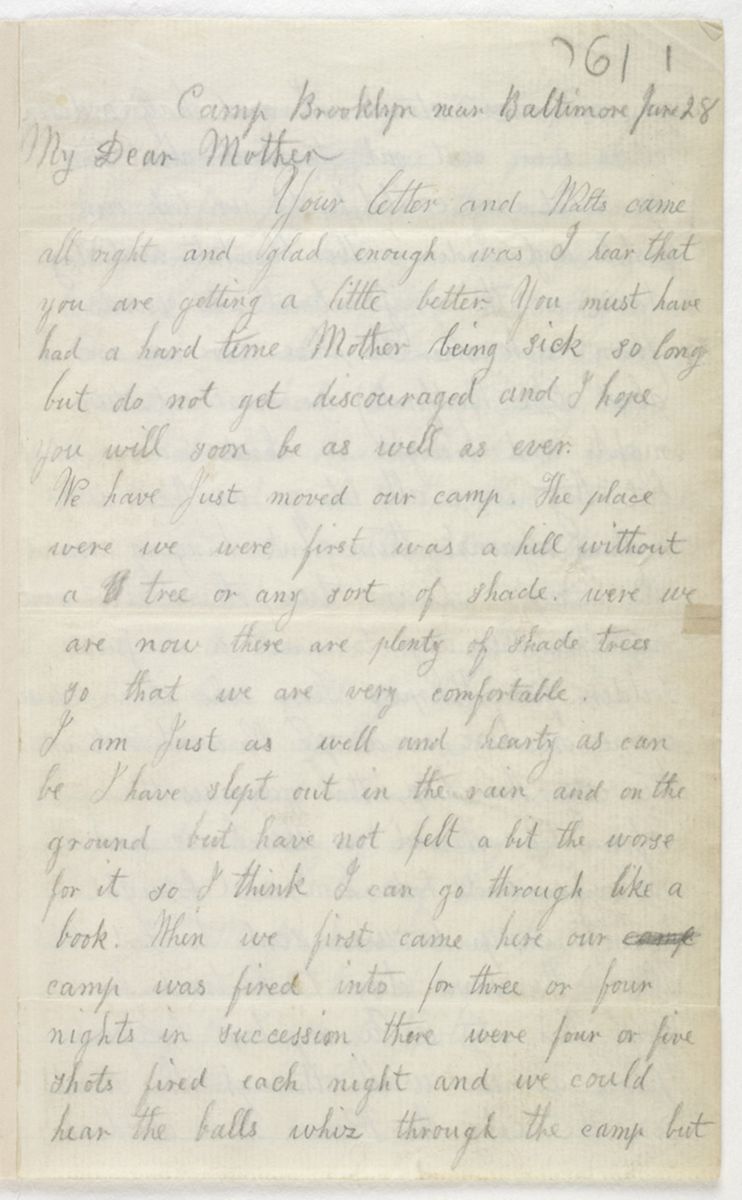
Your letter and Walts came all right and glad enough was I hear that you are getting a little better. You must have had a hard time Mother being sick so long but do not get discouraged and I hope you will soon be as well as ever.
We have Just moved our camp. The place were we were first was a hill without a tree or any sort of shade. were we are now there are plenty of shade trees so that we are very comfortable. I am Just as well and hearty as can be I have slept out in the rain and on the ground but have not felt a bit the worse for it so I think I can go through like a book. When we first came here our camp was fired into for three or four nights in succession there were four or five shots fired each night and we could hear the balls whiz through the camp but 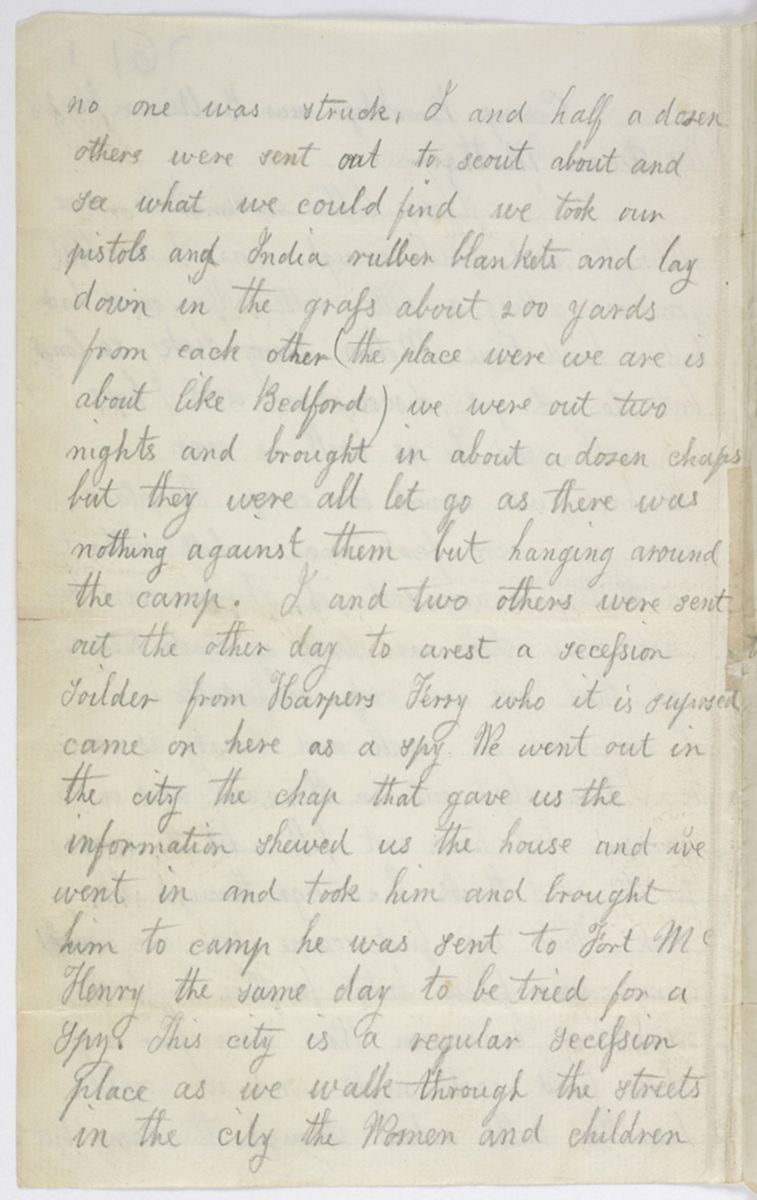 duk.00313.002_large.jpgno one was struck. I and half a dozen others were sent out to scout about and see what we could find we took our pistols and India rubber blankets and lay down in the grass about 200 yards from each other (the place were we are is about like Bedford) we were out two nights and brought in about a dozen chaps but they were all let go as there was nothing against them but hanging around the camp. I and two others were sent out the other day to arest
a secession soldier from Harpers Ferry who it is suposed came on here as a spy. We went out in the city the chap that gave us the information shewed us the house and we went in and took him and brought him to camp he was sent to Fort McHenry the same day to be tried for a spy. This city is a regular secession place as we walk through the streets in the city the Women and children
duk.00313.002_large.jpgno one was struck. I and half a dozen others were sent out to scout about and see what we could find we took our pistols and India rubber blankets and lay down in the grass about 200 yards from each other (the place were we are is about like Bedford) we were out two nights and brought in about a dozen chaps but they were all let go as there was nothing against them but hanging around the camp. I and two others were sent out the other day to arest
a secession soldier from Harpers Ferry who it is suposed came on here as a spy. We went out in the city the chap that gave us the information shewed us the house and we went in and took him and brought him to camp he was sent to Fort McHenry the same day to be tried for a spy. This city is a regular secession place as we walk through the streets in the city the Women and children 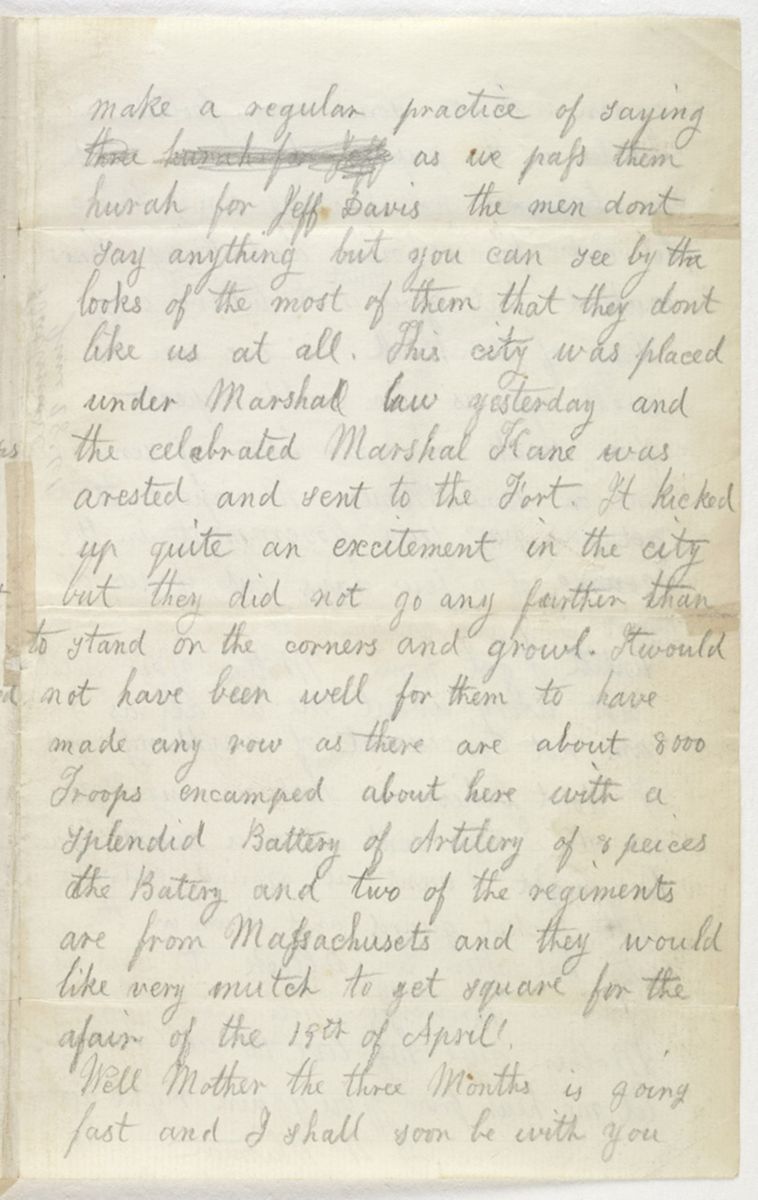 duk.00313.003_large.jpgmake a regular practice of saying as we pass them hurah for Jeff Davis the men dont
say anything but you can see by the looks of the most of them that they dont
like us at all. This city was placed under Marshal law yesterday and the celebrated Marshal Kane2 was arested
and sent to the Fort. It kicked up quite an excitement in the city but they did not go any further than to stand on the corners and growl. It would not have been well for them to have made any row as there are about 8000 Troops encamped about here with a Splendid Battery of Artilery
of 8 peices
the Batery
and two of the regiments are from Massachusets
and they would like very mutch
to get square for the afair
on the 19th of April.3
duk.00313.003_large.jpgmake a regular practice of saying as we pass them hurah for Jeff Davis the men dont
say anything but you can see by the looks of the most of them that they dont
like us at all. This city was placed under Marshal law yesterday and the celebrated Marshal Kane2 was arested
and sent to the Fort. It kicked up quite an excitement in the city but they did not go any further than to stand on the corners and growl. It would not have been well for them to have made any row as there are about 8000 Troops encamped about here with a Splendid Battery of Artilery
of 8 peices
the Batery
and two of the regiments are from Massachusets
and they would like very mutch
to get square for the afair
on the 19th of April.3
Well Mother the three Months is going fast and I shall soon be with you 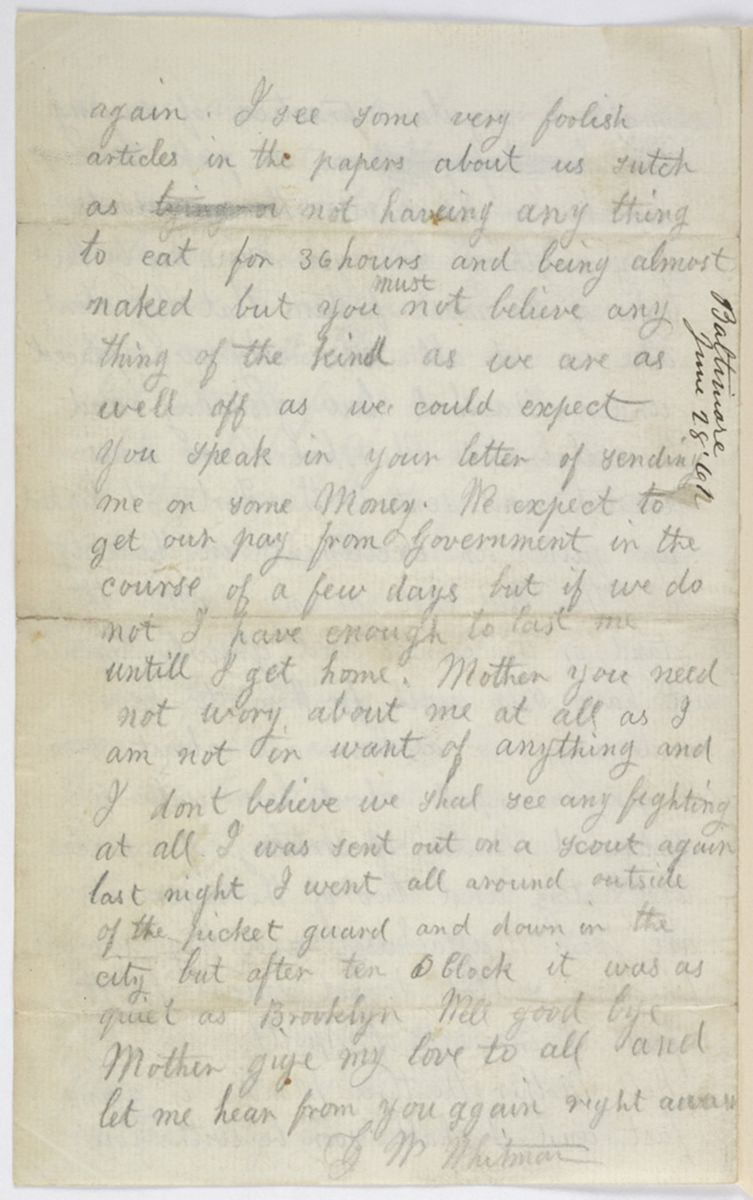 duk.00313.004_large.jpgagain. I see some very foolish articles in the papers about us sutch
as not haveing
any thing to eat for 36 hours and being almost naked but you must not believe any thing of the kind as we are as well off as we could expect4 You speak in your letter of sending me on some Money. We expect to get our pay from Government in the course of a few days but if we do not I have enough to last me untill
I get home. Mother you need not wory
about me at all as I am not in want of anything and I dont
believe we shal
see any fighting at all. I was sent out on a scout again last night I went all around outside of the picket guard and down in the city but after ten O Clock it was as quiet as Brooklyn Well good bye Mother give my love to all and let me hear from you again right away.
duk.00313.004_large.jpgagain. I see some very foolish articles in the papers about us sutch
as not haveing
any thing to eat for 36 hours and being almost naked but you must not believe any thing of the kind as we are as well off as we could expect4 You speak in your letter of sending me on some Money. We expect to get our pay from Government in the course of a few days but if we do not I have enough to last me untill
I get home. Mother you need not wory
about me at all as I am not in want of anything and I dont
believe we shal
see any fighting at all. I was sent out on a scout again last night I went all around outside of the picket guard and down in the city but after ten O Clock it was as quiet as Brooklyn Well good bye Mother give my love to all and let me hear from you again right away.
Notes
- 1. On April 19, 1861—shortly after the firing on Fort Sumter—George Whitman enlisted for one hundred days in the Thirteenth Regiment of the New York State Militia, which was commanded by Colonel Abel Smith. This regiment was first stationed at Annapolis, Maryland, from April 23, 1861, to June 16, 1861, when its encampment was shifted to an area adjacent to Baltimore. As his letter reflects, the majority of citizens there held secessionist sympathies. [back]
- 2. George Procter Kane (1817–1878) was the marshal of police in Baltimore. When the city was placed under martial law by General Butler, Kane resisted the order to surrender the city's arms and was arrested for protecting contraband traffic in arms and for being the head of a police force hostile to the United States Government. [back]
- 3. The Sixth Regiment of Massachusetts was attacked by angry crowds in Baltimore as the troops attempted to pass through the city. Four of its number were killed and many others wounded. [back]
- 4. In a letter to George dated July 12, 1861, from Brooklyn, Walt Whitman wrote: "There have been so many accounts of shameful negligence, or worse, in the commissariat of your reg't. that there must be something in it—notwithstanding you speak very lightly of the complaints in your letters. The Eagle, of course, makes the worst of it, every day, to stop men from enlisting" (The Correspondence, ed. Edwin Haviland Miller [New York: New York University Press, 1961–77], 1:56–57). [back]