Thomas Jefferson Whitman to Walt Whitman, 22 July 1877
 loc_ad.00523.jpg
St. Louis,
July 22nd 1877
Dear Walt—
loc_ad.00523.jpg
St. Louis,
July 22nd 1877
Dear Walt—
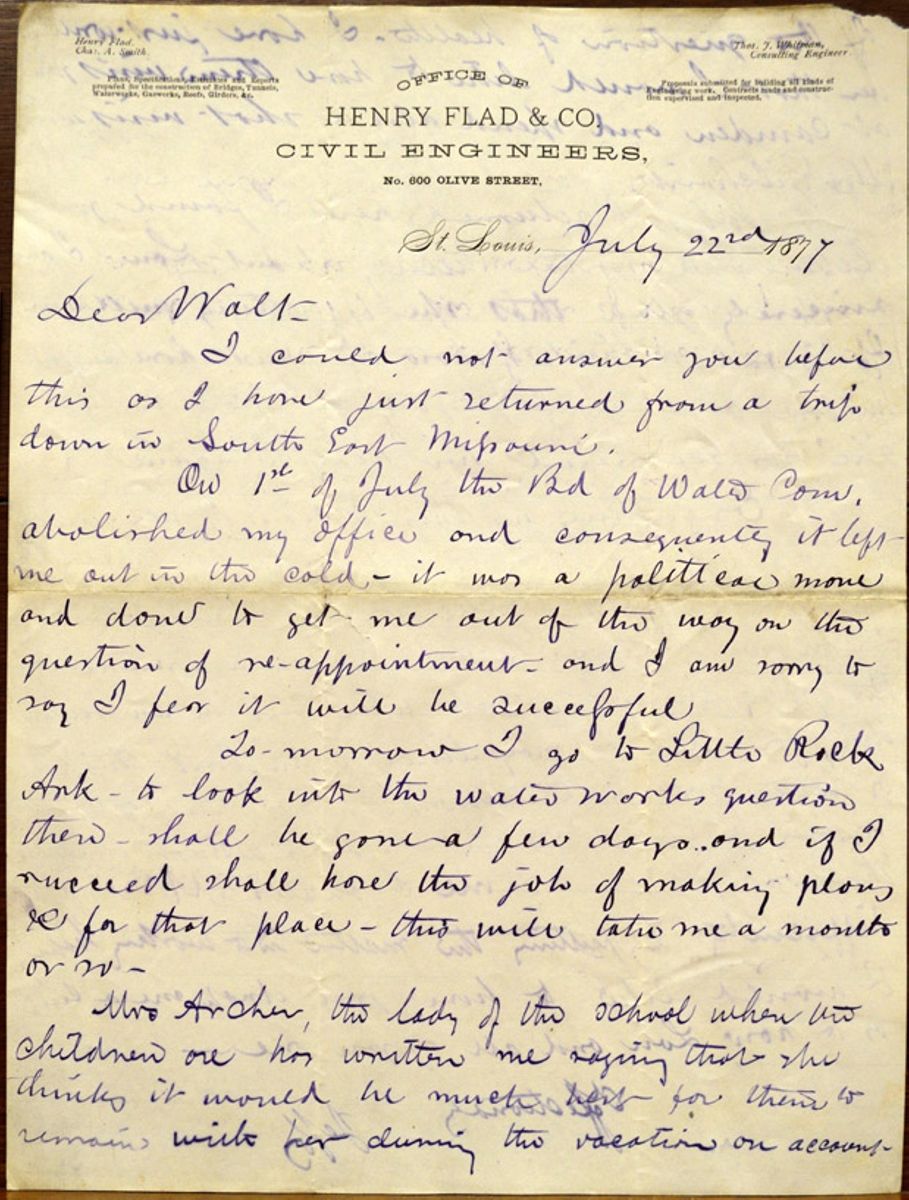
I could not answer you before this as I have just returned from a trip down in South East Missouri.
On 1st of July the Bd of Water Com. abolished my office and consequently it left me out in the cold—it was a political move and done to get me out of the way on the question of re-appointment—and I am sorry to say I fear it will be successful1
To-morrow I go to Little Rock Ark—to look into the water works question there—shall be gone a few days, and if I succeed shall have the job of making plans &c for that place—this will take me a month or so—
Mrs Archer, the lady of the school2 where the children are has written me saying that she thinks it would be much best for them to remain with her during the vacation on account
 loc_ad.00524.jpg
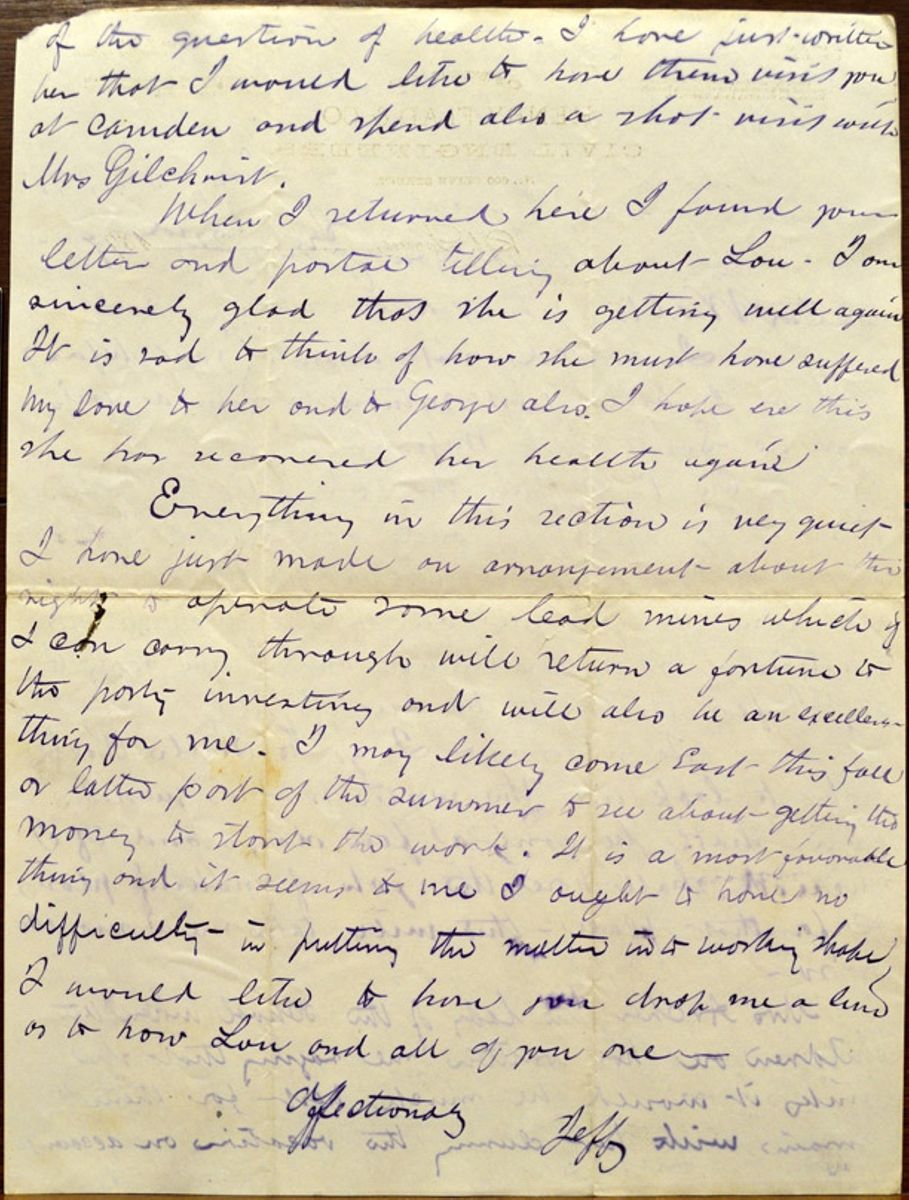
of the question of health.3 I have just written her that I would like to have them visit you at Camden and spend also a shot visit with Mrs Gilchrist.4
loc_ad.00524.jpg
of the question of health.3 I have just written her that I would like to have them visit you at Camden and spend also a shot visit with Mrs Gilchrist.4
When I returned here I found your letter and postal telling about Lou.5 I am sincerely glad that she is getting well again It is sad to think of how she must have suffered My love to her and to George also. I hope ere this she has recovered her health again.
Everything in this section is very quiet I have just made an arrangement about the right to operate some lead mines6 which if I can carry through will return a fortune to the party investing and will also be an excellent thing for me. I may likely come East this fall or latter part of the summer to see about getting the money to start the work. It is a most favorable thing and it seems to me I ought to have no difficulty in putting the matter into working shape I would like to have you drop me a line as to how Lou and all of you are—
Affectionately JeffNotes
- 1. From 1876 to 1877, St. Louis was in political turmoil. Under the new state constitution of August 1875, St. Louis adopted a city charter on August 22, 1876, which abolished the independent state Board of Water Commissioners and replaced it with a city Board of Public Improvements, a change similar to that made in Brooklyn in 1872 (see the letter from Thomas Jefferson Whitman to Louisa Van Velsor Whitman on December 8, 1872). Because of a series of legal challenges, the charter did not go into effect until April 1877, and the new Board was not appointed until August. The discredited political appointees of 1875 were apparently striking a final vindictive blow against Jeff before they were replaced under the new law. Nonetheless, the city council appointed Jeff as water commissioner on August 21 (Journal of the City Council, 10–30 August 1877). [back]
- 2. Mrs. Archers's Patapsco Seminary, located in Ellicott City, Maryland (Walt Whitman, The Correspondence, ed. Edwin Haviland Miller [New York: New York University Press, 1961-77], 3:99). [back]
- 3. On September 21, Whitman reported that Hattie, who was then visiting him, suffered from "a sort of Cholera morbus & fever" (The Correspondence, 3:97). [back]
- 4. The widow Anne Gilchrist (1828–1886), mother of four children and author of "A Woman's Estimate of Walt Whitman" (1870), left her home in England in 1876 to offer herself, body and soul, to the man she had envisioned from reading Leaves of Grass. In the poetry the Whitman persona spoke boldly of begetting "far more arrogant republics" ("Song of Myself"), but in dealing with Mrs. Gilchrist's passion Whitman was timid and evasive. [back]
- 5. Whitman's letter of about July 21 is not extant. The poet undoubtedly informed Jeff that Louisa's baby had died before it was delivered (see the letter from Whitman to Emma Dowe on July 12, 1877). [back]
- 6. During this period the lead trade was among the fastest-growing and most profitable segments of the St. Louis economy. [back]