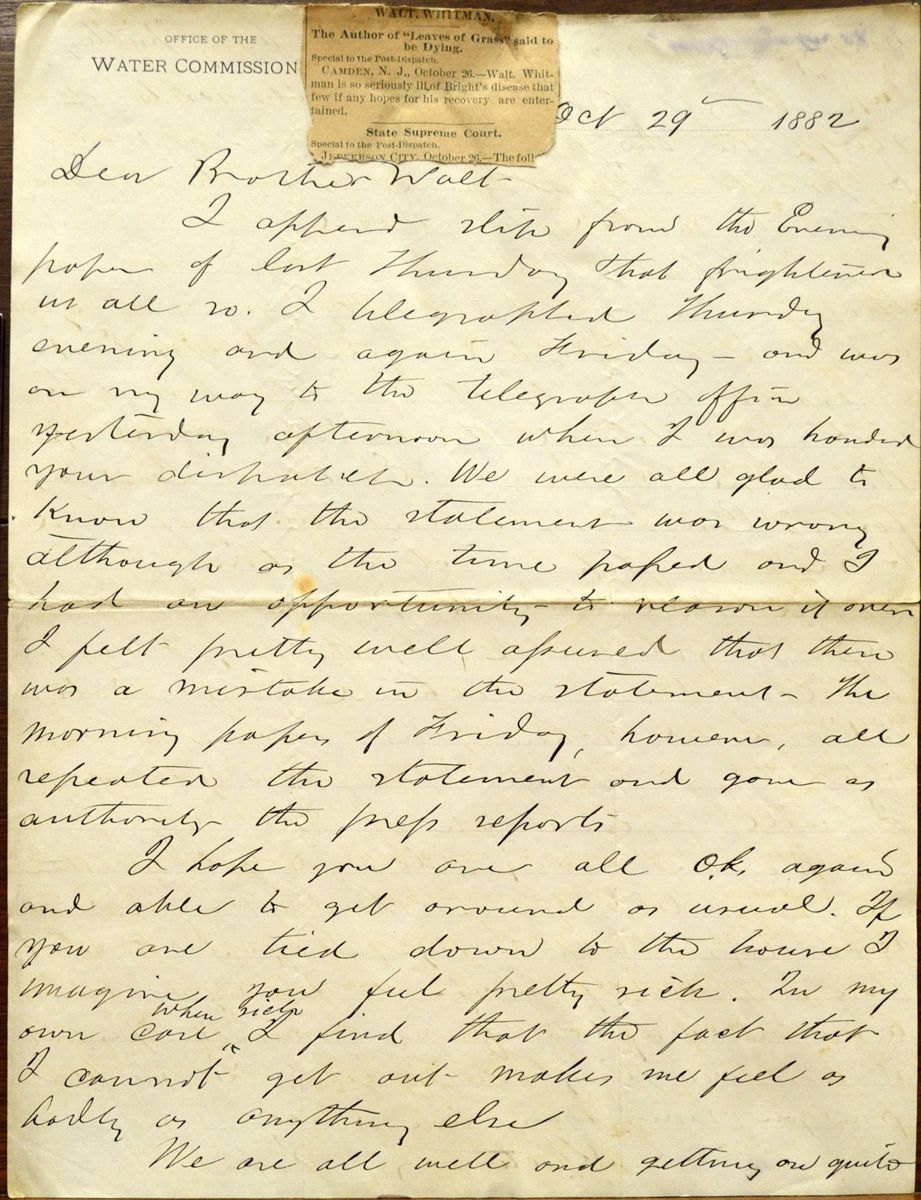
St. Louis,
Oct 29 1882
I append [a] slip from the Evening paper of last Thursday that frightened us all so. 2 I telegraphed Thursday evening and again Friday—and was on my way to the telegraph office yesterday afternoon when I was handed your dispatch. 3 We were all glad to know that the statement was wrong although as the time passed and I had an opportunity to reason it over I felt pretty well assured that there was a mistake in the statement 4 —The morning papers of Friday, however, all repeated the statement and gave as authority the press reports
I hope you are all o.k. again and able to get around as usual. If you are tied down to the house I imagine you feel pretty sick. In my own case when sick I find that the fact that I cannot get out makes me feel as badly as anything else
We are all well and getting on quite nicely. The girls have been busy "putting up" large quantities of all sorts of stuff in the pickle &c line—as much to practice I presume as with any idea that it would be needed
I have had considerable to do this summer 5 —have only been away once (to St Joseph) since I was East I expect to go to St Jo the last of this week—and toward the middle or last of Nov hope to come East—at least as far as Camden—so dont be surprised to see me pop in at any time
All send love to George and Lou and to yourself—by-the-way I must be considerable behind in regard to Ed's board 6 —when George or Lou write ask them to please state how far and I will square up—
We are having splendid fall weather—never so delightful—I have just finished a seven days out door survey—putting up at the nearest place where night found us—the country was new to me and very beautiful—the weather perfect it was like going back 25 years. Let me hear from you soon—again love to all
Affectionately Jeff
The text presented here is derived from Dennis Berthold and Kenneth Price, eds., Dear Brother Walt: The Letters of Thomas Jefferson Whitman (Kent, Ohio: Kent State University Press, 1984). For a detailed description of discrepancies between this electronic edition and the print source, see our statement of editorial policy .
The manuscript of this letter, dated October 29, 1882, is held in the Charles E. Feinberg Collection of the Papers of Walt Whitman, 1839-1919, Library of Congress, Washington, DC.
For more information on the letters of Thomas Jefferson Whitman, see Dennis Berthold and Kenneth Price's introduction to the print edition.
1. On September 10, 1879, Walt departed from Camden on a western jaunt to participate in the Old Settlers' Quarter Centennial Celebration near Lawrence, Kansas. The poet travelled in the company of the Philadelphia publisher John W. Forney and newspapermen J. M. W. Geist, E. K. Martin, and W. W. Reitzel. By September 12 the group had reached St. Louis, where Jeff guided them on a tour of the city. According to Geist, "nothing interested us more than an inspection of the Water Works....As we went down the winding stairs with the great deep pit below the bed of the river, and viewed the herculean workings of these ponderous machines, we felt like taking off our hats in reverence to the engineering and mechanical skill which were personified in those masses of immovable stone and animated iron and steel." Geist judged Jeff's water tower to be "the only beautiful...standpipe...I have ever seen. It is a perfect copy of the classic Corinthian column on a collasal [sic] scale" ( Daily New Era [Lancaster, Pennsylvania], September 17, 1879).
Although Geist's paean may today sound excessive, he was giving voice to the widespread nineteenth-century excitement about the advances of science. Walt, too, marvelled at the engineering achievements of St. Louis, particularly the Eads Bridge: "I dont believe there can be a grander thing of the kind on earth" (Edwin Haviland Miller, ed., Walt Whitman: The Correspondence [New York: New York Univ. Press, 1961-77], Vol. III, p. 172); "It is indeed a structure of perfection and beauty unsurpassable, and I never tire of it" (Floyd Stovall, ed., Walt Whitman: Prose Works 1892 [New York: New York Univ. Press, 1963-64], Vol. I, p. 229). Surprisingly, the poet left no record of his reaction to Jeff's waterworks, an omission which seems especially odd when compared with Geist's enthusiasm.
After his one-day stop in St. Louis, Walt travelled as far west as the Rockies and then returned to St. Louis, tired and ill, on September 27. He recuperated during a three-month visit with Jeff and the girls, but there were some difficulties: he was irritated by Hattie's piano playing and troubled by a shortage of money (See Jessie Whitman's interview with Garrett Newkirk, Fansler Collection, Northwestern Univ., and Gay Wilson Allen, The Solitary Singer: A Critical Biography of Walt Whitman [New York: Macmillan, 1955; rev. ed., New York Univ. Press, 1967], p. 489). Nonetheless, Walt and Jefff seem to have enjoyed their first extended visit in over a decade.
(Back)2. Jeff enclosed a clipping from the St. Louis Post-Dispatch of October 26, 1882, stating that "Walt Whitman is so seriously ill of Bright's disease that few if any hopes for his recovery are entertained." (Back)
3. WW's telegram of October 28, 1882, is not extant. (Back)
4. False reports about the poet's health seem to have been innumerable. Two of the more colorful rumors were the belief in 1871 that WW had been killed in a train crash and in 1877 that the poet was starving ( Correspondence , II, 123, and IV, 72). (Back)
5. There was some interest at this time in expanding the waterworks. On October 5, 1882, Sarah L. Glasgow, wife of the public school commissioner Wiliam Glasgow, Jr., and daughter of the first mayor of St. Louis, wrote to her family in Paris: "The news from the Water Works is not encouraging....They say Flad and Whitman are making an exhaustive search, strange to say the Chain [of Rocks] is not mentioned but a spot one mile above the Chain and Music's Ferry near St Charles are spoken of....I am persuaded it only wants a thousand or so dollars to decide Flad, but he will have to decide without any such reminder from any of us" (William Carr Lane Collection, Missouri Historical Society). Interestingly, Mrs. Glasgow thinks that Flad can be bribed but not, apparently, Jeff. When the waterworks was finally extended to the Chain of Rocks in 1890, the city paid William Glasgow, Jr., $39,000 for his land near the site. (Back)
6. Edward had been boarding for some years with various families and WW generally made the monthly payments, which at this time were sixteen dollars. Here Jeff implies that he too is obligated to support his feebleminded brother and wants to even up on back payments. (Back)
loc.00477