Thomas W. H. Rolleston to Walt Whitman, 4 June [1881]
 loc_af.00999_large.jpg
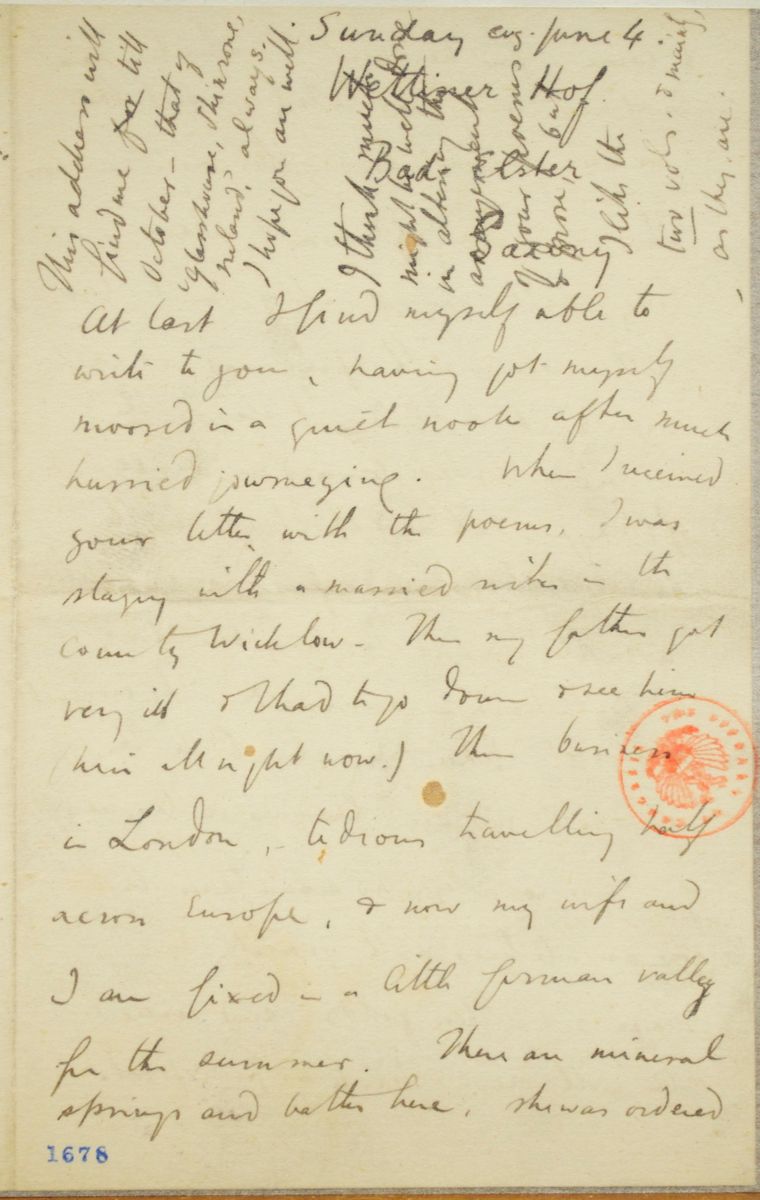
Sunday evg. June 4.
Wettiner Hof.
Bad-Elster
Saxony
loc_af.00999_large.jpg
Sunday evg. June 4.
Wettiner Hof.
Bad-Elster
Saxony
At last I find myself able to write to you, having got myself moored in a quiet nook
after much hurried journeying. When I received your letter with the poems, I was
staying with a married sister1 in the county Wicklow.
Then my father got very ill & I had to go down & see him (he is all right now.)
Then business in London, tedious travelling half across Europe, & now my wife and
I are fixed in a little German valley for the summer. There are mineral springs and
baths here; she was ordered 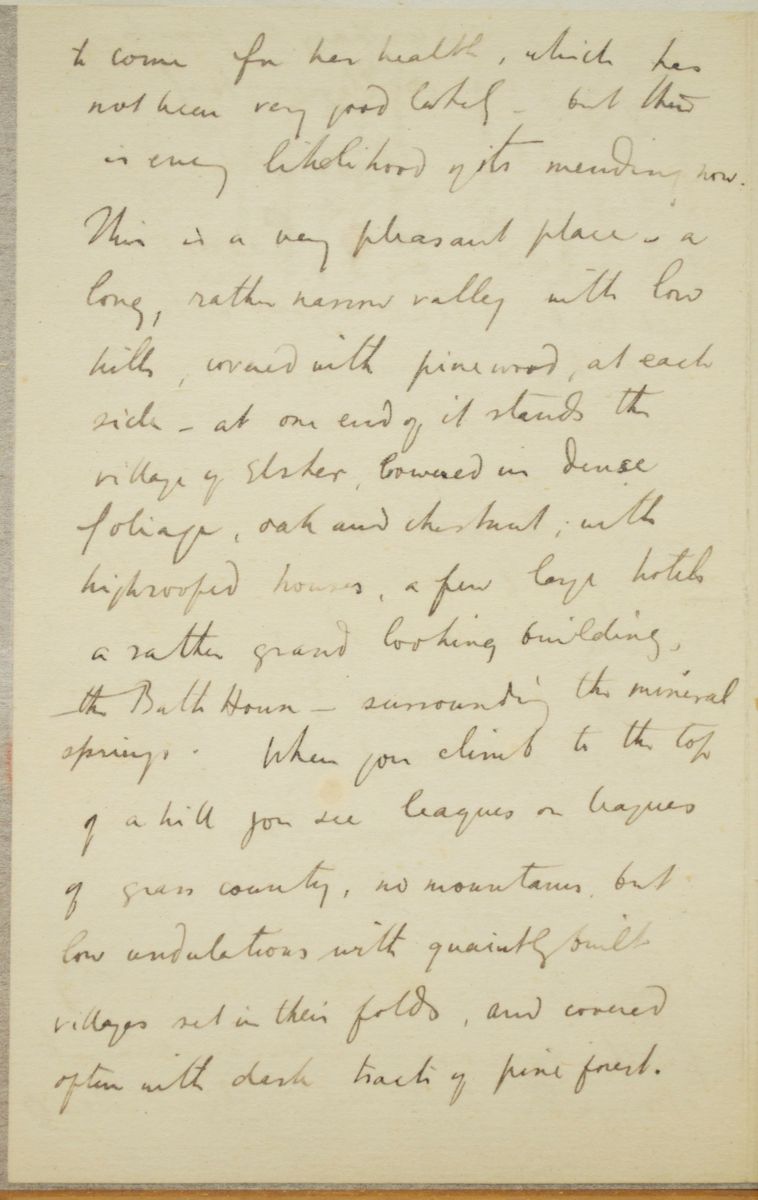 loc_af.01000_large.jpg to come for her health, which has not been very good
lately—but there is every likelihood of its mending now. This is a very
pleasant place—a long, rather narrow valley with low hills, covered with
pinewood, at each side—at one end of it stands the village of Elster, bowered
in dense foliage, oak and chestnut; with highroofed houses, a few large hotels, a
rather grand looking building,—the Bath House—surrounding the mineral
springs. When you climb to the top of a hill you see leagues on leagues of grass
country, no mountains, but low undulations with quaintly built villages set in their
folds, and covered often with dark tracts of pine forest.
loc_af.01000_large.jpg to come for her health, which has not been very good
lately—but there is every likelihood of its mending now. This is a very
pleasant place—a long, rather narrow valley with low hills, covered with
pinewood, at each side—at one end of it stands the village of Elster, bowered
in dense foliage, oak and chestnut; with highroofed houses, a few large hotels, a
rather grand looking building,—the Bath House—surrounding the mineral
springs. When you climb to the top of a hill you see leagues on leagues of grass
country, no mountains, but low undulations with quaintly built villages set in their
folds, and covered often with dark tracts of pine forest. 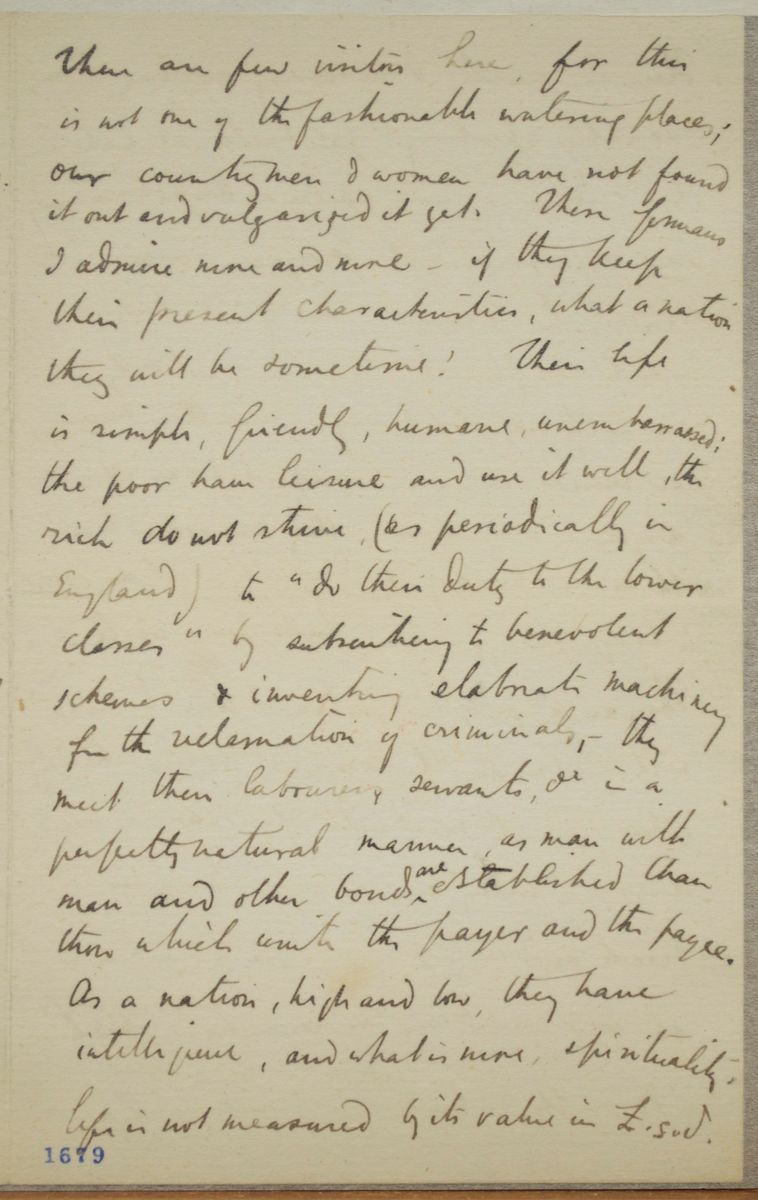 loc_af.01001_large.jpg There are few visitors here, for
this is not one of the fashionable watering places; our countrymen & women have
not found it out and vulgarized it yet. These Germans I admire more and
more—if they keep their present characteristics, what a nation they will be
sometime! Their life is simple, friendly, humane, unembarrassed; the poor have
leisure and use it well, the rich do not strive, (as periodically in England) to "do
their duty to the lower classes" by subscribing to benevolent schemes &
inventing elaborate machinery for the reclamation of criminals,—they meet
their labourers, servants, &c in a perfectly natural manner, as man with man and
other bonds are established than
those which unite the payer and the payee. As a nation, high and low, they have
intelligence, and what is more, spirituality—life is not measured by its
value in £.s.d.
loc_af.01001_large.jpg There are few visitors here, for
this is not one of the fashionable watering places; our countrymen & women have
not found it out and vulgarized it yet. These Germans I admire more and
more—if they keep their present characteristics, what a nation they will be
sometime! Their life is simple, friendly, humane, unembarrassed; the poor have
leisure and use it well, the rich do not strive, (as periodically in England) to "do
their duty to the lower classes" by subscribing to benevolent schemes &
inventing elaborate machinery for the reclamation of criminals,—they meet
their labourers, servants, &c in a perfectly natural manner, as man with man and
other bonds are established than
those which unite the payer and the payee. As a nation, high and low, they have
intelligence, and what is more, spirituality—life is not measured by its
value in £.s.d.
 loc_af.01002_large.jpg
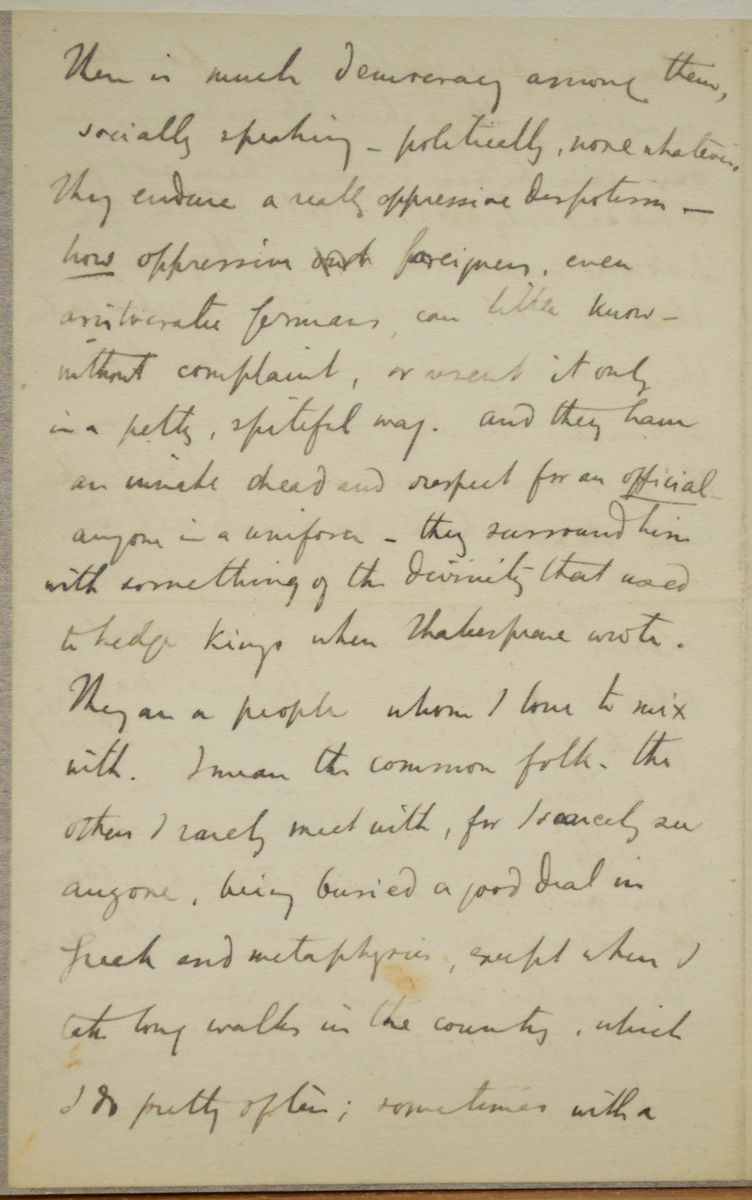
There is much
democracy among them, socially speaking—politically, none whatever. They
endure a really oppressive despotism—how oppressive
foreigners, even aristocratic Germans, can little know—without complaint, or
resent it only in a petty, spiteful way. And they have an innate dread and respect
for an official—anyone in a uniform—they
surround him with something of the divinity that used to hedge kings when
Shakespeare wrote. They are a people whom I love to mix with. I mean the common
folk, the others I rarely meet with, for I scarcely see anyone, being buried a good
deal in Greek and metaphysics, except when I take long walks in the country, which I
do pretty often; sometimes with a 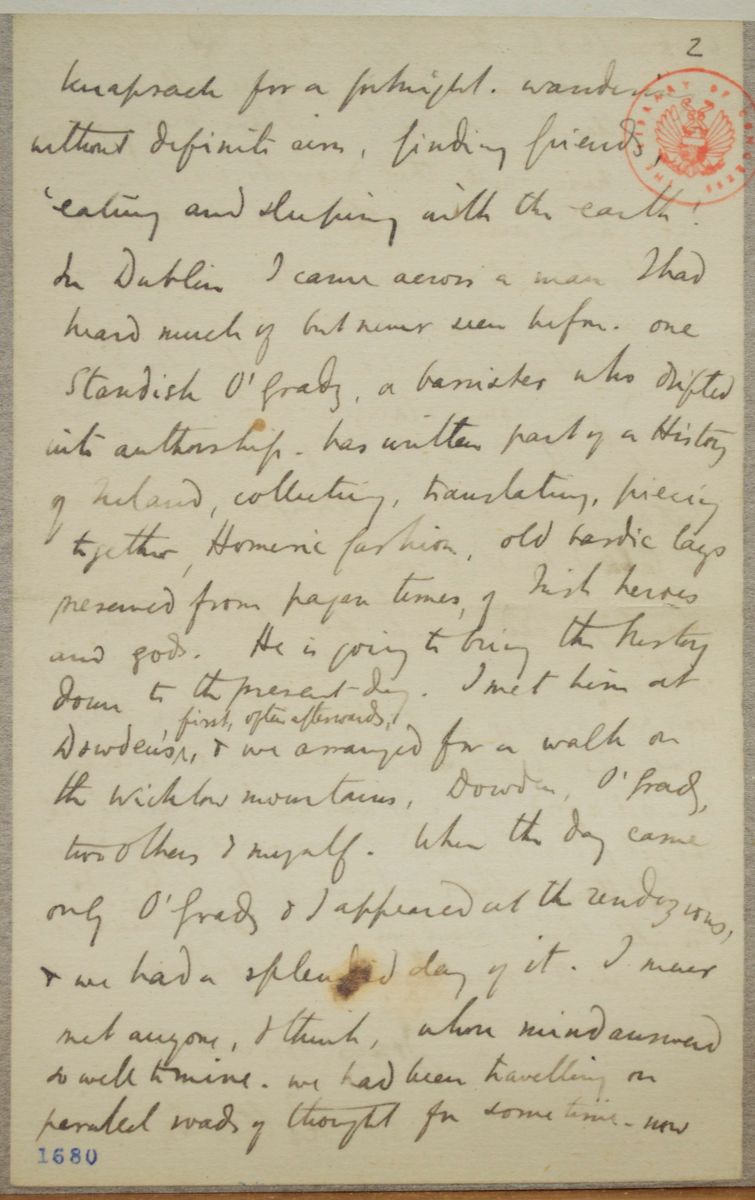 loc_af.01003_large.jpg knapsack for a fortnight, wandering
without definite aim, finding friends, 'eating and sleeping with the earth.'
loc_af.01003_large.jpg knapsack for a fortnight, wandering
without definite aim, finding friends, 'eating and sleeping with the earth.'
In Dublin I came across a man I had heard much of but never seen before, one Standish
O'Grady, a barrister who drifted into authorship, has written part of a History of
Ireland, collecting, translating, piecing together, Homeric fashion, old bardic lays
preserved from pagan times, of Irish heroes and gods. He is going to bring the
history down to the present day.2 I met him at Dowden's
first, often afterwards, & we
arranged for a walk on the Wicklow mountains, Dowden, O'Grady, two others &
myself. When the day came only O'Grady and I appeared at the rendezvous, & we
had a splendid day of it. I never met anyone, I think, whose mind answered so well
to mine. We had been travelling on parallel roads of thought for some time—now
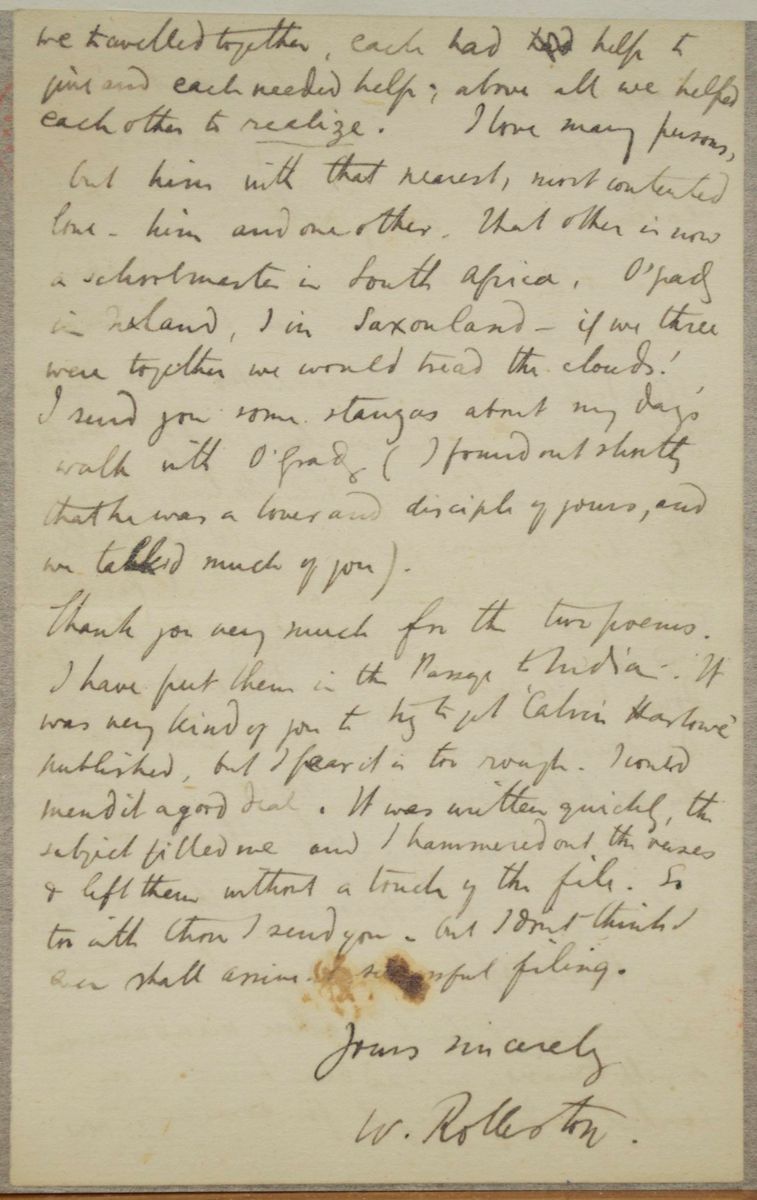 loc_af.01004_large.jpg we travelled
together. Each had help to give and each needed
help; above all we helped each other to realize. I love
many persons, but him with that nearest, most contented love—him and one
other. That other is now a schoolmaster in South Africa.3
O'Grady in Ireland, I in Saxonland—if we three were together we would tread
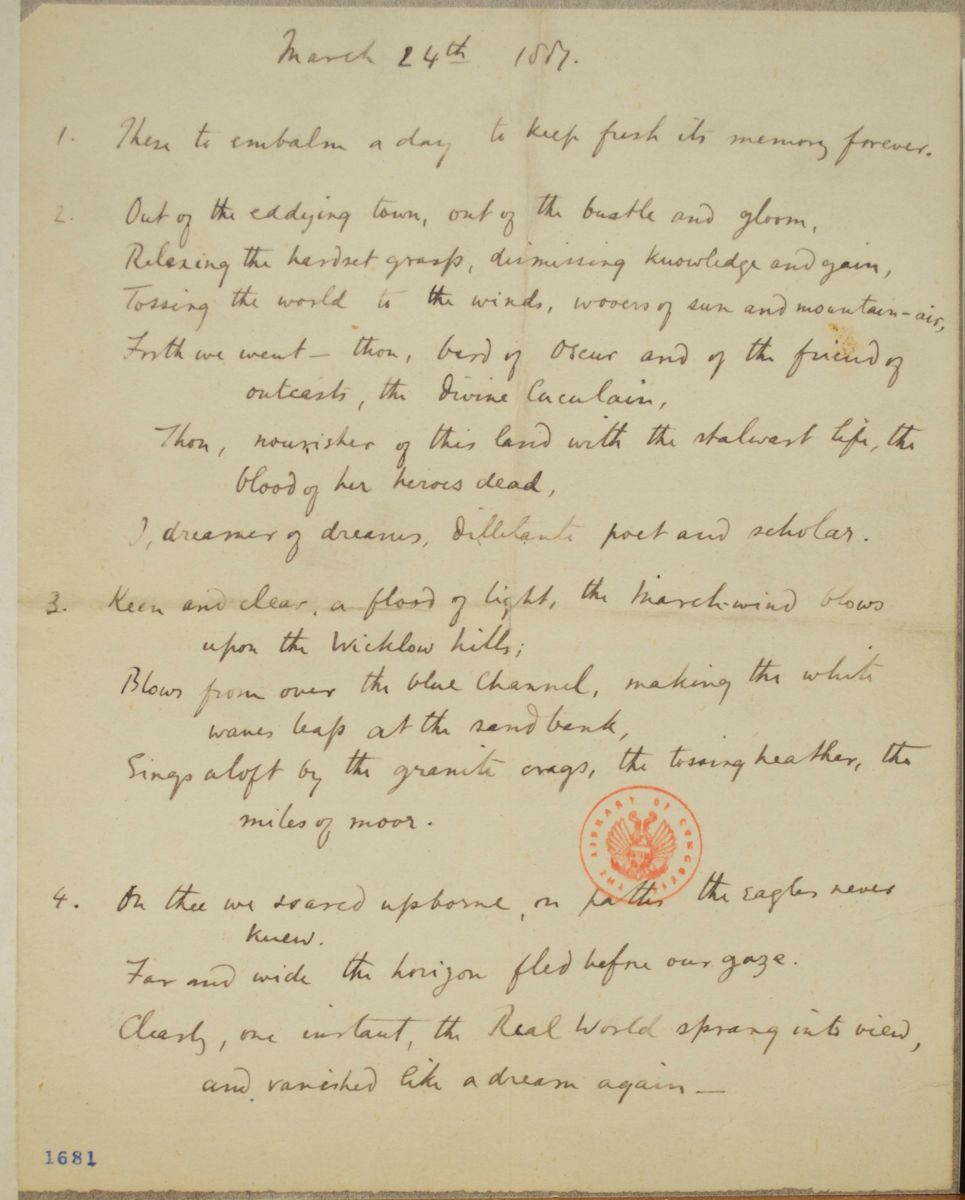
the clouds! I send you some stanzas about my day's walk with O'Grady (I found out
shortly that he was a lover and disciple of yours, and we talked much of you).
loc_af.01004_large.jpg we travelled
together. Each had help to give and each needed
help; above all we helped each other to realize. I love
many persons, but him with that nearest, most contented love—him and one
other. That other is now a schoolmaster in South Africa.3
O'Grady in Ireland, I in Saxonland—if we three were together we would tread
the clouds! I send you some stanzas about my day's walk with O'Grady (I found out
shortly that he was a lover and disciple of yours, and we talked much of you).
Thank you very much for the two poems.4 I have put them in the Passage to India. It was very kind of you to try to get 'Calvin Harlowe' published, but I fear it is too rough. I could mend it a good deal. It was written quickly, the subject filled me and I hammered out the verses & left them without a touch of the file. So too with those I send you—but I don't think I ever shall arrive at successful filing.
Yours sincerely W. Rolleston.This address will find me till October—that of 'Glasshouse, Shinrone, Ireland,' always. I hope you are well.
I think much might be well done in altering the arrangement of your poems & prose, but I like the two vols. & mainly, as they are.
 loc_af.01005_large.jpg
 loc_af.01006_large.jpg
 loc_af.01007_large.jpg
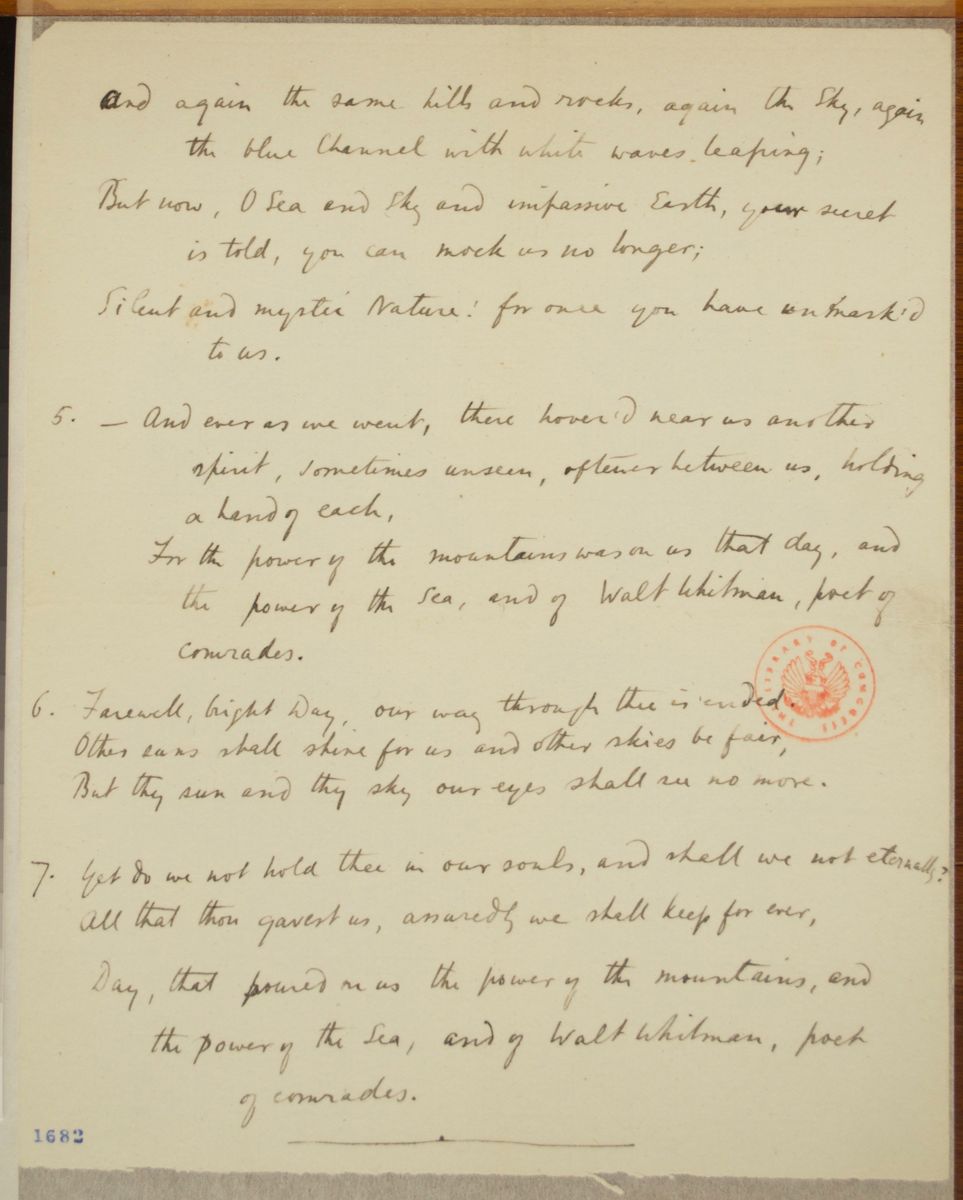
And again the same hills and rocks, again the Sky, again the blue Channel
with white waves leaping;
But now, O Sea and Sky and impassive Earth, your secret is told, you can
mock us no longer;
Silent and mystic Nature! for once you have unmask'd to us.
5. —And ever as we went, there hover'd near us another spirit,
sometimes unseen, oftener between us, holding a hand of each,
For the power of the mountains was on us that day, and the power of the
Sea, and of Walt Whitman, poet of comrades.
6. Farewell, bright Day, our way through thee is ended.
Other suns shall shine for us and other skies be fair,
But thy sun and thy sky our eyes shall see no more.
7. Yet do we not hold thee in our souls, and shall we not eternally?
All that thou gavest us, assuredly we shall keep for ever,
Day, that poured on us the power of the mountains, and the power of the
Sea, and of Walt Whitman, poet of comrades.
loc_af.01007_large.jpg
And again the same hills and rocks, again the Sky, again the blue Channel
with white waves leaping;
But now, O Sea and Sky and impassive Earth, your secret is told, you can
mock us no longer;
Silent and mystic Nature! for once you have unmask'd to us.
5. —And ever as we went, there hover'd near us another spirit,
sometimes unseen, oftener between us, holding a hand of each,
For the power of the mountains was on us that day, and the power of the
Sea, and of Walt Whitman, poet of comrades.
6. Farewell, bright Day, our way through thee is ended.
Other suns shall shine for us and other skies be fair,
But thy sun and thy sky our eyes shall see no more.
7. Yet do we not hold thee in our souls, and shall we not eternally?
All that thou gavest us, assuredly we shall keep for ever,
Day, that poured on us the power of the mountains, and the power of the
Sea, and of Walt Whitman, poet of comrades.
 loc_af.01008_large.jpg
 loc_af.00997_large.jpg
 loc_af.00998_large.jpg
Notes
- 1. Rolleston's only sister—to whom he was very devoted—was married to Henry Truell of Clonmannon, County Wicklow. [back]
- 2. The historical writings of Standish O'Grady (1846–1928) were an inspiration to the great Irish Literary Revival. He has often been referred to as the father of this movement. Between 1878 and 1880, he published the two volumes of History of Ireland: Heroic Period. [back]
- 3. In a letter to Horst Frenz of August 13, 1950, Captain C. H. Rolleston wrote: "I do not think there can be any doubt that my Father's schoolmaster friend was H. B. Cotterill, M.A., who was later in Germany and was the author of a version of Homer's Odyssey in English hexameters." [back]
- 4. One of the poems is probably "To the Man-of-War-Bird" referred to in the letter from Rolleston to Whitman, February-May 1881. [back]