With Walt Whitman in Camden (vol. 1)
Copyright, 1905, 1906, by Horace Traubel
Copyright, 1905, by The Century Company
Entered at Stationers' Hall
Published February, 1906
Press of Geo. H. Ellis Co.
Boston, U.S.A.
To Readers
My story is left as it was originally written. I have made no attempt to improve it. I have taken nothing off and put nothing on. I know that it has defects. I am not ashamed of defects. I know that it has virtues. I am not proud of virtues. Here is the record as it virginally came from my hands in the quick of the struggle it describes. It might have been made more literary. It might have been made more precise. Its loose joints might have been tightened. Some commas might have been put where colons are. Phrases might have been swung about. The formal grace of the recital might have been improved. I have preferred to respect its integrity. To let it remain untouched by a censorship. To let it continue, for good or bad, in its then native atmosphere. I do not want to reshape those years. I want them left as they were. I keep them forever contemporary. I trust in the spontaneity of their first inspirations.
Did Whitman know I was keeping such a record? No. Yet he knew I would write of our experiences together. Every now and then he charged me with immortal commissions. He would say: "I want you to speak for me when I am dead." On several occasions I read him my reports. They were very satisfactory. "You do the thing just as I should wish it to be done." He always imposed it upon me to tell the truth about him. The worst truth no less than the best truth. He did [Begin page viii]not ask to have his failings paraded but he did ask that they should not be hid. He knew that imperfection is a part of perfection. He knew that our blood runs black as well as red. He did not like evil talked about as if it was fatal. But he knew that a place must be provided for it in any portrait of a person or in any portrayal of an event. So I have let Whitman alone. I have let him remain the chief figure in his own story. This book is more his book than my book. It talks his words. It reflects his manner. It is the utterance of his faith. That is why I have not fooled with its text. Why I have chosen to leave it in its unpremeditated arrangement of light and shade. Why I have not attempted to make it conform to any arbitrary humors of the bookmaker. It was not my purpose to produce a work to dazzle the scholar but to tell a simple story. Or, rather, in the main, to let a certain story tell itself. I have done nothing negatively to disguise any poverty in the portrait and nothing affirmatively to falsely enrich it. I have had only one anxiety. To set down the record. Then to get out of the way myself. To give the observer every privilege of vision. I do not come to conclusions. I provide that which may lead to conclusions. I provoke conclusions.
A number of the collateral documents quoted are from Whitman himself. These are printed without repair. They are kept to his own text without elision and without change. The same thing may be said of the letters from others to Whitman. Nothing has been done to sophisticate the text. It occurs here in the rude dress natural to the incidents that produced it. I had no time then to polish. I have had no [Begin page ix]disposition since to do what I had no time to do then. The record begs no questions. Never makes worse of better or better of worse. Tries to explain away no sin. Tries to lug in no virtue. Whitman was not afraid of the man who would make too little of him. He was afraid of the man who would make too much of him. He knew that it was easier to survive some kinds of enemies than to survive some kinds of friends. Whitman did not insist upon his faults. But he wanted them all counted in. The last fault with the first fault. He would rather have been thought too little of than too much of. I have never lost sight of his command of commands: "Whatever you do do not prettify me."
HORACE TRAUBEL Camden, February, 1906ILLUSTRATIONS CONTAINED IN THIS VOLUME
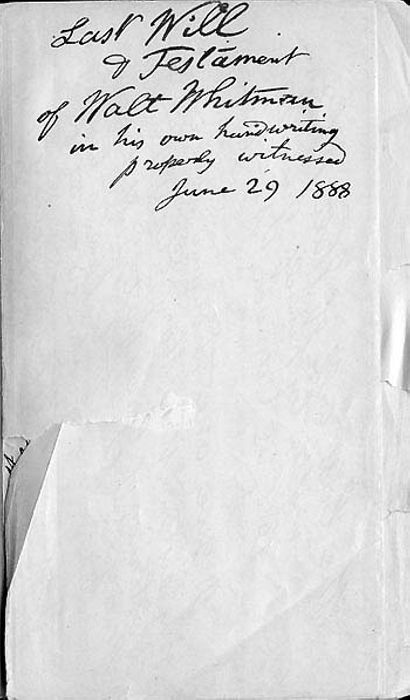
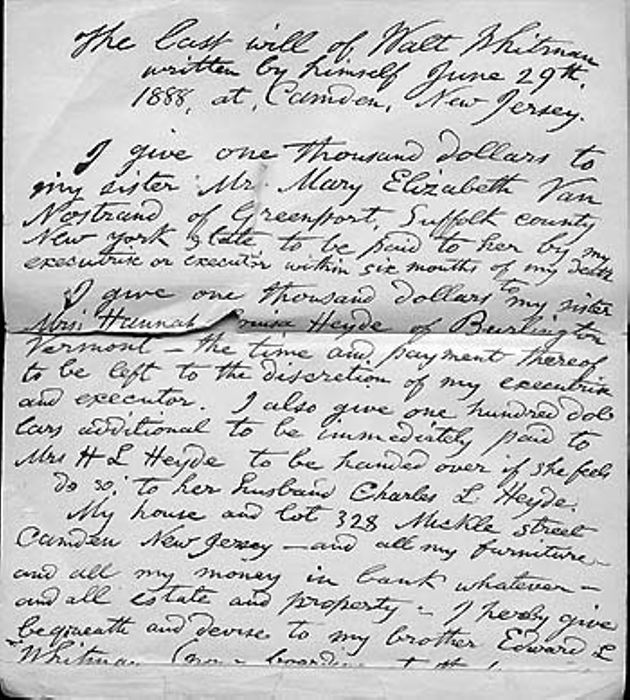
| Last Will and Testament of Walt Whitman, | Facing page ii |
| "In his own handwriting, properly witnessed, | |
| June 29, 1888." | |
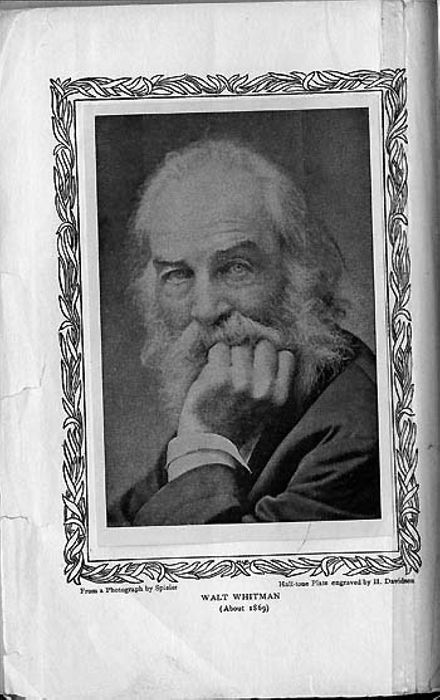
| Walt Whitman | Frontispiece |
| From a photograph by Spieler, about 1869 | |
| Whitman's Inscription in one of Horace Traubel's | |
| Copies of "Complete Poems and Prose" (1889) | Page xv |
| Facing Page | |
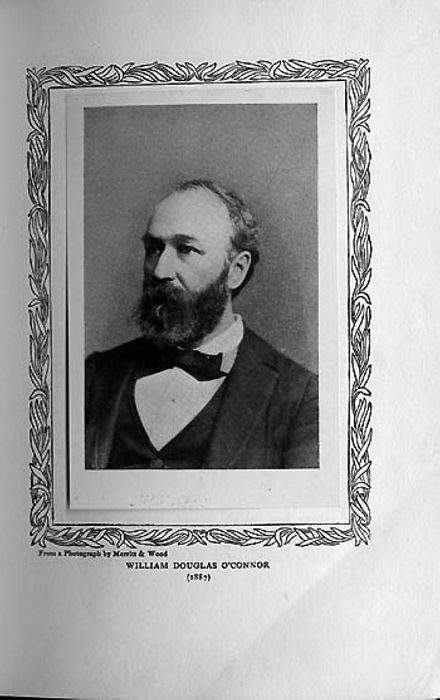
| William Douglas O'Connor | 4 |
| From a photograph by Merritt & Wood, 1887 | |
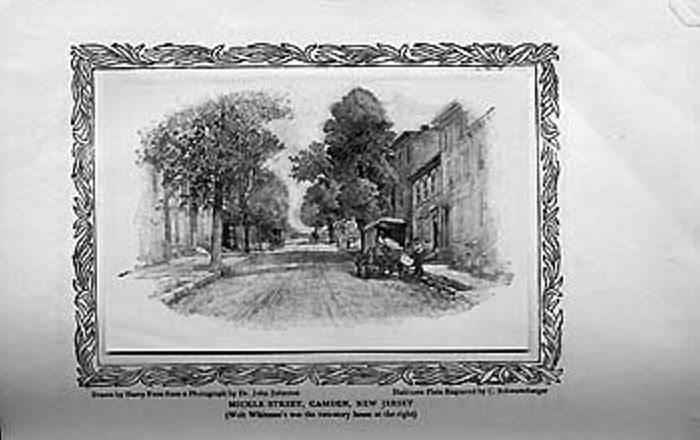
| Mickle Street, Camden, New Jersey | 20 |
| Drawn by Harry Fenn, from a photograph by Dr. John Johnston | |
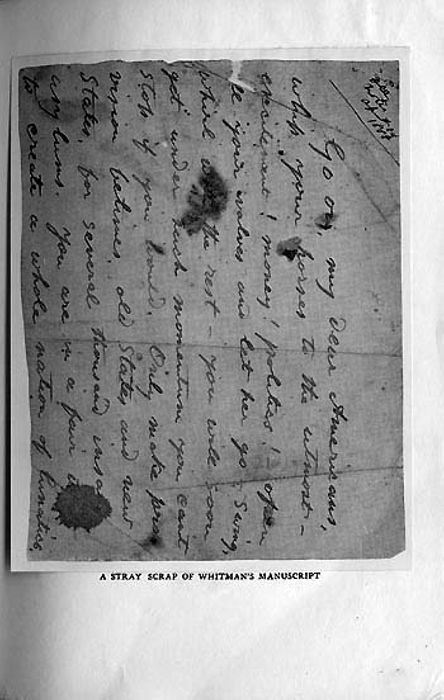
| A Stray Scrap of Whitman's Manuscript | 26 |
| "Go on, my dear Americans" | |
| A Tennyson Letter to Walt Whitman | 36 |
| Robert G. Ingersoll | 38 |
| From a photograph by Houseworth & Co., 1877 | |
| Joaquin Miller | 44 |
| Paris, 1874 | |
| Richard Maurice Bucke | 66 |
| From a photograph by Edy Bros., 1896 | |
| John Addington Symonds | 76 |
| From a photograph by C. V. Bark, about 1872 | |
| John Burroughs | 88 |
| From a photograph by J. Golden, about 1870 | |
| Edward Carpenter | 104 |
| About 1879 | |
| Daniel G. Brinton | 128 |
| About 1899 | |
| Walt Whitman | 154 |
| From the painting by Thomas Eakins, 1887 | |
| Richard Watson Gilder | 170 |
| From a photograph by George C. Cox, about 1880 |
ILLUSTRATIONS
| Facing Page | |
| "Shakespere-Bacon's Cipher" | 180 |
| A proof-slip of one of Whitman's Poems for private distribution | |
| set up at the printing office of Henry Curtz | |
| A Letter of Introduction from Walt Whitman | 192 |
| Walt Whitman | 198 |
| From the plaster bust by Sidney Morse, 1887 | |
| A Page from the Symonds Letter to Walt Whitman | 204 |
| A Lanier Letter to Walt Whitman | 208 |
| Frank B. Sanborn | 212 |
| From a photograph by Gehrig & Windeatt | |
| Thomas B. Harned | 234 |
| From a photograph by Allen Cook, 1904 | |
| Walt Whitman | 276 |
| From a photograph by Brady, about 1867 | |
| John Addington Symonds's Home at Davos Platz | 288 |
| Anne Gilchrist | 308 |
| From a photograph by Miss Davison, 1884 | |
| Walt Whitman | 334 |
| From a photograph by Brady, about 1862 | |
| Walt Whitman | 338 |
| From a photograph by Gardner, about 1864 | |
| A Page of a Note from Lord Houghton to Walt Whitman | 364 |
| Walt Whitman | 390 |
| From a photograph by Gardner, 1863 | |
| Rudolf Schmidt | 406 |
| From a photograph by Sinding, about 1872 | |
| Horace Traubel | 422 |
| From a photograph by Allen Cook, 1904 | |
| A Page from a Dowden Letter to Walt Whitman | 444 |
| Elias Hicks | 448 |
| From a copper plate by Peter Maverick after a painting | |
| from life by Henry Inman | |
| Augusta (Traubel) Harned | 460 |
| From a photograph by Gutekunst |
LETTERS CONTAINED IN THIS VOLUME (INCLUDING OTHER MANUSCRIPTS OF WALT WHITMAN)
- Alden, Henry M., 28, 61
- American Institute, Committee on Invitations, 326
- Booth, Edwin, 46, 355
- Buchanan, Robert, 2
- Burroughs, John, 43, 89, 333, 395, 403, 404, 418
- Carpenter, Edward, 158, 189, 252
- Clapp, Henry, Jr., 236, 267
- Corson, Hiram, 286, 287
- Conway, Moncure D., 344, 346
- Curtis, George William, 85
- Dowden, Edward, 122, 133, 224, 299, 301, 441
- Eyster, Mrs. Nellie, 34
- Gilchrist, Herbert Harlakenden, 227
- Gosse, Edmund, 40, 245
- Harte, Bret, 28
- Hay, John, 60
- Hempstead, O. G. & Son, 93
- Houghton, Lord (Richard Monckton Milnes), 364
- Kelly, I. G., 9
- Kennedy, William Sloane, 377
- Knowles, James, 28
- Lanier, Sidney, 208
- Lathrop, George Parsons, 16
- Linton, W. J., 12
- Miller, Joaquin, 44, 57, 107, 360
- Morley, John, 216
- Morse, Sidney H., 406
LETTERS AND MANUSCRIPTS
- Noel, Roden, 394, 425, 432
- O'Connor, Wm. Douglas, 29, 52, 67, 83, 177, 312, 350
- O'Grady, Standish, 399
- O'Reilly, John Boyle, 8
- Palmer, George Herbert, 112
- Powell, Frederick York, 356
- Reid, Whitelaw, 463
- Rhys, Ernest, 292, 451
- Rolleston, T. W., 18
- Rossetti, William M., 132, 379, 436
- Routledge — Sons, George, 263
- Schmidt, Rudolf, 274
- Swinton, John, 24, 416
- Symonds, John Addington, 74, 203, 387, 458
- Tennyson, Alfred, 37
- Terry, Ellen, 5
- Viele-Griffin, Francis, 119
- Warner, E., 294
- Whitman, Walt, 25, 26, 36, 101, 115, 171, 192, 197, 211, 216, 219, 233, 242, 263, 281, 310, 319, 327, 339, 369, 383, 406, 414, 434, 467
- Wilmans, Helen, 49
![[Inscription]](https://whitmanarchive.org/iiif/2/whitman-traubel%2Fmed.00001.f04.jpg/full/!700,700/0/default.jpg)
WITH WALT WHITMAN IN CAMDEN
Wednesday, March 28, 1888.
At Walt's this evening. Called my attention to an old letter in the Philadelphia Press describing a visit to Emerson with Louisa Alcott, and Emerson's senility. [See indexical note p001.1] "The fact is pitiful enough but the narrative is more so: the letter is so uselessly literal, so much mathematical: has to tell it all and let it run over." He had himself seen Emerson "after the shadow." And he "saw nothing tragic or startling" in Emerson's condition. "The senile Emerson is the old Emerson in all that goes to make Emerson notable: this shadow is a part of him—a necessary feature of his nearly rounded life: it gives him a statuesqueness—throws him, so it seems to me, impressively as a definite figure in a background of mist."
W. handed me a leaf from The Christian Union containing an article by Munger on Personal Purity, in which this is said: [See indexical note p001.2] "Do not suffer yourself to be caught by the Walt Whitman fallacy that all nature and all processes of nature are sacred and may therefore be talked about. Walt Whitman is not a true poet in this respect, or he would have scanned nature more accurately. Nature is silent and shy where he is loud and bold." "Now," W. quietly remarked, "Munger is all right, but he is also all wrong. If Munger had written Leaves of Grass that's what nature would have written through Munger. But nature was writing through Walt Whitman. And that is where [Begin page 2]nature got herself into trouble." And after a quiet little laugh he pushed his forefinger among some papers on the table and pulled out a black-ribbed envelope which he reached to me: "Read this. You will see by it how that point staggers my friends as well as my enemies. We have got in the habit of thinking Buchanan is not afraid of anything—is a sort of medieval knight militant going heedlessly about doing good. [See indexical note p002.1] But Buchanan, who is not afraid of anything, is afraid of Children of Adam."
16 Up. Gloucester Place, Dorset Square, London, Jan. 8, 1877. Dear Walt Whitman:Pray forgive my long silence. [See indexical note p002.2] I have been deep in troubles of my own. All the books have arrived and been safely transmitted. Many thanks.
You have doubtless heard about affairs in England. The tone adopted by certain of your friends here became so unpleasant that I requested all subscriptions etc. to be paid over to Rossetti, and received no more myself. During a certain lawsuit against the Examiner, your admirers—notably Mr. Swinburne—pleaded against me that I had praised you, cited your words against me in court etc. [See indexical note p002.3] I never was so shocked and astonished, for I would not have believed human beings capable of such iniquity.
As I think I told you before, I shall ever regret the insertion of certain passages in your books (Children of Adam etc). [See indexical note p002.4] I do not believe them necessary or defensible. These passages are quoted as being the work of an immoral writer, and, altho' I tried to show they were part of a system of philosophy, it would not do. I know the purity and righteousness of your meaning, but that does not alter my regret.
I think your reputation is growing here, and I am sure it deserves to grow. [See indexical note p002.5] But your fatal obstacle to general influence is the obnoxious passages. I wish you would make up your mind to excise them with your own hand.
[Begin page 3]God bless you!—May your trouble lift, and may happy days be in store for you!—Let me know about your affairs. I may soon be in a position to help you more definitely.
Yours ever, Robt. Buchanan.W. watched me as I read the letter and when he saw I was through resumed: "Children of Adam stumps the worst and the best: I have even tried hard to see if it might not as I grow older or experience new moods stump me: I have even almost deliberately tried to retreat. [See indexical note p003.1] But it would not do. When I tried to take those pieces out of the scheme the whole scheme came down about my ears. I turned Buchanan's letter up today in a heap of nothings and somethings. I guess Buchanan and Munger would not agree about lots of the subsidiary things but here the preacher and the radical come together: though as for that there is a difference between them even in this thing: for while Munger talks of the 'fallacy' as though it was fundamental to Buchanan I am only guilty of a lack of taste. [See indexical note p003.2] Well—there are the pieces, to sink or swim with the book: and here is Walt Whitman to sink or swim likewise."
Thursday, March 29, 1888.
"I have been making a few notes to-day," said W., "on the subject of my removal from the Interior Department. As you know, Secretary Harlan took the Leaves even more seriously than Munger: he abstracted the book from my desk drawer at night after I had gone, put it back again, and discharged me next day. [See indexical note p003.3] I suppose I felt harder about the affair at the time than I do now: it is easy to be unjust to a man like Harlan. He was of the sincere fanatic type, given to provincial views, ignorant of literature, in many ways that I consider essential ignorant of life. To Iowa as Iowa Walt Whitman as Walt Whitman was not [Begin page 4]easily digestible: so Whitman as the author of an indecent book had to go. Harlan was so dead in earnest that when his action was disputed by influential people he simply declared that he would resign his folio rather than reinstate me: which was all right for Harlan and all right for his kind of Iowa. I was taken care of by being given a desk in the Attorney-general's office. [See indexical note p004.1] The more or less anonymous young writers and journalists of Washington were greatly incensed—made my cause their own—wrote almost violently about it: but the papers generally as well as literary people either ignored the incident altogether or made light of it. This was the hour for O'Connor: O'Connor was the man for this hour: and from that time on the 'good gray,' William's other name for me, has stuck—stuck. I was told by a man then very close to Lincoln that this obtuseness in Harlan had gone a great way towards nullifying his ambitions for the Vice-Presidency: that the opposition underground from the press and even from the more tactical politicians had cut the foundations from under his feet. Not that this quarrel [See indexical note p004.2] with me could have had such an effect alone but because it was symptomatic—had simply served to accentuate certain unfortunate traits of character in the man. Long after Harlan acknowledged to one of the newspaper fellows in St. Louis: 'The removal of Whitman was the mistake of my life.'"
[See indexical note p004.3] In speaking on the subject today W. said to me that "the radical element in Lincoln was sadness bordering on melancholy, touched by a philosophy, and that philosophy touched again by a humor, which saved him from the logical wreck of his powers."
Friday, March 30, 1888.
[See indexical note p004.4] Happening to refer to something Ellen Terry had said about him in Chicago, which had been repeated to me in a letter, W. laughingly exclaimed: "We have heard from her
[Begin page figure-1]
 [Begin page 5] direct on that point. Let me see—where is that letter? Oh, yes! I know!" He reached to the floor and picked up a book. "I remembered I had used it for a bookmark. It came several months ago. Here it is." This is the letter:
I beg you to accept my appreciative thanks for your great kindness in sending me by Mr. Stoker the little big book of poems—As a Strong Bird, etc., etc. [See indexical note p005.1]
Since I am not personally known to you I conclude Mr. Stoker 'asked' for me—it was good of him—I know he loves you very much.
God bless you dear sir—believe me to be with much respect
Yours affectionately, Ellen Terry.W. had written on the outside of the envelope: "from Ellen Terry." He regarded me with a whimsical eye: "You have a hungry look: I think you want the letter. Well—take it along. You seem to cultivate that hungry look: it is a species of pantalooned coquetry." [See indexical note p005.2] I put the letter in my pocket. "These actor people," pursued W., "always make themselves at home with me and always make me easily at home with them. I feel rather close to them—very close—almost like one of their kind. When I was much younger— way back: in the Brooklyn days—and even behind Brooklyn—I was to be an orator—to go about the country spouting my pieces, proclaiming my faith. I trained for all that—spouted in the woods, down by the shore, in the noise of Broadway where nobody could hear me: spouted, eternally spouted, and spouted again. [See indexical note p005.3] I thought I had something to say—I was afraid I would get no chance to say it through books: so I was to lecture and get myself delivered that way. I think I had a [Begin page 6]good voice: I think I was never afraid—I had no stage reticences (I tried the thing often enough to see that). [See indexical note p006.1] For awhile I speechified in politics, but that, of course, would not satisfy me—that at the best was only come-day go-day palaver: what I really had to give out was something more serious, more off from politics and towards the general life. But the Leaves got out after all—in spite of the howl and slander of the opposition, got out under far better conditions than I expected: and once out went along— stormily, fiercely, rocked and shaken—until within hail of its audience. [See indexical note p006.2] I have wandered some distance from Terry: her letter made me reminiscent—this largely because the actors have always been more friendly to me than almost any other professional class, and she reminded me of it. Great woman! She reminded me of it."
Sunday, April 1, 1888.
At Harned's. A crowded table. W. in fine fettle. Felix Adler there: also Tom Dudley, once consul at Liverpool and now retired. Dudley is among high-tariff apostles as high as any. [See indexical note p006.3] W. is a free trader. The talk went hot, hit and miss, on the tariff. W. declared: "I am for getting all the walls down—all of them." "So I suppose," said Dudley, sarcastically: "even the walls between the planets, if you could." "If I could, yes," retorted Walt, with spirit: "that's what the astronomers are working all their days and nights, especially nights, to do!" He was even more explicit as the argument proceeded: "While I seem to love America, and wish to see America prosperous, I do not seem able to bring myself to love America, to desire American prosperity, at the expense of some other nation or even of all other nations." [See indexical note p006.4] "But must we not take care of home first of all?" asked Dudley. "Perhaps," replied W.: "but what is home—to the humanitarian what is home?"
[Begin page 7]At the table Dudley toasted Lincoln. Opposite Whitman, on the wall, was a portrait of Lincoln. [See indexical note p007.1] When Dudley offered the toast, W. lifted his glass, turned his eyes up to the picture and exclaimed: "Here's to you! Here's to you!" Adler cried: "I shall always wish to remember Whitman as he looked at that moment." And to the table in general Adler remarked: "I feel honored in having three things in common with Mr. Whitman—I like coffee, I admire Millet and I love the lilac!"
W. caught at the name of Millet. [See indexical note p007.2] "Yes, there's Millet—he's a whole religion in himself: the best of democracy, the best of all well-bottomed faith, is in his pictures. The man who knows his Millet needs no creed." Harned interjected this question: "If Millet is enough and to spare what's the use of Leaves of Grass?" "That's what I say," replied W.: "If I had stopped to ask what's the use I never would have written the Leaves: who knows, Millet would not have painted picture! The Leaves are really only Millet in another form—they are the Millet that Walt Whitman has succeeded in putting into words." [See indexical note p007.3] Dudley broke in: "But what about the Constitution of the United States while all the rest is going on?" W. laughed: "Good for you, Dudley. After Millet and Whitman we seem to have left little room for anything else. What about the Constitution? What about last year's almanac, the weeds back there on the lot, the ash heap down the street? I guess these things crowd into the scheme after all; and after all Millet and Whitman need not feel so lonely."
W. is often described as lacking humor. [See indexical note p007.4] But this quiet play of pros with cons enters more or less into all his conversation. One of Harned's little boys slid himself off his high chair, after being thoroughly bored with our tiresome sallies in economics and philosophy, and remarked, to nobody in particular: "There's too much old folk here for [Begin page 8]me!" [See indexical note p008.1] W. heard the youngster, laughed heartily, and declared: "For me too: let's all get young again. We are all of us a good deal older than we need to be, than we think we are. Most of the brilliant things we have been saying to each other here are very old, very few of them are very good. I don't know but I might as well say for us all, as well as for myself, that this is a sort of bankruptcy court of ideas. Yes—yes—there's far too much that's old here—far too much. That is, always excepting Dudley, whose seventy years don't count!"
Monday, April 2, 1888.
[See indexical note p008.2]Mousing among some old papers on his table today, looking for something else, W. spilled out a letter which he first scanned himself and then passed over to me, saying: "If ever a fighter lived, Boyle O'Reilly is that fighter: he writes me fiery letters, he tells me fiery stories. Have you never met him? No? I shall never forget the first time he spoke to me about his prison life. He was all alive with the most vivid indignation—he was a great storm out somewhere, a great sea pushing up the shore. Read this letter. It is mild for him. Then read the letter he enclosed."
The Pilot Editorial Rooms, Boston, Feb. 11, 1885. Dear Mr. Whitman, [See indexical note p008.3]I have received the enclosed letter today from one of the ablest men I have ever known; and I send it to you as another little proof that Irishmen understand and honor you. I hope you are well. Somebody told me lately that you had been in Boston within a month; but I could not believe that you would have gone away without letting me have the pleasure of seeing you.
[See indexical note p008.4] Bartlett is happy, and busy; but he has no more money than he had two years ago. His son is now with him, and they are finishing two portrait busts of rich men.
[Begin page 9]Mrs. Fairchild, whom you will remember, is never done preaching you and your work. [See indexical note p009.1]
Good-bye.
Faithfully yours, Boyle O'ReillyThe enclosed letter follows:
39 Bowdoin Street [Boston] 10, 2, '85. My Dear Boy,I am very grateful to you for inducing me to read Walt Whitman. He is to me that which he claims to be to all his readers, a Revelation and a Revealer. He has marshaled facts and sentiments before my mind's eye which have been floating, vaguely and transiently, through my consciousness since I commenced to be untrammeled in thought: he has given me views which help to render my 'dark days' endurable and my nights teem with companions. [See indexical note p009.2] When I read Walt Whitman nature speaks to me: when I read nature Walt Whitman speaks to me. He travels with me and he points out the goodness of men and things and he intensifies my pleasures by his presence and sympathy. Leaves of Grass! so like "the handkerchief of the Lord"! covering the face of creation with love and pity and admiration for "man and bird and beast" and thing! How sad that for a few 'bare' expressions it should be kept out of the hands of the multitude and the women and the children!
I thought I knew the greatest American in my dear friend Henry George, but no! [See indexical note p009.3] Walt Whitman (whom he admires) is still greater, as a philanthropist, a democrat and a philosopher. He also excels your greatest theologians, naturalists, scientists and poets. He is an intellectual colossus or individuality, which admits of no comparison. He is not a poet and still he is greater than any—no dramatist and yet his characters breathe and strive and even smite you at his will: he knows little of the names of plants and animals, [Begin page 10]but he makes nature a domestic panorama: he can hardly be termed a religious man, yet he overflows with Faith and Hope and Love: he has no rank as a politician, yet his principles, if grasped, would revolutionize the world. [See indexical note p010.1] Thus, he is everything and yet—nothing but Walt Whitman, a distinction which should satisfy the most craving ambition.
I am your friend and debtor I. G. Kelly.W. had pencilled this on the note: "Sent me by Boyle O'Reilly Feb. 85." [See indexical note p010.2] When he saw I had got through with the second letter he asked: "What do you think of that for a broad summing up? Barring any extreme statement, he seems to hit several real proper nails on their heads—gets pretty close to my ribs. The man with eyes to see that substance in my work must first of all have had it all in himself: we know that so well, so indubitably, so without disposition to quarrel or doubt, that it saves us from vanity. That man Kelly must be of the most real kind of real stuff. I like especially what he says about religion. [See indexical note p010.3] I claim everything for religion: after the claims of my religion are satisfied nothing is left for anything else: yet I have been called irreligious—an infidel (God help me!): as if I could have written a word of the Leaves without its religious root-ground. I am not traditionally religious—I know it: but even traditionally I am not anti: I take all the old forms and faiths and remake them in conformity with the modern spirit, not rejecting a single item of the earlier programs."
Tuesday, April 3d, 1888.
W. in good shape. Speaks optimistically about his health. [See indexical note p010.4] "I am of course only gradually though surely losing strength, but the experiences going with this do not disturb me: no man housed up as I am could expect to hold his ground against old age. But I am convinced that I can [Begin page 11]feint off the end for a long time to come: I am not anxious to, only determined upon it: we are not going to expect to lose even a losing fight—that would not be like us: we are not easily subdued: we must stick, eternally stick, until sticking itself will stick no more." [See indexical note p011.1]
He gave me some books to deliver to two or three persons in Philadelphia to whom he felt indebted for courtesies. He is always giving away books. He sent copies of the two volumes 1876 edition by me to Adler. [See indexical note p011.2] "Adler," he says, "is first rate soil. He is all gone on ethics. Worse things might happen to him, though ethics is bad enough. I do not see how these Ethical fellows can expect to do much as an opposition to the church: they may stir the church up, plague it into reforms, changes, even revolutions—but the church is bound to continue to be the church imminent—imminent, imperative. [See indexical note p011.3] People have thought I was powerful 'set agin' the church: but the church has not bothered me—I do not bother the church: that is a clean cut bargain. I am done with the letter of the church—with its hands and knees: but that part of the church which is not jailed in church buildings is all mine too, as well as anybody's—all of it, all of it!"
My mother had sent W. some cookies. "The best part of every man is his mother," said W. [See indexical note p011.4] I told him of one of his girl friends who had just given birth to a boy baby. "She will be too proud to go with us when she gets up," he jocularly remarked—adding: "But any mother of any baby has a right to be proud."
Back of him on the wall was a pencilled figure of a rather ragged looking nondescript. "Where did you get that?" I asked. "Would you believe it—the tramp himself was here this morning." [See indexical note p011.5] He was a curious character—an itinerant poet: and he read me some of his poems: Lord pass him, what stuff! But it was his own, written on the road. It made me feel bad to think that he could go along in the [Begin page 12]sun and rain and write while I am housed up here in the dust of a dead room eking out my substance in coalstove words." "Coalstove" was good. [See indexical note p012.1] But he burns wood in his stove. But how did he come by the picture? "The poet said he had drawn it himself sitting on a field outside Camden somewhere before a bit of a broken looking glass, which he had balanced on his knee." He reflected as I left: "When I said goodbye to the tramp I was envious: I could not see what right he had to his monopoly of the fresh air. He said he was bound for some place in Maryland. I shall dream of Maryland tonight—dream of farm fences, barns, singing birds, sounds, all sorts, over the hills."
Wednesday, April 4, 1888.
W. not so well. [See indexical note p012.2] "I am not down in the mouth about it," he explained, "but I am still jealous of that tramp: I suppose he's bummin' along somewhere on the road eatin' apples and feelin' drowsy and doin' as he pleases—and here am I in this room growlin' with a bellyache. What is the use of poetry or anything else if a man must have a bellyache with it?"
W. gave me an old letter from Linton. "This stuck its head out from a bunch over there this morning and I grabbed it. Take it along—put it among your souvenirs. That bunch of your souvenirs must be getting a bay window on it."
New Haven, Conn., May 19, 1875. My Dear Whitman:[See indexical note p012.3] Why have I not written to you? Why has not spring come? I have waited for that, waiting a little also till I could get through some work which would have made me uncompanionable.
Now—I go to New York on Saturday June 5 to the Century meeting and remain in New York till Tuesday or Wednesday after. Can not you meet me so as to return [Begin page 13]home with me? Apple blossoms surely will be out by then, and some summer warmth to enable you to enjoy your hammock (did I tell you I have one?) on the piazza. [See indexical note p013.1] I want you here and to set you to rights. Can you come then (not for a night or two but to stay indefinitely) or will you rather come later?
Do which may best suit you; but come; and let me know as near as you can when I may look for you.
Affectionately yours W. J. Linton.I want a copy of your Mystic Trumpeter for England.
Thursday, April 5, 1888.
"I feel so good again today," W. assures me, "that I no longer envy the tramp. [See indexical note p013.2] I think that dusty cuss did me lots of good: he left me temporarily in a quarrelsome mood: I hated the room here, and my lame leg, and my dizzy head: I got hungry for the sun again, for the hills: and though Mary brought me up a good supper she didn't bring the sort of food required to satisfy a fellow with my appetite. She didn't bring the sun and the stars and offer them to me on a plate: she brought muffins, a little jelly, a cup of tea: and I could have cried from disappointment. [See indexical note p013.3] But later, next day, yesterday, the tramp's gift got into my veins—it was a slow process, but got there: and that has made me happy. I thought he had taken everything he had brought away with him again: but I was mistaken. He shook some of his dust off on me: that dust has taken effect."
Friday, April 6, 1888.
"Not the negro," said W. today: "not the negro. [See indexical note p013.4] The negro was not the chief thing: the chief thing was to stick together. The South was technically right and humanly wrong." He discussed the present political situation in a [Begin page 14]rather more explicit way than is usual with him. He "cares less for politics and more for the people," he explains: "I see that the real work of democracy is done underneath its politics: this is especially so now, when the conventional parties have both thrown their heritage away, starting from nothing good and going to nothing good: the Republican party positively, the Democratic party negatively, the apologists of the plutocracy. You think I am sore on the plutocracy? [See indexical note p014.1] Not at all: I am out to fight but not to insult it: the plutocracy has as much reason for being as poverty—and perhaps when we get rid of the one we will get rid of the other." W. will not talk persons in his censure. He says he will talk persons only in his love. "When I hit I want to hit hard, but I don't want to hit any man, the worst man, even the scoundrel, one single blow that belongs to the system from which we all suffer alike." [See indexical note p014.2] Could this suffering have been avoided? "No more than the weather: it is as useless to quarrel with history as with the weather: we can prepare for the weather and prepare for history." Then was history automatic? "Not at all: it is free in all its basic dynamics: that is, the free human spirit has its part to perform in giving direction to history." Was this statement not self-contradictory? "I shouldn't wonder: in trying to represent both sides we always run some risk of finishing on the vague line between the two." He admitted that there was "no practical politics in this kind of talk," but then: [See indexical note p014.3] "What do I want with practical politics? Most all the practical politics I see anywhere is practical villainy." Did he see anything within the political life itself in America at present to excite his hope? "Absolutely nothing: not a head worth while raised above the surface: not a cross section of a party, or a clique even in any party anywhere, to promise a formidable reaction and advance." Then he was despondent? "Not a bit so, for you see I am not looking to politics to renovate politics: I am looking [Begin page 15] to forces outside—the great moral, spiritual forces—and these stick to their work, through thick and thin, through the mire and the mirage, until the proper time, and then assume control." Finally he said: "The best politics that could happen for our republic would be the abolition of politics."
Saturday, April 7, 1888.
W. is always a good deal interested in public discussions of the college. [See indexical note p015.1] How much freedom could be expected in the atmosphere and teaching of the schools? "To what extent can professors and editors, scholars tied up with institutions and writers writing for their daily bread (and writing under the severest conditions) be expected to talk out and defy the formal monitors of speech?" W. says the college is "of necessity an aristocracy." We have often gone over that same ground. [See indexical note p015.2] Today he revived the subject by producing a letter from Lathrop written to Burroughs in 1877. "This," W. contended, "shows how serious such difficulties are—how far they crawl serpent-like out from the college walls into the general world." To him Lathrop's letter was "touched with spiritual tragedy." "Hope deferred makes the heart sick—so does speech deferred." But what can a man do when he finds himself driven up against that wall? [See indexical note p015.3] "Come forward and make a peaceful surrender, be dragged out and grudgingly capitulate or stand where he is and be shot." This confession from Lathrop, W. contended, served to show why it would "be impossible for such a man, fine as he is, fine as his letter is, to really build up and round out a capacious career": there was a "lesion somewhere in his marrow." He looked at me and seemed to see some distrust in my face. "You think I am condemning Lathrop? Thousands from it! I love him—honor him: if there's anything comes short it excites my regret: I judge no one." This is the letter:
[Begin page 16] Cambridge, May 19, '77. My dear Mr. Burroughs,[See indexical note p016.1] I have just finished your book on Birds and Poets. I like your writing, always, and I have keenly enjoyed this. But you will not quarrel with me if I pass that matter over, in order to speak of Walt Whitman. Ever since I first gained some fragmentary knowledge of him thro' the pruned and lopped English edition, I have not for a moment flagged in the belief that he is our greatest poet, altogether, and beyond any measurement. He threw open a wide gate for me, and I passed through it gladly—thinking to be able in my separate way to make a kind of companionship with him. [See indexical note p016.2] From the start, my intentions have been very different in some respects from those of which he has given such huge exemplification; but, as I took to his poetry without any premonitory shrinking, and felt that at last here was something real, I knew that I should in some measure respond to his voice in what I should do, however far off, however fainter, and however much unlike in seeming it might be.
But my circumstances have been strangely hampering. I find myself in the midst of the camp which adheres to the old and the conventional. I am an accepted servant in it, trying to pass through my bondage patiently, working year after year in a roundabout way slowly trying to secure my position, and hoping at last to be able to let out the accumulating thunder in my own way. I get my hands loose now and then, and feel that I have done a little something. This much I thought it necessary to say because I suppose you at a distance hardly imagine that a young Cambridge literary apprentice can say his soul's his own or cherish in himself a whole revolution against the powers whom for a time he is working with. [See indexical note p016.3] I say it also, to explain why I would like now to convey through you to Walt Whitman some message expressing the fact that I have long wished to speak a word of gratitude to him. To a man so wronged [Begin page 17] even this little tribute may have its value. It is also a great satisfaction to me to think of speaking the truth about him to him and through one who understands it. [See indexical note p017.1] There are two persons hereabouts who appreciate Whitman, whom I know. Doubtless there are many more who are unknown to me. But I can believe that the scoffing narrowness which meets any avowal of their appreciation has driven them, as it has me, to preserve silence.
It is a great pity his works are not really published, and I have been wondering, long, how to get them. I have nothing but Rossetti's edition. Is there no way of obtaining them? I should be very glad if you would inform me as to this.
I frequently debate plans of some change of base, so as to secure something approaching independence. I was not born in New England, tho' of Puritan descent, but in the tropics. [See indexical note p017.2] I like many things here and dislike others as much. I am a great lover of cities for their crowds, their human sublimities and horrors, yet carry always an insatiable yearning for the wilds. I don't know where to go, if I go from here, where I am now editing the Atlantic with Mr. Howells; but I have before now thought of your region. I have no map showing Esopus. Is it in the Highlands—anything like Milton? Would you be willing to tell me something of your mode of life, or whether one can subsist in that vicinity on slender means?
Sincerely yours, G. P. Lathrop.Sunday, April 8, 1888.
"We are having our troubles in getting out that book," W. reflected, speaking of the German Whitman: "though as for that matter I do not know any edition with which we didn't have enough trouble and trouble running over." [See indexical note p017.3] We had got upon this subject because of an old letter from Rolleston which Walt had given me to read. "There's a [Begin page 18]lot in that letter describing the way the book is coming about: it is typical history—especially that possible encounter with the German police. [See indexical note p018.1] The Leaves have had several set-tos with the state, none of them serious, all of them serving to advance the book—Harlan's, to begin with, then Stevens', in Massachusetts, then that fool postmaster Tobey's. The funny underground in all this was the warning I got now and then from good attorneys general and their heirs and assigns that if I didn't modify my literary manners something would happen to me. Something has happened—but not just the something that was conveyed by their warnings." This is Rolleston's letter:
Glasshouse, Shinrone, Ireland, September 9, 1884. My dear Walt—I got your second letter yesterday, forwarded here from Dresden. [See indexical note p018.2] Don't be uneasy about the English text in translation. I fully see the advantages of it and have mentioned it in my Preface. Only, as I had had no opinion on the subject from anyone in the publishing line I didn't know what they might not have to advance, so did not like to speak so decisively about it. I should not have given you to understand that a publisher's mere opinion would weigh with me, for it would not.
Now, as to progress made. I have met with difficulties more serious than I expected. The work is ready, and could go to the printer any day. But the printer is not equally ready for the work. [See indexical note p018.3] I offered it to four publishers before I left Germany, agreeing to pay all expenses myself, and all refused to take it up. I sent with my MS. a copy of Freiligrath's article, and did all I could to secure a favorable hearing, but in vain. I am told there would probably be difficulties with the police, who in Germany exercise a most despotic power. Then other publishers I thought of trying are, I have been informed, rogues; and others again are [Begin page 19] dependent in various ways on court or official patronage—others wouldn't touch it with the end of a poker. I finally came to a resolution a good deal confirmed by what you said of the probable circle of readers of the first edn—namely, to let the work appear in America, and thence make its way into German circulation. [See indexical note p019.1] Once in print and fairly before the public it will of course weather every storm, but the thing is to get it fairly started. Had I been living in Germany longer I should have tried selling the book myself—but that I can't do from here. Now in America, where your position is assured, I suppose some German publisher would take it up readily enough. [See indexical note p019.2] I am going then to ask you to take what steps can be taken towards finding a willing publisher with some German connection. No doubt Dr. Karl Knortz would be a useful person to apply to. (If you know him, and could get him to glance through my proofsheets, I don't doubt that the work would be considerably improved.)
As to terms, of course if any enterprising publisher would give me one hundred dollars or so for the book I would let him have it (it being understood that you and I should have our way about the form of the book, English version, &c.). [See indexical note p019.3] But I would be willing also to bear the expenses and keep the copyright, if the former were not out of the way large. I suppose it would cost a good deal more in America than in Germany, where everything is very cheap, and I have not much ready money to spare now. But I think I can rely on my father's helping me to the extent needed. If the book is printed in America you will be able to oversee technical matters connected with the printing to your own satisfaction.
So the upshot of this is that I will send you my MS. as soon as it reaches me (it is coming in a box which was sent after me via Hamburg with other heavy luggage), and you can do as you think well with it. [See indexical note p019.4] Let me say again that I should greatly like the proofsheets, before coming here, to [Begin page 20]pass through the hands of some German scholar who knows the L of G. I should be grateful for any annotations he might wish to make.
I have grieved to hear of your increased illness. It is very hard to be persecuted by such things when you ought to have peace and freedom. But I know how you are "armed with patience." Silence is a great comforter.
[See indexical note p020.1] We are now back in our own country for good and are greatly delighted to be so. The people are much more congenial to me than Germans, though these latter are more so than English. I was born in this town and know every field and nearly every tree since my childhood. It is wonderfully beautiful to me—a rich, undulating, wooded land—deep grass and crops—blue mountains of Slieve Bloom on the horizon, and the stateliest trees, mostly ash and beech, I ever saw. I have a great love for ash trees—such sinewy strength, and a free powerful method of branching, showing through the light foliage. What a country this is! or would be but for savage misgovernment, and Protestant bigotry. The Orangemen in the North are a source of much evil, and will be of more, unless some miracle should turn them into human sympathetic Irishmen. There was a time when I thought that Ireland could never be set free from English rule because the Catholic Church would instantly become dominant and inaugurate a system of religious tyranny which would crush liberties more important than national liberties. Now I begin to see that this would not be so for long. [See indexical note p020.2] The Irish are much less Catholic than they were—dogmatic religion is loosening its hold upon them in a very remarkable way, and hatred for Protestant England as Ireland's ruler is a most potent cause at present in supporting the Catholic religion here. This is felt even by the more cultivated and far-seeing of the clergy, who consequently oppose the national movement as far as they dare. I have no doubt that in a free Ireland the Church would
[Begin page figure-2]
 [Begin page 21] persecute as naturally as a wasp stings, but I am equally certain that a revulsion of feeling would come which (though attended perhaps with terrible struggles) would mark a real moral and intellectual advance such as seems out of our reach at present. The people about us here are very poor, reckless, friendly, "full of reminiscences" both of good and evil. My father is greatly loved far and wide because when County Court Judge of Tipperary he protected the tenants as far as the laws allowed against the rapacity of the landlord class. [See indexical note p021.1] He is a man you would like to see. He is over seventy now, more than average height even for our family, where men grow very tall (about six feet four inches), and still sturdy. At present he is suffering from a strain got a few days ago while riding a restive horse. They tell me that a few days before I came there was a storm, and a fine sycamore he was fond of was being blown down. They saw the roots heaving through the loosened earth—and my father sat down upon them until heavy weights could be brought to keep them downtill the storm blew out, a device which was perfectly successful. He and my mother are greatly delighted with the two grandchildren we have brought them home. I'll send you a photograph of them soon, which has been done in Dresden just before we left.
I will have the poems arranged in the order I find best, but you of course may wish to alter my arrangement, in which case I shall have nothing to object. I couldn't make out what 'teffwheat' is (Salut au Monde)—is there a German equivalent? I have written Teff-Weizen.
Yours, T. W. R."Rolleston," said W., "has proved to be one of my staunchest friends. [See indexical note p021.2] He is a man without extravagance or excuse: he never says I am the only man that ever was, he never says I need to be apologized for." [The translations that [Begin page 22]form the chief subject matter of the letter did finally come out (1889) from Zürich, under the imprint of J. Schabelitz, with the names of both Knortz and Rolleston on the title page as translators. Harned happening in while we were in the midst of this talk W. explained: "We are canvassing the yeas and noes on the Rolleston book: it will come out but it is having the usual amount of stops, starts, stumbles."
Monday, April 9, 1888.
[See indexical note p022.1] "Tucker," said W., "has been giving me the very devil in Liberty for calling the Emperor William a 'faithful shepherd' in my poem. In fact, Tucker is not alone: I have got a whole batch of letters of protest—one, two, three, a dozen; but too many of the fellows forget that I include emperors, lords, kingdoms, as well as presidents, workmen, republics." We talked the matter over for some time. W. was good natured about it all. Yet he was disposed to regard the criticism rather seriously. As he said: "It is all from my friends. Take William O'Connor—take Tucker himself—they deserve to be listened to." In winding up our chat he said: "I see I must be careful in such things or maybe the boys will think I am apostate. [See indexical note p022.2] Yet they ought to be just to me, too. There was nothing in this little poem to contradict my earlier philosophy. It all comes to the same thing. I am as radical now as ever—just as radical—but I am not asleep to the fact that among radicals as among the others there are hoggishnesses, narrownesses, inhumanities, which at times almost scare me for the future—for the future belongs to the radical and I want to see him do good things with it."
[See indexical note p022.3] Matthew Arnold was mentioned: "Arnold has been writing new things about the United States. Arnold could know nothing about the States—essentially nothing: the real things here—the real dangers as well as the real promises—a man of his sort would always miss. Arnold knows [Begin page 23] nothing of elements—nothing of things as they start. I know he is a significant figure—I do not propose to wipe him out. He came in at the rear of a procession two thousand years old—the great army of critics, parlor apostles, worshippers of hangings, laces, and so forth and so forth—they never have anything properly at first hand. Naturally I have little inclination their way. [See indexical note p023.1] But take Emerson, now—Emerson: some ways rather of thin blood—yet a man who with all his culture and refinement, superficial and intrinsic, was elemental and a born democrat." I put in: "I think Emerson was born to be but never quite succeeded in being a democrat." W. was still for an instant. Then: "I guess the amendment is a just one—I guess so, I guess so. But I hate to allow anything that qualifies Emerson."
Just as I was about to leave W. reverted to the Emperor William affair: "Do you think I had better write a little note to my friends making that line a little clearer?" "I thought you never explained?" "I never do explain—rather, I never have explained: yet the rule is not arbitrary." "A rule you can't break is no good even as a rule." "That is true—true—if I wrote I would do no more than make it clear that my reference was to the Emperor as a person—that my democracy included him: not the William the tyrant, the aristocrat, but the William the man who lived according to his light: I do not see why a democrat may not say such a thing and remain a democrat." [See indexical note p023.2]
Tuesday, April 10, 1888.
[See indexical note p023.3] Happening to mention John Swinton, W. said: "By the way—here's an old letter of John's that will interest you—it was written four years ago: yes, fully four years ago, and in one of his milder moods. John, you know, is stormy, tempestuous—raises a hell of a row over things—yet underneath all is nothing that is not noble, sweet, sane. This letter is almost like a love letter—it has sugar in it: I don't [Begin page 24] think America has ever realized, perhaps ever will realize, John's greatness—the significance of his work: his dynamic force. I don't suppose John has written anything that will live—yet something else of him will live—something better than things people write." I sat down on a pile of books and read the letter.
134 East 38th St., New York, Jan. 23, 1884. My beloved Walt—I have read the sublime poem of the Universal once and again, and yet again—seeing it in the Graphic, Post, Mail, World, and many other papers. [See indexical note p024.1] It is sublime. It raised my mind to its own sublimity. It seems to me the sublimest of all your poems. I cannot help reading it every once in a while. I return to it as a fountain of joy.
My beloved Walt. You know how I have worshipped you, without change or cessation, for twenty years. While my soul exists, that worship must be ever new.
[See indexical note p024.2] It was perhaps the very day of the publication of the first edition of the Leaves of Grass that I saw a copy of it at a newspaper stand in Fulton street, Brooklyn. I got it, looked into it with wonder, and felt that here was something that touched the depths of my humanity. Since then you have grown before me, grown around me, and grown into me.
I expected certainly to go down to Camden last fall to see you. But something prevented. And, in time, I saw in the papers that you had recovered. The New Year took me into a new field of action among the miserables. Oh, what scenes of human horror were to be found in this city last winter. I cannot tell you how much I was engaged, or all I did for three months. I must waittill I see you to tell you about these things. [See indexical note p024.3] I have been going toward social radicalism of late years, and appeared here at the Academy of Music lately as President and orator of the Rochefort meeting. Now I would like to see you, in order to temper my heart, and expand my narrowness.
[Begin page 25]How absurd it is to suppose that there is any ailment in the brain of a man who can generate the poem of the Universal. [See indexical note p025.1] I would parody Lincoln and say that such kind of ailment ought to spread.
My beloved Walt. Tell me if you would like me to come to see you, and perhaps I can do so within a few weeks.
Yours always, John Swinton.I quoted W. that phrase from Swinton's letter: "I have been going toward social radicalism of late years." "Yes," said W., "I remember it. Are we not all going that way or already gone?"
I picked up a stained piece of paper from under my heel and read it, looking at W. rather quizzically. [See indexical note p025.2] "What is it?" he asked. I handed it to him. He pushed his glasses down over his eyes and read it. "That's old and kind o' violent—don't you think—for me? Yet I don't know but it still holds good." I took it out of the hand with which he reached it back to me. "Put it among your curios" he said, "you'll have enough curios to start a Walt Whitman museum some day." The note is below:
[See indexical note p025.3] "Go on, my dear Americans, whip your horses to the utmost—Excitement; money! politics!—open all your valves and let her go—going, whirl with the rest—you will soon get under such momentum you can't stop if you would. Only make provision betimes, old States and new States, for several thousand insane asylums. You are in a fair way to create a nation of lunatics."
Some neighbor had sent W. a plate of doughnuts. [See indexical note p025.4] He put four of them in a paper bag and gave them to me for my mother. "Tell her they are not doughnuts—tell her they are love."
Wednesday, April 11, 1888.
[See indexical note p026.1] A hospital talk with W. led him to speak of a letter he had just received from a western man, now prosperous, who had as a soldier been nursed by W. and was offering to send money, "with love and out of my great surplus." W. was visibly touched. We had a fine hour together, W. full of reminiscence. "I got lots of help those days from noble people all over the North—especially from women." He stopped and pushed his forefinger among some papers on the round top, drawing forth an old yellow envelope, unstamped, which he shoved over toward me. [See indexical note p026.2] "That was a great woman." I saw that the letter was addressed in his hand to "Hannah E. Stevenson 86 Temple st, Boston Mass." This memorandum was made on the envelope: "sent Oct. 8, '63." "That," he explained, "was the rough draft. Take it along: it will give you a little look in on the sort of work I had to do those days." The letter is given in full.
Washington October 8 1863 Dear friend
[See indexical note p026.3] Your letter was received, enclosing one from Mary Wigglesworth with $30 from herself and her sisters Jane and Anne—As I happened stopping at one of the hospitals last night Miss Lowe just from Boston came to me and handed me the letters—My friend you must convey the blessings of the poor young men around me here, many amid deepest afflictions not of body only but of soul, to your friends Mary, Jane, and Anne Wigglesworth. Their and all contributions shall be sacredly used among them. I find more and more how a little money rightly directed, the exact thing at the exact moment, goes a great ways. [See indexical note p026.4] To make gifts comfort and truly nourish these American soldiers, so full of manly independence, is required the spirit of love and boundless brotherly tenderness, hand in hand with greatest tact. I do not find any lack in the store houses, nor eager willingness of the North to unlock them for the
[Begin page figure-3]
 [Begin page ]
[Begin page 27] soldiers—but sadly everywhere a lack of fittest hands to apply, and of just the right thing in just the right measure, and of all being vivified by the spirit I have mentioned—Say to the sisters Mary and Jane and Anne Wigglesworth, and to your own sister Margaret, that as I feel it a privilege myself to be doing a part among these things, I know well enough the like privilege must be sweet to them, to their compassionate and sisterly souls, and need indeed few thanks, and only ask its being put to best use, what they feel to give among sick and wounded. [See indexical note p027.1] —I have received L. B. Russell's letter and contribution by same hand, and shall try to write to him to-morrow—
[Begin page ]
[Begin page 27] soldiers—but sadly everywhere a lack of fittest hands to apply, and of just the right thing in just the right measure, and of all being vivified by the spirit I have mentioned—Say to the sisters Mary and Jane and Anne Wigglesworth, and to your own sister Margaret, that as I feel it a privilege myself to be doing a part among these things, I know well enough the like privilege must be sweet to them, to their compassionate and sisterly souls, and need indeed few thanks, and only ask its being put to best use, what they feel to give among sick and wounded. [See indexical note p027.1] —I have received L. B. Russell's letter and contribution by same hand, and shall try to write to him to-morrow—
Address Care Major Hapgood Paymaster U S A
cor 15th and F St Washington D C
Thursday, April 12, 1888.
W. sometimes has what he calls "house-cleaning days." [See indexical note p027.2] He puts aside some waste for me on these occasions. I always take along what he gives me. I know what will be its ultimate value as biographical material. He rarely or never takes that into account. For instance today he said: "I would burn such stuff up—or tear it up—anything to get it out of the road." He laughed in handing me three letters done up in a string. "They are all declinations of poems," he remarked: "from different men at different times.' [See indexical note p027.3] Then after a pause: "These editorial dictators have a right to dictate: they know what their magazines are made for. I notice that we all get cranky about them when they say 'No, thank you,' but after all somebody has got to decide: I am sure I never have felt sore about any negative experience I have had, and I have had plenty of it—yes, more that than the other—mostly that, in fact. [See indexical note p027.4] But take these letters—it is interesting to read the reasons they give for saying no. Bret Harte has become considerably [Begin page 28] more famous since those days: I used to think he was one of our men, or about to be—destined for the biggest real work: but somehow when he went to London the best American in him was left behind and lost."
Rooms of the Overland Monthly, San Francisco, Apr. 13th, 1870. My dear sir, [See indexical note p028.1]I fear that the Passage to India is a poem too long and too abstract for the hasty and the material minded readers of the O.M.
With many thanks, I am,
Your obt svt F. Bret Harte, Ed. O.M. Harper & Brothers' Editorial Rooms, Franklin Square, New York, June 8, 1885. My dear Whitman,[See indexical note p028.2] The Voice of the Rain does not tempt me, and I return it herewith with thanks.
Yours ever, &c. H. M. Alden. The Nineteenth Century, 1 Paternoster Square, London, E.C., May 19th, 1887. My dear Sir: [See indexical note p028.3]I greatly regret being unable to avail myself of the Poems November Boughs which you so kindly sent me with your note dated May 2d. In order not to put you to inconvenience by delay, I return them at once enclosed herewith. With very many thanks for your kind thought of me I remain
Yours very truly James Knowles.Friday, April 13, 1888.
[See indexical note p028.4] "This," said W., handing me an old O'Connor letter, "this will give you some more of the Osgood history: the whole history of the Osgood affair will, I suppose, never come out, but one thing and another adds light to it as time [Begin page 29]goes on. I see more and more that it was not Walt Whitman who was hurt by Osgood; it was rather Osgood who hurt himself. I guess some of our fellows made a good deal too much fuss about it all: we might have rested on our case and let the other side do the fussing. [See indexical note p029.1] However, no one could say how much such tilts as O'Connor has always been having for the Leaves may not have aided in showing the world that the natural laws were on our side." After reading the letter I asked W.: "Do you accept the whole Bacon proposition, too?" "Not the whole of it: I go so far as to anti Shakespeare: I do not know about the rest. I am impressed with the arguments but am not myself enough scholar to go with the critics into any thorough examination of the evidences."
[See indexical note p029.2] I have long wanted to write to you, but have been shockingly crowded down with work, and I have nearly forty letters unanswered. Your postal of Monday last came duly. Also the Springfield Republican. How deliciously like my old friend Henry Peterson is that critical exegesis on your lines! I shall certainly send it to Bucke that he may be convinced of the error of his ways by it, as I have of mine!
Your poem about the Arctic snow-bird is beautiful. I send a slip from the Washington Hatchet to let you see your article on Shakespeare reproduced. Did I tell you (probably not) about getting a letter from Mr. Gibson, the Librarian of the Shakespeare Memorial Library at Stratford-on-Avon? [See indexical note p029.3] This is a gorgeous stone building, all carved and paneled oak inside, containing a library, a reading room, a grand hall, a museum of Shakespeare memorials, etc. The librarian wrote me, very liberally asking me to send to the Library anything I had written in favor of the Baconian theory, saying that the management wished to give house-room to anything related to the subject (fact is, those fellows [Begin page 30]over there are beginning to feel the force of the Baconian claim. It is a sign of the rising of the tide, and ten years ago such a request would not have been made.) I at once sent Mr. Gibson a copy of Bucke's book, writing on the fly-leaf— [See indexical note p030.1] "To the Stratford Memorial Library," together with this line, a sort of twistification of a line from Sophocles, "May the truth prevail!" In December last, I got a very polite and cordial acknowledgement from the librarian, in which he says: 'Many thanks for your kind remembrance of my letter and the welcome gift of the life of Walt Whitman, in which is included your letter to Dr. R. M. Bucke, referring to the Bacon and Shakespeare controversy, which renders the volume admissible to our library. I am glad to handle the volume and hope, ere a few days are over, to become better acquainted with the personal history of your great American Poet. The beautiful portrait of the Poet in 1880, to Chapter 2, is exquisite and adds much to our interest in reading his life. His poems are not so well known here as Bryant, Longfellow or Whittier, but they are gradually becoming better appreciated as they are studied. Of all the American poets Longfellow has the widest popularity, and his writings are better known than most of the English poets.'... So, you see, there you are lodged in the great Memorial at Stratford, close by Shakespeare's tomb.
I must tell you something funny. You know what I say in Bucke's book, page 91, about Dr. Kuno Fischer, ending with the observation that it is strange that having gone so far in seeing the Shakespearean connection with Bacon, he did not take the step that would seem inevitable. [See indexical note p030.2] Now comes the news that he has taken the inevitable step! Mrs. Pott writes me from London that he has come out squarely for the Baconian theory, and was to give a course of lectures on the subject this winter at the University of Heidelberg, where he is professor of philosophy and literature. So it would seem my words were prophetic. This is the most [Begin page 31]important accession to the theory yet made. Dr. Fischer is a very eminent man, widely known in Europe, and his advocacy will carry weight. There is a string of eminent German professors who have also come out for the cause, notably among whom is Dr. Karl Müller of Stuttgart. [See indexical note p031.1] He has translated our Appleton Morgan's Shakespeare Myth into German, and it will have the honor of being published by the great house of Tauchnitz. All this will be gall and wormwood to the literary gang here who, for years, in their effort to suppress us, have acted like the Dragon of Wantley in his dying moments.
Mrs. Pott writes me that the cause grows daily in England, a number of old scholars, not publicly known, but men of learning and judgment, having given their adhesion, and the young men at Oxford and Cambridge also joining in numbers, are getting ready to fight for Bacon. Hooray! Meanwhile, I bide my time in the cellar.
Here is something decidedly rich which I heard a couple of weeks since, and tell you in confidence, so as not to compromise the narrator. It is extremely creamy. You know, or you do not know, that Osgood and Co., besides being publishers, also run the Heliotype Company, which does beautiful work in that line, in reproducing maps, plans, engravings, illustrations, etc. They have an office here and their agent is a Boston man, a very nice fellow, named Coolidge. [See indexical note p031.2] I am interested in a little enterprise in his line which brings me into connection with him. The other day I was in his office, and in chatting, referring to a beautifully published life of Home sweet Home Payne by the firm, I remarked that Osgood got out books in splendid style. Coolidge assented, but somewhat wistfully. "Why," said I, "don't you think so?" "O yes," he hastily answered, "but"—"But what?"—I asked, laughing. "Well," said Coolidge slowly, after a pause, "Osgood's a good fellow, and we all like him, but I'm afraid, as a publisher, he's going down." [Begin page 32] "Going down!" I repeated. [See indexical note p032.1] "Why how's that?" "Well," returned Coolidge, "I mean that he's losing his grip." "Losing his grip as a publisher!" I exclaimed: "Why, Coolidge, how has that happened?" "Well," he returned; then after a long pause, he continued briskly, "Did you ever hear of a man named Walt Whitman, who wrote a book called Leaves of Grass?" I admitted that I had heard of this man, and of his book. Then he went on to tell me, very circumstantially, that Osgood had solicited the publication of the book, got it out in good style, and was selling it right along, when the District Attorney threatened him with prosecution, etc., etc., (you and I know all this), when he got scared, broke his contract and stopped the publication. "What an infernal fool!" I exclaimed, just here. "Fool!" returned Coolidge. "I should say so! Why that was his chance! He ought to have told the District Attorney to go to hell, publicly defied him, and set all his presses to work. He'd have sold a hundred thousand copies in a month, and nothing could have been done to him." Then he went on to tell me that the affair made a great buzz, that Osgood was universally condemned for his cowardice, and thought to have acted dishonorably, that in consequence a blight fell upon him, and that he had lost his grip as a publisher for the present, and might be going down. [See indexical note p032.2] "If he does go down," concluded Coolidge, "it will be because of his conduct towards Walt Whitman."
Such is the outline of what Coolidge said, and considering that it was told me as to one who knew nothing of the matter, and by an intimate agent of the house, you may imagine my satisfaction. It was a real comfort to know that although we got so little support in the matter from "the organs of public opinion," there was a public feeling broad and deep enough to put the brand upon the miserable peddler who did this mean wrong. I rejoiced exceedingly to have learned it.
[Begin page 33]Isn't it a sweet sequel? Don't let Scovel print it (as the divvle did my note to him—wasn't I astonished!) for I wouldn't have Coolidge injured in Osgood's regard for the world, though I wouldn't care a continental how widely it was known that a blight had fallen upon Osgood for his treatment of you, provided the news came without a source being specified.
Gosse's visit to you, and his kind and respectful words, inexpressibly gratified me. [See indexical note p033.1] What gave it all point was that he had been fêted to the very top by the literati and aristocracy everywhere in this country, and I "phansy their pheelinks," in Yellowplush phrase, in contemplating the tableau.
But I must break off. I wonder if my life-saving career draws to an end. March fourth comes near. Despite the terrible routine of the office work, so wearying and confining, I am deeply interested in the noble work of the service, and should be sorry to leave it. I think, however, the pressure for Kimball's place and mine will be terribly urgent, and already we hear of many aspirants. Our successors will never do what we have done—fill the stations with the best professionals, no matter what their politics, and so make the life-saving work part of the National glory. Well, we'll see what Cleveland will do. [See indexical note p033.2] What a chance he has generally to break down the infernal spoils system!
I have a fine picture of Bacon, after Vandyck, which I am going to send you soon.
Good bye, Faithfully, W. D. O'Connor.As I was putting up the letter W. remarked: "William is always a towering force—he always comes down on you like an avalanche: his enemies are weak in his hate, his friends are strong in his love. William should have been—well, what shouldn't he have been? [See indexical note p033.3] He was afire, afire, like genius." Referring to Gosse's visit: "I have a letter [Begin page 34]here somewhere in which Gosse announced that he would come. I can't put my hands on it just now."
Saturday, April 14, 1888.
[See indexical note p034.1] W. is not insensible to professional applause, but he is emotionally most moved by the accessions of obscure persons who have no axes to grind and are not bothered by the pros and cons with which culture is apt to wear itself out. He spoke of this today and as illustrating his notion gave me a letter from his table and called my attention to a note he had made on the envelope: "from a lady—a stranger—Washington—1870 (a letter to comfort a fellow and brace him up)." He waited while I read.
Sir.
[See indexical note p034.2] You have had many tributes from the learned and great of Europe and America, yet you will not despise that of a simple, honest woman who writes to thank you, in all sincerity, for those Leaves of Grass from which her soul has drawn such health, freshness, and aroma. I visited Washington for the first time this May, the guest of Mrs. Schwartz (who one night in passing off the platform of a car gave you a rose). I was compelled to [take] many car rides in my transit to "the city." On car No. 14 I encountered you more than once. Your face, which I chose to think a fac simile of the grand old patriarch's, Abraham, attracted me. Through Mr. Devlin, from Mr. Doyle, I was allowed to read your—I prefer saying—I was permitted a long look into the wonderful mirror of your creation, where I saw the reflex of your soul, and felt the influence of your divining power. [See indexical note p034.3] Mr. O'Connor's manly, eloquent, but most unnecessary vindication of your purity was also given me.
Only themselves understand themselves and the like of themselves,
As souls only understand souls.
I needed no one to translate for me the language of yours, written so plainly in every line and furrow of your face, and revealed to the world in the many gracious deeds of love to your kind.
I closed your book revelation, a wiser and more thoughtful woman than when from idle curiosity I first opened it at the very stanza, Perfections, which I have just quoted. [See indexical note p035.1] Life held grander possibilities to me from that hour, and the mission of a soul born into this world to love, influence, and suffer, was invested with profounder responsibilities.
[See indexical note p035.2] To whoever is granted the power to make another long for Truth for its own beautiful sake; love the lowly and oppressed for the sake of the divinity spark which is in each human body and see in Nature the heart of the great Mother-God who conceived and gave it birth—to such an one there is a debt due of allegiance and profound gratitude.
I thank you Sir, with all my heart, and pray for you the abiding Presence and hourly comfort of the divine Pure in Heart whom you worship.
I need make no apology for this note. You will not misunderstand it. I go to my home in Harrisburg, Pennsylvania, tomorrow. I may never again chance to see you, but you will believe, nevertheless, that I will wish for you—and teach others to do the same—a long earth life of usefulness, and an eternity of appreciation and renown.
Reverently yours Mrs. Nellie Eyster.When I was through he asked: "What do you think of that? Would a thousand dollar bill do you as much good as that? [See indexical note p035.3] I think I never got a letter that went straighter to what it was aimed for: it's better than getting medals from a king or pensions from Congress."
W. had been burning some old manuscripts today. A piece had dribbled at the foot of the stove. I picked it up. [Begin page 36] "Shall I take it?" "If you choose—but what's the use." He laughed.
[See indexical note p036.1] "Eighty millions of Tartars may shave the top of the head from Comparison to Self-Esteem, and so on down to the ears; and this may be done for thirty centuries, and be one of the institutions of the Empire.—But if a man appears at the end of that time in whose eyes the custom is unnatural and therefore ungraceful, this man will be none the less right because he is denied by a hundred generations, whose coronal fronts were well scraped, and whose pig tails hung down behind."
Above this note, which was of an old period, probably the fifties (the ink was much faded) W. had written in pencil: "Japanese women (mothers) shave their eyebrows."
Sunday, April 15, 1888.
To W.'s in the forenoon. "I'm going up to Tom's for tea—you will be there?" He was trying on a new red tie. "Red has life in it—our men mostly look like funerals, undertakers: they set about to dress as gloomy as they can."
As I was about leaving W. said suddenly: "By the way, I have found the Tennyson letter I promised you. [See indexical note p036.2] Take it along—take good care of it: the curio hunters would call it quite a gem." [W. borrowed this letter back from me several times in after years and several times sent people to me to look at it.] "Tennyson has written me on a number of occasions—is always friendly, sometimes even warm: I don't think he ever quite makes me out: but he thinks I belong: perhaps that is enough—all I ought to expect." I read the letter. "It is a poem," I said. "Or better than a poem," added W. "Tennyson is an artist even when he writes a letter: this letter itself is protected all round from indecision, forwardness, uncertainty: it is correct—choice, final."
[Begin page figure-4]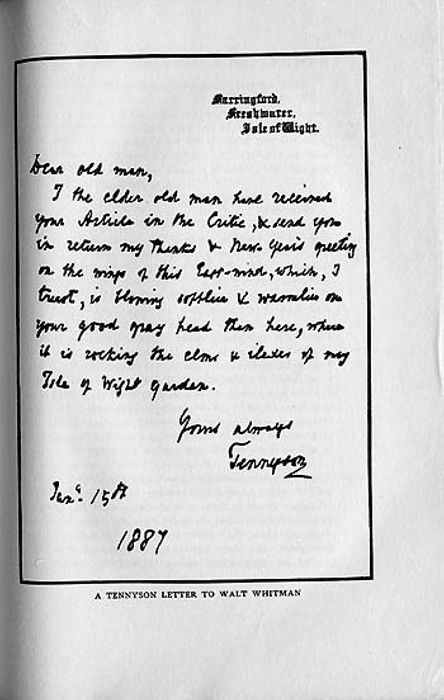 [Begin page 37]
Farringford, Freshwater, Isle of Wight
Jany. 15th, 1887.
Dear old man,
[Begin page 37]
Farringford, Freshwater, Isle of Wight
Jany. 15th, 1887.
Dear old man,
[See indexical note p037.1] I the elder old man have received your Article in the Critic, and send you in return my thanks and New Year's greeting on the wings of this east-wind, which, I trust, is blowing softlier and warmlier on your good gray head than here, where it is rocking the elms and ilexes of my Isle of Wight garden.
Yours always Tennyson.[See indexical note p037.2] Later at Harned's. No strangers present. "With each month that passes I feel more and more uncertain on my pins." "But you don't worry about the pins as long as you are all right at the top?" "I don't worry either way. But I guess I am all right at the top—at least as near right as Walt Whitman ever was: you know how crazy I have always been to some people."
W. talked with us in the parlor a long time. [See indexical note p037.3] "When I got up Monday morning last I had three sets of verses in hand. I sent one to the Herald, one to the Century and one to the Cosmopolitan. The Century folks sent me a check at once. The piece sent to the Herald was used according to our standing arrangement. The Cosmopolitan editor rejected me. He wrote a note saying the poem did not attract him—he suggested that I should submit other matter." The poem refused was To get the final Lilt of Songs.
[See indexical note p037.4] W. got hold of a San Francisco portrait of Ingersoll from Harned's mantel and regarded it long and intently. "That is a grand brow: and the face—look at the face (see the mouth): it is the head, the face, the poise, of a noble human being. America don't know today how proud she ought to be of Ingersoll." Harned read aloud some paragraphs from Ingersoll's North American Review paper on Art and [Begin page 38]Morality. W. exclaimed: "Don't stop there, Tom: read it all— read it all." And several times in H.'s pauses W. cried out: "Go on! Go on!" When H. was through W. said: "I'm sorry there's no more, though I guess he has said all: it's every bit fine, every bit. A little of it here and there I might say no to, but I guess my no wouldn't be very loud." [See indexical note p038.1] W. said: "Ingersoll's gone to New York to live." "Yes," replied H., "it's the Lord's own country." "But say, Tom" retorted W., "isn't it a sort of delirium tremens?" Then he reflected: "I used to love it. Perhaps it'll do from seven or eight to fifty or sixty—but not before, not after!"
"What do you think?" W. asked: "I've received an invitation to embark on a lecturing tour in England—a real invitation with dollars, pounds, back of it. [See indexical note p038.2] Of course, it's impossible, but it's interesting. My friends here and there, both sides, do not realize how badly broken up I am. Another thing. Hollyer, over there in New York, who is getting up some etchings of the writers—Carlyle, Whittier, Longfellow, Tennyson, and so forth—has written me for my portrait, sending along some specimens of his work, with which I am but little impressed. [See indexical note p038.3] I assented to his request and sent him a copy of what Mary Smith calls the Lear picture: you all know it. Of course I am a lot curious and very little certain about Hollyer."
[See indexical note p038.4] At the table W. raised his glass before the others had done so and glancing at the picture of Lincoln on the wall opposite exclaimed: "Here's to the blessed man above the mantel!" and then remarked: "You know this is the day he died."
"After my dear, dear mother, I guess Lincoln gets almost nearer me than anybody else." W. borrowed Boswell's Johnson from Harned, saying: "I have never so far read it."
[See indexical note p038.5]
"Tom," he said, "when I was out in the carriage I picked up a lame fellow on the road—a sort of tramp, limpsy, hungry, a bit dirty, but damned human,
[Begin page figure-5]
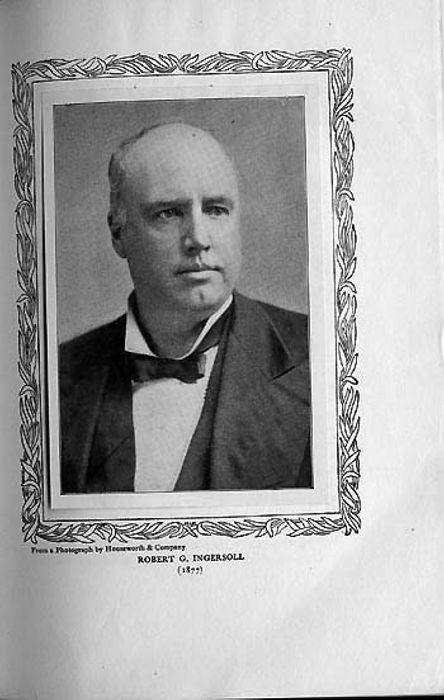 [Begin page 39]
much like your uncle here, bless his buttons!" H. exclaimed: "Walt—that sentence is as good as a sermon." W. put on a look of mock inquiry: "Is that all it's worth—is that the best you can say of it?"
[Begin page 39]
much like your uncle here, bless his buttons!" H. exclaimed: "Walt—that sentence is as good as a sermon." W. put on a look of mock inquiry: "Is that all it's worth—is that the best you can say of it?"
W. is writing about Hicks. Morse, now in the west, has made and sent W. a copy of a Hicks bust. W says: "The box is still unopened. [See indexical note p039.1] I told Sidney I was writing a Hicks piece which I would deliver in a lecture and give to Lippincott's to print (Will Walsh says he wants it). The bust has been along two or three weeks. I want Horace to come down with his hatchet or come down and use my hatchet and open the box."
Eakins' portrait of W. being mentioned, W. said: "It is about finished. Eakins asked me the other day: 'Well, Mr. Whitman, what will you do with your half of it?' I asked him: 'Which half is mine?' Eakins answered my question in this way: 'Either half,' and said again regarding that: 'Somehow I feel as if the picture was half yours, so I'm going to let it be regarded in that light.' [See indexical note p039.2] Neither of us at present has anything to suggest as to its final disposition. The portrait is very strong—it contrasts in every way with Herbert Gilchrist's, which is the parlor Whitman. Eakins' picture grows on you. It is not all seen at once—it only dawns on you gradually. It was not at first a pleasant version to me, but the more I get to realize it the profounder seems its insight. I do not say it is the best portrait yet—I say it is among the best: I can safely say that. I know you boys object to its fleshiness; something is to be said on that score; if it is weak anywhere perhaps it is weak there—too much Rabelais instead of just enough. Still, give it a place: it deserves a big place. [See indexical note p039.3] I seem to be in great request for portraits just now. The last request was from Warren Miller—he is in Brooklyn—who wants to know whether I will give him some sittings for a portrait in oil. I told him I would—yes, I would."
[Begin page 40]When W. was leaving H. said: "I hope you have enjoyed yourself today enough to come again." [See indexical note p040.1] W. replied merrily: "Better than that, I have enjoyed myself today enough to hate to go at all."
Monday, April 16, 1888.
"I found the Gosse letter today," said W. as I entered: "I knew it was about somewhere. I wasn't looking for it—it just turned up." I took it and read it.
1 East 28th St., New York City, Dec. 29, 1887. Dear Mr. Whitman:[See indexical note p040.2] I am very anxious not to leave this country without paying my respects to you, and bearing to you in person the messages which I bring from Mr. Swinburne and other common friends in England. I propose, therefore, if it be not inconvenient to you, to call upon you in Camden on Saturday next, in the forenoon.
Pray believe me to be, Dear Mr. Whitman
Faithfully yours Edmund Gosse."This was the letter—this was the meeting—that O'Connor seemed to think was so significant. [See indexical note p040.3] I do not know about the significance—I was glad to hear from him, glad to have him come. Gosse is very largely a formal craftsman but he has a little disposition our way."
W. was in excellent humor. He directed me to the hatchet and had me open the Hicks box. Meanwhile he kept up a running talk. "Half an hour ago I was wired by The Herald for some word on Matthew Arnold, who died suddenly today, and that is already finished and mailed. [See indexical note p040.4] Did you ever know me to be so fast before? What's to be said of Arnold? Do you know? My judgment would, on the whole, the judgment I sent to The Herald, be considered [Begin page 41] unfavorable." The bust was taken out and set on a box, displacing a Whitman, which I took up stairs and deposited in W.'s spareroom. "Morse has done well, better, almost best. [See indexical note p041.1] It more than meets my expectations: its serenity, its seriosity—which stops finely short of ministerial goody-goodishness. It impresses me, with regard to the head above the eyes, however, that Morse has given it too much mass—has idealized it; in fact, I never knew of but one artist, and that's Tom Eakins, who could resist the temptation to see what they think ought to be rather than what is. And yet I am pleased. Morse, you have done first rate. A good piece of work I should say. Its points strike you as you stay with it. Morse is getting stronger. He never could have done such worktill last summer, when he got in the back yard here, away from the art schools, and slashed and dashed away—and hit it!"
Gilchrist sends W. a card invite to an exhibit of his Whitman in London. [See indexical note p041.2] W. said: "Horace, I can't go. You go as my representative." "All right. And what shall I say of the picture when I get there?" "Nothing unless you must." "And if I must?" "Well, if you must be careful what you do. Don't set it very far up—but don't damn it, either." Arnold was referred to again. Arnold had recently said of Lincoln that he "lacked distinction." This seemed to irritate W. [See indexical note p041.3] "That makes me think of some one who once said there were two kinds of jokers—the damned good one and the damned bad one. Arnold is a damned bad one. Swinburne resorted to similar strategy to destroy Byron but it would not work. Byron has fire enough to burn forever." [See indexical note p041.4] W. continued: "I have a warm place even for Shelley. He seems so opposite—so ethereal—all ethereal—always living in the presence of a great ideal, as I do not. [See indexical note p041.5] He was not sensual—he was not even sensuous."
The poem The Cosmopolitan rejected was sent by W. to The Herald, in which it appeared this morning. His con- [Begin page 42]tract with The Herald calls for ten pieces (no size stipulated) a month, for which he is paid one hundred dollars. W. has hung the Eakins portrait in a better light. "Does it look glum?" he inquired: "that is its one doubtful feature: if I thought it would finally look glum I would hate it. [See indexical note p042.1] There was a woman from the South here the other day: she called it the picture of a jolly joker. There was a good deal of comfort to me in having her say that—just as there was when you said at Tom's the other day that it make you think of a rubicund sailor with his hands folded across his belly about to tell a story."
Speaking of the "strain of American life" W. declared that "every man is trying to outdo every other man—giving up modesty, giving up honesty, giving up generosity, to do it: creating a war, every man against every man: the whole wretched business falsely keyed by money ideals, money politics, money religions, money men." [See indexical note p042.2]
Tuesday, April 17, 1888.
Adler promised to send W. the Sower (Millet) but writes saying he cannot find a copy in New York such as he wishes and will send another peasant subject which he thinks would be almost equally interesting. W. had a lot of old cancelled envelopes in a rubber. "What are these?" I asked. "These are my visiting cards: I put them in my pocket when I go out." [See indexical note p042.3]
W. sent an autographed portrait of himself to Harned's cook. "She has done as much to make me happy as anybody." A couple of volumes of poetry from unknown writers reached W. by mail today. [See indexical note p042.4] "Everybody is writing, writing, writing—worst of all, writing poetry. It'd be better if the whole tribe of the scribblers—every damned one of us—were sent off somewhere with toolchests to do some honest work." We got talking a little about Carlyle, whereat W. produced a Burroughs letter which he explained to me had [Begin page 43] "just turned up in the litter" and contained "some mighty good matter—just a little of it—anent Carlyle." [See indexical note p043.1] He added: "I guess John touches the heel and head of the matter in what he says there about opinion. The world asks us to be so literal: the giant comes into the world like a big blow—no one can tell how."
Esopus N.Y.Mch 14, 1881. Dear Walt:[See indexical note p043.2] I send you a little remembrance—enough to pay your expenses up here when you get ready to come, which I hope will be before long. I have recdorig> reminders from you from time to time in the shape of papers &c. which I have been glad to get. I see about all that is in The Tribune as I take the semi-weekly. The sketch of Carlyle in the London paper was the best I have seen. Your own words upon his death were very noble and touching. It was a proper thing for you to do and it became you well. The more one reads and knows of Carlyle the more one loves and reverences him. He was worth all other Britons put together to me. [See indexical note p043.3] What have we to do with his opinions? He was a towering and godlike man and that was enough. He is to be judged as a poet and prophet, and not as a molder of opinion. He was better and greater than any opinion he could have. His style too I would not have different. To me it was not the "Mary-had-a-little-lamb" style of most of his critics, any more than your own prose style is, but grand and manly and full of thunder and lightning.
The robins are just here, and the ice on the river is moving this afternoon, bag and baggage. Ursula is still in N.Y. but is doing pretty well and hopes to be home soon. Julian and I have all sorts of ups and downs. I am correcting the proof of Pepacton and writing an article for Scrib. on Thoreau. [See indexical note p043.4] I first wrote them a notice of his Journal just published, which they were pleased to say was too good for a book notice and that I must make a body article out of it &c. Scrib. has displayed some remarkable journalistic [Begin page 44] enterprise lately. They have got from Emerson his article on Carlyle for their May No. [See indexical note p044.1] This is sub rosa and is not for the public yet. I enclose you a slip of the article or lecture which you may have seen. I do not think his trip hammer with the Eolian attachment figure conceived in the highest spirit. It is so preposterous and impossible that it spoils it for me, but it raps soundly upon the attention for a moment, and I suppose that is enough for his purpose.
I hope your cloud lifts as spring comes and that you are better. If you see young Kennedy tell him I will write to him again by and bye. I guess he is a good fellow but he needs hatcheling to get the tow out of the flax. How do you like him? I shall want a set of your books by and bye. Let me hear from you.
John Burroughs.We exchanged some few words about Joaquin Miller. W. was very willing to say good things about him. [See indexical note p044.2] "Miller is wholesome: he is a bit of his own West done up in print. I ought to be very grateful to him. He has always gone out of his way to show that he stood with me—that the literary class would not find him aligned with them in their assaults on me. Miller never quite does the work I expected him to do. He may yet do it." W. gave me a Miller letter the other day. It illustrates the friendliness of their relations. Miller enclosed a portrait of himself. I insert the letter here. It was written in 1874.
Hotel Chatham, 67 and 69, Rue Neuve St. Augustin, Paris. My dear Walt Whitman:
[See indexical note p044.3] In London last week I met many mutual friends who were asking after you and wondering when you would come over to the great Smoky Capital—friends who know you only by your books. Last winter Story of Rome the author of Cleopatra, you remember, asked me for your photo once. I gave it him to contemplate
[Begin page figure-6]
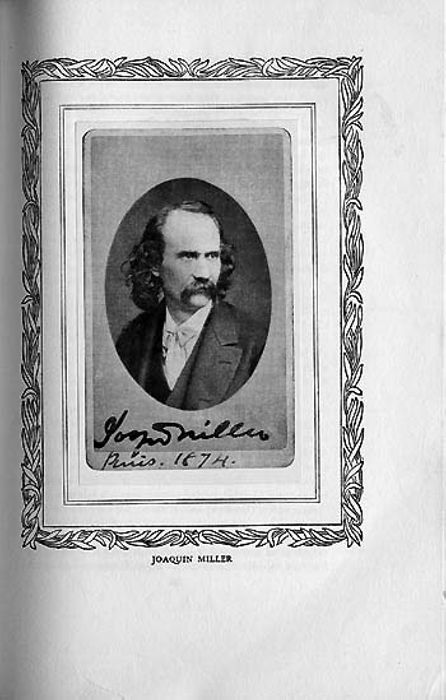 [Begin page 45]
and he has it yet. Are you coming, and when? Most like I shall return to the States this winter and then visit Washington for I have never yet seen our national capital. [See indexical note p045.1]
[Begin page 45]
and he has it yet. Are you coming, and when? Most like I shall return to the States this winter and then visit Washington for I have never yet seen our national capital. [See indexical note p045.1]
The news of the great Democratic victories has just reached us and all Paris—that is all American Paris—is terribly excited. Of course this suits me, born Democrat as I am, but I trust it will not at all disturb the future of my dear friend the "good gray poet." My address is the Langhorne Hotel. Drop me a line.
Yours faithfully, Joaquin Miller.Wednesday, April 18, 1888.
Whitman adds as to Arnold: "He will not be missed. [See indexical note p045.2] There is no gap, as with the going of men like Carlyle, Emerson, Tennyson. My Arnold piece did not appear in Tuesday's Herald. I wonder if the editor was a little in doubt about it? It appeared today, however. The Herald has a higher opinion of Arnold than I have. I discussed Arnold in effect—throughout in such words—as one of the dudes of literature. Does not Leaves of Grass provide a place even for Arnold? Certainly, certainly: Leaves of Grass has room for everybody: if it did not make room for all it would not make room for one. What we mostly need in this age are the men who do the portage. [See indexical note p045.3] We have for a hundred years—yes, I may say, for two hundred years—been about to be transferred—something has always delayed. Some object to being transferred but are transferred in spite of themselves. I am myself of late years more inclined to sit still exploiting and expounding my views than was the case back in the past when I was physically up to more."
W. said Adler's Millet had not yet come. W. reading the Boswell he got from Harned Sunday. "Johnson does not impress me. [See indexical note p045.4] I read this not because it interests me much but because I ought to know what the old man did [Begin page 46] with himself in the world. I don't admire the old man's ponderous arrogance: he talked for effect—seemed rather inclined to bark men down, like the biggest dog—indeed a spice of dishonesty palpably possessed him. [See indexical note p046.1] Johnson tried rather to impress than to be true: he speaks from a past era, outside those influences—spiritual, bodily influences—which are discovering themselves to us today. Johnson had a spot and he will be kept well to it: a local English spot: I do not see how the world could make any use of him elsewhere." Referring again to the Hicks bust: "It holds its own with me: I think Morse has hit something quite plausible—a living embodiment: I see that I am going to be very proud of it as time goes on." W. gave me an Edwin Booth letter. Here it is:
Newport, Aug. 28th, '84. Walt Whitman, Esq. Dear Sir—[See indexical note p046.2] I have tried in vain to obtain a good portrait of my father for you and am reduced to this last extremity—I must send you a book (which you need not read) containing poor copies of the good portraits that are in some secure, forgotten place among my traps—stored in garret or cellar of my new house where all things are at sixes and sevens.
The one as Richard is from a copper plate, taken in England about 1820; the frontispiece is from a daguerreotype taken in Albany 1848—the original is excellent; Posthumus is from an engraving—taken very early in his career at Covent Garden—which I never saw. [See indexical note p046.3] I am sorry that I can find none better than these poor reproductions. They give his face before and after his nose was broken, but are badly printed. I trust they will be of service to you.
Very truly yours, Edwin Booth."I have had no relations with Booth," said W. "Nothing beyond the sort of thing you see hinted of in this simply [Begin page 47] formal note. I've got a heap of admiration for him of the dramatic and personal sort, but we never really came to close quarters." Describing the visit of Haweis (now put by H. into a book), W. said: "Haweis came here with his wife and one other woman, evidently, to judge from what he afterwards wrote, to quiz me, and they of course found I was not so brilliant, original, as expected: I was more bent upon hearing them talk than talk myself—so I just put enough in to keep him going. [See indexical note p047.1] He seemed to want to go. I was not attracted by the man. He was a striking counterpart of Hastings Weld, a literary minister from Washington, who comes to see me and whom I like—hair-dye, modern dress, unexceptionable appearance, immaculate, impeccable, just alike in both men. [See indexical note p047.2] I took no shine to Haweis. Not that I have the least thing against him: what have I against anybody? I am always uneasy about the inquirers when they come buzzing about: they get on my skin and irritate me!"
Thursday, April 19, 1888.
In with W. Alluded again to Arnold. "I am apt at times to go back on my pieces: this Herald piece, now—it's not all that could be said: it don't say my say for me in the most conclusive way. [See indexical note p047.3] I'm not sure it's well to put yourself on record with such dispatch. I always say I won't do it: then I go do it." Still reading the Boswell. "I am convinced as I get farther along that Johnson was none too veracious—that he was on stilts, always—he belongs to the self-conscious literary class, who live in a house of rules and never get into the open air. Take Arnold, again. I have been looking a little into his poetry today. [See indexical note p047.4] It is fine—wonderful fine—like some delicate, precious bit of porcelain, of china, but it is fragile, it lacks substance." W. went back to Johnson. "As I read I think of a funny story Mary Davis tells me of some one who said once in a sudden humor: 'I feel like eating dough!' I don't feel like eating dough [Begin page 48]—I feel as if I had eaten it. Johnson fills me with a great heaviness. He gives me no lifts—never takes me up anywhere; always fastens me to the earth." Again: "I reckon I was not made to understand the scribbling class—perhaps they were not made to understand me. We seem to have been made for different jobs. I am doing my job in my way: it don't suit them: they growl, curse, ridicule: but what is left for Walt Whitman to do but complete the job in the most workmanlike fashion he knows?"
W. quizzed in this way: "When you write do you take anybody's advice about writing? [See indexical note p048.1] Don't do it: nothing will so mix you up as advice. If a fellow wants to keep clear about himself he must first of all swear a big oath that he'll never take any advice."
W. brought up the subject of November Boughs. When would he bring the book out? "I don't know: I get up some mornings and say, this is the day: but somehow before the day is over I see this is not the day: yet it will come out, and before long, God willing, and you, Horace Traubel, willing: for I shall need you to help me through with this expedition. [See indexical note p048.2] If you go back on me now I might just as well fold my sails." He produced the mass of papers going to make up the copy for November Boughs: a bundle of letters, reprints, new manuscript, pictures, tied together with a bit of coarse string. "This is the sacred package," he explained, solemnly. "It is ready for the printer, ready this minute, but I do not seem to pluck up the courage to get the enterprise under way." [See indexical note p048.3] Alluded to his memory: "It lasts—lasts wonderfully well: it plays me some tricks—but then it always did: it is not a marvellous, only a decently good, memory. I remember that the Broadway stage-coachmen could turn back over a month's confusion of trips—tell with readiness and accuracy the tally-numbers of passengers of the up and down rides of any hour that could be named—the records being always kept in this simple fashion by the [Begin page 49] then illiterate men. What kind of a light would my little memory make alongside such faculty as that?" W. brought out a soiled letter written on a couple of sheets of common proof paper and suggested that I should see what he had inscribed upon the corner with red ink: "beautiful good letter June '82."
ChicagoMay 21. Walt Whitman.I don't feel that I should apologize for writing to you. I have wanted to do so for years. [See indexical note p049.1] I have loved you for years with my whole heart and soul. No man ever lived whom I have so desired to take by the hand as you. I read Leaves of Grass, and got new conceptions of the dignity and beauty of my own body and of the bodies of other people; and life became more valuable in consequence. After a year or two—always carrying you in my thoughts—holding imaginary conversations with you and dreaming of you day and night, I came across a lady who knew you, Miss Lizzie Denton Seybold, now Becker. She had your portrait painted in oil. I made every effort to induce her to let me have the picture, but she would not. [See indexical note p049.2] Since that time—I was living in glorious California then—I have read with deepest interest every word about you in the papers and magazines, as well as everything you have written. Sometimes I have been furious at what immodest people, idiots, have dared say of you and have longed to write my own pure and true convictions of you. But I cannot—I am too impetuous; I feel my subject too deeply. And yet I am a writer and make a living by my pen. Now that I have come east this far, where I am employed as editor on the Saturday Express, I have the hope that I may sometime see your dearly beloved face, touch with my hand your beautiful gray hair, and possibly feel your arm about my waist. Because I love you so I have written these lines. It is nothing to me who sees them. I am proud of my feeling for you. It has educated me; it has done more to raise [Begin page 50] me from a poor working woman to a splendid position on one of the best papers ever published, than all the other influences of my life.
[See indexical note p050.1] I know you must have many letters from strangers, and so I will not take any more of your time in reading what I have to say. Of course I have no hope of receiving an answer to this. But I thought it no harm to let you know that my love went with you, and perhaps in some unknown way was a blessing to you all these years.
Good-bye dear Walt Whitman—my beloved, and may every influence in life contribute to your happiness.
Most lovingly your friend Helen Wilmans.W. waitedtill I had read this letter. Then he exclaimed: "Well, how does that strike you? [See indexical note p050.2] Don't you think that's a bright letter for a dark day? I like these letters from people I don't know, from people who don't know me, these confessions of love, these little 'how do you dos' that appear every now and then out of mysterious obscure places. I know some people will damn me and some will save me—the big guns who noise about the world: I don't know as it affects me either way. But such a letter as this has a verity, a sureness, a solid reason for itself, which gives it special value. I confess it pushed clean into my vitals."
Friday, April 20, 1888.
"Emerson's objections to the outcast passages in Leaves of Grass," said W. tonight, "were neither moral nor literary, but were given with an eye to my worldly success. [See indexical note p050.3] He believed the book would sell—said that the American people should know the book: yes, would know it but for its sex handicap: and he thought he saw the way by which to accomplish what he called 'the desirable end.' He did not say I should drop a single line—he did not put it that way at [Begin page 51] all: he asked whether I could consent to eliminate certain popularly objectionable poems and passages. Emerson's position has been misunderstood: he offered absolutely no spiritual argument against the book exactly as it stood. Give it a chance to be seen, give the people a chance to want to see it—that was the gist of his contention. [See indexical note p051.1] If there was any weakness in his position it was in his idea that the particular poems could be dropped and the Leaves remain the Leaves still: he did not see the significance of the sex element as I had put it into the book and resolutely there stuck to it—he did not see that if I had cut sex out I might just as well have cut everything out—the full scheme would no longer exist—it would have been violated in its most sensitive spot."
[See indexical note p051.2] I read W. a story about Turner—how he had on varnishing day once blacked out one of his brilliant canvases in order to save some adjacent pictures of other men from the destructive contrast. W. exclaimed: "Beautiful! beautiful! It's as fine as anything in Plutarch. The common heroisms of life are anyhow the real heroisms; the impressive heroisms; not the military kind, not the political kind: just the ordinary world kind, the bits of brave conduct happening about us: things that don't get into the papers—things that the preachers don't thank God for in their pulpits—the real things, nevertheless—the only things that eventuate in a good harvest."
[See indexical note p051.3] As I left W. put into my hands an O'Connor letter, old date, of which he said: "Put this with your Emerson papers: it throws more light on Emerson matters: O'Connor is always throwing light on things—lavishing light, we might say: vehement, penetrating light: light that nothing can stand up against. William is a torrent—he sweeps everything before him. [See indexical note p051.4] This letter is only one letter of many letters—all of them alike in that: alike in their power to make themselves felt. I don't believe William ever wrote [Begin page 52] an inconsequential letter—ever wrote in a muffled key: ever was commonplace, ever was in the evil sense of that word diplomatic. No—no. He was always outright—took the immediate course—refused all roundabout methods. But read the letter. It is like a plunging, irresistible overflow of mad waters: read the letter."
Washington, D.C., June 3, 1882. Dear Walt:Your two letters, full of memoranda, of May 28 and 30, came duly. [See indexical note p052.1] I have "toiled terribly," as Cecil said of Raleigh, and sent off another letter to The Tribune, which I think will make Mr. Chadwick wear a toupee, for I have snatched him baldheaded. It has cost me great labor, though you may not think so when you read it, it runs off so savagely easy; but the difficulty in a controversy of this kind is to mould everything so as not to lay yourself open, and to give no points to the enemy, and this costs time and care. My old fencing-master, Boulet, (no better ever lived; he taught once at West Point,) taught me always to cover my breast with hilt and point, even in the lunge, and I think of his lessons when engaged in fence of another kind. [See indexical note p052.2] I hope I have succeeded in being both guarded and bold in this new encounter with Chadwick.
I have freely used the memoranda you sent, and got in as much of it as I could see my way to employ, and as much as I dared. I think you will feel satisfied with the use I have made of it. Some things I thought it prudent to withhold, because they might provoke replication when we are not in a position to defend ourselves, not being ever sure that a single organ is open to us.
You must be very careful in this matter. [See indexical note p052.3] Even words must be carefully chosen, for the enemy is unscrupulous and uses every advantage we give him. I came near getting into a pretty scrape by trusting to your memorandum about the appearance of Emerson's letter in Cooke's memoir published [Begin page 53] by Osgood. It was a splendid point to make, that the letter appeared verbatim in a book issued with Emerson's own sanction a year ago, and I worked it in and made the most of it. But at the last I thought it would be prudent to see the book, and there was the letter sure enough, but with a lot of remarks by the editor to the effect that "it is understood" (the usual sneaking lie in putting it) that Emerson had considerably modified his feeling, and regretted, etc. etc. [See indexical note p053.1] Fortunately, there is not a word in the preface to show that the book had Emerson's sanction,—but just see the scrape I would have been in had I used the information in the shape you sent it!! Indeed, Walt, you ought to be more careful. "A wild and many-weaponed throng, hang on our front and flank and rear." [See indexical note p053.2] If I had said that the letter was reprinted in a book with Emerson's sanction, Chadwick would have had me. Our stronghold is the Emerson letter, unretracted by himself. Next thing we shall have to meet will be the stories of what Emerson said to this man and that man. We must deny them all, and call for proof. Let us admit nothing. Make the other side prove their allegations.
I hope my new letter will be as successful with you and the public as the first. [See indexical note p053.3] My aim has been to shut Chadwick up for good, for I don't want to be bothered on a side issue by this egotistic jackass.
Letters are pouring in upon me. One from John Hay, very cordial. One from the Melancholy Club of New York, very overflowing, inviting me to a grand supper to be given on Saturday (this) evening in honor of you and of my letter. Have you been invited? And who are the Melancholy Club men of Lexington Avenue? [See indexical note p053.4] I returned them a civil letter of regret at my inability to be present, etc., and consoled them by offering as a toast "old Selden's trumpet sentence—'Before all things, Liberty!'"—"Words," I said, "which are good to remember when thought is menaced by [Begin page 54] law." I have had a number of other letters from persons unknown. [See indexical note p054.1] One from Bucke, quite jubilant over my letter, and telling me the fix I have got his book into, which is comic as a scene from Moliere. You will see the fun when you know that he had sent his MS. to Osgood!! I also got a letter from John Burroughs, announcing his arrival, and I at once sent him a Tribune containing the letter. [See indexical note p054.2] I also have a letter from Dr. Channing at Providence, red-hot for you, and proposing to reprint my Good Gray Poet at his expense!!
There has been quite a swarming of people after me. The press notices are generally favorable and hearty. I hope nothing adverse or disastrous will happen. I want the matter to result in your getting a publisher, as it ought.
Watch the Tribune for my anti-Chadwick. [See indexical note p054.3] I hardly think it will fail to bring him down. At the last moment, after two days of anxious cogitation, I cut out of it several pages of really withering ridicule, excellent in itself, but positively injurious to the main effect. You see how solely I consider the interests of our cause—sacrificing thereto my choicest satirical felicities!
Good bye!
Yours faithfully W. D. O'Connor.[See indexical note p054.4] When W. saw I was through reading this vigorous letter he said: "That's like a battle-ship firing both sides and fore and aft: no man in America carries as big an armament for controversy as William—can do as heavy immediate execution. I would hate to be in his way myself—to have him feel me to be an obstruction, that he had to strike me down; I'd far rather have him on my side. I was going to say What a fighter! I won't say that: I will say: What a lover! For, after all, William is a lover: after all? yes—and before all, too."
Saturday, April 21, 1888.
In with W. Complains of headaches. "Rather, not aches, but a sort of congestion. [See indexical note p055.1] I have felt myself for two weeks back to be in a rather dubious condition. Today I have felt worse than any day previous. But what's the use complaining?—Why should I trouble you with my pains? You have pains of your own." He paused for a minute. I said nothing. He then continued: "I don't believe you have any pains of your own: I believe you are a sickless animal—I don't believe you know what it is to be on your back." I confessed that I did not. "Neither did I for the most of my life: I hardly knew I had a stomach or a head for all the trouble I had with either."
He got talking about New York—its literary men. [See indexical note p055.2] "They are mainly a sad crowd: take the whole raft of them—Stoddard, Fawcett, the rest—what are they saying or doing that is in the least degree significant? I am told that Stoddard is pretty sour on me—hates even to have my name mentioned in his presence, never refers to me with respect. [See indexical note p055.3] I do not blame him. But—I am sorry for Walt Whitman. There is Taylor. He was first rather friendly. Then he went to New York and experienced a change of heart. [See indexical note p055.4] Yet I have been told by a man who was very near to Taylor that he was melting towards me again when he died. I had a couple of letters from Taylor back, back, years and years ago. I don't know where they are: they were good letters. When they turn up, if they turn up, you shall have them. They will add a bit to the material you have collected about me. Did I tell you that I dined with Stoddard at the house of a Mrs. Bleecker? He was courteous but not friendly on that occasion. New York gives the literary man a touch of snow: he is never quite the same human being after New York has really set in: the best fellows have few chances of escape. Take John himself. Burroughs, I mean. [See indexical note p055.5] He lives just far enough off. Even John barely [Begin page 56] got off with his skin. Stedman? Stedman is all right—I love him. But after all I do not think that Stedman ever drew very deep water. His estimate of the American poets misses the chief points—is wide of the truth: he is too judicial, too much concerned about being exactly just. [See indexical note p056.1] The man who tries a too delicate operation with his scales breaks the scales. Don't Stedman break down in the process of his own criticism? He is generous, inclusive, hospitable, a bit overripe here and there, too much cultivated, too little able to be foolish, to be free, (we must all be foolish at times—it is the one condition of liberty)—is always precisely so, always according to program." W. still talked on, hitting at different themes: "I sometimes waver in opinion as between Emerson and Bryant. Bryant is more significant for his patriotism, Americanism, love of external nature, the woods, the sea, the skies, the rivers, and this at times, the objective features of it especially, seems to outweigh Emerson's urgent intelligence and psychic depth. [See indexical note p056.2] But after every heresy I go back to Emerson. Stedman is cute but he has not attached to Whittier, Emerson and Bryant anything like the peculiar weight that I should, rebel as I am. [See indexical note p056.3] Stedman is cute but hardly more than cute—not a first hander—a fine scholar, with great charms of style, fond of congregating historic names, processional, highly organized, but not in the windup proving that he is aware of what all his erudition, even all his good will (he has plenty of that, God bless him!), leads up to. I should not say such things, should I? I am a hell of a critic. But I just get going and go and can't even stop myself, especially when you come round, damn you! [See indexical note p056.4] You have an odd effect on me—you don't ask me questions, you have learned that I hate to be asked questions, yet I seem to be answering questions all the time whenever you happen in." I laughed at this sally, whereupon he continued: "Well—ask Stedman to forgive me." "To forgive you? He need never hear!" "Ask [Begin page 57] him to forgive me anyhow!" He chuckled a little. "I am always sure that in some way my friends hear all that I say about them: all the love I say about them, all the questions I ask: don't you think our minds go outside us and meet and exchange life for life?"
W. gave me another Miller letter. [See indexical note p057.1] "I guess I belong to Miller: he has proved himself in so many ways—his books have proved him, his personal affection has proved him."
Revere House, Boston, May 27, '75. My dear Walt Whitman,Your kind letter is received and the sad news of your ill health makes this pleasant weather even seem tiresome and out of place. I had hoped to find you the same hale and whole man I had met in New York a few years ago and now I shall perhaps find you bearing a staff all full of pain and trouble. [See indexical note p057.2] However my dear friend as you have sung from within and not from without I am sure you will be able to bear whatever comes with that beautiful faith and philosophy you have ever given us in your great and immortal chants. I am coming to see you very soon as you request; but I cannot say today or set tomorrow for I am in the midst of work and am not altogether my own master. But I will come and we will talk it all over together. In the meantime, remember that whatever befall you you have the perfect love and sympathy of many if not all of the noblest and loftiest natures of the two hemispheres. My dear friend and fellow toiler good bye.
Yours faithfully, Joaquin Miller.Sunday, April 22, 1888.
I took W. a volume Goethe-Carlyle correspondence. [See indexical note p057.3] "This Goethe-Carlyle business seems to have been an affair of respect rather than of love. It was not beautiful to me, like Goethe's love for Schiller, like Schiller's love for Goethe." [Begin page 58] I said: "You never seem to enter into such literary companionships." "No—I do not: they are hardly possible to me: I do not seek them. [See indexical note p058.1] I do not value literature as a profession. I feel about literature what Grant did about war. He hated war. I hate literature. I am not a literary West Pointer: I do not love a literary man as a literary man, as a minister of a pulpit loves other ministers because they are ministers: it is a means to an end, that is all there is to it: I never attribute any other significance to it. Even Goethe and Schiller, exalted men, both, very, very, were a little touched by the professional consciousness." [See indexical note p058.2] "Then you do not accept the notion of art for art's sake?" "Not a bit of it—that would be absurd on the face: the phrase seems to me to mean nothing. [See indexical note p058.3] Take Tolstoy: there are things about him that do not attract me—some that are even offensive—his asceticism, for instance—and yet Tolstoy comes to about the right amount: he counts up to a high figure." [See indexical note p058.4] Referred to Kennedy. "He is one of my most ardent—I often say, granitic—admirers. Indeed, he out-Buckes Bucke." To Tucker: "He has thumped me some for my emperor piece but is still my friend as I am still his friend: I don't think a fall or two taken out of a fellow hurts him in the long run. [See indexical note p058.5] Tucker did brave things for Leaves of Grass when brave things were rare. I couldn't forget that." To O'Connor: "He, too, fell afoul of me for my emperor piece. Why, that piece almost threatens to create a split in the church! [See indexical note p058.6] William is quite as radical as Tucker though much less interested in political study—is more fond of fooling with old books, ancient lores—is himself an Elizabethan student of almost miraculous erudition. I stand in awe before William." Rhys once said to W. in reply to W.'s question: "William Morris always mentioned you kindly, genially, in fine friendly fashion, admiringly, with full acceptance." [See indexical note p058.7] Spoke of Nihilism in Russia. "That seems about the only thing left to a Russian. Revolution may be the only conservatism."
[Begin page 59]W. said to a visitor in my hearing: "The American people wash too much." "See," said the visitor: What did I tell you? His gospel is a gospel of dirt." "What did you say to that?" asked W. [See indexical note p059.1] "I only said you were misunderstood—that what you meant was that the American people did not sufficiently honor the trades, the physical occupations." "Of course, and wasn't that obvious?" "Not to your visitor." "I suppose not. But what do such visitors come for anyhow? To be confirmed in their prejudices. I think our people are getting entirely too decent. They like nice white hands, men and women. They are too much disturbed by dirt. They need the open air, coarse work—physical tasks: something to do away from the washstand and the bathtub. God knows, I'm not opposed to clean hands. But clean hands, too, may be a disgrace. It was the disgraceful clean hands I had in mind."
W.'s friends often rally him about his aristocracy. [See indexical note p059.2] W. says for himself: "I appeal to no one: I look in all men for the heroic quality I find in Caesar, Carlyle, Emerson: yes indeed—find it, too, it is so surely present. If that is aristocracy then I am an aristocrat."
I spoke of Lincoln—of the Nicolay-Hay biography. W. said: "That reminds me." Reaching forward to the table and pulling a letter out from under a block—"Here's a letter from John Hay to me written long ago—twelve years ago. [See indexical note p059.3] I laid it aside for you. It illustrates the friendly basis upon which our acquaintance rests. When Hay was with Lincoln I used to see a great deal of him. He has been loyal—has always watched my work, has inevitably appeared at the right time with his applause. Here is the letter. [See indexical note p059.4] It is mighty decent of John to talk out in meeting as he has—to avow his faith. But read the letter." W. had written some memoranda on the letter, which was without an envelope. "July 25, '76, Letter from John Hay (Custer poem slips and paper sent him July 25)."
[Begin page 60] Century Club, 109 East 15th St., [New York]July 22. Dear Mr. Whitman,[See indexical note p060.1] I thank you heartily for my share in your Custer poem, which I have just read. It is splendidly strong and sustained and full of a noble motive. I am especially glad to learn, in such an authoritative way, of your health and vigor.
I wish you would take the trouble to let me know when your volume of collected works is to be published and where I can subscribe for it. I have heard that it was to be published by subscription, but have not heard any further details.
My address is now 506 Euclid Avenue, Cleveland, Ohio; and I would be very much obliged if you would spend a moment in letting me know how to get an early copy of the book for which many are looking.
Yours faithfully, John Hay.[See indexical note p060.2] "There's no use talking," said W., after I had finished reading the letter, "I no doubt deserved my enemies but I don't believe I deserved my friends."
Monday, April 23, 1888.
To see W. He said: "I gave you some notes from editors the other day—notes declining the poems. I have found you another to add to the collection. This is from Alden: it is more recent than one or two of the others. You see, I have been declined everywhere more or less. Alden is friendly. I never quarrel with the editors. [See indexical note p060.3] Besides, it's best not to have a royal road—it stiffens a fellow up to be told all around that he is not wanted, that his room is better than his company, that he has a good heart—that he can nurse soldiers but can't write poetry. But read Alden's little note: it's all in his own hand, polite but rigid: rigid? yes, almost frigid."
[Begin page 61] Harper & Brothers' Editorial Rooms, Franklin Square, New York, May 12, 1885. My dear Whitman,I have your kind favor of the 11th with the enclosed poem—or series of poems, rather. [See indexical note p061.1] It does not seem to me that Fancies at the Navesink will make a favorable impression upon our readers—though they might upon a select few. I must therefore return them.
With thanks, Sincerely yours, H. M. Alden.[See indexical note p061.2] W. got talking of Emerson again: "The world does not know what our relations really were—they think of our friendship always as a literary friendship: it was a bit that but it was mostly something else—it was certainly more than that—for I loved Emerson for his personality and I always felt that he loved me for something I brought him from the rush of the big cities and the mass of men. We used to walk together, dine together, argue, even, in a sort of a way, though neither one of us was much of an arguer. We were not much for repartee or sallies or what people ordinarily call humor, but we got along together beautifully—the atmosphere was always sweet, I don't mind saying it, both on Emerson's side and mine: we had no friction—there was no kind of fight in us for each other—we were like two Quakers together. Dear Emerson! [See indexical note p061.3] I doubt if the literary classes which have taken to coddling him have any right to their god. He belonged to us—yes, to us—rather than to them." Then after a pause: "I suppose to all as well as to us—perhaps to no clique whatever."
W. wandered into some side remarks on what he calls "the New York crowd of scrawlers." Winter, for instance. "There's little Willie Winter— miserable cuss!" [See indexical note p061.4] Of Stedman: "Stedman's judgment sometimes has a grandmotherly tinge." Of Stoddard: "I allow for Stoddard what he will not allow for me—that he has written good things. He [Begin page 62] wrote a fine Lincoln poem. Then he wrote a poem called On the Town, I think—about a girl: a superb poem." [See indexical note p062.1] Of Ripley, now dead: "He was a noble scholar: I read him at one time with great assiduity. He never struck anything off with his own fire but he knew what to do with the fire of other men." He summarized on New York in this way: "It is life to the letter but death to the spirit. It is a good market for the harvest but a bad place for farming."
W. spoke of Washington as "a big man after all." I said: "But I think Lincoln was a bigger man after all." [See indexical note p062.2] W. laughed and replied at once: "I know you are right—Lincoln was more likely as a Walt Whitman Horace Traubel man: Washington belonged to another period, to another social era: and Washington is too big to be trifled with. I allow him his full measure. But Lincoln? Well, we are very near Lincoln. He is like somebody that lives in our own house." [See indexical note p062.3] Described Kennedy's conversion: "It was slow, gradual—won out of an actual radical antipathy. Kennedy is the mixed fruit of the Puritan consciousness. Think of Walt Whitman and Plymouth Rock getting somehow together. It is hard to think out. Kennedy could not think it out at first: it was the most difficult problem he ever tackled: but finally the snarl was escaped. Kennedy came out of it on our side." [See indexical note p062.4] W. further: "Tom was in today—brought some kind of a preacher along: I don't even remember his name—a clever fellow but preachery all over, like a man in a lather. It did my eyes good to look away from him towards Tom—Tom, who is a normal man, gruff, honest, direct, simple, strong."
Tuesday, April 24, 1888.
[See indexical note p062.5] In to W. with the Millet picture from Adler. I do not know a title for it. It represents a peasant putting on his clothes after the day's work is done. W. took it from my hands and held it off from himself, regarding it with immediate [Begin page 63] approval and fondness. "After all, Horace—it's almost the Sower—it comes to almost as much: it is a piece out of the same cloth. Millet is my painter: he belongs to me: I have written Walt Whitman all over him. [See indexical note p063.1] How about that? or is it the other way about? Has he written Millet all over me?"
W. had been to Gloucester to a planked shad dinner and was unusually tired. Remarked his bad ears. "I am getting a little deaf—I don't hear little things. [See indexical note p063.2] I have to be pounded and yelled at to hear." This was an exaggeration called out by the fact that I had knocked a long time at the door and rang the bell and was not heard. W. was alone in the house. I asked him how he was managing to go about so readily. He prefers to be alone on these excursions. "The worst of it is I not only sit here and simmer all day long but am growing contented to do it—losing the desire to move. [See indexical note p063.3] I do not enjoy the sign—it seems like the beginning of the end: yet it is more and more marked. I resolutely say I won't get tired and won't stay at home—yet I am tired even while I speak and settle down into my chair as if I was never to leave it. I do not hide the facts from myself. They do not concern me. I never invite trouble to hurry up." I found W. reading Louise Chandler Moulton's book on Marston. "How is that?" I asked. [See indexical note p063.4] W. explained: "She was here yesterday. She left me the book. I have been trying to make something out of it—so far have not succeeded. Marston did some creditable work—work, however, that can hardly live. It lacked grit—it lacked the requisite organs: it was largely in the air. A sweet enough fellow, though, with a life tragedy, which should have taught him how to write. Literary men learn so little from life—borrow so much from the borrowers."
W. was joyous over what he called "a piece of the best news." [See indexical note p063.5] What was the best news? "The Whitman Club in Boston has petered out. It failed because I sat down on [Begin page 64] it. I wrote Sylvester Baxter, who, you know, is on The Herald there—yes, and to Kennedy, too—discouraging the idea. I said I had no objection to being studied by anybody who thought I was worth studying—God knows I ain't worth it: ask Willie Winter if I am!—I never wish to be studied in that way. [See indexical note p064.1] I seem to need to be studied by each man for himself, not by a club. Anyway, I was agin it. My word was not law, of course: they could have done anything they chose about it: but they asked my opinion and I gave it in a way that seems to have made itself felt." I referred to the Browning clubs. He waived the comparison by saying: "They no doubt have their own excuse for being."
[See indexical note p064.2] W. alluded to Goldsmith as "the Jim Scovel of literature," (J. S. a local man "of flaring but unreliable qualities," to quote W's words), and added: "I have not read The Deserted Village and The Traveller, but have read The Vicar of Wakefield more times than I can count."
Walsh has been saying something in Lippincott's to this effect: Whitman stands for idea, Tennyson stands for expression. [See indexical note p064.3] W. said: "It seems hard to justify such a hard and fast judgment. The idea must always come first—is indispensable. Take my own method—if you call it that. I have the idea clearly and fully realized before I attempt to express it. Then I let it go. The idea becomes so important to me I may perhaps underrate the other element—the expressional element—that first, last and all the time emphasis placed by literary men on the mere implement of words instead of upon the work itself. [See indexical note p064.4] You see it in Doctor Johnson—expression always paramount: you see it in Walsh himself here, who is one among the many who write down everything that comes into their minds without reference to their ultimate meanings. I avoid at all times the temptation to patch up and refine, preferring to let each version or whatever go out substantially as it was first sug- [Begin page 65]gested. This does not mean that I am not careful: it only means that I try not to overdo my cake."
Wednesday, April 25, 1888.
Some anarchist was in to see W. today. [See indexical note p065.1] W. did not know his name. "He was a stranger to me—a Russian, I think: clean, earnest, with a beautiful face—but too insistent: he would have me, whether I would or would not, say yes to his political, or revolutionary, program. We had no quarrel—I only made it plain to him that I was not to be impressed into that sort of service. Everybody comes here demanding endorsements: endorse this, endorse that: each man thinks I am radical his way: I suppose I am radical his way, but I am not radical his way alone. Socialists, single tax men, communists, rebels of every sort and all sorts, come here. [See indexical note p065.2] I don't say they shouldn't come—that it's unreasonable for them to come: the Leaves is responsible for them and for more than them. But I am not economically informed—I do not see the fine—even the coarse—points of difference between the contestants. I said to the Russian today: 'Don't ask me for too many definitions. Be satisfied with my general assurance. My heart is with all you rebels—all of you, today, always, wherever: your flag is my flag. Why should you want me to give you more?' The fellow was sensible—said he had learned a thing or two—and went away. [See indexical note p065.3] I think Emerson was sweeter with such men than I am—was more patient, was more willing to wait their talk out."
Something I said induced him to talk of the New York reception last year. [See indexical note p065.4] "I did not enjoy it: it was too sudden a change from my passive life in Camden: it was too much the New York jamboree—the cosmopolitan drunk. Some of my best friends, coming into the suite of parlors, seeing the crowds about, with me in the midst sitting there dazed, at a loss to know what it all meant, went away, satisfied to [Begin page 66] meet me in an environment more domestic—more cozy. I was glad to get home, though I recognized whatever was spontaneous, simply human, in the New York affair: the root of it, so to speak, and what of the rest was left after the fuss was all over."
Urged me to read Stedman's American Poets. [See indexical note p066.1] I had read the essays as they appeared in The Century. That was not enough. "Read the book: the book is somewhat different—modified. Stedman has both injured and strengthened his book: it is powerful in spots—rather few spots—and then goes to pieces in general. I should not say this: I should be as fond of Stedman's book as I am of Stedman. How can I? I am making a confession. How can I?" He could not find the book for me. It had got mislaid. "Every time I criticise a man or a book I feel as if I had done something wrong. [See indexical note p066.2] The criticism may be justified in letter and spirit—yet I feel guilty—feel like a man who ought to go to jail. I guess I am weak just there—the love in me breaks loose and floods me. I hate to think any man may not write the best books—any man. When I find any man don't I am disappointed and say things. How lucky is the man who don't say things!"
As I was going he called after me. I was already outside the parlor door. "Here's something for you to take along—something for your archives: another of William's letters: a bit sad (he speaks of his sick girl here—it was in 1883)—but powerful: a look into our work-shop while we were putting the timbers together for Bucke's life. [See indexical note p066.3] William could not be uninteresting: this is a sort of executive letter, so to speak, yet it is racy, sparkling—a real flame out of William's irrepressible fire." W.'s allusion to the archives followed naturally upon his knowledge that I was systematically collecting W. W. data. Once he said: "I will be handing you stuff from time to time for yourself—for use—perhaps for history: it would get lost here, most of it: some of it
[Begin page figure-7]
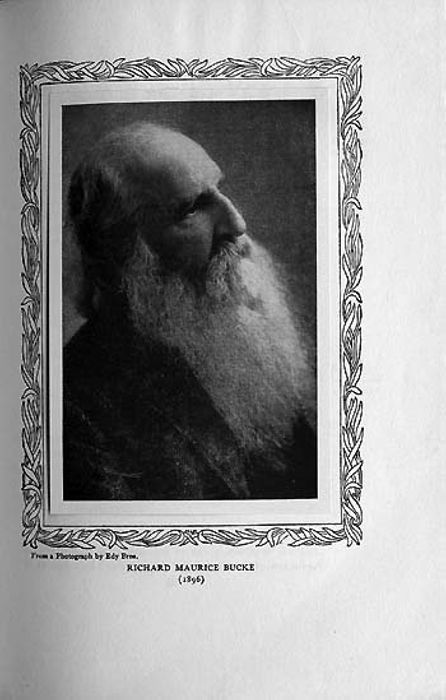 [Begin page 67]
gets stolen—I miss many things: be careful to put it away safely but in some accessible place." The O'Connor letter:
[Begin page 67]
gets stolen—I miss many things: be careful to put it away safely but in some accessible place." The O'Connor letter:
I arrived here last night, ill and exhausted. The parting at Providence was hard. [See indexical note p067.1] I fear I shall never see Jeannie well again.
Although I had a racking headache all the way, I spent time in the cars reading the proof, which I herewith return corrected. I have followed your wishes, and made only verbal corrections, which I wish you would see carried out carefully by the printer, as I know you will.
Of course I yield about the paragraphs, although I can't think I shall ever like them. No matter: the text is the main thing, and every consideration is swallowed up in the consciousness that you like what I have written—that you feel that my utterance has power and fills the bill. I hope, for your sake, that the public will think so also.
My principal corrections—the ones I feel specially desirous to have made—are as follows:
I. Page 78. Small k in the word "Knights.' [See indexical note p067.2] The obstinate printer has twice made this a large K, the effect of which is absurd.
II. Page 82. "Quaternion," not "quarternion."
III. Page 82. "Irresponsible." The allusion, which is one George William will keenly feel, is to Tennyson's "O irresponsible, indolent, reviewers," which is very witty, and sticks to the tribe like a burr.
IV. Page 86. "And it is grand." I think italicising "is" helps the sense.
V. Page 92. I hope I don't bother the printer, but the change here is necessary, for this is the passage I wrote you about, and I don't want to be picked up by some malevolent reviewer. Please see to this yourself, if you can. It should read "to ride with bared head in the warm and [Begin page 68] perfumed rains of Spring that he might feel upon him, he said, the universal spirit of the world." (How this anecdote reveals the poet in Bacon!—how it allies him to the Shakespeare literature!) [See indexical note p068.1]
VI. Page 94. I am not sure I understand the printer's work here. But there should be a paragraph—which I think the fiend tried to abolish.
VII. Page 95. "Furthest," not "furtherest," good printer's devil!
The Good Gray Poet.
VIII. Bucke sent me my foot note, and I have made the change (Page 100). [See indexical note p068.2] I think it better, and the five words which commence it, are a blow at Lowell, planted straight home.
IX. Page 113. I hope it won't bother the printer to take out Munro's name. I don't know how I ever made such a blunder. Munro's translation (prose) is really admirable for courage and fidelity, so far as I can judge.
X. Page 124. For heaven's sake, make the diabolical printer-man restore the two articles—"the" and "the"—to their proper places. The effect of the sentence is ruined by their elision.
The remaining corrections are trifles.
I'll write again soon. This is hurried, to go off with the proof, which I don't want to delay.
Bucke wrote me to find an epigraph for the appendix—leaving the matter entirely to me!!! So you didn't make anything by soliciting him. As yet I have not been able to think of anything—in fact, I have been in too much trouble to think effectually—that is to give my mind to it.
More anon. [See indexical note p068.3] Have you seen Grant White's article in the Atlantic for April on the Bacon-Shakespeare craze? It is rich. Supercilious ass!
Faithfully, W. D. O'C.Thursday, April 26, 1888.
With W. Read him a letter I had from Morse about the Hicks bust. [See indexical note p069.1] "The bust wears well. Say so to Sidney for me. Tell him I've had a bad head on me lately—have written few letters and nothing else. Say the bust wears best—tell him that. It will please him: I want to please him." W. not very well. Had been in excellent condition for three or four days. "Now I suffer the old heady feeling again. I wonder what it is all coming to? Something is brewing."
Talked of Marston. I said M. did not attract me, W. replying: "I can see why and approve why; but then you know Mrs. Moulton is a gushing woman. [See indexical note p069.2] Marston did not have the good fortune to be thrown up against the rough of the world—to get out into affairs, the trades—but was taken care of in parlors by friends who were never forgetful of his affliction. This shows in his verse. Day by day, in these older years of my life, I see how lucky I was that I was myself thrown out early upon the average earth—to wrestle for myself—among the masses of people—never living in coteries: that I have always lived cheek by jowl with the common people—yes indeed, not only bred that way but born that way. I was in a sense a boy of the farm and the streets; it was my fate, my good fate. Marston needed such an encounter (which was impossible in his case) to complete his education."
W. had been reading Gladstone's reply to Ingersoll in the North American Review. [See indexical note p069.3] W. shook his head: "It won't do, Mr. Gladstone: you may try: you have the right to try—you try hard: but the Colonel carries too many guns for you on that line." And after a pause he added: "Besides, Gladstone's day for that work is gone. Old men are too apt to insist upon being in the swim after their virility is departed. [See indexical note p069.4] It was so with Bryant, all of whose late work was poorer than indifferent—who should have retired and [Begin page 70] taken it easy twenty years before he died. This was not, I know, true of Emerson. [See indexical note p070.1] Emerson was gently snuffed out—the mind of Emerson—before he had quite reached the danger line. The essential Emerson was there to the last, but his faculty was passive—it no longer asserted itself. Gladstone has a great personality, or had, no doubt, but he stands his ground now more because of his proximity to great events than because of his own necessary superiority.
I asked W. about the Boswell—would he finish it? He seemed so little interested. "O yes! I'll whack away at it. I don't care much for it, but shall finish it as a duty. [See indexical note p070.2] I always remember that sometimes a fellow has to choose to do the unpleasant thing. 'Doing your duty' the preachers and the mothers call it. Sometimes I do my duty: not always: not because I live by any special method. Duty, duty. It is a free word—it is a slave word. The mothers make it a free word—the preachers make it a slave word." [See indexical note p070.3] W. said of Sidney Morse: "If he is not actually a genius he is the sort of stuff out of which genius is made." I spoke of Morse as "a non-organized, not a disorganized man"—as "lacking in consecutiveness." W. assented. "That's as good as it could be about Sidney: a sort of thumb-nail sketch, profound and complete. I think of him as lacking in coherency, which is about the same thing."
[See indexical note p070.4] W. had found the Stedman book. It is inscribed in this way: "to Walt Whitman with the love and sincere admiration of Edmund C. Stedman. New York April 14th 1887. Dies memoriae et lachrymarum." W. said the book "interested him." "But it is not convincing. With all its scholarliness, it kindliness, its receptivity, its genuine and here and there its striking talent, it still lacks root—still misses a saving earthiness: what shall I call it?—a sort of brutal dash of elemental flame, which burns, burns, oh, burns, but saves." [See indexical note p070.5] Then after a stop: "How strange it is how much better all these fellows are than their books. [Begin page 71] Stedman is full of this brotherliness—full of affection—is always doing good deeds—is always reaching out, reaching out, for something he knows but never can quite master, quite make his own: he sees, yes, he sees—he almost gets it, it seems almost in his grasp: yet that last spark, that sharp flash of power, that something or other more which gives life to all great literature, is not his or possible to him. [See indexical note p071.1] It was in Emerson—it was in Carlyle: Hugo had it. What is it? God knows. But it is. Just the other day at the dinner someone quoted a sentence from Emerson—I do not remember it now—which is the best summing up of that idea I have ever heard." "And yet you advise me to read Stedman?" "I advise everybody to read Stedman: Stedman is an education. [See indexical note p071.2] I do not deny him power. But I do not think him conclusive—beyond him is another Stedman whom he never seems able to reach: I have been talking about that other Stedman."
W. remarked that three Englishmen had been in to see him today. [See indexical note p071.3] "They were not célèbres but were none the less—perhaps the more—welcome on that account. They talked about matter of fact things in a matter of fact way—about their aunts and uncles and my aunts and uncles: about their voyage over—some mighty interesting experiences. They were the best kind of plain men—you know the sort I mean: the best plain men are always the best men, anyhow—if there is any better or best among men at all. The cultivated people, the well-mannered people, the well-dressed people, such people always seem a trifle overdone— spoiled in the finish."
W. loves to receive letters—any letters, provided they are in the true sense human documents. [See indexical note p071.4] He is always disappointed if the postman passes without stopping. This evening, while we talked, Mrs. Davis stuck her head in at the doorway and W. quickly asked: "Any letters?" "No, not one." "Not one? Not one? That's bad luck." W. [Begin page 72] suggested that I should read Mrs. Moulton's book. He expressed no sort of interest in it. [See indexical note p072.1] He has hung the Millet. He welcomes every allusion to Millet—every anecdote, every criticism. Parkhurst across the river, has studied Millet some and lectures about him, illustrating the talks. I said to W.: "I will ask Parkhurst over." "Yes, do—ask him at once—have him come—come any time—as soon as you can." "You seem very eager." "It's never too early to hear about Millet. Millet is our man—we must make the most of him." [See indexical note p072.2] W. has some framed photographic reproductions of Gerome's work left there by Eakins. He sometimes speaks of these, comparing them with the Millet work. "But the grand does not appeal to me: I dislike the simply art effect—art for art's sake, like literature for literature's sake, I object to, not, of course, on prude grounds, but because literature created on such a principle (and art as well) removes us from humanity, while only from humanity in mass can the light come." Had he read The Critic's criticism of Arnold's recent essay on America? [See indexical note p072.3] No, he had not read it. I described its chief features. He said: "I most likely agree with it. I don't object to Arnold's trip or his writing his trip up. But how can his three months' journey equip him for the real task of the traveller? A traveller must first of all write from the starting-point of sympathy. Every antagonistic word is wasted—strikes wide of the mark. Arnold was not inside himself friendly to America. He always approached it with a question mark."
[See indexical note p072.4] Speaking of great men W. said: "It is hard to make or justify comparisons of great men: stars differ in glory: who shall say one star is eminent beyond the rest of the stars? But we have an instinct in the matter—you have yours, I have mine. Shall we quarrel about the stars?—have wars of the stars, as one time they had wars of the roses in England?" [See indexical note p072.5] When I got up to leave and went across the room to W. he took and held my hand and said very seriously: [Begin page 73] "It's about time we were thinking of bringing out the Boughs, don't you think? I am reckoning upon you to help me—indeed, I cannot bring them out very well if you say no: I am depending upon your good will (your love?) to stick by me for this job. [See indexical note p073.1] We ought to make a good team working together. I could do little or nothing alone: I am lame, housed up, physically useless." I did not say a word. I only pressed his hand. He laughed merrily: "I knew you would say yes." Then I left.
Friday, April 27, 1888.
Talked an hour or more about Symonds. W. very frank, very affectionate. [See indexical note p073.2] "Symonds is a royal good fellow—he comes along without qualifications: just happens into the temple and takes his place. But he has a few doubts yet to be quieted—not doubts of me, doubts rather of himself. One of these doubts is about Calamus. What does Calamus mean? What do the poems come to in the round-up? That is worrying him a good deal—their involvement, as he suspects, is the passional relations of men with men—the thing he reads so much of in the literatures of southern Europe and sees something of in his own experience. He is always driving at me about that: is that what Calamus means?—because of me or in spite of me, is that what it means? [See indexical note p073.3] I have said no, but no does not satisfy him. But read this letter—read the whole of it: it is very shrewd, very cute, in deadliest earnest: it drives me hard—almost compels me—it is urgent, persistent: he sort of stands in the road and says: 'I won't movetill you answer my question.' You see, this is an old letter—sixteen years old—and he is still asking the question: he refers to it in one of his latest notes. He is surely a wonderful man—a rare, cleaned-up man—a white-souled, heroic character. [See indexical note p073.4] Look at the fight he has so far kept up with his body—yes, and so far won: it is marvellous to me, even. I have had my own [Begin page 74] troubles—I have seen other men with troubles, too—worse than mine and not so bad as mine—but Symonds is the noblest of us all." [See indexical note p074.1] This had been all called out by an old Symonds letter which he had been reading and which he gave to me. "You will be writing something about Calamus some day," said W., "and this letter, and what I say, may help to clear your ideas. Calamus needs to clear ideas: it may be easily, innocently distorted from its natural, its motive, body of doctrine."
Clifton Hill House, Near Bristol, Feb 7, 1872. Dear Mr. Whitman,Your letter found me today. [See indexical note p074.2] This is my permanent address. I live here in a large old house which belonged to my father—a house on a hill among trees looking down upon Bristol with its docks and churches—a picturesque labyrinth of marts and spires and houseroofs.
Your letter gave me the keenest pleasure I have felt for a long time. I had not exactly expected to hear from you. Yet I felt that if you liked my poem [See In Re Walt Whitman] you would write. So I was beginning to dread that I had struck some quite wrong chord—that perhaps I had seemed to you to have arrogantly confounded your own fine thought and pure feeling with the baser metal of my own nature. What you say has reassured me and has solaced me nearly as much as if I had seen the face and touched the hand of you—my Master! [See indexical note p074.3]
For many years I have been attempting to explain in verse some of the forms of what in a note to Democratic Vistas (as also in a blade of Calamus) you call "adhesiveness." I have traced passionate friendship through Greece, Rome, the medieval and the modern world, and have now a large body of poems written but not published. [See indexical note p074.4] In these I trust the spirit of the Past is faithfully set forth as far as my abilities allow.
[Begin page 75]It was while engaged upon this work (years ago now) that I first read Leaves of Grass. [See indexical note p075.1] The man who spoke to me from that Book impressed me in every way most profoundly—unalterably; but especially did I then learn confidently to believe that the Comradeship which I conceived as on a par with the sexual feeling for depth and strength and purity and capability of all good, was real—not a delusion of distorted passions, a dream of the Past, a scholar's fancy—but a strong and vital bond of man to man.
Yet even then how hard I found it—brought up in English feudalism, educated at an aristocratic public school (Harrow) and an over refined University (Oxford)—to winnow from my own emotion and from my conception of the ideal friend all husks of affectations and aberrations and to be a simple human being! [See indexical note p075.2] You cannot tell quite how hard this was, and how you helped me.
I have pored for continuous hours over the pages of Calamus (as I used to pore over the pages of Plato), longing to hear you speak, burning for a revelation of your more developed meaning, panting to ask—is this what you would indicate?—are then the free men of your land really so pure and loving and noble and generous and sincere? [See indexical note p075.3] Most of all did I desire to hear from your own lips—or from your pen—some story of athletic friendship from which to learn the truth. Yet I dared not to address you or dreamed that the thought of a student could abide the inevitable shafts of your searching intuition.
Shall I ever be permitted to question you and learn from you?
What the love of man for man has been in the Past I think I know. What it is here now, I know that also—alas! [See indexical note p075.4] What you say it can and shall be I dimly discern in your Poems. But this hardly satisfies me—so desirous am I of learning what you teach.
[Begin page 76]Some day, perhaps—in some form, I know not what, but in your own chosen form—you will tell me more about the Love of Friends. [See indexical note p076.1] Till then I wait. Meanwhile you have told me more than any one beside.
I have been led to write too much about myself, presuming on what you said, that you should like to know me better.
It will give me sincere pleasure to receive a copy of your book from you. I am grateful to you for purposing to give me so great a gift. Will you complete the benefit by sending me a portrait of yourself?
It is good to hear that your work does not deny you leisure. Work with an ample margin of freedom is the best thing for man; but I cannot believe in the modern Gospel of Work and no leisure. [See indexical note p076.2] This ends in a Science of Human Mechanics.
When I am free enough from home duties I hope to go to America on a tour with my wife. Then I shall request to be permitted to pay respect to you in person.
That you may know my face I enclose two portraits. The little girl in one of them is my youngest child.
I am your ever grateful and indebted John Addington Symonds.Said W.: "Well, what do you think of that? Do you think that could be answered?"
[See indexical note p076.3]
"I don't see why you call that letter driving you hard. It's quiet enough—it only asks questions, and asks the questions mildly enough."
"I suppose you are right—'drive' is not exactly the word: yet you know how I hate to be catechised. Symonds is right no doubt, to ask the questions: I am just as much right if I do not answer them: just as much right if I do answer them. [See indexical note p076.4] I often say to myself about Calamus—perhaps it means more or less than what I thought myself—means different: perhaps I don't know what it all means—perhaps never did know. My first instinct about all that Symonds writes is violently reactionary—is strong and brutal for no, no, no.
[Begin page figure-8]
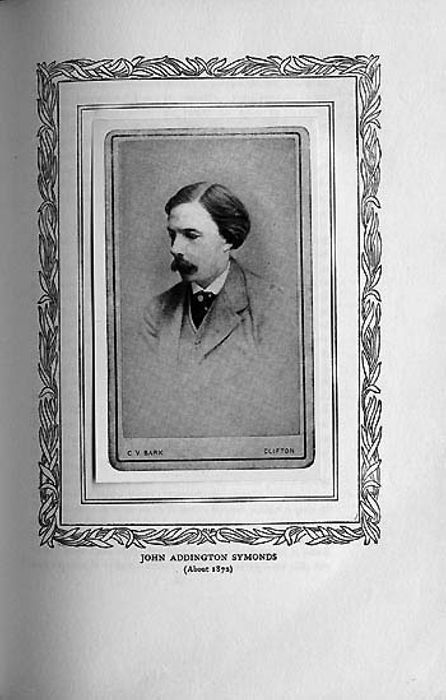 [Begin page 77]
Then the thought intervenes that I maybe do not know all my own meanings: I say to myself: 'You, too, go away, come back, study your own book—an alien or stranger, study your own book, see what it amounts to.' [See indexical note p077.1] Sometime or other I will have to write him definitively about Calamus—give him my word for it what I meant or mean it to mean."
[Begin page 77]
Then the thought intervenes that I maybe do not know all my own meanings: I say to myself: 'You, too, go away, come back, study your own book—an alien or stranger, study your own book, see what it amounts to.' [See indexical note p077.1] Sometime or other I will have to write him definitively about Calamus—give him my word for it what I meant or mean it to mean."
Symonds spoke of two portraits. The portrait of himself was still enclosed. The child portrait was missing. W. said: "It's around the house somewhere."
Saturday, April 28, 1888.
Asked W. "How is November Boughs?" "Still getting ready." "I thought you said it was ready?" "So I did—so it is: about ready: but that about sometimes covers a multitude of cautions. You know I am a conservative animal—I don't jumptill I must—till I'm pretty sure I can jump right." [See indexical note p077.2] "Well—I'm ready any time the book is ready." "I know—I know: we haven't said much about that between us, but you know, I know: give me a little more time, a little more room—then we can get our start: yes, start right."
Early evening. W. had just been out on his drive. Not over well. Complains some. "I keep so congested—head, belly. The truth is, I have no desire to go out, though I do go—going mostly because I feel it to be a duty. There was a time—not long ago, either—when the mere pleasure of locomotion—of having my arms and legs going out of doors—was a joy to me."
W. said: "I have this afternoon mailed two pieces to the Herald—two more throws against oblivion." I laughed—W. adding: "It does seem funny. [See indexical note p077.3] A man makes a pair of shoes—the best—he expects nothing of it: he knows they will wear out: that's the end of the good shoe, the good man. Any kind of a scribbler writes any kind of a poem and expects it to last forever. Yet the poems wear out, too [Begin page 78]—often faster than the shoes. I don't know but in the long run almost as many shoes as poems last out the experience—we put the shoes into museums, we put the poems into books." He had watched at Gloucester the drawing of the seine. "I will put it into a poem: it was dramatic: it would make a wonderful picture."
Frank Stockton has recently lived at Merchantville near by. [See indexical note p078.1] Had Frank called? "I do not think so, though I do not remember all my callers. I confess that my curiosity is slight, though I might like Frank at close quarters. The story writers do not as a rule attract me. [See indexical note p078.2] Howells is more serious—seems to have something to say—James is only feathers to me. What do you make of them?—what is their future significance? Have they any? Don't they just come and go—don't they just skim about, butterfly about, daintily, in fragile literary vessels, for awhile—then bow their way out? They do not deal in elements: they deal only in pieces of things, in fragments broken off, in detached episodes." [See indexical note p078.3] Mentioned Stedman again: "Stedman always feels that he must be judicial—the dominance of that principle has held him down from many a noble flight. Stedman seems so often just about to get off for a long voyage and stops himself on the shore. Why shouldn't we just let go—let life do its damnedest: take every obstacle out of the way and let it go? Why should being thought foolish or unreasonable or coarse hold us back? We can go nowhere worth while if we submit to the scorners."
W. said: "Too much is often said—perhaps even by me—about my Quaker lineage. [See indexical note p078.4] There was some of it there, but back, altogether among the women, with my own dear mother and grandmother and her mother again. It is lucky for me if I take after the women of my ancestry, as I hope I do: they were so superior, so truly the more pregnant forces in our family history. The Quakers are very clannish, though I am not that way myself. I am like the [Begin page 79] cabbage in the fable which forgot it was a cabbage: a very varied experience has washed me clean of that fault." He got talking along in matters of family history. Said some things about his father. "He knew Thomas Paine. [See indexical note p079.1] Did history ever more thoroughly victimize a man? The most of things history has to say about Paine are damnably hideous. The polite circles of that period and later on were determined to queer the reputation of contemporary radicals—not Paine alone, but others also—Fanny Wright, Priestly, for instance. The young radicals of that time have never had justice done them: they rallied—such of them as were in New York—about Paine and were far in advance of their time. Paine himself did signal, lasting work—work to which our people have been disgracefully oblivious. I used to meet Colonel Fellows four or five times a week in Tammany Hall. [See indexical note p079.2] I liked to draw him out reminiscently. He was an intimate associate of Thomas Paine—a man of imposing presence, of judgment, of recognised character, abilities. From him I learned the truth about Paine—how literally nothing true was at the bottom of all the vile slanders. Paine did drink: who did not drink then? The stories might just as well have be told of me—yet I never tasted strong liquortill I was thirty and heaven knows I drink little enough now. Fellows said Paine was sometimes somewhat hasty in speech, generally justifiably so, though sometimes also unnecessarily sharp and decisive, making enemies thereby. We talk of 'facts' in history. What are facts? [See indexical note p079.3] A good deal that gets written once is repeated and repeated, until the future comes to swear by it as a gospel. I have always determined that I would do all I could to help set the memory of Paine right. From my young days, with Colonel Fellows, I determined I would some day bear my testimony to that whole group of slandered men and women. My speech on Paine at a Liberal League meeting in Philadelphia some years ago was only a sliver—a little bit of rever- [Begin page 80]ence done at a neglected shrine. I do not know that the audience cared at all, but I cared a good deal: it made me infinitely happy. [See indexical note p080.1] Think of Fanny Wright. She had all of Ingersoll's magnetism and perhaps more than his tact, though I don't know that the Colonel travels on his tact. She was a brilliant woman, of beauty and estate, who was never satisfied unless she was busy doing good—public good, private good." Why did he not himself write up this story? "I ought to do it: I have often said to myself that I would do it: I may perhaps be the only one living today who can throw an authentic sidelight upon the radicalism of those post-Revolutionary decades. The average historian has either not seen the facts at all or been afraid to do anything with them."
Sunday, April 29, 1888.
W. took a drive at eleven, forenoon, and came in at Harned's after we were done supper at 6:30. Had been to see the Staffords at Glen Dale. [See indexical note p080.2] In good feather, "feeling rather peart," as he said. Drove up alone. No one at Harned's door. I saw him from the window. He held the reins and called out, waiting for some one to see or hear. When we had helped him into the hallway he said instantly: "I came for a drink—oh! I am that thirsty for it. I could wait no longer—have had it in mind, could not get rid of it, for an hour past." Someone remarked the fine day and he exclaimed: "Oh! it is perfect! And I saw out there such a field of fine new sweet wheat."
W. sat up at the table. We were gathered about him, he eating and drinking and talking. Got telling about the dinner the other day at Gloucester. "They wanted a toast from me—a toast to three eminent good fellows—and I gave them President Cleveland, Gladstone, and the Emperor of Germany. [See indexical note p080.3] I got myself into trouble. You should have heard the uproar. They all kicked on one or another of [Begin page 81] the three—some of them kicked on all three. But I held my own. [See indexical note p081.1] I don't believe in Cleveland because I think he is any great shakes in himself but because he has done some honor to his office—has done his best: not your best or my best but his best. I never knew a President to totally fail." Johnson was mentioned. But W. stuck to his plea. [See indexical note p081.2] "Even Andy Johnson. In all the line of Presidents I do not think we have had one absolute failure—I think every President so far as made more or less honest use of the office. You object to the Emperor Frederick William? [See indexical note p081.3] Well—object: objection is right, too. I called him a good fellow—he is one, too. He is one of the very best Emperors in all history—tries to do right—makes a big strain to size up to the emperor ideal he has had in his mind: why should we gag at it? As long as we consent to have emperors why shouldn't we be glad to have the good fellow emperors? Someone cried out there at Gloucester: 'You're damned tolerant, Walt!' Am I? Call it toleration, if you choose. [See indexical note p081.4] I only call it common sense—philosophy. I am extreme? Perhaps. But then it is with America as it is with nature: I believe our institutions can digest, absorb, all elements, good or bad, godlike or devilish, that come along: it seems impossible for nature to fail to make good in the processes peculiar to her: in the same way it is impossible for America to fail to turn the worst luck into best—curses into blessings."
Harned told W. that Gladstone had come out with a reply to Ingersoll. This excited W.'s humor. He laughed gently. Said: "Gladstone is no match for Ingersoll—at least not in such a controversy. Of course, he is a great man, or was—has had a past—but in questions of the theological sort, in questions of Homeric scholarship, he is by no means much. [See indexical note p081.5] Oh! There will be a funny time of it!" Here he put his two hands together scoop-wise. "Bob will take him up this fashion, turn him over (all sides of him), look at him sweetly, ever so sweetly, smile, then crunch him!"—to illus- [Begin page 82]trate which he worked his two hands together as if to crush their imagined burden—"Yes, crunch him, much as a cat would a mouse,till there's no life left to fool with." [See indexical note p082.1] Someone present demurred somewhat as to Ingersoll. "Ain't you exaggerating his importance, Walt?" "Not a bit: Ingersoll is a man whose importance to the time could not be overfigured: not literal importance, not argumentative importance, not anti-theological Republican party importance: but spiritual importance—importance as a force, as consuming energy—a fiery blast for the new virtues, which are only the old virtues done over for honest use again." [See indexical note p082.2] Further of Ingersoll: "It was one of the mistakes of Jerry Black's life that he got into that fight with the Colonel. I knew Black—he frequently came to see me in Washington—was a good fellow—but in that discussion he met, as he deserved, with the most scathing chastisement."
My sister Agnes remarked: "The drives are certainly doing you good—you show it." He assented. "They do indeed: yes they do. [See indexical note p082.3] I have been out each day now for three or four days—the season is opening some: I had got to feeling so I knew I had to do something or go flunk." He turned to Tom: "I say Tom what's the matter with that tipple? Did you put in the cork again? What's the good of a tipple with the cork in?" Then after his glass was filled. "Well, I forgive you. I forgive everybody: I am in a good mood for gentle things: the beautiful day, my hearty reception here, all of you about me: there's no room left for malice." [See indexical note p082.4] "Do you know, my philosophy sees a place and a time for everybody—even Judas Iscariot—yes, for all: all of us are parties to the same bargain: the worst, the best, the middling—all parties to the same bargain. We are as we are, all of us—and that's both the very bad and the very good that's to be said."
I was to go to Philadelphia to hear Adler speak. Had W. any message? "Yes, surely. Give him my love: describe [Begin page 83] the last hour here at Harned's—the talk, the good feed, the good drink; say to him that Walt Whitman had been out in the country for a long drive and at the end of the drive had come to Harned's and asked for something to eat and drink and had not been refused—was in fact royally entertained: tell him about the Millet—that I thank him for it: it is so much Millet—three times over and more: not the Sower, with the strong arm casting forth the seed, so, so [indicating it by a fling of the hand] but a quieter motif—a passive bit of atmosphere for a moment of prayer. Tell him such things, and other things. [See indexical note p083.1] Tell him he must come over to Harned's soon again and spend an hour and a half with Walt Whitman and the rest." [See indexical note p083.2]
Monday, April 30, 1888.
[See indexical note p083.3] W. said: "I want you to have this letter of William's for your archives. It would be valuable enough if it was only William's—but it happens to be more than that. You see the date—1865. He encloses a letter from George William Curtis—it makes good history. Curtis always had the big manner—yes, big without being offish: his personality has a large swing, as if it had plenty of time and space in which to live. [See indexical note p083.4] William elicited a noble reply. I don't know which is finer, the man who could have provoked such a letter or the man who wrote it: I suppose neither is finer—one is necessary to the other: it takes both to make the complete affair." Again: "It is an eloquent letter all through—rather silent, still, pastoral, for William: his tempest is lulled: the best soldiers are often the best men of peace." [See indexical note p083.5] This is the letter:
New Ipswich, New Hampshire, October 19, 1865. My dear Walt:The article you sent Nelly from the London Leader is in my possession. Good! I shall incorporate it. Part of it is very fine.
[Begin page 84]I wonder if young William Allingham wrote it? The Leader is the paper he is on. He is a poet, you remember—one of the most promising of the young British choir. He is an Irishman and a reverent lover of Emerson's genius. [See indexical note p084.1] I shouldn't wonder if he wrote this critique.
Anyhow it's good and I shall put a great deal of it in.
If, ever since I have been here, I have not had the worst cold I ever had in my life—a cold which has made me really sick and spoiled the pleasure of my visit—I should doubtless have ere this sent off the MS. to Curtis. [See indexical note p084.2] It will probably go soon. It is just as well and even better than I have delayed it, for in the first place it will be enriched with this quotation, and besides you will like it better by the excision of nearly all the personality, new light having come to me on this point as time has passed and the sweet country air and relief from labor cleared and refreshed my poor boiled brains.
On my way through New York I enquired at Harper's for Curtis and found he was out of town. So I brought the MS. with me up here. [See indexical note p084.3] Then came Curtis' answer; of which I send you a copy that you may see how true the reply this splendid gentleman and noble heart sends back to my call.
I really did not expect so much from Curtis. I relied on his literary chivalry, but did not look for the rest. As George would say, he has "elements"!
I have written to him saying that I want him to endeavor to find me a publisher and mentioning Hurd and Houghton: also saying that in a few days I shall send him the MS.
I wish you could come up here. The landscape is exquisite. Fields, farms, the quiet rustic town, the gorgeous foliage, the Temple and Peterboro hills enclosing all. And then, drive out a few miles and lo! [See indexical note p084.4] Monadnoc! O Walt, what a sight! A purple breadth of mountain, spreading calm in sleepy light and filling the landscape with grandeur. [Begin page 85] It is the finest mountain I have seen. Its characteristic is breadth.
I am staying here at the house of Miss Jenny Bullard, a friend of whom I believe I have spoken to you. [See indexical note p085.1] I wish you knew her. You would like her. She is handsome, bountiful, generous, cordial, strong, careless, laughing, large, regardless of dress or personal appearance, and appreciates and likes Leaves of Grass. The first thing she read in the book was Enfans d'Adam, which she cordially liked and wondered how anyone could mistake its atmosphere and purport. She is a very particular friend of mine. I wish you knew her. She told me today that she wanted me to invite you to come up here for a few days before I go, but I said I wouldn't because I knew you wouldn't come. [See indexical note p085.2]
I shall probably leave here about the twenty-fifth and go to Boston. Then home.
Spite of dear friends and respite from the treadmill and the superb scenery, I have had considerably of a bad time, chiefly owing to the horrible cold I have had and the weary state I have been in. But I am better now and the world looks brighter.
Now I hope to be able to announce to you that the MS. has a publisher. But oh, Walt, the literary shortcomings of it oppress me. It is not the thing that should be said of your book—not the thing that it is in even me to say—as I feel. However. Good bye. I will write you again.
Your faithful W. D. O'Connor.The enclosed letter of Curtis follows:
Ashfield, Mass. 30 Sept. 1865. My dear O'Connor:[See indexical note p085.3] Here, up among the Autumn Hills, I get your interesting letter of the 20th and you may be very sure that I will do all I can to redress the wrong of which you speak.
[Begin page 86]The task you undertake is not easy, as you know. The public sympathy will be with the Secretary for removing a man who will be considered an obscene author and a free lover. [See indexical note p086.1] But your hearty vindication of free letters will not be less welcome to all liberal men.
Personally I do not know Whitman; and while his Leaves of Grass impressed me less than it impressed many better men than I, I have never heard anything of him but what was noble nor believed anything of him but what was honorable.
That a man should be expelled from office and held up to public contumely, because of an honest book which no candid mind can truly regard as hurtful to public morality, is an offence which demands exposure and censure. [See indexical note p086.2]
I know Carleton but he has several times asked of me favors which I could not grant and I do not believe your offer would be strengthened if made through me. If you think otherwise, I shall most cheerfully go to him,—but would it not be better for you to write to him and refer him to me, saying, if you choose, that you had asked me to call upon him? Think of it and let me know.
It was very pleasant to see your comely chirography again, altho' I wish I could think of you as having had some vacation. We have been here for two months, far from railroads, telegraphs, and gossip, and are just going home. My wife returns your friendly remembrance and yours, I hope, has not forgotten me. [See indexical note p086.3] I should be glad, too, if I thought you felt as cheerfully as I feel at the real gain in the Good Fight made by the war. Andy may Tylerize but the country will not. The wave may be lower, but the tide is rising.
Good bye. Let me hear as soon as you will. You know how gladly I shall serve you and how truly I am
Your friend G. W. Curtis.Tuesday, May 1, 1888.
Called W.'s attention to some announcements of November Boughs already finding their way into the papers. [See indexical note p087.1] "That ought to spur me on." he said, "though as you know I am not easily spurred. I always argue that all the time there is my time: so I go slow with what I do—take the reasonable maximum of liberty." Then: "Yet you are right. We should get at that job. I'm in a pretty shaky condition, physically, right along these days—never know what may not happen overnight. I'm not afraid but I face the facts. I want the book to come out—I wouldn't like much to delay and delay and then die off with the thing hanging fire or half done. You are right—yes, you are right—we will attack the problem at once." He laughed a bit and broke out into a little recitative: "A minister was in here today—he came to give me advice—he said he had come from St. Louis, or Denver perhaps (I forget which), to give me his opinion on Leaves of Grass. [See indexical note p087.2] I told him that was hardly worth while—that I had plenty of opinions of Leaves of Grass nearer home—all sorts of pros and cons: damns and hallelujahs. But he didn't laugh or seem deterred—he went right on with his message. I must have done something to make him think I was inattentive—I didn't do it purposely—for he suddenly stopped: 'I don't believe you're hearing a word I say, Mr. Whitman,' he said. It was a good guess. I didn't mind his knowing it—so I said: I shouldn't wonder—I shouldn't wonder.' That seemed to open his eyes a little. He went very soon after that, saying to me: 'I was told you wouldn't take any advice—even good advice.' [See indexical note p087.3] I said again: 'I shouldn't wonder—I shouldn't wonder,' and while he was trying to intimate his disgust I added: 'You know I get so much good advice, and so much bad advice, so much nearer home.' The thing seems incredible: I don't believe anybody but a minister of the [Begin page 88] gospel would do such a thing—would have been guilty of so egregious an impertinence. When he was all gone I had a long laugh all to myself." [See indexical note p088.1] Then W. burst into laughter again, exclaiming: "That's a tale worth putting down in the book." I assented, but said: "So it is. But I've got a match for it." "I don't believe it—but let's hear." "My grandmother was sitting on the front step one day—she was well on to eighty, you know—quietly looking about at things. A clerical came along and saw her, stopped and sat down on the step at her side. 'Madam,' he said, 'you are very old: are you prepared to die?' She was of course annoyed and said to him tartly: 'Sir! if you were half as well prepared to die as I am you would be a happy man!'" W. was very much amused. [See indexical note p088.2] "Yes, that's a good match: that's worth being put down in the same book!" And after a little interval in which nothing was said by either he remarked: "The ministry is spoiled with arrogance: it takes all sorts of vagaries, impudences, invasions, for granted: it even seizes the key to the bedroom and the closet."
W. talked again about literary honesty. [See indexical note p088.3]
"It's not quite the thing to take language by the throat and make it yield you beautiful results. I don't want beautiful results—I want results: honest results: expression: expression. You know we talked about this the other day: you may have thought I was over vehement, thought, as for that, I don't see how a fellow can say too much on that score. Since we talked I have come across a letter from John Burroughs that finely illustrates my point. [See indexical note p088.4] It is an old letter, written by John from England in 1871: a letter in which he lets himself go—talks out—isn't trying to be judicial or qualified—which is on the square all through. See what I wrote on it then at the time in red ink." I took the letter from his hand and read the memorandum: "splendid offhand letter from John Burroughs—? publish it." W. resumed: "John
[Begin page figure-9]
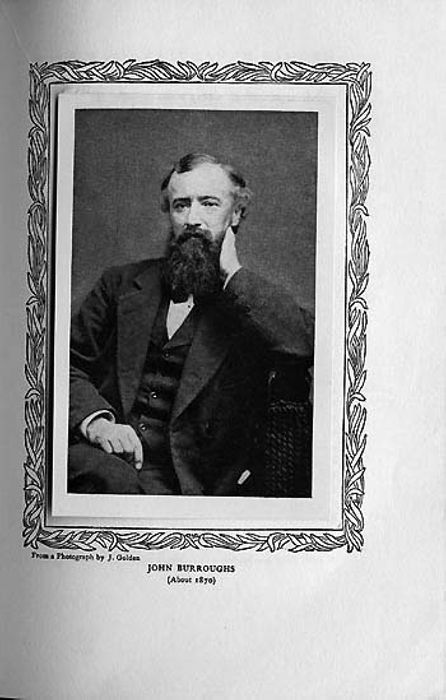 [Begin page 89] has a few of the simply literary habits—not many—not enough to spoil or even much hurt the batter. You will notice the postscript, written the next day. [See indexical note p089.1] He asks himself then whether he hadn't gone too far the day before—shows that after all he was a little bit afraid of his enthusiasm. He had slept over night—the judicial atmosphere was returning. But the letter itself? There is no discount on the letter—it is a superb example of let go: let hell come if it must, but let go. Does this seem lawless? [See indexical note p089.2] Of course I mean let go within the law—within your own law, not somebody else's law: every individual within his own law."
I am writing to you on the spur of the moment in hopes it will bring me to my senses, for I am quite stunned at the first glance of London. [See indexical note p089.3] I have just come from St. Paul's and feel very strange. I don't know what is the matter with me but I seem in a dream. St. Paul was too much for me and my brain actually reels. I have never seen architecture before. It made me drunk. I have seen a building with a living soul. I can't tell you about it now. I saw for the first time what power and imagination could be put in form and design—I felt for a moment what great genius was in this field. [See indexical note p089.4] But I had to retreat after sitting down a half hour and trying to absorb it. I feel as if I should go nowhere else while in London. I must master it or it will kill me. I actually grew faint. I was not prepared for it and I thought my companions the Treasury clerks would drive me mad they rushed round so. I had to leave them and sit down. Hereafter I must go alone everywhere. My brain is too sensitive. I am not strong enough to confront these things all at once. [See indexical note p089.5] I would give anything if you was here. I see now that you belong here—these things are akin to your spirit. You would see your own in [Begin page 90] St. Paul's, but it took my breath away. It was more than I could bear and I will have to gird up my loins and try it many times. Outside it has the beauty and grandeur of rocks and crags and ledges. [See indexical note p090.1] It is nature and art fused into one. Of course time has done much for it, it is so stained and weatherworn. It is like a Rembrandt picture so strong and deep is the light and shade. It is more to see the old world than I had dreamed, much more. I thought art was of little account, but now I get a glimpse of the real article I am overwhelmed. I had designed to go on the continent, but I shall not stir out of London until I have vanquished some part of it at least. If I lose my wits here why go further? But I shall make a brave fight. I only wish I had help. These fellows are like monkeys. I have seen no one yet but shall try to see Conway tomorrow. [See indexical note p090.2] I write this dear Walt to help recover myself. I know it contains nothing you might expect to hear from me in London, but I have got into Niagara without knowing it and you must bear with me. I will give facts and details next time. Go and see Ursula.
With much love, John Burroughs.[See indexical note p090.3] Oct. 4—I went today to see Conway but he was not in—so I went back to St. Paul's to see if I really make a fool of myself yesterday. I did not feel as before and perhaps never shall again. Yet it is truly grand and there is no mistake. It is like the grandest organ music put into form.
P. S. I hope you and O'Connor will make an effort to come over here. You need not mention it but I know it is not settled at all who will come. This you can rely upon, but there will be no more bonds sent until in November.
"Now I see what you mean by your reference to the foot-note." [See indexical note p090.4] "Yes," replied W., "the letter is perfect—it deserves to go alone. The footnote is an impertinence. The foot- [Begin page 91]note, however, helps to clear up the sort of literary questions we have been turning over together."
Wednesday, May 2, 1888.
[See indexical note p091.1] Returned to W. the Marston volume containing Garden Secrets and the memoir from Mrs. Moulton, who had written on one of the fly-leaves: "To Walt Whitman, Poet, These poems, by an English poet who delighted to do him honor. Louise Chandler Moulton, April 23, 1888." W. not well, had been feeling out of sorts again since Sunday. This is Wednesday. Same symptoms—the insistent headache, congestion, &c. Lay on sofa in parlor in some exhaustion. The Marston book I had noticed was not cut throughout. W. smiled. "No—I did not read the book; I looked into it: the bit I read did not lead me on: I dropped the trail—or lost it, perhaps." How about the lecture trip to England? Would he take it? [See indexical note p091.2] "No. It was tempting up to a certain point. But I would rather finish, as I have grown up, here. I could not stand the excitement of travelling and meeting people—of being lionized and denounced. This is a safer place for me—this little town, this little room, my own bed and chair." Said he had been reading Gladstone's reply to Ingersoll—"It is a great weariness—but I stuck to it, thinking it probably my fault. [See indexical note p091.3] Its protestations seem to me a sort of Captain Cuttle business—the 'yes I do,' 'no I don't,' 'perhaps,' 'Oh no': Gladstone is neither here nor there: he is longwinded and indefinite—he doesn't make his mark clear and then drive to it: he goes all over the country looking for his game. Ingersoll is everyway different—knows exactly what he wants and gets it at once."
Had W. ever heard directly from Carlyle? "No—never directly. [See indexical note p091.4] I once heard a report that Carlyle had made some foul allusion to the Leaves, but we had reason afterward for believing that he was not responsible for the nasty [Begin page 92] rumor. Yet Carlyle could never have understood me—could never have comprehended the Leaves, which are outside his spiritual latitude and longitude altogether. Carlyle was not an apt student of the modern, of literary rebellion—he was raised, imbedded, in older routines. [See indexical note p092.1] He did not understand humanity—had no faith in humanity, in fact—more than that, he lacked unction: don't you think that's the word to describe it?—he had no religious faith—I am sure he lacked conviction in the triumph of the good. I do not intend to say Carlyle did not contribute—did not do this and that for which humanity will be eternally richer and grateful. What I am trying to say is that he had no avenue of approach to the people; he lost his way in the jungle: the people were not a beautiful abstraction—they were an ugly fact: he shrank from the people. [See indexical note p092.2] Carlyle was a good deal of a democrat in spite of himself. Carlyle was incapable of seeing men generously, even his friends. One thing Carlyle did understand—the incessant caterwauling of radicals—their unceasing complaints against everything—their inability to appreciate the importance of conservatism, of restraint, even of persecution." I never knew W. to quote Ruskin. [See indexical note p092.3] This evening I said so. He responded: "I don't quote him—I don't care for him, don't read him—don't find he appeals to me. I've tried Ruskin on every way but he don't fit."
W. spoke about the first edition of the Leaves: "It is tragic—the fate of those books. [See indexical note p092.4] None of them were sold—practically none—perhaps one or two, perhaps not even that many. We had only one object—to get rid of the books—to get them out someway even if they had to be given away. You have asked me questions about the manuscript of the first edition. It was burned. Rome kept it several years, but one day, by accident, it got away from us entirely—was used to kindle the fire or to feed the rag man."
[Begin page 93]W. said about Franklin Evans: "I doubt if there is a copy in existence: I have none and have not had one for years; it was a pamphlet. Parke Godwin and another somebody (who was it?) came to see me about writing it. Their offer of cash payment was so tempting—I was so hard up at the time—that I set to work at once ardently on it (with the help of a bottle of port or what not). [See indexical note p093.1] In three days of constant work I finished the book. Finished the book? Finished myself. It was damned rot—rot of the worst sort—not insincere, perhaps, but rot, nevertheless: it was not the business for me to be up to. I stopped right there: I never cut a chip off that kind of timber again."
As I was about to leave W. rose painfully from the sofa, saying: "A minute—yes, wait: there is a little thing I am going to ask you to do for me. [See indexical note p093.2] I have received word that someone in England—a lady—a very great lady—indeed, no less a person than Lady Mount Temple, daughter of Lord Palmerston—has sent me a scarf or waistcoat. This letter speaks of it and I am going to have you see what we need to do to get possession of the dainty gift." W. handed me the letter:
Phila. Apr. 28, '88. Mr. W. Whitman, Camden, N.J. Dear Sir:—We will receive your acct by the "Br. Prince," now due from Liverpool, consigned to us for your acct., one package containing apparel valued at £1. [See indexical note p093.3] We would thank you for your invoice covering same as early as possible in order to clear through customs on arrival. The package will come to us through the medium of Messrs. G. W. Wheatley & Co. If the apparel contained therein is worn at all, kindly say so when replying to the above; and oblige
Yours truly O. G. Hempstead & Son. [Begin page 94]W. wrote to Hempstead on the face of an envelope: "Please treat with the bearer of this, Mr. Horace Traubel, a personal friend of mine, the same as you would with me, and consider him as my fully authorized agent in the matter." [See indexical note p094.1] To me W. said: "I have no word from Lady Mount Temple direct but from Wheatley, as in Hempstead's letter. I suppose this means the usual rigmarole and expense: by the time we get the thing in our hands we will have paid out more than it is physically worth. Of course the gift is the gift—we appreciate that: we will not lose sight of the gift in our struggle to rescue it from customs. [See indexical note p094.2] This whole tariff business is an insult to our good sense besides being a palpable impertinence and invasion. But we'll get the waistcoat if it takes our last cent—at least you'll get it: I am no good anymore, that way speaking: I am tied down here fast to my infirmities."
Thursday, May 3, 1888.
In with W. "I've had a bad day of it," he said as I raised the light—"a bad day altogether." He was on the sofa. I told him I had seen the Hempsteads about the Mount Temple gift. [See indexical note p094.3] Who was the Lady Mount Temple? What had she done? "I know little about her. She is not literary: but she is evidently a reader of books. I have had several letters from her—she has bought several copies of Leaves of Grass direct from me. She is a friend of my Quaker friend, Mary Costelloe: it was no doubt through Mary that we came together." "You are constantly getting gifts. You take them very composedly." "Why shouldn't I? They are pleasant—we all like to be tickled, to be soft-soaped: we like to have our fur rubbed the right way."
[See indexical note p094.4] W. again: "I had a Boston visitor today: Thayer, a young man, a Cambridge man, author of The Confessions of Hermes, published last year—a good fellow, interesting, of means I judge, who has travelled and makes a facile talker. [Begin page 95] Thayer," he reasoned, "is fairly a type of the literary feller—the class that looks upon literature as an exercise—as a bit of legerdemain—who have nothing native to themselves to give, but who keep right on writing, for what end God only knows. [See indexical note p095.1] The Confessions was written in the form of Pope—of the Essay on Man." "Well—what did the thing come to?" "He unpacked himself in it—that's about all I can say." "Is Thayer radical?" "I think so—in his proclivities—but, like men of that class, always making I would not wait upon I should."
W. said he had just heard from Rhys, writing from the Union League, New York, on his way to Baltimore and to Philadelphia. [See indexical note p095.2] "We will see him again before he takes his steamer for the return trip." "What do you think, Horace? He didn't, he will not, go to see Niagara. Think of a man coming to America and not seeing Niagara! It's refreshing. All the strangers come over and see a few of the ostentatious things and then feel satisfied that they are equipped for literary service. The foreign professionals cross the sea, visit Boston, New York, Philadelphia, Chicago—see a few elect people—hurry, skurry—then go back again and write a book: all in a breath—all over night, metaphorically speaking. [See indexical note p095.3] Do you think they know America? Not a bit of it. I do not mean to connect these people with Rhys—I am only speaking of the average traveller and his less than average work. I do not know that his position, or his offense, is a singular one. Don't most men who write write without knowing life? Write all over the surface of the earth, never dig a foot into the ground—everlastingly write."
W. talked of Arnold. "Arnold had no genius—only a peculiarly clever order of refined talent. [See indexical note p095.4] Arnold is much that sort of man who would be in his place as Keeper of Her Majesty's Despatches, careful that never a word be misapplied or misspelled—or he might serve as a tutor for [Begin page 96] gentlemen's sons, or sons of lords: but as for genius—no—no—not at all—that is not there. These men have their functioning to do—they are not waste, they are not useless: but they do not inspire—they do not lift you off your feet—they are without inspiration. [See indexical note p096.1] They make more fuss over foliage than root, if that may be: think the foliage may be superior to the root—neglect the root. Well—I mustn't go on too much about Arnold. I do not feel myself to be against him in any way: but so much is made of the Arnold type of man that we are liable to miss our normal gauge of value."
I mentioned Lafcadio Hearn. [See indexical note p096.2] W. said: "My attention was first called to him by William O'Connor, who may have met him personally—I don't feel clear on that point—but who at any rate entertained great hopes for his future—hopes that are being justified. I had one of his books here which Dr. Bucke carried off with him. Hearn has a delicate beautiful nature: he got into instant rapport with the Japanese. These story writers do not as a rule reach me—I find they stay too much on the surface of the ground. [See indexical note p096.3] I have tried to read Cable—have read several of his stories—Madame Delphine for one, brought here by Logan Smith. They are modelled on the French—show great delicacy, precision, analysis: a capacity for taking up a single act or character—a fragment—and working it out to an extreme individual conclusion, meanwhile missing the law, missing the general atmosphere. [See indexical note p096.4] I think the American theory would be, should be, must be, something different. My taste has been modelled on another theory—in the school of Scott, of Cooper, of some others of the older writers. How much I am indebted to Scott no one can tell—I couldn't tell it myself—but it has permeated me through and through. If you could reduce the Leaves to their elements you would see Scott unmistakably active at the roots. [See indexical note p096.5] I remember the Tales of my Landlord, Ivanhoe, The Fortunes of Nigel— [Begin page 97]yes, and Kenilworth—its great pageantry—then there's The Heart of Midlothian, which I have read a dozen times and more. I might say just about the same thing about Cooper, too. [See indexical note p097.1] He has written books which will survive into the farthest future. Try to think of literature, of the world of boys, today, without Natty Bumppo, The Spy, The Red Rover—Oh the Red Rover—it used to stir me up clarionlike: I read it many times. Is all this old fashioned? I am not sworn to the old things—not at all—that is, not to old things at the expense of new—but some of the oldest things are the newest. I should not refuse to see and welcome anyone who came to violate the precedents—on the contrary I am looking about for just such men—but a lot of the fresh things are not new—they are only repetitions after all: they do not seem to take life forward but to take it back. [See indexical note p097.2] I look for the things that take life forward—the new things, the old things, that take life forward. Scott, Cooper, such men, always, perpetually, as a matter of course, always take life forward—take each new generation forward."
I asked W. whether he had met Cable. [See indexical note p097.3] "Yes—once: and he is the thinnest, most uninteresting, man I ever struck—the typical Sunday School superintendent, with all that that signifies. I am told that he has a class, a Sunday School class, in Boston—that he conducts it from Sunday to Sunday. I don't see how such a man could interest anybody for ten minutes, much less an afternoon. In fact, the last person from whom I should expect any inspiration would be the average Sunday School teacher—the typical good man of the churches—the pillar—the money bag of the parish, though I do not, of course, class Cable, who has undisputed parts, with the money bags. [See indexical note p097.4] To me the negative virtues of the churches are the most menacing, to me the most abhorrent, of all professed virtues." W. stopped. I waited, knowing he would go on. "The morals of the churches: they might be morals if they were not something [Begin page 98] else. I have always looked about to discover a word to describe the situation: how Jesus and the churches have got divorced; how the institution has destroyed the spirit. [See indexical note p098.1] It is an old story. Don't you remember how Wanamaker used to treat the Leaves in his store when McKay first published it? I understood from McKay that they originally had the Leaves in the store—considered it—but decided finally that it would not do for them in any way to seem to back up the book. I can see how all this should be all right from the dyed-in-the-wool shopkeeper point of view. [See indexical note p098.2] The store is full of goody-goody girls and men—full of them: people who have been foully taught about sex, about motherhood, about the body. It is easy to see what Leaves of Grass must look like to people with such eyes. The Leaves do not need any excuse: they do need to be understood. If I did not understand them I would dislike them myself, God knows! [See indexical note p098.3] But all this fear of indecency, all this noise about purity and sex and the social order and the Comstockism particular and general is nasty—too nasty to make any compromise with. I never come up against it but I think of what Heine said to a woman who had expressed to him some suspicion about the body. 'Madame,' said Heine, 'are we not all naked under our clothes?'"
I have not yet succeeded in getting the waistcoat out of customs. "A lot of red tape has first to be encountered and escaped: then the customs bill will have to be paid: that damned customs bill, as utter a piece of piracy as being held up by a robber on the high seas." [See indexical note p098.4] As I left W. called after me: "Don't think I have forgotten about the Boughs. A few days more and we will be ready. You can roll up your sleeves any time now."
Friday, May 4, 1888.
Down to W. Found him sitting up in the parlor reading. "I am not much better, only a little more resolute. I have [Begin page 99] to give in." He exhibited a customs bill for three dollars and fifteen cents for the waistcoat. He quite tartly denounced the tariff. "The waistcoat (aside from the sentiment attached) is probably not worth in itself ten cents to me—indeed, I have a dozen vests which I cannot even give away. [See indexical note p099.1] And now comes another, which I am hardly likely ever to wear. The spirit of the tariff is malevolent: it flies in the face of all American ideals: I hate it root and branch: it helps a few rich men to get rich, it helps the great mass of poor men to get poorer: what else does it do? Nothing that I can see. If America is not for freedom I do not see what it is for. We ought to invite the world through an open door—all men—yes, even the criminals—giving to everyone a chance—a new outlook. My God! are men always to go on clawing each other—always to go on taxing, stealing, warring, having a class to exclude and a class excluded—always to go on having favorite races, favorite castes—a few people with money here and there—all the rest without anything everywhere? [See indexical note p099.2] That is what the tariff—the spirit of the tariff—means. Chatto & Windus printed Leaves of Grass in England—pirated it—never even sent me a copy of the book until Rossetti suggested they should do so. The book came—the books—and I was taxed for duties. Yes, three dollars and a half. One day I received a mail package on which sixty cents was levied by the tariff. [See indexical note p099.3] Some fellow in England had sent me a copy of his useless Introduction to the Study of Browning. So it goes. It is a robber age: the maxim of the law is, rob or be robbed. Of all robbers I think the tariff is the meanest robber. It has such sneaky, sneaking ways: it hits you in the back—hits you when you ain't lookin': gives you no sort of chance to protect yourself."
In touching upon some Washington episodes W. said: "I never had any desire to hunt up, even to see, the great men—indeed, avoided the magnates. [See indexical note p099.4] I was quite contented to be [Begin page 100] with plain people—to keep close to the ground. I didn't do much with pedestals. Forney often expressed his regret to me that we had failed to meet in Washington. [See indexical note p100.1] I first met him after my sickness, on coming north. He was full-blooded, large, splendid—a real human being—full of unction—a man after my own heart: much more of a democrat than he realized himself. He knew everybody, was on intimate terms with politicians, actors, doctors, literary men: who didn't he know? Have you read his book of Anecdotes of Public Men? [See indexical note p100.2] It overflows with pithy description. I often went to Forney's office. There was a fine big chair in the bay-window on Seventh Street—much like this—I would sit there—Forney would walk up and down: we would have a running chat. Forney liked drink, eating, society, better than he knew—better than was good for him: and the women came to see him—very often, many women; and no wonder: he was handsome, magnetic, big—oh, very satisfying magnetically."
[See indexical note p100.3] W. spoke of newspapers: "I suppose the news in newspapers gets better every year. But as the news gets better the rest of the paper gets worse. I read editorials from force of habit, now and then: what else could excuse such a waste of time?" He called my attention to a remark of a Methodist minister at a recent conference: "I propose to discuss this subject from a minister's point of view." "What in hell's name is a minister's point of view? [See indexical note p100.4] He does not approach life as a man or as an American or as a lover or even as a hater but from a minister's point of view. Emasculated—yes, sexless; yes, with no power to produce, reproduce—a sterile sort of affair altogether. He's just like schools of art—the French school, the German school, the English school. [See indexical note p100.5] What do I care for a school? any school? There's only one school, after everything's said and done—only one school: I don't know what to name it: I belong to that school, whatever its name: the human school, the man [Begin page 101] and woman school, the heart school: it is not professional, a class affair: a thing for priests to closet for themselves."
W. had seen Ingersoll's endorsement of Gresham for President. [See indexical note p101.1] "Yes," said W., "I am for Gresham too if he has all them virtues. But has he? The political class is too slippery for me—even its best examples: I seem to be reaching for a new politics—for a new economy: I don't know quite what, but for something." Touching E. L. Youmans, whom he had met several times, he said: "I like the scientific spirit—the holding off, the being sure but not too sure, the willingness to surrender ideas when the evidence is against them: this is ultimately fine—it always keeps the way beyond open—always gives life, thought, affection, the whole man, a chance to try over again after a mistake—after a wrong guess." [See indexical note p101.2] W. in rather happier mood than for some days. "I've got a little memorandum here for your archives," he said: "take it along with you: tell me tomorrow what you think of it: that Emerson matter sometimes seems to have two sides." He handed me an envelope bearing the printed legend: "Attorney General's office, official business" with W.'s script added to this effect: "J. T. Trowbridge's anecdote (Sept. 6, 1865) of Rich. Moncton Milnes' letter." [See indexical note p101.3] I went off without reading it, simply saying good night, kissing W. as I left. Inside the envelope, still on the stationery of the Department of the Attorney General at Washington—Sep 6, 1865—W. had set down this brief narrative:
"J. T. Trowbridge has called on me today, stopt an hour. Told me, on authority of Mr. Emerson, the following. An English gentleman who came to America, and among the Boston literati, not long since, was the bearer of a letter to me from Lord Houghton (Richard Moncton Milnes, the poet)—a friendly and generous letter about Leaves of Grass and also intended as a letter of introduction for the gentleman bearing it. [See indexical note p101.4] But the Boston literati talked severely and [Begin page 102] warmly about the author of Leaves, dwelt on the manner in which he treated Mr. Emerson, and, in short, made such a story that the gentleman changed his plan of visiting W. W. and never delivered the letter sent him. [See indexical note p102.1]
"J. T. T. told me of Mr. Emerson's lectures—one in which he said, speaking of the very few who wrote English greatly—'there is also Walt Whitman, but he belongs yet to the fire clubs, and has not got into the parlors.'
"By J. T. T.'s account it is plain that Mr. E has quite thoroughly shifted his position from that taken in the letter of 1855, and makes the largest qualifications."
Saturday, May 5, 1888.
7.30 P.M. Found Harned at W.'s with Corning, candidate for the pulpit of the Unitarian church on Benson street. W. in a questioning mood. [See indexical note p102.2] "I like to cross-examine," said W. to me, once, "but I don't like to be cross-examined." He was in a mood to cross-examine. He found Corning a willing witness. C. told W. he had spent ten years travelling in Europe. He was particularly interested in Greek art. W. quizzed him freely. After he was gone W. said: "He was talkative enough but I like his voice. I am particularly susceptible to voices: voices of range, magnetism: mellow, persuading voices. [See indexical note p102.3] Corning hadn't much intrinsically to say, but his voice was worth while." W. asked Corning: "And what may be the subject of your sermon tomorrow? "My subject? Why—the tragedy of the ages." "And what may be the tragedy of the ages?" "The crucifixion." "What crucifixion?" "The crucifixion of Jesus, of course." "You call that the tragedy of the ages?" "Yes—what do you call it?" "It is a tragedy. [See indexical note p102.4] But the tragedy? O no! I don't think I would be willing to called it the tragedy." "Do you know any tragedy that meant so much to man?" "Twenty thousand tragedies—all equally significant." "I'm no bigot—I don't think I make any unreasonable fuss over [Begin page 103] Jesus—but I never looked at the thing the way you do." "Probably not. But do it now—just for once. Think of the other tragedies, just for once: the tragedies of the average man—the tragedies of every-day—the tragedies of war and peace—the obscured, the lost, tragedies: they are all cut out of the same goods. [See indexical note p103.1] I think too much is made of the execution of Jesus Christ. I know Jesus Christ would not have approved of this himself: he knew that his life was only another life, any other life, told big; he never wished to shine, especially to shine at the general expense. Think of the other tragedies, the twenty thousand, just for once, Mr. Corning." C. said: "I have no doubt all you say is true. You would not find me ready to quarrel with your point of view." W. laughed quietly. "The masters in history have had lots of chance: they have been glorified beyond recognition: now give the other fellows a chance: glorify the average man a bit: put in a word for his sorrows, his tragedies, just for once, just for once." [See indexical note p103.2] Corning said: "You ought to be in that pulpit instead of me, tomorrow, Mr. Whitman. You would tell the people something it would do them good to hear." "I am not necessary," replied W. graciously: "You have the thing all in yourself if you will only let it out. We get into such grooves—that's the trouble—passing traditions and exaggerations down from one generation to another unquestioned. After awhile we begin to think even the lies must be true."
I had the waistcoat with me. It is knit, in red silk, and much too small for W. He examined it critically and said little. [See indexical note p103.3] "I suppose it will never be of the least practical use to me. The Lady Mount Temple meant well but hardly used good judgment. She must have made a guess on my size and guessed wrong." He said he had received two books from authors today—one from Harriet Prescott Spofford, Ballads about Authors, and another from Edward Carpenter, Songs of Labor. "Mrs. Spofford, as well as Dick Spofford, [Begin page 104]her husband, are good friends of mine; in fact, I have been told that at a meeting in Boston she declared openly that Walt Whitman had said the right thing in the right way about woman and her sphere—about sex—as no other writer in history has done. [See indexical note p104.1] This was a bold thing—a very bold thing. I do not know that she endorses me but she is that much and more my friend. The other Spofford, A. R., [the Librarian then at Washington], does not admit me. [See indexical note p104.2] I mean by that that he has no use for me—that he suspects my work, sees no excuse for it. He throws nothing in my way, but he does nothing to welcome me. I don't blame him—I am only putting down history for you to study—Whitman history. Spofford opposed when he might have benefited me." "Did I say I got a book from Edward Carpenter today? [See indexical note p104.3] O yes—so I did. Carpenter is a man of means on whom his estate sits lightly: is intensely interested in the radical problems: is of a religious nature—not formally so, but in atmosphere. He has been here to see me. I think he has given his book a Whitmanesque odor. He is ardently my friend—ardently. He will yet cut a figure in his own country. He is now just about climbing the hill: when he gets up to the top people will see and acknowledge him." [See indexical note p104.4] Someone asked W. whether Caird and Shairp had ever paid him their respects. "You have been so generally acknowledged in England." "Hardly by that class: I must seem like a comical, a sort of circus, genius to men of the severe scholarly type. I am too different to be included in their perspective."
Matthew Arnold's Milton address appears in the Century. [See indexical note p104.5] W. discussed it: "When you talk to me of 'style' it is as though you had brought me artificial flowers. Awhile ago, when I could get out more, I used to stop at Eighth street there, near Market, and look at the artificial flowers made with what marvellous skill. But then I would say: What's the use of the wax flowers when you can go out for yourself
[Begin page figure-10]
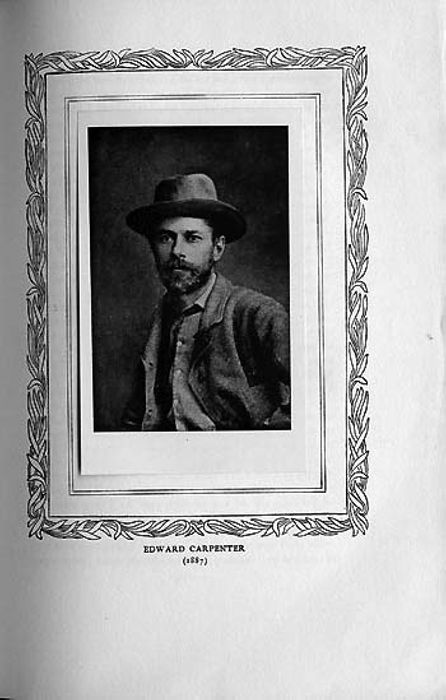 [Begin page 105]and pick the real flowers? That's what I think when people talk to me of 'style,' 'style,' as if style alone and of itself was anything. I have tried to be just with Arnold: have taken up his books over and over again, hoping I would at last get at the heart of him—have given him every sort of chance to convince me—taking him up in different moods, thinking it might possibly be the mood that prejudiced me. [See indexical note p105.1] The result was always the same: I was not interested: I was wearied: I laid the book down again: I said to myself: 'How now, why go any further with a thing that in no way either assists or attracts you?'"
"Speaking of style in that way," I said, "makes me think of something Lincoln said about policy—that it was his policy to have no policy."
"That's just it," exclaimed W. delightedly: "the style is to have no style."
[See indexical note p105.2] W. called my attention to some newspaper criticisms of his books. "All such criticisms, such threats, such warnings, go to show how necessary it is to leave the poems just as they are—to keep them intact: to weather out all the objections, sincere and insincere. The poems are not only fit for the future—they are also fit for today. Today is their day—I stick to it, is their day." Again: "You can detach poems from the book and wonder why they were written. But if you see them in their place in the book you know why I wrote them."
[Begin page 105]and pick the real flowers? That's what I think when people talk to me of 'style,' 'style,' as if style alone and of itself was anything. I have tried to be just with Arnold: have taken up his books over and over again, hoping I would at last get at the heart of him—have given him every sort of chance to convince me—taking him up in different moods, thinking it might possibly be the mood that prejudiced me. [See indexical note p105.1] The result was always the same: I was not interested: I was wearied: I laid the book down again: I said to myself: 'How now, why go any further with a thing that in no way either assists or attracts you?'"
"Speaking of style in that way," I said, "makes me think of something Lincoln said about policy—that it was his policy to have no policy."
"That's just it," exclaimed W. delightedly: "the style is to have no style."
[See indexical note p105.2] W. called my attention to some newspaper criticisms of his books. "All such criticisms, such threats, such warnings, go to show how necessary it is to leave the poems just as they are—to keep them intact: to weather out all the objections, sincere and insincere. The poems are not only fit for the future—they are also fit for today. Today is their day—I stick to it, is their day." Again: "You can detach poems from the book and wonder why they were written. But if you see them in their place in the book you know why I wrote them."
Mail not very heavy just now. "Mostly requests for autographs, which, as a rule, I do not send." [See indexical note p105.3] Had been out for a drive. "I feel in much better feather today—I was out and happy in being out. I am an open air man: winged. I am also an open water man: aquatic. I want to get out, fly, swim—I am eager for feet again! But my feet are eternally gone." I happened to say to W.: "I will be honest. I don't care much for Milton or Dante." [See indexical note p105.4] W. laughed: "I'll be honest, too. I don't care for them either. I like the moderns better. I agree with you that Millet says more, much more, to us today than Raphael or the [Begin page 106] medieval painters. He is more immediate—I can feel his presence; he is no half mythical personage: he is a living man." [See indexical note p106.1] This, too, is from W.: "The world is through with sermonizing—with the necessity for it: the distinctly preacher ages are nearly gone. I am not sorry." W. had been reading Heine again—The Reisebilder. "I have the book here: it is good to read any time—Heine is good for almost any one of my moods. [See indexical note p106.2] And that reminds me: the best thing Arnold ever did was his essay on Heine: that is the one thing of Arnold's that I unqualifiedly like."
I had been seeing Verdi's Otello. "Is it our opera—the vocalism of the new sort? or is it still the old business lingering on?" "It is both, though mostly new." "Good—we have rather expected Verdi to do heroic things." [See indexical note p106.3] "I thought you liked the old operas—preferred them?" "I do like them—at least, I did—but their age is gone: we require larger measures, in music as in literature, to express the spirit of this age."
Touched upon a practical item. "I have been sending monthly bills to the Herald but tired of it—it seemed so commercial. [See indexical note p106.4] May 1st I did not do so. Yet the check came. They are very systematic—they have treated me handsomely. You sometimes hear me tell the truth about the editors who turn me face down, kick me out, advise me to go to a nunnery: now I am telling you of an opposite case—of another editor, who can find some wood for me to saw." As I was getting ready to go W. handed me an envelope: "Here's another little scribble from Joaquin—it has several fine little touches—one especially sweet to me towards the end. [See indexical note p106.5] You see, I too can be flattered—I too may give in. Why should we resent any honest friendliness? If a fellow don't give up his soul to get it, why is it not squarely his, to be cherished, for comfort, solace? the real capital is love, after all: just love. Take Miller along with you." I took Miller along. This is the letter:
[Begin page 107] Easton, Pa., Sept 30, 71. My dear Mr. Whitman:[See indexical note p107.1] I have many messages for you from your friends in Europe which I promised and so much desired to deliver face to face: and day after day and week after week I promised myself and hoped to come to you, but now I shall not see youtill I return; for I am tired of towns and tomorrow set my face to the West. I am weary and want rest, and I cannot rest in cities. My address for a time will be San Francisco and since I cannot see you I should be proud of a letter from you. I am tired of books too and take but one with me; one Rossetti gave me, a Walt Whitman—Grand old man! [See indexical note p107.2] The grandest and truest American I know, accept the love of your son,
Joaquin Miller.Sunday, May 6, 1888.
W. drove up to Harned's at six, evening. Seemed rather feeble as he alighted, but joyous. The open air had done him good. "It's fine to see the green again. I wonder how many more springs I will last? [See indexical note p107.3] Not many, I guess. You should see the wheat—wheat, wheat, everywhere. How tired, how good, I feel! Very tired, O very—but not sick. The sweet sun has got into all my old bones."
Here are a few of W.'s detached sayings from the talk today: "I believe in the eligibility of the human soul for all perfect things." "All the 'great phases' in history are no doubt fictions." [See indexical note p107.4] "There's a beautiful woman: she is not beautiful alone or chiefly because of her eyes, her complexion, the mellowness of her body, though these, too, play their parts, but because of a certain unity, atmosphere, a certain balance of light and shade, which accounts for every detail—finally gives the detail its proper environment: yes, takes leave of the detail in the whole." "I believe in saints if they're far enough off."
[Begin page 108]W. spoke of "the nebulous South American republics which one day will melt in our North American sun." [See indexical note p108.1] Corning present. Talked again of Greek art. W. said: "I have always wished to know more about certain mysteries in Greek art—of Greek painting and music—their comparative primitiveness as compared with their literature and sculpture." [See indexical note p108.2] Had been looking over Notes and Queries. "It is a sort of small bug business. You have to take a magnifying glass to inspect the arguments." "I have this morning sent to The Herald the last little poem I had."
W. talked humorously of portraits, of traditions about public men. "I meet new Walt Whitmans every day. There are a dozen of me afloat. [See indexical note p108.3] I don't know which Walt Whitman I am. Now, there's Abraham Lincoln: people get to know his traits, his habits of life, some of his characteristics set off in the most positive relief: soon all sorts of stories are fathered on him—some of them true, some of them apocryphal—volumes of stories (stories decent and indecent) fathered on him: legitimate stories, illegitimate: and so Lincoln comes to us more or less falsified. [See indexical note p108.4] Yet I know that the hero is after all greater than any idealization. Undoubtedly—just as the man is greater than his portrait—the landscape than the picture of it—the fact than anything we can say about the fact. While I accept the records I think we know very little of the actual. I often reflect, how very different every fellow must have been from the fellow we come upon in the myths—with the surroundings, the incidents, the push and pull of the concrete moment, all left out or wrongly set forth. [See indexical note p108.5] It is hard to extract a man's real self—any man—from such a chaotic mass—from such historical debris.
[See indexical note p108.6] At the table there was a discussion started upon the need for preaching. "I am radical, severe, on that point," said W., "I am not willing to admit that we have any further serious use for the old style authoritative preacher. As I [Begin page 109] was telling Horace yesterday, we might as well think of curing people of the measles, the smallpox, what not, by mere sermonizings, yawpings, as of saving their souls by such tactics. [See indexical note p109.1] The world has got away from that. I do not mean by this that the mind may not be an aid in the cure of disease, in the saving of souls, as they call it—yes—I only mean that no amount of formal, salaried petitioning of God will serve to work out the result aimed for." But were not the old orthodoxies necessary? Would they still exist if they were not necessary? "Necessary? In a sense, yes. In another sense, no. Take that Methodist church we were talking about awhile ago—do you call that necessary? [See indexical note p109.2] It exists, therefore it's necessary. That is good enough as far as it goes. If it is necessary the symptom it exposes is a sad one. You speak of that particular church? If the truth was told about it—the record compiled of things begun there, finished there, of things conceived and executed there—you would find it was a house of assignation—a bagnio—rather than a church. Have you ever been to a darky camp-meeting in the south? Do you know what it signifies? Well—that is the church we have been speaking about. It is a darky camp-meeting with all the attachments thereof—the foul attachments. You think I stand for freedom and that this is only freedom. No—no—no—it is not freedom. [See indexical note p109.3] It is abandon, surrender." Corning interjected a few mild protests which, however, had no effect on W. "The whole ideal of the church is low, loathsome, horrible—a sort of moral negation—as if men got down in the mud to worship—delighting in the filth: out of touch entirely with the great struggles of contemporary humanity."
W. talked then of America: "It is said reproachfully of America that she is material, but that to me is her glory—the body must precede the soul: the body is the other side of the soul." [See indexical note p109.4] Corning asked: "Is that not like putting off the good thing for the bad?" "No—not at all—not more [Begin page 110] than youth is a putting off of maturity. It is the necessity of the process: the railways, mines, markets—the eatings and drinkings—all steered for one end in America's purpose. I do not believe in the body as an end, of course, but as a beginning, or rather, as a necessary item in the combinations of material that go to the making of a man."
[See indexical note p110.1] Of the announced reply of Ingersoll to Gladstone W. said: "I do not assent to Gladstone's claim upon the attention of scholars: I do not feel that he deserves it: either for his Homeric or theological—perhaps not even for his political—work—though, I acknowledge, something may be really said about his politics. I think Gladstone a wearisome old man determined to keep in the swimtill he dies. Take Emerson's old age: how much more beautiful it was: not meddlesome, not insistent: yes, take Darwin's old age, too: how clean it was kept—how sanely and equably sufficient. [See indexical note p110.2] Gladstone seems restless to be seen and heard like a fourth-rate theatrical star."
In answering the question: "Do you think the church could be safely destroyed?" W. replied: "Yes, why not? Men make churches: men may destroy churches. I see no use for the church: it lags superfluous on the stage. Yet that is not the whole story. [See indexical note p110.3] That's my part of the story. I suppose we must concede that all these things, these social furbelows, have a reason for being."
W. said: "I believe in immortality, and by that I mean identity. I know I have arrived at this result more by what may be called feeling than formal reason—but I believe it: yes, I know it. [See indexical note p110.4] I am easily put to flight, I assure you, when attacked, but I return to the faith, inevitably—believe it, and stick to it, to the end. Emerson somewhere speaks of encountering irresistible logic and yet standing fast to his conviction. There is judgment back of judgment—defeat only seems like defeat: there is a fierce fight: the smoke is gone—your enemies are nowhere to be seen—you are placidly [Begin page 111] victorious after all—the finish of the day is yours. Logic does very little for me: my enemies say it, meaning one thing—I say it, meaning another thing." [See indexical note p111.1] This, also, from W.: "Howells, Aldrich, good fellows: I have met them and like them (Howells especially is genial and ample—rather inclined to be big—full size)—but they are thin—no weight: such men are in certain ways important—they run a few temporary errands but they are not out for immortal service: perhaps even Hawthorne, though not surely Hawthorne: Hawthorne, in whom there is a morbid streak to which I can never accommodate myself. [See indexical note p111.2] I call this thing in our modern literature delirium tremens." Some one kicked. Hawthorne deserved to be exempt from this classification. "Well—you may be right: I know he was a man of talent, even genius: he was even a master, yes a master, within certain limits. Still, I think he is monotonous, he wears me out: I do not read him with pleasure."
Before I left W. asked me: "What did you make of the Trowbridge memorandum I gave you the other day?" [See indexical note p111.3] I asked in return. "What did you make out of the Emerson item? You have said you thought Emerson never qualified. Here you say he did." W. replied at once: "There was an if attached. If Trowbridge understood right, if, if—but who can decide about that if? Since that story, since that if, other things have occurred to make the Trowbridge version seem impossible. I have had letters myself from here and there tending to show that Emerson was rather silenced than changed." "Don't you think we are making too much of this Emerson business any way?" [See indexical note p111.4] "Yes I do—let us drop it—drop it right here. O'Connor used to make the plea that he kept harping upon it not because it would help Walt Whitman to have the thing settled right but because it would help Waldo Emerson. After all it don't much matter what Emerson thought of me or what I thought of him. The public want to know whether I have been an honest servant [Begin page 112]—whether I have stuck to my guns (to their guns): Emerson the same: I reckon that tells the whole tale so far as the public is concerned." [See indexical note p112.1] W. further said: "The New England crowd below stairs didn't like me—couldn't stand me—good or bad felt they must declare against me. And that was right. I could only have commanded their approval by being false to the job I had to do. I have been turning over that bit of ground a little today. This letter from Professor Palmer recalled it." Passing an envelope over to me. "See how he looks at me. He is sweet, affable, courteous: he takes me, not for all in all but for part in part, this or that—yes, with mild qualification: yet he takes me on good behavior. I like all these fellows—they are hearty, as far as they dare be, as far as their scholarliness will let them be, but they never quite know when to say yes and let yes be." This is the letter, which W. finally called "a characteristic whiff from Cambridge with a leaning towards mercy."
Cambridge, Feb. 20, 1885. Dear Mr. Whitman:I want to thank you for the beautiful photograph of yourself sent through Miss Smith. [See indexical note p112.2] It is too true a likeness of you as you are to represent the author of the Leaves of Grass. The picture which hung on yr wall showed that person better—his paganism, his full senses, his readiness to identify himself with all things, his insubordination, and his recklessness of the fine relations which change a world of things into a world of persons. If I could prefer a poet to a man, I should like that picture better. But this will be the best reminder of the beautiful ripened spirit who met me in Camden and said: "I did the work sincerely. [See indexical note p112.3] So it is honorable. God shall use it to help men, or else let him throw it away."
With warm regard, I am
Sincerely yours, G. H. Palmer.Monday, May 7, 1888.
W. spoke of material successes in civilization. "What do they show? Not necessarily much: we make a big noise about the things we have done, accumulated—what we can do and will do: with some of this I have some sympathy: but after all the main question is, what is all this doing for all the men, women, children of America? [See indexical note p113.1] The goods are worthless alone: they might demonstrate failure as well as success. Do you think goods can succeed and men can fail? They must succeed or fail together—they are damned or saved together. Against the things we call successes I see other, counter, tendencies working—an increased indisposition of certain classes to do the honest labor of the world, and the solidification of the money powers against the fraternity of the masses. Either one of these might, both of them are sure, to ruin the republic if nothing appears to contravene them.
Professor Adler and Tom Dudley had a hot discussion at Harned's in which D. spoke in severely disrepectful terms of the European masses, W. resenting it. [See indexical note p113.2] "I will not believe it, Dudley—I will not believe it. Give them a chance—give them a chance—they will be as good as the rest. All that man needs to be good is the chance. History has so far been busy—institutions, rulers, have been busy—denying him of that chance." W. said again: "In that narrow sense I am no American—count me out." Bonsall argued in favor of restricting emigration. W. took him up: "Restrict nothing—keep everything open: to Italy, to China, to anybody. I love America, I believe in America, because her belly can hold and digest all—anarchist, socialist, peacemakers, fighters, disturbers or degenerates of whatever sort—hold and digest all. [See indexical note p113.3] If I felt that America could not do this I would be indifferent as between our institutions and any others. America is not all in all—the sum total: she is only to contribute her contribution to the big scheme. [Begin page 114] What shall that contribution be? I say, let it be something worth while—something exceptional, ennobling."
[See indexical note p114.1] I read to W. a letter written by Ingersoll to the friends of Leonard Whitney, dead. (Published in Unity, Chicago. Whitney was a Unitarian preacher. In the Civil War was Chaplain of I.'s regiment.) W. said: "How graphic, touching, powerful that is! What a substantial, rounded fellow the Colonel certainly proves to be! He is in a way a chosen man. There always was something in the idea that the prophets are called. Ingersoll is a prophet—he, too, is called. [See indexical note p114.2] He is far, far deeper than he is supposed to be, even by radicals: we get lots of deep sea fruit out of him. Read that over again: I want to hear it again." This was what I read:
"During the time he was with us he was almost constantly by the sick and wounded, and was as kind to them as though they had been his own children. At the battle of Shiloh, he gave his blankets to the wounded, then slept upon the ground uncovered, with the chilling rain pouring upon him the whole dreary night, and at that time, as I believe, laid the foundation for the disease that terminated his life. [See indexical note p114.3] Permit me to say that I sympathize with you deeply in your irreparable loss. Generous men are not indigenous to this world. They are exotics from the skies. There is no such thing as being consoled for their loss. Their memory is worthy of and demands the bitterest of tears. And yet, believing as you do in the immortality of the soul, the dark cloud of grief now enveloping your heart, if not dissipated, will at least be adorned and glorified by the sweet bow of Hope."
"That," said W., "seems to catch the Colonel in his more affirmative mood. [See indexical note p114.4] I know quite well why and where I must disagree with him. The Colonel and I are not directly at issue even about God and immortality: I do not say yes where he says no: I say yes where he says nothing. I do not know whether to object to or to agree with his statement [Begin page 115] that 'generous men are not indigenous to this world.' Why not to this world as well as to any other? The Colonel himself is indigenous. I don't feel as if I wanted to disparage this world in favor of any other—the worlds are continuous—one opens into another: there is no start or stop—there is no virtue open to one that is not open to all." [See indexical note p115.1]
W. handed me an envelope marked as follows: "Sent about Aug 15 or 16 '63—letter to S. B. Haskell Breseport Chemung Co N Y"—and said: "I promised to give you some sample memoranda about the hospitals. Here is a letter—the draft of a letter—I sent to the parents of a boy who died. It was a pitiful, though after all only a specimen, case: they died all about us there just about in the same way—noble, sturdy, loyal boys. [See indexical note p115.2] I always kept an outward calm in going among them—I had to, it was necessary, I would have been useless if I hadn't—but no one could tell what I felt underneath it all—how hard it was for me to keep down the fierce flood that always seemed threatening to break loose." I read the letter. I must have shown I was much moved. W. said gently: "I see that you understand it. Well, I understand it too. I know what you feel in reading it because I know what I felt in writing it. When such emotions are honest they are easily passed along." I asked W.: "Do you go back to those days?" "I do not need to. I have never left them. They are here, now, while we are talking together—real, terrible, beautiful days!" W. was in a very quiet mood. "Kiss me good night!" he said. I left.
Washington, August 10 1863 Mr and Mrs Haskell, Dear Friends[See indexical note p115.3] I thought it would be soothing to you to have a few lines about the last days of your son Erastus Haskell, of Company K 141st N Y Vol—I write in haste, but I have no doubt any thing about Erastus will be welcome. From the time he came into Armory Square Hosp until [See indexical note p116.1] he died there was hardly a day but I was with him a portion of the time—if not in the day then at night—(I am merely a friend visiting the wounded and sick soldiers). From almost the first I felt somehow that Erastus was in danger, or at least was much worse than they supposed in the hospital. As he made no complaint they thought him nothing so bad. I told the doctor of the ward over and over again he was a very sick boy, but he took it lightly, and said he would certainly recover; he said, "I know more about these fever cases than you do—he looks very sick to you, but I shall bring him out all right"—Probably the doctor did his best—at any rate about a week before Erastus died he got really alarmed, and after that he and all the doctors tried to help him but it was too late. Very possibly it would not have made any difference. I think he was broken down before he came to hospital here—I believe he came here about July 11th—I took to him. He was a quiet young man, behaved always so correct and decent, said little—I used to sit on the side of his bed—I said once, jokingly "You don't talk much Erastus, you leave me to do all the talking." [See indexical note p116.2] He only answered quietly, "I was never much of a talker"—The doctor wished every one to cheer him up very lively—I was always pleasant and cheerful with him, but never tried to be lively. Only I tried once to tell him amusing narratives &c but after I had talked a few minutes I saw that the effect was not good, and after that I never tried it again—I used to sit by the side of his bed generally silent, he was opprest for breath and with the heat, and I would fan him—occasionally he would want a drink—some days he dozed a good deal—sometimes when I would come in he woke up, and I would lean down and kiss him, he would reach out his hand and pat my hair and beard as I sat on the bed and leaned over him—it was painful to see the working in his throat to breathe.
[See indexical note p116.3]They tried to keep him up by giving him stimulants, wine, &c—these effected him and he wandered a good deal [Begin page 117] of the time—I would say "Erastus, don't you remember me—don't you remember my name dear son?" Once he looked at me quite a while when I asked him, he mentioned over a name or two, (one sounded like Mr. Satchell)—and then he said, sadly, quite slow, as if to himself, "I don't remember,—I don't remember,—I don't remember." [See indexical note p117.1] It was quite pitiful—One thing was he could not talk very comfortably at any time, his throat and chest were bad—I have no doubt he had some complaint besides typhoid. In my limited talks with him he told me about his brothers and sisters, and his parents, wished me to write to them and send them all his love—I think he told me about his brothers being away, living in New York city or elsewhere.—From what he told me I take it that he had been poorly for several months before he came, the first week in July I think he told me he was at the regimental hospital, at a place called Baltimore Corners, down not very many miles from White House, on the Peninsula. [See indexical note p117.2] For quite a long time previous, although he kept around, he was not well—didn't do much—was in the band as a fifer—while he lay sick here he had the fife on the little stand by his cot,—he once told me that if he got well he would play me a tune on it, "but," he says "I am not much of a player yet"—
I was very anxious he should be saved and so were they all—he was well used by attendants—he was tanned and looked well in the face when he came, was in pretty good flesh, never complained, behaved manly and proper—I assure you I was attracted to him very much,—Some nights I sat by his cottill far in the night, the lights would be put out and I sat there silently hour after hour—he seemed to like to have me sit there, but he never cared much to talk—I shall never forget those nights, in the dark hospital, it was a curious and solemn scene, the sick and wounded lying all around, and this dear young man close by me, lying on what proved to be his death-bed. [See indexical note p117.3] I do not know his past life, [Begin page 118] but what I saw and know of he behaved like a noble boy. [See indexical note p118.1] I feel if I could have seen him under right circumstances of health &c I should have got much attached to him—he made no display or talk—he met his fate like a man—I think you have reason to be proud of such a son and all his relatives have cause to treasure his memory. He is one of the thousands of our unknown American young men in the ranks about whom there is no record or fame, no fuss made about their dying unknown but who are the real precious and royal ones of this land, giving up, aye even their young and precious lives, in the country's cause. [See indexical note p118.2] Poor dear son, though you were not my son, I felt to love you as a son, what short time I saw you, sick and dying there.—But it is well as it is—perhaps better. Who knows whether he is not far better off, that patient and sweet young soul, to go, than we are to stay? Farewell, dear boy,—it was my opportunity to be with you in your last days,—I had no chance to do much for you, nothing could be done—only you did not lay there among strangers without having one near who loved you dearly, and to whom you gave your dying kiss. [See indexical note p118.3]
Mr and Mrs Haskell, I have thus written rapidly whatever came up, about Erastus, and must now close. Though we are strangers, and shall probably never see each other. I send you and all Erastus' brothers and sisters my love.
I live when at home in Brooklyn, New York, in Portland Avenue, 4th floor, north of Myrtle.
Tuesday, May 8, 1888.
W. asleep on the sofa when I got to the house. 7.30 evening. I sat there and read for awhile. When he was aroused we had a talk. [See indexical note p118.4] "I had a volume from France today—poems—Les Cygnes—written by Francis Viele-Griffin—accompanied with a letter from the author which I will get your father to translate for me." In the volume was this inscription: "To Walt Whitman—the homage and sym- [Begin page 119]pathetic admiration of the author, Francis Viele-Griffin." This is a translation of the letter:
15 Quai de Bourbon. Paris, April 26, 1888. Sir and Dear Poet,In admiration of some of your poems, which I read in an edition, ridiculously "expurgated," published by Chatto & Windus, in London, I feel constrained to have the Parisian people share the estimation in which I hold your high lyrical talent. [See indexical note p119.1]
Would it be too much to ask of you that you indicate the volume (the edition) which you would prefer having rendered in the French? My friend, Jules Laforgue (who died only too prematurely) has already given to the public two of your poems, and the reception they met with seems to presage a new victory for your works. [See indexical note p119.2]
In expectation of your kind reply, Sir and dear poet, permit me to assure you of my sympathy in art and of my profound admiration.
Francis Viele-Griffin.W. said: "I have never been translated into the French except in bits. It is an interesting mystery to me, how I would pass the ordeal of getting into another language. I shall never know, of course: I know no language but my own. [See indexical note p119.3] William used to say the Leaves would before their work was done make all tongues of the earth their tongue." W. added: "I had a good friend in Washington who translated for me viva voce from the French and did it well. Through him I got rather directly acquainted with some of the French master-craftsmen—with Hugo, for instance. My whole—not exactly that: my best—knowledge of Hugo was derived from that man."
Referring to The Path (Theosophic) which he had on his lap: "Even the Theosophists claim me. [See indexical note p119.4] How much of me is going to be left for myself after all the claims of the radicals are satisfied?" N.Y. Herald today contains W.'s poem— [Begin page 120]The United States to Old World Critics. W. asked: "What did it mean to you?" I explained. He asked again: "Did that occur to you at once or with a struggle?" [See indexical note p120.1] "At once." "Good! then the poem is better than I believed." W. recalled a Robert Collyer incident. W. had said to him of preaching what he has so often said to us—that the day of the preacher is past. "Collyer turned the statement back upon the poets: 'Why write poetry any more? All the songs were long ago sung.' It quite embarrassed me on the instant—was an unexpected shot: I had no answer ready for it: indeed, I don't know that there is an answer. Collyer's not deep but he's damned cute—for the preacher class very damned cute: for, as you know, I don't as a rule expect anything of the preachers. [See indexical note p120.2] Occasionally one of them surprises me with a bit of well-borrowed wisdom. Collyer is a kind of reduced Beecher—a Beecher with much of the grace lopped off." W. again: "I notice that Morse in his recent writing drops his middle initial H. That is right. Rolleston has lately dropt one of his four initials: think of a man having four initials to contend with! It is asking too much. I used to be Walter—started that way: then I became Walt. [See indexical note p120.3] My father was Walter. He had a right to Walter. I had to be distinguished from him so I was made Walt. My friends kicked: Walter looked and sounded better: and so forth, and so forth. But Walt stuck."
Mrs. Moulton wrote up an account of her visit to W. W. for the Boston Herald. Talcott Williams sent a clip of it over to W. with this message: "I know you will be interested in this, which comes both from the Boston Sunday Herald and Mrs. Moulton, and feel sure that you will not object to her reference to you, all written in the great love each and all of us feel for one who has made life better worth living and to none more than to yours loyally and gratefully." [See indexical note p120.4] "Well—were you interested?" "Not much." "Why?" "I don't know why. She is too effusive." "Then you would [Begin page 121] rather have people refrain from praising you? "I don't say that: there's no harm in the praise: but we must praise right and blame right." [See indexical note p121.1]
W. called my attention to a pamphlet of sixteen pages of doggerel inscribed: "To Walt Whitman (America's Great Poet)" written, as he says, "by a woman who evidently thinks I am in danger and wants to save me from hell fire. There are eleven poems in the book preceded by a Prologue, all directed to show that the religion of Jesus is superior to the religion of Walt Whitman. [See indexical note p121.2] I always thought they came to about the same thing, but this woman evidently thinks they do not." W. much amused. "I ought to be saved in the end. I should say fifty or a hundred people are busy all the time trying to convert Walt Whitman from Leaves of Grass. Something ought to come of it all." Referring to Sylvester Baxter: "He is one of my cordial, truest friends—an out and out assenter to the Leaves: radical, progressive, with lots of look ahead. Baxter has gone off into Theosophy: all our rebels go off somewhere." [See indexical note p121.3] Corning said to W.: "The Greeks still make excellent wines." W. replied: "Then you see they are not altogether degenerate!" My sister had sent W. some cakes. "I was up, it was near midnight: I felt a gnawing something here—a void"—indicating his stomach and laughing—"so I took some of the cakes and ate them alone, in the dark, in the dead silence. [See indexical note p121.4] How much (perhaps all) the value of a thing—your joy, satisfaction, with it—consists in having it just at the right time: it may be a trifle but it is opportune. That's the way it was with the cakes. A little something at the right time is better than much and running over at the wrong time." Bucke likes Morse's first Whitman better than the second. [See indexical note p121.5] I prefer the second. W. said: "You are right—Bucke is wrong. The second is decidedly the best—I would admit nothing the other way. The second has my vote." Referred curiously to the skyscrapers. "Are they building them to [Begin page 122] stand?" Spoke of Charles Lamb: "A dear fellow and a hero, too." [See indexical note p122.1] W. gave me a Dowden letter and talked a little about Dowden. "This letter will give you a little notion of his private regard for me as well as of the reasons he is willing to give for his public espousal of my work. Dowden does not melt himself and melt me, as Symonds does: he is more stiffly literary: but he comes dangerously near to our standard. [See indexical note p122.2] That talk that he winds up with about the pension is impossible talk, as you know. I have sat down on all attempts, new and old. I have no reasons against the pension. All my feeling is against it. My feeling decides the day."
Winstead, Temple Road Rathmines, Dublin, March 16, 1876. My dear Mr. Whitman.Yesterday your post-card and your very welcome books reached me. [See indexical note p122.3] I spent a good part of the day over Two Rivulets, the Preface, and the Memoranda of the War, and was not far from you, I think, in feeling, however separated in place. I seem to see some gains from the illness which has grieved us. Tones and tints have passed from it into your writings which add to their comprehensiveness and their truth and tenderness. At the same time I hold to L of G and accept it,—taking it as a whole,—with entire satisfaction. [See indexical note p122.4] It seems to me more for the soul, and for things beyond physiology, than you, contrasting it with your projected songs more specially for the soul, quite recognize. The non-moral parts of it, such parts as simply are the "tally" of nature, are taken up into other portions of L. of G. and are spiritualized, and each part belongs to the other. In L. of G. I find a complete man, not body alone, or chiefly, but body and soul. That its direct tendency (and not alone its indirect) is to invigorate and reinforce the soul I feel assured. But in contrast to the pride and buoyancy, and resonant tones, of L. and G., the [Begin page 123] tenderer, more penetrating, more mystic and withdrawn tones of Passage to India, and of the recent poems and prose, seem to me to be again as serving the same, and not other, purposes, but for other moments, other moods and natures—and I think many of your future readers may gain an entrance to your earlier writings through your latter and that for some persons this will be the fittest way. [See indexical note p123.1]
[See indexical note p123.2] At present I have little doubt you ought not to set yourself to any brain work, but at the same time you ought not to think of ceasing to write, for every now and again the mood will come and you will write something as admirable as anything you have written heretofore. Your friends here want to think of you as free from all pressure to write, and anxieties about material well-being, with your spirit open to all pleasant and good influences the Earth and the Season and your own thoughts bring to you. The Newspaper paragraph you sent Rossetti and me has made us fear it may not be so with you, and we remain in suspense as to whether we might not make some move which would relieve us from some of this dissatisfied feeling on your behalf. [See indexical note p123.3] Ought it not to be a duty, too, of—not the American public to recognize your gift to America as a writer, but—the American Government to recognize your services, as of one who saved the lives, and lightened the sufferings, of many American citizens? It would be honorable to the government and to you. I write knowing little of the actual probability of this, but I believe in England we would be careful of such a voluntary public servant.
We are all well, my wife and children and I.
Always affectionately yours Edward Dowden.W. added: "I hear every now and then from Dowden back there. He has not kept his ardor up, quite, I think. [Begin page 124] He hasn't beat a retreat—he is still my friend—acquiesces in me. Symonds is a persistent fire: he never quails or lowers his colors. [See indexical note p124.1] Don't construe me too literally on all this: I am only nebulous about it: it would not do for me to give this opinion out for good and all."
Wednesday, May 9, 1888.
Took to Whitman, who came to the door himself, my father's translation of Griffin's letter. [See indexical note p124.2] W. read it and was pleased. He remembered the Laforgue renderings in the French. "I never could have known how they were done, of course, as I have absolutely no conversancy with the language. You ought to see the Laforgue poems—I want to hunt them up for you—I have them here. [See indexical note p124.3] I try to look at my face in a French glass but somehow it don't work very well. I shall advise Griffin to use one of the later editions—not to fool with the older books—yes, to use McKay's. I may get you to write to him for me. What could I do nowadays if it was not for your busy hands and feet? My wreck is way up the shore." I exclaimed: "The gospel is spreading!" "Yes—as fire once started in the grass." W. added: "It is a new experience to be successful: I always seem to know what to do with failure but success is a puzzle to me." Would Griffin likely publish an expurgated book? "Damn the expurgated books! [See indexical note p124.4] I say damn 'em! The dirtiest book in all the world is the expurgated book! Rossetti expurgated—avowed it in his preface: a sort of nod to Mrs. Grundy: and it was much the same with Rhys—Rhys does not wholly endorse me—is shy of me in a way—having dug so deep into the old English balladry he becomes convinced of the necessity of the lilt, the regular flow, the notation, the steady movement back and forth—hence his lingering distrust of the Leaves. [See indexical note p124.5] Rhys is coming along at a good pace but he has not yet come: he sort of feels his way—is resolved not to commit himself too far first lick." W. spoke [Begin page 125] of the Chatto & Windus Whitman as a steal. "I never got any money from it. But the Rhys book—the Walter Scott book—has a better record. They sent me fifty dollars. [See indexical note p125.1] They sold twenty thousand copies. You don't think fifty dollars much return on twenty thousand copies? Neither do I: but I am grateful for what I get: the little dribbles of favor are all I have ever got anyway: I am not a favorite of fortune—except perhaps a favorite victim." He laughed very good-naturedly. "Is this my little growl? Well—you must let me have the growl—listen patiently—my growl is worse than my spring." [See indexical note p125.2] W. liked Griffin's letter: "It is modest—it sounds well—I shall write him. The best part of Griffin's note is in what he refrains from saying: the best of us is never put into words."
W. asked if I had read Mrs. Moulton's letter to the Boston Herald and described her as "an emotional, full-blooded, somewhat gushing woman." "But," he continued, "I always reflect that such characteristics carry with them their own excuse, being in their own way natural, as I prefer to say." [See indexical note p125.3] W. proceeded: "You often hear me object to gush: I like love, I like freedom, I like any honest emotional utterance—but I hate to have people come at me with malice—throw themselves into my arms—insist upon themselves, upon their affection. I shy at it. William O'Connor used to say this was rather a contradiction between my life and my philosophy. I don't know—perhaps it is—but it is a feeling I can never rid myself of."
W. never met John Weiss and Samuel Johnson and has never read their books. "I know practically nothing of that group at first hand—the secondary transcendental group. Outside of Emerson, Thoreau, Alcott, I have not had any relations with the New England literati. [See indexical note p125.4] This is probably because I taboo religious books—books on religion—even the broad ones. I know I ought to know Weiss and Johnson—they are my men, I am their man—but I [Begin page 126] own up to my entire ignorance. Frothingham I have met: he has quoted me favorably—has written me. [See indexical note p126.1] You ought to sit down here sometime and tell me all about these fellows." We did then and there go on for an hour in that strain, I doing most of the talking, in answer to his questions. It was like being in the witness box at court. When we were through W. remarked: "I feel as if I was getting acquainted with a new world—I feel guilty—I have neglected those remarkable men: but I hate theological, metaphysical, discussion so heartily that I run at the sight of a controversial book—always, of course, excepting Huxley and Ingersoll, as you know." [See indexical note p126.2]
[See indexical note p126.3] Talked of translations of Homer. "I have had different opinions about Palmer's prose Homer—have liked it and not liked it and liked it again and so on—it comes and goes like indigestion. I think Buckley's translation the best extant—I read it many years ago: the impression it made upon me has proved to be indelible. Bryant's and Derby's are damnable—I don't know which is worse than the other—they are both so stiff, so bad, it hardly seems anything could be worse than either. [See indexical note p126.4] John Swinton sent me Derby's, for what reason I can't imagine. Pope was of course a machine—he wrote like a see-saw." Had never read Taylor's translation of Faust. [See indexical note p126.5] Suggested that I should try to get him "a cheap copy." "I have always meant to read it—it always seemed so formidable."
Fiction was debated the other night at a meeting of the Congregational Club, New York. [See indexical note p126.6] Gilder had referred to Cable as "perhaps the greatest artist since Hawthorne." W. said as to this: "The sense in which 'artist' is used there is to me as a bad smell to the nostrils. I refuse to consider literature in that light. [See indexical note p126.7] Gilder himself writes poetry—his poetry is considerably better than the average. I have friends who see a great deal in Gilder's work. Yet after all it never escapes being average, only average—it partakes [Begin page 127]of the general character of the characterless poetry of the magazines—that of porcelain, fine china, dainty curtains, exquisite rugs—never a look of flowing rivers, waving trees, growing lilies, floating clouds." [See indexical note p127.1] W. had been looking over Lowell's Fable for Critics. What would have happened to W. if he had been contemporary? Would Lowell have scored him? "I rather doubt—it was the original policy of the critics, the professional literateurs, to ignore me—to freeze me out." "When they found they could not freeze you out they tried to burn you out." "Exactly—exactly: but neither heat nor cold has killed our bud: the Leaves have lasted, lasted, seasons in and out, hates in and out."
W. has never met Whittier. [See indexical note p127.2] "I wrote him on his last birthday and had a short note in the winter from him—a note, however, that was purely formal." Was Whittier adverse to Leaves of Grass? "It is hard to say yes, it would be harder to say no. A correspondent went out to see him some time not long ago from Boston—they discussed literary matters together, my name being brought up with others—but he was very dextrous in evading any committal phrase pro or con. [See indexical note p127.3] I know, however, from Sanborn, I think—that Whittier years ago started to read the Leaves and when he came to what are called the indelicate passages threw the book into the fire."
Something Joesph Cook has been saying about Paine aroused W. [See indexical note p127.4] "It is always so: the tree with the best apples gets the worst clubbing." I put in: "Because they are best able to stand it"—he repeating the phrase after me—"That's ever so true—ever so true—they are best able to stand it." This reference to Percy's Reliques: "It takes you in to the birth of man: it is always a young book." [See indexical note p127.5] The Book News contains a frontispiece portrait of Mrs. Moulton. W. says: "It shows the best of her." I asked: "When will they put your phiz in their gallery?" "Never! I don't believe in their gallery—the Louise Chandler Moulton, [Begin page 128] Matthew Arnold, George Cable gallery. Not a few people would say my phiz belongs only in the rogue's gallery!"
[See indexical note p128.1] "Tom," said W., "has been in: sometimes he is like a blustering day. Well, a blustering day is part of a year, too: I like all kinds of days: Tom's kind the same's any other kind. Tom's chief trait to me, after his capacity for good will, is his honesty. Tom goes to a heap of trouble trying to hide his good traits at times—but he never fools me: I know him for what he is every time. [See indexical note p128.2] Bucke? O yes, Bucke! Someone was here the other day and complained that the Doctor was extreme. I suppose he is extreme—the sun's extreme too: and as for me, ain't I extreme? Ask my enemies if I ain't extreme. It seems to be the notion of some people that I should 'select' my friends—accept and reject and so forth. [See indexical note p128.3] Love, affection, never selects—just loves, is just affectionate.
Thursday, May 10, 1888.
"Dr. Brinton," said W., "seems to be always busy."
[See indexical note p128.4] I reminded W. that B. was now absent in Florence pursuing studies in connection with his own work in American archaeology. I had just heard from B. W. continued: "His work is always true and of the right sort. Brinton is a master-man—stern, resolute, loyal—yes, what I like (in the best sense) to call adhesive: a good comrade, a ripe intellect. [See indexical note p128.5] You say he will do no pot-boiling?—pot-boiling? I agree with you on that point—it is best for a man to do his one certain thing and do it well—to stick to it though all the devils (and the gods, too) are at his heels: to beat his way clear, to get out into the open. That seems like asking too much of most men: Brinton, however, is not most men—he is Brinton. I think now is the time for archaeology to be exploited here anyhow—especially American archeaology. [See indexical note p128.6] I remember that when Lord Houghton, Moncton Milnes, called to see me years ago, the first thing he said to me was:
[Begin page figure-11]
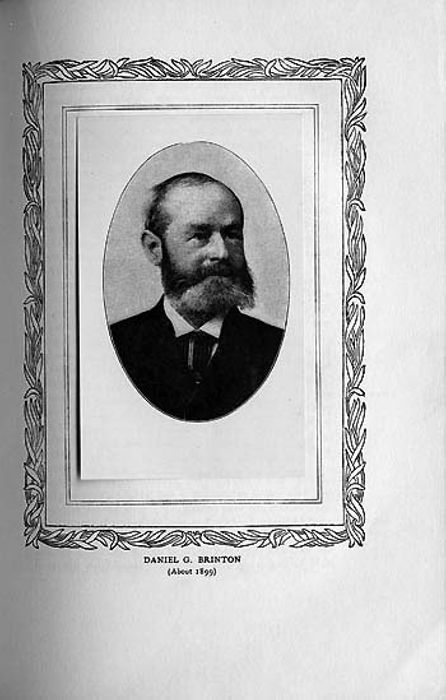 [Begin page 129] 'Your people don't think enough of themselves: are not in the good sense patriotic enough: they do not realize that they not only have a present but a past, the traces of which are rapidly slipping away from them.' [See indexical note p129.1] He referred to the slack interest we show in 'remains'. We have our schools and expeditions for Greek exploration: the people concerned are begging, begging, all the time for money—which is all right, as far as it goes. I would not put a straw in the way of this—not a straw: I wish it well: it is important work. But I say, why not give our own evidences a chance to show themselves, too? Why not open up our own past—exploit the American contribution to this important science? Brinton is doing just that—he is eminent: he insists upon the work and does his part."
W. was looking for a paper for me but could not find it. [See indexical note p129.2] He went poking about the room with his cane. Finally he sat down and said: "I guess I'll stop right here—I will wait until we have daylight in this room—when I will come across it naturally: to try to hunt a thing in the dark in this confusion is out of the question—the more you stir things up the more you mix 'em." Gave me New York Herald containing Nineteenth Century Club's debate on "toleration" between Ingersoll, Coudert and Stewart Woodford. [See indexical note p129.3] "I am done with it: you will like to see it. Ingersoll uses them both up as a matter of course—does it easily, nonchalantly—sits back in his chair—I should imagine, this way—shuts his eyes: as easily as this sweeps them right and left with a movement of his arm."
Longfellow was mentioned. W. recalled a visit from L. "He came with Childs, but I was not at home—had just started off for the ferry. They came after me, followed me, and inquired of one of the men at the wharf, who told them I was on one of the boats, for which they waited, but our talk was very short." [See indexical note p129.4] The man they questioned at the ferry was Ed Lindell. After they had gone, and as Walt [Begin page 130] came from the boat, Lindell asked him the name of the man with the gray beard. W. told him but was more inclined to talk of Childs than of Longfellow. I asked W. about L.'s port and manners. [See indexical note p130.1] W. said: "His manners were stately, conventional—all right but all careful." Was his conversation striking? "Not at all—he did not branch out or attract." Was he at all like Emerson? "Not a bit. [See indexical note p130.2] Emerson was as different as day from night—indeed, had the best manners of any man I ever met: by this I mean manners in the right sense: manners, words, thoughts, always right, yet never at any time suggesting preparation or design. Emerson always seemed to know what he wanted. If I was asked to put him into two words, I should give 'sincerity' first—always first—and—oh! I had a more apt word a minute ago, but now it is gone: I may call it 'definiteness': yes, sincerity and definiteness. Emerson never lost this quality: in his last days, when it was said his mind had failed, he remained of this aspect: in fact, it seemed to me to be emphasized. [See indexical note p130.3] Emerson only lost the outward, the superficial—the rest of him remained unharmed. I thought Alcott had really lost something. He came to see me in Brooklyn once just before Emerson. While Emerson was with me I asked him about this breakdown of memory or what-not in Alcott—but Emerson would not have it my way—he was gentle but firm—he opposed my observation. Emerson never lacked decision; he was indeed the firmest of men, never shaken from his place—unshockable—he never unhatted to any person or any power—any institution—never went out looking for things which did not come to him of their own accord. Alcott had a lot of queerities—freakishnesses: not vegetarianism—I do not count that—but transcendental mummeries—worst of all a most vociferous contempt for the body, which I, of course, opposed. [See indexical note p130.4] I spoke to Emerson about these things that day—but my comments made no impression: I saw that Emerson had his [Begin page 131] own opinion of Alcott and was not going to let me disturb it—though that was not my intention: underneath it all I had every sort of respect for Alcott myself."
I described a walk in the country beyond Camden. [See indexical note p131.1] W.: "After all, it is the city man, often the book man, the scholar man, who best appreciates objective nature—sees nature in her large meanings, growths, evolutions: who enters most naturally, sympathetically, into the play of her phenomena, the divine physical processes." Again: "Ingersoll could not come to my reception in New York: was out of town or busy: but he sent a note containing excuses and some fine things (witty, beautiful things) better than excuses. The Colonel is always my friend—always on the spot with his good-will if not in person."
W. talked of portraits. [See indexical note p131.2] He affects "the unceremonious—the unflattered. Of all portraits of me made by artists I like Eakins' best: it is not perfect but it comes nearest being me. [See indexical note p131.3] I find I often like the photographs better than the oils—they are perhaps mechanical, but they are honest. The artists add and deduct: the artists fool with nature—reform it, revise it, to make it fit their preconceived notion of what it should be. [See indexical note p131.4] We need a Millet in portraiture—a man who sees the spirit but does not make too much of it—one who sees the flesh but does not make a man all flesh—all of him body. Eakins almost achieves this balance—almost—not quite: Eakins errs just a little, just a little—a little—in the direction of the flesh. I am always subjected to the painters: they come here and paint, paint, paint, everlastingly paint. I give them all the aid and comfort I can—I put myself out to make it possible for them to have their fling: hoping all the time that now the right man has come, now the thing will be done completely once and for all and hereafter I can hood my face. [See indexical note p131.5] Take Gilchrist's—Herbert's: it missed the most of me, went all astray. Sometimes I think I like the best photographs best. They are called [Begin page 132] mechanical—Herbert used to say they were not art: maybe they are not art, maybe they are only portraits—and if a fellow wants a portrait then they are just what he wants. [See indexical note p132.1] Alexander was here for some time working up some studies for The Century: this was last year: but whatever the outcome it has not yet appeared in the magazine. I liked to have Alexander here—he is the right stuff for a man though I am not sure he is the right stuff for a painter. He told me some good stories of Ingersoll—of his generosity, of his Shakespearean scholarship: Alexander is, or was, his next door neighbor."
[See indexical note p132.2] W. gave me two letters—one from William Rossetti and one from Edward Dowden—and said of them: "They are far back letters—1871: they belong together. Rossetti gives in his a rather apt sketch of Dowden—has some interesting things to say about the Commune: Dowden writes a little more about his own faith in the Leaves—makes a confession, hits off in a sketchy way some other fellows over there who are interested in my work. [See indexical note p132.3] The main thing is not in what is said about the Leaves but the affection that is back of it all. I had no idea Rossetti could feel so radically about the Commune or about such things: I don't know why I should have expected him to be so conservative but I did. [See indexical note p132.4] Well—I have been lucky in my friends whatever may be said about my enemies. I get more and more to feel that the Leaves do not express only a personal life—they do that first of all—but that they in the end express the corporate life—the universal life: the Leaves being in the wind-up just as much Rossetti's book or Dowden's book or your book as my book."
56 Euston Square, London, N.W., 9 July, '71. Dear Mr. Whitman,[See indexical note p132.5] I was much obliged to you for the kind thought of sending me your fine verses on the Parisian catastrophes. My own sympathy (far unlike that of most [Begin page 133]Englishmen) was very strongly with the Commune—i.e., with extreme, democratic, and progressive republicanism against a semi-republicanism wh. may at any moment (and will, if the ultras don't make the attempt too dangerous) degenerate into some form of monarchy exhibiting more or less of the accustomed cretinism. [See indexical note p133.1]
I fancy that unless some one sends it to you from here, you may probably not see an article on your position as a poet lately published in the Westminster Review. I therefore take the liberty of posting this article to you. I don't know who has written it; but incline to think the writer must be Edward Dowden, Professor of English Literature in Trinity College, Dublin—a young man who no doubt has a good literary career before him. [See indexical note p133.2] He is at any rate, I know, one of your most earnest admirers. Lately he delivered at the College a lecture on your poems, with much applause, I am told: and the same week some one else in Dublin delivered another like lecture. There are various highly respectful references also to your poetry in a work of some repute recently published here—Our living Poets, by Forman (dealing directly with English poets only). [See indexical note p133.3]
You may perhaps be aware that the Westminster Review is a quarterly, founded by Jeremy Bentham, and to this day continuing to be the most advanced of the English reviews as regards liberal politics and speculation.
I trust Mr. O'Connor is well: will you please to remember me to him if opportunity offers.
Believe me with reverence and gratitude.
Your friend, W. M. Rossetti. Montenotte, Cork, Ireland, July 23, 1871. My dear Sir,[See indexical note p133.4] I wished to send you a copy of the July No. of the Westminster Review containing an article by me which attempts a study of one side of your work in literature. [Begin page 134] I wrote to Mr. W. M. Rossetti to inquire for your address and he tells me that he has already forwarded a copy to you. [See indexical note p134.1] But I will not be defrauded by Mr. Rossetti of the pleasure I had promised myself, and therefore you must accept a second copy of the Review (which I post with this letter) and do what you like with it.
I ought to say that the article expresses very partially the impression which your writings have made on me. It keeps, as is obvious, at a single point of view and regards only what becomes visible from that point. [See indexical note p134.2] But also I wrote more coolly than I feel because I wanted those, who being ignorant of your writings are perhaps prejudiced against them, to say: "Here is a cool judicious impartial critic who finds a great deal in Whitman—perhaps after all we are mistaken." Perhaps this will be unsatisfactory to you, and you would prefer that your critic should let the full force of your writings appear in his criticisms and attract those who are to be attracted and repel those who are to be repelled, and you may value the power of repulsion as well as that of attraction. But so many persons capable of loving your work, by some mischance or miscarriage or by some ignorance or removable error fail in their approach to you, or do not approach at all, that I think I am justified in my attempt.
You have many readers in Ireland, and those who read do not feel a qualified delight in your poems—do not love them by degree, but with an absolute, a personal love. We none of us question that yours is the clearest, and sweetest, and fullest American voice. We grant as true all that you claim for yourself. And you gain steadily among us new readers and lovers. [See indexical note p134.3]
If you care at all for what I have written it would certainly be a pleasure to hear this from yourself. If you do not care for it you will know that I wished to do better than I did. My fixed residence is 50 Wellington Road, Dublin, Ireland. [Begin page 135] My work there is that of Professor of English Literature in the University of Dublin. We have lately had a good public lecture in Dublin from a Fellow of Trinity College on your poems—R. Y. Tyrrell, a man who knows Greek poetry very well, and who finds it does not interfere with his regard for yours. [See indexical note p135.1] If the lecture should at any time be published, I shall send you a copy.
I am, dear sir,
Very truly yours Edward Dowden.W. said of the Dowden article: "It was written with restraint—it advanced, retired, gave, took back—finally came out with a balance on my side. That is the method of the literary historian—he is determined that no steam shall be wasted. [See indexical note p135.2] The literary critic says: Keep your fires hot but don't keep them so hot they will burn you."
Friday, May 11, 1888.
Took Whitman lilacs. W. said: "Tom has been in today. He brought Donnelly's book along—The Cryptogram: I told him I wanted to look it over. [See indexical note p135.3] It is a formidable book: I do not feel strong enough to say I will read it all through: that would be almost a dare-devil thing to promise: but I'm going to tackle it. [See indexical note p135.4] The subject is attractive to me—I do not deny it—although I have only got along as far as its preliminaries. In one particular I disagree with the critics both sides—I think both sides exaggerate the genius of Shakespeare—set it up too high, count it for too much (far, very far, too much). [See indexical note p135.5] Do you suppose I accept the almost luny worship of Shakespeare—the cult worship, the college-chair worship? Not a bit of it—not a bit of it. I do not think Shakespeare was the all in all of literature. I think there were twenty thousand things coming before him and at his time and since—things, men, illuminati—and [Begin page 136] everything has to be counted. Shakespeare was the greatest of his kind—but how about his kind? I do not know that I really care who made the plays—who wrote them. [See indexical note p136.1] No—I do not think it a supreme human question though it is without a doubt a great literary question. I am not as much interested in the question direct as in what it drags along with it—the great store of curious information that it turns up—information forgotten or near lost. I never met Donnelly, but he has written me. [See indexical note p136.2] William O'Connor was a storm-blast for Bacon. I never saw anybody stand up against William when he really got going: he was like a flood: he was loaded with knowledge—yes, with knowledge: and knowledge with William was never useless—he knew what to do with it—how to put it to some use—he knew the law of knowledge, which is wisdom. I am firm against Shaksper—I mean the Avon man, the actor: but as to Bacon, well, I don't know. [See indexical note p136.3] If the theory be true as Donnelly puts it, it will not be one of the fortunate or savory exposures in literature: it will rather injure Bacon—for here it is shown—I mean here in Donnelly's book—that slanders, flings, hatreds, jealousies, constitute the staple of his motive in making the plays. I may be reading the story the wrong way about but that's the way it looks to me. [See indexical note p136.4] But after all Shakespeare, the author Shakespeare, whoever he was, was a great man: much was summed up in him—much—yes, a whole age and more: he gave reflection to a certain social estate quite important enough to be studied: he was a master artist, in a way—not in all ways, for he often fell down in his own wreckage: but taking him for all in all he is one of the fixed figures—will always have to be reckoned with. [See indexical note p136.5] It is remarkable how little is known of Shaksper the actor as a person and how much less is known of the person Shakespeare of the plays. The record is almost a blank—it has no substance whatsoever: scarcely anything that is said of him is authorized. Did you ever notice—how much the [Begin page 137] law is involved with the plays? Long before I heard of any cryptogram I had myself been conscious of the phrases, any characteristic turns, the sure touch, the invisible potent hand, of the lawyer—of a lawyer, yes: not a mere attorney-at-law but a mind capable of taking the law in its largest scope, penetrating even its origins: not a pettifogger, perhaps even technically in its detail defective—but a big intellect of great grasp. [See indexical note p137.1] Now, I have talked a good bit about a thing I know nothing about. I go with you fellows when you say no to Shaksper: that's about as far as I have got. As to Bacon—well, we'll see, we'll see."
Had W. yet written to Viele-Griffin? [See indexical note p137.2] "No: but I intended doing so today. I am not much of a correspondent—never was—always wrote when I had something definite to say but never for the sake of writing—never for the sake of keeping up what is called a correspondence. Such correspondence as that of Carlyle and Emerson would be impossible to me, though I see it is all right in itself and for them. [See indexical note p137.3] It is a matter of taste—of temperament. I don't believe I ever wrote a purely literary letter—ever got discussing books or literary men or writers or artists of any sort in letters: the very idea of it makes me sick. [See indexical note p137.4] I like letters to be personal—very personal—and then stop."
Something got us talking of Beecher. "Lots of people think it their business to damn Beecher: I say if that is their business let them damn Beecher: it won't hurt Beecher any and may help the damners some. I am not in the damning business." "Or the saving business either." [See indexical note p137.5] "That's so—or the saving business, either: I'm just alive and interested in life. I met Beecher a number of times—half a dozen at least: once right here, in Camden, at the ferry. He was to lecture one night at Freehold (it was two or three years before he died)—had an hour of waiting at the West Jersey station. I met him there in that casual way—we [Begin page 138] had a good talk: we were at it probably half an hour. [See indexical note p138.1] He was more than commonly cordial, and I hope I was, too, for I felt more than commonly drawn toward Beecher. I have heard it said of him as it has been said of Tennyson—that he would not go out of his way for a king—which means that if he pays you any attention he means it. Beecher was a friend of the Leaves from the first—even applied himself to it, I am told. He said to me this day that his first feeling about the Leaves had not vanished—had been rather accentuated." W. stopped a minute or so. I said nothing. [See indexical note p138.2] Then he added: "Ministers are rarely friendly to me—perhaps are a little more tolerant than they were at the start, though damned little. There have been some exceptions—a few orthodox preachers who were far more revolutionary than they supposed themselves to be. It is only fair to say of Beecher that he was not a minister. You wrote a good line on that point yourself once." "What was that?" "You spoke of some minister—I don't know who he was—and you said: 'There was so much of him man there was very little of him left to be minister.' That was very good. It perfectly describes Beecher." [See indexical note p138.3] Alluding to Lyman Abbott, Beecher's successor in Plymouth church, W. said: "I know nothing against Abbott and nothing in his favor: I do not regard him as a positive force however he is looked at. After Beecher he is feeble enough—like a theatre-storm after a real storm out of doors."
[See indexical note p138.4] W. discussed Stedman's American Poets again. "The book is too deliberate—holds back too much: is like a conservative charge to a jury. There are touches in Stedman that seem like genius—but just as you are about to accept him as a luminary he snuffs the light out himself. Have you got so far as the Poe yet? [See indexical note p138.5] Do I like Poe? At the start, for many years, not: but three or four years ago I got to reading him again, reading and liking, until at last—yes, now—I feel almost convinced that he is a star of con- [Begin page 139]siderable magnitude, if not a sun, in the literary firmament. Poe was morbid, shadowy, lugubrious—he seemed to suggest dark nights, horrors, spectralities—I could not originally stomach him at all. [See indexical note p139.1] But today I see more of him than that—much more. If that was all there was to him he would have died long ago. I was a young man of about thirty, living in New York, when The Raven appeared—created its stir: everybody was excited about it—every reading body: somehow it did not enthuse me. Oh—I was talking of Stedman. I wanted to say I do not think Stedman did full justice to Bryant or Longfellow or Whittier—not even to Poe. [See indexical note p139.2] I think that if Stedman had let himself go a little he would have made a book calculated for a long life. I have such personal respect, love, for Stedman, I wish his book made a stronger appeal to me. Now, if we could get Stedman himself into a book we would all bow down to it."
W. had called on a rather testy Camden scholar, Dr. Reynell Coates, and had not met with a kind reception. W. said: "I may sum Coates up by saying that he invited me to a set dinner and had nothing on his table when I got there but pickles." [See indexical note p139.3] W. described the Duyckinck brothers, whose Cyclopedia of American Literature was at one time rather authoritative. "I was left out. Why not? It was not surprising: I am not even today accepted in New York by the great bogums—much less then. [See indexical note p139.4] I met these brothers: they were both 'gentlemanly men'—and by the way I don't know any description that it would have pleased them better to hear: both very clerical looking—thin—wanting in body: mean of truly proper style, God help 'em!"
Saturday, May 12, 1888.
[See indexical note p139.5] W. said: "I have often tried to put myself in the place of a minister—to imagine the forty and odd corns he must avoid treading on." Laughingly: "I often get mad at the ministers—they are almost the only people I do get [Begin page 140] mad at—yet they, too, have their reasons for being. If a man will once consent to be a minister he must expect ruin."
[See indexical note p140.1] To judge from Mrs. Moulton's Boston Herald letter it would look as though W. recited lines from his own poems on the occasion of her visit. W. demurred positively. "There was nothing at all like that: I never do quote, repeat lines—indeed, could not do it even if I wished to: I remember very few things out of the mass I have written—I could repeat but very few complete lines. Any one of you fellows knows more about my book than I do myself. I wrote the book—why should I be expected to remember it? The best people will tell you I ought to forget it as fast as I can. [See indexical note p140.2] Anyway I am not a reciter. Every now and then some woman or man comes in here and chats a while with me—doing most of the chatting themselves, most of them—and then go off and picture me as standing out in the middle of the room and spouting my own poetry. I am not a poetic acrobat—not in the least. When the visitors come—you see lots of 'em yourself—I sit very still and try to be good—don't I? But they won't let me be good—I am made in their reports to step out in the full light and go through contortions and behave queer. [See indexical note p140.3] Then they say: 'See, this is Walt Whitman, didn't we tell you he was odd here and there and a bit off in general?'" W. got a lot of fun out of this recitative. I remember that W. at Harned's when called upon to do so could not repeat three lines of the little poem Twilight which recently appeared in The Century. We had to get the magazine for him. He tried on another occasion to recover the Death Carol but could only get a line here and there—not one whole verse: probably knew a dozen lines in all. By the way, the little Twilight poem, like his Emperor William poem, brought him some excited correspondence. [See indexical note p140.4] "I suppose I had a dozen letters objecting to the last word, 'oblivion.' That word, they [Begin page 141] said, was out of place, not my word, inconsistent with my philosophy. I do not feel it to be necessary to fight for my words—I use them and let them go and that's an end on't. But oblivion as I use it there is just the word, both as furnishing sense and rhythm to the idea I had in mind. [See indexical note p141.1] It seems strange to me (perhaps it shouldn't seem strange) how my friends always want to keep me on their track—want me to go the way they think I ought to go: choose even my words for me and declare penalties for disobedience. I suppose every writer has more or less the same experience: the world says jump and he must jump—the world says die and he is dead."
Referring to Griffin again W. said: "I never knew any other language but the English. [See indexical note p141.2] I never liked text books—could never study a foreign language. Did I say I never knew any language but the English? My enemies would even dispute my knowledge of the English." W. talked of "Shakespeare worship." "It is like Corning's tragedy of the ages: only one Christ, only one, for forever and forever. Only one Shakespeare for forever to forever. To me that is rank nonsense—it leads to imbecility. Yet it may be a safety valve. Some people need harmless enthusiasms: better zest, ardor, warmth, decision, then nothing—than merely colorless inanity: better misapplied heat than no heat at all. [See indexical note p141.3] But for any philosophic mind—for anyone capable of perspective, of seeing back and forward, of measuring here and beyond—the Shakespeare worship is poor business enough—poor business enough."
Walt's great phrase of excuse for the prejudices and bigotries which he encounters—for frailties which in themselves are offensive to his perception of justice—is, "they justify themselves—they justify themselves." [See indexical note p141.4] He first speaks of a writer in a manner the most freely critical and then says: "But she justifies herself by the fact of her temperament and the ways of her life." Coates' irascibility had super- [Begin page 142]ficially incensed W. Yet W. only said of Coates: "He was supremely irritable—he fired off almost before his gun was loaded: I must have cut a sorry figure in his eyes: he no doubt had the best of reasons for his outbreak." [See indexical note p142.1] W. has a rather general objection to the clergy. "Their teaching is mostly impudence—their knowledge is mostly ignorance—they are arrogant, spoiled." Yet he suffers them because "they after all justify themselves in the scheme of evolution." [See indexical note p142.2] He spoke last night of the great social whirl—of "the porcelains, chinas, hangings, laces, fine dinners, equipages, balls, shows, hypocrisies, hard-heartednesses that make it up," arguing: "I hate it—hate it with my body and with the rest of me: but what I am to do? Try to find a place outside the universe for it? It, too, justifies itself, don't you see?" Some one was saying severe things of someone else. [See indexical note p142.3] W. put in: "Don't do it—save the severe things for yourself." The undercurrent of it all is a protest, but he tempers his mortal protest with the recognition of our immortal destiny. "Why should I take judgment in hand? I throw away all my weapons—all, all: all weapons of harm—every weapon: I want to meet every man, worst man or best man, with the open hand."
W. had been reading Ingersoll's oration on Conkling. [See indexical note p142.4] "It is not among the Colonel's best pieces: it is too usual for the Colonel: too much like what everybody thinks and says. The Colonel is best when he is off on his own account—letting himself go, go anywhere and however, not caring who is hit." W. again: "I have not been without friends even among the Catholics. I have had friends in the priesthood—half a dozen of them. [See indexical note p142.5] So far concerns the Catholic church, however, I have had in the main to look at it from the outside—I have seen a little of its pageantry and read with deep interest of the royal, gorgeous, superb displays in the cathedrals, especially those down in Rome—in St. Peter's. It is grand, grand—O how grand! Yet it has [Begin page 143] one defect: it lacks simplicity—it has deferred too much to certain sensational elements in its history and environment. [See indexical note p143.1] I could tell you of a wonderful experience—of a related but dissimilar experience—of an incident in which all the integers were simple—were more directly related to life. It was in Washington, during the war, in one of the wards of a hospital—a poor room, with cheaper furniture than this you see in my parlor, which is poor enough: a three legged stool for an altarpiece—no light but the light of a candle: then a priest came and administered the sacrament to a poor soldier. The room was spare, blank—no furnishings: the hearers in the other beds seemed altogether incredulous or else altogether convinced: there was a suspicion of quackery, humbuggery, in the whole performance: no one among the observers except myself perhaps was respectful. [See indexical note p143.2] I stood aside and watched, aroused in places to sympathy, though mainly impressed by the spectacular features of the event—by its human emotional features. All was done solemnly, without noise—done in a way to appeal to your sense of right weight and measure—proportion, proportion. It is necessary for you to know with what sort of emphasis such an incident affected me if you want to get a just perception of my esthetics. [See indexical note p143.3] No magnificent cathedral could quite so well have rounded up my simple picture. I remember another scene—a regiment, once made up of a thousand or twelve hundred men, returned from the war—from the battles, sieges, skirmishings, halts, marches, goings on—coming into Washington, perhaps on an errand only, for provisioning—God knows what: only there on duty for a day or more: now reduced from its proud twelve hundred to its humble one or two hundred men, trailing in, as it may be said, what remained of them, with their colors in rags and their faces emaciated, worn, but with their hearts true. [See indexical note p143.4] Don't that beat a cathedral picture? I think it does—God! it does, it does! It makes your [Begin page 144] heart bleed. Then you worship—get down on your real knees." [See indexical note p144.1]
After a brief pause W. went on: "I have seen the preparations for the great dinners of state at Washington—then the sumptuous fare: the swell military grandees, the political fol-de-rol, the brilliant lights—social form and superficial manners: it is all very staggering in a hollow sort of way. But I have seen something more convincing than that—a simple group of half a dozen veterans gathered about a plain board table, with plenty and good to eat, in a house that was perfectly plain, telling their stories—stories of things done and missed being done, stories of heroism and cowardice, stories of meanness and generosity—stories, yes, of death, of suffering, of sacrifice: all told so quietly, too, with no feathers, no tufts, no one wanting to call special attention to himself—everything being kept on a level lower than false ostentation, higher than false humility. [See indexical note p144.2] Don't you think that, too, beats the cathedral picture? I do—I do!" After ruminating: "I may have written these pictures in words somewhere: have I? at any rate, they show what I mean. [See indexical note p144.3] You know, Horace, I don't object to the refinements—to fingerbowls, to napkins, to fresh linen, to glassware, to costly china, to laces: I don't object to them: I only ask them some questions. I ask them why they think they are of equal importance with human affection—with what is directly and irrefragably the initialling root of the social organism. And as to the priesthood—well, I have nothing against the priesthood except my general objection to any class as a class. The priests—Protestant, Catholic, secular, I don't care which—don't study man as though they were themselves men but as though they were themselves priests. Now, I never object to a man—any kind of a man—but I object to a priest—any kind of a priest. [See indexical note p144.4] The instant a priest becomes a man I am on his side—I no longer oppose him.
Sunday, May 13, 1888.
W. drove up to Harned's just after one. When helped into the parlor he announced that he felt "miseble, as the darkies say." [See indexical note p145.1] After W. had got to his chair Harned started off to mix him his usual toddy but W. called him back: "Never mind the toddy today, Tom: I can't take it—it would finish me." W. was very pale—at dinner very abstemious. "I almost didn't get here," said W. "I feel damned bad today: some time before long I'll get one of these bad days and that'll be the end of me: then you fellows will have a funeral on your hands. Have you got a funeral ready?" W. laughed. Then: "I remember a darky story. [See indexical note p145.2] Mose didn't report for work—didn't come morning, noon, evening. Where was Mose? 'Ah! Massa must 'scuse Mose dis time: Mose is dead!' Some day I won't come—some day: mornin', noon, evenin'—Mose'll be dead!" Corning said to W.: "I'd like to see you in a pulpit once." "Once, did you say? once? That's all it would be: I wouldn't last more than once but I'd make all the fur fly while I lasted!"
[See indexical note p145.3] Questioned regarding Robert Louis Stevenson, W. replied: "I never met him, but his wife has been here in Camden—visited me. I do not think I would have cared for him, all in all, for a companion: he was rather morbid and more than a bit whimsical—lacking, I am sure, in guts—guts: a man, a sure man, must have guts. Stevenson was friendly to me—has rare gifts: I do not dispute his powers: considering his persistent illness, his rather black background, is rather sunny, rather cheerful. Yes, he was complimentary to the Leaves: not outrightly so—saying yes with reservations: but being a man in whom I dare not waits upon I would he does not state his conviction unequivocally. [See indexical note p145.4] You have seen what he has written about the Leaves—his first view, the after-qualifications. His wife assured me that he felt far more strongly on the subject than he [Begin page 146] wrote. I have read Stevenson—some, not much. I tried Dr. Jekyll and Mr. Hyde but did not get along with it: I tried some of the short stories: I felt that I should know about them: but the thing wouldn't work: I couldn't make a connection, so I gave up trying."
[See indexical note p146.1] Of Browning W. said: "I have read Browning but I do not feel that I know him. I realize him—that is, I see him for a great figure—I see him for a proud achievement—O yes—I do—but I do not feel that I know his books. I have read The Ring and the Book, Paracelsus, some scattering poems (many of them, in fact)—that is all. My impression has been not that he was not for anybody but that he was not for me, though Professor Corson, who has been here to pay me a visit, says that I am mistaken, that Browning is my man, only that I have not so far got at him the right way. [See indexical note p146.2] I do not assent to that—Corson does not know my appetite and my capacity as well as I know it myself. One thing I always feel like saying about Browning—that I am always conscious of his roominess: he is noway a small man: all his connections are big, strong."
[See indexical note p146.3] W. has never met Boyesen, "though I have had letters from him—two or three. I could not read his books—it was impossible, impossible: Boyesen depressed me by his inanity." W. finally has finished the Boswell. "I read it through, looked it through, rather—persisted in spite of fifty temptations to throw it down. [See indexical note p146.4] I don't know who tried me most—Johnson or Boswell. The Book lasts—it seems to have elements of life—but I will do nothing to pass it on." W. to me: "Your father was in the other day—we talked about Goethe and Schiller—mostly about Schiller: Schiller's sickness—his victory over his sickness. [See indexical note p146.5] That always impresses me—a man's victory over his sickness. I have thought something very interesting, valuable, suggestive, might be written about the influence, good influence, bad influence, of sickness (disease) in literature. Another thing: the in- [Begin page 147]fluence of drink in literature might also be written about—would also be instructive: it has so many sides, noble, devilish: it would need to be rightly interpreted—not by a puritan, not by a toper (the puritan is only another kind of toper). [See indexical note p147.1] I have almost made up my mind to make some use of the themes myself, though I don't know as I'll ever get to them—so many physical obstacles drop into my pathway these years."
Corning asked W.: "In your hospital work in Washington did you also come up against Confederate soldiers?" "Yes indeed—lots of 'em—lots of 'em: in fact, some of my best friends in the hospitals were probably Southern boys. [See indexical note p147.2] I remember one in particular, right off—a Kentucky youngster (a mere youngster), illiterate, extremely: I wrote several letters for him to his parents, friends: fine, honest, ardent, chivalrous. I found myself loving him like a son: he used to kiss me good night—kiss me. He got well, he passed out with the crowd, went home, the war was over. We never met again. Oh! I could tell you a hundred such tales. I don't know but I've put this case, this Kentucky boy's case, into Two Rivulets: maybe not—there's a lot of that stuff I never put down anywhere—some of the best of it. I could only give the typical cases."
Politics. Talk of Cleveland and Blaine. [See indexical note p147.3] W. said: "Four years ago I did not vote but would have voted for Cleveland if I had voted at all. Not that I prefer Cleveland personally: on the contrary I am not much impressed with his personality. I rather like Blaine—perhaps prefer him: he is strong, brilliant, with perhaps one drawback—he is a little shifty. But I felt that the election of Blaine would be a slap in the face of the South: we had already conquered, subdued, subjugated the South—got it right under our heel"—bringing his foot down with emphasis—"and why should we rub it in? [See indexical note p147.4] As to the negro question—well, it is a question—a confounded serious question: but who can [Begin page 148] say the negro is more likely to get his due from the Republican party than from the Democratic party? [See indexical note p148.1] I am inclined to repeat what you said to Bonsall the other day here." "What was that?" "Harry was arguing for the Republican party: you said, 'the negro will get his due from the negro—from no one else.' I say so too: that is the whole story, beginning, middle and end."
Some discussion of officialdom in Washington, W. arguing: "From my experience at Washington I should say that honesty is the prevailing atmosphere." Somebody laughed. [See indexical note p148.2] W. stubbornly resumed: "Let me explain that. I do not refer to swell officials—the men who wear the decorations, get the fat salaries (they are mostly dubious enough, though not all): I refer to the average clerks, the obscure crowd, who after all run the government: they are on the square. I have not known hundreds—I have known thousands—of them. I went to Washington as everybody goes there prepared to see everything done with some furtive intention, but I was disappointed—pleasantly disappointed. I found the clerks mainly earnest, mainly honest, anxious to do the right thing—very hard working, very attentive. Why, the clerk jobs are often the worst slavery: the clerks are not overpaid, they are underpaid. [See indexical note p148.3] Washington is corrupt—has its own peculiar mixture of evil with its own peculiar mixture of good—but the evil is mostly with the upper crust—the people who have reputations—who are better than other people."
Donnelly's Cryptogram was mentioned. Moorhouse said: "It is indeed a cipher that is a cipher." This aroused W. who exclaimed: "Not so fast—I'm not so sure about that: there's a heap big lot of questions to be asked and answered before Shaksper can be allowed his fling. [See indexical note p148.4] The easiest thing to do with a man like William O'Connor when he gets a-going about Bacon is to do nothing—to not try to answer him: the easiest thing to do is to dismiss the subject [Begin page 149] with a sweeping inclusive 'no—impossible': but that would hardly be taken for an answer in any court of simple reason." [See indexical note p149.1] Harned asked: "Are you then prepared to say the plays were written by Bacon?" "Not at all—I should not be prepared to go as far as that: I only say they were not written by William Shaksper the actor."
W. speaking of the idea of immortality, of the "fact" as he prefers to call it, added: "When I say immortality I say identity—the survival of the personal soul—your survival, my survival." [See indexical note p149.2] Moorhouse: "It could not be otherwise with a man of your optimism. It would be impossible for a man of your optimism to have any other belief." To which W. replied: "Optimism—pessimism: no one word could explain, enclose, it. There is more, much more, to be canvassed than is included in either word, in both words. I am not prepared to admit fraud in the scheme of the universe—yet without immortality all would be sham and sport of the most tragic nature. [See indexical note p149.3] I remember, also, what Epictetus said: What is good enough for the universe is good enough for me!—immortality for the universe, immortality is good enough for me! These are not reasons—not reasons: they are impressions, visions. What the world calls logic is beyond me: I only go about my business taking on impressions—reporting impressions—though sometimes I imagine that what we see is superior to what we reason about—what establishes itself in the age, in the heart, is finally the only logic—can boast of the only real verification."
[See indexical note p149.4] W. explained his attitude towards free trade: "I am for free trade because I am for anything which will break down barriers between peoples: I want to see the countries all wide open." W. had not yet sent Griffin the book. "I am more famous for procrastination than for anything else: you write to him—tell him that Walt Whitman will be along by and bye—is rather lame in the legs and in several other [Begin page 150] things: is harder to move round than a sick elephant." W. said again: "To vary the monotony of my life I received a long letter of advice yesterday from a preacher up in Maine who said if I wrote more like other people and less like myself other people would like me better. [See indexical note p150.1] I have no doubt they would. But where would Walt Whitman come in on that deal?" Just before he left he said: "It's been fine here today: I hate to go: I felt miserable when I came—I feel improved—O much improved. Sometimes I guess its not health I want—only people—the right kind of people—the Harneds, Traubels, Cornings—the right kind of people; who knows?" [See indexical note p150.2] A little less of pallor when he left but not looking hopeful at all. We are concerned.
Monday, May 14, 1888.
In with W. Harned already there. W. in excellent good humor, feeling much better than yesterday, his face ruddy again, his hand warm. [See indexical note p150.3] Sat by the window, in the parlor, in one of the armchairs. Chatted freely, with vigor and expressive gesture. Not out today—weather too uncertain. When he left Harned's yesterday afternoon he took Corning along for a drive. Then home. "At the end I was rather exhausted but I slept very well."
[See indexical note p150.4] Discussed Stedman's Whitman. W. said: "One of Stedman's ideas seems to be that we need an expurgated Leaves. Well—perhaps we do: but who is the man to expurgate it?" "Let him who is without sin cast the first stone!" I said. W. laughed: "Yes, let him expurgate. [See indexical note p150.5] Well—I have heard nothing but expurgate, expurgate, expurgate, from the day I started. Everybody wants to expurgate something—this, that, the other thing. If I accepted all the suggestions there wouldn't be one leaf of the Leaves left—and if I accepted one why shouldn't I accept all? Expurgate, expurgate, expurgate! I've heard thattill I'm deaf with it. Who didn't say expurgate? Rossetti [Begin page 151] said expurgate and I yielded. Rossetti was honest, I was honest—we both made a mistake. It is damnable and vulgar—the mere suggestion is an outrage. [See indexical note p151.1] Expurgation is apology—yes, surrender—yes, an admission that something or other was wrong. Emerson said expurgate—I said no, no. I have lived to regret my Rossetti yes—I have not lived to regret my Emerson no. Expurgate, expurgate, expurgate—apologize, apologize: get down on your knees." "If you can't walk into popularity on your feet crawl in on your hands and marrows." "That's the point—that's just the point. Did the Rossetti book ever do me any good? [See indexical note p151.2] I am not sure of it: Rossetti's kindness did me good—but as for the rest, I am doubtful." Laughed. "Why, what do you think I personally, selfishly, got out of that edition? Why, just three copies on which I had three dollars duty to pay. I don't blame Rossetti for that—that is only one of the humors of the incident. I was talking of expurgation—of Stedman. Stedman got that—I will not say 'bee'—cockroach into his noddle years ago, years ago—and it stays everlastingly there, stubbornly there, in spite of his honest desire to do me justice. [See indexical note p151.3] I feel it right along that Stedman does wish to do me justice—to put me where I belong—to not set me too high or too low but just right: as a man, face to face, he shows this anxiety: as critic, too, he seems animated by the same instinct. But how much does a man succeed in setting me right, in arriving at my purpose, in getting my measure (yes, my motive) who wants to expurgate me?—to expurgate me? [See indexical note p151.4] Expurgation and justice do not seem to go together: no, they do not. Stedman's great objection to Leaves of Grass on the questioned passages is that it offends against nature—runs counter to the modesty of nature: that Walt Whitman professes to follow the method of nature yet does not observe her restraints. So I must expurgate, expurgate, pick up my skirts and run back to nature: beg nature's pardon and be good hereafter. [Begin page 152] The contention reminds me of an incident that occurred in a play in one of the New York theaters in my early days. They were reviving a whole series of old English plays: very good, staple plays: I saw a good many of them. [See indexical note p152.1] Harry Placide was one of the great actors of the time—Placide: spelled P-l-a-c-i-d-e: that's right. There was one play (I forget its name) in which Placide carried along a rather odd scene. A woman of exalted station was on the stage—an elegantly dressed daintily constituted woman. Something happened or was about to happen, I don't know what. Placide with peculiar finesse led her to one of the wings of the stage—his hands touching hers at the tips of the fingers only—so—he bowing with unmistakable respect—and said with a concerned air: 'Not that way, Madame—the cows have been there!' [See indexical note p152.2] It seemed so irresistible; it seemed, and seems, to so illustrate some things, I never forgot it. Now, when they are all crying expurgate, expurgate, expurgate, the story comes back to me: the ghost of Placide comes back—warns me—waves me off: 'Not that way, Walt Whitman—the cows have been there!'"
W. was silent for a few minutes during which I said nothing. Then he exclaimed: "Horace, take my advice: never take advice!" [See indexical note p152.3] Breaking out into merry laughter: "That sounds like bull, Horace, but it's damned serious. No man who's got anything to do in the world can afford to take advice. Take my word for it—don't take advice!" Rabelais was somehow talked about. [See indexical note p152.4] W. put in: "Some people think I am someway, in some part, Rabelaisian. I do not know where it comes in—just what induces the belief. But after all, I know little of Rabelais—have looked at him, picked him up, but have never given him any close attention. William O'Connor's explanation of Rabelais was, that he became disgusted with the cant of intellect, scholarship, in his time, and went off to his characteristic work as a protest. [See indexical note p152.5] But people do not agree: I remember another claim pressed upon me for Rabelais in Washington [Begin page 153] by somebody—who was it?—I don't think I could say: a higher claim—that his motive was spiritual; not of revolt alone, though that also, but affirmation. [See indexical note p153.1] I don't know where I stand—I suppose I don't take sides."
W. said, motioning towards Harned: "We have been discussing the cryptogram again." "Do you go in for it?" "Well—no, but I read about it with interest if not with pleasure." [See indexical note p153.2] "Are you still against Shaksper?" "Yes, still against Shaksper—at least that if not more." Discussed the proposed French translation. "Let them make it—I encourage it: let results take care of themselves: but I do not think the French will take hold of me—that I come within their orbit. [See indexical note p153.3] I am told that Madame Greville had very much the same opinion. She was not adverse to me—she was neither friend nor enemy—she was a cute critic. Another of the great critics there in France—a man—has discussed Leaves of Grass and said (as I thought, profoundly said): 'Without delicacy there can be no literature.' I have thought over that a great deal: it sounds right—I shouldn't wonder but I approved it. [See indexical note p153.4] Yet there is a deeper point involved: what is delicacy?—what constitutes the delicate?"
W. gave me to mail in Philadelphia (I was about to go over the river) a letter he had written to O'Connor enclosing a Gilchrist note received from London today. G. writes describing the fate of his W. W. picture in London—the impression it made on the public and the feeling of artists for and against it. [See indexical note p153.5] W. in some measure amused and some ways evidently nettled. For instance: "Herbert says he is sure he would not like Eakins' picture: all Eakins' methods, he says, are tortuous. What do you take Herbert to mean by that? Tortuous? How?" [See indexical note p153.6] W. argued oppositely: "The Eakins portrait gets there—fulfills its purpose; sets me down in correct style, without feathers—without any fuss of any sort. I like the picture always—it never fades, never weakens. Now, Herbert is determined to [Begin page 154] make me the conventional, proper old man: his picture is very benevolent, to be sure: but the Walt Whitman of that picture lacks guts." [See indexical note p154.1] Harned said: "He gave you curls in your beard." "Yes, and more too: much more. You can see what Herbert made of me by the remarks of some of the visitors—two women—who were surprised to find that Walt Whitman was not after all a wild man but a rather tame man—almost a man of the world. But you see how it is. The world insists on having its own way: it don't want a man so much the way he looks as the way it is accustomed to having men look." After considerable conversation in this vein we discussed the question of the ownership of the Eakins picture (half of it Walt's, E. had said), W. remarking with a laugh: "But I'll kick the bucket some day—no doubt very soon now—and then some of these things will be of some value and be sought after." [See indexical note p154.2]
I asked W. about his projected Hicks volume. Was it all ready for the printer? He responded: "An hour's work would make it so: I have it right here"—rummaging among the papers on the floor with his cane and pulling out a tied package, which he opened, exhibiting a collection of notes, newspaper clippings, completed manuscript pages, &c. He handed me a book. [See indexical note p154.3]
"That is Hicks' Journal: it is a rare and precious book now." And said again: "I have here, as you see, about eighty pages of finished manuscript: it is about ready to be turned over to the printer—and this"—turning over some loose scraps—"I call Elias-Hicksiana." The Hicks matter is mostly written with pencil. I examined it. [See indexical note p154.4]
"I've got a lot of notes ready for November Boughs—disjointed notes: you had better take them some day—but you are to be extra careful of them—I have no copy of them." Harned asked: Why don't you push November Boughs along? The book ought to get out. Besides, it would mean money to you, and you say you need money." W. threw himself back in his chair and laughed: "What do
[Begin page figure-12]
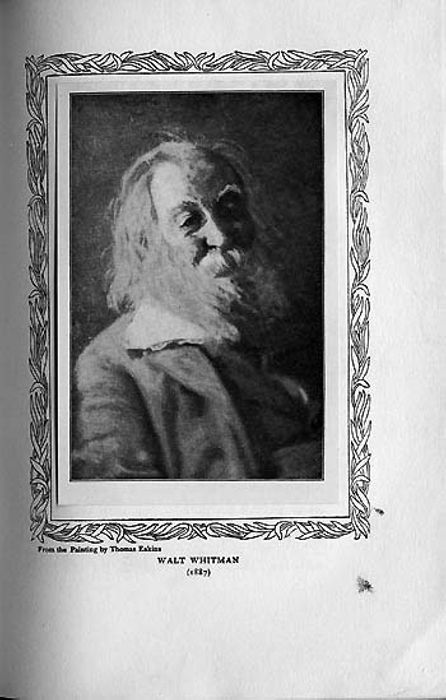 [Begin page 155]
I want with money? I have enough." But when I asked: "Wouldn't it be safer to do the book?" W. grew serious at once and replied: "I know what you mean: you are right—it would be safer done than left straggled about this room—with me dead, maybe, some morning. [See indexical note p155.1] I do feel as if I wanted to get this book issued before I light out." Added after a pause: "The Lippincott fellows have said they would take a bit of the Hicks—a good sized bit if I choose." He then carefully tied up the package again and put it back on the floor.
[Begin page 155]
I want with money? I have enough." But when I asked: "Wouldn't it be safer to do the book?" W. grew serious at once and replied: "I know what you mean: you are right—it would be safer done than left straggled about this room—with me dead, maybe, some morning. [See indexical note p155.1] I do feel as if I wanted to get this book issued before I light out." Added after a pause: "The Lippincott fellows have said they would take a bit of the Hicks—a good sized bit if I choose." He then carefully tied up the package again and put it back on the floor.
[See indexical note p155.2] There is all sorts of debris scattered about—bits of manuscript, letters, newspapers, books. Near by his elbow towards the window a washbasket filled with such stuff. Lady Mount Temple's waistcoat was thrown carelessly on the motley table—a Blake volume was used by him for a footstool: near by a copy of DeKay's poems given by Gilder to Rhys. Various other books. A Dickens under his elbow on the chair. He pushed the books here and there several times this evening in his hunt for particular papers. [See indexical note p155.3] "This," he said once, "is not so much a mess as it looks: you notice that I find most of the things I look for and without much trouble. The disorder is more suspected than real."
Tuesday, May 15, 1888.
Harned present. W., speaking of the Gilchrist-Eakins portraits, said they excited in him some remembrance of two Napoleonic pictures. [See indexical note p155.4] "An actor who had no faith in the real, the tangible, in life, portrayed by Napoleon crossing the Alps on a noble charger, uniformed, decorated, having altogether a hell of a time" (W. indicating its grandiose spirit by half rising from his chair and throwing up his right hand as though it held a sword). "Delaroche, not satisfied with such a conception, took the trouble to investigate the case—to get at the bottom facts. What did he find? Why, just this: that Napoleon rode on a mule—that [Begin page 156] the mule was led by an old peasant—that the journey was hard, the manner humble—that the formal-picturesque nowhere got into it. [See indexical note p156.1] This don't mean that it was less picturesque—it means that it was more—much more—picturesque: but the artists, many of them, won't have it that way. Well, Herbert painted me—you saw how: was it a success? Don't make me say what I think about that. I love Herbert too much. Then Tom Eakins came along and found Walt Whitman riding a mule led by a peasant."
[See indexical note p156.2] Brinton had said to W.: "You give us no consistent philosophy." W. replied: "I guess I don't—I should not desire to do so." I put in: "Plenty of philosophy but not a philosophy." To which W. answered: "That's better—that's more the idea." W. again: "Stedman thinks I should be happy to have my Lincoln poem classed with Lowell's ode. [See indexical note p156.3] I am happy, of course—am bound to be happy—but not for the reason Stedman cites, I can assure you: and yet I do not myself consider the Lincoln poem the best of them." Brinton said: "Chanting the Square Deific is an immortal poem: I sometimes think it is the most subtle and profound thing you have written." [See indexical note p156.4] W. said as to that: "Many of my friends have agreed with you, Doctor, about that. It would be hard to give the idea mathematical expression: the idea of spiritual equity—of spiritual substance: the four-square entity—the north, south, east, west of the constituted universe (even the soul universe)—the four sides as sustaining the universe (the supernatural something): this is not the poem but the idea back of the poem or below the poem. I am lame enough trying to explain it in other words—the idea seems to fit its own words better than mine. You see, at the time the poem wrote itself: now I am trying to write it." [See indexical note p156.5] Referring to Passage to India: "There's more of me, the essential ultimate me, in that than in any of the poems. There is no philosophy, consistent or inconsistent, in that poem—there Brinton would be right— [Begin page 157]but the burden of it is evolution—the one thing escaping the other—the unfolding of cosmic purposes."
W. has never read Buckle's History of Civilization. [See indexical note p157.1] Quizzed Harned. "Tell me what it is all about. It always seemed to me so formidable: I never seemed to have the courage to attack it." Laughing: "You see conscience makes some people cowards. I don't have much bother with my conscience. But books—well, books make a coward of me." [See indexical note p157.2] Again: "I have something of Shelley's distaste for history—so much of it is cruel, so much of it is lie. I am waiting for the historians who will tell the truth about the people—about the nobility of the people: the essential soundness of the common man. There are always—there have been always—a thousand good deeds that we say nothing about for every bad deed that we fuss over. [See indexical note p157.3] Think of the things in everyday life—we see them everywhere—that never are exploited in print. Nobody hunts them up—nobody puts them into a story. But let one base thing happen and all the reporters of all the papers are on the spot in a minute. That don't seem to give goodness a fair deal—though I don't know: maybe goodness don't need a fair deal—maybe goodness gets along on its own account without the historian." [See indexical note p157.4] Harned asked: "Have you ever had any experiences to shake your faith in humanity?" "Never! Never! I trust humanity: its instincts are in the main right: it goes false, it goes true, to its interests, but in the long run it makes advances. [See indexical note p157.5] Humanity always has to provide for the present moment as well as for the future: that is a tangle, however you look at it. Why wonder, then, that humanity falls down every now and then? [See indexical note p157.6] There's one thing we have to remember—that the race is not free (free of its own ignorance)—is hardly in a position to do the best for itself: when we get a real democracy, as we will by and bye, this humanity will have its chance—give a fuller report of itself."
[Begin page 158]W. spoke of Sidney Morse. "Sidney, so much of Sidney, is abortive—he don't get anywhere: he is a child of ennui: a child—true, sweet, persuasive—has a beautiful personality: is never discouraged: things go wrong: he falls and picks himself up again. [See indexical note p158.1] Sidney lacks altogether the world faculty—the power to turn the world to his uses. I don't feel sure—we shouldn't complain: perhaps it is better he should be as we find him. It is half tragic—the life he leads: the starts made—the ends that never come." Harned said: "You seem extra serious, Walt. You are not feeling sick?" "No, not at all. As to serious—perhaps I am: I get news some days—bad news, good news: news that sets me up, throws me down: I get only serious, however, never despondent." He did not specify. Stopped there. W. today gave me a Carpenter letter, saying of it: "It is beautiful, like a confession: it was one of Carpenter's first letters. [See indexical note p158.2] I seem to get very near to his heart and he to mine in that letter: it has a place in our personal history—an important place. Carpenter was never more thoroughly Carpenter than just there, in that tender mood of self-examination. Introspection! I am afraid of it, generally: just enough of it is good, too much of it is disease: most people don't stop with just enough. Carpenter is a thoroughly wholesome man—alive, clean, from head to foot." Carpenter's letter was addressed to W. at Washington and forwarded to Camden.
Trinity Hall, Cambridge, England, 12 July, 1874. My dear friend—It is just dawn, but there is light enough to write by, and the birds in their old sweet fashion are chirping in the little College garden outside. [See indexical note p158.3] My first knowledge of you is all entangled with that little garden. But that was six years ago; so you must not mind me writing to you now because you understand, as I understand, that I am not drunk with new wine.
My chief reason for writing (so I put it to myself) is that [Begin page 159] I can't help wishing you should know that there are many here in England to whom your writings have been as the waking up to a new day. [See indexical note p159.1] I dare say you do not care, particularly, how your writings, as such, are accepted; but I know that you do care that those thoughts you weary not to proclaim should be seized upon by others over the world and become the central point of their lives, and that something even transcending all thought should knit together us in England and you in America by ties closer than thought and life itself. When I say 'many' of course I do not mean a multitude (I wish I did) but many individuals—each, himself (or herself, for they are mostly women—fluid, courageous and tender) the centre of a new influence. [See indexical note p159.2] All that you have said, the thoughts that you have given us, are vital—they will grow—that is certain. You cannot know anything better than that you have spoken the word which is on the lips of God today. And here, though dimly, I think I see the new, open, life which is to come; the spirit moving backwards and forwards beneath the old forms—strengthening and reshaping the foundations before it alters the superstructure: the growth is organic too here I believe, but the flower is very very far and we do not dare to think even what it will be like. There is no hope, almost none, from English respectability. Money eats into it, to the core. The Church is effete. At school the sin which cannot be forgiven is a false quantity. [See indexical note p159.3] The men are blindly material; even—to the most intellectual—Art and the desire for something like religion are only known as an emotional sense of pain. Yet the women will save us. I wish I could tell you what is being done by them—everywhere—in private and in public. The artisans too are shaping themselves. [See indexical note p159.4] While Society is capering and grimacing over their heads they are slowly coming to know their minds; and exactly as they come to know their minds they come to the sense of power to fulfil them: and sweet will the day be when the toys are [Begin page 160] wrested from the hands of children and they too have to become men.
You hardly know, I think, in America (where the life, though as yet material, is so intense) what the relief is here to turn from the languid inanity of the well-fed to the clean hard lines of the workman's face. [See indexical note p160.1] Yesterday there came (to mend my door) a young workman with the old divine light in his eyes—even I call it old though I am not thirty—and perhaps, more than all, he has made me write to you.
Because you have, as it were, given me a ground for the love of men I thank you continually in my heart. (—And others thank you though they do not say so.) For you have made men to be not ashamed of the noblest instinct of their nature. Women are beautiful; but, to some, there is that which passes the love of women.
[See indexical note p160.2] It is enough to live wherever the divine beauty of love may flash on men; but indeed its real and enduring light seems infinitely far from us in this our day. Between the splendid dawn of Greek civilization and the high universal noon of Democracy there is a strange horror of darkness on us. We look face to face upon each other, but we do not know. At the last, it is enough to know that the longed-for realization is possible—will be, has been, is even now somewhere—even though we find it not. The pain of disappointment is, somewhere, the joy of fruition. Perhaps it will be, in time, with you in the New as with us in the Old world. [See indexical note p160.3] Slowly—I think—the fetters are falling from men's feet, the cramps and crazes of the old superstitions are relaxing, the idiotic ignorance of the class contempt is dissipating. If men shall learn to accept one another simply and without complaint, if they shall cease to regard themselves because the emptiness of vanity is filled up with love, and yet shall honor the free, immeasurable gift of their own personality, delight in it and bask in it without false shames and affectations—then your work will be accomplished: and men [Begin page 161] for the first time will know of what happiness they are capable.
Dear friend, you are older and wiser than me and can accept all that I have said, with a smile perhaps, but without any ill will. It is a pleasure to me to write to you, for there are many things which I find it hard to say to any one here. And for my sake you must not mind reading what I have written.
As to myself, I was in orders; but I have given that up—utterly. [See indexical note p161.1] It was no good. Nor does the University do: there is nothing vital in it. Now I am going away to lecture to working men and women in the North. They at least desire to lay hold of something with a real grasp. And I can give something of mathematics and science. It may be of no use, but I shall see.
You I suppose I shall not see. Yet if anyone should come from your side to England—this address will always find me. There are many who, if their pens were here, would send greetings to you across the sea.
Farewell: wherever the most common desires and dreams of daily life are—wherever the beloved apposition is, of hand to hand, of soul to soul—I sometimes think to meet you.
I have finished this at night. All is silent again; and as at first I am yours
Edward Carpenter.Wednesday, May 16, 1888.
Evening. [See indexical note p161.2] W. at home. Lying on the sofa in the parlor and complaining of ill health—of being "constipated, listless"—and saying: "My blood is so sluggish—my pulse is so low." Then: "But what's the use growling? Everything don't come my way but lots of things do." Talked for a long time recumbent. Then sat up and faced me. [See indexical note p161.3] "Rhys was here yesterday and the day before: he has now gone to New York. He intends to take in Niagara—then go [Begin page 162] over to Canada, spending a few days with Dr. Bucke—then home. He had at first intended not going to Niagara but he finally made up his mind to this: that he would not dare to return to England without having seen both Walt Whitman and Niagara. [See indexical note p162.1] 'After I have seen Niagara, after having seen you,' Rhys said, 'I can fairly say I have been to America to some purpose.' That's what he says. He came up from Washington. What do you think? You couldn't guess. He never called on or saw O'Connor. I was amazed when he told me—it seemed such a woful omission: twenty thousand Niagaras would not make up to me for one O'Connor. [See indexical note p162.2]
Rhys had said to W.: "Since seeing America and seeing you many things in Leaves of Grass which formerly puzzled me are made plain." W. responded: "I shouldn't wonder. That book has an amazing elusiveness: I am still looking for some of its meanings myself." He laughed. [See indexical note p162.3] "I don't wonder Rhys don't give himself airs about the book: the book, indeed, makes us all humble." Again of Rhys: "Just now his great point is to get along—to make a living—and at that I think he has a hard tug. He always has to think of it: he is as poor as any of us—you know that means a great deal. His first lecture in Boston was given the night of the blizzard—did not return the hall money. [See indexical note p162.4] But people there were hospitable—they boosted him on afterwards: made up for the hard night in a hundred ways. By the way, you mustn't suppose Rhys swallows me whole: he takes me with lots of allowance—chokes over me, gags a little: I am not easy to him. Why, Rhys thinks the 'lilt' is indispensable to poetry—he says I haven't got it—therefore: well, you know that therefore: you have heard it before in connection with Walt Whitman. [See indexical note p162.5] Well, I wanted to get into a dispute with Rhys on that point, merely to understand his grounds for it, but there was no opportunity—I was loath to insist upon my argument. Now he has gone— [Begin page 163]I shall never see him again." "You never were disputatious. Why did you want this fight?" "Only to get the truth threshed out. [See indexical note p163.1] I knew he had good reasons for his attitude: I wanted to learn them—I like to get at the fellows who oppose me—have them explain themselves." "But you and Rhys do very little fighting?" "Very little—very little. Do you ever know me to do any fighting? A kind of love passage—that's my sort of fight. But let me tell you a little more about Rhys. He is very interesting to me. We talked of the poetic lilt. Rhys insists on it: insists on it, come good or bad. Well—the lilt is all right: yes, right enough: but there's something anterior—more imperative. [See indexical note p163.2] The first thing necessary is the thought—the rest may follow if it chooses—may play its part—but must not be too much sought after. The two things being equal I should prefer to have the lilt present with the idea, but if I got down my thought and the rhythm was not there I should not work to secure it. I am very deliberate—I take a good deal of trouble with words: yes, a good deal: but what I am after is the content not the music of words. [See indexical note p163.3] Perhaps the music happens—it does no harm: I do not go in search of it. Two centuries back or so much of the poetry passed from lip to lip—was oral: was literally made to be sung: then the lilt, the formal rhythm, may have been necessary. The case is now somewhat changed: now, when the poetic work in literature is more than nineteen-twentieths of it by print, the simply tonal aids are not so necessary, or, if necessary, have considerably shifted their character."
Frothingham had somewhere said that Shakespeare "lacked the religious as distinguished from the poetic faculty." [See indexical note p163.4] W. said: "That seems to me to be profoundly true. The highest poetic expression demands a certain element of the religious—indeed, should be transfused with it. Frothingham has hit upon the truth: scholars will not, dare not, admit it, but it is the truth. The time will come when [Begin page 164] Shakespeare will be given his right place—will be put on a low shelf, as the esthetic-heroic among poets, lacking both in the democratic and spiritual: a master, sure enough: yes, a master: but subject to severe deductions. [See indexical note p164.1] People don't dare face the fact Shakespeare. They are all tied to a fiction that is called Shakespeare—a Shakespearean illusion. This is the idea in substance that I tried to exploit in The Critic: tried, I say (I reckon I didn't say the thing in the best style). I never have regarded Shakespeare as the heroic-heroic, which is the greatest development of the spirit: I call the heroic-heroic men the greatest men: Shakespeare is rather the poet of lords and ladies and their side of life. [See indexical note p164.2] Even the Greeks were a little tinged with the same quality. It's very difficult to talk about Shakespeare in a frank vein: there's always somebody about with a terrific prejudice to howl you down."
[See indexical note p164.3] I asked W. about November Boughs. He replied: "The book will be about one quarter verse—the pieces (the heres and theres) of the last three or four years: the rest of the book will be scraps—little papers from different places: a bit of this, a bit of that, a bit of something else. I have kept all the material carefully together: I can't hurry—it's not in me to hurry: yet I'm anxious to get the book out. Some day I'll die—maybe surprise you all by a sudden disappearance: then where'll my book be? That's the one thing that excites me: most authors have the same dread—the dread that something or other essential that they have written may somehow become side-tracked, lost—lost forever." [See indexical note p164.4] DeKay was referred to—his Nimrod, given to Rhys by Gilder and left by Rhys for W. to read. W.: "Rhys took it along with him yesterday." Had he read the book? "No indeed: but I probably read more of it than you would read if you took it up: I am more trained in patience than you are." He laughed. "It is a hideous mess—I cannot think of it except in connection with so much [Begin page 165] medicine." But "Stedman has always adhered to DeKay and Winter," he added, "especially to Winter—Winter, who, all in all, is about the weakest of the whole New York lot." [See indexical note p165.1] Winter's English book of travels was mentioned. "Yes," said W., "He is always on his marrowbones to something or somebody—especially if that thing or that body is English. There is some stuff in some of the fellows in that New York crowd but in DeKay and Winter, in some others, there is absolutely nothing whatever. [See indexical note p165.2] There's Stoddard, even, who might have blazed out a path for himself but who has chosen rather to spend his whole life in routine: and now he is gray, old, past retrieving. Stoddard's early work was most of it good—not giantesque but above the average: he immediately commenced to deteriorate and has continued to lose ground ever since. [See indexical note p165.3] Our young men have a sneaking hunger for loaves and fishes: they look for fat berths—get them: settle down: they are under orders—they are to obey, obey: and so they succeed in destroying all their individuality. I have met George Edgar Montgomery, a young man who originally promised much: who went to The Times, became dramatic critic—worked hard, hard like a slave. [See indexical note p165.4] He is perhaps another fine spirit destined for sacrifice—destined to the grind, the terrific strain, incident to metropolitan journalism."
[See indexical note p165.5] W. talked of Kennedy's Whitman [not published until 1896]. "He of course attaches more importance to it than I do—naturally does. I have seen some chapters of the book—I have helped him straighten out some biographical kinks—dates and the like: but that is all. As to the book—the whole: well, I don't know. [See indexical note p165.6] I am a slow arriver: I get there but I always come in last. I will only come at an opinion of the book by waiting—very patient waiting. I read a book in which I have a special interest three times or more—once to get its capital feat- [Begin page 166]ures—then after some delay I go at it again—this time for its atmosphere, spirit, and so on: that's reading number two, remember: then comes number three: I read finally for conclusions. [See indexical note p166.1] As to Sloane—well, he ought to be able to do something worth while: he's full of telling stuff: full of it: always, however, in a slightly disarranged, chaotic condition. Kennedy just misses being"—"Being Kennedy!" I put in. "That's just the word: being Kennedy: just misses being Kennedy. Some day he may get himself all together—then he'll do work his own size."
[See indexical note p166.2] Referring to Swinburne W. said: "He is always the extremist—always all pro or all con: always hates altogether or loves altogether: as the boys say, he goes the whole hog or nothing: he knows no medium line." "When he loved you he loved you too much. Now he hates you he loves you too little." "I suppose that's so: I don't know what I deserve or what I don't deserve. Tom said the other day: 'Swinburne either insults you or hugs you—he knows nothing between': that's just the point—yet that 'between' something or other is more worth while than all the rest."
[See indexical note p166.3] W. asked me: "You worked a long time ago in a print shop, didn't you?" "Yes, for four years." "Good! good! that's better than so many years at the university: there is an indispensible something gathered from such an experience: it lasts out life. After all the best things escape, skip, the universities." W. again: "There was a kind of labor agitator here today—a socialist, or something like that: young, a rather beautiful boy—full of enthusiasms: the finest type of the man in earnest about himself and about life. [See indexical note p166.4] I was sorry to see him come: I am somehow afraid of agitators, though I believe in agitation: but I was more sorry to see him go than come. Some people are so much sunlight to the square inch. I am still bathing in the cheer he radiated. O he was a beautiful, beautiful boy!" "What [Begin page 167] was his name? Where did he come from?" "I could not catch the name—he was from the west. [See indexical note p167.1] He said he just came in to say 'how d'ye do' and go again: that he was sure Leaves of Grass would do more for the new dispensation than anything else he knew. I don't see how anything could do more for the new dispensation than such a boy himself. Horace—he had your blue eyes: there was a flavor of the German in him: he said he was the son of an emigrant. [See indexical note p167.2] Well—you might crowd this room with emperors and they would only be in the way, but that boy—O he was a beautiful boy—a wonderful daybeam: I shall probably never see his face again—yet he left something here with me that I can never quite lose. Cheer! cheer! Is there anything better in this world anywhere than cheer—just cheer? Any religion better?—any art? Just cheer!"
Thursday, May 17, 1888.
W. talked of Rhys again. "He made some kick or other against Kennedy: they don't seem to have got along well together: I don't suppose it was anybody's fault. I can take no sides in such a quarrel: I consign Kennedy to Rhys and Rhys to Kennedy—let them finish their fight together. [See indexical note p167.3] Rhys complained of the nervousness of Kennedy and his wife—seemed to think it was alarming: I suppose Rhys got it all in the wrong perspective. That nervousness is constitutional: they have it—God knows! On the other hand I can see how Kennedy must have been irritated by Rhys' stolid ways. Kennedy is a proof reader with Houghton, Mifflin & Co.—works thirteen or fourteen hours a day—for poor pay, no doubt: his wife does the same sort of work for the Christian something or other. [See indexical note p167.4] It's not a business to quiet the nerves—especially such nerves as Kennedy had to start with. It is poor work for Sloane to be doing—poor work: it breaks him down for anything else. It seems inevitable that two men like Rhys and Kennedy should fall [Begin page 168]out: you couldn't get 'em to fit nohow. Kennedy will hardly fit anything but a chestnut burr. [See indexical note p168.1] Don't it seem to you all Kennedy's crosspatch qualities are on the outside? If a man will have patience to get through his skin he'll find a Kennedy he will forgive and love."
W. advised me to "go and get acquainted with Dave McKay." He described McKay. "Dave is a canny Scotchman—thick-set, bluff, bustling, businessy—in a few ways of the Tom Harned style. Dave always knows how to keep to the windward of things. [See indexical note p168.2] Some of my friends say, 'Watch Dave.' I do watch him, but not because I do not think him square. Dave knows how to butter his bread, to be sure: that is trade—trade will be trade any time: I have found Dave shrewd but at all times scrupulous. Authors always growl about publishers, probably with a good deal of reason, too: but I don't know as the publisher is any different from the shirtman or the shoemaker or anybody else with goods to sell. [See indexical note p168.3] All the little inhuman trickeries current are referred back to business. Now there's John Burroughs—you ought to hear what he has to say about publishers: it'd make your hair stand on end. Why, John actually gets violent on the subject. The author is generally in the hands of the publisher. I try not to be. Emerson was very shrewd in this particular—very shrewd: he owned his own plates and always himself ordered the copies struck off when they were needed. When Emerson published Carlyle over here he protected Carlyle in the same way—yes, even attended to Louisa Alcott's affairs until Louisa grew up, when she was found to be more than able to defend the family interests singlehanded. [See indexical note p168.4] An author ought to own his own plates—ought to alienate nothing from himself. I own the plates of Leaves of Grass—have ever been considering the propriety of buying the prose plates. Sherman, on Seventh Street, made these. Nobody cares a damn for the prose—it has the greatest battle simply to keep alive— [Begin page 169]the greatest. Dave is now producing a volume of extracts from the Leaves arranged by Elizabeth Porter Gould: a birthday book: I had a letter here today from her. [See indexical note p169.1] She described a meeting of the Home Club in Boston the other evening at which a Mrs. Spaulding, together with Miss Gould, took up the defence of the Leaves against violent antagonism. This story contradicts Stedman's idea that my friends are in error when they contend that the Leaves are not everywhere hospitably received. It is indeed a favorite idea of Stedman's that American literary men are misjudged in that particular—that after all they love us instead of hating us: that if they knock us down it only means again that they love us. Stedman is way off on that—way off. Kennedy wrote me a while ago on this very matter: I have used the letter somewhere, I think, in writing on the subject. [See indexical note p169.2] Kennedy said: 'Everywhere I go I meet with a solid phalanx of dissent'—or something of that tenor. Professor Gilman, however, declares that this is not true—he rather favors the Stedman notion."
Someone asked W. why he was not received in The Atlantic? "How should I know? They will have none of me. I have met Aldrich—used to in New York, at the beershop—indeed, have met Howells often enough. [See indexical note p169.3] They are friendly in all personal ways, of course. But when I was in Boston, although Aldrich called on me—and O'Reilly, who is my ardent friend (noble O'Reilly!), went several times to see him and induce him to invite me to contribute to the magazine—he made no tenders of literary hospitality: he was dead still and let me go." Had he ever tried them with verses? "Yes, years ago, with Elemental Drifts, for instance, which they published—and some others, I believe. [See indexical note p169.4] Don't think I blame 'em—feel anyway hard about all this: it all belongs to the story—I always take what comes: kicks, blessings, anything. No man of that stripe could accept me on the whole—could [Begin page 170] say 'yes' without a touch of 'no.' Take Stedman. He is as warm as any: a splendid, openhanded, openminded fellow: I think Stedman likes me as a critter. [See indexical note p170.1] He has been in Washington,—where he knew the O'Connors—is familiar with my hospital and other experiences—is generous, cordial, conciliatory. He likes me, as I say (or believe) as a critter—a human being—my build, port, practice: this perhaps more or less without qualification. But when it comes to my books he shies some—they are more or less suspected. Stedman may be right—the books may be wrong—I am not taking sides: I am only describing a situation. [See indexical note p170.2] Stedman has a wife—a superb woman: her friendly disposition towards me has always been in evidence. Her influence on my side has perhaps helped some to save me with Stedman. Gilder is much the same as Stedman: is friendly, listens to me, admits my measure—yet looks with distrust on all the claims of my friends, especially at the fund from abroad, of which he said once to Talcott Williams or Tom Donaldson: 'That galls me—I can't get over it!'"
[See indexical note p170.3] W. naturally diverted to Lanier. "The recent published adverse reference to me from Lanier as reported in the Memorial volume was objected to by his wife, I am told, on the ground of its unfairness, not only to me but to Lanier, since other things said by Lanier about me, reflecting a more favorable mood, should also have been given. [See indexical note p170.4] I know nothing about that myself and care less. I had several letters from Lanier—very warm letters. One of them is still about here somewhere: I want you to have it some day: the severely critical paragraphs in the book were therefore rather a surprise to me. I suppose we will both survive the anomaly. [See indexical note p170.5] Lanier was tragic in life and death. He had the soul of the musician—was a flute player: indeed, in the accounts, was phenomenally fine. This extreme sense of the melodic, a virtue in itself, when carried into
[Begin page figure-13]
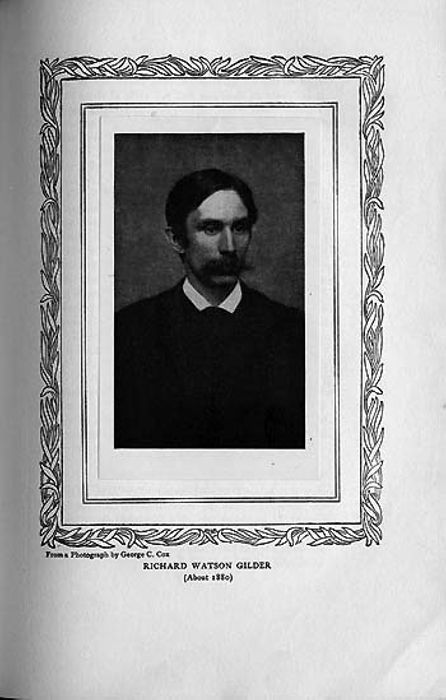 [Begin page 171] the art of the writer becomes a fault. Why? Why, because it tends to place the first emphasis on tone, sound—on the lilt, as Rhys so often puts it. [See indexical note p171.1] Study Lanier's choice of words—they are too often fit rather for sound than for sense. His ear was over-sensitive. He had a genius—a delicate, clairvoyant genius: but this over-tuning of the ear, this extreme deference paid to oral nicety, reduced the majesty, the solid worth, of his rhythms."
W. kissed me good night. [See indexical note p171.2] He said: "We are growing near together. That's all there is in life for people—just to grow near together." I was almost at the door. He laughingly called my name. I stopped. "I have a copy of DeKay's Nimrod, Horace: they sent it to me: it's quite a handsome book printerially speaking: you are a typo: I'll hunt it up and give it to you: you may take it away and keep it forever!" "Shouldn't I read the book, too?" [See indexical note p171.3] "If you read it you read it on your own responsibility. I advise you to study its mechanics: that's where my advice ends. Do anything you please with the book only don't bring it back!"
Friday, May 18, 1888.
Mailed postal card for W. addressed to Mrs. Costelloe, London. Also package of papers for O'Connor and a McKay L. of G. to Griffin, France. W. gave me a letter of introduction to McKay. "Dave is not exactly your kind, but he is a kind you will like."
328 Mickle Street, Camden Ev'g May 17, '88 Dear D. Mck—[See indexical note p171.4] The bearer Horace Traubel is a valued young personal Camden friend of mine—American born, German stock—whom I wish to introduce to you with the best recommendations—He is of liberal tendencies and familiar with printing office matters and the run of books.
Walt Whitman. [Begin page 172]Talked of Pearsall Smith. Smith is about to go to London and insists that he has two rooms in his house there retained unoccupied for Walt. [See indexical note p172.1] "Of course this is all a dream,"says W., alluding to it—"one of Smith's dreams. But then dreams don't hurt." "Sometimes you can eat dreams when you can't eat food," I suggested. "How true that is, Horace," W. said: "How true! How true! How many's the time I've just lived for days and days practically on my affections alone—the sight of my friends, the sky: thinking life away from, outside, all appetites." [See indexical note p172.2] Then he went on to talk about Smith. "Pearsall was always very kind to me—very kind. I used to visit them in their Arch Street house: they always treated me with peculiar consideration—made the home so much mine, its servants so much at my beck and call if I had wished it. The house could not have been more mine if I had owned it—the overflowing table, which contained about everything but a tipple (you know the Smiths were opposed to all tippling)—yes, everything but the tipple, which, by the way, some of us would now and then slip out and get round the corner. [See indexical note p172.3] Mrs. Smith—Hannah—and I never hitched: she is very evangelical: she takes her doctrine, if she don't take her whiskey, very straight: the sort of get under my feet religion which gives hell out to the crowd and saves heaven for the few. [See indexical note p172.4] Well—I didn't agree very well with Hannah—still, there was no demonstration. Pearsall himself, though once a missionary or something or other of that useless sort, is now agnostic—a man more or less of the world—fond of horses, good living, believing in goods—yet seeing more, too, than that. It was Smith who helped me to New York last year—arranged for the reception at the Westminster—got a suite or parlors at what must have been great expense—making this splurge in the face of my protest: arranging everything, however, with a certain grace and generosity that touched me. [See indexical note p172.5] The reception, as you know, was a thing of which [Begin page 173] I didn't approve; first and last I opposed it—tried to beg off. Smith has two admirable daughters—I have a real affection for them—for their unusual qualities. [See indexical note p173.1] When they went to London I broke an iron rule of my life, not to give letters of introduction to foreigners. I wrote to Tennyson in their behalf: they went and delivered the letter and spent a precious afternoon with Tennyson as a result. [See indexical note p173.2] Well—I ought to like the Smiths even if they ought not to like me."
W. spoke about prejudices against himself. "Sometimes they assume amusing forms. A few years ago the Association Hall Managers over in Philadelphia refused me the use of their public hall for a lecture on Elias Hicks on the ground that he did not believe in Atonement. [See indexical note p173.3] On the face of it that seems like bigotry: it may be bigotry, but it is also consistency. I do not blame them. [See indexical note p173.4] Such stuff as now passes for Christianity is liable to lead a man into any extreme of persecution—honestly lead him. I am against the whole business. I really think the Y.M.C.A. objection was not to Hicks but to me."
Harned asked W. what he thought of the decision of Vice-Chancellor Bird on the George case. A man named Hutchings, of Camden County, left some money to George for the propagation of the idea of the Single Tax. [See indexical note p173.5] The family fought the will. Bird decided for the family on the ground that his social doctrines contravened the law of the land. W. said: "The decision is vile—at least from the moral, abstract, point of view. There may be some legal warrant for Bird's decision, though I doubt it: but if there is any law back of Bird the sooner we kick it pot and kettle overboard the better for us all, even for Bird. [See indexical note p173.6] Suppose we substitute Rabelais for George—would Rabelais meet with the same fate? I am always concerned over any interference with the expression of opinion: I want the utmost freedom—even the utmost license—rather than any censorship: [Begin page 174] censorship is always ignorant, always bad: whether the censor is a man of virtue or a hypocrite seems to make no difference: the evil is always evil. [See indexical note p174.1] Under any responsible social order decency will always take care of itself. I've suffered enough myself from the censors to know the facts at first hand."
W. said: "I had a letter of advice, advice, from Bucke today. I love Bucke enough, God knows, but I am as afraid of Bucke's advice as anybody's. [See indexical note p174.2] And you, Horace: listen to this: Take one more piece of advice and then stop." "What piece?" "Never take advice!" W. laughed heartily. "I am pursued, pursued, by advisers—advisers. They love me, they hate me—but they advise, advise! What would become of me if I listened to them? I am deaf to them all—deaf—deaf. The more they yell, the deafer I become. [See indexical note p174.3] Why, I never move a step, write a word, that somebody don't object to: the thing that one likes another don't—the thing another likes one don't: it is God bless you for this or that, or God damn you for this or that. A fellow might easily be lost in the confusion: he's got no business to hear any of it: he's to hear only himself—that's his whole concern."
[See indexical note p174.4] Discussed good and bad men. Harned seemed to be in a sceptical mood. W. protested: "He's got it all, Tom—not only the cruel, beastly, hoggish, cheating, bedbug qualities, but also the spiritual—the noble—the high-born." Harned said: "Democracy, while abstractly right, is a hard doctrine to practise." W. shook his head: "I do not find it so." H.: "But you are rather an exceptional man." [See indexical note p174.5] W. would not have that. "That is not the explanation, Tom. Democracy is the thing for us—for America: that's what we're here for—individuals, all of us: yes, and these States. America will not dare to be false to its promised democracy. We're heaping up money here in a few hands at a great rate—but our men? What's becoming of our [Begin page 175] men in the meantime? We can lose all the money and start again—but if we lose the men? Well, that would be disaster. But I have no fears. [See indexical note p175.1] We will have our troubles getting on, but the end, the victory, is sure. I should feel like warning the moneyed powers in America that threaten to stand in the way: history will deal in a very drastic fashion with opposition like that should it become too stubborn." I related a couple of recent night experiences on the street. W. said: "That all goes to corroborate my argument—it confirms my own experiences—my own excursions everywhere among what we call the common people, even in rather notoriously criminal circles. You have heard what Horace says, Tom? [See indexical note p175.2] He goes everywhere—he has never had any sort of encounter with anybody. That was exactly my case. It is the respect men pay to a young man who goes quietly about without the spirit of bravado observing, sharing, absorbing, the general life. I must insist upon the masses, Tom—they are our best, they are preservative: I insist upon their integrity as whole—not, of course, denying or excusing what is bad. Arnold is all wrong on that point: it is good, not bad, that is common. The older I grow the more I am confirmed in what I have done— in my earliest faith—the more I am confirmed in my optimism, my democracy."
Harned made some allusion to Seward. W. took the name up. [See indexical note p175.3] "I once heard a great speech from Seward—one of the greatest speeches, if not the greatest speech, I have ever heard. It was in Washington, in a negro case—a brutal, degraded specimen, with no more sense than a horse, or not as much. Seward made the case a race case: his appeal was a masterpiece in itself—yes, successful, too—though the man was undoubtedly guilty." [See indexical note p175.4]
W. spoke of editions of Leaves of Grass. "The book no longer contains errors worth talking about—a few in spellings or words, but none that are damaging. I had three sets of [Begin page 176] proofs of the Osgood edition, and still a number of mistakes crept, or stayed, in. Books are like men—the best of them have flaws. [See indexical note p176.1] Thank God for the flaws!" I said: "If it wasn't for the flaws love would be impossible!" W. looked at me a spell. Then he said: "That sounds startling. Say it again." I repeated it. W. was slow to speak. Then he pushed his fingers down upon the arm of his chair: "Horace, you are right. The idea scared me first. You are right. Tom, Corning, ain't he right?" W. again: "Awhile ago we were talking of Pearsall Smith. [See indexical note p176.2] Pearsall, too, has his contradictions. For all his radicalism he likes the English life—likes to be near the big fellows there—likes to be served—obsequiously served—to get among people who don't consider themselves as good as he is—or a good deal better. But that whole serving business is a stench: it is offensive to me: besides, I believe people who serve you without love get even behind your back." [See indexical note p176.3] W. addressed a question to Harned. "Horace contends that half of Shakespeare's greatness is in his reader—half at least—or Homer's—or any man's who writes or sings or what not. That is a favorite idea of his and it's a striking one, if not absolutely, literally, true—or perhaps it is even that. But what do you think of it, Tom? And you, Corning?" Corning said something to W. about the hospitality of the Harneds, W. assenting. "Yes indeed, they spoil me: it has come to be with me an essential point: I get to expecting it. I am greedy—never satisfied: their house is an oasis in my domestic desert." [See indexical note p176.4] Harned broke in: "Don't put it on too thick, Walt." W. laughed. "Don't get conceited, Tom: that's not meant for you—that's meant for Mrs. and the children and the cook!"
Saturday, May 19, 1888.
W. complained of his health. "I have been sicker the last four or five days than ever before." W. received a letter from O'Connor today—read it to us. Harned and [Begin page 177]Corning present. W. said. "It does a fellow good to receive such notes: William is always so breezy, so cute. [See indexical note p177.1] He is better than the best medicine. By the way, Horace, here is an old letter of William's I have saved for you." Reached toward the little shelf at the window sill. "It is dated 1884—I guess it's almost all about the Bacon business: he says he could prove it if he only had time." This excited Corning to laughter. "He'd need a good deal of time," said Corning. This sally aroused W. who at once retorted: "I don't know about that—it's pretty well proved now!" [See indexical note p177.2] Harned remarked "Walt, I never knew you to go as far as that before." "I don't believe you did. It was Corning's fault. What I mean is this—that William is a great scholar—has the whole business in his fingers—can reel off irrefutable arguments by the yard—is wonderfully equipped for the fight. I don't think any man living can stand up against him in that argument: I'd rather run than try it myself, I can tell you." This is O'Connor's letter:
Washington, D.C., October 2, 1884. Dear Walt:I got yours of the 29th ultimo, with the slip from The Critic. [See indexical note p177.3] It is a magnificent compliment, and was inexpressibly comforting. John Burroughs told me when he was here, and has since written to the same effect, that what I say on the question does not touch him at all, and although one does not mind such things at first, yet gradually, and especially when they are only part of one concurrent voice, they more than half persuade one that he is a visionary jackass, and have a deeply disheartening effect—all the more, I think, when one's convictions on the matter are clear and deep. [See indexical note p177.4] [See indexical note p177.5] There is nothing more evident to me than what Machiavel in The Prince did for tyranny—i.e. sow death for it by simply showing it up without bias and with perfect candor—Bacon (i.e. Shakespeare) did for feudality. It is the old story of the basilisk—if you see him[Begin page 178]first, he dies. In the plays—the historical plays especially—Bacon sees the basilisk in all his nature and proportions.
I regret I am not free of office life, for I am sure I could make Bacon's part in all this matter so evident that Time would remember it. [See indexical note p178.1] Criticism on Shakespeare has not yet begun, nor can it begin, until the coincidence with the Baconian movement—the divine conspiracy of the Novum Organum against false civilization—is recognized. So far comment on Shakespeare has been merely esthetic. But the relation of that drama to that age—that marvellous "time-bettering age"—that is the main question.
I am extremely gratified at the reinforcement your article brings. [See indexical note p178.2] In this connection, please read Coriolanus. The impersonation of the feudal military spirit in the hero is perfect, and there are scenes—notably that of the conference between the tribunes when they plan "to darken him forever"—which are revelations.
I have an article before the Manhattan which I now hope more than ever they will publish, for it has some things about Bacon I would like you to read.
There is a noble picture of him, from the painting by Vandyck, in the October Harper. [See indexical note p178.3] Look at it, and ask yourself whether that face belongs to one who was "the meanest of mankind"! Nothing refutes a slander like a good portrait.
I have been over today to the Surgeon General's office to see about data for you. I know Dr. Huntington, the Acting Surgeon General, very well. I am afraid that the quest will be fruitless. The only matter they have is the Medical and Surgical History of the War, now in process of publication, what you want—i.e. hospital matter—will be in the third volume, and this is now being made up, and will not be ready, unfortunately, for a year. I am sorry. However, I will go down tomorrow to the Medical Museum, (as Dr. Huntington suggested to me), talk with Dr. Wild, the li- [Begin page 179]brarian, and see if he can give me anything. [See indexical note p179.1] I fear it is unlikely—the publications being inchoate. You shall hear duly.
I am crushed with work at present. The weather is simply infernal. I wish you were better, and hope the coming coolness of October will revive you. More anon.
Faithfully, W. D. O'C.(I hope you got the little Hearn book. The thieves' song in the Polynesian story is wonderfully fine.)
W. saw I was through and remarked: "William is a master: his art is wonderful to me. [See indexical note p179.2] He never writes a letter—even a business letter—without giving it that final touch of art which takes it out of the mass of epistolary writing. William is a constant marvel to me—like the sun each morning, like the stars every night: he never grows stale."
[See indexical note p179.3] W. asked: "Horace, who is the Louise Imogen Guiney who writes so everlastingly in Lippincott's about plagiarism? I don't seem to know her at all." Described O'Connor's place in the Signal Service as that of "the one who does all the work for the fellow who wears all the ornaments." Went up stairs, alone, with much effort, to get slip copies of North American Review article, A Memorandum at a Venture, giving one to Corning and one to me. "It is nothing much," he explained, "simply a word or two: but we have often discussed that subject—you will recognize the things I say as familiar friends. [See indexical note p179.4] No one can say too much to set people right on that subject of the nude—of sex."
A Carol closing Sixty-nine, sent to Lippincott's, not appearing in the current issue, out today (for June), Walt wrote withdrawing it, at the same time sending a copy to The Herald. "It should be printed before my birthday, on the 31st. I do not understand why Walsh did not print [Begin page 180] it: I have always considered him friendly to me: yes, friendly: he surely is my friend: he has given all sorts of proof of it. [See indexical note p180.1] But why should anyone try to prove why editors do or do not do things? There is no appeal from the editor: he is a necessary autocrat." W. told us his poem Old Age's lambent Peaks had been accepted and paid for by The Century and "is to appear soon." Then: "I am daily expecting The Century to shut down on me: too much of Walt Whitman won't do anywhere, especially in a magazine more or less Nancyish like The Century." W. showed us slips of the two poems but would give none of them out. [See indexical note p180.2] "I want the poem to appear first. It is a point of honor with me. I would feel free at any time to give away manuscript copies of any of the poems, but somehow object to distributing the printed slips. Curtz makes these slips for me—Henry Curtz. You know him, Horace. He is rather an effete person—seems as if left over from a very remote past: his queer little office, the Washington press, the old faced letters, the wood type, Curtz himself: it's all odd and attractive to me. [See indexical note p180.3] Be good to Curtz—he's the last of his race."
Corning asked W.: "Do you finally think Emerson did not withdraw his opinion of you?" [See indexical note p180.4] "From books I have read about him—from my talks with him, with his friends—I do not consider that Emerson withdrew that first opinion of Leaves of Grass. Ask Sanborn, ask anyone. I think it will stand. A lot of people are telling what they think and do not know about it, but who has any word in Emerson's own hand to that effect? I do not say I know, but who does know?"
[See indexical note p180.5] Reference was made to Richard Realf. "I am always interested in Realf: he was an exquisite, delicate spirit: we never met, but I am familiar with his career—with his earlier as well as his later career. His end was sad, tragic—but such cases are frequent: I have known many brilliant
[Begin page figure-14]
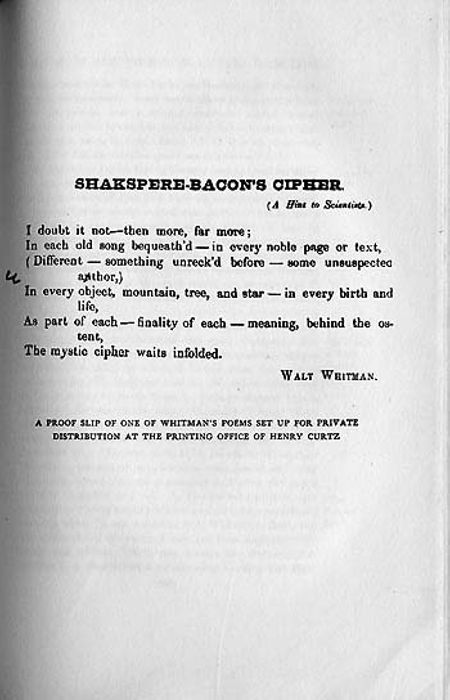 [Begin page 181] young fellows—in New York, in Washington, here—who went the same way. [See indexical note p181.1] Realf wrote many indisputably beautiful things—he had a winged soul—he soared, soared, soared, then fell bruised to the earth—bruised, dead: dead by his own hand, by God's hand. Well, it is all so mysterious: I do not answer the questions it arouses."
[See indexical note p181.2] W. expressed regret that O'Connor had not written more. "It is almost tragic to see a man endowed as he is so largely silent—so much of him just fired up and never expressed. A nobler genius never walked the earth. William has a world all his own—a potential world: I used to think he would some day give it birth: but the days pass, the years pass, by and bye William will pass, I am afraid, with the work undone. That damned job in Washington ties him down to a few feet of grass: I ought not to growl at it: it is splendid work: but somehow I resent it—just a little, anyway."
Griffin's poems have now joined the mass on the floor. But that implies no dishonor—note even disregard. [See indexical note p181.3] For there in the mix-up are many of W.'s own manuscripts—his diary, for instance, which I kicked from one spot to another today, W. laughing over it. W. denotes that stuff as "in a sense so much truck." Harned showed him a portrait of Haweis in Harper's. [See indexical note p181.4] W. said: "Good! that's very like him—he came here just in this sort of evening light. Haweis is the preacher sort: he does not dazzle me." Corning jollied W. "My sort, sort of!" To which W. replied: "Hardly—your sort of preacher is no preacher at all. You are a man before you are a preacher and after you are a preacher: that lets you out. [See indexical note p181.5] As Horace here likes to say, you're so busy being a man you have no time to be a preacher." Corning said: "I am honored, Mr. Whitman: that's the best certificate of character I ever got from anyone." W. smiled and added: "Well, you deserve the diploma, Mr. Corning." I waited just a minute after Corning and Har- [Begin page 182]ned had withdrawn, and kissed W. good-night. W. said: "Some night it will be a last kiss—a last good-night—but I hope not just yet—nottill the books are done!" [See indexical note p182.1]
Sunday, May 20, 1888.
A Carol closing Sixty-nine in today's Herald. W. said: "The list grows but what's the use of it?" [See indexical note p182.2] Spoke of his health. "I'm going down hill—not hurrying at all, but going." Asked me about John Stuart Mill: "I have just been reading a little squib here that mentioned Mill. Tell me about him. What did he stand for, teach, saliently promulge? I have never read Mill—I know nothing about him but his name." [See indexical note p182.3] I talked for some time, describing Mill. W. frequently broke in on my descriptions to say: "Well, that is beautiful to hear!" When I was through he said: "I see I ought to know Mill—but then, what oughtn't I to know?" I remarked to him: "I hear you were at the Unitarian church last night." He laughed quietly. "Yes—they wanted me to go: Tom particularly wanted me to go: so I went and saw all the pictures." But what of the sermon? "There was not much to it: the audience liked it: the room was crowded." [See indexical note p182.4] But what of W. W. Did he like the sermon? "Not a bit: all preaching is a weariness to me—Corning's as much as any other's. We have the stock phrases in books—the stock canvases in art: well, so we have the stock stupidities in sermons. Corning is all right—the man Corning: I can like him, I do like him: but the Corning in the pulpit last night tried my corns. I am always impatient of the churches—they are not God's own—they rather fly in the face of the real providences."
[See indexical note p182.5] Ingram came in—an old Quaker who keeps a tea store in Philadelphia. Ingram is a man who frequents the prisons out of a really philanthropic motive which W. respects and with which he co-operates. Ingram brought a message of [Begin page 183] love from some Moyamensing prisoners whom W. knew. W. was visibly moved. [See indexical note p183.1] "I have some books and papers to send by you, William," he said. Ingram brought with him a volume of selections from Jean Paul Richter, which he had promised W.: also, Thomson's Seasons, from a prisoner, and Clodd's Childhood of Religions. W. kept the Richter, passed the Thomson volume back without comment, and said with reference to the Clodd: "I see—I see: but I have never allowed myself to drift into such discussions: I have deliberately steered clear of them—of all theological, mystical, waggeries, respectable or not respectable: I am oppressed enough by the fact that men quarrel about their religions (as they do for that matter about their loves, strange to say) to wish to discuss them. Why should I addle the egg?" [See indexical note p183.2] But Clodd was affirmative—not a quarreler: what of that? "Well, perhaps I wrong that particular man: he may be exempt: but I am not mistaken about the thing. [See indexical note p183.3] To any man who thinks—to any man alive to the revelations of modern science—it is an insult to offer the doctrines of the church: it is as if you approached him to say: 'What a damned fool you are, anyway!'" Ingram had also brought W. on a former occasion Winwood Reade's Martyrdom of Man, which W. returned unread, taking care to repeat the fact of his distaste for literature of the polemical sort. "It is pessimistic, is it not?" he asked. [See indexical note p183.4] In reply to a question W. said he had never read William Morris' Earthly Paradise. "This is not because I do not honor Morris, for I do, but because—well, because. You see, I am not a constitutional reader: I do not apply myself to reading in the usual way. I have read, to be sure—read a good deal since I have been tied up indoors—but after all that has never been the chief thing with me." [See indexical note p183.5]
W. again: "We all hate the idea of the king, the emperor, but sometimes a good king, emperor, happens, who almost seems to excuse the tribe—just as a minister comes occa- [Begin page 184]sionally so good he excuses his tribe—yes, just as Emerson excused the literary tribe, in spite of all their frailties. Take the Emperor Frederick William—I have wished him to live—for years—to live to do his work, which is very important. [See indexical note p184.1] His son is reactionary and dangerous." He talked of his experiences with editors. "Who has had more experience of the nether kind than I have? I think everything that could happen to a rejected author has happened one time or another to me. [See indexical note p184.2] I could tell you some interesting stories. I just think of this one. John Swinton came to see me soon after I had settled in Camden—urged me to offer something to Dr. Holland for Scribner's—was very strenuous about it. [See indexical note p184.3] I demurred but John persisted. 'Do it, do it!' he said. 'Why should I do it?—why?' I asked John. He still insisted. 'For certain reasons' he said. I sent a poem, which was rejected—not rejected mildly, noncommitedly, in the customary way, but with a note of the most offensive character. I was sick and blue at the time: the note provoked me: I threw it into the fire. I was always sorry I destroyed it: had I been well I should not have done so: it was a good specimen insult for the historian—for Horace, here, who likes something that piques in his sauce now and then. [See indexical note p184.4] Of course this ended my relations with Holland. I never knew John's mysterious 'reasons,' either. The Century under Gilder has always accepted my pieces and paid for them. Gilder is quite a different man—noway of the Holland type. Holland is a dead man—there's hardly anything of him left today: he had his strut and is passed on: he was a man of his time, not possessed of the slightest forereach." [See indexical note p184.5] "Back of him everything, before him nothing." I said. "Exactly, exactly: the style of man who is adept in one two three—who can tell the difference between a dime and a fifty cent piece—but is useless for occasions of more serious moment. But Holland was all right: he did his deed in the Holland [Begin page 185] way: why should we ask or expect him to do more? Oh, I was talking of the editors. [See indexical note p185.1] The Harpers once accepted a poem, which induced me to send them others, but five or six were rejected in succession, some of them accompanied on their return with palliating notes: then I saw I was not wanted: I shut the door and withdrew. That was years ago. Latterly I have had verses in the Weekly. [See indexical note p185.2] I never have any fight with the editors—they know what they are about—they know what they want: if they don't want Walt Whitman who can blame them?" "They don't like to see you loafing around the throne." "That's so: and why should I criticise them for that? I don't blame myself for being Walt Whitman—neither do I blame them for thanking God they are not as I am! [See indexical note p185.3] Some of my friends have quarrelled with the editors but they have never done it with my consent. The fact is I have been about as well received as I expected to be, considering the proposition I set forth in the Leaves, considering the rumpus I made, considering my refusal to play in with the literary gang."
Ingram left. W. said of him: "He is a man of the Thomas Paine stripe—full of benevolent impulses, of radicalism, of the desire to alleviate the sufferings of the world—especially the sufferings of prisoners in jails, who are his proteges. [See indexical note p185.4] He is single-minded—morally of an austere type: not various enough to be interesting—yet always so noble he must be respected. He is a questioner—a fierce interrogator: I am disturbed by his boisterous questions: rattled by them, as the boys say: I am not fond of being catechized—indeed, rather run from it: I am not fond of questions—any questions, in short, that require answers. [See indexical note p185.5] Ingram plies me with his anti-theological questions—asks, asks, will not stop, let go." Ingram had said to W. about Reade's book: "It will show you how a man who was in got out." [See indexical note p185.6] W. was merry over the matter. "I never was in," he said, "therefore I had no reason to come out. I never read books [Begin page 186] that have to do with such controversy, the more to muddy my brain."
[See indexical note p186.1] W. was hilarious over the Standard's witty assertion that Edward Everett Hale had "ceased being a Christian and had become a protectionist." W. broached the subject of November Boughs. "I have determined at last to start on the book: I shall need to enlist you as my co-worker. I am physically helpless. [See indexical note p186.2] I could not do this work alone: I seem every day to be losing something—some atom of power. Now I feel as if we should commence, before the cloud that seems to threaten me falls—before I am bodily a total wreck—before I get beyond the power to follow my guides—to finish the work I have planned to do. [See indexical note p186.3] I do not seem to lose my mental grip—I have myself that way well in hand: but the other me, the body me, has little to expect for itself in the future. Any day the slender thread may be cut—any day. Horace, we will take the book up and see it through—eh?" He looked out the north window: there was no sorrow in his grave face. Then he turned my way again and added: "November Boughs will probably keep within two hundred pages of printed matter—one quarter of it verse, to be used supplementally in later editions of Leaves of Grass, and to be called Sands at Seventy. [See indexical note p186.4] I am glad you fellows like the title so much. I am well satisfied with my success with titles—with Leaves of Grass, for instance, though some of my friends themselves rather kicked against it at the start—particularly the literary hairsplitters, who rejected it as a species of folly. 'Leaves of Grass,' they said: 'there are no leaves of grass'; there are spears of grass: that's your word, Walt Whitman: spears, spears.' [See indexical note p186.5] But Spears of Grass would not have been the same to me. Etymologically leaves is correct—scientific men use it so. I stuck to leaves, leaves, leaves, until it was able to take care of itself. Now it has got well started on its voyage—it will never be displaced."
[Begin page 187]W. stopped a few minutes. Neither of us said anything. Then he resumed: "When you come tomorrow you will probably find I have drawn up plans for the book. [See indexical note p187.1] I am a very slow worker—I take my work easy—but when I get going I am quite steady and accomplish a good deal. This will mean a lot of extra work to you—it will tie you down every day to some routine. Are we to make a regular engagement? I haven't much money but such money as I have I ought to share with you. How can we get this delicate matter into the right shape?" "I wouldn't be interested in doing the work for money." [See indexical note p187.2] "It's not hire—it's only a sort of communism: why shouldn't we arrange that amiably together?" "The arrangement was made a long time ago before money was mentioned." "What do you mean by that?" "I appeal to the original arrangement!" W. looked at me and reached out both his hands: "By God, boy! By God!" He took me in his arms and kissed me and said: "This is a solemn pact to be ratified by love. You have saved my books: I could not do these books without assistance. [See indexical note p187.3] Of all the people I have known or know you are the most fitted to help me just now. You know books, writers, printing office customs—best of all you know me—my ways and what I need to be humored in." As I was passing out the door W. waved his hand to me and cried: "I'm not saying things—but you know, you know! Good-night! Come tomorrow!"
Monday, May 21, 1888.
W. in somewhat depressed mood. [See indexical note p187.4] Physically depressed. He says: "I never get entirely down in the mouth—I do not seem to have any scare in me—but I am wide awake to the fact of my gathering physical disabilities. It don't take an expert weather prophet to see some storms coming." In rather humorous mood, too. For he said: "I have another letter from an adviser today. It's queer how the advisers [Begin page 188] spring up everywhere like mushrooms. I used to think God was everywhere. I was wrong: the adviser is everywhere!" [See indexical note p188.1] "I suppose the best thing for you to do would be to throw the Leaves all away and make a new start. You might call your advisers together in a sort of parliament: they could instruct you by resolution: then we could have a new Leaves according to order." W. laughed for him a big laugh. He is a quiet laugher as a rule. "That's a striking idea—I can see the solemn assemblage—the big crowd of delegates. [See indexical note p188.2] Call Walt Whitman to the bar! Here you, Walt Whitman—Know you by this resolution, and so forth, and so forth!" He stopped here and seemed to enjoy the contemplation of the fancy we had mutually conjured. Then he resumed: "That seems like fool talk, on the surface, for both of us—yet underneath it all is the best logic: for fool talk could never be as foolish as the fool adviser who undertakes to shift a serious man out of his determined course of life. Advice! Advice! Advice! It is a confusion of tongues!"
[See indexical note p188.3] Referring to Stedman W. said: "He is in a sense our most generous man of letters, distinctly so called: he is always helping somebody to something—always: I rarely hear of Stedman but I hear about his good deeds: sometimes I am cross about him—about the writer, Stedman: about the man Stedman I have never had a doubt. I find it hard to say what I think about the fellows without seeming to be extreme or harsh—yet I do not want to be either. My little quarrel with Stedman is not about anything he does but because of something I think he could do, does not do: Stedman never seems to ultimate himself, I may say, if that conveys any meaning to you." He paused. [See indexical note p188.4] Then added: "Yes, I may say I love Stedman—love him: he has certain nervousnesses, he subjects me to certain irritations, which I find it difficult to bear patiently—but after all that is the small part of any man: a very small part: in a man like [Begin page 189]Stedman, so sterling in the trunk, they count for practically nothing whatever."
W. gave me a letter from Carpenter. [See indexical note p189.1] "It is an old letter, written in 1877. The best of Carpenter is in his humanity: he manages to stay with people: he was a university man, yet managed to save himself in time: plucked himself from the burning. I don't know of another living literary man of like standing who could write a letter like this. So many of them are good fellows—rather sympathize with the struggles of the people—but they are for the most part way off—remote: they only see the battle from afar. [See indexical note p189.2] Carpenter manages to stay in the midst of it." Carpenter's letter was dated December 19th. I said: "That is my birthday." W. smiled and replied: "That coincidence won't hurt the letter or hurt you: the two things are worthy of each other."
Cobden Road, Chesterfield, England, 19 Dec. 77. Dear Friend,I have (yesterday) sent a P.O. O. for £2 for your two vols. [See indexical note p189.3] They are ordered by Edward T. Wilkinson, 13 Micklegate, York—to whom please send them. He is a haberdasher in a large way of business—a very straight and true man. I hear from Vines that your books have arrived. He and Thompson (to whom you sent before) are lecturers at Cambridge, Haweis is a popular London preacher, Templeton is working music in London—organizing cheap concerts &c.—and Teall is teaching science at Nottingham. [See indexical note p189.4] Your other two vols. went to Carlile, a solicitor at Hull. So you see the kind of audience you have.
I want to say how splendid I think your Children of Adam. I was reading those pieces again the other day, and of course they came back upon me, as your things always do, with new meaning. [See indexical note p189.5] The freedom, the large spaces you make all around one, fill me with continual delight. I begin to see more clearly the bearing of it all on Democracy: that thought surges up more and more as the end and direction of all [Begin page 190]your writings. I don't know whether it is so. But this immense change that is taking place is absorbing to me now, and your writings seem the only ones that come close to the great heart of it and make it a living thing to one with all its fierce passions and contradictions and oceanic sort of life. [See indexical note p190.1] I wish I could say what I mean. But it is to thank you. There is one thing that I never doubt for a moment—and that is your deepest relation to it all.
I am very well and happy. My term's work is over and I am going away for a month, to Cambridge and Brighton. [See indexical note p190.2] I should like to describe to you the life of these great manufacturing towns like Sheffield. I think you would be surprised to see the squalor and raggedness of them. Sheffield is finely situated, magnificent hill country all round about, and on the hills for miles and miles (on one side of the town) elegant villa residences—and in the valley below one enduring cloud of smoke, and a pale-faced teeming population, and tall chimneys and ash heaps covered with squalid children picking them over, and dirty alleys, and courts and houses half roofless, and a river running black through the midst of them. [See indexical note p190.3] It is a strange and wonderful sight. There is a great deal of distress just now—so many now being out of work—and it is impossible to pass through the streets without seeing it obvious in some form or other. (A man burst into floods of tears the other day when I gave him a bit of silver.) [See indexical note p190.4] But each individual is such a mere unit in a great crowd, and they go and hide their misery away—easily enough.
Good-bye. With much love dear friend,
Edward Carpenter.I found a memorandum from W. on this letter: "Splendid letter from E. Carpenter Dec 19, '77." [See indexical note p190.5] I read all the letter to myself except the phase, "they go and hide their misery away—easily enough." This I read aloud. It moved W. greatly. [Begin page 191]He said: "That is a wonderful tribute paid to the common man. How cheap, vulgar, nasty, such heroism makes the heroisms that are most fussed about in histories! [See indexical note p191.1] 'They go and hide their misery away—easily enough.' It's wonderful—wonderful! It's that sort of thing in men which makes the race safe—which will finally see, assert, demand, produce, the new state, church—the new social compact. I never have any doubts of the future when I look at the common man."
I asked W. about November Boughs. He shook his finger at me. "I was sure you would ask, of course. Well, it's nearly ready—only I play a little for time—I am fencing for another day or two. Don't you remember, I told you I was very slow. I have to be true to my reputation." [See indexical note p191.2] W. just as I was going remarked: "I hear from Bucke right along—I rarely hear from Burroughs. I don't know about John—he stands aloof so much of the time: I have asked myself whether this betokens any change of feeling: I suppose it don't. When John writes things, has occasion to mention me, he seems to be of the old spirit—I can see no signs of retreat or compromise. [See indexical note p191.3] But he don't come round much—he seems to avoid visiting me—which must have its good reasons too. On the simply convivial, social side—at the table, face to face, in the jolly hours when all the fences are down—John is not our sort, anyhow. I miss him a lot."
Tuesday, May 22, 1888.
[See indexical note p191.4] W. handed me a copy of The Journal of Speculative Philosophy. "I shall ask you to take that away and never bring it back," he said, laughing. Why? "There is nothing in it to interest me—nothing. I like Harris—we have met: he is friendly to Leaves of Grass—is rather inclined to accept it—is at least lenient—though I guess I am on the whole not occult enough—not obscure enough—to satisfy the particular brand of philosophy he professes. [See indexical note p191.5] Mind you, I don't say read it—I only say, take it away."
[Begin page 192]Talked about November Boughs, W. showing me the copy and the plans as he had drawn them up. [See indexical note p192.1] "I want you to see Mr. Bennerman—to get all possible information before we set out: if the Sherman people cannot do it we will have to look up somebody else. I have written a letter to Bennerman—letter of inquiry and introduction—both: here it is. I think it covers the case: he will be able to answer us yes or no. Then we will know where we are."
Tuesday, May 22, 1888. To Mr. Bennerman:[See indexical note p192.2] The bearer of this is Horace Traubel, a young friend of mine in whom I have confidence—I want to have printed stereotyped a book of (probably) 160 to 200 pages—maybe somewhat less—long primer—exactly same sized page as the Specimen Days you printed of mine six years ago—
Can you and would you like to do it for me?—Have you some good long primer? The copy is ready—it is all printed matter—(or nearly all)—is all plain sailing—you could commence next Monday—sh'd want liberal proofs—
You can talk with Horace Traubel just the same as you w'd with me—I am almost entirely disabled ab't walking or bodily locomotion—
Walt Whitman.
[See indexical note p192.3]
"What portrait or portraits shall we put into the book?" asked W. "I have wavered between Eakins and Morse: Morse's, on the whole, seems to me best: is better for this purpose—as a distinct portrait. I think we should have the proper photos taken experimentally at once from the bust—or in a week or two. I am a little doubtful about getting the view I desire: I want your man to try and try and try again until the right one is secured. It is like ordering a suit of clothes: I can give the tailor a hint of what I want, but he must lumber out his stock—wait for me to recognize the right piece. I don't believe in the 'great' photographers—
[Begin page figure-15]
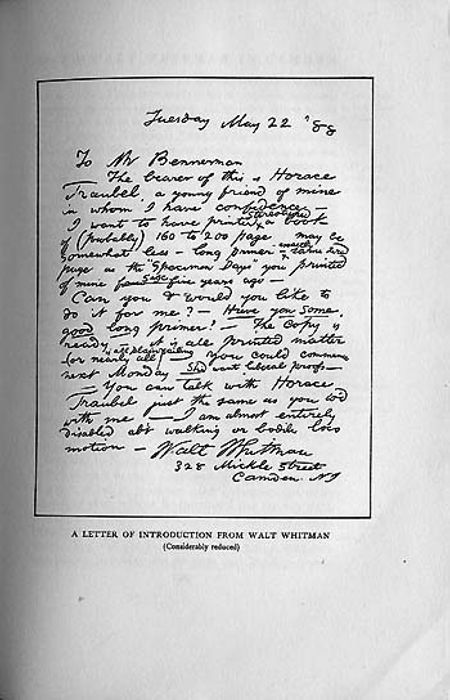 [Begin page 193]the swells with reputations—I think the other fellow is just as apt to hit it. [See indexical note p193.1] There is so much in the atmosphere, surroundings—in the whole circumstance. The other fellow is less likely to be a slave to rules."
W. alluded to Carlyle as "that terrible fellow—that terrible octopus—who kept forever growling out to us that we were all going wrong here in America—all the democrats—all the radicals: all going after a mistake—a delusion: all, all: going only to come back. [See indexical note p193.2] Well, I am holding myself under restraint: as they say out West, I 'hold my horses': perhaps that best expresses me—radicalism plus philosophy. Tennyson is constantly saying the same things with regard to us—bringing us up against our conceit, perhaps: he seems to have no faith in our democracy. [See indexical note p193.3] My leanings are all towards the radicals: but I am not in any proper sense of the word a révolutionnaire: I am an evolutionist—not in the first place a révolutionnare. I was in early life very bigoted in my anti-slavery, anti-capital-punishment and so on, so on, but I have always had a latent toleration for the people who choose the reactionary course. The labor question was not up then as it is now—perhaps that's the reason I did not embrace it. [See indexical note p193.4] It is getting to be a live question—some day will be the live question—then somebody will have to look out—especially the bodies with big fortunes wrung from the sweat and blood of the poor. This is all so—all of it so. Yet I do not feel as if I belonged to any one party."
Reverting to November Boughs W. said: "I have money enough to see it through: I have some money, but am chary of putting it out, as you know. But I recognize that nothing can be done without it—therefore I pay my way right through, preferring to have it understood so at the start—being rather averse to arranging for my books on any other terms. [See indexical note p193.5] You will see Bennerman. Tell him I want two men put on November Boughs from next Monday—proofs [Begin page 194] sent daily—each evening if possible: this is imperative, for the book must be out by fall. [See indexical note p194.1] As to the manuscript, although it's all ready, I'll leave it mainly in your hands—appoint you sort of supercargo: not giving it all over to the printer at once—giving it to him piece by piece only as he needs it. I have never lost any manuscript with printers but I don't want to run the risk. It's such a hell of a job for me to write now—I mean physically a job—I don't want to have to do any of this work over a second time. Well—you will first see Bennerman: we have to know his pleasure before we can proceed."
[See indexical note p194.2] After a pause W. went on: "I have another errand for you. I do not own the plates of Specimen Days: I ought to, but I don't: they belong to Dave McKay. I want you to go to McKay and make him an offer of one hundred and fifty dollars spot cash for the plates." He laughed and asked: "By the way, what is spot cash?" after my reply adding: "I guessed right, anyway. Offer him the one fifty spot cash. I don't believe Dave will accept the offer—no business man could resist the temptation to put more on an article some one was eager for. [See indexical note p194.3] But try him, anyway. If he says no then I guess it must be no: I don't think I am eager enough for the plates to increase my bid." Again: "I like to supervise the production of my own books: I have suffered a good deal from publishers, printers—especially printers, damn 'em, God bless 'em! The printer has his rod, which has often fallen on me good and powerful."
W. said as I was going: "I am watching your pieces as they appear in the papers and magazines—reading them all: you are on the right tack—you will get somewhere. I don't seem to have any advice to give, except perhaps this: Be natural, be natural, be natural! [See indexical note p194.4] Be a damned fool, be wise if you must (can't help it), be anything—only be natural! Almost any writer who is willing to be himself will amount to something—because we all amount to something, to about [Begin page 195] the same thing, at the roots. The trouble mostly is that writers become writers and cease to be men: writers reflect writers, writers again reflect writers, until the man is worn thin—worn through. I have been interested in your pieces—they are significant. [See indexical note p195.1] You seem to want to be honest with yourself. I'm sure I couldn't think of a better start in anything for anyone." [See indexical note p195.2] And finally: "I guess for one thing you will be our historian: we will have to rely upon you to review the field after the fight is all over. I do not mean a matter of mere biography: I mean the Walt Whitman movement, the Horace Traubel movement, that commenced long before either of us was born—that will go on forever after we are dead."
Wednesday, May 23, 1888.
[See indexical note p195.3] McKay wants four hundred dollars for the absolute surrender of the plates of Specimen Days or three hundred dollars for surrender with the privilege of printing an edition. He would not consider Walt's offer of one hundred and fifty. "That's nonsense," he said. The plates originally cost six hundred forty-six dollars. It costs thirty-five or forty dollars to print one thousand copies—press work." When I conveyed McKay's reply to W. he retorted: "It's nonsense, is it? [See indexical note p195.4] Well let it remain nonsense and then done with it. I would not for a moment consider Dave's alternative." Adding: "Dave was always saying the book wasn't worth a damn as a seller: I thought he'd be glad to get rid of the plates."
[See indexical note p195.5] W. discussed the Thayer & Eldridge plates, in possession of Worthington, New York. Worthington prints edition after edition and sells them. Sometimes W. seems indignant. Sometimes he only laughs the affair away. "Worthington is a humbug—pays me nothing: yet I am averse to going to law about it: going to law is like going to hell: it's too much like trouble even if we win. [See indexical note p195.6] Worthington no doubt has a theory justifying it which puts me out of his court. In [Begin page 196] a case so obvious it would seem as though things might very easily be brought to a head in my behalf. But who knows? The law's a tricksy thing to fool with, even for righteousness' sake." [See indexical note p196.1] W. laughed: "It's really a long story. Worthington is known in his trade as 'holy Dick': he combines piety with his other virtues. 'Holy Dick'! Well—he has a lot of débris to unload before he can enter the Kingdom. Dave rails at me for not pushing Worthington—and Tom, too, says: 'You should drive him to the wall.' I say yes, yes, yes: but when it comes to doing anything I rather decide for no. Holy Dick! He's a sour mess to me: I don't feel much like having any sort of encounter with him, good or bad."
W. then got to business, talking of November Boughs. [See indexical note p196.2] "I propose first issuing November Boughs independently—then shall issue a superior edition of my complete works." At Sherman's today. Bennerman not in. They advised me to get plates made direct at some foundry under our own supervision. The idea rather hits W. "There are still a few errors in the plates of the Leaves. We must get them corrected. The complete edition will make a ponderous volume of eight to nine hundred pages—shaped like the Cryptogram—printed more or less like our present books. I am of course figuring on your assistance in all these plans—I could not accomplish them alone: indeed, I should stop right here and now if I did not think you would stand by me—see me through."
W. gave me what he called a "document" to go among my "war records." The rough draft of a letter written by him (marked on the envelope "sent Oct 1 1863") to W. S. Davis, Worcester, Massachusetts. [See indexical note p196.3] "It will help along some other memoranda you have—give you some more material. I clean house from time to time: save you the bits, hunt them, that I think will be of service to you—service or interest. The rest (the most of things) go into the fire." He [Begin page 197] laughed quietly: "I know you are jealous of that fire," he added. "Well—that stuff is trash, notwithstanding your appetite: I know best what it is: trash, trash, trash." [See indexical note p197.1] This is the Davis letter, which I stopped right where we were and read.
[See indexical note p197.2] "The noble gift of your brother Joseph P. Davis of $20 for the aid of the wounded, sick, dying soldiers here came safe to hand—it is being sacredly distributed to them—part of it has been so already—I may another time give you special cases—I go every day or night to the hospitals a few hours—As to physical comforts, I attempt to have some—generally a lot of—something harmless and not too expensive to go round to each man, even if it is nothing but a good home-made biscuit to each man—or a couple of spoonfuls of blackberry preserve—I take a ward to two of an evening and two more next evening &c— [See indexical note p197.3] as an addition to his supper—sometimes one thing, sometimes another, (judgment of course has to be carefully used)—then after such general round I fall back upon the main thing, after all, the special cases, alas too common—those that need some special attention, some little delicacy, some trifle—very often far above all else, soothing kindness wanted—personal magnetism—poor boys, their sick hearts and wearied and exhausted bodies hunger for the sustenance of love or their deprest spirits must be cheered up— [See indexical note p197.4] I find often young men, some hardly more than children in age yet—so good, so sweet, so brave, so decorous, I could not feel them nearer to me if my own sons or your brothers—Some cases even I could not tell anyone, how near to me, from their yearning ways and their sufferings— [See indexical note p197.5] it is comfort and delight to me to minister to them, to sit by them—some wind themselves around one's heart and will be kissed at parting at night just like children—though veterans of two years of battles and camp life—I always carry a haversack with some [Begin page 198] articles most wanted—physical comforts are a sort of basis—I distribute nice large biscuit, sweet crackers, sometimes cut up a lot of peaches with sugar, give preserves of all kinds, jellies, &c. tea, oysters, butter, condensed milk, plugs of tobacco (I am the only one that doles out this last, and the men have grown to look to me)—wine, brandy, sugar, pickles, letter-stamps, envelopes and note paper, the morning papers, common handkerchiefs and napkins, undershirts, socks, dressing gowns, and fifty other things—I have lots of special little requests. [See indexical note p198.1] Frequently I give small sums of money,—shall do so with your brother's contribution—the wounded are very frequently brought and lay here a long while without a cent. I have been here and in front nine months doing this thing and have learned much—the soldiers are from fifteen to twenty-five or six years of age—lads of fifteen or sixteen more frequent than you have any idea—seven-eighths of the army are Americans, our own stock—the foreign element in the army is much overrated and is of not much account anyhow. [See indexical note p198.2] There are no hospitals (there are dozens of them in and around Washington) you must understand like the diseased half-foreign collections under that name common at all times in cities—in these here, the noblest cleanest stock I think of the world, and the most precious."
When I was through W. said: "There is some history in that letter. Sometimes I am myself almost afraid of myself—afraid to read such a letter over again: it carries me too painfully back into old days—into the fearful scenes of the war. [See indexical note p198.3] I don't think the war seemed so horrible to me at the time, when I was busy in the midst of its barbarism, as it does now, in retrospect."
W. is thinking of getting the Morse head of himself cast in bronze. Asks me to make some inquiry as to the cost. "It ought to be preserved: the plaster is very perishable:
[Begin page figure-16]
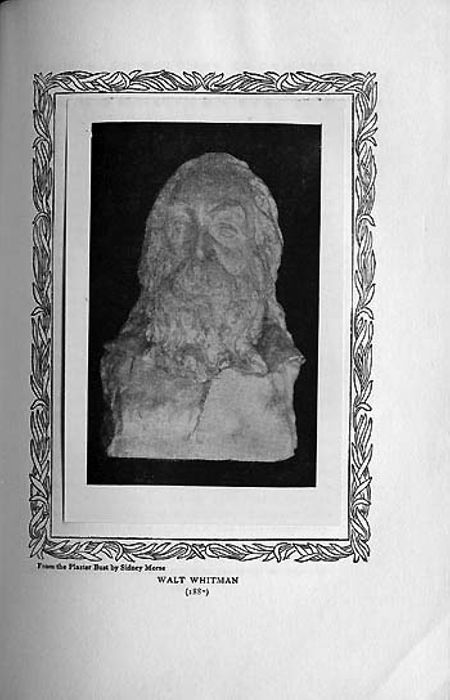 [Begin page 199]it is the best of the heads, so far, if I know anything about my looks—which William O'Connor says I don't. [See indexical note p199.1] William used to say: 'Give me a fool picture of yourself and you're sure to like it.' There was some reference to the Eakins and Gilchrist paintings in today's Press, but Sidney's bust was ignored. They passed the best by to speak of the worst."
"Is Eakins the worst?"
[See indexical note p199.2]
"That was a rather hard statement—it applied rather to Herbert's than to Tom's But no matter about that: no matter whose is the worst, Sidney's is the best." W. went on after a bit of silence: "When I look at Morse's present work I wonder that he could have made that head of me years ago—so inexpressive, so paltry, so apologetic."
[See indexical note p199.3]
"You did not preserve it?"
"No indeed: I took it into the back yard there on Stevens street and dashed it to pieces."
[Begin page 199]it is the best of the heads, so far, if I know anything about my looks—which William O'Connor says I don't. [See indexical note p199.1] William used to say: 'Give me a fool picture of yourself and you're sure to like it.' There was some reference to the Eakins and Gilchrist paintings in today's Press, but Sidney's bust was ignored. They passed the best by to speak of the worst."
"Is Eakins the worst?"
[See indexical note p199.2]
"That was a rather hard statement—it applied rather to Herbert's than to Tom's But no matter about that: no matter whose is the worst, Sidney's is the best." W. went on after a bit of silence: "When I look at Morse's present work I wonder that he could have made that head of me years ago—so inexpressive, so paltry, so apologetic."
[See indexical note p199.3]
"You did not preserve it?"
"No indeed: I took it into the back yard there on Stevens street and dashed it to pieces."
W. described his economies practised in Washington during Hospital days. "It is surprising how little a man may live on if he must: live not meanly but with about all that is needed to make him comfortable: a matter of three or four hundred dollars settles the whole case." [See indexical note p199.4] I asked: "Don't that mean worry for a man—and don't his worry reduce his capacity for work?" "Yes. I do not argue for three or four hundred—I only say it is possible. As a general rule it is true that we need something substantial at the foundation—all men—every man—but we can't set the same bounds for all men. There's Poe, for instance—poor Poe—to whose poverty, struggles, death at last in the gutter—sad, tragic, as it may seem—all his work, his quality, seems owing." "If you repeat these views to the rich they will think you are on their side." [See indexical note p199.5] W. laughed: "If I had my way," he said more gravely, "I'd try my medicine first on the rich—make them live on three hundred a year for awhile—they would then be better able to understand the case of the under-dog. In the human sense I am on both sides—the side of the rich as well as the side of the poor: no one who [Begin page 200]understands me would quote me in any other way on the side of the rich." "Why, you're almost radical!" "Almost! [See indexical note p200.1] Why—I claim to be altogether radical—that's my chief stock in trade: take radicalism out of the Leaves—do you think anything worth while would be left?" "But you said to Harned the other day: 'I am the most conservative of conservatives.'" "You've got a damned good memory: so I did: but when I said conservative there I meant safe. I contend that I am the safest of men—that my gospel is the safest of gospels. [See indexical note p200.2] What do you think of that?" "Nothing: I only wanted to hear you declare yourself." W. laughed freely. "You're too cute—you've interviewed me in spite of myself: you ought to be a lawyer."
Thursday, May 24, 1888.
[See indexical note p200.3] W. received today a copy of The Gnostic, published by George Chainey in San Francisco, which, said he, "I could not attempt to read." Also a little volume of sonnets from Warren Holden, of whom he says he "knows nothing." [See indexical note p200.4] "I met Chainey in Boston—saw him, received him, here in Camden on several occasions: am entirely familiar with his career. I could not easily forget how he stood up for the Leaves in Boston on the Tobey days." W. has been out driving but once this week. [See indexical note p200.5] "I am getting more and more satisfied with my bed and chair, which is suspicious." Is at last full of his book, after "hesitations plenty," in his own words, "and delays to spare." Says he wants it out in two or three months—three at the most: is almost eager. Explains: "The fall in my pulse is getting more and more evident: I've got no time to lose." The Presbyterians are celebrating a centenary in Philadelphia. [See indexical note p200.6] W. says: "Let them keep at it; it's like a cloudy day—it'll pass off by and bye." Woodrow is being tried before the Presbytery at Baltimore for his endorsement of the theory of evolution. "The question seems to be—did Adam come from the dust of the earth or [Begin page 201] from a baboon—isn't it? And now the Presbytery is to give high and mighty judgment in the matter. Good for the Presbytery! [See indexical note p201.1] Let them go on: the globe will still go round whatever the way the Presbytery decides it. The universe may even survive the withdrawal of the endorsement of the Presbytery." In talking about signatures W. said: "O'Connor once took one of my signatures to a clerk in the Treasury who so cleverly duplicated it that I could not myself tell the two apart."
[See indexical note p201.2] W. gave me a piece of cardboard which contained a penciled profile over which he had written: "Pencilling by Edward Clifford English artist what struck him as an American type of physiognomy, head &c. Oct: 1884." I asked: "Did the drawing impress you?" "It was very interesting—not necessarily convincing. Clifford has been about some—struck me as being a close observer. It was a point of view not quite to be assumed just yet: I feel myself that the American is being made but is not made: much of him is yet in the state of dough: the loaf is not yet given shape. [See indexical note p201.3] He will come—our American. Such a drawing as this will have more value later on when the type of face that struck Clifford in individuals here and there may be more generally evolved. I don't think I have any views on the subject myself: I see our new man rather more in moral, spiritual, lines, than in physiognomy." I said: "I would give a good deal to own this card." "Don't give anything to own it: own it anyway: take it along: I shall never want it again."
[See indexical note p201.4] W. again: "I've got some news for you: I am going to accept Harned's invitation to a jamboree at his house next Thursday in honor of my own seventieth birthday: you must be sure to be there: and Aggie, too: tell her. I have about made up my mind to live another year: why not? Considering all the things I have to do I will need at least a year." Was there anyone he wished particularly to ask for the "jamboree"? "No—I am sure not—at least not anyone [Begin page 202]necessarily, though perhaps Tom Donaldson—perhaps Talcott Williams—though I don't know: I am so liable not to get there at the last minute that it seems like asking people from a distance to take too many chances." [See indexical note p202.1] "You like Williams." "Yes, I do. Someone was here the other day—spoke of him as a prig. He is not that—he is a man, like Gilder, who possesses more regard for the conventionalities than we do, but he is square with it all: take even Emerson—he was somewhat of the same strain. [See indexical note p202.2] But there is more to Williams than all that: he has original talent of no common order—but I guess it will never get out: a man tied up as Talcott is with a great newspaper in a big city has little chance to make the best of himself." How about Donaldson? "He, too, is all right—though not quite so much all right as Talcott. [See indexical note p202.3] I feel that Tom Donaldson is my friend: he suffers from some severe shortages: but after that is said what is left is good stuff. [See indexical note p202.4] Tom has got too close to politics—that is his worst fault: some things that have touched him have stuck: yet he is so genial, so red—so real—I don't want to put any ifs in my love for him." It would be fine to have O'Connor come up from Washington? W.'s eyes twinkled: "That would be the crowning triumph—but it is impossible. He writes me that he is worse disabled than I am."
[See indexical note p202.5] W. gave me a Symonds letter again, saying of it: "The New Republic he speaks of there was Harry Bonsall's paper here in Camden. It is a beautiful letter—beautiful: Symonds could crowd all the literary fellows off the stage for delicacy—directness—of pure literary expression: yes, honest expression. [See indexical note p202.6] Symonds is cultivated enough to break—bred to the last atom—overbred: yet he has remained human, a man, in spite of all. You will see that he harps on the Calamus poems again—always harping on 'my daughter.' I don't see why it should but his recurrence to that subject irritates me a little. This letter was written thirteen years ago—thirteen years (that was the most depressed year or two of [Begin page 203]my life—1875—6): Symonds is still asking the same question. I suppose you might say—why don't you shut him up by answering him? [See indexical note p203.1] There is no logical answer to that, I suppose: but I may ask in my turn: 'What right has he to ask questions anyway?'" W. laughed a bit. "Anyway, the question comes back at me almost every time he writes. He is courteous enough about it—that is the reason I do not resent him. I suppose the whole thing will end in an answer, some day. It always makes me a little testy to be catechized about the Leaves—I prefer to have the book answer for itself." I took the Symonds letter and read it."
Gais, Switzerland, June 13, 1875. My dear Sir.[See indexical note p203.2] I was very much delighted some weeks ago to receive a copy of the New Republic with a little memorandum in your handwriting. Time does not diminish my reverential admiration for your work, nor do the unintelligent remarks of the English press deter me from giving expression to the same in print. [See indexical note p203.3] I hope soon to have an opportunity to explain at large, in a new series of critical studies of the Greek Poets, what I meant in the little note alluded to by the reviewer of the Quarterly, and to show how it is only by adopting an attitude of mind similar to yours that we can in this age be in true unity with whatever great and natural and human has been handed to us from the past. I was the more pleased to have this communication from you, because I feared that the last time I wrote to you I might perhaps have spoken something amiss. I then—it was about three years ago, I think—sent you a poem called Callicrates and asked you questions about Calamus. [See indexical note p203.4] Pray believe me that I only refer to this circumstance now in order to explain the reason why since that time I have kept silence from a fear I might have been importunate or ill-advised in what I wrote. There was really no reason why you should have noticed that communication; and it gives me great [Begin page 204]satisfaction to feel that your friendly remembrance of me is not diminished.
Now, though late, I may express the deep sorrow with which I heard of your illness. [See indexical note p204.1] How Whitman must have borne such a trial, no one knows better than one who like myself has learned to have absolute faith in his manliness and rigor of soul. Yet it is not the less sad to think that he who could enjoy life so fully, has met with this impediment.
I look forward with a keen foretaste of delight to your new volume announced.
My permanent address is: Clifton Hill House, Clifton, Bristol. I should have written earlier had I not been moving rapidly from place to place during an Italian journey.
Believe me ever gratefully and indebtedly yours John Addington Symonds.I said to W.: "That's a humble letter enough: I don't see anything in that to get excited about. [See indexical note p204.2] He don't ask you to answer the old question. In fact, he rather apologizes for having asked it." W. fired up. "Who is excited? As to that question, he does ask it again and again: asks it, asks it, asks it." I laughed at his vehemence: "Well, suppose he does. It does no harm. Besides, you've got nothing to hide. [See indexical note p204.3] I think your silence might lead him to suppose there was a nigger in your wood pile."
"Oh nonsense! But for thirty years my enemies and friends have been asking me questions about the Leaves: I'm tired of not answering questions." It was very funny to see his face when he gave a humorous twist to the fling in his last phrase. [See indexical note p204.4] Then he relaxed and added: "Anyway, I love Symonds. Who could fail to love a man who could write such a letter? I suppose he will yet have to be answered, damn 'im!" I remarked: "Symonds here addresses you as 'sir.' You were not yet 'master' at that time."
"No—not master.
[Begin page figure-17]
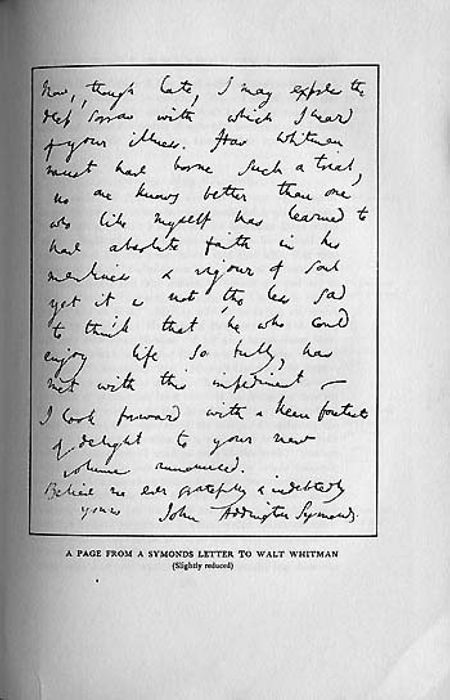 [Begin page 205] I don't know which I like least—sir or master: they both leave a bad taste in the mouth."
[See indexical note p205.1] When I left W. cried after me: "Whatever you do forget don't forget the thirty-first: and push along November Boughs the best you can: I lean on you for this job, so you must stiffen up enough for two!"
[Begin page 205] I don't know which I like least—sir or master: they both leave a bad taste in the mouth."
[See indexical note p205.1] When I left W. cried after me: "Whatever you do forget don't forget the thirty-first: and push along November Boughs the best you can: I lean on you for this job, so you must stiffen up enough for two!"
Friday, May 25, 1888.
[See indexical note p205.2] W. said: "McKay came over to see me yesterday—I forgot to mention it to you—and conceded a point or two. For instance, he said I might use the Specimen Days plates in the complete book. He wanted to renew his expired contract—asked for five years more: said that after that time he would sell me the Specimen Days plates at my own figure—one hundred and fifty dollars." [See indexical note p205.3] "What did you say to that? Yes?" "I made no concessions: I prefer to let the matter rest as it is." McKay advises us to get our plates made by Ferguson. He thought Ferguson would do them not only better but cheaper. I got an estimate from Sherman, who wants one dollar fifty-five cents per page, brevier. W. said: "That seems dear. After all Dave may be right—Ferguson may be our man." "I am quite possessed with the idea of getting the book out. It has hung fire here for two years or more. [See indexical note p205.4] All this time I have been getting physically weaker—less capable of the strain of producing the book. It may be a whim or a conceit—I believe in both whims and conceits: I must go on with the work. You are a godsend to me just now. Back of the whole business, of course, is a precedent fact—the world don't need the book anyhow. [See indexical note p205.5] But one man has the presidential bee in his bonnet—another has the book bee there: I have the book bee. I believe everybody I know writes books or something—everybody: some of them write everything—poetry, stories, essays, God knows what not. I believe if I met a man who had not written a book I should hug him—he [Begin page 206] would be a monumental exception—an honorable exception."
[See indexical note p206.1] W. said: "I had a letter from Bucke today: he says he likes the sixty-nine poem. But then Bucke likes me. I wonder what the people who don't like me think of the poem?" I didn't put in an answer, so he said: "I guess I know—I guess you don't need to tell me." Talked some about Specimen Days. "It don't sell at all—only a copy here and there. Dave simply carries it because he carries the Leaves—it amounts to nothing as a selling article in itself. [See indexical note p206.2] He submits me reports now and then—I don't attempt to examine them: I can never understand them: I always take a publisher's royalty report for granted." Speaking of McKay: "Dave is shrewd, canny, but honest: crude, almost crusty sometimes—but square. I like Dave. I have offered him five hundred copies of November Boughs—a sort of lump proposition. If he takes them I will put his name on the title page."
The foregoing are forenoon notes. I saw W. again in the evening. [See indexical note p206.3] In the meantime I had got November Boughs on the move. Went to see McKay first and then Ferguson, with such a result as made W. exclaim: "I guess we can conclude that Ferguson is our man: you had better leave word with Bennerman tomorrow to that effect." Ferguson will give us plates (long primer) for one dollar and thirty cents a page. W. wants, as he says, "copious proofs—three or four or five if necessary." [See indexical note p206.4] Then: "I want you to reach the workmen direct—treat with the craftsman without an intermediary—with the man who sets the type, the man who puts it into form, the man who runs the foundry: reach them, yes, with a dollar now and then. We will keep the troubled waters oiled. Bennerman would not permit this—he never wanted me to go up stairs into the composing room: but I am sure you can accomplish this point better than I did." I go to Ferguson's tomorrow for samples of type [Begin page 207]faces. W. did not "think much of American presswork—it seems to be slighted." "I know of no book printed on this side quite so beautiful in that respect as a book I have received from Dowden—his book on Shakespeare. [See indexical note p207.1] Some of the fellows have been at me to produce a folio of the Leaves as they are today. It is a favorite notion of Talcott Williams: to have a big broad page to save me as much as possible from breaking my long lines. [See indexical note p207.2] But that is only a pleasant dream—it is impossible: at present I must meet the case as I find it. The real case amounts to this: that it's all I can do to get the book out in any form."
W. has an Epictetus volume (The Enchiridion)—the Rolleston rendering. He is very fond of it. I often surprise him reading it. [See indexical note p207.3] He quotes it often though never literally—always rather in substance. Rolleston sent the book to W. W. writes his name in the more serious books sent him and treasures them, in spite of what he says about books in general. [See indexical note p207.4] Told him Frank Williams had written a W. W. article which I expected to see in this week's American. W. said: "I must see it at once. I am in safe hands. Frank knows what I am about—is loyal to the bone. God bless Frank!"
W. was very affectionate in his manner tonight. "Come here, Horace," he said. I went over. He took my hand. "I feel somehow as if you had consecrated yourself to me. [See indexical note p207.5] That entails something on my part: I feel somehow as if I was consecrated to you. Well—we will work out the rest of my life-job together: it won't be for long: anyway, we'll work it out together, for short or long, eh?" He took my face between his hands and drew me to him and kissed me. Nothing more was then said. [See indexical note p207.6] I went back to my chair and we sat in silence for some time. Then he quietly remarked: "I've got a real fillip for you tonight—a Lanier letter, written in the seventies, while he thought better instead of worse of me." "Why do you think Lanier's notion about you has changed?" "Things have been repeated to me: there [Begin page 208] seems to be no doubt about it. He finds me too strong meat—yes, meat on the turn. [See indexical note p208.1] There was a time—but read the letter for yourself." I waited to hear more but he added nothing. Then I read:
33 Denmead St., Baltimore, MD. May 5, 1878. My dear Sir:[See indexical note p208.2] A short time ago while on a visit to New York I happened one evening to find your Leaves of Grass in Mr. Bayard Taylor's library; and taking it with me to my room at the hotel I spent a night of glory and delight upon it. [See indexical note p208.3] How it happened that I had never read this book before . . is a story not worth the telling; but, in sending the enclosed bill to purchase a copy (which please mail to the above address) I cannot resist the temptation to render you also my grateful thanks for such large and substantial thoughts uttered in a time when there are, as you say in another connection, so many "little plentiful mannikins skipping about in collars and tailed coats." Although I entirely disagree with you in all points connected with artistic form, and in so much of the outcome of your doctrine as is involved in those poetic exposures of the person which your pages so unreservedly make, yet I feel sure that I understand you therein, and my dissent in these particulars becomes a very insignificant consideration in the presence of that unbounded delight which I take in all the bigness and bravery of all your ways and thoughts. [See indexical note p208.4] It is not known to me where I can find another modern song at once so large and so naïve; and the time needs to be told few things so much as the absolute personality of the person, the sufficiency of the man's manhood to the man, which you have propounded in such strong and beautiful rhythms. [See indexical note p208.5] I beg you to count me among your most earnest lovers, and to believe that it would make me very happy to be of the least humble service to you at any time.
Sidney Lanier. [Begin page figure-18a]![[A Lanier Letter to Walt Whitman]](https://whitmanarchive.org/iiif/2/whitman-traubel%2Fmed.00001.f22.jpg/full/!700,700/0/default.jpg) [Begin page figure-18b]
[Begin page figure-18b]
![[A Lanier Letter to Walt Whitman]](https://whitmanarchive.org/iiif/2/whitman-traubel%2Fmed.00001.f23.jpg/full/!700,700/0/default.jpg) [Begin page figure-18c]
[Begin page figure-18c]
![[A Lanier Letter to Walt Whitman]](https://whitmanarchive.org/iiif/2/whitman-traubel%2Fmed.00001.f24.jpg/full/!700,700/0/default.jpg) [Begin page figure-18d]
[Begin page figure-18d]
![[A Lanier Letter to Walt Whitman]](https://whitmanarchive.org/iiif/2/whitman-traubel%2Fmed.00001.f25.jpg/full/!700,700/0/default.jpg) [Begin page 209]
[Begin page 209]
Part of this I read aloud. W. argued: "He first tells me he disagrees with me in all points connected with artistic form and then speaks of me as the master of strong and beautiful rhythms. [See indexical note p209.1] That hardly seems to gee: I don't say I am one or t'other but I know I ain't both." [See indexical note p209.2] He chuckled a little and went on: "Lanier was a beautiful spirit: he had his work to do: did his work: I can see how the Leaves may at first blush have carried him by storm—then how, analyzing his feeling, he became less sure of his enthusiasm. [See indexical note p209.3] It was after all rather a rough dish for so delicate a palate. The young fellows seem rather bowled over by me: then they get respectable or something and I will no longer do. I do not attempt to explain it. [See indexical note p209.4] Bayard Taylor is quoted as saying unkind things about me: I do not say he is not right—perhaps he is: but I had letters from Taylor, long ago—letters, several of them—in which he expressed quite other views: I do not know where the letters are—I will find them for you some day. [See indexical note p209.5] There was Gosse, too: he was originally on my side—very warm (almost effervescent)—he, too, they tell me, though so new, has weakened just a bit." W. paused for an instant and added merrily: "I suppose I don't wear well—that's what's the matter: I fool 'em for a time, when they're in their teens, but when they grow up they can no longer be deceived—they take my true measure—set me down for what I am. [See indexical note p209.6] As some fellow said to some other fellow back in the fifties when a few people got a good deal excited about me: 'If this Walt Whitman ain't a damned humbug—then what is he?' That's so: what is he? Some people are still asking that question. Lanier thought he knew and said so but I am not sure that upon reconsideration he was so sure he knew. The vitiating fact is—the bother of it all is—that men of the Matthew Arnold type dominating contemporary literature judge all men (not literary men alone but all men) by bookish standards." [See indexical note p209.7] W. said: "Keep on with the book. November Boughs will be my good bye."
[Begin page 210]Saturday, May 26, 1888.
Got type-face samples from Ferguson today. W. will "look into it." [See indexical note p210.1] He is always slow in making up his mind in such things. Contract is to be drawn up and signed on Monday. Ferguson has agreed to give me the freedom of the office. "That's decent—very decent," said W.—"that's at least one point gained over the Sherman establishment." Ferguson had asked whether W.'s proof changes were many or extensive, I saying, "No." I repeated this to W. who reaffirmed me. "They never are—none at all, in fact."
W. was in rather jolly mood tonight. [See indexical note p210.2] I kicked a folded and taped bunch of paper on the floor. W. noticed it. "What's that?" he asked. I picked it up and handed it to him. He put on his glasses, opened it and after surveying its pages looked at me and laughed. "It's a draft of an old letter I wrote Hotten when he was getting out the London edition of the Leaves. Did you know I was something of an artist?" [See indexical note p210.3] I looked at him without understanding the nature of his allusion. "An artist? What sort of an artist?" "Well—a portrait artist," he answered. He was a bit waggish. "You don't believe it. Look at that and be convinced." He handed one page of the letter to me—then the two other pages. On page two was an attempt at autoportraiture in pencil. "Is that your work?" "Yes—they are my fool lines. I was giving Hotten some advice and tried to illustrate it. Read the letter—then you will see what it is about." [See indexical note p210.4] I read the letter clean through at once and then said: "Your letter contains a portrait, but it's not in the pencilled lines—it's in the words." "Do you think so? I was only trying to give him an idea how I seemed to myself in my own eyes." I asked W.: "Is this letter of any use to you any more?" "None whatever—is it of any use to you?" I didn't say a word. He looked at me. "I see you want [Begin page 211]me to say, take it. Well—I say it. [See indexical note p211.1] You are the victim of a disease I should not encourage—but then we've agreed to work together—you're my partner—there's no use quarrelling over trifles. Take the letter—and the devil be with you." "Is that a blessing?" "Hardly—but it might be stretched into a joke." I copy the letter:
April 24 '68 To Mr Hotten.[See indexical note p211.2] I am glad to hear you are having Mr Conway's photograph engraved in place of the bad print now in the book. If a faithful presentation of that photograph can be given it will satisfy me well—of course it should be reproduced with all its shaggy, dappled, rough-skinned character, and not attempted to be smoothed or prettyfied—(if in time I send the following hints)—let the costume be kept very simple and broad, and rather kept down too, little as there is of it—preserve the effect of the sweeping lines making all that fine free angle below the chin—I would suggest not to bring in so fully the shoulders and bust as the photograph does—make only the neck, the collar with the immediately neighboring part of the shirt delineated. [See indexical note p211.3] You will see that the spot at the left side of the hair, near the temple, is a white blur, and does not belong to the picture. The eyes part and all around the eyes try to re-produce fully and faithfully, exactly as in the photograph. I hope you have a good artist at the work. It is perhaps worth your taking special pains about, both to achieve a successful picture and likeness, something characteristic, and as certain to be a marked help to your edition of the book. Send me an early proof of the engraving.
Thank you for the papers with notices in them—and for your Academia criticism. Please continue to send any special notices. [See indexical note p211.4] I receive them safely and promptly. The London Review article is reprinted in Littell's Living Age. I should like to know who wrote the piece in the Morning Star—it flushed my friends and myself too, like a sun dash, brief, hot, and dazzling.
[Begin page 212]I have several things more to say and will write again soon—Also to Mr. Rossetti to whom meantime, please offer my friendliest, truest regards.
[See indexical note p212.1] I read some of the portrait sentences aloud and said to W.: "If not a portrait, this is material for a portrait." W. assented, "I suppose—I suppose," then laughed again: "But I am proud of my drawing—you don't say anything about that."
Harned and Corning came in. After several how do you dos they got talking of Thoreau. Corning had been reading something new about Thoreau. [See indexical note p212.2] Said he knew Thoreau's mother and sister. W. was drawn out. Gave his own description of Thoreau—of his several visits to W. in Brooklyn. "Thoreau had his own odd ways. Once he got to the house while I was out—went straight to the kitchen where my dear mother was baking some cakes—took the cakes hot from the oven. He was always doing things of the plain sort—without fuss. [See indexical note p212.3] I liked all that about him. But Thoreau's great fault was disdain—disdain for men (for Tom, Dick and Harry): inability to appreciate the average life—even the exceptional life: it seemed to me a want of imagination. He couldn't put his life into any other life—realize why one man was so and another man was not so: was impatient with other people on the street and so forth. We had a hot discussion about it—it was a bitter difference: it was rather a surprise to me to meet in Thoreau such a very aggravated case of superciliousness. [See indexical note p212.4] It was egotistic—not taking that word in its worst sense." Corning broke out: "He was simply selfish, that's the long and short of it." W. replied: "That may be the short of it but it's not the long. Selfish? No—not selfish in the way you mean, though selfish, sure enough, in a higher interpretation of that term. We could not agree at all in our estimate of men—of the men we meet here, there, everywhere—the con-
[Begin page figure-19]
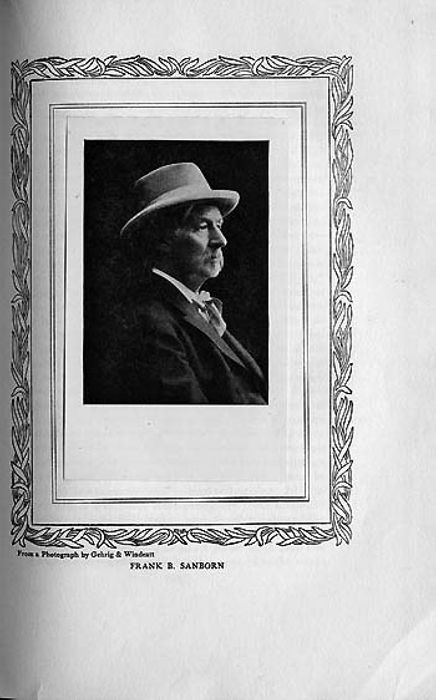 [Begin page 213]crete man. Thoreau had an abstraction about man—a right abstraction: there we agreed. We had our quarrel only on this ground. Yet he was a man you would have to like—an interesting man, simple, conclusive. [See indexical note p213.1] When I was at Emerson's Mrs. Emerson told me Thoreau stayed with her during one of Emerson's trips abroad. She said that Thoreau, though odd, was good, equable, assiduous, likeable, throughout. [See indexical note p213.2] I asked Sanborn that time at Concord who of all men of Concord was most likely to last into the future. Sanborn took his time in replying. I thought he was going to say Emerson, but he didn't. He said Thoreau. [See indexical note p213.3] I was surprised—looked at him—asked: 'Is that your deliberate judgment?' and he said very emphatically: 'Yes!' I thought that very significant. Considering who Emerson was, Thoreau was, Sanborn was, very, very significant." Pursuing the subject W. added: "When I lived in Brooklyn—in the suburbs—probably two miles distant from the ferries—though there were cheap cabs, I always walked to the ferry to get over to New York. [See indexical note p213.4] Several times when Thoreau was there with me we walked together." Corning referred to something Lowell had written about Thoreau. [See indexical note p213.5] W. said: "I have never read it: I do not seem to care much about Lowell's work."
Harned and Whitman got into a spirited discussion over the confession of Barclay Peak today in the Anderson murder case, Harned presenting the legal and Walt the moral argument. [See indexical note p213.6] W. repeatedly spoke of certain rulings in the case as being "possibly good law but bad sense," "the refinement of refinement of refinement of technicality," "instances in which justice is surrendered to legality," adding: "I supposed judges were more independent and juries had more freedom of disposal." [See indexical note p213.7] Harned said something about "the truth," W. interrupting him to cry out: "Little do judges and juries—especially judges—know about the truth: lots of men are just liars—remember that, too. On the whole[Begin page 214] the law is as likely to defraud you as to give you justice—quite as likely." Corning asked: "What are we to trust in if we tear down the courts?" [See indexical note p214.1] W. unhesitatingly replying: "We don't build on the courts—the courts build on us." Corning is to speak tomorrow on The Moral Dignity of Minorities. W. advised C.: "Tell your people that the most hopeful sign of the times is the growing number of men the land through who are not pledged to the programs of the old parties—who vote independently or do not vote at all—who are waiting or working for the new idea, which will before long formulate itself in unequivocal political statements." [See indexical note p214.2] Frank Williams did not get in The American this week after all. W. said: "That's just as good as not. If it's a bad word we won't miss it, if it's a good word it'll keep." [See indexical note p214.3] Gave me a copy of the Ledger (Phila.) containing an account of the printers' dinner at which Childs had been present. "Childs is eighteen carat root and branch."
Sunday, May 27, 1888.
W. said today: "You will have to know something about Henry Clapp if you want to know all about me." [See indexical note p214.4] Clapp, New York. How was I to know Clapp? "I will tell you, sometime or other. We were very intimate at one time—back around the sixties: he edited the Saturday Press, in New York: was my staunch friend—did the honorable with me every time. [See indexical note p214.5] I am sure you will get a lot of good material out of Clapp's letters. I must have a lot of these letters here somewhere—I don't know where. My friends! Well—I've had good friends as well as good enemies: a man who has had the friends I have had can afford to forget that he has enemies."
[See indexical note p214.6] W . spoke of something I had written: "You are steadying yourself—you have things to say: yes, I am sure of it: some day you will get them said—people will listen to you." About November Boughs: "I have the book in good shape [Begin page 215] for you to take. I am feeling pretty sick, sore, done up, these days. If I get through with this book I shall feel lucky: it will be my last. Even as it is I could not do it but for you. [See indexical note p215.1] You will have to be a very good boy until this book is out: then you can go on a big spree at my expense." I asked: "How about the thirty-first? Do you feel equal to it?" "O yes! I shall buckle to for it—hold in my horsestill then: we might 'celebrate' by getting the book started that day!" [See indexical note p215.2] Referring to Frank Williams: "Frank has written poetry—a good deal of it, I judge: some of it first rate, though all of the formal order. Frank deserves better recognition than he has achieved: lots of so-called big men, rhymesters, are less well equipped than Frank. The main thing about Frank is, he's a man—that's the main thing about anybody. A big man is nobody in particular, but a man—he's enough." [See indexical note p215.3] This of Lowell: "Lowell was not a grower—he was a builder. He built poems: he didn't put in the seed, and water the seed, and send down his sun—letting the rest take care of itself: he measured his poems—kept them within the formula." And yet? "I know what you mean to say. He was a man of great talent—I do not deny it: and skill, yes, skill—I do not deny that. But inspiration? I doubt it."
I said to W.: "Corning was saying to someone the other day that he thought you were rather conservative on the labor question." W. demurred: "Mr. Corning does not know. [See indexical note p215.4] I am a radical of radicals—but I don't belong to any school: after I got done with it there wouldn't be much wealth left in private hands—that is, if my say was final. We are growing: this present mad rush for money—every man robbing from every man—cannot last. Our American people after all have enough sense to revise themselves when there is need for it." [See indexical note p215.5] Was the immediate outlook very encouraging? "Not very: but the seed is being planted—the harvest will come." I said: "You are quite a revolutionist." [Begin page 216]He exclaimed: "If that is a revolution I am a revolutionist! But the word hardly applies. [See indexical note p216.1] I don't expect an upset—I expect a growth: evolution." W. said: "I gave you some letters awhile ago from editors declining my pieces. Here is a letter of a more favorable character—it is from John Morley: he was editing the Fortnightly at the time. Put it into your pocket." [See indexical note p216.2] I did put it into my pocket. When I got home I found the Morley letter enclosed in a rough draft of a letter written to James T. Fields by W. Here is Morley:
3 Garden Court, Temple, E.C.: London, Jan. 5, 1869. Dear Mr. Whitman:[See indexical note p216.3] I cannot find room for the poem which you have been so obliging as to send me, before the April number of the Review. If that be not too late for you, and if you can make suitable arrangements for a publisher in the United States so as not to interfere with us in a point of time, I shall be very glad. Perhaps you will let me know as early as you can.
With my kind regards— Always yours sincerely, John Morley.W. wrote on this: "Ans. Jan. 20, '69." The same day he wrote to Fields on a letter head of the Attorney General's Office, Washington."
Jan 20, 1869 James T. Fields, Dear Sir:[See indexical note p216.4] The package of February Magazines sent on the 16th arrived safely yesterday. Accept my thanks. I am pleased with the typographical appearance and correctness of my piece.
I enclose a piece, Thou vast Rondure swimming in Space, of which I have to say to you as follows. [See indexical note p216.5] It is to appear in the April number of the London Fortnightly Review. Having just received a note from the editor of that Review, Mr. [Begin page 217] Morley, in which he intimates that he has no objection to its appearing simultaneously in America, I thought I would show it to you. [See indexical note p217.1] Very possibly you will not care to print a piece any how which is to appear elsewhere. Should that, however, be no objection, and should you consider the piece available for your purposes, the price is $20. Of course it would have to go in your number of April. I reserve the right of printing in future book.
W. said: "I sometimes growl a little about the editors but after all they are a good lot—they do the best they can. [See indexical note p217.2] Besides, I am an incongruity to most of them—I make the sort of noise they don't like—I upset some things they do like: why should I expect to be received? The wonder is not that I am sometimes kicked out—the wonder is that anybody will receive me. I used to worry over it, just a little—resent it, too, just a little: I am past that now. The fact is, a few people are now listening to me—just a few: I am getting a foothold: I ought to be, I am, satisfied." [See indexical note p217.3]
W. asked me how my father was. Then said: "Your father is a great man. He was here the other day—sat over where you are sitting now—spouted German poetry to me—Goethe, Schiller, Heine, Lessing. [See indexical note p217.4] I couldn't understand a word but I could understand everything else. Your father has the fire, enthusiasm of a boy: he would have made an actor—he has a noble baritone voice—moves me very much. [See indexical note p217.5] I was never so struck with the conviction that if everything else is present you do not need words. There he was, spouting away in a language strange to me—yet very much of it seemed as plain as if it was English. I can understand now why you like to go to see Salvini act and are not confused with his Italian." [See indexical note p217.6] I said: "What is mere words I miss, but so much of it is not mere words." "Exactly—exactly: that's what I said to your daddy. I suppose [Begin page 218] men will go on and on and on until they won't need words at all: a look and all will be said!—a sort of presto process!"
We have often talked together about Anne Gilchrist and A Woman's Estimate of Walt Whitman, made up by William Rossetti from letters written to him by her. [See indexical note p218.1] W. played with some sheets of paper on his table and recurred to the subject today, finally handing me the paper with these remarks: "This is a draft of a letter I wrote Rossetti while Mrs. Gilchrist was still a mystery to me. [See indexical note p218.2] You can imagine what such a thing as her Estimate meant to me at that time. Almost everybody was against me—the papers, the preachers, the literary gentlemen—nearly everybody with only here and there a dissenting voice—when it looked on the surface as if my enterprise was bound to fail—bound to fail. Then this letter—these letters: this wonderful woman. [See indexical note p218.3] Such things stagger a man—leave him without words to say. I had to recognize her in some way at once—did so: you will see how I did so. There was some unaccountable element in it at the time: I had got so used to being ignored or denounced that the appearance of a friend was always accompanied with a sort of shock." "But you survived the shock." "Yes—there are shocks and shocks—shocks that knock you up, shocks that knock you down. [See indexical note p218.4] Mrs. Gilchrist never wavered from her first decision. I have that sort of feeling about her which cannot easily be spoken of—put into words—indeed, the sort of feeling that words will not fit: love (strong personal love, too), reverence, respect—you see, it won't go into words: all the words are weak and formal." I asked W.: "Do you mean me to keep this letter?" [See indexical note p218.5] "If you say so, yes. It is an index to my emotions at the time: it is a part of that history: it will inform you. I always assume in giving you such things that you will know finally what use to put them to. If you keep getting closer, closer, to Leaves of Grass, it will after a while get to be 'I, Horace Traubel, a cosmos, of Camden a son' and so [Begin page 219] forth." W. laughed at his notion and added: "That's what the Leaves amount to anyhow—that's what I mean them to amount to: there is a certain point in their evolution where they cease to be my creation, possession." [See indexical note p219.1]
Referring again to my own writings W. said: "I am always telling you not to take advice. I mean it—every word of it: but that don't mean that you are not to advise yourself or take your own advice." [See indexical note p219.2] "Do you mean that a man who systematically takes other people's advice is bound to be a failure and that a man who cannot take his own advice is bound to be a failure?" "You've said it for me: that's the substance of my philosophy. I wouldn't make it a stiffnecked rule—I would only make it a rule."
W. spoke last thing about the book. "You will see Ferguson tomorrow. Make the best terms you can with him. [See indexical note p219.3] Above all, insist upon having direct relations with the men who do the work: tell him we don't want to operate through the clerks."
I add the letter to Rossetti:
Washington December 9, 1869. Dear Mr. Rossetti.[See indexical note p219.4] Your letter of last summer to William O'Connor with the passages transcribed from a lady's correspondence, has been shown me by him, and copy lately furnished me, which I have just been rereading. I am deeply touched by these sympathies and convictions, coming from a woman and from England, and am sure that if the lady knew how much comfort it has been to me to get them, she would not only pardon you for transmitting them to Mr. O'Connor but approve of that action. [See indexical note p219.5] I realize indeed of this emphatic and smiling well done from the heart and conscience of a true wife and mother, and one too whose sense of the poetic, as I glean from your letter, after flowing through the heart and conscience, must also move through and satisfy science as much as the esthetic, that I had hitherto received no eulogium so magnificent.
[Begin page 220]I send by same mail with this, same address as this letter, two photographs, taken within a few months. One is intended for the lady (if I may be permitted to send it her)—and will you please accept the other, with my respects and love? [See indexical note p220.1] The picture is by some criticised very severely indeed, but I hope you will not dislike it, for I confess to myself a perhaps capricious fondness for it, as my own portrait, over some scores that have been made or taken at one time or another.
I am still employed in the Attorney General's office. [See indexical note p220.2] My p. o. address remains the same. I am quite well and hearty. My new editions, considerably expanded, with what suggestions &c I have to offer, presented I hope in more definite form, will probably get printed the coming spring. I shall forward you early copies. I send my love to Moncure Conway, if you see him. I wish he would write to me. If the pictures don't come, or get injured on the way, I will try again by express. I want you to loan this letter to the lady, or, if she wishes it, give it to her to keep.
[See indexical note p220.3] [Memo. 1904. In Rossetti Papers, 1903, compiled by William Michael Rossetti, I find this diary reference to the Whitman letter: "Received an interesting letter from Whitman, relative to the extracts I sent over in the summer from Mrs. G.'s letters, which he regards as, under all the conditions, the most 'magnificent eulogium' he has yet received. The letter must have been written before the complete papers which I posted towards the end of November had been seen by Whitman. Two copies of the last photograph taken for him are to reach me." [See indexical note p220.4] A letter from Anne Gilchrist is quoted in the same volume in which she says: "Will you please tell Mr. Whitman that he could not have devised for me a more welcome pleasure than this letter of his to you (now mine, thanks to you and him), and the picture; and that I feel grateful to you for having sent the extracts, since they have [Begin page 221] been a comfort to him." O'Connor described W.'s sensations at the moment in a letter which Rossetti includes in the same narrative.]
Monday, May 28, 1888.
Received from Ferguson today formal engagement for November Boughs and took it to W. this evening. [See indexical note p221.1] W. will not accede to Ferguson's condition that fifty dollars advance should be paid. "I am willing to pay a good instalment when the work is half done and the entire sum remaining on the completion of the plates. Any other conditions I shall decidedly oppose." Gave me My Book and I to take over in the morning—that "to be the opening piece." He has changed the headline to A backward Glimpse o'er travel'd Roads and has put two papers in one—the Lippincott piece being reinforced by another. Long primer finally chosen."
Rhys, he said, had been in today—was going to New York to stay with Stedman for some days and would then sail, June 2d or 3d. [See indexical note p221.2] W. was happy that Rhys had seen Dr. Bucke and Niagara, saying smilingly: "I am proud of both." "Rhys is the type of the young men who are to come our way and learn the best we have to teach—of the young men who will rightly perceive, measure, us, and then go back and democratize Great Britain." [See indexical note p221.3] Reference having been made to William Morris W. said: "Rhys and those fellows set great store by him—seem to rally about him as the one who best expresses the things that noble group of English socialists stand for." "Do you have any sympathy for the socialism of these men? " [See indexical note p221.4] "Lots of it—lots—lots. In the large sense, whatever the political process, the social end is bound to be achieved: too much is made of property, here, now, in our noisy, bragging civilization—too little of men. [See indexical note p221.5] As I understand these men they are for putting the crown on man—taking it off things. Ain't we all socialists, after all?" [Begin page 222] "But about their political program—how about that?" "Of that I'm not so sure—I rather rebel. I am with them in the result—that's about all I can say."
[See indexical note p222.1] Talking of his art W. said: "People often speak of me as if I was very new—original. I am in fact very old as well as very new. I don't so much come announcing new things as resuming the correct perspective on old things. I am very homely, plain, easy to know, if you take me right. Three or four years ago I spoke to some soldier boys in Brooklyn. I started by saying I did not come to reveal new things but to speak of those particular things about which all of them knew. [See indexical note p222.2] When I see how damned hard everybody strains to say bright things, I think it well to recall them to plain facts—plain divine facts—from time to time."
W. had been reading in Liberty Tucker's account of his encounter with a tax collector. "Tucker is like Thoreau: why should they pay taxes to a government they do not believe in? [See indexical note p222.3] That's so—why should they? And it's also so—why shouldn't they? Tucker made his protest and paid. Didn't you tell me once that he refused to pay and went to jail up there in Massachusetts? It seems like kicking against night and day—the course of nature—the rainfall."
W. showed me some literary item concerning Stedman. [See indexical note p222.4] "You can't put a quart of water into a pint bottle: Stedman holds a good pint, but the pint is his limit. It seems ungracious to say that—I do not mean it for being severe. Stedman is miraculously deft—does certain things with wonderful precision. He is after all our best man in his specialty—criticism. He can measure some of the fellows—Longfellow certainly—perhaps Whittier and Bryant—though hardly Bryant—Bryant is a bit Greek. [See indexical note p222.5] As for Emerson—I do not think he can touch Emerson at all." I put in: "Your opinions about Stedman do not always agree." "I suppose not. That's because I don't always agree with my- [Begin page 223] self about Stedman. If I could admire Stedman as much as I love him I wouldn't have much trouble making up my mind."
W. jumped on me for my "radical violence." [See indexical note p223.1] "Some of your vehemence is all right—will stand: some of it is the impatience of youth. You must be on your guard—don't let your dislike for the conventions lead you to do the old things any injustice: lots of the old stuff is just as new as it is old. There is no doubt more than most of us see even in the stagnant pool. [See indexical note p223.2] Be radical—be radical—be not too damned radical!" W. wrote to Walsh for the return of the "sixty-nine" poem which was to have been used in Lippincott's. "He has not sent the poem back—has not answered my note in any way. I do not understand it."
W. spoke of Hugo. [See indexical note p223.3] "I do not like his insularity. He never said a good word for us—was rather inclined towards the Carlylean point of view with respect to America. Hugo was full of contempt for all things not Parisian—at least, not French. [See indexical note p223.4] Castelar: Oh! How much greater—how quickly, surely, through his poetic insight, did he catch our points—do us justice. [See indexical note p223.5] And I think of Garibaldi—a beautiful character—nobly noble—the most unworldly man of them all. How much comes from the South—from Italy, from Spain—that is rich and permanent! I have such vast love for Mazzini—he, too, was so unworldly, so sacrificing, full of dreams, dreams of human progress—full, too, of courage, courage!" [See indexical note p223.6]
Some one spoke today of a "pee-a-nist". [See indexical note p223.7] W. laughed and asked: "Do you mean a pianner player?" W. objected to the piano anyway. "It seems to be so unequal to the big things." When some dissent was expressed W. added: "I know. The obvious retort is, that I have never really heard it played. That may be true: I wouldn't go to the stake for my opinion on this subject."
W. gave me a Dowden letter. "That last passage hits me very hard—is memorable for letter writing. 'You make [Begin page 224] no slaves, however many lovers.' Dowden has divined the whole secret. [See indexical note p224.1] Any love that involves slavery is a false love—any love. If I wished to put a final signature upon the Leaves, a sort of consummating entablature, some phrase to round its story—give it the seal, sanction of my motive—I would use that epigram of Dowden: 'To make no slaves however many lovers.' Dowden is a confirmed scholar—the people who call my friends ignoramuses, unscholarly, off the streets, cannot quarrel with the equipment of Dowden. [See indexical note p224.2] Dowden has all the points they insist upon—yet he can tolerate Walt Whitman. There is something to be explained in that." "Explain it." "I don't have to—let the other fellows explain it. Again: That is one of Dowden's early letters—one of the first: he has lasted, still firmly adheres to his original view. [See indexical note p224.3] I have seen many defections—have had quite an experience of that sort: young fellows who take to me strong, then, as they get older, recede—sometimes come to entirely disavow me. Dowden is still haunting the corridors."
8 Montenotte, Cork, Ireland, Sept. 5, 1871. My dear Sir.[See indexical note p224.4] It was very kind of you to send me the photographs of yourself, which I value much. I had previously received one, carte de visite size, from Mr. Rossetti, in which you wear your hat. These I like better, though I liked that.
I will name some of your friends on this side of the water whom I know myself. I wish I could make it appear how various these natures are which have come into relation with you. [See indexical note p224.5] There is a clergyman, who finds his truth halved between John H. Newman (of Oxford celebrity) and you. There is a doctor—a man of science, and a mystic—a Quaker, he has had a wish to write on the subject of your poems, and may perhaps accomplish it. There is a barrister (an ardent nature, much interested in social and [Begin page 225] political principles), he overflows with two authors, Carlyle and yourself. There is a clergyman (the most sterling piece of manhood I know) he has I daresay taken you in more thoroughly than any of us, in proportion to his own soundness and integrity of nature. [See indexical note p225.1] There is an excellent Greek scholar. There is a woman of most fine character and powerful intellect. She, I hope, will at some time write and publish the impression your writings have made upon her, as she is at present about to do in the case of Robert Browning. Then I know three painters in London, all men of decided genius, who care very much for all you do (one of them has, I believe, in MS. some study of your poems, which at some time may come to be printed)—and Nettleship, whom Rossetti knows, and who has published a book on R. Browning. I have been told that Nettleship at one time when Leaves of Grass was out of print and scarce, parted with his last guinea or two to buy a copy.
All I have named, (and I myself may be included) are young, and may, I think, be fairly taken to represent ideas in literature which are becoming, or which will become, dominant. [See indexical note p225.2]
One thing strikes me about every one who cares for what you write—while your attraction is most absolute, and the impression you make as powerful as that of any teacher or vates, you do not rob the mind of its independence, or divert it from its true direction. [See indexical note p225.3] You make no slaves, however many lovers.
Very truly yours, Edward Dowden.Should you care to carry out a half intention you had of writing me direct to 50, Wellington Road, Dublin.
I said to W. "There's some interesting history in that letter." "Yes there is. And by the way, talking of history [Begin page 226]—I have found you a letter or two from Henry Clapp to me. [See indexical note p226.1] They, too, are good history: I will give them to you the next time you come, or some time. I can't just put my fingers on them: I had them out today—found them in a bunch of old smeared letters—such things: then laid them down again, I don't know where."
W. said he has received "no less than three invitations to dinners the last week." Did he decline all of them? "All of them—all. Old men who have enjoyed a certain amount of fame—done great work—require to be fêted, noticed, flattered, commended, cultivated by the ladies, taken the rounds of clubs, of the towns, of meals—of dinners and suppers. [See indexical note p226.2] I don't seem to like that sort of attention myself. [See indexical note p226.3] I have heard that Bryant—still a cute, wise old man—would go of an evening from club to club—the Union League, the Goethe club, what not—being everywhere deferred to—meetings often 'perceiving the great so and so present,' inviting him to the platform, and so forth and so forth. [See indexical note p226.4] I except Emerson from the catalogue of the honeyfugled old men—and Tennyson—though I believe Browning was a club man. Even Longfellow yielded to some extent. The best thing I have lately heard about Browning is that he disapproves of the Browning clubs. Bravo for Browning! Down with the clubs! [See indexical note p226.5] Good bye clubs! Bryant was anyway a good fellow—I always liked to meet him—to have him around, to be around with him—liked to sit next him: I often met and debated with him. When I last saw Bryant he was the very color of death—like this paper here"—reaching forward and touching the cover of a brown-yellow magazine—"the very color of death. [See indexical note p226.6] He never had a ruddy face, but until that occasion had never seemed to me of a sickly hue."
Tuesday, May 29, 1888.
Discussed Ferguson with W. Ferguson is willing to have W. make the payments according to his own custom. W. [Begin page 227] said: "I've got no money to speak of but I've got money enough to take care of that book." [See indexical note p227.1] W. said: "My brother Jeff, from St. Louis—civil engineer there: until nine months ago for some time in the Water Department—has been here today." [See indexical note p227.2] Remarked in this connection: "No one of my people—the people near to me—ever had any time for Leaves of Grass—thought it more than an ordinary piece of work, if that." Not even his mother? "No—I think not—even her: there is, as I say, no one in my immediate family who follows me out on that line. My dear mother had every general faith in me; that is where she stopped. She stood before Leaves of Grass mystified, defeated." [See indexical note p227.3] How was George? W. smiled. "You are waggish. You know that George believes in pipes, not in poems."
W. said: "I picked up this old letter of Herbert Gilchrist's from the floor just now: it will interest you." [See indexical note p227.4] W. had written on the margin of the letter in red ink, at the time the letter was received: "isn't there something pretty consoling and deep in this letter?—deeper than Herbert knew when he wrote?" I read this aloud and asked W.: "Do you still stand by it?" "Yes: why not? Read the letter for yourself—see if I have written anything there that the letter don't deserve."
Griff, Warwickshire, August 16th, 1882 Dear Walt.[See indexical note p227.5] So glad to hear of your health and spirits being so good and that your book too has gone off so admirably in Phil. That Boston lawyer must be a curiously ignorant fellow or something much worse? However, all's well that ends well. [See indexical note p227.6] I and mother do not think very highly of O'Connor's blustering defence; we think that he is on the wrong tack when he justifies you by the classics and by what Emerson says as if that made any difference one way or the other; it makes some to Emerson but it doesn't substantiate anything one way or the other except to show that Emerson was what everyone already knows him to have [Begin page 228] been, a shrewd good man: as far as I can see. But people must find out for themselves, it's no use throwing big adjectives at their heads.
I don't, dear Walt, think that you have improved upon your early poems either the titles or arrangement. [See indexical note p228.1] I can't see that they needed improvement of any kind. And I fear that people of the next generation will be sadly puzzled to know which is the edition? whether to adopt your early or your later readings? depend upon it William Blake's maxim is a sound one, "First thoughts in Art, second in other matters." And neither do I think that your last edition is as artistically printed or bound as those early volumes. (The English edition).
I am staying down at George Eliot's native place and am seeing a good deal of her brother whom I like very much indeed. [See indexical note p228.2] Am sketching her house—Griff House—the house in which she lived so many years of her early life. The country here is flat but the land is fertile and the people are a fine stalwart race of men and women. Although I had not seen the Evans family before they are very hospitable and friendly. Wednesday afternoon I played the delightful game of lawn tennis with them and their friends and the following day I was asked to go and play tennis at the Rectory two miles off. Miss Nelly Evans, George Eliot's niece, has just returned from the Highlands: a fresh jolly natural lively candid cleverish woman without beauty is Miss Nelly.
A Scotch mist this morning so I could not go on as usual with my out-door painting but the afternoon is going to be lovely. Expect to stay in the neighborhood another week, when I shall shift my diggings as my bedroom window will not open: a small cottage, otherwise to my mind.
[See indexical note p228.3] I am wondering whether you are following our foreign policy as closely as I am: what a splendid fellow Gladstone is—I wish our Premier was thirty years old instead of seventy [Begin page 229] something! What a safety valve he is to English politics! and yet thousands of his countrymen hate him as though he had wrought them some personal injury. [See indexical note p229.1] I have just finished reading Democracy. I think that it is inimitable of its kind and quite a new kind to me. How ably the political shark is drawn and what a charming heroine!
Herbert H. Gilchrist.[See indexical note p229.2] I read the O'Connor passage aloud, asking W.: "Do you endorse that?" "Yes and no: I don't think O'Connor's note was indispensable—or the Emerson letter—or anything, for that matter: so far Herbert was right. But we could just as well say that the storm is not indispensable—or that peace is not indispensable: it is a doctrine that works both ways. The fact is that they are all elements going to complete an episode. Somewhere in the Leaves I say: 'Everything in its place is equally great with everything else in its place.' Apply that doctrine here and you have the truth." "What, then, was the 'consolation' of the letter?" "Its genial feeling—its calm: its insistence all through that the Leaves are competent to take care of themselves. [See indexical note p229.3] Yes, that is very true. If they do not take care of themselves I am afraid they will not be taken care of." "But where does that leave O'Connor?" W. laughed. "I am not to be confused, defeated. What shall we say to it if the Leaves choose to take care of themselves, for one way, through O'Connor?" "But where does that leave Gilchrist?" W. laughed again, heartily. [See indexical note p229.4] "See here now: I'm not here to prove things but to say things!" "What do you say to his kick against your later editions?" "Nothing. William O'Connor seems to feel the same way about it—Bucke too: perhaps even Burroughs." "But you—what do you believe?" "I don't believe—I work: I make the changes when they seem to be necessary and that's an end of it." One other thing I asked W. "You do not have any strong[Begin page 230] feeling of admiration for Gladstone?" "I'm afraid I do not: I am sure not. My feeling about him is not condemnatory—only indifferent." [See indexical note p230.1] I told W. Rhys had happened back in Camden today, unexpectedly, and appeared at Harned's, W. expressing surprise that R. had not stopped in on him. But R. is to get in to see W. in the morning.
W. remarked to me: "I have seen a statement attributed to Matthew Arnold—the statement, that goodness is not common—and feel inclined to quarrel with it. [See indexical note p230.2] In masses of men, as I have always observed, the trend seems to me to be towards the light—towards life, growth: yes, I may even say decorum. You have told me some things in your own personal experience lately that go a long way to confirm me. [See indexical note p230.3] That, after all, is my message—what I am here for—what I am to testify. I am not a witness for saviors—exceptional men: for the nobility—no: I am a witness for the average man, the whole. That is where I quarrel with Arnold—that is why we stand in a sense for different things." W. had never read Mill's autobiography. I had it with me. [See indexical note p230.4] He said: "I should like to read it—must read it. Is it a big volume? I should like to borrow it. I ought to know more about Mill than I do." Reverted to Arnold: "Perhaps it is the literary habit, which grows on all the fellows, and sets them far apart from men, from life, from sympathy, by and bye. [See indexical note p230.5] Arnold is a critic—a critic. Do you know a more dangerous business? A critic writes about a book—says yes to it, or no: blesses it, curses it. How does he come to his result? When he takes up a book he is himself uncertain—what he finally decides to say about it depends upon his mood—perhaps upon the condition of his stomach, the liver. [See indexical note p230.6] I know this don't apply to Arnold's pet doctrine of the saving remnant—that, I am aware, was no accidental judgment passed in some moment of stomachic disturbance. With Arnold such a negative humor is constitutional. He does not know the people: how, then, could he have faith in [Begin page 231] them? Look at Thoreau. Even his love of nature seems of the intellectual order—the bookish, library, fireside—rather than smacking of out of doors. [See indexical note p231.1] This is not the general view: it is my view. With Burroughs it is different: Burroughs has told me of his youth, spent in one of the still more or less crude counties of New York State, among trees, the corn, the wild flowers. Outdoors taught Burroughs gentle things about men—it had no such effect on Thoreau. [See indexical note p231.2] After all I suppose outdoors had nothing to do with that difference. The contrast just shows what sort of men Thoreau and Burroughs were to start with. I only mean to say that while I have no distrust of Thoreau I often find myself catching a literary scent off his phrases."
Ferguson today sent a signed contract to W. but asked for no contract in return. We are to get our first proofs day after tomorrow, W.'s birthday. [See indexical note p231.3] W. said tonight as he in substance has said to me before: "My relations with William Rossetti have always been the friendliest—the most reassuring: but I am never quite sure I did right to permit any sort of qualification of the Leaves in the Hotten edition produced under his editorship. No doubt Rossetti was right to propose it: his logic was good enough—Like Emerson's, on Boston Common, irrefutable. [See indexical note p231.4] No doubt, too, I was right to assent. But I have often asked myself since whether I would not have been righter if I had said no. However, the course we pursued seemed at the time to be the only one. That is our excuse. We had considerable correspondence about it—Rossetti, Conway. If I ever turn any of those letters up they will provide a nice milky cocoanut for your literary feast. There's Conway—I have not wavered in my faith in him, notwithstanding the irritations to which he at certain times subjected me." [See indexical note p231.5] "What irritations?" "I'll tell you about all that some other day. It's too long a story to begin on just as you are about to go home."
Wednesday, May 30, 1888.
Decoration Day. [See indexical note p232.1] Saw W. in forenoon. Alone. In very good shape, for him. I have been a little anxious. Would he be in trim for the 31st? I confessed my concern. He said: "I've had the same concern myself: my body is nowadays so easily shoved off its balance: but I am feeling quite myself today—head, belly, all."
W. said after a pause: "You remember our talk over Arnold yesterday? [See indexical note p232.2] I was mousing about, looking for something else, awhile ago, and came across this. It explains itself. It bears more or less upon the thing I was saying in connection with Arnold—you remember? I was contending for the average good heart of the people: the sterling common soil of the race. [See indexical note p232.3] Arnold always gives you the notion that he hates to touch the dirt—the dirt is so dirty! But everything comes out of the dirt—everything: everything comes out of the people, the everyday people, the people as you find and leave them: not university people, not F.F.V. people: people, people, just people!" [See indexical note p232.4] W. laughed. He had handed me a folded sheet of paper. I opened the paper and read it. It contained the penciled draft of a note written by W. to a Miss Gregg, a hospital worker, during the war. "Read it," said W., "if you can: it is a chirographic mixup, but you are a printer and will get through with it. [See indexical note p232.5] It cuts to the marrow—at least to my marrow: is a sort of confession of faith on my part. Can you imagine Arnold going into such work, standing all its wrenchings, wreckings—coming out whole?" Before I started to read W. added: "I don't mean that for egotism: I mean it only as indicating a distinction which it is entirely proper for us to make. [See indexical note p232.6] You of course understand that plenty of others then did and always will do as I did: I do not admit that we will ever fall short of that simple first sympathy man for man which drove me as it drove others into hospital work during [Begin page 233] the war. What I object to in so much that we call education, culture, scholarship, is that it seems to invest its avatars with contempt for the elemental qualities in character. [See indexical note p233.1] The hospitals put our feet right on the ground—put us into immediate association with the bottom facts of virtue." I read W.'s note.
Sept. 7, '63 Dear friend.[See indexical note p233.2] You spoke the other day, partly in fun, about the men being so undemonstrative. I thought I would write you a line as I hear you leave the hospital tomorrow for a few weeks. Your labor of love and disinterestedness here in Hospital is appreciated. I have heard the ward A patients speak of you with gratitude, sometimes with enthusiasm. They have their own invariable ways (not outside éclat, but in manly American hearts however rude however undemonstrative to you.) I thought it would be sweet to your tender and womanly heart to know what I have so often heard from the soldiers about you as I sat by their sick cots. I too have learnt to love you, seeing your tender heart, and your goodness to these wounded and dying young men—for they have grown to seem to me as my sons or dear young brothers. [See indexical note p233.3]
As I am poor I cannot make you a present, but I write you this note dear girl, knowing you will receive it in the same candor and good faith it is written.
[See indexical note p233.4] W. said: "I can hardly wait for tomorrow: I want to see my first proofs." Left him. Went to Harned's for dinner. Kennedy came in at Harned's while we were eating and stayed there two hours, talking of various matters, but mostly about W., to whom the three of us afterwards went. W. at the front window as we arrived. W. waved his right hand, crying: "Walk in! Walk in!" Kennedy asked: "Don't you get tired of having so many callers?" [See indexical note p233.5] W. answered gaily: "Oh! No—come right in—all of you"—laughing— [Begin page 234] "I'll take the whole dose at once!" Stayed the best portion of two hours, W. talking very freely all the while. [See indexical note p234.1] Kennedy said to me: "I hardly expected to find the old man so wide awake. He's as lively as a cricket!"
W. talked of the Donnelly Cryptogram again. "It is my final belief that the Shakespearean plays were written by another hand than Shaksper's—I don't say whose that other hand was—but I am confident it was another hand." [See indexical note p234.2] Kennedy asked: "Why is it necessary to infer the other hand?" To which W. answered: "It is not necessary to infer it: I infer it: that's all there is to it, to me. Donnelly's book has only served to confirm—to bring to a head—certain ideas which have long lain there in my mind nebulously—half formed—though the cipher argument, attaching the authorship to Bacon, is by no means so convincing. [See indexical note p234.3] You see, I am much less sure for Bacon than I am sure against Shaksper." W. discussed with Harned some legal features involved in the plays. "I know it is said that that legal knowledge is very faulty, imperfect. Suppose it is—grant it: still, it is there: the legal phrase: the legal habit, atmosphere, what not. I am more and more amazed at the little verity we can attach to the man, the player, the Stratford Shaksper. [See indexical note p234.4] There is much in the plays that is offensive to me, anyhow: yes, in all the plays of that period: a grandiose sweep of expression: forced, false, phrasing: much of it, much of it: indeed, I find myself often laughing over its sophistications."
Kennedy spoke to W. about his own Whitman volume, which is to come out through Wilson, of Edinburgh. [See indexical note p234.5] McKay has offered to market it on this side of the Atlantic. K. said: "It's no use even asking a Boston publisher to handle the volume." McKay is to bring out a Whitman book compiled by Elizabeth Porter Gould—selections. [See indexical note p234.6] W. assents to it. "I don't like the idea of having it done but I like still less the idea of telling her not to do it." Harned asked: "Have
[Begin page figure-20]
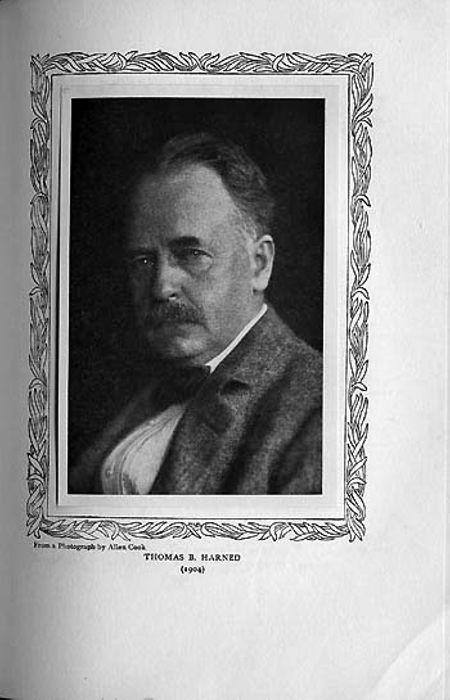 [Begin page 235] you written anything for Decoration Day?"
"Yes—a bit for The Herald, which probably was published this morning, though my today's paper is not yet here. [See indexical note p235.1] Tomorrow is my real Decoration Day: the Harneds are going to take me in hand tomorrow—garland me: set me up. You will be there, of course, both of you"—nodding to K. and to me. "I have already had four or five little remembrances by mail—two from Rhys: a bouquet of roses and two bottles of Jersey champagne. And by the way, that champagne—let's have some of it now—let's open one of the bottles."
[See indexical note p235.2] The bottle was opened. I took a sip from W.'s own glass—he barely tasted it—W. then sending this glass out by me to Mrs. Davis in the back room. "I am right up against my birthday now—feel quite chipper, for me: I am sure I can go through with it without lowering my colors. I am always more or less on tenter hooks about my health these times."
[Begin page 235] you written anything for Decoration Day?"
"Yes—a bit for The Herald, which probably was published this morning, though my today's paper is not yet here. [See indexical note p235.1] Tomorrow is my real Decoration Day: the Harneds are going to take me in hand tomorrow—garland me: set me up. You will be there, of course, both of you"—nodding to K. and to me. "I have already had four or five little remembrances by mail—two from Rhys: a bouquet of roses and two bottles of Jersey champagne. And by the way, that champagne—let's have some of it now—let's open one of the bottles."
[See indexical note p235.2] The bottle was opened. I took a sip from W.'s own glass—he barely tasted it—W. then sending this glass out by me to Mrs. Davis in the back room. "I am right up against my birthday now—feel quite chipper, for me: I am sure I can go through with it without lowering my colors. I am always more or less on tenter hooks about my health these times."
W. showed us a Walter Scott volume—an edition of 1833—with a title page drawn and written in his own hand, in red and black ink. [See indexical note p235.3] Pasted on the inside of the front cover was a process facsimile of Governor Dix's "shoot him on the sport" order, made for W., as he explained, "by a clerk in Washington, a girl, who was sweet on me." [See indexical note p235.4] We laughed. W. added: "I used to get love letters galore, those days—perfumed letters—from girls down there." Reference being again made to Scott, W. said: "I prefer the Border Minstrelsy to anything else: it is to me the richest vein he worked." Harned and Kennedy talked some together about Europe. Both had been abroad. [See indexical note p235.5] As to monuments W. said: "I don't think I'd take any interest at all in them." A neighbor's little girl came up to the window. W. greeted her and smiled and handed her out one of the Rhys roses. The report that Rhys was in town yesterday was false. [See indexical note p235.6] Harned's maid mistook the name. This seemed to comfort W. "I would find it hard to believe Rhys could come to Camden [Begin page 236] and skip me." W. finally said: "Well—we will all meet tomorrow: good luck! good luck! [See indexical note p236.1] And you, Tom—let me thank you in advance—and Mrs. Harned, too—thank her, too: tell her I told you to say this." And addressing me as I hesitated a minute after the other two had withdrawn: "God bless you, boy! And don't forget the proofs: the birthday won't be complete without the proofs."
Among the notes above, made in the morning, I forgot to say that W. gave me one of the promised Clapp letters. "Henry Clapp was always loyal—always very close to me—in that particular period—there in New York. [See indexical note p236.2] You can get much significant material out of his notes. I want to talk with you at length some day about Henry Clapp. In the meantime take this letter with you—read it—see if what I tell you is not true. Henry Clapp stepped out from the crowd of hooters—was my friend: a much needed ally at that time (having a paper of his own) when almost the whole press of America when it mentioned me at all treated me with derision or worse. If you ever write anything about me in which it may be properly alluded to I hope you will say good things about Henry Clapp: indeed, I charge you to say them. [See indexical note p236.3] To ignore him, or to say what should not be said about him, would be more unjust to me than to him." Clapp wrote on a letter head of the New York Saturday Press.
New York, Mch 27, 1860. My dear Walt[See indexical note p236.4] I am so busy that I hardly have time to breathe; moreover, I am in the greatest possible difficulties on account of one or two past liabilities still.
This must explain my not answering your letter promptly.
Do write and let me know about when the book is to be ready.
I can do a great deal for it.
[Begin page 237]I meant to have done more last week, but followed your advice and made a modest and copyable announcement. [See indexical note p237.1] The papers all over the land have noticed your poem in the Atlantic and have generally pitched into it strong; which I take to be good for you and your new publishers, who if they move rapidly and concentrate their forces will make a Napoleonic thing of it.
It just occurs to me that you might get Messrs. T. & E. to do a good thing for me: to wit, advance me say one hundred dollars on advertising account—that is if they mean to advertise with me. Or if they don't to let me act for them here as a kind of N.Y. agent to push the book, and advance me the money on that score. [See indexical note p237.2]
I must have one hundred dollars before Saturday night or be in a scrape the horror of which keeps me awake o' nights. I could if necessary give my note at three mos. for the amount and it is a good note since we have never been protested.
Of course I know how extremely improbable it is that Messrs. T. & E. to whom I am an entire stranger will do anything of the kind: but in suggesting it, I have done only my duty to the Sat. Press, and, as I think, to the cause of sound literature.
Yrs truly, H. Clapp Jr.I need not say, we are all anxious to see you back at Pfaff's, and are eagerly looking for your proposed letter to the crowd.
[See indexical note p237.4] This letter was addressed to W. care of Thayer & Eldridge, Boston. W. added to me: "Poor Henry! He, too, was always hard up. Poor Walt! Poor most everybody! Always hard up!" And as to the papers that "pitched into" him W. said: "Henry was right: better to have people stirred against you if they can't be stirred for you—better that than not to stir them at all. I think I first thrived on opposition: the allies came later." W. reverted to [Begin page 238] Clapp. "You may think Henry was hard up because of his extravagance—of something personal. That is not the point: he was generous, careful: the trouble was, he tried to carry an impossible load. [See indexical note p238.1] Henry was in our sense a pioneer, breaking ground before the public was ready to settle."
Thursday, May 31, 1888.
W.'s birthday. [See indexical note p238.2] Dropped in on Mickle street on my way to work in the morning. W. in bed but awake. Little talk. I kissed W. my congratulations. He was very fine about it. "Seventy years—seventy failures—seventy successes: which do you say?" "It amounts to success, whatever may have been the failures by the way." [See indexical note p238.3] "Good! Good!" I asked W.: "And don't every life amount to success?" He looked at me an instant, then said: "I see what you mean. Yes—every life amounts to success." I hurried off, W. calling after me: "I'll see you at Tom's: don't fail us at Tom's. In the meantime see Ferguson—bring me something from Ferguson: I am hungry for something from Ferguson."
I did see Ferguson. [See indexical note p238.4] W. yesterday told me he had written to Ferguson formally with regard to printing matters, stating that his "friend, Horace Traubel," had no doubt made all the required arrangements. "I told Ferguson that my note was sent by way of clinching what you had done." F. showed me the note today. Was greatly amused by one sentence in which W. advises F. to put "two good men on it (no sloucher)." [See indexical note p238.5] W. pasted a "specimen brick" of one of F.'s samples in the body of the note. A Backward Glance o'er Travel'd Roads was completely put in type today. (W. had changed "glimpse" to "glance.") W. wished this proof entire, not in parts. F. tells me his printers found W.'s copy "peculiar but interesting, and always clear." [See indexical note p238.6]
W.'s reception was to be at Harned's seven to ten in the evening. He arrived earlier for supper. These and some [Begin page 239] others were present in the evening: John Clifford, Mrs. Clifford, Edward Burleigh, Mrs. Burleigh, Frank Cauffman, Harrison Morris, William Sloane Kennedy, Harry Bonsall, George Gould, Mrs. Gould, Weda Cook, Katie Cook, my mother, Charles Bacon, Agnes Traubel, Anne Montgomerie, Mrs. Talcott Williams, Dwight Williams. [See indexical note p239.1] W. jollied me because I had not arrived in season for supper. "We missed you when we made the toasts—though I guess I did most of the toasting and most of the drinking."
W. was very animated. Got off again on the Cryptogram. "While I am not yet ready to say Bacon I am decidedly unwilling to say Shaksper. I do not seem to have any patience with the Shaksper argument: it is all gone for me—all up the spout. The Shaksper case is about closed. [See indexical note p239.2] That's enough for me—I'm too tired to go any further." He was in a rather merry mood. Songs were sung. Weda Cook sang a My Captain song of her own composition. W. seemed to be much touched, exclaiming "Bravo!" several times as she went on and when she was through saying to me: "There's fine soil in that girl." Afterwards Weda and Katie Cook sang together. Cauffman also sang. Mrs. Burleigh played piano. W. very ready. Greeting everybody gaily. Often with inquiries. Nothing flatters like an inquiry.
I gave Walt his first proofs there. [See indexical note p239.3] "I am surprised to receive so much—I did not expect so much. I see I must hurry up—the printers will get ahead of me—I must not keep them waiting." He laughed and added: "Think of me hurrying up, Horace," turning to Clifford and saying: "Horace is always quarrelling with my lame pace—he says I always come along the day after the fair." [See indexical note p239.4] I asked him if he could give me some more copy at once if I went down to Mickle street with him? "I will put it off to morning—I will send you some message to meet you at the ferry in Camden at noon tomorrow. Can you meet my messenger [Begin page 240] there?" That was agreed. He pushed the roll of proofs into a side pocket. "It's more precious than gold," he exclaimed to some one who came and remarked what he was doing, "it's my baby book just born today—don't you see?. [See indexical note p240.1] I am celebrating two birthdays today." W. asked me quaintly: "How did the new printers like my old style?" "You mean—how did the old printers like your new style?" "Well—have it anyway you like—but what was their first impression of Walt Whitman?" "Ferguson said they thought you a trifle odd." "Well," jocularly, "I don't mind that as long as I have my own way—as long as they humor me. [See indexical note p240.2] Did you tell them what a fierce tyrant I am?"
W. addressed Weda Cook: "My dear—who taught you to sing?" She did not answer—only looked at him smilingly; whereat he added: "Just taught yourself—eh? That's the best way after all." [See indexical note p240.3] To me: "If we've got the stuff in us, if we're dead in earnest about it, it'll find its own way of getting out." To Anne Montgomerie: "I suppose Horace has told you of his big contract?—of our partnership?"
Some aggressive person broke loose on Bacon again, W. at once taking up the challenge: [See indexical note p240.4] "The orthodox Shakespeareans are as horrified at our heresy as the preachers when we say we don't believe in hell—and their opposition has about as much, as little, significance—not a bit more. I do not so much require definite proofs against the Shaksperean authorship as the witness of my own soul that it is not in the nature of things possible." [See indexical note p240.5] Kennedy came along and put in a demurrer, W. resuming: "The Shakespeare plays are essentially the plays of an aristocracy: they are in fact not as nearly in touch with the spirit of our modern democracy as the plays of the Greeks—as the Homeric stories in particular. [See indexical note p240.6] Look at the Homeric disregard for power, place: notice the freedom of the Greeks—their frank criticism of their nabobs, rulers, the elect. You find the [Begin page 241] Greeks speaking of 'the divine hog-keeper,' 'keeper of the hogs'—saying things like that—very convincing things—which prove that they had some recognition of the dignity of the common people—of the dignity of labor—of the honor that resides in the average life of the race. [See indexical note p241.1] Do you find such things in the Shakespeare plays? I do not—no, nothing of the kind: on the contrary everything possible is done in the Shakespeare plays to make the common people seem common—very common indeed. Although, as I say, I do not admit Bacon, this is an argument which may go to the Bacon side." I remember that W. spoke the other day of O'Connor as "a fierce agonizer for Bacon."
W. said to me: "It seems very much all right to have Sloane Kennedy here with us today. [See indexical note p241.2] Now, if Dr. Bucke was here too, and if William O'Connor was here—especially William—our love-feast would be complete. You must write to them both, Horace, tell them all about the affair—who were here, how we frolicked, how silly Walt Whitman was—how happy, too: things like that." W. was very warm towards Harned and his wife, my sister. "This has been a calendar day for me—it has justified itself throughout—chiefly by your courtesy, consideration, love. [See indexical note p241.3] You have been good to me all day. Now I am going: now be good to yourselves—go to bed, get a rest." With Kennedy on one side and with me on the other W. was helped to his carriage. I asked W.: "Well—do you think now that the seventy years were worth while, Walt?" He replied meditatively: "Who knows? I don't know—I suppose so." The last thing before he drove off he called back a rememberer to me: "This side—the ferry—tomorrow—twelve o'clock sharp." And finally: "Good night all—good night all: God bless you!"
Two or three things I caught from W. on the fly, as I busied about the room. [See indexical note p241.4] While Cauffman was singing: "He has a voice like a Niebelungen god!" I asked: "What do [Begin page 242] you like best in singing—rather, in singers?" "What best? Let me see." Paused. "I guess I like strength in a woman—woman's strength." [See indexical note p242.1] "Then what do you like in a man?" "I guess I like strength in a man, too—man's strength." W. said of Clifford: "It puts a stop to your negations to find a preacher who is a man." Clifford is in the Unitarian pulpit at Germantown. W. to me: "My love is anybody's love today."
Day before yesterday W. handed me an old yellow sheet of paper (the stationery of the Attorney General's office) and said: [See indexical note p242.2] "There's a fillip for you: a bit of ancient history." It got side-tracked among my records. It is written in W.'s own hand. I give it here.
"Memo. The Saturday Review (London) of Sept 21, 1867, (p 383) distinctly endorses Walt Whitman as the only American poet—complains of all the other writers of verse in the United States, are mere imitators, without exception. [See indexical note p242.3] Tinsley's Magazine, for Oct. '67."
"A thing like that, breaking through clouds of abuse, was apt to set a fellow up some. [See indexical note p242.4] I do not mean set him up in the great man way—set him up in the class of the elect: I mean something quite different from that. A hand reaches to you out of the clouds—a warm hand—reality itself: love. It sets you up. That's what I am trying to say."
Friday, June 1, 1888.
Took to Ferguson today (after meeting and receiving the package from Mrs. Davis at the ferry) the copy for Sands at Seventy belonging to November Boughs. Then in with W. this evening to confer. [See indexical note p242.5] Much discussion of plans—headlines, &c. Arrangement yet a little nebulous. W. tremendously pleased with the proofsheets. "They are the best I have ever received—those fellows must be first-class: I have [Begin page 243] written a note to say so—enclosed it in the package." In this note W. extended his thanks to the foreman, proofreader and compositors of the Ferguson office. [See indexical note p243.1] W. is getting into the traces—wants now "to go straight ahead with the book," adding: "I am almost in a hurry, which is remarkable for me. And besides, I have quite a feeling for the printers—for the two you said were laid off: I do not want them to suffer on my account: Ferguson got them for me—I should keep them going."
Did he feel any the worse for yesterday's dissipation? [See indexical note p243.2] "No—not at all—better I believe, in all ways." W. talked of Kennedy: "Kennedy and Rhys do not seem to get on well together. Kennedy seems to experience a sort of antipathy for Rhys, who, in his own way, probably reciprocates in kind. I tried all I could to get at the bottom of it—questioned Kennedy himself—Kennedy—but he showed that he was averse to going into particulars. [See indexical note p243.3] Probably there are no particulars—probably it is only a clash of temperaments. Rhys intimated the thing when he was here but he was quite as indefinite as Kennedy. Rhys was more placid about it—did not seem to think it was worth fussing over."
W. has been reading Burroughs on Matthew Arnold in The Century. [See indexical note p243.4] "Ah! yes John puts a good deal more weight into the scales than I should for Arnold: but no doubt he justifies it—John always has best reasons for everything he does, says. I myself think Arnold's place a very much smaller one—sometimes think he has no permanent place at all."
Going back to the Kennedy-Rhys matter W. said: "Kennedy wanted to take Rhys out to Cambridge to see Sempers, who wrote the Harvard Monthly paper on me. [See indexical note p243.5] Rhys wouldn't go. That made some friction. But why should I umpire in that kind of a game? I suppose both the fellows were right—both wrong: I think too well of both to think ill of either!" Laughed.
[Begin page 244][See indexical note p244.1] General Sheridan is very sick. W. spoke of it. "I think it comes a great deal from high living. These military men have a curious experience—first on the field, inured to all possible hardship: there they do their work—get their fame. Then peace comes—then they are coddled, fêted, dined, out of sense—out of health: in fact, ruined." This led him to talk of the sick emperor Unser Fritz. "How it seems to mock human greatness, the catastrophe that has fallen upon that man! There is a man who went through sieges, agitations, battles, woundings, horrors, deaths—yes, even dying deaths, many of them, in a sense—a man who finally 'got there,' as people say, yet who at the last turn of the road is brought down with a diseased stomach or a rotted throat or some other such mortal adversity too disgusting and cruel in its form to be contemplated without a shudder. [See indexical note p244.2] Lay not your treasures up upon the earth! God knows! no one even heard me preach against life—its final joyous realities: yet the physical ingredients of life, the things we often set the most store by, are perishable, perishable, perishable! We have them in our hands! It all comes on such fast feet! It do not say 'all is vanity': I only say certain things are vain. I have seemed to enter into the tragedy of Unser Fritz—to have felt the flame of the fire that is consuming him."
[See indexical note p244.3] W. said again: "One of you fellows asked me about Gosse—you or Harned or Corning or somebody—how Gosse felt towards me. I said Gosse had shown a leaning my way—was more than cursorily courteous and warm. I have since unearthed a letter I had from him fifteen years ago. I was not looking for it—it just turned up in a litter of other documents. [See indexical note p244.4] It will serve to back up my answer. Was it you who asked me?" "Yes—I asked the question." W. added: "It is very odd to me that such men on the other side—Symonds, Dowden, Gosse, Carpenter—such men—should take such a shine to me—should show themselves to [Begin page 245] be so friendly to my work—yes, should seem so truly to understand me. [See indexical note p245.1] The same sort of men on this side are opposed—the essay, critical, scholar, class is dead against me—the whole clan, with scarcely an exception." "Is it the same class?" "Yes and no: the very fact that they regard me with such suspicion seems to put them in another class, spiritually speaking. But technically, professionally, they are the same class. The fellows over there in England are always writing me accounts of the scholars who espouse my cause (not me, my cause)—Dowden writes me—gives me their names (I will show you that by Dowden's letters)—Symonds, Roden Noel, Rhys, Rolleston—clean, cultured, quoted among the literary êlite. [See indexical note p245.2] In America that class has presented a solid front of opposition. I do not complain: who knows who is right? It is interesting, curious—not conclusive of anything in particular." Gosse's letter was written from the Library of the British Museum.
London, Dec. 12th 1873. Dear Sir:[See indexical note p245.3] When my friend Mr. Linton was here last, I asked him, during one of our conversations about you, whether I might venture to send you the book I was then writing, as soon as it came out. If he had not encouraged me to do so, I should hardly have liked to trouble you with it, and yet there is no one living by whom I am more desirous to be known than by you. The Leaves of Grass have become a part of my every-day thought and experience. [See indexical note p245.4] I have considered myself as "the new person drawn toward" you; I have taken your warning, I have weighed all the doubts and the dangers, and the result is that I draw only closer and closer towards you.
As I write this I consider how little it can matter to you in America, how you are regarded by a young man in England, of whom you have never heard. [See indexical note p245.5] And yet I cannot believe that you, the poet of comrades, will refuse the sym- [Begin page 246] pathy I lay at your feet. In any case I can but thank you for all that I have learned form you, all the beauty you have taught me to see in the common life of healthy men and women, and all the pleasure there is in the mere humanity of other people. [See indexical note p246.1] The sense of all this was in me, but it was you, and you alone, who really gave it power to express itself. Often when I have been alone in the company of one or other of my dearest friends, in the very deliciousness of nearness and sympathy, it has seemed to me that you were somewhere invisibly with us. [See indexical note p246.2] Accept the homage and love, and forgive the importunity of your sincere disciple
Edmund W. Gosse.After reading the letter I said to W.: "I call that pretty good." "So do I," said he. "Gosse must have been young then. Does he last?" W. smiled. "Who knows? [See indexical note p246.3] I think he does—but I would not be surprised if he does not: I am used to defections—especially of the young enthusiasts that grow old—yes, old and cold." Again: "Take Lowell, Whipple, Ripley, such men, in this country: they have no use for me: they are all against me." [See indexical note p246.4] "Do you think the same men in England would have been on your side?" "Not the same men—probably not: but men doing their kind of work."
W. spoke of Harry Bonsall's account of yesterday's affair in today's Post. "Harry made rather a mess of it. Harry's Post never gets much beyond being an apology for a newspaper. [See indexical note p246.5] Harry himself is not without ability, but he does not seem to see any reason for making the Post worth its salt. We all love Harry—but the Post: well, the Post is never a full meal nor even a decent lunch." "The Post has one virtue. It has always been loyal to you." [See indexical note p246.6] "That is so: Harry has never swerved from his adhesion: I could never forget that. Harry has always been ten times over my friend where once would have done. I don't think I want to be misunderstood on that score." We talked book [Begin page 247] a little. Then I left. W. said: "It now looks like pretty clear sailing—Ferguson is getting to understand me—we are getting to understand him."
Saturday, June 2, 1888.
Took W. the first six pages of O'er Travel'd Roads in page form. [See indexical note p247.1] Well pleased. "I have been thinking about the book today. After all, I hardly think it will make the one hundred and sixty pages. I was quite sure it would at first, but now the thing looks more than a little doubtful." Why shouldn't he include the long-postponed Hicks essay? [See indexical note p247.2] "It would not be out of place: but the Hicks must wait its time. I do not consider it sufficiently rounded up yet." Polished? "No—not polished: that is not the word: it lacks somehow that something or other in substance which will go to make it satisfactory to me at last." Why couldn't he give it that something or other at once and call it done? "Why? because I am a slow piece of machinery. [See indexical note p247.3] I do not seem able to muster myself for duty on call. I have to wait for the humor." Maybe the humor will come before the book is through? "You are stubborn. Maybe. If it does I will be only too glad. But I don't seem to have the power to strain at, to force, to compel, the issue." I read him a paragraph from today's Philadelphia Times—this:
"Walt Whitman enters the Seventies.
"Walt Whitman, the poet, who honors Camden by his residence there, entered on his seventieth year yesterday. [See indexical note p247.4] He is busily engaged in revising the proofs for his new book—November Boughs—which will include all his latest prose and poetic works. The book will probably be issued this fall. Although the good gray poet's bodily infirmities are increasing and he can scarcely move about the house without assistance, he maintains his kindly manner and good [Begin page 248] spirits, and his mental powers are as bright as ever. He works a little each day and in bright weather drives out with the horse and phaëton presented to him by his friends."
[See indexical note p248.1] W. broke in: "He says fall, does he and 'probably'? That is rather tantalizing. I am anxious to get the book into plates—printed: the rest is not material. I don't want anything to happen to me in the midst of the job. No one knows better than I do that I may go to pot any minute—vamoose, as they say out West." Questioned me some concerning the compositors who were working on his book. [See indexical note p248.2] "So they wonder about my use of the apostrophe, do they? I use it before the d, in place of e, in the past tense of verbs, because it seems like reason to do so. The practice comes to me legitimately from the old dramatists—yes, and there is a reason nearer home. I have so accustomed myself to it in my verse that I extend it to my prose for uniformity's sake. Besides, the closening of words—'wisht' for 'wished' and such like—is not alone an old literary form but a wise one—in line today with current phonetic tendencies. How very redundant were spellings in the old times—very redundant: but where spellings have been overdone we are gradually pruning—except"—with a laugh—"in almost hopeless cases like that of the Evening Post, Bryant's paper, which still uses the o-u-r in the o-r endings of words—or did when I last saw it. [See indexical note p248.3] I believe in getting rid of all superfluities—penetrating to the root sense of the matter. My 'peculiarities,' as your printers call them, hardly go further than this. I make a few rude departures—not many: on the whole I am conservative, travel the usual road."
[See indexical note p248.4] In speaking of the Shakespeare sonnets W. said: "Their origin was a thought-origin—that I feel, acknowledge: but they are often over-done—over-ornate—their elaboration is extreme, at times utterly obscuring the idea, which might [Begin page 249] be assumed to be of the first importance." I said to W.: "I met Morris—Harrison Morris—today. [See indexical note p249.1] He was happy over the birthday affair. He calls his meetings with you 'epochs.'" W. took the praise merrily. "That'll do for Morris. Tell him his roses smell good but he mustn't be reckless with 'em!" Ingersoll's reply to Gladstone has appeared. [See indexical note p249.2] Extracts in today's Press. W. read them. "Then Tom was in, too—he had the magazine under his arm: I shall see the whole business tomorrow when I come. I can easily guess what the Colonel has done with Gladstone." [See indexical note p249.3] Said of Viele-Griffin: "I believe he was here once, though I am not certain. He came in one of several bevies at a time I was not well—I cannot remember him. On such occasions I let them turn the crank but am myself able to do nothing that is not purely mechanical—no thinking at all—after it, no memory either." [See indexical note p249.4] The decision has gone against Henry George in the Hutchins case. W. criticises it. "It is a great injustice but I hope George will say nothing about it himself—it will right itself."
My sister Agnes asked W. whether he still felt satisfied with Morse's Hicks. "Yes—yes—yes: it stays, lasts, with me—that is the great test. I must have a thing by me a long while—must give it a chance to sink in—things never come fast with me, though, to be sure, when they come they come firm. [See indexical note p249.5] That is why I would not make a good journalist, preacher—least of all a doctor. My opinions are all, always, so hazy—so slow to come. I am no use in any situation which calls for instant decision." W. spoke of the birthday compliments. "I seem to have been particularly remembered by young women—in Camden, elsewhere. I got a card from Ryman, of Boston, containing photographs and a bit of four-leaved clover. [See indexical note p249.6] O'Connor didn't write. My friends do not in the main observe the conventions even in a matter like this. I have had a number of gifts—several gifts of money (small sums). The cake your sister [Begin page 250] put into my big pocket when I left I sent to a sick woman up on Arch Street. I have been treated fully up to my deserts and over."
W. alluded to Kennedy's letter in the current Critic dealing with the Worthington reissues of the Thayer & Eldridge volume. [See indexical note p250.1] "I would like to rehearse the whole story—it has elements all its own. It is a long story, too. Worthington—'Holy Dick' they call him—bought the plates—has done as he pleased with them ever since—never consulting me. [See indexical note p250.2] To hell with Walt Whitman! Walt Whitman be damned! Dick wouldn't use such vile phrases but that's what it all comes to. He might easily use vile phrases and be a better man. He is a pious Presbyterian—seems to be a publisherial freebooter (making no bones about it either). Jim Scovel once went to New York and frightened him into making a payment of fifty dollars, that fifty dollars being turned over to me. I think there was another twenty-five dollars paid at another time—I don't know when. I acknowledged both, on account, as royalty. Worthington wrote to me, at St. Louis, while I was with Jeff, years ago, proposing that I should make a five-years' contract with him—he wanted a new edition, containing new matter (I should say this was about 1877)—which proposal I turned down quick and sharp, telling him that three later editions or more had made the old plates worthless—except, I might have added, for trouble. [See indexical note p250.3] I again prohibited his printing and selling of the old book but he went on, no doubt thinking me a 'soft,' as in fact I have been. [See indexical note p250.4] Kennedy does not know about the royalty I accepted. There may be some construction of the law which would interpret my acceptance of any royalty as a consideration—I do not know. You know how Thayer & Eldridge busted during the war—how they were sold out. Worthington got the plates by purchase. He at first pretended that he had bought a big mess of loose sheets—was only using them—but that was [Begin page 251] a tale out of the whole cloth: I know the printer through whom Worthington bought the plates and he said Worthington was treating me to a fish tale. [See indexical note p251.1] I am averse to litigation—find I must not trouble or worry myself over such matters—make myself subject to the beck and call of courts. I like your suggestion that Ingersoll should be asked to look a little after Holy Dick. I was for a long time willing to stomach it all, but Worthington has acted so hoggishly, so impertinently, I feel as though I should now shake him up. He is easily frightened, as the Scovel incident shows. [See indexical note p251.2] Nothing would please Dave McKay better than to have me go at Worthington hammer and tongs—and Dave's feeling in the matter is not mercenary, but simply righteous anger. If the royalty acceptance should be considered as nullifying my case I should submit to the inevitable processes of the universe."
W. was very merry with me over a Carpenter letter with an enclosure than he produced. He said of it between laughs: "We are not always patted on the back—sometime we are kicked on the behind: and who knows but the kicks do as much good as the pats? [See indexical note p251.3] You will find in Carpenter's letter what was I imagine his first reference to Towards Democracy—his first reference to it made to me. His correspondent must be an interesting man—a man with very vehement opinions: rather oldish—out of date, with at least one eye set in the back of his head—yet very interesting, too, as dead or dying things may be now and then. Carpenter guessed right when he sent the letter on to me—I always find myself refreshed in a vigorous antipathy: I would rather have a whole than a half enemy. [See indexical note p251.4] I am afraid of the man who apologizes for his opposition. Can you make out the name at the foot of the letter? I never could quite do so—today, when I reread the letter, the signature seemed less legible than ever." I will first give Carpenter's letter and let passages from the enclosure follow.
[Begin page 252] Bradway Near Sheffield, 16 Mar. '82. Dear Old Walt—[See indexical note p252.1] I should like a line from you. I have not had time exactly to write to you lately—or rather I have written so many letters, business affairs mostly, connected with my brothers and sisters, that I have not wanted to write any more."
I enclose you a letter I am sure you will like to read—which I got the other day from a friend. He is a clever fellow, with flashes of genius—classical minded—but you are too much for him!
I have about finished what I am writing at present. It is in paragraphs, some short, (half a line or so), some long, in the ordinary prose form, tho poetical in character. It is a good deal made up of previous writings of the last five or six years squeezed out—a drop or two here and there. I have thought for some time of calling it Towards Democracy and I do not see any reason for altering the title—though the word Democracy does not often occur in it. [See indexical note p252.2]
Your friend Edward Carpenter.Following are passages from the letter mentioned:
My thanks for the Leaves of Grass. [See indexical note p252.3] Why not "Blades"? I have run through some of it; a barbaric work it is. Surely you must be poking fun at us!—What point of contact is there between E. Carpenter—learned and accomplished in an extraordinary degree, austere, ascetic and idealist,—and Whitman,—"turbulent, fleshy, sensual, eating, drinking and breeding" (pg. 48)—waiting for the wand of Circe. . . . [See indexical note p252.4]
Whitman is the poet of anarchy, confusion, lawlessness, disorder, "anomia," chaos—if such things are compatible with poetry. He is the logical outcome of Protestantism, the natural revulsion from Puritanism, Priapism. Prot- [Begin page 253]estantism abandons all reverence for the past, all respect for authority, tramples on all poetry and mystery: at last the individual, however rotten, is the only rule and law to himself. . . . [See indexical note p253.1] Nothing is vile, if only one has the courage to "brazen it out." These may not be Whitman's exact words, but he says as much again and again.
I don't dislike him as a man (p. 273)—provided he is in earnest, which I doubt—but his philosophy—he has none.
Nothing can be done without a system, nor will things work themselves out of their own accord and result in something better. [See indexical note p253.2] Our present society is but the concrete thought of some few great minds. The society of the future will be either the same as this, one stage more corrupt, or else nature, fertilized by the great thoughts of some philosopher, will breed something better.
There are thoughts which cannot be stated in downright language and yet they may be passed from mind to mind by Poetry and Parables. And if no thought can be extracted from the Poem, then damn the Poem! [See indexical note p253.3] —Thought need not be definite, but there must be thought. I find none in Whitman. Also he is not cosmopolitan.
"Have you read it all through?" asked W. [See indexical note p253.4] "What do you think of that blast? Is there a shred of me left? He don't slip into any half-way mood about me: 'Walt Whitman is maybe all right, but—.' No—that's not his style. He simply says Walt Whitman is not—and that's the end of it all. I kind o' take to the man: he tumbles me clean over as a matter of conscience—I respect him for it." [See indexical note p253.5] W. had written on the envelope in red ink: "from E. Carpenter enclosing sharp letter on L of G." W. then proceeded good-humoredly: "The next time anybody asks you about me tell them you have found me out at last—that there's a man in England who has shaken all my timber down."
Sunday, June 3, 1888.
W. arrived at Harned's at 1.20 in his carriage direct from home. He took his drive later in the day. Clifford came to dinner. [See indexical note p254.1] Dr. Bucke surprised us in the midst of an interesting talk on Hicks. Stephen Weston was the last to come. Anne Montgomerie also present. Bucke's appearance was altogether unexpected—very pleasant to W., who, however, took it serenely. At dinner W.'s talk was very animated. He dilated upon "Hicks' worldly providence." [See indexical note p254.2] "How well it would be if Morse had some touch of the disease of saving! I never met a man so little able on that side to take care of himself. Hicks always kept a little nest egg in bank." Talking about no-license W. said: "I take no personal interest in it. I don't accept the temperance advocate so-called—neither do I accept the rum seller: I often say to them—hatchel each other all you can—I shan't grieve over it! [See indexical note p254.3] But then aside from any feeling of that sort that I may have I remember that men are not to be made moral by violent means—by being spurred this way and that and told: 'You shall do so and so and so!' Resolved, that men shall no longer lie, shall no longer steal, shall no longer commit adultery! As a matter of fact I am at times disposed to think that men are so because they are so—that no absence of saloons could in itself prevent them from going to the bad, to the devil, if you've a mind to put it that way: they go or don't go from an impulse within themselves or the want of it. Salvation can't be legislated." [See indexical note p254.4]
At the table W. remarked: "I want to take a vote on an alternative of titles for the poem section of November Boughs. Should it be 'Sands at Seventy' or 'Sands on the Shores at Seventy' or something in effect the same. I am at a loss about it—don't exactly feel any sure way out of the dilemma. [See indexical note p254.5] Now what do you say—all of you? What do you say, Horace?" I voted for Sands at Seventy. "And you, Clifford—and you Tom—and you there, Anne Montgomerie— [Begin page 255]and Mrs. Harned, you, too: what do you all say?" All hands were of one notion in the matter. "You see, Walt," said Harned, "we're all agreed." [See indexical note p255.1] W. said at once: "So I see—I am agreed too: I guess 'Sands at Seventy' is best—but I wanted to ask. I never feel so certain of myself I may not feel certainer." Harned addressed W. "I thought you always did things in your own way without advice?" "So I do. Did I take any advice? It happened that you all agreed with me on that title. Suppose you hadn't? What would have happened? Tom, what would have happened?" Harned laughed heartily and said: "I suppose you would have cast your one vote against all our votes and declared your own motion carried!" W. very merrily exclaimed: "Good! Good!" adding, however: I ought to be honest with you all about that, though? I was a good deal uncertain about the title until your unanimous vote removed my uncertainty." [See indexical note p255.2] "That's a big concession for you to make, Walt," said Harned. "Never mind—it's the truth!"
Drifted into political talk. W. very decided about his politics. "I am for free trade—absolute free trade: for the federation of the world." [See indexical note p255.3] Some one asked him: "But isn't it our first duty to take care of ourselves—our America?" "Yes—that's right," replied W.: "Take care of your family, your state, your nation—that's right from a certain standpoint: some people seem ordained to care for one man, for a dozen men, for a single nation: and some other people—of whom I hope I am one—to care for them all. All sounds so damned much better than one—don't you think? The whole business done at once instead of a little patch of it here and there! [See indexical note p255.4] I don't want the brotherhood of the world to be so long a-coming. I can waittill it comes—it is sure to come—but if I can hurry it by a day or so I am going to do so."
In mentioning Worthington W. said: "The worst thing I know about Worthington is the fact that he is deacon or [Begin page 256] something in a church. [See indexical note p256.1] Yes—I always mistrust a deacon—a typical deacon—a church functionary. Indeed, I may say I never knew a typical deacon who was not in many respects lacking in the things we have a right to expect of a man. Generally, his standard is low. My first experience with that sort of a character was an unfortunate one: it has become a mere memory now, it was so long ago—but the impression it left upon me was ineradicable. [See indexical note p256.2] The man I mean was a type—the very sort of a man I think I of all men doubt: a pious, sanctimonious, unctuous, oily individual: his victim was my father. I was a boy then—hardly more than ten years old if that old. A Methodist elder—don't the Methodists call them elders?—or something or other of that sort—contracted with my father, who was a builder, for the construction of a house—drawing up the contract so cutely from his own side—so shrewdly worded—as to make it possible for him, when the time for settlement came, to evade here a sum, there a sum, until my poor straightforward father was nearly swindled out of his boots. [See indexical note p256.3] It was a sample case—I could match it with many incidents that have come my way since. I thoroughly disapprove of—hate—yes, even fear, institutional, official, teleological, goodness. I would any time rather trust myself in the hands of an avowed secular merchant. He is less likely to do you up."
[See indexical note p256.4] W. described New Jersey champagne as "lunar" but added: "Moonshine has its importance and place, too." Again referred to November Boughs as his "last word." Was he still determined to omit the Hicks peace? No—not determined—only afraid: afraid I can't get it done. [See indexical note p256.5] It needs some finishing touches: I do not seem to be equal to them. I can't be hurried—don't dare to be!" Anne Montgomerie having said something about Emerson W. said to her: "Read all the Emerson you can—it is the best preparatory soil. Emerson is not conclusive on all points, but no man more helps to a conclusion." Clifford made same allusion [Begin page 257] to Theodore Parker. W. followed him up. "Theodore Parker? Yes—he was built for mountains and seas—for might, for loyalty." [See indexical note p257.1]
[See indexical note p257.2] Harned told W. a story about General Sherman, which started W. into quite a monologue: "Yes, I see he is being mentioned for the Presidency—but he's in no danger—he won't be nominated. Have you ever seen Sherman? It is necessary to see him in order to realize the Norse make-up of the man—the hauteur—noble, yet democratic: a hauteur I have always hoped I, too, might possess. Try to picture Sherman—seamy, sinewy, in style—a bit of stern open air made up in the image of a man. [See indexical note p257.3] The best of Sherman was best in the war but has not been destroyed in peace—though peace brought with it military reviews, banquets, bouquets, women, flirtations, flattery. I can see Sherman now, at the head of the line, on Pennsylvania Avenue, the day the army filed before Lincoln—the silent Sherman riding beyond his aides. Yes, Sherman is all very well: I respect him. [See indexical note p257.4] But, after all, Sheridan was the Napoleonic figure of the war—not subjected to the last tests (though I am sure he would have been equal to them) but adequate, it seemed, to whatever duty arose. That is where I place Sheridan—among Napoleonic things. The real military figure of the war, counting the man in, was Grant, whose homely manners, dislike for military frippery—for every form of ostentation, in war and peace—amounted to genius. [See indexical note p257.5] I was still in Washington while Grant was President. I saw a good deal of him about the city. He went quite freely everywhere alone. I remember one spot in particular where I often crossed him—a little cottage on the outskirts of Washington: he was frequently there—going there often. I learned that an old couple of whom he was very fond lived there. [See indexical note p257.6] He had met them in Virginia—they received him in a plain democratic way: I would see him leaning on their window sills outside: all would be talking together: they seeming to treat him [Begin page 258] without deference for place—with dignity, courtesy, appreciation. This reminds me of a Sumner incident. I knew Sumner. I had spent a good deal of time in the South, off and on. Sumner seemed to know about it—once suggested that I should give him my impressions of Southern life and character. [See indexical note p258.1] I went to Sumner but he would not stand for me—not a damned bit of it. My view of the South was a little bit favorable—this seemed to irritate him: he would not have it so: stormed, stormed, would not yield a point. I have no doubt there is just as much chivalry, consideration, of its own kind, north here as south—in expressing some approbation of the southern social spirit I did not intend to accuse Yankeedom. But Sumner would not have the applause on any terms—cast it out of court." [See indexical note p258.2] Getting back to Sherman: "He must bear some corporeal resemblance to Tennyson—or what I take to be the Tennyson shape and measure. Tennyson, too, has something of the Norse in him. Some one was here awhile ago, some Englishman—many Englishmen come to see me—who told me a characteristic Tennyson story. Tennyson sat with a group of his friends listening to a description of some act of cowardly cruelty committed by a member of the nobility. [See indexical note p258.3] The question went round: what would you do if you were the victim? When it came Tennyson's turn to answer he made an appropriate gesture and exclaimed: 'I'd rip his damned guts out.' I was very much tickled with the story—it seemed to show Tennyson up in a new light—as being far more human and democratic than some of his work would lead us to suppose."
When W.'s carriage had arrived he asked Bucke to take a drive off into the country with him. [See indexical note p258.4] "I intended this ride for you," W. said, turning to Clifford, "but Doctor is not often here, so I take him. Your time will come later on." W. said "good-bye" all around, kissing the children, kissing Anne Montgomerie—shaking hands with Harned—flinging [Begin page 259] back at me from the carriage the charge: "You will see to matters at Ferguson's tomorrow, eh? Horace?"
Monday, June 4, 1888.
Ferguson referred to me this morning several questions about which I had to confer with W. [See indexical note p259.1] I went to Camden in consequence this noon, reaching 328 at a quarter past twelve. Found Harned there with two of his children, Mrs. Davis also, all of them in the parlor, anxiously regarding W., who lay on the sofa. What was the matter? My alarm was instant. But W. was very cheerful: "I seem to have had since last night three strokes of a paralytic character—shocks, premonitions. That's all there is to it. [See indexical note p259.2] Don't worry about it, boy." He held my hand warmly and firmly. When he drove off from Harned's yesterday with Doctor Bucke he was in great good humor and (for him) apparent health. In the evening he undertook to sponge himself, in his own room, alone, and while so engaged fell to the floor, finding himself unable to move or to call for assistance, lying there, he thought, helplessly, for several hours. When asked why he did not call Mrs. Davis he said: "I thought best to fight it out myself." [See indexical note p259.3] He added to me: "I have had many such attacks in the past—they do not alarm me—though I am aware they do not signify good health." This morning two perhaps lighter attacks had followed—one of which, the last, that from which he was recovering on my arrival, having somewhat affected his speech. "I never suffered that entanglement in my former experiences," he explained. Harned was present when this occurred. No doctor there. "Don't get a doctor," commanded W., adding humorously: "I think of it this way, you know: that if the doctors come I shall not only have to fight the disease but fight them, whereas if I am left alone I have but the one foe to contend with." [See indexical note p259.4] Mrs. Davis happening to say: "I hope it will all pass off," he replied: "I guess it will but [Begin page 260] if it does not it will be all right." W. attributes the trouble to his "infernal indigestion" suffered of late. "I have passed through hells of indigestion." [See indexical note p260.1] Harned suggested: "Fast for awhile—cut your belly off." W. smiled. "I am aware of the need of caution but I am aware also of the fact that I must keep the fire going."
Harned and the others going into the hallway W. turned his head towards me and said: "Well, Horace—you want to see me?" adding at once—"Sit right down here and tell me what it is." I demurred. Would it be all right? "Can you do it now?" "O yes, I am much better." While I was opening the proofs he went on: "Besides, this attack is a warning to us to hurry the book along all we can. [See indexical note p260.2] I may dance my last dance any day now. So do not be afraid—we will push right on—right on—till there's no pushing necessary, possible, any more." He took my hand—held it saying: I feel more and more my dependence upon you—I feel more and more that you are to be depended upon: God bless you!". [See indexical note p260.3] He put on his glasses and examined the proofs, talking rationally and clearly. He answered my questions without hesitation. Ordinarily he would have played for time. But I could see that he was serious about the warning. We talked only ten minutes. Then he said: "Bring as many proofs as you possibly can this evening. Do not forget the extra proofs—the four sets. I am willing (even desire) to give a dollar or so to the prooftaker for the extra trouble we are putting him to. I mean the dollar for the prooftaker personally—not for Ferguson. You will give it to him yourself." I asked W. whether he felt enough better to be left alone. "O yes—I seem now to be resuming my strength: do not be afraid. [See indexical note p260.4] Harned will be in from time to time this afternoon and Mary is around. I will see you this evening again: by that time you will find that I am fully restored." Left at twelve forty with Harned and the children. Harned informed me that he would telephone to[Begin page 261] Dr. Osler and Dr. Bucke, who is visiting today at the Noristown Asylum. [See indexical note p261.1] As he lay there on the sofa W. had called our attention to the New York Graphic, Saturday's issue, containing "two portraits, a picture of 328, the den inside," &c., W. saying: The reproductions are so bad they leave me indifferent."
I received from Ferguson on my return to Philadelphia proofs of Sands. Took these to W. at eight o'clock, finding him with Bucke and Harned, and better, decidedly. [See indexical note p261.2] Very cheerful, too. "The milk is spilled—why should we cry over it?" Took the roll of proofs from me and put them carefully in the inside pocket of his coat. He pointed to a chair piled with books and papers. "Go there, Horace: you will find a package: it contains some fresh copy for tomorrow." Bad as he had felt he had done this work since noon. [See indexical note p261.3] He had moreover been reading Ingersoll's North American Review reply to Gladstone, saying of it: "I have not got through yet: but I have tasted the fruit: it not only satisfies, it excites appetite. It is the lawyer's reply, not altogether satisfactory to me, but with here and there bits that we must class with poetry of the highest order." W.'s physical condition was discussed, W. himself frankly participating.
Bucke superficially made light of the incidents of yesterday and today, though secretly anxious. [See indexical note p261.4] But W. was not to be deceived. "Notwithstanding what you say, Maurice, there are earthquakes which shake walls, chandeliers—yes, and there are earthquakes which destroy cities." W. said quietly to me: "In spite of what the physicians say, I know myself, I know my peril: I am on shaky foundations—it cannot be concealed: I read the hints—am convinced of certain things. [See indexical note p261.5] So let us push the book along—get it done—before anything absolutely disqualifying occurs to me." W.'s love for Walter Scott never dies out. McKay has responded to his request for "typographically readable Scott [Begin page 262] books," as W. says, by sending two—The Heart of Midlothian and The Antiquary—over which W. is delighted.
It seems that after W. and Bucke had had their spin in the country yesterday W. drove Bucke to the ferry, W. then taking another run of over an hour beyond Camden alone. [See indexical note p262.1] "I drove up as far as Pea Shore—right up to the river, halting there for half an hour, looking over the water—listening to the wash at my feet, my nag all the while impatient, as is generally the case. [See indexical note p262.2] Then I drove home. All this time I was feeling physically and mentally in first class fettle. I had dressed a little lighter yesterday—that may have been against me—and then it was somewhat chilly as I stood there with my horse foot deep in the water at Pea Shore. It is all a mystery. It just happened—that's about all there is to it. This morning my sensation was of total collapse—giving away—things getting out from under me. I sat reading: the shock came without any warning—so quick I barely had time to lift and drop my cane for calling Mary. She helped me to the sofa where I rested and waited for the cloud to pass away. [See indexical note p262.3] I say cloud—cloud is just the word." Mrs. Davis says he looked ghastly at breakfast—scared her—but nothing happened at that time. Bucke says: "There's something suspicious about last night's affair. I don't believe the old man himself knows very much about it. He was probably unconscious for a long time. I questioned him sharply today and that is my impression."
W. has been looking over a Huxley book just out—controversial. [See indexical note p262.4] "It is far more crushing in its kind even than Ingersoll's—it is superb. It does seem as if Ingersoll and Huxley without any others could unhorse the whole Christian giant. They are master-pilgrims with a fighting gift that would appall me if I was in the opposition." W. receiving some letters from people he does not know says: "There is someone who says 'the fool is known by more people than the fool knows' or something running that way." [Begin page 263] Received sonnet addressed to himself from A. E. Lancaster. Also two Carlyle pictures from England. Bucke was here this afternoon some hours, Osler being with him a part of the time. [See indexical note p263.1] Bucke left at nine to see Osler again. Both are to come tomorrow.
W. gave me a couple of "curios" as he called them, one an envelope containing a note from The Broadway and W.'s reply to it (1867) and one envelope containing a Henry Clapp letter of the same year. [See indexical note p263.2]
New York, Dec. 28, 1867. Dear Sir:[See indexical note p263.3] The Editor of The Broadway, Mr. Edmund Routledge, London, writes desiring me to get from you, if we can, one or two papers or poems for his magazine. He was offered early sheets of your paper on Democracy from the Galaxy but that would not suit his purpose, he wants such only as he can have for both sides of the Atlantic and is willing to pay accordingly. [See indexical note p263.4] We do not suggest the title of any subject, believing you to know best the subjects on which you would like to write for such a magazine. Lest you may not know the magazine we send you by mail a copy of each of the five numbers already published. No. 6 will contain papers by Francis Turner Palgrave and Henry Sedley editor of the Round Table and a long poem by Wm. M. Rossetti. Hoping to have a favorable reply from you on an early day
We remainYours respectfully G. Routledge & Sons. Dec. 30, 1867 Geo. Routledge & Sons, 416 Boone St.,N.Y.
[See indexical note p263.5] I have received the letter asking me to write for the Broadway. I do not write much, but your invitation is cordially appreciated and may serve as the spur towards something. I can at present only briefly say that should I be able to pre- [Begin page 264]pare an article, or poem, appropriate for the purposes of the magazine, I will send it on,—and that I shall surely try to do so. [See indexical note p264.1] My address is at the Attorney General's office here. (New York house please forward this to Mr. Edmund Routledge, London).
W. had made this mem. on the reverse of the sheet: "I sent Whispers of Heavenly Death which they printed and paid handsomely for in gold." [See indexical note p264.2]
I said to W.: "That was nice enough in Routledge. You were not always knocked down and stamped out by the editors." To which he replied: "Not always—but mostly. There are exceptions even to this rule. The truth is, what for editorial hard blows, I haven't got a whole bone left in my body." [See indexical note p264.3] Then, after a little laugh and a pause: "By God Horace! if you could see some of the specimen letters of the old time your fighting blood would all be up. I have turned some of the 'no' letters over to you but you have only seen the mild ones. A few such incidents as that of the Routledges can be quoted on the other side: but the current has always pushed hard, very hard, against me. [See indexical note p264.4] But what's the use of diagnosing over cured diseases? I think I have finally escaped the hounds and can go the rest of the way in comparative peace."
I am writing this very late at night. Very tired. Walt's copy to run over and get ready for delivery to Ferguson in the morning. Will transcribe the Clapp letter tomorrow.
Tuesday, June 5, 1888.
Took further copy to Ferguson today, concluding batch of poems for Sands at Seventy—also essays on Burns and Shakespeare and several shorter pieces. [See indexical note p264.5] No proofs received. We are getting an extra set of plates of the poems so that they can be annexed to Leaves of Grass. W. also asks for three sets of proofs from the type-pages just before they are [Begin page 265] cast. Went to W. at 9.15 finding him in the parlor at the window, serene and gentle. Looks and feels better. [See indexical note p265.1] "I am inert, feeble, borne down with lassitude—my head being sore and sick: but there has been no recurrence of such attacks as I suffered yesterday." Osler had been in to see him—Osler, who, W. says, "believes in the gospel of encouragement—of putting the best construction on things—the best foot forward." [See indexical note p265.2] But Bucke had not appeared. "Doctor sent word that he was called off suddenly to meet his Commission somewhere in New Jersey. He will be back tomorrow. You know Doctor came down into the States with a group of men on an investigating tour." [See indexical note p265.3] We talked of the book. He still hesitates over Hicks. "I want it to go in if I can get it in. I looked into it today—observed places where patches are obviously needed. It would add forty pages to the book at least. I do not feel bound to put it in—shall not feel guilty if it cannot be managed. If the book must be smaller than it must. So much is packed into our solid pages: I saw as soon as we got started that I was talking rather boisterously when I said the book would make a hundred and fifty pages. I know the danger of delay. [See indexical note p265.4] What bothers me is the fragmentary, discursive character of the Hicks material—it is more like detached memorabilia than anything else. Yet I must let it go finally at that, I suppose."
When Sidney Morse was in Camden he took notes of his talks with W. Kennedy asked Morse for the notes for use in his book. Morse said: "It is absurd" and answered "no." W. said: "It does not seem absurd to me," adding: "Morse took the notes very carefully—often asked me to repeat things I had said. He seemed to be very conscientious about getting the right word as nearly as possible and putting it in the right place. [See indexical note p265.5] I do not think the notes were copious though there must have been fifty or more different entries." [Afterwards given by S.H.M to the editors of In re Walt Whitman and included in that volume.]
[Begin page 266]Drifted into further talk about W.W. portraits. "Herbert's picture," said W., "is in some ways unfortunate—is not what it ought to be: lacks in reality: I am sorry it is exhibited in London—it excites wrong impressions. [See indexical note p266.1] Morse's bust is much more faithful: I am satisfied with it: its points are incontrovertible. Look at Eakins' picture. How few like it. It is likely to be only the unusual person who can enjoy such a picture—only here and there one who can weigh and measure it according to its own philosophy. Eakins would not be appreciated by the artists, so-called—the professional elects: the people who like Eakins best are the people who have no art prejudices to interpose. Eakins is essentially a god man not a school man. I can well see why Gilchrist's picture should please those who frequent the galleries: but that very applause from such a quarter is to my mind an argument against the vitality of the picture. [See indexical note p266.2] Herbert is tickled half to death at the idea of being 'hung on the line,' they say, which, he tells me, for the Grosvenor Gallery, is great shakes for any man. That line in a conventional art gallery!—I am not so sure of it, my hearty. I wonder if Leaves of Grass would be hung on the line if the galleries had their way about it?—on the line or on a scaffold?" This seemed to amuse W. into a long laugh.
[See indexical note p266.3] We talked a bit more about the book. "My idea of a book page is an open one—a wide open one: words broadly spaced, lines with a grin, page free altogether: none huddled. Some printed pages seem to have a hump in the back. Now, there at Ferguson's I want you to get and keep on good terms with the working printers. If I could get about that is what I should do. The whole affair is in your hands. [See indexical note p266.4] I don't like to deal too much with proprietors—I like to deal with men: it makes the work more like work, less like trade." W. said there were two other things he would like to include in the volume. "But I am not free to do so. The Century [Begin page 267] Company has used and has paid for Old Age's Lambent Peaks and a hospital piece. They have held the hospital piece for over two years." [See indexical note p267.1] Walsh has never returned the Carol Closing Sixty-nine poem. W. unable to explain it. "I always designate my price when I submit a piece: it is far the simplest way: I make my own valuations. There was the Twilight poem, printed in The Century (a good many of my pieces are like it—only a few lines—a touch)—that was a mere thumb-nail, a hint—yet I named my sum and got it."
Talking of Sunday agitation generally and Gloucester baseball in particular W. said: "I believe in all that—in baseball, in picnics, in freedom: I believe in the jolly all-round time—with the parsons and the police eliminated." [See indexical note p267.2] Said there had been no visitors during the day except Bucke and Harned. Visitors, at least for the present, are being avoided—"though I am not sure that I want to hermit myself, either, even in sickness. I like them to come in and stay a little while. A great big lubber like me (my burly body—red, full face)—gets very little credit for being sick—for being an invalid." Used "legatee" on tenth page of November Boughs. "Was it right?" continuing: "I often get myself mixed in the use of the simplest words." I postponed the Clapp letter to today. W. had written on the outside of the envelope: "Henry Clapp (Garibaldi) quite good read again."
18 City Hall [New York] Octo. 3d, '67. My dear Walt:[See indexical note p267.3] I have this moment clipped the enclosed paragraph about Garibaldi from the Paris correspondence of this morning's New York Times. What a fine photograph of a splendid man! I wonder why it made me think of you! It did, though, and so I send it to you with the regards of
Yours truly H. Clapp, Jr. [Begin page 268]W. said before I had read the clipping: "William O'Connor was greatly pleased with it. He said to me: 'Do you know, Walt, that might easily have been written by me, about you! [See indexical note p268.1] Substitute your name for Garibaldi's and mine for Villemot and you have a complete case!' It didn't strike me quite so forcibly though I can see why it should in some ways seem to fit. [See indexical note p268.2] It is a gem for Garibaldi whatever it may be for me. Read it—see what you make out of it." Here it is:
The last that I heard of Garibaldi's movements was that he was at the villa of his friend, the Marquis de Pallavicini, in the neighborhood of Milan. This was on the 16th, the day on which it was so confidently announced by his partisans in Florence that he had crossed the Papal frontier. [See indexical note p268.3] In the last number of the Figaro I find the following 'physiology' of this remarkable man, by M. Villemot, which, though bordering on the caricature, is so correct in many points that I think it will interest as well as amuse your readers: "'Liberator' or 'heroical bungler' Garibaldi is a figure. Had I any disposition to believe in the supernatural he would have converted me. Against all reason and human wisdom, and to the professed humiliation of vulgar calculations, he has accomplished things which are to be classed among miracles and legends. [See indexical note p268.4] He is not a great captain; as a tactician he is no better than Jeanne d'Arc, but like her he had a familiar demon; he hears voices and takes the field. When he captures a throne he seats himself upon it, eats a bunch of grapes and inquires after his goats. He has not got a sou, and if he is a Chevalier of St. Maurice and Lazare, he is profoundly ignorant of the fact. [See indexical note p268.5] Educated people say: 'You see now that he is nothing but a rowdy; he may have a palace, receive the diplomatic corps, and eat carp á la chambord, but he loves best to live on a crust of bread rubbed with garlic.' But Garibaldi likes to be judged from the [Begin page 269] point of view of his temperament, and on this side of the Alps he cannot be very well understood. [See indexical note p269.1] He is reproached with not dressing himself like M. Rouher, and with wearing a boatman's shirt, a slouched hat and a Scotch plaid. They accuse him, moreover, of those turgities of style which wound ears accustomed to the small flute of the Academies. They forget that he is operating in the land of Tasso and Ariosto, and if our genius induces us to the search after simplicity that of Italy accommodates itself to a lyricism which with us is not in fashion except in the minor drama. Garibaldi is the expression of the land and the age that gave him birth. [See indexical note p269.2] You cannot get him to attire himself; you cannot get him to express himself otherwise than is his own nature. In his general physiognomy there is a mixture of the prophet and the child. Of our civilization, of our manners, of our vices and our crosses, he knows nothing. He marches ahead without seeing. He lives in an ideal world, and knows no more of the men of his time than a contemporary hero of the Iliad arising from his dust. His innocence exceeds all belief. The following is an example of it. [See indexical note p269.3] A few years ago he said to a friend, 'You are aware that I gave notes to M. Alexander Dumas to write my memoirs from. Would you believe that he has added to them a number of things of his own invention?' Brave Garibaldi! Write not your memoirs and get no one to write them. Let the people whom you have fanaticised compose your legend, and you will take your place among the great Sphinxes of history."
When W. saw I was done he asked: "Does it go home? Is it Walt Whitman or Garibaldi?" [See indexical note p269.4] "Neither and both." "I wonder? and after all that may be the way to see it. Let me see the slip." Put on his glasses. "William said: 'There you are, sure: He is nothing but a rowdy, wears a boatman's shirt and slouched hat, is not agreeable to the small flute of the Academies, you cannot get him to express [Begin page 270] himself otherwise than is in his nature, he is a prophet and child.' William said: 'Walt—it don't all fit but a good deal of it fits and what fits fits damned well.'" [See indexical note p270.1] I asked: "Well, how does it strike you? Can you see your face in the glass?" "I can see some of the features—yes." Then after an instant's quiet, laying his glasses down on the window shelf and passing the envelope back to me: "As to being any way associated with Garibaldi—that is the crowning tribute. Garibaldi belongs to the divine eleven!"
Wednesday, June 6, 1888.
[See indexical note p270.2] To W.'s at 7.15—he sitting in the parlor at the window in his big arm chair—improved, greatly, from Monday's prostration, but still weak, though serene. Dr. Bucke not in today—evidently not yet back from his trip. Mrs. Davis says she tried to have W. consent to a little drive but he objected—thought it safer to stay at home. [See indexical note p270.3] Spent a good part of today, like yesterday, up stairs—"in my big arm chair there—God bless my big arm chair!"—"very quiet, untalkative all the time," Mrs. Davis remarked.
W. up earlier than usual yesterday and today—by 8:30 instead of 10:30. "I do not seem to sleep," said he. We went over the Hicks matter again. He is anxious to complete it. "I should not be at all surprised now if it took its place in the volume though the doubts of it still remain. [See indexical note p270.4] Horace, I am physically down almost flat on the ground. We must not let any grass grow under us. What we wish to do we must do at once. I am not going to be reliable from this time on: I can see how we will have to eke out our success through ups and downs." [See indexical note p270.5] Mrs. Davis said to me: "There seems to be something on Mr. Whitman's mind. Do you know what it is?" "I think it's only the book." I repeated this to W. He was serious. "Yes, it's only the book—but ain't the book enough? Everything tells us to conserve the book—conserve the book." "I think the [Begin page 271] proofs I am receiving from Ferguson are unprecedented in their accuracy and taste. I do not give the whole credit to the proof-reader—it is the whole atmosphere that is good—the work of the printer, foreman, prooftaker, reader—all are concerned: I don't exclude any one of them. [See indexical note p271.1] These offices all have their swells—men who think they are more important than other men—but all the folks in the place are equally necessary—the boy who runs the errands as well as the man who bosses the shop."
After November Boughs W. will annex the Sands at Seventy poems to the Leaves. [See indexical note p271.2] He may annex the prose to Specimen Days. "I am not sure of this, however—I have not entirely made up my mind on this point." This led him to some reflections upon the character of these latest poems. "I often ask myself, is this expression of the life on an old man consonant with the fresher, earlier, delvings, faiths, hopes, stated in the original Leaves? I have my doubts—minor doubts—but somehow I decide the case finally on my own side. It belongs to the scheme of the book. As long as I live the Leaves must go on. [See indexical note p271.3] Am I, as some think, losing grip?—taking in my horns? No—no—no: I am sure that could not be. I still wish to be, am, the radical of my stronger days—to be the same uncompromising oracle of democracy—to maintain undimmed the light of my deepest faith. I am sure I have not gone back on that—sure, sure. The Sands have to be taken as the utterances of an old man—a very old man. I desire that they may be interpreted as confirmations, not denials, of the work that has preceded. [See indexical note p271.4] Howells, James and some others appear to think I rest my philosophy, my democracy, upon braggadocio, noise, rough assertion, such integers. While I would not be afraid to assent to this as a part of the truth I still insist that I am on the whole to be thought of in other terms. I recognize, have always recognized, the importance of the lusty, strong-limbed, big-bodied Amer- [Begin page 272]ican of the Leaves: I do not abate one atom of that belief now, today. [See indexical note p272.1] But I hold to something more than that, too, and claim a full, not a partial, judgment upon my work—I am not to be known as a piece of something but as a totality."
Harned's Boswell is still around. W. happened to pick one volume of it off the floor today. [See indexical note p272.2] "Here is Boswell. I thought I had given it back to Tom. I notice, by the way, that a good many of the things told by Boswell are contradicted by the notes of annotators, who intimate that this could not possibly have happened, or that, or the other, simply because the man was absent at the time, or dead, or unknown—or for reasons similar. [See indexical note p272.3] Dr. Johnson, it is plain, is not our man: he belongs to a past age: comes to us with the odor, the sound, the taste, the appearance, of great libraries, musty books, old manuscripts. My chief complaint against Johnson is that he lacks veracity: lacks the veracity which we have the right to exact from any man—most of all from the writer, the recorder, the poet. Johnson never cared as much to meet men—learn from men—as to drive them down roughshod—to crowd them out—to crush them against the wall. [See indexical note p272.4] He is a type of the smart man—a ponderous type: of the man who says the first thing that comes—who does anything to score a point—who is not concerned for truth but to make an impression."
Kennedy has written W. that he likes The Graphic pictures. "I do, too, except for the slovenly printing, which it is hard to forgive." [See indexical note p272.5] Speaks of Ingersoll's reply to Gladstone: "I have not read it seriatim, but nearly all of it—most of it several times, attentively. It is a work of genius and as against Gladstone conclusive. I find that Ingersoll is not altogether my man: does not say all my say for me: that is, is right in his place, for others, but not wholly representative for me. But I am not the only one to be pleased [Begin page 273]—indeed, not even the chief one—the paper was not after all written for me. [See indexical note p273.1] His reply to Gladstone is the lawyer's reply—a complete irrefutable statement. Ingersoll is not just my man in that sort of work because all such controversy—over the atonement, the Mosaic account, the church—seems to me utterly superfluous. I always feel that to one in the swim—in the swim of modern science, democracy, freedom—the atonement, the Mosaic records, are not worth the dignity of consideration, of a reply." "But is not Gladstone in the swim?" "It might be supposed so, but when we come to look it up, not. My friends tell me, for instance, that he cuts a rather thin figure in literature—that is Homeric studies, for instance, are bad in the extreme—as, indeed, they must be, if we may judge them by the standards which apply to his theological acquirements. [See indexical note p273.2] Of course the Colonel's skill goes without saying: his vitality, spirit: it is magnificent—nothing can stand up against its terrible onslaught."
My sister Agnes came in and told W. Cleveland had been nominated for the Presidency. "And Thurman?" asked W. at once: "He has been named for the Vice-Presidency?" [See indexical note p273.3] adding as to Thurman: "He is a bourbon—during the war was a copperhead—one of the earlier hateful examples of that tribe." W. is for Cleveland—says he "may vote for Cleveland," but shies at Thurman. "I never met Thurman—no: never met Blaine—have always avoided men of the purely political class: I seem to distrust them." W. gave me a copy of the 1882 edition of the Leaves. I am to show something in it to the printers. W. had written as title page: "Imperfect—pp 85 to 88 gone (two leaves gone)." [See indexical note p273.4] On page 84 was the subjoined memorandum, also in his hand, W. calling my attention to it: "Next pp 85, '6, '7, and '8 gone (who can have torn them out?)" The missing pages contained part of I Sing the Body Electric and all but the concluding stanzas of A Woman waits for Me. [Begin page 274] W. had often spoken to me of Rudolf Schmidt, at Copenhagen, and tonight produced an old Schmidt letter in which Bjornson is quoted, saying to me of it: "One of the best things I know about Leaves of Grass is the fact that it seems to hit the first-hand men. [See indexical note p274.1] Bjornson is a first-hand man. Leaves of Grass is supposed to be a first-hand product: it would fail as anything else." Schmidt wrote in English.
Copenhagen, 25 April, 1872. Dear Walt Whitman.[See indexical note p274.2] Just now received the New York Commercial Advertiser, which was for some days ago preceded by your kind letter. When returned to Washington, Clausen, who has taken a strong and sincere attachment to you, most certainly will be able to translate the whole article verbally to you. I should be glad if after a thorough knowledge you still would be pleased with it. I have had very great pleasure in introducing you to the Scandinavian public, and most probably in no European country would you find the conditions of the mind so favorable for the understanding of your poetry. [See indexical note p274.3] Your books and portraits have in the last month circulated amongst the ladies of my acquaintance, for especially it is the women who are your friends. [See indexical note p274.4] Bjornson writes of your article: "Walt Whitman makes me a joy as no new man in many years and in one respect the greatest I have ever had. Never had I thought in my days (during my lifetime) to get a spirit (or ghost, none of the expressions signify exactly our stand) for my help from America. But such and in no other shape of course it must come. I thank him and thee from my full heart. I went amazed during some days and still the great impressions are haunting me, as were I on the ocean looking on the driving ice-bergs that are inaugurating the spring."
I am very curious to know how you did like Clemens Peterson. Of course you did not like him. But if you have not found him broken by sickness and bad humors [Begin page 275] you must have felt that here is a mind with perhaps the finest nerves for beauty you ever met.
[See indexical note p275.1] Will you do me a service? I should like to write an article on "American fancy" comparing the grotesque humor that is scattered with no pretension in your newspapers with the humor of Luther and Shakespeare. Our own newspapers are sometimes bringing such specimens of wit and humor extracted from the American papers. Could you not find for me about a dozen jokes of this sort? That is all I want. [See indexical note p275.2] For instance: I saw in Harper's Weekly one of your leading political men (whom?) as Cincinnatus by the plough bringing himself an address, the same person making (in two figures) compliments to himself. Another instance: A teacher explains to his pupils the meaning of a phenomenon. An apple tree is no phenomenon; a cow is none. But if you were seeing a cow in an apple tree plucking apples with his tail: that would be a phenomenon!
At present you will understand my meaning! Good bye.
Yours Rudolf Schmidt.[See indexical note p275.3] W. had something more to say as to his relations with Schmidt: "Schmidt has translated a lot of me—done it well, I am told. He seems in his own country to be regarded as a man of great ability. What I like best about him is not his scholarship. He is a human being—is fresh, unspoiled by books. The best man in the world is the man who has absorbed books—great books—made the most of them—yet remains unspoiled—remains a man. It is marvellous what capacity books have for destroying as well as making a man. [See indexical note p275.4] I have some portraits of Schmidt here somewhere—I want to give you one. I can't put my hands on them just now. He is a beautiful character—has had his awful sorrows—domestic sorrows: I find myself much attached to him."
Thursday, June 7, 1888.
It got cooler today. To W.'s at 7.30. His shutters were closed. Sitting by the window looking chilled and disturbed. In reply to my question he said: "I'm not violently afflicted, as I was the other day, but I am feeling miserable." [See indexical note p276.1] Mrs. Davis came to me and expressed herself as much concerned. W. had towards evening shown signs of untoward weakness. She feared another attack. However, he had rallied. W. talked readily and copiously about the book—its headlines, its arrangement. I gave him one set of proofs and he gave me another. "I have about concluded to put the Hicks in whether or no—letting it go in with all its sins upon its head." [See indexical note p276.2] "I am in a hurry—in a hurry: I want to see the book in plates: then I can die satisfied. We will attend to the presswork and binding when we come to it. The main thing is the plates—the plates. Horace, I am on the verge of a final collapse: I look on the future—even tomorrow, next day—with a feeling of the greatest uncertainty. I am anything but secure: let us make the book secure."
Bucke not yet returned. "He has gone still further—across to New York: I have heard from him. He will be back here by Saturday night or Sunday morning."
[See indexical note p276.3] W. gave me a Broadway picture of himself. "How do you like that for free and easy?" Laughing mildly. "Some of the fellows in Washington said no—they wouldn't have it on any terms: they said to me: 'you like to make yourself look tough.' One fellow said: 'You do all you can to encourage the people in their belief that you are a tough.' [See indexical note p276.4] Is that the picture of a tough? Maybe I am not sensitive—maybe I am a tough—maybe the people who don't like toughs, don't like me, are right." He called my attention to the dent in the hat. "Somebody once called it a sauce-pan—said I wore sauce-pan hats." He had also found me the promised picture of Rudolf Schmidt. "It is an old one by this time but then everything about me is growing old—everything
[Begin page figure-21]
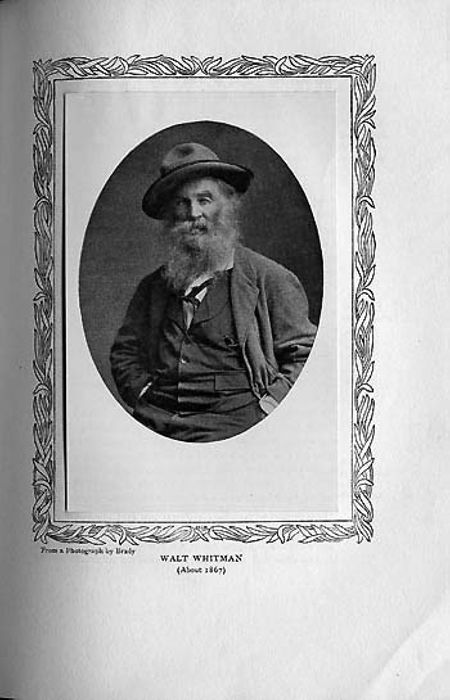 [Begin page 277] is getting past. I, too, will soon be past." Schmidt had autographed this picture and inscribed it "To Walt Whitman the poet of the American democracy."
[See indexical note p277.1] W. talked of O'Connor and Bucke. "William, taking him for all in all, I should consider my most ardent friend: O'Connor, with his Keltic, bardic, prophetic blood—with his intensity—with his fervent conviction, his uncompromising, unfearing challenge. O'Connor was the earliest of my friends—the first of his race. Bucke has not the same gifts—the same charm—yet Bucke is not a man whose friendship is to be despised: quite the other way—a man of whom a fellow may be proud. Doctor is of English parentage—lives in Canada—is an exceptionally strong character: is a great complex of tradition and rebellion: I admire his eligibility to employ the conventions while in no way overvaluing them: he is very worldly—yet also very not-worldly—has great ability to make his way in the world, yet always has eye and ear for the higher considerations. [See indexical note p277.2] Bucke's spirits are unfailing. You know, he is a great cripple: he lost that one leg, has lost the toes of the other foot, out in the west, in the mountains: was 'froze out and starved out' as the niggers say: I guess he has told you the story: yet Bucke is a whole man: he has lived down his losses—is always the same free, simple, manly man. Bucke of course is not subject to the flights we learn to look for in O'Connor: the soarings, the brilliant sparkle of satire and wit—the Irish—in William is rich in color—is mad with irresistible, indestructible life."
[See indexical note p277.3] Kennedy is to go camping with Burroughs. W. shakes his head over it. "Burroughs is an exceptional man, a denizen of the woods: it is natural, constitutional, with Burroughs to take hard beds, ill fare, as a matter of course, with entire serenity. Did you say they proposed to take Scovel? He would only be in the way—would not last. As for that, I doubt if Kennedy would last much longer. Kennedy has all the character necessary, all the brains, but with him it [Begin page 278] would be more a matter of giving up his chops in the morning—the fresh cup of coffee. I do not think Kennedy has that full out-door emotion which makes Burroughs at home in any environment. [See indexical note p278.1] Burroughs could not help but be what he is: the factor in him which provides for that sort of life is the primitive—the wild man, the woods man, the man of flint and skins, born over again into an age of more sophisticated ideals. Scovel said to Kennedy: 'Yes—I will join you. I will write the trip up for the New York Sun.' This disgusted Sloane."
Scovel had been telling some ultra-intimate suspicions to Kennedy about W.'s private life. Harned had referred them to W., who was indignant. [See indexical note p278.2] W. put me on the stand and plied me with questions, some of which I could not answer. "The stuff all seems to me beyond everything else vile and slanderous. I was never on intimate terms with Scovel: Kennedy seems to have imbibed a false idea. I like Scovel's wife, his daughters—spent some of my happiest hours there—at dinners, suppers, about the fire: but there was no more to it. It must be that Jim has repeated to Kennedy some of the vile slanderous stories which have here and there been invented and told at my expense. What is your notion of it all, Horace? [See indexical note p278.3] What is the nature of the stories he repeated to Kennedy? I cannot understand. I have always thought Jim true—I know his peccadilloes—am not inclined to exaggerate them: I do not like to think he is faithless. See what happened to poor Tom Paine, who was unfortunate enough to excite the theological rancor of his time. A thousand things about him, all of them slanders—without the least doubt slanders—have been perpetuated: a thousand things of which he was entirely innocent. [See indexical note p278.4] Woe be to the man who invokes the antagonism of priests and property! But, Horace—how did Kennedy take Jim's talk—seriously?" I told him K. was "shocked." "Shocked? Did he believe the stories? Shocked at me? Shocked at Jim?" [Begin page 279] "Shocked," I said—"just shocked." I added that Harned was indignant when K. first told him. W. exclaimed: "Indignant? Ah! of course! And still you do not know what it was that Kennedy heard?" I said to W.: "I advised Kennedy to use any material he got from Jim very conservatively." "That was right," put in W.,"damned conservatively."
[See indexical note p279.1] W. still looking into the Nicolay-Hay Lincoln now running in The Century. "It is not very important as a literary production—it is chiefly important for the material it supplies for the use of others, who will come along by and by and do the literature of that period. It adds sidelight, color, facts—statistics: and odds and ends of stuff here and there contributing to the general effect. What a fund of such data is not being revealed! I hope to see it go on—go on from all sides—from South as well as North—from the disloyal and the loyal. I often say that even Jefferson Davis should put his story down—put himself on record—give the world the benefit of any peculiar light he may enjoy from his personal post of observation. [See indexical note p279.2] Even Jefferson Davis, did I say? I should have said 'Jefferson Davis' without the 'even.' Do you say that Davis has already published something as to all that? That is news to me—good news. The Century Company has done very creditable work in this direction: its impartial war recitals, drawn from all sources, all sorts of men, on our side as well as the other, is of inestimable value. No matter about the contradictions—let them be: they were inevitable: the future will judge between fact and error."
I offered to copy the Hicks if it was necessary. W. smiled pleasantly: "Thanks, boy, thanks! I should not be at all surprised to have to call on you—take you at your word." [See indexical note p279.3] Mrs. Davis conversed with me freely about W.'s troubles since Saturday last. She noticed Sunday morning that he seemed weak and colorless. As to what occurred Sunday evening [Begin page 280] she knows no more than the rest of us. W. sleeps with his door locked—does so even now despite her protests. Monday morning W. came to breakfast looking horribly the worse for wear. He afterwards went into the parlor and looked over his papers, sitting, as usual, at the east front window. [See indexical note p280.1] When he suffered his first attack he still had strength left to rap for Mrs. Davis, who arrived just in time to catch him and save him from falling to the floor. Mrs. Davis called Warren, and together they got W. to the sofa. When he had recovered somewhat she asked if she should stay with him. He said no. "Leave the door open—go to your work—come back from time to time and take a wink at me"—as she did, asking once: "Does it annoy you to have me come so often?" and he replying: "Oh no! Not at all: come." [See indexical note p280.2] When I got in Monday at noon he was just rallying from his second attack. His speech this time was gravely affected. When Mrs. Davis first spoke to him at this juncture he could say nothing—simply drew his eyebrows frowningly together. She asked him: "Why did you not call me last night?" He only repeated the "Why?" and did not explain—could not, probably—for what occurred there that night in the isolation of his bedroom will probably never be known to him or to us. [See indexical note p280.3] Mrs. Davis speaks of his self-helpfulness. He asks little of her—will, indeed, accept but little assistance. He dresses, bathes, meets all the personal necessities single-handed.
People often criticise Mrs. Davis because of the confusion apparent in the parlor and W.'s bedroom. The fact is W. does not encourage any interference even by her with his papers. She has been cleaning some this week, W. being rather disposed to joke about it. "I hate to see things after they are 'fixed.' You get everything out of place and call it order." [See indexical note p280.4] We often talk of the different editions of Leaves of Grass. W. says: "They all count—I like all—I don't know that I like one better than any other." Tonight I happened to mention the Rossetti volume, whereupon W., [Begin page 281] reaching forward and taking a folded sheet of paper from under some books on the table said: "That reminds me—here is another Hotten memorandum: I have already given you something or other of Hotten's. [See indexical note p281.1] You will be interested because our own little job here together involves similar points. How good that English crowd has always been to me—the whole crowd: I want it to be forever recognized. When the time comes for you to tell your own story—give your own version—you must be careful to do those English fellows justice." W.'s memorandum was a draft of a letter, his to Hotten:
March 9, '68. Mr. Hotten.[See indexical note p281.2] I thank you for the copy of my poems sent by you. It has just reached me. I consider it a beautiful volume. The portrait given in it is, however, a marked blemish. I was thinking, if you wish to have a portrait, you might like to own the original plate of 1855 which I believe I can procure in good order—and from which you can print something much better—as per impression enclosed. [See indexical note p281.3] If so, send me word immediately. The price of the plate would probably be forty dollars gold—or eight pounds. It would suit just such a volume, and would perfectly coincide with the text as it now stands in note and preface. If I receive your favorable response, I will, if possible, procure the plate and send it you by express—on receipt of which, and nottill then, you can send me the money.
[See indexical note p281.4] I will thank you to convey to Mr. Swinburne my heartiest thanks for the copy of William Blake sent me, and also for his kind and generous mention of me in it.
[See indexical note p281.5] "Talking of those English fellows," added W., "reminds me particularly of Rossetti. Rossetti—William—was one of the first of my friends over there—has been one of the staunchest—right along: has never qualified his allegiance. There is another kind of a friend—the I'd rather I'd rather [Begin page 282] not kind: Rossetti does not belong in that class." "Was he on the whole satisfied with the Hotten book?" "On the whole—yes. [See indexical note p282.1] Yet any volume of extracts must misrepresent the Leaves—any volume—the best. The whole theory of the book is against gems, abstracts, extracts: the book needs each of its parts to keep its perfect unity. Above everything else it stands for unity. Take it to pieces—even with a gentle hand—and it is no longer the same product."
Friday, June 8, 1888.
Ferguson gave me the concluding proofs of the Sands today and some of the prose to follow it—Shakespeare, The Mexican Letter and Visitors. In with W. at 7.45till 9.20. [See indexical note p282.2] When I entered he lay at full length on the sofa from which he at once arose. Upon my protest he said: "No, it's all right: I was just thinking whether I should not go over to the window again." I helped him across the room. "I don't feel worse in any one place from the attacks the other day but weak all through—generally less able to get about. I have for two years been expecting a bad fall at some time or other so that what happened the other day was no surprise. I have always been very cautious—you know, the phrenologist puts my caution at 67"—here he laughed—"cautious enough to be cowardly—and I suppose I owe a good deal to that. [See indexical note p282.3] So far as my sleep is concerned I am doing very well: I get four or five hours of it continuously every night: but the process of locomotion is daily growing more difficult. Today I have been a trifle improved. If Warren was here—Warren, Mrs. Davis' boy (I like him very much—he is such a lusty fellow—has been about the world so much—is a sailor)—I would have arranged with him to drive with me this afternoon: I am a little afraid just now to go out alone. [See indexical note p282.4] The Doctor will be here tomorrow: if he comes in time I can have him for a companion." He took a bunch of flowers from a vase on the window sill. "The white ones [Begin page 283] have no flavor. After all the common red fellows are the best—they come straightest from their roots. [See indexical note p283.1] No rose of culture can transcend or even equal them in fragrance." Spoke hopefully of the "woodcuts" in newspapers. "Some of them are wonderfully good." He is really talking about half-tones and other process plates. "They promise so much—are prophetic."
[See indexical note p283.2] While speaking of portraits W. said: "We judge things too much by side-lights: we must have a care lest we pause with the single features, the exaggerated figures, individuals, facts—losing thereby the ensemble." W. pursued the subject of literary proportion. "The big fellows are always the generous fellows: they recognize each other wherever they are. [See indexical note p283.3] It's the generosity that makes the big fellow. It will do for the little crowd to have all the bickerings, the mean jealousies, the quarrelling ambitions, the mean policies. And you know that's the way to distinguish the little from the big. The thing we call smart, clean, skilful—that thing is not big. Those who regard literature as an exercise, a plaything, a joke, a display, are not big—they are small of the small. [See indexical note p283.4] There's nothing so riles me as this exhibition of professional acquirement. Literature is big only in one way—when used as an aid in the growth of the humanities—a furthering of the cause of the masses—a means whereby men may be revealed to each other as brothers."
[See indexical note p283.5] Except for the Hicks matter the printers have about all the copy for the book. But the book will be a small one. Frank Harned is to try to photograph the Morse bust of W.W. for a frontispiece and the Hicks for an inside illustration. "Things don't always work out," said W.: "Sometimes they work in." He thinks he will bring out the Hicks essay in a special "volumet," as he calls it, later on. Speculated about the development of photography. [See indexical note p283.6] "I doubt color photography: how can it ever be? There seem to be insuperable chemical difficulties in the way. Yet how can [Begin page 284] we doubt anything in this age? Day by day we are surprised by new ideas, theories, facts, experiments—if we can't get our heads one way we can no doubt get them another: the mine of novelty is inexhaustible. [See indexical note p284.1] You saw that portrait of somebody in the builder's magazine that was here the other day?—that I gave to McKay? I like the magazine a good lot—it is about one fifth literary: they are to use my portrait next, or next, or sometime before long."
[See indexical note p284.2] W. is very amiable towards the portrait hunters. He gives them pretty nearly everything they ask. Cauffman is the last. W. says: "He may come—he is welcome to try—let him take a shot. Frank Fowler was to have come, too. I give the painters all the rope they want: I humor them every way I know. [See indexical note p284.3] Alexander came, saw—but did he conquer? I hardly think so. He was here several times, struggled with me—but since he left Camden I have heard neither of him nor of his picture. The Century purpose using the Alexander picture, which, indeed, I never liked. I am not sorry the picture was painted but I would be sorry to have it accepted as final or even as fairly representing my showdown. [See indexical note p284.4] I am a bit surprised too—I thought Alexander would do better, considering his reputation. Tom Eakins could give Alexander a lot of extra room and yet beat him at the game. Eakins is not a painter, he is a force. Alexander is a painter." I am to write to Morse conveying a message from W. [See indexical note p284.5] "Tell Sidney that the Whitman sent to Boston, refused everywhere there in high quarters, is to be sent to Concord, and deposited temporarily with the Concord School of Philosophy—with that institution as long as it lasts, and, in the event of its demise, with the Concord Library. The London head is still in private hands—with Mary Costelloe—has never been exhibited except that one time with Gilchrist. Mary thoroughly likes it—likes Herbert's picture, too, for that matter, as they all seem to over there. There's something in a head [Begin page 285] painted in that style to appeal to, convince, them: it is a good bit of coloring—is no doubt in a fine frame (you know how much that adds to it in the eyes of the world): it has the formal virtues which nine visitors out of ten in the galleries applaud." [See indexical note p285.1]
W. has never seen the French bust of Emerson at Concord. "Concord is a great place. I always hold Sanborn, Frank Sanborn, to be a true friend—to stand with those who wish me well. [See indexical note p285.2] He has always treated me royally when I have been up his way. I believe Sanborn was instrumental in having the Whitman head established at Concord." W. remarked that he had not yet received any acknowledgment from Griffin of the copy of the Leaves sent to France.
W. has not read the Emerson-Carlyle correspondence. Asked me about it. [See indexical note p285.3] "I guess I should hunt it up. Do you think I should read it? Yes? Well—I must do so. How big is it?" He wound up by asking me to bring it down to him. "I think Burroughs' analysis of Carlyle about the best I have seen. Carlyle was fed on the pabulum of European libraries: he learned above all to love strong individualities—men who would drive on to their ends through whatever obstacles—men gifted with the genius of extrication—men who were not particular how they did things but very particular to have them done. [See indexical note p285.4] Carlyle had one failing in common with Thoreau—disdain, contempt, for average human beings: for the masses of men: he never could understand that though man was in some ways a devil of a fellow, he was not all devil or even chiefly devil. These are some of the points Burroughs has neglected or not made enough of. But after all the rest is said we have yet to say of Carlyle that all that was Carlyle's was naturally his—he came honestly by it."
[See indexical note p285.5] Referring to Mill W. said: "He excites my admiration though I have not studied him as I should." Speaking of [Begin page 286] Leaves of Grass editions I commended the original paper issue of Passage to India, W. assenting: "I always took a special shine to that, too. [See indexical note p286.1] My own personal choice among books is for those you can put in your pocket."
We talked some about college men. I had kicked something on the floor. Stooped and picked it up. W. asked: "What is that?" I passed it over to him. It proved to be two letters tied in a string—both from Corson, of Cornell. [See indexical note p286.2] "College men as a rule would rather get along without me," he said: "they go so far, the best of them—then stop: some of them don't go at all. Corson seems to have signal abilities—accepts me in a general way, without vehemence. As I was saying the other day, the college men this side, the critic classes, the formidable array of the literary celebres, are almost solidly against me." W. read the Corson notes quietly, then handed them over to me. "I wonder," said W., "if Corson knew how significant that last sentence or two may be taken to be? [See indexical note p286.3] —'the tendency towards impassioned prose, which I feel will be the poetic form of the future.' Do you suppose Corson advertises that?—tells it to his classes? I don't say no—I only wonder—only wonder. I am sometimes mystified, having them say flattering things to me, here, in letters—then in their public capacities talking in a qualified or opposite strain." [See indexical note p286.4] "Have you any reason for suspecting Corson?" "None whatever—only, I wonder. His letter is friendly but he has the excessive caution of the university man. The scholar swells rarely—I may say never—let themselves go." I read the Corson notes—both of them short.
The Cornell University, Ithaca, N.Y., 26 March, 1886. My dear Mr. Whitman:[See indexical note p286.5] Allow me to introduce to your acquaintance my young friend, Mr. E. H. Woodruff, who desires the pleasure and honor of meeting you and exchang- [Begin page 287] ing a few words. [See indexical note p287.1] Mr. Woodruff is one of your many lovers connected with our university, and I am sure it will be a proud satisfaction to him to meet you.
I remember with great pleasure my visit to you last March, when I was on my way home from Johns Hopkins University. I brought, you will remember, a letter from Howard Furness.
I expect to be in Philada on the 1st, 2d and 3d of April, and to visit Mr. Furness; and I shall be much pleased if I can have the opportunity of again meeting you.
Hoping that you are enjoying good health,
I am, my dear sir,Very truly yours, Hiram Corson. The Cornell University, Ithaca, N.Y., 26 April, '86. My dear sir:
[See indexical note p287.2] I received your favor of April 13th and the book, which I am delighted to have. Pardon my delay in acknowledging, due to illness. I'm delighted to learn that your lecture and reading, in the Academy of Music, was so great a success. I hope you may repeat it for many years to come. Americans are apt to forget their great men, unless their work in this world is kept before their minds, through annual presentations of it.
It was a great disappointment to me, when I was last in Philada, that press of work, and shortness of time, did not allow me to see you. [See indexical note p287.3] When I next visit the city, I shall certainly arrange to have a talk with you, on certain points upon which I have been long pondering—one especially, that of language-shaping, and the tendency towards impassioned prose, which I feel will be the poetic form of the future, and of which, I think, your Leaves of Grass is the most marked prophecy.
Very truly yours, Hiram Corson. [Begin page 288]I asked W. "What do you want? He seems to concede a good deal." "I want nothing—he does concede: yes, concede: I suppose that is so. [See indexical note p288.1] I started of with no one to say a kind word for me—hardly a soul—and now, when people are saying kind things, I look for enthusiasm. I think Corson is judicial—probably that is what ails him. I like the outright person—the hater, the lover—the unmistakable yes or no: the street 'damn you!' or 'how are you me boy?'"
W. is always saying to me—"I am nearly blind." He does have trouble with his eyes. But he sees things, too. Tonight he said: "One of the worst signs is my eyes—they seem to be going back on me entirely—I can't see an elephant with 'em." [See indexical note p288.2] Right afterwards while I was looking at a photograph of the Symonds home at Davos Platz sent him by Symonds W. remarked: "And do you notice Symonds himself is down there by the shed, large as life?" I did notice Symonds. But he wasn't large as life. He was so small it would take divination or a magnifier to see him. I said so to W. and added, rallying him: "And you are the man who says he is blind!" To which W. testily replied: "Who should so well know he is blind as the man who can't see!" I laughed and was about to ask him another question but he would not let me. "Take your question to court—don't bother me with them: you ought to be a detective or a lawyer!" Symonds had written on the back of the photograph: "Am Hof, Davis Platz, Graubunden, Switzerland, 1884."
Saturday, June 9, 1888.
[See indexical note p288.3] In at eight. W. stretched at full length on the sofa, Dr. Bucke taking his pulse, Harned looking on much concerned. W. recognized me even in the half light. "Ah! Horace! Is that you? And what have you got?"—seeing the rolls in my hand. I had manuscript and proofs and a copy of The American containing the first part of Frank Williams' paper on the The Poetry of Walt Whitman. W. shook hands
[Begin page figure-22]
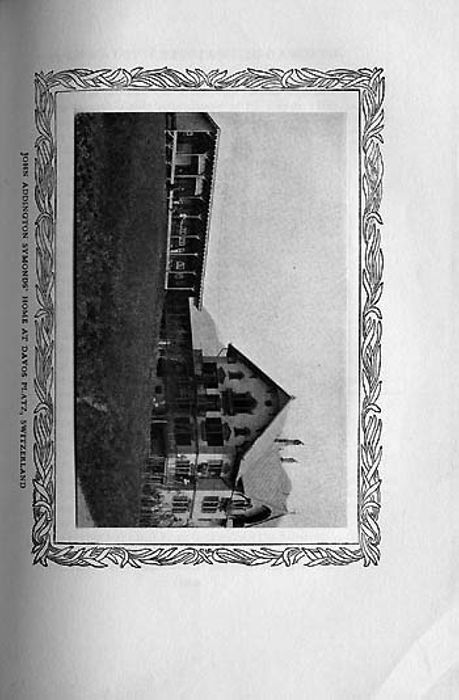 [Begin page 289] with me and took the rolls. Harned got up and whispered to me: "The old man's in a bad way. Bucke says he is passing through a very serious phase of his trouble. [See indexical note p289.1] He's mentally sort of mixed up. When we came in ten minutes ago he was up stairs. Mrs. Davis called him and he came down alone. He got down without an accident." It seems, however, that their presence saved W. from a serious fall. When he reached the parlor he was about gone.
For some time after I got in W. remained in a dazed condition—now perfectly rational, then wandering some. Bucke said: "Keep plying him with questions—keep him awake. I thought he was dying a few minutes ago. He is slowly coming round." [See indexical note p289.2] W. tried to tell us about a call of Frank Williams', today or yesterday. "Frank says they propose to have a Whitman symposium in The American. His own article initiates the series." He stopped short on Frank and got talking of Corning, who had also been in. I went out to say a word to Mrs. Davis. On my return I took the chair at the foot of the sofa. There was no light in the room. Yet W. saw me. "Who's that?" he asked, and on Harned saying "Horace" he wished to know "who passed back awhile ago?" I said: "I did Walt—Horace" [See indexical note p289.3] "But who did you go to see? "Mrs. Davis" "Ah! I thought it might be some other particular friend of mine." That was the way his mind cavorted about. "There's William—William O'Connor—he's alive, too: God bless William! And your mother? You, too? Why here I am with everybody."
[See indexical note p289.4] Gradually, however, W. came out of the mist as clear as day. Afterwards tried to get up and could not do so. "Give me your hand, Horace!" he said. I did so and he undertook to rise, intending to go to the chair opposite. He could not budge his left leg, which I had to literally lift and drop upon the sofa. The three of us then placed him in the chair in the middle of the room, where he stayed as long as we were [Begin page 290] there. Then he tried to describe his trouble of this evening. "I had a miserable—a very miserable—day. Towards evening I tried to do some proof reading but could not keep myself awake—felt very languid, heavy-like. [See indexical note p290.1] I went to the bed—fell asleep—must have slept soundly—was aroused by Mary, who told me Harned and the Doctor were here. Should they be sent up? I said: 'No—never mind,—I will go down'—coming down as you saw, in that way—overstraining myself, I think, so that when I got here I was in rather confused condition." Bucke said: "I'd give anything to have you stay upstairs!" [See indexical note p290.2] W. replying: "No, Maurice—don't worry—it's all right: you fellows must not feel alarmed: somebody get up and make a noise—don't let's be solemn about it. I have had fifty and more such spells—the first of them hardest, those after diminishing in force—some of them in Stevens Street, clusters of them, of spells. I am of course aware that with each one I am less eligible to meet those that follow. [See indexical note p290.3] Some day there will be a final spell—and then"—he was bright about it, stopped an instant, then proceeded: "But then we are not going to discuss that final spell until we have got out November Boughs, are we, Horace?"
Bucke has been in New York. Saw Gilder. "I do not think he wished to see me," said Bucke. "Don't say that, Maurice," put in W. W. referred to the Lounger in The Critic—Jennie Gilder. [See indexical note p290.4] "She calls attention to the money I am making on my poems—says it is rare. Tom, do you want to borrow some of my poetry money? Somehow the New York set hate to think that I receive help from England: they repeat it, that I am not poor: as Richard Watson Gilder puts it, it 'galls' them like the mischief to read the false reports that get about concerning my finances—the New York crowd is a rather snaky one anyway—always excepting Gilder, Stedman, and a few others (very few) who are consistently friendly—even affectionate."
[Begin page 291]Bucke asked W. if anything remained unpaid on the house. [See indexical note p291.1] "No, Maurice: it is all paid for. The house was first offered me for eighteen hundred dollars. I said I would take it, paying part cash. The owners then offered it for seventeen fifty spot cash. I took up with this proposition. I had twelve hundred and fifty of my own—George W. Childs advanced me the other five hundred, which I afterwards returned—every cent. You may wonder how I came by so much money one bunch? [See indexical note p291.2] I was making money then—just after the Massachusetts expulsion: the first Philadelphia edition netted me thirteen hundred dollars. I made a little hay while the sun was out that time—and it was lucky for me that I did: for the sale of the book got right down to a poverty level soon after and has continued there without a break."
[See indexical note p291.3] Bucke approached W. on the subject of a nurse. He demurred at first but wound up by saying: "I suppose I must submit. What you three fellows agree on together I will say amen to. For one thing: be sure you get a large man—no slim, slight fellow. Mary has shown me great consideration but if I am going to be more than ever helpless it will not do for me to impose upon her for more service." [See indexical note p291.4] Bucke and Harned went off together. When we were alone we talked proof a little, W. saying: "I do not want to delay the printers: must not: I want to rally from this, at least to finish the Hicks, if not for more." Bucke this evening instituted some comparison, or parallel, between Faust and Leaves of Grass. W. profoundly interested. "It is very striking, Maurice, though I don't know how well you could hold it up against the scholars if they slapped back at you."
[See indexical note p291.5] W. spoke of "a letter written by Watson Gilder for one English and one American periodical disapproving of the current stories of my poverty." Bucke asked: "How do you know Gilder wrote the letters—did he sign them?" "No—but I know it on good authority from some one near [Begin page 292] the throne." "Who was that?" "Who? Who? Well—it was John Burroughs." W. received three instead of two Carlyle photographs from England. Bucke questioned W. about his diet. "I never indulge in extras except now and then at Tom's. [See indexical note p292.1] Mrs. Harned's cooking is always very tempting." Bucke asked: "And how about the cooking here?" W. answering: "That was unjust to Mary—yes, so it was: her food, too, cooking, is always good—very good"—determined not to do Mrs. Davis any discourtesy: though as a matter of fact he said to me just a day or two ago: "Mary's heart is all right—she studies to please me—to feed me right—but she lacks in that finer something or other which the best cooks possess—which is so inestimably precious to a sick man: which anticipates conditions." W. had a note from Kennedy in which K. again tilts at Rhys. [See indexical note p292.2] W. laughed. "I won't commit myself. I want both of them: I am not willing to give either up. When the ocean gets between them again they will forget all about their grievances." Let me have a Rhys letter. "I intended it for you when it came but it got mixed up with things generally here. It will help along your records." The letter was written from the Union League Club.
New York, 21st May, '88. My dear Walt Whitman,[See indexical note p292.3] I have just been reading your lines in The Herald for this morning which hold in them a message full of meaning, for all of us who know you well. We think of your approaching birthday with sorrowful, and yet glad, remembrance of the years that you have lived so well.
My adventures since leaving you have not been very startling, but they have been full of everyday life and energy. Here in Fifth Avenue, or more often in Broadway and the less-known haunts, I have been seeing all sorts of memorable things and men and women. Yesterday my good friend Cyrus Butler, a kind and wealthy old gentleman, took me quite a round of studios, &c. We began by break- [Begin page 293] fasting sumptuously here, (fried shad, omelettes, tomatoes, buckwheat cakes, strawberries, coffee, &c.) and then turned in to see Col. Bob Ingersoll, meeting there Lawrence Barrett the actor, and others. [See indexical note p293.1] Then onto Beard's studios, &c. Over to Brooklyn to see a crazy rhymester—winding up again by having supper near midnight.
[See indexical note p293.2] Today promises to be even more memorable; I expect to steam up the Hudson River by the Mary Powell (fastest boat in the world, they say!) and then to catch a late train up at Newburgh on to Buffalo, &c. Thence to Dr. Bucke's place on Wednesday, where I will look to send you a further note on my doings.
I have good news of my brother at last, and so am free to sail for England in a fortnight.
With love, Ernest Rhys.[See indexical note p293.3] "I don't envy Rhys his big breakfasts and dinners and all that—I only envy him his call at Colonel Bob's! I am told those nights at Bob's are halcyon nights. Next to being lucky enough to be there yourself is being lucky enough to hear about them from others who have been there. I don't believe the conventional literary class take any part in the Colonel's gatherings but all the unusual fellows seem to turn up there one time or another." [See indexical note p293.4] "I like Rhys," said W.; "when you get underneath his very heavy exterior—under the impressive crust—you find a real human figure. I don't think Sloane ever got underneath: he is impetuous—was probably discouraged first time and didn't persevere. [See indexical note p293.5] They're both my men—I wouldn't give either one up for the other: I am greedy—I want both." W. handed me a "family memorandum" saying no more about that than this: "It will give you some detail in a matter on which you have questioned me. Take good care of it—I will leave it here."
[Begin page 294] Kings County Lunatic Asylum. Flatbush, L.I., Mch 22d, 1870. Mr. Walter Whitman.Dear Sir:
[See indexical note p294.1] Your brother Jesse Whitman died very suddenly yesterday from the rupture of an aneurism. As it is uncertain whether this reaches you or not we shall bury the body tomorrow.
Yours respectfully, E. Warner,Assist. Phys.
[See indexical note p294.2] W. had indorsed the sheet with red ink in this way: "Announcing the death of brother Jesse, March 22, 1870. Jesse Died March 21, 1870." I waited for W. to say something. He said nothing. Looked rather serious about it. "Do I understand that I am to take this?" "Yes—take it—put it away where it will be preserved." I left shortly after. W. by this time pretty well recovered. "I have got rid of the unsteadiness," he said, "but am very weak—very weak." I offered to help him up the stairs before leaving. He dissented. [See indexical note p294.3] "I like to do all I can for myself as long as I can. You fellows have about convinced me that I should have a nurse. You don't know how I resent the idea—yet how ready I am to acquiesce in it." We kissed for good night. He called after me when I was at the door: "Remember the book! Remember the book!"
Sunday, June 10, 1888.
[See indexical note p294.4] W. in bad shape all day—sleepy, confused, somnolent. Now and then stirred up but going into a cloud again. Voice thick, enunciation impaired. I was at 328 by ten o'clock and Harned came along in about ten minutes, the two of us going up to W.'s bedroom together, W. then in a chair dressing. We at once noticed his shaky mental condition. Not irrational—only not consecutive. He said: [Begin page 295] "I seem to be between a fever and a frost: first I burn up—then I feel like a man in a freezer." [See indexical note p295.1] Harned had brought along some ice-cream which W., sitting there in his shirt and drawers, ate with avidity, saying: "I feel very hot—I put the cream in on my fire: it is just the thing—just the thing." Looked haggard, his eyes being very dull, complexion off color. Yet he said: "I slept well."
I picked up a copy of Leaves of Grass Imprints (1860) he seeing what it was and saying: "You ought to keep that for yourself—there are others here. [See indexical note p295.2] It was originally intended as a sort of barricade: I set it up to hold back the desperate assaults of my enemies. When most everybody lied about me it seemed to me to be in point to tell the truth about myself." W. tried to describe a picture I was looking at over against the wall but could not do it. [See indexical note p295.3] The right words would not come together. He seemed to be aware of it and gave up trying. Harned entered into some side-talk with him while I questioned Mrs. Davis, who was in the room. She said W. had some trouble with himself after I left last night. He tried in vain to ask her if there was a light in his room. This morning he told her he thought he was "decidedly better." [See indexical note p295.4] But he still suffers from indecision of speech and inability to do any connected thinking. Yet he was only intermittently depressed. He talked a little about the book: "I am sorry I seem to be in a condition of half-suspended life"—adding: "Do you just keep things moving until I get balanced on my pins again." Seemed aware of his plight. Went astray again. The door down stairs banged. He listened—was perfectly quiet for two or three minutes. [See indexical note p295.5] Then he addressed me: "What do you suppose they have come for, Horace?" "Who?" "John and William." "John and William who?" "O'Connor—Burroughs. Didn't you say they were down stairs? Why does Mary detain them? Why don't she send them right up?" Seemed a bit peevish over it. While [Begin page 296] I waited wondering what to say in reply to his illusion—Harned all this time looking on, going about the room—saying nothing—the fancy seemed to pass away and he resumed his more lucid mood. [See indexical note p296.1] Doctor has been giving me some advice about November Boughs but I've got no time now to stop for advice: our train is started—we had better not halt it again until we arrive at our destination: I may never get another wind."
In spite of "feeling like hell," as he described it, W. kept us busy answering questions—Harned about his children and I about my mother and father and Anne. [See indexical note p296.2] He was even merry, here and there, as when he said: "I have my suspicions of you and Anne Montgomerie." After which he dropped into another very sluggish humor during which his face grew deadly pale and he said nothing. Then the flush returned and he turned his face away and smiled.
I left with Harned at about eleven. Arranged with Mrs. Davis to be called in case anything turned up. [See indexical note p296.3] Harned had gone down stairs, I was to follow. W. called me back to hand me a Dowden envelope. "I dragged this out of the wreckage for you: I remember what you said about your interest in Dowden. Dowden is not the very best but he is next to the very best. [See indexical note p296.4] I suppose Symonds must always be first: his loyalty takes such an ardent personal form: it has not the literary tang, except incidentally. I never feel quite as close by when Dowden is around: there always seems to be something or other left between us—some qualifying no: with Symonds everything is down—we are face to face. Not that I miss the crystal quality of Dowden's loyalty, either: it has its own beauty: I acquiesce in it too. [See indexical note p296.5] It is not easy for me to get Symonds, Carpenter, Dowden, together, and attempt to parse them." That was clear enough. I took W.'s hand, reached over, kissed him. "God bless you, boy! You say you will be back by and bye? That's right. Come."
[Begin page 297]I was to go to Philadelphia to the First Unitarian church to hear Clifford's sermon. Read the Dowden letter on the boat going over. [See indexical note p297.1] Very dubious about W. Worried. Stopped at Osler's on my way to church. Not at home. Returned to 328 immediately after lunch, about two, finding W. no better—rather worse. Donaldson, Harned and Bucke in the parlor. Mrs. Davis called Bucke and took him up stairs. After a few minutes Bucke returned and asked me to hurry to Philadelphia and do everything I could to find Osler. "It looks to me as if the old man was dying," Bucke said. I rushed off. Osler was not at his office. I then went to the Rittenhouse and from that to the University Club failing everywhere to connect. [See indexical note p297.2] I left a note for him on the desk of his office. Then back. W. no better. I was up stairs only a minute. The four of us walked over to Harned's office. Bucke asked me: "Did Walt ever tell you that he had made a will?" I answered: "He has told me that he has not made a will." "Lately?" "Just the other day." Bucke argued the matter over some, with Harned particularly. [See indexical note p297.3] Harned then sat down and made a hasty draft of a will making Donaldson, Bucke and Harned executors and trustees. Had early dinner at Harned's and returned to 328. Donaldson in the meantime had gone home.
Osler finally appeared in the early evening. Examined W. Seemed to be as dubious as Bucke and just as much mystified. We all agreed that a nurse should be secured at once. Bucke went over with Osler, designing to bring a nurse back with him. I went to W.'s bedroom at 9.45. W. seemed then quite clear. "Eh, Horace, is that you? I was wondering whether you would break your promise to come back." [See indexical note p297.4] I asked him if the heat was troublesome. "Yes—I guess it is—a little." Was very feeble. Went off rambling in some talk about Ellen O'Connor, the drift of which I could not catch. Then he seemed to get hold of himself again.
[Begin page 298][See indexical note p298.1] "Did you find some meat in the Dowden letters?" asked W. "Yes? There's always meat in Dowden—always. He never sets an empty table. Some day you must read his Westminster Review essay on the Leaves: it adds up a pretty big sum, all in our favor!" Then he went astray again talking weird things about his friends, seeming to get them all jumbled together. Once he mentioned Peter Doyle. [See indexical note p298.2] "Where are you Pete? Oh! I'm feeling rather kinky—not at all peart, Pete—not at all." He lay there with his clothes on, though complaining of the heat. Would he not be more comfortable with the clothes off? "Perhaps I would but never mind—it will do this way." Bucke argued with him about this in the afternoon but with no effect. I asked W.: "Is there anything I can do for you now?" He replied: "Is that you, Horace, at last? You have been away a long time. [See indexical note p298.3] No—you can do nothing. I don't feel well—I seem to be slipping down, down—I don't know where I will stop: but nothing can be done." Spoke sluggishly, with great difficulty.
I had a few words with Mrs. Davis, who was full of concern, and then whisked off to Harned's, returning with him at 10.30. [See indexical note p298.4] W. could hardly be called either asleep or awake. Bucke arrived an hour later, bringing a young doctor named Baker as nurse. Bucke sent me to Brown, apothecary, for some powders. Bucke and Baker had already on my return decisively set about undressing W., who was kicking like a steer. He also objected to having the nurse sleep there in the room with him. [See indexical note p298.5] "I am all right—good for the night: let him come back in the morning. I would rather be alone. I hate to have anybody around, right in my room, watching me. Maurice, do I need to be watched?" [See indexical note p298.6] He was finally persuaded, "browbeaten," he said. He was still clear about the courtesies for he said to me: "Of course the nurse knows that my objection is not personal to him." So we all bade him good-night and left him alone with Baker, who was to [Begin page 299] send for us instantly if anything occurred. It was 12.30 by this time.
[See indexical note p299.1] No attempt was made to broach the subject of the will today. W. had left the proofs untouched. A long day full of unspeakable anxieties. W. had written on the Dowden envelope: "from Dowden Feb. 6 and Feb. 16 1876." Sorry I could not talk with him more about them. [See indexical note p299.2] I recall this further note on Dowden by him to me some days ago: "Dowden represents the English literary elite—not the caste elite but the spiritual elite: the finer development of that English consciousness which articulates itself these days in the language of the international democracy. Dowden is a book-man: but he is also and more particularly a man-man: I guess that is where we connect."
Winstead, Temple Road, Rathmines, Dublin, Feb. 6, 1876. Dear Mr. Whitman:[See indexical note p299.3] Since I last wrote I received a letter from you, acknowledging my Shakespere book, the E. A. Poe newspaper, and that with the lecture on Shakespere in it. Thank you for all. It is very pleasant to think that you remember me.
The news of your health is that of the chief interest to me. And in one way or another I have heard about you several times. I trust you do not work when you ought to rest. For any affection such as yours I should suppose entire rest and open air to be essential conditions of recovery; and such lying fallow would be fruitful in the end with you.
[See indexical note p299.4] Nevertheless I rejoice to hear of the Two Rivulets and your Memoranda of the War being ready. I enclose a draft or bill on the Bank of England for what they tell me is the equivalent of ten dollars. Would you please send me the new edition of L. of G. and Two Rivulets, and Memoranda, but if the postage is heavy do not send the Memoranda, and let that so far compensate you for your loss by postage [Begin page 300] to Ireland. I should like to have my name written in each book by you (unless you object).
[See indexical note p300.1] I suppose you have seen Peter Bayne's very vicious (and the word is applicable in a literary sense as well as an ethical) article on your writings in The Contemporary Review. As to myself I feel that I have a small grievance to complain of—his selecting scraps from my Westminster article, out of connection with their environment, to employ against you an admissions of one who stands on your side. I trust that you have not so far forgotten my article as to think my meaning was that attributed to me by Peter Bayne. [See indexical note p300.2] Such an article as this may with some readers delay the understanding of your book, but others, as I know, will have their curiosity quickened by it to see for themselves what the phenomonon—L of G—really is. I see on all sides tokens of a continuous advance in England toward appreciation of your poetry. Occasional references to Walt Whitman in reviews and magazine articles now, as a rule, tacitly admit your position as secured, instead of being, as once was the case, contemptuous.
[See indexical note p300.3] I will find, if I can find it, a copy of an article by a young barrister friend of mine, O'Grady, which appeared in The Gentleman's Magazine the same month in which Peter Bayne's article appeared.
Lately I read a paper on your poems before a Club here—The Fortnightly Club. [See indexical note p300.4] The feeling was, to a degree which surprised me, favorable to your writings; and in College I read the same paper to a large class of students, reading aloud passages from your Vistas and L of G, to which a response of almost involuntary applause was given,—a murmur and a low response of satisfaction after complete silence and attention.
I had a pleasant letter from John Burroughs and got from him a copy of his Winter Sunshine. This is to me a delightful little book. He lies so close to nature, yet with such a quick, living human consciousness. His writing has some [Begin page 301] of the wholesome influence upon me that the sunshine and snow, the apples and the birds themselves have: and this is all the more precious to me because my work as Professor has a constant tendency to tide me away from what is fresh and vital into mere accumulation, and "culture," of a kind which is not life, but mere apparatus, machinery, and dead pelf of knowledge. [See indexical note p301.1]
A friend of mine—Miss West—has printed a little pamphlet of verses which perhaps she may send to you. They are some in sonnet form; and as regards executive power very unequal. [See indexical note p301.2] The spirit of them is somewhat stern and self-repressive; yet a capacity for joy is apparent in them; several are occupied with religious doubt, and emotions connected with it; and in the last two or three the result arrived at is declared—a stoical acceptance of our ignorance of the mystery of the world; with a certain amount of hope, founded upon the good things of human friendship and fellowship which life has revealed to the writer. (I write of what you have not seen, and I am not sure that she will think them worth sending to you.)
I am, dear friend, yours most truly, Edward Dowden.Too tired tonight to copy Dowden's second letter. Will include it tomorrow.
Monday, June 11, 1888.
This is Dowden's second letter:
Temple Road, Dublin, Feb. 16, 1876. My dear Mr. Whitman,[See indexical note p301.3] I received a few days since your last letter. It is very pleasant to me to find you liked my Shakespere book, but much more to know that you are not indifferent to me, myself, and do not think of me as a stranger.
The report of your health makes me both hopeful and anxious. I do not know whether your American summers [Begin page 301] are as health-bringing as our summers, but I should suppose they had a decided advantage over your winters in this respect (notwithstanding all John Burroughs says of Winter Sunshine) for an invalid; so it is chiefly from the summer that we shall look for an advance towards recovery.
[See indexical note p302.1] The newspaper statement of the attitude of the American public towards you is a surprise and a disappointment. We had been misled by a correspondent of The Academy, which is a paper always friendly to you, into quite a different view of things. I am waiting until next Saturday to see whether Rossetti has inserted this statement in The Academy. If he has not, I will write to him and try to get it printed there.
[See indexical note p302.2] Two friends, Professor Atkinson of Trin. Coll. Dublin, and Stoker, who writes to you, have asked me to get copies of your three volumes, L of G, Two Rivulets and Memoranda. But I do not doubt that half-a-dozen of my friends will wish to have the books, so I should be obliged if you would send a parcel containing six copies of each book—the Autograph 1876 edition. Stoker writes me to ask you to put, if you do not object, his name (Abraham Stoker) and your own in the copies for him.
[See indexical note p302.3] He has told you perhaps of a very lively debate we had at our Fortnightly Club on The Genius of Walt Whitman last Monday evening Feb 14th. A most savage, but ill-planned, attack opened the discussion. I followed with a speech which consisted in the main of apt selections from L. of G. and Democratic Vistas, and these were felt by my hearers to be a very effective answer to the previous speaker's extravagant statements. [See indexical note p302.4] Then, to my surprise and great satisfaction, followed speaker after speaker on the Whitman side—a barrister, a young clergyman, a man in business, and others, while the remaining speakers were three, one who placed you below Victor Hugo on the ground of alleged deficiency of form and beauty in your poems, one [Begin page 303] who announced that he had never read your books but was sure you could have written nothing as good as Burns' Cotter's Saturday Night, and a third recently introduced to L. of G. and who confessed to having discovered some few great poems, but much that baffled him, and that should be challenged. The result was on the whole highly satisfactory. It was the second evening occupied by you during the present season.
[See indexical note p303.1] These little skirmishes, however, are only occasional incidents in the quiet progress which as I said before I am convinced your writings are making.
I was very glad to hear of Burroughs. I still owe him a letter of thanks for his Winter Sunshine.
I enclose a draft for the equivalent of sixty dollars. Please send the parcel to me at the following address: Winstead, Temple Road, Rathmines, Dublin.
And now, dear friend, good-bye. Be sure that any tidings of you, good or the reverse of good, will always be of great concern to me, and write a line when it suits you, but at no other time.
Yours always, Edward Dowden.P.S. If you have any Magazine articles why not try The Gentleman's Magazine if a poem, or—better—if prose, the Fortnightly Review? But have a second copy of the MS. made to avoid the risk of its being lost. [See indexical note p303.2] I strongly incline to think Morley of the Fortnightly Review would be glad to hear from you, if you have anything suitable. It also occurs to me that some arrangement might be come to with Messrs. Chatto & Windus to publish your Two Rivulets &c., and give you a royalty on copies sold. I will write to Rossetti about this.
I dropped in to see W. in the morning before going to Philadelphia. Asleep, looking better. I reached over his [Begin page 304] pillow and kissed him. [See indexical note p304.1] Baker said W. persisted in his objections to attendance, though not disagreeably so, making it clear to B. that the objection had no reference to him in particular but was general. "He seemed to be very anxious to have me understand him on that point," said Baker. The powders had acted to some extent. He was relieved. Then I went over the river and at once to Ferguson's, where I talked with Myrick, head of the composing room. [See indexical note p304.2] M. was willing to hold up things a bit until we had seen what W.'s next turn might be, whether for better or worse. Several newspaper men after me for facts. Saw Osler, who spoke of W.'s condition as "very serious but not necessarily fatal or even likely to be." Spent all the evening at 328. W. slept most of the time. Bucke there. Talked about the book. [See indexical note p304.3] Bucke said: "Go on without the old man. What else can you do?" But I objected. Said I would not. W. had seemed better all day and generally lucid, though now and then going clean off again. I saw him just for a few minutes. I said: "Bucke thinks we should go on with the proofs in your place until you come around. The printers are waiting. But I object. Myrick says he can delay a day or two. I told Bucke you would object, too." [See indexical note p304.4] "I do object, Horace. Let them wait. If this business passes off we can make up for lost time." I had no other talk with him. Even this was dragged out. Utterance rather full, choked. I went down stairs and told Bucke what W. had said. B. remarked: "He said the same thing to me today. If I was in your place I'd proceed without him. He may be a long time getting on his feet again." Ferguson has got all his spare long primer tied up in our job. Cannot wait many days. Still, I am going to chance some delay.
[See indexical note p304.5] Few visitors today. Talcott Williams was over. Some reporters. Donaldson came to consult with Bucke about a nurse circular but missed Bucke. Harned of course around off and on. Bucke is to go home tomorrow evening. Ar- [Begin page 305]ranged to meet me at the Broad Street station at 6.30. Will not go if W. gets worse or will come back at once after going if events seem to warrant our call. [See indexical note p305.1] Bucke said: "Osler thinks, as I think, that the old man is on tenter-hooks. A little something either way may kill or cure him." The three of us talked over the possibility of Walt's death. What should we do? We felt that no minister should officiate at his funeral. [See indexical note p305.2] [See indexical note p305.3] Bucke suggested that Ingersoll should be asked to say a few informal words. "Ingersoll in one of his affirmative moods," I suggested. Bucke replied: "That's just it. And no man but a man who was Walt's friend would have a right to be present and speak." [See indexical note p305.4] W. had himself said to me: "Most formal funerals are insults: they belittle the dead. If anything should be honest a funeral should be honest." Harned added: "That's the only position possible for us to take. If we have Ingersoll—or whoever we have—to speak it will not be because of his views but because he was one of the old man's associates in life."
[See indexical note p305.5] We went up stairs and Bucke made an effort to get W. to say something on the subject of a will. Baker was present. But little could be got from W. He did not seem mixed. He seemed to understand what was wanted—twice said "Yes, yes," to Bucke's sharp questions—but showed on the whole that he did not wish to be disturbed. Bucke laughed. [See indexical note p305.6] "The old man is just as hard as ever to manage." I asked Baker how W. had spent his evening and how he promised to pass the night. "I think he is mending," said Baker: "he is less confused—he helps his nurse: he ought to show a decided improvement by morning." "How is he taking you by this time?" [See indexical note p305.7] "He is getting reconciled to me but I can see that I am the hardest dose of all." W. only said one other thing to me: "Horace, boy, hold everything just where it is. I am commencing to feel my grip coming back." Looked ghastly blue and languid, the [Begin page 306]lustre all out of his eyes, his hands very cold. I do not feel so certain myself about the grip, though I am not ready to give up. The last three or four days have been the most desperately anxious days of my life.
Tuesday, June 12, 1888.
[See indexical note p306.1] Saw Ferguson today. Said he was willing to hold type for several days to learn the results of W.'s illness. At 6.30 met Bucke, Harned and Frank Harned at Broad Street station. Bucke went off from Ninth and Green. Feeling greatly relieved. W. much better. Over to Camden. I promised Bucke I would write him daily concerning W.'s condition. Bucke is to come on in case any serious change occurs. Went to 328. W. sitting in his bedroom, looking renewed, quite like himself. [See indexical note p306.2] Talked at once and freely about his illness and his hopes. "It was a close call—a close call," he said, "but I can now, I think, see the edge of the woods. The Doctor, and Mr. Baker here, have been poking me full of medicine—full of it—of so much I'm sure I shall by and by leak medicine at every pore. The Herald has it, I am dying—but though it has been a rub, I guess it's not just that. I had a telegram from Jeff—brother Jeff—at Pittsburg: a worried telegram: I have been afraid he would see some of these alarmist reports. [See indexical note p306.3] No doubt I got on the nether side of fate for a day or two but—well, here I am, dying, perhaps, as The Herald says, but not dead. I guess I know the gravity of my situation—no one needs to tell me about that—and as for what I have passed through the past three or four days, I reckon I know what that was better even than the doctors-eh? Baker?"
Talked of his diet today. George Whitman and his wife had been in. Pearsall Smith also. "Smith sails for Europe tomorrow." [See indexical note p306.4] Alluding to the Emperor Frederick William, W. said: "He is said to be in a still lower condition. He is doomed—bound to die. If I thought praying would be [Begin page 307]of any avail I would pray for him. I seem to be greatly interested in him. Why is it? Perhaps it's only a whim of mine. Years ago I read something about him—a newspaper paragraph—perhaps not a credited paragraph—perhaps without authenticity—which reported him as saying: 'Were I emperor there would be no more war!' Oh! how that has clung to me!—it seemed so good. [See indexical note p307.1] That thing, a few other things similar, had given me great hopes for his emperorship. It was not the Emperor, but the man, in him that touched my heart. The medical men are making a big fight for him. I consider his case and Sheridan's a tribute to science—a proof of what medical science can do—medical science, with power to grab a man at times out of the very clutches of death. [See indexical note p307.2] It's all owing to the doctor and the woman—Doctor Mackenzie and that wife—that noble, plucky English woman."
W. was interested in our experiences with him since Saturday. "I am convinced that the shock was a nearly mortal one in spite of Dr. Bucke's fear that we might make too much of it." Again spoke of the drive to Pea Shore Sunday. "Had I stopped on my return that day and got some champagne at the Harned's, I am sure all would have been right. No doubt I got chilled without being conscious of it myself: but the pleasure was very great—very great: my nag stood in the water for fifteen minutes while I looked across the river—saw the sun go down."
[See indexical note p307.3] W. asked me what was my middle initial, which he has never used in writing my name. "You know, Horace, I propose making you, along with Dr. Bucke, and Tom here, my literary executor." Asked me my age—then said laughingly: "You look surprised. Well—now you must behave!" He had drawn up a will today in his own hand. He gave it to Tom and asked: "Will that not do?" Tom read it and demurred somewhat, saying the legal conditions were not all observed. W., however, asserted: "No [Begin page 308] court could overthrow that—no one could question it: I'd bet it would hold water anywhere." W. said to me: "First of all, I want to protect Eddy. Eddy must be protected at all hazards. [See indexical note p308.1] [W.'s imbecile brother for whom W. always felt peculiarly responsible. He had made a sort of pact with his mother to see Eddy through "at whatever cost," as he said.] Then I want to have this stuff round here taken care of—in the hands of people who know what to do with it. It would all be lost on my own family—there's not one of them who knows a from b in such things." Tom is to see W. about the will finally tomorrow.
W. gave me a copy of the original edition of O'Connor's Good Gray Poet, also a copy of The Radical containing the first publication of Mrs. Gilchrist's A Woman's Estimate. [See indexical note p308.2] W. Spoke of the O'Connor pamphlet as a "vindicator" and of Mrs. Gilchrist's "estimate" as "the proudest word that ever came to me from a woman—if not the proudest word of all from any source." Harned said to him: "You're bright enough to be your whole self again, Walt."
"I'd have you know I am my whole self again," replied W.—"I'm a little shaken but back on the throne."
[See indexical note p308.3] He had actually gone over some of the proofs today and made some changes. He had made up a roll for me. "I have written Ferguson all that is necessary: a few pages are changed about again but most of them are now ready for casting. You will see, Horace, I take in one more page for the Sands—it must come out on an even number, you know: seventy is even: and so I must look up something to fill it with."
[See indexical note p308.4] Handed us both copies of a Curtz sheet of his poems containing Halcyon Days, After twenty Years, and Yonnondio, explaining: "Be damned careful so's not to let the sheets get lost—I think one of the poems is yet unprinted though bought by some magazine." Always very loyal on that point. Harned asked: "Is there any-
[Begin page figure-23]
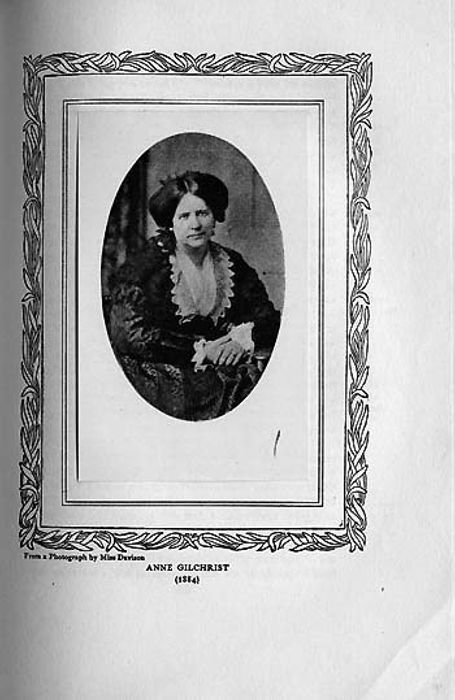 [Begin page 309]thing I can bring you to eat?"
"Perhaps a little ice cream, Tom—nothing more." Suggested Mrs. Harned should come to see him tomorrow: "She knows my ways, as you do"—adding: "But don't bring any others in—except"—turning to me—"your mother and father, Horace, and Agnes, and Anne Montgomerie. [See indexical note p309.1] Give my love to all the rest—explain that I am tied down to my chair here—that my head needs to be humored, coddled, for a few days. I ask for a few days' furlough—that is all!"
[Begin page 309]thing I can bring you to eat?"
"Perhaps a little ice cream, Tom—nothing more." Suggested Mrs. Harned should come to see him tomorrow: "She knows my ways, as you do"—adding: "But don't bring any others in—except"—turning to me—"your mother and father, Horace, and Agnes, and Anne Montgomerie. [See indexical note p309.1] Give my love to all the rest—explain that I am tied down to my chair here—that my head needs to be humored, coddled, for a few days. I ask for a few days' furlough—that is all!"
W. asked me: "Did you read the will? What do you think of it?" [See indexical note p309.2] I had not read it. Turning to Tom: "Let Horace see it, Tom: he is quite as much concerned in it as the rest of us—the sin is on his soul, too." Harned went out to get W. some ice cream—was away about half an hour. We helped W. to his bed before Harned's departure. While H. was gone we continued to talk, W. again referring to the will: [See indexical note p309.3] "I do not think I need to explain why I have left myself in your hands in this matter—Doctor's, Tom's, yours. I might say it this way: I feel more secure in your hands: I hardly need to say anything beyond that." W. a little merry about his condition the other day. [See indexical note p309.4] "Was I a little daffy? Did I talk nonsense? That was only a mood: Horace, I do not think my mind will ever go: I think I will go before my mind goes. The throne may occasionally reel but it never gives way."
W. passed over to me an old 1882 letter from O'Connor. "There's something in it from Professor Loomis about Emerson. [See indexical note p309.5] I know you think William made rather too much of Emerson's endorsement: I guess I do too: but William treats the whole business with such a magnificent swing that it is almost convincing. I want you to put these letters with your other Emerson-Whitman documents. You will have twenty chapters to your Emerson story by and bye." He was quiet for a few minutes. I did not break in. Then: [Begin page 310] "It is O'Connor's theory that the enemy made too much of their charge that Emerson repented of his 1855 letter—that the charge is baseless, that all kinds of evidence exists to that effect. [See indexical note p310.1] From that point of view you can see that such testimony as this given from Loomis is not only in order but probably very significant, if not conclusive."
By this time Harned was back with the ice cream. W. sat up with his legs hanging out the side of the bed and ate the cream eagerly, saying to H.: "Tom, you are a buster! This is the best thing I have tasted today!" W. afterwards laid down again and we withdrew. I went with H. to his home. [See indexical note p310.2] Read the will. Talked about it. [This will hung fire between Harned and W. until the 29th, passing back and forth.] The will was finally thus endorsed: "Last Will and Testament of Walt Whitman in his own handwriting properly witnessed June 29 1888." This is the will:
The last will of Walt Whitman written by himself June 29th, 1888, at Camden, New Jersey.
[See indexical note p310.3] I give one thousand dollars to my sister Mrs: Mary Elizabeth Van Nostrand of Greenport, Suffolk county, New York State, to be paid to her by my executrix or executor within six months of my death.
I give one thousand dollars to my sister Mrs: Hannah Louisa Heyde of Burlington Vermont—the time and payment thereof to be left to the discretion of my executrix and executor. [See indexical note p310.4] I also give one hundred dollars additional to be immediately paid to Mrs H L Heyde to be handed over if she feels to do so, to her husband Charles L. Heyde.
[See indexical note p310.5] My house and lot 328 Mickle street Camden New Jersey—and all my furniture—and all my money in the bank whatever—and all estate and property—I hereby give bequeath and devise to my brother Edward L Whitman (now boarding at the farm of Mr. and Mrs: Goodenough near Moorestown New Jersey).—As the said Edward L Whitman is mentally [Begin page 311] incapacitated I appoint and specify the hereinafter executrix and executor—to have sole and legal ownership, sale, direction, &c. for the fullest possible manner in the said spoken of property and money.
[See indexical note p311.1] I wish the Executrix and Executor of my will should be my sister in law Mrs: Louisa Orr Whitman and my brother George W Whitman (now resident at Burlington New Jersey, husband and wife)—these two I wish possessed whole and several ownership and legal control of all my effects, money, of my house and lot 328 Mickle Street—Also that my said executrix under this will is hereby comprised as sole and complete executrix as and whenever she thinks proper. [See indexical note p311.2] I mean in my name to empower in all means for this money and property as trustee and executor by her the said Mrs: L O Whitman for the use of said my brother Edward L Whitman.
[See indexical note p311.3] I also give and bequeath two hundred and fifty dollars ($250) to Mrs. Susan Stafford wife of George Stafford, now of Glendale, Camden county, New Jersey.
[See indexical note p311.4] I give and bequeath two hundred and fifty dollars ($250) to Mrs Mary O Davis, now of 328 Mickle street Camden New Jersey.
[See indexical note p311.5] I give to my brother George W Whitman the portraits of my father and mother (two small oil paintings and one framed photograph) and one old large Dutch portrait—four altogether—for said G W Whitman. Also the big mahogany table to said George W Whitman.
[See indexical note p311.6] I give to Thomas Donaldson the big arm chair presented to me his children. I give to Harry Stafford of Marlton New Jersey my gold watch. I give my friend Peter Doyle the silver watch.
[See indexical note p311.7] I desire that my friends Dr R M Bucke of London, Ontario, Canada, and Thomas B Harned, of Camden, New Jersey, and Horace L Traubel, of Camden, New Jersey, shall be absolute charged of my books, publications and copy- [Begin page 312]rights, and to manage and control the same—and make such use as they decide on my literary property and copyrights—any profits arising therefrom to be paid to my executrix or executor as before specified
[See indexical note p312.1] I give to Al Johnston, Jeweler, of New York City my second arm chair, ratan seated. I give Mrs. Mapes, twenty dollars ($20). I give Mrs. Nancy Whitman, my brother Andrew's widow, fifty dollars ($50).
In sign of my writing my name
WALT WHITMAN
all the above in
Walt Whitman's
handwriting
In testimony of the following witnesses present
Mary O Davis., Nathan M. Baker.
[See indexical note p312.2] Harned and W. had another tiff about the legality of this paper. H. said: "It can't be mistaken but it won't hold.". W. a bit nettled retorted: "It'll hold all well enough I'd bet, Tom. Anyway, it need not be final: we can set it straight any time."
Now for the O'Connor letter. W. Says of O'Connor: "He is always good for a good fight."
Life Saving, Washington, D.C., June 19, 1882. Dear Walt:[See indexical note p312.3] I have yours of yesterday, and am happy in the thought that you find my second letter telling. I think it indicates the line to stick to, and I don't see how Chadwick can climb over it. The enemy would give much to be able to break down the Emerson letter. That is what they will try to do, and my reply to Chadwick will make it harder than ever for them. [See indexical note p312.4] When we get them fairly shut up on that point, we will proceed to further action.
Meanwhile, be careful not to make any unguarded admissions, so as to call for defence. We must not be detained [Begin page 313] on side issues. I burn to resume the thunder and let the levin fly at Marston. He need not think he is going to escape. At present I am only perplexed by the problem how to make the other side fight. [See indexical note p313.1] So far, the affair is too much one way, and they seem cowed. Oh if you only had a publisher! What a chance for advertising is slipping by.
I am anxious not to be dragged away from the main question into the discussion of side issues, and am therefore in doubt whether to reply to "Sigma." Of course, it is a fine chance for the catawampus chaw, as this bogus "experienced critic" will find out if I go for him, but it seems too much like being drawn away from the trail. [See indexical note p313.2] On the other hand, The Tribune invites my attention to Sigma's "assertion" about the "disgusting Priapism," which is, of course, a disgusting lie, and I have to make up my mind whether the point is worth scoring. I have been talking today with Professor Loomis who was up in Concord when Emerson's letter was published, and heard him talk on the subject. He says Emerson's enthusiasm about the book was great, and that he never said a word, nor assumed any tone, pointing to any discount or qualification. [See indexical note p313.3] Emerson's prominent consideration about Leaves of Grass was its newness. He spoke of it as absolutely a new manifestation of literature—a fresh revelation. Professor Loomis is very strong about the impossibility of Emerson ever having gone back upon his letter. The tone he took, he says, precluded this. He says that undoubtedly Emerson was subsequently much annoyed at what the publication of the letter brought upon him—the swarm of "trippers and askers" that surrounded him with demands as to how he could defend such a passage as this, and what he had to say to such an expression as this, etc., etc., and that he may have expressed his annoyance, said petulant things, wished you more than once at the devil, etc., but that was all, and that he never qualified his original utterance—never! [See indexical note p313.4] This is Professor Loomis' view—a dis- [Begin page 314] tinguished man, a witness—and it has weight and force at this time.
[See indexical note p314.1] Thoreau, he said, was equally or nearly equally, strong in favor of Leaves of Grass, and so were the other Concordians. All this knocks the "disgusting Priapism" assertion endways. Of course we must expect all sorts of hardy lying, but we must allow nothing and demand proof of everything alleged.
Another question is as to the genuineness of the Sigma letter. The Tribune editorial shows a desire to put in something as a makeweight, and to seem biased against me, while admitting my letters and letting me do all the mischief I can, and Whitelaw Reid's notes to me have a cordial tone which sustains this view. [See indexical note p314.2] Hence the Sigma letter may be got up as a counterpoise. At any rate, it is let in in sham equity. If genuine, who wrote it? Sigma is the Greek letter S, which might stand for Spofford, the librarian of Congress, who is unfriendly to you. [See indexical note p314.3] I will decide soon whether to answer this serpentine signature.
Apropos, Professor Loomis says he wrote to you for a copy of your book, which he is anxious to get. I wish you would let me know the price, as I have enquiries on this point, and can only suppose it is two dollars, like the Osgood.
I sent John Burroughs one of yesterday's Tribunes, which I hope will reach him.
The day here is bad for heat, and I sit soaked, after a sleepless night, not fit to write a letter or anything else. Congratulatory epistles continue to flow. All taffy so far, except "Sigma," whose lucubrations make me think of dear old Gurowski's phrase of objurgation—"Sir, you are an asinine assish ass!" [See indexical note p314.4] This is too mild, but nevertheless it faintly describes Sigma.
Goodbye. Faithfully, W. D. O'Connor.Wednesday, June 13, 1888.
[See indexical note p315.1] Received from Ferguson today three sets proofs entire Sands at Seventy except the pages held by W. for additions. dropt in at W.'s in morning. Still asleep. Baker said not so well. In the evening there again, at 7.45, finding Harned already arrived. W. himself on the bed, clothed, seeming physically depressed though mentally cheerful. Greeted me by name and took my hand rather heartily. Talked of various things, but mostly about the book. Complained: "I have had a poor day—very poor: the jelly-like sensations, in my skull, have been persistent: I do not know how to account for them. [See indexical note p315.2] My body seems to lack in electric force—is not quick, does not respond." Had not touched the proofs today nor received any callers—"except one—a stranger—who was admitted for a trice, a handshake—was then dismissed: some one I never knew or had forgotten but who claimed that he had exchanged books with me two years ago."
[See indexical note p315.3] W. was very ready to talk in spite of being, as he said, "in rocky shape." Donnelly's book still on his mind. "I attribute a good deal of that cipher business in the Donnelly book to Donnelly's love of marvels—his inclination to do natural acts in unusual ways. I read a story once of a man who was thought remarkable because possessed of the power to see with his eyes shut—yet it was Emerson who said that it was not stranger that a man should see with his eyes shut than to see with them open." [See indexical note p315.4] Baker said he had seen and heard Donnelly often. Baker is from the West. "Was he not that kind of a man, Mr. Baker?"—and then: "If I was to write a book on philosophy I should devote a chapter to the discussion of this point. You know, I did not get as far as Donnelly's cipher: yet the plays are I am sure full of mysteries in which I am sure Bacon had a hand. [See indexical note p315.5] Doctor Bucke concedes a good deal of weight to the first part of the book though he seems to reject the cipher—at least in the main. Doctor is rather cute, too—very mathematical."
[Begin page 316]W. asked me: "Did you see the will at Tom's last night? Do you approve of it? Tom seems to think it lacks a certain legal verity: I do not myself think it can be misunderstood." [See indexical note p316.1] Again: "More and more as I grow old do I see the futility of calculation: refuse myself illusions—try not to get into the habit of expecting certain things at certain times—of planning for tomorrows, the eternal tomorrows, that never come quite as we arrange for them." [See indexical note p316.2] Asked about his own condition he said: "I think my diet needs some careful revision, though I am not a reckless eater any time. [See indexical note p316.3] We can—if we learn how—regulate diet for ourselves but can regulate it for no second person: one man's taste may be as different—is sure to be—from another's as meat is different from a potato."
W. remarked that he had received several "very pithy notes" from friends—"nothing too much said, just a few words to the point—sympathetic, loving, very precious," adding: "The modern letter is less elaborate and more like reality. [See indexical note p316.4] A century ago—Oh, not so long ago, even fifty years, in my memory—letter writing was itself a profession about which men set much store; not a pastime, an act of a moment, for a direct expression of some necessary fact—then silence; but real work, involving time, quiet, patience. I was never a fulsome correspondent myself—wrote no superfluous letters: wrote very deliberately: often made a draft of my notes. [See indexical note p316.5] I rarely do that now—very few people do it—except, of course, in official and business circles. I have given you drafts of several of my old letters: you have seen how extra-cautious I was: that was long ago. It involved a lot of useless work—made a man a slave: a long letter was half a day's job: God! I used to sweat over it even in cold weather."
[See indexical note p316.6] Speaking of the early experiences of Hicks up on the Long Island shore W. says: "I am convinced that the songs of that Quaker evangelism, the old songs, would today be precious, [Begin page 317] inestimably precious—a suggestion of the old English balladry, if not in themselves so symmetrical—if brought to light after their long burial, after their disappearance in the historical background." [See indexical note p317.1] W. asked me about his two compositors. "I am sorry for them—they must suffer because I am on my back: I feel guilty." He fumbled in his vest pocket and drew forth a silver dollar. "Give this to the prooftaker, Horace: I wish him to have it. He is giving me beautiful proofs—his proofs are clear, dark, on good paper. Why, Osgood used to send out the worst paper he could find—even Rand & Avery's proofs were only indifferently good. [See indexical note p317.2] Don't give that dollar to the boss—give it to the man." I picked up from the floor a bit of loose paper on which W. had copied a note about himself from the Nineteenth Century for December, 1882. He saw me do it and asked: "What's that?" I told him. "Read it," he said—"read it aloud." I did so:
[See indexical note p317.3] "Magnificent in his war-cry, as in the Song of the Banner at Daybreak, and his note of triumph, 'The War is completed, the Price is paid, the Title is settled beyond recall.' Yet finer still is the Vigil on the Field of Battle,—the memories of the hospital tent, with its rows of cots—the vision of the Mother of All gazing desperate on her dead—the reflection on those 'camps of green' where friend and foe without hatred sleep, and not any longer provide for outposts, nor word for countersign, nor drummer to beat the morning drum."
[See indexical note p317.4] "That sounds first-rate," said W., when I was through, "it shows that somebody there has assimilated me—has drunk my full cup. So many of the fellows this side complain of the attention I have received in England—look at it with a sort of jealousy or with a sort of contempt. Then they say I defer too much to English opinion in my favor. That's all bosh—I defer to nobody—I do my work. [See indexical note p317.5] That I recognize the English good-will is true enough—if I didn't [Begin page 318] I would be a miserable whelp. There are some people here who not only don't want me, won't have me, themselves, but insist that no one else anywhere shall have me. Well—let them dispute that with themselves—settle it with themselves. [See indexical note p318.1] I have been crying hello over the Atlantic to a few mighty affectionate men and women who have been crying hello to me. If that is a crime—well, try it, convict it, sentence it, as a crime, that is all I can say."
W. asked Baker for calomel on Sunday night. Baker would not "say yes without the doctor's permission" W. looked at him an instant rather dubiously and then said, closing his eyes: "You're rather literal, Doctor, but I guess you're right, you're right!" Harned left while I was still talking with W., who was saying to me: "Use your diplomacy over at Ferguson's: work for time—delay, delay, without seeming to delay. [See indexical note p318.2] In a day or two I will be well on my pins again—then we can resume operations with extra vigor."
Baker left the house for ten or fifteen minutes, asking me to staytill he came back. W. said hardly anything during that time. He looked pretty well tuckered out. He did, however, send me over to the table by the window for the notes of a Dowden letter which he had laid out for me. [See indexical note p318.3] "I have given you some of Dowden's letters to me—here is a letter from me to Dowden: it is the other side of the shield! We were just talking of letter writing awhile ago—the old and the new: this is a case in point. I suppose I have done a lot less general letter-writing than most men—I was not a voluminous letter writer—when I wrote at all it was mainly with a very definite notion of something very practical that needed to be said. Imagine a Niagara like O'Connor stopping its flood to take account of stock! [See indexical note p318.4] Imagine William trying to hold back his epistolary current while he made a tally of it! A slow duffer such as I am might do [Begin page 319] it—I did do it: nothing ever came to me in a hurry: even my storms came taking their time. But William?—never! never!" [See indexical note p319.1] Was there anything in particular to be remarked by me in this letter to Dowden? "No: it will serve to complete some of your records—that is all: will add the web to the woof—show you what went back to as well as what came from Ireland those days: that is all! that is all! Horace, I don't think you could hardly realize how grateful such friendships were to me in those days—when so many were against me the few who were for me were extra, extra precious! [See indexical note p319.2] Dowden was one of the few—the sacred few: the everlastingly sacred few."
W. asked me to put the light down. Said: "I'm clean tired out—I must not talk any more. You say you did see the will? That was right. And Ferguson? Go right there in the morning—explain the situation." I kissed him good night. Baker returned. I left.
W. had written on the Dowden sheets: "Prof. Dowden. Went on steamer Jan 20 1872." Written from Washington on Department of Justice Paper.
Jan. 20, 1872. Dear Sir[See indexical note p319.3] —I must no longer delay writing and to acknowledge your letters of Sept 5 and Oct. 15. I had previously (Aug 22) written you very briefly in response to your friendly letter of July 23d—the first you wrote accompanying copy of the review. All—letters and review—have been read and re-read. I am sure I appreciate them and you in them. May I say that you do not seem to be afar off, but stand very near to me. What John Burroughs brings adds confirmation. [See indexical note p319.4] I was deeply interested in the accounts given me by you of your friends—I do not hesitate to call them mine also—Tyrrell, Cross, your brother, Miss West, Todhunter, O'Grady,—Yeats, Ellis, Nettleship. Affectionate remembrance to all of them. You especially and Mrs. Dowden—and indeed all of you—already I say stand near to me. I [Begin page 320] wish each to be told what I write—or to see this letter when convenient.
[See indexical note p320.1] There is one point touched by you in the Westminster criticism that if occasion arise should be dwelt on with more stress—and that is defended—stating the attitude of general denial and sneering which magazines, editors, authors, publishers, "critics," &c. in the United States hold towards Leaves of Grass and myself as author of it. As to Democratic Vistas, it remains quite unread, uncalled for, here in America.
[See indexical note p320.2] If you write again for publication about my books, or have opportunity to influence any forthcoming article on them, I think it would be a proper and an even essential part of such article to distinctly include the important facts, (for facts they are,) that Leaves of Grass and their author are contemptuously ignored by the recognized literary organs here in the United States, rejected by the publishing houses here, the author turned out of a government clerkship and deprived of his means of support by a Head of Department at Washington solely on account of having written the book.
[See indexical note p320.3] I say I think the statement of these things proper and even indispensable to any complete foreign criticism of my poems. True, I take the whole matter very coolly. I know that my book has been composed in a cheerful and happy spirit—and that the same still substantially remains with me. (And I would like my friends, indeed, when writing for publication about my poetry, to present its gay-heartedness, as one of its chief points.)
[See indexical note p320.4] I am in excellent health and still employed as a clerk here in Washington. I saw John Burroughs very lately: he is well, and showed me a letter he had just received from you. I wish more and more (and especially now that I feel I know you, and should be no stranger)—to journey over sea, and visit England and your country.
[Begin page 321]Tennyson has written to me twice—and very cordial and hearty letters. He invites me to become his guest.
[See indexical note p321.1] I have received a letter from Joaquin Miller. He was at last accounts in Oregon, recuperating, studying, enjoying free nature, and writing new poems.
Emerson has just been this way (Baltimore and Washington) lecturing. He maintains about the same attitude as twenty-five or thirty years ago. [See indexical note p321.2] It seems to me pretty thin. Immense upheavals have occurred since then, putting the world in new relations. I send you a newspaper report of his lectures here a night or two ago. It seems to be a fine average specimen of his current lectures.
And now my friend, I must close my letter. [See indexical note p321.3] I have long wished to write you a letter to show that I heartily realize your kindness and sympathy, and would draw the communion closer between us. I shall probably send you any thing I publish, and any thing about me from time to time. You must write freely to me, and I hope frequently.
Thursday, June 14, 1888.
No proofs for Ferguson today. Delivered Walt's dollar to the proof-taker. Wrote to Bucke. The book is practically held up. In to see W. at 7.45. [See indexical note p321.4] (Had stopped in the morning: W. then asleep, "not looking very well," Baker said.) He was sitting up but asked before long to be assisted across the room to his bed. Had examined but three pages of proofs today. "I did not feel like ittill nightfall—then when I got to work my head gave out. I find my digestive apparatus still fitful—still unwilling to do its work smoothly. [See indexical note p321.5] First it fires up—raises hell—then it gets down so low we have to bust our lungs blowing it into flame again." Laughed. "You'll be nothing but a heap of ashes by and by." "That's so." Frank Williams and his wife were over today—also Osler—but there were no other visitors, except, of course, Harned, who came twice. W. wrote several notes and looked [Begin page 322] a little through the papers. Addressed Baker humorously: "Have I been a good patient today, Doctor?" [See indexical note p322.1] B. replied: "Pretty good." Thereat W. concluded: "You hear, Horace, he only says, pretty good: he still finds me a little rebellious."
Had W. yet been able to read Frank Williams' American paper? "I have looked it through—that's all. I can't read with much comfort—I don't have any consecutive grip. But I see Frank is all right—I of course take Frank for granted: he knows what our claims are: I guess Frank would indorse my note anytime." [See indexical note p322.2] Yet for all in all he had been much better today. Harned once or twice addressed questions to W. about the will but W. had pushed them off. Baker says W. is really "very obedient"—adding: "After the kick when I first came I expected to have a lot of trouble with him. Mr. Whitman is a very amiable man." Catching him in the act of saying something petulant concerning women Baker cried: "I supposed from your books that you entertained quite other feelings about women." W. at once came down. [See indexical note p322.3] "So I do: the books are right—I am wrong: I don't believe any man ever lived who was more fortunate in the friendship of good women." Baker put in a question I did not catch. W. then said: "I don't mean respectable women, so-called—I mean good women."
[See indexical note p322.4] I read W. two letters written by Edward Emerson to Sidney Morse about Morse's bust of Ralph Waldo. E. E. acknowledged the beauty of the bust but criticised the mouth. W. negatived E. "I think that Emerson's mouth: indeed, the whole of it, the whole, head, his: Sidney has hit home sure. A son, of course, is more sensitive to points we would not see or would dismiss. [See indexical note p322.5] How good the letters are!—and true, too—which is better. Sidney has caught the spirituality of the man—the parchment-like rarification of the face: a sort of worldless something that always distinguished Emerson: Emerson seemed some ways short of earth."
[Begin page 323]I said at one moment: "Ah! Walt—you know we all love you!" [See indexical note p323.1] He smiled: "It does me good to hear that—puts a little blood back in my body, Horace—and I think you all—all—for it." "And do you know, Walt, we thought Sunday that you were dying?" "So did I, Horace—and Bucke did, too, I know, for he took off his coat, rolled up his sleeves, buckled to, saved me. I thought I was having my last little dance. I am fortunate in being so surrounded, cared for, sustained." Sent me over to the table to hunt for a book. [See indexical note p323.2] "I want you to take it to your father. I know an artist is interested in the pictures of other artists. Look for it: a red-covered Pall Mall extra containing the pictures of the year." I found it and handed it to him as he sat up on the edge of the bed. "Are you sure that's it?" he asked—answering his own question by saying: "No—that's not it." Handed it back to me. "Look on page 66—see if my picture is there—Herbert's." Yes, it was there. [See indexical note p323.3] "I was sure that was not the book: my mind nowadays plays me strange antics—confuses shapes, sizes, colors of things." After a quiet minute or two: "I seem to be mentally so sluggish—things come slow: not falsely, but slow." I had of course noticed this myself. Tonight we discussed several little matters having to do with the book. [See indexical note p323.4] He would say: "Repeat that, Horace," or, "Go over that again, Horace," or "I don't quite catch on," or "How's that?" finally saying of himself: "I seem to be developing into a damned dull scholar, Horace." In essentials, however, it would be difficult to detect any break. [See indexical note p323.5] "I know well enough that this indoor life is gradually sapping me of all vitality: I need the fresh air—I need activity."
The Courier today had printed some alarmist reports about W., originating in the telegram sent to Osler and in something of a depressing nature that Harned had been heard to say. [See indexical note p323.6] Baker says W. is always more or less confused when first up in the morning. W. is in his chair every [Begin page 324] day part of the time but has not yet been able to give any connected attention to his work. Has not yet been out of the room. I met Brinton in Philadelphia today. W. heard me say so and asked: "Did he question you about me?" [See indexical note p324.1] "Yes, at once, and very affectionately." "'Thank you Brinton—that's what I should have expected.' Brinton is a brick, Horace. Brinton has been translating some native Indian poetry: I do not forget that he promised to come over with you some day and read me some of his versions. I like the first things of peoples—the child things." [See indexical note p324.2] W. said again: "There was a German band out on the street today—not too near: they played a couple of songs—O they were very good songs: folksongs, perhaps: anyway, excellent. I hated to have the band go: it helped my head. I do not think I could have stood it close by. After a drum and fife corps had gone through the street yesterday I felt as if my head had been thumped with a thousand vicious fists!"
[See indexical note p324.3] W. asked me: "You know about the American Institute poem, don't you? "Know about it? Know what? I have read the poem often enough." "I don't mean that—I mean its history—genesis? I tied up in a string for you these several letters—the correspondence—invitation—my answer—such things—you will find the packet on the table. You have got it? Yes? Yes—I meant it for you. [See indexical note p324.4] After All not to Create Only, it was called at the time: Roberts Brothers put it into a booklet: now I use it under another title—Song of the Exposition. Did I ever tell you that I knew Garfield in Washington? He had read this poem—liked it. When he saw me coming along Pennsylvania Avenue he wouldn't salute me by name but would raise his right arm and chant that line, 'after all not to create only,' and then laugh, as I did, and Pete, too, when we were out together and met Garfield, as happened several times. [See indexical note p324.5] It rather staggered me at the time to receive the invitation to make this poem: I was everywhere, practically everywhere, [Begin page 325] disavowed—hated, ridiculed, lampooned, parodied; rejected by the notables everywhere. Then this invitation came. [See indexical note p325.1] Of course my inviters were criticised for inviting, I was criticised for being invited—for accepting—all kinds of impolite things were said, mostly for my benefit: I even got a few anonymous letters from people who wanted to tell me 'the plain truth,' as one of them said. But the thing went off—went off all right—yes: was its own kind of success. I've only had a few such occasions to take care of. William told Eldridge or somebody that I should have had the poem for the Centennial—that Bayard Taylor was unfit—that no one but Walt Whitman could have proved equal to the exigency: but William found few to take his view of the matter. [See indexical note p325.2] I do not seem to belong to great show events—I am more like nobody than like somebody, as some funny man says—I was more used to being kicked out than asked in: I always went to the big pow wows with the crowd, to look on, not with the nabobs, to perform."
I said to W.: "In one of the Dowden letters you gave me Abraham Stoker is mentioned. Is that Bram Stoker, Irving's man?" [See indexical note p325.3] "Yes, that's the man—Bram for short, for better. I have heard from him direct—letters (some of them long ago)—he has personally been here—has given every evidence of being staunchly on my side."
[See indexical note p325.4] We talked no more. W. said: "If I don't let up, Baker there"—Baker was not in the room at the moment—"will set up a growl. Besides—I ought not to talk any more. Go to Ferguson tomorrow again—tell Ferguson I am better today, will be better still tomorrow—that our machine will soon be going again full speed." Kissed W. goodnight. As I left he said: "Do not fail to write Bucke right along—write Burroughs—write to William O'Connor. [See indexical note p325.5] Take that little bunch of letters off the table—the bunch in the rubber band—they are mostly from people I do not know—loving messages—look into them—answer for me to any of them that [Begin page 326] seem in your judgement to require some recognition." I took these letters home with me and spent two hours examining them. Wrote a dozen replies. Sometimes W.'s correspondence gets voluminous and keeps me working steadily until daybreak. [See indexical note p326.1] He will occasionally dictate a little note which I will take down in longhand. Laughing once he said: "We ought to have a firm signature." And on another occasion he remarked: "I will have to give you a power of attorney so that our business need not come to a standstill when I get in the dumps."
Examining the American Institute papers I find the invitation, the acceptance, a letter to Robert Brothers and a New York Globe Editorial.
I.
American Institute, New York, Aug. 1, 1871. Walt Whitman Esq. Dear Sir:[See indexical note p326.2] Aware of the kindly and generous interest you take in the welfare and progress of the American Institute, the Board of Managers of the fortieth National Industrial Exhibition have instructed us to solicit of you the honor of a poem on the occasion of its opening, Sept. 7, 1871—with the privilege of furnishing proofs of the same to the Metropolitan Press for publication with the other proceedings.
With profound respect, George Peyton Chas. E. Burd James B. Young Com. on Invitations.We shall be most happy, of course, to pay travelling expenses and entertain you hospitably, and pay $100 in addition, if agreeable to you, so as in some sort to make amends for your trouble.
II.
Department of Justice, Washington, Aug. 5, 1871. Messrs. George Peyton, Chas. E. Burd and James B. Young, Committee on Invitations Dear Sirs:[See indexical note p327.1] I have received your letter of 1st instant containing your invitation to deliver an appropriate original poem at the opening of the 40th Annual Exhibition of the American Institute, Sept. 7, and stating terms, &c. I accept with pleasure, and shall be ready without fail to deliver the poem at the time specified.
Address me here if anything further
III.
Department of Justice. Sent Sept. 17, 1871. Washington.[See indexical note p327.2] I send herewith the copy of my American Institute Poem. It will be plain sailing, if you have a careful printer and proof-reader. I think an ordinary twelve mo would be best, and send you a sample, my idea of size of page, and sort of pamphlet-volume to be made. As to size of type for the poem—If English solid would not be too large, I would like to have that. If you think it too large take the next smaller size. In binding let the edges remain uncut and bind in the kind of paper according to sample. See sample of title and cover. Send the revised proofs to me, by mail, directed to this city, and I will promptly return them.
My per centage &c. I leave to you. I should expect two or three dozen copies. I reserve the copyright myself.
That the papers have freely printed and criticized the piece will much help, as it awakes interest and curiosity, and many will want to have it in good form to keep. The [Begin page 328] demand will grow. I have no authority to speak for them, but I think the American Institute will want several hundred copies, and that the pamphlet will have a sale at all their public Exhibitions and Fairs. They always have book stands at them.
It ought to be put in hand immediately, and out soon.
IV.
[Globe editorial, Thursday evening, September 7, 1871, under this headline: Our great Poet.]
[See indexical note p328.1] America has one man who is recognized in the Old World as a great poet. Swinburne places him by the side of Victor Hugo, whom he counts as the first of living poets, and recently Tennyson has invited him to his residence as a guest. Long ago our own Emerson wrote in terms of highest commendation of him, and when his first book appeared he desired to leave his daily work, and personally congratulate the new poet. This evening this poet, who is regarded with indifference by most of the American poetry-reading people, will deliver a poem at the American Institute Fair upon the occasion of its opening. [See indexical note p328.2] The reader by this time understands that we refer to Walt Whitman, the author of Leaves of Grass, Drum Taps, etc. What other American poet has ever been honored like this? A few years ago Charles G. Halpine was invited to read a poem upon a similar occasion, but owing to a habit of which he was a victim, he was unable to appear when the time arrived. There is something very very appropriate in asking Walt Whitman to read a poem before an organization of which Horace Greeley is one of the prominent members. If the tradition about Mr. Greeley's personal appearance is correct, Whitman resembles him in dress. [See indexical note p328.3] He wears baggy pants, his coat is too long for him, his hair and beard are long and white, he wears a slouched hat, and keeps his [Begin page 329] shirt open, displaying a naked breast. He carries his hat in his hand as often as on his head; he often walks up and down Pennsylvania Avenue in his shirt sleeves; sometimes he sits down on the curbstone and reads his mail, and he always delights in being seen, and having people know who he is. [See indexical note p329.1] In all this he has a striking resemblance to Horace Greeley, and there are those who say his Leaves of Grass contain as much poetry as What I know of Farming.
Such a poet as this, who will sing of mowing machines, steam engines, soap, soda water, and potatoes, ought to fill the Skating Rink this evening to overflowing. We should honor him for the reputation he has abroad. It would astonish Longfellow and Lowell to travel in England, and learn how highly Walt Whitman is regarded. His poetical works have been republished in England, W. M. Rossetti editing one edition of them. [See indexical note p329.2] Lord Strangford has reviewed them in the Pall Mall Gazette, the Broadway; and the Fortnightly Review, the Saturday Review, and other publications, have noticed him, nearly every line which has been printed being favorable.
Mr. Whitman was born at West Hills in 1819, in this State. He has an official position in Washington, which yields him a small salary, too small, we learn, to allow him to accept Tennyson's invitation. During the war he was a frequent visitor at the hospitals in and around Washington, bringing cheer and comfort to many a poor soldier. During this time he worked for the government for one hundred dollars a month, he slept in a garret, ate frugally, wore mean clothes, and spent seventy dollars a month for the sick soldiers. [See indexical note p329.3] Whether his poetry is popular or not in this country, he is a whole-souled fellow, and as such will be worthy of a hearing this evening. He is the best man we know of to open the American Institute Exposition.
Friday, June 15, 1888.
Took to Ferguson proofs of Sands to page thirty-six, approved. Received in return from Ferguson three galleys on the Burns essay. Wrote to Bucke. [See indexical note p330.1] W. says: "Keep Doctor informed about things here: don't make the situation any worse than it is—make it a trifle better. Doctor is inclined to extreme views himself." In with W. at 7.45 evening. Found him alone fumbling about his room for a match. My offer to light the gas was rejected, though he used my arm to assist him in doing the thing for himself. He is game. "I won't be helped unless I must be." He asked at once: "Is it true that Frederick is dead? [See indexical note p330.2] Ah yes? It was to have been expected. And what a time there must be in Berlin tonight! I am not so sure of Germany now. There'll be a year or so's grief, or awe, following their loss, and then—who can tell what? [See indexical note p330.3] I have no faith in the young emperor now coming on—in William: he is a proud, narrow martinet—no more: a man who knew so little as not to respect a father and mother noble perhaps beyond the measure of any who ever reigned: a man the reverse of his father in all the good things for which the father stood. I thought we had some reasons for believing that Frederick would make Germany a peace nation." I asked: "But what about getting rid of the kings altogether?" [See indexical note p330.4] "That will come, too: the whole business will go. Meanwhile, we like the best kings better than the worst kings."
W. had read no proofs today but had worked on the Hicks. "I desire to get this into some final shape," he said: "I do not deny I am anxious about it—very anxious. For instance, if I got another blow like that the other day where would it leave me? [See indexical note p330.5] Way up the shore probably—I wouldn't be worth a damn from that time on: indeed, it might finish me right then and there. Now that I am better I am getting back the impulse to work. The Doctor says my pulse is good—very good—indeed, immensely good: and today I [Begin page 331] have had an effective bowel passage which seems to have cleared up the weather. It is wonderful, when you come to think of it, how much of a man is centred in his belly: the belly is the radiant force distributing life." [See indexical note p331.1] Then again: "I always feel tired. Although I am much better than yesterday I still rest under the old cloud—contend with the old indisposition to move about and work. I spoke awhile ago of the 'impulse' to work. It is hardly that—it is rather necessity. I want to see November Boughs through. Your sister sent me some more of her homemade cream, and oh! it is so deliciously taking! Cookery is so much of it genius—an art, by itself—one of six, one of ten, perhaps even more, only can do it justice. [See indexical note p331.2] How much is in a good bowl of coffee, a pot of potatoes—done just right. Some of my best experiences that way were among the soldiers—not always, but often: the whole affair going together—men, the place, everything. Your sister is an artist: she not only knows how to cook—she seems to know when I want particular things."
W. gave me a handful of letters received today and yesterday. "Look them through—answer them; they are all so sweet to me. Explain that I am too disabled to write myself just now. O'Connor has written but about nothing in particular. [See indexical note p331.3] I still remember Frank's visit yesterday: he came with his wife: Frank is always fortifying." W. laughs more than a little at the newspaper reports. "Do you see the papers? According to the papers I am crazy, dead, paralyzed, scrofulous, gone to pot in piece and whole: I am a wreck from stem to stern—I am sour, sweet—dirty, clean—taken care of, neglected: God knows what I am, what I am not. [See indexical note p331.4] The American newspaper beats the whole world telling the truth, the whole truth and nothing but the truth! But the Post account tonight—look it up there in the personal column"—indicating a paper—"is the fairest I have seen. Bonsall prints only a few conservative words [Begin page 332] probably inspired by Baker here. The Springfield Republican represents me as being in 'violent delirium' Sunday night."
Morse writes about his mother. [See indexical note p332.1] Mothers always make a special appeal to W. "I know of nothing more beautiful, inspiring, significant: a hale old woman, full of cheer as of years, who has raised a brood of hearty children, arriving at last at the period of rest, content, contemplation—the thought of things done." Someone across the street thrums a good deal on a piano. After W. has heard this for continuous hours some days he grows irritable. "She can beat the devil for noise and give him odds." Harned in in the forenoon. [See indexical note p332.2] "Tom brought in a will, embodying monetary and literary provisions—read it to me: it is about what I want. He has doubts about the legality of the will I made for myself. Tom is all right—I see his motive. I kept the will—took it from him—tucked it under my pillow: it is a matter that must be rightly attended to sometime—brought to a head." I saw both of the wills thrown carelessly open on the table. "A confusion of wills," W. calls it.
W. kicks a good deal about visitors. "Visitors," he says, "are so severe a strain, every one seems like half a dozen. [See indexical note p332.3] It is an ominous fact that I cannot stand visitors—the most ominous fact of all—because visitors, friends, lovers, comrades, whatever, are the last things I want to give up. But what can I do with this constant lethargy, languidness, drowsiness, tendency to sleep (when I do not sleep) hanging over me? Sometimes I seem sentenced to death: everything but the date is fixed."
W. said: "You are doing much too much for me nowadays. What can I do for you?" [See indexical note p332.4] "I am not doing anything for you. I am doing everything for myself." W. looked at me fixedly for a moment. Then he reached forward and took my hand. "I see what you mean, Horace. That is the right way to look at it. People used to say to [Begin page 333] me: Walt, you are doing miracles for those fellows in the hospitals. I wasn't. I was, as you would say, doing miracles for myself: that was all. One thing is sure—we seem to be able to work together in the right spirit."
W. never much interested in Stevenson's W. W. essay. [See indexical note p333.1] Said of it today: "Stevenson had a Leaves of Grass spasm: it mostly passed off, I should say: I am always Walt Whitman with an 'if' to some people." This matter came up because W. had found an old Burroughs letter in which the essay was referred to. "The essay and other things," explained W. "You will notice that he mentions Alcott, also. Alcott was always my friend: I have some letters here from Alcott that I want you to see some time. [See indexical note p333.2] It is curious about Emerson that no one who lived close to him ever claimed that he went back on his original opinion of Leaves of Grass."
West Park, Oct. 29, '82. Dear Walt.[See indexical note p333.3] I was much disturbed by your card. I had been thinking of you as probably enjoying these superb autumn days down in the country at Kirkwood, and here you are wretched and sick at home. I trust you are better now. You need a change. I dearly wish that as soon as you are well enough you would come up here and spend a few weeks with us. We could have a good time here in my bark-covered shanty and in knocking about the country. Let me know that you will come.
The Specimen Days &c came all right. I do not like the last part of the title; it brings me up with such a short turn. [See indexical note p333.4] I have read most of the new matter and like it of course. I have not seen any notices of the book yet. I have just received an English book—Familiar Studies of Men and Books—by Stevenson with an essay upon you in it. [See indexical note p333.5] But it does not amount to much. He has the American vice of smartness and flippancy. I do not think you would care for the piece.
[Begin page 334]I am bank examining nowadays but shall be free again pretty soon.
O'Connor writes me that he is going to publish his Tribune letters in a pamphlet, with some other matter; I am glad to hear it. [See indexical note p334.1] He draws blood every time.
I fear poor old Alcott will not rally; indeed he may be dead now. I had a pleasant letter from him the other day. [See indexical note p334.2] I had sent him a crate of Concord grapes.
I am very stupid today. For the past two weeks my brain has been ground between the upper and nether millstones of bank ledgers and it is sore. We are all well. Julian is a fine large boy. Drop me a card when you receive this; also write me when you will come up.
With much love, John Burroughs.
[See indexical note p334.3]
"Well, did you care for the piece?" I asked W. "Yes and no—yes, because it was intended to be friendly—no, because it was not very inclusive. Stevenson left so much of me unaccounted for—so very much: accounted for himself better than for me." Had O'Connor ever put the Tribune articles together? "No—that never happened. A half dozen of O'Connor's pieces bound in one book would have seemed like a battery of guns. [See indexical note p334.4] O'Connor never fell short of—never went beyond—his enemy: he inevitably fired to the right spot. He was a born artillerist—he was a past master in controversy: O'Connor anyhow was a host—O'Connor with the truth was all the hosts made into one." He reverted to Burroughs. [See indexical note p334.5]
"John is a milder type—not the fighting sort—rather more contemplative: John goes a little more for usual, accepted, respectable things, than we do—rather more: just a bit maybe—though God knows he is not enough respectable to hurt—not usual enough to get out of our company."
[See indexical note p334.6] Again: "The best of John is not in the cities—the best of him is in the woods: he gets
[Begin page figure-24]
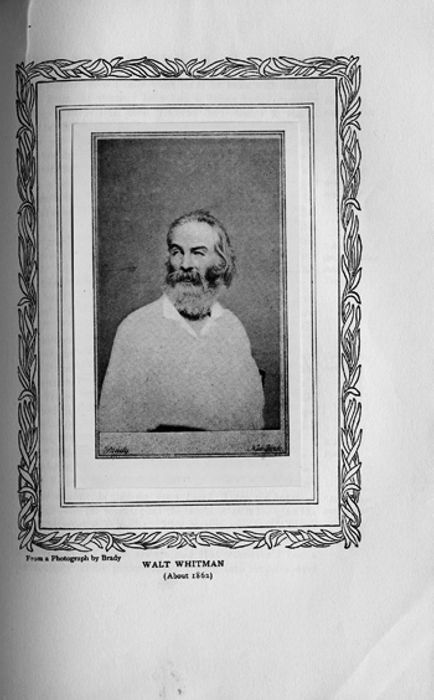 [Begin page 335] to be wholly himself only when he is let loose with himself away from the towns. [See indexical note p335.1] John has a rather better concrete feeling towards men than Thoreau had—seems to me to have better learned the lessons of the open air." Asked me: "Are you writing some yourself right along? Don't stop your writing: you will soon be on good terms with yourself: difficult things will come easier, easier, easy. [See indexical note p335.2] Above all, write your own way: don't take my word for anything—anyone's word—just take your own; follow your own intuition about it all, feeling sure that in the long run no other guide can lead you so surely to the truth." Was advice never good? He laughed quietly and concluded: "Certain things advised may be good, but advice?—no, it is never good! [See indexical note p335.3] Advice forces its way into the temple—it don't belong there."
W. said he and Baker were "getting along famously together." But he hated the idea of "being under watch and ward." "When a man comes to my pass he'd best take the next step as quickly as possible." "But you seem in no hurry to take the step." [See indexical note p335.4] "Except for the work we have to do I would be quite willing—ready—even anxious to take the next step. But that work—that work: we must get it done before I write down 'finis' next my name." Kissed W. good night. He was weak but pretty clear about things. Tired—overslow in talk—finding it hard to gather himself together. W. gave me a Brady portrait of himself. I said: "It has a rather ascetic look for you." [See indexical note p335.5] "So it has—a sort of Moses in the burning bush look. Somebody used to say I sometimes wore the face of a man who was sorry for the world. Is this my sorry face? [See indexical note p335.6] I am not sorry—I am glad—for the world: glad the world is as it is—glad the world is what it is to be. This picture was much better when it was taken—it has faded out: I always rather favored it. William O'Connor always said that whenever I had a particularly idiotic picture taken I went into raptures over [Begin page 336] it. There may be good reasons for that: how often I have been told I was a particularly idiotic person!"
Saturday, June 16, 1888.
Twice at W.'s today. He was free enough of pain but not specially talkative. [See indexical note p336.1] Drowsy, he says, most of the time. "I go from my bed to the chair—from my chair to the bed—again and again—never staying long in either place, never losing altogether the sense of lethargy which characterizes my present condition. [See indexical note p336.2] My head feels so sore—so raw: for a minute or two at a time, now and then, relieved—but then sore again—sore!" Spoke of the death of Mary N. Spofford—then of Dick Spofford, saying of him: "Do you know him? Have you met him? He is a brainy fellow—honest: seems to be generally liked: is often in Washington, cavorting about with the big political guns: a lawyer—a lawyer, I should say, of ability and income. [See indexical note p336.3] I always feel that Dick is a sincere friend."
W. asked me to write to Burroughs and Kennedy. "I cannot do it: I am not equal to it." Had, however, sent notes to O'Connor and Bucke—"then I was worn out—could not go on." Adding: "Now you go on for me." Talked of Burroughs: "You would like John—should know him. [See indexical note p336.4] You might say that you write for me. John is simple, amiable, devoted. Tell him I am physically on the rack but that I am in good hands." His head, he said, was easier when he laid down. Could not handle the proofs today. "I no sooner take them up than I am overcome again by this damned lassitude."
I had met Brinton. [See indexical note p336.5] Said so to W. He was remarkably alert at once. "Tell me about the Doctor. Is he quite well? Did he say anything about us?" "O yes, a lot. He was talking about the future of the Leaves." "Did he think they will have a future?" "I should judge that it was his impression that you would be very soon forgotten— [Begin page 337]or that you would last a very long while." "Did Brinton take sides?" "He said he thought you would last a very long while." [See indexical note p337.1] W. smiled merrily: "From a cool man of science that very long while is significant"—pausing an instant and proceeding: "That's my feeling too—has long been my feeling—that the Leaves are destined for a long life or are a dead failure."
W. called my attention to a clipping from the Chicago Herald, adversely commenting on his poetry. "That," said he, "is a slap in the face that does a fellow more good than a kiss." He is very cordial towards the enemy. [See indexical note p337.2] "They sail into me in great style—but that is the great test: if I cannot stand their attack I might as well go out of the Leaves business." "You are a rebel—you suffer from no attacks that you do not invite." "You are quite right: I am responsible, the people opposed to me are not responsible, for the fight—or, perhaps, we are both sides responsible. [See indexical note p337.3] I do not claim to be exempt."
Asked Mrs. Davis today to bring him up the N.A. Review Lincoln book and the little flexible Epictetus—Rolleston's. He will use his own essay on Lincoln in that volume in November Boughs. Wished to know if the printers could work from the book? [See indexical note p337.4] And would the N. A. R. people object to his including this in the book? "I am quite particular on the ethics of such a question: as, for instance, with The Century people and the two unprinted pieces, which they have paid for and not used." Epictetus appeals profoundly to W. Is always quoting the Enchiridion—quoting rather to the spirit than the letter. [See indexical note p337.5] He told Mrs. Davis when she brought books up from the parlor: "Now that the room is arranged I suppose I'll never be able to find anything any more."
Osler not here today. "He left word that we should send word over—we did so, telling him he was not needed." Is rather disturbed about the prolongation of his troubles. "I [Begin page 338] feel keenly my mental shakeup—my loss of continuity: my overwhelming weariness. I am afraid I am pretty well done for." [See indexical note p338.1] Baker suggested that he should have a bath but he said he would rather wait. "I am too weak: I am fragile enough to break." The day the big tin tub was brought in (it is round—four feet in diameter—about ten inches deep) he threw his head back on the pillows, opened his eyes wide and exclaimed: "Christ a'mighty! What's that?" No callers admitted today. Sat up and read papers. W. inquired of me concerning a deckhand at the ferry who had a sick wife. [See indexical note p338.2] Gave me a quarter to give Ben Hichens, a newsboy, who stands around the ferry on the Philadelphia side.
W. was very anxious about my mother who is a little under the weather. He had mislaid some of the proofs. We hunted them up on the round table by the window and got them together again. W. in the process shoved a couple of piles of documents over on the floor, I picking them up and returning them to the table. I asked him about a little portrait that turned up—a Washington portrait, made by Gardner. [See indexical note p338.3] He asked: "Would you like to have it? Very well—take it along. That's one of the several portraits which William O'Connor called the Hugo portraits. O'Connor and Burroughs never agreed about Hugo. When William spoke of the Hugo Whitmans John said he couldn't see it."
I picked up and asked him if I might read the draft of a letter written by him to Margaret S. Curtis, Boston. [See indexical note p338.4] The envelope was marked: "Care P. Curtis Oct. 28 '63 (about Caleb H. Babbitt)." He knew of my special interest in his hospital records. "Yes—read it—keep it, if you like. There's stuff in some of those letters which might make a certain sort of history. I have of course used some of the material in Specimen Days—some of it—but the letters possibly have a more absolutely concrete personal touch. I have lately destroyed a lot of that old mess of notes"—I
[Begin page figure-25]
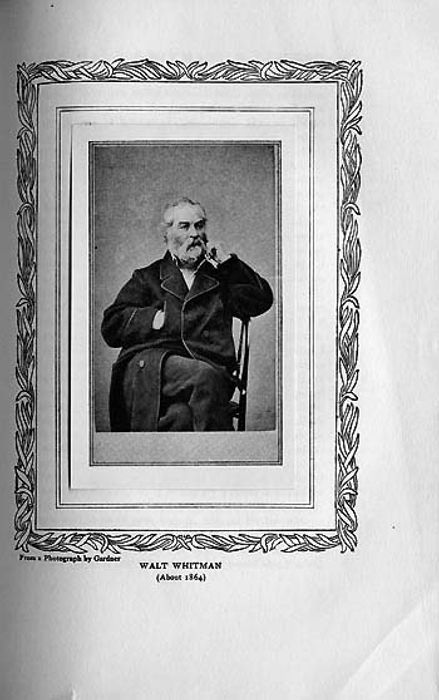 [Begin page 339] broke in: "What the devil do you do that for?" He laughed outright: "Now you're fierce again—why, you're as bad as Bucke and O'Connor. [See indexical note p339.1] What the hell's all that stuff good for now except to lumber up the house? Go down stairs and ask Mary if that ain't so." I was serious about it: "Anyway—let me judge of that for myself. I've got plenty of room home for anything you want to throw away." He looked at me fixedly: "You seem to be very earnest about it. [See indexical note p339.2] I don't know that I've got any prejudice against saving it. But, Horace—most of that stuff is best destroyed—for many reasons best." I still insisted. Then he smiled and concluded: "I'll promise to throw some of it your way—some of it—though there is a bit here and there too sacred—too surely and only mine—to be perpetuated. [See indexical note p339.3] I think you must understand that: anything else you are welcome to."
W. looked pretty tired. Baker floated in and out as we talked. I opened the Curtis envelope. W. said: "Put that up—read it when you get home. I am going to ask you now to help me to the bed and put down the light." This I did. W. then said: "Kiss me good night!" finally crying to me as I stood as the door: "Go to Ferguson! [See indexical note p339.4] Oh, tomorrow's Sunday! That's so. God bless you!" I asked Baker as I left what he thought generally of W.'s condition. "He is making slow advances—he will pull through." Back home—wrote a whole batch of letters for W., to people he had mentioned. Then sat down and read the Curtis letter:
Dear Madam.[See indexical note p339.5] Since I last wrote you I have continued my hospital visitations daily or nightly without intermission and shall continue them this fall and winter. Your contributions, and those of your friends, sent me for the soldiers wounded and sick, have been used among them in manifold ways, little sums of money given, (the wounded very generally come up here without a cent and in lamentable plight,) [Begin page 340] and in purchases of various kinds, often impromptu as I see things wanted on the moment [break] . . . train is standing tediously waiting, &c. as they often are here. [See indexical note p340.1] But what I write this note for particularly is to see if your sister, Hannah Stevenson, or yourself, might find it eligible to see a young man whom I love very much, who has fallen into deepest affliction, and is now in your city. He is a young Massachusetts soldier from Barre. [See indexical note p340.2] He was sun-struck here in Washington last July, was taken to hospital here, I was with him a good deal for many weeks—he then went home to Barre,—became worse,—has now been sent from his home to your city—is at times (as I infer) so troubled [break] . . . I received a letter from Boston this morning from a stranger about him telling me (he appears too ill to write himself) that he is in Mason General Hospital, Boston. His name is Caleb H. Babbitt of Co E 34th Mass Vol. He must have been brought there lately. My dear friend, if you should be able to go, or if not able yourself give this to your sister or some friend who will go,—it may be that my dear boy and comrade is not so very bad, but I fear he is. [See indexical note p340.3] Tell him you come from me like, and if he is in a situation to talk, his loving heart will open to you at once. He is a manly, affectionate boy. I beg whoever goes would write a few lines to me how the young man is. I send my thanks and love to yourself, your sister, husband, and the sisters Wigglesworth. Or else give this to Dr. Russell. The letter from the stranger above referred to is dated also Pemberton square hospital.
Sunday, June 17, 1888.
W. got his bath today. Was up a great part of the afternoon. Wrote somewhat. Read some. "Drowsed a good deal," as he said. [See indexical note p340.4] "I am still in the woods—I thought I was out, escaped: but still there, still doing rather poorly."
W. spoke of the Chicago Republican convention. Harned a delegate from New Jersey. "A rather dubious compli- [Begin page 341]ment for Tom," said W. Again: "I hardly seem in line with the Republican party any more—in fact, the Republican party is hardly in line with itself. What next? Something will come next—something better." [See indexical note p341.1] Had he entirely lost his old faith in the party? "I never had entire faith—now I hardly have any faith at all. It is not impossible they will rise to the occasion—it's not improbable they'll sink to the bottom and go to the devil! What a chaos and a chaos it is, mixed with extra chaos! But perhaps they'll pluck the flower safety from the nettle danger. It is hardly likely, however. When these institutions start to die they die on—nothing stops the process." Did he think the party likely to get licked in the election? [See indexical note p341.2] "I was not thinking of elections. A party may win elections and be defeated anyway. The Republican party as it is constituted now might win twenty elections without a single moral victory: the moral victories are the only victories that count." How about the Democratic alternative? [See indexical note p341.3] "Almost as bad—almost." He pointed to a paper on the table: "I've been looking through the gossip of the convention. I see Smith is there—our Charles Emory Smith. I have read the protection editorials in the Press carefully now for three years and have never yet seen it make a respectable presentation of the subject. Yet one is possible. [See indexical note p341.4] There's Dudley, now—our Dudley here—and even Pig-iron Kelley: they make some show of thought, and their figures are at least interesting—but Smith talks on and on, forever on, in the air. [See indexical note p341.5] Smith is backed by a man of millions—a manufacturer—whose settled policy it is to push Smith forward into notice on every occasion, proper or improper. Smith has his parts, no doubt, but he ought to play his piece in some village backyard: he don't seem to belong to the big republic. [See indexical note p341.6] The only thing that saves the Press from entire damnation is the presence of Talcott Williams. Now, there's a man with some stuff to 'im."
[Begin page 342]W. called my attention to a contemporary copy of the Long Islander—the paper he had founded in his youth at Huntington. The editor had indited a paragraph referring to W.'s approaching end, and "hoping a heavenly father would smooth his way," quoted W. W. asked me: "What do you think of that? Smooth my way—with all the aches and pains I've had for a week! [See indexical note p342.1] I don't know why it is—I approve of piety and all that, but somehow piety turns sour." I could not help laughing at W.'s queer visage. Wasn't the wish sincere? "I can't tell what soured the mix—I only know it's sour!" W. always shies at conventionally pious condolences.
Proofs still untouched. [See indexical note p342.2] "It seems to be wholly a matter of grip, and that I seem to have lost—to have lost entirely—beyond recovery. I am fighting for a chance to finish the book—after that I can die in peace." Should I try to do the proof-reading? "If I don't rally in a day or two I will turn the whole thing over to you—you may wrestle with it your own way." He is very anxious to do the work of the book himself. Complains that his "mind is a chaos"—that the instant he "tries to concentrate coherency flies." [See indexical note p342.3] He is perceptibly slower in enunciation—sometimes his words come out mixed up. His mind itself is clear. Osler was over today. His opinion was very encouraging. Mrs. Davis said so to W., who, however, was sceptical, pointing in reply to "the almost death-like pall that has settled down over" his "consciousness." [See indexical note p342.4] Expresses no desire to go down stairs. Asks that Mrs. Davis and Warren should often come in—"just for a look—perhaps not to say anything at all." Warren today took out W.'s horse. A little girl neighbor asked about coming in. [See indexical note p342.5] W. told Baker she should be admitted next time—"but only for a minute or two," saying further: "I love the little dear but my mind will not stand too much strain." Referred to the newspaper stories current about his condition: "I am dying, dead— [Begin page 343] almost buried." Asked me to have my sister Gussie prepare him some mutton—described how, &c., with amusing detail. "Mrs. Harned has a perfect genius for divining just what a particular man wants for a particular stomach at a particular time!" Agnes had left some flowers. Anne Montgomerie sent some over by me. [See indexical note p343.1] W. said: "It is very sweet of them. Why don't they come in to see me? Just to see me? To give me a kiss—let me look at them a minute—then go? Tell them I feel neglected." He lifts the flowers to his nose again and again: looks at them, smells them. "They are reminiscent," he says: "they take me out doors! God bless out doors!" Rather sadly said: "This is Sunday? [See indexical note p343.2] Yes, it is Sunday. This is my Harned day. I wonder if the Harned Sundays will ever return?" Was very particular to have me keep up my writing to O'Connor and Bucke. "Tell them the best and the worst."
W. had laid aside for me a Conway envelope. He called my attention to it. [See indexical note p343.3] I asked: "Are you sure this is not a love letter? Are you sure you shouldn't burn it up?" He didn't seem to be in a mood to parry. He only said: "You may see for yourself. Half a dozen fellows over there in England who were trying to help me got at loose ends over my poverty. Was I poor or not poor? Was I starving or did I have enough to eat? [See indexical note p343.4] It don't seem to me my part to take sides as between them: the thing finally found its own legitimate level. Rossetti, Carpenter, Conway, Buchanan, Symonds, Dowden, such men, there in England—all of them are loyal, all of them always meant best things for me—staunch, loving, open-handed—oh! all the little irritations disappear in the stronger note of the affections. [See indexical note p343.5] When I look back over that period—well, it was all sad enough (glad enough, too): I was down, down, physically down, my outlook was clouded: the appearance of that English group seemed like a flash out of heaven. I never felt like reproaching anyone here—why should I? Con- [Begin page 344]way was right in that. The people here owed me nothing: why should I have presented a bill for goods the people did not order? [See indexical note p344.1] I have made my mistakes too—have not always got events, myself, into right perspectives: have said things that should not have been said—have been silent when I should have spoken: in all that, I, too, have been guilty enough." "Bucke says you are sore on Conway." "That is a mistake—I am sore on nobody. How could I be sore on Conway? [See indexical note p344.2] Conway was always my friend—always stood round ready to help: was very considerate—did yeoman service in assisting to bring out the English editions. I do not think Conway ever quite understood the full vehemence of the opposition on this side of the water—how solidly the powers that be were arrayed against me." "But you got into the magazines, some—you were received here and there—you didn't have any more fight to go through than any rebel must expect to encounter. [See indexical note p344.3] Why should you growl?" "I don't: did you ever hear me growl?" "A little, sometimes—yes." [See indexical note p344.4] "Is that so? Then I take the growl back. A man who proposes something new and will not give people time to see it is not worthy of his message."
We sat there in silence ten or fifteen minutes together. Then I passed out. W. said nothing further except as to Ferguson: "Try to keep Ferguson patient." I did not wait to examine the Conway envelope, which contained a letter from Conway to Rossetti, a newspaper clipping and a letter from Conway to W.
I.
2 Pembroke Gardens, Kensington, W. Apr. 21, '76. Dear Rossetti,[See indexical note p344.5] I send you a note received from Roden Noel, to whom you had best send circulars.
Thanks for your note. I don't know what the synopsis telegraphed to America was, which troubles Whitman, but the basis of it was a paragraph running thus:
[Begin page 345]"Walt Whitman. Mr. M. D. Conway writes us concerning the letters which have appeared in our columns, that the reports that Walt Whitman is in want, or dependent on his relatives, is unfounded. [See indexical note p345.1] At the same time Mr. Whitman is gratified at the proposition of his friends in this country to circulate his works more widely, as in his present state of health he must depend upon the sales of his poems."
I have quoted the paragraph from memory, but nothing material is left out of it. [See indexical note p345.2] Of course, if I had permitted the assertion of Austin ("while we talk, he starves") to pass uncorrected, I would have been a conniver with falsehood; and should have consented to the dishonor of the whole Whitman family; and should have allowed Whitman to suffer a danger,—that of being charged with obtaining money under false pretences.
[See indexical note p345.3] The letter of Buchanan was sure to bring upon W. W. serious damage if he could be supposed to let it go uncontradicted; for everybody in America knows that it would be just as easy to collect money for him in America as in England, and that in a country where two volumes have been written in eulogy of him, and where he has as many admirers as here, he is in no more danger of starving than the President.
Ever yours, M. D. Conway.II.
[NEWSPAPER PARAGRAPH.]
[See indexical note p345.4] Our friend Mr. M. D. Conway has written to the Daily News in reference to letters which have appeared in that journal appealing for assistance for Mr. Walt Whitman. He says, on the strength of a letter just received from Mr. Whitman, that the idea that he is in distress or dependent upon his relatives is unfounded. But while at present surrounded with comfort, Mr. Whitman views with satisfaction [Begin page 346] the proposition of his friends to promote the larger sale of his works in England, as, in his condition of health, his dependence for the future must be on the income derived from the sale of his books.
III.
2 Pembroke Gardens, W. London, April 24, '76. Dear Whitman,[See indexical note p346.1] William Rossetti has shown me your letter indicating annoyance at some telegram which has reached America concerning a statement of mine in the Daily News. There was no letter of mine in the paper or any paper, but a paragraph which I enclose to you written by the editor on the basis of a private letter from me. I wrote to him on receipt of a letter from you saying that you wished money to build on your Camden lot and paid board to your relatives. [See indexical note p346.2] My motive was the necessity of saving you and your relatives from the degradation implied in Mr. Austin's letter to the same paper in which he said "While we talk, he starves"; to defend your American friends (such as Burroughs, O'Connor, myself and others) from the outrageous insults heaped by that fellow Buchanan upon those of your countrymen who would share their last loaf with you; and to free you from the charge of getting aid on false pretences of which you were in danger, and myself from equal peril of abetting what I knew to be a lie by silence; and you are not the man I take you for if you would have had me act otherwise. [See indexical note p346.3] I can only suppose you have seen some bungled and mutilated telegram embodying part of the statement of which I now send you the whole. You may remember that I talked to you in my bedroom about your circumstances, after I had conversed with your sister-in-law, and gathered from you just what you have been kind enough to write to me, except that you did not tell me that you wished to build.
[Begin page 347]In such matters as this the true thing is obviously the politic thing to do. [See indexical note p347.1] It is ludicrously false for Buchanan to say that you are in danger of starving, or that you have no appreciation in America (where books have been written about you, and where you have enthusiastic admirers!)—such absurd and false statements are sure to bring down contempt on those who make them, and sometimes imperil the good fame of those about whom they are made. Your friends here are quite at one on the subject, and Rossetti wrote to me that he knew Buchanan's statements were "exaggerations," before I wrote to the News. The effort to circulate your books by a subscription will be successful. [See indexical note p347.2] Rossetti has had printed for private circulation your letter to him which gives substantially the same account of your affairs which is contained in the paragraph of the Daily News enclosed.
I am much oppressed with work, and cannot write letters. I trust this will find you improving in health. Pray remember me kindly to Mr. and Mrs. Whitman and believe me your faithful friend
M. D. Conway.Monday, June 18, 1888.
Dropt in at W.'s early morning. [See indexical note p347.3] All well. W. asleep. W. on his bed in the evening when I arrived—7.45. Stayed until 9.30. He was very communicative. I put in few questions. Yet he talked on. No light—day gradually going: we sat by and bye in total darkness. W.'s mind very clear. "In that way," he said, "I am decidedly mended." Excused himself for his inability to attack the proofs. "There they are, untouched—God help me!"
I referred to the Conway correspondence. [See indexical note p347.4] "Yes, it was quite a little tempest in a teapot: I suppose no one was finally hurt. I want to tell you about it some day—the whole story: Buchanan had a story, too: I am not equal to it now." [Begin page 348]Had he copies of the Rossetti printed slip spoken of by Conway? "Yes: I will come across the slip some day—will lay a copy aside for you."
Ferguson is getting impatient—wants us to release his long primer. [See indexical note p348.1] We have tied him up completely. W. said: "That is too bad—it ought not to be"—stopping a minute—"I shall make an extra extra pull tomorrow—see if I can't get outside myself—above myself." Said he had new matter on page thirty-eight (verse)—but was not quite ready to close in thirty-seven. Discussed hurry. W. aware of the situation. "If I can't get at it for good tomorrow I'll resign the whole business into your hands." Added: "Hurry was never another name for Walt Whitman."
W. questioned me concerning the Chicago convention. [See indexical note p348.2] "Is it to be Harrison?" "You don't say Blaine?" "No—with Blaine the funeral is ready." Was the Republican platform to reassert the tariff? "If they do that will end it—let them do it—their time is near. [See indexical note p348.3] I suppose the Republican party is about through with its job—something more efficient should now come along—take up the task where the Republican party left it."
Had I written notes for him today? Yes, lots of them. To Bucke, Burroughs, Morse, Kennedy, others. "That's first rate," said W., "particularly the note to John. Did you write at length? And what did you tell him—and them? I had a long letter from Morse but laid it aside for another time: the first two pages floored me." Back to Burroughs. [See indexical note p348.4] "Burroughs is still what he was in the early days—true to Leaves of Grass and his original instincts. Of late years something has been added to him—sophistication, I may call it. He has mixed too much with the New York literary crowd—has been influenced by them, not always for good. Still, John is too deeply rooted—the soil in him is too firm—not to resist the pressure of that gang: he is too natural, too truly endowed. John's style has grown somewhat more [Begin page 349] refined—perhaps a little more literary, bookish—with time, but is still essentially rooted in the woods, the chipmunks, the trapperies—the first hand causes and effects. John was with the original Leaves of Grassers—in the first rank (the body guard)—has never wavered that I know of."
After striking a light W. attempted to read Morse's letter aloud but had to surrender it to me. [See indexical note p349.1] Then opened and read me a letter from Dr. Bucke. B. at one point spoke of the circular for contributions for keeping a nurse in the house for W.—said he would send a proof of it to W. for such verbal suggestions as he might make. W. was hot. [See indexical note p349.2] Exclaimed: "I don't approve of it—I don't want money—I have enough for all I need!"—adding with the same fire: "My 'verbal' suggestion would be for him to stop the whole thing at once. I have not so far said anything about it but should have done so. Horace—we must stop this thing before it goes any further." Insisted on my taking Burroughs' Pepacton to read. [See indexical note p349.3] "It's not John's best book but shows his quality." Pete Doyle was in yesterday and brought some flowers. "It was Pete who gave me the cane," explained W., "the cane with a crook in it. [See indexical note p349.4] I always use Pete's cane: I like to think of it as having come from Pete—as being so useful to me in my lame aftermath. You have never met Pete? We must arrange it some way some time."
Baker is very anxious. "Mr. Whitman is about cleared up mentally—in that way—but he seems to be getting physically weaker. [See indexical note p349.5] He is stronger in the head and weaker in the legs today than any day since I came." I can see good omens in the old man's refreshing candor about himself. He seems to know better than the doctors what is the matter with him. [See indexical note p349.6] He talks towards the ground but he is looking up. He always says to me, "Tell the fellows the worst," but does not hesitate to say afterwards: "The worst is not the worst."
[Begin page 350]W. has been receiving affectionate messages all around. Spoke of some of the fellows: "Give my love to Clifford—Clifford is a man-minister, not a minister-man." "There's Tucker, now—Benjamin: I love him: he is plucky to the bone: I don't know that I bank much on his anarchism or at all but on Tucker—well, he is a safe risk." "I suppose William [O'Connor] tops us all for vehemence and consecutiveness of life." [See indexical note p350.1] He said he thought Burroughs "shied some at O'Connor's directness but I don't admit that that's William's fault." "Stedman is always to me almost—an almost man: almost a genius, almost writing the best poems, what not: almost in everything but the affections: altogether affectionate." "I cannot be unfair to Dick Stoddard though he is always unfair to me. [See indexical note p350.2] Some of his early poems were superb—one in especial, treating of a woman on the town." "Maybe I have enemies because I have friends. My few friends are a great host—my many enemies are a few." "Tell Anne Montgomerie that if she don't come to see me soon I shall think she has gone back on me. [See indexical note p350.3] I know I have said I wouldn't see visitors: she is not a visitor—she is one of us." "I have said a good many things to you about William O'Connor—but there's Ellen, too—superb woman—without shams, brags: just a woman. [See indexical note p350.4] Ellen does not write: that gives her more time to get at the essentials of life." "In most of us I think writing gets to be a disease. We scribble, scribble, scribble—eternally scribble: God looks on—it turns his stomach: and while we scribble we neglect life." [See indexical note p350.5] Gave me an old O'Connor letter. "Sit up here by the light and read it: I will be quite still." Some passages of it I read aloud.
Life-Saving, Feb. 20, 1883. Dear Walt:[See indexical note p350.6] I have sent you the MS. of my letter to Bucke. It goes this day by Adams Express, addressed to you.
I sent you a card this morning just before your letter came. There is not the least bit of "pestering" in the [Begin page 351] matter, and of course I appreciate the necessity for despatch. I only got the MS. from R. M. B. on Saturday, and set to work revising it the next day. I am so driven with work, and so weary and worn, that I cannot always be as quick as I would like to in these offices. [See indexical note p351.1] The collection of my anti-Comstock letters has been positively prevented up to date, by simple lack of time. I shall soon have some let up. We have had a horrid fight with the navy, and flaxed them awfully—rousing Congress and the Seaboard upon them. I send you a pamphlet, which has some of the shrapnel we swept their decks with. The paper on Life-Saving transfer is mine—some touches in the others. I was thinking of you when I wrote the first and third of my three reasons against transfer.
I am rejoiced that G. G. P. still seems good in your eyes. [See indexical note p351.2] I should be glad to leave out some sentences in the last page, and originally intended to, but thinking it over, could not see my way clear, inasmuch as the whole publication is a matter of history, and ought to stand, follies and all, and several of my abusive critics at the time quoted the very passages I want to omit, for animadversion, which makes it more difficult now to withdraw them. Do you see my dilemma? The sentences sending the pamphlet to a number of persons named on the last page, are an absurdity, yet I don't see very well how I can honorably back out of it now, and escape twitting. How does this view strike you?
It was Bucke's wish that I should write the prefatory letter I send, and I accepted the chance of supplementing the pamphlet with a few remarks upon the Harlan transaction; of paying my respects to some of your recent critics, teaching them that there are blows to take as well as to give; and of putting you, where you properly belong, in the line of succession from Shakespeare, which will make some of our literati howl. [See indexical note p351.3] I hope you will think it good, and effective. Like everything I write, it has been done in a hurry, [Begin page 352] and without those leisures of the soul which are requisite to satisfactory work.
I trust it will be in good type. Where is it to go? The pamphlet, of course, belongs to the appendix. Let me have proof of all, which I will return promptly.
The MS. on copying press paper is my little tilt with Lanman, and should come on after the pamphlet in the appendix. [See indexical note p352.1] Bucke wanted it at first, but in his last letter thinks it best to omit it, although he leaves it to me. Now I think it ought to go in as it finishes the Harlan affair handsomely. But do as you think best. [See indexical note p352.2] It is a rather crushing rejoinder to Lanman, and a punishment to Stoddard, who is awfully mean, and it has a good effect of tone after the fiery pamphlet.
I hope Bucke's book will be a success. It comes in good time. He has a rare chance. I aimed, also, in my contributions to the volume, to add to its interest and attractiveness.
I see by the extracts in Sunday's Tribune that you are in the Carlyle and Emerson letters. Did you see it? I shall want to see the volume. [See indexical note p352.3] The letter, as printed, is very characteristic of Emerson—his reserve, his shrinking, like a woman's, because of the rebuff; his deceptive concessions to the enemy, in a vein of pleasantry, almost like irony, almost like a sneer, when he says the book "wanted good morals so much" that he did not send it. Of course, some people will take a different view. But I think I understand Emerson's real feeling, which is in his first letter to you, and there is no denying it.
I am suspicious of Professor Norton as an editor of this correspondence. [See indexical note p352.4] I hope he would not suppress things favorable to you, but have little faith in him since I read a sketch of his lecture on Greek art, in which he held that the later Greek sculpture began to be indecent with nudity—the great or earlier Greek being always draped, as in the [Begin page 353] work of Phidias; which precious assertion made me think of the Parthenaic frieze of Phidias where a row of soldiers charges, all naked, and the phallus in each man not only bare, but erected—stiff with valor—which is good for Professor Norton! Selah! I must close. More anon.
W. D. O'C.When W. saw I was through reading he said amusedly: "Well—how does that strike you—especially the tilt there with Norton? [See indexical note p353.1] He throws Norton clean off his horse into the mud. Norton is the type of scholar who is bound to distrust a man like me." W. did not think Emerson "showed up strong" in that reference to him to Carlyle. "Emerson should have said yes or no—not yes-no." I referred to O'Connor's Good Gray Poet. [See indexical note p353.2] "William is right—I do not cease or reduce my admiration: I have often had the idea of getting out an edition of the Leaves with the Good Gray Poet as the preface." O'C. in this letter is discussing Bucke's life of W. W., then in course of preparation, W. being an active factor in its production. [See indexical note p353.3] It begins to look as if W. was going to pull through. While he is not superficially optimistic he is fundamentally resolute.
Tuesday, June 19, 1888.
To W. at 8. Still in his bedroom. Got up off his bed at once and handed me proofs, remarking: "I have had a good afternoon—perhaps a slight trace (very slight but perceptible) of my old vigor." [See indexical note p353.4] He had gone over nearly all the accumulated proofs. Added enough to fill in the Sands to page thirty-nine—also this footnote for page thirty-seven: "The two songs on this page are eked out during an afternoon, June, 1888, in my seventieth year, at a critical spell of illness. [See indexical note p353.5] Of course no reader and probably no human being at any time will ever have such phases of emotional and solemn action as these involve to me. I feel in them an end [Begin page 354] and close of all." The new poems were, Now Precedent Songs, Farewell, and An Evening Lull. He has filled out these pages—36, 37, 38—with great struggle—"after the drawing of blood," he says. [See indexical note p354.1] I read the note and the poems. "Do they seem to you to lack in dignity?" he asked. "I am aware," he added, "that they are feeble, feeble enough, like an old man who has to lean on a cane, but they belong where they are—are necessary to round my story." He still insists that his "grip is gone—irretrievably lost: I seem to have lost the power of consecutive thought, work—mental volition, I might say: as if the ground had been swept from under my feet—as if I had nothing whereon to stand. [See indexical note p354.2] My brain will not solidify." I said: "Walt, you're only fooling me: all this time you're laying out your plans to get well. What do you want your brain to solidify for anyway? What use would it be to you after it had solidified?" W. laughed outright: "You think I'm a bit foxy? Well—I don't want to assume my cure." "Why not? You say you used to assume cures for the soldiers after the doctors had assumed something else and your men got well." [See indexical note p354.3] W. took the whole thing good naturedly: "Damn you! you're right! Well, let's assume I'm to get well and see how the assumption will work. I do believe I feel a trifle better already!" Said he had "tried to go over the Hicks manuscript" but "didn't get far along: ten minutes of it did me up. I stop work the instant I feel tired." Someone had told him he had lost flesh. Did it seem so to me? "I used to weigh—still weigh, probably—two hundred pounds. [See indexical note p354.4] In physical peculiarity I seem to be both fathered and mothered—both of my parents may be seen in me. I attribute much of my success in weathering this attack to my good stock—to my father, my mother: indeed, not one mother alone—the mothers of five or six generations."
W. asked me if I knew anything in particular about the convention. Spoke of a leg of mutton sent in by my sister, [Begin page 355] Mrs. Harned, today. "I greatly relished it—took several slices of it: ate the best meal in a fortnight. The asparagus, too, was so good. I want you to thank her and tell her what I have said to you. Her cooking is in itself a treat—everything gets appetizing in her hands: she has a decided genius that way. A good cook is born, not made. [See indexical note p355.1] Your sister never makes the right thing the wrong thing by bad treatment. She is one who could make the desert vegetate."
W. asked me: "Do you remember the Booth letter I gave you some time ago? [See indexical note p355.2] I have found the mate to it—the letter that preceded it, I think. You had better keep the two together if you think they have any significance, which I doubt. I was after Edwin for a picture of his father, you know." As to Edwin himself W. said: "Edwin had everything but guts: if he had had a little more that was absolutely gross in his composition he would have been altogether first class instead of just a little short of it. [See indexical note p355.3] His father had more power and less finish. Edwin is a very noble character—essentially a godlike man."
This was Booth's brief letter:
Newport, Aug. 24th, '84. Dear Sir[See indexical note p355.4] —I shall go to Boston Tuesday and will endeavor to get a portrait of my father—I have none here.
Many thanks for your kind offer of a copy of your book which I gladly accept.
Truly yours, Edwin Booth.I kicked a letter from under my foot and picked it up. "What have you got there?" I did not know. Handed the envelope to W. He put on his glasses and leaned towards the light. [See indexical note p355.5] "Oh!" he exclaimed—"that's from Frederick York Powell—English—a great man in his way over there among the cultivated college men. It is a warm letter, too!—it not only satisfies me, it would satisfy you. My [Begin page 356] claims are big enough, but yours—why, you are simply greedy!" Laughed. "Powell is one of the men, the tribe of the Oxford-Cambridge Israel, who have felt that despite their great scholarship—layers on layers of erudition—that they had something in common with Leaves of Grass. [See indexical note p356.1] I am both surprised and not surprised when a man like Powell comes around. I think sometimes that when a man knows just a little we repel him—that when he knows a little more we invite him. A little learning is a dangerous thing for Leaves of Grass."
Christ Church, Oxford, Nov. 1, '84. Dear Sir.[See indexical note p356.2] I wish to thank you most heartily for your gift to me which I have just received from Mrs. Wharton.
I could not have received anything from America which I should prize as I do this volume of the Leaves of Grass.
Since I first read your poems years ago now they have always had a great influence on my thoughts and wishes. I should have liked to write to you then, but I did not think I had a right to, and I wished to see you and talk to you, but I never had the opportunity. [See indexical note p356.3] Your gift has given me at least the right to thank you now not only for it but for the great good I have got from your work. Every man I suppose worries out some idea of the right life for himself, but your books have helped me much in getting a truer view of things than I started with. I have found out the truth of your words too from my short experience of life in deed as well as in thought. You have many more worthy listeners but none more grateful than myself. Your Leaves of Grass I keep with my Shakespeare and my Bible and it is from these three that I have got more sympathy than from any other books. [See indexical note p356.4]
I should like to tell you that you have many more friends here than you can even have heard of by letter or paper, men and women who have got a good hold of your poems and their pith.
[Begin page 357]If you should ever come back to the old country how pleased we should be. I wish it may yet be possible for you to do so.
You will not I hope think that I wish to give you the trouble of sending or writing any answer to these few lines. [See indexical note p357.1] I have not written for that at all, but simply because I wanted you to know that I am very grateful to you and that I am yours faithfully.
Fredk York Powell.[See indexical note p357.2] W. also spoke of Powell as a "cultive." Disrespectfully? "No—as specifying his tribe. The English cultive seems sometimes to enjoy deserved honors—his scholarship does not necessarily destroy him. Powell is exceptionally sincere." W. still anxious to get all the Sands "safely into type." Then, he said, he could "depart in peace"—after an interval continuing—"if it is necessary!" [See indexical note p357.3] Osler over today. He thinks W. better but still "a victim of progressive paralysis, which has a certain inevitable result." I quoted Jane Welsh's assurance to Carlyle that she preferred Goethe to Schiller because Goethe "did not make her cry." W. took an opposite view. [See indexical note p357.4] "The Greeks were very free, frank—not afraid of pain: to suffer, to hatchel each other—but going off when hurt bellowing, screaming, weeping in anger and pain: even Mars, we are told, among them—and at all times, also, sensitive to the humor, the fun, of the moment. Goethe's constraint was Roman (Stoic) not Greek: the Greek let go; in sorrow, in joy, let go." [See indexical note p357.5] W. is very sensible to form. He noticed too late that A Backward Glance finished at the foot of the page. "If I had been a little more vigilant I should have cut out five or six lines. I like chapters in books to end short of a page—it pleases my eye better so." [See indexical note p357.6] I objected to the use of the Celtic headlines. He did not agree with me at first, but in the end confessed that I was right. He sent a note complimenting the [Begin page 358] printers on their work. He said tonight: "I was fortunate in striking Ferguson—not only Ferguson but his men. I never met men in all my experience who caught on so well." [See indexical note p358.1] Then again: "When you go to Ferguson in the morning sit about fifteen or twenty minutes and chat with them—see that I am well understood." It has been hard work getting W. keyed to the work. We have discussed every detail together. He is stubborn about having his punctuation, abbreviations and general arrangement strictly followed.
Wednesday, June 20, 1888.
In at W.'s at eight. W. sitting up, awake, the gas burning. Greeted me heartily with his accustomed: "Eh—is that you, Horace?" [See indexical note p358.2] Spoke immediately of his condition. "I do poorly, poorly: this has been as bad a day as any since my sickness began. I do not suffer pain—only great feebleness, inertness, incapacity to think, to see—yes, a sort of general debility of the system. I am convinced that I am in a baddish state—that I have received a severe shock which is not easily, maybe not at all, to be shaken off. [See indexical note p358.3] But I still hope on—I do not give up: expect a clear day yet. The doctor just two hours ago said my pulse was very good—I have eaten my meals today with some relish—so the trouble don't seem to be primarily with my heart or my stomach. I do not seem to want to go down stairs or out of doors—that is the worst sign of all: I alternate between my bed and chair all day long."
Got from Ferguson today pages 36 to 54. [See indexical note p358.4] In Sands I called W.'s attention to several blunders. This is one of the new verses:
An Evening Lull.
After a week of physical anguish,
Restless and pain, and feverish heat,
Towards the hapless day a calm and lull comes on,
Three hours of peace and soothing rest and brain.
W. took my reference to the blemishes kindly. "I shall examine them in the daytime. I always thank my friends for pointing out any oversights that occur in my book. I do not just now see your point but I am pretty sure you are right. [See indexical note p359.1] I have been in more or less of a mixed-up condition now for some days." I showed him some other evidences at other points in the proofs all of which he conceded. He asked my opinion of page 37. "Does it seem crowded? Yes? Well, we can throw a line away." "Don't you love your lines too much for that?" "No—not enough to let them spoil the page."
Referred to the convention. "All is at sea out there still, I suppose. And who is it to be? [See indexical note p359.2] I hate Blaine's protectionism and anti-Chinese principles. The old doctors when called in would ask you to designate the seat of your pain and clap a plaster on the spot then and there and think that made a whole man. Blaine is the old doctor. And there's Depew—a mushy sticky style of a man—a candified Republican; a too-smart critter for me—leaking puns and such things: without bottom or top. [See indexical note p359.3] I rather prefer Gresham whose power papers like the Philadelphia Press and New York Herald belittle. I don't know what to make out of Harrison. The whole gang is getting beyond me: I find it harder and harder every year to reconcile myself to the exhibit they make: they narrow, narrow, narrow every year: after awhile I'll be altogether without a political home unless I build one for myself."
[See indexical note p359.4] Dr. Osler, by W.'s suggestion, did not come over today. Asked after my mother and father and Anne Montgomerie: "Tell Anne I am well alive yet though not gay—that I may still survive to do the work we laid out to do together." Asked me about Lindell at the ferry. [See indexical note p359.5] "Give my love to all the boys at the ferry—tell them I dream of the ferry: of the water—of the boats going across—of the wagons—everything: it all belongs to me." "I wish I did suffer [Begin page 360] pain—it would make me feel more lively." [See indexical note p360.1] W. gave me a Joaquin Miller letter with some jocular remark about the handwriting: "It is here and there about Lord Houghton. I always had the devil's own time reading Miller—in fact, I always left the half of him unread: I could catch the drift but no more. If you can read this letter you beat me: I tried my best at it again this morning but it left me out in the cold. [See indexical note p360.2] I afterward met Moncton Milnes—Lord Houghton—as he as called: a very affable, kindly-disposed man who showed an unmistakable warmth of friendship for me. But see what you can make out of the letter." I did have some trouble deciphering the letter, but I managed to read it aloud to W., who listened and said: "That's the first time the letter has been read, I guess, in full—the first time: why, it is thirteen years old. [See indexical note p360.3] Miller has had a very miscellaneous career since—an item here, an item there, a bit desultory, never seeming to come to quite as much as I expect."
Highland Falls, Orange Co., New York State, Sept. 5, '75. My Dear Walt Whitman:[See indexical note p360.4] I have been wandering up and down the house and waiting to hear from Lord Houghton so as to get you two together here on the banks of the Hudson, but he was gone on West the other way. He will return this way as soon as he has done the West when I hope to catch him, and then if we do not get down to see you you are to try and get up here if possible. [See indexical note p360.5] Yet it may be that Houghton will not get backtill too late for me here. In that case we will try and get together in New York city. I am off today for Boston on Biz and pleasure and as usual know not when I shall get back: but let me hear from you here for I am very anxious indeed to hear of your health. Do keep up my dear fellow there is lots in the tomorrows for you and I want you to live to see the great sunrise. Now you must answer me and send me that proof-sheet. By [Begin page 361] that time I shall have returned and will know more about what I shall do the next month. Yours ever
Joaquin Miller.[See indexical note p361.1] W. said he had had "no letters of interest" today. Had done no proof-reading. "I will put up a stiff fight tomorrow—try to get the stuff ready for you. You must set me right with Ferguson." Referring to Philadelphia Press again W. said: "Smith is the sort of man I find it hard to include even in my philosophy, but Williams, Talcott, he is easy: Talcott is the one excuse the Press has for its existence." Baker says W. has had "an extra bad day." W. mentally clear though slow. He is quite well aware of his condition. "My mind works laboriously," he said. [See indexical note p361.2] "It takes me a long time to get anywhere though I do arrive." W. humorously said: "Music is my worst punishment." I asked: "How's that?" "Oh!" he replied, "the bands out in the street—the drum and fife corpses that go rattling and banging past: they beat my miserable head like hammers." W. again: "I have read the little Stedman poem you left—The Discoverer. [See indexical note p361.3] Yes—it is to the point: it is the kind of work Stedman can do probably better than anybody else." I asked W. "Are you going to die or live? You know more about yourself than the doctors do. You are going to live?" He was very prompt and decisive: "Live? Yes—that's it: live: I've got to live: what else is there for me to do? [See indexical note p361.4] After we have done our work together, then let the curtain fall—but nottill then." "That's the way to talk!" I exclaimed. I kissed him goodnight. "God bless you, boy!" he cried. Then I left.
Thursday, June 21, 1888.
Eight o'clock, evening. W. up out of bed—better by a good deal than yesterday. Eats more comfortably. Feels sounder. Says he is not confident "beyond the immediate [Begin page 362] hour." Repeatedly dwells upon his "loss of grip"—"grip" the constant word: "grip" on Hicks, "grip" on proofs, "grip" on this and that. [See indexical note p362.1] "I do not seem to have the mental grasp: I find my mind unwilling or unable to apply itself to the proofs, the manuscripts, as it should, methodically, systematically: I am only imperceptibly if at all regaining my strength in that respect from day to day." I reminded him of what he said yesterday—that he was determined to live. "Yes," he replied, "I do not forget that—I am doing all I can to buoy myself up, to move back or ahead on secure ground again."
W. had returned yesterday's proofs through Baker today. [See indexical note p362.2] I kicked. I said I ought to do all those errands myself in order to keep a supervising eye on our affairs at Ferguson's. I said to him: "If I am to work with you it must be on this condition." He at once came down. "I see it was a mistake—it shall not occur again—we will lose rather than gain if I do anything to confuse you. You are quite right. I wish you would go to Ferguson's the first thing in the morning and see what I did with the returned pages. I know page 37 is lame and weak—that it contains some faltering lines—but I guess it must go as it is. Anyway, we will have a chance to get at it again."
Received a note today from Bucke. [See indexical note p362.3] Osler not over though Baker had been to Philadelphia to report. This is the first day W. has expressed any feeling of discomfort on account of the heat. Was mentally very clear, however. "Your father has been in—we had a slight talk: he is the most learned man in German literature I have ever met—full of enthusiasm, too—still a young man in the real sense." "In that sense you yourself are young enough." "I hope so," said W. fervently: "when I get old in that sense I want to step out of the way."
[See indexical note p362.4] In talking of O'Connor W. asked me if I knew that O'Connor "was hypochondriacal?" adding: "Well—he is a suf- [Begin page 363]ferer that way: he experiences certain periods of poignant depression, then long exemptions—regular returns of good and bad, seasons coming and going. [See indexical note p363.1] Do you know, Horace, William should have been an orator: all his Keltic bardic ancestry seems to set him afire for it. He would have made a great pleader: I do not think any audience could remain unsubdued, once William got going. He has the impetus of genius—there is always a wild current back of him pressing him on."
W. referred to Frederick Marvin, also, as "a consistent friend when consistent friends were none too many." [See indexical note p363.2] Then indulged a bit of self-characterization: "All my friends are more ardent in some respects than I am: for instance, I was never as much of an abolitionist as Marvin, O'Connor, and some of the others. [See indexical note p363.3] Phillips—all of them—all of them—thought slavery the one crying sin of the universe. I didn't—though I, too, thought it a crying sin. Phillips was true blue—I looked at him with a sort of awe: I never could quite lose the sense of other evils in this evil—I saw other evils that cried to me in perhaps even a louder voice: the labor evil, now, to speak of only one, which to this day has been steadily growing worse, worse, worse. I did not quarrel with their main contention but with the emphasis with which they asserted their particular idea. [See indexical note p363.4] Some of the fellows were almost as hot with me as with slavery just because I wouldn't go into tantrums on the subject: they said I might just as well be on the other side—which was, of course, not true: I never lost any opportunity to make it plain where I stood but I did not concentrate all my moral fire on the same spot." [See indexical note p363.5] W. "dissents from partisanship whatever its name or form," for, said he this evening, "after the best the partisan will say something better will be said by the man."
W. sat fanning himself during our talk, and was mentally clearer, I think, than for several days. He clouds up. He [Begin page 364] never stays in the cloud. The peculiarity of his trouble is this—it sometimes ends his thinking short, mars his sentences, mixes his tenses, makes him inconsecutive. As he says himself: "The right word won't answer—my tongue gets unruly—I lose my cues. [See indexical note p364.1] I mix up badly—but I inevitably come back again." Anent the Miller letter W. produced a Lord Houghton note of the same month and year. W. laughed over the writing. "It is as bad a hand as Miller's or worse." He was rather surprised when I read it outright. [See indexical note p364.2] "Bravo! bravo!" he said—and then asked: "What shall be your reward?" I thought a minute and said: "Give me the letter." W. without hesitation saying: "Is that all you ask? Why certainly—take it." This is what I read:
Brevoort House, New York, Sept. 29th. Dear Mr. Whitman,[See indexical note p364.3] I was only in Philadelphia for a few hours, but I propose to return there for some days the end of next month or the beginning of November. It will give me real pleasure to make your acquaintance having been, I think, one of the first to welcome you into our great old world literature.
I remainYours very truly Houghton.
[See indexical note p364.4] W. had written on the envelope: "Sept. 27, '75 from Lord Houghton." I asked W.: "Did he come?"
"Yes—although I understand that they tried all round, in Boston, in New York, 'most everywhere, to induce him not to come—to convince him that I was not entitled to the attention he proposed to offer me. This was the very first thing he told me when we met—how solidly the literary crowd was arrayed against me. I asked him: 'What does that signify?' He laughed and said: 'It is a compliment—you should feel honored.'" W. was quiet for a few minutes and returned
[Begin page figure-26]
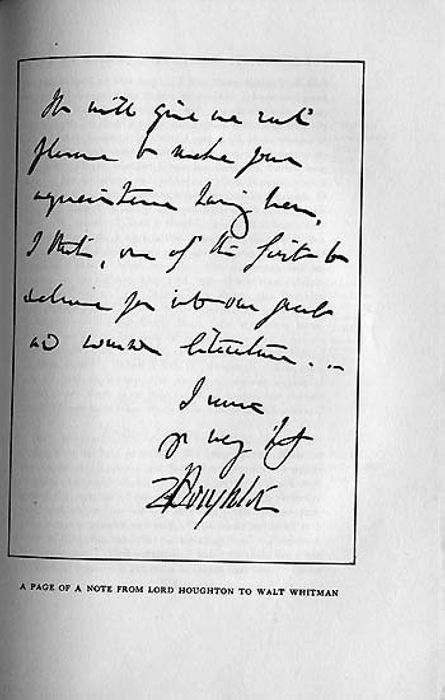 [Begin page 365] to the subject in this way: I have been through all that mortal flesh need have to test its fidelity: I have had good enemies and bad enemies—and friends—friends false, friends true (is there a worse enemy than a humbug friend?)—you know more or less who I mean. [See indexical note p365.1] I often wonder if I have survived—whether this is a real me, sitting here talking with you, or whether I was not dead and buried long ago." He laughed and added: "What nonsense such speculation is! It interferes with the healthy business of life." I picked up a slip of paper from the floor under my feet. W. asked: "What is that?" I quoted his own line: "Wherever I go I find letters from God dropped," &c. He smiled: "Read it—my eyes are no good."
[See indexical note p365.2] The sheet contained this: "Mem for Life. The Macready riot occurred on the night of May 10th 1849—I was then publishing 'the Freeman' cor Middagh & Fulton sts. Brooklyn had returned from N.O." W. recognized the note. "Yes: I have used it somewhere. Such little reminders sometimes open a very big door of reminiscence—but I am no good tonight even for that, even to talk—to look behind or look ahead." When I left W. remarked: You must use all your diplomacy with Ferguson—we are lagging at a sad pace: there is no help for it, of course, but he naturally objects to us when we clog the wheels of his business."
[Begin page 365] to the subject in this way: I have been through all that mortal flesh need have to test its fidelity: I have had good enemies and bad enemies—and friends—friends false, friends true (is there a worse enemy than a humbug friend?)—you know more or less who I mean. [See indexical note p365.1] I often wonder if I have survived—whether this is a real me, sitting here talking with you, or whether I was not dead and buried long ago." He laughed and added: "What nonsense such speculation is! It interferes with the healthy business of life." I picked up a slip of paper from the floor under my feet. W. asked: "What is that?" I quoted his own line: "Wherever I go I find letters from God dropped," &c. He smiled: "Read it—my eyes are no good."
[See indexical note p365.2] The sheet contained this: "Mem for Life. The Macready riot occurred on the night of May 10th 1849—I was then publishing 'the Freeman' cor Middagh & Fulton sts. Brooklyn had returned from N.O." W. recognized the note. "Yes: I have used it somewhere. Such little reminders sometimes open a very big door of reminiscence—but I am no good tonight even for that, even to talk—to look behind or look ahead." When I left W. remarked: You must use all your diplomacy with Ferguson—we are lagging at a sad pace: there is no help for it, of course, but he naturally objects to us when we clog the wheels of his business."
Friday, June 22, 1888.
[See indexical note p365.3] To W.'s at 7.45, evening. W. lying down. Rose on my entrance. Today I got from Ferguson revised proofs reaching to page fifty-six. These I gave to W. I suggested the removal of the small notes he sent in yesterday for blank pages forty-six and fifty-four. He listened amiably to my argument and said: "You make me think seriously of dropping the extra matter altogether." I objected. He continued: "Well—perhaps I won't do that, but I am inclined to think it is not suitable for use that way." Spoke [Begin page 366] with renewed regret of the Hicks—of his inability to touch it. "I am subject to a new development of my trouble—a new phase—seen the last few days—what is it I do not know—shall not until I have seen more if it". I asked him what he meant. [See indexical note p366.1] He described it as "a strange, soggy, wet, sticky ineligibility as of tar, falling down over me each morning for three or four hours, putting me into a state of almost death—like impotency—though I am always aware of things all the time just the same." I referred this to Baker, who said it was an important fact for Osler to know, W. being so exceedingly reticent with both of them.
[See indexical note p366.2] Yesterday W. wrote this on the margin of one of the proofs: "To proof reader—My dear sir, I shall mainly have to depend on you—shall mainly have to rely on your judgment and the copy—I find my brain has no grip on the copy and proof—I have done the best I can—my head is sick and weak—after the corrections and renewed pagination (45 to 55) with the added matter &c. I w'd like revised proof (complete set)—will send it back at noon (if Mr. Traubel will come over and get it)." [See indexical note p366.3] W. said of this to me: "It's just about so—you and the proof-reader will have to do the work—I don't seem to be worth the work—I don't seem to be worth my weight in feathers."
[See indexical note p366.4] Had he any mail today? "I have no mail today except an autograph mail—an autograph mail, yes, and that I get every day. They all write me—hundreds write—strangers—they all beg autographs—tell funny tales about it, give funny reasons (some of them are pitiful—some of them are almost piteous)—I practically never answer them anymore. It takes about all the strength I have nowadays to keep the flies off. I make what use I can of the return stamps and let the rest of the matter go."
[See indexical note p366.5] W. has all along been curious about the convention, speaking of it among first things this evening. "Who is the man? or likely to be? or best to be? Blaine? Well, [Begin page 367] after all, perhaps that's the best thing they can do. And there's the inevitable protection platform, too: inevitable. [See indexical note p367.1] When I hear those politicians making such noisy thunder about their American protection—on the platform, in speeches, in editorial platitudes—I think of Carlyle—of his brave, contemptuous smile—yes I see Carlyle—thrown back in his chair—so, so—and having his hell of a laugh!" He was silent for a minute and then added: "It all seems so stale—so stale: these conventions are dead, stone dead: they never realize their age and its lessons—their age and its demands—the cry to them to get out of the ditch, up into the road, and push on, on, on, with a new impulse of life. [See indexical note p367.2] The real questions waiting to be studied, threshed out, these fellows never suspect."
[See indexical note p367.3] Eakins was over today. W. could not see him. "I told Mary to tell him my head was too sore. You can imagine how I must have felt at the time to refuse to see Eakins. He is always welcome—always: except. Today it was except." In reply to a question W. said: "I have lots of pictures of myself about here—I want you to take any of them any time that you choose. [See indexical note p367.4] I am not afraid that you will wish many—not afraid—but two or three you must take as a special gift from me. I have been photographed, photographed, photographed, until the cameras themselves are tired of me."
Reference being again made to his own condition he submitted this notable statement: "I suppose I should have been free of all this today—free at least in part—if in those last years 63-4-5 I had gone off to a place of safety, avoided the hospitals—kept away from them—taken special care of my own person: but here I am, sick, nearly gone, and I do not regret what I did. [See indexical note p367.5] That was no time for doubt—no time for questions—no time to think about either staying or running away: there was but one thing to do, one part to accept, one way of duty: only one: I never have ac- [Begin page 368]knowledged that I could have done what I did not do: and you know, Horace, you know, I have nothing to regret in all that—nothing—all was as it should have been—all was right, all: and here I am today: dying here today I have nothing to regret! [See indexical note p368.1] Doctor Drinkard used to say: 'Whitman, you could have saved yourself this!' Yes, so I could. But if I had saved myself this I would have lost myself something infinitely more precious."
[See indexical note p368.2] Reminded of an old affair by the draft of a letter W. to Robert Buchanan (1876) which we turned up on the table while looking for something else, W. said to me: "There was a great rattling of dry bones over there and here that time about my poverty—whether I was starving to death or wasn't—whether the Americans deserted me or didn't desert me: Conway particularly seemed to take it particularly hard that America should be supposed to have neglected me. [See indexical note p368.3] It was during that period that I wrote Buchanan several letters—this is one of them—in which I tried to calm the waters even while frankly confessing my financial disabilities. [See indexical note p368.4] But you will see for yourself what I mean: you have other documents relating to the same incident. [See indexical note p368.5] I think a little blood was spilled but no one was really hurt. If a man sells goods—well, selling them seems all right: but if he sells poems, selling is degrading, wrong. [See indexical note p368.6] When I confessed to those Englishmen that I had written and written and no one—or almost no one—here wanted what I wrote—said so honestly to the few on the other side who did care a little for me—accepted their help here and there, when I needed it (I often gave help where help was needed) I was regarded as a beggar, charged with misrepresenting America, and so on, and so on. [See indexical note p368.7] What I said was true, true, every word of it. I didn't blame America for not wanting me—I only remarked it. Maybe it was America that was right and England that was wrong: I do not know. [Begin page 369] But you will read the Buchanan letter—now I am tired: let's say good-night." He took my hand. "You are sensitive—I know you well, well, so you must believe me when I say that my good-night is not a dismissal—it is only good-night! A good-night and a God bless you!" [See indexical note p369.1] He kissed me. I did not read the letter until I got home. W. certainly was very clear tonight. Speech very slow, hard, but straight—noway confused. Baker says he is rather mixed up when he first comes out of his sleep in the morning but that he seems afterwards rational enough however physically depressed.
[See indexical note p369.2] The Buchanan letter is in a very decrepit condition—written on sheets of very thin and now attenuated paper of irregular sizes and texture and color pinned together. It is dated May 16, 1876, and starts off with this memorandum: "(must have gone 17th by Scotia from N.Y.")
[See indexical note p369.3] "Your two letters including the cheque for £25 reached me, for which accept deepest thanks. I have already written you my approval of your three communications in L. D. News and saying that in my opinion (and now with fullest deliberation reaffirming it) all the points assumed as facts on which your letter of March 13 is grounded are substantially true and most of them are true to the minutest particular as far as could be stated in a one column letter.
"Then let me quite definitely explain myself about one or two things. [See indexical note p369.4] I should not have instigated this English move, and if I had been consulted should have peremptorily stopped it—but now that it has started and grown, and under the circumstances, and by the person, and in the spirit, (and especially as I can and will give, to each generous donor, my book, portrait, autograph, myself as it were) I am determined to respond to it in the same spirit in which it has risen—to accept most thankfully, cordially and unhesitatingly all that my friends feel to convey to me, which de- [Begin page 370]termination I here deliberately express once for all. This you are at liberty to make known to all who feel any interest in the matter.
[See indexical note p370.1] "The situation at present may be briefly and candidly told. I am, and have for three years during my paralysis, been boarding here with a relative, comfortable and nice enough, but steadily paying just the same as at an inn,—and the whole affair in precisely the same business spirit. My means would by this time have entirely given out but that have been temporarily replenished from sales of my new edition and as now by this most welcome present and purchase—the £25 herein acknowledged.
"Though without employment, means or income you augur truly that I am not in what may be called pinching want—nor do I anticipate it.
[See indexical note p370.2] "My object I may say farther has lately been and still is to build a cheap little three or four room house on a little lot I own in a rural skirt of this town—for a nook, where I can haul in and eke out in a sort of independent economy and comfort and as satisfactorily as may be the rest of my years—for I may live several of them yet.—To attain this would be quite a triumph, and I feel assured I could then live very nicely indeed on the income from my books.
[See indexical note p370.3] "I shall (as I see now) continue to be my own publisher and bookseller. Accept all subscriptions to the New Edition. All will be supplied upon remittance. There are Two Volumes. Leaves of Grass, 384 pages, $5, has two portraits. Then Two Rivulets, poems and prose, (including Memoranda of the War) with photos, 359 pages—also $5. Each book has my autograph. The Two Volumes are my complete works, $10 the set.
"I wish the particular address of each generous friend given, so as he or she can be reach'd by mail or express—either with the autographic volume Two Rivulets or a com- [Begin page 371]plete set of my works in Two Volumes, with autograph and portraits, or some other of my books.
"It may be some while before the books arrive but they will arrive in time.
[See indexical note p371.1] A marked out passage in the letter was this: "There is doubtless a point of view from which Mr. Conway's statement of April 4th might hold technically—but essentially, and under the circumstances—" There was no more.
Saturday, June 23, 1888.
[See indexical note p371.2] Improvement in W.'s condition today. He seems to alternate bad with good days. But on the whole he mends. He said of the change: "I woke right up this morning, which is significant—escaping, this time, the usual strange extreme lethargy. I have eaten freely and seem to digest my food: have felt altogether better, except, perhaps, at the top, which will finally feel the effects of my bodily rehabilitation I am sure. [See indexical note p371.3] So you see, my flag is no more at half mast: I feel the touch of life again!" In his mail was a postal card from Paris addressed to him as "the American poet." This is what was written on the card:
[See indexical note p371.4] "Read the histories of Lourdes and LaSalette, and, if you relish them, the lives of St. Peter and Paul (Catholic). You might also read the Catholic life of Jesus Christ. Pray St. Peter and Paul to cure you and have votive masses (P. and P.) prayers and communions made on 29 June, 30 June and 1 August. Buy pictures of them and hang them in your room; or buy statues. P. and P. will be pleased at your intercession."
[See indexical note p371.5] This was unsigned. W. remarked: "When I was in Washington it was surprising how many Catholic priests I came to know—how many took the trouble to get acquainted with me—on what good terms we kept with each other. I [Begin page 372] think we were unified on the strength of the deeply religious, deeply adoring, spirit that was patent behind our differences of technology, theology—our differences of lingo, name. Perhaps this postal is the reflection of that experience—grew out of it—who knows? [See indexical note p372.1] I do not make light of such messages—indeed, they have a profound place in my consideration. Of course I haven't a particle of faith in Lourdes—in faith cures—bones of saints, such things—not a shred of it—not the first sign of a sign of it—but this postal has for me a meaning quite apart from the literal yes or no of Lourdes—a meaning at least of sympathy, helpfulness, service. [See indexical note p372.2] People often speak of the Leaves as wanting in religion, but that is not my view of the book—and I ought to know. I think the Leaves the most religious book among books: crammed full of faith. What would the Leaves be without faith? An empty vessel: faith is its very substance, balance—its one article of assent—its one item of assurance."
Harned came in. Back from Chicago today. W. inquired a little about events connected with the convention but seemed soon tired of discussing it. Harned said: "The candidate of the convention is as good as elected." W. shook his head. "I don't know about that, Tom. The two hundred thousand strangers in Chicago, the enthusiasm—hurrah—of the convention; the parades, the torchlights, the hilarity, may mean a good deal or seem to; but back of all that, beyond all that, there is a great broad margin of fact in the country at large to be considered. [See indexical note p372.3] The people are lethargic—let things go—suffer themselves to be milked and thrown away by a class of political scoundrels—they are so patient, often so stupid—blind to their own divine descent—but finally they revolt—are up in arms—raise hell. Then look out! But they are so slow—so slow! This year or some year the people will do some new things for America—hardly this year—the soil is not yet sufficiently [Begin page 373] prepared—but some year. I wish the people believed in themselves as much as I believe in them!" [See indexical note p373.1] Harned remarked: "Walt, you used to call yourself a Republican?" "So I did." "And don't you still call yourself a Republican?" "God help me, no. I suppose I don't call myself anything. I'm no Democrat, either. Republican? with the Republican high tariff, high property principles or no principles? Hardly." Then W. added: "Anyway, Tom, you look well—the convention did you good: that's the best thing I've heard in connection with it. As to its forty-nine articles—they scare me."
Asked for the "news." "My Herald is stopped and I do not regret it: my subscription is run out. [See indexical note p373.2] As long as it came I read it as a sort of duty—that is about the truth. I don't suffer for want of papers in any event. I have not sent the Herald anything for a month." Had read some proof today. I brought over two additional galleys of matter. "I hope for the real privilege this time," said W.;"for strength—renewed life. [See indexical note p373.3] I am very eager to go on with our work: nothing can take the place of that. I guess that is the instinct that has kept me alive the past fortnight."
[See indexical note p373.4] I quoted Kennedy's letter to me, received today, in which he accused Frank Williams of "plagiarizing" him "unmercifully" in The American last week. This seemed to excite W.'s humor. He laughed in his quiet hearty way. "Nonsense," he said: "Kennedy is over-vehement. Frank don't need to steal—he has treasure enough in himself. And Kennedy?—why should he get excited? We might steal a lot from Kennedy and he would have plenty left. [See indexical note p373.5] Nonsense! You might get Kennedy's pamphlet and just look it over if you are at all curious, as I am not."
[See indexical note p373.6] Gave W. The American, this week's, containing a paper from Charles Morris—anti-Whitman in tendency—starting out with a confession that he knew little of W. W. direct [Begin page 374]—had read little, &c. &c.—but—. W. burst out into an audible smile. [See indexical note p374.1] "It is like them—very like them: to rush into the arena without the necessary weapons. When Morris said that he pleaded guilty—his paper was out of court." Says Bucke saved his life—"his skill, decision, brotherliness, pulled me ashore." Bucke's letter of 21st asks if W. has yet signed the will. He has not. The original will, written by himself, and Harned's draft of another, still lie on the table. [See indexical note p374.2] W. said humorously: "Bucke has not heard: we are not going to die yet." W. was elected a member of the Society of Old Brooklynites in 1880. "I submitted to it as to a necessary courtesy—that was all." I read him Sidney Morse's long letter of the 20th. He spoke appreciatively of Morse's "vivid and telling style." [See indexical note p374.3] "Sidney writes with great ease—without the slightest ponderosity—straight to the point. The best writing has no lace on its sleeves."
Sunday, June 24, 1888.
[See indexical note p374.4] Today W. again feeble. Went to his room and saw him a little after two in the afternoon. Sat fanning himself. "I'm burning up," he said: "in a little bit there'll be nothing left of me but cinders." Had written to Dr. Bucke what he called "a quite extended letter." Also a postal to his sister in Vermont. Postal rather shaky and signed "brother Walt." "I am not jubilating much," W. remarked: "the tide—rather, the flame—is against me a day like this. I just sit still and try to make living terms with the weather." W. said to Harned today: "If it was not for Horace I should be like a ship without a rudder." [See indexical note p374.5] Is more willing to have me do things. "I hate like hell to confess that I need you but I am mighty glad, needing you, to find you here to assist me." "An old veteran hates to resign his old tasks to new hands," he said again.
[Begin page 375]Still arguing over the book. [See indexical note p375.1] The book will make probably one hundred pages. He is still hoping to get the Hicks in. "I am afraid if I don't pay my debt to Hicks now I will never do it at all. And it is a sort of filial debt, too—a debt I owe my father, who loved Hicks." I am having a hard time getting him to straighten up pages 36, 37, 38. He has made one change at my suggestion, substituting "ending" for "hapless" in An Evening Lull. We discussed illustrations. "I leave that mostly in your hands," he said. "I am feeble, inaccurate, unsteady, in my work just now," he explains: "things come to me, all things, but somehow they do not always come in order."
[See indexical note p375.2] The will drawn up by Harned before he went West is still unsigned. H. today said to W.: "It would do no harm Walt to get it into ship-shape and safely put away." "That's so—I am aware of it—it should be done—I shall do it." W. spoke of the Leaves: "It is a book for the criminal classes." Harned asked: "How do you make that out?" "I don't make it out: it is the fact. The other people do not need a poet." "Are you in the criminal class yourself?" "Yes, certainly. Why not?" Harned laughed heartily. "Let me in?"
[See indexical note p375.3] W. somehow talked of American poets who were "hardly of international scope." Had we any great poets living? "Not one—not one." Then he added: "We don't need great poets, though they come. We need great men: and great men we have. I often think how much greater all the fellows are than they allow themselves to be—fellows like Gilder, Stedman—if they would only let themselves go. Some of the fellows seem afraid of their own size—pare themselves down wherever they can." [See indexical note p375.4] "Do you let yourself go?" "In the main, yes—and that has both advantages and disadvantages. I don't see how a fellow can do anything else and be honest with himself." "Most men tie themselves fast and then wonder why they are not free." [Begin page 376] "Precisely—that's a touch on the nerve. [See indexical note p376.1] You take a man like Gilder: he has an exquisite talent for certain things—exquisite: but Gilder has not been enough free from himself: he has held back too much. The same thing is true of Stedman—noble Stedman: I have always been expecting Stedman to soar out and be his full self—but Stedman, too, has drawn his reins too tight." [See indexical note p376.2] W. paused and added: "I have been reading over an old letter from Pete Doyle: so simple, true, sufficient: without even the knowledge of professional things—yet a rounded man. The real Irish character, the higher samples of it, the real Keltic influences: how noble, tenacious, loyal, they are! It was always the Irish in O'Connor that came up strong. [See indexical note p376.3] You should read—you probably have not read—a book called The Collegians, printed some fifty years ago. I can't think of the author's name—my memory plays me such shabby tricks these days—(though I should know it—it is a familiar name). [See indexical note p376.4] But anyhow, the next time you're near one of them inquire for it in one of the second-hand book stores—near Leary's or Dave McKay's—they are likely to have it: get it, read it: it is every way worth your while. It is a beautiful study of Irish life, Irish character—a little uncanny, but very important for some of the things it discloses. [See indexical note p376.5] I am not a voracious novel reader—never was—but some of the few novels I have read stick to me like gum arabic—won't let go. The Collegians was one of them."
Harned left. We then discussed our work together. W. very slow but clear. Before we got through he gave me an old Kennedy letter, saying of it: "It was along in the period when we were introducing ourselves to each other: Kennedy was still staggering some under the shock of the sex poems. [See indexical note p376.6] Kennedy was clean—clean: he made the inferences—but they were clean inferences. I think he has completely recovered." W. laughed. "I think by this [Begin page 377] time he is a completely well man." Laughed again. "Sometimes I have won the fellows against themselves—Kennedy is one case, Bucke was another." [See indexical note p377.1] "How did you win me?" "I suppose I didn't win you—we just growed up together!" I kissed W. good bye. He said: "On my bad days I like to kiss you good bye. One of these times when you come back—well, I won't say any more." He grew very quiet, looked very gently into my face, pressed my hand, and turned to the window.
I copy Kennedy's letter right here. W. had written on it in red ink: "from W. S. Kennedy a college-bred man of thirty, southern born but northern educated, an author and magazine writer."
1107 Girard St., Philadelphia, Jan. 20, '81. Dear Mr. W.[See indexical note p377.2] Thanks for the N. A. Review. I had already read two or three times your admirable, cheerful and spirited paper, and wanted to buy it, but did not feel able. I think (though I am not sure) that an article on it will appear in The American soon by a couple of us. You will be safe in attributing the praise to me, though I "have somewhat against you" for rapping the dii minores among our poets so hard over the coxcombs. Still it will do them good doubtless. They have treated you ungenerously and foppishly—always (most of them). You have no idea how I welcome an utterance of yours. I get so utterly sick of the idiocy and knavery of the mess that it is like a sea-breeze to feel and hear your voice. [See indexical note p377.3] It tickles my diaphragm to see you run your huge subsoil prairie plough so deep down under the feet of the Lilliputians—knocking down their sham structures and leaving them either sprawling on the ground or looking foolishly at one another because exposed in their small trickeries and small literary bookeries.
[Begin page 378]I heartily congratulate you, dear friend, that at last you are having justice done you (in some degree) by the literary class of this country. [See indexical note p378.1] My heart, at least, swells with gladness and pride on account of your honors this winter. It is a red letter season in your life. The honor is not much; but then one likes to stand well at home, too, as well as abroad;—one likes it a little better, too. But I have never wondered that you were caviare to the general; because, although I see clearly that your object in treating the passions as you do is a noble and pure one, yet I have thought that the world was not ready for such a move yet. [See indexical note p378.2] And besides, I am inclined to think with Stedman that (to such poor limited and petty creatures as we bipeds are) there is something intrinsically disagreeable in the various grosser functions of the body. I hope we shall grow to be such giants sometime that this will not be so. But that it is the case now, I do not see how we can help admitting. I can't for my poor self at any rate. But never mind this. I congratulate you again on this success.
Your friend cordially, W. S. Kennedy.Monday, June 25, 1888.
In at 7.45. W. sitting on bed, scantily dressed. [See indexical note p378.3] Rose on my entrance, and went, with my assistance, to the chair. Seems to grow daily less steady on his feet. He has not been dressed for two days, feeling rather too feeble and rather too hot. For the first time since his sickness he permitted me to fix the windows and light the gas. Threw himself back in his chair and fanned himself. "Mrs. Davis tells me you have been better today." He shook his head. [See indexical note p378.4] "Mary takes too much for granted: I am always improved in the evenings. Then again I don't like to put on a poor mouth when she's round—so when she comes in I am apt to steady up and look almost proper." He paused and [Begin page 379] then asked me a question. "Have you heard of my latest splurge? No? Well—listen: I pulled a tooth today! The next thing you will hear I have amputated one of my own legs!" No letters of importance. Day depressing.
[See indexical note p379.1] "So it is to be Harrison!" W. exclaimed referring to the Presidential nomination: "I don't think I take much interest in Harrison either as a man or as a principle. I am losing interest in the old political policies." Referring to November Boughs. "The Hicks is simple disjecta membra: a pretty good dig which will make about thirty pages in the book, which I think now will go as high as a hundred and fifteen pages. I am sure to get the Lincoln article in, too. The fact is, I am on the move again, in spite of my disabilities." W. actually let me look for half an hour among his papers for a memorandum. As a rule he does this himself. [See indexical note p379.2] He suddenly looked about him, took up a bundle of papers, and, finally handing me a reprint slip of his Five Thousand Poems, said: "I thought you would like that for your records"—then going on to fan himself again. I had pushed several documents out of the pile I was examining. We talked of them. One was a William Rossetti letter. First he said: "Let me see it." He put on his glasses and started to read. Stopped. "My eyes are poorly. It's so hot. You read it—read it for yourself—read it aloud." I read.
56 Euston Sq. London, N.W. 9 Jany. '70. Dear Mr. Whitman:[See indexical note p379.3] I was exceedingly pleased at receiving your recent letter, and the photograph wh. followed it immediately afterwards. [See indexical note p379.4] I admire the photograph very much; rather grudge its having the hat on, and so cutting one out of the full portraiture of your face, but have little doubt, allowing for this detail, it brings me very near your external aspect. May I be allowed to send you, as a very meagre requital, the enclosed likeness of myself?
[Begin page 380]I gave your letter, and the second copy of your portrait, to the lady you refer to, and need scarcely say how truly delighted she was. [See indexical note p380.1] She has asked me to say that you cd not have devised for her a more welcome pleasure, and that she feels grateful to me for having sent to America the extracts from what she had written, since they have been a satisfaction to you. She also begs leave, with much deference, to offer a practical suggestion:—that if you see no reason against it, the new edition might be issued in 2 vols, lettered, not vols. 1 and 2, but 1st series and 2nd series, so that they cd be priced and sold separately when so desired. [See indexical note p380.2] She adds: "This simple expedient wd, I think, overcome a serious difficulty. Those who are not able to receive aright all Mr. Whitman has written might, to their own infinite gain, have what they can receive, and grow by means of that food and be capable of the whole perhaps; while he wd stand as unflinchingly as hitherto by what he has written. I know I am glad that your selections were put into my hands first, so that I was lifted up by them to stand firm on higher ground than I had ever stood on before, and furnished with a golden key before approaching the rest of the poems." She also, as a hearty admirer of your original Preface, hopes that that may reappear—either whole or such portions as have not since been used in other forms.
[See indexical note p380.3] I know, by a letter from O'Connor, that, since you wrote, you have seen the further observations of this lady wh. I sent over in Novr. I replied to O'Connor the other day; also, still more recently, took the liberty of posting to you a little essay of mine, written for one of our literary societies, on Italian Courtesy-books of the Middle Ages. Some of the extracts I have translated in it may, I hope, be found not without their charm and value. [See indexical note p380.4] I wrote to Conway giving him your cordial message: probably you know that he was not long ago in Russia. Also I heard the other day from a man I am much attracted to, Stillman, of his [Begin page 381] having re-encountered you in Washington. [See indexical note p381.1] As he told you, there is a chance—not as yet more than a chance—that I may make my way over the Atlantic for a glimpse of America in the summer. If so, how great a delight it will be to me to see and know you need not, I hope, be stated in words.
Perhaps before that I shall have received here the new edition you refer to—another deep draught of satisfaction.
I cd run on a great deal further on these and other topics; but shd have to come to a close at last somewhere and may perhaps as well do so now.
Yours in reverence and love, W. M. Rossetti.[See indexical note p381.2] When I had finished W. said: "The mysterious lady is Mrs. Gilchrist. She, too, like Sloane Kennedy (we talked of him yesterday), shied at the Children of Adam poems at the start. Sex is a red rag to most people. It takes some time to get accustomed to me, but if the folks will only persevere they will finally feel right comfortable in my presence. Children of Adam—the poems—are very innocent: they will not shake down a house. [See indexical note p381.3] A man was here the other day who asked me: 'Don't you feel rather sorry on the whole that you wrote the sex poems?' I answered him by asking another question: 'Don't you feel rather sorry on the whole that I am Walt Whitman?' I never met Rossetti—he did not get over after all."
[See indexical note p381.4] There was another document I upset with the Rossetti letter. W. asked me to tell him what it was. Four pages of manuscript in his own hand indorsed in this way: "Part of Wm. O'Connor's letter to Conway, Nov. 10, 1867—good for use in review of Leaves of Grass." As this letter was originally written and all studied over and fixed up in W.'s own hand I asked him to tell me about it. He did not remember clearly whether O'C. had used it or not. "I must [Begin page 382] have been intending to assist him in something he was to say to Conway. If he used it at all he probably recast it in his own manner." W. added that I "might take it along if" I chose. I did choose.
[See indexical note p382.1] W. had forgotten about the will today. "I did nothing but wander from my bed to the chair and back again—nothing but that: it was all a great weariness. I am not losing ground but I do seem almost to stand still." Is thinner. Eats little. Digestion generally good. Pulse strong. Looks uncomfortable—ill at ease—is very lethargic—quiet. [See indexical note p382.2] Says his head is "gummy—sticky." Dr. Osler was not over today, W. objecting to having him come. Did no writing. Expresses no desire to leave his room or get out doors. Warren exercised his horse today. Baker says he and Mrs. Davis never say anything more to W. than they have to. [See indexical note p382.3] B. says: "You are about the only one he talks to at all freely." W. gave me half a dozen names of people he wished me to write to about his health. "I am unable to do it myself: my pen can't go even on crutches." [See indexical note p382.4] Recalling the Kennedy letter we discussed yesterday W. laughingly said: "Sloane is in general very techy—he flies off at the first touch: has a womanish excess of nerves: but below all that he is a loyal guardsman." I took the Whitman-O'Connor manuscript along with me to read at home, W. said: "I won't need it again—keep it in a safe place."
Tuesday, June 26, 1888.
[See indexical note p382.5] In at 8.05, finding W. fumbling about room for match. To Mrs. Davis' inquiry as to "how he did" W. replied: "Weakly, weakly: weak as death, Mary." And to me on my entrance: "I have had a bad day but then nature seems always to have a way of her own of mending me. I have been very feeble—O my! very feeble: sick feeble—even to the point of not being able to stand on my pins—but now that the evening has come on I am improved [Begin page 383]—much improved. [See indexical note p383.1] I am not by any means inclined to give up. Osler was over today and said he was 'encouraged.' What does a careful doctor mean when he says that? I have eaten some—bread, rice pudding: some conservative things."
[See indexical note p383.2] W. asked me if I "could make anything out of the Conway document" I had "taken away yesterday?" Said further of it himself: "I do not remember the incident with which it seems to belong. For one thing, it gives my idea of my own book: a man's idea of his own book—his serious idea—is not to be despised. [See indexical note p383.3] I do not lack in egotism, as you know—the sort of egotism that is willing to know itself as honestly as it is willing to know third or fourth parties. Why shouldn't a man be allowed to weigh himself? He can't do worse than go wrong: going wrong is no hurt." I might as well copy "the Conway document" right here.
[See indexical note p383.4] "2. Critically, a significant, if not the most significant, fact about Leaves of Grass is, that the genesis and fashioning of them have evidently not had in view literary purposes merely or even mainly, and the poet has not, either in mass or in detail, tried his work as it progressed by the sine qua non of current literary or esthetic standards. The Book is a product, not of literature merely, but of the largest universal law and play of things, and of Kosmical beauty, of which literature, however important, is but a fraction. This is the clue to, the explanation of, the puzzle of the widely vexatious literary and esthetic questions involved in Leaves of Grass.
[See indexical note p383.5] "3. The summed-up idea however which, in this man's contribution, compared even with the vast Biblical and Homeric poetry, looms and towers as athwart the giants of the Himalayas, the dim head of the more gigantic Kunchainjunga, rises over the rest: idea of Totality, of the All-perfect, All-successful final certainties of each individual [Begin page 384] Man, as well as of the world he inhabits. Joyousness, and certain ultimate triumph, only of new and unthought of descriptions, ringing through every verse. He alone holds the solution, the spell, giving full satisfaction; and his talisman is Ensemble. [See indexical note p384.1] This is the word that belongs to the book, turned with the word Modernness.
"The foregoing points my dear Conway, I wish through you, to submit to Mr. Rossetti. I have mentioned to Mr. Whitman my intention of writing him through you, and he, W., has made no objection. [See indexical note p384.2] I would add, for myself, for Mr. Rossetti, that I hope he will not be deterred from giving fullest swing to what I am sure I have discovered in him, viz.: an admiration and appreciation of our Poet, by the present ostensibly timid attitude of the literary and reading world toward Leaves of Grass; but that he will strike at that larger, loftier, honestly enthusiastic range of minds, which, perhaps, by the time Mr. Hotten's volume gets well before the public, may be the genuine audience Mr. Whitman is quite certain of.
"Again asking pardon of Mr. Rossetti for intruding these suggestions and placing them in any and every respect at his service should they be so fortunate as to strike him favorably.
[See indexical note p384.3] "Not for literary purposes, and not under the domination nor tested by the sine qua non of literary standards.
"Personally the author is a man of normal characteristics, and of moderate, healthy, following a regular employment, averse to any display.
"The words which belong to the Book are the words Modernness and Ensemble."
[See indexical note p384.4] W. picked up a book from the floor. "See this—it came today: the Walter Scott fellows have done it—done it well. A Backward Glance on My Own Road was the title I selected for that review of myself when I gave the copy to Rhys—but I am better pleased with our revision—A Backward [Begin page 385] Glance o'er Travel'd Roads: it is stronger, more musical. The English volume was rather unexpectedly put together—was, I think, a late thought."
[See indexical note p385.1] I read W. a postal I received from Burroughs today. What did he wish to say in reply? This: "Tell him, Horace, that last night—that is, tonight—you found me here and we had this good talk together. Tell him I have felt the duty upon me to write him from time to time but could not do it—was not up to it—conscious as I was of my neglect. Tell him I have many hopes of my getting about again—no expectation of being altogether physically what I was, but still of being in the main myself once more. [See indexical note p385.2] Tell him also, I am quite sure—oh! I am quite sure!—Dr. Bucke this time saved my life: that if he had not been here to roll up his sleeves and stay and work and watch it would have been a final call. Tell him you read me the postal—that I accept it and understand it." W. dictated this to me. He asked: "Have you got all that down?"
[See indexical note p385.3] W. showed me a bunch of roses that came from Kennedy today, saying of them: "They are surpassingly sweet, true, helpful." Reminiscently said: "I am what the boys call a stayer—I am very cautious: my caution has kept me out of many scrapes: has saved me from this death scrape. [See indexical note p385.4] Thirty years ago or more a circle of celebres in phrenology gave my head a public dissection in a hall—for one point, marked my caution very high—seven and over. Their seven was backed by my experience with myself. [See indexical note p385.5] I live even today most conservatively—avoiding things that would be sure to be fatal to me. [See indexical note p385.6] I know what Holmes said about phrenology—that you might as easily tell how much money is in a safe feeling the knob on the door as tell how much brain a man has by feeling the bumps on his head: and I guess most of my friends distrust it—but then you see I am very old fashioned—I probably have not got by the phrenology stage yet."
[Begin page 386]W. subsequently talked on politics. "I have been considering the convention today—taken a pretty thorough look at it—am not at all so certain as I was of Cleveland's election. Has it struck you that the nomination of Morton was a keen move? [See indexical note p386.1] I am finding myself inclined towards Harrison—on looking closer, closer, rather prefer him (if I must prefer either): prefer his personality to Cleveland's—am not, as it may have seemed, altogether given up to Cleveland. They say, scratch a Russian and you'll find a Tartar, and when I am scratched I am afraid the old Republican shows up again. This don't suit you—you are too radical for me: you want the old regime all upset—but no matter—my politics don't hang heavy even on me. If you see any Republicans tell them I lean just a trifle, a mere trifle, towards Harrison. [See indexical note p386.2] I can't enthuse any more over politics—the issues do not provoke me to enthusiasm—but I have the old itching—am not yet prepared to scuttle the old ship. But tell them not to make their protectionism too malignant—keep a little slow with it—not too malignant—then there may be a chance ahead. [See indexical note p386.3] It looks as if Blaine would come home in a couple of months—then Ingersoll will chime in, too—chime in after the disappointment is over: Achilles sulking in his tent and then coming forth again renewed: and then the tide may be taken at the full. I think of the important states—Indiana, Illinois, Missouri, Pennsylvania: those and perhaps New York and Virginia: the belt line of strength. [See indexical note p386.4] But there is no predicting what will happen. After all, how contemptible is the enthusiasm of the average voter—his sad, sickening, distressing talk of 'my man,' 'my man,' 'my man.' Our politics need a big lift to some higher plane—a big lift: probably will not get it until some more important issues make the lift worth while. [See indexical note p386.5] I see you think of the labor question. Well, yes—maybe that: that certainly is big enough, serious enough. I am always for free trade and everybody hereabouts says the [Begin page 387] time has not come for free trade. Whose time? What time? But then, let it be Harrison or Cleveland, the country will equally go on its way—fulfil its destiny: I have no fears."
[See indexical note p387.1] At the moment of my going W. called me to him to examine three portraits of himself from which I was to choose one. The first was "the laughing philosopher," the Cox N.Y. picture of 1887—"the best of the several he took on that occasion," W. said. The second was a Washington (Gardner) picture of 1863. The third was a large hatted W. W. "between the other two in date," W. explained. I at once chose the Washington picture, whereupon he quickly remarked: "You have chosen wisely—chosen best, Horace. [See indexical note p387.2] Tom Eakins thinks that the best picture of them all: you shall have it and gladly—gladly. Yes, I will write my name with yours across the face of the card: you will probably find it ready tomorrow when you come."
Wednesday, June 27, 1888.
To W.'s at 8, evening. Going into his bedroom I picked up trailed beyond the doorway into the hall what proved to be an old Symonds letter. I said to W.: "See what I found outside." He took it, handed it back. "What is it? Read it." I read it aloud.
Clifton Hill House, Bristol, Feb. 25, 1872. Dear Mr. Whitman:[See indexical note p387.3] I received the Washington newspaper with your new poem, for which I hasten to thank you. It is, I think, in your finest style. The conception is most impressive: for this transference to the unseen spiritual influences of the night of what the poet feels of past splendor, and of Love and Struggle in the present life, and of Faith for the future, strikes somehow a soul-thrilling and elevating chord that tunes the whole poem to the pitch of [Begin page 388] a Heroic Symphony. Movements V and VIII are especially grand. [See indexical note p388.1] Who indeed but you are the singer of Love and Faith in their new advent? I have nothing worthy to send you in return. But yet I must exchange my token for yours—brazen for golden gifts, as the Greek poet said. Therefore I venture to enclose a study of Greek friendship. [See indexical note p388.2] The misfortune of my poem is that it presupposes much knowledge of antiquity—as for instance that this Aristodemus returning alone from Thermopylae to Sparta was visited there with universal disgrace, that the Spartan youths lived not at home but in bands called "Herds," that the Spartans sacrificed to Love as the inspirer of Heroism before engaging in battle, and that, as a mere matter of recorded history, Callicrates was the most beautiful man among the Spartans and that he died in the ranks at the very opening of the battle of Platea. You to whom all things seem at first sight clear will need no further explanation.
I wrote to you some days since. More now I will not add—except that I am ever yours
J. A. Symonds.[See indexical note p388.3] "That was before Symonds addressed me as 'master,'" said W. "Symonds surely has style—do you notice? His simplest notes are graceful—hang about sweetly after they are done—seem to be heartbeats. I am very fond of Symonds—often regret that we have not met: he is one of my real evidences: is loyal, unqualifying—never seems ashamed—never draws back—never seems to be asking himself, Have I made a mistake in this Wait Whitman? [See indexical note p388.4] His Love and Death is indeed a beautiful poem—just barely lacks real greatness—is in places virile: a bit too decorative, here and there, maybe—on the whole triumphantly worth while. Symonds has got into our crowd in spite of his culture: I tell you we don't give away places in our crowd easy—a man has to sweat to get in."
[Begin page 389][See indexical note p389.1] W. not so bright as yesterday—sat reading when I entered. Complained. Two Germantown people down stairs. "I have not seen them—cannot," said W. "I know them but could not ask them up: my head is so like a raw sore—I cannot describe it in any other, better way: it worries me to receive strangers—I cannot stand it." Doctor not over today. Since it has got generally understood that no one is admitted to his room fewer visitors come. Reads but only for brief snatches of time. "Any consecutive reading hurts my head—I cannot apply myself." Examined the Lincoln paper this evening—is trying to get it ready to put into November Boughs. Returned the proofs of pages to sixty-five. [See indexical note p389.2] Book probably half done now if the Hicks goes in. "Half done!" he exclaimed jubilantly: "half the way home!" Frank Harned is getting Hicks and W. W. portraits ready for the book. Returned W. Burroughs' Pepacton. [See indexical note p389.3] He handled it for a minute—then looked dubiously at me over his spectacles. "It is not his best work—I often wonder why John wrote it: it has good points but interests me less than almost anything he has written." What of the new German Emperor? [See indexical note p389.4] "I am not very hopeful of the empire—not disposed to trust him—I mean the new man there—the martinet emperor. Perhaps the time has not yet come for so good a man as Frederick—Germany was not ready for him."
[See indexical note p389.5] Mrs. Davis approached W. about a portrait over the mantelpiece in his room. "Mr. Whitman, what a charming, winning face this lady has. I take a look at her every time I come into the room." "Ah! do you think that?" "Yes." "Some day when I feel more like it than I do now I will tell you about her. [See indexical note p389.6] She was an old sweetheart of mine—a sweetheart, many, many years ago." "Is she living yet?" The question seemed to stir W. profoundly. He closed his eyes, shook his head: "I'd rather not say anything more about that just now."
[Begin page 390][See indexical note p390.1] Harned in today. Still concerned about the will, which W. has not touched, the promise of Sunday evidently forgotten. Baker says he has repeatedly mentioned the matter to W. but it seemed to do no good. I recurred to it. W. took my jog kindly. "I promise you that I will attend to the matter in a day or two at most," adding: "Write to Bucke to that effect—it will console him." [See indexical note p390.2] I told him I had despatched letters to Burroughs, Bucke and Kennedy describing his condition. Gave me the Washington photo which he inscribed to me. [See indexical note p390.3] On the left he wrote: "Walt Whitman taken from life 1863 War time Washington D.C." To the right he wrote: "to Horace Traubel, from his friend W. W., June, 1888." Wrote in a firm hand in my presence, the card resting on his knees. "I can't say more, Horace, than that I want you to have it. [See indexical note p390.4] As for the picture—it is first rate—everybody at the time considered it capital: Eakins likes it—says it is the most powerful picture of me extant—always excepting his own, to be sure."
[See indexical note p390.5] Left with W. a copy of Detroit Free Press containing a paper on The Poet, Walt Whitman. Discussed with him the origin of the poem The Dismantled Ship. "Yes," he said, "it was suggested by the picture in Harned's parlor: "that's me—that's my old hulk—laid up at last: no good any more—no good"—pausing—"a fellow might get melancholy seeing himself in such a mirror—but I guess we can see through as well as in the mirrors when the test comes."
[See indexical note p390.6] Alluding to the care with which I preserve all the mems. concerning him that I find or he gives me he said tonight: "You always come into this room hungry and I always try to feed you but I don't believe you ever get enough. Did you ever go home satisfied?" Then he laughed. And after his laugh he spoke again: "After all you may be doing a public service, as Bucke calls it. Bucke said to me when he was last here: 'Walt, every scrap of paper in this room is precious
[Begin page figure-27]
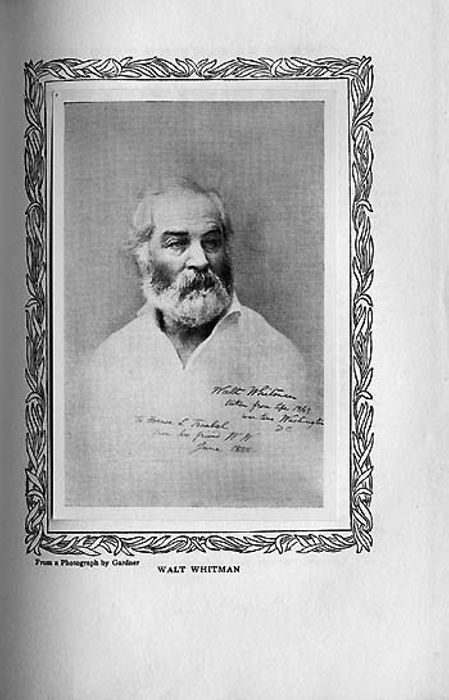 [Begin page 391]—will some day be interesting to the world.' Maurice always runs to extremes." I said: "I don't expect you to agree with us about the value of these odds and ends. [See indexical note p391.1] You have destroyed many papers and letters."
"Yes—I suppose I have: many of them."
"Don't do it any more—give them to me." W. burst out in the midst of a laugh: "Is that a request or a command?"
"Neither—but you once promised to do it."
"So I did—and haven't I pretty decently kept my promise?"
"I think you have." Then he grew earnest. [See indexical note p391.2]
"God knows boy you are welcome to the stuff—most of it seems to have no value to me: if you think it has any significance—is data for history—take it—preserve it—welcome—welcome."
[Begin page 391]—will some day be interesting to the world.' Maurice always runs to extremes." I said: "I don't expect you to agree with us about the value of these odds and ends. [See indexical note p391.1] You have destroyed many papers and letters."
"Yes—I suppose I have: many of them."
"Don't do it any more—give them to me." W. burst out in the midst of a laugh: "Is that a request or a command?"
"Neither—but you once promised to do it."
"So I did—and haven't I pretty decently kept my promise?"
"I think you have." Then he grew earnest. [See indexical note p391.2]
"God knows boy you are welcome to the stuff—most of it seems to have no value to me: if you think it has any significance—is data for history—take it—preserve it—welcome—welcome."
Thursday, June 28, 1888.
[See indexical note p391.3] To W.'s at 8. W. about to light the gas. After considerable fussing he got the job done. Would not let me help him. "I've had a bad day—a very bad day: am better now, however. Dr. Osler came over a couple of hours ago—said he did not like my feebleness—spoke of it for the first time today—made up some prescription of wine and cocoa which has helped me. How life plays itself back and forth!—what a chapter of ups and downs! I wonder how I am going to come out of all this? Right, I suppose, whatever happens—if death happens, life happens—either way." [See indexical note p391.4] Asked Mrs. Davis to send up Warren. "I like to look at him—he is health to look at: young, strong, lithe." But when Warren came W. did not talk. Handed me back yesterday's proofs. "You fellows between you are giving me the cleanest proofs I have ever received. I seem to be in a safe environment." Asked me: "Didn't you say, Horace, that Ferguson was printing Poore's book? [See indexical note p391.5] I knew Poore but not intimately. I don't think I figure in his reminiscences. Didn't you tell me he died? Ah, yes! I can remember him clearly. He was [Begin page 392] a man of parts. There used to be actors—are actors—formal, stiff—given to precedents, traditions and all that—who after all are not to be sneezed at. [See indexical note p392.1] Poore was one of that type. I met him in Washington—he was of the New England breed—the cultured stripe. There was a time when New England culture made me sick, mad, rebellious, though now it does not seem to matter—I have become hardened to it." Alluding to the portrait he gave me yesterday: "How well I was then!—not a sore spot—full of initiative, vigor, joy—not much belly, but grit, fibre, hold, solidity. [See indexical note p392.2] Indeed, all through those years—that period—I was at my best—physically at my best, mentally, every way."
Ferguson thinks our offer to McKay for the Specimen Days plates is fair. [See indexical note p392.3] W. says: "So do I. Dave mustn't think I am wholly ignorant in such matters. Of course I don't blame Dave, either, for standing out for all he can get. That is business. It's not pretty in him or in me—it's business. Dave has Napoleonic qualities. I admire him." Referring to the management of headlines W. says: [See indexical note p392.4] "I have no doctrine about such things: all ways are good if they are good ways—if they pan out well. I remember I used to have an intense dislike for eating in theatres—in such public places—seeing people eat—eating myself—especially women eating: but one evening I went into a theatre—it was hot and close—with a friend—and in the course of the play he nudged me: 'Look there!' he said: [See indexical note p392.5] and I looked: I found him pointing out a woman in front of us sucking an orange—violating my tradition: but doing it so inimitably—being no doubt warm and thirsty—doing it with such calm grace, cleanliness, I could not but admit that it justified itself. [See indexical note p392.6] It is a good, the only, principle, to apply to art."
Turning over some proof-sheets he quoted a line from his own Burns paper, removing his glasses and looking at [Begin page 393] me as he did so. "Some of my friends think the Burns piece the best of all: I don't look on it that way. [See indexical note p393.1] It was what the artists call a pot-boiler. Oh! I needed money very badly—Rice asked for it or something—so I wrote it. Carnegie has written me about it—you know Andrew is a true-blue Scotchman. I have been associated all my life with people who regard Burns as the greatest—yes, the very greatest—of poets—of wonderful firsthand children of genius. I am not so filled by Burns myself—I seem to need other fodder than his sort—though I honor, love him—indeed, recognize the paramount significance, eternality, of his songs."
We spoke of the will. "I really got to work at it today—you have egged me on—on. [See indexical note p393.2] I don't know which is most stubborn—your kind of Dutch or mine. I will have the document signed, consummated, tomorrow. Then you and Harned can sleep without dreams again." First draft in pencil. Mrs. Davis yesterday persuaded boys on the street to take their firecrackers around the corner. [See indexical note p393.3] W. objected. "Don't send them away, Mary: the boys don't like to be disturbed either. Besides who knows but there may be a sicker Man around the corner?" W. jollied with Baker anent what he called his "grog." "Baker fills me full—then wants to fill me all over again. But I am like another fellow I have heard of—I only hold a pint. [See indexical note p393.4] I am glad you drink nothing, Horace—that will hold finely for a young fellow, even in middle life. I am inclined to think that when a man gets old and his fires slow down some touch of (never much) stimulant may be necessary." We talked a little about a letter in which Roden Noel complained to W. that though he had been among W.'s earliest adherents in England Bucke had not included him in the list of W.'s English friends. [See indexical note p393.5] "I am sorry the thing occurred: it was an accident: an accident for which I was probably responsible. Noel is right: he was on the spot—I knew [Begin page 394] it. Friends there or here were none too many—I should not have missed any of them." This is Noel's whole letter:
London, May 16, 1886. Dear Sir.[See indexical note p394.1] I am so sorry to hear of your illness! and very sorry to hear the book has not reached you. I have now told my publisher to send another copy to your correct address and shall be glad to hear you are not dissatisfied with the essay on yourself. I'll send a copy too of my last book, Songs of the Heights and Deeps. I formerly sent you some of my poetry, but it was early work. I hope I have been getting on since, and have now got a place—perhaps as permanent as this sort of thing can be!—among our poets—though I am not popular here, or in America. I could wish to be more known in America.
[See indexical note p394.2] I am glad that you are at last taking your rightful place among the best. My debt to you is great. Would that I could express it in person! I have often said the chief (if not the only) reason why I want to go to America is to see Niagara, the Yosemite, and Walt Whitman!
[See indexical note p394.3] You did send me your works, and I value the present not a little. But I was sorry to see Dr. Bucke did not mention me among your early admirers, for I published in Dark Blue an essay you and Mr. Burroughs liked long ago (this one is an enlarged republication of that).
I venture to send a photo of myself in return for some you sent me of yourself formerly.
Yours with sincere respect, Roden Noel.W. also showed me a letter from Burroughs. "It contains some mighty interesting reading—criticism—a touch and go at Curtis, Arnold, Emerson, Carlyle. John is extra fine at that sort of work, especially in letters, where he qualifies nothing, just lets himself go on free wing. [See indexical note p394.4] Read the letter. It's better than a good apple."
[Begin page 395] West Park, Jan. 8, '84. Dear Walt:[See indexical note p395.1] That piece of writing of yours in the last Critic is to me very impressive. It is seldom you have fallen into such a noble and lofty strain. As I am myself trying to write a little these days, it makes me sad. It is like a great ship that comes to windward of me and takes the breeze out of the sail of my little shallop. I shall have to lay by today and let the impression wear off. I think you have hit it exactly with that word physiological. It lets in a flood of light. The whole essay is one to be long conned over.
[See indexical note p395.2] I went down to New York to hear Arnold on Emerson Friday night. Curtis—the pensive Curtis—introduced the lecturer. I wonder if you have heard Curtis speak? 'Tis a pity he is not a little more robust and manly. He fairly leans and languishes on the bosom of the Graces, one after another. Arnold looked hearty and strong and spoke in a foggy, misty English voice, that left the outlines of his sentences pretty obscure, but which had a certain charm after all. [See indexical note p395.3] The lecture contained nothing new. The Tribune report you sent me is an admirable summary—the pith of the whole lecture. He does not do full justice to Emerson as I hope to show in my essay. At least Emerson can be shorn of these things, and left a more impressive figure than Arnold leaves him. He had much to say about Carlyle, too, but would not place him with the great writers! [See indexical note p395.4] Because he was more than a great literary man he denied him literary honors.
Drop me a line when you feel like it. Winter is in full blast up here and the river snores and groans like a weary sleeper.
With much love, John Burroughs."When John is wholly John," said W., "he can't be beat. I think that probably the best part of that letter, which is [Begin page 396] full of best parts, is his sentence on the weather." "An author's letters are like an artist's sketches—they often contain his best art." [See indexical note p396.1] "You are right, Horace. Nobody's looking at a man when he is writing a letter: he just writes: writes: is wholly honest with himself. Of course all letters are not honest letters: I am speaking of honest letters: John's letter is an honest letter."
Friday, June 29, 1888.
[See indexical note p396.2] 8.15 P.M. W. lay on his bed as I entered and talked from that place almost gaily and with apparent ease. "I seem to have improved this afternoon and evening: my mind is clearer than any day yet: less sore—with less of the drowsy befuddled feeling." Voice stronger, eye clearer. But when I helped him to his chair I found him almost a dead weight. Even suggested going down stairs to supper. Baker headed him off by appearing in the room with the meal. "I felt that if I was ever going to make a move I had to start sometime." Osler not over today or to be over until Monday.
[See indexical note p396.3] Had he concluded the will at last? "Oh, it is done, Horace—I got it through today—my last will and testament and so forth—it is all signed and sealed. I wrote a short note to Dr. Bucke about it today: not much, but telling him: and if you write in the morning (I hope you will) you may tell him again—it won't hurt. If I keep on fooling with one will and another I won't know which is my last. I will have to look the will over a little for slips before letting it go: I am not certain of it as it stands: then it can be put in Tom's safe." Baker and Mrs. Davis were witnesses to the will.
[See indexical note p396.4] W. had been reading Charles Morris' screed on himself in The American. "It is a surprising hubbub he makes, indeed—it reminds me of little children playing with jackstraws or brass ninepins or toy balloons. As to Frank's piece—Frank Williams'—I'm afraid that too failed to im- [Begin page 397]press me. I have been wondering whether the trouble is with them or with me—whether I have changed, gone back—somehow the fellows nowadays—so many of them—seem to be writing the strangest fol-de-rol." [See indexical note p397.1] McKay said to me: "Charles Morris started out by saying he knew nothing about Walt Whitman and proved it." W. amused. "After all these literary fellows are so much alike—almost the whole crew (always excepting a fellow like Frank, who contains real stuff): I often find myself lost, absolutely lost, in their monkey-like mediocrities."
[See indexical note p397.2] W. said he had known Greeley and Raymond and Dana. "In a general way Dana was favorable to my work—not in any thorough-going fashion. I interest the newspaper men as one of the strange fellows—they look for freakish characters—it is among these I come in. How few of them—of all of them—actors, writers, professional men, laborers—on whom you can't put a tag. [See indexical note p397.3] There was Emerson—they never could hold him: no province, no clique, no church: and there was Lincoln, who did his duty, went his way, untrammelled: but there are few others. I slipped out, avoided the beaten paths, tried a way of my own—that was my experiment. Has it failed or succeeded?"
Talked of his "medicine men," as he calls them. "Dr. Baker is a faithful henchman—obeys orders—puts me through the mill—I have to submit. Osler, too, has his points—big points. But after all the real man is Dr. Bucke. [See indexical note p397.4] He is the top of the heap. He has such a clear head, such a fund of common sense—such steady eyes—such a steady hand. As you say, Bucke is a scientist, not a doctor: he has had severe personal experiences—is an expert in questions involving the mind—is in every sort of a way a large man—liberal, devoted, far-seeing. I especially owe him so much—Oh so much!"
[See indexical note p397.5] W. said: "I see that I shall write no more." "Nonsense," I exclaimed. He laughed outright. "More nonsense?" he [Begin page 398] asked. I told him people sometimes asked me whether he possessed any sense of humor. "And you say—" "Then I tell them a few of your stories and get them convulsed." "Does that convince them?" [See indexical note p398.1] "It makes an impression. W. added: "So they think I am funereal—that I live in a coffin—that I am solemn—never laugh—look down my nose—so—" and to prove that he never laughs he laughed. [See indexical note p398.2] "I have been intending for forty years to put on record the fairest picture I could conjure of Elias Hicks. Now I seem too far gone to do the job. I think I am or have been peculiarly fitted, equipped—having the run of certain facts—to do this for him."
[See indexical note p398.3] W. said to me tonight again as he has before: "Some day you will be writing about me: be sure to write about me honest: whatever you do do not prettify me: include all the hells and damns." Adding: "I have hated so much of the biography in literature because it is so untrue: look at our national figures how they are spoiled by liars: by the people who think they can improve on God Almighty's work—who put an extra touch on here, there, here again, there again, until the real man is no longer recognizable."
[See indexical note p398.4] W. gave me a letter from Standish O'Grady. "You remember that Dowden alluded to him in one of the letters I turned over to you? He seems to have been a young man of great spirit—talent: of high and masterful ambition." I found W. had put this memorandum on the letter: "from Standish O'Grady: sent photos to him Dec. 14, '81." Where was Standish O'Grady now? "I do not seem to know." "Did he get diverted?" [See indexical note p398.5] "Possibly: he does not seem to have kept me on his list. The young fellows come—the old men go—often, often: they serve an apprenticeship with me, in their youth, when they are getting their roots well in the soil—then they die, maybe become professional, adopt institutions, find that Walt Whitman will no longer do."
[Begin page 399] Dublin, October 5, 1881. Dear Sir,[See indexical note p399.1] My friend Mr Bagenal has written to me from America describing his interview with you and the kindness with which you spoke of myself. For years it has been a hope to me that I may see you and be able to tell you personally what your writings have been to me, every line breathing hope, admiration, trust and love. [See indexical note p399.2] For myself I can safely say that except William Rolleston no reader or student of your poetry has studied it so closely or so taken it into his nature as myself.
As a practical advice I would suggest that you would cause a certain number of advertisements to appear in our and the English press announcing that copies might be had from you personally. I procured mine from Trubner & Co. London paying two pounds ten when as I understand they may be had from you for two pounds, and I see no reason why publishers should fatten while the producer is neglected.
When Mr. Bagenal was in Ireland, I remember, he used to laugh copiously at the form of your poetry forgetting that account given by Alcibiades of the outer form of Socrates with the images of the gods within. [See indexical note p399.3] Now I find that from having met you and conversed, seen and heard, he is also one of us, and reads, marks, learns and inwardly digests.
One thing in your poetry I will refer to, that is the love of the heroic successful or unsuccessful. It chances that I have given a good deal of time to the study of the primitive literature of this country, a race in which the note of heroism and chivalry ever sounds. My impressions regarding this literature I have published in various works. One of these recently published is History: Ireland, Vol. I, Critical and Philosophical. I directed Scribner & Co. to send you a copy of this knowing your acquaintance and love of early Norse literature, which is kin to the Irish, with the heroes of the Niebelungen Lied: you are well acquainted and have [Begin page 400] praised them, but I think Cuculain our primitive Irish hero is equal to any of them, but English literature has the ear of the world and wilfully ignores everything of the kind. [See indexical note p400.1] May I ask whether you have received the book? If not I shall send one direct. My other works are History of Ireland, Heroic Period, Vols I and 2, an epical representation chiefly of Cuculain's career but not blameless as I have molded the chaotic poems and tales into a complete whole and so the student can never be exactly certain what is and what is not my own.
[See indexical note p400.2] I dare say like most men but for you I would have swung round to the theory of strong govts, an aristocratic ruling class, &c. I think from your comments on English literature that you don't appreciate Shelley. In the Revolt of Islam he has a fine Panegyric on the future of America. For my own part I put him high very high; his meaning lies fold within fold never to be exhausted. [See indexical note p400.3] For example, his love poetry is chiefly mystical religious, the divine bride, "perfect wife," is the object.
I find as I change I cannot so change as that I do not meet in you the expression of every changing ideal penetrating even the remotest parts of my nature with a profound sympathy as of his who knew what was in man.
[See indexical note p400.4] Farewell. Know that there are many in the "ancestor continents" of whom towards you might be said what was sung of our Irish hero Cuculain meeting his friend, "He poured forth a torrent of friendly welcome and affection."
Standish O'Grady.Saturday, June 30, 1888.
[See indexical note p400.5] To W.'s 7.30. Harned there. W. had gone behind a bit today. "From the medical point of view they tell me I'm getting on all right, but from the point of view of my own comfort I'm in a pretty boggy condition indeed. But so the doctor feels all right about it I don't suppose it mat- [Begin page 401]ters what I feel. I like to see the doctors comfortable, anyway." [See indexical note p401.1] Harned just back from New York. W. quizzed him. Said Tom: "I met Brick Pomeroy in New York." "The mischief you did! What's Brick doing now? It is remarkable how many of us live on and on long after we are dead."
The boys on the street annoy W. with their firecrackers but he will not have them disturbed. [See indexical note p401.2] "There's a certain allowance of deviltry in all boys. The boys out in this street probably know there is a sore, nervous old man up in this room, so they fling their malignant rattle-snake poison about with special vehemence. Boys could not get along without that. But let them go on—don't interfere with them. It would worry me more to have that done than to bear with the noise." Harned put it: "You talk in a familiar way about the devil, Walt, but you don't believe in him even a little bit." [See indexical note p401.3] W. laughed heartily: "You're right, Tom—not even a little bit—not even the littlest bit: I ought to send my apologies out to the boys."
Seemed feeble. Talked with Harned about politics—only briefly. "My head is no good tonight. Last night I felt extra strong." Had not read much proof today. [See indexical note p401.4] "I'll have to trust myself to your diplomacy with Ferguson again: these delays are tantalizing." No visitors, he said—"and only two letters—both requests for autographs—so you see I sort of drew a blank today. One of the autograph fellows intimated that I might die soon, which made his request a very urgent one. [See indexical note p401.5] I was so tickled with the cheek and honesty of the fellow that I signed and sent him the card." "You ought to die, also, at once, in order to please him." W. laughed quietly: "That's so," he said, "bring me some poison." Harned withdrew. W. said: "When Tom came in he was grumpy enough to hit me. [See indexical note p401.6] I found myself dodging him. He softened down in a few minutes: then you arrived. Tom seems to put on a mask of crossness in order to hide the fact that he is kind."
[Begin page 402]We discussed the book some. W. in no shape to be worried. Had not alluded to the will. W. had tied up some letters in a string. [See indexical note p402.1] Handed them to me. "Sit down and read them." "What are they?" "A few tid-bits for your treasure box," he said, with about half a smile. "A couple of letters from John—a letter from Sidney Morse: John's letters are old—Sidney's came only a week or more ago. Burroughs takes exception to O'Connor's vehemence—he often does it: it seems to be too strong for John's nerves: but what's the use of kicking? [See indexical note p402.2] It is very like making a fuss because the wind blows too hard—because the waters raise the devil when the storm comes in. Well, there's a law for noise as well as for quiet. John has been to Concord—takes a kind of shine to Edward Emerson. To me Edward is by no means the son of his father: he is of a far less capacious mold. [See indexical note p402.3] You'll find in one of John's letters that he talks to me like a Dutch uncle about my health. I really believe John thinks I am mostly or mainly the cause of my own ill health. Who knows? I don't claim to be innocent. In Sidney's letter is some very cute talk about his intuitions: Sidney is very knowing at that sort of thing: I shouldn't wonder but he's nearer the truth than not. I was messing through some old things a bit today between my trips from the bed to the chair and back again—these turned up—I put them aside for you. [See indexical note p402.4] That Schmidt document ought to be of special interest to you: I was giving Schmidt some pointers about myself—my life, purposes, etcetera: a bit of this and that jotted down, not at random, exactly, but with no attempt to shape anything to formal expression. Morse includes some shrewd political touches in his note—you will highly appreciate them: you and Sidney are companion souls in radicalism. [See indexical note p402.5] John is always calm—I think his calm helps me: I find myself comforted in his good will. I suppose it would help both if William would exchange some of his surplus stir for some of John's [Begin page 403] surplus calm." I read one of the Burroughs letters and then left. [See indexical note p403.1] W. wearied. Referring to my precious burden in the string W. said in a little twinkle of merriment: "You don't go home starved tonight, do you?" And finally with his good night cried after me the admonition to "keep on the good side of Ferguson" till he could get back at his work again. Also said: "Write to any of the boys you may think want to hear from or about me. Tell them I cannot write myself—describe my situation: tell them how helpless I am. I need your co-operation in such matters." This is the Burroughs letter I read:
Esopus, N.Y., Aug. 17, '83. Dear Walt:[See indexical note p403.2] Drop me a line where and how you are and what your plans are for the fall.
We are just back from Roxbury where we went in July. We are all pretty well. I rec'd Dr. Bucke's book and thank you for it. I had already purchased and read it. I cannot say that I care much for what Dr. Bucke has to say; he gives me no new hint or idea. Wm. O'Connor's letter is a treat, with a little too much seasoning. [See indexical note p403.3] If Wm. would only practise a little more self-denial, he would be much more effective. He could write so that his critics could not laugh at him. The review of the book in the Tribune was by a woman—a Miss H—(I forget her name)—regularly employed upon the paper. The latter part of June Gilder and I went to Concord and spent a couple of days there. Called on Mrs. Emerson, liked her much, supped and breakfasted with Sanborn and had a pleasant time. [See indexical note p403.4] Young Dr. Emerson seems a worthy son of his father. I liked him much.
If we ever get another girl in this house and the kitchen machinery running smoothly again, I shall come for you and take no denial. I think it would lengthen my days to see you once more.
With love John Burroughs.Sunday, July 1, 1888.
This is the Burroughs letter which W. spoke of yesterday:
West Park, N.Y., Oct. 7, '85. Dear Walt:[See indexical note p404.1] We left Ocean Grove the next day after I was with you, and are now all home again, safe and snug. I gave up the Ky. trip for the present. Gilder said next spring would do, so I expect to go next May, and see the season open down there.
I hope you are still mending, Walt. I am almost certain you eat too heartily and make too much blood and fat; at least that you eat too hearty food. As I told you, I was profoundly impressed by a couple of articles in the Fortnightly Review by Sir William Thompson, on Diet with relation to Age and Activity. [See indexical note p404.2] He shows very convincingly that as our activities fail by the advance of age, we must cut down in our food. If not the engine makes too much steam, things become clogged and congested and the whole economy of the system deranged. He says a little meat once a day is enough, and recommends the cereals and fruits. I think you make too much blood. This congested condition of your organs at times, shows it. Then you looked to me too fat; and fat at your age clogs and hinders the circulation. I shall talk to my Dr. about you when I see him again, but if I were you I would adopt such a diet as would make my blood as thin as possible, and so lessen the arterial strain. [See indexical note p404.3] This is common sense and I believe good science. In the best health, we grow lean, Sir William Thompson says, like a man training for the ring. I gained much flesh this summer, and am dull and spiritless this fall, as a consequence. I must work it off some way. Drop me a card if you can how you are.
With much love, John Burroughs. [Begin page 405]"A good letter—read again," W. had written on the outside. "Yes," he said, "John about hit the truth. [See indexical note p405.1] But I have been very abstemious the past three years—very conservative—as you know, and still here I am thrown down. Well, my time has come—that is all. You see, I am somewhat of a fatalist!" Morse's letter:
Richmond, Ind., June 15, 1888. Dear W—[See indexical note p405.2] I sent word by Horace one day that I had an intuition that you were about to enter upon a new lease of life. The next day the telegraph announced you were slightly improved from a severe attack of "heart failure." Now Horace writes you are quite yourself again. I take it my spirit sense of your condition is not likely to fail after all. But the hot weather is coming, and we shall get it by July good and hot. I hope you can get into comfortable shape by the time it reaches Camden.
[See indexical note p405.3] Am glad Horace is at hand to afford any help you might need.
I have about concluded not to go to the Cin. Exposition. There is so much red tape it will cost me all of twenty dollars to exhibit a few busts. I am calculating on starting for Chicago middle of next week. I'd like to look in on the Chicago Convention—just to see the shape of the heads that are prominent.
[See indexical note p405.4] I notice a marked difference in the political atmosphere here and in Mass. People here are more rambunctious; they get mad. The Republicans are high toned and look down on Democrats. If you show any proclivities of Democratic color they wonder how you can. How can white think well of black? And then, the anti-copperhead talk is still rampant here. The Dems are sore some over the slaughter of Gray, and Harrison would catch many sorehead votes. [See indexical note p405.5] If the Republicans have got to have a rushing campaign, they'll get it sooner with the grandson of old Tippecanoe, than with [Begin page 406]the cold-blooded Sherman. But I believe Blaine would sweep the States. Everybody fairly dances when his name is mentioned. Strange. I can't understand it. Somehow I am drawn personally more to Cleveland than any one of the others. [See indexical note p406.1] And yet he's a kind of a pork.
Well, this is a hot day here. I hope you keep mending and that you only went back a little for a new start.
Kindly, Morse.W. amused over Morse's allusion to Cleveland. "'A kind of pork.' How good. I am like your father, too: I never can quite forget that Cleveland once hung a man with his own hands. [See indexical note p406.2] I do not seem inspired by anything that's happening in politics nowadays. In fact, nothing real is happening. New issues are forming and grave issues (among the gravest)—but they are not yet politically expressed." I will also put the W. letter to Schmidt in here. [See indexical note p406.3] W. says of it again today: "It is first-rate autobiography—I rather let myself out in that letter—gave him pointers, this and that, so as to set him right in certain particulars—in matters he could not have known nor even learned about at such a distance." In reply to my question W. said: "Yes, I was at Ocean Grove with Burroughs: it was there that I wrote With Husky Haughty Lips O Sea—a rare experience: John himself was in extra good feather." [See indexical note p406.4] There are two dates on the Schmidt letter—Jan. 16 and 20th, 1872. Here is the letter:
[See indexical note p406.5] "Supposing that the books and papers I sent you in response to your letter have safely arrived, I thought I would now write you a few lines. What I have to submit and say I will just say without ceremony—confident you will receive it in the same spirit in which it is written. I sent you (By Mr. Clausen) my poems Leaves of Grass, and little prose
[Begin page figure-28]
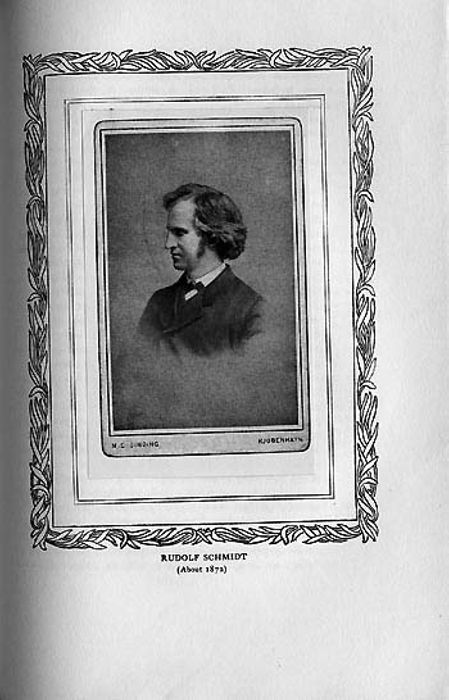 [Begin page 407] work Democratic Vistas. Also a piece I recited at the opening of the American Institute in New York; and then several criticisms, sketches &c. about the books and about myself by different persons, from different points of view. [See indexical note p407.1] These will furnish you with sufficient material for your examination, digest and proposed review.
[See indexical note p407.2] "When you are composing your review, I would like to have you bring in, in the proper place, the following mentioned facts—that neither my book of poems or Democratic Vistas is cordially accepted in the United States—nor do any of the chief Literary persons or organs of that country admit Leaves of Grass as having (possessing) any value or recognize the author as a poet at all—that he has indeed been ignominiously dismissed from a moderate government employment by special order of a cabinet officer at Washington, for the sole and avowed reason that he was the writer of the book—that, up to this time, no American publisher will publish it (the author having had to print its various editions himself)—that many of the bookstores refuse to keep it for sale—and that the position of the author both as to literary rank and worldly prosperity, in his own country, has been and remains to day under a heavy and depressing cloud. [See indexical note p407.3]
[See indexical note p407.4] "Of course at the same time you will hardly need to be told that my book is written in the sun, and with a gay heart—for these surely fully belong to me. But I think a good foreign criticism of my works would be more complete by giving these facts above, for they are substantial facts, notwithstanding a very few exceptions, and in truth they are a necessary part of any complete criticism.
[See indexical note p407.5] "Abroad, my book and myself have had a welcome quite dazzling. Tennyson writes me friendly letters. Freiligrath translates and commends me. Robert Buchanan, Swinburne, the great English and Dublin colleges, affectionately receive me and doughtily champion me. And [Begin page 408] while I, the author, am without any recompense at all in America, the English pirate-publisher, Hotten, draws a handsome annual income from a bad London reprint of my poems.
[See indexical note p408.1] "I wish you to speak of the purpose of Democratic Vistas—(It is at present in danger of falling still-born here.)
"I should be glad to hear more from you, your magazine, your country too. For all, accept my friendliest good wishes.
"Direct, W. W. Solicitor's office. Treasury, Washington, D.C. United States America.
Later. [See indexical note p408.2] Upon reading over my letter, previous to mailing it, I had almost decided not to send it as a part of it may be open to the suspicion of querulousness—yet as nothing can be further from my real state of mind (which is more than satisfied with my literary fortune upon the whole) I will let it go."
I said to W.: "I'm glad you put your 'Later' in the Schmidt letter." "Why?" "I hate to seem to hear you growl over the treatment you have received. You have never growled to me." "I should hope not. Did the letter sound like a growl?" "Part of it—yes." "I must have suspected that myself—that's probably the explanation of the 'Later.'" I asked W.: "Did you ever meet with any experience you did not expect? When you started out doing an unusual thing did you not expect an unusual reception or no reception at all?" "Yes—yes: to be sure." "Then a growl would not have been in order." [See indexical note p408.3] "No—it would not: and if I have ever said or written anything to you or anybody which seemed to be a growl I ought to be ashamed of myself." "After all—did you care what the world thought of you?" "Yes, I cared—but not enough to give up my fight."
[Begin page 409]This day, Sunday, in at W.'s at 7.30. Day had been a bad one again, though he had eaten somewhat better than yesterday, especially towards evening. He said to me earnestly: "Physically I seem to be about done for—and mentally, too—all done for, for that matter." [See indexical note p409.1] "Do you mean that you give up?" This fired him. "Hardly that—hardly that: but I don't seem no good nohow"—laughing gently. He has spoken much in the same vein to Mrs. Davis. He went on in this way to Mrs. Davis: "I feel that Dr. Bucke brought me out of the last bad spell. The Doctor called it vertigo, but he's not entirely right—it's paralysis, Mary. I know if Bucke don't, for I've had many of these attacks—know just what they are—all of them coming from the severe illness I had after the war. [See indexical note p409.2] I've pulled through them all, so far, but whether I'll pull through this I don't seem to know. Some day, however, there'll be one from which I won't pull out. I am in the midst of printing my little book—something I ought to have finished six months ago: and now I find I can't work at all. I don't know what I should have done if it hadn't been for Horace's stepping in as he did, lending a hand, helping me out: he is so kind, willing, able—he so well understands the job, understands me."
W. reading the N. A. Review Lincoln vol. when I entered. [See indexical note p409.3] Closed it, took off his spectacles and said: "Lincoln don't need adorers, worshippers—he needs friends. I take this book up a little now and then, to see what can be made of it. The great danger with Lincoln for the next fifty years will be that he will be overdone—overexplained, over-exploited—made a good deal too much of—gather about himself a rather mythical aureole. There was James Parton, who used to say of Washington: 'He's no real man—no such man ever existed—history warrants no such character.' The same danger threatens Lincoln—dear Lincoln: threatens to remove him from the list of living men and women and set [Begin page 410] him up among the false historic worthies—the wooden gods of the calendar—God save the sad mark! [See indexical note p410.1] Oh! that little Herald piece awhile ago in which something of this kind was said was very keen, cute, profound."
W. reading "tariff talk" in Phila. Press today. "I believe all this argument in favor of a tariff is stale, flat—utterly and irretrievably stupid beyond any conceivable limit. Such tariff talk is utterly asinine. [See indexical note p410.2] A mixture of dishwater, mud, old rags, dirty personalities, without any title whatever to respect. Certainly there's something to be said for the tariff by somebody, but just as certainly these fellows don't say it." W. showed me a copy of the English edition of his prose—Democratic Vistas, &c.—just out, and of Specimen Days. "I got fifty copies of the book—have given twenty-five away. [See indexical note p410.3] I get published, in spite of my enemies." "Your enemies never really hurt you?" "Never: they delayed me some, that's all." Mrs. Davis brought him an apron full of chicks. He fondled them, called them "dears"—was pleased—hated to have them taken away. Clifford today gave me two portraits of Hilda, his little girl. W. studied them with greedy eyes. "How lovely they are! They make me feel young again—they put new blood into me: they revive my dead ambitions." [See indexical note p410.4] W. had autographed some of the Whitman bas-reliefs made by Morse. Did two for me. "I think highly of the medallion—very highly indeed: it impresses me as a very significant piece of work. Morse gets the spirit of a face: gives up the letter if need be for the spirit." W. gave me an envelope containing a clipping from Bell's Weekly Messenger and Farmers' Journal treating of the celebration of W. W.'s birthday. [See indexical note p410.5] "Yes, we leak out into other countries, too." Said he had as yet no note from any one abroad concerning his recent illness. Sent one of the new English books to Bucke. Gave me copy up to the Hicks. "I hate to admit it," he said, "but I am so devilish poorly I shall be forced to ask you to extricate the Hicks hodge- [Begin page 411]podge from a mass of manuscripts here on my table." [See indexical note p411.1] As I was leaving W. said: "You will be hearing from Gilder, Burroughs, Stedman, Kennedy, the boys everywhere: you will know what to say to them: say the right word—say it as from me: say it with love—yes, with dear love: tell them how helpless I am to act for myself except through you: but give them my love—always that, to the last always that."
Monday, July 2, 1888.
To W's at eight o'clock. Frank Harned present for awhile. He had his own photos of the Morse W. W. bust and of the Hicks. W. discussed them. Wants to put them in the book. W. in bed when I got in. We helped him to a chair. Pretty feeble. Frank withdrew in a little while. We continued to talk. W. spoke of himself. [See indexical note p411.2] "I'm turned clean over—off my keel—am badly shaken. I seem to see things all right with my mind but my body won't see things at all!" Mildly laughed. "There's the book—the dear book—forever waiting—and I seem to be more feeble than ever. [See indexical note p411.3] But"—and he raised himself a bit in the chair—"there's no use dying now when there's still a job of work to do." W. handed me a newspaper reprint of Stedman's The Discoverer. "I never read that poem," said W., "but it powerfully affects me. Why do you suppose that is?" Had had a short note from Bucke—"a whiff of fresh air from the north," he described it. I read him a letter I had from Burroughs today. But he would not listen at all to B.'s suggestion that W. should go off to the shore. "John is fine, fine, about all that, but he does not quite take in the situation here. All my good friends suggest different cures, places, diets—changes of geography: one sort and all sorts of revolutions: but I am bound after all to keep to my own path. [See indexical note p411.4] The best place for me is just where I am—here, retired, in quiet, alone, to wait and see what results. For the present everything else must be held in abeyance. I am [Begin page 412] touched with John's solicitude—I do not want to seem ungrateful—I push his idea aside, but gently, gently."
I had to hunt up some proofs for W. They had been mislaid on his table. [See indexical note p412.1] He laughed about it. "This room is full of lost and found." Then laughed again. "Mary thinks it an utterly indecent place—disorder added to disorder. But then you remember what some one said writing about the Leaves: 'This book is a confused book—that's its main trouble: the author got mixed up at the start and was never put to order again.' That explains this room." Said again: "Pearsall Smith has got abroad, into England, to his new home, safely: a letter arrived today—says the voyage did him good—I am glad—he had been ill."
[See indexical note p412.2] I quoted a note from Morse in which Morse said: "I put up a big fight for Walt at a meeting the other night. I was interrupted in a speech by a man who accused Walt of want of sympathy for other authors." W. asked half in rumination: "Did Sidney say that?" Pausing for a minute or so. "I wonder if I have seemed to be amenable to such an accusation?" I said nothing, whereat he went on; "It may be true—I don't know: I don't intend it to be true, God knows! [See indexical note p412.3] Who can tell? William O'Connor used to say: 'Be careful, Walt, that in your revolt you do not go to the other extreme.' I was talking the other day with Tom, mentioning Stedman. Tom asked me: 'Walt, do you think you are quite fair to Stedman? Ain't he a good deal of a fellow in spite of your doubts?' [See indexical note p412.4] I think I have always conceded that he is a good deal of a fellow—a good deal: if I have expressed any doubts it must be because he has not been quite the good deal of a fellow his own work led me to expect him to be. And the same of many others—of many others: I have felt they have not let go—have not been willing to let their demon work out its fate—have not believed enough in themselves. Is this unfair to them? If it's true it's not unfair to them—if it's not true no one's hurt but [Begin page 413] your daddy. Of course nothing I say of their work applies to them in the personal sense—they are fine fellows—often the best—Stedman, Gilder, the others: and as to their place—well, they have a place, they are filling a place. [See indexical note p413.1] They may after all be the kings of all the people and I may be only—only Walt Whitman. I talk out in meeting, sometimes—and sometimes out of meeting: I particularly talk when you are around. If I talk wrong, then I talk wrong—but I talk honest, or always mean to: maybe that is the chief thing, to talk honest." When he stopped I said: "That gives a pretty good notion of the stand you take. Did you say all that to Harned?" [See indexical note p413.2] "I don't remember—maybe not—but I might have said it all: I don't like to be thought querulous—I like to give the biggest meanings to people, things, events, that I can."
I was still poking about looking for the proofs. I turned up numerous odds and ends in the search. One sheet of paper (Dept. of Justice stationery of the seventies) all pencilled over—interlined—studied out—I asked W. if I might have. [See indexical note p413.3] He looked at it and said "Yes," adding: "It is not new—I think I have used it somewhere in my prose." Suddenly called to me: "Horace! Horace! I must get to my bed: my head reels: I feel as though a minute more on my feet—on my feet—here—would finish me—be my last." I sprang to his side. His head fell forward—he seemed about to faint. He reached out, took my hand. "My cane! My cane!" I put the cane in his hand. [See indexical note p413.4] He could say nothing. Tried to get up. He rested his great weight on my shoulder. We made our way to the bed. He fell back on the pillow, exhausted, closing his eyes. "Keep on your hunt, Horace—take what you need: when you are done turn the light down." "Shall I go for Dr. Baker?" He spoke up: "No! No! I need no doctor! I will be all right in a minute: the doctor could do nothing for me." He kept my hand for some time. Then be said more calmly: [Begin page 414] "Now I am easier—easier—much easier." I returned to the search. He was dead still. He did not seem to sleep. [See indexical note p414.1] Now and then he would ask: "Have you found it?" "Any luck yet?" "Haven't you got it yet?" Finally the papers turned up. He laughed slightly. "We lose but we also gain," he said.
W. gave me a message for John Burroughs. Also Bucke. "Doctor is the kingpin." [See indexical note p414.2] He was to have had a check for Ferguson today. Not ready. Would autograph the two medallions I brought and make out the check tomorrow. His last words to me were these: "Good bye! Good bye or good night! I believe you prefer good night!" I had said to him: "Good bye means for all time—good night means for a little while." I will copy here the sheet of pencilled paper. It had had a headline—"The question of form"—which was marked out.
[See indexical note p414.3] "The want for something finished, completed, and technically beautiful will certainly not be supplied by this writer, as it is by existing esthetic works. For the best poems both the old ones and later ones now accepted as first class are polished, rhymed regular, with all the elegance of fine conceits, carefully elaborated, showing under all the restraints of art, language and phrase chosen after very much has been rejected, and only the best admitted, and then all joined and cemented together, and finally presenting the beauty of some architectural temple—some palace, proudly rising in proportions of marble, entered from superb porticos and adorned with statuary satisfying the art sense and that of form, fulfilling beauty and inviting criticism. [See indexical note p414.4] Not so his poetry. Its likeness is not the solid stately palace, nor the sculpture that adorns it, nor the paintings on its walls. Its analogy is the Ocean. Its verses are the liquid, billowy waves, ever rising and falling, perhaps sunny and smooth, perhaps wild with storm, always moving, always alike [Begin page 415] in their nature as rolling waves, but hardly any two exactly alike in size or measure (meter), never having the sense of something finished and fixed, always suggesting something beyond." [See indexical note p415.1]
Tuesday, July 3, 1888.
Evening. W.'s day miserable. "The minute I attempt to work my brain gets into a snarl." Expressed pleasure hearing I had written to Burroughs. "The good John," he called him. [See indexical note p415.2] Still refuses to consider going to the shore. "For the present I must stay where I am. Events might arise to make a change advisable, but for all I can see now I am best here, best at home." Was up only about ten minutes this evening, though he talked from the bed in an easy, cheery way. I handed him some proofs. He was happy over it. "This looks like getting on the move again"—asking me: "Does Ferguson make any comments on my snail-like method of work?" [See indexical note p415.3] Osler was over today. Says: "Do not take a gloomy view of Whitman's case—he will come around." W. says of Osler: "He's a fine fellow and a wise one, I guess: wise, I am sure—he has the air of assurance. Doctor Bucke was to select a man—selected Osler: said Osler was at the head of the band. Osler goes to the University, or somewhere—lectures students." Some one set some fire crackers off right under his window. [See indexical note p415.4] W. said of it: "Don't that beat the devil? Mary wanted to go out today and raise a racket about the firing, but I would not let her. I would rather have a headache than interfere with the boys." Gave me a check for fifty dollars for Ferguson—our first payment. Hobbled about the room. "This cane was given me by Pete Doyle," he reminded me: "Pete was always a good stay and support." [See indexical note p415.5] From his bed he cried to me: "How sweet the bed—the dear bed! When a fellow is physically in the dumps the bed gives him a sort of freedom." W. handed me an old letter of Swinton's to him. "Read it: it is crisp—straight-to." Enve- [Begin page 416]lope was addressed to W. at Washington in W.'s own hand, "care Major Hapgood, paymaster U. S. Army." [See indexical note p416.1] Enclosed was a slip containing this: "The Editor of Harpers Weekly begs to return the enclosed verses to Mr. Walt Whitman with his compliments and many thanks. Harpers Weekly, Feb. 26, 1863." How did that get there? W. did not know. It was in Alden's hand. "Read the letter," said W. again.
Times Office, Wednesday Night 2 O'Clock. My dear Walt[See indexical note p416.2] —You will find the article you sent will be in the Times of this morning, when it is published. I have crowded out a great many things to get it in, and it has taken the precedence of army correspondence and articles which have been waiting a month for insertion. It is excellent—the first part and the closing part of it especially. [See indexical note p416.3] I am glad to see you are engaged in such good work at Washington. It must be even more refreshing than to sit by Pfaff's privy and eat sweet-breads and drink coffee, and listen to the intolerable wit of the crack-brains. I happened in there the other night, and the place smelt as atrociously as ever. [See indexical note p416.4] Pfaff looked as of yore. I read your article in proof and hope it's all accurate enough. "The field large—the reapers few" is the finest paragraph. Everything in New York moves on pretty much as usual. It's the same old town—only different.
My brother William sailed for Port Royal ten days ago—to be present at the attack on Charleston—if it is to be attacked.
[See indexical note p416.5] Do you know Conway of Kansas? He is a good man. If you don't know him, and if he would be of any service to you in any way, I know he would be rejoiced to serve you, if you mentioned my name to him.
The article has some things in that I could recognize you by, but not many. I like it better on that account than I should otherwise.—Hoping that Vicksburg may soon fall.
J. Swinton. [Begin page 417]W. said: "Considering the historic importance of Charleston and Vicksburg John's mention of them by the way, so matter-of-factly, is very impressive. [See indexical note p417.1] John was always a bit sarcastic about Pfaff's: he was like a quick blade—crossed swords with many a man there. My own greatest pleasure at Pfaff's was to look on—to see, talk little, absorb. [See indexical note p417.2] I never was a great discusser, anyway—never. I was much better satisfied to listen to a fight than take part in it." W. has not said a word to Harned about the will since his return. It still lies in its place—endorsed, tied up, in condition to hand over. Did not feel able to sign the bas-reliefs today.
W. asks me every night as I enter: "Well, Horace, what is going on in the world?—what has the world been doing today?" Then he will adjust his glasses and ask his second question almost as unfailingly: "And the proofs—are there proofs?" [See indexical note p417.3] I generally have matters to explain. He listens. Then tucks the roll under his pillow in bed or deposits it carefully on the table if he is up—and remarks: "We're moving on—moving on: this is my tomorrow's job of work." Usually when I hand him today's package he gives me yesterday's. Lately, being conscious of his own unsteadiness, he has got into the habit of cautioning me: "Look everything over—leave nothing absolutely to me: I am not to be depended upon." Again, he has said: "Always keep yourself informed: it will be better for the printers, for the book, for you, and chiefly for me."
[See indexical note p417.4] W. pulled out of a pile of letters on the table a Burroughs envelope. "It is a June letter—worthy of June: written in John's best out of doors mood. Why, it gets into your blood and makes you feel worth while. I sit here, helpless as I am, and breathe it in like fresh air. I enjoyed it better reading it today than I did when it came, which was during the worst of my very bad spell. It was salvation to John to get back on the land: he was fast getting use- [Begin page 418]less, as he says: he took the bull by the horns—made the jump."
West Park, N.Y., June 11, '88. Dear Walt:[See indexical note p418.1] I hear through Kennedy that you are ill or were so last Monday. I do hope you are well again. Drop me a card if you are able and tell me how you are. I want to find time soon to come down and see you, if company does not bore you. I shall think of you as able to be out occasionally enjoying these June days. The world has not been so beautiful to me for a long time as this spring; probably because I have been at work like an honest man. [See indexical note p418.2] I had, in my years of loafing, forgotten how sweet toil was. I suppose those generations of farmers back of me have had something to do with it. They all seem to have come to life again in me and are happy since I have taken to the hoe and crowbar. I had quite lost my interest in literature and was fast losing my interest in life itself, but these two months of work have sharpened my appetite for all things. I write you amid the fragrance of clover and the hum of bees. [See indexical note p418.3] The air is full these days of all sweet meadow and woodland smells. The earth seems good enough to eat.
I propose for a few years to come to devote myself to fruit-growing. I have seventeen acres of land now, nearly all of it out in grapes and currants and raspberries. I think I can make some money and maybe renew my grip upon life.
I was glad to see Kennedy. I like him much.
[See indexical note p418.4] How I wish you were here, or somewhere else in the country where all these sweet influences of the season could minister to you. Your reluctance to move is just what ought to be overcome. It is like the lethargy of a man beginning to freeze.
We are all well. Julian goes to school in Po'keepsie, and is a fine boy. He goes and returns daily on the little [Begin page 419] steamer. I hope O'Connor is no worse. Do drop me a line. With much love
John Burroughs.[See indexical note p419.1] "You see," said W., "John writes letters—real letters. He does not strike you as a maker of phrases. I get so many letters that are distinctly literary—written for effect—labored over—worked upon to be made just so, just so: every phrase nicely balanced—all the words in place. John has the real art—the art of succeeding by not trying to succeed: he is the farmer first, the man, before he is the writer: that is the key, index, anything you may call it, of his success." I quoted a remark made by Stoddard to Brinton or a friend of Brinton (Brinton repeated it to me): "Whitman is sore on the literary class." [See indexical note p419.2] W. laughed: "It's the other way about—the literary class is sore on me." "Does it make you feel bad?" "Not at all. If it did, I should go and train with them instead of staying and training with myself."
Wednesday, July 4, 1888.
Evening, 7.30. W. stood the noise today heroically. Sitting talking with Mrs. Davis. He was urging her to go and see the fireworks. She dissented. Baker not about. She spoke of the danger from fire. He laughed. [See indexical note p419.3] "That is very funny, Mary—very funny. It makes me think of a story I once heard of a Bridget whose mistress found her weeping bitterly before a roaring big fireplace. 'What is the matter with you, Bridget?' asked the mistress, and Bridget, still weeping, said: 'O mum, it's just this way: I might be after marrying Pat and we might have three or four children around and Oh the brats might fall into the fire and be burned to death!' That seems like you, Mary—anticipating trouble. Now that Horace is here I am secure enough for you. Go out—go out—see what you can see— [Begin page 420]enjoy yourself." Turning to me: "Mary thinks men ain't much use for taking care of themselves nohow. I am keen about all that myself—jealous of my right to fall down and break my neck if I choose."
He called my attention to the medallions, duly signed, tied up, with a label on the outside designating them as my property. [See indexical note p420.1] I read him a Morse letter received today. Morse had much to say on politics. W. demurred. "I don't seem to get up any steam—nothing has occurred to enthuse me. The Harrison boom is nearly done for—it came too soon: tired itself out before the campaign had got under way." Clifford in with me. W. alluded to Bar Harbor. Clifford said: "It is a place for the thrifty." [See indexical note p420.2] W. added: "For the thrifty—yes: that sort of thrifty: it is an affair of electric bells, cottages, swell dinners, and all the damnation that goes along with such." Working over the Hicks headline. "I want to show that it is disjecta membra rather than a pretentious study: notes off hand set down with no attempt to put them into sequence." [See indexical note p420.3] Clifford said to W.: "You will get well?" W. answering: "I guess so—but if I don't it will still be all right. I've arranged it with Horace here that we are not to worry over trifles." Laughed lightly.
W. has not seemed to like Frank Harned's pictures. Why? "I don't know why—never do. I have feelings about things. nothing more. [See indexical note p420.4] I try and try and try again, and then try all over if necessary, until the approvable result is secured. I could not tell how to get it, but I can recognize my own when it appears." Clifford had waited down stairs until I told W. he was there. "Clifford must come up," said W.—"Come right away: he belongs to our church—we will let him in on the front bench: that's a great stretch of courtesy from us to a minister." [See indexical note p420.5] Clifford said when this was repeated to him: "I don't know whether to accept that as a pleasant or an unpleasant tender of grace." W. [Begin page 421] laughed. "Do as the fellow did who unexpectedly found himself in heaven. He didn't ask himself whether he deserved it—he just kept quiet and stayed."
[See indexical note p421.1] W. told us a reporter had been sent over from a Philadelphia paper today to ask him "a few leading questions," W. adding as he laughed: "only a few—just a few." Had he consented to be interviewed? "No—I sent him down my picture—told him I was in no shape for the encounter—whereupon he left, not altogether satisfied, they told me, with the result of his mission." [See indexical note p421.2] His old Bible lay opened face down on the table in front of him. Near his chair on a pile of papers on the floor was Ivanhoe, also laid over on its opened face. Had he been reading? "Some—only some—not much. I seem to go back to the old things sometimes. There's a lot occurring in the world of books these days that I do not seem to understand: no doubt the young fellows coming up are preparing to go still farther on—still on. [See indexical note p421.3] I am not out of sympathy—not doubtful of their demonstration: only, I am unable physically to keep up with them." W. questioned Clifford concerning his church work. Some talk about the book.
W. in affable mood and seemed more or less at ease. "I did not expect to survive the noise of the Fourth but here I am, safe and sound—even my head is pretty natural. You know," turning to Clifford, "my head sometimes beats like a drum, even when nothing is going on outside. With the infernal turmoil raised by the boys—their firecrackers—added, I looked forward to today with terror. Somehow, I feel better instead of worse." I had been in at the house once in the forenoon for a bit in the midst of the racket. [See indexical note p421.4] He seemed then to be taking everything as a matter of course.
W. asked me: "Do you think you assimilate all the memoranda I turn over to you?" I did not answer at once. Then he answered for me. "I think you do: if I didn't [Begin page 422] think that I should hesitate about continuing our partnership. You will be called on many a time in the future to bear witness—to quote these days, our work together, the talks, anxieties—the victories, defeats. [See indexical note p422.1] Whatever we do, we must let our history tell the truth: whatever becomes of us, tell the truth. My quarrel with the most of what purports to be history is that it is not history at all. I said to Doctor when he was here: 'Maurice, you put too much emphasis upon my part in the scheme: you may be sure the deal would go through even if I was not a party to it.' Maurice is just a little too much inclined to take my measure too large."
Thursday, July 5, 1888.
[See indexical note p422.2] Eight o'clock, evening, when I went to W.'s. On his bed. There the whole day. Pulse slower. "I've had a bad day—a miserable day—all the symptoms of another spell—everything but the spell itself." Then stopped and added: "I suppose you get disgusted coming here every day to hear my perpetual whine—my everlasting growl." No. Only anxious at times. "Thank you, boy: I am glad it's no worse than that. After all I do not kick—I am willing to take what comes—death or life—half life, half death—everything. I clearly perceive that I shall never get back where I was—I have slipped down a notch or two. But I don't care. [See indexical note p422.3] My only concern is for the work—the book. I don't want to sink—drown—before the book is out." Yet he also said: "I am determined to make a break for getting down stairs before long. Doctor Bucke writes about it—says, don't go: but I am going to break out of bond—make the effort—whatever results." "But how can you do it now lame as you are?" "Did I say now?" Laughed. "That was brag. I didn't mean it. Some day."
Gave him proofs. Addressed two letters for him. "Both my fingers and my memory gave out." Very calm. Kindly,
[Begin page figure-29]
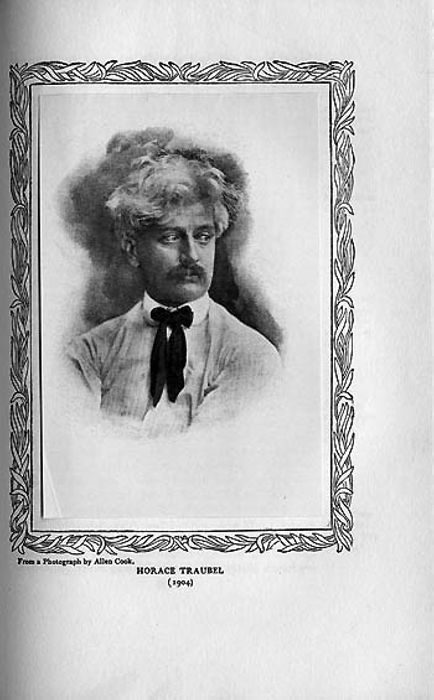 [Begin page 423] quiet, serene, undisturbed. "I have made up my mind not to worry—not to let even the worst upset me—not to look with dread upon anything. [See indexical note p423.1] I like to think it over and over and over again with Epictetus—I have often said it to Doctor Bucke and to you, too—'What is good for thee, O Nature, is good for me!' That is the foundation on which I build—it is the source of my great peace." Was rather playful about his disturbed stomach. "It is in a bad enough way, but let it have its turn—I have only to be quiet and wait."
[See indexical note p423.2] Mrs. Davis came in. W. asked: "Well, Mary, what's the news?" Mrs. Davis replied: "Mrs. Cleveland has stopped wearing a bustle—now bustles are no longer the thing!" W. took up the subject in the same playful vein: "I thought I heard some boys crying 'extra' on the street. That must have been it!
[Begin page 423] quiet, serene, undisturbed. "I have made up my mind not to worry—not to let even the worst upset me—not to look with dread upon anything. [See indexical note p423.1] I like to think it over and over and over again with Epictetus—I have often said it to Doctor Bucke and to you, too—'What is good for thee, O Nature, is good for me!' That is the foundation on which I build—it is the source of my great peace." Was rather playful about his disturbed stomach. "It is in a bad enough way, but let it have its turn—I have only to be quiet and wait."
[See indexical note p423.2] Mrs. Davis came in. W. asked: "Well, Mary, what's the news?" Mrs. Davis replied: "Mrs. Cleveland has stopped wearing a bustle—now bustles are no longer the thing!" W. took up the subject in the same playful vein: "I thought I heard some boys crying 'extra' on the street. That must have been it!
[See indexical note p423.3] W. asked me a question in this way: "I have been thinking a good deal about Sands at Seventy today—a good deal. I want to know whether you feel that they will be out of place in Leaves of Grass—not integral—too distinctly different in character to connect with the story? Bucke seems pleased and satisfied—thoroughly so: do you? Has Tom said anything to you about it? How do these poems stand in relation to the whole? [See indexical note p423.4] Have they peculiarities decided enough to isolate them?—do they in any way, the slightest way, contradict the general tenor of the book?—what I have tried to say in the Leaves so far—what has been aimed at? I am curious to know what you feel about all that—to have you tell me." I spoke of the "dignity" of the Sands. He caught up the word at once. "Dignity, did you say? Is it dignity? [See indexical note p423.5] I hope so—yes, I hope so. I remember well how one of my noblest, best friends—one of my wisest, cutest, profoundest, most candid critics—how Mrs. Gilchrist, even to the last, insisted that Leaves of Grass was not the mouthpiece of parlors, refinements—no—but the language of strength, power, passion, intensity, absorption, sincerity— [Begin page 424]that Leaves of Grass was no book for disease—for smallpox, rheumatism, yellow fever, scrofula—but was eminently and before all a book of health, the open air." [See indexical note p424.1] After a pause: "But I only throw out my question for you to chew on: I want your opinion. Take it with you and see what comes of turning it over—of seeing it all sides." Then he smiled and clenched his fist and raised his arm from the bed. "You know, boy, we must face all that and more: we must not be afraid of the worst—indeed, we must invite the worst—must bear all, brave all, and, coming to the test, throw or be thrown by it. [See indexical note p424.2] The question has come back to me in fifty different forms as I lie here footing up my accounts with the Almighty!"
In discussing some points involving the sale of November Boughs W. suddenly said to me: "And now that that point is up, Horace, I want to say to you that I rely upon you when the occasion arises to bear testimony to Dave McKay's fair dealing and general good will as toward me. Several of my friends have been to me lately and said: 'You'll have to watch McKay—he's foxy—he'll do you up.' I asked them: 'Why do you suspect Dave more than others—pick him out for criticism?' They said: 'We don't—he is a publisher: that is enough: all publishers do it.' Which of course sets Dave free. [See indexical note p424.3] I believe Dave is friendly to me—not friendly alone as a publisher but as a man—treats me squarely. By and by that will come up and I want you to speak for me on that point. I hate to be suspecting people anyway. I know Dave's weaknesses (and he knows mine, no doubt, and that's how we're square!) but have been able in the main to sail with him one trip after another on the most amiable terms. [See indexical note p424.4] I have real admiration for Dave—he has a sort of Napoleonic directness of purpose—has immense energy—has made himself very strong by self-discipline. [See indexical note p424.5] Did you ever hear Dave go off about Dick Worthington? He is very sore on Holy Dick—more sore than I am—would push him to the wall if I'd let him."
[Begin page 425][See indexical note p425.1] W. alluded to the superior presswork of English books, producing a book recently sent him by Symonds in evidence. "Anyhow they seem to be more conscientious over there in the trades—not in printing only but from the top down." Bucke reports that the English edition sent him by W. has not arrived. W. wondered if he "had misdirected it." "My memory is shamefully abusing my faith nowadays." [See indexical note p425.2] Put an old Roden Noel note into my hand from under the pillow. "I always bear you in mind: I am getting together such things as have ceased to be of use to me—which may be of practical service to you. [See indexical note p425.3] They all go to make up a story. A story? Yes. But will the world ever wish to hear it?—ever be willing to listen while you tell it? Noel was consistently friendly—never spared himself—confessed the faith wherever he was—everywhere—on the streets, in swell parlors—with the fashionables—everywhere."
Maybury, Woking Station, Surrey, England, Nov. 1871. My dear sir,[See indexical note p425.4] I send by this mail the second part of my study of your works. I hope I may not unintentionally have misrepresented you, but if I could be one of the means of drawing more general attention to your great works than they have yet received in this country, I believe I should have done something worth the doing.
May I venture to hope I may have a line from yourself when you have time? [See indexical note p425.5] And may I again repeat the hope I expressed to you in a former note when I sent you my own vol. of poems—the first—and which I am rather ashamed of now—on account of its Byronism—and too much leaven of aristocracy which is born with me—that you will not visit this country without coming to us?
I want to get hold of the American ed. of your work—which was lent me by Buchanan, but I understand it is difficult to procure.
[Begin page 426]The proclamation of comradeship seems to me the grandest and most momentous fact in your work and I heartily thank you for it.
Yours with much respect and in all sincerity, Roden Noel.[See indexical note p426.1] After I had read this note W. commented upon it in this way: "The fact remains, that the English are still ahead—that I have made no gains this side to equal my victories across the sea—that the crowd on the other side is in the main willing to give me a hearing—that the crowd this side is in the main dubious about me, if not actually antagonistic." I put in: "But who cares? Do you?" [See indexical note p426.2] "No—I do not: I take what comes. I think I must sometimes seem to take it more seriously than I do." "Besides maybe the English crowd is wrong and the American crowd is right. Maybe you're after all no good!" "That's so: I wake up at night sometimes for thinking of it!" [See indexical note p426.3] Had W. read the Noel poems? "Some, a few—very few: they are rather good—show some skill in architecture—they are well built: but Noel will scarcely last out."
No more tonight. W. admonished me: "You must help me to keep up with Ferguson: he has had great patience. [See indexical note p426.4] I expected to be kicked out long ago. You must be a pretty good diplomat." I demurred. "It's not my diplomacy it's his respect for you." W. would not have it that way. "You say that—but I still believe it's your diplomacy." Said he had "Noel's book about somewhere." Did I care to look at it? Yes. "You shall have it." Left. [See indexical note p426.5] As I did so he called to me: "Kiss Anne Montgomerie for me even if it is not lawful; give my love to the boys: tell Lindell, at the ferry, that I often think of him, as I lie here—of his damned old fiddle—I wish I could hear him again: and then there are all the fellows about everywhere to write to—I must neglect them all: you must do what you can to [Begin page 427] get, keep, in touch with them, for your sake, for mine. In all this world there's nothing so precious—in all this world, nothing. Good night! Good night!"
Friday, July 6, 1888.
[See indexical note p427.1] Eight P.M. When I entered W. was moving about the room, evidently intending to light up, but in the midst of his flurry over a match he asked me to help him to the bed, which I did, he dropping heavily upon it and saying by way of explanation: "You find me weak again: but the day on the whole has been fair—certainly an improvement over yesterday—though now for an hour and a half I have felt a sudden turn for the worse again. I find the bad hours rather more frequent and they stay longer." During the pause he laughed very gently and took my hand and said: [See indexical note p427.2] "See—I am off again—talking about my health—as if there was nothing in the world but my pains and aches to be considered." Osler over late in the afternoon. [See indexical note p427.3] Reported W. "as well as usual." That is, not more sick than usual. W. thought this "significantly meaningless." Spoke of "between six and seven" as "the holy hour"—"the hour of the man who returns from work: the hour of the family, the table, the story, love, frolic: O how precious is that hour!"
Day had been hot. W. fanned himself as he lay on the bed. Talked less than usual. Told him I had written again to Burroughs and Kennedy. [See indexical note p427.4] "That was right. That eases my conscience." We exchanged rolls of proofs. He put the roll I left under the pillow of the bed. Said: "Here's a budget for you tonight—several documents: you needn't look them over here: take them away with you—look them over at your leisure. If there's anything in them you want to ask me about, ask the next time you come." [See indexical note p427.5] Handed me the papers tied with a string. Continued fanning. "It's like sitting in an oven." My sister Gussie had sent him in some asparagus. "Oh! it was princely! I made two fine [Begin page 428] meals out of it—two—dinner and supper. Your sister, Horace, is a genius. [See indexical note p428.1] Her cooking belongs to what you the other day called 'the way-up school'—it is very superior—shows perfect genius. The good cook throws mind, soul, into her cooking—what I call spirituality—which will do all things, whether in art or keeping house. You want to congratulate her—repeat my words to her: say to her: Walt Whitman said this, and this, and this, and meant it all!" To Burroughs again. "You must never write him without sending him my love. And, Horace, do not forget the wife, Mrs. Burroughs, for she, too, has been kind and noble to me and I want her to know that I think of her." Then he paused. I interjected nothing. [See indexical note p428.2] When he felt ready he went on about Burroughs: "John is one of the true-hearts—one of the true-hearts—warm, sure, firm—I feel that he has never wavered in his friendship for me: never doubted or gone off—that I can count on him in all exigencies: and I think affection plays a great part in John's regard for me as it does in mine for him. John is making an impression on his age—has come to stay—has veritable, indisputable, dynamic gifts." Referring to Frank Harned's efforts to make photos to please him W. said: "Frank has kindness as a first quality: and kindness should be first—should not be only incidental." [See indexical note p428.3] Found at home on examining that the "documents" W. had handed me from under his pillow were four—Noel, Dowden, and Rossetti letters, with one of W.'s own war rough drafts (a letter about a sick boy to his family). W. very cheerful. Baker says: "On the whole he is better. Osler is right." No chance to read the documents tonight. Spent the rest of my timetill bed writing letters for W.
Saturday, July 7, 1888.
7.45 P.M. W. sitting by the window fanning himself. Greeted me heartily. And his health? "Oh, I am improved just this minute but I have been bad all day!" Add- [Begin page 429]ing, after looking in my face: "Don't feel bad about it—I don't." [See indexical note p429.1] I said to W.: "That was a mine of great treasure you gave me last night." "Do you think so? Well—so do I. Love is always a great treasure—always: these fellows have been very dear to me when I most needed adhesion. [See indexical note p429.2] They may be wrong in what they say of my book but they are not wrong in their love: love is never wrong. I never get the feeling of being bad off without getting the feeling of being well off—extra well off: for what I have missed in one thing I have gained a thousand times over in another thing. [See indexical note p429.3] Wasn't one of those letters from Dowden? O yes! Dowden: dear man—truly steadfast through the thick and thin of my darker days: I have got to sort o' look to him for good will: and there was Noel, too: Noel says he wants to be counted in always—always: and Rossetti—what can I say of Rossetti? [See indexical note p429.4] When I think of the friends I have had I forget the enemies I have made."
Another Whitman article in The American—this one by Harrison Morris. W. said: "The young men should steer clear of me—avoid me—stay outside my pickets—that is the only safe method for them. [See indexical note p429.5] I am dangerous—they find me hard—O very hard—to handle, though I suppose they will go on with me, all the same, whatever is said, asked or unasked—trying me by this, by that—perhaps that's the only way they can finally get to know me—can learn to swim in the deep waters: by just going in and in, against all warnings, in spite of all fears—until they discover the cherished secret. [See indexical note p429.6] Tell Harrison to look out—not to venture too far—not to jeopardize his reputation fooling with Walt Whitman—tell him I warn him and I ought to know what's what: tell him to get off in time—tell him that—then say that if he is still determined upon his reckless course that I say, that Walt Whitman says, 'God be with you!'"
W. paused for a laugh and went on in this way: "Indeed, I am a little surprised at some of my friends. Take Ken- [Begin page 430]nedy, for example: I am a little surprised that Kennedy is a friend of Leaves of Grass. [See indexical note p430.1] I am not surprised with Bucke or O'Connor or Mrs. Gilchrist or Burroughs—not a bit—but I will admit that I am a little surprised at Kennedy's accession. The truth is, Kennedy lays his stress—approaches me, applauds me—upon a side for which I care little myself—which I in fact despise—the intellectual side—the side of sickly self-regard—the introspective—that something or other which is more or less diseased—which has affected the literature of the last two hundred years—of which I am tired and sick to the point of death. [See indexical note p430.2] Kennedy is a Greekist—a fellow out of the college and ripe with all its canons: a good, a finely endowed nature, rich in a quality of which Kennedy himself makes little—an intuitive gift of rare significance, of uncommon grasp, which enables him to see far ahead of himself—to penetrate mysteries which defy all the assaults of logic. So I wonder over Kennedy—do not quite get him adjusted in my perspective. [See indexical note p430.3] The adhesion of Bucke, of Burroughs, of you fellows—Harned, Ingersoll—is easily explained—is thoroughly natural—is a matter of course: it is the comradeship of the total man. We know how to enjoy a meal for itself—to eat not from a sickly sense of duty but from a well sense of appetite—not because we are good or bad, pigs or gentlemen, but because we are hungry. [See indexical note p430.4] Burroughs, you see, has guts: and oh! there is so much in that—to have the grit of the body first of all—as the original guarantee of the rest. You would like John—he makes a great companion, but one you must understand. My brother Jeff said to me of his daughter: 'I love to drive out with Jessie—she is a perfect companion.' [See indexical note p430.5] I find that her virtue consists in not saying a word the whole time—in being simply observant—seeing everything, making no comment whatever. That's the sort of thing John likes: I think he dreads loquacity as much as I do." I said Burroughs suggested coming down to see him. W. demurred. "Tell him to [Begin page 431] postpone it—to put it off—for the present: feeling as I do these days I could not stand the visit: my head can stand no unusual experiences. [See indexical note p431.1] Tell him I no doubt will rally—rally enough for that, anyhow,—and then we can have it out. I wonder if William and John will ever meet with me anywhere on the same spot again? I am afraid that will never happen—never happen. Tell John my mind is now such a jelly—such a seething mass—always in such strange agitation—I dare not consent to see anybody except the few who are in effect a part of this household."
No letter from Bucke today. I get to look for Bucke as I look for my breakfast." [See indexical note p431.2] While we were talking Harned came in. W. described his experience of the day past with great particularity: his yesterday's bath, the terrible weakness that ensued, the difficulty of getting back to bed again—"then the continual mental unrest, lasting through the whole night and through all today until an hour ago, when, suddenly, I was relieved." What did all this mean to him? "I don't know what it means. Spurzheim says we cannot know mind—but is there anything surprising about that? I say so too. The wonderful phenomena of lunacy—what does that mean? Has it a physical basis? or physical entanglements? or what? It is a lesson to see Bucke's asylum at London—the hundreds on hundreds of his insane. [See indexical note p431.3] I used to wander through the wards quite freely—go everywhere—even among the boisterous patients—the very violent. But I couldn't stand it long—I finally told Doctor I could not continue to do it. I think I gave him back the key which he had entrusted to me: it became a too-near fact—too poignant—too sharply painful—too ghastly true." Said he did not agree with Bucke that his recent troubles could be assigned to vertigo. "The matter is deeper than that—Doctor will have to guess again."
W. read no proofs today. He said while I was alone with him: "America, I said many years ago, has accomplished [Begin page 432] the greatest results in all things except literature—in all features of modern life except literature, which is the greatest, noblest, divinest, of all: and there she is simply an absorber, an automatic listener, with no eye, ear, arm, heart, her own. [See indexical note p432.1] If it was necessary—I hope to God it will never be necessary—she would excel all other races, states, in military glory, also, sorry as that is, sorry—O sorry—as it is. [See indexical note p432.2] Aldrich once heard of my saying this and asked: 'Does he forget Emerson? Longfellow? and others?' After these long years, not forgetting any of the eminent ones or what we owe them, I still stick to my original statement—though I look for the day when literature, too, in America, will come to its own—realize its full inheritance."
As I left W. held my hand for a long time (his hand was very warm) and said: "What I say of my head does not accord very well with the way I have been chattering—talking—tonight—rattling away like a house afire!" I put yesterday's Noel letter in here. It is postmarked Thornton Heath, April 4, 1886, though written on the 30th of the preceding month:
My dear sir.[See indexical note p432.3] I have sent through my publishers a vol. of my essays on Poetry and Poets, containing an essay on your own work, reprinted with additions from our Taste some years ago—which I have been sorry not to see mentioned in the volumes of Dr. Bucke and John Burroughs—for I understood that you, and Mr. Burroughs, had approved of it and (as you know) I have long been a grateful and warm admirer. Please let me have a line, if you are well enough, as I hope may be the case, to write.
[See indexical note p432.4] I welcome the vol. of young Mr. Rhys, and trust it will make you well known among us.
If you should come to England, I hope you will not forget that you would find a warm welcome in our house.
I hope you may have seen and cared for some of my own [Begin page 433] work in poetry. [See indexical note p433.1] I believe I sent you an early and immature volume, but not hearing from you did not send later and stronger work.
Ever yours with affectionate respect, Roden Noel.[See indexical note p433.2] "I said to you yesterday that I was rather in than of the literary class," said W. in allusion to Noel's letter: "and the more the literary guild discuss me the more I seem outside the particular interests they chew upon with such relish. I do not refer to any one in particular but to the class. Now and then a man steps out from that crowd—says: 'I will be myself'—does, because he is, something immense. The howl that goes up is tremendous. Some step back. [See indexical note p433.3] Some stay out and go on." "You stayed out and went on!" "Well—I hope so. But the main thing is the people—the people: not how faithful I have been to the book class but how faithful I have been to the people, but for whom the book class could not exist." [See indexical note p433.4] As to Noel: "He is not the biggest man I know but his 'hello' is just as sweet to me as any other 'hello.'"
Sunday, July 8, 1888.
[See indexical note p433.5] In at W.'s three times today. In the forenoon. At five P.M. In the evening. Day good until afternoon. Osler over in morning. Said: "Well, Mrs. Davis, I think your old man is better." Afterwards O. added: "It looks as though he would go all right through the summer in this way." W. not so sure. Said to Mrs. Davis: "I'm done for, Mary." "But you'll be better tomorrow." "I mean I'm all done for." "Nonsense." "Nonsense? I guess I know." [See indexical note p433.6] Osler is to go away. Will substitute Mitchell, J. K., Weir's son. "Ah! these doctors! after all, Horace, do they know much?" Again: "I love doctors and hate their medicine."
Tom Donaldson over in the forenoon and saw W. W. [Begin page 434] said: "Eakins, I am told, is quite a Rabelaisian. [See indexical note p434.1] When I get better or well enough—on my feet again—I shall have him come over and talk while I listen. O'Connor, too, is full of Rabelais." I recalled the Stilwell letter. "It is very beautiful—very wholesome," I said. He remarked: "I hope wholesome is the word: I like to feel that the things I do are wholesome. [See indexical note p434.2] So you think the letter is wholesome?" After I had repeated myself he talked of it again: "I did a lot of that work in the hospitals: it was in a sense the most nearly real work of my life. Books are all very well but this sort of thing is so much better—as life is always better than books—as life in life is always superior to life in a book." I read the letter aloud—rather to myself than to him. I noticed that he listened intently. When I was through—parts of it put a shake into my voice—he said fervently: "I thank God for having permitted me to write that letter." [See indexical note p434.3] We were both silent after that. I then said: "I, too, thank God for having permitted you to write that letter—and others thank God, and others, and you could not count them all." "Do you say that, Horace? Thank God again, Horace!" The letter was drafted in pencil on Sanitary Commission paper. It was addressed to Julia Elizabeth Stilwell, South Norwalk, Connecticut, and was memorandumed as having been "sent Oct. 21, '63."
Dear friend,[See indexical note p434.4] Jimmy is getting along favorably but of course slowly. I was with him night before last and am going again this afternoon. It requires a good deal of patience in him to lay so steadily confined in bed, but he has the good luck to continue remarkably free from any acute suffering so far. Night before last he had some pain and swelling in the foot below the wound, but nothing of serious account. They bandaged it pretty tightly and that relieved it. He wished me to write to you this time, and I promised him to do so night before last. I wrote at that time from [Begin page 435] the hospital to your parents at Comac, and sent the letter yesterday. Jim is not satisfied unless I write pretty often, whether there is anything to tell or not.
[See indexical note p435.1] My friend I received your note about your folks getting your dear brother's body from down in Virginia. Lately, as you doubtless know, the Rebels have advanced upon us, and have held Culpepper and around there for many days past; and of course nothing could be done. The rumor just now is that they are falling back, and may soon yield us our old ground. At present still I should think nothing could be done. The authorities here don't grant passes yet. But I suppose you inferred all this from what you read in the papers.
[See indexical note p435.2] Dear friends all I say to you as I have to Jimmy's parents, that I shall try to keep watch of the boy, as according to all I know at present I shall probably continue in Washington for some time, and if any thing should occur I will write you. Dear friends, as it may be some reliance to you and make you feel less uneasy to know Jim can have nothing happen to him without you being informed. Though as far as now appears he will go on favorably, and his wound will heal up, so that he can sit up, and then gradually move about, and then in due time be able to travel.
[See indexical note p435.3] So farewell for [the] present, and I pray that God may be with you, and though we are strangers I send my love to you and Jimmy's sisters and brothers in law, for in times of trouble and death, I see we draw near in spirit, regardless of being separated by distance, or of being unknown.
W. speaks of L. of G. as "ours." Will say, for instance, of some one or other, "he is not our friend," or "he is favorably disposed towards us," or "we must face that criticism and see what it means to us," or "that is wrong—we must brave it down." [See indexical note p435.4] Always talks of "our portion"—ours, us, rarely says, mine. "This affair is our affair, not any one [Begin page 436] man's affair." Even speaks of November Boughs as "our" book. "Leaves of Grass is not one man's book but all men's book." [See indexical note p436.1] He got off on this sort of a strain, too: "You radical young fellows don't see it as I do—don't quite so plainly comprehend, concede, that it is best for any man to be tried by fire, to draw all the shot of the reactionaries, the wise conservatives and the fool conservatives, the asses in authority, the granitic stupidities of the average world. It all has its place—all. I, too, used to grow impatient, angry, about it, but now I want it all to be spoken, heard, passed upon: I want the full fire of the enemy. [See indexical note p436.2] If the work we try to do cannot stand up against the total opposition we may be sure we have gone off on a false scent." As to L. of G.: "It does not seem like my book—it is your book, too: anybody's book who chooses to claim it." "Leaves of Grass stands for a movement—a new-born soul—the Adamic democracy: is significant (if significant at all) as affecting a world, not simply an American, purpose. [See indexical note p436.3] I always contemplated meeting with opposition—I invited it. The other fellows don't understand me or I don't understand them or both. I guess something—a lot—can be said on the conservative side: my contention is not that much cannot be said but that after it is all said I have a bigger option to offer." Again: "Leaves of Grass may be only an indication—a forerunner—a crude offender against the usual canons—a barbaric road-breaker—but it still has a place, a season, I am convinced. [See indexical note p436.4] What is that place? that season? I don't know—I give up guessing." I copy the letter from William Michael Rossetti given me by W. day before yesterday.
London, 1 Jany, '85. Dear Whitman,[See indexical note p436.5] Some while ago I received your kind present of the 2 vols—Leaves of Grass and Specimen Days: received them, I am certain you will believe, with extreme pleasure, and with a grateful sense of your continuing to re- [Begin page 437]member me across a somewhat long lapse of years. To be remembered by Walt Whitman is what any man shd be proud of, and none is more so than I.
[See indexical note p437.1] I have read the Specimen Days vol. right thro: finding various new things, and continual pleasure in renewing my acquaintance with the old ones. Am extremely pleased to find in this copy of the book something which is absent even from Mrs. Gilchrist's copy—the photographs of your mother and father. If you were blessed with an unsurpassably good mother, I can with truth say the same of myself. [See indexical note p437.2] My mother is still with us—aged nearly eighty-five: health and faculties sound on the whole, but naturally bowed and stricken with the weight of years.
[See indexical note p437.3] I have also scanned with a good deal of attention (short of complete re-reading) my old and constant admiration, the Leaves of Grass vol. I observe that some edition (I think the Philadelphia edition is named, but my vol. is not under my hand at the moment for reference) is mentioned as the only final and complete form of Leaves of Grass. The vol. with which you favored me is not the Philadelphia edition, but I am in hopes it may none the less be regarded as complete.
[See indexical note p437.4] I am glad to notice in this country from time to time symptoms of the increasing appreciation of your works, especially something written by Ruskin and the Sonata from the Lincoln Dirge.
Accept as heretofore the affectionate respect and regard of
Yours always W. M. Rossetti.[See indexical note p437.5] "When Burroughs was abroad," said W., "he went once to see Rossetti—the first visit—they did not seem altogether to hit it—were not in the right mood to mix up pleasantly: I could never quite make it out: I know it could not have been John's fault—I know it could not have been Rossetti's fault—probably it was nobody's fault. Sometimes our tem- [Begin page 438]peratures don't exactly get adjusted. [See indexical note p438.1] That Rossetti family was and is a remarkable one—steeped in finished soil—cultivated, rich in its yield—perhaps a little too refined, too delicate, for the brush, break, of this tumultuous world. As I said to you yesterday the best thing about all these fellows—yes, about any fellows—is the noble quality of their love. When some people were here awhile ago and one of them said he was sorry I was poor I made a kick. Who was poor? Not I. [See indexical note p438.2] I thought of just a few of the fellows—William, John, Dowden, Symonds, others: thought of them—the thought of them almost choked me with gladness. Was I poor? Others may be deceived because I have no money in the bank: I am not deceived."
Monday, July 9, 1888.
In at W.'s at 7.45, evening. W. lying on bed. Inclined to chat—speaking at ease. I let him go on. He hates questions. Voice a bit husky. Very forcible, however, in manner. "You must be better," I said. "I believe I am—just a trifle." [See indexical note p438.3] Had eaten quite well. "I had letters from Bucke today again—two of them." Stopped. Then resumed. "I was glad to hear from Doctor. One of the letters was very gloomy—for him. I got to reading between the lines—catching the tone, the undertone—and somehow I seemed to catch him a little off guard, saying: 'you are sinking—steadily, surely sinking—there is no way out of it'—and I don't know but he's right. [See indexical note p438.4] In fact, I notice that everybody looks at me asquint, as if something was about to happen—people, the papers—everybody almost but you. But I am not at all agreed to it just yet. I have looked a second, third, fourth, time into the Doctor's letter for a gleam of light—the shadow is there still. But we will not admit that we are likely to be thrown down—we must see to it—see if instead of a rout, a ruin, we may not yet whip, or if not whip, at least elude, our pursuers." Bucke's letter palpably affected [Begin page 439] him. "But however it results it is all right—all right: all right for life, all right for death. If only the book was done! [See indexical note p439.1] I look forward with desire at least that far. How lucky we got started before I got into this cloud! Now I must live to finish the job I have undertaken. I remember that you told me while I was dilly-dallying that if we didn't hurry up our November would be our December boughs! It almost came true." "I have no thought of surrender," he finally said.
All the reprint in shape. Only the Hicks left. "I am laying low for the right hour to tackle that: when the game appears I will spring on it." I overruled him on a head-line decision today. First he said: "Damn you!" [See indexical note p439.2] I explained my reason. Then he said with a laugh: "Bless you!" Got a check for forty dollars from N.Y. Herald last week. Returned it. Had not written anything for the past month. The check reappeared. "That's what I call very unbusiness-like in The Herald," he said, adding however more seriously: "That was downright decent in somebody. Who is the somebody?" Brought him over a big batch of proofs. I watch them more critically than I did when he was well. He says of it: "I only read the commas—I leave all the rest to you." [See indexical note p439.3] The Society of Old Brooklynites has been discussing W. and the Leaves. "It was a mighty thin mess," he replied upon my questioning him, "no body to it all: only ignorance, ignorance—then more ignorance still."
[See indexical note p439.4] W. referred to Harrison Morris' paper in The American. "I have gone over it—glanced it through (without closely reading it): see enough to comprehend what it amounts to. Harrison is greatly superior to that other Morris who got into this discussion—Charles. It appears that Harrison means to be friendly to me—to accept me as far as he can—to decide a few ugly doubts in my favor—to recognize in me some gleam of literary righteousness: but I am yet far off—very far off. If the canons are to sit in judgment what will become of us? [See indexical note p439.5] The canons would rule out everything that [Begin page 440] is new, fresh, organic—make Homer, Shakespeare, Emerson, impossible. [See indexical note p440.1] It is the very worst sort of logic to try a poem by rules of logic—to try to confirm a round world by square tests—to sit down and argue a poem out, out, out, to an end—yes, to death. I do not say Morris does this: he is young: he will yet shift about until he gets the right point of view. Give Morris my love when you see him. Say to him for me that he must not be afraid to talk right out, very loud, very free, if it is required, letting the consequences take care of themselves." He added that the case of H. M. reminded him of Kennedy's early experience with the Leaves. [See indexical note p440.2] "Kennedy was choked to the mouth with canons, rules, whatnot—had them all to contend with, to get rid of: the scholastic divinities: but finally he broke loose—got over the fences—was wholly at liberty. He experienced several severe years—was full of doubts, qualms—his growth was gradual—the approval of Leaves of Grass a succession of conquests. Yes, Horace, I am inclined to adopt your assenting view of Kennedy—of his sterling scholarliness—of his plucky adherence to his convictions. Kennedy has roots deep down in good soils—he is like a soldier who has proved himself in many campaigns."
[See indexical note p440.3] W. monologued about Burroughs as bank examiner. "John had no great skill—he was honest—honest: was eminently conscientious: that's how he fitted into the job. Sometimes we see united in one man the very highest type of conscientiousness—the most exalted, superior, one may say perfect, moral sense—the largest consideration of the transcendental impetus to action—with an average capacity for taking care of everyday life, bank bills, farms, houses, stocks, and so forth. John is a man in whom the thing is well illustrated—O yes, capitally illustrated—and somebody in the government had sense enough to see it. [See indexical note p440.4] That is what made him a valuable man in the service. It is a wonderful perfection in a man: you will find it in Emerson, in Hicks— [Begin page 441]no doubt also in others: I do not know others: most curiously suggestive in these two. It is as if a final touch was put on personality."
[See indexical note p441.1] John Johnston over from N.Y. Was admitted for a very brief visit. W. has seen but few people during this whole sickness. "I am glad Johnston came—sorry I could not see more of him. He came at a time when my head was having one of its most infernal turns. I told Johnston that Doctor Bucke had saved my life. That is true, too. Saved it, not as a doctor but as a man. I have no great faith in or fear of doctors—they don't seem to do much good or much harm." I had Dowden's letter with me—the letter W. gave me two days ago. Read it again—part of it aloud—and asked W. some questions suggested by it.
50 Wellington Road, Dublin, April 12, 1873. My dear Mr. Whitman[See indexical note p441.2] Thank you for the kind thought which sent me the newspaper containing good news of your health. It concerns me and others here very much. A few days before the paper came I had heard for the first time—through a friend in Italy—a report authenticated that you were very seriously ill. The paragraph in the newspaper was therefore a relief as well as a sorrow. One's feeling about such apparent evil I find is much controlled by the nature of the person to whom it befalls. [See indexical note p441.3] Over and under all feeling which the fact of your illness produces lies the one feeling (which the growth of my own way of thinking together with your poems and other causes has made very real and strong)—that for some persons, and for you among such persons, casual misfortune or calamity is not a supreme affair. We give our grief to you with the reserve that after all Walt Whitman has not been really laid hold of by chance and change—that after all he eludes them and remains altogether untouched. And if I should happen to live longer [Begin page 442] than you I believe I should have the same conviction about what death could do to you. (Other persons seem like pathetic little flowers who have no title to permanence of being—but such an aristocratic theory of the ownership of a future life ought rather to be addressed to Goethe than to you, whose faith is larger and more charitable.)
[See indexical note p442.1] The best piece of the news about you is that you are likely to be strong again and to continue your work. I trust that may be so, and rely a good deal on your previous health and vigor, and on the fact that you are not of an age which ought to discourage hope of full recovery. We had been looking forward with very strong satisfaction towards seeing you over among us this year. That I suppose cannot now be expected: but it may come to be a fact at some later time. [See indexical note p442.2] One thing I will ask—that occasionally some friend, if not yourself, will let me hear of your health—a line of writing would be enough. I think Mr. Burroughs would be willing to take the trouble; (and he would add to my gain if he would mention to me the name of anything you may have published since Democratic Vistas. I think I saw some small collection of poems mentioned as having appeared at New York).
My wife joins with mine her love and both go to you together. We are well. I have taken to an attempt at the making of poems since twelve months. [See indexical note p442.3] It has always seemed to me more my proper work than prose, but if a sufficient experiment proves the reverse I shall return in a business-like fashion to prose. I mean to go on quietly, and not print any poems for three or four years at soonest. I have just written an article on Victor Hugo's poetry; and, when it is printed, I will send it to you. There is much in common between Victor Hugo and you, but if I had to choose between Leaves of Grass and La Légende des Siècles I should not have a moment's hesitation in throwing away La Légende. There is a certain air of self-conscious beauty or [Begin page 443] sublimity in the attitudes which Victor Hugo's soul assumes that greatly impairs their effect with me. [See indexical note p443.1] The poems, or many of them, are not thoroughly simple—there is something manufactured in them—they do not adhere and cling quite close, and become an invisible part of the reader. (But I must stop this.)
I think within twelve months of publishing a volume of essays, and intend to include the Westminster one on your poems (I shall remove from it one or two expressions which may have done you wrong with some readers, and which on that account I regret). [See indexical note p443.2] It happens that several of the essays will be concerned with democratic or republican leaders—V. Hugo—Edgar Quinet—Lamennais—Landor—Milton—Whitman.
Please before very long, if it is convenient, let me somehow hear of your health.
And dear friend believe me
Always affectionately yours, Edward Dowden.[See indexical note p443.3] When I got to the Hugo passage W. said: "Read it again." I did so. Then he said: "One part of that would suit O'Connor and one part would suit Burroughs but as a whole it would suit neither. O'Connor always said I was like Hugo—that he saw us sometimes almost like twin brothers. There was a Washington picture of me which he called the Hugo Whitman. But William would not admit that Hugo was artificial—attitudinized. He and John used to quarrel over this, John contending, sure enough, that Hugo was the victim of a sort of divine professional calculation, and denying, with equal vehemence, that he could see any resemblance between Hugo's work and mine. [See indexical note p443.4] The fact is, I think that Dowden was nearer right than either, though as for Hugo's artificiality I would not say as much as Dowden does about it—it does not seem necessary. Dowden draws rather too [Begin page 444] long a bow. Now you see I'm getting into the fracas myself!" [See indexical note p444.1] I paused in the letter where Dowden says: "I have taken to an attempt at the making of poems." "What's the matter?" asked W. I read that allusion to the end. Then stopped, waiting to see what he would say. He looked at me fixedly, then broke out into a smile. "I'll bet I know what you're thinking," he remarked. "Well—what was I thinking?" "Why—that that's rather a cold blooded way to talk about writing poetry: that he would start, try, maybe succeed, maybe fail—that if the venture proved unsuccessful he would in business-like fashion go back to the writing of prose. [See indexical note p444.2] You were thinking that poets never wrote real poems that way?" "Exactly." "That real poems sort of make themselves—will not be held back?" "Exactly." W. was quite abstracted for several minutes. Then he came back to me; "You are right—wholly right. I do not know whether Dowden ever wrote, published, the poems. [See indexical note p444.3] If he did I don't think he sent them to me. Leastwise I don't remember that I ever received such a book. However that may be, whatever happened to his verse, Dowden has succeeded in writing prose—in writing some of the best critical prose in modern English literature."
Tuesday, July 10, 1888.
[See indexical note p444.4] W. up in his room moving about and closing the blinds when I arrived, 8 P.M. "Day not a bad one for me," he said at once. "The doctors keep dosing me. But what's the good? It's no use trying to put there what is not there—it can't be put in from the outside." Complains of his eyes. Read some today—in the N. A. Review Lincoln volume. Had written nothing—"not even letters to Bucke, Burroughs and Kennedy—to whom I owe my biggest debts." Then: "The main trouble is to know what to say. What can I say? The outlook is too uncertain—I have no knowledge: only hope. I had a card from Kennedy today,—a scrambly
[Begin page figure-30]
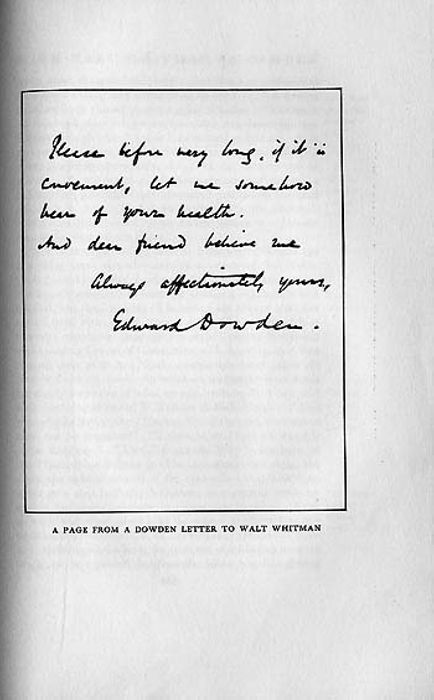 [Begin page 445] hasty upset characteristic postal. Did you ever notice that Kennedy's writing sort of stands on its head?"
[See indexical note p445.1] Not a word from anybody abroad concerning his sickness. "The work on the book does me good—stimulates me—bears me up. I think I should die if I didn't have the book to do. It is necessary to have an ambition—purpose—something you must absolutely, personally, do. Tell the doctors not to worry—I do not worry. Tell them we are working out a job together and that I have promised you not to die until the work is done. [See indexical note p445.2] That should satisfy even the doctors." I told him there would be no proofs tomorrow. "Good! then I can work on the Hicks."
[Begin page 445] hasty upset characteristic postal. Did you ever notice that Kennedy's writing sort of stands on its head?"
[See indexical note p445.1] Not a word from anybody abroad concerning his sickness. "The work on the book does me good—stimulates me—bears me up. I think I should die if I didn't have the book to do. It is necessary to have an ambition—purpose—something you must absolutely, personally, do. Tell the doctors not to worry—I do not worry. Tell them we are working out a job together and that I have promised you not to die until the work is done. [See indexical note p445.2] That should satisfy even the doctors." I told him there would be no proofs tomorrow. "Good! then I can work on the Hicks."
W. had received a copy of The Academy. "That's the last thing from abroad—contains a review of the Walter Scott book by Walter Lewin—well written enough, true—but I can't see that it amounts to much: it is scholarly and all that, but light weight. [See indexical note p445.3] The critics are always after the style: style, style, style, damn it style,till your stomach is turned: everything must go for style. Nearly everybody who takes up Leaves of Grass stops with the style, as if that was all there is to it. Nearly everybody—every fellow almost without exception—founders on that rock—goes down hopelessly—a victim of rules, canons, cultures." [See indexical note p445.4] I had said a similar thing to one of W.'s critics in Philadelphia. "And what did he say to that?" asked W. "He said, the canons must not be forgotten." "I thought so: they all stand it off in that way." "That," continued W., "is the bane of the Philadelphia fellows in The American—the style, the dress, the outside manner of the man—they stop with that, never go a step farther. [See indexical note p445.5] Napoleon, as a general, came up against the same class—yes, is a good case in point. When he set to and whacked away at the enemy, the tacticians, the traditionists, the canonites, all cursed him: 'God damn him! he is violating all the laws, the customs, of soldiering we were taught in the schools!' but then the fellow who was getting [Begin page 446] licked would come on and cry: 'That's true; that's all true; but, God damn him, he's knocking hell out of us anyway!' [See indexical note p446.1] The canon proves that the poet is not a poet—but suppose he is a poet anyway, what can be said for the canons?" W. went all through this with great fire. Paused. Started on again. "And that's the method of the critics everywhere. Why—there was Grant—see how he went about his work, defied the rules, played the game his own way—did all the things the best generals told him he should not do—and won out! Suppose the poet is warned, warned, warned, and wins out? [See indexical note p446.2] Some one in that discussion over the river presented my 'standpoint'—but suppose I have no conscious standpoint? suppose I just write?"
[See indexical note p446.3] W. says he makes his postals to Bucke very specific—"they are all about my bowels, head, symptoms, diet—the professional facts which a doctor knows what to do with." Had not yet put the will into Harned's hands. "I neglect it wickedly." I alluded to a Whitman poem in The Ledger and remarked that a Ledger reference to W. was rare. [See indexical note p446.4] He explained: "That is so and has a good reason. Its editor, McKean, and I don't hitch. That may be my fault. No doubt he's a good man in his place—and his place is important, too—but he is not the sort of man with whom I would have much in common. [See indexical note p446.5] Childs, however, is my kind of a man every inch of him: a generous, devoted friend—I like him, I think he likes me. Childs has made a number of tenders to me which I have declined and some others which I have accepted—all of them delicately done—all of them conceived in the large spirit. McKean has no place—no room—no call for me or my kind." "Did he ever express himself to you?" "No—not to me but to Childs. He told Childs that he regarded me as a poseur whose work was bound to disappear ten years after my death if it lasted that long." [See indexical note p446.6] I broke in: "And you can never disprove him except by dying!" "Good—so it seems. I'll have to leave [Begin page 447] it to you to disprove McKean!" He spoke of the Herald check—of its several trips—of his final acceptance of it. Referring to Lowell W. said: "I have always been told by the New England fellows close to Lowell that his feeling towards me is one of radical aversion. [See indexical note p447.1] My own feeling towards him is a feeling of indifference: I don't seem impressed by him either way: I have no interest in him—when I look about in my world he is not in sight." "Do you mean by that that you think Lowell is to be of very little permanent consequence in literature?" [See indexical note p447.2] "I suppose I do. I do not mean to say he is momentarily useless: I only mean to say he is not likely to be eternally useful." "That is—as Shakespeare or Emerson or Goethe are likely to be eternally useful?" "You say it for me but you say it all right. That is the idea."
Wednesday, July 11, 1888.
[See indexical note p447.3] W. passed a good day. I went down in the evening towards eight. Some indigestion. On his bed. Stayed nearly an hour. Pretty communicative. I let him pursue his own fancies. Only nudged him with a word or two now and then. Likes to be let alone. Voice rather husky. Troubled some with words. Mind perfectly clear. "As for the indigestion—I do not mind it. Now that my mind has got back to good weather again I feel more or less satisfied. I am more sensitive to intelligent impressions, mentally speaking, and am almost comfortable physically. [See indexical note p447.4] This seems like a gain, though I must not brag. Down I may go again any time!"
[See indexical note p447.5] W.'s niece Jessie was here today. Letter from Bucke. Wrote cards to Bucke, O'Connor and Kennedy. Mrs. Kennedy sent him a box of roses. Mailed off two copies of L. of G. to purchasers—one in New York and one in St. Louis. With the former, for which he was paid five dollars, W. enclosed an autographed portrait. No word yet from [Begin page 448] Griffin. W. had undertaken to work on the Hicks matter but gave it up. "I am more and more persuaded that I can never work it out according to the original design—I do not seem to be able to stand the strain. [See indexical note p448.1] No doubt it will have to go in just as it is, taking its chances." Describing Bucke's philosophy with regard to handling the insane: "His method is peaceful, uncoercive, quiet, though always firm—rather persuasive than anything else. Bucke is without brag or bluster. It is beautiful to watch him at his work—to see how he can handle difficult people with such an easy manner. [See indexical note p448.2] Bucke is a man who enjoys being busy—likes to do things—is swift of execution—lucid, sure, decisive. Doctors are not in the main comfortable creatures to have around, but Bucke is helpful, confident, optimistic—has a way of buoying you up."
[See indexical note p448.3] W. said he could never "reconcile" himself to Thoreau's and Carlyle's treatment of the common man: "They stood about with a wall around them. I guess friendship is constitutional, or in great part so—you like cabbage or you don't and that's all there is about it. [See indexical note p448.4] I had a friend once, Haggerty: a Scotch-Irishman or something of that sort—a good-natured excellent fellow all through, who often used to say to me; 'Walt Whitman, I think the one thing for you to do is to go to Europe—to England, France, Germany—and see the new life there—see what you can make of it—get it, too, reflected in your work.'
[See indexical note p448.5] But I remember one evening, in the midst of a talk, when we were all having a good time (in Washington, during the war) he turned upon me and exclaimed suddenly: 'Walt Whitman, I used to think a trip to Europe—to England mainly—was what you needed but now I see that that would not do—would never do: it would not help you along in what you are trying to do—would rather hinder you: what you need is simply to stay here, stay, stay—and die here.'"
[See indexical note p448.6]
"I think Carlyle saw all the horrors of life in European centres of population—that
[Begin page figure-31]
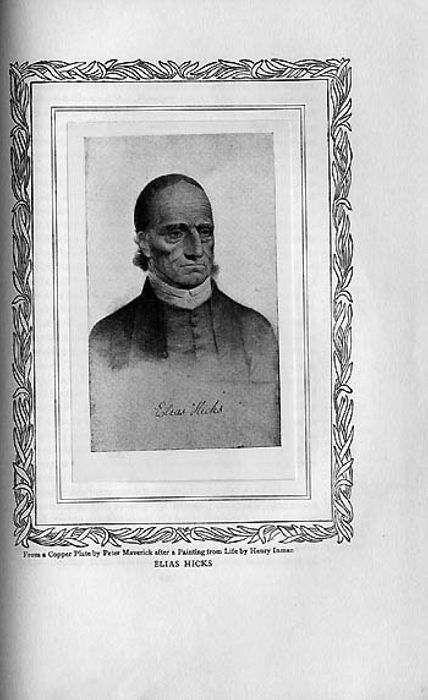 [Begin page 449] it made him mad, sour, disgruntled—put him in a hell of a humor with society. He was not a hater of the race—he wished it well—he spoke according to what he knew—but as he looked about and saw all the damnable evil, he grew depressed, seeing no way of escape. I think that explains one part of Carlyle—that and perhaps something constitutional."
[See indexical note p449.1] W. said that "Bucke has an immense faith in the people at large—immense—in civilization, in modern mechanical devices—miracles of power."
"Do you say that Bucke has more faith in the people than you have?"
"I think he has. I have seen in the later years of my life exemplifications of devilishness, venom, in the human critter which I could not have believed possible in my more exuberant youth—a great lump of bad with the good."
"That may be admitted. But you do not think there is enough bad to do away with the good?"
[See indexical note p449.2] This got him at once. He said almost sharply: "I do not—I do not: only I would not originally have believed it to be there. You know that I never admit that men have any troubles which they cannot eventually outgrow." He quoted from Tennyson's Northern Farmer, "the poor in a lump is bad."
"But then," I persisted, "suppose you refuse to consider them in a lump?" He laughed. "That's true—that's another point." I quoted an old woman, my friend, a Presbyterian, who said: "My head says hell but my heart won't say it at all."
[See indexical note p449.3]
"That's beautiful, beautiful," said W. Then: "Bucke is an optimist—thoroughly so, without qualification or compromise—so are you—but I could hardly call myself that in the strictest sense of the word."
[Begin page 449] it made him mad, sour, disgruntled—put him in a hell of a humor with society. He was not a hater of the race—he wished it well—he spoke according to what he knew—but as he looked about and saw all the damnable evil, he grew depressed, seeing no way of escape. I think that explains one part of Carlyle—that and perhaps something constitutional."
[See indexical note p449.1] W. said that "Bucke has an immense faith in the people at large—immense—in civilization, in modern mechanical devices—miracles of power."
"Do you say that Bucke has more faith in the people than you have?"
"I think he has. I have seen in the later years of my life exemplifications of devilishness, venom, in the human critter which I could not have believed possible in my more exuberant youth—a great lump of bad with the good."
"That may be admitted. But you do not think there is enough bad to do away with the good?"
[See indexical note p449.2] This got him at once. He said almost sharply: "I do not—I do not: only I would not originally have believed it to be there. You know that I never admit that men have any troubles which they cannot eventually outgrow." He quoted from Tennyson's Northern Farmer, "the poor in a lump is bad."
"But then," I persisted, "suppose you refuse to consider them in a lump?" He laughed. "That's true—that's another point." I quoted an old woman, my friend, a Presbyterian, who said: "My head says hell but my heart won't say it at all."
[See indexical note p449.3]
"That's beautiful, beautiful," said W. Then: "Bucke is an optimist—thoroughly so, without qualification or compromise—so are you—but I could hardly call myself that in the strictest sense of the word."
Cabot's Emerson contains a note from Burroughs describing a meeting with E. at West Point. W. greatly interested—had me repeat the story. [See indexical note p449.4] Then: "After I hear all that it sounds a little familiar. I think John may have told me about it." W. called my attention to a newspaper paragraph stating that Harrison once taught a Bible class of [Begin page 450] lawyers. "That seems very funny to me," he said: "too funny to be even laughed at—funny enough almost to be sad. Do you know, Horace, a tremendous deal of the public objection to Leaves of Grass came straight from the Sunday School? [See indexical note p450.1] From Sunday Schools and what makes Sunday Schools? The Sunday School has omitted virility from the list of its moral forces." I said to W.: "Anne Montgomerie says this is the Sunday School: 'I think so. Don't you? Yes.'" W. very heartily responded: "That's mighty good: very cute—it leaves nothing to be said." Paused and added: "It's really most capital." Repeating the formula aloud: "It is a complete picture. I must not forget it."
[See indexical note p450.2] W. gave me a Rhys letter to read, saying of it: "It is a noble letter—I am proud of it—proud of it not because it is addressed to me but because Rhys had the sort of soul which makes that sort of letter possible. And I entirely sympathize with what he says about the poor—the gospel of life for the poor—with his resentment as towards those who would make Leaves of Grass exclusive—keeping it as a choice morsel for the palates of the well-to-do. [See indexical note p450.3] You know we have often talked of bringing out cheap editions of special poems in this country. I have even spoken to Dave McKay about it though he is up in arms against the idea. I'll tell you what, Horace—if I pull out of this trouble we will produce a few small trial books—don't you think?—just to show where we stand. That is about the handsomest letter Rhys ever wrote me. They have sold a good many Whitman books, one kind or another, in England. [See indexical note p450.4] I never got anything of any account out of it—though I don't know as that matters much: the chief thing is, that the books get about." Then he added: "I read Rhys' letter over and over again today. Such a letter makes everything worth while—sickness, sorrow, even death: makes everything worth while."
[Begin page 451] 59 Cheyne Walk, Chelsea, London, S.W. 7th July, 1885. Dear Walt Whitman,[See indexical note p451.1] More than a month back I addressed a letter to you, which misfortune of one kind or another may have overtaken, or which you may not have had time or inclination to answer. It was referring to the scheme of a new edition of your Poems in England here, but I'm afraid was not clear enough as to the rights and reasons of such an edition, or the way it would be carried out. [See indexical note p451.2] In the letter I explained something of this, but not enough; and it was careless of me to do this and then expect you to reply to an insufficient proposal, when you must have already more to do in this way than can be easily compassed. For fear too that the letter never reached you at all, it will be better to state the whole matter afresh.
[See indexical note p451.3] A series of poets was last year begun by Walter Scott, the publisher, under the occasional editorship of my friend, Joseph Skipsey, poet and former coal-miner; (I have been a coal miner—a mining engineer that is—myself; hence the connection!) and in their list a month or two after my arrival in London as a student of life and letters this year, I saw rather to my astonishment your name amid the rest, and feeling that in some ways I had a special right and knowledge I ventured to write in, offering to prepare the vol. Skipsey's influence did the rest.
At first it seemed rather out of place to have your work in a series of this kind called, rather stupidly, The Canterbury Poets, and got up in a cheap and prettified fashion, with red lines, &c. [See indexical note p451.4] But afterwards it struck me that there might be gain in the end through it. Now I have succeeded in one hope: the publishers will give up the red lines and trivial design of cover. Next will be to have your Poems issued in a different shape—quite square I should like to have it—so as to give your long lines full play! And the very including of Leaves of Grass in a series like this gives them a chance [Begin page 452] of reaching people who would otherwise never see them. What I—and many young men like me, ardent believers in your poetic initiative—chiefly feel about this is, however, that an edition at a price which will put it in the reach of the poorest member of the great social democracy is a thing of imperative requirement. [See indexical note p452.1] You know what a fervid stir and impulse forward of Humanity there is today in certain quarters! [See indexical note p452.2] and I am sure you will be tremendously glad to help us here, in the very camp of the enemy, the stronghold of caste and aristocracy and all selfishness between rich and poor!
Some people want to class you as the property of a certain literary clique,—a rara avis, to be carefully kept out of sight of the uneducated mob as not able to understand and appreciate the peculiar qualities of your work. This does harm in many ways, and it would be a very good thing to make a fair trial of the despised mob. The price of Wilson & McCormick's edition—half a guinea—practically damns the popular circulation of the book, and gives color to the notion of its being a luxury only for the rich. [See indexical note p452.3] What we want then is an edition for the poor, and this proposed one at only a shilling would be within reach of every man willing and caring to read.
I did not know until a week or so back that Wilson & McCormick had any direct authorization for their edn, or should certainly have advised Walter Scott to communicate his intention to them. [See indexical note p452.4] Now someone has written on their behalf resenting—very naturally—his appearance in the field. But this difficulty might be easily settled by Scott paying, say ten guineas outright or a certain royalty per copy, to them on your account, if W. & McC. would not like a new contract with you by Scott. The fact of the new proposed edn being one of smaller scope [the vol. would not hold more than two-thirds of the poetry;] would no doubt weigh with them too, reference being clearly made to the complete [Begin page 453] works to which this would serve as a pilot for the time being, and increase the sale in the end.
[See indexical note p453.1] As for my own share, all I really care about is to procure a serviceable popular edition, giving all the help an earnest and enthusiastic sympathy can devise. On mere literary grounds I have very little claim, but I have a great love and desire to help the struggling mass of men, to be a true soldier in the War of liberation of Humanity. I should strive to just say what would best bring your Ideal to the hearts of such as the coal-miners and shepherds of the north—dear friends of mine many of them—many consciously, all unconsciously—and being a young man myself to make Leaves of Grass potent for comradeship and chivalry and manliness all through in the young men who are in the forefront today.
I feel very much inclined to say a good deal more about my hopes and ideals, but tonight perhaps it is better not. One thing though I must say a word about—how much in noblest knowledge and inspiration I have to thank you for, in life and religion and poetry and manhood, a debt it will not suffice to pay in words at all, but which some day you will see, I hope, may be fairly written off the score. [See indexical note p453.2] Meanwhile, receive the greeting of one more follower on this side the Atlantic,—very earnestly.
Any suggestions or directions as to the scheme and scope of the book I will thank you for most heartily; and will furnish fuller details as they are arranged.
Ernest Rhys.Thursday, July 12, 1888.
[See indexical note p453.3] Evening, 7.45. W. lying down. A good day again. Mind clear. "I cannot reasonably expect complete physical rehabilitation: but I still hope to get my head cleared up. If I can make that much gain I may be able to do my work. [Begin page 454] After the work is done I shall be willing, even glad, to resign." [See indexical note p454.1] Read some today but wrote nothing—not even to Bucke. "A bit in the Bible. After you have got rid of all your dogmas then you can read the Bible—realize its immensity—nottill then." [See indexical note p454.2] Read something in Cooper's Pathfinder. "I never forget Natty Bumppo—he is from everlasting to everlasting." "I can now read a little without the terrible sensation as of the ground sinking under my feet."
Actually worked a bit on the Hicks today. "A few bold strokes—a very few: then I stopped. Why, Horace, the first thing you know I will actually be getting sassy again." [See indexical note p454.3] Said he took the work up as many as ten times the day through—"just for trial glimpses." His head "stood it quite handsomely." "But do not get anxious—I do not force anything—I let everything travel its natural course." Asked me: "You remember our talk about Lowell yesterday? Yes? Well—I have thought a lot of it since. The New England crowd has always seemed to be divided about me, with Emerson, Alcott, Longfellow on the one side—Lowell, Whittier and Holmes on the other. [See indexical note p454.4] Sometimes I seem to be divided about myself—don't quite get myself of one mind about myself. I understand that Lowell is in the habit of saying sore things about me—yes, very severe things—Holmes passes me off in a joke: but Whittier? Well—Whittier took me in dead earnest at the very start—my book was an evil book—he would shake his head—a sort of ah me!" The Whittier picture of horror amused W.
Harned was in today. Also Dr. J. K. Mitchell. [See indexical note p454.5] "The young man Mitchell did not take me by storm—he did not impress me. I start off with a prejudice against doctors anyway. I know J. K.'s father somewhat—Weir: he is of the intellectual type—a scholar, writer, and all that: very good—an adept: very important in his sphere—a little bitter [Begin page 455] I should say—a little bitter—touched just a touch by the frosts of culture, society, worldliness—as how few are not! [See indexical note p455.1] Even John Burroughs—John is just a trifle impregnated—just a trifle—so little you don't dare speak of it. I am apt to judge a man by such indications—I am forced to give the matter more importance than I like to confess. [See indexical note p455.2] It is true Mitchell has written poems—a volume at least or two—I am moved to second you when you say they don't come to much (I guess they don't)—they are non-vital, are stiff at the knees, don't quite float along freely with the fundamental currents of life, passion. But then you know that in our time every fellow must write poems—a volume at least—and a novel or two—otherwise he can't qualify for society: he writes, he writes, then he gets over it all—recovers." [See indexical note p455.3]
Our printer Mirick had been much interested in W.'s Bowery piece going into the book. "Whitman must have been one of the boys," said Mirick. "So I was," said W. "I spent much of my time in the theatres then—much of it—going everywhere, seeing everything, high, low, middling—absorbing theatres at every pore. That was a long, long time ago—seems back somewhere in another world. [See indexical note p455.4] In my boyhood—say from nineteen on to twenty-six or seven—New York was in its prime for theatricals—still possessed the fine old extra-efficient stock companies. In these days the stage is made up of giants and nobodies: back in that other time nobody was a nobody—there were reasons for the existence of everybody concerned in the production of a play. [See indexical note p455.5] I gradually found myself alienated from the stage: there was the best justification for my withdrawal, too. The reality that was has ceased to be. The true old comedies and tragedies have given way to lightness, frivolity, spectacle, dazzle: the expression of power—of mind, of body—of stately manners, of noble bearing—is no longer required, called for or approved if they appear." I spoke of Salvini. [Begin page 456] W. had not seen him. "I am willing to admit the exceptions—all that I have heard of Salvini seems to confirm your view—I feel somehow as if he must be our man—a Leaves of Grass man: tell me more about him." [See indexical note p456.1] And after I had spent ten minutes obeying his injunction he added: "I feel that all you say is true: it sounds like correct criticism—discrimination. [See indexical note p456.2] Oh! I have seen just such combinations of power—of tremendous force—with delicacy, in the same persons. It is rare but it occurs. The elder Booth was an example. I do not regard Edwin as quite the same grade of man: he never moved me: I saw him often and often—but never—except in Richelieu, perhaps—have been much drawn to his work or excited in his presence. There are moments in the Richelieu—it is so great, so subtle, so fine—which incline me to regard it as Booth's most palpable hit. I always found that I respected Booth: he had the quality of good wine—it is clean, it is uplifting—but Edwin was never supreme—had for me no super-mundane moments—never unreservedly carried me away. [See indexical note p456.3] But as I said I am no longer a theatre-goer—perhaps I have lost the theatrical perspective—I have not seen plays for a long time. I mean this concerning Edwin: that he always left me about as you see me now—never made me forget everything else and follow him, as the greatest fellows, when they let themselves go, always do. Perhaps that was the one defect of Booth—that he did not let himself go. [See indexical note p456.4] I never met Forrest personally but of course saw him act—often saw him: and we had mutual friends: I watched his career with both my eyes." [See indexical note p456.5]
[See indexical note p456.6] W. wished me to send a message to Burroughs for him: "Tell John that I find at last that I am getting physically cleared up again—that the bad weather seems to be gradually passing off: tell him I realize a sense of comfort—some ability to enjoy food, to do a bit of work, to look a little over the horizon into tomorrow: tell him that I have not got well [Begin page 457] but that I seem to be entering into the zone of health once more—my kind of health, which is nothing to brag of at the best: feel something strangely like health floating about and breathed in." [See indexical note p457.1]
W. went over some of the proof-sheets today. Clifford wrote today: "My love to dear Walt Whitman. It has been an increasing good to have known him. Long life to him we need not cry. He has it already." Touched W. [See indexical note p457.2] He raised his head from the pillow: "My love to dear John Clifford! Whatever he says to me I say over again to him. Tell him that." Speaks of the tendency of his mind "to melt all things together—sometimes beyond separation, extrication. I often find myself misplacing names, things—find that I must go back and rectify my errors—retrace my steps—review my work." W. sent me to the table to get him a letter. "You will find it thrust under the inkpot." I found a letter in the place specified. "Who is it from?" he asked. I looked. "From Symonds." [See indexical note p457.3] "That's the letter: I want you to have it." In lifting the letter off the table I caught along with it a little slip of paper which dropt at my feet. I stooped to pick it up. W. saw what I was doing. "Did you lose something?" he asked. "I threw this off the table." Holding the slip in the air. "What is it?" There was little light over by the bed. I moved towards the lowered gas jet. Read the memorandum W. had preserved, a "for sale" advertisement from the Natchez Free Trader of May 11th, 1848. I read it aloud:
[See indexical note p457.4] I have just arrived from Missouri with ten Negroes, which I will sell at a bargain for cash. I have several boys about 21 years of age that are very likely, strictly No. 1. One fine seamstress and house servant, very likely. Those who wish to purchase and will buy the lot I will most certainly give a great bargain.
Asa L. Thomson.
Forks Road, Natchez, May 2, 1848.
[Begin page 458]When I had finished W. at once spoke out: "I recognize it. [See indexical note p458.1] Don't you think it's a wonderful specimen case? Such a thing means enough to make you both laugh and cry. And all in the Free Trader, too! What a lot of nonsense has got current in the world with that word. It has been made to stand for both the most devilish and most divine of human instincts. The way Mr. Thomson expresses himself is very cute. [See indexical note p458.2] You might think he was handling a line of reduced goods in a department store: a bargain, so much off, for one day only. How would it sound to say: I have a couple of scribblers of doubtful ages that are very likely, strictly No. 1? Stand forth Walt Whitman and Horace Traubel! How would that sound? Horace, a thousand years of history have been lived in the forty years since Mr. Thomson advertised his bargains in human souls. [See indexical note p458.3] Tragedy and comedy—both have been lived. We still suffer slaveries of one sort or another—particularly industrial slaveries—but nothing quite so raw as this could be quoted in America today. It is a good thing to keep around as a reminder— yes, a warning."
I asked W. again whether he intended me to keep the Symonds letter. "Yes," he replied—"it is in rather a mussed up condition: I found it on the floor under my feet. [See indexical note p458.4] It was one of Symonds' early letters to me—very sweet, already very affectionate. Take it along. And before you go, Horace, put the light down—I am tired—I won't do anything more today."
Friday, July 13, 1888.
This is the Symonds letter given me by W. yesterday:
Clifton Hill House, Clifton, Bristol, Jan. 23, 1877. My dear Sir,[See indexical note p458.5] I hardly know through what a malign series of crooked events—absence chiefly on my part in Italy and Switzerland, pressure of studious work, and miscarriage of [Begin page 459] letters—I should have failed to make earlier application to you for your new books. [See indexical note p459.1] I do so now, however, begging you to send me copies of Leaves of Grass and Two Rivulets, and enclosing a check on my bankers for five pounds. I see by Mr. Rossetti's circular that the price of each volume is one pound. If you will send me two copies of each, the other one pound will serve for postage. I shall then have copies for myself and copies to give to a friend.
May I ask that in one of the volumes at any rate your loved and revered autograph may be found?
Some time since, my friend Roden Noel gave me by token of comradeship one of two photographs signed with your own name, which you gave him. This is now framed and hangs in my bedroom. [See indexical note p459.2] I see it daily—opposite the similar signed photograph of Alfred Tennyson, from whom as a boy I learned much. To me as a man your poems—yourself in your poems—has been a constant teacher and loved companion.
I do not know whether you are likely to have heard that I make literature my daily work. I wait the time when I shall be able here in England to raise my voice with more authority than I yet have in bidding men to know you: for I feel that you have for us here in the old country a message no less valuable to us than to your own people. [See indexical note p459.3]
I seem to know you as a friend and father; and those who love me best, make me gifts recalling you—like Roden Noel's I have mentioned, and like that of a lady who some time since sent me a copy of Leaves of Grass Boston [Brooklyn] 1855. [See indexical note p459.4]
More than this I need not now write: unless it be to ask you whether, by way of remembrance, you would care to receive any works printed by me—echoes of my studies in the history of Greece and Italy for the most part?
I am with all love and reverence yours John Addington Symonds. [Begin page 460]W. noticed that Symonds said Boston instead of Brooklyn. "The personal quality of that letter attracts me most—I mean the emotional, affectional, quality—that something in me, in him, which brings us together as men. [See indexical note p460.1] I would a thousand times rather get near him as man than as author. Symonds must be a fellow of very lovable personal qualities. On the whole I do not regret that I never got to Europe, but occasionally it comes over me that Symonds is alive—that we have never met: then I want to drop everything and start at once." I said: "Would going to Europe help or hurt Leaves of Grass?" [See indexical note p460.2] "I don't know—I don't know: yet I think it is best as it is—the book worked out its entire fate on this side—it is a this-side book: I see no reason to feel sorry for myself or for the book."
I did not get to W.'s this evening until towards eight. [See indexical note p460.3] Stayed more than an hour. W. sitting up. Very cheerful. Said the day had suffered a few variations but was on the whole easy. Complains of excessive weakness of the left leg. My sister, Tom's wife, sent him a spring chicken. [See indexical note p460.4]
"I made two meals of it—at supper eating the last shred. It was a delicious morsel. She is a genius—your sister is a genius, Horace. She never fails in knowing just when to stop—just what to do to make the mark: her cooking is inevitable." Alluding to N.Y. Graphic writer whose writing about W. was full of mistakes: "That man is a Rip Van Winkle—not up to the time: is still hurrahing for King George! A certain kind of no that was addressed to me in the fifties is hardly in order any more." A letter from O'Connor. W. said of it: "There's nothing particular in it: it comes nearest to being a pot-boiler of all the notes I ever had from him. [See indexical note p460.5] O'Connor never forgave me the William piece—nor did Tucker. [See indexical note p460.6] They're anarchists—both of them: everything's anarchy with them: and if you don't say yes—God damn you! That's the way of it. I thought William knew me better. He thinks the Emperor is damned, any-
[Begin page figure-32]
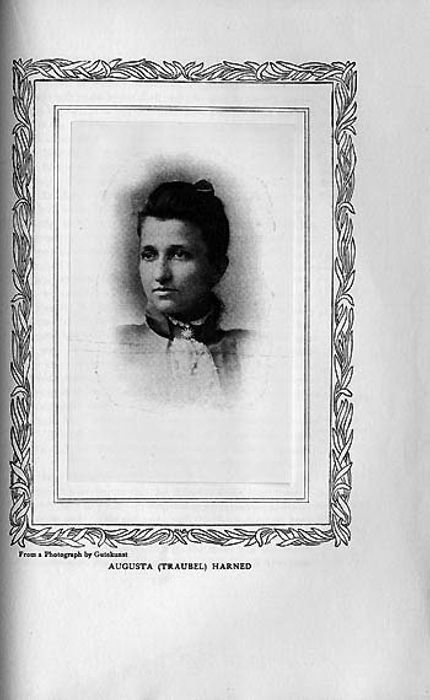 [Begin page 461]way—a sort of blood's monarch. I am sure, however, that William will come to see it all right by and bye—will realize that my position is not what he now thinks—that he will then come round. [See indexical note p461.1] He's true, true—everlastingly true—and so's Tucker, too, for that matter: and I guess it is good to have these demurrers put in."
[See indexical note p461.2] W. had been looking over Arnold's essay on Heine again. "I would read it if I was you, Horace. It's the only thing from Arnold that I have read with zest. Heine! Oh how great! The more you stop to look, to examine, the deeper seem the roots, the broader and higher the umbrage. And Heine was free—was one of the men who win by degrees. He was the master of a pregnant sarcasm: he brought down a hundred humbuggeries if he brought down two. [See indexical note p461.3] At times he plays with you with a deliberate, baffling sportiveness."
W. talked about the French people. "I never had the common Puritan ideas about France: I have long considered the French in some ways the top of the heap. We too generally lack the elemental affinities to judge the Latin races with anything like justice. Did I hear you say that things you saw in Emerson's journal were very favorable to the French? I should not have thought it—it was hardly to be expected: Emerson was so soaked in and in with English currents of ancestry. [See indexical note p461.4] I love Emerson—I do not need to say that—but he was somewhat thin on the physiological side. There are things in the French which I do not criticise but which I believe must have been very offensive to Emerson."
W. had a note from Bucke: "He never saw Slang in America before—wrote that he thought it the best thing I had ever done in prose—or something which comes to about that in the end. [See indexical note p461.5] I do not agree with the Doctor: on the contrary I think the piece quite insignificant—not important from any point of view—nothing, the most you can make of it, to warrant Bucke's enthusiasm. The North American [Begin page 462] Review fellows wrote: They must have a piece—anything—anything—must—must—a piece and at once. I had nothing but this in stock—was in no humor for writing—so this went through—was paid for—and that's all I know about it. [See indexical note p462.1] As to the slang itself—you know I was an industrious collector: slang was one of my specialties. I originally had no intention of putting this material together as I have done now."
A statement is made in Current Literature that all the magazines fought shy of W. W. except Harper's. "That exception seems very funny. Harper's is the great shyer. [See indexical note p462.2] I have no doubt there is a standing order in the office: Don't touch Walt Whitman: leave him alone. I think the Weekly is a little better disposed towards me, but the iron rules cannot be broken. It printed my Grant piece." [See indexical note p462.3] Speaking of antagonisms he said: "Stoddard, I think, made against me, once the filthiest fling I have ever encountered. Stoddard is not a bad fellow, but is disappointed, soured, gray, old—not sweetened with the reassurances of life—a man who started out promising much—wrote a few good things—then slowed up, got out of the race."
[See indexical note p462.4] Signed medallions for me tonight—Morse's. "I like it better and better," he said. He handed me his copy of Epictetus. "What do you think of that? I have been thinking of putting November Boughs into such a cover." Epictetus is flexible cloth. "Ah! you like it! I'm glad to hear you say that. All my own tastes are towards books you can easily handle—put into your pocket. I once argued this point out with Mrs. Gilchrist—she was vehement the other way—was so keen I yielded—going on year by year violating my first idea of what is proper. [See indexical note p462.5] What you say almost wins me back. Early thoughts are so often best thoughts after all. I have carried this Epictetus with me for years—it has been kicked, cuffed, slammed about—been on the floor—is still not broken—is intact—rubbed some, [Begin page 463] that is all. If we put November Boughs into that shape, using fine white paper, giving the pages a good margin, the book may do us some credit." [See indexical note p463.1] He at first intended placing the two introductory pieces to the English editions of Specimen Days in November Boughs as separate pieces but has changed his mind. They will go in with the prefatory note which went along with the Walter Scott edition of Democratic Vistas under the one general headline: Notes to Late English Books. "The arrangement of these things I leave to you. [See indexical note p463.2] I have no definite notion of what I want but when you get what I want I will yell straight out and stop you right there." Asked me if The American was liable to fire off at him again this week? Gave me a message to his bookbinder.
When I arrived this evening W. had lying there in front of him an old envelope with the "Walt Whitman" marked out and "Horace Traubel, personally" substituted across the face of it. It contained a galley slip—a French Opinion of Walt Whitman from Revue des Deux Mondes, and an old Whitelaw Reid letter. I did not stop to read them. [See indexical note p463.3] W. said they were "things you should have to put away in your storehouse." Said this was "a good Canada season." "You should see the barley fields, Horace—they are so beautiful, so beautiful. Canada is a miracle this season of the year: I want you to take a trip to Bucke some year just about this time." I did not read the Reid letter until I got home. It was written on the stationery of The Tribune. I will copy it here before I stop.
New York, Dec. 22, 1874. Dear Mr. Whitman:[See indexical note p463.4] I was sorry the article about the Camden school seemed to you unkind in its reference to your health. I shall have a paragraph within a day or two which will, I think, relieve you of the idea that we had any such intention.
[Begin page 464]I sincerely hope you are getting better, and will soon be out of the woods.
Very truly yours, Whitelaw Reid.Saturday, July 14, 1888.
[See indexical note p464.1] Saturday. To W. at 7.45, evening. Almost gleeful. "I am almost strong tonight—this has been my best day in five weeks." Mitchell over today. W. said: "They still insist on dosing me. I had a quarrel with them today over that. I guess they were right but somehow I felt as if I had to make the fight." [See indexical note p464.2] There is to be a change of nurses tomorrow. Baker will go. A man named Musgrove will take his place—an older man. W. insists that he is losing his eyesight. Makes a good deal of it, but the evidence is not as strong as he thinks it is. [See indexical note p464.3] He wrote to Burroughs yesterday. "It was quite a good-sized note—written with pencil: saying nothing in particular however—rather aiming to give him something right from my own hand—that's all. Dear John!"
W. read a little today. Bucke writes advising W. that he should sell his horse and carriage. [See indexical note p464.4] W. says: "Which means that in Doctor's opinion I am never to find much use for them again." Referred in this way to Sidney Morse: "Morse is a good deal like me: the spirit to write dies in him for days and weeks and months—then it revives and he is at it again like a steam plough!" [See indexical note p464.5] I asked him about the Reid note. What was it that was said in The Tribune? "I cannot just remember. It used to be the habit of some of the papers—some do it still when they want to fling themselves—to refer my illness back to my dissipations. This may have been a case of the kind. I do not recall the details of the incident. [See indexical note p464.6] Reid's letter was entirely friendly. O'Connor claimed that Reid was on our side—that he heard so from somebody or something of that sort." Advised me [Begin page 465] to "keep in constant touch with Kennedy, Burroughs and Bucke," adding: "I always feel comfortable for believing that what I cannot write them about myself you can and do write."
[See indexical note p465.1] W. referred to the slip he gave me yesterday discussing the Revue piece, but said he could not remember its origin. "It came from Hugh Hastings' Commercial Advertiser and was written by De Hayes Janvier, then its editor but afterwards connected with the Public Building Commission in Philadelphia—a man who seemed well pleased with me and friendly, I could hardly tell why. [See indexical note p465.2] The French have wonderful knack in certain directions—for extreme finesse, often—why, it is so good sometimes it seems almost natural. Here is a thing from Joubert: 'Where there is no delicacy there is no literature.' How much there is in that! Don't you think so? Oh! how subtle! You feel it—it gets into you and spreads about!" [See indexical note p465.3] W. said again: "The French writer contradicts himself on several points. Here is another of his magnificent phrases: 'Virility is a fine thing but the ideal is finer.' I have long thought of literature by just such light as this man throws on it. The easy touch of French writers does not necessarily come from frivolity, insincerity: Arnold was wrong if he ever thought that. [See indexical note p465.4] There are incomparable things in Hugo—in some others of the French literateurs: immense, immortal things: things that belong to every day of all time. I have often pointed to—always adhered to—Millet. [See indexical note p465.5] Millet was a new world in himself: was long doubted, but finally came to his own. [See indexical note p465.6] O'Connor, who reads French, who is perfectly at home in its literature, stands by the French—insists upon French supremacy: and William, you know, of all my friends and supporters, seems to me the most scholarly—the best possessed in literary treasures—the love of books: and William has this added fact to his credit—that his bookishness, tremendous, even extreme as it may appear, has in no way affected, reduced, his individuality: [Begin page 466] he towers over all the books: he is always a vital living man. I often say of Emerson, that the personality of the man—the wonderful heart and soul of the man, present in all he writes, thinks, does, hopes—goes far towards justifying the whole literary business—the whole raft good and bad, the entire system. [See indexical note p466.1] You see, I find nothing in literature that is valuable simply for its professional quality: literature is only valuable in the measure of the passion—the blood and muscle—with which it is invested—which lies concealed and active in it." [See indexical note p466.2]
I referred to a Western criticism in America (Chicago) copied in The Critic, signed E. J. M.: "Walt Whitman was the Jack Cade of American literature. [See indexical note p466.3] A sturdy rebel against conventions, a representative of the masses, he encamped before the citadel of tradition and proclaimed the war that was to bring about the democracy of song. His cause will perish with him, and his name stand like a pillar in a waste place—lonely, but imperishable." W. listened intently as I repeated this. Then he said: "Go over it again," which I did. "Was that in The Critic? I missed it. [See indexical note p466.4] I always read The Critic—it always contains things I feel I ought to know. Jack Cade? Even Jack Cade was something. I do not exactly connect one piece of E. J. M. with another—but that don't matter. All such things need to be said—should be yelled out in the loudest voice, spelled in the biggest letters."
We discussed book culture. W. laughed. [See indexical note p466.5] "They all tell me I know nothing about culture—nothing about the uses of formal literature—that my revolt is the revolt of ignorance. Well—let it go at that." One of the points I advanced in the matter was this: "I always claim that a man has a right to as much culture as he can carry, but that when he gets more than he can assimilate, when the culture turns around to carry him, culture has exceeded its office." W. heard this and had me say it over again. Then acquiesced: "That is [Begin page 467] a daring and a noble thing to say—and it is true, all true. I think O'Connor would like to hear you say that. You want to put that down somewhere when you write—it is worth keeping close at hand."
[See indexical note p467.1] I reminded W. that today was in France a day of days. He looked at me inquiringly—then his whole face lighted up. "Yes, now I remember—so it is. What America did for the Fourth France did for the Fourteenth: both acts were of the same stock. Horace, there's nothing here to drink it with but we'll drink a toast anyway: Here's thanks to the old revolution and death to all new Bastiles!" [See indexical note p467.2] Very earnest and vehement. I picked up a sheet of W.'s writing—old fools'-cap and very yellow, mussed, tramped on. W. smiled as I held it in view for him to see: "It has a sort of before-the-flood-look." I handed it to him. "It is earlier work," he said, "as you can see by the handwriting. I don't know what it belongs to: the substance of it (not the actual words probably) is no doubt in Specimen Days or the Leaves somewhere. [See indexical note p467.3] There's very little of such work that finally got left out. You remember I was at that period full of designs for things that were never executed: lectures, songs, poems, aphorisms, plays—why, even stories: I was going to write stories, too, God help me! [See indexical note p467.4] It took me some time to get down, or up, to my proper measure—to take my own measure—that is, a long time to really get started—though I think that after I had made up my mind and got going I kept up a pretty steady pace in that one direction." At his suggestion I read the thing aloud.
"Come, let us not be more indulgent with theolo [blank here and a ?] than we are with the circulating medium. [See indexical note p467.5] Shinplasters and paper from the Bank of Possum Creek may pass current in that swampy settlement of fine log houses and an unpiped steamboat, but for the journey of the globe we need coinage of gold.
[Begin page 468]"Yes, more still we demand. [See indexical note p468.1] In these noble days we say of laws of physical philosophy that we must try them and examine them for ourselves; they shall be exhibited to us. Nothing carries the day now but the clearly authenticated narrative and the solid, touchable, weighable, seeable, demonstrable substance and its action, and the plain reasons and proofs how and why. No mandamus or writ of court can be served here. Men wait not for the conge-delire of the king; and a hundred popes' bulls would get less respect than an inch or an ounce of the cabin-boy's or the dung-pitcher's word who testified that he saw."
[See indexical note p468.2] "But can you get rid of mystery?" I asked. "No—nor get rid of reason: the two belong together—each is necessary to the other." I quoted this from something I had myself just written: "Emerson says that one with God is a majority. I say so too. And I also say that mystery with God is the highest wisdom." W. said: "That is good enough to hear again: say it once more." I did so. [See indexical note p468.3] Then his voice was very fervent as he concluded: "I think I see all you mean and I think I meant the same thing in that piece of ramble. Mystery is not the denial of reason but its honest confirmation: reason, indeed, leads inevitably to mystery—but, as you know, mystery is not superstition: mystery and reality are the two halves of the same sphere." I had said in writing recently about W.: "Leaves of Grass is not all flat on the ground. Some of it is on wings way up in the air." I quoted this to W. He responded: "So it ought to be—so I hope it is: there would be no excuse for the book if it trailed and lost its banners in the mud."
![[Index]](https://whitmanarchive.org/iiif/2/whitman-traubel%2Fmed.00001.f40.jpg/full/!700,700/0/default.jpg) [Begin page 470]
[Begin page 470]
![[Index]](https://whitmanarchive.org/iiif/2/whitman-traubel%2Fmed.00001.f41.jpg/full/!700,700/0/default.jpg) [Begin page 471]
[Begin page 471]
![[Index]](https://whitmanarchive.org/iiif/2/whitman-traubel%2Fmed.00001.f42.jpg/full/!700,700/0/default.jpg) [Begin page 472]
[Begin page 472]
![[Index]](https://whitmanarchive.org/iiif/2/whitman-traubel%2Fmed.00001.f43.jpg/full/!700,700/0/default.jpg) [Begin page 473]
[Begin page 473]
![[Index]](https://whitmanarchive.org/iiif/2/whitman-traubel%2Fmed.00001.f44.jpg/full/!700,700/0/default.jpg)
![[Ad]](https://whitmanarchive.org/iiif/2/whitman-traubel%2Fmed.00001.f45.jpg/full/!700,700/0/default.jpg) [Begin page ]
[Begin page ]
![[Ad]](https://whitmanarchive.org/iiif/2/whitman-traubel%2Fmed.00001.f46.jpg/full/!700,700/0/default.jpg)
Note (p001.1): Emerson Return to text.
Note (p001.2): Munger on Leaves of Grass Return to text.
Note (p002.1): Robert Buchanan Return to text.
Note (p002.2): Letter from Robert Buchanan Return to text.
Note (p002.3): Swinburne Return to text.
Note (p002.4): "I regret the Insertion of certain Passages" Return to text.
Note (p002.5): "Your fatal Obstacle" Return to text.
Note (p003.1): Children of Adam Return to text.
Note (p003.2): "To sink or swim with the Book" Return to text.
Note (p003.3): Removal from the Interior Department Return to text.
Note (p004.1): Origin of "The Good Gray Poet" Return to text.
Note (p004.2): Harlan admits his Mistake Return to text.
Note (p004.3): Lincoln Return to text.
Note (p004.4): Ellen Terry Return to text.
Note (p005.1): Letter from Ellen Terry Return to text.
Note (p005.2): "These Actor People" Return to text.
Note (p005.3): Early Attempts at Oratory Return to text.
Note (p006.1): "Only come-day go-day Palaver" Return to text.
Note (p006.2): "The Leaves get out after all" Return to text.
Note (p006.3): For Free Trade Return to text.
Note (p006.4): "What is Home?" Return to text.
Note (p007.1): Lincoln Return to text.
Note (p007.2): Millet Return to text.
Note (p007.3): "The Leaves are only Millet in another Form" Return to text.
Note (p007.4): Whitman's Humor Return to text.
Note (p008.1): "Let's all get young again" Return to text.
Note (p008.2): "If ever a Fighter lived" Return to text.
Note (p008.3): Letter from John Boyle O'Reilly Return to text.
Note (p008.4): Truman H. Bartlett Return to text.
Note (p009.1): "Mrs. Fairchild preaching you" Return to text.
Note (p009.2): "A Revelation and a Revealer" Return to text.
Note (p009.3): "An intellectual Colossus" Return to text.
Note (p010.1): "His Principles would revolutionize the World" Return to text.
Note (p010.2): "A broad Summing Up" Return to text.
Note (p010.3): "I claim Everything for Religion Return to text.
Note (p010.4): A losing Fight for Health Return to text.
Note (p011.1): "We must eternally Stick" Return to text.
Note (p011.2): Felix Adler Return to text.
Note (p011.3): The Church Return to text.
Note (p011.4): Motherhood Return to text.
Note (p011.5): A Tramp Visitor Return to text.
Note (p012.1): "Coalstove Words" Return to text.
Note (p012.2): Jealous of the Tramp Return to text.
Note (p012.3): Letter from W. J. Linton Return to text.
Note (p013.1): "I want to set you to rights" Return to text.
Note (p013.2): Feeling better Return to text.
Note (p013.3): "The Tramp's Gift got into my Veins" Return to text.
Note (p013.4): Democracy Return to text.
Note (p014.1): Plutocracy Return to text.
Note (p014.2): Not Men but Systems Return to text.
Note (p014.3): Practical Politics Return to text.
Note (p015.1): Freedom of Teaching in Colleges Return to text.
Note (p015.2): "Of Necessity an Aristocracy" Return to text.
Note (p015.3): "Speech deferred makes the Heart sick" Return to text.
Note (p016.1): Letter from George Parsons Lathrop Return to text.
Note (p016.2): "He is our greatest Poet, altogether" Return to text.
Note (p016.3): "I get my Hands loose, now and then" Return to text.
Note (p017.1): "This little tribute may have its Value" Return to text.
Note (p017.2): "Now editing the Atlantic with Mr. Howells" Return to text.
Note (p017.3): The Leaves in Germany Return to text.
Note (p018.1): "Set-tos with the State" Return to text.
Note (p018.2): Letter from T. W. Rolleston about the German Leaves Return to text.
Note (p018.3): "I offered it to four Publishers" Return to text.
Note (p019.1): Difficulties of Publication in Germany Return to text.
Note (p019.2): Karl Knortz Return to text.
Note (p019.3): "As to Terms" Return to text.
Note (p019.4): "The Upshot of this is" Return to text.
Note (p020.1): Something about Ireland from Rolleston Return to text.
Note (p020.2): "The Irish are much less Catholic than they were" Return to text.
Note (p021.1): "My Father" Return to text.
Note (p021.2): "One of my staunchest Friends" Return to text.
Note (p022.1): Radicalism narrow and Radicalism broad Return to text.
Note (p022.2): "I am as radical now as ever" Return to text.
Note (p022.3): Matthew Arnold Return to text.
Note (p023.1): "Emerson was Elemental and a born Democrat" Return to text.
Note (p023.2): Democracy inclusive Return to text.
Note (p023.3): John Swinton Return to text.
Note (p024.1): Letter from Swinton Return to text.
Note (p024.2): "You have grown before me, grown around me, and grown into me" Return to text.
Note (p024.3): "Going toward Social Radicalism" Return to text.
Note (p025.1): "Such kind of Ailment ought to Spread" Return to text.
Note (p025.2): A stained Piece of Paper Return to text.
Note (p025.3): "Go on, my Dear Americans" Return to text.
Note (p025.4): "Tell her they are Love" Return to text.
Note (p026.1): A Hospital Talk Return to text.
Note (p026.2): "That was a great Woman" Return to text.
Note (p026.3): A Hospital Letter to Hannah Stevenson Return to text.
Note (p026.4): "These American Soldiers" Return to text.
Note (p027.1): "Everywhere a lack of fittest Hands" Return to text.
Note (p027.2): "House-cleaning Days" Return to text.
Note (p027.3): Turned down by the Editors Return to text.
Note (p027.4): Bret Harte Return to text.
Note (p028.1): Letter from Bret Harte Return to text.
Note (p028.2): Letter from Henry M. Alden Return to text.
Note (p028.3): Letter from James Knowles Return to text.
Note (p028.4): The Osgood Affair Return to text.
Note (p029.1): "Too much Fuss about it all" Return to text.
Note (p029.2): Letter from William Douglas O'Connor Return to text.
Note (p029.3): Bacon-Shakespeare Return to text.
Note (p030.1): W. W. in the Stratford Memorial Library Return to text.
Note (p030.2): Kuno Fischer endorses Bacon Return to text.
Note (p031.1): Karl Muller Return to text.
Note (p031.2): The Osgood Affair Return to text.
Note (p032.1): "Osgood is losing his Grip" Return to text.
Note (p032.2): "He ought to have publicly defied him" Return to text.
Note (p033.1): Edmund Gosse Return to text.
Note (p033.2): "What will Cleveland do?" Return to text.
Note (p033.3): Edmund Gosse Return to text.
Note (p034.1): Applause Return to text.
Note (p034.2): A Letter "to comfort a Fellow and brace him up" Return to text.
Note (p034.3): "The wonderful Mirror of your Creation" Return to text.
Note (p035.1): "Your Book Revelation" Return to text.
Note (p035.2): "To make another long for Truth" Return to text.
Note (p035.3): "Better than Medals or Pensions Return to text.
Note (p036.1): A Piece of discarded Manuscript Return to text.
Note (p036.2): About a Tennyson Letter Return to text.
Note (p037.1): The Tennyson Letter itself Return to text.
Note (p037.2): "I guess I am all right at the Top" Return to text.
Note (p037.3): Three Sets of Verses Return to text.
Note (p037.4): Ingersoll Return to text.
Note (p038.1): "I'm sorry there's no more" Return to text.
Note (p038.2): An Invitation to lecture in England Return to text.
Note (p038.3): Hollyer's Etching Return to text.
Note (p038.4): A Toast to Lincoln Return to text.
Note (p038.5): "A Sort of Tramp" Return to text.
Note (p039.1): A Bust of Hicks Return to text.
Note (p039.2): The Eakins Portrait Return to text.
Note (p039.3): "Too much Rabelais" Return to text.
Note (p040.1): "I hate to go at all" Return to text.
Note (p040.2): Letter from Edmund Gosse" Return to text.
Note (p040.3): O'Connor and Gosse Return to text.
Note (p040.4): Matthew Arnold Return to text.
Note (p041.1): Sidney Morse Return to text.
Note (p041.2): Gilchrist's Portrait of W. Return to text.
Note (p041.3): Arnold again Return to text.
Note (p041.4): Byron Return to text.
Note (p041.5): Shelley Return to text.
Note (p042.1): Does this Eakins Picture look glum? Return to text.
Note (p042.2): The Strain of American Life Return to text.
Note (p042.3): Visiting Cards Return to text.
Note (p042.4): "Everybody is writing Poetry" Return to text.
Note (p043.1): "Some mighty good Matter anent Carlyle" Return to text.
Note (p043.2): Letter from John Burroughs Return to text.
Note (p043.3): "Carlyle was worth all other Britons put together" Return to text.
Note (p043.4): "Writing an Article on Thoreau" Return to text.
Note (p044.1): Emerson on Carlyle Return to text.
Note (p044.2): Joaquin Miller Return to text.
Note (p044.3): Letter from Joaquin Miller Return to text.
Note (p045.1): W. W. Story Return to text.
Note (p045.2): Matthew Arnold Return to text.
Note (p045.3): "What we mostly need in this Age" Return to text.
Note (p045.4): Doctor Johnson Return to text.
Note (p046.1): "He talked for effect" Return to text.
Note (p046.2): Letter from Edwin Booth Return to text.
Note (p046.3): His Father Return to text.
Note (p047.1): H. R. Haweis Return to text.
Note (p047.2): Hastings Weld Return to text.
Note (p047.3): Talk about Arnold and Doctor Johnson Return to text.
Note (p047.4): "Arnold's Poetry is like some delicate precious bit of Porcelain" Return to text.
Note (p048.1): "Never take Advice" Return to text.
Note (p048.2): November Boughs Return to text.
Note (p048.3): Memory Return to text.
Note (p049.1): A "beautiful good Letter" Return to text.
Note (p049.2): "New Conceptions of the Dignity and Beauty of my own Body" Return to text.
Note (p050.1): "To let you know that my Love went with you" Return to text.
Note (p050.2): "A bright Letter for a dark Day" Return to text.
Note (p050.3): Emerson's Objection to Passages in Leaves of Grass Return to text.
Note (p051.1): "If I had cut Sex out" Return to text.
Note (p051.2): Turner and real Heroism Return to text.
Note (p051.3): "More Light on Emerson Matters" Return to text.
Note (p051.4): O'Connor Return to text.
Note (p052.1): Letter from O'Connor Return to text.
Note (p052.2): O'Connor versus Chadwick Return to text.
Note (p052.3): "You must be very careful" Return to text.
Note (p053.1): Cooke's Memoir of Emerson Return to text.
Note (p053.2): "Our Stronghold is the Emerson Letter" Return to text.
Note (p053.3): "Shut Chadwick up for good" Return to text.
Note (p053.4): "The Melancholy Club of New York" Return to text.
Note (p054.1): Bucke Return to text.
Note (p054.2): Burroughs Return to text.
Note (p054.3): "Watch the Tribune for my anti-Chadwick" Return to text.
Note (p054.4): "After all William is a Lover" Return to text.
Note (p055.1): Sickness and Health Return to text.
Note (p055.2): New York literary Men Return to text.
Note (p055.3): Stoddard Return to text.
Note (p055.4): Taylor Return to text.
Note (p055.5): Burroughs Return to text.
Note (p056.1): Stedman Return to text.
Note (p056.2): "As between Emerson and Bryant" Return to text.
Note (p056.3): Whittier Return to text.
Note (p056.4): "I am a Hell of a Critic" Return to text.
Note (p057.1): Another Miller Letter Return to text.
Note (p057.2): "Your great and immortal Chants" Return to text.
Note (p057.3): "This Goethe-Carlyle Business" Return to text.
Note (p058.1): "I am not a literary West-Pointer" Return to text.
Note (p058.2): Art for Art's Sake Return to text.
Note (p058.3): Tolstoy Return to text.
Note (p058.4): William Sloane Kennedy Return to text.
Note (p058.5): Benjamin R. Tucker Return to text.
Note (p058.6): "I stand in awe before William" Return to text.
Note (p058.7): Morris Return to text.
Note (p059.1): Whitman's Gospel of Dirt Return to text.
Note (p059.2): His Aristocracy Return to text.
Note (p059.3): John Hay Return to text.
Note (p059.4): "Mighty decent of John to talk out in Meeting" Return to text.
Note (p060.1): Letter from John Hay Return to text.
Note (p060.2): "I don't believe I deserved my Friends" Return to text.
Note (p060.3): "I never quarrel with the Editors" Return to text.
Note (p061.1): Letter from H. M. Alden Return to text.
Note (p061.2): Emerson again Return to text.
Note (p061.3): "Dear Emerson!" Return to text.
Note (p061.4): "The New York Crowd of Scrawlers" Return to text.
Note (p062.1): New York Return to text.
Note (p062.2): Washington and Lincoln Return to text.
Note (p062.3): Kennedy's Conversion Return to text.
Note (p062.4): "Some Kind of a Preacher" Return to text.
Note (p062.5): A Millet Picture Return to text.
Note (p063.1): "Millet is my Painter" Return to text.
Note (p063.2): W. W. comments on his Health Return to text.
Note (p063.3): "The Beginning of the End" Return to text.
Note (p063.4): Philip Bourke Marston Return to text.
Note (p063.5): "A Piece of the best News" Return to text.
Note (p064.1): "I never wish to be studied by a Club" Return to text.
Note (p064.2): Goldsmith Return to text.
Note (p064.3): Words and the Idea Return to text.
Note (p064.4): "The Idea becomes so important to me" Return to text.
Note (p065.1): "My Heart is with all you Rebels" Return to text.
Note (p065.2): "Your Flag is my Flag" Return to text.
Note (p065.3): Emerson Return to text.
Note (p065.4): The New York Reception of 1887 Return to text.
Note (p066.1): Stedman's American Poets Return to text.
Note (p066.2): "Every time I criticise a Man or a Book" Return to text.
Note (p066.3): "Something for your Archives" Return to text.
Note (p067.1): Letter from O'Connor Return to text.
Note (p067.2): O'Connor's Corrections for Bucke's Life Return to text.
Note (p068.1): "The Poet in Bacon" Return to text.
Note (p068.2): "A Blow at Lowell" Return to text.
Note (p068.3): Richard Grant White Return to text.
Note (p069.1): Morse's Bust of Hicks Return to text.
Note (p069.2): Marston Return to text.
Note (p069.3): Ingersoll and Gladstone Return to text.
Note (p069.4): Bryant Return to text.
Note (p070.1): Emerson Return to text.
Note (p070.2): "Duty—it is a free Word—it is a Slave Word" Return to text.
Note (p070.3): Sidney Morse Return to text.
Note (p070.4): Stedman Return to text.
Note (p070.5): "It still lacks Root" Return to text.
Note (p071.1): Emerson, Carlyle, Hugo Return to text.
Note (p071.2): "Stedman is an Education" Return to text.
Note (p071.3): "The best plain Men" Return to text.
Note (p071.4): Letters Return to text.
Note (p072.1): Millet Return to text.
Note (p072.2): Gerome Return to text.
Note (p072.3): Arnold on America Return to text.
Note (p072.4): Great Men Return to text.
Note (p072.5): A Compact Return to text.
Note (p073.1): "I am reckoning upon you to help me" Return to text.
Note (p073.2): John Addington Symonds Return to text.
Note (p073.3): "What does Calamus mean?" Return to text.
Note (p073.4): "A rare, cleaned-up Man" Return to text.
Note (p074.1): "The noblest of us all" Return to text.
Note (p074.2): Letter from Symonds Return to text.
Note (p074.3): "You—my Master!" Return to text.
Note (p074.4): "Adhesiveness" Return to text.
Note (p075.1): "A strong vital Bond of Man to Man" Return to text.
Note (p075.2): "To be a simple Human Being" Return to text.
Note (p075.3): "I have pored over the Pages of Calamus" Return to text.
Note (p075.4): "The Love of Man for Man" Return to text.
Note (p076.1): "The Love of Friends" Return to text.
Note (p076.2): "The modern Gospel of Work" Return to text.
Note (p076.3): In Answer to Symonds Return to text.
Note (p076.4): "I hate to be catechised" Return to text.
Note (p077.1): "I maybe do not know all my own Meanings" Return to text.
Note (p077.2): "I am a conservative Animal" Return to text.
Note (p077.3): "Two more Throws against Oblivion" Return to text.
Note (p078.1): Frank Stockton Return to text.
Note (p078.2): Howells and James Return to text.
Note (p078.3): Stedman again Return to text.
Note (p078.4): "My Quaker Lineage" Return to text.
Note (p079.1): Thomas Paine Return to text.
Note (p079.2): Colonel Fellows Return to text.
Note (p079.3): "What are Facts in History?" Return to text.
Note (p080.1): Fanny Wright Return to text.
Note (p080.2): "Feeling rather peart" Return to text.
Note (p080.3): "A Toast to three eminent good Fellows" Return to text.
Note (p081.1): Cleveland Return to text.
Note (p081.2): "Even Andy Johnson" Return to text.
Note (p081.3): Emperor Frederick Return to text.
Note (p081.4): "I only call it Common Sense" Return to text.
Note (p081.5): "Gladstone is no Match for Ingersoll" Return to text.
Note (p082.1): "Ingersoll's Importance to the Time" Return to text.
Note (p082.2): Jerry Black Return to text.
Note (p082.3): "I am in a good Mood for gentle Things" Return to text.
Note (p082.4): "My Philosophy sees a Place for Everybody" Return to text.
Note (p083.1): A Message to Adler Return to text.
Note (p083.2): "Tell him about the Millet" Return to text.
Note (p083.3): O'Connor Return to text.
Note (p083.4): George William Curtis Return to text.
Note (p083.5): Letter from O'Connor Return to text.
Note (p084.1): William Allingham Return to text.
Note (p084.2): George William Curtis Return to text.
Note (p084.3): "Splendid Gentleman and noble Heart" Return to text.
Note (p084.4): Monadnoc Return to text.
Note (p085.1): Jenny Bullard Return to text.
Note (p085.2): Enfans d'Adam Return to text.
Note (p085.3): The Curtis Enclosure Return to text.
Note (p086.1): "Your Vindication of free Letters" Return to text.
Note (p086.2): "An Offense which demands Exposure and Censure Return to text.
Note (p086.3): "Andy may Tylerize, but the Country will not" Return to text.
Note (p087.1): Struggles with November Boughs Return to text.
Note (p087.2): "A Tale worth putting down in the Book" Return to text.
Note (p087.3): "I get so much good Advice" Return to text.
Note (p088.1): "A Match for it" Return to text.
Note (p088.2): "The Ministry is spoiled with Arrogance" Return to text.
Note (p088.3): Literary Honesty Return to text.
Note (p088.4): Burroughs Return to text.
Note (p089.1): "John has a few simply literary Habits" Return to text.
Note (p089.2): "A superb Example of let go" Return to text.
Note (p089.3): A London Letter from Burroughs Return to text.
Note (p089.4): "A Building with a living Soul" Return to text.
Note (p089.5): In St. Paul's Return to text.
Note (p090.1): "It is Nature and Art fused into one" Return to text.
Note (p090.2): Conway Return to text.
Note (p090.3): "The grandest Organ Music put into form" Return to text.
Note (p090.4): "The Footnote is an Impertinence" Return to text.
Note (p091.1): Marston's Garden Secrets Return to text.
Note (p091.2): "The Lecture Trip to England" Return to text.
Note (p091.3): Gladstone's Reply to Ingersoll Return to text.
Note (p091.4): Carlyle Return to text.
Note (p092.1): "Carlyle lacked Religious Faith" Return to text.
Note (p092.2): "He shrank from the People" Return to text.
Note (p092.3): Ruskin Return to text.
Note (p092.4): The first Edition of the Leaves Return to text.
Note (p093.1): W. W.'s Franklin Evans Return to text.
Note (p093.2): Lady Mount Temple's Gift Return to text.
Note (p093.3): "Apparel valued at £1" Return to text.
Note (p094.1): "The usual Rigamarole" Return to text.
Note (p094.2): The Tariff Return to text.
Note (p094.3): Who was Lady Mount Temple? Return to text.
Note (p094.4): Thayer Return to text.
Note (p095.1): "A Type of the literary Feller" Return to text.
Note (p095.2): Ernest Rhys Return to text.
Note (p095.3): "Don't most Men who write write without knowing Life?" Return to text.
Note (p095.4): Matthew Arnold Return to text.
Note (p096.1): "More Fuss over Foliage than Root" Return to text.
Note (p096.2): Lafcadio Hearn Return to text.
Note (p096.3): George Cable Return to text.
Note (p096.4): The American Theory Return to text.
Note (p096.5): Scott Return to text.
Note (p097.1): Cooper Return to text.
Note (p097.2): "I look for the Things that take Life forward" Return to text.
Note (p097.3): Back to Cable Return to text.
Note (p097.4): "The negative Virtues of the Churches" Return to text.
Note (p098.1): Wanamaker and Leaves of Grass Return to text.
Note (p098.2): "The dyed-in-the-wool Shopkeeper Point of View" Return to text.
Note (p098.3): "Sex and the Social Order" Return to text.
Note (p098.4): "That damned Customs Bill" Return to text.
Note (p099.1): "The Tariff flies in the Face of all American Ideals" Return to text.
Note (p099.2): "Favorite Races, favorite Castes" Return to text.
Note (p099.3): "It is a Robber Age" Return to text.
Note (p099.4): Washington Episodes Return to text.
Note (p100.1): John Forney Return to text.
Note (p100.2): His Book of Anecdotes Return to text.
Note (p100.3): Newspapers Return to text.
Note (p100.4): "From a Minister's Point of View" Return to text.
Note (p100.5): Schools of Art Return to text.
Note (p101.1): "The political Class is too slippery for me" Return to text.
Note (p101.2): "I like the scientific Spirit" Return to text.
Note (p101.3): A Trowbridge Memorandum about Emerson Return to text.
Note (p101.4): "On Authority of Mr. Emerson" Return to text.
Note (p102.1): Lord Houghton Return to text.
Note (p102.2): Leonard Corning Return to text.
Note (p102.3): Voices Return to text.
Note (p102.4): "The Tragedy of the Ages" Return to text.
Note (p103.1): "The other Tragedies" Return to text.
Note (p103.2): "The Masters in History" and "the other Fellows" Return to text.
Note (p103.3): The Mount Temple Waistcoat again Return to text.
Note (p104.1): Harriet Prescott Spofford Return to text.
Note (p104.2): Ainsworth R. Spofford Return to text.
Note (p104.3): Edward Carpenter Return to text.
Note (p104.4): "To men of the severe scholarly Type" Return to text.
Note (p104.5): Style Return to text.
Note (p105.1): "I have tried to be just with Arnold" Return to text.
Note (p105.2): "The Style is to have no Style" Return to text.
Note (p105.3): "I am an open Air, open Water, Man" Return to text.
Note (p105.4): Milton, Dante, Millet, Raphael Return to text.
Note (p106.1): "The World is through with Sermonizing" Return to text.
Note (p106.2): Heine Return to text.
Note (p106.3): Verdi Return to text.
Note (p106.4): Another Editor Return to text.
Note (p106.5): "Another little Scribble from Joaquin" Return to text.
Note (p107.1): Letter from Miller Return to text.
Note (p107.2): "I am tired of Books too" Return to text.
Note (p107.3): "How many more Springs will I last?" Return to text.
Note (p107.4): A few detached Sayings Return to text.
Note (p108.1): South American Republics Return to text.
Note (p108.2): Greek Art Return to text.
Note (p108.3): "There are a dozen of me afloat" Return to text.
Note (p108.4): "Lincoln more or less falsified" Return to text.
Note (p108.5): "Historic Debris" Return to text.
Note (p108.6): Is the Preacher any longer needed? Return to text.
Note (p109.1): "The World has got away from that" Return to text.
Note (p109.2): "Were the old Orthodoxies necessary?" Return to text.
Note (p109.3): "The whole Ideal of the Church is low" Return to text.
Note (p109.4): America Return to text.
Note (p110.1): Gladstone Return to text.
Note (p110.2): Emerson's old Age and Darwin's Return to text.
Note (p110.3): "I see no Use for the Church" Return to text.
Note (p110.4): Immortality and Logic Return to text.
Note (p111.1): Howells, Aldrich Return to text.
Note (p111.2): Hawthorne Return to text.
Note (p111.3): The Trowbridge-Emerson Memorandum Return to text.
Note (p111.4): "Emerson rather silenced than changed" Return to text.
Note (p112.1): "The New England Crowd below Stairs" Return to text.
Note (p112.2): Letter from Professor Palmer Return to text.
Note (p112.3): "I did the Work sincerely" Return to text.
Note (p113.1): "Do you think Goods can succeed and Men can fail?" Return to text.
Note (p113.2): "All that Man needs to be good is the Chance" Return to text.
Note (p113.3): "America can hold and digest All" Return to text.
Note (p114.1): An Ingersoll Letter Return to text.
Note (p114.2): "Ingersoll is a Prophet" Return to text.
Note (p114.3): A Tribute to Leonard Whitney Return to text.
Note (p114.4): Ingersoll "in his more affirmative Mood" Return to text.
Note (p115.1): "The Colonel himself is indigenous" Return to text.
Note (p115.2): "Some sample Memoranda about the Hospitals" Return to text.
Note (p115.3): The Haskell Letter Return to text.
Note (p116.1): "A Friend visiting the wounded and sick Soldiers" Return to text.
Note (p116.2): "I was always pleasant and cheerful with him" Return to text.
Note (p116.3): "I would lean down and kiss him" Return to text.
Note (p117.1): "He wandered a good deal of the Time" Return to text.
Note (p117.2): "He was in the Band as a Fifer" Return to text.
Note (p117.3): "I shall never forget those Nights in the dark Hospital" Return to text.
Note (p118.1): "He behaved like a noble Boy" Return to text.
Note (p118.2): "The thousands of our Unknown" Return to text.
Note (p118.3): "Your dying Kiss" Return to text.
Note (p118.4): A Book from France Return to text.
Note (p119.1): Letter from Francis Viele-Griffin Return to text.
Note (p119.2): "A new Victory for your Works" Return to text.
Note (p119.3): "The Ordeal of getting into another Language" Return to text.
Note (p119.4): "Even the Theosophists claim me" Return to text.
Note (p120.1): A Robert Collyer Incident Return to text.
Note (p120.2): "A reduced Beecher" Return to text.
Note (p120.3): Walter and Walt Return to text.
Note (p120.4): Louise Chandler Moulton's Visit Return to text.
Note (p121.1): "We must praise Right and blame Right" Return to text.
Note (p121.2): "The Religion of Jesus and the Religion of Walt Whitman" Return to text.
Note (p121.3): Sylvester Baxter Return to text.
Note (p121.4): "A Little Something at the right Time" Return to text.
Note (p121.5): The Morse Busts Return to text.
Note (p122.1): Charles Lamb Return to text.
Note (p122.2): Dowden and Symonds Return to text.
Note (p122.3): Letter from Edward Dowden Return to text.
Note (p122.4): Leaves of Grass "for the Soul" Return to text.
Note (p123.1): Passage to India Return to text.
Note (p123.2): To write even if not to write much Return to text.
Note (p123.3): A Query about a Pension Return to text.
Note (p124.1): Symonds "a persistent Fire" Return to text.
Note (p124.2): About Translations Return to text.
Note (p124.3): "In a French Glass" Return to text.
Note (p124.4): "Damn the expurgated Books!" Return to text.
Note (p124.5): Rhys Return to text.
Note (p125.1): "I am not a Favorite of Fortune" Return to text.
Note (p125.2): "My Growl is worse than my Spring" Return to text.
Note (p125.3): "Freedom but not Gush" Return to text.
Note (p125.4): John Weiss and Samuel Johnson Return to text.
Note (p126.1): Octavius B. Frothingham Return to text.
Note (p126.2): "Getting acquainted with a new World" Return to text.
Note (p126.3): Translations of Homer Return to text.
Note (p126.4): "Pope a Machine" Return to text.
Note (p126.5): Taylor's Faust Return to text.
Note (p126.6): Gilder Return to text.
Note (p126.7): Art Return to text.
Note (p127.1): "The original Policy of the Critics" Return to text.
Note (p127.2): Whittier Return to text.
Note (p127.3): "He threw the Book into the Fire" Return to text.
Note (p127.4): Thomas Paine Return to text.
Note (p127.5): Percy's Reliques Return to text.
Note (p128.1): Harned Return to text.
Note (p128.2): Bucke Return to text.
Note (p128.3): "Selecting" Friends Return to text.
Note (p128.4): Daniel G. Brinton Return to text.
Note (p128.5): "It is best for a Man to do his one certain Thing" Return to text.
Note (p128.6): Moncton Milnes Return to text.
Note (p129.1): "Your People don't think enough of themselves" Return to text.
Note (p129.2): Looking for a Paper Return to text.
Note (p129.3): An Ingersoll Debate Return to text.
Note (p129.4): A Visit from Longfellow Return to text.
Note (p130.1): Describing Longfellow Return to text.
Note (p130.2): "Emerson as different as Day from Night" Return to text.
Note (p130.3): "Sincerity and Definiteness" Return to text.
Note (p130.4): "Alcott had a lot of Queerities" Return to text.
Note (p131.1): "Who best appreciates objective Nature" Return to text.
Note (p131.2): Portraits Return to text.
Note (p131.3): "I like Eakins' best" Return to text.
Note (p131.4): "We need a Millet in Portraiture" Return to text.
Note (p131.5): "Sometimes I think I like the best Photographs best" Return to text.
Note (p132.1): John W. Alexander Return to text.
Note (p132.2): Two Letters: Rossetti, Dowden Return to text.
Note (p132.3): "The main Thing" Return to text.
Note (p132.4): "I have been lucky in my Friends" Return to text.
Note (p132.5): Letter from Rossetti Return to text.
Note (p133.1): Sympathy with the Commune Return to text.
Note (p133.2): Rossetti on Dowden Return to text.
Note (p133.3): Buxton Forman Return to text.
Note (p133.4): Letter from Dowden Return to text.
Note (p134.1): William Michael Rossetti Return to text.
Note (p134.2): "I wrote more coolly than I feel because—" Return to text.
Note (p134.3): "The clearest, and sweetest, and fullest American Voice" Return to text.
Note (p135.1): R. Y. Tyrrell Return to text.
Note (p135.2): The literary Historian and Critic Return to text.
Note (p135.3): The great Cryptogram Return to text.
Note (p135.4): "The Subject is attractive to me" Return to text.
Note (p135.5): "The almost luny Worship of Shakespeare" Return to text.
Note (p136.1): "How about his Kind"? Return to text.
Note (p136.2): "O'Connor was a Stormblast for Bacon" Return to text.
Note (p136.3): "Donnelly's Book will rather injure Bacon" Return to text.
Note (p136.4): The Author Shakespeare Return to text.
Note (p136.5): Shaksper the Actor Return to text.
Note (p137.1): "The Hand of the Lawyer" Return to text.
Note (p137.2): "Not much of a Correspondent" Return to text.
Note (p137.3): Carlyle and Emerson Return to text.
Note (p137.4): "I like Letters to be personal" Return to text.
Note (p137.5): Henry Ward Beecher Return to text.
Note (p138.1): "He would not go out of his Way for a King" Return to text.
Note (p138.2): "Ministers are rarely friendly to me" Return to text.
Note (p138.3): Lyman Abbott Return to text.
Note (p138.4): Stedman's American Poets Return to text.
Note (p138.5): Poe Return to text.
Note (p139.1): "A Star if not a Sun" Return to text.
Note (p139.2): "If we could get Stedman himself into a Book" Return to text.
Note (p139.3): A Dinner of Pickles Return to text.
Note (p139.4): The Duyckinck Brothers Return to text.
Note (p139.5): "The forty and odd Corns" Return to text.
Note (p140.1): Louise Chandler Moulton Return to text.
Note (p140.2): "I am not a Reciter" Return to text.
Note (p140.3): "Not a poetic Acrobat" Return to text.
Note (p140.4): The Twilight Poem Return to text.
Note (p141.1): "My Friends always want to keep me on their Track" Return to text.
Note (p141.2): "I never knew any other Language but the English" Return to text.
Note (p141.3): "The Shakespeare Worship is poor Business enough" Return to text.
Note (p141.4): "They justify themselves" Return to text.
Note (p142.1): "He fired off almost before his Gun was loaded" Return to text.
Note (p142.2): "The great social Whirl" Return to text.
Note (p142.3): "Save the severe Things for yourself" Return to text.
Note (p142.4): Ingersoll's Oration on Conkling Return to text.
Note (p142.5): The Catholic Church Return to text.
Note (p143.1): A Hospital Incident Return to text.
Note (p143.2): "I stood aside and watched" Return to text.
Note (p143.3): "My Esthetics" Return to text.
Note (p143.4): "Don't that beat a Cathedral Picture?" Return to text.
Note (p144.1): "Get down on your real Knees" Return to text.
Note (p144.2): "A simple Group of Veterans" Return to text.
Note (p144.3): "I don't object to the Refinements—I only ask them some Questions" Return to text.
Note (p144.4): Man and Priest Return to text.
Note (p145.1): "Miseble, as the Darkies say" Return to text.
Note (p145.2): A Darky Story Return to text.
Note (p145.3): Robert Louis Stevenson Return to text.
Note (p145.4): "His first View, the After-qualifications" Return to text.
Note (p146.1): Browning Return to text.
Note (p146.2): "I am always conscious of his Roominess" Return to text.
Note (p146.3): Boyesen Return to text.
Note (p146.4): "I don't know who tried me most—Johnson or Boswell" Return to text.
Note (p146.5): "The Influence of Disease in Literature" Return to text.
Note (p147.1): "The Puritan is only another Kind of Toper" Return to text.
Note (p147.2): Confederate Soldiers in the Hospitals Return to text.
Note (p147.3): Cleveland and Blaine Return to text.
Note (p147.4): "A Slap in the Face of the South" Return to text.
Note (p148.1): "The Negro will get his Due from the Negro" Return to text.
Note (p148.2): "Honesty the prevailing Atmosphere of Washington" Return to text.
Note (p148.3): "The Evil mostly with the upper Crust" Return to text.
Note (p148.4): Shaksper's Fling Return to text.
Note (p149.1): Perhaps not Bacon, surely not Shaksper Return to text.
Note (p149.2): The Idea of Immortality Return to text.
Note (p149.3): "Not prepared to admit Fraud in the Scheme of the Universe" Return to text.
Note (p149.4): "I am for Free Trade because—" Return to text.
Note (p150.1): "Harder to move than a sick Elephant" Return to text.
Note (p150.2): "I guess it's not Health I want—only People" Return to text.
Note (p150.3): Feeling better Return to text.
Note (p150.4): Stedman's Whitman Return to text.
Note (p150.5): "Expurgate, expurgate, expurgate" Return to text.
Note (p151.1): "Expurgation is Apology" Return to text.
Note (p151.2): Rossetti's Leaves Return to text.
Note (p151.3): Stedman Return to text.
Note (p151.4): "Expurgation and Justice do not go together" Return to text.
Note (p152.1): Harry Placide in an old Play Return to text.
Note (p151.2): "Not that Way, Madame" Return to text.
Note (p152.3): "Never take Advice" Return to text.
Note (p152.4): Rabelais Return to text.
Note (p152.5): "O'Connor's Explanation of Rabelais" Return to text.
Note (p153.1): A spiritual Rabelais Return to text.
Note (p153.2): "Still against Shaksper" Return to text.
Note (p153.3): Madame Greville Return to text.
Note (p153.4): "What is Delicacy?" Return to text.
Note (p153.5): The Gilchrist and Eakins Portraits again compared Return to text.
Note (p153.6): "Without Feathers—without any Fuss" Return to text.
Note (p154.1): "The conventional proper old Man" Return to text.
Note (p154.2): "I'll kick the Bucket some Day" Return to text.
Note (p154.3): "Elias Hicksiana" Return to text.
Note (p154.4): November Boughs Return to text.
Note (p155.1): "What do I want with money?" Return to text.
Note (p155.2): W. W.'s Room Return to text.
Note (p155.3): "Not so much of a Mess as it looks" Return to text.
Note (p155.4): Two Napoleonic Pictures Return to text.
Note (p156.1): "Riding a Mule led by a Peasant" Return to text.
Note (p156.2): No consistent Philosophy Return to text.
Note (p156.3): "My Lincoln Poem classed with Lowell's Ode" Return to text.
Note (p156.4): Chanting the Square Deific Return to text.
Note (p156.5): Passage to India Return to text.
Note (p157.1): Buckle Return to text.
Note (p157.2): "Books make a Coward of me" Return to text.
Note (p157.3): History good and bad Return to text.
Note (p157.4): "Give Goodness a fair Deal" Return to text.
Note (p157.5): "I trust Humanity" Return to text.
Note (p157.6): "The Race is not free" Return to text.
Note (p158.1): Sidney Morse Return to text.
Note (p158.2): "Carpenter's Letter is beautiful, like a Confession" Return to text.
Note (p158.3): Letter from Edward Carpenter Return to text.
Note (p159.1): "The Waking up to a New Day" Return to text.
Note (p159.2): "The Word which is on the Lips of God Today" Return to text.
Note (p159.3): "The Women will save us" Return to text.
Note (p159.4): "The Artisans too—" Return to text.
Note (p160.1): "The clean hard Lines of the Workman's Face" Return to text.
Note (p160.2): "A strange Horror of Darkness on us" Return to text.
Note (p160.3): "The Fetters are falling" Return to text.
Note (p161.1): "I was in Orders: it was no good" Return to text.
Note (p161.2): "Everything don't come my Way" Return to text.
Note (p161.3): Ernest Rhys Return to text.
Note (p162.1): Walt Whitman and Niagara Return to text.
Note (p162.2): "Twenty thousand Niagaras for one O'Connor" Return to text.
Note (p162.3): "The Book makes us all humble" Return to text.
Note (p162.4): Rhys in Boston Return to text.
Note (p162.5): "I am not easy to him" Return to text.
Note (p163.1): "Get at the Fellows who oppose me" Return to text.
Note (p163.2): "The poetic Lilt" Return to text.
Note (p163.3): "The Content not the Music of Words" Return to text.
Note (p163.4): Shakespeare and "the highest poetic Expression" Return to text.
Note (p164.1): "Shakespeare will be put on a low Shelf" Return to text.
Note (p164.2): "The Heroic-heroic" Return to text.
Note (p164.3): November Boughs: "its Heres and Theres" Return to text.
Note (p164.4): Charles DeKay's Nimrod Return to text.
Note (p165.1): William Winter Return to text.
Note (p165.2): Stoddard Return to text.
Note (p165.3): "A sneaking Hunger for Leaves and Fishes" Return to text.
Note (p165.4): George Edgar Montgomery Return to text.
Note (p165.5): Kennedy's Whitman Return to text.
Note (p165.6): "I am a slow Arriver" Return to text.
Note (p166.1): Kennedy "full of telling Stuff" Return to text.
Note (p166.2): "Swinburne is always the Extremist" Return to text.
Note (p166.3): "Better than so many Years at the University" Return to text.
Note (p166.4): "A Kind of Labor Agitator" Return to text.
Note (p167.1): "A beautiful, beautiful Boy" Return to text.
Note (p167.2): "You might crowd this Room with Emperors, but that Boy—" Return to text.
Note (p167.3): Rhys versus Kennedy Return to text.
Note (p167.4): Nerves against Phlegm Return to text.
Note (p168.1): "Kennedy will hardly fit anything but a Chestnut Burr" Return to text.
Note (p168.2): Dave McKay Return to text.
Note (p168.3): "Authors always growl about Publishers" Return to text.
Note (p168.4): Emerson protecting Carlyle and Luisa Alcott Return to text.
Note (p169.1): Boston Defenders of the Leaves Return to text.
Note (p169.2): "A Solid Phalanx of Dissent" Return to text.
Note (p169.3): "The Atlantic will have none of me" Return to text.
Note (p169.4): "Don't think I blame 'em" Return to text.
Note (p170.1): "Stedman likes me as a Critter" Return to text.
Note (p170.2): "Gilder is much the same as Stedman" Return to text.
Note (p170.3): Sidney Lanier Return to text.
Note (p170.4): "Very warm Letters from Lanier" Return to text.
Note (p170.5): "He had the Soul of the Musician" Return to text.
Note (p171.1): "His Ear was over-sensitive" Return to text.
Note (p171.2): "We are growing near together" Return to text.
Note (p171.3): Nimrod once more Return to text.
Note (p171.4): "The Bearer, Horace Traubel" Return to text.
Note (p172.1): Pearsall Smith Return to text.
Note (p172.2): "Dreams, don't hurt" Return to text.
Note (p172.3): "Everything but the Tipple" Return to text.
Note (p172.4): "The Sort of get under my Feet Religion" Return to text.
Note (p172.5): The Reception at the Westminster Return to text.
Note (p173.1): Smith's Daughters Return to text.
Note (p173.2): "I wrote to Tennyson" Return to text.
Note (p173.3): Prejudices Return to text.
Note (p173.4): "I do not blame them" Return to text.
Note (p173.5): The George Case Return to text.
Note (p173.6): "The Decision is vile" Return to text.
Note (p174.1): "Censorship is always ignorant" Return to text.
Note (p174.2): "A Letter of Advice from Bucke" Return to text.
Note (p174.3): "I am pursued, pursued, by Advisors" Return to text.
Note (p174.4): Good and bad in Men Return to text.
Note (p174.5): "Democracy is the Thing for us" Return to text.
Note (p175.1): "Warning the Money Powers in America" Return to text.
Note (p175.2): "I must insist upon the Masses" Return to text.
Note (p175.3): "It is Good, not Bad, that is common" Return to text.
Note (p175.4): "A great Speech from Seward" Return to text.
Note (p176.1): "Thank God for the Flaws" Return to text.
Note (p176.2): Pearsall Smith Return to text.
Note (p176.3): "That whole serving Business is a Stench" Return to text.
Note (p176.4): "An Oasis in my domestic Desert" Return to text.
Note (p177.1): "O'Connor is better than the best Medicine" Return to text.
Note (p177.2): "The Bacon Business" Return to text.
Note (p177.3): Letter from William O'Connor Return to text.
Note (p177.4): Burroughs is not touched Return to text.
Note (p177.5): "What Machiavel did for Tyranny Bacon did for Feudality" Return to text.
Note (p178.1): "Criticism on Shakespeare not yet begun" Return to text.
Note (p178.2): Coriolanus Return to text.
Note (p178.3): "Nothing refutes a Slander like a good Portrait" Return to text.
Note (p179.1): Hospital Data Return to text.
Note (p179.2): "William is a Master—he never grows stale" Return to text.
Note (p179.3): Louise Imogen Guiney Return to text.
Note (p179.4): "That Subject of the Nude—of Sex" Return to text.
Note (p180.1): "The Editor is a necessary Autocrat" Return to text.
Note (p180.2): "It is a Point of Honor with me" Return to text.
Note (p180.3): "The Last of his Race" Return to text.
Note (p180.4): "I do not consider that Emerson withdrew that first Opinion" Return to text.
Note (p180.5): Richard Realf Return to text.
Note (p181.1): "Realf had a winged Soul" Return to text.
Note (p181.2): O'Connor's Genius Return to text.
Note (p181.3): "In a sense so much Truck" Return to text.
Note (p181.4): Haweis Return to text.
Note (p181.5): "The Preacher Sort" Return to text.
Note (p182.1): "Some Night it will be a last Kiss" Return to text.
Note (p182.2): "The List grows" Return to text.
Note (p182.3): John Stuart Mill Return to text.
Note (p182.4): "All Preaching is a Weariness to me" Return to text.
Note (p182.5): Ingram Return to text.
Note (p183.1): Prisoners Return to text.
Note (p183.2): "Why should I addle the Egg?" Return to text.
Note (p183.3): "To any Man who thinks" Return to text.
Note (p183.4): William Morris Return to text.
Note (p183.5): "We all hate the Idea of the King" Return to text.
Note (p184.1): Emperor Frederick Return to text.
Note (p184.2): "A rejected Author" Return to text.
Note (p184.3): Doctor Holland Return to text.
Note (p184.4): "A Specimen Insult for the Historian" Return to text.
Note (p184.5): "Holland had his Strut and is passed on" Return to text.
Note (p185.1): Experience with the Harpers Return to text.
Note (p185.2): "I never have any Fight with the Editors" Return to text.
Note (p185.3): "I have been about as well received as I expected to be" Return to text.
Note (p185.4): "A Man of the Thomas Paine Type" Return to text.
Note (p185.5): "I am not fond of being catechized" Return to text.
Note (p185.6): "I never was in" Return to text.
Note (p186.1): Edward Everett Hale Return to text.
Note (p186.2): November Boughs Return to text.
Note (p186.3): "I do not seem to lose my mental Grip" Return to text.
Note (p186.4): "I am well satisfied with my Success with Titles" Return to text.
Note (p186.5): "Leaves" or "Spears" of Grass? Return to text.
Note (p187.1): "I am a very slow Worker" Return to text.
Note (p187.2): A Compact—not a Contract Return to text.
Note (p187.3): "You have saved my Books" Return to text.
Note (p187.4): "I never get entirely down in the Mouth" Return to text.
Note (p188.1): The omnipresent Adviser Return to text.
Note (p188.2): "Call Walt Whitman to the Bar!" Return to text.
Note (p188.3): "Stedman is in a Sense our most generous Man of Letters" Return to text.
Note (p188.4): "I love Stedman" Return to text.
Note (p189.1): "The best of Carpenter is in his Humanity" Return to text.
Note (p189.2): "He managed to save himself in Time" Return to text.
Note (p189.3): Letter from Edward Carpenter Return to text.
Note (p189.4): "You see the Kind of Audience you have" Return to text.
Note (p189.5): Children of Adam Return to text.
Note (p190.1): "Its bearing on Democracy" Return to text.
Note (p190.2): Sheffield Return to text.
Note (p190.3): "Squalor and Raggedness" Return to text.
Note (p190.4): "They go and hide their Misery away" Return to text.
Note (p190.5): "Splendid Letter" Return to text.
Note (p191.1): "A wonderful Tribute to the common Man" Return to text.
Note (p191.2): "I have to be true to my Reputation" Return to text.
Note (p191.3): "Burroughs don't come round much" Return to text.
Note (p191.4): William T. Harris Return to text.
Note (p191.5): "Take it away" Return to text.
Note (p192.1): Plans for November Boughs Return to text.
Note (p192.2): A Letter of Introduction Return to text.
Note (p192.3): "What Portraits shall we put into the Book?" Return to text.
Note (p193.1): "Less likely to be a Slave to Rules" Return to text.
Note (p193.2): "All going wrong here in America" Return to text.
Note (p193.3): "Tennyson saying the same Things" Return to text.
Note (p193.4): "The Labor Question a live Question" Return to text.
Note (p193.5): "I pay my Way right through" Return to text.
Note (p194.1): "The Book must be out by Fall" Return to text.
Note (p194.2): The Plates of Specimen Days Return to text.
Note (p194.3): "Printers, damn 'em, God bless 'em!" Return to text.
Note (p194.4): "Be natural, be natural, be natural!" Return to text.
Note (p195.1): "Writers reflect writers" Return to text.
Note (p195.2): "You will be our Historian" Return to text.
Note (p195.3): McKay's Answer Return to text.
Note (p195.4): Whitman's Retort Return to text.
Note (p195.5): Worthington Return to text.
Note (p195.6): "Going to Law is like going to Hell" Return to text.
Note (p196.1): Not willing to push Worthington Return to text.
Note (p196.2): "A Superior Edition of my Complete Works" Return to text.
Note (p196.3): Document for my "War Records" Return to text.
Note (p197.1): "Trash, Trash, Trash" Return to text.
Note (p197.2): Letter to W. S. Davis, Oct. 1, 1863 Return to text.
Note (p197.3): "I go every day or night in the Hospitals" Return to text.
Note (p197.4): "The Sustenance of Love" Return to text.
Note (p197.5): "It is Comfort and Delight to me" Return to text.
Note (p198.1): "The men have grown to look to me" Return to text.
Note (p198.2): "The noblest cleanest Stock I think of the World" Return to text.
Note (p198.3): "Some History in that Letter" Return to text.
Note (p199.1): "The best of the Heads" Return to text.
Note (p199.2): Morse—Eakins—Gilchrist Return to text.
Note (p199.3): The Fate of Morse's first Bust Return to text.
Note (p199.4): "How little a Man may live on" Return to text.
Note (p199.5): "I'd try my Medicine first on the Rich" Return to text.
Note (p200.1): "I am the most conservative of Conservatives" Return to text.
Note (p200.2): "The safest of Gospels" Return to text.
Note (p200.3): George Chainey Return to text.
Note (p200.4): Warren Holden Return to text.
Note (p200.5): "More and more satisfied with my Bed and Chair" Return to text.
Note (p200.6): "It's like a cloudy Day" Return to text.
Note (p201.1): The Universe and the Presbytery Return to text.
Note (p201.2): Drawing by Edward Clifford Return to text.
Note (p201.3): "The American is being made but is not made" Return to text.
Note (p201.4): "A Jamboree at Harned's" Return to text.
Note (p202.1): Talcott Williams Return to text.
Note (p202.2): "Has original Talent" Return to text.
Note (p202.3): Donaldson Return to text.
Note (p202.4): "Too close to Politics" Return to text.
Note (p202.5): Symonds Return to text.
Note (p202.6): "Harps on the Calamus Poems again" Return to text.
Note (p203.1): "It always makes me a little testy to be catechized" Return to text.
Note (p203.2): Letter from Symonds Return to text.
Note (p203.3): "The unintelligent Remarks of the English Press" Return to text.
Note (p203.4): "Questions about Calamus" Return to text.
Note (p204.1): "How Whitman must have borne such a Trial" Return to text.
Note (p204.2): "That's a humble Letter enough" Return to text.
Note (p204.3): "I'm tired of not answering Questions" Return to text.
Note (p204.4): "Anyway, I love Symonds" Return to text.
Note (p205.1): Sir or Master? Return to text.
Note (p205.2): McKay visits Whitman Return to text.
Note (p205.3): Negotiations with Printers Return to text.
Note (p205.4): "The World don't need the Book" Return to text.
Note (p205.5): "I have the Book Bee" Return to text.
Note (p206.1): "The sixty-nine Poem" Return to text.
Note (p206.2): "I like Dave" Return to text.
Note (p206.3): November Boughs on the Move Return to text.
Note (p206.4): "I want you to reach the Workmen direct" Return to text.
Note (p207.1): A Folio Leaves suggested Return to text.
Note (p207.2): "It's all I can do to get the Book out in any Form" Return to text.
Note (p207.3): Rolleston's Epictetus Return to text.
Note (p207.4): Francis Howard Williams Return to text.
Note (p207.5): "We will work out the Rest of my Life-job together" Return to text.
Note (p207.6): "I've got a Fillip for you tonight—a Lanier Letter" Return to text.
Note (p208.1): "He finds me too strong Meat" Return to text.
Note (p208.2): Letter from Sidney Lanier Return to text.
Note (p208.3): "A Night of Glory and Delight" Return to text.
Note (p208.4): "The Bigness and Bravery of all your Ways and Thoughts" Return to text.
Note (p208.5): "Count me among your most earnest Lovers" Return to text.
Note (p209.1): A Lanier Contradiction Return to text.
Note (p209.2): "A beautifull Spirit" Return to text.
Note (p209.3): "The young Fellows seem rather bowled over by me" Return to text.
Note (p209.4): Bayard Taylor Return to text.
Note (p209.5): Edmund Gosse Return to text.
Note (p209.6): "I suppose I don't wear well" Return to text.
Note (p209.7): "November Boughs will be my Good Bye" Return to text.
Note (p210.1): Plans for the Book Return to text.
Note (p210.2): "An old Letter I wrote Hotten" Return to text.
Note (p210.3): "Something of an Artist?" Return to text.
Note (p210.4): "How I seemed to myself in my own Eyes" Return to text.
Note (p211.1): "You are the Victim of a Disease" Return to text.
Note (p211.2): Letter to John Camden Hotten Return to text.
Note (p211.3): "Not attempted to be smoothed or prettyfied" Return to text.
Note (p211.4): "It flushed my Friends and myself too" Return to text.
Note (p212.1): "I am proud of my Drawing" Return to text.
Note (p212.2): Talk of Thoreau Return to text.
Note (p212.3): "Thoreau's great Fault was Disdain" Return to text.
Note (p212.4): "He couldn't put his Life into any other Life" Return to text.
Note (p213.1): Thoreau at Emerson's Return to text.
Note (p213.2): Frank Sanborn Return to text.
Note (p213.3): Not Emerson but Thoreau Return to text.
Note (p213.4): Walks with Thoreau Return to text.
Note (p213.5): Lowell Return to text.
Note (p213.6): A Murder Case Return to text.
Note (p213.7): "Good Law but bad Sense" Return to text.
Note (p214.1): "The Courts build on us" Return to text.
Note (p214.2): "Waiting or working for the new Idea" Return to text.
Note (p214.3): George Childs Return to text.
Note (p214.4): Henry Clapp Return to text.
Note (p214.5): "Good Friends as well as good Enemies" Return to text.
Note (p214.6): "You have Things to say" Return to text.
Note (p215.1): "A big Spree at my Expense" Return to text.
Note (p215.2): Frank Williams Return to text.
Note (p215.3): "Lowell was not a Grower—he was a Builder" Return to text.
Note (p215.4): "I am a Radical of Radicals" Return to text.
Note (p215.5): "The Seed is being planted" Return to text.
Note (p216.1): Revolution or Evolution? Return to text.
Note (p216.2): Letters from Editors Return to text.
Note (p216.3): Letter from John Morley Return to text.
Note (p216.4): Letter to James T. Fields Return to text.
Note (p216.5): "Thou vast Rondure" Return to text.
Note (p217.1): "The price is $20" Return to text.
Note (p217.2): "The Editors are a good Lot" Return to text.
Note (p217.3): "I am getting a Foothold" Return to text.
Note (p217.4): Traubel senior Return to text.
Note (p217.5): "You do not need Words" Return to text.
Note (p217.6): Salvini Return to text.
Note (p218.1): Anne Gilchrist Return to text.
Note (p218.2): "A Letter I wrote Rossetti" Return to text.
Note (p218.3): "I had got so used to being ignored or denounced" Return to text.
Note (p218.4): "Mrs. Gilchrist never wavered" Return to text.
Note (p218.5): "I, Horace Traubel, a Cosmos, of Camden a Son" Return to text.
Note (p219.1): "That's what the Leaves amounted to" Return to text.
Note (p219.2): "Take your own Advice" Return to text.
Note (p219.3): "The Men who do the Work" Return to text.
Note (p219.4): Letter to William Michael Rossetti Return to text.
Note (p219.5): "I had hitherto received no Eulogium so magnificent" Return to text.
Note (p220.1): "A perhaps capricious Fondness for it" Return to text.
Note (p220.2): New Editions Return to text.
Note (p220.3): From William Michael Rossetti's Diary Return to text.
Note (p220.4): Anne Gilchrist to Rossetti Return to text.
Note (p221.1): Contract for November Boughs Return to text.
Note (p221.2): Rhys had seen Bucke and Niagara Return to text.
Note (p221.3): William Morris Return to text.
Note (p221.4): Socialism Return to text.
Note (p221.5): "Putting the Crown on Man" Return to text.
Note (p222.1): "I am in fact very old as well as very new" Return to text.
Note (p222.2): "Plain divine Facts" Return to text.
Note (p222.3): Thoreau, Tucker and the Tax Collector Return to text.
Note (p222.4): "Stedman is after all our best Man in his Specialty" Return to text.
Note (p222.5): "Bryant is a bit Greek" Return to text.
Note (p223.1): "Radical Violence" Return to text.
Note (p223.2): "Be radical—be not too damned radical" Return to text.
Note (p223.3): Victor Hugo Return to text.
Note (p223.4): Castelar Return to text.
Note (p223.5): Garibaldi Return to text.
Note (p223.6): Mazzini Return to text.
Note (p223.7): "Pee-a-nists" and the Piano Return to text.
Note (p224.1): "You make no Slaves, however many Lovers" Return to text.
Note (p224.2): "Dowden has all the Points" Return to text.
Note (p224.3): "Young Fellows who take to me strong, then recede" Return to text.
Note (p224.4): Letter from Edward Dowden Return to text.
Note (p224.5): "Some of your Friends" Return to text.
Note (p225.1): "How various these Natures are which have come into Relation with you" Return to text.
Note (p225.2): New Ideas in Literature Return to text.
Note (p225.3): "You do not rob the Mind of its Independence" Return to text.
Note (p226.1): "A Letter or two from Henry Clapp" Return to text.
Note (p226.2): "Old Men require to be feted" Return to text.
Note (p226.3): Bryant Return to text.
Note (p226.4): "I except Emerson—and Tennyson" Return to text.
Note (p226.5): "Down with the Clubs!" Return to text.
Note (p226.6): "When I last saw Bryant" Return to text.
Note (p227.1): Visit from Jeff Whitman Return to text.
Note (p227.2): "No one of my People has any Time for Leaves of Grass" Return to text.
Note (p227.3): "George believes in Pipes, not in Poems" Return to text.
Note (p227.4): "Something pretty consoling and deep" Return to text.
Note (p227.5): Letter from Herbert Gilchrist Return to text.
Note (p227.6): The Classics and Emerson Return to text.
Note (p228.1): "First Thoughts in Art, second in other Matters" Return to text.
Note (p228.2): George Eliot's native Place Return to text.
Note (p228.3): Gladstone Return to text.
Note (p229.1): "A Safety Valve to English Politics" Return to text.
Note (p229.2): "Do you endorse that?" "Yes and no" Return to text.
Note (p229.3): "The Leaves are competent to take care of themselves" Return to text.
Note (p229.4): "I am not here to prove Things but to say Things" Return to text.
Note (p230.1): Rhys back in Camden Return to text.
Note (p230.2): Matthew Arnold Return to text.
Note (p230.3): "I am not a Witness for Saviors—I am a Witness for the average Man" Return to text.
Note (p230.4): Mill's Autobiography Return to text.
Note (p230.5): "A Critic: do you know a more dangerous Business?" Return to text.
Note (p230.6): "Arnold's pet Doctrine of the saving Remnant" Return to text.
Note (p231.1): "Thoreau's Love of Nature" Return to text.
Note (p231.2): Thoreau, Burroughs, and Out-of-doors Return to text.
Note (p231.3): "Relations with William Rossetti" Return to text.
Note (p231.4): Was the Rossetti Leaves a Mistake? Return to text.
Note (p231.5): "I have not wavered in my Faith in Conway" Return to text.
Note (p232.1): In good Shape Return to text.
Note (p232.2): Matthew Arnold Return to text.
Note (p232.3): "The average good Heart of the People" Return to text.
Note (p232.4): "Everything comes out of the People" Return to text.
Note (p232.5): "A sort of Confession of Faith" Return to text.
Note (p232.6): "I don't mean that for Egotism" Return to text.
Note (p233.1): "What I object to in so much that we call Education" Return to text.
Note (p233.2): Letter to Miss Gregg Return to text.
Note (p233.3): "As my Sons or dear young Brothers" Return to text.
Note (p233.4): Kennedy at Harned's Return to text.
Note (p233.5): "So many Callers" Return to text.
Note (p234.1): "I'll take the whole Dose at once" Return to text.
Note (p234.2): The Donnelly Cryptogram again Return to text.
Note (p234.3): "Donnelly's Book has only served to confirm" Return to text.
Note (p234.4): "Much in the Plays that is offensive to me" Return to text.
Note (p234.5): Kennedy's Whitman Return to text.
Note (p234.6): The Gould Selections Return to text.
Note (p235.1): "Tomorrow is my real Decoration Day" Return to text.
Note (p235.2): Birthday Gifts Return to text.
Note (p235.3): A Walter Scott Volume Return to text.
Note (p235.4): "I used to get Love Letters galore" Return to text.
Note (p235.5): "I prefer the Border Minstrelsy" Return to text.
Note (p235.6): The little Girl and the Rose Return to text.
Note (p236.1): "We will all meet Tomorrow" Return to text.
Note (p236.2): "Henry Clapp stepped out from the Crowd of Hooters" Return to text.
Note (p236.3): "Say good Things about Henry Clapp" Return to text.
Note (p236.4): Letter from Henry Clapp Return to text.
Note (p237.1): "The Papers all over the Land have noticed your Poem" Return to text.
Note (p237.2): An advertising Proposition Return to text.
Note (p237.3): Pfaff's Return to text.
Note (p237.4): "I think I first thrived on Opposition" Return to text.
Note (p238.1): "Henry was in our Sense a Pioneer" Return to text.
Note (p238.2): Whitman's Birthday Return to text.
Note (p238.3): "Seventy Failures—seventy Successes" Return to text.
Note (p238.4): Business with Ferguson Return to text.
Note (p238.5): A Backward Glance in Type Return to text.
Note (p238.6): At Harned's in the Evening Return to text.
Note (p239.1): "I did most of the Drinking" Return to text.
Note (p239.2): "The Shaksper Case is about closed" Return to text.
Note (p239.3): First Proofs of the Book Return to text.
Note (p239.4): "Horace is always quarreling with my lame Pace" Return to text.
Note (p240.1): "My Baby Book just born Today" Return to text.
Note (p240.2): "A fierce Tyrant" Return to text.
Note (p240.3): "Just taught yourself—eh? That's the best Way" Return to text.
Note (p240.4): "The orthodox Shakespeareans" Return to text.
Note (p240.5): "The Witness of my own Soul" Return to text.
Note (p240.6): Shakespeare not as modern as the Greeks Return to text.
Note (p241.1): "The Plays make the common People seem common" Return to text.
Note (p241.2): "Our Love-feast would be complete" Return to text.
Note (p241.3): "A Calendar Day for me" Return to text.
Note (p241.4): Caught from W. on the Fly Return to text.
Note (p242.1): "A Preacher who is a Man" Return to text.
Note (p242.2): "A Bit of ancient History" Return to text.
Note (p242.3): "The only American Poet" Return to text.
Note (p242.4): "A Thing like that sets you up" Return to text.
Note (p242.5): November Boughs under Way Return to text.
Note (p243.1): A Letter of Thanks to the Printers Return to text.
Note (p243.2): Kennedy and Rhys Return to text.
Note (p243.3): "Only a Clash of Temperaments" Return to text.
Note (p243.4): Burroughs on Arnold Return to text.
Note (p243.5): "Both right—both wrong" Return to text.
Note (p244.1): Phil Sheridan Return to text.
Note (p244.2): The sick Emperor Unser Fritz Return to text.
Note (p244.3): "How Gosse felt towards me" Return to text.
Note (p244.4): "Odd that such Men take such a Shine to me" Return to text.
Note (p245.1): "The same Sort of Men on this Side are opposed" Return to text.
Note (p245.2): "A solid Front of Opposition in America" Return to text.
Note (p245.3): Letter from Edmund Gosse Return to text.
Note (p245.4): "A Part of my every-day Thought" Return to text.
Note (p245.5): "You, the Poet of Comrades" Return to text.
Note (p246.1): "All the Beauty you have taught me to see" Return to text.
Note (p246.2): "Your sincere Disciple" Return to text.
Note (p246.3): "Does Gosse last?" Return to text.
Note (p246.4): "Take Lowell, Whipple, Ripley" Return to text.
Note (p246.5): Harry Bonsall Return to text.
Note (p246.6): "Ten Times over my Friend" Return to text.
Note (p247.1): The Book growing Return to text.
Note (p247.2): The Hicks Essay Return to text.
Note (p247.3): "A slow Piece of Machinery" Return to text.
Note (p247.4): A Newspaper Clipping Return to text.
Note (p248.1): Anxious about the Book Return to text.
Note (p248.2): "My Use of the Apostrophe" Return to text.
Note (p248.3): "I believe in getting rid of Superfluities" Return to text.
Note (p248.4): The Shakespeare Sonnets Return to text.
Note (p249.1): Harrison Morris Return to text.
Note (p249.2): Ingersoll's Reply to Gladstone Return to text.
Note (p249.3): Viele-Griffin Return to text.
Note (p249.4): The Decision against Henry George Return to text.
Note (p249.5): "Things never come fast with me" Return to text.
Note (p249.6): Birthday Compliments Return to text.
Note (p250.1): Kennedy's Letter in The Critic Return to text.
Note (p250.2): Worthington's reissues of the Leaves Return to text.
Note (p250.3): Whitman's Relations with Worthington Return to text.
Note (p250.4): "A 'Soft,' as in fact I have been" Return to text.
Note (p251.1): "I am averse to Litigation" Return to text.
Note (p251.2): "I feel as though I should now shake him up" Return to text.
Note (p251.3): "We are not always patted on the Back" Return to text.
Note (p251.4): "Refreshed in a vigorous Antipathy" Return to text.
Note (p252.1): Letter from Edward Carpenter Return to text.
Note (p252.2): Carpenter's first Reference to Towards Democracy Return to text.
Note (p252.3): Leaves of Grass: a barbaric Work Return to text.
Note (p252.4): "The Poet of Anarchy, Confusion, Chaos" Return to text.
Note (p253.1): "Nothing is Vile" Return to text.
Note (p253.2): "Nothing can be done without a System" Return to text.
Note (p253.3): "I find no Thought in Whitman" Return to text.
Note (p253.4): "Is there a Shred of me left?" Return to text.
Note (p253.5): "Found me out at last" Return to text.
Note (p254.1): Dr. Bucke unexpectedly appears Return to text.
Note (p254.2): "Hicks' worldly Providence" Return to text.
Note (p254.3): Talking about No-license Return to text.
Note (p254.4): "Salvation can't be legislated" Return to text.
Note (p254.5): A Vote on Sands at Seventy Return to text.
Note (p255.1): "Did I take any Advice?" Return to text.
Note (p255.2): "A good deal uncertain about the Title" Return to text.
Note (p255.3): "For the Federation of the World" Return to text.
Note (p255.4): "All sounds so much better than one" Return to text.
Note (p256.1): Deacons and the Like Return to text.
Note (p256.2): A Sample Elder Return to text.
Note (p256.3): "Institutional, teleological Goodness" Return to text.
Note (p256.4): "Lunar Champagne" Return to text.
Note (p256.5): "Read all the Emerson you can" Return to text.
Note (p257.1): Theodore Parker Return to text.
Note (p257.2): General Sherman Return to text.
Note (p257.3): "The Norse Make-up of the Man" Return to text.
Note (p257.4): "Sheridan was the Napoleonic Figure of the War" Return to text.
Note (p257.5): "The real military Figure was Grant" Return to text.
Note (p257.6): A Grant Story Return to text.
Note (p258.1): "Summer would not stand for me" Return to text.
Note (p258.2): Sherman and Tennyson Return to text.
Note (p258.3): "A characteristic Tennyson Story" Return to text.
Note (p258.4): A Drive off into the Country Return to text.
Note (p259.1): Broken down at last Return to text.
Note (p259.2): "Shocks, Premonitions" Return to text.
Note (p259.3): Speech affected Return to text.
Note (p259.4): "Don't get a Doctor" Return to text.
Note (p260.1): "It will be all right" Return to text.
Note (p260.2): "A Warning to us to hurry the Book" Return to text.
Note (p260.3): Goes to work at once Return to text.
Note (p260.4): "Do not be afraid" Return to text.
Note (p261.1): New York Graphic Pictures Return to text.
Note (p261.2): "Why should we cry over it?" Return to text.
Note (p261.3): Ingersoll's Reply to Gladstone Return to text.
Note (p261.4): "Earthquakes which destroy Cities" Return to text.
Note (p261.5): "On shaky Foundations" Return to text.
Note (p262.1): Yesterday's Drive Return to text.
Note (p262.2): Describes his Experience last Night and this Morning Return to text.
Note (p262.3): "Trusted and waited for the Cloud to pass away" Return to text.
Note (p262.4): "Huxley and Ingersoll are Master Pilgrims" Return to text.
Note (p263.1): Sonnet from A. E. Lancaster Return to text.
Note (p263.2): A Couple of "Curios" Return to text.
Note (p263.3): Letter from Routledge & Sons Return to text.
Note (p263.4): Asked to write for The Broadway Return to text.
Note (p263.5): Letter to Routledge & Sons Return to text.
Note (p264.1): "I shall surely try to do so" Return to text.
Note (p264.2): Whispers of Heavenly Death Return to text.
Note (p264.3): "What for editorial hard Blows" Return to text.
Note (p264.4): "The Current has always pushed hard against me" Return to text.
Note (p264.5): More Copy sent Ferguson Return to text.
Note (p265.1): W. looks and feels better Return to text.
Note (p265.2): Osler had been in Return to text.
Note (p265.3): Bucke gone away Return to text.
Note (p265.4): "The Hicks Material is like detached Memorabilia" Return to text.
Note (p265.5): Morse's Notes on W. W. Return to text.
Note (p266.1): Discussion of the Eakins, Gilchrist, and Morse Portraits Return to text.
Note (p266.2): "On the Line or on a Scaffold" Return to text.
Note (p266.3): "My Idea of a Book Page" Return to text.
Note (p266.4): "I don't like to deal too much with Proprietors" Return to text.
Note (p267.1): "I make my own Valuations Return to text.
Note (p267.2): "The Parsons and the Police eliminated" Return to text.
Note (p267.3): Letter from Henry Clapp Return to text.
Note (p268.1): Whitman and Garibaldi Return to text.
Note (p268.2): "A Gem for Garibaldi" Return to text.
Note (p268.3): Villemot on Garibaldi Return to text.
Note (p268.4): "He hears Voices and takes the Field" Return to text.
Note (p268.5): "Nothing but a Rowdy" Return to text.
Note (p269.1): "The small Flute of the Academies" Return to text.
Note (p269.2): "A Mixture of the Prophet and the Child" Return to text.
Note (p269.3): "He marches ahead without Seeing" Return to text.
Note (p269.4): "Is it Walt Whitman or Garibaldi" Return to text.
Note (p270.1): "Garibaldi belongs to the divine Eleven" Return to text.
Note (p270.2): Weak though serene Return to text.
Note (p270.3): "God bless my big Arm Chair!" Return to text.
Note (p270.4): "I am down almost on the Ground" Return to text.
Note (p270.5): "Ain't the Book enough?" Return to text.
Note (p271.1): "All are equally necessary" Return to text.
Note (p271.2): Reflections upon later Work Return to text.
Note (p271.3): "I still wish to be the Radical of my stronger Days" Return to text.
Note (p271.4): "Howells, James, and Others" Return to text.
Note (p272.1): "I am to be known as a Totality" Return to text.
Note (p272.2): Boswell Return to text.
Note (p272.3): "Doctor Johnson not our Man" Return to text.
Note (p272.4): "A Type of the smart Man—a ponderous Type" Return to text.
Note (p272.5): Ingersoll's Reply to Gladstone Return to text.
Note (p273.1): "Such Controversy utterly superfluous" Return to text.
Note (p273.2): "The Colonel's Skill goes without saying" Return to text.
Note (p273.3): Cleveland and Thurman Return to text.
Note (p273.4): A mutilated Copy of Leaves of Grass Return to text.
Note (p274.1): Rudolf Schmidt and Bjornson Return to text.
Note (p274.2): Letter from Rudolf Schmidt Return to text.
Note (p274.3): Introduced to the Scandinavian Public Return to text.
Note (p274.4): "The Women especially are your Friends," Bjornson writes Return to text.
Note (p275.1): American Humor Return to text.
Note (p275.2): "The Humor of Luther and Shakespeare" Return to text.
Note (p275.3): "Schmidt unspoiled by Books" Return to text.
Note (p275.4): Books destroy as well as make Return to text.
Note (p276.1): "Feeling miserable" Return to text.
Note (p276.2): "I want to see the Book in Plates" Return to text.
Note (p276.3): A Broadway Picture of W. W. Return to text.
Note (p276.4): "Is that the Picture of a Tough?" Return to text.
Note (p277.1): "O'Connor, for all in all, is my most ardent Friend" Return to text.
Note (p277.2): Describing Doctor Bucke Return to text.
Note (p277.3): Kennedy camping out with Burroughs Return to text.
Note (p278.1): "The Man of Flint and Skins born over again" Return to text.
Note (p278.2): "Vile slanderous Stories" Return to text.
Note (p278.3): "See what happened to poor Tom Paine" Return to text.
Note (p278.4): "Woe be to the Man who invokes the Antagonism of Priests and Property" Return to text.
Note (p279.1): The Nicolay-Hay Lincoln Return to text.
Note (p279.2): "Jefferson Davis without the 'Even'" Return to text.
Note (p279.3): Side-lights on Whitman's Illness Return to text.
Note (p280.1): Called Mrs. Davis Return to text.
Note (p280.2): But resented being watched Return to text.
Note (p280.3): Whitman's self-helpfulness Return to text.
Note (p280.4): Different Editions of Leaves of Grass Return to text.
Note (p281.1): "How good that English Crowd has always been to me" Return to text.
Note (p281.2): Letter to Hotten Return to text.
Note (p281.3): A rejected and a proposed Portrait Return to text.
Note (p281.4): A Message to Swinburne Return to text.
Note (p281.5): William Michael Rossetti Return to text.
Note (p282.1): "Extracts must misrepresent the Leaves" Return to text.
Note (p282.2): "I have for two Years been expecting a bad Fall" Return to text.
Note (p282.3): "Locomotion is growing more difficult" Return to text.
Note (p282.4): Flowers and Culture Return to text.
Note (p283.1): Of Woodcuts in Newspapers Return to text.
Note (p283.2): "We judge too much by Side-lights" Return to text.
Note (p283.3): Big and little in Literature Return to text.
Note (p283.4): "Literature is big only in one Way" Return to text.
Note (p283.5): "Things don't always work out—sometimes they work in" Return to text.
Note (p283.6): Photography Return to text.
Note (p284.1): In a Builder's Magazine Return to text.
Note (p284.2): The Portrait Hunters Return to text.
Note (p284.3): "Alexander came, saw—but did he conquer?" Return to text.
Note (p284.4): "Tom Eakins could beat him at the Game" Return to text.
Note (p284.5): The Morse Bust, refused in Boston, sent to Concord Return to text.
Note (p285.1): The Gilchrist Picture liked in London Return to text.
Note (p285.2): Concord and Frank Sanborn Return to text.
Note (p285.3): The Emerson-Carlyle Correspondence Return to text.
Note (p285.4): "Carlyle had one Failing in common with Thoreau" Return to text.
Note (p285.5): Mill Return to text.
Note (p286.1): "Books you can put in your Pocket" Return to text.
Note (p286.2): "College Men would rather get along without me" Return to text.
Note (p286.3): "The poetic Form of the Future" Return to text.
Note (p286.4): "The excessive Caution of the University Man" Return to text.
Note (p286.5): Letter from Hiram Corson Return to text.
Note (p287.1): "One of your many Lovers" Return to text.
Note (p287.2): Second Letter from Hiram Corson Return to text.
Note (p287.3): "The Tendency towards impassioned Prose" Return to text.
Note (p288.1): "Corson is judicial—I like the outright Person" Return to text.
Note (p288.2): Symonds and his Home at Davos Platz Return to text.
Note (p288.3): "In a bad Way" Return to text.
Note (p289.1): Somewhat confused but altogether cheerful Return to text.
Note (p289.2): A Whitman Symposium Return to text.
Note (p289.3): His Mind cavorted about Return to text.
Note (p289.4): He came out of the Mist as clear as Day Return to text.
Note (p290.1): Describing his Trouble Return to text.
Note (p290.2): "Don't let's be solemn about it" Return to text.
Note (p290.3): "Some Day there will be a final Spell—and then—" Return to text.
Note (p290.4): "The Money I am making on my Poems" Return to text.
Note (p291.1): How Whitman bought his House Return to text.
Note (p291.2): "I made a little Hay while the Sun was out" Return to text.
Note (p291.3): To have a Nurse Return to text.
Note (p291.4): Faust and Leaves of Grass Return to text.
Note (p291.5): "The current Stories of my Poverty" Return to text.
Note (p292.1): Two Kinds of Compliments Return to text.
Note (p292.2): Kennedy again tilts with Rhys Return to text.
Note (p292.3): Letter from Ernest Rhys Return to text.
Note (p293.1): "Turned in to see Col. Bob Ingersoll" Return to text.
Note (p293.2): Rhys goes to see Bucke Return to text.
Note (p293.3): "I only envy him his Call at Colonel Bob's" Return to text.
Note (p293.4): Rhys plus Kennedy Return to text.
Note (p293.5): "A Family Memorandum" Return to text.
Note (p294.1): Death of Jesse Whitman Return to text.
Note (p294.2): W. said nothing Return to text.
Note (p294.3): "I like to do all I can for myself" Return to text.
Note (p294.4): In bad Shape Return to text.
Note (p295.1): "Between a Fever and a Frost" Return to text.
Note (p295.2): Leaves of Grass Imprints Return to text.
Note (p295.3): Experiencing Difficulties with his Speech Return to text.
Note (p295.4): "I seem to be in a Condition of half-suspended Life" Return to text.
Note (p295.5): Illusion about O'Connor and Burroughs Return to text.
Note (p296.1): "I've got no Time to stop for Advice" Return to text.
Note (p296.2): Feverish and unsteady Return to text.
Note (p296.3): "Dowden is next to the very best" Return to text.
Note (p296.4): "Symonds must always be first" Return to text.
Note (p296.5): Symonds, Carpenter, Dowden Return to text.
Note (p297.1): Bucke said: "It looks to me as if the old Man was dying" Return to text.
Note (p297.2): "He has not made a Will" Return to text.
Note (p297.3): Harned draws up a Will Return to text.
Note (p297.4): Still rambling some Return to text.
Note (p298.1): "Dowden never sets an empty Table" Return to text.
Note (p298.2): Mentions Pete Doyle Return to text.
Note (p298.3): "I seem to be slipping down, down" Return to text.
Note (p298.4): The Nurse arrives Return to text.
Note (p298.5): A few first Kicks Return to text.
Note (p298.6): "Browbeaten" Return to text.
Note (p299.1): Nothing done with the Will Return to text.
Note (p299.2): "Dowden represents the English literary spiritual Elite" Return to text.
Note (p299.3): Letter from Edward Dowden Return to text.
Note (p299.4): Two Rivulets and Memoranda of the War Return to text.
Note (p300.1): Peter Bayne's Attack Return to text.
Note (p300.2): "Tacitly admit your Position as secured" Return to text.
Note (p300.3): Standish O'Grady Return to text.
Note (p300.4): A paper before the Fortnightly Club Return to text.
Note (p301.1): Burroughs and Winter Sunshine Return to text.
Note (p301.2): "A little Pamphlet of Verses" Return to text.
Note (p301.3): Second Letter from Edward Dowden Return to text.
Note (p302.1): "The Attitude of the American Public" Return to text.
Note (p302.2): Professor Atkinson and Bram Stoker Return to text.
Note (p302.3): "A very lively Debate on the Genius of Walt Whitman" Return to text.
Note (p302.4): "Speaker after Speaker on the Whitman Side" Return to text.
Note (p303.1): "These little Skirmishes" Return to text.
Note (p303.2): John Morley Return to text.
Note (p304.1): Still objecting to Attendance Return to text.
Note (p304.2): Somewhat improved Return to text.
Note (p304.3): Meantime, how is the Book to be kept going?" Return to text.
Note (p304.4): "I do object" Return to text.
Note (p304.5): Visitors, Reporters and Doctors Return to text.
Note (p305.1): "Osler thinks that the old Man is on Tenter-hooks" Return to text.
Note (p305.2): Funeral? Return to text.
Note (p305.3): Ingersoll Return to text.
Note (p305.4): "Most formal Funerals are Insults" Return to text.
Note (p305.5): Would not talk about the Will Return to text.
Note (p305.6): "Just as hard as ever to manage" Return to text.
Note (p305.7): "I am the hardest Dose of all" Return to text.
Note (p306.1): Much better Return to text.
Note (p306.2): "I shall by and by leak Medicine at every Pore" Return to text.
Note (p306.3): "I am dying, perhaps, but not dead" Return to text.
Note (p306.4): The Emperor Frederick Return to text.
Note (p307.1): "The Man in him touched my Heart" Return to text.
Note (p307.2): "A Tribute to Science" Return to text.
Note (p307.3): "I propose making you, along with Dr. Bucke, and Tom here, my literary Executor" Return to text.
Note (p308.1): "Eddy must be protected" Return to text.
Note (p308.2): "The proudest Word" Return to text.
Note (p308.3): "A little shaken but back on the Throne" Return to text.
Note (p308.4): Work again proceeding Return to text.
Note (p309.1): "I ask for a few Days' Furlough, that is all" Return to text.
Note (p309.2): "Did you read the Will?" Return to text.
Note (p309.3): "I feel more secure in your Hands" Return to text.
Note (p309.4): "I do not think my Mind will ever go" Return to text.
Note (p309.5): Professor Loomis about Emerson Return to text.
Note (p310.1): "The Enemy made too much of their Charge" Return to text.
Note (p310.2): The last Will of Walt Whitman Written by Himself Return to text.
Note (p310.3): Mary Elizabeth Van Nostrand Return to text.
Note (p310.4): Hannah Louisa Heyde Return to text.
Note (p310.5): Edward L Whitman Return to text.
Note (p311.1): Louisa and George Whitman Return to text.
Note (p311.2): "For the use of said my Brother" Return to text.
Note (p311.3): Susan Stafford Return to text.
Note (p311.4): Mary Davis Return to text.
Note (p311.5): George Whitman Return to text.
Note (p311.6): Donaldson, Stafford and Doyle Return to text.
Note (p311.7): Bucke, Harned and Traubel Return to text.
Note (p312.1): Al Johnston Mrs. Mapes Nancy Whitman Return to text.
Note (p312.2): Another Tiff Return to text.
Note (p312.3): Letter from William O'Connor Return to text.
Note (p312.4): Chadwick Return to text.
Note (p313.1): "Oh if you only had a Publisher!" Return to text.
Note (p313.2): "The catawampus Chaw" Return to text.
Note (p313.3): "Emerson's Enthusiasm about the Book" Return to text.
Note (p313.4): "He never qualified his original Utterance" Return to text.
Note (p314.1): "Thoreau was equally, or nearly equally, strong" Return to text.
Note (p314.2): Whitelaw Reid Return to text.
Note (p314.3): Spofford Return to text.
Note (p314.4): "Sir, you are an asinine assish Ass" Return to text.
Note (p315.1): Not so well yet cheerful Return to text.
Note (p315.2): Had done no Work Return to text.
Note (p315.3): Ignatius Donnelly Return to text.
Note (p315.4): "If I was to write a Book on Philosophy" Return to text.
Note (p315.5): "I am sure Bacon had a Hand in them" Return to text.
Note (p316.1): The Will Return to text.
Note (p316.2): "I refuse myself Illusions" Return to text.
Note (p316.3): "Not a reckless Eater" Return to text.
Note (p316.4): "The modern Letter is more like Reality" Return to text.
Note (p316.5): "Never a fulsome Correspondent" Return to text.
Note (p316.6): "The old Songs" Return to text.
Note (p317.1): "Sorry for the Compositors" Return to text.
Note (p317.2): A Bit of loose Paper Return to text.
Note (p317.3): "Magnificent in his War-cry" Return to text.
Note (p317.4): "That sounds first-rate" Return to text.
Note (p317.5): "I defer to Nobody" Return to text.
Note (p318.1): "I have been crying Hello over the Atlantic" Return to text.
Note (p318.2): "Delay, delay, without seeming to delay" Return to text.
Note (p318.3): "Here is a Letter from me to Dowden" Return to text.
Note (p318.4): "A Niagara like O'Connor" Return to text.
Note (p319.1): "Even my Storms came taking their Time" Return to text.
Note (p319.2): "Dowden was one of the few—the sacred few" Return to text.
Note (p319.3): Letter to Edward Dowden Return to text.
Note (p319.4): "You seem to stand very near to me" Return to text.
Note (p320.1): "The Attitude of general Denial" Return to text.
Note (p320.2): "Ignored by the recognized literary Organs" Return to text.
Note (p320.3): "My Book has been composed in a cheerful and happy Spirit" Return to text.
Note (p320.4): "I wish more and more to journey over Sea" Return to text.
Note (p321.1): Tennyson, Joaquin Miller, Emerson Return to text.
Note (p321.2): "It seems to me pretty thin" Return to text.
Note (p321.3): "I would draw the Communion closer between us" Return to text.
Note (p321.4): Still in bad Shape Return to text.
Note (p321.5): Little Work done Return to text.
Note (p322.1): "He still finds me a little rebellious" Return to text.
Note (p322.2): Francis Howard Williams Return to text.
Note (p322.3): "The Friendship of good Women" Return to text.
Note (p322.4): "I don't mean respectable Women" Return to text.
Note (p322.5): "Emerson seemed some Ways short of Earth" Return to text.
Note (p323.1): "You know we all love you!" Return to text.
Note (p323.2): "I thought I was having my last little Dance" Return to text.
Note (p323.3): "Things come slow—not falsely but slow" Return to text.
Note (p323.4): "A dull Scholar" Return to text.
Note (p323.5): "I need the fresh Air" Return to text.
Note (p323.6): Alarmist Reports Return to text.
Note (p324.1): "Brinton is a Brick" Return to text.
Note (p324.2): A German Band Return to text.
Note (p324.3): "The American Institute Poem" Return to text.
Note (p324.4): Garfield's Salutation Return to text.
Note (p324.5): "The Invitation rather staggered me" Return to text.
Note (p325.1): "It was its own Kind of Success" Return to text.
Note (p325.2): "I do not seem to belong to great Show Events" Return to text.
Note (p325.3): Bram Stoker Return to text.
Note (p325.4): Work to do Return to text.
Note (p325.5): "Loving Messages" Return to text.
Note (p326.1): "We ought to have a Firm Signature" Return to text.
Note (p326.2): Letter from the American Institute Return to text.
Note (p327.1): Letter of Acceptance from Whitman Return to text.
Note (p327.2): Letter from Whitman to Roberts Brothers Return to text.
Note (p328.1): "Our great Poet" Return to text.
Note (p328.2): "What other American Poet has been honored like this?" Return to text.
Note (p328.3): "Whitman resembles Horace Greeley" Return to text.
Note (p329.1): Leaves of Grass and What I Know of Farming Return to text.
Note (p329.2): "It would astonish Longfellow and Lowell" Return to text.
Note (p329.3): "He is a whole-souled Fellow" Return to text.
Note (p330.1): "Don't make the Situation any worse than it is" Return to text.
Note (p330.2): Death of Emperor Frederick Return to text.
Note (p330.3): "The young Emperor is a proud, narrow Martinet" Return to text.
Note (p330.4): "Getting rid of the Kings altogether" Return to text.
Note (p330.5): "If I got another Blow like that" Return to text.
Note (p331.1): "How much of a man is centred in his Belly" Return to text.
Note (p331.2): "Cookery is so much of it Genius—an Art" Return to text.
Note (p331.3): "According to the Papers" Return to text.
Note (p331.4): "The American Newspaper beats the whole World" Return to text.
Note (p332.1): The Mother of Children Return to text.
Note (p332.2): Harned draws up a Will Return to text.
Note (p322.3): "Every Visitor seems like half a dozen" Return to text.
Note (p322.4): What are we doing for each other? Return to text.
Note (p333.1): "Stevenson had a Leaves of Grass Spasm" Return to text.
Note (p333.2): "Alcott was always my Friend" Return to text.
Note (p333.3): Letter from John Burroughs Return to text.
Note (p333.4): "I do not like the last Part of the Title" Return to text.
Note (p333.5): Stevenson Return to text.
Note (p334.1): "O'Connor draws Blood every Time" Return to text.
Note (p334.2): Alcott Return to text.
Note (p334.3): "Stevenson left so much of me unaccounted for" Return to text.
Note (p334.4): "O'Connor was a born Artillerist" Return to text.
Note (p334.5): "John is a milder Type" Return to text.
Note (p334.6): "Not enough respectable to hurt" Return to text.
Note (p335.1): Burroughs and Thoreau Return to text.
Note (p335.2): "Above all, write your own Way" Return to text.
Note (p335.3): "Advice forces its Way into the Temple" Return to text.
Note (p335.4): Taking the next Step Return to text.
Note (p335.5): A Brady Portrait Return to text.
Note (p335.6): "Is this my sorry Face?" Return to text.
Note (p336.1): Overcome by a Sense of Lethargy Return to text.
Note (p336.2): Death of Mary N. Spofford Return to text.
Note (p336.3): Dick Spofford Return to text.
Note (p336.4): "On the Rack but in good Hands" Return to text.
Note (p336.5): Brinton Return to text.
Note (p337.1): "Destined for a long Life or a dead Failure" Return to text.
Note (p337.2): "A Slap in the Face" Return to text.
Note (p337.3): "I might as well go out of the Leaves Business" Return to text.
Note (p337.4): Rolleston's Epictetus Return to text.
Note (p337.5): Always quoting the Enchiridion Return to text.
Note (p338.1): "I am fragile enough to break" Return to text.
Note (p338.2): A Deckhand and a Newsboy Return to text.
Note (p338.3): "The Hugo Portraits" Return to text.
Note (p338.4): An old War Letter Return to text.
Note (p339.1): A Fight for the Records Return to text.
Note (p339.2): "You seem to be very earnest about it" Return to text.
Note (p339.3): "I'll promise" Return to text.
Note (p339.4): "He will pull through" Return to text.
Note (p339.5): Letter to Margaret Curtis Return to text.
Note (p340.1): Hannah Stevenson Return to text.
Note (p340.2): "A young Man whom I love very much" Return to text.
Note (p340.3): "Tell him you come from me like" Return to text.
Note (p340.4): "Still in the Woods" Return to text.
Note (p341.1): The Republican Party—"Something will come next—Something better" Return to text.
Note (p341.2): "A Party may win Elections and be defeated" Return to text.
Note (p341.3): The Democratic Party—"almost as bad" Return to text.
Note (p341.4): Protection Return to text.
Note (p341.5): Charles Emory Smith Return to text.
Note (p341.6): Talcott Williams Return to text.
Note (p342.1): "Piety turns sour" Return to text.
Note (p342.2): "Fighting for a Chance to finish the Book" Return to text.
Note (p342.3): Complains that his "Mind is a Chaos" Return to text.
Note (p342.4): "The almost death-like Pall" Return to text.
Note (p342.5): "Just for a Look" Return to text.
Note (p343.1): "Why don't they come in to see me?" Return to text.
Note (p343.2): "God bless Out-doors!" Return to text.
Note (p343.3): A Conway Envelope Return to text.
Note (p343.4): "Was I poor or not poor?" Return to text.
Note (p343.5): "It was all sad enough (glad enough, too)" Return to text.
Note (p344.1): "The People here owed me Nothing" Return to text.
Note (p344.2): Sore on Conway? "I am sore on Nobody" Return to text.
Note (p344.3): "Why should you growl?" Return to text.
Note (p344.4): "I take the Growl back" Return to text.
Note (p344.5): Letter from Conway to William Rossetti Return to text.
Note (p345.1): The Discussion of Whitman's Poverty Return to text.
Note (p345.2): "While we talk, he starves" Return to text.
Note (p345.3): Buchanan Return to text.
Note (p345.4): Conway in the Daily News Return to text.
Note (p346.1): Letter from Moncure Conway Return to text.
Note (p346.2): "The Degradation implied in Mr. Austin's Letter" Return to text.
Note (p346.3): "That Fellow Buchanan" Return to text.
Note (p347.1): "The true Thing is the politic Thing" Return to text.
Note (p347.2): Rossetti canvassing Return to text.
Note (p347.3): Improved Health Return to text.
Note (p347.4): "Quite a little Tempest in a Teapot" Return to text.
Note (p348.1): The Printers impatient Return to text.
Note (p348.2): The Chicago Convention Return to text.
Note (p348.3): "I suppose the Republican Party is about through with its Job" Return to text.
Note (p348.4): "Burroughs is still what he was" Return to text.
Note (p349.1): Read Bucke Letter about a Nurse Return to text.
Note (p349.2): "We must stop this Thing" Return to text.
Note (p349.3): Burroughs' Pepacton Return to text.
Note (p349.4): Pete Doyle Return to text.
Note (p349.5): Physically weaker Return to text.
Note (p349.6): More knowing than the Doctors Return to text.
Note (p350.1): "Stedman is an almost Man" Return to text.
Note (p350.2): "Maybe I have Enemies because I have Friends" Return to text.
Note (p350.3): Anne Montgomerie Return to text.
Note (p350.4): Ellen O'Connor Return to text.
Note (p350.5): "While we scribble we neglect Life" Return to text.
Note (p350.6): Letter from William O'Connor Return to text.
Note (p351.1): "My anti-Comstock Letters" Return to text.
Note (p351.2): "Rejoiced that the Good Gray Poet still seems good in your Eyes" Return to text.
Note (p351.3): "In the Line of Succession from Shakespeare" Return to text.
Note (p352.1): "My little Tilt with Lanman" Return to text.
Note (p352.2): Stoddard Return to text.
Note (p352.3): The Carlyle and Emerson Letters Return to text.
Note (p352.4): "I am suspicious of Professor Norton" Return to text.
Note (p353.1): "He throws Norton clean off his Horse" Return to text.
Note (p353.2): "Emerson should have said yes or no—not yes-no" Return to text.
Note (p353.3): Good Gray Poet as a Preface Return to text.
Note (p353.4): At Work at last Return to text.
Note (p353.5): Two new Poems Return to text.
Note (p354.1): "After the Drawing of Blood" Return to text.
Note (p354.2): "Like an old Man who has to lean on a Cane" Return to text.
Note (p354.3): "Let's assume I'm to get well" Return to text.
Note (p354.4): "I seem to be both fathered and mothered" Return to text.
Note (p355.1): "One who could make the Desert vegetate" Return to text.
Note (p355.2): Edwin Booth Return to text.
Note (p355.3): "Essentially a godlike Man" Return to text.
Note (p355.4): Letter from Edwin Booth Return to text.
Note (p355.5): Frederick York Powell Return to text.
Note (p356.1): "A little Learning is a dangerous Thing for Leaves of Grass" Return to text.
Note (p356.2): Letter from York Powell Return to text.
Note (p356.3): "Your Poems have always had a great Influence on my Thoughts and Wishes" Return to text.
Note (p356.4): "Leaves of Grass I keep with my Shakespeare and my Bible" Return to text.
Note (p357.1): "I am very grateful to you" Return to text.
Note (p357.2): "Powell a Cultive" Return to text.
Note (p357.3): "A Victim of progressive Paralysis" Return to text.
Note (p357.4): "The Greeks were very free" Return to text.
Note (p357.5): "Goethe's Constraint was Roman, not Greek" Return to text.
Note (p357.6): Esthetics Return to text.
Note (p358.1): Messages to the Printers Return to text.
Note (p358.2): "In a baddish State" Return to text.
Note (p358.3): "I still hope on" Return to text.
Note (p358.4): Blunders in An Evening Lull Return to text.
Note (p359.1): "We can throw a Line away" Return to text.
Note (p359.2): "I hate Blaine's Protectionism and anti-Chinese Principles" Return to text.
Note (p359.3): Depew Gresham Harrison Return to text.
Note (p359.4): "Altogether without a political Home" Return to text.
Note (p359.5): "The Boys at the Ferry" Return to text.
Note (p360.1): Joaquin Miller Return to text.
Note (p360.2): Moncton Milnes Return to text.
Note (p360.3): "That's the first Time the Letter has been read" Return to text.
Note (p360.4): Letter from Joaquin Miller Return to text.
Note (p360.5): Trying to get Houghton and W. W. together Return to text.
Note (p361.1): Charles Emory Smith and Talcott Williams Return to text.
Note (p361.2): "Music is my worst Punishment" Return to text.
Note (p361.3): Stedman's Discoverer Return to text.
Note (p361.4): "Are you going to die or live?" Return to text.
Note (p362.1): "Loss of Grip" Return to text.
Note (p362.2): A Lovers' Quarrel Return to text.
Note (p362.3): "A young Man in the real Sense" Return to text.
Note (p362.4): O'Connor Return to text.
Note (p363.1): "William should have been an Orator" Return to text.
Note (p363.2): Frederick Marvin Return to text.
Note (p363.3): "I did not think Slavery the one crying Sin of the Universe" Return to text.
Note (p363.4): "The Labor Evil" Return to text.
Note (p363.5): "After the best the Partisan will say" Return to text.
Note (p364.1): "The right Word won't answer" Return to text.
Note (p364.2): "As bad a Hand as Miller's" Return to text.
Note (p364.3): Letter from Lord Houghton Return to text.
Note (p364.4): "They tried all round to induce him not to come" Return to text.
Note (p365.1): "Is there a worse Enemy than a Humbug Friend?" Return to text.
Note (p365.2): "Little Reminders open a big Door of Reminiscence" Return to text.
Note (p365.3): Pegging away at the Book Return to text.
Note (p366.1): "A new Development of my Trouble" Return to text.
Note (p366.2): "To Proof-reader" Return to text.
Note (p366.3): "I don't seem to be worth my Weight in Feathers" Return to text.
Note (p366.4): "An Autograph Mail" Return to text.
Note (p366.5): Still curious about the Convention Return to text.
Note (p367.1): "I think of Carlyle—of his brave, contemptuous Smile" Return to text.
Note (p367.2): "These Conventions are dead, stone dead" Return to text.
Note (p367.3): Eakins was over today Return to text.
Note (p367.4): "I have been photographed, photographed, photographed" Return to text.
Note (p367.5): "If I had gone off to a Place of Safety" Return to text.
Note (p368.1): "I have nothing to regret in all that" Return to text.
Note (p368.2): Buchanan Return to text.
Note (p368.3): "There was a great Rattling of dry Bones" Return to text.
Note (p368.4): "Conway seemed to take it hard" Return to text.
Note (p368.5): "A little Blood was spilled" Return to text.
Note (p368.6): Recognition in England Return to text.
Note (p368.7): "I didn't blame America" Return to text.
Note (p369.1): Very clear tonight Return to text.
Note (p369.2): Letter to Robert Buchanan Return to text.
Note (p369.3): Approves Buchanan Return to text.
Note (p369.4): "I should not have instigated this English Move" Return to text.
Note (p370.1): "The Situation at present" Return to text.
Note (p370.2): "My Object is to build a cheap little House" Return to text.
Note (p370.3): "My own Publisher and Bookseller" Return to text.
Note (p371.1): A marked out Passage Return to text.
Note (p371.2): On the Whole mending Return to text.
Note (p371.3): "My Flag is no more at half Mast" Return to text.
Note (p371.4): A Postal Card from Paris Return to text.
Note (p371.5): Catholic Priests Return to text.
Note (p372.1): "I do not make light of such Messages" Return to text.
Note (p372.2): "I think the Leaves the most religious Book among Books" Return to text.
Note (p372.3): Harned back from Chicago Return to text.
Note (p373.1): "I wish the People believed in themselves as much as I believe in them" Return to text.
Note (p373.2): "I don't suffer for want of Papers" Return to text.
Note (p373.3): "I hope for renewed Life" Return to text.
Note (p373.4): Kennedy accuses Frank Williams of Plagiarism Return to text.
Note (p373.5): "Nonsense" Return to text.
Note (p373.6): Charles Morris on W. W. Return to text.
Note (p374.1): "Morris pleaded guilty" Return to text.
Note (p374.2): The Will still unsigned Return to text.
Note (p374.3): "The best Writing has no Lace on its Sleeves" Return to text.
Note (p374.4): "I try to make living Terms with the Weather" Return to text.
Note (p374.5): "An old Veteran hates to resign his old Tasks" Return to text.
Note (p375.1): Still arguing over the Book Return to text.
Note (p375.2): "The Leaves is a Book for the criminal Classes" Return to text.
Note (p375.3): "We don't need great Poets—we need great Men" Return to text.
Note (p375.4): Gilder, Stedman Return to text.
Note (p376.1): "If they would only let themselves go" Return to text.
Note (p376.2): "An old Letter from Pete Doyle" Return to text.
Note (p376.3): "The Irish O'Connor" Return to text.
Note (p376.4): The Collegians Return to text.
Note (p376.5): "Not a voracious Novel Reader" Return to text.
Note (p376.6): "Kennedy was still staggering some" Return to text.
Note (p377.1): "Sometimes I have won the Fellows against themselves" Return to text.
Note (p377.2): Letter from William Sloane Kennedy Return to text.
Note (p377.3): "Your huge Subsoil Prairie Plough" Return to text.
Note (p378.1): "The literary Class of this Country" Return to text.
Note (p378.2): "The World not ready for such a move yet" Return to text.
Note (p378.3): Less steady on his Feet Return to text.
Note (p378.4): "I steady up and look almost proper" Return to text.
Note (p379.1): "I am losing Interest in the old political Policies" Return to text.
Note (p379.2): "On the Move again in spite of Disabilities" Return to text.
Note (p379.3): Letter from William Michael Rossetti" Return to text.
Note (p379.4): An Exchange of Portraits Return to text.
Note (p380.1): Anne Gilchrist Return to text.
Note (p380.2): Anne Gilchrist writes about W. W. Return to text.
Note (p380.3): O'Connor to Rossetti Return to text.
Note (p380.4): Conway Return to text.
Note (p381.1): Stillman Return to text.
Note (p381.2): Anne Gilchrist "shied at the Children of Adam Poems" Return to text.
Note (p381.3): "The Poems will not shake down a House" Return to text.
Note (p381.4): An O'Connor Letter to Conway written by W. W. Return to text.
Note (p382.1): "I am not losing Ground" Return to text.
Note (p382.2): Objects to Doctors Return to text.
Note (p382.3): Not disposed to talk Return to text.
Note (p382.4): "My Pen can't go even on Crutches" Return to text.
Note (p382.5): "Weak as Death" Return to text.
Note (p383.1): Osler "encouraged" Return to text.
Note (p383.2): The Conway Document Return to text.
Note (p383.3): "I do not lack in Egotism" Return to text.
Note (p383.4): "The Poet has not tried his Work by current literary or esthetic Standards" Return to text.
Note (p383.5): "Idea of Totality, of the All-perfect, All-successful" Return to text.
Note (p384.1): "His Talisman is Ensemble" Return to text.
Note (p384.2): "The present ostensibly timid Attitude of the reading World" Return to text.
Note (p384.3): "Not for literary Purposes" Return to text.
Note (p384.4): "The Walter Scott Fellows have done it well" Return to text.
Note (p385.1): A Postal from John Burroughs Return to text.
Note (p385.2): "It would have been a final Call" Return to text.
Note (p385.3): "I am a Stayer" Return to text.
Note (p385.4): Phrenology Return to text.
Note (p385.5): "I live most conservatively" Return to text.
Note (p385.6): "I am very old-fashioned" Return to text.
Note (p386.1): Harrison versus Cleveland Return to text.
Note (p386.2): "My Politics don't hang heavy even on me" Return to text.
Note (p386.3): Blaine, Ingersoll Return to text.
Note (p386.4): "How contemptible is the Enthusiasm of the average Voter" Return to text.
Note (p386.5): "Our Politics need a big Lift" Return to text.
Note (p387.1): A Choice between three Pictures Return to text.
Note (p387.2): "You have chosen wisely, Horace" Return to text.
Note (p387.3): Letter from John Addington Symonds Return to text.
Note (p388.1): "Who indeed but you are the Singer of Love and Faith?" Return to text.
Note (p388.2): "Brazen for golden Gifts" Return to text.
Note (p388.3): "Symonds surely has Style" Return to text.
Note (p388.4): "Symonds has got into our Crowd in spite of his Culture" Return to text.
Note (p389.1): Not so bright as yesterday Return to text.
Note (p389.2): "Half the Way Home" Return to text.
Note (p389.3): Burroughs' Pepacton Return to text.
Note (p389.4): "The Martinet Emperor" Return to text.
Note (p389.5): The Story of a Portrait Return to text.
Note (p389.6): "An old Sweetheart of mine" Return to text.
Note (p390.1): The Will continues unsigned Return to text.
Note (p390.2): "I promise" Return to text.
Note (p390.3): The Gardner Portrait autographed Return to text.
Note (p390.4): "As for the Picture—it is first rate" Return to text.
Note (p390.5): The Origin of The Dismantled Ship Return to text.
Note (p390.6): "We can see through as well as in the Mirrors" Return to text.
Note (p391.1): "Bucke said: 'Wait, every Scrap of Paper in this Room is precious'" Return to text.
Note (p391.2): "God knows Boy you are welcome to the Stuff" Return to text.
Note (p391.3): "I wonder how I am going to come out of all this?" Return to text.
Note (p391.4): "Right, whatever happens" Return to text.
Note (p391.5): Ben: Perley Poore Return to text.
Note (p392.1): "There was a Time when New England Culture made me sick" Return to text.
Note (p392.2): "All through those Years I was at my Best" Return to text.
Note (p392.3): The Specimen Days Plates Return to text.
Note (p392.4): "All Ways are good if they are good Ways" Return to text.
Note (p392.5): "Violating my Tradition" Return to text.
Note (p392.6): "The only Principle to apply to Art" Return to text.
Note (p393.1): "Some of my Friends think the Burns Piece the best of all" Return to text.
Note (p393.2): "Your Kind of Dutch or mine" Return to text.
Note (p393.3): "There may be a sicker Man around the Corner" Return to text.
Note (p393.4): "I am glad you drink nothing, Horace" Return to text.
Note (p393.5): Roden Noel's Complaint Return to text.
Note (p394.1): Letter from Roden Noel Return to text.
Note (p394.2): "You are at last taking your rightful Place among the Best" Return to text.
Note (p394.3): Was one of W. W.'s "early Admirers" Return to text.
Note (p394.4): "Read the Letter. It's better than a good Apple" Return to text.
Note (p395.1): Letter from John Burroughs Return to text.
Note (p395.2): Arnold on Emerson Return to text.
Note (p395.3): "Curtis fairly leans and languishes on the Bosom of the Graces" Return to text.
Note (p395.4): "Because Carlyle was more than a literary Man" Return to text.
Note (p396.1): "Nobody's looking at a Man when he is writing a Letter" Return to text.
Note (p396.2): Much improved Return to text.
Note (p396.3): "My last Will and Testament and so forth" Return to text.
Note (p396.4): Charles Morris on W. W. Return to text.
Note (p397.1): "Their monkey-like Mediocrities" Return to text.
Note (p397.2): Greeley, Raymond, and Dana Return to text.
Note (p397.3): "How few on whom you can't put a Tag" Return to text.
Note (p397.4): "W. W's Medicine Men" Return to text.
Note (p397.5): "I see that I shall write no more" Return to text.
Note (p398.1): "So they think I am funereal" Return to text.
Note (p398.2): Hicks Return to text.
Note (p398.3): "Whatever you do do not prettify me" Return to text.
Note (p398.4): Standish O'Grady Return to text.
Note (p398.5): "The young Fellows serve an Apprenticeship with me" Return to text.
Note (p399.1): Letter from Standish O'Grady Return to text.
Note (p399.2): "Every Line breathing Hope, Admiration, Trust and Love" Return to text.
Note (p399.3): "The outer Form of Socrates with the Images of the Gods within" Return to text.
Note (p400.1): "I think Cuculain is equal to any of them" Return to text.
Note (p400.2): "But for you" Return to text.
Note (p400.3): Shelley Return to text.
Note (p400.4): "A Torrent of friendly Welcome" Return to text.
Note (p400.5): "I like to see the Doctors comfortable" Return to text.
Note (p401.1): Brick Pomeroy Return to text.
Note (p401.2): "There's a certain Allowance of Deviltry in all Boys" Return to text.
Note (p401.3): "I ought to send my Apologies to the Boys" Return to text.
Note (p401.4): No Work done Today Return to text.
Note (p401.5): An irresistible Autograph Hunter Return to text.
Note (p401.6): Harned's Mask Return to text.
Note (p402.1): A few Tid-bits for your Treasure Box" Return to text.
Note (p402.2): "O'Connor's Vehemence" and "John's Nerves" Return to text.
Note (p402.3): Burroughs visits Concord Return to text.
Note (p402.4): "Some Pointers about myself" Return to text.
Note (p402.5): "You and Sidney are Companion Souls in Radicalism" Return to text.
Note (p403.1): "You don't go Home starved Tonight, do you?" Return to text.
Note (p403.2): Letter from John Burroughs Return to text.
Note (p403.3): "A Treat with a little too much Seasoning" Return to text.
Note (p403.4): "Young Emerson seems a worthy Son of his Father" Return to text.
Note (p404.1): Letter from John Burroughs Return to text.
Note (p404.2): "Common Sense and good Science" Return to text.
Note (p404.3): "In the best Health we grow lean" Return to text.
Note (p405.1): "My Time has come—that is all" Return to text.
Note (p405.2): Letter from Sidney Morse Return to text.
Note (p405.3): "Am glad Horace is at hand" Return to text.
Note (p405.4): Western Politics Return to text.
Note (p405.5): "The cold-blooded Sherman" Return to text.
Note (p406.1): "Cleveland is a Kind of a Pork" Return to text.
Note (p406.2): "Nothing real is happening" Return to text.
Note (p406.3): "First-rate Autobiography" Return to text.
Note (p406.4): At Ocean Grove with Burroughs Return to text.
Note (p406.5): Letter to Rudolf Schmidt Return to text.
Note (p407.1): Material for a Review Return to text.
Note (p407.2): "When you are composing your Review" Return to text.
Note (p407.3): "Up to this time no American Publisher will publish it" Return to text.
Note (p407.4): "My Book is written in the Sun and with a gay Heart" Return to text.
Note (p407.5): "A Welcome quite dazzling" Return to text.
Note (p408.1): "Democratic Vistas in Danger of falling still-born here" Return to text.
Note (p408.2): "More than Satisfied with my literary Fortune" Return to text.
Note (p408.3): "A Growl would not have been in Order" Return to text.
Note (p409.1): "I don't seem no good nohow" Return to text.
Note (p409.2): "Some Day there'll be a Spell from which I won't pull out" Return to text.
Note (p409.3): "Lincoln don't need Worshippers—he needs Friends" Return to text.
Note (p410.1): "The wooden Gods of the Calendar" Return to text.
Note (p410.2): "Such Tariff Talk is utterly asinine" Return to text.
Note (p410.3): "I get published in spite of my Enemies" Return to text.
Note (p410.4): The Morse Bas-reliefs of W. W. Return to text.
Note (p410.5): "Yes, we leak out into other Countries, too" Return to text.
Note (p411.1): "You will know what to say to them" Return to text.
Note (p411.2): "I'm turned clean over—off my Keel" Return to text.
Note (p411.3): "There's no Use dying now" Return to text.
Note (p411.4): "I am bound after all to keep to my own Path" Return to text.
Note (p412.1): "This Room is full of Lost and Found" Return to text.
Note (p412.2): "Accused of Want of Sympathy for other Authors" Return to text.
Note (p412.3): "I don't intend it to be true, God knows!" Return to text.
Note (p412.4): "Stedman is a good deal of a Fellow" Return to text.
Note (p413.1): "If I talk wrong, then I talk wrong—but I talk honest" Return to text.
Note (p413.2): "I like to give the biggest Meanings I can" Return to text.
Note (p413.3): A Sheet of Paper Return to text.
Note (p413.4): Taken suddenly ill and helped to his Bed Return to text.
Note (p414.1): "We lose but we also gain" Return to text.
Note (p414.2): "Doctor is the Kingpin" Return to text.
Note (p414.3): "The Question of Form" Return to text.
Note (p414.4): "Not so his Poetry. Its Analogy is the Ocean" Return to text.
Note (p415.1): "Always suggesting Something beyond" Return to text.
Note (p415.2): "The good John" Return to text.
Note (p415.3): "My snail-like Method of Work" Return to text.
Note (p415.4): "I would rather have a Headache than interfere with the Boys" Return to text.
Note (p415.5): "Pete was always a good Stay and Support" Return to text.
Note (p416.1): Alden Return to text.
Note (p416.2): Letter from John Swinton Return to text.
Note (p416.3): Pfaff's Return to text.
Note (p416.4): "The intolerable Wit of the Crack-brains" Return to text.
Note (p416.5): Conway of Kansas Return to text.
Note (p417.1): Charleston and Vicksburg Return to text.
Note (p417.2): "My own greatest Pleasure at Pfaff's" Return to text.
Note (p417.3): Our Method of Work together Return to text.
Note (p417.4): "A June Letter from Burroughs" Return to text.
Note (p418.1): Letter from John Burroughs Return to text.
Note (p418.2): "I had forgotten how sweet Toil was" Return to text.
Note (p418.3): "The Earth seems good enough to eat" Return to text.
Note (p418.4): "Your Reluctance to move" Return to text.
Note (p419.1): "John does not strike you as a Mother of Phrases" Return to text.
Note (p419.2): "The literary Class is sore on me" Return to text.
Note (p419.3): "It makes me think of a Story" Return to text.
Note (p420.1): "The Harrison Boom is nearly done for" Return to text.
Note (p420.2): Bar Harbor Return to text.
Note (p420.3): "If I don't get well it will still be all right" Return to text.
Note (p420.4): "I recognize my own when it appears" Return to text.
Note (p420.5): "Clifford belongs to our Church" Return to text.
Note (p421.1): An Interviewer Return to text.
Note (p421.2): The Bible and Ivanhoe Return to text.
Note (p421.3): "I seem to go back to the old Things sometimes" Return to text.
Note (p421.4): "I feel better instead of worse" Return to text.
Note (p422.1): "Whatever becomes of us tell the Truth" Return to text.
Note (p422.2): "My perpetual Whine—my everlasting Growl" Return to text.
Note (p422.3): "My only Concern is for the Book" Return to text.
Note (p423.1): "What is good for thee, O Nature, is good for me" Return to text.
Note (p423.2): News and an Extra Return to text.
Note (p423.3): "Will Sands at Seventy be out of Place in Leaves of Grass?" Return to text.
Note (p423.4): "Do they contradict the general Tenor?" Return to text.
Note (p423.5): "One of my noblest, best Friends, Mrs. Gilchrist" Return to text.
Note (p424.1): "Leaves of Grass was before all a Book of Health" Return to text.
Note (p424.2): "Footing up my Accounts with the Almighty" Return to text.
Note (p424.3): "I rely upon you to bear Testimony to David McKay" Return to text.
Note (p424.4): "All Publishers do it" Return to text.
Note (p424.5): "I hate to be suspecting People" Return to text.
Note (p425.1): English Presswork Return to text.
Note (p425.2): Roden Noel Return to text.
Note (p425.3): "Will the World be willing to listen" Return to text.
Note (p425.4): Letter from Roden Noel Return to text.
Note (p425.5): "Too much Leaven of Aristocracy which is born with me" Return to text.
Note (p426.1): "The English are still ahead" Return to text.
Note (p426.2): "Who cares? Do you?" "No—I do not" Return to text.
Note (p426.3): "Noel will scarcely last out" Return to text.
Note (p426.4): "You must be a pretty good Diplomat" Return to text.
Note (p426.5): "In all this World there's nothing so precious" Return to text.
Note (p427.1): "The Day on the whole has been fair" Return to text.
Note (p427.2): Osler's Report "significantly meaningless" Return to text.
Note (p427.3): "The holy Hour" Return to text.
Note (p427.4): "Here's a Budget for you" Return to text.
Note (p427.5): "It's like sitting in an Oven" Return to text.
Note (p428.1): "The way-up School" Return to text.
Note (p428.2): "John is making an Impression on his Age" Return to text.
Note (p428.3): "Kindness should be first" Return to text.
Note (p429.1): "Don't feel bad about it—I don't" Return to text.
Note (p429.2): "Love is never wrong" Return to text.
Note (p429.3): Dowden, Noel, Rossetti Return to text.
Note (p429.4): "I forgot the Enemies I have made" Return to text.
Note (p429.5): "The young Men should steer clear of me" Return to text.
Note (p429.6): "God be with you!" Return to text.
Note (p430.1): "Take Kennedy, for Example" Return to text.
Note (p430.2): "A Side for which I care little myself" Return to text.
Note (p430.3): "The Comradeship of the total Man" Return to text.
Note (p430.4): "To have the Grit of the Body first of all" Return to text.
Note (p430.5): "John dreads Loquacity as much as I do" Return to text.
Note (p431.1): "I wonder if William and John will ever meet with me again" Return to text.
Note (p431.2): "I get to look for Bucke as I look for Breakfast" Return to text.
Note (p431.3): "The wonderful Phenomena of Lunacy" Return to text.
Note (p432.1): "America has accomplished the greatest Results in all Things except Literature" Return to text.
Note (p432.2): "Military Glory, sorry as that is" Return to text.
Note (p432.3): Letter from Roden Noel Return to text.
Note (p432.4): "Young Mr. Rhys" Return to text.
Note (p433.1): "My own Work in Poetry" Return to text.
Note (p433.2): "Rather in than of the literary Class" Return to text.
Note (p433.3): "The main Thing is the People" Return to text.
Note (p433.4): "Noel's Hello" Return to text.
Note (p433.5): "I think your old Man is better" Return to text.
Note (p433.6): "I love Doctors and hate their Medicine" Return to text.
Note (p434.1): "Eakins is quite a Rabelaisian" Return to text.
Note (p434.2): "I like to feel that the Things I do are wholesome" Return to text.
Note (p434.3): "I thank God for having permitted me to write that Letter" Return to text.
Note (p434.4): Letter to Julia Elizabeth Stilwell Return to text.
Note (p435.1): "The Rebels have advanced upon us" Return to text.
Note (p435.2): "I shall try to keep Watch of the Boy" Return to text.
Note (p435.3): "In Times of Trouble and Death we draw near in Spirit" Return to text.
Note (p435.4): "Ours" not "Mine" Return to text.
Note (p436.1): "Not one Man's Book but all Men's Book" Return to text.
Note (p436.2): "A new born Soul—the Adamic Democracy" Return to text.
Note (p436.3): "I have a bigger Option to offer" Return to text.
Note (p436.4): "A barbaric Road-breaker" Return to text.
Note (p436.5): Letter from Rossetti Return to text.
Note (p437.1): Specimen Days Return to text.
Note (p437.2): "An unsurpassably good Mother" Return to text.
Note (p437.3): "My old and constant Admiration" Return to text.
Note (p437.4): "Ruskin and the Sonata from the Lincoln Dirge" Return to text.
Note (p437.5): "Burroughs and Rossetti did not altogether hit it" Return to text.
Note (p438.1): "The noble Quality of their Love" Return to text.
Note (p438.2): "Was I poor? I am not deceived" Return to text.
Note (p438.3): A gloomy Letter from Bucke Return to text.
Note (p438.4): "Everybody looks at me asquint" Return to text.
Note (p439.1): "All right for Life, all right for Death" Return to text.
Note (p439.2): "Damn you! Bless you!" Return to text.
Note (p439.3): "I only read the Commas" Return to text.
Note (p439.4): "If the Canons are to sit in Judgement" Return to text.
Note (p439.5): "I am yet far off—very far off" Return to text.
Note (p440.1): "The very worst Sort of Logic" Return to text.
Note (p440.2): "Kennedy was choked to the Mouth with Canons" Return to text.
Note (p440.3): Burroughs as Bank Examiner Return to text.
Note (p440.4): "It is a wonderful Perfection in a Man" Return to text.
Note (p441.1): I told Johnston that Doctor Bucke had saved my Life" Return to text.
Note (p441.2): Letter from Edward Dowden Return to text.
Note (p441.3): "For some Persons casual Misfortune or Calamity is not a supreme Affair" Return to text.
Note (p442.1): "The best Piece of News about you" Return to text.
Note (p442.2): Visit to England Return to text.
Note (p442.3): "I have taken to an Attempt at the Making of Poems" Return to text.
Note (p443.1): "Victor Hugo and you" Return to text.
Note (p443.2): A projected Volume of Essays Return to text.
Note (p443.3): O'Connor and Burroughs on Victor Hugo Return to text.
Note (p443.4): "Dowden was nearer right than either" Return to text.
Note (p444.1): "Getting into the Fracas myself" Return to text.
Note (p444.2): "Poets never wrote real Poems that Way" Return to text.
Note (p444.3): "The best critical Prose in modern English Literature" Return to text.
Note (p444.4): "It can't be put in from the outside" Return to text.
Note (p445.1): "The Work on the Book does me good" Return to text.
Note (p445.2): "I have promised you not to die" Return to text.
Note (p445.3): Walter Lewin Return to text.
Note (p445.4): "A Victim of Rules, Canons, Cultures" Return to text.
Note (p445.5): "Napoleon came up against the same Class" Return to text.
Note (p446.1): "Grant played the Game his own Way" Return to text.
Note (p446.2): "Suppose I just write?" Return to text.
Note (p446.3): Postals to Bucke Return to text.
Note (p446.4): McKean, of the Ledger Return to text.
Note (p446.5): "Childs is my Kind of a Man every Inch of him" Return to text.
Note (p446.6): "McKean regarded me as a Poseur" Return to text.
Note (p447.1): "Lowell's Feeling towards me" Return to text.
Note (p447.2): "My Feeling towards Lowell is a Feeling of Indifference" Return to text.
Note (p447.3): "My Mind has got back to good Weather again" Return to text.
Note (p447.4): "I must not brag" Return to text.
Note (p447.5): Jessie Whitman Return to text.
Note (p448.1): "The Hicks will have to go in just as it is" Return to text.
Note (p448.2): "It is beautiful to watch Bucke at his Work" Return to text.
Note (p448.3): Thoreau's and Carlyle's Treatment of the common Man Return to text.
Note (p448.4): "I guess Friendship is constitutional" Return to text.
Note (p448.5): "Go to Europe, Walt Whitman" Return to text.
Note (p448.6): "Stay, stay—and die here" Return to text.
Note (p449.1): "Carlyle was not a Hater of the Race" Return to text.
Note (p449.2): "Bucke has an immense Faith in the People at large" Return to text.
Note (p449.3): "My Head says Hell but my Heart won't say it at all" Return to text.
Note (p449.4): Harrison's Bible Class of Lawyers Return to text.
Note (p450.1): The Sunday School Return to text.
Note (p450.2): A Rhys Letter Return to text.
Note (p450.3): "Those who would make Leaves of Grass exclusive" Return to text.
Note (p450.4): "Such a Letter makes everything worth while" Return to text.
Note (p451.1): Letter from Ernest Rhys Return to text.
Note (p451.2): "A new Edition of your Poems in England" Return to text.
Note (p451.3): Joseph Skipsey Return to text.
Note (p451.4): Leaves of Grass in The Canterbury Poets Return to text.
Note (p452.1): "Ardent Believers in your poetic Initiative" Return to text.
Note (p452.2): "In the very Camp of the Enemy" Return to text.
Note (p452.3): "What we want is an Edition for the Poor" Return to text.
Note (p452.4): The Wilson & McCormick Edition Return to text.
Note (p453.1): "I have a great Love and Desire to help the struggling Mass of Men" Return to text.
Note (p453.2): "Receive the Greeting of one more Follower" Return to text.
Note (p453.3): A Good Day again Return to text.
Note (p454.1): "After the Work is done" Return to text.
Note (p454.2): "Then you can read your Bible" Return to text.
Note (p454.3): "Natty Bumppo is from Everlasting to Everlasting Return to text.
Note (p454.4): "The New England Crowd has always seemed to be divided about me" Return to text.
Note (p454.5): Weir Mitchell Return to text.
Note (p455.1): "The Frosts of Culture" Return to text.
Note (p455.2): Burroughs Return to text.
Note (p455.3): Mitchell's Poems "are stiff at the Knees" Return to text.
Note (p455.4): "I spent much of my Time in the Theatres then" Return to text.
Note (p455.5): "The Stage is made up of Giants and Nobodies" Return to text.
Note (p456.1): Salvini Return to text.
Note (p456.2): "I feel as if he must be our Man" Return to text.
Note (p456.3): The elder Booth and Edwin Return to text.
Note (p456.4): "Edwin was never supreme" Return to text.
Note (p456.5): Edwin Forrest Return to text.
Note (p456.6): A Message to Burroughs Return to text.
Note (p457.1): "Into the Zone of Health once more" Return to text.
Note (p457.2): My Love to dear John Clifford Return to text.
Note (p457.3): Symonds Return to text.
Note (p457.4): Negroes for Sale Return to text.
Note (p458.1): "A wonderful Specimen Case" Return to text.
Note (p458.2): "I have a Couple of Scribblers" Return to text.
Note (p458.3): "Bargains in human Souls" Return to text.
Note (p458.4): "It was one of Symonds' early Letters" Return to text.
Note (p458.5): Letter from Symonds Return to text.
Note (p459.1): "Your loved and revered Autograph" Return to text.
Note (p459.2): "Yourself in your Poems" Return to text.
Note (p459.3): "You have for us here in the old Country a Message" Return to text.
Note (p459.4): "Those who love me best make me Gifts recalling you" Return to text.
Note (p460.1): "I do not regret that I never got to Europe" Return to text.
Note (p460.2): "Leaves of Grass is a this-side Book" Return to text.
Note (p460.3): Two Meals on Spring Chicken Return to text.
Note (p460.4): "Your Sister is a Genius" Return to text.
Note (p460.5): "That Man is a Rip Van Winkle" Return to text.
Note (p460.6): "O'Connor never forgave me the William Piece" Return to text.
Note (p461.1): "A sort of Blood's Monarch" Return to text.
Note (p461.2): Arnold's Essay on Heine Return to text.
Note (p461.3): "Heine brought down a hundred Humbuggeries" Return to text.
Note (p461.4): "Emerson was somewhat thin on the physiological Side" Return to text.
Note (p461.5): Bucke and Slang in America Return to text.
Note (p462.1): "Slang was one of my Specialties" Return to text.
Note (p462.2): "Harper's is the great Shyer" Return to text.
Note (p462.3): "Stoddard is disappointed, soured, gray, old" Return to text.
Note (p462.4): Morse's Medallion: "I like it better and better" Return to text.
Note (p462.5): "Early Thoughts are so often best Thoughts" Return to text.
Note (p463.1): Plans for November Boughs Return to text.
Note (p463.2): "I will yell straight out" Return to text.
Note (p463.3): "You should see the Barley Fields" Return to text.
Note (p463.4): Letter from Whitelaw Reid Return to text.
Note (p464.1): "My best Day in five Weeks" Return to text.
Note (p464.2): Change in Nurses Return to text.
Note (p464.3): A Note to Burroughs Return to text.
Note (p464.4): "Morse is a good deal like me" Return to text.
Note (p464.5): "My Dissipations" Return to text.
Note (p464.6): "O'Connor claimed that Reid was on our Side" Return to text.
Note (p465.1): De Hayes Janvier Return to text.
Note (p465.2): French Finesse: "it seems almost natural" Return to text.
Note (p465.3): "Virility is a fine Thing but the Ideal is finer" Return to text.
Note (p465.4): Hugo Return to text.
Note (p465.5): Millet Return to text.
Note (p465.6): "O'Connor insists upon French Supremacy" Return to text.
Note (p466.1): "O'Connor towers over all the Books" Return to text.
Note (p466.2): Emerson Return to text.
Note (p466.3): "The Jack Cade of American Literature" Return to text.
Note (p466.4): "All such Things need to be said" Return to text.
Note (p466.5): "My Revolt is the Revolt of Ignorance" Return to text.
Note (p467.1): The Fourth and the Fourteenth of July Return to text.
Note (p467.2): "Here's Death to all new Bastiles" Return to text.
Note (p467.3): "I was full of Designs" Return to text.
Note (p467.4): "It took some Time to get down, or up, to my proper Measure" Return to text.
Note (p467.5): "The Bank of Possum Creek" Return to text.
Note (p468.1): "We must try them and examine them for ourselves" Return to text.
Note (p468.2): "Mystery and Reason" Return to text.
Note (p468.3): "Mystery and Reality are the two Halves of the same Sphere" Return to text.