Tuesday, November 27, 1888
Tuesday, November 27, 1888
8 P. M. W. reading Scott's The Antiquary. Had spent a good day. No sign of gloom. Yet he said: "It is getting very monotonous, tiresome, wearisome: it is getting close upon six months since I was put up here: the confinement is no pleasure, no comfort: of course I brace up under it as I may." Yet he does not "possess the ambition to go out—nor the courage," as he says. Adler told me Sunday that Mrs. Johnston had been in to see his wife and had said they regretted they could not get W. over to New York. W. spoke of the invitation: "I have a letter from the daughters: they invite me for Thanksgiving: promise me good days, good pleasure—quiet, if I like it: rooms—two even, adjoining: plenty to eat—all that: yet I have n't the slightest notion in the world of going." I referred to Joe Gilder's note. "You would be nearer the literary fellows: they could call on you from time to time." W. retorted: "Two or three would be bearable: a hundred, torture!" All his friends seem to think that nothing is needed but to get him away somewhere: the Johnstons want him north, Kennedy south. W. calls it "out of the question." "That is John's great hobby—first idea: to get me away, somewhere: but I think this is just the place I should be at present." "Especially" would it do him "no good" to hurry him "off into a big city."
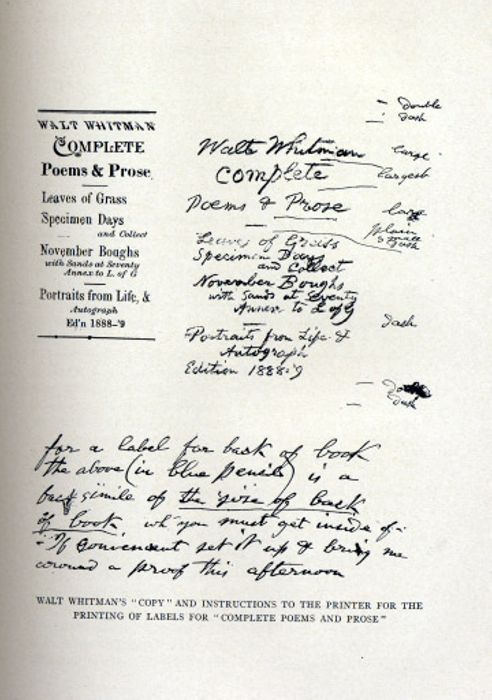
The report of W.'s cold is broadcast. Williamson writes me about it from New York. I wrote back reassuringly. Saw Hancock Engraving Company about a design for the stamping of the covers. Promise me an answer to-morrow. Three or four reporters inquiring. I saw a bundle of [Begin page 188] manuscript under the stove. Called W.'s attention to it. He said: "Oh! there 's no danger: I keep a sharp eye out for all these things: then in the night after I 've turned in Ed comes along quietly, puts matters a little to rights—sees there is nothing badly askew." Ed himself gives an irresistible account of the evening procedure—the rubbing, chiefly. "He likes to be treated rough: wants me to rub him all over the bed." Ed has asked himself: "Could I lift him?" Is confident he could. Says he feels increasingly interested in W.'s unusual habits. Talked about the books. Has gone over the stitched copy. "I like it more and more." Found no errors. Thinking things over he wrote a page of instructions to Oldach—this: To Mr. Oldach 1215 Market St Phila: Yes—the fixing up of the sheets—placing of the plates, &c &c—all right and the paper-bound specimen satisfactory—But I think you can do it better for me—try— I want fifty (50) copies bound in good strong paper covers—w'd it do in some handsome marble paper? W'd that be better? (I leave mainly to y'r taste & judgment)—if you have anything better as strong backs (stitching &c) as can consistently be made—uncut & untrimm'd like this sample (I like this sample even as it is pretty well)—I will send you the label to put on the backs—I am now having them printed—(will also have the 550 copies in handsome costlier still bindings afterwards. Walt Whitman 328 Mickle St Camden
"I have decided to have fifty done up instead of ten: want them for my own promiscuous use: for Doctor, for you, for others. These can be done up at any time, in any way, you choose. Then the rest must be made more durable: strong: not to be destroyed: made so they will not need to be remade—people will not want to change them." The idea of having them in vellum, gilt top, &c., appeals to him.
[Begin page figure-002]
 [Begin page 189]
Has ordered slips to paste on these flexible copies. "Curtz"—the eccentric Curtz—"was in an hour ago: I asked him: 'Will you have these ready to-night?' and he said: 'To-night or to-morrow morning.'" Will not need them till the cover for the fifty is approved. I packed up together the stitched copy and fifty signed first folios. The whole six hundred laid there on the floor in lots of twenty-five: in each case there was a slip under the string marked: "25 autographs." Took the other five hundred and packaged them carefully. I will only take them over as they are needed. He watched me closely as I worked: I was on my knees on the floor: the room was in a sort of half light: "growing warmer, more comfortable," as he said: then spoke, half to me, half to himself: "What a comfort it is at last to get the book into shape—to have it right in your hands: to see it, the whole mass of it, brought at last together." And again: For what can it be? for what can it be?"
[Begin page 189]
Has ordered slips to paste on these flexible copies. "Curtz"—the eccentric Curtz—"was in an hour ago: I asked him: 'Will you have these ready to-night?' and he said: 'To-night or to-morrow morning.'" Will not need them till the cover for the fifty is approved. I packed up together the stitched copy and fifty signed first folios. The whole six hundred laid there on the floor in lots of twenty-five: in each case there was a slip under the string marked: "25 autographs." Took the other five hundred and packaged them carefully. I will only take them over as they are needed. He watched me closely as I worked: I was on my knees on the floor: the room was in a sort of half light: "growing warmer, more comfortable," as he said: then spoke, half to me, half to himself: "What a comfort it is at last to get the book into shape—to have it right in your hands: to see it, the whole mass of it, brought at last together." And again: For what can it be? for what can it be?"
I wrote Blauvelt to-day. W.: "I am glad that you did." And when I told him what I had said: "That was right: that was just what I should have wished you to say." Then adding: "But I wrote to him myself, too: the breakfast was so good—the bird so fat, so sweet: I felt I should render thanks for it: only a postal—a few words." Described a letter from Bucke as "an echo merely of the last: his trip postponed, Gurd expected back: to go to Ottawa to secure patents: all that over again." Sneered at the "legal processes"—their "dilatoriness, procrastinateness"—how our "jurisprudence is a weak modelling upon England's": the "obscurity of legal formulas," and so forth. Emerson was mentioned. W. spoke of Emerson's poetry—its "plentiful and healthful disregard for conventions, forms," and so forth—its "undoubtable power." "I can easily see how a stylist like Arnold should find Emerson below the mark. I suppose your friend Morris would find Arnold about right in that exception. But there 's a higher thing than the pure stylist can ever know." Spoke as before [Begin page 190] of "our better imaginationists—Emerson, Bryant, Longfellow, Whittier": said that "they had their place, would hold their own, in any category of English singers."
W. discovered in the big book the first mistake: in Collect, page 240, line 15, changed "I think if" to "Truly if we." Asked W. if he had read Sunset Cox's Mohammedanist book. No. Not even Why We Laugh. I had Why We Laugh. Said: "It would be tonic for you." "Probably," he said: "why not bring it down one of these days? One is not forced to read, not forced to take up, not forced to put down: try me with it." He "could imagine" a "good" book from Cox. "Cox is the sort of fellow who sets out for brightness—lambency: the epigram, the gem, the smart saying—brilliant flash: the stream sparkling dazzling—the background of all: not a mind of the first class: yet important, necessary." Had he read Brown to-day?—Wieland? He said: "No—not really read it: yet I looked it honestly over—looked through the whole story." The story "had no attraction" for him. But the introductory life of Brown—"that I read squarely through." I asked: "Who wrote it?" W. said: "I don't know: it does not say: it is tepid: not strong, not weak: not interesting, not dull: flat, to sum it up. It deals with Brown conservatively—is neither hot nor cold: it is not a piece of writing such as Macaulay could make of Milton, Hastings, or Arnold of Heine." Lament for O'Connor. "No word at all—which is a bad word: yet I write to him—send him papers—the Boston papers." I asked about O'Connor's wife. W. exclaimed: "Tiptop! intellectual, true, noble: rather consumptively inclined, I should say—rather, not wholly that: has some pulmonary weakness." O'Connor, he said, "though a man now over fifty, and tremendously a sufferer, is still young in spirit: his letters, his talk, his public writings—all show it. That is his vehement, passionate, sincere temperament." He considered that "if O'Connor had been a priest back in the earlier Christian ages his noble, lofty, extreme personality would have roused nations, stirred conti- [Begin page 191]nents, led crusades, excited thought, speech, action, the deepest, the most full of meaning. O'Connor, is veritably a Peter the Hermit, a Luther." "Before all else," he said at another point, "O'Connor is expresser: a positive, powerful, overwhelming expresser: intellectual—oh! superbly intellectual!—yet moving men rather with the emotional, the sympathetic—with an equipment unparalleled, I believe, in these days." Yet, warrior as he was—"born warrior, born tempestuous"—he was still "the soul of courtesy" capable of "emphasis, indignation, of an overmastering power, but never bursting into a crowd with a club, a battle-axe. O'Connor's weapons were fine, delicate, but keen—subtle, past the possibility even of appreciation by the ordinary literary mind."
I met a radical Friend to-day. He talked of Hicks—I of Whitman's Hicks. At the mention of W.'s name, the old Quaker looked at me. W. evidently only a half-known name to him. "He 's the fellow who wrote a smutty book?" Then he asked: "Was it smutty?" I retorted: "Smutty people consider it smutty!" The old fellow quite gracefully withdrew: "I thought that might be the case," he said. W. interested in this and what further I had to say. "It was my grandfather," he remarked, "who best knew Hicks: they hobnobbed together in their young days: but my father had met him—known him—also, as he did Thomas Paine: I myself saw Hicks: what is more, I saw his surroundings, the country he travelled, the people—associates, followers: this, to me, most valuable, I may say, in explaining, justifying Hicks." "In this way by long contemplation of habitats and so forth I have come to think of myself as intimate with Elias as a person: have came more to understand in my own late days that you can mainly get to know a man's life by incidents, environment, parentage." "I feel now that I know more of Elias Hicks by standing a little off: I take a sounder, fuller view—more fairly estimate him." "However grievous the fact Hicks is to-day practically forgotten: the general world requires when he is [Begin page 192] mentioned to be told who he is: yet it would be hard to name a man—a modern man—who in his time maintained such a stratum of influence—a long plane of influence"—sweeping the flat of his hand across from left to right. "I find I can write, master, cope with affairs fifty years old better than with those occurring now: I get more completely the sense of proportion." Here he paused an instant, then he said earnestly: "Had I all my faculties now, my literary power, the strength to take up work, stick to it—the force I once had, the ease—I have no doubt I could write of Elias Hicks, Aaron Burr, Thomas Paine, as I could of no contemporary men." Had he written of Emerson: his personal history—meetings and so forth? "No—only here and there a little note: the time is past for that now." "Who best appreciates Hicks or Jesus to-day?" W. asked. I spoke up: "Not the nominal Christians—Quakers—but the men who take the large view that includes all—Jesus, Buddha, Zoroaster, Confucius: know they are all part of one perfect whole." W.: "That is true—must be true: say it again, say it everywhere." The Burr piece had not yet turned up. "I imagine it is downstairs—somewhere: I don't catch a trace of it among the papers here." W. passed on to me a Carpenter letter three years old. "It seems to me you may find some use for it: it belongs to the English end of our story: read it anyway: read it there, now: then you will know." It was written in pencil. No envelope. Millthorpe near Chesterfield, 23 Oct '85. Dear Walt: I had yours of 3 Aug—acknowledging receipt of draft. Sorry to hear you were troubled with sunstroke. I hope you are going on pretty well again now. We are very pleased that the money came in handy. I have n't been in London laterly or seen Mrs. Gilchrist or your friend Mary (?) Whitall whom you mention. I rather expect to be that way in about a month or so. Am laid up just now with a kick from my horse—luckily nothing [Begin page 193] very bad—he struck me (accidentally in a way—the kick being probably meant for another horse that was teasing him) just above the knee on the front of the thigh—so no bones broke: but it is a big bruise and it will be a week or two before I can get about. It is wonderful though how nature sets to work directly to put things right, and it has been peaceable and free from pain. I have plenty to do looking over proofs. I am bringing out a second edition, enlarged, of Towards Democracy—also a criticism of Modern Science which I am interested in and hope it will provoke some discussion—it is a direct attack on the validity of scientific "laws" and methods generally—not that I don't think Science has been very useful, but that it is time that it should climb down a bit. Do you see anything of your friend McKinsey or has he left Philadelphia? I send you a photo I had taken a little time ago with a young fellow who is an old friend of mine—in Sheffield—it is not very good of me, though very fair of 'tother one. The farm gets on—slowly—but still it moves, and I rather expect in a few months to put it on a distinct cooperative footing. Prices are awfully low now—owing apparently to the general depression and the fact that the mass of the people are without money—also, perhaps, partly to a growing scarcity of gold. Isabella Ford had an accident since we wrote but I do not know exact particulars. She was driving with her mother and the ponies ran away. Isabella climbed out, probably thinking she could render some assistance, and fell, hurting her shoulder. However, she was much better when I last heard. Hope you keep going pretty well. I often think of you and wish we could have a chat. With love, Edward Carpenter.
I had read aloud. W. expressed some personal things about Carpenter and the Fords: "The altogether beautiful[Begin page 194] people who have made me welcome on the earth." Then he referred directly to the science passage of the letter. "I am much interested in Carpenter's attitude towards science: it seems just right: yet it is a dangerous experiment—a perilous impeachment: one which I am doubtful whether a man of less ability than Carpenter could handle at all. I say to a fellow: do it, yes: and I also say, don't do it: don't do it unless you are fully aware of what you are doing: for science looked at from final places somehow comes first: it must not ride a high horse, but it comes first. As I understand Carpenter his only intention was to bring it down from its high horse."