Wednesday, December 19, 1888.
Wednesday, December 19, 1888.
7.45 P. M. W. sitting up. Light at half. Not reading. Face thoughtful, hands crossed across his stomach: fire burning cheerfully. He was cordial: "I was just thinking as you came in—is the Doctor, is Horace, to come yet, or had I better lie down? I had almost given you up." Stayed an hour. Harned in part of the time—ten minutes or so. W. quite willing to talk. Had been up a good part of the day: had read some—going over several accumulated Transcripts: Frank Leslie's, Press, Record—local papers: has done no book reading "for some time, except snatches of the Bible, Burns, Old English Ballads, and so forth." W. said again: "The Doctor has not been here for two days. Mr. Hunter was here early in the evening. As he was going right from me up to the Walshs' I sent word by him to the Doctor that I was better, stronger—that I did not need him to-day but that I think he had better stop in to-morrow."
I received a beautiful letter from Morse to-day describing the sudden death of his mother. I dared not read it to W., who has always been profoundly interested in the old lady. I have felt as though I should say something to him about it. But I held back. Every two or three days he asks about Morse. Why is n't he heard from, &c? In one column of The Transcript he found a group of so-called poetic "brilliants." "You are not quoted among the brilliants!" "I should hope not: that is one fate I pray to be spared!" Anxious about Bucke's books. "What of Bucke—the books? Not a word! not a word!" Evidently disappointed. I had two letters from Bucke to-day dated 17th—both about the arrival of the books, one referring to a fuller note written to W. W. for B.'s "more elaborate judgment." I said to W.: "I have a note—buy my note refers me to yours." He put on his glasses without a word. "Let me see." I had to be careful so as not to give him the wrong letter, the second containing matter calmly discussing W.'s [Begin page 333] possible death. W. read. "Bucke is enthusiastic"—much pleased, smiling—"Well, it is something to be so received." Then with reference to what B. had to say of vellum: "Vellum! pshaw! humbug! vellum is one of my lady's chairs, pretty to look at, carved, delicate, polished—but for heaven's sake don't sit down on it!" Then as he read on: "Ed, you rascal—why don't you appear with my letter?" adding by way of explanation: "Ed went off to the post office: wanted to go somewhere: said he would come back at once if there was a letter: if not not: so the letter has not come. Anyhow, I am glad the Doctor's books are there—it relieves me." He thought "the antics of the mail unaccountable: The Critic is issued Friday: yet I rarely get it before Monday morning. I did at one time think it was Joe Gilder's fault—that he let the dead-heads lie over a day or two: but I doubt now if that 's the case. They probably have a couple of clerks: they are more or less gilt-edged."
Harned asked W. about his health. W. reported "betterment." But, "I find I do not get my grip—that I can do no one thing for any length of time: I tire: sometimes have a sickish, sinking sort of sensation: reading often tires me—sometimes reading only three or four minutes—then I must desist. Even writing is much easier than reading: it does not so severely try me. Yet last night or night before (I don't know which) I found I could write, read, along nearly the whole evening." Lying down eased his head. "But it is a dreary round being chained so to the one spot." W. and Harned much amused over their conflicting letters to Bucke. Harned wrote one day, in the morning, intimating that W. was near done for. Bucke gets a letter from W. in the same mail speaking cheerily about his rally. W. said to us: "You know I have often said I get no credit for being sick: no one realizes sickness in me—not even the doctors. Osler comes in—I am glad to see him: I breeze up: I greet him—I talk: my pulse gets to pounding—temperature rises—face is red—heart goes a-racing: then [Begin page 334] the Doctor looks at me—my eye lighter: saying optimistically: 'Oh! there 's nothing the matter with you—a little this, a little that—no more!'"
W. drifted into talk about the odd letters sent him: strange papers—"nondescriptism," often: "mere complaints—sorrows: strangers who invoke or extend confidences. I got a very curious letter—I get many—within a day or two: it comes from a great distance—of all places in the world"—looking over at me—"you would not think it: Algiers." He described it as from some one "who wants to acknowledge an indebtedness: it is warm—almost fervid." There was "something in the case which appealed to" him—he did "not know what." "A young fellow, an Englishman—it would seem, a 'nob' (I don't say that offensively): he has lost his girl: grieves, is restless: turns away from home—travels: puts some good English pound in his purse: takes a sea voyage—gets to Algiers. Whether he took it with him, or found it there, or some one directs him to it—somehow he falls upon a copy of Leaves of Grass: reads it—says he is helped by it: that it braces him up to bear his sorrow: is enthusiastic—feels he must write—must have me know!" Harned: "Let's see it—let's see who it is." W. pointed: "It 's under the cup there: I kept it as a curio—thought to send it to Dr. Bucke. Sometimes I write Bucke a very short letter: if I do, if I enclose a note like this, I am excused—he says nothing." As Harned was reading the letter W. called my attention to a letter from Logan Smith: it had been laid with the other: "That is interesting, too: Logan is a good boy—the youngest of the three children: he is at Oxford—writes me faithfully—I as faithfully enjoy him." He advised us to "take the letters along" if we wished to read them "more at leisure." We did not do so. Harned looked up. "Walt—this is a beautiful letter—this is no mere curio: and it is from a celebrated character too."" We put our heads together. It was signed: "Justin Huntley McCarthy." W. knew "nothing of him." I described his work [Begin page 335] —then spoke of his father. W.: "Even of him I have but a dim rememberance: yet I remember too: I think he came to see me in Washington: do you know if he was in America? Yes, I think he came to see me. The father must have been one of the '76 subscribers: I am sure he was. I did not notice at the time—was not feeling well when the letter came: glanced through it—put it aside." He even told how he had come to find Leaves of Grass. W. acknowledging. "It is true—that explains." We replaced the letters—put them under the cup again—W. adding that he had "so many letters similar in tone" that he "probably often must have failed to regard them even when they should be regarded." Clifford returned Bucke's W. W. to Harned through me. Between the leaves I found this written by Clifford on an odd slip of paper:
"The more I read of W. W. and about him, and the more I bear of him in my thought, the more I love him, and more; and the more certain I feel that his name will be great, as his life is great, and its utterance, among the sons of men."
Read this to W. He seemed pleased. He brushed it aside with a pleasantry: "The conscienceless flatterer! Where did he get all his soft soap from? Our fellows get in the habit of it!" Then he reflected: "But it 's all right—to be taken: was maybe part of one of his sermons—do you think?"
W. asked Harned about the baby. "Yes: if there is anything divine at all it seems to me to be the new born babe—unpolluted, pure, unstudying, spontaneous: every act, movement, honest—out of its native instinct." I gave him a copy of Unity containing a paper on Tolstoy's Ethics by G. D. Black. I suggested that there were many parallelisms. "You and Tolstoy have much in common, whether you like it or not." W. said: "I accept Tolstoy: I say of him what I often say of Victor Hugo—for his time, place, environment, he is the man—no other would do: none are [Begin page 336] nobler, higher, more excellent. For us, for our circumstances, they would be morbid, unhealthy. I shall read the article—every word of it—carefully." I said: "Tolstoy's theory of art is much like your own: he speaks very scornfully of the elegant arts—the arts of classes—the arts that oppress rather than enfranchise the people." W. asked: "Does he say that? Are they his words?" "I don't know that they 're his words but I am sure they are the substance of what he says." "Well—whether they 're your words or his—it does not matter: I endorse them: O yes, with ten thousand amens: and if he goes on like that talking about the arts then you may say anywhere for me: Walt Whitman is with Tolstoy—count him in." "The substance of Tolstoy after all, Walt, is the substance of Leaves of Grass." He said: "I think so too, taking it in the large and not being fussy about the details. Of course you must remember that an ascetic something or other has been developing in Tolstoy as he has grown older: I don't care for it—in fact, rather despise it—spit it out: asceticism is always obscene to me. That has disfigured some of Tolstoy's later speculation: I refuse to take it seriously: it don't seem to belong with the rest of him. At the same time I remember his origin: I say again as I did—that probably for his time and place he is a perfect result: he could not have matured in that form here, but there—well, there he fits in without a shock."
Got from McKay to-day a copy of Leaves of Grass containing Annex. W. examined critically—said of the way Dave had printed Annex title page: "The devil has got into Dave's head and rides him to death: Dave is opposed to inside margins."
I quoted Dave's complaint that we do not know how, &c. W. laughing: "It is well we do not." He had sent a copy of the big book off by mail to-day. "Can you think what the postage came to? forty cents! Imagine it—thirty-eight cents:I made it four tens." And he explained: "I sent a copy to the editor of The Long Islander—the [Begin page 337] sheet I started up there. He has always been very kind to me: I feel that I should recognize it." I asked him if he was prepared to sell any of the cheap-bound books and for how much? He said at once: "Yes"—and then: "Six dollars—the regular price. I don't suppose there will be much demand if any. By and by, fiften or twenty years after I am dead, they may be wanted—may get their price. My expectations for it are not pecuniary—not at all. It has for years and year—more definitively this last year or so—itched me that this should be done—that I should get my books together—have them in one volume—handle them so. I think it is worth a loss of two or three hundred dollars to have achieved that."
W. remembered that this is my birthday. He said: "I don't congratulate you—I congratulate myself, others: if you were as lucky as I was in your birth then you must feel rich indeed!" W. gave me an O'Connor letter—what I called a way-back letter: 1864. He said: "Read it to me." "Is it very important?" "Well—I won't say that—though William's letters are always important: but there 's something in it about the War. I want you to see that: and about Gurowski—the redoubtable Gurowski—that you will want to know about. Read it, anyway: I want to hear it again."
Washington, D. C., Aug. 13,1864. My dear Walt:I am enraged and ashamed of myself to have never sent you a word responsive to your letters of July 5th and 24th. Believe that I have thought of you much, however, and for the last fortnight I have talked of you incredibly, saying superb things all the time, to Mr. Channing whom you know, and to Miss Griffith whom perhaps you have not heard of. She is a handsome and heroic Kentucky girl, who several years ago impoverished herself by liberating her slaves (seven of them, I think) and then came North to live, the South being hateful to her on account of slavery. She lives in New York, but has come [Begin page 338] on here for a time and is staying with her sister in Georgetown. She had heard much of you and was anxious to hear about you from me, whom she likes (of course!!!). So I told her much, painting you as the gigantesque angel of valor, compassion and poetry that you are, and reciting moreover all the splendid passages from your book that I could remember; besides numerous excerpts from your forthcoming volume! This, you see, involved considerable conversation about you and you must admit that I have kept you well in mind.
I am indeed glad to know from your letter and from a recent report from Howells that you are getting better. I have felt very anxious about you. At times I had dreads that I did not like to own to myself. But the sky now seems clearing if not all clear and I can trust to see you well again and strong.
The heat of the last fortnight has been fearful, but tonight, thank goodness, there has been a rattling thunderstorm, flash and crash, with a deluge of rain, and the moon now shines thorugh broken clouds on an earth drenched and cool. It was such rain as we have often seen here from my windows, only this time I saw it all alone.
I drill every day between three and four in the afternoon. It is fine exercise and good for me, though what with the torrid sun (for we drill out of doors) and the weight of a sixteen pound rifle with accoutrements, it is pretty severe.
Glad you got the Report on Armored Vessels. I thought it might yield hints for poems. At all events it gives one a good idea of what the monitors are and can do. They are, as I once said to you, an upheld finger of warning to all despotocracy. The Dictators will prove a clenched hand of menace to the same. Soon America can defy all outward foes.
I want very much to hear that Drum Taps are printing. I have many misgivings about your plan of getting out the book yourself. I want it to have a large sale, as I think it well might, and I am afraid that this sort of private publication [Begin page 339] will keep it from being known or accessible to any considerable number of people. Such a volume ought to make your fame secure, and with a good publisher I think it would. How I wish Eldridge was in the field!
Are you going to get it done by subscription? I want to know because I want to help as much as I can. The rascally Congress taxes me in September fifty dollars in a lump, besides my normal income tax, so that I shall not be able to do as well as I intended, but if subscription is the order of the day, I mean to give as much as I can. So let me know.
Eldridge is down at Petersburgh paying troops. Alas, Walt! There is no hope of Richmond. The campaign has proved a failure. Everything shows that Grant is coming back and the next fighting will probably be in the Shenandoah Valley if not in Ohio or Pennsylvania. It is sad to think of the eighty thousand men, veteran, lost so fruitlessly. I think Mr. Lincoln's chances for the next presidency are very small. Victory at Atlanta is possible and may save him, but the signs are that the party will withdraw him and run some other man. I see New York had one of her oceanic meetings for McClellan lately. I fear he will be our next President.
I am glad your brother continues unscathed. I think of him whenever there is fighting.
Howells gave me splendid accounts of your mother. I hope I shall yet know her.
Ashton is away at Schooley's Mountain, New York, vactionizing. I am quite alone here, save for the society of Miss Griffith, whom I go to see pretty often. The house is awfully lonely with Nelly away, and I don't like to stay in it.
The Count I have not seen for several weeks. The last time I saw him he abused me frightfully—for the first time! I happened to say, very quietly, that the Rebels would probably repeat their raid into Maryland very soon. (A week afterward they did so and burned Chambersburg). Whereupon the Count clutched his straw hat down upon his head with both hands, danced like a demon on the pave- [Begin page 340]ment, howled out: "You are an ass!" and, in a word, behaved like a maniac. Indeed his conduct convinced me that he is a madman with lucid intervals. I seriously mean it. No one could burst into such tempests of rage and abuse on so slight an occasion and be sane. A few nights afterward he undertook to discipline the firemen with a pistol, during a conflagration, because they did not move quickly enough, for which freak he suffered fine and imprisonment.
I hope you will come back here this Fall, dear Walt, and that our former days and nights may be renewed. For this time, good-bye. I will send your letter to Nelly.
Your faithful W. D. O'C.W. said: "That 's one of William's most interesting epistles: oh! those days! and the Count! Well, I have told you about the Count: did I ever show you a picture of him? his portrait? I think I had, maybe I have, a picture here: you must see one some day: perhaps O'Connor has one, I should n't wonder. [1908 Mrs. O'Connor gave me such a portrait of Gurowski.]. The Count? O yes, he was, no doubt, very crazy but also very sane: he was noisy, violent—that sort of thing went with his nativity, his temperament: he was a revolutionist—a man who rebelled against restraint—even when he would admit it was justifiable, rebel against it: to hell with authority and all that: but underneath all he was a loving man: a curious mixture of the aristocrat and the nobody—fascinating, too (some of his facets). He had to get out of Russia. He said to me once: 'Walt—you here in America—you are vulgar, but magnificent!' I remember another occasion on which he was all aflame about some personal outrage: he said: 'I'll kill myself at once: that will show you how I despise your republic!' But he nevertheless said: 'I belong here: who will put me out?' That fire incident William tells about is characteristic—looks worse than it was: was a quite natural expression of his childlike resentments." I said: "William
[Begin page figure-006]
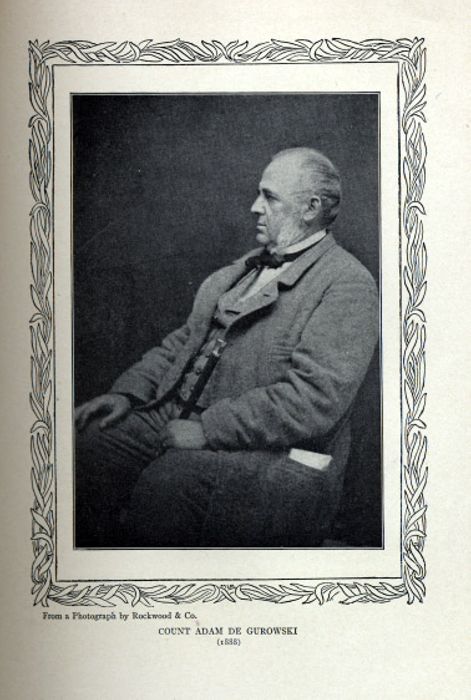 [Begin page 341] was not a good prophet on the War in that letter." W. laughed: "No—was n't he down in the mouth there! Everything going wrong—the devil to pay. At that very time Grant was going on doggedly towards the finish of the War. Atlanta turned out all right: Lincoln was nominated and elected. William talks about Grant turning back. When did he ever turn back? He was not that sort: he could no more turn back than time! You can turn the clock back but you can't turn time back. Grant was one of the inevitables: he always arrived: he was as invincible as a law: he never bragged—often seemed about to be defeated when he was in fact on the eve of a tremendous victory." Paused. Then exclaimed: "O William! William! If only our former days and nights could be renewed! Those nights! those nights! I say so too: I say so! Alas! Alas!" When I left W. cried out:
"Here 's love for all the rest of your birthdays!"
[Begin page 341] was not a good prophet on the War in that letter." W. laughed: "No—was n't he down in the mouth there! Everything going wrong—the devil to pay. At that very time Grant was going on doggedly towards the finish of the War. Atlanta turned out all right: Lincoln was nominated and elected. William talks about Grant turning back. When did he ever turn back? He was not that sort: he could no more turn back than time! You can turn the clock back but you can't turn time back. Grant was one of the inevitables: he always arrived: he was as invincible as a law: he never bragged—often seemed about to be defeated when he was in fact on the eve of a tremendous victory." Paused. Then exclaimed: "O William! William! If only our former days and nights could be renewed! Those nights! those nights! I say so too: I say so! Alas! Alas!" When I left W. cried out:
"Here 's love for all the rest of your birthdays!"