Tuesday, December 25, 1888
Tuesday, December 25, 1888
8 P. M. W. working over his notebook. Light up full, room very warm. The day mild and clear. How had he spent his Christmas? "Oh without variety: there can be no variety for a man situated as I am here: I am always much as you see me here now." He had read and written somewhat—"started a letter for Doctor Bucke to be finished and sent off to-morrow." Had he had any visitors? "Yes—a few: only a few: Mr. Corning was here, and with him a young man, an Englishman—from the south of England somewhere—Rathbone by name." He paused and looked at me. I must have looked my ignorance. "Perhaps this will point the way for you. You remember the man who spoke about the nude in art? I used his speech: it is there in Specimen Days." I assented. "Well, it was his son: and a real handsome fellow he was, too—even you would admit that." I asked laughing: "Why do you say 'even' me?"
"After the way you and Tom received my mention
[Begin page figure-008]
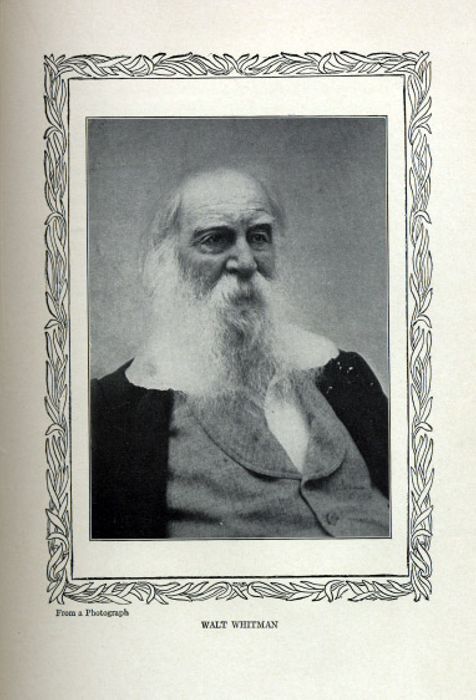 [Begin page 379] of some one last evening I felt I had to be careful what I said, what I tied to." Then he continued: "He was really handsome—one of the Englishmen you cannot help liking: a bit dressy, washed, almost dandyish—yet not, either: very enthusiastic—might call it soft-soapish: but very sincere, no doubt, in some measure. We must remember that all the society fellows have that failing—that peculiarity: the desire to say, do, think, graceful things." Had Rathbone any personal knowledge of L. of G.? "I do not think so: he did not talk as if he had." Had his father? "I do not know: I know nothing about him further than the speech itself." "Rathbone was bright: wanted to talk over matters literary, scientific, political, on none of which did I feel like descanting or would have descanted if I had felt well: they are subjects I always avoid discussing."
On a pile of papers an opened autograph album. W.'s name with date scrawled across a big full page. I pointed to it. "That is a dangerous precedent"—which made him laugh heartily. "So it is—generally: but this is for a special person. A lady came here the other day to get a copy of November Boughs: Eddy received her, waited on her: she left this book with him: the idea being, when I was found in good condition to present it to me for my signature. Eddy is very intuitive—knows how to fend, to ward off: all that—but gets names wrong. I found when I got hold of the book once that this Miss Elwell was a friend of my sister's—lives somewhere off in Jersey—is a school teacher: not a mean one—of some prominence, I think: not very young, though a miss"—here he laughed: "I would not like to say that to her, though I can say it to you"—pursuing the subject: "Of course I conform in a case like that: Miss Elwell is a reader—a bright woman."
I told him how good I felt over his inscription in my copy of the big book. "Ah! you like it?" "Yes." "So do I!—and what a trifle it is!—the expression of an obligation—nothing more: in fact, the obligation not half said—not at all said." I put in: "I did not accept it that way: [Begin page 380] I took it in the camerado spirit." W. then: "Ah! how much better that is. Such a debt can never be paid for in money, in confessions." Spoke of checks for printers and binders—did so voluntarily. "I must make them out: I want to settle the bills: I have a very convenient way when feeling the least out of kelter of dropping all the world's affairs—even the part that belongs to me to attend to." I suggested going to see McKay now the holiday season was over and he was approachable. W. asked me to get him a copy of The Publisher's Weekly containing a reproduction of the November Boughs frontispiece. Inquired if he had "adopted" the new pocketbook. "Yes indeed, fully: and here 's the other in testimony"—lifting up the old book from the table. "I did not like to throw this away—it has done me long service—it has done its part well: I have some sentiment in connection with it." Then further: ""You take it—use it if you care to. What a history it has—if written, if told! Not a tale of money alone, but of notes, cards, memorabilia—the hasty records of many wanderings about. I have carried it many, many, years—have had it on my person at all times: indeed I think I must have carried it from before the War—certainly from the Washington period. I came up once—I used to come through Philadelphia every now and then, on the way to see my dear mother: some one said to me: 'If you want a book—a book of which you may be cocksure—go there'—naming a place up Seventh street near Sherman's—where Sherman is now."
Had he read more of the Tolstoy book? "I have finished it—every word of it: was impatient to do it—profoundly interested." I felt that he began to see the reasons for my warm espousal of Tolstoy. Was the book not vivid? "I should say so!—rich: if I had to criticise it I should say, too strong, too vivid." Yet it was "fascinating beyond words." "The translation itself was a work of finest art: Tolstoy, so far as I see, is here for the first time fitly rendered in English. I wrote the Doctor about it this eve- [Begin page 381]ning: put it in the letter there: he is always on the qui vive for matters of that sort—new books, worthy books, remarkable books." But where was the book? "It has got lost somewhere among these odds and ends on the floor. I wanted to tell Doctor whose translation it was but could not find the book." "Sebastopol" troubled him also—whether "opal" or "opol." We looked for and finally found the book. "Frank D. Millet: it seems to me I know something about him—but what, what?"
Insisted that I take the book. I wrote the name of the translator on a sheet of paper which he carefully laid aside. He then composed himself in his chair and looked for a long time at the frontispiece portrait of Tolstoy. "It is a wonderful powerful head: I have seen such heads: dynamic—crowded with character." Then: "Some day look about in the print stores or among the art dealers—find me a good portrait of Tolstoy: get two— I will take and pay for one: I wish to have it about me here." "This book is far, far, far—threefold, fourfold—beyond anything I have seen before from Tolstoy. From reading it, from hearing your reasons, from the man Black's articles in Unity—new lighs are thrown on him: I find tangible indications of to me heretofore only half-suspected powers: mainly by your strong statement and this book: the whole, compacted, compating, judgment: ascending: up—up—up and out"—trying to illustrate it with his hands. "Oh! he has immensely risen—immensely!" He "fully realized" the "grandeur" of T.'s methods—"his planting himself on certain facts—redoubtable facts." "The wonder to me is, that those characters emerge from extremest social conditions—the conditions of all others we would think little likely to produce them: from the most tyrannical social forces in Europe. Think of Turgenieff: I often talked of him with Gurowski—my family friend there in Washington—one of the clearest headed most remarkable men I ever came in contact with. Gurowski was very irascible at times, but when at his best, when on good humor, he was keen, [Begin page 382] cordial, happy, as men rarely are." Yet G. came of "just such hard conditions": his movements were "a puzzle to his friends abroad": "loudly condemned, he suffered for it." A pause. "The whole genius of this Russian power—the writers: Tolstoy, Turgenieff: Kennan's exile—has been a wonder, in some respects a delight, to me. I have been a personal witness of much in the same direction in Gurowski: and by the way," he said, after a slight pause—"in your travels about in the second-hand stores—in Leary's (which I know to be a very good one)—in Dave's—you 'll some day come across a book of Turgenieff's—Dave maybe can tell you about it—Sketches of Sporting Life—something of that sort: get it for me—get it, read it, let us read it: I will pay for it. I have heard of it somewhere—have long desired it: but somehow it escapes me."
"Did you notice," W. asked later on—"Did you notice Doctor speaks in that letter I gave you"—Dec. 21st—"speaks of the big book again?—calls it grand?" "What is the secret of the growth of the fame of L. of G.?" W. said: "It seems the merest accident: an accepter here and there: an accepter quite accidentally generated: how, wherefore, who can declare?" He spoke of the original fight over it—"the efforts to keep it upon its feet"—"even now acquiesced in by a scarce circle." Bucke's allusion to immortality in his letter interested W. "Did you notice what the Doctor said?" "Does the Doctor go with you the whole way?" "I think Bucke fully acquiesces: Bucke is Oriental—has an Oriental religiosity—a firm fixed notion of some sort." How then about W. W. himself? "I mostly conclude I do—mostly: yet there are times when I ask myself very seriously—do you or do you not?" I said: "Donaldson asked me about it when he was over." "Did he? What did you say?" I explained: "I said to him what I have been saying to others—and a good many have been asking me lately—that I believed you always accepted while never dogmatizing about it." W. exclaimed: "Good! good! that [Begin page 383] was just about the right word: I guess I do: indeed, I do without a guess: but many folks say I do not and I suppose I myself waver at times—always however coming round to the affirmation at last." Told me of a Boston man, "a scholarly, leisurely man—a friend" who had "frequently" looked him up on his last trip to Boston—"the Leaves of Grass Trip"—and "debated the point with" him or "before" him—for he himself would "never debate." "H was in a curious train of thought: perverse, stubborn: yet was a man of intelligence—meant to be honest. He asserted to me time and again that I did not believe: quoted me lines from Leaves of Grass—'here—here—here—here—how do you explain this?' I would ask: 'How do you get that?' and he would say: 'Here they are—here they are': would himself have the most distorted versions—would find it hard to understand: even my explanations were mostly futile: text and all confessedly brought together in his hurly-burly head." It had been "a great lesson" to him. "I regard it as a study, a curio: instructive: it demonstrated by what a thin thread a writer hold his prestige: by the accident here and there of somebody understanding—in any case oftener misunderstanding—you. This man was a fair sample of the critics as critics go, good and bad (mostly bad)."
As we sat there talking Ed brought in a card—a reporter's card—a fellow I knew well and whom W. knew when I explained who he was: connected with The Record. W. put on his glasses: read the name off deliberately— "Charles [something] Bacon"—repeating it several times as if to job up his memory. "I indistinctly remember him. tell him to come up—stay a minute: tell him I am sick—that he is to stay only briefly." Then as Ed was about to go: "Put a chair there"—motioning towards the foot of the bed. Bacon shortly came in—shook hands: W. saying some few welcoming words and inviting B. to take the chair. B. explained that he had been sent by The Record to find out how W. had spent his Christmas. W. thence- [Begin page 384]forward affable—full, free, communicative. W. said: "I have had but no letters you would call important"—adding after a laugh—"strange to say, some of them from young ladies: the young ladies are most faithful to me nowadays. I had one letter from New York, one from Connecticut—several others: young ladies who for some reason or other have followed me up—grown up under my wing: young ladies or about to become." Spoke of his confinement—of his "half paralyzed" condition. "It is now almost twenty years. Do you know what hemiplegia is? In my case it started here"—pressing his finger to the back of his neck—"then came down the whole side—arm, leg, face: the leg never recovered: the arm recovered quickly. Luckily the stroke did not affect, such as it is, my power of speech, or my brain: up to the time of the present attack I was able to work—to write, read—as any time before: only my power to locomote, to get about, was gone—or partly gone." "My bete noir," he said, "is indigestion." But "the last two or three days" he had "in all respects" felt "wonderfully" bettered—"better, clearer of active trouble, than for five months past." Spoke of himself as "leaning towards gain": said his books were "off" his "hands, so to speak"—"done, or as good as done": the vols. "not actually here," but "some of them" here, and all the sheets with the binder. Advised the visitor to remember him to "all the boys." He assured B. he "always" had "warning" of the attacks. "Thanks to my dear father and mother, I have been wonderfully fortunate in my constitution—my body." He was "gifted with cheer" and that was "certainly worth more than five or ten thousand dollars a year." ""By nature, by observation, by the doctors, I have learned that the thing to do when I am down is to rely upon the vis, as it is called—the inherited forces: to lay low—attempt nothing—rest—recuperate: if the vis comes to the rescue—meets the peril—well and good: then for another lease! But if it does not, then all may as well be given up at once." He did not know—"it [Begin page 385] is not at all certain"—but "I may go from this out upon my ordinary condition of the past seventeen years." B. asked W.'s age. "I am in my seventieth year—celebrated the end of the sixty-ninth the last of May, this year." Then he added with what I told him was "cocky confidence": "If you can, come around next May: I will post you on points you might wish to know—which you can use or not as you choose." B. asked about W.'s "outings." But W. shook his head: "I have none—I have not been out for seven months: I can scarcely get from this chair to the door there unassisted—must help myself with a chair, the table, anything—sometimes calling the nurse." Did the cold weather hurt him? "Oh no! not in the slightest—no days could have been better for me than the last three or four." The hot days were the trying ones. "If I am still about when summer comes I must look up another place—get away somewhere."
Bacon left. W. very free with reporters, sometimes quickly dispatching them or will not see them at all. Likes them. Sometimes is very communicative, as to-day.
Room terrifically hot. "In time of peace prepare for war," he said, as Eddy came in the room with a big armful of wood. I said: "Ed seems to be the right fellow for you here: he suits you to a t." He nodded: "Yes: he is vital, easy, nochalant, self sufficient (in the right sense): he throws out a sort of sane atmosphere: I always find myself at home, at peace, with him." W. is always willing I should take along with me the scraps of things which he starts to throw away. He "can't see what the devil" I care for "the written stuff," as he calls it. "Still—I must humor you," he says. He gave me to-night another of his letters from Washington to Hugo in New York. "I want you some day to write, to talk, about me: to tell what I mean by Calamus: to make no fuss but to speak out of your own knowledge: these letters will help you: they will clear up some things which have been misunderstood: you know what: I don't need to say. The world is so topsy turvy, [Begin page 386] so afraid to love, so afraid to demonstrate, so good, so respectable, so aloof, that when it sees two people or more people who really, greatly, wholly care for each other and say so—when they see such people they wonder and are incredulous or suspicious or defamatory, just as if they had somehow been the victims of an outrage." He paused. Then: "For instance, any demonstration between men—any: it is always misjudged: people come to conclusions about it: they know nothing, there is nothing to be known; nothing except what might just as well be known: yet they shake their wise heads—they meet, gossip, generate slander: they know what is not to be known—they see what is not to be seen: so they confide in each other, tell the awful truth: the old women men, the old men women, the guessers, the false-witnesses—the whole caboodle of liars and fools." I said to W.: "That 's eloquent enough for Congress and true enough for the Bible!" He shook his fist at me: "What do you know about either, anyhow?" I read him the Hugo letter but had a deuce of a time getting through, it was so criss-crossed and interlined. But I finally worked it out. W. helped me here and there. He said: "You 're a better sleuth than I am: I find it impossible to go through some of my devious old drafts of letters myself." I read. There was no date on the letter. I asked W.: "Can you give a date?" He said: "I think it was in '63—about the same time as the other."
My honest thanks to you, Hugo for your letter posting me up not only about yourself but about my dear boys, Fred, Nat Bloom—always so welcome to hear personally or in any way any and every item about them. Dear friend, the same evening I received your letter I saw in the New York papers (which I get here about 5 every evening) the announcement of Charles Chauncey's death. When I went up to my room that night towards 11 I took a seat by the open window in the splendid soft moonlit night and, there alone by myself, I devoted, (as is my custom sometimes under such [Begin page 387] circumstances) to the dead boy the silent cheerful tribute of an hour or so of floating thought about him, and whatever rose up from the thought of him—his looks, his handsome face, his hilarious fresh ways, his sunny smile, his voice, his blonde hair, his talk, his caprices—the way he and I first met—how we spoke together impromptu, no introduction—then our easy falling into intimacy—he with his affectionate heart thought so well of me, and I loved him then, and love him now—I thought over our meetings together, our drinks and groups so friendly, our suppers with Fred and Charley Russell &c. off by ourselves at some table, at Pfaff's off the other end. O how charming those early times, adjusting our friendship, I to the three others, although it needed little adjustment—for I believe we all loved each other more than we supposed—Chauncey was frequently the life and the soul of these gatherings—was full of sparkle, and so good, really witty—then for an exception he would have a mood come upon him and right after the outset of our party, he would grow still and cloudy and up and unaccountably depart—but these were seldom—then I got to having occasionally quite a long walk with him, only us two, and then he would talk well and freely about himself, his experiences, feelings, quite confidential, &c. All these I resumed, sitting by myself. Hugo, that 's the way I sat there Wednesday night till after midnight (the pleasant Virginia breeze coming up the Potomac) and certainly without that they call mourning thought of the boy. That 's often my little way of celebrating the death of my friends.
Dear Hugo, you speak of your all remembering me and wish to see me, it would be happiness for me to be with you all, at one of your friendly meetings, especially at Fred's room, so pleasant, with its effect I remember of pictures, fine color, &c. to have the delight of my dear boys' company and their gayety and electricity, their precious friendship, the talk and laughter, the drinks, me surrounded by you all (so I will for a moment fancy myself) tumbled [Begin page 388] upon by you all, with all sorts of kindness, smothered with you all in you hasty thoughtless magnificent way, overwhelmed with questions, Walt this, Walt that, and Walt everything. Ah if one could float off to New York this afternoon. It is Sunday afternoon now, and perhaps you are at this moment gathered at Fred's or at your house, and having a good time.
I suppose you were at Charles Chauncey's funeral—tell me about it and all particulars about his death. When you write tell.
I looked up as I finished reading. Walt's eyes were full of tears. He wiped the tears away with the sleeve of his coat. Put on a make-believe chuckle. "It 's very beautiful, Walt: right on the ground: where the people are." "I hope so: that 's where I belong: right on the ground." W. added: "Emerson said when we were out together in New York and Boston—said it more than once: 'I envy you your capacity for being at home with anybody in any crowd.' Then he asked me on another occasion: 'Don't you fear now and then that your freedom, your ease, your nonchalance, with men may be misunderstood?' I asked him: 'Do you misunderstand it?' He put his hand on my arm and said: 'No: I see it for what it is: it is beautiful.' Then I said to him: 'Misunderstood? Yes: it will be misunderstood. But what is there I do that is not misunderstood?' He smiled in his sweet gentle way and murmured: 'True! true!'"