Wednesday, January 16, 1889.
Wednesday, January 16, 1889.
7.55 P. M. W. had just risen before I entered: gone to chair: turned up the light. Harned there. H. asking how W. felt, W. replying: "I keep very weak—gain nothing: I am not so certain I am not going back. Yes, I eat: but little, very little: I live all through on a very low plane"—observing no doubt Bucke's warnings. Then he asked: "Isn't it very warm out? This is a most remarkable winter: I know no such another." I inquired how the check matter had turned out and he at once answered: "They report against me in the bank: it was my treacherous infernal memory at fault again: I could not have believed it: could not have believed that the check came, was endorsed, banked, never acknowledged—since then totally wiped out of my mind!" His memory had "played" him "tricks before," "but never one equal to this." I was not surprised: it turned out just as I supposed it would.
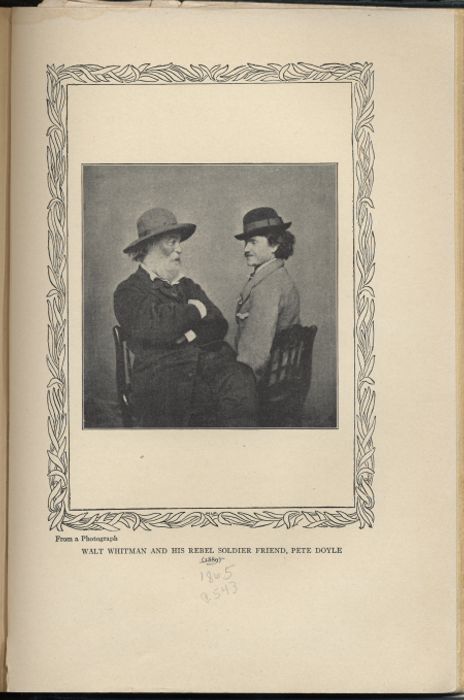
Until a piece is printed W. will rarely discuss it. He has done it with me but I have not known him to do it with any one else. I had told Harned of W.'s piece sent to The Century. H. asked this evening: What was it? what was it about? W. said evasively: "Well—what was it? I hardly know myself: I know I get my pay for it, and that is the chief thing as matters go now!"—and no more was said on that matter. W.'s complexion to-night a palish red. Harned remarked the well look. W. dubious: "It will not do to depend too much on that!" I picked up a picture from the box by the fire: a Washington picture: W. and Peter Doyle photoed together: a rather remarkable composition: Doyle with a sickly smile on his face: W. lovingly [Begin page 543] serene: the two looking at each other rather stagily, almost sheepishly. W. had written on this picture, at the top: "Washington D. C. 1865—Walt Whitman & his rebel soldier friend Peter Doyle." W. laughed heartily the instant I put my hands on it (I had seen it often before)—Harned mimicked Doyle, W. retorting: "Never mind, the expression on my face atones for all that is lacking in his. What do I look like there? Is it seriosity?" Harned suggested: "Fondness, and Doyle should be a girl"—but W. shook his head, laughing again: "No—don't be too hard on it: that is my rebel friend, you know," &c. Then again: "Tom, you would like Pete—love him: and you too, Horace: you especially, Horace—you and Pete would get to be great chums. I found everybody in Washington who knew Pete loving him: so that fond expression, as you call it, Tom, has very good cause for being: Pete is a master character." I said: "One of your powerful uneducated persons, Walt, eh?" W. quickly: "Just that: a rare man: knowing nothing of books, knowing everything of life: a great big hearty full-blooded everyday divinely generous working man: a hail fellow well met—a little too fond maybe of his beer, now and then, and of the women: maybe, maybe: but for the most part the salt of the earth. Most literary men, as you know, are the kind of men a hearty man would not go far to see: but Pete fascinates you by the very earthiness of his nobility. O yes, you fellows will know him: you, Horace, must particularly make it your point to come in relations with him: you will know him—both of you—and then you will understand that what I say is wholly true and yet is short of the truth." Then we developed a great talk over the Rebellion, W. growing immensely serious, grave: I have rarely seen him so much so.
Harned quoted Jeff Davis disparagingly. I dissented from singling him out as worse than others. But W. asserted vehemently: "I still hold to my opinion formed at that time: Davis was representative: he must bear the onus of that. Besides, Davis is alive: he has perfect free-
[Begin page 544] dom: he goes where he wills: every now and then we read accounts of new speeches by him: he is everywhere down South warmly received—applauded to the echo—the echo itself echoed. What more could he have? This has been paralleled nowhere in the world: in any other country on the globe the whole batch of the Confederate leaders would have had their heads cut off." And then he added indignantly: "I do not think history affords a parallel to some of the methods of these men—the leaders—the dark, low, mean, damnable methods they pursued to break up the country." He instanced the prisons: "Words cannot picture the atrocities they inflicted—the horrors—the midnight deeds. I have often thought, this is not a subject for the writer but for the artist: these things can only have justice done them by pictorial statement." But then he had not originally felt the same way in the matter. "I have not at all times thought that way: I conclude mainly, it is better so, better as it is: give these facts to oblivion: let them go: regret nothing in their loss. History has in general been kind to bury the dismalest features of life: somehow it is provided that the darkest spots should be forgotten. So be it." I asked W. about the prisons: "Do you think there is real, not sectional, evidence that the Southern prisons were worse than our own?" He answered quickly: "I have asked myself the question: you now do the same: it would naturally occur: I can't answer it: I have no desire to do the South an injustice—far from it: but it looks to me as if this is a damned spot that will not out." I said: "Any prison is hard enough to think of: I often wonder if any man was ever bad enough to be put into a prison?" W. looked a bit startled. He asked: "Is that the only thing you've ever wondered?" I asked vehemently: "Did you never wonder some along that line yourself?" He cried: "I have! I have! But, Horace, how in hell did you know it?" I said: "How could anyone know anything about Leaves of Grass and not guess you was guilty?" He then exclaimed: "That 's right! that 's right!" He asked after
[Begin page figure-011]
 [Begin page 545] a silence: "You've thought no man was ever bad enough to be put into a jail: what have you thought he was bad enough for?"
"I have thought he might be bad enough to be put into a hospital—sick enough to be put into a hospital." W. looked at me intently then broke out into a smile: "That 's a very striking way to put it: put in that way I say yes, yes, to it: you know, I have often said to you, Tom, and to you, Horace, also, that if I have any doubts at all about Leaves of Grass it is in the matter of the expression of my sympathy for the underdog—the vicious, the criminal, the malignant (if there are any malignant): whether I have made my affirmative feeling about them emphatic enough. You see, Horace, I agree with you new fellows who do not believe that the criminal classes so known are the cause of themselves: I see other causes for them: causes as to which they are no more guilty than we are." I said: "Walt, you 'll get civilized yet if you go to our school long enough." He shook with laughter. "Oh! that school! Well, I want to go to it, but I 'm afraid I 'm a too-old, too-feeble, too-sick scholar."
[Begin page 545] a silence: "You've thought no man was ever bad enough to be put into a jail: what have you thought he was bad enough for?"
"I have thought he might be bad enough to be put into a hospital—sick enough to be put into a hospital." W. looked at me intently then broke out into a smile: "That 's a very striking way to put it: put in that way I say yes, yes, to it: you know, I have often said to you, Tom, and to you, Horace, also, that if I have any doubts at all about Leaves of Grass it is in the matter of the expression of my sympathy for the underdog—the vicious, the criminal, the malignant (if there are any malignant): whether I have made my affirmative feeling about them emphatic enough. You see, Horace, I agree with you new fellows who do not believe that the criminal classes so known are the cause of themselves: I see other causes for them: causes as to which they are no more guilty than we are." I said: "Walt, you 'll get civilized yet if you go to our school long enough." He shook with laughter. "Oh! that school! Well, I want to go to it, but I 'm afraid I 'm a too-old, too-feeble, too-sick scholar."
Then back to the Southern prison subject. His tone was very deep and earnest. As he talked I had seated myself on the sofa again. Picked up an envelope addressed Hon. Walt Whitman: laughed. W. mistook: thought I was laughing at what he said: "No—no—no—Horace: that ought not to be: if you had been down there—had seen victims who had to endure those cruelties—the maimed, sick, dead, dying—you would not respond to it with a laugh." But when he got to understand he laughed himself: "Oh! that is it! But that is not remarkable: I often am honorabled—and worse than that, too!" Then back again to War. "I knew something about those infernalities. You know about the smallpox scare. A great many people down in Washington doubted it—laughed it down, or tried to. The Attorney General sent for me: said he wanted to have the matter looked into: that he thought I was the man: putting a good many documents into my [Begin page 546] hands—some of the funds of the department at my disposal—urging me to investigate, report. I did so: looked closely into all evidence." Then he had concluded: "It was horribly true: true in every iota of evidence: I am sure of it as that we three sit here now and talk about it: true, damnably true. It is a foul blot on the fair fame of the country, those years. By means of infected rags, imported from districts in Southern Europe, it was designed to introduce contagion in our big towns—New York, Philadelphia, Boston, Chicago, others." W. "made an emphatic report" on all he had learned. "I had before been very ardent—more ardent than I am about anything these later years—being younger, stronger then—on the subject of allowing drugs to cross the line: I had always contended—I said Christian then—that no Christian could afford to refuse medicine to the sick and the wounded, wherever found: and when I made my report the Attorney General asked me if I was now willing to reassert the same position: I replied ardently just as I had before: 'Yes even now—at all times! as one in direct contact with these dark facts.'" W. said: "I have emphatic notions which I have never lost." But he "had no feelings" on this point "detrimental to the honor of the masses south—the great body of people there: workers, toilers, men and women: whose share in noble qualifications, in richness of character, I cannot, must not, dare not, question: no": he "only had a horror of the leaders, the conspirators, the group on top, who prepared the way for all these terrors—encouraged, excused, gloried in, them." He did not "grudge Jeff Davis his freedom" but he "could not give him" his "respect"—and did "not forget that the rattlesnake, the asp, could not help being the rattlesnake, the asp," &c. And so talk of this ended. W. thoroughly aroused: his voice strong, at times almost exclamatory. Although talking leisurely in a fragmentary way, he spoke under great stress of emotion. He confessed the subject "always stirred" him: that "from being present with the suffering wounded" he had himself [Begin page 547] "been a sufferer." It was not "ordinary facts that pained" him, or "the fact that the South was the South, and in opposition," but "the other fact that there existed unhappily at the South those days men who seemed utterly oblivious to the humanities."
In at McKay's to-day. Dave gave me The Bookbuyer which contains a notice of N. Boughs, portrait, and so forth. But W. said: "I have seen it: they must have borrowed the cut from The Publishers' Weekly." Had sent his copy to Bucke. Forgot to speak to me of it, he said. As to its Whittier portrait: "I have examined it: it is pretty fair: has the air of accuracy: yet might be much improved by proper attention." Knortz sends W. a second paper—Bahn Frei—Sept. 18, 1886—containing "a condensed report of my lecture on W. W.," as Knortz wrote on the margin. W. handed it to me. "Did I tell you Knortz had written me? Did I tell you what he said?" K. had received W.'s "first letter" and had "commissioned Charles DeKay to answer it at the time," but "through neglect or desire" DeKay had not done so. Knortz had "authorized the interposition of a German proof-reader, for security's sake, with the translation." As to this second paper: "I know nothing about what is printed there: it appears to be a report of a lecture." Where delivered? "Here and there, variously: I know of no particular place." Asked me then: "Did you know Charles DeKay is related to Gilder—is Gilder's wife's brother?" W. had DeKay's Nimrod—"a book-poem: it was large, finely printed, beautifully bound." Had he read it? He said briskly, with half affected indignation: "I doubt if anybody has: it was not made to be read: it appears to be one of a trilogy—a trilogy about the Lord knows what." I read him the free translation I had made from the Ohio paper:
"Among the old, yet active, poets, figures also Walt Whitman; but he is rather a noble, humane, poetically inspired eccentric [or original] than a poet. What he wrote is [Begin page 548] mostly of poetic import—an art rhapsodie—but to rhythm, rhyme, and generally, to every one of the poetic forms, he is a stranger. Freiligrath has translated some of his poetic writings, and these read better in the translation than in the original."
W. said: "Is that what it 's all about? I have no doubt there 's a certain measure of truth in what he says." Harned interposed: "But you can't help it whatever the hard things said." W. repeating: "No: I can't help it: I am what I am!" Then after a slight wait: "I am like Sidney Morse's darkey: Sidney had a darkey to help him in his work: paid him so much per week: a good enough fellow when he was good but inclined for a splurge now and then. Sidney tells of one of them: he told it to me: a grand spree, lasting a couple of weeks: after the siege was over, after the man had cooled off, Sidney got hold of him, catechized him—asked: why will you do such things? the darkey answered: 'I suppose it was all meant!'" W. repeating the last phrase with infinite humor, his whole tone and carriage rollicking in response to it. Then he said: "I tell that story because it fits so well here: I suppose I was meant, too!" Then after a still further reflection: "It was very cute in the fellow—natural: it may seem very simple—simple, perhaps, as he designed it: but it is profound—profound indeed!" Are we responsible? W. said it was "a great problem," for "is the thistle, the oak plant, responsible for being thistle, oak plant?" It was "a thing to consider"—"the tree a tree—man what he is!" Was "pleased" with "the Freiligrath touch." "The only trouble," said W., "is, that as I can't read German Freiligrath is a closed book to me." I read W. an extract from Brinton's letter of the 15th to me. W. considerably engrossed: said he had only a slight knowledge of the Johnson case. Harned explained. W. then: "It often appears to me as if many of these plagiarisms, so called, took a form that could be explained if not justified: the memory is a [Begin page 549] strange creature—plays us unmannerly tricks." But after he had gone on in this way for some time he called himself to a sudden halt: "I suppose I should stop there: it will not do to carry that too far! One may overdo it." Noted plagiarisms quoted. Longfellow and the Hiawatha matter, for one instance. W. addressed himself directly to Harned, to whom the story was new. "There are some of them who do not hesitate to call it a daring outrageous plagiarism: I myself have no doubt but that Longfellow brooded on it, hatched on it—this celebrated Kalavela—which of itself would not necessarily argue any evil: the worst of it was, not that Longfellow did this, but that he never owned up to it—neither he nor his friends: the poem is put out as if it was indigenous." He did not think Longfellow "could plead ignorance." But "how was it the matter had not been sifted before?" W. said he had "always suspected it"—that the affair was "not new—not novel," to him: "but I never felt conclusive till I met my Scandinavian friend"—he meant Selma Borg—"who declares it is a plain, palpable, unmitigated theft."
T. took rather a favorable view of the poem: quoted good lines. W. affirmed: "Yes—he is a singer—every page has beauties": but again: "Longfellow was essentially the scholar, translator, borrower—adapter and adopter!" Tom: "But he always credited his translations, did n't he?" But W. was still dubious. "Often he did—often he did not." Harned again quoted what he thought a fine passage. "Isn't that there? do you remember it?" W. resumed: "Yes—that is there—and more too: but the question is, does it belong there? That is concise: by that Longfellow must stand or fall." Did he doubt Longfellow's native flavor? "Ah! he had not a bit of it: Longfellow imports all sorts of things into Hiawatha: but did an Indian ever talk so? Was it not the man in the library who was doing the talking?" Then he said with increased earnestness: "But you take Homer—you take Shakespeare: you feel at once that everything you find there belongs integrally to [Begin page 550] the design—nature: speaks for nature—is nature—soil of its soil, inevitable." I put in: "You don't mean to say anyone ever talked like Shakespeare's heroes, do you?" He shook his forefinger at me: "You 're too damned critical: why don't you keep a few of your scepticisms to yourself?" "But do you?" I persisted. "No, I don't," he said. Then Hiawatha was not as native as Leather-stocking? W. resented the notion. "Cooper was indigenous: take The Prairie, The Wept of Wish-ton-Wish, The Spy: some would say, not The Spy, but I should say even that—I rank it among the best: they are all racy of America: vigorous, belong to the constitution of things—have established their right to stay, to bear the standard." So the talk ran. W. vigorous, positive, genial. Harned rather impressed with W.'s condition. "Barring gastric troubles—he seems more or less subject to them—he is in for another six months: it will take a long time to wear him out."