Thursday, January 17, 1889.
Thursday, January 17, 1889.
7.25 P. M. W. reading by gaslight: not looking over-joyful. Yet serene. Voice, vigor, not so marked as yesterday. Talked freely while I stayed. How was he? "I find little—in fact no—change: I am so-so: no more: am passing days now, one like another, little varying, all monotonous. I don't seem to be getting worse—or better, either, for that matter: indeed, may be getting a little weaker—slowly, slowly." Then he laughed quietly: "But the Doctor does not come—has not been here in days: and that may be a good sign—at least we will interpret it that way." Spoke of having "dipped into" Holmes' Emerson, saying: "I think it will interest me." And again: "I find I am like to be moved, at least a little, by it." I referred to Holmes as "chirpy"—and W. after a slight pleasant laugh said: "Yes, he is that?" Had he ever met H.? "I have seen him: I met him once in the Old Corner Book Store." "In Boston?" "Yes—in Boston." When? [Begin page 551] Here he was a little puzzled. "I don't know if I can say that positively: perhaps in '61, over the Thayer and Eldridge proofs: or in '81, with the Osgoods: probably '81": but could not "settle that with" himself. But he clearly remembered "the old book store: Holmes was there: we said a few words: probably words of no consequence, no purport." But did H. take any stock in W.? "No! oh no! I guess, not a bit. How could he? Still, I don't know much about it." He thought H. "a considerable man of his kind"—but "a man alien to our ideals." "I think Sidney stumped him most—Sidney Morse. Morse some years ago secured sittings from Holmes for a bust—afterward sent to London: done in Parian marble, spoiled (all smoothed out) in the process. Sidney is brave: he always stands up for the colors: he is equipped—knows. Sidney told me much about their talks together: he out and out telling Holmes once that he did not know enough to talk on that subject—enough about me: that he should go back to the books, learn more—something of that purport." I said: "We should dare the gods occasionally, especially when they nod." W. responded heartily. No one who has not heard him talk can imagine the feeling he sometimes puts into expressions of endorsement that read almost commonplacely. He cried: "Yes we should! Yes we should!"
I quoted Parker who spoke of God's duties to man as well as man's duty to God. W. said he had not heard that before: "They must have regarded it as rank blasphemy." Bryant up. I asked W. some questions. "Did Bryan appreciate your position—your work?" I asked the same question the other day. Now W. said unhesitatingly: "I hardly think so: Bryant was built up of the Pope and Dryden school." I interrupted: "But you think he was greater than either?" W.: "I did not mean that he was just like them, but that he was trained in that school: he was in fact greater than either—ever so much more human and moving: but Bryant never could have appreciated the facts we have stood for." Reading Frank Leslie's to-day [Begin page 552] again. This and The Stage seem to be the only papers he thoroughly looks into. He asked me about the book. When I said: "Nothing: we only have to wait"—he nodded and said: "Yes: and for my part I have little anxiety on the subject." Still, he wants "to see it done, well done, for others if not for me." Said he had letters from Rhys and Bucke, "neither of them of the slightest interest." "Rhys is still in London, floating about there, mainly engaged with the Walter Scott Company."
No visitors to-day. Saw a photo on the table. I picked it up—said warm things about it: unmounted: four by six or eight inches: showing W. about fifty-five. Waited for me to get through. Then: "So you like it? I don't know but it is good: I came upon it to-day." He has been looking up old portraits—the Doyle one of them. "If I strike another you shall have it. O'Connor has a copy—at least, he had one—I suppose has it still. He liked it—if I am not much mistaken liked it much." Who took it? He could not remember. "It was one of the great New York fellows." Tried to hit on the name. No, it would not come. "I think it must have been taken fully twenty years ago: I cannot recite all the details: it was while I was working—was in Washington—on one of my trips up—my flying trips." I said he seemed to lend himself to the camera—that he seemed to come naturally by good photos. He accounted for "the occasional success" by other reasons. In the first place, he thought "many of the photos failures anyhow—some indifferently good, some radically bad." "It is, I am convinced, in the main from other circumstances—rather in this, that I don't fix up when I go to have the picture taken: they tell me nearly everybody does: that is a great item." But I persisted: "Anyhow, even if you did fix yourself up, you would make an impression." He laughed heartily. "I see you will have it so: but there are difficulties, too—my red, florid, blooded, complexion—my gray dull eyes—don't consort well together: they require different trimmings: it is very hard [Begin page 553] to adjust the camera to both." He had an eye, he said, "not searching, not moving." I called "quietude" the habitual humor of his pictures. He was struck by the word. "How do you mean it?" Then instancing Hunter: "He has a piercing black eye which is always telling, effective: take him when is thoroughly interested, awake, earnest: there are many fine glows to his eye—like the fleeting lights of the sky, the water of the lake." But: "Startle, strikingness, brilliancy, are not factors in my appearance—not a touch of them. As for me I think the greatest aid is in my insouciance—my utter indifference: my going as if it meant nothing unusual—happening in."
I suggested that we might some day have a W. gallery—a book giving W.'s portraits—lots—all—of them. In the midst of this W. suddenly exclaimed: "I have it: Brady! Brady!" I knew at once this was the name he had lost: so I said: "Your memory generally brings you out right in the end." But he objected: "No—it 's not that: but what you have just said brought into my mind certain hours, talks of the old times—with them Brady's name." Afterwards he explained: "Brady had galleries in Washington: his headquarters were in New York. We had many a talk together: the point was, how much better it would often be, rather than having a lot of contradictory records by witnesses or historians—say of Cæsar, Socrates, Epictetus, others—if we could have three or four or half a dozen portraits—very accurate—of the men: that would be history—the best history—a history from which there could be no appeal." I asked: "Was that Brady's notion?" W. said: "No: mine, I suppose: I suppose I spun that out—reeled it off: but I know that we discussed it—that it was occasioned by conversations we had together." "Brady made many fine pictures," W. thought: "he had the notion to produce the heads of celebrés: he had quite a collection: he must have had not a few dozen merely but hundreds and hundreds. I remember some of them: there was one of Cooper: I liked it very much: oh! it was very [Begin page 554] good! I have seen engravings from it since: one of Irving, too: and the women: the women in society there at Washington: Presidents' wives, and so on, so on"—naming several. How about Lincoln? Had he a good Lincoln? "No not one: at least, not one good." W. half remembered a Lincoln—"perhaps more than one"—"of a sort"—but none effective. "He should have had: Lincoln was very obliging: whenever he could he would make it convenient."
W. resumed after a brief stop: "But there never has been a portrait of Lincoln—never a real portrait: there were certain ones of us agreed on that." Why? What was the reason? "I could not tell: none of us could: all we knew was, it was not there: had we seen it, had it been there, we should have been mighty happy, you can well believe." He spoke of Lincoln's "wonderful reserve, restraint, of expression—fine nobility staring at you out of all that ruggedness": this had never been "stated pictorially." He did not know why his friend Alexander Gardner "did not try his hands at it," for G. was "very successful: I have often thought him the best." Darwin, too. He was named. "I have never seen a good portrait of Darwin." How did W. like the old daguerreotypes? "I have seen wonderful specimens: they are not to be sneezed at." But the modern photo is certainly an improvement? "Oh! I suppose so: they are more convenient—cheaper: better in all ways probably."
I had the Willis life in the American Men of Letters series. Would he like to read it? He "guessed" not. "I am not much interested in Willis: he was a good natured bright fellow: I met him: he had a certain run of success." Described Willis as "one of the particular men"—"the horror of photographers." W. inimitable: "Willis had his topknot: this had to be got into the pictures: if it was this side when it should have been that, that when this, then good-bye picture!" W. tried to illustrate with his own thin hair but it would not work: very comical, however. I had a couple of Boston pictures of Morse in my pocket. W. was
[Begin page figure-012]
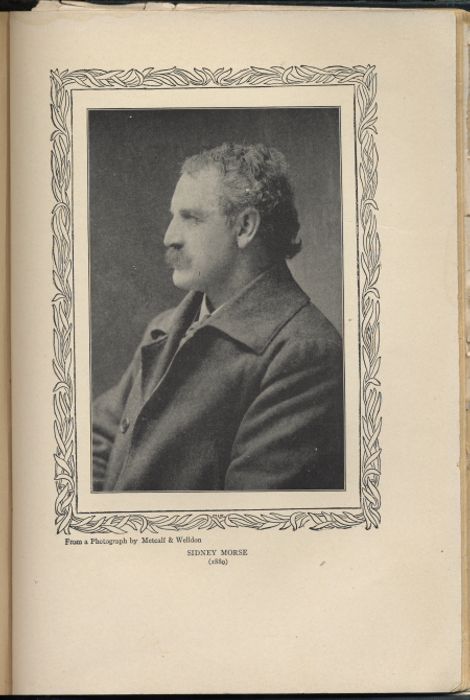 [Begin page 555] eager to see them—actually seized them out of my hands: and he regarded them for a long time with an evident relish. "Oh Horace they are beautiful: O, they are our Sidney! They fill me with a certain sort of awe: he is the noblest Roman of them all—of us all: who goes farther, who goes deeper, than Sidney? Who more loves? Who gives up more? Who is so willing to let others succeed and stand back himself—so ready to help them succeed and stand back? Sidney is full of genius: he rides at the front: he says the first and last words: he is like the still waters that run deep. Oh! as I look at these pictures I see him here still: his quiet quizzical wholesome ways: working in the yard back there with his clay: downstairs—cocking his head (getting a line on me) then rushing back to the head again giving it another touch or two. It all comes back: and the evenings, too, in the dim light: the talks: his gentle voice—sometimes his loving hand which he would lay on me." W. stopped. Then: "Some day we must have him back with us again: some day, some day."
W. gave me another one of the "avowals." He said: "It is a beautiful thing after being denied so long to be accepted in such a spirit." I had to read the letter to him of course.
35 E. 39th Street, New York, May 3, 1876. Mr. Whitman,Dear Sir: My friend and yours Mr. Joaquin Miller tells me that the best way to gratify a long cherished wish of mine, i. e., to have a complete edition of your poems, is to write to you directly for a copy of them. I therefore follow his advice. If you will write your own name on the fly leaf of the volumes, it will be a great favor to me and most highly appreciated.
I was one of the earliest readers of your Leaves of Grass, that unique book, which so startled the many and so delighted the few. Permit me to congratulate you and to [Begin page 556] feel a little pride myself as an American that you have received such abundant recognition from the greatest men of our age both abroad and at home; and when I remember your work during our dreadful War, my heart as well as my pride is touched, and I cannot though a stranger to you forbear presenting to the true man, a nobler title even than that of the true poet, my profoundest respect and admiration. With sincere regard yours
Laura Curtis Bullard.W. seemed doubtful about "the abundant recognition." "A few here and there—a handful: are there more? I am not worrying over what I could not get: but I am not willing to figure as a petted darling of the great and the powerful." I said: "She don't say you are popular, Walt: she only says the great men of this and other countries have recognized you. Do you deny that?" He said: "That 's hardly for me to say: who are the great, anyhow?" I broke in: "Walt, you almost seem to resent the idea of success." He shook his head: "No—it 's not that: I am not afraid of getting the success or of being spoiled by it." "Well, Walt—take this woman herself: I don't know who she is, but she sounds pretty big to me: you feel proud of yourself as the man she addresses in that way, don't you?" W. then: "Oh! don't think I don't appreciate such things—all such things: why, I live on them—they are all I have: cut them out and I am landed high and dry. No—I only kick about the popularity idea. Every now and then some one comes along and says: Walt, I don't see that your shoe pinches! Of course he don't. But I do: I wear the shoe: I feel the pinch." Then after a break: "Yes: God bless her! God bless her!"