With Walt Whitman in Camden (vol. 3)
VOLUME THREE [Begin page ii]
Copyright 1914 by Horace Traubel
Copyright 1912 by The Century Company
Copyright 1912 by Mitchell Kennerley
The Plimpton Press - Norwood - Mass - USA
ILLUSTRATIONS CONTAINED IN THIS VOLUME
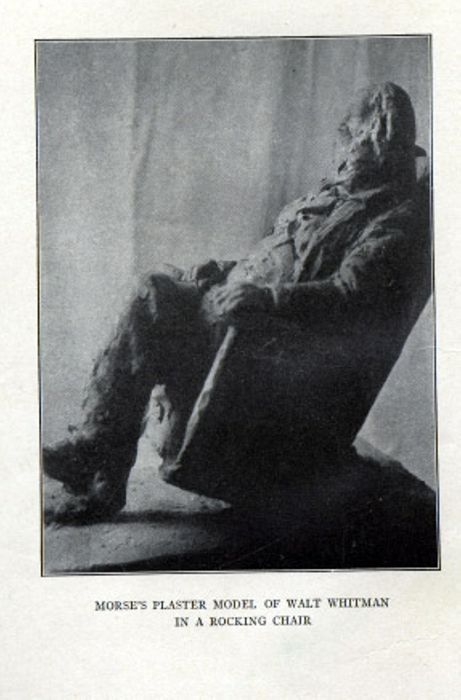
| Morse's Plaster Model of Walt Whitman in a Rocking Chair | Frontispiece |
| Facing page | |
| Walt Whitman's "copy" and Instructions to the Printer for the Printing of Labels for "Complete Poems and Prose" | 188 |
| Four Page Letter from Walt Whitman to William O'Connor September 28, 1869 | 236 |
| Receipt (No. 1) Given by Oliver Dyer to Walt Whitman June 17, 1857 | 238 |
| Receipt (No. 2) Given by Oliver Dyer to Walt Whitman June 17, 1857 | 239 |
| Count Adam de Gurowski | 340 |
| From a photograph by Rockwood & Co., 1888 | |
| Walt Whitman From a photograph, 1888 | 364 |
| Walt Whitman From a photograph | 378 |
| Walt Whitman's written account of the interview between Mr. Ashton and Secretary Harlan | 472 |
| July 1, 1865 | |
| Walt Whitman From a photograph, 1873 | 494 |
| Walt Whitman and His Rebel Soldier Friend, Pete Doyle, 1889 | 544 |
| Sidney Morse | 554 |
| From a photograph by Metcalf & Welldon, 1889 | |
| Walt Whitman From a photograph, 1889 | 574 |
LETTERS CONTAINED IN THIS VOLUME
(INCLUDING OTHER MANUSCRIPTS OF WALT WHITMAN)
| Alden, William L., 259 |
| Alcott, A. Bronson, 243, 245 |
| Binckley, John M., 475 |
| Blake, J. V., 153 |
| Blauvelt, William H., 8 |
| Bucke, Richard Maurice, 248, 269, 397 |
| Bullard, Laura Curtis, 556 |
| Burroughs, John, 28, 260, 281, 350 |
| Carpenter, Edward, 192, 414 |
| Conway, Moncure D., 111, 267, 296, 322 |
| Cook, William, 202 |
| Croly, D. S., 560 |
| Dowden, Edward, 41, 146, 215 |
| Dyer, Oliver, 238, 239 |
| Eldridge, Charles, 483 |
| Freyer, Samuel S., 577 |
| Gardner, Alexander, 346 |
| Garland, Hamlin, 67, 114 |
| Gilder, Joseph B., 124 |
| Gillette, F. B., 465 |
| Greg, Thomas Tylston, 432 |
| Hale, Philip, 533 |
| Harlan, James, 471 |
| Hay, John, 91 |
| Hine, Mrs. Charles, 330 |
| Houghton, Lord (Richard Monckton Milnes), 31 |
| [Begin page viii] Johnson, John H., 331 |
| Knortz, Karl, 488 |
| Miller, Joaquin, 225 |
| O'Connor, Nelly, 524 |
| O'Connor, Wm. Douglas, 9, 48, 74, 128, 130, 282, 337, 349, 351, 504, 521, 563 |
| Otto, W. T., 470, 471 |
| Redpath, James, 460 |
| Rhys, Ernest, 59, 162, 440 |
| Ritter, Fanny Raymond, 483 |
| Roberts, Morley C., 466 |
| Rolleston, T. W., 85, 487 |
| Rossetti, William M., 65, 141, 170, 299, 303, 306, 376 |
| Sanborn, Frank B., 402 |
| Schmidt, Rudolf, 361 |
| Stetson, Carles Walter, 10 |
| Stoddard, Charles Warren, 444 |
| Sullivan, Louis H., 25 |
| Symonds, John Addington, 197 |
| Trowbridge, John T., 506 |
| Van Rensellaer, A., 178 |
| Westness, T. D., 571 |
| Whitman, Walt, 101, 188, 201, 232, 237, 244, 292, 298, 301, 316, 329, 363, 367, 395, 408, 425, 454, 475, 488, 499, 513, 539, 561, 578 |
| Whitman, Sara Helen, 505 |
| Williams, George W., 475, 476 |
| Young, John Russell, 311 |
"I want you to be in possession of data which will equip you after I am gone for making statements, that sort of thing, when necessary. I can't sit down offhand and dictate the story to you, but I can talk with you and give you the documentary evidence here and there, adding a little every day, so as to finally graduate you for the job."
W.W. to H.T., Jan. 9, 1889.
"I don't choose you as a biographer: or anything of that sort—as an authority for this or that: that would n't be an honor, it would only be a burden, to you: no, not that: I only in a sense put certain materials in your hands for you to use at discretion."
W.W. to H.T., Nov. 16, 1888.
"I am disposed to trust myself more and more to your younger body and spirit, knowing, as I do, that you love me, that you will not betray me—more than that (and in a way better than that) that you understand me and can be depended upon to represent me not only vehemently but with authority."
W.W. to H.T., Dec. 10, 1888.
Thursday, November 1, 1888.
7.45 P. M. W. lying on his bed—clothed. Remained recumbent during the time of my stay, except when here and there, in the course of our animated talk, he half rose on his elbow to give some emphasis to a remark. Complained of weariness. I asked him how he had spent the day. "I am not as bad as I might be—not as good as I wish to be." Last night after I left he took a trip down stairs again, alone. "I went silently, so as not to disturb Mary, but I realized my exhaustion." I asked anxiously: "Why do you do that? Why don't you listen to our warnings? Why don't you warn yourself?" He made no kick. I thought he would. He said: "I'll never again attempt to make the trip alone—never: I promise." He said to Mrs. Davis after this experiment: "I see I 'm far gone, Mary: I'll not be with you long, Mary." He has been down on his bed a great part of the day. "I feel weak—exhausted." He speaks less of a rally than he did. "I 'm down a certain distance and there I'll stay till I slip farther down: I 'm not likely to slip up any more." Yet he cheerfully goes his way. He asked me after our hellos were all over: "Did I tell you about yesterday's caller?"—and on my shaking my head: "Well—I intended to: it escaped me." W. went on tersely: " His name was Aldrich"—spelling it carefully: "He is just back from Europe: as I understand it, on his way home: stopped in here: a likely man: we had quite a talk." Then [Begin page 2] he relapsed a minute—all was quiet over on the bed: "He said he dined with Rossetti—William Rossetti—while he was in England." I asked: "Did Rossetti send you any word like Tennyson?" "Ah! no: Rossetti is not effusive: nor is Tennyson for that matter: but Tennyson knew Herbert was coming over—would see me." He added: "But however that be, Rossetti is my friend: he has always borne me in mind—stayed close: he has always done whatever seemed at the moment necessary to demonstrate his loyalty." Aldrich, as W. had said before, had "dined with Rossetti"—"met there once a Frenchman—I think a writer—who said he had seen in one of the great French periodicals some big piece about me—about Leaves of Grass." I asked: "Who was that?—and who wrote the piece?" W. replying: "I don't know either: I do not remember the name of the man Aldrich met: Aldrich did not remember the name of the piece: but I will hear from Aldrich—he said he had memoranda on the subject which he would look up for me." Here he described Aldrich himself. "He is gray, not large, active—a very likeable man—I suppose what they would call in England a tufthunter"—asking me: "You know what a tufthunter is?" and hardly waiting for my nodded assent before going on: "Though that is not peeping out, so far as I could see—not making itself obtrusive." Then he added: "He is from Iowa—has probably make money: is a man of affairs: I noticed that he had a little touch of local pride: he told me of Des Moines—said they have there what he described as the best of the Western capitols—capitol buildings: in one building a suite of rooms dedicated as a public library in which Aldrich himself is a sort of king-pin."
I had met Hunter's daughter this evening on the boat and walked up the street with her, she telling me about her father's sickness (he has been in bed for weeks) and alluding to his later visits to W., which, she said, her father feared had worried W. I said to her: "Walt likes your father—I can assure you likes him to come. There are [Begin page 3] times, of course, when he can see nobody, or, seeing people, can do little talking, but when he is in good condition there are few people he would rather see." W. said very heartily: "I 'm glad you said what you did—mighty glad: glad you said it in that way, as if it came from me." He asked: "So he thought I looked bored? I may have seemed troubled: sometimes that can't be helped: I am not always well—never well in fact: not altogether seeable: but Hunter is always cheery, hearty, interesting: has a story to tell which I want to hear—would not miss—and all that." I read W. Bucke's letter of the thirtieth to me, in which he said on the nurse question: "Still you say nothing definite about Wilkins. Meanwhile W. has written quite a strong letter wanting him sent." W. interrupted me at this point: "Did he say 'strong' letter?"—then: "I don't think that—I don't remember that"—yet confessing that he had written approvingly, much in the temper of his talks on the same subject with me. He no doubt would welcome a change. Yet he does not want to do anything, to say a word, which would seem like wanton criticism of Musgrove. Musgrove is curt, rough, almost surly—creates a bad atmosphere for a sick room. "He has done his best," said W., "but don't quite understand that I 'm a peculiar critter mostly determined to have my own way—not to be unnecessarily interfered with even here, even in my incompetencies." Walt's mild, "I am not disinclined for a change," helps us out of the puzzle. We have not given him any details of the fund which puts the nurse in the house, but he knows of it in general, and in general defers to our notion as to how it should be disposed of.
W. monologued on politics: started off on his own accord and went on for some time about the situation. "I am troubled by the merely mercenary influences that seem to be let loose in current legislation: the hog let loose: the grabber, the stealer, the arrogant honorable so and so: but I still have my faith—in the end my faith prevails. [Begin page 4] It has been my ambition for America that she should permit, excite, high ideals—enlarged views. Take the West case: what a disgrace we made of ourselves out of it! I should have advised, urged, say nothing—don't break the silence by a breath even. Why should n't we allow even to the British minister or any minister or anybody, the largest liberty of opinion and expression?—why not? Why not? Cleveland lost his head—should not have given West his passports. They call it that—"giving him his passports." It was unworthy of Cleveland—unworthy of all of us—was little instead of big: I hate with my whole soul anything that smacks of truckling to our meaner, baser impulses, as this act surely does. I watch the campaign interestedly, but without passion: it has its meanings for me: but it scarcely sinks very deep or goes very high: as I wrote Dr. Bucke the other day, I 'm in no danger of getting worried or excited over it: I feel llike taking the advice of Epictetus to the youth who was bent upon seeing the Roman games—don't get heated, don't fret over results, accept the facts as they appear: wish but this—that the fellow who deserves to win will win: something in that strain." I asked W.: "But suppose neither deserves to win?" He laughed. "There you've got me: abstractly speaking, neither deserves to win: neither Democrats nor Republicans." "But sometimes though neither is good one is not as bad as the other: is that your idea?" "Yes—just that: though I don't get into a boil over it I keep up a devil of a thinking in my corner—my silent thunderings. There are reasons why Cleveland should win—good reasons: then there are reasons the opposite." He shaded his eyes from the light with one hand and lifted himself on his elbow. "Personally I can see no point of view from which it appears desirable to me to elect Harrison. To me the condemnation of Harrison is in his support—in the fact that he is the candidate of all the toploftical conventionalisms of the North—of all that is formal, sectional, schismatic—of all that is commercially iniquitous, [Begin page 5] arrogant, macerating." He said he was anti-Harrison quite apart from his free-trade antagonism. "That would be enough, but there 's vastly more—vastly more: it is a serious consideration to me—the buffet, the slap in the face, which Harrison's election would be to the South: to me it is abhorrent, deplorable, to find all the States of the North on one side, all the States of the South on the other. I know what our people say about that: it 's their fault, our people say: but that don't say it all—not by a long shot. Why is everybody more interested in boundary lines than in unity?—in sects, parties, classes, hates, passions? What a humbug is our so-called civilization if it can't lead us the way out of the jungle! Why North, South—why even America—alone? I know the problem has its difficulties: it must be many years before we heal that old sore." But he had "lived in the South," had "known the meanness of the Southern people" to the full—"known also their strong points." "I can hardly be accused of abasing my high ideals to the Southern contagion: I was anti-slavery, always: the horror of slavery always had a strong hold on me." Yet he "saw other things, too," and refused to "permit one fact to close all other facts out." "I can never forget or deny that the acts of some of the Southern officials, agents who went into rebellion, were as black, perfidious, forbidding, as any known in history: yet these elements of treachery were exceptional: I regard them as exceptional: after all I am an optimist, I suppose: I agree with Dr. Buck that man is better than he was—is constantly growing better still: but there are passions in man to be fought by man to extinction: in our own campaign, here, in America, this year now, there is on one side a spirit of section which must be met and destroyed: I can never condone it. As for free-trade—it is greatly to be desired, not because it is good for America, but because it is good for the world. For Cleveland personally I have no great admiration, though there are some things in him which I like: but the West [Begin page 6] matter, Cleveland's attitude, his official mock heroic indignation, is not creditable to him—rather a blot on his record: a play made to the Paddy O'Reillys and the McMullins."
I said: "Our officialism, most of it, is foreign: it is mainly foreign." W. replied: "So it is: you have touched the nerve: but you have to live in Washington for a time, as I did, to fully comprehend the length to which the tradition is carried: I remember at least one occasion in point during my stay: the question was brought up—the question of officialism, clothes, habit: the question whether a minister should wear a sword, gilt buttons—clothes cut so and so—on demand—to conform with social etiquettical dogmatisms. They all declared to me, in Rome it behooved me to do as the Romans did: to make no demurrer—to take my chances with the rule. I objected—took the ground that men should dress as befitted tastes, habits, necessities, no matter for what the occasion: I did not believe in small clothes, and so forth, and so forth, and so forth. You should have seen the imposing air with which I was sat down on—with which I was assured that if one went to court he should accept the court's dictum." But this was not invariable: "Even officals, usually formal enough, sometimes recognized the tyrrany of the code: we know what happened to Buchanan at the English court. Buchanan (was it from Marcy that he got the appointment under Van Buren?) was a simple, quiet man in his manner: went to a reception—was barred out because he was not formally attired: went home without a murmur. The Queen heard of what had transpired—sent a messenger after Buchanan telling him the Queen would be glad to receive him in any habit he himself elected to adopt: but Buchanan received the messenger slippered in a dressing gown—said he would not go back, and so forth—which seems to me to have been an admirably simple and effective rebuke: it enforces my view—has the American I am in it—or what ought to be the American I am. Sanford, in France, went through the same experience, except [Begin page 7] that he was not barred out: the French court more wisely, less stiffly, construed official right and wrong. But there was Franklin, too: he set the teeth of the French court on edge: his wonderful exceptionalness from the ways of other men—the daring liberties he took—allowed to him probably because of his magnificent personal magnetism,"—"that quality least of all to be defined, yet least to be left out of the qualities of men," as I put it and as he endorsed it with accented warmth—"Amen! Amen! to the end of the chapter!" When he said "good night" to me, I said back: "It sounds so much better to say good night than bad night": to which he replied: "Yes—bad nights don't seem so good as good nights! We 'll only wish bad nights to them who hate!"
Friday, November 2, 1888.
8 P.M. W. reading Pepacton—rather lazily. "I see little in it to hold me: but I had a little notion towards it: I have John humors when I pick up his books and browse with him for a while." Looked pretty well. Yet said in reply to my question: "I can say I am here—little else, nothing else." Sat up near the light: no fire: the evening warmer, as the day had been: the stars out: a touch almost of something that felt like Indian summer. W. particularly interested as always in the state of things outdoors. Questioned me: "Where have you been? What have you been doing?" and so on. Gets great pleasure out of my recital of average experiences—particularly street incidents: likes me to tell him about people I meet—particularly everyday people. "At last and for good I 'm penned up here," said W. He said again: "We hear nothing but politics—cheap politics: cheap and nasty politics: a wearying platitudinous wrangle of politics: with hardly a sincere note anywhere to relieve the tedium of corruption." I showed him The Bulletin of Tuesday containing a review of November Boughs. W. read it while I stood looking [Begin page 8] over his shoulder. "It is kindly," he said—"very kindly: and that is much." Then he added: "Be sure you send the paper to Doctor: he goes wild if he misses a single sliver—he is deadset for curios." Stopping a minute. "The Doctor must have a curious collection: I wonder what it 's all for? I have also sent Doctor a copy of The Transcript in which I found a bit of something which might go into his portfolio." He said again: "That Bulletin fellow does one thing for us—he don't say we are sick. I want the book to be taken on its merits: if it 's a sick book I don't want it excused." "Your being a sick man wouldn't excuse a sick book." "That 's just it: exactly: I want to last whole—don't want to go out piecemeal." I showed W. a letter which I received to-day:
Richfield Springs, N. Y., Oct. 31, 1888.I am illustrating E. C. Stedman's Poets of America, and in it I find mention made of a portrait of Walt Whitman; the one which was in his Leaves of Grass, first edition, and also, I think, in the two volume Centennial edition. I am anxious to get a copy of this portrait, and Mr. Stedman suggests that I may do so through you. Will you kindly inform me whether or no a copy is obtainable, and, if obtainable, the price?
Yours respectfully, William H. Blauvelt.After reading the note W. said: "This means the Linton cut or the steel"—then, as he looked again: "No—it means the steel—it could mean no other: there was no other in that edition"—continuing: "Well—send him the steel. I wonder anyhow why he chose that picture: I wonder: I wonder." He looked at the postmark: "Richfield Springs: ah! I know: the name is familiar: it suggests tone—it is the place for the eight and ten dollars a day fellows: not the ten cents a meal fellows like us: [Begin page 9] no, not us." He asked me about my reading. I mentioned Robert Elsmere and happened to quote the opinion of some one who put Mrs. Ward in the same class as George Eliot. W. exclaimed: "Ah! that 's the woman!—George Eliot! I keep right on reading the book you brought me: I want to read it all: I get more and more interested in her: she was quite the cutest of all women: I have read German Life, Heine, Young—more, too, than them: I can't tell which piece I most like—whether I don't like them all equally well." Then after a pause: "I never supposed George Eliot capable of saying so many good things." I referred to The Impressions of Theophrastus Such. He said: "I think I must have read them—there is an old ring to the name"—then pausing: "Let me see"—putting his finger up against his forehead as if to cudgel his brains—breaking out again finally: "After all, I guess not, Horace: I can hardly have seen the book: I must have taken some one name from another: anyhow, bring the book along: I would like to see it." Talked now and then in a pathetic, hungry way about his friends. "No word from Morse yet: poor Morse! I wonder where he is now? And not a word from John! Oh! I need the fellows—they feed me: lying in here, cribbed here, they are sustenance, life to me. I am sorry for myself when I think how little John writes me nowadays." Then he handed me an O'Connor note with an enclosure. "Look at them," he said: "sit right where you are—read them." I took the letters. Here they are:
Washington, D. C., Nov. 1, 1888. Dear Walt:I was so impressed with the letter Mr. Stetson wrote a year ago about the calendar that I got Grace to send it to me from California, and enclose you a copy, thinking you might like to see it. You can return it sometime, as I have sent back the original. It does not say much, to be sure, and makes me long for such a mind to do the calendar. Don't you think so?
[Begin page 10]The eye is as bad as ever and I see with difficulty. Good bye.
Always faithfully, W. D. O'C. Providence, R. I., 27th July, 1887. Dear Miss Channing:Yours of the 17th came yesterday. I am glad indeed to have such definite information as to what you do not want the calendar to be. I was never so at a loss for an appropriate design, probably because of the greatness of Whitman, of whom I think more highly, and probably more truly, each time I renew my reading.
My idea thus far for a cheap calendar is a nearly square card large enough to hold the three and one-half by four inch days, and a photogravure in some warm tint of the head of the poet, surrounded by a sort of wreath of lilac leaves and pine (with cones and needles of course). I am convinced that pine and lilac are the keynote of the poetry. Then I thought that at the sides I could faintly—I mean delicately—indicate the evolution out of mortality to life that is so strong a feature in many of the poems, by a half-buried inoffensive skull, out of which—or rather the surface of which—merges the "leaves of grass," with their seeds, perhaps. I 'm afraid that will seem to you rather ghastly, but it would not be as I should do it. If there is any one thing that the poems suggest to me, it is the permanent change of all things, but always towards life. Things die constantly, but only to give energy to life by the nourishment of the living. I cannot see any simpler way to express it than by the accepted emblem of death out of which grows grass that so pleases him. I should dearly like to work in something expressive of the enormous sympathy he has with the earth, air, and water, but I confess myself unable to see how to do it in one card with any degree of simplicity and expressiveness.
I had read most of the letter aloud. I stopped at this place. W. said: "Stetson goes on in detail: do you know [Begin page 11] him? He is the painter—the portrait artist: enjoys quite a fame. There 's a line or so at the bottom—farther on: you will like to see it." I looked and repeated this: "I have a horror of the cheap imitation of missal painting that has been in vogue." W. interrupted me: "So have I: I always want the real thing even if it 's real bad." Then he added: "But I am always asking myself about all that calendar business—what's the use? I can't see that it leads to anything worth while: but I 'm not responsible for it: I wash my hands of it." W. also gave me a Bucke letter. He said: "O'Connor writes on the whole as if he was on the mend"—then, after a pause: "I have hoped you would meet him: he has been here several times—yes, I think once when Sidney was here: but I feel dubious: I don't like the look of things: I 'm afraid he 'll never be here again."
I had been to a committee meeting of the Contemporary Club. Gave W. a message from Coates. "Coates is always cheerful, encouraging, gentle. He struck me as that sort of a man: and comfortable, too: perhaps too comfortable—perhaps with a little too big pocket book, God help 'im!" I said to Brinton at the meeting: "Walt has a thorough liking for you." Brinton replied: "I take that as a great honor—a fact to cherish." I quoted this now to W. who said: "Yes, I like him: yet when you tell me of his self congratulation I recall a little story told of Oscar Wilde when he was in this country—in Boston, at some drawing room reception. Wilde said to those there—said it gravely, I think—(at least, I have taken it gravely): 'If I may presume to speak for them—to include myself among them—I should say, it is not your praise, your laudations, that we, the poets, seek, but your comprehension—your recognition of what we stand for and what we effect.'" I drifted into fuller details of my talk with Brinton. "Brinton is simple, candid, forceful, and never flatters: it 's your significance that Brinton first and last of all realizes: he is scientific: he never talks of things he has not examined and never acquiesces in things he does not approve of." W. [Begin page 12] smiled and said: "Amen! Amen! that sounds something like: I see: I see: Brinton is the genuine article—is the typical scientist: in the best of them that spirit is beautiful indeed: the fact, the fact, the divine fact! that 's what they're after."
I read this out of Bucke's letter: "In the afternoon came McKay's November Boughs—for which many thanks. I like it well, and if I had not seen the other should have thought it quite perfect. As it is like YOUR November Boughs with the limp covers the best." But W. shook his head: "But mine was not the best: Maurice likes what I do when I do not like what I do myself." Bucke said this about the change in nurses: "Horace tells me that Musgrove is to leave on Sunday or Monday morning. I have written Ed Wilkins and will have him leave here by 11.40 train Sunday morning. He will reach Philadelphia about 8 A. M. Monday." This seemed to make W. serious. Yet he said: "I guess the shift on the whole will be welcome: no doubt the time has come for it." He put his name on a copy of the title page medallion. "Give it to Acton," he said. Acton is Bilstein's proof-reader. He had expressed himself as "a Whitmanite." W. said: "Give him that: give him that for me. I still find in myself that simple childlike instinct which says, I like you because you like me." And he said further: "I have a great emotional respect for the background people—for the folks who are not generally included—for the absentees, the forgotten: the shy nobodies who in the end are the best of all." A letter was handed him by Mrs. Davis. It had been left by someone at the door. "It is from Hunter: he is better: he says he hopes to get up in person on Sunday to report: he says he has suffered greatly from a boil." W. then added in a laughing way: "It 's always a boil or something: we're all in for it more or less: no one is exempt." W. referred in this way to the two O'Connor letters in Bucke's book: "I think one is as good as the other—they are alike in quality—in power—in immense impetuosity." He asked me as I was leaving: "Well: how do our book affairs get along?" [Begin page 13] He always says our and we. I told him I had taken the original of the title page to Wescott and Thompson to-day for their second trial of an electro.
Saturday, November 3, 1888.
8.15 P. M. W. sitting at the table, his head resting on his hand, his elbow on the arm of the chair. He looked around, hearing me—turned the light up instantly. "Ah!" he exclaimed: "Horace!"—then: "And how are you this day? how goes it with you?" We at once got to talking busily. I stayed a full hour. W. bright, cheery, if not confident, if not vigorous. I handed him a printed copy of the title page. He regarded it with pleased eyes. "I can say it fully meets my expectations: yes, more—that it exceeds the most I could have hoped for." I said: "I like it because there 's no business intimation on it—no publisher's imprint." "Ah!" he said, "you regard that as a sort of esthetic dash?" "Esthetic?" I asked: "what have you to do with estheticism?" He laughed. "Why not? I 'm afraid I would not at all times be out of danger of that—appealing to an art impression, of reaching towards the simply tasteful or beautiful." After a pause: "I of course mean that in the exceptional sense—as an incident, not the main thing."
I described to W. my hunt most of my spare time to-day for the steel plate. I found that Adams had it after all—pushed away somewhere in his shop. W. asked: "What do you suppose Blauvelt intends doing with the steel plate? Is he to illustrate Stedman's book?" I am to inquire and to send the plate on Monday. W. wanted to know what was my "real opinion of the plate," saying then: "William O'Connor fancies it because of its portrayal of the proletarian—the carpenter, builder, mason, mechanic: but I do not share his view: I take real pleasure in it for its execution as a specimen piece of rare engraving: then I like it because it is natural, honest, easy: as spontaneous as you are, as I am, this instant, as we talk together." He gave [Begin page 14] me a copy of the Gutekunst phototype, endorsing it with blue pencil: "Walt Whitman: Nov: 3, 1888." He asked: "Do you think it glum? severe? I have had that suspicion but most people won't hear to it. I called Mary's attention to it once: she is cute, knows me: but she said what you say, that I am wrong: and I hope your view is correct: I don't want to figure anywhere as misanthropic, sour, doubtful: as a discourager—as a putter-out of lights." He referred to Stetson's letter. "It was a noteworthy suggestion—he has the true feel of the genuine painter: I feel its essential verity. I shall send it on to Doctor to remind him that it must go back to William."
W. reached forward to the chair near him and picked off it a copy of The Pall Mall Gazette of the eighteenth of last month. "William Summers has gone home and written a piece. It is good—pretty good: nothing to brag of, but passable. I read it wondering how it came about that I said so much as he quotes. It is not inaccurate: there is a slip now and then: two or three places where I'd like to make changes: but the story at large sticks pretty decently to the facts. You know, I spoke of Summers when he was here—rather favored him. Did I show you Mary Costelloe's letter about him?" "No." "Well, she said he was a man of parts—that he would be a man of far greater prominence if he was not the most inordinately lazy man that ever was born: something like that. Fortunately he 's rich. As for being lazy, I 'm some punkins at that myself, so I guess I readily understand Summers." He pushed the paper into my hand. "I want you to take it along: when you bring it back I'll give it another look and forward it to Bucke." He seemed a bit grave about Wilkins. "He will be here Monday: but will he do? Well—we are to see: if he does as well as Mr. Musgrove I shall be satisfied: if he does better—" Here he broke off.
W. had been turning over old papers to-day: manuscripts and clippings and portraits were wildly strewn across the table and floor. He had asked Mary to bring him up a [Begin page 15] bunch of stuff from down stairs. "I must do something: it 's slow death to sit here with my hands folded: so I am cleaning house, so to speak—looking into old scribbled pieces—throwing a lot of débris away." He got up for something: I walked about with him, he leaning on my shoulder. "The assistance is very welcome, Horace: yet if one allows it, invites it, gives in to it, he comes to need it. I must be on my guard: I must take care not to grow helpless before my time." Warren has been suffering with an abscessed ankle. W. said of it: "He 's knocked up worse than I am now: but then he 's young—he 'll recover: I 'm old—I'll not recover." I met Harrison Morris to-day. He said: "I hope Walt will do me the justice to believe that when I proposed to go over to Camden to see him I had no idea he was so ill." W. now replied: "I do do him that justice: I have never done anything else from the start: tell him that: I am sure I understand: but he knows that I am sick—that conversation wears me out—that I often have to dodge it—that I sit here in a mental physical condition which demands isolation of me. I realize his feeling: tell him so: tell him this."
W. suddenly spoke out briskly as if he had almost forgotten to say something he wanted to speak of. "Now I am in the way of it, Horace, I want to let you know that I took up the Conway book again to-day—sort of fell across it, got interested in it and I read on for fifty pages or more. I mean the Carlyle—Conway's. By the merest accident I struck upon a reference to myself. Conway had had some talk with Carlyle—some talk about democracy: some point arose: he tried to set Carlyle right by quoting me: Carlyle stopping him instantly: 'No—no—don't quote that man! he 's the fellow who thinks he must be a big man because he lives in a big country.'" W. was highly amused. Exploded in quiet chuckles. "It may be I put it a little strong but that 's the gist of it: it consorts mighty well with Carlyle—with the Carlyle we otherwise hear of—his humor, his judgment, as it has been told of so often by so [Begin page 16] many people." He wanted to know this: "Did you ever remark the strong likeness between Goethe and Hicks? Goethe lived in a little slip of a place—a little town interested in small wares—given up to petty, trivial gossipings: yet he glorified himself, glorified the place, by his tremendous vital grasp of eternal principles—by the infinite reach of his faculty—his illimitable intuitions. Goethe would say, Hicks would say: 'It 's not the land a man lives in but the sould he has that makes him big or little, useful or useless.' Oh! there 's a great heap in that: I could not question it: I know it could be argued for, forcibly argued for—perhaps proved: yet I find myself always coming back to my own point of view." "Which is what?" "Oh! have n't I spoken of it often, vehemently enough? of the common man and the common ways? that they too must be included and made much of?" Back then to Conway. "After all," he presently argued: "I was too quick to condemn the Conway books: I pushed them aside the other day just as if they contained no message for me." "I noticed you did: I thought of taking them home again." He placed his hand on mine and looked into my face affectionately. "I noticed that you noticed: but you did n't take them: I am glad now that you did n't. There 's considerably more to the Conway stuff than I supposed: Conway has greatly improved in recent years. Take those last years—the last days—in the Carlyle book: they are better told of there than anywhere else by any other writer. Yet I can't help feeling still a little suspicion of Conway's lack of historic veracity: he romances: he has romanced about me: William says lied: but romanced will do. I don't feel sore or ugly about it: it only makes me watchful. There 's Tom, now: why, he puts Conway way up—in the seventh heaven: they even say he is quite an orator, as maybe he is. He has done too much hack work—that 's the trouble: it damns any man: the fellows allow themselves to need too much money—then they sell out to get it: Conway did more or less: he had the story teller's faculty of [Begin page 17] forcing things. Personally, he has mostly been my friend: and one thing—Conway has always stood for free things—free thought: I can't forget that—don't want to: that atones for much."
Something or other induced me to mention John Boyle O'Reilly. This started W. right off. He is immensely approbrative of O'Reilly always. "Boyle's charm came out of his tremendous fiery personality: he had lived through tremendous experiences which were always appearing somehow reflected in his speech and in his dress and in his attitude of body and mind. I had wonderful talks with him there in Boston when I was doing the Leaves: he came every day. Oh! he is not the typical Irishman: rather, Spanish: poetic, ardent." Then reflectively: "You know his life in outline: he has given me glimpses into it: short, sharp, pathetic look-ins." He stopped a minute. "They were like this: it was in his prison days: the prisoners suffered from bad food or too little food or something: O'Reilly is deputed to present a complaint: he does it: the overseer does not answer—pays no attention whatever: raises his hand, this way"—indicates it—"hits Boyle—slaps him in the mouth—violently—staggers him or knocks him over." Walt had raised his voice. His eyes flashed. "Think of it, Horace!—think of it! what must that have meant to O'Reilly: he was a mere boy, I should say: scarcely twenty or not more: noble, manly, confiding: think of it: try to comprehend it: what it must have aroused and entailed." W. dropped back into his chair: closed his eyes. "It is horrible! horrible!" I did n't intervene. W. after a bit talked on: "O'Reilly has had a memorable life: this is but a sample item: he is full of similar dramatic retrospections: who can fail to be aroused when a man meets you that way stepping right out of a background of vital experience? Here is Kennan, too. I have read him: at first, specifically, deliberately: then with pain: with added grief, more emotion, almost a nightmarish dread: till the horror of it drove me off. I swore I would [Begin page 18] never listen to such stories, read them, again: then something else appears—new material: somebody's confessions—the tales of travellers, investigators: I take it all up once more—can't drop it: the strange, beautiful, haunting emotional appeal dissipating all objections. I swore off Kennan once, twice, many times: now I swear him on again."
We discussed Kennan. I had seen him at the Contemporary meeting. W. asked me many questions re his appearance. "Yes, it must be all there in his face if you can look deep enough: the fierce unforgivable Siberia of his stories." He digressed: "It 's interesting, very—interesting to think of the irrepressible journalist defying danger, penetrating into remote places: coming face to face with alien distant fact: the new fighter on the new plane—the indefatigable gatherer of historic treasure: the surprising paperman: impertinent but pertinent: shameless, often glorious." I said: "Walt, you got the reporter business about right: it 's both divine and devilish: we both know it, don't we?" He seemed to enjoy the idea: "Yes—we 've tasted the fruit of the tree—some of it rotten as hell, some of it sweet as heaven!" Then we got off on another tack. "I was going to say something of things I knew in war time. I have in mind one particular fellow—a North Carolinian—keeper of North Shore light there: a magnificent fellow: not conventionally pretty, but handsome, strong, manly, developed—recognizably so to anyone who knows how the rock, the tree, the stream, has its own beauty. This man had been away to see his wife: was arrested on his return—asked to enter the Southern service. 'How can I? I have given my oath to the Union.' He was impressed, imprisoned—kept so for years—in some hole like Libby or Andersonville. This man in the later years of the War came to Washington: he had been released: came up: I met him: we became friends—saw much of each other: I got to know his whole sad history."
W. recurred to O'Reilly: "Put these things together: [Begin page 19] think of such men: the best sort of men: the plain elect: all their young hopes of life scattered—the blessed joys of camaradarie all crushed out: power, brutality, everywhere to annul, to destroy: everything crushed out of a man but his resentments, the unutterable memories of barbarisms, the heart's uncompromising revolt." W. had this furthur to say about O'Reilly: "His late years have not been as free as the years of his youth—as noble: he is in some respects too much like Cleveland—too much interested in the Irish vote." This political swing led the talk to the campaign. "I don't enthuse: I have my hopes: some, not many—a few (just a few): but after all the fight is between two parties neither one of which has any real faith. I can't help thinking of the Sackville West affair: it disgusts me: I hate anything which looks like a surrender to debased appetites: for instance, now, to-day—the haste of politicians all around to pander to the Irish vote: it is contemptible—all such hypcrisies are contemptible—to the last degree." I repeated to W. what I said to Brinton to-day: "An average Pennsylvanian has no god but the tariff." Brinton had replied: "That is so: yet anybody should see that there is no problem more difficult to decide one way than the tariff." W. said: "The whole tariff business is too damned little to give much time to: it 's only on the surface: the real troubles are profounder: but our time will come: we will keep on with the stir: our time will come: I say to the radicals—the impatient young fellows: wait, don't be in too great a hurry: your day is near: in the meantime hold your own ground—defend what you have already won—look, listen, for the summons: it will come, sure: it can't come too soon." Gave W. a copy of to-day's Star containing some Carlyle matter. "Yes, leave it with me: I 'm sure it 's a thing I should look into: Carlyle is always grist to my mill, no matter what form he comes in or where he comes from." I asked W. if he had any directions to give me about a cover for the book. "Not yet: I must turn the matter [Begin page 20] over: I don't think I want much to do with it. I'll try to get myself so I can tell you what I don't want: then you can proceed on your own account." He picked up the title page and held it in his hand as he said: "John should like this—number two: John Burroughs: it shows the ear: John has very strong notions—physiological, spiritual even—about the importance, the significance, of the ear."
Sunday, November 4, 1888.
7.15 P. M. I found W. writing. "I 'm thinking of a squib for the big book," he said. He thought he would call it "a note in conclusion." Not sure yet, however. His writing pad was on his lap. He had been busy. "I am feeling about a bit to see whether I should or should not write a little prefatory note and perhaps an epilogue—something of the kind. What do you think of the idea? Would it seem superfluous to make the addition?" So far he had been saying: "I guess I'll let the book go as it is: no intermediating words are necessary." Now he says: "If you say yes I'll do yes. What do you say?" I said yes, of course. W. then: "Well—that 's a vote: two for, none against: I'll work on the thing to-morrow—will have the copy for you to-morrow evening. I have spent most of the day arguing it over with myself: I needed you to bring me to a conclusion—to end my vacillation."
W. very cheery. Said he felt "almost flirty" most of the day. "Hunter did not get here: I expected him—wanted him: but Tom came in with Frank and young Mr. Corning. We talked politics: Tom is hot about the election but I don't feel my pulse stirred a bit: even my hopes are only lukewarm: for Cleveland personally, I care nothing: he don't attract me: is rather beefy, elephantine: yet I do care for some of the things he represents. I have no feelings against Harrison as a man: he may be good enough looked at as a hail fellow well met—but so is Dick Turpin: the fact remains that I dread what his election must inevitably [Begin page 21] bring about. No man can look into what we call party politics without seeing what a mockery it all is—how little either Democrats or Republicans know about essential truths." W. said again: "It 's fine to see Tom so hot in the collar but I always wish it was in the interest of something more important: I am always quoting Epictetus myself: he said: 'Don't fret, don't excite yourself: be satisfied: the man who must win will win.': which is an admonition to self-control." He did not like Harrison's attitude towards the South. "I recognize all the flummery of the South—the flummeriness, the tinsel: but I would humor it in that—give it plenty of rope: yes, humor it, as I would a bad boy or a bad horse: humor it, wait, rest my faith in the developmental energies: giving the good a chance to drive out the bad, as it will, is sure to, with time. This may seem like a trifle, but trifles move mountains. I remember a story which Bryant told me. There was a banquet arranged for: the guests came—were gathered about: a waiter brought in a big bowl of soup, placed it on the table: one of the guests took a toothpick, used it and threw it into the soup. That toothpick was a little thing, but it nullified the soup: it was only a detail, a trifle, but it changed the face of that world. This represents the Harrison case to me: Harrison's election could only be that toothpick—and yet! Now," he concluded, "let them all have their useless says: all of them: even The Press man over there in Philadelphia with his damned cartoons, which, if I had a weak stomach, would make me throw up. What do you think of The Press anyway? To me it gets worse and worse: of all the political horrors it is the most horrible horror."
W. passed me back The Star piece about Carlyle: "I read it with considerable interest: it corroborates all that has gone before—is in the usual strain: is genuine: it adds nothing to the Carlyle story but goes over the old ground vividly." He quizzed me. "How does the title page seem to you to-day? Do you think it looks lean? Has it a [Begin page 22] thinnish air? I am more and more interested in the reproduction: Clifford is right—it beats the original: this half-tone gives an effect of richness—in tint, effect, delicacy—that the photo itself does not possess." And he said further: "I am a little suspicious of the picture in one regard: it seems to give me a superior niceness which I have never thought of as an element in my makeup." Referred to "O'Connor's orator nature—his mobile, passionate, high-strung orator nature," and spoke again of William as being "all over eyes to see and ears to hear—his senses are so infinitely comprehensive." Nora Baldwin said to me this afternoon in Germantown: "The carpenter portrait of Walt is prevailingly sad—seems sad first and last—is overpoweringly pathetic to me." W. admitted: "It is open to such a suspicion: it must be touched with what is tragic—the minor key: the idea has been exploited before: even Dr. Bucke has made something of it: but Bucke speaks of it as an elusive, fleeting phase only."
W. picked up The North American Review volume on Lincoln and opened it at his own piece. He pointed to the portrait facing it. "See this: of all the Lincoln pictures this is the best." He looked at it long and earnestly in silence. "I think I must at one time have collected fully fifty pictures of Lincoln: there were lots of them; they were countless: most of them very cheap and hideous—as ugly as the devil. I had a copy of this picture: they wanted it: I sent it for the book. They promised me faithfully they would use it and return it, which they have never done. The figure is better than St. Gaudens'—far better: Lincoln has for the most part been slanderously portrayed. I vividly remember a street view I once had of Lincoln: he was on a balcony speaking to a big crowd—a mixed popular assemblage—a usual American audience—not too still, not too noisy: it affected me powerfully: Lincoln stood just as we see him here—he had one hand behind him, he was in spite of his speechifying calm and in a way reposed: his face—its fine rugged lines—was [Begin page 23] lighted up: it seemed removed, beyond, disembodied: I see it all over again now: this picture is like enough to have been seized out of that scene." Then he spoke of photography itself. "The art is growing with strides and leaps: God knows what it will come to: some of the smart wide awake fellows even back in that Lincoln time had a knack of catching life on the run, in a flash, as it shifted, moved, evolved." Don Piatt's name was there before us in the Lincoln book. W. remarked: "He makes me think of a sloop, a yacht, without an anchor, that would forever keep on going like hell." He spoke of Piatt's "fermentative lightness." "The only thing in Piatt that interests me is his free-tradeism: the free-trade principle is like the sun—it shines upon the good and the bad alike: Piatt has a right to his evil and his free-trade, both: he is a fiery cuss who burns but does not shine."
W. asked me further about the Germantown party at Clifford's. Some one there had asked about W.'s weight at the the time the steel was made. W. said: "I should say about forty pounds less than for the last twenty years—about a hundred and sixty-five or thereabouts: I formerly lacked in flesh, though I was not thin: I was less fleshy than in after years—had less belly—though I never had belly in excess—was never at all portly: I had a good liberal frame—was all right that way: I owed a lot to my mothers and fathers." Another question came up. Had Sam Longfellow been over during his occupancy of the Germantown Unitarian pulpit which Clifford now has charge of? Clifford said: "He must have been here at the time of the Boston affair: if so, if he was Walt's friend, it was his place to call—to put himself on record by Walt's side." W. said to that: "I should never have thought of that myself but now that Clifford says it I can see very well why it should have been said. I don't think Sam was ever here: I may have met him over there in the city—in Germantown—though even that seems doubtful. Sam is a fellow who would not do anything to [Begin page 24] endanger his share of a good dinner—of one or two thousand a year. I know very well that this is not so of Clifford: it would not be like him: being brave, on the right side, uncompromising, goes of course with such a man."
Clifford had said to me: "Sam Longfellow is in some ways at least a more powerful figure than Henry." W. took that up when I repeated it. "I have said that to myself more than a few times: but then I am not sure enough of my ground to dogmatize about it. Perhaps Sam is like our man there in The Pall Mall Gazette as Mary Costelloe describes him—inordinately lazy. Henry's face does not suggest strength: no—not at all: it suggests grace, finish, affability, sweetness, suavity." I alluded to the Longfellow diary notes in Sam's Life of Henry as "almost insipid." W. took me up. "Regarding them critically that probably might be said—but you must not regard them critically. Take Longfellow for what he was: a man of a certain sort, of his own sort (more or less traditional, according to rule)—as necessary as men to whom we would attribute an ampler genius, larger purposes. Longfellow was no revolutionaire: never travelled new paths: of course never broke new paths: in fact was a man who shrank from unusual things—from what was highly colored, dynamic, drastic. Longfellow was the expresser of the common themes—of the little songs of the masses—perhaps will always have some vogue among average readers of English. Such a man is always in order—could not be dispensed with—maintains a popular conventional pertinency."
I said: "Clifford spoke of O'Connor's two letters as unmatched in English literature." W. at once assented: "There is nothing in their line anywhere near equal to them: William was vehement: he was boundless in his forthreach: he went into the anti-slavery fight hot, ripe, for all encounters: transcendentally powerful: enjoyed the smoke of battle: had not fire in his eye (his eye was gentle) [Begin page 25] but certainly was a burning bush of justice. I was always anti-slavery myself but never was able wholly to sympathize with O'Connor's fervid dead-earnestness." I cited Emerson's "what right have you to your one virtue?" But Walt dissented: "I don't know that it was for Emerson's reason or for any conscious reason: I felt, I feel, that the cosmos includes Emperors as well as Presidents, good as well as bad. Why should n't I?" W. stuck his fingers under some papers on the table and pulled out a letter which he handed me. "Read that," he said: "it 's not new according to the calendar but it 's brand new according to its goodwill. Read it aloud: I 've read it often but I'd like to hear it again." So I read.
Chicago, Feb. 3rd, 1887. My dear and honored Walt Whitman:It is less than a year ago that I made your acquaintance so to speak, quite by accident, searching among the shelves of a book store. I was attracted by the curious title: Leaves of Grass, opened the book at random, and my eyes met the lines of Elemental Drifts. You then and there entered my soul, have not departed, and never will depart.
Be assured that there is as least one (and I hope there are many others) who understands you as you wish to be understood; one, moreover, who has weighed you in the balance of his intuition and finds you the greatest of poets.
To a man who can resolve himself into subtle unison with Nature and Humanity as you have done, who can blend the soul harmoniously with materials, who sees good in all and overflows in sympathy toward all things, enfolding them with his spirit: to such a man I joyfully give the name of Poet—the most precious of all names.
At the time I first met your work, I was engaged upon the essay which I herewith send you. I had just finished Decadence. In the Spring Song and the Song of the Depths my orbit responded to the new attracting sun. I send you this essay because it is your opinion above all [Begin page 26] other opinions that I should most highly value. What you may say in praise or encouragement will please me, but sympathetic surgery will better please. I know that I am not presuming, for have you not said: "I concentrate toward them that are nigh"—"will you speak before I am gone? Will you prove already too late?"
After all, words fail me in writing to you. Imagine that I have expressed to you my sincere conviction of what I owe to you.
The essay is my first effort at the age of thirty. I, too, "have sweated through fog with linguists and contenders." I, too, "have pried through the strata, analyzed to a hair," reaching for the basis of a virile and indigenous art. Holding on in silence to this day, for fear of foolish utterances, I hope at least that my words may carry the weight of conviction.
Trusting that it may not be in vain that I hope to hear from you, believe me, noble man, affectionately your distant friend,
Louis H. Sullivan.When I was through W. asked: "Ain't that catchin'? It sounds like something good that comes along on the wind for them as know enough to suck in. I'd say that feller's some shucks himself: whatever he does I'll bet he does big: he writes as if he reached way round things and encircled them. He 's an architect or something: and he 's a man for sure. Take the letter along, Horace: keep it near you: use it now and then when it comes in just right."
I had casually mentioned Harrison Morris: W. thereupon suddenly starting to hunt something up among his papers—finally pulling out a copy of The Poetry of the Future—a pamphlet such as he had sent to Jerome Buck. W. said then to me: "Show this to Morris sometime: There 's a passage along here which exactly meets his case." Turning to page 202, he marked the following with his [Begin page 27] blue pencil, saying at the same time: "They sent me several of these pamphlets from New York there: I think Bromley had a hand in it: you know it is Bromley who sent me this book"—holding up the Lincoln volume: "He is a Friend."
"Is there not even now, indeed, an evolution—a departure from the masters? Venerable and unsurpassable after their kind as are the old works, and always unspeakably precious as studies (for Americans more than any other people), is it too much to say that by the shifted combinations of the modern mind the whole underlying theory of first-class verse has changed? 'Formerly, during the period termed classic,' says Sainte-Beuve, 'when literature was governed by recognized rules, he was considered the best poet who had composed the most perfect work, the most beautiful poem, the most intelligible, the most agreeable to read, the most complete in every respect—the Æneid, the Gerusalemme, a fine tragedy. To-day, something else is wanted. For us the greatest poet is he who in his best works most stimulates the reader's imagination and reflection, who excites him the most himself to poetize. The greatest poet is not he who has done the best; it is he who suggests the most; he, not all of whose meaning is at first obvious, and who leaves you much to desire, to explain, to study, much to complete in your turn.'"
Monday, November 5, 1888.
7.50 P. M. W. reading George Eliot. Very cheerful though speaking of an only "tolerable day." I asked him at once: "Did you get the manuscript completed to-day?" He answered: "No, I could not make it fit: it would not come out as I wished it." He had attempted it. "The prefatory note is satisfactory—all done: the other is helter-skelter." He would stick to it. "If I can't manage it in a day or two I must let it all go." I protested: "But you will manage: if you have anything to say you must [Begin page 28] find a way to say it: if you have nothing to say why write at all?" He seemed to spur up. "That is wholly true: you give me my resolution back: I have something I want to say: I still expect to find a way to get it said: I feel that it will come if I but wait." I had sent the picture to Blauvelt and asked him what he intended to use it for. W. assented. I read W. a postcard received from Burroughs to-day:
West Park, N. Y., Nov. 2, '88. Dear Horace:I rec'd the book all right and wrote so to W. W. in a few days. Many many thanks. I shall find time to read it by and by. I see there are new things in it. I am busy with the farm these fine days and pretty well. I hardly need to tell you how much joy your letters have of late given me. With love to W. W. and yourself.
J. B.W. said: "I guess John wrote if he says so, but the letter never reached me. If you write tell him this. Make it plain to him always that he is eminently present to me always here: no matter what happens, remains vitally with me, sharing my life." He reached towards the table. "I have had a letter to show you: it came to-day: from Sidney—Sidney Morse: I laid it out somewhere for you." He struck upon it after considerable difficulty. "It is in his worst hand." I was looking it over. "But in his best heart," I said. He said: "Yes, that: Sidney is notable for fellowship: radiates, illumines: is the whole, not the piece, of a man." Brinton informs me that Ingersoll's name is taboo in The Ledger office—is prohibited by a standing order. I said to W.: "To judge by the rare appearance of your name there you must be under a similar ban." W. rejected this idea: "Hardly—hardly me: McKean would not go to that extreme: indeed, I am occasionally referred to, and kindly, though without enthusiasm."
I reported to W. that Acton was proud to have the portrait. W. was happy over it: "It 's fine to be able to do [Begin page 29] things to make people happy: I like to confer unsolicited benefits—to give people what they don't ask for: I dread the spoils hunters, especially the autographists: but I am willing to please the rest of folks all I can." Had the new nurse turned up yet? W. laughed. "Now—that 's funny: why did n't we speak of that before? Ed? Yes: I think he 's in the next room this minute"—calling out: "Ed! Ed!"—and when Ed seemed not to hear: "Open the door, Horace"—I doing it and W. calling again: "Ed! Ed!"—Wilkins coming in at that and towards me. W. introduced us. "Ed, this is one of my friends—this is Horace Traubel." Ed scanned me. He was tall, young, ruddy, dynamic. W. regarded him approvingly. Ed had been writing. He stood, his arms folded up, against the foot of the bed. He was in his shirt sleeves. There was a half smile on his face. I moved about, sitting, standing, in different places.
W. talked freely of various things, Ed remaining. W. addressed himself to Ed: "Do you know that you have plunged into the very heart of protectionism? that the merest breath against the tariff is blasphemy here? stirs the whole community against you? Some one says, if you have an odious law, enforce it—let it be seen for what it is: maybe: Grant said something of the same import: there may be good sense, philosophy, in the idea: but the question is, can you enforce it? If most people or a tremendous mass of the people (a large minority) is against it, can it be enforced?" Then he inquired playfully of Ed: "But There 's nothing to keep Canadians out, is there? If a Canadian chooses to come over what shall we do with him? That raises a point which if settled humanly right impeaches the whole system." I asked if Bucke was an out and out free-trader. W. seemed uncertain: "I don't know: don't remember that we ever talked of it: but he should be—it would seem logical for him to be: by his antecedents, tastes, training in science: what else could he be? It would seem like gross self-contradiction for Maurice [Begin page 30] to have any tariff notions whatsoever." W. said again: "The tariff business is all flub-dub anyway."
W. asked me some questions having to do with to-morrow's election. "I'd like to smash out two damnable idols—the tariff and the bloody shirt. I don't want to see Harrison elected: yet I don't anticipate anything special from the election of Cleveland—in fact, from any President as Presidents go, with party policies as they are these days. We have in a sense been fortunate in our Presidents: no matter what their backgrounds may have been the Presidents after they become Presidents have borne themselves well—the whole line of them: carried themselves according to their lights"—"Yes, dim as some of their lights have been," I interrupted—he was laughing: "Yes, dim as some of them undoubtedly were. But if they had all of them except Lincoln been inadequate, impossible, he would have redeemed, justified, the tribe." Then after a pause: "But there have been other forcible goodsized men: there was Jackson: he was a great character: true gold: not a line false or for effect—unmined, unforged, unanything, in fact—anything wholly done, completed—just the genuine ore in the rough. Jackson had something of Carlyle in him: a touch of irascibility: quarrelsome, testy, threatening humors: still was always finally honest, like Carlyle: Jackson was virile and instant. Look at some of the other Presidents: take Andy Johnson and Frank Pierce, who were the worst of the lot: they tried every way they know how to steady up—to redeem themselves from their weaknesses. Take Buchanan: he was perhaps the weakest of the President tribe—the very unablest: he was a gentleman—meant to do well—was almost basely inert in the one crisis of his career: though at the last, in the two or three weeks before his retirement, he came to himself, stood straight again, saved his soul. It goes much so all the way on. Start with Washington: come down to our own day—to Cleveland: the selection of men from the first to last registered a certain average of success. We are too apt to pause with [Begin page 31] particulars: the Presidency has a significance, a meaning, broader, higher, than could be imparted to it by any individual however spacious, satisfying. There is no great importance attaching to Presidents regarding them simply as individuals put into the chair after a partisan fight: the Presidency stands for a profounder fact: consider that: detached from that it is an incumbrance indeed, not a lift, to the spirit. We need to enclose the principle of the Presidency in this conception: here is the summing up, the essence, the eventuation, of the will of sixty millions of people of all races, colors, origins, inextricably intermixed: for true or false the sovereign statement of the popular hope."
W. dropped the political talk here. He produced from under some other papers what proved to be an "undecipherable" letter. "Here is a specimen note from one of the illegibles," he said. I turned it over. "Read it if you can," he said. I asked: "Can't you read it?" He answered: "It has never been read so far as I know: I never have read it: I read enough of it to get its purport: I managed to read the postcript, which was meant for me." I commenced to puzzle over it. W. demurred: "I wouldn't bother with it now: take it with you: devote yourself to it some day when the time hangs heavy on your hands." "You call Houghton one of the illegibles?" "Yes: there are two illegibles: Miller is one, Houghton is the other: curiously enough this letter is from one to the other." "I wonder how they like taking each other's medicine?" W. broke into a hearty laugh. "I wonder?"
Chicago, Sept. 4. My dear Miller:Here I am in the heart of the old country and directly on the borders of the new. We (I and my son) have had three pleasant weeks in Canada—a Dominion not to be snubbed as you Americans are in the habit of doing.
I don't know how you have found your way to that "inferior [Begin page 32] Europe," as you call the Northern cities. I told everybody you were going to Japan and India—but this was on your own authority—which of course I ought n't to have cared for.
I myself expect to be there about the 29th and shall stay in the neighborhood of New York and Boston through October. My son returns on the 29th to England, to the University of Cambridge.
I have been intending to write every day to Mr. B—— in answer to his cordial letter but did not like to do so till my plans were a little clearer. I shall do so as soon as I have quite made them out.
I have to thank you for verse and prose. I did not care for the subject of your Poem as much as for that of your others but the treatment and diction are very powerful. The story of the Sierras has the difficulty of following Bret Harte. I wish you had been the first in that field. You would have done it as well and won both fame and gold. The publishers said your Italian novel would be out soon. I await it with interest.
Please give my best regard to Mr. Whitman.
I am yours very truly Houghton.W. said: "Miller sent me that letter on account of the postcript, but it is, all of it, a valuable example of touch and go from a traveller. I have talked with you before about Miller and Houghton: Miller, rugged, careless, happy-go-lucky, earthy: Houghton, titled, refined, cultivated, in a certain sense an elect: they were both my friends: I feel warm towards them—towards their work. Miller's work? Oh! Miller has broken loose some—been more or less free in technique: Houghton wrote in the old ways, hugging the traditions."
John Forney is often spoken of in Philadelphia as Buchanan's son. W. said: "I never heard of that. I do not believe it. Yet I have been aware of Buchanan's signal [Begin page 33] interest in Forney. Forney I knew well: liked him, honored him: he was warm—a man of passion: a strong anti-slavery man—stronger than I ever was: I always was anti-slavery, but I never looked at slavery as the beginning and end of crimes. His presence was fine in the extreme—was noble, fascinating." I described a speech I had heard from Forney on election night 1876 to a crowd of bitter disappointed Republicans. He spoke from his bay window on Seventh Street. It looked as though Hayes was defeated. I stood in the torchlit crowd. W. said: "Oh! that is graphic to me: I can see it all: Forney was just the right man to figure in such an episode."
Clifford said yesterday: "If Doctor Bucke is to come on and comes out here why should n't he speak some Sunday from my pulpit?" I repeated this to Bucke in writing to-day. W. said: "What you tell me is surprising: Clifford must have a phenomenal church: he is himself phenomenal. Did I say what you tell me is surprising? Well—I hardly meant that: it would be surprising emanating from any other man: coming from Clifford it seem natural enough." I asked: "Suppose Bucke should give them a Leaves of Grass sermon?" W. answered: "Suppose? I can hardly conceive of it: they have never made much of us in pulpits: I know of no case: there have been allusions—some of them strong (some kindly enough): but for the most part we have been ignored or damned." He said Conway when in Cincinnati had treated him liberally. "But then Conway is not the man we find Clifford to be—not as true, not of nearly equal weight and measure, however brillant." He advised: "Don't take Bucke's simple no as sufficient: insist upon the speech: let him come down: tell him of a Saturday evening without ceremony, $lsquo;Your sermon comes on to-morrow morning$rsquo;: he will go, find his message, speak. Maurice has his head full of things which people over there might like to hear."
Harned came in. He sat on the edge of the sofa. W. asked: "Tom, who's going to be elected?" Tom did n't [Begin page 34] answer direct. He made some general remarks. W. said: "Of course you will vote for Harrison"—adding: "You 're chained—you have to." Tom looked annoyed—seemed about to put in his dissent. W. stopped him: "I don't mean that invidiously: I mean it fairly: chained as I am often conscious I am chained: old habits, associations, speculations, hopes, reasserting themselves." W. said: "Tom—here is Ed Wilkins: Ed, this is my friend Tom Harned." Then he said, with Ed still present: "If Ed suits as well as Baker and Musgrove I'll be satisfied: he has got to prove himself." Musgrove is greatly disturbed. When he settled with Harned he was completely out of humor. W. said: "I saw that, too: he is put out—indeed I may say, mad." W. is glad of the change. That is easily seen. But he is unwilling to have Musgrove imagine that he rejoices in his retirement. W. said as I left: "You are getting to be more important to me than my right arm: I suppose I might get along somehow without you, but I don't like to think I could: somehow, needing you, and having you respond to my need, seems entirely right for us both. That 's how it looks to me: and you?—how does it look to you?"
Tuesday, November 6, 1888.
7.15 P. M. W. lying on the bed when I came, but at once got up and with my assistance crossed the room to his chair. Seemed extra heavy and weak on his pins. Very bright. Talked of many things. I had brought him The Impressions of Theophrastus Such. He took it, repeated its title line, went over the subheads. "No doubt," he said, "the matter is better than the manner"—putting his forefinger down on the list of themes: "The old essayists, the Addison fellows, would say, On Power, On Love—all that: it was their custom, tradition: on this, on the other." I said: "Emerson used the simplified caption—Power, Love, and so on." "Yes," W. nodded: "it was justified in him: I only hope my own titles will be justified in me." "George [Begin page 35] Eliot hasn't your gift for headlining." "I don't know about myself: she seems to have no great trick in that direction: yet I would be happy if I felt that I could do as well." He asked: "Have you ever seen a portrait of George Eliot that impressed you as being adequate? I never have. I have seen portraits, but they don't look probable: they are heavy, torpid, inert. George Sand's face was alluring: it was aged in the portraits I saw, but still cheerful, bright: it was poetic, expressed power, saw up and around." He brushed his hand across the hair on the top of his head. "She wore her hair so." "Do you rather prefer Sand?" "I can hardly say that: both women were formidable: they had, each one had, their own perfections: I am not inclined to decide between them: I consider them essentially akin in their exceptional eminent exalted genius. Yet my heart turns to Sand: I regard her as the brightest woman ever born." Better than Hugo as a novel writer? "Oh! greatly! Why, read Consuelo: see if you don't think so yourself: it will open your eyes: it displays the most marvellous verity and temperance: no false color—not a bit: no superfluous flesh—not an ounce: suggests an athlete, a soldier, stripped of all ornament, prepared for the fight—absolutely no flummery about her. She was Dantesque in her rigid fidelity to nature—her imagery: she led a peculiar life—obeyed the law of her personal temperament: she redeems woman." "Do you think woman needs redeeming?" "No indeed: no, no, no: I do not use the word in that sense: I had in mind the question, what is woman's place, function, in the complexity of our social life? Can women create, as man creates, in the arts? rank with the master craftsmen? I mean it in that way. It has been a historic question. Well—George Eliot, George Sand, have answered it: have contradicted the denial with a supreme affirmation."
Reference having been made to Shakespeare, W. said: "Shakespeare shows undoubted defects: he often uses a hundred words where a dozen would do: it is true that there [Begin page 36] are many pithy terse sentences everywhere: but there are countless prolixities: though as for the overabundances of words more might be said: as, for instance, that he was not ignorantly prolific: that he was like nature itself: nature, with her trees, the oceans: nature, saying 'there 's lots of this, infinitudes of it—therefore, why spare it? If you ask for ten I give you a hundred, for a hundred I give you a thousand, for a thousand I give you ten thousand.' It may be that we should look at it in that way: not complain of it: rather understand its amazing intimations."
W. had read the George Eliot letters "after a fashion," as he described it: "Looked over them: but I want to particularize: I want to go carefully through the whole series." W. gave me Bucke's letter of the 4th. "Read the first sentence or two," he said: "it 's rich." I opened the letter and did so. Bucke wrote: "Gave the first lecture of the course yesterday morning—a demonstration of the brain—cerebral statics—the next will deal with cerebral dynamics (what grand names we give to our various ignorances!)." W. laughed. "Our various ignorances! how immense that is! it specifies, contains, the whole of a great truth: exhibits the whole weakness of professionalism in three words: 'what grand names we give our various ignorances': how perfect that is—how it says all, leaves nothing to be added: our various ignorances: scientific, priestly, literary: our various ignorances: oh! Maurice, you are none too vehement: 'our various ignorances': Amen! Amen!" I said: "Bucke is impatient for the big book." He said: "Tell Maurice to give the big book time: you can't shift the tide ahead of its own pleasure: it comes in, it goes out, according to its own leisurely law." Read Donaldson's piece in to-day's Press on Phil Sheridan: called it "wonderfully interesting"—adding: "Sheridan is always a fierce flaming fiery figure." I laughed: "What are you laughing about?" he asked. "Your alliteration: it sounds like Swinburne." He was unconscious of what he had done. I repeated the phrase back to him. "Sure enough—that [Begin page 37] has a Swinburnesque fling: we must n't flirt our phrases so much." He said: "A letter came along to-day from Tom: quite a fat one: and then something more: wine, California wine—some he said he had had eighteen years: champagne: and back here," he added, pointing behind the chair, "some fruit—the best: I shall surely make a raid on it pretty soon." "What about that wine? Bucke puts a ban upon it." "The way I have felt the last two or three days I owe myself a glass now and then: Maurice is all right: the wine is all right, too: sometimes even Maurice must be adjourned!"
Had he done any work on the Note to-day? "No: I did not touch it: it does not come to me: something holds me back: if a day or two more passes without an inspiration I'll let the thing drop." "But they won't," I put in: "the inspiration always comes in the end." "Yes: that has been so far true." "If you could lay it aside, take a walk out, ride across the river, loaf a bit in the streets, the secret would come back to you at once!" "Ah!" he said: "that would be the solution of it all: that was my old way: a walk to the river, a look up at the stars, a trip to Timber Creek: oh! those days at Timber Creek! If anything went wrong I would get my stick and hobble down to the water." Then he paused, closed his eyes. "Those old days! those old days! they are past—gone forever!" I said to him: "After awhile I 'm going over to the city to mix in the crowd and see the election returns." He was immediately interested. "If I had leges for it I'd go with you: in the old days I never missed it: until very lately, never missed it: as long as I could keep on my pins: now that I cannot go you must be my scout: you must go around, peering into everything, reporting by and by at headquarters!" He asked: "Did you hear anything on your way home to-night? It 's just as well not to get into a stew over it. I think of Emerson's 'why so hot, my little man?' That seems to me to apply—I adopt it. Have you noticed how these tides—these [Begin page 38] noisy currents—rush past, and the people hardly give them a thought? There may be a quarter of a million people out on the streets of Philadelphia to-night: yet the vast majority of people stay at home, pay little attention to the splutter, attend to their own personal affairs—go their own individual ways: and the great world goes on and goes on whatever for God knows: on and on unhurried, undeterred."
I find Clifford a Shakespeare sceptic. He said Sunday: "The assurance O'Connor displays in his reference to Bacon as the author of the Plays is contagious." W. now said: "If Clifford takes an interest in the problem he should read Hamlet's Note Book: I have it here, somewhere here, I guess: will hunt it out for him." Harned has the book. I told W. so. He replied: "Well, take it from Tom's then: tell Clifford I advise him to read it." He called it, "every way quite characteristic of William: sharp, keen, decisive—full of fine fence and masterful learning." And yet: "Donnelly's is the book if you wish to go conclusively into the subject: Donnelly has done the best with the problem so far: I don't say is final: I say, has done more than any other." He asked: "Have you noticed the dirty tricks to which Donnelly's enemies resort to discredit him? I put no faith in the stories of his political crookedness: his literary enemies make a lot of it: consider it a final adverse argument—though what that has to do with Shakespeare versus Bacon I don't see. The typical literary man is no more able to examine this question dispassionately than a priest is to pass on objections to the doctrine of the atonement, hell, heaven: not a bit more able: the scribblers are blind from the start: they are after effects, technique, what a thing looks like, not what it is: they don't read farther up or farther down than the surface of the ground they walk on: Donnelly comes in on a general stream: there is a spirit abroad in our age which is bent upon the destruction of falsely cherished stories, historic marvels, maudlin theological [Begin page 39] superstitions. The one thing I have against Donnelly—if I have anything against him—is that he is a searcher after things out of the normal: not abnormal—I should not say that: but out of the normal: a man who likes to go about showing us how we have made mistakes—put a wrong twist into facts: that Judas was a pretty good fellow, of some use, after all: that Cæsar was not thus and so, but thus and so: that there was no William Tell—that the William Tell story was wholly a myth: that Columbus did not do this or that on the voyage to America—but rather did that or this: all of which might be true and might serve a purpose, but tends to over-refine a man's sense of general right and wrong. This sort of thing inheres in modern criticism: it demonstrates the temper of the age: I do not complain of it—indeed, welcome it: the arguments are at bottom irrefutable: but the letter of destructive criticism must not be pushed too far—it tends to render a man unfit to build. Have you read Grote? There has been no man equal to Grote in calm dispassionate disregard of traditions, prejudices: he dissects, resates, things: masterfully: take his version of the last days of Socrates: it is wonderfully cute, keen, undeniable: he complained that the usual stories were onesided, therefore almost worthless. Grote had a peculiar way of putting his stories into shape: I might express his Socrates version in such a way as this: modernize it this way: There is a Cleveland meeting being held somewhere in one of the big halls: the audience is aroused: excited, clamorous, threatening: suddenly a stranger enters, places himself in the middle of the crowd, yells: Hurrah for Harrison! What would be the result? Grote would say Socrates did just that thing: he would say there are many causes and effects to be included in an examination of such an episode: that it is not all onesided: who, then, is to blame? This is Grote's way of looking at it: I don't call it the right way: I call it a right way: not the view—a view: the point is, that we should regard the problem all around—not decide [Begin page 40] offhand from one glimpse from one point of the compass. Grote was first class in that: he was among the noblest of men—scholarly, democratic: democratic—not exactly as we are wont to play on that term to-day, but in the sense of the Elizabethans: defiant of the hightoned flumpishness of the rich titled superior classes—perhaps even intolerant of it. Oh! read Grote: don't believe those who tell you he was only a scholar, a pedant—anything of either in a bad sense: you must not take him en passant: take him up at a moment when you are prepared to tackle a big job: there are volumes of him: not one only, or even two or three, but eight or nine: I have read them all—carefully, fully, more than once—more deliberately than usual for me: there is no work near the equal of it treating of the Greeks. Some people class Grote with Southey: that 's a mistake: there 's not the slightest resemblance: Grote is all that we mean by vigor, originality, force: Southey in every way contrasts with him. Picture to yourself a sailor, a first mate—strong, lithe—standing at the wheel: his raincoat, rainproof—the skies clouded: a great storm: this man at his post: no ornament—every stitch he wears necessary, useful, protective: then think of a man all perfumes—silk coated: all his appointments elegant, scarce: hangings, courtesies, parlors: kid gloves: think of him, of all that he implies: well, Grote is no more like Southey than this sailor is like this dandy. Grote's integrity was absolute: I know of no historic writer who is more guarded, more subtly straightforward: as a young man you should particularly read Grote: he is an equipment in himself."
W. had referred to the Cæsar myth when he spoke of Donnelly. I mentioned Froude's Cæsar. "Ah!" exclaimed W.: "Have you got it?" and when he learned that I had asked to see it. "Froude is brilliant: I think a whole big heap of him: he is always readable: I accept him: on the whole trust him. I have no sympathy with the people who accuse him of a lack of veracity: he has faults, no doubt." [Begin page 41] Later he said: "Now don't forget the Froude book: you have made me anxious to see it." I went into the next room before I left to say a word to Wilkins, who was sitting there, writing. When I came back a moment later W. was reading The Impressions of Theophrastus Such. "Caught in the act," I said. He laughed. "Yes, when I 'm interested in such a book a bit I 'm interested a good deal. Then I 'm the same as others—I have a curiosity as well as interest." Bilstein to-day handed me a bill for nine dollars and eighty-five cents for printing the title page (two printings) and the Lincoln portrait. I had said good night and was at the door when W. called me back. "I almost forgot," he said. "To-day in turning over some scraps looking for something else I came upon a Dowden letter which it struck me you should have. It is a loving loyal letter—has a captivating swing: names some of the fellows: tells about them: Roden Noel, Rossetti, O'Grady, Tennyson: oh! you will find it worth keeping as a Whitman memorandum!" I stopped a few minutes to read the letter.
50 Wellington Road, Dublin, Oct. 15, 1871. My Dear Sir:I ought before now to have thanked you for the poem, After All, not to Create Only, which I read with very great interest and pleasure. The evening I came to Dublin, a friend—Todhunter—offered to lend me a copy cut out of a New York newspaper, not knowing I had seen it. Much work lying before me on my return here prevented me from thanking you sooner.
Probably the Hon. Roden Noel, almost certainly Mr. Rossetti, has sent you a copy of this month's Dark Blue—nevertheless on the chance of your not having seen it I post a copy. I think you can hardly fail to be pleased with the article upon your poems. The essay in the same number upon Robert Browning is by Max West, whom I have named to you as one who knew and loved what you have written.
[Begin page 42]I also send you the first morsel of O'Grady's writing (I named him to you also) which he has got into print—Apollo. You will see, I think, that he springs from Carlyle on one side, and from you on the other, and is an aristocratic-democrat or democratic-aristocrat. I do not wholly like Apollo. I think he has made Apollo (and his English fellow) too idle, a god of glorious play merely, whereas he really does each day a good day's joyous work, illuminating the world, and slaying Python, and doctoring sick folk in a magnificent manner.
We have heard here that Mr. Tennyson has asked you to come to him. I hope you will come. And if to England—to Ireland too. And if to Ireland, would you not come to this house if you had not pleasanter quarters? Your welcome, at least, would be very sincere.
Yours very truly, Edward Dowden.W. asked, as I folded the Dowden letter: "Does that strike you as going too far? I enjoy its personal tone: it is a man's letter to a man: I like to be simply a man—taken so: one of them: not singled out as a professional: Dowden is quiet-hearty without being effusive: he has trained himself against effusiveness: a whole far-seeing far-loving man: I have always felt as if, if I have any right to pride at all, I might be proud to have convinced Dowden that I am not entirely useless."
Wednesday, November 7, 1888.
8 P.M. W. reading Frank Leslie's. "Some one sends it to me," he said. He spoke at once of the election. "Ah! What do you bring me—what news?" I said: "Harrison." He asked: "Is it Harrison for sure now?" He paused. Then: "I remember the election of four years ago—the days of uncertainty: so I have put aside to-day's paper, not wholly convinced." Now, however, he [Begin page 43] discussed Harrison. "I say it 's all right, of course: I am disappointed: a bit disappointed: I wanted it to go the other way if it had to go one of two ways: I own up that the result oppresses me. My chief resentment of Harrison is because of the Republican attitude towards the South and on the tariff: I do not forget that as affecting the main things (the real issues of our democracy) the election leaves us where we were. I am very warmly disposed towards the South: I must admit that my instinct of friendship towards the South is almost more than I like to confess: I have very dear friends there: sacred, precious memories: the people there should be considered, even deferred to, instead of browbeaten: I feel sore, I feel some pain, almost indignation, when I think that yesterday keeps the old brutal idea of subjugation on top. I would be the last one to confuse moral values—to imagine the South impeccable: I don't condone the South where it has gone wrong: its negro slavery—I don't condone that: far from it, I hate it—I have always said so, South and North: but there is another spirit dormant there which it must be the purpose of our civilization to bring forth: it can't, it must not, be killed. It is true there are a lot of us—like you, me, others—in whom there is developed a new camaraderie, fellowship, love: the farther truer idea of the race family, of international unity, of making one country of all countries: but the trouble is that we do not hold the whip hand. It is sad, sad, to me to face the fact that we have a family here: half the children on one side, half of them opposed, standing in antagonism: the situation does not seem to me to offer us the brightest prospects. Suppose Blaine is made Secretary of State? would that give us much hope? The trend is indicated—we see the lay of the ground: I must say it—I start with suspicion. Think of trying to extract any comfort from the sort of motive that finds expression in such a paper as The Press: The Press: a paper, a sort of paper, which, beyond all other papers, sorts, seems to me low, to have low ideals, to regard [Begin page 44] things from the mud point of view—to talk in filth, to exude the odor of sewage: The Press is even worse than the New York Tribune, which, though bad enough, still retains a streak of dignity, if one may say it. I shrink from such pandering organs of opinion: for America's future, the world's, there must be larger, freer, nobler, mediums of faith."
I described my loafing in the streets last night: the crowds: the speeches: the parades: the good-natured banter everywhere of Cleveland Democrats and Harrison Republicans: the bands playing: the singing and whistling: the drunken gentlemen and the respectable toughs. He was all ears for it. Especially for "the drunken gentlemen and the respectable toughs," which he said "is too good to be lost and should be put down somewhere to save it." "Oh! I can see it all," W. said: "I have gone through it all: many, many a time have I enjoyed such crowds—experienced the thrill of the crowd: for what, from what, who can tell? I am at home in such places: I respond sensitively to the life of the street—its almost fierce contagion: it seizes you in spite of yourself, even against your sympathies, your dreams: I remember the big affairs on Broadway, many of them memorable, all of them historic: I never missed one of them. What you tell me goes to confirm my old faith in the masses. The good nature, the nonchalance, of the people—what may not come of that? I hope for all things from the crowd—the crowd needs no saviour: the crowd will be its own saviour."
There was much noise in the streets over the election but it did not disturb him. He says: "My head must be much better: otherwise the clatter would have worried me." And again: "I am certainly a bit nearer normal: I find myself reading with more ease—paying more attention to things: not suffering such exhaustion." I asked him about the Notes for the book. He answered at once: "I have them mostly done—yet must say that I don't think much of them: they are not very good: maybe not very bad, either: [Begin page 45] I should put it that way: the way that I speak of my health: it 's not better yet it 's not worse. If I only get the job passably done—that will satisfy me. I am whimsical: for a time I thought I would say nothing: then the notion to say something came over me, took possession of me: I saw I must comply." He was still speculating over a possible dedication. "I want to do it: I don't want to do it: it don't seem to be just like me: yet there 's no reason I should n't do it if the disposition to do it grows strong enough: the inconsistent thing is consistent enough for me if I choose it."
The room was rich with the odor of fruit. I remarked it. He smiled and pointed forward and about him. "You see, I am environed with riches." "There are pears: grapes too: bananas: apples." Here he stopped and his eyes twinkled: "And wine too: don't forget the wine." He went on some about his drinks: "I like the wines—sometimes: I have moods of revulsion: but I like the wines—sour wines especially"—explaining: "sugar does not tempt me." Did he like Rhine? He said at once: "Yes—pretty well"—pausing: "But then I should not say I 'like' it: 'like' is not a word I should use about any drink"—and yet: "The champagne up there at Tom's is the finest in the world: and Tom knows what I like, and Mrs. Harned too: whenever I come there is a bottle: sometimes two bottles are put out: and luckily for me no one else who comes there seems particularly to care for champagne!" After a brief stop, closing his eyes: "Can we ever forget all the good days at Tom's?"
W. picked up Moulton's Magazine of Poetry. "The thing amounts to ciphers—no more: is only a flea in somebody's bonnet: it is a flea. Take it: read it: then I'll send it to Bucke." I asked: "Or shall I send it?" "No—bring it back: let me send it: I will mail it along with other papers: I don't want Doctor to imagine I attach any importance to it." Then he added, as if explanatorily: "I get many curious documents: most of them are rot: I don't [Begin page 46] spend much time making up my mind about them: I turn them over then into oblivion"—pointing to the stove: "I find them handy to light the fire with." I read him a Bucke letter I received to-day. He was pleased. "I depend upon you to keep Bucke posted: he asks me questions every day which I expect you to answer: tell him the exact truth about me." I found a copy of The Esoteric under my feet. He regarded me with amused eyes. "Look at it," he said: "look it through,"—and as I started to do so—"dull—don't you think? death itself?" Then: "I wish you would take it along with you: it suggests the very sublimity of prosiness, of opacity, if it is allowable to say so: I hardly know how to characterize such a mixture. Gaustich—I think that was his name—wrote a story in which he said somewhere off towards the end, in the last ten pages or so, something like this: 'Dear reader, you who are moved to pronounce this book dull, pause for one minute while I say, it is dull because it treats of a subject that is dullness itself.' I think Gaustich may be taken as the apologist for this magazine."
I don't know what turned the talk to Emerson. W. said: "Emerson was a most apt, genuine, storyteller: his whole face would light up anticipatingly as he spoke: he was serene, quiet, sweet, conciliating, as a story was coming. Curiously, too, Emerson enjoyed most repeating those stories which told against himself—took off his edge—his own edge: he had a great dread of being egotistic—had a horror of it, if I may say so: a horror—a shrinking from the suspicion of a show of it: indeed, he had a fear of egotism that was almost—who knows, quite?—an egotism itself. Yet Emerson was on the square—always so: who ever doubted it?" I quoted an anti-Emerson piece written by a Presbyterian in which Emerson was charged with being "egotistic and self-sufficient." W. took that up at once. "No—no—no—no—: there never lived a sweeter, saner, more modest man—a less tainted man, a man more gently courageous: he was everything but self-sufficient, [Begin page 47] taking that word the way it was meant in this instance."
He turned to the table and fingered among its books and papers hunting for something. "Oh! here I have it!" pulling a newspaper slip from under a bunch of letters: "I put it away for you—saved it: it is from The Transcript—about Mrs. Ward, the Robert Elsmere woman: it interested me much and will you too without a doubt: it is statistical, biographical, not discussional: gives the sort of information I always like to get hold of in connection with any one who attracts me." I said: "The Sunday School Times pronounces against Robert Elsmere—says it 's a dangerous book." W. looked across at me curiously and laughed heartily. "Is it really so? How could they do it? If that is so then I must read the book: it must be one of our books." He said no more for a few minutes. Then: "Yes, it certainly must be one of our books if the preachers are against it." W. quoted a Voltairean hit at the Index of the Catholic Church and remarked: "I have been prohibited in Russia—under ban: John Swinton, who has a good deal to do with the Nihilists there, told me of it." "How did it occur—what was the ground for it?" "I cannot tell positively in detail." "Because of your democracy?" "Not exactly that, I should suppose, though also that after all, it may be: probably because I am understood to excuse the assassination of emperors." He spoke of a pamphlet or circular he had received to-day. "It was odd: it came evidently from Boston." He turned upon me with a question. "Do you know about Victoria Woodhull? She was back of your time: she has been in England—was married there: is now a Lady Brasswood, or something of that sort. This pamphlet was made up of sayings purporting to have originated with her: I have not gone through it fully: this is the upshot of it: it looks like a slanderous effort of someone to blacken, malign her: it was most filthy, obscene, rotten: it must have been sent out with a motive of revenge, of spite. I wondered what to do with [Begin page 48] it: I hate such things: so"—he thrust his thumb over towards the fire—"I slipped it into the stove. How could anyone stoop to such deep-dyed damnable inexcusable malice: and why should they send the miserable thing to me?" I instanced an anonymous vilifying letter which Clifford had received. W. said: "I think I should like to have somebody write a piece entitled, 'People who Love Poison for its Own Sake,' or 'People who Love to Spread Poison simply for Poison's Sake'—something like that." W. made an effort to find the envelope in which the thing came. Gave it up. "No—I can't do it: I tried to locate the sender, identify the sender, in some way: I could n't do it: the handwriting itself was palpably a disguise." Then he asked again: "But why should they send the stuff to me? Why? Why? I can't understand it. Thank God there are not many such creatures: only enough for samples: the samples are enough." I wrote Burroughs to-day. W. said: "That 's right: keep in touch with John." He inquired after the Cæsar. I had forgotten it. He is more interested in it than I supposed he would be. I got up to say good night. W. reached into the pocket of his gown and pulled out an O'Connor letter which he handed to me. "You had best take this: put it into your files: read it after you get home: we can talk some about it to-morrow: it is in William's best manner—bulging with vital energy." It should go in right here:
Washington, D. C., June 29, 1882. Dear Walt:'Rah! I have yours of yesterday. It is just delightful to know that you have a publisher, or rather publishers, though I have felt sure from the turn things have taken within two or three days, that you will not want for publication. I am sure there is going to be a big row.
Rees, Welsh and Co. promise well. Only be sure your contracts are in form. Will it be advisable to have a long contract? You may have a better offer yet. I hope Rees, Welsh and Co. only have life. If they take advantage of [Begin page 49] the present uproar, and advertise you on the crest of this wave, they may secure a great sale. A publisher with money, ardently believing in your book, "fresh, vehement and true," as Thomas Davis says the Irish guard were at Fontenoy—devoted to your interest, and on the qui vive to turn everything to swell the fame of his venture—might effect a sale which would be tremendous. I am delighted at your prospect.
I earnestly hope they will print Bucke's book also. It will help. I wrote for him, in a whirl of bitter work and many cares, a long helter-skelter sort of introduction, for my old pamphlet, which he was to print as an appendix. He thought my prolegomena good, and I am sorry I could not make it better, but if Rees, Welsh and Co. publish his book, I will strive to refurbish my contribution and make it better.
Dr. Channing wrote me from Providence a fortnight ago in great indignation at what had been done to you, and proposed to reprint The Good Gray Poet in Boston at his expense. I explained (did I tell you this?) that I had promised the republication to Bucke and could not in honor take it away from him. Besides, I felt it would not be as timely as I could wish. The thing for a pamphlet will be my letters upon Oliver Stevens and company, when we get to a stopping point, which will be some time during the summer. I propose to print them under the caption The Suppression of Leaves of Grass, and they will make a good tender or pilot-fish to your publisher's venture.
After long cogitation I have concluded, from internal evidence, and feel that I can't be mistaken, that "Sigma" is simply Stoddard, and I am going to answer him now and give him hell. The way I shall manage it, I think you will approve. The rationale of his infamous communication is to give a basis, through the vilest calumniation, to the tottering action of Oliver Stevens and Marston. I mean to point out this fact and exterminate his effort, announcing that I do so simply as preliminary to the arraignment of Marston, [Begin page 50] who has thus far escaped scourging, but shall presently know the meaning of the word knout. Then I shall go for Marston. Also Tobey, the Boston postmaster. He shall have a sample of the Day of Judgment. When I heard that George Chainey's lecture on you had been suppressed, I at once wrote to him and got the facts by telegraph. Then I went to see Col. Ingersoll, and we had a red-hot time over the outrage, and arranged for a session with the Postmaster General on the subject. To-day we have seen him, and Ingersoll was magnificent. The Postmaster had, however, heard nothing of the matter (you will understand this chenanigan when you read the accompanying copy of a letter I have just received from Chainey) and said Chainey must write him a letter. So we telegraphed to Chainey accordingly, and this afternoon Ingersoll will concoct a letter to the Postmaster General, with my assistance, and we will put in a copy of this letter of Chainey's. I think we can manage Howe, which will score heavily for us in the game.
I'll keep you posted. Pretty soon I will have a petition started in Boston for the removal of Tobey; also Marston and Stevens. This will make Rome howl. Even if we can't effect the ruin of the scoundrels, it will make a prodigious uproar to roll up several thousand signatures against their retention, and meanwhile I will subject them to the noble art of composition, and my pen will blacken them forever.
Depend upon it we are going to have music. I hope I shall see everything the press has. I saw the Boston Sunday Herald, with your rendition poem printed with splendid effect. Shall watch the Boston papers. Charley was going up to Boston, and would have made me an exhaustive report on the roots of the matter, but unluckily has been ordered to Memphis. Too bad! Good bye.
William D. O'Connor.Thursday, November 8, 1888.
7.45 P. M. W. reading the Bible. The daylight was near gone. He huddled up against it. Speaks of his reading [Begin page 51] as "altogether a matter of humor and of what book comes to hand when" he "sits down." His mind is still on the election. He asked me immediately after motioning me to a seat and laying the book down: "Is everything settled for Harrison now? Is it fixed so beyond a doubt?" After my natural and quiet "yes," he asked another question: "Do they speak of Blaine for the State Department?" To this too I answered "yes." Then he exclaimed: "Well, let them have him: he will make a good one: they are entitled to their infernal orthodoxy: Blaine always cuts a dramatic figure: he is superb in technique." He wanted to know "if anything authentic has yet come from the President bearing upon the defeat?" and added: "I hope he bears it philosophically: it is our defeat—not his more than ours." I tried to repeat to W. the substance of a Ledger editorial which attributed Cleveland's defeat to his 1887 message, calling it a "mistake," intimating that he should have refrained from issuing it for tactical reasons. W. said: "That 's a shameful thing to say: but it 's worthy of The Ledger: The Ledger's not so far gone as The Press, but it 's gone far enough." Then he dealt directly with the tariff men: "They think this is the end: let them go on believing so—that there is no hell. There are more ballots to come: elections, ballots, then ballots, elections, again and again: the real questions will recur: the living issues: this to-day is no settlement—it is only a postponement."
This time I had the Cæsar along with me. He was visibly delighted. He handled it fondly, regarded the frontispiece portrait of C. for a long time. "This is quite different from the pictures of Cæsar I have heretofore seen." Then he looked at me graciously: "Thanks! thanks! I am glad you brought it: I am sure to enjoy it." He rarely comes to conclusions about a book before he reads it. This was a compliment to Froude. I had Fred May Holland's Reign of the Stoics with me. "Who is he?" W. asked. He remembered the book—its title—but had not, he thought, [Begin page 52] read it, nor had he met Holland. I said to him: "Dave declares that he 's going to sell four thousand sets of his Emerson First Series before the year is out." W. was astonished: "Four thousand? did you say four thousand? Well, that looks to my poor eyes like riches—a miracle: that should be good for Dave—good for Dave's pocket: good for America, too. Four thousand, eight thousand, Emersons, let loose, scattered broadcast, could not fail to result in immense good fruit. Emerson never fails: he can't be rejected: even when he falls of stony ground he somehow eventuates in a harvest."
W. entered into frank talk touching his health. I had asked my usual questions. He responded: "I have felt very well to-day: have had no visitors: best of all got a splendid—oh! a splendid!—effective bath: the best, the completest, since I was thrown on my back here. I got to-day what I call my currying, too—rubbing: I have a brush for it. I at first intended to have Ed bring the big tub into the room and fill it with water so I could take my bath right here: but I got to the bathroom—Ed helped me—and so got my swab in the old way. Ed is very stalwart—handled me well—helped me with the currying." He takes to Ed. Calls him "brawny—a powerful ally." His first lament over Musgrove was the last. "I liked Baker and Musgrove, but never called on them to assist me in this way—did not feel like it, for some reasons. Rubbing is good for everybody but is especially valuable to me—stands me in place of exercise: I need something, oh! so badly—something that will stir me up like the sun and the air, of which I am now deprived: I am a prisoner here, almost denied the light of day. I remember that Dr. Drinkard in Washington said to me the last thing: 'Don't let anything occur to induce you to neglect the business of circulation: whip yourself into vigor no matter where you are or what happens.' Dr. Drinkard was one of the first doctors I had there in Washington: I had two: Drinkard was the subtlest, surest: he was a Southern man: came to [Begin page 53] Washington to practise: his folks were Virginians: he was abroad studying—in Paris, I think. Dr. Drinkard's family, like so many Southerners at that time, lost all their property—then made up their minds to try Washington. Doctor was a hot Rebel—hot as the devil—but was very kind to me. Did I ever tell you about the electric treatment to which they subjected me in Washington? A couple of weeks' trial showed that it was not to be effective—really did no good at all." I interposed: "It don't seem to aid O'Connor either." W. said: "You 're right—it don't: sometimes I 'm afraid nothing is going to help William." Stopped. Seemed a bit gloomy. Then: "When I came here, to Camden, I tried the electric business over again: Philadelphia doctors tried it on me: the results have been the same—negative only. Then I took the brush, which from the first both promised and effected much. But I 've got off from what I started to say. Among the last letters I received from Drinkard there was one—I don't know but there were others—I remember one, clearly—in which there was this caution: 'Keep up the rubbing: whatever you do don't abandon that: in that mainly, chiefly, wholly, is your hope, if you have any: in not letting yourself flag away: in not letting the extreme inertias possess you.'" W. threw his hands out before him. "Words to that effect, I mean. Since last June I have been prevented from observing this admonition: this week sees me at it again. Ed will be of great assistance to me: I am coming to see that he is just the man I needed: he is my kind: he is young, strong: I felt immediate wholesome invigorating reactions under the spur of his treatment: he gives me a sort of massage—(by the way, don't you think women make the best massagers?). To-day, while I feel tired, I also feel in some remote way freshened." Burroughs had urged this thing on W. and on me when he was here. W. said: "John is a great believer in that: is a no-medicine man: I have n't the least doubt but that he speaks by the card." "Imagine poisoning a man to purify him," I interposed. [Begin page 54] W. laughed merrily: "True: true: tell that to the doctors you know: never stop telling it."
W. asked: "You read William's letter—the letter I gave you to take along with you last night?" He followed my mild "yes" with a sort of joy. "Wasn't it a rouser? When William gets going there 's nothing can stop him but an earthquake or a waterspout: he is elemental: he drives everything before him." We talked some about his publishers: the Boston desertion. "Osgood was more foolish than recreant," W. said. Then Rees, Welsh & Company. Now Dave. "Rees, Welsh were never the hummers William hoped they would be—wanted them to be—tried to make them: but they sold lots of books—the public clamor aroused that strange, almost alien, temporary interest." I asked W. some question about Stoddard. W. answered: "William was always on Stoddard's heels—always suspected him: Stoddard was always so inveterately antagonistic that he invited castigation: not because he was telling the truth about me but because he was always lying about me—personally, venomously attacking my motives. I don't know that I bothered much about this, but William could not let it rest: he had it in for Dick and whenever an opening offered William would dash and hit about like a knight of the Cross." I quoted O'Connor's phrase: "Ingersoll was magnificent." W. was very responsive. "Damn if I don't think the Colonel is always magnificent!" And again: "There was always something ample, sufficient, about Bob's ways and means: he always seemed big enough to go as high and as deep and as far around as anybody. He is the same man to-day, only a little more so if anything: inevitably, tremendously, yet almost lethargically forceful, like a law of nature." I said: "The best thing about Bob is the love in his heart." W. exclaimed: "Amen! amen! that 's the best thing about any man." Then further about the letter: "They were trying times—the'82 times: back there: the Yankee went back on us: we had to come to slow Philadelphia for an asylum: and after all the slow things [Begin page 55] are often or mostly the surest." Again: "I wonder if there ever lived a flaminger soul than our William—a man who was for all in all more intensely afire for justice: a man who was more willing to sacrifice his own peace, his own profit, for an idea, for some cause, for some person, he loved?"
I had a letter from Blauvelt to-day explaining his desire for the steel portrait. He is extra-illustrating Stedman's Poets of America. There seems to be no further mystery about it. Stedman personally advised B. to apply to W. or to me or to Dave. I handed W. Blauvelt's letter to read. He said: "I thought the issue was graver than that!" Then: "After all, he is an autograph hunter of the subtler sort: at the same time that letter is all right—is a letter of a gentleman despite its collector flavor. His first letter was something of a ruse: but no matter: I have no rigid rule with respect to autographs: I give them or don't give them: each request has its own character: the everyday ordinary autograph hunter is an affront. Blauvelt of course offered to pay for all he got: so he is fair from the commercial standpoint, at least." I said: "In my letter to John yesterday I told him you had seemed to be gaining somewhat: don't you think you have?" He replied without the slightest hesitation: "Yes, I do,": his first admission of that tenor for several months. Read him some sentences from a Boston Advertiser editorial entitled A Jealous Emperor. He remarked: "I have just been reading in Frank Leslie's a good piece probably of the same purport. In this case the writer speaks of the freedom with which certain Berlin journalists—the most independent fellows there—have discussed what the Emperor thinks his family affairs." He looked for the paper, but it could not be found. "I must have put it away somewhere: I wish I had not: you should have read it." Then he added: "It was not short, not long: editorial matter, unsigned: seemed to me judicial, excellent. It is to me a healthy sign that these fellows kick up their heels at the court, conventionalities, [Begin page 56] etiquetteries, there in Germany: such men are needed everywhere, everywhere—especially in Germany, where offenses against the Emperor and his family are most harshly dealt with." Now I asked W.: "Have the Notes been finished yet?" He threw himself back in his chair, his eyes wandering to the box on the floor across which the big-sheeted manuscript lay spread flatly out. "I thought so to-day," he said slowly, "but when I came to read what I had written over to-night was not satisfied with it—found some things still to be worked out and in: so I decided that I would keep it for still another day before turning it over to you." Then he said again what he has been saying ever since he started to write: "It amounts to nothing: you will realize its weakness when you get it once—go over it. But I shall persevere: you will surely have it from me to-morrow."
W. gave me Bucke's letter of the 6th which he had laid in what he calls "the Horace corner" of the table. He said: "I want you to note especially what Doctor says about you: I say amen to it—every word: and then I would say more." I was putting the letter in my pocket. "No," said W., smiling: "read it now—read it to me: the whole letter." I did as he asked. When I came to the passage about myself he cried again: "Amen! amen! amen!" This is what it was: "Yes, I do not know what we should do without Horace. The kind of help he gives could not be bought for money and without him we should be badly stuck in many ways. I have the greatest admiration for him and the magnificent way he has behaved all through."
I got from Wescott & Thompson to-day original and electros of titlepage cut. I asked for W.: "How should we keep these? Are there any special precautions to be observed?" The foreman laughed and said: "No: except—don't put them in a bucket of water." W. laughed over this: "That reminds me of a story: a man calls on his friend: they are together: he looks critically about the [Begin page 57] room: 'Why,' he says, 'there 's not room enough here to sling a cat': the other fellow says: 'But slinging cats was not in the scheme!' Your man is that visitor: putting the cuts in a bucket of water was not in the scheme. The old printers did particularly provide in some manner for storing cuts: I don't know what it was: some practice: probably our new printers provide for that in another way." I made W. promise to mark the package so it could be easily found. He loses so many things. In assenting he laughed. "I see you get to know my tricks: well, things do get into a strange welter here."
Discussed the question: Should we set a limit upon ourselves to free expression? W. said: "Some one has said what some people regard as a profound bit of wisdom: It is important to say nothing to arouse popular resentment. Have you ever thought of it? I have often asked myself: What does it mean? For myself I have never had any difficulty in deciding what I should say and not say. First of all comes sincerity—frankness, open-mindedness: that is the preliminary: to talk straight out. It was said of Pericles that each time before he went to speak he would pray (what was called praying then—what was it?) that he might say nothing to excite the wrath, the anger, of the people." W. shook his head. "That is a doubtful prescription: I should not like to recommend it myself. Emerson, for one, was an impeachment of that principle: Emerson, with his clear transparent soul: he hid nothing, kept nothing back, yet was not offensive: the world's antagonism softened to Emerson's sweetness." I said: "It 's far better to have a thing rightly said than softly said." W. heartily acquiesced: "Yes, always, always: some wise man has said (was it Steele?)—I have always thought it one of the best things: 'If you would do the people good you must not fear to pain them.'" "That beats the Periclean code," I interposed. W.: "Yes, it does: it 's the whole truth—justifies veracity, courage, sacrifice: it signifies the place of the surgeon: the thing needs to be done, [Begin page 58] the knife must be driven deep, so let it be done without a qualm."
Had he read the November Century instalment of the Lincoln—its scoring of McClellan? "No, I have not," he answered: "I find John Hay a bit too hard on McClellan: yet I know our more and more knowledge of Lincoln seems to add more and more to the list of his noble qualities. As between Lincoln and McClellan there is an obvious distinction to be made: their natures were related as higher to lower: Lincoln had a point to make—the Union: McClellan contemplated the prospect of an early end of the War—felt that the man who dealt the softest blows all around would be the great man, the general idol, the saviour: so he kept one foot on each side, waiting for the certain sure turn of events which was to give him his immortality. But events did not turn out the way he expected—McClellan expected. In all that went along with this clash of policies Lincoln's benignity shone resplendent: the personalism of McClellan was always discouraging, perilous, injurious: Lincoln always stood aside—kept his individual motives in rein—loved, hated, for the common good. Stanton was another vehement figure there: he had a temper—was touchy, testy, yet also wonderfully patriotic, courageous, far-seeing: was the best sort of man, at bottom: had been a Democrat—saw trouble coming: was alert, simple-minded: when the shock came was reborn, kindled, into higher, highest, interpretations, resolutions: dropped his old partial self away wholly and entirely without a murmur." W. spoke of "somebody who says somewhere that the best saints are those who have been the worst sinners. I consider McClellan as in some respects a seamed man: he paltered with the army. Yet at Antietam, when pushed to it, he displayed undoubted qualities: they all said and say now, the battle was well-managed to begin with: the fault seems to have been in neglecting to follow out an opportunity: in the loaferly after-hours: in McClellan's 'no, no: the army must be rested': a man like Grant would have beaten [Begin page 59] his way on and on at that moment doggedly to a positive result."
An allusion to O'Connor led W. to say: "I stand in awe before the fiery ardent temperament of the Irish people—their emotional make-up: that temperament is their glory and their danger at the same time: see by what base impositions they are seduced: they always come back whole and sound but they are seduced: things like the Burchard and the West episodes indicate what I mean." Then he said: "I think one of the churches as good as the other: that may seem extreme, but it is my impression: as good and as bad as the other: as safe and as perilous as the other: as institutions they are both menacing, to be guarded against." W. had another letter for me in the Horace corner which he did not uncover till I was about to leave. "This: take this," he said: "it 's a Rhys note: it will give you some English data on the Walter Scott books and on some of the fellows over there: besides, it shows Rhys up in beautiful, loving human ways: it 's that personal somewhat (who can tell just how it all comes about?) which most immediately appeals to me—bowls me over. In our uphill history such, if we may say it, spiritual signs serve to indicate where we are, how far we have to, what we can hope for. Rhys alludes to the Lincoln lecture as if it was some kind of a literary success: no, it was not: it was a good fellowship affair, rather: more than anything else, that: I took it as that, not as a literary victory." Rhys' letter:
59 Cheyne Walk, Chelsea, 24th May, 1887. Dear Walt Whitman:I have this morning received your card of the 11th instant. Specimen Days in America makes its appearance in the London bookshops to-morrow, and before you get this I expect you will have a preliminary batch of six copies of the volume. I am writing to the publishers to-day to instruct them about sending the fifty more you want. The publishers seem to have made some mistake about the Preface and the printed slips. I gave [Begin page 60] them distinct instructions about sending them, and I must just make them pay for their mistake by sending you further copies of the book to supply to omission. I enclose two cut out leaves which they sent to me last week, with some vague idea of atonement, I suppose.
Yesterday afternoon J. Addington Symonds called here unexpectedly when I had a pile of the Specimen Days vols. on the table, and he was delighted with the appearance &c. of the book. I took him a copy on going to dine with him and Roden Noel in Eaton Square last night. I sent copies off to many other folk yesterday—Mrs. Costelloe among the rest. She wrote me a nice little note about it which arrived this morning. Gabriel Sarrazin, the young French critic, who is writing a study of L. and G., which he is tremendously taken with, shall have one to-day or to-morrow. I feel quite proud at being the agent and deputy of the book in this way. It gives me a new conception of my own importance in the world. I do hope you will like the general get-up of the book, and so on. If we have made any slips in this respect in the book we can profit by them in the Democratic Vistas volume, etc., additional papers for which I look forward to receiving.
I was glad to hear and read in the papers you sent of the brillant success of the Lincoln lecture. How I wish you could come over here and deliver it too: but I suppose that may not be. The presence of the literati in the audience was very significant. It shows a new departure, I think, on the scholastic literary side.
By this time I expect Herbert Gilchrist is with you and has given you a general account of things over here. (Give him my hearty greetings!) By him I sent a batch of birthday wishes for the 31st, which I follow now with all imaginable devout orisons. In your coming recognition here I earnestly hope you will have the great gratification of seeing a deeper and wider application of Leaves of Grass, pointing to a nearer consummation of their great idea than [Begin page 61] we have hitherto deemed possible! Tell Gilchrist no to forget about writing to me. And, so, with deep love, I am
Ernest Rhys.Friday, November 9, 1888.
7.45 P. M. I found Harned with W. They are talking politics. Harned just back from Boston, where he had been most of the week. Harned said: "I consider Harrison good for eight years now." W. rejoined: "Don't be too sure about that, Tom: it is settled that Harrison is elected: it is not settled what is to come of the election." And to save further signs of dissent W. objected: "No—that is not my view: I do not think that is settled at all. Some wise man somewhere says: 'Let him not rejoice who putteth on the armor, but him who putteth it off.' Let us not be too quick to dismiss Cleveland: he will be heard from again." He said he had "been doing a lot of thinking" here "alone." "It is my opinion that there will be a reaction: we will see"—here he paused: "It will be seen before the four years are over that other things are to be said than are said now." He felt positive, finally, "that people will set to thinking: there will be no dodging it: then will come the day of reparation: the people will realize that America means free-trade and the farthest toleration: they must come to see it: understanding along with it to the full what Harrisonism means—its narrow constructions, its unworthy interpretations. This is bound to come: I rest my faith in the final good sense of the nation. America has its purpose: it must serve that purpose to the end: I look upon the future as certain: our people will in the end read all these lessons right: America will stand opposed to everything which means restriction—stand against all policies of exclusion: accept Irish, Chinese—knowing it must not question the logic of its hospitality." He said: "Our conditions, ideals, causes, all point one way: that way cannot but be the way of freedom. Let the Hannas go on now believing that there is no hell—that they are the end, that [Begin page 62] they are all there is: they will be rudely shaken out of their arrogance one of these days." Harned left shortly.
W. had not been very well to-day—though for his own part expressing no complaint. Mary spoke of his bad condition. Ed said: "He was done up by the trip to the bathroom yesterday." When Ed came he expressed surprise at W.'s condition. He had expected to find him worse. Thought Bucke had exaggerated. Now Ed says: "I see that the old man is after all in a pretty bad way." He has given W. his rubbings twice a day, much to W.'s comfort. "I have not received a single letter from anybody the whole day," W. said, "but I have written to William." He shook his head: "Poor William! poor O'Connor! he does not seem to get any better: I do not think he will: I do not hear from him." Then he inquired: "Do you think the election of Harrison is in any way likely to imperil O'Connor's position?" Then earnestly: "I hope not." Was O'Connor a Republican? "A sort of one." "What is a sort of a Republican?" W. smiled: "I admit that 's ambiguous: but I could n't name William's real politics: he 's an Anarchist some ways—has a good deal the same notion as Tucker about government." Then he enlarged upon it. "William was a strong, an ardent, anti-slavery man: he was a Republican—worked with the Fremont party: before the War he made anti-slavery speeches: passionate, powerful, they were, too, as are all things he does. William is never a half-way man: he has the temperament of a soldier. Indeed, it was this anti-slaveryism, this Republicanism, which made him complain of me that I was too indifferent to the issues of that time: and I had to confess that I did not feel as hot about it as he did."
I said a similar complaint was also made concerning Emerson. W. said: "I do not see what reason there was for it in Emerson's case: Emerson always let it be clearly enough understood where he could be found." I said: "Emerson, like you, never would admit that the anti-slavery question was the only question." W.: "Yes, that 's [Begin page 63] true." Then I asked: "Did Emerson take this view from more or less heart?" W. said: "From more, certainly." I said: "The anti-slavery men thought the labor question would be settled with the abolition of slavery, but they found"—W. finished the sentence for me—"a bigger question than that at once and ever since upon their hands." W., after a pause: "Yes—many's the thing liberty has got to do before we have achieved liberty! Some day we 'll make that word real—give it universal meanings: even ministers plenipotentiary and extraordinary will thrive under its wings." He thought of West. "The poor minister—sent home for that!" I told him I had read an editorial in Harper's Weekly taking a very generous view of the West affair. He was exceedingly pleased. "That 's the first sign of sense, of decency, in the West matter from an American newspaper." I noticed the Froude lying on the basket, open, face down. "Have you gone far with Cæsar?" He smiled oddly, as if the question seemed humorous. "Not far yet: it takes Froude a long time to get started: yet the style is fascinating: first he marshals his facts: is masterly, doing that: then the movement begins." As to Theophrastus Such: "I am not so greatly struck yet: George Eliot is not so immediately alluring as Froude: it may still come: I must wait." He asked me in the midst of our talk: "Is it raining out of doors?" When I said "no" he continued: "I seemed to hear something: it was like a distant rain: my ear, it may be, is playing me tricks." He closed his eyes: his voice was strangely exalted in tone. I said nothing. I wondered what he was thinking of.
I went in to see McKay. Hunter had been in ahead of me. He reported W. "much worse." W. asked: I wonder how Hunter got that impression?" He also wants to know "if Dave has yet sent copies to the New York papers?" Dave had said yes. W.: "I am glad." Also was "curious" to know what cut Dave is to use in The Publisher's Weekly. I asked again as I had been asking every evening lately: [Begin page 64] "Is the Note ready?" He smiled gratifyingly: "Yes: at last: it is done: you can take it." But he seemed to recall something: "I have thought, this is Friday: to-morrow, Saturday, is a short day: perhaps it would be just as well for me to hold it over for you till Sunday night: I might go over it again carefully." Finally at my suggestion it was understood that I should take it with me in the morning. If Myrick could proceed with it at once, giving me a proof in the afternoon, I was to let it go through: if he could not I was to bring it back to W. to take another look at. "It is done about as well as I can do it now, I suppose: I probably will not help it any by further tinkering." The manuscript was a study: written on big sheets: patched: stricken out: interpolated: partly written in pencil, partly in ink. His first suggestion of head line had been, "Note of Introduction" for one, "Note of Conclusion" for the other. He had revised these to "Note at Beginning" and "Note at End." He writes on "Note at End": "To Printer—Set in 1 p close (like the rest) I want it to come in two pages—you might as well make up before you send me the proof—The head might be plain o s caps—(? abt pica)—" I leave that just as W. wrote it. On the reverse of "Note at Beginning" I found a rejected passage—obviously an earlier draft of the account of his "sixth recurrent attack" in "Note at End." I asked W.: "Did you throw this out because it finally seemed to you too detailed—too intimately personal? He at once replied: "Yes: my reasons against it might be stated that way." Here is the discarded bit:
"The early summer of 1888 bro't me ab't the sixth and (as it proves) the most obstinate attack of a paralysis incurred from emotional and bodily tensions during the Secession period [he first wrote "years"] of 1863-'65—and prostrating me afterward [he first made it "soon" afterward] and ever since. Yet of late (favorably, after two or three weeks at first) this current spell of '88 has left [Begin page 65] untouched my ["entire" first inserted here, then thrown out] mentality and mainly what other power was indispensable ["indispensably needed" at first] to formulate November Boughs and the work of getting out the present edition; and this has been my occupation and perseverance the past summer."
We talked over details in connection with this new material. W. said finally: "I prefer to leave the minutiæ to you: you always seem to know about what I want: better one boss than two bosses in such matters: you be the one boss: give me the veto: otherwise proceed according to your own instinct." I met Wescott's foreman to-day. Told him W.'s cat story. But he said: "I meant it serioulsy: the Butlers had twelve hundred dollars' worth of cuts spoiled by dampness in their new vaults on Arch Street."
"Before you go let me give you this," said W. He picked something up off the table reaching it out towards me. I now call the "Horace corner" the "amen corner." He gets a lot of merriment out of the phrase. I found that he had saved and was giving me an old Rossetti letter. "You have the Rhys letter: I gave it to you the other day: the one about the Walter Scott Leaves: this will show you how Rhys and I came together: Rossetti was the intercessor: this memorandum really belongs among your records: take it."
5 Endsleigh Gardens, London, N. W., 6th Oct. '85. Dear Whitman:As announced the other day, I have now the pleasure of enclosing Post-office orders for £37-12-0.
It escaped me to mention in my previous letter that a Mr. Ernest Rhys, not heretofore known by me (59 Cheyene Walk, Chelsea, London) called on me two or three weeks ago, wishing to obtain your address, which I gave him. He intended, as I understood, to write you with a view to entering into some terms regarding a London edition of your Poems. He seemed to me to have a genuine feeling of [Begin page 66] regard for yourself and your works, and he asked me to convey to you an expression of his feeling when next I should write.
Yours always, W. M. Rossetti.W. said: "They speak of Napoleon's Old Guard: what shall be said of our New Guard? Could Napoleon match Dowden, Rossetti, O'Connor, Burroughs, Symonds, Rhys, Noel? And there are still others. Could Napoleon match them?"
Saturday, November 10, 1888.
7.40 P. M. W. reading Boston Transcript. They told me down stairs that he had had a shaky day. Now better. Bright and willing to talk. I had brought along proofs of Notes. The Notes went each in a page. W. highly gratified. "It elates me to be the beneficiary of such good luck: I hardly expected Myrick would be able to push things through so promptly." W. said: "We should lengthen the Note at End a bit so as to carry it over to the next page. I shall go over it to-morrow—probably add something." Then asked: "How did they strike you? Did it seem like too much?" I answered: "Not too much: too little: don't be afraid to add to the Note at End: your friends, the world, will always welcome all that kind of stuff you choose to give out." He responded fervently: "I am glad to hear you say that: I had some fear in the matter, as if I was possibly getting a little vaporously garrulous: I assure you that your acquiescence has great weight, is about conclusive, with me." Is still reading the Cæsar. "It is very fascinating: though I get along with it very slowly that is merely because I am in no shape to do much continuous reading: in the old days if I had got hold of it I would not have laid it down till I had finished the last page." Again: "I had a letter from a Chicago fellow asking about Leaves of Grass—enclosing two dollars for it: [Begin page 67] I sent the book off several days ago: to-day I received his acknowledgment: very warm—gushing, in fact. What an advantage it would be all around if an author could sell his own books!"
He had laid aside a Garland letter for me. "You will find it significant enough to go into good company: you have the good company: put it with Rossetti, Rhys, the rest." Garland wrote:
Jamaica Plain, Nov. 9, '88. Dear Mr. Whitman:I talked last night to my Waltham class (of forty ladies) about your work and read to them. I wish you could have seen how deeply attentive they were and how moved by Out of the Cradle, To Think of Time, Sparkles from the Wheel, and others. Many of them will now read your works carefully and understandingly. I told them to come at you through Specimen Days. I always advise my pupils so. After reading your prose they are better prepared to sympathize with your poetic views. I am much pleased with November Boughs and expect to do quite a good review soon. Mr. Clement of The Transcript is a personal friend and is quite kindly disposed towards your work. Indeed, all the leading men on The Transcript are. Baxter is away. Kennedy I have not seen. Chamberlain is in the Library as usual. I think I told you of the good letter I had from Burroughs. I hope Mr. Howells will succeed in doing something for November Boughs in the December number, it is such a great number usually.
It rejoices me to think you are gaining. I hope the winter will not be too severe for you, though I believe you stand the cold better than the heat. I hope to hear a word from you occasionally.
Very sincerely, Hamlin Garland.I asked: "What is your theory about Garland's tactics in introducing the prose first?" He said: "I have no [Begin page 68] theory: Garland seems to be very firm in that notion: he always speaks of it: is determined to test it out: I have doubts of it myself: I think on the whole, usually, it 's best to let the people take the plunge at once. Of course Garland will say he has the evidence of his own eyes and that that is enough—is conclusive: I don't say it 's not—for Garland: but for me? Well, while what Garland says seems profoundly probable in special cases, I am not convinced of the rule: I like best the idea of trusting the people at once to the full programme—not being afraid that they can't stand the dose. I of course respond heartily to Garland's beautiful brotherliness: that takes right hold of me—that is wholly convincing."
Bucke writes me referring to the proposal that he should speak in Clifford's church. W. said: "That would make Clifford's church the church of churches: I am doubtful about my figuring in it: as for the rest, it seems both proper and wise. That is Doctor's thunder anyway: the evolution of the race from low to high, good to better, slowly, surely, inevitably: Bucke is primed—full to the brim: can sit down by the hour, anytime—talk the best talk about big things. Now, keep at him: don't let him evade you." Letter from Bucke to W. quoting London Advertiser: "Walt Whitman, according to The Star of London, has an English cousin, a Miss Whitman, who lives at Putney." Bucke asks: "Have you ever heard of the said Miss W.? I fancy not." W. laughed: "I fancy not, too: I know not." Bucke says in the same note: "With your physique you ought to have been a hearty man at ninety." This hit W. He said: "No doubt: or at a hundred and twenty: but my ought-to-have-been, like most ought-to-have-beens, is upset, made light of, scattered, put to rout, by what is: the what-ares are harder to contend with than the ought-to-have-beens."
Still talks politics: "I am willing to see the election face to face—to consider, weigh it, unprejudicedly: I am glad the solid South was broken: West Virginia sets a good example: [Begin page 69] but that was not all the election suggested—indeed was almost its smallest item. As to free-trade, one thing is fixed: the deck is cleared. The argument so far has been tentative, coarse, partisan, slanderous: now the real battle will commence—we will have the higher statements. Go under the surface, study the undertones. For instance, have you thought, there may be five or six or eight of the Southern States almost unanimously opposed to the new administration? Hasn't that a peculiar, a sinister, significance? almost an ominousness?" I said: "The Republicans make a good deal of the negro vote—the suppressed vote." "So they do," said W., "and that they have a right to do: I, too, emphasize that: it 's a point not to be dodged or trifled with: but after every allowance is made this fact still remains true: the white people of a number of States are nearly unanimous in their antagonism. This is one of the dark spots, the puzzles, in our system of government: all our Presidents now are elected by minorities—a fact of unfortunate import: on a popular vote the parties, the two parties, are nearly balanced—at a standstill: yet we see the sectional supremacy of one party ensuing. Now, let this not be driven too far! America is yet to achieve things of which these men little dream! All the real problems, the fundamentals, are yet ahead of us—will have to be tackled by us or by our children or theirs: not skin-ticklers, like the tariff, but life and death challenges which will line us up fiercely on this side or that."
W. asked me: "Did you see by the papers that Tennyson is very ill? I 'm afraid! I 'm afraid! They call it gout—rheumatic gout—which often has swift, fatal endings. You know, Horace, Tennyson is pretty far along: has been going down hill for some time—is eighty years old or so: things go hard with a man at that stage of the game." W. spoke of sudden deaths. "A man gets sick: some célèbre: we hear that he is taken sick: then we hear that he is dead: it 's all over as soon as it 's commenced." Then further: "It was so of Darwin, so of Arnold [Begin page 70] —Matthew Arnold." I asked about Carlyle. W. answered: "I was kept informed about Carlyle: his death was not a surprise: Moncure Conway wrote me often about him—his condition: he was in London then—Conway was: I understood that Carlyle ailed, ailed, ailed—gradually grew weaker: so his end was no shock, was not unexpected, by me." W. reflected. Then: "And Darwin—the sweet, the gracious, the sovereign, Darwin: Darwin, whose life was after all the most significant, the farthest-influencing, life of the age." He drifted back to Carlyle: "Poor Carlyle! Poor Carlyle! the good fellow! the good fellow! I always found myself saying that in spite of my reservations. Some years ago Jennie Gilder wrote me in a hurry for some piece about Carlyle. I said then that to speak of the literature of our century with Carlyle left out would be as if we missed our heavy gun: as if we stopped our ears—refused to listen: resenting the one surest signal that the battle is on. We had the Byrons, Tennysons, Shelleys, Wordsworths: lots of infantry, cavalry, light artillery: but this last, the most triumphant evidence of all, this master stroke: this gun of guns: for depth, power, reverberation, unspeakably supreme—this was: Carlyle. I repeat it now: have made no change of front: to-day, here, to you, I reaffirm that old judgment—affix to it the seal of my present faith." Here he reached forward and picked a sheet of paper off the table handing it to me: "See this: this from Carlyle: characteristic words: I wrote them here probably intending to use them for something or other—but never did." He had written on this sheet:
"'No good book," says Carlyle (article on Novalis)—"no good book—no good thing of any sort—shows its best face first. Nay, the commonest quality in a true work of Art, if its excellence have any depth and compass, is that at first sight it occasions a certain disappointment; perhaps, even, mingled with its undeniable beauty, a certain feeling of aversion.'"
Then he advised me: "You seem to enter into the spirit of that: take it along."
Turned up a copy of the Thayer and Eldridge Leaves in the next room. He said, pointing to the frontispiece: "There 's the portrait Blauvelt had in mind, for one." I said to W.: "I am not wholly convinced that I like that head." W. replied: "Nor am I that I am: the original, however, is fine: Johnston, the jeweller, over there in New York, has it." After a pause, adding: "At least I think he has." I have a copy of Scribner's Book Buyer containing a portrait of Mrs. Ward. Would he like to see it? "Yes, indeed: bring it—let me see the picture: I always enjoy them—every portrait has an interest, some have an extraordinary interest." He expressed himself as always considerably attracted by Humphrey Ward himself: "I have so often heard of him from his friends: he is an editor on the London Times: Costelloe declared that Ward was the writer of the articles in The Times some years ago on Longfellow, Bryant—Poetry in America: his friend took exception to it: they visited me: I am myself much mystified." He described Costelloe. "He was here, years ago: three of them: collegers—bright." He "clearly remembered" Costelloe's statement: "He said he knew the authorship of the articles by signs he could not convey, yet could feel and did not doubt of: but then the other fellow said no to all that: and I was impressed at the time. I felt that he knew—that he understood what he was talking about." "Well," I said: "that leaves a mystery: were you ever enlightened?" "No, not in the least: but I have always held that the article was wonderfully good—better than I could have written myself"—this with a laugh. "I think Costelloe even felt that Robert Elsmere had been written by Ward instead of by his wife: Costelloe intimated as much: then his friend objected again." W. spoke of the "policy of anonymity" in newspapers: "It seems more insisted upon in Europe than here—nowhere more than on The Times." I said: "The Times has got itself into a pretty mess with Parnell." W. [Begin page 72] vigorously: "So it has: a damned pretty mess: it has made a mistake—a grave outrageous mistake: my sympathies are all with Parnell—with the Irish—in that fight: I hope Parnell is right—believe he is: without having gone into the affair in all its detail my faith, my sympathy, all leans to the one side." Said of the Whitechapel murders: "They take me back to the Middle Ages."
W. took a package off the table and dropped it on his lap. He had written on it: "Good photos, &c." He slowly untied the string. He picked up the Washington (hatted) portrait, 1864. W. said: "Mrs. Gilchrist and Herbert (the artist of that picture there)"—pointing to the wall—"always liked this." Then he asked: "Do you perceive a suspicion of theatricality in it?" I said "No." He, going on: "Possibly not: yet it has always seemed to me that there was. I have no great admiration for the picture myself: it is one of many, only—not many in one: the sort of picture useful in totaling a man but not a total in itself. Now, take 'the laughing philosopher' picture—the Cox picture: that is the picture I sent over to Tennyson: he liked it much—oh! so much—I am told: that picture was more like a total—like a whole story: and this picture too is not permanent—will not last: it is too self satisfied." I said: "You do not allow for, may not be aware of, your natural picturesqueness." He asked: "Do you think you see that?" Again, concerning the Cox picture: "Do you think the name I have given it justified? do you see the laugh in it? I 'm not wholly sure: yet I call it that. I can say honestly that I like it better than any other picture of that set: Cox made six or seven of them: yet I am conscious of something foreign in it—something not just right in that place."
W. gave me a draft for $14.43 from Trübner (London) to get cashed. Referred to Thomas G. Shearman: "I know about him: never met or knew him personally: he is a man of wonderfully nimble faculties: he is a free-trader: I am with him heart and soul in that." Very much interested [Begin page 73] in the Notes. Went to work on them at once. "Leave the copy here with the proofs: I like to have it by when I read proofs, though I rarely, practically never, consult it." I picked a sheet of paper up from under my feet. It was written over in W.'s handwriting. I said after reading it: "That 's the first and last of the matter." He laughed. "What is? What have you got there?" I read aloud:
"A modern 'poem' is as if a proper and fashionable suit of clothes, well made, good cloth, fair linen, a gold watch, etc., were to walk about, demanding audience. The clothes are all well enough; but the objection would be, there is no man in them—no virility there."
"Yes," said W., after hearing me: "that 's about the substance of it: I see nothing to add and nothing to take off: the literary majorities always prefer the traditional to the initiative." "Always choose rather to start old than to start new," I suggested. "Exactly," W. said.
Sunday, November 11, 1888.
7.15 P. M. Remarkably good day for W. Mrs. Davis went into the room this morning while W. was reading. He dropped his paper to his lap and exclaimed: "O Mary! If I could only feel this way always!" Now he said to me: "Yes, indeed—it has been the very best of days—and evenings, too!" He volunteered: "I am going ahead with Cæsar: I don't hurry: I find a mess of stuff new for me there—stuff I should know: I don't read it straight on—am grasping things, events." I made some allusion to the often expressed suspicions of Froude's accuracy. W. did not think Cæsar open to this criticism. "It seems to me this must stand." He found it "a fine narration." Talked about the tariff. W. said: "The Harrisonites put it this way: the tariff is so and so: the man who says, let us cut that down five per cent—he is a free-trader, he is un-American." W. gave me this old O'Connor letter.
[Begin page 74] Washington D. C., January 21, 1886. Dear Walt:I got yours of the 4th instant, written on the back of Kennedy's, and meant to have written you long before, as well as after, but have been in a wretched condition with the misery in my back, as the colored brother calls it. I don't improve in my back and legs as rapidly as I ought and am nearly as lame and heavy as you are, but keep hoping.
I have waited to hear how you are, especially your eyes, which you don't mention. The state of your eyes worries me more than anything else about you.
Did you see the enclosed, cut from The Nation, from the great Italian fortnightly? The article must be a splendid one, to bear such excerpting by The Nation. We tried to get the magazine through Brentano, but failed. It must make these fellows gnash their teeth to see this growing foreign appreciation. Send the slip back sometime when you are writing.
I got a copy of Kennedy's pamphlet from him, and but for my bad condition would have written to him, which I will do yet. I can't help feeling that he skates on pretty thin ice sometimes, though he says many things that are quite undeniable.
I had a letter from Grace Channing recently in which she says: "By the way, there is in the latest edition of Leaves of Grass a poem—The City Dead-house—which affects me I cannot tell you how powerfully. I never saw it before, and I think Walt has never written anything more divinely beautiful. Often as I have read it, I can't keep the tears out of my eyes."
The Channings are all very happy in their new home at Pasadena, in California. It appears to be a perfect Paradise.
Up to date the New York publishers have uniformly refused to publish my Baconian reply to R. G. White, even at my expense. Reason, Shakespearean hostility to the subject. This is a pretty note! I am now going to try Boston.
[Begin page 75]The death of Mrs. Gilchrist deeply stirred me. I was just about to try to write her when I saw the news of her decease.
When you next write tell me how your eyes are. I am really anxious to know. Good-bye.
Faithfully yours, W. D. O'Connor.W. was anxious about William. He said: "That letter seems like the beginning of the end: it shows William with some of his fire gone out: he is still always vigorous, inerrant, inevitable: yet the trouble already active two years ago has gone on increasing, is still going on, God knows to what—I hate to think what." He asked me: "Where have you been to-day?" I had been way off in the country on the other side of the river, walking with Kemper and May. He wanted to know about it. "I walked great walks myself in the Washington days: often with Pete Doyle: Pete was never a scholar: we had no scholar affinities: but he was a big rounded everyday working man full to the brim of the real substance of God." I asked him if he and O'Connor did much walking together. "I took many and many a walk in Washington—I may say thousands of them: but not many with William." Then talked rapidly about William: "At that time, for the first two or three years of the War, O'Connor was warm, earnest, eager, passionate, warrior-like for the anti-slavery idea—immersed, sucked in, in a way that would have offended the deep and wise Emerson. This in some ways served to keep us apart—though not really apart—(superficially apart): I can easily see now that I was a good deal more repelled by that sentiment—by that devotion—in William—(for with him it was the profoundest moral devotion)—than was justified. With these latter-day confirmations of William's balance, of his choice, of his masterly decisions—the fruit of later eventuations—the later succession of events—there has come to me some self-regret—some suspicion that I was extreme, [Begin page 76] at least too lethargic, in my withdrawals from William's magnificent enthusiasm. Years have added lustre to the O'Connor of that day: some things I did not see then I see now. After all I may have been tainted a bit, just a little bit, with the New York feeling with regard to anti-slavery: yet I have been anti-slavery always—was then and am now: and to all and any other slaveries, too, black or white, mental or physical." He stopped. To start him again I asked: "Then you took very few walks with O'Connor?" "Yes—very few: yet I frequented his house—spent the later two hours or so of the afternoon, and the evening, of every Sunday there: delighted in them: found in them the one compensating joy of my Washington life: and Nelly, the wife—Mrs. O'Connor—she liked me: always made that plain to me: liked me to come. I grew accustomed to being with them: oh! the cheeriness of the talk! I looked forward to Sundays: would rather have missed everything else than these Sundays."
I asked W. what sort of a looking man O'Connor was at that time. W. then: "He was one of the most graceful of men: agile, easy: yet also virile, vigorous, enough. William came along the street this way"—indicating by a wave motion of his right hand: "I can liken it to nothing but the movements of a beautiful deer—a fawn: his body swung along with such strength, his step was so light, his bearing was so superbly free and defiant." When Burroughs was here he described W. in almost the same terms. W. negatived that. "No—no: that might apply to O'Connor—it does not apply to me." Then: "O'Connor was essentially, before all else, mobile by nature, inside and out." "As graceful as his sentences?" I inquired. "Certainly—more so—as nature is than art." W. went on: "In those early years of the War, settling in Washington, I endeavored to make my living by writing for the newspapers. You know Charles Eldridge: he is now in southern California, Los Angeles: it was to him I was indebted at that time for consistent kindness." And after a pause: "There was Major [Begin page 77] Hapgood, too: have I ever told you about him? Hapgood was very decent with me: Hapgood was Paymaster: Eldridge was his clerk. The Major had a room about the size of this: here was one desk, there was a second desk, for Charles: and over in the corner, like that"—pointing towards the door—"there was a little desk he put up for me—for my use, my private use: it was near a window." then he explained about Eldridge: "Charles came to Washington from Boston: he was one of my publishers there—Thayer and Eldridge: they got into trouble when the War broke out: the loss of their Southern credits ruined them: a fellow named Wentworth got hold of the bulk of the stock of the business: they went through the usual bankruptcy process—saved nothing. Charles was a good accountant, bookkeeper, clerk generally: so, with a little influence, he readily got a berth at Washington." W. said: "It was at that little desk in Hapgood's office that I did most of the writing of that period. I wrote letters: some for the New York Times, some for The Tribune, some for a Brooklyn paper: these letters met with a certain show of acceptance: I made a fair living by it and was satisfied. On one occasion, Raymond was particularly tickled by one of the letters—something in its style—and sent me an extra check for fifty dollars." Had he copies of these letters? "No: pieces of some of them have been put into my prose book: others are completely lost: some day, if they turn up, you shall have them: they'll turn up: I always find that things turn up if I don't look for them."
I asked W.: "Did I understand you to say that O'Connor and Emerson had met?" W. answered: "No—I think they never met." I remarked again: "Your own position in that anti-slavery matter was almost exactly like Emerson's." W. asked: "Do you think so?" Then: "It was curious, O'Connor, hot as he was, never accused Emerson: he had real reverence for Emerson: respected him above, below, all others: I never once heard him complain of Emerson: but he would go for me—go for me in the fiercest way— [Begin page 78] denounce me—appear to regard me as being negligent, as shrinking a duty." Under what circumstances had he first met William? "It was in Boston, while I was going over the proofs of the 1860-61 edition of the Leaves." "Did you take to him from the first?" "Yes, without a suspicion of uncertainty: he was so bright, magnetic, vital, elemental: I think the thing was mutual—was instant on both sides." Had William taken up L. of G. at the beginning? "Yes—enthusiastically: even back to the first edition." W. stopped. I was silent. Then he said: "It would be hard to make William's manifold magnetisms understood simply by descriptions in words: have you seen, known, Boyle O'Reilly? O'Connor is much the O'Reilly sort of a man—much apt like Boyle to hit you at once." I said: "Don't you think it significant that William recognized Leaves of Grass at the start?" He answered: "I do: I never miss that point." Then I added: "It 's easy for a man to say yes when everybody says yes, but when everybody says no and damn you for your heresy it takes quite a man to stick to his guns." "Yes, yes, my boy," W. exclaimed, earnestly: "You 're right: William was always a first-hander, never an echoer."
We talked of Lincoln: "What was your first impression of Lincoln?" W.: "I did not enthuse at the beginning, but I made up what I may call a prophetic judgment from things I heard of him: facts, stories, lights, that came in my way. Lincoln's composure was marvelous: he was self-contained—had a thorough-going grip on himself. For two or three years he was generally regarded darkly, scornfully, suspiciously, in Washington, through the North. Now, O'Connor took to Lincoln unhesitatingly, at the first glance—never wavered: was warmly, even hotly, favorable, right along. There was Gurowski, too: have you heard me speak of Gurowski—Count Gurowski, the Russian refugee. He came to Washington: some of us grew to realize his great keenness, his splendid intellect. I think Gurowski liked O'Connor on sight—liked me, too, I believe—had the [Begin page 79] good sense to, as we used to say." He called Gurowski "brilliant." "He measured Lincoln at the first look: said yes, yes, yes, from first to last: oh! but he was a busy man: he went about everywhere: in offices, among newspaper men: he was truly a remarkable, almost phenomenal, man: he had lost one eye—sometimes it was covered with a green blinder: the eyelid was fallen loose: it was something like this"—indicating—"his other eye was extraordinary: gay, shining, luminous, animated." Had he means? What did he live on? "He had a daughter—a Russian or Spanish princess—who sent him money." He spoke of Gurowski's "sharp wit," of their frequent meetings—then of Gurowski's death. "There is a curious story about his death: it occurred while I was there. When he was taken sick a family who knew him—Eames by name—Judge Eames, we called him (a lawyer)—took him in, got him a nurse: he died in their home. O'Connor was told by Gurowski's doctor later that one day the Count asked if there was any hope: that he was told that from the symptoms it could hardly be said that there was: Gurowski thereupon replying, brightly: 'Well, a brave man must not be afraid to die'—turning over on the pillow and lapsing into silence. That sounds authentic: it was just like the Count: if I had been asked what he would do under such conditions I should have said he would do what the Doctor told William he did do."
Something my sister Agnes said to me concerning Ray Walton's interest in Walt's magazine war memoranda led W. to say: "Ah! I wrote my mother voluminously from the War: ah! those letters! my dear, dear mother! She was in Brooklyn, alone: I wrote every day or so: sometimes in a general way: frequently all sorts of personal quips, bits, oddities, interspersed—family jottings: no letter in the whole lot absolutely clear of them." He spoke more generally of women: "I don't think our Northern women have ever been given sufficient credit: we have heard of the women of the South—of their fortitude, patriotism: we have heard [Begin page 80] them cheered, lauded, to the echo: which is all right, too: but the women up here who stayed at home, watched, worked, worried—who prayed for our soldiers, armies: their self-control, their sacrifice, has never been recognized for what it is and means." Just before I left I said to W. (it came into my head without warning): "You have n't yet told me your great secret or even alluded to it lately." He at once grew very serious. Looked at me gravely. "No, I have n't, but I will: you must know it: some day the right day will come—then we 'll have a big pow-wow about it." As I left he took hold of my hand extra hard. "Good night!" he said: "Some day—the right day."
Monday, November 12, 1888.
8 P. M. W. sitting in his chair. The light was lowered. His head was dropped in his right hand. Was aroused at my entrance. "Oh! it 's Horace!" How had he been to-day? "Not very well: all right the fore part: then I had a bad turn: it has gripped me now since the middle of the afternoon." Yet talked with fluency. Musgrove in to-day. His impressions of W. not favorable. Gilchrist in yesterday "for ten minutes." Visitors not plenty the last week or so. Got W. his English draft exchanged for $14.43. Took notes to Ferguson this morning. W. pleased to find how well the matter ran over to the second page after his addition. W. added to paragraph one everything from "people of the world" to "from the point of view alluded to." He had written on the margin of the proof: "please put this in as mark'd—and send me proof to-night—I want it to make two pages." He talked about the draft. "It gives us useless trouble sending money that way: I try to induce the fellows over there to send me postal orders when they owe me anything—must remit. I have thought the English post-office department in some ways superior to ours: they have introduced some marked improvements—a good many of them through Anthony Trollope, who was [Begin page 81] so long employed in the service. James, there in New York, afterwards Postmaster General, was a man who seemed to me to be of sterling merit: such a man should be held on to—should not be let go of after a term or two: the trouble is that we don't live in an age of public emulation but of private greed." Held up before me a note from some lady (he did n't say who): "I 'm going to send this to Doctor: he thinks much more of these trifles than I do, than we do."
Bucke is expected. Had W. his date? "No—nothing definite." Was Bucke likely to be here this week? "Hardly: but we can't tell: he may come over night in a burst of glory." The confusion in his room "sometimes reacts," as he laughingly said to-night: "kicks like a gun." We hunted without success for a copy of the November Boughs frontispiece. "Damn this mix-up!" he exclaimed. Then: "But I 'm the chief mix-up myself: so why should I growl?" Camden alive with torchlight paraders. W. said: "Let them have their blare: to-day is theirs: but how about to-morrow? The tariff sneak-thieves seem to expect another generation of rule: they are arrogant, almighty: but there 's another something coming: maybe they can't guess it: I can: let them not be too certain: pride comes before the fall: it 's when they seem most sure, sufficient, self-satisfied, prosperous, that there comes the smash-up: heap up your treasure—gold, goods: heap them high—way up: then beware! The Greeks—nearly all of them: the writers, the race traditions: are full of this idea: the idea that the gods hate prosperity—this sort of prosperity: the idea that when men sit heaped all round with possessions, loot, then the end is near—then look out!"
I handed W. Bucke's letter of the 9th to me. He read it aloud. B. remarks: "W. writes very cheerfully—speaks of feeling 'better still'"—W. put in: "Yes—that was three or four days ago: but to-day? To-day he 's not so sassy!" Afterwards Bucke said: "He seems to like Ed Wilkins well, as I was sure he would." W. exclaimed: "He [Begin page 82] does! He does!"—pronouncing "does" playfully like "doos," as is his habit when pleasantly moved. At the end of the letter came this passage: "Should this meter go it is my dream to devote the rest of my life (not many years perhaps, but still a few) to the study and promulgation of the new religion ('the great idea') and I should hope to find younger men to pass on the"—the rest of the sentence was "work to when I lay it down," but W. dropped the letter on his lap at the "the," laughed and exclaimed: "Gas! gas!—O Doctor, Doctor, what are you after now!" I said: "What is his religion? He is hazy about it." W. renewing his laughter: "Indefinite? yes indeed: but that very mystery, haziness—that is the religion!" Then W. took the thing a bit more seriously: "And yet I suppose Bucke has reasons and more reasons: even gas has reasons—even gas is an important agent of power: why, science tells us that heat, gas, accounts for all the operations of nature: everything returns to the one force, element—whatever it is called: all life is a witness to the basic part so played in physics by the gases." I said: "That lets in even the politicians." W. laughed even more: "It does? do you say that? then I take it back."
He remarked that his little note on the poets sent to The Critic had not yet appeared. "Perhaps it will not appear: it may not meet their purpose: who knows but the whole project fell through? The question was not addressed to me alone: it was a circular, filled in for me: it was no doubt widely circulated. There 's little profit in such cogitation: none, I sometimes think: it tends rather to do harm than good. Emerson says somewhere that no matter how much the critic fails to tell the history of his book he never fails to tell his own. That was one of Emerson's characteristic slaps." I asked: "Don't you think that very often personal criticism is superior to official criticism? comes more surely from the inidvidual and goes nearer the mark?" W. was quick to say: "Undeniably: that is profoundly true: I don't know but the best criticism—the real fundamentals [Begin page 83] in criticism—is always mouth to mouth, face to face, one person with another, as you with me here now."
W. went on talking on the question of "lights" in literature. "I had a letter from a fellow last week: did I show it to you? I intended that you should see it. The letter was from England: some one, not a célèbre—not even literary, markedly, I suppose—yet a man of considerable cuteness, writing it. His fad is Keats: he thinks Keats is the man. He offered me some very free criticisms of Leaves of Grass. Oh! I wish I had the letter here: I must have sent it to Bucke: I did not intend to—I wanted you to see it, know about it, before it went." "How do you regard Keats, on the whole, anyway? You don't refer to him often or familiarly." He replied: "I have of course read Keats—his works: may be said to have read all: he is sweet—oh! very sweet—all sweetness: almost lush: lush, polish, ornateness, elegancy." "Does he suggest the Greek? He is often called Greek." "Oh no! Shakespeare's Sonnets, not the Greek: you know, the Sonnets are Keats and more—all Keats was then a vast sum added. For superb finish, style, beauty, I know of nothing in all literature to come up to these Sonnets: they have been a great worry to the fellows: and to me, too: a puzzle: the Sonnets being of one character, the Plays another. Has the mystery of this difference suggested itself to you? Try to think of the Shakespeare plays: think of their movement: their intensity of life, action: everything hell-bent to get along: on: on: energy—the splendid play of force: across fields, mire, creeks: never mind who is splashed—spare nothing: this thing must be done, said: let it be done, said: no faltering." He shot this out with the greatest energy of manner and tone, accompanying animated gestures, saying in conclusion: "The Sonnets are all that is opposite—perfect of their kind—exquisite, sweet: lush: eleganted: refined and refined then again refined—again: refinement multiplied by refinement." Then he saw no vigor in them? "No: vigor was not called for: they are personal: [Begin page 84] more or less of small affairs: they do their own work in their own way: that 's all we could ask and more than most of us do, I suppose." He regarded the Plays as being "tremendous with the virility that seemed so totally absent from the Sonnets."
W. again: "I have never given any study merely to expression: it has never appealed to me as a thing valuable or significant in itself: I have been deliberate, careful, even laborious: but I have never looked for finish—never fooled with technique more than enough to provide for simply getting through: after that I would not give a twist of my chair for all the rest." Then after an interval: "I don't know but that sounds very imperious: yet it seems to be to be absolutely true: it is after all the great underlying fact in all modern art—the writers, the poets: oh! the poets! the whole brood of them: the fellows in England, here: the magazine men: the insane emphasis put on the way things are done rather than on what is done." "Tennyson?" He protested vigorously: "No—not Tennyson: certainly, not the Tennyson: Tennyson is exceptional—survived himself: I referred to the average, the total, the tendency." "Take Coquelin," he said: "take Coquelin, the French actor, who opens in Philadelphia to-night: it seems to me he is the exemplar of it all: art: art: art: again and again art, art, art—art refined out to the last limit: art refined to a line that has no beyond. With Coquelin it is—what is the end to be sought? is my audience literary, artistic, scientific—to be pleased as such? If so what has to be done to make that point?—not what is natural, spontaneous, fit: no: rather what comes closest to meeting the case: let there be no mistake about this: the case must be met, then all is won!" That, to him, was "contemporary literature in the work of the mass of its writers": it was a false note. "Lowell: take Lowell: might we not even class him with the disciples of form—of exquisite workmanship: a sort of Coquelin off the stage as Coquelin is a sort of Lowell on the stage?"
[Begin page 85]W. has been much stirred by Tennyson's illness. "One piece of news in the papers to-day has made me more cheerful: Tennyson's improvement: it was a close call, I am told: now, however, we may look forward to a favorable outcome." I saw something over in the Horace corner. I asked: "Is that for me?" "What?" I pointed my finger that way. He looked around. "Why, yes: it is for you: I came near forgetting it: it is a Rolleston letter: it refers in part to Grashalme—the German Leaves (a remnant of the Leaves!): you ought to keep it among your scraps, notes, memoranda: you have a lot of letters by this time about editions." I sat down on the edge of the bed and read the letter aloud. W. said: "It has an ardent, unforgettable tang—it tastes sweet to me: not the literary something or other of it: no: its simply human quality: I like that above all else." Here is the letter:
Delgany, Co. Wicklow, Ireland, Feb. 11, '85. My dear Walt:I have been too long in acknowledging the receipt of a newspaper containing the short poem about the Arctic singing bird. It is really a thing to give thanks for—a piece of verse that shows poetry at its greatest. Would it be too great a favor to ask for, if I begged you to let me have it in your own handwriting?
I suppose Dr. Bucke sent you a letter I wrote him about Dr. Karl Knortz and his judgment on my translation, which letter I asked him to forward to you. Since then I wrote to Dr. K. explaining my views, and asking him if he would revise the manuscript without impairing its literality. I have not yet had an answer to this proposal. If he would take it up in the manner I suggest a really good thing might be made of it. I should earnestly like to see it fairly afloat and before the public in Deutschland.
We are settled now pro tem in the County Wicklow on the lower slopes of the Wicklow Mountains and about two miles from the sea, which we have a good view of from the windows. We are within easy reach, by train, of Dublin, [Begin page 86] which is advantageous for me, as I am coming forward in the political line and belong to the Dublin Young Ireland Society. Our president, John O'Leary, is a splendid fellow—a lion-like old man with long full gray beard, jet black twenty years ago, when he was sent to penal servitude for the Fenian rising in '65. He was released after six years of condition of not returning to Ireland till '85. He is now trying to instil a spirit of tolerance into the rather narrow and bitter patriotism of the National League. He and O'Donovan Rossa were fellow prisoners! so strangely do men's paths merge.
I wonder if you have seen Irving act? I used to admire him very much, and hear he has improved lately. I have seen his Hamlet twelve times and each time with new interest.
Did you like the translation of the Greek Hymn to Zeus I sent you from Dresden?
T. W. Rolleston.Before I left W. said: "I 'm not saying everything I think about the work: I depend mainly upon you: I don't want to embarrass you with suggestions: assume your own initiative: stay close to the printers: you will understand each other. Take my love to all the boys: the typos: tell them Walt Whitman not only was but is one of them. Good night! Good night!"
Tuesday, November 13, 1888.
7.25 P. M. W. reading The Long Islander: held it spread out before his face: did not at first see me: light was full up: he had his spectacles on: seemed thoroughly absorbed. I stood there. He looked up, seeing me. We shook hands. "Well—what have you been doing to-day?" he asked. He gave me the proofs of title pages. Changes few. Wants still another proof and then three sets for his own use. "After this is done," he said, "then you can whack away at the cover." I asked him how he was. "Very good—very good." "I 'm going to a Contemporary meeting this [Begin page 87] evening: they'll ask how you are: what shall I say to them?" "If anybody asks you give them my love: tell them I feel better to-day than I have felt any day for five months: tell them I sit here"—"top up?" I asked: "Yes, top up—good!—helpless so far as concerns moving about, but cheerful: tell them that for two or three weeks there in June things looked dark indeed, but that I weathered the capes—am safely here." Suddenly he asked: "What have you over at the Club to-night, anyway?" "Professor Edward S. Morse is to be there: he is to talk on Evolution." "Evolution? Well, that 's a big enough job to give Morse plenty to do: it 's like starting at the beginning—at the root or the seed before the root. Is this Morse the Japanese man? Tell them after they have had Morse upon Evolution they should have him for Japan—to describe what he saw there, what Japanese life signifies, to an American, in this nineteenth century."
W. showed me a galley set of proofs of Burroughs' Walt Whitman and His Drum Taps. "It appeared in The Galaxy years ago—many, many years ago: I seem to have several sets: have been trying to get them together: one for Kennedy, one for you: even more." He had made up two complete and two incomplete sets. "I brought that package in to look them up," he said, pointing to "a miscellany in strings" lying on the floor. "Take this set—Kennedy's: read it: bring it back to me: I shall try to have yours ready by then." He wrote on the first sheet: "from the Galaxy Magazine, Dec: 1862." I asked: "1862?" He first said "Yes." Then suddenly: "No—certainly not: that could not be: it was after the War, after the hospitals: I had already written When Lilacs in the Dooryard Bloom'd: Lincoln had been murdered." He took up his pen: "1866," he asserted, as he made the change: "that was the year." I said: "Suppose I fall in love with this piece? never bring the proofs back?" He shook his finger at me: "If you don't then Sloane will get your set! now you must behave!" I repeated to him a Gartenlaube story told by a German [Begin page 88] who went to call on Hugo one early morning and found Hugo striding the porch naked, taking a constitutional—his sun bath. W. was merry over it. "That is a new Hugo bit for me: it sounds right: is significant: I had a sun bath myself this afternoon in the back room there: it did me good."
W. then drifted into a talk inspired by a letter from Bucke. "The Doctor speaks of a piece about Millet in The Nineteenth Century: have you seen it?" He gave me a letter which I did n't read at the moment but put into my pocket and found on the boat subsequently was not the letter in question though from Bucke too: it was dated the 9th and contained nothing about Millet. But I said now: "Why Walt—that must be the sketch I brought down for you to see or the one you read: that was about Millet and it was in The Nineteenth Century." He looked at me queryingly for an instant: then a peculiar light broke over his face. "Sure enough: sure enough: that is exactly the piece: do you know, I had forgotten about that altogether." He described the Doctor's letter. "It pointed out the wonderful parallelism of Millet's life with mine. I consider it remarkable that Bucke should without knowing your view repeat it here almost line for line." "Don't you remember that I said to you at the time that if the name was changed it would pass as a Whitman story instead of a Millet story?" He eyed me: "Did you write that to Bucke?" "No." He exclaimed: "It is really wonderful: there must certainly have been something very plausible about it for the thing to have separately hit you both with such force." W. had read the story. I asked: "Did n't the resemblance strike you?" "Never." "Not in the slightest way?" "No: not by the suspicion of a suspicion." "When did you first happen upon Millet?" I asked. He answered, after a little hesitation: "Oh! I had often seen fugitive prints—counterfeits: bits about Millet in papers, magazines: it was in Boston that I first happened upon Millet originals: through some one else, of course, but I do not just remember who: [Begin page 89] I have an idea it was Bartlett: it may have been Boyle O'Reilly: I can't say: some of us went one day to Mr. Shaw's—three or four of us. Shaw had a wonderful collection of curios, gathered in the East, Syria, Spain: the walls were everywhere covered with paintings: there were swords there, too: cutlery, also—the most interesting and unusual cutlery: I remember the silks—rich silks—kept in rolls as they keep wall papers. It was while roaming through these rooms that I came upon the Millets: I was there with others: I wanted to be alone: I waived them all off"—here he gestured—threw his head back—"'Here you fellows,' I said, or something in that manner: 'I want you to all go out—to leave me alone: I want to be alone here': they went: and so I got an hour or two to myself—the sweetest, fullest, peaceablest: then I saw Millet." He ceased talking. I did n't break in. "I remember one picture—a simple scene: a girl holding a cow with a halter: the cow's head was dropped into the creek from which it was drinking: it would be called a commonplace subject: it was that, to be sure: but then it was also vivid and powerful. Millet's color sense was opulent, thorough, uncompromising, yet not gaudy—never gilt and glitter: emphatic only as nature is emphatic. I felt the masterfulness of The Sowers: its dark grays: not overwrought anywhere: true always to its own truth—borrowing nothing: impressive in its unique majesty of expression." W. added: "I said to myself then, I say it over to myself now, that I can at last understand the French Revolution—now realize the great powers that lay back of it, explain it—its great far-stretching past. I said to myself then, I can realize now, that there can be no depth of feeling, sympathy, emotional appeal, present in a picture, a painting, anywhere, anytime, going beyond these: here is the fact incarnate." Again he said: "On one point I am not as well understood as I would wish to be: as to the old feeling of pride in the rustic because he was rustic—Burns, Millet, Whittier: I do not share that pride myself: whatever it may be it is [Begin page 90] not modern—is not equi-large with the newer meanings of civilization. O'Connor, somewhere, in one of his letters, quoted Victor Hugo: Hugo points to the tramps, the poor, the ignorant peasants: 'these,' he says, 'are not the people—these are but the mournful beginnings of the people': it is something like that, not that just in those words." I put in: "What he says there of the people you would say of our present democracy." W. then: "Yes—oh, yes! that is what I have been striving to say for thirty-five years now: stating, restating: repeating, insisting upon, it: all my poems are the outcrop of that—fed with it, drinking of its meanings." I exclaimed: "What great things Hugo says!" W.: "Yes, none greater!" I said: "He is certainly one of the immortals." W. replying: "Oh! how William would delight to hear you say that! And he would carry it out to its farthest affirmations."
Here W. halted as if to stir up his memory a bit. "I think I have told you what O'Connor says about Hugo. When we were together, in Washington, John Burroughs in the party: others, too: O'Connor would say when someone criticised Hugo—any of us (I never would): I might complain—I would not criticise: I always felt as though Hugo was beyond that, from me, from others: O'Connor would say: 'We are not able to appreciate, explain, Hugo: from our puritan environment Hugo looks outré: we can't grasp the peculiarities in him which make him first a child of France, of his time: just the exact right final sort of a man for the situation—no other planned for, possible': O'Connor would protest that with the whole force of his nature." W. again: "I suppose I should look into the Millet piece again myself: now that you fellows have come to such a striking community of agreement I should take a hand in the matter myself."
W. referred to Bucke's "amazing modernness." "Doctor keeps the run of the progressive magazines: things come to him from all corners of the globe: he has a great stack of things come: people know him, what he wants, are on the [Begin page 91] qui vive for him, send him things: Doctor is one of the widest awake of men." Then someway W. talked of the old eras of parties in America. He referred to prohibition: then to the minor parties that flourished in his youth. "The great party of those days was the Know-Nothing party: it was rather before my time that they were plentiest"—here he paused, ruminating—"No," he resumed then—"that 's not just the way to put it: I suppose in the years while I was from twenty-five to thirty or thirty-five, the party was most flourishing." "Had you any sympathy with it at all?" "Not the slightest." "What were your party affiliations then—or had you none?" "If I could have been called anything then it would probably have been a Democrat: I was an orthodox Democrat." "What were your opinions on anti-slavery at that date?" "I was anti-slavery." "From the first?" "Yes, from the first: and not only anti-slavery: more than anti-slavery: a friend, indeed, all around of progressist fellows: that 's where, why, how, I finally cut off from the Democratic party." W. gave me a John Hay letter. "It properly belongs in your pigeonholes: it helps to show how we come on with the grandees—what we pass for in the upper circles. John don't call himself upper circle or anything of that sort, but he is in the elect pit—he belongs to the saved, to the respectables. John is first rate in his own way anyhow—has always been simple enough to break love with me on occasions."
Washington, March 12, 1887. Dear Walt Whitman:I have received your book and Ms. and send, with my hearty thanks, a New York check for $30. It is a little more than your modest charge. You will pardon the liberty; I am not giving you anything like what the writing is worth to me, but trying to give a just compensation for the trouble of copying, simply.
My boy, ten years old, said to me this morning: "Have you got a book with a poem in it called O Captain! My [Begin page 92] Captain! I want to learn it to speak in school." I stared at him, having you in mind at the moment, as if he were a mind-reader—and asked him where he had heard of that poem. He said a boy had repeated it last year somewhere.
I made him happy by showing him the Ms. and promising him it should be his, if he deserved it, after I am gone.
With love and good wishes and hope that the spring may bring healing in its wings to you
I am faithfully yours, John Hay.Wednesday, November 14, 1888.
7.55 P. M. W., sitting in his chair, against the light, dozing—his eyes closed. Aroused by my entrance he was at once cordial and inquisitive. Talked well. Looked well. "To-day has been much like yesterday: I have in fact been fortunate the past week in being blessed with tolerable relief." Seemed depressed though. "It is wearisome, almost sad, to be confined in this way, imprisoned, for days, months, years. Yet I have made up my mind to be cheerful: to sustain myself by what philosophy I can." Bucke says: "We doctors too often fail to take account of Walt's ancestry—the wonderful recuperative potentiality of his constitution." W. said: "It is encouraging to a fellow to hear that: it boosts him a little even if he knows better himself: I do not fail to take account of the arguments the Doctor has to present: but there 's more and more than that." Mrs. Coates said to me at the Club: "Walt Whitman is Olympian." W. laughed. "That has a new sound—is a new rôle for me." As to the too cheerful reports of those who visit him: "There is often a mistake about that: people come: I brighten up: they brighten me up: they go away thinking that 's the whole story: little do they know the underlying facts!" Arthur Stedman sent back the Linton cut. Also writes. I gave W. the Millet piece: he was glad to get it. "I should read it with special care, now that you [Begin page 93] fellows have put it to me in your remarkable way." He handed me Bucke's letter of 11th containing the Millet parallels. "Bucke will never be able thoroughly to appreciate Millet till he sees some of the original work: the facts themselves: the backgrounds." We talked about Bucke's letter. W. had me read the parallels to him.
"1. Both born and brought up near the sea which exerts a profound influence on the mode of thought and feeling of each.
"2. M.'s books in youth the Bible and Virgil. W.'s Homer and Shakespeare.
"3. Each born of country people and always stuck to these in preference to city and polished folk.
"4. Each strangely affected by a wreck at sea or coast near home in childhood.
"5. M. left country early: went to Paris. W. left country early: went to New York.
"6. Sensier speaks of M.'s twelve years' apprenticeship in Paris. John Burroughs of W.'s twelve years of preparation in New York.
"7. The time M.—Le Grand Rustique—revealed himself for the first time in 1850 (thirty-six years old—born 1814) in Le Sémeur—The Sower, which was hailed by at least one critic as a fine and original conception. The time W. came out, 1855 (thirty-six years old) first edition of L. of G. which was hailed by one critic (Emerson) as a fine and original conception.
"8. The fate of both: constant neglect varied by fierce attacks, relieved by the passionate faith and friendship of a few.
"9. This, then (the beauty, pathos and grandeur of labor and of the common laboring man) was M.'s (W.'s) discovery—this the message he had to give the world. Before this time the peasant had never been held a fit object for art.
"10. 'Here is a man,' said Gautier, 'who finds poetry [Begin page 94] in the fields, who loves the peasant.' 'In the labor of engines and trades,' says W., 'and the labor of fields I find the developments and find the eternal meanings.'
"11. They wish to drive me into their drawing-room art. No, no—a peasant I was born and a peasant I will die.
"The list might be greatly extended."
"Is it convincing?" I asked him. "Not convincing—no: only interesting." Then W. said: "We must n't go peeking about trying to weigh and measure and classify everything." I had the page proofs of Notes and three extra sheets each. He asked me again (he has often asked me before): "What do you think is the nature of Mrs. Coates' feelings for me? I accept her thoroughly but am a little at a loss to explain her: she is wonderfully sweet, cheery: she is good to look upon." W. said: "You had evolution at the Club last night, did you? What are the limits of evolution as a theory? I assume that Spencer, Huxley, Darwin, the greatest evolutionists everywhere, take the ground that evolution is a process: do not pretend that it gives a why for existence: no: only that it expresses a method of nature." I said: "Huxley says it can't be made into a dogma: that it is a working hypothesis, no more." W. exclaimed: "That is a striking way to put it: I have never heard it put just in that way: did Morse state it so? I think that evolution, considered as you explicate it, is accepted by all who amount to much—for whose opinion we would experience sincere respect. To go further than that is, I should say, looking at it in a very crude style—is altogether unjustified. When it comes to explaining absolute beginnings, ends, I doubt if evolution clears up the mystery any better than the philosophies that have preceded it. I have felt from the first that my own work must assume the essential truths of evolution, or something like them."
Agassiz was mentioned. W. said: "It was charged against him that he showed an anxiety to prove the story of revelation—so-called—true. I never construed him so: I [Begin page 95] heard him speak once in Washington: there had been a series of lectures at the Smithsonian: two or three or more of them: I attended—once at least." Was Agassiz as a person attractive? W.: "Let me see: who does he look like? Have you seen Henry Wilson—H. B. Wilson? Agassiz resembled Wilson, I should say, though not so large a man. Agassiz's voice was good: his manner was modest, simple—no tricks—perfectly easy: as of a man confident he was capable of handling his subject. He spoke English as well as he spoke French—as well as an American: there was no trace of a brogue in it: directly, clearly, without circumlocution: making his point inevitably, with grace and charm." Ingersoll was mentioned. W. said: "Ingersoll stands for perfect poise, nonchalance, equability: he is nonconventional: runs on like a stream: is sweet, fluid—as they say in the Bible, like precious ointment. It is good to know that Agassiz's son is more radical, advanced, in his views than his father—that the father is outgrown."
W. referred to something Mrs. Coates had said to me about him. "Yes, I often think of it, especially of late days—how fortunate I have been in my friends: I doubt if any man has been more blessed: such advocates, comrades, men affiliated through thick and thin: O'Connor, Mrs. Gilchrist, Burroughs, Dowden, Symonds, Rossetti: and there have been and are others: Bucke, Tom, you: and now Kennedy, too." I said: "It sounds middle-agey with heroics." W. smiled: "So it does: it seems like romance." Bucke says: "If Walt had stayed away from the War he would have been good for ninety years." W. assented "Yes: but there 's more to the story: I never once have questioned the decision that led me into the War: whatever the years have brought—whatever sickness, whatnot—I have accepted the result as inevitable and right. This is the very centre, circumference, umbillicus, of my whole career. You remember Homer—the divine horses: 'Now, Achilles, we 'll take you there, see you safely back again, but only on condition you will not do this thing again—act unwisely; [Begin page 96] will be steady, peaceful, quiet—cut up no capers': but you know Achilles said: 'No—let what must, come: I must cut up my capers.' So it was with me: I had to cut up my capers. Why, I would not for all the rest have missed those three or four years." In this connection spoke of Burroughs' discussion of Drum Taps. "I find no other complete sets: I suspect from the difficulty I had in finding these—their scarcity—that I really never had them to give away. I sent a set up to Dr. Bucke yesterday. I came across the stuff accidentally in looking for something else. As I do not remember having extra copies I doubted if Bucke had one. The piece itself I have always clearly enough remembered—always liked." Gurowski mentioned again: "He had a Roman head: circular: it was a powerful top-knot, in and out: people always stopped to look at him."
We talked about what I called "manners and matters." Dress and substance. W. said: "We can't always get at a man immediately through externals. Years ago there was a man who came here to see me—a perfect Dundreary: came several times: his manners, his talk, the tone of his voice—they were sickish, nauseating"—here W. pressed his forefinger into his belly, indicating—: "he lived at Newport—was a man of some fame, power. Well, he was about the worst. But I learned by and by that back of all the pretence, affectation, sickishness, Dundrearyism, there were diamonds, pearls—gems of unquestionable richness: so that after all, so far as currents of the world's meanings were concerned, he knew as much, he got as close to essentials, as the rest of us." He quoted another instance—that of "an army man: the case of a colonel—a dandy: much criticised, talked over; everybody having a whack at him: an old fellow defended him: 'Here you growlers, let up: try this man in a battle: he 'll be as brave as the rest of you!' and I have no doubt he was." So W. counselled me in a fatherly way. "It is well to allow a liberal margin to the dudes, dandies, dawdlers: I know the probabilities [Begin page 97] are against you: the average is likely, almost certain, to disappoint you: yet your man may be there."
W. spoke of Mrs. Gilchrist: "Oh! she was strangely different from the average: entirely herself: as simple as nature: true, honest: beautiful as a tree is tall, leafy, rich, full, free—is a tree. Yet, free as she was by nature, bound by no conventionalisms, she was the most courageous of women: more than queenly: of high aspect in the best sense. She was not cold: she had her passions: I have known her to warm up—to resent something that was said: some impeachment of good things—great things: of a person sometimes: she had the largest charity, the sweetest fondest optimism. But however able to resent she was not able to be discourteous: she could resent but she resented nobly: for instance, in behalf of Shelley, Tennyson, Browning: she believed in Shelley: there must have been a heap in Shelley that I never reached to: see the people who believe in him—Mrs. Gilchrist, Forman, Symonds. She was a radical of radicals: enjoyed all sorts of high enthusiasms: was exquisitely sensitized: belonged to the times yet to come: her vision went on and on."
Thursday, November 15, 1888.
7.45 P. M. W. sitting talking with Harned when I entered. Discussed the law. H. gave a critical account of things said by the minister who officiated at his brother John's marriage last night. W. said: "When it came to the worst some one should have yelled, 'rats!'" Afterwards talked evolution. H. rather conservative in the matter. W. said: "There comes a time, after all this is expounded, promulged, proved, for some one to come forward and say: 'Don't be in such a damn big hurry: don't believe that this settles everything—that nothing more remains to be done. We can say here as was said of anti-slavery: don't deceive yourselves into the idea that this question is the only question: that with this settled all is settled—that the world centres upon this spot: there are [Begin page 98] slavery and anti-slavery: the world's a big one: there 's more to it than can be put into a single definition.'" Harned said: "The evolutionists are the master-men of the time." W. then: "So they are: I don't know but you can call this their age. I stand in awe before the men of science: they hold the key to the situation: they are the true discoverers: they are—they, with their utter abandon, honesty."
Harned left. Had to go down to the church—Corning's reception. Asked me to go along: expected Clifford there. I looked at my muddy boots, my flannel shirt—and then W. exclaimed: "Go! you 're all the better as you are: it will give salt to the occasion." But I did not go. W. handed me some proof-corrections for the book. He had no letter from Bucke to-day. Bucke wrote me: "I am greatly pleased that W. takes to Wilkins. What does Wilkins think of W.? Does he feel interested in him? I hope so and expect it will be so." W. said: "I don't know what Ed thinks of me: I think he looks upon me favorably: I like him: I wrote the Doctor so: he is just what he seems to be—straightforward, not inquisitive, hearty—best of all he is not intrusive: he does not push himself upon me, does not insist." I quizzed: "And not literary?" W. laughing and repeating: "No—not literary: and I take that to be a great escape indeed!" He shows Ed various little confidences and attentions.
When I went into the other room later I found Ed reading L. of G.—at ease, his feet upon the trunk. Was he interested? "A little: I read a couple of pages at a time—then take a rest." Doctor's note seems to put his coming off again. W. disappointed, though saying little. Saw the Millet book on the floor. He said he was done with it. "I went through it categorically, one may say." Did he make anything of the resemblances? "No—not much: there may be something there: but it don't hit me forcibly." I had a letter from Morse to-day. W. asked me to read it. It came from Chicago. Good news. Sidney busy with work. Has made a big Emerson and shipped a copy to [Begin page 99] Harned. "That 's the best news from Sidney yet!" He said: "But you are away from the light: come nearer." "It seems like a tidal wave for Sidney, don't it?" He was curious about the Emerson. "Would you like Tom to bring it down for you to see?" He answered buoyantly: "Why bring it down? I'll go up to Tom's: by and by I'll go up." Clifford wrote me yesterday. He says: "Bucke sounds like a whole fellow." W. exclaimed: "And he 's just what he sounds like!" He had me read the closing passage of Clifford's note a second time:
"Truly, the brillancy of O'Connor on Walt has so drowned my rushlight flame that I have n't dared even to see if it is alight yet! Remember, too, that Walt has been so growing upon me. I don't want merely to advertise November Boughs; anyone could do that; and unless I find the word coming which will give me, if not it and him, I shall succumb to the better silence. So would you—and he."
"So we would—so we would," cried W. Then he said: "Clifford must n't be scared by William: Clifford's a damsiter himself, though not in William's way: no two men are alike: Clifford has his own powers, identities: look how he steers his church: it 's a marvel to me: I never stop wondering over it." Talked of Burroughs' Drum Taps piece again. W. spoke of "the high lasting quality of John's best work." I told W. I had suggested to B. that he should gather his fugitive W. W. pieces together and bring them out in a volume. W. said: "I 'm suspicious: there would be no demand for it: for the present world cares mighty little for Walt Whitman: how he comes and goes—whether he comes and goes at all." "Yet I 'm glad you wrote to John—glad, too, that you wrote to Stedman: John particularly: I want you and John to get, stay, close to each other." Then of Kennedy: "I have n't written him for a week: tell him you were here to-night, that we [Begin page 100] had a good talk together—that you mentioned your idea of writing to tell him of my betterment—that I sent him my love—that I am still top up, doing a little work." He said again: "I 'm a lame duck: my physiology still says, here, but faintly: but thank God! I 've kept a clean record in my top-knot." Ed is anxious to fix up the room. "I'll clear out some day and let you do it." But he won't.
W. received Liberty and The Christian Register among other papers to-day—the latter from Kennedy. W. laughed: "I can get in touch with Liberty, but The Register—well, it has its own reasons, but its reasons are not my reasons." Still reading the Cæsar. "I read it only by snatches—but it still fascinates me." Gave me a check to pay Bilstein. Philadelphia fashion is going to see Coquelin this week. W. said: "I have been watching the Philadelphia papers trying to hit upon something like an able criticism: but there don't seem to be a single man over there capable of taking the matter up, willing to take the matter up, in the spirit and letter of its real backgrounds." Had he read The Critic on Coquelin? "No. Should I?" "Yes." "I'll do it." Harry Wright called yesterday. George's wife in to-day. Told Mrs. Davis of some dreams. W. smiled: "Her own house, or mine, was draped in black." I asked: "Do you joke about omens?" He laughed: "I don't know but an omen is itself a joke." I saw a bunchy note in the Horace corner and asked him about it. "Oh yes!" he said: "it 's yours—yes, it 's yours: one of my war letters—a hospital letter: it 's a long one: I looked it over to-day: it made me feel quite sad, so to speak: it was a reminder—brought so many things back: the boys: most of them now gone—dead: scattered everywhere. You 'll find two versions—that is, the vague notes, then the inked letter—the letter that went was passed around: they don't essentially differ, if at all: I got the sent letter back from Lew Brown: oh! dear Lew! It may be that bits of this letter have found their way into print in other places—in Specimen Days: it may be: I don't know: anyway, take [Begin page 101] it along: we can talk about it to-morrow." Then I left. I have made my copy of the big note from the pencil draft:
Brooklyn, November 8, 1863. Dear son and comrade, and all my dear comrades in the hospitalI sit down this pleasant Sunday forenoon intending to write you all a good stout letter to try to amuse you as I am not able at present to visit you like I did—yet what I shall write about I hardly know until I get started—but my dear comrades I wish to help you pass away the time for a few minutes anyhow—I am now home at my mother's in Brooklyn N. Y.—I am in good health as ever and eat my rations without missing one time—Lew I wish you was here with me, and I wish my dear comrade Elijah Fox in ward G was here with me—but perhaps he is on his way to Wisconsin—Lewy I came through from Washington to New York by day train, 2nd Nov. had a very pleasant trip, everything went lovely, and I got home in the evening between 8 and 9—Next morning I went up to the polls bright and early—I suppose it is not necessary to tell you how I voted—we have gained a great victory in this city—it went union this time, though it went democratic strong only a year ago, and for many years past—and all through the State the election was a very big thing for the union—I tell you the copperheads got flaxed out handsomely—indeed these late elections are about as great a victory for us as if we had flaxed General Lee himself, and all his men—and so for personal good will I feel as if I could have more for Lee or any of his fighting men, than I have for the northern copperheads—Lewy I was very glad to get your letter of the 5th—I want you to tell Oscar Cunningham in your ward that I sent him my love and he must try to keep up good courage while he is confined there with his wound. Lewy I want you to give my love to Charley Cate and all the boys in ward K, and to Benton if he is there still—I wish you would go in ward C and see James O. Stilwell, and also Thomas Carson in [Begin page 102] same ward, and Chambers that lays next to him, and tell them I sent them my love. Give Carson this letter to read if he wishes it. Tell James Stilwell I have writ from here to his folks in Comac L I, and it may be I shall go down there next week, on the L I railroad; and let him have this letter to read if he wishes it. Tell Manvill Winterstein that lays next to him in ward C that I send him my love, and I hope his wound is healing good. Lew I wish you to go in ward B and tell a young cavalry man, his first name is Edwin, he is wounded in the right arm, that I send him my love, and on the opposite side a young man wounded in the right knee, and also a young man named Charley wounded in left hand, and Jennings and also a young man I love that lays now up by the door just above Jennings, that I sent them all my love. So Lew you see I am giving you a good round job, with so many messages—but I want you to do them all dear son, and leave my letter with each of the boys that wish it, to read for themselves—tell Miss Gregg in ward A that I send my love to Pleasant Barley, if he is still there, and if so I hope it be God's will that he will live and get strong to go home yet—I send my love to little Billy the Ohio boy in ward A, and to Miss Gregg herself—and if Miss Doolittle is in ward B, please ask her to tell the boys in the ward I sent them my love, and to her too, and give her this letter some evening to read to the boys, and one of these days I will come back and read to them myself—and the same to Mrs. Southwick in ward H, if she wishes to read it to the boys for my sake. Lew I wish you would go in ward G and find a very dear friend of mine in bed 11, Elijah D. Fox if he is still there. Tell him I sent him my best love and that I made reckoning of meeting him again, and that he must not forget me, though that I know he never will—I want to hear how he is, and whether he has got his papers through yet—Lewy I wish you would go to him first and let him have this letter to read if he is there—Lewy I would like you to give my love to a young man named Burns in ward I, and to all the boys [Begin page 103] in ward I,—and indeed in every ward, from A to K inclusive, and all through the hospital, as I find I cannot particularize without being tedious—so I send my love sincerely to each and all, for every sick and wounded soldier is dear to me as a son or brother, and furthermore every man that wears the union uniform and sticks to it like a man, is to me a dear comrade, and I will do what I can for him though it may not be much—and I will add that my mother and all my folks feel just the same about it, and would show it by their words too when they can—
Well, dear comrades, what shall I tell you to pass away the time? I am going around quite a great deal, more than I really desire to. Two or three nights ago I went to the N Y Academy of Music, to the Italian opera. I suppose you know that is a performance, a play, all in music and singing, in the Italian language, very sweet and beautiful. There is a large company of singers and a large band, altogether two or three hundred. It is a splendid great house, four or five tiers high, and a broad parquette on the main floor. The opera here now has some of the greatest singers in the world—the principal lady singer (her name is Medori) has a voice that would make you hold your breath with wonder and delight—it is like a miracle—no mocking bird or clearest flute can begin with it—and besides she is a tall and handsome lady, and her actions are so graceful as she moves about the stage, playing her part. Boys, I must tell you just one scene in the opera I saw—things have worked so in the piece that this lady is compelled, although she tries very hard to avoid it, to give the cup of poisoned wine to her lover—the king her husband forces her to do it—she pleads hard, but her husband threatens to take both their lives (all this is in the singing and music, very fine)—so the lover is brought in as a prisoner, and the king pretends to pardon him and make up, and asks the young man to drink a cup of wine, and orders the lady to pour it out. The lover drinks it, then the king gives her and him a look, and walks off [Begin page 104] the stage. And now came as good a piece of performance as I ever saw in my life. The lady as soon as she saw that her husband was really gone, she sprang to her lover, clutched him by the arm, and poured out the greatest singing you ever heard—it poured like a raging river more than anything else I could compare it to—she tells him he is poisoned—he tries to inquire &c and hardly knows what to make of it—she breaks in trying to pacify him, and explain &c—all this goes on very rapid indeed, and the band accompanying—she quickly draws out from her bosom a little vial, to neutralize the poison, then the young man in his desperation abuses her and tells her perhaps it is to poison him still more as she has already poisoned him once—this puts her in such an agony, she begs and pleads with him to take the antidote at once before it is too late—her voice is so wild and high it goes through one like a knife, yet it is delicious—she holds the little vial to his mouth with one hand and with the other springs open a secret door in the wall for him to escape from the palace—he swallows the antidote, and as she pushes him through the door, the husband returns with some armed guards, but she slams the door to, and stands back up against the door, and her arms spread wide open across it, one fist clenched, and her eyes glaring like a wildcat, so they dare not touch her—and that ends the scene. Comrades, recollect all this is in singing and music, and lots of it too, on a big scale, in the band, every instrument you can think of, and the best players in the world, and sometimes the whole band and the whole men's chorus and the women's chorus all putting on the steam together—and all in a vast house, light as day, and with a crowded audience of ladies and men. Such singing and strong rich music always give me the greatest pleasure—and so the opera is the only amusement I have gone to, for my own satisfaction, for last ten years.
But my dear comrades I will now tell you something about my own folks—home here there is quite a lot of us—my father is not living—my dear mother is very well indeed [Begin page 105] for her age, which is 67—she is cheerful and hearty and still does all her light housework and cooking—She never tires of hearing about the soldiers, and I sometimes think she is the greatest patriot I ever met, one of the old stock—I believe she would cheerfully give her life for the union, if it would avail anything—and the last mouthful in the house to any union soldier that needed it—then I have a very excellent sister-in-law,—she has two fine young ones—so I am very happy in the women and family arrangements. Lewy, the brother I mentioned as sick, lives near here, he is very poorly indeed, and I fear will never be much better—he too was a soldier, has for several months had throat disease—he is married and has a family—I believe I have told you of still another brother in the army, down in the 9th Army Corps, has been in the service over two years, he is very rugged and healthy—has been in many battles, but only once wounded, at first Fredericksburg.
Monday forenoon November 9.Dear comrades as I did not finish my letter yesterday afternoon, as I had many friends come and see me, I will finish it now—the news this morning is that Meade is shoving Lee back upon Richmond and that we have already given the rebs some hard knocks there on the old Rappahannock fighting ground. O I do hope the Army of the Potomac will at last gain a first-class victory, for they have had to retreat often enough, and yet I believe a better Army never trod the earth than they are and have been for over a year.
Well dear comrades it looks so different here in all this mighty city, everything going with a big rush and so gay, as if there was neither war nor hospitals in the land. New York and Brooklyn appear nothing but prosperity and plenty. Everywhere carts and trucks and carriages and vehicles on the go, loaded with goods, express wagons, omnibuses, cars, etc—thousands of ships along the wharves, and the piers piled high, where they are loading or unload- [Begin page 106] ing the cargoes—all the stores crammed with everything you can think of, and the markets with all sorts of provisions—tens and hundreds of thousands of people everywhere, the population is 1,500,000—almost everybody well-drest, and appearing to have enough—then the splendid river and harbor here, full of ships, steamers, sloops, &c—then the great street Broadway, for four miles, one continual jam of people, and the great magnificent stores all along on each side, and the show windows filled with beautiful and costly goods—I never saw the crowd thicker nor such goings on and such prosperity—and as I passed through Baltimore and Philadelphia it seemed to be just the same. I am quite fond of crossing on the Fulton ferry, or South ferry, between Brooklyn and New York, on the big handsome boats. They run continually day and night. I know most of the pilots, and I go up on deck and stay as long as I choose. The scene is very curious and full of variety. The shipping along the wharves looks like a forest of bare trees. Then there are all classes of sailing vessels and steamers, some of the grandest and most beautiful steamships in the world, going or coming from Europe, or on the California route, all these things on the move. As I sit up there in the pilot house I can see everything, and the distant scenery, and away down toward the sea, and Fort Lafayette &c. The ferry boat has to pick its way through the crowd. Often they hit each other, then there is a time—
My loving comrades, I am scribbling all this in my room in my mother's house. It is Monday forenoon—I have now been home about a week in the midst of relations, and many friends, many young men some I have known from childhood, many I love very much, I am out quite a good deal, as we are glad to be with each other—they have entertainments &c. But truly my dear comrades I never sit down, not a single time, to the bountiful dinners and suppers to which I am taken in this land of wealth and plenty without feeling it would be such a comfort to all, [Begin page 107] if you too my dear and loving boys could have each your share of the good things to eat and drink, and of the pleasure and amusement. My friends among the young men make supper parties, after which there is drinking &c: everything prodigal and first rate. One, Saturday night, and another last night—it is much pleasure, yet often in the midst of the profusion, the palatable dishes to eat, and the laughing and talking, and liquors &c my thoughts silently turn to Washington, to all who lie there sick and wounded, with bread and molasses for supper—
Lewy dear son I think I shall remain here ten or twelve days longer and then I will try to be with you once again. If you feel like it I would like to have you write me soon, tell me about the boys, especially James Stilwell, Pleasant Barley, Cunningham, and from the cavalry boy Edwin in ward B—tell me whether Elijah Fox in ward G has gone home—Lew when you write to Tom Sawyer you know what to say from me—he is one I love in my heart and always shall till death, and afterwards too—I wish you to tell a young man in ward D 2nd bed below the middle door, (his first name is Isaac, he is wounded in left leg, and it has had erysipelas) that I sent him my love and I wish him to have this letter to read if he desires it, and I will see him again before long.
So Lew I have given you a lot of messages but you can take your time to do them, only I wish each of the boys I have mentioned to have my letter that wishes it, and read it at leisure for themselves, and then pass it to another. If Miss Hill in ward F or the lady nurse in ward E cares about reading it to the boys in those wards for my sake, you give it them some evening, as I know the boys would like to hear from me, as I do from them.
Well Lewy I must bid you good bye for present dear son, and also to all the rest of my dear comrades, and I pray God to bless you my darling boys, and I send you all my love, and I hope it will be so ordered to let things go as easy as possible with all my dear boys wounded or sick, [Begin page 108] and I hope it will be God's will that we shall all meet again my dear and loving comrades not only here but hereafter.
Walt Whitman. Portland Avenue near Myrtle Brooklyn New York.Friday, November 16, 1888.
8 P. M. W. lying down when I arrived. Nearly asleep. I paused in the doorway. An instant after I heard him say: "Ah! Horace—is that you?" We shook hands, he still recumbent. Had he been unwell? "Oh no! I simply lay down awhile ago to nap it or doze it a bit: now I shall get up: I should get up anyhow"—which he found difficulty in doing, I assisting however, handing him his indispensable cane (which was on the bedcover beside him). He is generally curious about the weather—this evening was unusually so. "Is it clearing? Is the moon up?" It had been mostly a stormy day. He passed slowly over to the chair, leaning the one side on the cane, the other on my arm. "I must have been asleep," he said: "I forgot things: everything had passed away." I think the floor grows worse and worse littered. When he had got nearly to his chair he tripped on some newspaper which caught his foot. He quickly grasped the chair with his right hand and me with his left and steadied himself. It takes a little incident of that sort to show how weak he really is. I suggested that it was about time somebody had set to and cleared things about there. He laughed acquiescently: "That is true enough: Ed is at me every day to let him do it: I must, I must." Sat down. Asked first: "What news to-day? of the book? yours?" I spoke of several minor matters, he commenting little but questioning much. He turned up the light. I looked at him closely at times when he was not regarding me. He seemed wearied: yet spoke of being well—for him. "I have had another of the usual days—a good day: I seem to have got hold of something tangible at last."
I had a copy of Harper's Bazar with me. He looked it [Begin page 109] over and over, regarding every picture, making some apt criticism. He had something to say even of the fashion plates. "I suppose a great percentage of human effort has to be spent that way." The Bazar contained a picture by Arthur Frost which was called The Old Maid's Thanksgiving Dinner. W. spoke of it as "wonderfully fine and homelike: everything is in the right place: even the chairs are where they ought to be! and Tabby on the floor, and the light coming this way in the windows, across the faces, objects." The engravings he called "technically wonderful—all of them." This particular engraving had what he spoke of as "a Millet flavor." He contemplated it for a long time. He was curious to know what I knew of Frost. Then some talk of "the simple and complex" in art: "being as honest as God made us versus being as crooked as the Devil persuades us to be," as I said: W. assenting with a merry: "Praise be to the highest and mercy be to men for wisdom and courage!" I asked W.: "What were your father's political affiliations?" "My father was always a Democrat—a Democrat of the old school." "Was he anti-slavery?" W. did not answer this with a yes or no, whether because he did not wish to (certainly not that) or had not caught it on the fly, I don't know. He went on to say, however, anent my remark that nearly all Quakers were opposed to slavery: "My father was not, properly speaking, a Quaker: he was a friend, I might almost say a follower, of Elias Hicks: my mother came partly of Quaker stock: all her leanings were that way—her sympathies: her fundamental emotional tendencies." He said further: "In those early days, as I remember, the Democrats feared the Abolition ideas—pestilential ideas, they called them, thought them."
I proposed bringing over the rest of the books due us from McKay. W. advised: "Yes, bring them: I shall need a few: Tom Donaldson has asked for nine copies: I shall send ten—one for him: I don't know what he wants them for." He spoke of the considerable number he had given [Begin page 110] away. "They make quite a bulk: I gave them to my own people—my dear friends: some of them close, O so close! others, not so near, who have done me a service." I paid Bilstein our printing bill. In at Ferguson's. They promise us plate proofs of three pages to-morrow. Brought over to W. cuts from Bilstein—lettering for Complete Works and electro of the Linton cut. W. said: "I suppose after you finish with Ferguson we will be in a position to declare war." I wrote to-day in various Whitman matters to Bucke, Kennedy, Clifford, Burroughs, Morse.
W. gave me a letter he had from Bucke. He read me this passage from the letter: "I think I told you that Rolleston had sent me his new volume, Epictetus. Have not looked into it much yet—no time—but how modern some of it is—for instance Chapter XI, Book ii—that will bear studying still." He said: "Look up the Doctor's reference: see how it strikes you." Clifford's youngster Hilda expressed some objection to the picture of W.'s mother in Bucke's book. W. said: "I should n't wonder but the severity is there: the dear children are so wonderfully cute: there is something of that kind in it: it lays itself open to such a reaction: I always knew it was so: was conscious of it from the first: was never completely satisfied with the picture." How this repellent "something" stole in he said was "unaccountable." "Yet," he added, "we know how elusive such things are."
Garland is President of the Single Tax Society in Boston. There is something from him in The Standard this week. I quoted the Single Tax slogan: "Free trade, free land, free men." W. said: "That is grand!" He has however made no examination of the Single Tax. Knows little about it in detail, concretely. Letter to me from Mrs. Coates: pleasant for us both—for W., for me: about W., of course—about our relations together. W. asked me: "Did you read the huge hospital letter? Did it remind you of anything? My relations with the boys there in Washington had fatherly, motherly, brotherly intimations— [Begin page 111] touched my life on many sides: sympathetically, spiritually, dynamically: took me away from surfaces to roots. I don't seem to be able to review that experience, that period, without extreme emotional stirrings—almost depressions. I 'm glad you have the letters: I want you to keep them: they are out of my way: I can't pick them up any more (as I have done so often and so often when they laid around here): I don't want to wipe out the memory: it is dear, sacred, infinitely so, to me: but I would rather not have it recur too frequently or too vividly: I don't seem to be able to stand it in the present condition of my body."
W. passed a Conway letter out to me. Said of it: "It is a letter containing evidences: it mentions people, incidents, writings, which have much to do with my uphill struggle: Conway was friendly—he quotes others who were friendly, too. Put the letter among your testimonies: many of these things (you are getting quite a collection of them) will be useful, indispensable, to you by and bye: that is why I am giving them to you now. I don't choose you as a biographer, or anything of that sort—as an authority for this or that: that wouldn't be an honor, it would only be a burden, to you: no, not that: I only in a sense put certain materials in your hands for you to use at discretion. Other things will keep coming up: you will duly receive them: they belong to your records. Tuck the Conway letter away.""
51 Nottinghill Square, London, Sep. 13, '7. My dear Whitman:I have been voyaging amid the Hebrides,—strolling amid the Highlands,—loafing by the sea,—trying to extract from two or three weeks' vacation some vigor and virtue for my work, which in these last years is growing heavy. On returning I found your munificence to be as of old. The three volumes and the photographs were most welcome. A third photograph was sent to me by Sharman. (If you see him tell him that his accompanying letter got lost in my absence or it should have been answered.)
[Begin page 112]About the same time that I received your volumes I got a letter from Kate Hilliard (a brilliant girl and writer of Brooklyn who was here last year) written from the Adirondacks. She says: "I have made a discovery since I have been here, and that is, that I have never half appreciated Walt Whitman's poetry till now, much as I fancied I enjoyed it. To me he is the only poet fit to be read in the mountains, the only one who can reach and level their lift, to use his own words, to pass and continue beyond. The others seem more or less paltry and insufficient, except Shakespeare, and he seems almost too courtly. But Walt Whitman exactly accords with the ruggedness and tenderness of the mountains, and seems in some way more their fellow. At any rate, he so affects me, and what other thing can we know?" I copy this for you as it is in a way what mountains said about you to the girl.
As you may judge, the criticism in The Westminster Review seemed to me valuable on account of its standpoint and main principles. The Hon. Roden Noel (one of the Lord Byron blood, and author of a pleasing volume of Poems) submitted to me recently a very long and careful review of your work, which begins with a charmingly incisive analysis of The Saturday Review's criticism. The essay of Noel will probably appear in the new Oxonian magazine, The Dark Blue. I shall take care to send it to you.
What is this I hear of your coming over here? Is it to be so?—and if so, when? and for how long? When you arrive—if that good fortune awaits us—you must (letting me know beforehand the ship by which you sail from America) come straight to my house, where you will find a small room but a large welcome. I hear that Tennyson has written to you, and I should be very glad to know what he said.
Let me hear from you as soon as you find it convenient.
Ever your friend, M. D. Conway.Saturday, November 17, 1888.
3.30 P.M. W. reading Bucke's Whitman. Was cordial—quite bright. Sat by the table, the strong light streaming into the room. Temperature comfortable. A dull fire in the stove. I brought him from McKay ten copies of November Boughs. I asked: "Shall I put them on the pile with the others?" He said: "Yes: but give me one: I want to see how it looks." As I worked I went on talking. "Dave tells me that he this morning sent two hundred and fifty copies in sheets off to Paisley, Scotland, to some fellow—I forget his name." W. asked: "Why not bind them? I doubt if they'll get up as good a book as this there." I said: "You seem now to have come to like Dave's cover." "Yes, I don't know but that now I like it better than my own: I know Bucke don't—know you don't." He added: "You remember that the other sheets sent to England did not turn out extra well." I gave him several bills received to-day. One from Adams. One from Dave. Also receipt from Bilstein. I advised him to keep them together—accessible. He said: "I always do—always." I looked incredulous. "Well, I mean to, anyhow."
W. had received a copy of the Boston Transcript to-day containing Garland's column review. Garland wrote, too, enclosing the slip. W. gave the note and slip to me. "I laid them aside here thinking you would like them: the paper I made up for Bucke: it is there"—pointing to where it was on a chair next another package addressed to O'Connor. He spoke of the O'Connor paper. "It is another issue of The Transcript: I send it to O'Connor because O'Reilly has something in it—Boyle O'Reilly: a poem on the Boston Massacre, read at the celebration: I know O'Connor always keeps up with such things." Did the poem appeal to him? "I can scarcely say it did: I read it: it was strong: but to my ear it is rather the rhetoric, the rhetorical quality, which comes uppermost—most forces itself upon my attention. The poem is artistically fine, [Begin page 114] polished. It is like a big feast: the setting superb: everything there: not a good thing missing: finger-glasses, wines, fruits, pastries: yet I growl, yet I am not satisfied, yet I think of the ten cent dinners." I spoke of the Taylor Centennial Ode, which I heard Taylor recite in '76. Was it not another case in point? W. said at once: "Yes, there 's no doubt of it." Here reverted to The Transcript piece. "It contains some of the most shocking typographical errors—slips of phrase." "But you make nothing of them, do you?" I asked. "No: I am willing to excuse them. I like the piece: think you will like it: it has spirit, movement: inspires me as a horseman determined to push on—to tolerate no stop: on and on, whatever happens. It is written by an admirer: that can be seen: Garland is surely an admirer."
Jamaica Plain, Nov. 16, 1888. Dear Mr. Whitman:I send a copy of The Transcript containing a notice of your work. It is not intended to be a study or an elaborate review but simply a good word which will allay if possible some of the antagonism which still exists toward your work. I shall do more of course but this little notice has its work to do. I sent copies to Mr. Howells and to Mr. Burroughs. I hope you are feeling as well as when you last wrote. I saw Judge Chamberlain and others of our friends to-day. Called on O'Reilly, but he was out. Hope to see him soon. I hope to do something specially useful for you by and bye. Baxter has returned from Europe. I shall see him in a day or two at his home.
Steadfastly, Hamlin GarlandW. said: Garland's letter is quite busy—it addresses itself to a lot of people and things. The Transcript piece has as a trifle a certain air almost of apology: but for that feature I like it. We are forcing the enemy to listen to us: not hurrah for us but listen to us: that so far is about our only accomplished asset." He advised me to [Begin page 115] "keep a sharp look-out now for paper reviews: the Doctor will expect us to be vigilant: now that I don't get about at all I have to depend upon other people for these things." Remarked: "My friend Julius Chambers, I see, has gone on The World." Yet he thought "the young Bennett kindly disposed" and that The Herald would "still credit W.W. some." He gave me a copy of the title page head for Mrs. Baldwin, writing his name and the date on it with a blue pencil. "It 's rather hazy and indefinite: but then, that 's what they say of me—that 's me!" He had notions about indorsing pictures. "No set one—sometimes preferring to put the name above, sometimes below," but "never across any part of the picture itself." I referred to the Burroughs piece. W. advised me: "Keep it—I have found several more"—pointing to the box at his feet on which were two or three sets tied with a string. On the hearth was a torn set. "Ah! that was incomplete: I started to kindle fire with it." Then as to the set I had at home: "You will probably want to read it carefully—to take your time over it. I find that it is characteristic of John's pieces—you are not satisfied to let them go at the first reading—don't in fact grasp them at the first reading." I asked: "Is n't that to be said impartially of all good writing?" He responded: "You are right: but there is something in John which especially persuades you to persevere." I said something about the aptness of Burroughs' quotations. W. commented: "Yes, that probably is true: yet it has been one of my complaints that John quotes too much. It is true he does it well. Quoting is a thing that gets to be a disease." He indicated the passage from Drum Taps rendered by B. "Don't you think there 's too much?" I did not. Yet he appeared to be unconvinced.
Our talk brought up Burroughs' statement that the first edition was all sold after the Emerson letter, &c., &c.—a public demand having been created by it. W. said the edition "had disappeared, no one could tell where." Yet all the books were not lost. "there have been ten or twelve [Begin page 116] sent to me for my signature." But he thought "John was wrong"—"it must have been a slip: I doubt if even ten were sold—even one." The "whole Wells case," as stated by Burroughs, W. "was inclined to question." "If they were sold I am sure I must have come in for my share: but I don't remember a dollar, or cent, even." He called Wells "a shrewd Yankee"—then described W. B. Scott, who "may have purchased a batch" from Wells, and taken them to England. "Scott was one of the fellows who make a business of underselling." J. B. had said that L. of G. was made a butt of in newspaper offices, &c., &c. W. said : "That was true: I had friends there who kept me informed. When they found that my hide was thick—that it could stand all sorts of rubbing and drubbing—they brought these stories, odds and ends, reports, to me." I asked: "You stood it easily, it did not disturb you, even at the time?" "Not at all: they did it for their amusement: I was inclined to let them be amused." He went on with his story. "I think it was The Press—the New York Press, as it was called." Described: "the fellows congregating there Saturdays for their pay": "sometimes they would have an hour or two to wait: the cashier would perhaps be delayed with the money. One Saturday this happened—the men were there chatting, talking—were kept two hours, full: something had detained the cashier: so to while away the time one of the fellows drew a copy of Leaves of Grass out of his pocket—read it, made light of it: the others, too: the strokes bright, witty, unsparing." I suggested: "Good fellows, probably?" W. heartily: "Yes, none better." How had this all come to him so explicitly? He said: "At Pfaff's." Then spoke of Pfaff's—it 's frequenters, &c.: "down town": "a great number of the fellows there": "we talked, discussed: all sorts of questions were up. It was a place, say, like this room, with an area extending under the pavement: considered famous in its time: all now obliterated."
W. then proceeded: "It was there I learned about this [Begin page 117] affair: one of the young fellows was there: went over the tale for our edification (chiefly for mine, I supposed)." W. paused. Then: "I understood there was one dissident in the group that day. He said nothing at first—then protested." W. hesitated for some two or three minutes. "Oh! what is his name? What is it? What is it?" As he paused I put in: "It 's important to have that name: the man is one of the immortals—he deserves to be canonized." Still his memory fooled him. He started disappointedly into an enumeration of further details—had said but two or three words—when his face lighted into a smile. "Oh! Ned Wilkins! That 's the name—I have it!" It was interesting to see his face. I looked over my shoulder at the door of the adjoining room. "Ned Wilkins! that 's pretty near!" W. nodding "So it is—it is a coincidence." Then: "Well: Ned Wilkins it must be: noble, slim, sickish, dressy, Frenchy—consumptive in look, in gait: weak-voiced: oh! I think he had the weakest voice I ever knew in a man. But Ned was courageous: in an out and out way very friendly to Leaves of Grass: free spoken—always willing to let it be known what he thought: in fact, was what we nowadays call a dude: kid-gloved, scrupulous—oh! squeamish!—about his linen, about his tie—all that." I suggested: "But evidently not intrinsically a dude." He continued: Oh! no—no—not intrinsically. It illustrates what I said to you the other night—that we should not take too much for granted—not too hastily discard a man on appearances. A dude is not likely to turn out well, but may: I have known men dressy, perfumed, washèd"—emphasis on è—"and yet at bottom tiptop soldiers, men of affairs, professionals." Here was Ned.
After the event of the reporters W. met N. W. several times. "I think it was at Ada Clare's: and by the way, it is very curious that the girls have been my sturdiest defenders, upholders. Some would say they were girls little to my credit, but I disagree with them there (I suppose that 's not the only place we disagree, either!). Ned's [Begin page 118] dressiness was immense—almost painful: his perfume, washèdness, strangely excessive: yet in spite of all that he was as a man one we would call notable: and Ned was always plucky. He was always plucky: he was not a talker: was rather taciturn. He had a most sickish voice, as I have said: a habit of waiting till a room was all silence, quiet, then interjecting some remark in weak, frail, drawling, Dundrearyish tones." It had been a source of both comment and amusement. "But let me say this: I never heard Ned say a foolish thing: every remark had its place, its point." I questioned: "How do you explain his liking for Leaves of Grass?" W. answering: "Ned himself was naturally weak, loose-jointed, thin in the girth: illish: he realized it himself—felt the need of something strong, virile, life-giving: he thought he had found this in Leaves of Grass: an external agent: so leaned upon it—accepted, acquired it." Then W. said sadly: "You know he died within a couple of years." W. added: "Such a defender at that time was appreciated. I don't know if you have ever realized it—ever realized what it means to be a horror in the sight of the people about you: but there was a time when I felt it to the full—when the enemy—and nearly all were the enemy then—wanted for nothing better or more than simply, without remorse, to crush me, to brush me, without compunction or mercy, out of sight, out of hearing: to do anything, everything, to rid themselves of me."
His tribute to Wilkins was full of feeling: his reference to the devotion of the girls, and the closing line, alluding to Wilkins' death, notably tender—almost admonitory. After a few minutes W. said: "And there 's another thing, Horace, I have found, in looking through this stuff to-day. You remember that phrase. 'Still lives the song though Regner dies.'" He stopped an instant: "I made use of it in the book, in November Boughs—in A Backward Glance. I could not remember where I had found it. Today it turned up: the mystery is revealed. It is from [Begin page 119] Sterling—Carlyle's Sterling: you recall it? He wrote some poetry—we read about it just a little time ago there in Carlyle's book: Sterling thought he could write poetry and Carlyle was always trying to persuade him another way. It was from Sterling, then, that this line had come: and whatever the defects of the rest this is a notable bit indeed" Had I ever had a volume of Sterling's poetry? W. "supposed" he had seen—"perhaps had"—a copy: but if so "it had made little impression on" him and "been mainly or wholly forgotten—almost certainly wholly. It is interesting—even odd—how many things come into, stay in, a man's mind which he cannot account for!" Then they would "pop up" after awhile, "a man thinking he owned them himself." I argued: "These forgotten things all go to the making of power—soul, soil: the leaves are crumbled, but they still persist, in a sense: unseen, still enrich the earth." W. exclaimed: "That is a very striking way to put it: better still, it is true." I said: "What a strange make-up of beginnings and ending and appropriations we are!" I was standing by W. The runner of his chair caught in a pile of manuscript and picked it off the floor. He saw me look at it. He said: "That is one of the things the begun, ended, appropriated!" I looked more closely: found it was the manuscript of Poetry in America: much ruffled, old, dirty, written on paper of various colors—some of it yellow, some white, and so forth.
When I left I took along to the post office W.'s packages of papers for Bucke and O'Connor. Article in December issue of Magazine of Art on portraits of Dante Rossetti written by William his brother. My copy came to-day. W.'s not here yet. "I get it rather late." Should I bring down mine? "I can wait—I can wait." Some one in to-day: Washburne, writing up Swinburne for the Encyclopædia Britannica: came to learn what W. knew about S. Was not admitted. W. pleaded off. W. still refusing to tell me his "secret," as he called it. I don't know what to make of it. I wonder what it is? Sometimes I think [Begin page 120] it is just his playfulness. Then again I get the feeling that he really has something serious to say to me. But I can't push him.
Sunday, November 18, 1888.
12 A. M. Clifford preached at Unity Church this morning. We went to W.'s afterwards. Harned along. W. seemingly in fine condition. Talked well—cheerfully. As we went in H. said, pushing C. ahead (W. shaking hands heartily with him): "Here 's a man, Walt, who's been taking your name in vain." Clifford had quoted Voting Day in his sermon. W. retorted: "Let him fire ahead: that 's what I 'm here for—to be whacked away at."
We stayed there twenty or twenty-five minutes. Talking not active on W.'s part—questioning, mostly. He asked about the weather. "Is it colder than yesterday?" Fire burned cheerfully in stove—wood flaming up. W. looked fine—spruced: wore his dark gray pantaloons: clean shirt, spotless ruffles folded back over the sleeves of his coat: hair flowing: complexion pale pink—not Eakins-like. Somehow we drifted into anecdotes of Lincoln, W. showing great interest, mainly in an interrogative direction. Clifford told three or four—two of them, as W. said, "perfectly new" to him, "but good, good—smacking of genuineness." Clifford also told a Josh Billings snake story which W. called "wonderfully apt" and said "has a moral too." Asked if he had been reading the paper. He said: "Somewhat." Had "laid The Press aside" to read Ingersoll's article on Robert Elsmere. Then he asked us: "Have you fellows read in The Press the decision of the Secretary of the Treasury—or Secretary of Something: it is about Zola: I can't tell just what to make of it: it seems important." Harned asked: "Are they to rule Zola out?" W. said: "It looks like it: it looks that way." Thought it "a question that should be seriously weighed." He himself knew what it was to suffer from orders on high." [Begin page 121] Clifford referred to Oliver Stevens (O'Connor immortalizing him, etc.), explaining that S. had been his (C.'s) "parishioner" in New England. W. asked: "What put that maggot in his brain?" Clifford then entering upon some description of Stevens' personality. W. said: "My friends there—I think Kennedy for one—say he was put up to it—that there was more in the case than any of us knew." Clifford suggested: "If that is so, won't it all come out some day?" W. said: "I don't know." Asking meanwhile one thing and another about Stevens' make-up.
One of Sidney's paintings on the mantel attracted Clifford's attention. He asked about it: found it was Morse's. Then ensued talk of pictures about the walls. I brought another of Morse's canvases from the room back. "Seven months ago—more than that, now—I expected to kick the bucket: got ready for it: had Morse make these for my sisters." Harned remarked: "After all, Walt, Morse seems to be the only feller of the lot who understands you." W. asked: "Do you think so? do you think them good?" Then: "I should n't wonder." Pointing to one of the pictures: "He had an odd pit of canvas there—thought he would fill it up in that way. The thing about them all which strikes me most forcibly is, that they are all mere flashes—rough glimpses—throwings off of half an hour's labor to fill in time." Why do the academic men fail to catch W.? "These fellows are not for us: we cannot accept them: yet I always argue that the Lord includes them, therefore should we: all these men, these things, have their place." Something was said of Matthew Arnold. "It is a great comfort for me to think that the Lord finds a place for them all: and if the Lord can afford to do so, so can we—and not stand off and be critical. We must have the bedbug, the rat, the flea: they all have their places."
Clifford picked up the Epictetus: saw the inscription T. W. H. inside: did not notice the Rolleston that followed: said: "Ah! Higginson has been sending you something!" [Begin page 122] W. was amused. "No: Higginson would send me nothing: he thinks I am a bad egg." Speaking of Morse's big Emerson at Harned's W. said he would "be up" to see it "some day"—which indicates a real desire to get out. "I'll get a low carriage—get Ed to help me: so will manage." Spoke here of Ed's willingness and capacity. His health, he said, was "pretty good," adding: "I have had a good breakfast—buckwheat cakes and coffee." W. spoke of politics. "Don't it strike you fellows that our politics have got to such a pass that it seems all and only disturbance, confusion—merely that?" Clifford repeated some individualistic things he had said at a meeting of his church Friday. W. said, raising his finger with a twinkle in his eye: "Don't be too deadset on that: be individualistic, be individualistic, be not too damned individualistic." Clifford applauded. Harned said: "Walt, that 's profane: you will have to be suppressed." W. going on to say "No doubt of it: I should have been incarcerated long ago: ask Oliver Stevvens!" Harned expressed his distrust of a direct vote for President. Believed in the electoral college. "That 's what I say, too, Tom: it is better as it is." Then turning to Clifford: "You and I are probably extreme: we have too much impatience of restraint: we brush it nearly all aside," &c.
I found an old pamphlet nearly destroyed under W.'s rocker. Picked it up. "What is it?" It proved to be a copy of Democratic Vistas (edition 1871). W. said to me: "Take it along—keep it: but why should n't you have another copy?—a perfect copy? It is changed, you will find, in later editions." Then, however: "No—take this as a curio: it is well to have that just as it is." Then wrote in it with blue pencil: "Horace Traubel from Walt Whitman Nov: 18 '88." Again said: "Burroughs don't agree with us about Arnold: we had a little fencing about Arnold when John was here: he was very fully convinced that Arnold had his place: that we should accept [Begin page 123] him—not above his value, neither for less." Allusion was made to two of the railroad stations in Germantown—Wingohocking, Tulpehocken. "They are beautiful names," said W.: "they should be kept: they have some reasons for being." Again: "Why should we give up the native for borrowed names? Down in this country—right here, near us—there was a place called Longacoming: the name was fine, fine—the mere sound of it: yet they got it into their fat heads that the name was not satisfactory: they met, put the old name aside for a new name: changed Longacoming to Berlin: oh God!"
8 P. M. W. reading The Critic when I entered. Was bright. I had brought The Bookbuyer along. He was at once verbal over Mrs. Ward's picture. "Well—if she is as attractive in her own person as this picture is to the eye, she may be considered fortunate indeed." The engraving itself attracted him. Afterwards turned to the portrait of Margaret Deland in the same magazine. It did not so greatly "charm" him. "Yet," he said: "we know how much little accidents do to make or mar a picture." He spoke of Mrs. Ward's "great grace." I asked: "Do you like the neck free?" He laughed. "I don't know: I like that." Farther on there was a picture of Edward Lear. He remarked nothing: looked at it quietly—was about to pass it. I asked: "What do you know about Edward Lear?" "Nothing at all," he answered. Beyond that was still another portrait: Franklin: the fur-cap portrait. "Very good!" he cried. And as he looked farther: "Even the printing of this has an attraction. There is one thing these publishers are determined to do: each one must have a book review." Asked me to leave the periodical. He knew I was going to Philadelphia. Gave me a letter to mail to The Critic and a paper for Capt. R. SA. Rayner, Doylestown. Said he had sent The Press with other papers out to the Asylum this evening. "I send a bundle every Sunday." Then referred to The Critic matter: "That envelope contains a proof. The little piece turned up to-day with this [Begin page 124] letter from Joe Gilder"—handing me the following, which I read:
New York, 17th Nov., '88. Dear Mr. Whitman:I was particularly delighted to receive the enclosed communication as an indication of your being in a tolerable state of health. Would that you were in, or nearer, New York, that your many friends here might see more of you!
Always sincerely yours Joseph B. Gilder.At the remark, "if you but lived near," &c. I looked up. "You 're not sorry you don't?" W. had been regarding me and with a laugh: said: "That 's what I was about to say: I am well content to be here: I am like the old lady (you have heard the story of the old lady?) who said—I think that 's the way it runs: 'I know the argument is true but I am of the same opinion still': I am of the same opinion still of John Gilder—of the New York fellows." Then he followed the matter up: "Keep the letter: keep what I say to yourself: it is mine, yours: let it stay so." As to The Critic piece he said again as he had said before: "It is nothing: I sent it because it was in my head and they asked for it."
W. spoke of Knortz. "There is something suspicious about his silence: I wrote to him about Rolleston's translations: he never sent any word in return: I should write again. Knortz was himself part translator: I thought it would please him to know." Hunter was in "not staying long," as Mrs. Davis said. Everybody remarked W.'s remarkably good appearance to-day. Clifford asked: "Why should n't he live to be eighty?" This was on the way to Harned's, where we went for dinner. Toasted Walt at the table. Clifford asked me to-day how the Emerson letter came to be published. I answered: "Through Dana," but was not able to give the particulars. W. gave me a detailed [Begin page 125] account of it this evening. "You were right, he said: "it was Dana: Dana was city editor of the New York Tribune at the time: the letter was known, had been shown about. I met Dana one day: he had heard of the letter: asked me to let him have it, use it." W. continued after a stop: "I objected when he said, 'why not? you might just as well—in fact I think you ought.'" W. said he had "said finally, well, don't take it for granted yet: hold it open: let it go for a day or two: we 'll see each other again. That 's where the matter was left—just there. I did see him in a week or two—gave him the letter: he used it." I asked: "Did Emerson object at that time?" "Never a word—not even the hint of a word." I suggested: "Nobody objected then except those who would object to the letter itself?" He repeated: "Emerson did not object: nobody who might have objected did object: only the enemies, the fault-finders, who designed to sweep me off the boards at all hazards." After a pause as if to reassure himself: "I think that is the whole story of the publication."
General talk of Emerson's position as towards W. Had Emerson recanted? W. did not believe it. "All the evidences, the intimations, are the other way, so far as they exist at all." Clifford asked to-day: "Why did n't Emerson put himself on record when Walt was under fire?" I had answered for myself: "I suppose Emerson thought: Whitman is a great character: he needs no defence: I ask no defence for myself, why should he?" W. thought me probably right. "But," he added, "there 's more to be said again: it is to be remembered that for years there I was alone, isolated, friendless—the burden, like the handle of the pitcher, all on one side." Leaving it to be implied that Emerson might have done what he did n't do. "Yet" W. had not "the suspicion of a suspicion of Emerson." "He was wrestled with, fought with, argued with, by the whole claque of them—the Boston second, third, raters, at him: of that there can be no doubt: the circumstances do not show a surrender—even a yielding or show of [Begin page 126] yielding." I asked if he did not look upon Emerson's lasting personal regard (undoubtedly made plain always) as proving something? "Yes, I have no reason to question it: but better than all that—than anything else—seems the word of my friend Milnes—Richard Moncton Milnes—brought here that time. You have heard me tell of it? It seemed intended for me—lugged in, if I may say it, simply to be said by him and heard by me, to satisfy a deep sense of emotionality, camaraderie." W. was sure that Milnes had "faithfully conserved his mission." He said: "The world now can have no idea of the bitterness of the feeling against me in those early days. I was a tough—obscene: indeed, it was my obscenity, libidinousness, all that, upon which they made up their charges." He repeated the story of the nobleman whom Lowell turned back. "He came over here with a letter of introduction from some man of high standing in England—Rossetti, William Rossetti, I guess"—but correcting himself after a pause: "No—not Rossetti: it could not have been Rossetti: some other. There was the Cambridge dinner: there were many of the swell fellows present: the man I speak of was the principal guest. In the course of their dinner he mentioned his letter to me. Lowell, who had had a couple of glasses of wine—was flushed—called out: 'What! a letter for Walt Whitman! For God Almighty's sake don't deliver it! Walt Whitman! Do you know who Walt Whitman is? Why—Walt Whitman is a rowdy, a New York tough, a loafer, a frequenter of low places—friend of cab drivers!'—and all that." "Words like those, W. said, when the passion was blown over (he had been powerfully contemptuous in stating himself): "The note was never delivered." He had learned of the incident "from one who was present—was friendly—did not share Lowell's feeling." He said O'Connor had spoken of it, "but only by way of allusion." "But O'Connor knows all about it—made some detailed note of it at once—a note probably lost now, as so many thing have been, must be." W. added that when I met O'Connor [Begin page 127] I should "have him unbosom on this subject: he is never extra anxious to unbosom but will do so, caught in the right mood: he knows all about it: no one else knows it so fully. This incident contained in essence the spirit of the opposition at one time omnipotent." Was "sure Emerson never yielded to it but he must have had it dinned into his ears." "We were much apart—separated completely: I went down to Washington, to the War: Emerson was in the North: years passed and we did not meet."
I quoted Clifford as speaking of the greatness of O'Connor's letters. W said: "They are indeed all we can say of them: I cannot think of another man living who could have written any letters so significant." He felt that O'Connor took L. of G. "not of an isolated fact but as a fact related to all other facts: he looked upon it as a new dispensation, an avatar, an incarnation." L. of G. "was not a literary but a historic, a human, fact." O'Connor took the largest view. "Shakespeare was to him an era—only to be studied in that light." "The meanings of Leaves of Grass" could only be read "in the meanings of its age." "Bucke seems to think O'Connor dwelt too much on extraneous matters." W. said: "They are not extraneous: they all have a place: I think William was justified in all he did." But then: "After saying that I could say, there 's more yet—much more—to be said." As I was leaving (starting up right after this talk about O'Connor) W. reached to the table and picked something up to hand to me. "It is one of William's letters," he explained, "one of the best: full of fire—direct, explicit—with the usual tremendous vehemence back of it sending it along like a fierce storm. William resembles a natural law: he is beyond appeal: he delivers himself without apologies: he kills and saves, mercilessly, gently. Take the letter along: we 'll talk about it a bit to-morrow: not to-night: I 've about talked myself out to-night." I did not read the letter till I got home.
[Begin page 128] Washington, D. C., July 12, 1883. Dear Walt:I have been so ill, and so burdened with the office charge, being scarcely able to hold my head up, that I have too long kept your Critic article, which I return. It is splendid. What other American poet has earned, or will ever earn, the proud distinction of having an article upon him, like Dr. Popoff's, suppressed by the knout-empire!
Did you note how the N. Y. Post (same as The Nation) in itemizing the article, took out its essential features? Contemptible wretches. There was a vile review of Bucke's book in The Nation of [June] July 26. I did not see it until this week, and have sent a reply—quiet but scathing—which I hope may get into print. As for Mathilde Blind's (Blinnd, they pronounce it, as rhyming with dinned,) report of George Eliot's attitude toward L. of G., it is a precious war-weapon when you consider the immense estimation in which George Eliot is held, especially by the enemy (an undue estimation, though she certainly was a woman of genius). It is high jinks for us when she, whom they are even ranking with Shakespeare, should put L. of G. among the few good modern books she read, and declare that she found it "good for her soul!" This must be wormwood to some of our moral literary ghosts—ghosts, indeed, since they have, if you 'll believe them, got rid of their bodies before death—who are always retching over L. of G., and purring like cats over Adam Bede and Middlemarch. A careful advertisement ought to be prepared for McKay, giving a few of the best opinions on L. of G., with this prominent among them. The effect would be considerable. How poor Sidney Lanier would wince over this testimony! He had a savage (and silly) attack on you in his lectures, coupled with sky-falutin eulogy of George Eliot. To see his idol prostrate in worship before his béte noir, would have been a stinger. But, rest his soul! he 's dead, and gone where he knows what an ass he made of himself.
I have just read Specimen Days, and seen the splendid compliment you pay me. To be remembered in connection [Begin page 129] with Ossian and on an Ossianic night, is the highest tribute possible.
The book is all sweet and sane and immortal. When I get well (I am slowly mending) I am going to read it carefully and slowly—not, as now, with a weak and whirling head. I noticed on page 317 what seemed a plate breakage—NOTES LEFT OVER—"ovep" for "over."
Apropos of corrections, I wish, if Bucke's book comes to a second edition, that you would substitute something else for the facsimile piece about Garfield's assassination. First, because, despite the poor fellow's horrible death, he does not deserve such commemoration. Garfield was a bad fellow. I knew him well. He was one of the worst types of an intriguing politician—personally and politically base. His death has canonized him, although the glamor is fading. Any knowing politician, who will be confidential with you, will tell you that Dorsey's allegations are strictly true. Three or four of them, I myself know to be true. A second reason for suppressing the piece, or relegating it to a back seat, is that the first line—"the sobbing of the bells"—is one of Edgar Poe's best-known verses, original with him, too. You will find it in The Bells.
I got the twenty-five copies from McKay, and will settle soon.
I have found that the "office editor" of the N. A. Review is named Metcalf. As ill luck would have it, he is away, as Rice is. I have an article there which I am anxious to get published, but fear they will reject. Grant White had a dastardly mass of lies and perversion in The Atlantic in April anent of Mrs. Pott's publication of Bacon's Promus—an anti-Shakespeare document—which hurt the book immensely, and my article is a reply in which I take Mr. White's hide off, and "hang the calf-skin on his recreant limbs." Although Rice welcomes both sides, the Shakespeare prejudice is so strong, that I am afraid of not getting a hearing, and I wanted to make things even by bringing a little influence to bear on the office editor, in Rice's absence. [Begin page 130] I am glad you stand so well in Rice's favor, though I am surprised he should have rejected your Carlyle article, which seems to me so rich and grant.
I wrote to Montgomery by the way of attaching him, and had a very cordial and friendly reply. He had lots of talent, but a vicious way of temporizing—qualifying his statements—which he ought to get over. His letter, too, gave me an unpleasant impression of pertness and conceit. I fear he is an ineradicable sophomore, but he is friendly to us and we need friends.
I wrote to Sloane Kennedy, and had a fine reply. He is a good fellow.
Your Santa Fé letter is superb. It strikes a great chord. I have long looked with distrust on the Spanish boojum manufactured for us. After all, the true Spain—the real, essential Castilian spirit—is in Cervantes. Surely, it is not dark and cruel there. À propos, here 's a nice little fact. The Spanish Inquisition, according to the indictment of its deadliest enemy, its secretary, Llorente, destroyed in four hundred years, thirty thousand people. The whole Protestant world howls and roars, properly enough, over this dreadful record. Yes—but in the single reign of Henry VIII, Defender of the Faith and typical Protestant, according to Lord Chief Justice Campbell, a Protestant and a Scotsman, there were seventy-two thousand people who suffered blood and violent deaths! It is funny that History shrieks over the thirty thousand it took four hundred years for the Inquisition to destroy, and is quite mum over the seventy-two thousand who perished in the single reign of the English Bluebeard. "Give a dog a bad name." Good bye.
Faithfully, W. D. O'Connor Washington, July 20, 1883. Dear Walt:I am only succeeded to-day in getting The Critic of June 16th, for which Brentano's sent for me, and find that the item I copied into my letter was drawn therefrom. [Begin page 131]The article is very interesting. See what that cursed knout-empire does for praising a free book!
I hope you 'll get a copy of The Russian Magazine.
W. D. O'C.Monday, November 19, 1888
7.45 P. M. W. reading Boston Transcript when I came. Quite cordial though not overly bright. Yet talked freely. I did not stay long. He motioned me to a seat—questioned me about my day's work, etc. I had brought him plate proofs of the three new pages of the big book. The printers had not accented the first o in eidôlons. W. not vexed but determined it should be done. He had marked it on proof. "I am very particular on that point: he must do it even if he has to go to some other office to get the o. It is the custom everywhere to pronounce the word eidolons: I always make it eidolons: this is right, too. I make considerable use of the word." Spoke of the possibility that John Wanamaker would go into the cabinet. Sneered at it. Then said of Alger, Quay, Morton, Platt, Wanamaker, who reviewed the Republican jollification parade in Philadelphia Saturday: "All millionaires? Well—it typifies the Republican party: nothing more needs to be said of it." Gave me The Bookbuyer. Had he looked at the portrait of Mrs. Ward again? "Oh yes! for a long, long time to-day: it is very fine: the engraving itself is a rare piece of work." Did the face appeal to him? "Thoroughly: the picture is noble in its negative qualities—the face is sensitive, fine, all that." He pointed out the grace of the neck: "It is swanlike yet strong."
Called my attention to to-day's Post containing a report of Clifford's sermon—a column or more of it. Had again read Garland's Transcript deliverance. I said: "I think it good, Walt—probably among the best of them so far—though the criticism remains yet to be written." W. said: "I like it, too"—saying afterward as to Kennedy's probable further discussion of the book: "He will do it when [Begin page 132] the time comes: we must be content to wait." I referred to Democratic Vistas: am struck again with its evidence of great power. W. said "That is a little changed in later editions: I added a paragraph at the opening: you will see it: see the new paragraph in the Collect of the prose volume." Then after pausing briefly: "I have never been able to settle it with myself whether that change was an improvement or not: often the first instinct is the best instinct." Mentioned Bucke's and O'Connor's aversion to changes in Leaves of Grass text. "Both object but O'Connor is worse than Bucke: O'Connor gets mad, mad!" "After all," I suggested: "You have to come back to your own point of view—to satisfy yourself." Whereupon W.: "That is gospel: there is no truth beyond that: but we can learn from the criticisms of our friends, too: I have got some of my best ideas that way: I not only welcome, I invite, that." I asked:"Is n't the best criticism that of friends? has n't the criticism of an avowed enemy less weight?"" W. said: "I am confident of it: but I always plant myself on my own plans in the end."
Mentioned Charles Eldridge. "Charles is very fine—very much of a help, too. But my book has aroused his suspicions. You know, there is a sense in which I want to be cosmopolitan: then again a sense in which I make much of patriotism—of our native stock, the American stock, ancestry, the United States. Charles shakes his head over that. 'That 's not worthy of us, of you,' he says." "That is the same old question—adjusting the individual to the mass." W. repeated my sentence. "Yes, the big problem—the only problem: the sum of them all." But he considered that the advice had its place. "We must be willing to invite, to hear, even if we must refuse." In the end there could be no recourse but to the self. "Take the last edition of Leaves of Grass: some of the fellows think my changes have not improved the book: yet it is my final judgment that the book is just right as it is now—that it should be permitted to stand. One advantage a thing [Begin page 133] has if a man disregards the advice of his friends—it is all his own—an expression purely of his own personality: free of blemishes nothing could be, but freedom from alien influences: ah! that is necessary." He suddenly commenced to root among the papers at his feet, finally hauling out a paper which he held up for me to see. "The Critic: do you get it? on this page here"—pointing to a study of Verestchagin's paintings. "He must be a wonderful man: I have marked a bit here"—indicating the blue pencillings—"what I wanted you to see: it struck me, without formulating or announcing them, that them 's my sentiments, my opinions."
"...a vision in which 'Holy Russia' lies revealed before him. The Slavic spirit descends upon him. At last the problem of the painter's art is solved. The word narodnost (nationality) seems written in letters of gold upon these mysterious, baffling canvases, each of which forms one stone in the kaleidoscopic mosaic of the exhibition. It is not merely that Verestchagin is a great painter, that he has a technique that would alone win for him a position in the front rank of art. He makes the careful concentration and personal egotism of the art of western Europe seem trivial beside the careless, luxuriant largeness of his creativeness. The Russian abandon leads him to despise concentration, and this is where, like all Russians, he runs the risk of misconstruction. Artistic form, for its own sake, may satisfy the artist of the boulevards, but it does not content the artist of the steppes. His genius is built upon larger lines—so large, indeed, that the conventionalities of art galleries and studios do not exist for him, and he towers above them like the peaks of the Himalayas above the clouds. Like Gogol, like Tolstoy, like Dostoieffski, his literary counterparts, Verestchagin works, not for art's sake, but for the sake of humanity—that is, narodnost. Modern Russian art, like modern Russian literature, is founded on narodnost—the development of the national idea, which was born into [Begin page 134] literature with Pushkin and nourished by Gogol, to flower into life with the literary realists of the past thirty years. The romanticism of Pushkin became the realism of Gogol, and, progressing in the scale of evolution, resolved itself into the naturalism of the contemporary novelists, which, on its ethical side, has called forth proletarianism from nationalism. Russian art struck the national note much later than Russian literature, but when it did strike it, it was on the proletarian side. Thus to-day, in Russian art as in Russian literature, the words nationalism and proletarianism have one and the same significance."
"Who do you suppose wrote it?" he asked: "Is it original with The Critic?—is it copied from somewhere?" Adding: "It is an unusual piece in such a place." Then he said: "Read the whole piece: I would advise you to give ten or fifteen minutes to it: you won't regret it." Here he indulged in further remarks anent nature in literature, bringing in Millet, of course. I insisted upon the likeness between W. and Tolstoy. Both regarded literature as an instrument not a thing in and for itself, &c. W. said: "I begin to see that much of a likeness myself: there are always great points in a life like Tolstoy's—so high, so courageous." I repeated to him the substance of Ivan the Fool. He asked me: "What is the genuine meaning of anarchism as now being more and more philosophically adopted?" I stopped at the mantelpiece to look at a strange little Washington-Lincoln photo. It represents Lincoln as being welcomed into the cloudlands and throwing his arms about Washington, who with a disengaged hand offers to put a wreath on Lincoln's brow. I spoke of it as "queer." W. laughed: "Everybody seems of the same mind—everybody but me: I value it: yet I could hardly tell why: probably because it made a favorable impression on me at the start. When I was in Washington I had it on my desk: the clerks got much frolic out of it: the chief clerk thought it was a cheap thing—the cheapest of cheap things. It [Begin page 135] is an old idea: a sort of Tom Paine Voltaire idea—the welcome to the shade."
I asked W. if he wrote easily? "I suppose I can say that I do: I do not revise much: yet I do make changes: that change I have spoken of in Democratic Vistas is a good instance." I quoted Salter, who said the religious spirit of the time existed most characteristically in the ranks of the labor radicals—Socialists, Anarchists, &c. W. asked: "Can it be true? It sounds true." He repeated his question. "It is a great subject—a daring one—to ponder." Has been reading Symonds. Ed reports W. "the same." Rubs him once a day, when W. goes to bed, using the brush first, then the naked hands, generally continuing for well upon an hour, till both are in a sweat. It helps W. vastly. Ed says Walt is "all used up" by a bath. W. asked him today if he could not carry him? He gives his weight still as two hundred pounds, allowing nothing for his very perceptible losses. He told me just to-night that he thought Ed could carry him. I said something in my note to Bucke to-day about the possibility of W.'s getting out of doors again. "Well," said W., "these are bad days, but they won't all be bad days." Ed has a violin which he plays round the house. W's favorite piece in Ed's modest repertoire is Rock-a-bye Baby. Ed says quaintly: "I make it long for him—put in the chorus two or three times." Talked about the book—pushing it ahead. Everything now about in shape for the binder.
We got on the subject of the O'Connor letter which W. gave me the last thing last evening. "Williams sends us good news from Russia, that most inaccessible of all countries. He warms up special for The Post and The Nation: are they worth it? We expect them to be on the other side—to be always in the respectable opposition: to drag back—to never be in the van, to never lead. Why should we kick about it, then?" I quoted William's phrase "moral literary ghosts," which made W. chuckle and say: "How more than good that is: William can do that sort of thing[Begin page 136] better than any man writing to-day." I referred to Lanier. "Yes," said W., "I noticed what William has to say about him. Lanier was once my friend—once thought himself on my side: he shied off later—could n't stand the rough road: preferred the prepared ways, like the paved streets." W. shook his head over William's anti-Garfield argument. "Suppress the piece? Why suppress it? Let it pass: let it be counted up against me: William is too vehement—goes too far—asks too much." W. again: "What valuable stuff William unearths and proclaims: that Catholic Protestant data, for instance: who 'd have thought of diving for it but William? Of course he 's not the only one of his sort but he certainly is way the greatest of his sort."
Tuesday, November 20, 1888.
7.15 P. M. W. writing a postal. Shook hands, then went on writing. Ed in the meantime coming in and waiting. W. handed Ed two postals and two wrapped papers. Ed went to the post office. Spoke of his health—said that he still feels comparatively well. "Now for fourteen days, this has kept right on, without intermission, I may say." Returned me proof for Ferguson. "Eidôlons" had not been corrected. "It is not a matter of life and death," he said, "yet it must be done: we must insist on it." I heard from Kennedy to-day. W. read the note. Where K. says of Garland's Transcript piece that it was "very good indeed," W. put in: "That is what we say, too." Asked me then: "Did n't Garland say he had sent a paper to Burroughs?" He added after I had answered him: "I thought so: I had a paper made up to send to John: a note, too: thought, just at the last minute, of what Garland had said: so set to—addressed it to O'Connor."
W. spoke of some rabid criticism of Leaves of Grass. "There was a time when I was inclined to reply to these charges, though I never did so: now I have not even the disposition to do so: have not had for years: I have felt that whatever is for a fellow worry is not for him: [Begin page 137] if I had n't observed this I would not be here to-day: you take some of the criticism harder than I would: yet I can understand—I have been there." Suddenly he said to me: "I had another M. P. here to-day: came with a letter from Dowden—only a short note—simply introducing." W. handed me cards. One of them "Lewis Fry" and the other one bearing the names of his two daughters. He pointed to the girls' card. "That is an English kink: I wonder why they have n't adopted it here." W. went on: "I liked Fry and I liked his two daughters, too: fine looking, handsome, ruddy." Did they stay long? "Oh no—only a short time: Mrs. Davis brought up the cards." He smiled good humoredly. "The doctor's prohibition was explained to them—they observed it." Was Fry as interesting as Summers? "Quite: he talked like a house afire—altogether colloquially, however: he was so interesting I almost regretted the prohibition." Described Fry as "tall, rather slimmish: moustache: not at all John Bull in appearance, build. He seems to be a good Liberal." He told W. he "had been in Dublin—seen Dowden." Here W. commenced a fruitless search for a letter. "I wanted you to have it: I thought I had laid it on the corner of the chair there where I sometimes put your letters." Floor, table, chairs, boxes, turned over but no letter. "No matter," said W., "I will look for it again—keep it for you when it turns up. I gave him a book—one of Dave's copies—for Dowden. He said he would like to read it—was not going straight home. Would I grant him the privilege? I had not written in it: of course I said yes." I remarked: "He 'll find it worth while: the book pans out well with healthy strangers." W. looked pleased. "That is a good thing to hear—that is the test of a book: does it wear?" I said my question was: Do I want to go back to it? W. approving. "That is even better—that is final: there is nothing beyond that: I never heard it put more decisively."
Dave had not seen The Transcript piece. Elizabeth Porter Gould wrote him about it. I promised him a paper: sent [Begin page 138] for several Saturday: not here yet. W spoke of Dave—his ability &c. I referred to his courtesies to me. W. said: "Yes, he wants to identify himself with the books he publishes—their writers. Some people accuse Dave of sharp practice: I do not: I have seen no evidence of it: he is close—but then that is the business man in him. He has done great work on the market this year with his Shakespeares, Peys, Emersons." W. after a pause asked: "Did he ever tell you anything about Brown—Charles Brockden Brown? Did the books go?" I answered no. McKay is reviving Brown. "Not that I take any interest in Brown: it is interesting to know if anybody else does—if that sort of work can still find a place." Had he read Brown? "I think I must have done so: I read a great deal in those early days: even The Mysteries of Udolpho—as bad as that!" My inquiry then was: "Then you don't like Brown?" "No. I am not averse to the rank, the crude: but Brown was too rank, too crude." Brown then was not a Cooper? He shook his head emphatically and said with a raised voice: "I should say not: not more than a molehill is a mountain, than disease is health!" Cooper "had immortal qualities." Undine he had read: "but that is of a higher order—a stroke of genius."
He has been going over papers and manuscripts the past week. I asked if the Aaron Burr had yet turned up? "No," he said, "but I have my eye out sharply for it: it seems as if it must be there in the mix—yet so far I 've not come upon a trace of it. Some months ago, not long before I was taken sick, I sat down for an hour in the parlor there by the window—jotted down memoranda of Burr. Since that time I have missed the sheets: they got out of sight among other papers. It is nothing: it contributes nothing new: adds nothing to the stock of knowledge of Burr: yet it is a word, perhaps well said." He thought Burr "justly should be regarded as above the ordinary estimate of him"—"the school book stories," as he called them. I thought there had been a reaction from them: yet they crop up again [Begin page 139] and again as if to say, 'Burr was a traitor and that 's the end of him.' But that is not the end of him: Burr was an able man—one of the great men of that day: he had his bad spots: in the turns and twists of life"—W. indicating by a gesture of his right hand—"now and then a dark spot would appear: that spot has set itself in the public eye: that spot alone, as if there was nothing else: yet the man was mainly good, mostly noble." He did not think Burr "was worse than the average great man of his day: none of them will bear inspection: Franklin, Washington, Hamilton: subject them to the standards of our time: the nice standards: none of them would shine." I asked: "But you justify our standards?" "Yes, yes: but I mean, Burr should be judged by a standard applied to all, not to him alone. A century ago drunkedness was not necessarily a dereliction: now it means shame and reproach. Hamilton has come down to us almost deified: but was he exempt from criticism? Hamilton was an intellectualist: cold dispassionate, calculating: yet he was truly a patriot—performed no inconsiderable part in the consummation of the American revolt: but Hamilton was a monarchist: there was nothing in him to appeal to our democratic instincts—to the ideals we hold so dear to-day." Described Burr: "A little man: what some of us would call dudish in manners, dress"—yet "not in the least that in fact."
W. was much stirred up. He said: "I had the most happy good luck in my early days to fall in with superior men—the higher man of that past era. I remember Colonel Fellows: you have heard me talk of him: one of the finest of them all. He had been a bosom friend of Paine in his last days—Paine's last days. How good the stories he told! how well reflecting things as they must have been!" W. said: "My father had been an acceptor of Paine: Paine had been much vilified." W. was quiet for awhile. "There has never been a life of Paine," he said: "anything tangible, real." I jokingly said: "That would be a job for me to take up." He seized the idea earnestly: surprised me with [Begin page 140] the vehemence of his assent. "Yes, it would: charge yourself with it: do it: it needs to be done." He was "familiar with Vaill's life, but that is merely a sketch." Then: "I knew Vaill personally: he had a little store in New York: was a mathematician, I think: something in the nautical way: a valuable rare old man to know. Take a man: take all sentiment, poetry, philosophy out of him: that is Vaill." Yet "Vaill was a hard nut"—that is to say, "was a character not to be trifled, ridiculed, away." Still the Paine story needed to be told. W. had read Ingersoll's lecture on Paine and "perhaps his reply to Dr. Prime":"but that was not enough—was polemical." As to W.'s Burr piece, "it is nothing in itself." I suggested: "But much as it reflects you." He said: "That may be: I know it is important to know a man's views, opinions, so we may know him." He still hoped "to come across the manuscript." "When I do you shall have it to read."
Something was said about "nothing." W. broke in: "After all, nothing makes up a good deal of a man's life: these trifles are registers, explanations, confirming, justifying." I asked W. about Dana—Charles Dana. Was Dana always friendly? W. replied: "Yes: Dana wishes me well: The Sun always treats me well: Dana accepts me so far as it is safe to do so—keeps on the line of safety." Regarding Dowden's "Walt Whitman" on the outside of the envelope, W. said: "How alike is the writing of all the English professors." I mentioned the "great secret" this evening again. He grew grave at once. "Yes, it belongs to you: you are entitled to know it: some day: some day soon." I laughingly replied: "Maybe it 's like the Diplomatic Secret: the secret being that there is no secret." He shook his head, but was very quiet for a bit. "There is a secret: you will sometimes see that there is a secret." That was all.
W. had another letter for me. He picked it up from the accustomed place on the table. "It 's from Rossetti," he said: "I 've been reading it over: William Rossetti: full [Begin page 141] of wise beautiful things—overflowing with genial winsome good will: you 'll feel its treasurable quality." I sat there and read. He said: "Read it aloud: I can easily enjoy it again." When I got to the passage describing the walks W. interrupted me: "Oh! that 's so fine—so fine, fine, fine: he brings back my own walks to me: the walks alone: the walks with Pete: the blessed past undying days: they make me hungry, tied up as I am now and for good in a room: hungry: hungry. Horace, do you sometimes feel the earth hunger? the desire for the dirt? to get out doors, into the woods, on the roads? to roll in the grass: to cry out: to play tom fool with yourself in the free fields? do you feel that, Horace? If you do—O yes! I know you do—then you too can understand what Rossetti means—can understand the open air things that I have tried to set forth in Specimen Days." I went on reading, still aloud, and he listened, with his hand back of his ear, to every word: listened and spoke about what he heard. He must have broken in upon me twenty times:
56 Euston Sq., N. W., 31 March. My dear Mr. Whitman:Your very interesting and valuable letter of 30 Jan. ought to have been answered before now. As you are willing to confess in it, however, to being an irregular correspondent, I gladly avail myself of so tempting an opening for saying that I am the same—and shall feel confident that my delay is pardoned.
I read with much zest the poem you kindly sent me, with its deep sonata-like alternations of emotion.
It was a peculiar pleasure to me to get acquainted with Mr. Burroughs, to whom would you please remember with great cordiality whenever the chance occurs? He may have told you—and indeed it cannot have needed telling—that you were a very principal subject of our discourse, and of my reiterated enquiries.
It interests me to see in your letter that you have a habit of taking moonlight walks out of Washington. I used [Begin page 142] to find walks of this kind highly enjoyable, and have frequently indulged in them years ago. In my youth I was living in habits of daily and brotherly intimacy with various painters (Millais, Homan, Hunt &c) and from time to time we would all sally out, six or seven, say towards eleven at night, and pass the whole night, and sometimes the succeeding day as well, tramping about, and enjoying the varying effects of night, dawn, &—studied of course with peculiar interest, and directness of observation and purpose, by the painters: sometimes, instead of walking, we would row up the river from nightfall to day. There is a good deal of agreeable country round London: but unless one lives quite out in the suburbs, it takes miles of walking to get even to the beginning of anything green and rural. I can easily imagine that to walk out of Washington at night into Virginia or Maryland is an experience of a very different sort, in point of grandeur and impressiveness. Though, indeed, from some points of view which you of all men realize most intensely, nothing surely can be more impressive than the unmeasured size and colossal agglomeration of life in London—none the less felt through the interminable streets when all are asleep, and scarcely a passenger met althwart one's path. The interval when the streets are really deserted to this extent is but brief. I suppose from about two and three quarter to four a. m. is the most vacant time.
What you say about the insulting and in fact ungrateful treatment which your poems continue to receive in America is deeply interesting though painful. I suppose it is a very general if not universal experience that anything that is at once great and extremely novel encounters for some considerable time much more hostility than acceptance, and so far your experience is not surprising—rather indeed a testimonial, when properly considered, to the great intrinsic value of your writings. But certainly it does seem that in degree and duration the obduracy of Americans against your work is something abnormal and unworthy—especially [Begin page 143] considering the spirit of your intense patriotic love and national insight which pervades your book through and through. That America should be so wanting (in this matter at least) in large receptiveness and quick intuition is distressing to those who love her—among whom I may humbly but truly profess myself. It seems as if she were even less capable than others of appreciating great work vital with the very marrow of her bones and corpuscles of her blood: perhaps this very affinity is partly the reason—but at any rate a bad and perverse reason. In this country there are of course very diverse knots of opinion, and schools of thinking and criticism, and to several of these your works are still an exasperation and an offence: but others accept and exalt you with all readiness of love and delight, and I think I may safely say that it is these who have in their holding the future of English opinion on such matters for some years to come. But I will say no more on this tack. For myself (with others) who believe in you with the certainty of full conviction, all these considerations are poor and slight: the one thing is the work itself, and the maker of the work, which has a destiny as assured and as limitless as that of any other great product of the soul or of nature.
I have not met Professor Dowden since last summer (or spring perhaps): he is seldom, I think, out of Ireland. What I saw of him I like particularly. He seems an uncommonly young man to be a Professor—less than thirty to look at; and is in no common degree good-looking, pleasant, open, and sound-minded. There are few men, I should say, more likely to have their sympathies in literary matters sane and right—guided also by the fullest measure of lettered cultivation. Mrs. Gilchrist I dined with noy many weeks ago. She seems to have fairly recovered from a very exhaustive and indeed dangerous illness that oppressed her of late (say from the early autumn of 1870 to the late summer of 1871)—only that she is not so capable as she used to be of continuous mental or bodily [Begin page 144] strain. It was a pleasure to see her surrounded by her family, the type of a true mother, guiding and nurturing all aright in her children, mind and body. The eldest son bids fair to have a distinguished and prosperous career as a mining engineer: a younger son is greatly set on being a painter. One of the daughters is just about grown up; the other, I suppose, ten or eleven years of age.
Mr. J. A. Symonds I don't know personally; but, about the time when my selections from your Poems came out, he wrote to me (two or three letters) showing himself to have been for some while past one of your very ardent admirers. Tennyson I have known for years, and like much: I think him deep-hearted and high-minded, though it may be true (as has often been said, and sometimes not in a kindly spirit) that he is somewhat too self-centered, and morbidly sensitive. He hates the vulgarizing aspects of fame, and some people find him present a very obtuse exterior to their advances and approaches; for myself, I can truly say my experience is the direct contrary. I think you and he would understand each other, and feel on a very friendly footing. Tennyson (as I dare say you know) is a remarkably fine manly person to look at, with a noble mould of face, and very powerful frame. He must be six foot one in height, I should suppose—but not now so erect as in his prime. If you do at any time come to England to see Tennyson or others, I need not say what a delight it would be to me to know you personally—and several of my friends would amply share my feelings.
My volume of selections from American Poets does n't seem likely to be published yet awhile. It has been completed for months past: but, as it is one volume of a series, and others of the volumes are in course of printing, the printer may probably leave it over for a few months to come. I have in the briefest terms dedicated it to you (and hope you won't object). Any other dedication—at least, if to any one on your side the Atlantic—would be a fatuity.
[Begin page 145]I have no doubt you will have felt sorrow as I did—though indeed sorrow is not fully the right word, nor the right emotion—at reading lately of the death of Mazzini. I, who am three-fourths Italian in blood, have naturally a strong feeling on these subjects: and I regard Mazzini as the noblest of patriots, and the man to whom more than any other single person, not even excepting Garibaldi, the lovers of Italian unity are beholden. It is often a pleasure to me to reflect that, with all the miserable oppression and depression under which she has so long been laboring, Italy has after all produced the three greatest public men (to my thinking such) of the last hundred years in Europe—
1. Napoleon I, the greatest genius as a conqueror and rules (I suppose anyone is to be allowed to admire him enormously whether one approves him or not—and to call him a Frenchman, or anything save an Italian, is meaningless).
2. Mazzini, the greatest of ideal statesmen, patriot.
3. Garibaldi, the greatest and most flawless personal hero.
Believe me honored to be called your friend, W. M. RossettiW. said: "Rossetti fires up magnificently when he talks of the American attitudes towards me. Whether America is right or Rosetti is right—who knows? I don't. Rossetti sounds right: yet America has her own voice in the matter—has thundered against me or been contemptuously silent about me in a way not to be misunderstood. America makes me proud: Rossetti makes me humble: I stand for myself, for the Leaves—must let results take care of themselves. I would be a fool, an ingrate, if I did not however respond with love to a confession as unhesitating and unqualified as Rossetti's." He paused. I went on. The Tennyson matter moved him? "Yes, I am sure we would understand each other: we would find that we had most things in common—that the differentiations were too trifling to make much of." "Even Tennyson's later desertion of democracy?" I [Begin page 146] quizzed. He laughed mildly: "I 'd prefer to go back of that: back of that you 'll find Tennyson all right—or mainly right." W. was also very responsive to what Rossetti wrote of the dedication. "We can best appreciate such delicate compliments in the silences." To the Mazzini passages W. cried repeatedly: "Amen! Amen! Amen!" And he wound up with declaring: "Mazzini was the greatest of them all down there in Italy: infinitely the greatest: went deepest—was biggest around."
Wednesday, November 21, 1888.
7.55 P. M. W. reading Century. Became quite talkative. Laid magazine down. "Well, what is there now?" The day had been pretty sharp but clear. He asked about it—about the night. "Does the moon shine?" I spoke of the stars, the cold clear atmosphere, the moon just rising above the houses in the east. "It 's a good night for astronomers—a good night for a fellow to put on a short thick coat, take somebody along, and stroll off into the country." W. said: "Yes, what a good time that suggests! a walk of seven, eight, nine miles, anyhow!" I had spoken of getting off without an overcoat. He seemed to appreciate that. "It is a wise view: to keep warm by circulation, not by excess of covering." Spoke of his own health: admitting that he kept pretty well—"for me," he says—but exclaimed: "Oh! the imprisonment! the long stay shut up here, confined!" And again: "How much would be gained if a fellow could get about some!" No letter from Bucke for several days. His visit is so near he seems to think further writing unnecessary. W. had found Dowden's letter: he gave it to me: here it is:
Dublin, August 31, 1888. My dear Mr. Whitman:Allow me to introduce to you Mr. Lewis Fry, member of Parliament for Bristol City, who is about to travel in the United States.
[Begin page 147]We rejoice to hear that your health is better and that you are able to work at your November Boughs.
Most truly yours, E. Dowden.W. asked: "How did Clifford come into possession of Parker's Milton, which he offered Sunday to let me examine?" Through Hannah Stevenson. Had W. seen or known her? "Neither, I guess," he said, meditatively, "and yet the name does not sound strange to me." Then: "If I have not I am sure I should have heard of her." Asked about her. He had seen Parker and would like to see the book. "It appeals to me, to know what Parker thought of Milton." Got on politics. I described an ardent Republican (a graduate of Yale) I had met yesterday: anti-Chinese, anti-Southern: anti-freetrade: anti-emigration. "The Chinese are vermin," he said. W. very much struck. "That comprehensively states the case of the Republican party," he said: "it is typical: it shows the dominant forces here in the North: I confess that I distrust if I do not despise it." Garland discussed. Did Moore know him in Boston? "I think not: he is a new man—has just lately come up: has his career yet to make." He wondered whether Garland's friendliness was a "permanency." The pulled himself in. "Perhaps it is not just to ask that: but with Garland it may be considered more or less of an experiment: it was a sudden move." I pleaded: "We can't say for sure: some people wake up suddenly, others by degrees: but the day is a fact to both of them." He smiled: "That is profoundly true—is to be considered." He described Garland as "still young, enthusiastic, bright—I may say, too, demonstrative." But genuinely so? "Oh! without a doubt: I never met a more earnest man: yes, he is genuine." He then reflected: "It is best to be cautious: it is utterly impossible to lay down a rule for everybody: there are no formulas that have not the most remarkable exceptions—remarkable exceptions indeed: there is no formula but demands to be broken—is broken."
[Begin page 148]I sat on the sofa, looking across a barrier of chairs, books, papers, wood for the stove, &c., &c. My eye caught on the woodpile a bunch of manuscript. I picked it up. "What is this? What do you mean to do with this?" He seemed amused. "Oh! burn it up—use it to kindle fire with"—this in the mildest way, adding: "My main concern is to get rid of it." I half muttered something about "treasure": he caught me up: was at once listening, attentive. "Why?" he asked: "would you like to have it? It is quite a curio, I suppose: would it have any value for you?" I objected: "No value as a curio: much as coming from you, as being full of suggestions of you: your study, your workshop. You know that your friends would value such things from that side only, not as marketable curiosities." He assented: "There is much truth in that view: it gives a verity to things not to me otherwise valuable. But that mess you have there is jumble: notes, only: beginnings, hints. Still," he went on, "if you care to, take them—but you might have something better." With this he drew back his chair, reached his hand out on the floor behind him, picked up a tied package—manuscripts, etc.—and passed it across to me. "Take this," he said affectionately: "take this, if it may be of such importance to you. Should you live to be eighty perhaps it will be valuable to you: the autographs," he said, laughing heartily—"there should be some fifty checks, notes, odds and ends." He referred me to the first package again. "Notes on the Future of Poetry: you 'll find them there: who knows but they too may be worth while to you fellows as curios?" He wrote my name above the package: "for Horace Traubel, Nov: 21 1888"—above which he had already written: "Crude drafts poems autographs (cheque signatures) and rough sketches pieces &c." "Keep them as they are," he said: "in that order: you will find there notes, finished pieces, and then print—showing the growth of a poem."
Discussed the writing habits of authors. Professor Cope contends for outdoors. Has said beautiful things to me[Begin page 149] about it. I quoted him to W. W. said: "That has mainly been by method: I have caught much on the fly: things as they come and go—on the spur of the moment. I have never forced my mind: never driven it to work: when it tired, when writing became a task, then I stopped: that was always the case—always my habit." I suggested: "Here is the explanation of the tremendous living power of your books." He acquiesced: "No doubt, that in some measure needs to be said: if the power is there that must have been its cause. Indeed, it is that sort of a test I always apply to the great writers: the power to arouse, to excite, to stir, to the highest pitch the highest things in man." It is not the "place" of the writer to supply this force to men. He said: "I make little of mere absorbing." Men must accept or reject: help themselves. "I take it there are qualities—latent forces—in all men which need to be shaken up into life: to shake them up—that is the function of the writer." He was conscious of the spur of his own thought upon his thinking. "The surprise to me is, how much is spontaneously suggested which a man could never have planned for. I sit down to write: one seemingly simple idea brings into view a dozen others: so my work grows. A writer can do nothing for men more necessary, satisfying, than just simply to reveal to them the infinite possibilities of their own souls."
He has been working much among his papers for a week or two past—rooting, destroying, arranging. Talked of Tennyson. "I don't know about him: the reports vary—even the reports of a day. In the morning I read that he is in bed—in the evening that he is greatly improved again. I am inclined to believe he does improve: not absolutely, but as much as can be expected for a man of his years." We speculated as to the physical Tennyson. Had he a big body?—"like yours?" I asked. W. answered: "I think not: I asked Herbert when he came about Tenny- [Begin page 150] son's appearance: Herbert described him as tall, bent, lean: in no way of my make-up: not thick, broad, but lean—almost what may be called thinnish." He did "not attempt to account for it." "But Tennyson has had much worry—mental worry, worry of work, writing, thought: has always been poring over books, applied himself, lived the intellectual life: he must have had a good constitution at the start: nor can I say he has not used it well—in fact, I think he has. He is seven years my senior, I believe: Herbert says, shows age, is round-shouldered, stoops." After a pause: "My mental work was always taken easy: more-over, I have never forgotten what I owe my fathers, mothers, for a good body." "Some day soon," he thought, "as I sit here, will come the news of Tennyson's death."
Clifford's sermon was given a column in Monday's Post. But the W. W. passage was cut out. Why? W. himself laughed over it. "Something had to go: that was least important." I wrote Kennedy, Bucke and Burroughs to-day about W., saying he was improved. I don't predict. I only hope. W. said this about Ingersoll: "He is a master of fence: his strokes are not only infallible but virile: he contains no malice, no poison, but is vehement, aggressive, even overwhelming, not impetuous, as William is, but searching, calm: he batters down the opposition like some irresistible wind-blow—like the sea when it comes piling in flooding everything." After leaving W. I went to the city. Saw Anne. Looked with her over the papers he had given me. I was much moved and delighted. Here were the origins of poems I had always enjoyed in the printed book: lines, passages, showing his backgrounds. The Prayer of Columbus notes were particularly interesting to me. I will sort of inventory the contents of the package:
A hospital note book. Manuscript, The Patrol at Barnegat. Manuscript, The Dalliance of the Eagles. Checks. Origins, notes, completed manuscript, of the Prayer of Columbus. Manuscripts: A Death Sonnet to Custer, Spirit that Form'd this Scene, Edgar Poe's Significance, Death of [Begin page 151] Carlye, Poetry in America, After all not to Create Only (voluminous notes and completed version).
Thursday, November 22, 1888.
8 P. M. W. not in the room. I sat in his chair by the light, took up his fresh copy of Lippincott's, read poem of Amelie Rives and looked over the Notes at the end. W. had cut none of the pages except those relating to new books. W. came in slowly from the bathroom, Ed leading him. Was cordial, but, as I quickly perceived, not as well as he had been on previous days this week. Sat down. Turned the gas higher. Questioned me for "news." "No news? Well, that is good: news might be bad news!" He saw me with Lippincott's. I spoke of it as dry. He said: "True, true: it is dry enough—light enough: but there 's a story, and it covers more than half the book: what ails that?" But I would not have even that—he laughing: "Well—I suppose we must agree!" His voice was thick. He seemed to find it difficult to hear. His bad days always bring along the same phenomenon. Several times he reached his head forward—said: "Repeat that"—pressing his fingers into his eyes as if his head hurt him. He finally rallied and talked some. "This has been a bad day for me: I seem to have caught a cold—a cold in the head: you know, all my troubles seem to tend that way. For two or three years now I have been greatly troubled with colds—colds—colds: a congested head: always the same indications. To-day it is on again: with it a perceptible pain—a dull pain: then an inertia: a certain cloudiness with it that prevents me from reading, writing, thinking." I expressed some concern. "Oh!" he said: "we 'll not ask that it get no worse: we 'll ask that it get better." W. had been looking into the magazine, "rather without fruit, however." Remarked some of the tinted advertising paper. "I have been wondering if there may not be a better paper than white for our books," adding: "Has the time not come for a change?" Yet he said: "I conclude that they have[Begin page 152]already been experimenting for centuries—three or four of them—and that this is the result: for white apper, indisputably for white." We found a promise of Walt's Hicks piece in the announcements. W. said he might give this to Walsh. "But nothing has been definitely determined about it. It all came from a talk—a supposition—two or three years ago: Walsh does not seem to know the piece was in the book." Some one had banteringly said of Walsh: "He is the laziest, least systematic an ever born." W. assented: "So he is—almost: the laziest but one: I am the one."
I brought W. ten copies of November Boughs from McKay. Dave has an extra order for five copies from Boston. W. said George's wife had been in. Had seen and liked the stiff edition. W. seemed a little disturbed. "Did she want one? did she say she wanted one?" He was slow answering: "She should have to come to me: I have one for her any time she wants it: she came before when I had only the first five copies: she wanted one: I told her at the time it was imperfect." He got talking of his family—of Mrs. Heyde, of George, of Jeff—and his "niece, you know, who was here." He spoke of his sister, "way off on the east coast of Long Island—who comes least of all—never comes: has a big family of children: her husband is a mechanic." He always has Eddie in mind: "The poor crippled boy." He remarked that "none of them" were "literary"—laughing and adding: "Luckily for them." I quizzed W.: "Would you call yourself literary?" W. answered quickly: "No: it is true: I am not literary: it is as a man that I should wish to be accepted, if at all—judged." Had a letter from Hannah Heyde to-night. She is better. W. glad. He had me untie the package of November Boughs. "Untie them: leave them out for me: I shall send them to John: I must autograph them: nine he is to sell—to pay for: the other copy I will give him." Then: "I told you I sent one to Dowden, did n't I?"
We spoke of W.'s manuscripts. "My position had been [Begin page 153] simple: sitting here day after day in this litter"—looking around—"my one idea has been to get rid of some of it, anyhow—making kindling of it." Bucke has not written either to W. or to me for a week. W. thought it possible B. had started down without saying anything. "I don't wonder that he is silent: I know at times I want the long silences: they bring a fellow back to his own level." Leaned forward to stir the fire—drew his coat about him. "It seems chilly: certainly it 's cold out?" Talked of writing letters. "Some men are gifted with epistolary talent: I should perhaps say of Bucke that he is conveniently fixed for writing: he has a quiet desk, a doorkeeper: they encourage him to write: making the conditions pleasant." Moved up closer to the fire. I read him a letter from Blake.
Chicago, November 20, 1888. My dear Mr. Traubel:Your letter of the 17th is just at hand and I am glad to hear from you—always glad. Yes, Mr. Morse, I think, is getting established. But you must not think he is the rage quite yet. He has made some good, influential and very warm and admiring friends. But, after all, he will go on, as always he has gone on, appearing in the main to but few. However, to fill a few full is to have a great mission in life. We well know Morse does that, therefore let us be thankful for him, and sorry that the price he has to pay for it is so great. As to Walt Whitman, I am glad that my little note pleased the good and grand old man. Will you give him my greeting from afar and from near—from afar in space but from near at heart with which space has nothing to do? What ground I may take about the name for his writings I have yet to consider, but with regard to the inspiration of them, the fervor, nobility, power, there is no question in my mind. They are life-giving to the soul. It may be some time before I can take up the November Boughs in a worthy way. I must wait the time. I often feel that the succession of events and of work is a thing hardly in my own hands. When the time comes [Begin page 154] I do it; or, more truthfully and humbly, it gets done through me.
Very truly yours, J. V. BlakeW. interspersed exclamations. "Good for Sidney!" "That sounds bravely!" "The name? we won't worry about that!" "Gets done through him, not by him! yes, that's it: all the best things do: how, how: who knows how?" Finally: "It is a good letter—strong: sounds as if it came out of deep waters." Ed came in with a bottle of glycerine. "It cost only fifteen cents," Ed said. W. had given him a quarter. "Then I 'm ten cents in!" he exclaimed. I laughed. "What are you laughing at?" he asked. I said: "It occured to you that you were ten cents in: it occured to me that you were fifteen cents out!" He laughed quietly. "It 's according to both ways, to be sure." Asked Ed to close the door and the window. I noticed his wonderful bulging scrapbook on the floor mixed up with the firewood strewn before the stove. I said: " O Walt! you must n't forget yourself and use that for kindling." "No indeed: that 's too precious, too useful: then besides I 'm too much accustomed to it—know it too well. It has been about me now for fifty years: I am very close to it: it is one of my bibles." I asked: "Is it Leaves of Grass in foetus?" "Well, who knows? The book, most of it, was just as it is now half a century ago: I have added some pages, perhaps: otherwise it 's the identical volume." "Talking of growing accustomed to things reminds me of Amelia Barr. She went to Holland: designed getting initiated into, saturated with, Hollandish customs, manners: got herself a house: chairs, tables, everything Dutch—believing she would so accomplish what she wanted. She had two daughers with her: there she lived, there they lived, there she tried her experiment. It must have been a process worth watching." He stopped just a minute. Then: "And by the way, do you know anything about Amelia Barr? She [Begin page 155] is a worthy woman: I have always been interested in her: she has written a great deal: I read all her writings I light upon: I came across her first years ago in a magazine: she wrote about Robert Burns—Bobby: wrote well: wrote in a way to attract me. She is best in sketchy reminiscence—things of that sort." Has she ever written of you? "Not that I know of: I rather guess not: she is a Southern woman, living still: probably old: I have never met her. Yes, Southern: I like the Southern women—they draw me close: there is something a bit mobile about them: perhaps a good deal: don't you feel it?" Spoke of the man who came to see him about Swinburne last Saturday. "I don't feel that he rang true: I judged from what Mary told me that he was an imposter or a bore or both: I must avoid bores, espcially: the imposters might be interesting: many bores come here: some even get up stairs." "What could I say of Swinburne that the Encyclopedia Britannica could wish? the whole thing is transparently a device to trap me: I really have no opinions on Swinburne to publish." We hear that some one is to review November Boughs in Saturday's American. W. told Ed: "Play your violin: play it as much as you choose: I like it: when I am tired I will tell you to stop." Ed at first played in the next room. I advised him to play down stairs. But W. said to me on the side: "I don't altogether like the screeching, but I do altogether like Ed, so I can stand one for the sake of the other." Sunday I sent Ed to some musicale at Unity Church. W. said: "That was right: I want him to get about: I don't feel right to have him tied here too fast." Took him Tatui Baba's pamphlet on Japan. "Yes, I want it," he said: "I never like anything Oriental to get away from me."
Friday, November 23, 1888.
7.50 P. M. W. reading The Record. Had several papers on his lap. Light up, fire burning slowly, room slightly cooler than is usual for him. Was he better? "I think [Begin page 156] so—a little: as I have just been telling Ed, am not feeling anything to brag of but am much better this evening than through the day—than yesterday. My experience is a peculiar one: something like this"—working his hand circularly—"it is as if things were all in a whirl—me with them—everything grown indistinct, indefinite." Here he had sat the day through, "loth to touch anything, do anything, think anything." Was the weather milder out of doors? It had grown suddenly cold last night: temperature twenty at 7.30 this morning. Said he had noted the change. "I am a very good thermometer—none better." Had not suffered any from the fall in temperature.
We talked of my work—of my bookkeeping: how at times long stretches of it became very trying. W. said: "I have had little of that to do: little at any time even in Washington: my duties were of another sort: I was a clerk but had nothing to do with finances." He had been "put in charge of the Attorney General's letters: cases were put into my hands—small cases: the Attorney General could not attend to them all so passed some of them over to me to examine, report upon, sum up: which I did mainly by my feeling: I am afraid the technicalities of these cases did not always get their proper share of attention." Was it pleasant labor? "I cannot say it was not: indeed, I can say it was: the hours were not long: I took my time: I was very deliberate. The work of the office required some neat decisions—almost refinements of judgment: there were territorial judges, district attorneys, to be treated with, appointed. The more important of these remained for the President to appoint: the Attorney General would be called on to advise, inform—furnish required facts." He had "watched affairs closely there"—was "more and more struck" with "the general honesty and skill of the work done in the departments." "I liked all the fellows—was on good terms with them: the Attorney General: Stansbery particularly: and Stansbery was a friend of mine—a Western man—the lawyer who was [Begin page 157] closest to the President in the impeachment trial." This gave a new direction to his thought. "There was a group of us—O'Connor was one, I was another—who felt, insisted upon it, from the first, that the impeachment of Johnson was a mistake." I put in: "Everybody sees it now." "Yes," he said: "But they did not see it then: the Republicans were hot for impeachment then." Yet he thought it "remarkable how independent the Republican party men of those days were: they would revolt at things then which now they would swallow without a grimace." Johnson was a sort of "mugwump" of that early day. "He should have been left alone." I said: "There was something necessary lacking in Johnson: what was it? what we may call fine instincts, high motives?" W. took up the thread with emphasis: "It is true: he was a common man: I should not say bad—deliberately, knowingly, bad: he was without brains, without conscience." Yet, "there was something in Johnson which indicated the existence of democratic instincts"—which J. "in a sense possessed truly—coming to them honestly." Still he acknowledged that Johnson "missed being much of a man." His "definitive trouble" was this: "He had no principles: was wanting in purpose: was absolutely sterile where Lincoln was most rich—where every great man must needs to be gifted: he had no insight, no fine perception of occasions, needs, men." Then "Lincoln's supreme reserve, which always stood him in good stead, was a quality unknown to Johnson: there was not a shred or trace of it in him." "Yet all this may be said and the impeachment still be regarded as a mistake—as it was."
W. described O'Connor's work at that time. "He was in the Signal Service, of which the Life Saving Service is a branch, so to speak." W. expressed regret that we are hearing nothing of O'Connor. I asked W. why O'Connor had not been a more prolific writer? I said of the two W. W. letters: "they will go down in history with Leaves of grass: they are inseparable from it: they are part of each other." W. assented: "That is veritably, unmistakably,[Begin page 158] so: I too regard them in that way: always have so regarded them: they go to establish the identity of the Leaves: contribute that element as nothing else that has been written about me, about the book, could do." He too had felt O'Connor's capacity to be far greater than his product. "It is not lazy literary habits at the root: it is much a matter of whim in his case—I might say within certain meanings, of disappointment. A more whimsical man never lived. With resources of magnificent bulk and quality he still has been mostly silent. It is true, the two letters are of themselves conclusive—aside from Leaves of Grass have a distinction all their own. We know, however, that the greatest writings—poems, orations, deliverances—have never been: the greatest natures are silent, inarticulate." He instanced Mrs. Gilchrist. "No one would better stand such tests—search, criticism—than she: yet almost nobody knows her: she is, in the most absolute sense, obscured: perhaps by a few, or socially here and there (she shone socially as elsewhere) she may be taken at her true weight: but for the rest she might just as well never have existed. It should be difficult to give any one a reason for O'Connor's reticence, but whatever was in the way it was not lack of treasure upon which to draw."
The book is now about ready for the binder. I spurred W. "Let us have your ideas." He said: "I have n't any: but have done this to show were loose sheets may be put—pictures." Ransacked a pile of papers: drew out his folded signatures of complete works: a set, tied: ink written directions on a sheet of paper just under the string. "And I drew up this, too—just a hint"—he went on apologetically. It was a sheet of paper containing his design for the edge of the volume. I will take it with me Monday. He: "It may be as well to leave it here to-morrow: I shall take another look at it: it has long, long, long, been an idea of mine," he explained—"call it a whim, if you choose—a humor—that I should sometime collect together all I have written into one book—get everything together—here in[Begin page 159]bulk—without absentees or breaks." Now that he had got this far "towards that cherished object, how would it do?" He was not at all certain. "I have held the opinion—indefensible, perhaps—that all I have done would cohere, belonged together, suggested a natural connection—would seem to merge, one theme into another, as if one story—as undoubtedly it is one story." "Now" it was "to be tested."
Bucke is fond of ranking Faust and Leaves of grass together. I expressed doubts. W. himself spoke of Goethe. "I suppose humility should restrain me: it might be said I have no right to an opinion: I know nothing of Goethe at first hand: hit upon translations, pick up a poem, a glint, here and there. I have read Faust—looked into it—not with care, not studiously, yet intelligently, in my own way." Now he "had an opinion of Goethe," and having it, "might as well own up." "Goethe impresses me as above all to stand for essential literature, art, life—to argue the importance of centering life in self—in perfect persons—perfect you, me: to force the real into the abstract ideal: to make himself, Goethe, the supremest example of personal identity: everything making for it: in us, in Goethe: every man repeating the same experience." Goethe would ask: " What are your forty, fifty, hundred, social, national, phantasms? This only is real—this person." While W. felt that "all the great teachers—the Greek, the Roman—Plato, Seneca, Epictetus ( I remember Epictetus says a very like thing) in some respects placed a related emphasis on personality, identity," yet he observed a break in the fact that "all those eminent teachers were superbly moral (I confess they quite satisfy me as being so) while Goethe was not. Goethe seemed to look upon personal development as an end in itself: the old teachers looked for collective results. I do not mean that Goethe was immoral, bad—only that he laid stress upon another point. Goethe was for beauty, erudition, knowledge—first of all for culture. I doubt if another imaginist of the first order [Begin page 160] in all literature, all history, so deeply put his stamp there. Goethe asked 'What do you make out of your patriotism, army, state, people?' It was all nothing to him." Here W. stopped and laughed. "So you see I have an opinion while I confess I know nothing about Goethe." Further: "I do not think Burns was bad any more than I think Goethe was bad, but Burns was without morals, morality." Goethe was bad, "looked askant" at patriotism. "Burns was as little a patriot in any large sense as any man that ever lived. You know it is very easy to get up a hurrah—call it freedom, patriotism: but none of that is patriotism in any sense I accept."
William Lloyd Garrison has just written an open letter to Senator Hoar treating this very same subject of patriotism very much in W.'s own way. I spoke of it. W. asked: "you mean the young Garrison?" Then: "I should like to see it." Then reflected: "It is not hard for a tonguey man like Hoar to make a case for the Blaine-Harrison-Quay party: but then America means more than that—has a higher destiny than any of these men can conceive. It is easy to expose the pretence—the glaring pretence. Can any sound man believe in a patriotism that means America alone?" America was to keep "open arms for all broad principles"—was "to see the place of the social man made secure." "Ignoring this element—this human vitalizing connection with the world about him—was no benefit to Goethe." Postal from Clifford. "Sunday was a rare day for me. W. was great." Clifford wrote. Letter to me at last from Bucke dated 21st. Starts off as saying: "I went to Sarnia Sunday evening to see poor Pardee, who is very ill indeed and in a most wretched state mentally." W. paused at this (I had given him the letter): "Yes, poor Pardee! Poor Pardee! it 's all up with him!"—in the sweetest saddest voice. Then went on with the note, paying slight attention to what B. said about the meter, stumbling finally upon this and expressing his regret: "It is hard to speak definitely, but this change of front will prob- [Begin page 161] ably throw my visit to Philadelphia into January: this is bad, but we must try to go safe even if slow." Letter, too, from Morse to-day. I read it to W., who said: "It is like Sidney: it is a good letter—not only witty but more than witty." When Morse said: " Can't Harned take it [the Emerson] down and let Walt see it," W. said quietly, sensitive as he is to the suspicion of invalidism: "No—tell him not to do it: tell him I will get out and up to see it where it is before long." I had a copy of Harper's Bazar in my pocket. He took it—looked long at the picture by Arthur Hopkins: a Type of Beauty picture: conventional, usual. "Is Arthur Hopkins a man of any celebrity?" "No." "I thought not." Then picked a package from the floor. "I liked the way these Magazine of Art fellows get over this folding business, putting the magazine flat in an envelope made for it. It sends pictures—even letter press—to you all in good condition." In to see Brown at Ferguson's. Promised to print the three pages this p. m. Will send to Oldach.
W. handed me a Rhys letter. It was not in an envelope. He said: "It is another one of the notes throwing light on the English end of our history. You have Rosetti's letters and other Rhys letters. I want you to have all the memoranda I can find applying to the publication of the Leaves over there. This letter from Rhys is particularly interesting—indeed, very incisive, definitive, and then also delicately diplomatic." He had written at the top of the letter in ink: "Third Letter from Rhys—the little English selection from L. of G. is out since, and the whole edition (10,000) sold." "You may want to ask me something about the letter," W. said: "Take it with you—let me know to-morrow if there 's anything you want me to add to it." I found this memorandum on the margin in red ink: "return no hurry." "Who did you send it to?" I asked. He answered: "To William: I wanted William to see it: he has followed things so closely. I feel that Rhys now has become one of my surest friends: not blindly [Begin page 162] idolatrous but sanely firm in his adhesion. I feel about these fellows—Rhys, Symonds, Rossetti, O'Grady, Rolleston—over there, that I owe more to them than they owe to me, though they put it the other way."
59 Cheyne Walk, Chelsea, London, S. W., 25th September, 1885 Dear Walt Whitman:Twice I have written to you before,—and whether my letters have ever reached you, or whether you have had other nobler and more important things to prevent your attending to mere secondary matters, or—whatever the reason may be—(and indeed I know how many reasons, remembering too that you have been ill this summer, there are for it) I have waited very anxiously for a reply, so far in vain. You know this anxiety—of a young man, in the first hard fight of life and poetry in a great careless town, rebuffed over and over. . . . Not that I wish to pretend to any great misery—for perhaps there never was a happier life than mine, in most ways; but discovering my present standpoint, at odds with the fortunate ordinary aspects, you may be more ready to give me your helping hand of comradeship and cheer.
The exact nature of the help you can give is this,—(as perhaps I ought to assume you know already, unless my former letters have not reached you)—the giving permission for a new and cheap edition of Leaves of Grass in England. The conditions of the series of poets in which it is proposed to include your name are not altogether satifactory maybe; certain details are rather out of keeping with the tremendous scheme and infinite scope of the Leaves of Grass. But at the same time there are advantages in such an assocation which cannot be overlooked, as for instance the immediately extended audience which is obtained by the appearance in a popular series of this sort. The more incompatible features of the edition—such as red line borders, prettified cover and so on, we must insist on having done away with in the case of the Leaves of Grass [Begin page 163] volume; and indeed I think if you strongly expressed your disapproval of the general conditions of the series, at the same time not objecting to the most urgent part of the request—for a cheap edition simply that is—I think the publishers would be persuaded to issue the volume specially and by itself, as a small square volume with plain cover and simply the emblem of a tuft of grass, and this would be a size and shape which could easily be carried about anywhere in the pocket. My own copy of Leaves of Grass [Philadelphia, 1883 edition] I have taken to pieces and carry the different parts as I may want them about in a little parchment wallet; for the whole book is too big to be conveniently pocketed. The publishers have asked me to forward you as a proof of their honorable intentions ten guineas, and I am sure if the edition proved successful they would readily repeat the remittance. Last week I saw William Rossetti, and he advised me to send the amount through the Post Office, which I will do accordingly early next week.
William Rossetti said he thought the proposed edition very desirable and was altogether so kind that I felt a good deal cheered (though we only had a moment or two's talk) and determined to consult him again as the arrangements progressed. Last Sunday as a further step I lectured on Leaves of Grass, as you will see by the bill enclosed, in Islington, north London, and thanks to my subject the adventure was successful and I have been asked to redeliver the lecture in two other places. We had been threatened beforehand with a fierce opposition, but to our surprise it utterly collapsed after the lecture, and one lady present spoke with enthusiasm on the right side. For my own part I can't tell you with what elation and pride I recited some of the noblest passages in Leaves of Grass, firing them off as it were into the enemy's camp like the rifles Ruskin calls them.
29th Sept.—This is my chief claim to be your interpreter at all in England then—that I stand with the band of young men who have the future in their hands, young men [Begin page 164] of the people, not academicians; not mere university students, but a healthy, determined, hearty band of comrades, seeking amid all their errors and foolishnesses to help th eaverage, everyday man about them. You could have a thousand writers of more culture and literary student faculty than mine, but none I think with more love and enthusiasm and heat of youth. So far my accomplishment in life and song has not been much, having struggled through endless phases of literary tradition, being too occupied with the mining of coal and the living of a free open-air country life in the north. But give me your word, and I will not be unworthy of it.
There 's a temptation to say more about myself in past and present, but perhaps it 's better not to, especially as before long I may be able to send you a book—The Book of Browney Valley, (Browney being the name of the little river by which I lived for some years), which will tell what is to be told at length. Now, on the banks of the Thames, whose currents and craft of all kinds—sailing, steaming, rowing—are free every morning to this attic window, I gather with tremendous zest materials for a larger volume—the book of Thames valley, which will owe to Leaves of Grass more than I can well say.
Ah, I often wonder what your days are like in Camden,—how the sun shines, how the winds visit you,—wonder too whether you would mind if one day yet another young messenger came with some English leaves of grass in his hand for a token to your door. Only before that there 's a great deal I must do, for to-night, remembering that admonitant voice in Calamus, I seem a very poor and weak and inefficient follower. But "Therefore release me and depart on your way," as ominously runs the last line I will not!
I shall wait very eagerly for some word from you; with great love (in which William Rossetti asked to be included) from this London nook of the world.
Faithfully Ernest Rhys.Saturday, November 24, 1888
8 P.M. Found Harned sitting on the lounge. He and W. were talking literary things—also immortality as reflected by modern writers. Tennyson chiefly up. Tennyson's bad condition excites almost painful interest in W. nowadays. Rather an interchange of views than discussion, though this too of a mild sort. W. greeted me kindly, as usual. Notes and Queries on his lap. At his feet on the floor Cæsar, which he had been looking at again, and the Bible open at Job. W. did not look bright, nor was he. The light full up—the fire cheerful. Weather growing colder. How had he passed the day? He laughed. "I have managed to survive: that is all I dare say." I relapsed. Then the conversation went on. Harned's faith in Tennyson, he said, "much shaken by his entrance into the peerage." W.'s not. Harned pinned his faith to Tennyson's earlier work. W. said: "I accept it all." So the differences ran on. Immortality? "What does modern life teach us as to that? the educators, writers, poets?" That was W.'s question. Harned rather agnostic. W. thought: "Tennyson seems to me the great expression of modern ennui—the blue devils that afflict modern civilization. It is the background of every poem—every one of them: latent there—not always pushed to the front—perhaps never introduced—but always present, never missed: a half gloom—even a question—but after all, summed up, a faith. It is not a note of triumph, but it is there. There are many to whom life may seem a thing of itself, but the greatest, noblest, farthest-seeing, largest-hoping of modern man do not believe this is an endup—this life a closing": rather, "With my friend, Mrs. Gilchrist, one of the cutest sanest souls that ever blessed the earth, I am sure, while not formulating anything (take Tennyson, Carlyle—the noble Carlyle), that we are, as she puts it, 'going somewhere,' bound for something, following out a purpose, though we [Begin page 166] may little apprehend its meanings—its inmost suggestions." Tom had said something about the survival of identity—said that George Eliot, W. K. Clifford, others, questioned it, etc. Was this not true of the major proportion of the greatest modern men and women? W. said: "No—no—Tom: I do not think so: indefinite as all may seem, the faith in identity, in purpose, lasts—must may seem, the faith in identity, in purpose, lasts—must last." But it was not a thing to dogmatize about. No one knew: he did not know. But, "as Horace has said," science "has put new meanings into life—indicates that everything is alive: therefore it becomes us to be slow to reject or accept—to take fairly what may be and wait."
W. spoke tenderly of Darwin. Darwin is one of his loves that will last. So of Clifford, so of George Eliot: "Darwin, simplest greatest, however, of all." I had said: "Science everyhow says: See how nature seems to be aiming at something in man—in all life: and everything is life!" W.: "Yes—that is coming more and more to be seen in its larger significance." As to "Why should my dog inhabit heaven if I?" W. said: "Why not? that question proves nothing: the results, whatever they be, must apply broadly to all life." "Life," said W. further, "is an enterprise, an exercise"—then after a flash—"with reference—" pausing querying. Suddenly he turned to me. "What have you got there?" Afterwards saying: "Well, it 's interesting to learn all these things." I had delivered him a copy of The American containing the promised review. He looked at but did not read it. "That 's one thing for to-morrow: we must face the music." Expressed an idea that "we must learn all that is said about us, good and bad." Harned pronounced the notice "fair and favorable." W. had turned to the table: took up a letter. he handed the letter to me. "It is from Bucke," he said: "I had it to-day: he thinks very highly of Garland's article." Did n't we all like it? "Yes, that is true: we all like it." This is what Bucke writes:
[Begin page 167]"If I had Hamlin Garland's address I think I would write him a few lines to say how much I admire his calm and pleasant sentences in The Transcript. I do not know when I have read anything that pleased me more—not, I think since I read O'Connor's letter in the N.Y. Tribune on the Osgood-Stevens affair. We are coming to the front at last—and should come. I have no fear, no doubt. It is only a question of waiting a few years till men have time to take it in. Another quarter or half century will see Leaves of Grass acknowledged to be what it really is—the Bible of America."
W. made no remark about Bucke's enthusiasm. W. interested in Arthur Montefiore's Temple Bar piece about America which I had brought to leave with him: a reprint. "Such things," he said, "I always read." Whatever was missed "that should not be." I got The Critic to-day. He did not get his copy. Was curious to hear what I could tell him about the poet symposium now at last out. "What do you make of it all?" he asked: "or do you make nothing—which is more probable?" I said the consensus appeared to be for Emerson. W. at once: "I don't know but that is just—but that 's the best thing to be set down." He wanted the names of writers: spoke of some of them—Burroughs, Gilder—kindly. "But what can they say? What can anybody say?" I remarked: "There is no mention of you." He smilingly replied: "I am ruled out by the terms of the question if nothing else." "But you yourself name Whittier." "Ah! he is so near: we are privileged!" Showed no feeling whatever. But said: "It appears thoroughly unprofitable to enter such a discussion: if Charles Dudly Warner calls it 'idle speculation' I agree with him." Harned mentioned Louise Chandler Moulton. I remarked: "She is one of your admirers." W.: "Yes, of the gushing kind: she has been here to see me." Had he met Elizabeth Stuart Phelps? "No—never: I know little of her—she of me, I suppose." I expected Howells[Begin page 168] to notice November Boughs in some way in Harper's. W.: "It is doubtful: still it may prove so: but it will be in no hurry: it takes two or three months at least to get anything into our magazines." Did not think Howells had ever said anything about him in The Atlantic. "They printed several of the poems there years ago: but their policy is mainly to ignore me." Still, "something might turn up from Howells," though he did "not expect it."
Harned thought W. looked rather bad. He spent a brighter day, Mrs. Davis tells me, than yesterday. W. called my attention to the dummy of the book for the binder. He had it ready. "Take it now, if you care to." But I left it for to-morrow. The second half of this week has been a hard one for W., clearly discouraging him from any sanguine feelings. Harned left. I stayed a little while longer. Just a little. W. said: "I 'm glad you held on: I wanted to say a word or two to you about a nasty snarling thing I saw in a paper here about the Colonel." He commenced a search in the litter on his table. Then sank back in his chair. "I 'm too tired: the paper was there: I kept it for you. It was of no importance: only I wanted you to see it. I wanted to see you get hot over it. It made me boil. Bob is a big dog and goes on cheerfully though the little curs do make a hell of a noise: but every time he turns his head they scamper: why, there 's no other canine his size in the whole tribe. This time it was an editor fool not a preacher fool, Horace, though, as you know, as we know, both sorts of fools are plentiful. Ingersoll is so placid equable self-contained that these biters, these poisoners, these revengers, don't seem to raise a hair on his back." I said: "You 're something that sort of critter yourself." He smiled: "I suppose we 've got to be: I suppose fellows of our sort have got to get used to the crossfirers."
We talked a little about the Rhys letter. I asked W. some questions. W. said: "It is really a noble letter— [Begin page 169] the letter of an extra inspired young man of idealist inclinations. I liked two things especially in the letter: what he said of the necessity of having the Leaves dressed in a habit of its own, and what he said about his young friends there—that they are 'of the people not the academics': Horace, have you the letter with you?" I had. I took it out of my pocket. "Read that passage to me again." I did so. He said fervently: "That 's a memorable tribute—a memorable tribute: to Rhys really more than to me: not so much proving anything about me but certainly proving something—something ingratiating and lofty—about Rhys himself."
W. had laid aside a William Rossetti letter for me. He handed it to me the last thing. "I want you to have it: it throws a little more light on that English part of our history: speaks of editions there—people, too—some very friendly people: none of them, of course, more nobly generous, comradely, than Rossetti himself: William. Oh! it seems queer about the William Rossetti: of course I have never seen him: I only know him in this way, by correspondence, by his work: but when John went to England their first encounter was almost a tragedy: something got on John's nerves—something in Rossetti's manner: got on his nerves hard: so John was for never going back again—never seeing him again: to hell with him: but later John tried again: this time everything went as if it was greased: nothing could have been more beautiful, satisfying: that English something or other which floored John seems to have smoothed itself all out." W. laughed quietly. "You will find the letter delightful to read—also important for your records: file it away—put it in a safe place." He stopped in an amused way. "I tell you to put it in a safe place: I know I don't need to: I know you keep all these things damned safe almost with a miser's caution." I got to the door. He called me. "Won't you kiss me good night." Saying: "It will be a last kiss, a last good-night, sometime." I said: "You seem a bit gloomy." "No: I [Begin page 170] only face conditions." Then I went home. I will put Rossetti's letter right in here:
Somerset House, 15 June, '77 Dear Whitman:I received some little while ago your post-card of 3rd May, and felt obliged to you for having sent the books to Mr. Cozens, without waiting for actual receipt of the money—which, as before stated, is in my hands. The only reason why, contrary to my usual practice, I have so long delayed sending it on to you is that I have been looking out for any other stray subscriptions, promised but not yet paid, which could be sent along with Mr. Cozens' in a Bank order—or, if more convenient, a P. O. order. On receipt of your card (other such subscriptions not making their appearance at present) I was intending to send C.'s money at once by P. O. order; but then, some little while ago now, Minto, the editor of The Examiner, started in to talk with me, of his own accord, on the subject of the money that he owes for your article, and he proposed to send round to me at once—which of course I approved. This again made me hold over the dispatching of the P. O. order for C.s money, but as yet, after all, no symptom of Minto's remittance appears. One of these days C.'s money will be properly sent off to you—accompanied, let us hope, by some other, but if not then by itself. I enter into all these tiresome details because an explanation of my delay is due to you: but I fear you will think them quite as bothering as the delay itself.
It is a goodish while ago—say six weeks—that I wrote to Dowden in Dublin, inquiring about those subscribers who volunteered through him (not holding any direct communication with me), and who have not yet paid. Dowden has not yet replied to me: when he does so, it will behoove me to look into the details of all the outstanding subscriptions, and get the affair finally closed.
Lately,—say three weeks ago—I received a letter from Australia, of which I enclose some extracts, along with the[Begin page 170]printed matter which accompanied it. I replied the other day, giving the writer, Mr. Adams, my last news of your health, and enclosing also a copy of my last circular (summer of 1876) regarding your new editions—not without some hope that some few Australians here and there may do themselves the good service of ordering copies. Mr. A.'s wish for a copy of my "full review" of you (as he terms it, meaning of course the introduction to the selection from your Poems which I published in 1868) has been attended to—the publishers sending him a copy. I had hardly thought there was any remaining of the book. The tone of his letter is agreeable to me, and I hope it will be the same to you: his name had not previously been known to me.
Pleae remember me to Mrs. Gilchrist—or us, I should rather say. My wife received lately a letter from Mrs. G. to serve as an introduction for an American lady, Mrs. G. to serve as an introduction for an American lady, Mrs. Edwards. To the latter my wife sent a card for a gathering at our house of a few friends on 14 June, and we had the pleasure of seeing Mrs. E. and her son accordingly. I was glad to hear from her a good account of the G.'s generally, though she thinks Philadelphia is anything but a favorable field for the painting career of Herbert.
I have by me a note written long ago (6 Jan?) by Foote, editor of The Secularist, to say that before receiving my then last note on the subject, he had sent on to you direct the subscription money in his hands. This, I suppose, is all right, within your cognizance.
I enclose a note written to you by C. P. O'Conor, and shall without a delay forward to you by post the volume of his poems. In a note addressed to me he says: Will you kindly tell Whitman that the writer is one of his ardent admirers, and that it was a rich treat to read in your American Poems those of Walt Whitman's production." I never met Mr. O'Conor: but he has addressed me from time to time about his volume of poems, and other such matters.
Not very long ago I received a letter from Mr. Marvin[Begin page 172] offering a prospect, rather more definite than hitherto, of your coming to look a little about you in England, and perhaps on the European continent. I can but repeat my delight in this prospect, were it to be realized, and my wife's hope and my own that you will not, in such case, fail to give us some of your company in this house, Euston Sq.
We have had a rather noticeable summer here. Up to 2 June, nothing that was worthy the name even of spring: then suddenly at 3 June hot summer, which continues till now—but less decidedly these two days.
I am interested in hearing that the Bostonians mean to cut us out—and we deserve it for our neglectful tardy stolidity—and erect a statue to our poet Shelley.
Believe me with all affection, Truly yours, W. M. Rossetti.Sunday, November 25, 1888
6.55 P.M. W. reading Boswell: his first look into it for some months. The humor to read had struck him: he reached for a book: Boswell was there: so I found him reading Boswell. The Press was near by. On a basket in front of him was to-day's N. Y. Tribune, left by Harned. W. was not very cheerful—talked wearily: sat by the light: fire burning low. This personal was in to-day's Press: "Walt Whitman, the poet, is confined to his room with a serious cold." Had he seen it? "Oh! yes: who could have put it there?"
As I entered the house I found a reporter at the front door questioning Ed. W. wanted to know who he was and what Ed told him. How could the reporters have learned of his cold, etc.? "That is easily explained: the object, the principle, of a reporter is to make a story—a story at all hazards: if the victim does not want to contribute towards it, make him." After a half stop: "Of all newspaper men George Childs is the only one—the only [Begin page 173] one out of the whole pack—who wants the truth. I think it is a standing rule in The Ledger office that there shall be every care exercised to insure accuracy in reports. This is called old fashioned. Child deserves a good deal of credit: The Ledger has lost something in brightness, gained in justice. Years ago we took The Ledger: that was when I lived with my brother on Stevens Street: now I get The Record and The Press: I think I should drop The Press and take The Ledger." He spoke of The Press's "capacity for lying: its utter seeming want of conscience." "I get many papers: some from New York: The Herald often: Kennedy sends me The Transcript from Boston."
My father had reinforced W. in his Goethean views. I had repeated these views from my notes. W.: "Oh! that is good news to hear: your father speaks almost by authority: I know how well equipped he is to formulate the German writers." Was disappointed that "no mail—not a letter or paper—or any sign of anything," as he expressed it, had been given Ed at the postoffice this evening. "They put him off wilfully," he said: "when my carrier is there, he looks and gets what is owing me, but the others are official-wise and do not look: it is much easier to sit on a stool and say 'no.'" He had particularly wished The Critic.
W. spoke of the labor question: then of the Malthusian doctrine—"its horrible falsity": for he "had never been inclined to a moment's acceptance of it." The earth crowded? It was "absurd" on the face of it. Instanced Texas: Henry George's declaration that it could almost or quite feed the population of the world. "That," said W. "is wonderfully instructive, if true—and mainly true I have no doubt it is." "I have myself," he went on, "learned much at this point, simply by crude observations and reasoning." His Colorado trip—"the road to Denver—miles, thousands of miles, of arable land left wild, unsubdued, fruitless." Overpopulation? "That is a pure confession of incapacity to explain social sores. Why, even[Begin page 174]New Jersey, one of the oldest States in th Union, is but sparsely settled." He spoke of Long Island: his early tramps: what he had learned from them. "The Long Island land is better than ours here: some of it barren: twenty miles or so to the east: but no land I know there is as bad as that we see on the road from Camden to Atlantic City." I expressed my faith that finally science would find ways to vitalize what we now regard as waste or desert land. W.: "You must be right: it will be confirmed: I too have often thought that." Again: "No social theories complaining of overpopulation are to me tenable: whatever the reason for poverty may be, it 's not that."
Returned me Baba's pamphlet, The Political Condition of Japan, remarking: "I read it through—every word of it: there are curious institutions over there which we all ought to know about"—things, as he thought, "we can only come to know from such native sources." Commended Baba's English as "more than good." Then asked me about Baba: listened attentively and questioned me. Baba is out at the University. Some mention of Carlyle induced me to say: "What an occasion that would have been—you and Carlyle sitting opposite to each other in this room talking." W. laughed. "Would n't it? I reckon on one certain thing had that occurred: I would have done my best to draw from him all he knew, thought, especially what he thought, about America. Do you know, I have myself imagined such a meeting." W. spoke of Gladstone: "Gladstone is one of the curiousities: his age, vigor, wonderful alertness, put together, excite respect." He spoke of G.'s "wide awakeness"—called him the "rarest thing among well preserved human beings." Allusion was made to Webster—Carlyle's impression of him. W. said: "I heard Webster often—heard him deliver some of th greatest of his political speeches. The effect he had on me was more of grandeur of manner, size, importance, power—the breathing forth of these—than of things said, anything said." I referred to Theodore Parker: remarked that Parker looked a bit like Webster.
[Begin page 175]W. reflected:"How can that be so? If that is so it may be an important thing to know—to have said." Then: "But the men are no way alike in essentials: Parker is way and beyond bigger, more expansive, sincerer: he leaves Webster in the lurch everyhow: why, in pure intellectuality, where Webster shone, Parker was a brilliant luminary." I said: "I would rather say the godlike Theodore than the godlike Dan." W. fervently: "So would I: good, good: so would I rather—a thousand times rather."
I asked W.: "What do you think of the anti-Zola decision?" He: "It is very bad indeed." I asked: "How about The Press statement?" "I have forgotten that part of it: how did The Press put it?" The Press argued that the French should not be condemned: it reaches scholars, does not harm them: the English reaches the masses, who would be hurt—therefore should be censored. W. said. "That is characteristically bad—ridiculous, in fact. Such hair splitting is unmanly and degrading." He had "no sympathy" with attempts "to style Zola": "we seem to have fallen into an age of meteors—small appearances, lights, pen pictures: poor petty wonders, worships: but I look forward to a time beyond that, to a heroic purification: more drastic, healthier, cleaner ways and means of life." I told him of several of Zola's minor stories which I have recently read—also of Sims's recent criticism, which W. had not read. I knew W. was attracted by the nature of that question. He asked: "How are you impressed? tell me that." Then said: "Zola has been friendly to me—is an admirer, reader: so, at least, I am told: reads Leaves of Grass, accepts. He send me word of it three or four years ago. A man who had met him, dined with him—Minturn was his name: of New York—was charged by Zola when he returned to come and see me—come for him—say this." Did he feel dishonored? "Oh!" he said, laughing: "nothing like that I guess." Had he read much of Zola? "Not much—only here and there: it seems to me—"here he stopped to ask: "What do you think about [Begin page 176] it?"—continuing: "It seems to me that Zola has often been unfortunate in his translations—poor scribblers doing no justice to him." Perhaps because the good translators shrank from an association with Zola? Still, he excepted Vizetelly. "I suppose that is it—that is one reason." W. said: "I have no desire to see freedom attacked, whether through Zola or any other. As to indecency and all that—am I not judged by the same standards?" Here I quoted what my sister Agnes said to-day regarding L. of G.: "I see nothing in it to trouble me." W. instantly: "I should hope not: some day it will be read right."
W. asked me: "Where are you going this evening?" And when I said Adler was in Philadelphia and I expected to hear him speak W. said: "Ah! that is good news!" Had he a message for Adler? "I have nothing to say to him—nothing in the way of news: yet you can tell him that I send my affectionate remembrances—tell him I hope he prospers: tell him I am still chained here, confined—but helped, hopeful, with my head up." Adler was "considerable of a man." Some one had spoken of the Ethical movement as "dangerous." "Dangerous!" exclaimed W.: "that sounds hopeful—that is encouraging!"—then: "Well, let 'em damn! What fol de rol!" Shook his head over Republican propositions to "settle the Southern question with bayonets,"&c. It would "never do." That was "cast-off clothing." Gave me sheets of Complete Walt Whitman with illustrations, etc., as he wished them bound: on top a memorandum of instructions, steadily written, ink and pencil. "I leave it with you now: I guess the notes there will be easily understood." The directions were extremely simple. I am to see Oldach to-morrow.
He handed me the Montefiore piece I left with him yesterday. Then reached for it again—took a bit of string (rather, rope) and tied it up loosely with Baba's pamphlet, monologuing meanwhile: "It is really a formidable article: more than that, it is mainly true." I said: "It is a coincidence: the English visitors here hit at once upon our pov- [Begin page 177] erty, our men in England upon theirs." W.: "Yes, but more curious than that seems another fact—this difference: that with us this poverty, degradation, filth, horror, is foreign—mainly confined to the foreign populations. And again, there is another curious fact: go out among the miners in Pennsylvania—Hungarians, Poles, Italians: it is not menial." Explained that he "found a complete illustration of this in the War: coming in contact with Southern soldiers, prisoners, the sick. I found them illiterate, yet fascinating: they would stand erect, look you straight in the eye." They were "honest": "fellows you'd like to be with—to have opposite you at meals: I learned how to love them much: the common soldier: never menial: the air of something other than that—beyond that. The poverty of what is called East End in London is mostly native: there may be some little of it floating over from the continent: but beyond that little it was a congregation of human vermin—the human sewerage—of England, the islands, slumped together there in a degradation, squalor, past describing. But however painful, sad, heart-breaking, this may be, it is but the legitimate offset to top-loftification." England had suffered "an extreme development of that: indeed, right there we touch on our danger." He described "the big cities, the immense accumulation of peoples, the squalid poverty: the danger of our experiment: hunger: madness to make money whatever happens": all of that had "to be skillfully piloted through if we are finally to come out safe."
News in papers to-day of Tennyson's helpless condition: some improvement. W. visibly relieved. Also reports of John Bright's cantankerousness with doctors which W. sets down to "newspaper storytelling." Said nothing about the American piece. I forgot to ask. W. was rather cranky to-night. Jumped on me for not having some message from Ferguson. "What the hell?" he asked two or three times. I got tired of hearing it and asked him: "What the hell?" too. That made him laugh. I said: "If I 'm doing so [Begin page 178] miserable bad why don't you bounce me?" He look indignant for a minute: then said: "I could n't: you would n't be bounced." "Then you'd better accept me the way I am." I was a bit mad myself. We don't have many tiffs. Finally he said: "Don't let's go in that vein: I 've got something pleasanter here: what do you think of it?" He reached smilingly to the table, picked up a letter, and handed it to me. I read the letter. "Is it for me?" I asked. It hardly seemed possible. "Yes, it 's for you: for your safe box: but you have n't said what you think of it." "What can I say? Only that I never expected to see the letter: you know you said a bit ago that you did n't think it would ever turn up again." He: "Well, it did turn up. Read it to me." I said: "I bet you know it by heart." "So I do: but I can listen to it again coming to me in your voice." I read:
New York, July 30, 1865. Dear Sir:Looking over a file of papers in the reading room I saw a paragraph about your dismissal from the Interior Department, and as I once read your book, I am moved to express my feelings in the matter. The act strikes me as pretty mean but quite of a piece with Harlan's character. As I see you are in the Atty Gen's office I will call on you when I come to W. in a few days and tell you in confidence a little transaction I once had with Harlan, long time ago, which will show you what kind of chap he is. I read your book when it first came out and though I must admit a good deal of it was blind to me, I saw considerable which struck me as first class, though I don't pretend to much judgment in such matters. Anyhow I did n't see anything worse in what Harlan makes so much of than what is in old Bill Shakespeare and the Bible, and dashed in pretty thick too. Some folks are more squeamish than me, though.
Perhaps you might like to hear something Mr. Lincoln once said of you, which you probably never heard of. It was n't much to say, but the way he said it struck me a [Begin page 179]good deal. It was in the winter time, I think in '64. I went up to the White House with a friend of mine, an M. C., who had some business with the President. He had gone out, so we did n't stop, but coming down the stairs, quite near the door, we met the President coming in, and we stept back into the East Room and stood near the front windows, where my friends had a confab with him. It did n't last more than three or four minutes, but there was something about a letter which my friend had handed the President, and Mr. Lincoln had read it and was holding it in his hand like one thinking it over and looking out of the window, when you went by, quite slow, with your hands in the breastpockets of your overcoat and a sizeable felt hat on your head pretty well up, just as I have often seen you on Broadway. Mr. Lincoln asked who you were, or something like that. I spoke up and said, mentioning your name, that you had written Leaves of Grass, etc. Mr. Lincoln did n't say anything but took a good long look till you were quite gone by. Then he says (I can't give you his way of saying it, but it was quite emphatic, and odd), "Well," he says, "he looks like a man." He said it pretty loud but in a sort of absent way and with the emphasis on the words I have underscored. He did n't say any more but began to talk again about the letter and in a minute or so we went off. Seeing your name just now in the paper put me in mind of it it and I thought it was an item you might like to know. It was the only time I spoke to Mr. Lincoln though I saw him often.
I expect to be in Washington on my way down South in a few days and will take the freedom of giving you a call. Please don't mention my name in connection with what I write about Harlan. I'll explain why when I see you and you will see the reason for not spreading it round.
With respect &c., truly yours, A. Van Rensallaer.W. must have seen the big smile on my face. He looked extra pleased himself. "I am twice glad to see the letter[Begin page 180]again: once glad for myself, once glad for you." I said: "I 'm a hundred times glad for myself." Then he said: "I think that letter will convince you: I have sometimes thought you had an idea we were romancing a bit in telling that story about Lincoln: now you can see for yourself that we 've kept strictly literally prosaically to the figures—have added nothing to them." I turned the letter over and over in my hands. "This is the real thing," I said: "This puts the Lincoln story on ice." W. was heartily amused. "You are a damned impertinent snip after all: you 'wouldn't believe until you were convinced,' as you say: you held off: you half thought I was lying: William too—all the fellows. Well, the dispute is settled now? or have you still some suspicions—maybe that letter is forged?" We laughed together. I kissed him good night. He held my hand for an extra clasp. "Don't let our fight prejudice you against me," he said.
Monday, November 26, 1888
7.50 P. M. W. relieved at last. Better. Very cheerful. Change indicated in tone, gesture, generally. Reading when I entered—Boswell. Book close to his eyes—chair drawn up to the light. Quickly attentive to me—to what I brought. Asked about the weather: urged me to throw my coat off: altogether most cordial. The reporter who had called last evening while I was there (talked with Ed at the door: none of them see W.) had inserted this in the Ledger to-day:
"Condition of Camden's Good Gray Poet
"Walt Whitman, the 'good gray poet' of Camden, was reported last week to be suffering from a severe cold, necessitating his confinement to his room. This report was denied at his home, 328 Mickle street, last night, and it was stated that his health has remained about the same for several weeks past, and that he has not left his room, except at [Begin page 181] intervals for a short time, since the recurrence of his old illness, several months ago. It was also stated that no serious danger is at all apprehended by his present condition."
W. read, commenting: "That tells about the truth: that is about the way things stand." He added: "Mary was trying to tell me of someone who called: I could not altogether make out who it was: probably this fellow." I handed Sims' piece to W. Referred to before. He read it carefully.
"Zola as a moral writer. The author of Lights of London on the writer of Nana. G. R. Sims in the London Referee.
"That Zola is obscene goes without saying. He is recklessly and wantonly dirty. He seeks out the mudheaps that are gathered together along the roadway of life, and, jumping into the middle of them, commences to kick that filth about with both his feet at once. But to say that Zola is an immoral writer is an absurdity. He is perhaps the most moral writer that the present century has witnessed. There is not one page in Zola that makes vice seductive. The one steady and absorbing purpose of the man is to paint vice in hideous and repellant forms. He is obscene, dirty, coarse, disgusting and brutal in his method, but there is far less real harm in all the books that Zola has written than in one page of the modern society novel written by ladies for gentlemen and clothed in the choicest language of the drawing-room.
Zola has been called the apostle of realism (realism with a big sneer). As a matter of fact, he is the apostle of of truth. The misfortune to art is that he is foul-mouthed, and that his sermons, which are worth miles upon miles of the conventional twaddle talked in the bulk of our pulpits, are full of dirty allusions and disgusting descriptions. For this there is no defence which will hold water. Meat is a good thing for us (vegetarians need not reply), but no one will argue that because meat is useful and helps to build up our[Begin page 182]strength and make hardworking citizens of us, it should be thrust down our throats raw by a man who has not washed his hands for a fortnight."
"Obscene? dirty? who but Sims is obscene, dirty? Nonsense! What right has Sims to call him obscene? I do not see that he is—do not see how." Then as he read along further: "It is the usual plea: the average criticism: in England they have to do this—in fact here, too: do it in deference to conventional opinion, society, Sunday schools, the parsons—I don't know but the parsons chiefly." He stopped reading in the middle of the second paragraph and handed the slip to me. "Cheap! Cheap! I hate it!"
Had he any news? First he said "No—nothing." Then half in doubt reached forward, raised the papers on the corner of the chair where he often puts the letters he has for me: then shook his head, saying again: "Nothing." I drew from my pocket the Blauvelt letter I received to-day. As I did so his face lighted up. "Yes there is news, to be sure: some one sent me a box of pheasants—some unknown friend or friends: I have his card here." With that searching his table. But I opened B.'s letter and read it to W. He exclaimed: "That 's the man! that sounds handsome! that is handsome! Of course we are grateful: I was intending to write him a line to-night about it: I 'm going to take half a one to-morrow for breakfast." I brought him his stitched copy of the complete W. W. His pleasure extreme. No cover but a bit of thick brown-red paper. "Why!" exclaimed W., "it 's good enough to go this way." Pointed to the title page. "That looks handsome: I don't know but it 's the best thing in the book." He hit upon the November Boughs frontispiece. "It tickles me," he said, "that that that appears to be justifying itself: nobody seemed at first to like it: I stood alone: now they appear to be coming around." Then: "I hope it will be so with Leaves of Grass—believe it will." I asked: "With the world?" and he answered: "Yes, the world."
[Begin page 183]Talked considerably about the dummy, he handling it, opening and shutting it, all the time. We were not to try any false economies. "I am as well aware as anyone could be that this volume requires serious attention—work and, above all, good binding—cover: something characteristic—strong." What should that be? I consulted Dave to-day, he giving me ideas, proposing a green vellum. I brought over a volume of McKay's Brown for W. to examine. W. spoke of Brown's reputation. "It is all gone: he is weak—has no virility: no staying power." W. tapped this book—Wieland. "This is a sort of Udolpho business watered—twice watered—thinned out. A ghost story, a phantasy, must be interesting: it is a bad sign when it is not: Brown is one of the fellows you can lay down any time—go from him, enjoy a meal, not the least excited—not the least anxious to take up the book again: which is a bad sign for a story." The general reader certainly no longer reads Brown "if ever." Why was he reprinted? "For the libraries: the schedulistic books—there are many of them now: books like Richardson's, Stedman's, call attention to them: then no library is complete without them. There are now so many libraries in the United States it takes a good pile of books to go round." McKay told me his edition is going pretty well but that while guaranteeing that there were buyers he would not guarantee that there were readers. W. said: "Of course not: he could not: Brown has no constituency."
When Oldach looked at W.'s sheet of instructions to-day he asked: "Did he write this himself?" I answered "yes." He declared: "Why, it 's wonderful: the man who wrote this is good for ten years yet." W. answered. "Well, I 'm sure we hope so—hope that he is a good prophet. But tell him these books—whatever of me—are designed to accomplish certain things, are to last many times ten years, to go down the corridors of time: to be preserved, not to be duplicated, added to, surrendered. Tell him they have a mission: that to insure this we must have his aid: let him [Begin page 184] work with reference to that. Tell him, if he does well, we 'll let him put the label on the book." Here he picked up the invariable Epictetus from a chair: "See, here is one: and I think it adds to the book." Then, turning the book over: "Now, if we get a book as durable as that, I'll be satisfied"—opened, pulled it: "See: it is made to last: this has stood wear and tear: I have carried it about: used to stick it to my pocket—take it to the privy with me: it was handy." Laughed. Here I interjected Heine's inimitable classification of Von Platen's poetry. W. convulsed: "Oh! that is wonderfully witty—wonderfully Heineish!" Then back to the Epictetus again: "I have given it to at least twenty persons to read and, wonderful to relate, it came back unharmed!" And when I said: "More wonderful still to relate it was returned at all!" W. quizzed: "Sure enough—was n't it?—and out of my usual run of luck, too!" The reference to Heine was followed by W.'s question: "Have you read Arnold's essay on Heine?—Matthew Arnold's?" Adding after some interjected remarks: "It seems to me the best thing Arnold ever wrote: it gives me a vein in which I run companionably with Arnold." W. was surprised that Arnold so "thoroughly appreciated" Heine's"unique genuis." "Arnold does not always stick to his point—like O'Connor, takes excursions—seems to get away from his subject: but that is no detriment: we discover that though it may go under ground—subterranean—or dip into forests, or take unaccountable turns, it is always the same stream."
Sent The American and The Critic to Bucke to-day. Was favorably impressed with what The American writer said of him. Who was the writer? I said: "It 's the best of the lot." W. assented. "I say so too—much the best." As to The Critic's discussion, in which W. took part: "It seems to lead nowhere: is profitless: at the best foggy, indefinite." He added: "My first doubts are my last. I think the little woman (was it Lucy Larcom?) the cutest wisest of us all. She says: 'It 's too soon: these fellows are too near our [Begin page 185] elbows: we must wait.' That sums up the question: be patient: the rest is a growth. That the most of those who wrote agreed upon Emerson should occasion neither surprise nor disappointment: that seems as it should be: Emerson is great—oh! very great: I have not attempted to decide how great, how vast, how subtle: but very, very: he was a far-fetching force: a star of the first, the very first, magnitude maybe: without a doubt that." I spoke of the wariness of the writers. W. said: "That I noticed too: they are too wary: dropping out Shakespeare, Byron, Shelley, perhaps—some of them of the very topmost rank—I am not afraid to say our fellows, the best of them, deserve an equal rank with the rest: I dare even say Milton." Then further: "I could never go Milton: he is turgid, heavy, over-stately." I said: "Take Paradise Lost: don't its vogue come mainly from a sort of Christian theological self-interest rather than from pure delight in its beauty?" He responded at once: "Oh! an immense lot! Besides, it seems to me that Milton is a copy of a copy—not only Homer but the Eneid: a sort of modern repetition of the same old story: legions of angels, devils: war is declared: waged, moreover, even as a story it enlists little of my attention: he seems to me like a bird—soaring yet overweighted: dragged down, as if burdened—too greatly burdened: a lamb in its beak: its flight not graceful, powerful, beautiful, satisfying, like the gulls we see over the Delaware in midwinter—their simple motion a delight—attracting you when they first break upon your sight: soaring, soaring, irrespective of cold or storm. It is true, Milton soars, but with dull, unwieldly motion." Then after a slight repetition of points accented above: "There 's no use talking, he won't go down with me: I have sometimes questioned myself: have I not been too hasty? have I not rejected unfairly?—was it humor, whim, that stood in the way? Then I would re-examine my premises. Yet each attempt was fruitless." "In this way I have gone back to the book repeatedly. Only the other day the same question returned." [Begin page 186] He pointed to the floor: a pile of books was at his feet—he pulled out a Milton. "I have a volume here containing Paradise Lost: I have had it about me for twenty years: but it never attracts or exalts me."
W. was pleased with the message sent over by me from Adler last evening. Adler said: "Give W. my love," and so forth. W. asked me: "What was he after last night? What did he prove?" It had been a subject defining the fellowship conditions of the Movement as criticised from Unitarian sources. Here I said: "Unitarians (some of them) seem to argue—morals are not enough, &c." W. said: "I should think the Ethical fellows would say that of themselves: I should not think that would be a Unitarian criticism simply or first of all." After further statement: "All the great teachers—Epictetus, Plato, Aurelius—seem, however, to rest their faith on the ethical laws." It was charged again—the Ethical fellows lacked the spirit of worship: lacked the "up-look." W. however believed in the human duties. "It is true the up-look is needed: but many have it whom we accuse of being without it." Besides, "morality, read as you say by modern science, seen by the Emersonian eye, may after all be the deepest of all readings of the matter." "Duty," he judged—"first for one's folks—then neighbors—then the street—city—country—the world—then to the heavens." Was that not the order? "Each man for all: that is eligible: do not attempt to mark out impossible ways—take the moon out of the skies: all that." In the course of our talk about the book W. said: "I like this impromptu book so much I am tempted to have ten or twelve done up in this way. You shall have one of them: Doctor Bucke, too: then one of the printed books also." Changed his cover design at McKay's and my suggestion. Instead of "Walt Whitman's Complete Prose and Poems" above and specified contents below—author's edition, portraits, 1888-9—all that—he is satisfied to have "Walt Whitman's Complete Works" at the top, "Poetry and Prose" in centre, "Author's[Begin page 187] Edition 1888-9" below. He said: "I am not in love with the old idea: when I was a young man we had in our debating club a fellow who, when he was pushed very hard, would say: 'Well, I 'm not wedded to this idea!' That 's me now!" W.'s design for the cover was given back to me by Oldach. I keep it among my records.
Tuesday, November 27, 1888
8 P. M. W. reading Scott's The Antiquary. Had spent a good day. No sign of gloom. Yet he said: "It is getting very monotonous, tiresome, wearisome: it is getting close upon six months since I was put up here: the confinement is no pleasure, no comfort: of course I brace up under it as I may." Yet he does not "possess the ambition to go out—nor the courage," as he says. Adler told me Sunday that Mrs. Johnston had been in to see his wife and had said they regretted they could not get W. over to New York. W. spoke of the invitation: "I have a letter from the daughters: they invite me for Thanksgiving: promise me good days, good pleasure—quiet, if I like it: rooms—two even, adjoining: plenty to eat—all that: yet I have n't the slightest notion in the world of going." I referred to Joe Gilder's note. "You would be nearer the literary fellows: they could call on you from time to time." W. retorted: "Two or three would be bearable: a hundred, torture!" All his friends seem to think that nothing is needed but to get him away somewhere: the Johnstons want him north, Kennedy south. W. calls it "out of the question." "That is John's great hobby—first idea: to get me away, somewhere: but I think this is just the place I should be at present." "Especially" would it do him "no good" to hurry him "off into a big city."
The report of W.'s cold is broadcast. Williamson writes me about it from New York. I wrote back reassuringly. Saw Hancock Engraving Company about a design for the stamping of the covers. Promise me an answer to-morrow. Three or four reporters inquiring. I saw a bundle of [Begin page 188] manuscript under the stove. Called W.'s attention to it. He said: "Oh! there 's no danger: I keep a sharp eye out for all these things: then in the night after I 've turned in Ed comes along quietly, puts matters a little to rights—sees there is nothing badly askew." Ed himself gives an irresistible account of the evening procedure—the rubbing, chiefly. "He likes to be treated rough: wants me to rub him all over the bed." Ed has asked himself: "Could I lift him?" Is confident he could. Says he feels increasingly interested in W.'s unusual habits. Talked about the books. Has gone over the stitched copy. "I like it more and more." Found no errors. Thinking things over he wrote a page of instructions to Oldach—this: To Mr. Oldach 1215 Market St Phila: Yes—the fixing up of the sheets—placing of the plates, &c &c—all right and the paper-bound specimen satisfactory—But I think you can do it better for me—try— I want fifty (50) copies bound in good strong paper covers—w'd it do in some handsome marble paper? W'd that be better? (I leave mainly to y'r taste & judgment)—if you have anything better as strong backs (stitching &c) as can consistently be made—uncut & untrimm'd like this sample (I like this sample even as it is pretty well)—I will send you the label to put on the backs—I am now having them printed—(will also have the 550 copies in handsome costlier still bindings afterwards. Walt Whitman 328 Mickle St Camden
"I have decided to have fifty done up instead of ten: want them for my own promiscuous use: for Doctor, for you, for others. These can be done up at any time, in any way, you choose. Then the rest must be made more durable: strong: not to be destroyed: made so they will not need to be remade—people will not want to change them." The idea of having them in vellum, gilt top, &c., appeals to him.
[Begin page figure-002]
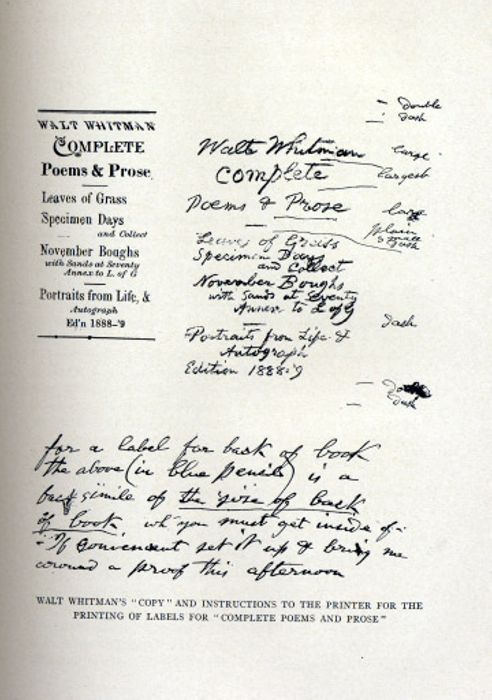 [Begin page 189]
Has ordered slips to paste on these flexible copies. "Curtz"—the eccentric Curtz—"was in an hour ago: I asked him: 'Will you have these ready to-night?' and he said: 'To-night or to-morrow morning.'" Will not need them till the cover for the fifty is approved. I packed up together the stitched copy and fifty signed first folios. The whole six hundred laid there on the floor in lots of twenty-five: in each case there was a slip under the string marked: "25 autographs." Took the other five hundred and packaged them carefully. I will only take them over as they are needed. He watched me closely as I worked: I was on my knees on the floor: the room was in a sort of half light: "growing warmer, more comfortable," as he said: then spoke, half to me, half to himself: "What a comfort it is at last to get the book into shape—to have it right in your hands: to see it, the whole mass of it, brought at last together." And again: For what can it be? for what can it be?"
[Begin page 189]
Has ordered slips to paste on these flexible copies. "Curtz"—the eccentric Curtz—"was in an hour ago: I asked him: 'Will you have these ready to-night?' and he said: 'To-night or to-morrow morning.'" Will not need them till the cover for the fifty is approved. I packed up together the stitched copy and fifty signed first folios. The whole six hundred laid there on the floor in lots of twenty-five: in each case there was a slip under the string marked: "25 autographs." Took the other five hundred and packaged them carefully. I will only take them over as they are needed. He watched me closely as I worked: I was on my knees on the floor: the room was in a sort of half light: "growing warmer, more comfortable," as he said: then spoke, half to me, half to himself: "What a comfort it is at last to get the book into shape—to have it right in your hands: to see it, the whole mass of it, brought at last together." And again: For what can it be? for what can it be?"
I wrote Blauvelt to-day. W.: "I am glad that you did." And when I told him what I had said: "That was right: that was just what I should have wished you to say." Then adding: "But I wrote to him myself, too: the breakfast was so good—the bird so fat, so sweet: I felt I should render thanks for it: only a postal—a few words." Described a letter from Bucke as "an echo merely of the last: his trip postponed, Gurd expected back: to go to Ottawa to secure patents: all that over again." Sneered at the "legal processes"—their "dilatoriness, procrastinateness"—how our "jurisprudence is a weak modelling upon England's": the "obscurity of legal formulas," and so forth. Emerson was mentioned. W. spoke of Emerson's poetry—its "plentiful and healthful disregard for conventions, forms," and so forth—its "undoubtable power." "I can easily see how a stylist like Arnold should find Emerson below the mark. I suppose your friend Morris would find Arnold about right in that exception. But there 's a higher thing than the pure stylist can ever know." Spoke as before [Begin page 190] of "our better imaginationists—Emerson, Bryant, Longfellow, Whittier": said that "they had their place, would hold their own, in any category of English singers."
W. discovered in the big book the first mistake: in Collect, page 240, line 15, changed "I think if" to "Truly if we." Asked W. if he had read Sunset Cox's Mohammedanist book. No. Not even Why We Laugh. I had Why We Laugh. Said: "It would be tonic for you." "Probably," he said: "why not bring it down one of these days? One is not forced to read, not forced to take up, not forced to put down: try me with it." He "could imagine" a "good" book from Cox. "Cox is the sort of fellow who sets out for brightness—lambency: the epigram, the gem, the smart saying—brilliant flash: the stream sparkling dazzling—the background of all: not a mind of the first class: yet important, necessary." Had he read Brown to-day?—Wieland? He said: "No—not really read it: yet I looked it honestly over—looked through the whole story." The story "had no attraction" for him. But the introductory life of Brown—"that I read squarely through." I asked: "Who wrote it?" W. said: "I don't know: it does not say: it is tepid: not strong, not weak: not interesting, not dull: flat, to sum it up. It deals with Brown conservatively—is neither hot nor cold: it is not a piece of writing such as Macaulay could make of Milton, Hastings, or Arnold of Heine." Lament for O'Connor. "No word at all—which is a bad word: yet I write to him—send him papers—the Boston papers." I asked about O'Connor's wife. W. exclaimed: "Tiptop! intellectual, true, noble: rather consumptively inclined, I should say—rather, not wholly that: has some pulmonary weakness." O'Connor, he said, "though a man now over fifty, and tremendously a sufferer, is still young in spirit: his letters, his talk, his public writings—all show it. That is his vehement, passionate, sincere temperament." He considered that "if O'Connor had been a priest back in the earlier Christian ages his noble, lofty, extreme personality would have roused nations, stirred conti- [Begin page 191]nents, led crusades, excited thought, speech, action, the deepest, the most full of meaning. O'Connor, is veritably a Peter the Hermit, a Luther." "Before all else," he said at another point, "O'Connor is expresser: a positive, powerful, overwhelming expresser: intellectual—oh! superbly intellectual!—yet moving men rather with the emotional, the sympathetic—with an equipment unparalleled, I believe, in these days." Yet, warrior as he was—"born warrior, born tempestuous"—he was still "the soul of courtesy" capable of "emphasis, indignation, of an overmastering power, but never bursting into a crowd with a club, a battle-axe. O'Connor's weapons were fine, delicate, but keen—subtle, past the possibility even of appreciation by the ordinary literary mind."
I met a radical Friend to-day. He talked of Hicks—I of Whitman's Hicks. At the mention of W.'s name, the old Quaker looked at me. W. evidently only a half-known name to him. "He 's the fellow who wrote a smutty book?" Then he asked: "Was it smutty?" I retorted: "Smutty people consider it smutty!" The old fellow quite gracefully withdrew: "I thought that might be the case," he said. W. interested in this and what further I had to say. "It was my grandfather," he remarked, "who best knew Hicks: they hobnobbed together in their young days: but my father had met him—known him—also, as he did Thomas Paine: I myself saw Hicks: what is more, I saw his surroundings, the country he travelled, the people—associates, followers: this, to me, most valuable, I may say, in explaining, justifying Hicks." "In this way by long contemplation of habitats and so forth I have come to think of myself as intimate with Elias as a person: have came more to understand in my own late days that you can mainly get to know a man's life by incidents, environment, parentage." "I feel now that I know more of Elias Hicks by standing a little off: I take a sounder, fuller view—more fairly estimate him." "However grievous the fact Hicks is to-day practically forgotten: the general world requires when he is [Begin page 192] mentioned to be told who he is: yet it would be hard to name a man—a modern man—who in his time maintained such a stratum of influence—a long plane of influence"—sweeping the flat of his hand across from left to right. "I find I can write, master, cope with affairs fifty years old better than with those occurring now: I get more completely the sense of proportion." Here he paused an instant, then he said earnestly: "Had I all my faculties now, my literary power, the strength to take up work, stick to it—the force I once had, the ease—I have no doubt I could write of Elias Hicks, Aaron Burr, Thomas Paine, as I could of no contemporary men." Had he written of Emerson: his personal history—meetings and so forth? "No—only here and there a little note: the time is past for that now." "Who best appreciates Hicks or Jesus to-day?" W. asked. I spoke up: "Not the nominal Christians—Quakers—but the men who take the large view that includes all—Jesus, Buddha, Zoroaster, Confucius: know they are all part of one perfect whole." W.: "That is true—must be true: say it again, say it everywhere." The Burr piece had not yet turned up. "I imagine it is downstairs—somewhere: I don't catch a trace of it among the papers here." W. passed on to me a Carpenter letter three years old. "It seems to me you may find some use for it: it belongs to the English end of our story: read it anyway: read it there, now: then you will know." It was written in pencil. No envelope. Millthorpe near Chesterfield, 23 Oct '85. Dear Walt: I had yours of 3 Aug—acknowledging receipt of draft. Sorry to hear you were troubled with sunstroke. I hope you are going on pretty well again now. We are very pleased that the money came in handy. I have n't been in London laterly or seen Mrs. Gilchrist or your friend Mary (?) Whitall whom you mention. I rather expect to be that way in about a month or so. Am laid up just now with a kick from my horse—luckily nothing [Begin page 193] very bad—he struck me (accidentally in a way—the kick being probably meant for another horse that was teasing him) just above the knee on the front of the thigh—so no bones broke: but it is a big bruise and it will be a week or two before I can get about. It is wonderful though how nature sets to work directly to put things right, and it has been peaceable and free from pain. I have plenty to do looking over proofs. I am bringing out a second edition, enlarged, of Towards Democracy—also a criticism of Modern Science which I am interested in and hope it will provoke some discussion—it is a direct attack on the validity of scientific "laws" and methods generally—not that I don't think Science has been very useful, but that it is time that it should climb down a bit. Do you see anything of your friend McKinsey or has he left Philadelphia? I send you a photo I had taken a little time ago with a young fellow who is an old friend of mine—in Sheffield—it is not very good of me, though very fair of 'tother one. The farm gets on—slowly—but still it moves, and I rather expect in a few months to put it on a distinct cooperative footing. Prices are awfully low now—owing apparently to the general depression and the fact that the mass of the people are without money—also, perhaps, partly to a growing scarcity of gold. Isabella Ford had an accident since we wrote but I do not know exact particulars. She was driving with her mother and the ponies ran away. Isabella climbed out, probably thinking she could render some assistance, and fell, hurting her shoulder. However, she was much better when I last heard. Hope you keep going pretty well. I often think of you and wish we could have a chat. With love, Edward Carpenter.
I had read aloud. W. expressed some personal things about Carpenter and the Fords: "The altogether beautiful[Begin page 194] people who have made me welcome on the earth." Then he referred directly to the science passage of the letter. "I am much interested in Carpenter's attitude towards science: it seems just right: yet it is a dangerous experiment—a perilous impeachment: one which I am doubtful whether a man of less ability than Carpenter could handle at all. I say to a fellow: do it, yes: and I also say, don't do it: don't do it unless you are fully aware of what you are doing: for science looked at from final places somehow comes first: it must not ride a high horse, but it comes first. As I understand Carpenter his only intention was to bring it down from its high horse."
Wednesday, November 28, 1888.
8 P. M. I can find W.'s condition generally signified as I approach the house by the lights shining through the slats of the shutters upstairs. To-night all was dark. Eight o'clock is his good hour invariably if there is a good hour in the day. For that reason I have mostly made it the hour for consultation. My heart foreboding much, I rang the bell, Mrs. Davis admitting me—telling me at once (what I had feared) that W. had experienced a bad day indeed. W. lying on the bed—not asleep. Greeted me with outstretched hand. "Ah!" he said: "You come at the last hour!" His hand was hot, ferevish. I inquired: "How has it gone with you?" "Ill!" he exclaimed—"ill indeed: one of the worst of days—the very worst: ah! my boy I have gone far under! It is time for another peg to be taken out: one peg more: more even that that—who knows?" spoke huskily, weariedly: mentally clear but hesitating. He motioned for me to sit down: I took a chair near the bed. Then he went on: "I have felt so weak: oh! so weak! so weak I cannot stand! I cannot tell you how weak!" Then: "I have done nothing to-day: for the first time my appetite has positively, wholly, given out." He drank a cup of chocolate in the morning: took a little chicken broth: in the afternoon had a cup of tea and some pumpkin pie. [Begin page 195] "That more from necessity's sake than from desire." Said he felt now a sort of "qualmishness"—a stomachic reaction—although his digestion was good, he thought. Whether fever or not? "I do not know," he said.
As is generally the case when W. suffers physical depression he was eager about the book. Had the binder stitched his sample copy? No? He was a little disappointed—saying the next instant: "Well, I trust it to you: guide, guard it." But I had brought the design for stamping and this revived him a little. Should I put it over on the table? No. He was eager to have it there by his side. "I will see that no harm comes of it." Made me think of the old days when he would take the proofs affectionately and tuck them under his pillow. No mail to-day "except a letter from Mary Costelloe: it contains no news—no news at all: all are well, bright: there they enjoy society, friends, good living." Then he wondered whether R. P. S. was "gone from America for good?" Reflecting: "That seems neither settled yes nor settled no. Pearsall likes English living—service, servants, finger bowls, a big fellow back of your chair attending every beck and call: all that: so he may stay: but nothing appears certain about it."
I did not propose to remain: he seemed utterly exhausted. But when he spoke again of going down another peg I protested: "But if it is to be withdrawn don't you help to withdraw it!" pointing out to him the record of his summer when his quiet confidence showed that he knew the possibilities of his vitality better than either doctors or friends. He said: "It is good advice: I will heed it." I urged, moreover: why not have the doctor come in the morning to see him, anywhow: it would do no harm: having always to regard his usual aversion to professional attendance. He said: "I don't know but you are right: do your own choosing: it might be better to have him come." The room was hot. Yet he suddenly turned his head on the pillow. (I stood up, hat in hand, ready to go): "Horace, I think I'll get you to close that window," pointing to the middle win- [Begin page 196] dow, lowered about ten inches. The shutters inside were closely fastened—so little air could in any event have got it. "I am cold," he added. There was no more to do. We shook hands. I reached down, kissed him: he kissed me, saying thickly: "Bless you, my boy! bless you!"
I had got outside the door. I heard W. call: "Horace! Horace!" I returned to his bedside. He reached under the pillow, pulled out an envelope and handed it to me. "What's that?" he asked. I moved over under the dim light and opened the letter. "It appears to be from Symonds," I said. "Exactly," W. responded: "Symonds: yes, Symonds: take it along: I want you to have it: it 's not Symonds alone—it 's his nephew, also: a boy, I imagine, and lots to him too, I should judge: he includes a poem." I waited to see whether he would say more. He did, briefly: "That Symonds blood seems to be good stuff: it comes from the top rather than from the bottom up, to be sure (it should come the other way) but nevertheless it tingles, stirs, thrills, with genuine humanism." He stopped, turned his head over on the pillow. "Good night!" I said. "Good night, God bless you!" he said: "We may talk of the letter to-morrow if I am better." Then away, to the city. To Osler's, where I left a note (putting it on his desk) asking him to call to see W. in the morning. Mrs. Davis is greatly exercised: spoke of W.'s haggard appearance—of his despondent talk with her: "things are nearly up with me." W. noticeably fine: always so in these spells: uncomplaining: his despair, if he has any, is always only physical—never affects his spiritual life. Who could share with me the thought of that evening's ride across the river? I stood alone on the deck of the boat—leaned over the rail: no one else near: the sky was clouded, it was dark overhead: the wind was high: the water was rough: I just had Walt with me and was wondering what crisis we were coming to. I will add the Symonds letter. [Begin page 197] Clifton Hill House, Clifton, Bristol, July 12, 1877. Dear Mr. Whitman: I was away from England when your welcome volumes reached me, and since my return (during the last six weeks) I have been very ill with an attack of hemorrhage from the lung—brought on while I was riding a pulling horse at a time when I was weak and cold. This must account for my delay in writing to thank you for them and to express the great pleasure which your inscription in two of the volumes has given me. I intend to put into my envelope a letter to you with some verses from one of your great admirers in England. It is my nephew—the second son of my sister. I gave him a copy of Leaves of Grass in 1874, and he knows a great portion of it now by heart. Though still so young, he has developed a considerable faculty for writing and is an enthusiastic student of literature as well as a frank vigorous lively young fellow. I thought you might like to see how some of the youth of England is being drawn towards you. Believe me always sincerely and affectionately yours. J. A. Symonds.
Thursday, November 29, 1888.
10 A. M. Thanksgiving Day. Doctor not yet over. Ed reported W. not up. Would stay in bed a while longer. W. looking bad: is very pale, unrested. Speaks of himself as "sinking." All of us rather despondent. I wrote Bucke a dubious note, expressing the hope that in the morning I might have better news. Called at Harned's. H. not at home: took Anna along—going to church in the city. W. said this morning about eating: "Give me nothing: send me a little something to drink—coffee." Did not myself see W. Ed said: "Go in." But I thought it best not.
11.30 A. M. Down again. Saw W. Had just got up. Took a cup of coffee—nothing more. Spoke of himself as "in a poor way": "a little better than when in bed." This [Begin page 198] did not last long. In the course of our talk he said: "I feel better after all in bed." When I mentioned Osler he said: "I am glad you went, but I don't see that he can do anything for me: the best course for me to follow is to get rest—just rest:—to lie down: for lying down always seems somehow to restore me." "I feel so weak," he said again: "I cannot stand up—I have no equilibrium." Ed said W. dressed himself but was most unsteady: would have fallen once if Ed had not caught him: another time took to the bed "feeling like a stick of wood." This is the sensation W. described to me. Yet his color is good. I told him so, but he seems to be afraid of optimism. Had been reading papers—trying to: "it goes hard," he said. The Press was on the table, The Record was in his hand. Cited the ruin up the coast by the recent storms. Was sympathetically interested. W. made a comparison between Ferguson's type letter and Osgood's: "It is a little more aristocratic: finer in face: of more exquisite cast." Questioned about the book. "You don't go to Ferguson's to-day? Yes, yes, I see: it is a holiday: but to-morrow take them." He reached back to the table, produced an envelope containing Curtz's quaint slips for the complete Whitman. W. gave me the copy for the label and a copy of the label. He had it all diagrammed out for Curtz and besides drawing the design added these black ink directions: "for a label for back of book—the above (in blue pencil) is a facsimile of the size of back of book, which you must get inside of. If convenient set it up and bring me around a proof this afternoon." He thought Mrs. Davis was having a poor Thanksgiving with him sick. She wanted W. to have some turkey. He said: "Practically nothing: very little at the most." I got up to go. Advised Ed to make the bed, which he did, W. then at once lying down again, dressed. Letter from his sister at Burlington, Vermont. Could stand no rubbing last night. Our anxiety is great. W.'s manner with me markedly sweet—memorable. He refers quietly tenderly to the book. "So near port—in sight of port— [Begin page 199] and now!" He is anxious about the books. "If I get them out why—well, then let happen what may."
3.15 P. M. Found Tom Donaldson in parlor: had had what he called an hour's talk with W. I did not think it advisable for me to go up myself after that. Would wait till evening. Went over the river with Donaldson, who had brought W. fruit and wine and taken away with him the ten copies of November Boughs, which W. had got up (was lying down when Donaldson came) and autographed. D. vociferous regarding W.'s strength—his ability to maintain himself ten years yet. "Why, he 's hardly noticeably sick at all!" W. brightened when D. arrived: when the reaction came D. was gone. Donaldson with others are misled into believing W. almost well.
7.15. Again down. Osler had been over towards evening. Was not at all alarmed. I did not see him. He instructed Mrs. Davis minutely how to reach him at certain hours should an emergency arise: after all evidently fearing something. Will be over Saturday or Sunday anyhow. Advised: keep W.'s bowels open: the tendency with him is to constipation: insure a pssage at least once in every two days. Ed went up stairs through his room to W.'s. I followed. W. was standing up leaning heavily on the bed, putting on his coat. He described Osler's visit at once. "Osler was over—came at last: Dr. Osler: he finds nothing to excite alarm—thinks it mainly indigestion: that a day or two will restore me." I looked at him. "I mean counted my pulse, questioned me—went through all the technicalities: but—!" Which is a way he has of dismissing doctors and doctrinaires. It was characteristic of him that, bad as he felt, with Ed standing attentively near, and I with my hat in my hand, he arose from his sitting posture on the bed, reached forward, leaned heavily against the wall, and turned the key in the door. "I want you two fellows here but I want to lock the rest of the world out," he said. Then he went back to bed, very laboriously—lay down dressed.
Ed left the room. We talked some. He stayed where he [Begin page 200] was. Said he had eaten nothing at all. "I have not even the suspicion of an appetite: no hunger: absolutely none." Did no work. I showed him a portrait of Verestchagin with Crucifixion and Sepoy pictures found in Harper's Weekly. "Leave them," he said: "I much want to look at them: will do so to-morrow." Spoke pathetically of his entire helplessness. When I said: "Should you ever need a Secretary, let me serve," he fervently responded: "Bless you, my boy! I shall! I shall! I often feel that I may yet have to call upon you." He said: "Donaldson was over to-day: among other things he brought me a bottle of wine." I asked: "Will you dare use it now?" "Oh yes! I shall take some of it to-morrow!" "Tom talked about Sheridan: told me new things: interested me—cheered me: he knew Sheridan: caught glimpses, lights, not allowed those of us who lived outside." I told W. what Donaldson had said of his prospects—of his ten years yet. W. said: "Well, we 'll wait till the ten years are over before we talk of that." Added, too: "Yesterday was a close call: I fully realize it."
Donaldson to-day spoke of Kennedy as "a half-crazy curiosity." W. repeated the epithet to me and asked: "What do you make out of such a phrase? I don't see how it applies to Kennedy at all but Donaldson was stubborn about it. When Ernest Rhys was here he met the Kennedys—came to know them pretty well—probably met them often. Ernest called them 'shocks': that is, as I understand it, they were both afflicted with nerves: which may be true—which is no crime, however unfortunate. For instance, it can be illustrated in this way: one comes into the room, fixes all the things on the mantelpiece, passes out: then another comes along, takes everything that was just put up down again, putting something else in place of it. Rhys seems to have seen that sort of thing going on—came to extreme conclusions regarding it: called them the nervousest couple he had ever met. But how unimportant all that is: Kennedy does not begin and end with such an [Begin page 201] incident. Then Kennedy had some objections to Rhys: I also heard them: Rhys was selfish—rode over people: was arbitrary. Well, maybe some of that was true, too: but that again is not the whole of Rhys: he is more than that. As I see more of Sloane I am impressed with his strong, remarkable, moral nature—his moral, intellectual nature, I may call it: and when I speak of his moral nature I don't mean morals but that highest something which makes life steadfast and ample. Of all things in Kennedy that moral entity appeals to me most surely—is most convincing: his honesty, his love of truth: perhaps honesty alone would say it—honesty with all that it implies: the fellow who at the last is found not to deflect from the truth—from thinking truth, uttering truth, being truthful."
W. spoke of O'Connor: "William is all gentleman: however strong, however impetuous, however overwhelming, never a bragger, never a boaster: always gentleman: always." And of Harned: "Harned stands for force: he is a man's man: he is frankly, almost brutally, honest: goes his own way: gets down on his knees to nobody." Corning in but did not see W. W. shows his renewal of vigor in his voice and in his greater alertness. W. handed me as I left a letter from what I call his "amen" corner. "We were in much distress of mind about George at that time: my dear mother was terribly exercised: she was heroic, loyal, uncompromising: but she loved George—was profoundly disturbed over the mystery of his movements, whereabouts."
"Did you mean for me to read or keep this?"
"Both: it will interest you to read: as to keeping it, well, it embodies a piece of history: it is likely to be safer in your keeping than in my own: so you had better take it along." The envelope was postmarked New York. W.'s inquiry comes first. Cook answers on the same sheet of paper.
Washington, Feb. 27, 1865.
Captain:
Could you give me a little further information about my brother Capt. George W. Whitman 51st New
[Begin page 202]
York, who gave you the slip you sent from Annapolis Feb 19 with his and mother's address, Feb 14th?—Why did not he, and the other officers, 51st N. Y. come up with the main body, for exchange?—were the other officers 51st there at Danville, time you left?—Please tell me all you know, or think probable, on this subject of why they did not come. Have they been sent further south, to avoid exchanging them, or are they still at Danville?—Was my brother really well & hearty—was Lieut. Sam'l Pooley, 51st N.Y. there, & how was he?—Do you know whether my brother got letters & boxes we sent him?—Was he in the attempt to escape, Dec. 10, last?—My dear Sir, if you could take a leisure half hour and write me, soon as possible, what you know on these or other points relating to my brother, it would deeply oblige me—
Address—
Walt Whitman
Washington, D. C.
New York Feb. 28th, 1865.
Dear Sir:
I have just received the letter on the back of which I am writing. Your brother is now, I have no doubt, in Annapolis, awaiting his leave of absence, unless, as some of my brother officers did, he donned citizen's costume and made tracks for home before receiving it. With me, only nine other officers were exchanged, but a few days after I reached Annapolis, all that were in Danville, or had been there rather, arrived in town also. They came in two batches, the 23rd and 24th I think. I knew quite a number of officers in the 51st, all of whom came to Annapolis. They were quartered either in the hotels or in the hospitals; not in the latter from illness so much as because the town could furnish no more accommodations. I do not remember your brother, but I have no doubt that his indisposition if it exists at all is such as plentiful food and pure air will remove at once. While almost all of us were weak and slightly ailing as I may say, almost none of us were seriously affected. I venture to suggest that a letter addressed Care of Dr. Vander-
[Begin page 203]
kuft, Surg. U. S. Army, in charge of General Hospital, might reach your brother sooner than if it bore his name only. You will hear so soon from your brother that it will not be worth while for me to answer your other questions, except to say that the Danville Prison was emptied of officers and that they are all in Annapolis. There I left them at least the 25th.
Very respectfully,
William Cook
Capt. 19th U.S.C.T.
92 W. 10th
New York.
Friday, November 30, 1888.
6.30 P. M. W. lying on bed. Ed entered with me lighting gas. Ed said that W. "spent a day in much the same condition as last night." W. admitted that he was better: "but I am still weak—still far gone." Had eaten, however, and was manifestly stronger. Voice, manner, willingness to talk—all testified to it. He stayed on the bed for some time after I arrived, talking binder and all that. Could n't get stitched sample to-day. Oldach rather testy about it. W. disappointed but calm. Oldach spoke of the stitching of books—the style of two centuries ago—"the old-time style"—and that of the present. "But nobody wants the old style now." W. said: "Let us be the exception: let us be the odd fellow: let us get the old stitch." Then added: "Binding illustrates all life. Show a man a house—one that may be plain but in and out everything that is honest, durable: he shakes his head: is there not something more? So you show him a reverse case—show, ornament, external bother: he at once applauds!" But ours was another path. "While we, too, aim for healthy, utilitarian considerations not to be disregarded." When he feels physically shaky he gets urgent about the work. Does so to-day.
Discovered the little Shakespeare piece—cipher piece—left out of Sands at Seventy. "I don't know how it was I [Begin page 204] missed it: it has only turned up again within a few days: yet I once had it printed." I said: "Yes: and what is more I referred to it in the summer and supposed from your manner that you did not intend to use it." "No: it was not rejected: only forgotten. I still stand by it: it was only a few lines, perhaps of no importance whatever: yet it should have gone in." "You will put it in the later editions?" "O yes." He got up. With my help went over to his chair, turning up the light, sitting down heavily: legs of little value to-day for support or locomotion. Spoke of this as "of all attacks—I have had many of them—the shortest in duration: yet severe, troublesome: Wednesday so severe I feared for it: it was a close call indeed." He turned to me after he had got comfortably fixed in his chair: "I should like all my friends to understand from me—all of them—that the succession of whacks, as I call them, to which I have been subject these last fifteen years, is the result of two or three years of great exposure during the critical period of the War: an exposure the most hardy—some would say, inexcusable: and indeed I see myself I might have 'known better,' as has been charged upon me." His self-examination: "In fibre, muscle, organically: in build, arm, leg, chest, belly—in physical equipment—I started superbly—no one more so—more gifted, blessed." Then came the War. "I was no spring chicken then." His consecration "was no youthful enthusiasm—no mere ebullition of spirits—but deliberate, radical, fundamental." Here he paused, turned his face towards me, passed his fingers, spread, over his heart. "Deliberate? more than that: it was necessary: I went from the call of something within—something, I cannot explain what—something I could not disregard." Whether for good or bad he "could not pause to weigh it." "There 's something in the human critter which only needs to be nudged to reveal itself: something inestimably eloquent, precious: not always observed: it is a folded leaf: not absent because we fail to see it: the right man comes—the right hour; the leaf is lifted."
[Begin page 205]This experience of the War "was not all simply physical." "Think," he argued, "of the sympathetic, emotional outpouring of those years: what they meant to others, to me: then calculate results: what results must have accrued." He was "one of the few" who at the outset realized "the vital danger—the real point of weakness." The "critical factors of the national life in those years lay not in the South alone but north here, too—here more insidiously. I was bred in Brooklyn: initiated to all the mysteries of city life—populations, perturbations: knew the rough elements—what they stood for: what might be apprehended from them: there in Brooklyn, New York, through many, many years: tasted its familiar life. When the War came on I quite well recognized the powers to be feared, understood: and not alone in New York, Brooklyn: in Boston as well: the great cities west, north-west, the very hotbeds of dissent." He felt that the nation—"the thinkers of the nation—had only commenced to realize what had been escaped in those years." "I for one feel strongly grateful to Victoria for the good outcome of that struggle—the war dangers, horrors: finally the preservation of our nationality: she saved us then." Afterwards saying again: "Victoria and Albert! Victoria and Albert!" He had "often thought to put this on record, at least for" his "own satisfaction." It seemed like his duty "to write something: to put myself square with the higher obligations all must in time come to acknowledge." I asked quizzically: "If you wrote such a thing, what would Tucker and O'Connor do?" He laughed heartily: "I don't know: but that would not deter me: and at any rate, O'Connor is fully conscious of the truth of what I say: we often talked it over at the time." Now it had become "commonplace" to any one who chose to know it—"our public men—the better type of our public men—all know what it signifies: especially is it conceded by those who have been part of the inner circle in Washington. When Julius Chambers, out of the rare kindness he somehow developed for me, first appealed to me to send them scraps [Begin page 206] of thought for The Herald—I think it was the period when Cleveland was being so sharply taken to task for having sent a present to the Pope on his jubilee—I wrote a few lines in effect of this purport: I for one thing must go on record approving the President's action: more than that, I contended, rather than having done too much the President has done too little: my own impulse would have been to send, send to the Pope: to send likewise to the Queen—to England's Queen—from whose forethought of those serious years so much of good came to us. I never sympathized with—always resented—the common American criticisms of the Queen." He still kept to his theme. "It was in such an experience as of the War that my own heart needed to be fully thrown—thrown without reserve: I do not regret it—could not regret it: what was a man to do? The War was on, I was strong in my strength—superb of body—I had much to give: there were thousands, tens of thousands, hundreds of thousands needing me—needing all who might come: what could I do? So you see it was a time that enforced its own services."
There was a real solemnity in this last outbreak of feeling. He had thrown his head back—spoke freely, strongly, with great emotion. He said the subject of the War had come up while Donaldson was here yesterday. "Tom said, John Brown, Lincoln, Grant, Sherman, Sheridan, were the five men out of that period, brought out by that period—assured of immortality." I asked: "Well, do you accept his selection?" He answered: "Of some part of it, anyhow, I have no manner of doubt: I never enthused greatly over Brown: yet I know he is a great and precious memory: I don't deny but that he is to be ranked with the best: such devotion, such superb courage, men will not forget—cannot be forgotten." I referred to Lincoln's "balance, poise," arguing—"we can imagine the War without Grant, Sherman, Sheridan, but with Lincoln not there at that time, what?" W. responded: "We must not give too much importance to personalism—it is easy to overcharge it—man [Begin page 207] moves as man, in all the great achievements—man in the great mass: yet I, too, think of Lincoln much in that same way: as you say, his poise, his simple, loftiest ability to make an emergency sacred, meet every occasion—never shrinking, never failing, never hurrying—these are things to be remembered and things 'providential' if 'providence' ever has a meaning in human affairs."
I used the word "Secession." W. said: "The word recalls much—much that is hideous as well as wonderful." Reference was made to Sam Randall's supposed Southern sympathies, in the early years of the War. W. said: "Randall is essentially what the English call a trimmer: study his course in Pennsylvania politics: Randall is always quasi-protective. And—the more I think of protection, the principle it goes upon, its practice, our worship of it, the more convinced I am, the clearer my mind becomes, that it is the most hollow pretence, fraud, humbug, of our political life. I cannot say I have recently been reading anything on the subject—any serious treatment of it: for two years and more I have not: yet my conviction against it, my contempt for it, grows stronger and stronger." He had "no statistical table from which to educe a formal argument of any sort"—"it is the atmosphere—the position of the parties—more than all else, a realization of the course of nature that appeals to and overwhelms me." "I object to the tariff primarily because it is not humanitarian—because it is a damnable imposition upon the masses." "Imagine," he exclaimed, "the bottom absurdity of America's cry for protection. Of all lands—America! We can conceive of lonely islands, faraway provinces, agitated for such a defence: but for us—why it would be laughable if it was not fraught with serious consequences. With our mines, railroads, agriculture—the richest the world has known: an inventive spirit past parallel: land without end: ambition, freedom: it is madness to reach forth for external protectives—not madness alone either: it goes to make a national farce also."
W. likes Osler. Says fine things about him. Not so [Begin page 208] much caring for him professionally as humanly. I asked him about Drinkard. "I have been singularly fortunate in my doctors," he said: "I often think of Dr. Drinkard—noble old fellow he was"—here paused, starting to correct himself: "I should not say old: why do I say old? Drinkard has been dead many years: he was really a young man: he was a Rebel—a hot one, in fact: red-hot: but that subject never came up between us: he would not allow any heavy mental pabulum for me then: I was not in great shape at the time: rather than talk thinking matters, when that danger seemed imminent, he would turn his conversation into the light frivolous channels. But Drinkard was one of my true friends whose affection was something to be recked of: he was to me then in some ways, though not so strongly, what Bucke now has grown to be."
Gave me the Verestchagin pictures. "I looked long, long at them—the portrait, the others"—adding of The Crucifixion: "What a wealth of suggestion it has—a power—an appearance as of a man who had made up his mind to say—do—something and had fulfilled himself." Verestchagin's head was "splendid in strength and beauty"—almost a "monstrosity" for size—yet, "intellectually, sympathetically a marvel to behold." Altogether V. was "a considerable man." "I read Clarence Cook's piece too—the whole of it: liked it—got from it some new points about Verestchagin." "The elements so simple, yet so much made of them." He said again: "Verestchagin is our man—comes along in the same stream with us (or we with him): stands for our contention, as we do for his: against the formulas, the art sophistries, the textualists."
I spoke of my going to Germantown to hear Brinton lecture. W. inquired: "What will he speak about?" adding, when I had said: "The Quest of the Beautiful": "It is a big, a fruitful subject: I don't know but the biggest: and Brinton should be able to tell about it: his scientific training, truth-lovingness—all that brought to bear." I don't know how the thing came up. We found ourselves talking [Begin page 209] of the spontaneities—how some of the most beautiful things happen without a plan. I spoke of the driver of a wagon on the Chestnut Street hill by the river: "his horse fell down—could not get up: a dozen men as by one instinct rushed into the street—gave the carter a boost, got the horse safely on his feet: all then laughingly going their ways again: no scheme, no reward: just the finer human impulse at play." W. was immensely moved. "How splendid that is! That is wonderfully à propos: there are more cases like it than we can count. Tennyson's Northern Famer says to his son, 'the poor in a lump is bad': but stories like yours tend to show that Tennyson is wrong. There is always a manifest streak of good side by side with the bad: I have seen much of men, of the masses": "out of all this conviction has come to me—this faith. Every day instances confront us. I had a visitor—a Quaker lady—to-day: she came—was from the city: her name, Brotherton: she asked to see me: I consented. She was here but shortly—explained that she had been out a while since, called on a friend: while waiting in the parlor had hit upon November Boughs on the table there: she had read, it appears, been attracted chiefly, I suppose, by the Hicks piece: said that simply seeing that much had created in her the desire to see more. The old lady—she much be quite old—is poor, not famous: not intellectual, not even literary: but with a face remarkably gentle, sweet: and she 'thee'd' and 'thou'd' me—tickled me much: I own up to it. She did not stay long: was mindful of what had been told her down stairs. When she came to go she took my hand, put into it a little folded piece of paper—so"—indicating: "said, "Don't open it till I 'm gone—this is not for thee alone but for me': passed out. When I looked, lo! she had left me a two dollar and a half gold piece. The whole manner of it was characteristic: much the way of the Friends. It is a singular feature in men, that to simply confess a love is not enough: there must be some concrete manifestation of it."
[Begin page 210]W. said: "I have a letter here which I have left for you to answer." Moulton, of Buffalo, editing the Magazine of Poetry, wants permission to use copyright poems. McKay referred M. to W. Bucke has written him a biographical note on W. to go along with them. W. said: "Tell him I am perfectly agreed—that if he finds it worth while to use the poems I will find it worth while to give my consent to it." Gave me two Bucke letters. "There 's something in one of them that you must see—I don't know which one: to make sure you don't miss it take both letters." Said he had passed an idle day. "Wrote to Bucke—a long letter: that was all." George Whitman's wife in. I read the Bucke letters. "Was the mention of the big book what you wanted me to see?" He answered: "Maybe—maybe." Then: "Oh! I remember now. It was his reference to the cover: Maurice never seems very fertile in esthetic suggestion: that is a talent that has been neglected in him." I said: "Maybe it goes along with his utter failure to enter into musical things." W. assented: "I should n't wonder: in fact it seems almost necessarily true."
Saturday, December 1, 1888.
7.45 P. M. Saw as I approached the house that the light was low in W.'s room—indicating that he was not up—arousing forebodings in me. Ed told me W. had not been so well. W. lying on his bed. Heard me enter. "Aha! it 's Horace!"—extending his hand without rising. How was he? "Bad! bad!" he said: "I spent a horrible night: stayed awake, suffered much pain, was restless: I am little better now." Added: "It seems as though the pain all concentrated in the urinary organs—in the kidneys: I was up often: there was no relief." Said he had "slipped back again" from yesterday. Then he stopped talking about his illness. "What of Germantown? Who did you see there? What did Dr. Brinton say? And I suppose you met Clifford?" As to Brinton's address: "It is a sublime subject: I think we may very well use that word there." In [Begin page 211] after-talk Brinton had argued with a group of us the necessity of a universal language as enforced by the adoption of the telephone and phonograph. W.: "That is a very suggestive weighty argument: it is the argument of a man of science: it is entitled to respect." The question presented itself to him in another way. "A universal cipher may be adopted—manufactured: the question is, whether a language—a language, taking hold of peoples—the globe's peoples—can be, could ever be, grown, much more deliberately constructed." But whatever that case, "such a reason as Brinton gives is one that no man can avoid—perhaps that all must before long realize." To him, "the fibre, climate, spinal independent facts of different peoples, persisting, brought their own deeper problems." He asked me Brinton's judgment on Volapük. I said it was adverse.
Got up heavily, I helping him: stood there with his blue gown on, tall, massive: turned back my way: went to the bed alone, saying as he stood there: "Ah! my boy! who can tell the sweetness, the comfort, the peace, the happiness, I have now, for knowing that whatever becomes of me, the book is safe: we have the book safe—both books! Doubtful long ago of one, we have achieved both: in its way that is a triumph indeed." He had "achieved his great wish": he had "the two volumes in one—the collectivity: I have desired it always: it is done." Here he turned, took up his cane, put his left arm out for me, going painfully to the chair opposite, saying on the way: "Whether Dr. Osler said it because he believed it, because he thought he should say it—whether for some other reason—I do not know, but to me his dismissal of this thing as trivial is wrong, wrong—far wrong: to me it seems rather that an end is near." Then, as he reached the chair: "The Doctor might promise respite, pause, that: but is this not bad enough as it is? Who would want more of this—have this aggravated, prolonged?" No complaint—rather greater amiability: desiring to keep on a right footing with events. "Ah!" he said after he sat down: "the days are slow: the [Begin page 212] time hangs heavy: already six months of this storing away—this imprisonment!" But the words were hardly past his lips when he fired a new question at me: "What news? what do you bring?"
I showed him a copy of the complete book to-day stitched and bound by Oldach—a temporary cover for the fifty copies. Instead of a paper binder had put on a board back: but on the edge and at the corners the book was finished with green cloth and marbleized paper to represent leafage. W. accepted the errors as "inspiration." He regards Curtz's label, pasted on the edge of the book, curiously and humorously. "It is queer, don't you think?—like Curtz: looks as if he had taken an axe and gone out into the woods—hewn it out of the rough, the axe not very sharp, either. I should not commend it as a deliberate piece of work: but it is like Curtz—like me, too: besides, it seems to fit well in its place there." Then he proceeded: "Thank Oldach for it: thank him for the mistake: tell him Walt Whitman more than likes it." He turned the book over and over: "Done at last!" he said: made various little comments: finally addressed me: "Did you notice in Doctor's letter that he says he looks for us to give the book a characteristic cover? I wonder if we will?" Here he paused. Then: "We must wait till it is done before we can say it is well done." Then he gave me a letter—Bucke's of the 28th—and inquired: "Did you write to Moulton to-day?" I had done so. He was perfectly satisfied. Handed me a specimen page of Moulton's Magazine. "You may wish to look it over: it shows the way he aims to do it." I read his letter of 29th from Bucke. Much about the meter. A paragraph devoted to Pardee, which W. insisted on hearing in full. "Poor Pardee!" he exclaimed: "and he was such a gentle man: gentle in all ways: I met him: he was physically rather small: pleasing, bright: evidently a man of force." He commented on the meter business: "Willie Gurd is much like Ed in there—characteristically Scotch: a natural inventor: his mind always ran [Begin page 213] in that channel." Doctor was cautious. W. thought his confidence in this invention full of meaning. "He may make a fortune out of it." He had no opinion in the matter. "What is the meter anyway? what is its purpose?" Doctor has not explained it to me. W. said: "He has explained it to me—did so while he was here: but I confess I did not understand." I understood that it was to measure water. W. surprised. "I did not suspect that: did not comprehend: I had an idea it was a meter of some sort to drive machinery: they are much more interested in affairs of that kind than (I thank God!) I am: it is a worrisome business." I argued: "But it won't worry Gurd—don't now: don't you remember what Doctor has said about his phlegmatic ways?" "Well—he is young now: if he makes money by this invention he may avoid some of the inevitable troubles: but by and by, when he is older, then will come the trying hours—the lying awake of nights puzzling over problems: things he can't shake off, forget, ignore: mental discussions, principles, arise"—now he pointed his finger here and there as he went on: "If this is so then this is so: if this is so then this is so: if this is so then this follows: and this and this and this: a wearisome round." His finger relapsed: the laughter went off his face. "Oh! I know what that is—what it becomes: I have known cases—more than a few of them." He had "met Gurd": he was sure I "would like him: he is a man who will attract you: you know he is Mrs. Bucke's brother—a careful, thinking man." His chair caught and broke the string about some manuscript on the floor: sheets leaked out and badly scattered about. He said: "I must put it in order: I have nothing else to do but sit here: an occupation of some sort is welcome."
Back to Bucke. He reminded me: "I have said, you must some day take a trip up to London: see them: we have been talking about them so often: see Bucke in his home: the house: the acres surrounding: the hedges (what we call hedges here) half the thickness of this room: the [Begin page 214] fine country thereabouts: the family, people: the new atmosphere. It is a thing you must count on, know, eventually." Described B. as "a man of intense powerful nature": went back to the days of B.'s going to Sarnia; "he put up a shingle there—got a couple of nags: went about his business: shortly was known all around to be more than the ordinary run of village doctors—in fact an extraordinary man." He described "a frolic" at Bucke's. "I was there: some one had sent in some wine: Mrs. Bucke, the children—all of them I think—were in bed: the bottles were appropriated—emptied: Bucke took very little if anything: even then you know he was averse: the rest of us did full justice to the tipple. The night wore on: by and by some one proposed that we bury the bottles: everybody conformed—agreed to have it done: we marched in procession out, across the lawn, chanting, chanting: here and there an invocation: overhead the stars: everybody taking part in it: everybody sharing the fun: recitation, farewell: then the bottles were cast clean over the broad hedge—over, over: the deed was done." W. laughed. Told it in just that seemingly broken but eloquent way, slapping the arm of his chair with great vehemence. "It was like the farce of the college boys," I suggested: "they each year burn on the campus the textbook which has given them the most trouble." He nodded. "Exactly—except that this was spontaneous, unstudied. I could get about on my feet then: I don't know if I did not head the march."
He spoke of his rare enjoyment of those days in London. "I liked Doctor—loved Doctor: his folks, the staff, inmates, all of them: liked, too, the men who had come to see him while I was there. He had them come while I was there: Englishmen, most of them." I spoke of Bucke's catholic nature. W.: "You are quite right: he has n't in him the first sign of the dogmatism we are led to expect in an Englishman: yet he is English: I may say, too, of those others—I found in none an objectionable assertiveness: Doctor himself is the most modest of men: a more modest
[Begin page 215]
man never lived: it is instinct with him to be modest." W. had several newspapers and some clippings and a letter laid aside for me. One of the newspaper pleasantries said this: "A well known writer is responsible for the assertion that the Good Gray Poet is not scrupulous about paying his debts. After all the Good Gray Poet may be the Bad Gray Poet."
"Where did you get this from?" I asked W. He said: "It was mailed to me anonymously from Boston, by some one, I don't know who, out of a paper I don't know the name of." Then he said: "Ask me about this when you come to-morrow. I want to say something to you about it: don't let me forget it." The letter I looked over and started to read. W. said: "Read it aloud: I want to hear it again."
50 Wellington Road, Dublin, June 9, 1875.
My dear Burroughs:
(You fall back into the unfriendly "Mr." and I will invade you in your solitude with a direct and natural address which must be taken by you for a grasp of the hand across the water.) I was very glad to hear from you about yourself and about Whitman. He, too, wrote to me most kindly and told me about his state of health. I hope before this reaches you that you will have received my Shakespeare book as a proof that you have been in my mind, although I have lost time in sending you an answer to your letter. In some ways I envy you—or at least count you happy—in your own house, and with your farm, in sight, or close to a river, with woods I hope near you, for your own delectation and that of the birds. I, on the contrary, who need and am happy in the country—near hills or by the sea,—have been kept more than ever before in streets and squares, having accepted added work in College for added pay, (needful now, not for myself, but for others), and of future literary work which I have undertaken a fair share is of only secondary and superinduced interest to me, but useful in solving the problem of living. These things make it more unlikely than it was some years ago that I can get over to see Whitman and America (including you and your
[Begin page 216]
house). You have—I am glad—dared to write warmly to me about your love of Whitman: and I, who have not seen him, know that you have only said what is just and inevitable. I shall like much to hear from you now and then, as I don't care to ask Whitman himself to write, and all that concerns him is of interest to me. Especially I shall be anxious to hear when his promised book is procurable.
My article on Victor Hugo is only partially satisfactory. I felt that to do him justice at all I should abandon myself very much to him. Yet, as you will soon see, underlying this abandonment there was a certain sense of uneasiness, and want of security, for Victor Hugo has not the massive sobriety and good sense which enables one to trust oneself to Shakespeare or to Whitman. And so, having written my article I have drawn back, and don't now return again and again to V. Hugo for sustenance and light. Still in some ways I have not said too much of his stupendous powers, and my article has (as far as I know) the merit of being the first chronological survey of his complete course as a non-dramatic poet.
What you have written, if you have a copy to send, I shall wish much to see.
Thank you for the very interesting article on The Birds of the Poets,—going so easily and lovingly near to the lives of both kinds of singer. The swallow, as you say, has never been caught, and I have seen only one poem on the swallow,—which does not appear in your article and which possibly it may be worth while for me to copy:
I
Wide fields of air left luminous,
Though now the uplands comprehend
How the Sun's loss is ultimate:
The silence grows: but still to us
[Begin page 217]
From you air-winnowing breasts elate
The tiny shrieks of glee descend.
II
Deft wings, each moment is resigned
Some hint of day, some pulse of light,
While yet in poised, delicious curve,
Ecstatic doublings down the wind,
Light dash, and dip, and sidelong swerve,
You try each dainty trick of flight.
III
Will not your airy glee relent
At all? this aimless frolic cease?
Know ye no touch of quelling pain,
Nor joy's more strict admonishment,
No tender awe at daylight's wane,
Ye slaves of delicate caprice?
IV
Hush! once again that cry intense!
High-venturing spirits, have your will!
Urge the last freak, prolong your glee!
Keen voyagers, while still the immense
Sea-spaces haunt your memory
With zests and pangs ineffable.
V
Not in the sunshine of old woods
Ye won your warrant to be gay
By duteous, sweet observances,
Who dared through darkening solitudes,
And 'mid the hiss of alien seas
The larger ordinance obey.
[Begin page 218]
We are all well, and shall spend the summer—July to October—at Bray near the sea. Write here as usual.
Yours sincerely
Edward Dowden.
W. asked: "Do you understand that the swallow poem was written by Dowden?" "Not necessarily." "I have wondered: I like it much: it has real kinks to it—is far and away above the ordinary rhyming of the nature singers." Then again: "Dowden has always shown me that same delicate consideration; doing enough, never overdoing: loving enough, never overloving; saying enough, never overtalking: he just seems to maintain a fine balance: judicial—looking both sides, not hurrying to decisions. I know you may say I don't always talk like this: that I love O'Connor for doing exactly the opposite thing: so I do: I like William to do what he does, I like Dowden for doing what he must do: they are different men—they are two sides: one is important, the other is important." I said: "You speak of William and Dowden: I don't think that the difference between them is the difference between the dynamic and the static—do you? Bucke says William [Begin page 219] goes on and Dowden stands still. William goes on, sure enough: but if Dowden stands still how is it he ever came to recognize you?" W. clapped his hands together: "Horace, that 's fine—that cuts to the bone: you must tell that to Maurice some time when you write." He paused: then resumed in this way: "I confess men like Dowden, Rossetti, Symonds (there are others too of the same stamp) surprise me—almost upset my applecart: they are scholars, in certain ways classicists, yet they are the promptest sort possible in analyzing and rightly estimating new things: it seems natural for men like O'Connor, like Ingersoll, to like me: they are my own kind through and through: but those other fellows have been trained in other schools—as a rule we expect, in fact get, other things from them. Thank God I don't have to solve all the mysteries: I am satisfied to have Dowden's love, satisfied for him to have my love, without trying to match pennies with him." W. also said: "I am much taken with what Dowden says of Hugo in the letter: it amounts to about John's opinion: the letter was written to John—that bit of it especially must have pleased him. I for my part am rather more disposed to William's than to John's estimate, characterization, of Hugo."
I called W.'s attention to a couple of bills that should be paid—Ferguson's, Adams'. He begged off to-night. "You keep the bills," he said: "We 'll take care of them to-morrow." Harned in. Did not stay. Thought W. looked tuckered out. W. said: "I have written Doctor to-night very gloomily of my condition: I have not written him for three or four days." I said: "Why, you spoke yesterday of having done so." "Ah!" he replied: "I know: but I did not send the letter off—added a little to it to-day." Here he picked up a pad: "I wrote on such sheets as these"—large letter sheets—"wrote this far yesterday to Doctor [indicating about an inch from the bottom] and filled in the rest to-day." Then he repeated: "And I wrote him a gloomy letter: things seem to warrant it—warrant it: nothing else, better, seems in order to say."
Sunday, December 2, 1888.
7.15 P. M. W. lying on bed. Ed had told me downstairs that his condition was unchanged. It seemed really so. He said something to that effect at once. Once during my stay got up to urinate but could not. "The trouble seems to lie in the kidneys," he explained: "I am not relieved: the pain is intense: I am weak: have been lying here nearly all day." Dressed, of course. I had stopped by in the morning, at ten: he was not yet up. Ed said he had himself called his condition "only so-so." Looks very ill. Got up at eleven (yesterday not till twelve): read the papers: then shortly went over to his bed again. Harned in—brought along The Tribune: talked with W.: found him "all fagged out," seemingly: did n't stay. W. enjoys no consecutive sleep. Gets up continually in the night.
Osler was to have been over to-day: did not come: W. expressed disappointment. Was pretty talkative, however, this evening. His first question after shaking hands: "What's up to-day? What have you learned new?" I said something about the birth of the boy at Harned's: my sister's courage and physical sanity and serenity. W. said: "Oh! that is a real confinement! How rare they are! And who can appreciate it better than I?" I told him that my sister had sat up reading Robert Elsmere last night. The boy was born this a.m. at 11. W. asked: "Is Elsmere that kind of a book? Has it that deep an interest?" It reminded him of a kindred experience: "When I had my great attack—my great paralysis—I was reading Bulwer's What will He do with It? I was lying on the sofa: it was comfortable: all of the others had gone home: it was one of the few times when I was deceived in my personal condition. I read, got up, felt sick, laid down again: finally I went home." He said: "Dr. Bucke gives some notion of all this in his book: but there was more to it: I suppose at that time I had got half through the book—the Bulwer: there were several volumes of it. I had got over fairly half." [Begin page 221] Then came his trouble. "It was severer than we expected it would be. A year and more passed." Had he read much between? "No: very little: nothing, practically: but afterward, when the storm had mainly spent itself, I took up the book—the Bulwer—where I had left off—at the very point, chapter. This was in Camden: I came here about that time." It "seemed curious" but "in some way there is a resemblance between your sister's interest in Mrs. Ward's book and mine in Bulwer's." He further said: "At that time, while I lived in Washington, even while I lived in New York, I read a good many stories from the Spanish—translations: bits, odds and ends of romance, anecdotry, short pieces, incidents, historicalities: here a story of love—romance: there an incident of common life: this murder happened at such and such a time—was committed by such and such a person: this shipwreck happened so and so and so: I was much fascinated by these things—was ready to be fascinated by them. Among them—in this mixture, this fund of chronicle, truth, fiction—I came across a queer little tale which I never have quite forgotten—which it would be in place to refer to now. I recall it clearly in outline: its essence: the larger features: the significance of it. Its hero was an archibishop: I don't know where located: whether in Seville, Madrid or where: a great dignitary: rather free in his ways, yet long tolerated. This man somehow was an accredited lecturer in some college, school, institute: lectured to nobles, priests, citizens, whoever: on one occasion, such an occasion, he was adjudged heretical: some official was present, through the empowerment of the king or a lord of some sort: the archibishop was therefore arrested. Time passed: they secured his release: his term was over: something turned up in his favor: he resumed his work." W. here laughed heartily, anticipating his point. "It is told of him that on opening his new lecture, the next in the course—third, fourth, fifth—he ignored time: said naturally (it was a famous mot): 'My friends, seigneurs, grand gentlemen, as we were saying in our last,' &c., [Begin page 222] &c.! That was the way with my Bulwer: I resumed it where I had been interrupted, though a whole year and more had flown: resumed it naturally, too, as if it had been after an interval of a few hours—a day." He said Bulwer had "always in great measure satisfied" him. "Bulwer had vista as well as a certain amount of skill in the delineation of character: I have always liked some of his tales: he don't flash: is not like Walter Scott, who seems to scintillate, especially in emergencies—could create, handle great situations. Bulwer did not have that quality: Scott seemed made by opportunities, Bulwer never reaching the highest point at all."
I spoke of B. as "high-flown," as "gaudy." W. said: "Yes, he was writing for that constituency—that was his clientèle." He asked me if I had read What will He do with It? and when I said no briefly described it: "Bulwer deals mostly with high life, types, introducing low life, here and there, but only for contrast: he has contributed some characters: his men have a single aim—success: to get a place, fame, possessions: gold, name, fortune, reputation: the end is achieved: a government position, prosperity in affairs, the prestige of professional success, notoriety. Then the question comes up, What will he do with it?" This "expressed for" him "a spiritual content and impulse." "After you once get inoculated, initiated, Bulwer is very likely to satisfy you: he could tell a story—had the story-telling skill: was not of the first class, yet without a doubt was gifted—perhaps will be read, some of him, for a long time."
Spoke of visitors—said they were few. "Tom was in—only for a few minutes—in the forenoon: it must have been before the event up home: he said nothing about it." Then: Corning had "come around," asked after him, "but he did not see me: it was in the afternoon, at a time I was feeling my very worst." Baker in to-night, but did not come up. Had H.G. been here recently? "No—I have not seen or heard from him for some time": then he paused and seemed to catch himself: "But wait—I have heard from [Begin page 223] him: he has sent me a letter of introduction: it was for a young man named Pease—English: said in the note that P. could give me a good deal of information about the London literati." Was Pease a man of note? What was his business? W.: "I do not know: I never heard of him." Adding: "It was rather queer of him: he came only to the door—left the note—did not show any sign of wishing to come up: said he had desired to have a talk with W. W.—words like that: so I understood from Ed: then was off." I suggested: "Perhaps Ed made him understand your condition?" "No—that is not likely: I think Ed handles the callers a good deal different from Mr. Musgrove. Musgrove always acted out of the kindness of his heart—meant well: all that: but there was something more needed—he had no diplomacy: was good in still waters but not equal to situations." I said to this: "Exactly." He had had a further caller: "a young fellow—one of my family—from East Long Island: he is jaunting about: is handsome: Mary took a great fancy to him: he talked to her downstairs before he went. Did not stay but a few minutes here—was not talkative: did not seem to have any particular reason for coming."
W. was brightly humorous, in spite of his weak and dispiriting condition. Full of drollery about someone Mary Costelloe had written him about—a woman in "some queer sort of business—(it would make you laugh!)" "whose name" he "could not recall at once." Suddenly he said: "Ah! she is a decorator of some sort—what we call here a decorator: when Mary first spoke of her—of her profession—I thought she must be an actor, a speaker, a writer—she called her an artist: by and by I learned she is a decorator." I spoke of Morris as in that same business. "Ah! that is so: I believe this girl went to Mary Morris—William Morris's daughter—who has a genius, they say, for something or other, I don't remember what. Decorating seems to be a considerable business over there: is greatly overdone: we don't have so much use for it, [Begin page 224] though we, too, seem to be getting a big mass of people who build big houses, palaces, showcases—then have to look about for something to put in them." Here he lifted himself on his elbow—looked straight at me in the half light: "What do you think about it? We might bring the decorators here—see what they could do with our quarters!"—bursting into a hearty laugh—falling back on the pillow again, folding his hands over his stomach: then talking with his eyes shut: "The last three or four years I have tried to arrange everything here with respect to poor me—my convenience—to spare my poor head"—then, after a pause—"but the habit now seems to have developed into a disease: I am tempted to point to myself as a warning."
While I sat there—there was a lull for a moment—I heard him fumbling in his pocket: he was after his purse. "I was thinking," he said, "I had half a dollar here, but I have not. Have you change for this?" extending me a dollar bill. After I had made the change he said to me: "I am wondering if the man over there at Oldach's who hit off the book so well to my taste should not be shaken hands with, congratulated: so you must give him this for me: tell him to go out to-morrow—take a glass of beer—some cheese—lunch—for me." Here he paused: then added: "He is a German, I suppose? anyhow I want him to have it." Suppose he is not a German? "Well—he 'll know how to eat the lunch anyway." W. proceeded: "In business it is too much the custom to sink labor in money values: which is all the more reason why I should break through the custom—show that I put quite another estimate upon work, product." W.: "I have looked over the book again: more and more like it: more and more feel it to be a happy inspiration. It is queer how I often plan and plan and plan, yet do not get what I want: then again, another time, with scarcely a hint given, make a hit that is almost miraculously perfect." He had determined to get a hundred instead of fifty done up in this way. "We must send one of the [Begin page 225] first to Bucke—then send him a package, three or four, for his own use up there: Kennedy, too, should have one from the first batch." Recalled the old Quaker lady: spoke of her "seeing November Boughs and then wanting to see all that Walt Whitman had written." He remembered that he had promised me the checks to-night but pleaded off. "Unless you insist upon it I won't get up now: I am best here." I did not insist. Has not yet examined the stamper's design. "I doubt a little if I shall like it even when I do." I reminded him of what he said last evening about the Bad Gray Poet. He laughed gently—then grew serious. "Yes, I want to speak to you about that but we won't do it to-night: probably to-morrow night." W. gave me a Miller letter: Lapierre House, Phila., Friday (Dec. '77). My dear poet: I wrote you from N. Y. asking you to be the chief figure in a box with Childs, Dayton and self on the eve of the 24th inst at the opening of my play at the Walnut St. Theater. I have not heard from you. My dear friend, are you not well enough to come? Longfellow was with me at Boston. Come over. We will pet you to death. We all want so much to see you. Yours, Joaquin Miller.
W. made no comment on the letter but said: "Miller is big, wholesome, does things his own way, has lived in the open, stands alone—is a real critter: I rate him way up."
Monday, December 3, 1888.
7.50 P. M. Light down in his room. Ed admitted me. W. "about the same—no better." Bad. But Osler had been over at last. Seems finally to be awake to the dangers of W.'s condition. Says W. undoubtedly has kidney trouble—of just what nature he is not sure. Will be over again Wednesday bringing someone else for consultation. Ed in [Begin page 226]the meantime to sample W.'s urine. W. himself says: "The Doctor talked and talked: what it amounted to I do not know—is doubtful to anyone—even—" "Even to the knowing unknowing doctors," I put in. "Yes—even to the knowing-unknowing doctors: Horace, that 's very good: the knowing-unknowing: that punctures the balloon." He said the pain was much what it had been: no change for the worse—none for the better. Was up once while I stayed—about an hour and a half—otherwise recumbent: now and then raising himself on his elbow to emphasize some point of interest. Hands folded across his stomach. Light half down. I sat at the foot of the bed—on the bed. His voice unusually strong: sometimes it works badly. He looks tired, worn, but his brain is clear: he talks not only with coherency but fluency.
After shaking hands W. dived right into talk. "The first thing—the first thing before all else—is, how is the mother, how is the boy?" And when I had given him my good report: "How good for her—for Tom—for us! How rare a story: health: health where health seldom exists: entire unequivocal health." Letter from Bucke. "Nothing new in it: much the same report: Bucke has put much of his heart in Leaves of Grass—then in the meter!" "Some day," I said, "the meter may get hungry for first place and drive out Leaves of Grass." W. smiled but said: "That sounds like fun but more surprising things come true: when men go for money they sacrifice everything else: even Doctor is not safe: no." No word from anyone else. "Morse, Kennedy, John, William—all silent!" About O'Connor: "I feel uneasy: I might say I have felt uneasy before—each time, as it turned out, not justifiedly: but now the spell is long: I am much more doubtful—deeply uneasy: often thinking as I sit here, lie here, of him, of his sickness." News not extra all around. Dave's wife is very sick. Told W. of Ferguson's accident. Fell from a car—severely injured the sinews of his back, he saying: "How strange the little things make so much ado! [Begin page 227] We are the most fearful when we are least in danger: a little knock of the joints—a simple muscle: in some seeming trifle lay for us battles and sieges of blood."
Saw Dave to-day. He gave an account of Gardner's (Glasgow) title page November Boughs, saying: "Look at that price—three dollars!" W. laughed when I related this to him. "Well, let Gardner go on: I hope he will make something out of it: we won't." Did not succeed in getting a definite promise from Oldach on the hundred books. He promises to hurry them through all he can, however. W. a little disappointed, but said: "We must wait our turn: it will come"—adding: "The book was wonderfully well done considering its pretensions: no particular scheme proposed: the label looks good: it is a sort of loose preparatory idea: I grow into an even greater liking for it. The man seemed to have caught on to my idea almost before I expressed it: the green ends, the tipping, the paper—all seem a revelation." I found the man for Walt at Oldach's to-day. They told me in the shop: "He drinks like a fish: he 'll have no trouble getting rid of the fifty: yet he 's the best binder we have—the one to whom we entrust all our best work." W. said: "Well, well: that might be thought a miscarriage: but we must hope it will do no harm: I am still glad I did it: it was very small but was a recognition: I set much value on that—the recognition."
W.'s copy of The Critic is here. He said: "It contained more of the poetry affair: I looked over it: did not read it—have not in fact read anything to-day: looked into the papers—no more." Yet about the poetry discussion: "There seem to be things said there worth noting: yet on the whole it strikes me that this is a third or fourth rate controversy, amounting to nothing—zero." He expressed some surprise that Stedman had not contributed to it. I told W. Gilchrist was to be one of the speakers at the next Contemporary meeting. W.: "Well, I hope he does well: Herbert ought to be able to tell them something." Verestchagin expected in Philadelphia. W. much interested. [Begin page 228] "I have no doubt we would find many common objects, grounds, facts, principles: I could draw something from one who has so much—values unprophesiable." He thought it "all right for clubs and fashionables to do the courtesies to such men: it certainly helps the strangers along: the mistake comes when these masters go away and imagine that this is America—this ultra world: imagine that seeing that they have seen America. But this America? this the heart of America?—the dear heart of America? No!—no! no! they are all far, far, impossibly, cut off who think they come to a full revelation of America by such a pathway." "This club America," as he calls it, "is the America which says: Look, see, observe, wherein our greatness is attested: see that we too, as the best of your historic places, have fine dinners—plate, finger bowls, hangings, rich foods, silver tureens, ladies, full dress, ten thousand dollar cooks, foreigners, decorations, china, glassware, jewels, music: we too have these historic places, have fine dinners, plate, finger bowls, hangings rich food, silver tureens, ladies, and full dress and ten thousand dollar cooks and foreigners and decorations and china, and glassware and jewels and music. We, too, have them—have them in abundance—share their distinction with London, Paris, Berlin, Vienna, St. Petersburg." The average traveller encountered this: the rest was blank to him. "But what a knowledge this must be: not a sign here of the vast underflowing current that most signifies the national life."
W. alluded here to John Van Buren—asked if I knew anything about him. "He was the son of Martin Van Buren: I knew him well: a bright, manly fellow: full of life, vivacity: built like Tom Donaldson, with much of Tom's humor, animal spirits. John told me a story about Andrew Jackson—authentic I learned and believed: a story whose scene was a metropolitan dinner—a swell political dinner: in the earlier life of New York City." Van B. lived in Brooklyn. "It seems something had gone wrong with Jackson, so the fellows in New York—all hands—made [Begin page 229] up their minds that they would give him a reception, a dinner, a big splurge: Tammany, Cincinnati, some other society. Everything was to be sumptuous, overwhelming. The affair was duly prepared: Jackson came over." W. here suggested that the story was "not so important in itself" as for "what it hinted of." Then went on to say Jackson was with a friend who "drew him aside" and said: "Now Jackson, this is an elaborate dinner: we want to do the best we can by you: have you any delicacy, any favorite dish—anything which you particularly affect or desire? What we will get for you is submitted to your own choice." Jackson hesitates—thinks—finally says simply: "I don't know: what can I specify? Perhaps some rice and milk!" W. thought this "rich in itself and rich in the way John had of telling it!" Besides, "John never spared the concomitants in telling a story." Rice and milk!—"of all things to be thought of, if thought of at all: the last thing, with that elaborate kitchen in the rear—the guests about—the expectation—would be the rice and milk!" W. had studied Jackson—"that story seemed like him." Had he ever personally known Jackson? "Oh! yes—often talked with him: Jackson was a very simple man: ate little." This story of John's had "Oh! so great a significance to me in the fact that one man out of that mass—the formal, conventional, everywhere first considered—dared to be perfectly plain, himself, frugal, hopeful."
I quoted Henry George as calling Jefferson "among the greatest of the great." W. added: "Yes, greatest of the great: that names him: it belongs to him: he is entitled to it." W. said again: "You should see David's figure of Jefferson at Washington." I said: "My heart warms to him." "Then I should say, all the more reason that you should see the statue: and the Washington statue. It did once stand in front of the President's house—the White House: now I hear it has been removed. Who was it told me? I guess it must have been George Shoemaker—yes, surely him." W. had "wandered Washington over," taken [Begin page 230] in "sights, persons, the rushing world, the characteristic life of the place—especially during the wild days of the War": and here, before the Jefferson figure, often and often I paused." He continued: "Many, many hours, long and long and long, have I studied that piece of work." The public "seemed to give little heed to the statue"—in fact, it "is often harshly criticised—the people never seeming to be aware of its excellence, its value." "David, I believe, lived in Jefferson's time: this seemed to me a worthy bit of work taken direct from life." I asked what he thought of the Washington monument? "Oh! I cannot say I have n't thought of it: I have seen it, been in it—rather liked it. People habitually ridicule it: I never felt impelled to ridicule: it is an obelisk, a simple plain line—a shaft: all of it plain: interior chambers: a winding stairway: the building being hollow. It was designed to be filled with contributions from the different nations—kings, emperors, czars—presidents, magnates." He described "the occasion upon which the Pope offered something, which was rejected." "Some of us then were highly indignant, aroused—called for the rejection of the rejection. Whether the point was later on reexamined I don't know: I thought the original monument idea on the whole a good one—that it might mean something in the friendship of nations: all that: my favorite idealization."
Back to Van Buren. "The scandal at the time was, that John seemed to have no parentage—no absolute genealogy: that Martin Van Buren was not his father: so at least it was charged, gossiped: it was said John was the child of Aaron Burr. I have always doubted the story. John did not look the least like Burr: did not look like either, in fact. Build, face—nothing in either resembling either. John was big—not handsome. Burr was as small as Martin Van Buren himself: the best informed people of that day all agreed that it was a foolish conclusion—scandal. I always looked upon Burr as a handsome man: barring certain differences I should say he is something like Osler [Begin page 231] who comes here. Osler is fine looking: examined, he gains on you: you realize him: his forehead is beautiful: have you noticed the mobility of his eye? Osler, though a Canadian, is yet, as I put it, Southern and French: he shows indications of both: I have myself been puzzled on the French point." Osler small. Were big men the men? "We are forced to doubt it: a great many of the great fellows in history were pretty small: I don't know, however, but we must attach some importance to the question." I asked him earlier as we talked of Verestchagin: "How large was your club life?" He laughed heartily. "I have had no club life: no, none at all: it did not tempt me at the start—was not offered—would not have been welcome if it had been!" He had "escaped all that": his was "a larger life": "some would judge it smaller": "at any rate it was not that life."
Tuesday, December 4, 1888.
7.45 P. M. W. lying down—not, however, asleep. Shook hands. Seemed cheerful but weak. I started to ask him how he was. He stopped me. "Nothing more till you tell me how is the mother? how is the boy?" of whom a very favorable account indeed: he saying: "That is all good to hear—that is what I want to hear—delight in"—and again: "What a precious body Mrs. Harned must have!" "The picked of many," he thought it. Notable how motherhood appeals to him. After this he would talk about his own condition. Explained: "I woke up feeling much improved—spent the morning well: but this afternoon, this evening, I seem bad as ever—the tide back again. Yet I am thankful for the relief, short though it was. I am hoping, if not believing, that this trouble of the gland—what they call the prostate gland—may shortly be ended: the Doctor has not been over: this is not his day: to-morrow. I can say one thing: I spent a tolerably good night: it rested me." But he was very feeble. After awhile he wanted to get up, go to his chair—did so. He mainly desired to do these things for himself: started so this evening, I walking [Begin page 232] by his side; he was unsteady—reached out for me. When finally in his chair he at once again revived—seemed like his usual self. He had written a label for a package of a hundred more first sheets which he knew I wished to take along with me. When my bundle was ready he produced this from the table—pasted it on. "It is almost a superstition. I did it for myself when I would start out with a package—always addressed it." Alluded to the books: "I like the sample so much: it seems such a stroke: I want Oldach to follow it exactly—not a change: I have decided to have one hundred and fifty done: a hundred and fifty instead of a hundred: at first it was fifty, then one hundred, then a hundred and fifty. I was eligible to be pleased with this success." Oldach had written note received to-day for more first sheets and more labels. "I sent word over by Ed that the labels had not come but would be sent to-morrow: since that I have received them: I will get you to take them and the sheets over: I have written Oldach a note: you can see what it is."
Camden, Evn'g: Dec: 4, '88. Mr. Oldach BinderSir I will have 150 (not 50 nor 100) copies bound in the style I like—as sample.—I send 100 autograph sheets—(50 were sent before.) I send 100 labels—(50 were sent before.) The sample made up is herewith—partly as sample which all copies will be compared strictly by—and partly to put in the right page for "Specimen Days" title back'd with the copyright line, wh' in present is out (the printer's fault) endangering our copyright. Please see the right ones get in these copies.
Walt Whitman.W.'s note was written firmly in pencil. I am daily with Oldach—sometimes talk with him over the 'phone. W. interested—questioned me: "You can hear quite well?" I [Begin page 233] asked: "Have you never tried?" "Never—never once." Afterwards: "It is a wonderful servant—now become necessary, probably: I have been thinking a good deal about what Brinton said since you told it to me: the more I turn it over the more weighty his reason gets." As he sat there by the light he asked me suddenly: "Have you read the President's message?" "No." "Neither have I: not a word: nor shall I." It was long: he was "not in condition to tackle it." Then: "I remember how when I was a young fellow I followed the great magazines—came upon them in one place or another: the foreign reviews, quarterlies: they gave the most splendid compendium of new books, things, events—the information by short cuts. To a fellow who could n't get the books it was invaluable. I realize the danger of trusting too much to reviews of any sort—even mere statements of book news being subject to bias, where criticism is not intended. But, allowing for that, the compendium was invaluable." Sometimes the newspapers attempted the thing, "but only rarely." "The Ledger, for instance, practised the system years ago—does it still: there were years—five or six years—when I never missed The Ledger—always read its compend of news. It seemed to me very effective, valuable, with something more in the case of The Ledger—a sort of judicialness, a desire to be fair, to state the whole of a case." A letter from Bucke. "There is no change in things there—news, none: the meter resting: snow, melt, slush, mud—a general air of dullness: that is Doctor's report." Said that he had been a little more active to-day.
Ed alleged W. "was at work again," &c. Read papers (always tries to do that)—"Frank Leslie's, Press, &c.: later, the local papers." Then, as he said, had "written a trifle." "I took Alexander Gardner's sheet—the title page: it had quite a good deal of white paper: wrote a long note on it—a note of my personal affairs—and, as is my habit, made it a sort of combination matter: sent it to Kennedy with request to send to Burroughs with request [Begin page 234] to send to O'Connor with request to send to Bucke." It "considerably eased" him "to be able to write this": he "could not have written to all"—yet "felt all would like to hear." "I calculate it will go around promptly—Kennedy get it to-morrow, Burroughs Friday, O'Connor Saturday evening, Bucke early in the week. Then they all have the ripple, if so to be called, of seeing the Glasgow edition—of following up the changes in that edition." Then he pursued the matter in this way: "How about that Alexander Gardner—who is he? I have been asking myself that question all day: he is the bookman probably in that part of Scotland. Could he be the Alexander Gardner I knew in Washington—immigrated, gone home? Oh yes! My Gardner was a Scotchman—that is the point: he was the man who took the Washington picture I gave you: he took a number of pictures of me—some of them extremely good." Nor was Gardner a mere chance non-literary friend. "He went strong for Leaves of Grass—believed in it, fought for it. If you can picture to yourself Hunter as a young man, you may get some little idea of Gardner: Gardner was large, strong—a man with a big head full of ideas: a splendid neck: a man you would like to know, to meet." W. could not "recall many of the portraits" taken by G.—the multiplicity of pictures is so confusing." "He did not take the picture Herbert used for the etching, but he took the picture you have." I remarked: "I would not swap that picture for any other." W." "Nor would I: it is one of the best if not the very best."
I received Bucke's letter of the 2d to-day, answering my first report of W.'s new complication. Expresses great anxiety. Matters look dubious. W. perceptibly growing weaker. Must rally some or rapidly decline. Says himself: "This is not life—this is only half a life: it 's a fighting half—but only half anyway." I asked W.: "What about the Bad Gray Poet? You told me to remind you of it." "O yes: so I did: I had it in mind to say something to you about it: initiate you into its history: the devilish [Begin page 235] insistent thing has gone about so far: it means so little yet it is made so much: are you sure you don't know anything about it?" I was quite sure. I had seen a fling here and there but I had set it down to the general malice of his libellers. W. said: "No—no: it 's not that—not that alone: there 's something to this story—just enough to make it plausible to my enemies—to those who want to discredit me." I put in: "They have said debts—debts: as if there was more than one debt: as if you made a habit of not paying your debts." He smiled at that. "That 's what you would call a blanket charge: I make nothing of that: but there is one particular debt which is the single basis for all these insinuations." That was news to me. "Yes," said W.: "one single debt: it was a matter between me and James Parton: I thought it was all settled to the satisfaction of every one concerned very long ago: I thought so: but every now and then a new accuser appears—some variation crops up: I am again charged, convicted, sentenced." To what did he ascribe the persecution? He said: "Do you call it persecution? Well, it might be called that: persecution: yes: the main thing is that some one or several or many ones are still willing to repeat the story vaguely enough not to commit themselves, definitely enough to create an ugly impression: it is always put in such a way as to be unchallengeable. William was very furious about it: it was bandied about Washington—got into the papers: William asked me: Why don't you put your foot down on it? I hate controversy: hardly feel like controversially affirming or denying anything: would rather do almost anything else: but William was vehement: swore himself black and blue over it: said if I would n't why should n't I let him do it: just meet the thing with the proper rebuttal—figures, facts, and so forth, and so forth. That was William: I suppose he was right: I needed only to make a simple public statement: I would be believed." Had Parton always been responsible for this? "I don't think so: maybe: hardly: there were other elements in the story—venom, jealousies, [Begin page 236] opacities: they played a big part: and, if I may say it, women: a woman certainly—maybe women: they kept alive what I felt James Parton would have let die, left dead. Well, as I was saying, William was fiery, emphatic: drove me to do it: had me write him about the affair in detail: this I did: he must still have the document: I gave him the story—the receipts (there were receipts): William felt that a time would come when it would be in order to submit this rebuttal: a proper time—a timely time: to-day, maybe—to-morrow—in the future: he was delighted with what I gave him: he said: 'Now I am armed to the teeth.'" W. quietly laughed. I asked: "Then you say this Bad Gray Poet piece referred to the Parton debt, which was paid? That you did borrow money from Parton? that it was all settled for?" He nodded. "That 's the whole crime in a nutshell: I wanted you to know that much about it: you might get hold of the paper I gave William—might see it: you would then realize how much and how little there is to the irresponsible newspaper gossip on the subject."
I wanted to ask more but was not inclined to worry him with questions. He did say this: "I thought I would go more into items for you, but it 's not necessary: the debt was closed out: I have (William has) the receipts for it." When I left I said: "Well, Walt, you are still the Good Gray Poet to me!" He pressed my hand gently. "Oh! I had no doubt you would realize my version: I know how you look at such things: you have mixed in the battle enough to realize the quality of the antagonism by which I have been pursued: I only wanted you to know." "To know at least enough to know that there was a Good Gray Poet side as well as a Bad Gray Poet side to the story!" I exclaimed. "Yes: yes: that 's it: I don't know but I may sometimes make some record, put down some memoranda, in the matter for you and Tom."
[1910. This Parton matter came up again in one way or another in our after-talks. W. never wrote the mem. for
[Begin page figure-003]
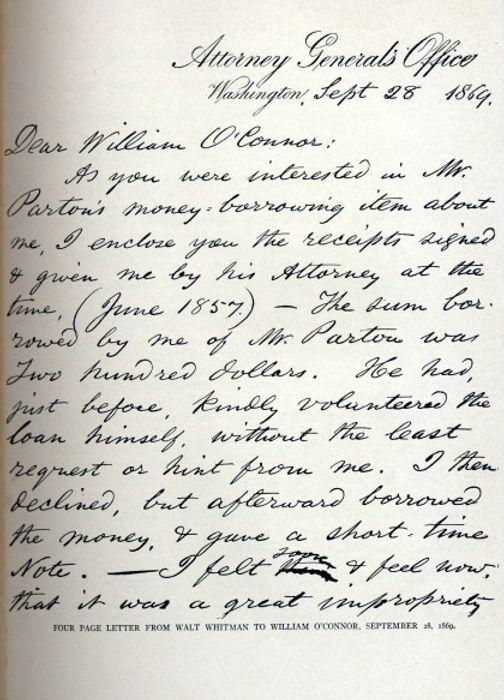 [Begin page figure-003]
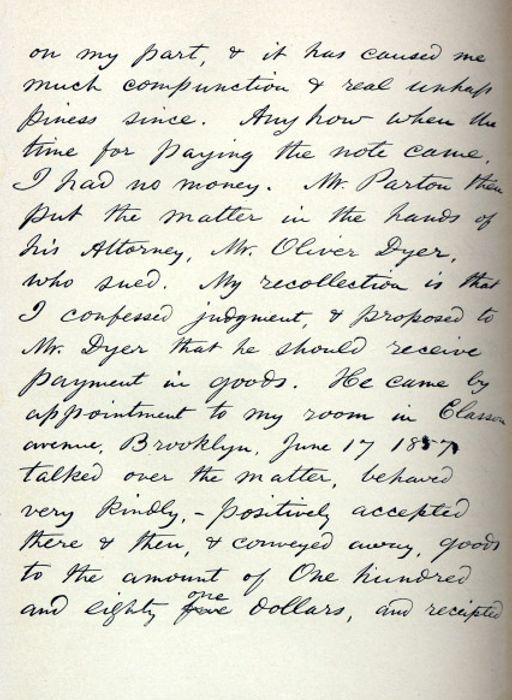 [Begin page figure-003]
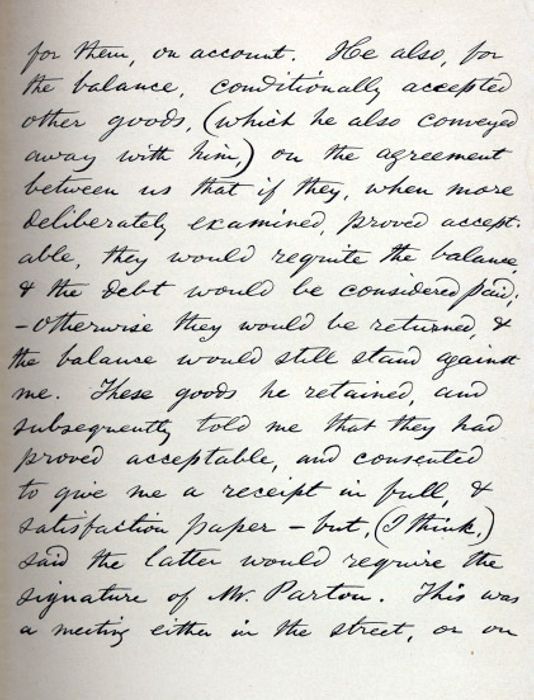 [Begin page figure-003]
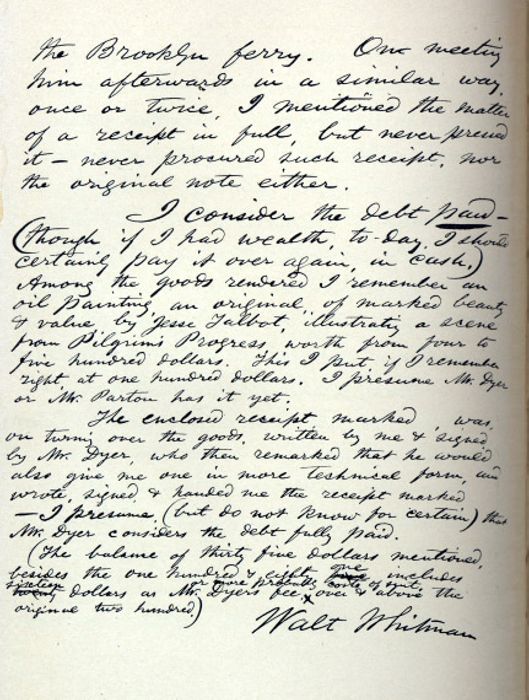 [Begin page 237] Harned and me, though he referred to it more than once. Later he said:
"It is all past and gone: it hardly seems worth dwelling upon—taking seriously—any more." But more recent writers have taken the thing seriously. I submit here the document prepared for William by W. and passed into my hands since by Nellie O'Connor.]
[Begin page 237] Harned and me, though he referred to it more than once. Later he said:
"It is all past and gone: it hardly seems worth dwelling upon—taking seriously—any more." But more recent writers have taken the thing seriously. I submit here the document prepared for William by W. and passed into my hands since by Nellie O'Connor.]
As you were interested in Mr. Parton's money-borrowing item about me, I enclose you the receipts signed and given me by his attorney at the time, (June 1857)—The sum borrowed by me of Mr. Parton was Two hundred dollars. He had, just before, kindly volunteered the loan himself, without the least request or hint from me. I then declined, but afterward borrowed the money, and gave a short-time Note. I felt soon and feel now, that it was a great impropriety on my part, and it has caused me much compunction and real unhappiness since. Anyhow when the time for paying the note came, I had no money. Mr. Parton then put the matter in the hands of his Attorney, Mr. Oliver Dyer, who sued. My recollection is that I confessed my judgment, and proposed to Mr. Dyer that he should receive payment in goods. He came by appointment to my room in Classen avenue, Brooklyn, June 17, 1857, talked over the matter, behaved very kindly,—positively accepted there and then, and conveyed away, goods to the amount of One hundred and eighty one dollars, and receipted for them, on account. He also, for the balance, conditionally accepted other goods, (which he also conveyed away with him,) on the agreement between us that if they, when more deliberately examined, proved acceptable, they would requite the balance, and the debt would be considered paid;—otherwise they would be returned, and the balance would still stand against me. These goods he retained, and subsequently told me that they had proved acceptable, and consented to give me a receipt in full, and satisfaction paper [Begin page 238]—but, (I think,) said the latter would require the signature of Mr. Parton. This was a meeting either in the street, or on the Brooklyn ferry. On meeting him afterwards in a similar way, once or twice, I mentioned the matter of a receipt in full, but never pressed it—never procured such receipt, nor the original note either.
I consider the debt paid—(though if I had wealth, to-day, I should certainly pay it over again, in cash.) Among the goods rendered I remember an oil painting, an original of marked beauty and value, by Jesse Talbot, illustrating a scene from Pilgrim's Progress, worth from four to five hundred dollars. This I put, if I remember right, at one hundred dollars. I presume Mr. Dyer or Mr. Parton has it yet.
The enclosed receipt marked 1, was, on turning over the goods, written by me and signed by Mr. Dyer, who then remarked that he would also give me one in more technical form, and wrote, signed, and handed me the receipt marked 2. I presume (but do not know for certain) that Mr. Dyer considers this debt fully paid.
(The balance of thirty-five dollars mentioned, besides the one hundred and eighty one, includes sixteen dollars as Mr. Dyer's fee, or more probably costs of suit, over and above the original two hundred.)
Walt Whitman. Brooklyn June 17th 1857.Received by the undersigned (as Attorney for James Parton) the sum of One Hundred and Eighty-One Dollars, in part payment and settlement of a Judgment and execution at suit of James Parton against Walt Whitman—Leaving Thirty-Five Dollars Due, which, when paid, is hereby declared to be a full settlement of said Judgment, Note, &c., and all demands connected with the same.
Oliver Dyer. [Begin page figure-004]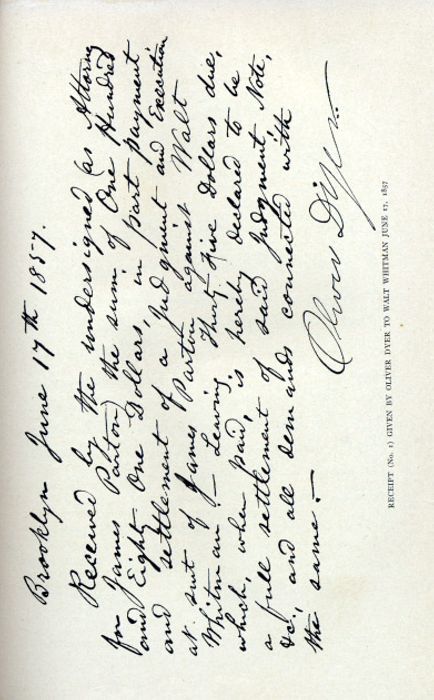 [Begin page figure-005]
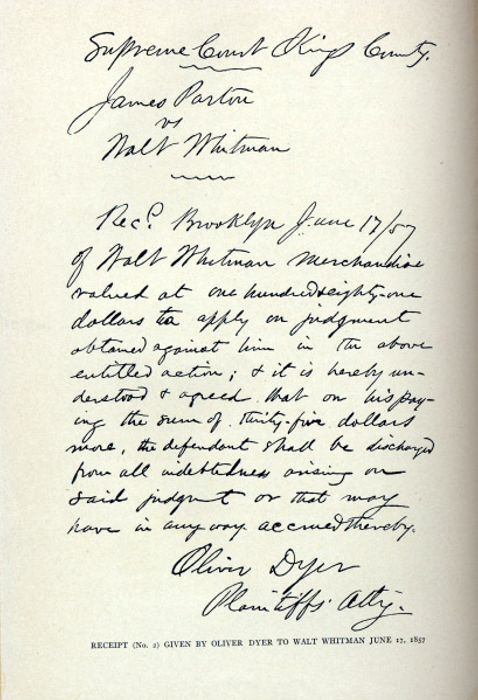 [Begin page 239]
Supreme Court Kings County.
James Parton vs Walt Whitman.
[Begin page 239]
Supreme Court Kings County.
James Parton vs Walt Whitman.
Rec'd Brooklyn June 17, 1857, of Walt Whitman merchandise valued at one hundred and eighty-one dollars to apply on judgment obtained against him in the above entitled action; and it is hereby understood and agreed that on his paying the sum of thirty-five dollars more, the defendant shall be discharged from all indebtedness arising on said judgment or that may have in any way accrued thereby.
Oliver Dyer Plaintiff's Atty.[Pencilled memo. on reverse of receipt one in W. W.'s hand] Mr. Dyer also took Jefferson's works and Carlyle's Cromwell at $9 (if he keeps them)—which would then leave $26. due as the Judgment or claim
June 17, '57 W. W.The envelope in which W. sent this material was addressed to "Wm. D. O'Connor, Light House Board, Treasury Dept, Washington City." O'Conner marked the envelope: "Parton matter." W.'s letter was written on the paper of the Attorney General's Office. Receipt one was written in W. W.'s hand on a plain slip of paper and signed by Dyer. Receipt two was written all in Dyer's hand on the reverse of a tax bill of the City of Williamsburgh.
Wednesday, December 5, 1888.
Saw Oldach to-day. Took sheets, labels, &c., to him. Had his promise of some books for this week—Saturday, probably. Found three sheets short in one of W.'s packages of twenty-five. Nothing new at McKay's. Secured the remaining eight books of our thirty-four. These are billed [Begin page 240] against us: to be deducted in settlement next month: binding, thirteen and a half cents apiece. Two letters from Bucke—one dated 3d, the other 4th. Advises the more regular and frequent attendance of the Doctor—if not Osler then someone to cooperate with him. I wrote back saying among other things: We will wait till after the consultation of the doctors to-day: will find out then what Osler counsels.
7.45. At 328. Ed out—taking a music lesson. W. sitting up. Mrs. Davis talking with him. She left. I remarked my gladness seeing him about again. He shook his head: "Don't count too much on that." After all he had been worse than ever. "I am very much knocked out indeed." Osler had been over. "Came," W. said, "with a Dr. Wharton." "This Dr. Wharton," W. "did not know." He added. "They had a consultation: said nothing to me: it is a glandular trouble—that they allowed." But before he would say much or anything about himself he demanded as he did yesterday: "Tell me of the mother—the child"—and when I had done so: "That is good news, anyhow, where good news is not plentiful." He looked worse than at any time since June. Had done little or nothing. "Wrote a short note to Dr. Bucke—that is all." Papers all about him unread. Kennedy's last Transcript on the floor unopened: Liberty, too (he always reads Liberty). "No letter from Doctor to-day." Then again inquiring: "Philadelphia, I suppose, is much alive—perhaps a little more so than usual for Christmas's sake—eh?" And he asked: "Are the stars out?" I described the trip across the river this evening: the new moon— "a thin semicircular strip of a thing: the clear sky: the bit of slender cloud overhead: the water full of mobile reflections: the electric lights up along the river's edge." He listened intently. "How that appeals to me! A few little glints: even a mere touch or so: a striking trifle, it may be: only this, and you have a wonderful picture. The electric lights are new since my time: there were never any along the river's front as [Begin page 241] I knew it." Something being said of Ingersoll, W. added: "The Colonel has a big air about him that discomposes his enemies: they are not prepared for his generosity, his wit, his hospitality" he is a dangerous man to meet if you don't want to like him: he overcomes venom—he baffles the quibblers." Said this of Gilder: "Some of the hard and fast penny-a-liners on the poetic field affect to despise Gilder: they are a poor lot—most all of them: Gilder has written some poems which will live out the lives of most of the second-class songs of his day: genuine fine pretty big stuff: some of it, almost free. I sometimes incline to believe that Watson wants to be free but don't dare to. At any rate, he has my admiration for some things he has done—yes, admiration: and my personal love surely, always, always." He said of the Century: "Sometimes I get mad at it: it seems so sort of fussy, extra nice, pouting: but then I turn about—have another way of explaining its limitations: I say to myself: those very limitations were designed—maybe rightly designed—therefore it does not belong to me to complain."
W. said of his illness: "It is an old man's affliction: seems to be very common with old men—old age." Had he entered into any details in his combination letter sent off yesterday? "No: no really personal details: things more or less in the shape of gossip: little personal matters coming within the lines of our work—our sympathies." I had found him the proof strip of the cipher poem in the parlor. Much pleased. "I knew it was about somewhere: I want to keep it by me." W. not only weak but very restless. In the little time I stayed I twice helped him from the chair to the bed—he staying on the bed after that. "Guess I'll sit here," was the way he put it—too utterly exhausted to try another trip. Lamented absence of letters—especially letters from O'Connor. "He does not write a word: it is an ominously significant silence." I urged it upon W. that we should have a Camden doctor to assist, as Bucke advises. After a little talk W. assented— "if found necessary." But [Begin page 242] as Wharton had left a prescription with Ed for to-morrow "we had best wait to learn what the result of the injection may be," at least, if nothing more. The doctors were reticent while here. I of course was not present: they came this afternoon. Osler said he had himself heard from Bucke. Instructed Ed, under certain contingencies, to call upon Dr. Walsh—(brother of William, of Lippincott's). Doctors examined W.'s urine.
No callers to-day save Corning, who did not go upstairs. Curtz in to see W. about printing (forenoon). Stayed too long. W. called Ed: advised him: "Make my bed: I must take a wash all over, then lie down again": turning to Curtz with the charge: "You will have to excuse me now"— Curtz thereupon going. He did sponge himself: saying, however, to Ed, that he did n't think he would "be able to do that many times more alone"—that he "would have to be assisted."
We talked about the cover for the complete W. W. He said: "Apply your own best thought to the question: hit upon something characteristic": and again: "I shall have to trust that to you: you must follow your own serious judgment in the matter." I spoke again as I was about leaving, he holding my hand: "You know now, Walt, I am at your command—ready, willing, anxious, to serve you": he answering: "Yes, and I shall call on you." I urged further: "You believe all this of me?" He looked up into my eyes, a wonderful smile on his face as his grasp of my hand tightened: "Yes—I do, my boy: I know you: I believe you." Then I said jokingly: "Well—I must go now: I must not talk you to death"—he laughing and answering: "I do not propose to die that way."
Harned had been in. I was not there at the time. W. still in the greatest uneasiness and pain: able to do nothing, go nowhere. After leaving him stopped downstairs to talk a bit with Mary. Heard him up again. He wrote Bucke that he was up forty or fifty items one night last week. All of us are anxious. Bucke will be called upon the first show of [Begin page 243] grave danger. W. seems hopeless. Osler comes Friday again. I secured the three "shorts" for a package W. had marked: "Nine good autographs." Note his care to the last. He insisted then on taking the pen himself and changing "9" to "6 (six)." Did not feel in good enough condition to write out the checks. "Let it go another day," &c. Mrs. Davis says W. ate oysters freely, for him, to-day, but is very abstemious in general. W. gave me some prize stuff to-night. Three letters tied in a piece of departmental red tape. A letter from Alcott to W. A letter replying to it from W. to A. Then a second letter from Alcott to W. I looked at them enough to see what they were. Then I was for sitting right down and reading them. I did not at first realize that I was to have them for good. He said: "Take your time in studying them out: I meant them for you to take away with you—to keep!" I must have looked surprised. I felt so. He said: "Yes—that 's so: for you to keep: they belong to you: first, because you are the natural transcendentalist of our group here—the best of us all in that: second, because it throws some light on the story that Emerson later on repented of his folly in endorsing Leaves of Grass: there are things in the letters which bear on that—which tend to make that intimation improbable. At any rate, put the letters in your pocket: we may say a bit about them again—sometime: maybe"—here he stopped a few seconds—then adding: "I say sometime: that sounds to me a little like boasting: sometime: I 've been feeling the last week or so as if there was to be no more sometime for me here, with you, boy: though I don't know—I don't know." I could not wait to get home to read the letters. I stood under the lamp at the street corner nearest 328 and did it.
Concord, Jan. 7, 1868. Walt Whitman:The scope and spirit of your paper on Democracy delight and satisfy me beyond all expectation, [Begin page 244] and I write without compliment or reserve to the man, the American Columbus, whose sagacity has thus sounded adventurously the sea of our Social Chaos and anchored his thought securely in soil of the newly discovered Atlantides about which Grecian Plato died dreaming. Especially have I to thank you for delivering such doughty thrusts into the sides of the British Behemoth sending him bottomwards. All you say of the Imperial West is strong and is.
I talked last evening with Emerson about your strong strokes at the thoughtless literature and Godless faith of this East—nothing as yet to show of original type—wholly null and empty of ideas—only Thoreau to redeem it from idiocy and fatuity.
That dutiful drill of yours, too, in Humanity during the dread struggle of these last years gives to your thought a sanction and potency which Universities cannot claim nor confer.
Personally A. Bronson Alcott. April 26, '68. To Mr. Alcott.Your kind and welcome letter came to hand. Pardon me for not responding sooner. I esteem your friendly appreciation of Democracy. I have just sent you Personalism—which is to be followed, in perhaps a couple of months or so, by another article addressing itself mainly to the question of what kind of Literature we must seek for our coming America, &c. In the three articles (to be gathered probably in a book) I put fort, to germinate if they may, what I would fain hope might prove little seeds and roots.
I am still living here in Washington, employed in a post in the Attorney General's office, very pleasant, with sufficient leisure, and almost entirely without those peculiar belongings that make the Treasury Interior Dep't &c. clerk- [Begin page 245]ships disagreeable. I am, as ever, working on Leaves of Grass—hoping to bring it yet into fitter and fuller proportions. I am well as usual. My dear mother is living and well; we speak of you. I wish you to give my best respects and love to Mr. Emerson.
Concord, April 28, 1868. My dear Sir:Your friendly note of the 26th has just come to hand, and yesterday came your noble paper on Personalism—for both of which attentions you have my thanks. I shall look for your views of the aboriginal literature, fully believing that your thought is on the track of Empire and sees the route to Personal Power for the nation, as for the individual. And never a people needed more the Cosmic thought to inspire and guide its action.
Yet think of the progress out of the twilight since your star dawned upon our hazy horizon.
Some friend has sent me from time to time appreciative notices of yourself, knowing by some supreme instinct my hope in whatever promises expansion of our hemisphere. You, too, kindly inform me of particulars about your personal position and prosperity. I am interested in all you choose to communicate.
Emerson is just home from your city of steeples and stocks, but I have not spoken with him yet. I know how fully he shares in my appreciation of yourself and works.
Please accept the little sketch accompanying this, and oblige
Yours, A. Bronson Alcott.Thursday, December 6, 1888.
8 P. M. Ed met me with a smiling face. W. better: had not got up better but had improved during the day. Went upstairs. W. sat in his chair, a pad on his knee, writing a [Begin page 246] letter. Spoke of this before he had answered my questions about his health. "It is for Edward Carpenter," he said: "Edward Carpenter, of England. I have had a regular invasion of English visitors to-day: one of them from Edward—came with a letter of introduction." He laid the pad down on a pile of papers. He had addressed the envelope in ink and stamped it: the letter was written in pencil. "I won't send it off to-day"—he had written about three-quarters of the letter page— "will hold it over: add a little, then let it go, to-morrow: I sat down right after tea intending to send it to the post office by Ed, but found I did not feel well enough: let it go." "Edward" was "likely to come over here at any time." "He has paid us three or four visits: after awhile will come the fifth." I asked: "Three or four? That sounds like too many." This somehow seemed to trouble W. He retorted: "Who the hell should know—you or I?" I was going to say no again but he at once went on: "Carpenter is a youngish man, not now over thirty-seven, I should say: Italian in appearance: radical of the radicals: come-outer: one of the social fellows in England who get constitutions by the ears—stir up thought, progress. Strange to say, too, Carpenter is really liked by the dons, the fellows on top: liked in spite of his radicalism, his espousal of hated ideas." Carpenter was "a Shelleyite": England now "seems full of Shelleyites—so much so, I question at times: is n't there too much of this? too much crying, screaming, for progress? Should n't the brakes be put down?" But he "always rejected" his "suspicions." He came "around inevitable to" his "optimism." "More than all else," he continued: "what I am now going to tell will amaze you." Then he said: Oxford, Cambridge, have too much money—so many thousands and thousands of crowns more than is required for college purposes. How to dispose of this? Here is a vexed question. Finally the idea was hit upon, that lectures be established in the outlying places: not avoiding London, exactly, but mainly confining themselves to the smaller places: regular [Begin page 247] corps of lecturers being sent out: to Birmingham, Bristol—towns of that kind. Edward was very young, yet was chosen for one of these boards of lecturers—chosen in spite of his radical proclivities. The lectures were for the masses—workingmen, anybody who would come."
W. said Carpenter had "come of wealthy parents." "The father died: they had lived in Bristol: Edward came in for his share of the patrimony: quite a showable share it was, too." C. had been "much attached" to a young man whose "great ambition had been to get a farm of his own to work, to live upon: Edward encouraged him. When he came into his money Edward invested in land: the friend was married: the three lived together: Edward was not always there, yet mainly." W. spoke of it as "near a still larger place." "Edward has described to me the difficulty he found in getting land—getting a freehold: it is almost incredible—he says it is almost impossible to get. Think of it—in a civilized land: land mostly unoccupied: even here it seems the same. They had settled in this place—Edward for some part of the time off on the continent—seeking adventures—interesting himself in the masses: studying." Then: "Remember, Carpenter is a college man, but one of the liberal samples of that class." He had been "given all the advantages": had "availed himself wisely of them." At one time recently he had "started a coffee house in one of the second or third class English cities"— "a venture reformatory in nature—supposed to be for the people: but according to the story of my visitor to-day it has gone bad—been given up." The problem now is "for another change." "My visitor man told me they are very much discouraged—talk of coming to America: Edward willing, the friend willing, the wife objecting. I should not wonder if it was yet done." W.: "The strain of that English life seems intense: the fight is going against them: but is it any better here?" He called Carpenter "a noble fellow." W. believed him absolutely friendly to Leaves of Grass: "in fact, to me personally." What would "come out of Carpenter's [Begin page 248] life" was "yet to be developed." It had for him "the pathos of a half-shadowed history." But: "I did not encourage the young man to talk much to-day: insisted upon the limit on his time: I was not feeling bright." "These vivid young fellows—what are they going to lead us to? The world abounds with 'em: earnest, astute, clarified, wanting to act, seeking progress, progress, progress—the fever of the age!" Then he laughed. "After all" was he "not as radical as the most radical of 'em?"
Getting off this strain he asked me as he has every day: "What of the baby—the mother? And well still? Tom was in last night for an instant—pretty late." Gave me two letters from Bucke, Dec. 2d and 3d—looked for, found them, himself. They occasioned some talk of his health. W. wished me to particularly read the letter of the 3d. "It seems like sense: the Doctor is level-headed in such matters—not an alarmist: perhaps we should do as he says: what do you think about it?" I will quote the letter itself:
London, 3 Dec., 1888.Your letter of Friday and Saturday (30th and 1st) came to hand this afternoon and has made me feel very anxious for you. I fear you are suffering a great deal. I have written to Osler urging him to try and do something to relieve that horrible irritation of the bladder that keeps you getting up so much at night, and it seems to me imperative that the bowels should be kept open. I fear that Osler is too busy to give you the attention you require and it seems to me that you ought to have him recommend a good man who would see you every day, and twice a day if necessary, while O. himself would come over from time to time and see you with him. I have also written to Traubel urging him to make some arrangement by which you will be seen at least once a day by some good doctor. I wish I could be with you, but that is impossible at present. I shall hope to hear very soon that proper arrangements have been made and [Begin page 249] that you are more comfortable. I am always affectionately yours,
R. M. Bucke.W. said: "Of course you fellows will do as you think best: you do generally: I am in your hands: yet I would have you always lean to the side of mercy—don't oppress me with doctors, nurses, attentions, medicaments: I am near enough dead as it is: yet I may say I am conscious that Maurice is in effect wise—only suggests a necessary precaution." Then suddenly W. asked me: "Don't you enjoy Doctor's picture in the other letter? Read that passage to me."
"But I have a good fire in my office, have just had a good dinner of roast turkey and potatoes boiled in their jackets (which is the only way potato should ever be cooked), and have a very middling book to read (Obiter Dicta, 2d series, Augustine Birrell), so I feel that I can defy the Pope the Devil and the Pretender—(an old expression of my father's)."
W. was very jolly over this: "I can defy the Pope the Devil and the Pretender! How rich that is! and the turkey and the potatoes with their jackets on and the very middling book! Oh Maurice, dear Maurice, that 's better than all your medical advice! Why should n't I too defy the Pope the Devil and the Pretender? Why should n't I? Defy them?" He was very happy over it.
W. said: "I think Bucke is unnecessarily anxious, alarmed: yet I am sure we realize here all the danger he speaks about: it seems to me Osler is doing as well as could be expected—that he is relieving me: no doctor could do more." I suggested: "But Bucke is absent—is therefore more nervous." He granted that: "It is true: you are right—of course we know what animates all the Doctor's anxiety." But he thought "calm" was "enjoined." [Begin page 250] "There are certain things which can be done—certain things which cannot: it is for us to be on guard: more than that is impossible." Said he often wrote the Doctor notes made up of items written different days. "I write a few lines—then lay the thing aside for later news: so to-day—so to-morrow: but if you write the Doctor in the morning tell him I am better: you may call it much better: tell him I am relieved of this terrible pressure: I promised myself nothing: you know, two or three days ago we all thought I was better when it proved only to be a rest before a worse siege: so don't you, don't Eddy, be too quick—we must hold our horses." He thought this had been "mainly" but "not only" a bladder trouble. "I am always more or less constipated." "Last night I got full four hours' sleep—think I slept a clean sweep from twelve to four, undisturbed: Oh! that was a terrible experience Friday—ever since: the going to and fro—pain, unrest." He supposed his description of the one or two bad nights last week was chiefly responsible for Bucke's alarm. "I am not well yet by any means, but then a man in my condition counts little things."
He spoke of disease in general—epidemics, &c., &c. Then of diarrhea. "How much I knew of diarrhæa in the hospitals—the army: diarrhea was of all troubles the most prevalent." I interjected: "and a bad form of it, too!" W.: "Yes, a bad form: it meant death, death: I nursed many a man down with diarrhæa." He instanced one case of a German—a young man— "a miserable scamp and scalawag he was, too"—yet with "elements in his chaotic nature" which W. "rather liked." "He liked me, too, I think: came there, down with diarrhæa: oh! it was very bad: we nursed him: I was there once, twice, often three times a day: posted the nurses, the doctors." Finally the man "came around, was better." There was "hope of recovery"—"almost assurance." "The doctor came to me one evening—said to me: 'We're going to get your boy about again': next day he got a big mess of pork and beans: his mother, sister, smuggled them in—surrepti- [Begin page 251]tiously brought them in." It had occurred while no attendants were present— "cadets, nurses, doctors, me." The fellow was "ravenously hungry"—he "swallowed the whole mess with gusto—was taken with a relapse—then died: that finished him."
W. closed his eyes, dropped back in his chair. "I can see him now—it is one of those days long ago—the devilishly obstinate, illiterate boy he was: no one could do anything with him: doctors, nurses: no one but me. For me he would do anything"—as W. put it— "somehow." "Yet I was a perfect tyrant with him. Yes, yes: I can see him now: the close-cropped hair, the beautiful, full, eloquent brown eye—the bullet head—the strong mouth: then as he lay there, pale, sick, thin." He had seen "many such cases, seemingly insignificant in themselves, yet part of the real history of that time." He had "drawn physical lessons" from it—one of them, "how much physical trouble is traceable to stomachic disarrangement." "The stomach, the lower trunk—heed it, care for it"—he swept his hand down his ample front— "there is nothing in legs or arms or head so preciously to be guarded." He said it was curious with "this German lad"—that he "distrusted the doctors"—probably "for reasons no better nor worse than our own." "There seemed to be in him as in all of us at some hours that suspicion—what do the doctors know?—what a mass of solid pretence after all! what the devil is the use of diets, abstentions, prohibitions, squeamishness?" "We all feel that way at times: I know I do: but I know too that it is unreasonable—that the doctor is justified as others are justified." "Yet I feel that the best doctor is bitten somewhat—the best—I don't except any: it is the taint of the preachers—the same thing: the best minister is here or there bitten: they can't avoid it—it is the stamp of their circumstance. Tell that to Clifford sometime: tell him I told you to—tell him for me: tell him I said, beware! beware! it is a poison, a pestilence!" I described Clifford's attendance at the big Farrar reception of [Begin page 252] ministers in the city: hundreds were there: Clifford's swift exit, repulsed as he was by the frightful clerical air prevalent. W. laughed. "That 's a good thing to hear of him—I can see how natural it should be for him: I confess there 's no trace of the taint in Clifford—no air, word, gesture—nothing: he is certainly the most remarkable human being for a preacher I have ever known." Dr. Brinton met C. at the lecture Friday last: was with him at tea &c.: said to me Monday that he thought C. "was an individual of noteworthy character.: W. not "surprised" that B. had "discovered that." "I have no doubt it is so: more 's the wonder when you put that and the minister together."
I chanced upon a sheet of Ms. on floor—much singed along the edges—evidently had been against the stove. Headline: "On Religion"—something of that sort: asked W.: "Was that matter not printed," &c. He answered: "I don't know: let me see." Took it—glanced across the page. "On religion!" he exclaimed: "God save me!" Then: "Probably something I commenced long long ago—then laid it by for future consideration but never considered." He surveyed the litter about him—under his feet, on the table. "It is getting very bad, don't you think? The worst of it is I am very unsteady on my feet and some day shall have a fall—trip." He said again: "Eddie has been at me time and time again to let him set to and clean up. We must do it—do it before long." He felt himself "getting more and more helpless."
Spoke of Tom. "He was in, but late: told me a little about the boy." Corning called. Did not see W. Sent up by me to my father a picture of Dr. Bucke for him to see. He had written on the back of it: "My friend Dr. R. M. Bucke came Oct: 15 '88". Still pleads off writing out the checks: "I do not feel quite disposed for it."
Discussed Epictetus—W. telling me finally to take his little pocket Ep. along. The following is now the full inscription on 1st fly-leaf:
[Begin page 253]"Walt Whitman (sent me by my friend the translator T W H Rolleston, from Dresden, Saxony)——1881"[this in ink—probably written when book was received.] Then came the following—written with purple indelible pencil: "March—1886—T W R is now in Ireland, (Delgany, County Wicklow)—and edits the Dublin University Magazine." "Magazine" marked out with purple pencil and "Review" put above it—no doubt about the same time. This fall he added (now blue pencil): "seems to have left"—evidently meaning review: then writing this: "from 1881 to '88—Have had this little Vol. at hand or in my hand often, all these years —" finally, this, just added the other day in black pencil: "Translated a good part of L. of G. (with conjunction of Dr. Knortz) into German—being printed (I hear) in Nov. '88 in Zurich, Switzerland."
W. said: "This book has become in a sense sacred, precious, to me: I have had it about me so long—lived with it in terms of such familiarity." I nudged him a bit about the "secret." "You have n't said anything about it, Walt." He was serious at once: "But I have not forgotten: I want you to know it—know all about it: you." I can't make it out. He has something on his mind.
Friday, December 7, 1888.
7.55 P. M. Fine night. Cool and clear. W. still holding his head up. "All right at the top": that is his favorite assurance. He sat near the light (the room very cosy). Pad on his knee. Writing to Bucke. Stopped upon my entrance. Talked freely at once. "What news do you bring?" Returned him the soft dummy I got from Oldach to-day. Oldach incorrigible: would not yield: Monday will be the day—not before, but then sure, though: even then only half a dozen books at best. W. was merry over it. "Well, like the fellow whose whole wardrobe was stolen but his hat: it 's not worth much, it 's not of much practical benefit, but thank God something is left!" Then added: "I suppose [Begin page 254] there 's nothing for us to do but resign ourselves—wait: I am convinced that old Oldach will have his way." Yet was "exceedingly anxious to send copies of the book out to Bucke and others." "It is chiefly for that I have grown impatient." He described his day as "busier": had read papers (opened several of Kennedy's Transcripts: Press, Record, the Camden papers): "tried to write a little: felt, for me, really comfortable. The bladder trouble has subsided, if not withdrawn: the pains are not what they were—the gnawings, the heat: I have hours of the day, have had them to-day, as bad as could be, but the day as a whole has been better: the overwhelming pressure gone: and when evening comes (this evening especially) there is wont to come with it a real good feeling of security." Then he questioned me about my "day's doings." "I suppose Philadelphia is all alive—every nerve of her?" Spoke of "life going on no matter who stayed or who recked it not." "It is strange anyhow how many big things go along their ways and we know nothing of them: I was reading something about The Youth's Companion to-day: its circulation must be immense, its business value great: probably a matter of hundreds of thousands of dollars. It is phenomenal." He spoke of the Gartenlaube. "What does the word mean?" He had seen it—looked it over: called it "high class" with "illustrations and make-up admirable indeed." He does not read German.
Boozer said to-day pointing to the '55 W. W.: "I still think this the best of the pictures." W.: "It is good: something is to be said for it: but I feel that the best picture is the frontispiece, the title-page"—the complete W. W.— "but not only as a piece of art (where it is effective, refined), but because so thoroughly characteristic of me—of the book—falls in line with the purposes we had in view at the start." As he sat there, pen in hand, his hair free off his head, he made me think of some of the operatic Fausts I had seen. I said so. He laughed: "I am not troubling myself with Faustian problems: I have heard [Begin page 255] all the Fausts, I may say: Gounod's, others: Faust plays: but never was moved fundamentally—never was attracted." Was it because the legend itself failed to touch him? "Yes—even that: I guess my time for it is yet to come: I am yet to read it—read it as I should: Bucke says so: I think he must be right."
Tom stopped in on his way down to a church entertainment. Got W.'s Contemporary card. Stayed only a few minutes. W. replied to a question about his health: "I 'm better, I own: I can say I 'm decidedly better—better than better this evening." Harned pleased. More color. Voice stronger. W.'s first question to Tom was: "How is the madame? how the boy?" and afterwards: "I shall be very curiously set about to see that boy: I guess I'll tell the Doctor about it: he likes to hear all about us here: Mrs. Bucke, too: I 'm writing to him now—was when you came in: I'll write some here to-night, then finish to-morrow to close the record of the week: it will half fill up this side of the sheet." Did he never turn over—write on the reverse of the sheet? Always go to the second sheet? He smiled waggishly: "Oh! I would go to the second sheet but don't find occasion to: write with pencil generally: if when I get here"— "I find I have too much left to say, I crowd it: then, when I get here at the foot, stop, sign it—conclude that I must not prolong the affliction." He ended this with a gay chuckle: "Even the Doctor would growl if I went on too far."
Sent a book to Carpenter to-day. "I could do that much, at the least." The letter went off with the book. I told him of Henry George's trip abroad: his meeting with a Philadelphia high protectionist on ship, with wife, children, servants, going to Europe for medical treatment: the proposition of this man (see Standard, Dec. 8): drop a tube two hundred feet below the surface of the sea for traffic, &c. &c.: George suggesting: But what good, with any army guarding both ends, &c.? W. highly interested: "What could he [Begin page 256] say to that? À propos of that I may say our Philadelphian would only need to go to the end of a telephone or telegraph wire and get all the medical treatment he needs (and more than he needs)—all he goes abroad for: summon the best the world affords—surgeons, wise, skilled, as learned as science can make them: right here in Philadelphia: in New York: none better: in fact I think it is even acknowledged." W. "more and more regretted the tendencies towards legislation." "Restriction! restriction! everywhere restriction!" "Among other things," W. said, "Tom Donaldson thinks he knows something about pictures—has been in Washington helping to fix up the tariff on art. There are some of the fellows who could extend a welcome to everything but books. They send me a book from England: our postmaster sends me word I must send him fifty or sixty or seventy or eighty cents to secure it: I send books abroad (sent one to Carpenter to-day): the simple postage put on: they go without question. This is one of the beautiful contrasts."
Harned left at this point. H. is a tariff man. W. said: "That 's one of the things in Tom it 's best not to try to explain: the whole tariff business is a robbery—a highwayman's job: sort of police's commerce—interferes with the normal everyday freedom of one man treating with another. Tom ought to know better." Was curious: learned I often wrote on trips: cars, boats, &c.: "Do you carry little books about with you?" he asked. He was "never without them: two or three sheets of the best paper folded, stitched together." I reminded him of his promise to give me one of his note-books. "One of the War time?" and when I said: "Yes—that"—he replied: "Surely if you want it: well and good." Then he laughed in his quiet kindly way: "I guess I'll have to do for you what I 've often threatened to do to Bucke—I'll get a trunk here: put into it the things I want you to have." Then: "The trunk I mean would be a box. Ed has been very anxious to have something done: the boy thinks the room has too littery a character: I told him to-day that it should be definitively, dis- [Begin page 257]tinctively, finally, fully, set down as our purpose to get at this matter to-morrow and sort it out." Ed afterwards told me that W. had "not felt well enough" to-day, and explained how the "religion" piece I had picked up from the floor (singed all along the edges) had come into that state. Ed had gone into the room one evening after W. had retired: "found considerable smoke there": on investigation discovered that a whole pile of papers had been pushed against the stove there—were smouldering. W. has made three or four such narrow escapes.
I had a copy of the Bazar with me. W. regarded the pictures with considerable interest—for one, Otto Zimmerman's picture (1881) of Christ and the Fisherman. W. thought "its most remarkable feature the absence of the aureola about the head of Jesus here"—pointing with finger: "It is a wonderful powerful portrayal—this"—indicating Jesus— "a very significant face." Afterwards happened upon some illustrations of a story. "These are good, too: pictures of another sort: not like the Christ picture—but important, for their place." Greatly attracted by a picture, The Yoke of Misery, painted by J. Geoffroy, French: a man and boy harnessed to a cart of household movables, &c. He looked at it "long and long," as he puts it— "a touch of common life" which greatly "appealed" to him. He thought: "What a strange power our men are getting—the artists: nothing eludes them—defeats them." The Christ picture: "The engraving itself is noteworthy: as you say, there 's something in it never expressed by a steel engraving—something that steel can't compass." A reference some way to Eschylus. W. said: "He wrote his plays in trilogies (I have a friend—he always amuses me—calls them trillogies): Eschylus thought it consistent with nature that he should do so: but by and by came along fellows who broke the traces." I said Eschylus had interested me as a boy more than Homer. W.: "That is because you must have come upon Pope's translation of Homer." I owned up. "I thought so: and [Begin page 258] think it the most damnable that ever was conceived." "Almost inexcusable?" I put in. He looked over at me:— "I should say 'inexcusable' without the 'almost.'" I confessed an equal lack of affinity with Milton, Dryden, Pope, Gray. W.: "I can see it—share it: I can see why it should be: why it must be: they tell the story themselves—they are their own refutation: not one of them free: heavy, stilted, sticky: without ability, any of them, to soar: soar gracefully, freely—take wing into highest altitudes: I should say they are to be remembered now (not to be emulated) but as warnings." "That is one of my favorite notions," I said: "that the most important lessons of history are lessons of avoidance not of guidance." W.: "Which strikes me very forcibly—which is really profound: how can it be escaped?"
Was Tennyson exempt from the shackles of form and precedent? "Yes: oh! yes! Tennyson is exempt: his work, all of his work, is free from taint: polite, refined, polished, rich in color—but nature's own, after all, at bottom, in essence." I mentioned The Relief of Lucknow and The Revenge. "I agree with you: they are great emotional utterances—both of them: I felt them so at the time: I do not withdraw my opinion now." Adler said in a letter to me to-day: "Remember me most cordially to our dear friend." W. said: "Thanks! thanks! write to him: tell him Walt Whitman thanks him." I met Hunter with his daughter on the boat this evening. H. is unsteady on his feet: does not go out on evenings; sent his love to W. W. said: "Thanks: thanks again!" I described Hunter's designation of W.: "A noble good mon he is!"—the Scotch of it—and, "a cheerful mon is that!" W. pleased. "It is characteristic—it is Scotch: the 'mon' greatly Scotch: it does me good merely to hear such a man talk." We discussed the point—why not some time issue an edition of L. of G. in small vols, for pocket wear and tear? Song of Myself, Children of Adam, &c. &c., in separate books? W. believed in it. "It has long been my ambition to bring out [Begin page 259] an edition of Leaves of Grass with margins cut close, paper cover: some book rid of the usual cumbersome features. Everybody now wants margins. It is a theory to be seriously considered: now it is perhaps too late: but others may one day think of it—act on it." John Bright in a bad way— "about done for," W. says. W. again: "Yes indeed, that 's John Bright: good, pure, noble, high-souled." Ed says W. will not let him do anything for him that he can do for himself—especially in extreme personal directions. Letter to-day from Bucke (yesterday's) intimating that we can expect little physically from now on for Walt even if he should rally from the present attack. W. gave me this note for what he called my "bibliographic pigeon hole" to-night:
New York City, Aug. 9, 1867. Friend Whitman:I publish in to-morrow's Citizen Rosetti's article. It may wake people up.
I wish you would send me a copy of your book—a thing which I don't possess. I will mail you a copy of to-morrow's paper.
Very respectfully yours W. L. Alden (Associate Editor).I said: "I suppose Alden is another one of your editor enemies, Walt." He was on to my point. "Well—he was warmer then than he was later on." "In spite of your many enemies on newspapers you also had friends there." "Yes—I know: sometimes I growl so much about the enemies I forget the friends, which is wrong." Gave me an old Burroughs letter. He called it "one of John's come-out letters." I asked: "What do you mean by that?" He answered: "Don't you know?" "Yes, in general: but are not all John's letters come-out letters?" W. said: "They used to be: they are not so much so now." "What happened to him?" "I don't know. I don't mean that he has turned tail and run: I mean only that he has [Begin page 260] lost color—it is not quite so definitely, I may say quarrelsomely, virile as he was: he has lost something—something: but read the letter." I started to do so. He said: "Read it aloud."
Roxbury, N. Y., Aug. 24th, 1879. Dear Walt:Your letter came the other day and with the enclosure was very welcome. The papers came also. I am glad you keep well. I wish you here daily, it is so cool and salubrious. I imagined you off to some of the watering places. I was sorry I could not bring about the arrangement to have you come to our place, but Emma has not been very well, and though she said yes, I thought she was a little reluctant, and our own household was deranged by the cuttings up and running off of the girl. But I shall not rest till I have you up there.
I was much interested in the letters you enclosed. I must write to the Gilchrists.
I made the trip down the Delaware the last of June, all alone; went only to Hancock on the Erie Road, about fifty miles. Had a pretty good time, though lonely. I was not quite a week on the river. I slept in my boat or under it all the time. The next week after I returned home I wrote up my trip for the magazine, using the health and strength I gained on the voyage. Since I have been here I have written an article on Nature and the Poets, showing where our poets trip in their wood lore and natural history, and where they hit the mark. I catch them all napping. Emerson, Bryant, Whittier, Longfellow, &c. I shall have something to say about you, with extracts, but I cannot catch you in any mistake, as I wish I could, for that is my game. I wish I could also find a slip in Shakespeare or Tennyson, but I cannot according to my knowledge, except where Shakespeare follows the unscientific thought of his times, as in his treatment of the honey bee.
Yesterday i wrote a sort of Pastoral Letter to The Tribune, but I doubt if they find it worth while, and it is [Begin page 261] no matter. I will send you the proof of the article on the poets before it goes into the magazine.
There are two articles in the August Appleton's Journal that are worth glancing over—Arnold on Wordsworth and Earl D. on moosehunting. What simple good hearty fellows those English earls must be; not a false or conventional note in this one.
The baby is doing well and completely fills my heart. Wife is about as usual.
I find I cannot read Whittier and Longfellow and Lowell with any satisfaction. Your poems spoil me for any but the greatest. Coming from them to you is like coming from a hothouse to the shore or the mountain. I know this is so and is no pre-determined partiality of mine.
Faithfully John Burroughs.When I stopped reading W. said: "Now you probably know what i meant by come-out: unequivocal: as in the last passage, just before closing: he there makes a declaration: is unqualified, wholesale, final: that 's what I call come-out: also back farther, where he speaks of our science—says he has so far not tripped me up but that tripping me up is his game." I said: "Brinton has said the same thing to me—that he has tried his best to find flaws in your science but has failed to do so." "Did Brinton say that? Well—Brinton ought to know: with John and with him on my side I am well defended. John's letter appeals to me because of its uncompromising red-blooded espousal of the book—of my code: I respond to John: I feel the eminent kindliness, love, of his declaration: John never slushes but is always on the spot."
Saturday, December 8, 1888.
7.45 P. M. Harned had been in. Was going. I met him in the parlor. Much impressed with improvement in W.'s [Begin page 262] condition, which persists. Ed said: "He has been tip top to-day": and further: "It is cold here: I was so busy with him fixing up things I left the fire go out." They had actually got to work on the room. Ed described W. as watching him like a hawk as he picked up and arranged papers—leaning forward on the chair, pointing with his cane, &c. Dr. Walsh in to-day: had come (Ed says) by letters from Osler—is to meet Osler at W.'s to-morrow. Walsh confident W. would be better if he could be got to go out—go in a wheeling chair, &c. I afterwards put this to W., he seeming however to be averse.
Upstairs found W. on his bed. Light lowered: room very hot and close—not offensively so. Remarkable how sweet W. keeps his person: even his breath not bad. Ed remarks this. Considers it extraordinary. Reached out his hand. Very cordial. Had me turn up the light at once. His usual question: "How has it gone with you?" I answered by a word—then turned inquiringly to him. He said: "Well—well: still sustained—still sustained." Was entirely freed of the bladder trouble—the pain of it. He spoke of Walsh. "I seem to have met him before—been introduced to him—yet could not make it clear when or where." He felt weak: supposed he "always would be weak": yet suffered no discomforts. Eats now, sleep— "have my very bad hours, of course"—but on the whole is "out of danger." Had "sent letter off to Bucke" to-night, "with more cheery news" Asked: "How is the weather out of doors?" Then: "Is the moon up? Can you see the moon?" Again: "After all, I suppose good and bad weather comes back to the question, how do we ourselves feel? If we are well all is well, and vice versa: I think it was Emerson who, in one of his earlier essays, told the story: a man wanders over the moor: the night is dark: the way muddy, bad: but he is alive in every pore: oh so glad he is alive he dares not tell it even to himself because it may not prove real—may be an illusion." Had he realized such an experience? "I suppose I have: at any rate it seemed to me to have a profound [Begin page 263] meaning: I felt that it was true—true even beyond Emerson's utterance of it, which was great indeed."
I had something to say about depressed mental states. W. exclaimed: "Depression! that is O'Connor! Of all men that I know O'Connor most deserves study: he baffles, eludes: yet you must study him. He is at times the most vivid, brilliant, charming—most full of fun—of all beings: with me, with another, in a roomful of company: then come weeks of depression, hypocondriacism: while they are on they were moods not to be ignored—only to be suffered." "These moods seemed to be a necessary part of O'Connor's life: they had visited him for years and years." Did they interfere with his work? "No, not at all: he would get up in the morning, eat his breakfast, depart, with very few words: go down to the office: often, in after hours, take long, long walks—three or four hours at a stretch: be away from home all day, returning at midnight. That was frequent: Nellie would often be worried—fear for him, fear some harm—I don't know but go out for him." "Did you come in contact with him at such times?" "O yes! I would go down to the house—often go out and look for him. We always got along very well together. His wife at one time was very anxious—was afraid it would develop into an insanity: but she finally grew accustomed to it: years of association showed her that it meant what it did—nothing more." Had W. any theory about it? "I never gave it an explanation—never regarded it as the reaction from anything: simply felt: 'It is in him: therefore it must be.'"
W. turned his head towards me on the pillow: had been lying flat, his hands folded across his stomach. "You know Doctor—Doctor—he wrote The Wandering Jew?"—his memory for a minute going back on him: "Oh! Sue—Doctor Eugène Sue: have you read The Mysteries of Paris? There is one of the characters of that book—one of the, to me, most interesting characters: a fellow who used to go off every now and then, at stated periods, to have [Begin page 264] a hell of a time: he always knew when the period approached: would prepare for it—then have it out. It is like the animals—the snake—hybernating: being fat, well fed, lying down—going into its long rest: then coming forth, the time over, lean, lank, frail—the whole spirit gone out of it. This illustrates O'Connor."
The "lugging in" of Sue, as W. described it, kept W. going. "Read him—get him: the next time you go to town look about in one of the second-hand book stores: you will find the book there: it may be in several volumes: it is long: get them." Years ago, he said, the Harpers "started to publish it"—had "got along about ten pages or more"—found it "obscene—something obscene in it: stopped it thenceforth. But another publisher less squeamish bought the plates as they stood and went on with it: at that time translations were few: now there are many—some of them must be pretty cheap." I said I thought we had the book at home. W. replied: "Ah! I was going to say something more: if you come across the book, get it: after you are done with it bring it to me. I want to read it again."
I spoke of a paragraph credited to Huxley in which he described the gradual growth of the power to speak without notes. W. said: "It was right for him to do so: indeed, I should say to anyone, take the bull by the horns at the start: discard the notes—go on your own hook: it cannot be discovered too soon that this is the only real public speaking—the speaking without a barrier." Again: "Beecher once said to me: 'I thank my good fortune that nature almost from the first possessed me of such readiness, alertness, that I could speak freely': this is the conclusion of all men who speak or know speakers: I never realized it myself—never till the later years: but if I had the path to go over again—knowing what I know now—I should put that among the first of my studies. I have always been forensically in a bad way myself—like a man overboard without the bladders under his arms. To a man who intends in any way to make speechifying the business of his [Begin page 265] life it is especially a first and necessary part of his equipment." I asked if he did not think prolixity encouraged by speaking without even notes. But he was "willing to assent to it" even "with that danger." Adler speaks so. Evidently memorizes. W. questioned me: what was his style, bearing, voice?
As touching our talk last evening I showed him an issue of Cassell's National Library—a ten cent book, four by three, paper cover. He felt it as he lay on the bed—approved it. I said: "That 's my idea for Leaves of Grass—that 's the book I mean." He said: "I understand: I know its advantages: some day a public may demand this—of the Bible, of other books: years ago, in my young days, I felt it necessary to have books about me: not cumbersome—light: carried them in my pocket: Shakespeare, for instance—one of the Plays: I think it was Richard II, in some respects the most characteristic—I carried it most: I would buy a cheap second-hand book—tear out the play I wanted—paste the sheets carefully together—keep them with me." W. had read the report that Cleveland had a plurality of the popular vote over Harrison of about a hundred thousand. "I found it taken from The Tribune, I think: but The Tribune asks: what does that signify? it is all accounted for by a suppressed ballot: accord, protect, a free ballot and it will be hundreds of thousands the other way. The question with me is, is the first fact true? has Cleveland the vote supposed?" Here W. turned to me. "Has he?" then: "Well, that to me is the essential fact." "No matter how he got it?" I asked. W. said: "I did n't say that."
W. questioned me about the book: was anxious, yet willing to wait. "We must bide our time: I trust it to you to follow things." Returned him the Bucke picture and the Epictetus. Left with him copies of The Stage containing portraits of Kellogg and Lotta (photo engraving process) which he wished to see. I renewed the insurance for another month to-day.
[Begin page 266]We talked some about the Alcott letters. W. said: "Everything goes to disprove the idea cultivated by some of Emerson's friends that he immediately lost interest in my work after 1855. We have his own words to the contrary—we have the words of his intimates—things thrown out by his friends: visitors, too, European, many of them, have passed straight between Emerson and me—told me of Emerson's peculiar passive yet also emphatic questions anent me—what I stood for, what I am doing, what finally is likely to happen to Leaves of Grass." I asked: "Do you attach extreme importance to that letter? to Emerson's interest in you? Suppose he did change his view? suppose he did? would that ruin you?" He laughed. "No—probably not affect my fortunes at all: but the question has had its interest to me because of the emphatic partisanship of the literary clique which resented the original letter—which seemed almost to look upon it as on Emerson's part an act of treachery to the guild." I said: "I think it was more important for Emerson to write that letter than for you to receive it." He asked: "Do you say that after thinking it over and over and over? Do you?" I added: "Yes: after looking it over till there 's no more looking to be done." I found W. very warm about Alcott: "The two letters: did n't you feel impressed with them? They are old style: have a sort of gold button long coat effect: yet they are human, too—thoroughly so: Alcott was cordial—more apt to let himself go than Emerson: did, in fact: Emerson was always for poise, poise"— "was poised to death sometimes," I jerked in—W. taking it up: "Yes, we can say that and not say it: it 's true—it 's not true: it 's the sort of thing which in a little man would damn his soul but which in a man of Emerson's sufficient great size is only a foible smiled over and easily forgotten. The Alcott letters—they are very graceful: they are conclusive of their kind: they don't quite sound as if they were meant for me—they set me too much up and apart: but what a living loving act it was, at that time, handed out to me from that centre of cul- [Begin page 267]ture! Alcott was childlike: he was one of the divine simples; he belonged to the race of the teachers—the peripatetics: the wise wondering seers, instructors: a quite exceptional class of men who in another age, in another country, where such things are more directly popularly cherished and taken pride in, would be set to work at the expense of the state to conduct their schools." I said to W.: "You seem to think you have enemies at Concord." "Enemies? I may not call them that: maybe not that: but suspectors, certainly—people who would rather not than rather." He smiled a bit over it. "But we will not make overmuch of these matters: after all they come along, have a place, but are not the chief thing." W. had laid aside a Conway letter for me. He said of it: "You know what I think of Conway: how he draws, repels me—does both: how brilliant I think him—yet also how erratic—in some ways how unreliable: yet I respect him, too—he is a liberator—one of the freers of men: is generally, instinctively, on the right side—that is, on the rebel side: don't you call that the right side? This note has more to do with our attempt to bring out English editions: I am giving you all that sort of material I can put my hand on: there 's a bunch of Rossetti's letters somewhere about here: I design it for you: it will turn up some day: it applies to the same problem of English editions."
Hardwicke Cottage, Wimbledon Common, London, S. W., Sept 10, '67. My dear friend:It gave me much pleasure to hear from you; now I am quite full of gratitude for the photograph—a grand one—the present of all others desirable to me. The copy suitable for an edition here should we be able to reach to that I have and shall keep carefully. When it is achieved it will probably be the result and fruit of more reviewing and discussion. I shall keep my eyes wide open; and the volume with O'C.'s introduction shall come out just as it is: I am not sure but that it will in the end have to be done at our own expense—which I believe would be repaid. [Begin page 268] It is the kind of book that if it can once get out here will sell. The English groan for something better than the perpetual réchauffé of their literature. I have not been in London for some little time and have not yet had time to consult others about the matter. I shall be able to write you more satisfactorily a little later. I hear that you have written something in The Galaxy. Pray tell O'Connor I shall look to him to send me such things: I can't take all American magazines; but if you intend to write for The Galaxy regularly I shall take that. With much friendship for you and O'Connor and his wife, I am yours,
Moncure Conway.Sunday, December 9, 1888.
7.15 P. M. Day very rainy till evening, but quite warm. W. lying on his bed but not asleep. Said he was "simply resting," having been up in his chair a large part of the day. Very bright: talkative: voice vigorous: stayed on the bed during my visit. Said; "I hold my own: I am a shattered man: but I keep my head up, which is a great thing." How had things gone with him? "I have had a stream of visitors: the doctors—Osler, Walsh: Mr. Hunter was bright, cheery, as usual: talked a good deal—talked like a house afire! Then Herbert was in, and Tom: Miss Corning, too—and by the way, what a bright girl she is!" Talking of women W. said (referring to something I said about the "smart" woman): "I can easily comprehend your feeling: I don't know but I have it to the full myself: a horror, shrinking, from the repartee woman—the woman who could prefer the false to the dull. Miss Corning, I am conscious, is that, unfortunately: but she seemed to me more, too: good, if I may put it so: the father did not come in."
Harned had brought W. The Tribune. Herbert had stayed "but briefly"—"Hunter longer." In going stumbling [Begin page 269] down the front steps in leaving H. said to Mary: "I'll have to get rid soon either of this trouble with my legs or some of this belly." W. greatly amused: "That sounds so like the man—thoroughly hearty, jovial." As for the doctors: "They treated me well." He described himself as "relapsed to what I call my shaky half paralytic condition. Dr. Walsh has offered very kindly to come in every two days and Osler from time to time: that is enough, I should think." On the whole was weaker. Had to lie down more: pain, however, gone. Thought he had met Walsh before. "Where? I have been puzzling with myself: his face is familiar." Did not feel disposed at present to take Walsh's advice and go out. Walsh suggested a portable chair. W. gave me Bucke letters of the 6th and 7th, saying of the second: "You must see to that principally: Doctor is urgent: says the letter is for you, too."
London, Ontario, 7 Dec., 1888.I have your letter of 5.30 p. m. Wednesday (5th) and am greatly relieved at the result of the consultation as far as I understand it at present. I had a letter also by this morning's mail from Osler, written 5th, but before the consultation. It is, however, very cheering. I want to impress it upon you, however, that you certainly should be seen (for the present) every day by some good doctor who would call in Osler from time to time as necessary. Osler agrees with me that this would be the proper thing to do. You had better take some clever young (at least not old) Camden man for the regular daily attendant.
Thank you very much for Shakespeare-Bacon's Cipher. It is too bad that it was missed out of Sands, for it is a good piece.
I am confident that your present painful symptoms can be greatly alleviated (if not removed) by careful management, but you must be seen at least once per day in order that you may be closely watched and the proper steps taken at once from day to day.
[Begin page 270]I want you to show this letter to Traubel to save me repeating it to him.
Always affectionately R. M. Bucke.I told W. I had anticipated this letter in writing B. yesterday. I informed B. that we would use Walsh when necessary: that Ed would be especially vigilant, understanding that Walsh was to be summoned night or day upon the slightest sign of a bad turn in W. I added: "You know Doctor's deprivation: he is away: is anxious, loving." W.: "Yes: I see it—see it all: he is right, we are right." Then of my explanation: "It is good—very good: when did you say you wrote it?" "Yesterday" "Ah! I am glad! that is about what I should have said myself: all are kind, attentive, as you put it: we will be on our guard—not hesitate when the time comes: I have a friend here—right near us—Dr. Benjamin (you know him?): a young man (you know Maurice wants a young man): he has offered to come in—is anxious to serve, too." I said to W.: "But these are all drug men—druggers: don't you think you could get along mostly without medicines?" He said "yes" with gusto and went on: "I do—I do: Maurice knows what I feel about that: my whole being revolts against their potions: I think the time will come when the doctor will be quite another sort of administrator doing quite other things." "You mean along mental, psychical lines?" "Yes, mostly: yes indeed: if we knew enough we would not need to resort to our poisons: we could find better ways to extricate ourselves from deviltries." He laughed "Maurice says I 'm a good deal of a fool when I say such things: maybe I am: and you, Horace—you sound like the same sort of fool yourself. Did you ever have the temerity to disclose your views to Doctor on that subject?" "Yes: and first he gave me hell—particular hell: then he wound up by agreeing with me." W. was most amused. "Exactly my experience, Horace: he said to me—Maurice [Begin page 271] said: Walt, 'you 're right enough—right enough—but for a thousand years hence, not for to-day!'" I said: "To-day is not too soon for me." "Nor for me," said W., fervently: "The time to help with a good thing is when you know it 's a good thing."
Ed says W. "is about the same yesterday": eating well, though not as much: not suffering: "very bright and cheery." W. said: "I have been reading the papers—The Press, Tribune. The Tribune has a little notice of the book—probably three or four stickfuls: rather interesting: I bundled the paper up and sent it off to Bucke." Was the notice favorable? "I don't know whether you would call it that: not unfavorable at any rate: rather mild. It is I should, I could, I must, I can, I ought, yet I will not." He delivered this with real honest laughing enjoyment. "I am convinced that long ago The Tribune folks met—resolved upon the things they would do and the things they would not do: Walt Whitman was one of the things they would not do."
W. said: "What a heap of things Bucke must have! Here goes still another paper!" I remarked: "If he keeps my letters, they alone must fill a trunk." W. said: "No doubt he keeps 'em: you can bet on it: Doctor is very hungry for all we can send him—every scrap no matter how small and insignificant."
Editorial in Christian Union: Eager for Excellence. Two references to W. Read them to W.—then left the paper with him. He listened intently—admitted: "they have a true ring—they seem to acknowledge us!" W. returned me copies of The Stage. "I enjoyed them very much: read them carefully today—finding a good deal more than I had expected: they are the right stripe—rather brighter, more sparkling, than anything in the same line I have seen here: more like the French sheets of the kind—not so polished, however." Moreover— "the printing itself—let alone the pictures—are satisfying to the eye."
He asked what was the subject up at the meeting of [Begin page 272] Contemporary Tuesday next (H. G. participating) and when he learned—Some Tendencies of American Art—said: "What a dry subject: it must take a brakeman to tackle it!"—half in jest, I thought, half in earnest. For, as he said it, "the real underlying tendencies, virtues, of the masses the average professor never will acknowledge."
Going the rounds is an announcement that W. W. is to contribute to Lippincott's the coming year. He laughed at the idea himself: "They got hold of that two years ago: have kept it standing." I quoted something that was said to me to-day by Brinton: "Howells is not our man, James is not our man." W. was much struck. "That is a genuine protest: I am sure it is right—not surer of anything than of that: but then I should be inclined to ask—where is our man to be found? Among all the brilliant advanced men, I see none I should pick out—not here, not in Europe: I don't know so much about the continent: at least not in England: no—I guess not one." I mentioned Tolstoy. W. "could not approve"—felt he did not "know" Tolstoy. "Tolstoy has been unfortunate in his translators: how much of his failure to impress me is owing to this I could not say: much," he was confident: "the most wretched miserable stuff has been palmed off on us as transcipts of the original. There is Dole: I know Nathan Haskell Dole: he was for a time on the Philadelphia Press: went form The Press to The Epoch—then out on his own hook. He always displayed a very kindly and courteous spirit towards me: I met him in New York—he was here several times to see me, too—affable, a gentleman, generous—sent me a couple of his books." W. had "tried to read" these books. "One of them—Anne Karenina, or some such name—I have downstairs still: wrestled with it at the time: never had such a task: I had heard somewhere—some distinguished critic had said so—that this was Tolstoy's best book—that this was most rich in the larger qualities ascribed to him: so, in spite of myself, I persisted—went through with it—feeling that along somewhere the truth would out—I [Begin page 273] would get my reward: but nothing eventuated: the book was big in bulk alone—it seemed to me there must have been at least three volumes in that one: all my plodding failed to relieve it of its dullness." Was it the fault of the translation? Was that poor? "Yes—yes—it stared me in the face from every page: it sounded like a translation made by a man who started to translate the book before he had read it: take my word for it, that is true: the trouble is, the publishers are all in such a devil of a hurry to get there: no matter how, to get there: disgracefully or honorably, either: but to get there. I don't blame Dole: he 's a good fellow—can do a good job: but the book seemed to me, sounded to me, like something done with a pistol at his head." He felt that "rivalry developed poor work." He was somewhat familiar with Isabel Hapgood's tranlations. I spoke of Sebastopol—described it. "Have you got it?" he inquired. "Then bring it along: I may do better with that." He had read Turgenieff "fitfully." Knew nothing of Gogol. He said: "Even Turgenieff suffered from imbecile translations." I said: "There 's much to Tolstoy which you should hold on to—much stuff of your own sort: his view of art is about the same as your own: that is, he hates anything calling itself art unless it is of some use to the people: he is down on all art aristocracies." W. exclaimed: "Why, you say it better even than he does! The fact is, my suspicion that what you say is the case (though I have not so far seen it in Tolstoy) induces me to hold off—tells me to go slow: and it is for that reason I feel that the translations have belied Tolstoy—are not to be trusted. There 's an ascetic side to Tolstoy which I care very little for: I honor it—I know what it comes from: but I find myself getting to my end by another philosophy: in some ways Tolstoy has cut the cord which unites him with us: has gone back to medievalism—to the saturninity of the monkish rites: not a return to nature—no: a return to the sty. But Tolstoyis a world force—an immense vehement first energy driving to the fulfulment of a great purpose."
[Begin page 274]When I came he said: "The first thing to be done is to put up the light." On my getting ready to go out he said: "The last thing to be done is to put down the light." As I shook hands with him he said: "Good luck. You are good luck to me!"
Monday, December 10, 1888.
7.45 P. M. Ed admitted me. Reported W. as not waking up well but rallying in the afternoon. Doctor had not been here. I had with me two bundles each containing four copies of the complete W. W. got from Oldach at last this evening. Upstairs to W. who had lain down on his bed though not sleeping. Said he "had not been so well through the day"—"a sort of sinking—weakness—all along in the forenoon." But he had "shaken it off—at least partly." Talked well: I have not for a long time found him so ready to talk. W. greatly gratified: he fondled the books. "Now we can send Bucke's!" I told Bucke we would send him the book in a day or two. W.: "I have been thinking—should we not send more than one?—three? even four? I want to deposit a solid nest egg with the Doctor." W. will have the rest of the hundred and fifty sent to Camden and piled up in his room here until used.
McKay showed me to-day The Literary World of the 8th containing a column and a half or so on W. I summarized it for Walt (sent for copy to-day). W. said: "The Literary World started out years ago with being friendly—almost fulsome, eulogistic: its head man was Abbot: I had several letters from Abbot, written in a friendly temper: displaying a friendly feeling for me. The other man, the money man, on The World, was Hines"—spelling it out for me: "At that time they wanted me to send them something for an Emerson number of The World: I remember it well: it was five years ago: I sent them the piece—you know it—there in the Collect: it was with them that I first printed it. But this friendly disposition came to an end. There was a time [Begin page 275] when the question of W. W. came up—Abbot must have been overborne: yet, whatever the policy of the paper, more recent letters from Abbot—personal letters—have in substance repeated his original judgment. Yet what you say of The World is significant enough: it shows that time is having its effect. It is with The Literary World much as with The Tribune: they occupy the same comparative position. For instance, let me give you a case. Whitelaw Reid—I have spoken to you of it—was, years ago, exceedingly well disposed towards me—towards Leaves of Grass, it was said, too: greatly so: personally he was always very kind to me. When I was in New York—the trip seven or eight years ago—he called on me, put a cab at my disposal: was courteous in that way, in orther ways: I was lame: he respected it. Yet in spite of this apparent good feeling, when the change in ownership came—Reid's father-in-law becoming a heavy owner—the stock running into a million or millions I should say—a conference of the staff was called: it was decided then that the paper should pursue a certain policy: that any tendency towards too great a freedom—social, sexual, religious freedom—should be frowned down, should not be encouraged: that the Mrs. Grundyisms should be cultivated—the conventional, traditional, appealed to." He knew "this was not a novel procedure." "I was informed that among other things it was asked how Walt Whitman, Leaves of Grass, the man, his writings, where to be treated. It was then settled that Reid's favorability should be toned down greatly—that while nothing should be said absolutely adverse, neither should anything positive be said in the way of applause. This caution seemed to pervade Sunday's piece. It is true there is a cessation, a lull, in the old method of attack: not the same bitterness anywhere, nor the poison, the venom, that characterized the older critics. Indeed, The Tribune's is the animating spirit of all that class in New York: Stoddard, William Winter—these others—such men: yet none of these men are men to be merely sneered [Begin page 276] at: bitter as was their warfare—resentment: particularly is Stoddard not to be so dismissed: R. H. Stoddard: Stoddard has native good quality—started well—has written good things—grazes against genius though yet not a genius."
W. said that the opposition among some of these people was "a mean low unprincipled spirit of jealousy," while with others it was "an incapacity to understand" his "purposes." "The trouble is, these men—the literary class—the second, third, fourth, fifth raters—do not understand: for Walt Whitman, for Leaves of Grass, for what he declares, they grant nothing—cannot see. It makes Dr. Bucke mad—oh! mad three times over!—that they all make so much of the trifles—criticise, attack, the trivial features, yet fail utterly to consider what is essential to the scheme—the very vital special power precedent to all." W. here broke out into vehement eloquence: "Yet not one of them comprehends—not one of them—not one of them all—(the whole batch who have written, criticised, annulled)—has grasped the truth, the principle: has come into contact with, and prized, what is the first essential. Oh! it is a shallow, shallow brood!" He criticised the reviews of November Boughs: how rarely they mastered its import: "I still stick by Oscar Wilde's Boston declaration: I still say, it is not your applause, flattery, acceptance even, we seek: but we seek to be understood—to have you recognize what we stand for: what underlies our utterance: what we first defer to and last and all the time as the explanation, the justification, of what we do."
I asked W. how he liked some of the recent innuendoes on November Boughs. "W. W. is an old man, is very sick, therefore we will say no unkind word of him," &c. W. asked: "You too have noticed that?" Then: "I have too—am quite conscious of it—of what it means: yet I can reply to it all—Walt Whitman spits it out, refuses to accept it: takes it at its right measure: is not to be bribed by it." "The world's intellectual classes so-called fail to take [Begin page 277] in the character of our work: they want their sonatas, songs, odes—yet I would not turn on my heel for any one of them: not even for the ode—not for an instant acquiesce in them. We are after something not to be stated in terms of restriction, of art, simply. America means above all toleration, catholicity, welcome, freedom—a concern for Europe, for Asia, for Africa, along with its concern for America. It is something quite peculiar, hardly to be stated—evades you as the air—yet is a fact everywhere preciously present. Bryant had a whiff of it—Longfellow not the first sign: Emerson had universality—intellect, heart: Whittier distinctly the flavor of it—though for him, while sweetly human in his main current, it was narrow, a New England patriotism, therefore not satisfying and competent." I argued: the future of L. of G. is assured in the nature of its present upholders: no cause, no person, so sustained, was ever destined to failure: I had no more doubt of this than that the sun and light go together, &c. Referred to John Burroughs' faith, restated while here: also quoted others: then Clifford: W. exclaiming: "Yes, Clifford—such a man as Clifford: that is very significant." Then: "It is sweet, good, to hear you say all that: it makes up, atones for so much else."
I asked W. if he had read The Christian Union piece. He said: "Yes indeed; all of it: carefully. I was especially interested in the lines you underscored—the bits you marked one, two, three, four, five." Here are the lines:
(1) The man who sees nothing in Byron but obscenity, nothing in Swinburne but blasphemy, nothing in Whitman but indecency, betrays a defect of vision in himself which renders his judgment valueless to those who see not only these things, but noble poetic qualities besides.
(2) Because one loves Longfellow, by reason of some natural affinity, he need not, therefore, decide that there is nothing in Browning but obscurity, and nothing in Whitman but verbose absurdity.
(3) To be able to enter into new conditions, to be ready [Begin page 278] to accept unfamiliar forms of art, to be eager for the perfection that is alien to our native aptitude, to thirst supremely for beauty and light, are the qualities which he who longs to enter into life fully and deeply will cultivate with unwearied resolution.
(4) A generous faculty of admiration unlocks the secrets of art which elude all efforts at mastery by the purely critical spirit.
(5) No real poet ever sang who has not much for those who are willing to learn.
W. said: "They are all you say of them: I can only repeat what I said last night when you read them to me—they show the right drift—are generous, broad: if they do not absolutely yield a result they point the way to it." He was "curious." "What are The Christian Union's theological connections?" he asked me. I went towards the light to look for the paper (he on the bed still) when suddenly he made a motion as if to get up. I protested—I would find it or wait. "Well I want to—there is something else, top heavy, it may be, yet beautiful: I want you to see it, take it with you, tell me what you make of it." I helped him across the room: very poorly on his legs: leaned heavily on my arm. Poked about floor—finally fished out two loose leaves of The Christian Register. There was a sermon from Corning on one page. I pointed to it. You don't mean this?" He turned it over almost impatiently: "Oh! no—not that: this"—indicating Augusta Larned's Some Thanksgiving Thoughts. Said: "Surely that sums up our case: I have never known it better stated: I like it so much—was so greatly attracted—I got up this evening awhile to finish it, to read part of it again, though I was feeling little like doing so. I wish you would run over it carefully—show it to your father: it would come home to him: then bring it back, report to me. One of my chief delights in it is for this—that here is a woman who shows a capacity for diving down to the bottom of the stream—who gets [Begin page 279] to the marrow of the matter. The spinal thought of her piece is this—that she has been abroad, has taken with her her best eyes—has seen much, learned, reflected—concludes that Thanksgiving—the Thanksgiving she meets here on her return—the national holiday—would have no meaning in Europe—the soldier-ridden, the poverty-suffering, Europe." W. conceded that her case "needed to be qualified here and there," but that on the whole it "nobly stated a notable truth."
I spoke again of my letter to Bucke to-day: I had said, if Oldach gave me the expected books to-day, no doubt W. would send him one to-morrow. W. promised he would regard this. Did not open the package while I stayed. Would rest till morning. "I must fill one in for Doctor—one for you."
Had thought to give me checks to-night. Would again defer, &c. I had insurance renewed to-day on $300 for one month. W. said: "I have not written the Doctor to-day nor heard from him."
Just as I was about to leave W. handed me a bunch of letters. "Here is some Rossetti correspondence of a sort: I want it to go into your collection: it takes up more of the phases of that English publication—of the Rossetti edition: I wish you to go over it. If there are any questions you want to ask about it you'd best ask them now: I rely upon you to get these things straight, and some day, if there is a reason for it, you will put them on record in some such shape as to make them intelligible: I am getting so fidgety about myself—am so uncertain about the future—there seems so little hope for me for long—that I am disposed to trust myself more and more to your younger body and spirit, knowing, as I do, that you love me, that you will not betray me—more than that (and in a way better than that), that you understand me and can be depended upon to represent me not only vehemently but with authority." I turned the bundle over in my hands. "It 's an important looking package of papers," I said. W. assent [Begin page 280]ing: "Yes—from our standpoint, very important. Well: we will talk about them some other time."
Tuesday, December 11, 1888.
7.30 P. M. Down to W.'s. Everybody there ominous. Great change in Walt. Not out of bed all day: bowels and bladder absolutely beyond control. Had lain still, said nothing, eaten nothing solid: milk: no other nutriment. Ed said: "He is the worst I have known him to be." I went into the room. He laid quite still: yet, as I approached him, recognized me. "Ah! it is Horace!" the familiar cordial voice grown weaker. He made a motion as though to shake hands. Could not lift his hand. But when I placed mine near he pressed it gently. "I hear you have had a bad day, Walt." He answered: "Dreadful! dreadful!" His hand was hot—his head was hot. He said one thing more: "You will find a couple of letters over there on the table: they are tied in a string: I laid them out for you last night: take them along: one is from John—the other is an O'Connor letter: they go to you with the rest." Here he sank back into his pillow: "Oh boy! I 'm tired as hell—oh, tired as hell: I 'm almost at the bottom—almost—almost: God bless you!" I did not stay. I found the letters. Leaned over and kissed him: I could feel a slight return: then glided out.
Down on the floor were the bundles just as I had left them yesterday—the eight books. On the table was his mail, unopened—even the letter from Bucke. Harry Stafford in. Did not see W. Harned in this evening: Ed had gone to him—told him of W.'s condition. Did not come to me—knew I was due anyway. Walsh along late in the afternoon: prescribed: directed Ed. Ed asked if there was danger; Walsh would not say: he said: "I'll know more about it in the morning." The strange medley in the room: I looked it over some: veritably a work room: here in the lowered light with W. so sick in his bed and his book stuff about him in this inexplicable way: it affected me profoundly. W. said [Begin page 281] but few words to Harned: few to Mary all day: those few of a rather gloomy cast. Perfectly clear-headed. In spite of his seeming fever was very sensitive to the cold to-night: when Ed lowered the window he detected it at once and insisted on having it closed again. Looks like bad times on us again. All anxious and tired. I feel gloomy. But he seems to have a faculty for pulling himself out of the most devilish holes. Maybe he 'll do it again. I wrote Bucke a big letter. Also received a letter from Bucke—specific as to medical attendance. I went over to the Contemporary meeting. Met Gilchrist there. Also Talcott Williams. Much talk of W. Gilchrist took part in the discussion. After the meeting stopped at 328. Ed talked with me. No change in Walt. 11.40 time. I wanted to talk with him about the Rossetti letters. They are crackerjacks. I need to ask him some questions. The Burroughs letter W. had laid out for me was an old one:
Middletown, N. Y., Jan. 12, 1873. Dear Walt:I have thought of you very often since I have been up here, but have hardly had the time to write and tell you so. I left W. in great haste, and since I have been here have been in the midst of a very maelstrom of business, all new, all strange and very mixed; but I am now fairly master of the situation, and though I do not expect my troubles are over, yet I am better prepared to meet them. I have got a good accountant, a component attorney, a balance in the bank, and ought to be happy. But it cost me a pang to leave W. I was so warm and snug and my nest was so well feathered; but I have really cut loose and do not expect to return again except briefly. I can make more money here, be much freer, be nearer home, and have a new field for duties. My greatest loss will be in you, my dear Walt, but then I shall look forward to having you up here a good long time at a stretch, which will be better than the crumbs I used to get of you in W. I expected it will take me a year or more to close up this bank; then I shall make me another nest among the [Begin page 28]rocks of the Hudson and try life, my own master. I hope you are well and will write to me, and will go up and see my wife. It is very cold and wintry here, the thermometer at zero yesterday. I have just been out taking a sleigh ride and enjoyed it very much.
I have collected and turned over to the Government thirteen thousand dollars since I have been here and have about a hundred thousand dollars more to collect. By and by I shall have plenty of time to myself.
With much love, John Burroughs.Burroughs' note was addressed to W. at the Solicitor's office, Washington. I remembered W. reading this letter to me himself once—a couple of yeas ago. He said of it: "This was John's midway period: he was just breaking free: he was trying to get out of the bank examining business—to cut loose and go on the land: he says so there, indirectly: 'try life my own master,' as he speaks of it: and this he did—did with crowning success: is now on his feet for good, not only where he wants to be but where he belongs." The O'connor letter was also old.
Washington, D. C., May 29, 1882. Dear Walt:I got your cordial letter of the 25th. Congratulations and approval, personal and from the press, are pouring in upon me, but I shall get nothing worth so much as your heartfelt "God bless you," flashing from the finale of your postscript. Next best is your admiration of my lightnings. It fills me with measureless content to know that what I have written is not merely a success with the public but with you.
I had given the letter up and was taken aback by its appearance. Of course I was delighted, for my article puts the matter just in the shape I wanted it to appear—gives us the ground to fight from—a base for operations. It cost me immense labor, for I had to be very guarded and very [Begin page 283] bold at once, blending composure with fury, and was anxious not to lay myself open to the disingeneous enemy. I am satisfied. Let Oliver Stevens and Osgood get over this if they can. It will stick.
It is very probably the beginning of a fight, and we will comport ourselves according to events. Let Stevens or Marsh dare to reply! I will exterminate them. After the affair has gone its full length, some of us—perhaps I—will have the grand closing word, solemn as life, copious as the tempest, in the North American Review. Mr. Rice will give us a hearing.
The moment I get John Burroughs' address abroad, I will mail him a copy of The Tribune, which I have reserved for him. I think John will be delighted with my swordplay. Besides, I want him to know the facts, so that he can fire up the literati abroad.
I wish the article I wrote for Bucke could appear, because a part of it was devoted to the recent critiques on your new edition, and every sentence was a blister. I wrote one in particular on the Rev. Higginson, which I was going to add when Bucke sent me the proof, and which will make Higginson wish he was in another and better world. I have not yet found out from Bucke why his book is delayed.
I earnestly hope the matter will bear fruit in your getting another publisher. If there is one publisher in this country who has the least sense, he will take advantage of the conspicuity the District Attorney has given you, and come forward with an offer to publish.
I had written thus far when your letter of the 20th came containing the article of the Rev. Chadwick in the Sunday Tribune, which I had not seen. Of course I shall answer this clerical blackguard, who has the audacity to accuse me of wilfully and consciously lying, and I shall do my bset to answer him with blasting effect, but I am truly sorry to have to turn aside to the discussion of veracity with such a fly as this. The harm I foresaw from your equivocal statement in The Critic and The N. A. Review, and of which I warned [Begin page 284] you, has come in this letter of Chadwick's. I feared that the enemy would make this use of your language. "Howandiver," as Father Tom says, we must endeavor to turn the disaster to the best advantage, and make something by the operation. I shall certainly try to weave in all the memoranda you send me.
I had a comforting letter, with yours, from Whitelaw Reid—very cordial and friendly and evidently pleased with me, and the poignant and perfumed little note of thanks I sent him after the appearance of my letter. He says: "I took great pleasure in printing your letter, because it was so cleverly done, and because besides I could not help having some sympathy with it." I was glad to get this letter, for the assurance of innings at The Tribune office which it gives me.
I had a splendid letter from Mr. Walter P. Phillips, the head of the Associated Press here, ranking you among "the greatest of living men," and thanking me, although a stranger, for the "taste, eloquence and strength" of my defence. It is very consoling, and shows a real gentleman. Doubtless we shall hear much more.
If we can only send Chadwick to the moon in fragments! My task is to do this, and thoroughly, the first time. No afterclaps. If I fail, his adominable letter will give us trouble. Goodbye
Faithfully, W. D. O'Connor.Went in to see Oldach to-day. Directed that he send books when bound directly to 328 Mickle.
Wednesday, December 12, 1888.
Went in to see Walsh in the early morning. He admitted that W, was "much worse" than he had been: that he was "in a very precarious condition." Promised he would inform me on the first appearance of fatal symptoms, when I [Begin page 285] am to summon Bucke. Paid insurance bill to Wagner & Taylor—one dollar, running to January 8th. Wrote Bucke at length. Back to Camden at five in the afternoon—at once to W.'s. He had had an improved day: slept most of the time: very drowsy: perfectly sane but not bright: rarely noticed anyone's entrance to the room except when spoken to. Voice stronger. Stomach not improved in great if any measure. Did not look at mail or take any interest in things about him. Talcott Williams over. Did not see W. Gilchrist came later: was in bedroom a few minutes. Ed much happier. W. cannot stand up. The folks took occasion to-day to clear up things a bit in the room: Mrs. Mapes doing it: W. not observing her presence, they told me. His catarrhal condition prevented him from noticing the closeness of the room. When Ed reminded him of this he said: "Open two of the windows: let the air in"—though he is very sensitive to the cold. I stayed but a brief while—then home to supper: after which out and to Walsh's (Walsh had been in during the day). I asked Walsh: "What is the nature of his trouble? What do you call it? do you give it a name?" He answered: "It is gastric disturbance, with fever." "Will you bring him out of it?" That was asking too much. "That I can't tell you: he is better to-night." Encouraging, anyhow. Off then to Harned's, who had just packed up some pillow cases, sheets and blankets to take down. On the way discussed W.'s will. W. had often promised: "When I am done with it, it must go into Tom's safe." Here he was helpless again and the will God knows where. The folks were cleaning about the room: no one could know what was in the wind: it had all along through the summer and fall lain on a packing box, close to the store, along with a fearful mixup of other papers. Would it not be best for Harned to try to find and pigeonhole it? Harned said he had just been debating that very thing with himself. When W. was up and about again—if he was—we could return it.
[Begin page 286]So we went on—to 328: upstairs: talked ten minutes with W. Harned then left taking the will (found where I supposed it was) home and putting it in a safe place. W. very much brighter than last evening but still very wornout looking. Ed turned the light up. W. spoke of his improvement. He knew me easily enough: was a little doubtful about Tom: evidently his eyes trouble him. "Is it Tom? Tom, is that you?" Asked Tom: "How about Mrs. Harned and the baby?" Asked me: "What day is this, Horace?" and when told, "Wednesday," he repeated it with a query: "Wednesday? only Wednesday? I thought it was Saturday at the least." "What? last Saturday or next Saturday?" I asked. He chuckled over this; "I guess I was meaning next Saturday." Then: "Horace, I 'm going to ask you to take one package of the books (there are four in a package, say?" and send it to the Doctor—express: address it in this way"—giving most specific details— "put on it, 'valued at twenty dollars': then when you write the Doctor (you will to-morrow?) tell him I did n't want to delay him: tell him I will write the dedication for his personal copy on a sheet of paper and he can paste it in the book." Did he want it prepaid? No.
While we talked the three big boxes of books came from Oldach. W. called for his vest from which to pay the expressman. So keenly, immediately, alive to events. Said: "I'll be up in two or three days: then I can attend to many of those things—this for Dr. Bucke, other things." I asked if he knew anything about Canadian duties. But he did not— "except," indistincly, "that there is a duty—damn it!" Addressed me: "See that the books are put into the front room: the parlor." Then: "See Oldach: get his bill: then we will pay him." I said: "Oldach would give us thirty days." "Well—never mind that: we 'll pay him in ten days—we don't want thirty days." I could see by the tone of his voice that he was a little suspicious that I had appealed (as I had not) for the thirty on account of his uncertain footing. Speaking of his illness—Tom calling it "gas-[Begin page 287]tric"—W. said: "I have always been more or less troubled that way—at least for years past."
How much like Lear—the waking Lear—W. seemed: shaken, on the boundary of reason, to-night: his gray hair long and confused: W. opening his eyes wide trying to see Harned—the pillow as a background—the splendid strong hand lying out on the coverlet—the light of the room half down: W.'s voice. I stayed a little while after Harned left. Twenty minutes or so. W. said:"I 'm glad you stayed: you 're good to look at to-night." "How's that?" "Oh! you look more than ever cheery: you look like hope and expectation: I 've been looking death in the face for a couple of days: now, looking at you, I feel as if I was looking life in the face." I asked him about the Burroughs and O'Connor letters. He talked of them freely: "John is not the wonderful letter writer that William is—he don't hit things so quick and so hard: he is rather reflective—yes, of the reflective turn: takes things in but not so promptly, so decisively, with such a hurrah, as William does. But then, where is there anybody like William? I don't see where: I see a lot of people but I see no duplicates of William—no one exactly on his plane: he is in a sense isolated—enjoys a glory all by himself: is almost lonely up there in his high place." I quoted John's phrase: "Try life my own master." W. said: "Yes, that 's good: John was not fitted for the earlier work of his life: he did a good many things before he got to the thing." I had the letter in my pocket. I said: "I want to read a line or two from O'Connor's letter." W. asked: "Why not read the whole letter? I can stand it again: can't you?" I could, sure. So I read. And as I read W. cried out and bravoed and hear-hear'd like a man in an audience listening to a speech. When I was through he said: "William had it in for a few of those fellows: Higginson, Chadwick, Winter—men of that stripe: they tried their literary tricks on him: he went at them like an avalanche: when he was through there was the avalanche taking a rest but where were the quibblers? William made [Begin page 288] short work of the hair splitters. Chadwick got on the wrong field when he called William a liar and crossed blades with him: William gave no quarter—asked for no surrenderers: he just slew them—slaughtered them: drove at them like a tempest: irresistibly assailed, scattered, destroyed them. That Boston New York crowd always felt the sting of William's lash: always: to the end." All of a sudden W. said: "By the way, Horace, I got a card from William: and he says I should show it to you: I wonder where it is?" I found the postal on the top of some newspapers on the table. "That 's it," said W., "and I want you to take it along." O'Connor wrote:
Washington, Dec. 9, 1888. Dear Walt:I was very glad to hear from you this morning, and hope to be able to write you soon in extenso. I have been very sick and feeble for a month past, but am a little better. My eye got open at last but is still bleary and bad. My present trial is a festered penfinger, sore as death, and preventing me writing. Altogether, I am pretty used up. Tell Traubel. I feel dejected at your illness but am comforted to know you are better. The bladder trouble is worst to think of. It is one of my afflictions, though without pain. —I will try to write soon.
I deeply enjoyed your reminiscence of the elder Booth in November Boughs, and wish you had made it longer. He and Rachel were the only vast actors I ever saw.
Always affectionately, W. D. O'C.I said: "Walt, that don't sound like a nearly dead man." W. said: "Indeed it does not: we may say William is not a nearly dead man: he 'll never be nearly dead until he 's dead: he will dash out of the grave even on resurrection day triumphantly: that 's William. Some men are invested with a bouyancy that no problems or disappointments can discourage. We talked of Wiliam's hypochondria the other [Begin page 289] day: well—this is the other side of the story: he goes way down: way, way down: but he comes back—comes perhaps with a more than ever air of confident power and faith. Yes: that 's William—the undaunted William: the fiery friend and lover."
Thursday, December 13, 1888.
7.45 A. M. At W.'s on my way to the city. All well there. W. and Ed sleeping. Ed had not gone to bed till one. Kept the fire going hot. W. complains that at midnight he suffers from cold. In at Oldach's and McKay's. Oldach gave me a bill for a hundred copies complete W. W. at fifteen cents—ninety-two in box last evening, eight delivered to me. Dropped in on Ferguson. Told him of W.'s new setback. F. greatly interested.
7.40 P. M. Letter from Bucke. Harned and Gilchrist in the parlor. W. better. Rejoiced. Upstairs at once. W. on bed: not sleeping. "Ah! there is Horace!" Knew me low as was the light. Ed had started for the post office. W. just gone to bed. He had said to Ed: "You are going out a minute: I guess you had better put me to bed before you do so." Talked with astonishing freedom considering what he had gone through. "Yes—yes: I have been up: was up about ten minutes just at sunset: took a little tea: felt faint, dizzy: came to bed again." But: "Later I tried myself once more: was then in my chair I guess for full half an hour: wrote to Doctor Bucke: not much—something. You sent the books off? I told him I supposed you had—that you had taken them with that end in view." Then added: "You should take your books too: you will find a couple over there—over towards the corner of the room: I think Eddy left a couple of them there: I was looking at them myself: am altogether pleased, more than pleased: how well the fellow hit upon what I wanted!" Spoke of the inscription. Would he write it on some sheet of paper to put into the volume? He said: "No: I would rather put it in the book itself. I went over my mail—the mail for several days: [Begin page 290] there was a letter from the Doctor—probably one that came a day or two ago: he tells nothing new." Suddenly he remarked: "It is unaccountable—this deep, deep, deep, sense of weakness, giving away, collapse: Dr. Walsh was here to-day but I did not ask him what was his theory." I repeated what Walsh had told me. W. said: "Well—that is something: I have no doubt that is there: but that is not all. How does he account for these sinking sensations—for the deathliness, the awful deathliness, that comes upon me now and then? I may say, the feeling of death itself? Think of Tuesday: dreadful! dreadful! I felt in the very presence of death—the final call!" Now he was better. "The back-lying forces heave up again—recouping me. But what is it all for?" Perhaps "the old experience." "I saw much of these things at Washington—the boys in the hospitals, getting better only to get worse again: I seem to be submitting to a succession of whacks and knocks—going through one sickness after another." He dwelt upon "uncertainties." "I am glad you got the books off to the Doctor: he should have them: nothing seemed more certain Monday than that you fellows would have your books the next day: the next day I was lying at the point of death!"
On my entrance he had taken my hand, I resisting a little, and objecting: "It is cold: I have just come in from the street." But he has fever still—retained his hold: "No—don't take it away: it feels good—better for being cold. Ed has heated the room—do you feel it? —and is it not stale—stale?"—as indeed it was not. A little the odor of wood: the light flickering upon the wall, the bed white and clean. "My personal cleanliness—the washedness—so bad has been my state, has for the present to be post-poned." Said again, when I spoke for Oldach and said that he had confined himself stricktly to the estimate, fifteen cents: "Well, after all, that man has a surprising good conscience!" Then he added: "You keep those affairs well in hand—we will consult about 'em"—laughingly: "To-morrow I expect to be up awhile for the transaction of [Begin page 291] business." I spoke of THe Literary World. W.: "Yes, I must take an opportunity to see that: bring it down: then, when the mood is on, I can read it. You say you had one sent to the Doctor? from Boston direct? Well—that is good: it is more important that he should see it than that I should." Laughed. He said: "No letter from O'Connor. How uneasy I feel about him!"
Harned wrote to Bucke—had been in at W.'s about 11—W. then in bad shape: had gone home sat down and dispatched a letter to B. "Then think of my surprise: I came down in the evening—there W. was sitting, writing to Bucke! Don't it beat the devil!" Even Ed had been dubious in the forenoon.
I had to go through with all the tariff rigamarole to-day to get the books expressed to BUcke. But got them off by B. & O. route: followed W.'s directions as to estimate of value and address. George Whitman and wife in to-day, but stayed only a short time. So far no word about W. has crept into the newspapers. W. held my hand a long time to-night as I said my "good-bye" and was about to start off. I reached over and kissed him. "Good-bye! Good-bye!—and bless you!" he cried.
W. has read nothing yet—nothing in print. Papers from Kennedy have come—the dailies have accumulated. Even as I left he said doubtingly: "I don't know what to make of this weakness: it baffles me: what it starts from, what it means, what it will lead to." Then again: "I wonder what will come next! Sometime something will come that will make an end of it all!" I protested: "Well—that is n't here yet—we won't encourage it." He exclaiming: "No—we won't: it was only a thought—a fleeting thought." I said to W. as I lingered: "That Rossetti correspondence is tremendously valuable—gives a great look in on you and on him as you worked over that English edition together." W.: "Yes—that 's so: have you read it carefully—let it soak in? I want you to digest it before you put it away—want you to ask any questions it may suggest: you see, you must [Begin page 292] ask me such questions while I am here to answer them: while I am here, don't you see? for I 'm only here by a slender thread—oh! who knows how slender, doubtful? who knows? who knows?" W. gave me few days ago the letters that passed between himself and Captain Cook about George. To-day he gave me a letter from himself to his mother treating also of George's imprisonment:
Washington, Feb. 1, 1865. Dear Mother:I sent Jeff a letter three or four days ago, which I suppose he received. There is nothing very new with me. I see in the U. S. Senate yesterday they passed a resolution that it was the sense of the Senate that there ought to be an exchange of prisoners. I feel as if there was a fair chance of the box you sent getting to George. I wrote to Jeff how I was so much surer that a box from City Point would go through that I had sent a letter to Julius Mason asking him to have a box made up there, and sent, giving him the address, and I or Jeff would pay the bill—if he writes to me that he has done so. I asked him to write if he got mine. I will send him the money myself—Well mother how are you getting along—we had a cold week, but the past three days has been much moderated—I am satisfied in the main with my room. I have such a good bed,—and my stove does very well—it is a little bit out of the way in location—My work as clerk in the Indian office is quite easy—I am through by 4—I find plenty who know me—I received a week's pay on Monday, came very acceptable—My appetite is not very good but I feel very well upon the whole—I wish you would ask Mr. Fosdick in the corner house for The Times, and also sketch of 51st I lent him, and put them away—I am very glad I have employment (& pay)—I must try to keep it—I send you an envelope so that you can write me a letter soon as convenient. I send $1 for Nancy, the other for you. I may not write you again till about the 12th, or perhaps 10th—Tell Hattie and sis Uncle Walt sent them his love. I see Gen. Butler [Begin page 293]says the fault of not exchanging prisoners is not his but Grant's.
Walt.My room is 468 M street, 2d door west of 12th—from 10 till 4, I am in the Indian Bureau, north-east corner Patent Office, basement.
W. said: "We were all at sea about George there for a while: we did n't know whether he was exchanged or was n't—weounded or sick: whether he got our messages or did n't. O God! that whole damned war business is about nine hundred and ninety nine parts diarrhæa to one part glory: the people who like the wars should be compelled to fight the wars: they are hellish business, wars—all wars: Sherman said, War is hell: so it is: any honest man says so—hates war, fighting, bloodletting: I was in the midst of it all—saw war where war is worst—not on the battlefields, no—in the hospitals: there war is worst: there I mixed with it: and now I say, God damn the wars—all wars: God damn every war: God damn 'em! God damn 'em!" I never saw W. looking finer: his voice suddenly got strong, rang out. Then he sank back in his pillow. I wondered if he would add anything. He did. Only a few words. "I should n't let myself go—no, I should n't—but I say God damn 'em anyway!" Ed had heard W. from the hallway but not what was being said. When I left he asked: "What was the old man going on so about?" Ed is fine. W. said to-night of him: "He 's a gem: just the right man."
Friday, December 14, 1888.
7.20 A. M. Ed said W. had spent an easy night. Did not wait. To town. Wrote Bucke a detailed letter. Weather to-day extremely blustering—wind N. W., dusty, cold. Ed has to keep a strong fire.
7.40 P. M. Things maintained as they were. Every time [Begin page 294] the telephone rings these days I wonder if it is to be a call for me. To W.'s immediately after supper. W. on bed still dressed. Harned had just been in for a few minutes. Ed reported W. as not in so good a condition as last night. Walsh had called. Questioned W. Left prescription for powders. Ed did not go for them. W. said he would not take them. I saw W. for a few, probably ten, minutes: then away: then later was up again. Was really in poorer shape than yesterday. Said he had spent "a very bad day—one of the worst"—yet was hopeful he would "shake off" the "pall" which "seemed gathering about" him. He had been dressed most of the day but had lain down—up only at intervals and then but briefly. Spoke about Walsh's visit: "He ordered a resumption of the powders, but I said to Eddy, 'No, I will not take them—the effect is too bad': they give me such infernal pains in the stomach and the head, I must not take them again." Adding: "I am aware of Walsh's skill—acknowledge it: I like him—like his quiet way: but for all that I did not feel that I should accept his medicine." I said: "That sounds like heresy, Walt: anti-medicine: it 's dangerous blasphemy!" He smiled: "I know what it sounds like to a doctor: to me it sounds like sense: it 's all got to go—the drug theory: there 's something wrong about it: it 's a poisonous viperous notion: it does not seem to fit with what we know of the human body—with the physical something or other and the mental something or other going together: they doctor a man as a disease not as a man: a part of him—doctor a part of him: a leg, a belly, an eye: they ignore the rest: as if it was n't true that the seat of the trouble in most cases is not at the point of demonstration but way below somewhere: oh! I am impatient about it: it riles me—makes me say ugly things." He laughed quietly. "Then you won't let Ed get the drug?" "Not a bit of it—not for me." "Did you say so to Walsh?" He shook his head. "No—I did n't say it to Walsh but I said it to myself."
W.'s mail has been small. "Nothing from Bucke— [Begin page 295] O'Connor: a scratchy ragged postal from Kennedy: but nothing new." Then he asked: "What's doing with you? What have you learned?" I said: "I supposed we got ahead of the reporters this time." W.: "Well—did n't we?" I answered: "It seems not: Clifford writes me: See note of W. in Press. Can I do anything?'" W. asked: "Did Clifford say that?" Then: "Give him my love: tell him Walt Whitman is grateful: tell him I am I think slowly wriggling out of this trouble—wriggling towards the surface—will get there if nothing new occurs to throw me back: the tendency is upward." Said again: "I have not read the papers now for four or five days. Time flows on rapidly—for some!" I had met Walsh on the boat. He said: "I think Mr. Whitman is better: I do not think you need have any apprehension at present." George Whitman was down from Burlington again, staying only long enough to make inquiries. W. asked somewhat after Dave—also some others. W. said: "Herbert looked as chipper as a new gold piece last night: he seems to be getting a lot out of life just now: I 'm glad: I like us to treat our guests well." The remainder of the hundred and fifty books came this evening. Got talking a little of the Rossetti letters. He said: "I am not surprised that you think them wonderfully interesting and valuable: they are quite all you make out of them. If it should ever happen to be thought worth while to have the history of Leaves of Grass written the correspondence of William Rossetti with me and others would require to be considered first of all. It has a significance for this side as well as the other side of the Atlantic: we were all intensely excited when these propositions were made: William, John—all the fellows: Charley Edridge—yes, Charley, too: so I do not wonder, knowing the whole story as intimately as you do, that you find it sort of romantic, too." "The Romance of Leaves of Grass: some one should write that some time," I said. W. fervently: "Yes: so they should: not so much because Leaves of Grass is entitled to it but because you fellows are all entitled to it." I said to [Begin page 296] W.: "I have a few questions to ask you about the letters." W. replied: "I supposed you would have: well, ask them: not to-night: I 'm not up to it to-night: to-morrow, next day, as soon as you please."
What we have been speaking of as the Rossetti correspondence is a series of letters, one from Conway to W., one from W. to Conway, one from Rossetti to W., one from W. to Rossetti, two from Rossetti to W. The letters are given in the order in which W. himself numbered them. W.'s letter to Conway was addressed 14 Milborne Grove, Brompton W., London. On the envelope of W.'s letter to R. was written: "Copy of letter sent to Mr. Rossetti, Dec. 3, probably went from New York Dec. 7, '67, reaching England Dec. 20, '67." In letter 5 I found two enclosures—a title page of the Rossetti book, 1868—a translation in W.'s hand of the Michelangelo motto used on the title page: "But whether this be the name, or for evil, or for good—and whatever it be for the world—here they are."
No. 1
14 Milborne Grove, Brompton, W., London, England, Oct. 12, 1867. My dear friend:I regret to say that our hopes of getting out the complete and arranged edition of your Poems with O'Connor's Introduction is at present remote. Just as I was beginning to consult about the master I found that Hohn Camden Hotten had already contracted with W. M. Rossetti to prepare and edit a volume of selections from your Poems. I found that Hotten is not yet ready to bring out the whole work as we would wish. My first feeling at hearing of this arrangement was one of regret. On thinking the whole matter over however I came to think that such an arrangement as that was not without some advantages. In the first place it 's a thing which cannot be prevented. Americans have not granted the English any protection for their works or choice about bringing them out, and in the absence of a just law [Begin page 297] on the subject no one can claim property in his work over here. I may say in passing, however, that in reply to a letter from me to Mr. Hotten he told me that he meant to share with you the pecuniary profits of the venture, and spoke in an honorable tone.
Now the advantages I see in the plan of having Rossetti edit the selected volume are these: I believe that it is the best means of paving the way for a public demand for the entire work. The English people are the very ones to desire that which is reserved. Until there is such a popular demand no publisher can be found to print the poems, which are now quite extensive. In the next place it is far better, in my opinion and that of your real friends here, that the introduction of you to the general public will come much more gracefully from an English literary man than from any American. No introduction could easily surpass in simple breadth that which O'Connor has written; and some day it must appear; but his reputation here is confined to the few who have read his noble pamphlet, and, which is still more important, it can never have so much effect here for an American to praise American work. It says more for your work that has kindled enthusiasm in the mind of one of another nation, and one whose good judgments cannot be ascribed to personal friendship more than to national pride. These facts together with the assured social and literary position of Rossetti make him of all persons of my acquaintance the fittest I could name to undertake the work. It at once secures the position of your work. The criticism which he wrote in the Chronicle will show you the spirit in which his work will be done, and I know that he is putting a great deal of very careful work upon his introductory essay. I have passed an evening with him. He tells me that his plan will be to divide up the Poems according to their subjects: e.g., Poems of Democracy, Personal Poems, Poems of Friendship, etc. He does not intend to alter any of the Poems he publishes. His volume will I should judge include about one half you have written. There will [Begin page 298] be foot-notes explaining "phebe-bird" and other things not known in England so far as he can.
Now for some questions he wishes me to ask you: What is Calamus? I could not tell him, satisfactorily, either the exact thing you meant or its metaphorical meaning to you. Rossetti admires very much indeed your introduction ot the first edition of the Leaves of Grass, and whishes to publish it; but he is deterred by a few words. He writes to know whether you will not send him a word instead of "father-stuff" (p. 7, 17th line from bottom) and if on p. 10, bottom lines, you will allow him to alter "venereal sores or discolorations," "onanist" and "any depravity of young men." These are the only words he anywhere wishes to modify. The essay is a great one and should have a great effect; but if you do not permit the alterations he will not print it—as he goes on the honorable principle that he has not the right to change an author's language.
Now, my dear friend, I hope that on reflection you and O'Connor will think as I do (who am on the ground) that on the whole we had best feel good-naturedly towards this plan of Hotten's and Rossetti's. We are not here up to the point yet, but are rising; and this book will help us I am quite sure. The other day the Saturday Review which once ridiculed Leaves of Grass began a review of some American's poems by saying that nothing related to America had appeared in its literature with the simple exception of Walt Whitman's works. The word had its effect. And now good-bye. Let me hear from you as soon as you can, and believe me ever cordially your friend.
M. D. Conway.No. 2
[W. W. to Conway: "sent Nov. 1st '67": from Washington, Attorney General's office]
My feeling and attitude about a volume of selections from my "Leaves" by Mr. Rossetti, for London publication, are simply passive ones, yet with decided satisfaction that if [Begin page 299]the job is to be done, it is to be by such hands. Perhaps, too, "good-natured" as you advise—certainly not ill-natured. I wish Mr. Rossetti to know that I appreciate his appreciation, realize his delicacy and honor, and warmly thank him for his literary friendliness.
I have no objection to his substituting other words—leaving it all to his own tact—for "onanist," "father-stuff," &c. &c. Briefly, I hereby empower him (since that is the pivotal affair and since he has the kindness to shape his action so much by my wishes—and since, indeed, the sovereignty of the responsibility is not mine in the case) to make verbal changes of that sort wherever, for reasons sufficient for him, he decides that they are indispensable.
I would add that it is a question with me whether the introductory essay, or prose preface of the first edition, is worth printing.
"Calamus" is a common word here; it is the very large and aromatic grass, or root, spears three feet high—often called "sweet flag"—grows all over the Northern and Middle States—(see Webster's Large Dictionary—Calamus—definition 2). —The récherché or ethereal sense, as used in my book, arises probably from it, Calamus presenting the biggest and hardiest kind of spears of grass, and from its fresh, aromatic, pungent bouquet.
I write this to catch to-morrow's steamer from New York. It is every way likely I shall think of other points, and write you again in a week or so.
No. 3
56 Euston Sq., London, N. W., 17th Nov., '67. My dear Sir:Allow me with the deepest reverence and true affection to thank you for the copy of your complete poems I have just received from you through our excellent friend Mr. Conway—and still more for the accompanying letter to him, in which you authorize me to make, in the [Begin page 300] forthcoming London issue of your poems, such verbal changes as may appear to me indispensable to meet the requirements of publicity in this country and time.
I feel greatly honored by your tolerance extended to me in this respect, and assure you that, if such a permission can in the nature of things be used rightly, it shall not be abused by me.
My selection was settled more than a month ago, and is now going through the press. The only writing of yours from which I thought it at all admissible (with your consent applied for through Mr. Conway) to cut anything out was the prose preface to the first Leaves of Grass. As for the poems, I felt bound not to tamper with their integrity in any the slightest degree, and therefore any of them which appeared to contain matter startling to the length of British ears have been enetirely excluded. But now, after your letter, it seems to me that all or most of these poems, with some minimum of verbal modification or excision, may very properly be included: and indeed, that there is nothing to prevent a reprint of the revised copy of your complete poems (which you sent to Mr. Conway) coming out at once, instead of the mere selection—subject only to modification or excision here and there as above named. Of course, I would explain in print that the responsibility for this shabby job belongs to me—fortified only by your abstaining from prohibiting it; for such a prohibition would be sacred to me.
I have just written in that sense to the publisher Mr. Hotten. I cannot clearly anticipate whether or not he will be disposed thus to sacrifice his outlay hitherto on the selection, and embark at once on the complete edition. If he does, it will please me all the better. I shall always hold it one of the truest and most prized distinctions of my writing career to be associated, in however modest a capacity, with the work of so great a poet and noble-hearted a man as you. The time is fast coming, here as elsewhere, when to be one of your enthusiastic admirers will only be to be [Begin page 301] one of the many. I shall remember, with a degree of self-congratulation, that in 1855 I was one of the few.
Dear Sir, believe me most respectfully and truly yours, W. M. Rossetti.No. 4
Washington, Dec. 3, 1867 My dear Mr. Rossetti:I have just received, and have considered, your letter of Nov. 17. In order that there may be the frankest understanding with respect to my position, I hasten to write you that the authorization in my letter of Nov 1st to Mr. Conway, for you, to make verbal alterations, substitute words, &c. was meant to be constructed as an answer to the case presented in Mr. Conway's letter of Oct. 12. Mr. Conway stated the case of a volume of selections, in which it had been decided that the poems reprinted in London should appear verbatim, and asking my authority to change certain words in the preface to first edition of poems, &c. I will be candid with you, and say I had not the slightest idea of applying my authorization to a reprint of the full volume of my poems. As such a volume was not proposed, and as your courteous and honorable course and attitude called and call for no niggardly or hesitating response from me, I penned that authorization, and did not feel to set limits to it. But abstractly, and standing alone, and not read in connection with Mr. C.'s letter of Oct 12, I see now it is far too loose, and needs distinct guarding. I cannot and will not consent, of my own volition, to countenance and expurgated edition of my pieces. I have steadily refused to do so here in my own country, even under seductive offers, and must not do so in another country.
I feel it due to myself to write you explicitly thus, my dear Mr. Rossetti, though it may seem harsh, and perhaps ungenerous. Yet I rely upon you to absolve me, sooner or later. Could you see Mr. Conway's letter of Oct. 12, you would, I think, more fully comprehend the integrity of my explanation.
[Begin page 302]I have to add that the points made in that letter, in relation to the proposed reprint, as originally designed, exactly correspond with those, on the same subject, in your late letter,—that the kind and appreciative tone of both letters is in the highest degree gratifying, and is most cordially and affectionately responded to by me—and that the fault of sending the loose authorization has surely been, to a large degree, my own.
And now, my friend, having set myself right in that matter, I proceed to say, on the other hand, for you and for Mr. Hotten, that if, before the arrival of this letter, you have practically invested in and accomplished, or partially accomplished, any plan, even contrary to this letter, I do not expect you to abandon it, at loss of outlay, but shall bona fide consider you blameless if you let it go on and be carried out as you may have arranged. It is the question of the authorization of an expurgated edition proceeding from me that deepest engages me. The facts of the different ways, one way or another, in which the book may appear in England, out of influences not under the shelter of my umbrage, are of much less importance to me.
After making the foregoing explanation, I shall, I think, accept kindly whatever happens. For I feel, indeed know, that I am in the hands of a friend, and that my pieces will receive that truest, brightest, of light and perception coming from love. In that, all other and lesser requisites become pale.
It would be better, in any introduction, to make no allusion to me as authorizing, or not prohibiting, &c.
The whole affair is somewhat mixed, and I write off-hand to catch to-morrow's New York steamer—but I guess you will pick out my meaning. Probably, indeed, Mr. Hotten has preferred to go on after the original plan—which, if so, saves all trouble.
I have to add that I only wish you could know how deeply the beautiful personal tone and passages of your letter of Nov. 17 have penetrated and touched me. It is such things [Begin page 303] that go to our hearts, and reward us, and make up for all else, for years. Permit me to offer you my friendship.
I sent you hence, Nov. 23, a letter through Mr. Conway. Also a copy of Mr. Burrough's Notes, Mr. O'Connor's pamphlet, and some papers containing criticisms on Leaves of Grass. Also, later, a prose article of mine, named Democracy, in a magazine.
Let me know how the work goes on, what shape it takes, &c. Finally, I charge you to construe all I have written through my declared and fervent realization of your goodness to me, nobleness of intention, and, I am fain to hope, personal, as, surely, literary and moral sympathy and attachment. And so, for the present, farewell.
Walt Whitman.No. 5
56 Euston Sq., London, N. W., 8 Dec., 1867. My dear Sir:Your letter of 22 Nov. reached me the other day through Mr. Conway. You no doubt will by this time have received the one I addressed to you two or three weeks ago; but perhaps it may occur to me to repeat here some things said in that letter. I think the most convenient course may be for me first to state the facts about my Selection.
Some while back—I suppose before the middle of Sept.—Mr. Hotten the publisher told me that he projected bringing out a selection from your poems, and (in consequence of my review in the Chronicle) he asked whether I would undertake to make the selection, and write any such prefatory matter as I might think desirable. Proud to associate myself in any way with your writings, or to subserve their diffusion and appreciation here, I gladly consented.
I at once re-read through your last complete edition, and made the selection. In doing this I was guided by two rules—1, to omit entirely every poem which contains passages or words which modern squeamishness can raise an objection [Begin page 304] to—and 2, to include, from among the remaining poems, those which I most entirely and intensely admire. The bulk of poems thus selected is rather less than half the bulk of your complete edition; and, before my selection went to the printer's hands, I had the advantage of revising it by the corrected copy you sent some while ago to Mr. Conway. I also added the prose Preface to Leaves of Grass—obtaining through Mr. Conway your permission to alter (or rather, as I have done, simply to omit) two or three phrases in that Preface (only). THus my selection is a verbatim reproduction of a good number of your poems, unaccompanied by the remainder. There is no curtailment or alteration whatever—and no modification at all except in these three particulars —
1. I have given a note here and there:
2. I have thought it better, considering the difference of a selection from the sum total, to redistribute the poems into five classes, which I have termed—Chants Democratic—Drum Taps—Walt Whitman—Leaves of Grass—Songs of Parting:
3. I have given titles to many poems which in your editions are merely headed with the words of the opening line.
The selection being thus made, I wrote a Prefatory Notice and Dedicatory Letter; and then consigned the whole aaffair to the publisher and printer, somewhere in the earlier days of October. My prefatory matter and something like a third (I suppose) of the poems, were in print before your letter of Nov. 1, addressed to Mr. Conway, reached me; and now the Preface to Leaves of Grass is also in print, and I fancy the whole thing ought to be completed and out by Christmas, or very soon after.
The letter which I wrote you on receipt of yours of Nov. 1 said that I was about to consult the publisher as to dropping the mere selection, and substituting a complete edition, only with slight verbal modifications. This, however, the publisher proved unwilling to do, the Selection being so far [Begin page 305] advanced, advertised, &c. Therefore the Selection will come out exactly as first put together; and on reflection this pleased me decidedly better.
I now proceed to reply to the details of your letter of 22 Nov.
If any blockhead chooses to call my Selection "an expurgated edition," that lie shall be on his own head, not mine. My Prefatory Notice explains my principle of selection to exactly the same effect as given in this present letter; and contains moreover a longish passage affirming that, if such freedom of speech as you adopt were denied to others, all the great literature of the whole world would be castrated or condemned.
The form of title-page which you propose would of course be adopted by me with thanks and without a moment's debate, were it not that my own title-page was previously in print: I enclose a copy. I trust you may see nothing in it to disapprove—as indeed in essentials it comes to much the same as your own model. However, I have already written to the publisher, suggesting that he should decide, according to the convenience of the printing arrangements, which of the two shall eventually appear.
In making my Selection I preserved all (I believe all) "the larger figures dividing the pieces into separate passages or sections," but did not preserve the numbers of the stanzas,—the separation of stanzas, however, continuing as in your edition. I am sorry now that I did not meet your preference in this respect, and that the printing has already proceeded too far for me to revert to the small numbers now. My wish was to get rid of anything of a merely external kind which ordinary readers would call peculiar or eccentric. Parrot-like repetitions of that charge have been too numerous already.
I need scarcely assure you that the most glorious poem on Lincoln is included in my Selection. It shall appear with your title President Lincoln's Funeral Hymn. I had previously given it a title of my own, Nocturne for the Death [Begin page 306] of Lincoln; and in my Prefatory Notice it is alluded to under that title. A note of explanation shall be given.
I await with impatience the receipt of your paper on Democracy. It will find in me no reluctant hearer, as I have always been a democratic republican, and hope to live and die faithful to the meanings of that glorious creed. The other printed matter you have so kindly sent me I received two evenings back from Mr. Conway. The newspaper articles are new to me; with the publications of Mr. O'Connor and Mr. Burroughs I was also familiar, and I entertain a real respect for those publications and their writers.
Believe me, I am grateful to you for your kindness in these matters and for the indulgent eye with which you look upon a project which perhaps after all you would rather had never been entered upon. I am in some hopes that your indulgence will not be diminished when you see what the Selection itself actually looks like. In consequences of the correspondence which has passed since the Selection was made, I may possibly find occasion to add a brief P. S.: it shall contain nothing you could object to. If the Selection aids the general body of English poetical readers to understand that there really is a great poet across the Atlantic, and to demand a complete and unmutilated edition, my desires connected with the Selection will be accomplished.
Believe me, dear Sir, with the deepest respect yours, W. M. Rossetti.No. 6
56 Euston Sq., London N. W., 16 Dec., 1867. Dear Mr. Whitman:The receipt of your letter of 3 Decr. this morning would have made me feel miserable were it not that before then the matter had already been set right, and my letter notifying that fact very nearly (no doubt) in your hands by this time. My first letter to you was written too much from the impulse of the moment; and, finding [Begin page 307] soon after from the publisher's statement that the original plan of the Selection could not be altered, I felt that it was also much better it should not be altered. I congratulate myself therefore on being quite at one with you concerning that point. Not one syllable of any one of your poems, as presented in my Selection, will be altered or omitted: that is the first intention and the final result.
Pray believe me however that, while I understood the latitude of your first letter honored me within its widest sense, I still meant to take all proper precautions before acting upon it. I write at once to Mr. Conway enquiring whether he put the same interpretation upon it; and his letter in reply (18 Novr. now before me) replies—"I agree with you that Whitman's letter gives you all the liberty you could desire." I am now perfectly satisfied that it would have been most undesireable for you to give or for me (even if given) to act upon such liberty.
To be honored by your friendship is as great a satisfaction and distinction as my life has presented or ever can present. I respond to it with all warmth and reverence, and the Atlantic seemed a very small space between us while I read and re-read your letter.
I read your paper on Democracy (received a few days ago) with great pleasure and interest. I have always felt—and did so markedly while our own recent Reform discussions were going on—one main truth involved in your paper. That, after one has said that such and such people or classes are not exactly fitted to make the best use of political enfranchisement, one has said only a small part of the truth, the further point remains that to induct these people or classes into the combined national life, and to constitute that life out of them along with all other classes, is an enormous gain. The consequence is that, with the intensest respect and admiration for Carlyle, I find constantly that to acquiesce in the express views he takes of late years of particular questions would be simply to abnegate my own identity.
[Begin page 308]The Selection goes on smoothly though not fast—the proofs now approaching their close. I suppose the volume will not fall much if at all short of four hundred pages. You may possibly have seen the advertisement of it repeated several times in publications here, as enclosed (slip cut from the Athanaeum). The "Portrait" is a re-engraving (head and shoulder only, I believe) of the one in the first Leaves of Grass, which was a capital piece of art work. I have not yet seen the reproduction, but trust to find it adequately done.
Always yours, W. M. Rossetti.In the advertisement enclosed by Rossetti I read this: For twelve years the American poet Whitman has been the object of widespread detraction and of concentrated admiration. The admiration continues to gain ground," &c.
Saturday, December 15, 1888.
After I left last night a Press reporter stopped in at W.'s—had a talk with Ed: gleaned enough to make up this paragraph, which appeared in this morning's paper:
"There was a marked change for the better yesterday in the condition of Walt Whitman, the poet. He sat up the greater part of the day, rising a little after 12 o'clock, and did not retire until 9.30 last night. His nurse, Wilkins, said Mr. Whitman's improvement was marked, but that his physicians would say nothing of hopes of recovery."
W. himself only glanced at the papers this morning. I fancy he did not see that.
7 o'clock, morning. I got to W.'s before he was up. He had had a quiet night. Then to town. In at McKay's and Oldach's. Got bill from O. Wrote to Bucke and Clifford—yesterday or day before to Morse.
[Begin page 309]Again to W.'s at 4 o'clock. W. unchanged. He had got up—been what Ed calls "up" all day—(that is, he got dressed—laid on instead of under the cover)—Ed's "up" to the reporter yesterday not covering the exact truth. W. sat up very little. W. begins to feel his own incapacity. He said to Ed to-day: "Eddy, I wish you would come in every ten minutes or so"—seeming to anticipate some extreme need. Also submitting to help in everything. Ed was up till two this morning, keeping watch, room warm, &c. He is assiduous. Stays about. W. got up late last evening: sat up some time—till after ten even—the light half on: did nothing—seemed to think, doze. It 's rest for him to sit. Osler over to-day: Walsh not in: Osler cheery: W. "mending," &c. W. himself said of this: "You are right—he is not only cheery but cheer-dispensing—disperses an inspiration: even I feel it, am better for it." W. lying on the bed—on his side. Looking very ill. My first glimpse of him by sunlight this week. Face pale, eyes bad—a generally haggard aspect. Talk perfectly coherent though difficult. Strange how exact his sentences are but how long they are coming. There were times to-day, Ed says, when W. seemed mentally considerably confused. Looks his worst about eight in the morning. "Scares me sometimes, how he looks then," says Ed. W. inquires where I had been. "What is new in our affairs?" Christmas. The streets are full of people—men, women, children. "They enjoy it—some enjoy it: I like to hear you tell of it." "But for me," said W., "but for me—well, what is there for me? And the weariness of it all—the close confinement in a room: I feel that I am slowly—I think I can say slowly—moving onward, out." But: "What a poor miserable critter man is! A joker—a great joker for his little time: then nature comes along, buffets him once or twice, gives him two or three knocks: nature, the strong, the irresistible, the great bear: then what is man? where is the joker?" There was a note of pathos, not of complaint, in this. He shifted his talk. "Did you hear from Bucke? [Begin page 310] What has he to say?" "Nothing but things about the cover for the big book." W.: "Well—whatever: I hope he gets his books to-day." I then quoted this to him: "Am on the lookout for book or books (by mail or express) from W." W. smiled: "I don't know why he is anxious about it: he 's had all that three times over." W. again: "I for my part accept the cheap cover just as it is: it has a meaning." And he paused before adding: "I remember the boys in the West—the farmers, cowboys—stockmen—in the western lands: how they would come into town—the queerest rigs—horses, nags—the finest, purest—with harness the greatest mess—string, rope, wood, leather, metal: anything, everything: yet the nags themselves always beyond question." I suggested the boy fishing, sure of his hook who utilized anything for line and a rod. W. laughed: "So with the book: if the nag is pure, the hook is right, then we are safe!" W. alluded to McKay: "This must be Dave's harvest—this period of his life: now or never!"
George Whitman in twice to-day. Saw W. the second time. Gilchrist over this afternoon. Did not go up stairs. Harned in in the evening. Saw W. Remained only a few minutes. Two visitors this forenoon—women: one of them left a card—Mrs. William Tebb (Surrey, England). They were greatly disappointed W. not being able to see them. Nothing from Bucke. W. gave Ed a copy of the big book saying he would write in it to-morrow. Has been up a number of times: seems restless: does no writing or reading. Walsh and Osler have advised against reading. W. said: "I need no advice: I am not tempted." I picked up a sheet of paper off the floor. W. asked: "What is it?" I found it was a letter written W. from China by John Russell Young. W. had blue pencilled it, intending to use the other side for writing. "Read it to me," he said. The light was bad and Y's writing is diminutive but I managed to do so.
[Begin page 311] Legation of the United States, Peking, Feb. 3d, 1883. My dear Mr. Whitman:I have seen a paragraph in the press to the effect that you are not in good health. I am sorry to read it, and trust you will not regard as an intrusion a word of kindness and good will from an admirer and friend, ten thousand miles away. I was glad to have seen you before I left, and apparently destined to live many many years. I trust that what I have read was a mere newspaper exaggeration, and in sending you this wish I send the assurances of my gratitude and esteem, and pray that it may find you enjoying a very happy New Year.
Yours sincerely, John Russell Young.W. said: "Dear Young! He is a lovable cuss: you rememeber he went round the world with Grant: he is the higher type of the newspaper man—a man with real guts to him—no mere penny a line liar as so many of the boys are: God bless 'em, too! —I suppose they have to lie: only, I can't quite get used to their point of view!" I was down in the evening again at eight. Advising with Ed. W. lying on the bed. I did not disturb him. Shall let my Rossetti questions hold over. Looked about a little, provided for some little matter Ed needed attended to, then left. Ed is disturbed by reporters every night. They come at unconscionable hours. One came at 2 A. M. Rang lustily. Ed did not answer. He went away. Weather moderated. Less wind. Warmer. Still keeps clear.
Sunday, December 16, 1888.
Stopped in at W.'s at 9.30 on my way to Germantown. Got portraits of Bucke, O'Connor, Burroughs—wished to show them to Mrs. Clifford. W. not up yet though awake. Had spent a peaceful night. Then away. Back again in the evening towards seven.
Evening. W. had been dressed most of the day but lay [Begin page 312] down. No strangers. Harned down in the forenoon: brought The Tribune among other things. W. has been more talkative all day. This afternoon talked for a long time with Ed about the Thousand Isles, Canada, etc. Walsh in. No new developments. W. on bed when I entered. One cover drawn over him. He knew me, dark as it was—called my name. Then, after a word or two about the weather, he drew himself around on the bed, as if about to get up—sat—reached back for his cane. "Are you strong?" he asked. I said: "That 's according: I am strong for somethings, weak for others." He laughed. "Well—try me: help me get to the chair." It was a painful journey—he behind—I leading—his long blue gown trailing the floor—he leaning heavily on me, and expression of great suffering on his face. Had I brought The Literary World with me? No. But I promised to leave it in the morning. W.: "Yes, leave it for me: my reading is a matter of humor, condition: if I feel so and so I get Eddy to help me up—then set to work." Harned in during a part of my stay this evening. I met Michael J. Ryan, President of the Irish American Club, on the train: he spoke of "some Whitman piece" he had read in an English review years ago "predicting a future for W. W. above that of Jesus Christ." W. exclaimed: "Yes, I have had such slaps, but I can assure you I do not appreciate them: some of the wild fellows think they must say such things: but they are too previous—too previous, to say the least." "This matter of the awards of the future is a thing way beyond us anyhow: we can't usurp its jurisdiction."
W. asked Harned about my sister and the baby. Also: "Do you need to take The Tribune with you?" T. said, "no." W.: "Let it remain here: I'll get to it again: my reading goes slow: I don't in fact read anything at all: I feel I have lost what I call my grip." Had looked through The Press. He said: "It is such a relief to get up—to sit up—if only for five minutes: a relief from the dreadful dreadful monotony of the bed. I feel stronger—much [Begin page 313] stronger: Dr. Walsh has been here to-day: both the doctors are cheerful—Walsh, Osler: it is good to have them tell me I am better: it does really help—really help: though even when they tell me I am better I know I feel like the devil. I have eaten to-day—something—something this evening for supper: two cups of tea and some toast." W. had also taken the wine and milk ordered by Walsh. Some sort of esoteric publication on the table. W. said: "Yes—it came yesterday: I opened it: dropped it like a hot coal." Spoke of books he wanted to go abroad. "I will send all in one bundle—address them to Pearsall Smith." Prepay it? "No: they must pay for them there." Then he reflected: "I think I should send half a dozen—seven or eight"—pausing, repeating some names: "One for Addington Symonds: one for Buxton Forman: one for William Rossetti: one for Pearsall himself: one for the bright particular star—for Mary Costelloe"—then, after a thinking pause—"perhaps one for Rhys." Would he write in them? "That will depend on how I feel: but we will send them together—put the name on the wrapper of each book." He would send them "direct by foreign express: I never have had any trouble—missed anything I sent abroad: it is quite another matter to bring goods this way." Instanced the vest from Lady Mount-Temple.
"One of the letters there"—pointing to the table— "came to-day—is from the Postmaster at Huntingdon, Long Island. Some one in England sent me a package of papers—addressed them to West Hills, my birthplace: there is no post office at West Hills—the mail goes to Huntingdon. The postmen are a great set—have vast ideas of their own importance." He thought "the whole demeanor of officials towards the public curt in the extreme." He instanced: "Our postmaster—the present man here in Camden—has a very cavalier way of dismissing applicants. They are not only not anxious but not willing to serve you." He had felt Bailey—the predecessor of Janney—was the best. "In Bailey's time they seemed to have [Begin page 314] more system—more spirit: if I sent there—if anything came—I could get it." But now had come a new order of things. "They give me the letters—think I should be thankful for them." He described his mail—"quite a mail"—as he put it— "five letters, I think—all of them complaints—poverty, trouble, what-not: somebody dead, sick, hurt." No applicants for autographs? "Strangely—none—not one: not one of the five: though out of every batch there are usually some to be counted on: I got two yesterday"—hesitated a breath: "Yes, two." Discussed then to whom books should be sent—the "complete" Whitman. "Kennedy must have one—have it soon: he is anxious, I know: and Hamlin." Then Mrs. Fairchild: "I rank her truly as a friend—my friend, friendly to Leaves of Grass. I think I shall get you to send the three, perhaps more, to Kennedy direct: he can distribute them." Discussed copies also for O'Connor, Burroughs, Morse.
He had urged me to take a chair. I sat opposite to him: his back was to the light—for him an unusual position: the light shining through his hair loosely flowing around his face produced a sort of aureole. Expression rather haggard: eye tired and dull: voice mainly strong, with, however, increased huskiness though much music of tone.
W. wondered: "Do you think Bucke has his books yet?" Reflected upon the obstacle of the tariff: it aroused his fire—what fire yet burned: he flashed out: "Humbug? it is indeed: none more arrant, transparent." Particularly was this to be said of "restrictions between this country and Canada." "The United States themselves realize the danger of it for themselves but not for them and Canada. Our American policy so called—our little, insignificant, muddy, God-damned, policy—is beyond words despicable. It seems to me this age, especially America, owes it to itself, owes it to the world, to cut off this wretched pretence." He had "ways of knowing" what "officialism" was: "The custom house upstarts, for instance—silly, red-tapey, pompous, ignorant, dandyish—never a help, always an interference: [Begin page 315] not knowing when you ask them, not able to discover, not willing to serve: and this with Canada, too, of all countries. I think a person must go to Canada, too, before he learns how monstrous this thing is—how utterly inexcusable: Ontario itself: its young men—strong, bright, happy, receptive: I know of no State in our Union which can beat—even equal—Ontario." He urged: "Note the life there—agriculture, intelligence—desirable neighbors, if not kindred, to be cultivated, not spurned. America has fallen far short of her achievement while this is so." Asked me to-night: "Is there a sting in this air for your eyes?" He referred to the wood smoke. "I feel it myself—feel it now: I don't know but I get to like it."
W. asked me: "Where do you think you stand politically?" I asked him: "Where do you think I stand?" He seemed to think it funny that we should ask each other such questions. "You must be on the outer line—far out where the worst rebels are," he said: "I can't think of you as being satisfied at all with political, sociological, things as they are." "Rather not," I said. And I asked: ""Are you satisfied with things as they are?" He shook his head. "No: do I growl as if I was?" "Well—what do you look forward to?" I asked: "Do you see a way out?" "I look forward to a world of small owners." I put in: "Or maybe no owners at all." He asked: "What do you mean by that? no owners at all? Do you mean common owners—owning things in common?" I nodded: "Yes: don't you think that would be best?" He said: "I don't know: I have n't thought it out: it sounds best: could it be best? could it be made to work?" "Can't anything that is right be made to work?" "Can it?" "Don't you say so?" He laughed. "You've got me on the witness stand: you 're like a lawyer." "Well—but answer me: don't you say so?" Then he acquiesced: "I have to believe it: if I don't believe that I could n't believe anything." That 's as far as we got. W. gave me a prize to-night—a letter to Symonds, his draft of it, written Jan. 27, 1872. He said: "Did I [Begin page 316] never show you the poem I speak of? it was inscribed to me: came in a pamphlet: was privately published: Symonds was very beautiful about it: a long poem—written in the conventional way, but high class conventional: very adept of its kind, elaborate, perfectly rounded. I must try to find it for you: you should know about it—see it: as a work of the customary order it would rank considerably high." I sat reading W.'s letter. He said: "Read me what I say there." I had picked the letter up from the floor. That 's how we came to talk of it.
J.A. Symonds:Not knowing whether it will reach you, I will however write a line to acknowledge the receipt of your beautiful and elevated Love and Death, and of the friendly letter from you, of October 7th last. I have read and re-read the poem, and consider it of the loftiest, strongest and tenderest. Your letter was most welcome to me. I should like to know you better, and I write you to send me word should this reach you, if the address is the right one. I wish to forward you a copy of my book—as I shall presently bring out a new edition.
I am as usual in good health, and continue to work here in Washington in a governmental office, finding it not unpleasant—finding it in, indeed, sufficient and free margin.
Pray don't think hardly of me for not writing more promptly. I have thought of you more than once, and am deeply touched with your poem.
W. said: "How ironical that sounds to-day: I am as usual in good health!" He paused. Looked out the window. Gently laughed. "Well—we must pay our bills: I have my bills to pay: the hospital bill: it must be paid. I get very impatient some days—am a little resentful: sore, sore: wonder if it 's all fair and square—whether the scheme after all is not doubtful: then I go back: find my way back to my central thought again—my spinal conviction: I resent my resentment—am ashamed of my questions. Oh! [Begin page 317] I feel how empty everything would seem if I was not full of this faith—if this faith did not overthrow me: how useless all things would be if they led on to nothing but what we see—to nothing but what we appear to wind up in here." "You think we 're led on and on to something that will finally satisfy us, here or hereafter?" "Yes." "What?" "I don't say what—I don't know what: I only say, to something: it is best we should not know too definitely what is to come: the important thing to us now is the life here—the people here: yes, that 's the important immediate thing: the earth struggle—our effort, our task, here to build up our human social body into finer results: the daily hourly job right here, right now: yours, mine: the rest will come—the beyond: we are not called upon to bother about it at once: it would only confuse matters: we can make our declaration about it, say our yes, then stop: our responsibilities are on the earth."
Monday, December 17, 1888.
Stopped at W.'s in the early morning. All well there. Then to Philiadelphia. Letters from Bucke Friday and Saturday. B. not "confident" W. will last long. Who is? Is afraid we won't be able to give him (Bucke) much notice when the end comes. Down to W. again in the evening. Talk with Ed. Walsh had been in. Had little to say. Only: "Whitman is better." George Whitman stopped in. Ed says W. talked considerably with him after we left last evening. Sat up more to-day than yesterday. Ate well: chicken broth, wine and milk, mutton broth: more than for several days past. Did not touch a book, however, or write. When I got there W. was fast asleep. I stayed in Ed's room till I heard W. stirring—probably half an hour. Then I passed in and had a short talk with him. Light down, room all closed, perceptible odor of burning wood. W. sitting on the edge of the bed for a few minutes, then lying down again. Had this been a better day? "I don't know; I think rather not: only mostly like other days." And he [Begin page 318] added: "I am a bad mess anyway." Had done little "though I was up some." "But I had a letter from the Doctor: the books had n't come yet—it was Saturday forenoon: he expected them in the afternoon: and I wrote him, too—sent him a bundle of papers—one of them the Revue Indépendant (Paris)—discussing me, the book." Pointed out Literary World to me on the table. "I am done with it now: it is a pleasing notice—hedgey, a little—is pulled up short here and there—but agreeable, friendly: from them it is significant." I said: "You always forgive the unforgiveable fellows." He said gently: "I always remember that I am to be forgiven." "After all," I asked: "don't the literary men do just what they must do? most men are not dynamic—they are static: they would rather some one else did the revolutionary things." W. said: "That 's true: but will it always be so?" "Not maybe if the environment is more generous—more hospitable." "That 's what I mean: these fellows would let loose a lot if they did n't have to make a living." I quoted W.'s own line: "It was the body that dragged me in." "Oh," he said, "that 's mine!" Then: "But that 's no reason why it should not be true. That 's the troube with the scribbling fellows" they are dragged in: they would do something different if doing this was not so damned much easier." "But why should they damn you for doing what they would do if they could?" "That 's just the point—why should they? That 's the thing to explain. It can't be jealousy: why should any one be jealous of me? Or do they regard me as an accusation? God knows I don't want to accuse anybody: I do the work—I let the consequences take care of themselves. I recall that in one of my talks with Emerson he said: 'You have a great pack howling at your heels always, Mr. Whitman: I hope you show them all a proper contempt: they deserve no more than your heels.' Emerson could be severe, too, in his own way. Thoreau, in Brooklyn, that first time he came to see me, referred to my critics as 'reprobates.' I asked him: 'Would you apply so severe a word [Begin page 319] to them?' He was surprised: 'Do you regard that as a severe word? reprobates? what they really deserve is something infinitely stronger, more caustic: I thought I was letting them off easy.'"
W. said he had "not felt well enough" to "do the books" to-day. "I had a Critic in the morning's mail: sent it to the Doctor: it contained several references to me—to the books: Doctor will want them, of course." Had also sent B. some Italian papers (Palermo). Proposed to take a bath to-day but when the time came his zest had flown. Read Press and Record this forenoon: also the local papers—Post, Courier. Harned not in to-day. Makes no move towards the discussion of a cover for the complete W. or the cover for the book to go on the market. For the present everything is suspended. To be resumed? He himself asks: "Who can see a way out of this? who?" Yet hopes—expresses hope: refuses absolute despair, though he is more easily depressed than formerly. "This is one peg more, or many: it even looks like many." Bucke writes: "It is wonderful how clear his writing is." Bucke congratulates Harned on getting the will into a secure place. W. has said nothing about it. Has not missed it. We talked of the Rossetti letters. W. wished it. Not at great length. I had some questions to ask W. Was very vehement about the expurgations. "Of course I see now as clearly as I did then how big and fine Rossetti was about it all—how thoroughly he realized me: much more so and more promptly than Conway, as you must have noticed. But I now feel somehow as if none of the changes should have been made: that I should have said, take me as I am: my bad and my good, my everything—just as I am: to hell with all cuts, all excisions, all moralistic abridgements. I never regret that I gave Rossetti options in the matter, but I doubt if I would do the thing over again that way. Rossetti himself used his margin with great tact, consideration, delicacy: was miracu- [Begin page 320]lously circumspect. But an expurgation means a lot more always than it looks as if it meant—has far-reaching consequences: like one move on the chessboard that moves so much else with it—imposes other moves: so we must look out—must not compromise unless it 's a life and death issue, as it was not in this case. If any mistake was made in this incident it was mine—my mistake: Rossetti was altogether beautiful—genial, loving, open-handed: he was full of resources—always seemed to know which way to turn next."
I asked: "Did you feel any active dynamic impulse to push the book forward in that way in England?" "No—none at all: I was rather passive as towards it all—would personally have been as well satisfied if the game had been declared off at any stage of the play." "And about redistributing the poems—giving them new titles: did n't that play hob with your scheme?" "Did it? yes indeed: mixed me all up—made Leaves of Grass over from a sequential product to a poetic scrap-heap." Did W. agree with Conway as to the advantage of having an introduction by an Englishman instead of by an American? "Yes—surely: for the purposes of that edition that was the best thing to do: yet we lost heaps in losing William out of that book. There was another regret from which I have always suffered: I always wished William to figure in some edition of the Leaves in an Introduction of some sort, either abroad or here—wanted him in the book as a part of its blood and sinew: at first I thought the Rossetti book might be the occaision I hoped, looked for: then the objections arose: they were good objections." W. said again: "Conway could never understand my stony attitude towards expurgations: he at once flew to the conclusion that I was as willing to expurgate a complete Leaves as a volume of extracts. But the two things are quite unlike: even the extracts should have been used word for word, but I yielded on that—said yes with my lips when my heart said no: I wished to let Rossetti alone as much as possible—not to stand in his [Begin page 321] way." W. laughed gently: "How people reel when I say father-stuff and mother-stuff and onanist and bare legs and belly! O God! you might suppose I was citing some diabolical obscenity. Will the world ever get over its own idecencies and stop attributing them to God?" "Then on the whole you resent expurgations? Asked to-day you would not submit to them under any circumstances?" "I may say that: yes: I would never permit the text to be tampered with—not for any edition, not for ten thousand editions: it 's a mistake: it 's like going back: why, that 's what Emerson asked me to do—expurgate: he did n't call it expurgate, but that 's what he meant: give the book a chance to be heard: cut the dangerous things out: they won't hurt near as much out as in: excise them—throw them away: but what do you think Leaves of Grass would come to with Children of Adam thrown out? What? what?" W. stopped. Then: "To a cipher: that 's all: what does a man come to with his virility gone? Emerson did n't say anything in the Leaves was bad: no: he only said people would insist on thinking some things bad. Well, those affairs are all past now: we can review them historically now: look back: I am not of the feeling that anybody has committed any crime in the matter: I made one mistake: Emerson—well, Emerson had his rights, too, but in his argument failed to realize the orbic character of the Leaves, supposing that an important piece could be taken out without injury on the whole: Rossetti was altogether logical—logical, asking for permission to do and doing what he did: logical—and loving, too. Oh well: that is now all gone: I 've talked freely with you because I wanted you to know just how the affair looks to me looked back upon from to-day."
W. said: "I 've got a curio for you." What was it? He held a smallish white unstamped envelope up before me. "This: look at it." I took it from his hand. Opened it and read it. It was addressed to "Walt Whitman Esq., Attorney General's Office, Washington.
[Begin page 322] 14 Milborne, West Brompton, London, Nov. 7.My dear Walt: I introduce to you Mr. John Morley, Editor of the Fortnightly Review, in whose acquaintance you will find much pleasure as he will in yours.
Cordially yours, M. D. ConwayI asked W.: "What year was that?" He closed his eyes—was still. Then: "I can't just say: is there no year on the letter?" Further: "Morley was not the famous man then that he is now: he has been gradually going ahead ahead ahead until now he is one of the big sized men over there: not quite my type—not the letting-it-go kind: rather too judicial: still quite a man."
Tuesday, December 18, 1888.
7.45 P. M. Caught W. writing the lines—"To the year 1889": the light up full: Ed dozing on the lounge. W. with his writing pad on his lap, pencil in hand: seemingly wrapped in deep thought. He looked up—did not at once see who it was: "Ah! it is the Doctor!" I laughed. He discovered his mistake. "Well—you are not unlike him—don't even look unlike him: your manner is much similar: as it is said, there is great likeacality." But: "The Doctor has not been here to-day: I suppose it is not yet too late: what is the time, anyhow?" He added: "This is the first day he has failed to come." A mistake: Walsh did n't come Saturday—Osler alone. Then he relapsed. Complained of being dizzy. "I do not know how to account for it—whether it comes from hanging my head down over the writing here—turning my neck about: but my brain gives out: I feel sick and dizzy—unsteady." Laid his paper aside. Closed his eyes. Then said: "But I am better—undoubtedly better: better and waiting for what will turn up."
W. said to Mrs. Davis earlier in the day: "I suppose [Begin page 323] in about a week there will be another spell: I am like the Indian sqaw who lost her husband—ready for another." He added to me: "Whatever the reason, this dizziness often recurs: it is a sick weakening feeling: it generally accompanies this gastric trouble." He was averse to taking medicine. "I should not dare to tell the Doctor how much cold water and cold milk I drink." He had been up a good part of the day—really up and in his chair. This evening looked fagged but was verbally lively. Mary and Ed both speak of his rather dismal day. W.:"I am consumed with the desire to drink—drink—drink: it goes so all day long." He had "tried to be busy"—to "interest" himself "in papers and books" to-day. "I have a letter from Doctor written Sunday: interesting: but the books had not come yet." He handed me the letter. "He is in a great stew about it: it is very annoying anyhow: this tariff business: always makes me mad if I will let it." Spoke vehemently denouncing "our national narrowness." What would B. think of the book? "I have been very conservative in all I have said to the Doctor about it: I did not prepare him to expect much"—here turning to me mock threateningly: "But you have done so, I 'm afraid: you have written him—said a good deal about it." Yet he had his "own notion"—a notion "more and more intrenched." Even of Bucke he would have to say: "If he likes it—if he don't like it—it will be all the same to me: I am more and more convinced that it is the thing—just the thing: that the whole book, kept simple, genuine, is justified: it bears me out: it grows: it can be lived with day by day, night after night—months, years: after that nothing more needs be said." I made the suggestion (had before to both Bucke and W.) that this cover more or less points the way to the permanent cover. W.: "Yes: I consider that wise and something to be weighed—perhaps followed: something rich, durable"—fingering the volume on his lap—"in that line, color, air—strong, direct, characteristic." He said he had shown it to a number of people. "I find they [Begin page 324] all call it a noble book: it strikes me as likely to last satisfactorily, in spite of all minor objections."
He asked about the bundle of books downstairs: how were they brought? &c. Would have us bring up the smaller box, "sometime," he put it. I queried: "Now? what better time than now?" slinging off my overcoat. W. laughing: "Yes: now, if you chose: that is my malady: not to do a thing promptly." A good tug. But we got the box in, W. watching us, interested. We put the box beside the bed against the south wall. W. thought it would make a good chair. We counted the books. W. had not written in many of them to-day. Had been "feeling in another mood." He wished me to get wrapping paper for sending the books away in. Offered me money. I refused. He said: "You always seem proud about money—sort of damned stuck up about it: don't you think my money good enough for you to have?" He held up a couple of bills: "You should not spend so much money for me—entertaining my friends: you should let me at least share all your expenses with you." I still said no. He added: "There 's no reason for your tomfoolishness, of course—no reason: we are doing the work together here: why should n't we share and share?" But as I was still stubborn: "I suppose it 's your feeling: I have such feelings myself: they are stronger than logic—no argument can touch them: they drive a man on and on: he can't account for them—he only obeys them. Well—God bless you!"
He wrote Kennedy a note this evening. "I told him I had an idea of sending some books to him—in his care: a bundle of them: asked whether he would deliver them—how he wants them sent? whether somewhere in the city: I shall express them—prepay them—send one for him, one for Harland [he meant Garland], one for Baxter, one for Mrs. Fairchild. I sent the note for Kennedy up by Eddy: Sloane must get it to-morrow: he will answer it at once: so I will probably hear from him Thursday." For the present he had "not many books to send away— [Begin page 325] probably a dozen"—would let them remain boxed. Suddenly he seemed struck, as if by something he had intended to say and nearly forgotten: "By the way, Kennedy writes an interesting letter. He says he has hit upon a poem there in the Harvard Library—a poem on Solitude—bound—purporting to be 'by Walt Whitman': so it reads: Kennedy says he looked into it some—examined portions—felt it was not me—was suspicious of it: he quoted a few lines, the two or so at the start. Of course it 's ridiculous—not mine: morbid, unhealthy: not ill done—not, however, done my way. Strangely, Kennedy says it was sent there by Lowell—was so specified: James Russell Lowell, 1860. Kennedy asked if I had not something to say to him about it—was it mine, &c? You can easily imagine for yourself what I wrote him. I sent Kennedy's letter to the Doctor—it should have been kept for you to see." Again he said: "It gives a fellow a queer feeling to find himself swirled into the atmosphere of a forgery on himself: wrenches him—makes him ask questions: I have been wondering all day whether I am really myself or some one else."
Pictured imaginatively the city streets, the weather and the near Christmas. "There must be streams and streams of people—met everywhere—crossing you in all directions: old and young, gay and sad" &c. &c.—the play of his imagination quite fine. He said further: "The Christmas lasts in its own way rather than in the old way: the theological suppositions are all taken out of it: it has become humanized—been brought down to the earth out of the heavens: has been humanized—sometimes I think almost marketized." W. advised me to read Bucke's letter. He referred particularly to this: "I wish I could hear from O'Connor—I imagine all sorts of things about him and worry a great deal." W. said: "I too imagine but I do not worry: I too wonder: but I won't make the concession that my suspicions seem somehow to impose. It looks to me as if William was in for some extreme decision before [Begin page 326] long—I don't think he can last this way many months: it cuts me to the heart—the drag of it all: with me, too, sitting here, utterly hopeless." W. said: "Maurice has The Literary World you sent him: he liked the review: he says some pleasant things about it, as you see. But the reviewers? who are they? Sometimes real men—sometimes sincere scholars, competent, in a way authoritative, entitled to our respect: sometimes: in the rare case: but for the most part ignoramuses choked with prejudice carrying a club." "You have had the good and the bad in your own case." "So I have—but not good enough to make much show against the bad." I said: "But it looks as if the good would win out: don't you call that enough good?" He laughed and shook his finger at me: "There you are, arguing again. But maybe you are right. Do you really think they will win out? be good enough to win out?" I replied: "Emerson says, one with God is a majority. Can't we say Symonds with God is a majority? or Dowden with God? or Rossetti with God? or O'Connor with God? Can't we say that?" W. retorted: "You are devilish cute: maybe we can: at any rate you have scored a point on me. The fact remains however that the main body of criticism still remains either ignorant of me or against me." "Well—why should n't it? You've got to give the laggards time to catch up: you say so in your own poems." "God bless you, so I do: sometimes I forget myself, you see—go on like any other scarifying quarreller: berate people for not doing what they are not prepared to do: expecting them to reach way beyond themselves. I know it 's not reasonable: will not hurry the world along beyond its pace. Then there remains the other reflection: maybe I 'm not so far ahead as I think I am—maybe Walt Whitman's not ahead of the world at all—maybe the world's ahead of Walt Whitman: maybe it 's with the world, not with Walt Whitman, to complain: who knows?"
He stopped—was very quiet. "Do you have moods in which you get that doubtful about yourself?" "Yes— [Begin page 327] sometimes: at least moods in which I put myself through a series of the severest questions. It does a man good to turn himself inside out once in a while: to sort of turn the tables on himself: to look at himself through other eyes—especially skeptical eyes, if he can. It takes a good deal of resolution to do it: yet it should be done—no one is safe until he can give himself such a drubbing: until he can shock himself out of his complacency. Think how we go on believing in ourselves—which in the main is all right (what could we ever do if we did n't believe in ourselves?): but if we don't look out we develop a bumptious bigotry—a colossal self-satisfaction, which is worse for a man than being a damned scoundrel."
W. shot all this out much faster than in his usual talk as if stirred by great feeling. When he was through with it I thought he was likely to say more. When he was through with it I thought he was likely to say more. So I did not break in. There were some minutes of silence. Then he quietly said: "At least that 's the way the situation looks to me, Horace: I have no illusions about myself: Leaves of Grass is still speculative—I mean its hold on the world, its place in literature: where it is to be put if put anywhere at all: whether it 's to go to the dust bin to which Carlyle was so fond of consigning his contemporaries." I asked W.: "Suppose the whole damned thing went up in smoke, Walt: would you consider your life a failure?" He cried out at once with intense feeling: "Not a bit of it: why my life? why any life? No life is a failure. I have done the work: I have thrown my life into the work: in those early years: teaching, loafing, working on the newspapers: traveling: then in Washington—clerking, nursing the soldiers: putting my life into the scale—my single simple life: putting it up for what it was worth: into the book—pouring it into the book: honestly, without stint, giving the book all, all, all: why should I call it a failure? why? why? I don't think a man can be so easily wrecked as that." "You really mean that you don't think he can be wrecked at all." "Yes—that 's better—that 's saying the whole truth: not [Begin page 328] wrecked at all." I said: "You don't seem to be disturbed by literary ambitions." "Well—say it anyway you choose: I have had ambitions: no one is without ambition: nothing can be done without it: but I had no notion of simply shining—of doing something brilliant, showy, to catch the popular imagination: I can say I never was bitten by that poisonous bug: but I had ambition: there were some things I wanted to do—some things I wanted to say: I was very eager to get my life according to a certain plan—to get my book written so, according to a certain plan: I was very resolute about that: that was my ambition: to get certain things said and done." He was still talking with intense feeling. "Have I done it? Have I fulfilled my ambition? God knows. Here I am about stepping out with the case still undecided." "But you really have some confidence in the decision?" "On the whole, yes: sometimes, no: but on the whole, yes."
W. said: "Harned has not been in to-day: I miss him: I like him to come every day: he never stays long (I wish he would stay longer) but he always says a few stirring cheerful things which wake me up." No callers to-day. W. read the daily papers. "That 's hopeful: don't you think so?" he asked. Wrote to Bucke. "A short letter," he said. Then: "I am depending upon you to in the main keep our folks informed how I am—John, William, Kennedy: and, if you will, I would like it if you should connect with the fellows abroad: they should know you—you already know them: they should be told from time to time whether I am walking or crawling: they write me constantly—seem so sincerely, profoundly, anxious: Carpenter, Symonds, Dowden, Rossetti: and there are others, Horace—quite a list: they have been loyal to me." I was getting ready to go when he handed me a little bunch of stuff from off the corner of the chair. "We have often talked of Charley Hine—of his portrait of me: the portrait Johnston has: I have told you some things about Charley—some things about the picture: to-day I came across this stuff pinned together just [Begin page 329] as you see it. I thought of you at once—thought that you would like to see the letters: they will explain some things to you: a letter from Johnston, the draft of a letter—my letter—to Charley, a letter from Mrs. Hine to me: they are sad enough—pathetic: you will find them valuable in the statistical way: they will give you a few dates." He smiled: "You are rapidly becoming our statistician-in-chief!" On Mrs. Hine's yellow envelope W. had written "from Mrs. Hine about my dear friend C.H." W.'s letter and Johnston's were unenclosed. I said good night to W. He said: "I mean to fill in a book for you some day when the humor is on." I read the letters when I got home.
"sent May 9, '68" My dear Charles Hine:I received with gladness the authentic sign and proof that you are on hand and doing,—viz. Watson's Art Journal with notice &c—I am anxious to see the picture. I am sure it must be a thing of beauty, glowing, human and true. Believe me, my friend, I have not forgotten you nor your old kindnes and friendliness. Also Mrs. Hine and the daughter—to whom I send best remembrances.
As soon as I come to New York again I will visit you at the studio. In the meantime, I send you by same mail as this a copy of my last edition, also a little book, written by Mr. Burroughs, (a second Thoreau,)—and a newspaper, with letter—the book and letter all about my precious self,—and I dare say may interest you. If the books are not brought by the carrier, you must send to p. o. for them. I have seen Faris here, but now he has gone back to N. Y. I am working in the Attorney General's office—have a pleasant berth, moderate pay, but sufficient. I am well, weigh nearly 200, and eat my rations every time. You must write and let me know whether the books come safe.
[Begin page 330] New Haven, Aug 6, 1871. My dear friend Walt Whitman:I have written so many letters to you dictated by Charles that I feel a painful pleasure in commencing this to you at this time, knowing that his voice is silent, and that no pleasant message can come from his lips to you. It is useless for me to tell you how strong his affection was for you, and how he has looked forward to you coming N. H. I think that after your visit to him that his hold on life seemed to give way and his yearnings were all accomplished. There was a gentleman, Mr. John Matthew, who was very kind to him once in New York when he was sick. He had sent several invitations to him but he put it off for some reason, and he was the only one of all his friends. His exit was peaceful—no struggle—a gradual giving way. He used to say: "I don't believe I can die," when his sufferings were so great. It seemed as if his release would never come. And although I thought he was likely to die at any time, still I found I was unprepared for his departure—and my ambition and hopes were all crushed. I am feeling most keenly the desolation of widowhood. I look at my three children and think what a work I have yet to perform. The duty of father and mother both merged in one. As far as my means go I am left very dependent, Charley's protracted sickness exhausting the little we had laid by. I hope I may realize a little from the sale of pictures. I want to ask you if you could at the distance I live assist me to get some writing or copying to do. I thought you if anyone might know of something, and you could perhaps make inquiries that might lead to my getting some business of that kind. I wish I might. Mr. Townsend, a dear friend of Charley's, has sent you a paper with a pleasant article written by himself. I hope you have received it. I am intending to visit New York soon. I shall try to call upon your mother. It will be always pleasant to me to hear from you; any and every association connected with my husband will be hallowed. The funeral was Masonic and [Begin page 331] largely attended, and the ceremony at the grave was very impressive.
My mother from Massachusetts is with me for a few days and is a great comfort.
Hoping to hear from you soon I am very sincerely you friend Mrs. Charles Hine. New York, March 25th, 1884. Dear Walt:I promised you I would send you fifty dollars four times over for your portrait by Hine, but the thought has occurred to me that your moving may make it desirable to have some extra cash just now, and so I send you my check for one hundred dollars and will send the balance before you need it, I trust; if not a gentle reminder from you will fetch it.
As I looked at your things packed up for moving, I wondered if you had in any way by will or otherwise secured their safe care when you have passed away. Some one who loves you should have them to give to the world in proper shape. I do not consider myself the proper one, although I hope some day to tell the world "what I know about Walt Whitman," but the safe care of your literary remains I feel anxious to have in right hands.
Mr. Montgomery was wonderfully delighted with meeting you, and talked of nothing else all day and evening. He is a man of very marked ability, who will be heard of before long in politics and literature. I think he has a wonderfully well-balanced mind. Alma ws sorely disappointed at my not bringing you home with us Sunday and hope you will very soon visit us.
I want you to write me the full history of the painting by Hine—when, where, how, &c &c.
Sincerely yours, J. H. Johnston [Begin page 332]Wednesday, December 19, 1888.
7.45 P. M. W. sitting up. Light at half. Not reading. Face thoughtful, hands crossed across his stomach: fire burning cheerfully. He was cordial: "I was just thinking as you came in—is the Doctor, is Horace, to come yet, or had I better lie down? I had almost given you up." Stayed an hour. Harned in part of the time—ten minutes or so. W. quite willing to talk. Had been up a good part of the day: had read some—going over several accumulated Transcripts: Frank Leslie's, Press, Record—local papers: has done no book reading "for some time, except snatches of the Bible, Burns, Old English Ballads, and so forth." W. said again: "The Doctor has not been here for two days. Mr. Hunter was here early in the evening. As he was going right from me up to the Walshs' I sent word by him to the Doctor that I was better, stronger—that I did not need him to-day but that I think he had better stop in to-morrow."
I received a beautiful letter from Morse to-day describing the sudden death of his mother. I dared not read it to W., who has always been profoundly interested in the old lady. I have felt as though I should say something to him about it. But I held back. Every two or three days he asks about Morse. Why is n't he heard from, &c? In one column of The Transcript he found a group of so-called poetic "brilliants." "You are not quoted among the brilliants!" "I should hope not: that is one fate I pray to be spared!" Anxious about Bucke's books. "What of Bucke—the books? Not a word! not a word!" Evidently disappointed. I had two letters from Bucke to-day dated 17th—both about the arrival of the books, one referring to a fuller note written to W. W. for B.'s "more elaborate judgment." I said to W.: "I have a note—buy my note refers me to yours." He put on his glasses without a word. "Let me see." I had to be careful so as not to give him the wrong letter, the second containing matter calmly discussing W.'s [Begin page 333] possible death. W. read. "Bucke is enthusiastic"—much pleased, smiling—"Well, it is something to be so received." Then with reference to what B. had to say of vellum: "Vellum! pshaw! humbug! vellum is one of my lady's chairs, pretty to look at, carved, delicate, polished—but for heaven's sake don't sit down on it!" Then as he read on: "Ed, you rascal—why don't you appear with my letter?" adding by way of explanation: "Ed went off to the post office: wanted to go somewhere: said he would come back at once if there was a letter: if not not: so the letter has not come. Anyhow, I am glad the Doctor's books are there—it relieves me." He thought "the antics of the mail unaccountable: The Critic is issued Friday: yet I rarely get it before Monday morning. I did at one time think it was Joe Gilder's fault—that he let the dead-heads lie over a day or two: but I doubt now if that 's the case. They probably have a couple of clerks: they are more or less gilt-edged."
Harned asked W. about his health. W. reported "betterment." But, "I find I do not get my grip—that I can do no one thing for any length of time: I tire: sometimes have a sickish, sinking sort of sensation: reading often tires me—sometimes reading only three or four minutes—then I must desist. Even writing is much easier than reading: it does not so severely try me. Yet last night or night before (I don't know which) I found I could write, read, along nearly the whole evening." Lying down eased his head. "But it is a dreary round being chained so to the one spot." W. and Harned much amused over their conflicting letters to Bucke. Harned wrote one day, in the morning, intimating that W. was near done for. Bucke gets a letter from W. in the same mail speaking cheerily about his rally. W. said to us: "You know I have often said I get no credit for being sick: no one realizes sickness in me—not even the doctors. Osler comes in—I am glad to see him: I breeze up: I greet him—I talk: my pulse gets to pounding—temperature rises—face is red—heart goes a-racing: then [Begin page 334] the Doctor looks at me—my eye lighter: saying optimistically: 'Oh! there 's nothing the matter with you—a little this, a little that—no more!'"
W. drifted into talk about the odd letters sent him: strange papers—"nondescriptism," often: "mere complaints—sorrows: strangers who invoke or extend confidences. I got a very curious letter—I get many—within a day or two: it comes from a great distance—of all places in the world"—looking over at me—"you would not think it: Algiers." He described it as from some one "who wants to acknowledge an indebtedness: it is warm—almost fervid." There was "something in the case which appealed to" him—he did "not know what." "A young fellow, an Englishman—it would seem, a 'nob' (I don't say that offensively): he has lost his girl: grieves, is restless: turns away from home—travels: puts some good English pound in his purse: takes a sea voyage—gets to Algiers. Whether he took it with him, or found it there, or some one directs him to it—somehow he falls upon a copy of Leaves of Grass: reads it—says he is helped by it: that it braces him up to bear his sorrow: is enthusiastic—feels he must write—must have me know!" Harned: "Let's see it—let's see who it is." W. pointed: "It 's under the cup there: I kept it as a curio—thought to send it to Dr. Bucke. Sometimes I write Bucke a very short letter: if I do, if I enclose a note like this, I am excused—he says nothing." As Harned was reading the letter W. called my attention to a letter from Logan Smith: it had been laid with the other: "That is interesting, too: Logan is a good boy—the youngest of the three children: he is at Oxford—writes me faithfully—I as faithfully enjoy him." He advised us to "take the letters along" if we wished to read them "more at leisure." We did not do so. Harned looked up. "Walt—this is a beautiful letter—this is no mere curio: and it is from a celebrated character too."" We put our heads together. It was signed: "Justin Huntley McCarthy." W. knew "nothing of him." I described his work [Begin page 335] —then spoke of his father. W.: "Even of him I have but a dim rememberance: yet I remember too: I think he came to see me in Washington: do you know if he was in America? Yes, I think he came to see me. The father must have been one of the '76 subscribers: I am sure he was. I did not notice at the time—was not feeling well when the letter came: glanced through it—put it aside." He even told how he had come to find Leaves of Grass. W. acknowledging. "It is true—that explains." We replaced the letters—put them under the cup again—W. adding that he had "so many letters similar in tone" that he "probably often must have failed to regard them even when they should be regarded." Clifford returned Bucke's W. W. to Harned through me. Between the leaves I found this written by Clifford on an odd slip of paper:
"The more I read of W. W. and about him, and the more I bear of him in my thought, the more I love him, and more; and the more certain I feel that his name will be great, as his life is great, and its utterance, among the sons of men."
Read this to W. He seemed pleased. He brushed it aside with a pleasantry: "The conscienceless flatterer! Where did he get all his soft soap from? Our fellows get in the habit of it!" Then he reflected: "But it 's all right—to be taken: was maybe part of one of his sermons—do you think?"
W. asked Harned about the baby. "Yes: if there is anything divine at all it seems to me to be the new born babe—unpolluted, pure, unstudying, spontaneous: every act, movement, honest—out of its native instinct." I gave him a copy of Unity containing a paper on Tolstoy's Ethics by G. D. Black. I suggested that there were many parallelisms. "You and Tolstoy have much in common, whether you like it or not." W. said: "I accept Tolstoy: I say of him what I often say of Victor Hugo—for his time, place, environment, he is the man—no other would do: none are [Begin page 336] nobler, higher, more excellent. For us, for our circumstances, they would be morbid, unhealthy. I shall read the article—every word of it—carefully." I said: "Tolstoy's theory of art is much like your own: he speaks very scornfully of the elegant arts—the arts of classes—the arts that oppress rather than enfranchise the people." W. asked: "Does he say that? Are they his words?" "I don't know that they 're his words but I am sure they are the substance of what he says." "Well—whether they 're your words or his—it does not matter: I endorse them: O yes, with ten thousand amens: and if he goes on like that talking about the arts then you may say anywhere for me: Walt Whitman is with Tolstoy—count him in." "The substance of Tolstoy after all, Walt, is the substance of Leaves of Grass." He said: "I think so too, taking it in the large and not being fussy about the details. Of course you must remember that an ascetic something or other has been developing in Tolstoy as he has grown older: I don't care for it—in fact, rather despise it—spit it out: asceticism is always obscene to me. That has disfigured some of Tolstoy's later speculation: I refuse to take it seriously: it don't seem to belong with the rest of him. At the same time I remember his origin: I say again as I did—that probably for his time and place he is a perfect result: he could not have matured in that form here, but there—well, there he fits in without a shock."
Got from McKay to-day a copy of Leaves of Grass containing Annex. W. examined critically—said of the way Dave had printed Annex title page: "The devil has got into Dave's head and rides him to death: Dave is opposed to inside margins."
I quoted Dave's complaint that we do not know how, &c. W. laughing: "It is well we do not." He had sent a copy of the big book off by mail to-day. "Can you think what the postage came to? forty cents! Imagine it—thirty-eight cents:I made it four tens." And he explained: "I sent a copy to the editor of The Long Islander—the [Begin page 337] sheet I started up there. He has always been very kind to me: I feel that I should recognize it." I asked him if he was prepared to sell any of the cheap-bound books and for how much? He said at once: "Yes"—and then: "Six dollars—the regular price. I don't suppose there will be much demand if any. By and by, fiften or twenty years after I am dead, they may be wanted—may get their price. My expectations for it are not pecuniary—not at all. It has for years and year—more definitively this last year or so—itched me that this should be done—that I should get my books together—have them in one volume—handle them so. I think it is worth a loss of two or three hundred dollars to have achieved that."
W. remembered that this is my birthday. He said: "I don't congratulate you—I congratulate myself, others: if you were as lucky as I was in your birth then you must feel rich indeed!" W. gave me an O'Connor letter—what I called a way-back letter: 1864. He said: "Read it to me." "Is it very important?" "Well—I won't say that—though William's letters are always important: but there 's something in it about the War. I want you to see that: and about Gurowski—the redoubtable Gurowski—that you will want to know about. Read it, anyway: I want to hear it again."
Washington, D. C., Aug. 13,1864. My dear Walt:I am enraged and ashamed of myself to have never sent you a word responsive to your letters of July 5th and 24th. Believe that I have thought of you much, however, and for the last fortnight I have talked of you incredibly, saying superb things all the time, to Mr. Channing whom you know, and to Miss Griffith whom perhaps you have not heard of. She is a handsome and heroic Kentucky girl, who several years ago impoverished herself by liberating her slaves (seven of them, I think) and then came North to live, the South being hateful to her on account of slavery. She lives in New York, but has come [Begin page 338] on here for a time and is staying with her sister in Georgetown. She had heard much of you and was anxious to hear about you from me, whom she likes (of course!!!). So I told her much, painting you as the gigantesque angel of valor, compassion and poetry that you are, and reciting moreover all the splendid passages from your book that I could remember; besides numerous excerpts from your forthcoming volume! This, you see, involved considerable conversation about you and you must admit that I have kept you well in mind.
I am indeed glad to know from your letter and from a recent report from Howells that you are getting better. I have felt very anxious about you. At times I had dreads that I did not like to own to myself. But the sky now seems clearing if not all clear and I can trust to see you well again and strong.
The heat of the last fortnight has been fearful, but tonight, thank goodness, there has been a rattling thunderstorm, flash and crash, with a deluge of rain, and the moon now shines thorugh broken clouds on an earth drenched and cool. It was such rain as we have often seen here from my windows, only this time I saw it all alone.
I drill every day between three and four in the afternoon. It is fine exercise and good for me, though what with the torrid sun (for we drill out of doors) and the weight of a sixteen pound rifle with accoutrements, it is pretty severe.
Glad you got the Report on Armored Vessels. I thought it might yield hints for poems. At all events it gives one a good idea of what the monitors are and can do. They are, as I once said to you, an upheld finger of warning to all despotocracy. The Dictators will prove a clenched hand of menace to the same. Soon America can defy all outward foes.
I want very much to hear that Drum Taps are printing. I have many misgivings about your plan of getting out the book yourself. I want it to have a large sale, as I think it well might, and I am afraid that this sort of private publication [Begin page 339] will keep it from being known or accessible to any considerable number of people. Such a volume ought to make your fame secure, and with a good publisher I think it would. How I wish Eldridge was in the field!
Are you going to get it done by subscription? I want to know because I want to help as much as I can. The rascally Congress taxes me in September fifty dollars in a lump, besides my normal income tax, so that I shall not be able to do as well as I intended, but if subscription is the order of the day, I mean to give as much as I can. So let me know.
Eldridge is down at Petersburgh paying troops. Alas, Walt! There is no hope of Richmond. The campaign has proved a failure. Everything shows that Grant is coming back and the next fighting will probably be in the Shenandoah Valley if not in Ohio or Pennsylvania. It is sad to think of the eighty thousand men, veteran, lost so fruitlessly. I think Mr. Lincoln's chances for the next presidency are very small. Victory at Atlanta is possible and may save him, but the signs are that the party will withdraw him and run some other man. I see New York had one of her oceanic meetings for McClellan lately. I fear he will be our next President.
I am glad your brother continues unscathed. I think of him whenever there is fighting.
Howells gave me splendid accounts of your mother. I hope I shall yet know her.
Ashton is away at Schooley's Mountain, New York, vactionizing. I am quite alone here, save for the society of Miss Griffith, whom I go to see pretty often. The house is awfully lonely with Nelly away, and I don't like to stay in it.
The Count I have not seen for several weeks. The last time I saw him he abused me frightfully—for the first time! I happened to say, very quietly, that the Rebels would probably repeat their raid into Maryland very soon. (A week afterward they did so and burned Chambersburg). Whereupon the Count clutched his straw hat down upon his head with both hands, danced like a demon on the pave- [Begin page 340]ment, howled out: "You are an ass!" and, in a word, behaved like a maniac. Indeed his conduct convinced me that he is a madman with lucid intervals. I seriously mean it. No one could burst into such tempests of rage and abuse on so slight an occasion and be sane. A few nights afterward he undertook to discipline the firemen with a pistol, during a conflagration, because they did not move quickly enough, for which freak he suffered fine and imprisonment.
I hope you will come back here this Fall, dear Walt, and that our former days and nights may be renewed. For this time, good-bye. I will send your letter to Nelly.
Your faithful W. D. O'C.W. said: "That 's one of William's most interesting epistles: oh! those days! and the Count! Well, I have told you about the Count: did I ever show you a picture of him? his portrait? I think I had, maybe I have, a picture here: you must see one some day: perhaps O'Connor has one, I should n't wonder. [1908 Mrs. O'Connor gave me such a portrait of Gurowski.]. The Count? O yes, he was, no doubt, very crazy but also very sane: he was noisy, violent—that sort of thing went with his nativity, his temperament: he was a revolutionist—a man who rebelled against restraint—even when he would admit it was justifiable, rebel against it: to hell with authority and all that: but underneath all he was a loving man: a curious mixture of the aristocrat and the nobody—fascinating, too (some of his facets). He had to get out of Russia. He said to me once: 'Walt—you here in America—you are vulgar, but magnificent!' I remember another occasion on which he was all aflame about some personal outrage: he said: 'I'll kill myself at once: that will show you how I despise your republic!' But he nevertheless said: 'I belong here: who will put me out?' That fire incident William tells about is characteristic—looks worse than it was: was a quite natural expression of his childlike resentments." I said: "William
[Begin page figure-006]
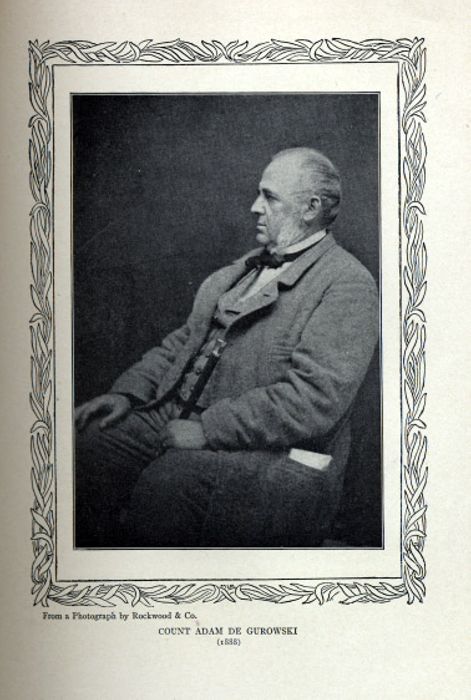 [Begin page 341] was not a good prophet on the War in that letter." W. laughed: "No—was n't he down in the mouth there! Everything going wrong—the devil to pay. At that very time Grant was going on doggedly towards the finish of the War. Atlanta turned out all right: Lincoln was nominated and elected. William talks about Grant turning back. When did he ever turn back? He was not that sort: he could no more turn back than time! You can turn the clock back but you can't turn time back. Grant was one of the inevitables: he always arrived: he was as invincible as a law: he never bragged—often seemed about to be defeated when he was in fact on the eve of a tremendous victory." Paused. Then exclaimed: "O William! William! If only our former days and nights could be renewed! Those nights! those nights! I say so too: I say so! Alas! Alas!" When I left W. cried out:
"Here 's love for all the rest of your birthdays!"
[Begin page 341] was not a good prophet on the War in that letter." W. laughed: "No—was n't he down in the mouth there! Everything going wrong—the devil to pay. At that very time Grant was going on doggedly towards the finish of the War. Atlanta turned out all right: Lincoln was nominated and elected. William talks about Grant turning back. When did he ever turn back? He was not that sort: he could no more turn back than time! You can turn the clock back but you can't turn time back. Grant was one of the inevitables: he always arrived: he was as invincible as a law: he never bragged—often seemed about to be defeated when he was in fact on the eve of a tremendous victory." Paused. Then exclaimed: "O William! William! If only our former days and nights could be renewed! Those nights! those nights! I say so too: I say so! Alas! Alas!" When I left W. cried out:
"Here 's love for all the rest of your birthdays!"
Thursday, December 20, 1888.
7.45 P. M. W. reading. Ed reported him as having one of the best days. W. quiet, looking pretty well. Few visitors to-day. George Whitman, for one. Ingram up stairs for a minute—brief visit from him. Sorely tries W.'s patience sometimes. Yet W. loves him. Very kind—generous: sends W. coffees, teas, fruits, home-made wines, &c. W. always grateful, "seeing the beautiful good heart below his peculiarities." W. had been up all day. Busy. Arranging Christmas gifts. Got Ed to draw a hundred dollars from bank, part or all of which he sent off by post-office money orders. Wanted three three-dollar gold pieces: Ed could not get them: got two fives. W. asked me to secure them in Philiadelphia if possible, "unless it should be troublesome," &c.: no other pieces would do. "I have always had a peculiar liking for three-dollar pieces: something in their shape attracts me." Had his big bulging purse in inside vest pocket: in taking it out to get the coins spilled them all over his lap and about the floor. We gathered them up. [Begin page 342] "I have threatened for a year to get a new purse and yet I seem to cling to this one, which is miserable enough." Said he wanted Kennedy to get his books for a Christmas present, "though I have had no word from him yet." Fears if nothing comes to-morrow it will be too late. Yet is "not willing to pay the postage on four or five volumes."
Walsh was in to-day. "Very bright: Thinks I am better, as, indeed, I feel I am." I asked: "Did he leave you any medicine?" "Oh no! he knew better—knew I would not take it." He had eaten well. Drinks considerable milk. When I entered he was reading the Leaves of Grass I took him last evening. He said: "I like the Annex—like the way it flows in there: found it all correct,—pagination, appearance, all." I said: "The book gets thicker: every now and then you add twenty or thirty pages to celebrate a new period passed through." He looked at me quite earnestly. "Yes—that is the way it has come to be: but there will be no more: that is the last." Woman in to-day to buy a copy of L. of G. Did not see W. nor ask for his autograph. W. wrote Bucke. Sent him the Logan Smith and McCarthy letters. "I did not write much much—a little towards evening." Picked up the McKay L. of G. Pointed out the stamping. "Our big book must be better than that"—indicating the title line, L. of G., "almost hid among the flowers in the background": "Except to those who already know it is a medley—conveys no intelligence: I never did like it: it is a New England notion: the Osgoods': they paid several dollars for it—probably thought it just the thing: to me it seems wishy-washy." I suggested the Author's Edition, 1882—stamping free, strong, characteristic. W. approved. "We should look up something like it: I want something strong, characteristic: too often heretofore we have adopted things not of my choice. It seems to me anyhow that the modern stamping on books is thoroughly devilish, horrible: I can conceive of nothing that could be so little suggestive, so characterless. Look at the lettering Dave has stuck on that book—Charles Brock- [Begin page 343]den Brown." As to cover he said again: "Of all things, I should least think of vellum—white vellum especially."
I was rejoiced to have him show marked interest in the subject: just this forenoon had written B. I doubted if W. would ever resume business. Referred to Bucke: "The letter came to-day: came this morning. It is a wonderfully inspiring letter: yet it 's not long." He handed it to me. I started to read it. He stopped me. "No: I want you to take it where you can read it more carefully than you can here: it is much like the letter you gave me to read: the substance of it: elaborated." He is generally calm—almost provokingly so—in taking the good words of his friends. This letter moved him. "Doctor seems impressed with the autobiographicality of the book—that from beginning to end it is autobiographical: not in the ususal sense—but in a sense that makes it strikingly mine. I confess the letter impressed me more than I could have believed it possible. It contains but a few lines—yet these are pressed in deep—are put there to stay." He, too, "realized a sense in which the book is deeply personal"—"no breaks in its continuity"—"the statement of a life." Then he said: "I want you to read it very carefully: we must discuss some of these matters together: for myself there can be no explanation—no formulated explanation: it is because it is." He continued: "One thing I can say: I am satisfied: I feel that we have won a victory: much is left undone but some things we have done." He thought Bucke's letter "vehemently Buckeian."
He returned me Unity left yesterday. Had read Black's piece:—"read it carefully—it is good—read every word of it." He said it had "aroused new thoughts" in him—"seemed to prompt a revison of some" of his "former ideas of Tolstoy.": had "never known Tolstoy presented in that way." "Who is the writer—who is Black?"—He certainly strikes his crowbar very deep: he is not making sport—is in dead earnest." He felt "convinced" that "Tolstoy has much for us—is one of our men." He had [Begin page 344] been "particularly moved by the article" and what I had said of the parallelisms of W. with T. "One of the things that impresses me is this: that to the fellows over there, the miseries, gloom, uneasiness, messiness, of things, comes very close—the outlook is painful, dismal: feelings are naturally excited in them that could not come to us here." But he "did not speak of this complainfully." "They are right to feel this environment—must feel it: they are subjected to an experience we cannot realize here—the circumstances of our birth and all the rest are so different: the whole atmosphere on this side is charged with the idea of liberty." He attributed "a great deal of our good fortune" to the fact that the land is at present still measurably free." But he "had no idea that with tendencies as they are this can continue long." "We have free land—now: much of it: land that will be free for a couple of generations more: but—what then?" There he was "troubled." "We have our hoggishnesses, miseries, wrongs, horrors—but none that press us quite so hard and so close." He "at last understands better" my very "frequent association of" his own name "with Tolstoy's." "I can't endorse you: it 's hardly for me to say you are right or wrong: but I see what you mean and I appreciate your intention. You have good reasons: that 's as much, as far, as I can go." I asked W. about the land. "Won't we have the European problems just the same here in a little time?" "Yes." "All the poverty problems—about the land, about machinery, ownership of things—just the same?" W. nodded: "Why not? surely? what can prevent it? we seem to be travelling the same damnable road." "Inevitable road," I put in. "Yes—but damnable, too." "We will get out of it?" "Yes, we must: money must take second place!"
Yesterday was my birthday. W. was inquisitive—congratulatory—saying of my health so far (I have never been in a doctor's hands): "Certainly that is the whole story: it seems to me that tells all: the thirtieth year! [Begin page 345] and health, vim, hope! What is there more thant that?" He humorously questioned me. Had I no rules of life—no dietary doctrine? No. "Good! good!" "Except," as I put it—"no tobacco, no whiskey." Ah! that is wise—a wise precaution: I should say, persevere on that point—everything is to be gained by it, nothing lost!" I said: You said to Harned the other day talking of smoking that no doubt you had lost a lot by not learning how to do it." He laughed gently: "Well—I don't like to insult the smokers: I let them have their own way with themselves. Did I say I had no doubt I had lost a lot? Well, that is still true. But I may add that I have no doubt gained an immense lot more than I have lost." "Do you ever have any regrets?" "I would as lief regret that I had not murdered my mother." Showed me a picture of one of Johnston's daughters. "It 's Katy," he said: "a dear girl: more mature there than in fact: only fifteen or so: bright, happy."
W. sat to-night on his chair: talked easily: his hair glowing: hand firm and warm: eye better, clearer, than any day in the fortnight past. But he declines "to express hope of rehabilitation": feels "now that this is only a lull on the way down.": realizes that every "spell," as he calls the bad phases, puts him "a little lower in the measure" of his "vitality." Speaks of having "grown old" and "being near the end." Ed is better. Gets his full sleep. Says he nearly suffocated the two or three nights he slept in W.'s room: light down, every window closed: Ed sleeping on the lounge: W. waking every now and then and admonishing him: "Eddy, stir the fire." When he is well and up, stirring the fire is W.'s own monopolized and enjoyed job.
W. thinks Gardner, in Washington, has so far done the best portraits of him. He always refers to Gardner with great respect and says beautiful things always of that particular Gardner picture, the 1863 picture, which he gave me. To-day he turned up a Gardner letter which he brought to my notice before I left. "It shows when and in a certain [Begin page 346] way how Buchanan became interested in me: throws an interesting sidelight on the Buchanan adhesion, which had its ups and downs. Gardner was always a mighty fellow—also mightily my friend: he was always loving: I feel near to him—always—to this day: years, deaths, severances, don't seem to make much difference when you have once loved a man: Gardner was a real artist—had the feel of his work—the inner feel, if I may say it so: he was not a workman—only a workman (which God knows is a lot in itself, too!)—but he was also beyond his craft—saw farther than his camera—saw more: his pictures are an evidence of his endowment." Then he paused. "How garrulous I get on the least provocation! Read the letter." I did so, aloud:
Washington, 26 November, 1886. My dear Whitman,I received this morning from an old friend (Mr. Robert Buchanan) in England a letter and among other things he asks me to send him Leaves of Grass, Drum Taps and any other works by the author Walt Whitman of the Attorney General's department, Washington, and a portrait if it can be got by hook or crook. I shall make a copy from each negative. Please tell me if there are any other works of yours than the above and where I can get them. He desires also that I should send him a portrait of Emerson. Can you tell me where I can get a good one?
Yours respectfully, Alex. Gardner.I asked W.: "Up to that time you had not heard direct from Buchanan?" "I think not." "Did Gardner send him the books?" "O yes! I helped him out: also sent things to Buchanan direct."
Friday, December 21, 1888.
8 P. M. W. sitting reading a letter he had just received from Bucke. Stopped reading: took it up by and by again [Begin page 347] —finished—gave to me. He signed a Gutekunst portrait for me. Picture belonged to Miss W., Germantown. She sent it to me several weeks ago. I had to hold it. I went to the mint to-day and got him his three three-dollar gold pieces. He said: "Oh! then you got them! Well—I am glad: I wanted them—only them: I have a fancy for them. These are the most beautiful of all our coins—the only ones that satisfy me on that score." Preferred "the big silver dollar to the little gold dollar. I forgot about the money and wondered what you were up to with your pocket book in your hand." He had a letter from Nelly O'Connor to-day. Was O'Connor better? "I suppose he is not able to write: conclude so from the fact Nelly wrote." Here he paused. "Poor O'Connor! he 's in a bad way: he is as all-suffering as Job. He cannot be better—not materially better: I got the letter about nine: hurried if off to the Doctor—sent it by ten: I know how anxious he is to hear every word." He said of himself: "I seem to be getting better: I experience a growig feeling of rest and painlessness, though I am still without any ambition to set to and wrestle anybody. The Doctor was not in to-day: said yesterday he would be in to-morrow. The other time he missed two days. I don't like it to go so long." Was asked again: "Will you sell any of the big books?" "Yes—if anybody is fool enough to buy them!"
Corning in to-day. Upstairs. Stayed only long enough for a greeting. W. reading the Annex copy of L. and G. to-day: found Dave used old sheets for the other folds: W. was a little disappointed. "I hoped he would at once use the plates as corrected." I asked W.: "Is he mean?" W.: "I should not say that: no: he 's canny." "You don't call being canny being mean?" He was amused. "Well, I don't know. They used to say up our way when I was a boy that a Scotchman can save two cents out of every one cent and still be generous!" Gave me a copy of the Woman's Gazette and Weekly News (Manchester): "Take it away: let Aggie read it. It came from Mrs. Costelloe yes- [Begin page 348]terday or the day before. It is more likely to be matter to interest Aggie than me." He had not read it. It contains a paper read by Mrs. Costelloe at a woman's conference. Jubilant over "a good bath" he had to-day. "I went over to the bathroom. Ed helped me: he is so gentle, so strong!" He said again: "The water was cold." Ed says: "Not so: only for him." "I had my swear out about it: I hope there was no risk run: so far I feel all the better for it—have felt the need of it for five or six days." Ed had rubbed his back afterwards. He can't stand general rubbing. I asked if he enjoyed the Turkish bath? "I never took one, though they urged me often in New York: did so even the last time I was there—last year: but I have always bathed much—habitually—always at least three or four times a week, hot or cold—besides having the rubbing daily, which I never missed." Was the rubbing not a new idea, since his sickness in '73? "Oh, no! I cannot remember when I did not do it: reaches far, far back: it was indispensible: the currying, as I call it, came later on—the doctors recommended it. In bathing I have to be very careful lest the water is too hot. Whether it is a function or an organ—I guess an organ—that is affected, hot bathing has two or three times since my paralysis nearly finished me."
I found W. had sent the books to Kennedy: "You will be surprised: I have a surprise for you: I made up five of the books to-day: sent them off to Boston—expressed them: one for Garland, one for Baxter, one for Frank Sanborn, one for Mrs. Fairchild—and one for Kennedy himself. Kennedy sent me a little note: said—send the package 'to be called for' main office Adams Express Company Boston. He will slip in to-morrow afternoon late: if they are not there then Monday morning. I hurried them off this evening—wanted him to get them for Christmas. When they report I 'll let you know: I suppose they 'll not be anything before Wednesday." His anti-tariff feeling crops out on all occasions. He had been reading the actors' [Begin page 349] appeal for protection. W. thought that "surely the greatest farce they had ever played in." He did not like the Gutekunst picture he signed. "That portrait you brought me: how weak! how sizzled out! I like it, passably: but it is not one of the best. Perhaps it is as you say—there is enough of me to survive even the worst ordeal: I hope so: yes I do."
W. said: "Horace, I 've got a job for you: I want you to read me these letters." He handed me sheets of papers pinned together. They were old and soiled. No envelope. I just scanned them. An O'Connor letter first. Then a Burroughs letter. Then another letter from O'Connor. He settled comfortably in a chair. I read.
Washington, D. C., June 24, 1882. Dear Walt:I have your postal of the 22d, together with The Press notice. Beautiful! Who is the lady?
After much cogitation I have judged it prudent to withhold my reply to "Sigma," at any rate until next week. We will see whether the Sunday Tribune has anything from anybody.
My aim is to attack Marston terribly, and I don't want to be led off into a side show by an anonymunculus, like "Sigma," if I can help it. I am trying to accumulate the materials for the next assault, and have written in several directions, among others to George Chainey. Do you see what the scoundrel postmaster at Boston, Tobey, has done to him—stopped his lecture on you and your book! After stopping the book, they will stop discussion! Here is a text. It will go hard if I cannot make such a cloud belch thunder.
I have written to Chainey for full particulars.
Don't forget to tell me the price of your book when you write next. Did you send one to Prof. Loomis? Good-bye.
Faithfully, W. D. O'Connor. [Begin page 350] West Park, N. Y., May 1, 1882. Dear Walt:With your letter came one from O'Connor bursting with wrath; I think I will enclose it to you. No doubt he will be a host there in W. and will reach that miserable Dist. Atty yet. 'T is a pity Osgood has not got some pluck and so make a fight. No doubt we could beat them to tatters and make a big strike for the book. Write and ask him if he will fight if he is well backed up. It is the last thing I ever dreamed of. If this is the wish of Boston then I pary for her purification by a fire ten times bigger than the fire of a few years ago.
I enclose my check for the amount you ask for, $100. [This was money in my possession belonging to Walt. J. B. 1912.]
What a blank there in New England! To me Emerson filled nearly the whole horizon in that direction. But I suppose it is better so, though the very sunlight seemed darkened. I should have gone to his funeral had I not had so much to do before sailing for England. I wrote a page or two for The Critic yesterday, though I may be too late.
If our passage was not paid to England, I should not go. I am ashamed to go off at such a time. I have had no heart for the trip from the first, and now the death of Emerson (how these few words penetrate me!) and your troubles make me want to stay at home more than ever.
If you have Mrs. Gilchrist's address send it to me; also that of Mr. Carpenter.
I have written an essay on Carlyle which I think goes to the meaning of him more than anything I have ever seen. I spoke to your North America Review man about it on Friday, but he did not bite; said it was not in his line, &c. I shall probably offer it in London.
If you do not hear from me again anything addressed to me care Henderson Brothers, Glasgow, 49 and 51 Union [Begin page 351] street, will be forwarded to me. We land at Glasgow and shall stay there a few days.
Ever your friend, John Burroughs. Life Saving Service, Washington, D. C., April, 28, '82. Dear John:I have just been thunderstruck by a letter from Bucke telling me that Osgood, under a threat from the District Attorney at Boston, Sanger, has stopped the publication of Walt's book. I don't let the grass grow under my feet when an outrage of this kind is committed—one which makes Harlan's insignificant—and I am going to make the District Attorney regret that he was ever born, if I can compass it. As soon as I read Bucke's letter I flew down stairs with Leaves of Grass to the Solicitor of the Treasury, Kenneth Raynor, and for two hours to him and Robinson (the Assistant Solicitor) and Barton (the Law Clerk) I gave the District Attorney unlimited volcano. They all agree with me, especially after hearing me read and expound the accused poem, that it is the greatest outrage of the century. I am next going straight to Brewster, the Attorney General, who of course controls the District Attorneys, and will see if I can't get him to crush Sanger and annul his action. I have only been stopped by Brewster's absence at Newport. He returns on Monday, and then I will see him, taking, if possible, Bob Ingersoll along with me—Ingersoll being a warm admirer of Walt's book. If we don't raise the biggest row Sanger ever dreamed of, I 'm mistaken. He doesn't know the kind of man on his track when I start after him.
Now, pending the arrival of Monday and Brewster's return, I want to know all the facts. Tell me everything you know, and speedily. To be posted is to be armed.
Of course, if we annul the District Attorney's action by a fulmin from headquarters, perhaps we can next shore up that cowardly fool, Osgood, and get him to go on with [Begin page 352] the publication. The infernal idiot should have defied the District Attorney, published his official warning as an advertisement, stood a suit, defended it with Evarts or Charles O'Connor, won it, and sold a million copies of Walt's book on the strength of it. The jackass!
Let me hear from you. Excuse the scrawl. I am trembling with fury, and with the fervor of my oration down stairs in the Department of Justice.
Good bye. I sent you my last report.
Faithfull, W. D. O'Connor. —Emerson gone! The world grows darker. W. D. O'C.W. was enthusiastic by the time I got through. He had interrupted me throughout with exclamations and comments. He had me read some passages a second time. Broke right in and said: "Go back a bit—read that again." When I was through he said: "William says there: 'It will go hard if I cannot make such a cloud belch thunder.' He made it belch many thunders: William had unlimited capacity for raising hell: I don't mean that he was a gratuitous fighter: far from it: I mean that when aroused, where there was occasion for it, he could do the job—he was a human avalanche: nothing could defy him: stand up before him: nothing. Stedman said to me once: 'O'Connor is the finest fighter of us all with the noblest sense of right and justice.' John Hay was a great admirer of William—way back there: he said about the same thing Stedman did—said it to me: said, 'You are lucky, Whitman, in the adhesion of a man like O'Connor: he is a giant influence: he is the sort of man who lasts out the battle—who don't give in with a job half done.' I think Stedman was a bit afraid of William—was timid—just a bit, befor his vehemence: just as Gilder always has been: William gets on Watson's nerves—William is so virile, Watson so feminine (I don't mean any disrespect by that word—I don't [Begin page 353] mean what people mean when they say sissy): some of the fellows were built for the more orderly performances: William was not: he was virile: he was well hung: he was no trifler or half trifler but a man who had the arm to sling an axe and the soul to sling it justly: that was William. Well—he did belch ten thousand thunders on this occasion: you notice, how even John was mad and said so beautifully: but how tame John's anger (which was not tame) seems when coming up against the intenser vehemence of William! I don't make comparisons—I think John had as he has his own way of getting mad: a sort of Quaker anger: whereas William storms and blows and rains and snows and freezes and roasts you all at once: goes for you tooth and nail, hammer and tongs—leaves nothing of you for the dogs—not a bone"—W. laughed: "O how divine that passion in William has always seemed to me! His uncompromising love of justice! His eagerness to court any danger, to accept any peril, to go to any trouble, endure anything—starve, go wounded—shed his blood—for a cause which he considered sufficiently lofty."
W. liked what Burroughs said of Emerson: "To me Emerson filled nearly the whole horizon in that direction." W. said: "I guess I enjoy that: I guess I do." He had had me read the line over again. "John was right: Emerson was the whole horizon: Ralph Waldo: Emerson: the gentle, noble, perfect, radiant, consolatory, Emerson. I think of something Emerson said in one of our talks: he said: 'I agree with you, Mr. Whitman, that a man who does not live according to his lights—who trims his sails to the current breeze—is already dead—is as many times dead as he is untrue.' Emerson lived according to his lights—not according to libraries, books, literature, the traditions: he was unostentatiously loyal: no collegian, overdone with culture: so gifted, so peculiarly tremendous, that, if I may say so, knowing too much did not as it so often does with the scholar hurt him." "Did n't you tell me that he expressed regrets to you face to face one day—saying some sort of [Begin page 354] apologetic thing about his book learning?" W. nodded. "Yes—more than once: said he felt like athletes—some athletes: overtrained: that a scholar, like an athelete, overtrained, is apt to go stale. He said he felt that culture had done all it could for him—then it had done something for him which had better been left undone." "Did he seem very serious in that self analysis or did he say it all quizzically?" W. answered: "Oh! he was serious enough in it: he said to me (speaking of Thoreau) that, 'strange as it may seem, Henry being an outdoor man (he called him Henry)—he shrinks from some formidable things in you—in your book, in your personality—over which I rejoice!' And he said this too: 'I don't say it by way of flattery at all—I would as readily say it to any man like you who had not written a book—but I say that meeting you is a peculiar refreshment to me—puts something needed into my tissue which I do not seem to get in my own established environment.' Yes Horace: he was dead in earnest about it all: not plantive at all: no, nothing of that sort: but soberly free." I asked: "Did some of this happen in that Boston Common walk?" "Yes—some of it: but I recall that some of it occurred that Astor House day in New York." Considerable talk followed my return to him of Bucke's letter spoken of yesterday. "Oh!" he said at the start, "I had forgotten about it: you shall have it back again when I am done with it: I want to read it again—have an idea of having it printed—to get a few copies for my friends." Then he looked at me inquisitively: "You read the letter carefully?" I answered: "Yes—and I think it at least among his best." W. nodded his head: "Remarkable, is n't it? The question is, is it true? It will take more than a moment's thought to settle that—careful weighing, elaboration, the judgment of many: I shall seek out a few—see what can be made of them. The idea of the autobiographicality of the book—that is what hits me: yes, the Doctor's letter is striking: more and more so as its contents is realized: Can it be true?" "Can it be that the Doctor's [Begin page 355] theory is true? that the book is autobiography pure and simple—in its elemental form?" It was this feature "alone" of the Doctor's commentary which "hit" him. "That the work all centres upon one point—that its origins, beginnings, inspirations, have emanated, vitalized, all, centrally, from one source: that comes more and more to me. The last two weeks especially I have questioned the whole case, turned it over, seen it on every side—and I have come to recognize a more marked centrality than I had ever observed before—a centrality actual, while not designed: but whether as autobiography—even in the high, the uncommon sense (the sense in which Doctor means it)—it excels the great, I may almost say, literatures of the past—that puts a severe and serious if not impossible strain upon our faith. Think of Rosseau, of Goethe—then consider what Doctor has undertaken to determine and declare."
Had I read Rosseau's Confessions? "You should do so: there is a good English translation: I have had it: it is a singular mixture—plenty of the petty, the minor, the mean, the dirty—then surprising streaks of genius—often and often." I suggested: "Taking autobiography in its finer form, the best autobiography is not that which a man starts deliberately out to write"—("of malice prepense" echoed W.)—"but that which flows spontaneously from his own personality. By such a test Leaves of Grass is certainly one of the exclusive books in the group of the great autobiographies." W.: "That is well and profoundly put: even if not true as applied to Leaves of Grass is true in general: that the best autobiography is not built but grows." I suggested Heine's name. "Yes, Heine—pre-eminently, above all others—and Burns: take Burns—the heart of him: drops of his blood on every page: if I may say it (is there such a word?) the ear-marks of the one human fact in every line." I spoke of Shakespeare as objective. W. then: "Yes, that states the difference." I quoted my frequently repeated judgment of the summer— [Begin page 356] that November Boughs was consistent with all that had gone before W.'s work: Sands at Seventy as honestly and normally a part of Leaves of Grass as Childen of Adam itself. W. exclaimed: "Yes—that gives an illustration to your point: I understand you now as I did not then: if true it is a precious fact." W. said: "John hardly agrees with you about these later poems—thinks they are inconsequent: might just as well have been thrown out or left unwritten." "But they are such a part of your scheme." "Yes—as you just said, as much so as Children of Adam." "Walt, my idea of your idea is this—that you are to write on and write on to the end, even if in senility, so as to make the Leaves a complete record of a life. Is that it?" "That 's it: that is all and final: there 's no more to be said: I don't say a man's old age is as important as his youth or less important than his youth: or his work—that it 's as strong: that does not come in: I only say that in the larger view, in the scheme originally laid down for the Leaves, the last old age even if an old age of the dotard is as essential (if I live to old age) as the record of my first youth." W. vigorously like his full self again all the evening.
Saturday, December 22, 1888
8 P. M. W. reading the Bucke letter, which he wants to print. Made a note or two on it with a blue pencil. Spoke of his health. "It is dull business being confined here, days in and out—chained to the bed, the chair. Yes even this—say, the measure of vitality I enjoy this evening—not sliding back again—is something to relish, to be thankful for." He ate well: drank a lot of milk—cold milk: called for some while I was there. W. said he had a Christmas gift of five dollars from Williamson, in New York. Williamson was always W.'s good friend in more ways than W. was aware of. "How is it George M. Williamson is one of us? Has he come to the conviction by his own vision or has it been pumped into him?" Turning to me: "Can you tell?" "It is there: how it comes there I don't [Begin page 357] know." W.: "I suppose that is the best thing to say under the circumstances." Again: "Did Williamson ever acknowledge November Boughs?" I said: "Yes." Then he: "Oh yes! it comes back to me."
I had got The Critic. Said there was nothing in it. Had not for that reason brought it down. W. said: "I am glad you did not bring it down: I never have any anxiety to read it. Take it as it comes along—it just seems so-so—that is all: sometimes there is a personal paragraph: something of the sort: practically never anything of final value." He paused. I thought he intended saying more anent The Critic. He did. "Did I tell you about the little piece I sent Doc—the piece on poetry—nothing in it—they sent me five dollars for? It was wholly a surprise: I did not expect it. Joe must be pretty flush." I said: "Either pretty flush or thinking you are not: but whatever the circumstances, the result is equally welcome." W. amened me instantly. W. had a letter from Bucke to-day. "Little, I may say—nothing—in it." I wondered if he had seen Mrs. Costelloe's piece in the English woman's paper he gave me yesterday. "No—I did not know it was there." Should I return the paper? "No—no—I do not care for it. There was nothing in Mary's piece?" Then, after my no: "Oh! I thought not! the subject is not one that interests me."
I told him some stories of the factory life at Graham's. He said: "I should think you would jot down these incidents as they occur. Oh! they are very suggestive—deep: deeper than most of the things that pass current in books nowadays. There must be a dozen interesting little items every day. Take your little story of the six o'clock whistle: that gets down to real life—the heart of life: there is no beyond. Then you seem to have considerable faculty for telling a story: you should make something of it—give it a chance to develop: I 'm afraid sometimes you 're a little too much inclined to the didactic: your moral earnestness, your intense sympathies, maybe press you a little bit too far [Begin page 358] that way. You will probably worm out it but that 's how you seem to be at this stage." I laughed. "You have hopes of me?" He was extra friendly. "O not only hopes—I am sure of you: I can't make out just now just which road you will take but you 'll find a way and I have no doubt travel it with distinction." I had never had him break loose so about my work. I reminded him: "Once you said I was a damn fool—would never know how to write." "Did I say that? Well, I was a damn fool to say it: I can't imagine what could have tantalized me into such an outburst. You 're still a pretty green pippin but you 'll ripen." Then: "After all there 's something better than to write: that 's not to write: writing is a disease. Look where it has brought me. Do you envy me the pass it has brought me to?"
W. reached forward to the table: picked up the folded sheets of a book: handed them to me: "This came yesterday—from Kennedy without a doubt: a book: they call it The Other Side of the War: it is written by Katharine Wormeley: I think she must be a nurse: sketches of hospital life: I suppose Sloane sent it thinking it would appeal to me. I have looked at it: did not, however, go far in it: it did not attract me. Take it along—see what you can make out of it: perhaps Aggie would like to read it." He wrote my name on it. "That dismisses it for good." I once went with Slack of The Boston Commonwealth to see Houghton and afterwards with Houghton out to their big printery in Cambridge. W. said: "When I was in Boston I had a very good time—everybody was kind to me—everybody tried to make me comfortable. The Osgoods gave me a little room—a room about as large as that yonder"—pointing to Ed's bedroom: "there I would read proofs—do anything I chose. It was a room they used one day in the week for paying off—that was all. Often I would read my proofs at the hotel. I took things very easy—moved slowly, did all carefully, and, I think, well." Was the Osgood edition not a good one, &c.? "Oh yes: I was satisfied [Begin page 359] with it: besides I had my own way there from the start. It seems to me a man was never more fortunate than I have been in having things done just as he demands them. I never for an instant lost sight of this—lost my grip, hold, of the books: I handled them, shifted them, changed them, never yielding control of them for an instant to any one. Take the big book, for instance: whatever it is not, it certainly is what I—I alone—no other—designed it should be. Whether lost—lost at last—unaccepted, unread—whether the world listens or turns from it—there at least it is—direct from my hand, I alone being responsible for the making of it. That of itself is something high in the nature of reward, if we must have reward. There is everything to tempt a man to stray—little to hold him steadfast—yet to stick must at last be its own satisfaction." But "'satisfaction' is perhaps not the word: another word—perhaps 'integrity'—better says it. To steer clear of all the rocks, to remain faithful to an initial purpose—that is the point." "Everybody interferes, advises, threatens: printers, binders, worst of all publishers. If a fellow could safely get through all that many a battle would be saved: trouble: quarrel: loss." Here he picked up the poker, stirred the fire, separated the red embers—took from me a couple of heavy logs—speaking slowly as he did so: "I had a funny experience with a publisher in my early days—with the first edition. A fellow there was willing to print it but for a couple of lines which he construed into a disrespectful reference to God Almighty. It has always seemed to me very funny because I have never heard a word of complaint against them: nobody has picked them out though they have picked out nearly everything else." I remarked: "We have made strides in the conception of God since then." W.: "I should hope so: I believe we have. This printer himself said he was not 'squeamish'—'but' &c!"
I repeated to W. the substance of a conversation I had with him on a Market Street car one Thanksgiving Day years ago—he going to Preston Street to dinner, I to For- [Begin page 360]tieth Street. We talked of progress. W. remarked the increased pace each decade, attributing it to more efficient methods of communication, through commerce, printing, telegraphy, &c. As he stirred the fire again he said: "Yes, it is a quick movement now—I often feel impelled to ask, is it too quick?" But he "supposed" the tempo "was a reasonable one for the reasons given." "That which I said to you long ago, as you put it, sounds very like—it is manifestly true, whether I said it or not. I should be inclined to repeat that explanation now: solidarity—the word solidarity—that seems to me most to fit. I like much to see that word—solidarity, intercalation: not Philidelphia alone, Camden alone, even New York alone, but all together, all nations—the globe: intercalation, fusion, no one left out." I referred to the French fondness for the word: then to the orthodox puritan comtempt for French ways of life. As to this he said: "I take no part in it: it excites my contempt." Further as to solidarity: "Yes: Comte makes much of it: it is peculiarly a French word: comes naturally from the French. That is a fact I always remember in connection with Victor Hugo—with Tolstoy, too, who is not French, yet human with Hugo: their great purpose is human: their purpose is communication, understanding." He thought he had been "thoroughly inoculated by O'Connor." "People—most of them—people here—call it sentiment in the French, in Hugo, but I confess it seems to me all right—the necessary, the inevitable, thing from their standpoint: and it is from that standpoint they must be judged—not from our circumstances, our environment, but theirs: and from theirs, how high, how lofty, what Hugo, what Tolstoy—others, too—have done!" Indeed, he thought that "even the humblest person is entitled to be so judged in connection with the environment to which he has had to conform." He protested his "affection for the use of the word 'solidarity'" for "broadest reasons." "Solidarity is the future."
W. gave me a Rudolf Schmidt letter. "It relates to the [Begin page 361] Danish prose book—Schmidt's own translation; you should have it along with the Rossetti and other such documents. Schmidt's letter was in English." W. was silent as I read it.
Copenhagen, 2 January, 1874. Dear Walt Whitman:To-day the first part of the manuscript of the translation of Democratic Vistas goes to the printer. I would not write to you before I could give you sure information.
It is a devilish hard thing to translate your prose, and our ordinary translators most surely would break their necks in trying it.
I shall send your translation in loose sheets and give the bookseller an order to send you one or two complete copies.
When the book appears I will have left Copenhagen for one or two months; I am going to Germany a little, too.
Your letters shall reach me surely when sent to the old address.
I shall be glad to hear from you. An American gentleman told me that you were going to England. Is it true?
Yours, Rudolf Schmidt.W. said: "Schmidt brought out a fine book: I am told that the translation was way above par—was more than good: was virile—idiomatically strong: faithful, circumspect, clarified. That man Schmidt is a big man: also a man of many sorrows, I fear: has had domestic troubles of one sort or another—something. He has written me considerably in the past—not so much now: was an admirer, lover, of Bjornson—recanted (gave up his idol): seems to have some vinegar in his composition, which I do not marvel at remembering what he has gone through. I want you to have some of his letters: I will look them up for you: they go to the making of our story. There is in some way a remote- [Begin page 362]ness about Schmidt: I don't know how I get the impression, but I have it strong; he seems to hermit himself."
George Whitman in to-day. Saw Walt for a minute. Never stays longs. Makes brief inquiries. In nearly every day. W. knows I am on friendly terms with the men at the ferry and on the boats. Made explicit inquiries to-night of many of them by name, of some of them descriptively: knows most of them by name however. "Pilot" this and "engineer" that and "deck hand" the other: and then he said: "Tell me about Ed Lindell—tell me particularly about him." Lindell is a gatekeeper on this side—a great friend: the only man there who reads W., I believe: a strange character, with striking elements who never reads other books: always asks after W.—used to talk with him daily. I see L. often. Told W. so. W. was much concerned about one of the engineers who I told him was sick—perhaps mortally so. Asked: "What boats are they running now?" I named several of the boats. W. then: "The Beverly is the best of all: the Wenonah is good, too: they were the special good boats." I mentioned the Pennsylvania. "Lindell tells me she is the best of all in obeying her rudder." W. said: "I can't believe it—the dear old boat! And you say the Delaware is still used? What has anybody to say in her praise? The poor old Delaware seems to go unvoiced." Dwelt upon "the old days strolling and lolling about the wharves and on the boats": "sunshine and cloud—seeing many people—water, sky, life." "I never used the other ferry: this was the most convenient." Finally he said: "Give my love to the boys—to all of 'em!"
Ed came in with an armful of wood. W. admired "the fine thick chunks." "Who split it? You? Why, I did not hear you": adding: "I have a neighbor, next door below, who splits his wood on the floor—seems to get up in the middle of the night to do it. He is not a particular fellow: sometimes takes a notion of early morning to get up and tramp steadily about his room, miles and miles: then makes his fire: then whistles—generally starts up a noise: wakes [Begin page 363] me at all hours: I manage to hear him whom I ought not to hear—miss you whom I should like to hear." I remarked that Ed had his hair cut. W. said as Ed left the room: "Yes, Eddy has been and had his picture taken—had to spruce up: the boy is a little like the women: they will fix up whatever is said: if they have jewelry on it must go."
W. gave me my personal copy—the complete W. W.—to-night. I left it at the house this morning on my way to Philadelphia. He proposed last night that I should do this. "I have done the writing and tied up the book again." At home I opened the package: found in it the inscription that follows. It is the first time he has let himself go to me.
To Horace Traubel from his friend the author Walt Whitman& my deepest heartfelt thanks go with it to H T in getting this book out—it is his book in a sense—for I have been closely imprison'd & prostrated all the time (June to December 1888) by sickness & disability—& H T has managed it all for me with copy, proofs, printing, binding, &c. The Volume, & especially "November Boughs" & the portraits, could not now be existing formulated as here, except thro' his faithful & loving kindness & industry, daily, unitermitted, unremunerated—
W W Dec: 1888 Camden New Jersey—Baker came in just as I left. I advised him to go up and see W. a minute. He did so. W. very hearty and cheerful with him. W. gave me a soiled and rumpled picture of himself which I found on the floor. "Whose is it?" I asked. He asked in turn: "Don't you recognize its characteristics? It 's one of the Gardner pictures—one of the best. It was sometimes my mother's favorite picture of me: she said to me often about it: 'When I look at this picture I feel like cheering thee with extra love.' You want it? Why of [Begin page 364] course, take it: there must be other copies here." I asked him if he would some day put his name on it. The light was down. He was back on his bed by this time. "Yes, some day, not to-night: bring it along some time: yes."
Sunday, December 23, 1888.
8 P.M. W. yesterday undoubtedly better than at any time in two weeks or perhaps a month. On his bed this evening. Said of his health: "I call it a continuation of yesterday, though I don't realize it as having the same edge and nip." He at times feels almost as if he was enjoying a "revival"—"a dim suspicion of something or other" as he states it. Walsh not in to-day. W. feels that he is not needed. Digestion pretty good. The one thing he says he notices after each of these setbacks is the "weakness," and this weakness "grows and grows, each spell setting me down a peg or two." Still, he walks across the room again, often unassisted: can sit up much longer than he could a week ago: is generally more optimistic and able. Face very cheerful, calm, bright, voice strong. I had Tolstoy's Sebastopol along with me. Left it. "I know I shall like to read it." We had spoken of it before this last illness.
Out in Germantown. Mrs. Burleigh had received some fruit from the south. Gave me two tangerines which I passed over to W., who was glad, smelt of them, and said: "I will lay them aside till morning and make a breakfast of 'em." He asked me about the weather. Were the stars not full out? Was it cold? Then of my trip. Always brightens up when so humored. He said to-night playfully: "You must always answer my questions even though I don't always answer yours." I said: "You don't answer my questions—that 's true. That question about the great secret—you've never answered that." He asked: "You have n't forgotten that yet?"
"Do you want me to?"
"No." There was a pause. Then he said again: "No: I want you to keep on asking till I answer: only not to-night—not to-night." Returned
[Begin page figure-007]
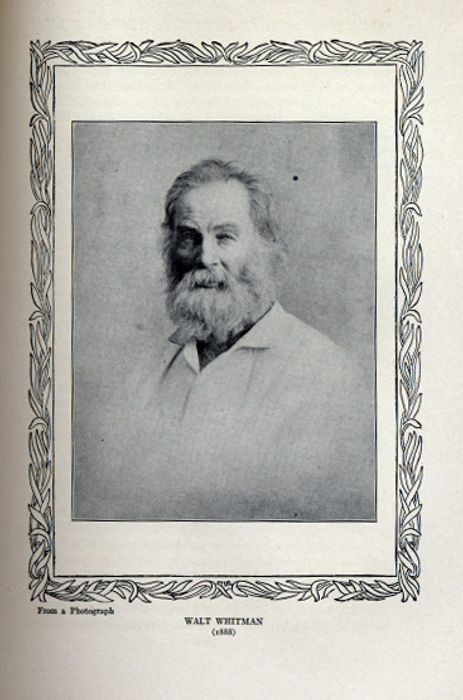 [Begin page 365] me Ticknor's literary bulletin and The Stage, which I left with him last night. "I read them both: the theatrical paper all through: it is very bright: it is a great relief to hit upon that airier stuff occasionally." Said also: "I read all the notices in the literary journals—every word of them. I am very industrious at that!" Bellamy's picture in the Ticknor pamphlet. W. had forgotten all about Baxter's counsel that "Traubel" should read Looking Backward. Have not done so yet. W. urged it.
W. wrote in Ed's book to-day: from so and so to so and so: then: "Camden, New Jersey, America," contemplating Ed's ultimate return to Canada. Shows how closely he looks to details, well or unwell. Harned in early in the evening. Did not stay long. W. has struck a notion to have some of the big books boxed—perhaps a hundred of them.
Had he read De Guérin? He asked: "How do you spell the name?" then: "Ah! I know it: I have read him, somewhat—not enough, however, to have got a decided impression—an impression I retained." Spoke of "American ballade rondeau writers—their small calibre, mean aims—the mere literary hangers-on and sportsmen." "But ours are not the real fellows—even of that sort: they are the six time diluted imitators of the French: the French excel in all that: in grace, beauty, sparkle—witty sayings, bright rhymes—persiflage, they call it." There was a paragraph in The Press to-day about Tennyson's protest against the introduction of a railroad near him on the Isle of Wight. W. had not read that, "but I read a paragraph somewhere which said that he had got much better of his sickness—the acute gout, or whatever." W. did "not sympathize with such sensitiveness"—did not "fear the age of steam." "There is Ruskin: Ruskin seems to think himself constituted to protest against all modern improvements." I asked: "Are all the modern improvements improvements?" W. shook his head: "Oh you lawyer! I 'm afraid not." W. said Ruskin "maintained a more or less curious and uncertain attitude towards" himself. "I have heard nothing [Begin page 366] from him, of him, recently: years ago he was known to have read Leaves of Grass: he said Leaves of Grass contained no humor—no humor at all: it is true he saw good in it, too—acknowledged the good." He thought "the friendship that existed between Ruskin and Carlyle" was "rather remarkable if not inexplicable." Yet W. felt that "Ruskin's notions of professional integrity—in art, literature—were noble, admirable, no doubt productive of vast moral educative benefits."
No mail in to-night. "Letter form Doctor yesterday, but, as I told you then, nothing in it—empty almost." Mention of the boat hands. I met several to-day who asked about him and whom I greeted for him, as he advised me. One, deaf, oldish, bronzed, strong—W. saying instantly (I did not know his name): "Oh! I know him—know his name, too: he rejoices in the unique and saving name—though the best hand on the river—the unique and saving name of John Smith: he is deaf, but wise, wary. Nature has a keen way of putting its strength out: if a man lack in one sense, nature puts the strength—the strength due that—into another. It is so with Smith." He thought the men on the boat "sensitive to influences"—"water influences," he called them—"as we are not:" "like all men made acute by long training in some special branch of labor." "These fellows—the pilots particularly—are very sensitive anyhow—wonderfully: how often I have gone up into the pilot house—often when they had to help me: sat there—sat there with the Captain. I remember the Brooklyn boats—how sensitive the pilots were to motions I would not have even a suspicion of: I think even their feet were extremely sensitive."
W. often gets back to free-trade. Protection rubs his fur the wrong way. It 's like a perpetual sore with him. To-night he said: "Why am I a free-trader? a free-trader in the large sense? It is for solidarity: free-trade makes for solidarity: the familar, full, significant word: and I hope, oh I hope, there has been no failure to manifest the [Begin page 367] fact in my books. I know in my own heart that every line I ever wrote—every line—not an exception—was animated by that feeling. I like best of all—better than anything else—in all the thousand pages, the little line or two in the preface to the English edition of Specimen Days: the lines wherein I expressed this feeling, this hope, that the witness of it was 'below any page I had written, anywhere,' &c.: I think I put it this way." He quoted page 94, November Boughs. He had considerable difficulty in getting it out but it came out quite accurately. "I tie myself to that if tying is necessary." W. gave me one of what he calls his "soger boy letters": his draft of such a letter: he even had me read it to him. I don't like to read these letters aloud. They move me too much. I notice that he too is stirred strangely over them hearing them again. But I read. I could not get out of it. It was spread out over ten different slips of paper which were folded in a Sanitary Commission envelope on which he had written: "to Hugo Aug. 7 '63." He said: "Yes it was from the midst of things—to the midst of things: when I went to New York I would write to hospitals: when I was in the hospitals I would write to New York: I could not forget the boys—they were too precious."
Dear Hugo,I received a letter from Bloom yesterday—but before responding to it (which I will do soon) I must write to you my friend. Your good letter of June 27th was duly rec'd.—I have read it many times—indeed Hugo, you know not how much comfort you give, by writing me your letters—posting me up.
Well Hugo, I am still as much as ever, indeed more, in the great military hospitals here. Every day or night I spend four five or six hours among my sick, wounded, prostrate, boys. It is fascinating, sad, and with varied fortune, of course. Some of my boys get well, some die. After I finish this letter (and then dining at a restaurant) I shall give the latter part of the afternoon and some hours of the [Begin page 368] night to Armory Square Hospital, a large establishment and one I find most calling on my sympathies and ministrations. I am welcomed by the surgeons as by the soldiers—very grateful to me. You must remember that these government hospitals are not filled as with human débris like the old established city hospitals, New York, &c., but mostly with these goodborn American young men appealing to me most profoundly, good stock, often mere boys, full of sweetness and heroism—often they seems very near to me, even as my own children or younger brothers. I make no bones of petting them just as if they were—have long given up formalities and reserves in my treatment of them.
Let me see, Hugo. I will not write anything about the topics of the horrible riots last week, not Gen. Meade nor Vicksborough, nor Charleston—I leave them to the newspapers. Nor will I write you this time so much about hospitals as I did last. Tell Fred his letter was received. I appreciate it, received real pleasure from it—'t was a true friend's letter, characteristic, full of vivacity, offhand, and below all a thorough base of genuine remembrance and good will—was not wanting in the sentimental either (so I take back all about the apostate, do you understand, Freddy, my dear?)—and only write this for you till I reply to that said letter a good long and special measure to yourself.
[This paragraph W. said as I read he did not think was ever sent. He had drawn his pen through it. "It was too damn nonsensical for a letter otherwise so dead serious."] Tell Nat Bloom that if he expects to provoke me into a dignified not mentioning him, nor write anything about him, by his studious course of heartbreaking neglect (which has already reduced me to a skeleton of but little over 200 lbs and a contenance of raging hectic, indicating an early grave). I was determined not to do anything of the sort, but shall speak of him every time, and send him love, just as if he were adorned with faithful troth instead of (as I understand) beautiful whiskers—Does he think that beautiful whiskers can fend off the pangs of [Begin page 369] remorse? In conclusion I have to say, Nathaniel, you just keep on if you think there 's no hell.
Hugo, I suppose you were at Charles Channing's funeral—tell me all you hear about the particulars of his death—Tell me of course about the boys, what you do, say, anything, everything—
Hugo, write oftener—you express your thoughts perfectly—do you not know how much more agreeable to me is the conversation or writing that does not take hard paved tracks, the usual and sterotyped, but has little peculiarities and even kinks of its own, making its genuineness—its vitality? Dear friend, your letters are precious to me—none I have ever received from anyone are more so.
Ah I see in your letter, Hugo, you speak of my being reformed—no, I am not so frightfully reformed either, only the hot weather here does not admit of drinking heavy drinks, and there is no good lager here—then besides I have no society—I expect to prove to you and all yet that I am no backslider—But here I go nowhere for mere amusement, only occasionally a walk.
And Charles Russell—how I should like to see him—how like to have one of our old times again—Ah Fred, and you dear Hugo, and you repentant one with the dark shining whiskers—must there not be an hour, an evening in the future when we four returning concentrating New York-ward or elsewhere, shall meet, allowing no interloper, and have our drinks and things, and resume the chain and consolidate and achieve a night better and mellower than ever,—we four?
Hugo, I wish you to give my love to all the boys—I received a letter from Ben Knower, very good—I shall answer it soon. Give my love to Ben—If Charles Kingsley is in town same to him—ditto Mullen—ditto Park, (I hope to hear that sweet sweet fiddler one of these days, that strain again)
I wish to have Fred Grey say something for me, giving my love to his mother and father—I bear them both in [Begin page 370] mind—I count on having good interviews with them when I see New York.
I said to W.: "That 's not so serious as you led me to believe." He smiled: "The undertone is serious: they were grave times: I was not feeling gay and festive in those years: never could get away from the terrible experiences. Emerson asked me: 'Mr. Whitman, how can you stand it? I do not think I could endure it. It would take too much out of me: too much—too much—.'" I asked W.: "Did Emerson always address you as Mister?" "Generally—I may say always. Once or twice he addressed me as Whitman: but he looked a bit uncertain after he had done so as if possibly he might have taken on too much liberty."
W. lay on the bed as I left. The tangerines and a book beside him: he played with them. I was happy. He seemed so well.
Monday, December 24, 1888.
8 P. M. W. making some entries in his notebook. "Work—system," he called it: then laid the book down. Sitting by the light: fire quite lusty: room more than comfortable. On the table a flat box done up addressed to George Whitman. Harned was present part of the time of my stay. I brought W. a pocket book, remembering his remark a few days ago. Called it a Christmas present. W. said: "I am fortunate: now I can make sure of all my possessions. Eddy brought me a present to-day: that big bottle of sherry you find there on the table." He opened the book—counted the pockets. "It is beautiful: just what I have been wishing for." Afterwards, when Harned had come in and remarked it, he said: "Yes—it is a Christmas present"—lifting it up and shaking it towards me—"That is the fellow who did it." On the table a pile of loose change. He pointed to it. "See—I am forced to do that now: I think I must lose lots of money about here: Mary says I do." Spoke of his enjoyment of the sherry—"yet only a [Begin page 371] mild enjoyment after all." "The Doctor encourages sherry and milk: I like the milk—drink a great deal of it: but the sherry? I don't know." Tom uncorked and put his nose to the mouth of the bottle. Turned up his nose at it. "Poor stuff! But I'll send you some in a day or two that 'll make you hair stand on end!" W. laughed. "Yes, do, Tom: I accept: 'yours truly!'" Tom has always antagonized the opinion of Dr. Bucke that no drink should be pressed upon W. Spoke of whiskey. But W. did not regard that favorably. "Not whiskey, Tom: whiskey is too sharp, too strong. As the old woman said, I have no doubt that the time will come for whiskey, but for the presnt I dare not!"
The Tolstoy on a pile of papers face down. Had he been reading? "Yes, indeed: and it is the best thing I have ever met with from Tolstoy. The first point that strikes me is the translation: the translation is so good—noble, in fact: superior to any I have seen in Tolstoy's case. It does not say who translated it?" It did—Frank D. Millet. "Anyhow, it is fine—whether it is so because from the French I don't know. The style of the book is wonderfully true, above all: it struck me most with its honesty, directness, realism. It was as if Tolstoy sat right across where you sit: his paper and pencil in his hands—so"—indicating—"the picture caught—not an essential lost—missed!" This was "another Tolstoy from the Tolstoy" of his "previous reading." "I have read several of Nathan Haskell Dole's translations: measurelessly poor, unequal, not to be considered." He was greatly taken with Howells' introduction. "Splendid, I think; wholesale, we may almost say: I never knew Howells could entuse so much—could take such an interest in any one." I reminded him of what Garland had said. W.: "Well—let us hope it is justified: let us say, God speed 'im!—God mak' 'im so!" "Certainly if this continues I shall have to warm towards Tolstoy!"
Bucke has sent me his portrait. We looked it over together. [Begin page 372] W. delighted. Held it up before him a long while, looking and commenting: "Better and better! Why, the Doctor seems to have the knack of taking good pictures! How that eye has come up: and the beard—look at it! What a superb study of hair!" I said people who had seen Bucke asked me if they were related. W.: "Is it so? is there something there?" I pointed out the accented lines down from the nose. Is it a sneer? W.: "No: not a sneer: it 's the mark of the medical man—the man accustomed to treating bad bowels, bad heads, bad lungs, bad everything: the man who says half severely—what a set of forlorn helpless critters you are at the best: all of you: me too, as well as you!" W. asked me if I did not see "the Canadian" peeking out of B.'s face? I did not. What constituted the pecularity of a Canadian? "I cannot tell it: but it is there: you will know it some day: you 'll get up there, tramp about, see the Doctor, then come to know what I mean." Congratulated me on my possession of the picture. "You should have O'Connor in the same shape: if you don't get it so in any other way you should take the picture I have down stairs and have it thrown up into this size: I know a fellow in the city who does that work very well—has done some of it for me." Tried to recall the name: it would not come. "Anyhow, he is at 722 Chestnut, I am sure: upstairs, at the top: up in the tenth or twelfth story, I believe." He thought O'C.'s picture would "lend itself easily to good reproduction." I said: "O'Connor will be forever associated with you: whoever writes the book about you by and by—Dr. Bucke probably—will have O'Connor's face there with yours!" W. warmly: "Nothing is truer than that: O'Connor is one who cannot be passed over." And as to Stedman's idea that O'C. had sacrificed his public career on the altar of W.: "In a way O'Connor has risked much—staked all—on the throw of Leaves of Grass: his powerful, vehement personality crossed and inter-crossed the history of the book." This brought us to the present O'Connor. W. said: "Poor, poor, poor O'Connor! [Begin page 373] he is in the worst way. Do you know what paresis is? No. Nor do I. But it seems with him"—motioning with his forefinger and thumb—"the lid of the eye hangs down—can only be raised this way, with the finger, if he wishes to see. It is a deep-rooted trouble, I think: sometimes it crops out otherwhere: in the fingers—draws two together, as I do now—or the toes—then away again. O'Connor does not seem to improve—not at all: Nellie's letter is not cheering: O'Connor himself still thinks that if he had the right doctor he would come up again, get entirely cured—not relieved simply but absolutely cured." I said Bucke's diagnosis sounded accurate. W.: "Yes indeed: the evidence all tends that way." Then of O'Connor's optimism: "I don't believe a word of it—not a word: I think O'Connor is fatally afflicted: what surprises me most in the matter is the fact that O'Connor is himself deluded: how can he be? He is one of the subtlest, keenest,shrewdest, never-to-be-deceived men that ever lived: how he could have failed to see, to face, this, baffles me." I wondered if O'C. was as philosophically calm as W.? W. shook his head: "I don't know: for keenness, immense power, to measure, to group, as if by instinct, he is pre-eminent." And then he asked me: "I so often talk of his keenness: would you consider his keenness abnormal?" Talked this matter over some time, W. animated and cheerful.
The missing soft book turned up. "Yes, I have found it: I am going to use it for corrections. I have already found four or five—strange to say none of them in Leaves of Grass. Kennedy pointed out a number—one of them in November Boughs: a place where I used the word encyclopædia—i-a—instead of i-e—which he says is correct. I did not know it—the French." W. had "a very cheery bright letter" from Rhys to-day. This he forwarded at once to Bucke. "Rhys has heard of Herbert's great success here—says the young fellows in London have got wind of it and are preparing to emigrate to America." What was the "great success"? W. answered: "He has got a foothold: [Begin page 374] for a young man it is success to get a foothold." Something was said by Harned about an English lawyer visiting over the States just now. Harned said: "He has sent some pretty nasty notes to an English paper about us." W. broke in: "But what does he know? What does any casual traveller know? He has no way of knowing: they come here, fidget about a bit in the clubs—then go home and report. And such reports! Why Tom it 's the God damnedest farrago of nonsense thirteen times out of twelve! They don't see the people at all—they only see the swells—they only look at themselves in the glass: then they go home: they say America is so and so and so and so." W. paused a minute. Then added: "I think the English are about the worst offenders in this direction. It is well for us to remember our debt to England—yet we must not be blind to other facts equally important, at least—perhaps more: notably, American leadership already in mechanincs—by and by perhaps as inevitably in art, literature, science. But we must not go too fast in boasting of our material acquisitions: remember that something more, deepest fixed in everybody: think of Emerson's repeated question: are there to be no men there? no men?"—W. very vehement—"And the men! ah! that is the task—that is the necessity—after all!"
A neighbor, a man, came in. Was only there a few minutes. He asked after W.'s health. W. said: "I could ask nothing better than to continue as I am: I enjoy a total absence of anything like discomfort or pain." Gave me a Bucke letter dated 21st. "It contains a message for you: Bucke is always having messages for you." Harned asked W.: "Do you always feel as if it was quite certain that Emerson will size in history ultimately bigger than Thoreau?" W. replied: "Tom, you've a hell of a habit of putting the most difficult questions to me when I 'm least prepared for them." T. got back: "But that 's not answering the question. Do you?" W. took his glasses off his nose and said: "Tom, I 'm not dead sure on that point either way: my prejudices, if I may call them that, are all [Begin page 375] with Emerson: but Thoreau was a surprising fellow—he is not easily grasped—is elusive: yet he is one of the native forces—stands for a fact, a movement, an upheaval: Thoreau belongs to America, to the transcendental, to the protesters: then he is an outdoor man: all oudoor men everything else being equal appeal to me. Thoreau was not so precious, tender, a personality as Emerson: but he was a force—he looms up bigger and bigger: his dying does not seem to have hurt him a bit: every year has added to his fame. One thing about Thoreau keeps him very near to me: I refer to his lawlessness—his dissent—his going his own absolute road let hell blaze all it chooses."
We talked some over a Rossetti letter which W. produced and gave to me. He asked me to read it. "Why do you have me read all these things, Walt?" I asked him: "You know I 'm nothing of a reader." W. said: "There are two reasons—1st, I like to hear your voice: 2d, I like to hear these letters, such things, back in the voice in another." Then he said: "I often read them aloud to myself: I like to read them in a palpable voice: I try my poems that way—always have: read them aloud to myself: I seem to get a new angle on them—see things I could not see in any other way. So with the letters: you give the letters extra meanings: I am passing many of them over to you: I want to sort of fasten them in my mind before you tuck them away in your safe." I laughed about the safe. He too. "You and Bucke hang on to these things as if they were life preservers." I said: "They are." He looked at me quizzically. Then he added: "Oh! I see." W. said: "I was looking over the London Times awhile ago—this paper or a piece of it: someone writing there (I think it was The Times: it certainly was an English paper): he spoke of William Rossetti as 'garrulous.' What do you suppose was meant by that?" I had n't the least idea. W. said: "Neither have I: I thought maybe you had seen the same thing or heard it quoted. I have had many letters from Rossetti: they never seem overdone—never seem too full [Begin page 376] —too wordy: if he is garrulous it never got into his correspondence: I don't know who in England or America writes more definitely to a point with so little switch around as Rossetti. Garrulous? It may be: but he looks different to me. I was stopped by Dana—Charles Dana—in New York one day: one of the far back days: we had a chat about Emerson: Dana was amused over what some one had asked him: 'Don't you find Emerson a very talkative man?' This made Dana laugh: 'Whitman, could anything be more ridiculous?' I suspect that Rossetti is about as much garrulous as Emerson was talkative. Read that letter: you won't find any waste words in it":
Euston Sq., London, N. W., 8 Octr. [1871]. Dear Mr. Whitman:I was extremely obliged to you for the present of your photograph and books; the vol. of poems containing (what I read for the first time in that shape) the important section of Passage to India and many modifications here and there in other compositions. It happens that I have lately been compiling a vol. of selections from American Poets, and had had to use your earlier editions for the purposes of this compilation: but I have now set these aside and used your new edition throughout—so the kind and welcome gift came to me at a very apposite moment. I confess to a certain reluctance to lose the old title A Voice out of the Sea of that most splendid poem (rated by most of your English admirerers, I observe, as the finest of all, tho I am not prepared to acquiesce in that estimate): however, in this as all other respects where the editions differ, I have followed your new edition. Many thanks also for the separate poem subsequently received, After all not to create only—replete with important truths. I don't well know when my American Selection will be out: my work on it is done, and the rest depends on the printer and publisher. I shall hope to beg your acceptance of a copy in due course.
[Begin page 377]I sent on the copy of your work transmitted for "the Lady" after some little delay occasioned by my being absent from England up to the end of August. She was (and I think still is) in the country: but, to judge from a letter of acknowledgment she wrote to me, you have probably by this time heard from her direct. I know also that you have heard from Prof. Dowden, the writer of the article in the Westminster.
Mr. Burroughs called here on 5 Octr., and is to dine with us to-morrow: I like his frank manly aspect and tone, and need not say that you were a principal subject of conversation between us. He seems very considerably impressed with the objects and matters of interest in London: I wish it might be my good fortune to see you here also some day. Rumors of your projected arrival here have been rife for some while past, but, as I learn from Burroughs, the prospect is as yet not a very definite one.
Believe me most respectfully your friend, W. M. Rossetti.W. asked me: "Does that sound garrulous to you? The lady was Mrs. Gilchrist: Rossetti knew her well: it was through him that she finally got in touch with me: she was a wonderful woman—a sort of human miracle to me: built on a large plan—delicate, too: oh! so profoundly considerate, intuitional, knowing: I guess I should not talk about her: not even to you, maybe: my emotion gets the better of me." He was very quiet. I was surprised. He is generally so reticent in matters so personal. Not even to me, he said. He does not talk most things with me. He said further: "Her taking off—Mrs. Gilchrist's death—was a great shock to me: she was subtle: her grasp on my work was tremendous—so sure, so all around, so adequate." He said of the letter itself: "I think John was himself disappointed in that first interview with Rossetti—he wrote me as if it had not gone off right—but when John wrote again, ac- [Begin page 378]quiescing in the invitation Rossetti mentions in the letter, they seemed to have opened up to each other on a normal plane and been mutally won." W. showed me a big photo of himself. "Who made it?" He tried to say. Could n't. "Some day I'll think of it." I looked it over: "Does it look glum—sickish—painful? Has it that in it? They say so. I hate to think of myself as pensive, despondent, melancholy. How is it?" He asked again: "Does it look unkind? No man has any excuse for looking morose or cruel: he should do better." I said: "May I take it along?" He nodded. "Yes: I 'm willing you should have it: but does it look glum? That is so important to me: to not look downcast—cloud up things." "Maybe you are serious: you are never sour." He laughed: "Well, that 's an admission. But I 'm not quite satisfied yet. If you should ever use this portrait in any way—for this, that—be sure to say Walt Whitman was not a glum man despite his photographers."
Tuesday, December 25, 1888
8 P. M. W. working over his notebook. Light up full, room very warm. The day mild and clear. How had he spent his Christmas? "Oh without variety: there can be no variety for a man situated as I am here: I am always much as you see me here now." He had read and written somewhat—"started a letter for Doctor Bucke to be finished and sent off to-morrow." Had he had any visitors? "Yes—a few: only a few: Mr. Corning was here, and with him a young man, an Englishman—from the south of England somewhere—Rathbone by name." He paused and looked at me. I must have looked my ignorance. "Perhaps this will point the way for you. You remember the man who spoke about the nude in art? I used his speech: it is there in Specimen Days." I assented. "Well, it was his son: and a real handsome fellow he was, too—even you would admit that." I asked laughing: "Why do you say 'even' me?"
"After the way you and Tom received my mention
[Begin page figure-008]
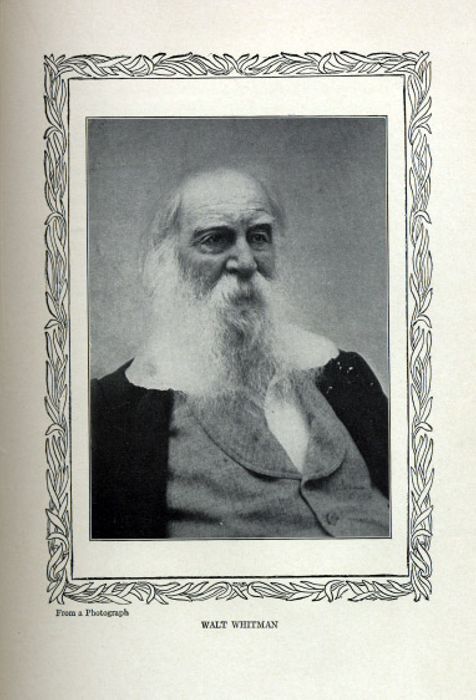 [Begin page 379] of some one last evening I felt I had to be careful what I said, what I tied to." Then he continued: "He was really handsome—one of the Englishmen you cannot help liking: a bit dressy, washed, almost dandyish—yet not, either: very enthusiastic—might call it soft-soapish: but very sincere, no doubt, in some measure. We must remember that all the society fellows have that failing—that peculiarity: the desire to say, do, think, graceful things." Had Rathbone any personal knowledge of L. of G.? "I do not think so: he did not talk as if he had." Had his father? "I do not know: I know nothing about him further than the speech itself." "Rathbone was bright: wanted to talk over matters literary, scientific, political, on none of which did I feel like descanting or would have descanted if I had felt well: they are subjects I always avoid discussing."
On a pile of papers an opened autograph album. W.'s name with date scrawled across a big full page. I pointed to it. "That is a dangerous precedent"—which made him laugh heartily. "So it is—generally: but this is for a special person. A lady came here the other day to get a copy of November Boughs: Eddy received her, waited on her: she left this book with him: the idea being, when I was found in good condition to present it to me for my signature. Eddy is very intuitive—knows how to fend, to ward off: all that—but gets names wrong. I found when I got hold of the book once that this Miss Elwell was a friend of my sister's—lives somewhere off in Jersey—is a school teacher: not a mean one—of some prominence, I think: not very young, though a miss"—here he laughed: "I would not like to say that to her, though I can say it to you"—pursuing the subject: "Of course I conform in a case like that: Miss Elwell is a reader—a bright woman."
I told him how good I felt over his inscription in my copy of the big book. "Ah! you like it?" "Yes." "So do I!—and what a trifle it is!—the expression of an obligation—nothing more: in fact, the obligation not half said—not at all said." I put in: "I did not accept it that way: [Begin page 380] I took it in the camerado spirit." W. then: "Ah! how much better that is. Such a debt can never be paid for in money, in confessions." Spoke of checks for printers and binders—did so voluntarily. "I must make them out: I want to settle the bills: I have a very convenient way when feeling the least out of kelter of dropping all the world's affairs—even the part that belongs to me to attend to." I suggested going to see McKay now the holiday season was over and he was approachable. W. asked me to get him a copy of The Publisher's Weekly containing a reproduction of the November Boughs frontispiece. Inquired if he had "adopted" the new pocketbook. "Yes indeed, fully: and here 's the other in testimony"—lifting up the old book from the table. "I did not like to throw this away—it has done me long service—it has done its part well: I have some sentiment in connection with it." Then further: ""You take it—use it if you care to. What a history it has—if written, if told! Not a tale of money alone, but of notes, cards, memorabilia—the hasty records of many wanderings about. I have carried it many, many, years—have had it on my person at all times: indeed I think I must have carried it from before the War—certainly from the Washington period. I came up once—I used to come through Philadelphia every now and then, on the way to see my dear mother: some one said to me: 'If you want a book—a book of which you may be cocksure—go there'—naming a place up Seventh street near Sherman's—where Sherman is now."
Had he read more of the Tolstoy book? "I have finished it—every word of it: was impatient to do it—profoundly interested." I felt that he began to see the reasons for my warm espousal of Tolstoy. Was the book not vivid? "I should say so!—rich: if I had to criticise it I should say, too strong, too vivid." Yet it was "fascinating beyond words." "The translation itself was a work of finest art: Tolstoy, so far as I see, is here for the first time fitly rendered in English. I wrote the Doctor about it this eve- [Begin page 381]ning: put it in the letter there: he is always on the qui vive for matters of that sort—new books, worthy books, remarkable books." But where was the book? "It has got lost somewhere among these odds and ends on the floor. I wanted to tell Doctor whose translation it was but could not find the book." "Sebastopol" troubled him also—whether "opal" or "opol." We looked for and finally found the book. "Frank D. Millet: it seems to me I know something about him—but what, what?"
Insisted that I take the book. I wrote the name of the translator on a sheet of paper which he carefully laid aside. He then composed himself in his chair and looked for a long time at the frontispiece portrait of Tolstoy. "It is a wonderful powerful head: I have seen such heads: dynamic—crowded with character." Then: "Some day look about in the print stores or among the art dealers—find me a good portrait of Tolstoy: get two— I will take and pay for one: I wish to have it about me here." "This book is far, far, far—threefold, fourfold—beyond anything I have seen before from Tolstoy. From reading it, from hearing your reasons, from the man Black's articles in Unity—new lighs are thrown on him: I find tangible indications of to me heretofore only half-suspected powers: mainly by your strong statement and this book: the whole, compacted, compating, judgment: ascending: up—up—up and out"—trying to illustrate it with his hands. "Oh! he has immensely risen—immensely!" He "fully realized" the "grandeur" of T.'s methods—"his planting himself on certain facts—redoubtable facts." "The wonder to me is, that those characters emerge from extremest social conditions—the conditions of all others we would think little likely to produce them: from the most tyrannical social forces in Europe. Think of Turgenieff: I often talked of him with Gurowski—my family friend there in Washington—one of the clearest headed most remarkable men I ever came in contact with. Gurowski was very irascible at times, but when at his best, when on good humor, he was keen, [Begin page 382] cordial, happy, as men rarely are." Yet G. came of "just such hard conditions": his movements were "a puzzle to his friends abroad": "loudly condemned, he suffered for it." A pause. "The whole genius of this Russian power—the writers: Tolstoy, Turgenieff: Kennan's exile—has been a wonder, in some respects a delight, to me. I have been a personal witness of much in the same direction in Gurowski: and by the way," he said, after a slight pause—"in your travels about in the second-hand stores—in Leary's (which I know to be a very good one)—in Dave's—you 'll some day come across a book of Turgenieff's—Dave maybe can tell you about it—Sketches of Sporting Life—something of that sort: get it for me—get it, read it, let us read it: I will pay for it. I have heard of it somewhere—have long desired it: but somehow it escapes me."
"Did you notice," W. asked later on—"Did you notice Doctor speaks in that letter I gave you"—Dec. 21st—"speaks of the big book again?—calls it grand?" "What is the secret of the growth of the fame of L. of G.?" W. said: "It seems the merest accident: an accepter here and there: an accepter quite accidentally generated: how, wherefore, who can declare?" He spoke of the original fight over it—"the efforts to keep it upon its feet"—"even now acquiesced in by a scarce circle." Bucke's allusion to immortality in his letter interested W. "Did you notice what the Doctor said?" "Does the Doctor go with you the whole way?" "I think Bucke fully acquiesces: Bucke is Oriental—has an Oriental religiosity—a firm fixed notion of some sort." How then about W. W. himself? "I mostly conclude I do—mostly: yet there are times when I ask myself very seriously—do you or do you not?" I said: "Donaldson asked me about it when he was over." "Did he? What did you say?" I explained: "I said to him what I have been saying to others—and a good many have been asking me lately—that I believed you always accepted while never dogmatizing about it." W. exclaimed: "Good! good! that [Begin page 383] was just about the right word: I guess I do: indeed, I do without a guess: but many folks say I do not and I suppose I myself waver at times—always however coming round to the affirmation at last." Told me of a Boston man, "a scholarly, leisurely man—a friend" who had "frequently" looked him up on his last trip to Boston—"the Leaves of Grass Trip"—and "debated the point with" him or "before" him—for he himself would "never debate." "H was in a curious train of thought: perverse, stubborn: yet was a man of intelligence—meant to be honest. He asserted to me time and again that I did not believe: quoted me lines from Leaves of Grass—'here—here—here—here—how do you explain this?' I would ask: 'How do you get that?' and he would say: 'Here they are—here they are': would himself have the most distorted versions—would find it hard to understand: even my explanations were mostly futile: text and all confessedly brought together in his hurly-burly head." It had been "a great lesson" to him. "I regard it as a study, a curio: instructive: it demonstrated by what a thin thread a writer hold his prestige: by the accident here and there of somebody understanding—in any case oftener misunderstanding—you. This man was a fair sample of the critics as critics go, good and bad (mostly bad)."
As we sat there talking Ed brought in a card—a reporter's card—a fellow I knew well and whom W. knew when I explained who he was: connected with The Record. W. put on his glasses: read the name off deliberately— "Charles [something] Bacon"—repeating it several times as if to job up his memory. "I indistinctly remember him. tell him to come up—stay a minute: tell him I am sick—that he is to stay only briefly." Then as Ed was about to go: "Put a chair there"—motioning towards the foot of the bed. Bacon shortly came in—shook hands: W. saying some few welcoming words and inviting B. to take the chair. B. explained that he had been sent by The Record to find out how W. had spent his Christmas. W. thence- [Begin page 384]forward affable—full, free, communicative. W. said: "I have had but no letters you would call important"—adding after a laugh—"strange to say, some of them from young ladies: the young ladies are most faithful to me nowadays. I had one letter from New York, one from Connecticut—several others: young ladies who for some reason or other have followed me up—grown up under my wing: young ladies or about to become." Spoke of his confinement—of his "half paralyzed" condition. "It is now almost twenty years. Do you know what hemiplegia is? In my case it started here"—pressing his finger to the back of his neck—"then came down the whole side—arm, leg, face: the leg never recovered: the arm recovered quickly. Luckily the stroke did not affect, such as it is, my power of speech, or my brain: up to the time of the present attack I was able to work—to write, read—as any time before: only my power to locomote, to get about, was gone—or partly gone." "My bete noir," he said, "is indigestion." But "the last two or three days" he had "in all respects" felt "wonderfully" bettered—"better, clearer of active trouble, than for five months past." Spoke of himself as "leaning towards gain": said his books were "off" his "hands, so to speak"—"done, or as good as done": the vols. "not actually here," but "some of them" here, and all the sheets with the binder. Advised the visitor to remember him to "all the boys." He assured B. he "always" had "warning" of the attacks. "Thanks to my dear father and mother, I have been wonderfully fortunate in my constitution—my body." He was "gifted with cheer" and that was "certainly worth more than five or ten thousand dollars a year." ""By nature, by observation, by the doctors, I have learned that the thing to do when I am down is to rely upon the vis, as it is called—the inherited forces: to lay low—attempt nothing—rest—recuperate: if the vis comes to the rescue—meets the peril—well and good: then for another lease! But if it does not, then all may as well be given up at once." He did not know—"it [Begin page 385] is not at all certain"—but "I may go from this out upon my ordinary condition of the past seventeen years." B. asked W.'s age. "I am in my seventieth year—celebrated the end of the sixty-ninth the last of May, this year." Then he added with what I told him was "cocky confidence": "If you can, come around next May: I will post you on points you might wish to know—which you can use or not as you choose." B. asked about W.'s "outings." But W. shook his head: "I have none—I have not been out for seven months: I can scarcely get from this chair to the door there unassisted—must help myself with a chair, the table, anything—sometimes calling the nurse." Did the cold weather hurt him? "Oh no! not in the slightest—no days could have been better for me than the last three or four." The hot days were the trying ones. "If I am still about when summer comes I must look up another place—get away somewhere."
Bacon left. W. very free with reporters, sometimes quickly dispatching them or will not see them at all. Likes them. Sometimes is very communicative, as to-day.
Room terrifically hot. "In time of peace prepare for war," he said, as Eddy came in the room with a big armful of wood. I said: "Ed seems to be the right fellow for you here: he suits you to a t." He nodded: "Yes: he is vital, easy, nochalant, self sufficient (in the right sense): he throws out a sort of sane atmosphere: I always find myself at home, at peace, with him." W. is always willing I should take along with me the scraps of things which he starts to throw away. He "can't see what the devil" I care for "the written stuff," as he calls it. "Still—I must humor you," he says. He gave me to-night another of his letters from Washington to Hugo in New York. "I want you some day to write, to talk, about me: to tell what I mean by Calamus: to make no fuss but to speak out of your own knowledge: these letters will help you: they will clear up some things which have been misunderstood: you know what: I don't need to say. The world is so topsy turvy, [Begin page 386] so afraid to love, so afraid to demonstrate, so good, so respectable, so aloof, that when it sees two people or more people who really, greatly, wholly care for each other and say so—when they see such people they wonder and are incredulous or suspicious or defamatory, just as if they had somehow been the victims of an outrage." He paused. Then: "For instance, any demonstration between men—any: it is always misjudged: people come to conclusions about it: they know nothing, there is nothing to be known; nothing except what might just as well be known: yet they shake their wise heads—they meet, gossip, generate slander: they know what is not to be known—they see what is not to be seen: so they confide in each other, tell the awful truth: the old women men, the old men women, the guessers, the false-witnesses—the whole caboodle of liars and fools." I said to W.: "That 's eloquent enough for Congress and true enough for the Bible!" He shook his fist at me: "What do you know about either, anyhow?" I read him the Hugo letter but had a deuce of a time getting through, it was so criss-crossed and interlined. But I finally worked it out. W. helped me here and there. He said: "You 're a better sleuth than I am: I find it impossible to go through some of my devious old drafts of letters myself." I read. There was no date on the letter. I asked W.: "Can you give a date?" He said: "I think it was in '63—about the same time as the other."
My honest thanks to you, Hugo for your letter posting me up not only about yourself but about my dear boys, Fred, Nat Bloom—always so welcome to hear personally or in any way any and every item about them. Dear friend, the same evening I received your letter I saw in the New York papers (which I get here about 5 every evening) the announcement of Charles Chauncey's death. When I went up to my room that night towards 11 I took a seat by the open window in the splendid soft moonlit night and, there alone by myself, I devoted, (as is my custom sometimes under such [Begin page 387] circumstances) to the dead boy the silent cheerful tribute of an hour or so of floating thought about him, and whatever rose up from the thought of him—his looks, his handsome face, his hilarious fresh ways, his sunny smile, his voice, his blonde hair, his talk, his caprices—the way he and I first met—how we spoke together impromptu, no introduction—then our easy falling into intimacy—he with his affectionate heart thought so well of me, and I loved him then, and love him now—I thought over our meetings together, our drinks and groups so friendly, our suppers with Fred and Charley Russell &c. off by ourselves at some table, at Pfaff's off the other end. O how charming those early times, adjusting our friendship, I to the three others, although it needed little adjustment—for I believe we all loved each other more than we supposed—Chauncey was frequently the life and the soul of these gatherings—was full of sparkle, and so good, really witty—then for an exception he would have a mood come upon him and right after the outset of our party, he would grow still and cloudy and up and unaccountably depart—but these were seldom—then I got to having occasionally quite a long walk with him, only us two, and then he would talk well and freely about himself, his experiences, feelings, quite confidential, &c. All these I resumed, sitting by myself. Hugo, that 's the way I sat there Wednesday night till after midnight (the pleasant Virginia breeze coming up the Potomac) and certainly without that they call mourning thought of the boy. That 's often my little way of celebrating the death of my friends.
Dear Hugo, you speak of your all remembering me and wish to see me, it would be happiness for me to be with you all, at one of your friendly meetings, especially at Fred's room, so pleasant, with its effect I remember of pictures, fine color, &c. to have the delight of my dear boys' company and their gayety and electricity, their precious friendship, the talk and laughter, the drinks, me surrounded by you all (so I will for a moment fancy myself) tumbled [Begin page 388] upon by you all, with all sorts of kindness, smothered with you all in you hasty thoughtless magnificent way, overwhelmed with questions, Walt this, Walt that, and Walt everything. Ah if one could float off to New York this afternoon. It is Sunday afternoon now, and perhaps you are at this moment gathered at Fred's or at your house, and having a good time.
I suppose you were at Charles Chauncey's funeral—tell me about it and all particulars about his death. When you write tell.
I looked up as I finished reading. Walt's eyes were full of tears. He wiped the tears away with the sleeve of his coat. Put on a make-believe chuckle. "It 's very beautiful, Walt: right on the ground: where the people are." "I hope so: that 's where I belong: right on the ground." W. added: "Emerson said when we were out together in New York and Boston—said it more than once: 'I envy you your capacity for being at home with anybody in any crowd.' Then he asked me on another occasion: 'Don't you fear now and then that your freedom, your ease, your nonchalance, with men may be misunderstood?' I asked him: 'Do you misunderstand it?' He put his hand on my arm and said: 'No: I see it for what it is: it is beautiful.' Then I said to him: 'Misunderstood? Yes: it will be misunderstood. But what is there I do that is not misunderstood?' He smiled in his sweet gentle way and murmured: 'True! true!'"
Wednesday, December 26, 1888.
8 P. M. W. lying on the bed but did not stay there long after my coming. Greatly interested in the weather. Had been talking to Harry Fritzinger. Fire burning sharply—room intensely hot. I spoke of the heat to W. who admitted: "It is fearful hot: I have just been having Harry attend to it—open the door." Ed off having a music lesson. I asked W.: "How are you?" "There is no change—or [Begin page 389] little: I am altogether what I was." But was tired: needed a little more rest: would not however stay on the bed. "I only put myself here for a little furlough: then I have some letters I must show you." So went laboriously over to the chair: greatly easier than some days last week. I said: "After all, your legs have not completely given out." "No—but nearly: they are not much good: I go stumbling about badly on them." Called my attention to Lippincott's. "I want you to take it along. There is a piece in it on Poe: Stoddard wrote it: I read every word." Was it worth while? "It is very cross, fault-finding, vitrolic, crabbed—characteristic of Stoddard: Stoddard is old, gray, disappointed—milk turned sour: thinks the world generally a fraud, a delusion." I interjected: "And thinks pretty sharply of you, too." "I should say so: he thinks I am a fraud—a fraud from top to toe."
Stoddard's general work was discussed. W. said to me as he had before that "The Woman on the Town was without a doubt the best thing" S. ever wrote. "Sotddard has always stuck up for Taylor: Taylor is the only one of them all that he has stuck up for: but even that was a wonder to me." Brought him the Christmas issue of Publishers' Weekly. Got it from McKay. Contains a W. portrait. "It looks very well: I don't know but I like it better than our own prints." We are to send this to Bucke. McKay gave me along with it two big pages of matter from W.'s Hicks, copied by Elizabeth Porter Gould as an addition to her W. W. book McKay now has under way. Was it not too big a slice? That was Dave's question. I submitted it to W. McKay had a copy of the second edition of Leaves. Picked it up in N.Y. for three dollars and a half. For his own use—not got speculatively. W. asked: "Was it the book with the steel portrait—thick—green cover?" Then: "I did not know there was a demand for them—any demand that would run up the price." Where did he imagine all the old books went? They rarely turned up in the stores. "I don't know: they slip away: they are rarely found— [Begin page 390] they have no speculative value: I have a copy of this edition, but probably not more than one."
I was speaking of Emerson and W. as the giants of our time in America—the only giants. "I assume that you stand incomparably higher than do all others." I said: "I think less of Bryant probably than you do." "I have an idea you do: I think a great deal of him: regard him highly: but I clearly perceive that you are essentially right—that taken all in all Emerson is a way, far, above all others: not one to share his glory."
He had slips printed: To the year 1889. Curtz is to set and print Bucke's letter regarding the big book: proof there to-night. Spoke of sending a copy of the complete book to Morse. "Must do so within a few days." No acknowledgement of the Boston package "except from Baxter." Spoke kindly of Baxter—of his endorsement of L. of G. Checks not yet made out. Still promises. W. said something about "the best fellows—like Whittier, for instance." I sent Bucke to-day's Record containing Bacon's report of his visit yesterday. "A queer bungle," W. said: he "caring nothing for it." Asked about Tolstoy's My Religion and My Confession: did not know but he "might read them"—at any rate would "try": "If they are what they may be I shall go definitely through with them." Was I going "up to Harned's?" "Will you not give your sister—Mrs. Harned—my love—my greetings of the season—enough for her, for the baby—then for all the rest?" W. thought "the just word" for Tolstoy "vraisemblance." T. "not surpassed in that Sebastopol book by any of the giants in the history of literature." W.'s appearance not quite so encouraging as for the previous three days.
W. said: "I have laid out several letters here for you—several of them: one from Rennell Rod: I thought it would interest you: others: several from the Doctor: Rodd is from abroad." Collecting them together—passing them over to me. "I look over matters about here—try to put a little order in the great confusion. Work a little each [Begin page 391] day." We went over the letters. W. got me reading again—reading aloud. Bucke says in one of his letters that he is reading Parkman and thinks a lot of him. W. nods: "He ought to if he thinks a lot of anybody: Parkman deserves it." In his letter of the 15th Bucke says "If the thing was possible I should go to Camden and stay with you—but it is not possible, so there 's no use thinking of it. Perhaps I could do no good if I was there: certainly you have a better doctor by far than I am—I mean Osler. But it seems to me they do not take the interest they ought." W. exclaimed: "O Doctor: Doctor—yes they do: all of them: I don't want a medicine man camped on the premises—could n't stand it: not even Bucke: I could stand Bucke here as a man but as an attending physician—God save me!—I love him—but God save me! Horace, think of having a doctor settled down on my doorstep! As for Osler: he is a great man—one of the rare men: I should be much surprised if he did n't soar way way up—get very famous at his trade—some day: he has the air of the thing about him—of achievement."
Bucke wrote on the 20th, satisfied with the aspect of things in Camden. "I think you are well off as to doctors and nurses now—Osler, Walsh and Wilkins—it is a strong team and we ought to see some result of their care of you." W. reached over quietly and took my hand: "Not to speak of you, Horace, who are worth all the doctors and nurses in the world." Then he added: "We 've converted the vehement Doctor: that 's a great victory." I read W. Bucke's letter of the 24th. When I was through he said: "I wish that damned meter was buried hopeless fathoms deep in the seas they propose to measure with it!" I also read B.'s brief Christmas letter, about which W. made no remark, but the letter of the 23d contained one sentence which W. said was "daring if not impertinent": "I am thoroughly satisfied with the big book and more and more as I look it over: I think it will stand in future ages as the chief glory of the nineteeth century." W. added: "Maurice must have felt [Begin page 392] mighty sure of himself to go on so in the face of providence. With all the world against him, too! Maurice, you are like one of those knights of the middle ages who went out alone challenging everybody to everything and attempting to do the impossible." There was still another envelope. Rennell Rodd's. It contained a manuscript poem but no letter. W. would have me read the poem. I demurred a bit—said I could n't read verse: but he insisted and I did so. He said: "It 's scholarly and all that: sort of schoolish: but nevertheless you 'll like it: it drives right to the point: besides, it seems intended seriously—as a real handshake, and I am inclined to take it as such cordially without critical qualifications." I read.
To Walt Whitman.
An English answer to certain strictures of Mr. Swin-burne's in a recent number of The Fortnightly Review.
Laugh loud from the merry old throat, rough Walt inthy haven of rest, For the curse of the prophet of Putney proscribes thee the
isles of the blest! He has passed from the van to the rearguard forsaking the
Ayes for the Noes, Renouncing the passionate lyric to preach in extravagant
prose: Oh where are the frenzy and fervor, the sonnets that "sting
like a whip," Protests anapæstic indignant that flashed from the radical
lip? He has turned on you too, Camerado, has passed from the
few to the throng, Content you and smile and remember he called to you once
for a song! [Begin page 393] But we who rejoiced to have found you, accepting the whole
for the part, The virtues implying the failings keep warm your old place
in the heart: We will say you were rugged uncouth and untamed as the
land of your birth, But large with heart of its greatness to compass the
glory of earth. We will love you and praise and remember when lilacs are
blooming once more, And thrill at the camp and the drumtap, and weep with
your bird on the shore. There is music in murmur of forest and rhythm in slapping
of waves, And of such were the music and rhythm old Walt of thy
mutinous staves. For the trick of the rhyme and the tinkle are easy enough
to acquire, But the insight and reading of nature were thine and the
throb and the fire. There is more of the roar of the ocean with thee, of the scent
of the pines, Than in all his recoiling and foaming up and down anapæs-
tical lines. So laugh and content you, old Walt, while the fever remains
let him rave! Let him be, he has doomed you with Byron, who hardly will
turn in his grave! And oh, bard of the pinewood of Putney, return to your
kisses and doves, The allurements of alliteration, romaunts of your trouba-
dour loves! [Begin page 394] Disbelieve since you must in the ardor of old you were first
to extol, Disbelieve in the present the future, and if need be look after
your soul! But forbear to believe that your footsteps are stainless
wherever you trod, Because you made music of lewdness to rhyme with the
mother of God! There is more pain on earth when a poet renounces the star
of his youth, Than for all the blind groping of dunces who never set eyes
upon truth.
The poem was signed "Rennell Rodd," and as from the British Embassy, Berlin, Sept. 8, 1887. W. laughed when I was through. "That 's mighty good,—eh? mutinous staves! That 's what they are: damned mutinous. Who is Rodd? He is a clerk, a secretary, an attaché, of some sort—not the chief, not the big bug: but he means us well, does us well, whoever he is. It 's funny to me how you fellows all get so hot over Swinburne's recantation: all but John: John was hot over the original position of Swinburne—said he could n't understand it: wondered if I had been misbehaving, and so forth, and so forth. When Swinburne took it all back John said: 'Now things look about right again: now I see that the trouble was not with you but with him.' It 's not necessary to believe Swinburne's original notion was dishonest, nor that the new view is: they stand for two Swinburnes: you can take your choice: one is as honest as the other: which do you choose? Maurice said: Swinburne's gone crazy! But Swinburne's friends originally though he had gone crazy for exactly the opposite reason. Tom said yesterday: Swinburne looks to me a bit like a liar: but oh Tom, ain't that going it a trifle strong? Don't you think there 's a decenter explanation than that? [Begin page 395] Emerson said to me: 'Beware of the praisers, Mr Whitman.' I said: 'You don't need to: the praisers beware of you.' He laughed—put his hand on my arm: 'You've got it just right: they beware of us.'"
Thursday, December 27, 1888.
8 P. M. W. reading. Had a letter from Sanborn acknowledging big book and enclosing a recent address on Emerson. W. sat reading the latter. The room was comfortable. He looked well, busy. Had spent a day "much like its immediate predecessors: reading papers, writing some, taking things easy." Talked brightly. I took a chair on his urgent "sit down—sit down." It was a little colder out of doors. W. stirred the fire (he always enjoys doing it): then settled himself in his chair, asking: "Well—what do you bring now? W. handed me an envelope: "It contains Miss Gould's extracts: I don't know why I should object: neither for that matter do I know why I should approve; it is a matter of indifference to me. I have enclosed a little note to Dave saying she may use the stuff if she chooses: that while I don't interfere I have no vehement desire to see the project furthered. Read it." This was the note:
Camden, Dec. 27, '88.I have no objection to this going in Miss Gould's little book—no objection at all, but no vehement desire either—If you can include it conveniently, do so; if not, not—I am feeling easier and freer the last four days.
Walt Whitman.He added: "You know I care nothing for this—no more than for the calendar." Then again: "I depend on you to talk with Dave if he wants more." He added: "These gems, extracts, specimens, tid-bits, brilliants, sparkles, chippings—oh, they are all wearisome: they might go with [Begin page 396] some books: yes, they fit with some books—some books fit with them: but Leaves of Grass is different—yields nothing to the seeker for sensations." He had laid away for me, "thinking you would like it," a copy of to-day's Post. Post reporter had been in and as he said "done me up in a two inch paragraph." Gave me a Curtz printed sheet containing Bucke's letter. "This I give you along: I know you like curios." He said he had had "quite a number struck off." He picked up another from the pile on the floor. "I give you one for Clifford: if you want several more you must take them: they are made purely for the inner circle—the few of us: we count Clifford one of us." Then he said dubiously to me: "I never asked Doctor if I might print it: it struck me to-night after I had sent his copy off: I wonder how he will like it? But I conclude he will understand: it is a private affair, all in the family: only for the elect, the few: I guess he will be satisfied. It is a curious little note—powerfully eulogistic: arouses, arouses in me, the gravest doubts, hesitancies, many times over: but I have concluded to let it go." He has secured thirty copies of The Post. Asked me to look at it.
"The author of Leaves of Grass has had a long and at times very serious spell of sickness since last May, all arising, as dated by medical science, out of the severe paralysis from Whitman's continued and overstrained labors to the wounded of the Secession War. This last is the seventh attack, and has been a most severe one—and only his good constitution has brought him through but he is comparatively recovering from it. He has had what has been called a strong team to pull him through, Drs. Bucke, Osler, Wharton and Walsh, and a good nurse, Edward Wilkins, a young, strong Canadian. During his spell Whiman has had printed and finished his little book, November Boughs, and a large volume of 900 octavo pages, including all his complete works, poems and prose. He is still in good spirits, yet very feeble."
I read this. Then I laughed. W. asked: "Now what is the matter?" "Walt you wrote that yourself!" He was jolly over it: "Who told you such stuff as that? It don't sound a bit like me." "It don't sound like anybody else!" Then he asked: "Suppose I did: is there any harm in it?" "No, the best way to get reported straight is to report yourself." W. exclaimed: "Good: You ought to say that to William: that 's one of his pet ideas (and mine too, so far as that goes): he also thinks authors should review their own books—that there 's no other way for them to get fair reviews!" W. added: "I sent away a number of the papers this evening—to Doctor, Kennedy, my sisters, brothers, nieces, others: with each paper I enclosed one of these sheets." He pointed to the Bucke letter. "You found yours all right, did n't you?" he asked me. Then he suddenly said: "I don't believe you've read the letter yet: I 've been talking all over and around about it—not shown you the letter itself: well, read it now, this minute: let me see that you read it—hear that you read it, indeed: read it aloud." W. had provided a heading for his sheet. I read:
An impromptu criticism on the 900 page Volume, The Complete Poems and Prose of Walt Whitman, first issued December, 1888.
. . . It is grand, grander than even I had hoped. It is the volume of the future for the next thousand years, and after that (superseded by even greater poems) to live as a grand classic for ever. It is a gigantic massive autobiography, the first of its kind, (though the trick had been tried before by Goeth, Rousseau and others: but even Goethe cold not do it). The title page is perfect—I cannot conceive anything finer—and the little notes (opening and closing) are (to my notion—though you seemed so doubtful about them) just right.
you have had a hard fight and a long fight, [Begin page 398] but we may say of you to-day that you have won the battle. If you have fallen at the end, (though I trust even yet you may still have before you some good days), but even if you are to fall now, your fame is safe beyond all peradventure. Your work is well done; and here or elsewhere (I do not know that it matters much which—except for those you leave a little while behind you), you will live and be honored always. Yes, and loved always.
R. M. Bucke.W. had pinned the original proof with his blue-pencilled corrections to my sheet. He tied the papers together. He said he was "careful not to ostentate with the sheets"—"only to send them to the few" he "knew would approve its appearance if not its sentiments." Even with Morse he hesitated. "Would Sidney be interested?" "I remember Doctor's emphasis on that phrase—'one of us'? We talked once about Stedman—more than once: but this was a particular time. Maurice declared—was emphatic: 'I can't think—no, I can't think, he is one of us!' He thought probably that I was too warm: something I said, probably, aroused him." I said: "Dave was nearly struck dumb when I told him to-day that Stedman gives you thirteen pages in his book whereas the average is three." W. asked me to repeat. Then: "Yes, it is significant: you are right: there is no doubt but Stedman has changed a good deal—in fact as towards his older point of view has changed utterly: has turned his back on all that." I said: "I meet men who say—Whitman is great, perhaps, but no poet. They refer to Stedman. But Stedman is nowadays among the readiest to call you a poet and love you as such whatever he may have said in the past." W. nodded his head: "It is true: whatever else is true, that is true, too." Then asked about S.'s book: how many volumes, &c. Had seen none. "I suppose I come up at the last with the W.'s?" But I found the order was different, coming in periods: colonial, &c. W. said in conclusion that if S. [Begin page 399] was not to be reckoned as "one of us," he was "at least extremely friendly, growing closer with the years that pass."
W. gave me back The Publishers' Weekly. I'll send it to Bucke. "I have looked it over carefully—was interested in the pictures, the printing: but it struck me to ask, if Dave paid fifty dollars (did n't you say fifty?) to get that portrait in, was it a paying investment?" Gave me check for Ferguson—eighty-four dollars seventy-five cents: paying in full. Advised also that I get F. to "certify" to the deposit of the plates with him. One box from Oldach still unopened down stairs. W. wished to pay bill. I advised: Wait till we are sure: I will open the box and make my count in a day or two. He said: "Well—do as you think best, but I am in the humor now—have no doubt at all but that things are all right: besides, I have softened to old Oldach: he has so gratified me with the book I want to testify to it." The W. paragraph was not in all editions of yesterday's Record. W. said: "It happened so once with The Herald: some one said he had a copy reporting that I was dying, but when he went and secured a second copy—the same date—the paragraph was not to be found. Probably later information showed the report to be false." W. leaned over towards the fire: picked up the old-fashioned tongs. "What do you think of this? this is the latest"—opened and shut: looked at it asquint: then seemed to study it: handle graceful—a good looking tool. "Warren Fritzinger, one of Mrs. Davis's boys, knows an old Irish lady living not far from here—right in the neighborhood. She had this—was not using it: she would not sell it but would let me have it till I got another. Don't it have the true look? It is made for work not for appearance. You go into the parlors: there are the tongs, brassed, shining—a long handle—graceful, pretty, dainty—but never intended to touch the dirty fire with. I need such a thing as to stir up the fire here." He thought "forty or fifty years ago I might have handled this weapon with [Begin page 400] agility," but now he was "very long out of practice" and had "to relearn the art."
I had read McCosh's paper on Arnold. W. said: "Yes, I see he has been doing it, and he is very severe too—thinks, evidently, there was no place for Arnold." I asked W.: "Don't you think that 's from the theological bias?" W.: "That is true: McCosh is the priest: he has the priestly twist. I imagine, if Arnold, Arnold's spirit, is hovering about these days—could be cognizant of McCosh, of others—he would care little about what they think—what Mr. McCosh thinks, anyhow. My own criticism of Arnold—the worst I could say of him—the severest: I who probably have no right to any opinion at all—who, having read so little, should keep his mouth shut on the subject: my worst criticism would be, that Arnold brings coal to Newcastle—that he brings to the world what the world already has a surfeit of: is rich, hefted, lousy, reeking, with delicacy, refinement, elegance, prettiness, propriety, criticism, analysis: all of them things which threaten to overwhelm us." Yet he "understood that." He was aware that "we must be in no haste to dismiss Arnold." "John Burroughs, who has read him, knows him, is certain Arnold has a place and a significance—a great place, too." I suggested: "You don't credit the critics much: John Burroughs thinks you are pretty considerable of a critic in your way." W. said: "Does he? How could John? If I am it must be in an intuitive fashion: but I guess I am not. That reminds me of a story told of Socrates: you have probably heard it: perhaps I have repeated it before myself. It lugs in the oracle—is told of Athens: some one coming to Socrates and telling him the oracle had named him the wisest man in Athens: he resisting, explaining, questioning: how was it? how could it be? could the friend, servant, courier, messenger—or whoever—give reasons? unravel the mystery? Well—Socrates would find them for himself. Why was Socrates the wisest man in all Athens? Simply because of this—simply because of this: because while the whole pack [Begin page 401] of so-called philosophers, scholars, learned men, were damned fools—utter damned fools—and did n't know it, he, who was also a fool, as much as any, knew it, acknowledged it."
W. recited this with great spirit—slowly, as usual, threading his strange but strikingly coherent sentences through with an infalliable circumspection. Then he said with vim: "That is the story in substance. It has no doubt often been better told—I myself have told it better, perhaps. Did I never before allude to it? It is the oldest of the Socratian stories to me: I met it very young, when I was sixteen or seventeen—met with it in a book somewhere—I don't know in what. It has clung to me all these years: it is a touchstone: it seems to me, O very deep—very deep!" The story was familar to me but his way of retelling it was inimitable—his enjoyment of it immense. "There is of course a not literally true element in these stories: yet all of them are essentially true—must be: they bear the stamp." We quoted a number of Socrates stories. W. said they contained for him "a perpetual and perpetuating interest." The story he had told was "in a sense" an answer to John who thought him a critic, "with the difference that John set nothing up egotistically." "But W. W. knows W. W. is a damned fool if no on else does." I asked him: "You speak of well told stories: don't you think most of the stories in books are too well told?" He said without hesitation: "Yes I do—I do." I said the best criticisms, the best stories, are heard in parlors, in crowds, informally. W.: "That, too, is true: see the theaters: the best criticisms are heard in the lobbies, at the time, impromptu, unstudied: yet lost, swallowed up, unheard of." Took him the Carlyle-Goethe correspondence. "Is it Tolstoy?" he asked. I handed it to him. When he had seen what it was: "Well—this, too, is something: we 'll see." In another reference to John's saying W. was a good critic W. quoted something Emerson said to him in one of their talks: "'You surprise me in one way, Mr. Whitman: sur- [Begin page 402]prise me greatly: yet do not surprise me either: for I might have assumed as much: that is, I find you a copious book man—a readier knower of conventional things in literature than I had thought you to be.'" W. was still. Then: "The gentle Emerson: I was surprising him in more ways than one." Referred to the Sanborn letter. "No—he does not enthuse: he is cautious, moves slowly—accepts carefully, moderately: but I consider Sanborn one of my best friends—one who leans my way, who I in turn may lean upon." Further: "Sanborn was one of John Brown's big young men in the old times—was a fighter: up in arms—a devotee. You can take the letter along: but I want you to read it to me first. You will meet Frank some day: he is one of your sort: the revolutionary crusader sort: gets hot in the collar about the enemy, as you do: is quick on the trigger: noble, whole sized, optimistic. But read."
Concord, Mass., Dec. 25, 1888. Dear Friend:I received you noble volume of Works just in time to make it a Christmas present from you,—and none could have been more highly valued. I hope it may not be the final edition but that you may live to add more prose and verse to the monument which will preserve your name in the Future, for which you write, and to which you truly belong. But in the Present and the Past also you have done your work, and thus have gained a claim on the Future, which will not be denied you.
I cherish two copies of the first edition of your Leaves of Grass—one given to me by Emerson in the year it was published, and one left to me by Sophia Thoreau—her brother Henry's copy. I shall place these and your fullgrown volume together, and hand them down to my children.
I enclose the report of an essay I lately read in New York. The omitted passage is one about Emerson, which did not properly belong there, and was not read by me— [Begin page 403] but the reporter found it among the sheets which I handed him to use, not to print entire.
Yours with friendly regard F. B. Sanborn.I said: "I'd like to see the Thoreau copy of the Leaves. It would be interesting to know whether Thoreau soaked you any on the margins or put any amens there." W.: "You might write Frank and ask: yes, it would be interesting to know: for Henry was not all for me—he had his reservations: he held back some: he accepted me—my book—as on the whole something to be reckoned with: he allowed that I was formidable: said so to me much in that way: over in Brooklyn: why, that very first visit: 'Whitman, do you have any idea that you are rather bigger and outside the average—may perhaps have immense significance?' That 's what he said: I did not answer. He also said: 'There is much in you to which I cannot accommodate myself: the defect may be mine: but the objections are there.'" Then: "You know, Alcott was to see me, too: they were all in some particulars much alike—Emerson, Alcott, Thoreau: then they were different too: but they all had the same manner—a sort of aloofness: only so far: that coming an inch beyond that would mean disaster for us all." W. laughed quietly. "You see, the cultivated fellows all carry that air about with them: it is not dishonest, though an acquirement: yet because of it they in some ways, the best of them, Emerson himself (and Emerson knew it) compare unfavorably with the urchins on the street."
Friday, December 28, 1888.
8:10 P. M. W. lying on bed. Just helped there by Ed who was adjusting the covers. W. of course dressed. Rather a bad time again this afternoon and evening. Nothing decided. W. brightened up some on my entrance. "Take a [Begin page 404] seat, Horace: and you, Ed—turn up the light." Then asked me: "What is the new thing with you? How has the day gone?" He said he had written Bucke "a postal—a short postal." No visitors. George Whitman in yesterday: thought (Ed says) W. looked better every time he came. W. had sent off almost all the rest of his batch of Posts, Ed taking them to the postoffice—pockets stuffed full. W. said last evening: "I should send a few to England—to Mary Costelloe, to Ernest Rhys." Sent the Bucke letter along, mainly. W. said: "I had a note from Mrs. Fairchild acknowledging the book. It is a good note. She speaks of the book as being 'sumptuous.'" "Sumptuous? sumptuous? that 's scarcely the word." W. at once: "Nor do I think so: sumptuous means parchment, vellum, gilt bindings: that is scarcely the word."
Referred, pleased, to Kennedy's enthusiasm over the title page. I reminded him of my original favor. He said: "I see it better now: you are confirmed: I am for my own part more and more willing to accept it." I said I was glad that going back that day to Brown with the Romeo picture I had insisted on a retrial. W.: "Yes, I am glad you persisted: we have many reasons for congratulating ourselves: the Romeo curls would have been an accusation of our dying day. The picture wholly satisfies me—even the ruggedness you properly speak of: and in your reflections on the page does there seem to be any significance in the outlook of the face?" Secured two copies of the Sunday Herald to-day containing three quarters of a column about November Boughs. Sent one to Bucke. Brought the other to W., who questioned me. "What is it like? is it favorable? Extracts mainly, eh? What do they purport?" I described. W. inquiring: "Is it well done? well selected?" I put it and copy of The Publishers' Weekly with second notice of November Boughs on the table. The latter spoke of W. as a "rugged old reformer," which made him laugh. He made me repeat it several times. Also found at McKay's copy of Boston Republic containing a notice of the book. Sent for copies [Begin page 405] for Bucke and myself. When McKay read W.'s note to-day about E. P. G.'s book he said he had no enthusiasm himself—"from the first would just as lief W. had sat down on it." Showed me proof sheets. W. interested in all this. "Gems of Walt Whitman." He dreads such volumes: "gems," "brilliants." "Is my time at last here? Alas!" Was he curious to see the book? I would bring the sheets I had seen to-day. "Oh no! not at all! I can think of no reason for which I should desire to see them." Again questioned me: "So you think Sanborn's letter a good one?" Then: "If there are precious copies of Leaves of Grass, he has 'em!—one from Emerson, one from Thoreau: one that belonged to Thoreau: that is sacredness itself!" Further: "Emerson said to me: 'Henry carried your book around Concord like a red flag—defiantly, challenging the plentiful current opposistion there!'" I said: "But Emerson: did he carry his copy around?" W. smiled. "Scarcely so: that was not his way: he probably never apologized for it: all the same he did not go out and sow it in the world."
No letter from Garland yet. Saw Ferguson. Got his receipt and "certificate," as W. asked. Opened and counted big books with Ed in the parlor. Among the letters W. gave me yesterday was one from Bucke very specific about W.'s diet. W. said to-night: "It is—yes it is—a very good letter: I am conscious of it even though I do not obey it—conscious it should be obeyed. I know no one better able to say these things than Bucke." Bucke had advised that the letter be shown to Walsh, who could give more direct instructions. W. has not done this: it is doubtful if he will, though he may. I wrote Bucke that Harned had often agitated towards the same end. W. not careful—not avoiding certain foods when he should. But W. goes his own path. W.'s serenity, cheer, control, at least qualifies the evil effects of his indiscriminate eating. Again as to Sanborn: "So you like the letter? so do I." I added: "It is reserved, but all the better for that." W.: "Reserved—and what?" He had not heard. I repeated. "Ah! that 's [Begin page 406] just it. I think I can count on Frank: it is characteristic of him these years to be quietly self contained." He pointed across the footboard to the table. "Over there is a big envelope: I laid it aside for you: I put in it the essay Frank sent me. It is a speech on Emerson delivered before the Geothe Club in New York. Then I put along with it Hamlin Harland's"—he always gets the name wrong—speaks of it as a "perverseness"—"piece on the Single Tax, whatever that is." I searched for and found the envelope, W. having written upon it:
"from Frank Sanborn
(on the big book)
(lecture on Emerson & Hawthorne to the Goethe Club N Y also Hamlin Harland's [Garland's] piece on the 'single tax' give it to Horace if he cares for it.)"
It was curious. I resumed my seat. "You found it? Good! I laid it aside for you. These things are easy to lose in the confusion of this room." Had he read the Sanborn piece? "Yes—every word of it: it is very interesting: but not weighty, not vigorous—contributes nothing new: smooth, literary, all that: the something beyond not there." As to the Single Tax: "I left that wholly for you—did not attempt to read it. Hamlin writes more than a column: it is from The Herald—Boston Herald: I know nothing whatever about the subject." I asked W. about the accented e in Goethe in the Bucke letter. He said quickly: "I know: I saw that myself: indeed, started to correct it: it looked odd and unusual and wrong to me: somehow at the last I missed it." Kennedy told W. in his letter about a man whose leg was cut off by the train Kennedy was riding on. W. said: "I wish he had n't tried to be so damned vivid: the picture has bit in on me—I can't shake it!" He asked me: "Have you read Dick Stoddard's piece yet? I want to hear what you have to say about it." Ed says W. gave Dr. Walsh a big book to-day.
[Begin page 407]Bucke is crying for a copy of the big book with an inscription from W. in it. W. said he would write something on a slip for Bucke to paste in. "That will do, won't it? I had not forgotten: put if off from day to day: that 's all." Lets Ed help him more than usual nowadays. "I am getting worse and worse on that score—on the verge of giving out entirely." He is greatly taken with most of the new books I leave with him. The night I took him Sebastopol he sat up till after ten with it—confessed its "terrible attractions." He is like a child in his curiosity to see a new thing. He gave me another of his rough draft letters. "It was to Einstein: but who does not matter it describes the fix I was in after my upset—after I had settled here in Camden. I was beginning to feel easier about my shaking up when I wrote that: life was reviving: I was getting a little like my own self: certainly was spiritually realizing life once more—tasting the cup to the full. Horace, you were a mere boy then: we met—don't you remember? Not so often as now—not so intimately: but I remember you so well: you were so slim, so upright, so sort of electrically buoyant. You were like medicine to me—better than medicine: don't you recall those days? down on Stevens Street, out front there, under the trees? You would come along, I would be sitting there: we would have our chats. Oh! you were reading then like a fiend: you were always telling me about your endless books, books: I would have warned you, look out for books! had I not seen that you were going straight not crooked—that you were safe among books." I asked him: "Well Walt—do you still think I go straight—that I am safe?" He patted me on the head. "You've gone from good to better right along: it 'd have to be a damned crazy book to fool you. Why, Horace, I tremble in my boots for Leaves of Grass every time I see you open your eyes!" I said: "Walt, do you remember the day you buried little Walter? How we met—walked a bit: how we had quite a little chat: how you took the car at Fifth Street—at Stevens there: how we met again [Begin page 408] an hour or so later on the boat? I look back and see it all: you said: 'Horace, it does me good—this air does me good: sort of makes me whole again after what I have gone through to-day.'"
W. was very quiet for a while. I wondered if he remembered meeting me that day. Finally he stirred around on the bed and exclaimed: "Yes! now I do remember it: not all the details you mention but the circumstance: and I remember what maybe you have forgotten: that on the boat you bought some wild flowers from an old nigger mammy who had been all day trying to sell them in the city and was going home dispirited: you bought her flowers and handed them to me. Do you remember that?" When he spoke of it, yes. W. was palpably moved. He said in a hushed sort of way: "Read the letter, Horace: read it to me."
Camden, Nov. 26,'75. My dear Einstein:On coming back here I find your letter of the 20th. It is so kind (bringing up old memories, and making prologue and ceremony unnecessary) that I will at once answer it in its own spirit, and reveal the situation.
My paralysis has left me permanently disabled, unable to do anything of any consequence, and yet with perhaps (though old, not yet 60.) some lease of life yet. I had saved up a little money, and when I came here, nearly three years ago, I bought a nice cheap lot, intending to put on a small house to haul in, and live out the rest of my days. I had and yet have a sort of idea that my books (I am getting ready, or about have ready, my completed writings, in two Volumes—Leaves of Grass, and Two Rivulets) will yet henceforth reliably furnish me with sufficient for grub, pocket money, &c., if I have my own shanty to live in. But my means, meagre at best, have gone, for my expenses since, and now, while not hitherto actually wanting (and not worrying much about the future, either) I have come to the end of my rope, and am in fact ridiculously poor. I have [Begin page 409] my lot yet clear, and it would be a great thing for me to be able to build forthwith a four or five room shanty on it and haul in snug and quiet, with the sense of security for the rest of my days—for I feel yet about as cheerful and vimmy as every, and may live several years yet—indeed probably will—and may write some—though my days of active participation, and ganging about in the world, are over.
I get out a little nearly every day and enjoy it, but am very lame—keep stout and red as ever—grayer than ever—am feeling pretty comfortable as I write—have just returned from a three weeks' jaunt to Washington and Baltimore—which has much refreshed me, (the first time I have been away from my anchorage here for nearly three years.) I often recall the old times in New York, or on Broadway, or at Pfaff's—and the faces and voices of the boys.
This was written on all sorts of pieces of paper—six pieces. Two pieces of a letter from Pete Doyle. One piece a letter from Josie Morse, New York. Pete used the stationery of the Baltimore & Potomac Railroad Company. I said to W.: "That 's not as gloomy as some of your letters written in the same period." No—maybe not: I was feeling better the day I wrote that: it was then as it is now: one day I'd feel sort of completely knocked out—gone: then another day all my bodily ills would seem to leave me—then I'd feel almost like my complete self again: what my letters were would depend upon which of these days I wrote." I said to W.: "You 're still talking of that old shanty—your shack: you asked for a hut and you got a house." He laughed. "Yes: I 've asked for lots of things and got something else." He said further: "I have always had an idea that I should some day move off—be alone: finish my life in isolation: it may not seem just like me to say that, but I 've felt so: at the last, after my fires were spent. For the most part I have desired to remain in the midst of the hurlyburly—to be where the crowd is: to make use of its mag- [Begin page 410]netism, to borrow life from its magnetism: my heart is always with the people, in the thick of the struggle."
Saturday, December 29, 1888
7.30 P.M W. improved to-day: sitting reading as I entered. He had received a circular of Poet Lore—a new monthly. Held it up to me after I had shaken hands. "Didst see this?"—mockingly—"Well—listen!"—thereupon reading. Would he subscribe? "No, I will not"—laughing heartily: "I was just wondering what to do with it—whether to put it here with the waste paper or save it for you. I know you are interested in all that 's going." Left with him copy of the current Stage. Did it interest him? "I don't know: I only know I read it through from the beginning to end." The Carlyle-Goethe letters open. Had he started reading them? "O yes! I slipped into them, but have not gone far." It had not impressed him. W. said: "Why, Horace—that Herald notice is very good: a very generous one: I have read every word of it: while they make few comments—only quote—the comments are extremely good and the quotations apt." Had also read the little note in Publisher's Weekly. "It, too, is very fair—very distinctly favorable." W. said: "I have been busy— reading, writing, sitting up—everything but moving about. I wrote Doctor—sent a letter off to him to-day." Had enclosed a Kennedy letter. He asked: "You still think the Sanborn letter good? Still are content with it?" Said nothing about it himself.
I trod on a package: picked it up: found it to be a Post directed to Mrs. Fairchild: should n't it have gone off with the others? W.: "What is it? Oh, certainly: I thought it gone two days ago." I took it with me to mail over the river. Ed had brought two letters—the one Poet Lore: the other W. now opened. I saw at once what it was. "For an autograph?" He read a few lines. "Yes, yes—merely that: listen"—reading lines closing: "I am a little girl and would so value your autograph." He laughed. "Do[Begin page 411]you believe it?" "It is very doubtful—an old subterfuge." He took the letter, reaching forward: saying as he dropped it in the wood box: "Here she goes"—then was about to cut the stamp from the corner of the return envelope enclosed—"oh a good card"—taking a card out of the envelope, laying it on the table carefully—removing the stamp also. "It is a weariness to be besieged: but they come every day—sometimes in squads." He tried to explain my good health: "I explain it by your large intuitional gifts: you have intuitive ways of knowing what to do, what not to do. There is no better safeguard than that. I have made up my opinion from our frequent talks: it seems to explain and justify you fully."
I returned his Lippincott's. "Well," he asked: "What of Stoddard?" I had read the paper on Poe on my way over in the morning. I was very vehemently against S.'s point of view. Enlarged on it. W. leaned forward in his chair: "Oh you are right, boy: you are right—right—right! Oh! how that sounds like William O'Connor!—almost his very words: I can hear him in the very tones of your voice. What you have said, what you have been saying: that is just what he would say: I have heard it often and often: the same eloquent forgivingness: better, the same refusal to judge, condemn." W. went on insisting upon this resemblance. He considered Stoddard "sour, dissatisfied, disgruntled: it has been so with him—that has been his humor—for many years. Poor Poe! Poor Poe! who shall say he did not have failings, defects, weaknesses: serious weaknesses—grave, oh! so grave!—from which he suffered?" But why stop with them? "It seems to be Stoddard's principle to pull men down"—I said: "I suppose he would rake you over with the same vim?" "He has done it already. Oh! I am sure when I kick the bucket he will be ready with some columns of obituaries just as vinegary, fault-finding, mean." W. felt that S.'s character was "warped." "Stoddard is determined certain things should be even if they are not. I remember the time I spent at St. Louis years ago—some [Begin page 412] years ago: I would go into the schools—the kindergarten, others—there. The children always insisted on a story—on hearing me talk—say something. I liked a little fancy—a fable of the cats: I repeated it—then—often here"—he closed his eyes an instant then resumed interestingly—simply, as a child—himself—and with much feeling: "The two cats went on a trip from home, then back again —along the same road, under the same conditions: the same sky overhead, the same influences about. When they returned they were asked what they had seen. Oh how different the stories! They had gone the same road, met with the same experiences: one had to tell of the most wonderful adventures—had seen the most wonderful things: the road, the fields, the clouds above—tenderly, lovely, fascinating, compassionating: the other had realized nothing but horrors—had met reptiles, stagnant pools, poisons, despairs." He stopped here—looked at me: "I interpret this as exhibiting a habit of mind—the morbid, the healthy, so to speak. Stoddard is determined to see the bad, the dark, the venomous: it is his habit of mind: he is the second cat." I read W. a passage from the Poe piece: Stoddard—a rainy day in New York—seeing Poe standing on the street corner: S. had not offered umbrella—P. heroic, defiant, self-reliant, proud: S. saw him so still—always would. I said: "The man who saw him so still would not write this article." W. feverently: "Nor would he! Oh boy! If only William O'Connor could hear you talk so!" I said: "I alluded to Stoddard in my letter to Doctor this morning." W.: "Did you? Should we send him the magazine?" Then after a pause during which I must have looked doubtful: "No, I guess he would not care for it: you can take it along with you if you wish."
Talk took still another turn. "Do you know anything about Burns—John Burns—a writer: he is a London man—seems to be a labor agitator—an anarchist—something of that sort: that is his portrait you have in your hands now. Some one sends me some of his poems: they [Begin page 413]seem to imagine a likeness between us—seem to see some suggestions of me there, of Leaves of Grass." W. took the Burns picture in his hand: B wore a hat making him look not unlike the W. of the '55 edition. I remarked it. W. said:"It is a noble remarkable face, I think: does it not seem so to you?" I asked him if Burns was not the man arrested with Morris in one of the Socialist troubles in London? "I do not know: I forget even about Morris: tell me." Added: "When I have gone through with them you had better take them in hand. I confess I have n't read the letter there that came along with it to see what it is all about." Not sent from London but from Marshall B. Williams, Philadelphia. M. B. W.'s letter with portrait, &c. on the table. More talk about Stoddard. W. said: "That type of man is particularly devilish to me: is not big, ample, inclusive: rather drives away than invites. He hates Poe not because Poe is hateful but because he—Stoddard I mean—is full of hate. Stoddard has pursued me with a sort of venom always: he said to Stedman—so Stedman told me: It is your duty to stamp out, not to encourage, such influences as Whitman in literature. Gilder has told me of similar things said to him by Stoddard: always against me—always (or my work, which is me, after all): saying severe things to Gilder on occasions: on one occasion especially, on Broadway, up there in front of his office—Gilder's office: somewhere—I think there: said to Watson, if it was not for the sympathy he, Walt Whitman, gets from a few of you men who really stand for something, he would have no currency whatever—would disappear: said that to the gentle Gilder, who, though always my friend—God bless 'im!—was never rabidly bitten by Whitman, as you are, as Symonds is. When I read Stoddard on Poe I think of Stoddard on Walt Whitman: I understand his quarrelsome, querulous, disposition better than ever. Sometime when you are over there in New York you must quiz Gilder, Stedman (even others: they all say the same thing about him) as to this point in Stoddard's history. I never quite [Begin page 414] know whether Dick is simply agin some of us come-outers on general principles or whether underneath it all in him towards us there may not lurk some ingredient of jealousy. When he first knew of me he seems to have said: He 's only vulgar, only indecent: let him alone: he 'll come to nothing. In the later days, when I seem to have come to something—when he at least thinks I have come to something—he tells the fellows: 'He has not kept himself alive—you have kept him alive.'"
W. gave me a Carpenter letter. The signature was cut out. Consequently some of the writing on the other side of the sheet is gone. I asked W." "Who mutilated the letter?" He said: "It was mutilated for reasons: some one wished the signature, I suppose: I am not quite clear about it: the autograph fiend is omnipresent: he turns up everywhere and is irrefusable: there may have been another reason: I guess it was that." He called it "one of Carpenter's early fine letters"—adding: "He was never nobler than then, in that period of interrogating enthusiasm." He had me read the letter aloud.
Brunswick Sq., Brighton, 3 Jan., 1876 Dear Friend:A few weeks ago I sent you a book of mine—Moses: a drama. It is an effort to represent the character of one who, being far beyond his time, has conceived a new idea, a new development for mankind, and by the very force with which he has conceived it wills to shape out, and shapes out, the way of its realization—standing himself all the while alone, solitary, upon earth. I hope it may be some pleasure to you to read it, if only that I may pay part of the debt I owe you for your writings.
I write this, having just had put into my hands a letter from Moncure Conway written after a visit to you at Camden. Is it true that no American publisher will issue your works? When reading your writings I have thought the future for which you looked quite close, but then one goes [Begin page 415] out into the world and hears such things as this and sees the general drift of men's minds towards commonplaces and conventional estimates of things, and then the future looks far—beyond all attainment as indeed I believe in some sense it is—and it seems only cruel that men (some) should be born to breathe their lives out after a mere visionary beauty. Will it ever be that human love—strong to meet with adventurous joy all chance and change—will cease to be a mere name? that men will "understand"—eat of the tree of knowledge of good and evil, and so be immortal? How strange it is! I know that it must be, I see it everywhere—in face after face in the streets, in the sound of men's voices and in their silence—clear, unmistakable, as if just about to be disclosed, the divine "everywhere-equal" life; and yet the children die, hardly knowing what they have sought yet knowing that they have not found it, and their dreams fade away, and to long suffering succeeds rest, and still the distance remains immeasurable. All is resumed. As soon as I remember what the end is—however great the distance—I do not doubt. It is quite true—even as it is truly present with us now underlying all thought and these words. Dear friend, you have so infused yourself that it is daily more and more possible for men to walk hand in hand over the whole earth. As you have given your life, so will others after you—freely, with amplest reward transcending all suffering—for the end that you have dreamed. In the midst of the ferment of this age of material and mechanical intercommunion you have planted the seed of a spiritual union and identity above all space and time, which yet shall use the spaces and times of this earth (while it endures) for its manifestation and expression. What have we dreamed? a union which even now binds us closer than all thought high up above all individual gain or loss—an individual self which stands out free and distinct, most solid of all facts, commensurate with all existence—love disclosing each ever more and more. See, you have made the earth sacred for me.
Meanwhile, they say that your writings are "immoral": [Begin page 416] and you have to defend yourself against people who will misunderstand your defence as they misunderstood your original words. Need I say that I do not agree with them in the least? I believe on the contrary that you have been the first to enunciate the law of purity and health which sooner or later must assert itself. After ages perhaps man will return consciously to the innocent joyous delight in his own natural powers and instincts wich characterized the earlier civilizations. I do not understand what it is to be "shocked" by these things: it seems to me childish. But in the meantime it is certain that people do not understand. In some way or other our modern civilization has become narrowed and one-sided. People's minds are dwarfed: one portion of their nature grows up in the dark (and ceases to be healthy). Men have lost the freedom (free masonry) of Nature and are plagued with insane doubts of their Duty. For a time I suppose men must grow up in swaddling bands of morality, and a certain instinct makes them cling to them till they have grown to be greater than, and the masters of, morality. But I think indeed the time has come for people to learn to unwrap these bands, and that from this time there will be a world-wide growth in the direction you have pointed out. So while I regret sometimes that there are things in your writings which make it difficult, sometimes impossible, to commend them to some who might otherwise profit by them, yet I feel it is best that they should be there. Their presence delays the understanding and acceptation of your message, but your message would not be complete without it, and slowly, gradually, increasingly, without end, its grandeur will dawn upon men.
You are saying something on this subject in your Two Rivulets which I look forward to seeing. Can I obtain a copy through you, or have you an agent in London?
I feel that my work is to carry on what you have begun. You have opened the way: my only desire is to go onward with it. Though it is out of all question to suppose that one generation or ten generations will make such a difference [Begin page 417]in men's minds in the direction of the ideal state, still—to contemplate that ideal and to live slowly translating it into real life and action is quite certainly the only good—and is sufficient. I do not think of anything that I have done except as preparation: on all hands the words seem to me to be flowing in but in exactly what shape they will issue forth again I am not quite clear, and I think it is my business to wait yet. Meanwhile there is a wonderful new life springing up here in England. I have been this and last winter at Leeds doing something in the way of lecturing and teaching, and have seen a certain amount of the working artisans, &c. There is undoubtedly an entirely new (social) state of affairs coming about through their rise, and I hail it with delight, for the wealthier classes though they struggle for light are hopelessly bound in conventionality, and the rough experience of their contact with the rude unaccommodating life below them (during the next few years) will be salvation to them. I am very anxious to see America, partly for my own sake—in order to breathe a less conventional atmosphere—partly for the sake of seeing the people and appreciating the life that is growing up in them, for I find that no general account, or seeing through other men's eyes, helps me towards that, and I have no friend whose opinion I am willing to judge by in the matter. Should I go it will probably be this next April, if it were not for the Philadelphia Exhibition—which makes me hesitate: partly because it will increase the expense considerably and partly because on account of the turmoil one will perhaps not see so much either of people in general and their ways or of individuals as at another time. If I thought that one occasion would give me a better chance of seeing you than another I should be guided by that, but on the other hand I fear to plague you—and I dare say you are tormented enough by people already. . . .
I think or fancy that you are happy in your surroundings, and am glad to think so. Will you tell me—you see I am not satisfied yet—where a photograph of yourself is ob- [Begin page 418]tainable? I am very anxious to have one; and will you forgive me for wearing you—if I have done so—with perhaps needless talk about myself, and believe me
Yours with continual remembrance Edward Carpenter.W. said: "Carpenter seems to have been just a bit dubious about the Children of Adam poems then: just a trifle: staggers, reels, wonders, just a little: comes back at once, of course: recovers—stands up: but the question was there—whether certain things were advisable or not: the suspicion was there. I liked what he said of the mechanics at Leeds: I put my faith in them—in the crowd of everyday men—in the rise, the supremacy (not the rule) of the superb masses: the men who do things—the workers: they are our hope—they will lead us on if we are led on: not the kid-gloved nobses—the women and the men who dress, who shine, whose life is not love but toilet: I don't see what they can do for us except lead wrong ways—to the devil—yes, lead us into a hole. Edward was mistaken if he thought I had been making explanations—putting up defences—trying by an argument, an appeal, to make my position clear: I have always left that to take care of itself: have kept the work going, kept my hands on the wheel, steered the ship, not worrying about the results: for I always saw that explications did not explicate—that certain people were eligible to understand me, would understand me—that certain other people were not to be reached—would only negative me whatever—that no sort of a plea, no figures quoted, even, would affect them—reduce the quality, quantity, vehemence of their prejudice. Edward was beautiful then—is so now: one of the torch-bearers, as they say: an exemplar of a loftier England: he is not generally known, not wholly a welcome presence, in conventional England: the age is still, while ripe for some things, not ripe for him, for his sort, for us, for the human protest: not ripe though ripening. O Horace, there 's a hell of a lot to be done yet: don't you [Begin page 419]see? a hell of a lot: you fellows coming along now will have your hands full: we're passing a big job on to you."
Sunday, December 30, 1888.
8 P. M. W. on the bed. Very good day. Visitors few. Doctor not in. Inquiries by Miss Hunter. Harned came awhile. Nobody else. W. quite communicative. "I consider this on the whole a good week—freer, easier, calmer than for some time: while not agile not boisterous I never experience that strange sinking, giving away, in the head, I did formerly. I can write, I can read—I am getting a little stronger: it is in that direction I most suffer now—the want of strength." Said he had been busy all day. Some mail this evening, though little. "I got The Critic: tried to read it: but it was decidedly dry." I asked: "Even The Lounger?" He laughed: "I forgot that: you mean the tariff talk?—the aim of actors to put a tariff on companies contracted for abroad?" It was "outrageous," he said: "outrageous"" it was "nothing but restriction—restriction." "Consistently carried out the tariff would close our ports absolutely," he said: "and do now, in fact: abolish America itself." But it has struck me that the whole noise this time is the work of a wag. Can it be?" Was "glad to see" that there were "some who objected to be classified with reactionaries: Jefferson, Florence, for example."
W. received a copy of Long Islander containing a marked paragraph acknowledging the book sent the editor. Was this to go to Dr. Bucke? "No—I guess not: it is but a trifle: I send the paper off every week to an old sea captain." Bucke spoke in one of his letters of Parkman's histories. W. said: "I never read them—not one of them:yet by all accounts they are set down as being strong and fascinating." He had "never met Parkman"—in fact, knew "little about him." Sanborn discussed. W.: "I have a good picture of him here somewhere: I will hunt it up for you. Did you never see Sanborn? He has a striking [Begin page 420] face. Perhaps you have seen Emerson. No? Well, Frank looks like Emerson: a fine face, a fresh eye, plenty of hair, black—tall,slim. He is always exceedingly cordial: and Mrs. Sanborn too: I like her too: they have a couple of fine children-sixteen, eighteen, or twenty." W. had "been there"—had always been "nobly received." Spoke of Mrs. S. as "a typical New England woman." Then referred to Mrs. O'Connor—"true, tender—also a New England woman: bright, intellectual dyspeptic, the mother of two children: not so cherry as before: she lost both children: a little boy—brought with them when they came to Washington: did I ever tell you about it? the time was unfortunate: the smallpox was very prevalent there then: the early years of the War: everybody was crazy with the idea of inoculation: crazy, beset, dogmatic: in this current the child went down—had been inoculated: sickened, then died, in that strange way: the other child, the girl, living on to her twenty-second year: that is, until three or four years ago." At this point I broke to W. the news of the death of Morse's mother. "It came a week or more ago when you were not so well: I thought it best then not to speak of it." He asked: "What? the good mother we have heard so much about?" And he added after a pause: "So she is dead? she is dead? How often Sidney spoke of her." Called her "the grand Roman mother." I asked: "What's the matter with her being the grand American mother?" W. looked sharply at me: "Yes Horace: the grand American mother: sure enough: we don't have to go back to Rome for our mothers: the grand American mother: is there anything beyond being that?" He would write Morse. Spoke tenderly: "How greatly the making of America belongs to the personality of its mothers-the ever faithful, ever earnest, ever strong, ever brave!"
I had Tolstoy's My Confession with me. I gave it to him. He rose from the bed—went to the chair with my assistance. "I have Oldach's check made out: I want to give it to you." Sat in the chair. Handled the Tolstoy. [Begin page 421] "I will read it—at least skim it: I doubt if so closely, absorbingly, as Sebastopol." I spoke of Tolstoy's verbal simplicity: this book was in the same style: "never an assault on the reader, attempting sensational effects"—adding: "I think a great many of the writers must calculate, how will this affect the reader?" W. said: ""No doubt of it: all of them: nearly all of them: as I put it, of malic prepense." I asked: "Is n't it true of the masters, that they are incapable of such calculation?" W. said: "Yes: undoubtedly yes."
Handed me a check for Oldach: thirty-four dollars and eighty-six cents. Then said: "Was there another? did n't you speak of another?" I indicated Adams' bill for plate printing. He took his check book, kept wrapped in brown paper on the table: "I guess I'll make it out now while I 'm in the humor." When handed to me: "That closes us all out? Our skirts are clear now?" This pays every bill.
"Do you want this?" he asked, handing me a sheet from the table. "It is the manuscript of the Note at Beginning: I rescued it from the wood box for you." I protested against his profligacy in threatening to throw such treasures away. He was jolly over it. "Well—there 's lots more here prepared to follow it!" I kicked. "Lets's make a swop: I'll furnish paper for the fire if you 'll give me the manuscripts!" He cried: "That 's a square offer, sure enough. We 'll see—we 'll see!" Bucke refers every now and then in his letters to his own probably early death. W.:"Yes: I notice the Doctor makes such allusions, but it is in a distant sort of a way—the second, third, fourth, even fifth remove." What was Bucke's age? He did not know. Seemed to think it odd. "I can't even come a good guess when he was born: Maurice must be forty-five, fifty, years—thereabouts. I wonder?" I inquired of W. concerning Pease recently here. Weston met him at the last Contemporary meeting: had come there (Pease had come) in a flannel shirt: talked well, candidly. He spoke to Weston of W. as "the greatest man in the United States to-day." [Begin page 422]Weston discovered that he was a man of means—devoted himself to Socialism: came to this country, went to work in the shops: started propagandism, was discharged. W. listened to the story intently. Said as to the reference to himself: "Well, he is crazy, sure!" Then: "Yes, I recall him: of course: he is a Socialist: it seems as though all the square round fellows were getting to be Socialists: sometimes, I think, I feel almost sure, Socialism is the next thing coming: I shrink from it in some ways: yet it looks like our only hope. I 'm a sort of an anarchist tramp, too: and you? well, you are a lot like me (or am I like you?): but things drive us on—the God damned robbers, fools, stupids, who ride their gay horses over the bodies of the crowd: they drive us on : God knows to what: sometimes I don't like to think of it: but they 'll drive us into an inevitable resentment, then revolt, of some sort. The prospect of it all would make me shudder if I did n't know that something must happen—that we can't push on much farther in this direction. Horace, you 'll be in the thick of the fight after I 'm gone: my days are few: but you have years ahead—years of vicissitude—of active agitation: you are one of the rebels: you will have to take your part in the fight. God bless you whatever you do! I know that what you do for yourself, for others, in those days you 'll also do for me. God bless you!"
As to the article from Falconer in The Critic: "Stevenson appears to be famous: all the things of the world that go to make a man famous seem to be his: I confess I do not enthuse in the slightest degree myself." On the table Consuelo. He had been repairing the loose covers: "I find after all I have the volumes complete: five of them: three of the story proper: two of the sequel—the Countess of Rudolstadt." He had said to me in the summer that he was afraid one was missing. "I have had the books—or my mother—I think since '41-nearly fifty years. This is the best translation: there is no other approaching it: it is by George William Curtis' wife's father—George [Begin page 423] Francis Shaw. I have always treasured it: read, read, read-never tiring. The book is a masterpiece: truly a masterpiece: the noblest work left by George Sand—the noblest in many respects, on its own field, in all literature." He desired that I should take and read it. "I can say it almost has an historic preciousness to me, now I have had it so long. It is very decrepit—the sheets often loose, ready to drop out. I have been minded to bind it—so to preserve it, if there could be any great object in that." W. is sensitive as to translations. His first question as to My Confession was, "Who translated it?" No name on the title page. He hoped "not Dole." After we had shaken hands and I was departing (I stood in the doorway leading to Ed's room where he sat reading a paper) W. called out:"Oh! I did n't tell you: Tom brought me The Tribune to—day: I read much in it—among other things a review of Richardson's American Literature. Richardson brings me in. It seems he has made quite a discovery: he makes much of it: the reviewer uses it as if to say, that is so, very so: namely-that I distinctly confess a spiritual failure—do not know spirit at all—outrage it: in fact am grossly material etc., etc." I said: Well, that was a great discovery, was n't it?" "Oh! very great—a surprising discovery." I said again: "But don't you remember O'Connor's friend in the summer who said you were all spirit?" "Yes I remember: I thought he, I now others, made too much, far too much, of that point." Then turning back to the critique: "The reviewer evidently wants to make much of it!" He had sent the paper off to Bucke by the evening mail. I spoke of purchasing a copy. "I would not: it is not worth the time: I read it all—read it word for word: but it did not pay me. The type was good, the columns broad: I was in fine humor. It was absolutely flat—had absolutely nothing in it: much, much, much worse than Sanborn's piece on Emerson and Hawthorne, which, while having no weight, was still worth reading."
[Begin page 424]I heard this in a play: "a walking shadow ending in nothing." W. asked me: "Don't you like it? 'ending in nothing': how fine that is: that is the review." Again: "Most of these book reviews so-called are echoes of echoes: the fellows don't seem to have a bit of originality: they run after each other like sheep: one says a thing: then the other says a thing: then they chorus together—the whole kit and crew: they say, one, two, three, damn so and so: they say, four, five, six, save so and so: that 's the way they proceed: like so many monkeys on the limb of a tree chattering in concert." "You don't feel that they are all so?" "No—not at all: all but the exceptions: there are exceptions. Emerson was quite vigorous in talking about the critics—talking with me: he said: 'I seem to mystify them—rather mystify than antagonize them': which I guess was true. I seem to make them mad—rile them: I mystify them, too, but they don't know it: they only know I am vile, indecent, perverted, adulterous. Bryant was very nice to me generally: he seemed to follow my history somewhat—knew about me: he thought I had 'the whole wolf pack' on my heels and he would say again: 'As you have challenged the whole world I don't suppose you are surprised or resentful when you find the whole world out against you with its hounds.' It did not seem to me that Bryant was wrong: what else could I have expected? When John Morley came to see me that time he made some remark of this same tenor. 'Criticism has isolated you here in America,' Morley said; which was true: but it would also have been true to say: 'You have isolated yourself.' I am not a squealer: I don't think that a man has any call to go out breaking heads and expect the people he attacks to bless him for it: in a case like mine it 's give and take: after I 'm on right foundations no opposition can upset me: if I am falsely rooted nothing can save me."
No day passes now but W. hands me over some document which he says is for my "archives." I said to-night to him: "You are giving me some great stuff nowadays: I will find [Begin page 425] real use for it: I'll make a big story out of it all some day." He nodded: "That 's what I want you to do if the world will stand it. In the final sense they are not records of my life—of my personal life—of Walt Whitman—but scripture material applying to a movement in which I am only an episode." He had laid out one of his rough drafts of letters. This was for Conway. The envelope (Attorney General's office) was written up by W. Letter sent to M. D. Conway, Feb. 17, 1868. Left N.Y. probably 19th Feb. reach'd England probably 3d March." I read letter aloud.
Feb. 17th, 1868. Dear Conway:Your letter of Feb 1st has just come to hand. I am willing that Mr. Hotten should sell his English publication of my Poems in the United States, on condition of paying me one shilling for every copy disposed of here, and hereby give consent to that arrangement. Furthermore, to save trouble, I hereby fully empower you to decide or act for me, in any matters or propositions relating to the book, in England, should any such arise—and what you agree to, is agreed to by me. If convenient I should like Mr. Hotten to send me two copies of the book, by mail, immediately. I should also consider it a special favor if you would forward me from time to time any of the English magazines or journals that might contain noteworthy criticisms of my poems. But you must allow me to repay you the favor.
William O'Connor is well and remains employed as before. Ellen O'Connor is absent, in Providence, but returns here soon—their little girl has been very ill, is now convalescent.
Our American politics, as you notice, are in an unusually effervescent condition, with, perhaps (to the mere eye observation, from a distance)—divers alarming and deadly portending stars and signals:—Yet we old stagers take things very easily, and count on coming out all right in due time. The Republicans have exploited the negro too intensely, and there comes a reaction. But that is going to [Begin page 426]be provided for. According to present appearances the good, worthy, non-demonstrative courage-representing Grant will be elected President. What about him, then? As at present advised I shall vote for him, non-demonstrative as he is—but admit I can tell much better about him some five years hence.
I remain well in health—occupy the same agreeable quiet place in the Attorney General's office—and am writing a prose piece or two (which I will send you when printed). I wish to send my sincerest thanks and personal regards to Mr. Rossetti. To have had my book and my cause fall into his hands, in London, in the way they have, I consider one of the greatest pieces of good fortune.
Mr. Morley called upon me. Did you get my piece I sent—Democracy?—I have just received a letter from A. B. Alcott—he was with Emerson the previous evening, talking.
Remember my request to Mr. Hotten for a couple of copies by mail—also, by your own kindness, any English criticisms of value, should such appear.
I have not yet seen the February Fortnightly, nor the book William Blake, but shall procure and read both. I feel prepared in advance to render my cordial and admirant respect to Mr. Swinburne—and would be glad to have him know that I thank him heartily for the mention that he has made of me, in the Blake.
Indeed, my dear friend, I may here confess to you that to be accepted by these young men of England, and treated with highest courtesy and even honor, touches me deeply. In my own country, so far,—from the press, and from authoritative quarters, I have received but one long tirade of impudence, mockery, and scurrilous jeers. Only since the English recognition have the skies here lightened up a little.
With remembrance and love, to you, Rossetti, and all my good friends—I write for the present Farewell.
I said to W.:"That was the time when you and Swinburne were coquetting." "Coquetting, do you call it? [Begin page 427] There was damned little coquetting from this side: I took Swinburne at his word—that was all when he said, 'I want to be your friend' I acquiesced: what else could I have done? I think John would rather I had said, you don't belong to me and I don't belong to you, and shown him the door. How could I have done that?" W. also said: "You remember I gave you the Conway letter introducing Morley: I don't know whether I said then that Morley called. He did: we had a friendly talk: he was not effusive but he made it plain that he had not come merely out of the idle curiosity: there was an underlying interest (shall I say affection, too? maybe: maybe not) evident in his manner. The reference to Alcott's evening with Emerson will take you back to the Alcott letter in which he tells of it—of that visit. Oh Horace, these are all records of long ago—of times, places, persons: I was then in the struggle—fought desperately for my life. Now the strenuous first battle is over: I am no longer in the rushing current: I sit here contemplating as an observer what I was formerly in the midst of as an actor. But some matters have come my way, too: the storm has not gone altogether contrary: has brought me comfort here and there—an intimation of ultimate victory."
Monday, December 31, 1888.
8 P. M. Ed met me. Said W. had a bit of a cough during the day. Doctor in. Advised plaster in case W. did not improve. Went upstairs. W. gulping water from a pitcher: his ordinary method: except at the table he rarely or never drinks from a cup or glass. We had an animated talk lasting till nearly nine. He appeared to be a little disturbed. He said: "Eddy brought me in a letter half an hour ago: it was postmarked Washington: it was heavily edged with black. I thought of O'Connor at once: opened it with much trepidation: found, however, that it was from other friends there: a man and wife I knew well: they have lost somebody." It had been "a great relief" to him. "Black letters or telegrams coming late in the night always [Begin page 428] set a man's nerves off: but on reflection I did not think O'Connor would realize any sudden death. His fate, I fear, will be still more lamentable than that: rather a wasting away—slow, gradual: loss of abilities—faculties—perhaps." This was his "great concern for William." I myself am inclined to the antique prejudice—the glory of the sudden death, the being cut off one swathe, in the pride, the loftiness, of achievement. Look at Ward Beecher: how happily—no lingering"—then, after I had said something: "Yes, and Dickens, others: there is much to be said for it."
Against the wall, standing on the table, a big picture of W., autographed. "Yes, it was just sent to me: comes from Pearsall Smith: left here with many other of his properties: they have just come to it—sent it over." Then he turned to me suddenly: I had called it the Victor Hugo Whitman: "Does it suggest that? Well—maybe: but do you detect a scowl, a frown, anything bordering on it?" It was serious, not severe. "Well, I don't know: I have feared it was a frown. That is one of the Washington portraits—one of Gardner's—taken about he same time as yours." I said:"O'Connor says you like your idiot pictures best." He laughed. "Maybe: but do you call this an idiot picture?" No. "Neither do I. But I know what William means: he used to say to me sometimes—'Walt, when it comes to some things you've got no more taste than a rat,' and I would say: 'I think a rat has a good deal of taste!' But I confess William would go way ahead of me in that direction—was gifted beyond us all: was sensitive in the last degree to beauty." But he speaks often enough of the beautiful things in Leaves of Grass—uses the word 'beauty' often in relation to your work." "So he does: and no doubt all he says he saw he thought he saw: but the fact remains that in esthetic things he was developed much beyond me—was in fact, talking of such things, one of the most remarkable men of his time." "Do you object to the esthetic?" "Being an esthetic and hav- [Begin page 429]ing esthetic sympathies are two things! Willliam was not an esthetic—far from it: he despised the prettinesses, the curtsies, such ephemera: he was a man, a virile man, first of all: esthetical inclinations can do no hurt to a man who is first and last of all a man."
He was amused. Seemed to be thinking of something funny. "I had a letter from Doctor," he said: "he shies, just as you did—flies off—at the accented e in Goethe: sends one of the sheets back with suggestions of changes: I sent this up to Curtz with word that if not too late the change should be made—a few more copies struck off: but the matter had been distributed, so I shall let it drop. I am sorry Eddy left the copy there—I must send him for it." He is still wondering whether Bucke is sore over his having used the letter in this way. "As for the accented e, that is easily fixed—a penknife will do that." I quoted a bad sentence from the letter. W. said: "I realize that, but I look on this as a spontaneous offhand utterance—a bit of emotional expression caught on the fly, not to be measured by rules of composition." Thought it "far better" for "being what it is." In spite of W. I went off to-day and bought The Tribune. He was immensely funny over this. "That is natural, right: I should have done it myself: there is a determination in the critter to go in and see for himself if a thing reputed bad is bad." Now did I believe the piece was bad? I had to own up. W. was happy. "It struck me—as you say it—that it was trivial, petty, stupid"—then followed: "I have known one thing a long while—was told it: Billy Winter has said it: he is a terrible liar, to be sure, and a fool to boot: but Winter has said to some one that the main reviewer on The Tribune was a woman. This piece was very Tribuney." Then: "But did you discern the woman?" I had no notion of sex in reading. "Nor I," said W. "I had not seen the woman—had not seen the man—detected nothing: it is a very stale, flat, as you say, trivial, piece all through." He considered "the reviewers as a class anyhow to be [Begin page 430]miserable, narrow minded, often mountebanky." Said he felt a serious aversion for their methods. "It seems to me they wholly misconceive their importance, functions: instead of stating, explaining, what is in a book, what a writer says, they think the essential thing heir own opinion of the book: say bright things—attempt them, rather, for they are rarely bright at all—quite the opposite." To him that was the merit of The Herald piece on November Boughs. "It states my position—lets me state it in my own words: then lets the reader answer for the rest."
Considerable talk of actors and acting. "I suppose there will be an account in to-morrow's papers of the opening of the play house in New York: I have followed it with a good deal of interest. At least in that thing Booth has displayed the most noble munificence: and anyhow, Booth is a man to be accepted. I have had letters from him, he has had letters from me. But how utterly despicable is Booth's participation in that actor's tariff business." He had seen in The Press this morning the Ellen Terry interview on Macbeth. "It was a thing to read: but as Siddons long ago clapped a copyright on the interpretation of Macbeth, I do not think Ellen Terry can change the course of conviction, which belongs to Siddons." I expressed "some doubt as to Ellen Terry's capacity for the Macbeth part." She was "subtle." W. said: "I have supposed that very thing myself, though I ought not to pretend to judge, never having seen her." Had I read Fleming Jenkins' Notes on Macbeth? "You should do so: they are notable: very strange, unusual: but there 's nothing better—nothing anywhere. They are the notes of a Scotchman—a gentleman: barrister: something or other: going into the pit, seeing the play, putting the notes down, pencil in hand—just as he sat, as they came. That is their charm. The Nineteenth Century Magazine printed them several years ago: I came across them there: tore them out: have had them ever since—often consulted them. They are about here somewhere: you shall have them—ought to have them. [Begin page 431] You know about Jenkins? Robert Louis Stevenson has written him up" Spoke of a portrait of Mrs. Siddons. "She holds a dagger aloft—so: is drawn back"—gestures: had I seen it? I doubted—did not remember. "Well, if you do not remember you did not see it: if you had seen it you would never have forgotten it. It was memorable as a portrait."
Salvini was mentioned. W. wide awake over it. S. always animates me. I stood up—talked warmly—W. saying "Good—good" half a dozen times—spurring me on with questions. He has never seen Salvini—"I suppose now will never see him, though I ought.": yet "I do not doubt your description: it sounds as if it must be about right. It is confirmed in all I hear—all I hear that I value: I can often tell from the tone and measure of a criticism what a thing may be worth." As to S., there "appears to be an unprecedented and universal recognition of his genius." I referred to The Tribune's complaint that S.'s Othello was not Shakespearean. W.: "That was of Othello? I remember an Othello criticism: undoubtedly written by William Winter: Winter is the dramatic editor: and what an arrant damned fool he is!—a little fellow in all ways: must measure everything with a tape: knows nothing beyond traditions, customs, habits, stage inventions. If he had lived at the time of Garrick-Garrick was the first to break through the old bonds—he would have insisted that Garrick should play Hamlet wearing small clothes and a periwig, as it had once to be played. That was the tradition: a tradition is everything. Winter always calls for the rules: like your friend Morris, calls upon the canons." But "the objection to" S. on "such grounds" was "as weak as skim milk." Salvini seems to me from what I hear to supply the qualities I always insist upon as requisites for the Shakespearean: abandon: the subtle southern passion: fire, glow, the absence of calculation." Said further: "I can conceive Salvini: but I have notions so influenced by some of the old actors—Booth, for in- [Begin page 432]stance, as Richard—that I would have to see Salvini, to explain him intelligibly, to report him fully, to myself even." Asked me about Rossi. Did he too measure up so big? "Read the Bowery piece in November Boughs again: I mention Jenkins there—speak of some of the others. They were the days of my greatest theatrical application."
I picked up a letter. He said: "Take it along." I looked at the signature: I asked: "Who is Thomas Tylston Greg?" The card also said, "England." W. said: "That is what I should like to know: who is he? He sent me that letter: I have n't given it much attention: it came only a day or two ago: there was something came with it"—leaned over: pushed among things on the floor. "It was a little pamphlet—probably fifteen or twenty pages: oh! where is it? Let me see! Let me see!" Finally struck it. "Oh! here it is: a speech delivered somewhere. Look!" Pamphlet: "Walt Whitman: Man and Poet," delivered October 16th before the Warrington Literary and Philosophical Society. "The letter indicates warmth, enthusiasm—is fluently written." As to the pamphlet: "I have not really read it: take it: see what you make of it: it and the letter: afterwards we will send both to Bucke: he likes all such things." G.'s letter:
15 Cliffords Inn, E. C. December, 16, 1888. My dear Sir:I should like, if I can do so without impertinence, to send you my grateful thanks for the, almost, new feeling or sense which you and the Leaves of Grass have endowed me. You have, through them, infused into my life and into the lives of many others, a fresher, healthier happiness than we knew of—and we thank you. I send you a paper which I read in October last in Warrington, Lancashire, and let my sincerity and enthusiasm be my excuse for the utter inadequacy of treatment of a subject I both love and revere. We English are learning each year to know you better and to value you more. The Harvest of [Begin page 433]the Leaves is not I fear quite ready—but when it is, and the day is not far off—assuredly the laborers will not be few. May you live to learn the truth of this. I remain, my dear sir, with grateful thanks,
Thomas Tylston Greg.It is curious how little out of such letters he feeds to his self-esteem. I saw that in this case as in McCarthy's he had read the letter but casually. I found it on the floor, much trodden over. He speaks of being "grateful": then as to Greg's estimate of his work: "which all remains to be seen: we must wait: wait patiently, I can tell you." Again: "You and Doctor attach more importance than I do to things like that." Yet he can just as freely say: "They come and they come: somehow Leaves of Grass seems to gather up its own here and there." Always quietly, however—interrogatively. "May you live to learn the truth, Horace: but I 'm afraid I won't live—or afraid the truth has already been told: the truth: the failure." "O pshaw!" I exclaimed: "You don't think you've been a failure: what's the use putting on airs? Why don't you get humble and reconcile yourself to your success?" He exploded over this. "You 're damned sassy, boss: yes you are: but I'll obey: I'll be humble: forgive me: forgive me."
I found him at last much interested in the Goethe-Carlyle letters. "I have made discoveries: glints, lights—happy ones too—I never met with before: I am much attracted. Here is a new Carlyle: I have been tempted as I go along to make my marks in the book: I always do it in my own books: but restrained myself: it is a settled principle with me not to underline books belonging to other people." I would only have been glad to have him do this. Said so. "Ah! that is like an invitation, almost: sometime I may surprise you with the plenitude of my emphases!" Of the portrait sent by Smith: "That was my prime—that was the period of my power—of endurance: the period in [Begin page 434]which I was most alive"-and he added: "Except for an interval or two, from fifty-five to seventy-three—nearly twenty years." Walsh had been in. Why had he stayed away so long? "He was sick himself: looks it, too: so I had to wait." I said to W.:"You take such letters as Greg's nonchalantly, but don't you feel a bit better after they come?—as if they were in some way a verification of your work? You sometimes act as if you did n't care a damn: but you do, don't you? You do care? You would rather have it this way than the other way, would n't you?" He grew serious. "Do I give you the impression that I don't care? I do care: of course I care: I love those fellows: but when I listen to such things, said in such a way, said by dead in earnest, grave, sane, men and women, how dare I nod yes to it—how dare I assume that they are right? Maybe they are right, but is it my business to say so?" I said: "It 's all right: I see: I only wanted to know if you cared: I don't say you should endorse what they say: I say you should endorse them." "I do! I do! I do endorse them: their good will, camaraderie, their love: yes indeed, I endorse their love." He spoke with great feeling. Then took my hand and held it fervently. "I always expect you to know a lot about me without my having to say it to you—about my feelings: especially my feelings towards you." I wished him a happy New Year. "Ah boy! and you too!" and what would the New Year bring us? "I wonder—wonder—wonder," he said, slowly: "I suppose the watchers are already gathering—the meetings commenced."
I paid checks to Oldach and to Adams. Oldach acknowledged overcharge at once.
Tuesday, January 1, 1889.
7.35 P. M. W. spent an improved day. The cold, the cough, is gone. "I am very well: I call myself well if I am without any of the active symptoms." He felt "disappointed" at one thing. "I had hoped for a good bath to- day but did not get it: the demon did not move me: I am very obedient to the demon. I get to have a perfect horror of exerting myself—the day through am content to sit still—just to sit still." We discussed the old and new uses of "demon." Socrates was cited. Ed was in the room when I arrived. Sat on the sofa. W. was writing—his pad on his knee. Read much to-day—books, The Century, papers: had written some—a note to Bucke. Nothing from Bucke. Visitors few: Harned, Harry Wright, Ed Stafford and one of Warren's friends. W. had intended writing to Morse. Charged me: "Tell Sidney I am about to write him." I gave W. the cards sent from my sister: "Herbert Spencer Harned—Dec. 2d." "Ah! that is a good name to commune with! may the kid live to be worthy of it!"
He had spent "a fine first day." How had I spent mine? Had a long walk. He asked me to tell him about it. "I suppose the people must have been out thick. It seems to me just the day—these days of days: I have never known in all my experience such a series of beautiful mild days as we had in December: the worst of it is that a fellow like me—who could so enjoy it—who feels he ought to get it—is compelled to be housed up in a room." As to the damp days: I allow for them: I don't think they are necessarily detrimental: I am sure that if a man fixed himself up warm—is warmly clad throughout—no danger can come to him." I put in: "And kept his bowels open!" W. repeated it: "Yes, that, too: for indeed much, everything, does come from that." "Good digestion is the base of a man"—the lack of it the "source of many if not all his woes." The physical woes. "There is a doctor somewhere—I read of him in The Transcript to-day—who declares that even consumption can be cured by diet." Said he had "finished reading the Carlyle letters." Advised me to take the book. "I confess I have had a treat—an unexpected treat: you seem to know what I like." Afterwards referring to Carlyle's "early" letters—often letters to his mother: "I am sure I would be interested in them." I said: "The print is [Begin page 436]not as good as this." "Well—no matter: bring it: I will get along: we can't expect heaven always: the print in this Goethe book is wonderful—simply the best, like the best, I have seen." He had "read the letters over with avidity": had found himself "wishing there were more." They "treat of such an interesting period of Carlyle's life—the removal to the farm at Craigenputtock: then the going to London: after that the sudden death of Goethe." His "initial rejoicing" lay in "the revelation of good things before unsuspected in Carlyle." It was "much to have got that." He had "often been advised not to read Carlyle," but he "pursued" his "own humor" and disobeyed the injunction. Referred to Greg's letter. I apologized. "Do you want it?" I had not brought it with me. W. said: "I am in no hurry." How was he affected by applause? We talked that over yesterday. "I have always cared little one way or the other." As for such enthusiasm as Greg's and McCarthy's: "I take it as a matter of course: I have suffered so much of the bitterest vituperation: I was never worried or disturbed by it. There are a few such messages which tickle me, but a very few—often for peculiar reasons."
He had been looking over the newspapers. "What a frightful series of holocausts, murders, railroad accidents!" I said: "I rarely read them." W.: "Nor do I: but I read the account of the burning of the Bristol—the noble old Bristol: it was in the papers, morning, yesterday or day before." He had "personal reasons" for his regret over this boat. "I have often seen the Bristol—admired her, loved her: she was a Newport steamer: now burned." Was she old? "Not very: I suppose twenty years: a beautiful creature. I would be on the lookout for the Bristol of late afternoons: she would start out at four or five from the Battery: I would walk out on one of the long piers, or take the ferry boat, and watch her as she swept around into the East River. We have no boats here like her—there is no call for them." Yet he felt "every ship has its splendor." He had "been on the qui vive for the American steamers [Begin page 437]here—the Pennsylvania, the Ohio (Ohio is right, is n't it?)." He would watch for announcements of departing and arriving boats—"then be on hand to see them coming in, going out: the haughty big hearted ships going up stream or down under full steam, with the tide or even without." "There is something grand in a boat of full-sailed, careless of criticism—passing on and on and on—nobly on and on." It is always the homely incidents that appeal to him. I told him something about a trip I took on a canal boat years ago. He insisted that I should tell him definitely about it in detail. Was not satisfied till he had pumped me dry.
No letter from Garland yet saying what he thinks of the big book. W. said: "I have had a note acknowledging—that is all. Garland is a very active man—a man determined to have his hand on things: you have never seen him?" Described Garland—depicted his "earnestness." "Garland is one of the fellows determined to be in the fight: in manner he is extremely quiet: has a low voice—speech toned down, way down. He does not give you the impression of a belligerent man at all, yet in his writing he is very aggressive." G. expressed "polish, some little"—"then some little college bred man," but was "genuine—full of conviction": "this espousal of the single tax is a very good representative illustration of his mental daring—likewise his Whitmanic endorsement and adhesion." I said: "A man can't be an upholder of W. W. and be altogether a man of peace." W. laughingly: "Not? Not? I suppose not." Then: "No one knows better than I do the difficulties that beset such a course." I said: "You seem to have hopes of Garland." "I do: yes: why should n't I? He seems started all right: is dead set for real things: is disposed to turn himself to the production of real results. Will he keep on or get discouraged by and by? So many of the fellows do go all right for awhile then suddenly stop—are arrested—develop no further—or go back, retreat: so many of them: the brilliant men particularly: those who have no faith— [Begin page 438]who have only cleverness: the smart fellows, the gaudy glittering showy men and women whose main idea in writing is to surprise, startle, transfix, the reader, instead of filtering into people gradually, subtly, by the mere force, vehemence, of an exalted faith. Garland looks like a man who is bound to last—to go on from very good to very much better: but you never can tell: there are so many dangers—so many ways for the innocent to be betrayed: in the clutter, clatter, crack of metropolitan ambitions, jealousies, bribes, so many ways for a man, unless he is a giant, unless he is possessed of brutal strength and independence—so many ways for him to go to the devil. I look for Garland to save himself from his fate."
I write daily to Bucke and to others. W. said: "I only ask you to take care of that thing for me—to supply for my shortcomings." He eats well—too well, perhaps, for a man who sits in one spot all day. Seems stronger. W. asked me: "You will write some day: have you any plans? I know you write now. What I mean is, that you will write some day to great purpose: it seems to be in you, though I think you will mature slowly." Then to my look of inquiry: "I don't mean anything negative by that: it 's mainly the slow maturers who mature to stay—mature to grow." After I had said a few things to him: "I suppose the best plan is to have no plan—to keep fluid, to let the influences possess you for what they may: of course you want to know in general where you 're going, but apart from that I doubt if trying to live life on some mathematical basis can help a man to fulfill himself." I said: "You talk like Emerson." He nodded: "I suppose I do: I feel as he must have felt: in some things there is nothing beyond Emerson—he is (he can be said to be, though it is not strictly true: could n't be) ultimate."
Talking about "marriage forms" W. said to-night: "Some time they will have to yield—give way." I asked: "To what?" W. said: "I don't know to what—to something bigger than themselves." Then you don't consider [Begin page 439] the present laws on the subject ideal." He laughed heartily: "Ideal? Far from it: far, far from it." Was is to go utterly—the system? Were we to have free love? He asked me: "What do you call free love? There 's no other kind of love, is there? As to the next step—who knows what it means? I only feel sure of one thing: that we won't go back: that the women will take care of sex things—make them what they choose: man has very little to do with it except to conform." I laughed as I asked him: "What will become of the foundations of society if our mothers are mothers for love rather than for some other reason?" "You are cute—that is well said: yes: what will become of them? Why, the mothers are the foundations of society: mothers need no law." I asked W.: "When you and Emerson had that talk on Boston Common about the Children of Adam poems did the free love matter so-called come up?" "O yes! it did: Emerson said: 'For one thing you are in danger of being tangled up with the unfortunate heresy.' I told him that had already occurred: that worse heresies than that were charged to me: that nothing I could do now would mend matters." "Did Emerson appear to be shocked at the poems, or at free love, or at your defense of the book?" "Not at all: he was calm, equable, agreeable: he was as he himself said only putting up a worldly argument: he wanted my book to sell—thought I had given it no chance to be popularly seen, apprehended: thought that if I cut out the bits here and there that offended the censors I might leave a book that would go through editions—perhaps many editions. He did not urge this for my sake but for the sake of the people: he seemed to be arguing that I did n't need the people so much as the people needed me. I said: 'You think that if I cut the book there would be a book left?' He said: 'Yes.' Then i asked: 'But would there be as good a book left?' He looked grave: this seemed to disturb him just a bit. Then he smiled at me and said: 'I did not say as good a book—I said a good book.' That 's where he left it. Emerson was not a man to be scared or [Begin page 440]shocked: he was too wholesome, too clean, too well balanced, to be worried by the small fry moralities, the miniature vices." I asked W.: "Don't you think that maybe Emerson was as glad in the end as you were that you refused to expurgate your book?" W. replied: "Horace, there—that 's it: you've hit the nail on the head: I think he was—yes, just as glad: he liked me better for not accepting his advice. He must have known as well as I knew that it would have been decenter to throw the book away than to mutilate it."
W. gave me one of Ernest Rhys' letters. First had me read it. Then he spoke of it. He broke in with powerful emphasis upon the Christmas Eve cry of the crowd told of by Rhys:
London, 5th Jany, 1888. Walt Whitman.Your card of the 24th came two days ago, not a little to my relief. I was beginning to fear lest you were not so well again. This year ought to treat you well, and give you the wind and weather and everything that you love, seeing that in it you attain three score and ten. If good wishes of friends were of any direct use, physically, I mean, as well as in other ways, it would be the happiest year of your life. It seems very right and fit that in it you should publish the edition definitive in this vol. of your "complete works," which we all so eagerly expect.
The last few weeks have brought nothing perhaps that is very remarkable to the surface here. I have been jogging along quietly enough,—but absorbing always a great deal humanly from the endlessly wonderful life of this great London. One of the most striking episodes I have lately had any share in was the midnight meeting of the unemployed of London on Christmas eve. It was held at the foot of Cleopatra's Needle, round the base of which the various speakers were grouped, faced by the motley throng of men, who cheered hoarsely with hungry throats as the speechifying went on. Through the day it had been wet and foggy in turn, but now the sky was of an American clearness, the half [Begin page 441] moon shining bright behind the shaft of Cleopatra's Needle, contrasting strangely with the red torches held to light the orators. Altogether an impressive scene; and when the Christmas bells rang out, and one of the speakers called out—"Peace on earth, good will towards men! If Jesus were in London to-day would he be in those churches?"—and the crowd shouted back, "No! he 'd be here!—here with us!"—the effect was dramatic in the extreme.
When I had been standing in the crowd for some time, I discovered Jo Pennell, the artist, standing near me, and we presently went home together. He lives in the next street to Cowley Street, from which, by the way, I may have to move shortly, as a sister (whom you know) is coming up to town to study music at the Academy.
I am writing this at the reading room of the British Museum. I must end it rather hurriedly. Don't let me forget to tell you that last night I saw Edward Carpenter—the first time in three years—at a meeting of the Fabian Society, where he lectured. He looks older than he did—more nervous lines in his face. As he is staying in town we shall probably meet again.
The Scottish Art Review wants me to write an article on The Portraits of Walt Whitman, with portrait reproductions. Can you send any new pictures of yourself? For the present time, so long!
Ernest Rhys.The Christmas Eve story hit W. hard. He said: "Its glorious! oh to have been there! Rhys was lucky—that was one sublime moment in a lifetime: think of it! there in the crowd, among the people, with the bells ringing, and that fierce great cry! I can think of nothing to quite match it: it cuts me like a knife: it was something elemental: a tempest call: cyclonic, masterful—yes, threatening. I say threatening: it was most of all that. Some day that tremendous force, now tied up, now held down by its ignorance, will break loose—will overflow everything: sweeping [Begin page 442]all opposition before it. Then where will all the king's horses and all the king's men be? all the millionaires' horses and all the millionaires' men? where will they be then? where? where?" He was silent. It was beautiful to hear this strong tender outburst.
Wednesday, January 2, 1889.
7.45 P. M. W. on bed: cane: some papers: had been there, he said, "for an evening's quiet hour or so." Ed says: "He generally takes that nap before you come." W. said after the "Good evening—and how fares it with you?"—"Eddy is off to-night: takes a music lesson once a week: is very fond of music—his violin: plays it assiduously downstairs: I encourage him: it is good for every fellow to have a hobby." "Provided it does not ride him." "Yes—that always provided." He wondered if there was not "something" in Eddy and if that "something" could not "be brought out by the free play of his tastes." He took it for granted of Eddy as of most men. "Good Eddy! what a good boy he is!" Then he questioned me. "What sort of a day have you spent? Who have you met? What? New people? New experiences? I hardly suppose so: I guess it is the same round—the monotonous round in a sense—like mine here, it may almost be said: waking—doing a little this, a little that—then sleeping again." Has not yet written Morse. "To-morrow, maybe. Sidney's address is the same?"
W. has at last started reading Tolstoy's My Confession. He was "curiously interested"—interested "even in things" he "would seem to be naturally driven to protest against." "What does it all mean?" he asked. His cursory original look into the book had been if anything unfavorable: now he was "alive with interest." "In spite of myself," he first said. Then: "It is scarcely fair to use that term sine I have no desire not to like Tolstoy—only the earlier impression of repugnance, now rapidly vanishing. It is hard for me to explain the book: is it not [Begin page 443]morbid? indeed, may I not say dreadfully morbid?" I argued: "It would be morbid for us here in America: it is not morbid for him there in Russia." W.: "That is a better way to put it: yet I wonder to myself how a man can get into that state of mind. It is as though we should sit down to a meal—ask, why do I eat? why is this good? why will it have such and such results? —or on a hot day in summer—why do I feel so good in the glory of the sun? or, why do I strip and souse in the water? or, why does the flowing river make me happy?—why? why? making that mood the talisman for all?" W. raised himself on his elbow as he spoke: then dropped back again. "Yet I realize Tolstoy is a big, a genuine, man: a fact, real, a power"—seeming to reflect in the interval: "Most of all, a fact—as a fact, adopting Frederick's saying, to be reverenced. I do not distrust him: I feel that he is a subject—a bit out of nature—yet to be grasped, yet to be understood. I am not denying, only struggling with, him." It was his "first encounter with the Tolstoy mystery." "While baffled still, still I am not all baffled: I must keep on. For instance, I feel that he is, as a fact, a different fact from Shakespeare—a different order, we may describe it to be." I interrupted: "So are you." W. nodded: "I do not forget: I do not say, for that to be any the less honored." Tolstoy is "strangely removed from the Shakespearean." How removed he did not seem disposed to define. "That is what's to come yet." As to being "different" himself: "I feel that at many points, in essentials, I share the Shakespearean quality—except," he apologized—"of course"—here again a reflecting moment—"as to the last point—the highest flights—the latest plays—in which the breadth is so great—so unmistakably phenomenal." But he must still state his dissent even from S. "Shakespear, however, is gloomy, looks upon the people with something like despair: does so especially in his maturer plays: seemed to say: after all the human critter is a devil of a poor fellow—full of frailties, evils, poisons [Begin page 444]—as no doubt he is if you concentrate your light on that side of him—consent that this, this alone, is the man—are determined to take the pessimistic view." But his own "deep impressions run counter to such lack of faith." He recognized Tolstoy's "faith and call." "Perhaps the strongest point with Tolstoy—this point that most fastens itself upon men, upon me—is this: that here is a man with a conviction—a conviction—on which he planted himself, stakes all, invites assault, affection, hope. That would be a good deal if there was nothing more—not a hint more: whereas that there is more to Tolstoy I think no one can doubt." He "clearly perceived, as perhaps not before," that "however little Tolstoy might prove to be his, for him, his place and purpose, lofty indeed, for some—perhaps for the modern world—that strange seething European world chiefly—is no longer to be questioned."
W. reached under the pillow. "I have something here for you." Handed me a letter in an envelope. W. had marked on it in red ink: "from Ch Warren Stoddard California 1870." "It 's a rather beautiful letter: startling, too, I should say: not offensively so, however: but read it first."
2d April, 1870. To Walt Whitman.In the name of Calamus listen to me! before me hangs your beautiful photograph, twice precious, since it is your gift to me. Near at hand lies your beloved volume and with it the Notes of Mr. Burroughs.
May I not thank you for your picture and your letter? May I not tell you over and over that where I go you go with me, in poem and picture and the little volume of notes also, for I read and reread trying to see you in the flesh as I so long to see you!
I wrote you last from the Sandwich Islands. I shall before long be even further from you than ever, for I think of sailing towards Tahiti in about five weeks. I know there is but one hope for me. I must get in amongst people who [Begin page 445]are not afraid of instincts and who scorn hypocrisy. I am numbed with the frigid manners of the Christians; barbarism has given me the fullest joy of life and I long to return to it and be satisfied. May I not send you a prose idyl wherein I confess how dear it is to me? There is much truth in it and I am praying that you may like it a little. If I could only know that it has pleased you I should bless my stars fervently.
I have been in vain trying to buy from our Library a copy of your Leaves, edition of 1885. I think it your first and I have somewhere read that you set the type for it yourself. Is it true? Do you think I could obtain a copy of it by addressing some Eastern publisher or bookseller?
You say you "don't write many letters." O, if you would only reply to this within the month! I could then go into the South Seas feeling sure of your friendship and I should try to live the real life there for your sake as well as for my own. Forgive me if I have worried you: I will be silent and thoughtful in future, but in any case know, dear friend, that I am grateful for your indulgence.
Affectionately yours, Charles Warren Stoddard."I have had other letters from him," said W.: "when they turn up you shall have them: he is your kind of a man some ways: I would like to have you meet him some day: he is still alive—somewhere: he did go off I believe as he threatens in the letter: he is of a simple direct naive nature—never seemed to fit in very well with things here: many of the finest spirits don't—seem to be born for another planet—seem to have got here by mistake: they are not too bad—no: they are too good: they take their stand on a plane higher than the average practice. You would think they would be respected for that, but they are not: they are almost universally agreed to be fools—they are derided rather than reverenced: why, Horace, you are a [Begin page 446] good sight such a sort of a fool yourself." He thought I might be hurt. Laid his hand on mine: "You know what I refer to in you? I mean your other worldliness, as they call it: you have that in you: the disposition to sacrifice yourself to others—to ideas, ideals—all that: it means hell for you maybe here and there but heaven too for sure. Stoddard was, is, that sort of a man, they tell me: I have felt it in his letters."
W. suddenly took a notion to get up. I helped him to the chair. His legs are little good. He leans heavily on you. Yet he on his own plane is comfortable just now. "One thing is gone utterly and forever—my agility," he said as we walked across the room. Sat down. Stirred the fire. "I will get you to hand me the poker," he said. Then worked for fully ten minutes—likes it—with the embers, talking meanwhile leisurely and at perfect ease. Turned up light, too: brushed his hair back from his face and brow. Did he nap it always so in the evening as Ed said? "No: I have no rule: I live, move, just as the spirit directs." He had read somewhere of Humboldt's informal mode of life while in Paris—eating, sleeping, &c., not by hours but by instinct. W. liked the idea. Spoke of it. I received from Boston to-day a copy of The Republic containing a brief review of November Boughs—flat but affirmative. Left it with W. Gave me Herald containing the review: again approved "its excellent good judgment in letting me state my case for myself." Too often "the reviewers so called come between." He handed me Bucke's letter of the 31st. "There 's nothing new in it—yet it is fresh, breezy." Reached to the table. "Here 's a new sheet also of Doctor's printed letter: Curtz set to work, corrected it." Did Bucke object to having the letter used in this way? "No—he had no grave, not any, objection to it: only, he balked at the Goethe with the accent. It is changed but I don't see that it makes much difference." Was it the scholar in B. that objected? "No—I would n't call it that: the German: the individual, first of all." I [Begin page 447] picked up a square much trodden envelope from the floor. "Whose writing is this?" W. took it—put on his glasses. "I do not know." Opened it. "Oh! a man named Angus—a Scotchman: I remember now: it came several months ago: you like curious things: take it along then—put it in your pocket." I did not read it there but at home. It was curious.
I picked up a photo from a box near the fire. "Ah! Baxter!" W.: "Oh, yes! it came a day or two ago: he wrote a good letter along with it—but it was not what we call newsy." I remarked a resemblance between Baxter's face and Howells'. W. said: "I see what you mean: it is there: Baxter has something of the German scholar look." Spoke warmly of Baxter's "advocacy and friendship." January Century there on a pile of papers. Opening with Stillman's piece on Giotto—copiously illustrated. W. had not read it. "I know it must be considered something important to artists." It did not appeal to him. But he had read "several pieces in the number." "I have been particularly interested in the Hay-Lincoln there—the Emancipation chapter: read every word of it." Then he asked: "Did you see about McClellan? Poor McClellan! Poor McClellan! How they lay it on him! Yet I don't doubt but it is just—that he deserves it." He had "always had an impression amounting to the same thing." Contrasted Lincoln "as here portrayed" with McClellan: "see how above all others, unapproached, Lincoln is." Bucke is earnest as to W.'s diet. W. inclined to observe, yet rebellious. He acknowledges that Bucke knows—"but—but"—and laughs it off. Giving me a letter to mail he asked: "Are you one of the fellows who forget? I have had a queer knack trusting just such rascals: I am one of them myself—so I know what they are and how to appreciate them!" He was very much like his old self all this evening. He was curious to have me tell him something about Bonsall. We had had a talk to-day. Bonsall is one of W.'s "warmest partisans." Bonsall says: "We have to be partisans in order to fight [Begin page 448] off the enemy." W. "not quite sure". He said: "You must nt make too many claims: be conservative: let the other fellow make the claims against us: we should just stick to our work and let the claims take care of themselves. It seems absurd for us to be putting crowns on our own heads—to be patting ourselves on our backs—to be throwing bouquets at ourselves." I spoke of a Beranger poem of a poet who was asking questions or providence all the time and was told to "sing, poor little thing—sing, sing!" and ask no questions. W. laughed over that. "That 's mighty good: sing, poor little thing—sing, sing! and ask no questions: sing, Walt Whitman: sing, sing! and ask no questions: and you, too, Horace—you are not excused: you, too, sing, poor little thing—sing! sing!"
Thursday, January 3, 1889.
8 P. M. W. up to his recent best standard to-day. Visitors few. Harned, Harry Bonsall (or Bart?). Reading Emerson when I entered. "Glimpsing a few paragraphs—that is all." "What do you bring?" seeing a book in my hand. I passed it over. He opened it quickly. Looked along at the picture of C.'s mother: said nothing: then at the picture of Mrs. Carlyle. "It is reputed that she was a beautiful woman." After a long and attentive study: "Now I see that she must have been. I have never seen her so favorably presented as in this." Looked at the book critically. "The type is good too." Turning the pages again: "Oh! I am sure I shall be greatly interested: I can already see it." He sent The Republic off to Bucke. This was a mistake. I had had a copy sent to him direct. I had intended that B should have the paper? "No? Well—well—I thought you did. I sent B. along with it a little package of the letters—the printed letters: the new print of them, corrections and all." He was in fact annoyed at himself, first for the errors, second for having used the letter without asking permission. He was anxious to have the Doctor satis- [Begin page 449]fied—"to show him" that he was "inclined to act fairly." He thought The Republic piece "very indifferent."
I returned W. Greg's pamphlet and letter. Read to-day. I called it "rather weak and stale, though, like The Republic, affirmative." W.: "You are right: undoubtedly it is stale and weak." He listened as I read him some familiar sentences not quoted. "I noticed that, too: it is wonderful like something or other: but then you must excuse him: he addressed an audience—wanted to interest them." Here W. stopped, resuming more seriously: "But when it comes to publishing I know that don't excuse. The least he could do there would be to give credit for his facts." As to Greg's repetition of the idea that twenty to thirty W. read few books aside from Shakespeare and the Bible: "That is funny—very funny: it is often said." "And he apologizes" for the "certain passages" of L. of G. which "out to be dropped," &c-("even dear Emerson suggesting it"). "That is something that is often said even by my friends: I do not appreciate it: I have made my decision—must stick to it. However inclusive the objections may be my own reasons are the only reasons for me." He asked: "What do you know about the Boston Republic? I looked it over some—it struck me as much like Boyle O'Reilly's paper, The Pilot—to stand for much the same thing."
Discussed permanent cover for complete W. W. I suggested that he have me go on—compare my own ideas with Oldach's—see what would result. He said: "Yes, do it: and would it not be well to take in consultation the man who 'revealed' that other cover? But do as you choose." I reminded him of that man's "peculiarity." W. had sent him fifty cents for cheese and beer. The bookkeeper had said when I gave it to the man: "I don't know about the cheese but he 'll satisfy himself with the beer." W. had me repeat the story. Then: "never mind: it reached the man anyhow—perhaps gave him more pleasure: I must not inquire beyond." Expressed regret over his own procras- [Begin page 450]tination. Has not yet written to Morse. Will have Morse's letter and book off before many days. Letter from Bucke. "All is quiet there."
Read W. the letter Bucke wrote me on the 1st. B. objects to W. drinking any wine. "The good Doctor! the good Doctor! I scarcely dare tell him I take the wine—take a swig every day or two: yet I know Doctor is right—that he reasons out of the soundest experience. But this is a case like many cases—after the first, conclusive, convincing, irrefragablest reasons have been stated, there is something still to be said—to be taken note of." He spoke of an "incident" in his life of which he was "sharply reminded" by the course of our talk. Was it in Brooklyn? "Yes-there in Brooklyn: we were coming down what was called Washington Hill together: it was years and years ago: one of the many walks I delighted to take with my dear, dear mother. I can see it all, all, even now: the two of us there, the man approaching—my mother's voice: her hand as it was laid on my arm." He spoke picturesquely, pathetically. "The fellow came up—asked me for ten cents: he had not eaten, &c. I growled out: 'I'll give you nothing'" turned away. The man was drunk then: was evidently now far along in a week of dissipation—perhaps trying to get rid of the effects of it: anyway, in bad condition. I was certain the ten cents more would but go as the other had gone, for drink. We passed on. My mother spoke to me: she said (laid her hand on my arm): 'I know what you are thinking—I know you feel that it would only add to his misery to give him ten cents more now: I know about such men: when they get into that state then nothing can be done for the moment but give them the drink: it is but mercy to give it to them.'" W. said: "She was quiet, tender: I looked at her as if to ask, What? she continuing: 'I wish you had given him the money: I would have you go back and give it to him yet.' So I went back, complied—we resumed our walk." The man was no stranger. W. had known him long—had often given him money: "He was poor, dis- [Begin page 451]solute, well educated, talked well," but when they encountered him "he was a pitiable creature indeed—his brain, stomach, heart, all afire with rum." W. said again: "We know now that the best doctors agree that for a man so situated there is nothing like a dose of raw whiskey. My dear mother was wonderful wise and cute. It is a horrible remedy, but a horrible disease too: it is in fact delirium." So of his wine, he smilingly said: "I have got so, it may be said."
Talked of nurses. "After all the best nurses are women—at the last the women are always called in. Men are the best nurses up to that point—then, somehow, the woman tells." Fell back on his Washington experience: "One nurse in particular I remember: this one: great, sturdy, fat, red-faced, Irish: her brogue terrible—hardly to be understood. She had declared war against the whole tribe down there but somehow she tolerated me: I was literally a favored one. The woman was immense in size. I have seen her take patients up in her arms bodily—hold them there like babies—while the rapid operation of changing the bed was gone through with. She was without any of the absurd pruderies which unfit so many young women for nursing." Ed is well fit in many ways: he is silent: moves about noiselessly: strong, faithful: has one quality significant above all, essential—the quality of touch: has a touch which the patient likes." He had met "the thousands of them—never one perfect." He thought "that often the illiterate are the best." After the white woman the negro. "But not universally the negro. We often found that the Northern soldiers objected to the negro nurses: but the Southerners seem to have settled that long ago—accepted them—were cheerful enough under their attendance." But "the ideal nurse is yet to come." He "had often told a story": here again: "A negro woman, speaking to her second of her first husband, was heard to say: 'Massa? Lor'! he was a puffick saint wen he was hisself— [Begin page 452]but Lor' sakes! Massa never was hisself!' A man is naturally a perfect nurse when he is himself, but he never is himself!" W. considered it singular that so little attention was directed to the training of male nurses. "They talk of the girls—the women: rarely of the men." Here was "something needing to be done." Some day "we will wake up and do it."
Ed took the books upstairs to-day: packed them there in the box again. Is it here, with the last and full issue of his book at his very bedside, that he is to wind up his career? W. asked me about my sister. How was she? "The mother of Herbert Spencer Harned." He said: "She went through that business of having a baby like the sun comes up in the morning: no cross, no shock, no shame, no apology: she was normal, sweet, whole—a perfect mother. Oh! how gloriously beautiful motherhood is when it comes normally in this way! We have got so in our civilization, so-called (which is no civilization at all) that we are afraid to face the body and its issues—when we shrink from the realities of our bodily life: when we refer the functions of the man and the woman, their sex, their passion, their normal necessary desires, to something which is to be kept in the dark and lied about instead of being avowed and gloried in. Your sister has done the proudest of proud things: she has been a mother—she is a mother: she submitted her woman's body to its noblest office. I look at the girls—at the childless women—at the old maids, as you speak of them: they lack something: they are not completed: something yet remains undone. They are not quite full—not quite entire: the woman who has denied the best of herself—the woman who has discredited the animal want, the eager physical hunger, the wish of that which though we will not allow it to be freely spoken of is still the basis of all that makes life worth while and advances the horizon of discovery. Sex: sex: sex: whether you sing or make a machine, or go to the North Pole, or love your mother, or build a house, or black shoes, or anything—anything at all—it 's sex, sex, sex: sex is [Begin page 453]the root of it all: sex—the coming together of men and women: sex: sex."
He stopped at this point. I cried: "I wish you had kept on, Walt!" He said: "Why should I? I have got it all said: sex, sex: always immanent: here with us discredited—not suffered: rejected from our art: yet still sex, sex: the root of roots: the life below the life!" I said: "You grow eloquent on that subject." W. answered: "I have a right to: it is the thing in my work which has been most misunderstood—that has excited the roundest opposition, the sharpest venom, the unintermitted slander, of the people who regard themselves as the custodians of the morals of the world. Horace, you are too young to know the fierceness, the bitterness, the vile quality, of this antagonism—how it threw aside all reserves and simply tore me to pieces metaphorically without giving me half a chance to make my meanings clear. You have only heard the echoes of that uproar: it 's bad enough, still, to be sure—bad enough even in its echoes: but we have to some extent worn the enemy out—have in some part won our contention." "When you debated Children of Adam with Emerson did he show any sympathy whatever with this outcry?" "None whatever: he in fact expressly disclaimed it: he said: 'Always understand, Mr. Whitman, that my idea is not that there is evil in the book: my idea is that by taking certain things out of the book you are likely to be instrumental in removing some evil out of people': that, in about such words: that was what Emerson said." "Was it your impression that Emerson was less physical than yourself?" W. was quiet a minute. Then he said: "Yes, he was less physical: but he did not hesitate to say he regretted that as a defect in himself." "Did he use the word 'defect'?" "Yes-that word: I remember it clearly." "Would you yourself describe it as a defect in Emerson?" "It was surely a defect: and yet, Horace, somehow, I don't think I could honestly describe anything as a defect in Emerson: he seems surely so far beyond defect: is not perfect, either: yet is beyond defect—beyond it."
[Begin page 454]W. said: "I 've got a lot of Galaxy letters somewhere: I want you to have them: they appertain to my publisherial history—help to show what I have been at—when, where, how: they belong in your collection. The Galaxy was hospitable to me: you fellows should know it: who set me up, who knocked me down: who opened their doors, who slammed their doors in my face: who saw, who did n't see: you are entitled to know. William was always a world of help in these treaties with editors: he was an intercessory force: knew everybody, everybody knowing him: would say: 'What's the matter with you that you don't invite Walt Whitman in?' Some invited, most did n't: but whether the one thing or the other, William mediated with his customary enthusiasm." I read the one Galaxy letter he had found. Read it to him. His draft of a letter. He had cancelled it this way: "To Messrs Church April 30, '68, proposing Orbic Literature."
To W. C. & F. P. Church.I have now just ready an article intended as the third and concluding one to the two already published by you on Democracy and Personalism. This is upon the general subject of a needed American literature in the highest sense, and of our imaginative mental &c growths, home-born, appropriate to and towering high enough for The States, and in the interests of their democratic institutions. I have, of course, treated the subject in my own way,—certain parts strong and earnest,—but there is nothing in it to make the piece at all improper for the magazine—probably indeed may be found more appropriate and serviceable, and more to rouse additional and critical attention, &c., than the already published articles. I propose to you to print it in The Galaxy for July. It will make from eleven to twelve pages in the new form and type. The name is Orbic Literature. The price will be the same as for each of the previous articles, $100. I reserve the right of printing it in future book. I can sent it on immediately. I think it will be best to not [Begin page 455] delay too long as the interest in the thing is now up, something like a serial story. This is the conclusion and I should like to have it in the July number.
I asked W.: "This Personalism piece: was it the one Alcott liked so much?" "Yes." "You found these three things responded to?" "Very largely: by a limited body of people, very largely. You must remember that I was never popular—am not to-day: when I say it was liked I refer to the very very few: they liked it. The world at large has always ignored me—still ignores me: I do not cut a big figure in the professional sphere: I am either not known at all or known for bad. When we were together in Boston I said to Emerson: 'Mr. Alcott tells me that he enjoyed some of my prose papers—that, indeed, he and you would sometimes confer together over them.' Emerson immediately talked straight out. 'That is true: they pleased us greatly: they seemed to us elemental—dove deeper into reasons than anything else we knew this side dealing with your democracy.' I asked him again: 'Is it possible you feel so about them? You surprise me.' Then he was very cordial: 'You need not be surprised: many people, many others, we are not the only ones, look to you to speak the profounder message of our democracy: it peculiarly fits in with your character and your idealism: we would be surprised if it were the other way about—if you failed us at this point.'" I said to W.: "You never told me this before: I must make a note of it: its too fine, too significant, to lose. Would you object if I made a note of it?" He was genial. "Object? Not at all. Only, you must be just—give it just as I say it to you: not commit Emerson too much to me, me too much to him."
Friday, January 4, 1889.
8 P. M. W. reading. Ed stretched out on sofa lazily regarding him. Everything went well to-day. W. had a [Begin page 456] bath. Visitors few. Harry Stafford. One other. Health just about as it has been for a week past. I addressed Ed: "Are you trying to see how he does it?" W. said: "I hope not, I think not: I don't believe Ed is going to worry himself much about writing—literary matters." To W.: "Did you? I guess you did not worry." "No—I cannot say I did: I never prodded myself on: I just let things come—on the fly. Like Topsy in Uncle Tom's Cabin, I just growed." Then he continued: "That made a wonderful good play in its time, did n't it?" It contained "half a dozen good characters," had "very distinct virtues," was "to be credited with a history." W. asked what particular persons or things" I had seen to-day?. Not many. But I had The Ethical Record in my pocket (January issue). Adler's address on The Influence of Manual Training on Character there. W. put on his glasses and looked it over. "That is genuine—that is pointed." It contained an account of the Sunday at Harned's when W. asked: "But what kind of men are you raising here?" Did he remember the day? "Oh—well—well! It was a memorable day." Had he met Adler before that day? He rather thought so: "but if so it was but casually."
I reminded W. of Adler opposite W. in the parlor: Dudley grown earnest, standing up—back towards the fire—Walt holding his cane: W.'s searching question after Dudley's statistical boasts. "Oh I see it all!" he exclaimed. Asked me about The Record. Was it Adler's "personal mix-up mainly?"—then of the Ethical societies: their purposes, &c. Back again to Harriet Beecher Stowe. Had he ever met her? "No—nor those who knew her, either"—adding, on my reminder, however: "Yes, Henry Ward, of course": and as for the latter: "I have every reason for believing he was a great absorber of Leaves of Grass—that perhaps quite unconsciously he imbibed, accepted, its spirit: molded many of its formulas into his own work. I think I met dozens of people in New York and Brooklyn those days who said to me (it was of a Monday or Tuesday): [Begin page 457]'I heard Henry Ward Beecher last night (or night before) and his whole sermon was you, you, you, from top to toe.' I have always said to myself then: Well, this is a sign that we are growing."
W. asked me to "look out" for The Critic to-morrow. "If you can see it anywhere look if it contains a little poem of mine." I said: "I usually get my copy Saturday anyhow." W.: "Well, look in that: you need not buy me a copy: I shall get one anyhow Sunday or Monday. What I want to know is simply this—whether the poem is there. It is a little matter of eight or nine lines. I am anxious to have Doctor see it: I have slips of it here: if I find it has turned up I shall send a slip to Doctor—not otherwise. It is a point of honor: I argue that the man who pays for an article owns it till it appears: I never till then give copies to any one: never break the rule." Says little to me even about what he writes till it has appeared in print. I suppose this is his strong New Year's poem. I did not ask him.
Frances Emily White speaks at the Club next Tuesday on the Evolution of Ethics. W.: "You should have Bucke come before you and talk on that subject: give you twenty minutes or so. It would be worth while: he knows it: is full up." I said: "Unfortunately he won't be here till next week." W.: "Well—some other meeting then: arrange for it." I said: "I would rather have him speak on Walt Whitman: Rhys did not treat you radically enough." W.: "No: Rhys could not: I do not count Rhys among my out and out endorsers: Rhys wants the lilt—whatever that is: insists upon it: I have not the lilt, therefore I am not his man." Gilchrist, however, is more positive. "Herbert gets it probably from his mother: there was no compromise in Mrs. Gilchrist's position: it was clean—cut: and she never abandoned it. Did I ever give you a copy of The Radical containing her Woman's Estimate?" He had. I think the first time I took Clifford to see him. "Well—then you know it: it has never been beaten: it stands at the top still." I said: "I think the only thing in you at which [Begin page 458] Herbert's admiration halts is your opinion of Shakespeare." "What opinion is that?" "The doubt of the Shakespearean authorship." "Oh! I see! I am sorry but it cannot be helped—facts is facts!" He attributed "much of the English feeling on the subject" to "a wholesale patriotism: it is like rushing to the defense of the household: and the defense is often by no means a milk and water one: They get angry: they try to crowd you out: how dare you? what right have you?" Is it necessary to know who wrote the Plays? "No! nor is it. Remember the old Homeric debates: they are about as trivial. I suppose, however, that all such controversy helps things along—some things, anyhow."
I told him Bucke had finished his W. W. address and would deliver it at Germantown while here. I spoke of it as three quarters of an hour long. "That 's to much," W. said: "cut 'im down! cut 'im down!"—then after a laugh: "I suppose half an hour 's as little as any man could ask and three quarters is not much more." He asked me some questions regarding Bucke's position on W.'s diet. Was Bucke a teetotaler? "Up to two years ago I know he was not—but it may be that he is now: Bucke has always been a temperate man, however—temperate in the real sense." Later: "In fact, I am obeying most of the Doctor's injunctions: I don't eat much—overcrowd: don't drink much—in fact never did: but I do take some—a swig now and then—a swig of sherry: I know the Doctor would not approve of that: I realize that Doctor is right: he has his science reasons for declaring his objections." Here W. paused—looked doubtingly at me. "But still—but still"—which I knew to mean, "but I can't make any absolute rule": told him so: he laughed: acknowledged that was "about the amount of it." Had Walsh recommended the sherry? "No: I don't think he means to: he did at the time I was down: a sherry and milk: but I can only infer now: I know nothing about his present opinions. The Doctor's main purpose now is to give me [Begin page 459]strength: to build up the system: and indeed I feel as if it was building up—but very slowly—slowly—slowly. I had my fine bath to-day: no bad results from it—not even weariness: I can well go to the bathroom: the trouble, difficulty, clumsiness, in getting about—it 's rather that than pain."
W. stopped talking for a while. Then he said: "The big bottle of sherry Harned brought me was downstairs: somebody made love to it: when the bottle came back there was hardly anything in it." Spoke of the comfortable lap-robe: made by George's wife: then described George's occupation—inspector of pipes, &c. "He has been solely occupied with that: years and years now: even to—day New York is putting up some new reservoir: George is inspecting the pipes furnished. It is important: the interests are immense: one of the conditions usually being (or always) that an inspector may be placed on the ground: many of the biggest contracts were given to the Starrs out here."
W. handed me an old Redpath letter which he said I "might keep." He said: "Redpath was one of the men in at the birth: just see when that was—1860: I had few friends back there: I was practically alone. What Redpath was then he was always: he stayed so: he helped me in many ways: he was not only loyal—he was militantly so: he was a perpetual challenge: he would say: if you don't like this Walt Whitman I'd like to know the reason why: yes, why? why? and he would hold people up—make them stand and deliver. I was never of that sort myself—always felt rather like slinking away: it did not seem to me I could say yes when another man said no: I could live yes, as you say: but I was not disposed to put my confidence in myself into blatant affirmations." I said: "Walt, some people think you blew your own horn a lot—wrote puffs on yourself—sort of attitudinized and called attention to yourself quite a bit." He was quizzy over this. "Do they say so? Do they? Who are some people? What are puffs? I have often talked of myself: I talked of myself [Begin page 460] as I would of you: blamed and praised just the same: looked at myself just as if I was somebody else: I am not ashamed of it: I have never praised myself where I would not if I had been somebody else: I have merely looked myself over and repeated candidly what I saw—the mean things and the good things: I did so in the Leaves, I have done so in other places: candidly faced the life in myself—my own possibilities, probabilities: reckoned up my own account, so to speak. I know this is unusual: but is it wrong? Why should not everybody do it? You, anybody? If you did it for the sake of aggrandizing yourself that would be another thing: but doing it simply for the purpose of getting your own weight and measure is as right done for you by yourself as done for you by another." All this time I held the Redpath letter opened in my hand. W. said now: "Read Redpath: it 's playful: it 's valuable for its data and for the unequivocal note it strikes."
Malden, June 25th, 1860. O rare Walt Whitman!I said I would write to you about your Book when I found time to read it as it was written to be read. But I take back my promise. For if you are not sane what will writing avail? and if you are sane your writings are alive with richest sanity. Now, if I do not understand them, or any parts of them, what good will it do to say so—silence, it seems to me, is a duty till I do understand them; and then again, if I do understand them, or when I shall do so, what good will it do to tell you of the fact? It is a waste of breath for my friend to tell me I am healthy when my pulse records the circumstance so often every minute.
I love you, Walt! A Conquering Brigade will ere long march to the music of your barbaric jawp. Ever and truly
James Redpath.Redpath's letter was addressed to W. in Brooklyn. W. said: "It 's a jolly letter: underneath its little pleasantry, [Begin page 461] jokiness, was a conviction: Jim held on to that—was loyally my friend when I had no friends to spare." I asked: "Have you friends to spare to-day?" He said: "No friends: a few flatterers, perhaps." Then: "Jim brings in his little fun about my sanity: well, so it goes: I got a letter from a doctor up in New England—a small town—he was an elietist or something: he assured me that there was a screw loose in me somewhere: he said I was a subject for a pathologist—that he had gone into Leaves of Grass definitively: that nothing else could explain its jumble of sense of nonsense, of the sublime and the ignoble: that I assuredly had a squirt or two of talent but that on the whole I was simply a verbose windbag. I was amused over his letter: I 'll find it some day: I want you to have it. He said he had once talked with Emerson about his theory and that Emerson said it was very likely true. In one of my meetings with Emerson I alluded to the thing in an airy sort of way: he denied all knowledge of such a person. Emerson said: 'I have been so often called insane myself I always feel very closely drawn to the insane': which was very cute." No letter from Bucke. Had read neither Tolstoy nor Carlyle to-day.
Saturday, January 5, 1889.
7.55 P. M. W. sitting talking to Ed. The day stormy: high wind, N. E. Rain. Cool. W. remains in good condition. Even seems to have regained much of the old flush of the face. Manner and voice more vigorous than for some time. I brought along The Critic and The Stage. Looked at the latter. Rosina Vokes on front page. He regarded the portrait laughingly: "Rhidie Odenheimer! Sure enough Rhidie Odenheimer! A little fixed up, a little different—but still the same: too much fashionability, perhaps—but that is very apt to be the case with the girls." Would read to-morrow. The Critic contains his piece To the Year 1889. Took it from me at once. Put on his glasses. I [Begin page 462] asked if it was all right? After a pause: "Yes, all right"—then: "I expect they 'll all give me the devil about that—ask what it means: but I guess I'll let 'em all find out for themselves. Joe Gilder says it should be To the Year '88 instead of '89: but whatever it means or should be, here it is. I wrote to Doctor to-day. Before I sent slips to him, to Kennedy, I had to know that it appeared." I spoke of it as "strong." He asked: "Do you think so?" adding: "I do not put Sands at Seventy forward to be judged by the standard of the earlier work in Leaves of Grass: the slide has shifted, the point of view changed: years have sped. I needed something to taper off with: this seemed to me the best available: yet I know how differently people feel about it." But he did not for himself "admit" that "tapering off" implied "weakness." He hoped Sands at Seventy proved that he "still held" his "grip." "But the time has come for a final strain: I could illustrate it with the composers: after a long exhibition of power, grandeur—when the time comes to close—one will tear along on the ascending scale, make a devil of a racket, as if hell was loose: another will tone down and down till the music indistinguishably dies. I have selected the gentle, the quiet, the reposeful method: not hastily, not obstinately, from any stultifying motive, but after long and long weighing and considering."
W. seemed suddenly reminded of something. "Oh! I meant to tell you: I got a letter here to-night—not more than twenty minutes ago: they want me to write a poem—attend: it is from some Easton soldiers who are going to dedicate a monument at Gettysburg." Well—would he write it? "That depends: all that hangs upon the question of my mood: I shall read the letter over again to-morrow and see how it strikes me then." Had laid several things aside for me. Copy of The Path. Record of Mermaid Club, Germantown. A letter from Gillette. "These are curios," he said: "I know you like them just enough to look at them, as I do"—then, thinking a moment, turning to [Begin page 463] table again: "and there 's another thing here: see, here it is"—opening envelope—"from Harvard University: some one's avowal: take it along. I don't want to see any of them again. I don't mean they are no importance: only, that I am done with them." Also gave me a Kennedy letter to read. "This you may bring back: I have yet to answer it." Nor was this all. I took my seat again (had been around looking over his shoulder) when he started again. "Here is something more—the crown of all: I got it to-day: it is The Herald, Boston Herald, of January third: Baxter has been doing us up in fine style: two columns of it: so more than friendly, so good, so sound, it might be us speaking instead of him!"
Handed me The Herald: urged me to "take it along"—"it would not hurt to spend half an hour over it. Are you going home direct from here? Well, sit down b the fire and see how Sylvester does us up: it is certainly the best thing he has ever written: shows a firm hand: quotes liberally, finely. Evidently Sylvester recognizes the true function of a reviewer—to state what the writer purports to say—as far as possible to let him state it for himself." Described B.'s place on The Herald. "You know Talcott Williams' position on The Press?—sort of general man, sent off on important missions: if something out of the usual is happening he is sent off to write it up: Baxter is such a man on The Herald, I believe." He said Baxter and Kennedy were "thick at one time." "Baxter lives off at Malden in a little house with his mother—a big house, perhaps: why did I say little?—I think he has some private means." He said as he had said to me before: "Baxter looks like a German: if he was to come in that door now you would without hesitation set him down as a German professor or advanced student. Sylvester was three or four or five years in Germany at one of the universities—got greatly Germanized." He said The Herald review "is the best of all the reviews so far undoubtedly." Asked me to send out a few copies. He could use three or four. "Baxter [Begin page 464] is a peculiar but genuine fellow: a theosophist—that is what they call them: he has travelled a good bit in New Mexico—the West: is a man of wide information." W. had no knowledge of Belmont from any meetings with Kennedy there. "Belmont is three or four miles out of Boston: stands on a hill—high, fine: but when I was last on to Boston Kennedy was not yet married. My personal meetings with Kennedy were mostly here: he came over often to see me: little trips, talks. Kennedy was on The American then: The American was not a sheet calculated to open much new life to his sort of a man: a financial sheet—narrow, weak."
W. spoke of cover for big book again. Wishes me to hunt up the man at Oldach's who had made "the other beautiful strike." "I shall write out my ideas: make a memorandum of them: but say at the same time, throw these overboard if you have a better scheme." I repeated my idea of a cover. W. said: "Yes, I am in favor of calf: anything rather than vellum: the order of my instructions would be, durability, utility, first: then anything consistent that is rich and true. I am not averse to having it look handsome, provided the other points can be gained also." He instanced two pairs of gloves sent him: "the same year—the same occasion—I think: both pairs fine—equally fine—but one evidently made to put on the shelf, the bureau: the other to be worn against the cold—for comfort, use. Now I am after the second glove: I want the book to be neither ugly nor worthless." Said I should "give the man a dollar or two": "prod him on": if the thing did not work out "at any rate no one is damaged and we are where we were at the first." Thought he should send a copy of the big book to Dave. "He often sends me books: I should give him one for his personal library." Would fix it to-morrow. And Morse's. "Take them into consideration, as diplomats would say."
W. stirred the fire repeatedly. Somewhat colder. The wind howling around the corner of the house. "Speaking [Begin page 465] of diplomats, did you ever see the play Diplomacy? It shows how much importance may attach to trivial things—as with our book, with all we do. Years ago Barrymore was in Philadelphia playing it; he sent me over a lot of tickets: we all went—had a good time." Detailed it: animatedly: "at one point the fellow stands—says, 'What's that?': the effect was fine: I think it was Barrymore himself: the hush: oh! so few actors realize the power of silence, pause, surprise! and here was a demonstration." The plot of the play was about a perfumed glove—so trivial, almost silly—yet was a successful study throughout: delicate—very delicate: French, in fact: no one but the French can hit high water mark in such things: the play must have had a French inspiration—purely French." Then: "The Puritan world in spite of itself is greatly influenced from France." Had not read Carlyle to-day much though some. "I am gone so deep into Carlyle affairs this must come as a matter of course: I must take the full dose, then wait to see its effect." No word from Bucke. Did not know but Bucke would yet "be rich out of that meter." "He has put his cash and his faith into it. Such a piece of mechanism—a good instrument—seems to be very much desired."
W. gave me an "avowal" from Harvard. He also gave me an older avowal. He had written on the envelope with pencil: "from Dr. Gillette on Democracy—no answer." This:
Post Hospital, Natchez, Miss., Dec. 23, 1867. Walt Whitman:Dear Sir. I write this to let you know how glad I am Walt Whitman was born, and that he writes. Oh! that there were more of the same sort. Our country needs them. I hope some day to grasp your hand and hear you speak. Democracy made me yell with delight. It put things into [Begin page 466] shape that I ran all in a heap before. Go on, and may God bless you and you efforts as a true American.
Respectfully, F. B. Gillette, U. S. A.And this was another "avowal." W. said: "I have had such confessions from time to time: one now and then: a sort of oasis in a desert: a sort of blessing in the midst of curses: in the crowd and clamor of my enemies some hand lifted up in friendly salutation: I have felt that to be the sacred counterblast: especially the very old ones, like Redpath's, coming in the period of my darkest prospects, when scarcely a sigh appeared anywhere of anything except exclusion, antagonism, misrepresentation. A cry like Redpath's heard at such a juncture comes along as a rescue: is too unmistakably encouraging and reassuring to be made light of." The other avowal follows: W. spoke of it as "fragrant and beautiful."
14 The Grove, Clapham Common, London, S. W., Dec. 12, '86.Dear Sir. I have but lately read your poems, Leaves of Grass, but I find in them so much encouragement and hope, but such a great personality, that I write to express my simple thanks for the gift of the book and the great thoughts in it. Though I belong to England, and am English heart and soul, I know your America, who finds in you her first poetical expression, from the Atlantic to the Pacific, from New York to Texas, and Minnesota, and the great West, Oregon, Washington, and California. I have toiled and travelled thousands of miles on the Pacific slope, and only regret that I had not Leaves of Grass with me to make me see even more than I did in three years of arduous struggle. But I thank you now, and with all sincerity, for a new religion and the knowledge of a great personality. In all [Begin page 467]events to come for me, you have had a great influence, and I am, dear sir, yours gratefully
Morley C.RobertsW. said: "For a long time all I got out of my work was the work itself and a few amens like that: I was not only popular (and am not popular yet—never will be) but I was non grata—I was not welcome in the world. The fellows on top did not want me at any price—not even as a gift: the people, the crowd—I have had no way of reaching them. I have sometimes thought of going out and around and reading my poems: I felt that the people would listen—would get to know what I am about: as things are I am a stranger to them: they have no way of getting acquainted with me: I get to them through the falsifying interpretations of the newspapers: through slander, even: which is not getting to them at all." I said: "Emerson travelled and lectured: why could n't you have travelled and read?" He replied: "I could, I should, have done it: some of them wanted me to: I see now that it was my mistake: I needed to reach the people: I could have done so at once, following out this method, instead of subjecting myself to the terrible delays—the murderous delays: but it 's too late now: the milk is spilled: I can only say to you, don't do likewise: if you have anything to say to the people find some way of saying it direct: don't rely upon explications and time: they will come anyhow: go ahead on your own account: speak out: trust the people—yes, trust the people."
Sunday, January 6, 1889.
2 P. M. Stopped in on my way to the city. All well there. W. sitting up writing "Critic Jan. 5, '89" on a number of the slips of poem to send off. Gave me one for Clifford, one for myself. On a book near the floor a bulky letter addressed to Kennedy. "I have been writing Sloane: sent a slip along: now am preparing one for Dr. Bucke." [Begin page 468] Speaking of poem: "I make no pretensions for it: I have not endeavored to pile on the agony: it must go for its own worth, much or little—no doubt little." W. said: "No art for arts sake." Then: "Let nature flow her own way: then leave the rest." Some one had wondered whether W. was "able to write". He laughed: "We might as well ask, can a duck swim?" Read the papers this morning. Handed me back The Stage. "I have gone through it from beginning to end." Also read Press and Record. Had been "thinking over memo for binder" but had "not achieved it yet." Would put out Dave's book so I could get it on my way over to the city to-morrow morning. Where was I going? Still storming: mist, rain: temperature mild. "As the book says, give my love to all inquiring friends." Alluded to a metal plate on the mantel. "It is a card-reciever: someone thought I should have a card-receiver and gave me that: the stamping is Rip Van Winkle—one of the episodes of the story: very good of its kind I suppose: of course I never used it—only put it on the mantel piece—kept it there." Took him back Kennedy's letter and Herald. W. said: "Sylvester did us up proud: we would not have done better ourselves." Was it getting colder? I thought so—very gradually, though mild now. "Anyhow I am prepared: just yesterday I laid in another cord of wood: a man with a cord of wood need not despair—need he?" Then: "I believe these rascally dealers in wood cut us short every time. A cord of wood lasted me nearly all last winter: this winter I have already used over a cord." He forgot that he lived downstairs last winter where he had a coal fire. But he resented my explanation. Insisted that the cords were short. Would give me copy of L. of G. for free library in Clifford's church. Harned has said nothing to me regarding the will—nor has W. I doubt if W. knows H. has it. W. probably thinks it there in the welter still if he thinks of it at all.
Found myself kicking an envelope about the floor: picked it up: marked Attorney General's Office"—date, 1865. [Begin page 469] W.: "Ah! that is very important. It is some notes on the Harlan matter—long preserved: I came across it again to-day." I said to W.: "They won't seem so important if they get kicked about the floor a few more years." He laughed—then was serious: "That 's sure enough: they should be put in some secure place." Then: "I'll put them away: see that they don't drift onto the floor again." I put in: "There 's only one secure place: you have no secure place here." "What do you mean?" I did not answer. He looked at me inquiringly. "Oh! I see: you mean you are the only secure place." He stopped. I still did not say anything. He spoke up again: "You ain't usually so infernal slow to say what you mean. I suppose you think you need n't say what I already know."
I was looking the documents over. There were four or five envelopes indicating his appointments under the government at Washington. W. said again: "Horace, I 've a mind to adopt you—to take you at your word: it looks to me, too, now, shaky as I am, uncertain as I am about the future, near the wind-up as I am: it looks to me, too, as if maybe it would be best for you to take this stuff and put it where you have put all the rest." "Do you supposed you 'll ever have an use for it?" He was very grave. "No—never: the time is rapidly coming when I'll have no use for anything." I said: "It would be a shame to have anything happen to this old document—your own story of the Harlan business: it would be a shame." W. nodded: "Probably, though you of course attach more importance to it than I do. Still, I can see how more or less valuable it is, going along as it may with the history of those times—with the fortuitous career of Leaves of Grass." Finally he said: "you will find in these envelopes a pretty clear account of my appointments and depointments—of my jobs, one after another, of the salaries attached, of dismissals, and so forth and so forth: most of it all is formally there. I don't know but you had best take it: but you must keep it within reach, so that if anything comes up that demands that stuff in evi- [Begin page 470] dence—the chance of it is remote—you can trot it out instanter." I was hoping he would say more. He only added: "I wish you would just arrange the documents in the order of their dates and read them to me."
I was in a hurry to get away. But rather than run the chance of putting the thing off to another time and having the precious letters lost again, maybe for good, I sat right down and commenced to read. I had a devil of a time with W.'s Otto story, it was so much interlined. The rest went along smoothly. W. interrupted me some as I proceeded. He said for one thing: "I would not have been mortal if I had not felt some resentment over my discharge at the time: but when a man like Harlan does a thing like that we find generally that he is sincere, often deadly sincere, though a fiercely impossible bigot. Humanistically speaking the Bible and Leaves of Grass are in every way compatible." "But between the Bible as a book used to put chains on people and Leaves of Grass as a book to take them off there is no compatibility whatever," I said. W. shook his forefinger at me: "It seems to me that whenever I start to say a good thing you take it right out of my mouth. It is your very worst habit: it gives my vanity, complacency, many a jar!" Then I said: "Well, do you want me to read or don't you?" "I want you to read, certainly: go ahead: read." So I went through the nine different papers in their order. W. said: "There may be several more papers that belong in that batch: indeed, I think they are: I don't know where they can be now: if, when, they turn up I will see that they are laid aside for you."
I
Department of the Interior, Washington, January 12, 1865. Sir:Upon reporting at this Department and passing a satisfactory examination you will be appointed to a First Class Clerkship at a compensation of twelve hundred dol- [Begin page 471] lars per annum. I am, Sir, very respectfully, your obt servant
W. T. Otto, Assistant Secretary. Walt Whitman, Esq.Brooklyn, N. Y.
II
Department of the Interior, Washington, D. C., January 24, 1865. Sir:You are hereby appointed to a Clerkship of the first class—in the Office of Indian Affairs, of this Department—the salary of which is $1200 per annum, to commence when you have subscribed the enclosed oath, and entered upon duty. I am, Sir, very respectfully, your obedient servant
W. T. Otto,Assistant Secretary. Walt Whitman, Esq.
of New York.
III
Department of the Interior, Washington, D. C., May 11, 1865.Walt Whitman of New York is hereby promoted to a Clerkship of the Second Class in the Office of Indian Affairs to take effect from and after the first instant.
William T. Otto,Assistant Secretary of the Interior.
IV
Department of the Interior, Washington, D. C., June 30th, 1865.The services of Walter Whitman of New York as a Clerk in the Indian Office will be dispensed with from and after this date.
James Harlan,Secretary of the Interior.
V
["Interview between Mr. Ashton and Secretary Harlan, July 1st, '65. (Made July 5th and 8th, 1865 in Washington)." That 's the way W. described this paper, which is all written in his own hand].
Interview between Mr. Ashton and Mr. Harlan took place, July 1st, 1865, at the Room of the Secretary of the Interior in the Patent Office. Mr. Ashton drove down there from the Attorney General's, about 10 o'clock A. M. and remained over an hour. The interview consisted of a most animated conversation. Judge W. T. Otto was present, but took little or no part in the discussion. The Assistant Attorney General asked why W. W. was dismissed; asked if he had been found inattentive to his duties, or incompetent for them. Mr. Harlan said, No, there was no complaint on those points. As far as he heard or knew, W. was a both competent and faithful clerk. Mr. Ashton then said, Then what is the reason? The Secretary said, W. was the author of Leaves of Grass. Ashton said, Well, is that the reason? The Secretary said, Yes. He then went into a sort of narrative to the following purport. He was examining round the building, after office hours, and either in or on a desk he saw the Book. He took it up, and found it so odd, that he carried it to his room and examined it. He found certain passages marked; and there were marks by and upon passages all through the book. He found in the book in some of these marked passages matter so outrageous that he had determined to discharge the author, &c. &c. &c.
Mr. Ashton then went into a statement of the theory of the book—that a construction of that kind put upon the passages was not consistent either with the intention of W. W. or the rest of the drift of the book—That he knew what the spirit and intention of the author, and they were noble, whatever merit, or deficiency of merit, there might be in the book. Mr. Harlan said: Well, he could n't help
[Begin page figure-009]
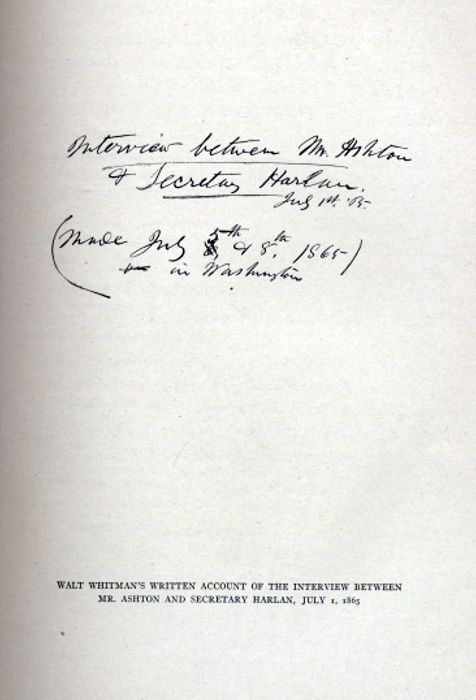 [Begin page figure-009]
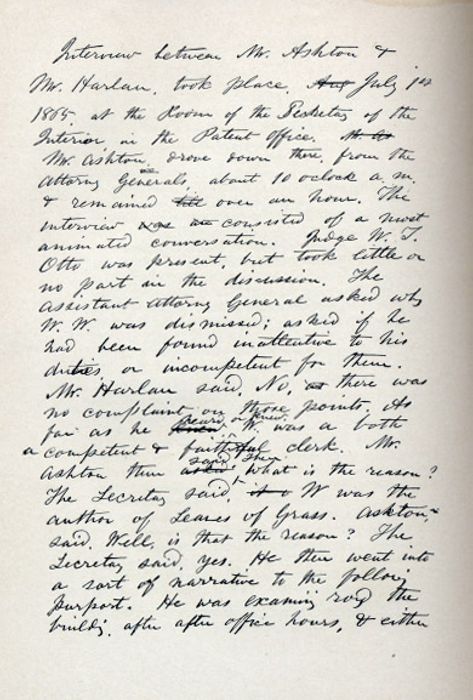 [Begin page figure-009]
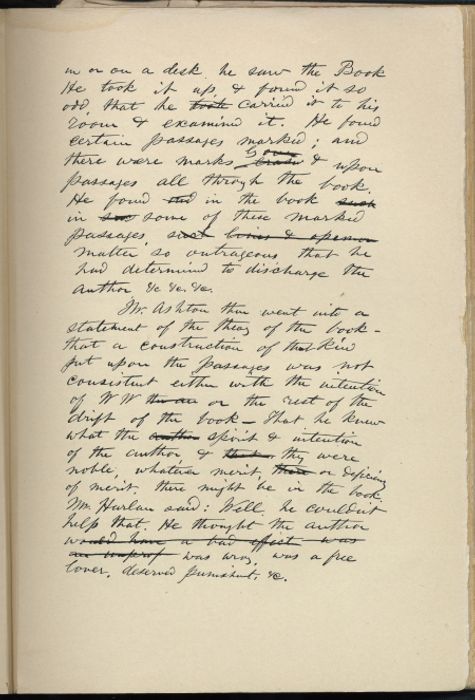 [Begin page figure-009]
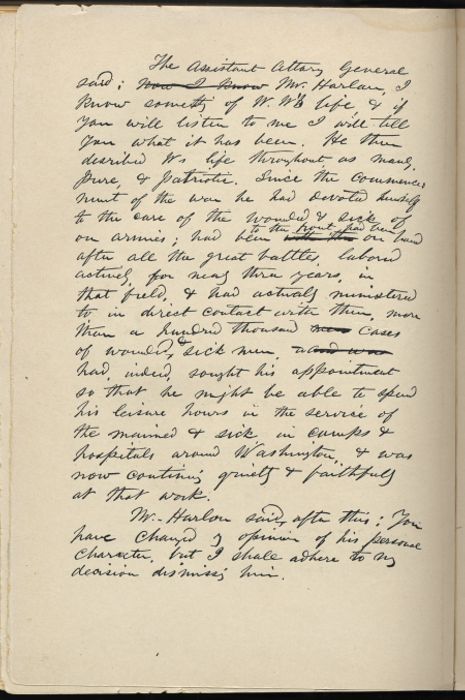 [Begin page figure-009]
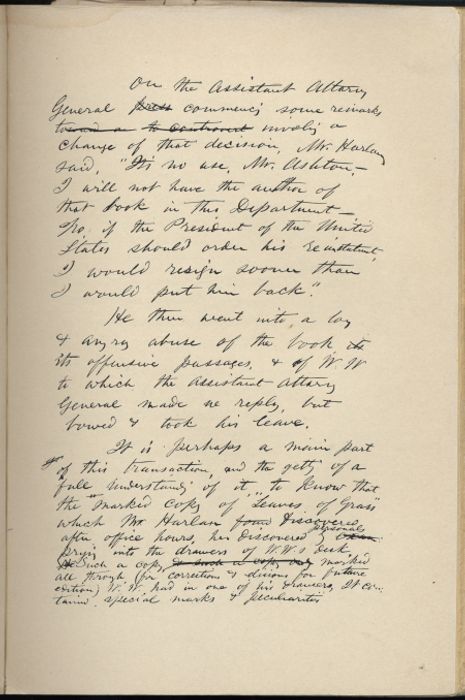 [Begin page figure-009]
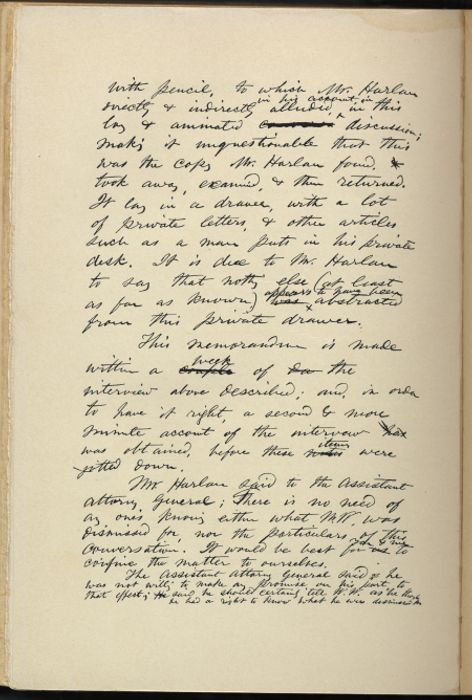 [Begin page 473]that. He thought the author was wrong, was a free lover, deserved punishment, &c.
The Assistant Attorney General said: Mr. Harlan, I know something of W. W.'s life, and if you will listen to me I will tell you what it has been. He then described W.'s life throughout as manly, pure, and patriotic. Since the commencement of the War he had devoted himself to the care of the wounded and sick of our armies; had been to the front, had been on hand after all the great battles, labored actively, for nearly three years, in that field, and had actually ministered to, in direct contact with them, more than a hundred thousand cases of wounded and sick men, had, indeed, sought his appointment so that he might be able to spend his leisure hours in the service of the maimed and sick, in camps and hospitals around Washington, and was now continuing quietly and faithfully at that work.
Mr. Harlan said after this: You have changed my opinion of his personal character, but I shall adhere to my decision dismissing him.
On the Assistant Attorney General commencing some remarks involving a change of that decision, Mr. Harlan said, "It 's no use, Mr. Ashton—I will not have the author of that book in this Department. No, if the President of the United States should order his reinstatement, I would resign sooner than I would put him back."
He then went into a long and angry abuse of the book, its offensive passages, and of W. W., to which the Assistant Attorney General made no reply, but bowed and took his leave.
It is perhaps a main point of this transaction, and the getting of a full understanding of it, to know that the marked copy of Leaves of Grass which Mr. Harlan discovered after office hours he discovered by personally prying into the drawers of W. W.'s desk. Such a copy, marked all through (for corrections and elisions for future edition) W. W. had in one of his drawers. It contained special marks and pe- [Begin page 474]culiarities with pencil, to which Mr. Harlan directly and indirectly alluded in his account in this long and animated discussion; making it unquestionable that this was the copy Mr. Harlan found, took away, examined, and then returned. It lay in a drawer, with a lot of private letters and other articles such as a man puts in his private desk. It is due to Mr. Harlan to say that nothing else (at least as far as known) appears to have been abstracted from his private drawer.
This memorandum is made within a week of the interview above described; and, in order to have it right, a second and more minute account of the interview was obtained, before these items were jotted down.
Mr. Harlan said to the Assistant Attorney General: There is no need of any one's knowing either what W. W. was dismissed for, nor the particulars of this conversation. It would be best for you and me to confine the matter to ourselves.
The Assistant Attorney General said he was not willing to make any promise, on his part, to that effect; he said he should certainly tell W. W. as he thought he had a right to know what he was dismissed for.
VI
["Sept. 29, '65. Int. with Judge Otto—he saw the blue-covered book on Mr. Harlan's desk." This in W.'s handwriting and the paper that follows.]
The Acting Secretary of the Interior, Wm. T. Otto, on his way to cabinet meeting, called at the Attorney General's office on business and stopt at my desk a moment. He said to W. W., "I hope you are well situated here-I was sorry to lose your services in our Department, for I considered them valuable. The affair" (my dismissal) "was settled upon before I knew it."
In the course of the conversation then and there the ques- [Begin page 475] tion was asked Mr. Otto of the particular copy of Leaves of Grass which Mr. Harlan had in his room as alluded to in his conversation with the Assistant Attorney General and whether it was a volume bound in blue paper covers—and anything like this—pointing to a volume of Laws, paper bound, octavo, about the same thickness. He said he had had no special conference with Mr. Harlan on the volume. A 500 page paper vol. lying on the table was shown him, and he was asked if it was such a vol. He said that he had seen on Mr. Harlan's desk a volume of Leaves of Grass, in blue paper covers, and the pages of the poems marked more or less all through the work; he remembers this volume being shown him and opened by some one who saw on his, Mr. Otto's, table a copy of Drum Taps.
VII
(All in W.'s handwriting except B.'s signature)
Attorney General's Office, Washington, Aug. 31, 1867. Hon. Mr. Binckley,Acting Attorney General.
Sir:The undersigned respectfully asks leave of absence from the 9th of September to the 12th of October.
Walt Whitman.Leave granted, as above.
John M. Binckley,
Acting Attorney General.
VIII
Department of Justice, Washington, Mar 10, 1873. Walt Whitman, Esq.,Washington, D. C.
Sir: You are hereby transferred from the office of the Attorney General to a clerkship of the third class in the [Begin page 476] office of Solicitor of the Treasury, to take effect on the 1st instant.
Very respectfully George W. Williams,Attorney General.
IX
Department of Justice, Washington, June 30, 1874. Walt Whitman, Esq.,Camden, N. J.
Sir: Congress at its last session abolished one of the third class clerkships in the office of the Solicitor of the Treasury and upon my requesting the Solicitor to designate which of the three he could best dispense with, you were named. It is, therefore, my duty to inform you that your service will not be required from and after the first proximo.
I regret to have to send you this notice, but under the law limiting the force in the office the proposed reduction is necessary, and I do not feel at liberty to overrule the wishes of the Solicitor of the Treasury.
Very respectfully, George W. Williams,Attorney General.
I asked W.: "Are they all the documents in the matter?" He said: "Yes: practically all: there may be an item or so which I have not tied together here. If they turn up I' ll see that they are given to you for preservation. One thing, Horace, about that Harlan matter: it 's history now: you don't need my story: another thing, Horace: don't ever assail Harlan as if he was a scoundrel: he wasn't: he was only a fool: there was only a dim light in his noodle: he had to steer by that light: what else could he do? Then, Horace, remember this too—that he was afterwards sorry for it: I have been told so by newspaper men: they knew him: out in the west—in his own country: he told them he thought it was a mistake: he was a bigot—that was all: yet he had [Begin page 477] the courage of his convictions: he did n't allow Ashton's eloquence to shake him: he threw me out: his heart said, throw Walt Whitman out: so out I went: I have always had a latent sneaking admiration for his cowardly despicable act"—he laughed: "After all, the meanest feature of it all was not his dismissal of me but his rooting in my desk in the dead of the night looking for evidence against me. What instinct ever drove him to my desk? He must have had some intimation from some one that I was what I was." As I left W. said: "We 'll talk of this again: be sure you put the documents in your safest place!"
This was one of the unusual occasions upon which I could see W. W. by daylight. Looked rosier than for some time: hand firmer, more vigorous: eye clearer. I did not stay after I had read the letters: was on my way to Philadelphia.
Monday, January 7, 1889.
7.45 P. M. W. lying on his bed. Got up later. Said he was "very tired," but, as usual, "thanked God it was no worse." Had stayed up last night till half-past ten reading: got up this morning a little earlier than usual. Perhaps these unusual hours accounted for it. He "could not tell," however, if he "wished to." I called for Dave's book this morning but Mrs. Davis said Ed was not up. But W. said to-night: "I had intended Ed should put it on the stairway so you could get hold of it for yourself: anyhow, you can get it now." He had written this dedication on a fly-leaf: For David McKay from his friend the author Walt Whitman with best regards and luck wishes not forgetting by any means Mrs: McK and the young ones Jan: 7 1889."
W. asked me: "Do you get Liberty? does Tucker send it to you?" Then: "Well, I laid it out for you: it came to-day: I can't say I enthuse much over it: Tucker seems to be a man with a belief: his paper is there for that belief: that 's about as far as I can see. I do not understand what they are driving at—what the anarchists want: I do not [Begin page 478] understand what they want: I do not understand what the Henry George men want: nor do I trouble myself about it." "But you do trouble yourself about it," I said. "What do you mean?" "Your book is full of anarchism and Henry George." He looked at me: "You mean by implication? that I throw off sparks that way?" "Yes." "Well, I suppose I do: I am sure, taken that way, that I might be convicted of a hundred philosophies." "You say you don't know what the anarchists want, what the Henry George men want: are you sure you don't?" He replied: "if you ask me to tell you what their contention is I can't tell you." "Their contention is the same as yours. You remember what you told Pease here in this room." "Oh! he was the Socialist? that English fellow: a nice fellow, too: what did I tell Pease?" "You said you did n't so much object to Socialism as to being talked to about it." He laughed. "Did I say that? Well, why should n't I have said that: that 's what I 'm trying to say now." "But why don't you say it then? The way you talked I should judge your objection to Tucker and the other fellows to be general, wholesale." "No indeed: I would not have that implied: I honor them: I know they are probably working in their own way to produce what I working in my own way am trying to produce." I said: "You ask: what do they want? what do they want? Let me ask you: what do you want?" "Do you mean that as a question for me to answer?" "Yes: I'd like to hear you answer it." "Suppose I would rather not answer it?" "I would continue to want to hear you answer it anyhow."
W. stopped. Closed his eyes a few winks. Then: "You mean economically speaking?" "Yes." Then he stopped again. I waited. Finally he got going with great feeling and vehemence: "I want the people: most of all the people: the crowd, the mass, the whole body of the people: men, women, and children: I want them to have what belongs to them: not a part of it, not most of it, but all of it: I want anything done that will give the people their proper [Begin page 479] opportunities—their full life: anything, anything: whether by one means or another, I want the people to be given their due." I said: "That don't sound like a plea for millionaires." "I suppose not: the millionaires don't need any one to plead for them: they are in possession." I inquired: "You want the people to have it all: how are they to get all?" "Oh! there is the rub: how are they? Do you know: who knows? I wonder if anybody knows?" "Well, Tucker thinks he knows: Henry George thinks he knows: Pease thought he knew." "But do they know?" W. cried: "Every doctor knows, but do the doctors cure people?" I asked W.: "How do you know these men don't know if you don't look into what they propose?" He smiled. "Damn you! You 're like a lawyer! That was a blow between the eyes." I added: "What they want—what Tucker wants, what George wants, what Pease wants—is exactly what you want—you all want the people to own their product—to not make beautiful and useful things for their masters to enjoy. There must be a way out. Why isn't it as much your business as any other's to try to find what this way out is?" He answered at once: "I suppose you are holding me up with good reason: I have no right to discourage the boys: they are doing their work—big work it is, too, I acknowledge: they are devoted-they sacrifice themselves to it: it needs to be done: the people must resume their inheritance." "Or assume it," I said: "they have never so far had it—therefore they have not lost it." "You are cute: you see all around it—all around me, in fact: I acknowledge that I am wholly ignorant—that I might brush up a bit in this line and not be hurt by it. My general position is plain: the people: all the people: not forgetting the bad with the good: they are to-day swindled, robbed, outraged, discredited, despised: I say they must assert their priority—that they come first: not the swells, the parlors, the superiors, the elect, the polished: no, not them: the people, the fraternal eternal people: evil and righteous, no matter: the people." "Do [Begin page 480] you think the class that has robbed the people will hand their loot back?" "I 'm afraid not: I 'm afraid the people will have to fight for what they get." "How will they fight?" "There are several ways: Tucker suggests one way: George suggests another way: Pease suggests Socialism." W.: "I don't dispute with them. Why should I? I want the real things to get said and done whether they please me or please anybody in particular or not: the real things: the people's things. I am always outspoken on this point. When I say I even include kings I would n't like to be understood as making a plea for kingcraft: I include Carnegie but I would not make a plea for Homestead: God forbid!—yes, I say damn Homestead! But I can't get myself into a personal boil in the matter: I want the arrogant money powers disciplined, called to time: I think I shall rejoice in anything the people do to demonstrate their contempt for the conditions under which they are despoiled." I exclaimed: "Hurrah!" Then: "All these fellows find texts in Leaves of Grass: not figures, not names, but electrifying intimations. They don't any of them claim you as a partisan: they only claim you in the general way. We say Jesus is on our side. In the same sense we say you are on our side. With the people as against the elect few: with the people: even when things go wrong, with the people."
I was feeling gratified to hear him talk so. "You 're pretty radical after all, Walt: a good bit more radical than you probably realize yourself—you 've gone farther than you think." He assented: "It 's quite possible: the growth of a man is so subtle: he sometimes goes along in entire innocence until he is reminded of his heresy." I asked W: "Suppose the millionaires were abolished—that millionairism became impossible, would you feel unhappy over it?" "What? me? God no! Ain't that my program?" "That 's what I 'm trying to find out: I want to see if you do have a program." W. raised his arm and brought his hand down with a slap on the arm of his chair: "I say [Begin page 481] that if the people know any way to get rid of the millionaires, to get the old man of the sea off their backs (God knows they 've staggered on under the burden long enough!): I say that if they know any way, let 'em embrace it: now—any day: the sooner the better: to hurl the nasty mess into oblivion!" His eyes flamed out. I exclaimed: "Why Walt, you 're a damned good revolutionist after all!" He was amused. "Did n't you always know it? What could I be if I was n't?" "I thought from what you said of Tucker and George that you were maybe a bit reactionary!" He fairly yelled at me: "To hell with your reaction! to hell with it! I may be dodging your doctrines: I 'm not dodging your purpose: I am with you all in what you aim for: solidarity, the supremacy of the people: all the people in possession of what belongs to all the people but has been stolen from them: I 'm with you in that: but I can't follow you in all the intricate involvements, theories, through which you pursue your fierce agitations."
W. touched this subject again later on. Spoke of Johnston. "Johnston came in yesterday: and Richard Hunter: Dick Hunter: you know about Dick? They were here about fifteen minutes. They are both great talkers—vigorous: and very radical, too—radical of radical—free thinking, socialistic, even anarchistic, maybe. But, as I said before, I know so little about the aims of these reformers I ought not to say anything one way or the other"—here he paused: "Dick is a tremendous little fellow!" Then "wondered" if Johnston knew Adler. They were both "of the good sort and come-outers by nature." Letter from Morse. "I can't think what day: certainly within a week. He tells me of the death of his mother but gives no news of himself." Did I know Harry Bonsall—the son? "He is dead—died up in the asylum." Exclaimed then of Harry the father: "Poor Harry! he has a siege of it!" Then he added: "But every man has siege of it sooner or later if he will only wait!"
I saw Dave McKay. He showed me review (brief) of N. Boughs in Springfield Republican, Christmas day—favor- [Begin page 482] able. I sent for two copies—one for Bucke, one for us here. Dave had already heard of The Herald notice through Boston inquiries after the big book. I spoke of this to W. Thought we might send a few copies to Dave on sale. "But it will be six dollars just the same." McKay too thinks a heavy cover advisable. He will be over to see W. to-morrow. Bill for N. B. due from McKay. W. spoke of Kennedy's letters. "I always call them scrappy: they are not foolish: they are like him—thoroughly like him: nervous, quick, discursive, always nteresting." Letter from Bucke. "He complains of the irregularity of my letters. They seem to have a strange perkish way up at the post office. Bucke says he often finds letters I date and send one day stamped Camden the next. I am always statistically careful about the dates of my letters. These letters should go off the night I send them up: I wait till night, till after nightfall, a little beyond seven then send Eddy up. I did there for a time write Doctor every day: he would receive none perhaps for two days, then the third day receive three." Appeared to be excessively exercised about a trivial matter. I told him I thought it was at seven, not eight, that the mails went out. "If that is so," he retorted, "I have been working under a wrong supposition for years and years. But we must submit: whatever they decree we must obey."
Whittier has written a poem on Dick Spofford: W. has not seen it, but said: "Poor Dick! Good Dick! Dick was one of the dead earnest men—Italian in that—risking all for a conviction!" Met Brinton and Coates at Contemporary board meeting this afternoon: both asked after W. W. acknowledged. Bucke has received slip containing dedication. Expresses himself as satisfied. Speaking of the Philadelphia symposium on W. he said: "Did n't I think at the time that Frank Williams' paper was pretty good?" Then said: "These young men are honestly though narrowly animated." W. reads so much better now: longer spells: and writes with even greater ease than he reads. For a while right after the attack in December, "a minute [Begin page 483]—two minutes—finished me." Now he can read right ahead for an hour or two. Asks me invariably about the weather, news, people. Did to-night. No longer expresses any desire to get downstairs or go out. I told him of something from Will Walsh in yesterday's Press. "I had not seen it: in fact I have n't read half of yesterday's Press yet: I hope I have not sent it away." Always interested in what Walsh does. W. gave me another one of the "avowals" as he calls them. I said: "We want to know who saw you, recognized you, stuck by you, when you needed friends." "Yes," said he: "that 's it: I feel that way myself: I have known the sweetness of being loved." Eldridge did not enclose the original of Mrs. Ritter's letter but O'Connor's copy of it.
Washington, D. C., May 2, 1876. Dear Walt:Enclosed I send you a copy of a letter received by William. He says he knew the writer by correspondence only, when he was on The Saturday Evening Post. Her name was then Fanny Malone Raymond, and she was said to be extremely beautiful and is probably so yet. You had better accept their invitation.
How did you like William's article? And how is your health? Write me if you can. All your friends well here as far as I know.
Faithfully yours Charley. Poughkeepsie, April 26, 1876. W. D. O'Connor, Esq.Dear Sir: The name at the end of this letter is now perhaps unfamiliar to you; the first part of it you may remember as having been that of a young lady whose girlish poetic attempts you once took the trouble of kindly and sometimes (more kindly) unkindly criticising and encouraging.
[Begin page 484]My husband's name, may be unknown to you, unless you take an interest in music; if you do you will recognize him as having been a professor of that art at Vassar College for some years; as composer of symphonies, etc.; and as lately the author of the history of music-the first written and published in America. (Mr. Ritter is Alsatian, however.)
I do not write to-day to claim an old acquaintance of mere correspondence, but to tell you, on both our parts, how delighted we were with your manly defense of Mr. Whitman in The Tribune last week, and also to beg you to give our respects and a message to your friend.
He may, perhaps, feel interest enough in the aspirations of his young countrywomen at Vassar College to wish to see for himself what they can do at Commencement season; if so, we shall feel honored in receiving him as our guest towards the end of next June, in our quiet artist home, where he will find a fine library, plenty of music, our two selves, and a warm welcome.
We should be most happy to see you also, and should good fortune ever lead you hitherward, you will be welcomed by Professor Ritter and yours truly,
Fanny Raymond Ritter.W. said: "You are right to feel warm about the people who felt warm about me when for the most part most people froze me out: you are right when you say they must not be forgotten. I do not dare to say that it was important to preserve the Leaves: I can only say that if it was important then my friends must be regarded as the saviors of the book: my friends: many of them unknown but preciously beautiful and far-seeing."
Tuesday, January 8, 1889.
8 P. M. W. in room sitting up, reading Carlyle (early letters): probably a third through. Was he interested? [Begin page 485] "I don't know so much about that, but I am in the stream—the Carlyle stream—and take what glimpses I may as I go along." I read to-day Darwin's Estimate of Carlyle: in Darwin's autobiography. Repeated things from it to W. W. said: "Does he say that? It brings back to me a story I heard once: perhaps it is printed somewhere and you have read it: I am not certain, but it seems to me some one told it to me—that I got it that way: at any rate it was something like this." W. did not go on directly: asked me some further questions about Darwin. Then: "It wonderfully fits with the like of the old devil—if we may speak so of a great and venerable man—oh! how wonderfully!" He could not "recall particulars—all the circumstances." But this was as he knew it: "Carlyle was off somewhere, travelling with someone, some stranger—perhaps had met him. It was a calm beautiful night—a rare night anywhere: the stranger was intensely moved: he thought, here, surely, is a sight to inspire the most unimpressionable, the most dissatisfied, man: the stars shining, the moon out in all its glory, the air stilled, the waters flowing at their feet: everywhere, all about them, grandeur, beauty, solemnity. I can imagine the night myself: I have seen such nights: many a time we would go walking—walking—walking: late—under the illumined sky: two of us: sometimes others!" W.'s voice intensely emotional—deep, earnest. He looked across at me. I sat on the sofa directly opposite. "'What do you say to this—this?' the man asked, turning to Carlyle. Carlyle lifted his head"—W. threw his shoulders back and from left to right as if sweeping something out of the way—"scanned the heavens, looked down at the stirred current, dropped his chin on his breast, so"—W. showing how—"said:'It is a sad, sad, sad sight!'" W.'s manner was indescribable: a sigh indicating the hopelessness of Carlyle's pessimism: his voice musical, intense. "How capitally that describes Carlyle!" I said: "It must be true in effect: it is like Carlyle—too like to be a pure invention." W.: "It is both: it is literally true: it [Begin page 486] is Carlyle in and out: I know nothing better illustrative of the man: I accept it just as it stands."
W. spoke of his health—its change for the better. "I suspended the rubbings: I shall resume them now I am so greatly improved. To-day I had a good sunbath—sat in the room back there by the window: it was very helpful. I don't seem to get about much better but I seem stronger—less actively ailing." But progress was so "slow-so slow." He had given me the manuscript of the Note at Beginning. Intended also to give me Note at End but could not put his "hands upon it." "I am not certain I can: I barely rescued the other: I am half persuaded it got burned up."
"Perhaps you can help me out in this," he said, producing a letter: "some one writes me here: he has had a copy of Drum Taps sent him: I don't know who sent it: writes me to know: I can't give him the least idea." Of course not. Neither could I. Was it a play for an autograph? W.: "I was half tempted to answer it: but I won't write a word." What would he do about the poem asked for by the Easton soldiers? "I have done nothing at all with it: it rests just where it did." He did not feel inspired. "If inspiration" did "not come," &c. Showed me a letter from Knortz, "at last." "He sent me a German paper: somewhere in it is a reference to me: I don't know what its import may be." Pushed his feet about the floor near his chair but the paper did not turn up. "I put it down there almost on that spot: Bucke will know about it: he reads German: he will solve the riddle." Was he curious? "No: these things do not arouse or disturb me." Was "most glad to hear from Knortz." Had not seen a word from him since 1885, when Rolleston wrote W. a note which was forwarded to K. and elicited a reply. "By the way," he said: "here are the old letters: by some sort of coincidence they came right into my hands to-day while I was looking for something else." W.'s note was bluepencilled on [Begin page 487] Rolleston's. Knortz had returned the R. letter with his own.
Fairview, Delgany, County Wicklow,Ireland Aug. 4th [1885]. My dear Walt:
It 's a long time now since I 've written you, and I owe you thanks for the many papers &c you have sent me containing verse and other matter connected with you. I asked you the last time I wrote to let me have one small poem which I felt especially stirred by in your handwriting. I don't think I 've heard from you since then. Will you remember this now if it does n't trouble you too much? I don't possess a single line of your verse in your own handwriting, and should think it a very precious possession. The poem I meant is that on the Artic snowbird.
I send you herewith a magazine of which I have made editor. The article signed "M. Rowlandson" is mine. It (i.e. the review) emanates form Trinity College Dublin and aims at introducing Nationalist thought among the upper classes in Ireland. We have to go forward very cautiously in this enterprise, political questions here are so fiercely debated, and at present we can only reconcile the landed interest and conservative element by opening our columns to both sides alike. To get Nationalists admitted at all to an audience in Trinity College is a great step. We publish an article by Michael Davitt in September. I have been getting acquainted with him and other prominent members of the National party here since I came back. The best man I have met in Ireland is John O'Leary, formerly editor of Irish People, imprisoned in 1865 for Fenianism. He has been living in Paris ever since; let out after five years on condition of remaining abroad till his sentence (twenty years) was out. This expired in Jan. 1885 and he is to the fore again now. A good looking man, long white beard, aquiline features, keen eyes—spare, sinewy frame, full of restrained passion and energy.
What about Dr. Knortz? I have heard nothing from [Begin page 488] him at all about the translation of the L. of G. that he should have revised and read long ago. I think of writing him about it. I fully expect it would have appeared before May.
We have gone into a house of our own now, at least one we have rented for several years, and so are pretty well fixed. All of us well, especially my two little boys, who enjoy the country life very much. We have a good garden and a little land which I work myself. On the whole, like this sort of life very much. We are about three quarters of an hour by train from Dublin, and have easy access to libraries, &c., there.
I hope you are well and hearty. I am sorry to hear the sale of L. and G. has not been so good lately. Wish we had fairly opened it in Germany. Will you send a line to Knortz? I was to give him twenty dollars for the work—am only waiting to hear that it is complete to send it—but don't like sending bill till I know that he is going in for the thing, as I have n't yet even heard that he had begun for it.
Cover of our Review is old Celtic design.
Yours always T. W. Rolleston. Camden (328 Mickle) Sept. 10. Dear Sir:I send Rolleston's last letter to me—please look at the parts marked in blue—Did you get a note from me about two months ago?
Walt Whitman. 540 E. 155th St., New York. My dear Mr. Whitman:Please excuse me for not having answered your letter two months ago. I was very busy, as I had to prepare a series of lectures for the coming fall and winter. I have not been able to find a publisher who will print the German and English; but Mr. Schabelitz, of [Begin page 489] Zurich, will publish the German text at his risk and pay all the expenses. This is as favorable as may be expected. According to the wish of Rolleston I shall add a few of my translations and send the Ms to Europe within six or seven weeks from now. Of my German-English anthology I have no proofs; but my publishers will bring out a new edition (revised) this fall and I shall not fail to send you a copy. I shall answer R.'s letter to-day.
Yours truly, Karl Knortz."That adds a little more detail to your data about editions," W. said: "we had our ups and downs—our advances and halts and breakdowns. Rolleston was a knight-errant: the real Irish stuff: like William: radiant, forible, illuminative: I fell that he has always been more than my friend—has sworn his big oath in my interest and battled for me without reservation. We had special extras of trouble getting out that German translation: it went slow: it was done, it was n't: we could n't get a publisher: we could: so it went for a long time. Knortz must be an adept in rendering things in the German: he stands high: I feel as if I was in good hands: as if Rolleston, Knortz, were an efficient team. When the time comes for you to write about these things you must emphasize my words in repeating that I have said about these men."
Contemporary meeting to-night. Frances Emily White to open with The Evolution of Ethics. W. exclaimed: "Oh! that is a subject! If anyone asks after me, or even if they don't, if you can get a word in edgeways here and there, say this: say that Walt Whitman would only have this to put in on that question: that however they settle it, whatever origins, what not, they hit upon—however they warm up, discuss, get wrothy—things will still go on the same—not a tremor even of the balance!" He spoke half jesting, half seriously. I quoted a humorous poem in refrain, "it still rolls on." Saw it in Bryant's Library of Poetry [Begin page 490] and Song. W. very much amused: "That is extremely good: I never have heard that before: and it is more than mere wit." Whose was it? I suggested: Perhaps Orhpeus C. Kerr. Did he know O. C. K.? He looked at me astonished. "Orpheus C. Kerr? I should say so: why, I worked with him: closer than you and I are now: day by day." at Washington? "Oh no: in New York. I was editor of The Aurora at that time: Kerr was exchange editor: scissors editor we all called him." Was W. managing editor? "Yes, you might call it that: The Aurora! tremendous name, was n't it? Kerr was not his name: that was his nom de plume: he was a typical New Englander—keen, dry, a good fellow: I liked him: I liked 'em all: all the fellows I met: how good, even noble, many of them—the boys on the papers!"
I left McKay's book at his store early this morning. Asked W.: Was McKay over? He had been. Did he like the inscription? "Oh my yes! it tickled him immensely. He paid me the bill: paid it just as you figured, I think: I did not like to look while he was here: see if he did n't." He produced receipt: of course all right. "We talked of the big book: I told him I wanted to give you fellows carte blanche—at least with that copy: consult together: do what you agree is best: you, Dave, the Swiss. Dave said he was at your service any time you found it convenient: to—morrow if you want to go right ahead with it." He had told McKay "he could have the book for four dollars—a third off": could "have some of them now" if he wished. I said the public that bought might want a soldier cover. But W. protested: "That may be: but this book as it stands is essentially the book, irrespective of expensive binding: it has the portraits, notes, title page-all the guarantees of my personality: it is as clearly the book as anything could make it. In short, the price must be kept at the standard—six dollars." He "would not restrict" us in the choice of cover: would "simply suggest half calf in green, gilt top, rough side and bottom." "Even there I [Begin page 491] may yield: I take no pledge": he knew "a thing done, even unexpectedly done—a variation often"—was "the very thing we wanted done but could not direct." He had a notion "this Swiss" would "know better than any of us how to go about the job: he is right in the field—has the tools." "The book must be substantial, rich, without making a show, a glitter: rich not after the binder's fashion or the booksellers', but on other rules, manners—ours." Talked freely with Dave. "I told him you understood me and would stand for me in the arrangements."
Something got us going about Baldwin's and locomotives. I alluded to our army in the Rebellion. "It was an army of mechanics who could reconstruct as well as destroy, differing in this way from all armies known in history before." W. said: "That is true: I know all about that: I was there—realized all that it signified: the Southerners were good at destroying: especially railroads, locomotive: while our boys would put them up again—were rather proud they could do it. Destruction is easy: the Rebels were easy destroying: a few minutes, an hour, would rake up a whole line—miles long: demolish everything. It was, as you say, one of the unique qualities of the Northern soldiery: no one had more reason for seeing it, glorying in it, than I." After a pause he went on: "We can't get on with a world of masters: we want men—a world of men: backbone men—the workers, the doers, the humbles: we want them. The ornamental classes make a lot of noise but they create nothing: you may crack a whip over men and you may be useless nevertheless: lots in business that passes for ability is only brutality: don't forget that—you masters: you are not so damned clever as you think: you 're only coarse, cruel, wanton: that 's all: that 's all." I said: "Walt, you 'll be a revolutionist yet!" He was grave over it. "I have been: have n't I been?" Then he shook his head: "I see a stirring time coming but I won't be in it: but you 'll be in it—you 're in it already: you 'll have to fight big enough for us both: I'll steady your right arm: you 'll feel me [Begin page 492] with you." It sounded so fine. "Walt, Leaves of Grass will be in it: it will not be like one man, either: it will be like a thousand men: after all, Leaves of Grass is you." He was fervently affirmative. "I do hope all that may be true: that I will contribute to the great result: I sit here now physically lame, almost done for: it takes something extra out of a man to feel so helpless as I do: it is a great joy for me to hear you say what you do: that there will be enough of me left after I am gone to assist: that the Leaves will perhaps go on doing a little here and there to nerve men freshly for the fight." Then he added: "I do not forget what you drove so hard at me yesterday—the day before—that what you want I want too: I never had it driven at me in just that way before, but now that you have done it realize that you are nearer right than I have been in some of my suppositions."
Bucke (5th) wrote at length about the meter. They have been making some successful experiments. W. "not at all interested in that": did "not care to read it." "Maurice is naturally enough interested in his speculations but never quite seems to see that they don't appeal to me. I don't care whether he makes money or not: the more he makes the less a man he is likely to be: making money don't seem to go with the other thing: you have to choose: if you choose money the other ideals must be abandoned. Many men say: Money will make us free: Maurice says it: but that is an illusion: money never made any man free—only enslaves men: some of the finest, noblest fellows have walked right into that dirty ditch—have headed (strangely) with their eyes open right into that stench: let Maurice beware—tell him to beware: say to him some time for me (in a letter, or when he comes): say it for me: it 's the sort of fire no man can play with and not be burned: no one—not even the strongest."
W. sent a note to Harned to-day asking for some wine. Spoke of Dave a second time. "I was glad he liked the [Begin page 493] book-enjoyed having it come: he deserved it: he had been kind to me." I said I thought Dave wanted to become and remain personally identified with W. W. said: "and I with him: he not more than I." W. in more like his old spirits. Everything seems momentarily serene. Renewed insurance to-day on sheets at Oldach's: one month more. Morse has written to have two of the W. heads shipped to him for the Ethical building. Is to lecture in Chicago: will require them. "Good for Sidney!" exclaimed W. who watches all his doings fondly and is happy over any good reports. W. had a couple of little "page things" laid aside for me. He handed them to me as I left. One was an 1873 portrait which he had autographed. The other was the original notes ("some of them": he said: "I think there were more") of the To the Year 1889 poem. He said: "You understand I give you these things on your own valuation, not on mine: to me they are useless bits of paper, which, once done with, might as well be burned as not so as no longer litter up a man's environment." I said: "These things—seeing them, having them—give your friends great joy: it is not fetich worship: its 's only simple everyday love." W.: "When you put it that way I accept it: for a long time I had a little pen-knife that belonged, they told me, to Lincoln: I lost it: I felt as bad as if a dear friend had died."
Wednesday, January 9, 1889.
7.55 P. M. W. sitting reading book catalogue. Had been well: "up all day": reading, writing, "some," making himself "as comfortable as possible." Visitors few: yesterday one or two: not more to-day". Is practically let alone mornings. No sign of any particular ailment, Ed says. "He 's punishing an awful amount of wine nowadays." Takes milk, cold water, hot water. I have known him twice or three times of an evening while I was there scoop hot water from the bowl on the stove and drink it. As to wine, what Ed calls much is not much after all. But as Dr. [Begin page 494] Bucke discourages its use altogether it may not be best for W. to be so stubborn. "Tom was in," he said: "brought me a nice bottle of wine: asked me if I did not want to read Robert Elsmere: he has a copy which no one is using now. I told him to bring it along—I would try to read it." I said I had no idea the book would interest him: it took up problems in a way he had never cared for: it was rather for the class whose spokesman it was—the great mass just at the orthodox loosening point. "You think," he said, "that there is that great mass movement?" Then: "I can easily see that what you say is true: for my part these things have little value: but I shall try the book: if it will paddle its own canoe, well and good: if it will not, let it go the way of the others: I won't force it through."
That had been the trouble with Tolstoy's Confession, now for days lain untouched. "I gave it up," he explained: "I got about a third of the way through: it was too much for me: I find little pleasure in it: it 's poor reading for me: I was never there. Tolstoy's questionings: how shall we save men? sin, worry, self-examination—all that: I have never had them. I never, never was troubled to know whether I would be saved or lost: what was that to me? Especially now do I need other fodder: my mind is in such a state I need food which will frivol it. I know a bright girl: she expressed this for me: she would sometimes say: 'We went out for a drive, came home, had our supper, then frivolled the evening away.' I want to frivol my evening away." He was very earnest. "I find better employment, enjoyment—both—in reading one of Scott's novels." Of course he "did not mean to say Tolstoy has no place or significance." He was conscious that, "there are things, persons, making it possible to argue for, prove, Tolstoy." Only, "that conclusion" was not his conclusion. "But with all this I am glad I read the book: it shows me more clearly what Tolstoy stands for: besides, the last third or half of the book probably justifies the first. Taking it up at another time this might be enforced even upon me: it looks as if the
[Begin page figure-010]
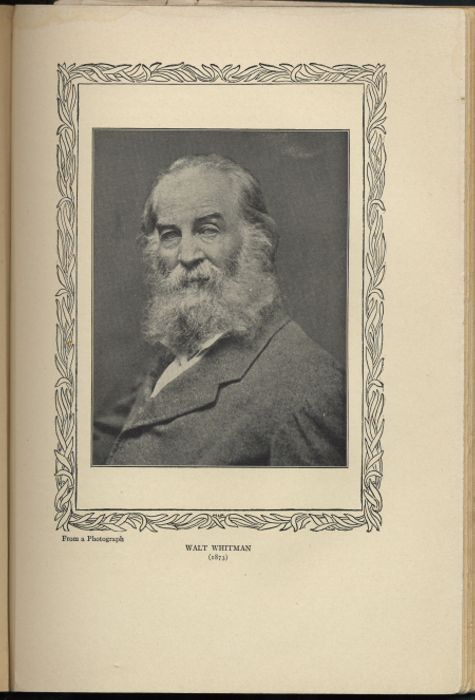 [Begin page 495] first part, the part I read, was introduced in order that the second might be written. There are undeniable and undoubted marks of the great man in all that Tolstoy writes, but the introspective, sin-seeking nature makes no appeal to my constitutional peculiarities. In this respect Tolstoy may better represent the present day than I do."
As to the Carlyle letters: "I still hold on there." It was "good" for him "to know them: to know even those which had no great interest. They throw out glints, lights—even shadows—of his early life which it is important not to miss." This book did not depress him. "It is on the whole brighter than the other Carlyle books." He asked me: "What did you do at the Club last night? Whom did you meet?" Then as to The Evolution of Ethics: "It opens a vast field: you should have had the Doctor there: that is his subject—his favorite theme: he is booked—has thought: has his own ideas." I gave him details as far as I could, especially speaking of a gem of a speech by Brinton in which W. took the greatest interest. W. said he was "interested enough in the subject but not in it as a subject for debate." He produced an old envelope addressed to him (his sister's handwriting: Burlington, Vermont) in which he had crowded some bulky sheet. Handed it to me. "This is Note at End." "I have not found the German paper Knortz sent me: when I do find it you shall have it: you can read it and pass it on to Dr. Bucke: there was about so much in it about me"—measuring about two inches—one forefinger with the other: "but I can't read a word of it: I know nothing at all about the German."
I supposed he had sent Bucke Boston Herald early in the week, but he has not done so even yet. "You sent for some? We will send one to Doctor when they come." Letter from Bucke. "It contained nothing new." Saw McKay: talked over cover. Will see him at Oldach's to-morrow. There will be no copies sent out for reviews. McKay suggested that [Begin page 496] some means be taken to get the book into England. Suggested also that the books should be numbered. W. said: "I am satisfied to have you proceed: so far as I am concerned I am content to rest with the books as they are: I have a batch of them here now, right in the room: in the boxes, about the wall: I confess I view them with a sense of comfort: am proud of them just as they come up in the cheap fifteen cent back." Still he recognized the market arguments. "I am willing to have a rich showy cover shown me: am willing to accept it: not showy in the vulgar sense but showy for what it is." He had been "curious to know what the great binders, the really great workmen, would do with the book." "I suppose if Paris was across the street we could get one of the artistic fellows there to lend a hand: but of course it is useless to think of that: it is impossible, not to be thought of, in this country."
Dave said W. should be careful in giving copies away. W. said: "I do not need to be reminded to be stingy: I am aware of the necessary caution: I shall not scatter them. I gave away a great many copies of November Boughs: there were many very dear friends, friends I valued, valued highly—particularly girls, women, mothers: they had done me service: I could not give them money: therefore I used the little book: it showed where I stood: was always rightly accepted in that same spirit." Several times afterwards W. referred again to "the Swiss," as he calls Oldach's binder: "Be sure you consult with him: he must not be left out." Is not "anxious about the book," but "now we have started let us forge ahead." Moulton asks McKay for a W. W. cut. W. said: "I begin to think Moulton is a fraud: I am almost sorry we had anything to do with him." There was "that Drum Taps fellow," too, "probably a fraud." "I am not to be taken in: I am too old a bird at that: I have experienced all sizes and styles of the autograph monster."
W. is so well now Ed has little or nothing to do. The other day E. complained. W. said: "Well—I'll haul him up some work." At once wrote the wine message to Harned [Begin page 497] and sent Ed to bank with some checks. Some one had sent W. Ingersoll's The Gods in a pamphlet. W. was happy over it. "I wonder if anybody ever hit back at the orthodox God better than our dear Bob? Ever spit upon it with such necessary and effective derision? I read this superb thing to-day: it seems just perfect. Of course Bob does not go far enough: he gets rid of the old thing—does it without a quaver—ends it forever. But God? God? Well, there are other divinities: they are not of the hell and damnation sort: they are not of the legs and arms sort—the personal sort: they yet remain, more firmly on their thrones, in the race, than ever: they continue their supremacy. Bob does not intellectually account for them: he has them in his heart: they are one part of his noble protest—whether he knows it or not. I sometimes ask: Why does Bob not see more? Then I say: If he saw more maybe he could not do his work? I ask myself that question over and over again. He lives more: the chief matter is living. The main thing is that he has done in his divinely appointed job: O the dear wonderful man! He was sent by high heaven to save the race and he has done it. We talk about salvation: we need most of all to be saved from ourselves: our own hells, hates, jealousies, thieveries: we need most to be saved from our own priests—the priests of the churches, the priests of the arts: we need that salvation the worst way. The Colonel has been the master craftsman in this reconstruction: he has taken us by the ears and shaken the nonsense out of us: the criminal institutions we have built up on our already overburdened backs. As I read this old piece over again my first impression of the sanity, the health, the virile humanity, of it all was renewed in me. Some things—some systems—requiring to be removed, can't be got rid of with a too kind law: they have to be rejected scornfully—with a species of almost ghoulish delight. Hell is such a system: the revengeful gods—they are such a system: the sould be summarily ejected: they should be stamped out without equivocation." I said: "You spoke of the priests of religion [Begin page 498] and the priests of the arts. We still have the priests of commerce to contend with." "So we have: doubly so: the priests of commerce augmented by the priests of churches, who are everywhere the parasites, the apologists, of systems as they exist."
W. said to-night: "That whelp, Charlie Heyde, always keeps me worried about my sister Hannah: he is a skunk—a bug"—I laughingly broke in: "What have you got against bugs and skunks Walt?" He nodded, amused. "That 's so: what have I?" Then: "Did I never tell you about this man Heyde? He has led my sister hell 's own life: he has done nothing for her—never: has not only not supported her but is the main cause of her nervous breakdowns. He is a leech: is always getting at us: himself gets most of the money my sister has from us—squanders it on himself: still leaves her sick, poor, uncared for. Did I never tell you about him? O yes! I must have done so. I am always obliged to reach my sister indirectly—through her doctors up there at Burlington, or perhaps a friend or two. Charlie is always in the way: he is the bed-buggiest man on the earth: he is almost the only man alive who can make me mad: a mere thought of him, an allusion, the least word, riles me. Oh! that makes me think of the gentle Emerson! He said one day: 'Mr. Whitman, your love is very comprehensive—includes about everybody: but don't you sometimes find there are people who insensibly try your philosophy and nearly break it down? Perhaps not exciting you to hate but surely stirring up in you an unlovely repugnance and resentment?' I said to him: 'I see you have met such people.' He did n't take long to say: 'Yes I have. And you?' It made me laugh, especially as coming from him. 'I 'm afraid I have, too,' I said. Then he put his hand on my arm and said: 'It comforts me to have you say that: it provides me with a companion in my delinquency!'" W. stopped. I waited. Then: "How like the sweet Emerson that was! Delicious! Delicious!" I put in: "So you have a place for Charlie?" "Yes: a hot place!" Further: [Begin page 499] "Henry Clapp said to me: 'Walt you include everything. What have you got to say to the bed bug?' I wonder if Henry could have been thinking of Charlie Heyde?" All this was by the way.
W. gave me a pencil draft of a letter of inquiry he had written to Dr. Thayer twenty years before. I asked W.: "Has she always had this trouble?" "Yes—from the first—ever since she married the whelp." "Why, Walt, this letter is twenty years old." "I know it: and her trouble is twenty years older." "Is the situation up there the same now as it was when you wrote this letter?" "The same or worse if worse is possible." Then I asked him: "Are you quite sure you want me to have this letter?" He nodded: "Yes: you see how it is: I want you to be in possession of data which will equip you after I am gone for making statements, that sort of thing, when necessary. I can't sit down offhand and dictate the story to you but I can talk with you and give you the documentary evidence here and there, adding a little every day, so as finally to graduate you for your job!" He was both grave and quietly jocular about all this. I then read him the letter. He almost invariably has me do this now with letters he gives me.
December 8, 1868. Dr. Thayer,Dear Sir: Won't you do me the very great favor to write me a few lines regarding the condition of my sister, Mrs. H. L. Heyde. I am sure, from what I hear, that it is mainly to your medical skill, and your kindness as a good man, that she got through her late illness. She seems by her letters to be left in an extremely nervous state. Doctor, please write me as fully as you think proper. Though we have never met personally, I have heard of you from my mother and sister. I must ask you to keep this letter, and the whole matter, strictly confidential, and mention it to no person. My sister in a late letter wished me to write you and thank you for your great kindness to her.
[Begin page 500]W. said: "My mother was very gentle, though strong: you have seen her, talked with her: she had sad days over this thing, which almost amounted to a tragedy. George would get indignant: used to want to go to Hannah—raise hell—handle Charlie without gloves: but my mother restrained us—thought it would do no good. You can't very well break in on domestic situations and straighten them out: they generally have to be scrupulously avoided: the third person as a rule finds himself helpless." I said: "Charlie is still a thorn in your flesh?" "Yes, and will be till one of us is dead: he is a cringing, crawling snake: uses my sister's miseries as a means by which to burrow money our of her relations." I said: "Walt, I never heard you go on so about anyone before." "I never felt so about anyone before. I think if Charlie was a plain everyday scamp I'd not feel sore on him: but in the role of serpent, whelp, he excited my active antagonism."
Thursday, January 10, 1889.
7.49 P. M. W. reading Stedman's Poets of America, which he put down on my entrance. I had had a note from Stedman just to-day. Read the last paragraph from it to W. and much talk of Stedman ensued. W.: "I was reading Stedman's essay on Bryant when you came in: reading it critically." I asked: "He does not say as much of Bryant as you would?" "No: I don't think he fishes with a very deep sinker. Stedman don't seem to have vision, soul—depth of nativity—sufficient to make him capable of the highest interpretations." Did Stedman lack emotion? Was he too intellectual? "That is just it: I doubt if the big fellow—the great critic—is ever the artist so-called—the reader, student." I instanced S.'s letters. They certainly contained fire, feeling. W.: "Yes, I know it: yet that something is the all—the last, I may say the finalest, quality." Again: "Stedman in his person is full of that essence which you demand: he is emotional, impulsive, enthusiastic, to the [Begin page 501] core: the whole man of him honest, generous, true." Well, why did n't he let himself go then? "He 's afraid: he dare not: but it 's all there." "That means failure, don't it?" "It does indeed." Had he ever read The Discoverer? "No—I am sure I have not." W. then: "The devil with all the fellows is 'style': as you say, it 's the graveyard of too many reputations." He said again: "That is Lowell's canon: how is it done? not, what does it?" He "feared after all that influence of the New York crowd" was "baleful": "Stedman lives too near it: I don't want to be unjust, to be severe—to attach undue meanings to it: but there 's something in the touch of it of which a man must beware." Then he said: "If you write to Stedman to-morrow, give him my love: tell him I still keep my head up: that I am easier, freer—probably never to recover, to be get-about-able again, but cheerful, inclined to accept all things as they come: reading some: writing some: spending all my days in this room between a bed and a chair." W. gave me an old slip from a Washington paper—some year during or after the war—using the Marine Band for a subject, in which this reference to him occurred: "The tall gray-clad figure of Walt Whitman, with his red and tan face, was faithful to the last." He "came across it to-day": had "had it about" there "all these years": "it is an odd or end: it will interest you a bit."
Paragraph on W. in to-day's Press. I sent paper to Bucke. W. also. Who was the writer? "Bart Bonsall, I am sure. He was here two or three days ago: stayed quite awhile. When he asked downstairs I sent word that he could come up for two minutes, but when he got up once he stayed for a long talk. Too many of them do that. I did n't mind it much that day: I was not feeling bad at all." He spoke of Bart's "apparent bad health," saying further: "He has that flea in his head: he thinks he must write: enlighten the world." McKay did not keep engagement to-day. Renewed same for to-morrow. Gave W. copy complete book bound for his personal use. Contains memos and cor- [Begin page 502] rections. On the first fly-leaf he has written the page nearly full, evidently at different times. This was in ink: "Walt Whitman Camden N. J. Dec. 7, 1888." Then this in pencil: "(first stitched then bound copy as a specimen to see that the plates &c: are all right—as they seem to all be)." And again the following, still in pencil: "I examine [keep] it to mark errors—typographical ones—corrections for the future—(see last of Vol:) Am in my sick room in Mickle street, Camden—to-day Dec: 31 '88-9 9:20 a.m.—have just had my breakfast: feeling middling: have now been seven months—confined all that time in this room (bed & chair)—have put through the printing office November Boughs & the big 900 page Complete Works Vol: in that time faithful helped by Horace Traubel."
W. said: "I have wished to go through the whole book, annotating it so to say: pencilling a note here and there—giving figures, poem starts, what this came from—what that came from: such things: I will keep it by me and make entries from time to time. I could make it finally into a book that would be very valuable to you." "I should say so: do you mean to will it to me?" "I meant it for you, willing or not willing." He chuckled over his little joke. Then: "When I have lighted out you must put in your claim for the book." W. received to-day The Century Guild Hobby Horse from England. Told me to "Take it along." Laughed at Ford Madox Brown's illustration—Réné's Honeymoon. "Honey humbug!" he cried. "The book is more to be looked at as a fine piece of mechanical work than for any other reasons: its content, the text, seems utterly weak: the printing, particularly the paper, superb." Took him a copy of Springfield Republican of 25th containing a book note on N. B. written by Mrs. Goodale. W. said: "I know that Mrs. Goodale: she is the mother of the two little girl poets—the Skye Farm poets they call them. I do not mean I have met her: but I have had letters from her—from one of the daughters: letters which did not seem to require any answer—which I churlishly laid aside. The [Begin page 503] letters were warm in spirit. I think somebody sent me the little book of poems but I am afraid I never read them."
W. had a great stew over a letter he said had come from Edward Carpenter to-day. "You know about Edward Carpenter? We have often talked of him. He sends me the duplicate of a draft he says was mailed way back last year—May of last year. Edward is rich: his money burns his pocket: he and two or three ladies over there have repeatedly sent me money—drafts: this undoubtedly is another. He speaks of a 'duplicate': I never got an original." Could not find the letter on the table. Took over onto his lap a pile of letters, &c. I said: "If you only had these pigeon-holed!" "Ah! if I only had them any way that was an orderly way it would be an improvement." Wheeled his chair about the floor searching. Ed afterwards said: "I wondered what you were at up there." He was in the parlor below. Several times W. threw himself back into the chair as if to give up the hunt. "Never mind: his paragraph about the draft was only a little one at the end of the letter: it is substantially as I have told it to you: the letter is mainly personal." But he would resume again and again. I picked a letter up from under the stove. It was unstamped. He looked it over. "Curiously that 's the letter of introduction: and by the way, he says the book has come: I sent it, you know, by the visitor." Finally he hit upon C.'s note in the easiest place imaginable—on a box by the fire.
W. showed me the draft—for a hundred and seventy-four dollars and some cents. What should we do with it? Was certain E. had not sent the other: date May 17, 1888. "He is often very absent-minded: I have known that in him myself: somehow the draft never was sent." He could not believe it lost. "I have never lost anything that way in the mail." I did not read C.'s letter while there. W. said: "Take it with you: you are going straight home? Take it with you: read it at your ease." Found this to be C.'s [Begin page 504] reference to the draft: "Enclosed draft is only a duplicate of one we sent you in May—which probably you got all right—but not having heard I thought I would send you this instead of destroying it. You can destroy it." W. said he had no record of receipt of corresponding amount at any time. "It may have been intended as a birthday gift." Thought he would "simply deposit it." Gave me a Bucke letter of the 8th. "I think you should see it: I have not shown it to you." Rather dubious about his health to-night. "I don't gain any strength at all: I wonder what it means? Although I feel much better all through, I am as little able to move about as ever." Speaks frequently of his seventieth birthday. I wonder if he will reach it? Expresses no confidence—nor doubt either for that matter. "The books done! who can measure what that means to me?" Dwells on this—"the difficulties through which it has been accomplished." Reads many papers: lays them over the back of a chair: the chair is now piled up as high nearly as my shoulders. "This is not a habit," he says: "this is a disease!" When W. has things to give me he often leaves it to the last minute before my going to hand them out. To-night he gave me an unstamped envelope addressed in O'Connor's hand to "Walt Whitman, Attorney General's Office." He said: "It did not come through the mail: William must have handed it to me or sent it by a messenger. He and Sarah Helen Whitman were great friends: he sends me here a few bits from one of her letters to him. I am also giving you a Trowbridge letter which bears upon the sale of Leaves of Grass—has to do with the business of Leaves of Grass editions. You are so eager to know the who and what of my history that I am doing what I can to supply you with material."
Monday Noon, Nov. 23, 1868.Dear Walt: I can't come down so I transcribe and send to you the enclosed dithyramb which forms nearly the whole of the letter I got from Mrs. Whitman this morning. She [Begin page 505] alludes to a number of passages I marked in the copy of the book you gave me for her. I told her I would mark passages for her in the copy I meant to send on my own hook, but did n't send because you gave me the book, so I mailed you a copy.
Your faithfully W. D. O'C.[From Sarah Helen Whitman to W. D. O'C.]
How shall I thank our poet for the beautiful book and for my name written in it by his own hand so near his own! His "cousin" had not dared to ask for this. The great, the good Camerado! The lover of men! The Counsellor! The Interpreter! How strange it seems to me now that I should have been so near him without knowing him better! How many questions that I asked you about him would have needed no answer, if I had but have read his book then as I have read it now.
Is it your haunting voice as I heard it that last night we were together, chanting to me that divine song of Death—that "word out of the sea"—is it your voice ("O heart of love and soul of fire!") that has lent to these poems such a mysterious rhythmic charm—such majestic meanings—such sweet and solemn cadences?
"Never more shall I escape — "Never more the reverberations."I have read all the passages you marked for me with a longing, lingering delight—read them again and again, dreading to have heard the last.
How he probes and searches all hearts with his "barbed tongue!" How he gives expression to our most secret and presumptuous thoughts—as in the lines beginning, "Have you thought there could be but one Supreme?"
I have many things to say to you about these poems but not now.
The Trowbridge letter of which W. spoke follows. He interrupted me once in the reading to say: "The way Trowbridge stuck by me through thick and thin was beautiful to behold. He had objections to me always: has objections to-day: but he accepted me on general principles and has never so far as I know revised his original declaration in my favor." I said: "You do not class him among your radical friends?" "No—I don't: but that, not because I like to draw lines: I don't: only, some of the fellows do these things in totals and some do them in halves: William, you fellows—you are wholesale: you enter no qualifications: Trowbridge I rather guess would have some serious negations to charge up to me if it came to a rough and tumble test. I hate to debate this way about a man: it seems ungracious, if not insulting." I read the letter to him.
Arlington, Mass., July 20, 1867.My Dear Friend. W. H. Piper & Co. of Boston say they would like to place your new edition of the Leaves on their counter, and sell it as they sell other books. They would take, say, fifty copies to begin with. There is a small continuous dropping-in demand for the Leaves, and copies of the Thayer and Eldridge edition sell for five dollars. You might write directly to W. H. Piper, using my name. He will be a good man to retail the book: he would also have undertaken to publish and push it but for the opposition of others.
Mr. Newton was not able to call on you for the little volume you wished to send me by him. It came by mail—through W. D. O'C.'s agency, I perceive, with a N. Y. Times enclosed. I thank you both. I had already bought a copy of the critique, but as a friend had carried it off, I was very glad to get another. It is a unique and delightful little treatise: how bold, fresh and native! I hope some day to see the author.
My love to the O'Connors. I owe Wm. for a long and eloquent letter received I don't dare to say how long ago! [Begin page 507] I am hungry to see you and him and Mrs. O'C. again: if you or they ever come near me, you must surely visit me.
Sincerely your friend J. T. Trowbridge.Friday, January 11, 1889.
8 P. M. W. lying on bed. Did not get up while I stayed: was cheerful: talked vigorously and long: seemed generally in good trim. Said he was not on the bed because he felt worse but simply for a change and some little rest. Asked at once about the book: what had been done to-day? McKay met me at Oldach's: we had discussed and ordered cover. W. greatly interrogative: "So you ordered one? Are promised one next week? I was afraid I did not commit myself radically enough for you to go on: I am glad you went on of your own accord." Then: "Whatever turns up we retain the privilege of final rejection"—adding: "I suppose it is a question of durability: it remains to be seen how far these present books will answer: that can only be known by waiting, use." Referred to "great covers." I suggested: "Perhaps some day there will be a Whitman edition produced in such style." "That is very far off, if at all: but there are places, people, who want them: the big British libraries, the museums: even here there are some rich men: rich men's sons, families. Do you know young Ed Reed?—the lawyer?—the young man down Federal Street? He has fine bindings: some very fine, rare: I have seen them: he has shown them to me." So on and so on. "But for the present I suppose we have nothing to do but wait—see what comes about."
New York Mail and Express copied Press paragraph as a telegram. W. remarked: "That is usually the way: the thing you don't wish circulated goes the rounds: it is copied from one end of the land to the other: the thing you wish noticed, read—think must be read beyond a doubt—that falls flat, is altogether forgotten." I returned him Carpenter's note. "You found it just as I said, did n't you?" [Begin page 508] W. had been "turning the matter over and over," he said. "I am confident it was never drawn—never received: I would not have forgotten. You know that would have been, is, a notable event—not easily dismissed: but to make certain about it I looked all through my note book to-day and through the check book: there was not a sign of it: besides, the draft was marked as 'not drawn.'" Then W. laughed heartily till the bed shook. "I seem to be getting up wrong anyhow nowadays. You know the little piece I sent The Century the other day—the six or seven lines?" I said no. He had not told me of it. "No? why I thought I had told you? Anyhow, I sent them a piece—marked it twelve dollars (I always settle the price myself). To-day there comes along a letter from Gilder—a few lines, I think signed by him—dictated, I suppose—written on a type machine—in which he says something this way—that he is glad I am able to do these things again: that he encloses my price: but there was no check enclosed—nothing there at all, check or cash. I returned him the note stating this in effect."
Something was said about Clifford's message of thanks for The Critic piece. W.: "Oh! I 'm glad he got it." Expressed himself as "a little or a good deal dubious" about "both the pieces" himself. "I must wait and see what comes of 'em—see what I make of 'em myself." It was "a problem"—to him "a strange sort of difficulty." "What they amount to, what they signify, I could not at all estimate." I said: "Bucke appears to be well satisfied—almost enthusiastic." W.: "Well—I don't see it that way: Doctor says it is fierce, powerful: then asks, where the devil do you get this power—that is all." Was that not enough? "Not at all. whether the poem has any congruity with what has gone before, that is another question: that is the question: there may be the fierceness, the power: that is not enough." What had been my feeling? "I liked it—liked it much: [Begin page 509] the first part is clear, good: the last three lines are not so easy for me: I confess I don't grasp them." He said warmly: "Good! good! your state appears to be precisely mine: you will have to wait as I do: see what is finally evolved." He expresses his frequent suspicions that this work he attempts now is not congruous with what has preceded it. He realizes "a loss of grip": that "the old power will never come back": but the question remains: "If not all, why not some?" Said he had sent copies of the 1889 poem to O'Connor and Kennedy. Neither one has so far acknowledged it.
Suddenly after a pause W. exclaimed: "Poor Nellie O'Connor! She has a hard time of it!" Then: "She is a slight woman: weighs ninety pounds—perhaps a little more. O'Connor is a heavy man: built like Oldach: that same figure—compact: she is a typical Yankee girl: rather intellectual than physical: bright, good." "I can't help thinking of the talks I used to have with Eldridge—Charles Eldridge: our strolls together: often having Nellie O'Connor in mind. We would wonder if O'Connor showed her sufficient consideration." I asked: "Was not O'Connor an affable man enough to meet with?" "Oh yes! there was no doubt about that: but it seems almost the rule among foreigners—even the sons of foreigners—to regard woman less deferentially—less considerately, I suppose we may say: less gently: than we find is the case here. Nellie? We both liked her—oh! had a great affection for her—particularly Charles"—then after a short pause: "But I don't know: I liked her as much as he did." W. again as to foreigners: "The helpmate business they do not comprehend as we do. They do not recognize that it must be a reciprocal relationship." He did not wish to "hypercriticise": had come to this conclusion by careful study. It was true "our fellows make a popinjay of a woman: dress her up—give her jewelry, toggery—creams, candies—which is all paltry, mean, enough": but then "that is the mere surface of the evidence: below all that there 's a something more—a nearer [Begin page 510] approach to what should be than is found in Europe—found here among Europeans." I told W. how Christlieb traveling here in America was surprised for instance to see a husband go and get his slippers for himself in the evening instead of waiting for his wife to do it. He thought the American woman would go to the devil if this thing kept on. W. said warmly: "It is a good illustration." He knew "we have nothing to boast about": he knew, he felt, that "we have no reason to point a finger at Oriental customs or any others and say: 'There, there alone, is the sin.'" Yet "we have made a decided move." I contended for greater freedom all around. W.: "I feel that as deeply as you do: I consider it the glory of this age that it dares throw off restrictions—throws them right and left: demands to go free: and this freedom must be for the women as well as the men. I look to see woman take her place in literature, in art—show what are her innate potencies, powers, attributes." But was not motherhood precious above all: not bookwriting or ornamental acquirements? "Yes, I allow all that: but it is important to have the books because of what they reflect: as the alter ego—the other self: men nearer realize what they are through what they see in others: O'Connor calls it 'the philosophy of the passions': sees it as the chief fact, the interfusing atmosphere, so to speak, of the Shakespearean, or, as he positively insists, the Baconian, plays."
A great question, W. thought it: "the question of questions, perhaps: who knows?" "O'Connor makes much more of that factor in the Plays than I do: warms up a good deal more about it: but what he says is substantially true." The Washington clipping he gave me yesterday—what paper was it from? What was its date? "It was in the Washington days," he said slowly (he always speaks slowly): then seeming to catch on to the inquiry in my face: "Yes, I wrote it: I am the man." But how about the reference to him? Had he inserted that? "No—that was interpolated: I don't know how it came about. The paper was edited by [Begin page 511]—let me see, who was it? Burbage, Savage: some name or other near that: oh! I have it: Burritt: I think he lately died." His memory is a bit shaky here and there but he generally gets it together again. "Burritt would often come in of a Saturday night: take his coat off: set lustily to work. He probably got hold of my piece—knew I had been present at the concert: my habits, enjoyment: inserted that line or two. The concerts were always a treat: I was always on hand: the players were most of them Italian: spoke miserable English—a mere show of it: but I got along very well with them, as I always did, do: I struck up acquaintance with all of them. They were likeable fellows: I think they thought I was a likeable fellow. Sitting here of late, calling up, as often occurred, old times—these among a curious hunger to possess a file of The Herald: get hold of my pieces again: re-read." They would be "oddities at least."
He paused: was serious, yet in a fraternal mood. "I can now see one of those Italian players: he played E flat cornet, I think they called it: very bright, animated: one of the best if not the best. I was always loafing about: had a quick if not a technical ear. This man would come to the crucial passages with immense gusto—would often play solo interludes, whatnot: then would come the lull—a chance for the others to whack away—he being silent for a space. Then it was I would see his dark eyes glancing about—catch me—as if to say, how was that? do you approve? are we agreed?" "I looked upon those concerts in the open air—the nights often so beautiful, calm—as bright gleams athwart the sad history of that harrowing city and time. Yet my enjoyment was altogether untechnical: I knew nothing about music: simply took it in, enjoyed it, from the human side: had a good natural ear—did not trouble myself to explain or analyze."
Whether it was "best so" had been a question he had "often heard debated and had debated" himself. "Some [Begin page 512] insist that, given the vital intuition, a man is better without than with a knowledge of technique." W. said: "I don't know about that: I think that a risky assumption: I think my best talks on this have been with Mrs. Gilchrist. She was very vehement: she would say: 'No! no! rather than hurting it betters.' First, of course, there needs to be the feeling, the bottom appreciation." I pointed to Ruskin—had just been reading The Eagle's Nest. W.: "I have heard that: but he is wrong—all wrong: Mrs. Gilchrist alone, standing as she did, for what she did, was sufficient refutation." I think he delights to conjure with that name. He spoke of her "vast information," her "eminent qualities." "It is one of my great regrets, that of all of these great, solid, cute, keen criticisms hers—I have heard them in hundreds (all good—some supremely ample)—none have been written down—written by her, by some of us—by some one who had the good fortune to meet, realize her." He considered that "they deserved, as they would have had, an immortality." He "commiserated" me that I had not witnessed "the power, the heart, she displayed, even in a case like the matter we have been talking about." "She was courageous: nowhere afraid to assert truths—often profound truths—as we knew, knowing her. I was her contention that no man can know too much of science: not even the artist himself, the poet, the writer." W. regarded Mrs. Gilchrist as "a supreme character of whom the world knows too little for its own good." "If her sayings had been recorded—I do not say she would pale, but I do say she would equal the best of the women—the best of the women of our century—add something as great as any to the testimony on the side of her sex." W. added: "And now that I have said this much to you about Mrs. Gilchrist I don't mind giving you a draft of a note I once wrote to her acknowledging her wonderful recognition and understanding of me. Whatever notion you might have of my extravagance when I speak of her or write about her would be dissipated at once if you by a miracle could spend a single hour in her [Begin page 513] presence: I have often spoken to you of Frances Wright: well, here was Frances Wright—glorious Frances—and something still more glorious added: in this woman—this great soul." He directed me to the table where I found what he spoke of. The letter was written on two pages of the American Institute poem sheets pasted together. I asked W.: "Do you mean me to read this aloud, too?" He was very still. In a glow, too. "Yes, if you will."
Nov. 3, 1871.[To A. G., Earl's Cone, Halsted, Essex, Eng.]
I have been waiting quite a long while for time and the right mood, to answer your letter in a spirit as serious as its own, and in the same unmitigated trust and affection. But more daily work than ever has fallen to me to do the present season, and though I am well and contented, my best moods seem to shun me. I wished to give to it a day, a sort of Sabbath, or holy day, apart to itself, under serene and propitious influences, confident that I could then write you a letter which would do you good, and me too. But I must at least show without further delay that I am not insensible to your love. I too send you my love. And do you feel no disappointment because I now write so briefly. My book is my best letter, my response, my truest explanation of all. In it I have put my body and spirit. You understand this better and fuller and clearer than any one else. And I too fully and clearly understand the loving letter it has evoked. Enough that there surely exists so beautiful and delicate a relation, accepted by both of us with joy.
I finished. W. lay there on his bed. His eyes were closed. "Horace," he said: "there are some things in the world too big for it: they seem to crowd it out at the sides—to demand more room. I have had to spend a good deal of time for thirty years thinking of my enemies: they have made me think of them: even when I have tried to forget I had any enemies, have been compelled to reckon with them. [Begin page 514] But when I turn about and look at my friends—the friends I have had: how sacred, stern, noble, they have been: the few of them: when I have thought of them I have realized the intrinsic immensity of the human spirit and felt as if I lived environed by gods. I do not mean to be extravagant—to say too much—Horace: you know how much I hate gush, effusion, flattery: but I can't help acknowledging that while I have had the worst enemies that ever were I have also had the best friends that ever were: perhaps the one comes to offset the other—the passionate love to offset the venomous hate. I don't need to name anyone: yet there are Dowden, Symonds: there is William: and John, too: and do you know Swinton? he is fiery true always: oh! what's the use? They don't need to be named to you: and the Mrs. Gilchrist—a woman among women: she saw me as no one else did—certainly no other woman ever did. Here we have had the hate and the love: how I have been bedevilled! how I have been blessed! I never feel quite certain of myself—certainly I am never certain of the Leaves: the Leaves still seem to be a trial merely: but my friends—of you—of Rossetti, of Tom, of Doctor, of Rolleston—oh! after all there are quite a lot of you: oh! of you I feel certain: there is no doubt about you: you are my rock of ages: but for you, for the assurances you have always been bringing me—you fellows—I would never feel that I and my book had done more than simply passed across the stage into oblivion." Then he referred to his letter to Mrs. Gilchrist: "The substance of that letter—its feel: what it starts out to say to her: oh! with a few words taken out and put in—it would do for any one of you! I have not said much about it but the sense of it all has stirred my heart profoundly and drawn me closer and closer to you with each year." After a pause he said: "Horace, maybe I have said too much—been too wordy: but the facts remain facts: I feel just what I have tried to say."
In talking of W.'s early adherents I mentioned Bryant. "Walt: you and Bryant were personal friends. Did he [Begin page 515] ever care for your work?" "I can't say he did: Bryant was trained in the classics—made no departures. He was a healthy influence—was not a closet man: belonged out of doors: but he was afraid of my work: he was interested, but afraid: I remember that he always expressed wonder that with what he called my power and gifts and essential underlying respect for beauty I refused to accept and use the only medium which would give me complete expression. I have often tried to think of myself as writing Leaves of Grass in Thanatopsisian verse. Of course I do not intend this as a criticism of Bryant—only as a demurrer to his objection to me: Thanatopsis is all right in Thanatopsisian verse: I suppose Bryant would fare as badly in Leaves of Grass verse as I would fare in Thanatopsis verse. Bryant said to me: 'I will admit that you have power—sometimes great power.' But he would never admit that I had chosen the right vehicle of expression. We never quarrelled over such things. I liked Bryant as a man as well as as a poet: he I think liked me as a man: at least I inferred so from the way he treated me. Bryant belonged to the classics: liked the stately measures prescribed by the old formulas: he handled them so marvelously well. Breaking loose is the thing to do: breaking loose, resenting the bonds, opening new ways: but when a fellow breaks loose or starts to or even only thinks he thinks he 'll revolt he should be quite sure he knows what he has undertaken. I expected hell: I got it: nothing that has occurred to me was a surprise: there probably is still more to come: that will not surprise me, either." A long good talk vividly impressing me.
I wonder often over W.'s long sentences—if they are to come out right at last (as they mostly do) after devious windings. He was serenely glowing to-night. He stirred me. He rarely lets himself loose in this personal fashion. I wrote to Stedman for W. to-day: sent the message out of my sheet of notes. Copies of Boston Herald arrived at last. Gave three to W., kept one for McKay, kept one for myself. In leaving I picked up a piece of paper on the floor by the [Begin page 516] door. I went back under the light to see what it was. It was three lines in W.'s handwriting. W. asked from the bed: "What is it?" I read it: "'If you would know what books are best worth reading,' was the saying among European scholars in the 16th and 17th centuries, 'look in the Index Expurgatorious.'" W. said: "That 's what it is: yes, I remember: take it along: paste it in your hat: it 's worth having around to think about."
Sunday, January 12, 1889.
7.45 P. M. W. sitting up. In pretty good condition. Reading and writing some to-day. "I started a latter to Bucke which I shall finish and send off to-morrow. I mailed him one of the Heralds you left yesterday. I have had a letter from Bucke myself too: he says he has the book back from the binder: the sheet is in: he would defy any one but a specialist to detect that it had been inserted. I was careful in making up the sheet: I had some of the paper here: I used a piece: tried as nearly as possible to keep the writing within the page." Gave him The Stage. He took it gratefully. "I can say of this that it is the only paper on the list that I read right through, top to toe." No visitors to-day.
I am reading Life of Darwin. Especially hit by the autobiographical chapters. W. listened intently as I went on about it to-night. He said: "I guess I must read that book: I know from what you say—I can almost always tell from your manner—that it will attract, hold, convince, me."
Asked me as usual: "Whom have you seen to-day? and what? Tell me." He listened attentively to my descriptions of going about and said: "Good! Good!" many times as I told him how I write and read on the boats and cars and delighted in being with people—on cars, in crowds, &c. That had been his training, too. W. had taken up Symonds' Greek Literature "with the old interest to-day again." Questioned me concerning big book. Is getting anxious: wants to see it: knows a model is being made ready. "Will [Begin page 517] it be by Wednesday, do you think?" Talked bindings. He commended Oldach's "good sense." "After all he is a very good man: what he does appears to be well done." And as to the common stint policy of publishers with binders: "That must not be our style: we must go ahead—do our best: stint nowhere: make something honest, appropriate, prepossessing"—and enjoined me: "See that that is secured: it is essential: nothing other will serve." Oldach quite a settled quiet slow German: was figuring out an estimate for us yesterday. McKay smoking his cigar—I with my book under my arm. Beguiled the time with talk. McKay related the story of a drive he took once in the Park with Bucke and W.: Bucke's abstention from drink when they stopped up at Smith's (at the Falls): W.'s elaborate instructions to the waiter how to prepare his punch. I said W. had extensive personal experience in the preparation of punches at Washington with the soldiers: then at my sister's: then in his own home providing for the sick in his neighborhood (drinking nothing of that sort himself any more). Oldach had thought W. "fussier." When he heard these stories he stopped his figuring and beamed on us. "Did he do that?" he asked. W. said: "That is very interesting: like him, too—thoroughly. It is very funny too: I am glad you told it: some of the little stories—the seemingly insignificant—are the best." O.'s estimate for the book was a dollar twenty-four a copy. W. said: "I am in favor of one hundred copies at the start if this suits." Found one of McKay's receipts in the wood box. Did n't he keep such memorandums? "Mostly—but not that: I am not particular: besides, it seems to me I come across that account everywhere I look: it is paid, anyhow, and so—done with it!" "I got my check from Gilder in the morning's mail," he said: "that sets things to rights." Then with a laugh: "And if it had n't I'd lost no sleep." G. could not have had W.'s return note.
I took another copy As a Strong Bird, he writing Nora Baldwin's name in it, and "from the author" with date. [Begin page 518] I thanked him. He said: "No! don't thank me for it: take it, and both of you welcome! You can have as many more as you choose: they are right in there: I have plenty of them: any time you want a couple, come, get them." Then he broke into a hearty laugh. "It 's a terrible nut to crack!" I asked: "You surely are not dubious about The Mystic Trumpeter?" He said quickly: "No—not of that: I was not thinking of that: I had the first piece of mind—As a Strong Bird: it 's tough bit for anyone to attempt to chew upon." Usually he gets up and hunts out the books for himself. But this time he was willing I should. Knowing I would see Clifford to-morrow morning W. sends his love to C. "and all others." They are to have a book reception. Have asked me to read a paper there. W. said: "Do it."
Reporters frequently come here—have a good talk: W. very free with them: yet the printed results are wretched—often misrepresentation. I spoke of these as "lost opportunities." He nodded: "They would seem to be lost somethings." Bacon wrote half a column for the Christmas Record, but all except the bare statistics was cut out. "Perhaps just as well: better nothing said than more or much ill said." W. himself would rather be left alone. "Every now and then something bobs up in the papers, going here, going there, attributed to me: something I never in the world said—never!" The Stage was on his lap. His eye caught the name below the picture on the first page—E. H. Sothern. "So this is the son? He is new to me." He had "seen the father." W. queried: "He created that character—that Dundreary character—did n't he? It was always my impression that he did—that he was the first. Some one told me—I don't know if it is true—told me something about the way it happened." W.'s manner animated, inimitable, as it generally is when he is thoroughly awake over a story. "Sothern was coming on the stage one night from the wings: tripped: almost fell: caught himself: passed off the accident in a sort of lisp or whatever. Sothern, then, [Begin page 519] had caught on himself, or some bright girl did (the girls are always up to that) and, from that time on, Sothern, adopting this fugitive mannerism, this accidental idiosyncrasy, was successful in creating a stage illusion. I don't know that that story is literally true, but it illustrates how such a little turn is often the making of a man's life."
W. asked them: "Did you ever come much in contact with actors?" I had not. But described to him the Greiner restaurant round the corner from the Arch Street Theatre much frequented by actors—men and women. Went down there much with Eugene Kemper and Fred May. He was greatly inquisitive. Why did n't I keep a record of those days? "You seem to hit upon some little incident every day: jot it down! jot it down!"—"gone once they will never return." Dwelt upon his old habit. Then back to actors. "I have always had a good deal to do with actors: met many, high and low: they are gassy: you 'll have to beware of that, to take no account of that: but after that is said, there is more, and more important, to their credit. I have always had one question for actors: a question they have never answered, however: I put it to them this way: How is it that whatever the conditions—sick, worried, fagged out, grumpy—they can turn their backs on the common life, away from distractions, and engage in the new role at once: everything thrown off but the tragedy, comedy, whatnot of the moment." I asked: "Irving has been here to see you?" He responded:"No—he has never been here but I have met him: but I never put the question to Irving." He "felt that none of the actors had even been able to explain." "I suppose that 's the art: that 's the secret of the profession: perhaps all the greater, surer, more significant, because, though felt, realized, it cannot be defined: if we knew that probably we should know all." Said more critically of Irving: "I have never seen Irving on the stage—never witnessed a performance—but I have heard, read, much, thought a good deal, about him. My impression is that he would not satisfy me—would not fill me—would [Begin page 520] not fill the bill. All my ideals have been made up by long study of the elder Booth—Edwin's father." How was it with Salvini? Had he some impression of Salvini too without even having seen him act? "Yes: and that is quite another impression, too: I think he would fill the bill: from all I learn—long study, reading, hearing—I am certain he would at least answer—perhaps more than answer." I discussed Salvini. W. full of questions. Likes to get me going about S. He said: "I feel that must all be so"—and: "as you say, the attitude of actors towards him is in itself significant—sets him apart."
Dr. Furness, William Henry, though eighty-five, still preaches occasionally: preached last Sunday at Clifford's church. W. remarked upon "his wonderfully preserved body": "no one more able to appreciate that" than he (W.). "I have met him—talked with him: I never heard him preach. I do not think he takes to Leaves of Grass. The Doctor's theories are all arranged with reference to Dryden, Bryant—as he was tutored in his early days." But of Horace Howard Furness: "I am persuaded he is an absorber, a considerable reader, of Leaves of Grass: more radical: has newer ideas: friendly not only as a person but professionally, so to speak." Then: "Curiously, I have never found his deafness a bar: I have talked with him now and then: we seemed to get along very well together." Boker also "friendly."
I told W. that Dick Stoddard had traveled through Philadelphia the other day. Had he stopped at 328? W.: "No: oh no! he would not do that: Dick Stoddard does not see me: would not see me better by getting nearer." W. had me read him an 1867 O'Connor letter. He said: "It is in William's best hand and best heart: it is wonderfully fine: then it contains a beautiful picture—pen picture—a sentence or two—of my mother that I wish you to have. It is so very tender and brilliant, so like William at his best, that I'd want to keep it here by me, if it was not for my fear that it might in some way get lost. At this juncture I think it [Begin page 521] more important that you should take these things along with you—arm yourself with them than that I should continue to hoard them here. I might say the same thing of William that I did of Mrs. Gilchrist—that it 's a shame his wonderful talk has not been somehow preserved. We at least have William's letters: there are many of them: they may console us in some part for what we have lost. It is because I have such feelings about him that I regard even his simplest letters, notes, postcards, as in a sense scriptural, holy, sacred—that I seem to want no harm to come to them." I read:
WASHINGTON, D. C., May 9, 1867.My dear Walt: I duly got your letter of May 5th and was glad to hear from you. I sent you a letter which came for you Monday, and which I hope you got, and herewith enclose another which Ramsdell left for you.
I earnestly hope George will be better when this reaches you. We all felt distressed to know he was so badly. The turn in the weather to-day, I think will be good for him.
I can well imagine how you must have felt to see him so, and how sad it must be for your mother.
I enclose a letter I got from that child of a burnt father, Allen, which you can bring back with you when you come. It is truly Pecksniffian, and seems to have been written on all fours. You will see that it ends the matter of publishing the book, and he doesn't say a word about John Burroughs' book, but of course that is understood to be declined also. I have written him, saying that John will at once put the book to press himself.
I had another letter from Raymond yesterday, very kind and friendly. He evidently does not yet know of the Allen-Carleton decision. Part of it is about my coming upon The Times—a sort of hankering treatment, but no offer, which of course he could n't well make, not knowing exactly how useful or available my talent would be to him. He has not heard that I was in New York. I shall write him—to-day if I can.
[Begin page 522]I think, on the whole, it is probably altogether best that Carleton should have nothing to do with Leaves of Grass, though I would well enough like him to publish the Notes.
I write in a hurry, nearly on mail time. Nelly charged me to send you her love. Your letter was very sweet. I think a young girl finding herself beloved or admired by some one unsuspected before, must feel as I did when I read how the household thought of me. But I did n't lay myself out at all, as you say, and moreover, the evening I was there I had a shocking headache.
Give my loving remembrance to all, especially your mother. I have not yet succeeded in telling you (you know we were interrupted each time we began to talk of it,) how deeply she affected me. Her cheerfulness, her infinite gentleness and tenderness, are like the deep smile of the evening sky. As I saw her that night, with the children on each side, and each leaning a head upon her, I thought of the Madonna grown old.
["Dear dear mother! dear dear mother!" Walt interjected fervently.]
Charley bade me send you his love. He has been in the most extraordinary jolly humor this week. It is as if the Cheeryble Brothers were rolled into one. The Times has done him the decent honor of copying at length, and devoting an editorial to, besides, one of his late letters to The Standard, in which he comes the bloody Roman centurion on a batch of politicians, sparing not one.
H. Clapp will end by becoming a respectable citizen. When once a man enters upon the downward path, &c. Like De Quincey's warning against the practice of murder, on the ground that it leads to procrastination and Sabbath breaking, so we can see as the guilty result of Bohemianism, a place in the Common Council or Board of Aldermen!
Good-bye. I hope George is better to-day.
Your very faithful W. D. O'C. [Begin page 523]W. said: "That 's a home stroke—'it is truly Pecksniffian and seems to have been written on all fours.' O William: you can hit a thing like that off with absolute finality. 'Seems to have been written on all fours!' Why, Horace, I think that nine-tenths of the literature of the world seems to have been written on all fours!" He also repeated the phrase applied to his mother—"like the deep smile of the evening sky." "My darling darling mother!" He further said he wanted me "to notice that Carleton was once imminently" his publisher. "That is an item to go with all the other bibliographical matter you have." Also gave me "a Nelly O'Connor letter" to "take along and put away." Said: "If there 's anything to be said about it let it go till to-morrow."
Sunday, January 13, 1889.
7.45 P. M. W. reading Shakespeare Sonnets. Had been reading the Carlyle letters busily to-day. He was "getting along with them." "But they do not make me much happier: Carlyle is a great pessimist: seems to have started so: even these first letters show it." Far on towards the end—three-quarters. For the first time in weeks spoke gloomily of his health. Questioned me. How was the day? It was mild, clear—almost green off on the hills. "What of Germantown?" and "you had some walk?" and "it must have been inspiring." But there he had sat the whole long day. "It is getting very very monotonous—very monotonous: the same place all day long, days in and out: not even moving out of the room. I don't appear to get up far if at all: rather retrograde than anything else: the main trouble is in my locomotion—my legs seem almost wholly given out." Ed said to me as I was going that he thought this really so—not W.'s momentary humor: he has increasing difficult in getting up the three steps from the bathroom, &c. I quoted Bucke. "He says you may go on this way indefinitely with care." But he was not convinced. "It is not the legs alone: I don't start up tall expectations in any re- [Begin page 524] spect." He "must simply drift along." I cautioned him concerning colds. He asked: "The room is warm enough now, isn't it?" adding: "I am very cautious: I try not to take cold." This is true. But for his extreme caution he would have been dead long ago. It is only occasionally that his confinement chafes him into any expression of complaint and then the complaint is rather regret—not stronger than that.
We got talking of the Nellie O'Connor letter he gave me yesterday. I had not read it to him yesterday. He had me do it now. I brought it in my pocket. It was postmarked Washington, November 21, '68. W. had endorsed it '63.
Sat. Nov. 21st, 400 L. Street.Dear W., Many thanks for your long good letter, which I am not going now to answer. I write at the request of Charlie Eldridge who said that he should be too busy to-day to do so, to tell you that he and Mrs. Cooper are to leave here either in the 8 A. M. or the 11 A. M. train on Monday night for Philadelphia, and he is to remain at her house that night. They want you to leave New York so as to meet them, and stay at her house too. Her residence is No. 1429 Girard Avenue, between Broad and 15th Streets.
Mrs. Cooper has been coaxing, persuading, begging, entreating, commanding even William to go on with them too, but he says he can't, and I know him well enough to know that she can't move him. She wants me to go on also, but I know that I shall not unless some strong pressure is brought to bear between now and Monday, for I can see that William does not want to spare me.
They fully count upon seeing you. Charlie will remain at Mrs. C.'s till Tuesday evening. By the way, he got your letter and was delighted with it: he said it was worthy to be set in a gold frame—to which William and I assented most heartily.
Dear Walt, we long for you, William sighs for you, and I feel as if a large part of myself were out of the city. I [Begin page 525] shall give you a good big kiss when you come, so depend upon it.
My love to your good noble mother, whom I shall some day know. Kiss her for me—and tell her that I love her boy Walt. I want to see those splendid children, too. But I shall some day. Good-bye.
No more now, but if you are not back in a few days I will write you a good long letter and answer yours fully.
Oh! do you know that Mrs. Howells is in New York—has been there a week?
With love from all. Yours Nelly.W. was much affected by this letter. He sort of excused himself. Wiped the tears out of his eyes. "It 's not so much what's in the letter, Horace, as what it leads me back to, what it stirs up in me, what its tender indirections are. The O'Connor home was my home: they were beyond all others—William, Nelly—my understanders, my lovers: they more than any others. I was nearer to them than to any others—oh! much nearer. A man's family is the people who love him—the people who comprehend him. You know how for the most part I have always been isolated from my people—in certain senses have been a stranger in their midst: just as we know Tolstoy has been. Who of my family has gone along with me? Who? Do you know? Not one of them. They are beautiful, fine: they don't need to be apologized for: but they have not known me: they have always missed my intentions. Take my darling dear mother: my dear, dear mother: she and I—oh! we have been great chums: always next to each other: always: yet my dear mother never took that part of me in: she had great faith in me—felt sure I would accomplish wonderful things: but Leaves of Grass? Who could ever consider Leaves of Grass a wonderful thing: who? She would shake her head. God bless her! She never did. She thought I was a wonderful thing, but the Leaves? oh my, hardly the [Begin page 526] Leaves! But she would put her hand in mine—press my hand—look at me: all as if to say it was all right though in some ways beyond her power to explain. I was saying our family is where we are loved—understood: by all the real tests the O'Connor family was my family: you, Rossetti, anyone that near to me, is my family. I have been giving you the letters—the avowal letters, we have called them: they are my family—the avowers: blood tells sometimes against a man as well as for a man: they say that blood is thicker than water: but what does blood mean in a case like this? what do you think blood counts for with George? George is my brother: it may be said that I love him—he loving me, too, in a certain sort of way. But would you say that George was capable of giving you any ripe views on Leaves of Grass? I would say, God bless George my brother: but as to George my interpreter, I would ask God to do something else with him. When I think of what my own folks by blood royal have done for me, I don't make much of the family diamonds or the inherited crown. Now, you must not set this down for a growl: it 's not that: I never feel unhappy over what is unavoidable: I have no more right to expect things of my family than my family has to expect things of me: we are simply what we are: we do not always run together like two rivers: we are not alike: that 's the part and the whole of it. My relations with Nelly and William were quite exceptional: extended to both phases—the personal, the general: they were my unvarying partisans, my unshakable lovers—my espousers: William, Nelly: William so like a great doing out of the eternal—a withering blast to my enemies, a cooling zephyr to my friends."
No visitors at all to-day. Harned stopped at the door but did not go up. Had an idea of having Eakins' picture of W. photo-engraved. We talked it over. "Can they enlarge—can they diminish?—this way?" W.'s friends in the main resent E.'s picture. But he is obdurate. "For my part I consider that a masterpiece of work: strong, rugged, [Begin page 527] even darling": and as to the criticisms: "We won't care: we 'll go on holding our own view: I stick to it." Then after a pause, rubbing his eyes, putting up his left hand, shading his face from the light: "I have told you before, I think, of a speech I heard from Webster: it was years and years ago. He started off with saying: 'I come, not to tell you pleasant things but true things'"—here W. laughed at his own homely way of putting the phrase: "That is the substance of it: but he spoke with more grace, ease." Then he continued: "It always hits me that way with this portrait: not what he wanted to but what he did see." He alluded to Sothern's picture in The Stage: "wonderfully reproduced"—photo engraving. Returned the paper: "it is interesting, it is easy: I think I have read every line of it." Remarked, however, "the generally dull tone of papers at present": no "starting events anywhere."
W. asked: "How about Clifford? You have n't told me about Clifford: is he kept busy at Germantown these days?" I described the old man Galvin out there [W. spelled the name after me: it is his habit]: how he is gradually losing his hearing: now nearly gone: first would hear the sermon with both ears: then had to turn one ear: then curl his hand into a transmitter: now so deaf can do little but count the people, which he does every Sunday. W. laughed heartily and long. "In most cases—in most churches—that would be an advantage—not to hear: but then that is one of the things—especially in the case of such an affliction—which each fellow would rather judge for himself." Interested in Hilda, Clifford's younger daughter. I quoted him Clifford's saying that W.'s "great critic had not yet come" : a sort of O'C.—one of his ability—coming modernly fresh upon the Whitman literature. W. listened—asked me to repeat it: then, after reflecting: "That is one of the things I always think will take care of itself: the underbrush has to be cleared away first: there is much of that: we must not be in a hurry." He was "willing to let the natural forces take care of it," as undoubtedly would. "I remember [Begin page 528]—it is quite vivid—a spot off on Long Island, somewhere in the neighborhood of our old home—rough, uncultivated, uncared for—choked with underbrush—forbidding: people coming would avoid it—it was that kind of a place: put to no practical uses, untouched."
W.'s manner was quiet, sweet: reminiscent. "I left the neighborhood—was away for years: wandering: seeing: living: went back again: the whole face of it was changed: now a base ball ground, a park, something or other: yet it had required but little work to effect the transformation—simply clearing away the brush: now it is a perfect spot of its kind—a resort." Before we "can be judged there needs to be some such clearance in the spiritual world." He proceeded: "Carry the thought along: there is an art in such a situation—an art of not doing too much." He had "known, talked with," landscape gardeners. "They have assured me the desired thing was not an absolute cutting away but modification—nature not all wiped out, as if ashamed of." In N.Y. and Brooklyn "Olmsted was the famous man for that: but I don't think much of him—don't think he knows much. With him titivation was the word: titivate things. I can give you an instance: it will mark the man. You know Prospect Park in Brooklyn: it is a grand hill—one of the grandest hills in the world: in character it reminds me of a stretch of Western prairie I have seen: a hundred miles clean sweep: a clear level, then a hill—a gradual hill, taking three or four miles to complete the ascent." He said: "This man Olmsted had been commissioned to spend two hundred thousand dollars to start with: and what do you think he did? of all things the most absurd, ridiculous, fantastic: he built an artificial hill there! My brother was a young engineer: was very much worked up about it: indignant: and so was I: though I took that thing, as I take most things, more calmly." He thought that example "beyond anything" he had ever heard of, "stupid and narrow." "I might liken the hill to the case of a great man—a king, let us say—who was to come to [Begin page 529] see the ocean—see it for the first time—the grand free sky overhead: the roar of the water on the shores: the music: but for whom it was feared the shock of seeing would be too sudden: the difficulty being finally disposed of by the cutting of a lake inland: the king first to see that—to realize the power of the sea by degrees. That is Olmsted!" Fine as W. said it. Not seeming very buoyant, yet talked very freely. No change for the worse. W. said as I left: "I say again, Horace, you are my family: if love and being in rapport together makes two men of one family, then you are my family and I am yours."
Monday, January 14, 1889.
7.50 P. M. W. on bed: just turning as I came in: said: "I was just about to get up"—putting out his hand, having me assist him to the chair. His difficulty in moving bore out what he told me last evening. Cheerful: talked with ease. No visitors to-day. Read papers. Finished the Carlyle. Had bundled up a number of books together and laid on table for me. As to the Carlyle: "I got through with it—it interested me: I am glad I read it." Yet was not in the least ardent about it. I read this to him: he listened intently:
" 'This is all very well. I like your industries and your factories and your wealth; but tell me, do they turn out men down your way?' This is the way Felix Adler quotes from an 'aged poet' in an address on The Influence of Manual Training on Characteristics in The Ethical Record for January. Was the 'aged poet' Walt Whitman? Whoever it was, the question is timely."
W. said: "I guess that 's me: and it is very kindly and friendly, isn't it?" Then he continued, I having told him about the approaching Ethical convention: "I hope Adler will come over to see me while he is here." Handed me a bundle of papers also. "I did not know what to do [Begin page 530] with them: thought I'd give you a chance at 'em first." And he added: "also the letter: perhaps that will be a curio." There was a letter folded up in the papers: a crushed pansy blossom on the corner of a sheet containing a poem and a card note of affectionate remembrance. Dated September. He gets lots of such stuff. Expressed great pleasure over my hearing from Morse to-day. I said Morse seemed to be flourishing. He said: "Good! Sidney does seem to have got a hold on something West there!" Then he said: "Read the letter, won't you?" And I did—he questioning much. The closing two pages were about the anarchist free speech case in the Illinois courts.
W. intensely interested. I had to read many sentences a second time. Before I came to Morse's Daniel W. had exclaimed: "A Daniel come to judgment!" Then at end: "That last I should have expected any judge to say: but the first—the sacredness of free speech as against the police: that is great—that deserves to be enshrined: that is Socratic—not only splendidly said but demonstrating an impressive courage." Then: "How rare! How rare!" I said that though Emerson, Whitman and others were quoted from as saying striking things, Whittier was not, &c. W. said: "That is so." Then stopped. "And by the way, now you mention Whittier—perhaps it was in The Critic and you have read it. Well, at any rate, somewhere, probably in some foreign paper, there is a little (or big) review of Whittier: some one does not conceive of him as a great poet: incidentally mentions me and inquires what reasons I have for giving Whittier a lofty place." "Well"—I laughed as I said it—"you are going to explain?" With a twinkle: "I don't know about that: I rather guess not: I wish I had the paper here: I want you to see it." I asked: "Did you see that John Burroughs has at last tackled Robert Elsmere?" W.: "What? John? That 's real funny—really funny!" Then: "The last time I heard from John he said he had given the literary work up almost entirely." Seemed to have no curiosity. I said I had consented to [Begin page 531] write a paper for the Book Reception at C.'s church. W.: "That 's good news!" I said mischievously: "And you will give me a text?" He looked at me inquiringly: "I should say not: I know nothing about books: thank God I don't!" I said: "Nor I: but I'll tell some of the things I don't know." W.: "That 's just as well: and anyhow, it 's a good thing: you can count it exercise: and when a fellow sits down deliberately, he has to explain himself: it shows him his beliefs: often points he had not himself suspected before. I often think that the great fellows of old have not had their tally for talk: talk was the ancient method—writing is the modern: think of Epictetus, Lucretius, the grand batch of them: their best things: the magnetism of voice, contact: gone, never written: practically unknown: a theory merely!"
I saw a crayon picture of W. in a glass case in the city, Market Street: also one out Chestnut, it too publicly exhibited. I spoke of them as the Gutekunst portrait. W. said: "They might seem like that, but there is another with which it gets confused. The Gutekunst picture is good: the other is not: the other I think was made by Potter, around on Chestnut Street—used to be there." Then after a pause: "Have you ever remarked the difference? The Potter picture is startling but it is not good—it don't hit me." I had seen a cabinet of Hunter on Arch Street. W.: "What! our Hunter?" And when assured: "Well, that must be good: Hunter should take a fine picture: he has a face that tells: purely Roman: powerful: nose perfect: and such an eye!—a real Roman eye!" I wondered about the eye. What was the Roman eye? He laughed: then said: "Nothing in itself to be described: I should say, an eye of command, of power, of compass: an eye that constrains, wills: the Roman character typically lived. Hunter has all that."
Why was he (W.) so often called Greek? "I don't see why: don't know about that: I am never pleased with such comparisons: I have a face: it seems to make up fairly well [Begin page 532] in a picture: that is all: my head gets about: is easily recognized: but where is the Greek?" Then he said: "One of the papers in that bundle is Lockwood's: you know he published me in one of the numbers." Clifford speaks tomorrow evening at the Ethical building. The Ethics of Criticism. W.: "That is great! that covers all: I wonder what he 'll do with it? There is a chance for any man: I guess Clifford 'll meet it!" Allusion to Darwin. W. still says he wishes to read the book. Asked me: "Did you say Oldach would put lettering on that cover? Ah! what will he use?" I did not remember. W. suggested. "If you think there 's time I would like to give you the words myself." He took up his writing pad—slowly printed with pencil: "Walt Whitman Complete Poems and Prose Ed'n 1889." I said as he drew: "I am just reading in Darwin his expressed regret that he did not learn to draw when a young man." W.: "Well might he grieve! I think that very essential—oh, very important!—one of the first things." W. then further: "I doubt myself if this new cover will please me as much as the other: still, I suppose it is necessary to have the other and this too." Did not think O. would fail to do something pretty good, "but whether satisfactory—that is another matter." I said Oldach did not seem to have much confidence in his stamper. W.: "Nor have I: his work for us would seem to justify Oldach's suspicion." W. not as much engrossed in Carlyle's letters to his mother and Miss Welsh as I think he would have been under other conditions. He admitted "a lax interest merely." Once W. alluded to Carlyle as "Schopenhauerish, top to toe"—then added that "perhaps Schopenhauer as a person" was "cheerful enough, which could not be said honestly of our great Thomas." As to vellum for cover, he would not think of it. "Vellum? pshaw! hangings, curtains, finger-bowls, chinaware, Matthew Arnold!" Touching at one moment the slip he made up for Oldach, he said, looking at me: "You know I am very arbitrary: always determined to have my own way: so much so, those who have [Begin page 533] worked with me, understood me, have adopted the method of the Chinaman who cut a hole to sew a patch on!" This was his quaint way of speaking of his resolution. He is not arbitrary—not in the slightest degree.
Had been cleaning up a little to-day: got rid of paper from chairs, tables, floors. Discussed his health more lightheartedly than last night. Said: "A letter from Dr. Bucke with nothing in it." W. said: "You have taken such an interest in the avowals I am trying to get together all that are left for you. There were quite a number here: not enough to make a big story out of but quite enough to seem formidable if brought together. Now here is another: it is from Philip Hale, at Exeter (maybe was in the school there—maybe): he speaks of himself as a boy: there is a refreshing air of independence about it: you will like it. See the date: 1871: that was awhile ago. Read me the letter."
Exeter, N. H., Sep. 14, 1871.Dear Sir: I have just got your complete works Ed. 1871, and would like to ask you why you did not reprint the preface to the first edition? I have only read extracts from that preface and should like to have seen the whole reprinted. I suppose I cannot get the old ed. now at the stores.
I saw the other day that Mr. Swinburne said he enjoyed your Song of the Sea more than any of your works. Did he mean Sea Shore Memories No. 1? The poem of yours that I read over with the most satisfaction is your Burial Hymn of Lincoln. But as my opinion is not worth anything, being a boy, I should not have intruded it upon you. If you are pressed for time—even then I should like to hear from you—just a word. Do you know where I could get a first ed. with a preface? Yours most respectfully,
Phillip Hale.W. said: "I like the boys who are glad they are boys—the men who remain boys. Why should any man ever give [Begin page 534] up being a boy? What do you know of this boy Hale? I wonder what he has got into since? It would be interesting to me to know."
Tuesday, January 15, 1889.
7.20 P. M. Found W. and Harned animatedly talking: questions of diet, drink, &c. Harned vehemently opposed Bucke's notion of abstinence in W.'s case. W. very mild regarding it: very humorous over it, too. "Whether right or wrong, one of the main considerations with me is that I have it, I want it, I get it." And then he said: "Besides, it is very little I take: I am living on a very low plane: everything is shaved down: way down: eating, drinking." Then he asked: "Tom, what do you think of McAlister: Dr. McAlister, the young man?" Then: "What a pleasant fellow he is! He has come in place of Walsh, who has been quite ill: he is very young, it seems." T. expressed his fear of the Camden doctors in important cases. W. shook his head. "I don't know about that, Tom: I think the Camden physicians are about as good as any others. The trouble is not with the doctors alone, but the patients: the patients, too, are responsible for the tomfoolery. The patient wants the worth of his money, so he must have a powder or two—some medicine—what not. Then the whole medicine business is a sort of a now you see it now you don't affair, sifted down, don't you think?—eh, Tom? I expect McAlister in again to-morrow." And so on. T. still skeptical: W. mildly so: W. putting in a word now and then "for doctors in general." I said: "I did not bring down John Burroughs' piece in The Christian Union: I did not suppose you would be interested in it." W. asked: "What did you say it was about?" "Miracles!" W. then positively: "No—I would not!" "not even if he disproves miracles. What's the use of disproving anything that never has been proved?" Harned asked: "Well did you settle the question of the evolution of ethics the other night?" [Begin page 535] W. said: "That 's easily settled: at least as easily settled as such things can ever be: settling them—which is not to settle them at all."
H. had not brought Robert Elsmere yet. W. seemed indifferent. They discussed belief: who believed, what was believed, &c. W. not warming up, however much prodded. Said that was a question he "always kept clear of personal entanglements." "I have had letters now and then from ministers." Favorable? "No: they don't seem to take to me: I don't know why—could not explain it: yet they have come here: we often meet, encounter: I get along wonderfully well with them—chiefly, however, the priests: I met many of them in Washington: wonderfully equipped, open, free. Long as we worked together I can remember no sharp word, no bad blood, at any time." But the "facts" of the church were for him "utterly incredible," though "if we accept the saying, 'whatever is is right,' we must conclude that all these things, bad and low as some of them appear to us, have a place. I think Matthew Arnold had this view—did n't he? you know." Talk of people—the masses—Tom saying he had no inclination to distrust them, W. nodding: "Right, Tom—right!" Referred to Howells' Anne Kilburn—its position that workingmen want and must have clean homes (their own) &c. W. exclaimed: "Good! But then it could be replied that we all agree to that: all of us: and we might ask the question, believing it so: Why don't they have them? Why don't they take them?" W. said the main thing was to study to reply to the second question.
I took him down Holmes' Emerson. Seeing it in my hands he asked: "What's that? What have you got there?" I said: "A book for you to read." He put on his glasses—opened the book. The Emerson picture appealed to him. "That 's him: that 's Emerson: that 's as I knew him—as I have seen him often: that 's as he looked sixty to sixty-five." Added as he turned over the leaves: "I shall enjoy this, I know: what print, too, and paper! All beau- [Begin page 536]tiful, all just right. How well they make the books nowadays. Yes: I am sure I shall enjoy it: sure." His pleasure in the book was childlike. Said again: "There is not a picture of Holmes here? I was looking for that." Talked of other Lives in American Men of Letters series. My mention of Lounsbury's Copper aroused W. "I should like that—I know I should." There was the Margaret Fuller, too. But when I mentioned Higginson as the writer he seemed instantly to cool off. "There was a life of Margaret Fuller years ago: made up by several: Emerson was one of them: others: that was very good: I read that at the time." Discussed her: her marriage, &c. Harned questioned the marriage of literary women as unfruitful of good, &c. W. did not combat but question, I thought curiously. The Gilchrists—were they hurt by marriage? W.: "No—why so? how could they have been? No!" He added: "I never met Margaret Fuller, but I knew much about her those years: her life: the tragedy of her death: oh! how sad this was—all of them, three together, drowned. I remember the impression it made on me at the time."
Letter from Maine to-day, from a stranger, asking after his literary habits—whether he wrote with pen, pencil, typewriter, &c., &c.: from some stenographic association. I asked: "Did you reply in full?" He laughed. "No indeed—not a word." Then turned to the table. "I have his stamp here: the envelope is in the waste basket with the letter!" He remarked that "almost daily" he had "curious beseechments of one kind or another"—"some of them genuine, some of them subterfuges, but all of them to be equally disregarded." Explained to W. that I took his slip to Oldach to-day, directing him to adhere to W.'s wording but to use his own judgment about placing it. W. said: "Did you say that? I 'm glad you put it that way." Commented on probable sales in England. W. not sanguine at all. The thought struck him: "There may be copies required there: there are a great many libraries in England: often private libraries: men who are immensely rich, collect [Begin page 537] curios, fine bindings, rare editions: the British Museum itself must be a marvellous place." Harned had been there. Spoke of it enthusiastically. W. greatly attentive. "Yes," he said: "in the Museum our problem of a cover will not effect anything. They would rip it off anyway: any book that comes in: off goes the cover—this way"—violently with hands: "Then they put on their own bindings—yellow for books of poetry—and what for history? do you know?" Had he ever been in the Boston Public Library? He thought not. "If I was ever there it must have made a very slight impression on me."
Reference to England suddenly shifted W.'s talk. "Horace," he asked, turning to me—"you remember the draft from Edward Carpenter?"—and on my nodding assent—"I sent it down to bank, to deposit it, and today the runner came up and said that Shoemaker"—it is drawn on J. L. Shoemaker and Co., Phila.—"declares he has already paid it—paid it nearly a year ago." W. said he had "looked up all the records—check book, note book"—to see if he could "possibly have slipped the matter—made a mistake"—but had found no record. Had found a deposit of three hundred and some odd dollars July 2d, but no items, and he did not think that covered the matter. "I am sort of bitten with the suspicion of suspicion—just a hint of doubt—that my memory fails me: and if that should prove to be the case then I shall conclude that I am near the toppling off place"—for "besides the memory of depositing I should have the memory of acknowledgment, and Carpenter says and I believe myself that I have acknowledged the thing." A check for such an amount was "too momentous to go unnoted or be passed casually: and surely if received, even if forgotten for the months between, should have been recalled when I was jogged by its duplicate." He would have to wait. "If it is not my memory, then only forgery can explain the matter." It was interesting to see him struggle into the facts. He said last evening: "Wait: it will come"—he was after a name: "I generally come to [Begin page 538] my own if I push around long enough." We will get the bank to go back and report on W.'s deposits. I guess the trouble is with his memory. The whole matter new to Harned.
Rooting around on the floor I hit upon a paper—German (Germania, Steubenville, O.)—which I suspected to be the Knortz paper, as it was. W. took it—looked at the blue pencil marks: "Sure enough, there it is! the long lost!" Then he advised me: "Take it along: send it to Dr. Bucke when you are done with it." He said: "I can't read a word of it." If I thought it worth while I might bring him a translation of it from my father. I found something else on the floor which I picked up and asked W. if I should take along. "What is it?" he asked. I handed it over. He put on his glasses and scanned it. "Oh!" he said: "a letter to Brother Jeff: War time, too: yes, certainly, you may take it: why not? It 's just such stuff I want you to have: it 's getting ruined here: you will find it contains some interesting, valuable, statistics: they belong with your data papers." I read him the letter aloud. But before I had got started he broke in with some remarks about the work in the hospitals: "I had to drive myself hard at times: then I would pursue a leisurely policy: it seemed as if a fellow had to be cautious—go slow: not break his nerves down by a too insistent habit: by devotion, days and nights of unutterable anxiety: sitting there by some poor devil destined to go: always in the presence of death. That was fearful business, Horace. My folks were always worried about me—my mother especially: some of them regarded it as a crazy whim: I think George has always had more or less suspicion of my sanity." He laughed his gentle laugh. Then: "I think George would have been pleased, better pleased, if I had written in rhyme. He said this to me in a burst of confidence: 'Damn it, Walt, I think you have talent enough to write right: what are you up to, anyhow?' Then he waited as if I had something to say—as if I was bound to give away my secret! I made no reply: [Begin page 539] he still waited: I busied myself about the room: finally he broke in again: 'I say, Walt—have you nothing to say?' I nodded: 'Nothing, George: I just did what I did because I did it: that 's the whole secret.'" I asked: "Did that satisfy George?" He said: "Satisfy him? no: he did n't understand that any better than he understood the poems. He only said: 'You 're as stubborn as hell, Walt.' So we abandoned the subject." I asked: "Shall I go on with the letter now, Walt?" He cried: "O yes! do so! I had almost forgotten there was a letter!" So I read:
Washington, Jan. 30. 1865.My dear brother: Your letter has only just reached me though I see the Brooklyn post office is January 27th—I was gratified with Babcock's and Smith's letters, though I am very sorry they neither of them mentioned the date of Lt. Caldwell's letter from Danville. If it should be much later than George's, which was November 27th, it would be a relief to know it—but I presume it was one of the same batch. Jess, I have this morning written to Capt Mason, telling him where George is, and asking him, as that would be ten times more likely to get through, if he will have (or direct some proper person) to put up a box of things to eat, and given him George's address to send it through the lines, and said that I or you would pay the bill of course, and be most deeply obliged to him and that I would have enclosed the money in the letter I sent him, but thought it safer to wait and see whether it reached him. I have written to George since I have been here in Washington. Also a few lines to Han. We have had very cold mean weather here ever since I arrived till to-day,—it is now moderated and very pleasant overhead. I am quite comfortable, have a comfortable room enough, with a wood stove, and a pile of wood in the room, a first rate and good big bed, and a very friendly old Secesh landlady, whose husband and son are off in the Southern army—she is different from any I have found yet here, is very obliging, starts my fire for [Begin page 540] me at 5 o'clock every afternoon, and lights the gas even and then turns it down to be ready for me when I come home.—I get my meals where I can—they are poor and expensive—You speak of the Indian Office—it is a Bureau in the Department of the Interior, which has charge of quite a large mass of business relating to the numerous Indian tribes in West and Northwest, large numbers of whom are under annuities, supplies, &c. from the government. All I have hitherto employed myself about has been making copies of reports and bids &c. for the office to send up to the Congressional Committee on Indian Affairs.—It is easy enough—I take things very easy—the rule is to come at 9 and go at 4—but I don't come at 9, and only stay till 4 when I want, as at present to finish a letter for the mail—I am treated with great courtesy, as an evidence of which I have to inform you that since I began this letter, I have been sent for by the Cashier to receive my pay for the arduous and invaluable services I have already rendered to the government—I feel quite well, perhaps not as completely so as I used to was, but I think I shall get so this spring—as I did indeed feel yesterday better than I have since I was taken sick last summer. I spent yesterday afternoon in Armory Square Hospital, and had a real good time, and the boys had too. Jeff you need not be afraid about my overdoing the matter. I shall go regularly enough, but I shall be on my guard against trouble. I am also going to some of the camps about here; there is a great chance among them to do good, and they are interesting places every way, for one who goes among the men. I have thought every day of Mother—dear Mother I hope she gets along well this bitter weather—(about the hoop iron, I think it was the right thing to do—the least they can do is to take it off)—My dear brother you must by all means come and see me —Martha my dear sister, I send you and the dear little torments my best love. Jeff give my respects to Mrs. Lane and Dr. Ruggles.
Walt. [Begin page 541]I asked: "Walt, did you ever write such letters to George?" He shook his head. "No: George and I—well, we were never quite so near: not that I have anything against George or that he has anything against me: no: but we were never cheek by jowl, as Jeff was with me, I with Jeff, always. Being a blood brother to a man don't make him a real brother in the final sense of that term. You have seen enough of George here to realize what I mean in what I am saying: I love George: I am of the clan: the Whitman clan—the blood: it appeals to me: I don't go back on the stock: I am wholly loyal, even sort of tribal, regarding the matter from one side: but then there is another side—something else prevails there: you understand: the general big human appeal: it possesses me—it bowls me over. I have given you some of the drafts of letters I had here—still had here: old letters: letters to the boys: they show my point of view—they serve to indicate who to me are finally my brothers, wives, mothers, and the rest. You see, then, that I draw the line—that there I break the line: that George like me is the son of my mother: something goes with that: something special (O dear, dear mother!): but there is another call which while it may not wipe this call out at least refuses to permit it to longer exercise any exclusive activities." I said: "Walt, there 's another thing in the letter. From the way you speak of your Washington job there your enemies would say you were sojering on it!" He laughed and took my hand. "Horace, what wouldn't my enemies say with or without provocation? They are literal if they can hurt me be being literal: they are figurative if they can hurt me by being figurative: their idea is to hurt me—to down me if they can, no matter how. You remember what I asked Emerson: 'what is there about me that my critics don't suspect?' At that particular period in Washington I had to coddle myself some or I would have gone completely under. I did everything that was required of me in the office: what the government did n't get from me in the office it got from me in the hospitals. If there is any [Begin page 542] balance in that matter I don't imagine it 's on my side: not that I overvalue myself: only, the fact remains that I threw myself body and soul into that public work and came out of it without a cent and with my health shattered. But I always say, as you know: thank God I had the chance! I regret nothing!"
Wednesday, January 16, 1889.
7.55 P. M. W. had just risen before I entered: gone to chair: turned up the light. Harned there. H. asking how W. felt, W. replying: "I keep very weak—gain nothing: I am not so certain I am not going back. Yes, I eat: but little, very little: I live all through on a very low plane"—observing no doubt Bucke's warnings. Then he asked: "Isn't it very warm out? This is a most remarkable winter: I know no such another." I inquired how the check matter had turned out and he at once answered: "They report against me in the bank: it was my treacherous infernal memory at fault again: I could not have believed it: could not have believed that the check came, was endorsed, banked, never acknowledged—since then totally wiped out of my mind!" His memory had "played" him "tricks before," "but never one equal to this." I was not surprised: it turned out just as I supposed it would.
Until a piece is printed W. will rarely discuss it. He has done it with me but I have not known him to do it with any one else. I had told Harned of W.'s piece sent to The Century. H. asked this evening: What was it? what was it about? W. said evasively: "Well—what was it? I hardly know myself: I know I get my pay for it, and that is the chief thing as matters go now!"—and no more was said on that matter. W.'s complexion to-night a palish red. Harned remarked the well look. W. dubious: "It will not do to depend too much on that!" I picked up a picture from the box by the fire: a Washington picture: W. and Peter Doyle photoed together: a rather remarkable composition: Doyle with a sickly smile on his face: W. lovingly [Begin page 543] serene: the two looking at each other rather stagily, almost sheepishly. W. had written on this picture, at the top: "Washington D. C. 1865—Walt Whitman & his rebel soldier friend Peter Doyle." W. laughed heartily the instant I put my hands on it (I had seen it often before)—Harned mimicked Doyle, W. retorting: "Never mind, the expression on my face atones for all that is lacking in his. What do I look like there? Is it seriosity?" Harned suggested: "Fondness, and Doyle should be a girl"—but W. shook his head, laughing again: "No—don't be too hard on it: that is my rebel friend, you know," &c. Then again: "Tom, you would like Pete—love him: and you too, Horace: you especially, Horace—you and Pete would get to be great chums. I found everybody in Washington who knew Pete loving him: so that fond expression, as you call it, Tom, has very good cause for being: Pete is a master character." I said: "One of your powerful uneducated persons, Walt, eh?" W. quickly: "Just that: a rare man: knowing nothing of books, knowing everything of life: a great big hearty full-blooded everyday divinely generous working man: a hail fellow well met—a little too fond maybe of his beer, now and then, and of the women: maybe, maybe: but for the most part the salt of the earth. Most literary men, as you know, are the kind of men a hearty man would not go far to see: but Pete fascinates you by the very earthiness of his nobility. O yes, you fellows will know him: you, Horace, must particularly make it your point to come in relations with him: you will know him—both of you—and then you will understand that what I say is wholly true and yet is short of the truth." Then we developed a great talk over the Rebellion, W. growing immensely serious, grave: I have rarely seen him so much so.
Harned quoted Jeff Davis disparagingly. I dissented from singling him out as worse than others. But W. asserted vehemently: "I still hold to my opinion formed at that time: Davis was representative: he must bear the onus of that. Besides, Davis is alive: he has perfect free-
[Begin page 544] dom: he goes where he wills: every now and then we read accounts of new speeches by him: he is everywhere down South warmly received—applauded to the echo—the echo itself echoed. What more could he have? This has been paralleled nowhere in the world: in any other country on the globe the whole batch of the Confederate leaders would have had their heads cut off." And then he added indignantly: "I do not think history affords a parallel to some of the methods of these men—the leaders—the dark, low, mean, damnable methods they pursued to break up the country." He instanced the prisons: "Words cannot picture the atrocities they inflicted—the horrors—the midnight deeds. I have often thought, this is not a subject for the writer but for the artist: these things can only have justice done them by pictorial statement." But then he had not originally felt the same way in the matter. "I have not at all times thought that way: I conclude mainly, it is better so, better as it is: give these facts to oblivion: let them go: regret nothing in their loss. History has in general been kind to bury the dismalest features of life: somehow it is provided that the darkest spots should be forgotten. So be it." I asked W. about the prisons: "Do you think there is real, not sectional, evidence that the Southern prisons were worse than our own?" He answered quickly: "I have asked myself the question: you now do the same: it would naturally occur: I can't answer it: I have no desire to do the South an injustice—far from it: but it looks to me as if this is a damned spot that will not out." I said: "Any prison is hard enough to think of: I often wonder if any man was ever bad enough to be put into a prison?" W. looked a bit startled. He asked: "Is that the only thing you've ever wondered?" I asked vehemently: "Did you never wonder some along that line yourself?" He cried: "I have! I have! But, Horace, how in hell did you know it?" I said: "How could anyone know anything about Leaves of Grass and not guess you was guilty?" He then exclaimed: "That 's right! that 's right!" He asked after
[Begin page figure-011]
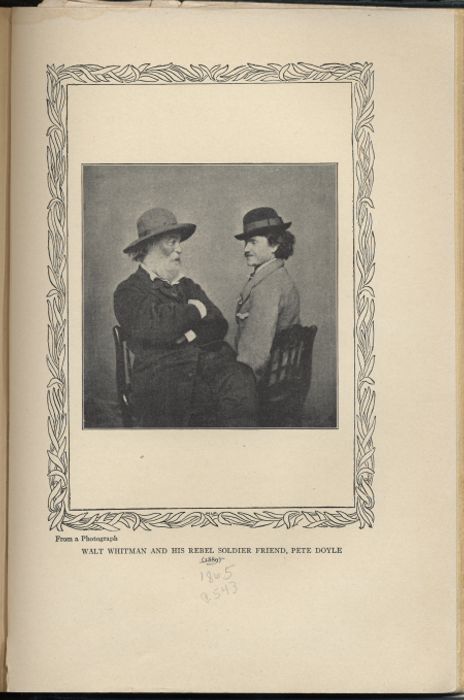 [Begin page 545] a silence: "You've thought no man was ever bad enough to be put into a jail: what have you thought he was bad enough for?"
"I have thought he might be bad enough to be put into a hospital—sick enough to be put into a hospital." W. looked at me intently then broke out into a smile: "That 's a very striking way to put it: put in that way I say yes, yes, to it: you know, I have often said to you, Tom, and to you, Horace, also, that if I have any doubts at all about Leaves of Grass it is in the matter of the expression of my sympathy for the underdog—the vicious, the criminal, the malignant (if there are any malignant): whether I have made my affirmative feeling about them emphatic enough. You see, Horace, I agree with you new fellows who do not believe that the criminal classes so known are the cause of themselves: I see other causes for them: causes as to which they are no more guilty than we are." I said: "Walt, you 'll get civilized yet if you go to our school long enough." He shook with laughter. "Oh! that school! Well, I want to go to it, but I 'm afraid I 'm a too-old, too-feeble, too-sick scholar."
[Begin page 545] a silence: "You've thought no man was ever bad enough to be put into a jail: what have you thought he was bad enough for?"
"I have thought he might be bad enough to be put into a hospital—sick enough to be put into a hospital." W. looked at me intently then broke out into a smile: "That 's a very striking way to put it: put in that way I say yes, yes, to it: you know, I have often said to you, Tom, and to you, Horace, also, that if I have any doubts at all about Leaves of Grass it is in the matter of the expression of my sympathy for the underdog—the vicious, the criminal, the malignant (if there are any malignant): whether I have made my affirmative feeling about them emphatic enough. You see, Horace, I agree with you new fellows who do not believe that the criminal classes so known are the cause of themselves: I see other causes for them: causes as to which they are no more guilty than we are." I said: "Walt, you 'll get civilized yet if you go to our school long enough." He shook with laughter. "Oh! that school! Well, I want to go to it, but I 'm afraid I 'm a too-old, too-feeble, too-sick scholar."
Then back to the Southern prison subject. His tone was very deep and earnest. As he talked I had seated myself on the sofa again. Picked up an envelope addressed Hon. Walt Whitman: laughed. W. mistook: thought I was laughing at what he said: "No—no—no—Horace: that ought not to be: if you had been down there—had seen victims who had to endure those cruelties—the maimed, sick, dead, dying—you would not respond to it with a laugh." But when he got to understand he laughed himself: "Oh! that is it! But that is not remarkable: I often am honorabled—and worse than that, too!" Then back again to War. "I knew something about those infernalities. You know about the smallpox scare. A great many people down in Washington doubted it—laughed it down, or tried to. The Attorney General sent for me: said he wanted to have the matter looked into: that he thought I was the man: putting a good many documents into my [Begin page 546] hands—some of the funds of the department at my disposal—urging me to investigate, report. I did so: looked closely into all evidence." Then he had concluded: "It was horribly true: true in every iota of evidence: I am sure of it as that we three sit here now and talk about it: true, damnably true. It is a foul blot on the fair fame of the country, those years. By means of infected rags, imported from districts in Southern Europe, it was designed to introduce contagion in our big towns—New York, Philadelphia, Boston, Chicago, others." W. "made an emphatic report" on all he had learned. "I had before been very ardent—more ardent than I am about anything these later years—being younger, stronger then—on the subject of allowing drugs to cross the line: I had always contended—I said Christian then—that no Christian could afford to refuse medicine to the sick and the wounded, wherever found: and when I made my report the Attorney General asked me if I was now willing to reassert the same position: I replied ardently just as I had before: 'Yes even now—at all times! as one in direct contact with these dark facts.'" W. said: "I have emphatic notions which I have never lost." But he "had no feelings" on this point "detrimental to the honor of the masses south—the great body of people there: workers, toilers, men and women: whose share in noble qualifications, in richness of character, I cannot, must not, dare not, question: no": he "only had a horror of the leaders, the conspirators, the group on top, who prepared the way for all these terrors—encouraged, excused, gloried in, them." He did not "grudge Jeff Davis his freedom" but he "could not give him" his "respect"—and did "not forget that the rattlesnake, the asp, could not help being the rattlesnake, the asp," &c. And so talk of this ended. W. thoroughly aroused: his voice strong, at times almost exclamatory. Although talking leisurely in a fragmentary way, he spoke under great stress of emotion. He confessed the subject "always stirred" him: that "from being present with the suffering wounded" he had himself [Begin page 547] "been a sufferer." It was not "ordinary facts that pained" him, or "the fact that the South was the South, and in opposition," but "the other fact that there existed unhappily at the South those days men who seemed utterly oblivious to the humanities."
In at McKay's to-day. Dave gave me The Bookbuyer which contains a notice of N. Boughs, portrait, and so forth. But W. said: "I have seen it: they must have borrowed the cut from The Publishers' Weekly." Had sent his copy to Bucke. Forgot to speak to me of it, he said. As to its Whittier portrait: "I have examined it: it is pretty fair: has the air of accuracy: yet might be much improved by proper attention." Knortz sends W. a second paper—Bahn Frei—Sept. 18, 1886—containing "a condensed report of my lecture on W. W.," as Knortz wrote on the margin. W. handed it to me. "Did I tell you Knortz had written me? Did I tell you what he said?" K. had received W.'s "first letter" and had "commissioned Charles DeKay to answer it at the time," but "through neglect or desire" DeKay had not done so. Knortz had "authorized the interposition of a German proof-reader, for security's sake, with the translation." As to this second paper: "I know nothing about what is printed there: it appears to be a report of a lecture." Where delivered? "Here and there, variously: I know of no particular place." Asked me then: "Did you know Charles DeKay is related to Gilder—is Gilder's wife's brother?" W. had DeKay's Nimrod—"a book-poem: it was large, finely printed, beautifully bound." Had he read it? He said briskly, with half affected indignation: "I doubt if anybody has: it was not made to be read: it appears to be one of a trilogy—a trilogy about the Lord knows what." I read him the free translation I had made from the Ohio paper:
"Among the old, yet active, poets, figures also Walt Whitman; but he is rather a noble, humane, poetically inspired eccentric [or original] than a poet. What he wrote is [Begin page 548] mostly of poetic import—an art rhapsodie—but to rhythm, rhyme, and generally, to every one of the poetic forms, he is a stranger. Freiligrath has translated some of his poetic writings, and these read better in the translation than in the original."
W. said: "Is that what it 's all about? I have no doubt there 's a certain measure of truth in what he says." Harned interposed: "But you can't help it whatever the hard things said." W. repeating: "No: I can't help it: I am what I am!" Then after a slight wait: "I am like Sidney Morse's darkey: Sidney had a darkey to help him in his work: paid him so much per week: a good enough fellow when he was good but inclined for a splurge now and then. Sidney tells of one of them: he told it to me: a grand spree, lasting a couple of weeks: after the siege was over, after the man had cooled off, Sidney got hold of him, catechized him—asked: why will you do such things? the darkey answered: 'I suppose it was all meant!'" W. repeating the last phrase with infinite humor, his whole tone and carriage rollicking in response to it. Then he said: "I tell that story because it fits so well here: I suppose I was meant, too!" Then after a still further reflection: "It was very cute in the fellow—natural: it may seem very simple—simple, perhaps, as he designed it: but it is profound—profound indeed!" Are we responsible? W. said it was "a great problem," for "is the thistle, the oak plant, responsible for being thistle, oak plant?" It was "a thing to consider"—"the tree a tree—man what he is!" Was "pleased" with "the Freiligrath touch." "The only trouble," said W., "is, that as I can't read German Freiligrath is a closed book to me." I read W. an extract from Brinton's letter of the 15th to me. W. considerably engrossed: said he had only a slight knowledge of the Johnson case. Harned explained. W. then: "It often appears to me as if many of these plagiarisms, so called, took a form that could be explained if not justified: the memory is a [Begin page 549] strange creature—plays us unmannerly tricks." But after he had gone on in this way for some time he called himself to a sudden halt: "I suppose I should stop there: it will not do to carry that too far! One may overdo it." Noted plagiarisms quoted. Longfellow and the Hiawatha matter, for one instance. W. addressed himself directly to Harned, to whom the story was new. "There are some of them who do not hesitate to call it a daring outrageous plagiarism: I myself have no doubt but that Longfellow brooded on it, hatched on it—this celebrated Kalavela—which of itself would not necessarily argue any evil: the worst of it was, not that Longfellow did this, but that he never owned up to it—neither he nor his friends: the poem is put out as if it was indigenous." He did not think Longfellow "could plead ignorance." But "how was it the matter had not been sifted before?" W. said he had "always suspected it"—that the affair was "not new—not novel," to him: "but I never felt conclusive till I met my Scandinavian friend"—he meant Selma Borg—"who declares it is a plain, palpable, unmitigated theft."
T. took rather a favorable view of the poem: quoted good lines. W. affirmed: "Yes—he is a singer—every page has beauties": but again: "Longfellow was essentially the scholar, translator, borrower—adapter and adopter!" Tom: "But he always credited his translations, did n't he?" But W. was still dubious. "Often he did—often he did not." Harned again quoted what he thought a fine passage. "Isn't that there? do you remember it?" W. resumed: "Yes—that is there—and more too: but the question is, does it belong there? That is concise: by that Longfellow must stand or fall." Did he doubt Longfellow's native flavor? "Ah! he had not a bit of it: Longfellow imports all sorts of things into Hiawatha: but did an Indian ever talk so? Was it not the man in the library who was doing the talking?" Then he said with increased earnestness: "But you take Homer—you take Shakespeare: you feel at once that everything you find there belongs integrally to [Begin page 550] the design—nature: speaks for nature—is nature—soil of its soil, inevitable." I put in: "You don't mean to say anyone ever talked like Shakespeare's heroes, do you?" He shook his forefinger at me: "You 're too damned critical: why don't you keep a few of your scepticisms to yourself?" "But do you?" I persisted. "No, I don't," he said. Then Hiawatha was not as native as Leather-stocking? W. resented the notion. "Cooper was indigenous: take The Prairie, The Wept of Wish-ton-Wish, The Spy: some would say, not The Spy, but I should say even that—I rank it among the best: they are all racy of America: vigorous, belong to the constitution of things—have established their right to stay, to bear the standard." So the talk ran. W. vigorous, positive, genial. Harned rather impressed with W.'s condition. "Barring gastric troubles—he seems more or less subject to them—he is in for another six months: it will take a long time to wear him out."
Thursday, January 17, 1889.
7.25 P. M. W. reading by gaslight: not looking over-joyful. Yet serene. Voice, vigor, not so marked as yesterday. Talked freely while I stayed. How was he? "I find little—in fact no—change: I am so-so: no more: am passing days now, one like another, little varying, all monotonous. I don't seem to be getting worse—or better, either, for that matter: indeed, may be getting a little weaker—slowly, slowly." Then he laughed quietly: "But the Doctor does not come—has not been here in days: and that may be a good sign—at least we will interpret it that way." Spoke of having "dipped into" Holmes' Emerson, saying: "I think it will interest me." And again: "I find I am like to be moved, at least a little, by it." I referred to Holmes as "chirpy"—and W. after a slight pleasant laugh said: "Yes, he is that?" Had he ever met H.? "I have seen him: I met him once in the Old Corner Book Store." "In Boston?" "Yes—in Boston." When? [Begin page 551] Here he was a little puzzled. "I don't know if I can say that positively: perhaps in '61, over the Thayer and Eldridge proofs: or in '81, with the Osgoods: probably '81": but could not "settle that with" himself. But he clearly remembered "the old book store: Holmes was there: we said a few words: probably words of no consequence, no purport." But did H. take any stock in W.? "No! oh no! I guess, not a bit. How could he? Still, I don't know much about it." He thought H. "a considerable man of his kind"—but "a man alien to our ideals." "I think Sidney stumped him most—Sidney Morse. Morse some years ago secured sittings from Holmes for a bust—afterward sent to London: done in Parian marble, spoiled (all smoothed out) in the process. Sidney is brave: he always stands up for the colors: he is equipped—knows. Sidney told me much about their talks together: he out and out telling Holmes once that he did not know enough to talk on that subject—enough about me: that he should go back to the books, learn more—something of that purport." I said: "We should dare the gods occasionally, especially when they nod." W. responded heartily. No one who has not heard him talk can imagine the feeling he sometimes puts into expressions of endorsement that read almost commonplacely. He cried: "Yes we should! Yes we should!"
I quoted Parker who spoke of God's duties to man as well as man's duty to God. W. said he had not heard that before: "They must have regarded it as rank blasphemy." Bryant up. I asked W. some questions. "Did Bryan appreciate your position—your work?" I asked the same question the other day. Now W. said unhesitatingly: "I hardly think so: Bryant was built up of the Pope and Dryden school." I interrupted: "But you think he was greater than either?" W.: "I did not mean that he was just like them, but that he was trained in that school: he was in fact greater than either—ever so much more human and moving: but Bryant never could have appreciated the facts we have stood for." Reading Frank Leslie's to-day [Begin page 552] again. This and The Stage seem to be the only papers he thoroughly looks into. He asked me about the book. When I said: "Nothing: we only have to wait"—he nodded and said: "Yes: and for my part I have little anxiety on the subject." Still, he wants "to see it done, well done, for others if not for me." Said he had letters from Rhys and Bucke, "neither of them of the slightest interest." "Rhys is still in London, floating about there, mainly engaged with the Walter Scott Company."
No visitors to-day. Saw a photo on the table. I picked it up—said warm things about it: unmounted: four by six or eight inches: showing W. about fifty-five. Waited for me to get through. Then: "So you like it? I don't know but it is good: I came upon it to-day." He has been looking up old portraits—the Doyle one of them. "If I strike another you shall have it. O'Connor has a copy—at least, he had one—I suppose has it still. He liked it—if I am not much mistaken liked it much." Who took it? He could not remember. "It was one of the great New York fellows." Tried to hit on the name. No, it would not come. "I think it must have been taken fully twenty years ago: I cannot recite all the details: it was while I was working—was in Washington—on one of my trips up—my flying trips." I said he seemed to lend himself to the camera—that he seemed to come naturally by good photos. He accounted for "the occasional success" by other reasons. In the first place, he thought "many of the photos failures anyhow—some indifferently good, some radically bad." "It is, I am convinced, in the main from other circumstances—rather in this, that I don't fix up when I go to have the picture taken: they tell me nearly everybody does: that is a great item." But I persisted: "Anyhow, even if you did fix yourself up, you would make an impression." He laughed heartily. "I see you will have it so: but there are difficulties, too—my red, florid, blooded, complexion—my gray dull eyes—don't consort well together: they require different trimmings: it is very hard [Begin page 553] to adjust the camera to both." He had an eye, he said, "not searching, not moving." I called "quietude" the habitual humor of his pictures. He was struck by the word. "How do you mean it?" Then instancing Hunter: "He has a piercing black eye which is always telling, effective: take him when is thoroughly interested, awake, earnest: there are many fine glows to his eye—like the fleeting lights of the sky, the water of the lake." But: "Startle, strikingness, brilliancy, are not factors in my appearance—not a touch of them. As for me I think the greatest aid is in my insouciance—my utter indifference: my going as if it meant nothing unusual—happening in."
I suggested that we might some day have a W. gallery—a book giving W.'s portraits—lots—all—of them. In the midst of this W. suddenly exclaimed: "I have it: Brady! Brady!" I knew at once this was the name he had lost: so I said: "Your memory generally brings you out right in the end." But he objected: "No—it 's not that: but what you have just said brought into my mind certain hours, talks of the old times—with them Brady's name." Afterwards he explained: "Brady had galleries in Washington: his headquarters were in New York. We had many a talk together: the point was, how much better it would often be, rather than having a lot of contradictory records by witnesses or historians—say of Cæsar, Socrates, Epictetus, others—if we could have three or four or half a dozen portraits—very accurate—of the men: that would be history—the best history—a history from which there could be no appeal." I asked: "Was that Brady's notion?" W. said: "No: mine, I suppose: I suppose I spun that out—reeled it off: but I know that we discussed it—that it was occasioned by conversations we had together." "Brady made many fine pictures," W. thought: "he had the notion to produce the heads of celebrés: he had quite a collection: he must have had not a few dozen merely but hundreds and hundreds. I remember some of them: there was one of Cooper: I liked it very much: oh! it was very [Begin page 554] good! I have seen engravings from it since: one of Irving, too: and the women: the women in society there at Washington: Presidents' wives, and so on, so on"—naming several. How about Lincoln? Had he a good Lincoln? "No not one: at least, not one good." W. half remembered a Lincoln—"perhaps more than one"—"of a sort"—but none effective. "He should have had: Lincoln was very obliging: whenever he could he would make it convenient."
W. resumed after a brief stop: "But there never has been a portrait of Lincoln—never a real portrait: there were certain ones of us agreed on that." Why? What was the reason? "I could not tell: none of us could: all we knew was, it was not there: had we seen it, had it been there, we should have been mighty happy, you can well believe." He spoke of Lincoln's "wonderful reserve, restraint, of expression—fine nobility staring at you out of all that ruggedness": this had never been "stated pictorially." He did not know why his friend Alexander Gardner "did not try his hands at it," for G. was "very successful: I have often thought him the best." Darwin, too. He was named. "I have never seen a good portrait of Darwin." How did W. like the old daguerreotypes? "I have seen wonderful specimens: they are not to be sneezed at." But the modern photo is certainly an improvement? "Oh! I suppose so: they are more convenient—cheaper: better in all ways probably."
I had the Willis life in the American Men of Letters series. Would he like to read it? He "guessed" not. "I am not much interested in Willis: he was a good natured bright fellow: I met him: he had a certain run of success." Described Willis as "one of the particular men"—"the horror of photographers." W. inimitable: "Willis had his topknot: this had to be got into the pictures: if it was this side when it should have been that, that when this, then good-bye picture!" W. tried to illustrate with his own thin hair but it would not work: very comical, however. I had a couple of Boston pictures of Morse in my pocket. W. was
[Begin page figure-012]
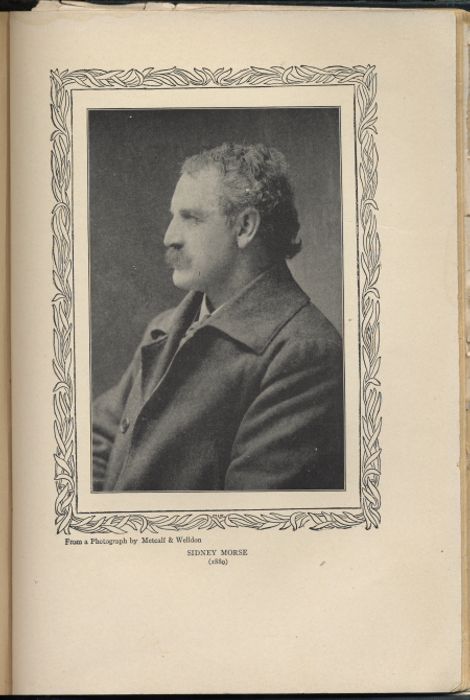 [Begin page 555] eager to see them—actually seized them out of my hands: and he regarded them for a long time with an evident relish. "Oh Horace they are beautiful: O, they are our Sidney! They fill me with a certain sort of awe: he is the noblest Roman of them all—of us all: who goes farther, who goes deeper, than Sidney? Who more loves? Who gives up more? Who is so willing to let others succeed and stand back himself—so ready to help them succeed and stand back? Sidney is full of genius: he rides at the front: he says the first and last words: he is like the still waters that run deep. Oh! as I look at these pictures I see him here still: his quiet quizzical wholesome ways: working in the yard back there with his clay: downstairs—cocking his head (getting a line on me) then rushing back to the head again giving it another touch or two. It all comes back: and the evenings, too, in the dim light: the talks: his gentle voice—sometimes his loving hand which he would lay on me." W. stopped. Then: "Some day we must have him back with us again: some day, some day."
W. gave me another one of the "avowals." He said: "It is a beautiful thing after being denied so long to be accepted in such a spirit." I had to read the letter to him of course.
35 E. 39th Street, New York, May 3, 1876. Mr. Whitman,Dear Sir: My friend and yours Mr. Joaquin Miller tells me that the best way to gratify a long cherished wish of mine, i. e., to have a complete edition of your poems, is to write to you directly for a copy of them. I therefore follow his advice. If you will write your own name on the fly leaf of the volumes, it will be a great favor to me and most highly appreciated.
I was one of the earliest readers of your Leaves of Grass, that unique book, which so startled the many and so delighted the few. Permit me to congratulate you and to [Begin page 556] feel a little pride myself as an American that you have received such abundant recognition from the greatest men of our age both abroad and at home; and when I remember your work during our dreadful War, my heart as well as my pride is touched, and I cannot though a stranger to you forbear presenting to the true man, a nobler title even than that of the true poet, my profoundest respect and admiration. With sincere regard yours
Laura Curtis Bullard.W. seemed doubtful about "the abundant recognition." "A few here and there—a handful: are there more? I am not worrying over what I could not get: but I am not willing to figure as a petted darling of the great and the powerful." I said: "She don't say you are popular, Walt: she only says the great men of this and other countries have recognized you. Do you deny that?" He said: "That 's hardly for me to say: who are the great, anyhow?" I broke in: "Walt, you almost seem to resent the idea of success." He shook his head: "No—it 's not that: I am not afraid of getting the success or of being spoiled by it." "Well, Walt—take this woman herself: I don't know who she is, but she sounds pretty big to me: you feel proud of yourself as the man she addresses in that way, don't you?" W. then: "Oh! don't think I don't appreciate such things—all such things: why, I live on them—they are all I have: cut them out and I am landed high and dry. No—I only kick about the popularity idea. Every now and then some one comes along and says: Walt, I don't see that your shoe pinches! Of course he don't. But I do: I wear the shoe: I feel the pinch." Then after a break: "Yes: God bless her! God bless her!"
Friday, January 18, 1889.
8 P. M. W. lying on bed: not asleep. Did not strike me as extra bright though he was willing to talk and did talk. Not up during my stay. Ed said W. appeared to be [Begin page 557] as usual to-day, though complaining somewhat of great heaviness of feeling—"as if I was carrying seven or eight hundred pounds on the top of my head." He said nothing of this sort to me: spoke only of "jogging along feebly." Complains of "increased monotonousness": seems to require company to cheer him up: yet can't stand company, which draws too heavily on his nerve power. Said to me: "I made up a bundle of papers to-night intending to send them to Dr. Bucke: then thought you might like to look at them first: held them back. They are across there on the table—a delicate red string about them: rolled." And after I had secured them: "I did not want you to forget to take them—I want them all back: or if you like you may send them off to Bucke yourself: he will want them more than either you or I." He described the contents of the bundle uniquely: "A copy of Poet Lore for one thing: a sort of Browning-Shakespeare hystericality, transcendality, if I may so speak of it: you won't take much stock in it any more than I did: but you will want to read it: there is absolutely nothing in it: but it is a satisfaction sometimes to look into a thing if for no more than to see how valueless it is." Also in bundle a copy of San Francisco Bulletin containing a notice of November Boughs—"sent, evidently, by Charles Eldridge—a notice hardly of moment: one, however, well to know": for it is "about the best thing we can do: keep a sharp eye about to see where are our vulnerabilities." Third paper in bundle Springfield Republican, of the 15th. "It contains some talk about the big book: something Sanborn had done." But when I asked W. is S. had laid himself out on the job he appeared to think not. Said, just as he had said of S.'s letter in regard to the book: "It is pretty good but mild: Sanborn is bound not to be extravagant: keeps himself well in under all circumstances."
In at McKay's to-day. Saw Boston Traveller containing another review. The Traveller quoted from Sands at Seventy: then said, in substance, "if you call this poetry, [Begin page 558] well and good, but the Lord save us!" W. laughed: "Well, we must be glad we get off as easy as that." But did I not notice all around "a definite softening of the lines: if not endorsement, at least no longer, or, for the present, not violent assault? Perhaps it is only a truce—the flight to be resumed—but at any rate there is a lull now." It "baffles" W., as he puts it, that his "letters appear to arrive at Bucke's so irregularly." "He writes of three letters coming together. How could that be? Where could they be the time between? I never send them that way: always send them evenings. There was a time I wrote every day. I can't understand: I know the Canadian post officials are very prompt—appear to take a pride in their work." Spoke of Bucke's coming next week or week after—"now at last it would appear to be definitely settled."
Fire bell up town ringing vigorously as we talked: I went to the window, raised the sash, opened the blinds, looked out: a great light northwest: W. asking me questions: could see nothing from the bed. "Where is it? Can it be serious? What do you make out of it?" &c. McKay already has some orders for complete W. W. Oldach does not appreciate our haste: said to-day, no sample book this week: next week, about Wednesday. McKay thinks Boston Herald review brought him orders. W. asked: "And he don't think the books we have here will do?" I answered that I thought Dave wished the others for the market—regarded them as more sellable. W.: "Well—I suppose so: and, as you say, we must keep Dave in our good graces. Though not eager or worried to sell the books, my chief satisfaction is in the fact that I have them now in that shape—authorized: a certain ideal, warrant, seal, accomplished." Still, he did not object to selling? "Oh no! that part must not be forgotten either: I want to come out whole on what I have put into the books." McKay still argues that the books should be numbered. W. not averse but suggesting that I should do the numbering. Perfectly willing. But I said we should number them, spelling [Begin page 559] the numbers out: it would give the books more market value. W. said: "I can see no argument against it." I could see no sensational sale for the book anyhow. W.: "Yes—it is not a volume to rush through with a hurrah." McKay asked me to-day what I thought of W.'s invitation to him to bring over his children. I advised yes. W. always intensely interested in Harned's youngsters. McKay remarked great evident change in W. "Noticeable to anyone seeing him only occasionally." Bucke not confident W.'s present condition can last much longer. Told W. a story of last evening. I went directly from him to the boat. I was in the rear, ladies' cabin: no others there: writing my W. notes (did not tell W. what notes). Suddenly a shadow fell on my paper: I did not look up: I was conscious of some one regarding me: then of a sweep about as a man landed in the seat next me on the left: a man full of rum and tobacco: a no-care sort of a fellow. I kept on writing. He spoke to me. He wanted ten cents for lodging, &c. I stopped long enough to say: "You see I am writing: I would rather be let alone"—then to work again: he persisting, however, equally, after I repeated: "I told you I was writing and would rather you let me alone." He now grasped my meaning, got up, went across the cabin to stare at me, then reeled out. I felt disturbed and sad about it afterwards. It seemed to me I was a bit priggish. "Ah!" said W.,—"that is one of the graphic incidents out of life that one cannot well drop or disregard." I asked: "Was I harsh?" "Oh no! no! I was not thinking of that: only that it was a temperance lecture among the profoundest that I have known."
I had read Paumanok this evening. We talked of the poems of that period. "Is there indeed somehow in those poems a weakening of the fibre as Bucke believes?" I dissented: "You are still the same man wrestling with other conditions," I said: "still equally firm, even through Sands at Seventy." W. said that was what he wished it to be. "'Transference,' is the word: not changed—only trans- [Begin page 560] ferred." "The War deeply engaged me: enlisted all my powers, thoughts, affection: the doubts, anxieties, dubiosities: the tos and fros, the ups and downs, the heres and theres: the sad visions, ever approaching, ever appealing: deeply, unreservedly, commanded me. Life anyhow, particularly life as we live it these modern days—is a going rapidly from one thing to another—incidents, people: a great melange: there is no doubt Leaves of Grass partakes of the character of the time: but whatever the change of position, the man is the same—nothing more is signified for it than transfer, entrance upon other outward contingencies." And again he said: "It means nothing but transfer—simply transfer: I was transferred: perhaps transferred myself."
Ed had a scare the other day. While at breakfast, about eight, he heard W. knocking vehemently on the floor with his cane. Ed hurried upstairs, wondering if something had happened to W. He asked W.: "How are you this morning, Mr. Whitman?" "All right, Eddy: what time is it?" That was all he wanted—the time. Ed relieved. "I thought it was long after nine!" said W. W. on bed this evening during my whole stay. He gave me a couple of "scrap things" as he called them. Directed me to the table to find them. There was a thin string about the papers. I asked: "Shall I take them without reading them?" He shook his head. "No—take them after reading them: reading them to me—aloud." He said: "I wrote things for The Graphic back there, you know. Croly was really good to me." Then he laughed: "See what he says about my proof revisions: he was sore: I don't blame him—do you?" I said: "No editor ever said you wrote bad, did he?" "No—they only said I revised too much: that was Croly's grouch: read." I did.
The Daily Graphic, January 19, 1874.Walt Whitman: We enclose the proof of your second article; but would much prefer that you should get the [Begin page 561] copy straight the first time. Such very heavy corrections in proof cause great embarrassment and expense in a newspaper office. We are quite willing to give proofs for verbal corrections; but we do not like to reset and readjust so largely. So please have a care to fix your copy before sending it in.
Yours very truly, D. S. Croly.I said to W.: "I have read you the wrong note. There is your draft of a note to A. K. Butts on the other side of the sheet." W. said: "Neither side is the wrong side, though I have pencilled Croly out. I meant you to read both. The letter to Butts will give you some data on editions." I read again:
Camden Feb. 8, '74.To A. K. Butts, O'Kane has undoubtedly sent you all the copies of my books remaining in his possession—he received originally (April 28 '73 from Doolady) 239 Leaves of Grass, 100 As a Strong Bird, 92 Democratic Vistas, 45 Notes by John Burroughs, &c. And since then he has delivered about 30 Leaves of Grass to my order—leaving only 30 or 40 more to be accounted for as sales &c. so that, as just said, he has unquestionably retained none in his possession. As said in my note, you know, (with the exception of about 350 copies As a Strong Bird, which are at my printer's in N. Y., & which I can send you an order for,) you now have all my books in the market. (The last edition you have, L. of G. only consisted of 500 copies, when issued, over a year and a half ago.) Will write you again early this week, anent of your yesterday's letter, offer, &c.
"What a sweat I used to be in all the time," said W., "over getting my damned books published! When I look back at it I wonder I did n't somewhere or other on the road chuck the whole business into oblivion. Editions! [Begin page 562] Editions! Editions! like the last extra of a newspaper: an extra after an extra: one issue after another: fifty-five, fifty-six, sixty-one, sixty-seven—oh! edition after edition. Yes, I wonder I never did anything violent with the book, it has so victimized me!" I broke out into a broad "Ha! ha!" He lifted his head—leaned on his elbow. "What the hell! What are you breaking loose about now?" "Oh! I was only thinking how the poor victim is still making edition after edition: now, even, in eighty-eight—thirty-three years after fifty-five." W. chuckled over this too. "It does seem rather laughable, don't it? But the fact is, the bug bites: we can't help ourselves: we are in a web—we are moths in flames: all of us: you, too, damn you! you 'll have your bug some day: then maybe you 'll have some sympathy for me!" After a pause: "But you still have another letter: why don't you read it?" "You mean O'Connor's letter? Ain't it too long?" He asked: "Was an O'Connor letter ever too long?" I said "no" at once. He added: "William is one of the fascinators: you can't escape him: he fixes his eye on you like the Ancient Mariner: then you are his subject—you do his will. If William had gone like Bob—gone into the cities—talked—well, there would have been another great orator for the world to take account of. Do you ever stop to think how many sorts of greats William might have been if he had not chosen to settle down onto that job at Washington? Oh! this is a wonderful letter. The world does not know William: that 's because the world rarely seems except by and by to know its real inhabitants. The world goes daffy after phantom great men—the noisy epaulette sort: a man has got to set up a howl if he wants people to take him right off: if you have the real stuff in you you've got to wait for it to be recognized: and you are far more likely to die than to live in waiting. But read, Horace: read: I want to hear William: read! read!"
[Begin page 563] Providence, R.I. Mar. 27, 1883.Dear Walt: Your gratifying letter of the 25th instant was received last evening. I return the proof herewith. The only corrections I have seen to make are —
1. Striking out the quotation marks from the declaration of Novalis, which I think was without the quotation marks in The Tribune. I never meant to attribute those words—"the body is the temple of the Holy Ghost"—to Novalis, but only to indicate in that phrase the sense of what he says. The phrase is St. Paul's (I Corinthians, Chap. VI, verse 19) and I think it happily expresses, in epigrammatic form, what Novalis says very grandly, at length, in one of his Fragments. When I get back to Washington, I will get the German book out of the Congressional Library (it has never been translated) and send you a version of some of his splendid sentences; and when I collect my letters into a pamphlet, as I still mean to (much work and Jeannie's illness having prevented) I think I shall put in a note to the passage about Novalis, giving these sentences, lest some one should accuse me of having made the bull of attributing to von Hardanberg what belongs to Paul.
[W. broke in on my reading: "Stop right there: Horace: there: you notice what he says: that should be done: William's letters should be collected—the Leaves of Grass letters: they would make a marvellous book—an eloquent book. It 's of no importance that they should have been written about me: it 's of every importance that they should have been written by William. Whatever happens to William—whatever to me—God knows, Horace, we are both nearly through with this life—our accounts are nearly closed: whatever happens to us, do you bear O'Connor's desire in mind: you may some day be able to collect these pieces together out of their many forgotten depositories and relight them in a book—make them live again in a book. Bear it in mind, Horace: bear it in mind!" He had lifted himself up on his elbow. He dropped back in the bed. "Go on!" he said.]
[Begin page 564]II. "The poet, using nuptial imagery, as Isaiah, as Ezekiel," etc. I have changed this to sexual imagery, which is truer to the fact as regards Isaiah and Ezekiel. The word "nuptial" was not well chosen originally.
["That 's right, William!" exclaimed W. from the bed: "get right down to the facts—the truth: don't gloss things over: don't beg the supreme questions: there 's no better word than sex when you mean sex!"]
III. I have put in a row of stars (******) to indicate a break in the extracts. You can strike them out if you choose, for I don't stick on them, but they seem justified.
That is all. The extracts pleased me greatly. They never seemed less mine than when I read them in this proof, nor ever before so powerful. If ever lighting went into sentences, it is there—although I say it, as should n't! That Tribune letter did good to Leaves of Grass, and I hope so to do good. Dick Spofford told me Oliver Stevens felt "perfectly withered" when he read it. Apropos, he told me that his wife, Harriet Prescott Spofford, says always and everywhere, that you are the only poet that ever lived who has done justice to woman.
I have drawn a mark and made a ? beside the passage in which Bucke eulogizes me, just to make you consider it. I read it with deep mental acknowledgment to him, but not without some misgivings. Still, it is his tribute, and it is not for me to make objections. I only wish to consider your interests, and should deprecate the introduction of any express statement, which might challenge successful attack by our enemies. I doubt the truth of the statement that I am "a scholar." ["Don't be so sure of that, William! You are not a scholar as scholars go: you are a scholar as scholars do not go, thank God! No, William: you are not that scholar—the dried up mouthpiece of the dead, as our Horace here has said: no: you are the trumpet call of the living: Horace says that of you: God knows you are entitled to it!" W. very earnest. I waited thinking [Begin page 565] he might say more, but he did n't. I started again.] Alas! I am not, and have had many a moment of bitter sorrow because I am not—because I have never had the chance to be more than a somewhat omniverous and desultory reader. I am afraid, too, that the Doctor overstates my efficiency in Elizabethan letters. I have had some new insight, some novel views, of those books; no more. However, you must judge of the effect of the passage. As I read it my main thought was whether it would do good or harm, and I am still in dubiety on this question.
I am glad I am to have a revise, for there is one brief correction I want to make, being afraid to let the passage stand as I have it. It is where I mention Bacon as loving to ride at night, uncovered, that he might feel "the spirit of the universe upon his brow." This is from an old note of mine, which I forgot to ascribe to its source, and am unable to verify, though I cannot see how I could have mistaken the matter in my notation. The nearest I can come to it is Aubrey's gossip that he loved to ride, uncovered, in the spring rains, that he might feel upon him the universal spirit of the world—a magnificent anecdote, I think, and quite in keeping with the Shakespeare ideal (isn't it?), but not quite like my version; and I must alter the latter accordingly, for we are going to run a sweet gauntlet of criticism, and must not be laid open any more than can be helped.
Should n't wonder if the book, and especially my share in it, would make an enormous row!
["It did, William!" said W., "and the noise of it has not yet all died out!"]
The title page is very handsome, and the Lucretian motto delights my soul. I only wish a good prose translation of the lines (Munro's would do) could be slipped in somewhere in the book, (or probably it is better to have the Latin alone on the title page). I have no doubt, as you suggest, that I shall like the book typographically and every other way.
[Begin page 566]To-day is the day set for Heywood's trial, and cold shivers run over me as I think of it. I can't help some sympathy for the devilish fool, despite the mischief he is likely to do us. ["O William! William! not devilish fool: not that: after all a brave man—a man more sinned against than sinning: I did honor him—yes I did: he was under a cloud not of his own making!"] Dr. Channing and I have concocted a move toward getting a nolle pros, though with small hope of success. In case of conviction, I mean to attempt, with Ashton's help, to get him promptly pardoned, which will break the force of the finding, and paralyze Comstock in his designs against your book. ["And he 's not paralyzed yet!" exclaimed W.: "it 's six years, nearly, and he 's still loose in the country seeking whom he would devour!"] I am horribly anxious. Heywood is a stupendous jackass ["O William! how often I have been called by that pleasant name!"], and has contrived to render almost nugatory the clean victory we won by The Tribune letters. It is too bad.
More anon. I am glad you keep well.
Faithfully, W. D. O'Connor.W. asked: "Did you ever see anything, anybody, liver than William is when he gets a-goin'? He is beyond being reined in—beyond being nullified. He is not a man, then: he is a force—a driving blast. I suppose you know about that fellow Heywood? He was a free lover: I don't know whether he 's still alive or not: Sidney said he was a brother-in-law or cousin or something of the Concord Hoars: he was really an important man—brave in his view: he was unqualified—went to jail—suffered." "I don't care what idea a man goes to jail for," I said, "going to jail for an idea makes a man: the idea may be false but the man is true." W. said: "Amen to all chapters like that! Well said!" I leaned over W.'s pillow and kissed him goodnight. "God love you!" he said.
Saturday, January 19, 1889.
8 P. M. W. sitting by the light reading Symonds' Greek Literature. Ed said he had spent a very good day. W. himself repeated Ed. Talked about fifty-five minutes. Bright, deliberate, sure. Questioned me about the fire last night: it was a lumber yard along the wharves; he was very much interested in my description of it. "Ed told me you went off together to see it." Fire rather low. W. took up a prodigious log there by the stove: started to put it in: it would just about go through the doorway. "There, Mr. Log," he said: "I have been preserving you just for this moment: now show what you can do!"
Oldach has not yet done the cover. Disappoints us. I saw McKay to-day. He had a copy of Queries (Buffalo) which had copied, without crediting, American notice, as we believe. Sent Bucke the three papers W. gave me last night. He said to-night: "Have you done it? Ah! good! and I commenced to write Doctor this evening a note I must finish and send off to-morrow." Sensitive to the weather. It has grown severe. "I thought it was pretty cold last night," he said. The weather on such days interferes with his bathing: he hates to give up his bath. No visitors to-day. Critic's review of November Boughs out at last. W. said: "Oh yes—I saw it. It is unprecedented to have the paper sent and have it arrive the same day, as it did this time. It must have had a special messenger." "As things look now there appears to be a boom for November Boughs," W. said with a laugh: "I wonder what it all means?" As to Critic notice, his question, like Dave's and mine, is, who wrote it? "Who do you think? I think it is a classical fellow—one of the college men: it is full of literary references and classical names. You don't think it was Jennie Gilder? I am sure it was not Joe, anyhow. I have guessed Howells: and by the way, I want you to keep out a sharp eye for the February Harper's: I have reasons to suppose Howells will discuss us in that number—in his department there. New [Begin page 568] evidences seem to indicate that Howells is moving on." W. said: "The Critic notice seems the most extravagant of all—no other is so full, so liberal, so expansive in its plaudits. My first notion was to write to Joe Gilder and ask who it was had gone on so, at such a rate: but I concluded that would not do—it was best not." The review "was interesting for other reasons." "I have heard that some famous man said something to this effect: in writing the history of another he wrote the best history of himself: words signifying that: this Critic piece, in fact all the pieces, bear that out." Brought him a copy of The Stage. Portrait of Marie Wainwright this week. "Certainly, that is the best so far, and wonderful it is, too: I have seen Marie Wainwright—liked her very much: seen her in Boker's play—Francesca he calls it." He says "The Stage has become part of" his "regular Sunday reading."
I received note from Burroughs to-day—West Park, 17th. W. eager to read it. Put on his glasses at once. "What does John say? Let us hear." He read it himself deliberately. "The good John!" And when I spoke of B. as "affectionate and sweet," W. repeated: "affectionate and sweet? He is indeed: highly endowed with the human emotional qualities: the sweet juices of the best apples, nuts, milk—all good things!" At the passage as to a Christmas letter I said: "I did not know you heard then: you did not say anything to me about it: I wrote Bucke just to-day we had not heard from John in a long time." But W. shook his head: "I have no memory of such a letter. But then," he said doubtingly, after a slight pause: "since that draft business I don't trust my memory any more." But, "alas and alas! no word from O'Connor! You can only tell John on that point that we hear nothing or very little: that for weeks we have not had a word: that William no doubt continues as he was—and that is bad—very bad and sad!" Could O'C. still go down to his work? W.: "That 's what I want to know: that is what I want them to tell me: but they don't say a word about it—not a word! They are [Begin page 569] very generous with the fellows in the departments down there: if they are sick or away, they draw their salaries all the same, once a month." Was O'C. politically a Republican? "Mightily, yes: O'Connor was an Abolitionist." Republican and high protection? "No: I hardly think that: though I am not certain: free trader, I believe."
I put in this question: "You have said William was an Anarchist, too: how can he be both a party Republican and an Anarchist?" W. replied: "A Republican for to-day, an Anarchist for to-morrow." He talked of O'Connor's tenure—his job: how he had been able to hold on to it. "Even under Cleveland—radical as O'Connor is: and Kimball, too, his chief, just as radical: and another—Johnson: let me see, where is he?" Closed his eyes. Then quickly: "O yes, the Light House Bureau—that 's it!" He thought "quite a liberal modicum of Republicans" were "holding over." Talked of Marvin too, but W. hears little of him nowadays. Had forgotten about his appointment under Cleveland. "And so the Bureau of Information is gone up?" He thought Marvin "poor." "I don't think he has more than his salary brings him. Did you know he was a Unitarian clergyman at one time? He got out of that, somehow, for some reason or other. Then he was on The Radical awhile with Sidney—cheek by jowl, weren't they? Then on to Washington. He got a position there with the tax revenue department: he: Eldridge also: Charles Eldridge. Part of the work was to investigate and report on banks, bankers—big concerns. They made some powerful enemies—both of them: by and by both were dismissed—put out: Marvin first, then Eldridge." He did not know for what. "I never had details," but: "I have no doubt it was for telling the truth—for being honest—for both were good clerks, wherever you might put them." I grouped W.'s Washington friends: called them "the faithful few." W. said: "Yes, indeed: and there were several more than you have ever heard of—the names forgotten now: Knox, one of them: a good, faithful fellow: and there was a musi- [Begin page 570] cian, too: I used to run round and hear him play: he handled the piano well, strongly—was a genuine musician."Had Burroughs come down there designing to go into a department? "No: not at all: he came crushed, low spirited, despondent—thinking to go into the War—like a fellow jumping into the river, to sink or swim. He was quite a different man then from now—thin, emaciated, pale, feeble: he had friends there: they united to persuade him that that was not the thing for him to do: finally, he stopped right there—took a department position—so became one of us." But this was not all. "There were womn, too: the women are wonderful friends: did you ever know one good noble genuine woman will outweigh all the rest? oh! I have been fortunate in these, too: fortunate! fortunate!"
W. had read Feb. Lippincott's which arrived to-day. Stoddard there on Hawthorne. "It is not quite as bad as the Poe article for personal venom, but it is of the Stoddard kind." He thought S. "engaged generally nowadays in poor sort of work:: but he supposed the H. piece was "characteristic." "It is not worth reading," he finally said. Then again: "Stoddard seems particularly envenomed: he does not seem hospitable, friendly, receptive: he has so many more hates than loves: Stedman said to me: 'I 'm afraid he is sour on everybody: you 're not an exception, Walt!'" W. said: "I had a visitor one day last week—a preacher fellow: he wore black clothes—clerical: was quite courteous, almost gracious. He said he came from Chicago: his name was—ah! let me see—what was his name"—he stopped: then—"O yes! Burton: he said he had read the Leaves—talked quite a bit in a ministerial way. Just before he left je said"—here W. paused and chuckled: "'I hope it is not true, Mr. Whitman, that you are a great admirer of Bob Ingersoll!' It was lugged in in such a way I felt as if that was really the purpose of his visit—to satisfy himself on that point. I blurted out at once so he should remain in no uncertainty: 'I 'm afraid my friend that I hope it is true and always may be true!' [Begin page 571] You should have seem his crestfallen face, Horace. He said at once: 'I confess I am disappointed.' I only smiled. He seemed to take it so to heart. I asked him: 'I suppose your religion has a place for Ingersoll?' He answered evaisvely: 'That opens up a large field'—which meant he had his doubts. So I hurried to add: 'Well, I 'm afraid mine does, anyhow: Leaves of Grass would be a poor sort of pretender if it flourished a whip oer people.' He bowed as if to say, Have it as you will. The fellow riled me a bit, too, it was all so unnecessary. I did not wish him to go supposing my love for the Colonel was only a half-hearted sort of thing—an apology: so I said quite vehemently: 'You must make no mistake about it: I am Bob's friend: I admire him" I stand by him in his war on the Church.' He was as solemn as a judge by this time. 'And in his war against religion, Mr. Whitman—do you stand by him in that?' I answered: 'He makes no war on religion.'" W. laughed: "It 's astonishing to me how these preacher people thin themselves down—lose thier blood: they have no more guts than a dead weazle: they nose about with thier little hells and heavens like a corner grocer with something toothsome to sell." Then he added: "Sometimes I have thought you were too violent on the preachers, Horace, but when a sample like this comes along with his numerous arogances I am up in arms again full of my old resentment." W. gave me a letter which Thomas Dixon—"the Sunderland man," as he calls him—sent over to him "many years ago." "It is one of the avowals, again—a beautiful one, too: it is from a man named Westness—W-e-s-t-n-e-s-s, as I make it out"—spelling it. I read it to him.>
333 Liverpool Road, Apr. 11, '76Dear Dixon: I forgot to acknowledge in my last the Feb. number of Human Nature containing Barlow's article on Walt Whitman. He appears to be a superior man but no so advanced as Whitman in his mode of thought. His article is a valuable one, and his poem, alluded to in the short piece [Begin page 572] by an anonymous writer in the April number (who is not capable of dealing with him) is an interesting production. You will, I suppose, have seen it. It is in the Dec. number, and is entitled Another Year's Meadow-sweet. He seems to despair of immortality, and there Whitman has the advantage of him. The poem is somewhat of a hothouse production full of the oppression of Death. Unlike him Whitman approaches undaunted the veiled angel so terrible to men. He embraces her, finds her soft and yielding; he removes her veil and finds her beautiful and desirable—a delicious bride with cool and perfumed breath. Whitman's poems are everywhere the work of a man "enamored of the open air," and are like his "athletic girls," "tanned in the face by shining suns and blowing winds."
You ask me how I should like a manager's place in a large photographic establishment? I dare say I should like it very well, but where is the photographic establishment?
I read Mr. Brockie's Notes of Whitman in the S. Times and I hope it may be of service. The fact is that it is sort of sacrilege to present Whitman or his claims to almost anyone. To all but about one in ten thousand he simply appears a mass of unheard of folly. I should be glad to see his book sell, if only the most of people could make anything of it. But I never show it to anyone, as I never meet with any to whom it would be at all intelligible. The book is open and plain enough, certainly, to those who are on the same plane of thought with himself, but the majority of men want "a book to join them in their folly"—and their damned trifling conventionalities.
I have not heard anything from Mr. Rossetti. I believe Mr. Buchanan is a very good man; and he is a writer of high quality; but I hardly desire to trouble him with my acquaintance. The fact is, that, as a rule, the visits of a person moving in a different sphere generally have something of the character of intrusions. This is the reason why I have never visited Mr. Rossetti, who very cordially invited me to do so whenever I pleased. These men are too much [Begin page 573] surrounded and worried—and it is much better for a man to be alone than to visit where his visit is not a distinct favor, and a thing to be desired. I should visit Whitman—of all men—without hesitation, because I know that there I should meet the solid hero skin to skin—without the intervention of "lace and ruffles." Perhaps, if he were worried by too much "society" he might be almost tempted to put on his dress coat also. But there is not much fear of that. Society never yet offered incense to such a man. Those who understand him are what he desires them to be—his "lovers": and there is not much love in "literary society."
I am yours faithfully, T. D. Westness.W. said: "That man going on so about the open air ought to see me now, tied down in a single room, day and night." But I asked: "You don't love the open air any less than you used to, do you? You are here because you must be, not because you choose to be." "Yes: I know: but there are times when that does not satisfy the rebellious spirit: then I want to jump out of my skin—feel as if I must yell, leap, raise hell—do anything to break down the walls of my prison and escape." W. gave me the original of the sitting picture we used in November Boughs. Also a W. W. "at home" card, Wentworth Hotel, New York, April 15th, 1887. Also a big yellow envelope on which he had written: "From Office Christian Commission 343 Pennsylvania av. Washington, D. C. Commission of Walt Whitman of Brooklyn N. Y. Jan 20 1863." He said: "The portrait is getting all crushed up here: you had better put it in a flat place: it is worth keeping—if anything is worth keeping. I often wonder if all this sort of thing is not a mistake? I am near the jumping off place: why should I care what comes? After me the deluge? What do you say to that, Horace?" I replied at once: "I don't say you should care what comes: we care: that 's why I am hungry for these papers—for saving things you want to throw away: be- [Begin page 574] cause we care." W. was gentle about it. Kissed me good night. Said: "I 'm glad you care: I am: I am!"
Sunday, January 20, 1889.
2.30 P. M. W. sitting in his usual place. Neither reading nor writing—yet not dozing: hands folded across his stomach—seeming to be lost in thought. Particularly affectionate somehow to-day. Some of his mail down by his feet: letter and paper for Bucke: spoke of these. "I finished my letter, as I told you, last night: put it up: there it is: and The Critic, too: I think he will like to receive that: Maurice has a curious affinity for all the odds and ends Whitmanesque." Then he turned a questioning eye upon me: "How would Kennedy do? Could it have been Kennedy?" And when I looked quizzically at him: "Oh! I mean for The Critic piece: could he have written it? I have been running it over in my mind all the forenoon." I said "me too": I too had wondered about Kennedy: but I doubted if Kennedy had access to The Critic. W. said: "Oh yes! he has that: Kennedy is not closed out: I don't know but he is liked there: at any rate it might be him." Then W. exclaimed: "It is not wholesale: it pulses with enthusiasm: it 's hot victuals: not warm only but hot, hot, hot!" And when I spoke of it as gracefully written: "That is true: facility in every line." But he is still dubious of criticism in general.
I said Sanborn's piece in The Republican sounded as if it was written by a man who wanted to say more. W. said: "That is very like to be the case." How did he know that Sanborn had written the letter? "I do not know: I only conclude—assume, surmise: it seems to me probably: he is the only man from whom to expect that kind of a word in that paper." Was S. cold, stately? "No: I could not say that. I could best describe him by saying he was of the Emerson stamp—modelled himself on that standard." Then after stopping: "You never met Emerson? Well, anyone who had ever met Emerson would recognize any one of the
[Begin page figure-013]
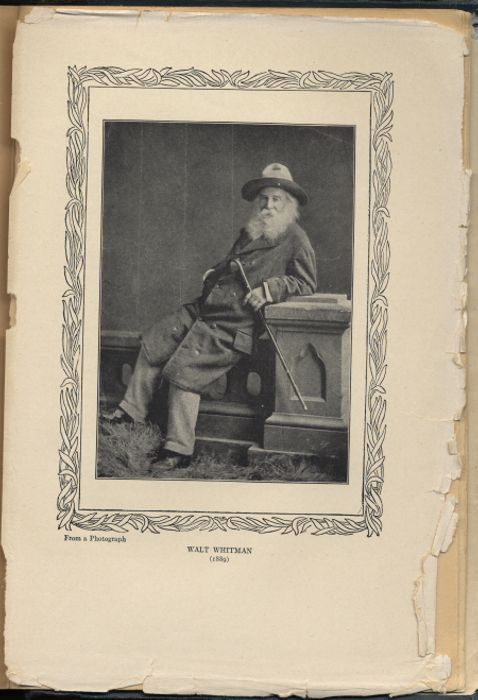 [Begin page 575] group up there: they all more or less accept his fashion. It reminds me of something from a Voltairean—perhaps from Voltaire himself—who said that, pilgrimaging about in Christendom, you everywhere met a piece of the cross: here more, here less, of it: till finally getting to Rome you come upon the whole cross itself. It was so with the Emersonian manner: now a piece of it, then a piece of it, finally coming to Emerson himself—there the whole genuine beautiful efflux, of which you had only caught scents, glints, glimpses, before."
The Press this morning, under a display headline, The Flag Insulted gave a long sensational account of our Samoan difficulties with Germany. W. had read. Did it mean war, "Oh no! The Press makes a big noise: we will not be frightened or angered by it. I read The Press every day: it has all the news (a good deal more, too!)—all the news: but along with what's excellent in journalism it illustrates—illustrates better than any paper I know on the list—the dangers, pettinesses, possible in the profession. The man inside there—the fellow hired on the little editorials, witty pieces—evidently mistook his vocation. My objection to The Press is, that it is narrow, superficial: horribly flippant, arrogant, ignorant." I thought that a very severe arraignment. "Yes, it is: but it applies there." Why not to other papers too? Most of them? "Yes—more or less to others too, but to The Press most of all." Gave me back The Stage. "I have read it through: I always do."
It commenced to snow about noon: now snowing hard and lying: the first snow storm practically of the season. W. asked: "Was it not unusually early: it seemed to me the light came through the slats there piercingly: I wondered if it was in some way from an artificial light." We talked of the river: how the river is on days like this: W. interrogating. I was to go to Germantown in the late afternoon. "Ah!" and after a slight wait: "Well, if you meet out there with [Begin page 576] any inquiring friends, tell them Walt Whitman sends his best love—is still in his chair here: the fire briskly burning: the weeks wearing monotonously away." I said: "It 's at least half my business out there usually to talk of you." W. further: "It is very hard, very hard, having to sit here for such a period—now going on eight months—in the same room: to read a little, write a little: doze the time off into oblivion." He added: "I have been telling Eddy, I feel as if seven or eight hundred pounds were tied to me, to be borne about, borne with, and that not only physically but mentally, with my brain, as well." I wrote Bucke—now he is almost on the eve of his visit at last—that we little thought back in the summer that the three of us would meet here again in this way. W. listened. "Nor did we: there were doubtful days indeed!" Had he too had the same misgivings? "Yes indeed: those first days were full of seriosities." Said there was "a tied-up pile" of Passage to India on top shelf in the little room. I went in. Got down the package he indicated. He sat still—examined: there were about a dozen. "But all Democratic Vistas! Why, I did not know I was so rich in them!" Tied them up again. Put them back. Found P. to I. He took a copy—wrote in it: "Horace Traubel from Walt Whitman, Jan 20 '89." Had often promised me such a perfect copy.
Harned stopped at the door this noon. Left Tribune. Met Gilchrist at Eighteenth and Arch yesterday. W. "glad to hear of him." "He has not been over for several weeks." Referred to The Critic once again—the review—as "having no dubiosities whatever." Ed tells me of a visitor during one of W.'s bad spells: an old lady, who cried—said she "did so want to see the dear old poet." I said to W. that I thought Dave was not dissatisfied not to have his imprint on the big book. W.: "I guess he understands: I do not regret myself that the book stands as it does." He asked for my opinion. Had he "made a mistake in keeping the book thoroughly personal?" I said: "You can't help your- [Begin page 577] self: it would be personal with or without a publisher: that 's the start and finish of the book." He cried: "Good! good! so it is: the root of the matter: you have it. I wanted to make this a pet edition—to sort of let it go straight from my hands into the hands of the reader: from my heart to your heart—from me to anybody: giving us, whoever we are, strangers or friends, a direct relation—establishing us in immediate neighborliness." I said: "I suppose you say that every reader is a next door neighbor!" W. said: "I have n't said it, but now that you have said it for me I'll say it after you—adopt it." Then of a sudden he swung around to the table by the window. "Are you in a big hurry?" he asked. I said no. I was not due in Germantown till the last thing in the afternoon. He picked up an envelope. "I have found you another letter to Hugo: my letter to Hugo: a draft: one of the first drafts: I always kept the original. I would like you to read it to me before you finally take it along: to-morrow if you choose: now if you have time. We were just talking of personal things—of the Leaves—the complete book: we insist upon the personal: well, you have it in these letters too: they, too, demonstrate me—my theory, philosophy, what I am after: they too. If you want to know what I mean watch what I do. Did you say you had time to read the letter to-day? Do it then: I have time to listen to it." The envelope was indited: "To Hugo Oct 8 '63." The letter was written on four different sized sheets of paper. On the reverse of one of the sheets was this note in W.'s hand:
Fort Bennet, July 21st 1863.Adjutant General Thomas, General [substituted for Sir]: I have the honor to forward this my application for an officer's position in one of the Colored Regiments now forming in the District of Columbia.
I have been in the military service of the government as a private since the beginning of the War—enlisted first in the 8th New York Militia 19th April 1861, for three [Begin page 578] months—subsequently on the 25th August 1862, in the 2nd New York Artillery for three years—and am still in the regiment. I was born in the state of New York, am in sound health, & 26 years of age.
Herewith please see testimonials from my officers —
I have the honor General to remain &c Samuel S. Freyer, Co E 2nd New York Vol. Artillery."Yes," said W.: "I wrote hundreds of such, similar, letters for the boys: letters for their friends—for their folks: fathers, mothers, sweethearts: they were too sick to write, or not sure of themselves, or something: why, I even said their prayers for them—some of them. What did n't I do? I had n't noticed that letter on the back of the sheet: I 'm glad, however, that you read it: it was, it is, a part of the story. But read the big letter: read it: then I 'll let you go—you and the letter together."
Dear Hugo. I don't know why I have delayed so long as a month to write to you, for your affectionate and lively letter of September 5th gave me as much pleasure as I ever received from correspondence. I read it even yet & have taken the liberty to show it to one or two persons I knew would be interested. Dear comrade, you must be assured that my heart is much with you in New York, & with my other dear friends, your associates—& my dear I wish you to excuse me to Fred Gray & to Perk, & Ben Knower, for not yet writing to them, also to Charley Kingsley, should you see him—I am contemplating a tremendous letter to my dear comrade Frederickus, which will make up for deficiencies,—my own comrade Fred, how I should like to see him and have a good heart's time with him, & a mild orgie, just for a basis, you know, for talk & interchange of reminiscences & the play of the quiet lambent electricity of real friendship—O Hugo, as my pen glides along writing these thoughts, I feel as if I could not delay coming right off to [Begin page 579] New York & seeing you all, you & Fred & Bloom, & everybody—I want to see you, to be within hand's reach of you, and hear your voices, even if only for one evening for only three hours—I want to hear Perk's fiddle—I want to hear Perk himself, (& I will humbly submit to drink to the Church of England)—I want to be with Bloom (that wretched young man who I hear continually adorns himself outwardly, but I hear nothing of the interior) and I want to see Charley Russell, & if he is in N. Y. you see him I wish you to say that I sent him my love, particular, & that he & Fred & Charles Chauncey remain a group of itself in the portrait-gallery of my heart and mind yet & forever—for so it happened for our dear times, when we first got acquainted, (we recked not of them as they passed,) were so good, so hearty, those friendship times, our talk, our knitting together, it may be a whim, but I think nothing could be better or quieter & more happy of the kind—& is there any better kind in life's experiences? —
Dear comrade, I still live here as a hospital missionary after my own style, & on my own hook—I go every day or night without fail to some of the great government hospitals—O the sad scenes I witness—scenes of death, anguish, the fevers, amputations, friendlessness, hungering & thirsting young hearts, for some loving presence—such endurance, such native decorum, such candor—I will confess to you dear Hugo that in some respects I find myself in my element amid these scenes—shall I not say to you that I find I supply often to some of these dear suffering boys in my presence & magnetism that which nor doctors, nor medicines, nor skill, nor any routine assistance can give? Dear Hugo, you must write to me often as you can, & not delay it, your letters are very dear to me. Did you see my newspaper letter in N Y Times of Sunday Oct 4? About my dear comrade Bloom, is he still out in Pleasant Valley? Does he meet you often? Do you & the fellows meet at Gray's or anywhere? O Hugo I wish I could hear with [Begin page 580] you the current opera—I saw Devereux in the N Y papers of Monday announced for that night, & I knew in all probability you would be there—tell me how it goes, & about the principal singers—only don't run away with that theme, & occupy too much of your letter with it—but tell me mainly about all my dear friends, & every little personal item, & what you all do, & say &c.
I am excellent well. I have cut my beard short & hair ditto: (all my acquaintances are in anger & despair & go about wringing their hands) my face is all tanned & red. If the weather is moist or has been lately, or looks as if it thought of going to be, I perambulate this land in big army boots outside & up to my knees. Then around my majestic brow around my well-brimmed felt hat—a black & gold cord with acorns. Altogether the effect is satisfactory. The guards as I enter or pass places often salute me. All of which I tell, as you will of course take pride in your friend's special & expanding glory.
Fritschy, I am writing this in Major Hapgood's office, fifth story, by a window that overlooks all down the city, & over & down the beautiful Potomac, & far across the hills & shores for many a mile. We have had superb weather lately, yes for a month—it has just rained, so the dust is provided for, (that is the only thing I dread in Washington, the dust, I don't mind the mud). It is now between one and two o'clock Thursday afternoon. I am much alone in this pleasant far-up room, as Major is absent sick, & the clerk lays off a good deal. From three to five hours a day or night I go regularly among the sick, wounded, dying young men. I am enabled to give them things, food. There are very few visitors, amateurs, now. It has become an old story. The suffering ones cling to me poor children very close. I think of coming to New York quite soon to stay perhaps three weeks, then sure return here.
W. was quiet for a few minutes after I stopped reading. I put the letter in its envelope and both into my pocket. [Begin page 581] "That 's right," said W., "now it 's yours." He was serious: "The letters, my letters, sent to the boys, to others, in the days of the War, stir up memories that are both painful and joyous. That was the sort of work I always did with the most relish: I think there is nothing beyond the comrade—the man, the woman: nothing beyond: even our lovers must be comrades: even our wives, husbands: even our fathers, mothers: we can't stay together, feel satisfied, grow bigger, on any other basis." I said: "That picture of you in the sojer clothes is delicious." He laughed very heartily over it. "Ain't it, now? Well—I should say so: I could have passed for an understudy—for Thomas, Rosecrans, Meade: O yes! I must have presented a wonderful front as I stalked about dressed to kill—an N. P. Willis in the uniform of the Grand Army of the Republic!" Then again: "I was always between two loves at that time: I wanted to be in New York, I had to be in Washington: I was never in the one place but I was restless for the other: my heart was distracted: yet it never occurred to me for a minute that there were two things to do—that I had any right or call to abandon my work: it was a religion with me. A religion? Well—every man has a religion: has something in heaven or earth which he will give up everything else for—something which absorbs him, possesses itself of him, makes him over into its image: something: it may be something regarded by others as being very paltry, inadequate, useless: yet it is his dream, it is his lodestar, it is his master. That, whatever it is, seized upon me, made me its servant, slave: induced me to set aside the other ambitions: a trail of glory in the heavens, which I followed, followed, with a full heart. When once I am convinced I never let go: I had to pay much for what I got but what I got made what I paid for it much as it was seem cheap. I had to give up health for it—my body—the vitality of my physical self: oh! much had to go—much that was inestimable, that no man should give up until there [Begin page 582] is no longer any help for it: had to give that up: all that: and what did I get for it? I never weighed what I gave for what I got but I am satisfied with what I got. What did I get? Well—I got the boys, for one thing: the boys: thousands of them: they were, they are, they will be mine. I gave myself for them: myself: I got the boys: then I got Leaves of Grass: but for this I would never have had Leaves of Grass—the consummated book (the last confirming word): I got that: the boys, the Leaves: I got them."
He had fired up. Looked almost defiant. "All the wise ones said: 'Walt you should have saved yourself.' I did save myself though not in the way they meant: I saved myself in the only way salvation was possible to me. You look on me now with the ravages of that experience finally reducing me to powder. Still I say: I only gave myself: I got the boys, I got the Leaves. My body? Yes—it had to be given—it had to be sacrificed: who knows better than I do what that means? As to that, Horace, look here: here 's a dirty slip of paper I was re-reading to-day." He reached forward, picked up a soiled stained sheet of blue paper on which was some of his writing. "Read it," he said, handing it to me: "it falls in with what we have been talking about." I read this, aloud:
"Perfect health is simply the right relation of man himself, & all his body, by which I mean all that he is, & all its laws & the play of them, to Nature & its laws & the play of them. When really achieved (possessed) it dominates all that wealth, schooling, art, successful love, or ambition, or any other of life's coveted prizes, can possibly confer, & is in itself the sovereign & whole & sufficient good, & the inlet & outlet of every good. In perfect health (a far, far different condition from what is generally supposed—indeed few minds seem to have the true & full conception of it)—sometimes I think it is the last flower and fruitage of civilization & art, & of the best education."
[Begin page 583]I said to W.: "I see: you knew all that: you had to give that up: you have no regrets." "No regrets: none: it had to be done." I said: "Walt, you gave up health great as health is for something even greater than health." He said: "Horace, that 's what it means if it means anything."
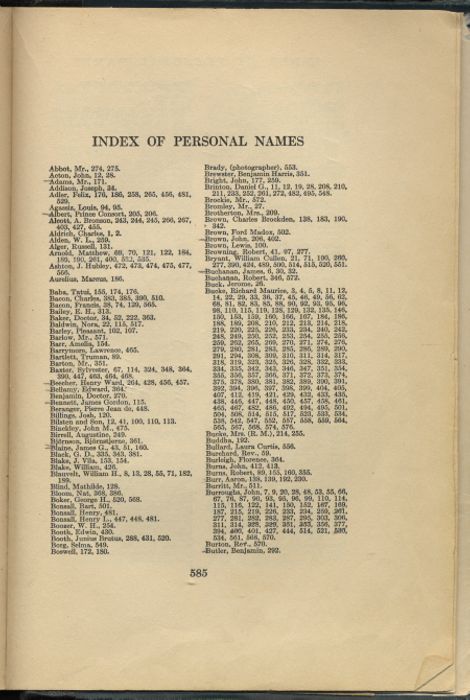 [Begin page 586]
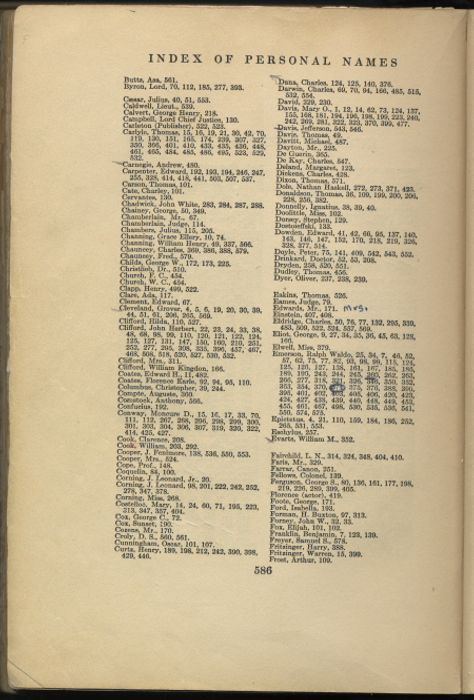 [Begin page 587]
 [Begin page 588]
 [Begin page 589]
 [Begin page 590]