With Walt Whitman in Camden (vol. 8)
February 11, 1891-September 30, 1891
8 [Begin page ii]
Note (): (See page 226.) Return to text.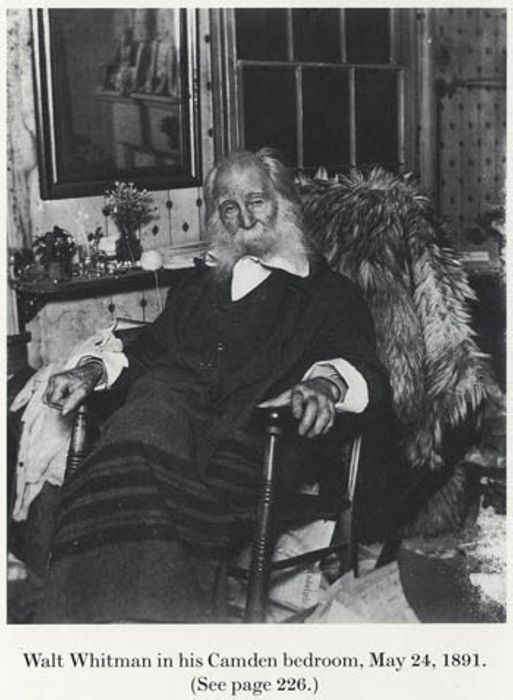
February 11, 1891-September 30, 1891
8
By HORACE TRAUBEL
Edited by Jeanne Chapman
Robert MacIsaac
W L BENTLEY
OREGON HOUSE - CALIFORNIA [Begin page iv]
[Electronic edition published with the kind permission of the Fellowship of Friends and W.L. Bentley Publishing.]
Copyright 1996 by the Fellowship of Friends, Inc.
All Rights Reserved
Printed in the United States of America
Published by
W L Bentley - PO Box 887 - Oregon House, CA 95962
To ROBERT EARL BURTON
CONTENTS
| ILLUSTRATIONS CONTAINED IN THIS VOLUME | viii |
| LETTERS CONTAINED IN THIS VOLUME | ix |
| EDITORS' PREFACE | xi |
| CONVERSATIONS | |
| February 11-28, 1891 | 1 |
| March 1-31, 1891 | 47 |
| April 1-30, 1891 | 116 |
| May 1-31, 1891 | 175 |
| June 1-30, 1891 | 250 |
| July 1-31, 1891 | 294 |
| August 1-31, 1891 | 378 |
| September 1-31, 1891 | 458 |
| APPENDICES | |
| I. "Walt Whitman at Date" | |
| by Horace L. Traubel | |
| (from The New England Magazine, May 1891) | 561 |
| II. "Walt Whitman's Birthday, May 31, 1891" | |
| by Horace L. Traubel | |
| (from Lippincott's Monthly Magazine, August 1891) | 591 |
| INDEX | 607 |
ILLUSTRATIONS CONTAINED IN THIS VOLUME
[Frontispiece]
WALT WHITMAN IN HIS CAMDEN BEDROOM, MAY 24, 1891. Photograph by Dr. William Reeder. Courtesy Rare Books and Manuscripts Division, New York Public Library, Astor, Lenox and Tilden Foundations
[Following page 308]
DRAFT MANUSCRIPT TITLE PAGE OF GOOD-BYE MY FANCY, 1891. Courtesy Library of Congress, Feinberg Collection.
ANNE MONTGOMERIE TRAUBEL. Courtesy Library of Congress, Horace L. Traubel Collection.
HORACE L. TRAUBEL. Courtesy Library of Congress, Horace L. Traubel Collection.
MARRIAGE CERTIFICATE WRITTEN BY WALT WHITMAN FOR ANNE MONTGOMERIE AND HORACE L. TRAUBEL, 1891. Courtesy Library of Congress, Horace L. Traubel Collection.
SAMUEL MURRAY, THOMAS EAKINS, WILLIAM O'DONOVAN, AND HARRY THE DOG, C. 1891-3. Photographer unknown. Courtesy Hirshhorn Museum and Sculpture Garden, Smithsonian Institution, Charles Bregler Archival Collection.
MRS. MARY OAKES DAVIS, 1891. Platinum Print by Thomas Eakins (19.5x24.1 cm). Courtesy The J. Paul Getty Museum.
J. W. WALLACE AND R. M. BUCKE IN BOLTON, ENGLAND, AUGUST 1891. Courtesy Library of Congress, Horace L. Traubel Collection.
THE BOLTON "COLLEGE," MAY 31, 1899. Courtesy Library of Congress, Horace L. Traubel Collection.
LETTERS CONTAINED IN THIS VOLUME
(Including Other Manuscripts of Walt Whitman)
| Isaac Newton Baker, 19, 62, 70, 214, 381, 519 |
| F.A. Bisbee, 84-85 |
| James W. Blake, 252 |
| Raymond Blathwayt, 187 |
| Henry L. Bonsall, 311 |
| Daniel Garrison Brinton, 214, 310-11, 512 |
| Richard Maurice Bucke, 7, 9-10, 17, 18-19, 27-28, 34, 49, 89, 90-91, 100, 103, 104, 115, 118-20, 134-35, 149, 191, 219, 237, 269, 281, 335-36, 367, 368-70, 390, 391-92, 402, 412-13, 429-32, 449, 529-30, 538-39 |
| John Burroughs, 20-21, 235-36, 411, 537-38 |
| Harry D. Bush, 444-45 |
| Percival Chubb, 246-47 |
| Cassius Marcellus Clay, 117 |
| John H. Clifford, 47, 282, 463 |
| Elliott Cones, 366 |
| Charles Anderson Dana, 235 |
| Ignatius Donnelly, 116-17 |
| Havelock Ellis, 14 |
| Elizabeth N. Fairchild, 48-49, 128, 182 |
| Henry Buxton Forman, 15, 77, 219 |
| Warren Fritzinger, 258-59, 261-62 |
| Octavius Brooks Frothingham, 409-410 |
| Hamlin Garland, 229-30 |
| Joseph B. Gilder, 283 |
| Elizabeth Porter Gould, 45 |
| William B. Hanna, 218 |
| [Begin page x] Clifford Harrison, 441 |
| George Horton, 446 |
| Robert Green Ingersoll, 29-30, 82-83, 149, 168, 171, 188, 281, 387, 549-50 |
| Bertha Johnston, 234-35 |
| Dr. John Johnston, 16, 81, 239-40, 314-15, 328-29, 378-80, 416, 427-28, 449-50, 552-53 |
| John H. Johnston, 69, 389 |
| William Sloane Kennedy, 14, 176-77, 211, 218, 236, 450-51 |
| Sumner I. Kimball, 71-72, 89-90 |
| Karl Knortz, 39 |
| David L. Lezinsky, 87 |
| Lippincott's Monthly Magazine, 33 |
| James Russell Lowell, 264 |
| Edwin D. Mead, 156-57 |
| Roden Noel, 228 |
| Ellen M. O'Connor, 2-3, 60-61, 86, 92, 113, 189-91, 336, 417-18, 536-37 |
| William D. O'Connor, 500-1, 532-33 |
| Ernest Rhys, 228-29 |
| Franklin Benjamin Sanborn, 251-52 |
| Gabriel Sarrazin, 25-26, 356-57 |
| James Matlack Scovel, 50 |
| Horace E. Scudder, 3-4 |
| Logan Pearsall Smith, 533 |
| Arthur Steadman, 76, 105 |
| Joseph Marshall Stoddart, 42 |
| John Addington Symonds, 55-56, 483-85 |
| Alfred, Lord Tennyson, 233 |
| John C. Trautwine, Jr., 65, 440-41 |
| Benjamin R. Tucker, 251 |
| James William Wallace, 16, 50-51, 109, 183, 238-39, 309-10, 328, 507-08, 530-31 |
| Walt Whitman, 47, 51, 68, 73, 114, 141, 161, 260, 262, 273, 286, 327, 375-76 |
| Talcott Williams, 130, 306-7 |
| Charles Woodbury, 305-6 |
EDITORS' PREFACE
In 1888, Horace L. Traubel, a young political radical and aspiring writer in Camden, New Jersey, began systematically recording his daily conversations with his friend, Walt Whitman. He continued for four years, until Whitman's death in 1892, amassing a lovingly detailed record whose accuracy, fidelity, and immediacy remain unsurpassed in the history of biography. Traubel published the first three volumes before his death in 1919; the remaining volumes have appeared, one by one, at widely separated intervals. This is the penultimate volume in the series.
Once again, we must offer our deepest gratitude to the Fellowship of Friends, Inc., and its director, Robert Earl Burton, for so generously funding the preparation and publication of this volume. It is solely Mr. Burton's recognition of the value of this neglected manuscript that has made possible the publication of the final volumes.
We are also grateful to the many people who participated in the preparation of this manuscript. Judith Grace Bassat, Peter Bishop, Cynthia Hill, Kevin Kelleher, Leigh Morfit, Peter and Paula Ingle, Rosaline Mearns, and Alla Waite gave generously of their time and knowledge. We also thank once again the staff of the Manuscript Room at the Library of Congress and Professor Ed Folsom, editor of the Walt Whitman Quarterly Review.
Apollo, CaliforniaAugust 1994 JEANNE CHAPMAN ROBERT MACISAAC
"I suppose every man has his purposes. I had mine--to have no purpose--to state, to capture, the drift of a life--to let things flow in, one after another, take their places, their own way. My worst struggle was not with ideas, anything of that sort, but against the literariness of the age--for I, too, like all others, was born in the vesture of this false notion of literature, and no one so born can entirely--I say entirely--escape the taint. Though, as for me, looking back on the battleground, I pride myself I have escaped the pollution as much as any."
W.W. to H.T., August 18, 1891
Wednesday, February 11, 1891
5:30 P.M. Not with W. except for about 20 minutes. Had been in to see Ferguson today—making preparations for the new volume. W. "glad" I "had paved the way." Said he did not feel well—"congested"—he described it so. Had made me out a long list of pretty nearly everybody under the sun for Stoddart. Forty-six names. Called my attention to a couple of transposed lines in the Lippincott's galley proof—prose. I assured him they must have caught this in proving the pages, but he was uncertain and asked me to see about it—if it was too late to correct. Gave me mail for Post Office—paper for Gilchrist—letters, among others, for Bucke, Kennedy, Stead (Review of Reviews). Did not appear at all cheerful. Complimented me on the galley proof of the Dutch piece. "It is a handsome piece of work—the proof splendidly read, too." Had I Schiller's works, in English, at home? He was "curious to get some greater insight—Schiller is a man who, from what scattered glimpses I can get, satisfies, uplifts me: a great sampler." He spoke of my cold hand, "You don't know how grateful it is to me: an immediate flavor of out-of-doors." He had saluted me, "You come with the sunset: welcome! Welcome!"
Left with him Mrs. O'Connor's letter enclosing Scudder's. Down in an hour or so to get it. "Attracted towards the project." [Begin page 2] 112 M St. N.W. Washington, D.C. Feb. 9, 1891 Dear Mr. Traubel, Your letter of the 7th was awaiting me when I got home from the office this ev'g. I wish you were here this minute that we might talk the whole matter over. You have touched upon the subject nearest & dearest to my heart. This idea of having William's descriptions of wrecks, etc. put into a volume has never left me. Stedman proposed it to W[illia]m the last time that he was in W[ashington] before Wm. died, at our house one ev'g, & many persons have proposed it to me since. Mr. Kimball, the Chief of the Life Saving Service told me that it ought to be done; & that he should like to write the Preface. Dr. Bucke and I discussed it when he was here last May, & when I was in New York the last time, I discussed it with Rossiter Johnson; & all have said that it must be done; all say, as I do, that it will make the most live & thrilling book ever published. It will sell too, tremendously, if the right house does the publishing & manages it properly. I told William just a little while before he passed away, that nothing he had ever done was I as proud of as that Life Saving work. He gave his life to it just as truly as any man ever did who died on the battle field. He worked night & day literally, to get out the reports, & he broke down under the tremendous strain of it. I could tell you by the hour of it all, & how he put his very life into it. It was truly "Life Saving" to the world, but he gave his life for the world. How soon would you like to begin the work? & who would be your choice as to the Publisher? I think Mr. Stedman's advice as to Publisher would be excellent! & no one's better, I guess. You must come on to Washington & spend a Sunday with me, & I will put into your hands all the material needed: & much information that I can't write. I will put you in possession of the things you will need to know, & a few choice people who worked with William in the office, & who can tell you much that you will need to know—things that I have not time to tell you now, & indeed some that I would not care just now to write. I will pay your fare over & back from Phila., & you are to be my guest, of course. If you could come this very next Sat. to spend the [Begin page 3] Sunday, you could have the room which I reserve for the lady who owns the house, as she is not yet here but will be very soon. If you decide to come this next Sat. send me a line at once & say by what train you will come, & when I may look for you. It will I suppose be impossible to get a complete set of the reports, but I have a set which I shall put at your disposal. They are very bulky, but we could take out what you want. I will enclose a copy of the letter that I had from Mr. Scudder, the Editor of the Atlantic Monthly, and you will see what he says about the book, etc. I have to use my eyes in the office all day from 9 to 4 & so can't write much or even read in the evenings, so I get my sister to make the copy of the letter. If the story comes out in April & May, it will soon be here. I get papers from Walt, & thank him very much. I wish I could write him, & how much I want to see him! Give him my love. & thank you, too, for the papers. I am glad Walt is so well & able to do his literary work still. I want to know more about Walt's new book. But you can tell me all when you come. I will do better still. I will send you the letter of Mr. Scudder to read, & you will please read & return it to me, as I value it, & also as a matter of business I must keep it. It came the last day of the old year—I said it was the best New Year's present that I could have had, as this business of getting these matters of William's under way & in train weighs upon me, & often rather oppresses me. But if you can help me in this matter I shall be rejoiced. They, the descriptions, surpass any thing that he ever did, & as someone said, no one but Victor Hugo, or William O'Connor could have written them. Send a line at once to say if you are to come next Sat. Yours cordially, Ellen M. O'Connor. 29 December 1890 Editorial Office of The Atlantic Monthly, Boston. Dear Madam Your volume of stories by Mr. O'Connor has been before Messrs. Houghton Mifflin & Co., but they are not quite clear in their minds as [Begin page 4] to the best course to pursue regarding publication. The book, for a collection of stories, is pretty large, too large I think for economical publication, & there is always considerable doubt attending the issue of a volume of short stories. Again, the Christmas element in the book is so prominent that there is a propriety in issuing the book in the fall rather than in the spring. It has occurred to me that some light could be thrown if I were, with your consent, to print The Brazen Android in the Atlantic, for which you tell us it was originally designed. It is true that the story is more effective if read at one sitting. Yet midway in the story is the incident of the entrance of the Paduan, & a division could be made there. The entire story would probably occupy at least forty pages of the Atlantic, & it would be quite inexpedient to publish the story whole in a single number. Let me then make this proposal, that I print the tale in the April & May numbers of the magazine & that you defer publication of the book till the ensuing Christmas. Whether the book be issued by this house or some other, there will be plenty of time to make arrangements after the appearance of the May number, & the appearance of the story in the Atlantic would I am confident work no detriment to the future of the volume. The Brazen Android is a striking tale & ought to attract attention. Of course you will understand that the Atlantic will pay for the story independently of anything you might receive from book publication. Yours Truly H. E. Scudder Editor Atlantic Monthly Left Harper's Weekly with him. He spoke of his "unending enjoyment of the pictures."
I was reading [Robert Louis] Stevenson's "Whitman." Did not think much of it. "Nor I," he said. "It amounts to nothing."
Thursday, February 12, 1891
5:30 P.M. Spent good half hour with W. He sat in the small chair by the fire—his room dark—the light through the half- [Begin page 5] open stove-door playing with his beard and hair, and casting shadows on the wall. W. continues to complain of his condition. "This is a bad period with me," he said. "Something working, working—who knows for what?" Had taken his list to Stoddart. Now the foreign list. I had it in my pocket. He had endorsed it: "Foreign names—we will furnish (or pay for) all the postage stamps necessary." The list included Rhys, Pearsall Smith, Wm. Rossetti, Tennyson, Sarrazin, O'Dowd, Josiah Child, Rolleston, Dowden, Johnston, Wallace, Mary Costelloe, Carpenter, Symonds, Schmidt, Knowles (Nineteenth Century), Athenaeum, Forman, Whitelaw Reid, Roden Noel, Will Saunders, Ed Wilkens, Bucke, Walter Scott, Pall Mall Gazette, Spielman, Nouvelle Revue (Paris), J. Schabelitz, Miss Langley, Bertz, Logan Smith. Then on another sheet he had written: "John Ruskin, Robert Buchanan, Oscar Wilde, Augusta Webster the poetess, Swinburne the poet, Edwin Arnold the poet, Lady Mount-Temple, Irving the actor, Ellen Terry the actress. If you have any person there, send these additions to London, Eng: to be definitely sent thence."
Then in an envelope he had thrust a dozen English penny stamps—marked it, "here are some English stamps"—and asked me to give them to Stoddart. "I received them today from somebody who owed me money—they are no good to me," descanting then upon international postage. "Someday we will come to that, too: even now we might have an international five-cent stamp—it invites us." Postage "very cheap": "When I think of the letters we can send as far as California for the mere song, I am forced to say the man would be a hog to complain of the cost."
No word from Bucke today. W. "glad the meter has appeared at last"—thought it would "emerge in the end to something substantial."
Hailing when I came. He had "enjoyed the sound." Had held my hand in his some time "to feel its out-of-door cheer, vigor: it has the warmth, smell, of the fresh air—a healthy cold."
[Begin page 6]We talked of General Sherman, at death's door. The papers full of it this morning. John Sherman telegraphed the President this afternoon: the General was enough better to warrant a faint hope of his recovery. W. listened as I recited this—then spoke at some length of the General: "I don't think I ever had a talk with him—came face to face with him that way—but I have met him. He was a warrior—Normanesque, I was going to say: he seemed to me like a Norman baron, lord of many acres—with adherents, servitors—all that—something of grandeur, hauteur, haughtiness. That was the man. I think I have told you a story about him—I shall tell it again—it throws the whole character in relief. It was in the review of the troops after the war—in Washington—I can see the day, the long, winding, noble procession—the sky, people, earth. Sherman was at the head of the line—rode, uniformed, a noble animal. Kept a distance of perhaps 15 feet between his own place and the file of aides. These aides spread entirely across Pennsylvania Avenue—all mounted. In front of Welland's a woman set forth from the crowd—straight up to the General's horse—gave him a bunch of flowers. It all comes back to me—vivid—powerful—the etched features of the scene: he took the flowers, curtsied, put them—an instant only—to his nose—then held them out and back with his hand, so"—indicating—"for the instant I did not know what it meant, but before I needed to ask, one of the aides galloped out of the line, up to the General, took the flowers from him, returned to his place again. What could better present the man than that? No, no, Grant was quite another man. Even that day, where was he? Off in his corner—in his place, no doubt—but making nothing of it, at most. Probably going by some obscure way to rejoin them later on. Out of all the hubbub of the war, Lincoln and Grant emerge, the towering majestic figures. There were others: Seward, Sumner, Phillips—such—elegant, refined, scholarly—the gift of college, the past, book-keen, great men: these: then, by contrast, Lincoln, Grant! Don't that tell everything?" Dwelt upon Grant's plainness: "Grant savored of our soil—was Saxon—Sherman Norman. Grant hated [Begin page 7] show—liked to leave things unsaid, undone—liked to defy convention by going a simple way, his own."
W. said, "I am rather disappointed that Scudder's letter is so inconclusive. It leaves the fate of the book uncertain."
I found, as I had guessed to W. , that the proof-reader at Lippincott's had properly transposed defective lines in proofing pages. This man in a great rage about W. 's inconsistent punctuations and spellings and abbreviations. I admitted, but told him he should have changed as W. would have wanted him. "I was afraid," he said.
Friday, February 13, 1891
5:35 P.M. W. in bathroom—I sat and talked a while with Warren. Showed him Bucke's letter of 10th—which he had cautioned me not to show to W.
10 Feb 1890
My dear Horace
Am rejoiced to hear that the new book is in such a state of forwardness. I fear W.'s health is worse than you think, and feel decidedly uneasy about him. He is evidently suffering a good deal and that (unchecked) must end badly. I look for a sudden end (when it comes) and I feel satisfied it may come any day. It is more than likely he will look and talk as well as usual up to the last day. I think we must have meters before the end of this week—the moment is manifestly approaching. I want the new proof of Kennedy's piece without fail. Am well.
Love
RM Bucke
Note (): For yourself only. Return to text.
We passed to other themes. Had I seen Stoddart? No—Walsh: Stoddart was out of town. Of course they refused W.'s foreign stamps: yet I had offered them for W.'s satisfaction. "Resigned," he said, "to their will. So the magazines reach our people, I am content." Said he had had "a letter from the Billstein man, thanking me for the gift through you." Looked for it. "Lost in the debris," he said. Would save it when it turned up. Had he read Wayland's speech in the morning paper on Lincoln? Delivered in New York (before Republican Club). "No, I did not read it. But anyway, I don't believe it can amount to much. No professor—no preacher—can have anything to say about Lincoln. He soars and plays way beyond them all." Would he have anything about Lincoln in the new volume? "I suppose not. I suppose all I am ever to say has been said in the old channels—in 'Specimen Days'—in 'November Boughs'—and yet my story is mainly untold: I had looked forward to saying a good deal more. Yet I know no one for whom less needs be said." Referred to the good the rubbings had done him. "From my very first days up I have brushed myself—had a flesh brush: it has been a source of refreshment—not for sickness but to fend you against it. You ought to have such a brush. Let me give you [Begin page 9] one—one I have had for many years—fine bristles—it will last you your life through." And he insisted on getting up, crossing the room—bringing back two brushes—one of which, with the short handle, he said I should take. "Warrie prefers the hand with me—has been under instructions in Philadelphia—but this has greatest value, especially when you are rubber and patient both. Warrie is a noble drubber himself: he handles me like a master—and the best thing about him is not his strength but his magnetism: he is electric to the last degree—never man more so. I don't think he can be beat. Ed Wilkins was strong, too—but lacked in many ways Warrie's peculiar gifts."
I read him aloud Bucke's long letter of the 11th containing suggestions as to the birthday dinner this year: 11 Feb 1891 My dear Horace Thanks for mentioning Salt's "Life of Thoreau." I have sent for the book. I like T[horeau] and shall like the book still more for its allusions to W. You will know before you receive this that I have returned Symonds' letter to W. I shall of course want to see S[ymond]s' other letter when W. can conveniently send it. On what subject is the lecture that Colonel Ingersoll may deliver while in the West? The notion of repeating the Reisser dinner with the Col.—everything as in '90 does not seem to go to the right shot with me. Would it be possible to take W. to New York (overnight say—or even a few days beforehand) and have a dinner there—some prominent W[hitman] men in New York, of course, to manage it? A better thing still (but perhaps it is too ambitious) would be to have a Walt Whitman reception at some theatre in New York (afternoon or evening)—have 2, 3, or more short addresses by Col. I[ngersoll] and others interspersed with recitations of selections from L[eaves] of G[rass] and a couple of pieces (as "Death Carol" and "Two Veterans") sung—this could be worked up into the biggest thing we have ever had, if it was taken hold of by the right man or men. If W. would not venture on going to New York, the thing could be done in Phila., and I have little doubt could be made a great success there. [Begin page 10] Of course we would charge say $1 admission the proceeds to go to W. Certainly I should be on hand unless something turning up made it impossible—I would plan to take a little holiday at that time (as last year) and perhaps you could return with me and see our grounds in their early June beauty—it would pay you. So long! RM Bucke He listened—questioned—then said, "No, that does not—any of it—appeal to me as it is presented there. I like your idea much better—much: it more exactly reflects me, my mission." Again, then, talked of Reisser dinner last May. "It was all you say it was—the proudest, finest occasion we have so far known. Even the absence of the shorthand man—which we have wept over and over—I have, I know—was provided for, for with him there we might not have had the Horticultural Hall speech—and that would mean less again. I guess things on the whole took about the right course." And yet, "That dinner speech! That dinner speech! Where is our compensation for that!" All his argument, he said, would not entirely satisfy him.
Saturday, February 14, 1891
5:10 P.M. W. seemed improved—talked freely and heartily. Yet confessed himself moved by General Sherman's death, reported this afternoon (1:50). Had just eaten dinner. "It helped me on my feet." Gave me letter, "I had it from Bucke today"—and another—an old one. "Bucke urges me to autobiographize myself! Well—well!"
Referred to the American generals. "Yes, they are mostly gone—all the first-class fellows—we have a number of the third and fourth class yet. We have had no one from the keel up so American as Grant. Sherman? No—not Sherman. There was a good deal of stuff in Porter—Admiral Porter—who died yesterday. If not a star of the first magnitude, he was a star. There is a [Begin page 11] curious thing told us by astronomers—that there are orbs which, by the laws, or the heavenly powers, or whatever, are dark—utterly dark—do not shine—yet are as big as anybody! I suppose it might be said that to the right man, fame will—must—come—sooner or later: that if it belongs, it appears, inevitably, and yet—and yet"—shaking his head—"Why should we say it is certain?" After a pause, "Think—for one instance—of the telegraph corps in the war: no division of the service more intricate—nobler—requiring more courage, penetration, faithfulness: its necessity, too, a very high development of the moral sense—the sense of duty, virtue. These fellows—19, 20, 21—to 26 or 27—boys and men—knew everything, could tell everything or anything—yet, so far as I know, there is no record of betrayal in the whole story of the war—nor this, even at times when the departments in Washington were full of traitors—when knowledge was barter—when every secret seemed sold. But who hears of these men now? —heard of them then? The memory of it, almost, is wiped out." Of Fitz-John Porter he did "not think much: he had ability—as some writers have ability: was a product of schools—knew the rules of his craft, its traditions—yet was without genius—lapsed utterly on that line."
Wayland had compared Washington unfavorably with Lincoln on his speech the other day—Washington a product of monarchy, Lincoln most immediately out of our soil. Was that "Leaves of Grass"? W. said, "It has something of the sound—but more should be said: I would not say it entirely in that way. Of course Lincoln was more Western—his habits so—his dress—speech, but in the things which really establish the hero, the majestic genius, he was Roman, Greek, Biblical—had the towering individuality which peers over all border-lands of race, is one with the great characters of all ages." What were these virtues? "Farsightedness—not the ability to see tomorrow, but to see panoramaed the whole future—ages; penetration—the most wonderful, vast; a patience, suavity, cheer, out of all danger of confusions; and candor! It amounted to genius," etc. I had heard the criticism that Grant was greater than Napoleon. [Begin page 12] Napoleon fought all his battles in the accepted rules of war—Grant met new fields with new weapons. W. said, "There is a striking ring to that: in some ways it recommends itself to me—goes straight to the truth—at least about Grant. Whether Napoleon is the right man to quote on the other side I doubt. It seems to me Napoleonicism—to make a word—means the very thing praised in Grant. The old fellows would have said—'Cross the Alps? It is impossible—fatuous!' Which only excited Napoleon the more to say, 'Impossible? Then we will do it!'—and other impossible things he did—till at last his mastership could not be denied. All genius defies the rules—makes its own passage—is its own precedent. But I can see how all this is emphasized in Grant: it is part of him. I more and more incline to acknowledge him. His simplicity was much like old Zack Taylor's."
W. said that Harry Bonsall had mentioned our prospective Lippincott's pieces in Post. "It was several days ago—in four or five lines. Harry is distinctly favorable to us. I always count on him. Why don't you often send him items? He likes them." And W. asked again, "What has become of John Russell Young? He was one of our men." We discussed Cleveland's silver letter, which Republican papers try to say has destroyed all hope of his new nomination. W. remarked, "Damn 'em! They don't want him nominated, but before that time comes this and a hundred other things will have blown over. I think the letter one of the best things he has done. I don't understand all the intricacies of the question, but have some general judgments. The smart man in the Press—the fourth column man—today gets off a twit, that Grover has made the most reputation on the smallest capital, etc.—to which I might answer, if it deserved an answer (and, it does not)—that so do all strong men make much out of little things—simple, direct, manly method."
W. had seen mention of himself in Press editorial—"Three-Score-and-Ten"—this morning: "Seventy-one counts in its list Signor Crispi, John Ruskin, Walt Whitman, Sir Lyon Playfair, and General William T. Sherman, who, it is hoped, will rally and [Begin page 13] celebrate many more birthdays." Wondered if Talcott Williams had written it. "I am sure Talcott will stand by his guns."
Sunday, February 15, 1891
W. continues—no worse, no better.
Some good words from him. "I knew a fellow down there in Washington—a curious character—given to wise sayings. One of these was, speaking of the army commissary—'You know, any how, the army travels on its belly!' That is true in more senses than appear on the surface."
"I am glad you hear of the Colonel's return!" he said again. "And what it suggests! The vast distance—the thousands of miles—travelled in a couple of days! There is a history—prophecy—in it!"
Referring to McKinley's speech the other day—in which he denounced free traders as British leaguers and all that—W. said, "It is the preacher over again: if you are not a Christian, what the devil do you know about religion? If you do not bathe in our little tub, what do you know about the great sea? It is all one—the scream of localism."
Monday, February 16, 1891
7:55 P.M. To see W.—spent half an hour with him in his room. Not in good condition. Seemed exhausted and hoarse. Yet cheery in spirit. Was reading Havelock Ellis, "The New Spirit"—pamphlet. "Have you seen it?" he asked. I reminded him that he had read the book—or a part of it—in the spring when Bucke was here. This made him laugh. "I do have an indistinct remembrance of it now—but till you spoke of it, it slipped me absolutely. Why yes. And did I give a rather negative view? Probably—probably. But here is a copy of the book came from Ellis himself—I have been reading it—in fact, with great enjoyment. There are other than the Whitman essays—that on Heine, for instance—I like that, it has a ring—whether truest [Begin page 14] ring, I don't know. It's not as good as Arnold's to be sure, but good. So I have read the book before?—and Bucke's copy? Then he will laugh when he gets my today's letter, for I ask him in it if he has ever seen the book—heard of it, even. I am sure, now, that my opinion of the book is better than on first reading: it seems to me it must be—for if it had impressed me, I would have had some more or less vivid memory of it. As I read it today it takes more hold. When I am done with it, I want you to read it again. Here is the postal came along in the same post—take it, if you are curious at all." 9 St. Mary's Terrace Paddington, London 3 Feb/91 I am sending you a copy of my New Spirit which contains an essay that may interest you. It is a feeble attempt to express the help & delight that your work has given me. With all affectionate greetings, Havelock Ellis. Did not have it with me, but quoted in full postal from Kennedy: Thurs Eve Dear Horace Sh'd be glad of 1/2 doz slips of my article and of yrs as many as you can spare conveniently. Mrs. K. too thinks the Dutch study capital. I guess it is so good fr. W. W.'s part in it. It's meaty and original anyway—like yr article. Thank Walt for the slips & give him my love. W. S. Kennedy W. said, "It is certainly the best piece of work of that kind which has been done—it is O'Connorish: has that sort of a flavor—has the merit of taking up a point which no one else observes, or everybody else makes little of—yet which is of the gravest significance." I got Kennedy his half-dozen slips.
[Begin page 15]Received the following letter today from Forman, dated February 4th: 46, Marlborough Hill, St. John's Wood, N.W., London 4 February 1891 My dear friend, Your long good letter reached me safely with papers of your own, and Walt Whitman's leaflet "Shakespeare for America", for all of which many thanks. And as you say the slip, which you expect to give me "a moment's joy" is from W.W., please give him my love and thanks. Indeed you are quite right. The papers he has for years sent me have never failed of their electric flash of pleasure. The sight of his handwriting always goes straight to my heart; it so thoroughly expresses the personality that is so familiar a guest in my mind, and so loved and respected a guest too. Dear Walt Whitman! What you send, Traubel, of the approach of the end made me sad enough when I came to that part of your letter but I take it that you were but generalizing—I hope so—for I see announcements of work still a-doing; and why should he not last years yet? Your news of Bucke was pleasant: I would give much to see him again—either here or in his own London; but I know of no chance for a long while. By the bye, Walt once indulged me, on a request preferred through Bucke, by writing a title-page for a poem printed without one. Do you think he would write another for a prose essay similarly situated? If it will bore him, drop the matter; but if not I should be glad if you would lay before him a single leaf of paper, size of the pattern which I enclose and get him to write upon it as shown. Then you might send it to me by post with a board the same size to protect it & avoid folding. There's a commission! Perhaps that will cure you of offering your assistance to persons of unknown habits. Believe me to be, my dear Traubel, Yours very sincerely, H. Buxton Forman W. immediately wrote the title-page for me—struggling with a bad pen, while I held copy and ink before him. Was "happy to [Begin page 16] do it," etc. I could not show him the letter because of some of its plain speech about his condition.
Here is a letter from Wallace and Johnston (England)—reached me this forenoon: Anderton, nr. Chorley. Lancashire, England 6. February 1891 My dear Mr. Traubel, We are very much disturbed to learn today from a paragraph in yesterday's Daily Graphic of Walt Whitman's relapse & ill health. The par[agraph] is as follows: "A postcard received from Walt Whitman says: 'Am having an extra bad spell these days. May blow over, may not.'" We shall be very anxious till we hear further, and I shall be glad if you will kindly do us the favour of sending us a cable message, for which I enclose a money order for £1. It will be best (soonest received) to address it to Dr. Johnston, Bolton. Your very kind & friendly letter on Christmas Eve emboldens me to ask you to do us this favour. With kind regards in Whitmanly "Comradeship" & esteem I am Yours sincerely J.W. Wallace PS J.W.W. has shown me this. I endorse it and am joining him at the P.O. Yours sincerely J. Johnston We should be glad if you could procure & send half a dozen copies of Ingersoll's address—also a copy of John Burroughs' "Notes on Whitman" for JWW—for which we will remit cash on receipt. Please enclose statement of cost. JJ
I cabled as soon as I could get free of the Bank.
W. said, "Why—yes: that is genuine: I can remember writing such a postal—but I don't know who to." And after a pause, [Begin page 17] "And isn't that the state of the case—just as I described there? You know it—know it well." I protested that the fellows over there took too serious a view of it. "Maybe they do. I had a letter myself, this morning. Their idea seems to be that I am pretty nearly gone—pretty nearly given in. And I am not sure but they are right—or if not right, at least as near right as any of us." But, "I am happy you cabled: it will relieve them—which is much." And further, "If you write, tell them you have just been here—that I am here—erect—sitting—not without cheer—not well—sick—badly shattered—hoping—expecting nothing—working when I can. Here I am reading Havelock Ellis' book—making what may be of it." Would give me a copy of Burroughs' book. W. remarked that Bucke liked Kennedy's piece. Gave me B. 's letter: 14 Feb 1891 I have your notes of 10th and 11th. The one came Thursday evening and the other last evening. No time at all to scribble a line yesterday—more than usually occupied now since got round again—accumulated work. I am real sorry to hear such bad accounts of your walking powers—it is a bad look-out—but the fresh air in the spring may do something for you. I fancy you have been as bad at other times as you are now and partially rallied. So I trust you will again. What shall you call the little book? I hope you will give up the notion of putting anything in it but your own writing. I am clear that a mixture such as you spoke of would be injudicious. We must have another vol. at once or very soon made up of a lot (8 or 10) of the best pieces—Sarrazin, Knortz, Rolleston, Traubel, etc. etc. etc. Horace and I are speculating hard at it and we must fetch it through. Thanks for the Kennedy "Dutch" piece—it is first class, nothing more suggestive has ever been penned on the critter. I have written Horace to see that I get a lot of "Lip[pincott]'s", and I shall of course have a bundle of "Conservators". Politics here are hot, hot, all hot—impossible to say at present which way the cat will jump. Each side is confident—or pretends to be! As always—love to you RM Bucke [Begin page 18] We are urging W. to leave the Sarrazin and other pieces out of his own book—to keep the W. W. first-hand matter inviolate. I also had note from Bucke on same subject: 14 Feb 1891 Dear Horace I have two letters from you both dated 10th tho I think one was written 11th and also I have "The Voice" 15 Jan. with the Ethical Culture piece. Thanks very much for it. One of your letters contained the finished "Dutch Traits" which I cannot help thinking one of the most suggestive pieces yet written about our friend. I thank you, my dear friend, for your interest in me on the occasion of my slight illness which would seem much more serious than it really was to your thoughtful eyes looking at it from 500 m[ile]s away. I am thankful on many accounts (on those you mention not the least so) that my constitution seems perfectly sound and that my prospects of life and vigor seem excellent for a man of my age. That you and I shall need both health & vigor to carry through the work that lies before us during the next few years I well believe, and if they are given us we cannot be too thankful—when all is over and done I believe I shall be ready & willing at any moment to join our friend in the Great Hereafter. About the book of pieces on Walt—Sarrazin & I are clearly of your mind and think it should be kept entirely distinct from W.'s own vol. What should go into it is a grave point—I should say: Let us put in (as far as possible) the best things that are not now accessible to the English reader: 1. Sarrazin of course 2. I am not so sure about the Ingersoll piece as that now is in fair shape already 3. I think we should have a translation of Knortz piece (do you know it? ) 4. Of course I would like to have my piece in and would overhaul it carefully 5. If we could have (at least a part of) Rudolph Schmidt's piece—Danish—it would be well 6. Then Kennedy's Dutch piece 7. Rolleston's German piece should be seriously considered etc. etc. Of course all the pieces would need careful editing. Each (at present) has a biographical section which would have to come out and so on. What, too, would you think 8. of Anne Gilchrist's piece from the old Radical? Now-a-days few, I fancy, even see it and it is fine. If this book is got up I will invest $25 in copies of it and perhaps we could sell many copies by subscription. 9. Of course your N[ew] E[ngland] Mag. piece would go in. [Begin page 19] I have very little to report here—no meters yet! You will think they are never coming—but they are! We shall I think have the first batch in the course of next week. All will yet be right—a little patience, that is all that is wanted. Best and kindest wishes and regards to you RM Bucke
W. "approved" what Baker wrote me (9th) about Lippincott's piece: New York, Feby 9th 1891. Dear Traubel: Yours enclosing the Whitman sketch for Lippincott rec'd Saturday. I read it yesterday and return it this morning. It is vivid, natural, and worthy of your great friend and of yourself. I thank you sincerely for the honor & compliment in submitting it to my eye. Later I will write or still better talk with you about it—& especially about your design to do the Col. in the same line. As to the latter proposition, however, I think that must come, if it comes, as between you & the Colonel alone. The Colonel is averse to having others write about him. He may approve it if you are the biographer. I wish he would. I could not, in any way, be a party, however, in bringing it about—hence could not furnish the materials, etc.—without his knowledge and approval. Hope you are well and happy these days. You ought to be. You deserve to be. Yrs faithfully Baker W. had written the title-page for Forman so heavy I had to put it on the stove today.
Tuesday, February 17, 1891
7:45 P.M. Found Harned sitting there with Walt. W. had spent a bad morning—now "somewhat reinstated"—but looked worn out—suffering severe cold—his voice hoarse. Not without willingness to laugh and joke, however. The "Good-Bye My Fancy" manuscript on the bed. Was it ready yet? I picked it up. "No, [Begin page 20] not near—no more, in fact, done with it." The potted flower left on Sunday still throwing out its perfume—the buds, too, bursting forth. No letter from Bucke today. Talked over the Sherman funeral briefly. W. said again, "I wrote a postal to Dr. Johnston today." I wrote to Wallace and Forman last night. I had letter from Bush saying Bob was to debate with Donnelly on the Shakespeare-Bacon controversy. W. laughingly said, "That would be great! As for me—I should say—let us do with it as with Christianity, immortality, all that: range the evidence along in a line—full, exact—then not decide: accept Bob's favorite attitude—I don't know! For myself—I hesitate to give judgment—I let all that rest—to make itself up for each mind. There is so much each way!"
Gave me the Ellis book ("The New Spirit"). "It is worth while," he said. "It has the making of something: I don't know what, but something."
Wednesday, February 18, 1891
5:50 P.M. W. greeted me brightly—was improved with the sunny day. Gave me this letter from Burroughs: West Park, New York Feb 17, 1891 Dear Walt I was very glad to get your card, but sorry to hear you are under the weather. I trust the spring which is now near will set you up again. I keep pretty well, as do wife & Julian. We have been here all winter. I have been busy with my pen, turning out pot-boilers, nothing else. I shall keep an eye out for your N[orth] A[merican] article. I see it in the reading rooms in Po'keepsie. I have been sending some things to the Independent & to the Christian Union at the request of the editors. It is surprising how much heresy these papers can stand. I think they secretly like it. I see nothing in the literary horizon, no coming poet or philosopher. My opinion is that life is becoming pretty thin. Our civilization runs all to head & cuteness, no character, no heart in anything [Begin page 21] now adays. Most of the magazine poetry is utterly barren. It is like poor mortar—too much sand for the lime. I am in a hurry to see spring. I want to taste the earth again. The ground here has been deeply covered since early in Dec. Rain & fog today. With much love John Burroughs "Nothing particular in it," W. advised me, "but worth seeing, enjoying." No letter from Bucke—but referred to him. "He has an essentially healthy nature—is full of youth, vigor, hope, faith. I should never associate the idea of death with such a man."
Then, "I am at last about ready with the book: you have urged me to it. I will let you have the first copy Monday morning. It is wonderful, the disposition of the human critter to postpone, to put off: to postpone and postpone—then to think and postpone again—and after all the arguments are in and more too, to find new temptations to postponement, and all that indefinitely." And again, "I want to get this in type, anyway. It will be my last volume—my finale—without a doubt. I know it is not impossible there may be another volume still—but it is not likely—it is not a thing within any reasonable likelihood. So this will really be my good-bye!" Then into details. "You might drop in on Ferguson someday this week and tell him. My first point will be to get all the batch of copy—the poetry—into galleys at once: it probably would fill about four—I want to read that division with some sort of continuity." And further, "My idea would be, that he should put a couple of men on it—no more—and that I might keep these busy, but of course all that is subject to the situation in the office."
W. spoke in the most affectionate terms of Wallace. "He seems to be in an architect's office—a draughtsman there—what-not—but sick, sick, sick—oh! much of the time—poor fellow!" But, "He is a noble fellow—genuine. I wonder if the country there grows many such?"
[Begin page 22]Open Court review of Ingersoll's Whitman [lecture] almost avoids mention of Whitman himself.
Thursday, February 19, 1891
5:10 P.M. W. looks very much better—indeed, is better—saying to me, "I feel a fine turn for the good—or think I do—which is about the same thing. I have written Johnston and Wallace—telling them this." I had been to Ferguson's—seen Myrick—arranged for him to start one man on the book Monday: Myrick said he could not give us two till the big Bible is out of their hands. W.: "I am content—at least, must be: it is the best we can do, no doubt, but I hope his one man will be a good man." I said, "If he isn't, that proof-reader is between us." W. then, "It is true—yes, true—but against stupidity even the gods fight in vain. But after all, I guess you are right." Said he felt "relieved" himself "to have the matter in something like shape."
I left Chadwick's (manuscript) reply to my "spirituality" paragraph in last Conservator. W. said, "I shall like to hear what he says." On his lap the local papers. "I have been reading about the funeral of Sherman today. It is a great account."
At 5th and Chestnut this afternoon I had passed a man so like O'Connor I paused and looked after him as long as he was in sight. When I told this to W. he exclaimed, "So like him, you say? So like him?" And then with eagerness, "But how did he walk, how?" —explaining after some further speech from me—"O'Connor's walk struck you at once: it was fawn-like—full of grace—light, soft as a feather. To me it always had infinite meanings."
What did W. know of James Redpath, now also dead? "Not a great deal, perhaps—yet I knew him well, too, and he was very favorable to us—to 'Leaves of Grass': treated us handsomely at all times—when on the North American—before—since. You know, of course, he was an Englishman—came to this country—went to Kansas. You have heard the descriptions of the typical New England woman—that she had 'views.' Well, James had [Begin page 23] views—that was one of his drawbacks. But of course we may easily make too much of that. He was of the intellectual type—all brains, no body—and once he had a wife—I met her: but one of the smart women, too—then they were separated. Yes, Radpath was a very active man—always at something. His knockdown, and death from that, was not wonderful: he had for a long time been in a way to invite death. In spite of everything, he was a noble man—believed something—was no liar or coward." Somehow the talk digressed to religious questions. Some minister had been saying, conscience was born of the Christian revelation. W. said, "That is very much like the old story of the hen and egg—which was first. I remember the question was asked the clerks in the department, once, while I was in service. They went from one to another"—laughingly—"and came to me by and by: a sedate, serious old man—I can see him yet as he stands beside me. I threw myself back in the chair, looked up in his face, just as I do now"—indicating—"and said to him, 'Whichever you choose! Whichever you choose!'—which started a guffaw all around the room."
Next we discussed Shakespeare worship among scholars, W. going on at some length. "I rest satisfied with the position of Elias Hicks—even his position about Jesus, which was this—that Jesus was valuable to him, not by any qualities of intellect—or any formal qualities whatsoever—but by the force of his power to exalt and inspire—to inflame the John Smith or John Jones about us—the Toms, Dicks, Harries, of everyday life, and I think Elias would, unconsciously did, in fact, apply the same judgment to Shakespeare. Indeed, it may belong to the question of Christianity itself—whether it has done more evil than good in the world. I am not disposed to dwell upon its evils so much as to congratulate humanity that it was attracted towards it—that it represents something perceptible still even in the crowding and hoggishness of the life about us—some nuggets, grains, streams—of truth which humanity cannot get away from. That is the side which appeals to me." I put in, "But isn't it with some of us as with Davy Crockett, that things get so [Begin page 24] 'damned respectable' that it is time we moved off, into the woods and freedom? And we could say that of Christianity without any impeachment of what it has done—but simply as notice that a new life belongs with the future." I was hardly finished ere W. exclaimed, "Good! Good! And I can say amen to all that, too, it is my sentiment—just as you say it—and as you say it, it is conclusive. I recognize to the full its justice, weight. For the Christianity we see—the Christianity of churches, creeds, articles of faith, preachers, Sunday schools—I have no sympathy: it is damnable debased currency. I say, go on—buffet it how you will: your buffet, your challenge, has my respect."
Remarked, clapping the paper in his lap, "The General's son seems to prove he was a Catholic." I said, "I don't think it makes much difference what he proves." W. then, "Nor do I, it makes no difference at all." What did he think of the protest that Shakespeare was the poet, not of feudalism but of the modern? "I can see how people should get, hold, that view—how he could in a sense be called the poet of the modern. But of the modern-modern? No, no, no—he had no glimpse of it!"
Had laid out a copy of Burroughs' book for Wallace. Later I wrote Wallace and sent it off. Says he "realized the weight of my argument against the extraneous matter" in "Good-Bye My Fancy"—but is not yet disposed to give a final decision.
Discussed Saturday's Critic reference to autograph. W. said, "I am at a loss about that: I guess somebody else must have put in the lines. I remember the autograph—it was asked for—but haven't the least remembrance of the other, at least, that is as I see it now, though I know my memory is so bad nowadays, it will not do for me to swear to it. The lady's letter is only a few days old, anyhow."
Friday, February 20, 1891
7:50 P.M. Nice little talk—W. in very good condition—though he said, "I count nothing on it—whether it is any way permanent [Begin page 25] is yet to be seen." Pointed me to table. "That whiskey, that is the whiskey sent over by Francis Wilson, the actor. I think it is the best I have ever tasted. Though I am not a great judge, I think I can detect the true article." Returned me Chadwick's manuscript. "It amounts to nothing—he has nothing to say, but I was glad to read it, anyway." No sign of Lippincott's, yet the Times and Camden Post printed all W.'s poems today. W. asked me to go in—see Stoddart—get a copy "if an advance one is possibly to be got." Anxious I should get our list from Stoddart, so to send copies of Conservator containing Dutch piece (out today). W. said, "I am looking forward to my friends—to have them read all these pieces: there's a new flavor to it all," etc. Told him I sent book and letter to Wallace. "That is good, good—the fellows like to hear." Gave me Sarrazin letter written way back in December—arrived today—thus: Noumea, December 18, 1890 Dear Walt, Your kind letter of September 5 duly received. I received also the newspapers you sent, namely the Camden Post, February 13, and The Times, October 22, 1890. This last one I read with special interest, as it contained Col. Ingersoll's very eloquent speech about your achievements. This lecture (I mean the resume of it I read) I found at once brilliant and true, full of precision and width. I was very glad to hear you are always in pretty good health and could enjoy the last sunny days of the present year. As to me, I was exceedingly ill for several months (an iliac phlegmon) and like to die. I hasten to add that this dangerous crisis went away as soon as a chirurgical operation took place; and I recovered entirely. These two months I am up and as strong as ever. I am now quite used to my new situation, and my opinion, too, is that such a change of base will be something of a gain. I was poor, unfit for journalistic work and, nevertheless, wanted to free my intellectual life from pecuniary difficulties; I had an opportunity to be appointed here as a magistrate. In this way I secured my "bread and butter" and, now, can set to my intellectual task; I can read, write, and think without being constantly stopped by pecuniary difficulties. [Begin page 26] I wish you, dear Walt, a bright and happy new year; be assured of all my love. Gabriel Sarrazin "Nothing new in it—but it is nice to have. The question comes up in my mind whether they have the Ingersoll pamphlets yet—any of them."
We discussed the new book. W. said again, "Oh yes boy! It will be my last—my last! I haven't the least doubt of it now." Spoke of his "relieved day," that it had put him "in the humor for work again."
Saturday, February 21, 1891
7:50 P.M. W. continues his improvement. Shows it in face and talk. My stay brief. Expressed his liking for the Dutch piece "as it shows up in the paper." Said, "I have had a letter from Bucke—but it contains nothing particular, unless about the election: all is excitement about that." I had written Stoddart today about returning me the lists and ordered some copies sent Bucke. W. "satisfied." Would he have manuscript of book ready for me tomorrow? "Can't you let it go till Monday morning?" Yes. I proposed that he send it up to the house by Warren, but he said, "I would rather have you come for it," explaining that "the fewer hands it went through, the better," etc. And then, "I shall give you all the poems at once—about 40 manuscript pages. I have a notion, to read them in the type all at once, to get an average, entire impression, one glance." Referred to someone who prints W. "a guzzling whiskey-drinker"—laughing—"that is mild, compared with other things, words, I have met." Had wrapped up a jelly cake in newspaper—tied. "Are you going home from here? Take it to your mother—give it to her—it is from me, my love goes with it," etc. As to Chadwick's unfavorable comparison of Paine to Leslie Stephen, "What does Stephen amount to?" I asked, "Will he be remembered [Begin page 27] even to be damned a hundred years hence?" W.: "That is just my question, but you have Chadwick—he can't answer you—that is enough." Spoke of Poet-Lore as not having "much meat this issue." Was "very much struck" with what Symonds had said about his "decrepitude" in one of the Johnston letters.
Sunday, February 22, 1891
Did not see W. today: but found that he had paged and arranged the preface and poems—packed them in a couple of paste boards—had written on the top, and a note to Ferguson.
Letter from Bucke of 8th: 8 Feb 1891 My dear Horace Many thanks for your kind note of 4th and W. your kind and deep interest in my welfare—I feel it more than I can say—I ought to have sent you & W. word oftener while I was sick but really it never occurred to me that you would worry about it—the chief reason was that I never looked upon the illness as the least serious and did not have the sense to think that persons a long way off—knowing less abt. it might imagine it was so or at least fear it might be so. But at all events it is gone by now and I am as well as usual (which I hope is well enough to satisfy anyone). If you can make the (soi-disant) liberals (or even a few of them) understand that L[eaves] of G[rass] contains the vital religious fire of today well and good—you will have done a good work—and at least it is worth trying—good luck to you in the enterprise! But really it sometimes looks to me (of late years) as if all this was useless—that those who have it in them to see, see anyhow—and that those who have not will not see or hear "even though one rose from the dead to tell them." But this no doubt is an exaggeration the other way—it is well for us to work anyway for our own sakes if not for the sake of others—therefore work my dear boy "while it is still day—for the night" etc. etc. Yes, Horace, I know I am too much of a savage for the New York folk (and for many others)—but after all who and what is the "friendly and flowing savage"? Is he behind or ahead of our boasted civilization? [Begin page 28] Some time ago I said "From this moment I ordain myself loosed from all limits." And I find it a very good way to live—let each one do as it suits him. "I am for those who are not mastered—whose tempers cannot be mastered—whom laws, theories, conventions can not master." I am for living the new life and getting the good of it—do you know what that means? I am not worrying abt. what folk think or say. Love to you dear Horace RM Bucke
Monday, February 23, 1891
Took manuscript to Ferguson's today—talking with both Ferguson and Myrick. Will start at once, giving me first proofs Wednesday. Received note from Bucke today.
Walked in Wissahickon and in park with Anne. Then later on to Camden again and to W.'s (after supper) at 7:45 P.M.
W. in very good mood. Harned came in just after I got seated. W. by no means uneasy, yet said, "I am in bad enough way still, Tom—though not as bad as was." Harned spoke of Scovel. "He was up to the house—wants to get your obituary—says his daughters were here and gave you up." W. laughed. "Yes, they were here—I suppose I was pretty bad. Let him go on with the obituary!" Asked about weather, saying, "I would not dare to go out, mild as it may seem." I left 20 copies of Conservator with W. this morning when I went for manuscript—which he had left with Warren for me. He now reported, "I have sent them all away. When you come again, bring at least as many more!" But "no sign of Lippincott's." As to the proofs, "Oh! They must give them to me as I ask—the full batch of poems. You see, I want to 'make up' with them—they are not now arranged as I wish them to stand. I must arrange page after page, one poem, one strain, one thought, with respect to another. For that the entire batch is necessary one sitting!" I promised him I would have a more thorough understanding with Myrick tomorrow. Harned referred to his trip to Washington. W. advised him, "I want you to go see my friend J. Hubley
[Begin page 29]
Ashton some day, Tom: I'll give you a letter." W. referred to some Western paper. "I don't know who has sent it—some fellow out there. It seems somebody declares that Bob not only does not compass 'Leaves of Grass' but absolutely misses it altogether." Harned said, "That is about the opinion I have come to." W. then, "Well, then, you ought to have that paper. As for me, I would not say it that way—I hold to very different notions, very." And then, "I feel in Bob the most magnificent vitality, health: a clear eye, a great soul—such candor, strength—rare, rare. Oh! There is wisdom—wisdom—at last—always—in Bob's cute, always-pressed, never-yielded, I do not know, I do not know! It is the final word!" And still again, "I think it the necessary thing—I almost pray for it—that each age should have its hero—some majestic self to buffet the creeds, show, of the damned preachers. There is nothing else will clear the atmosphere." I gave him this letter from Ingersoll received this morning. "Perhaps this will help you out."
New York, Feb 21st 1891.
My dear Traubel:
I received, and read with great pleasure, your tribute to Walt Whitman, to be published in Lippincott's.
I think it exquisite in touch, and poetically just. The great thing about Whitman is, not that he thought free things, but that he said them. Nearly all the poets have thought them, but lacked the courage to say what they thought. I do not say they have felt them as intensely as Whitman has, but I do say that they would have done much better had they been true to themselves.
It may be that love of public approbation has given us great poems, but I am equally certain that the fear of the public has deprived us of greater.
There is, of course, a great difference of opinion as to what the poetic is. Men who transfigure the common things of life are called sensual, and those who denounce what they enjoy and praise only that which they have never experienced, are called spiritual.
I think great poetry has to be honest. If people will only tell the truth, they lay at least the foundation for the poetic.
[Begin page 30]
Personally, I would far rather have the society of the one woman I love, than to be the favored of all the gods and goddesses.
Very truly your friend
R.G. Ingersoll
He read it—parts of it twice—and when he was done, looked over his glasses at me. "A grand letter! A grand letter! It has a sage-like tone—some faraway murmur of wisdom, calling us to listen! How life bubbles up in him, unhindered!" Read him this from Chicago Times:
As to Gladstone's new hit at Huxley about the Gadarean swine, W. was "very curious." He spoke in discredit of Gladstone. "I don't think he amounts to much—especially in this direction." Also, of Gladstone's assertion that he had one by one disposed of Huxley's objections, "He had better let somebody else say that. The preacher over here at the church—Reverend something or other—is always quite sure, and every man, woman and child in the place with him, that no infidel argument has put up its head but he has hit it. My surprise is, that a man like Huxley—superb in every way, making a mere noise of Gladstone—should ever stop to discuss such a question, think it worth while. Who the devil cares about it? It is like the discussions your Unitarians, Tom"—laughing—"make over immortality, the Godhead, whether there is a personal God. Who the devil cares to follow such stuff? After all I go with Bob—I do not know. The sooner the revelation of this comes the better: I do not know!"
W. read Shakespeare matter (Bob's proposed address thereon):
Copy of Magazine of Art on the bed. W. said, "Do not bring your copy: Wallace has sent this, and it is very fine, too: I have had a great delight in it today, especially the Ruskin pictures."
W. laughingly said to me, "I have some news—Hartmann turned up again today, this time with his wife. He is married—was married about a fortnight ago, and proposes to stay a little time in Philadelphia." No harsh word to say of H., yet I know his feeling on the subject, and when I said, "I hope he carefully keeps away from you," W. laughed and asked, "Do you suppose he will?"
Have not got W. to say anything positive yet on question of insertion of the Sarrazin and other pieces.
Tuesday, February 24, 1891
5:10 P.M. W. had just finished his dinner. His work comes in worse confusion than usual, if possible. Had "been on a search." His chair turned east (usually west). But he was in no good condition: "Had a bad turn again." Mrs. Davis speaks of the extension of his catarrh—his constant cough—then of the decreased [Begin page 33] appetite. She thinks he is thinner, but Warren contends not. Warren says that in early mornings the flesh is pale—often bluish—and so in the evening before rubbed. Both say he is very much weaker, and speak of his greater inclination to admit the weight of his burden. He is very impatient "to get the book into type," as he says, always showing such impatience when he thinks there is danger of his own collapse. Now he can hardly wait for proofs. "Ah! there will come an end—perhaps soon!" And, when we rally him "You are not dead yet, he responds, "We die very quickly round here nowadays"—alluding to the many deaths of prominent men. I received letter from Lippincott's today: Philadelphia, Feb 23, 1891 Dear Sir Enclosed find list of names to which copies of Lippincott's for March have been sent. The Foreign list will be forwarded as requested, but the list itself was sent to London. Ten copies will also be sent to you, and the 5 copies sent to Dr. Bucke will cost you $1.00. Lippincott's Magazine Read it to W., who asked me, "Well, how do you interpret it—that they have all gone? I am glad. But where are our copies?" Myrick had doubts whether he could give us all the poems in one lick. W. insists, "I want them no other way—they won't do me the least good." I consulted with Ferguson himself, who promised to see if it could not be done. W. satisfied at this. But says, "I sit here and think of the types—they must abet me promptly now." Does he feel a collapse impending? Urged me, too, "Send Conservators to all the fellows—the Dutch piece deserves to be read, known: it has merits entirely apart from me as an individual." Gave him Bucke's letter of 21st, received this forenoon. He read but was "in no condition either to assent or dissent." [Begin page 34] 21 Feb 1891 My dear Horace Your note of 18th saying that W. had rallied again was a great relief to me last evening. Glad to hear too that you were to get to work on W.'s vol. so soon. The pub[licatio]n of this vol. (the end of W.'s life work) will be a perfect occasion for the contemplated vol. of W.W.'s essays, and it is my opinion that we should rattle it up. If W.'s volume comes out (as I suppose it will) before 31 May it would be a great scheme to have our vol. come out that day—but perhaps that would be impossible? I send you a suggestion for a title-leaf, and my idea would be to number the essays and not name them. And select a motto (or mottoes) for each essay—printing somewhat in the style of the enclosed printed leaves. Give me your views on these points when you have time, and when you think we could get our vol. to press. I take it for granted that you can easily find men down your way to do the Danish and German translating (?) Always affectionately RM Bucke I spoke of Academy reception tonight. Wished to see the Eakins picture. W.: "Yes, do—come, then, and tell me about it. It will be a rare hour for you."
Wednesday, February 25, 1891
5:30 P.M. With W. more than half an hour. Very much better than yesterday. Talked freely and well. "The magazines have come," he said. "I think they must have come by express, and how well it all looks! I have gone carefully over all the pages: everything is in place—all the snarls straightened out. And do you know, Horace—I like your piece? Oh! I like it much. After all, it is the best of the lot there—draws all the rest along with it. We ought to congratulate ourselves that things have been so squared for us!" Had already made up a copy for Bernard O'Dowd, Melbourne—which he wished me to mail, having [Begin page 35] guessed 15 cents postage, and written on the face "by way of San Francisco or otherwise"—which I thought naïve. I gave him Harper's Weekly—will leave it overnight—and he said, "I will give you something in exchange—Black and White, the new English paper, which Wallace sent me," but forgot, as I did, when I left. Had he copy of Review of Reviews (I had) from Wallace this morning? "Yes, and I saw the portrait. It is the News portrait over again—with variations. And as you know, I don't like it. I suppose they use it because it's all they have, but it has a look of horror for me. There's in it that thing which I least crave—which I in fact despise—which has gone a good way towards the marrow of the American character—to injure it. The craft, smartness, dupishness—to overreach, to humbug, entail, steal—to put on tariffs (to protect us, they say)—to array us against solidarity. No, no: that is not me. But the facsimile of the postal: that is very good—I acknowledge it—it is all over finger-marked Walt Whitman. I suppose it was to Stead. Stead, you know, has been very friendly to me—generous—in act, deed, thought: has sent money, applause, life. You know the gift some years ago—the Christmas gift, several hundred dollars—which he collected and sent? He is a very active man—bright, a Yankee—has the Yankee, not English, look. The portrait we have had here has the flavor of our own land. But whatever, he is a man." And again, "I like all the Lippincott's stuff but the portrait: that rather staggers me—I like it much less now than I did. Stoddart must have fished it up out of some auction store."
I had with me proofs of preface of book—first proofs. "The start at last!" W. exclaimed—even in the dark looking at the pages. "How it raises a fellow to have this evidence in hand!"—merrily. Ferguson promised again today to do all he could to accommodate us with the complete proof of the poems. W. said, "It is essential. There's no great hurry about it—yet there is a hurry too. You can never tell what damned thing will happen—I am like as not to drop off any day now—so if there's to be done, now's to do it! I have no other anxiety—that leaves out the whole string." I questioned, "And now, about the book [Begin page 36] Bucke and I propose to get out—what do you think?"—"Oh! that is in your hands—I can see the breadth, even nobility, of the plan: it appeals to me." Would he yield the Sarrazin matter to us? "I must—and I gladly do it, anyhow. My main point has been, to get it out. It seems a part of the explication of 'Leaves of Grass.' What it tells, what it exhales, belongs to our atmosphere—will clear up many things." And again, "Bob's lecture—how splendidly he handles the sensual arguments! He sees, overthrows, the demon."
I told him I had seen the Eakins portrait in line last night—a laborer each side—a doctor and a plain girl of the masses beneath. W.: "I am glad you got there—your word convinces me"—and asked for most detailed description of the other heads. When I spoke of complaints of Eakins' "coarseness," he said, "I see—I understand it fully. The boys over there must have got it from Herbert—at least, it would hardly do to say that, for it is a prevalent notion—but shared it with him. I have talked with Herbert time and again—that is his philosophy. Yes, I read your paragraph—it is just—I endorse it—it is my view, too. The cry, coarse—it is the cry of all the schools all codes, literary as well as art. You know it, I know it. I know just where to trust its heart." And then, quizzically, "Has it a heart?" Afterwards, "Bob touches it with his lance—in the lecture—in your letter, too, the other day. And what about his characterization of Burns! 'A child of nature of whom his mother was both ashamed and proud'! What could penetrate deeper than that!"
Spoke of having "had word from Bucke at last of a completed meter—not only of a meter done, but a meter put under special pressure—the damndest—to see what it can do, and it triumphed." Didn't this confirm Gurd's deliberateness? "It does—he has a remarkable grit—he shames us in our impatience." When I spoke of the difference between him and Bucke and of B. as "a war-horse, charging right and left," he laughed and exclaimed, "Yes, Greek—and the best—Greek from head to toe. Someone writes this question: here is the Greek, bawling like hell, laughing with the same gusto—a child of impulse, nature; here is the Scandinavian—suffering everything, never a whimper: which would you be? And he answers, 'The Greek—the Greek—what else fits the biggest man?' And I often think I second that—answer it in my own heart."
Then on another track, "Tillie was down today—she brought me a cake from your mother, who sent word she was baking today and had not forgotten it. Give her my dear love —tell her I had it here at my supper—that it was my sweetest morsel—that it was more to me than its sugared particles." I reminded him of his frequent remembrance of her, but he said, "That was nothing—it was a trifle—but this—this was from a mother of men," uttered with rare pathos. Often his reverence for women will crop out in such unexpected expression. He had also autographed a picture for Aggie, saying he "would do anything for her." In talking proofs already proposes to give me "some money for Ferguson's man."
[Begin page 38]I proposed to go to McKay and make some proposition to him in regard to the Whitman essays. W. said, "It's a good idea, but wait a few days—say, till Saturday or next week—let us see what effect this Lippincott's matter has—it certainly will in impalpable ways affect the atmosphere." Should I use his name with McKay? "Yes, if it will do any good, but I do not see that it will." But when I insisted that it would he added, "Well, you have my warm espousal. Of course it is yours and the Doctor's book—you are the ones to prepare and issue it your own way."
Referred again to Bob's lecture. "These Eakins critics ought to go to the lecture. I think that one of the strong points of the Colonel—truth—he sees clearly the dividing line, which is 'Leaves of Grass': the old school stood for what it called beauty—aesthetics, elegance—we stand for truth: the schools stood for it—not men necessarily—not the big fellows, anyhow. Truth, truth, truth—as the basis of the poetic—oh yes! the Colonel has it—it is all there!" I told him how deeply "Good-Bye My Fancy" had impressed me—in respects more deeply than "Sands at Seventy." W. asked, "So you read all the copy—at a sitting? You and Doctor must look out: it is one of the dangers of 'Leaves of Grass' that it takes you too far." I protested, "I was with a lot of people recently and one of them said, 'I wish to heavens Traubel could find somebody sometime whom he could unqualifiedly endorse!'" W. laughed and cried, "Bravo! Bravissimo! What a hit! And how significant for you, too. I am answered, sure enough."
Talked a little about Harry Stafford—whether I could help him to a job at Ferguson's or Billstein's. "Though I don't know," W. said, "perhaps he would rather go into transportation work. He tried to get on one of the railroads." W. "did not know" but he "commended" Stafford for it.
Thursday, February 26, 1891
5:30 P.M. Was with W. till after six. Though the day was stormy, he felt and talked "in the up-bent," as he said, though [Begin page 39] "I am poorly enough—am in a bad way—what with the bladder and the constant indigestion." Returned me proof and copy with this message written in margin of former: "These two all right—but don't make up the poems in pages until I have the whole proofs complete in galleys—I shall want the make-up to follow my special directions." Had altered "this late-years palsied old bodily shellfish condition" substituting "shorn and" for "bodily." Handed me the following note from Knortz without comment, except, "You know him, and ought to have this." 540 East 155th St. New York. My dear Sir: Dr. Bucke, of Canada, who yesterday spent an hour at my house and whom I had a very pleasant conversation with left with me the Rolleston translation of your poems with the request to find a publisher for this book. As Dr. Bucke informed me the translations had been revised by a competent German scholar I wrote immediately after Dr. Bucke left me, to my publisher Schabelitz, of Zurich, Switzerland, and offered the MS. to him. In the evening I commenced to examine the MS. and found out that it could not be printed in the present shape and that it wants a very careful revision first. One acquainted with the German language perceives at the first glance that the translations are written by a man who thought in English and afterwards tried to write in German. In its present shape no publisher will accept the MS. for publication. What is to be done? I am, at present, too busy to revise the MS., otherwise I would do it with the greatest pleasure. After three or four months I, perhaps, shall have some weeks to spare and then I could undertake this task. But the question is, will Mr. Rolleston accept my assistance and wait so long. Shall I write to him, or will you do it? How many hours does it take from New York to Camden? I should like very much to spend a few hours with you, and if you have no objection I shall make a trip to your city at my earliest convenience. Or do you intend to spend a few days at New York in the course of this winter? Yours truly Karl Knortz [Begin page 40] We spoke of Review of Reviews, I not liking its scrappiness. W. then, "Nor do I. Stead seems to have an insane notion that everything, to be appetizing, must be chopped into little bits—as if a cook should cut the meat into small pieces before putting it on the table. It has all the character of detail, division, a tiresome shift from thing to thing."
Treating of Donnelly and Bacon controversy: "I am not so sure of the Bacon argument—I could never go that—but I have an idea that a century hence there will be a consensus about Shakespeare—some general doubt or even knowledge nearer the truth of the matter. As for Shakespeare—oh! there's more than him to be accounted for there!"
Ferguson virtually promised me today that he would see we had our wish in all the matter of the proof of poems. W. remarked, "Good! Good! I thought it would all come around right!"
Then as to Chadwick's fling at Paine: "Oh! He is undoubtedly wrong—he is on the wrong track, and a poor track at that! This word spiritual is claimed now by theologians, preachers—but God knows! W. don't belong to them. I am confident that in course of time it will be put to grandest uses—the largest of all—much as I faintly, dimly, suspicion it in 'Leaves of Grass.'" Had he read Paine's poem, "The Castle of Fancy"? "Yes, that and several others—songs, rather—and very good, true, they are, too. There is one thing lost sight of by these echoists of the original defamers—that in the early years of this century, by most men worth much, he was regarded as the very apostle of democracy, freedom, free-thought, liberty. I can remember it all as a boy—Paine died in 1812, seven years before I was born, but as a youngster I heard many, many, many a fight over him—warmest espousals, hottest denunciations—denunciations by preachers whose words got hot in the mouth. What Ingersoll so wonderfully describes as the literary situation in 1855 was the religious situation in 1825 or thereabouts. I have often told you about Colonel Fellows—that ardent and adored friend of my early years—he was bosom friend of Paine—to know this was itself to have a vast respect for Paine, if there was no more. [Begin page 41] Fellows was a nobleman in the best sense—in some respects the noblest person I have ever met—grand to look at, a grand old man—grand to be with, grand to remember. It is not surprising the old ideas of Paine are not gone. Yet it is right to know how they arose."
Gave me three postals to mail—to Johnston (England), Bucke and Kennedy.
Had received article from Hartmann for Conservator. Left for W. this forenoon, along with the 20 extra copies of paper he wished. Had he read it? It transpired, "No, I was not moved." Further, the manuscript had been lost on the floor and we had an absurd hunt for it, and at last a find! I told W. I should not use it—I did not wish negotiations with Hartmann—and while he laughed and "didn't wonder" he would add no outright criticism, and I was glad he did not.
Frank Williams in to see me today—left some 12 dollars to the fund. W. said, "God bless Frank! Noble fellow!"
Clifford saw my father's picture of W. for the first time at my sister's Sunday—thought it the best he had met. W. remarked when I told him, "I am not astonished—it impressed me, impressed me deeply—it is a splendid piece of work." As to the criticism of artists that Eakins was brutal, cruel, bloody, etc.: "They could not be expected to accept him—he inhabits another world."
Speculated about sending some money over to the printers. "My dear daddy used to advise me—my boy always keep on good terms with the cook."
Told me title of book should be "Good-Bye My Fancy"—no exclamation point—quite emphatically saying he hoped "the newspapers" would "mend their ways" and "report" him right.
Friday, February 27, 1891
5:30 P.M. W. just finishing dinner. He reported himself "a trifle better but pretty bad," adding, "I have eaten too much," explaining, "This indigestion is terrible—it wracks and strains [Begin page 42] me past words." It developed, he had written a letter to Brown (druggist) inquiring after the old prescription I had taken for Bucke on the critical day 1888. "I was going to ask Warren to take it up—but now you are here and Warren is away, perhaps you will take it? A good druggist files away all prescriptions. I wonder if Brown has this?" etc. I repeated to W. talk I had with Myrick today—anent poems—and he was "satisfied." Myrick promised to do all that was possible for us.
W. speaks again of Ingersoll's characterization of Burns as "a child of nature of whom his mother was both ashamed and proud." "It is one of the best things I know—sublime, profound." What of Knortz? Did he feel I should regret? "No, you are about right in it, anyway. Knortz was one of the men, but Rolleston was the man, there's no other way to put it. Of course you could someday more explicitly state it, though it was not necessary here, where no elaborate writing was attempted." I quoted W. letter I had today from Stoddart, as follows: Philadelphia, Feb. 26th, 1891. Dear Mr. Traubel: Enclosed please find check for $35.00 in payment for your article on 'Walt Whitman.' Hoping this will meet you in time to meet your desires, I am, Truly yours, JM Stoddart P.S. I think the articles make a good show in the Magazine. W. then, "Well, then, two men are suited—two—and," tapping his shoulder, "here sits one of them." "Are you satisfied?" W: "Yes, aren't you?" I laughed and said, "With your part of it!" He, more seriously, "And why not with your own?" I made no answer coherent; he went on, "It seems to me you have done a splendid piece of work there—I value it more as I see more of it. I do not know what you could have done to make it more rich in [Begin page 43] suggestions. It hit the mark—hit it clear and sharp—with a music its own, too." And still more, "I confess I have experienced a good deal of satisfaction in it all, and I read a real success in Stoddart's conservative comment."
I related incident in university extension course at Morristown—Prof. R.E. Thompson—literary lecturer—speaking of W. substantially as "anarchic" and "without form and void." Jake Lychenheim getting on his feet with some positive questions for W. This touched W. 's imagination. "I like that—it is a picture—I wish I had all the details. It recalls the Georgetown boy—in the academy, university, college there—asking the priest some knotty questions about, in favor of, Walt Whitman. O the young man! the young man! What would the world do reft of him!" At one point I said, "Let the Professor say his say. The more sure I am in my faith the less I feel such antagonism—as my faith grows, my irritability wanes." W.: "That is splendid—it has the sententiousness of an aphorism. Stick to it boy! Let it grow!" And then, "The Professors have the ear of the world—then for something more! They are great, everything, for erudition: as for the rest?" And he left the question there, only adding, "We will give them all the past, much of the present—we will take the future!" When I tell W. of the value I think belongs with "Good-Bye My Fancy"—that it has music and power—he says, "I am incredulous, yet I know you talk out of important backgrounds, too," and will question me very closely as to precise places and features. We discussed somewhat the use of word 'Fancy' in the title: how was 'Imagination' adapted for use? W. said, "I know 'Fancy' has come to express a more or less circumscribed idea—that imagination covers larger areas—is the new statement. Yet 'Fancy' has generic warrant—I using it because I am confident readers will so comprehend it. As mere glider over surfaces—shallow, if not unreal—it does not belong with 'Leaves of Grass.' I think Coleridge was the first man to give 'Imagination' an efficient application the new way. I have no objection to the word—on the contrary I like it—it attracts me, is grand, clusters a world of meanings."
[Begin page 44]Told W. I had returned Hartmann's piece—he smiled but gave no counsel.
Anne sent off Conservators to W.'s American list today. W. asked, "You did not forget the blue work?"—and was satisfied. Promised to make me out the foreign list tonight.
Took some papers to Post Office for him. Then went to Brown's, who left his supper and searched for prescription. Took down one immense file, loaded. I asked, would the date help you? "Yes—much." I gave him June 10th, 1888—and sure enough it proved to be that and he soon had it! It was Bucke's—written that critical night—and Brown had marked it as for W. Lucky find! Mixed powders at once—W. to take one before going to bed, and a purgative in the morning. (He takes Friedrichsthal.)
7:30 P.M. To W.'s with the powders. He was delighted I had found it. "I own, I did not expect any such luck!" Found him with the memorandum book on his lap, making out foreign list—a yellow paper on floor which he picked up now and then to add a name. Where was I going? Explained—to Dental College commencement—Academy of Music—Dr. Peirce to speak on Evolution. W. remarked, "I was almost about to say chestnut—but I know evolution deserves no disdains—would not have it from me: it is like nature, inexhaustible—like a fine day, ever-fresh. I should feel to amen all that was said to it!" Before I left told me, "I have a postcard from brother George's folks: they say they read the Lippincott's matter aloud—liked it all. But are they not all repeating that? It is a 'Leaves of Grass' wave!"
Saturday, February 28, 1891
7:50 P.M. W. reading paper—in his bedroom, which was rather cold, he remarking that he was conscious of the chill. Weather, however, moderating. He had my list—over 50—the main body foreign. Had the sheets marked "Addresses for HLT"—tied with a string—under which he had thrust his today's letter from Bucke, dated 25th.
[Begin page 45]I utterly forgot all the time I was with him to ask about the powder—its action and the response. But he seemed improved. I had the first proof of the poems in my pocket—gave to him. He said, "I will read them tomorrow and send them up to the house—or you can come for them Monday morning. I may not be able to read them before evening—evening is my best time: from eleven to five are my worst sensations—the oppression is on me full-weight." Gave me copy of New Yorker Tagblatt containing translations by Knortz from "Leaves of Grass." Wishes my father to see them. Shall forward to Bucke. I had letter from Bucke dated 25th.
Showed W. following from Elizabeth Porter Gould—dated 24th. Book came same mail: Chelsea, Mass. February 26, 1891. My dear Mr. Traubel, I feel sure it will be no intrusion to tell you how much I enjoyed reading your fine article in the last Lippincott's on our dear Walt Whitman. One of my deep joys is to see my own thought well expressed by another, hence I am grateful to you for an added joy. It is possible you have seen my little collection of "Gems from Walt Whitman." Whether you have or not, it will be a pleasure to me to send you one with my compliments. I like to think that the little offering finds a home among the lovers of the poet, not because they need it as the great multitude does (as an introduction to him), but because it expresses in a small, though sincere way, a woman's tribute to the power and wealth of his personality. Would it could introduce many to the work as a whole! In my work of "Topic Clubs" among our society ladies in Boston and the vicinity, I often speak a half hour on the poet's work and life. I did today to a most interested number of ladies on Newbury Street Boston, not one of whom knew anything especially intelligent of the poems or the poet. So the good work goes on, and some day the whole world will follow in our footsteps. Most sincerely Elizabeth Porter Gould. [Begin page 46] W. said, "How steadily the good woman stands to her guns! It is refreshing!" Adding, "It is invariable, that a wind of applause brings along its acid. The Transcript comes on with a notice of Lippincott's in which the writer says it is sad to see the old man—that is, me, Walt Whitman—as more and more he wanes: alluding particularly to the poems. That was one of the enemy got on top in the office. I wonder how Kennedy will like?" Laughing heartily. "That is our story: the threads are mixed." Critic quotes W. at about a column's length. W. said, "I'll bet they selected the description of this room?"—as indeed they had.
Rather disparaging touch in current (March) Scribner's: "And it is curious to note how prone are all apologists for formlessness, including Mr. Higginson in the present instance, and the admirers of Walt Whitman, passim, for example, to insist that what to the convention-steeped sense appears amorphous is in reality the very acme of form." But W. was not at all disturbed. "How could they take any other view? The cloud, sunset, river, tree—freedom, spontaneity—these are inimical to their art—are outside the demesne of their ambitions."
Asked me, "What do you know of the Mennonite aversion to buttons?" His tone mock and I laughed—whereat he urged more seriously, "It has a funny side—but I ask it for an answer. I never could guess a reason for it and never had anyone tell me." Started into a history of Mennonism—then drew himself up with a laugh. "I had better not go on garrulously with stuff you know as well as I do, but the buttons, the buttons?"—and so humorously continued, questioning about members of the sect I had seen—their dress, speech, appearance, etc.
What did he think of the Bryant portrait in Century? (Engraved by T. Johnson from a daguerreotype.) He rather negatived it. "I never knew him that way—though that is no argument, but there's something to it not Bryant. Some of the other pictures in the number—the touch and go pictures—are better, both as portraits and works of art. Look at the Bishop's there—Bishop Potter: a few lines—a drop of ink—it is all [Begin page 47] done!" And spoke of "the tendencies towards over-refinement" as "injuring art as well as everything else in the current life."
Sunday, March 1, 1891
Did not see W., but he sent proofs to house with this amusing highly-wrought note: Horace here is the proof—I have kept the copy as it will be needed in the second proof—(will send it back when I send that 2d). Am not satisfied with the type-setting job—it is horribly slow & lally-gagging, & the foreman seems to have put some inferior 1/3er on it, & slow & bad at that—damnable proof, and little at that—(sh'd have put two good men as I requested). I do not agree with him. Ferguson was frank from the first to tell us that on starting out we would have to go slow.
Clifford writes me this about Lippincott's matter: Thursday Night. My dear Traubel: Mrs. Clifford has just read aloud to me the piece in Lippincott's. I had no idea how much of a writing it was from the glance I took before. I do not see how any criticism should be passed upon it. Very glad am I that the call came to you to say this word fitly chosen. These are, I suppose, fore-speakings of the Book that is one day to put Walt's record as it is before the world. I look for a task then to be done once for all. These little slips are sent not for any worth, but because I happen to have them here at hand. These Gtn. newspaper men have always treated me with kindness according to their estate, and for that I am never disposed to deny their friendly invitations. All well here now. Mrs. Clifford came back Monday much repaired, so that I hope to see her hold a stronger way from this on to the Summer. My man after all did not come Sunday night, and we might have had another hour. As ever yours, John H. Clifford
Monday, March 2, 1891
7:55 P.M. Night very cold—one of the now consecutive three or four coldest of the winter. W. in his room, coaxing up the fire. Sat there—fur wrapper very close about him—looking with steadfast eye into the flame. Said he had letters from Wallace and Johnston today. "Nothing new." Also some publications "from the same good fellows." Asked me with a smile, "Did you get my proof?" And to my yes, went on in a way to show he was nettled that things proceed so slow. "It is even slow for one man," he remarked, "and dull, too, at that—a bad man." Gave him letter I had from Baker today (dated Saturday)—was "greatly attracted" by "the record of the Colonel's movements" and "delighted with Baker's hand." Thought Ingersoll "can wipe out Chadwick with a breath."
Left Current Literature with him. Brinton speaks on Burns at Unity Church Friday. Harned wishes us both to tea at five that day. Inquires, "Can we get Walt out?" I notice Wilson's whiskey is little by little disappearing. Frank Williams over to see me about J.C.T., Jr. footnote. Should it read from rather than to J.C.T., Jr.?, I asked. Frank thought possibly, but was pretty sure it was to Suplee. W. declared, "If it is wrong, it is your fault. I put your copy in my piece to save trouble." Must look it up. Want it accurate anyway.
Laughed over this—thought it "an odd way to say the thing":
Had noticed also mention of the magazine in the Inquirer.
I hear thus from Mrs. Fairchild: March 1, 1891 Dear Mr. Traubel, I am sure I owe a great pleasure to your intention in sending me a copy of "Lippincott" which came the other day. But I am sure of your [Begin page 49] intentions only! For this especial copy is mis-paged so cleverly that precisely your words and Whitman's are those which are missing! I shall get another copy as soon as I can get out—being for the moment housed—and shall then eat my cake, having already had it! I enclose the little cheque, which is a fragment larger this month because I want to help, to a very small extent alas!—in the Conservator's good work. I do hope to hear that W. W. grows stronger as his sun comes westward. May the days be good to him—many, many more of them! With regards to you both, I am very truly yours, Elisabeth Fairchild W. "touched" and "wondered" about the defective magazine. Bush had written to the same effect. Anxious, too, at the hint of sickness. "O, the noble, big woman!" And again, "When women are big, how big they are!" Bucke is still very anxious about W.'s condition—despondent. As in this, dated 26th, received today: 26 Feb 1891 My dear Horace I have your two notes of 24th. I return the notes (Th. on W.) there is nothing new. I am much disturbed by your accts. of W. I do not anticipate anything immediate (it is not that) but I know he is having a miserable bad time and I feel it. But we must wait—and that is the worst of it—it is such wretched work waiting in such circumstances. Of course W. should have medical attendance—he might be made much more comfortable I am confident—but if he won't what can we do? Keep me posted RM Bucke
Tuesday, March 3, 1891
7:30 P.M. W. appears to be in a bad way altogether. Warren told me instantly on entrance that W. had spent a bad night and that his urine this morning assumed a blood-red color—that further, W. had gone to bed early last night—8:50—and dispensed [Begin page 50] with the rubbing—an almost unprecedented thing. W. himself said to me, "I am having a hell of a time—the night was bad, the day has been bad. My head, my belly, my bladder—all are out of gear, and for what end?" He looked at me as if for an answer. I said something cheerily, which seemed to arouse him, so that he asked, "Well, what news today? How are things moving?" The proofs I had left yesterday he had not finished—had "not felt to do them"—which was an evil sign. I left now still others, and he promised to have all ready for me tomorrow. "Regretted," he explained, but the day had "been too bad."
Showed him this postal from Jim Scovel: Tuesday My Dear Sir, I have long wanted to see and desired to write just such an article as yours about the Good Grey Poet in this current no. of Lippincott. I wrote to Walt that in style, facts, keenness of criticism and in just praise of W.W. it is the best thing ever written about the Old Man. Yours, J.M. Scovel I read it to my family last night. My father had traced some hidden sarcasm. But W.: "Perhaps, but I do not see it. He wrote me to the same purpose. What idea could he have in lying about it? Besides, everybody likes your piece—everybody. I have lots of letters. See how Kennedy writes. Oh! you have not seen—but he was very warm, admiring. And Sloane is not a fellow to go off into stupid enthusiasms. And I, myself, like the piece better and better as I read it more and more."
The morning's mail had brought me this from Wallace: Anderton, nr. Chorley Lancashire, England. 17. Feb. 1891 My dear Mr. Traubel, I have only time at present to acknowledge receipt of the cable message you were kind enough to send us, with its glad tidings of Whitman's condition, & which came to hand this morning. [Begin page 51] We were afraid that he had had a bad relapse & were very anxious to hear further. Your message is reassuring, & we can now await the ordinary mails with composure. Dr. Johnston joins me in cordial thanks to you for your kindness, & with friendly regards, I remain Yours sincerely J.W. Wallace I gave to W. to read, and it "penetrated" him, he said.
His "condition is to be regarded as serious," he says, for which reason "I am not satisfied with the way the proofs are coming. I never had such curious woes in proofs before. The printer cuts up all sorts of capers. It does not yet prosper as I would like." Had been reading Current Literature, not yet done with it.
Gave me Christmas supplement of Review of Reviews (portraits of sovereigns). I rescued also from his waste papers a portrait he had marked "1860"—usually given about 1850 as date—and an odd bit of manuscript:
Wednesday, March 4, 1891
5:30 P.M. Good half hour with W., finding him somewhat better than last night. But he describes the day to me as "full of [Begin page 52] disturbance, oppression." When I asked more specifically, he replied that it was "all over—a general bodily devilishness." Yet he talked quite serenely about several things. The proofs, at last read, all tied up on bed. He was in better humor about them. "Evidently, they have listened to your complaint: they are better set, better read." Had "eaten a decent meal" and was "the better for it." How about last night's sleep? "Bad—bad. I was up many times." And had again dispensed with rubbings. "Could not stand it."
Left Harper's Weekly with him. A picture of John Wesley excited his admiration. "A handsome picture—certainly, too, a more handsome man than I had expected to see." Portrait of Professor Winehell also attracted him. Very much amused when I called his attention to the fact that Stead's letter the other day had been addressed to Walt Whitman, "Connecticut, U.S.A." "I did not notice. Queer—don't you think? They don't seem to have much idea of our lay over there." Had been reading his own "National Literature" piece, North American Review, which had come today—a copy (only one) marked "complimentary." Offered me to take, but I told him tomorrow would do. "I have reminded them of the slips I had asked for: they seem to have forgotten." Gave me a letter to mail to Mrs. Heyde. It contained money. Cautioned me to "get it in the right box," laughing meanwhile. Would he be up at Harned's Friday? "If I could! But things are against me—not the weather only, all things." How did the Review piece suit him? "It is well set-up," diplomatically, "but wait," looking at me over his glasses, "you will see—you have a copy to meditate upon." Had read in papers that Edwin Booth had made a fizzle of Shylock the other night in New York. "It is odd about this Booth—he acts in humors. Today with power, tomorrow without. It was different with the father. I have seen him in all tempers, yet he was always powerful. I have seen him at the very top of his genius—have seen him at his least—yet even the least was very great, a lustrous star. And besides, he would never surrender to the moment. He would force himself to the edge, and when there once, [Begin page 53] all was right. I am convinced it is not in Edwin to do this. It only belongs to men of the first class."
Gave me a $20 bill. Wishing it changed for two fives and five twos, these last to send from time to time to Mrs. Heyde. Said he had received Review check for $75, "which I think quite decent pay."
Proofs: he returned me pages 7 to 25 inclusive. "Let the printer use it as necessary—then keep it, and welcome, too!"
Wishes me to get him envelopes from Cohen. Will arrange samples tomorrow.
Thursday, March 5, 1891
6 P.M. Stayed a full half hour with W. He had been in the bathroom. Came laboriously over and took a seat in the small light chair by the fire. How was he? "If anything, eased—if any change, it is that way—but this indigestion, this tied-up-ness, is bad, persistent."
Adler had asked me Sunday if there was anything he could send to add to W.'s comfort. I negatived. W. now said, "You were right—I can see nothing. I am as comfortable as a man could be in my condition: well-cared for, enough to eat and drink, friends. The last few years I have made considerable money by my writing itself, which had never been the case before. The last few days my mail has been the most horrible medley of requests, favors, flatteries you can think of. And I have had simply to lump them all in the fire. But I was about to say, thank the Professor for me—give him my love. Say I have my measure of ease here, such as it is; that I am happy to have him think of me but that he must not do more than he is already doing," alluding to the fund. "As for food, I eat enough—too much, I sometimes think. This noon Mary brought in some rice pudding. It was delicious—tasted it—kept on tasting it—till finally it was all gone. Now I am sorry—my stomach won't digest it—and there it is! I find that so much of my food seems to amount to nothing just in that way."
[Begin page 54]Had slept better last night. Urine restored to its normal color. Bucke has been writing of the election in Canada today. W. warned, "It may sail us nearer, nearer, union." I returned old proofs to Myrick today and brought W. two new galleys. In improved humor about it. "We are almost done with these poems—good!" On the bed a package marked thus:
'National Literature'
two copies
Said it was for me. How did the piece grow on him? "It does not grow. I feel now as I look at it that it don't really touch the National Literature subject—don't even graze the edge of it: only suggests, suggests, suggests, leading to nothing definite." I remarked, "Well, it may be like 'Leaves of Grass'—important in the things it leads out to, not in any outright gift." And he, "Yes, perhaps. And that is in fact the true spinal thing in all books. We need go no further," but, granting this, "I am still not satisfied with the piece. It seems to leave everything untold—everything." And then, "The slips are now in your hands. Examine them. I got them today after all—have now sent most of them away. We must wait and see what they come to."
Gave me quite a package of mail—a book among them, ordered by a Western man. Returned me Harper's Weekly and Current Literature.
I alluded to the intelligence of my news-agent, whereat he remarked, "I understand. Such men—of the streets—mechanics: they are very mines, offering every treasure." I brought him new bills in exchange for the $20 bill he gave me yesterday and he was delighted, fingering them with childlike pleasure. After contemplating the five for some time without a word, he suddenly turned to me and said, "We have our international copyright at last—the bill is signed today. The United States, which should have been the first to pass the thing, is the last. Now all civilized nations have it. It is a question of honesty—of morals—of a literature, in fact. I know it will be said by some—Here, [Begin page 55] now, how is it that you, Walt Whitman, author of 'Leaves of Grass,' are in favor of such a thing? Ought the world not to own the world in common? Well, when others do, we will, too. This copyright bill is the doing as we would be done by." I laughed and suggested that Congressmen opposed it so long on the pleas that it would deprive the people of books, W. exclaiming, "Not so—that was not the issue—the issue was, whether the man here who manufactured doll's eyes should be wiped out of the market by some Swiss or other manufacturer of doll's eyes who would make them two cents a hundred cheaper." What form literary protection would after a while take he "would not prophesy." But "there will come changes and mighty ones."
Speaking of copyright again, W. said, "It is comparative, this virtue matter. What is true and right to one generation is wrong or unfinished to the next."
I had a couple of letters from Symonds this morning—remarkable, both. Here they are:
Am Hof, Davos Platz, Switzerland
Feb. 21, 1891
Dear Mr. Traubel
Your letter of the 7th and the beautiful verses, original in thought & graceful in expression, which you sent with it, bring back to my memory a letter which I once wrote you on the occasion of the paragraph I sent for Walt's anniversary.
I wrote the letter, & tore it up, because I thought that the friendly feeling expressed in it from me to a stranger whom it was not likely I should ever see, might appear to you sentimental or unreal.
I feel I was mistaken; for yours which lies before me now is full of that confidence & straightforward comradeship which inspires a like return, & would have justified the warmth of my spontaneous utterance.
We English people, especially those of us who have "aristocratic" connections, & who have been bred at a public school like Eton or Harrow, & at Oxford or Cambridge, we, I say, find it hard to break the conventional husk, & be as simple as God made us.
These national peculiarities have great drawbacks, & offer obstacles to the free currents of manly sympathy. Yet they have stood the
[Begin page 56]
Anglo-Saxon in good stead during his long brutal warfare with new lands & savage populations. So I ought not to complain only I feel it rather ridiculous to have written you a long letter of sincere feeling, & to have torn it up, because I thought it "too forthcoming"—now that I am sure you would have liked it.
I hope that the spirit of our Master, if it water & leaven the whole mass, will eventually do much to lift what is free & noble in men above the petty pens of their castes & creeds & prejudices. It has already done this in those of us who carry written on our hearts (if hearts can be tattooed by life-long thought-preoccupations), the letters W. W. Queen Mary said that "Calais" would be found tattooed upon her heart, poor woman!
Still we must be careful, walking in the footsteps of the Master, not to break the limits of a masculine reserve. It is very difficult, I think—at least, it requires a wonderful equipoise of factors in the man—to be as fluid & responsive, as elastic in sympathy & as full of buoyant impulse, as Walt Whitman is, without tumbling over into what the English call "gush."
This sort of predicament is drawn forth from me by the very keen interest I take in all that you have said to me about your life with Walt. I want to tell you, candidly & sincerely, how grateful all disciples of our Master must be to those who tend & brighten with their service and affection his declining years: & how much I personally thank you for the good thought which inspired you to write to me as you have done. I am easily drawn to all those who have a clear unsuspicious nature, such as I find here among my dear friends of these Swiss mountains—people whose only faults are hereditary love of hard blows, love of the wine-cup, and love of mastering their neighbors in business; but who, for the rest, give their hands & hearts to a comrade. I am sure I owe it to Walt that I am able to appreciate this grand stuff of humanity, in spite of my culture & my criticism & the burden of book-learning I carry about with me, & like a pedlar display to the public in my literary products.
And I owe it to him that my heart warms to you, who are helping him, & who are so generous in friendly feeling toward myself. What a man he is! who can make the world kin by common touch & central throb of his own vital self!
Write to me again, & send me, if you wish, a photograph by wh. I may know you as in a glass darkly. I seek and feel after the bodily
[Begin page 57]
presentment of a man who occupies my thought. And it is only too probable that we shall never meet; for life is growing for me yearly more & more difficult. I find it every year more troublesome to live, more irksome to do my daily tale of work.
I exchanged some words by letter with Walt lately about his "Calamus." I do not think he quite understood what I was driving at. Yet that does not signify. I wish you would tell me what you & your friends feel to be the central point in this most vital doctrine of comradeship. Out here in Europe I see signs of an awakening of enthusiastic relations between men, which tend to assume a passionate character. I am not alarmed by this, but I think it ought to be studied.
In true friendship, yours,
John Addington Symonds
Am Hof, Davos Platz, Switzerland
Dear Mr. T.,
Here are a few sentences about Walt, if you can or care to use them. They are dictated in simple truth by a sense of the impossibility of saying aught to the point yet on Walt's work.
Yours,
J.A.S.
[See Appendix II, page 593, for the text of this letter]
Did not give to W., but spoke of the personal letter, which I promised to leave with him tomorrow. W. said, "Poor fellow! He seems on the down-road. Must be sicker, sicker. You remember, he speaks in the letter to Johnston of being decrepit—poor fellow!" And several times again referred to Symonds. "I do not always seem the worst of the lot, though bad enough, God knows! Poor Symonds! And so the letters come—brimful—but in a lowered key!"
Referred me to an English reprint of Ingersoll's address. "Not handsome, but useful." Gratified. It would give the cause still greater currency, and so on, speaking in most delightful, impersonal way.
[Begin page 58]Friday, March 6, 1891
7:40 P.M. Called in with Brinton, who had been with me to take dinner at Harned's. Brinton to lecture ("Bruno") at church. Took Brinton right up—no introduction. W. seemed glad to see us—invited us to sit down. I gave Brinton a chair—sat myself on the edge of the bed near the door. W. sat, one quilt pinned round his shoulders, another thrown across his knees. When we first talked, he seemed reluctant; but afterwards, when we got on a subject that moved him (about the actors, for instance), he was vigorous and free. Brinton remarked the wonderful room and W.'s seeming retention of vocal musical force and mental grip. On the bed were my proofs (Myrick had not given me any new ones today, but hopes to let me have all poems tomorrow). W. was very frank to tell Brinton of his physical trouble, though he did not dwell on it.
Brinton at one point congratulated W. on "the new work" and said, "I did not know till today that it was to be done." W. then, "It is hardly to be dignified as 'work': it is simply a last drop, a leave-taking, my farewell—a gout," pronouncing it as the physical gout is pronounced. Brinton called it gout—G-O-O-T, but W. insisted, "It is a word used in 'Macbeth. ' I remember it with the old players. My custom was, in the old days, to listen sharply to the pronunciation, accent of the actors—then to stand by that—to stick to it—absorb, adopt it. And gout was gout with the old Shakespearean actors!" Afterwards, "I saw the Macbeth of many actors—Forrest, Booth, Macready—but it seemed to me the best of all was Tom Hamblin," going into particulars, describing Hamblin physically and mentally—much to our joy—in a voice noble and strong. What did he think of Booth's? "He did not play Macbeth much. He rather affected the plays which involved intellect—the more subtle by-playings—Iago-ish characters," etc. Did Edwin inherit this? "Only imitatively—that's all." Described the old theatres inimitably—the pit—"There's no doubt the old actors played to the pit, not the upper part of the house." Dwelt upon "the board [Begin page 59] seats, the dark entrances—anything but alluring—but things were comfortable enough when you got in once. Nothing anywhere like the elegance, finishedness of the modern theatre." Told Brinton more definitely about some of the plays Hamblin "excelled in." All this time he displayed a great vigor and music of speech. I picked up a Gutekunst portrait from the table and gave it to Brinton—W. willing. Left with him the Symonds personal letter, which Brinton spoke of as "remarkable." We also gave Brinton a slip of Kennedy's Dutch matter.
Saturday, March 7, 1891
5:10 P.M. W. in his room, with dinner just finished and appearing in his recent usual humor. But he was not well, says he feels "miserably congested, bound up, in all ways." At last even admitted the idea that a doctor might be profitably called. Yet, "I shall try my second powder first. I took the other the night you brought it. No, it did no good—hardly touched me." He had said, "I wish Doctor was here"—Bucke—"I should like to talk with him about this." Well, Bucke was not here. Why should we not call Walsh? He had "thought of calling in Benjamin," but "if Walsh was mentioned by Osler, perhaps we'd better reconsider the matter." I had brought him the final proofs of poems. They made him happy. Would send them up to me if I did not get down tomorrow. "For a wonder," he says, "the Critic arrived today, and I find several Whitman squibs." I had myself counted three.
Returned me Symonds' letter, advising me to "let Doctor Bucke have a glimpse of it," and saying, "How full and fine it is—noble! Noble!" What did he think of Symonds' constant reference to W. as master? "Oh! I account for it on the basis of the student in him: it was especially in other days the student-phrase." But did he think our fellows here could ever use it—O'Connor, Burroughs, Bucke? "Oh! No, no, no," shaking his head positively, "none of them—not one. Not any one of us—I know. But in Symonds we have to remember its background. [Begin page 60] Symonds is a college man—soaked, absorbed, the product of great schools. Almost prenatally bent to all that. And master comes to his lips as naturally as some other word might to us. I feel we have no call to a severe judgment. The Australian boys all address me as master, I suppose with reference to the same understanding. In the schools it was, 'Master, shall I do it?' or 'Master, will you show me this or that?'—always master. It could not have been used by Symonds with any other meaning—for instance, with anything akin to the supernatural interest given such an address to Confucius, Jesus." W. smiled over Symonds' reference to his aristocratic connections. "I notice he does that very frequently—but not to vaunt it. He simply sets it forth as a fact." Thought the touch upon the Swiss mountaineers "especially rich," and when I said, "I am going to ask him more particularly as to the Calamus paragraph," W. said, "Yes, do: it would be meat for us all." I said nothing to W. about the second note, preferring to keep that till the birthday.
W. supported our "anxiety" as to "late reports about Symonds"—they "seem to grow more serious—not only in the prints but in his letters."
Thought that Western newspaper man, quoted in the Critic, "subtly humorous" in that twit on his voice.
Thought he would "need two days or more for the poem-pages." Again and again says, "This will undoubtedly be the last: the end of that is near." I was rejoiced to have him give his assent at last to the idea of the doctor. How long has been the fight!
W. much interested in my letter from Mrs. O'Connor: 112 M St. NW March 5, 1891. Dear Mr. Traubel, Yours of Feb. 28 was rec'd and I wrote at once to Mr. Kimball. Now let me know as soon as you hear from him, & if you do not hear very soon, let me know. He has a gift, not uncommon, of procrastination. I will enclose a copy of something he has just written for the Life Saving Report, of the year William died, only just out, I think. [Begin page 61] Thanks for the Lippincott, & also the Conservator. I will send a line to Walt also. But I not only work from 9 to 4, but last night had to go back & work till near 10 P.M., so you see I get very little time to read. I am sorry you give me no better news of our dear Walt. With much love— Yours truly E. M. O'Connor "I, also, had a letter from her. Yes, she enclosed a copy of Kimball's piece with mine, too. And quite well done it is, too."
Talked of the election in Canada: they had gone against the Liberals. But W. thought "only for the present." Did he anticipate annexation sometime? "Undoubtedly—it is one of the sure things of the future." But I had yesterday discussed the matter with the new Unitarian (Canadian-English) preacher here in Camden, and he had declared it "impossible." W. then, "If it is impossible, then it will surely come to pass—surely. It is like those tendencies in the individual critter—working, working, subtle, underground, long before the plant shows its flower. And we know, too, how much a man outgrows before he knows he has grown at all; how a Methodist is way off from Methodism a long time before he realizes it, by the force of tendencies that can't be stayed. I look at the Canadian question as a question of much the same. I know you can't mention annexation but to rouse the devil—they get mad as hell—oh! every quill is out at a jump! But that again is an evidence in my favor, for these men who grow unconsciously get mad as hyenas to have you notify them of it."
W. was intensely attracted by my description of a mail car. Said, "One thing I have always wanted to do—trace the passage of one of my letters to Dr. Bucke; but our stupid officials here in the Post Office never could help to that or anything."
W. gave me letter from Wallace dated January 6.
[Begin page 62]Sunday, March 8, 1891
4:40 P.M. W. received me cordially. I just met Warren at the door, W. having given him proofs to bring up to me. Said nothing about doctor—I did not as yet urge it. But he spoke of his continued evil feeling. Warren says that twice during each of last night's and Friday night's rubbings W. had had to pause and urinate: unheard of before. A sharp fine drizzle out of doors, W. asking, "I suppose it is as ugly as it looks?"
I just received the following letter from the Post Office (from Baker): New York, March 7th 1891 My dear Traubel: The Colonel wishes me to say to you that he will give you something on the subject of "Spirituality" some time next week. We go to Albany tomorrow, when the Col. delivers his Shakespeare lecture. This is the lecture he will give in this City on Sunday night Mch 22d at the Broadway Theatre cor. of 41st and B'way. The Colonel has nothing to do with the arrangement or management. It is in the hands of the New York Press Club, and for the benefit of their Building Fund. We have no tickets or passes. The Colonel himself has none. He expects to pay for his own family. He gives the Club the entire proceeds. I am in too big a hurry to think another thought—so good bye, dear fellow, from Yrs always Baker. Said W. as he read it, "What a noble free fellow! A light touch—strong, too! And so you will have the piece? Bless the Colonel!" And as to the address, "Brave man! How generous and great!" Laying letter on lap and looking at me, "And to be there! What a treat!" Dwelt upon the Colonel's generosity. Here he was "doing another splendid deed!" And I said, "He is full of them! They fall from him like flowers!" To which W., "Indeed! Indeed!" A little toast of the Colonel on "Facts" at some dinner [Begin page 63] the other day had struck W. when I read it aloud, as I did. Said to me, "I have written Bucke today. Dr. Johnston, also. And I have sent a book—a big book—to Signor Nencione—Italian. Hartmann sent me the address." He ferreted out and handed me a postal from Hartmann giving address. Then, "That fellow Hartmann threatens to develop into a handsome man. As he goes on towards the corpulent, he puts on a great physical port—body, head, plenty of hair, all that."
Monday, March 9, 1891
6:10 P.M. W. seemed to me to be better, if appearance could be counted on confidently. Yet I found him about to send Warren to Brown's for more powders. He told Warren last night that if he got no better he would send for a doctor—mentioning Benjamin—Warren, however, protesting, as I had advised, and W. finally saying, "Let it be Walsh, then. But don't go till I tell you." I took W. the last two galleys for his make-up. He "receives them gladly"—that his word. Was ready with prose. "I will not promise you the pages tomorrow—let me say Wednesday: that will make it sure." Radiant flowers on the table. "They are from a cousin of mine. I have had a visitor today—her name is or was Clift. She is newly married. She brought her new husband along. She was from Brooklyn. Her mother was my mother's cousin. Never met her before." Had been reading Century today, "here and there," he said. Asked me in detail about the Colonel's lecture—what it is for, etc. And then, "It will be a grand night! Well—go, if you can, it will be your everlasting memory. And so all this is for the Press Club? Do you know, Horace, I feel as if I ought to do something for the Club myself. I have never forsworn my allegiance to the printers—never. And today I respond to them as in the best days I have known. O, the noble army! And let me tell you: if you go over there, go for me as well as yourself. See the fellows—tell them Walt Whitman will give them something—anything—if there's [Begin page 64] a place for him. What could it be? Perhaps I could send one of Sidney's busts, or autographed books. At any rate," looking directly at me, "take my authorization with you: I authorize you to promise just the thing you think they ought to have and they will take." I said, "I find reporters and printers uniformly favorable towards you." W. quickly, "Well, I consider that a plume," for it was "better the friendship of such men than of literary changelings." Called my attention to the fact that the Long Islander reprinted my Lippincott's piece in full, giving me paper. Johnston had sent him over from England a photographic reproduction of one of his own postals. It was vivid enough to deceive and much amused W.
I met the J.C.T. Jr. (Trautwine: West Philadelphia) of W.'s footnote yesterday. He was surprised W. had quoted him. W. said, "If you are right, and the letter is from, not to, Trautwine, then I need to alter my footnote before I get the piece in my book." W. now uses the to.
Gave me: Scovel's postal, which he said he "endorsed" and thought Jim meant it; an old letter of Doctor's (Nov. 23) speaking of Wallace and of "Sunset Breeze" poem (says as to this, "I do not understand why it is you fellows are so struck with it"); also a little slip on which he had written "Average American Personality"—and with it some notes about our Union armies, which, he wonders, "would—wouldn't it? —make a good article?" Finally an autographed copy "Sunset Breeze" poem. Tuesday Dear Walt I have been long wanting (longing) to write just such an article as Horace Traubel's about you in Mch Lippincott. It is round and perfect as a star—the best brochure about Whitman ever produced— Yours JMS[covel]
Bucke writes me (date the 6th) of W.'s condition.
[Begin page 65]Tuesday, March 10, 1891
7:45 P.M. In at W. 's only a few minutes. Left with him letter as follows I had from Trautwine today: 3301 Haverford St., Philadelphia March 8th, 1891 Dear Sir: After Mr. Salter's lecture today (which I enjoyed greatly) I went to Broad St. station and was agreeably surprised to find the news-stand open. I got a Lippincott, and was a little dismayed to find my rather disparaging remarks quoted, until I noticed that through a happy accident they have been put down as from a letter TO me, instead of FROM me. My wife has ventured, on the strength of it, to write to the old man, and I enclose her letter herewith, asking if you will kindly hand it to him. In it she asks for the privilege of calling upon him some day with me. We should both esteem this a great pleasure, provided it does not tax him too severely; and we can show him photographs of his very ardent admirer, Mr. Harrison. Yours truly John C. Trautwine Jr. It confirms my own and Williams' idea of the footnote. Mrs. Trautwine says in her note to W. that some letter more definitely setting forth Harrison's views of W. had been sent by them from Europe. But it never came to us. She does not say in whose charge it was put.
I heard from Wallace again today.
Met Bisbee, Universalist minister, at Contemporary Club. Congratulated me on Lippincott's article. "It has given me the best idea, so far, of the old man, and I have always wanted it." Then went on to say that about ten years ago he was one of a committee of five deputed to select books for a town library in Spencer, Mass.; that "Leaves of Grass" was bought with others but the Committee objected to its reception, Bisbee alone [Begin page 66] taking issue; that he then bought the book from the town and has it in his possession still.
Boyle talked of W.'s tomb. His idea would be, he said, "simply to have a rough boulder with a bronze leaf somewhere carelessly disposed."
W. had no proofs ready today. But would "tomorrow, certainly." Had not "felt up to it."
Wednesday, March 11, 1891
5:30 P.M. "Having completed dinner," W. said, "I now feel refreshed." Yet, had "been having a poor time of it." Did the powders work? "Scarcely at all. Yet their tendency is good—that much I can feel." But "the past two months have kept me very near border-line. The indigestion is frightful. It closes up everything."
Proofs were ready—on bed—rolled up, and I put them in my pocket. "I have to trust a good deal to their taste," he explained. "If they put a good man on it, he will know just what to do. But if they do not, then we'll have the devil. I have tried to make that plain on the slip here, but I am doubtful; depend on you to enlarge till he understands." Prose copy not ready yet, though it was on the bed and he had been working at it. I told him Spencer incident from Bisbee. "That is an item worth citing," he said. I had asked Bisbee, "Would they take the book now, do you suppose?" "I think they would." But W. shook his head. "I doubt it—doubt it—or at least, there are many who would not. There are still prohibitions—plenty of them."
Returned me Trautwine's letter—kept the wife's. "She writes in a warm, generous, friendly way: it is precious to me. But the husband is a little too sensitive: I see nothing amiss in the footnote—do not mind to have him speak of my style—have I a style?—as rough. For that is a part of it, if anything is. The other letter the woman speaks of certainly never came to me—must have been withheld."
[Begin page 67]Was glad to hear Wallace and Johnston had received Lippincott's. But I could not show him Wallace's note, on account of the remarks on W.'s condition. Glad he did not ask it. Told me Joe Stoddart's son had been here today. "He came from Truth [periodical], New York. They sent him to interview me." Well, was he interviewed? "It was very short, very—only a minute. But a nice boy—19 or 20 or so. I liked him."
And again, "Ignatius Donnelly sends me his new book," leaning over and picking it up from the floor (it was "Caesar's Column")—handing to me. I said at once, "I know of it. It will not interest you." He instantly, "So I saw, but I thought it would interest you. It ought to go in your collection." I asked, "Then you do not want it back?" "No, not if you want it. Keep it—such books are not for me anyhow." But he had written his thanks to Donnelly's publisher, or to Donnelly through them, asking that Donnelly see the postal. Gave me a letter from Gilchrist. "He probably received the Lippincott's, but he does not say so. He tantalizingly lumps all together and says 'papers received.' That leaves lots of latitude." What of Donnelly's radicalism? "It does not worry me. We need the men who go before—the pioneers—west, west, still west—to break the roads." As to Shakespeare controversy, "I am not satisfied that we know all that is to be known, or ever will know—though William O'Connor was confident the time would come. I am not read up on the lore. I long ago confessed that what had much weight with me was the fact that such a man as William—so cute, so profound—had taken up with the idea, espoused it hotly. And I have always been prepared, anyhow, to push aside, break through, come out from, the ordinary canons as to Shakespeare—the literary code. Now I rest myself with saying, back of all the plays is a something unrevealed, perhaps the profoundest so far in literature—an elusive factor—a breath of which we catch, but no more. Indeed, I sometimes feel that this could be said of all the real literary achievement, take history when or as you will."
[Begin page 68]Was curious, when I spoke of having sat for some time with Maurice Egan at Boothby's. Said, "Tell me about him—how he looks—how he talks—what manner of man he is." After a while adding, "I have always taken him to be a cute, knowing fellow. The good sample of the Irishman is very good and the bad damned bad: no better, no worse!"
I read him a little note sent by Ingersoll to some diners last week, and when I was done, W. exclaimed, "That is exquisite—the very essence of wit. The touch as light as the French."
The following is W.'s note "To maker up" of pages: To maker up— Just do the best you can with them—in general follow as they are here on the galleys—where there are pieces with notes after let such pieces always come at the bottoms of the pages. Wish a tasty smooth look of the make up of the pages—for that purpose I can always add or take out when necessary a line or two any where—the paragraphs only headed "L of G purport" I can easily break up & give headings to make paragraphs to suit pages—(two pieces I have mark'd to be set aside outside from the make up)—
Thursday, March 12, 1891
5:40 P.M. This is a good hour to see W. If he is bright at all, it is now, after the dinner. He denies that his appetite has failed, though he eats less. He says it is a measure of caution. He looked so much improved, I asked if the powders had not helped him; but he only shook his head. "No, no, I am still as slow, sluggish, congested, as I was," which is certainly not borne out externally. I had brought him six pages made up, and this seemed to please him—saying he had not expected so many. We discussed some of the details of the book. Myrick will make up the rest of the pages tomorrow. I had questions to ask W. and write Myrick at once. Two of the poems, though in type, W. will lay aside—"Ship Ahoy" and "Death's Valley." Why? The first is in the hands of Youth's Companion, unprinted, and the other in Harper's, unused—"and both are paid for." W. adding, "It is a point of honor. I do not see how I can put them in except I ask [Begin page 69] their permission, and I would not do that. I had them put in type because I wished to have them ready in case either appeared while we were working on the book." I had an indistinct feeling that he had told me long ago that Harper's had rejected that poem. "If I did, it was by mistake—they took it and paid for it. Yes, it was for the Inness picture—and they have had it nearly two years—the matter of that. They refused six or seven but took that." Said he had received copy of Truth today "with message in it from young Stoddart." Gave to me. It had not attracted him. He insisted that the poem there printed from Tennyson as new "is very old—I have read it many times." As to the full-figure spidery picture of Tennyson (in color), "It is the worst I have ever seen—no man has a body like that. I have seen plenty of specimens of spidery men. They are many in Washington—come up from the South—but never one as spidery as that. I have no doubt it is bogus—as to me it certainly is worthless." Told him substance of letter I had from Johnston today: New York, Mar. 11, 1891 Dear Traubel: May says "why of course they can both come to our house as well as not." So—that is settled. That's what a big house is for. If we cannot enjoy it in this way, I shall move that we move into a smaller one mighty quick. I know nothing about who the benefit is for. We returned from Florida last Saturday (gone 3 weeks). On the train from Baltimore I found Stedman & his wife—he had been to B[altimore] to lecture as you probably know. He said he put in some big licks for Walt. He thinks he sees great falling off in vigor and continuity in Walt's article in Lippincott. And I guess he's right. It's no wonder—the wonder is that Walt does so much and so well with all his disabilities. Your article certainly fulfills all the promise you made for it, and will hold its own in Whitman Literature. Excuse great haste, Yours sincerely J. H. Johnston Love to Walt. [Begin page 70] Did not wish to show it to him. He inquired more particularly as to Stedman lecture. "As would appear from that he has delivered at least one. But I am surprised if that be so. Why not a word in the papers—and if it's expected they would be black with headlines of it. Tell me that again—what was it Johnston said about the licks?" I repeated and he exclaimed, "Good fellow! Thanks! Thanks!" And again, "I am whetted to see more what he says. But I suppose they will in the end be printed authoritatively—that will be our chance." Read aloud letter to him I had from Baker: New York, March 11th 1891 My dear Traubel: No, you never intimated anything—I was only lamenting to myself my own limitations, and wishing that I had something to do with the Press Lecture, so that I might invite you to come and go with me. But it is not certain even that I shall be at the lecture. I have heard it twice, and, in addition, helped the Colonel in getting it together—that is, it was all dictated to me, so that I know it almost by heart. He gave it in Albany last Sunday night—to get it oiled for easy delivery on the 22d, before a metropolitan audience. I do hope you will come on. The Colonel has privately printed copies—that is, he has had it printed for himself—but he has given out no copies to anybody. It is a great utterance. No one, it seems to me, could enter more intimately into the arcana of Shakespeare's heart, soul and brain than does the Colonel. I do not know, today, a more competent exponent of the great poet and dramatist. I am, as always, in a hurry—on the dead run. When will the day of leisure dawn? Yours always, Baker It took him by storm and he said, "It must be true! It must be true! And you'd better go over boy—you will not regret it—nights like that are worth paying for."
Reeder wants to come over—take the room by flash light. W. said, "Do as you choose. I am willing, but I would advise against it—it will do no good—he will not get it." And laughingly to [Begin page 71] my insistence that we might try, "Yes, try, but this den does not lend itself that way. It is like 'Leaves of Grass' itself. You can no more catch it than this twilight—these mists of the closing day." But perhaps the outlet to it? He laughed, "I see you are determined. I admit, 'Leaves of Grass' is less accomplishment than preparation."
W. gave me three letters from Bucke, "for your collection," he said. "They will have an interest for you, especially that of the 10th" [containing news of Canadian elections].
Repeating to W. a story about Ingersoll, printed in Truth (he had not seen it), he laughed heartily, "I don't know how near true it is, but it sounds like the Colonel, however it may miss him in fact." W. laughingly said, "The sunset poem which you fellows like so much was one of the poems declined by the Harper's. So you see you are not right after all."
I received letter from Kimball to this effect: Treasury Department, Office of the General Superintendent Life-Saving Service Washington, D.C. March 10, 1891 My dear Sir: Your note of the 28th ultimo, inquiring whether I can furnish you with a full set of the reports compiled and written by Mr. O'Connor during his service in this office, is received. In reply it is perhaps proper for me to say, in the first instance, that none of the reports of the Life-Saving Service were "compiled and written" by Mr. O'Connor in any proper sense of the term. The editing of the reports, including the discussion of methods and plans, the review of the transactions of the year, the making of recommendations, etc., I have always personally attended to; and although there are, in this part of the work, some forms of expression suggested by Mr. O'Connor as I dictated the matter, (according to a custom enforced upon me by a nervous difficulty in using a pen, which has afflicted me for many years,) and an occasional idea adopted after consultation as to the treatment of the topic, there is scarcely a thought that is not entirely my own. [Begin page 72] There are, however, certain portions of the reports that should be properly credited to Mr. O'Connor, and these possess great literary merit. They include nearly all of the narratives comprised under the captions "Loss of Life" and "Award of Medals," and those of the more important disasters appearing under the title "Services of Crews." A few of the accounts under the captions mentioned were written by Lieutenant Walker and others. Those of Mr. O'Connor are, I presume, what you propose to republish. In this undertaking I tender you my cordial cooperation; indeed Mrs. O'Connor will inform you that I first suggested the idea to her, and I have been trying to find an opportunity to pick out from the reports the proper parts, as I then promised to do; but pressure of current work, together with the preparation of two annual reports now in hand, and the increased burden of my labors incident to Mr. O'Connor's sickness and to the many changes in the personnel of my office, have made it, so far, impossible of accomplishment. My evening hours at home have been about as fully occupied with official labors as my days at the Department. Now that Congress, the presence of which always complicates our work, has adjourned, and my office is gradually approaching a settled condition, I hope soon to be able to redeem my promise. I wish, if it were possible, that you could visit Washington at an early day, as I do not see how your task can be properly and satisfactorily initiated without my personal aid. Again assuring you of my hearty sympathy with the enterprise, and expressing the sincere hope that it may be a fortunate one for yourself and for Mrs. O'Connor, in whose welfare I shall always take an earnest interest, I am, Yours sincerely, S. I. Kimball P. S. It just now occurs to me that possibly there may be an objection of law or propriety to the project, or at least to my being concerned in it. I hardly think there can be but perhaps out of abundant caution, we had better ascertain about it, which may be done when you come. I said to W., "That is the worth of officialdom. You see, I hit him on his honor when I spoke of O'Connor's reports." This made W. laugh and he said, "I have no doubt that is true, but it is all bosh. [Begin page 73] They were O'Connor's reports—of course they were, and he knows it." I left it with W. to examine. Did he think the fellow would put difficulties in our way? "He might—it looks a little that way. But we must not anticipate them."
Friday, March 13, 1891
5:40 P.M. I could see at once that W. was in no good condition. Eyes heavy—manner thick and unwieldy—voice husked. And this appeared to have been the case—had spent a bad night, with little rest. Had read Kimball's letter and written this on envelope: I sh'd say (after reading this) go on & excerpt & make up the pieces from the Reports just the same. If necessary we will get our New Jersey MC (Senate or House) to get a full set of the Reports—but I think Mr. Kimball will join & help when it comes to the pinch. W. W. Saying now to me, "You were right in your view yesterday—he wants to assert his position. But no matter—see him, write him, and he'll come around. Or if he won't, we'll do the thing anyhow. Our Congressman here would without a doubt be glad to furnish us. But you will get around the difficulty. He is a vacillating purposeless kind of a man—has no rudder. William was his rudder. I have no question but if I could meet him I could wheedle him about my thumb, and you can do it as well. But these scamps are a nuisance, true." I suggested writing to Kimball—ignoring a great part of his letter—simply asking for the reports. W. assented, "Well, try that: I am sure you will provide yourself the best method and succeed at last."
Commenting on the storms—the incessant rain, now on for days—W. says with melodic voice, "The old folks tell us, there is no storm but has an end at last: yes, at last!" —looking with ope-spread eye out upon the darkening day. Returned me the proofs I had left yesterday. I had rest of poetic pages with me. Necessary [Begin page 74] for him either to cut or add. I laughingly said, "Add, don't cut—let the divine genius descend upon you and ease your pen." He then, "I am sure it will come about all right: I usually find that my good demon does not nap in an emergency."
He gave Warren the "Ship Ahoy!" poem today and asked him if a sailor would find anything to criticise in it—Warrie saying, "No."
Someone had remarked that Harrison was "utterly and unspeakably a small man." W. laughed and said, "Don't we all repeat that—echo it? Yes, I guess we do—we do!" The World has been discussing Stedman's lecture, referring in one point to W. W.:
W. had not seen but said he had "been looking with the best eyes" he had to "see if the papers would mention the lectures at all."
Wrote in proofs I received from him today: "Will send you a batch—perhaps the whole—of the prose stuff (copy)—Monday morn'g next. Will make about 16 pages—all long primer."
Bush alludes to a Whitman convert in letter of 11th.
Saturday, March 14, 1891
5:40 P.M. Spending 20 minutes and more with W.—was he comfortable? "Not at all. I am as much under the weather as before—or under something. Yet I am here—I stand it, after a fashion." But he continued, "I don't believe it will last this way long—either it must be better, or"—and he said no more. Said he had a letter from Wallace today, "Affectionate—almost pathetic," and had written a postal response, giving me to mail. Young Stoddart was in to see me today. Said the New York people (in Truth) had sent to him to get a poem from W. Could W. furnish it? I advised Stoddart to come over tomorrow afternoon—five or six—(not in morning, as he proposed)—that I would in the meantime mention to W. and have him prepare something, if possible. Stoddart says he wants the poem at once, perhaps for next issue. Had written up interview which they wanted him to get W. to sign—but Stoddart staggers to ask it. Now I detailed all this to W., who said, "Well, I'll see. It must be something already about here, for I have not the time, even if I happened to be in the condition (as I am not) to make up anything new. Yet they must want something to date, too. No mention was made of a subject, eh?" Would do what he could to "get the poemet together." Wondered, "They will pay for it?" "Yes, Stoddart said they would pay you a good price." He smiled, "Pretty nearly any price is a good price for me!" I advised him, "Kill two birds with one stone—make the poem serve for Truth and to fill up our page in the book!" He exclaimed, "What an idea! A good one!"—explaining then—"I cut out several pieces to make up our pages with—they had to go." Had he compunctions? "No, none—none whatever." Would have ready for me tomorrow.
[Begin page 76]Was I fully determined on the trip next Saturday? He thought I "ought to be," etc. Brisk March day, but he complained that it entered his bones. Asked for the World piece of which he spoke yesterday. "I look forward to some pretty full explanation of his standpoint," W. said (Stedman's), "but when or how I am to get it would be hard to say." Morris came in to say to me he had heard and thought great the other day's lecture—that Stedman was pretty well and sent his love to Walt. W. smiled as to the "great," but spoke of Stedman as "a noble good fellow, sending everything and doing much well." I showed him letter I had from Arthur Stedman today: 137 West 78th St., New York, Mar. 12th, '91. My dear Mr. Traubel, Since receiving your letter of Feb. 14th I have been continuously laid up with rheumatism. Father fortunately recovered his health early last week, though not yet very strong. He received the copy of "Lippincott's" you kindly sent him. I don't believe Mr. Whitman will have to be "urged" to give a sheet of his ms. to Mr. Aldrich. No, I don't think you an ogre at all. I know what an ardent devotee you are, and as your master has only completed his conspectus of the Real, declaring lack of opportunity to finish that of the Ideal, the shoemaker's bench is not at all a surprise to me. How fortunate am I, who can soar with our friends of the winged horses! I fear that father has only strength to undertake his journeyings to Baltimore and back, of which there are three in as many weeks. We have worked very hard to get him into condition. With kind regards, Very sincerely yours, Arthur Stedman
I had also received letters from Wallace and Forman this morning. [Begin page 77] 46 Marlborough Hill St. John's Wood, London NW 1 March 1891 Dear Traubel, You were very prompt in getting my small unreasonableness satisfied. Of course the sheet will "do", and I thank both Walt & you sincerely, for it & for the photograph of 1890, which I had not had from W. I have also received & read the Lippincott. The wood engraving is good as work; but taken from an indifferent portrait, as you say. However each new portrait of Whitman is welcome. There are two (in particular—but probably hundreds) that I have never succeeded in getting. They are small things, one of W. W. in his study—the other outside the house, said to have been taken by a lady. The one in the study has dark clothes on. Who was it that took them? In answer to your question, I must say I did not receive Ingersoll's pamphlet. I only came up yesterday from a Post Office Committee in the country, & found your good pleasant letter etc. Tomorrow I return to the said Committee for a day or two. Like you, I suffer from lack of leisure. The Foreign & Colonial business of the Post Office is my "bread & butter" life as you call it; & this year it will take me to Vienna for a month or so to attend the quinquennial Congress—interesting work, but fairly hard. How do dear old Walt's books continue to go off? Is he realizing enough by them to keep comfortably above water? Let me know as soon as possible about the birthday scheme, whatever it is. Thanks for the timely warning: I will think the matter over at once & write a letter soon. Give him my love, and believe me to be Very sincerely yours H. Buxton Forman As to Wallace's question of the "Poetry of the Future"—"I have heard from Symonds since, and he has found the essay in 'Specimen Days' under another title. He is right, and you might tell Wallace that. I have often changed such headlines, to accord with latest convictions. I always find a superfluity of headlines cropping up, anyhow—revise them often—both in the poems and prose." As to the Lippincott portrait, "I would hardly call [Begin page 78] it good as work, even allow that much for it. I do not like it more, as I look it up more closely." As to the two portraits Forman particularly asks about, "I don't know the out-of-door one at all—the other may be Mrs. Williams'. Do you think it is?" Further, "How funny he did not receive Bob's pamphlet! He was one I was particularly minded to send it to." Then as to the closing passage of Forman's letter, "Noble fellow! Well, our heart goes out to him—that much, anyway!" He thought, "The boys seem to look forward to a book in 'Good-Bye,' but I would not dare call it that—no, not mention it that way. A mere drop, to fill the bucket at last: the final utterance."
Sunday, March 15, 1891
4:40 P.M. W. looked much better, though still declaring that he suffered from "the great depression" that had "recently beset" him. Proof ready on bed and with it new prose copy up to the appendix. To make up pages had laid aside "For Us Two, Reader Dear" and "For Queen Victoria's Birthday," writing this on margin: "Set these taken out pieces with the rest on the galleys—they will all be bro't in elsewhere—(please give me two proof impressions of the whole—these set out pieces)." Explained to me, "That is the best way I know to keep up the symmetry of the pages." I asked if he had prepared anything for young Stoddart? "Yes—that is, I have something for him. I have taken a piece out of the book." He thought, "That ought to do for him—but if it does not, well then it does not!" Opening as I sat there a book of poems—just brought in by Warren from Post Office—a man named Black of Chicago. W. smiled, looked it through for a few minutes, then laid it down. He has changed the name "Have we a National Literature?" to "American National Literature: Is there any such thing—or can there be?" He had seen a "spice of asperity" in the old head—thought this would "mend" it—adding the footnote, then, as it stands in the book, as still further softening its flavor. Thought himself "entitled to this change," for he had "intended no sharp criticism, statement, in the first place."
[Begin page 79]I told him what Johnston had quoted from Stedman about W.'s Lippincott's piece—putting it rather in the way that this was not up to the mark of W.'s other prose pieces. He admitted, "I have no doubt Stedman tells the truth—instinctively. All I can say is, that that piece was the result of a mood—and moods are not always fragrant, manageable." Then, "My friends must understand that: it is one of the bottom principles of 'Leaves of Grass.'"
On the table was the appendix to "Good-Bye My Fancy." I picked it up and examined. "How does it seem?" he asked. I replied, "I am only glancing at it—my impression is a good one: I always like your personal chit-chat." He laughed, "So do I! But you really like it?" Afterward inquiring, "Does it seem actual? Has it an aroma—a personal, sentient touch—a flavor of truth?" To my assent proceeding, "And yet there are some who would doubt all that—doubt it utterly. That which you told me the other day—that some, even of our fellows, question whether this paralysis came of the war, was not the result of the youthful"—he hesitated and laughed—"indiscretions, so to say—that was news to me, news. Yet it is not the worst that has done duty against me. I remember one man—at least one—who thought all this sickness of mine—the old age, paralysis, what-not—was sham, thorough sham, without a breath of justification. There was a man in Washington—we knew him well—caterer for Chase—who always contended that Lincoln was a fraud from crown to toe—that he wished election, re-election, but that he might put government money into his private pocket. He would contend stoutly for it. We knew him well—O'Connor, Burroughs—and he was a stiff-believing curious character. We were all convinced—the rest of us—otherwise; that Lincoln was the sanest, wisest, moralest political man ever known on the stage—the noblest saint in all history of states: Democrat, aristocrat, both in one—the life and lift of the time. But this fellow stood us out to the last. We were deceived, foolish—he knew it. Remembering such—plenty other—examples I know—I am satisfied not to be understood. Besides, it is [Begin page 80] useless to kick—what will happen, will." Here was Dr. Benjamin, in W.'s own town, who thought him "a damned fraud," having reference to the literary side of the man. W. said, with a laugh, "I sympathize with him—he must be about right." Then referring to his caterer again, "I always had a penchant for such men: they are a queer combination of culture and craft—trade and books. Curious to know, giving forth an odd life—always a study to me."
Monday, March 16, 1891
7:50 P.M. W. and Mrs. Davis talking together when I came, of course in W.'s room. Mrs. Davis retired, though W. protested, and we chatted for half an hour together. W. said, "I got your postal about the Ingersoll article and think well of it—shall adopt your idea." I had written him yesterday, urging that he include the Post (unsigned) article in book. "It is worth printing for itself," I said, "And then it is due to Ingersoll." To which W., "You are right, right—I can amen all that." Remarked, "Doctor writes me much less full letters, I suppose because the election excitement is not all over yet." Young Stoddart had come in to get poem after I left yesterday. W. had given him "Old Chants." Stoddart in to see me today—grateful that he had secured his point. As to whether W. would sign Stoddart's interview of the other day, W. exclaimed, "No indeed—how could I? It's not mine—I have never seen it—perhaps don't want to see it, which may sound ungrateful." And yet, "I want to do all I can for the young man, too, and for Joe. All I can, in reason, within bounds." Laughed about the poem. "I gave him my sweetest and best. What better can I do?" Asked, "Have you seen Youth's Companion? I have an idea that the 'Ship Ahoy!' poem has appeared. If so, one of the locked-up poems is released for the book." On the bed a woodcut of Ignatius Donnelly. "I laid it out for you. What a fat, hearty, pudgy fellow he seems!" I told W. substance of letter to Bucke in which I described Kimball. W. made merry over it. "If you have told it to Doctor as [Begin page 81] you have told it to me, he'll laugh over it. It's so very funny." Brought him triplicate pages of first six pages of poems. Want pagings from him for duplicate plates.
How had he been today? "Very bad, bad—no light yet, not a glimmer." Explained to me that he had left his Lippincott's article for the appendix.
I received this note from Johnston (Bolton) this morning: 54, Manchester Road Bolton, Lancashire, England. Mar 6/91 My Dear Mr. Traubel, Many thanks to you for the six copies of the Ingersoll Oration which reached me safely by last mail which also brought a p.c. from Walt. This one was less hopeful than the previous one but another from him to J. W. Wallace dated two days later said that he was then easier. A good letter from Dr. Bucke gives me many interesting details about him which materially assist me to a proper understanding of his "case." We thoroughly realize the gravity of his condition & tho' we can hardly hope for recovery still we continue hopeful that the more acute symptoms may soon subside & leave him in moderate comfort, for it distresses us to think that he is actually suffering physical pain & Dr. Bucke says that he suffers more than anyone knows of. We are looking forward to the appearance of "Good-Bye" with great interest—also the N.A. Review for March. At the next meeting of "The College" I intend reading your good essay in Lippincott—deferred from last meeting. Things are going on with us here much as usual. Many thanks, too, to you for your kindness in volunteering to let us know of any material change in our dear old Master's condition, and you may be assured that anything you can tell us about him will be welcome to us. With kindest regards from J.W.W. & myself, I remain, Yours sincerely, J. Johnston [Begin page 82] Could not show to W., but told him in an offhand way of the reading of Lippincott's piece—whereat he described to me what the "College" was and "how much of a lift to" him "it is to hear of its doings." Referred to Johnston and Wallace as "beautiful, loyal souls."
W. remarked amusedly at one point, "I do not think even intelligent people know how much goes to the making of a book: worry, fret, anxiety—downright hard work—poverty—finally, nothingness! It is a story yet to be told." And again, "The proof-reader has his story to tell, too. Oh! He is an important critter—the most important, I often think, in the making of a book. It is easy enough to have good material—a plenty of everything—but to put all in its rightful place and order!—oh! that is another thing!"
Morris came in to tell me his first letter (much of it about W.) was in Literary World—but I did not bring a copy. W. had not seen it. Morris and the fellows are at me every day for a glimpse of the Symonds letter—of which Brinton has told them.
Caught up several things from among the waste-paper today—W. laughing as usual. He throws all odds and ends of writing into a wooden box near the stove. I have often found him burning up manuscript. "That is so many bankbills sent up the chimney!" I would protest, and he with a laugh, "Is it so? so?"
Tuesday, March 17, 1891
7:55 P.M. Took W. remaining set of pages of poems. He was much pleased. We discussed somewhat technical matters pertaining to the book. He was very ready to listen to some of my objections, and deferred to them. I showed him letter—this—from Ingersoll this morning: Mar. 16, '91 My dear Mr. Traubel Come and see me on Saturday evening, or on Sunday. Always glad to see you. [Begin page 83] Hope that you are well and happy and that the Poet's "jocund heart is still beating in his breast." With regards to both, Yours always, R. G. Ingersoll He read it with delight, his face showing every sign of pleasure. "What a noble free hand it is—like the flight of the bird—the sweep of the eagle. It is the man, out and out." Then, "I am glad you seem to have decided to go: it is a part of your life to know, see, such a man." Said he had received letter from Kennedy yesterday—sending it to Bucke. "It contained nothing new—yet was happy, too." I received copy of the Bolton Daily Chronicle from Johnston this morning, containing account of Johnston's photograph lecture—with allusions to Walt. W. said, "I, too, had one. What delicious loyal fellows they are!" I remarked, "Are not all your friends characteristically loyal, devoted, once you have come to know each other—had the final recognition?" He smiled, "I have an idea you are right: I have wondered if I was not the most fortunate man of all!"
How did he feel? "Not good—bad, rather—almost as bad as ever." Then I plied him direct, "Wouldn't this be a good time to bring in a doctor?" He responded, "No doubt it would." Then I urged and urged, he weakening quite along, till finally I mentioned Longaker (Philadelphia), W. asking, "Do you think he would like to come?" I shall definitely ask W. tomorrow (I meet Longaker at reception) and try to make arrangements.
Wednesday, March 18, 1891
5:45 P.M. Not a long talk together but one eminently satisfactory to me—since at last he has consented to have the doctor. I will see Longaker tonight and try to have him over tomorrow. W. admits that he feels no better. Morris had been in, forenoon. "He was here but a few minutes, but I had him tell me what he had heard from Stedman in the lecture, at least the part that related to us. And I am sure, to judge from the samples, he must [Begin page 84] have spoken of us just as we would speak of ourselves"—laughing—"which is top-loftical enough, as you know!" And, "Morris says more is to come. It is very satisfactory." Morris had left copy of Literary World? "Yes, here it is made up for Sarrazin—I want you to mail it if you will. What relates to us is of little consequence, but the note about Sarrazin ought to interest him—will, I have no doubt." Had he found the Post piece about Ingersoll? "Yes, I have put it in the appendix. It belongs there, don't it? I think you were wholly right: it should not be missed from the book." I wrote to Johnston and Wallace. W. said, "I am glad—you should send them all you can—I cannot write much." As to the book, "I want to take all I can from it for 'Leaves of Grass'—the poems, the preface, perhaps more." This rather dark to me, but I did not pursue. Asked me to get him several more copies of the preface. "I had a present today—a joint gift from Wallace and Johnston—a book on Holland—descriptive—illustrated by Actus"—spelling. "It has attracted me: the letter-press is beautiful, type big. Then the character of the book is in our choicest color—natural—a discussion of the inner life of a people." Showed me the book. Commented on Black and White, which I picked up from the floor. "It is not as good as our illustrated papers—not up to our standard. But the English are cute—they feel their way to things—get to them eventually, through the horriblest conservatisms." Spoke of my trip to New York. "I am very curious to have you go—then to tell me all that you saw, heard—how the whole thing went off. It will be an event—yes, indeed. I wonder if the Colonel will let us have a copy by and by?"
This letter from Bisbee to me today interested W. greatly: 1620 Master St., Phila. 3-17-'91 My dear Mr. Traubel: I am glad you called my attention to the Contemporary Club bill. I had entirely forgotten it or not received it or something! However I enclose my check for $5—in payment which please receipt and return. [Begin page 85] As I told you I was tempted to write you a letter about your sketch of Whitman and there are some temptations one better not resist. And to me the temptation to recognize a good thing is only resisted in the fear it may be an intrusion. Your poet has been the occasion of much thought with me ever since I first saw his book. He was so new in every way and I shocked my wife by saying—"He reminds me of Jesus in some way." I never was able to convince her any more than I was able to get rid of the idea. My impression was of a new force introduced into life, and because it killed a lot of sacred prejudices so called—I could not condemn it any more than I could electricity because, through no fault of its own, it happened to kill a man now and then. There is a lot of him I do not understand but I think the fault mine more than his. I had always rather think I do not know enough to comprehend the universe and life than to think the universe and life small enough for my comprehension. Your sketch gives me a better idea of the man and his work than I ever had before. It is a good while since I have read him excepting stray bits, and now the first opportunity I get will be to give him more appreciative attention. My first welcome to his book was impressionable. My judgement has and will confirm. He is deep in life and I love life. Others write about life—he writes life. Your article will do much good. It has done me good and I thank you for it. Sincerely F. A. Bisbee Bisbee is Universalist preacher in Philadelphia. W. called it good, then said, "God help him—he has put his foot in it. What will become of him?" W. did not put his Lippincott's check ($50 for March piece) in Bank till yesterday. It came through clearing house to us (F. & M., where Lippincott's draw all their checks) today.
Got an odd four-page manuscript from his waste-paper. W. gave me an absurd poem on himself—laughed over it. "That is what we made, you see," he said.
[Begin page 86]Mrs. O'Connor writes me this about Kimball's letter, which I enclosed: March 15. Yours—(Mr. K.'s) rec'd. Will try to write soon. Let me know when you get reports, and if he does not send, I will. I think we will come right at last. Yours— E. M. O'C. W. counsels, "Persist—push him: you will make your point."
Thursday, March 19, 1891
5:30 P.M. Met Longaker last night, explained matters—W.'s case, his independence, dislike of doctors, etc.—and he promised to be over today. I wrote Bucke apprising him of this and saying that preliminary to all else was the question as to how W. took to Longaker as a man. Now the first thing I hear, both from the folks and from W., is that Longaker created a very favorable impression. It overjoyed me. W. was very specific about it all: "Your doctor was here. I liked him. Solid is the word for him: to use Herbert's rough word (which is good, anyhow)—he has more guts than I had expected of him. I don't know that I had any intelligent defined idea of what I expected, but it was something different. He seemed to be very frank—seemed to have nothing to conceal; and I was just as frank, or hope I was, for I meant to be. He has the happy faculty by which to perceive without probing for facts. Some doctors get at conclusions by intellectual, almost mathematical, means. But others—masters and their kind—catch the truth as by an inspiration, by a trick of nature which we can't describe. He was here some time—we had quite a confab. I told him all I knew, just as I tell it you now. How that for two months I have suffered the most horrible blockade—just as if this corpus was being closed up, choking, taking its last gasp. Indeed, I have felt these last days as if the corpus was done for, if not mended at once. And I told him, too, that especially the last three or four days, I have felt an agitation, a whirling,
[Begin page 87]
circling—I hardly know how to put it—inside"—indicating—"not marked or violent, but re-marked. What I call intestinal agitation. What it bodes I can't guess. I told him these—such things—but warned him, too"—laughingly— "that his only danger, the rock on which all doctors have so far split, is conceit that he knows me, knows this corpus, just as it stands, bone, all—can fully enter its necessities. But no, no," shaking his head, "it is a mystery, mystery. What he can do is simply to get certain glimpses of it, though with these he may do much. He is to come over again Saturday. I have written Doctor about it. The catheter business is surprisingly simple—he left the instrument here. One chief feature in the man is his cheer. It is a thing to be reckoned on." Certainly Longaker had physically or mentally or in both ways helped W. Left prescription with W. The whole thing surpassed my best hopes. Wrote favorably of Longaker to Lancashire and gave me letter to mail to Bucke. I have received a letter from Lezinsky:
Box 211, Berkeley, Cal.
March 13, '91
My friend—
"To You"
"Stranger, if you passing meet me and desire to speak to me,
why should you not speak to me?
And why should I not speak to you?"
In speaking not only of Walt Whitman but for him, you have not only spoken to me but with me. As our poet makes us feel, "Life is a daily battle" and it is good to know those who are on our side. I received a copy of March 'Lippincott' and the February 'Conservator.' I thank you for them. I shall soon send in my name as a subscriber (and another address). Success to you in your highest aims and purposes,
Sincerely,
David L. Lezinsky
It was so near dark, W. would not read—asked me to read it to him, which I did, standing up. "I have a letter from him, too, to
[Begin page 88]
the same purport—thanking me for something I had sent. That letter of yours is a good one. He is our unknown." He had always felt there was an unsolved mystery about Lezinsky.
Then he said to me, "I have an interesting letter from the Harper's Weekly folks, about the poem 'Death's Valley.' They are afraid I will put it in the book—it is a protest. But read it for yourself—take it along with you." "Have you answered?" I asked W. "Not a word." Did he intend to? "No, not that I know now—not a word!" He was evidently not impressed with the tact of the letter. Suddenly, by and by, after a pause, he said, "Tell me again, Horace: when do you go to New York?" Saturday. "And when does Colonel speak?" Sunday night. He looked at me and smiled. "I envy you the trip—truly, truly. I wish I had something to send to Bob. What could it be? You'll be along tomorrow? I'll try to think till then." And he further said, "I wish you would find out absolutely if Mrs. Ingersoll ever got the pictures. Don't make your question too direct, as if you were fishing for an acknowledgment. But I should like to know: nothing has ever been said on the subject since you left them with the Colonel at his office." A fact, truly.
In finer tones, afterwards, W. continued, "Now, boy, I have a message for the Colonel: first of all, give him my love. Then tell him for me that I think he ought to speak as much as possible away from or without printed, written, matter. He is greatly gifted—curiously right with most spontaneous utterance—is one of the men, very few any time, in whom speech bubbles up and overflows. The few men, greatest of all time—Father Taylor, perhaps, for one of them—some of the anti-slavery men, perhaps—I should say, Elias Hicks—but Bob most of all. It is so rare a gift, a man is bound to yield to it. I haven't it in any way—I could not do it—was long ago committed to other methods. But the first-class men have it, and it always excites my admiration. I do not say that anything is really spontaneous, in the sense that it was never thought of before—but I speak of elements—say, of freedom: the absolute trust to the hour, the magnetism of a big audience, to break the last barrier. There must be [Begin page 89] preparation, but it is not such preparation as interferes with the bubblingness I have in mind. Tell this to Bob, or"—with a laugh—"words to that effect."
Letter from Bucke dated 17th—much of it in reference to W.'s Lippincott's prose: 17 March 1891 St. Patrick's Day! My dear Horace I have had your long and interesting letter of 12th a couple of days. No, I believe I never mentioned W.'s Lip[pincott's] prose piece to you—I did not feel there was much to say—I was glad enough to see and have the piece but it would be absurd to declare that I think it would in any way enhance W.'s fame—I think it commonplace and almost entirely a repetition of what has been said and better said before but still there are lines and touches in it that we should not like to be without. And on the whole you put it too strong when you speak of me being "disappointed by it." I guess your English Canadian Unitarian minister is a good deal of an ass—Canada is drifting away from Great Britain and towards the U.S.A. as fast as it can and the last election (5th inst.) shows the trend very plainly. We must and shall have commercial union with you very soon and that probably means political union in the near future. My dear boy you well deserve all the congratulations you have received or can receive for your Lip[pincott's] piece—it is a true inspiration and beyond all question will do noble service for the good cause. Are you thinking at all about our W. W. vol. these times? Love to you RM Bucke
Now I hear from Kimball more definitely and favorably: Treasury Department, Office of the General Superintendent Life-Saving Service Washington, D.C. March 18, 1891 Dear Sir: In compliance with your request of the 13th instant I transmit by mail to-day copies of all the annual reports of the Life-Saving Service [Begin page 90] issued up to the present time. To mark the portions written by Mr. O'Connor would take so much time, and delay the transmission of the books to you so long, that I have not attempted to do it. If you should come to Washington hereafter, and desire to confer with me, will you be good enough to give me notice a little in advance in order that I may arrange to be here. Yours very truly, S. I. Kimball W. smiled when he read the letter. "That's the man," he said, "that's the fellow. He vacillates—you can turn him on a thumb. Keep on—on!"
Friday, March 20, 1891
7:50 P.M. To W.'s, finding him not so bright as yesterday—yet not despondent at all. Looks forward to Longaker's coming tomorrow. "Yes, I have taken the pills—one, two, more of them. They are not without effect." Yet he was not "prepared to give judgment." Slept better last night from the relief of bladder—not up at all. Said, "I am reading the Dutch book—this from Amicis"—pulling it down from the bed. "It has a French, Italian vivacity. It tells the story of travel. Yes, I like it—it has something for us—some true, subtle strokes." No proof for him today, but our printer has started on the prose—one man. W. exclaims, "We are going devilish slow—but no matter. We will get there, and the poems are up!" —this in the way of triumph, strangely leading the way again to an old thought of mine which I had communicated to Bucke and of which he wrote me in a letter received today (dated 18th): 18 March 1891 My dear Horace Ex-President Cleveland and I were born this day 54 years ago! Yours of 16th was received & welcomed this morning—I am glad things are no worse with you—every day I dread that some bad news [Begin page 91] may come but now the spring is opening and we may hope W.'s condition will improve—still, I must confess to you, Horace, my hopes are not any too strong—the physical bars to W.'s rallying are of course greater than ever before and we may not be able to do much if anything in this direction. Still we must wait and hope. What you say about W.'s being in less hurry with the book now that the poems are set up is curious and interesting. This bundle of poems finishes L[eaves] of G[rass] and no doubt he has been uneasy lest anything should interfere with their setting up under his own eyes. The prose, of course, he cares much less about. Yes, of course, I am much pleased to hear of the autobiographical matter in the appendix—I have an idea that the little book will be just what it should be—just what we want—I am exceedingly anxious to see it. No, I did not the least imagine that our book could be got out by 31 May (tho' I mentioned it to you) and I agree with W. and you that next fall would be as good a time as any—let us meanwhile maturely weigh what should go into it. I will go over the whole field of W. essays as soon as I have time and let you know at once what I think should be admitted. About Life-Saving Reports. Has not Mrs. O'Connor a set of them? Or do you have to have leave to print? I could have told you better than to have asked for "O'Connor's reports"—have understood for years how that matter stood. Walt has written very little to me lately—just a post card now and again—the last dated eight days ago—it is a gloomy sign. I would give a good deal to be present at Ingersoll's lecture but of course it is out of the question—I hope you will be able to go. The first dozen meters are made—we shall place some with w[ater] w[orks] people for test at once—So far the shop is damnably slow but I am trying to reorganize and vivify it. Affectionately RM Bucke I told W. of a convert Bush had made, whereat W. said, "There is a dry twinkle in the man which I like—the slow, sly humor of bright quiet men! Sometimes it is the richest of all—travels most ground. Bush has that honest faculty." Adding, "And that [Begin page 92] reminds me: what did you think of the copyright picture in Life?" —going on almost immediately to say—"It is rather a forced effect, yet would seem witty to a fellow who has wit—can give it what it has not—meet the humor with a better." Had he heard from Bucke? No. But I had—but did not dare tell him of the letter, which was gloomy.
W. read, too, with real eagerness, letter I had from Mrs. O'Connor, enclosing one from Kimball: 112 M St. N.W. March 19, 1891. Dear Mr. Traubel, I was to return your letter from Mr. Kimball to-day, but find that I have no envelope large enough, & will get some. In the meantime since you sent it, I have consulted two friends who were in the office with William, & they both think that Mr. K. will do what he has promised, but that he is slow. They also think that he is as William used to say super-cautious. I also think that he is now at his leisure looking the reports over & marking copies for you. If you do not get the reports in a very few days will you let me know & I will write him & ask that he make a little haste—as time is passing! & life is short!! I will enclose the letter he sent me, and you can return it. I am so very tired these days, & the work grows more & more urgent & pressing as they hasten to completion. Yours cordially, Ellen M. O'Connor I felt all that you did when I read Mr. K.'s letter!! "That looks lovely—right. I am sure you will make the thing wholly move our way." And further, "That was only a little quibble on Kimball's part, that the law might be brought in against you. For these reports, once issued, are common properties, for authors, writers, editors, reporters—anybody—to do with what they think." Referring to some of Burroughs' writings on religious questions (in Open Court), W. said, "No, you [Begin page 93] need not bring the paper. I do not care to read it. That is a part of John which does not appeal to me. His great work was with his intimacies with toads, birds, gnats—out-of-door creatures. Yet he himself might explain his later days by saying he had evoluted: has he?"
Young Stoddart had left a copy of current Truth at Bank for me to take to W. Contained interview, poem "Old Chants" (made to fill a page—ornamented), and loose colored portrait made from one of Gutekunst's cabinets. Portrait poor—interview rather boyish—meant well by Stoddart—poem seems to have shaped itself nobly in the printer's hands. Rained so hard I could not bring the paper with me. W. satisfied to have it tomorrow. How much had he asked for the poem? "Ten dollars." I said, "A cheap page!" Whereat, "It may be, but I am glad to get that, if I get it—as no doubt I shall." Then, "I wrote for copies of Munyon's World today, and I wrote Melville Phillips, too, to say that Munyon had not paid me the ten dollars he promised for that poem, telling Phillips he should collect it for me. Oh, yes! I have always found Munyon honest. He has always paid heretofore. Phillips you would not dislike. He has the preacherial exterior, but underneath all that is something more—something more solid."
Advised me, again, "Tell all the folks over there—John, Alma, the rest—that I am still here—holding the fort, as I say, sort o'—with an apostrophe after the o. That I have had an awful tug this winter—this has been the hardest yet—that we have not given up all hope, though much of it is gone. Give them my love—tell them all the good things you can of ways here—all that." And when I kissed him good-bye, he said, "God bless you, boy—God bless you! Take care! Take care!" Adding something, "What would happen to me if anything happened to you?"
Saturday, March 21, 1891
To New York with Anne Montgomerie. Trip easy—weather doubtful. Bush met us New York side. Had tea together. Left [Begin page 94] Anne with Bush to go to Johnston's. I took a 5th Avenue bus to Ingersoll's, arriving 9:20. Quite a tussle with the darkey at the door, who told me three or four lies in five minutes—wanted to throw me out, etc., etc. First he told me he thought the Colonel was in, then that the Colonel was out, then that I could not see the Colonel, then that I had no right there anyway. While we talked so, I heard the rustle of a dress at the head of the stairs. Scrawled my name on a postal I had with me and insisted that he take it upstairs, which he did, Miss Maud Ingersoll finally tripping down and we having a little talk together. She explained that Robert Ingersoll had come home sick and gone to bed at seven to husband strength for tomorrow. She was cordial, apologetic—wanted me to stay—which I declined to do. The Colonel had wished I would come to breakfast in the morning. I looked doubtful and she smiled at me, "It is too early? Nine o'clock. Well, he says come to lunch, then, at one," which I said was more within scope. Afterward down to Bush's. Bush not yet back, but his wife there; and after some chat, a ride down to Johnston's, where I sat up with Miss Bertha till about one, talking various matters. Anne safely there and in bed. Learned that Mrs. Johnston was sick—had come up from Florida with a bad cold, which almost completely destroyed her voice.
This is Anne's first trip to New York.
Sunday, March 22, 1891
Happy early Sunday hours there with the Johnstons—all of them cordial and bright. Day stormy. At about eleven I started off alone to Ethical [Society] meeting, seeing the librarian Mangasarian (who spoke on Socrates) and Frank Damroselle—to talk with latter about Philadelphia concerts. Then by Broadway car to Ingersoll's. Welcome there quite different from yesterday's—shown instantly into the parlor—hat and coat taken by girl, and Mrs. Ingersoll and Maud soon appearing, inviting me upstairs—the Colonel being in bed. As I entered the room he called out, "How are you, Traubel, how are you?"—a little [Begin page 95] creature of a dog in the bed and he fondling it. "Here you are, both together," I exclaimed, and he laughed. I sat at side of the bed, Mrs. Ingersoll on foot of bed, Miss Maud coming in and out at times and Mr. Farrell appearing to be introduced. Ingersoll seemed in good color. Had been up—resisted having doctors, but one having been brought, he ordered Ingersoll to bed. The women seemed very solicitous for his condition.
He talked freely. Spoke tenderly of Barrett, just dead ("a client, a friend") and of General Joe Johnston—death announced this morning. Knew Johnston, thought him "the best general of the war from the South—certainly better than Lee"—and—"a good fellow, too, everyway." "The war was barbarism at the best—I have always contended it—a civilized resort to a savage method of settlement," etc. Told me a story of Lincoln—of his conjoined tenderness and justice—(told wonderfully). Said, too, "I have read your beautiful article in the Conservator about Chadwick. I think your argument conclusive. I dictated a piece for you the other day, but did not send it off—it seemed to me too bitter." I protested, "I am not afraid." And he then, "Well, perhaps I was mistaken. But that is what I thought at the time," saying after a pause, "I suppose if Jesus Christ had married, raised a family, made his own living, they would have said he was not spiritual! But you have hit off the point exactly—that if love and all the qualities you enumerate are not spiritual qualities, what are they, and what value has spirit?" Then further, "I touch that in the lecture tonight. I think all the gospel that man needs is uttered by Coran in the passage"—quoting about "owing no man anything," etc.—in easy phrase, as he lay flat on the pillow. Mrs. Ingersoll suggested that he have a second pillow put back of him, but he would not hear it.
A reporter came from the Times and was refused. Ingersoll said he had requested the New York papers not to report the lecture, and they had promised to refrain. "But I shouldn't wonder but some rascally village sheet will get hold of just enough of it to make me out an imbecile." (The New York correspondent of [Begin page 96] the Philadelphia Press really about did this.) Word had come to the house that the whole body of seats in the theatre had been sold. They all asked me much about W.'s condition. Maud came in at one moment. Bob naturally reached out for and took her hand—drew it to his mouth and kissed it. "How is Rosy?" he asked, and smiled. Farrell came in and we shook hands. By and by the bell rang and Bob ordered us all down to lunch. "Get out! All of you!" he said, and then to me, "Then come up after you are done, Traubel, and we'll have a smoke together." But when I had got in the hallway, he called me back. "About last night, Traubel: you must forgive us, but when I am sick, or in bed, of course I am not home to anybody—and I had so given it to the boy at the door. I am so pursued by the newspapers and others that I have no other protection. I was at fault, because I knew you were coming. You see how it is: I should feel honored if a man was to send word down to me that he was engaged. That would mean—he likes to hear the truth. But somehow most people would rather be sent away gently with a lie." And as a sort of good-bye, "Keep up the fight! What you say of tendencies in your article is true gold: it cannot be disproved."
At dinner, everything was simple—the talk positive, independent, but friendly. They inquired a good deal about W., and I learned much about Ingersoll that I had never known before. For instance, that they did not favor his practicing law—thought his gifts ought to have uninterrupted flow. He differing: preferred to make his living—then to give his tongue to good causes, as he had been doing lately. Spoke of their care for him—that they wanted to preserve him, etc.; and of his great health—of outdoor speaking in campaign days, which Mrs. Ingersoll declared had never done him any good. At table: Mrs. Ingersoll, Maud, Eva, Mr. Brown (Eva's husband), Mr. and Mrs. Farrell—their daughter—then an old lady whose precise relationship I did not catch. I stayed till four o'clock in parlor, delightful talk about everything. Found the women intensely sympathetic—interested in all directions, great ease and candor, utterance full of feeling, especially the Miss Maud, in whose [Begin page 97] eyes (wet with tears) and about whose brave beautiful lips struggled all the tones of human affection. They offered me tickets, which I had to decline, Johnston having some for me. Afterward hastened to Bush (30th St.), and together we went up to Baker's (80th), where we had a fine chat, and I found he was preparing to move out of town. He, too, told me, "The Colonel dictated a piece to me for you, but we did not get it finished." Very affectionate—wife sick—not to be seen. Full of talk of Ingersoll and W.
Afterward Bush and I went together to Johnston's, where we had tea, Mrs. Bush there but Mrs. Johnston still not showing herself (except for a brief stretch at breakfast, had not seen her). We all started for the theatre together about 7:30, reaching it in due time. Lecture slow—Ingersoll did not appear till 8:20. His address occupied nearly two hours in delivery. He read from sheets (Baker's work), but the concluding passage (about 20 minutes) came free of all notes. Men turned pale, women wept—almost appalling silence except for the music of his voice. Then a yell (full ten minutes) of pent-up feeling and enthusiasm. I never heard a speech like it or beheld auditors so enthralled. Afterward, when I met Ingersoll around in the box occupied by his people, he asked, "Wasn't it a grand audience for such a night?" I put in, "A grand platform, too!" He laughed and said, "Well, a grand audience, anyway!" Kissed all his people. Miss Maud asked, "Were you thinking of your Rosy?" and he patted her on the cheek and smiled, and I introduced Anne to several of them. The Colonel easily caught her name, was cordial. Mrs. Ingersoll asked frankly about the speech, "Wasn't it lovely?" Thence with Bush and wife to a cafe, where we enjoyed a chat and gave him our farewell. The whole day and night tempestuous.
Monday, March 23, 1891
8 P.M. Kissed W., who was talking with Stafford (left as I came). How had he been? "Mighty poorly—poorly enough." [Begin page 98] Had Longaker been over again? "Yes—yesterday. He is a hit: I like him. He has solid quality—the stuff I love in men." Then immediately broke out, "And now about last night—tell me that—that is the most important of all." And this launched us, my own talk, I suppose, verging on enthusiasm; he interjecting many questions. "Bravo! Bravo!" on hearing that the lecture had cleared $2500—and "Bravissimo! Bravissimo!" when hearing that every penny had gone to the Press Club. "The noble man! And he seems to be doing a good deal of that lately. It is characteristic—deeply so." And all else went smoothly. "What about the Johnstons?"—and so on. "Was the lecture worthy of the subject and of Bob? They are big, both." And, "It was brave for him to go literally from a sick bed. I am intensely drawn to all that." And to all the sweet remembrances in talk of the Colonel's family and from others, W. responded, "Thanks! Thanks! It lifts a heavy weight off me."
W. gave me a curious order for envelopes from Cohen, some to be made particularly for foreign use. Said of Ingersoll reports in Philadelphia papers, "They must have been very bad: I felt as I read them that Bob never could have said such things in such a way." But, "I am sorry there is to be no print of the address. You say none at all?" Ingersoll had requested reporters to refrain, and they had observed his request (the New York papers), though others had not.
W. remarked tonight that if some physical change was not shortly accomplished, he would certainly come to a quick end. Nowadays it was "all downhill."
Intensely interested in all I told him of the Ingersolls—firing at me question after question to enlarge my story.
Tuesday, March 24, 1891
5:30 P.M. Met Longaker in the boat on way to Camden. Had one of his handsome little boys with him. This is Longaker's third trip. Did not think W. in "alarming" condition, though seeing "serious symptoms." Questioned me closely of matters I [Begin page 99] had observed, especially those relating to W.'s mental condition and vigor. Longaker could see a "gradual decline," but thought otherwise the trouble was bladder and digestive merely. He has already heard from Bucke and will write him. Reaching W.'s, he left the boy downstairs, I preceding him up. W.'s welcome to him very cordial—their talk of the frankest character. W. had kept memoranda of the several days since Longaker's previous coming. Uses catheter himself—admits its benefits: "Yes, I slept well last night—was only up, probably, twice. Must have slept four or five hours all told." Was that much? "I consider that a good night's sleep. I never have been a great sleeper." Referring to rubbings, Longaker commended, urging that they should be made constant, every day. W. saying, "I interrupted them for a week or ten days there, when I felt weak and bad. But yesterday resumed them, and shall continue." Longaker urged that even in periods of fatigue and pain, light magnetic rubbings could be continued. W. said, "My young man here is good—none could be better. I have flesh brushes here, but of his own intentions he prefers the hand." How did he find mental exertion? "More or less wearying, of course. But I must do something to while away the time—write, read. That is one of the indulgences I cannot forfeit. This confinement would be intolerable without it."
When Longaker first came, W. offered to pay him—Longaker refusing. W. then offering him a book, Longaker then saying he had one. Longaker tells him he will make a change in his medicine—the pills. Listened to the beat of his heart, tried pulse. Afterward saying to me, "I see no particular change. He is mainly as he was." W. explained as to his memoranda, "I could not trust myself to tell you these. I am, especially of late years, such a forgetful critter."
Longaker went downstairs, and W. and I had more or less talk together then for 10 or 15 minutes. Said of Truth, "How nobly they put the poem together there! I think it the prettiest page I have ever been given—certainly have set these in true artistic measure. Did I tell you? Yesterday I sent them a prose piece [Begin page 100] about old actors. Charged them $16 for it, saying I wished it in next week—the issue of next week. No, no, they may not want it, of course—that is one of my risks. I want it to be printed at once, so I can put it in the book. You will like it, I think. It has a touch—a light easy touch—which I know you like." Would send the old copy of Truth to Bucke, who had written to ask for it. What did he think of Stoddart's interview? He smiled, "Quite fresh, young, wasn't it? Yet not wholly bad, either. Certainly intended well, which is something. A general impression would not be false, would be rather faithful. But the words he puts into my mouth, the so-called actual phrase, touch—oh! they are very funny. They are far away from the fact. But anyway, it may on the whole do good. At any rate, we will hope it so." He asked me how the Truth poem ("Old Chants") had "read and filtered."
Had been writing some new matter. I saw Cohen today about envelopes. Very pleased to do them—W. with samples Cohen sent over by me. Gave me a letter from Bucke: 22 March 1891 Your good long letter of 19th came to hand yesterday afternoon—I had been at a meter meeting—all the principal stockholders present—got home about 6 P.M. and found it on my desk—I am much pleased that you have had a doctor and I look for considerable results in increased comfort—I hope you will stick to the doctor and let him stick to you! When you have plate-proofs of the "Goodbye" poems I hope you will send me a copy? Horace sent me a proof of "Death's Valley" and intimated that it might (or not) go in the vol. I cannot understand you leaving it out—to my mind it is an admirable piece—most valuable. One expression in it—naming death "God's eternal beautiful right hand" viz. contains more poetry than many a vol. of so-called poems. Oh yes, I have the Round Table "Walt Whitman" by John Robertson 1884—have had it for years. All quiet and all well here—warm outside snow going away rapidly—roads muddy. The meter gets on slowly but gets on & I have [Begin page 101] hopes will do well but there is a lot of work to do yet before we make the first million out of it. Nothing new here—Mrs. B. and self think of going East for a short holiday April or May but nothing settled yet. I have a long MS. piece by J. W. Wallace on W. W.—it is scrappy but good. So long! With love RM Bucke W. asked, "What can we do about it? We cannot honorably print it." Also gave me—"I want it back tomorrow to send to Doctor to read"—letter from Wallace (13th and 14th) enclosing copy of a long letter from Symonds of the 7th. W. said, "It is a letter for you to see, for us to weigh, to put in our pipes and smoke."
Returned me proof of "Old Man's Rejoinder," left with him yesterday. James (at Ferguson's) has lost the two preface pages. Will have to reset and cast. Delay again.
I have letter from Bucke, dated 22nd, containing strong meat.
W. said, "That 'Old Chants' piece is the one Scribner's refused." I said, "It has come to its own: Truth has espoused it!" W. laughed, "Well, it is published: that much we are sure of."
Wednesday, March 25, 1891
5:38 P.M. W. seemed to me to look better than for many days and weeks. And his voice seemed stronger and whole manner changed. Talked heartily of many things—chiefly of our work together. Gave him envelope proof from Cohen, on which he passed. Asked me to go to McKay's to number half a dozen big books ordered from abroad. "It is from the same person who took the others. Dave wanted to know if I would give him the same price as before, in the big lot, and I said, no: before, it was $3, now I asked $3.20. Perhaps he will not pay that, but that is my price."
[Begin page 102]Gave me last number of Review of Reviews. "It came today, from Johnston and Wallace—the good fellows. We both appear there, the Lippincott's stuff well-noticed. Then I thought you would like the number on account of the article there on Bradlaugh, which is very good, very: I read it from title to end." Written by Annie Besant. W. spoke tenderly of Bradlaugh—then mentioned Ingersoll, dwelling upon him with great earnestness and feeling. "He is a type of our best—our rarest. Electrical, I was going to say, beyond anyone, perhaps, ever was: charged, surcharged. Not a founder of new philosophies—not of that build. But a towering magnetic presence, filling the air about with light, warmth, inspiration. A great intellect, penetrating, in ways (on his field) the best of our time—to be long kept, cherished, passed on. Curious as it may seem for me to say it, I feel—see, am sure of in him—a remarkable likeness to Elias Hicks, Father Taylor. To the first glance they would yield no resemblance whatever: but as you look, the reality appears, more and more the positive fact of relationships. It is very remarkable. It should not be surprising that I am drawn to Ingersoll, for he is 'Leaves of Grass.' He lives, embodies, the individuality I preach. 'Leaves of Grass' utters individuality, the most extreme, uncompromising. I see in Bob the noblest specimen—American-flavored—pure out of the soil, spreading, giving, demanding light." He had seen the Inquirer editorial, which claimed that Ingersoll's Sunday speech about Barrett showed a change of base—a greater willingness to grant the possibility of immortality. He said it had "interested him," thought "Ingersoll is always such a vitalizing force, I look on immortality as in some way implicated with him." And then, "Paine was a grand fellow—high—with the most splendid sense of justice. But he was a reasoner—not warm—not letting out the natural palpitating passion," then, after a pause, "which perhaps he didn't have. But I see all that and more in Ingersoll. His imagination flames and plays up, up, up. It is a grand height! And he has so sharp a blade, too; is many-sided, gifted for great effects in different spheres." I described Ingersoll's wonderful fence with [Begin page 103] realism—that realism was not the paint but the painting, not the stone but the statue, etc., and W. exclaimed, "That must have been grand. But it was all grand—all: I can see." Further, "I don't suppose we ever had a man here so well adapted to that work. I see in him a great resemblance to great founders of religions, passionate devotees: Hicks, Luther—sturdy smiters of wrongs, criers-up of new virtues, callers to man to come forward, come forward, forward." W.'s expression of this of marked music and beauty.
W. gave me letter of Bucke (24th), wishing me to see Bucke's view of W.'s new writings. 24 March 1891 By this morning mail arrived your two post cards of 21st and 22nd. And also "Truth" for 19th inst. for which latter many thanks. I was going to write for it and am glad to have it without waiting. I like "Old Chants" well—exceedingly, indeed. Walt, I cannot see this falling off that they speak of in your poetry. Some of your late prose has not been to my mind up to your standard—but your verse has not fallen off. Of course you do not write now as you did in the "Song of Myself" days—in power there has been since then a tremendous drop—but that drop occurred in the early '60s. Since then you have held your own and today your verse has as great, as wonderful subtlety and charm as ever it had. Stoddart's column is interesting and in good taste. I am real glad that you have had the doctor and more glad still that you seem to take kindly to him. I hope now that you will let him keep coming and I am certain he will help you—that he thinks things fairly satisfactory with you is good and comforting. All quiet with us here—nothing settled yet as to when Mrs. B. and self shall go East. The meter, as usual, moves along slowly but prospects remain good. I still think we shall make a big thing of it but it may take a while yet. So long! With best love RM Bucke [Begin page 104] Bucke writes me, same date, as to his trip East (and here) this year—plans not yet outlined: 24 March 1891 My dear Horace I have yours of 21st. Yes, if you can get here in June (as I hope) we shall be able to talk over and settle a lot of things—more especially (I hope) the details of the W. W. book. About going East in April—there has been some talk of Mrs. B. and some of us going to Washington on an excursion but I doubt if it comes to anything—I really have no plans at present—think perhaps it may end in my going down sometime in May and back 1st June as last year—but if it can be as well arranged that way I should like you and your new wife to come here towards the end of June—if you could you would see a paradise. But tell me when you want to come and I will keep that in my head in making plans. As far as I myself am concerned I should like to get down your way soon—say in April sometime to have a good loaf by the sea—say at Atlantic City. Perhaps we will all stay here until you come and go East with you and go to Atlantic City or Cape May—we shall see—meantime tell me what your plans are and when it will suit you to come here. Always your friend RM Bucke P.S. Two cards from W. today 21st and 22d—he seems to like the doctor and I think feels better (tho' he does not say so). I hope the doctor will stick to W. and see him from time to time right along. Love to you RMB W. expresses greatest interest in all this, says, "I am anxious to see Maurice again." Returned him the Wallace and Symonds letters. He asked me, "Does it seem to you Symonds must be living now in a bad turn? That was my impression. It has left a pain with me: I can hardly shake it off. But the letter—oh! it was noble!"
[Begin page 105]Mrs. O'Connor sends me a picture of William. W. took it from me, regarding it long without a word; finally breaking out to say, "It is a good picture and a grand head. I know you like it?" Did not think he had seen that particular picture before.
Thursday, March 26, 1891
8 P.M. W. continues in apparent good condition—talking freely and vigorously. Was he not much better? "I do not know, would not like to say. But I suppose it is better to be no worse!" Had not the catheter helped him? He seemed to doubt, "I do not think I can hardly admit that, but the doctor—his general knowledge of my condition—they have helped me, I am sure they have. And that is much of medicine's secret, however we may disguise it." But he is undoubtedly improved. Longaker over again today. The bed all covered with manuscript. W. getting more copy ready. We debated some minor points. I brought him over three prose pages. Lost plates of the preface turned up today. W. "overjoyed," he remarked. Brinton in to see me and inquired after W., who spoke of him as "the good fellow," etc. I had not with me, but reported to W. this letter, received the other day from Arthur Stedman: The Century 7 West Forty-Third St. March 22d 1891 My dear Traubel, Your kind letter in at hand, and I hasten to say that Mr. Whitman's message has been duly delivered to the Governor, who was much pleased thereat. In regard to the inquiry he says that the lectures will be published in magazine or book form, probably within a year from now. His health seems to be visibly improving. Sincerely yours, Arthur Stedman [Begin page 106] He said, "Yes, I am glad you wrote him. I know Stedman is not a great, splendid, flourishing genius—anything of that sort—but he is a man of good generous capacity, full of literary treasures, intellectual, a critic, in one line or two master. W. I honor and respect him for his noble instincts." Further, "Stedman always was a jerky, nervous critter, like our friend Morris here." Afterwards, "It was Alden, of Harper's, as you know, who refused the 'Sunset Breeze' poem as an improvisation and Gilder who refused the 'Jocund Twain.' Yet I welcome all that, too, on the principle, as Bucke would put it, that if our light cannot be kept burning in whatever gale, then it deserves to be snuffed out." Ingersoll had said to me, "I like Whitman for his don't-care-a-damn manner. He started out knowing what he wanted to do and has stuck to his intention." W.: "I should expect that from the Colonel: should expect that his magnificent appreciation of individuality would grasp that side of us."
Talked about Symonds. Did not W. have much hope of the autobiography mentioned in the letter to Wallace? No positive response, only to say, "With the orthodox literateur even Emerson, Symonds, have much in common, etc. They never come down from the bench," etc. I had written Symonds today, told W. since of the things I said. He wished he could have seen my letter. I told Symonds about the "master" question, that none of our fellows here ever used such a term to W.—that W. and I differed somewhat as to sense in which Symonds and other Europeans applied it, W. contending that it was only a student inclination, I that it was not alien to the feeling with which others address Jesus as master. W. then, "All that will be immensely interesting to Symonds. He will undoubtedly enjoy it. Perhaps as he gets sicker and older, these dry leaves will fall off. He will not be afraid to let his horses go." I did not agree with Kennedy that it was "cowardice" in Symonds to feel so warmly by letter and in private and to not let this warmth penetrate his printed allusions to W. Then W., "Nor do I, I think you are right—that is the explanation. It is the critic in him which makes him judicial, cautious," etc.
[Begin page 107]W. questioned me about Stedman's reference to Hartmann. "Hartmann is a dangerous rascal to have roused," he said. "He has some things in common with Thorne, and his lies are the dangerous lies, made up, en passant, from talks with me—just enough of truth in them to make trouble. He is a big, broad savage—always hungered to be au fait with the literary group—has a good eye—is a quite determined pursuer. I wonder how the Poet-Lore people came to their disagreement with him?" And again, "It is pretty bad luck to fall into such hands—to be reported by a man who lies from the mere necessity of lying."
He laughed over Scovel's forgery of the Arnold letter. "It is still going about in the papers—every once in a while it turns up. I meet it. By and by it will fall under Sir Edwin's eye, and then who's to pay the racket? Hartmann is a fellow to make the fur fly—to create a fight. He don't care how, by whom—just to have the fur fly—which is poor satisfaction to anyone with the first traits of manhood. It indicates a fundamental venomous disposition." It is rarely he speaks so positively of Hartmann or anybody else.
Friday, March 27, 1891
7 P.M. Went to W.'s for proof. W. in his bed. "Napping?" "Oh no! I am here—more to rest than for any other reason. I rarely go really to sleep." And then, "It is no disturbance to me for you to come in, for us to have a talk. But there are visitors and visitors." I noted his remarks on margin of proof written in fine, easy hand—the best for months. "Though more comfortable," he complains, or explains, "I am weak, seem good for nothing: all the vitality pressed out of me."
Left him—went to Ferguson's. There got six pages more prose proofs.
Saturday, March 28, 1891
7 P.M. Took W. further proofs, and he returned me those I left him yesterday. Filled in page 28 with two of the poems laid [Begin page 108] aside—"Ship Ahoy" and "For Queen Victoria's Birthday." I had written on the sheet when I left it: "Don't cut!" and he said, "I took your advice—have not cut. In fact, I hate to cut, though I often do it." Further, "I think it perfectly safe to use the 'Ship Ahoy' poem now, though I have not seen a copy of the Youth's Companion containing it. I asked Kennedy what he could tell me about it: he writes one of his scrappy, jerky letters—simply says, 'Yes, your four lines are there,' leaving it in that vague fashion. On the strength of that I shall go ahead and print the poem." I spoke to him of a Whitman "personal" in the Bazar. He said, "I can think it might be there. I have a mate there—a third or fourth remove from the head—who is friendly (just as I have on the Weekly), but the men at the top are not my friends, care nothing, so far as I can see." Liked recent proofs. Asked about the reader, called him "very good—a strong man."
How had he passed the day? "Not uncomfortable, but I seem to have no strength—none at all—am very weak." And again, "I feel some of these days a strange pressure. I cannot describe it. It is as if I were near the end." And later, when I asked some question about our work, he said, "Each day for itself, Horace, I feel certain of nothing." It seems I had not told him of the hanging of my father's watercolor of W. at the Watercolor Exhibition (Art Club). He felt it to be "an item of real interest." Not deterred by W.'s price, McKay orders the six copies of the big book. W. will give me the first sheets tomorrow. I argued that McKay had no enthusiasm over the big book, that he would probably have preferred to handle it as publisher. W. quickly, "Well, I'll sell him all I have, everything—copyright, to 1900, the end of the century, if he wants it. Do you think it well to try him? Tell me." I urged not: that it was well enough to sell all the books if he chose, but to reserve the copyright. W. then, "I am not determined either way. He can have them, I can keep them—one plan, the other, will equally suit me." But he admitted that in his "increasing disabilities" he felt disposed to shake off all cares. Quite a long talk on this line, with no conclusion, except this—that except by further propulsion I shall not carry his proposition to McKay. He left it in my hands, he said.
[Begin page 109]Sunday, March 29, 1891
Did not see W. today. Late (my mother says after she had gone to bed) Warren rang bell. Had brought me the six first-sheets for McKay and further copy (now entering the autobiograhical stage). Autograph sheets for Dave laughably dirty and blotted. Wonder where they have been? I don't believe Dave will take them.
Note Wallace's pathetic letter of the 17th: Anderton, near Chorley Lancashire, England 17 March 1891 My dear Traubel, Many thanks to you for your kind letter of the 4th inst., to hand yesterday. And I have to thank you for your kind invitation to Johnston and myself to send letters of greeting for May 31st. Of course we shall be pleased & proud to do so. We are very sorry to hear of the relapse in Whitman's health, & can only hope that the better weather to come bye & bye will restore him. I can't write any more for this mail, but with cordial thanks & friendliness remain always Yours very truly J. W. Wallace Warren was very frank to tell my mother his conviction that W. "is slowly, now, going downhill." The signs every way bad: yet today was beautiful out of doors—threw forth the early spring perfume. If W. gets out will he be revivified? If not that, probably death before long. He put it that way himself—just yesterday said, "I am on the last edge: if I make no gains—get no stronger—how long can I stay there?"
Monday, March 30, 1891
5:35 P.M. W. was very cordial and seemed almost happy. "You are a stranger," he said. "I missed you yesterday." Brought him [Begin page 110] much proof, which we examined in a general way and I left with him. W. gave me a letter of Bucke's (27th March) saying, "You should read it: Doctor claims that we have not sent him a report of the Colonel's Shakespeare address. We haven't, have we? But we can't send what we had not got. Doctor is impatient. Funny—oh! it is very curious!—how the boy in him persists—how all his experience, intellect, disappointment—have not taught him to be patient—to take things as they are! The good Doctor!" And further, "You will like what he says there of the doctor, of Longaker. He seems to have fancied him. You might show this letter to Longaker if you like."
As to Doctor's urging that "Death's Valley" should go into the book, "Perhaps it should, but it can't! It is a point of honor: for the present, the poem is theirs, not ours." Then with an impatient shrug of the shoulders, "God damn Kennedy, I say! The scoundrel writes, writes, writes, but the very thing I want him to say, he won't touch. Several times I asked him about the 'Ship Ahoy!' piece: had the Youth's Companion yet printed it? And I told you what his vague answer was—that my four lines had appeared—that I came out there in company with all my friends—Chamberlain, Boyle O'Reilly—naming others. But what did all that convey to me? It was a mere drag on the edges of what I wanted—hardly innuendoed it even. He is usually explicit enough, too. I send money to some poor friends—relatives, some of them—my sister, others—but, as I have told you, they thank me for my 'affectionate' letter and all that, but either evade any direct mention of the money or float way off into the clouds—fine sentiment. Just as Sloane with his vagaries." Then he laughed and added, "To make the Youth's Companion business worse, I wrote to the paper direct last week, asking about the poem and if I could not have two or three copies of the paper—and not a word from them, either. That's success with a vengeance. Anyhow, we have made our throw: the poem is in the book."
We discussed further matter for the book. "For one thing, I am waiting for proof of the Truth piece: that is to precede all the other [Begin page 111] copy I have here. I got a check today, as they promised (Blakely Hall) last week, paying for both pieces—but no proof. Perhaps it will come in a day or two, which will open a way for us."
I spoke of a letter I had written Wallace, and W. said, "Good! Yes, write them, they like to hear, deserve to hear." Afterward saying, "They are affectionate, true, best coin out of the best mint. But I was thinking today how few of us but are more or less possessed by the spirit of technique: even our fellows—Wallace, even Symonds—who throw it away, disdain it, spit upon it, yet keep, maintain, battle for its kernel. I find the struggle hard, even in myself." I put in, "And that is an argument that the other fellows use—that even you cannot get away from it, that this therefore attests its validity." W. exclaimed, "O damn 'em! I hate the whole thing more and more: the older I get, the fuller my conviction. I think of Jesus—outcast, anarchist, no family, free, despised, stoned—everything that is low and vile in the eye of the average. Then of the preachers in his name, swearing to the technique at 10,000 or 20,000 a year, living sumptuous lives. What are they to each other? No, no, no: the whole temptation, backed by 40 generations of mistakes (let it have all the advantage of that), I despise—yes, hate, will defy, in all the ways I can." Would he write more autobiographical notes? "Perhaps a few. I give myself free rein: if the notes come, I'll welcome them—I never buffet their salutations: they have their own right as guests."
Called W.'s attention to this from Hugh Pentecost in a recent address:
—20th Century, March 26, 1891]
He said, "How bitter that sounds! It is like the condemnatory word of a doctor: it goes straight to the marrow. There is a daring ring to it."
Johnston (NY.) had sent him a beautiful Knickerbocker Souvenir spoon—for oranges—in which he took an active interest and questioned me.
Had received two rival Contemporary Club tickets. "Which one shall I vote?" he asked. "I want you to tell me. Brinton for President—that's the one?" He was "willing to go the whole radical length." The first ticket (sent out by the nominating committee and antagonized by ours) "has too many ministers on it"—two names—"I am against that." We are making an issue, whether "to break with fashionable, dilettante, tendencies of the Club."
As I supposed he would, McKay returned me four of the six sheets as "soiled and blotted." W. said, laughing, "I was quite aware of their condition, but these are just the sheets I should select if I was after a curio."
Again, he picked up a magazine, "I have been reading this—it came from Wallace—the National Review, containing an article by William Sharp on 'American National Literature.' What a lot of damned trash it is, too: dry, stupid, valueless. It is wonderful, the amount of that stuff we stand without protest. I don't know how much Wallace sympathizes with Sharp, but Sharp himself sees little, nothing."
W. every day asks me about my copy of the Atlantic. Anne Montgomerie now has it.
W. greatly moved by Mrs. O'Connor's last letter to me: [Begin page 113] 112 M St. NW March 26, 1891 Dear Mr. Traubel, I don't yet hear from you that you actually have the "reports" in hand—but when you get them please let me know; & if you don't get them soon, I also want to know, as some mischance may have sent them the wrong way, or not sent them. As Mr. K. wrote you that he had sent them, if you have not rec'd them, you better let him know at once. I sent you my letter from him, which you may return when you get ready, & I hope you got the photograph all safe. And now to-day, when I got home, I found the Atlantic had been sent me with the first part of the "Brazen Android." I have just cut the pages. If you write for any paper or can get into any, will you speak a good word for it? The more it is noticed, the more chance of the book in the fall. I saw that they meant this as a feeler. Love to Walt, I wish I had a copy to send him, but they have sent me only this one. Yours cordially, Ellen M. O'Connor "I hope we can do a good deal for her. How can we?"
Bucke's letter of 27th to me mentions Longaker favorably. Speaks also of "Death's Valley."
Tuesday, March 31, 1891
7:55 P.M. W. sent me this note to house by Warren last night: "Can't find the sheets tonight—will find them to-morrow morning and send over (proof too) by noon to-morrow to you at the bank by Warry. W. W." The sheets he refers to are for McKay. Towards noon today, Warren came in Bank with further word: [Begin page 114] Horace, I think the sheets (including the first ones, with auto) are all over in Oldach's made up, complete and inclusive. If you can, go there and see if that is not so—see how many big books in sheets he has there. Of course Mc's order will then get the six complete. W.W. I found it was really as he said. When Dave's man came in, I sent him to Oldach's for the sheets and went about 4:45 to Dave's and numbered them. W. says, "The remembrance of the thing flashed across my mind, while I was in bed last night." Oldach appears to have about 150 or 170 books—autographed sheets and all—ready to deliver (folded). I numbered the sheets at McKay's. Would it be safer to have all the sheets now shipped and kept here? But W. was doubtful, "We are at least as likely to burn out as they." No conclusion.
W. not looking so well. Longaker over today. "He is a great aid to me," W. admitted. "I like his quiet ways, his effective sure counsel." No word from Truth yet. Brought him more proof. Had sent proof by Warren to Bank, but had forgotten one sheet. He could "not believe it," but it was so. In the prose discussing Tennyson's "Crossing the Bar," he added, at my suggestion, several new lines, beautiful. Hard to get the right disposition of all these things. W. does it best by having us first get it into type our way, then submitting to changes. So with envelopes Cohen is making for us—here are a couple of W.'s designs:
200 with this inscription:
WALT WHITMAN
CAMDEN New Jersey
U S AMERICA
—this line black or antique
800 with the "U S AMERICA" line out
no points at all—no thin spacing
Bucke (29th) writes me imperatively about Longaker: 29 March 1891 My dear Horace Your notes of 25 & 26 to hand I am quite braced up about W. Do not see why he might not have a few good years before him yet. You must see that Dr. Longaker remains in attendance—W. cannot be trusted to send for him or to look after himself—he must be watched—I would like to see the letter of that Dr. who is not pleased at your friendship for W. It must be very funny. I am glad to know that you must have holidays in early June (since it is so)—I shall plan now to be with you 31 May and we will all (I trust) return here together—I shall probably go East about 10th May and stay (as last year) at seaside or somewhere till 31st. I guess we cannot do better than as you say—a dinner with Ingersoll—can you be sure to get him? So you are having some experience of slow people too? But how would you like to wait 8 years for a man to finish an invention and have to float it afterwards? But the meter is beginning to move—the traveler takes the road tomorrow. A magnificent day—the ground was covered with snow this morning but it is vanishing like a dream! So long! RM Bucke Left with him the copious Inter-Ocean (Chicago) discussion of "National Literature" (W.'s).
Today stormy, but yesterday and Sunday cloudless. W. said, "I had lots of temptation to go out, but was dissuaded. Was it too great a risk? There was a young man here Sunday, and he advised me to be cautious, which advice I hardly needed; though I am not prone to take cold—never have been—would not fear to go out."
At one point he spoke of "Jesus—if he was not altogether a myth, a tradition," etc. W. complains that Munyon has not yet paid him for "The Commonplace," though he had sent copies of the magazine when requested.
[Begin page 116]Alluded to the withdrawal of the Italian minister on account of the New Orleans Mafia murders. W. said, "I anticipate no serious trouble—it is a bit of bluster, a noisy wind, which will quiet itself. There are plenty of these Italians here who make a heap of trouble, anyhow." Referring then to a man here in Camden jailed for murder, "A fellow like this ought to be crushed out like a bug. He is a creature for whom patience has passed the life-line."
Wednesday, April 1, 1891
5:25 P.M. Quite the most vigorous talk with W. had for long time. Very communicative. He was much amused with my recital of a debate with Bucke about "The Riddle Song"—roared when I told him B. thought I should watch for some hint of the solution before W. slipped away from us. "Doctor would find after all, that it is the old story, 'diplomacy,' again—the secret: that there is no secret. Some of my simplest pieces have created the most noise. I have been told that 'A Child Went Forth' was a favorite with Longfellow, but to me there is very little in that poem. That is one of my penalties—to have the real vital utterances, if there are any in me, go undetected." W. gave me a letter he had today from Ignatius Donnelly. "You might just as well take it: it belongs rather with your collection than mine." State of Minnesota, Senate Chamber Ignatius Donnelly, Twenty-Fourth District St. Paul, March 29, 1891 Honored and venerated friend: I have come to know you through your writings and through the warm praises of our dead friend, William D. O'Connor. I have received your card, through Mess. Schultz & Co. of Chicago, and I shall treasure it as a memorial of one I love and honor. [Begin page 117] I thank you and pray that your days may be long in the land which is proud of your genius. Believe me to be with sincerest respect, yr. friend, Ignatius Donnelly Also gave me this curious "pugnacious" note (he called it) from Cassius M. Clay: White Hall, Ky. Jan. 6. 1891 Dear Sir, I have just received your "Leaves of Grass etc." 1890—for which accept my thanks. I have not found time but to glance over it—& cannot return a criticism—even if such a thing was a consequence. I am very independent in such matters—and think with Burns "Crooning to a body's sel/Does weel eneugh" and let the world read or not, as it likes. Wishing you long years yet of health and happiness I remain yours truly Cassius Marcellus Clay "I am the target for missiles good and bad—numberless missiles, from friends and enemies."
Morris had asked me to see Symonds' letter, to quote from it for Literary World. Showed him the letter but advised that he not quote—it would seem out of confidence, etc. W. said, "You were quite right—I am sure we should guard well these inner utterances—often they are only and simply for us." And further, "But use your own judgment—all I can say is this: that you are safer in the position you occupy now than you would be in any other."
Morris reports to me an expression of Gilchrist's to the Coateses, that there were but two real appreciators (understanders) of W. living today—Symonds and Rossetti. I am surprised he did not say there were three. W. laughed and said, "That is very like [Begin page 118] Herbert, very. I don't know whether I ought to say it, but I may say I think him the most insular of all the excellent fellows we know—though it is true, too, that Rossetti and Symonds are good friends." W. laughing continued, "But though I accept them both—appreciate them—their weight, mass, of testimony—I should not—no, not at all—express my feeling in Herbert's way. Rossetti is not thoroughly measured even by our fellows—his allegiance means a great deal, has expressed itself in thick and thin. Except for this—his dread of Italianity, which withdraws him often into an English hauteur, reserve—he is one of us. I can never forget what he and Symonds have been to me." Was Gilchrist's mother so Englished as Herbert? "Not at all—no, not at all—she was everything but that, everything—hadn't a sign of it. I had intended saying just now that in most ways she has so far been my most thorough accepter—more open to my purposes, determinations. I might say of her, she was mortised in science—in Tyndallism, Huxleyism, Darwinism—she came to 'Leaves of Grass' stamped with the stamp of the best elements—even with a brush of Spencer, though more from the concrete, experimental workers. I think I have told you how someone wrote me in those early years of her advocacy—that if asked to mention the last person they would point out as likely to go off into a poetic enthusiasm, Mrs. Gilchrist would be that person—not sentimental, yet gifted with the most splendid sentiment—oh! most splendid!" I mentioned to W. some of Herbert's extreme applause of English art (at the Contemporary Club) and said, "It created a giggle." W. then, "It makes me giggle, too—it is very funny."
W. gave me a letter he had received from Bucke today. "There are things in there to interest you—discussing my prose and poems. See how they appear to you."
30 March 1891
I have today f'm you—letter of 17th enclosing Wallace's copy of Symonds' good letter and (better still—if possible) the "Goodbye" poems—these last I have (so far) barely glanced at but I can see that
[Begin page 119]
this is a superb cluster—better I think even than "Sands"—but I will write more fully of it later—it is marvelous to me dear Walt, what power and fascination there is still (as much as ever indeed) in your verse while your prose has certainly lost in force, in grip. How is this? is it (I believe it is) that your verse comes f'm something in you—inside the mind—the intellect something perennial—not liable to decay—while your prose rests upon the intellect—the great ganglia—and these feel the effect of time, of age?
It is funny Walt that you always call Dr. Longaker—Dr. Foraker—but whatever you may call or miscall him he is certainly doing you good—at least giving you some relief—may it continue and increase!
My plans at present are to be in Washington (at Med. Supt. Ass. meeting) April 28 to May 1—then put in May at the seaside & in neighborhood of Phila. and go home 1 June. We shall see if I can carry it out!
Love to you always dear Walt
R. M. Bucke
31 March 1891
re "Goodbye my Fancy"
Ruskin says of great writers that they "express themselves in a hidden way and in parables." I have understood this of you, Walt, for many a year and I am bold enough to say that I believe I have followed the subtle winding & burrowing of your thought as far as anyone. I have known well from the first that "there are divine things well envelop'd—more beautiful than words can tell." It is this mystic thread—running through all your poems that has fascinated me from the first more than anything else about them. I have noted the (by most people) "unsuspected author"..."spiritual, godly, most of all known to my sense." And I understand (tho' you will never tell—perhaps could not tell us) where the secret prompting comes from. Well the "haughty song—begun in ripened youth...never even for one brief hour abandon'd" is finished, and the singer soon departs...and the present listeners soon depart. But the song remains and will do its work—that same song is the most virile, potent and live thing on this earth today—and the singer and the listeners they go the way provided for them but they will not get out of the range of this prophetic utterance. I congratulate you, dear Walt, today upon having completed the
[Begin page 120]
greatest, most divine, most humanly helpful work that has ever so far proceeded from any individual man—and this claim for Leaves of Grass I will maintain while I live.
I am, dear Walt,
With love and admiration
Your friend,
R. M. Bucke
Had he read the Inter-Ocean editorial? "Yes, it seems good-naturedly stupid, non-positive—friendly, however, in a way. I have not read it with any severe attention." Asked me, "By the way, Horace—don't it look as if the bottom had fallen out?"
Speaking of dinner next May 31st, W. said, "Yes, have it—have what you feel you must—but do not count on me." I urged, "But you will be there?" He shook his head. "It is doubtful—things with me get more and more confused, uncertain, impossible. Where shall I be at that time? Who knows?" But still after a pause, "But the dinner is your right—you think it your duty. And of course have the Colonel there—he belongs there—he has the best warrant of all to speak for us. Yes, I say it deliberately." And more emphatically, after gazing out the window a minute, "That reminds me: the bottom seems to have fallen out of the Ingersoll-Whitman dinner colloquy. What do you suppose has affected Talcott? I have neither had it nor a word about it since the loss of the first draft." Had I not better see Talcott Williams? "Yes, do so—I authorize you to do so—to treat with him for it." I suggested, "How would it do to include that in the book—to send it to New York and have Ingersoll correct and fill in his and you fill in your part, and print it as substantially your discussion?" This seemed to impress him, "Sure, sure—why, it never occurred to me—yet as you present it now it comes full-round. But do you see Talcott first—ask to have it. And there should be no delay."
McKay had spoken to me of Stoddard as a man indebted to nearly every publisher in America, "they having to look sharp for their manuscript if they advance him money." W. protested, "That may be true—I do not know—but I don't [Begin page 121] believe it is true. I never heard any mention of such a thing before." And to Joe Stoddart's rather poor opinion of Stedman, "That may speak for Joe, but not for me. Stedman is a germinal force, of his kind of course. I know he is not a great genius—or genius at all—child of nature—or anything of that sort in the first sense, but in the literary trade he is top, very top—puts forward its fairest foot—is warm, true, honest—eligible to the best appreciations."
Thursday, April 2, 1891
5:50 P.M. Found W. lying in his bed. Not, however, ill. "I came to rest. That was all. I am about as well as I have been, which of course isn't very well. I ought not to complain. Dr. Longaker has not come today—this is his day—but I suppose the storm"—it is raining terribly—"kept him at home. The worst thing lately has been the clutch of my old monster—the grip. And it fatally—almost fatally—affects my hearing. If I talk myself, or listen to others talk, a while, I seem to lose my hearing utterly."
He returned me the proof-sheets I had left him yesterday and I had brought him others. He asked me, "So you are quite set that the Sarrazin piece, or Kennedy's Dutch piece, should not go in the book? It is quite a determined feeling?" And to some emphatic affirmative words of mine, "I do not quite look at the matter your way, but when I meet with your opposition, and Tom's, and then Doctor Bucke's—all set firmly against me—positive, assured—a bold protest—I confess I am shaken—feel much to be reconsidered—practically, must yield."
Had he read Blaine's letter in reply to Fava (Italian minister withdrawn on account of the New Orleans imbroglio)? "No, what is it?" And when I repeated its substance, he said, "I would warn the fellows over there, Beware! Beware! Bluster all you may—cry your loudest—that is all right, that is necessary and inevitable—but before you get yourselves practically embroiled, consider your danger—consider, consider! For all you [Begin page 122] take, interest—deep, subtle, inexorable—will be exacted. And payment, and bitterest travail! America is long suffering, quiet, not quarrelsome, plain, democratic—no great armies—not easily aroused; but once stirred to the deep—once touched at the heart—she is fearful—she sways the fates themselves—yes, till judgment is hers!" And then, "I missed Blaine in the papers. So you think he was poised, clear, strong? I must read the letter—look for it when I get up; it is a thing I would not want to miss."
After a pause he continued, "Doctor writes me again: he is thoroughly taken with 'Good-Bye'—thoroughly—it is quite exhilarating to see how he freezes to it. But what—what—will be said of it, long, long hence, when I am a person passed—passed—into the night?" I picked up a book from the floor—W. H. Babcock's "The Two Lost Centuries of Britain." W. then, "I have been looking into it—casually—a bit here, a bit there—but it seems to me the more he writes, the more lost they seem—the more dark—the deeper the mystery. I suppose if the charge was made to him he would say, well, that is what I meant to show—that they were dark, lost, irrecoverable!"
McKay wondered if W. expected him to publish "Good-Bye My Fancy." W. with a laugh, "I wonder—yes, I wonder. I am not averse—it might be just as well. Let us hold it in mind." McKay will be over to see W. to make a six-months' settlement. I advised him to bring the subject up.
W. announced, "I catch a good item of news—that the Critic will publish a full syllabus of all the eight Stedman lectures. This is a very good item, very." The one report so far ignored W. "Well, it is all according to who writes the report, whether we come up great or small."
McKay says Ingersoll's lecture undoubtedly stimulated sales of Walt Whitman volumes. "The sale has been better ever since." W. as to this: "We had a right to expect it—it was a legitimate prophesiable influence."
Mrs. Davis has built W. a shelf between two of the windows.
[Begin page 123]W. said to me of [the following article] that "such curious criticisms have a tendency to stagger good sense," yet "are based in something which is not to be laughed away."
[Chicago Standard, March 12, 1891]
Friday, April 3, 1891
7:55 P.M. Into W.'s room to find him reading a paper. Room frightfully hot. Seeing bundle under my arm he asked me at once, "What have you got there?" Proofs (new), plate-proofs, etc.—which, upon my opening, he examined with pleasure and relish. "We are getting along very well at last," he said. "Better speed—better proof-reading." Then again, "I feel thoroughly worn out tonight—as if, in the play of the sailors, I had been paddled, paddled, paddled till the life was all gone from me. I have had a sculptor visitor—his name is O'Donovan—he is from New York—he has come on proposing to take my head. What will come of it, if anything, is yet in the future—it is hard to say. He wants to get a room hereabout somewhere—will probably be here three or four weeks. Warrie went out with him, hunting—but so far without result." And then he paused—shut his eyes—speaking again wearily, "So one after another have scarified me—here was Dave, too, and he undertook to pay me [Begin page 124] for only 50—not 100—of the big books—remembering but one lot, and disputing me for a while—but going home, I think, convinced—at least to look up the thing. I have since written him a postal, to say Oldach could verify my version, though I should not think that would be needed. But the thing exercised me. Yes, Dave did report an increased sale for the book, which we are warranted in attributing to the Colonel's splurge."
Young Stoddart had said to me, "Whitman marked twelve dollars on the poem, but when I saw it, I tore the amount off—expecting they would pay him more for it." "How much did they send?" I asked W., and he said, "Ten dollars." Then I told him what S. had detailed and he laughed, "Well, I put my foot in it there, to be sure—for when I wrote, asking for money for both pieces, I spoke of ten dollars for the poem—and that is all they sent me."
He called my thoughts in another direction. "Kennedy sends me a Transcript containing an indignation meeting of Western poets: a poor, fruitless—I might say, stupid—protest against the invitation to Tennyson to write something for the Columbian exposition." I understood that the Illustrated American had boasted W. himself in this connection. W.: "I heard nothing of that—not a word. That is on authority? You saw it? At any rate, this Transcript piece makes a poor enough show—amounts to nothing above commonplace—a flat commonplace." Wished me to see it. "I laid it somewhere to send to the Doctor," but could not put his hands on it. "It isn't worth while, anyhow—you will care nothing for it."
I had brought him the Atlantic [containing William O'Connor's story, "The Brazen Android"]. Now he handled it "with a real deep joy," he said. "I ought to take a profound interest in this: I was in at the 'borning'—I must say—with the first light—the first glints of dawn. The great William!" And as he glanced through it—"I can see the touch everywhere—the strong sweeping strokes. Yes, yes, yes—if it comes to me, Horace—if I have the impulse, strength (God knows, these become less and less positive, as days go by!)—I shall write something [Begin page 125] about the story—for some paper, perhaps—for anybody who will use it."
The printer has several times persistently objected to descriptive phrases of W.'s, and it much amuses him.
Letter from Bucke (1st). I had asked him what he thought of naming the magazines. Glad he supports me. Will so present to W.
On second letter of same date, Bucke broaches payment for Longaker—increasing his own contribution to help. But I have for the present made other arrangements with L.
Referred affectionately to Longaker, who had again been over today.
Saturday, April 4, 1891
7:50 P.M. W. rather better tonight, though he still complains that he constantly realizes a sense of weariness. "As I told it to Longaker the other day—in the phrase of the lumbermen, when the logs all clutter up the river—and continually more and worse—I feel choked, oppressed, almost suppressed, in fact." He was now reading proof. I left new pages with him. We have now reached 51. W. was astonished. "I never had any idea we would go so high. I shouldn't wonder but we'd make it 60 before we are done!" Then with a laugh, "But that scoundrel on Truth hasn't sent me a proof yet. I wonder if he'd have the cheek to print it without sending me a proof? I had a proof of the poems. No, no, I am not afraid—and yet I shall not feel relieved till I actually see it in the types—unmistakably concreted." And further, "It is probably the scrappiest prose piece I have ever written—about the old actors, you remember. I mention, I suppose, the matter of 50 names—and if I have no proof, I'm sure this will be a hell of a mess." When he had quieted from the laugh this caused him he asked me, "If you will, go to a stand Monday, see Truth, see with your own eyes whether we have been sent through unacquainted"—for—"after all, I never believe in the impossible. I accept the saying of some witty Frenchman—that the impossible is the likeliest thing to happen." I had a copy of
[Begin page 126]
the Illustrated American (April 4th) containing portrait of W. and article on "Our Poet Laureate" discussing the Tennyson-Columbian matter in a frank way:
W. said, "The thing appears to have been in today's Press—I sent my copy to Bucke. They call it, 'Our National Poet.' You think it was written by William Walsh? Probably, more than probably—it certainly is by a sure, friendly hand—takes us up with no apologies. If you can get occasion, I wish you would thank Walsh for me—tell him of my gratitude. I noticed, yes, that he spoke of Lowell as finicky, a scholar—or to that effect. But however, it was a manly recognition."
Had he read "The Brazen Android"? "Yes, and beautiful it is, too. I can see William all through it. No, I never saw it before—it is quite new to me—never read it, or heard it read—but [Begin page 127] I know all that it came out of. All the history of the centuries from 12th to 16th—and what are called the Elizabethan group, literature—were at William's fingers' and tongue's end. This literature has a species of artificialization—a shade of it—but an artificialization which is nature itself."
Ingersoll lectures in Brooklyn tomorrow night ("Shakespeare"). W. remarked, "It arouses all my dormant desires. What a treat to go over! But there's no use—no use. I suppose 50 years from now it will be so that a fellow can take up stakes at five or six in the afternoon—get to New York—having everywhere perfect independence—composedly, easily—and home the same night. Do you know, I feel quite sure of that—indeed, wonder why we haven't had it already!"
I expressed to W. my doubts about naming the magazines which had rejected him (in a note entitled "Two Questions"). It was a taste—a feeling—perhaps a question whether it comported with W.'s usual strength and reserve. He responded, "I am very glad to hear you say that—it is frank—I like to hear it—I have been waiting to hear it. Such a criticism is always very welcome to me, especially when I know it is from one of the fellows in touch with my work." And after pause and reflection, "Yes indeed, it is a great question for us. I shall take it up seriously—perhaps decide for the very attitude you urge on me. I have not felt any over-arching supreme reason either way, but now you present it to me, I see it in a new light."
Miss Porter gave me in some detail an account of a talk with an English actress now here—a "Belle" somebody (name escaped)—and when I referred to the fact tonight W. said, "That reminds me: she sent a card over and I sent word that I was too sick—that for the past few days I had been seriously broken and weak—which is a fact." The statement the stranger had made was, that while all English people of weight or mark had an enthusiasm for W., she had noticed on coming to America an entirely other atmosphere. W. put in, "A 'pooh! pooh!'" And then, "But that is no surprise to us: haven't we long known all that?" I assented, "Yes, but not from her—it is worth putting down— [Begin page 128] is another observation." W. then, "You are right—and it is true, too, wholly true."
Showed W. this letter, received today from Mrs. Fairchild: April 2 Dear Mr. Traubel, Spring is really here by the almanac if not by the skies which with us at least, have no shade of tenderness yet. But I hope that with you it is different and that our dear friend can get away from his fireside to a more benignant warmth in the open air very soon. I enclose the little cheque on which I hang so much pleasure every month, with heartiest wishes that Walt may share the throbbing new life of the earth—he long ago felt the new life of the new era pulsing through his breast and to him I owe more than to any other my own vital thrills. Best regards to you also; & a common wish for us all. Very truly yrs Elisabeth Fairchild He exclaimed as he read, "She writes like a man! Such a hand! Such a strong searching verbal certainty!" And again, "She is a rare woman—she is an honor to us!"
Would send (or if I came, give) me new copy (appendix) tomorrow. Laughingly: "I even dictated to the Truth fellows the date on which to print my piece, but they took no notice of it." Further, "We can't all be masters of the same situation!"
Sunday, April 5, 1891
10:55 A.M. Met Warren on the way down—had a roll of newspapers and new manuscript for me. In the latter was "Splinters"—marked A.B.C. in the manuscript—which he told me he had written today to fill in page 41 and run on page 42. He changed the Lippincott's piece for the book—instead of "memoranda" made it "jottings" in headline—cut out Emerson's letter and Trautwine's note. For pages 39, 40, 41, 42 having no general headline, which I urged, he inserted now, "Some [Begin page 129] Laggards Yet"—very good. W. said, "I have been trying to read Tolstoi's article in today's Press, but it would not go down. It is very dry—unattractive. I looked for some sign of the touch of the stories, but none was there." The article referred to is "True and False Christianity"—an argument against the temporal and dogmatic emphases of the Christian church.
I paid Mrs. Davis seven dollars for a couple of woolen undershirts and some extra dry goods for W.
W. said, "The day must be marvellously beautiful. I can feel its impulse to the very bones. And if I cannot get out, I can at least enjoy the people as they pass there—across the street—Sunday-decked." The Critic report of Stedman lectures contains no mention of W., though it covers two full pages. W. remarked, "I'd be surprised if Dick Stoddard, or someone like him, did not prepare the reports—it is his style." And then, "Well, as you say, it shows that the author is not one of our men." An abstract is more or less an indication of the leanings of the man who writes it. I urged it. W. responding, "You are undoubtedly right—that makes a very useful fact to remember." Further adding, "We can stand it: it may be one of our inspirations."
Holland, New York correspondent for the Press, has in Press some curious paragraphs about Ingersoll. W. had read and now said, "Who is Holland? Is it a pen-name only or some real flesh and blood? This letter was very pointed and interesting, but sometimes he writes stupid enough. That story about the Colonel's retreat is a very old one. I have heard it so many times, I am tired of having it repeated. Yes, it is as you say, he is not going down—they are coming up."
Referring to the Critic report again, "I ought to say now—as I always have said—that I care nothing for the public, yet in a sense care for it a good deal. The public has little to do with my acts, deeds, words. I long ago saw that if I was to do anything at all I must disregard the howling throng—must go my own road, flinging back no bitter retort, but declaring myself unalterably whatever happened." I asked, "Isn't there a distinction between
[Begin page 130]
the humors of the public and its convictions? Its daily condemnations and crazes, its humors—and its age-stored morality, its convictions?" W. at once responded, "I like that a good deal—it is exactly my idea—and now I can make myself clear. From the first I despised the humors of the public, but I always respected its convictions." I found in consulting the manuscript he had given me, after I had gone home ("Splinters"), some reference to this very topic—as follows:
Had found Talcott Williams' letter asking about the actress visitor—clearing to me the matter of her name: 1833 Spruce Street Philadelphia April 4. '91 My dear Mr. Whitman: Can you see for a few moments this afternoon or a day next week at 3 PM, Miss Belghannie, a devoted English admirer of yours who feels she owes encouragement, inspiration and direction from "Democratic Vistas"—You will confer much if you grant an interview—Miss Graeff of this city will go over with Miss Belghannie. Please send answer in this envelope. As ever Devotedly yours Talcott Williams
W. declared that he was "glad" McKay had acknowledged he was right: McKay yesterday having dispatched an additional check covering amount of 50 copies. W. still says there are two copies of [Begin page 131] big book McKay has not paid for. I advised that hereafter no book be delivered to McKay except for receipt. W. said, "That is a good idea—hereafter I will leave it in your hands."
Monday, April 6, 1891
5:35 P.M. W. looked himself again in more ways than one, and I felt overjoyed. And his talk was quick (for him) and decisive. Will it last? Remarked at once, "Doctor Longaker was over today! How much I like the man! More and more he grows in my favor. He has solid virtues—is wise—knows his trade. And Bucke seems to have as good an opinion as I have—probably through you—or through you in part—and partly, perhaps, from their correspondence together. At any rate I am satisfied." And further, "There has been a visitor, too: Herbert—Herbert Gilchrist—and he looks hearty and happy. He has taken board near here somewhere, in Camden, and will stay a few days. He tells me Morris is getting ready to pay him a visit." What had W. heard since of O'Donovan? "No one seems to know who he is. He went back to New York—we have not seen him since. But I guess he is all right—he came from Childs—and I have confidence in that." O'Donovan not impressed with the Morse head. Said W. quickly, "So much the worse for him"—and with a laugh—"I wonder if we will be impressed with his?" He shook his head over Truth. "Not a word yet—not a word. I wonder if they mean to wait till I die, then print the piece with a hurrah? with great trumpeting of heads?" I protested and W. then, "Well, I did not urge that—only mentioned it. The pages 79 to 85 in manuscript—which you missed—were the pages I sent to Truth. I had them ready to go into the book when the idea struck me to send to them first." Young Stoddart told me today that he had received $25 for his Truth interview (one column), while W. had only been paid $16 for his matter, which, he said, "I thought might take up a whole page." W. had set his price too low. He joked about it and said, "That only shows that in the future I must set my price to a higher key."
[Begin page 132]Book to page 51 now. W. thought, "I aim to make it strike 60 or 64, anyhow—and how this comes will by and by appear." I asked if he could not add some notes? "Yes indeed, I could go on ad infinitum—but the trouble would be, that just as I had fairly got into the thing, I would find that was just the thing I should have done long ago—and will want to do it with a good deal more care. I can readily see that somebody, sometime, should think all this very important—especially if 'Leaves of Grass' continues—becomes a part of the living universal message of our land, time." I had noticed that he had not cut out the names of magazines which had rejected him. "No, but I weighed what you said. I have felt uncertain about it, but not enough to yield. It is quite clear to me—clear to my own mind, that I should here and there flash clear light—give a vivid touch here and there—on the critter himself, as he lives, moves, these days, among men and women, above the earth. It is in line with all my old determined purposes—to set free the currents of sympathy—to reach out unto other ages, a hand of recognition—to let such as can see, see in me (as indeed they might in any man of the time) the peculiar life that throbs and is vital in the trial democracy."
I wrote to Walsh yesterday, conveying W.'s gratitude for the Illustrated American notice, and to Talcott Williams, asking after the Ingersoll colloquy.
Mrs. Davis came in to hand W. the local papers, and before she could go, he insisted that she should take some return—handing her some papers he hastily grabbed from the loaded chair, and saying, "It must not be all on one side." One of these papers happened to be the Path—and he turned to me when Mrs. Davis was gone and said, "I get the queerest papers and letters. Judge, from New York—this Path man—sends me many and quotes 'Leaves of Grass' every once in a while. Then I get another Theosophist paper from the Pacific coast. And the editor appears to be a 'Leaves of Grasser' in a wild sense, too. He recently said that he had read all Colonel Bob's speech—read it carefully, read it minutely—yet that Bob was all, all [Begin page 133] wrong—that he nowhere touched the heart of our philosophy, that whatever the superficial appearance, at bottom Walt Whitman was spiritual—even a religioso—kin and kind to religious heroes, all peoples, ages." Adding after a pause, "Which sounds crude, in some ways—has the youngish ring—but is bold, however crudely stated."
I made some comparison of "Good-Bye My Fancy" and "Sands at Seventy." Of my good words for the former W. exclaimed, "Is it so? Is that the feeling?" I alluded to its indirection. "It is grand not in what it tells or shows, but in what it leads out to." And when I spoke of true power as "a note in a song—what it stirs up, rather than the force of simple description," W. cried, "Exactly! Exactly! The secret at last: the note in a song! What it stirs up—all the indefinable things—beauty, courage—the most real thing of all, yet defying statement, explication. That is the key to 'Leaves of Grass'—that opens every door—explains its history—throws light in dark places! The note of a song!" And he gazed out on the skies and repeated the innocent little phrase several times.
I was to hear Campanini tonight, and W.: "What! The great fellow again! I envy you—envy you! Now you have a double duty—to take it for me as well as for yourself."
Said he had read the Critic abstract. "I think you are right about it, too: it must have been written by someone who meant to avoid Walt Whitman—who at any rate ignores him by force of habit. Dick Stoddard, my first guess—I would be willing to swear to it—or one like him. The abstract is very scrappy, anyhow—very much cut into bits—very tantalizing in that respect. Nothing, of course, will be right, but the printed book—and for that we must wait." And further, "The lectures, as I read them there, convey no distinct, definite, coherent idea—but I attribute that to the reporter wholly—not to Stedman."
W. told me with great gusto a Washington story related to him by Tom Donaldson. "Tom tells an inimitable tale—he knows how to do it—to keep its first nature—and he mimics to great perfection."
[Begin page 134]I gave him my ideas as to extract of O'Connor's reports: to try to have the book issued by subscription—say by Webster, New York—have it vividly illustrated—call it "Shipwreck and Storms" or by such a general title. This would put money in Mrs. O'Connor's pocket? W. listened intently—questioned—then, "I am completely captured by that idea—completely—and have only this suggestion to make—that in the title of the book you give it a distinct American focus—make it plain at once where it belongs. And Horace, what can I do for it? Anything I can do I will do." I said, "You write an introduction and I will write a sketch of O'Connor—then we can let all the rest of the book be his, absolutely." W. very quickly said, "I will do it—do it all. Yes, write you the introduction—and I like the idea of the sketch, too. The whole scheme is very attractive to me—and William would have an absolute monopoly of the field—a clear way out, perhaps to some just recognition. I do not know, anyhow, but that is the best, most characteristic work he ever did. The best work of its kind (I think it of a high order) ever done—and to be preserved, rescued, as you put it."
Tuesday, April 7, 1891
7:55 P.M. W. seemed let down a peg or two from last night. Pretty good humor, however. Sent me some proofs to Bank by Warren today—but I brought them all back, as the directions sent along were too vague. Now cleared up in a minute. Neither of us have word from Talcott Williams yet. W. adds still more to "Some Laggards Yet," several notes, one on health and one about cheer in human life. I brought him the envelopes from Cohen and he was delighted with them, speaking of Cohen's "eminent taste." I received this note from Bucke today: 5 April 1891 My dear Horace I have yours of 1 Ap. Longaker says about Walt just about what I wrote you and I do not understand [if] it is in reply to my letter (which [Begin page 135] you were to show him) [or] but a spontaneous prognosis of his own? If you see my letter to W. of 31st Mar kicking about save it or return it to me—W. refers to it in card of 2d inst. and I may want it later—all very quiet here—Winter has come back—ground frozen hard and at present snowing—a regular February day. My brother from Ottawa is to be here this week to stay—he has taken a house in London. So long! R. M. Bucke I replied as to Longaker, no, he has not seen Bucke's note—this makes their correspondent views the more valuable. As to the letter of 31st, "no sign yet," W. said. I do not remember having seen it. W. decided, "I think it was the letter in which he spoke itemistically about the 'Good-Bye' poems—in highly eulogistic terms—warm—almost passionate—certainly vehement." And then, "I shall keep an eye about for it—lay it aside for you if it turns up." The Times (Phila.) has dealt rather sarcastically with the Stedman lectures. So Morris reports. We have not seen. W. anxious to know how. Gave me a Camden Courier, in which E.J. Edwards writes of Stedman (article copied no doubt). "It will interest you, though there is nothing new in it."
Met Jim Scovel on the way down. We shook hands—he spoke of [my] article (Lippincott's). I said, "I was told by at least one person that the postal you wrote me was written in satire." He flashed out, "That person is a damned fool! Tell him so for me. Why! I had a long talk with Joe Stoddart the other day on this very subject and he agreed with all I said!" W. was much amused at this—called it "Scovelish"—and said, "Well, Jim is right for once, probably, anyhow."
Wednesday, April 8, 1891
5:20 P.M. W., having just finished dinner, seemed in excellent condition—speaking freely and well. Yet complains of weakness. No proof for him today. Has been writing some further matter, "some final items," he says. I examined and read—they lay on [Begin page 136] the bed. Returned me Atlantic. "I now have a copy from Mrs. O'Connor—can use that." Was he disappointed in the piece? "Not in the least—not at all. The only criticism I would pass on it, if I sat here with William over the manuscript, would be this: that its purpose was too obvious, that its ethical aim too continuously showed its head. And I do not know but this was William's weak point, anyhow, if he had any—that this was the weak spot in the embankment. And in it I know he outraged his own best convictions, as well. The novel with tendencies has a dangerous weapon in hand—a weapon best not touched." But after a pause W. went on, "I only say this because you asked it. Some things are better not said—best thought and left to others to think, if they must, or not, if not—unhunted-up, unsummoned—and so of this criticism."
Referred to O'Donovan, "Doctor asks me about him: I shall say what I know, which isn't much. Herbert tells me O'Donovan is quite a fellow, stands well among sculptors." I spoke of a fine $20 bill I had seen in the Bank—I thought the most beautiful note I had ever seen. W. right quickly drew a $20 bill from his vest pocket and said, "I will ask you to get one for me." I said, "Perhaps you won't like it at all!" "Yes, I shall. I am sure I shall like it."
We spoke of singers. W. said, "I am writing something about them now—the old figures I knew." Then, "Wagner? Well, I know little of him, though much about him. And I am confident that I should have seen in him all that makes him grand—a towering figure." Further, "Your and the Doctor's eloquence have clean converted me." Some bits from Ingersoll's Shakespeare address were in Press. W. read—now said, "I liked them immensely—and now the paper is on the way to Bucke—he was howling so much to have it or any edge of it." I told W. I would say to the Truth people that he was willing though he could not write the review. "Yes, that is a good idea—I am perfectly willing."
Doctor's letter of 6th has this item about W.: "...a postcard from W. in which inter alia, he says 'Am tired and deaf, am sitting [Begin page 137] here alone and glum as usual.' Poor old fellow he is having a bad time...."
Some mention of dinner in Doctor's letter of 3d. This is his word: "I note your idea for the birthday—Ingersoll etc.—do not suppose we can do better—still it does not seem to go to the right place with me—too much of a repetition—and then I detest these formal dinners—but I do not know that our hidebound social ideas permit anything better. Horace I suppose you know that we live lives of the most contemptible slavery—driven with whips along a narrow road by the ghosts of our ancestors! It is enough to make one sick just to think of it. See that I get the bal[ance] of the proof of the little book as soon as convenient...."
Looks now as if all was to wait till his birthday: no book till then. We will probably make that date the point. W. had "thought about the thing" himself and "felt disposed to set that day." Touching upon the noise and mass meetings, etc., of ministers and people upon what is called the Saturnalia of Gloucester, W. said, "I take little interest in it. It seems to me like a case of the mumps—it will pass off by quite natural applications." Bucke had written me that Bob was wrong about Bacon: "take my word for it, Shakespeare never wrote those plays." W. laughed, "That's Doctor—that's Doctor—vehement, cocksure. Why, his cocksureness is almost the most surprising thing about him!" Then as to the plays, "Don't be too sure, Doctor—don't be too sure! There's many a way out besides our way! As for me, I decline to debate the question. I am like the end-man in the minstrels, 'Now Julius—how's so, or so, or so?' And Julius will scream, 'I won't Sambo—no, I won't! I'll not guess it, I'll not give it up, I'll have nothing to do with it!' And that is where I stand about Shakespeare!" After a good laugh (he had told this with great unction) he asked me, "Is Julius still a character in the minstrels?—the same name—the end-man? In my early days, Julius was always the name and there was a hilarious common joy and wit [Begin page 138] about the whole by-play and play of the men which attracted me."
Thursday, April 9, 1891
7:55 P.M. Took W. quite a substantial batch of proofs, which he took with a smile. Not looking very bright. "Longaker was over today. He thinks he is doing me good, and I don't know but he is. And yet I do not feel well—am far from well—comfortable. Last night was a very happy one—easy in every way. And tonight I hoped to have another, but the signs are less favorable." I gave him his new $20 bill, which he examined with warmth of commendation. "This is certainly the most beautiful note I have ever seen—the very thing you last night said it was. And this head—whose did you say it was?" Daniel Manning's. "Oh! yes! And how Western it is—royally American—sharp, bright, compact, nervy, positive, agile. It is a characteristic head." And to the figure of a mechanic in the design, "It is beautiful, masterful—yes, as you say, has an Indian flavor, almost—fresh odors of woods, rivers, the grass!" And so on, winding up with, "Now I hope they will know when they have a good man and will continue him. This hand ought to be at work always—it gives in beauty the palpablest of its sort I have ever known." Took out his pocket book—folded away the new note—gave me a ten—saying, "One good turn deserves another"—with a laugh. "I am going to ask if you will not get me five twos for that—the crisp new twos if you can. It is for money to send away." Only yesterday I noticed on his table three or four little packages—each one with a ribbon about it and inside the ribbon, on little yellow slips, the names of persons to whom he wished to send. The woodman yesterday tried to overcharge W., which made him wroth, "I am subject to all that, mainly because rather than make a fight I submitted to the exaction. That was some time ago—and now it occurs again." I inquired of W. what truth there was in Press story of "Wilfred Besant" this morning:
[Begin page 139]
Walter Besant, Who Denies the Existence of Any Such Brother.
Several weeks ago there appeared in this city a man who announced himself as the brother of Walter Besant, the London novelist. He gave his name as Wilfred H. Besant. This stranger was tall and well-built, with ruddy cheeks, and long tawny mustache, and apparently between 25 and 30 years of age. His costume was unusual, if not grotesque, and at once would attract attention in this section of the world. He wore a light Summer hat and corduroys of light yellowish brown, and used no top coat. A cablegram from Walter Besant yesterday said that the man is an imposter.
The bogus Besant played a bold game and kept a shrewd front. The tale of distress which he told in this city, as well as in other cities and towns of the East, has brought him much money. The persons whom he has duped are of the highest literary and business circles, who granted him audience because he was the brother of Walter Besant. Here he seemed to know all the prominent literary men, and when he called at their offices, asked for them by name. His cool, English air made an impression, and he was able to gather money here and there....
It is not generally known how many people in this city the man succeeded in getting money from, but from all reports he must have left with a good roll of bills. Before he departed he wanted to see Walt Whitman, the poet.
"My brother thinks so much of Mr. Whitman," said he, "that I would like to grasp his hand and talk to him a while."
It is said that the meeting between the poet and Walter Besant's "brother" took place. After leaving Philadelphia the man went to Princeton where he told the same story of misfortune, and secured financial help. He then went to New York.
[Philadelphia Press, April 9, 1891.]
A rather disrespectful allusion to W. from Cavazza in last Unitarian Review. W. remarked, "I have said many positive things about the Unitarians—they would think them hard—and have never been in good color with them, so this is no wonder."
I had seen that the two poems, "As in a Swoon" and "After an Interval," were from printed copy. Where printed? "Never in any magazine or paper," he explained, "but in a slip—I think to go into the Centennial edition—but from that day to this I never managed to include them in any edition of 'Leaves of Grass.' For my own satisfaction I went deliberately through 'Leaves of Grass' several times, but no sign! I don't know why I dismissed them at the time—whether I really thought them not worth while—but I am sure I like them now." He had a manuscript copy of "As in a Swoon" on which was written in pencil: "Is this pub'd? is it in L. of G. or annex?"
This is the way, he said, he first thought to write the "Gay-Heartedness" paragraphs on page 43:
[Begin page 141]
(who shall be one?)
Washington D.C. with a companion*
Walking on the Navy Yard bridge with Mr. Marshall, a great traveler and observer from England. As the [manuscript cut off here.]
Friday, April 10, 1891
7:55 P.M. W. greeted me at once with, "The Truth is here at last!" and laughed and exhibited to me the proofs of "actors and singers" piece. We had long waited. He has inserted probably as much as is printed. "Not bad—all in all," he remarked. What? "Oh! I mean the piece—it mainly satisfies me, especially in its new shape—that is, with the new matter. I had intended sending it over to you today by Warren, but he was not here." I left some new proofs with him. He says he has a letter from Bucke, "but it is way too vague—a dull repetition." Gave him the new two-dollar bills he asked for. Said to me, "I am looking about the room, trying to collect everything that bears my marks together, to include—bank—in this volume. Every day almost some little squib turns up." "After an Interval" laid aside from page 44. "It may go in somewhere else, or nowhere, if no place is found." I said, "That poem is subject to great vicissitudes," which made him laugh. Has changed headline of "actors" piece from "Old Actors and Singers, Flitting Mention by Walt Whitman" to "Old actors, singers, shows, etc., in New York. Flitting mention (with much left out)."
Alluded to the "courtesy" of Youth's Companion editors.
As to Truth piece had this to say, "My additions better it—though they are for the book, not for the paper. But these editors make the most of the case—spread the matter out, as you see, with, I confess, a certain artistic, ornate beauty, too." He remarked that "Harned comes in but rarely now—about once in ten days, I should say." And then, "I have a telegram from O'Donovan, saying he would be back in Camden Monday. And I [Begin page 142] wonder what will come of it?" Would it be a failure? "We must wait and see. The chances are, that it will, but there's no way to be certain of failure except through trial."
Saturday, April 11, 1891
5:20 P.M. W. just writing some letters. Meal done. Offered me a bun—wrapped it up. "You are going straight home? Well, take this with you. I wish I had more—I would send one to your mother." I asked, "Why not give her this?" But he seemed determined. "No, you keep this—I want you to have it. This is baking day here. I have enjoyed some for my dinner." I espied a fat letter to Bucke on the table. "You must be writing him an official message!" "No, not that, but a week or ten days ago I received from Wallace a long account—seven, eight, nine pages—of a tussle he had there with a preacher who didn't like 'Leaves of Grass'—wouldn't have it at any price, all that! And I own up to it, I did not read the letter till today—it seemed a big job. And now I shall forward it to Doctor." Should I mail it? "No, I will hold till tomorrow—to add a word." Longaker not over, but "things about the same," though afterwards said, "This is one of my mean days, with the grip on again. And what do you know about this grip etymologically, anyhow? Doctor always made it the pure French—La Grippe—no shake, no tremor—and perhaps that is the right word, signifying, it may be, in the French, just what it does to us in the English. Anyhow, it has set its seal on me today: I am under the heaviest pressure—head, all." But as the day itself had been close, showery, to everyone, I felt no uneasiness.
Left with him new proofs. He and one of the printers (an Italian of intelligence) have discussed (through me) the necessity of accenting the "e" in finale. W. insists, yes—yet says also, "I have great respect for the decided opinions of good printers, proof-readers—am disposed, every time, to yield to them. Long experience has taught me their wonderful cuteness. Accent and all that is always a foggy latitude to me. I [Begin page 143] never feel certain of myself in it, though, having feelings (bad, good, worthless) I express them. You talk more definitely with your man—tell him in substance what has passed between us here."
Some of the fellows in the city seem to think the Critic can be subsidized. Developed this in a recent talk with Morris. W. said, "No, that is a mistake—at least I think it is: I do not think they can have any positive knowledge of that." Reference, somehow, to Dick Stoddard. W. then, "Dick is the typical snarling, biting, noisy, barking dog, unfriendly even with his neighbors. Yet Dick is not wholly without quality. He has unction, of a sort—though not of that last, final, over-arching sort which establishes real greatness—but he has it, of its kind—and he has made a certain sphere his own, and is not to be denied that. His sentiment is all venemous, however—he passes no courtesies."
Insisted that I should take de Amicis, "and have your father read it, too. It should have a peculiar interest to him."
Sunday, April 12, 1891
4:10 P.M. On my way from Philadelphia and stopped in for 15 minutes. W. just up from his bed (resting not sleeping, he said), waiting for his meal from Mrs. Davis. "Tom has been in," he said, "and he tells me there was in yesterday's Ledger an account of the Tribune anniversary Friday"—and he seemed astonished when I told him such an account had also appeared in the Press. "Why, I take the Press—have it here every day—yet missed that," which caused him to remark that "the vigilance" of his vision could "no longer be depended upon." And after a pause, slowly, "Or mentality, either, for that matter"—adding a word about his inability to "either read or write any more in long stretches." He had "wished to see about the Tribune affair." Had he been asked for a message? "No, I should say not!" Said last night had been a close one to him. Today mild, but not uncomfortable. Since four the sun had suddenly burst forth in great [Begin page 144] splendor. "It lures a fellow out of doors." I put in the hope, "Your days will soon be here," but he only shook his head, looked doubt and question at me, and said slowly, "I wonder? I wonder?"
Harned wants a number of us to dinner there next Friday. W.'s going doubtful. W. gave me proof-sheets for Ferguson. He had written on one, "Put this under the proof-reader and sent to be cast"—strange mixture of tenses. I laughed at the first clause and so did he.
I received fine letters from Johnston (1st), and Wallace (31st) yesterday. Answered J. briefly today.
W. has at last turned up Child's letter introducing O'Donovan. Gave me also Bucke's letter (20th Feb.) which contained references to me. Turns these things up one by one, after a season of loss.
Monday, April 13, 1891
6:00 P.M. Quite a good chat with W., though he was not in good condition. Longaker had been over. "He reports himself satisfied with our progress—I believe he is." How were W.'s own feelings? "Not good—yet I know I am improved. But somehow it comes to me that I ought to be better." I smiled, and this caused a little ripple with him. "That does sound funny! But I might have said, the body is willing but the flesh is weak," adding that now it was a mental depression which had weighed upon him. Spoke of the dullness of the Critic, current issue. Explained to him substance of my letter to Truth—that they should let me write about new book—review to appear contemporaneously with book or just before—perhaps with facsimile reproduction of preface or "Good-Bye" poem. I said this was proposed with W.'s consent. W. now said, "You are right—it was well done." Then, "I suppose my article should be in Thursday's issue. I wish you would look out for it. I sent them word not to fail to send me copies—but it is hard to tell what these newspaper critters will do. They will have their own way—that much is certain but no more."
[Begin page 145]I was in to see Talcott Williams. He will send us the colloquy. Said he had not understood it was for the book. But I found what was more truly the reason he had not returned to W. "I wanted to keep it as an autograph." That let the cat out of the bag. W. said, "He is welcome to it, as for that." Talcott Williams likewise told me he cared nothing for anything Ingersoll said—did not care to preserve that. W. remarked, "I don't know whether to accept that as a compliment or not." Williams had intended printing and circulating among W.'s friends. He thought many people did not understand W.'s belief in immortality and that this would make it plain. Was it not all in "Leaves of Grass"? "Yes I think so, but they do not see it."
W. asked me as to T. Williams' "popularity" among "the boys" in town, and seemed surprised when I said he said he seemed disliked. "I thought he was a great favorite!"—and asked, "Is that a new or an old phase?"
No new proofs. One of our printers off on a drunk. W. exclaimed, "The rascal! To desert us!" Tried to get his final copy but he was "not quite ready to resign that yet." No letter to either of us from Bucke today.
W. returned me Unitarian Review, which I had left with him yesterday. As to Cavazza, he knew nothing, but "the article is one of the stupid average arguments which literature passes out in countless numbers." Referring again to T. Williams, W. said, "I hardly remember what it all amounts to. My changes were very few—and anyhow, the real speech is the speech we entirely lost." Of course referring to Ingersoll's.
Williams so afraid he would lose his autograph if he sent it back to W., that I promised to have it copied myself and return original at once. This excited W. to some merriment.
Tuesday, April 14, 1891
7:55 P.M. Taking W. five new pages proof and expect to have for him everything up to "Last Saved Items" tomorrow. This moved him a little, so that he gave me copy of this last this [Begin page 146] evening. He was rather indignant that still no word has come from Talcott Williams. "It is curious—does not at all satisfy me. His ostensible reason all along, that something had occurred to the type-writer, or that some baulk of that sort had occurred, does not seem to have been the real reason. Yet we want very little from him—very—simply a copy, in which my corrections are duly made. As for the original, he is welcome to it—was from the first."
I found he had not after all sent in his Contemporary Club ballot—but now he signed a copy of the Brinton ticket I had with me, remarking, "I had two or three new documents today, but I care nothing for them. My idea is, to ballot for Brinton, science, liberty—against the minister."
How did he feel? "Not very well—yet well, too. Oh! The day has been beautiful. I was on the very edge of a trip today. Warrie came up—he was vehement, urgent, almost objurgatory—but I didn't go. Yet I can hardly say why, except that I didn't feel moved to. O the horrible venom of this sloth! It pushes me down—down—down! I am reminded of the King, 'Pray, sire, give us but your wish—your least, greatest: it shall be granted.' And then the King, 'I wish—I wish—well, I wish for a wish—that I might have a wish!' And that is where I stand." Did he feel less strong than this time last year? "Well, it is all I can do to hold my head up. I am so faint, weak, merely to keep straight, to be on my feet at all, is a victory. Who knows how this will mend?"
Alex Harrison expected to speak at Club tonight. W. said, "I have the feeling that I have somewhere met him—perhaps at Frank Williams'—coming to see the wife—years ago, years. But the man I have in mind was then rather a frail sickly fellow—but full of faith, hope, in his work, I should have said." Remarked that he had had no letter from Bucke. W. asked, "Do the personal items, there in 'Good-Bye,' seem too egotistical—too personal—such-like?" Adding to my "no"—"Well, I suppose after all that is provided for in the nature of things. A certain amount of egotism is necessary—but for having it, we [Begin page 147] never could have endured the strain—passed unharmed through the fire—especially in the years when 'Leaves of Grass' stood alone, unfriended but by me."
Wednesday, April 15, 1891
5:30 P.M. Spent a pleasant half hour with W., but he did not appear in good condition. Explained, "I was out today—got out at last—I suppose was out about 20 minutes—but it was a curious experience. When I found myself in the sun, on the streets, among people again—the blare, everything—I was totally blinded, almost—everything obfuscated—my head swam, my hearing dulled—all my senses seemed to desert me. I could not stand it—my brain whirled—was in a ferment. And even now, hours gone, I feel the effects. And it was a revelation to me of two things: my sight is going—going markedly—and I am weak—very weak—my legs will hardly hold me a breath—but for Warren and Mary I would have fallen." I said something about "the eyesight of most people, suddenly put in broad sunlight," and he responded, "I allow for that—Warrie solaced me by saying that his own eyes felt the strain—but there is more to be said than that—more, more." But on the whole had it not done him good? "I cannot tell—just now I have a certain sickish feeling it has left me. Perhaps the morning, as you say, will tell me a better story. But don't worry," with a laugh, "I shall persist—I do not mean to yield." And further, "It was a beautiful day—very warm, warmish—and everything tempted. I could not have resisted. But things seem to be slipping away—yes, going." Mrs. Davis told me afterwards that he had constantly urged caution in them as they helped him down and up the stairs, "Keep hold of me! Keep hold, Mary! Keep hold, Warrie, boy!"—and that immediately on return he asked for lemonade—something to drink. She spoke of his thinness—that it had never before so impressed her. I also had letter from Bucke about his sickness.
[Begin page 148]W. wrote Dr. Johnston about his trip. He said to me again, "The sculptor is here, at last. I give him the first reception tomorrow. It appears he will not have a room in Camden. The only room Warrie could find him—here in the neighborhood (two doors east) would not do—so he says he will look up a room in Philadelphia—perhaps with Eakins or some other artist he may know there." I suggested Boyle, who is now in town (near Broad Street), knows O'Donovan, and talked with me last night about him. W. at once "impressed," as he said, with this. I should give Boyle's address to Warrie.
W. called my attention to this in today's Post:
We held an indignation meeting over it. No proof—no sign at all at any time that it was so near printing! W. insisted, "You are quite right to get mad about it. It is unheard of—to rush such a thing through without giving a writer his chance to a final revision." I would write at once, W. advising, "Do so without fail tonight—though all the indications are against us—all the signs are that the thing is absolutely printed, if not out." (Later, at home, I wrote Mead very positively on the subject.)
Gave me a letter from Bucke dated 13th, "recounting another set-back," as W. said: [Begin page 149] 13 April 91 I went to Toronto Thursday last (9th inst.) intending to stay a week and do a lot of things—but rather curiously, my foot, which had been a little sore for a couple of weeks became much inflamed the same night I went down so that I had to make the best of my way home the next day—I have suffered a good deal of pain and loss of sleep with it and am still confined to my room but am mending. I have your card of the 7th and your good letter of 8th and 9th and am glad to see that you are no worse. I have asked for leave of absence frm 26th April to 1st June. No answer yet—if I get it will spend part of the time at Atlantic City and part (I guess) at Ingram's. I guess the grip (which I had pretty bad about end Jan.) left something behind it (as it is apt to do) and I am suffering largely f'm that, whatever it is, but it has not taken on a serious form and I guess it won't— Lovely weather here bright air warm—will write again very soon With love RM Bucke W. urged me to write—to "send our sympathy"—adding, "I can't get over my notion that Doctor is utterly rash, if not foolhardy."
I met T. Williams at Club last night. He said, "I am on the track of that piece," but had not found yet. Miss Belghannie there—should she come over? Write to W. when? I said, "No, come over, two of you together—take the risk. I think Walt will see you—and with you, her." W. now said, "That was judicious. I like Mrs. Williams pretty well—she has always been good to me"—but no more. "Agnes," he said, "and a lady—a friend—came in to see me this afternoon—and we had a sweet little time—for a minute, together. She is always welcome." I had this little note from Bob today: My dear Traubel, I send you a little article on Spirituality with best regards to Whitman and yourself, I am as ever, yours R. G. Ingersoll [Begin page 150] W. said, "Oh! You must let me see the manuscript. It will no doubt be a great enjoyment to me. I suppose Bob never wrote anything that was really dry." W. afterwards, "I wore my new hat today. It made a great dash." Then I told him for the first time, "It was from Mrs. Fairchild." He then, "The noble woman—oh! how noble—and many reasons mine to thank her." I spoke of her as "a big brave woman." W. thereat, "She is not big." I explained, "I mean big in spiritual senses." He then, "O yes! I see, the mantle of Elizabeth—of Mrs. Gilchrist—has certainly fallen on her. But I was going to say, that like Mrs. Gilchrist, she is a small womanly woman—very womanly—yet with the outlook all ways upon the currents of our time, life—the age." Talked with Harry Walsh last night. He thought it "very likely" that William had written the Illustrated American paragraph.
Harry thought W. asked low prices. Should not mark his prices. Would get more not. They laughed hilariously over the Truth incident. I told W. and he said, "Well, I can say that I felt I was paid enough for the piece—yet Harry's advice is valuable, too." I had told H. [that] W. always welcomes him. W.: "Yes indeed—I like the boys, whenever they come."
Thursday, April 16, 1891
5:35 P.M. Found W. at work, putting up a number of copies of the Post, to which he had today sent this paragraph, editorially, unsigned:
No word yet from Mead (Boston, New England Magazine). W. said, "Of course we may be mistaken. Bonsall may be mistaken—but my guess now would be that it's a good sample of the damned sneaking editorial arrogance which prevails here and there. I have myself often had to fight for proofs—but not, of course, with a great magazine like the Century. They have always been ready enough." I told him of letter I had sent Mead. "You are right—it is an outrage." And I guessed that the thing had been cut and altered. "If you get no proof, I shall think that myself. We may be wrong—let us hope we are—but there's a bad, ominous look to things."
I made some mention of Ingersoll's piece, that it was "sarcastic," which made W. laugh and say, "I suppose: that is one of Bob's noblest weapons, when he cares to!" I persuaded him that he should add six pages to book—making it 72—and he answered, "I shouldn't wonder but it came to that—I am inclined to that view myself, and I have things to say, though I don't know that I can say them."
Friday, April 17, 1891
5:55 P.M. W. in his bed, but rose immediately after shaking hands with me. As he limped painfully across room—holding [Begin page 153] onto bed, table and chair—he said to me, "You see what it is to get old—see what life may become." Had not been out. "I have spent a fearful day—sluggish, weak, depressed—but here I am. I did not go out—no, could not. There's no use pumping up an ambition when you feel all the logic is against it. And I have no doubt it is as well for me to rest. But I have not given it up—we will resume them the first day we can—do what is possible to shake off this growing bodily numbness." And then, "Yesterday—if I had not felt my pulse—known by its regular beat that all was right there, I would have believed the worst—for I lived in a near deathiness which crept subtly, as the day wore on, through all my bones." Rarely is he so direct as this. But now his color was good, however weary his general expression. "I suppose I feel worse today because I have been visited—visited. Oh! These visits are in some ways my damnation! These strangers—who make me deaf and blind! But today it was O'Donovan, who chatted an hour—has got a room with Eakins—has gone back to New York—to return Monday. And my sister, George's wife." And with the last he had spoken of the Burlington (Vt.) brother, the very thought of whom is an irritation and excitant. He had resolved not to go to Tom's to tea. Fortunate decision! Doctor L. opposed, as I was, and W. himself. "It would not do—I can see it—a good spread and good friends! It might havoc me! I know the temptation. But Tom was kind—was here again last night to ask me again." Gave me proofs I had left yesterday—few changes—added to book little paragraph from yesterday's Post—ordered 20 copies of "actors" piece pulled. "I want to send some of them away, here and there. I know quite a cluster to whom these stage bits are always welcome." Insisted I should take 50 cents "to give to proof-taker"—adding, "I feel always to wet their whistle—these good fellows. I never lose my respect for the printer boys, however they aggravate me at times."
I have no word yet from New England Magazine. W. in high dudgeon, "I am not a prophet, but I prophesy about this, it is a bungle—and of the worst kind—names, everything else, bad [Begin page 154] and bad—a typical arrogant conceited journalist is one of the hardest scoundrels of all to deal with. Yet I have always been well treated on this ground by the best magazines. Gilder for instance—always kind, generous, deferential—and all the North American Review-ers except Metcalf. He was our bête noir. But Redpath, Rice, the present man—all three—were uncontestably manly." What was his experience on the point charged against North American Review—that the editors manipulated articles? "I do not believe it. My experience has been that they have left me honestly alone, always to say my say as I wished to say it." Then, "These New England men—supercilious, overbearing—sensitive about their own rights—not so sensitive about another's—ought to know by this time how and where we stand. And they are disposed to take all the advantage they can of a current in our favor without returning for it more than force compels from them. They are cute enough to see that of late few years there has been a call everywhere for particulars of the life of the critter, Walt Whitman—the intimate things, which perhaps only a few know, but which are important in any life. Your paper was very rich in that, and the fellows up there knew it." After a pause laughed. I had said, "Let us wait and see." And he, "Yes, that is the fair attitude—to wait and see. But what I see I am almost sure will not be the thing I am entitled to see." He listened to my persuasions that he should add to the book at least the six pages to fill in the 72 (three signatures) and said, "It is quite possible I shall—I feel to do it, if the spirit moves." He asked me again about Ingersoll's manuscript on "Spirituality" and I promised to leave it with him later in evening.
Gave me an orange for my mother. Always says, "the mother," and now added, "I don't think she knows how much I love her."
Saturday, April 18, 1891
5:50 P.M. W. in his bed again—insisted on rising. Looked quite better, but said, "I am still under a cloud—suffering radical depression—and I don't know what it means. I do not like to [Begin page 155] appear to borrow trouble, but all the signs seem to me to point to some new stroke—extension of the paralysis—some crisis. The feeling may pass off in a day or two, but as it is now, I do not like it—it is ominous." Going up to Harned's last evening had been "out of the question," and as for the parties denied admission, "I felt bad, could not talk, half-blind, deaf—and besides was three-quarters undressed. No, no—I did right by doing what I did. They must understand it." I left with him copies of Uber Land und Meer and Magazine of Art—"They will be a treat to me tomorrow," he said. Gave me a letter from Bucke, "He talks of going to England! Always the busy Doctor!"
No proof for him tonight. "It is a little disappointing," he remarked, good-naturedly, "but they have their reasons, I know." Then, "Did you give the boy the 50 cents?" There were two boys. W. at that, "If I had only known, I should have sent two pieces. Well, it can hardly be helped now." Was much interested in a patriarchal picture of Meissonier in Magazine of Art, representing him painting in the open air. Remarked its "ease." After further talk about various matters he said suddenly, "Oh! I must not forget to tell you—I had a letter from Alexander, the artist, today—and he tells me someone has bought his Whitman—will place it in the Metropolitan Museum. Yes, even more than that—that it will be engraved for Harper's Magazine." I did not like the painting. Did W.? He had not seen it. "But, Alexander himself says he considers it one of his best pieces of work," adding then, "As for me—whether I am whimsical, fickle, whatever—I feel that I do not like any of the paintings—they all fall short. But that may be the notion you have. So far the Gutekunst picture beats the whole cluster—outdoes everything else." But Gilchrist says photography is not art! "I know—but I should like to know, what is art? I should like to know, what is life? Yes indeed—what is life?" This in rather a sad strain—with certain musical resonance. Asked me again as to word from Mead, but none had come. Returned me Ingersoll manuscript. "It is great, and cute. And full of a certain light, vigorous grace, belonging to a high type." And, "It is a sword-fish—plays the [Begin page 156] devil with the enemy—cuts right and left. It is a masterly little note."
Sunday, April 19, 1891
5:50 P.M. To W.'s on my way home from West Philadelphia. Found him industriously reading proofs of book. Looked distressed—how did he feel? "Under a cloud! Under a cloud!" And, "I feel as if this was my last pull of shad!" He is opposed to my making any plans for the birthday. "Who knows? I may not be above ground then!" But he appears seriously conscious of the dangers of his condition. Warrie tried to persuade him out, before the heat of the day, but he would not go. Did "not feel to." Had read the papers—written "some notes"—that was the "beginning and end of my day." I had found a letter at home yesterday afternoon from Mead, who writes: 20 Beacon St. Boston, April 17. My dear Mr. Traubel: I have yours of the 15th. The announcement of your article on Whitman for our May no. is correct. I am sorry about the matter of the proofs. Referring to your letter which accompanied the article, I see that you are correct as to having asked for proofs. But so long a time elapsed between the receipt of the letter and the taking up of the article again for the printer, that the request had quite passed out of my mind—the sending of proofs or the request for them very rarely happening. But I hope you will feel reassured when I tell you that I looked over the proof myself after my assistant had done with it,—a thing I don't often do; so I don't think any serious slips are possible. I did this the more carefully—you will let me be frank—because I found your ms. so villainous! I wonder if you realize how you crowd and obscure your pages by interlineations and erasures; I should not think you would find editors who did not know you willing to read your ms. until transcribed—I say this in the way of friendly hint, as such things make a real difference in an editor's welcome of a ms. But I found the article itself very interesting, & I think the public will. It was very [Begin page 157] long—I think you cannot have realized how long—and I was compelled to cut some of the less important passages to bring it within reasonable limits; but I think you will agree that the compressions were to its advantage. The pictures came out very well, and the article—which I make the first in the no., using the portrait as a frontispiece—will make a good show. I will give orders to have early sheets sent you as soon as they come from the press. I have also your letter of the 10th & will send it to the publishers requesting them to send you a check. I congratulate you on the approaching marriage. Yours truly, Edwin D. Mead Gave this letter to W., who read—twice—expressing high indignation. "He is one of these damned insolent beasts of editors who prepare to have everything their own way. And he cut it, too, as we supposed—which would have been all the more reason for sending a pre-proof—everything to browbeat and possess another man's property. It is about all we had to expect, after that announcement I gave up all hope." And with something of better humor, "Now look out for blunders—the most horrible ever was!" Referred to "affection of the Lancashire boys"—and instanced a note from Johnston (20th March).
I did not linger. He is "certainly in a bad way," as he says, "with outlook doubtful, clouded—eligible any day, hour, to yield the fight."
Monday, April 20, 1891
8:10 P.M. W. very much better. Had been out, with good result. Was happy over it. Reading papers as I entered. Had received "loving letters" from Johnston and Wallace today. Mead sends me advance sheets (printed only on one side) of New England Magazine piece. I gave to W. after we had talked some time. He was immediately wrapt in it—I could hardly get a word from him. Yet he said of Mead, "So he has cut and changed? Of course! Of course! And he's a whelp—no doubt of [Begin page 158] it—a dirty whelp—at least for our purposes." Yet the pictures seemed to come up well. He was "pleased with that aspect."
Gave W. revises of last four pages of book. We spoke somewhat of portrait-frontispiece. He asked, "Is it necessary to have one? I have been coming to the conclusion that it is not." And then, "It could be issued quite plain—perhaps the better for it"—still—"It is an open matter. Do you think it over further, so will I."
I wrote Wallace today rather gloomily of W.'s condition. Letter at home from Wallace.
W. returned to me Magazine of Art and Uber Land und Meer, "They are inexpressibly beautiful. What a grand fellow Meissonier must have been!" Pulled them out from under the bed, where of late he has been tucking papers till it is now nearly choked.
Not a word from Talcott Williams. W. of opinion, "There's more to it than he wants to tell us."
Tuesday, April 21, 1891
5:10 P.M. Although W. had not been out today, he was unmistakably better. Yet Warrie reported that in earlier hours he had been "weak—and good for nothing," as he said himself. Busy writing on the yellow sheets. "A man named Stinson has been over—one of the Record staff—and he wants me to go among his 'Celebrities.' I am writing a few notes here." And then, "As to what they shall turn out to be—that is another matter. I am never certain of things any more, even when I control them—never sure what will result till it has resulted. That seems to me important, from every point of view, to understand. It saves a fellow lots of trouble." Gave me back New England Magazine sheets. "I read it—it has a floating, easy style—simple effective narrative. It hardly carries out our fears. He has the names all right—things come up with more accuracy than we would have believed. The whole article has the air of fact—as if it revealed the critter, or glimpsed him—threw here and there flashes of light, conviction—making a picture harmonious, faithful—and [Begin page 159] with vista, leaving it to be understood that all is not closed in with the simple words as printed there. You have fulfilled Heine's standard—no great flourishing periods—a direct series of strong touches, fact and fact, from one passage to another." And even the illustrations satisfied him. "Now," he said, "we must see that we get copies, someway. All our fellows will want them. These pages will no doubt give out as good a popular idea as can be of our habits, ways, courtesies—habitat—the house—friends. Yes, it is an outlet to much. After all we will not be disappointed—only be grateful things are as things are. I always feel even with my own books, which are entirely in my hands, that I never get them just as I want them." If Mead will not liberally supply us copies, W. thinks we must buy them. Said, "I am just writing to Bucke, to say I have read it—to tell him substantially what I have been saying to you." [For the text of Traubel's "Walt Whitman at Date," see Appendix I, page 561.]
And after pausing and looking north from the open window, "I have a letter from Bucke—you can take it"—handing to me. "He is still in bed—still in pain. It is an unfortunate mishap—and Maurice anyhow no longer seems to maintain the same standard of health as of old." Murmured then, "He speaks of the beautiful days there—but what could be more beautiful than this? A gorgeous procession of lacy shadows and flames—sun and darkness. I have been watching the light clouds. No, no, Maurice—the days are not better there than here!"
Gave me a postal to mail to Johnston (Eng.). "I wrote it last night—it has lain there, forgotten." I had picked it up from the table. He read it. "Is it stale? Well, let it go." Longaker was over yesterday—thinks W. "getting along" which W. says with a laugh, "is vague enough," impelling the question "which way?" Myrick wants six more pages from us. W. asked, "Where will I get it?" I suggested, "Continue the autobiographical notes—everybody delights to read them." "I could do that." "Well, why not do it?" Then I added, "Those who would criticize them would criticize you anyway, whatever you do." He laughed merrily, "Yes, I see—and I care nothing for them, anyway, fortunately." I still urged, [Begin page 160] "Why not send to Bucke to forward you half a dozen of your best letters?" But he shook his head, "I couldn't work that. My letters are too full of bowels—the ups and downs of the physical critter, prisoned here, suffering fleshly ills too many to mention. This frank commentalism would not do for our purpose!" And yet "the letters might be used, too—parts of them." Neither of us had word from Talcott Williams. W. said, "I cannot understand it—he must have some reason not confessed to us." And further, "If I could only get my hand on it, I could show him! It's mine anyhow, to do with what I please. He has possession but I have right."
He gave me a copy of Contemporary Review for April, "Johnston sent it over from England. It contains an article on the influence of democracy on literature—trash, trash, trash—bold stupid trash, from first word to last. What does Gosse know about that subject or any other? He is like the Philadelphia fellows—nearly all of them—wise in bindings, names, of books—with a pretty good income, leisure—given to loafing in libraries—knowing about every book that ever was—yet knowing all, knowing nothing—never even in suspicion penetrating to the facts back of books which are the real books to be reverenced at last. Gosse is a child of that world. Here he deals in the pettiest commonplaces—travels a flat road—never once proving anything." Then there was no democracy in the paper? "No, nor anything else—I defy you to find it—defy you." As to Gosse directly, "I have met Gosse—he has been here—is a fat, healthy-looking fellow—affable, friendly—and with unction, too, of a sort: all of Stedman's unction, perhaps, without the splendid lynx-eye—a trace of the unction anyhow but absolute emptiness at other points, where Ned is gifted."
Wednesday, April 22, 1891
8:10 P.M. W. reading—not well. "I spent a horrible day." Had written the following "memorandum," he called it, and laid out on the bed for me: [Begin page 161] Horace tell Mr Myrick if we add further to the 66 pp: I sh'd add 12 pp: (or more) as an Appendix—the main part solid brevier, with interspersed quotation bits (? nonpareil)—has he good brevier?—I haven't quite decided on the Appendix, but please ask ab't the good brevier—& if he has such— W W I asked, "Then you propose to print the Sarrazin piece anyhow?" "No, not necessarily—though I have it in mind. I am not set for it." I argued the matter with him for some time, against—and though he did not yield, said, "It is open, open—I shall keep it so. But in the meantime see what the printer has to say about the brevier." Gave me an autographed photo-engraved portrait for one of the type-setters.
Bucke writes despondently of W.'s condition. Does not surprise or worry—however it pains—me. W. gives me a little bundle of "scraps" as he calls them. Lays such things out on the bed for me.
W. said, "O'Donovan has been over again. He has no doubt started his work. I want you to go see him sometime, to get, bring, me news of his progress. He is with Eakins—you should visit both. The whole thing is like firing in the air: something may be hit—the chances are that it will not."
Thursday, April 23, 1891
5:45 P.M. W.—and Warrie—still complain about "the bad signs" and persistent weakness. "He refused his ice cream today, which was extraordinary for him," said Warren. Warren helped him over from the bathroom and he joked as they went toilsomely along, "It is a good thing we have plenty of time." Not out today. "I still feel to say, I have not grown to hold more than a pint!" I told him I had found all the nonpareil and brevier necessary at Ferguson's but still fought the idea of his printing the Sarrazin essay. He said, "I am much inclined to yield all that now—you are so positive about it—so set against. And I have more than a suspicion you are right." "Rather the [Begin page 162] 66 pages," I argued, "rather let it end now!" And he, "Well, let us then end it—let this be the wind-up—why not?" Afterwards we discussed plans. Want it for a birthday book. None too much time ahead. Besides, W. was "so uncertain" about his condition he "felt to push things on with best speed." As to the volume itself, of which I spoke warmly, W. said, "I am not so much concerned with what our critics will say of us as of what we will say of ourselves. What you mention there—its indirection, its power to hint—to throw out masses, outlines, colors—then leave the rest—that is fine. My only ambition has been to not contradict—break—in 'Good-Bye' any of the great foundation laid in the early poems. I quite realize that 'Good-Bye' is different from the rest of 'Leaves of Grass'—but it is not inconsistent, inconsonant. I am quite sure of this myself, after many doubts, questions, criticisms (self and others)—and so I am fortified." I expressed regret that we would have to go to press without "Death's Valley," saying, "It belongs with the 'Good-Bye' poems." He then, "Indeed it does, it does—but what can we do? It is not in our power to do anything but omit." Charged me to get thickest paper I could for the little volume. "With now only 66 pages we must make up a little bulk some way." We will go ahead with contents and title-pages at once.
Had I ever talked with O'Connor about Rabelais? "It is not wonderful that William knew a good deal about Hugo—but Rabelais? Well, he is a different order—information of him is rare—and he was one of several rare figures whose intricate make-up William penetrated."
W. gave me a copy of National Review. "It is one of the many things I get almost daily from Lancashire. They are loving, comradery fellows—worthy the best stock." Perhaps would diagram title-page tomorrow to give us his exact idea.
Talked with Ferguson about printing. Will give us a press any day, almost.
James will give us complete proofs (plate) tomorrow except last two or three pages—which W. still holds, has not passed.
[Begin page 163]I received letter from Baker this forenoon. W. greatly interested. Baker writes that Ingersoll speaks in New York May 3d for the benefit of the New York Ethical Society. W. remarked, "What a beneficence the noble fellow proves himself everywhere! I know no other just like him. He is a streak of life—a passing blessing—day by day."
W. has been in stress and strain for several days over the serious illness of Warren's grandfather, Captain Rayner at Doylestown. And he sent Warrie today to Ed Lindell's home to inquire after his condition. The death of old Danny Sweeten, at the ferry, "shocks" him, he says, "though he is old and might have been expected to go anyway before long." And then, "These multiplied troubles are pretty serious. I find I cannot wholly shake off their effect."
Would he have some strawberries? "No, not till we have our northern berries. I notice these others look rosy and happy, like a good sky, but lack many things to the taste."
Friday, April 24, 1891
7:55 P.M. W. reading. Not in a bright mood. Another evil day. "There seems no end to 'em." Talk, however, free and full. Brought him plate proof, all pages to 53. Pleased with them. "They look well—I am much impressed." And, "We are like to have a decently good book anyhow"—as he casually turned over the pages. "And there's nothing in the way of progress now—nothing? Let us push to the end." W. spoke of "the Puritanical character" of New England Magazine. Did "not like its methods." Yet, "The piece comes up sufficiently well—considering no proof—all that—we ought to felicitate ourselves we don't make an absolute flunk." As to "formalistic literariness," as W. terms it (in reply to my remark, "It has not all died out yet")—"No, and often I think it over and am convinced it never will." After further talk W. said, "The sculptor was here today—took a cast of my hand." Which one? "This," lifting up his left. And then, "His address is, 1330 Chestnut—I want you to go there if [Begin page 164] you can." With a laugh, "Take a squint—see what they are making of the critter there."
We discussed W.'s apostrophied past tenses, and when I asked, "Why not print the word without even the apostrophe—thus: expressd." W. said, "Why not? We will get there—that is the point we are after: just now people will only stand so much of the move!"
I picked up one of his old war memo. books from the floor, and spoke of the handwriting as "more easy but less large and positive than his present hand," at which he asked, "Do you think so? Mary tells me that when she takes a letter to the Post Office, people often ask—Is that Walt Whitman's hand? What is it like? Let us see!—and so forth: that the big black scrawl arrests them."
Wished to send books or pictures "or both" to Myrick and the proof-reader. "They are intuitive fellows—I value them. They very curiously apprehend me—often anticipate."
No sign of his Truth piece. Asks, "I wonder what they are holding off for?"
Saturday, April 25, 1891
5:45 P.M. W. on his bed. I sat there for some time, in his chair by the window, reading, now and then answering his questions. Day very disagreeable: high wind, dust, chill. On the bed near him a cheap copy of Volney, in which he had written his name and some remarks. Had been reading. Asked me about the weather—spoke of his weakness. "It seems impossible for me to rally from this. What will it lead to?" Had noticed the clouds of dust floating on the wind—"I can taste it, even back of these closed windows." I had brought him a copy of the new Atlantic containing the second part of O'Connor's story. "I am glad: it will afford me a joy—I have none too many things leading that way." After a brief pause, "And yet I don't know why I should ever say that, either," for, in truth, "who ever had such loyal friends?" Curiosity as to the book at last induced him to get up [Begin page 165] off the bed. As he sat on its edge—the strain of getting up—he murmured, "The wine is left the cup—nought now remains but dreg!"—turning his head about to me—"Isn't there something of that sort in 'Macbeth'?"—his tone musical, but distantly sad. Toilsomely he went around to the chair sitting opposite to me (towards the west)—picked up the Atlantic and regarded its cover, "That is the same old fellow—the same form and show, unchanged, untouched." Then opening, inspecting O'Connor's piece sharply, "I should think even Dick Stoddard would revel in this: there's enough of the literary about it—and joined with first-rate native power—to carry it anywhere—even up to court!" And again, "The important question now is—what of the book? Will they print it? That's the thing I'm after to know." It had come over me last night that W. had forgotten his Horticultural Hall speech from the book—and had so written him—in the meantime holding the proofs of pages he had last night ordered cast. Now he said, "Your note surprised me—I had indeed forgotten entirely about it—but Lord knows how many other things, too, are gone, perhaps utterly—perhaps to turn up too late—so that you see, I shall be like the actor, having many farewells. I do not see how we can get the speech in now, except by adding other things with it. I have left no more white space on that last page than I want." No word from Bucke, but, "Every couple of days I have something from my Lancashire friends—some letter, some affectionate reminder. Here is one of Wallace's letters."
Frank Williams brought me today a copy of Lippincott's for W. in which he discusses the static and dynamic forces in literature, and instances W. as supreme, in our age, in the second. Forgot to take to W.—promised to do it tomorrow. Mead writes that he will send W. a dozen copies of the magazine. W. then, "Thank God for that much. I want a couple for my sisters, one for my niece, a couple for Lancashire, one for Symonds. Well, well, a dozen will do for the present."
Papers this morning contain accounts of the death of von Moltke—over 90. W. said, "What a grand specimen he was! A [Begin page 166] rare, great, simple, unglittering kind of man, built for transacting great things!" And, "One account says he was feeble till he reached 50—that he commends a certain regularity in walking, diet, all that—and simplicity first of all. But there's no rule for old age—a man comes to his nineties if he comes, not otherwise!"
When I left W. he was buried (not drowned) in the Atlantic.
Sunday, April 26, 1891
9:30 A.M. Down to W.'s with Lippincott's, last number of Conservator, several sermons by J. H. Clifford, and contents pages of "Good-Bye," which I put together last night. Just up—reading papers and eating breakfast. Did not linger. He spoke of "the fresh beauty of the day." Would he get out? "I don't know—I must see how I come to feel."
3:10 P.M. I took dinner at Longaker's—after which to Camden with him and Reeder (Reeder with his camera). R. snapped a picture (instantaneous) of the front of the house—Warren and H.L.T. on the step. Then in—I directly up, followed by Warren, to whom W. said, "Tell them to come up: it is all right." After which our two friends sauntered slowly to the room. W. in the bed. Longaker greeted him—I introduced Reeder. R. stood near the foot of the bed—L. nearer the head, after a while feeling W.'s pulse, which he found "pretty steady," etc. W. complained, "I have now for a week past felt like the devil, Doctor: no relief—none at all—except when I sleep—and curiously my sleep has been good." And again, "I do not feel nearly so well as I think I ought to." Adding with a slight laugh, "But that is nothing odd—we are never just as we should be." He said again, "I seem to get no relief—except as I come here—rest stretched out on my back. Today has been particularly oppressive, though for the past half hour or so I have felt relieved—at least so far as the head is concerned." After some little lapse of time he got up and went to the chair. Longaker offered to help him, but he refused, "No, I can get along, it is a road I often travel—I know it well—and by navigating slowly, I come to port at [Begin page 167] last." And after he had sunk in the chair, "I tell Warrie, when I get here, hawsered safely after the voyage, and we have a constant fight over that word 'hawsered.' Warrie is himself a sailor: he pronounces it just as it is spelled—with an a—but I have always heard it H-O-W-sered—as if with an o—often having found it so pronounced by the sailors, at Brooklyn and New York—with whom I fell in so much in early life." He told Longaker, "Doctor, somehow or other I took the notion—it is another of my evil whims I suppose—that the pills had much to do with this depression—so today I did not take them—temporarily suspended." Giving such reasons in extenso. L. insisted that they should be taken and that they had nothing to do with the troubles of which he complained—whereat W. said, "Well, I will resume—I will take your word for it, Doctor." (Said to me yesterday: "The ship is pretty near the end of its cruise, boy.") I found he had not touched the contents pages left in the morning. "I have not felt to do it: I am under a cloud." Would do so tomorrow "absolutely."
Gave "Laughing Philosopher" picture to Longaker and 1890 picture to Reeder (photo-engraved reproduction). They had picked up from the floor. Asked R. if he was not an amateur photographer? And consented when told by us to have R. come some evening and take flash pictures of the room. "It won't hurt to try—the good and bad of it is an accident anyway, I find." Looked for a Gutekunst to give Reeder but could not find. One bundle of pictures he unearthed was marked "dear mother (good of her)." We exhibited the Symonds picture. W. asked me to go down and get the big picture of Bucke from the parlor.
Monday, April 27, 1891
5:00 P.M. W. just folding a new two-dollar bill in a letter to his sister which I subsequently mailed. Had also been wrapping up a copy of the pocketbook edition for Wallace. "I hear from those loyal Lancashire fellows—oh! they write and write and write and write again! There seems to be quite a group of our people [Begin page 168] there—not one or two only, but a number." Gave me a letter from Bucke, received today, and a postal from Mrs. O'Connor.
W. said as to these, "The Doctor has had one attack after another now. I don't understand it—but with his usual vehemence, he insists that he will be all right in a day or two. Nellie makes the question keener—what of the book? Will they print it?" How had the second part of O'Connor's story impressed him? He said, "I read it." I knew this to mean avoidance, but I asked, "And liked it?" But he still said, "I read it"—and that was all. I received the following from Ingersoll this morning: 400 Fifth Avenue Apr 25th 1891. My dear Traubel: I have not been well for a few days and am not well yet—consequently I add nothing to the "Spirituality", and I think of correcting nothing, except a word. Accept my sincere thanks for your kind and exquisite letter, and give to Mr. Whitman my sincerest regards—or I might say, love. I hope that as the sunshine comes, he will grow better, and that he may have his part in the resurrection called Spring. His work is not done. If he says nothing more, the serenity of his last days forms a kind of dome that rises above his work and glorifies it all. Good luck to you. Yours, etc., R. G. Ingersoll W. read it—turned it over—read it again. "The noble Colonel! Thanks! Thanks! And how beautiful! How tender! Subtle, deep-searching! How gifted he is in just that faculty—to grasp, state, expand, give music to, a thought, feeling!" I was to write the Colonel? "Well, give him my love—love for what he writes, love for him in his sickness!" I gave him an account of our long walk yesterday after leaving him—from Anebler across the country to Germantown. Much enjoyed, asking innumerable questions. Then—and of Reeder, "I liked him— [Begin page 169] felt that he attracted me—he has a clear, transparent nature—that subtle best thing in a young man, dear to me beyond speech. It is a wholesome world, too, after all our despairs—so much to convince, to justify the rest!"
I saw Brown about paper today. He will get sampler. Last three pages will be cast at once. W. had not gone over the contents manuscript yet. Although he promises and means to keep promises, he seems more and more to forget—says this, in fact, himself. Copy of Pall Mall Budget with first page portrait of Carlyle—reproduction of Whistler's profile picture. It had greatly attracted him, "It is the happiest hit on Carlyle, I should guess, ever was! I should say, if there were no other copy of that picture, of the one you have in your hands now, your copy would be worth a thousand guineas. The original has been bought for that by the Glasgow city corporation. How grandly everything is there—all the homeliness—no artistic patches anywhere. I can easily see how the typical artist—how Herbert—should take exception to that—the cloak on the knees, the hat on the cloak—but to us, it is natural." And, "Beyond that?—well, there is no beyond," I said, to which W. cried, "Amen, amen! That's 'Leaves of Grass'!"
Commenting on Frank Williams' "Literary Dynamics," he said, "Frank is a good fellow—and faithful. He goes out here into metaphysics, don't he? He seems to be making metaphysical distinctions."
Tuesday, April 28, 1891
7:50 P.M. When I went into W.'s room, the light was turned low, and he lay on his bed, on his left side, his face turned to the door, bundled up, in a peculiar position, like a babe, his cheek resting on his right hand. He stirred on my entrance—opened his eyes, "Oh, Horace—it is Horace!" And then after a pause, "I was nearly asleep: you roused me up." At once he began to work as if to rise—I objecting—and he said, "No, I shall get up—it is best for me not to make too much of the bed." But the getting up was [Begin page 170] a struggle. The left leg would not budge, till finally he took his hand (the left) and cast the leg over the edge of the bed, where it seemed for an instant lifeless, inert. "This has been one of my damnedest days," he said. "One of the very damnedest. It has taken all my courage, energy, simply to keep afloat—simply to hold my head above water." Finally got to the chair, by which time he seemed good for nothing at all. "You see how I am! There don't seem to be anything of me anymore." Doctor Longaker had been in. "He recommended sherry after meals—it might strengthen me, he said. But I don't know—I have my doubts." Yesterday had been downstairs in the front room for an hour. Today had not ventured anywhere. "All the day I have had simply to nurse myself against this utter deadness that presses me." What had been the news with me? I showed him samples of pages from Brown. He did not like any one of them. "Let's use the North American Review as a sample. That paper strikes me favorably." Had not touched contents pages. "I have been more dead than alive—it was impossible."
Wednesday, April 29, 1891
5:30 P.M. W. seemed to me better—whether because he had just finished his meal I do not know—since he said, "I am not better—I have suffered another of the very meanest days." But while he looked pale and worn, voice and manner were certainly fuller and more vigorous. Gave me postal for Bucke, letter for Dr. Johnston and paper for Mrs. Stafford to mail. Contents pages not yet touched. "It is a short matter, once got to—but to get to it—there's the rub." But, "I'll do it tomorrow, if it's in me!" Gave him duplicates of last three pages. Everything now cast except title, copyright, contents pages. Left word for Brown as to paper (he not being in). W. spoke of the wine recommended by Longaker: "I can't decide for myself whether I should do it or not." I urged and he finally consented that I should get some as a trial. Should it be sherry—or what other? [Begin page 171] "Let it be sherry—if I prefer any, it is that." I exhibited a note from Ingersoll—this: 400 Fifth Avenue Apr 28. 91 My dear Traubel— A thousand thanks for your good letter. I am all well now—all I had to do was to lie still in bed for one week and live on air. This I did and now health comes back. I send you my love for your loving words—same to the great poet. Hope to see you both before long. Yours always, R. G. Ingersoll W. read—paused at the passage "live on air." "That gives me a hint. I wonder if it would help me to follow that notion?" But after a pause, "No, I suppose not. Dr. Longaker says I should eat—don't want me to fast. Though this scheme attracts me." Then he finished the letter—exclaiming, "The noble old fellow! The grand soul he has, too! He is ours—ours—if ever man was." And here, said W., was "Leaves of Grass" again, "witnessed to, justified."
Returned me Atlantic. "I read that second part of William's piece with the same care as the first. It is full the first's equal—topping everything of that sort, probably, ever was in America." I spoke of O'Connor as having a genius for that sort of thing and he acquiesced, "It is indeed so—I always knew it—never made enough of it." Morris would note my collation of [O'Connor's] reports in a Literary World letter. W.: "That is a good idea—it always helps a good deal to have the couriers out—all of them possible." And again, at my explanation of a letter I wrote Mrs. O'Connor this morning detailing my plans, W. said, "Yes, I will write an introduction—gladly, gladly."
Gave me a letter to take home and read—a big letter, blackly written: "It is unique, don't you think? A bit of the World enterprise—ink, envelope, paper. It is from Julius Chambers. And do you know, Horace, it invites me to a birthday dinner—my own birthday—the Quaint Club over there—seems to be a small [Begin page 172] affair—probably would spread a very swell dinner." He would not go? "No, it is impossible—impossible. But I have been considering whether the invitation does not demand a deliberate, well-considered answer. I must turn the thing over for a day or two." I told him of my own plans to have a dinner downstairs—throwing the two parlors into one—spreading a long table—and having a very few of our close friends there. W. at once, "That seems the best idea yet—the very best—and I consent to it. Say, from seven to half past nine or so—or anyway arranged so I can withdraw, or even not appear, if necessary. That seems entirely practicable, provided"—here he paused, looked out the window, resuming—"provided I am about at all. And who can vouch for that?" Discussed the subject fully. "I postaled the Doctor about the Quaint fellows—that I could not consider that." And, "If we can get a few here—just a few—the real fellows—Burroughs, Ingersoll—a scarce dozen—a few more, if you like—and some of the girls—that would serve. Work with that in view. The idea reflects my own exactly, in spirit and letter."
Gave me a five-dollar bill out of which to pay Cohen for the envelopes. Wrote me a sheet—a gift sheet—to go with the "Good-Bye" copy, which he wants me to have. Wrote it on his knee, with a bad pen—hence an unnecessary unsteadiness:
Good-Bye my Fancy
by Walt Whitman
April 1891
Camden New Jersey
for Horace L Traubel
Spoke of Review of Reviews and of new quotations from him and of its "friendly disposition." Gave me a copy of Fortnightly—and though referring to Symonds' "The Second Idyll of Theocritus" therein, dwelt more specially upon Frederic Harrison's "Editorial Horseplay." "It seems that Harrison somewhere suggested the return of the Elgin Marbles and was criticized for it—and now he goes for his critics. It is good writing, of its sort, but smart, tricky, not up to the emergency. Yet well worth reading, too. As to the return business, I look upon it as a piece of arrant idiocy. Why not return everything? To give back here, there, everywhere, everything that had been stolen, would leave nothing undisturbed. And besides, it would be no readjustment—it would be confusion. But there is a mad something or other about some men which dispossesses them of sound judgment." He felt there was "too much of this smart writing anyhow"—and—"There's something in public life—in the life of the stage—the addresser of the public—flare, blare, blaze—which turns the head. Look at poor Anna Dickinson just now!—mad as a hare— [Begin page 174] and vicious, too—barking, biting, right and left—everybody—scolding, screaming, swearing. And anyway, Horace, I think she was always more or less flighty. I remember years ago, meeting her in New York—talking with her—and I can recall coming away then, saying to myself, there was a screw loose—very loose. And you heard, saw, her Hamlet? What another force that must have been—another argument. Nor is she the only one turned by public attention." He mentioned the eccentric Count Joannes, in my boyhood already daft. "There was a time, Horace, when that fellow was among the good of the heap—for some years he played good parts—played them well—say two or four years—Caesar, for instance. He was a serious, good-looking fellow. Well, well, well—we know no more about it than that it is their tendency—they go astray out of the vital necessity—the focus, the direction—of their make-up!"
Thursday, April 30, 1891
7:55 P.M. Took but a glimpse in at W. this evening, as he was in no condition to talk and I was besides in a hurry to get to Philadelphia. On his bed, the light lowered—room very dark—but he knew me the instant I came into the room, greeting me by name. I said, "And yet you think your sight is gone!" At which he laughed, "I knew you by your coat-tails!" How was he? "I can hardly say. This has not been one of my best days, nor one of my worst, either. I barely manage to keep afloat—there is no margin to play with. Here I am—and that's about all I can report." I had not the wine yet—but would get it tomorrow. He laughed—shook his finger at me. "We want the genuine, now! And how easy it is to be defrauded—to get sham sherry, sham madeira, sham this, that—is quite the general result." Contents pages not touched. I suggested that we might delay the book beyond his birthday, "But no—I guess we can do it—make the date." And then, "I have been on the bed here, more or less, all day—seem to love the bed more and more—which is a bad sign." His article has at last appeared in Truth. [Begin page 175] "I am relieved to hear of it," he said—though no copies of paper here yet. Was a little afraid they might delay it beyond the issue of the book (in which it also appears)—"which would put me in a bad light." One funny thing about book is, its O'Connor preface, appearing here before in O'Connor's own book! W. laughed heartily when I joked about it. "Do you know, Horace—it never occurred to me." Left Current Literature with him.
Friday, May 1, 1891
7:50 P.M. As I came to doorstep, found another had preceded me—and as I found him to be a Press reporter, I warded him off for W. and gave him the information he wanted. He had brought today's Call—wished to know how far it was truthful. I talked freely and calmly to him, then gave him Longaker's and my Philadelphia addresses—telling him that if at any time he wished anything authoritative he had best come to us. He seemed pleased. Good face—body supple and strong—said he had met W. at Denver in 1879.
Going straight to W.'s room, found him on his feet. Observing me, he sat down again. "How do you do, Horace? For the want of something better I had just started to the bed. I am glad you have come again." Told him what I had just been doing with the reporter. "Thanks! Thanks! That relieves me of one. But many come. That Call man was here today and I liked him pretty well. No, not a sign of the papers—I did not know what he would make of it. So it is pretty good, eh? Thank God for that!"
W. expressed his "joy" that Bucke "sends word of improvement—real radical improvement." He had "gone through carefully" Current Literature left yesterday. I brought last pages cast—the sheets. Now he said, "I did not go over the contents pages—yet I should, too. Now that everything else is here I will. I can make it a point for tomorrow and Sunday—and that should fetch it." Now new samples of paper, out of which he readily settled upon the one I had told Ferguson was my own choice. I had foreseen correctly. "Enough for a thousand copies, [Begin page 176] Horace"—and after a pause—"I had no idea, Horace, but to risk a thousand. What we will do with them remains to be seen. But one thing—find if additional quantities of this paper can be readily got. I have made up my mind to have 'November Boughs' printed in the same style, and then have copies of the two books bound together—mainly for my own use. Indeed, I can say I am quite determined on that. But for the present, no doubt, 'Good-Bye' is our book—we must center on that."
In respect to the Philadelphia papers, I asked W. if he did not think he had more vogue than of old? "Yes, I think I have—my name certainly gets about more—but what does it amount to?" He has no copy of Truth yet, so I promised to buy him one tomorrow.
He spoke despairingly of his condition. "No rally seems possible—it is my last run of fish." Had been down in the parlor today. "O'Donovan was over—brought a young fellow with a camera. They took me hell's times in all sorts of posishes." I laughed at his "hell's times" and "posishes"—and he seemed to perceive intuitively what caused my merriment for quickly he burst into a hearty laugh himself.
I had found him the sherry at last—at Reisser's—and left with him. He would "not break seal with it till tomorrow."
Saturday, May 2, 1891
7:58 P.M. With W. a little more than half an hour, though I had intended staying but a few minutes. Lying down again. But now went to his chair. I brought him Truth, which he put on the bed.
Gave me copy of [Christian] Register—"the great Unitarian organ"—and with it a postal from Kennedy. "Kennedy seems to have been moved by the Register program—the literary studies—to find us included." The paper I send (Xn Register) has that which justifies yr prediction in L. of Grass—that the West wd prove the place where yr poems wd [Begin page 177] be understood and accepted most completely. Traubel's article in the Boston Mag. is noticed by the papers I see. Frau & I have bad colds. W. S. K. Likewise gave me a letter from Bucke dated 30th.
Had the wine turned out well? "Very well—I took a couple of small glasses at dinner today. It is the genuine stuff—I can tell it—all such stuff has a sweet, non-metallic taste, which cannot be described, but goes the whole way. We have been lucky in our man." Longaker not over. I had a note from him that he was sick—"under the weather." Lilacs on the table. Had I noticed the odor? And many downstairs, too, gloriously perfuming and beautifying the parlor. "And they are our own—right out of our own domain—picked by Mary, here, in the back yard."
Had bought—now gave him—a copy of Truth. The piece had just filled a column. W. said, "I thought to add a good deal to it—make it a page (had plenty: it has gone into the book), but after the first delay was afraid to risk it—had a fear that I would never get it back"—alluding to proof so long delayed in the first place.
No New England Magazine yet. W. expressed disappointment. "We come in on the tag-end of supplies." Commenting on this writing again: "The great virtue of your piece—its power—is, it is Plutarchian. Plutarch was great in power of simple narrative. And you threaten him sharp!"
Referred to O'Connor: "He was the lightest breeze—the grace of storm and flowing sea. Oh! I wish you could have seen him as he walked!—the swift sure step, light, easy—up and down—like a doe—yet with a majesty no doe could justify."
From today's Press as a queer result of my interception of the reporter last evening:
Sculptor of His Bust
Walt Whitman, affectionately known wherever the English language is known as "the good gray poet," had his photograph taken
[Begin page 178]
yesterday at his home in Camden. It was an ordeal for the poet to come down from his snug arm-chair in his cozy bedroom on the second story to the parlor, but he bravely accomplished it.
Mr. O'Donovan, the New York sculptor, who is at work on a bust of Mr. Whitman, has wanted a couple of photographs, and chose yesterday to take them. He went over from this city with a photographer, and at noon Mr. Whitman came down stairs, slowly and with pain, and seated himself in a big arm-chair in a corner of the parlor, at a window overlooking Mickle Street. A couple of good negatives were secured, and then the old man was assisted back to his bedroom, his books, his writing, and the contemplation of fresh green trees in the little plot back of his modest home....
While the old poet is very weak physically, his mentality seems as vigorous as ever. Hardly a day passes but that he writes a short sketch or poem, all of which are hurried off to the publishers of his forthcoming book, called "Good-by, my Fancy." This he says will be his last volume, but Horace L. Traubel, his close companion, says he does not think it will be the last work he will do. In fact, he is constantly mapping out new work that he expects to accomplish in the future. Mr. Whitman is 71 years old and protests himself that he is a very sick man.
"Damn the Professor! Damn the model! Build on hell! No, no, no—that is not what we are here for—that is not the future—that's not 'Leaves of Grass'—opposite to all that—opposite, antagonist—to fight it, if need be, to a bloody end—stands life, vitality, the elements. And on this must everything, everything that belongs to our future, appear, be justified. But how can anyone understand 'Leaves of Grass,' the new genius, nature—the principles, if we may call them such, by which we came—except by knowing the certain background out of which Walt Whitman appeared? Here, Horace—here in 'Leaves of Grass'—are 400, 430 pages, of let-fly. No art, no schemes, no fanciful, [Begin page 179] delicate, elegant constructiveness—but let-fly. A young man appears in the Western world—the new world—is born in the free air, near the sea—lives an early life in the early life of a big city—absorbs its meanings, the past, history, masses of men, whores, saints, sailors, laborers, carpenters, pilots—goes liberal-footed everywhere—has no erudition—reads books, reads men—prepares in himself a great ground—travels—takes everywhere—every sign a sign to him, every treasure his treasure—nothing denied—lives the life of a war—unmistakably the greatest war of history—passes through camps, enters the hospitals—using gifts of penetration (Horace, they told me my penetration would damn me!)—accumulates, accumulates—then lets fly—lets fly—no art—no, damn art!" Here he stopped to laugh. "No, I must not say that—I take that back—it would be like to say, damn the Bible, which—though I understand, accept, all the Ingersollian positions—I am not prepared to do. For I have a respect myself for anything respected through so many centuries—and so with art. But apart from that, art is not entitled to much. I deny it everything. The amount of all which is, that to know 'Leaves of Grass,' to read the future, these things must be understood—for out of these was the early statement, the challenge, long battle, old age, disease—next, death." I asked him if the idea was not just what I had used in New England Magazine, comparing Lowell's ode and the Lincoln poem. "Yes, that is the idea. Lowell is a palace—plate-glass windows, curtains, prettinesses—built—unexceptionable. 'Leaves of Grass' is a seashore, a mountain, floating cloud, sweeping river, storm, lightning, passion, freedom—and all the tremendous, vital, throbbing, resistless, overwhelming, stupendous forces (I hope) included in, implied by, these. When you get in such a talk again, Horace, give out these ideas, give them as from me—authoritatively—let your note be heard. For here is the kernel—this is the seat of the explanation: the tremendousest let-fly in this, our history here, perhaps in all literature. Understand me, I mean that men shall proceed in all they do out of a knowledge of life—as great actors act, orators speak, [Begin page 180] singers sing—as in Alboni's voice, perhaps the greatest singer ever breathed—as in Booth—the old Booth—I don't know but the grandest actor the world has seen or will see—as in Ingersoll—voice, vitality, and so on—full—overflowing—with accumulation of fact, feeling, actual palpitating experience—crowded into them, as crowded into me, by resistless forces of a proud pure ancestry—intricately woven from hardy, to hardy, purposes—splendid effects." And at this moment, after throwing all this out in a voice and with gesture powerful and fine, he sank back in his chair, closed his eyes, "And now I have talked too much! But you know, Horace, a man can't always be good. And I want you to take this with you—assert it anywhere for me—make it felt as my message, declaration."
And as I said my good-bye, he picked up Truth—waved his hand as I went out the door—and turned towards the light.
Sunday, May 3, 1891
4:50 P.M. To W.'s for a short space—finding him looking well after his dinner—inclined to be frank and easy in his talk. Had not looked finally over contents pages but was willing to let me have them as they were—merely debating with me whether to use small caps or Roman letters. Wrote for me in a large hand also what he thought should go on title-page, viz.: "GoodBye My Fancy 2d Annex to LofG". Did he propose to put his name on title-page? No. Then I argued, "LofG" should be spelled out, to convey necessary meaning to the world at large. He admitted this—took up his pen and completed the line. Not decided yet if to put himself or McKay down as publisher, or neither—so for the present no name is there.
I left Scribner's with him. Last night he had expressed curiosity to read "Shakespeare as Actor"—one of its papers. Alluded to "the flitting beauty of the day"—the showers (light) and repeated shifts from cloud to sunshine. He believed he was "a shade of a suspicion better," though going on to say, "I have stopped the pills again. I have no doubt I should not have done [Begin page 181] it. Longaker said they had nothing at all to do with my depression, but I stopped them today. Last night was an awful one. My sleep didn't amount to a small coin. My belly kept me awake—yes, awake and awake—which is unusual, for in my own way, as a usual thing, I sleep some and sleep that some well." And then, "But I have just had my dinner—and ate heartily—and took a couple of swallows of the wine. Oh! The wine is good—it goes to the right spot every time! We've certainly got the genuine article." I asked if he had thought there was a "cut" in the Truth piece? "I had the suspicion there was, but have no way to prove it." I shall look up the copy.
Monday, May 4, 1891
5:55 P.M. W. on his bed—had drawn a blanket over him—seemed spirited enough, though he said he felt "worn out." Had been out to the cemetery. "Mr. Moore urged it. And so, out we went. Bennett, here, took us—he has a couple of black colts, the finest, and harness to match—and I am ashamed of myself for my inability to enjoy the ride. But I'd no sooner started then I went all a-fuddle—and was three-quarters blind besides. Things progress—are nearer an end than I had expected to see them. You ought to walk out there, Horace, any evening—it is a short walk—you ought to see it—see the grand stone. Introduce yourself to Mr. Moore—you will like him—he has a genuine way—and as engineer, gardener, has a good deal to tell."
O'Donovan had also been over today. "He promises me photos of the work as it progresses." This had "also fatigued" him—he had, in fact, "been under pressure most of the day." And he thought, "I must be getting weak, weak, that these things—innocent enough—upset me." He alluded in our talk to a New York colloquialism "current when I was a young man"—"which would say, for instance, 'put up that window up'—urged with the greatest gravity. And there was a congregated series of expressions."
Mrs. Davis says, "Mr. Whitman won't be paler when he is dead than he was when he had alighted from the carriage and [Begin page 182] gone into the tomb. He leaned up against the wall—yet seemed to want to get away from the subject—spoke of the trees outside." And before he had come away he asked if the workingmen there drank beer and left a dollar with them with which "to take a big swig."
Tuesday, May 5, 1891
7:50 P.M. Only at W.'s for a brief talk. Left with him contents and title-page proofs. Myrick set up at my insistence alternative title-pages. As soon as I saw them I exclaimed to Myrick, "Whitman will want this," indicating one. Sure enough now W. said very quickly, "This is our page—this is decidedly better than the other"—pointing out the page I had selected. We are both to cover the contents proof. I kept duplicate. He will give to me tomorrow. Mrs. Fairchild writes me as follows: May 4 My dear Mr. Traubel, It has been suddenly decided to go abroad for the summer, so I send you my little contribution till September beforehand. I shall then return, and shall hope to hear that everything has gone well with our noble friend in the interval. I have been reading your account of him in the "New England" mag. again with a great delight. You have done a fine thing in showing that life, so dignified, so true, so noble to the world, particularly for the younger generation who cannot gaze enough on such a model. I wish you a pleasant and helpful summer. Pray give my love and a goodby to W. W.—the years only increase my debt of gratitude and affection to him. Very cordially yrs Elisabeth Fairchild W. read. "My benison attend her! How always nobly good she is to us! A rare woman, every way." Wallace sends me his portrait, which I showed to W., who to my remark—"It is an easy powerful gentle face!"—responded, "It is all that, and we know him for a brave true fellow anyway." [Begin page 183] Anderton, nr. Chorley Lancashire, England 24 April 1891 My dear Traubel, Last Wednesday, (22nd) Johnston met me at the Bolton Station as I took train for home, & handed me your letter of the 12th which he had received. I read it as I came along in the train, & afterwards sent you a cable message—wiring to Johnston that I had done so. I will enclose a photo. (the only one I can lay my hands on at present) taken some time ago by Johnston in my little room in Eagle St, Bolton, where the friends used to meet. (The book in my hands was L. of G.) It certainly isn't worth a place "on your walls," but it may serve as a provisional memento of one who is glad to have your friendship & who wishes you well. And I do so especially at this time, dear friend, as you enter upon the joys & sanctities of married life. I wish that your union may be blessed to you both in long years of ever deepening love & happiness, mutual helpfulness & spiritual growth. And I cannot doubt it will be so;—knowing what I do of your loyalty & devotion, your warm affection, your high & pure aims & your busy activity. May God bless you richly. Johnston & I are very grateful to you for your cordial friendliness & kindness,—and if you do exaggerate our trivial services to Walt, that surely is an amiable trait. You cannot exaggerate our personal love & reverence towards him, & that may be, perhaps, the main point. And because of that we are grateful to you for all your daily & loyal devotion to him. Love & gratitude to you for it always from all his friends & lovers. And we owe you a more direct & intimate affection & gratitude for all your kindness & friendliness to us. Will you convey our greetings & good wishes to your wife?—as from unknown friends across the sea. For in all the good will we bear to you, she, too, must henceforth have her share. May all good attend you—without & within—ever more & more. Yours affectionately J. W. Wallace W. still urges me to write more "Whitmania" for "you have the knack—you are here—there are many reasons now why you should do it. And it can be done now—and by and by? Well, [Begin page 184] then it will be impossible." Would he examine anything of that sort I chose to write? "Yes, I can promise it—I see its importance. By and by people may want such things—and it may be too late." He freely confesses "the jeopardy" of his position and that he "may end up any day now" with this "weakness spread over" him "like a pall." We had each got one copy of the New England Magazine at last. I found W. reading his. "It all seems well," he remarked, "will have a weight, I have no doubt." I was disappointed with the frontispiece, and he said of it, "So am I: the trouble is the old one—they have titivated it out of character." And again, "Well, we have one copy apiece—little enough—but we might thank God for that."
Wednesday, May 6, 1891
5:50 P.M. W. on his bed, but arose on my entrance, going heedfully to his chair. Warren had told me W. was up all day, and W. now repeated the information. Again said as he had last night, "The New England Magazine folk are a queer set. In the portrait I am titivated out of all my good looks!" Gave me a copy of Black and White (England)—"They can't touch our illustrators—can't reach the edge of 'em, though they cultivate and cultivate and try to refine. Take that as a sample—it is far below our standard." Also said I should take copy of the Pall Mall Budget containing Whistler's portrait of Carlyle—again commenting upon its "simple strength and beauty." Said in regard to his health, "I am spending bad days—wretched days—with poor hope of anything better." He'd a letter from Bucke, which he gave me, and returned me yesterday's proofs—having added McKay's name to the title-page. Had he talked with Dave? "Not definitively—but enough to know he is willing to handle the book. I think I may risk that." I urged that he read plate proofs at once. He assented, "Yes, and do you, too—and between you, the proof-reader and me, no great blunders ought to get through." And further, "I am willing to push the book right through now: I give it over to your hands."
[Begin page 185]I had Harper's Weekly with me—left it, at his request, till tomorrow. He regarded therein a portrait of Phillip Brooks. "It seems all drawn in big masterful circles," he said. "It minds me of something once said to me by Daniel Huntington, of the Academy in New York. He had gone to some great French artist with questions about art—what to do, how to start, something of that sort. And his first instructions had been—go to the paper there, that sheet on the wall—make circles, curved lines, curved lines, circles. Is that all? Yes, yes. And for how long? All day! All day! And this picture carries me back to that story: it is full to fullness of just such circles—sweeping, effective—the result superb. Oh yes! I knew—know—Huntington. He was and is just the opposite of Sir Frederick Leighton, of the British Academy—who is elegant, accurate, technical—not without talent—but with power, none. And for titivation Huntington is just like him. It is hard for the typical artist to be otherwise."
Thursday, May 7, 1891
5:10 P.M. W. just finished his meal. Reading Post. One of his blankets wrapped about his throat. The day cold and raw. Lusty fire in stove. Room very hot. Yet he was unconscious of any excess of heat. Returned me Harper's Weekly with assurance that he had "enjoyed it." How had the day passed with him? "It has been horrible—horrible—one of the horriblest! No, not out—not a step. Nothing but to keep afloat—which itself means a great struggle. My nights are better than my days—I sleep, after a fashion. But everything seems to give out—everything."
Spent some time at Ferguson's this afternoon, arranging to have book go to press next week. Promised to return James one set cast pages Monday. He will correct immediately. Brown will hurry on press instantly thereafter. Title-page fixed to our taste. I asked and got a new proof of contents pages. I suggested to W. (as he seemed bent on a narrow margin) that we should print the book as Rolleston's fine soft edition of Epictetus—with margins all at side and bottom—thus leaving to W. the [Begin page 186] privilege of cutting his copies—to McKay the privilege of keeping main body of edition wide—and besides imparting something new to the whole thing. He at once said yes to this—"I think it a first-rate idea"—and left the rest for me to arrange. Advised me to go in and see McKay about imprint before having title-page cast. "He might wish to add something to it."
I expressed regret that W. had missed the Wagnerian energies of Salvini, for their breadth and color—frank passion and abandon—were perhaps apart from all so far known in that branch of art. W. at this, "I, too, regret it, but I am past all that now. And I regret it the more because I feel with a vague certainty, it is true—that experience would establish me in your conviction. O'Connor would tell me substantially what you have been saying, and of late years I have heard it from Bucke time and again." Then, "This leads me to old Father Taylor again—the great soul!—the man who, of all men I ever knew, cut closest the moral life of man. I could not describe him except by reference to, say, Booth—the real Booth. Yet Taylor, however passionate, was not passionate at all—never noisy, never ranty—as if he held a sure instrument and was not ashamed to make wise—not rough—use of it. Which is the heart, soul, of all true art—at the line where art is nature. And it is this I have purposed to pile into 'Leaves of Grass,' to give it its mass, its spinal utterance, its larger measure and weight. And if my 'Leaves' have failed here they have failed altogether. It is the secret of all great poets, orators, philosophers: as in what I have said of Father Taylor, of Ingersoll."
W. remarked, "I am disappointed—rather—that Doctor don't recover—don't move quicker. Take this letter with you—read it"—handing to me. "He is evidently not well, by any means. Yet sound—sound to the core, I believe." Says again as to his own state that "it leaves me right on the edge of destruction." Longaker not yet resumed his visits.
W. thinks, "Now as I grow old—useless, helpless—I seem to come in great demand"—instancing a new request, as follows, arrived today: [Begin page 187] Century Club 7 West Forty-Third St. April. 17. 91 Sir, I have come over to America to do a series of articles for the Pall Mall Gazette. May I come & have a conversation with yourself for publication in that paper, which is read by most of your English admirers? I regret I have no letters of introduction to you personally, as I do not know any of your friends, but I have letters to Cardinal Gibbons, Mr. O. W. Holmes, W. D. Howells, & many more. My work is well known in England & I possess the highest possible testimonials regarding it from Cardinal Manning, Mr. J. A. Froude, Hall Caine, Grant Allen, Mr. Justin McCarthy & many more. Awaiting your reply & with great respect I am Faithfully yours Raymond Blathwayt I might add that Lord Tennyson lives in the parish in the I. of Wight of which my father is the Rector & that they were both old schoolfellows. He was in doubt what to respond.
Friday, May 8, 1891
7:55 P.M. W. in his room, drowsing—seeming to do nothing—a paper knife in his hand—light full up. Welcomed me, however, brightly. "Glad to see you again—you cheer me—it has been a bad day—very bad—from dawn out. I do not know, Horace, I do not know!" Yet he had "spent an hour or so downstairs" early evening—and it had done him good, he thought. Warren at the time of his going down working in back yard—Mrs. Davis then offering to help. W. said, "It will do as well." But after he had got down said again, "I do not think you will do quite as well, Mary—I do not feel I can lean on you as I can on Warrie." Weakness growing—he knocks oftener for Warrie—sometimes [Begin page 188] even to merely assist him from chair to bed or bed to chair (knocks on the floor with his cane). And the other day when Warrie assisted to dress him, he remarked himself, "I seem to be wasting away." It is in such a strain he has recently often spoken to me. Yet he is "not hopeless." I gave him letter I had from Ingersoll today, as here subjoined: Law Office, Robert G. Ingersoll, 45 Wall Street New York, May 7th 1891. My dear Traubel: I regret to say that it is impossible for me to be with you on the 31st of May, as I start for the West on Sunday, and may not be back till the middle of June. If by any streak of luck I come back in time, I shall certainly be with you on the occasion you speak of. Give my love to Whitman. I think of him all the time as of one sitting on the shore, looking hopefully out on the sea, while the sun goes down. Yours always, R. G. Ingersoll. B[aker]. He seemed to read several times—then exclaimed, "The great fellow! He's poet and poet! Thank you, Robert! Thank you, Robert!" And further, "And now, if he could come, notwithstanding! He would be conquest indeed!"
I brought him duplicates of contents pages. "I like them—they suit me." Told him result of my quest of McKay, who is of course willing to take the book, will arrange imprint, and agreed with me as to principles of margin in printing. W. thereupon, "I am thoroughly satisfied. The fact is, Horace, it is a great triumph for me as it is. Simply to have kept afloat long enough to bring this book where it is."
Seems to get anxious about Longaker. "See him, if you can. And see O'Donovan, too. I want to know what he has been doing all this time." Another national bank in Philadelphia has gone under. "What's the matter with these fellows?" he asked. "They seem all going to tatters. It is a bad spectacle." Remarked again, "This has been a wonderful day—not a visitor—not one."
[Begin page 189]W. promised to "do what" he "could" to read cast pages by Sunday P.M. "But do you," said he, "give them a careful reading. You have a set: use them. I have great confidence in your eye. And I think little—between us all—will get through, or perhaps nothing."
Saturday, May 9, 1891
7:58 P.M. W. had just got up from the bed. Says he is "compelled to take to it more and more." Longaker over today. "I was glad to see him again—and he seemed hopeful." He had received his dozen copies of New England Magazine at last. "I have sent off four—one of them to Lancashire." Remarked, "So it really seems as if the Colonel was to go West again? It is a pity—for us. Though his going is no matter of choice even to him." Had he read any in proofs? "No, nothing—not a word. Oh Horace! I am afraid I shall have to leave that with you. You have just the eye for it. I am not in doubt but you will do it well." Still, "If I can, I will tomorrow—but do you not wait for me." For, "I have spent a poorly day—poorly, poorly!" On the way down I had received a letter from Mrs. O'Connor at Post Office, very distressing: 112 M. St. N.W. May 8. 1891. Dear Mr. Traubel, I told you that since March 17. I have been in a kind of prison, & I hardly over-stated the case. I will enclose the orders that were issued at that time & you will see what I mean. I was transferred to the "Tabulation" division, & the rush to finish the work is such that we are under the lash all of the time. I have been so exhausted that I have not been able to do any thing when I get home, & to write a letter is out of the question. You may have read something about the "punching machines"—& that is the work that I have been in since March 17th. I have, with all the rest, been ill, with what is called the grip, but through it all, sick as I have been, I have still gone to the office. [Begin page 190] In regard to the book, I shall have to ask you, as soon as the time is ripe, to come over & discuss it with me. There is so much to talk about, & so many points to go over, that we must meet. And I renew my original proposal—that just as soon as you can fix the date, you come & spend the Sunday with me, not to be my guest only, while here, but I am to pay all of the cost of the journey. You come on my business, & at my request, & indeed we won't get on without the conference. I hope that you can arrange to come while my sister Mrs. Channing is here, & indeed it will be a great advantage to us, as she is usually full of good suggestions.... I never expected to be so utterly worn out as I am, after I, in some measure, recovered from the exhaustion of nursing William four years. It will be at two o'clock to-morrow morning, March 9, since he passed out of this life into the ether. At two o'clock the most holy and beautiful morning, and I shall never forget the look of the sky, the trees, the glorious planet that was shining in upon us. Two years since he left, & eight on the 5th of this month since the beautiful girl left us. From 5th to 9th of May are days full of sad and tender & holy memories. Perhaps it may not be so long ere I shall join them. I have feared that it would be many years, but this long continued weakness & exhausted state that I am in & don't seem to rally from may be more an indication of my condition than I was aware of. Well, it is no matter, only that I did want, & do want very much to finish up all this work that William left for me, & which I know pretty well about,—& his wishes in regard to it. You shall have as much of his writing as you want when you come. Did Walt get the second part of the "Brazen Android"? I sent it. Now I must say good by. And don't fail to note my meaning. I am to pay your fare to Washington & back, & you are to come to me at once, for we shall want every minute of all the time that you can spare from Camden, from the Sat. till Monday A.M. My love to Walt. Is he better? Good by. With all good wishes as ever— Ellen M. O'Connor. Don't fail to return to me these two orders—as I wish to keep them. [Begin page 191] I dared not stay home even for sickness two days, & yet I have been too ill to work, but did. You see that it is a kind of slave driving! But it is all for political reasons! Well, let us hope! W. read it. It took him a long time—read it to the end. Then folding up with a sigh—"It has a note of the tragic," he remarked. "Poor Nellie! Poor Nellie!" And again, "William gone now two years! Who would believe it?"
Had tied together a copy of Belfast (Maine) Age and a couple of letters from Bucke—one April 14th and another more recent. I leave them in the string just as he tied them. "I supposed you would like to see the paper. In Bucke's letter—one of them—is a bit about your piece: he likes it—it soaks him through and through." 7 May 1891 I do not hear from you and I am anxious. But perhaps I shall have a letter this afternoon. This A.M. I got from New York (and have of course read) Horace's New England Magazine piece. I do not know but it is the very best thing that has ever been done about you it is so modest, sober and genuine—it is bound to captivate many readers and draw them into the right path and it cannot offend anyone. I have read nothing for a long time that has given me such pleasure—I feel now more than ever that we must have that W. W. volume out this fall. I am better but lame still, hope to be all right before long. Shall try to see you end of this month. So long! R. M. Bucke Bucke had written me also as follows about it: 7 May 1891 My dear Horace I am here over at office, in good trim—a little lame yet but otherwise O.K. The New England Magazine reached me from my New York bookseller this A.M. and I need not say the piece has been read. I would [Begin page 192] like to compliment you upon it but really do not know how to put it—the article is unique and take it all in all I am not sure it is not the best thing yet. We cannot compare it to O.C.'s "Good Gray Poet", to Sarrazin's piece, or Knortz's or Rolleston's—they all have their merits but also the one failing that, viz., they are "literary" while this thing of yours is no picture, disquisition, argument, exposition or reproduction in poetry or prose but is the thing itself—W. actually lives in your pages—you can see him and hear him speak. There is not a false note from beginning to end every word genuine and just what it should be, neither more nor less. Its only fault is that it ends too soon—I should like a big vol. of just such pages—I could read in it day and night. And by & by (thanks to you) we shall have such vols! Think how people today delight to read great volumes of Pepys and Boswell—that being so how much more will they rejoice in years to come to read similar volumes (as characteristic and as truthful) about this far greater man? My dear boy you are in a great position, you have a big mortgage on the future and don't you forget it! I have not heard from either you or W. for two days. I trust all is going well. My love to you & heartiest congratulations R. M. Bucke Mrs. Fairchild [in letter to Horace Traubel dated May 8, 1891] replied as follows to W.'s blessing: "While I am away Walt's blessing is one of the most precious things I shall take with me. May all the days of earth be pleasant to him and easy."
W. again spoke of her as "a great, great woman—worthy to wear the mantle of Mrs. Gilchrist." Showed me copy of Boston Transcript, in which was a paragraph containing extracts from one of W.'s letters. "I detect Kennedy's hand," he said, "and it is a good hand"—adding—"He is always loyal—always on hand with a cheery word."
Bush sends me a check for $20 for Whitman fund and inquires in letter for price of leather pocket-book Whitman. I said to W., "I do not like to send him the price. I think we should send him the book." He then instantly, "So do I, and if I were you I'd take one from the box in the corner at once," which I [Begin page 193] did, he writing Bush's name in it with date and "from the author"—saying meanwhile loving, flattering things of B.'s "staunch loyalty."
Sunday, May 10, 1891
7:10 P.M. W. at the parlor window, a shawl pinned about his shoulders, looking pale and thin by contrast with the picture as I last remembered him there, in the summer of '90. As I came up, he waved his hand, "Ah! Horace!"—and Warrie, who sat with him, came and opened the door. Greeting inside cordial. I sat down by his side. How had his day been? "Quite poorly—just about the same. I have nothing to brag of nowadays, Horace." Had he read plate proofs? "No, not a word—not a word. As I told you, I would have to trust that to your vigilance." I had read—found little except his many forgotten apostrophed d's—and these he said he did "not desire to fix, now it is so late"—as—"they are not essential anyway—never worry or unnerve me!"—laughing. In other respects he conceded my corrections. He had written in the Ingersoll piece that "50 or 60" were present. I told him there were but 32 plus the waiters. "Well, set it right," he said. "You know, of course. I had the feeling that 50 or 60 were there." He put on his glasses—looked from time to time as I pointed out changes, in all of which he concurred. "I am confident you have fished out about all."
Says as to New England Magazine piece, "It has two defects: it should have included this chair"—clapping the arm as he said it—"and a picture of Mary." Further, "I wondered how it came that 12 copies were brought here through the Post Office—even delivered at the door. For we know four pounds is the limit." I suggested, "It is a special dispensation: they grant you several at the Post Office." He laughed and asked, "How?" I joined his laugh—he seemed so to enjoy it—and responded, "Don't you remember what they told me? That they never weighed your matter—let it go through as you stamped it?" To which, "Yes, now I do. And that should advise me, that as I have run out of [Begin page 194] four-cent stamps I might use some old threes I have. Though as a usual thing I overstamp letters and papers, when I am at all in doubt about their weight."
Warrie spoke about the monotony of Sunday. W. then, "I suppose that is as the preachers want it, and worse. For they think, if everything else is suspended the field will be left free for them."
I called attention to this from Open Court—quoting it—not reading:
M. M. Trumbull.
Said he had sent a copy of New England Magazine to Symonds. Asked, "Tell me, Horace, what's the latest you know about Ed Lindell?" I replied, "He has been back at the ferry a week—looking pale enough at first, but is now regaining his color, though he complained to me today that he could not shake off the lassitude and bad stomachic symptoms."
Monday, May 11, 1891
5:50 P.M. W. had just within an hour finished his dinner. Looked refreshed, yet insisted, "I have spent a mean day—things have been very poorly with me." On the table a letter [Begin page 196] from Bok. "I am followed up daily by the most curious questioners. I get four letters and three are for autographs or with some silly question. So I am pursued. Sometimes I enjoy it—sometimes it infuriates me—though"—with a laugh—"the infuriation is not very violent." Letter from Bucke—"All well." I had passed cast pages today—they will be printed either tomorrow or Wednesday. W. liked the title-page as I showed it to him in duplicate. "Things prosper us." As to the printing Wednesday, "I can hardly believe we are so near port."
I received letter from Wallace this morning. He asks me to get him 12 and Johnston asks for a like number of copies of New England Magazine. I secured 22 copies and mailed them this afternoon. W. "glad they wanted them"—and then—"You remember, I sent them single copies last week. More and more I see that the piece is bound to prove satisfactory and take a place its own. It will become a part of our history—touches a spot right at the heart and gives curious tinctures, glints, indirections, valuable in themselves, necessary, vital." And then, "I agree with Bucke's verdict. I think it will be the general verdict."
By and by he said, "So I see Harrison is about to finish his trip—will return." And then, "He has not done so bad this time. His best strokes have been in making no strokes—in what he has left unsaid. He seems to have sailed along very happily—all till the other day. I allude to what he said at Salt Lake the other day—about one wife and all that. I consider it uncalled for, unnecessary, ungracious, a scar on the journey—perhaps the only real scar. Yes, somehow a man made president is at once dignified—rises to his best-average height." I mentioned that Dole had a poem to him in last number of Literary World. W. asked, "Do you know Dole?" And to my negative, "He is a good fellow—very friendly to me—I have met him—talked, walked with him—an erudite, collegey, Edmund Gosse-ish sort of a man. But he will never set the river afire." "You mean that in essential things he does not carry a big pack?" I asked. "That is just the point, but I always feel kindly towards him, and he is a [Begin page 197] man to like anyway—frank, a hustler, but even, easy—conventional, of course."
W. desires 50 copies of the book in sheets "for distribution among the fellows." I am to see Oldach about this.
W. was "very much attracted by the idea of the golden wedding" of his neighbors, and sent in a book—with this response from them:
326 Mickle St. Camden
Mr. and Mrs. Abner Huston wish to express to the venerable and distinguished Poet, whose just fame is known to the civilized world, Walt Whitman, their sincere appreciation of his gift to them upon the fiftieth Anniversary of their wedding of his books of poems, accompanied with the photograph and autograph of the author a token that will always be esteemed and highly prized.
April 25th. 1891
"Any such many-yeared faithfulness—good health, good life—lifts, raises me up."
Tuesday, May 12, 1891
5:50 P.M. W. sat with his lap filled with papers, evidently very busy. Seemed to me to look better, and I said so. He responded, "I have had a poor day, nevertheless—very poor. Though a doctor who was here—a man named Kerr—a Philadelphian—tells me I haven't the look of a sick man. Isn't it curious? Longaker has been here today, too."
Book is on press. Brought him a sample signature. He looked at it, he said, "with a great delight." Handsomely printed. "I want you to tell Brown—this pleases me beyond measure—is almost a surprise—paper, letter, impression, make-up. Surely, if this is an average sample, we are going in for a good job this time." If completed tomorrow wished Brown to fold us three or four copies. "One for Doctor at once."
[Begin page 198]Gave me a copy of Black and White for my father. "He will be interested in the Exhibition pictures—they struck me as very fine—very." Had read Dole's poem in Literary World—also Morris' letter. "I like the letter better than the poem—yet do not dislike the poem, either. I know Dole—it is a friendly hand—has one good feature—is a sign of vital feeling, which is a good deal in a time when poetry has gone way down into trickery—fallen simply to an art. And it is refreshing even for an instant to have a fellow break the rules—the iron bonds—of literariness. I may quote or adapt Heine—that it is something like a triumph that the poem is not damned bad—though, to be sure, I don't think it is damned bad, or anything like it." And then, "At any rate, Morris is true to us—we have reasons to acknowledge his fair feeling." Someone had sent a copy of the paper to him from Boston, "and I have made it up there for Doctor Bucke"—I afterwards taking it with other things to Post Office.
I wrote Stoddart the other day, suggesting that letters and talk at [forthcoming birthday] dinner be reported for Lippincott's. Today I received his note. Went to see him—had a long friendly talk—conclusion of which is, that I am to make up a round robin, to include letters and talk—a stenographer to be present and report every word, from which I would excise and make up article—letters to be naturally interwoven. W. very well pleased. First I told him I had a secret. He put on mockery—"Dreadful! Dreadful! What will I do with it? Had you better tell me?" And after I had told, "It is a good one anyway, and I will keep it. No reporters, no strangers, no interlopers? I understand, and that is best." Then, "The dinner last year was ideal—it took care of itself, and such a care! But there was tragedy to it, too—the loss of that marvellous speech—gone, gone, gone! It is one of the despairs of my life—to listen, to lose! I shall never recover from the disaster! Now, Horace, protect us against that! What a triumph if the Colonel could come! It would bring us vitality, freedom, elementalism! What a great train of great things he carries with him!"
[Begin page 199]Stoddart said that the obscenity in their round robin talks was frightful. W. exclaimed, "Dreadful! Dreadful! Is it so? And yet I know it is so, too. You know I am no prude—you know I face facts—am not afraid of free manly unbridled speech, even. Yet it seems to me there is no necessary connection between a dinner and filth—though, God knows!—they are often—oftenest—joined! It is astonishing—the amount of absolute filth current that way, on such occasions—horrible, utterablest filth—not a trace, gleam, even an echo of wit in it all. I can appreciate a story—even a loose story—if it have wit, if it pass for a good purpose—illustrate, illumine—but otherwise all my instincts revolt. Oh! my dear mother!" What a touch that, in indirection and tone! "I knew a young man in Washington—a bright fellow—noblest impulses—loved good books, good things—loving, honest (I loved him)—a man of some importance in one of the embassies. For a time this thing ran away with him—he seemed unconscious of it. What a list of dirty stories he accumulated! But one thing deserves to be said of him—he never used the stories but for a purpose. They always led out into some apt lesson—which was something—though it was a bad habit anyway. The time came when it disappeared—the fever was past. But I loved the boy and never forgot it." Asked me, "We will have the girls at the dinner, yes? I always should speak for that when I had a say. And I have thought, Horace—how would it do to have drink only—no food?" After a pause, in which I objected, "I guess you are right. I suppose I said that because I thought I, myself, should not eat. And I suppose you remember that the 31st is Sunday? If it suits you fellows as well, I particularly want the dinner that day."
In this connection called my attention to the following in today's Press:
Desired me to arrange with Ferguson for 400 copies of "November Boughs"—"same size and style—paper—as 'Good-Bye'—the two to be bound together."
Wednesday, May 13, 1891
6:15 P.M. W. on bed—had just laid down—yet insisted now that he should go to his chair again. Complains that he gets "too fond of the bed." Adding, "I have had some visitors again—O'Donovan again, and his photographic assistant, and Eakins. And I was photoed again—various ways. Eakins says O'Donovan is setting us up high. I don't know. Don't you expect to get in to see him? He says he has been waiting for you to stop in—we talked about it—he wants to see you."
Picked up a profile photo from a pile of papers. "Look at that. How does that touch you? That is one of the young man's results." I saw it was from nature, not from O'Donovan's work. W. then, "Yes, it is from the critter himself—a direct catch—no middlemen. And that is one point in its favor." I detected a resemblance to Morse's medallion. "Yes," said W., "I can see that. No doubt it is a good piece of work—sui generis: I know nothing like it—which establishes something, at once." I could imagine points professional photographers would criticize. "Yes, so can I, but—damn 'em! Wouldn't they, like all professionals, all [Begin page 201] lines, condemn any marked original work? That counts for nothing." The copy there autographed by O'Donovan. Said W. again, "I have not learned the young man's name yet, which is queer, for me: I usually get that first thing. He seems to be in some way attached to Eakins—his entourage. All those fellows want to see you." Asked me if I thought the photo could "be processed"? And to my affirmative (entered in with explanations, etc.), "Well, try for it—see somebody at once about it. We can use it in the little books. I think the head an eminent hit—one of those curious chances, out of a thousand, which hits a close mark—not to be schemed for—not to be purposed—only discovered, revealed, we might say." I shall go up to Eakins' studio tomorrow—perhaps to get photo negative—better for use in processed pictures.
I had brought W. four copies of book in sheets (all now printed). He was delighted with them—autographed one for me and another which I was to mail at once to Bucke. "The printing is all I could wish. And more than I had a right to expect. And I can say the same for paper—and particularly for the make-up of the pages—the form. It was a stroke on your part to get it into this shape." He forgets now his desire for narrow margins! Asked me if I had given my father Black and White? "I thought it a strong array of pictures. It occupied me long and long."
I met Miss Belghannie at Club last night and promised to do what I could to have her see W. Thursday, when she speaks in Camden. Talked with W. and he finally asked, "So you think I should see her? Well, I will—if you say so. It is probably just for me. And so this is her fourth attempt? She deserves me, to say the least." Especially willing when I described her strong ways and noble body—music of voice—health every way. I told Miss B. to meet me at W.'s at 7:30.
Thursday, May 14, 1891
7:30 P.M. To W.'s—some time—20 minutes—before Miss Belghannie came. Meanwhile I talked with W. He had cut one of [Begin page 202] his sets of the sheets—seemed to have read it. "Have you been prospecting?" "Yes, and curiously, some of it seems a new field! But the printing of the book—oh! it is a success. You must tell Brown I think so." Remarked a letter he had from Bucke today. I had noticed a perfumey odor and remarked it. "Well, I tried an hour or so ago to wash myself. Perhaps that's the cause. I feel refreshed and weakened at the same time." Frank Williams in to see me about birthday—anxious lest it might be passed over, but agreeable in face of my plans.
I went up this afternoon at four and caught O'Donovan at his work. Quite a long talk—fully an hour and a half. Eakins on a lounge in front room, asleep, huddled up like a child. After a while came sauntering out and entered into our chat. Both of them interesting men—Eakins more the genius, with cut free and original—dry humor, sententious—disposed to look at you and make his quiet, wise criticisms and cease. O'Donovan was at work on the bust—which, in its present stage, did not impress me. Gave me a little photo to take over to W., showing its progress. "But only for that," he said, "for the rest—expression, etc.—is not yet even hinted of." I found both men possessed with admiration of W. They only had one other copy of the photo left with W. yesterday—pinned on the wall—not so good for our purposes—not so clear-cut. O'Donovan advised me to use W.'s copy. An accident anyway—no negative that size—it was thrown up from a smaller negative, copy of which he gave me—fine in itself but without the mystery of the other—which was only a thrown-up print.
Eakins brought out his own Whitman—said, "I am sure it has good points." Had several times been at Harned's house. Would Tom buy the picture? I told him of the understanding with Bucke. He said, "I thought it might help the old man to sell it now, before he is dead." Neither one have any admiration for Gilchrist's work. Eakins regards G.'s Whitman as "quite horrible, missing at every point," telling me that the students at the Academy—some of them—had advised Gilchrist that [Begin page 203] they wished no instructions from a man who would paint so wretched a thing as the Whitman.
O'Donovan had fully 25 photos pinned on the wall near his stand—many of them done by their man—a picture even of the empty chair among them—a splendid "catch" of Mrs. Davis, sitting in the yard, in the armchair, sewing—infinitely natural! O'Donovan spoke of my New England Magazine article. Had he seen the Lippincott's article? "Yes indeed—while I was in Washington. It was mainly that which brought me at this time—though I have often had the notion I would do Whitman." What did Eakins think of Alexander's painting of W.? He answered with a question, "Did you hear, that he finally made the picture from a photo?" O'Donovan said, "The Century will reproduce it. But won't they be mad when they see this photo of ours?" O'D. also said that the great difficulty was the hair—to give the sense of its mass yet also of its thinness (for it is quite thin now)—Eakins interposed, "That was one of my difficulties, too, but at that time the hair was heavier than it is now." O'D. tells me some anecdotes of his trip to Camden—is particularly amused at W.'s vehement criticism of Herbert Gilchrist's portraits (and others) with "the damned Romeo curls." Related anecdote of the butter woman's application to Gilder for a letter to W. and Gilder's refusal of it as "an insult." Portraits of Weda Cook (full figure, singing, the hand and baton of the leader protruding at one corner) and of Mrs. Talcott Williams on easels. Eakins talks of Miss Cook as "lively" and of Mrs. Williams as "sickly." "Something always happens when I expect her here."
I went over the main part of this for W., and with other points of our talk, which he said, "all seems as if you'd had a good time"—adding—"Yes, that man Eakins is sui generis himself—I like him—you will like him more and more." W. asked, "Well, what has O'Donovan done?" I exhibited the little photo he had given me and said, "I am not attracted so far, but should not like to set this impression up as a finality." W. then, "I am [Begin page 204] satisfied—I see—you are right." He examined the little picture but said nothing at the time except, "I see it is in a state of unfinishedness," saying no more after. I had been in to see the "process" people and they promised to do what they could to finish the thing in a week. W. satisfied. "No argument," he said with a smile—holding his head, "tell me results: as soon as I hear an argument I am befuddled." I had brought him samples of work. He felt the glazed paper. "This has a popular value," he remarked, "but it is no bribe to us. A sign of elegance, but not necessarily of good work, though this is good work—I admit it."
I went downstairs for a while—talking with Mrs. Davis in the kitchen. Till, by and by, the bell was pulled, and Mrs. D. admitted Miss Belghannie and a friend from Philadelphia. I greeted her—then went up and told W., and he asked her up (through me). Immediately she entered the room he offered his hand, which she took and kissed—ejaculating her joy that after long waiting and repeated failures, admission at last had come. I pushed a chair forward—she sat down—I sat, hat in hand, on the edge of the box at the other side of the bed. It appeared that she knew the Costelloes, the Ford girls, Carpenter and other of W.'s friends there—of whom he immediately asked and about whom she fell into easy description—much to his pleasure, I could see. Her voice was melodious, strong—emphatic her manner. He was attracted. At one moment he leaned impulsively forward, "Do you know, dear, you remind me of my dear dear friend, Mrs. Gilchrist." And again, "I felt at once when I looked at you, that when she was a girl, of your age, she looked as you do now." Miss B. flushed a little—saying that others singularly had spoken of just such a resemblance. W. said he had understood this was her fourth coming—that he was "glad to see" her now, "however the interruptions before." He asked her what she was to speak about down at the church? And she told him—the forming of wage-women in union. He did not appear to be greatly struck with the idea, yet would say, "It is well to go fishing—to fish—to see if anything is to be caught." This led to some considerable talk—she of "the good time coming" and [Begin page 205] admonishing him not to go back on "Leaves of Grass"—and he saying or asking, "Don't you think all this inevitable?—that it is because it must be—that in the swinging orbital movement of planets, all that is becomes the right and the just," etc. And then he sent me looking for a package—I finding it eventually on the bed—in which he had "put by several things" for her—asking her name, how to spell it—"I have an awful memory nowadays"—and starting to write. After he had written her name he paused and dropped into most eloquent dissertation. "I should say, my work, I, stand for, solidarity—not only of what are called the White or European peoples, but of the whole earth—and other earths if there can. I myself do not share any policy of restriction which may obtain among Americans—restrictions—the tariff." She protested the broader policy of England. "Yes, I admit it, and I often think I see in the English character a higher growth of fair play—the willingness to hit and be hit. Indeed I often think of it, and ask myself, if for that they are not eminent, above all lands, peoples, others—though I am not sure, of course. Not but they have bad enough—very bad—as all of us have." And as to her labor work, "Well, go on with it—make all that can be made of it. I myself read things in this way, for however these things may exist—be deplored—may be reformed for—they are but bits, fragments, segments—a part of—a necessary ingredient—but not the whole fabric, not universal, not super-enclosing. And they are evils, too—I know it—but like evils, prove the good—just as I said to my doctor yesterday: that sickness is the proof of health," etc. Here he finished the inscription—protested he must not delay her longer—she now standing up and I the same, opposite. Yet still he continued, "The greatest lesson of all—the supreme—is that this great earth—swinging in its orbit—freighted with life, mystery, beauty—going round, round, round"—he swung his hand—"points everywhere to an indescribable good—goes on, on—we do not know to what, but we feel to just ends. Oh! an indefinably august power enclosing, explaining, all. This is 'Leaves of Grass'—this most—above all else—pervades, possesses it." And so for some little time, in tone, [Begin page 206] with gesture, easy, musical, graceful. It much impressed her, as it did me. And when he bade her farewell she kissed his hand again and expressed her love and veneration and said that it was not to her alone, but to whole groups of women in England, that this welcome was extended. As to the package, W. said, "It has a picture—the latest—and some little things I put together when Horace told me you would come." Miss B. in high glee—her fine ruddy face bright and eyes twinkling—went down to her friend, and both then off with me to the church. She later on discovered in her package not only picture but several bits of manuscript and printed slips—and so precious did these seem that she insisted that they should not be put away with her coat and hat but kept in the hand of her friend while she spoke. I so liked the woman and her ways that I was glad all went so happily. After the lecture I went to the ferry with her. She spoke well, in flow and with emphasis. Not very tall—full, fine complexion, healthy eye—grasps your hand as if for comradeship—is free (at foot of stairs at W.'s exclaimed, "I do believe my lace is undone," and put her foot up on a chair and set the defect right)—very positive in speech—independent—not afraid to say no in a way to be understood. Evidently throughout a healthy happy nature. I had felt sure these things in her would attract W., and it passed so.
Longaker tells me he will have Dr. Harrison Allen (specialist, distinguished) come over about W.'s deafness, which L. thinks ominously increasing.
Friday, May 15, 1891
8:00 P.M. W. reading papers—sitting near the bed. Did not look very bright. How had the day been? "Bad—bad—bad: the demon hawk has struck his talons in." Then, immediately, "What a nice girl that was you brought to me last night! She is a new edition of Mrs. Gilchrist! Oh! I enjoyed her visit—and did she?" And again, "What is she in America for? I could not quite get the notion of it last night."
[Begin page 207]I left photo with Grosscup and West this afternoon. If there are clear days, hope to get proof of plate Tuesday. W. satisfied, "I hope all will go well with it, but it is a trial—that is all—no more. And all we can do is to wait for what may come of it." Said, "I had a short note from Doctor of no significance—except that he is well." How about wine—did he wish more of it? "I took nearly all that one bottle—it was good—yet it seemed to affect my bladder and I thought it best to stop—at least till I had asked Longaker." Renewed talk of printing of the book, which "more and more satisfies our best expectations."
Saturday, May 16, 1891
5:45 P.M. A happy few minutes with W., who, these days, though not appearing stronger, is undoubtedly more comfortable. All that he says is of a more assured color. "Still, I am weak." Longaker over: "I don't know but the best thing about Longaker's visits is the tonic voice, hope. He spreads a new heaven over us—always takes a bright view—is confident—has a firm step, touch. And anyhow, don't you think, Horace, that that is the best medicine a doctor may bring?" I brought him 25 stitched copies of "Good-Bye," which he had me put on the floor at his feet. He handled the pages affectionately—having picked up a copy. "We have made a good road with this—cloven straight through doubt, difficulty, to success. And do not forget, Horace, to go to Brown, tell him for me that I am more than pleased with this job—that it exhilarates me, in fact. He deserves it. As we were so ready to damn him for the other, so we must be at least as ready to applaud him for this. Yes, yes—I have gone over it critically—have not a word to say." We discussed the dinner, 31st. My inquiries in Philadelphia had developed that it would be impossible for me to go to any public place there of a Sunday and by any arrangement have drink supplied. W. said, "That is part of the disease of our time. If we are helpless, let us anyway protest." Had therefore pretty well [Begin page 208] concluded to have it in the two parlors below. W. then, "I am satisfied, and I will appear with you for half an hour, at least, and say something—that is, if I am as I am now. I might make a suggestion that we get a couple of big fine hams, some good bread—have sandwiches, first class—and plenty to drink—plenty." I urged a little more of a meal, but plain and he then, "I only suggested—I don't know but you are right—at any rate, it is well enough to have several views." Speaking of "Leaves of Grass" he said, "My 'Leaves' mean, that in the end reason, the individual, should have control—hold the reins—not necessarily to use them—but to possess the power: reason, the individual—through these solidarity (the whole race, all times, all lands)—this is the main purport, the spinal creative fact, by which we stand or fall." A while after he remarked, "I shall send a copy of the book off to Addington Symonds tonight—the first. I want him to have an early copy." He questioned me about the very cool turn in the weather. Did it affect him? "No, I think not—I am about the same—neither better nor worse." It necessitated some fire, which he had himself kindled.
Sunday, May 17, 1891
12:40 P.M. To W.'s with Bush, whom I had met at Broad Street station. Clifford, Harned and wife had been there just before us. W. had been "glad" to see Clifford, as now he says to Bush, "I am glad to see you, too." Bush sat down and we were there about ten minutes. W. talked very freely, of weather, health and work. Day beautiful but cool. Inquired of Bush after wife and fortune. "And you have been west—far west, into California?" But no—not beyond Chicago and Milwaukee—at which W., "I don't know how, but I have labored with the impression that you had taken a long trip—far—into the Great West." As for his own health, he said, "I am not up to much," etc. I rallied him that he certainly had looked better the past three or four days. "Do you think so? It seems that way to you? [Begin page 209] Well, I may feel the suspicion of a change, but no more. No, no, no, Horace—some day I'll surprise you and Warrie and Doctor Longaker by puffing out. When you do not suspect it—kick the bucket without warning. I don't think any one of you, or Bucke, realizes what I have come to. It is a far-down peg—far-down." But he did not propose to slip us before dinner? He laughed and made merry over "the bad look that would have"—I saying it would not become him and he assenting, "I see it would seem ungrateful!" "But, Horace, the seriosity, gravity, of my case—we are not to forget—we may easily lose sight of it. And any day may call an end." I reminded him of other days, when he had declared "we will not fight with that end in view," and told him a story:
"General, what do you do, going to a battle you feel you will win?"
"Fight like hell!"
"But what if you think you will lose?"
"Fight heller!"
This aroused W. to great laughter. "It is fine, fine—very good—splendid! And a lesson, too!" Still he insisted that things were "in a suspicious stage" and he could not trust them. I showed Bush a copy of the book and asked W. if he still felt satisfied with it? "Yes, satisfied and more! Indeed—that is my great triumph, stand-by, these days." He had been making up copies to send to Symonds and Tennyson. (I subsequently found from Harned that he had refused to give out copies for a week.) What did he think for a cover? He would leave that in part with Dave. Should I go to Dave and discuss it? "Yes, and do what you choose. I give you carte blanche." I would reproduce title-page on cover and not add the autograph this time. W.: "I endorse that view: I, too, would prefer the autograph left off," saying this slowly, deliberately.
Last night he gave me a letter and manuscript poem sent up from Waco by a woman. "If you like real hard labor, there's for you. I could not travel far in it myself."
Monday, May 18, 1891
7:58 P.M. The day has been most beautiful throughout, but W. "did not venture" the chair—though this evening spending an hour downstairs in the parlor. As I entered now I found him changing his clothes—he proceeding (there in his bare legs, donning and doffing shirts, etc.), talking to me the while. What was the news? How had I spent the day? What did I bring him? These his questions. Says, "I continue to read my own book with the greatest admiration"—the press-work and paper so good it had "bribed" him "beyond admiring speculations." McKay and I had had a talk today—conferring about cover, etc. W. now "agreeable," as he said, to our views. "I shall neither approve nor censure what you do—I want to leave that in your hands entirely." Dave wants to know how many copies W. wants to sell him, at what price, and how many press copies? W. says, "I will memorandize that tomorrow."
I met William Swinton at McKay's, having a long talk with him about W. Told W. of it now, W. saying, "He was one of my earliest friends—a true one, too—a sweet attractive fellow—gemmie—I always loved him. What! The new friends drive out the old? Not unless the old drive themselves out. Yes, I knew him before any of the others—O'Connor, Burroughs—and ours was a real intimacy, too. How is he, Horace? Is he still large, handsome, fascinating? Oh! In the old times he was all that and more—and au fait with all the best things, too." Swinton in Philadelphia—being treated for insomnia—looked to me shattered—yet with flesh, too, and a strong hand. Living out in Germantown—had come to McKay's to get an old edition of one of his own books. Expects John in town and says they will possibly be over together Wednesday to see W.—or this week sometime. W. pleased and said, "Let them come. I am almost anxious to see them." Swinton told me an anecdote of Emerson and his wife—S.'s visit to Emerson just after Dana's publication of the greeting to "Leaves of Grass"—their talk together of W.—Emerson's wife's chance entrance to the room, the hearing of [Begin page 211] the name, the shrugged shoulders and sniffle, "more significant than if a thousand things had been said." Swinton told me that John's eyes (operated on abroad for cataract) were much improved, but his nerve condition bad. Told me of editorials he had got W. in Washington to write for the Times (New York): "They were very fine—mainly descriptions of armies, their marches, etc. I have them yet. You should see them sometime." And assured me that his feelings towards W. were unchanged. He had not kept a copy of first edition though he had at the time many in his hands. Regretted.
I received letters from Bucke and Baker about the dinner. Kennedy writes W. a postal as follows: I b[ough]t Traubel's piece—the New Englander Whitman number—today & frau & I are sitting here by kitchen fire enjoying it. It's the best thing ever done here in Massa. on W. W. Good for T[raubel] and Mead! What, I wonder, do the Vice Society idiots there think of these things? W. S. K. May 12 '91
Tuesday, May 19, 1891
7:45 P.M. W. on his bed. Had just gone upstairs. Now rose—went to his chair—giving the stove door a pull with his cane by the way. Doctor had been here and thought W. "better." W. himself said, "I feel a trifle more comfortable, but just as weak." Said, "I have sent copies of the book to Tennyson, Symonds, Johnston (at Bolton), Kennedy." None so far to Wallace. I left copy of book with McKay and got receipt for it. He disputes the correctness of W.'s recent bill. I shall now follow the sales myself. Also brought W. five dollars for a copy for one of the clerks at the Bank. He asked, "So he is a young man? Good!"—continuing—"You remember what I told you the other night—remember it quite clearly? The purpose of 'Leaves of Grass'?" And to my assent he added, "It was this: nature, nature, again [Begin page 212] nature. Not art, erudition, decoration, elegance, but simple, elemental first-causeism—to get at things direct—accept the final truths. Without this a reader can never grasp 'Leaves of Grass.' I was going to say, damn art, but again I say, I must not do that. For no one knows more than I do the place it has occupied, the good it has done—no one. But accepting all that, I pass beyond."
Again he spoke out quickly, "No sign of the Swintons today"—adding—"I want them to come—want to see them—indeed, am curious." Brought him proof of plate made from the O'Donovan photo. He was gratified with it. Held the original out before him—regarded it admiringly. "It has that splendid thing, audacity—that great flavor of genius—the will to dare—to spread a big feast—to utter big things in big ways! Take it over to Paris, London, Germany—it would storm them—it would be a true utterance out of the West! I can see just what professional photographers would criticize in it—its first virtues, in fact. Among photos it excels any so far, in the range of its audacity." He will get 1500 copies printed—1000 for the books—the rest for his use. He discussed it with me. And then, "The picture is like Eakins—has his best touch—has breadth and beauty, both. He is a remarkable man."
Brown will print "November Boughs" last part of the week. W. suggests American liquors for the dinner. "I think they are as good as any others—fully. I have often wondered if some ways they did not excel." Had made up contract for McKay. I have taken facsimile copy on press. W. expects no profit from the edition—enough only to make himself whole.
Morris will use sea-pieces from W. in a volume he edits for Lippincott's. Would W. consent? "O yes! For such a purpose, why not? And anyhow, why not? Let the gospel go forth!"—with a smile. Morris up to see Gilchrist—spent Sunday with him—they riding together to West Hills. Mrs. Jarvis there said Dr. Johnston had promised her a copy of the photo of the house, but none has come yet. W. was for sending her a copy of New England Magazine, but I told him I thought Morris had already [Begin page 213] done so. "By the way, I have sent a copy of the book to Sarrazin, too—put a five-cent stamp on it. It starts on a long voyage." Gilchrist took a photo of graveyard—the one drawn by Pennell for Bucke's book. "How are the banks in Philadelphia?"—several had been run lately.
Asked him, "But do you not have an art, too?" He quickly, "Yes, nature's—as nature has. I seize, let go—freedom the first, last—to let nature take her course—that is 'Leaves of Grass.'"
Wednesday, May 20, 1891
7:30 P.M. With W. for full half an hour, though I was on my way to Philadelphia and intended to stay only a few minutes. He was on his bed. "I was just about to get up—go to my chair"—doing so now (the cane always on the bed beside him). "Well, what is new? What do you bring me?" I had a copy of Darwin. Gazed at the portrait long. "What a grand head! Do you suppose the crag-like eyebrow was there? Yes? Oh! The great Darwin! None greater our time! Big—big—big! I for one am grateful to have lived as one of his contemporaries."
How has the day passed? "Not as bad as some other days—but bad—bad! But I am still here—which you can take for what it is worth." I had been in and discussed W.'s proposition with McKay, who kicked and whose several suggestions, memorandized, I stated and left with Walt. W. asked "a day to turn it over" in his mind. Was "inclined to trust such a thing mainly to Dave." I protested on several points. "I think the easiest way out is for me to take the $255 and quit." But I did not think that should be hastily done. My idea was—"make yourself whole and have the plates as profit." To this he assented. I shall go to Ferguson today to get bill. Can then calculate. McKay objects to binding the two volumes together, especially at so low a price—and W. insists that two dollars is too much. McKay also protests that it is not a fair deal for W. to cross his $1.25 edition with a cheaper, etc. W.: "That is so, too—and I shall not do it." As to frontispiece, Billstein thinks, do not use thicker paper than [Begin page 214] proof, which is fine. But W. says, "I am still in favor of the thick—after paying all deference to the opinion of a man I know knows more. But it is not a law of Medes and Persians. I leave it in your hands, to take what direction you choose."
I am making arrangements for dinner. Brinton has moved to country again—thus writes me quizzically: Media, Pa. May 20 How about the W. W. dinner on the 31st? Count me in. Yrs. D. G. B. And Baker writes me thus about the chances of the Colonel's coming: Law Office, Robert G. Ingersoll, 45 Wall Street, New York May 19th 1891 My very dear Traubel: Proof sheet of "Spirituality" received. It seems—doubtless is—all right. Send half a dozen "Conservators" when out. The Col. is due to-day in Butte. I hear from him every few days. All is going well. I am almost sure, however that he can't be back by the 31st. Still, he may. If he don't, I hope he will telegraph or write a suitable word for the occasion. You must write him, at once, to do this, by all means, if he can't be on in person. Perhaps you have done so. Now I can't tell, so far ahead, whether I can be there. I doubt it. I think not—much as the pleasure wd. be to me. I am more tied here, when the Colonel is away than when he is here. Hurriedly but heartily, as always, Yours & yours Baker. Had a pleasant & hope profitable interview with Doctor Harned, in his electric business yesterday. He thinks everything of you. B. I have written West, as suggested. W. still says, "I will be with you—you can count on me—for a stretch. Make your own [Begin page 215] arrangements—but keep it small!" And again, "I should almost feel to ask the Colonel to come! I wonder if ever there lived a vitaller personality—one more current with power, life?" I would write, saying this in substance. Did he object? "No, on the contrary I should advise it." Asked me about the pronunciation of Butte—"You know what it means? A lift of hill—mountain—rock—a knob. At least, so I understand it. Don't you?" The doctor was over today. W. thought Longaker "worth while, if only for his cheer." Other visitors, too, "among them Melville Phillips. He came to ask for a poem for 'Once a Week.'" Would he give it? "We shall see—if I can, yes—but I have felt bad enough not to promise anything. I suppose I may do it. Phillips brought with him an artist—Simon—a Hungarian, as I understood. I was in no condition to help him—give him what he wants—today. But promised him a good half hour sometime." The Swintons not over yet. C. H. Greene, Rochester, Mich., sends W. a curious manuscript piece called "Ingersoll's Synopsis of 'Leaves of Grass' Verified." We at once saw that it was vastly superior to most things of that sort sent here. But characteristically, W. had not read it all.
W. is very particular about having "the women folks" at dinner and "the Ingersoll wife—daughters—if they will."
Yesterday or day before he had said, "How am I? Well here I am." I put in, "And to be for a long time yet." But he shook his head, "No, not for long—I have not a long look forward."
Thursday, May 21, 1891
8:45 P.M. Detained—could not get to W.'s till late. He had not undressed. I found him on his bed fast asleep—on his right side—curled together—looked like a babe—hand under his cheek—a steady breath—light low—cane at his side—fire burning lazily (the last ashes of a log in the stove). He did not awake on my silent entrance. I stood several minutes in the middle of the floor—gazed at him, the room (oh! the solemn strange associations!)—some papers on the bed near him—several [Begin page 216] sheets folded across the right arm of the big chair—an odd end of manuscript almost under his left hand, which rested lightly on the counterpane—subtle signs (which long, attentive coming enable me to read) of the work he had fragmented through the day. I cannot say why—but repose, reverence, almost awe, filled me—and a far deep peace—and something to withdraw me from myself—and so I slid quietly out—closed the door noiselessly—not bearing to disturb him from a slumber so profound, though there were things we should have talked about.
Warren told me he had seemed about the same in health though on his bed most of the day. Someone (a publisher) whom W. would not see came yesterday to propose to take W. to the shore and pay his board for a week—a curious and of course rejected notion. Warrie tells me; W. so far has forgotten to refer to it.
I arranged to meet Frank Williams and Morris at the former's rooms (Drexel Building) tomorrow, 4:15, to talk over dinner. Wrote Brinton to join us there. In to see Stoddart, but missed him. Brown promises to give me copies of "November Boughs" by Monday evening. Ordered pictures of Billstein—1050. Wrote to Gilder, Morse and Kennedy, asking for letters for 31st.
Got rough figures from Ferguson showing his total bill for both books about $190, to which incidentals (frontispiece) would add about $10:
Compn. Good-Bye 106.39
Paper NB 25.60
Printing 15.00
190. 39
Friday, May 22, 1891
8:00 P.M. Though W. was on his bed, he was not asleep—got up instantly on my entrance, and after he had shaken hands with me—going laboriously around the bed to his chair. The day, or evening, very hot. He referred to it, wondering if it was [Begin page 217] close. How had he been? "Continuing the bad time—the bad," he said. And then, "I suppose the best word for me would be simply, prostrated: I am prostrated past the power of relief." Then he felt no gain of strength? "None whatever—not a grain." After he had taken his seat he at once beat out into freest conversation. "I read the Colonel's spirituality piece again. It is very fine—a great swath—swift but direct from the shoulder. He takes me back to 'The Maid of Perth.' You remember it? Scott's? A great, sturdy splendid fellow there—Harry of the Wind—cutting a straight way—parting them right and left—by the mere grand sweep of his momentum. So the Colonel—they go this way, they go that, unstayable, cast off with the magnificent momentum of the man. Who can stand against it?" And as to Ingersoll's great audiences in the West, "Yes, I see—they will follow him—vast assemblages—listening, learning, spurred. It is a grand thing to think."
He said further on, "I am sorry—was sorry—I did not see you last night—though I was not then altogether decided on it. But this morning I sent a note over to Ferguson's—I suppose about ten o'clock—saying that if the paper had not been bought and 'November Boughs' not commenced, they should cancel that order for the present. They sent back a very vague answer—that they would see to it at once—which in a sense leaves me where I was. I am not absolute on it either way—I do not care very much or much at all—for we lose little if we have them on our hands. Still, you may go in tomorrow and see what's to be seen about it." I had brought him one copy of frontispiece (now on press at Billstein's). He examined it closely and declared himself satisfied with it. "I still think the word for it is 'audacity.' It has the abandon of nature herself. How the foreign fellows will gloat over it! Surely they will see that even they have something to learn from America—some new audacious types." And further, "Yes, the light and shade—they are superb. And the mystery, too, as you put it—that is probably the best of it anyhow." He said that in writing Ferguson he had "taken occasion to commend the printing of the book."
[Begin page 218]We wondered if the Penn Club would give us a room for 31st and this grandfatherly note was replied: Penn Club. 720 Locust Street, Philadelphia. May 22d 1891 Harrison S. Morris Esq. Dear Sir: Your request conveyed through Mr. Hayllar, for use of the Club Rooms on the evening of Sunday, May 31st inst. to celebrate the anniversary of Walt Whitman's birth, has received the careful consideration of a majority of the Directors of the Club, who conclude it would be undesirable to start a precedent in this case by opening the rooms of the Club for the purpose desired. We would respectfully suggest that the celebrations be observed on Saturday or Monday evening as is done in the case of Washington's birthday when falling on Sunday is observed on the day preceding or following. Regretting that we cannot oblige you in this matter, I am very respectfully yours Wm. B. Hanna, Sec. W. said, "Damn the Penn Club! That's enough—we don't want anything more of them! And this is a land of liberty—when a few fellows don't dare meet together, conviviate, without someone's consent! The Colonel is right! We have a big fight yet ahead of us!"
W. remarked, "I think all the fellows will like the book—they all say high words for it. Bucke and Kennedy are enthusiastic. Read their letters." (W. handed me several letters—a batch: from Forman, Brown, Johnston, two from Bucke, Kennedy, a couple from Phillips.) The Good-bye sheets rec'd, & read through this eve. & notice written. What pretty typography! I enjoyed all think the Sunset Breeze the best of all. W. S. K[ennedy] I wrote Idyl of the Lilac other day Tues [illeg.] [Begin page 219] 20 May 1891 All quiet here. The lilacs are not out in the grounds here yet but they will be in a few more days. "Good-Bye" which was mailed a week ago reached me noon today—have spent an hour looking through it since—it is a most charming little vol.—has not (of course) the power of the early books (either in verse or prose) but has a charm of its own which will make it equal, in attractiveness, to any of your books. But I have not half examined it yet and must put off for another letter my dicta upon it. I am well but not strong and keep very lame so much so that I have grave doubts about getting East 31st much as I want to go (but I may improve between now and then). We shall see, meanwhile best love R. M. Bucke I heard from Forman as follows: 46 Marlborough Hill St. Johns Wood London N. W. 11 May 1891 Dear Traubel Have been awfully rushed for weeks past getting ready for the Vienna Postal Congress & trying to clear up other matters. Had Walt all the time in mind & I wrote him a letter on the 7th (Browning's birthday, & Cenci day). I hope it will not fail to reach him duly before his birthday: it does not go with this, but separately. No! I never got that Ingersoll pamphlet—which "grieves me sore." Enclosed is a copy of "Leaves of Grass Imprints." Please ask Walt to write his name & mine on it & send it back to me safely. If you have no copy yourself I can give you one when I get back from Vienna. Afterthought. To save risk & postage I take off the front piece of the booklet & send that alone. You can reenclose it to me without folding it. I write in haste in the train. Pardon! Yours ever H. Buxton Forman And W. volunteered his Forman note, which had to do with the dinner, and was in reply to my request.
[Begin page 220]He looks on Brown as "one of the generous souls who offset for us so many antagonisms."
As to Bucke's doubt of his visit, "That has a bad look—it tells us that Doctor has not been as well as his spirit made us to believe." And then, "But there are ten days yet: we may indulge ten days of hope." W. smiles as to Phillips' invitation to him to go into the country. "Just now it is my main labor simply to hold my head up. As for moving? No! No!"
I showed him Bucke's letter to me in which he says the book took a week to reach him. W. said, "That is one of the specimens of our efficient tariff, restrictiveness, tyranny—a damnable, prevalent spirit—does much harm, no good. But I have a curious example—worse than this—in the case of a book I sent to Australia, to our young Irish friend there. It seems they made a kick—would not pass it through customs—because it had not the name of a publisher—said, no, we cannot do it, it violates law and precedent. O'Dowd—yes, it was O'Dowd—was hot, wrathful—he must be a William O'Connorish sort of a fellow—protested every way—finally hit upon Ferguson's name as the printer—made his fight on this line passionately—and won. It was a farce—oh! ridiculous the worst way—but rascally, too—an arrogation of all a man's freedom. We have a long road to travel yet."
I met Williams and Morris in afternoon. Brinton could not come—wrote me. Decided upon a plain meal in W.'s house. No better way. No hotel or room possible in Philadelphia—besides doubt as to whether W. could get there. Risks less in Camden.
Saturday, May 23, 1891
7:50 P.M. W. on his bed (alas—I always find him on his bed now!). Talked with me some time recumbent, then making vain attempts to get up. I reached forth my hand and literally, by a great effort, lifted him. What was new? There were an additional 25 copies of "Good-Bye" in sheets. Satisfied with it. I placed them under the table, along with those already here. He took
[Begin page 221]
yesterday's picture from the table—scanned it again—said of it as he held it arm's-length, "It is better for me—better, better—as I study it—strikes out a new tune—gives us something we never had before. Yes, it is audacious—that's my word—and I have a curious story to tell you about that. You know the queer old lady who stays downstairs with Mary?" Yes, I knew her. She was the screamer, moaner, who had alarmed me on my entrance some days ago and of whom Mrs. Davis explained, "Oh! Nobody is sick—it is only the old lady, probably flopped to her knees praying. She is very religious." This excited W. to great laughter, after which, "Yes, you have nailed her—she is a cranky religionist—poor soul! Well, she has a way of saying when things happen—'I do say, that is audacious'—and when Mary showed her this picture, instantly she said again, 'That is audacious!'—exactly my word!" Further, "This is an artist's picture—an artist's picture in the best sense. Photographers could not take it if they wanted to—certainly would not want to." And again, "I can easily see that Tom Eakins should like it—just as you tell me he does—it is essentially his picture—after his heart." Went laboriously to table and gave me a little package, tied up—two papers—the Transcript (with editorial paragraph from Kennedy, and a marginal note, about "Good-Bye"):
And a copy of the Trenton Times warmly noticing my New England Magazine piece:
I called his attention to the Critic's assault this week upon Ingersoll's lecture on W. Gave him its substance (had not the paper with me). He asked, "Tell me that again: what was the exact thing said? Repeat it." Which I did. He smiled, "I see—I see it well: motive, charge, result. I have been quite aware from the very first of the mincing, squirming, squealing of some of our friends and would-be friends over the fact of the Colonel's rally for us. I had actual suggestions of it, vague, indirect. But I don't know that it ever caused me to budge an inch—a hair—from the line of my recognition. I am conscious that some things upon which he speaks with great decision—some judgments, views—are not mine, could not be mine, should not be mine. But what does that show? Not anything but our difference. In all essential things we join hands, are on the same road, travel loyally together. Yes, yes—I see, I see—the point of attack, the philistinism—the puerile cries. It don't become us—them—anyone—to lift a protest so thin." I asked him what he thought of the Critic's literal interpretation of Ingersoll's statement that "in the year 1855 the American people knew but little of books." "It is a damnable piece out of the book Miss Nancy—a stupid critical literalism. And besides, the statement is substantially true—I endorse it to the full—it is not Colonel's view alone—it is mine. It has an indirect meaning—the real meaning—which is entirely lost on these people. Who would take it that the American people absolutely read no books—none? Why, it is hell's own stupidity! But of course the Colonel is not to be blown away by such whiffets."
Asked me to bring him Critic down in the morning. I saw Brinton today (he came in Bank)—approved ideas—would [Begin page 225] preside at table—had already talked with chef (Falkenberg) at Reisser's. We arranged for meeting at 4:15 Thursday next at Frank Williams'. Brinton said he thought he could get us a private room in Philadelphia if we wished. Later I went to see Falkenberg. He will go to Camden Monday—estimate capacity of room.
I received a letter from Gilder today.
Sunday, May 24, 1891
I stopped in at 10:30 to leave Critic with him. He sat reading the Press. Said, "Oh! I am reading this wonderful news!"—meaning the financial smashes.
7:15 P.M. In and spent 20 minutes with W., who was on his bed. No light—close to last fall of the night. W. was not asleep—at once accosted me on my entrance—reached forth his hand—seemed indeed bright in speech though he said he had "spent a very evil sort of a day." (Mrs. Davis, however, told me, as I left, that he had seemed vastly brighter to her and had eaten a very hearty dinner between four and five.) Quickly said to me, "I have read the paragraph in the Critic about the Colonel—a nasty, snarling, vicious, currish paragraph—not to hurt anybody, but only to spend someone's venom—a horrible fling. But"—breaking into a laugh—"it is another advertisement—it will call a certain amount of attention to the subject in new persons—in people not otherwise put on the scent." Wondered if it was not too cool in the room? "A while before—an hour" had refused Mrs. Davis the privilege to start the fire. Now asked me to call Warren. (Before I left, finding Warren out, I advised Mrs. Davis, who immediately went up and to work.) I told him of a letter I had from Edward Dowden [see Appendix II, page 596, for the text of this letter].
I said, "Next week at this time we ought to be holding high council in this house." He responded laughingly, "You must look out—the philistines are many—you may find that nobody will come." He had been reading financial reports carefully today— [Begin page 226] arrest of Bardsley (city treasurer), flight of Marsh (President, Keystone National Bank), etc. "What are we coming to? All in one town, at one time—kinks, snarls, knots, past finding an end!" Letter from Bucke yesterday: "It recites no change—the peculiar thing about such hurts as his is that they are worse the third week than the first."
Longaker and Reeder over last night, the latter with camera, taking flash pictures of front and back bedrooms. W. jokes about the other night when I found him asleep and withdrew. "It was the only time in six months I wanted to see you, and we missed!"—having in mind the matter of printing "November Boughs"—which I found from Brown yesterday had already been started when W.'s letter arrived. W. now says, however, "It is a small matter, anyway, not to be squealed over—and our fault anyway. I may give the whole thing to Dave on his own time, or let him have 'Good-Bye' and keep these myself."
Monday, May 25, 1891
7:56 P.M. To W.'s expecting to stay only a few minutes—yet it came full 9:17 ere I left. Latest longest stay for a long time. Talked round the whole calendar. For more than half an hour he continued on his bed, where I had found him—talking freely there—then rose and went to his chair, where he talked again and easily. Dr. Harrison Allen over today. "He is au fait—I liked him. He came at Longaker's suggestion, with special reference to the ear business—catarrh. Quite an elaborate examination—a very long talk. I found he had the virtue of all the first-rate fellows—the first first-raters—namely, that he was not too damned certain—had no arrogance—listened, advised, inquired. And I talked with him readily—like a house afire. I am surprised myself, now, that I expounded so many things—made such a full exhibit—with an ordinary doctor. I would not have done so, but it was mostly about myself—almost wholly that." What had Allen told him? "Little—he inquired, inquired, inquired. A clever, bright fellow—younger than I had expected."
[Begin page 227]He seemed curiously doubtful whether I "could assemble a dinner." Caterer had been over today. I saw him late in afternoon at Reisser's. He could seat 30. W. asked, "Where will you get them? Look out that you don't spread your dishes and find nobody to eat them." And then, "This world—this part of it—is full of philistines—and you must not forget that this is held Sunday." I laughed. "Why do you laugh?" And then even asked me about Morris, "Has he any such objections? Will Sunday stagger him?" But my confidence and laughter finally got him laughing too. I named some of the women who would be there. "Will they come? Well, that will be the triumph of the feast! Your sister, Mrs. Harned? And you will bring your girl, Anne Montgomerie, won't you, Horace?" I said, "Yes, we start housekeeping this week." "Eh! to be married?" Rose on his elbows on bed—"You are not married yet?" And then, "Where will you locate?" "In Camden." "Good, good!" and dropt his head on the pillow again. "Well, then Anne will be here. And another—your mother. She should be asked, though I doubt if she can come. But do you ask her, Horace, for me." And Bush's wife—"Yes, she ought to be here." Discussed in that strain for some time—counsel, etc., from him. He seemed to think it should be eight to nine—"and plain food and plenty to drink." We arranged for six o'clock—plain dinner and drink as ordered. He named several who "should not be forgotten." I promised to write Donaldson and Tucker—all the others were listed. Said of Tucker, "I noticed he took Trumbull by the ears! Well, he was always one of us—would be a big help if we had him here—a lift. A healthy nature—powerful—throughout." No "further or more hopeful" word from Bucke. "Perhaps he won't be here—but that's not natural, either!" W. was questioning, to know if Frank Williams' wife is to come. He had heard inimical words about her. "But I dismiss all that: what have I to do with it? Besides, she is what she is. Which is what my dear parents used to say of our friends, to close criticism. I wonder who, if a strong enough light is cast, can stand such tests?" He was acquiescent when I told him I had invited Miss Porter and Miss Clarke. "I like Miss Porter—like her well. And she ought to be here."
[Begin page 228]I received this note from Roden Noel today:
9. St Aubyns
West Brighton
May 15. 1891
Dear Sir
Your letter has been forwarded to me to my present, (& more or less) permanent address. Hence delay. I most heartily send salutations to the Bard on this auspicious occasion, & hope he may have happiness to enjoy many more birthdays. I send also greeting to all his wellwishers.
I seem to have been left out of the list of his English friends in such notices of them as I have seen. Still I have always been a friend & wellwisher. Perhaps the handle to my name has been against me in America! But in politics I am felt much of a socialist—though I do not go quite so far as some who are called socialists would do—wishing to safeguard the legitimate claims of individualism, of which I take Walt Whitman to be one of the most eminent preachers.
I hope you saw what I wrote about him in "Time" apropos of Mr. Swinburne's attack. I have also said that I wish to go to America to see Walt Whitman, & Niagara. Believe me
Yours fraternally,
Roden Noel
W. said, "Very likely I forgot him—perhaps others—as we will forget best notes of a song, do what we will. But I have always realized, acknowledged, his friendly spirit—his support." Rhys sends me note and poem:
Llantysilio / Llangollen.
N. Wales.
16 May 1891
Dear Traubel,
Many thanks for your good reminder of Walt's birthday & your other previous friendly remembrances! including the notable paper by you in Lippincott's. Would I could be of the birthday company in Mickle St. on the 31st. Here are a few lines of greeting in default.
Yours very sincerely
Ernest Rhys
[Begin page 229]
To Walt Whitman
31st May 1891
To-day, oh poet, at your birthday board
Sit many viewless guests, who cross the seas,
(Their talisman, imagination's spell!)
Ambassadors of many lands & tongues,
Who come to hear your voice, to hold your hand
And wish you health, once more upon the earth,
And break the birthday bread of love once more!
(So viewlessly, across the foreign seas,
Your songs went out erewhile, the welcome guests,
At hearth & board that you have never seen.)
Among your viewless guests, who come to-day, dear host
To break the birthday bread, count with them, Ernest Rhys
W. denoting his pleasure, "How loyal all the fellows are! None to say us no in emergency." Acquainted him also with substance of a letter from Morse. "What! The noble Sidney! And heard from again!" Would send him a copy of the book. "We must show him we love him." Josephine Lazarus likewise writes me a good word. Law seems a little doubtful about coming. W. says, "He ought to be with us: he has proved both his faith and his courage."
I had written Chubb about the two books—sheets—of "Good-Bye" and "November Boughs"—charged $2.25. W. exclaiming, "That was too much—too much." But I protested, "Too much? Garland does not think so—he sends me five dollars with this note": My Dear Traubel— I'm very sorry I live so far away that I can be at your dinner to Walt Whitman only in ink and paper. I don't know what I can add to express my regard and admiration for a man who has dared to be himself native and unaffected. In these days of apparent drift toward centralization of power, his doctrine of the Individual, comes to have majesty like that of Ibsen's, surpassing it indeed for with equal weight of unswerving resolution Whitman has a more fervent humanity. He is a [Begin page 230] natural lover of men and does not forget the wounded and crippled even in his moments of hottest warfare. I need only add that prejudice against our most American of poets is rapidly passing away in Boston. There is very little of it remaining among our most thoughtful critics. Our papers deal kindly and with regard to his great name and were it possible for him to come to Boston once more the truth of what I write would be made manifest by deeds and words of greeting, by clasp of hands and by smiling lips. Men (and women too) begin to understand that he stands for the strength of wisdom and not the weakness of ignorant innocence. That he stands for self-government, for individual development, for liberty, love and justice. The free and individual form of his verse is reaching wider circles of readers each year. It will have incalculable effects upon future verse forms not by way of imitation but by its power to educate the ear to freer forms and subtler rhythms. Once more I make salutation to a great personality, a powerful poet and a serene prophet of a glorious America and faithful American literature to come. Hamlin Garland This touched W., "Let's send him two copies—he deserves them and more." Commenced handling the books—"In spite of Dave, I will put these two in one." (I had brought copies "November Boughs" and he took up a copy of "Good-Bye" and clapped them together.) "Why not? They belong so. It has always been my idea that my proper works are of three periods: 'Leaves of Grass' in one volume, 'Specimen Days' in another, these two to make a third—then you get a wise connection—for there is connection, though differentiation, too. Then I want to have 'Leaves of Grass' fuller than now—to include 'Sands at Seventy,' 'Good-Bye,' and 'A Backward Glance'—making a solid volume of nearly 450 pages. And indeed, I shall insist on it. I know Dave opposes it, but that cannot be helped." I suggested, "Sell him the 750 copies of 'Good-Bye'—let us keep 'November Boughs.'" W. then impulsively, "I'll sell him all—sheets, plates, copyright, everything." But I declared, "That would be foolish [Begin page 231] —they will be valuable to your people after you are gone." "Do you think so?" "Undoubtedly." "But they are getting to be a great burden—I must unload." "Let me take charge of them: I'll gladly do it." "Would you do it?" "Yes, indeed." He looked at me, smiled, "Take care what you undertake!" Then after a pause—handling the printed sheets, "At any rate this book is a great success—printing, arrangement, everything. To whom am I indebted? I feel as if I ought to treat the fellows—give them a meal, what-not. You set to and fix it for me." And further, "I should think any man with a sense of beauty would see the attraction of these pages—the printed matter shoved to the top and corner." And he told me again, "I can put the screws on Dave anytime—we go along now without any contract whatever—and he knows it—the rascal—and for that reason probably, printed that big edition of 'Leaves of Grass'—2000—a year ago." And W. said further, "I think the time has come for me to make a new move with 'Leaves of Grass'—to give it a new cover. This present cover never pleased me, either as to color or stamping. In fact, I consider it damnable. It was a fad of one of the Osgood designers—and I did not wish at the time to raise a riot with the people there—so let it go. And when Dave took hold of the book, I easily understood his motive in making it an exact counterpart in every respect of the tabooed New England edition. But that old necessity is gone—much gone with it—my approval, among other things." I liked best of all the green, gilt-top 1883 edition and he, "So do I, on the whole, and I have in mind now much such a book." The "Good-Bye/November Boughs" volume might be like the big book, with a paper label. I asked, "How about a red label?" He was struck with it, "I carry the notion favorably in my eye." And, "Since the big dude English publishers, buyers, have come round to the label-book, we threaten to get into the swim." Dave wanted the steel-plate to have copies of the portrait run off for new copies of "Leaves of Grass." Found it and took along. Endorsed and gave me a set of sheets of "November Boughs." "I shall send copies abroad instantly to several of the fellows." Discussed Eakins' idea to sell [Begin page 232] his picture of W. to Harned. I had told Eakins W. had promised Bucke first choice. W. said, "Yes, I am glad you reminded him of it—that is so." But I suggested, "To make sure of the ownership of the picture, why not sell it now to, say, Tom—with the understanding that if Bucke wishes it, the old promise holds good?" W. agreed, "Suppose we say $400, of which half would be Eakins' and half mine?" He smiled over some of Eakins' criticisms of Gilchrist's Whitman but shook his head, "Herbert has his virtues, too: as I said before, he is what he is—his picture is not the worst I know." Yet, "I understand Eakins' view, too: it is the view of a big man, mastering an art. All that Eakins does has the mark of genius." Referring to Mrs. Frank Williams again, "I remember the Smiths used to feud themselves against her—she was too urgent, demonstrable—but I always liked her—liked her velvety, soft, even if eager, voice—strong, yet musical—not boisterous."
Tuesday, May 26, 1891
Letter from Stoddart. Went in to see him at 4:45—talked over plans, names of guests, etc. Seemed satisfied with my views. I thought he would rather have Melville Phillips than me edit the talk, but I said, "I have determined to preserve the history of the day—to weave even the letters in colloquially: if you wish the result, you can have it—if not, I will keep it or use it elsewhere." But he readily owned he wanted it. Is manly throughout. Proposes to use in August. Asks for copy of "Good-Bye" to review same month. Fully expects Hawthorne. Is sure things will pass off well. Leaves things in my hands. I said, "I am to preserve this as history—Whitman is the central figure—all that comes from him or reflects upon him that night belongs to the record." "Yes, I see—I endorse that." Engaged to see him Friday afternoon.
Surprised by a letter from Tennyson, in reply to mine of a fortnight ago—brief, beautiful—addressed "Harringford, Freshwater, Isle of Wight" and reading: [Begin page 233] My dear W. W. All health & happiness to you on your birthday & henceforwards. Yours ever Tennyson May 14—91 Stoddart pleased to hear this. It gives me, with Symonds, Noel, Dowden and Rhys, a good budget to start with. Miss Porter and Miss Clarke promptly acquiesce in my invitation, the former writing me. But the word from Baker about the Colonel is discouraging. Seems no doubt now about Bush and wife. He writes from New York.
I stopped in and saw Bonsall, who will himself come and will acquaint Buckwalter. Some talk with Morris about general look of things. Fred May in Bank inquiring. We keep very quiet about reporters, etc. Stoddart advises, "Let us tell them no more than that Lippincott's will report it full." This evening on way to W.'s, stopping at Post Office, I found a letter from Conway [see Appendix II, page 596, for the text of this letter].
8:00 P.M. Spent half an hour with W. showing him the letters I had received. He was much interested in all. Gave him the five dollars from Garland. "I sent the books today—two copies," he said. I had remarked that something or other was good—and suddenly, bethinking myself—"I've your five-dollar bill: you'd better have it at once"—he then with a laugh, "Well, that is good, too!" Regarded the Tennyson letter with a happy eye, "So we hear from the old man again! Great-hearted Alfred!" And again, "That will come first, won't it, Horace? Not ostentatiously, but undoubtedly." But when I said, "It ought to be introduced in the course of our talk," he admitted it, remarking, "You are right, that brings it in naturally—does not lug it in." Averred that it did his heart good to hear from Morse again. Hearing me read Noel's letter he expressed warmest returns. Conway's attracted him, "That is the most positive, least conditional word I have ever heard from him. And intensely interesting—a spice of robust manliness." At Miss Porter's letter, [Begin page 234] "That seems really to secure us a triumph. I count it such." But the Colonel's probable absence (he read Baker's letter) depressed him, "I am afraid our biggest lord is gone!" And, "I suppose there is no doubt of—no help for—it." Read Morse's letter intently. "Not a word further from Bucke. He seems to have a real hurt—enough to call it disablement." Told him what William Swinton had said to me about W.'s mother, "Walt says a good deal about her, but not a word too much: she justified his best words, his utmost reverence." This stirred him, "William is right—she did, she did."
Had been reading Scott when I entered. Said he intended to send a copy of the new O'Donovan portrait to Black and White. "They may use it: if they have any sense of the truly artistic, they will." Says of the new doctors, "I don't know whether it's their medicine or their cheer helps me." Again, "Your New England piece—oh! everybody seems to think it fine—fine. You ought to jot more just such stuff."
Wednesday, May 27, 1891
Mark Twain sends me check for fund but not a word to read at dinner. Donaldson writes me: "Count on me at 6. Sunday. D. V. I go to W. in the morning and Bucke on Saturday. Say How'dy to Walt for me."
My letter to Hay comes back from someone in Cleveland with his London address added; too late to reach. Bertha Johnston will come, announcing herself thus from New York: 305 E. 17 St. May 27. 91. Dear Mr. Traubel: I have just received a few lines from Mr. Ingram enclosing your note to him. [Begin page 235] I have just written to him and to save time, write to you as well, to say that I will be only too happy to attend the Abendmahl at Camden on Sunday next, and thank you for allowing me the privilege—though I feel very unworthy the honor—but as our great comrade is made sick by the discussion of one's duty to God—I will brace up and come, just as I am—though I feel so little beside his strong, brave, tender personality. Your article in the New England Magazine was of great interest. With kind regards to Miss Montgomery and much love to Uncle Walt. Sincerely yours, Bertha Johnston Best news of all, Bucke will probably be here, writing (date, 25th) to that effect. I answered him within 30 minutes.
Letters have come from Kennedy, Dana, Burroughs, Adler—Dana's only a sentiment—listen:
The Sun, New York
May 26, 1891
To Walt Whitman health and long life!
No man is so happy as he who has more friends today
than he had yesterday.
Dear Sir:
I submit above a sentiment for your festival.
Yours sincerely,
C. A. Dana
Burroughs' fuller:
West Park, New York
May 25.
Dear Traubel:
It will not be possible for me to be with you on the 31st tho' it would give me great pleasure to do so. Tell Walt I will keep his birthday pruning my vineyard and in reading for an hour from his poems under my big tree. You will not expect a letter from me either. My affection
[Begin page 236]
& appreciation of Walt is a matter of course, & I will let him eat his dinner in peace as I am sure I shall want to do if I ever reach my 72d. Give him my love. Tell him I am well but tethered to a grape vine.
Very sincerely yours
John Burroughs
Adler's an affectionate supplication, and Kennedy's vehement, strong, manly, original—a note from high temperatures:
Belmont Mass
Eve'g May 25. '91.
Dear Horace Traubel:
I don't know that the spirit moves me to convey to you and Walt at this particular time much more than the simple Hawaiian salutation Aloha! "Love to you." This I must say, however, that my belief is and forever will be unshaken in the ultimate triumph of the ideas for which that great document Leaves of Grass—the Bible of the Nineteenth Century, stands: Truth, justice, comradeship, union, spirituality, and, above all, the sanity and nobility of the passion of love. Christianity and Whitmanism are mighty and irreconcilable opposites, as touches the body. The one ascetic, antinaturalistic; the other a joyous accepter of nature; the one spurning what is the other's chief glory. Historical Christianity is superstition; Whitmanism is science. But in spiritual insight Christ and Whitman are grandly alike, both seeing the real life to be behind the veil of sense.
As before, I write you from the stronghold of Puritanism. The shame of the suppressing here of America's greatest book is still not wiped out of existence. And here before me lies a clipping taken from a Boston paper which describes how a college man was arrested the other day for kissing his wife on the street! The Boston Dogberry locked up both man and wife in jail overnight—until it was proved that the woman kissed was the man's lawful wife! Did you ever hear of anything more laughable? Christian antinaturalism deeply entrenched, you see, yet, in the popular mind. It will probably take a thousand years or so for the new gospel to supplant the effete one.
However, Sursum corda!
Auf Wiedersehen, yours as ever
W. S. Kennedy
Stopped in at Press to see Talcott Williams. He and wife will come. Suggested another name but I had to negative it. No room. Gave me copy of the Ingersoll-Whitman colloquy at last, but not W.'s changed copy—another and "the original" he called it. Seems to hope to have that "autographed," too. Too late for book, of course. Exceedingly friendly talk together. Some more specific consultation with Morris. All goes well. I am to be married tomorrow. Strangely, the promised birthday letters from Johnston and Wallace are not here yet.
7:30 P.M. Spent a little time with W., calling his attention to the various letters I had received. Expressed joy to hear of the several who would come. "I have a letter from Gilchrist—short—evidently intended to be read at the dinner. I will lay it aside for you." Indicated to me letters from Bucke (two), on one of which he had written: "Send Dr the slip (if you have it) 1/4 sheet Boston Trans. his little criticism 'Good-Bye' of five days ago." 26 May 1891 This morning has come and is welcomed yours of 23d with enclosures. Your own criticism of "Good-Bye" is good—will probably be the best—its general "old age" character is of course what it should have and if that involves (as in some sense it must) loss of power, dash, and life it implies and gives something else just as good as these: undying courage, viz., and faith to the last in the scheme of the world and in man. These last words of yours "are valuable beyond measure to confirm and enclose" the facts and faith of your life. Have you a copy of Kennedy's criticism to spare? I would like to see it. I hope to see you in a few days but cannot yet be sure, the foot is not so well again and it may hold me here yet—will write again tomorrow after seeing (this afternoon) the surgeon about it. All well here and fine weather tho' quite cool. I have an armful of lilacs in a big pitcher in front of me on my desk—they are good company. With love R. M. Bucke "That is the best word yet, that Doctor will come." Dana's message excited his "surprise" he said. Then, "But I don't know [Begin page 238] whether it is just for me to say that, either: Dana has always been favorably inclined towards us." Advised me, "You might get the Tennyson letter facsimilied—let it go along with the article. It is beautiful, characteristic." W. further, at another moment, "I am a good deal in doubt about my own part in the dinner—whether it will be long or short—much or nothing: perhaps to be only a few minutes down there, to say a word or two. Yes, I shall try to say something—to be seen—to be there 15 minutes—perhaps half an hour. But I can promise nothing, nothing: I leave all in your hands—promising only that I shall do what I can to help—to share the feast. But you must not expect much: leave everything to the day, which must take care of itself." As to his health, "I am by no means gaining—I seem to stick in my low estate—no lift any way."
Thursday, May 28, 1891
Bush will be here Saturday morning with wife. Writes me. Letter also from Jeannette Gilder—short—the sentiment this:
"Mr. Gilder is in England but if he were here he would join me in hearty greetings & best wishes for the 'good gray poet.'"
Stedman not only sends me [a message] for me to read on Sunday, but attends it with a personal letter [see Appendix II, page 601, for the text of Stedman's message].
I got a big envelope containing letters from Johnston and Wallace—Johnston easy, quick; Wallace earnest, quiet, philosophic, reverent—written on the second page of a big letter (double) sheet on third page of which, opposite, all the "college" had signed their names: Anderton, near Chorley. Lancashire, England. 14 May. 1891 To Walt Whitman, For his 72nd Birthday. Loving greetings and tender good wishes to you from the friends in Bolton. [Begin page 239] We must leave it to others to thank you for your immense services to your country & to humanity—in your book (just completed) and in your life:—greater, in my judgement, than those of any other man these 1800 years. Nor can we now begin to thank you for the deep & intimate personal obligations we owe you—going down to the very roots of life—deeper & greater as time goes on. Be it rather ours to hail you—with swelling hearts—as indeed "the tenderest lover"—in our own experience the dearest & noblest of all friends—inexhaustible in your loving-kindness—& by us the most deeply loved & honoured. Our gratitude, reverence & personal adhesion, our tenderest sympathy, our dearest prayers & our heart's best love to you this day & always. This evening on which I write—which till a short time ago was dull, cold & overcast with dark lowering rainclouds—is now, at sunset, clear, calm & radiant with heavenliest hues. May it be, indeed, an omen of your remaining life. J. W. Wallace J. Johnston, Fred Wild, R. K. Greenhalgh, William M. Law, W. Dixon, Thos. Shorrock, Sam Hodgkinson, F. R. C. Hutton, T. Boston Johnstone, Fred Nightingale, Wm. Alex. Ferguson, William Pimblett, Richard Curwen. The same mail brought private letters: 54 Manchester Road Bolton, England May 20/91 My dear Traubel, Just a line to acknowledge rect. of your parcels containing N[ew] E[ngland] mags. for May & to thank you very cordially for your kindness in sending them. I cannot express the feelings & emotions which surged thru me when I recognised my photos. & saw my name in the article. It is an honour of which I am indeed proud—to be associated with you in connection with Walt Whitman. I have not yet had time to read the article in its entirety but I have absorbed sufficient of it to judge of its merits & import. I can honestly congratulate you upon your successful portrayal of our superbly majestic old Hero & I say "well done, good & faithful friend!" [Begin page 240] I give you joy of your achievement & welcome your good work to these shores. In a letter acknowledging the receipt of my "Notes" Wm. Rossetti said: "As posterity, to a long distance, is certain to be interested in Whitman, so your little book is certain to attain a far more than patriarchal age." If this is true of such a trifle as I was enabled to contribute to Whitman literature how much more will it apply to such a graphic word picture of him in his old age as you have painted? I am curious to know in what respect your MS. was mutilated. I hope the Birthday business won't harm W., & we trust to your guarding him to some extent from the too assiduous attentions of well meaning, & perhaps devoted, but over-zealous friends & well wishers. Now, if ever, he will need to be "saved from his friends." Pardon more, as time presses With kindest regards to Mrs. Traubel & yourself, I remain Yours sincerely, J. Johnston I want to read the Rossetti paragraph Sunday in the course of the talk. In afternoon I met with Brinton, Williams (Frank) and Morris and talked over affairs at Williams' office and later at Reisser's, to which we all adjourned and arranged bill of fare and discussed proceedings, finally admitting that freedom was after all the atmosphere to be preserved. All in good humor—highly convinced that things will prosper.
Mead, of New England Magazine, answers my inquiry.
5:50 P.M. In at W.'s on my way home. Left him North American Review containing Bob's article, "Is Vice Triumphant?"—"I always watch for 'em!"—and Harper's Weekly. Read him Stedman's letter—also the Rossetti extract from Johnston's. And gave him Wallace's curious document to read. "How odd! Good fellow! How he plasters it on!—thick, thick! But beautiful, too!" But after a pause, "The most remarkable of all is Conway's. I never knew Moncure to let himself out so: a good summing up—and curious wit, stories and turns." Then advisorily, "I think, Horace, if I were you, I'd print the letters pretty well [Begin page 241] in full. So far as I have seen them they have a noble ring—a distinct trend!" The folks are commencing to clean downstairs. W. remarked it, and the fact that, "It is like entering a battle—we don't know what will turn up as the result—the unexpected—of it." I objected laughingly, "No, I don't think it like entering a battle—I think it a jollification over a battle won: if the jollification amount to nothing, the battle is still won." W. exclaimed, "Good! Good!" and then with an amused air, "But are you sure the battle is won?" Left with him Ferguson's bill—in all $192—for both books. W. satisfied, "We must pay it without delay." Also gave him five dollars for the Fels book, for which Joe came in today.
Talked with W. about my marriage tonight. He could not come up to my father's house. Could we all come to him? He seemed greatly pleased, "Do you wish it? Do you really wish it?" Yes indeed. "Well then, come—yes, come, Horace, boy, all of you. And will it be right in this room, right here? And no formalities? And a minister? Oh! Clifford—yes, that will do—Clifford will always do—the good Clifford! And so you will all be here—and to make short work of it?" Even expressed himself willing to write out a document asserting the fact—"the naked simple history of it, eh?" So with talk in this strain I left, his "God bless you, boy!" thrown after me as I closed the door. (Had even asked what sort of paper should be used—picked a pad up from the floor—but I pointed out one of the big yellow sheets and he said, "It shall be that—surely.")
8:10 P.M. I went ahead of the party to W.'s and talked with him about our affairs. He gave me sheets of "Good-Bye" for Stoddart—with them a note on the reverse of a notice of the book which he asks S. to print, of course without his name. By and by there was a ring at the door and W. said to me quickly, "Here they come—throw the door wide open—welcome the guests"—but it was a false alarm. Shortly, however, was another ring, and again the exclamations of like import. This time indeed our people—I threw open the door—they came upstairs. W. exclaimed, "Welcome, welcome, welcome all," and in they
[Begin page 242]
came—a whole troop—with the strangers (several of whom I am sure Mrs. Davis had summoned) downstairs added. And they clustered about the bed and through the room, W. showing some anxiety to get them seats. W. very loving with all—particularly to the girls—addressing Anne as "Anne darling" and Agnes as "darling"—kissing both fervently and sitting Anne at his side on the bed—greeting Clifford heartily—saying pleasant things all around—alluding to his failing sight—"Is that you or you or you?" —as if he missed recognitions. Clifford shortly commenced—reading poems from Whitman and Emerson, and with a few added informal words making that the whole ceremony. W. seemed struck with it—very serious—looked beautiful as Clifford read—at one point, as if out of inner abstraction, exclaiming, "The marriage bond and police law forever!" And after a pause, "At least for the present—at least for our day." He had already signed his own name—when matters had reached the point, he pointed the place he had left open for Clifford to sign, C. protesting, "No, not first—let me follow you," but W. was amusingly insistent and Clifford obeyed—all the others then signing, as follows:
Friday, May 29, 1891
7:53 P.M. To W.'s and found Bucke already there—talking freely with W.—sitting opposite—W. with a shawl about his shoulders. A good deal of free talk and Bucke's description of his trip. W. called attention to a big copy of "Webster's Unabridged" sent down by the Merriams with a letter requesting some applauding word. We made arrangements to go out to tomb tomorrow. W. says he has made a payment of $500 on it. "If I feel as I do now—this minute—I shall not go with you tomorrow; otherwise, yes." Bucke had arrived in Philadelphia about 5:30—and we arranged to go back probably Tuesday (Anne of course with us).
Talcott Williams writes me doubtfully about the coming of his wife. Ingram informs me that he and Bertha will be here. Law is more positive than he was the other day. Bush grieves me with a note about his wife [who cannot attend the dinner]. H. H. Furness writes beautifully of interferences [see Appendix II, page 598, for the text of this letter].
Saturday, May 30, 1891
Hurried up to Longaker's house, whence to Dooner's, where breakfasted with Bucke. The doctors interchanged views as to W.'s condition. (Bucke last night took views which I am sure he will have to revise: too favorable—W. flushed over his coming.) Thence to studio of Eakins (O'Donovan coming in after a
[Begin page 244]
while). Interesting hour and a half there—talking about art and Whitman and various kindred affairs. Eakins sui generis. A strong type—lounging, easy, not a useless word—full of admiration of W. I asked both over to the dinner tomorrow—they will come. We reached W.'s at about one, rather than twelve, and found W. impatiently waiting—"I have been here for an hour." Mrs. Davis prepared our strawberries (we had been hungried and bought these on the street). Table in parlor—where we ate. After which, Warren going out and getting carriage, we went for our drive to the tomb (as prepared yesterday). W. very labored on the way down—and it was quite a long process to get him into the carriage. He joked about his lameness, asking, "How do I look? I must take care"—whispering—"that my shirt tail don't hang out." Bucke drove—Warren along—W. at once uttering his enjoyment of the fresh air—and from that time on being very conversational. We went direct to Harleigh, to the tomb, about the grounds, and home again. Much discussion by the way of the piece of land he proposes to buy—near Liberty Park. "I am aware of how women grow old, and people look on them as useless and in the way, and I am determined that Mary Davis, for one, shall be protected against that." And again, "Warrie, I feel to build two houses—one for Mary, one for me"—and at different places. "How would that do?"
"Look at the hill there—what a plot!" Or, "Why shouldn't I buy half a dozen lots somewhere about here? They can't cost much, and it wouldn't be bad, even as a matter of speculation." And so matters were argued—and sites—W. repeatedly protesting his seriousness and saying, "We must love the ground we tread upon and the friends who tread it." All along the road he saluted people—especially the children—many of whom regarded him with a sort of wonder—and some out of a recognition of the old days of his more frequent goings-forth. At the cemetery he called loudly into the lodge for Moore, who came out and whom W. asked about the progress of the tomb, to which we drove at
[Begin page 245]
once, Moore coming down later on. The great, shaggy, massive, earth-big stones of the tomb impressive to imagination. The letters cut in front, this way:
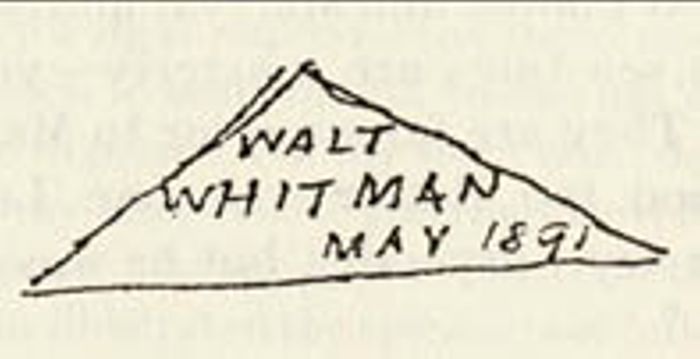 did not attract W., who admitted, "My first look is unfavorable—somehow, my printer's eye seems offended. I am not satisfied with it—yet cannot say why." Bucke and I immediately took ground against the date below, which—much turned over—was "ordered wiped out" by W. before we left. "You both vote against it, do you?" And at first he said, "Let it rest a day or two," finally however declaring, "Let it go—it might as well—it is an easy matter—let it go!"
W. was helped out of the carriage into the tomb, where he stood and described things as he intended them "and as now they really seem to be." Pointed to the three crypts to the north (four in each of two rows) and said, "Let this be understood"—pointing with his cane—"the first is to be my father's, the ultimate for my mother, and I am to be between." And to Moore, "Make a note of that—it may be upper or lower—either way—but that arrangement." Said he marvelled himself at the size and mass of the walls and door. One of the workmen said to me comically, "The more I think of it, the more I see that nothing else—nothing—would fit Walt Whitman." They told W. many "admirers" came along, but this excited his laughter and questions, "How—what—do they admire?" He pointed to the naked top of the hill. "You know, it was through Tom they gave me the lot—they expected me to select a spot there in the open—ostentatious—but I said, we'll go on a ways, drive on, drive down in the woods—and down we went, and when I got [Begin page 246] here I saw at once the lay of the land—'This will do—this is the spot'—and here we are!"
We talked about Cooper and Marryat and Scott. W. considered, "Cooper's sea-tales are masterly—you should read them, Maurice. They are far superior to Marryat's, though Marryat's are good, too. Better even than 'Leatherstocking.' Cooper could be dry—dry—dry, but he was a great master, too, none better."
He insisted on giving the men some money for "bread and beer" or "some lunch." Inquired of us what we felt as to the stability of the tomb, drove us about the grounds—marking its improvements, Cooper's Creek at the back, flowers, etc.—having Bucke drive us past the tomb on the way out, telling Moore at the gate again how thoroughly the work pleased him—talking thus with us the whole way home. Had the trip done him harm? "None at all—I am a bit dazed—but I would be that anyway—was before I started. But you remember Consuelo—the poor moments when she was like to succumb—when things all seemed black to her—against her—but she set her teeth together—she would not flunk—no, would not—not till the victory was won—no break—no sign to that outward staring, gaping, expectant world. And after the blare was over, oh! the weakness, horror, then. And I am Consuelo—determined to keep my head up, whatever betide." But later, when we reached 328, I helped Warren with W. who—indoors—literally dropt on the first chair—looked at me—said, "Well, here is Consuelo at last!" Here I left him—Bucke going to tea with us.
7:50 P.M. To W.'s again for a brief stay—no evil signs from the ride. All it had done was to convince both of W.'s great weakness—"goneness," was W.'s word. We talked about the morrow's affair—W. sure that "no hindrance could be expected now." Then good night and home again.
Morse writes me. When I showed it to W., he said, "The grand Sidney! What a touch comes of his least word!" Chubb also writes me to this effect: [Begin page 247] Farmington, Conn. Sat. morning. Dear Traubel, I have been in the most unproductive mood since I arrived here, & have no little speech to send you for to-morrow's occasion. I wish I could be with you in person, but my spirit must do instead. Please convey my affectionate greetings to Whitman. May he live on among us for many a happy year to illustrate the majesty & peace of old age as he has illustrated the splendors of full-blooded manhood! I think of him in his serene latter days along with the gracious picture of old Cephalus, which Plato gives in the first pages of the Republic—enjoying "the abiding presence of sweet hope, that 'kind muse of old age' as Pindar calls it." The longer I live the more important does the birth of Whitman into the XIX Century appear to be. He is for me one of its few great emancipators from the special dangers to which it has been liable—the dangers of luxury and mechanism, issuing in the vice of dilettantism which at present afflicts certain American as well as European centres. The future will assuredly be grateful to Whitman for confronting his age with a type of manhood that exhibited a noble power, an emotional amplitude, a religiousness, a physical sanity, & simplicity of habit & carriage against which the influences of the time conspired in vain. I say the future will be grateful because I think that, like other great souls Whitman has been "before his time"; & that his influence upon the world has hardly been felt as yet. It will be felt, because the world is going to recover from its stupor of soul; & then it will recognise its liberators. I join with you in wishing joy to our dear friend & helpful elder comrade. Health & happiness to him & to you all! My particular congratulations to you on your marriage. Being a lover, with the hope of marriage before me, I can wish you well with deep sympathy. May all good things attend you & your wife in happy & prosperous wedlock! Send me November Boughs. I think I'll wait until Good-bye is bound to match—though if you have the sheets to spare I should like to see them, being minded to write a review. I enclose cheque for 2.50; if that proves insufficient, I'll send balance. What about the pocket Whitman? Farewell, my dear fellow. Percival Chubb [Begin page 248] W. gives me also a couple of Johnston's letters—thinks they would interest me—pertaining more or less to the New England Magazine article.
Bucke admits that his yesterday's judgment of W.'s condition was "ridiculous," for "he seems all tuckered out—rags—nothing of him."
Sunday, May 31, 1891
(Bucke still with me.) Met Bush at Broad Street station towards noon—with him to Camden, where he took dinner with me. I kept pegging away at my work—writing, reading, getting ready for the dinner. To W.'s in middle of afternoon—fixing places of guests—leaving Bucke there finally with Bush, myself to 509 Arch, there to do further writing. W. seemed in good enough condition, considering. Did he desire any particular place at table? "No, put me at the spot you think the best—anywhere." Laid down a good part of the time, or sat in his chair drowsing. "I must husband all I have—all." At five, on returning, Bush and Bucke were still clustered together over meter affairs. Soon the fellows commenced to float in—Morris, Frank Williams, Eakins, O'Donovan, Harry Walsh, etc. etc.—and these fellows grouped interestedly about the rooms, in the yard, hallway, in front of the house. Photographer stubbornly would not flash us—insisted we should group in the yard or at the front of the house. Caterers meanwhile busy. W. would not hear to the photo—so the man was sent away. Several times I went up for word with W., finding him cautiously resting—after a while reading a paper. Hats, coats were put everywhere—on the Hicks, on a table in hall upstairs, on Warren's bed—unconventionally, easily, gracefully. The guests soon made up a strong circle. By and by W. sent word down that he would come whether or no—that he was getting tired of it—"Damn the long wait!" And shortly down he came, Warren leading him, I ahead—he taking my hand from time to time. "I have great reliance on Warren—he is so strong"—and to me—"I shall be down for ten [Begin page 249] minutes—at least long enough to show myself—to be seen—to salute the boys." And as he came in (the guests in their place) he was met, shaken hands with—showering recognitions—bravely—seeming to know all—calling Anne "my darling"—speaking to Morris, T. Williams, and so getting his place. Gussie was on one side of him, Brinton on the other—W. being put into an armchair—from which he again saluted individuals by name where he could—Frank Williams, Tom Harned, Miss Porter, others—as, indeed, he did through the whole dinner—particularly to apologize to those down the line some way, explaining his "blindness" and its "growth," etc.—asking me now and then, "Who is there I have not seen?" and "It seems to be a jolly crowd, don't it? Good fellows!—good all!" Gussie sat next him—I nearby—and Tom—Bucke by preference down halfway the table. Everything easy—no "plans." Near me sat Mr. Black (short-hander) who took my cues from time to time—eating meanwhile—his book on his knee, unseen. (Noble fellow! Came faithfully, though his heart, agonized by the death of a sister that very afternoon, protested.) W. did not seem to see him. Gussie fanned W.—did all she could to make him easy—keeping his glass filled. (Just before coming down W. said, "Have my glass filled, Horace—do not delay. I feel as if to give way—if I had not Warrie here I would collapse.") W. seemed to have his wits about him almost to repartee—his replies all sharp, strong, prompt—no bars except from sight and ear. We talked frankly, freely. Every now and then he would recognize some other face—reach a hand forth for its hand. He interrupted letters and speakers—really made himself chairman in Brinton's stead—inviting, protesting, amplifying; being drunk to and drinking; his powerful defense of Bucke's book most strongly uttered; his retort when Donaldson asked, "Isn't that 'Leaves of Grass,' Walt?" or to that effect—"That's part of it, Tom—that's part of it." Everybody seemed content—Brinton eloquent, Harry Walsh, Tom (Tom read several of the letters with great feeling). Day clear and beautiful—temperature high—the room looked noble. W. thoughtful when Tom was reading—exclaimed, "Put [Begin page 250] up all the lights—give him light!" Thus we went on till ten o'clock—laughter, talking, speechifying, the neighborhood stirred (the food in courses, soup leading)—children and others collected out of doors. In the end I leaned over to W. (others had suggested it, too) and insisted that he should go. "I guess I had better—though this thing might tempt me all night." Rising then—Warren assisting—and all in accord getting on their feet—W. then feebly (led) towards the door—shaking hands with the gathered friends—said to me, "Ain't it funny, Horace, I came down for ten minutes and here I believe I have stayed an hour." "You have stayed four hours, Walt." "Is it so? What a garrulity! What a garrulity!" Met Longaker in hallway and said with simple unaffectedness, "Why, here you are, Longaker—glad to see you—and why didn't you say something? And Doctor, I had a partial—very slight—bowel reprisement today." Longaker said, "I will make my little speech to you tomorrow." Kissed Bertha Johnston and Anne in the hallway—greeted all who clustered about him—very slow and weary on his feet—at stairway could not lift his left leg from step to step—I attending (Warren leading) all the way up and I lifting the leg from step to step. W. was not greatly disturbed—when at last in his room simply dropping (seated) on his bed—painfully—saying, "Consuelo is here—not death yet!"—and dropped his nose to the flowers on his coat. There I left him, kissing him good night. [See Appendix II, page 591 for Traubel's text of Whitman's birthday dinner.]
Everybody felicitating himself and others on the success of the night. Tom Donaldson brings some whiskey over for W. Bush sleeps at Harned's, Bucke with me.
Monday, June 1, 1891
10:45 A.M. To W.'s with Bucke, who stayed with Tom last night. W. reading Press. Had not yet come across good notice therein (no doubt T. Williams'), but quickly read at my suggestion. How did he feel? "Considering the amount of talking I did, great. It was a battle, wasn't it? And a not inconsiderable part of [Begin page 251] it against me, too, but somehow I held up—somehow. It is hard to account for, for when I started to go downstairs, I was more for death than life. Yet down once, and the spigot out, I let forth a constant stream—even garrulity itself! It was an experience. What a triumph! And here we are, not more dead than alive, with something left for another!"
I read him some letters I had just received—one from Tucker, one from Sanborn, and a third from Blake. Benjamin R. Tucker, Publisher and Bookseller 45 Milk St., Room 7 Boston, May 29, 1891 Dear Traubel, The temptation is strong to disregard all else and start tonight for Camden to avail myself of the delightful privilege of sitting at the board of America's great bard, where I might greet him before the finish of that great career at the threshold of which Emerson greeted him. Once in my boyhood I saw his noble form and kindly face, but never have I grasped his democratic hand. I have not given up the hope that I may do so yet. But at present I find it impracticable to accept the invitation he has extended me through you and which I shall always look upon as among the greatest honors of my life. Yours sincerely, Benj. R. Tucker. American Social Science Association Concord, Mass. May 29 1891 Dear Mr. Traubel: Although I date from Concord, your letter reached me in Chicago, where I have been for a week awaiting the wedding of my son Victor, whom our friend Walt Whitman may remember as a boy of fourteen when he honored me with a visit beside the Musketaquid. So youth is beginning independent life, while Age, as seen in our poet-friend, is withdrawing from this visible life, to enter into a house not made with hands. Give my earnest love to Walt Whitman on this memorial occasion, and tell him we think of him at Concord as often as we look out [Begin page 252] over the meadow across the river, which he was so fond of feeding his eyes upon. Sweet fields beyond the swelling flood Stand drest in living green now as they did then, and they are an emblem to all believers and poets of the landscape beyond the river of mortality. Yours ever F. B. Sanborn 21 Laflin St. Chicago, May 28. 1891 Dear Mr. Traubel, I am glad to hear of a dinner with Walt Whitman for the chief viand in a feast of reason, to be held next Sunday. I would I might be with you. Failing that, I would like to write a letter worthy of the man & the hour. But that is even more impossible than to be present. I might, by setting every thing else at defiance, transport my body to the place of assembly, but by what kind of defiance or triumph or effort I could transport my spirit to the necessary flight I cannot tell. Will you make my reverential greeting to the venerable poet whose songs will wind men's arms around each other's necks if we will sing them truly after him. Tell him for me gratefully, too, that I made a New Year's sermon from his "Song of the Open Road" which was a sermon, the people said. What stronger saying to live by have the ages to show than the lofty words in that song, "Henceforth I ask not good fortune; I myself am good fortune"? Yours heartily, J. V. Blake As to Tucker, "What a grand victory that would have been! Grand! The good Tucker—the courageous—the devoted!" And on Sanborn's: "It is a new strain for Frank—almost of melancholy." But Blake's struck him "profoundly," he said, especially the several expressions—"Will you make my reverential greeting," etc. Here, too, was yesterday's cablegram from Bolton: "Joy, Shipmate, Joy," with its note, at top, written by W.
And Mrs. O'Connor had sent him greeting. Doctor had wished to know if W. would go out to look for the lots now for some time [Begin page 253] broached. W. says, "No, not today, I guess not today; it is quite out of the question—I should not attempt it." Bush had come to say his farewell. W. asked him to "bring the wife—the dear wife, yes—next time."
Received letter from Curtis today.
5 P.M. To W.'s to meet Bucke (who with Bush and me had taken dinner at the Broad Street station). Bucke in parlor and me upstairs together to say our good-bye. W. on the bed and with him there the two books for Chubb—made up and stamped—and a letter for Dr. Johnston. W. stayed on the bed all the time we were there—speaking of many things but mainly of our "great affair last night," asking me, "Now you have had a bigger chance at it, does it size up to what you hoped?" Saying afterwards, "I don't know what it was in me held my head up: something—something—not planned for." And again, "I suppose it was a sort of Consuelo business, a feeling as if of defiance—that if I was to succumb to the strain it should be after—post the victory," etc. I had been in to see McKay—telling him, go ahead with "Good-Bye"—sending W. 25 copies bound—as soon as done. "He will sell you 725 copies (750 less 25 for press) for 25 cents—and will for the present hold 'November Boughs.'" "I am agreed to all that—thoroughly agreed," W. said. "Glad you came to some understanding with Dave before you go away," etc.
W. spoke with us about the Tennyson message, seeming to think it "sweet and good and Tennysony," as he said. Bucke wondered if Tennyson was not a free man in the presence of the queen, not obsequious, etc. W. confident, "He is like a spaniel, to the wife"—making that understood, after some of Bucke's questions—"Oh yes! I mean the wife, not the queen: oh! to the queen I have every reason to believe that he meets her face to face, asking nothing. But the wife, she has been sick, a half-invalid, for years—some trouble—I don't know but stomachic—and he is very attentive, devoted, like a spaniel—watchful, heedful," and so on for some time. We talked various matters; when it seemed to be time for us to go (as we were to dine with [Begin page 254] Longaker), W. charged Bucke to convey certain things. In the midst of it a ring at the bell, a step on the stairs, and Longaker's face at the open door—surprised us. Then W. turned to him, I giving Longaker a place near the bed and taking W.'s chair over by the window. But W. did not rise. Longaker inquired after his condition—felt the pulse—Bucke also doing so—both speaking of its regularity but weakness. W. said to L., "Oh! How am I? Considering—well—yes, undoubtedly well. Especially when it is remembered the condition I came out of yesterday. I seemed then like a black dull coal—incapable of work, of movement, of life, almost. Yet by some means, I don't know what—magnetism—pressure—I felt equal to the occasion—made myself one with the heaviest demand, which I count something, after all. Even as Consuelo, doomed to die, or seeming, determined to go down with colors flying—only after the best note. I did not make a deliberate pull or push or speech but it seems I had a finger in every pie. I felt no harm—no harm whatever—Warren gave me a rubbing—I went to bed. It was very hot, too—wearying—but I found myself strong enough to stand it well." He jokingly said to me "Mrs. Harned treated me handsomely—oh! I must have taken a great lot of champagne—two bottles, anyway—and she kept filling the glass—I drinking it away! Didn't you have something to do with it, Horace? I thought so."
In answer to questions, "Yes, I have a bad spell, oh! almost every day at this time, say about five o'clock to eight." Said his dinner "had consisted of chicken, asparagus and a dish of strawberries." What did he mean by "a bad spell"? "I feel cove in—everything seems to desert me—especially strength, volition —that backing which comes from good stomachic conditions—it leaves me without strength, eligibilities all gone. I feel gone in—Warren comes up and helps me whenever I signal" (he knocks on the floor), "or other times. I get up towards dark—feel a bit built up—then the massage, which refreshes me."
Discussed wine—Bucke not favorable to claret—deciding finally for Rhine—Longaker to get the wine and charge to me. W. very bright—talking with a felicitous ease. Then good-bye— [Begin page 255] Longaker first (going downstairs), Bucke lingering, bending, holding W.'s hand a long time—advising W. to call him any needed time and speaking too of the European trip in July. I the last—kissing W., and he saying, "God bless you, boy! And back again! I hate to see you both go away!" And then, "Write me—write me—don't fail to let us know how you go—where to—safety." At the door instructions to Warren—departure. Supper later at Longaker's. Bucke and Anne present with us.
Bucke says he told Eakins that W. thought $400 a good figure for the painting. B. will probably pay Eakins his $200. W. owes him (B.) $200. Eakins will probably ship the picture in a few weeks.
W. said he particularly wanted what he said of "the near dead poets" in my report.
(Nearly a fire in W. 's room the other night. He slid his chair about—it ignited a match—which in turn fired papers. I discovered and stamped out. W. seemed to see nothing of it. If I had not been there, what might not have happened?)
Tuesday, June 2, 1891
Left Camden at seven—morning—took breakfast in Broad Street station—train 8:20. Dinner at Scranton—supper on train, about at Dansville—reaching Niagara Falls towards ten. No look at the Falls, the night clouded and dark. We all strolled out a bit, but found it advisable to retire shortly. Stayed at Cataract House (American side). Whole ride up fine—country just out—green, freshness, everywhere. Up in the mountains hard rain—driving from northeast. Splendid panorama at Dansville and about—the valleyed town, the road skirting the cliffs. A rare easy ride, in parlor car. Doctor and Anne complaining nowise. Met a clergyman who had tables fixed—his work with him—Bible, tracts, hymnbooks, etc. By and by warming to us and volunteering to talk stocks. Bucke read Ingersoll's "Is Avarice Triumphant?" with great enjoyment. Anne read "The Ghost."
[Begin page 256]Wednesday, June 3, 1891
At Niagara till about three, seeing many things even through the hard rain that prevailed for an hour and more. Doctor left Anne and me to make trip to the other side alone (up to whirlpool—down to Canadian falls). Took trip again in Maid of the Mist. Vegetation richer than in the fall—mists much heavier. I met my young guide at whirlpool again, the Tweed Coast man. Everywhere the word is gouge—another day would have cleaned us both out. Nothing so impressive as the combination of greatest mass with greatest beauty. No augury can destroy the conviction of such unity after one has swept this circle into his vision. Sat down at the hotel and wrote and immediately mailed a line to W. (a note also to Tillie). Bucke lamented on the road yesterday that he had no copy of "Leaves of Grass" along.
Big slip with our baggage—found it had been sent no further than American side. Bucke fee'd the baggage-master (Canadians to exchange us checks and hasten on by a later train). Reached London nearly upon seven—a good supper for us there and a sweet welcome.
Thursday, June 4, 1891
Baggage does not turn up today. Wrote to W. again and Tillie. Also scribbled a note about the dinner for Neidlinger to hand to the Eagle (Brooklyn). Bucke's Inspector swooped down on him today which made him unwontedly busy. B. had taken Anne and me out for a drive early in the morning. The rest of the day I was with him and the Inspector, going rounds of the field—picking up many facts in the course of their very specific discussions which other circumstances would make impossible. B. governs here with love—no harsh words either to family, staff or patients. All like him—love him. Even his reprimands are [Begin page 257] without sting. Good group at night in study, with Inspector (Christie), Sippi, Doctor present.
Weather superb—not a cloud in view—but very cool. Many curious incidents in my wanderings among patients. Especially in north buildings, among the unruly members of the big household. One man there insisted I was his boy and I allowed him the fancy—a big, bearded, wide-eyed, shaggy fellow who maintains, "We are all fellows and brothers—let us live peacefully together." And a poor creature in the boilerhouse, who holds that coal is gold except for our belief that it is different. And the patients—boys and men—working about the grounds, more or less of melancholy visage and indisposition to be driven but who, some of them, talk a constant stream, or, others, will neither look at nor salute anybody, inmate, officer or stranger. Tragic demesne, relieved, however, by Bucke's methods of freedom and love.
Friday, June 5, 1891
Baggage still not here. Read a whole series of W.'s recent (this year) letters and postals to Bucke. Not full—bear more or less on his sickness. Found several postals had been copied in a press (Bucke having no hand in it)—probably by postman at the London end or the other. Bucke still speaks of going to Europe—perhaps 24th of June—surely a month later if not then. Am going through Gilchrist's book. Except for the Whitman portions pretty dry—not well put and kept together—but enheightens my respect for Mrs. Gilchrist. Christie here till nightfall—and Tully (another in some way on the same line of governmental duty) with him. Fine talk with Beemer about W.—Beemer describing the real love engendered in everybody here by W.'s visit years ago.
Wrote W. today—expressing our fears that no word had yet been received from him.
[Begin page 258]Saturday, June 6, 1891
Harned writes me this:
Sunday, June 7, 1891
To chapel in forenoon. Discussion with Bucke as to Whitman volume to be issued in fall: what should go in it? Continued anxiety about W. Long drive over to waterworks in afternoon (Percy Bucke, his daughter, Anne Montgomerie Traubel, and Miss Kittermaster along).
Monday, June 8, 1891
Letter from Warrie this morning—as follows: Camden June 5th/91 Friend Horace, Just a few lines to let you know everything is much the same as when you left. Mr. Whitman kept well until day before yesterday, then he commenced to look tired and weary. But one thing I attribute it to was the warm weather. It was eighty-five 85 degrees in the front room, so you can see that it must have been pretty warm in the sun. He appeared to be better last night and said that he thought that he would have a good night. I went out to the tomb Wednesday. They had chipped off the May, 1891. And I think that it has improved it. They [Begin page 259] did not have the door hung but expected to have it done today. Mr. Moore said that he could not get a stone cutter to work on it more than a day at a time. And then they would leave it, and tell him that they would not do any more, as they were afraid of splitting it, but I guess little by little they will get it done and hung. Quite a number of visitors called Tuesday and Wednesday but Walt did not see any except O'Donovan. He gave him a sitting of ten 10 minutes and then told him that he was tired and bid him good day. Tell Dr. Bucke that Walt has not said anything more of the lots. And I guess that he has kind of tired of them or intends waiting his own time. How strange it appears not to have you coming in of an eve. Walt said last night that he felt quite lost. He received your letter from Niagara and sent you last night's Post and Courier. Dr. Longaker was over Wednesday and brought him a bottle of wine. And said that he had ordered half a dozen bottles to be sent over. He brought his little girl over with him and Walt was quite pleased. And would have liked to have talked of nothing else and to nobody else but the little girl, only after inspecting his room she said that she would rather come down stairs, which she did much to Walt's disappointment. Walt came down stairs last eve. for a while and sat by the window the first since Sunday eve. Give our respects to your wife and tell her that we know that she will have a good time and enjoy herself at Dr. Bucke's hoping to hear from you if convenient. I remain, Most Respectfully Yours, Warren Fritzinger Several notes from W.—4th and 5th—indicating a continuance of favorable signs. But then a postal of the 6th speaking of evil turn. Papers—two bundles—from W. (Camden and Philadelphia; one copy, too, of Boston Transcript). Also sent pamphlet called "The Knight of the Plow." W. attempted in margin of the copy of the Record to draft outline of the tomb. Also marked New York World comment on the dinner.
In town and saw Ed Wilkens.
Through some of the female wards with Bucke (inspecting). B. spreads everywhere his own atmosphere of freedom, spontaneity, love—a great exhibit.
[Begin page 260]Wrote both Warren and W. of my relief. Wrote also to Ingersoll, Tillie, Clifford, Callingham, Billstein, Salter.
Tuesday, June 9, 1891
Papers again from W. Through the wards—north building. Mrs. Beemer described to me Bucke when the first Whitman fever was on him—how he came over Sundays, nights, with "Leaves of Grass"—to read aloud, discuss, etc.
Whitman evening in Bucke's library—B. reading at various points and we discussing.
Wednesday, June 10, 1891
The manuscript from Harned today. Also a note Black (stenographer) sends Harned and his bill for ten dollars.
I went to work at once—half finishing by evening. Cricket match in front of north building. Delightful ride in town. To Thomas concert in the evening—Campanini singing. Write W. every day. Bucke has heard from Bush. Find that speeches of Eakins, Walsh, O'Donovan, J. K. Mitchell, Buckwalter, Brinton, Bonsall, Neidlinger, Miss Clarke not reported at all. Black attributes it to noise and distance of speakers. But this does not satisfy me. I have written to several of these to send me a word to add.
The following letter from W. today: June 7, evn'g—'91 Suppose you receive the letters & papers I send every evn'g—have had a pretty fair day, this last, (as already said) negative as I call it (free f'm vehement distresses) & am sitting here twilight almost cold—Warry has been in for twenty minutes to cheer me up & talk—I like the (Murray) photo profile more and more—Eakins says O'D[onovan] wants the presence of that oil portrait while sculping, & that then he (E) will send it on to C[anada] as agreed—all right— June 8 just past noon—So-soish to-day—have eaten a small mutton chop for my breakfast—y'r letter comes—thanks—sunny but [Begin page 261] coolish weather—still the horrible constipation block—am sitting here the same—Warry is down stairs practising the fiddle—letters f'm Bolton last evn'g & papers this mn'g—quite a heavy mail to-day— Mid-afternoon—Sunny & bright out—quiet—no visitors—How is Annie enjoying the trip? I hope well— Walt Whitman
Thursday, June 11, 1891
More papers from W. and a postal to Doctor—word very good—favorable. Warrie writes me an interesting letter:
Camden June 9th/'91
Dear Horace
I was much pleased to receive yours of the 9th. And also to hear that you and your wife were enjoying yourselves. Walt came down stairs tonight for about two hours. Cannot persuade him to venture out though, upon the whole he has been much the same as when you left. He misses your not coming in of an eve. as indeed we all do, but otherwise everything is much the same. He is drinking his wine that the Dr. left along with his meals, does not say if it does him any good or not. Dr. L[ongaker] was over yesterday said that Walt was fairly. Must stop now and give him his massage, will finish when through. Just finished 10.10 and he appeared to be in pretty good spirits. I gave him your letter to read and he was glad to hear that you expected to be home by Sunday morning. He goes to bed at nine (9) sharp now. And lays until half past ten or quarter to eleven. Two morn's last week he laid until after eleven. I open his windows about half past eight or quarter to nine and about 10.30 finding him around. Moore was in Saturday, he said that they expected to have things looking ship shape and bristol fashion the last of this week. I do not think that it would pay Horace to come to Canada expressively to test their whiskey. Although I use to be a pretty good judge (off Cape Horn). At present we are sampling Donaldson's bottle, Walt and I. Walt pronounces it not good, not bad, but supposes that beggars must not be choosers. We have had middling cool weather here, but today it has been quite warm and Walt appears to have stood it all right. If there should be any change I will let you know at once by telegram. I wanted to get Walt down to Lincoln Park.
[Begin page 262]
He thinks that it would do him good, but does not appear to want to make the attempt. Mama wishes to be remembered to you & Ann T. and Dr. and hopes that you will have an enjoyable trip home again, home sweet home she says even if it is humble. By the way have you seen Ed and how is he getting along give him my regards if you see him. Hoping to hear from you whenever convenient I remain
Most Respectively Yours
Warren
P.S. Going through the wards must be interesting especially the women's. I suppose that some of them are quite violent.
Just received a letter from Dr. B. Walt just up a little earlier this A.M. of 10th. Wished me to make the bed up soon, so from that he does not feel so well.
Warren
Storm—with thunder first, then hail—today—clearing off in the evening to a smile.
Finished draft of the Lippincott's report. Makes much too much. Now to study, cut down. W. admonishes me, "Print all the letters in full—but if you can't all, then Symonds' and Conway's, anyway."
Friday, June 12, 1891
Papers again from W.—some of them in a wrapper improvised from the envelope of one of my letters. Postal as follows from W.: Camden June 10 eve'g '91 Stoddart has been over, & is a great strain for the MS: the copy—If possible if you get this send it on to him at once & I will see when you return in type. WW Long ride to Delaware—Anne, Ina, Mary K., Miss G.—supper there—drove home from seven to nine-thirty. Splendid, weather [Begin page 263] perfect, roads enough damp from yesterday's storm to lay dust. Magnificent playing in cricket match on grounds—a patient—Rev. Terry (Oxford graduate) scoring 140 runs, one inning, continuously. Most magnificent batting. Letter from W. to Bucke about his condition—could "hardly lift hand to head," etc.—writing, he said, "automatic." Letter also from Eakins to Bucke, Eakins saying he understood Longaker desired to move W. to cooler spot and perhaps W. was waiting for the $200 for the picture to enable him to go! Longaker's own account of W. to Bucke the other day very bright.
Saturday, June 13, 1891
Still in London at daybreak. Last day. To office with Bucke early, where we talked of various matters—Lippincott's piece, our book, Bucke's trip to Europe, the exigency of W.'s death. More papers from W. Letter from Bush. Beemer asks for a new portrait of W., which I promised to get and send. All the messages for W. loving—even from several of the patients (I found that a number of them remember W.'s trip). Left London at 11:30—day splendidly clear—all well with all. Percy Bucke at station, too, and Mrs. Bucke and Miss Gurd. Ride to Niagara fine, but easier in the States (cleaner cars, etc.)—sight of Genesee Falls grand in the extreme. The Niagara rapids, as we looked down from the bridge, seemed an eternity of boisterous impatience and angry haste—could see but the mists from the falls. Took supper at Howellsville. The mountain ride exquisite—the light passing over into the evening hours and seeming to hang there to give us opportunity. I examined Lippincott's article somewhat, read to Anne, she keenly criticizing it at several points.
Sunday, June 14, 1891
10:00 A.M. Reached Camden 8:15, and after breakfast and a bath, and examining my mail, down to W.'s. Among various letters come since my going away was this: [Begin page 264] Elmwood, Cambridge 1st June, 1891 Dear Sir, I very greatly regret that, owing to an accident, your letter, though it reached my house, did not reach me till too late for a reply in season. I should have been glad to add my felicitations & good wishes to yours had it been possible. Faithfully yours J. R. Lowell When I showed this to W. later on he exclaimed, "That is a victory for you—how did you get it from him?" I shall put it in my report as a footnote. W. advised simply, "Do as you will." Greeted by Warrie and Mrs. Davis warmly. Their report of W. decently good, but not very, and said the weather had been warmer than W.'s letters seemed to convey. Into W.'s room—he sat reading papers—reached forth his hand—both hands—took mine—and kissed me twice. "The wanderer returned!" he said. "The wanderer returned! And Anne—how is Anne? Safe and well! The darling! Tell her I greet her, too!" And then, "I did not expect you till noon. How quicker and quicker the travel is between points!" And then a shower of questions and remarks from him. "I think even since I went to London, the time of the trip has more and more shortened—shortened." How was Doctor, the family, etc., etc. "And the queer insane! Oh! How they possessed me! I and they together!" And asked me about special fellows, some of whom I had met, some of whom were gone or I missed. "I remember one old man—I bought him tobacco—he liked it well." And I told him of several who had intelligently asked after him. I asked about his postal (anent Stoddart)—why should Stoddart be worried—I had not promised the manuscript but for Monday. W. then, "I suppose I overstated it—made it an extreme case when it was not that. I do not suppose he had even then the natural stewishness of editors—who no sooner order a thing than they want their hands on it—but Stoddart is all right—he will wait." I left the manuscript [Begin page 265] with W. He will go over it by evening and send it to 509 Arch if I do not appear. As to its exceeding the pages Stoddart allows me, "I do not mind your writing to Stoddart—or going to him—to say, that it is Doctor's opinion, yours, my own, that he ought to use it intact—that it might be endangered if cut."
Longaker had said in his letter to Bucke that the new wine seemed to work well with W., but W. said to me now, "I do not like it—I don't know that it does good or harm—anyway, it don't go to the right spot." And as to the Monongahela whiskey, "It is too coarse—has a vulgar flow!" Speaking of the frauds in Philadelphia, "It is awful—awful! And the worst is it is indicative. Oh Horace!"—shaking his head—"it is indicative—a bad sign!" How had his health been? "A crowd of bads and goods—more bads—many more! Downstairs nearly every day, but not out." Reported, "Not a copy of 'Good-Bye' from Dave yet! Delay—delay—delay!" I promised to inquire. Talked various other matters—he cheery though looking wearied. The day beautiful—warm. To Philadelphia, to Germantown, seeing Clifford in his trouble (has just resigned from the church). Back in evening—W. had sent the manuscript to house, with changes in his own talk and suggestions what to leave out in case of necessity (among these the marriage discussion, etc.). But I made no great changes. Wrote Bucke and Stoddart—added the Lowell sentence in a footnote.
Monday, June 15, 1891
5:55 P.M. Found W. sitting at the head of the stairs (out of bathroom). Day had been intensely hot. He had stood it well. Yet complained now of "weakness"—and thought he "might get a bit cooler in this draft." His room "not very warm, however." Longaker just over. I had met him at corner. Thought favorably of W.'s power to withstand the heat. W. himself said, "The Doctor was here—I was glad to see him again—his health, cheer." W. asked, "Now, what is the news? Tell me. Did you see Stoddart?" And to my "yes"—"Well, what was the result?" [Begin page 266] That S. would take the manuscript home, examine it tonight. Stoddart had thought he would use it pretty much as it stood. He remembered my promise—that it was for today—and said his "stew" last week had come of an idea that last Monday was the promised day. Would not make a facsimile of the Tennyson letter. Told W. I would have the letter anent Trumbull and the pension in Open Court (letter from Carus to that effect). W.: "I do not feel that I have anything to say on that point—or want to take on any part in such controversy—still I can appreciate your feelings and why it is perfectly proper that you should have a brush with them." As to a suggested article, "Walt Whitman and the Children," he said, "Yes, try it. Years ago—always, in fact—I was a great caresser, fondler of children—but in the last three years, that went along with other things." He further volunteered, "I did not realize till I had read the report just how I had talked, talked, talked away. I can hardly account for it—except by the fact that it happened on my own dunghill—that I seemed to owe something to them direct (as perhaps never before in the same way)—and then besides I was in very good humor, very—good 'spirit' as the Quakers would say—and things flowed out, out—a flood!—inexcusably, some will say. I wonder how many, reading it, will set me down for a gossip? The thing that justifies the whole piece—my part as others'—is its naturalness—extreme—and vigor, integrity." Again, "I wonder if Stoddart will let me have another proof-slip of my piece?" Had he had one already? Not exactly—but a type-written copy. "I don't know why the devil he copied it—my copy was as plain—at least to me." How was it to be printed? "In the body of the magazine—as an article." Signed? "Yes, signed: he was vehement—put on a forlorn face—would have it so—so I yielded." Had he changed it to suit? "Oh! quite a bit—emendations, alterations, a new turn here and there."
I gave a scheme of book, as worked out by Bucke and me at London, to W. who would examine. We proposed using the Ingersoll-Whitman immortality piece. W.: "Yes, do it." T. Williams had not given me the copy W. corrected. Professed not [Begin page 267] to be able to find it. W. says, "The knave! He knows well enough where it is—could put his hand on it anytime, no doubt, but let him go to the devil. You take a copy of this draft, send him his back, give me yours, and I will put it in shape." I said, "We proposed to have Ingersoll revise his part, too." W.: "Yes, do! That is the only fair thing: then the piece will issue authoritatively." Three of the "Imprints" are known to have been written by W. We propose to use two over his signature if he will permit. I was delighted to feel that his first view was favorable. "You and Doctor are quite agreed on it? Quite?" To my "yes"—"Well, I will see—will look it up overnight." As to Lippincott's piece again, "I think Symonds' letter a quite distinct contribution—a new lift—a fresh word. And Stoddart will be unwise to drop—or propose to drop—it."
Elaborate book (soft leather, etc.) sent by Samuel B. Foster, Chicago, for W.'s autograph—contains Whittier's and others (famed). W. said, "It is a horrible practice—a pest—yes, pestilential—I hate to think of it: days and days, nothing but applications, applications! Think of the gentle Whittier! He must be the most pestered of all—yet never a word—a public word!" Would he write in this? "Now that it is here, perhaps a few lines, but all under protest—damn the crowd! I have to return the book and might as well put in a word."
A couple of Lancashire fellows came in to see him Saturday (not the Johnston-Wallace dozen)—but W. would not see them—saying, however, now, "I am sorry I did not: it would not have hurt." Said Morris was over last week, "and O'Donovan has taken a couple of trips, and Eakins."
W. informs me, "I wrote Bucke yesterday about you—that you had come in safe—ruddy—looking better than I ever knew you." But no letter from Bucke himself. Said he had wished Morris in next Literary World letter to quote his first dinner remarks about the giants, etc. (Tennyson, Whittier, Longfellow, etc.), but Morris had told him letter ceased for summer months.
Total cost of dinner nearly $150 dollars. I must assess the fellows five dollars a head.
[Begin page 268]W. said, "I wrote Stoddart Saturday that I had no doubt you would shy your manuscript in Monday. I wonder if he got my note?" Stoddart had told me of it.
No copies "Good-Bye" in covers yet. McKay promises them tomorrow or Wednesday. W. asked, "How do you take that? Does it mean more delay? Well, we must take it as it comes, but not believe till the bird is in the hand."
W. received the Meister (London) containing "A Grecian Rhapsody" and with it an autograph letter from Shepherd. Gave to me. "They have a curio value, anyhow, if you can take them for no more. And take this too—a note from Kennedy—the good Sloane—a few words about Professor Sophocles (Harvard) who must have been an odd worth-much old man—a creature after one kind—his own kind. You will like to get this glimpse of him, because it is quite vivid."
I told W. that Wallace and Johnston had written enthusiastically about the New England Magazine piece. He responded, "I do not wonder—so do they all—everybody thinks the same about it—looks on it as a great triumph in honest portraiture, and I not less than any other."
W. continued, "The loyalty, devotion, of these Lancashire boys is one of the best things I know: God bless 'em!"
Tuesday, June 16, 1891
5:45 P.M. W. in his room, fanning himself (oh! the sunset breeze!). Reached forth his hand, "I have just been enjoying the first whisper of the wind! Surely this has been the hottest day ever was—or if not that, hot for me, anyhow. Yet I seem to weather it well, too—except for the sweat, feel comfortable enough." Not out but "sat here enjoying myself—thinking myself to the woods, streams." Had been "reading, reading, reading—and if not that, drowsing, sweating—sweating, drowsing—all the day through." Gave me a letter from Bucke, "evidently written the day you left." New? "No, nothing much—only that he urges me, as you do, to let you use the [Begin page 269] 'Imprints.' You should see his letter: it is on the bed there—I meant it for you." 14 June 1891 I have your letter of 11th (it came yesterday afternoon). Anne and Horace left at noon. I feel quite lost without them. I enjoyed their visit here greatly. By this time H. has shown you the M.S. of the "Round Table" piece which seems to me as characteristic & valuable as anything we have had. Horace will also by this [time] have submitted to you our plan for the book. (I hope you will allow the two early pieces by yourself—there would be no sense in disallowing them as they will certainly be republished as yours anyhow). It is a perfect day here—bright, warm—the trees now full leaved and perfect—they stand on the lawns sleeping—not a breath of air to move their branches. The deep blue sky bends over them in benediction like the concave palm of God. Best love to you always and always R. M. Bucke
W. then, as to people who criticized Bucke (many very good fellows in Philadelphia), "They do not understand—do not grip him, realize him—seem to be unable to realize stern, strong reserve force even when it exists. But Doctor's critics defeat themselves." And later on about the Lippincott's report, "You hold the reins and are entitled to do so. About Eyre, it was beside the issue anyway—that question of marriage, no marriage, women, wives—was without the purpose—has its own explication—did not seem to me to be clearly understood. The this and the this and the this and the this—Eyre fell into the abyss of his curiosities, words—yet it was all right, too—he saw what he saw—he felt to say and said—that is all there is to it."
I had seen Stoddart—worked an hour with him over the piece—cutting in Donaldson and Eyre (whose matter Stoddart and Walsh seemed to think of no value). They decided to use Symonds and Conway letters in full. I had quite a fight for Bucke's piece: they seemed almost inclined to throw it out in toto. I said to Stoddart, "Rather than cut the whole piece up, I will [Begin page 270] withdraw it," but we came to terms. I took Bucke's pages away to make some abbreviations—cutting out a couple of sentences (no more)—afterwards meeting Stoddart on the street—when he said, "Well, it won't make much matter either way—we will use it." I said to W., "If these fellows understood 'Leaves of Grass' better they would better understand Bucke"—he then—"That's exactly the point. Bucke's power is his own—only to be understood again out of the citadel of a strong individuality." Stoddart very pleasant, however—matter sent instantly to printer. W. asked, "Will you see a proof of it?" Yes. "And will I?" I still said "yes"—adding—"The day I get it I will leave it on my way home and call later for it again." W.: "That's a good scheme—by which nobody will be delayed." And, "I want a proof of my little piece, too—should have it. Can you tell Stoddart?"
Wallace writes me June 5th [requesting copies of "Good-Bye My Fancy"]. W. says, "I can supplement that by word from Johnston today. I shall send them six instead of two copies. And a batch of photos, too. Johnston sends me three dollars saying he is not sure he has copies of all the available Whitmans and would I attend to the thing for him, he sending all the additional money necessary." Asked me if I would attend to mailing from Philadelphia.
Had not yet examined scheme of book. "It was too hot today to do anything other than keep head above water." But, "From what you say of it I like it—like it a good deal."
Bucke had inquired after Clive's essay "The Fact of Joy" and O'Shaughnessy's. W. says, "They are the same—Arthur Clive is his pen name."
Mrs. Davis brings him in some cold tea. "You are a good angel, Mary." Had he taken to buttermilk? "Yes, that is the latest—and I like it, too—though it and the wine must be taken at long distances—they don't co-operate worth a cent"—laughing heartily.
I joked with W. about dinner, "You took possession of the meeting. We asked Brinton to preside and you took the reins in your own hands." He laughed, "I believe I did—I went on at a [Begin page 271] great rate—have thought of it often since. Do you think Brinton was angry? No? Well, it was curious—I jumped all bounds—probably the more for feeling that the fellows had come, in a way, to my own board."
Wednesday, June 17, 1891
5:35 P.M. W. in his room much as yesterday, though now he speaks of having spent a bad day "pursued by the devils of heat and exhaustion." His sleeves rolled up (how much thinner his arm!)—fan in hand. Greeted me very cordially, "I am glad for your regular visits again—they have become a part of me." No books yet from McKay. Had made up the pictures for Wallace (I took them along) which I shall pack with the books and send abroad. (W. wrote Wallace a postal about this yesterday.) Inquiries today from someone in Cranford who wants to buy books. W. sends circular. Said to me, "In your new piece" I have commenced another like the New England Magazine piece), "I think I will get you to set out at greater length—more definitively—my political, religious, radical notions—so there may be no mistake." Why shouldn't he give me rough notes, so to secure accuracy, etc.? "I think I will—I think that perhaps would be the best idea. And I will do it at once. It is a thing which ought to be plainly said—which my books do not make naked, plain—which perhaps I would not care to go into myself—but which I must not die, being mistaken about."
Referring to Liberty in which I had read some note about a new magazine to be started by J. M. Stoddart, W. said, "I will look up the paper—it is here in the dust and confusion somewhere. As a rule, as you know, I don't read these special papers. These fellows, I know, are a cute lot—strong—I have thorough admiration for them—their work—but their paper has a good deal more interest for the fellows in the swim of affairs, philosophies." What did he think of Brinton's idea that public opinion—not church and state—is the great moral conservator and lever? "It is very striking—true, too, I admit it: it sets out a big [Begin page 272] lay of premises—establishes them, too. Then I would say, there is more, too—the bottom fact of all—the inherent good nature, integrity, sanity of man—residing below, underneath all venoms, poisons, evil wills. Especially as existing in our democratic land, age—in America. I think I have often enough expressed myself on this in my books—and that the disease of our time is its smartness, cleverness—that hellish New England hunger to know something—to store up a big fund of bookishness—to accumulate, accumulate, accumulate, ad infinitum. Thank God! The people as a whole—knowing enough for the present—are not spoiled and ruined by the ambition of culture! They can wait for what will come—for growth—the up-going of their stronger, healthfuller nature. I see signs everywhere of larger purposes, not literary—human—and these will urge, urge, urge, urge—urge again, irresistibly—the conviction of the masses. And so to me, Brinton is right—well right—proved—and well for the race that it is so—that the average good heart of a time takes care of the individual. I know there is more to be said than this, but this gives the one side."
W. asked, "So Clifford will leave Germantown? Where will he go?" All doubtful. W. then, "He ought to be brought to Camden if that were possible—this town needs just such a man to stir it up—to dig after vitals. If someone don't assume the task, it will die—what with its Sundays, its Methodisms, Presbyterianisms and the like."
W. wonderfully describes his condition, "I am taking in all the outworks—like a besieged city. If I would have life at all, on any terms, I must husband, concentrate, cluster my powers at vantage-points—make a stand. I have felt the forces retreating from me—have drawn closer and closer to what power I have left—brain—to write a little, to read, to see the fellows, chat—all I contain centered upon these claims. Ah! Horace, there is no choice, no gain—for a while I may fight off the end—for a little space I may hold the city: but the enemy is strong and valiant—is sure of victory—my only hope, to keep comfortable as I can and do what I may as long as I may, going down at last [Begin page 273] without disgrace." He told this once to Bucke (substantially) in my presence. This time voice, all, strong, pictorial, eloquent.
I told W. it was my mother's birthday. "Oh! Are you going straight up to the house? Yes? Well, let me see." Leaned over the basket under the window, rammed his hand far in—fished out an envelope containing several silk handkerchiefs—taking one out. "Take this to her—will you?" Searched the table, brought forth cologne bottle. "The Donaldson girl sent me this—often does"—poured it copiously on the handkerchief—then enclosed it in an envelope on which he wrote that it was sent to Kate Traubel by Walt Whitman, with his love and congratulations and respects. "It is a trifle," he said, "but trifles are indicative: tell her that my heart goes with it."
Thursday, June 18, 1891
5:20 P.M. Day cool. W. said, "Too cool—a change too sudden: we are thrown about, between hot and cold. I have had a bad headache all the day through." Said musically, "I have had a couple of boy visitors just before you came in—the melodious darlings! They chatted away, sweetly, without the least constraint." Gave me letter from Bucke. "He seems glad you came—sorry you left. It must have been a great trip for you both."
Wrote this memo for Oldach: Oldach Binder Stitch this & case bind it in some stout board—mind & keep the sheets as new arranged you needn't trim any thing (unless you need to in the job)—make the best rough strong job of it, convenient without regard to finish—it is only a dummy for my own eyes— WW 328 Mickle St. Camden NJ What he has bound is simply a new make-up of "Leaves of Grass" to include the "Good-Bye" poems and "A Backward [Begin page 274] Glance"—the birthday preface to be dropped therefrom. "You will understand it—have him do it at once, if he will."
Quotation in Poet-Lore from Walt Whitman. He jocosely said, "I don't know myself, dressed in that way. It is wonderful what that good paper and a few leads will do to set a fellow up!"
Had not yet examined our prospectus. Asked me to give him a copy of the papers in the order we proposed to use them. Bucke says he withdraws his first title—"The Poet of Democracy." I had objected that it was not explicit enough—that W.'s name should be a part of the title. Bucke now agrees. "Clifford and his wife and daughter were here. He is to take dinner at Tom's—says he expects to meet you there. He looked well, natural—no bones broke." Gave me the English letter for £40 sent by Carpenter and his friends—wrote at foot "Pay to the order of Horace Traubel"—drawn on Brown Bros., Philadelphia.
Oldach bound up some copies of "Good-Bye" but left the portrait out, at my suggestion. Dave at once returned them. Asked W. positively, "Shall I tell McKay that you will give him 25 press copies and sell him 725 at 25 cents?" W. replying, "I thought you had done that long ago. I leave it in your hands, to make such terms as you think best." Expects a note from Dave payable December. Would pay Ferguson with that note. I objected, "I doubt if he would take it—if it would be fair to ask him." W.: "Why? How do you make that out?" "Because it makes Ferguson wait a long time for his money or submits him to a discount if he wants it now." This seemed to rub W. a little the wrong way and he asked me "to explain further," which I did. "If it is wrong, then we don't want to do it"—got into a little passion anyway. "I think Ferguson piled it on thick anyway, charged for everything—corrections, changes, what-not—till the bill is way up." I fought him on this quite hotly till he said, "Well, you attend to it—make the best way out of this you can—I trust to you—and the book was beautiful—its printing noble, elevated—I am willing to excuse a good deal for that."
I advised with W. about getting interest on his money in the Bank. He acknowledged he had a large sum there, "I have poor [Begin page 275] Eddy, you know—and the feeble sister—and that is their fund. I have several times thought to invest it some way, but always thought it would be too much trouble, etc. etc. But I suppose it might as well be made as much as we can make it, and perhaps you had better go see about it."
Friday, June 19, 1891
5:50 P.M. Found Longaker sitting there with W., Longaker immediately going on my entrance, having other patients to see before tea. Before going, however, congratulating W. on his condition and receiving from W. the doubting laugh, "It is always funny—sometimes exhilarating—to me, to be sometimes told after one of my worst days, when I know I feel like the devil, that I have the color, flush, vigor (outlook) of a man in good health!" I knew Longaker hungered for one of W.'s soft books, so I called on him to wait—going to the box opposite, getting a copy for W. to sign—he doing it willingly, remarking, "It is as you say, Horace, this is the book for our fellows. Yes, Doctor, it will go in your pocket." Longaker afterwards thanking and shaking hands with him. I had the Lippincott's proof with me, would leave it till eight, to call then to have my own look at it. W. contends still, "This is my 73rd, not my 72nd birthday"—meaning that the 72nd anniversary is the 73rd birthday and so on, up and down. "I know the custom, but it is a stupid one—someday they will set it right." I described several places at which I intended to make changes, and he endorsed them all. So left him.
7:58 P.M. To W.'s again. He had the sheets spread out over the bed. "I have made no changes at all—not one—have left things just as they are. It is very natural—carries the reader right along—simple, hits the nail on the head—does not hurry, does not lag—which is to say of all true work!" But his own little proof had not come and he had his growl over it. McKay asked me today (came to the Bank, as if astonished) if "that death-mask" was to go with the book. W. exclaims, "No, no—that is a [Begin page 276] poor name for it—it looks nothing like that. I call it a sculptor's profile."
Thought Dave "should not make the price of 'Good-Bye' above a dollar." Asks every day for copies. Brought him back draft and its duplicate to sign for the £40. Promptly filling them in, he held his pen suspended to say, "I knew a man in Washington—an expert there—who said once, when he leaned over my shoulder (I was working)—that my signature was one of the hardest he knew to imitate. I asked, is it so? And he assured me—yes, its very simplicity protects it. And he himself had a wonderful pen—could imitate pretty near any signature at will, for instance. Had a distinct genius of the sort. And I have often thought of it since." I told W. every bank teller would give him the same assurance. "That makes it more curious still. It must be as the expert said—its very simplicity—just as simplicity, truth, can never be imitated."
On his table a process (engraved) picture of Stanley—on its reverse "Gorse," a painting by Murray. Under the portrait W. had written "Royal Academy Pictures London 1891"—but it was the "Gorse," I found, that had attracted him. "It is wonderfully strong, vivid. I have been deeply moved by it—some quality in the air—I don't know what."
Every now and then W. hands me out one of Bucke's old letters—"Here's for you." Tonight one.
Saturday, June 20, 1891
4:50 P.M. W. in good humor, allowing that he had passed "a fairly comfortable time of it" the whole day, and looked it too. Gave him Brown Bros. check for $194. Said, "This is the best way for me to handle the money—yet I had wished for it in cash, the best to contribute a bit myself towards the dinner." I said, "That will be taken care of." He then, "But who enjoyed it more than I did? I doubt if anyone got so much fun out of it." And again, "After the Lippincott's piece, who'll credit me again [Begin page 277] as a sick man? I doubt if anyone! I am astonished at myself—it seems the most unusual procedure—frivolling like a child—talking, taking possession of the hour. No one seeing me there would have conceived the utter feeling of goneness that held me just a while before when Warrie came up—urged me off the bed—insisted I should dress. I can describe it no better than by my old figure—that it seemed as if all the vital insides had fallen out and left me but the shell, the husk—appearing right enough—appearing the same—but empty, empty, empty! I thought of putting something of that in the note at the beginning, but it did not come in time: what do you think of that idea?" He "rather liked" the "plain matter-of-fact headline"—but "more than all" the "richness, naturalness of the dialogue. You were extremely happy in all that."
A New York publication had sent him a copy of Voltaire's romances. "I think I have rarely seen a real good picture of Voltaire. Most of them give him a smirk, a strange, constant smile, which easily runs off into idiocy on the one side, or into an exquisite benignity on the other—and this benignity is anyhow Voltaire. The book itself is stupid enough, so to speak—it did not interest me, anywhere I picked it up."
I sent off copies (six) of "Good-Bye" from Dave's [to Johnston and Wallace], enclosing the lot of photos W. had selected to go along. Had to send in two packages. "Glad they have gone at last!" cried W. "Letters again from both today—they are faithful to the end!"
Lincoln Eyre forwards me a note written by a Philadelphia woman, wishing to persuade W. to a sanitarium at Dansville, New York. Numberless such counsels. W. says, "Thanks! Thanks! But there are some reasons why I should stay here, too." Bucke writes me—18th—the first note since I left. Is elevated with the idea that W. will let us use the "Imprints." A preliminary cable but does not know when he must sail.
W. gives me [notes] for my "memoranda," to be used "by and by, when some article, word, is necessary, which this would help out."
[Begin page 278]Dave says positively he will not give W. his note—never gives them. This relieves me. I billed 725 copies "Good-Bye" to Dave at 25 cents a copy and attached a memorandum granting 25 additional for press copies (yesterday). McKay very positive that Ingersoll's lecture gave a fresh lift to "Leaves of Grass." "I sold about 500 copies last year, one of the largest sales on record, and the fact is 'Leaves of Grass' is the only book I make any money on—and Bucke's book is a dead failure, as far as sales are concerned."
W. gave me a copy of "Good-Bye" bound. McKay will send over 15 Monday. I sent six to Wallace—brought over four. This makes W.'s 25. W. also wrote up a copy for Bucke which I at once folded and addressed and mailed. Under portrait he marked: "Walt Whitman Sculptor's profile May 1891," in both books. "I turn these books over with a great deal of pleasure, Horace—so far they are the most satisfactory job of all—better go to the right spot."
W. laughed when we referred to the dinner, "I can't forget about the champagne, Horace, the iced champagne: how straight it went to the heart of the matter—to my need—setting up the whole night! To know what I know about the condition in which I went downstairs—then to know how the champagne lifted me! It is the explication of much! A year ago or so I tried to write some lines about champagne, but they did not satisfy me. I like things that possess more than a surface meaning, and somehow I stuck on this—could not throw out the suggestion I was after. But it will come, someday—by and by—perhaps."
I brought up from downstairs a letter and a paper just handed in by the postman. W. asked, "Did you notice this letter—that it was from my sister's husband at Burlington?" I had, of course, and he continued, "Did you ever know anybody whose sneakiness, low-down-ness, passed the line of patience—gave the lie, almost, to your best philosophy—tempted you to all sorts of profanities, what-not?" Then, "This fellow is such a one. I ignore him, never recognize him in any way—pity my [Begin page 279] poor sister—old, sick. And he is not an ordinary sponge—I could figure that—he is a sneaking canting scoundrel, making a trade of my weakness—knowing the spot where I am sore—my love for my sister—ramming his knife in there! But you know—you know!"
Sunday, June 21, 1891
10:10 A.M. W. just up. Later in bed recent days. I did not go in to see him, more than to hear from Warrie that all was right, that he woke well. Day hot—out to Ashbourne—not back again till too late to make a second stop.
Monday, June 22, 1891
8:00 P.M. W. in his room and on the bed. Had just come up from the parlor, where he had spent an hour at the window. Insisted that he would get up. I asked, "Isn't the bed warm anyway?" "Not too warm—no, I do not feel it as you might, or others. When a man is old—and all his innards are fallen out—digestion disgruntled—the waterworks limping, leaking along—everything impaired, weakening, giving way—he is not ready to quarrel with his bed—a little warmth more or less." He said this with a merry laugh, then knocked on the floor with his cane—Warrie (from the doorstep) responding with alacrity. W. said, "Touch the glimmer, Warrie," and after we were adjusted (he was helped across the room), he felt in his vest pocket: "Here Warrie, we must treat Horace to cream"—adding as Warrie took the coin—"Get enough for all, Warrie, for all!"
While Warrie was gone, we talked. W. examining some old manuscripts today—a pile on the bed. W. said he had a letter from Bucke. "Now his anxiety is, when he must start for Europe—he says he daily, almost hourly—expects a telegram." As to the cream, "I like it: it has such a good taste of milk—is refreshing—goes to the right place." Again, "What is finer, [Begin page 280] anyhow, than a simple glass of milk—iced milk—these hot days?" Asked, "How did the mother's birthday pass off?" And to my word of gratefulness (from her) for his handkerchief W. said, "No, it is all right—tell her as I so often say, the main thing is that we are here—the rest is but vague." I proposed some carriage rides for the summer and W. was agreed. Sundays, probably. Told him Ralph Moore had written me for an interview about the tomb.
I sat down and wrote with W.'s big pen a postal to Stoddart asking for 15 to 20 sets of sheets of August matter. W. remarked, "Today I received a proof of my little piece—it has gone back tonight. All, now, I hope, in good shape."
I met Longaker in Philadelphia today—took some cream with him. Asked me, "What do you think of Whitman's condition now? I think it favorable." W. remarked, "It is a good thing to hear. I wonder—wonder?" When Warrie brought in the cream, W. ate with great enthusiasm. "It sets a fellow quite up: it is a pretty good make, too—I can taste the cream of it, which is to say a good deal." Said that more and more as he thought over the scheme of our book, he approved it.
Tuesday, June 23, 1891
5:40 P.M. W. in very good humor and in good condition. "Didn't you meet Longaker? He must just have turned the corner." And, "The Doctor seems encouraged by the way I stand the heat. What do you think?" And I rallied him—he saying then further, "I am a little surprised myself." A gracious talk of half an hour! How good (sweet) and affectioned his voice! "Word from Doctor!" he exclaimed. "He will sail on the 8th—he has his word of summons at last!" And, "Take his letter—I have laid it out for you." I also received a letter to the same effect. "I am sorry he can't stop here on his way out," says W. Bucke writes on 19th about Stoddart amusingly: [Begin page 281] 19 June, 1891 My dear Horace Your letter of 16th (ev'g) just to hand this A.M. Much obliged to S. for wanting to cut out my speech (!) & to you for saving it. These editors are bad men to deal with—the Lord preserve me from them for ever & ever, amen. Nothing new here in Asylum or meter affairs—nothing further f'm Eng., could not well be yet. I wish we could get started in the States but do not see how it is to be done unless Dave gets better & comes up to the scratch. Nesbit will do nothing—d[itt]o W. J. Gurd—Dave it seems cannot—how can I move? that is the question. R. M. Bucke W. called attention to a couple of old notes from Johnston and Wallace—"specimens of simple notable criticism and lovingness." This note, today from Ingersoll, took W.'s eye: New York, June 21. 91 My dear Traubel Countless congratulations to you and Mrs. Traubel—To me love and marriage are sacred beyond expression. Love alone redeeming the coarse and brutal world. And so I wish you all the joy that true hearts can give and hold. I should have written you all a letter on Whitman's birthday—but that day was the anniversary of a great sorrow—the death-day of my dear brother—and to tell you truth the birthday was forgotten. I hope that Whitman will live for many, many happy years—live until he is fully appreciated at his worth. You must give him my very best regards with a "good luck" to boot. For you and your wife I ask for the best, and say to you both, good luck, long life, and love enough to last you through. Yours always R. G. Ingersoll I have been absent from New York for weeks. "It is a grand noble hand—a sweep, ease, style, natural, giantesque. It is good air to breathe."
[Begin page 282]Clifford sends me this:
(From London Quarterly Journal, April '91.) In early portion of a critique(?) of Ibsen:
Gave me a curious chart which had been sent him. "I get the greatest mass of truck, queer things, oddities—everybody with a peculiar philosophy has to send me a taste of it—and I don't taste, anyway. The last few weeks have been autograph weeks—the worst spread of the disease I have known." Had he sent the Chicago man his autograph? "Yes, wrote my name and two or three lines. It is horribly tiresome business." W. thinks Forman "loyal and true." I showed him a letter [from Forman]. "We are to be congratulated in our friends, whatever may be said of our enemies!" —laughing. But he was excessively aroused when I showed him the following from Joe Gilder: [Begin page 283] The Critic 52 & 54 Lafayette Place, New York June 22, 1891 Dear Sir: I find in this morning's Tribune a poem entitled "The Midnight Visitor," & comprising six stanzas of rhyming verse. It is signed "Walt Whitman." May I ask whether the authorship is correctly given? & if so where & when the poem first appeared? I have been abroad for some weeks, & am a little behind with current literary events at home. Very truly yours, Joseph B. Gilder My kindest regards—& those of my sister—to W. Whitman. Laid it down, took off his glasses, "Well, that poem threatens to have a history. And with that history you are about as familiar as I am. I am a little amazed to think Gilder is taken in by it. Almost comical when the literary fellows are gulled, anyhow—editors of literary papers! Though Joe suspects a rat, too. The sum and substance of that story is, as you remember, that I knew a Frenchman—we used to sit over our wine together—in an inn, anywhere—and in that familiar way he would give, I would take, off-hand, great things from the French—off-hand, rendered in prose—almost literally. This poem of Murger's I got that way—from that fellow. And the verse rendering, though partly mine, is mainly someone else's. And if credit goes anywhere, it should go to that someone else. I struggled with it myself, too, to give it a good setting. And the version I give came by that means, no other—corrections mine, perhaps an ending or two. The poem was always a great favorite—one time I had it printed in a little slip. I must have some of the slips now—one might be sent Joe." But he could not find it, he finally saying, "You know all about it: write him a sentence your own way—he wants something authoritative."
Had I got his "dummy" from Oldach? "No? The scoundrel! Next time we'll get a quicker man!" But he never will: he always [Begin page 284] excuses our men in the end. Has received the additional 15 copies of "Good-Bye" from Dave and sent receipt. That leaves W. at Oldach's: 175 copies "Good-Bye," 400 copies "November Boughs"—beside sheets of the big book.
The Ledger quoted "The Midnight Visitor" the other day over its "Walt Whitman" signature. W. says, laughing, "It never would have been quoted if it had not been a rhyme. That's the Ledger, out and out!"
Wednesday, June 24, 1891
5:55 P.M. W. on bed—not asleep—cane at his side—some papers and a letter from Bucke. I had brought him his dummy from Oldach—at once pleased. Cost only 50 cents. "Cheap! Cheap! And wonderful good, too! You mind the story of the boarder: 'Yes, Madam, it is good butter.' 'Do you know I pay 50 cents a pound for it?' 'Yes, Madam'—and he takes another hunk—'And it is worth it, too!' And so I think the job is worth Oldach's price." As I thought, all yesterday's petulance gone. Sometimes he is a little impatient at slowness of tradesmen, and when I urge, "But they can't drop all other work to take up ours," he will retort, laughing, "Damn it, don't tell me why the battle is lost—it is enough to know it is lost!" Yet will lapse and conclude, "I know, I know: Oldach's cat has as long a tail as ours."
The day had been cool. "It set me way up!" Windows closed—room I thought hot. Yet he is not sensitive. "My hot-blood days are all gone, now, all gone—it is the evening chill!" Morris had sent him Literary World: "It had the initial passage of my speech—or the substance of it—the best possible under the circumstances. But of course the authoritative account is yours, in Lippincott's. And that will stand by us and we by it. But Morris has done well—as well as I could have expected—gives me in effect." And, "I sent the paper off to Doctor at once—he will like to see it." And again, "I wrote Doctor again—not to [Begin page 285] any length. We will get a few more letters in before he sails." Asked, "Did you see the Post today? Bonsall sails into the Murger fellows without gloves—disclaims for Walt Whitman all authorship, etc. etc. Does it well—I like its spirit." And advised me, "Send a little note to Gilder, as you proposed. You can put it in a light to stop the reports."
Wondered what my notion was about Moore: "Why do you suppose he wrote you? My guess would be that they want to arrange for a jamboree—to celebrate the opening of the tomb. The tomb must be about finished now. Of course, I don't know any more about it than you do, but I give you my guess. And I tell you my guess for this reason: that I want you to speak for me—to say (if the subject come again the way I suspect) that I disapprove of it—that it seems to me inappropriate—out of place—out of keeping. I know I have no negative—that Moore and Reinhalter may go on, do as they please—nor would I interfere. But I want them to know just where I stand in the matter—that's all. And another thing, Horace, I want you to see, too, if anything at all is done, that it is done in the right taste. For instance, that no orthodox or anti-orthodox twist is given to the affair—any prayer, preachment, what-not. It is quite the custom to give such a turn to events of that character and we must be protected. For anyhow, if I make a choice, the orthodox would be the last to be called. But there are some of our radical fellows, too, who might rashly make a demonstration—our fellows being mainly radical (noble boys!) anyway. But this time keep all the coast clear—clear especially of the preachers. (My own position on these theological disputes ought to be understood—to have no part in them. Yet you know me for a radical, too. And thank God I have room for all—I take up my skirts for no one!) I go into all this, Horace, to prepare you for any proposition, scheme, which may be in Ralph's mind. And I may say as at the beginning—I haven't the least notion for what he wants to see you." Had found Arthur Clive's "Joy" essay and laid out for me.
[Begin page 286]Thursday, June 25, 1891
7:55 P.M. W. sitting by the window, fanning himself. At the west a gorgeous sunset—its later phases. "It is a great joy to sit here—to use a beautiful Scotch word—how beautiful—in the gloaming." Condition pretty good—had "spent a day fanning" himself. Wondered where Warrie was. I took his cane from the bed and knocked on the floor. He laughed, "Pretty good—but not quite my knock." Warren soon up, W. saying, "Yes, I wanted you: and Warrie, how about having some cream again? I want to treat Horace again." So we were soon enjoying the cool draught. Meanwhile talked. I spoke to him of Eyre's woman-friend and her Dansville scheme, and of Bucke's doctor friend who went to Dansville and was frozen out by prayers morning and night. W. at this, "I should think that was a bad basis to go on: prayer, prayer, prayer would not help much in a cure! It is an atmosphere I should like to be out of." I received from Johnston (England) a facsimile of W.'s letter to them on the 1st: Camden NJ—US America June 1 '91—Well here I am launched on my 73d year—We had our birth anniversary spree last evn'g ab't 40 people choice friends mostly—12 or so women—Tennyson sent a short and sweet letter over his own sign manual—y'r cable was rec'd & read, lots of bits of speeches, with gems in them—we had a capital good supper (or dinner) chicken soup, salmon, roast lamb etc: etc: etc: I had been under a horrible spell f'm 5 to 6, but Warry me got dress'd & down (like carrying down a great log)—& Traubel had all ready for me a big goblet of first rate iced champagne—I suppose I swigg'd it off at once. I certainly welcom'd them all forthwith & at once felt if I was to go down I would not fail without a desperate struggle—must have taken near two bottles of champagne the even'g—so I added ("I felt to") a few words of honor & reverence for our Emerson, Bryant, Longfellow dead—and then for Whittier and Tennyson "the boss of us all" living (specifying all)—not four minutes altogether—then held out with them for three hours—talking lots, lots impromptu. Dr. B is here. Horace T is married—fine sunny noon— Walt Whitman [Begin page 287] W. had several, Warren one. "I sent one to Joe Stoddart," he said. "And now tell me—how did it read? Was it plain sailing? I am anxious to know—to have you tell me. For somehow, when it comes to a facsimile, I want it to be high average." Then again, "You are au fait in all this—easily penetrate, absorb—but what of the others? That is the point—a point I doubt. Was it all right, interlineations and all?"
I wrote Ralph Moore today but no response, W. saying, "I wish you could get Dr. Reeder to go with you—take a picture of the tomb: he seems quite an adept. You have your instinct in all that—can tell how, where, it should be taken." Perhaps I shall do it Saturday. As to facsimile again, "It is a striking piece of work—we ought to use it some way." Should I suggest its use to Stoddart? He was agreed, so I took a postal there and wrote it. "I am fully alive to the importance of the thing!" A few minutes and he said, "Stoddart is a straightforward fellow—the best of the lot for pure good human nature." And further, "But we have had a great drop, haven't we? Here is the July Lippincott's but not one of our words there. What could have happened?" I laughed heartily. "What the devil's the matter?" he inquired. He had mistaken the July for August Lippincott's. "Oh! Then it is to go in August"—adding—"I was not shocked at all—care little at bottom whether or no—but I felt a certain sort of got-left-ness when I first looked at the magazine."
Called my attention to the Review of Reviews—copy sent by Johnston. "It contains a page and more of your matter—selections—no portrait—and all favorably done, too. You will like it. This magazine is a great hodge-podge, don't you think? Like a great display of meal—good things of their kind, but scraps, scraps, without end—a thousand and one tastes, no mouthful." And again, "Stead is a great socialist man—turns everything into the labor question—into the condition of so many millions in England, on the continent, poor, down-trodden—whips everything around into that channel. I seem to see it all through his work—almost on every page. And anyway the Review is a solvent—seems like certain chemicals, which, cast into the mixture, [Begin page 288] at once gives it a result or combination. Sometimes his scraps, bits, are chemic—have this effect. And Stead has the American in him, too—progress, movement, democracy, push."
Col. Fitzgerald, of the Item, dropped dead in London today. W. says, "I did not know him. Did you? Yes? Well, wasn't he flamboyant?" etc.
Friday, June 26, 1891
5:50 P.M. Met Longaker on the boat and went with him to W.'s. Wrote Reeder today about trip to the tomb, and photo, tomorrow. Longaker will probably go along. W. on bed in our entrance. Out today? "No, I did not feel to, but just before you came I debated between going downstairs or to the bed—and you find me on the bed." Longaker felt his pulse—they talked freely together—W. of his "bowel action yesterday—not copious," etc., specific as to feelings, etc. Had "taken milk liberally, but no wine."
Told him of my message to Reeder. "I am glad. I want him to do it. He seems a pretty expert amateur, don't he? Anyway, he will do his best. And you must give him the benefit of your good taste. You know well what I like—make several trials—do not be afraid of your material! You are au fait in all things about me. You even anticipate me—and so I feel a singular, long-prepared reliance upon you—as if in fact you had become my first necessity." Afterwards, "I wish you could get O'Donovan's young man to go with you." Longaker left in the midst of our talk. W. then got up from the bed and to his chair. We looked vainly for the Review of Reviews which he wished me to have. "I lose everything in this mess—yet things all turn up again in their own time." While I sat there express package came in containing 20 sets of sheets of the Lippincott's matter. We took ten apiece—I promised him to send copies to Bucke and Johnston (Lancashire). "If you do that," he said, "I will send to others." He at once commenced to read his sheets. Somebody sent him an inkstand from New York—"I shall use it—oh yes!—though [Begin page 289] these formal, conventional weapons, even an inkstand, do not lend themselves to my habits, taste. But here are two bottles—I shall use one for red, one for black, ink." Describing Review of Reviews: "Drops out of everything in the universe seem to congregate here."
W. inquired about Clifford, "He is a healthy fellow—eh? No ways morbid? That was always my impression: buoyant, light, loving." As to the farewell reception to Clifford at Germantown this evening: "Give him my love, respect, admiration."
Saturday, June 27, 1891
A couple of postals from Reeder acquiescing in my plan. Met him and Longaker at 5th and Market, towards four. We went immediately to Camden and to W.'s. W. just eating dinner. He did not suspend operations—talked freely with us. Gave Reeder some good advice about the picture: "We don't want a picture of the bare tomb—we want all that goes with it—air, trees, a bit of sky, the hill. That would be my plan. I have been talking with Horace about it." I asked him if there was water in his pitcher. "Yes, you want a drink? Take this—take the wine—there is only a little; swig it!" So the three of us finished it. "The morning is the best time for the tomb," he said. "There is better light—the direct aim—then, and it makes everything in the effect." He insisted the tomb lay east. I said, "More nearly west." (Moore afterwards showed us it was south-west.) "Will you walk out? Oh! Good! Had I my legs as once, it wouldn't be but a little skip for me. But now—it is worse than impossible to walk—painful to go any way." Counseled Reeder, "Yes, try and try and try: you will in the end get something. It is only so that the hits are made—to go ahead—letting things operate—till sometime the happy result is got." Very urgent to have us take a bite—put it so; Reeder had to take a turn at Mrs. Davis' bread. "Yes," breaking a piece off, "I want you to take it—I think Mary Davis makes the best bread ever was—the best: it is my chief dependence, pride, nowadays, when I have to be so careful what I do [Begin page 290] with my belly!" Urged it all around—but we proposed to leave it till we got back. "Yes, it gets towards the dark—perhaps you'd better start—though to fellows like you it's but a trifle of a matter to get there." After some continued talk of the kind (Mrs. Davis coming in with some mail meanwhile), we departed. The walk quite a light one. I met Moore—had some talk with him. He said they had some idea of formally opening the tomb but had themselves dismissed the idea. What he really wished to see us about was the payment—whether the money could not be raised among W.'s friends. Showed me contract for $4,678. Thought that would pinch W., etc. What would I do? I gave no answer further than to say I would think it over—perhaps talk to W. in a distant way about it. Reeder got two pictures—one close to the tomb, west—the other south-west—distant. Afraid the light would not aid. Everything now well done—the door hung. Moore says, "We don't want a lock: no two men I know can budge it." Walked home as we had come. W. sitting at the parlor window. His good thought had set us a table in the parlor. But before we ate Reeder made a trial of W. as he sat at the window—doubtful, however, of results, because of evening shadow. While we sat and ate W. quite chatty—with an amused air asked Reeder, "Was it heavy enough? Do you think it will keep me in?" Kept watching and urging the food, "Take a little wine, Doctor—it won't hurt you." And, "There's Mary's bread—don't forget it: the best!" And, "You've had a walk, now eat!" Looked wonderfully well. Suggested to Reeder to take a morning before long to "get the tomb in its proper light."
I had called Reeder's attention to page 77 of "Leaves of Grass," "To his work without flinching the accoucheur," etc.—as being perhaps finest among, if not finest, picture of birth, physical, spiritual, immortal. He now spoke of a talk he had had with his wife about it. W. said with great earnestness and feeling, "To women—to nurses, doctors—I look for the best final understanding of all that. Oh! the wonders in wonders of that life in Washington—the women nurses there—the hospitals—all that seemed to issue from the experience there! I should [Begin page 291] hope it meant finally just what I tried to say there—the best, the best!" And again, "It is not shame—not shame—oh! no!—only beauty, glory!"
While we sat at table W. sent Warrie upstairs to bring me a letter from Stoddart, just received.
Sunday, June 28, 1891
With Reeder and Longaker to Morristown on train—then a long tramp west to Valley Forge and back—taking 9:05 train again from Philadelphia. Reeder showed me proofs of yesterday's experiments—the close view (dark as it was) quite satisfactory—the other not so fortunate. It had proved too near night to make a picture of W.—therefore the parlor experiment also failed. The walk perfect, under a cloudless sky and with noble companions: all I could have wished. Cherries common—leaned over road as if everywhere inviting welcome and giving it. We talked a good deal about W.'s condition, Longaker convinced that it had now phases of considerable hope. Johnston's facsimile letter everywhere admired: J. sent one to Longaker, one to Warren—no doubt since a few others. Met Buckwalter, still moved by the dinner—will give me a brief abstract of his dinner remarks. Not in Camden till after eleven. Tom in to see W. today—I, of course, had no chance, having spent Saturday night at the Lychenheims'.
Monday, June 29, 1891
6:50 P.M. W. on his bed—fan in hand. Did he think it hot? "I don't know—I feel it a little—yet I know there's more the show than the feel of it." Described to him our Sunday's walk. He questioned with greatest intent, "I know what they mean—such walks: they get into a man's marrow—rich—draw a long train of circumstances after them."
Had found Review of Reviews: "I gave it Tom to read yesterday—instructed him to see that you got it when he was done. [Begin page 292] Also gave him a set of the Lippincott's sheets. He seemed to enjoy the prospect." I found that he had written on cover of Review of Reviews: "This is to be given to Horace." Gave me letter from Bucke, "The Doctor holds his own. Do we?" Bucke writes me, too (26th). Several items about the Whitman book. Glad he approves idea of a little piece from Clifford.
W. called my attention to "a couple of waifs—letters"—one from Dixon, Lancashire, the other from Knowles, Nineteenth Century Magazine. "They sample the ups and downs—the things we must submit to—the history (affection, love) of the critter."
Bucke's letter of 23rd goes over ground of our Whitman work.
Warrie may go to New York to meet Bucke next week. W. will send the canary to Johnston (cased)—probably by Bucke. W. quite in favor of Warrie's trip. He will write Bucke of it.
Tuesday, June 30, 1891
8:00 P.M. To W.'s, to find him in bed. I entered very softly but he was not asleep, instantly saluting me and extending his hand. He reported, "I am as well as I have a right to expect—but bad enough, anyway." I asked about many inconsequential things. He had written to Bucke: "He ought to get this letter before he starts—perhaps another tomorrow." Warrie up—helped W. to a chair. I lighted gas. Strange matter in papers today about Bismarck. W. had "glanced at it" but not read—"not feeling to sit down over a big article." Reported, "I have read the Lippincott's piece over again today—read it and read it—more carefully, I think, than before. I do not feel to criticise it in the least. I feel as I look at it, that Symonds, Conway, Bucke, touch the deepest chord—oh yes! Doctor—it is a great thought—and not praise overdone. These seem to me to have each a great get-at-able-ness: a far, priceless something worth while to start for, to persist towards, to get at last—a curious gemlikeness—though I don't like that word, either. I cannot think why anybody wished to cut the Doctor out—to unload that: it will hold a proud head [Begin page 293] anywhere." And further, with a laugh, "That was a keen thrust, Tom Donaldson's at Morris, eh? Tom went right home—it was cute, quick, decisive." Then, "But do you know, Horace, as I get older, I feel to want to hedge. You know what that means? To shrink from personalism—to be less gabby, less self-talky, less disposed to make free and easy. As I read the Lippincott's piece, I wonder if it will come by and by to assume an offense—do you think?" I protested, "It is the best history; it takes you as you are—conveys you—makes neither much nor little of you—makes nothing of you—simply leaves you as you are." W. further, "The old fellows who wrote history—Gibbon, Hume, the like—kept up a certain stately pace—a dignified exterior, at least." I urged, "But we are now after nature—not to stand before the light, or say where the light shall shine, but to let it go its way, to expose what it will. In that sense, such matter as the Lippincott's talk is the best light—the very best." W.: "True—I do believe—I do not know but that touches the high notch. I feel how subtle, unanswerable, it is." I moreover said, "Lincoln did not have distinction—yet will live: you know why (in spite of Arnold and his dictum)." "Yes, that is true: he is an ever-living new day." I argued, "And as to distinction—we can do well without it." "Yes, better without it—if Lincoln could be what he was without it, it cannot be very necessary to the making of a man." And what good was it to Arnold himself to have it? W. laughingly, "How true! The big qualities never come into file—parade at call!" This led him to talk of the "Imprints." Not yet yields to our argument to use it—saying, "I do not quite know what to think about it. Could it be done without damage? I am much inclined to submit to your judgment—to Doctor's—saving the gab I have just talked about. It is a question whether we should do more in this line—yet not a question, either, if what you have argued is true—and I am disposed to think it is. There seems to be a revolution in the writing of history—the new fellows won't have the old on any terms—science presents new methods—more than that, insists on them. I liked your paragraph about [Begin page 294] the dinner" (in June Conservator). "It goes to the heart of the matter—touches center. Stick to that—assert it everywhere—it is our gospel, if we have any."
The dinner given Walt Whitman in his own house, May 31st, his 72d birthday, brought together notable men, and set forth the best music of good feeling and recognition. I have edited an account of it for Lippincott's. The utterances of Whitman and his friends and correspondents, wound together conversationally, take the mind back to Socratian literatures—the simple, profound part taken by Whitman especially having Greek flavor and melody. This event will cluster historic meanings, and I look to see the record of it preserved for its certain priceless odor of the prophet. A feature remarked by Mr. Harned—Whitman's composed front when disasters the most serious surround him (his very welcome of death, as Ingersoll puts it, with outstretched hand)—will go far, as even to-day it has far influences, towards the final universal appreciation of his philosophy. The emphasis set upon this conviction by Mr. Harned had the charm and freedom—the careless eloquence—of personal feeling: it was the testimony of no casual traveler, passing from a moment's observation, but of a close friend, a long intimate, to whom Leaves of Grass, as William Rossetti believes, is the greatest gift floated on modern shores.
As to attempts of friends to commit W. to special reforms, "I am not favorable—it is not me. I am willing to hear—to welcome—to have experiments tried—to aid even to have them given the freest play. For the rest I must be excused. Yes, I think you understand me on that point. My sympathies are all on the forward line—with the radical—but any close study of methods is out of the question for me." As I was leaving and we shook hands, "What you said there tonight about methods of history—personal history—Horace—has moved me to some new ground. I am stirred by it."
Wednesday, July 1, 1891
8:00 P.M. Again W. on bed. "I was just going to get up. Yes, Warrie"—Warrie just entering the room—"help me over to the [Begin page 295] chair." And, "We will want a light—a little one anyhow." W. reports again, "This has been a horribly poor day, one of my worst—even now I am little if any better." Edelheim came in Bank with Prang (Boston) in course of the day. They were on their way to W. I wrote a little note. But they did not see him, anyhow—he "felt too far gone," as he told it to me. Their beautiful basket of fruit, lain on the table, was untouched. "Are you going straight home? Yes? Well, I will make you up something to take." Picking a big bit of his yellow paper from the floor and putting in it a couple of cookies and some apricots, a peach, a banana, an orange—"These are for the mother and for Anne. Take them—take them with my love." Warrie quite determined to go to New York to meet Bucke. W. asks, "There's no danger the sea-fever will seize the boy again—no danger he will ship again, desert us?"—even saying this with a serious tone.
I was curious to know how he liked—as I had caught—the Bardsley note in the Conservator:
I picked up Century from the floor. Frontispiece of Greeley. "Have you never seen him?" W. asked. "No." "Well, you see him there! That is really the old man. I knew him some—saw him often—a great figure there in New York at one time. And that piece there in the magazine—the Lincoln piece (Joel Benton—do you know him?—edited it). I have read every word—it is the only thing in the magazine I have read. But it is empty—contributes nothing—adds nothing to what we easily know by other ways—is less than insignificant. And even dry [Begin page 296] as a recital. But of course all that is natural: Greeley was not a first-classer—never got behind outer walls. This lecture—this estimate of Lincoln—I should think would be about the estimate of Wendell Phillips—says about what Phillips would have said—did say—on Lincoln—neither of them being able to justify their daring—for it is a daring thing to brave the commonplace, even if only by way of attempt to do something better." Yet, "I do not see why this lecture is resurrected now. It can do little good."
Bok writes this story to the Boston Journal about W.
A Western writer has been saying, "If Walt Whitman objects to being called the good gray poet, he should dye his whiskers." W. says, "That is another Bok-ian—another smart man. They are plenty—they spring up anywhere—they come without much preparation." And to this—
[Begin page 297]
But these two from the Boston Herald pleased him better—"indicate a better spirit—humor, not smartness. And there is a great gap between the two things—you need not be told."
Thursday, July 2, 1891
7:55 P.M. W. on bed—as so much lately. Strange how—the room very dark—he knew me at once, called my name, extended his hand. The hand chill and I remarked it. Window wide open—I closed—called Warren (W. wishing him to "light a small fire"). "Longaker in again today—hopeful, as always." Gould writes me another slurring letter about Conservator—its espousal of Whitman and Ingersoll and (now added) Clifford. W. remarked, "There are some letters I laid out on the table for you—among them one of the same tenor." I found on the tin box he uses for his stamps—made up in a rubber—four letters from Bucke along with the other.
W. said, "We must get used to the howlers—there's enough to do, not to busy with their demonstrations. Settle your case with yourself—then go ahead—the howl, the rest, what-not, won't hurt." And again, "We are players in a play: this is all part of the play, to be welcomed along with the rest." Said he often craved "an anecdotal piece about Ingersoll." Thought it would furnish "much rich stuff—he has such a genuine hearty personality, so many big grand simple elements." He lay on the bed—talked thus freely. "The Doctor, as you will see, persists in all his plans—no change—he will go. Yes, probably see Tennyson—that most of all, if he can." We knew Tennyson's tender feelings towards W. as a person, but what of his acceptance of "Leaves of Grass"? W. remarked, "It would be interesting, what the Doctor could extract as to that. Tennyson is a social being—quiet, warm—heart quick, pure. But his caution, reticence, is great, too—no wastes, anywhere, with him, in the history of expression—all purpose, pith." What was the greatest art in literature? "I liked your 'Socratian' paragraph in Conservator: spinal to the Lippincott's piece, is a cut of direct simplicity. Yet had not the Socratians a style, too, where I have not?" Perhaps [Begin page 299]a style, but who ever thought of style—was conscious of such a thing—as he read? W. thereupon, "Good! Good! That's just the point—to keep close to nature—to let the adjuncts take a second, third, fourth, place!"
Friday, July 3, 1891
5:55 P.M. W. writing postal "to the Lancashire boys," as he said. I urged, "Go on—don't let me interrupt you." "I won't—read this in the meantime," throwing out a letter from Bucke.
He had also made up Lippincott's slips to send to Stead. Has started to make out a list to whom Stoddart will send magazines. W. "very happy to find Doctor has his Lippincott's sheets at last"—had been curiously delayed on the road. W. wondered, "Couldn't Kennedy's letter be printed in your paper? I can see you were right not to use it in the Lippincott's conversation. I doubt if Stoddart would have let it go through—it was not in the best order to go there—yet strong in itself, too. Conway is quite a fellow—I had no idea he could write to such effect—with such pith. But that letter goes a great way to establish him."
Left Scribner's with him. He was much drawn to a picture by Teniers, engraved for the Bazar: "The Village Doctor." Lathrop has become a Catholic. I am reading his explanation in the Christian Register. W. says, "It is a singular turn, taken by such a man—not explicable, of course, by ordinary logic—by, probably, anything you or I could see."
Saturday, July 4, 1891
1:15 P.M. To W.'s with Joe Gilbert. He was making up bundles of papers—several on the table before him. "I have hungry fellows all around—Kansas, elsewhere—who want papers—appreciate them." My note about Trumbull, with a reply from Trumbull, in Open Court. I left paper with W. I read parts of it to W., who contended, "It is easy to be seen that he squirms [Begin page 300]under it—yet will not make the admission." Going on then to say what he had before about the history of the affair, "I am sure Lovering understood at the time, others—sure of it—for I made it very plain. And Bucke was here, too, he agreeing that what I had done was sufficient—for I had been wondering if I had made it sufficiently plain. The paragraph which Trumbull stumbles over I sent to Stead at his own request. He had written me inquiries, and I was bound to reply to them. He facsimile'ed it for the Review without my knowledge—not asking if I approved, though it was done out of a good heart and I could not complain of it—it looked well, probably resulted well (except perhaps with this man). I feel myself perfectly clear on the subject—feel that I made myself clear to others. But do you leave the papers—I will examine into it—into your note, his—see in full how you thrust, parry."
I had just had a talk with Harned, who felt that Bucke had taken advantage of Eakins' impression that W. needed the $200—the idea being that if Eakins had known W. was not in need he would not have sacrificed the picture for $400. According to Harned, Eakins himself was aggrieved. I explained things in a way I think to mollify Harned somewhat. W. says, "I think Bucke had the first right to it, don't you? It is an old promise. But we must speak to Tom, too—explain—for he is one of our intimate and best friends and must not misunderstand. As to the price I think the $400 quite enough—quite. I owed Doctor $200 and wanted to pay it back, and here was a chance. Often the debt worried me—once I sent him a check for it, which he returned, saying he was in no need of the money. Well, well, it should be the Doctor's, if anyone's, don't you feel? I guess it has gone right. You noticed in the Doctor's letter the other day that he wrote with something of triumph—'the picture is mine'—it seeming to be that he has heard from Eakins again. We must give all this to Tom."
Again, "I am not at all sure about the O'Donovan bust. I had a paper from O'D. yesterday or day before—from New York—a paper in which were particulars of the unveiling of his statue [Begin page 301] of Archbishop Hughes. He unveiled it himself. It has a recommendable faithfulness, I guess—is a figure in full canonicals—aprons, robes, all that—more or less after conventional modes. I hardly know what it leads me to; in part this—that he is not to catch 'Leaves of Grass.' Anyway, without wishing to prejudge anything, I shall venture that prediction—standing ready, when the work is done—to revise, throw it utterly aside, if called for. But this I want to say—this—that the longer I live the more I am impressed that Sidney's interpretation on the whole expresses more—has absolutely an abandon, freedom, breadth, expansiveness not found elsewhere, in any photo, painting, bust—that no trials have come to such results—no handling so surely, deftly—with a stroke, like a play of elements—hit the nail on the head. And, Horace, I do not know but I feel to add to you, put me on record for this, say for me, Walt Whitman"—waving his hand across the room towards a copy of the bust—"here, in Sidney Morse, I recognize," with a laugh and a pause, "well, what I recognize—that is just the things I have been specifying." Tried to find me the paper with the Hughes picture but it was for the present lost in the confusion. Speaking of portraits in general, "They must be natural, of course, but then the question will come—what is the natural? It may be as with the girl who went to Paris to learn to sing—who said, oh! my voice is all nature, pure, true—and whose teacher told her at the very start—do you know, my girl, that not one of your tones is natural, equal to the measure I will set for it? Often our nature may be as far below nature as that—and yet we will continue to demand it—demand, demand! Here is 'Leaves of Grass': its purpose—whatever it has done—falls nothing short of that."
W. quite abruptly asked ere we went, "And your friend here, Horace—who is he—what does he do?" And I explained and let Gilbert explain—G. blushing to his hair meanwhile—W. then smiling and questioning.
Under date of 1st Bucke writes me of the Lippincott's piece—also of his departure.
[Begin page 302]Sunday, July 5, 1891
10:05 A.M. W. eating his breakfast—looked well. Returned me Open Court, "It is not worth noticing, Horace. My advice about that fellow would be, to let him alone—let him severely alone. He amounts to nothing—is not honest, even—rejects an explanation he is bound to accept." And again, "My charge would be—drop him—he is not worth a word." I would mail paper to Bucke—New York—as he wished to see it and might thus do so before departure. Then would send west for more. W. said, "I shall write Doctor—send my letter over by Warrie (Warrie will undoubtedly go—undoubtedly). If you write Doctor, address him in care of the Purser steamship Britannic. I don't know that it's at all indispensable, but it's not inadvisable. I usually make my address as full as I know. Every now and then a green hand comes in—and then lord knows what will result." Kept on eating, "I feel for a hearty breakfast this morning—it is a good sign." Spoke of the beauty of the day. "What did you do yesterday?" And I told him of our walk yesterday along Carsham Creek to Devil's Pool—Reeder, Longaker, Gilbert, Anne, along. He asked, "Did Anne walk it? Six or seven miles? Good girl! It is a great thing to hear of the girls walking. She must be quite a walker." And further, "How well I know what such walks mean! What they lead to." I happened to say of "Leaves of Grass," "How well I know what that leads to. Its value is not in what it exhibits but in what it stirs us to exhibit—not in what it brings but what it leads us to find for ourselves." And he exclaimed, "Good! Good! I hope it is! That is what we have always had before us—that is the sort out of which all the rest comes—a few indicative splashes—a little field—trail—then silence."
W. gives me Bucke's letter of 3rd., and an old (fine) letter from Johnston, dated about April 14th, and a memorandum letter from Johnston. "You seem to have a healthy relish for them."
[Begin page 303]Monday, July 6, 1891
8:00 P.M. Just in W.'s as the town clock struck eight. W.'s room dark—he, however, sitting on the edge of the bed, about to get up. Warrie asked, "Shall I touch the glimmer?" And W.'s—"Yes, Warrie, do"—was followed by this amusing outburst from W.: "Do you remember the Frenchman?—the fellow who said—When I want to meet ze friend, I zay, at the station I will be, I will ride me zere in ze car. But when Shakespeare makes appointment wiz ze friend he affirms—I will ride me on lightnings, I will come in the turmoil of thunders, I will mount ze tempest. And zat—zat—zat—is imagination, genius—zat is ze great man made sure!" W. uttered this with great passion, humor—real eloquence—made his voice ring. Then with a laugh, "Did I never tell you that? Did you never hear it? That is queer—it is one of my favorite stories—one of the very richest I know. I heard it somewhere a long time ago—I give you the amount of it. But its real power is some of it lost. But it is a thing to know!" Then went with Warrie to the chair—I meanwhile closing the blinds. As soon as he was seated he asked me, "Which would you rather have—milk punch or ice cream? I want to treat you." And Warrie was sent for the cream. W. on his return, talked over train Warrie was to take in morning, W. admitting, "It will not do for him to go till I am up—I am very dependent upon him." Then asking, "What time is it we hear the great whistle in the morning?" Warrie said, "Six." But W. shook his head, "No, it's not as early as that." I said, "Seven," and W.: "That's more like it—well, that would not be too early for me, I always hear it." I secured Doctor's hat and glasses, and Warrie will take them over, along with the bird for Johnston.
The Critic today contained the following in "The Lounger":
He had a letter from Bucke today. Wondered that Bucke gave the house instead of the office address of Costelloe, with whom he will stay in London. "I am interested to know what the Tennyson introduction will amount to—if Doctor will see Tennyson."
"This," he said by and by, "is a letter I had from Woodbury today—the Emerson man. He assured me that the anecdote will be expurgated from the new edition." Letter from table: [Begin page 306] Seattle, Washington, June 27th, 1891 Walt Whitman, I write to inform you that I have expunged from the forthcoming Edition of my "Talks With Emerson" a paragraph referring to yourself, which I have learned was offensive to you. It should not have been printed. Time was, perhaps, when the publication of an eccentricity would not have injured you. Perhaps, indeed the effect would have been to the contrary. Such was my feeling I remember in regard to the effect of the incident when I mentioned it. I have learned with regret that it has caused you pain. Your utterance was a noble help to me in days when I sorely needed it, and I would not bring one shadow across your brow. Yours with high respect, Charles Woodbury I remarked the fact—the odd fact—that Woodbury did not grant the truth of our protest but simply moved in deference to W.'s pleasure—in fact, intimating that the thing must be true but that W. himself has shifted from the early ground, etc., W. allowing, "There is a good deal in what you say. As I see it now, you have touched bottom." I proposed to write Woodbury more specifically—W. not protesting.
Showed W. a letter I had from Talcott Williams, and its "grace—delicate complimentariness" seemed to strike him: Ye Painte Shoppe, 1833 Spruce Street, Philadelphia July 4. '91 My dear Traubel: I have been deeply touched by your reference to my work in the Conservator. The impression you record is the one above all others I desire to make by my daily work & it is a soulfelt encouragement to know that I make it on any earnest soul like your own. But I long since accepted, at first unwillingly & now gladly, the anonymous conditions of our journalism. It is right and better I think that our efforts for good, which leave each of us but infinite debtors, should be lost in the [Begin page 307] general current rather than given a personal recognition. Praise the Press when you can but not Your sincere and grateful friend Talcott Williams TW I enclose $10—(2 months) for Walt Whitman. "The good Talcott! It is a good word to have from him."
W. greatly amused at my story of getting the Doctor's glasses. I went in at Fox's to be told the glasses were not there—I insisted, the salesman insisted. Finally I sat down on a chair in front of the counter. "What are you going to do about it?" I asked.
"I don't know: we haven't the glasses here."
"That's unfortunate—as my friend goes to Europe tomorrow and must have his glasses."
"But they are not here."
"I am sorry for it—but I came for them, he must have them, you must give them to me."
He looked astonished—aghast. I was to sit there till they were produced? He went back towards the wall—then forward again.
"I do not understand."
"Neither do I—but he must have his glasses."
I took off my hat—sat there unperturbed. Astounded and perhaps indignant he renewed the search and found what I came for!
W. laughed a long time over this. "It was the thing unsaid—the sitting there—which brought him!" The indirection of circumstance, I called it, at which W.: "Yes, the best thing in circumstance, too. And the whole story rich and funny. You must tell it to Doctor."
Tuesday, July 7, 1891
5:40 P.M. W. in thoroughly good mood—talking well—acting easily as if not oppressed. Warrie got off this morning all [Begin page 308] right. W. said, "I have had several visitors here today—one of them causing one of the funniest things in my experience. Dave sends a man over here with a letter of introduction—a Doctor Scott." I interrupted and asked, "Who is he?" "That's the point—who is he? I don't know. At any rate I did not see him—sent my excuses down by Mary. It seems there was a boy with him—a strange handsome boy—and Mary tells me he said down there, 'I want to see Mr. Whitman, too!' She thereupon telling him, 'Well, you may come up with me a minute.' And excusing himself to the man, 'Mr. Whitman sees children—always has a word for the children, however sick he may be.' The boy came along with her—and then happened the oddest incident. He came straight over here to where I sat—my hands extended—shook hands with me, looked about the room quickly, took it all in, scanned me and it—then without a word turned, went quickly and deliberately out. Not a word! And he did not seem satisfied with these quarters (I do not blame him!)—a devil-may-care-ness everywhere. He was a very small boy—I would call him handsome, too. A strange, almost wild, yet not timid look about him. I felt it altogether the oddest occurrence in many days."
Morning papers full of marriage of Princess Louise—Victoria, Emperor William present. Evening papers full of electrocution of four murderers at Sing Sing. W. says, "I don't know which is most interesting—I have read both with curious, unusual interest—the wedding, I suppose, because it is such a good story in the hands of the reporters. This execution business is not supposed to be divulged—we are all bound to secrecy—yet, though it is a criminal offense, the papers are full of it—editors making up what they do not honestly find. I have wondered today why people should so object to electrical execution. If there must be execution, this is very clean! Anyway, there is a look to it which asserts, signals—which we must consider." Ending in this vague way, leaving me to infer by his manner that the death of the men had saddened him.
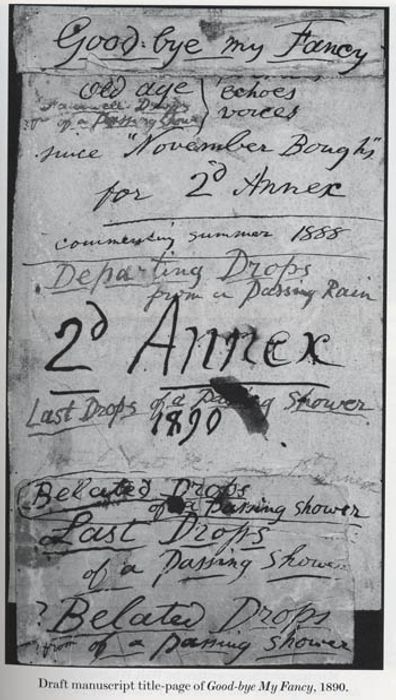
Note (): Return to text.
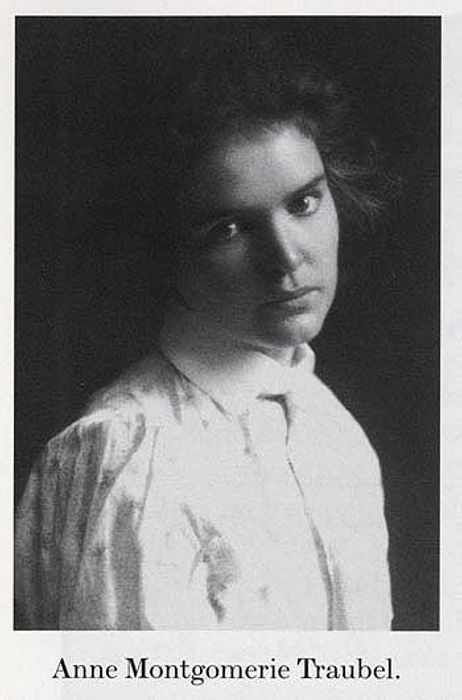
Note (): Return to text.
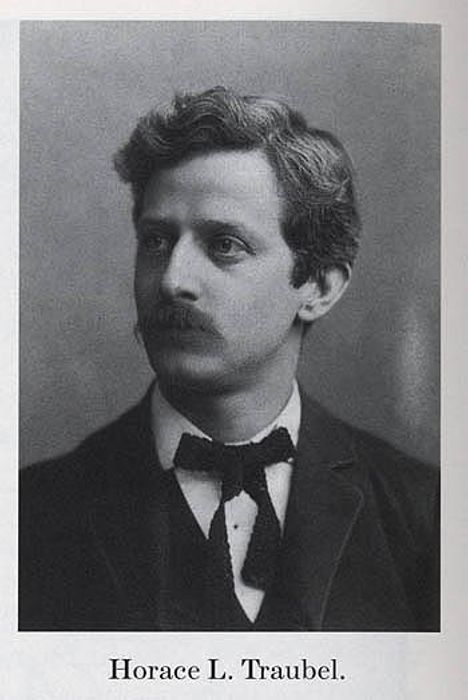
Note (): Return to text.
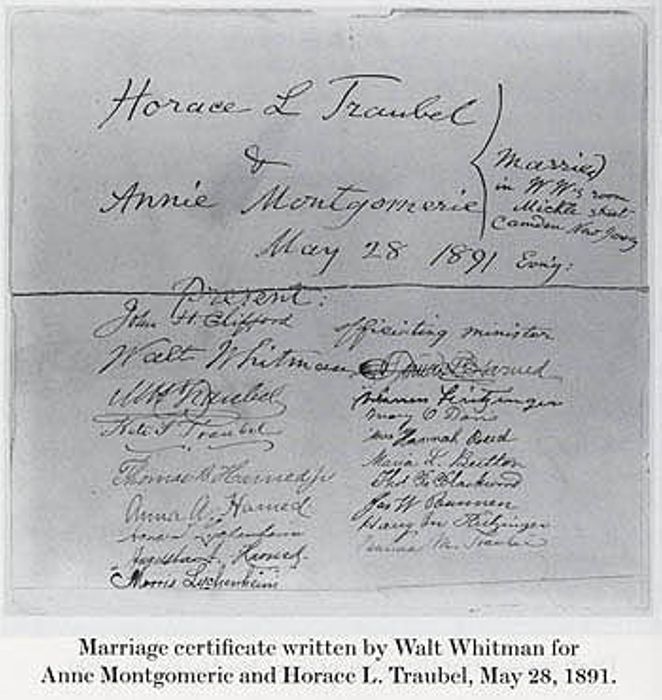
Note (): Return to text.
![Samuel Murray, Thomas Eakins, William O'Donovan, and Harry the Dog [with O'Donovan's bust of Whitman in background], c. 1891-93.](https://whitmanarchive.org/iiif/2/whitman-traubel%2Fmed.00008.f07.jpg/full/!700,700/0/default.jpg)
Note (): Return to text.
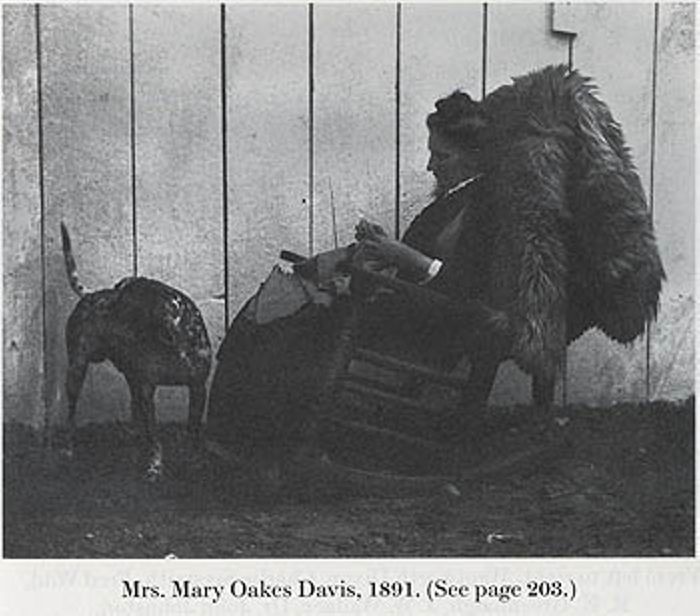
Note (): Return to text.
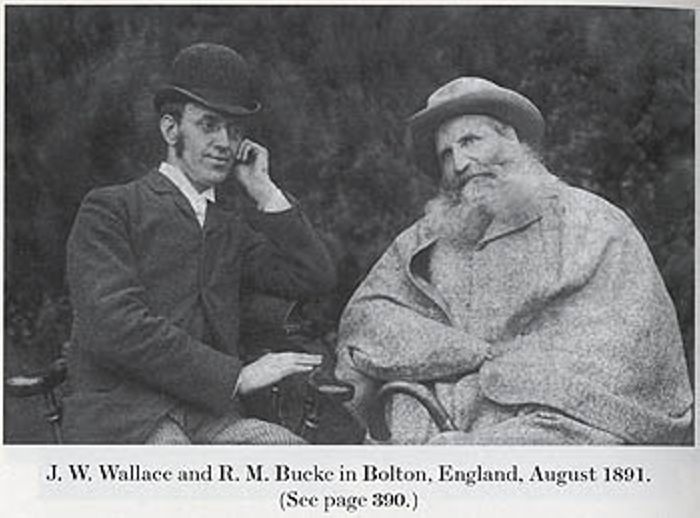
Note (): Return to text.
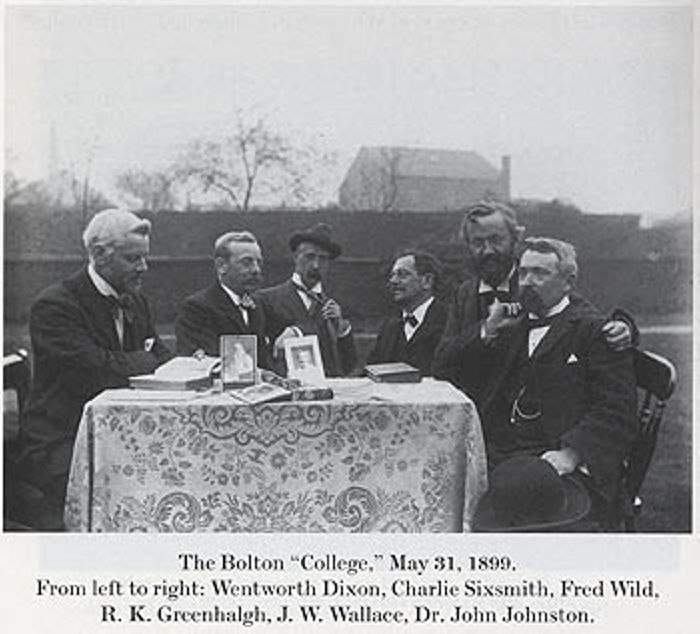
Note (): Return to text.
[Begin page 309]Reeder is having pictures of the tomb printed—W. inquiring closely after them. Johnston has reproduced the O'Donovan photos and sent copies to W.
W. returned me Scribner's. Has been reading Nineteenth Century today. I took his Critic to send to Bucke.
9:50 P.M. Dropt in to see if Warrie had returned. Just in—train half an hour late—had a good trip (in room, now, with W.). Bush and Bucke much together in New York and the two to stay at Johnston's tonight. Warrie's account interesting to both. W. advised, "Go downstairs, Warrie, get your coffee—then come back to me. I need you." Going then, by Warrie's lead, to the bed and commencing at once to undress. "I am tired now, and for the last hour or so very impatient. I ought to sleep well." And so I bid him good night as he sat on the edge of the bed. Warren went in to see Johnston; did not catch Bush; met Bucke on Britannic at five.
Two letters, from Johnston and Wallace, May 5th and 6th. [Wallace writes:]
Anderton, near Chorley
Lancashire, England
5 May 1891
My dear Traubel,
Johnston called on me yesterday afternoon to shew me your kind letter of April 23rd. Now for a few lines in reply.
I note the postponement of your marriage & its cause. No doubt it is now happily over & I wish you joy.
But I devoutly hope that you succeeded in getting a house in Camden near Walt. It would be a real calamity if you were not able to do so. But I trust that the gods have been propitious.
All honour & blessing to you for your devotion to him! And all success to you in your further ministrations!
I infer from a passage in your letter that you, too, are a "poor" man as I am myself. Let that serve as another bond between us!
I know its drawbacks from painful experience. Perhaps in broken health one realizes them most—in the need of leisure & the means of recovery.
[Begin page 310]
But (in its ordinary sense) it is only a very secondary matter after all. The true riches are quite independent of material good, and it is no mere paradox when Emerson speaks of "the rich poverty which men hate." Think of the long roll of illustrious names of those who—wise & powerful & richly dowered—have enriched the world, yet have been in life poor and obscure. And—even more—think of the countless myriads of common men in every land, all times, who have lived hard lives of toil & poverty & ignorance, yet have lived serenely & cheerfully, & happily too, in love & hope & faith.
"If happiness have not her seat
And centre in the breast,
We may be rich, or wise, or great,
But never can be blest."
And has not our dear old friend ennobled poverty & the common "average" life for ever? He has deliberately chosen that life & made it his own, that he might make it illustrious—that he might show it eligible to the highest—in happiness, in dignity, in ideal aims, in daily practice, in rich & many sided culture (true culture), in all-encompassing charity, in far-reaching influence, & in everything that deepens & enriches personality & makes life joyful & serene.
In old days it used to be considered an honourable ambition to be "a poor gentleman & scholar." Perhaps in our day the need for such a class is greater than ever.
And, anyhow, if it be our appointed lot we may accept it with equanimity & in illustrious company!
Let us pray only, as old Socrates did (according to Plato) "Grant that we may become beautiful in soul, & that all that we have of outward things may be at peace with those within."
Love to you & all good wishes! May God bless all your services to Walt, all your activities, & crown your life, & that of your wife, with ever-deepening & spreading love, true happiness, & serene & lofty faith!
Yours affectionately,
J. W. Wallace
When I asked Brinton for his dinner speech, he replied: [Begin page 311] Media, Pa. June 14/91 Dear Mr. Traubel, First, my congratulations on your marriage. May it bring with it the enduring happiness which ought ever to attend that closest of all friendships, and which in your case is to some extent insured by your just estimate of the importance of the bond. I was away for a day or two & could not send you in time any notes of what I said at the Whitman dinner. In fact, I had no notes, & made no preparation, & do not remember what I did say. Let it go with the usual reference to "appropriate remarks". The bill for the "banquet" is enclosed, $124.50, which is according to contract. I paid it a day or two afterwards, & what you can collect before the 21st, you can remit me. We sail next week for Southampton, which will explain why I cannot come on one of your "Tuesdays". With my compliments & best wishes to Mrs. Traubel I remain Cordially yours D. G. Brinton Yet he was very warm, eloquent, fluent—even his voice, not naturally music, ringing out a melody and feeling rich and high. Many thought it the best speech of the evening.
Bonsall sent his speech and with it this good strong note: Office, June 18. '91 Friend Traubel: Your note of yesterday relieves me. I had to leave dinner to catch a train. Tom Harned and Buckwalter neither could tell me to whom I was indebted, and I couldn't get at you. Find enclosed $5. In reply to Canada note, find also short transcript of my sentiment in as nearly exact words as I can recollect. I think some things said at supper had better have been left unsaid. I do not wish to set myself up as the interpreter of Walt Whitman, but my little talk seemed called for and was given in self-defence and in defence of yourself and all others who think they know what they are talking about. Truly H. L. Bonsall Too late to use in Lippincott's—but can use in book.
[Begin page 312]Wednesday, July 8, 1891
5:45 P.M. Took W. copy of Reeder's photo of tomb. How he seemed to enjoy it! "Certainly it is much better than I expected it could be, much better, which is about all a man can ask—to have the fulfillment exceed his best hopes. That is victory—yes, yes—victory. Reeder is quite an artist—I can see that point of view was studied with great care—taste, too, and a good eye! Now we must have Murray try it—see what he can make of it. Shouldn't we have some copies of this? Say, 20? Well, order 20, we can use all of them. There is even a charm about this picture—even its vague, misty lines seem to suggest an atmosphere—rich (quite rich) and with traces of the setting sun. Indeed, Horace, I count this a success." He examined the picture a long time. Merry over my face, lost almost in the trees on the hill. Moore's knee, too, exposed from the trunk of a tree. Asked me—pointing to table, "Did you see my lilies? Exquisite, eh? A dear little girl was here to see me—brought me these—a breath out of the ponds! Oh! full and full are the ponds!" "I have seen them in their thousands, with heads up out of the water," I remarked. "And I too—and Jersey is especially rich in them. I never knew them in such profusion as not 35 miles from Camden, south." And again, passing his hand over them, "They are a delicious fragrant reminder—they carry me out of this room—away, away."
Copy of Puck with me—cartoon of Wanamaker, "the holy man" (Keppler's), W. regarding it with amused eyes. "How good it is—how suggestive! And who is this in his pocket?" (Harrison.) It made him laugh when I told him. "Do you know, that is Henry Clapp, Clapp exactly. Have you known anything of Henry Clapp? Poor fellow, he died in the gutter—drink—drink—took him down, down. But there was a time when he was an actor—I might say of well-known face, purpose. But that was long before. And there was Ada Clare, too! Oh! I knew Ada! A bright, handsome girl, liking good dress—vivacious—lovely, too, Horace. I liked her well—and she was what in the [Begin page 313] Middle Ages was called the paramour of Gottschalk—Gottschalk, the composer (he was a strong man—a first-classer in his line!). How far back all that seems! And poor Ada, fondling a dog, was bitten, or fancied she was (which is just as bad), by a big dog—bit here, against the nose—and from this, or from the worry of it, resulted hydrophobia—or what passes for it. (The doctors still debate it, as they debated it then: was it not altogether a fiction? And in the meantime people die of it right along!) And Ada died—and then was the last of that tragic experience. Poor Ada! Poor Henry! This face recalled it all." Then W. back to the joyous side of the paper, "These are all very witty—or efforts at wittiness. The fourth remove, perhaps: strained—then the strain strained and so on two or three times more! The odd thing is, that all the little pictures have a foreign air, are not American—improbable stereotyped faces, costumes after a mode, all of them the same." And yet, "They serve an end, too. I do not do more than give this for myself."
I had been examining American reprint of Review of Reviews. Whitman matter not copied there. (I had noticed same before.) W. said, "It is curious—I understand it, nevertheless—how some of our folks here will not, cannot, must not, dare not, see me: have but to ignore—pass by—say no word. It is a point to mark, to consider."
Was I going straight home? "Then take a couple of the lilies to Anne, do not forget—the dear girl!—and with my love." Meanwhile taking them out himself.
"I sent Stead a copy of the facsimile, thinking it might convey to him more accurate notions of the dinner than any of the foreign papers seem to have got. What an idea, that about my reciting, reading, declaring my own poems! An extraordinary delusion: it is the last thing I would do—the very last. As you know well enough."
Johnston and Wallace letters of 26th and 30th May W. "felt greatly luminous. I enjoy criticisms of my work even if I do not feel to justify them. What I see—report—is after all only a segment. I leave the rest of the search for you."
Thursday, July 9, 1891
Three letters of unusual interest this morning—one from Baker, another from Bush (New York), giving glimpses of Bucke's movements there. The following from Johnston surprises and delights me: 54 Manchester Road Bolton, England July 1. '91 My Dear Traubel Just a line to acknowledge the receipt, an hour ago, of your kind letter of June 22nd, & to thank you for it & its good words. Glad to hear such a cheering report of Walt's health. Judging from his postcards recd of late he seems to have been in distinctly better spirits, not that he ever really gives way to low spirits—& I sincerely trust that there will be no more of such hot spells as you have had to "pull him down like a pack of hounds" as he phrases it. Glad too to hear that Mrs. Traubel & you are comfortably settled in Camden & long may you both be spared to cheer & help each other upon your earthly way! I have got the July No. (Engl. Ed.) of Lippincott & am much disappointed to find that it does not contain any reference to the Whitman Birthday "spree." I presume the article will appear in the Aug No. but if it has appeared in the American Ed. of the July No. would you please kindly procure & send me a dozen copies & I will remit the "cash at once." By the way there has been no mention by anyone of the joint letter which the friends here sent to you for W. W.'s birthday. Would you kindly say whether it was received. It was sent along with the birthday copy of my "Notes". Thank you for your good words anent that & glad to hear that it pleased the dear old man. And now shall I whisper a secret which I am fairly itching to tell some of you? Well it is quite within the bounds of probability that J. W. Wallace may pay a visit to Camden this summer! Like yourself he is a poor man but some of his friends have resolved to testify their regard for him by giving him a testimonial in the shape [Begin page 315] of a trip to America & back & already some steps have been taken to carry this proposal into execution. But of course he is to know nothing of it yet & I must ask you & everyone on your side not to mention it in any of your or their letters to us until I give you leave to do so. You can make what use you think fit of this confidence. Tell our dear old Master himself of course—asking him to say nothing. I think it will cheer him. I hope nothing unforeseen will come in our way. But I will let you know something more definite as soon as it is settled. I had a slight accident the other day but am getting over it all right again. Pardon this hurried scrawl. Is your wife of Scotch descent? I have an uncle Montgomery. Thanks for copy of yr wedding announcement. With kindest regards to your wife & yourself I remain Yours sincerely J. Johnston Wallace. P. S. A telegram from JWW just recd says Books & pictures just received. Thank Walt & Traubel for me. No letter. I stopped at 509 Arch on my way down to ferry and enclosed J.'s letter in another of my own to W. (Tillie will deliver). Have at once written Johnston that Wallace must stay with me—this is to be told him immediately he knows he is to come—my part in the gift of travel.
5:50 P.M. To W.'s. Writing a letter. Had patched to the Reeder picture this, written on a slip of white paper:
"You see," he said, "I have given it a name. Has it music, sense? Beth, you know, generically, means the unseen, the way up, mystery. And that fixes us a near-enough significance. And by the way, Reinhalter was here today—he says he would rather not have any conclusive photo taken for a few days yet. There [Begin page 316] seem to be things to fix. I wish you would go on to see Eakins, those fellows—advise them to wait. I think they intend going out. O'Donovan was here this morning—before Reinhalter—else I would have told him. But you will find them in. And I want you to see the bust as it is at this stage, anyway—report to me upon it." I suggested, "May we not go out for a carriage ride Saturday? How do you feel about it?" "Oh! Agreed! Why not? If nothing occurs between today and Saturday to make me worse than I am, I can easily go. Yes, I consent." So I arranged with Warrie to see about carriage—two seats.
W. said, "I was gladdened today by a letter from Bucke—mailed or written seven o'clock yesterday morning, on the Britannic. Have I not showed it to you? No, I guess not—it came only today. I was thinking of something else. Well, he is well-started now—many miles gone—far out at sea. One thing he said was, that the Bolton fellows had cabled, they would either see or he would hear from them at Queenstown. They are royal in all they do." He had written Johnston—I had mailed the letter. Spoke of Tillie's being here—he had invited her up—read the letter, gave it back to her—told her, "Tillie, you ought to come to see me oftener."
We had a long talk about the Lincoln controversy now going on—with respect to Lincoln's advocacy of Johnson rather than Hamlin (just dead now) for Vice-President:
The Times to-day will print the following from the pen of Colonel A. K. McClure, its editor, by whose courtesy the press is furnished with advance proofs of the editorial:
The ignorance exhibited by John G. Nicolay in his public telegram to the widow of ex-Vice President Hamlin is equalled only by his arrogance in assuming to speak for Abraham Lincoln in matters about which Nicolay was never consulted, and of which he had no more knowledge than any other routine clerk about the White House. I do not regret that Mr. Nicolay has rushed into a dispute that must lead to
[Begin page 317]
the clear establishment of the exact truth as to the defeat of Hamlin in 1864. It will surely greatly impair, if not destroy, Nicolay's hitherto generally accepted claim to accuracy as the biographer of Lincoln, but he can complain of no one but himself....
I now repeat that, in obedience to a telegraphic request from President Lincoln, I visited him at the White House the day before the meeting of the Baltimore Convention of 1864. At that interview Mr. Lincoln earnestly explained why the nomination of a well-known Southern man like Andrew Johnson—who had been Congressman, Governor and Senator by the favor of his State—would not only nationalise the Republican party and the Government, but would greatly lessen the grave peril of the recognition of the Confederacy by England and France. He believed that the election to the Vice-Presidency of a representative statesman from an insurgent State that had been restored to the Union would disarm the enemies of the republic abroad and remove the load of sectionalism from the Government that seemed to greatly hinder peace. No intimation, no trace, of prejudice against Mr. Hamlin was exhibited, and I well know that no such consideration would have influenced Mr. Lincoln in such an emergency....
I ordered the 20 copies of tomb photograph at McCollin's.
Friday, July 10, 1891
8:05 P.M. Warrie went up with me (playing cards with Harry in the kitchen)—W. on the bed. I closed blinds—Warrie lighted gas—W., who was on bed, got up and was helped across to his chair. What was new? Bush had stopped in to see me (now en route for Baltimore—goes tonight). We had gone to Eakins' studio together. There for well upon an hour. Found O'Donovan had been in Camden again today. W. had delivered his own message from Reinhalter. The fellows will go out in about ten days to photo tomb. O'D. said he had talked with W.—got his consent to be photoed in front of tomb. I fought the idea—it was a stalking horse business—not like W., etc. But O'D. firm. Now, when I refer to W., he says, "You are right—O'Donovan is wrong: I did not consent—I was simply silent. He thought silence breathes consent! On the contrary I am opposed—bitterly opposed—would not do it—it is impossible, impossible—out of keeping, utterly. I shall have to tell O'Donovan so—make him understand—though gently, too. I feel I owe a good deal to the goodness of those fellows." What about bust? Better, but not broadly treated—not equal in treatment to the Eakins or Morse interpretations. W. said, "It would have to be out of the commonly grand, even, to beat Sidney's—or even reach it. And by the way, Horace, you wanted one of them, didn't you—one of Sidney's—for your house? And a Cleveland? Well, take them—take them any time." No photo of the bust yet (O'D.'s), but I would get Reeder to photo the Whitman when I got it up to the house.
[Begin page 320]Eakins thinks Tom Harned has a good deal of feeling about Bucke's getting the Whitman, but sees Tom had all the chances in the world, through years, to get it himself. I explained all to Eakins in a way to satisfy him. W. says, "Tom is high-spirited: he is one of the terriblest fellows I know to be beaten—hates to be beaten—won't be." And yet to be mollified—amenable to that? "Yes, very mollifiable—that's the other side of him. He will finally understand about this." Eakins said, "I hate to see the picture go out of the country: it ought to be here." "But Bucke contemplates coming here before many years himself." "Oh! does he? In that case it is all right." W. says, "I am glad you told him that—it is well for him to know." Eakins has a portrait of Tom laid out in strong color and lineaments. I think it will be a success. He told me he thought their dinner night a great opportunity for O'Donovan, who had not before, and probably would never again, see W. in that mood and pose. O'D. goes to W. and studies with wax. He asked me, "What value has Bucke's book? Any at all?" I responded, "In all its biographical features—in all explicit, implicit things—it is authoritative—it came out under Whitman's own eye."—"But what of Bucke's judgment? I don't think I would like him. Is he a man whose judgment is safe?"—"That part given up to his spiritual estimate of W. you must take or not as you choose. I accept and oppose Bucke, as I do any other man." W. now says to me, "What the devil has a man's judgment to do with whether you like him or not? You were right to take the ground you did. These fellows, none of them—few of them—can take in a man like Bucke, without varnish, veneer or any of the show-parts. And now I want to ask you something, Horace, which this brings up. You remember in the dinner talk, how, at one place, I put in almost unqualified endorsement of Dr. Bucke's book—then turn round and say, but as to his explication—no, no, no—that I do not accept—for 'Leaves of Grass' baffles me, its author, at all points of its meaning—so that things perhaps plain to Doctor are not so plain to my mind. You remember, that was what I in effect said. I have been reading it over lately, and it occurs to [Begin page 321] me that I might have been raspy—raspy—in the assertion of my independence. How did it affect you?" I had had no such impression—nor had Doctor. "I did not think Doctor had—he would not see it that way, even if it was raspy—the good man. But how would it appear to others—how even now, to read it?" And then, "You see how it is: 'Leaves of Grass' is a mystery to me—I do not pretend myself to have solved it—not at all. Doctor starts off with great vehemence to assert—'Leaves of Grass' means this and this and this and this and this—oh! stamps it down with the hammer of Thor! But even he, much as he really does know about it, has never caught this—that 'Leaves of Grass' never started out to do anything—has no purpose—has no definite beginning, middle, end. It is reflection, it is statement, it is to see and tell, it is to keep clear of judgments, lessons, school-ways—to be a world, with all the mystery of that, all its movement, all its life. From this standpoint I, myself, often stand in astonishment before the book—am defeated by it—lost in its curious revolutions, its whimsies, its overpowering momentum—lost as if a stranger, even as I am a stranger on this earth—driving about with it, knowing nothing of why or result." Again, "This way, you see I am spectator, too. And here alone do I fall short of endorsement of Doctor's book. I wanted to make that plain—yet not to set it down hard and fast—not to drive a sharp sword."
Reinhalter in today. W. gave him a check for a thousand dollars on account. Said he, "The bill staggered me. I had expected a matter of a couple of thousand dollars, but this is literally a stunner. But," after a pause, "the job pleases me—it is done as I wanted it done, and that is about all I can ask." Left with him Reeder's own blueprint from tomb negative—better, more luminous—and wrote McCollin a postal, as I sat there, to make them lighter—print them so. W. at once admitted, "It has more atmosphere—is less monotonous—goes farther."
Would he take the ride tomorrow? "Yes, unless I have an upset before: I never can tell from day to day how things will turn." Arranged with Warren for three tomorrow afternoon.
[Begin page 322]Mrs. O'Connor urges me to come to Washington at once. Showed her two letters to W.: "It does my heart good to see her hand again." And, "You should go: it may open the way to many things for her, for you."
Saturday, July 11, 1891
3:00 P.M. To W.'s precisely on time. Anne in soon after. Warrie then went for carriage. Meantime I went upstairs for a few minutes—saw W.—found him on bed. Left proof with him—inscription for tomb picture. I did not like it—do not believe he will. Did not, however, disturb him, and he appeared grateful. Soon Warrie—soon the toilsome trip downstairs—at foot, meeting Anne, called her "darling" and "dear" and kissed her, talking gracious and grateful things. Promptly to carriage and off. Anne sat front with Warrie, I back with W. Talked but briefly, monosyllabic at first, but was soon more disposed to go into particulars. Waved his greetings right and left. Many people seemed to look with astonishment, many seemed to know him, some would stand still and gaze as we passed, some would return his salute easily, gratefully. Out on the road a darkey coaxing a dog. W. humorously asked, "Is he coaxing him honestly or is there a whip back of it all?" Pointed out features of the country to Anne, to whom it was new. "Moore expects us," he said. "I told him yesterday our visit was pretty positively set." Thinks a good deal of Moore's plainness and knowingness.
Moore met us at gate of cemetery and afterwards went with us to the hollow. The debris about the tomb pretty well removed. Door not closed. Moore doubtful about the door. Would it not some day be irrevocably open or shut? W. laughed, "That would be a queer attitude for it to assume, Ralph, queer—but likely, too. Anyway, it has its solid front, its admirable solid front. And Ralph, the photoers will be out about Monday a week—ten days. I think I should like to have it taken door shut—close shut. You will remember that?" Got out of carriage and Moore and I led him painfully up the hill. Anne and Warrie meantime in the [Begin page 323] tomb itself. "I have never had this view—never seen it this side." Yet went up and up—finally to show us that he had his private purpose there. "You will excuse me a minute? You know, always physiology first—its claims resent to be pushed aside!" Afterwards led about, inspecting variously. Moore says all the loose pieces of granite have been taken away by people as souvenirs. Gives me a big slab of marble to take away—a piece left from the crypts. W. says to Anne, "I feel most of the time as if I ought to be deposited there, rather than be anywhere else—rather than be here viewing it." We drove a little about the place, W. giving Anne particulars—pointing out the glimpse of Cooper's Creek through the trees—speaking of Moore's "extraordinary good sense for a man in his place." Moore says they will allow no other vaults down in the hollow near W.'s. A granite slab up on the hill—W. said to Warrie, "Stop a minute—let me look at that." It was rough except for the polished surface used for the inscription. W.: "That is Walt Whitmany, to be sure—quite our kind—yet, true to the old instincts, he has had a part of it polished, too. But it is on the whole very good—just as it ought to be." On the way out we stopped at the gate some time, to talk with Moore. I asked if they allowed marble on the hill (noticing it was all granite). Moore replied, "No, marble has no modesty," etc. This struck W. "I don't suppose any other cemetery man in this country—in the world, probably—would have dared to use that word in just that way." And several times on our way back spoke of it, "What a good word—how nobly applied! 'Modesty'—the marble has not 'modesty'—that was an exquisite turn!" Moore quoted "The Midnight Visitor," W. speaking of it in a little different way than before. "The thing was translated for me conversationally by a Frenchman, then I put it freely into that shape—even the title-head is not mine. The poem always impressed me—took hold of me—yet I could not have written it—it is too morbid, too much in the lower key—it would not fit with 'Leaves of Grass.' I made up my mind from the first that at a time when all literature was sickly with plaints, moan, sillinesses, I should not add to the great stream—the result being, I [Begin page 324] think, that I have a book healthy with the first health of nature—or intended to be. Though we know well enough—you know it, Ralph—how little the best fellow can do for himself after all." On the road—at Liberty Park. "Here are my lots—I like these—I'll come out some day and buy half a dozen." And, "This is all name and no park." W.'s trip did not seem to exhaust him, though it told on him. While he stood at the grave he seemed very pale and worn and weak. Once home, he went straight to his room—sat by the window, dropt his face in his hands.
W. wished to stop at Dr. Garrison's house, Benson St. Warrie drove there. The nurse came to carriage—then had Garrison come to second-story window. He and W. saluted—tried to have some talk together, but it was not very successful—Garrison finally sending down word that he was allowed to sit on the porch forenoons, and W. should come then and they should have a talk. When we left W. said, "The Doctor looks natural enough, but far gone."
Took copy of Morse's bust and the Cleveland home in carriage after the ride.
I wrote Woodbury the following letter: Your letter to Walt Whitman, which he has shown to me, has raised this question in my mind, whether my inference be true, that you will expunge the paragraph or paragraphs referred to rather because they seem to you to be a cause of pain than because you admit them erroneous or untrue? There is a vital distinction inherent—since the ground on which Whitman objects to them is the ground of their untruth. I have thought to address you this question frankly, not doubting but that you will see that it was the natural outcome of your letter. Read to Clifford, who was in to see me. "It is a clincher," he said, "It makes for the heart of the matter." Bush in in the evening—from Baltimore sooner than expected.
W. still reading the Lincoln matter, saying, "I adhere to my opinion of the other day—that McClure is right. I have no question of it at all."
[Begin page 325]Sunday, July 12, 1891
To W.'s with Bush about ten, but W. was not yet up. I then to Philadelphia—taking a long walk with Reeder and Gilbert up to Hammer Hollow and the King of Prussia and back to Philadelphia 52nd Street—walking 23 miles. Eakins and O'Donovan spent evening with Harned. Bush to W.'s again near six, having then "a long beautiful talk with him alone—the first I ever had." No evil effects, apparently, from the drive.
From the Bolton Evening News, June 29th, 1891:
Monday, July 13, 1891
5:50 P.M. W. reading—looked rather dragged out. The day had been very hot. "It is the most oppressive of all—the most. I have spent the day in the chair—on the bed—without the least comfort anyway you put it." Asked me, "Well, did Bush get off? Yes? [Begin page 326] He was here yesterday—we had quite a long talk together. He seemed to enjoy it." Clifford in Camden but had not stopped at 328. His quest of W. the Sunday previous with a young lady unfortunate—W. not seeing them. O'Donovan and Eakins had not stopped yesterday. The first here again today "with his wax," W. said laughingly. July issue of Magazine of Art before W. (it had come from Bolton). He was "much charmed" by its illustration. Turned to an open copy of Century—picked it from the floor, "Look at that! Do you think better ever was? That is the General, out and out—to the bone—if not to the heart." Pointing to the reproduction of St.-Gaudens' Sherman (the General). "I think the reproduction, too, about perfect—it is so strong, so full of atmosphere"—photo-engraved. Incidentally, too, "No, I don't put Sherman in the first rank. I would speak of him in military lines as I would of Longfellow in literature. Longfellow was high up, but topped—others way beyond. He was no bit of an Emerson, for instance. No, Sherman came less than first-classers. There was Grant, I think him the best—he typifies so many things—towers, tops, stands ever alone!"
W. asked, "When you leave will you go direct home? Well," glancing about him, his eye falling on a lemon nearby, "take this to Anne, the dear girl—tell her I remember her." Then, toying with the lemon, "What a color it has! The sun's—strong, fine: it attracts me. How do simple trifles—the merest accident, often—arrest, appeal, command!"
Again, "How often have I seen Sherman! Yet, so far as I know, never spoke to him. Yet there was a time when I was in the Washington swim—knew every cranny and corner of affairs, and persons, and events as they transpired. Some unfulfilled, unknown, secret events, too! All the passion, victory, defeat of long, long, long years!"
Told W. of our walk, he being in every way interested. "Why! it comes close to my old walks, long, long ago—brings the whole thing back to me. Oh! the exhilaration of such freedom—the going and coming—the being master of yourself and of the road! No one who is not a walker can begin to know it!"
[Begin page 327]We talked about lecture. Could he undertake the Lincoln in the fall? He smiled, "The hundred dollars or so would be tempting, but you know, as I know, now, that I am not any longer in shape to take risks—have but to sit here—wait, wait—husband, husband, husband."
Wished tomb photos cut circular and put on a square card. Had curiously expressed his notion by cutting his circle on the yellow paper—mounting on photo—with descriptive lines:
To head plate printer
Can't you make me a photo: cut plain round like a full moon or silver dollar and mounted on ab't this size card—of wh' this is a (crude) suggestion and sample?
Put lines at bottom of photo and show taste in space—not too near, & not too low.
After printing six (6) with the line "U S America" take out the line and print the rest (14) without it
(the photographer, Dr Reeder, says the plate will show better by being printed middling light—I leave that to y'r taste and judgment.)
WW
[Under the round frame and photo W. wrote:] You see this sample is all askew yr own judgment will carry you right
Asked, "Did you see yesterday's Record? They tell me something appeared there about us—a fling, too, if I am rightly informed. Perhaps you will look it up?" (I found a postal from Law at home to the same effect later.)
Tuesday, July 14, 1891
8:00 P.M. W. as usual on bed—Warrie closed blinds and made a low light. W. very cordial to me—extending hand, "And how are you?" I said, "Just the same—no change: that is the one point on which the Catholic Church and I agree—semper idem." W.: "Always the same! Good! Yet damn semper and the Catholic Church with it! Nothing, for them, is more untrue than that [Begin page 328] motto—instead of being always the same, it is always shifting—always accommodating itself age after age to new forces—never till it has to, but always then—to come sneaking up at the rear and claim leadership! One of the curious things is to see the new pope coming in line with democracy—or pretending to; trying to make himself, his church, consist with the fact of America. Can they hope for anything here? I don't think so: the stars in their courses are against them—the wisdom of America—its spinal thought, deed—says no to Catholicism, the priests—casts them back, back, back into the past, into dead history—not willing longer to have their stupid superstitions, slavery. Oh! Horace, you will live to see new battles fought out. I am now pretty near the end of my own history, but mark what I have said—it is the gospel of our democracy—the necessity of our future!"
I received this letter from Johnston and Wallace today: Anderton, near Chorley Lancashire, England 3 July 1891 My dear Traubel, Your extremely kind & fraternal letter of June 22nd to hand yesterday morning. The 6 "Good Byes" & portraits recd the previous evening but too late, for the mail from here. I must content myself at present with the briefest acknowledgement of these but will write again for next mail. Lifelong & ever increasing & deepening love & joy to you & your wife. Surely you must have felt that a marriage solemnised so, in the loving presence & with the heartfelt blessing of Walt himself, received the visible benison of the Highest. God bless you always. With love to you & all good wishes to you both. Yours affectionately J. W. Wallace PS by J. Johnston We have told Wallace of the proposal mentioned in my last letter to you but he says No to it! I have also told Walt about it & asked him to say a word. Would you do the same please. [Begin page 329] Everything has been done in the way of making his passage clear we only want his consent & the only reason he urges against it is his fear of the excitement upon him. He is troubled with nervous debility—or rather a lack of nerve energy & any excitement prostrates him afterwards. But I think the long sea voyage there & back would more than counteract that & I think it wd be a joy for the old man to see him & a lifelong memory for J.W.W. We must wait & try again. With love to Mrs. Traubel & self Yours in haste, Johnston Anne and I both wrote at once, urging the trip. W. received word to same effect. Said he, "It is curious how these English fellows give way to their imagination—let fly without restraint. Johnston, like the rest, is clever enough—full of loyal love, too—yet comes here, sees very little of us, stays a few days, is decently treated—nothing extra any way put out for him—and goes off, doubling, at least, on everything—making it out that he met with the most splendid hospitality in history. Should Wallace come in the face of that, it might not be altogether fortunate. And there is the physical reason, too—I am not sure but the decision not to come would be the best. I can see his condition—the nerve-centers unusually sensitive—the need of calm. And would he get that here? Perhaps I would even advise against—it may do him such harm." I argued, "You can't tell—Johnston thinks the sea-trip will do him good. Besides, everybody says, don't urge Walt Whitman—give him no dinner—yet you are better after every dinner." W. laughed very heartily, "There does seem something of that sort. I acknowledge the doubt. It is a thing, perhaps, not to be known till tried. And anyhow, whether or no, he will come—this is the first flush, the early negative—he will get over that—they will make a fresh onset—he will risk the worst." I still urged, "He has the one best reason which does not appear to you as to him—the need to see you—the exhilaration of meeting and knowing you as a healthy, living body." W.: "I can realize that abstractly without [Begin page 330] connecting it with my own person. Yes, I see it." "And further," I said, "he may find peace here. I never come to your room but I leave all care at the door—you always give me content, ease, quiet, elevation." W.: "That's Pearsall Smith, too, he used to say that. Is it so? Can it be so? And that reminds me, Horace, I feel lately that the Smiths—Mary, Alys, Logan, Pearsall—all have gone back on me—let me alone—got offended at something said or not said—moved off. Time was, I got a couple of letters every week from one of them—now for three months I have had no word at all!" "Dr. Bucke," I interposed, "says that Mary Costelloe is killing herself." "What? What's that?" "Killing herself." "What does he mean?" "By too much deadset-ness for reform and all that." "I have had a suspicion of the same thing myself! It is duty—the damnable sense of duty—it runs away with some people—takes everything from them—ruins them at last. Poor Mary!" Repeated to W. something Ingersoll once said to me in a talk, "Traubel, I don't worry myself about doing things—doing philanthropies, good deeds, as people call them. My business is to be—the rest will come as a matter of course, a necessary incident!" W. exclaimed, "How grand that is! How it goes to the marrow! How quick, subtle! After that, nothing remains to be said." I quoted likewise Emerson's "What right have you to your one reform," etc. W. again, "Yes, that is the old man! How often he gives us such superb dashes!"
Stoddart writes for me to come to see him about pay for the article. W. says of him, "He has been a genuine friend—the one tree in the field after the tempest of recent years! Ah! Horace, you can know, I know, how important his work—the past work, the dinner—other things, too; with them, what Stead feels to do in Review of Reviews! It is a lift—a passage over dark days. Your New England piece is liked because it betrays the critter himself. I can fully enter into its influence." Further, "All these items enter into the force we have set at work. The future, the future—that is the thing!"
[Begin page 331]Saw McCollin about picture today—they will do as we wish. W. has been reading Current Literature—which I left with him Sunday. Referring to his own condition, "I have got round the cape—several dangerous voyages—on Stevens Street—here—part by good luck, part by other reasons. But what of the new dangers? There'll come voyage—storm—wreck—now before long!"
W. continued on the bed throughout my stay.
Wednesday, July 15, 1891
5:49 P.M. W. returned me Current Literature. Sonnet there by Realf. "Yes, I read it—it is fine. I always read Realf, poor fellow!" But, "I never met him—our ways never crossed." He wondered, "Do you suppose Lippincott's has a larger clientage than we would be apt to set down for it? I feel it—feel it with a sort of positiveness. Anyway, they treat us handsomely—frank, noble, generous. And, Horace, shouldn't we testify to it every way? These days, when others are shutting us out, it has a great significance, value. I want every way to show Walsh and Stoddart how thoroughly all this filters through—becomes a part—of us. Why shouldn't we send them over one of our big books? One for Walsh, one for Joe. Yes, let us do it—do it now: go to the box if you will—take them yourself." And so I took two. But he would not write in them, "It might be, they would not like it—no, it must get very chestnutty to them—books of all kinds, from all points of the compass, with all sorts of inscriptions."
On the table a beautiful photo of the bust—O'Donovan at its side—certainly evidencing great improvement. W. said, "It seems to me too hunched. Of course, I don't know how I look—yet as I know myself, if I know myself, my head don't set so on my shoulders." I said, "I felt as I looked at the bust as I feel now, to see it here—that the head is too intellectual." W. at once, "Yes, that is so—a sort of Theodore-Parkerish look. I am quite confirmed to that view. And again, don't the head seem too [Begin page 332] broad—too much of it this way"—lifting his hands up to his cheeks. "But O'Donovan claims he is not done yet—will work out the rest of the month—put many touches more on it. Warrie was over today—O'Donovan sent this picture by him. Warrie saw Tom's picture, too—says it is a great hit." But "whatever the me, that is an excellent picture of O'Donovan himself—excellent." Hopes the word left with Moore, that when the fellows go to photo the tomb they will have the door shut, "will be sacredly regarded"—for—"somehow, it is my superstition that it more fits the case, door shut than open." Counselled, "Try to get in from time to time—see the bust, advise with it—you ought to be able to do some good, knowing me as you do."
W. exclaimed in our talk, recalling Ingersoll's "to be" (yesterday's), "That is bedrock—that is truth absolute: the right arm of God!" Said to me, "Some time ago, someone—I think his name Chace—wrote to me asking for some sentence, communication, note, what-not, about America. He was getting up a brace of opinions—a whole series—here and there. And they were to appear in the Herald. I sent about a finger-full, no more—a sentence or two—but have heard nothing directly about it from that day to this. Last week I got a note from some fellow up that way—I think, Newark—who says, 'I see you remark so and so in the Herald,' etc. Which suggests to me that the matter has appeared. Can you look it up a little? I haven't much curiosity—yet have some, too." This reminded me of the Record, which I had bought, containing the "fling" he had spoken of.
He laughed, "Well, that's odd—queer—and it's just as well to know how you stand with these fellows—though knowledge have no other value."
I had made up a sheet of clippings for him to examine. One item the Swinton Tribune paragraph—another the Toronto Mail's republication of "The Midnight Visitor"—third the New York Observer's (Presbyterian's) print of same poem with the following stupid comments:
[Begin page 333]
"Whose steps are those? Who comes so late?"
"Let me come in—the door unlock."
"'Tis midnight now; my lonely gate
I open to no stranger's knock.
"Who art thou? Speak!" "Men call me Fame;
To immortality I lead."
"Pass, idle phantom of a name."
"Listen again, and now take heed.
"'Twas false. My names are Song, Love, Art.
My poet, now unbar the door."
"Art's dead, Song cannot touch my heart,
My once Love's name I chant no more."
"Open then, now—for see, I stand,
Riches my name, with endless gold—
Gold and your wish in either hand."
"Too late—my youth you still withhold."
"Then, if it must be, since the door
Stands shut, my last true name do know.
Men call me death. Delay no more;
bring the cure of every woe."
The door flies wide. "Ah guest so wan,
Forgive the poor place where I dwell—
An ice-cold hearth, a heart-sick man,
Stand here to welcome thee full well."
Walt Whitman
There is something very sad in the foregoing lines of Whitman, and they stand in striking contrast with the thrilling words of Pope in his "Vital Spark of Heavenly Flame," and of other poets who have uttered words that were more than a welcome to death, being suggestive rather of conscious triumph in life's last hours. In reading the closing
[Begin page 334]
stanza of Whitman's poem one recalls the pathetic wail of Byron's "My Days are in the Sere and Yellow Leaf." How different is the effect produced on the reader by the words of Young:
"The chamber where the good man meets his fate
Is privileged beyond the common walk
Of virtuous life, quite in the verge of heaven!"
Cheerfully does Longfellow sing:
"There is no death! What seems so is transition;
This life of mortal breath
Is but a suburb of the life Elysian,
Whose portal we call Death!"
The following paragraph quoted in Critic. [See paragraph re "The Midnight Visitor," pages 304-305.] W. says it is undoubtedly from John Swinton. "That's the good Swinton—his tone, fact. No one else could have written just to that effect."
Word from Baker again, who expects Ingersoll back in New York. Shall I go over? Problem. W. said, "He is a bird of passage."
Thursday, July 16, 1891
5:40 P.M. W. on his bed. (When is he not on his bed nowadays?) Yet talked well—not asleep. Johnston sent him Magazine of Art. Much interested in a series of Thackeray pictures therein. "I sent the copy to Herbert Gilchrist, feeling sure it would serve best in his hands."
Stoddart sent me this note the other day: "Can you call in here on Thursday in reference to the pay for the article
[Begin page 335]
'Whitman's Birthday'." Went there accordingly—delivering big books. (They are not yet moved downstairs—will not be.) Both pleased, but wished after all that W. had inscribed them. W. announces, "Well, let them come over. I'll write what they think best." Walsh says Egan has been again in town—gone, too—but will be back again in a fortnight—they proposing then to get over to see W. Walt tells me, "They will be welcome. I am willing to see Egan. How now and then good fellows escape our best vigilance. I have often thought I might meet Egan—have looked for him here and there in literary crowds—but no fortune, no fortune! Once or twice—more than that—he has struck a very high note, very—showing the genuine fire." Stoddart paid me $50 and sent to W. by me $20 for his page. W. protests, "The good fellow! It is too much—I hate to take it!" Stoddart deducted $10 from my payment ($60) to pay for our copies of magazine. W. had made out a list with 25 names. In the patchwork of paper was this, evidently a dismissed alternate for "Good-Bye" title-page:
and other songlets
To taper off Leaves of Grass"
Each hot day he asks me (it is invariable), "This is the hottest day yet, eh?" But today was really modified.
W. read with old-time fervor a couple of letters from Mrs. O'Connor. "They give out more cheer—as if she was getting her poise again! And you will go?"
Friday, July 17, 1891
Another letter from Mrs. O'Connor about trip: 112 M St. N. W. July 16. 1891. Dear Mr. Traubel, All seems to promise well at this end; for you to come for — coming Sunday. I shall, as soon as I hear from you, arrange for us to see the three gentlemen. I will also try to get off for Monday. Can you stay over? and how early do you get here? on Sat. Get a roundtrip ticket, as by that, you save some money, & it is good for some days. Let me hear as soon as possible. Yours hastily, E. M. O'Connor. [Begin page 337] Baker telegraphs me as follows about the Colonel: "Impossible to see Colonel Saturday and Sunday. Not here today. He lives up the Hudson. Write you fully. I. N. Baker."
To W.'s with Morris, arriving 5:10. Morris stayed in parlor, I went up. Warren off for carriage. W. on the edge of bed. "I am trying to gather myself together," he said. "It is a struggle—has been a damnable day—horrible—one of my worst." Looked bad. "I have been debating with myself whether I ought to go out at all. If you say so, I suppose I must"—laughing—"but I don't feel the least certain about myself."
"Cablegram this morning before I was up—from Bolton—to say Doctor had arrived all right. Although we expected him to arrive all right, we are never sure till sure!" And then heartily, "Joy, shipmate, joy!" Calls attention to letters from Johnston and Wallace referring to Wallace's trip. "They are brave hearts! None braver, truer, loyaller, this planet, any planet!"
Clifford in to see me this morning. Has a letter from Furness to Childs—looking up work. Would W. likewise introduce him? But I found W. in no condition to be urged on that point. "You know, Horace, I recommend nobody—object even to letters of introduction. I must think it over." I suggested, "I will let you alone—let you rest—till Warrie comes." He to that, "Good, I will take what advantage of it I can"—laying down again as I went to rejoin Morris. Warrie however very soon along. W. immediately down with him, toilsomely—greeting Morris in hallway—then to carriage. Left leg helpless, almost—got it into carriage—could not shove it along. "Give it a push, Warrie, give it a push"—which set him straight. Morris behind with him, I in front with Warrie. Morris spoke of his "looking well." W. then, "But I don't feel well—feel the worst—my damnablest." Warrie hurried off at a great pace—W. stopping him. "Warrie, you are trying to shake the life out of me." Called attention to things as we passed along. Much interested in rows of new houses on Benson Street. "They are very pretty." Kept saying, "I am blind, anyway"—as usual—yet we rallied him a good deal on the improbability of the fact. There was a group of geese tramping over [Begin page 338] the lot—30 feet off—and he exclaimed, "A band of dirty geese!" —noticing the dirt on their legs and bodies; and saw a little midget—some distance in the doorway—missed by Morris, "Ho! little darling—how are you?"—and remarked the fences. Once, "Yes, that is the distant—but look at the near beauty—field, hedge, bush—all about us." All the small and simple things attracted him—he saw them well enough. We passed the Cooper Hospital both ways, "This is the most vital realization of the Quaker spirit." Then describing to Morris the Cooper family—the queer maiden ladies and all that. Passing the children's home he asked, "There are some children, but where are the real little ones?" We just then espied them in the rear grounds. "Oh! There they are—the darlings! That is right—under the trees—on the grass!" Further, "It is a good institution. I have been here. One of the grandest features about Camden is, the amount of its voluntary good-doing—that is, good things done apart from organization, government, taxation. Dr. Taylor tells me, the doctors come out here, volunteer, charge nothing." On the road looked at his "lots" again, as he calls them. Stopped Warrie so he could see a sign with name of agent. At the tollgate asked keeper if he was interested—could "talk" lots—inquired cost—asked, "Well, yes, send the agent to me. Any day—I am there any day." Afterwards adding, "With the park opposite—if we get the park—it would be grand." What was cost? etc. "I design to buy a block of lots."
"The land all across there to the creek is just a bit left by Providence for our use—not a house on it. But will the legislators be wise enough to take their chance?" Described the creek to Morris. They kept up a pretty big talk in the back seat—M. most lively. At cemetery entrance Moore came out—greeted us. Then we drove down. Half the stone wall of the hill up—the other half to be finished tomorrow. W. did not get out of the carriage this time. Talked considerably with Moore—Morris and I examining things—afterwards with us. Spoke of, "A very elegant mansion on the hill over there beyond the road—built by Da Costa—long, long ago—somehow related to the doctors we know of that name."
[Begin page 339]W. developed some talk about the dinner report—Lincoln Eyre's part—W. asserting, "It was a faux pas—yes—led nowhere—came from nothing. Had little or no importance anyway—was especially out of place there. When Horace showed me his make from the notes, I drew my blue pencil through it, by way of suggestion, but he thought best to retain it—thus it stands. Bob Ingersoll was the first to throw it out—it was Bob." I laughed—said, "But you know how he said it there at the Lafayette—putting one hand on your shoulder and joking it out." W. merrily, "Yes, I guess that is so, but Eyre made a very serious thing of it. If I had been in a mind to be short or extreme, I might have quoted 'Consuelo'—when the girl is accused of not being married and exclaims, 'Mercy me, I have been married the matter of 20 times!' or to that effect." I put in, "Though that would be to give you away badly." He with a further laugh, "Yes, that would be the penalty." Then finding Morris had never read "Consuelo," he gave him much counsel to do it—"in English, in French, any way. You ought to know it. It cuts a great swathe." "It is simple as truth, profound as simplicity," I put in. W.: "What is that you say, Horace?" And then, "A noble saying! And Harrison, if you want to read the book, you may take the copy I have, on one condition only—that you take good care of it! It is old—in several volumes—belonged to my dear mother—was read by her—probably, too, by 50 others—is a translation of the first order."
Moore spoke of having the builders give us some sort of bond that the door will hang—seems doubtful. Mentioned that he could bring some loads of pebble to case on the road to the tomb. I opposed: let us have the earth natural to the place! This seemed to commend itself to him. Before going out on the road we drove about the cemetery—even off into the farm to the south—Warrie nearly given an upset on a sharp turn (is not an expert driver, by any means—the contrary)—then to the road again. Morris laughed at the New England pronunciation "carlm" for calm, W. quizzically, "Isn't it calm? I thought everybody pronounced it calm!" At one point on the road exclaimed, [Begin page 340] "The bramble! the bramble! the leaves of grass!"—with reference to things he saw, not in our connection, and to nobody in particular. This aroused Morris' curiosity. Wouldn't it throw some light on the title of the book? Driving along a high point of the road, a superb stretch of Pennsylvania scenery appeared. Morris joked, when I spoke of its beauty, "It is Pennsylvania, remember!" W. just as quickly, "But remember, you have to come here to see it!"
We drove past Garrison's house on the way home—Mrs. G. on the porch. She came out in the street (W. having directed Warrie to stop) asking W. how he was, W. replying, "Only so-so, but whenever I appear, they pass all sorts of compliments upon me." "Which you believe, of course," she said. "No, which I accept," he corrected smilingly, adding, "It is always a hard pull to get together for such a trip, but we achieve it!" Garrison had been on the porch himself—now gone in. She said he had expressed a hope W. would come along while he sat there. Then we passed on—soon around the corner to Mickle St. Morris exclaims, "My! How I have enjoyed all this! I had no idea so much was to be seen so near Camden!" W. then said, "Plenty to be seen if you have the eye to see it! Remember the old stories of the two boys, coming home at night after long excursions—John arriving tired, hungry, disgruntled, saying, when asked what he had seen, 'Oh! nothing at all—nothing—absolutely nothing!' But Bill, coming along whistling, happy, cheery, asked the same question, could respond, 'Oh! More than I can tell you! A world of new things! Trees, farms, cities, the clouds, rivers, sunset, workingmen, factories, dogs—oh! a whole, interminable list of experiences!' One, we see, all eye, the other none!" He finished telling this just as we drove up to the door. When Warrie helped him out he could not lift his left leg over the edge of the carriage. "You lift it, Warrie," he said, and it was done—limp. Direct upstairs—sat on bed—asked Warrie to take off his shoes. "Here is Consuelo at home again!" So I left him—kissing him good-bye (I go to Washington tomorrow) and he saying, [Begin page 341] "God bless you, boy! Take good care. Give Nellie my dear love. Tell her about me."
Morris had put this in today's Bulletin. I had shown him Observer piece:
Saturday, July 18, 1891
To Washington—train 3:46—nearly seven when we arrived. Day rainy, yet cleared before our arrival. Walked to Mrs. O'Connor's—112 M St. N.W.—where we had tea—my brother Lothario (in Government printing office) stopping in while we sat eating. Fine talk with Mrs. O'Connor—learning many new things about W., about O'Connor and their relations together. The more known of O'Connor, the more grandly he measures. After tea to Lieutenant Walker's to arrange with him about tomorrow. Walker was O'Connor's assistant—wrote up parts of many of the reports. A sailor—modest, high-minded, simple—with a fund of humor and wise speech—overflowing with tender regard and remembrance of O'Connor. Walker never knew W.—has never seen him. Brought us out a picture of O'Connor, which he much cherished. Much good talk with him—would cooperate with me any way I commanded to produce the book. Engaged for him tomorrow at ten. Then to the streets again (of course Mrs. O'Connor and Anne with me). Mrs. O'Connor took me to house in which she had first met W.—a large three-story [Begin page 342] and basement. They had a floor or part, and gave W. the hall room. Mrs. O'Connor had heard much of W. then but never seen him. W. had come to Washington—stopped in in her absence. There was his carpet bag, left—and he to return—and she to see him at last! He was looking up a room in Washington, and after O'Connor and wife consulting, they offered him this. He intended staying but a fortnight but stayed months. Rented their rooms from a fellow (Irish) named Quinn—very mean man—who, once cheating some poor devil roundly, and marked therefore by W., was meted out some justice by W. before he left. Mrs. O'Connor said, "I can hear his voice now—very gentle, but very firm and ringing. They were in the hall below." Now the whole vista closed in by houses; then everything open.
Back home with Mrs. O'Connor—late—near midnight—then an hour's talk more in her parlor. William's books mainly there, and odds and ends—manuscripts and letters generally in trunks upstairs. (I engaged with my brother to meet me early tomorrow: we would walk together.)
Mrs. O'Connor appears in reasonably good health. Complains of the hard work. Someone making political capital. Even suspects she may be thrown out shortly. Says, "I have an invitation to another place." I interposed, "I supposed as much: I interpreted your letter to mean—come down at once—I may have to leave Washington shortly." She smiled, "That is curious. I did not say that. I did not know I even indicated it. But I suppose I did." Then the change to involve leaving Washington? "Yes, and that's the reason I am in doubt about it. I don't want to go." (Learned after it was to go with some friends at Providence.)
Sunday, July 19, 1891
My brother comes round early—saw him resting on the fence out front of the house. At once out and to the network of public buildings—thus for two hours and more (from 6:15 to 8:45). He has not been in Washington long but had gathered together a [Begin page 343] good deal of information about the town—its history and buildings. Surprised—I had not known such a tendency or faculty in him. Breakfast—delightful, simple: Mrs. O'Connor full of reminiscence, much of it now pathetic—with William and the children dead and so much past, so little ahead. Yet she says she is cheerful—longs for "the other world"—says she has had this drift from childhood—no fears any way intermingled. O'Connor a lover of cats. The negro who serves in the kitchen proud of her service to O'Connor in latter months of his life—"I brought him his last meal." Mrs. O'Connor had kept for me his little leather-metal inkstand—the last he used—a favorite. How I prize it! Also parted with manuscript of "To-bey or not To-bey"—beautiful in sight and sound. Walker came in about ten. We went to work on the books at once—Walker pointing out O'Connor's descriptions—I noting, memorandizing. But I found I had guessed most. One single piece in one year which I picked out proved to be (we subsequently asked Kimball) the only piece of the report written by O'Connor that year.
After finishing this work we went together to the Treasury building where we found Kimball with one of his men (Piper). We talked—Kimball told some college stories. They showed me O'Connor's room and desk. I found they appreciated O'Connor's greatness. Kimball promised to write me a few lines about their relations together to go in the book. Also had me promise to stay with him next trip, either in fall or winter. He admitted he had been a little twitted by my letter (the first), but I readily made that easy. Full of incident. Had met W.—described how W. would come past his house of a morning—pick up his little boy, bury him in his great beard, walk him a square, then set him down again and tell him to run home, the boy never fearing. "I shall never forget it. It all seemed done spontaneously—without a word." Said to me, "You must not mistake: I admit that every good thing in the reports belonged to O'Connor." Very hearty, easy, nonchalant, smart—with some play of wit and considerable good sense. Presented me with copy of a volume on the life service (romance) written by a minister: Rand's [Begin page 344] "Fighting the Sea." Amounts to little. Kimball will send me 1889 report, just out, containing his notice of O'Connor. Walker simple as a child—unsophisticated. We parted on the street, I going to Mrs. O'Connor's for dinner, reaching about three. Little further time, having to come up at 5:40. Anne decided to stay (stayed till Wednesday). Mrs. O'Connor says Houghton proposes to print three of the stories (out of seven)—"Brazen Android," "Carpenter," "The Ghost"—thinking these will make a book sufficiently large. Mrs. O'Connor rather staggered. Asked advices as to accession and title. So much in a title—a future or failure. Showed me the new (never completed) draft of "Android," which had originally moved O'Connor to withdraw story from Atlantic though part of it was already in type. O'Connor left no full stories in manuscript. Mrs. O'Connor says she finds scraps, pages, but no finished consecutive piece. But her search has not yet been entire.
Gave me quite circumstantial account of the break between O'Connor and Whitman—its causes—lights thrown boldly here and there, indicating nature and style of their discussions. W.'s coolness under criticism of "Leaves of Grass." O'Connor would say to his wife, "I wish Walt would get mad! But the worst we say simply rolls off him, like water off a duck." Imperturbe! His own sign. Good story of Eldridge, who meets W. one slushy horrible winter morning—leisurely going along Pennsylvania Ave.—hands in jacket pockets, gazing aloft. E. urges, "Let's hurry—let's get out of this." But W. insists, "No, you go ahead if you wish. I wish to enjoy the morning." And then out with W. walking (beyond Washington), it commencing to rain—but nothing would drive or persuade W. to quicken his pace.
Interesting to hear of the Rice manuscript—O'Connor's piece on Poe—sent to Miss Rice for use at Poe memorial—she refusing to print because of its kindly references to Walt Whitman, which O'Connor would not cut out. But the manuscript was never returned, never printed anywhere. O'Connor had no copy of it. Eldridge advises Mrs. O'Connor to move at once to secure [Begin page 345] it—so do I. It is the summing-up of long studies of Poe by O'Connor. Much reading, information collected—a vast mine delivered. The theft—keeping—outrageous.
Mrs. O'Connor says William took in "Leaves of Grass" from first look, though not with the whole mass of the after-enthusiasm. Her own first copy came by an odd way—from William Henry Channing, Boston, when she lived there, before marriage—he bringing it in as a book which must have some strength, for Emerson had spoken highly of it, etc. etc. Leaving it on table—Mrs. O'Connor when he was gone examining—striking the "Children of Adam" poems and remarking merrily that Channing would not have left it had he known, etc.—he being prudish and particular on all sexual statements and problems. But Mrs. O'Connor had recognized power at once. One of Mrs. O'C.'s happy points, that she is not deceived as to W.'s personality—neither exaggerates nor miniatures his virtues and failings. (W. says, "That is right: that fixes me right in my average personality.") She thinks of writing up some matters pertaining to her intercourse with W. I advised it—to do it herself, or let me do it, at once. She gave me bound copy of O'Connor's "Sketch of the U. S. Life Saving Service"—reprint from "Appleton's Annual Cyclopedia," 1878. And the little leather and brass inkstand—closed with a spring—a traveller from which all his later writing was done. How precious these to me! Every turn simple and attractive. Mrs. O'Connor and Anne went with me to station. The cheer with which she sustains her work remarkable—lessoning. Her reverence for O'Connor exalted and exalting—so, too, her love for W. Unmistakable, too, the courage of the woman—her ability to grapple with occasion, sorrow or death. She regrets as Burroughs that no record whatever exists of the famous Washington talks. I hoped to be able to see Dr. Reed, too—another of O'Connor's associates—but the time failed me. Love to this woman! And my trip profited, with respect to the task I am to set about and a better acquaintanceship with her.
[Begin page 346]Monday, July 20, 1891
5:50 P.M. W. on bed—seeing me exclaimed, "The wanderer returned. Well, boy, how is it?"—and was not slow to get up and over to his chair. Then the flood of questions! As to his own condition, "I have had a couple of bad days—yesterday especially—horrible, wretched. And today bad enough, too. I do not seem to amount to much, anyway."
"How is Nellie? Well? And you left Anne there with her? Good! And what of yourself? Did you see anything of the city?" Said, "Yes, Eldridge was here—I suppose ten days ago. Didn't I tell you? I meant to say he had been. He probably is out west now. As I understood it, he went to Boston to urge on Houghton the publication of William's book. I understood him to say he would stop at Washington again, but he must have had new reasons not. And what does Nellie hear about the stories, anyway? Is there no definite understanding yet?" I repeated what Mrs. O'Connor had said to me about this—that Houghton Mifflin & Co. proposed to use three—"The Brazen Android," "The Carpenter,""The Ghost." W. lamented—asked the full number of stories (seven). "And what decision has she come to? What has she told him?" But no answer had yet gone.
He remarked to me, "I had a letter from Wallace this morning. He had just received and read the dinner piece—said Johnston had sent it over—given him three hours to read it. He is full of praise of it—extravagant in praise of it—thinks it goes way out and beyond ordinary things—sees me in it clear as a new day. Wallace seems eligible to be extravagated by 'Leaves of Grass' and all that concerns it. Why should he not, to be sure, if he feels it! But I don't know! I don't know. Anyway, that is the state of the case. So you sent Johnston a copy—a set of the sheets? So did I. And probably one or the other is not yet there: they speak as if they could have but the one copy. And that reminds me, Horace: just when you went away, or before, a letter came from Bolton, saying they had discovered there that Sarrazin had suffered a relapse and gone back to Paris, where he is [Begin page 347] now, improved. Yes, take his address—I can give it out of the book here"—taking up the big memo book—finding the name—indicating its red-ink change.
Then back to O'Connor, of whom W. said, "William had a mighty penetration—now and then a brilliant intellectuality, which troubled me. Yet he was a first-classer, too. And heroic for everybody, too—a large, vast, inclusive man. As if he had a great mantle and threw it about everybody—as if it would cover all—and he gemmed it—and there it was, sign by which he conquered!" Told him I had got a couple of new Whitman anecdotes. "Are they good ones?" he asked—and laughed heartily when I told him one of them. As to Mrs. O'Connor and death, "Nellie always was of a spiritual turn—very spiritual. But I think that a sign of disease—a great way off from a good healthy satisfaction with life as it is—with what life gives, yields." She had said, "Walt told me the last time I met him that Dr. Bucke and I always strengthened his faith in personal immortality." W.: "I do not remember saying that, but it sounds like. I probably said it." Said of Quinn, "He was a mean Irishman. I do not intend by that to reflect on Irishmen in general—to say that Irishmen are mean—but rather to indicate that Irishmen are so rarely mean that when you meet one of the real stripe, he seems to make up for all the rest!"
"And so the house is all built up opposite! When I was there it was open—we had a noble outlook." Of the Capitol, "I never went so far as to say much in praise of it. I never felt the absolute beauty of the building. I well remember Sumner's opinion—that he had traveled much abroad—seen everything there—churches, cathedrals, theatres, everything—that the Capitol exceeded them all." I said, "Without reference to architecture or anything of that kind it looms up there, on its height, seen from all quarters, in sun and under the stars, and impresses by the mere fact of mass and position." W. then, "From that standpoint I agree with you: you are undoubtedly right." Again, "In my days the Washington monument was not yet completed—had not put its cap on. It is only an obelisk— [Begin page 348] nothing else can be expected of it. Yes, the view from the top floor of the Treasury Building is very comprehensive. But to really see the Potomac, you must go to Arlington Heights." Doyle no longer in Washington. "He has not been here for some years. He is a bird of passage—always on the wing. He has not been to see me as often as I like. I would not know how to reach him now."
"And you found Kimball a good deal of a democrat? You must have got on pretty good terms if he asked you to stay with him your next visit. Indeed, yes—I often stopped in on William there: they were great days."
Had been reading Critic, "but it comes to so little, a fellow is surprised to look at it all." Asked me if I "did not realize Washington to be a beautiful city?" Again, "Your best discovery was probably Walker. I have no doubt from your description that I would like him."
A long touch at Ingersoll and Shakespeare. "I received a Washington paper—the Post—today or yesterday. It contains a column and more from George Bacon anent the Colonel's fling at the Baconians in his Shakespeare lecture. I have read George's piece—shall read it again, then give it you to keep. I know George—he is a Massachusetts fellow—educated—not stupid. He has written this article—it is not bad—I can easily see its genesis. George is a Swedenborgian. I remember, O'Shaughnessey there, in his piece, says, one place—some men, often very ordinary men, penetrate, reach something, an end, a purpose, by the mere subtlety of their intellect—not might or spiritual gift leading the way. O'Shaughnessey says Swedenborg was such a man. I should say it of George Bacon, he, too, was such a man—a good-natured fellow, no great light—but culture—sharp eyes. Makes in this case a readable article. As for me, no, I am not satisfied that Bacon wrote the plays—though long ago satisfied Shakespeare had not. Nor could I hardly say I thought a cluster had done them. Somehow I find myself mystificated as time and thought go. Even now, as I read the plays, or more now than ever, something indefinable, greatest [Begin page 349] of all, appears, leads me on, eludes me. I feel that there are notes struck beneath the notes heard by the ear—seas beneath seas, soils beneath soils—mighty, permanent, unperceivable. What is it? I do not know—I can never make it clear to myself—never make it clear to others. I feel, too, that even Donnelly, cutting some capers as he does, has a needed word—is on the track of something. William perhaps more cutely than any so far, any land, took in, absorbed, the whole situation." Then, "I want you to have the Post, to keep, as would be said—but first I want to take another whack at it."
Spoke to W. about the manuscript I had at home—Mrs. O'Connor's—called by her "Sequel to Good Grey Poet"—found among O'Connor's papers. Bucke thought the matter mainly or wholly embodied in the '83 letter. I argue, "If it is differently said, would it not still have great value?" W.: "Certainly, certainly—it should be used, somewhere. After all, William was the top bough—the nearest heaven! What a world of chivalry, knowingness, he breathed! The two letters in Bucke's book—" I interrupted, "I have heard it said, they are the book." W.: "So they are—so they are! I was going to say, those two letters should remain intact forever—should be kept where they are. Bucke and I differ about them. He says all that Victor Hugo matter—the literary excursions—are extraneous matter—could perhaps be dropped. I argue—not a word dropped—not a word dropped—not a word extraneous—not a syllable too much or out of place! No, not one!" I said, "They are extraneous as minor streams to the trunk current!" "Exactly—and no more! I have charged Bucke—I charge you now, you will not forget it?—that the letters be kept as they are—that no hand touch them—that they be left sacred as a shrine. Further, the whole book: let it be—let it remain as it is—unchanged. I like it well, in its present form—it has a rough, simple majesty of power and defense. Bucke, I know, proposes to add to it—to supplement it—to give it new pages. But I insist, add what you will, but do it supplement it—don't let it break up the form of the old book." As to the Tobey manuscript, "I forgot about it— [Begin page 350] 'To-bey or not To-bey'? How witty that is! He does not include the Arthur anecdote in it?" What was that? "Oh! Did I never tell it you? President Arthur was at a reception afterwards in Boston—was introduced to Tobey—turned then and asked, 'Is that the damned fool who stopped Whitman's book?' I asked William, 'Is that authentic?' and he said, 'Yes, I had it from a man who was there and heard it.' The two stories should go together." Of course that story not in O'Connor's manuscript, which was written at the time of the event. W. said, "Yes, I remember the fine touch about the Colonel. William was an ardent lover of Ingersoll's, always—thought everything of him." Again, "And their styles are not unlike—in fact, they are much like. I have often told myself."
When I went to McCollin's today, found they had printed 19 of the 20 pictures; but the 19 were of no more value to me to take to the printers than one—so I left till tomorrow. W. said, "That seems very funny," and laughed merrily over it. As to Wallace's nervous debility, "Yes, it seems out of place in so young a man—probably one of the hereditaments! I don't know but in most cases that."
Wallace writes me—date 10th. We have our regrets that he seems determined not to come to America.
Tuesday, July 21, 1891
7:20 P.M. W. reading papers. Had spent a better day. But "not much built up, anyway: the weather is against us." Our talk, however, very active. "First of all take the Washington paper. I have laid it out on the bed for you there. It deserves your notice. And you will like to read it. It is altogether the best piece of work I have known George to do. And deft, too. The way he puts in his dig, yet shows his respect for the Colonel, is artistic, if no more. O yes! He seems intensely admiring—is devoted to the Colonel—yet sets out now to give him a drubbing. I object to being classed as a Baconian myself. He seems to set me up that [Begin page 351] way—but for the rest, well, it is a good touch. I confess I never had any faith that George could do as good a piece of work. It is the kind of thing which the Colonel himself would enjoy."
Read Wallace's letter to me (of 10th). "It is written in the same mood in which he dipped mine—enthusiastic, full-hearted. Wallace seems disposed to worship 'Leaves of Grass'—to see it as the summing-up"—but said it kindly. Told him I had left photos with printer. Satisfied. "We will come out all right with them in the end." Then, "I can see Wallace's enthusiasm, its basis—can see what you suggested, that the dialogue breathes a Socratic spirit—takes a fellow back to Plato, Alcibiades."
Mrs. O'Connor had shown me the second draft (never finished) of "The Brazen Android." W. said, "I should have a curiosity to compare, had I as much strength as I have time." And, "How William would storm and cry out if I made a change in 'Leaves of Grass'—a comma, even. He was worst of all. And Bucke next, easily next—though not quite as bad. And even Mrs. Gilchrist, who, if she ever showed passion at all, came nearest it in the matter of revisions." I put in, "Bucke tells me of a Long Island accident, by which he saved 'Leaves of Grass.'" W. laughed, "How?" "Why, you had started to cut it up and out and he protested." W. smiled again, "Oh! I remember the event you hint of in that. But Bucke probably did not tell you the whole of that story—did not, it is like, know it. I have always been like Emerson, to wish to see how things look from all sides. What I did then was no finale, but a trial—the point being, to try with this, without this, without that, with that—so on, every way. Bucke probably does not know that long long ago, before the 'Leaves' had ever been to the printer, I had them in half a dozen forms—larger, smaller, recast, outcast, taken apart, put together—viewing them from every point I knew—even at the last not putting them together and out with any idea that they must eternally remain unchanged. Bucke mistakes the danger: there was no danger. I have always been disposed to hear the worst that could be said against the poems—even the [Begin page 352] most rasping things—everything, in fact which would serve to give me an honest new point of observation. That was a necessary part of my career."
Mrs. O'Connor tells me of W.'s imperturbability under fire: "Everything rolled off him." Even the day of the discharge "he came around—cool, undisturbed—William too stunned himself to vent the fire he afterwards felt." W. declared, "William was what I said in my little piece, a shield for the oppressed—a knight of chivalric ages, flying to the defense of the injured and maimed. It was always his forte—that seemed what he was made for. The clerks in Washington stood up for him, he first for them—all loved him. He was first of all literatus—yet a literatus of the highest type—not the New York ilk. They could not touch him." Further, "George Bacon's acceptance of the Baconian theory is very hot—he seems to take it in emotionally. William was different—his poise admirable. Such knowingness, such fidelity! He saw the problem intellectually."
W. much relieved to find by Wallace's letter that the bundle of photos sent had safely arrived. "Few people realize the many-sidedness of 'Leaves of Grass'—understand how varied the life it reflects, expresses. Yet an understanding of that is of the first necessity." He tells me, "There is somebody in Washington I had it in mind to have you go see—but your stay was so short, I did not mean to break into it. That was Crosby Noyes—previous owner of the Star—an old man now, retired—has a considerable block of money—lives with children (having several there)—always a true friend of mine. I hope when you next go, you'll hunt him up." W. said as to the Rice manuscript, "It is rascally—it ought to be demanded at once—it belongs no more to her than to any other accidental person. You should see that Nellie gets it, Horace." Then, "So it was from reference to 'Leaves of Grass' that it was condemned? How like O'Connor, to say his say—to let the rest take care of itself! A knight armored with nothing but the sense of justice! Modern life—certainly literature nowhere—gives his equal in that! Such courage, such [Begin page 353] justice, such mentality rarely comes together in one person! Noble William—child of best generations—picked from all—the flower of the modern!"
The Eakins fellows not yet over to take [photos of] tomb.
Wednesday, July 22, 1891
5:50 P.M. Had met Longaker on boat—we going to W.'s together. W. had been reading—the local papers on his lap. Greeted me (I went in first). "I have brought you a stranger." And as Longaker stalked in, "Why, to be sure—Doctor—here is Doctor. And Longaker, how are you? Where have you been?" Longaker replying by asking W., "And how is it with you?" "Bad! bad! I have been passing through the pressure of several bad days. This is one of them, as bad as any." Was it not the heat? "Probably—it has been warm." We argued with him for the opening of the other two windows (he always has but the one open). But he said, "I think I get about all the air this way. Sometimes it is a free current. I must protect myself against drafts—therefore must not open the window at the back." Longaker felt his pulse, reporting, "So far as the external signs go, you are as well as you were." W. said, "That's true doctor-like! To give hope, cheer—to see the bright spots! Bucke often says to me, 'What's the matter with you, Walt? I don't see why you complain—there is nothing serious the matter with you.' And I tell him, 'Well, I don't know which is worst or best, Doctor—to look well and feel like the devil, or to feel well and look like the devil!'" He laughed—as did we, his manner so comical. "But in fact, I do not complain. It is not meant for complaint. Some years ago I debated with myself whether it was not the thing to play stoic with all the ills—to accept them, say nothing, give no sign—smile everything off. And for several years, I observed that principle. But again I came back to my early notion, whether it was not as well for men to observe the dial of the clock, to report upon it, to realize the time of day, to know [Begin page 354] when stoppages, hastenings, disarrangements." Longaker objected, "But not to watch the clock too closely. It is a bad rule." W. then, "True, true—I see that—admit it. But to watch—of that I am certain. It is the Greek of it—the Greeks were very cute some ways." Then, "I do not suppose there is any great mystery about my condition. It is the result, evidence, of long accumulations—of set-backs, losses of this thing and that, especially, constantly, for the two or three years past. Of one thing I am sure, that reason is still upon its throne (though I am physically confobolated)—still reigns, holds the state—however the embarrassments, whatever rebellions. But it is a curious fact—worth telling (especially not to hide from a doctor)—that even now, as I sit here—and from only the little talk with you two fellows—my brain gets in a whirl—both sight and hearing seem overcast. And so with the rides out—about three-quarters of the first hour, I am in hell—I suffer all sorts of discomforts—seem not to get adjusted—am blind, dazed—after which comes something like ease. But I dread the initiative—dread the start: it is a hard task. Yet, Doctor, as you say, it probably does me good to get out." Longaker soon goes, W. urging, "Don't make the waits too long, Doctor"—it has been a week this time between visits. "As Bucke always says, the chief part, importance, in a doctor's work is vigilance, watchfulness—direct treatment being only of secondary and last importance anyway."
After Longaker had gone we still went on with our talk. Referring again to subject of our talk yesterday about Bucke, W. said, "Bucke never sees, or shows that he sees, that 'Leaves of Grass' is not written with reference to the time that saw its birth—that it is monumental—that it is meant as well for a hundred years hence as now—that it is there in its place, to be seen from all sides, times, peoples—to testify to permanence, stability, faith—a faith, too, not of a day. I perhaps give only vague expression to my idea, but it is quite clear in my own mind. Doctor seems sometimes to grasp it—then seems to forget it. But it is a thing never to be forgotten." As to Ingersoll, [Begin page 355] "I want it to be unmistakably understood that in all essentials, I agree with, glory in, the Colonel's work. I know no more needed thing to be done—no man, either, any way so calculated to do it as he more and more proves. I have my differences, he has his, but we agree in the main, which is enough." Again, "And I don't know but that if we don't agree at all, it would be just the same—he would be just as great, I would love him just as much." And he spoke at one moment vehemently, "These damned Methodisms, Baptisms, Presbyterianisms—their use was gone long ago. It is solidarity, solidarity—out of this, everything, everything!" Was pleased with the photos I had brought him. "You should take one." He sits expectant of word soon from Bucke.
Thursday, July 23, 1891
6:00 P.M. Glad to see W. looking, as I thought, better. He was cordial—asked immediately after "the news" saying, "I have none myself"—adding, however, quickly after that, "Yes, I have too. I had a queer unusual visitor today. He came to buy a book. Can you guess who? Joseph Cook. Yes, the same! He is a healthy-looking fellow—healthy to the eye—and a big head. Easy in his talk. He had a good deal to say about Christian—but," with an odd glance at me, "we know all about that, don't we Horace?" I had O. B. Frothingham's "Recollections." W. expressed desire to read when I was done. Frothingham says Walt Whitman was in his library. W. remarks, "I have understood O. B. was always my friend—that his allusions were always kind—that he quoted 'Leaves of Grass' without doubt, fear."
Expects "letter from Bucke by the end of the week or first part of next." But adds, "I guess there'll be nothing for him to tell us—nothing material. He would probably stay a couple of days with the boys at Bolton—then away, doubtless. I try to get from Warrie where Bolton must stand—probably below London—30 miles or so—a short ride up. That Lancashire [Begin page 356] country must be magnificent—a great stretch, part of it, anyway. So Wallace sent you the Rivington Lakes? He sent me some water-colors, too. Loyal—almost worshipful—but why that? It is not America! But big hearts without a doubt. I suppose Wallace and Johnston are the only real Whitmanites out of the 'college.' One or two others are warm—the rest probably only curious, if that." Further, "A couple of letters from Doctor Johnston—coming together—one dated 10th, one 15th—but no news—no change of front in anything, so far as I see—as he indicates."
"Johnston says to me, not to send him any copies of Lippincott's—he can get them there." The magazine out and on the stands today. W. had a copy—open—turned down on floor. "Everything seems in good shape. I have gone over it with great care. The Socraticality of the dialogue is striking—you did it well. And it is final, in a sense—gives the actual breath, fire, tone, of the critter. People may be attracted by it from that point of view." Informed me later, "I have sent to Stoddart for some extra copies. In the same mail starting a couple of copies of the tomb photo for Johnston and Wallace—sending both in Johnston's care. I am thoroughly pleased with that job, too: it came up well every way." Has written Reeder about a larger picture. R. did not understand—the message vague—came in to see me about it. But as W. had not mentioned to me I could not enlighten R.—will ask W.
W. insists, "I never could get up any enthusiasm from the human side for Bacon, for that question—the question is a big one, I admit it, but it is literary. Yet to William it was a human question, too: it enlisted him first of all as a man, in the interests of justice."
Still asks me, "What do you make of George Bacon? Do you notice how the cute fellow mixes up his admiration for the Colonel with his defense of Bacon? It is well done, for he is bound to sacrifice neither." Gave me following postal from Sarrazin: [Begin page 357] Hotel Caranne 153, Boulevard Saint-Germain, Paris 11 July, 1891 Reached Paris, exceedingly tired, but my health is becoming better each day. Send me papers and works: my permanent address is my uncle's, in the country, as follows: M. Gabriel Sarrazin, aux bons soins de M. Leon Sarrazin, a Saint-Front-la-riviere, par Saint-Pardoux, (Dordogne). Believe me, dear Walt, always yours Gabriel Sarrazin "We are glad to hear this—I am. I wonder if Noumea was ever the place for him? You know we doubted at the time." Solicitous about McKay's father—"The young man who was over for the books the other day said Dave's father was in such a bad way, they were on the point of telegraphing Dave to come home. But they had not done it. Poor old man! Poor old man!" Mrs. O'Connor curious to know what W. had thought of Grace Channing's poem and story in Scribner's. W. now said, "Yes, she is a bright girl—a true 'Leaves of Grasser,' too. You never met her mother? Her mother was the best of the Channings—the fullest, bravest—a host for any cause."
We expect to take another drive Saturday. W. had read Julian Hawthorne's "Poe" in Lippincott's.
Friday, July 24, 1891
5:40 P.M. Quite some talk with W. Find him perfectly ready to go out tomorrow. Referring to health, "There are ups and downs. I growl a good deal, yet on the whole I keep up a certain sort of spirit. Yet it will not do to hide the fact that I amount to but little at bottom." O'Donovan not here for several days. "He must be in New York. That is his home, anyway." What had I seen of the Washington Monument? "It was all done, except for capping, in my time. Only a shaft, of course—obelisk—with no pretense of artistic beauty."
[Begin page 358]Gave me check for $203.19 to cover bills:
Billstein
Profiles 7.50
Tomb .40
McCollin 2.50
Had said to me yesterday, when I asked again, as often before, if he was not ready to pay Ferguson, "There's nothing else to do but give him the cash if Dave refuses us the note." Had lost bill. I said, "Don't try to hunt it—I'll get another tomorrow." He at that, "Yes, do so—I would hunt and hunt—weary myself—head, all—and maybe not find it anyway." So I had gone into Ferguson's today and got bill. I suggested—having made out foregoing list, "Give me a check for the full amount. I will divide it and pay the bills—to save you trouble." "I will do it—tomorrow." But after a pause, "But why put it off? You might just as well have it now." Sending me in the corner for his vest, which I found among a varied mess of papers and shoes and books. "It is very heavy," I laughingly said. "Yes, it has all my fortunes! Watch, bankbook, pocketbook, everything." Handing to him he found checkbook in inside pocket—folded up, curiously, with a thick rubber about it. I stood over him and dictated as he wrote—he making out check in my name. "That is done—paid—it gives me a relief to have done it. Good! Good!"
Had found him book for addresses. He turned it over and over in his hand. Really a good book, leather-bound, worth a dollar. When I told him I had a like book, he said like a child, "But not as good as this?"—which I admitted with a laugh.
I notice on floor a growing number of papers unopened—even Transcripts from Kennedy. "I find myself gravitating more and more towards the bed." Putting to it, however, this: "I think—sometimes have the suspicion—that bad as I feel, the fact that my assimilative forces keep up demands—that I eat pretty well—is evidence of life, of some remaining spark. But I am very careful: I am just done my dinner—ate some peas, beans, mutton, broth—even with something like relish. Sharp appetite [Begin page 359] I have not—that is all gone—but something remains, something." Reaching forward to the table, "What shall I do with these, Horace? Don't you think you'd better take charge of 'em?" Handing me a bunch of pamphlets and printed sheets, done curiously in a string. "You will see, even the Nineteenth Century piece is included. You will probably want it."
Package contained: "Imprints"; "Walt Whitman in Russia," from Critic, June 16, 1883 (W. writes on margin: "My guess—at random—is that John Swinton is the author of this article"); "Walt Whitman, the Poet of Joy," by Arthur Clive (Gentleman's Magazine, Dec. 1875)—Standish O'Grady—W. says on margin: "His letter to me Oct. 5 '81" and speaks of O'Grady as "a lawyer in Ireland"; Nineteenth Century piece by C. G. Macaulay. Also certain newspaper clippings of no pertinence.
W. went on, "That seems to be the only 'Imprints' I can put my hands on, so take good care of it. I thought the Doctor had a lot of them. You are, of course, to use your judgment about what you will use. And here, too, take this"—leaning over—reaching along the floor to another stringed package containing Sarrazin's piece (book and Morris' translation), Burroughs' book, and copy of "Leaves of Grass," full of slips of paper marking passages quoted by Sarrazin. "You had better keep these with the others. And remember my counsel about the Sarrazin piece—that it should be used entire, except for the biographical figures, through which I have drawn my pencil. The rest ought to go in just as it stands, quotations—every one of them—and all. I think Bucke would propose, will, did, to cut it—but I differ from him—decidedly hold to the view that not a word should be thrown out. I have gone over, marked the quotations. And my instructions to the printers are very clear—appearing a little baffling, at first, but easily followed out, I should say. As, in fact, I think is usually the case with my manuscript. I am thus special about Sarrazin because the more I dwell upon him, the more satisfied I am that he has grasped much otherwise, and with other people, lost, unsaid—perhaps is the only one to go so deep—though I would not care to be so sweeping as that. But [Begin page 360] it is minted gold—yes, Horace, minted gold. And rich as is your material for the book, that goes with the best—ought to sail it a long way. I want you to chew on all I have said on this subject—keep it near you—use it as testimony at the proper time. How Sarrazin comes to all this, God knows! But the big things—how they come—are always mystery anyway."
Saturday, July 25, 1891
5:10 P.M. To W.'s—Warrie driving up and Anne arriving about the same time. W. ready to come downstairs. Said to me as he buttoned his vest, "Things proper if not pretty here must be mended before a fellow goes on the streets." Kissed Anne and spoke loving words in the hallway. Got in carriage rather more readily than last week. Remarked, "I had been saying to Warrie that I thought not to go out at all, but"—with a laugh—"you see I obey superior orders." I mentioned Longaker's feeling that the trip would do him good. "Oh! The devil! I wonder if he knows that any better than I do?" Anne sat back with him—I in front with Warrie. Told her he had had a bad night. Uptown to State Street bridge and Pea Shore. We had asked him where to go. By his own word it was Pea Shore. Talked freely and without abatement the whole trip. We pointed out to him where we lived. He spoke of "the beautiful openness of things up here." Of one of the factories, "I don't know but the factories are the most beautiful buildings in Camden." To a great chimney which I pointed out as "better—handsomer—than an obelisk against the sky there," he said fervently, "You are right—grander—and with such a human look." I had jumped out of carriage to put a package in Post Office for him—addressed to Sarrazin—two three-cent stamps. Anne asked, "Is it Lincoln?" And his, "Yes, Abraham Lincoln—Abraham Lincoln" came in a tone which she afterwards called "music itself" and which she remarked, "always characterizes his mention of the name." He was full of reminiscence—once we were out of Camden—very specific to Anne. "Look at the river, lying off there—flowing—and the city across—and the mist. It is [Begin page 361] a misty day, Horace! And off here—look how the road runs, curves, passes away into the horizon. And"—pointing to the curious rims of deep water-grass running all through the flats—"Leaves of Grass! The largest leaves of grass known! Calamus! Yes, that is calamus! Profuse, rich, noble—upright, emotional!" How he uttered that! "I have had many inquiries about that—questions of all sorts—from people here, from abroad—where is it found? What is calamus? Even Mrs. Gilchrist. I don't know that it grows in such wealth over there, though I don't see why not. These democratic bottoms are full of it this side!" He dwelt on cloud, sky, fences, trees—read signs, saw distant steeples, chimneys of factories, curls of smoke—I meanwhile joking, "And yet you say, Walt, that your eyesight is about gone!" This made him jovial and merry, "Well it is, damn us! Remember the story of the doctor and the fellow with the corns. Here you, do you come to me with corns? Pshaw! You have no corns! Burn, eh? No, nor do they burn. And hurt? Why, damn you, there's not a corn on your foot—not a sign of a corn! Away with you—away! And all the time the poor devil's foot and head were in a great strain—the pain went on!—the doctor notwithstanding!" We went on, he talking meanwhile, "Cross there—Chris Eckert's place! Poor Chris! One day he sets to and cuts his throat! —now is gone! How familiar all these roads. And one thing I have always remarked—the utter promiscuousness of the names of the towns hereabout. Pavonia mixes with Pavonia proper—and somewhere is Cramer's Hill—and East Camden—and devil knows what not—all running into each other—misnamed for each other. Stop a little here, Warrie—let us take a look." And far to the west the city, which he looked at fixedly for some time—making remarks descriptive and other to Anne. In Pavonia he saluted everyone—was mostly saluted in return. Some gazed at him astonished—some curious—some knew him—I heard his name frequently used. One man calls his wife to the window—another calls a child—another comes to the fence, says his "good day" and gazes after us till we get at the turn of the road. In the meantime, sunset approaching and the glory and mist going therewith.
[Begin page 362]W. much admired a wooden schoolhouse—"a prime success." Asked me, "Do you know the cross-roads?" And by and by we turned to the left and to the river. The road we were on seemed to lead into the water. I jumped out and went ahead—found we could get down there, though log and debris would prevent following the shore. So W. said, "Drive right close to the water, Warrie"—and there we were—Pea Shore at last. W. even elated—seemed to sniff in the air. "This is very beautiful, very—and its beauty is much like Doctor Johnston's style, which is the best style because it is no style at all." Then, "Oh! the great quiet here—not a sound but the curling up of the waters! After Mickle Street this is heaven! Night and day there, noise, noise, noise—hell's own noise. Just in the first light of day, when you get your first nap (the whole night bad! bad!) comes the huckster into the street—stands under your window—bawls for his life. And comes another—and they go apart about a hundred feet and then hold a great conflab—yelling, calling—their talk, then about their goods. And so on and so on! Yes, this is peace, peace!"
"It has been long since I was here—it is a grand memory! How would it do to get a house up there on the hill, Warrie? Here is air, water, freedom! See the stretch of the city—above there clouds. Oh! the clouds! and the line of the shore, here! See, Anne—see the boats—the white sails. And you think, Horace, we can't get along the shore here? Well, we can't risk anything—I can't. So, Warrie, I would turn the horse—we must go back the same road." So we did turn the animal—difficultly—having so little room. Meanwhile W. took off his hat—the low light sweet air seized his filmy hair, casting it about his head its own way and grace. He kept hat off for a great part of the road back. Which way would he go? "Any way—I have no tastes. One of the delights of travelling in a wagon is to find new ways—to sort of discover your own roads—go any way, so the general direction is right." Motioning across a field, "There is a picture: grand! A group of horses!" Everywhere his salutations—then, after passing one [Begin page 363] who did not respond, "It is so different here from in the South. There everybody gives you time of day, nods, says some good word, looks a certain sort of hospitality—even the boys you meet—the girls." He "missed" some factory chimneys he "used to know" and asked about them. He remarked sails of schooners—and masts, a slight line into the mists—far up the river. (How about his sight for that? ) I asked, "Your eyes feel bad: you interpret it as a loss of sight?" He returned, "Maybe." Speaking to Anne of the tomb, "I suppose one point is, not to go there as an inhabitant till nothing else is left!" Then, however, quietly, "But I don't know! I don't know!" Referred to Potomac, rather disparaged the Delaware—yet said, too, "I know less about the Potomac immediately at Washington than above and below it." We paused at several places, to speak to boys about the road—the names of places. W. himself pointed out Dudley's, standing across on a high hill. "Tom has amassed a good deal of money, and that's his way of using some of it." Again, "This Dudley—all this settlement—is new since the days I came out in my own rig." Joked about the rig itself. Nice? "Yes, exactly suits me—the best we have had so far." I said to Warrie, "Offer him $15 for it." W. then, "Yes, and throw in $10 from me for the nag!" Drove on over Federal Street bridge and back of the railroad to Benson. No stoppage this time, though multitudinous salutations as we passed along—several chidren coming into the street to say some word—one boy to grab W.'s hand—another to stand near and ejaculate "Kris Krinkle!" Passing 4th and Stevens—had he ever known Dr. Briscoe? No, but Frank—yes. "Frank is doing well now? Paints—works still?" Yes, between dissipations. W. then, "Poor fellow! How queer so many of the best fellows are subject to that!" As we came near the house, "Ten minutes ago I could have felt to faint. Now I am myself again—the return of the wave!" W. has several times expressed curiosity to see the manuscript of "To-bey or not To-bey." I have promised to leave it with him. "Any manuscript of William's has an interest for [Begin page 364] me." He did not seem exhausted on return. Helped upstairs at once—substituted slippers for shoes—he lay immediately on bed.
Before going to W.'s I had spent an hour with Eakins and O'Donovan. The bust improves. O'D. "glad" for my suggestion that the head seemed hunched on the shoulders. As to the intellectual cast, he seemed to be well aware of its danger—was sure he could avoid it. Admits after all that he may not get done this month. The runnings to and fro consume a good deal of his time. Tells me Gilder asked him in New York if his (G.'s) letter was read at the dinner. O'D. claims to be well acquainted with Green, chairman of committee of New York legislature having in charge proposition to make New York City and clustering places a new state. Will urge W.'s "Mannahatta", of which he says W. talked copiously the other day. They will get out with their camera next week. Eakins much progressed on Harned's picture. Is painting O'Donovan at his work on a bust of Eakins himself. W. perfectly satisfied to know they would soon get to Harleigh for the picture.
Sunday, July 26, 1891
Did not see W. Went with Longaker and Reeder for a walk—15 miles—far as Media—taking tea at Dr. Peirce's, where Anne had preceded us by train. Peirce has a fine stone house there, things about it being in a fine state of cultivation. A noble photo of Parker given him by Parker himself. Arranged with him for an interview on Parker—to write it up. Day perfect—balmy—roads good. Ran one stretch of about 1 1/4 miles on soft soil: delicious—the active life of the moment—the yielding earth. Favorable sky and soil. Coats off—sleeves rolled up—making the road across Darby and Crum Creek sturdily—happily. Best talk by the way.
Asked Longaker "What about Whitman?" "He is in as good condition as he was." "No fall?" "None—he may live ten years [Begin page 365] yet." "Do you think he will?" "I wouldn't say that." "Is it desirable he should?" Longaker shook his head. "Hard to answer. Hardly, I should say. It'll only be to go from bad to worse." Longaker wants to send some photos to Johnston—the interiors taken by Reeder at 328.
Monday, July 27, 1891
8:00 P.M. W. in his room reading Symonds' essays. Had he gone back to it for more than casual glimpses? "Well, I suppose I have. I have been reading the book off and on now for several days." Said, "I am disappointed not to get a word from Bucke today. This was the day I had set." Mrs. Davis brought up some ice cream. "Oh!" exclaimed he, "is it a treat, Mary?" After she had gone and he had swallowed the first spoonful, "Cold is thy bath, Apollo!" Had the ride hurt him Saturday? "O no! Not a bit! And then these two delicious days on top of it! I am in luck!" He had seen disrespectful allusion to Fanny Wright in newspaper. "They do not understand—she was one of the noblest—none nobler—and beautiful, too! Had she lived among the Greeks, they would have made her a goddess! I suppose altogether the most beautiful woman I have ever known. Mary Costelloe—do you know Mary? Mary is a beauty, too—has points not unlike." Next said, "O'Donovan was over—he tells me they will go to Harleigh in a day or two. It is not improbable but I shall go along." To be photoed in front of tomb? "No, not that! Remember what I told you the other day," which was to this effect (while we were driving), "Not a bit of it! I am not to be in it! That time will come!"—a grim pleasantry!—"but is not here yet. I will depute you, Horace, or Anne here, or Warrie, to take my place."
I picked up a pamphlet from the table—"A Woman on the Case"—W. saying, "Haven't you seen it? Have you heard of Cones? He sent a letter with it. Take it along if you are curious at all. It is woman's rights—an argument." [Begin page 366] 1726 N Street Washington, D.C. July 21, 1891 My Dear Friend, If I may call you so—I wish you peace and joy, and many more years in which to know and feel how great is your fame. We have seldom met, and you will hardly remember me; but I recall pleasant hours with you in this city, just after the war, and I not long since came to see you in your home, with Mrs. Cones, among the many visitors who wish to do you homage. Some of your published expressions lead me to think you may be in sympathy with the spirit of a little tract which I send, and which please accept. Should you find time to glance at it, and find any reflection of thoughts that have passed across the mirror of your own mind, I should be proud and pleased. Your sincere friend, Elliott Cones Here was also Johnston's Bolton letter of 23d May. "There are curious things in it for you. How reverent those Lancashire fellows seem! Are eligible to it." And he has a poem "from one Danson, Kansas City," written in "palpable presence of 'Leaves of Grass.'"
Kept on through all this eating the cream, which he says "has a direct personal application to the best spot in a man's make-up!" We took up question of diet. He said, "I study everything—try not to take any risks." And when I told him my own preferences, "All simple tastes! All excellent simple tastes!" Further, "Have you ever tasted any of Mary's dumplings? They are the best ever was! I love them—though nowadays I cut off even there!"
Did not Kennedy write less than of old? "He don't write at all. It has been weeks now without any word. But Sloane is busy—his work is exacting. I know nothing which makes more demand upon a man—to read proofs day in and out, nights, anytime." Sailor downstairs with Warren—a brother of the lost Nesbit. Warren playing violin with great vehemence, to show [Begin page 367] what he could do—W. inquired of Mrs. Davis when she came into the room.
Tuesday, July 28, 1891
Received first word from Bucke—morning's mail: Bolton, Lancashire 18 July '91 My dear Horace All here, Johnston & Wallace especially, send loving greetings to you—and Johnston says: "Say to Traubel that the photographs came safely to hand." I have written Walt giving account of my reception here; you will see that letter and I need not repeat. I may say however that if nothing comes of my trip but what has already come of it here I shall consider the journey a success. We had many little speeches and much talk and I was very greatly gratified to find that they realize the magnitude of this Whitman business just as fully as we do—nothing that I said of the meaning and probable future of Whitmanism (and I spoke out pretty plainly) staggered them at all—they had thought it all before; and I tell you, Horace, I am more than ever (if that is possible) convinced that we are right at the centre of the largest thing of these late centuries. It is a great privilege and will be ages from now a great glory to us. For my part when I stop and think of it I am fairly dazed—the strangest thing, to me, about it all is that I have had premonitions of this spiritual upheaval and of my (small) part in it since I was eight or ten years old—and now it has come—a solid fact—and come to stay—and we will stay with it. Love to Anne and love to you R. M. Bucke The boys here are afraid you are working too hard—pray be careful of yourself and be sure to take a good rest (not less than 8 hours) every night—do not work so late as to prevent this. Immediately wrote him and Johnston.
[Begin page 368]5:30 P.M. To W.'s, where I found him reading papers. "Why should you come to me, a hermit, for the news?" he asked. "It seems queer—a man in the swim, as you are—right out bravely in baffling currents—should feel to ask me a word," etc.—laughing meanwhile. Yet said to me instantly, further, "Yet I have some news, too—Bucke is at last heard from. Warrie"—Warrie was in the room—"do you go down and bring Doctor's letter up for Horace." When it was brought, W. adding, "The Doctor's reception appears to have been the most extraordinary. It seems to ensure a true final basis of things there. No, take the letter with you—it is a long one. You will want to examine it carefully."
Bolton, Lancashire
18 July '91
I am really at a loss how to begin this letter or how to write it. My reception here has been such that I am absolutely dumbfounded. I got here about noon yesterday (I ought to say that I had a telegram at Queen's Town from Johnston to say that Wallace and he would meet me at L.pool if I wd. let them know the time of my arrival, but I did not think it well to give them that trouble & came through alone)—Johnston & Wallace met me at the Station. It was a fine day and I went around the town with Dr. J. while he made his daily visits. Sat in the carriage while he went in the houses. We went to a hotel to dinner—then 8 of us went for a 20 mile drive through as picturesque a country as I have seen any where—had tea 8 miles from here with another Whitman friend (Rev. Thompson) then he came to Bolton with us. By this time it was after 8 o'clock and on reaching Johnston's house we found half a room full of men waiting for us—from then to midnight was constant talk, songs, recitations, supper, and good fellowship generally. You are right to say that the Bolton friends are true and tender—they are that and if there are any stronger words you may use them! Most of the evening I laughed and the rest of it I could have cried, their warmhearted friendship for you and for me was so manifest and so touching. I enclose a song which they had composed & set to music and which the whole room sang together in the middle of the evening—of course I made a speech of thanks and
[Begin page 369]
two other quite long speeches in the course of the evening—and I really spoke quite decently! A wonderful thing for me. You will of course, dear Walt, show this letter to Horace as there is no use my writing it over again to him. I trust you are no worse than usual—and that I shall find you to the fore when I return in September. Nothing to tell about the meter yet.
Wallace slept here last night, he and Johnston desired me to say that they might not have time to write you today and wished me to give you their love and assure you of their devotion to you and the cause—and indeed, Walt, it looks as if the thing had come here to stay. I was to say, too, to you and Warry that the canary had come safe—not even the glass cracked! And that it was warmly appreciated. And I want you to tell Mrs. Davis that they all know her here and feel very friendly towards her.
I think I have said all I can say at the present moment. Will soon write again.
I send you my love, dear Walt, and sign myself yours till death
R. M. Bucke
P. S. I read the message from you to the boys here (in your letter of early July) yesterday evening—the boys were much affected by it—they have taken the letter from me to facsimile that part of it so that they may each have a copy. If it were ever possible for you to come to England the fellows would go clean crazy about you.
The College Welcome to Dr. Bucke
(Sung to the "March of the Men of Harlech," Welsh National air)
17 July 1891
Comrade-stranger, glad we greet you
One and all are pleased to meet you,
Cordial friendship here shall treat you,
Whilst with us you stay.
Friend of Walt! Be that the token,
That enough our hearts to open,
Though no other word be spoken
Friends are we alway.
[Begin page 370]
Friendship let us treasure,
Love to greatest measure,
Comrades true our journey through:
Life's thus made a pleasure.
Hail! to Whitman, lovers' poet!
Here his portrait. All well know it
To the world we gladly shew it
Proud his friends to be.
Doctor Bucke, Walt's brave defender,
Thanks to you we gladly tender
Noble service did you render
To our hero's fame.
You, his chosen "explicator,"
"Leaves of Grass's" indicator,
You, his life's great vindicator
Honoured be your name.
Health to Walt and glory!
Long live the poet hoary!
Noble life through peace and strife
Immortal be his story!
Let us cherish his example,
Kind, heroic, broad and ample,
Be our lives of his a sample,
Worthy friends prove we.
After pause, "All those goings-on—feasting, talking, thinking—the rides—everything—go far to excite my fears. The question is whether there is not danger that the fellows there will not overdo the matter—overstep the mark?" I remarked, "I do not think it will hurt, even if it be extravagant." W. then, "But I do—I do decidedly. Sitting here today, chewing on Bucke's letter, it came to me that especially Wallace and Johnston stood right on the brink. I find they say too much about me as a man—are too extravagant—give me all the virtues and more—insist upon everything for me. But that is wrong—wrong. I am no saint—no one knows this so well as I do. I am
[Begin page 371]
full of things which these fellows do not even seem to suspect. And Bucke is just as dead-set—makes the same mistake—gets mad as the devil if I am impeached at any point. Yes, you are right: in earlier ages, Wallace would have made a follower of Jesus—a saint—a disciple! Noble fellow, anyway! But Johnston—I guess Johnston is saved partly by reason that he is a doctor. A doctor has too much to do with guts, lungs, excrement, urine, blood, wounds, disease, death, corruption—physical corruption—to go the whole story. He is saved from his ideal, saved from dreams, saved to earth and sense—a real man among real men! Yes, Horace, I am stubborn—I more and more feel the mistake—a pull in from extravagance—reserve—not to claim too much—not to claim anything—just to go on with the work—that is my method, has been, must be." Called my attention to a postal he had written Johnston (I mailed it on my way up).
Referred to O'Donovan. "Good fellow, O'Donovan! But I am afraid for the bust. He tends to make it too smoothified—to finish it"—smoothing his cheeks, to indicate. "He is too particular—does not grasp the generals. Think of Morse's bust, how it was made—yes, in less than two hours—dashed off—an inspiration—done there in the back yard. I can see Sidney yet—every now and then he would run in, lift up his head, take a look, touch me, maybe, here or there, to get a point, a protuberance, then rush out again—his hand full of clay—his eye alive—on his lips a smile. The memory of that is wonder, as well as happiness, to me. Yes, you touch the heart of it." I had said, "I told Eakins, 'Walt Whitman, who himself treats everything broadly, has to be treated broadly in turn.'" "Now, that's the fact to tie to—O'Donovan has not got it—or has not kept it—determinedly in mind. Yet it is the determining point of the problem." But again, "As you say, let us wait—we owe O'Donovan the best chance—he may come in a splendid first at the end."
After a while W. spoke again of Bucke. I said, "The most interesting incident will be Bucke's descent on Tennyson." "Descent you call it?" —laughing—"Well, I, too, feel that the most [Begin page 372] significantly. Will he reach the old man? The great thing will be, to reach him. As to drawing him out any, I don't know. Tennyson is reserved—has hauteur, too. Yet I am persuaded he is plain, loves plain things—farmers, laborers, mechanics, boys, old women, characters—simplicity, simplicity." And there was "the problem of Bucke himself," Bucke not "taken to, understood" at first touch. "I am quite aware of the difficulties that crowd and thrust people off from a complete early understanding of Bucke. He has his points—is not to be taken in by nonchalance, first day, second, third even. I see quite clearly why it is he should not go in on waves of popularity. Yet people come round to him, too, in the end." Morris always negative. I said the other day, "Wait till Bucke comes on in September. I will have you meet and really talk with him. You don't know him." W. at this, "That is good, Horace—insist upon that—have them meet."
Bush writes that he and wife may be in next week. Gave W. receipts for bills yesterday. Put them (pinned together) in his memo book. Longaker and Reeder to my house late in evening—photoed Morse bust by flash light. Longaker said, "I have just come from the old man—from the pleasantest talk I have ever had with him. He looked so gentle and fine under the gaslight there."
Wednesday, July 29, 1891
5:50 P.M. W. in his room—reading Camden papers—looking very well. I congratulated him. "I acknowledge a lift in the pulse." "Longaker says you may live ten years yet." He smiled, "That is sublime confidence: I do not count even a day ahead." When I told him I had written Johnston and Bucke last night, "Good! Good! I call them our branch church—a now well-based affair, true to the faith. It is more than curious, however." If we printed the conversazione in the book, would the letters be more fully admitted? W. argued, "I would use them all." But they were (some of them) too much attenuated—diffuse. W. then, "Well, not them, then; but Kennedy's, for instance, or letters [Begin page 373] like—as good as—his." Would the thing do good? "I think so—thoroughly good. But I am sure the matter is in the main aside from the current of popular interest—is left for special individuals, here and there. Probably Stead will take a bit. The fellows abroad do so, even if to go all astray in their recitals. Johnston tells me of the Athenaeum (I think it is that) which says, the August number of Lippincott's is to contain a poem by Walt Whitman called 'Good-Bye My Fancy'—which is rich! It is like the arbor business on my birthday. Have you Doctor's letter with you? Yes?" I asked, "Why shouldn't this letter be sent down to Harry Bonsall for the Post? Then we could have copies for circulation among our friends." He seized on the idea at once. "Why yes—just the thing. Will you see to it? And with such explanations as are necessary?" Then, "I sent a copy of Lippincott's to Sarrazin."
Would he go to tomb tomorrow with O'Donovan, etc.? "That remains to be seen—rests with the belly—all that centers in me, forces me this way or that by surplus of feeling. I take care to reserve the last decision to the last moment." When I told him about Reeder's photo of bust, "That is good news—I hope good may come of it. Reeder seems a very genuine fellow throughout—manly, simple, like all the real fellows. A Quaker, eh? Left the meeting?" And when I said, "Reeder insists that even the Hicksites have their orthodoxy," W. remarked, "I haven't a doubt of it—indeed, know it. Fasten but a collar-button for any organization—any church—and the yoke comes easy: once give away a bit of your freedom and all instantly is gone."
Had he seen how Tucker in Liberty had taken up my debate with Trumbull? W. says, "That man Trumbull amounts to very little—lives in superficials, smartness. And Tucker is very cute—penetrated him instantly." Gave me his copy of Liberty to send to Bucke, also several scraps—one from a German paper—New Yorker—by Ernst Ziel on Walt Whitman. Showed him Bush's letter. "What a frank, rollicky style—or want of style (the best style!) he has—not a word too much—direct as a telegraph wire." Yet grew serious over the intelligence that B.'s [Begin page 374] mother's illness was probably fatal. "Poor old woman! Poor Bush!" As to W. 's own ability to stick—"to rest and let the billows brush over him"—he said, "You have hit the secret there—that has been my salvation. I can do nothing else. To sit calmly—to let the storm blow over if it will—that is all." Stoddart writes that he has sent me ten copies of Lippincott's and sent out our list. His "regards" to W.
Thursday, July 30, 1891
7:55 P.M. Found W. reading "Liberty in Literature." Found it "always fresh—always with some new suggestion." Had he bought his lots on the outskirts yet? "No, the man has been here—left a postal for me to send for him again if I desired. Would take me out in a carriage to inspect. The day he came I was feeling pretty bad. Since then have not taken the matter up." Rained at intervals very hard this afternoon. This kept the Eakins party away. But W. said, "I could not have gone with them anyhow—I have spent a horrible day—horrible—am little better now." Looks especially benevolent, sitting under gas, looking at one over his spectacles. Complains that often "the mere exertion—so to speak—of lying down exhausts me," and asks "Don't you think that funny?" Had written Bucke "a letter." Long? "No, short: I had nothing of any account to write."
He had sent Warren out for cream (chocolate) which he ate as he talked—inviting me to partake, which I declined to do. "You are welcome—indeed I want you to. Won't you take half?" He had sent out before I came. Half would leave him nothing. So I insisted on my refusal. Till then he would not start. Has been reading Lewis Morris' paper (essay) on the future of poetry. Generous words there about Whitman—the new noble things introduced with him. But W. puts "no high estimate on the piece—nor on Morris for that matter"—though feeling the sentiment and courtesy and "cuteness" of the piece. Mrs. Davis has been out to the tomb. They are just setting in the lock. Instead of sending Bucke's letter to the Post alone, I have made up a
[Begin page 375]
column or more, to include letters from Lancashire for birthday, Bucke's to W. and to me, the poem (song) and descriptions and comments. Will submit to Bonsall in the morning, but insist he print it intact. Among "the odds and ends that get nowhere," as W. put it, is this, autobiographical, "probably intended for something when I wrote it, but the purpose now lost."
Hartford Courant discussing of "Study of Nature in Verse," says at one point: "But when we come to this country we find Walt Whitman (as an example) at his most inspired when he chants of our night-singer, the hermit-thrush." W. calls this "kindly, with an eye set our way." Current Literature also says this: "William E. Henley is preparing an anthology for boys—a book wherein will appear what he considers all the finest fighting or heroic verse, between and including Shakespeare and Whitman."
Friday, July 31, 1891
8:30 P.M. Late getting to W.'s and did not stay more than 15 minutes. Had seen Bonsall in morning, and he promised to print the long piece I had prepared. Now I told W. about it. He smiled, "Will Harry do it? But he knows—he knows." On the bed laid a package of letters, tied up with a string. "Take these," he said. "They may interest you some, and if they do not you know yourself what to do with them. The letters from the fellows—the Bolton chaps—the last week—are there." Complained of "a very bad day"—saying further—"Murray was over, prospecting. I don't know whether they did or did not go out. But I could not have gone with them, whether or no." Would we take our own drive tomorrow? He looked doubtful. "I have a feeling that we ought to skip tomorrow. I am disposed more and more to keep to my room—not to go out. Which I see—count—to be a bad sign." Thought "there ought to be more letters from Bucke in a day or two." O. B. Frothingham tells in his "Recollections" that his father had Walt Whitman in his library, and O.B.F. himself, trying to describe Emerson's [Begin page 378] taste for fresh and natural men, "heroic his enthusiasm for, on behalf of, individuals like Walt Whitman, John Brown, Henry Thoreau." W. insisting, "That sounds like O.B."
Saturday, August 1, 1891
4:55 P.M. W. beside his half-eaten meal. Warrie came in for tray, and W. said, "Tell Mary I tried my best to make away with the whole thing, but I wouldn't hold it." Had been reading Century. Not, of course, out today—nor to go out, for now it rained quite testily. I spent an hour at Eakins'. No better change in bust. I told W., "I am not overwhelmed; perhaps I do not know?" They have not yet been out to see tomb, or photo it—propose to go early next week. Took W.'s papers (local) to him: they were at doorway. There was my column and a half. Bonsall gives it place of honor—first column, first page, and prints it without an error, except two misplaced commas. W. comments, "The good Harry! That does us up proud. And now, Horace, you'll have to see that some of these go abroad—especially to Bucke and Johnston." W. then, "I got Johnston's belated letter today." What was that? "Oh! The letter with the first part of the story of Bucke's visit. Didn't I tell you? In one of the letters I gave you last night he says—it is dated the 22nd—'I will now take up the thread of my narrative about Doctor Bucke'—but I hadn't the other end of the thread—not till it turned up today—a letter which, though dated 18th, got blocked up somewhere. I will give it to you and you may put it with the other. It is very interesting—and how the boys seem to have taken notions for each other! It is quite a story!" 54 Manchester Rd Bolton, England July 18 1891 My Dear Walt Whitman, Just a few lines to supplement Dr Bucke's letter to you this morning & to tell you what a good time we are having. [Begin page 379] Yesterday & today have been "red letter" days for us all. What a splendid fellow the Doctor is! He has won all our hearts & we shall grudge to part with him. Yesterday we had a glorious drive all round Belmont & Rivington. The day was magnificently fine & not too hot & we all enjoyed it greatly. We had tea at Revd Mr Thompson's in Rivington—a charming little rural retreat all embowered in honeysuckle, foxgloves & roses. Evening spent here. Nearly all the boys were present & we had a downright good time. The Dr read us your kind messages & gave us lots of interesting talk about you. After supper came songs, recitations—Will Law our comic man was in great form—speeches etc. from Wallace, Hutton & Dr B. Original songs were sung by Dixon & myself & the fun & frolic were kept up till midnight. We gave the Dr a "touch of our quality" & he seemed to enjoy it. He stayed indoors this forenoon writing letters & this afternoon a few of us went to Rivington with him & making our way to the secluded spot where we celebrated your birthday—a tree there has carved on it "May 31 '91"—we sat down and the Dr read to us his paper upon you (intended for the forthcoming book) while the trees waved & rustled overhead, the birds sang, the cattle lowed, the haymowing machine whirred its crescendo & the strains of a band of music belonging to a Sunday School party having their "field-day" floated on the breeze. Wallace made a neat speech in praise & partial criticism of what was really a most impressively striking essay & we all enjoyed our hour & a half there immensely & altogether we spent a most memorable afternoon. Returning we had tea at Wallace's where I had to leave them to come to Bolton to attend to some professional work. Please thank Warry & Mrs D. for the canary bird wh. the Dr brought safely. I have given it to Wallace as Warry first mentioned it in a letter to him & I had the impression that it was originally intended for him but we regard it as a joint possession. It now graces Wallace's mantelpiece directly underneath your portrait. They all send their love to you as does Yours affectionately J. Johnston [Begin page 380] P.S. I hope you are keeping better these days. Please thank Traubel for the photos wh Dr B thinks do not do him justice—they give a wrong impression of him, he says. All the same we are glad to have them as we now know something of how our dear friend looks. Love to Warry, Harry & Mrs D. I took a photo at Rivington. Will send you copies if successful. J.J. W. read and enjoyed letters I have from Wallace (20th) and Johnston (22nd)—Johnston's coming yesterday, Wallace's today. "What a throbbing, vital tone to it all! They have certainly taken a shine to the Doctor. And that account of his coming and going has a peculiar value. You should lay them by. Who knows but they may have a use yet?"
Warrie came in and handed him a letter from that scamp Heyde. At once overcast. It is always so. Grieved, too, to have bad tidings from Bush about his mother. "Yes, I know Sag Harbor well. It is at East Long Island, like this"—opening two fingers—"It is in the crotch, like. And right there, too, is Shelter Island—a mountainous island lifted out of the sea. And Greenpoint is at the other side. All of it being familiar to me as old haunts—yes, haunts long, long ago." Was "glad" Bush thought to come on again. "Especially as he seems prepared to bring the wife at last." I had invited Warrie to walk with me to Harleigh, but the rain prevented. W. certainly for the past few days on the down road again.
Letter from Williamson asking about W.'s new book—was in Belfast [on W.'s] birthday. W. affirms, "Sure enough—he should have the piece of manuscript. I did promise him."
W. laughingly asks me, "I wonder if a fellow ever really understands—knows—how he looks? That is the question that always comes first in my mind when I look at pictures of Walt Whitman! But anyhow, I have studied the picture of O'Donovan's bust, and say to myself—'I don't think I look that'—for somehow, I seem to have the right to make myself another sort of critter."
Sunday, August 2, 1891
Did not see W. today—but on my way to Philadelphia stopped at Post Office where they gave me a letter from Baker, reading thus:
Law Office, Robert G. Ingersoll
45 Wall Street
New York, Augt 1st 1891
My dear Traubel:
I write to reply to your message of the Lippincott of August—but I have, really, not the chance now, in detail, [illeg.]. I simply want to say that I have pondered your report of the W. W. celebration and I have no criticism to offer. It is unique, manly, descriptive to nature, and worthy of W. I wish I had been there to absorb it all.
The Col. is away. Won't be back till lst or 2d w'k Sept. But never mind. Things go on.
Yours always
Baker
Frightfully startled a few minutes later, looking through papers, with accounts of the tragic encounter at Croton:
to Prevent Being Wounded Himself.
Caused by Women's Tongues.
Had Mrs. Baker Let Her Husband and Anderson Alone and Not Said She Had Been Insulted, All Would Have Been Well.
Croton Landing, N.Y., Aug. 2. Nine-tenths of the inhabitants of this village, including the women and children, are to-day discussing the duel between Isaac Newton Baker and Orville Anderson, that took place yesterday on the main road leading to the Croton Dam. Of one thing all are agreed, and that is if Mrs. Baker had known enough not to interfere with two angry men, her husband would not be lying on what
[Begin page 382]
may prove his deathbed, and young Orville Anderson would not be a prisoner in jail.
Mr. Baker is 56 years old; his wife at two years younger. He is an expert stenographer. For more than twelve years he has been private secretary to Colonel Robert Ingersoll....
The Andersons are from Louisville.... [Mrs. Anderson] answered Mr. Baker's advertisement for half a house in the country, within easy distance of New York, and early in April Mr. and Mrs. Baker took possession of their half of the house under a verbal lease that was to be good for a year....
[E]arly last week Mr. Anderson wrote to Mr. Baker, telling him that he would like to terminate their agreement. It was late in the season and he could get no other tenant, but he would be pleased to pocket that loss, if Mr. and Mrs. Baker would leave. The letter was rather curt. In reply Mr. Baker said he had been put to considerable expense moving furniture and things to Croton, and he thought if he vacated the premises he was entitled to compensation.
The men had several arguments on the subject, but could come to no agreement....
The train that reaches Croton at 5.20 P.M. from New York carries the mail. It was by that train that Mr. Baker came home each evening.... Anderson was on his way to ask for letters when he met Baker, who was going home. Here is his version of what happened from the time they met until Baker was shot.
Anderson's Version.
"I was walking on the road, and Baker called me over to the sidewalk, and said: 'Let us finish our interrupted conversation of the other day.' I said: 'Yes, let us try and arrange things.' We were talking quite a little time. He angrily about our having broken faith with him, as he said, and I trying to pacify him.
"He had calmed considerably when Mrs. Baker, who had come to meet [him], and who had come up unseen by either of us, stepped up and said, 'That man insulted me this morning; he laughed in my face.' I did not deny it. It was a childish thing to do, but she had made herself intensely disagreeable, and I did 'ha ha' at her. Baker said something, I don't remember what, and pulled out his revolver.
[Begin page 383]
"Either he stepped behind his wife or she ran between us, for, by the time I had my pistol in my hand, and it did not take a second for me to get it, his hand holding the pistol over her arm or shoulder was pointing straight at me. I could not shoot for fear of hitting the woman, and jumped to one side. Our right arms crossed and I felt the muzzle of his pistol against my coat when I fired.
"I heard only one report. I felt that my revolver had missed fire and that I was wounded. I pulled the trigger again and again, each time hearing but one report. With the idea that my gun was no good, I dropped it and grabbed Baker's wrist. I thought I was hit and I did not know that I had wounded Baker. I turned his wrist up and shouted if he would drop his pistol, I would let him go. Just then Mrs. Baker grabbed me by the shoulders and we all fell together. Baker underneath and Mrs. Baker on top of me...."
Doctor T. J. Acker and C. P. Byington, of Croton, and Dr. W. Helm, of Sing Sing, are in attendance on Mr. Baker. They consider his condition serious, but say that he has a good chance for his life. He was stronger this evening than they expected he would be. The bone of his right arm is shattered by a bullet that went through the muscle and lodged in the flesh at the back. It has not yet been extracted, but has been located. Another bullet went through his left forearm and glanced upward. The third bullet, according to the doctor's diagnosis, entered the left side immediately over the region of the heart, and came out at the edge of the right armpit.
Anderson's weapon was a 32-calibre Smith & Wesson self-cocker. Baker's pistol was a 22-calibre nickel-plated, of a cheap pattern. It had not been discharged....
Mr. Baker took a turn for the worse at midnight. He was resting easily until shortly after 11 o'clock, when he commenced to spit blood, and the doctors...fear traumatic pneumonia. Should it set in, nothing can save him.
[Phila. Press, Aug. 3, 1891.]
Mailed papers (Posts) to Johnston last night.
Quite a walk with Anne—to Grand Ave. bridge—where we took one of the Fairmont steamers—then to Riverside, from which point walked to Mt. Pleasant.
[Begin page 384]Monday, August 3, 1891
5:45 P.M. Had just met Longaker on the street, L. reporting, "I think Mr. Whitman is all right—passing the season wonderfully well." Indeed W. looked improved over the darker days of last week. I had under my arm a big bundle of Saturday's Posts just got from Bonsall. W. asked me to send copies to Burroughs, Kennedy, and one or two others, asking me for four for his own use—"for my own immediate folks only," he said. Telling him of Current Literature quotes, he remarked, "It is something gained, sometime, even to be talked about—though I don't know." Then, "I have heard from Doctor at last. He was with Forman when he wrote. But you might as well have the letter for yourself." Leaning over the table, "Here it is—and it's a good one, too."
Then, "And now, what's the news from Baker? Tell me that?" But there was no news beyond what was in the morning papers. However, I showed him my yesterday's letter from Baker, which he read, looked at, grew pathetic over. "The noble fellow! And now he is as he is!—low, low!—and with almost all the chances of life against him! What do you make out of it all, Horace? To me, it is inexplicable—strange he should even have got in it." I said, "Certainly it showed him no Quaker," at which W. replied, "Well, no matter about that Horace. Let a man go to New York with whatever, soon he is a changed being. Everybody going to New York, getting into the swim of its affairs, is born again, remade—seems given a new lease, but not a better. And its secret —what is its secret? To me a horrible show, strain—disgusting, ruinous, promising nothing. The very bottom principle corruption itself. Think of it—the games they play—the travesty! To them life is but a game—a play, a frolic, devil-take-the-hindmost business. Who can get on top? All wrong—all set on the wrong track. To a New Yorker life is not lived a success if it be not planted in a background of money, goods: curtains, hangings, tapestries, carpets, elegant china. As if life had to be tied to these. Yes, it changes everybody, Horace—except me, I [Begin page 385] always conceit—and changes them not for good. Even Burroughs—swayed, moved, by it. Yet John is a rustic, body and mind—that is his quality, with all the glory and shame of rusticity. Though I don't know about the shame, either. That's New York—there it has an undisputed throne. And yet it is not New York in any special, or exclusively special, sense. I might say, it is America—the land, time—speculative, prone to display, to count success in dollars. Yet I do not mean to say that other things do not go with these—objects, refinements, superb things certifying to evolution. And the New Yorker, the American, is radical, progressive—has that to be said for him." But he thought all that darkness would pass—day would come at last? "Yes, I see signs of it now—things will take their right order eventually. And what I say is extreme, anyhow, intended to set forth one side—to throw it out in strong relief, so that people will see, acknowledge the great danger we must avoid." Yet "a money civilization can never last. We must find surer foundations. Not to disdain goods, yet not to be ruled by them—not to dawdle forever in parlors, with luxury, show."
Had not Bonsall's editorial a perfunctory sound?
Again and again referred to the "horror" of the Baker episode. "I ascribe that—much else—to our strained, straining civilization. Oh! the horror of it! the misplacements! And do you suppose O'Connor saw the change in Burroughs? Yes, yes. I remember what you said after the trip." O'Connor had asked, "Has Walt made any account of a change in John?" I asked, "In loyalty to Walt? None." "No, in John himself." "Yes, and charges it to New York influences." O'Connor then to his wife, who sat there, "There! My same complaint, my same reason!" This interested W. "Poor Baker, gone under by the same current. Poor fellow! I suppose his chances of life few, low. That rush, inhumanity—the devil's own who gets left. Oh! It leads to hell!" One of his "loves for the Colonel," he said, that the Colonel realized the dangers and evils of metropolitan life—"the dangers with its glories—for glories it has."
Among remembrances to W., friend Howells, and he always curiously addresses me as Doctor.
Tuesday, August 4, 1891
5:30 P.M. W. seems in excellent condition, to judge from appearances, though he avers, "My color misreports me." And yet he has been a good deal worried today about Baker. "The tragedy has possessed me. Sad! Sad! Sad! And what is the afternoon's news? I have practically given up hope that he will recover." Accounts of Baker not better, yet not worse, either: seems to hover between safety and collapse. W. will not discuss merits—is only concerned with Baker's plight and anxiety that [Begin page 387] somehow he may be soundly delivered. Much "touched," he said, by the Colonel's telegram to his wife: "It seems impossible that anyone could be malicious enough to assassinate poor, dear, gentle Baker. Your message just received. Give our love to Baker and see that he has every care. We are well. Love to all." Maud is with him west. W. says, "How simple, strong, free—characteristic of the Colonel!"
Should I go on with the story of Bucke's trip, giving more notes to the Post? "Yes, I think I would, if I had the mind. It might have an interest for somebody."
Wednesday, August 5, 1891
5:50 P.M. W. on his bed. Feeling any better? "Still holding the fort: that is about all." Says word from Bucke very scarce. "Wish there was more, but Maurice is busy." Said with a happy ring, "Baker seems to be better—has chances. Poor fellow—he has a big journey ahead of him before he is well—if he gets well, which I doubt. But anyway we will hold out our hope—make it last till the last."
"Traumatic pneumonia? Yes, I know what it is. It is singular how nature, wounded in one part, disturbed, will throw the weight of her concern on another. So with Baker. I saw it a thousand times with the soldiers. And now I notice it with myself. For instance, I doze—that has lately been my recourse—not to sleep, no—to doze—to lay on my back. It is an increasing tendency—yes, necessity."
The Ledger reprints the Transcript discussion of "The Literary Changes of a Generation," in which was this characterization of W.:
It is exceedingly interesting to reflect on the great changes which have taken place in the American literary field in a little more than a generation. To realize this more fully, let us look back to the year 1855—
[Begin page 388]
some thirty-five years ago—and note what was taking place in literature in our country at that time.... [T]hat other personality, who stands alone in the galaxy of letters simply because of his strange and untoward originality, Walt Whitman, in the year referred to was preparing for publication his volume entitled "Leaves of Grass."
Rather amused over Johnston's (N.Y.) letter about the Baker shooting: J. H. Johnston & Co. 17 Union Square, New York Aug. 4 1891 Dear Traubel I enclose my check for $5.00. Isn't it terrible abut poor Baker? Why did he carry a revolver! I went to Leadville in '79, carried $38,000 worth diamonds and left my revolver in the hands of the makers. I have crossed the plains ten times and never carried one. I would carry one mounted with $10,000 worth of diamonds if presented with it. Love to Walt. Ever yrs J.H.J. "That sounds like John, and it is true, too—that fire-arm business is a bad one—it takes what it gives. Sad! sad! sad! for Baker!"
From paper received from Johnston today:
Thursday, August 6, 1891
5:35 P.M. W. sitting up, reading. In spite of dubious words, looked in good color and was cheery. He had made up a package of letters for me—he called it a "budget"—containing notes from Elizabeth P. Gould, Tom Donaldson, Bucke's letter 26th, Wallace's 28th and 29th, and circular and note from Home & Co. (Chicago) anent E[dward] E[verett] Hale's "Columbus." Said, "And now, here is the best of all: see the pictures Dr. Johnston sends me—pictures of Bucke—all so natural, easy. I can feel their flesh and blood! It is a great art—or no art—to sit down—give such an impression as that." Looked over the table—picked out pictures—three of Bucke, one of a group. "No," with a laugh, "don't fall in love with 'em—you can't have 'em! Write to Johnston—tell him you want duplicates—he will send them. Oh! they are so good, so fresh! Yet Doctor lends himself to that, too. It is the sitting picture I like best—the leg crossed—the eyes forward—the lips firm. How is it that the fellows don't understand Doctor? It is strange—sometimes surprises me—yet it is not surprising, either." Then again, "Wallace's letter, too, there in the package, will move you—will attract you—perhaps attract you even more than it does me. Yes, Wallace—see him there in the picture—might be taken for a preacher, perhaps a Church of Englander—looks inside too much, inside—introspection. But a splendid heart—how true—a bit of tried steel, steel with blood and life! Yes, I am not sure but Johnston's is the freer spirit—hits the splendid mean—lets fly—does not stop to ruminate. Anyhow, we must take all as they are, all—each contributing his portion, his kind."
"Pained" to have Bucke confirm his fear that the Smiths had cooled. "I intuitively felt it—it came over me, little by little. Well, well."
46 Marlborough Hill
St Johns Wood, London N.W.
26 July '91
I am so much occupied with the meter and a lot of other things including work on our W.W. book that I can not write as often as I shd.
[Begin page 391]
like—but you will be far away wrong if you think there is any other reason for my comparative silence. But something has gone wrong with the Smiths and I may as well tell you first as last. Neither they nor the Costelloes have asked me to visit them and when I dined at the Costelloes on Friday and gave Mrs. C. your messages to her and the Smiths she never answered me and never asked a question about you. But do not let all this worry you, dear Walt, there are a few of us left and we will be a legion when the right time comes. My only feeling in the matter is one of intense curiosity. Why shd. they shift about in this weather-cock fashion? At Bolton I saw a letter from Mr. Smith to Johnston thanking J. for his "Notes" and in that letter he expressed himself as being very much your friend. Why should he write to J. that way if he had ceased to be your friend? J. is a stranger to Mr. S. & he had no temptation as far as I can see to pretend any thing to him. I have had some talk with H. B. Forman (I am writing from his house) on the subject. (F. is your friend through & through) & he thinks that Mrs. S. and Mr. Costelloe are responsible for the coolness—be this as it may the coolness itself is a solid fact. I have not so far accomplished any thing in meter matters but the parties who are looking into it seem much interested. I may do something yet before I leave England or I may only pave the way for future business. Give my love to Horace and say to him that I will write him soon. My trip is agreeing with me and I am as well and hearty as possible.
Best love to you
R. M. Bucke
Showed W. letter I had from Bucke (29th) as follows:
46 Marlborough Hill
St John's Wood, London N.W.
My dear Horace
I am well and in excellent heart. I went 2 days ago to see Reeves (had previously consulted Alfred & H. Buxton Forman as to a publisher for L. of G. and they had advised R.) and he says he is willing to publish. I was of course unable to go into any detail but told him that I supposed he would get the W. W. books in sheets from America, put his own title page and cover to them & sell on commission. R. is (I think) prepared to handle W. W. books generally on these lines—he would therefore handle our new book (I mentioned it to him). He is
[Begin page 392]
said to be perfectly honest and straightforward and I believe he is as good a man as Walt could have. His address is:
Reeves & Turner
196 Strand
London W.C., England
I leave the matter now with you, Walt and Reeves and I suppose you & Walt will write R. and put the thing on a business footing. All goes well with the meter business—nothing, of course, is accomplished yet but it looks a good deal as if I might accomplish an arrangement before I leave here. Still you must not be surprised nor at all discouraged if you hear later that the bottom has fallen out of my plans—it does not really matter whether it does or not because if the m. is all right (as we think) it is bound to go sooner or later and if it is not right no arrangement can make it so. I still hope to see you quite early in Sept. & I still hope to have my share of the book ready then.
Love to Anne.
R. M. Bucke
And from Wallace (24th), addressing to "Horace L. Traubel and Mrs. Traubel" and starting "Dear Friends."
As regards Reeves W. said, "I authorize you to go ahead in that, Horace, make your own terms. I will say yes to anything you definitely arrange. I am too far gone now to worry myself over such negotiations—much too far. It would only add to my cares. But I can plainly see the wisdom of having a sort of center abroad there for the distribution of our books. Reeves is not entirely unknown to me—I have known him somehow. My only counsel would be, to be careful about Dave—to watch his interests, too—not to rub him—to do him any injustice—though Dave is quite in my hands now, if I choose to crush him. But I respect Dave. We must regard his interests—our implied where there is no written contract. Even with 'Specimen Days,' of which he owns the plates, I could stop him tomorrow—he could not sell another copy. However, you understand that as well as I do. I do not propose to step in—to interfere with you. What I [Begin page 393] say about Dave is only by way of caution, justice. In the meantime, I like your idea—get an offer from Reeves, then perhaps see Dave." Oldach will give me the count of the books tomorrow. W. satisfied.
Friday, August 7, 1891
Wrote Bucke and J. W. W. last night. Then sat up till two o'clock writing the article for Bonsall which appears in today's Post ("Walt Whitman Abroad"). Left article with Bonsall on my way to Philadelphia. Wrote in course of day to Johnston, to Open Court (fence with Trumbull), Joe Gilder (Critic: about "Midnight Visitor"). Found at Oldach's he had 181 copies of complete Whitman, 175 copies of pocket edition (all in sheets).
8:00 P.M. To W.'s—found him eating a bowl of ice cream. "Oh! Why didn't you come ten minutes earlier! I had too much cream and here I have forced myself to eat it. So runs the world—its two evils: too much or too little!" Then quite quickly, "Good news from Baker today—he seems undoubtedly better, undoubtedly. And do you know, Horace, I intended putting the question to you—I see a great likeness between Baker and Wallace—our English, Lancashire, Wallace? It is unmistakable." (Note papers today—Baker stronger—perhaps may have to have arm amputated.) "Ingersoll is expected back. The great fellow! He is one of the men whom New York cannot touch—he is not spoiled—all these years, and yet he is safe—he is unspoilable!" He had heard "the Colonel is as simple a manner of man as when he started out in the West. And his digestion—perfect. Oh! How much this tells! How much explains! It is perhaps the sine qua non! And his buoyancy, hope, cheer—all belong to him as matter of course."
Told him of the Oldach count. He explained, "It is my intention to have them all bound up—to have them brought here. I know there is a risk, with them deposited in such a place—a furnace—and all the autographed sheets are there, too. No, no—it is safer here."
[Begin page 394]How had he passed the day? "It has been a blue day, blue—I have felt weak, pushed-down, depressed—now and then a hush, relief—now, something like comfort again." Should we go out for a drive tomorrow? "I do not feel to promise: indeed, feeling as I do today, I could not go at all. But the morning may bring a change, and then we may go. But I am yielding, Horace—I feel it almost day by day." Bush's mother worse. W. says, "Poor woman—poor Bush—poor both!" Bush may be over tomorrow. No definite information. We then developed our talk to the Smith episode. W. very generous in his comments. "It is curious—and all is mystery, too. I suppose there are reasons why, but I do not know them. The estrangement is a fact, as Doctor says, and that is enough. Yet it would seem as if we should go to the bottom of it. Though, as for me, I shall neither ask nor give explanations—not a word, not a sign of it. For one thing, it is too trifling; for another, it is against my habit, my confirmed determinations. Whether it could have been the Lippincott's matter or not, I am at a loss. I don't know whether you noticed, but in the March article, mentioning the names of friends, I left out the Smiths. It was entirely an accident, you know that. At the last moment I sent over about 20 additional names, the Smiths among them—but it was too late—the magazine had gone to press. Can this omission have made the trouble? I don't know what to think of Forman's explanation—or guess—for it is only a guess. As you know, my list was never given out as perfect—as including all who have served—been friendly to—me, only of such as came into my mind at the moment. Many were necessarily missed. Yes, the fund men—generous , constant—and others. Mrs. Smith has always been inimical to me—suspicious—questioning, but the rest—Pearsall, Mary, Alys, Logan—they have always been markedly affectionate. As for Costelloe, I don't know: he came here once, and I met him—was not especially loving towards him, yet not the least cool or discourteous, either. Is it the London swine? Or stories—the damnable stories that float round—that they may hear, there as here. I have that sort of enemies. [Begin page 395] This man Johnson, for instance—the Colonel, here in Camden—filthy, corrupt, rotten, with his base instincts active—active—active. Once a time ago—long, some years—I was mixed up with the Colonel. I think the Smiths got hold of that, somehow—someone had been present at one instance. In some saloon—Sansom Street—the Colonel was there, already drunk. Someone had said, here was Walt Whitman—Whitman, the poet—and another said, is that Whitman? I want to be introduced to him. And afterwards drinks together, with Walt Whitman along, never disavowing. And out of an incident like that—with more I do not care to recite—were stories, that Walt Whitman loafed, drank, in taverns, telling filthy and obscene stories, delighting in dirt, wallowing in the excretions of virtue. And you remember the Washington story—I can see O'Connor now as he tells it—with his vehement eye, voice, gesture. Oh! he said, it was asserted with such emphasis, you had almost to believe it true. What was his word? Oh! I forget it, but a sharp incisive word, dipped in fire and contempt! The story was, that Walt Whitman had been driven out of Washington—that was the very statement, driven out of Washington—for living with a lone woman, a notorious loose woman, a notorious whore—in defiance of social, statute, religious—every—convention, virtue. Such stories have pursued me for many years—many, many—and in all forms. So far as I am affected by them, I care nothing—have no defense to make—no word, not the least. They must go as they came—my hand, word, knowing nothing of birth or death. I use them now—tell of them—because I regard them as illustrations—think they may have crept to London—or stories like—perhaps have affected the Smiths. However, we must make it none of our affair." But I said, "In writing to Bucke last night I said—if I were in your place I would go to the Smiths direct and question them. I always do that: when I hear anything about a friend I go to him instantly for his own version." W. at once, "That is a very good plan, very—and honest—ought always to have the best results. I could not advise the Doctor to [Begin page 396] anything, but if he chooses it might be a very handsome settlement. The tantalizing feature is the mystery of it all."
I told him of my further word to Open Court, from which he was moved to remark, "The long and short of it is this: I would not ask for, I would not take, I would not persist, I do not believe in, a pension. I would not ask for it, would not take it, do not believe in it! My friends quite well understood this the time they made their stir, but Lovering pushed it—I think it went through Committee—after which it disappeared. But I was quite clear, had it gone all the way through, by whatever éclat, I would not have accepted it. Therefore, Horace, always say for me: Walt Whitman himself stands the final immovable obstacle to any pension schemes—knows his own mind on the subject—asserted it—is prepared to assert it again." Adding, however, "It is likely all this would be entirely lost on Trumbull—probably there's no way we could put it to satisfy him." "Evidence is evidence to such a man," I said, "only when it comes his color." W.: "That's the point—there are men of that build—I have met them in many."
Laughed when I told him the purport of one feature of my letter to Joe Gilder—that the editor on the Observer, comparing Whitman's "Midnight Visitor" with Young to show how less was W. in face of death and sorrow (less faith), said it could only be accounted for by the thought that in the Observer's sanctum the reading and criticism of books were distinct matters, one not necessary to the integrity of the other—W. being acknowledged for his glorification of death and cheer in the front of disaster. "That is a good thought, well set down: but you know—know me, the book."
Was "greatly pleased" with the Post letter—with the quote from Wallace—"especially with the 'harvest-note.' It is a great word."
Saturday, August 8, 1891
To W.'s a little after four. "No I guess I must not go, Horace, it is too much for me. The mere strain of going down the stairs is [Begin page 397] enough to wear me out. No, not today, no—let us postpone." But he desired me to go. "See what you can see—come back and tell me. I want to know if all the work is done"—of course having reference to Harleigh. "No news at all in the papers about Baker I see—but I take it, no news is good news. The noble fellow! Yet nothing explicates the case for me—how the man ever got mixed in it."
Would practical things make poems? "They are poems—that is one of my purposes: to show the universal beat of the poetic. There was the locomotive: how often I heard of its artificiality—that nothing but dust and iron could be made of it. I accepted the sneers as a challenge—then the 'Locomotive in Winter.' How clearly I remember my anxiety—to get terms straight, to express the technicality of the trade, then to infuse all with life. It was a challenge—yes, a challenge—perhaps I was reckless to take it up. But something came of it—whether the thing I was after or something less I do not know." I had been speaking of the beauty of the bed of a railroad to Reeder days before, he protesting its artificiality, therefore not beauty—I contrary. W. now: "You were clearly right, at least"—with a smile—"right as our gospel puts it—as 'Leaves of Grass,' science, evolution, holds it."
W. protests, "I am very weak—seem to lose my ambition. I believe I have not written a letter in three or four days." On his bed "often and often," for "it is my only thorough relief." Speaking again of the Smiths, with whom we had thought Bucke would stay, W. said, "I still address Doctor there—don't know where other to address him. I suppose I have sent over eight or nine notes—mostly postals." While I sat there Mrs. Davis brought in a plumbing bill (four dollars) which he thought excessive. He turned to me with a comical gesture, "You know these fellows, Horace? They turn to the left, cost two dollars—they turn to the right, cost two dollars—total $4—and whoso protests, he is no man!" And laughed and continued, "Of course I must pay it. I always believe in paying a liberal price, but this beats all." I put in, "Perhaps is illiberal," which [Begin page 398] made him laugh. Mrs. Davis went down and sent the boy up. W. asked, "Are you Mr. —'s boy?" "No, but I collect bills for him." "Well, can you write?" The boy seemed astonished at the question. "Of course," his manner amusing W.—dropping his hat on a pile of books and scrawling a receipt with great facility.
Word from Bush that he could not come on today. His mother dying—Bush gone to Springfield. W. pathetic in his condolences.
Away and out to Harleigh—things there seeming in improved order. Moore has hardly improved things by squaring off the embankment. Told him so, and he confessed, and would change. Picked up a few granite chips from the doorway to send abroad. Lock not on yet—Moore not satisfied with it—but the latch is hung. Moore full of talk and anecdote. Walked both ways.
To W.'s again at 8:10 to tell him about trip, of which he was full of question. Rather surprised that the O'Donovan party had not been out yet.
Speaking of the idea of a Whitmanite, that he had been slighted because not put at the head of the table—dinner at Reisser's—W. said, "Which was the head of the table? I am sure I was at a loss. I never just knew where I sat. I wonder if the Colonel was worried on that point?" Then, laughing, "I suppose it mattered nothing to him. He must know that where he is, there is always the head of the table anyway." And further, "It is astonishing how perfectly the Colonel has preserved all directness, spontaneity, of a child. It is the indication of a great nature."
Mrs. Davis brought him in some cream, which he ate with much enjoyment. "I never lose zeal for that," he said.
Still insists, "I will get all the sheets bound up—bring them here."
Sunday, August 9, 1891
Intensely hot. W. weathers quite well. Experiences discomfort, but no other sign. Longaker over—saying after to me, "I see no change in him—he may feel the hot weather, but his [Begin page 399] general health is the same." Longaker has quite a batch of W.'s daily memoranda, kept and given him on his earlier visits. I think takes some pride out of the possession. Walk with Anne and Longaker to the park—sun blazing, pilgrims many—up to the dairy. Longaker's confidence in W.'s condition assuring.
Monday, August 10, 1891
5:30 P.M. W. at his middle window, fan in hand. Hearty—asked me instantly, "Isn't this the hottest day ever was?" And again, "Is it hotter in Camden than in Philadelphia?" And when I said, "I think it is rather hotter over the river," he allowed, "Likely, likely—but it seems here as if a few degrees more would finish us all." Had been "able to do but little," he said, "to sit, to think, to doze—that is about the start and finish of my life here." What of Baker? he asked me. "I see nothing in the papers about him—not a word. Yet I am anxious. The rascally papers baffle me—make me mad. Then last week I would look for this news—look through and through—through the five or six papers I have here—and at last, after an hour's search, I would hit upon a three-liner of no importance, saying the shot man was no worse. Yet I do not suppose I was the only man interested to know about Baker—there must have been thousands scattered in various places, equally anxious."
Mrs. Davis brought in a big mug of ice water. "Is it something good?" W. asked. "Milk? Oh! ice water. Yes, that is good, too," and sipped it every now and then as we talked. I found W. greatly interested in reports that the French Catholics had swung their forces round to the support of the republic. I had read a paper from a Frenchman, Girard, in the Unitarian Review, outline of which I gave W. He said, "Yes, I have heard of it, but in a vague, uncertain sort of way—hardly knowing how much to take and how much not. What does it mean? How to take it? I see no great mystery. For one thing, it shows a determination on the part of the Church to plant its standard forward—to make a perceptible advance. And I should say of the [Begin page 400] republic—it matters little to it that the Church does not give its adhesion, it matters little to it that the Church does. Either way, the republic is strong enough to be indifferent. And so in America: America is the future—the Church is only an incident on a big roll."
Something brought up the question of spontaneity of public speaking—oh! some quotations from a paper by Huxley on his own early trials in public speaking. "There is a good deal that is puzzling, baffling, about all that—about this matter of speaking to audiences. It is hard to be sure of any one thing with regard to it. I remember what Beecher, Ward Beecher, told me about that—what had been his own trials, experiences. That at first he relied upon notes—copious notes—but that even this did not finally give him the freedom he wanted. In the end, he came to rely almost exclusively upon a few stray notes, sometimes not consulting them at all. But Beecher said his main point after all was contact, touch with his audience—even to depend upon that—to trust to the communications of the moment—to feel the throb—joy, sadness, expectancy—of the people gathered together. But along with this preparation of the subtlest sort—of course to get soaked with the subject—to know the main lines of attack—to even go into partnership with every incident—turn incident to profit—not to be nonplussed—to keep absolute open door for occasion. There was—never is—the spontaneity people imagine in a speech, even the best. It must have something back of it—something—and care—oh! such care!—and especially where important matters come up. And ready wit, to mass and throw out comparison—and fire! Men like the signs of spontaneous utterance—they like to be approached direct. I remember vividly the long talk with Ward Beecher about this. I haven't the least doubt but he himself was full of resource—reserve—and our friend the Colonel—who knows but he, too, is full of art that is not art—of the quick flow of spirit—certainly embodying the greatest power—speech, music, vocal—of our time. No one in the multitude of their gifts to anywhere approach him." The closing [Begin page 401] passages of the Whitman address "are a study to me, day and night." And then, "The orator must anyhow brood upon his work, day and night—sunshine, storm—till at last the bars are taken down and speech is free."
Miss Porter wrote me, thinking the bust "very fine" when she last saw it (O'Donovan's). W. remarked, "That is one judgment one side. But what was that you were telling me about Tom—that he thought O'Donovan had rather hurt than helped it the last two weeks? I am far from sure myself that he has grasped the situation."
Inquired of W., "How about fruits, Walt—is there anything I can bring you—anything at all?" He shook his head, "No, nothing. I am well-kept in best things." Then, however, suddenly, "There is something, Horace—prunes. Sometime, if you can, if you get in the neighborhood by some good store—find out from me whether it is possible to get prunes—real prunes—of the first water, so to speak. Oh! they are delicate, rich. Yes, I like them cooked, like them not cooked."
Had a batch of letters for me. "I have heard again from Bucke and Wallace. Mark what Bucke says of Mrs. Costelloe. What will it lead to? And good warm gentle loving Wallace!" The packet contained: Wallace's letter 31st; Bucke's 31st; letter from Clare Reynolds, April 13th—clinging to this a slip on which he had written; and pieces of manuscript headed: "I had intended the words for the title of a little olio."
Tuesday, August 11, 1891
5:35 P.M. Found W. much less discomfited by the frightfully hot day than I had believed possible. Yet he asked, as he fanned himself, "Isn't this the hottest ever was? Certainly as hot as we have a right to expect days these parts!" Then, "And what of Baker? That is of more importance than all the fires of nature?" To my return that "the doctor seems to expect his recovery," he said, "Good! Good! It lifts a weight to hear that." Then, recurring to weather, "As I just told Warrie a few minutes ago—if we [Begin page 402] can't get rid of the heat we can at least say to it 'you're another!' and defy it."
I have letter from Bucke dated 31st July—written from Cricklewood N.W., London, as follows: Kingsgate, Cricklewood, N.W. London 31 July '91 My dear Horace Your good, long and most interesting letter of 20th reached me last evening and has been read and "inwardly digested." A card of 21st from W. came by same mail and it is (as you may well believe) a great comfort to me to hear and know that W. is getting on so well. Was much pleased, too, to hear from you that Mrs. O'C. would go west with me. I have quite set my heart on having her make us this visit and shall be greatly disappointed if any thing comes in the way of it. It seems only too certain that the Smiths (including Mrs. C.) have gone clean back on W. I do not know that you will approve of the plain way in which I told W. about it (no doubt you will see the letter) but I always think it best to come right out with these miserable businesses and after a clear understanding all round to start fresh on the new basis. I have not time to write you half such a good letter as you in your kindness have written me but you will not think for that that I love you the less. I am as busy as a nailer, spent yesterday afternoon at the British Museum working at the Danish translation & shall work at it this afternoon again. Then the two German have to be done. The French will probably have to wait for the shipboard time (L.pool to New York). Meter matters take a lot of my time and all looks well in that direction tho' I doubt much whether I shall accomplish any thing very definite during my present stay here. I am told that Tennyson is much broken in health and mind and sees nobody but I shall attempt to see him & should I succeed shall make as full a note as possible of what transpires. I am very sorry about Clifford—if the meter would only get a move on and assume such proportions as I anticipate (perhaps foolishly) possibly an opening might be found in that direction (?). Love to W. to Anne and yourself. Write to old address—I hope to sail 26 Aug. & see you 2 or 3 Sept. R. M. Bucke [Begin page 403] W. read it deliberately. As to the Smith matter, "Disturbed? O no! Doctor! I have already dismissed it, like that"—sweeping his arm—"never to be brought forward again as far as I shall move. No, I look upon it as a feast gone—the bread, meat, corn, wine were here once—now all are swept away, taken off. And there I drop it. As to what you fellows will do, I have nothing to say. But it is an experience I cannot linger over." Then, however, "You don't know more than I do about it, do you Horace? Nothing has been told you and withheld from me? No? Well, it is all right then—if this I find here, if what we can all guess is all we all know, then we all know nothing—then we are mystified alike." And further on in the letter, "What is the French he speaks about? Not Sarrazin? For I want to use the Sarrazin translation we already have. O yes! Benzon—that's a woman—yes, that is a great piece, I understand." When he learned I had written to Symonds for a contribution to the book, he said, "That was right, very right—I hope he will respond. But poor fellow! He must be in a bad way." I had also written Burroughs, enclosing the Tribune piece and asking him to correct or substitute for it, W. again saying, "You did quite right—it was a happy thought. And I hope John, too, will respond." Then showed him Johnston's letter, dated 30th, which he deliberately read. "Did you read Wallace's letter, the one I gave you yesterday? How good it was! Johnston is very free—lets everything take its own course. That is the perfection of 'style.'" And informed me, "I wrote both to Bucke and Johnston today—not at any length, however." Speaking of Browning he said, "Browning is an identity—has a place—is something definite. Yes, yes—the more I think it over, the more plainly I see. I could not prove this, I suppose. But I feel it."
Harned complains of Eakins and O'Donovan for their criticisms of other artists (unfavorable almost without exception). W. asked, "Is it possible Tom is not mistaken? Did you say Eakins, too? It is a tough nut!" Then, "There is St.-Gaudens—I suppose he is the top of the heap, or if he's not the top of the heap has many claims to the top." Anne will get W. his prunes. [Begin page 404] He said, "God bless you, darling!" I urgently inquired if there were not other things he wished, but could not get him to say more than, "Tell all the fellows, God bless 'em! Give 'em my realest, substantiallest, thanks. Yes, the heartiest, Horace, and there do come up needs, I shall not hesitate to call on you. In the meantime, I am overflowed with all the good things I need!" Exhibited to him a picture of a group of us before the piano—Reeder, wife, Anne, H.L.T.—Anne's figure and profile especially fine. "I don't know anything more natural," W. commented. "It is the kind of thing that justifies the whole craft."
Read W. this, sent me from Newark by Mrs. Baldwin:
Black writes me his explanations why dinner report was not complete. I wrote back, "I do not complain, only regret."
As to last issue of Critic, W. says, "I see Joe gives us a lift again. Did you see it? Yes? Friendly, don't you think? It is a very readable paragraph, too."
[Begin page 405]W. comments with considerable candor about his "failingness," saying this among other things: "I doze, doze, doze—my life runs its last thread in sleep."
8:00 P.M. To W.'s again, just for a minute—to drop him the copy of the Ingersoll-Whitman colloquy he is to fix for our book. "That is not a copy of the last? Of the piece as I revised it? Well, that was the only piece which had any value. The original piece was miserable hack-work at the best. So Talcott couldn't find it?" —incredulous—"Well, we must do the best we can with what we have."
Wednesday, August 12, 1891
5:30 P.M. W. "finished with dinner." Seemed bright—good color. Terrific rain storm about three, which had made it slightly cooler. "I am still here—not melted," he said. "No change anyway, so far as I know." I inquired about dinner. "Had you much appetite for it?" "Not a bit—I never have." But once there was appetite? "That was long ago—long. And, Horace, I have really eaten very little—a dish of peaches for my breakfast, for dinner, peaches!—and that is all."
This in the morning paper:
George Jones, proprietor New York Times, also dead today. W. remarks, "I cannot say I know him—I have met him, that is all." But, "There was another Long Island fellow I knew those early days—William Mount, artist—character-ist, I call him. He lived away from the city at a place called Storey Creek—lived with his parents. When he would come to the city, we usually went to the theatre together—the Park Theatre, usually—and if anything struck him there, any curious, beautiful character—a head, shoulders—he would whip some paper out of his pocket—he always carried it—and indicate by a few deft lines, which of course excited my wonder and admiration. Mount was in demand those days—painted portraits, sold them. It was long, long ago. He long, long wandered out of my ken. And there were others, too—Tilden, for one. O yes! he was well known in New York even then. Try to imagine him: imagine a very small man, even dapper—clean-shaven, good head, very neat in dress, high hat, a good writer—stately in his talk, stiff, even, but plenty of words—quite elaborate and lengthy at all times—that would be Tilden."
Speaking of our book of essays, W. remarked, "You seem to be making it very comprehensive. Good, too, if you succeed." Speaking of kindly Inquirer paragraph discussing the Lippincott's birthday talk, "It was in best mood—thorough—and helps, helps. Yes, all such things help the cause."
Thursday, August 13, 1891
5:45 P.M. Met Longaker on the boat. Went to W.'s together (Longaker was to take tea with me). W. on his bed, with a fan in his hand, but temperature was mild. Longaker took W.'s pulse, W. on the quiet—gazing as if in inquiry at him. Then remarked, "I seem to pull through this hot spell pretty decently, but it [Begin page 408] pulls all the gizzard out of me." And as we laughed, he added, "I have taken good care, kept quiet, eaten cautiously, dozed a good deal, done little, no, work. Now I feel a little the effect of the sudden change—the pores close—there seems a little reaction, but I guess it is all right. Warrie has been to town—to some institution, place—seen someone there rubbing a patient, the patient all the while growling, and Warrie, surprised, saying to them, 'Why! that's a pretty mild rub! I give it to Mr. Whitman till we're both red and blue!' And Warrie does—I think it is the best thing I get, very best. And I always tell Warrie—don't be afraid to rub it in hard—give me the devil—the hardest drubbing is the best drubbing! I don't know but I'd cave in but for this dose—it invigorates me—is the only thing that will." Longaker inquired particularly after the buttermilk. "O yes! I take it—take it without fail—every time Mary brings it. And I like it." With a cheery laugh, "I wonder if I don't like it because I think it does me good?" Longaker advised him to take it daily and regularly. Thought his condition unvaried. Pulse as good as at any recent time.
W. had asked me last night for indelible leads for a battered old gold pencil which he picked off the table. I had now brought him a new holder and new leads altogether. He said, "I do a great deal of writing with the pencil—it comes easy, natural." And I sampled it for him, showing him some lines. "Yes, I see. I have no doubt it will do well."
On the table a letter from George Horton (Chicago) suggesting or inviting an exposition poem from W. for their paper. W. brightly dwells upon it. "It is a hearty invitation—comes with good spirit. And that fellow is so good a friend. It is astonishing how many invites I get, now I can accept none of them! Only yesterday, Doctor, my friend Sylvester Baxter, of the Boston Herald, was in here to know if I would not write them a poem—some lines—anything, almost, on the death of Lowell. I don't know but that was his mission—just to see me—to ask that. But I had to say no—told him I had gone out of the business. The stand is closed—the sign is taken down. No, I have not yet [Begin page 409] written to Horton, but shall do so in a day or two—of course to say no." I asked, "Must it be no? Might something not yet come?" He thereupon, "I do not see a way to it." But did he ever see a way to the poems? Did they not come their own way? He smilingly said, "You are right—you are right. But, Horace, I am afraid my back is turned for good."
Friday, August 14, 1891
8:05 P.M. W. looking over Stedman's "Cyclopedia." "Ned has given O'Connor a pretty good hearing here—many pages. Did you see?" O'Connor's own selection, Mrs. O'Connor had told me. W. remarked, "Good, good—it is honorable to both." Then said to me, "Anne was here with the prunes—dear girl—but I have not sampled them yet, will not till tomorrow. But they look handsome. I know they are all right." Added, "When Anne came in Frank Williams was here. He had a few minutes to stop off on the way to Atlantic. He looks well—is always cheery—seems to accept the world—its ups, downs—with content—which is a fortunate disposition." He had read somewhere of "Bob's perfect digestion" and said, "I wonder if that is not the secret of it all—if all does not hang on that?"
Warrie brought in cream while we were talking. W. took to it heartily. "It is always welcome these warm nights." I argued with him again as before to open all the windows of his room instead of only one, but he resisted. "I guess I get all the air I need—all I can. Besides, I have a fear of drafts—must watch that." Nights he even closes door between his and Warrie's room, though a current might be kept by means of the passage.
Says he has done nothing in response to Horton yet, but after we had gone yesterday—when I had said, "Try, Walt, to give Baxter and Horton their pieces"—he had gone on with some notes made, finished them, and had Warrie take them to Post Office. "But the waters run very low, Horace."
Exhibited to him a letter I had from Frothingham anent the new book. I wrote F. thanking him for his open eye—his [Begin page 410] acceptance of Ingersoll, Ethicalism, Whitman—F. writing me thus in response: Windsor Hotel Saratoga, New York August 12, 1891 My dear Sir, Your letter came to me yesterday. Many thanks for your generous and welcome words of praise, a great deal warmer than I deserve. My book claims no merit save that of sincerity. In the way of hearty appreciation of the new thought it might have gone much further and still come within my feeling. I wish I had spoken more plainly in regard to the positive aspects of Agnosticism, and the speculative significance of the scientific conception of Law. But I depended on an amanuensis and stopped off the discussion before it was complete. Sincerely & gratefully, O. B. Frothingham W. said after reading, "The noble man! And what a good great soul, abreast the biggest things. I endorse it—yes, all. It is a letter to use, Horace."
Reminiscing again—in that mood, again, as now and then felicitously occurs, "I told you the other day of my relations with Slamm. They were sort of Democratic Review days, when I was writing stories to fill in corners, gaps, in the magazines—stories of no importance to anybody but me, and of no importance to me, but for the fact that they supplied me with necessaries—grub, a living." He seemed surprised when I told him Bucke had collected all these pieces. "I had hoped not—they are worthless. I hope he will never do anything with them. If I never say anything myself to him, do you: he will understand. The dear Doctor! Faithful in all things, noble, fruitful."
W. again said, "I have read everything Ingersoll has written, I suppose, at different times. Some years ago he sent me a set of his lectures in three or four volumes. And you remember the handsome volume he sent last year—all in calf—print, paper, all, superb. I pick it up—absorb it—an hour here, an hour [Begin page 411] there. How vital—how penetrating!" Met Stoddart—bronzed, hardy—on the street Wednesday. "Have we done all we promised for you?" he asked. Hearty grand fellow, and W. again repeats, "As honest a man as we have fell in with—yes, to the bone. Horace, let him be long remembered—long, long."
I asked W. about tomorrow's trip. Would he try it this week? "Why tomorrow particularly?" Longaker, he knew, wished it, but, "None of us do exactly all the things people think we ought or we ourselves think." But why not make this one of the things to do? He laughed. At this point I handed him this letter from Burroughs, just received at Post Office: West Park, New York Aug. 13, 1891 Dear Traubel: It does not seem that this Tribune letter of mine is worth preserving. It had some aptness & cogency at the time, but is out-of-date now. But you must use your own judgment. I hope you do not fancy that such a book as you propose will sell? I hope you will not invest or sink any money in it. I am sorry Walt has given up the chair. I do not see how he can live long shut up in-doors. You should fairly drag him out. The death of Lowell gives me a pang, I do not rue him much, yet the country does. If not a star of the first magnitude in our heavens, he certainly was of the second. Give Walt my love & remembrances. I trust your marriage will bring you much happiness. If I get down to Camden this fall I shall be happy to lodge under your roof. Give my love to the wife. I remember her. The name of that French journal in my Tribune letter should be changed to Revue des Deux Mondes. Very Sincerely, John Burroughs I think the passage about his confinement—the danger of it—arrested and impressed him. He read long at that place. I watched him. Then he remarked, "Good! Good!" And after a pause, during which I said nothing—waiting for the effect—he added, "Well, Horace, I'll try it—I'll see what can be done for [Begin page 412] it. But you know I can't give any answer now—not till the very hour. Yes, I, too, love the fresh air—all that it implies." And later, when Warrie came in and spoke of the ride, he spoke to the same effect. I suggested that we have Harned go along, and he was "very well agreed—in fact, I want him."
I am reading Henry Jones' book, "Browning as a Philosophical and Religious Teacher," in which Browning is presented as the one man, poet, who accepts evil as a form of good, etc. I said to W., "That comes on our ground, yet he does not mention you." "I suppose not. But that seems to me a novel presentation of Browning, anyway. Did you ever hear it before? It would not have been my explication—no, not at all. But I suppose you would say, that is because I know nothing about Browning, which is in effect true. If true, it is an important item for Browning."
W. had a bundle of letters for me, three arriving today: Johnston's (2nd) from Isle of Man; Wallace's (4th); Bucke's (4th). The others: Johnston's 29th, Johnston's April 1st, Johnston's April 4th, M. H. Spielmann's Black and White of March 16th addressed curiously to W. as "poet" at "Boston USA." Kingsgate, Cricklewood, N.W. London, Eng. 4 Aug. 91 Sunday (day before yesterday) I went with Mrs. Costelloe from London to Hazelmere. I am confident they had not intended asking me but for some reason they did. Mrs. C. was very nice indeed and I like her as much as ever, neither do I believe that she has altered towards you really, but for some reason she is silent on the subject. She did not speak of you at all though we were much together and spoke of everything else. I avoided the subject waiting to see if she would begin upon it. Once she asked me what I was doing in the British Museum. I said "working at some translation." She wanted to know what translation. I told her something from the Danish for a book some of us were about to bring out. "Well, what was the book about?" I said "about Walt Whitman." She said "oh" and did not pursue the subject. I spent yesterday morning with Mr. Smith—he did not speak of you except a very few words. I gave him your message—he scarcely seemed to hear [Begin page 413] it. Still I believe he is friendly to you in his heart. Mrs. S. is not friendly. She is the only one who said anything actually unfriendly. She did not say much but it was significant. I did not call on Tennyson as it was too late when I got to Hazelmere & too early when I left the next day but I am to spend Saturday afternoon and Sunday there and Mr. Smith will take me to Tennyson's. I do not however expect to see T. All goes well, I am hearty and having a good time but shall be glad to get back and see my American & Canadian friends again. Love to you always R. M. Bucke RMB Show this to Horace. Bucke's further mention of the Costelloe difficulty "only deepens the mystery," W. thinks. "But is a curious sample case—a misunderstanding—painful, too." "Worth noting," he thought.
Saturday, August 15, 1891
4:50 P.M. W. reading. The dinner just done—remains still there. "I have eaten heartily enough." But "after all, Horace, I cannot go out—I do not feel to—it would be wrong for me to absolutely force the issue and that I would have to do. Tom was here an hour or so ago to ask whether I would venture out, but I told him I could not. And now maybe he has gone to Harleigh alone." Spoke especially of his enjoyment of the rice pudding, a part of which still lay on table. Referring again to the Costelloe and Smith difficulty, "As I told you yesterday or several days ago, I have put the matter aside, dropped it entirely. The broiled meat, the vegetables, the fruit—I enjoyed them all once, now they are gone, I must not even mourn for them—simply must dismiss them. No, no, no, Horace. I assure you I am the least suspecting of all—haven't the least idea of the why, wherefore. Doctor sends not a beam of light. But do you know, I bet it is some scoundrel story, some infernal lie, got afloat there, detailed, sworn to—coming, the Lord knows from who or how. But [Begin page 414] the affair is dismissed—let it go. It is, I suppose, one of the several mysteries you fellows will one day, many days, have to clean up for me." W. now looks ahead to Bucke's return. "It is almost near enough to see."
W. had the Critic in his hands. Therein: "Walt Whitman's note on his new book, 'Good-Bye My Fancy,' though it but fills half a page, is the most noteworthy contribution to Lippincott's for August." But W. says, "I am not satisfied with the piece—could not be well enough satisfied to say that of it. It was thrown together—hastily, as hay is—pitchfork—no order—is even chaotic as it stands—a thing that seems to have no necessity for being—is made—labors along. You know its history—that it came into my mind to write when I understood from you that Joe intended to print a notice of the book—that it was intended originally not to sign—but Joe got it, took to it his own way, the next thing I know he appearing here for me to sign it. He wanted my name over it. He is an inveigling cuss, anyhow—so good, too. I told him—well, if I sign it, it will be to please you, your folks, not because I think I should. But no, he would not have it that way—I was not to sign it reluctantly—not to sign it if I did not want to—yet that he wished it signed. And so between his wishing and lecturing the signature was set down. Now that the piece stands there, it almost seems as if everybody might read our story between the lines. Have you any such feeling yourself, Horace? No? Well, perhaps I am too sensitive. I suppose general readers will not look on it as we do. My main complaint of it is, that it is vague, misty, that it effects no end—hits nothing, so far as I see. It was designed to be essence itself—to focus the whole mass of fact surrounding 'Leaves of Grass,' me—but in that purpose it was a bad miss."
"Good tidings of Tennyson," he announced, the Critic paragraph describing celebration of his birthday. Then, "Yes, after all, I sent the few lines Baxter wanted—sent them the night of the day he was here, and last night I sent a copy over to the Press, which appears this morning. Here is the paper," which, however, was only found after great difficulty. "The best part [Begin page 415] of it all is Arnold's tribute, and our best feather, too—genuine this time, I guess—for Peter Eckler, who publishes Ingersoll's works, who sends me this volume of Gibbon, which came today—encloses a clipping from the Herald, which flaunted Arnold's letter under a brigade of headlines, main, sub and minor." I had read New York Sun (Dana?) editorial on Lowell which had contended that Lowell was not a man of the first rank—that his poetry lacked in original quality, vitality, natural throb and emotional ease—that Lowell would himself have been the first to admit it. W. heard. "Did they say that? Certainly it is the best thing so far—true, thoroughly true—I endorse every word of it—it probably fixes Lowell's place." Thought Burroughs' word anent Lowell "very pungent, valuable"—that it, too, had "peculiar weight" as "finally deciding the worth of the man."
"I have a copy of the Boston Herald—yesterday's. Baxter, after leaving here, wrote a few lines about the call—hearty words, too. But Sylvester could be depended on for that."
The Press he gave me was blue-and-black-pencilled: "Whitman's Tribute to Lowell — The Good Gray Poet Speaks Feelingly of the Dead Poet's Fame":
Sunday, August 16, 1891
To Post Office first thing, where found letters from both Wallace (Aug. 6) and Johnston (Aug. 8). I wrote to the first at once—a final word, I called it, persuasive of the American trip.
Bolton, England Aug 8/91 My Dear TraubelJust a line or two to acknowledge rect. of your kind letter of July 28th with enclosure of slips—"John Herbert Clifford"—& your bundle of oak leaves in the copies of the Conservator & to thank you most heartily for them all.
I have just returned from spending a very pleasant week in the Isle of Man & must now buckle in to work—no easy task after a week's idling.
We are all glad to know that our reception of Dr. Bucke has given you pleasure—it simply expressed the cordiality we felt & when he comes again—wh. he will probably do between the 19th & 24th (he sails on 26th in Majestic)—we shall all feel that we are receiving an old & dear friend.
I have not seen Wallace since my return but shall probably do so on Sun. (Ag 10th). I do hope he will see his way to go to America—the last time I saw him he said that he felt he should see Whitman yet & things seemed to be converging towards that. One thing is certain—your letters have done more to sway his decision than anything else & altho' Walt himself says that his decision in the negative was entirely right he (JWW) feels that the old man himself wd like to see him & he even infers a suspicion of disappointment at that decision in one of Walt's post cards—a disappointment felt but not expressed by him even to you. From what Dr. B. said to us we don't expect Walt to say Come, & we are quite sure that he wd be glad to see Wallace.
With love to you & yours Traubel I remain
Your sincere friend Johnston [Begin page 417]Monday, August 17, 1891
5:20 P.M. W. in very good humor and quite ready to talk. His first remark was, "What is this we read about Whittier? I find in the Record here this morning a paragraph that Whittier was quite sick. Is it so? It is not confirmed in the other papers. I went straight to the Press—looked it over high and low—but did not find a word." He said again, "I am pretty well, and I indulge myself these days—live upon nothing but tomatoes and peaches. I haven't fully tested the prunes yet—tell Anne—but I guess I'll do so time and again, after this peach and tomato season is over." I picked up a letter from the floor—noticed it was from Heyde—who had addressed it "Walt Whitman, Poet-Philosopher, Humanitarian." W. remarked, "Yes, humanitarian—the damned scoundrel!"
W. said, "No letter from Dr. Bucke, but one from the other doctor—from Johnston," which he gave me. "It contains some curious things about 'our church.' I wonder at such a name!" Thereupon exhibited him my Johnston letter of 8th. W. said, "Good! the leaves are there!" And as to Wallace's coming, "It is for him to decide—his is the judgment, and there are enough points between heaven and earth we may not dream of—and these will finally sway him, this way or that." W. also read Wallace's letter with zeal. "The fellow always warms my heart. Will he come? Well, whether or not, it is all one—it must be for best." Yet I am sure he would like to see the good disciple. "It is interesting, how the sentiment came, grew—then Johnston's visit, the love, Doctor's trip to England—now Wallace."
Mrs. O'Connor writes me (date 15th Saturday), at one point referring to Lippincott's piece thus:
Mrs. O'Connor sends me a letter to mail to Bucke. Will he get it before sailing? W. thought not. After leaving W. I got another from her. Mailed two together, addressing to steamship.
Tuesday, August 18, 1891
8:05 P.M. Delightful talk with W. till nearly nine. Very bright. Admitted to me, "I feel much better—eat better. Last night I had a splendid sleep, the best for a long time." Warrie brought in some chocolate ice cream which he ate with considerable [Begin page 420] enjoyment, almost insisting I should share it with him. Had laid out on the bed copy of the Boston Herald, Sunday, containing editorial "American Poets." "It is written by Baxter, I am sure—has a firm ring—is evidently not afraid to say its say—is kindly to me, almost fervently so." Wrapper marked "for Horace for Dr. Bucke."
Have received note from Mrs. Baker at last. W. greatly moved as he read. "Noble fellow! Grand news! It is happy as a word out of the sea. Don't you see him well again? Well and well? I can look ahead—see the whole transaction laid out before my mind. This is the best news in weeks."
W. now read the letter of 15th from Mrs. O'Connor. When reached the dinner passages—stopped—shook his head, "No, no, no better—could not have been better. This was freedom itself—no high-falutin'—no discussions of Byron, the unknowable, nothing—plain strong chat, every way." And again, "William would have seen it himself—yes, would have gone straight to the heart of it." "I wrote Johnston a long letter today," I said. "The Bolton Johnston?" "Yes, and I said to him, Walt never has any complaint to make of the Lancashire 'church' except when it puts him into a too close relationship with saints. He wants you to leave him a little bit of the rascal." W. laughed heartily, "Good! Good! And you may say that to them again and again and again. I have never said a word on that subject myself to them, not a word, nor would I—but you can well do it. I do not mind saying to you that it grows unpleasant to me—is too much of me—an adulatory strain—me as a person. After all, boy, I am only a person, eh? It curiously illustrates what you several times said to me—what I always thought striking, true—that that would be impossible to us here in America. Our fellows never fall in that vein—never burn incense. Yet over there in Europe it seems to be a part of their creed—Catholic-like—the boys, the swinging of the censors this way and that, the fumes. But that is not 'Leaves of Grass.' Ours here is a simple comradeship—you and me—you and me—one, one, another one—not more, not less. They might see a good [Begin page 421] example in Doctor himself. What reconciles me to the Bolton fellows is the genuineness of it—the spontaneous nature of the adulation—it is a part of them—it probably must be. And it would seem very ungracious for me to make any fuss about it—to protest in any way. I would advise you, however, to make it understood, yet without lugging it in—but I can trust you for that. There seems to me—though it has a hard ring to it—a morbid touch in Wallace. I ought not to say that, remembering, as I do, the steadfastness of their friendship, how they advocate our cause, turning neither to right nor left—at a time when, God knows! kicks and cuffs were mostly our portion." Referring to the same subject, "We are bad enough in America—have enough sins to answer for—but we are free of incense-burning—we have got beyond that."
The odd movements of the Emperor William, Germany, excited W.'s interest. "He seems an odd critter. I am baffled by his going this way and that—his apparently wavering purposes. I read the stories about him. Can it be, there's to be a crazy king again?" In the Costelloe matter W. said, "I am far past that now—far. Indeed, I resent it. That after all our sweet relationships—the affections, confidences—the fat is taken up, thrown into the fire. No, no, no. My greatest interest now is to know how Doctor fared with Tennyson. The Smith girls were cuter—they forwarded my letter several days before, with it some word—modest enough, I guess, not adulatory—suggesting they might call if it chanced to be pleasant to him. And soon a letter, summons—and they went. I don't put much faith in Doctor's despair—it is queer for him to feel it, anyway. By and by we will know." Perhaps Doctor would have many new things to tell about the Bolton fellows? "I hardly think so. He could hardly make things plainer to us than the letters themselves."
Drifted into a long discussion anent my statement that Bucke was in favor of a chronological arrangement of "Leaves of Grass." W. spoke freely, "What was the ground you took?" "That the spiritual—the present—was better than any chronological arrangement—that you wished the book to remain in the [Begin page 422] form you have put it yourself." He then, "That was right—I do wish it as kept—it is my final request. All my close friends have taken a lick at this chronological business—Mrs. Gilchrist for one, now Bucke. But I charge that matters be left where they are. When I went to Boston in '81, I put things together, knit them, gave them adherence, succession. Yet I have since thought that even that was unnecessary. The unitary principle is there—was there from the start—the scheme—the rest followed. I take it—want it—that the latest poem embraces the first, as the first the last. All is in an order, a vital connection, sequence. I had the determination from the first to do nothing literary—to tell the story I started out for—to let ornament go. The power of 'Leaves of Grass,' if it have any, being in its atmosphere, its characterization. It has no gems, such as we find in the other men—no points at which you can put your finger and say, this shines with a double lustre. And now I want to ask you, Horace. 'A Backward Glance'—does it seem to you out of place—should it be dismissed from 'Leaves of Grass' entirely? No? Not any such sense? I have had a lot of qualms about it. Years ago, the Smith girls spoke about it—Alys said, make it the epilogue. I held the idea in my mind a long time—but she was a wonderful cute girl, I gave the notion good attention. Finally, after even years, I cast the die—put it in. Most of this you know. Yes, I know the nature of Bucke's objections—would like to have heard you discuss it. I know he wants it front." I put in, "One of my arguments was, I don't know any reason why an epilogue should come at the head of a book—except the reason that custom supports it." "And that is a very ripe summation, too—I accept it, like it. 'A Backward Glance' is a survey—just what its name implies, as you have well said. And it is the best argument in defense of the '81 edition—I have (I did then seek) taken pains to mark out the spiritual order of the poems. The book—my book, 'Leaves of Grass'—as it now stands—is the massing together of important groups of poems through six stages or so, with the schema eminent from the first step. It is not necessary to go back of the present order—indeed, I do not [Begin page 423] desire it. For what has been arranged has been done with reference to the entire case—in the face of—after the study of—every objection. I am slow to make up my mind—like to let things simmer—and this thing has grown out of the most deliberate understanding and determination." And further, "I suppose every man has his purposes. I had mine—to have no purpose—to state, to capture, the drift of a life—to let things flow in, one after another, take their places, their own way. My worst struggle was not with ideas, anything of that sort, but against the literariness of the age—for I, too, like all others, was born in the vesture of this false notion of literature, and no one so born can entirely—I say entirely—escape the taint. Though, as for me, looking back on the battleground, I pride myself I have escaped the pollution as much as any." There were "essential things" which were "primary to the study of 'Leaves of Grass,'" among them "these about which we have been speaking tonight." And to me, H.L.T., he would say, "Solemnly, I put it down I may say as a charge, I trusting to you (to speak for me long long long after I am dead): 'Leaves of Grass' asks to be left as I made it—to remain undisturbed—to escape editorial hands—emendation—arbitrary rearrangement. For if I am remembered at all—if 'Leaves of Grass' continues—I am sure it will be for just the things which I was most clear of myself—what I perceived, stated, wrote, uttered. As, now, to you, as we sit here, face to face."
Gave me copy of "Good-Bye" in sheets to mail to Karl Knortz.
Wednesday, August 19, 1891
7:45 P.M. Quite a good, however short, talk with W., whom I found on his bed, in the dark, and for whom I lighted gas. At once inquired for "news"—then spoke of "betterment" in health. Warren went out for W.'s cream. No one else in the house. Suddenly a ring—which I answered, hastening downstairs—finding on step an old man (living here) who had [Begin page 423] brought a request from someone in Bridgeport, Conn. that W. should transcribe "My Captain" for hanging in a lodge room there. I explained W.'s condition and the stranger departed, W. afterward remarking, "I feel like asking, if they want it transcribed, why don't they transcribe it? Not forgetting the Bowery boy—You want to go to Lindsay Street, sir? Well, why in hell don't you go?" Soon Warrie came in with the cream, which W., after vainly arguing with me that I should have some, ate, and with relish. "I get to expect it—it goes to the right spot."
W. has a letter from Johnston. "I see Wallace is now about ready to come—yet he will not come immediately. Johnston's letter is warm, as usual. But nothing from Bucke, and Bucke's is our expectancy. Yes, is our best man. What of Tennyson? Yes, I wonder. Bucke himself seems almost sick to come home—the thing seems to burst through every letter. And yet there seems an undercurrent to all that—a something I do not grasp."
Again fervent in words about Baker, "I suppose he will come around. What can we do to bring it so?" Ingersoll not yet East. W. wants to send him "Good-Bye"—would send at once—but I advised to wait, that it may fall first of all in his hands. "I see, I see," said he. "And we will wait—ought to wait." As to Boston Herald editorial, I asked—is it not significant as standing there advocating not Baxter's views alone but the views of the whole journal? "Yes, that is significant. I suppose I have some friends there. But Baxter must be to the Herald very much what Talcott Williams is to the Press—not head, but of some authority."
W. much amused at my detailing my letter to Woodbury, so far gone unanswered. W. exclaimed, "Pain! Pain! What a hell of an excuse. Pain! Pain! No, it is vexation, that's all. I never have any pain from such stories, though they have been circulated by hundreds. But I have been angry. For instance, the Appleton Journal stories—one of them—and by a writer who must have known better had he inquired—the story that Walt Whitman always went swaggeringly about, with his tarpaulin hat and red shirt. Which, to get into a great popular journal, go [Begin page 425] among some thousands of people, is vexatious, entirely unjust. And you remember that other story—of the old man who claimed that I wrote to Longfellow asking permission to dedicate the first edition of 'Leaves of Grass' to him. The further details of the story being, that Longfellow wrote back, asking to see the book or specimen pages of it, which I sent, and that finally he acquiesced sufficiently to say, 'The book will prove acceptable, provided you leave out so and so and so,' naming passages, poems. The whole thing idiotic. Yet the old man would undoubtedly—did undoubtedly (for I questioned him about it)—insist that he had the fact from Longfellow himself. And so with Woodbury—he will continually proclaim that the fact was exhibited by Emerson. I see the other Woodberry has a professorship in one of the colleges—is rapidly showing quality, reserve."
W. also gives me letter from Johnston dated 24th and 25th July. W. calling "particular attention to several features of news" it contained. As to Johnston's trip he said yesterday or day before, "I enviges him the old house on the Isle—it is famous for many good things."
Happening to mention O'Connor, "His vast treasury of knowledge—his overwhelming and elemental imagination made everything royal." Tells me of "a nut-brown girl—an English girl—right off the prairies" who "came here the other day—bought some of my books. But I could not see her—it was one of my bad days. She was quite young, a mere girl. The folks downstairs fell in love with her—had great things to tell of her ways. Now I almost regret I did not see her—it is tantalizing." I picked up Eckler's Gibbon (the old man had written therein a salutation to W.). "It is curious," said W., "the scrofulous old fellows they were—Gibbon—Dr. Johnson—queer types—fluffy, puffy, cheeks swelled out—clothes to aid—small clothes, damnable oddities in dress—leaving little of the man." And as I turned the leaves of the book, "A little chestnutty, don't you think? It seemed so to me."
[Begin page 426]Thursday, August 20, 1891
7:50 P.M. Warrie came into the Bank in forenoon with a big fat envelope, addressed in W.'s hand, and with his "from Walt Whitman," containing long letter from Bucke describing his Tennyson visit and success and with it a note from Logan Smith. Warrie said, "He told me to say to you, he thought you would like to see it at once. He wants it back." Bucke speaks definitively of the visit—hardly with as much detail of conversation as I had wished (he talked with Tennyson an hour) and with added words on the Costelloe-Smith difficulty. But I found at home a letter from Bucke which seems supplementary—an impression of Tennyson's manner and make—rather close in line and strong in color. Now to W.'s and these letters became mainly our subject matter as we talked. W. read mine very carefully—as he handed it back saying, "That is strong—it is valuable, too: I can pierce it through and through—realize from what ground the Doctor writes it, believes it. But no, no, no, no—I would go further, much further. What he says does not satisfy me, does not take us to the end of the story. There are many stars, differing in glory, but all glorious. Do not forget it, Doctor, do not forget it. But how vitally the Doctor writes. You shall have the letter to keep for him, as he asks. I only wished it back so I might read it again, more particularly, tomorrow." Did he wish a copy? "No, after I have read it again—that will be enough. Doctor will probably want to add some notes to it—to use by and by, say 15 or 20 years from now—when everything will have taken other settings—when it can be harmlessly done. I noticed particularly his injunction of secrecy. All right, Doctor, we will divulge nothing! I ought to hunt up Alys Smith's letter—see that that is kept, too: she sent me a full account of their visit—lots of particulars—evidently carefully preserved. How much more Doctor will have to tell us! Out of that hour's conversation, as you say, must many things have come—been worth remembering. And that Carlyle touch—it is interesting—more than interesting. Froude? Oh! he seems to be one of the [Begin page 427] stubborn men—set, a real John Bull—who, once having got an idea, hold it through thick and thin, through good or evil—will not hear to anything else." He felt as Doctor had said, that, more significant than words said, was the general air of friendly welcome. "I am not for sure myself how to take it all, but it seems good—good—and when Doctor is here to fill it all in, I've no doubt we'll have the light we need."
Johnston (letter 12th) wrote warmly of Wallace's understanding of W.—that J.W.W. was as well prepared as any man in England to speak of W., and probably would, present difficulties of purse and health overcome: 34 Manchester Road Bolton, England August 12th 1891 My Dear Traubel, I have just finished reading your article in the Camden Post of August & feel all of a tangle with pleasurable excitement at the honour you have done us in writing so flatteringly about us & for the proud position you assign to us among English Whitmanites. My heart's best gratitude to you, our loyal & true hearted American friend! Such words as yours go straight to our souls & while they reveal our own unworthiness they do not fail to arouse in us a desire to be more worthy our exalted privileges. Little did I imagine when I returned from America this time last year how pregnant with blessings the coming year was—that it would result in such close intimacy with our beloved master & in the formation of such valued friendships as those of yourself & Dr. Bucke. Thanks be to God for all the benefits wh. we have recd at His hands! And surely the chiefest among these are our dear friends who are grappled to our hearts "with hoops of steel." I shall send one of the papers to Wallace & let the others see the article & proud men will they all be, I can assure you. If I might venture to criticise the article it wd be to object to the respective places assigned in it to Wallace & myself. 'Tis he who is the "chief of the apostles" here, the rest of us lag a long way behind him, perhaps not in personal affection but in depth of insight into & in all-round [Begin page 428] intellectual appreciation of all that is in Whitman; & to him it is that each & every one of us owes his original introduction to & elucidation of L. of G. Sure am I of this that no one in England at the present time, & that includes Dr. Bucke, is more competent to write about & to expound Whitman than J. W. Wallace, & were his health more satisfacatory & had he leisure he could produce a book about him which would be second to none. You may think these strong words & that I have an exaggerated estimate of my dear friend's abilities, but I only speak what I know. He himself has long contemplated writing an article in wh he wd. say things wh have never been said by anyone yet & he has told Walt so—"by God it is in me & shall come out!" but his hitherto state of health, his poverty, & his lack of leisure through the necessity of working for his daily bread—he is an architect's assistant, the chief of the staff in a large firm—have all obstacled his cherished inclinations. Yesterday was his birthday & we are rejoiced that he accepted the first instalment of our Testimonial from us. So that one difficulty in the way of the American visit is overcome. Perhaps in time the others will vanish too—nay I am certain they will; for surely it cannot be that he & Walt are not to meet on earth! Do you think you cd manage to send us some more copies of the Camden Post—we sd like 2 dozen if possible—& I will pay you for them. I hope the heat has not prostrated Walt much. Dr. B. due here 23rd—we expect another good time. With love to your dear good wife & yourself Yours affectionately, Johnston W. says, "I suspected as much—I suppose he will write." And as to J.W.W.'s understanding of "the message of 'Leaves of Grass'"—"I do not know—no, I do not. But it is as well to know to have Johnston tell us about it. Time will demonstrate how nearly he hits the truth." Johnston's reference to tomb [in letter of August 11] caused W. to say, "It will justify itself—the tomb is one of the institutions of this earth: little by little the reason will eke out. Yes, it is 'for reasons.'"
On the table, untouched so far, the Immortality piece. "I ought to chastise myself for having forgotten it. I confess it had [Begin page 429] quite slipped my mind. I must take it up. But somehow, I hardly write at all these days—have stopped altogether, except for a few brief notes. I must write Logan Smith tomorrow—only briefly, though."
Friday, August 21, 1891
7:55 P.M. Often go to W.'s after last trip to Post Office. Tonight sitting up—reading Symonds. Talked of many things. I asked, "Does it not seem remarkable, how much the critic is made of in Lowell. Won't that fix his place?" W. asked, "Did you interpret it that way? So did I—it is a fact to note."
Returned me Doctor's long letter. Had written on it in red ink "Visit to Tennyson." "Yes, I read it again. I think I have it down fine. Do you take good care of it, Horace. By and by it will need to be used—who knows? Especially with what Doctor will want to add to it, and his letter to you supplementally." And then W. laughed merrily, "A funny incident—Doctor tripped up on his Americanisms. How did you construe that? I hoped Doctor would state a case." I suggested that he did—the "awfully" having escaped W. Now he took it all in. "How blind—not to see that! But it's sometimes the Doctor's damned writing. How good—good! And characteristic of a simple honest nature. What we will learn of Tennyson after all!—that he was simple as the rest of us!" 49 Comeragh Road, West Kensington, London W., England Monday 10 Aug '91 On Saturday I went again to the Smiths' at Haslemere. Mrs. C. was (and is) away on the Continent (Mr. C. too). I had plenty of talk with Mr., Mrs., and Alys & Logan S. Logan desired me to send his love to you he is very friendly to you, Mr. S. only moderately so & Mrs. & A.S. not at all as far as I can find out. Mrs. C. I believe is in her heart friendly but "for reasons" she says nothing. This matter is too delicate to write about even to you but I will tell you all when we meet abt. 2d or 3d Sept. When I returned to town today I found your letters & card of [Begin page 430] 24th, 26th & 29th and a couple of letters from H. besides letters from home etc. I am well pleased to see that you keep, if not fairly, at least not markedly worse and I hope to find you "right side up with care" on my return about 2d Sept. (not a very long time now). I have the "Lip." and find that the "Dinner Piece" comes out well—I think it as good an ad. as we have had. But the main thing I want to talk about to you today is my visit yesterday to Lord Tennyson. I was (as I have said) at Mr. S.s and he sent me with a man & buggy to L. T.s place some 5 ms. away. I drove thru one of the wildest and most beautiful pieces of country (in a drizzling rain) that I have seen any where, hills, woods, brush, every-where but with splendid English roads to drive on. Got to T.s place (a fine almost stately mansion) a little before 4 P.M., got out, rang the bell—a footman opened the door, I gave him your letter and my card & said "please give these to Lord Tennyson." He left me in the hall and disappeared in the house—soon he came back and conducted me into a room on the ground floor to the left of the main hall. I went in and sat down, in a few minutes a quite young looking and handsome man came in—he held out his hand to me and said "Good day Dr. B." I shook hands with him saying at the same time "You are Hallam Tennyson?" He said he was and we had a little talk—then after saying that "his father" was sleeping—that he always lays down for a couple of hours in the afternoon & would not be up until 5 o'c., he asked me if I would wait. I said certainly I would wait if he thought L. T. would see me. He said "I don't know, but I would like you to wait" then he asked me if I would step in and see Lady T. I said I shd be very happy to do so. He took me to the next room where L. T. was lying on a sofa—a very pale & delicate but a very spiritual, intellectual & pleasing face. I sat down by her sofa and we talked for a good half hour about Canada & the Canadians—about the late Sir John Macdonald, about Carlyle & Mrs. C. (she said they were not understood, that Froude's book did them injustice—that they were greatly attached to one another etc. She said she had seen Mrs. C. once when some disparaging remark was made about C. burst into tears) and other things—then Hallam asked me to go with him upstairs to see Mrs. Tennyson. I went (of course)—Mrs. T. is a very young looking and almost beautiful woman with an air of considerable distinction. She received me in a half stately but very kind manner and we had quite a little talk. (I had been at least half an hour with Lady T. and it was now nearly 5 o'c.). A little before 5 Hallam asked me to go with him to [Begin page 431] Lord T.s room—I did so. I found L. T. in a large room on the first floor (up one stair, as yours is) containing book shelves and many books—he was sitting on a sofa and as I went in did not see me so as to know who was there—in fact when I went up to him he thought I was Hallam. I spoke to him and took his hand (which he thought strange thinking I was H.) however he soon realized who it was and then welcomed me. We then talked with perfect unconstraint for an hour. T. is not much for compliments, very blunt and downright—he spoke of you with much good feeling but my reception at the house, by the whole family, was a far greater compliment to you than a volume of soft phrases would have been. None of the Tennysons I imagine (I had hardly any talk about L. of G. except with Hallam who spoke very freely and pleasantly on the subject) have read you so as really to understand you or what you are after—but have read you enough to know in a more or less vague way that you are a great force in this modern world. Had I been introduced to the Tennysons by the greatest prince in Europe they could not have received me more courteously, nor had I been a near relative could they have shown me greater friendliness—all this of course was for your sake since they did not know of me by name even. But after all I fear I can give you but a faint notion of the pleasure my visit was to me. The Smiths had said that T. was old and queer and that he certainly would not see me—that perhaps H. would see me etc. etc. etc. So that I was totally unprepared for the reception they gave me. And the Smiths seemed as much surprised as myself when I went back and told them about it. T.s presence is imposing but does not make as strong an impression of great personality as I expected. He is still handsome but so shortsighted that his eyes have little expression. He is not nearly so reserved, careful and dignified in conversation as I looked for—says (with somewhat rapid enunciation) whatever comes uppermost—said (for instance) "there, I have caught you in an Americanism" and then pointed out the phrase. Said "I hate that word 'awfully' they might as well say 'bloody' at once—they both mean the same." Then showing a lot of pictures & busts of self and family (different members) done by Ward-Millar's etc. etc. he said: "The best of it is they never cost me a penny—they were all done for nothing." I am asked to go back to the Smiths' but probably shall not as time is getting short. I sail 26th inst. & must leave London for the north about 20 or 21, Mr. Costelloe is to be back in town tomorrow and then [Begin page 432] we see what is to be done about the meter. I have the Danish W. W. piece translated—am now at Knortz' have a lot of work to do yet. Give Horace my love and show him this letter, tell him to keep it. I may want to see it again as I have no other record of the T. interview. Tell him it must not get out on any account that would never do. Best love to you dear Walt R. M. Bucke
Ingram had been over, left pears for W.—some for me. As to someone's harsh criticism, "It is all right—it is as well—the best thing, indeed—to know it. As a doctor, learning there is a fellow with small pox in the next row, knows more about the chances of his own patient than before."
Christian Register writes of Lowell and speaks of the two men left—Holmes and Whittier—ignoring W., as it always does. W. laughed it off, "Why should they not? As for us, we are not hurt. 'Leaves of Grass' has a place or has not. And if it has, no more need be said." Boston Herald has recently been piling it on Donaldson for his advocacy of a tariff on art and now quotes the closing passage of the dinner report to show how W. himself confutes Donaldson. W. says, "It is right—that's where Tom is clean lost—lost. He seems to think we can force the growth of American art—make buyers, sellers, all that. No, no, no, Tom, that is not freedom—not freedom." Bush writes hopefully, almost confidently, of Baker. W. accepts it as "an omen." Harned had gone to Harleigh last Saturday but W. "heard no report from him." Would say nothing definite about driving out tomorrow. "I'll see after tonight's sleep—that always decides so much." Had brought him manuscript of what Mrs. O'Connor calls the sequel to "Good Gray Poet." He took it—looked at me—looked at it—saying, "How familiar it all is—the paper, the hand. It carries the mind back, back, back." And instantly commenced to read—reading on—making occasional remarks—now and then exclamations—I sitting there, watching him. He of course wore his glasses. I could see the color come and go in his face. Once he cried, "Noble!" oblivious to my presence. His eyes seem [Begin page 433] to trouble—often he will close them, lift them, sometimes close one and use another singly. Turned the sheets in order, legs crossed, gas light almost full in his face. Hair animated—blown-up—very easy, however. Said, "I have passed a soggy day, but I felt the air, too. There seemed no absolute lull, not the day through at any time."
As I left sent "love and a kiss to Anne." Burroughs will be down in September. W. thinks, "It will do me good to see him again—noble quiet loving John!"
I find he reads about everything he sees about Lowell. "I smoke away at it." And yet I doubt if much goes off in smoke—his summings-up seem to include so much.
Saturday, August 22, 1891
3:00 P.M. In to see if W. could go out. But no. "It seems too hot. I am afraid of the trial." But heat by no means excessive. Lay on bed with a fan in his hand. Inquired, "What of letters? Any foreign letters? I had none today." He had read the O'Connor piece? "Yes, how eloquent and fiery it is! How characteristic! But I would advise against publication: I would not offer it for publication."
It is astonishing how little disposed he is to really throw his window open to the winds—will only open one of three windows. Yet I have repeatedly argued with him, and Longaker has done so with much emphasis. Now, today, he complained of heat. Yet, while hot out-of-doors a free breeze was blowing. Nights, again, he will close the door to Warrie's room, lock the hall door, and close the blinds of the shutter of the one window.
8:10 P.M. In to W.'s again to leave today's Star, containing John Russell Young's "Memories of Lincoln." W. said, "I know Young well and he knows me. And he has always been of the most friendly disposition towards 'Leaves of Grass'—a noble healthy sample of our best journalistic stock—occupier of important positions, many—and ought to know—must know—a good deal about Abraham Lincoln." I had asked how much [Begin page 434] Young could have known of Lincoln. He said, "I am glad you brought this in, Horace. It is the kind of thing, if anything, I like to read these days." And suddenly, "Won't you open that window near you, Horace—it begins to feel a little warm in here," which, considering things were about scorched, I was glad to do—the middle window, in his chair near which I sat, being close shut. "As I told you today, I read William's piece—enjoyed it—who would not enjoy it? It is so eloquent, so grand—big, passionate—but I do not see why it should be published now, at least in this special way. The occasion for it is passed. If the occasion were on I would say, let us make the most of it, and this would be our most without a doubt. I give this as my counsel, only—for you to chew on and do with what you think best. You can take the manuscript. I guess I am done with it. O the great William! It was like living with him again—those times, events." I had just had a letter from Mrs. O'Connor, which W. read and called "very interesting and cheerful. The cheerfulness cannot always be said of Nellie. It looks by this, Horace, as if she had determined on a move from Washington. And it is as well or better so. Only time can really prove it, but time will probably prove her right if she goes." And added, "Of course we will all be glad to see her here—all. And we will be in the midst of our friends, with Doctor coming at the same time and perhaps Wallace. No, I suppose not Wallace just now." He was disappointed I had not found any foreign letters at home.
On the bed the Immortality manuscript. He pointed to it and said, "It is damnable, to have to go over all that again. I have started but make little headway. I put the other copy in shape to make it authentic. This is a written lie in great measure. What I want most to take out of it is the quality of damn-certainness. It is not what I intended to impress—I don't think it was what I said. As it stands there, everything is cock-sure—everything. Which is not 'Leaves of Grass,' not me. Talcott holds that other back 'for reasons' I suppose—but it belongs to us, nevertheless—is ours. I set everything down in this so-called original report almost dogmatically, but I don't feel them that way—not [Begin page 435] at all. It would be inconsistent with me, with my work, to plant guns, to threaten, to exact, to believe, even, in such a fashion, I might say. But as the thing stands there I would not like to certify to publication: it is not mine, not me. Are you sure you tried Talcott thoroughly? It is odd in him considering that he denies us our own property. But I will try what to do with this, Horace. I may be able to put it into a shape that would satisfy me—satisfy truth. The thing anyhow is fiction founded upon truth—no more. And we must not do injustice to the Colonel, whose claims to be heard are as good as mine."
Sunday, August 23, 1891
8:40 P.M. Spent about five minutes with W. Sultriest day of the year. The whole community a growl. I met Mrs. Baker's sister at Ashbourne from whom I heard good news—that the wound in the body had healed, that the arm was troublesome but not to be lost, that Baker sits up most of the time, that he goes to the mountains Tuesday and after a fortnight there will probably come to Ashbourne. Further, I learned that Baker did not draw on Anderson at all—that after Anderson had fired and wounded Baker and Baker had fallen, Mrs. Baker took the revolver out of B.'s pocket but did not know how to use it. But the family expects nothing to be done to Anderson if Baker recovers, as Baker's possession of a pistol nullifies a good deal that could otherwise be urged against A. But evidence shows Anderson brutish—premeditating evil. I went over all this for W. who sat on the side of the bed, questioned me and called it "good news—as good as any."
He had turned the light down—was disrobing. "It has been a frightful day. After my bath, I sat a long while here, naked, not a stitch on, fanning myself—but even that was only a moment's pleasure." Yet he looked himself. Yes, would take his usual rubbing, despite heat—calls it "the life of me" these days. Warrie amused to tell me, too, of W.'s "picture" as he dried himself after bath. No sign but that he stands everything nobly. As I left [Begin page 436] he said, "We must have more news of Doctor. And that you bring me from Baker—oh! it is good!" And his "Good night! God bless you, boy!" followed me into the hall. I question him every day, how I can add to his pleasure—eating, anything else—but he says, "I know of nothing. I seem to have all I need. Strength—that is what I want—that will never come again."
Monday, August 24, 1891
5:25 P.M. W.'s first question to me was, "Is there any shift in the weather?"—adding—"I feel only the faintest breath of breeze—no more." Then right quickly after, "You see," pointing to the floor, where the papers lay open, "I have been reading the Critic—reading about Lowell. But it was a hard job—the stupidest piece I have known in a long while—dull, obfuscated. Whose is it do you suppose? And rates Lowell high—above Emerson? Yes, I see that, too, but what does it count for? The writer himself has so little power of statement—none at all, in fact—I am not surprised that he rates Lowell at the top. I believe this is about the dullest piece on Lowell that has appeared anywhere." And again, "Such stuff does the Critic no good—adds nothing to its weight, a good deal to its stupidity." Had he found Young's piece as dull? "No indeed—I read it through. On the contrary, it was very interesting." And true? "Yes, I feel it to be true, too. Why shouldn't it be true? Young was on the scene—was a remarkably bright young fellow—saw, noted, volumes. Of course his article has all the merit and power, and with these the evil, of newspaper dash—the having to say things well and say them hurriedly. But on the whole its genuineness is very apparent." Not a word from Bucke, he reported, "But Kennedy writes me. And he wants to know if we can let him see Bucke's Tennyson letter. He says he'll be ever, ever, ever so careful it shall not fall into the wrong hands." I promised W. I would mail the letters—the one to him, the one to me. (Later I did send them off.) W.: "Kennedy naturally has a bit of curiosity about it [Begin page 437] all. And he'll take care, I've no doubt." He had written a letter to Logan Smith.
Said to W., "The other evening I read Lowell's ode and your Lincoln poem, one after the other, to try myself. And I again felt what I had always felt before, that his stood for the past, yours the present." W. remarked, "I should get and read the ode again. It is so long since I read it I forget pretty much what it is like." And as I had the volume containing it I promised to bring it down.
W. thought, "It is right to cut out, put in, prune, change, to your heart's content—but God help you if the world detects you at it! To the world a poem must each time be a new discovery—not seem old, stale, made. Everything depends on that—to not make anything of the labor obvious." I said, "My description of the master is that his art is so close to nature for so long, it at last becomes a part of her." W. exclaimed, "That is noble—admirable! I know nothing better." And when I added, "The Rhine castle, so long threatened and blown by wind and shone upon by suns, it has come to be as natural as the mountain on which it stands." W. cried, "Noble again, Horace! Yes, you are on the right track." And I concluded, "If the poems live so the life of nature, in all the changes of seasons, why should not they, too, become elemental—finally form a part in the natural play." W. again, "That is all the best gospel, Horace. And now that you talk as you do, let me give you an idea of my own. I think we ought to go to Joe Stoddart and say to him that Lippincott's ought to contain a Lowell eulogy and then such a statement as this you have been making to me, running counter. Lowell ought to be treated as an orthodox—explained as an orthodox influence." I put in, "My idea would be to admit all that the formalists claim for Lowell, then to ask whether there is not something larger—whether poetry has not something more than art can give it." W. at once, "I like that: that would be my idea—to say to them, yes that is true, every word of it—but is that all?" He laughed merrily, "I would write or see Joe at once—it should be done. Perhaps Harry Walsh would do the other. He is [Begin page 438] competent. A few pages each would be worth while." My notion had been to headline the article "James Russell Lowell, Walt Whitman," then to indicate the line of demarcation. W. considered, "You have an admirable notion of our position—it is a view that ought to be exploited, especially now, when the other seems secure in possession. Someone ought to say—we agree to all that, yet we think we have something profounder to offer, something that goes deeper—into the heart and sinew of the situation. Eh? Horace? That is the view you seem to hold—and you may say for me anywhere, Walt Whitman says amen—always amen to this and this!"
Tuesday, August 25, 1891
7:48 P.M. As I entered hallway W. called out, "Here we are, Horace, waiting for you," to my surprise and gladness. And then after shaking hands, "I came down last night, too, for a little while, after you were here. It is all the weather, Horace—all the small matter of five degrees or so—inconsequential, yet vital, too. I don't suppose one out of all the 67 millions of people on this continent—not one—can more truly say that this change was release—yes, release—for it seemed to lift me out to freedom again."
Then we speculated a good deal about Bucke, who sails in the morning. Warrie had been over England—its coast—pretty thoroughly in sailor days. W. questioned concerning docks. "They are a wonder to me as I understand them—revelation of science, subtlety, ingenuity. I used to know the wharves in New York—they were—many of them—horrible ramshackles, almost ready to tumble pell-mell into the river. Are they better now? But think of the harbor then at New York—probably—I presume it is—the noblest, best, in the world—open, free, yet a shelter: storm, strain outside and protection within. Philadelphia is not bad, either—how could it be, with such a noble river? But it is far from the sea—can't hold a candle to New York. Though the Jersey canal—do you think it will ever come?— [Begin page 439] ought to help that difficulty. Yes, New York beats even the Golden Gate—that was my impression. Do you think it wrong, Warrie? Anyway, it has its great superiorities, one way or another." And he inquired after Queenstown, Havre, and other ports, never satisfied till facts and terms were snugly understood (I have no doubt stowed away). He thought, "Doctor will no doubt linger with the Bolton fellows to the last minute—probably is with them now, this minute."
We heard the hearty laugh of a negro out on the street. Warrie remarked, "I do believe the niggers are the happiest people on the earth." W. saying at once, "That's because they're so damned vacant." I laughingly interposed, "That would be a bad thing to tell an anti-slavery man." He taking it up in this way, "It would—it was a bad thing. But I used to say it, though it always raised a storm. That was one of the points on which O'Connor and I always agreed. Charles Eldridge, however, not. That the horror of slavery was not in what it did for the nigger but in what it produced of the whites. For we quite clearly saw that the white South, if the thing continued, would go to the devil—could not save themselves. What slaveholding people can? Not, of course, because I could be cruel to the nigger or to any of the animals—to a horse, dog, cat, anything—especially me—for my dear daddy was remarkable everywhere he went for his kindness to the dumb beasts. A fine trait which I hope I inherited—which I believe I did." I said, "My argument with doers of good deeds is, that its best effect is upon them and not upon the person for whom they do good." W.: "And you are right, too—that is irrefragable—there is no handle to dispute it." And, "We had stormy times then, but William and I always thought ours the most comprehensive—what would be the future—view of the question of slavery."
Wished to know of me, "Did I send through you, or do you remember that I sent myself, a copy of 'Good-Bye' to Sidney Morse? I remember I promised you. All the rest is gone. My memory plays me shabbier tricks each year." As I was able to say he had not sent, he promised to send at once. I want S.H.M. to write [Begin page 440] me a notice of it for Conservator. He has sent W. a copy of his lecture circular announcements—one of them on "Lowell—Holmes—Whitman." W. saying, "He is always loyal. Do you understand from the circular that he is settled at Hillside? Sidney is a bird of passage, but keeps up health, cheer—which is about all a man may want." He thought further, "Sidney deserves everything from us—everything. His love is a proved possession."
Drawn to say something, laughingly, about Tennyson's detection of Bucke in "Americanisms." W. merrily contended, "Doctor is an American anyway—his spirit is ours, not British. Oh! He is a great United-Stateser. I have heard him talk United States, Union, all that, in a way to make people stare. Doctor is disposed to fall to, ride over, any opposition—to charge the forces of the enemy with tremendous vim. And when I was there in London, I noticed, too, pretty much the same disposition towards us among the keepers—the young men, everywhere. And the doctors, too. More, too, than that—independently vital—came to them of their own conviction, not to reflect Bucke's. It is of course significant of what is to come—holds the future in its right hand."
Warrie sat at the other window—I in a chair almost touched by W.'s arm. W. said, "Nothing this week so far from the Bolton branch, but I wrote yesterday to Johnston. I like to write Monday or Tuesday, to catch the Wednesday steamer, or Thursday or Friday to catch the Saturday boat. When I was a young man these boats used to drop out about noon, but now they seem to go in the early forenoon—sometimes at daybreak—'for reasons,' I know." Not a word heard by either from Bucke. I have this note from Trautwine: 3301 Haverford St., Philadelphia August 23rd 1891 Dear Sir: Our friend has after all found the letter which Mr. Clifford Harrison wrote to Mrs. Trautwine about Tennyson's expressed opinion of Walt Whitman and which I enclosed to him intending that he should forward [Begin page 441] it to W.W. It seems he mislaid it. He now returns it and I have the pleasure to enclose it, hoping it may give a bit of pleasure to the old man. Yours truly John C. Trautwine Jr. Hotel Breuer, Montreux Vaud. Suisse. Monday. 19th Dear Mme. Trautwine, ...About Tennyson & Walt Whitman I wish I could quote exactly. But it [is] long since I saw Tennyson—& it must be ten years or more ago when I heard him speak of the great American poet. It certainly seems to me that his expression was "one of the greatest poets" or "he surely is a great poet" or words to that effect. But I could not be sure of the words or the form of the statement. Of the English poets I have met I have never heard one who did not speak in large admiration of Walt Whitman—even when the admiration stopped itself at certain things both of matter & manner. There can be no doubt that his circle is spreading rapidly. I know too many people of judgement of the older generation who at first were startled, amazed, shocked—but who have gone down at last in genuine admiration—such an one is my dear friend Mr. Charles Kingsley. I have always been a worshipper. His pages are to me illuminating & strengthening in the highest degree. They bring me the open air, & the sense of sky & earth—& of a large humanity & the grasp of a strong loving hand, such as I find in no other writer. There is no man in the world (now that Father Damien is dead) I should so like to speak to—so like to see—no man for whom I feel so moving an interest. I love him.... When I told W. of this—that "the Harrison letter has turned up at last," he exclaimed, "A good find, no doubt! And what had the good Tennyson to say?" Asking after my further descriptions and quote, "Is that authentic? Perhaps it is as you say—stronger, more probable, for not being so strong"—which were my words. And he asked to have the note left till tomorrow. "I want to see what honestly we are entitled to make of it."
[Begin page 442]At 8:30, when he got up and Warrie helped him towards the stairs, he said, "I came down for no more than to say I had been down—and now see how long I have stayed! Two hours and a half? I thought so!" Warrie asked if he felt better for it. "I don't know. The important thing is—I have been here. I ought to say, I am here because I feel better."
Wednesday, August 26, 1891
5:10 P.M. W. had laid down. "I have not had a good day, and visitors have been here. It is hard for me to keep a stiff upper lip, driven as I am." I was somewhat surprised to hear this, though the tone was not the least evil. Who had been here? "Several. But one of them, Talcott Williams, I was glad to see. Talcott stayed a full hour." Had he (W.) asked anything concerning the Immortality manuscript? "No, not a word—it was not mentioned by either."
Returned me Harrison's letter, remarking, "It is exceedingly bright, well-written, cheering—and has a certain value, too. Though it is singularly vague in some ways—unsatisfactory. Evidently the man Harrison has some recommendable traits. Indeed, I like this letter. It seems to have a pure ring, and what he says of Tennyson goes well with some of the other indications we catch. Oh! yes—I guess there need be no doubt but Tennyson is very friendly towards me—has a genuine admiration, of a sort. I have had it by various and unmistakable signs. And Hallam, too, I should judge, is friendly—acknowledges us for something." Gave me his mail—letter and copy of "Good-Bye" for Logan Smith, Illustrated American for Wallace. Forgot to mail Smith's letter yesterday. W. says of the heat, "It pulls on me—seems to stick everlastingly."
Inquired, "When you went to London, had you no time to take the trip to Sarnia? You ought to go there next time. Sarnia is opposite Port Huron, Michigan. And all the country thereabouts for a hundred of miles is the best I know. It was a real [Begin page 443] joy to me, both for that time and for memories since." And he spoke of the tunnel that was to connect Canada with the U.S. at that point and of "the unnaturalness of the political boundary," which could not last.
Bonsall indulges himself in today's Post with an argument which made W. smile and say, "It is curious—and the question is: who is right?" I narrated it. He had not yet read.
W. says, "I have been hoping for some days to have more definite knowledge about the Doctor's comings and goings—what he did at Bolton and how soon we may expect him here. Our supposition would be that he sails today, but does he?" I laughed at his suspicions and doubts, and he laughed too, though to say, "That is more and more my disposition—to accept nothing till I see it with my own eyes, have it in the grip of my hands." I rallied him on his general large faith, etc., at [Begin page 444] which, "Never mind about that, Horace," ending it in a murmur of pleasant assurances that I was "made for a cross-examiner—born for one—if ever man was!"
When I told W. I had sent the Bucke letters to Kennedy, he said, "Now the dear fellow's heart will be glad! He will not violate us—tell our secret."
Thursday, August 27, 1891
4:40 P.M. Having just finished his dinner W. looked well—his color good and his manner bright. Weather continues very hot. At my reminder he gave me the "Good-Bye" for Morse and with it a "sculptor's profile" and a copy, unmounted, of the Gutekunst picture. When endorsing the profile with the big pen he exclaimed, "The gentle Sidney! Never do we forget him." I want Morse to write me a notice of this book for Conservator. W. gave me the circular about Morse's "Conversational Lectures." "They must be strong. After so long an uncertainty, it seems the right thing for Sidney to fall in good luck at last—if it is good luck." Bush writes me about Baker. Something in the letter attracted W., who exclaimed as he read, "Oh! I say 'amen' to all that first page—and this fellow Griffin—why, he is common-sensed and a man of feeling, too. I would like Griffin—like the way he drives at this thing." The Engineers' Club 10 West 29th Street, New York Aug 25 Dear Traubel— I hasten to write. Returned here this A.M. Went early to Ingersoll's office. His partner Mr. Griffin & I had a talk. Baker better—moved last Friday (at least this was the intention supposed to be fulfilled) to the Catskills. Has nurses and all done for him that can be. Out of danger from wound in chest which might have been fatal. But possible danger yet from right arm—upper bone shattered—suppuration and blood poisoning possible but not probable. [Begin page 445] Anderson is a murderous villain. Griffin in his speech said that "a man who after knowing Isaac Baker a day could shoot him was a menace to society and not fit to associate with an obscene babboon." Griffin says Anderson's sister warned Mrs. Baker that day that Baker was in danger and A. went down to meet B. as he was coming from his train. However Griffin blames Baker—says he was a "fool"—lst to carry a pistol and 2nd to carry such a small one which could do no damage and still make it an excuse for the other man to shoot—3rd to have lived in the house when all was so disagreeable. Constant quarreling of the most petty kind. Anderson wrote a threatening letter because Mrs. Baker gave the little girl a peach "gratuitously." I never heard such nonsense as the whole thing is. Mrs. Baker called Mr. B. "Newty" and Anderson like a small boy mocked her. This nothing to shoot about or feel insulted about rather to move away from as being disagreeable like the bad odor from a piggery. Anderson certainly a blood thirsty cuss and most to blame. After Baker had fallen with 3 shots in him then Anderson jumped on him. Anderson is held without bail and will get due punishment if Baker fails. But chances are against this latter. In mean time Anderson will get well cooled off and his Southern chivalrous blood must feel really "insulted" now by his imprisonment. Anderson had a 38 cal. revolver—a killing size that most used—Baker a little 22 cal. that would not kill a sparrow. Anderson either a lst class shot or strange combination of circumstance. lst shot through Baker's chest—over the heart—a pistol shoots high naturally—2nd shot broke Baker's right arm just after he had drawn his little pop gun—3rd shot through Baker's left arm as he held it before his face passing through arm and grazing head. This shot aimed at brain evidently. Griffin has strong common sense, laughs at Baker's foolishness and sympathizes with his misfortune and is thoroughly roused against Anderson and will pursue him to the end. Baker will have all care and plenty of effort for vengeance if it comes to the latter. I can't get away yet. May send small express package tomorrow. Love to all. Mrs. Bush much better but still at Sag Harbor. Faithfully, H. D. Bush "How deft a pen Bush wields! I wonder if he knows he has a distinct talent for that—a quick epigrammatic style? I know it is [Begin page 446] the abomination of the great stylists—they won't have it on any terms—short sentences, what they used to call the lapidary style. But to me it is the nucleus of something grand. Bush shows signs of it here—abundant signs. I am interested—short sentences, climaxes, all that—the French having it, too. And what it says of Baker here—it is the first authentic, first-hand thing we have had—clean-cut—lawyer-like, for Griffin—engineer-like, for Bush—means the same thing. Yes, these damned curious Southerners—they baffle us—a morbid sensitiveness—pride they call it—I call it lunacy, insanity, and it drives 'em into many a well. This story sets many things straight for me—confirms me in something I had strangely guessed. Good for Bush and Griffin! And good for Baker, too, who will come round again." And then he spoke of "the power and vitality of simple writing," that it had for him a charm "beyond the determined methods of professional writers"—literary showmen. "Such letters as this, for instance." Had he yet written the Chicago poem? "No, but here is Horton's letter. Isn't it free and cordial? One of the reporters at his best! Besides, Horton has been here—manifested his friendliness in many ways." The Chicago Herald 120 & 122 Fifth Avenue Chicago, Ill. Aug. 5, 1891 My Dear Walt Whitman, I am commissioned to ask if you can supply The Herald exclusively with a poem in relation to the coming world's fair to be held in this city. The idea is to get contributions from the few leading poets of America, and the list would be very incomplete without your name. The West is anxious to hear from you on this subject, and The Herald reaches the West very widely. If you entertain the proposition favorably, please state probable length and price. One or two other distinguished poets have been approached, and have made encouraging replies. Your Admirer and Friend, George Horton. [Begin page 447] I quoted for W. from article in Illustrated American on Lowell, which gave Lowell eminence as "a great critic" and author of one supreme ode (Lincoln) but said the people were not interested in him as in Bryant and Longfellow dead and Whittier and Whitman alive—the temper of the article cautious. W. remarked, "That must be William Walsh. I suppose he is there yet. It sounds like. And he has always taken a shy to 'Leaves of Grass.' And I can see the critical feature, too. It seems to go home." But he had "no desire to read the piece." Lowell matter drags on him, he says. Yet I mentioned to him Curtis' estimate, too—which put Lowell on top, both in critical and poetic gifts—leaves no equal behind, etc. W. laughed, "Fools give names, judgment, when angels are silent—dread to speak, dread to think or know or think they know. It is equal to the idea of the great man of the Critic—that even Emerson pales beside the orb of Lowell. No, no, let this go—it will go!"
Press this morning announces sailing of Majestic. W. asked, "Do you know if McKay is back?" And to my no—I had understood he would not be back till September, "Well, I wish you would stop in there—tell them not to bind up any more copies 'Leaves of Grass'—that we have quite a budget of new pages to go in with it hereafter. I know Dave printed an awful edition. I know why, too"—laughed. "He saw trouble ahead, or possible—my iron hand, my death—that he now sells without contract—don't know what will happen or what minute. And I know he objects to putting this new matter in. But the book is ours—we will have our way. See here," he had been reading his own copy, which I had bound for him a while ago, "I have put things in shape—made the new pages for 'Good-Bye' and 'A Backward Glance'—a new title-page—and this," unpinning a sheet which I read, it enumerating editions and copyrights—closing with the last, '89, of "Good-Bye." "That," I said, "practically copyrights 'Leaves of Grass' entire, dating from this year." He laughed, "Yes, so it does—so I intended. Read the last paragraph there," which I did, it proving a naïve statement of the reach of the copyright from this year to 1905 and then to 1919 [Begin page 448] by renewal, etc., etc. "You see," he remarked, "that may bring me Kennedy's accusation again, that I am foxy, deceitful—though I don't know that I should say deceitful—for he would not say deceit. But Kennedy would have a word about it, you can be sure!" And further, "I wonder if there will be any more annexes—another?" "Why not? When fall comes you will be writing again." "I don't know—I guess not. I used to argue that way, but I do it no longer. No, Horace, I guess the old hen is done for—the last egg is laid. I see nothing beyond what we have now. I feel more and more that the curtain is dropped." Then, "I want a duplicate set of 'Backward Glance' sheets—want them paged for the 'Leaves of Grass' plates. The other set will remain paged for 'November Boughs.' I am finally determined to act upon your counsel (which is my own, too), to put 'A Backward Glance' at the end, not at the beginning. And to set the book now into a shape in which, if my wishes are regarded, it will always remain—marked, sealed, with my final word, hope."
Bucke sends W. copy of Academy containing this: "Dr. R. M. Bucke, the biographer of Walt Whitman, is at present in England making arrangements for the publication of Whitman's last work, 'Good-Bye My Fancy'"—with further items of no value to us here. W. laughs heartily at "Doctor's embassying in England." Also said, handing me a little roll, "I was searching for something today. Among things which turned up were these"—containing Verestchagin's "Progress in Art," copy of United Services magazine and a daily graphic pamphlet "Distressed Ireland," sent over by Johnston.
Friday, August 28, 1891
5:10 P.M. W. with pad on lap, writing a postal to Johnston (England). "News today, Horace, news. Wallace is coming, I have three letters from the boys today—from Bucke (the good Doctor!), from Wallace, from Johnston. Here they are—I laid them out for you—knowing no one with better right or heart to [Begin page 449] possess. You see I am sending word to Johnston. And do you write, too—write him we are glad. Wallace curiously could not come with Doctor—started the same day but in another boat—the Majestic all crowded. But you have the letters—they will set you straight. How they warm up a fellow's heart—a princely affection, love. Oh! Horace, they are more than little to us these days, eh?" 49 Comeragh Road West Kensington, London W. 16 Aug. '91 Yesterday came to my hands your card of 2d inst. I have not written you as often as I should have liked. Life is at high-pressure here especially when your time is so short as mine on this visit. I have the "Post" with "Over-sea Greeting" and also the same thing on a slip from Bolton (one of several, I infer, that Horace sent over to Johnston or Wallace). Horace is mighty cute to utilize the scraps as he does—it is well, all well—can do no harm and may help. We must keep moving, cannot stand still in fact—time for that is gone. I expect to spend next Sunday with Carpenter in Millthorpe, then go Monday to Bolton & stay there till Wednesday morning—run to L.pool after breakfast and get aboard "Majestic" before noon. She sails abt. noon. I ought to reach New York 1st or 2d & see you 2d or 3d—4th, I think, at latest. Shall be very glad to see you again. I enjoy it over here but "there is no place like home." My visit here has been a great success—I have been well received and treated on all hands, I shall feel richer for it for the rest of my life. Keep good heart, dear Walt, till I get back—but in any case be easy about "L. of G." and the good cause—they are all all right. Your loving friend R. M. Bucke 34 Manchester Road Bolton, England Aug. 19th 1891 My Dear Walt Whitman, Since Monday afternoon last (Aug 17th) we have been all agog with heart gladdening excitement, for on that day J. W. Wallace announced [Begin page 450] his decision to go to America with Dr. B. if possible & asked me to enquire about a berth on the "Majestic" & failing that on the "British Prince". Unfortunately owing to our late application both ships were full but through the good offices of Capt. Nowell of the "Br. Prince" we have now secured a berth for him on her. According to present arrangements, then, Wallace will sail on Aug. 26th & if all goes well you may expect to see him about Sept. 7th. The doctor will sail on the same day for New York where he will be due about Sept. 3rd. & we hope that he will be able to stay with you until J.W.W. arrives at Camden. We are all very sorry that they cannot go in the same ship: but as things are it cannot be helped & we are too much rejoiced at the thought of his going at all to mind it much, tho' the Dr. & Wallace will. A p.c. received from Dr. says: "I am disgusted to think that we may be separated on passage." I am too full of conflicting emotions to write much at present, & I cannot tell you how much I feel this intended visit & all that it implies to me—& to us all here—& more especially to him. My visit to you was the crown & glory of my life & his will be that & infinitely more. I sincerely hope that you are keeping better & that your health will permit of your receiving him if only for a short time. —Later Many thanks for your kind p. c. of Aug. 11th inst. just recd. J.W.W. has had tea with me—along with R.K.G.—& we have had a good time talking over his coming trip. He is delighted with your p.c. (about his letter re Ballacoore Isle of Man) & intend[ed] writing you but was unable to do so this mail. He & R. K. Greenhalgh send their love as does yours affectionately J. Johnston Kennedy returns me Bucke's letters with this: Dear Horace & Walt W. Thanks for the Tennyson letters. Bucke always writes the most singularly dull & empty letters I can imagine. But he has got a little of superficial observation wh. is interesting in the letter. He has no eye for details, ever, apparently. [Begin page 451] Thanks, Traubel, for the invitation. It is very kind. I shd. have acknowledged yr wedding card & offered my congratulations, wh. I do now very sincerely, W.S.K. W. read—his eyes gathered together—then holding the little odd-shaped sheet in his hand, "No, no, Kennedy—I do not agree with you—you are severe—you are wrong. Indeed, the letters just satisfy me—set out in a few bold strokes what I wanted most to know—what Doctor had it in his experience to tell us. Details? But details are dangerous! Details of a sunset, of a wreck at sea, of some great catastrophe—no, no—they are rock, peril—better not to attempt!" And again, "What we want after all are the suggestions, the first touches—the rest floats in by the force of the tide." Yet he too thought Doctor would have "much more to tell than had come in the letters. It is difficult to write when on the wing, anyhow, however easy things go." Kennedy would "see it"—see even the details "after a way." For him (for W.) Doctor had "an eminent eye for detail" when necessary.
W. has order from Reeves and Turner (London) for 100 copies of "Good-Bye" and six copies each of other Walt Whitman books. Gave me letter—wished me to see McKay, who will be in town, from Western trip, tomorrow. We discussed whether to hold English market ourselves through Reeves and Turner and how far we were bound to McKay, W. insisting, "I feel in every way an obligation even in unwritten things in Dave. I feel quite clear we must not put out American editions of 'Good-Bye' to injure his purchase of nearly our whole first edition. But this European outlook brings up new questions. I want to defend Dave's interests." And his own? "Yes, my own, too. But we must take care, not to offend against him. He is part of our machine—a good fellow, who means us well personally as well as publisherially. He is shrewd, too. He has just been telling me he has made himself good on 'Specimen Days'—just lately, I should judge—and on all the books, in fact. Though for the matter of that I am never afraid but Dave's Scotch instinct will [Begin page 452] take good care of him. But you had best go to him—I do not object even to having you show him that letter. Then tell me how he feels towards it all. As things are, we hold the club—he don't—but we don't mean to assert our prerogative except by right, except as we must. Yet I should not like to have it come to anything but the best feeling."
W. had heard from Mrs. O'Connor. "She says this visit is for me as well as Anne and you. We will all be happy to have her here—have her near by. O the past! And William—after all our greatest light, our own right hand!"
At home I found letters from Bucke, J.W.W. and Johnston, going over same ground as with W. Hear from Mrs. O'Connor that she will come up tomorrow afternoon on 2:10 train, arriving Philadelphia at six.
Left current Scribner's with him. He has been reading Wolseley's paper on Sherman, but "profits nothing by it."
Saturday, August 29, 1891
8:35 P.M. Late because Mrs. O'Connor's train was delayed. W. reading Symonds. Has been reading Scribner's. Says, "I am afraid Symonds is sick. Poor fellow! It has been a long time—a long time since the last letter. I wonder if he is any better? We ought to look it up, but how can we?" Asked, then, "Well, how does Nellie look? Well? Good, good!" And she would be down towards noon tomorrow. W. himself looking very well. Had "spent an hour in the parlor, at the window, comfortably wrapped—thanks to Mary." I told him of Current Literature (Sept.)—that it quotes the "Good-Bye" poem, the Lippincott's one-page piece, and something from Mme. Benzon, which induced him to say, "There must be a new hand on Current Literature—some would call it a 'prentice hand, maybe. At any rate it indicates a warming disposition. Won't you bring me the magazine here? I ought to see it—especially as that French woman, who seems to be a power over there, was one of our first famousest [Begin page 453] friends. It is not a bad idea to know how winds blow, for writers as doctors."
This morning had brought me further notes from Wallace and Johnston. W. "grateful to read them" for "they are so full of a warm heart," and saying, "Doctor will probably be here Tuesday—and Wallace, when? Do you say six days later? That would be too bad. Doctor will not be able to wait. Yet we ought to have all here together—Nellie, Doctor, J.W.W." (Sometimes refers to Wallace as J.W.W.) However, "The sea has its chosen ones—we have no appeal." Endorsed a copy of "Good-Bye" for me to take up to the home to Mrs. O'Connor. McKay just back in town—has a new boy, born 4th of July—the previous child St. Patrick's Day. This excited a good deal of merriment in W., who said, "I suppose the next one will come Christmas." Picture of Holmes in Press—today his 82nd birthday. W. had read the account. "The picture is quite a good one—quite like." Had he known Holmes—seen him? "O yes! Several times. Saw him once in Boston—at Ticknor and Field's old bookstore—when I was up there fixing 'Leaves of Grass.' And we had a little chat—I suppose ten minutes or so. Bright, genial, epigrammatic—a Bostonee of the original stamp—that was Holmes. O yes, very pleasant—very. Genial in a way abundant for all, extending good fellowship right and left, but with the Bostonee palpable, too. 'I am Oliver Wendell Holmes—do you know—you are duly to take notice of it!' It belongs to the whole race—none are exempt, not even Emerson. Though I don't mean to say that it was made offensive—spread out defiantly. Indeed, the real New Englander façades all that—oh!—two, three, four bricks thick—has too much of practical good nature to break the barrier, the reserve—has a certain philosophy that it would not be becoming to make such a possession too plain. Yet it was there. Yes, Lowell, too—Lowell perhaps most of all. But to countervail such examples take a man like Baker—our Baker here in Philadelphia. He was an out-and-outer. He was frankly, boldly, bravely Baker: I am George H. Baker, I would have you know—no shame, no suspicion of reserve—not four bricks [Begin page 454] façaded—no, nor three, nor two, nor one, nor any brick at all. Yet you would like him—his heart so took you up, beat close to you. He had such an air of genuine love—royal in his ways, offerings—as if he was always addressing you—take this pearl, take this gem, take my horse and carriage—use them—take house, lands—take, take—my best linen, the whole entourage is yours—take, I give. That was the noble air of Baker. But back of all this, of the Bostonee, there was no such magnificent spontaneity as we find with the natural characters everywhere. Look at the Colonel—how eminent for his great nature—red with nature's first gifts of blood. And I often think of the scientists—in ways, for reasons, the highest type of all, surpassing all. Darwin, for instance—our own Brinton. Yes, I think of Brinton, surfaced by philosophy—the best sample I know. Not the first sign of imagined personal splendor, unconsciousness. And Darwin, giving to us, our time, the race, perhaps the most, richest, ever yet extended by any one hand. Oh! the very simple-heartedness of the man a gift in itself, inestimable. Think of these Darwinian—yes, I may say, even the Brintonian virtues as set off against the Bostonee. It is beyond all that speech can tell." I quoted some passage from Ingersoll about Darwin—his simple rational nature and love of integrity—giving so much of truth, yet hardly daring to use the word (this its essence). W. exclaimed, "It is grand, grand: the Colonel sees it. But why shouldn't he? He is himself a choice tree in the same forest." Further, "The difference is, the one seems set to a spot—to swear to it—to see no other; the other seems to have taken a complete sweep of the globe—gone round and round—and come to the same spot. And yet that difference is everything, everything. I don't know anything that has gone higher than Darwin—the noble, the exalting; Darwin is to me science incarnate; its spirit is Darwin, Darwin its." And further, "The typical Bostonee, the Bostonee in flower—knows nothing of this—surprised to have it mentioned."
Talks with Mrs. O'Connor delightful—full of reminiscence—of her tender love for William and for W.
[Begin page 455]Sunday, August 30, 1891
8:15 P.M. W. reading Symonds again. Sitting in his room—hat and overcoat on and red tie. But had a look of real vigor. Mrs. O'Connor had spent an hour or more with him. "How wonderfully well she looks! Brave Nellie! It did my eyes good to see her again. She seemed to bring the whole past back with her." He had gone downstairs to see her (Anne was along). This evening down again. "The cool days seem to invigorate me." Speculation anent Bucke. "He must be well near home—near America—now. And Tuesday, I suppose, will finish the tale. Wallace will even then be still slowly coming, coming." Sketched for W. a plan that he, Doctor, Mrs. O'Connor and Anne should go in a carriage to wharf to meet Wallace—Warrie and I would walk. "It is a pretty idea," he laughingly said, "but I am a bad one to include in it—uncertain at the best. Yet I like the idea, too—we will see, we will see!"
Had been reading interview in Press with Holmes, in re birthday. "Pleasantry—wasn't that all? Or pleasantness?" I suggested, "No profound reflections." "No, but probably he did not start out for profundity." "A man does not determine to be profound, he is profound—his words fall into their place by no plan." "Good! Good! I say amen to that, every word of it. And in fact it has long been one of my cherished thoughts." Adding, "But Holmes' years become him—long, honest, healthy years!"
W. speaking of Ingersoll's controversies, "It is no use trying to evade him—he is like Burroughs in the track of a bug, bird: he gets his game every time." Mrs. O'Connor remarked that W. used the expression "our Saviour." I asked W. about it and he said, "If so, it was an accident"—laughing. "I suppose I use many words, phrases, which might be turned against me."
This appears in the current Critic:
W. remarks, "That was Kennedy. However, I like 'whatever'—out full—better than 'whate'er'—much better. I remember I wrote Jennie Gilder long long ago, at the beginning, that in anything I might send them I was to be humored. And she assured me I could have everything my own way with them." But, "The question they have 'up' is not worth disputing about—a poor bone at best."
Something induced him to speak of Tennyson. "I had four or five letters from him of a most interesting character—even striking, in their way. I remember one—that it was written after a visit to an old castle in Wales, contained allusions to that. But where are those letters now? I seem to miss them all—indeed, I think they have been hooked. A great many of my things here used to disappear that way." But now he closeted himself and did not have the same difficulty. I had letters from Johnston and Wallace again—received at Post Office this morning (no delivery Sundays—I go to Post Office, which is open an hour in forenoon). W. exclaimed, "What warm-hearted willing fellows they are! I had letters, too, to the same purpose as yours. Brave, hearty, true!" And he gave me some of the slip reprints of my Post piece of 1st (reprinted on four-page leaflet). "It is wonderful, their patience, determination—how all things are seized, kept, cherished, dwelt upon."
Letter also to me from Reeves and Turner. W. counsels, "See Dave—I leave all in your hands. Do nothing that he could reasonably object to. However, I need not advise you on that point—you know as well as I do how to go about it. I am willing to agree to the terms here mentioned. But you examine into it all."
Referring to "our Saviour" again, "I do not worry for every word I use with you—I depend upon you to receive me right." He had read in Scribner's. Left Current Literature with him. [Begin page 457] "Mme. Benzon," he said, "yes, she is a wonderful character—seems to occupy a great place in the present literary history of France."
Mrs. O'Connor has brought up a trunk full of odds and ends of Whitman-O'Connor papers (manuscripts, scraps, letters, etc.). Notable things among them—for instance, a letter from Newman (Francis) anent impeachment (1867). (W. says, "Yes, I guess I saw that letter—William had several from Newman about that time—all noble, high, exalted.") Also, original manuscript of "A Woman's Estimate" in Rossetti's own hand; innumerable Whitman newspaper excerpts which she designs for Bucke's collection; scrapbook of William's Evening Post work, etc. etc. I read his contest in Appleton's Journal with Burroughs on Hugo. Brilliant. W. says, "I am sure William was more right than John in all that. How magnificent William had to be when he crossed swords with anyone! It made him a torrent heroic—nothing but was swept along with it, resisting or not resisting." Mrs. O'Connor alive with anecdote and story—brings new pictures of William and W.—tells me countless new things which I rejoice to hear. Some insight, too, into the trouble in John Burroughs' household—the wife, estrangement, etc.—tallying W.'s hints. (W. never will go beyond hints or indirections on such a topic.) Mrs. O'Connor sheds a delightful atmosphere—goes about the house like a good mother, easily, plainly. We will try to persuade her to stay for Wallace. All is anticipation for the stranger, even W. aroused. "We ought to have some good days, eh Horace?"
Monday, August 31, 1891
5:55 P.M. They told me at 328 that Mrs. O'Connor and Anne had just left after a good talk in his room. (He did not this time come downstairs.) Sat with his hat and coat on by the open window (still chilly, cool) reading Camden Post. "The women are just gone—I was glad to have them here. It sends the blood to my extremities!" I laughed and he did too and then said, "This [Begin page 458] is a no-news day—nothing seems to have been done or to be doing—though everything is being done, too, if we shift our point of view. But the thing I have been most interested in today is a piece about Thoreau"—leaning over and picking up a paper from the floor (Great Thoughts, London, Aug. 22nd). "Here it is—it is the opinion of someone across the water" (W. H. Wilkinson: "Henry D. Thoreau, Poet Naturalist"), "contains nothing at all new but a good deal that is interesting. In fact, we always like to read about Thoreau—anything that turns up. He was one of the characters—yes indeed." Returned me Scribner's and Current Literature, referring to Mme. Benzon, in the last, in terms of admiration. Is speculating about the boats—Bucke's arrival "and Wallace yet far out at sea."
I saw McKay today. Discussed Reeves and Turner matter. Very stout, cheerful. Prefers to have Gardner handle the foreign books. "He has always done so—I have even written him now for an order on 'Good-Bye.'" But I found Gardner's purchases did not average $50 a year. At any rate, said I would do nothing till I had a talk with Bucke, bringing out fully the purport of his conference with Reeves and Turner in London. W. acquiesced.
Tuesday, September 1, 1891
5:00 P.M. Found W. puzzling over a piece in the Post—a clipping from the Buffalo Express, which handles the New York Advertiser with cudgels for a bitter criticism of "Good-Bye":
No word of the Majestic yet. W.: "I examined the paper this morning—there was not a word—no sign. But there ought to be now. And Wallace must still hang out, out, out, at sea. I wonder when he will turn up?" Says he "momently" expects Bucke. "He may even get here to surprise us tonight." I told him Mrs. O'Connor and I had separated a big pile of Whitman reviews for Bucke. He said, "I have found some here, too. It is best for him to have them—to keep them together in one collection. Though the question would come up—why keep them at all?" His package was full of clippings, small and big. He disengaged a pamphlet from the top. It was marked "This bundle for Dr. Bucke," and in brackets was the following: "Is not this particular piece, 'Keep Off the Grass,' by Geo. Charney (W. spells it Cheney) worth printing in the book?" And he repeated to me, "Look it over—see if anything can be taken out of it. I only [Begin page 461] accidentally turned it up in the papers here today." I reminded him that it was this pamphlet that had aroused O'Connor to "To-bey or Not To-bey." "Indeed, indeed, I remember it well—having so good a cause! Well, I leave it in your hands."
A story travelling about in the papers took W. capture when I narrated it: a poor Catholic, denied admission at heaven's door, because he had not had absolution before death—St. Peter pitying but helpless—the claimant meanwhile arguing it unfair to bar him out. "We tried all we could to get a priest—scoured the neighborhood for one." Nevertheless St. Peter relentless, "We cannot help that."—"But I was a devoted lover of the Church all my days on earth."—"I am sorry for you, but you see the situation." The exasperated petitioner finally suggesting, "Why not have a priest brought out from heaven, to administer it to me here, now?" St. Peter himself not thinking this a bad idea, retiring and closing door—but after a long time returning, thrusting a mournful face out the half-open door, "I have looked in vain: there's not a priest to be found in heaven!" W. laughed again and again and again when I had finished. "How rich and subtle! How good for the Colonel himself! He would make much of it. I have gone a long time without anything as subtle as that!"
Reminded me when I left that if I got "any word of any sort about the pilgrims" to come to him—"sharing all"—post-haste. Mrs. O'Connor not yet in to see W. today. But went later in afternoon—not finding W. very well (he came downstairs) but full of questions as to O'Connor's California trip. Complains that the sudden cold has hurt him somewhat.
Wednesday, September 2, 1891
5:10 P.M. The afternoon papers describe the arrival of Majestic but W. had not heard this yet and so called out to me first thing, "No word from Doctor yet—the boat is very late. How [Begin page 462] thoroughly tantalizing it all gets to be." But when I told him the boat really was in, he cried, "Good, then, for that—good, good! What a load it takes off a fellow's mind! And yet I don't know why the load was even on, either—this ocean travelling is getting to be so cheap an affair!" We are in doubt as to Bucke's plans. Will he come on tonight? W. thought "not—probably not till tomorrow now." Said he had got some copies of yesterday's Post. "One I have sent off to Johnston—another I have here for Doctor. Yes, I have read the thing very carefully. I wonder if that is the Commercial Advertiser? Do you think so? I am not so certain! Anyhow, both bits reveal expert hands. They undoubtedly knew what they were talking about—both."
Had Mrs. O'Connor been here yet? "Yes, but I did not see her today. I was lying down when she came—felt like the devil—did not feel as if I wanted to talk. I am sure Nellie understood. I have been passing through a bad day again—one of the old kind—doing nothing, saying nothing—resting, yet getting no rest. Now I am a little eased, but not enough to make a note of. Certainly the temperature has got hotter—much hotter—I feeling its effect at once."
Left Harper's Weekly with him. Read W. several passages from my Lowell piece, he exclaiming, "You are on the right track—I see it well—work it out on that line! Good! Good!" Asked me to leave what I had written but as it was all in fragments, and badly penned, I would not do so. I found by inquiry that British Prince is expected in Sunday or Monday. W. simply says, "We don't pray, but we hope. Wallace? Noble fellow! I, we, all of us—love him for his good works!" W. sits there half-expecting Bucke any moment. When I leave urges, "Come down by and by—we will compare notes again—perhaps you will find something at home to give us some light." Note from Bush at home saying he and wife would probably be on next week—Tuesday or Wednesday. Clifford writes from Farmington, this (out of a long letter) about the Bolton message to him: [Begin page 463] Farmington, MI Sept. 1, 1891 Thanks, my dear T., for your own good note again, also for the hearty word from the English group, which touches me very deeply and strongly. Near their rallying place I had been born (Manchester) if my parents had put off their voyage for a single month. How you have made me of any interest to such a company, I should be at loss to conjecture, did I not fully gauge the impact of your enthusiasm in behalf of a friend upon friendly natures! Will you return to them my cordial thanks and good wishes. How proudly my father & mother will drop their tears on the message!... Ever, John H. Clifford Broader and deeper the streams of the Whitman fellowship. Wallace delights to quote every evidence of this. I have written Trautwine thanking him for the Harrison letter. Johnston sends me long letter and songs, embracing information of farewell to Wallace and Bucke. Shall excerpt for Post.
7:50 P.M. To W.'s again to say I had no knowledge of Bucke's movements. He seemed disappointed. "Of course no sign of him here, nor will there be now, anymore, tonight." Further, "But he is in, safe and sound—that is enough." W. eating ice cream. Remarks how much good he feels it does him. Daily, evening, he has it. Spooning from a big mug. Thinks the milk "goes into" his "bones." Remarked, "Nellie said something to me the other day about reading proof or seeing copy of 'The Carpenter,' thinking, she said, that it was too heavily hefted with adjectives, objurgations, things of that sort. But I don't know"—shaking his head—"I had no such feeling at the time I read it—in the first days of its making and publication—would probably not feel it now. I have only a mutilated copy of 'The Carpenter' here. And on the whole I guess I had better not attempt to revise it—touch it in any way—even to read the proofs." Mrs. O'Connor got first proofs of book forwarded from Washington [Begin page 464] today. (Book will start with "The Ghost.") W. declares, "That's the first evidence of fact. Now we have the palpable promise. I get not to believe in things till I absolutely see them. I seem to come out more and more the Colonel's way."
W. has not yet put book in shape for printers. "Now to be sure—forgotten again! My memory plays me the devil's own trips." Will "try" to "have it made ready tomorrow."
I sometimes fear some fire accident may overtake W. Again an escape—sitting in the room, opposite him—he near the bed, talking but veiling his eyes from the light—I smelt burning paper—sniffed, went over towards him—and lo! there, back of him, a slight flame, started among the papers (he had rocked on a match). I stamped it out with my foot. But for the chance of my presence, things may have gone evil. Matches everywhere about the room. I often gather them up—put them back in the box. Remember once in winter—he had raked some wood coals out on a bit of paper which had caught fire. As I extinguished, I said, "This is a bad go! This paper has caught fire!" He responding, "Yes, I suppose the damned thing has!"—coolly, comically. Yesterday W. turned his foot in saving himself a tumble and has suffered pain inW. since. Pronounces it "better" tonight. Longaker will be out of town for a week or ten days. Reports W. "improved."
Mrs. O'Connor and I together went over proofs of "The Ghost." We expect to take dinner at Harned's tomorrow. Harned wants W. but I have no idea W. can go.
Thursday, September 3, 1891
4:45 P.M. Discovered that W. was in no good condition and not able to go to Harned's. "I can hardly walk across the room. It is a venture I dare not make. No, no, no—give my love to them all—tell them I remember the old days. Oh! they are unspeakably precious to me! Tell Tom—tell the wife. Tell Nellie—tell Anne—tell all, my love is with them, though I am here!" How his tone carried me back to other years! "And now," he said, "I [Begin page 465] have had word from Doctor—have you? And it appears he will not be here till tomorrow or even Saturday. His letter and one from Doctor Johnston are downstairs—Mary has them." Just as he was speaking Mrs. Davis came in with the letters. He laughed, "Are they my letters, Mary? I was just telling Horace how to get them downstairs." I also had letter from Bucke.
W. reported, "This has been one of my very worst days—a day full of discomfort, depression—yes, oppression, too, and a muddy condition generally." Mrs. O'Connor not in to see W. today. Despite illness, however, W. suddenly roused himself to fire pitch because of assertions now in papers that the United States was "the wealthiest country on the globe." He said, "I have thought a good deal on that point. Everything looks damned fair till a few figures are exhibited—then the pretty theory vanishes. I don't know what the unspeakable rush for money means—will lead to—on this continent. Unmentionable degradation—rottenness—the foulest, perhaps, taking it politically, ever known, ever written of in history. Wealth unbounded, greed as unbounded, one man feasting on the ruins of another! Look at politics—stinking, dripping, with the last filth, experiences. Often and often I used to look at Brooklyn, New York City—see all that transpired there—a perfect carnival of fraud—and now Camden. I get a sort of insight here—and what I don't tell you, ask Tom about! Tom knows—he has gone through it all! From Sewell down, fraud, fraud, loot, theft. Bribery everywhere—show, show, of virtue—all as hollow as a shell. I suppose no city on the face of the globe—no municipality—can show a worse fool, for its size, than Camden! How much tax do you suppose I pay on this little home? It is assessed at $800, and $25 is my tax yearly. And that is only one tax—there are half a dozen minor taxes piled on top of that yet. And not a thing to show for it—not a thing—no public spirit—no park, no decent highway even. Politics! Politics! Did I tell you about the young fellow I met the other day? I knew him to fail in three or four things—he had no ability to make anything go. And now, when I ask him, what do you mean to start next, [Begin page 466] he says, 'I am going into politics.' 'What do you mean by that? What is politics?' I find it is to burn on the heels of a ward politician—to become that himself—to be made alderman, freeholder, member of council—to live on bribes, in fact. God forgive us the profanation! It is horrible to think of—excites me to the most unmitigated disgust. I ask, what hell will it not lead us into? I suppose every job done is half of it corrupt—breaches of faith—rotten self-calculation. Every man sunk in filth, beastly foul money-getting. And curious to say, the people themselves, the great body of the people, are healthy, sound—right, honest, at heart—spinally pure—eligible to the best. No, no—I doubt if England, any country, can afford such political samples—we excel them all. But if we do not, then alas poor Scotland! In our own town—uptown—all that half of the place—are a lot of people—cultured, cute, moneyed, colleged, prosperous, arrayed in purple and fine linen, satisfied with their books—who, I venture to say, pay their taxes, knowing they are looted—but half of whom couldn't tell you today who is mayor of the city. Yet America, robbed, gnawed at the vitals, lived upon by a mass of corrupting political fraud—is wealthiest of the list—exceeds all in her power to outlast her evils." I jokingly said, "How Tucker would like to hear all this from you. He would say, we will forgive you even your praise of an Emperor if you are willing to say this longside it!" W. laughed, "True, the good Tucker! But I have only given one side—that one side that can't be too strongly stated—must be faced!" I have rarely heard him speak with more fire and vehemence.
Friday, September 4, 1891
4:50 P.M. Postal from Bucke saying he would be on today. Likewise one to W. to same effect. When I reached W.'s found him in parlor, his dinner spread on the serving board, Bucke in front of him vociferating his loudest in description of the trip. W. had his hat on—looked, I thought, rather haggard—the meal pushed aside—questions and cross-questions. Bucke [Begin page 467] looked mighty well—had his usual vehemence and fire. They were talking about the Costelloe-Smith estrangement. W. very serious—as Bucke says, "I believe the old man was ready to cry." As Bucke went on, W.'s seriousness increased, till at last W. burst out, "Don't let us talk of that anymore. Tell me more about the visit to Tennyson." The subject thus dismissed and not returned to. Bucke said, as we after sat at home round the table together—Anne and Mrs. O'Connor along, "I could not make the old man understand—the case is quite clear to me, but he would not take it in. I don't believe, either, that he ever will." Bucke adding, "The truth is, there is little change, except in Mrs. Costelloe—perhaps no change. Mrs. Smith and Alys never cared anything for Walt—on the contrary, Mrs. Smith has always disliked him. Smith himself told me this. We had a talk one day—a very free frank talk. I asked no questions but I set things as Smith kept on talking. He told me he could not understand my extreme admiration for Walt Whitman. And then he commenced to question me—to discuss the matter. Yes, I saw easily he did not understand the old man—never had understood him. He seemed to think I was—well, I had a loose joint somewhere. But my shock was with Mrs. Costelloe. Five years ago when I was in London I was received with all the honors of a member of the family—stayed with them, was every way handsomely treated. I knew all this was on Walt's account—that they knew nothing of me except through Walt and because of Walt. Now I went there—was received like a perfect stranger—as if I had been introduced only a day or two before—was not yet on easy terms with the family. I was knocked clean out—clean off my feet. Yet I never let on—took no notice of it—not the least. I went to London expecting to stay with them—had my letters addressed there. But when I found how things were situated I made no demonstration—went off and stayed with Forman." Bucke further describes his talk with Mrs. Costelloe. "She never said a word to me about Walt—never mentioned his name. When I gave her his messages—his love and things like that, she took no notice of it, made no reply—no [Begin page 468] more than if the name had never had any significance to her. She seems to have wiped that matter completely out—all memory, all thought, of it. I debated with myself whether she only seemed to abjure it—whether it was only held in abeyance. But no, I am sure it is all over, all past and gone. Yes, I explained to Walt—told him all—but somehow he don't comprehend it. He appears to have fixed his mind on another explanation or that there is no explanation at all. How do I explain it? Well, I will tell you. By several things. First you must remember what I have just said—that Mrs. Smith and Alys never liked Walt—that Mrs. Smith has a positive dislike. There was that pressure. On top of that again must be put the merely lukewarm feeling of Mr. Smith. He never cared for Walt nearly so much as Walt thought he did. Walt was mistaken. Smith wanted to tote him, to lionize him, to take possession of him—because it was the thing to do. Time passed—he could not do as he wished with the old man—he dropped him. Again, there is Costelloe. He dislikes Walt. He is frank to say he does. Or, to put it more properly, he fears Walt—his influence—the influence of his book. Of course, without understanding him in the least. That is another factor—and a great one. Did you ever notice how Catholics look with holy horror on 'Leaves of Grass'—look on it as a visitor from the pit, or something like." And Bucke then went into particulars and experiences. Resuming, "Well, just imagine her position. Mrs. Smith on one hand—Costelloe on the other. Mrs. Smith thinking it unsafe for the girls to have anything to do with Walt, with 'Leaves of Grass'—fearing that they would exert an evil influence—perhaps a ruinous influence. Why, there's Logan. He's quite warm for Walt. But Smith, the old man, don't like it—sort of pulls the young fellow up for it. But"—and here Bucke was confidential—"there's another cause with Mrs. Costelloe, greater than any other. I don't know as I ought to say much about it, anything. But it is Mrs. Costelloe's mental condition: she is not responsible—not responsible to her children, to her husband, to her father and his family—has differences with them. Indeed, Costelloe had a long talk with me about it, [Begin page 469] hours of talk. He was very open—told me all about her situation—though he seemed unwilling to face what I told him. It seems to me that alone would almost make it unnecessary to inquire further." Bucke had dined several times at the Costelloes'—had ridden into the country with Mrs. Costelloe, sat by her side for an hour and a half—she never alluding or noticing any allusion to Walt. "She talked about books—about everything else." Then she went to the Continent and Bucke had lost sight of her. The mental trouble "probably over-pressure—the result of strain through a number of years."
Bucke went on to W. about Tennyson. "If I had been a cousin, or even more nearly related, I could not have been more handsomely treated than I was. I spent two full hours there. Yet in all that time I was subject to the most considerate attention—first by Hallam, then by Lady Tennyson, with whom I spent half an hour, then by Hallam's wife—a beautiful young woman, who, before I went, fixed me up some tea and crackers, English style—then by Tennyson himself. After having my talk with Tennyson, Hallam took me in hand again. We had a good talk together. Afterwards Tennyson rejoined us in the garden. Hallam said to me when I left, that if I ever came to England again, or as often as I came to England again, I should remember that they would be glad to see me. The whole reception was fine, considerate, noble and full of feeling. The time of my stay the horse had been put up—the man loafing back in the servants' quarters, and when I was ready to go, there was the carriage waiting for me."
W. listened to all this with an interested ear, putting in a question here and there to show the direction of his hope. "All that is good—good! It carries out my, our, idea, as we formed it from your letter. And it is like Tennyson—is a significant demonstration." Bucke hereupon said, "The Smiths tried to persuade me against going. They did not think you had a right to give me the letter of introduction." "What is that? Say that again?" And when Doctor had repeated, "How did they argue that? Why not?" And Bucke, "Why, I suppose for the same [Begin page 470] reason they would call it impudence for me to write a letter introducing anyone to Lord this or the other." W.: "That is curious! But go on, Doctor, you are telling us an interesting tale." And Bucke proceeded, "They told me I could not possibly see him. They said he was in permanent charge of a nurse, who went with him wherever he happened to be; even intimated that he was mentally broken or gone. Nobody saw him, nobody was admitted, he was not fit to see strangers—all that!" W. broke in, "Was it so? Is it so?" Bucke answering, "No, it is not so. He is a little dense with regard to things about him. But on all other points, in questions philosophical, spiritual, psychological, he is clean, clear as anybody. What's more, he had no nurse about him—nobody at all. And he is a grand old man—grand, grand—just grand! Just as noble an old fellow as you would see anywhere. The trouble seemed to be that the Smiths were not admitted—never got to see him. The girls seem to have been disappointed in their visit." W. interrupted, "Isn't that a mistake?" "No, not as I got it from them." I put in, "But we gathered from their letters that they were not only satisfied but gratified with the result of their visit." W. seconded me, "So we did—we thought they had seen him—been well received—come away perfectly contented and happy." Bucke followed, "That's not the way they put it now. But anyhow, all that I saw was a contradiction of what they reported to me. I don't know whether I was surprised. I can hardly say I was. Yes, I went back. I felt happy enough, you can bet. But I made no boast of what I had found—simply alluded to, detailed, it in the most matter-of-fact way. I think they were astonished. They must have tried hard to explain it. However, it was not alluded to." W. exclaimed, "That's all curious, interesting to me, Doctor. More than you know, maybe."
We talked then about the storm Saturday, of which we had read much and Doctor had seen little. W. said to Warrie, "If you will take the table away, I think I'll let you help me up to my couch." Warrie proceeding—W. when seeing table folded laughing and saying, "What an institution that is! I'd give my life but [Begin page 471] it's the invention of a Yankee!" W. said a few words anent Wallace. He is going to London with Bucke after spending a few days here—may then return—staying in America about 40 days and returning on British Prince. W. went towards stairs, Warrie helping. "Good-bye, all! And Doctor, come tomorrow!" "Towards noon?" "Yes, towards noon. That's a good time." Bucke said, "You have kept up wonderfully, Walt, wonderfully. I don't know but you are better than before the birthday." W.: "Perhaps, Maurice—but very weak! very weak! But I have nothing to complain of. Things are about as good as could be expected for them."
Shortly a cab came and we went up to my ranch, where supper, comparison of notes and talk over manuscript. Bucke brought back translations—Rolleston, Knortz, Schmidt, Benzon—and his own original manuscript for book. Says the Benzon piece not certainly as favorable as W. had thought. "I had never taken the trouble to examine it critically myself. She says some tough things of the old man."
Told us many things about the English trip. "The Bolton fellows! Oh, they are a wonderfully good set! Sturdy, too. Wallace is rather a slight man—not sickly but nervous. He has a perfect infatuation for Walt—W. afraid as the devil to come over." I told Bucke of Wallace's expression to me, that he would consider it as grand simply to see W. from across the street. "That's the fellow!" Bucke exclaimed, "Exactly!" Then I detailed to Bucke what I had written Johnston about undue personal reverence for W., Bucke allowing, "It is good—I second you fully. I fully endorse that. But it's the English of it. They think if they like a man they must always be telling him of it." I laughingly told Bucke, "When I was uptown in the factory, I noticed the difference in the workingmen. The foreigners invariably unhatted before the boss—the Americans kept their hats on in the most nonchalant and natural manner possible." Bucke, "That illustrates it. But of course, the Bolton fellows are genuine—they mean it all," which of course was allowed. Bucke said again, "I guess Wallace understands Walt as well as any man living. I want him to go up with me—stay a [Begin page 472] month—then spend the remaining days down here before sailing. He himself only wanted to make a short visit—then go right back. But the fellows there say—Keep him in America till he is well." In answer to my question Bucke said, "Yes, I think I enjoyed the first reception better than the second: it was more of a surprise. I spoke—I think well on to three-quarters of an hour" (Johnston says 20 minutes). "I don't know what I said, but everything passed off well and they told me I spoke with feeling and effect. Perhaps I did. I don't know. But I do know that they all listened, which has a certain sort of significance. Johnston's wife is a splendid kind of woman. He has a good practice there—but not a wealthy one—his people are mostly poor. O my! They are as hearty as any set I was ever led into! It is all so significant—so much to be welcomed and remembered. Indeed I think it in some respects extraordinary. Of course the old man must have been pleased."
We are arranging for a carriage tomorrow. W. still in doubt about going. He said as he went upstairs tonight, "I am about to send Johnston some word. Have you fellows anything to send? I will of course say that Bush and his wife are yet to come—yes, of course want to say Doctor is arrived here at last. And you, Bucke, did you get all my letters?" W. had kept an account of them, but Bucke had not.
I left manuscript of piece for Post with Bonsall—greeting of Wallace. Not in Post today. Was up till two last night to finish it.
Harned said yesterday, "One of the best things about Mrs. Davis is her cheer. She always encourages Walt, even when she don't say a word."
Among papers recently from W. an old letter of Bucke's (Sept. 18 '90) endorsed with a note. Also some scrappy odds and ends of notes.
Saturday, September 5, 1891
No direct information of J.W.W. Arranged at steamship office for them to telegraph me of arrival of British Prince at breakwater. [Begin page 473] That will give us several hours to meet Wallace. To Camden between two and three and shortly Bucke arrives at house with carriage. "The old man said he would go. But I'm afraid he will back out by the time we get down there." Anne and Mrs. O'Connor to go along. But W. did not back out. When we got to 328 Warrie and I went up to W.'s room and found him sitting there hat and wrapper on. He instantly got up in readiness to be led downstairs. Getting him out seemed easier than usual. He sat front with Bucke—I back with the two women. So out. Warrie could not go. We were out from about 3:45 to 5:30. W. returned not exhibiting any marked fatigue. When we got him into his room again Warrie said, "Now you must keep it up, Mr. Whitman," but W. only laughed and said, "We won't make any rash resolves. It is enough to have gone—that is victory enough for one day." And he further said, "My brain now is in a whirl—twisting, turning, so"—motioning with his finger. "But it was a good thing to breathe in the fresh air." Bucke had asked, "Shall I come down tonight?" W. simply interrogating, "Well?" Bucke saw the doubt in W.'s tone and said, "I guess I had better not." W. quietly then, "Probably not, Maurice, probably not."
We took direct road to cemetery—out Mickle to Haddon Ave., etc. Bucke drove. W. very conversational. Pointed out varied places of interest to the Doctor and Mrs. O'Connor. "I ought not to come, but here I am." At one point exclaimed, "There's Johnson, of Alabama!" (intimating resemblance to that strange wanderer). But when I said, "He's crazy!" W. said, "So are we all! I suppose I have been called crazy at least a hundred times to my own face!" And yet he went on to explain how queer a fellow Johnson was. To Mrs. O'Connor, "There is our orphan's home, Nellie. Isn't it pretty?" And of old Newtown graveyard, "See how huddled the old graves are! It is old, old—tenanted by hundreds and hundreds! And look at the children, Doctor!" (some on the road). "The beautiful children! What would our world come to without the children?" W. had brought a copy of August Lippincott's for Ralph Moore and a bundle of papers for the tollgate man. In this bundle a volume of poems sent him the [Begin page 474] other day by some stranger. We handed it to the man on the way out. On our return he asked, "Is it for me to keep, Mr. Whitman?" And to W.'s, "Yes, oh yes indeed!" embarrassedly said, "Oh, it is—it is—oh! I am yours ever, Mr. Whitman!" Approaching the toll W. asked Doctor, "Have you a few pennies, Maurice?" But found a few in his own vest pocket, which he handed to Bucke. But when we reached the gate we found a sign, "No toll." W. thereupon saying, "Give me my money back, Maurice!" This greatly excited Bucke's merriment.
W. still insists, "I am about blind," but at the top of the hill he was quicker than Bucke to see the tower of the Philadelphia city hall off in the distant mist. He talked again about the lots he had designed to purchase on the road. "The land agent has been to see me several times, but I have been too busy to attend to him." But Bucke preferred a lot further out. W. took it very laughingly, "Well, I'll peg out soon. Then you wouldn't have so far to cart me!" Moore came out of his office as we swung in and followed on down into the vale. "They have left everything pretty well as it was before a spade was put into the ground. Though there were a couple of noble trees which had to go and after which I mourned—oh! how I mourned!" He did not alight at the tomb. "What do you think of it, Nellie?" Explaining, "It comes from far back—way back—into the East into the earliest Greek. It was my own choice, after I had looked at all the elegant tombs—monuments." The lock is pretty well done. Mrs. O'Connor admired the tomb but could not get over the sense of the philosophy which had built it. But W. says but little on that score. He joked a good deal, several times with considerable laughter. Spoke of Doctor's new hat, substituted for the hat lost out of the Majestic. Moore was touched by the magazine, "Is it for me to keep, Mr. Whitman?" And to W.'s, "Yes, certainly, Ralph," "I am very much obliged, Mr. Whitman." And he admired the curve of the lake, "It is a beautiful line, Ralph, more than what the old fellows used to call the line of beauty! You know, Doctor, we have in Ralph here a fellow strangely sympathetic with our views." Called our attention to patches of grass, [Begin page 475] to the clouds, to the water; pointed out the vague lines of the creek. "More and more as I grow old do I love the grass: it seems to supply me something—some dear, dear something—much my need, yes, greatly needed."
My piece appears in Post, making a stretch of a column and a half. W. remarked, "I did not see it to read it, but saw it. We seem to be in a good swim, just now—with the genuine hearty English young man handshake." As to Critic notice of "Good-Bye"—W. having not seen it as yet (his paper has not come)—still queried much which I had to answer.
"How refreshing the air is! Almost as sweet as if a fellow had never sucked it in before! Ah! yes, Doctor—keep the nag to the right—that's the way! And so, Horace, you expect the Bushes to be here tonight? It is good, good! But don't bring them about tonight—I am already about tired out! But if you meet them, give them my love—tell them you want them to see the critter tomorrow."
Bucke had spent some time with W. alone at home before the ride. Believes there is no change for worse in W. At home in evening, when I returned with the Bushes (who will stay with Harneds till Monday), found Bucke, Mrs. O'Connor, my father and Anne together. Afterwards much discussion—all topics (literary, scientific)—good deal about Bacon—also Goethe and Schiller. My father and Bucke especially at it. My father said this thing beautifully, "When I think of Goethe, I think of a statue, perfect, smooth, on which not another touch can be spent. When I think of Schiller, I think of this"—touching the Morse Whitman head near which he stood—"rough, crude, struck straight out of Nature, unfinished." And lifting his arms, "But Schiller seems to me to part the great blue overhead, so that I can see straight through!" Most beautifully, eloquently said.
Sunday, September 6, 1891
3:10 P.M. Bucke and I went to ferry in a car and from there took a cab to W.'s, where we found Bush and wife with W. in the [Begin page 476] parlor. We were there full an hour, W. talking admirably and showing no sign of any ill effect from yesterday's drive. W. said immediately after my entrance, "And what of Wallace, Horace? Now, I shall not be satisfied till I hear definitely of him." Bucke put in, "Pssha! There's no danger, Walt—he'll come about all right tomorrow!" W. then, "O yes! I am sure of that! And yet I have the concern, too!" I had found in Philadelphia the boat not yet sighted—indeed, hardly expected today. Then some talk about ships at large—Bucke describing the Majestic and the Teutonic—"sister boats, the top of the heap." W. remarking, "No doubt, no doubt! They must be samples indeed! But where the devil did they get such names? Why didn't they hit upon more significant names—something flavored of the sea, the wind?" W. had remarked to Mrs. Bush that she was "rosier, ruddier than I had expected." And he admitted, "I was not sure but you was a blue-stocking—a Bostonee—and blue-stockings—well, as a rule I don't like 'em!" And he laughed with considerable freedom. After some time some stranger came in with a youngster—telling Warren at the door, "I saw Mr. Whitman at the window—wanted to show him to the child." Stranger said he had been there often. But W. had no remembrance. What was his name? W. wished to know—the fellow replied, "Call me a silent admirer." And even when he left, after nearly sitting us all out of countenance (he had said, "I only came in for a second"), he seemed for some reason to hesitate to give W. his name. Said he wrote pieces for the Post from Del Air. When introduced to me (W. introducing from his sitting posture), he said, "I have heard of Mr. Traubel often. I was in David McKay's the other day (I am often there) and asked him, pointing to a man opposite, 'Is that Mr. Traubel?' but he said, 'No, that is another person.'" And the man called Bucke "Buckey," Bucke exclaiming, "Bucke! Bucke!" Warren several times rose—tried by one hint or another to get the man away. But nothing would work till I bluntly asked Bucke, "Don't you think we had better all go?" When the stranger took his youngster, insisted he should again look at W. and departed, meantime, [Begin page 477] however, after repeated questions from W. and inabilities to find a card, told us his name was Whitcraft. "But I wanted to be a silent admirer!" he said, almost mournfully, as if the victim of a great disappointment.
W.'s general talk free. At one moment, while we spoke of the Bolton fellows, he said, "Noble men! We take them to our heart! And Wallace—God be with him—God bring him safely here!" Then pulled himself short with the exclamation, "There it is again! God! If I might for a while join the serene band of philosophs I would set to, define that word, make it plain what I mean when I use it! Though I don't know—probably to define it would be not to define it at all—the best things elude definition! But the philosophs! Oh! they never mean with such a word anything even on the edge, the hem, of the damnable Methodistic Presbyterianistic god, stretched on a throne across there"—swinging his arms to illustrate—"on one side and another his angels and saints—all the mysterious humbuggery of what they call heaven! No, no, no—they reach for quite another thing. Often I think, I use the words—I say, God bless you! or God be with you! or God knows! or somehow use God, one way or another. But I see how easily a man may be misunderstood—and I feel, if I have any power to write left me, I will someday go seriously to work to express my right to the words—how I use, express them—what they are intended to explicate. But my conception is so at odds with any churchey theological ideas on the subject, I often think perhaps I should not use the words at all." At another moment speaking of "explications" of the Bible, W. contended, "I hate them—I would rather accept the stories as they literally stand, with such significance as I can then strain from them. This idea of taking the beautiful old myths—stripping them of all national, historical meanings—forcing new intentions upon them—why! damn their lights! The explicators bring us nothing but confusion and lies!"
Bucke had never seen a picture of Jeff. I took that from the mantlepiece. But W. contended, "The picture you have there is a poor one. I had a better, which I sent to New York to Horace [Begin page 478] Tarr. Tarr wanted it for one of the engineering journals—wanted me to write something to go with it. But I had already written for another journal all I wished to say publicly. But now the picture has gone! Tarr has had it—oh! a full six months." Bush would probably see Tarr in New York? And W. himself, "I guess I will write—ask it of him—that is probably the thing to do. It is a picture to have, Doctor. The one in your hand falls short of Jeff in every way." W. very amusingly described his condition to Bucke, "My head easily gets in a whirl now. I think it is reaction after the heat—is from the change. In the summer—in extreme heat—I feel feebler, enervated—but more or less comfortable—certainly had not this whirr, whirl, in the head. Now I feel as if my brain had an envelope like the outer crust of a pudding—a dense, mucoussed cover or wrap—and especially when I talk it seems to take active shape. My deafness is directly chargeable to it."
We all subsequently went to Harned's (W. promises to prepare book for printer tomorrow)—Anne, Mrs. O'Connor and I going to our own ranch for tea, however. Afterwards I got a cab and went for the Doctor, who rode to 537 with Mrs. Bush while Bush and I walked up. Found Morris there. A good talk—much of it by Bucke descriptive of the trip and especially of the visit to Tennyson. Not a sign from the steamer. No telegram. We will all go to town tomorrow together. We must go to McKay and Eakins' anyhow. Mrs. O'Connor goes off to Washington at noon tomorrow. Wallace probably will not see her. Bush and wife at Harned's. Bucke and I will probably have a conversation on his Tennyson visit—I to write down, throw it in dialogue.
Monday, September 7, 1891
4:10 P.M. We all went over to Philadelphia in forenoon. Met together at Broad Street Station—dined together 12:30. Mrs. O'Connor to take 1:30 train—Gussie, Anne, Mrs. Bush, Bucke, Bush, Mrs. O'Connor, H.L.T. at one table. Good time. Bucke and I to see McKay. Arranged for him to handle books with [Begin page 479] Reeves & Turner direct. Then discussed our own book of essays. Will not take any risks—simply willing to sell books. Estimates 1000 copies to cost $550. We will probably issue circular—see if Whitmanites will guarantee us 400 copies. Discussed with McKay idea of changing cover of "Leaves of Grass" to a green. Seemed not at all averse. We had all been at O'Donovan's, but he would not exhibit the bust, saying it was all "taken to pieces," all "pulled apart." We were surprised but could not insist. Harned's picture not well liked—too beery—stuffy—needs much revision. When I told W. what we had learned of the bust he said, "I suppose that is about the best thing that could be done with it! In pieces! From what I hear, from people on whose judgment I much rely, it is a failure, or not very good, anyhow. He made me Theodore Parker, not Walt Whitman. But what are we to say to this—that Talcott Williams was there, saw it, comes to me and tells me it is fine!" I explained Harned's view, that the bust seems to be getting worse instead of better. "Did Tom say that? I am thoroughly inclined to say, it's quite likely. I have felt for some time that he was not on the right track. And he is such a good fellow, too! You almost wish he could do it, he is so handsome. But I have been suspicious of it—yes, from all sorts of signs and sights and insights."
We had driven to W.'s in a cab—ordering the cab back at 4:45. W.'s exclamation as he saw me enter, "Well, Horace, what of Wallace—have you heard?" But I had been making inquiries all day. No sign of boat yet. W. remarking, "I can't altogether get over my concern. I'm afraid I'm getting to be a great materialist—not to believe anything till it's absolutely in my fist." W. gave Bucke the original of the O'Donovan profile picture—endorsing it in red ink across the dark background. At one point W. remarked, "Often in the evenings, before bedtime—an hour or so then—having an hour for peace, quiet—I sit by here—read, read—and often read Symonds. Yes, the last essays. And especially one thing has lately arrested me. Symonds' enunciation of an idea which has always possessed me, which is at the center of my own theories (if I have theories)—that all great [Begin page 480] writing, all writing, literature, poetry, prose, great speech, comes out of, is the direct product of, not schools, books, art, delicatesse, tradition—but the national spirit. Do you understand?" Bucke said, "No, I don't know as I do." W. following, "Well, I put it there in the last page of 'A Backward Glance.' Goethe says it—Herder. It gives power, the spinal forces, to the national spirit." And then, "I find wonderful things in Addington's books—wonderful—glimpses of vastest things. And I find that, as I read the books more, they have more for me. And I think that is always my way with real good work—I don't enter into it, absorb it, first hit. I must go back to it times and times—about the third time I begin to grasp the secret."
W. told us that Mrs. O'Connor had been in to give him her farewell. He had seen her in his own room. She thought he "talked well—seemed his better self." W. went back to Critic notice again, "It is the best of the book so far—yes, much the best. Yes, is scholarly—Greek—Latin—full of the signs of the master. Do you know who wrote it? Do you see a hand? I haven't even enough to make a guess on. Doctor, what is abalone?" The notice says, "The almost dead shell of the 'grey beard sufi' has a live soul in it capable still of radiant abalone-like iridescences." Bucke did not know either. W. advised, "Look at the dictionary, Maurice, it is right there." W. then, after solution, "I only wish I had William O'Connor here now. I used to drive him, that he was prone to adapt unusual words—the more unusual the better—to plague and worry the scholars. And he would always say, 'Well, damn 'em! They ought to know, and if they don't, let 'em look it up!'" Further, "Horace, what do you know of Josephine Lazarus? Could she have done it? No, I suppose it was not a woman: it is rarely but there are tell-tale marks to indicate sex. And yet, there is a doubt, too—in women like George Sand, George Eliot, where are the marks? The strength is grand, grand—but the power is there, too. Perhaps it was Jennie Gilder. She is quite a woman—I like her. She has all George Eliot's manifest of power—without the coarseness. And a good voice! Oh! I like her voice, too. What a wonderful lot is in a [Begin page 481] voice!" Had written a postal to Critic, for reviewer, thanking him. "Is it too strong? Do I say too much?" W. pleased to hear I was writing down account of Doctor's visit to Tennyson in the form of an interview. Our interrupting stranger, yesterday, writes a lot of twaddle in today's Post. W. remarks, "The fellow is a clerk or something like that. Oh! it is foolish enough—but friendly—which is its excuse."
Bucke still here. We finished Tennyson conversation tonight. Considerable talk of affairs. If Wallace comes tomorrow, Bucke wants to go West with him Wednesday evening.
Tuesday, September 8, 1891
Telegram came to house after I left. Bucke telephoned me from Harned's. Wallace to reach Philadelphia about eleven! I replied to Bucke I would be on wharf—where I did indeed appear, Bucke already there, but no boat in sight till nearly twelve—and not tied to wharf till about 12:20. I knew Wallace at once, leaning over the quarter-deck rail. But he was so near-sighted, it was some time before he recognized us. But when he did, he made a hurried exclamation and laugh, jumped to the front from the side rail, exclaimed to Doctor, "You arrived last Wednesday!" (Warrie had joined us. Bucke had sent word to W. and Anne.) Wallace seemed in strangely nervous condition—went from one to another with his remarks, till he seemed tired himself. Wore glasses. The boat high out of the water. Warrie exclaimed the minute he saw her, "Why, she's got nothing on her!" Bucke took a seat on some boxes and Warrie and I met Wallace as he stepped down the gangway. Some words, all of us, with Captain Noell, who said, "This is possibly my last trip." Wanted to see W. Goes out to Altoona for several days. We had Wallace's packages and trunk easily passed. Bucke exclaimed as soon as he saw J.W.W., "He looks a thousand percent better! The trip has done him good." And Wallace said he had not been in the least sea-sick. He is tall, slender, with a good head and fine mouth—eyes losing much expression by their defect—a [Begin page 482] good hand—nervous manner—voice quite weak—no solid tones—as if forced out over obstacles. Speech, however, accurate, embarrassed often by situation. After expressing goods we went out, I ahead with Warrie, Bucke and J.W.W. arm in arm, to Third Street where we took a car. J.W.W. thought "everything novel" to him—houses, people. Had made no intimate friendships shipboard "which lessens the pain of parting." Was very eager to know about W. "You see, I have not had any word for two weeks." Good passage. Stormy several days but no severe strokes.
Warrie left us at Walnut. We got off at Chestnut, going up, Bucke and J.W.W going down Fourth to Bullitt building for lunch, I going to Bank, minus lunch. At 4:45 when I got to W.'s, I found the whole kit in the parlor—W. at the window, Wallace in the center of the room, Bucke at the west window, Mrs. Davis back on an armchair, Warrie floating about. I suppose we remained three-quarters of an hour after my arrival. W. received them upstairs, it seems—afterwards coming down and eating dinner in parlor. He looked wearied when I came—had evidently had some sense of pressure from the talk. Bucke said to me, "What do you think was the first thing he said to Wallace? He said, 'Well, here you are! And you have come to be disillusioned!' And," turning to Wallace (he told us this in my parlor), "the old man really meant it—really. For I am sure that he felt a little shaky, that your reverence, when you had once seen him, would all disappear!" But Wallace (who was packing his trunk) only looked up, smiled, chuckled an articulate laugh, shook his head, said "No" and went on with his work.
W. exclaimed as I came, "Here is Horace now!" as if they had been talking of me—and to Wallace he said, "The important thing is, that you are here—that you are a fact. I have been saying to Warrie—damn the ships! Damn the ships. I suppose I bear out the idea that old men, old people, are eligible to fears, to suspicions, to imaginings." I asked him if he had prepared me the new "Leaves of Grass" yet? "No, yet it is mostly prepared,
[Begin page 483]
too. But I want to take another look—to give it a little more attention. There are a number of detail-bits to be set straight—must be handled carefully. But if Ferguson will put a good man on it, it ought to be done in a day." I received a letter from Symonds this forenoon:
Davos Platz, Switzerland
August 24. 1891.
My dear friend & comrade
I am a brute beast before you. I have been thrilling to all your messages sent over sea and shadowy hill to me. I participated in your marriage, thanks to your kindness. And I sat at the feast with Whitman, when he spoke so like his grand old self about his friends—so simply falling like pure light upon their personalities, & giving them relief of sun & shadow.
All this I have had from you, & your portrait too, showing me what my friend Traubel is. It came to me in a high upper room at Florence, where I was ensconced, poor old man that I am, with my Italian "Warry."
Give Warry a good grip of the hand from me. Tell him that a fine young man must work his own life-drama through, but that he will not regret the time spent in assisting a hero so triumphant as our Walt, or even a poor fellow so inferior as one who does his best & comes to little. Love is fellow-service; & as Paul said, of these three Love lasts longest.
I have been so tired with the unremitting calls upon my force to write a Life of Michelangelo, when I am physically unequal to the task, that I have lived only in sympathy with my dear friends—absorbing too much of their affection, giving out too little, accumulating the whole produce in my own miserable egotism.
Forgive me, friends, take it not amiss. It is only the old worn workman's instinct to conserve his energy for what his present task is.
What you tell me about Walt's daily life now, is infinitely precious. He teaches us, in his latest years, as in his youngest, how to deal with life. In the long run, this will be his real mission.
Tell him from me that his sick-bed, his death-bed, is the seal of the magnetic inspiration he has sent to quicken spiritual life in others. I am sure of this. He ascends sublimer, as the mere material force of life
[Begin page 484]
declines. And I believe that in this he clinches the whole of the philosophy he gave us. We need not look beyond the grave. But Whitman teaches us to live and die.
The Universe is responsible for those who live and die. The Universe sends men, from time to time, to show us how to live & die.
Whitman is the last of these Avatars.
I am writing just as though I were talking; tired out with my day's work. But I mean every word of what I have said above. And when Whitman joins "the majority", he leaves a rule of sane & social conduct for the disciples lingering round his grave—not with tears, that spirit needs no sign of sorrow; rather with acceptation of the destiny, which he taught us to face bravely & hopefully.
Dear friend, from the remote Alps to you, I am writing these words, very late & tired.
Please take them in good comradeship. And do not be vexed with me, if they seem to you stupid or simple. The heart speaks sometimes; & then it asks too little from the head. The heart wants eyes.
You tell me you would like to have something from my pen about Whitman, to put into a volume of essays.
What I should like to put there is a poem in Terza Rima I once wrote, about his prophecy of Comradeship. He got it, & responded to it in a letter, wh. I have religiously preserved.
Elsewhere I have not published it. But I stand by the opinions & feeling I expressed in verse there.
Could you make use of this poem, I am able to send you a (privately) printed copy of it. And I do not think I could add anything to your volume more characteristic of what I feel about our master's influence.
Give him my dear dear love, & show him this letter.
I am yours in fellowship
J. A. Symonds
Aug. 25. I think I may, on the whole, send you straight off this poem.
If you use it please let it appear that it was written in 1871 & has not been published.
I add inside this, a few notes to explain my meaning to you as you read.
J.A.S.
[Begin page 485]
Symphony on Love & Death
Written to Whitman about the year 1871.
The whole was suggested by his teaching of comradeship as the guiding
emotion of the nation & in particular by some poems out of Calamus.
(Scented Herbage. I dream'd a dream. Primeval my love)
First Movement. The address to Whitman as the Poet-prophet of a new
chivalry, & to the God in man's heart revealed by him, are blent
together like two motifs.
Second Movement. Example from the history of two comrades, who in the
early age of Athenian liberty, voluntarily devoted their lives to save
the city from a plague.
Third Movement. Vision of the Future, when Whitman's teaching on
comradeship & Democracy shall have imbued the nation with
a new religion & a new audacity.
Though the 20 years wh. have passed since I wrote this ode have damped youthful ardour, I still believe Whitman's doctrine to have the essence of a great possibility for human expansion in it.
I read it to Bucke on the wharf while we waited for J.W.W. Bucke now had told W., who suddenly cried out before I had been there long, "Horace! You have a letter from Addington Symonds! Won't you leave it with me?" I had learned Bucke was determined to take J.W.W. west tomorrow, so I said, "I want Wallace to see it before he goes. Suppose I bring it down tonight?" But no, he was impatient as a child, "I think not—no, leave it now. I want to take it by myself—read it—read it carefully, composedly. I can send it up by Warrie tonight." But I did not wish to give him that trouble, so it was arranged that Bucke and Wallace should get the letter tomorrow afternoon when they came to bid W. good-bye. We all had a good hearty laugh over W.'s simple eagerness. When I handed out the letter he put it in the pocket of his big wrapper—himself laughed—said quietly (almost whispered), "The noble Symonds!" Then looked up and questioned, "Do you understand the letter,
[Begin page 486]
Horace, as Doctor does—that Symonds is in a pretty bad way—is down, down—pretty neary submerged—in fact, is dying?" His tone curiously pathetic in its inquiringness. (Bucke argues, "I always think it best to tell the old man the worst. Then if he finds things better than he had expected, he is rejoiced." And I have noticed how W. will say to me, after discovering the inaccuracy of a bad report, "I would like to contradict that—to take issue with it"—his eye showing how much he felt the pleasure of cheerier intelligence.) I think he will read more light into this letter than Bucke did.
Before I have passed it entirely: yesterday, Bucke present, we had a discussion of cover of "Leaves of Grass." We have long urged W. to change it. I have always been for a green. I am sure McKay himself is not averse. W. said yesterday, "I am tired of it—tired. I think the time has about come for a change. In fact, I never did care for the cover: it was not a good color—not simple enough—did not seem somehow to make inside and outside agree. Horace and I have often talked about it. Surely Dave ought to welcome it—it might have a tendency to help the sale of the books. And if it didn't, well, it would help me—which is the important point. My eye never quite even tolerates the old form. Of course we must not make any change that would injure Dave." W. had always promised Bucke the only copy of 1872 (green cover) edition he had. Bucke needs it—will make his collection complete. Bucke now asked if he had not better take it along? W. seemed to part with it with some pain. "I suppose you might as well, Maurice, but—well, I confess, I feel a twinge—I sort of shrink from it—it being the last copy I have. Yes, Maurice, it is like as if the old man's last hope was gone"—laughing half-seriously, half-merrily. "But take it, Maurice. Yes, Horace"—I had started towards the square table (east) to find it. "You will see it under the paper there"—a newspaper spread over table. I found and handed him the dusty book and he duly inscribed it for Bucke. Then the question arose—should we use this cover as a model? And we all agreed, yes. Instead of taking to Canada, Bucke will leave this with me till the new copies are [Begin page 487] out. Several times Bucke said to W., noticing his feeling on the subject of the book, "I won't take it, Walt—I guess I'll leave it." But W. insisted, "It is all right, Maurice—take it—you might as well." We discussed the shape and beauty of various editions, but this seemed to most nearly affect our taste. Finally it was decided I should see, discuss and arrange the matter with McKay.
Now to go on with today's. We got into some talk of Canadian politics (W. not participating). Bucke described certain Canadian systems of political corruption. W. exclaimed, "How American!" He seemed perfectly content to have Wallace go west. "The main point is that you are safe, are here." He said that over several times. He got more quiet as he grew tired—finally reaching for his cane and calling Warrie—shaking hands with me first, then Wallace (Doctor did not rise). "I feel dull, heavy, stupid. I think I must have eaten too much." But he had not put the quart in that pint bottle? He laughed heartily, leaning upon the door-jam as he did so, "No, not that, Horace. But I feel tired, anyhow—feel it best to go up. Good-bye all! Do not hurry"—seeing Bucke and I rise—"stay down here, talk a little." And, "You shall have your letter tomorrow. The good Symonds! The good Symonds!" And so left, taking the local papers (which had been handed in at the window to Bucke) with him. W. told Wallace to go take the rocker—"see how easy it is." But Wallace, who went directly over, felt he could only take it, not fill it—at which I let out that irreverent Americanism, "Well then, you can rattle around in it!"—which excited his interest and merriment. Before long a cab drove up and we all went to my house together.
As the folks proposed a ride out most of tomorrow, they had to do their packing tonight: it was an interesting process. Wallace talked meanwhile. He spoke of the "novelty" of everything with which he met—people, houses, landscapes—of our "beautiful blue skies." He is curious about every little fact connected with W. Is very quiet—apt to listen to discussions—to take no part except when asked a question. Then [Begin page 488] speaks quietly; when done stops. A valuable trait. These, of course, all early judgments, incident to his newness. Showed him a few of my Whitman possessions, but no time to go into them. Seemed surprised at busts of Carlyle and Emerson in parlor. Had I touch with them? "That gives us another thing in common. They were my best men till I knew Whitman. Now they occupy a quite subordinate position." Doctor and I packed and talked. Wallace sat in the parlor, with paper and pencil, and wrote notes of the talk with W. Once he asked Bucke, "What word was it he used when he said, Symonds had buffeted the current, borne up against it," etc. And so wrote and wrote. And long after Bucke had gone to bed and was heard snoring and I sat in my room writing, the light was to be seen under J.W.W.'s door and I knew he was perseveringly at his notes. He said, "I find I remember very little of what was said—very little." The noble fellows over there had made J.W.W. the bearer of various gifts, tokens—some to W., to Warrie, to Mrs. Davis, to me. For Anne, a beautiful bed coverlet—for me a copy of the Johnston book, beautifully bound—and pictures (loose), a number of them. Delightful to see how Wallace felt them all—handed them forth—spirit full of grace and faith and fellowship. Something of spirit about this fellow—I don't know what. I think he seemed blued from having to go off tomorrow, almost without a breath's-taking here. But sweet. "I am in your hands," he says continually. "I don't want to do anything which in any way disturbs your arrangements." Seems the lover, filled with the fine new chivalry. He seemed drawn to all evidence of Whitmanic atmosphere. The Morse bust: he put his hand on it. "Since seeing Whitman, I can understand this better. Yes, it is striking" Picture of Morse, the Whitman medallion, Whitman (Washington) picture—all affected him. Discussed W.'s personality—story, all intimate facts, interspersed. Much humor—W.'s kissings, Wallace's hesitancy, Hawthorne's daughter, etc., etc.
[Begin page 489]Wednesday, September 9, 1891
4:45 P.M. W. with unfinished meal before him, reading papers (local)—not looking very well—color lighter, faded. He said, "This violent change to cold, from heat, has shaken me up. My head especially—filled me with whirlings, whizzings, spiralings—seeming to send every effervescence to my poor brain. I have been passing through a trying day—feeling a little better since the meal. O yes, Horace! Reason still holds her throne, but often only with a grip, clutch—from inner determinations. It is a struggle, growing more palpable day by day."
Bucke and the party not yet in. They had taken a carriage forenoon, and gone, together, to park—Mrs. Bush, Anne, Wallace, Bucke. I had caught a glimpse of them on Chestnut St. in one of my hurried runs out. Wallace's money had been forwarded to Tradesman's National Bank. He drew 100, left the rest of £40 ($93 or so) there, getting certificate of deposit. Had W. his book ready yet? "I prefer to keep it another day. That won't hurt?" Had "not felt to take much of a turn at it today." Returned me Symonds' letter, hopefully remarking, "I don't agree with Doctor—I don't see any serious tone—even twist—in the letter. All it tells is, that when he was in Florence Addington had such a man—a nurse, a Warrie. Probably he is now, at Davos, pretty much in his old condition. Anyway, the letter does not alarm me. I think Doctor splashed the color on too thick. And how beautiful the letter is! We are good fortune—yes indeed—to live in such good will!" He seemed surprised when I told him the travelers would start at 8:30. "So soon? I had hardly faced that. But it is all right. And Wallace ought to have a great time. It is all a great affair for him. America! America!" And we drifted easily into a talk about our national destiny—in midst of which hearing wheels on the street, W. stopped suddenly and exclaimed, "That must be the fellows!"—leaning forward, looking out the window—"Sure enough! Sure enough!" Doctor hitched the horses to a tree across the street and soon appeared in the [Begin page 490] room, W. saying, "So here you are again! And where is Wallace?" Wallace had lingered downstairs to speak with Mrs. Davis and Warrie. Soon his knock was heard at the door, and he came in. W. exclaiming as he extended his hand, "Welcome! Welcome! And I shall not say again, as I said yesterday—So you have come to be disillusioned!" Laughing merrily, as all did—tone irresistible. They made a stay of about half an hour, after which we all went to the house together. Wallace brought out the photos—thrust in letter sheets—marked some of them for W., some for me, etc. All beautifully arranged by Johnston—W. to take his choice. He looked at all with eager enjoyment. Wallace seemed to fear W. was bored, but that was a mistake. Especially the pictures of concrete average life were attractive to him. He went into warm admiration over some wandering pigs—and a picture of three miners against a rock, picks in hand, drew from him, "Oh! how fine they are!—a fine three. I like this picture—it throws out the suggestion of immense health, strength, courage—the plain, homely, honest faces!"
W. asked Bucke a good deal about the trip today—where they went to (through park, on Wissahickon, to Germantown, where they had dinner). W. suddenly started to get up—asked me for my hand—came to table (east). "I laid out a couple of photos for Doctor." After some search one turned up, but W. said, "There is another, somewhere—if I can only turn it up," but it would not turn. W. asked me, "Didn't we owe it to Williamson to send him a slip or so of manuscript? I got out a lot of stuff today—was looking about for matter, or something. I could let you have some odd bit or other." Bucke had left book (pocket edition) from Greenhalgh to be autographed this forenoon. Now picked it up—said that autograph was OK. "Why is it open?" he asked. W. replied, "I thought to put something in for him—but nothing to suit me turned up. Well, take it as it is—I will have to let it pass this time." Wallace exhibited the gift of underclothing from one of the fellows—a splendid bunch (made in Bolton)—and apologized that he had not brought anything from Johnston and himself. W. said quickly, "You brought yourself." [Begin page 491] W. full of admiration and gratitude—fingered the goods, fondly spoke about "their winter comfort, warmth," etc. We lingered about for a little time further—nothing consequential being talked about—then farewell. Bucke first shook hands, said, "Well, Walt, good-bye—we must go!" "Good-bye, Maurice, good-bye!" "You're not worse, Walt, not a bit worse. I think, in fact, you're as well as any time for three years past!" "I guess I'm doing very well, Maurice, very well. I am very feeble, to be sure—I easily tire, but then I recupe, too—recupe!" "It won't be long before I see you again, Walt." "I hope not, Doctor." "I am sure of it, Walt." "Don't be too sure, Doctor"—smiling—"it's best to allow for a little doubt." "Well, take good care of yourself, anyway. I know you are in good hands—the best." "True, Maurice—God bless 'em!" And with some minor further references to his "head—the poor worried brain there," they parted. Bucke went at once from the room, Wallace and W. very cordial—indeed, loving—but on J.W.W.'s part not the same perfect ease, of course. W. had said to them both, "You will write to me soon? You will tell us you have got home safe? I will write, too—at least, write as I can: you understand?" Bucke fervently, "Yes, Walt, we understand! Write when you can." "And if he does not write, you will understand just as well, Doctor," I suggested—to which, "Yes we will: we will, Walt." W. himself, "That is enough. God bless you both!—both!" I lingered just one moment beyond Wallace to say some words about our work, then away.
Wallace downstairs tenderly unbosomed himself of his gifts. Brave, modest fellow. Warrie got his best tongue—gratitude run to eloquence even with him. At the house the girls preparing supper. Put final things together. Wallace only takes a part of his goods to Canada. We talked sundry things. Wallace thinks he can see great changes in W. from the representations made by Johnston a year ago. After the meal (it was a good one, sweetened by good talk and wondrous even nature), Bucke made his good-bye and started off ahead, intending to stop at young Ingram's for a brief call before train time. Wallace and I [Begin page 492] would linger. Mrs. Bush played some for us—from Wagner, Schumann. And in due time we followed Bucke. But a queer thing happened. We got to the depot (9th and Green) at 8:20—the very moment promised. No Bucke. 21—22—23—24—25—26—27—no Bucke! I wondered—went on the train—not there. Hurried to the street. Ah! here he came with young Ingram. He hurried to his bag, which I had brought over and which lay on floor—opened—wildly grasped an old folded handkerchief—shook the package in the air—then leaned over and whispered me, "It is the lace—the lace!" He had already smuggled it through at New York and now intended the same at the Canadian line. It seems after he had got most the way to Ingram's he somehow fell into doubt—had he put lace in bag? Perhaps not—what if he had left it on the bureau in Camden! He could not remember one thing or another about it. So back to Camden at once, to make assurance sure—and a breathless arrival at the station almost at the moment of departure of train! And of course no visit to Ingram, who had simply met him outside station. I went with them on train—gave each other our calm good-bye—and so, parting! I at once then home alone, with thoughts not the brightest, though the moon overhead was pure and sweet with the breath of inspiration.
On the way to Philadelphia Wallace and I had a good talk—of W. mainly. He first knew W. from a Rossetti book. Later a full edition. Had never seen the complete Whitman till he had seen mine. "I should not hide from you what is so obvious. I came mainly to see Walt. That is my mission. To confess the truth, I was disturbed by Doctor Bucke's arrangements. I had expected to stay here a term, then go West, and finally leave America from Canada." But he felt sure Bucke had arranged it as it should be. Wonderfully considerate—determined not to be in anybody's way. Wallace every way concerned to see W. "I do not yet consider I have seen him at all. I must see him. I will go West—see Dr. Bucke for about a fortnight—then possibly go to Johnston's folks—coming back here probably early in October."
[Begin page 493]He spoke of the uncommunicableness of the feeling he had for W. When he tried to give this feeling expression, it was gone. His whole reverence was rather sympathetic than intellectual. W. had revolutionized his being. Life was quite another thing with this new factor—this new man. Carlyle and Emerson had been and were much to him—but W. overarched all—took immediately and positively a dominant place. We compared notes as to W.'s power to move, to attract men. Rather companionship than reverence, I argued. W. had helped me to freedom. I seemed proved in W. He seemed to seal my identity. All great teachers given this power. By all odds to evade excessive adulation—to remember the self as a hint—to exact for self as good things as W. or another teacher from their own individualities. We leaned over the railing of the boat—our bags slung at our feet. To south-west the moon, a long shimmering and trembling streamer across the water. The stars calm, the air stirred but gentle. Wallace confessed his emotion. All was novel to him. People and places—life as lived here—but he would learn. He spoke of Anne—had had some conversation with her about me, it seems—she rehearsing my "excessive" labors and he sympathetic and now warning me—saying Johnston and others there had talked it over, as fruit of the information given them by Bucke.
Thursday, September 10, 1891
5:10 P.M. To W.'s—found him, writing pad on lap, "putting together," he said, "a few words, on a postal, for Doctor and Wallace." He insisted that they were in London now—I not. He further said, "I hope Doctor takes him the route I went. Does he? The same ground—oh! it is as good as anything anywhere! And a few hours at Niagara—that will do—that will give eyes to the blind! Then to finish the journey—to wind up at Doctor's—the Asylum—the strange, strange life there!"
We spoke of Wallace, W. remarking, "I can see the necessity of his going off with Doctor—of being convoyed by Doctor. And [Begin page 494] it will do no harm, except perhaps to his feelings—and he will get over that before he is in London long. He made a very pleasing impression on us all here—very—genuine, loving, true." "His voice?" I asked. "Has he any?" W. laughing, "Has he any? I asked myself that. I can't make it out—find it beyond me to hear him—to keep up any real connection between his speeches. There is something a little odd to me about it. Well, well, well—we are made and made—God knows for what, how. I have written to Johnston, not at great length—and do you, too. He will like to hear every word we send."
Said he had spent a better day but that his head still troubled him. Referring to Wallace again, "I am sure we have all taken a shine to him." And, "That trip to Canada was one of my best—seemed so completely to possess me—to fill me—I absorbing, yet absorbed. How much of all that will Wallace get?" Wallace had said to me, "I did not come to see America, but to see Walt Whitman." I had replied, "But if you see America, you see Walt Whitman; or you must see America to see Walt Whitman." Telling this to W. he said, "How subtle—how deft a knife! It goes to the vitals!" I told him I had received the poem from Symonds—he thereupon, "And now—what about that poem, Horace? My memory serves me some pretty mean tricks, but, somehow, I do not remember this thing at all—its make, form, how it came, what I could have said to Symonds about it—anything, in fact." "But it was in 1871" "So long ago as that?" "Yes, and you must have received it in Washington." "Surely, if I had it that year, and I suppose I did have it then. But all memory of it is gone, absolutely gone." So I was to bring him the pamphlet. "Will it serve your purpose?" he asks. "Will it come within your wish? You think it is fine, eh? I have no doubt. But I must see it again—you must bring it to me." And again, "And what about the book, anyway? If Dave won't father it printerially, what will you do?" We proposed to get subscribers. W. wondered "if that could be relied upon." Yet felt, "The book ought to be issued: it seems like a part of our schema." I brought up question of new cover for "Leaves of [Begin page 495] Grass"—the green. Would he authorize me to say that he as well as the rest of us had fixed upon that green cover of the edition of 1872? "Yes, I do. You can put it to Dave just in that way. In fact, say we are determined upon it. And here, by the way, are your sheets for Ferguson. Tell Dave we will have about 35 pages to add, prose and verse. Tell him the book will remain as now, but with the new matter. Let him keep the present rough edges, the gilt top. I like that, like both. Yes, I agree—the time has come for another step—quite come. I am glad you touched Dave—sent out a feeler—glad, too, he did not make any great ado in opposition or any opposition at all." Moreover, "I have another word for Dave: tell him I feel that the book ought to be sold—after these additions—at an increased price—say two-fifty or three dollars. There ought to be something piled on, a little, anyway. Though, as a rule, I am not in favor of a costly book." I tried him on the score of a cheap edition of "Leaves of Grass"—say, in paper, at 50 cents. He was rather averse. "And yet it is a thing to weigh. I can see your argument—it is a good one. But I suppose I live out the Baconian notion, that the human mind, constitution, by the necessity of its being, denies, discredits, any enumeration of new truths, ideas, philosophic or social. Anything new, in fact, whether complex or simple—is there, in fact, before the fact, opposed! And I could hardly explain why I object to a 50-cent book. On the other hand, a dollar book—even a 75-center—would commend itself to me. I am rather in favor of it, now you bring it to me in the way you have, passing over the first inward protests. It is at the least a thing to think over. Try it with Dave—yes, do that—then let us speak about it again. Our new complete book, you know, is to be autographed. I have so arranged the title-page, which I suppose will give it a first-hand value."
W. said by and by, "Warrie went to town this afternoon, and one of the things I commissioned him to do is to go to O'Donovan's, see the bust. Bucke did not say a word about it yesterday, so I conclude he did not go. I am extremely curious to know about the break-up." At the very time we were talking about it [Begin page 496] Warrie came in. But O'Donovan had not exhibited bust, though explaining that when he told Bucke and me that it was taken to pieces he meant it in the artistic sense—not with any absolute meaning. But he admitted he was seriously overhauling. W. said, "It is obvious that he has been dissatisfied with his own work. Perhaps it is a good sign. At any rate we are helpless in the matter—I have my own doubts—culminations of culminations of thoughts on the matter—now, today, if anything will ever come of the experiments. O'Donovan, maybe, is not the man? Eh? But of course there's no use sitting here and making stupid guesses."
McKay does not regard Reeves & Turner's note as an order. Will not fill till he hears from them. W. gives me an apple for Anne. "This is for the dear girl, with my love!" The second picture he looked for yesterday for Bucke "has not turned up. I generally find that if I particularly want a thing it has disappeared." I asked, "How about fruit—is there anything I can get you?" "No, I know nothing—I am well provided. But I do need stockings"—lifting up his leg, showing me the blue material—"like these—several pairs!" A very singular transition, but I spoke to Mrs. Davis about it. W. himself merry to think of his "absurd shift of base."
The Ferguson sheets characteristic. Outside his red ink: "Copy for the new pages and some emendations on plates for Walt Whitman's work."
"Oh!" said he, just as I was about to go, "I almost forgot the most important thing of all—Williamson's manuscript. I have laid it out for you at last." Handing me a package, on which he had inscribed, with red ink, "For our friend Williamson, New York, MSS. etc. f'm Walt Whitman with best thanks and love." Package contained rough drafts "Sail Out for Good, Eidolan Yacht," "Old Age's Ship and Crafty Death's," "A Twilight Song." Also a corrected proof sheet of "The Voice of the Rain" (at first called, "The Rain Enigma"); an army pass, 1864, Alexandria; a photo of W. W.; a North American Review corrected reprint of "Poetry Today in America."
Friday, September 11, 1891
5:10 P.M. W. making up some papers for the mail. Had also written a letter to Johnston at Bolton. Was in cheery mood—yet said, "I have had one of my bad head days—everything heavy, uncomfortable." After some pause, "Mrs. Bush came down today—came with Tom"—I found it was Gussie, not Tom—"but I did not see them—I could not—I was feeling like the devil." But when he learned Mrs. Bush was going home tomorrow or Sunday he had "a wish to send her something," I finally bringing him a copy of "As a Strong Bird" from the other room, and he endorsing simply "Emma Bush" after asking her name. Heard ring at the bell and the dog bark—Mrs. Davis a minute after into the room. Visitors—two women—from Connecticut—one a Miss Raymond, one a Miss Jennings. W. asked, "Do they want anything particular, Mary?" I put in with a laugh, "You! They think you're pretty particular." He laughed, "But I mean, do they want anything, Mary?" "Only to see you, I suppose, Mr. Whitman." At which he positively, "Well, say no, Mary—say it kindly, but say no. Tell them I am sick, old, prohibited—that I am closeted here. Make as good a story as you can, Mary." She forthwith going and he turning to say, "I am getting more and more impatient with the notion of being toted out—paraded—set up or down for strangers to look at. I don't know what it indicates—but my spirit is getting into rebellion. And yet I see them, too—why they come!"
I had been in today to see Dave. Repeated to W. the purport of my discussion with McKay. Latter rather opposed to new shaping of "Leaves of Grass." Indeed said, "I think it nonsense." W. exclaimed to me, "What the devil has Dave to do with that—whether it's nonsense or sense—anything at all in the critical way? Does he suppose I am to be deterred—moved—damned into or from any course, by him, by anyone, in fact? No, no, no, Dave—take another tack—this will not answer. This new book—the clinching, riveting, of the whole cycle of poems—the final word, touch—yes, my finale in fact (yes, Horace, [Begin page 498] it is that: day by day I feel, realize, it is that)—this book, utterer of life, my life (God knows! and more than that, if anything!)—stands for more than publishers, purveyors, can know! But go on, Horace. Tell me the rest. Did he come into our idea?" "No, he made me—or you—a counter-proposition. He suggests that we have two editions of 'Leaves of Grass'—one, in fact the Boston edition, bound and priced as at present—the other with our new green cover, to contain 'Sands at Seventy' and 'Good-Bye' and 'A Backward Glance,' title-page autographed, selling at three dollars." W. instantly said, "No, my disposition is immediately to say no, to negative him. I do not see why there should be two editions—especially with one of them incomplete." W. was much amused when I told him one of my retorts to McKay, "You must remember that the book is ours—that we are going on to make it after our own ideas—that we are not submitting the shape of the book to you, but its sale!" W. quickly, "Did you tell him that?" "Exactly." "Well, I am glad you did—that is our position in a nutshell. I have not worked my life through to have the book emerge at this day and be denied by a publisher. However, Dave will come around. He is bound to see it our way at last. I have made changes in 'Leaves of Grass,' some minor, some vital—but none to tamper with the general purpose. And I think that by and by, with me gone, you will all feel I was justified. You know well enough I never act on the impulse of a day. I have waited long and long and long to pronounce my determination. But once it is pronounced—" I exclaimed, "Stand from under!" And between his laughs W. repeated, "Stand from under! Sure enough!" Then he asked, "What else did Dave say?" "He wanted to know how many copies you would sign." "Any reasonable number?" "Ten thousand!" "No indeed—that would be indecent!" How had Dave regarded the cover? "Very well—he admitted it, in fact." W.: "That is one important point gained." I spoke of the stamping as "chaste," which made W. laugh heartily. "That is an odd use of the word. You know we don't altogether like the word. It has stood for so many stupidities." "Well, suppose it were used as [Begin page 499] Ralph Moore used 'immodest' for the monuments?" "Oh!" he admitted, "that would excuse it, of course. And the lettering is chaste, after that sense." Said he owned the stamp, but could not lay his hands on it. We had better have another made.
I left copy with Myrick at Ferguson's. Myrick exclaimed, "It does me good to see the old man's writing again! You haven't buried him yet!" W. went off the handle to hear this. "You ought to tell it to Warrie. When I am most despondent Warrie is most cheerful—rallies me—'You ain't dead yet for a good while, Mr. Whitman!' Tell him about Myrick, Horace! And yet, though the old man ain't buried yet, it's a close shave—close enough!" And several times, finding him laughing, I knew it was Myrick's several pleasantries—one of them, "You remember, Mr. Traubel, you buried the old man three years ago!" W. gave me a bill for special big books sent over to McKay—$33 in all. I have been at him several days to give it to me. We discussed paper edition of "Leaves of Grass" again. McKay objects, W. remarking, "Dave measures everything by our past—seems to think there has not been the least shifting of the scenes. But his publisherial canniness don't see the whole panorama" for "there are certainly paper editions of the poets—ought to be—and they might be made to pay."
Report in Ledger that W. would have a poem for the Pan-American Congress (Philadelphia) in October. "That is a mistake—it is not authoritative. I have had fully half a dozen applications for poems lately—poems for public occasions—to none of which have I even replied." And the report further speaks of Ingersoll as one of the speakers, W. saying of this, "I think it likely that is true—authoritative. For the Colonel is more or less enlisted for such movements. And no man could say better things. But I have not written the poem and shall not. Though I am intensely interested in their aims—think them noble—'Leaves of Grassy'—what we have always aimed at. It would be funny for us to go back on our principles at this late day. This Congress really represents an advance step—a serious step: and I in fact take it with them—took it, rather, a long time [Begin page 500] ago. Yes, solidarity—evolution—that is 'Leaves of Grass.'" When I told him what Maud Ingersoll had told me—that her father intended to study astronomy and that he was marvellously quick to perceive bearings and lines, W. acquiesced, "I can easily believe that—in fact know it—it is one of the great possessions of the Colonel—intuition—oh! lightning itself! I doubt if another man in America, our time, has it in the same degree. He don't take in a particular, a piece—he seizes whole bundles, areas, at a flash!" He wants to send Ingersoll a copy of "Good-Bye" but is doubtful if he is back in New York. W. sent to New York for copies of last week's Critic and is sending them out. One goes to his niece, another to Bolton. Wallace had never seen big book till I showed him one of my copies. W. asked, "Is that so? Certainly he ought to see it. I supposed they had copies. Before he goes we must give him a gift book!" Among various papers left me on her recent visit, Mrs. O'Connor has called my attention to this: Washington, November 24, 1868. My dear Mr. Fields: I intended of course to ask Mr. Whitman upon my return here for the MS you desired for the Harvard book, but after reading Mr. Lowell's review of Piatt's poems in the last North American, in which Mr. Whitman is elaborately insulted through two pages and pointedly referred to as "a sham hero" and "a satyr in masquerade" I really haven't the face to approach him on the subject, and shall not. Don't misunderstand me unkindly, for I mean no offence, and write more in sorrow than in anger: but this fresh assault is worse even than the one the Quarterly had a few months ago in which Mr. Whitman was styled a New York rowdy; and you must see that I cannot ask a favor of a gentleman for anyone through whose periodicals he is thus publicly advertised as a vile and low person, and defamed and slandered constantly and in various ways. You will see also, I hope, that I don't willingly say this, but only to explain why the promise I made cannot be redeemed. Faithfully yours, W. D. O'Connor [Begin page 501] I hadn't this letter with me but gave W. substance of it, to which, "I think that was a mistake. I would have given him the manuscript. Fields was always my friend—thoroughly generous and warm." Did O'Connor know this? "I do not think he did. But Fields had taken many ways to indicate his friendship—always connected 'Leaves of Grass' and Walt Whitman—made it obvious he knew what he was about. Yes, his wife was kind—is—and friendly—but not so markedly so as was Fields himself. No, no, I think William overpassed necessity that time." But the letter was characteristic? "Thoroughly so—nobly so. There were no two ways about William—he was always at danger-places, in the midst of perils—a knight—loyalty, courage, daring, made into man!"
Found an old yellowed dirtied bit of manuscript on floor—proved to be "After the Supper and Talk," here appearing under line "So Loth to Depart." W. said, "Take it along. It has no value for me anymore." A curiously patched and mangled specimen.
Saturday, September 12, 1891
5:10 P.M. Carriage drove to door—537 York—W., Mrs. Bush and Warrie therein. First look W. had had of our little home. Anne and I at carriage door. "Is this where you put up, Horace? And you, Anne?" I joined them—Anne stayed to get tea ready. Mrs. Bush asked me, "Don't you intend sitting back with Mr. Whitman?" But no, and W. himself with a laugh, "I want you with me today." She, "But I thought you could have him here." W. tapping me on the shoulder, "I have him anyhow—have him as he is!" And further, "This is your seat today—so take it!" Thence out State Street—though before we got to bridge like to have met with an accident—suddenly discovering that men at stable had badly harnessed the horse—loosely, imperfectly—so that before we were aware of anything we found the animal walking clear of his harness—getting entangled with the shafts, which slipped out and towards the ground. Warrie grasped the reins lightly—I assisting—then jumped from the carriage. Had [Begin page 502] the thing been delayed an instant and the horse become frightened by the confusion of his gear, there might have been serious results. I held him and Warrie hitched. To show our escape fortunate, we found the horse shying a good deal the whole ride—at one moment, when we passed a trolley car, almost overturning us in the eagerness of his fear. Mrs. Bush a little alarmed, though saying nothing at the time. W. perfectly collected, remarking simply "the damnable carelessness of the hostler."
Now the ride resumed, and happy throughout. Repeatedly W. exclaimed, "The air! the air! the air!" And once, when Mrs. Bush called his attention to a bit of landscape, "Yes, it is beautiful! beautiful—but the air! Oh! I believe the air is the best of all!" And again, "I believe this is the best ride yet! The whole air, light, seems alive and to make me alive!" We paused on the Pavonia road to take a glimpse of the river, shot through with beams of golden gorgeous burning sun. Back of it all lay the city—and there, against the disk of the sun, the upright tower of the public buildings on Broad Street. "Oh! revelation! How grand it strikes up there into the heavens! A rare hour! And it brings me back all the past, and this road, so often travelled, absorbed!" And he gazed westward, rapt, for some minutes—finally turning to Warrie, "But we must go! Drive on, Warrie!" On the beautiful bending simple cove road W. again said, "This was in the old days one of my favorite roads. It leads you on, on, right down the water's edge." Indeed, there was the stream ahead, and soon we were down to the very lick of the water—the last shoreline. He was not satisfied to stand aloof. "Go all the way, Warrie—don't stop!" And the horse was driven close, till he himself hesitated, would not go further. Evening hour—the mists slight but beautifully melting everything in a panorama of color—the waters quietly flowing on—here and there a boat—W. very still. But when I had picked Mrs. Bush some wild common flowers from the roadside, W. seemed stirred, "They are beautiful, Horace—simple, just as they are, they reach out their look of beauty!" And he softly passed his hand over [Begin page 503] them—fondly, with a touch light as air—and spoke in tender memory of "other times" when he, too, had come this road, gathered its flowers, "accomplished its best purposes" (a fine verbal as well as spiritual subtlety). "Sometimes I would even cross the edge of the stream—horse and I would go in—and there stay, an hour, two hours, laved, lost. Oh! the waters! the winds!" But he said little beyond this during our 15 minutes there except to ask me about several towers and steeples in Philadelphia which he thought were "lately new," as he said—not there in his "old visitings." Then regretfully to town on the road again, he commenting, keeping Mrs. Bush informed of features, topographical and other, which he knew well and of which she knew nothing. "All these houses hereabouts are new since the old trips! See the barn there! The fellow has a bank account and that shows the use of it! The fences, too! See how they wind and turn! That? Oh! that is the"—giving it a Latin word—"vulgarly called stink-weed!" He said this, to excite himself and us to laughter. Everywhere we went the children cried, "Kris Kringle" after him. Sometimes he would seem to be a bit annoyed but usually would smile—once remarking, "I have had that name these 20 years, so you see there is no novelty about it for me." We crossed and recrossed the railroad till W. got to twitting Warrie about it. "Warrie is driving us upon all the railroads in the country. Can't you hunt up a few more, Warrie?" He talked easily. Read signs, took in distant points of pleasure, etc.—yet complained that he was "near blind." Last week he saw the city hall tower before Bucke. This day I pointed out nothing which his eye did not readily take in. When we were nearly home he said, "I have felt very uncomfortable—shook up—till the last ten minutes: now I feel wonderfully easy." Everything seemed to move him. The night. Yes, he pointed out the stars. Now and then salutations to people on the road or street. "It is good to feel free again—oh! so good!" Yet once in his room, he let Warrie substitute slippers for shoes—then sank in his chair. "I am pretty well tired—vexed out." He had previously told me, "I had Conway—Moncure Conway—at the home [Begin page 504] fully an hour. And he gave me an hour's worth of questions—fired one after another, in interminable succession. No, he did not say a word about the birthday or his letter." He thought, "Our nag is a first-rate one—has a little fire." Had not felt this to be a "bad" day—in fact "comparatively good, all things taken into account."
Several letters for Wallace, a postal for Bucke, came (English, all)—I immediately forwarding. Johnston writes me letter dated 29th August—mainly about Wallace. It has had a very long trip. W. says he has letters, too. "They are a breath off the sea," he said.
Sunday, September 13, 1891
Mrs. Bush went off on the 9:50 train, New York. Did not see W. today. Sent Johnston several copies of the Post. Made some further notes for my Lowell-Whitman paper. Day perfect—mild (warmish), clear. Spent part of the afternoon in the park.
Monday, September 14, 1891
5:20 P.M. W. talked with great energy today. I had brought him proofs from Ferguson. Things were not just as he wanted them, and he was strangely irascible for a few minutes. "Everything is wrong—leads where there ought to be none, lines left and right, out of place—everything determined to run to opposites!" But very soon he relaxed, and we drifted into other talk. "Have you heard from Wallace?" he asked. "I have, and a letter from Bucke, too—thoroughly interesting. Wallace seems to be becoming reconciled to things. He will learn a good deal about America—in spite of himself, if that must be. See its best facets—face its best specimens. Canada—Doctor's place—the house—the children—Mrs. Bucke, the porch, the green lawns! Oh! the green lawns! I doubt if their like is to be found in England—extent, breadth, scope—acres stretching out before you! And he will see the staff there—the Doctors—keepers—the [Begin page 505] attendants (fine girls, too!). It is a thing to absorb. To be sure, we have our evils, too. None worse anywhere. Camden, for a small specimen, among the rottenest—and Brooklyn. I know Brooklyn well—the sneakiness of its official life—none too good for hell itself. Luckily, happily, the ensemble of our life in America is indescribably grand, splendid—the life of the people—the masses—the real play of our democracy. It is frightful, to go into the details of our politics. Philadelphia—take its business side—I know nothing meaner, smaller, more despicable. But beyond that are great things which overweigh the whole evil tenfold. I often think the small communities show the worst—or sneakiest—forms of corruption. But Wallace will not see this—to him will come only the deeper, more general influences—the influences which give dignity even to officialdom. As I have often said—often to you—I notice how our men, once raised on a pinnacle, popular favor at their back—inevitably assume a certain manhood—add to dignity, reserve, seriosity. Our presidents, from Washington down—not a single exception. I have written of one instance—a dark deep night in Washington (1865)—Congress in session—yes, it was the close of a session—night—men tired, drowsy—draggled-on-edness—life at its low ebb. Suddenly on the scene the tramp of a great storm—flashes of lightning—crash, crash, crash, the dismalest thunder that ever fell out of the heavens—a hurricane, seeming to threaten destruction everywhere, to everything—man, dome, house, city—nothing spareable. On all this an instant's dread—men pale (oh! I was there! I saw it all!)—a hush, suspense—then every sleeping member wakened—every head raised—shaking off sleep, fear, even disquietude, with disdain. At once the work resumed, the order taken up—calm inside, hell it self out—every person present lifted by the magic of personality into best selves, best atmospheres! I thought then—what Roman senate can best this! What Roman people bring more splendid dignity—the best fruits of pride, wealth of self? And these out of democracy's average—out of the thousands, millions, of our population. And I could match it, oh so grandly—by soldiers on the fields—in the [Begin page 506] hospitals—by laborers—artisans—the streaming, straining life of our cities—the farms. Oh! Horace, Horace! This after all is the great gem on our brow—the gem surpassing all others—the sparkling glittering gem—America—the real under the unreal—the substance under the show! How much of this will Wallace get? Yet this is the essential thing—this is the message of America!" I asked if ordinary men, suddenly thrown into responsibilities—young men, girls, forced to support a family—did not enlarge to the area of the need, fill it, glorify it? W.: "Noble! Noble! And they do, Horace! It is a proud eminence—in all characters—in men, especially our masses—nothing more wonderful. I have always meant to write of this—write fully—make it a theme—oh! what a theme it would be! Here and there in 'Specimen Days' are glimpses of it, but nothing just as I would mean it—nothing adequate—nothing beyond the edges. But someone ought to take it up—exploit it! To me it is markedly American—more our trait than any nation's else—marks our young men. Yes, Wallace will not only stumble, slump, but be glad, too, he came—glad he saw America—learn worlds of new affairs—worlds out of the peculiar new hastening life here."
W.'s mail consisted of a letter and paper for Wallace, a letter for his sister (Heyde), "There's money in it! Take care!," and a copy of "Good-Bye" for Tucker. "Yes, Tucker ought to have it. He sends me his paper. Then he is friendly—heroically friendly. We owe him more than anything so small can pay." And again, "I left Wallace's letter open—Rhys writes me and wants you to see the letter." He handed me Rhys—I read—but found it was not the letter he wanted me to see, but a book he had sent. W. said, "Is that so? Well, the book is here on the floor, in the stack, somewhere. It is a broadside—good. Yes, you will like it—or like to see it." I had letter from Bertha Lewis. W. put in, "So have I—a nice letter," asking again, "What did she say to you?"
I write Wallace every day. W. remarked, "That is right. I myself have a feeling to write often while he is here. It will seem like welcome." My letters from Bucke and J.W.W. only outlines. W. gave me both his to read—wants Wallace's returned. [Begin page 507] Insane Asylum London, Ontario 11 Septbr 1891 My dear Walt Whitman, How I wish that you were here just now! The day perfect,—clear air, warm sunshine, with just felt breezes,—the beautiful park-like grounds—& the homely hospitality of your old friend, & of his wife and family. If only we had a Fortunatus-hat or wishing cloak to put at your disposal, we would instantly waft you here. I enjoyed the journey here immensely. The novelty of the luxurious Sleeping Car interested me to begin with, and everything was new & interesting. We turned in about 10 o'clock, & both enjoyed a refreshing night's sleep. Morning clear & fresh & beautiful—the landscape & farmsteads American! Stopped for an hour & a quarter at Buffalo, where we had breakfast. Arrived at Niagara Falls (Canadian side) about 11.15 & had to wait for a train at 3. So, after the Custom House officers had examined our Baggage we took a conveyance to the Falls. Took long looks at them from several points of view, silently absorbing. Sun shining gloriously, blue sky with light clouds here & there. I won't attempt to convey my impressions of the Falls. Only that I was quite unprepared for their delicate & exquisite beauty. The effects of the wreathing spray were beyond description & unique. In coming to America I was indifferent whether I saw Niagara or not. Now I am very thankful that I have seen it. But I did not care to stop too long, as "I only hold a pint," & we came away while the impression was still fresh. We had a good dinner at the Depot, & then put in the time till train came in—Dr. reading, I scribbling. Then a 4 hours run to London—country beautiful all the time. "Blue Ontario" like a sapphire on our right for a time—snake fences, stumps of trees, homesteads, character of scenery, perfect loveliness of day—all of constant interest to me. Dr. visibly impatient to get home, his heart going out to his wife & family & friends after his trip—silent & absorbed. At last—1/2 an hour late—7.30 we arrived at London, & stepped out on platform. Dr.'s son came up, followed by two of the Drs. here. Conveyance in readiness & at 8 o'clock we arrived here. As we approached along the Avenue a band struck up, playing by lamplight, the new moon shining overhead. Mrs. Bucke & family all waiting in the verandah. I never saw such a homecoming & shall never forget it. Dr. moving about, shaking hands here, now there, & exchanging greetings. [Begin page 508] Everyone manifestly glad to see him back—talk & laughter, band playing all the time—now "Home, Sweet Home," now "Should Auld Acquaintance be forgot," etc. etc. This quite a long time—half an hour at least. Then the band stopped (half of them patients) chorus of frogs still sounding, a few words of thanks from Dr.—dispersal—& then into the house. Tea or supper, a little talk & bed. I noticed that early enquiries were made about you, & about Traubel & his wife. Immediately after breakfast this morning we had a drive down to town, getting back about 11. Since then I have loafed, written letters, etc. Mrs. Bucke notices a perceptible improvement in Dr.'s appearance, & he seems to be unmistakably better for his trip. How I wish you could have one too. I wished it all the time we were out in Fairmount Park & Germantown. It was so beautifully fine. My dear old friend! My heart goes out to you more than ever now that I have seen you. For one thing you remind me so much of my dear mother. And in so far as I still felt a distance between us you have "disillusioned" me indeed, for you seem to me now as near & intimate as well as dear as my own kith & kind—nay, dearer. If I were not so helpless & stupid! I would gladly do something to please you, while I am over if I only knew what. I am glad to have seen Mrs. Davis & Warry, & feel that they are more my friends than ever. And I am very happy to know Traubel & his winsome wife. God bless them both. Well, I think I will stop now. I feel sleepy & write stupidly & will rest a little. It is now 4 o'clock, & at 1/2 past Dr. B. will come here & drive me round the grounds. Love to you, renewed and deepened, & my best prayers & wishes. And love to all. J. W. Wallace "That reception of the band—it is characteristic—that must have stormed Wallace. The whole scene there—patients, attendants, doctors, the quiet life—oh! they entourage the best life on the continent!"
W. admitted he had spent "quite a favorable day." Who could have any excuse for feeling bad with such sunshine about him? [Begin page 509] The ride Saturday had unmistakably done him good. I exhibited O'Connor's letter, spoken of the other day. He remarked after reading, "Now that I see this, I am reminded of the time—the incident, almost—though not of that either. But I vaguely bring back the event—and if I am not mistaken, I afterwards gave them the manuscript they wanted. It was for some big memorial volume—American writers, I think—to be deposited at Harvard. I do not remember this letter at all. If I ever saw it I did not make much ado, for good or bad, because of it. Yes, among William's multitude of qualities, he had a hot temper. This note a curious beautiful illustration how he would flame up. But William did not understand the friendliness of Fields, who always took opportunities, direct and indirect, to show tenderness for me—for my book. It may be Fields himself afterwards got the manuscript—coming to me, asking me. As to this review by Lowell of the Piatt poem, I know nothing—never read it—though, from the words, signs, set out here, it must have been pretty tough—pretty much Lowellian. Lowell only negatively opposed? Now that would be a mistake. Lowell was actively bitter—remember the Lord Houghton story—wasn't that Lowell? He was every way, bitterly, set against me. William knew it well—stormed upon him for it. And here, Horace, comes one of the most remarkable histories—a history with a long tail—Lowell's. For I have been told of late years that Lowell markedly toned down his criticisms—came round a good deal. I have it from Trowbridge, who thought it was a revolution. Trowbridge himself has always been my friend—personal, certainly—and friendly towards the books, too."
I remarked that in looking over the new title-page I had felt impressed with the seal—it seemed to set "Leaves of Grass" in shape for all the future—to drive the last efficient nail. W.: "I mean it so. I am sure you will like it—confess it, by and by—or now even. I am sure you will see the necessities which drove me to the exact form in which I must leave the book. The book is all seasons, together for a year! Thus it must stand—no hand to remake, to mar, it." But, "I am still deadly opposed to two [Begin page 510] editions—different books, one less than the other. I would rather be in favor of two editions of the same book—one for three dollars, the other for one dollar—both to be complete. Dave seems to forget that the making of the book to me only matured after stage upon stage of experience, thought—is not to be denied by the whim of a day or the fear that it may take the bottom out of his profits. The book is ours and we will hold the reins."
W. remarked, "Doctor speaks of being head and ears in work. But I guess he keeps well—is able to cope with it. But I am glad you got down that Tennyson interview before you went. It could not be done with any safety later on."
Tuesday, September 15, 1891
5:20 P.M. Had met Longaker on boat, so that we reached W.'s together. W. reading (having finished dinner). Longaker at once said—after W.'s "What a stranger you are, Doctor!"—"Yes, a stranger! But I appear to have gone off for your good. You certainly look much better than when I left. Have you been out?" "Yes, once or twice." "I believe you are sunburnt. Sure enough!" W. exclaimed, "Is it possible? Yes, I feel a bit more comfortable. Probably look what I feel. But this cool weather don't entirely satisfy me. It is important for my best condition that the pores should be kept open—that I should exude freely—throw off—shake away—have good operations of the skin. And I find I do not, as the days get cool. The heat brought its own troubles, I know—I was feeble under it—it sapped me of some strength—but after all gave me a sense of liberty." But Longaker insisted upon his good report and W. admitted, "I am here—I feel no loss—I do not complain. I guess I am in good hands!" And further, "I have occasional—if not copious—bowel evacuations. I watch that point closely—realize there is none more important. But tell me about yourself, Doctor, where have you been?" Meanwhile Longaker had felt W.'s pulse. "It is as strong as when I was here last." "But nothing to [Begin page 511] brag of?" "No, nothing to brag of. But you eat well—eat heartily?" "I could hardly say that, Doctor. Yet I have eaten enough, too—today with oysters. Mary is away today—Warrie is my cook. But I was going to say, I have to be careful about unusual things, even about the fruits. Someone brought me apples yesterday—they were beauties—I took one—it was large as my fist"—doubling fist, left—"but after I had eaten it, I wished I had let it alone. I find I must exercise my utmost wits, to keep myself in a certain negative plane—which seems my only safety under present conditions." Longaker then went into some particulars about his trip. W. asked, "Did you find anything at Atlantic?"—he rather questions the plan himself—and Longaker went on for some time, answering W.'s curiosity. Further on, Longaker exhibited a picture of his grandmother (photo, his own work)—a grand heroic face—a woman in her eighties, on the porch of a country house. W. entered into it like a flash, "How great that is, Doctor! Do you know, Doctor, I think you amateurs are doing the best work done in photo lines nowadays? You seem to hit the action of a subject—permit it to have its own grace—do not titivate it!" And as he looked at the old face and folded hands, "What is it, Doctor, makes mothers the grandest of women? What fine final touch is that which comes with motherhood? The last grace, the mould of things perfect? I wonder—wonder—wonder! It confers something, like fruit—the mellow-ripe—color, form, melting, dying-away. No rough edges, no sharp angularities! I remember a woman in Brooklyn—a singer in one of the churches—oh! she had an exquisite voice! Yet something seemed lacking, too. An indescribable charm followed, breathed from, her—always drew me. Yet at the last approach I felt some jar, too. What was it? I knew a doctor there. He said to me one day—so and so will never sing her best songs till once she has been a mother! Oh! it is a wonderful thought! I followed it up by many ways—it seemed to have a thousand filaments, tangled, tangled, tangled—and since then, watching, absorbing, accepting—I have felt the best singers, the best of all singers, everywhere—are the [Begin page 512] mothers of babes. And, Doctor, are they not the best women anyway? The mothers of America! Everything bending, appealing, supplicating them. I did not know—do not know—that this about the singers has ever been published. Nor do I know that I know it—but it is a feeling—a profound one which I can't disown!"
Longaker soon got up to go—W. lingering to the last upon the topic of women. I read aloud a letter I had from Brinton (written in Berlin)—rather dismal in its prophecy of European social and political upheavals: Berlin, Germany Sept. 4/91 Dear Mr. Traubel: Since I left Philadelphia, I have been wandering rather widely over Eastern Europe, from Paris up as far as northern Finland. After a month in London, where I found much to interest me in the British Museum, I took my family to a German watering place, & started myself for Russia & Sweden, Poland & Finland. Though my stay was necessarily brief in these several countries, I used it to the best advantage I could, & certainly have gained a good deal of insight into the "Russian question," and other such problems of the day. My attention was especially devoted to the people, the working & commercial classes, & their condition. The result was on the whole not cheering. The prospects are sad, and it is more & more borne in upon me that Europe is drifting every year nearer and nearer toward some general cataclysm, which will be the more stupendous, the longer it is delayed. The preparations for war on all hands are gigantic, and are carried on with increasing activity. I presume you are beginning to prepare for the literary labors of the winter. Unfortunately, I was not able to attend the meeting of the Com. of the Contemporary at Mr. Patterson's in June, as it took place but a few days before my departure, when I was immersed in preparations. Doubtless, however, a good scheme was projected for the ensuing campaign. I have been much interested for the last day or two in reading the religious book of the season in Germany. It is by Colonel Egidz, & fifty thousand copies of it have been sold since the first of the year— [Begin page 513] phenomenal for Germany. If it is new to the Ethical people, in Phila., I will give them an abstract of it. Remember me most kindly to Walt Whitman. I hope he has borne the summer well. Present my compliments to your wife & believe me Truly, D. G. Brinton W. saying, "That must have a considerable value, coming from Brinton. Things are in a bad way: God knows, we all have enough ahead of us, here and there!" The English news the last few days has moved us all. W. had read with close attention.
Again recurring to women, W. said, "The women who have borne children—oh! they are the most alert and well-balanced people I have known—especially the women, old, the children grown up, the past reviewed, glances backward casting—the old mothers, preserved out of the battle, the trials—sound, pure—all the senses still in hand, still commanded!" Longaker left us at this point. We continued talking for 15 or 20 minutes—mostly about business. He is still determined to stand off McKay. "I can't reason myself into two editions—different editions—though I am more than ever in favor of that one dollar book. The three dollar book will come without saying. But the cheap book would contain the same matter. I don't want a difference made. Now the book is completed, I want it made and kept my way."
I had written Ingersoll today. Bush writes that Ingersoll is in town again. I told Ingersoll I would this evening send him a copy of "Good-Bye." W. now endorsed book and profile portrait for I., marking book "with reverence and love." W. said, "I always meant that the Colonel should have a copy—for he deserves it, if anybody does." Information that Baker is now pronounced out of danger moved W., "The dear fellow! He deserves the best that good air and sunshine can do for him!" W. has repeatedly expressed his wonder, "The Colonel's lecture on me—I always believed it would go a great way, but its surprising currency sets me way up." There was the New Brunswick paper [Begin page 514] the other day, and what Bucke tells us of several editions in England—hundreds of copies shipped to Australia—"and Law tells us Ingersoll has a great clientage in Scotland. All is surprising, helpful." When I spoke to him of something that was "not in a hurry," he said as often before, "No, not in a hurry—yet look out, Horace. I'll slip off some day before you know it, and then"—not serious, either, about it. Hunted vainly on floor for a letter, "It is from someone on the Times, Philadelphia. Do you know a man there—Gordon is his name? He writes to ask the question, when is the Colonel's lecture in Philadelphia? I am puzzled to know just what he means—have therefore written a postal, referring him to you—giving him your city address. What can he want?" No sign of the letter. Finally, "Well, he will be in to see you. And I want you to let me know about it—for my curiosity has been aroused." Someone sends him a copy of Literary World—reviewing "Good-Bye." "It is very kindly, friendly," he said, "and I have been wondering who could have written it? Not Morris? No, I suppose not. As for the writing, it is far from striking—far, but it goes on well. All these Bostonee cheers have a significance—show a turn in the tide."
Gave me letters from Wallace and Bucke. I returned him Wallace's yesterday's letter. I took his mail—postals for Bucke and Johnston, papers for J.W.W.
Wednesday, September 16, 1891
7:20 P.M. W. sitting in the dark parlor, at closed window. But knew me instantly on entrance, extending hand. "It is you, Horace? Ah! Another night! I am glad to see you again!" And I sat down on a chair at his side. Said, "I am feeling pretty well. This getting downstairs itself is improvement. And I have had a doctor here today. Talcott Williams came over—with him a Doctor Schweinitz. I have his card upstairs. I don't know how his name is spelled. This doctor gave my eyes an extended, elaborate examination. He is an oculist—a youngish man—very pleasant: I liked him. He laughed at the idea that I was going blind—said, [Begin page 515] there's no danger of blindness for you. I see defects, losses of this and that—but no fatal break. The result of all which is, that Talcott is to send me over a new pair of spectacles. No, he did not condemn the old pair. You remember, I got these only three months ago or so. I didn't like them first at all—in fact, laid them aside. Then by some accident lost the old pair and had to use the new, getting gradually quite accommodated to them, though never convinced they were just the things I wanted. This man today was very pleasant—made a good impression. And if the glasses turn out as good—well," stopping as if with a question.
Morris in to say he had heard from Gilchrist, to the effect that someone in England tells him of a talk with Lowell there (while minister, probably) in which Lowell admitted that Walt Whitman had more to him than had in earlier days seemed the case. W. said, "It is of no importance what Lowell thinks." "Except for its bearing upon what you said the other night." "That is true, Horace!" And as to Gilchrist's severe mention or naming of Lowell in the letter to Morris, "No, we will not follow that course ourselves; there are many stars, differing in glory. And I am surprised anyway to hear that from Herbert. He ought to be quick enough to perceive the real Lowell. Their art has a great deal in common."
W. asked, "What are you reading now?" "I read 'Leaves of Grass' today." "Oh! and what of it?" "I read 'By Blue Ontario's Shore,' 'Inscriptions,' 'Starting Out from Paumanok.'" "How that reminds me of William Swinton! William liked the 'Open Road' poem, 'Blue Ontario's Shore'—some others, but these particularly." I added, "I enjoy 'Leaves of Grass' most in the open air, when I am active." "So you should." "I think then, I read it as it was written." "So you do, Horace! You do! You do!" Adding, "It is a very good plan—I know no better. I got the pocket edition out, to make it possible."
The Times man telephones me today. I find he wished to learn date of the Colonel's lecture last year! W. had not caught his idea. Have talked with Miss Porter, again. Read her Symonds' [Begin page 516] letter, which arrested her. Says she saw O'Donovan's head—and when I spoke of it as an intellectualized Whitman, she assented at once that Miss Clarke and her, going to see it, had carried away a like impression. W. put in now as I told him, "That is very significant—that goes a long way!" And she further, "You have never been out to our room yet, Mr. Traubel, to see us. I want you to come, and your wife, too. We have there a copy of an old Homer—I call it Walt Whitman, or could call it that. The resemblance is marvellous." This called out by my quote from Burroughs, that W.'s head was Greek and modern, beyond any other he had known—inaugurating a type, in fact. W. now enlarges, "I think I know of that head—have seen copies of it—a Homeric head—a head of Homer—deposited in the British Museum. If not authentically Homer's, at least greatly accepted by scholars. Very grand—ample—very fine—a certain swing of strength about it, refreshing to see. That must be the head Miss Porter wants to show you. But O'Donovan—well, somehow I hadn't any confidence lately that he was on the right track at all. Now he seems to have come to the same conclusion. It then remains that the only substantial thing so far done—the only creative piece—is Sidney's—yes, the sweet Sidney's—standing head and shoulders above anything we know—perhaps to go into the future alone—standing for us—for the vital, breathing, yes, and the seeing critter. For Sidney has put something into the bust, something, indescribably subtle, deep—and the whole affair throbs with life. It was a hit—a flash—a sudden reaching-forth. I often look at it—feel myself there indeed!"
Again to Miss Porter—her judgment, literary. She had spoken of human art, of the human as paramount, of Whitman as putting the emphasis in the right place. W. at this, "She evidently is coming around—or is around, perhaps. It is wonderful how that idea takes hold, once it gets fairly into a fellow."
Referred to dinner report as "a vivid presentment of its kind—in fact the best I know." Spoke of the old correspondents—Gath (G. A. Townsend) and Jo Howard—as his friends. [Begin page 517] "I always had the good luck to get into the good graces of the reporters."
Is not satisfied with the purple leads I had lately brought him. "They are a suspicion of the right color—yet not the color. Some damned adulteration, rather. Some fellow in the first place makes an honest pencil—then another thinks, if I put in a little fraud—a little gray matter, costing nothing—I can sell it for so and so—cheaper—undersell. So forever after maker number one goes out of the business of making pencils. It is industrial deterioration—and time comes that we can't get what we want even if we are willing to pay for it!" He is quite exclamatory on the question—the other day took his pencil to show me on the edge of a paper that it made "only the suspicion of an honest line." Though for my taste I should have thought it good enough purple. But I promised him a new look about.
We discussed our proofs somewhat. "I suppose, gradually, by process, and waiting, we will get things in the shape we want. There don't seem a short cut to it." He is a little annoyed that Ferguson's men did not perfectly interpret his orders.
Thursday, September 17, 1891
5:30 P.M. W. in bathroom when I came. After remaining in room a while I went down and chatted in parlor with Mrs. Davis. But soon we heard him call—went out to hallway—found him sitting on a step at the head of the stairs. "Ah Mary! And Horace, too! Well, both! I meant to come downstairs, Mary. Give me your arm, won't you?" And she hastened up. On way returning he said, "You are pretty strong, Mary, but you're not Warrie. His arm is as hard, sure, as metal. I can trust it absolutely." "Never mind, Mr. Whitman, I could hold you if you fell." "I am not sure about that, Mary—I rather think not." But could Warrie? "Yes, I would be willing to trust him. He has the solid strength of a horse." Once in the parlor W. seemed very bright. We talked freely, about much of everything.
[Begin page 518]Told him about Gordon, which aroused his curiosity. "What can he be doing? I suppose it will develop—but what?" Then asked, "You spoke over the telephone?" And when I mentioned Gordon's "manly voice," W. asked, "Can you tell that, too? Tell me about the telephone. You can hear every word? And easily? Is there an art about it? No? It has a curious meaning to me—a curious meaning indeed." Had he never used one? "Not in the least—not once. I haven't any idea of its manipulation—of its mystery. But you seem to think it a success. How as to long distances—New York, Chicago?" And so on with questions. He had heard of someone who said—wipe out steam, telegraphs and telephones and our civilization would go with it. W. exclaimed, "That sounds like an extraordinary statement. Very much as if it was said, wipe out butter and we'll all starve to death."
Discussed book again. Dave is away for a week. W. insists, "It is our idea—to plant ourselves on the two editions of the same book—the three dollar and the one dollar editions. I know Dave has it in him to get mad—to see it his way—but no matter; when he finds the determination is sealed—that the thing is insuperable—he will have to come round. He ought to look at the matter broadly. And he does come round in the end—has in our past experiences. It might be possible to keep the bound book at two dollars by shaving down—or make it fine at three dollars by adding to, enriching, it. These of course all details. My own position is the writer's, not the publisher's. First of all, the book must be put in the shape I have evoluted it to—with the final touches, the last data, memoranda. All is secondary to that." I had brought him part of the proofs. He seemed annoyed I had not brought all. "Tell Brown," he said, "that Walt Whitman is mad—has gone on in a frightful way about it!" Then a laugh, "But anyway, Horace, this ought to be done—all done. I hate to be put back by a lot of lally-gagging printers!"
We had quite a heated discussion over the bastard title for "Good-Bye." First he said, "We won't have any at all—it is not needed," but I convinced him it was. Then he said he was satisfied to use the title of the book itself. But again I objected, [Begin page 519] "It is not in good shape—'Sands at Seventy' and 'Backward Glance' have some point—this would not, with your name and the publisher's appearing midway in the book." "But I am not after form in this book." "Yes, you are—your own form, anyway: in fact it's for form's sake, yours, that you are putting it together now." He laughed, "That trips me, I admit! Well, what do you want?" And he listened and wound up with, "Well, do it—I see the point." One other of my suggestions about the grading of lettering of contents pages of "Leaves of Grass" (the general page) he instantly accepted. "That did not suggest itself to me, but I see it plainly enough at your suggestion."
Baker writes me a letter—dictates it to his wife: Cairo, Greene Co. New York Sep. 16. 1891. My Dear Traubel, Your tender letter of sympathy reached me in due course. I need not say that I appreciated it as coming from a loving and loyal heart. Such words at such a time mean more to me than I can adequately respond to. The sincere outpouring of true and tested friendships are worth more to a responsive heart than millions of prayers to the unresponsive heavens. I thank you and your dear wife in my own behalf, and in the behalf of my own precious wife. How weirdly strange this event has been. So sudden—so unlooked for—so tragic—as the outcome of an arrangement into which we entered less than six months ago so full of happiness. Rest assured that we have the consciousness on our part of honorable upright and peaceful purpose and action throughout the whole affair. Why such an issue should come out of such a purpose is one of the mysteries the world of moral philosophers have not yet solved. To us the whole event seems like a horrid dream from which we have scarcely yet awaked. That I am alive is however the tangible thankful fact. You will be glad to learn that what was thought at first to be a fatal wound has healed beyond probable danger. My lungs which were pierced by the cruel bullet have so far resisted the approach of pneumonia or other serious symptoms. And thanks to the careful nursing [Begin page 520] of my dear wife, and the pure and healthful air of the mountains, my general condition seems to improve each day. My shattered right arm is still however a cause of great anxiety. The fracture is one of the worst possible kind and it will take months before the arm can be restored to its full use, if ever again [...] patiently enduring until the end. Meantime let me have a continued interest in your best sympathies and affections. Remember me to Mr. Walt Whitman and thank him for every sympathetic thought he has wafted to me. I little imagined that I should be running such a swift race with him toward the common goal. Col. Ingersoll has returned from his long absence west. Words cannot convey the height and depth of his great and overspreading love to me in this hour of my calamity. The telegrams and letters which he sent and the daily personal ministrations of Mrs. Ingersoll to us make us his hopeless debtors forever. But I will not weary you, all I can do from my chamber of waiting is to wish you gladness in your newly made house, and success in all your career with its growing plans, and ambitions of useful service. Remember me kindly to your brother-in-law Mr. Harned. I hope that the pleasure is still reserved to us of seeing you all in some happy future day of reunion. With my best love in which Mrs. Baker joins, to you and yours I am as always Your sincere friend I. N. Baker W. read it with a grave face—exclaimed at one point, "Why, he has a style—a strong one, too!" And murmured as he neared the end, "Beautiful! Beautiful!" As he finished and handed back, "A noble letter! Yes, all of that, Horace. But no nobler than the fellow! And no hard word in it at all! No bitterness! The best proof of the man!" And as he looked up, I found he had grown quite serious—that tears were in his eyes. O rare sight! "It is good to hear all that—to have the best news, best said! Why, Horace—the letter has a princely nobility, grace!" The letter touched him—was pathetic—yet made him "glad" too.
Remarked, "In writing Doctor the other day, I said, if you have not a copy of the Critic of the 7th, I can send you one. I [Begin page 521] had sent to New York for several. And I have mailed Doctor the Literary World, too. No, I haven't a clue to the writer. It is singular, to have that appear in such a place. The editor of the paper is opposed to me, and the publisher is bitterly inimical. But I suppose Doctor Abbot may have written the notice, he having always demonstrated a sturdy friendship. Yet I have nothing but a guess to go by. The funniest things to me nowadays are the signs of coming-round in people always my enemies—always standing against me in the days of my worst struggle. It is almost comical—I am often inclined to laugh it out of face. Signs of surrender, or offers, even in the very citadel of opposition. How curious—how much it tells, yet how little, too! We can do no more than accept it—stand it the best way we can." But Stedman was not willing to admit but that W. had all along received as good treatment as others. "Ned ought to know better. He is wonderfully cute—right in the rush of life there—knew Stoddard, Willie Winter—the whole ilk of critics. It is almost inconceivable that he should not know." How about Stedman's protest to me that he had always thought of Walt Whitman as he does now? "It is another of Ned's mistakes—another. Ask William O'Connor—or you have asked him. Ask William's letters—ask John Burroughs. Yes, appeal from Ned to Ned! This matter of opposition is nothing that even asked to be looked for: it came up, arrogant, everywhere, to everyone." Mrs. Baldwin told me today of a lady in New York who exhibited an autograph album which she boasted of as about complete (all American writers therein)—Mrs. Baldwin examining and saying, "But you haven't Walt Whitman!" —which raised a perfect storm. W. remarked, "Another fact for Ned—that is the type of the feeling of the parlors! O Horace! I have gone through too much of this to not know the thing when I see it—or feel when I am struck. I know affairs are modified, greatly, but the old seed is still put in the ground—the soil propitiates it." Referring to Dole W. asked, "Did you know him? No? He is a good refined fellow, but phantasmal—an Edmund Gosse-ish sort of critter"—laughing—"wall-flowers, I call them!"
[Begin page 522]W. has a letter from Wallace today. I, too. Wallace too much moved to outright adulation, W. not liking it. "Make it as plain as you can, knowing his love and worth—that it is better not! The noble fellow! I could not say a word to him, yet would like him, somehow, to know." What was the significance of Wallace's pilgrimage? Did it "forecast anything of the future"? W. "in doubt," but it was a question he had asked himself.
One of our tellers said to me today, "I would not have Walt Whitman in my house." "I know, your house is too small for him." "But it holds me." "That shows the difference in your sizes." W. laughed when I told him this. "He laid himself squarely open to sharp retorts. It is not queer he got 'em!" W. a good deal amused to learn from Anne that Wallace thought W.'s poetic reference to the morning glory pointed to the glory of the morning—not the flower, the morning glory, which Anne pointed out on their ride. "Certainly the flower will hold its own with the morning!" commented W.
Friday, September 18, 1891
5:55 P.M. Going to W.'s with Paul Albright, met W. on street, in his chair, Warrie wheeling. A long time since last trip in that way. "I am going to the fire," he said. "We want to see the ruins." There had been a fire round the corner a few days ago. I introduced Albright. W. asked, "Haven't I met you before? You are a reporter?" The Ledger Camden man an Albright, but not this one. W. excused, "I am almost blinded when I first get out in this chair—the shaking up of it," etc. etc. He asked if I had proofs, which I handed to him. "I will go back if you want particularly to see me"—but no, I would wait—be down again after supper. So we went along the street together. Over in front of the church, near the railroad, met old Bourquin (one of Camden's queerities) and Lynn Garrison. W. accosted both. Both expressed surprise to see him. W. asked first, "This is a Garrison—is it Charley?" And then after a further look, "No, I see—it is Lynn! Well, Lynn, you have become a giant!" The young [Begin page 523] fellow not belying the name. "And what of the Judge? And father and mother? All well? Good! Good! And you, Mr. Bourquin—it has been a long time since we met." Bourquin remarked thereat, "It is so, and I didn't expect to see you today, Mr. Whitman. And how are you?" W. said something about his "blindness." Bourquin thereupon, "But that ought not to be." W. replying, "Perhaps it ought not to be, Mr. Bourquin, but it is. Many things that ought not to be, are. But then there's another way to look at it, too—that everything which is, ought to be." Bourquin exclaimed, "I know Pope says that but some of us don't believe it." W. laughingly, "Well, some of us do, too." And with swinging of arm and "good-bye" Warrie sailed him off, W. saying to me as we parted at the corner, "Well then, Horace, we will see you tonight? Good! Come! And you, Warrie, where will you take me?" Warrie said, "To the ruins." "But not too near the walls, Warrie." Warrie laughed, "The walls won't fall on you, Mr. Whitman." W. laughing too, "They won't if you don't go near them." I asked, "You don't think the Lord would defend you by a miracle?" "No indeed—I would not like to trust to that!" And so our good-byes!
7:55 P.M. To Post Office (Albright along, we had had tea at 537)—thence to W.'s, whom we found in very good mood. Had already prepared proof, which he returned me. We talked of many matters. For one point, Young (J. R.) in Star, whom Albright had told me (piece last Saturday) had written reminiscences of Conkling—among them account of his giving Whitman's Lincoln poem to Conkling, who could make nothing out of it. W.: "I am not surprised—I often wonder if I can make anything out of it myself. But I am a good deal in debt to Young. He has said many kind things of, for, me. Yes, he was in Washington. And somehow—I don't know how—perhaps it was the guild feeling—the newspaper guild there, especially the young fellows, were always loyally my lovers—took me—treated me with high brotherliness—respect. Yes, you are right—the reporters do yet. I remember one hearty stout fellow there—very handsome—Oh! What was his name? He afterwards had a good [Begin page 524] deal to do with the National Republican. Oh! You would both know the name if I mentioned it. I owed him a special respect, for he certainly showed that to me. Young is a good fellow, like so many of the fellows I have known—reporters mainly—who have a large fund of generosity—mean everybody well—are retentive—lively in recital—able to tell a tale—tell it well, compel you to listen. Not profound, not at the base, root—but keen, incisive, bright, inspiring, tender. I noticed all this—set it mentally down—from Young's letter on Lincoln. I can imagine"—laughing—"Young's shock (I suppose not disgust) if Conkling handed him the book back, unabsorbed." Then W. asked me, "Did you get a copy of the proceedings of farewell at Bolton?" They had come from Dixon. Yes. W. went on, "Then you won't want mine. Did you read Doctor Bucke's speech? I wrote him a postal today—you may have read it when you took it up." I put in, "I didn't take it up." "That's so! Warrie took it about noon. I got today mixed up with yesterday. Anyhow, I said to Doctor, 'Hold your horses!' Did you notice how the Doctor is constantly branching off into new fields? Well, here he is again, with a fresh case. What I quarrel with is the Doctor's damned definiteness—and it is very damned! I often pull him up short when he is here. He is explicating this, that, the other, as if there was no doubt in the world about it. Yet I, the author, am in constant doubt about it. Texts—texts—texts! And Doctor, Doctor—I may say to you, yes, this meant a certain something yesterday, it means a certain other something today. I am most troubled by it of all—yet sure, too, that it has an entrance somewhere. The 'Leaves' often defy me to turn them." It seemed to me that the Bolton fellows took W.'s dinner remark very literally, so as to look upon Bucke as W.'s spiritual as well as domestic or social "explicator." W. asked, "Can it be possible? That would nowhere touch my purpose—the impulse by which I made the statement." Had some papers on the table for Wallace, which I offered to mail and took along with me. Again referring to Young W. said, "Childs is the best sample I know of the man I tried to describe by Young. He has treasures from all sources— [Begin page 525] receives all—has no outlawing word—is hospitable on every side."
Great hopes W. will drive out tomorrow. "I will do what I can for it, Horace. Yes, I see, I should go. But should and can are different things!" Had he seen the ruins? "Yes, a bit, but not as I wanted to see them. Warrie took me the wrong way."
Saturday, September 19, 1891
5:10 P.M. After all, W. could not go out—had caught cold from the trip in the chair yesterday. (Said to me again, "Mary persuaded me to eat downstairs: it was a good meal.") Had gone out in shirt sleeves—sleeves even rolled up. Now looked pale and worn. "I woke up feeling like the devil." Had heard from Wallace again. Was sorry he could not go out. "The day seems almost perfect, too!"
Signing name and being named W. said, "I like best my name in full—Walt Whitman—not Whitman alone nor Walt alone!" We spoke of books, printing, etc. "That's an item!" he exclaimed of one of the points of detail I gave him, "and I am glad to know it!" Called his attention to paragraph in Critic, to this effect:
Camelot series has one volume, "Famous Reviews." Had W. read the review of Byron which brought out "English Bards"? Or the Keats quarterly, etc.? "No, but I have read the English Bards itself. But, Horace, I would like to read the reviews—they would have a value to me." "They make or made history?" "Yes, exactly—exactly." I remarked, "History's best lesson is not in guidance but avoidance." W. said, "That is very profound—very true, too. And the sooner we adjust ourselves to that fact, the better for all concerned." I had brought him proofs. He enjoyed. "Everything seems about right now—we have finally set things straight." Also new letters from Wallace to both of us. As to Morse's fear that tiresome iteration of the name of Whitman may prove injurious, "I see Sidney's idea. We know where we stand with regard to it—but it would be churlish, brutish, to slap them in the face—these good friends. We are serene in the knowledge of our position—that is enough." As to such notices as the Literary World's, "We must not count too much on them. We must go our own way, accepting but not expecting."
Sunday, September 20, 1891
8:20 P.M. W. giving himself a footbath. Would it better his cold? "Where have you been today? In the woods? Ah! Good! I enviges you your good legs!" Then immediately, "More letters from Wallace and Doctor. Wallace seems to have entered fully into the life there—indeed is hustling too much for my taste. I wonder if he'll stand it as he should?" And further, "Yes, I hear from Johnston: he is mourning for his mate. Otherwise all must be well there." Returned me proofs of title and other pages, approved. "Who is the particular man I am indebted to for these? Could you get at him? I feel as if to send something, testifying to my gratitude for the extra sheets." And when I said, "It is hardly necessary to send more—you have sent a number of things already," he responded, "Then just because it is not necessary, I should insist on sending it." Still for the present he gave me nothing. Had he read Young in the Star? "Yes, and how [Begin page 528] interestingly he writes! We easily find that we like that gossip: it is the cream of its kind. 'Gath' has something of the same sort in today's Press—not exactly like (I suppose not as good)—but a piece in the reminiscence line."
Captain Noell (British Prince) has written W. his regrets, that he could not get over to say his farewell. He has sailed back to Europe—leaves the sea now (this his last trip). Papers report he was removed because of discourtesy to Americans in refusing to fly the American flag on the 4th of July—on the boat anyway (foolish though that were). He is a big manly interesting fellow. W. has seen him—always loved his "mere appearance."
Tunnel opened yesterday between Sarnia and Port Huron. Had W. read it? "Yes, and with profound pleasure." Adding, "I doubt if many people realize its significance. It is important beyond all ordinary speculation." How with Wiman? His speech betrayed some appreciation. "So it did—but from the material side. But there is a greater than that (though that is great, too)—the spiritualistic. Who sees the length and breadth of that? It is something to be counted on most of all. Oh! That is a beautiful country, both sides—Port Huron, Sarnia—the river between. The noble river! Not as big as the Delaware, but much like it. True, there is little difference between us—if any, perhaps it is in their favor—taking the average Canadian and the average Camden workman, for instance. It seems to me there is a difference—a striking difference. Perhaps they are not so smart as we are—not so quick—yet they have a solid grip of things, many things. The young men are such fine samples. We have classes north in Camden—above Cooper, above here. With some of the affectation of culture, veneer—and some hardier traits, faculties, too. But would they compare with the Canadian average?" And still again, "Yes, we will come together in the natural course of things—sometimes, I think, it will be without a jar, a stir even—that we will hardly realize it. We certainly seem more like each other than they like England."
Told him of Bucke's message to me: should his Bolton piece go into the book? Should Doctor's speech be used alone or the rest [Begin page 529] be set to follow it—the Post pieces wound in perhaps. But W. said, "I did not read the account with that point of view." W. quite attracted to the idea of Frederic Harrison's high notion of Scott's poetic value to the modern. "It is all as he says it, all. And more than that, too. Scott was the great troubadour—the singer—tremendous in fire (almost fury). I can see him—see the castle—the processions of ladies—the grand dames—robes—color—gaiety—Scott ahead—the minstrel. O yes! I can hear his songs—voice—the cadence—the stir— listeners. All fresh, a new day. Scott will always be that for me. And for the world? Well, the world will never lose sight of him."
Monday, September 21, 1891
5:20 P.M. Found in a pile of mail on W.'s table a book for Johnston (N. Y.)—"Good-Bye." Johnston wrote me, 10th, for it. I spoke several times to W.—yesterday positively—when he said, "John ought to have it—shall have it. It is small enough recognition of his good soul for us!"
Also gives me letters—Wallace (18th)—"The note will show you at least what he is doing. He is going along in the life there, content enough."
And two letters from Bucke (16th & 18th). "Doctor is tickled with the profile picture. Well he may be. It was a discovery—a flash of life on paper." And again, "Doctor's note of 18th will please you. You must have said something to stir him up on the subject of my health. And he is sending a lot of things to Tennyson, it seems." 18 Sept 1891 I have your card of 15th and today your good letter of 16th—thanks, too, for the scrap of ms., I have duly filed it away in its place in the great W. W. collection. Longaker (after having, it seems, "gone over" you pretty thoroughly on 15th) has much to the delight of Horace and all of us pronounced you to be in wonderful shape "considering"—in fact he was surprised to find you so well and we are all cheered up accordingly. I sent my book with a note to Lord Tennyson [Begin page 530] and have other things to send in due course (I sent him the Lip. Dinner piece while still in England). I have Critic of 5 inst., thanks. Very glad to hear so good report of your sight. I was somewhat uneasy about it. I am thoroughly enjoying Wallace's visit. Love to you R. M. Bucke
W. enjoys all the letters from London. "They bring me the North—the fresh nights—the free sunrises." Wallace is faithful—writes him, I suppose, daily. Note dated 16th full of affectionate greetings: Insane Asylum, London, Ontario 16 Sep. 1891 My dear Walt Whitman Our friend H. L. T. set rather a bad precedent immediately after my coming here! For 3 days in succession he wrote each day to the Dr. & to me. But yesterday no letter came at all. Of course, this was only what one could reasonably expect, but after so much pampering & indulgence one becomes unreasonable. And, as he said in his last letter that you had reported a miserable day, I cannot help feeling anxious about you. However, the morning's mail will soon be here, & we shall perhaps hear something of you—or, more probably this afternoon. I intended to write to you last night but hadn't a good opportunity. Yesterday morning was a little showery, but warm. Dr. & I drove down to town, & amongst other things called at Edy's. The photo en of Dr. the other day was not a success (Dr. had moved) so he had to sit again, & two negatives were taken. Yesterday afternoon the annual athletic sports were held here, on the grounds in front of the Refractory Wards. The weather turned out gloriously fine, & the sports were very successful & went off without any hitch. Quite a crowd of spectators, officials, employees, patients, etc. & the whole scene was very pretty & picturesque. The patients were entirely well behaved & all seemed more or less happy. The relationship between all classes entirely human, simple & kind. The Revd. Mr. Richardson had promised to come, & I had quite looked forward to meeting him as the chief event of the day for me. I knew that he had met you here—is mentioned in Dr.'s book—& hoped [Begin page 531] to get some reminiscences & facts from him. But I was disappointed. He was very pleasant & kind & I had quite a long talk with him, but found at the close that I had got nothing of any importance. God speed him & good wishes to him! Quite a lot of people here to tea. Revd. & Mrs. Richardson, another Revd. ("Short"?), Dr.'s brother, W. J. Gurd, Mrs. & Miss Bucke from London, another niece, also Miss Bucke & two or three little girls. Dr.'s brother & W. J. Gurd had just returned from a month's "camping" in Muskoka & were quite enthusiastic about it. Some talk too of Canadian politics, English ditto, which I quietly listened to & noted. Later four of us drove off in carriage—Dr. calling in at Dr. Sippi's—I going on to town with his brother, & W. J. G. & afterwards driving back to Sippi's for Dr. Most lovely moonlight night—Jupiter large, lustrous, regal. Arriving at home Dr. got his glass out—could see three of Jupiter's moons, one with the naked eye. This morning eventful to the household here. Pardee went away at 8 o'clock for Toronto—a youth from Toronto (Archie, the Inspector's son), who has been staying here for 7 weeks—along with him. Miss Gurd (Mrs. B.'s cousin) to Sarnia, Mrs. B. with her for the day. Just as I had finished the foregoing Dr. called for me to accompany him to town, & brought me two letters from Traubel. I was delighted to find that you had been out on Sunday with beneficial results. What a wonderful fellow H.L.T. is! That he should be a devoted son to you is not surprising; but that he should be so zealous, ardent, & affectionate towards us is astonishing! I wonder continually how he gets time for all his work, & energy to support him through it all. But he is a true son of yours in his generous comradeship. He forwarded me a letter from my old school chum, & dear friend always, Fred Wild. "Tell Walt," he says, "that I love him all the time." And that he means it, from the bottom of his heart, I know very well. I write this at 1:30 P.M. Day gloriously fine—sky almost cloudless. I wish you were here to set on the Verandah & to look out on the beautiful grounds in front, with their dappled shade & sunshine. But the messenger will be here soon, & as I want to write to Traubel before he comes I will close. With a heart full of love to you always, & all good wishes, Yours affectionately J. W. Wallace [Begin page 532] Williamson writes acknowledgment to me of manuscript and book.
W. remarks the number of books he gives away—yet that "it is the only way I can pay my friends. Indeed, this don't pay them: I mean, to acknowledge them." W. hands me among other "curios," he calls them ("letters out of date," he names them, too, and "letters underfoot"—they so often are picked from the floor), a letter from William O'Connor, August 17, 1883; another from J. B. Gilder (January 15, 1891); and a letter from J.W.W. while still in England (August 7). Washington, D. C. August 17, 1883 Dear Walt: I enclose the letters from Riley and Bathgate you sent me long ago, and which should have been returned earlier, and would have been but for the maelstrom confusion in which I have lived the sad year past. All the letters you told me to forward to Bucke went on to him except one, which was overlooked, and has been sent lately. I was very much touched with what Ruskin wrote, which seemed to me to be very strongly on your side. You appear to have a different impression, judging by some remarks you make in a letter of last October, and perhaps have some other information. It seems a great thing to say, as Ruskin does, that your book "is deadly true—in the senses of rifles—against our deadliest social sins"—and also that its fruit is "ungatherable save by loving and gleaning hands, and by the blessed ones of the poor." I understand this as a high endorsement, coupled with a bitter indictment of English society. But maybe mine is a misreading. I never told you about Macaulay's article on you in the "Nineteenth Century." It is certainly very fine, and I greatly enjoyed it. His reservations were completely oversloughed by his eulogy. Do you hear any more of Rolleston's German translation? The Nation this week (I have just seen it) does not print my reply, which may have come too late, and perhaps will appear next week. Your postal card of the 14th came. What a good time you must have. Well I know that delightful Germantown landscape, and the unmatched Wissahickon. [Begin page 533] The enclosed about the Nirvana is good. I never believed that the Buddhist meant annihilation. I sent Tucker one of Bucke's books, in souvenir of the gallant stand he made for you against the authorities. Did you send Mrs. Ritter one? I want to avoid sending to anyone who may have received already. You have probably sent one to Mrs. Gilchrist. Goodbye, Faithfully W. D. O'C.
Bucke left Logan Smith's letter to W. (August 8th) on our mantel—just found it. W. evidently gave it to him anent speculation as to breach with the Smiths. Friday's Hill House, Haslemere. Aug. 8th 91 Dear Mr. Whitman We have just had a visit from Dr. Bucke, and we were so glad to hear from him all about you. In furnishing our house here we have got three of those New York photographs of you framed together, hanging in our dining room, and it almost feels as if you were with us sometimes. It is delightful to see Dr. Bucke again, he is so fresh and original and individual in everything he says and does. I am taking this summer as a rest. I have finished my work at Oxford, and in the autumn I shall begin writing. I feel that there is a great deal to be said about America, about England and Oxford and many things. The Costelloes are abroad now. Mrs. Costelloe has got tremendously interested in art,—especially Italian art, and means to make art criticism her life work. There is a new school of art critics, who follow an Italian, Morelli, and judge pictures, not so much by the documents about them, as by the techniques of the painter. It is most interesting and there is a great deal of work to be done in it. We are all well, and send much love Your affectionate friend Logan Pearsall Smith
Bucke writes me, September 17th, enclosing his copy of Bolton farewell report. (I have a copy of my own—beautifully done.) Submits several propositions. Should it go in book?—as his [Begin page 534] speech?, etc. I have written that my first impulse is to negative all except his speech. What was W.'s feeling? "I have none—I have not thought the idea out. Indeed, only get it from you this minute. I guess I agree with you about the Doctor's speech." Wallace himself counsels that apart from Doctor's speech the Bolton matter, if it be referred to at all, be boiled down to a few lines. Doctor's and Wallace's many letters give us insight into their life there together.
W. gives me Wallace's letter of 13th. Wallace seemed to expect something from a meeting with Rev. Richardson, who had seen W. the year of the Canada visit. But Richardson is empty and Wallace found it out. Bucke speaks in letter of 13th of the "disillusionment" of J.W.W. It will not happen. He is as bad as he was! etc. etc. W. laughs, "God help him! Poor fellow! But rich, too, in his own splendid nature." Wallace's mention of a "maternal" note from W. touched us both, so sweetly was it couched (September 17th). Wallace sent me one of Johnston's notes to him, full of good words of me. Generous forgiving comrades! It is daylight for me. And Wallace says—we can do little, but we can cheer you who do do! A latch on the door of the infinite! Wallace's letter of 16th shows some anxiety for W.'s health. A silence on my part—and their solicitude!
In letter of 18th, Wallace asks how to get six copies of pocketbook edition and pay for them—having W.'s inscription in three of them. I at once wrote: "Real easy—I will see to it." So I took six copies of the book out of the box in the corner, then to W. with a list of the names I had plainly written off, he saying, "I am only too glad! What wouldn't we do for those fellows! They open us a thousand unsuspected hopes!" Will do tomorrow. Likewise in this note some description of the occasion—the origin—of Bucke's speech at Bolton. And last from J.W.W. a note written Saturday—all then going on nobly—drives, talks, loafs, etc. In letter of 14th Bucke gives some impressions of Wallace. Bucke says, won't get down to hear Bob this time (October 12). No, I had no idea he would. Hope Wallace may be here to go with me. Bucke asks three questions (17th): Had I read [Begin page 535] translations? Had I extract from Lucretius for front of book? Could I not send him Symonds' poem?—to read, simply. Have written Burroughs to say, J.W.W. had been with us a day—went west—was expected back early in October. Would Burroughs like to time his own visit to meet J.W.W.'s? No answer yet. No acknowledgment from Ingersoll, either.
W. had made up a big bundle of mail: money for Mrs. Heyde, a postal for Bucke, and so on. Confessed he was feeling better. "I am a wreck—afloat, but in a calm—not out of danger, away from storm (the possibility) but for the present secure." We have been seeing something of a paper from Conway—discussing freedom in America and England—his key idea being: English society is the result of evolution, American of revolution. W. laughed mildly, then grew serious and said, "That is one of Moncure's strange notions—and he will stick to it. It stays in his head, and the longer it stays, the bigger it gets. By and by it will possess him. You know his crotchet about the Presidency—that the Presidency is an obstruction—unnecessary—ought to be abolished! Oh! He would wipe it out forthwith! He's got that theory—it plays the devil. It assumes more and more the appearance of a tyrant—an octopus! Grows like a bit of debris lodged in the river—the currents flow on—add to it—fasten it—till in time it is a part of the place! But Conway is not a big light—shines only a bit of a way across the shadows. In this Presidency business he forgets the most important points. If he sees any distance into 'Leaves of Grass,' if his friendship for it has a solid rock to stand on, he must know that this Presidency—like everything else—is not established—cannot be justified—in itself alone, or at all, but with reference: with reference to a thousand things surrounding, coming before, to come after. That would be the message of the 'Leaves,' if any: relationship—the fact of relationship—everything with everything—nowhere break—nowhere cut, lesion. Indeed, I often think to myself, perhaps this is the kernel of it all: infinite relationships—the immortality of relationship—a thousand things to make one, one to make a thousand. Sometime s I wonder if [Begin page 536] 'Leaves of Grass' has any one lesson, any one purpose. Whether it hasn't a thousand, a legion. But this—this 'flowing filling sense of relationship' as you call it, Horace (and it is nobly said, too)—oh! it enters, explains, contains all—I don't know but chiefly makes us what we are. And that is queer about Conway. He is so cute—so sharp—so brilliant, even—these central things, you would think, would come to him perforce. Anyway, here, now, he is all wrong—all." But this was kindly said.
Then we debated new "Leaves of Grass" again. W. of his "desire to cement all, bring all together"—doing it at once—for "these days are days the most uncertain" for him. He lives, he says, "in the perpetual sound of the water!" and things delayed, put off, might find occasion and man irrevocably parted. "Let us push on. The matter may seem unimportant to some—to Dave perhaps—but to me it is the rounding of all that has gone before—the last, but vital, touch." But if Dave had to throw away some title-pages already printed to make place for this new, "it must be at my expense, not his, and I want you to make that plain to him." And further, "When they impose these new pages, I wish you could be present. You know more about the book than anyone, now—more than I know, even. It is at your finger's end." And, "The association has been so long, so close, so subtle, so everyway intimate loving, how much of the book as it stands is yours, how much mine, nobody could tell—not I, certainly." He wished a duplicate plate of the title-page—"for my own use," he said, "for reasons." I have yet to get duplicate sets of plate proofs when the pages are cast. Sat down there and wrote a postal of instructions to Myrick.
Letter from Mrs. O'Connor. W. read: 112 M St. N.W. Sept. 19. 1891 Dear Horace, I am able to send you the '79 "Report" which gives me pleasure, as it will save you some work. In the same package I send the life of Mrs. Gilchrist, you did not say if you had it, but I inferred that you had not. [Begin page 537] In all that book W. D. O'C. is once mentioned, & yet he as Walt's staunch defender, & champion had written reams, & given him the immortal name of "Good Grey Poet." Even William wondered that he was so wholly ignored, & he was very modest about any claim. Did Walt enjoy the flowers that I left request for Warren to get for him? Glad he is so well. I am nearly tired out with the packing, assorting & destroying. It is awful work! Love to you & Annie & Walt. Yours— E. M. O'Connor As to whether he had enjoyed flowers: "O yes! Nellie! It was a precious sweet gift. Warrie brought them that day—then brought more several days after. Yes indeed—they were odors—oh! odors, bringing me all the fresh fields!"
Morse writes for a copy of "Song of the Open Road," uses it for reading in his lectures West. W. said, "I will find it. He must have it—must not suffer for it. The gentle loyal superb Sidney! The debt for that alone"—swinging his arm over towards the bust—"is beyond our power ever to pay!"
Tuesday, September 22, 1891
7:50 P.M. W. in his room—not reading—though the light was up—head resting on hands, elbow on arm of the chair. Room hot—air pretty bad—he conscious of it, said, "This heat today—what does it mean? It seems to me as bad a spell as any yet." But he keeps two windows out of three closed, which is one cause of the oppressive air. "I have letters from both Bucke and Wallace—but not a word of any new import. They have settled down into a routine there. So much of life is that. Think of me, caged up—what a routine! And with all the physical devils upon me besides—old age, sickness!" Burroughs writes me doubtingly about his trip this way: [Begin page 538] West Park New York Sept 20, 1891 Dear Horace, I should like to see Wallace, but I fear I cannot. This week I go to Delaware Co. with my family for a change & rest, to be gone several weeks. I have had an arduous grape campaign & need rest. We shipped over 20 tons of grapes & got fairly good prices considering the season. I hope you will continue to get Walt out often. Give him my love. I return the ms. as you request. Very sincerely, John Burroughs W. read. "I am mainly interested in that grape yield. John must feel pretty happy over that." Forman also writes me. I asked W., "Isn't that to the same effect as the letter to you?" W. after reading, "Yes, it is pretty much the same. Bright, cheery—and generous, too. Oh! he has done me many good deeds! But this book, Horace ["Memoranda During the War"]: I don't see where it is to come from. Of course, if we knew! I had plenty of the little books once, but they are all gone now: I doubt if I could put my hand on one."
I had just received a note from Mrs. O'Connor from Post Office. W. read—exclaimed when done—in a voice so mournfully musical, "Oh! it is the beginning of the end!" I asked him, "But I thought you advised her to go?" "So I did! But this breaking-up! I can see how it tears her heart!" And then, "You have the 'Consuelo'? I guess it's not the best translation—but a precious book, having been so long William's!" Wallace writes me (20th) and Bucke, same date—Bucke solicitous about my health. 20 Sept 1891 Dear Horace Very glad to hear such continued favorable reports of Walt. We are having a quiet but good time here. Wallace is a thoroughly good fellow I like him greatly. I am terribly busy—go to bed each night about [Begin page 539] 10 o'c. tired out but wake up O.K. every morning. Very glad to hear that Baker is out of danger. My dear boy, I think I see you burning your books and mss. to retire into the wilderness to share Sitting Bull's charming natural life. Better try it for a year before the bonfire so that you can take up with this miserable civilization again in case you might tire of S.B., the squaws & papooses! I have the "Posts" wh. I asked for and which you kindly sent—thanks. My dear Horace—I wish you would arrange to drop some of your work and have a little fun on your way through life especially while you are young. What the devil is the good of making all life one infernal grind. If I were you I would do my work in the bank and the W. W. work and let all else go to the devil for the present anyhow. Love to Anne Your friend R. M. Bucke I send you a set of Bolton photos of self—perfectly lovely! Show them to Walt and then let Anne have them! R.M.B. I write Bucke—as for joy, I have more than you imagine.
Johnston (England) sends me copy of testimonial photo. I don't know what W.'s exact reflections are, but he exclaims of this, "I wonder what it all means—I wonder—wonder!" Weather has made him very sluggish. McKay sends me order for ten copies complete W. today. I gave him order on Oldach and bill for $35. W. opens his eyes, "That's a stunner! I wonder who it was sent for them? I wouldn't be surprised after all to live to see all that edition wiped out." Left order with James for three sets of proofs, from plates of new pages. W.: "That's right—we ought to have them." Books I laid out yesterday for Wallace not yet endorsed, W. saying, "It has been a bad day. I have not been up to it. But I have put the names in a secure place. And besides, Wallace will not want them for several weeks yet, anyhow."
[Begin page 540]Wednesday, September 23, 1891
7:50 P.M. W. sitting on side of bed, struggling to get his shoes off. "It is astonishing how it stirs me up, to do the least thing for myself." Then, "And now, Horace, what have you been doing this hot day?" "Working hard!" "Oh! I enviges you!" James had not our proofs ready yet—some misunderstanding—but W. took it equably. Expect them tomorrow. Talcott Williams had expected, or appointed, to be over with Willard, the English actor, towards noon—but telegraphed impossibility of coming. W. has not his new glasses yet. Longaker ranks von Schweinitz at the top—"very brilliant." W. greatly engaged with a copy of Puck I had with me—a cartoon about the Philadelphia scandals (political)—and one of Keppler's double-pagers anent agitation against opening Columbian Exp. on Sundays—the theological ass, big-eared, planted in the gateway, with pious hand—the people one side, the directors the other—and warnings beneath against "Middle-Age"-ism. W. exclaimed, "That's very like. That's the whole story. But of course the ass will be beaten off?"
Told him of Aggie's little girl, born last night, 20 minutes before twelve. W. asked, "And is she all right? Weathered the cape? Good! Send her my love—hopes for her. Oh! I think the sweetest, sanest, perfectest, whollest, majestic-est of all characters are the mothers of children. Neither saints nor warriors—neither—all history, art, literature, has so far been devoted to such. Now comes a new age, new recognitions—the age of the mothers." He was telling me this as he toiled round the bed to his chair. He finally sat down, closed his eyes, murmuring, "This becomes a tough struggle, sometimes, merely to keep up." I said, "You and Bob have your reverence for woman in common. Bob is constantly saying, the grandest picture under the heavens, or over, or anywhere, is the mother with her children, the mother of children: no saint, no virgin, no nothing, to compare with it." W. thereupon fervently, "Them's my sentiments, out and out! Nor is that the only thing the Colonel and I have in common."
[Begin page 541]Suddenly he said, "I ought to tell you. I should have told you before—that Buxton Forman said in his letter that your Lippincott's piece—the report—was a skillful piece of literary work—distinctly an achievement. Yes, I want you to have the letter when I am done with it. I have not sent his books yet but want to tomorrow. But one thing Buxton says (you ought to know that, too)—though I do not agree with it. He objects to Conway's speech, lecture—says it is verbose, seems to think it wandering unnecessary directions, lengths. But I do not feel the criticism is warranted. It seemed to me Moncure was quite simple—conversational—went direct to his point—told his little story—then stopped."
Left with W. sheets of Morse's article on "Good-Bye" in Conservator. "Glad to get them—I am sure they will be worth while." He laughed heartily at this passage: "Whitman speaks of 'the last polish and intellectual cuteness of Emerson,' but just whether to like it or not, I don't make out," saying, "Sidney is on to one of my tricks!" Then, "I forgot all about the 'Open Road' poem for Sidney. He ought to have it. Yes, must have it. I think my memory is getting worse and worse. After a bit it will be a blank!"
Forman sends me his picture. Not English—more Yankee—most of our American South in character. I wrote Bucke it minded me of General Mahone—Virginian and politician—but the General refined: which, as Bucke probably did not know about the General's singular career in the U. S., did no harm. W. remarked, "I can easily see your idea. And it is wonderful anyhow how many of our own fellows, Northern born and bred, seem Southern: some of the very best, too! I have often spoken of it, but found no explanation to satisfy me. But you must bring Buxton's picture down—I should like to see it. I had a picture of him once, but it must have been many years ago. He must have changed many ways these later years." I had left the photo home. Bucke sends me (or Anne) some of the Bolton photos of himself, sent across by Johnston. Is pleased with them, calling them "perfectly lovely." Have not shown them to W. yet. [Begin page 542] Some of the fellows speak of giving a little dinner to J.W.W. But I have Johnston's warning well at heart and shall leave all to J.W.W.
Thursday, September 24, 1891
7:55 P.M. W. in his room, gas full up. Boston Transcript spread out before his eyes. "Ah! Here's Horace!" And after shaking hands I sat down. Shortly Warrie brought him in his ice cream, which he took with considerable gusto. "This is the best hit of the day!" Had he been writing anything? (Some scraps about!) No, they were old. "My writing days are done—all done!" Had he read Morse's paper? "Yes! and enjoyed it, too. It is very good! And so easy—so graceful: like a fish, swimming!" I remarked, "Especially the closing passages, when he addresses you direct, as Bob over the table at Reisser's!" "Oh! Yes, it is very fine! And that of Bob's! Oh! That was the grandest ever was! Sidney here is so conversational, so without effort! It is a gift: few have it." Then, "I want two or three copies!" "You can have as many as you want!" "Give me a dozen then: I can use them!"
Had he yet sent the books to Forman? "No, but I shall. I can't find any 'Memorandas'—I must send him a loose copy of 'Two Rivulets'—he must make his book out of that." Had W. received his glasses yet? "Yes, just today. A young man named Hostetter brought them over." Spelled the name. "They seem to do very well. Of course, I haven't had a real chance to try them yet. Is it to be a new lease of sight, do you think?" He calls me "a born skeptic" because I always rally him on his "blindness," and has a hundred times said, "The fellow who wears the shoe ought to know if it pinches," forgetting however that we have plenty of evidence that he sees objects and reads signs at marked and heroic distances.
Asked, "You haven't got my proofs then, I suppose?" But I had, most of them, and he looked over the clean pretty sheets with a real joy. "This is our palpable proof—no promise, no potency, merely—but the fact itself! And you know, Horace, in my [Begin page 543] old days, I have become skeptical of anything but facts!" "A born skeptic?" I laughingly asked, turning his accusation of me back at him. He laughed, too, "No, made one in my old age, by long trials!"
W. inquired this night after "the fellows at the ferry," saying, "Tell me about them." And as to Ed Lindell's remark that he did not want to come up to disturb the old man, W. said, "Tell Ed that'll do for an excuse!" But Ed meant it seriously? W. only smiled, "Tell him it'll do for an excuse. Ed will appreciate the humor of it." Foxy once spoke indignantly of Ed Lindell, "He's God Almighty with two feet added." And when a knotty question was up, said sarcastically, "Take it to Lindell—he's the only fellow can decide what can't be decided!" W. fairly rocked in his chair when I told him these things. "They're as good as anything I've seen for a long time—true wit—the best!" And further, "A man can pick up a mine of such stuff as he goes along! It is the best metal!"
I had met Harned on boat. He said, "I don't exactly know if I ought to give the old man whiskey," so had not volunteered lately. But coincidentally W. asks for whiskey this very evening. Had Tom any? Did I suppose? And to my "yes" reached back to the table next him and brought forth a bottle. "This is Tom Donaldson's bottle—the old man's whiskey—and noble whiskey it was, too." "I thought you told me it was not good, was vulgar?" "I remember: it tasted vulgar to me that first day. But I inquired further—came to appreciate its quality—to like it. And I found it had a nip, a spirit. You know there are two kinds of whiskey. One that burns your throat as it goes down. Some like that—I do not—I call it vulgar. Then the other has a milder, more serene taste—does not offend—only elevates—only possesses good manners. I found the old man's was the best. I have really taken little whiskey this summer." The bottle now lasting four months. "Only a swig now and then—a bit of sunlight in dark days. And Tom—oh! he will fill it for me! The good Harned! Give him my love and this bottle!" But did not Doctor Bucke object to the whole whiskey business on W.'s [Begin page 544] part? "Yes, yes! I know! I know! But damn the Doctor! Of my real innerness he knows less than I do!" He seemed greatly amused "to think," as he said "or imagine" the Doctor's "horror," but when I said, "I understand that Doctor Bucke makes some exceptions himself," he exclaimed, "Yes, he does! And so do I!" So I am to get the bottle filled with "exceptions" or for the "exceptions." Tom always welcome, "Don't let him get that maggot in his brain—that he is not welcome!"
Letter from Bucke, who is warm for the one dollar edition and suggests (wildly) that the three dollar book be bound in morocco. I replied immediately—impossible—cost alone would prevent, morocco coming to one dollar to $1.50 per case. When I tell W. this, he says, "Doctor must have forgotten himself. We could make a five dollar book in morocco, but that would not be advisable. I shall talk with Dave the first time he comes over to see if he can arrange without any raise in price whatever—to continue the bound book at two dollars." "But Dave himself admits your autograph would give it added value!" He then, "Perhaps. Yes, on the whole, I am moved to leave it in your hands. Perhaps our three dollar and one dollar books would be the best—fit into all our purposes and please Dave besides." But I am not to see Tucker till I have all the sheets to show him.
Wallace writes 21st (gone deep into Whitman-Doyle correspondence, by Bucke's permission). And word from Greenhalgh, too (11th). His salutation, self-introduction, and enclosure of letter from Wallace, explaining the "worship" of which H.L.T. had accused him in one of the Post pieces. Struck us as forcible addition to our knowledge of the stuff making these Bolton heroes.
Friday, September 25, 1891
5:35 P.M. W. in his room, his lap full of papers. "The heat continues. Isn't this the hottest spell yet?" Had been reading local news. "The horribilia of Camden politics!" Had Tom sent the whiskey? I had left bottle last night. W.: "Yes, it came: and handsomely, too. Anna came down with it. The sweet child— [Begin page 545] oh! the sweet child! Oh! the sweet children! And I intended writing Tom a little note about it—to give him my thanks." I would meet him this evening. Could not the note go by me? "If you meet him, tell him. Tell him I am grateful—tell him his good deeds transfix me! And tell him, too, Horace, about coming here—that he is always welcome, that I love him, love to see him. But say, also, that my friends hardly understand—some of them—the real severity of my bladder trouble, that I am often sick for that. And that is one item only. There are days where for several hours at a time I have simply to concentrate every effort merely to hold together—merely to keep up. Oh! I want them all to understand me at that, at my real condition. And Tom especially. These gathering complications, increasing my difficulty merely to live, grow more and more serious." Just now looks quite himself. Admitted he had "a passing fair day." "Warrie is away in Philadelphia, gone to see Ingram's nephew, cousin, something or other, who was on the Saratoga, has left here, taken passage on a boat for California, to go round the Horn. It is a dangerous, hazardous voyage."
Called his attention to this from Conservator:
Would he take the ride tomorrow? "We must wait till tomorrow comes—tomorrow may bring us bad!" Then he said, "I suppose you hear plentifully from Wallace? I do, and he always has a good deal to say about you: his letters are full of compliments of you. But no, I don't feel to insist upon that word—don't like it—but they discuss you, always in your favor, and sweetly, too. Wallace expects to move west—travel a little—starting Monday. What a fortunate length of days! He is constantly felicitating himself on the beauty of the weather—the clear skies—the star-lit nights. And hearing what we do of England, I do not wonder he feels our clear atmospheres a luxury. And he has had a particularly good stretch, anyhow—good for us, even. Days and days and days of unclouded sun, rainlessness, climatic sobriety, serenity." He had written Wallace a postal—gave it to me "to read and mail." "We are under a grave debt to our friends," he says, "a debt daily growing deeper." "But you forget their debt to you?" "Is there a debt to me?" "You don't doubt it?" "Why shouldn't I? Anyway, Horace, we will know and acknowledge our own debts, however others theirs!"
Showed him Forman's picture. The other night said he long ago had a portrait. Now he questions. "Did I? Now I look at this, I doubt. Taken at Wien, I see"—pronouncing like wine—"and splendid, too. I have had to revise several of my notions about photos. Once I thought the best were undoubtedly taken at New York and in San Francisco. Now I see these foreign fellows at least contest with us. And so this is Buxton! How good a face—everything so ample—sweet, too. What a noble head! And the clear eyes! And ears, nose, mouth—the splendid beard! What a feast he must be to know! This face tells me much that I have only been able to suspect from the letters. He is a thoroughly Americanized type—yes, just as you say, Southern. And I expect his hand is as good as his eye. I know he is a fellow I should delight to be with!" After a pause, "But I am more and more secluding myself—am forced to—and to be with my friends, oh! that is past, gone, swept away, the current flowing on, on—God knows to what sea! But, Horace, the picture [Begin page 547] attracts me—puts blood into my old corpus!" Then I showed him a couple of the Bucke photos I thought he had not seen. As it proved, he had not. The two figures—Wallace and Bucke together—moved him as it had me. "It is the best yet, and another argument for foreign photos! I tell you, Horace, they are rubbing us close! We'll have to look to ourselves."
In at McKay's today. He paid me $68 for big books to date, I giving him receipt. Again we discussed book, the new "Leaves of Grass." And W. was quite free in the development of his ideas. "I can see the day for dear books is past. I don't know but that Dave will object to the one dollar edition—will speak of it as an injury to the better book. But that is folly on the face of it. We often hear of publishers issuing cheap editions by which to sell the dear. I think maybe it would be well for me to write to Dave—give him my ideas. Then refer him to you, you discussing it, standing for me, giving him the benefit of our talks together. We want to treat Dave fairly, want to give him his due. But we want our own, too. No one is more determined than I am that 'Leaves of Grass' in its new form shall be mine, from head to toe. I like Dave's present book: the letterpress, the paper. But I have a suspicion the cover of the three dollar book should be more elegant or substantial than the model you left with him. Though I leave that in the main for you two to arrange together. No, I would not autograph the dollar edition: we could use the same title-page with a facsimile instead of a written autograph. We must try to make Dave appreciate the unique character of the book—what it stands for (even publisherially) and why I have worked so hard to get it into the present complete shape. If I write to him, he will know you speak by authority." And again, "No one knows so much about this—about my affairs, purposes, anyway—as you do. And you are properly my spokesman. Yes, Horace, will be that long after I am dead."
I described to W. Wallace's odd suspicion (evident) the night he was with us, when Anne set out oysters, in the half-shell and panned. Recalled Thackeray—W. said with a laugh, "Perhaps if you'd scattered some grains of copperice over 'em he'd not [Begin page 548] suspected!" And further, "That brings back a story—a fastidious young man had been in the country—returns—says to someone at an early meal, 'Oh! By George! What can you think. Out there in the country they gave me milk strained from a beastly cow—yes, from a beastly cow'—and how daintily he had got it in town, in a pure glass! Was it the shell that worried Wallace? I once boasted, the best oysters were in Washington and Baltimore, but now I think we have them quite as good here. And oysters are my dish. Think of them—their best specimens! I have just had a meal of them, and they went to the right spot. They probably give me more subtle pleasure than any one thing I can eat these later days."
W. asked me for some blotters, so I went down in the evening, towards eight, to find him busy with ice cream.
Saturday, September 26, 1891
5:20 P.M. Met Longaker on boat. To W.'s together. Found Mrs. Davis sick. Longaker consulted. I went upstairs. W. on bed, fanning himself. Very hot. "Isn't this the hottest yet?" Always his question. I pulled chair up to bed, sat down. I had a letter—opened it—did not tell him who it was from—commenced to read. But before I had gone three sentences, he cried, "It is the Colonel. I know. No one else. No one else such swing, music, power joined, streaming along. But go on." And as I finished exclaimed, "That gushed straight from the red blood of his heart! What a man he is! One of the old school—the real freethinkers—the old men whose life and word were indissolubly joined—the sweetest sanest men of all the world to me—the men who were the inspiration, commanded the reverence, of my early days—whose memory nothing can efface—whose art, well, they had no art—but whose nature was rich and genuine as mountain springs. The Colonel! He is spontaneity itself, action itself—not active, but action—brave, big-eyed—a soul to look to horizons! I hardly think you can have a true idea what these old freethinkers were to [Begin page 549] me. The world seems to misunderstand them. They are hounded down, swept into evil reputations, given everything but honor. Paine, Jefferson—such. And a host of others of whom I know but of whom history gives no account! The Colonel stands even with—yes, way beyond—the best of these: is richer gifted—a soul and tongue of fire. I wonder if ever anyone spoke for freedom as he does? I wonder—I wonder. No, I don't wonder—I guess no one ever did. Horace, this is a letter to know—itself a poem—thrown off the red heat of his proud, great life—simple (as all great things are), and how it touches my heart! Comes straight from him to me—nothing to appear between. Give him my love, tell him you found me here, tell him the beautiful note nestled to its place in my heart—is there this minute, safely housed, to be kept, forever! The splendid health, strength, abandon! The extended hand, purse: the princely—more than princely, simply human—soul of the man! But you will know, Horace, your instinct will lead you to the right words—only make it plain that I am glad and proud to hear what you have brought me." At the passage about the book he made me reread. And as to Shakespeare, "We would take that as a great compliment." Here is the note itself: New York Sept 25. 91 My dear Traubel, Since my return home I have been overwhelmed with business. I rec'd the 2d Annex to Leaves of Grass and have read it. It is beautiful. Whitman has lost none of his power. He has the same sky, horizon, amplitude & scope. He still lives in the center & radiates. The movement and rhythm of the tides are still within his heart—around the oak of his logic still runs the vine of his fancy, and his sympathy, like an Indian Summer, envelopes all. Give him my love and tell him that he must live for many years and gain new comrades every day. About the lecture—I cannot say. We must wait a while. Maybe it would be better to give Whitman another lift. I don't care much for clubs. If I will send you copy of my lecture on Shakespeare will you [Begin page 550] read it to Whitman? Of course I do not want any part of it published. Give my love to your wife and to yourself. Yours always R. G. Ingersoll Could not go out. "I am not equal to it. The heat has dragged the life out of me—the little that is left." Longaker came up. W. asked, "How about Mary?" Neuralgia—cold. That was all. W. saying, "I knew there was nothing serious though she suffered a good deal of pain." Then Longaker applied himself to W., felt his pulse, "It's all right!" W. saying then, "This is hard on me, this heat. I sweat much—sweat much too freely. I feel today as if I was driven by a pack of hounds, as if a pack of three or four were at my heels: death's own chase. So the pulse is not bad? No? Perhaps I am whimsical. I had a good bowel action yesterday. It eased me. This is all to be charged to the heat, I suppose. And with the heat will pass off. O no! I am not worried! It is right, whatever line it takes."
Suddenly a word about the cricket match (English-Philadelphian, at Germantown)—a very close game, the visitors ahead first innings (259-248), W. saying, "It's not our game—our funeral. I'm rather glad they're ahead. I think I feel like yielding them the trophies—the compliment. It's a compliment for them to come here. I understand they're very fine fellows."
Then back to his talk with Longaker. "Doctor, I find the pills the best things I have had for years. I'd like to keep them in my keep." Longaker: "It's quite an honor to the prescription." W. laughed. I asked, "You slept well last night?" "Well, middling, yes. I have not quite as good nights lately, but I think the derangement is temporary—is only a brief perturbation. I eat pretty hearty: one meal I eat quite hearty. I tell them I should not have so much sent up. I get along better when I have only one thing. I eat by desperation sometimes: no really strong appetite. But I get along—hold my head up—pull the fragments together," merrily, laughing, fanning. Longaker inquired, "Are you taking buttermilk?" "Very little, Doctor." "You haven't [Begin page 551] found it grow distasteful?" "Oh! no Doctor, I would like it if I got it. A good deal is the time I get it. Any time about twelve if I can get it, I find it then comes in right. That's the time I prefer it—other times not so much. I don't drink very much water. I used to drink very much more freely; but these last three months I have refrained. I hardly drink at all through the day. I drink a little wine and water—a mild swig." Rhine wine? "Yes, once or twice a day—not every day, either." Longaker: "Wine is preferable." W. then, "Once in a while I experience the stomachic disturbances: then I take a mild swig of whiskey—not often—and it tends to set me straight." Longaker said, "This is a great year for cider. I have put some in my cellar." W. thereupon, "I would drink cider—first-rate cider—if I could get it. I would like—do like it." Had he not made cider in his youth, Long Island? "Yes, we made cider, especially our adjoining neighbor. Many a time I was over there. Yes, the old cider mill—I can bring it here now. And I heard that our neighbor who had the mill was connected to the temperance—some call it principle, some fanaticism—the temperance cause, anyway, breaking his machine up, declaring he could not make the cider any longer." Thence word of W.'s novel. "You mean 'Franklin Evans'?" "Yes, Doctor Bucke is wild for a copy." "It's not worth getting. I'm glad he hasn't been able to get a copy. Yet it's probably in existence, procurable in some New York second-hand store." Would it not appear some day as his? "It's not impossible, but it's a bad fate to look forward to!" But I had heard of his Democratic Review stories, that someone had a volume of them almost ready to put out. W.: "Probably waiting for me to peg out. I should almost be tempted to shoot him if I had an opportunity."
Longaker preceded me downstairs by a few minutes. W. asked, "My proofs? Not come yet?" I was to have them Monday. I had found on floor book Rhys had wished me to have, a pamphlet by-play entitled "The Great Cockney Tragedy." W. said, "Take it along. I have not had the feel to read it." It was uncut. "It has a curio show to it—a bit of broad farcicality. And I [Begin page 552] doubt if it contains anything I care for." And as I was leaving, "It's a pity about our ride, but pities are many, now. And now, Horace, if you write to the Colonel, don't forget my love. Tell him his message is here and kept, kept in all the flush of its beautiful strong life."
Sunday, September 27, 1891
Did not see W. at all today. Got in Philadelphia and not back till late. Wallace's letter of 22nd dwells upon duties to me in my service for W. Loving and uplifting. And some further account of the London experiences (a Paradise, Earthly, etc.). Bucke's letter of 24th goes over much ground, of interest to W. and to me. W. was moved yesterday to speak of its "cordial good counsel." Sends me Lucretius again. I had lost. Should he rewrite his Bolton speech? Symonds' poem there, calls it "good stuff."
In letter of 24th J.W.W. explains how Greenhalgh came (by Bucke's advice) to write me and send the "worship" letter. Also gives me program of his eastward trip and extract from a letter sent to England descriptive of Niagara. On 26th writes, describing Greenhalgh, undoubtedly a rich, royal, plain fellow, not given to ornate word or act. Johnston's English letter (15th), part of it before and part written after word of J.W.W.'s arrival, very warm, almost a rhapsodic touch:
54 Manchester Road
Bolton, England
Sept 15th, 1891
My Dear Comrade
I have now to acknowledge & thank you for two of your characteristically kind & paternal letters re Wallace's anticipated arrival at Camden wh. by this time is a fait accomplet.
Often & often have I pictured & imagined the splendid time you have all been privileged to participate in during the past week & am now longing & straining my ears to catch some stray echoes of your unique symposium. And what a meeting of notable Whitmanians:
[Begin page 553]
Bucke, Traubel, Mrs. O'Connor, Wallace! All in the house of the grand old man himself or at least within a very little distance! Truly a memorable gathering worthy of more than a passing thought or word. Oh for a phonographic record of your interesting talk! But we shall ere long receive J.W.W.'s impressions & reflections & these we shall prize.
Sept 16th 2 P.M.
I have just received a bundle of stuff by the mail—a letter from Walt, one from Warry, one from Wallace & the latter's "Diary of Voyage of America"—all of wh. I have devoured like a boy eating strawberries & cream. Oh it has been a delicious feast. Now we know something of Wallace's doings among you, but, like Oliver Twist, we are already eagerly clamouring for more! Like the horse leech we cry Give! Give! Ours is an insatiable appetite. We shall have some of your impressions & perhaps his by next mail.
My mind is in too great a whirl to write any more at present. I know it is a poor return for yr splendid letters—wh. are read at every meeting of the "Church" & greatly enjoyed—but I know you will understand & take the will for the deed.
I am off to Scotland, to my Home (Annan) in a few days for a short visit to my good dear old Father & Mother.
My love to your dear wife & yourself!
Yours ever
Johnston
Monday, September 28, 1891
5:00 P.M. Spent 20 minutes with W., having a good talk. Mrs. Davis improved. "She is now suffering only the reaction of the strain of last week." Brought him last proofs due. Expressed his "gladness" to have them in his "fist." Said, "I still hear from Wallace, but in the last two or three letters he says nothing about the program for coming east, which leaves me in the dark." Bucke goes today to Montreal, Wallace leaving London at same time. W. says, "It will be a fine trip for Mrs. Bucke. She will like the jaunt." As to Wallace, "We probably can't expect [Begin page 554] him till next week, even if he sticks to his program." I notice W. uses the old glasses rather than the new. Why? "Oh! I don't know! Because they are here, because I am used to them. But the new seem to work very well." Told me a story, "Swinton—William Swinton—dined with me once at Washington. It was at Willard's. We were just returned from a long walk—miles and miles. I was ravenous, hungry past all ordinary satisfactions. We ordered some meat. The waiter brought a piece for me not larger than a big thumb. I could have eaten a dozen its size. Swinton was in high indignation, asked the waiter, 'Is that all you have?' The fellow answering, 'Oh no! We have plenty outside.' Swinton instantly spoke up, 'Bring us in all you have!' The waiter's big eyes (yes, he was a darkey) opened wide—opened larger—and for some time the poor fellow seemed dazed at the demand."
Referring to the cricket visitors again, "They seem splendid fellows, thoroughly good natured, thoroughly up to the best spirit of the occasion. And that spirit is the occasion, anyhow. The significance of the visit is in the good nature of it all—its solidification of the nations, or tendency. It brings in solidarity again. Not the game, not who wins or loses, but the salutation, the comrade-touch." This led to talk of America, he declaring, "In the most—many—points of her civilization, the power, place, of America is incontestable. I don't forget that, even where I may seem to. But latterly I have occupied myself more with the dangers—and dangers we have."
W. had Review of Reviews on his lap. "It is very tantalizing: it is like a pretentious dinner, with only small samples set out—a bit this, a bit that, nothing in plenty or satisfyingly. We commence to read, get interested, then the gates are closed down."
W. spoke of an exorbitant bill. "I pay it, as I pay my plumber—under protest. Yes, the laborer is worthy of his hire. I would not fight against his charges, especially as they've the margin of doubt anyway. I have always believed that a good round sum paid down is better than half a sum and a fight!"
[Begin page 555]Tuesday, September 29, 1891
5:35 P.M. W. on his bed. A storm had prevailed and passed over—sunset sublime. He had noticed the golden-green crowns of the trees. "I wondered—now I see. And it is cooler." Yet not much cooler? "But anything is much, after what we have had. As with the man whose back would break if another straw was added." Had passed a "pretty good day" and was on the bed only "for the change it gives" him. "Wallace writes me very industriously. I get about two letters a day from him. Got one this morning and another only a few minutes ago. He is coming down now—is turned our way. But when to get here I don't know." And told me somewhat in detail what would be Wallace's movements.
On the bed the new sheets for McKay, with some "printerial directions." "I don't think I will write Dave a note. You see him—talk with him. We have had pretty definite talks. You know my notions. Make him understand them. I have to trust mainly to you anyway." Was he done with Forman's letter yet? "No, I want to read it again. Then you shall have it. I have sent the books, with them a loose copy of 'Two Rivulets.' The other book impossible."
Spoke to W. of the report years ago that Walt Whitman was dead—killed in a railroad accident at Croton. Mrs. O'Connor showed me a long obituary notice. "Yes," says W., "that was in the New York World. I was treated at some length, but as a curio. It was very funny. I was not dead, in spite of all. I was going along Pennsylvania Avenue one day—in my usual easy-go-lucky way—this way and that—taking in people, the stores, the sky—when a young fellow in Taylor's bookstore (I knew him well, he was a good fellow) seeing me pass, rushed to the door, called after me, 'Here, you, Walt Whitman, what are you doing, roaming the streets in this style. You've no right to do that—you're dead!' I looked back at him, thought he was into some mischief, saying, 'I suppose you mean that for wit, but I don't see the wit of it.' But he insisted, 'Never mind, you are [Begin page 556] dead—dead. Yes, dead and buried, and here is the whole story of it,' which was said in a way to induce me to go back, he taking me in and showing me the paper. It was quite funny. I enjoyed it to the best." I had known Philadelphia papers in 1888 with obituaries set up and afterwards to be distributed. W. laughingly, "I suppose, and it was bad to disappoint them. But we had to do it, 'for reasons.' Jennie Gilder wrote me about that time, asked me about some dates, saying very frankly, 'You are an old printer and will appreciate my position,' she having an order to write one up, have me ready, I think for the Herald." After a pause, "If things keep on I suppose there'll be a big batch of stuff to memoir me with. The French, they say, excel in that—have funds and funds of it—memoirs to serve is a literal rendering of their words. I understand that Paris—the institutions there—are full of everything, every treasure, in that direction—art, literature, science—every way. Yes, yes, the French notion is very alert—full of flash, brilliant. But sometimes too prone to turn serious things to levity. Heine had a touch of that, but was saved by the seriousness of his nature. I detect even in his wit sadness, melancholy, a pensive strain: his most determined sallies mellowed by feeling. Noble gifted fellow! A child always nature's—always!"
Somehow the talk reached immortality, W. saying, "You are right. It is personal identity—the whole question hinges there. And who knows, to be sure! Yes! Yes! Horace, the scientific men, theirs is the true attitude! Sweet to me, full of the modesties of opinion. Of course, we don't know, neither do I know if other worlds than this are inhabited. Yet I am as sure they are as that we talk about it here together this minute. Yet we do not know, there are senses in which we do not know—I know and I don't know. The Colonel? No, I don't think it denial. Like the scientific men, he says he don't know—that's not denial. Indeed, I take it as the noblest, most splendid yes: a yes to honesty, anyway, which, as things go here, is the preciousest possession of all." He alluded to some of the Colonel's repartees. "It is foolish [Begin page 557] for anybody to open the way for his lance. He gets to the heart, everytime—has an aim, precision—oh! excelling any in anybody else, anywhere, our time!"
Wednesday, September 30, 1891
6:40 P.M. Very cool. Great change. W. downstairs in parlor. Window closed. Warrie came in and sat there while we talked. Hand cold. I remarked, Warrie putting in, "I said the same thing to Mr. Whitman." W. tells me, "I am in fair condition today. This weather is almost a revolution. And I am not altogether the better for it." But had enjoyed his oysters at tea. "Steamed oysters I suppose I like best of all. Probably because I got used to them in Washington—found them a stand-by in Washington days."
McKay out of town. Could not talk over book with him. Gone to New York and Boston, will be returned Saturday. W. displayed a bit of impatience. "I am in a hurry to push it through, though I don't know why I should be." But McKay's men had sent me an order for copy complete Whitman bound, W. asking me to go upstairs and get—as I did—from the big box, underneath a miscellany of clothing, etc.
No letters from J.W.W. today, but W. says, "I have a copy of Monday's Mail from him—Toronto Mail—and he was there at that time, probably with Doctor. But now I suppose they have parted, Doctor his way, Wallace his. When is Doctor's speech in Montreal? We will want to see that." I paid Warrie today, for himself and Mrs. Davis (one month, $52.34), going upstairs and using W.'s mammoth falcon pen to write receipt. I asked W. yesterday, "You don't seem to write anything at all these days?" "No, the wheels seem to have stopped." Was he to write more? "No, I feel I have reached my finale. What more needs be said?" He felt that the blood no longer pushed out and along into new creation. "The free ways are closed. I hold a corner of the citadel—no more."
Appendix I
WALT WHITMAN AT DATE
MAY 1891
by Horace L. Traubel
John Addington Symonds has recently said: "'Leaves of Grass,' which I first read at the age of twenty-five, influenced me more, perhaps, than any other book has done, except the Bible; more than Plato, more than Goethe." Such emphatic frankness, so exalted an estimate, by such a man, commands attention.
While the world knows Walt Whitman by name, or even from the controversies he has aroused, it is often strangely ignorant of the simple principles for which he stands as a writer, of the gifts which distinguish him as a man, and of the splendid courage with which he has passed triumphantly through a generation of abuse and misunderstanding. My purpose here is to take up chiefly the personality of the man. How stands he among his friends, and in the street, how is his philosophy lived out, into what runs the red flood of his everyday life? We have known him showered with defamation on the one hand, and on the other hand ignored. Yet he has always proved to be a man with whom a policy of avoidance was not wise, and a policy of brutality futile. His great friend O'Connor loved to describe, as he passionately described to me not long before his death, the simple power that Whitman asserted in the merely casual deeds of his life in Washington. O'Connor would tell of his unstudied majesty—of the betrayal of this in the carriage of his head, the swing of the body, the ease and confidence of his step. He would [Begin page 562] say that some looked to applaud, some to disdain, but all looked, and all realized in some way his unusual personality.
There have been discussions of the form of his work, of his disregard and dislike of traditions, of his philosophy as developed in religious, political or other directions. Critics have doubted his art, even his integrity, have stood aghast at his "impurity," been dismayed by his lusty first-hand power, and shaken wise heads over the alleged downward tendency of his realism. Yet the earlier shock yields in almost every vigorous person to healthier influences. There is no quality of his individuality without a similar history, running the thread of enmity to conquest and unswerving loyalty. Some to whom he stands at this moment pre-eminent for poetic genius were not long ago among the deniers that such a guerilla could meet the first test of poetic force. It is this change of feeling, and the quality of those who have come to love the poet, that create new reasons for desiring to know the habits and humors of the man.
When I once asked Whitman what three or four names of absolute greatness he thought America had so far offered, he answered interrogatively: "What would you say to Washington, Lincoln, Grant, and Emerson?" I have frequently heard from him the highest mention of Cooper in the same connection. To these, or to whatever others might be insisted upon, I do not hesitate to add his own name.
But abating here all questions of greatness, I wish to jot roughly something of Walt Whitman, the man, as I know him, in these later years. I assume that he is greatly great,—and that as time absorbs these details of days, these throbs of passing loss and gain, the color which the daily life of the poet has worn will be increasingly a question of interest.
Walt Whitman came to Camden in 1873, and I have known him ever since. It is one of the pleasant mysteries of our intercourse how our ways first crossed, for neither of us has remembrance. The history of the years preceding this change of habitat are well known or easily accessible. Whitman's life has now covered seventy-one years. From 1819 to 1855, at which [Begin page 563] last date "Leaves of Grass" was first published, Whitman's experience had been most varied, always in the line of the preservation of those primary rugged qualities which are the background of great events or great persons. He had been builder, type-setter, reporter, teacher, editor; and through the associations thus brought had penetrated the shallows and deeps of American character. Losing any part of these, of travels North and South, of contact with class and mass, would have meant loss to the great poem and to its prevailing spirit. If you speak to him about these potent influences, he will speak to you of the importance of things which history forgets.
Whitman's immediate touch with our democracy in the making must be remembered, if any picture of the man is to be gained.
When Whitman was born (1819), Walter Scott was at the meridian of his fame; "Ivanhoe" was just out, and not long after "Quentin Durward" appeared. Scott has been throughout a great and attractive character to Walt Whitman, especially in his personality and in his "Border Minstrelsy" ballads. Whitman has been fed, as Dr. Bucke has remarked, first on Long Island scenery and the real seashore, then on New York and Brooklyn city life, superadding the southern journeys, the secession war, and western travel. But books have had not a little to do with his initiative; and those "Border Minstrelsy" ballads were the first start of all.
He has said to me that "the special designs, either of the artist to make a fine work from aesthetic or poetic or imaginative or intellectual points of view, or of the moralist or religioso from his, sinks into quite a subordinate position," in the scheme of "Leaves of Grass."
Walt Whitman is often spoken of as a man of details; but, after all, "Leaves of Grass" is a spirit, not a statistical rehearsal, as nature is a spirit and not a count of the leaves of her forests. Out of a so expansive life, a life which, while careless of subtleties, has turned unfailing reverence upon the play of sympathy in man, came the liberal figure known in Camden these sixteen years past.
[Begin page 564]My earliest memory of Whitman leads me back to boyhood, when, sitting together on his doorsteps, we spent many a late afternoon or evening in review of books we had read. I am quite clear about the dread I experienced in the face of his subtle questions. Once I took him my copy of Castelar's "Lord Byron and Other Sketches," and he expressed himself freely in applause. He had already imbibed a genuine love and admiration for the great Spaniard, and this sentiment he still feels. These were my first years with Emerson, and the questions provoked by this would startle me by their directness. At this time Whitman lived with his brother, Colonel George Whitman. The house they occupied was capacious, a plain brick house, finely shadowed at the front with trees. It was Whitman's habit in milder weather to spend the early evening out of doors. I often happened upon him, as he sat there in the shade, heroic in port and word to all who passed. His living-room was in the third story front, which faced south. But I was as apt to meet him strolling along the street, or on the boat, as at his home. On cold days he wore his long gray coat; in very hot weather he might be observed on his way without coat, vest, or suspenders, distinguished from afar by the glimpse of a spotless white shirt, open always at the throat. I recall many such approaches. My nebulous impression then was of a large man, of generous nature, magnetic beyond speech. All my earlier views tended to recognize him as a man, rather than as prophet, as a summing-up of singular personal power. Although I was not ignorant of his books, or inclined to underestimate their gravity, what he had written seemed dwarfed by the quality of his attractiveness. He rarely spoke to me of his work. Copious in narrative, frank and clear in comment upon current affairs, especially lingering upon the details of the life of the streets, Whitman's spoken word or speechless presence was to me a high and incessant resource. I can recall how vividly he would touch upon the then more recent hospital experience. He had not the least arrogance of speech: his attention when I spoke, his curiosity to grasp the pith of what I said, was unfailing.
[Begin page 565]I have been fortunate to hear Whitman describe the circumstance of his sickness and certain consequences of it which led to his settlement in Camden. It appears that while in Washington, from 1864 to 1870, he suffered several partial paralytic attacks, the influence of which he succeeded in temporarily throwing off, by medical counsel, but mainly by drafts upon that private reserve of wisdom which in all later perils has secured him; he thus stayed what afterwards was proved to be an inevitable, if impeded, work. But finally, after 1870, a culminating severe spell, in the form of the rupture of a small blood vessel at the back of the head, prostrated him. The trouble was complicated by the death of his mother and a sister. He had seemed to be recovering, but the sad conflux of sorrows produced a relapse. Furthermore, the hot weather was approaching. His doctor, W. B. Drinkard, of whose wisdom and noble manhood Whitman frequently speaks, peremptorily ordered a change of locale. Starting for the New Jersey seacoast, he broke down badly in Philadelphia. He was taken to Camden. His friends and family, hardly less than Whitman himself, anticipated an early and fatal termination. Nevertheless, in a few months he again rallied, going off into the country as soon as able, staying there under plain conditions, having no conference with doctors nor welcome for medicine, making love with open-air influences, and healing himself by intuitions that superbly suited method to man. Thence back to Camden and permanent settlement. The years since have been marked by acute physical trials. "I have closely grazed death more than once," he says. Back of repeated recoveries stands the fact of his great rock-ribbed heredity and constitution. Drinkard wrote from Washington to a Philadelphia doctor, detailing Whitman's case, that here was a man with "the most natural habits, bases, and organization" he had "ever met with or ever saw." Dr. Bucke, whose authority is grounded both in friendship and professional insight, lays stress upon Whitman's exceptional physical qualities, his stature, his build, the nobility of his form and features, his splendid constitution, the remarkable acuteness of his [Begin page 566] senses, as well as the depth of his moral intuition and the subtlety and truth of his instincts.
Whitman at times describes the phases of his trouble. His prostration arose from a poisoned wound in the right hand, received while assisting at the amputation of the gangrened limb of a Virginia Union soldier, to whom he was much attached. Hand and arm inflamed and swelled, the vessels under the skin showing like red snakes running up to the shoulder. Though seemingly bettered or cured, the excessive labors and worriments of that period, with the saturation of hospital malaria, through those hot summers, no doubt in a measure sapped even his almost perfect organization. "Nothing overmuch" had in earlier times been his self-counsel. But in the presence of a great necessity, such mottoes must be thrown to the winds. He once said to me: "Perhaps only one who has seen the fearful suffering and wholesale death of those days, for mere lack of care and aid, can understand or sympathize with my impulses and acts." He ministered to fully a hundred thousand persons, cheering all, making no distinction of North or South, alleviating where he could the red overflow of discord and dismay. All his speech upon this topic is subdued. He never vaunts his choice and participation. He never sets up for sainthood.
I will not linger upon this earlier history. The transition through the first years of our acquaintance to the later intimacy was gradual and never broken. Since this intimacy has become known, the questions put to me by letter and speech have been multitudinous. What I say here is largely in response to such of these questions as now recur to me.
Walt Whitman is a large man, six feet in height, broad of build, symmetrical, with an ineffable freedom evident even in these days of his broken physical fortunes. In years of health he weighed fully two hundred pounds. His head and face betray power and fortitude in high degree. I have a picture before me as I write, a rare one, taken at Washington in 1863, which reveals phases which no later portraits discover. The beard, cropped rather close, and the head, with its elevation and [Begin page 567] unshadowed energy, express immense virility, mingled with the most delicate evidences of emotion and sympathy. His complexion, while still fine, is nowadays somewhat paled; and yet it has the same marvellous purity and transparency, which of old had showed its unpolluted origin. The rosy pink tint of the skin, of body as of face, and its peculiar softness and richness of texture are unlike that of any man I have known. His eye is dull—one realizes how dull when he is seen sitting face to face with his friend Dr. Bucke, who has an eagle's orb. Twenty years, with their history of physical disaster, have dimmed and troubled his sight and not infrequently, through painful symptoms, aroused his fear and lament.
His voice has been strong and resonant. Full of music—a rich tenor—it charms ear and heart. It has high tones not so sweet. In ordinary talk it may give out the defects, with the virtues, of monotone. But for depiction of event or repetition of poetic lines or prophetic utterance he gives it curious and exquisite modulations. Its range is simple, like the simplicity of the language itself. I have heard him raise his speech in argument till it was as shrill and imperative as a bugle, and talk to babes in tones that cooed like a cradle song. His gestures are few and effective. He has an extraordinarily large ear, set at an unusual line. His hand is the hand of laborer and scribe, large in bone and sinew and shaped for liberal ends. In all the years of my knowledge of him he has been lamed below the hips, so that I have never seen him in halcyon vigor. His paralysis from the first deprived him of effective locomotive power, and the sad strokes in 1888 almost utterly deprived him of the old certainty of support. The severest shock has been on the left side. To-day he possesses perhaps nowhere actual power apart from the right arm, which, better than the other limbs, has withstood assault.
It is almost superfluous to add that "the good gray poet" is no misnomer; the silvered hair and beard, the customary suit of gray, the wide-brimmed gray wool hat, combining to preserve the integrity of the term.
[Begin page 568]Whitman does not, either at first glance or finally, suggest the intellectual type. He never overwhelms by a show of the knowledge which the schools propound. He suggests power, mass, repose—carrying a train of qualities which might be called Greek. I went to him once with William M. Salter. On our exit the visitor exclaimed: "What a beautiful face! and his voice, too, how grand! I have, perhaps, in no one else known such a presence." Everybody I take there is first of all moved by the mere port and odor—the magnetic mystery of the person. I never heard any one remark initially the brains, smartness, erudition, of the man, as they do of others, though these, too, are unmistakably present. Group him with the happiest selection of men, and he easily looms above them, however in special ways any one might be regarded as his superior. I have been present under such circumstances in his bedroom and elsewhere—when he was the central figure by right which no one could dispute.
In his parlor, one cold night, I said: "You are an open-air god—this does not seem your place! It is as if we plumped an oak down in your parlor, and said, —'There—get life!'" He laughed and said: "However I ought to be, here I am—here is the oak!" But the oak keeps its grandeur, outspreading threshold and roof-tree to the latest day.
Whitman's first years in Camden were spent boarding with his brother and sister-in-law, in Stevens Street. The Boston persecution (the threatened lawsuit against the Osgood edition) for a year or two excited the usual curiosity-sale of his books. The resultant income, combined with certain generous and accepted tenders of George Childs, enabled him to purchase the little wooden house in which he has now for eight years dispensed a modest hospitality. It is a plain, box-like building, with two simple stories and a slanting loft, divided into six rooms and a bathroom. Up to June, 1888, the parlor was both work-room and reception-room, though it may have occurred at times that he wrote or read in the room above. Of late the latter has received all the honors of occupancy. It is but rarely that he goes downstairs during the day. All his meals are eaten in his [Begin page 569] "workshop." Special visitors are received in the parlor. In the evening he will in some seasons sit at one of the lower windows, often after his trip in the wheeled chair, often if not going out at all. He will wave his hands to friends as they pass. With hat and coat at careless ease, and hair stirred by gentle breezes, he haloes the spot. Not infrequently will he remain an hour or more in his chair out on the sidewalk.
There have been long periods since June, 1888, during which he has not left his room except for his bath. Self-helpful, gently forbidding even minor attentions, he is infallibly cautious. The trips he takes about the house are possibly more painful and toilsome to those who watch than to him. The wheeled chair was one outcome of the dinner fund in 1889, in addition to a surplus in cash. It has been a great boon. The horse and buggy—the historic gift of a group of loving friends—were sold in 1888, in the conviction that they would never be needed again. They had been a lease of larger life. Sometimes he was willing to be driven, sometimes he would prefer to be alone. He would cover good stretches of the flat but fertile country, delighting in every evidence of thrift and prosperity. Though often in Philadelphia, his main driving was done on the good pikes running out of Camden. The landscape, the farms, the crops were a never-failing exhilaration. I have lounged by his carriage on the boat, and had his greeting as he rushed past me on the road, the head erect and beard flowing in the wind. I remember how one recognition impressed me in the bustle of Philadelphia life, a summer's day, years ago—the contrast of his serenity with the impatience of everything about him.
Whitman's birthday in 1888, May 31, was marked by a reception tendered him at Thomas B. Harned's residence. It was a simple, domestic occasion, which he much enjoyed. A supper, the dropping-in of a few friends, informal talk, a little music, was all. That night I took him the first proofs of "November Boughs." Within the few days that followed, June 2d and 3d, occurred those several slight paralytic shocks which left such serious results. He was with us at Harned's for [Begin page 570] dinner on Sunday, the second. In the afternoon, Dr. Bucke surprised us. We had supposed him in Canada, but he had come into the States with a sanitary delegation. Later, when Whitman's carriage drove up, he apologized to Clifford, "I had intended giving you this trip," and went off with Dr. Bucke, who had but a brief space to remain. He left Bucke at the ferry and hastened off, now alone, into the country, northward, to what is called Pea Shore. Here his horse was urged into the water, and Whitman—the haughty Delaware at his feet, a speckless sky overhead—spent what he described as an unspeakable hour in contemplation of the sunset. Whether because of this daring, or because of something else, a chill, and with it signs of paralysis, appeared in the evening. Suffering this initial shock in his room when alone, he stubbornly refrained from calling assistance. He told us subsequently that he had determined to fight the battle out single-handed. The next forenoon he sustained another shock, and toward noon a third. I had come over that day with proofs, and found him upon the lounge, Harned at his side, Mrs. Davis, his invaluable friend and housekeeper, near, he unable to speak, for the first time affected in this way, though he had suffered many similar shocks. Yet his resilience was so positive that before I left he looked cursorily at all the proofs, and answered all my questions. On Saturday night he appeared to be down to the border line of collapse, and there were hours on Sunday when we all felt that he had come to his end. Recovery from this attack was tedious and never absolute; Whitman always attributed the recovery to Dr. Bucke's presence and skill. He called it "pulling safely from a close call."
In the mean time we proceeded with our schemes, producing "November Boughs" and the thousand-paged autograph edition of his complete works. In 1889 we printed an edition of "Leaves of Grass," in celebration of his birthday. "November Boughs" was slow in the making. I was daily with its author. Spells of illness made continuous work impossible; but he heroically persevered. I left proof with him each evening on my [Begin page 571] return from Philadelphia, and he would examine them the following day. He had a keen eye for mistakes in the types, his corrections were always clear, and his determination to have things his own way was absolute. "November Boughs" contained both prose and verse, the latter grouped as "Sands at Seventy" and so arranged as to be incorporated with all later editions of "Leaves of Grass." I remember our discussion of this headline at Harned's table, one Sunday. Whitman had an alternate, and then an alternate for the alternate—and we voted for the words he adopted. There was plan and plan, till the last touch was secured. I never found him working at random or throwing his works together. Neither did he build in any formal sense. He set his streams free and let them find their natural union. Stedman classes Whitman's Lincoln poem with Lowell's ode—but there is every difference between them, as between a cloud or a brook that floats or flows in the humor of freedom, and a stately arch that is deliberately built.
Whitman likes a handsome page. He is averse, for example, to a full, black closing page; would rather cut off a precious paragraph, as he did in "A Backward Glance," than leave the eye offended. So, too, would he accommodate the poems to the circumstance. A line too much or too little did not worry him. His insertions were circumspect, and his blue-pencilled excisions were made without compunction. The little poem, "Memories," was written on the margin of a proof sheet, to fill up a page. He always had a noble line ready. Two or three of the poems were written in this time of great illness, to run in on page 403. He was most patient with the printers. When anything pleased him, he always wished to send some book or coin or portrait, in recognition, for instance, to the boy who took his proofs, to the foreman who anticipated his desires and realized his tastes, to the binder who forecast or confirmed his design.
Whitman's caution is a quality to be noted. I never knew him to do a thing in a hurry. The printer could not get a snap "yes" or "no" in any question. He would insist on full time to weigh any problem. Some of his friends thought he ought to give the [Begin page 572] books into other hands. He would not do it. He liked counsel well, but liked better the privilege to refuse it. But he was always gentle. His nays were sweeter than the yeas of other men. He had such a fascinating way of following his notions, after having listened to all that could be said in criticism, you were not sure he had not absorbed your own. "November Boughs" threw up numerous questions. One of them attached to the fate of the essay on Elias Hicks. It was only after much persuasion, and after the development of the fact that our book was to lack in bulk, that he decided to include it. The piece was not really finished, was not all that Whitman intended, but he patched it together, smoothed the rough joints, wrote a prefatory note, and there it stands.
We followed this volume with the "complete" Whitman, containing all in poetry or prose to that day printed. The "Note at Beginning," and "Note at End," in the big volume, and the title page, are new, and were the subject of much debate. Both notes were quite impromptu. We pursued the new task under much the same anxiety. Whitman was vigilant, however much it cost his body. Errors that had passed into earlier editions, trifles of punctuation or spelling, were adjusted. Whitman always keeps copies of his books, in which to indicate the discoveries of successive reading. With each new edition he makes some change. He always says that, though the earlier volumes may have a "curio"value, the latest have the only full, intrinsic worth. He owns the plates of "Leaves of Grass" and "November Boughs." "Specimen Days" belongs to McKay. But the "complete" Whitman and the birthday edition appear without the name of the publisher. Whitman sells them from time to time, either through McKay, or direct from the box in the corner of his room to the customer. Orders come from the most distant points, in Europe and America, in Australia and, perhaps, in Asia. Usually, in sending off a book, he writes to the purchaser to acknowledge its arrival. Books and portraits are sent in numbers for his autograph, and he is certainly as generous as he ought to be in complying with these requests.
[Begin page 573]Whitman loves children, though at first contact they seem in these later days to shrink from him. John Burroughs recites one memorable instance in which Whitman inspired confidence from the beginning, and which would seem to show that what I note might not always have been true. The great figure and long, shaggy beard are formidable obstacles to immediate intimacy. But his voice, gestures, and touch are quick to reassure; and once children know him, they never fear again. He will reach for them as they pass him in the street, will place them on his knee when they come to see him, will question them as gently as a mother—and when they go will give them banana or apple or flower or any little token which the moment yields to his hand. This simple response to the life of children characterizes his contact with all things. Age, fame, wealth, poverty, do not seem to affect his demeanor. The same dress that carries him to the shop, fits him for the reception. He does not like to be questioned, yet is himself much given to questioning others. He wants the vivid event and terminology of industrial life, the minutiae of banks, the inside facts of great enterprises—those intimate minor streams which vivify and explain the hour. He likes to talk to theatrical men, to reporters, to editors. I have never seen him embarrassed. He is the only person I know of whom I can say this. I have never seen him put on a show of knowledge or seem ashamed to confess an ignorance. His phraseology is never complex, nor always as the schools go. He daringly imputes new meanings to words, calmly adopts new words, serenely illustrates by peculiar combinations. He is justifiably proud of his "Presidentiad" and thinks it belongs to the Century dictionary. He is quick to concede the use of slang, apprehending what of value it contributes to the fund of expression.
But even casual visitors perceive that his simplest talk issues from a generous background. He has his reserves. Vulgar familiarity would never be essayed with him. Literary foppishness is never welcome. Men or women who go to interest him in special causes, philanthropies, to debate with him, to persuade him to [Begin page 574] read their books or listen to their theories, find him cold and untalkative. People who take advantage and would stay too long or vociferate too much, discover by and by that he has retired within himself, and can hardly be drawn to say a word. Those who have tact accept the lessons; others wonder or are angry. Reporters will ask, "What are your politics?" and he will reply, "I should be glad to have you tell me"; and will retort in kind to questions that touch his religion. I have been frequently asked if Whitman in his recent affliction shows any sign of relenting from his radical notions; and when I say that his affirmations are as strong and serene as ever, some go away disappointed, and some rejoicing. He does not like controversy, yet will on occasion fling out the most unmistakable rebuttals. He has decided impressions of things, rather than "views," and never hides them. His hospitality to the thought of others is warm. He will listen patiently to an opposing view, and be quite likely to admit that "there is much to be said for it,"—at the same time conditioning his concession, as if to protect his private integrity: "But back of that is another and another fact, and to them I appeal." He shows deference to opinions for what their weight intrinsically brings, not because fame or eloquence conveys them. His attention is respectful to prophet and to laborer.
He likes free people, incidents fresh from man's instincts, principles that leave man unhampered, governments and systems that put on no shackles. He is an ultra free-trader. His way of stating himself is, that the common classes of all civilized countries are essentially one in their prosperity and means of development, and that inter-trade, mails, travel, commerce, should be free, and that America especially, standing for all these demands, should legislate and illustrate them. He likes William Legget's formula, that "the world is governed too much." He insists that noblesse oblige is not only a good motto for superior individuals, but for nations, for America. He condemns the Anti-Chinese law, dislikes restrictions of whatever character put upon the masses. He thinks our age and the United States full of bad elements, but full of good, too, affording [Begin page 575] ampler eligibilities ("eligibility" being one of his special words) to the good and for the lower classes than have been heretofore known. "Our ship," he says to me, "is the best built possible, and has all the charts of seas, and is the best manned that can be. Are we to go through some bad weather? No doubt. But we'll get through. It will have to be pretty tough to be worse than the storms behind us; and here we are, better than ever."
The spontaneity he would exact of society at large he exemplifies in himself. All his habits are informal. One Sunday evening, at Harned's table, when an unusually large group of us were gathered, I happened to make some allusion to Fitz-Greene Halleck. This attracted Whitman, who said he had known and liked Halleck, and that more than once they had sat together over their wine. Some impulses led from this to his vigorous quotation of the opening lines of "Marco Bozzaris." His fork was half raised to his mouth. A bit of bread and meat were nicely balanced on it; and now, as the first lines seemed to take down any barrier, he recited the whole poem, with infinite fire, to the joy of us all. When he was done, the fork and its cargo completed their voyage. I have heard him recite, under similar circumstances, the one poem from Murger of which he is fond. Sitting opposite a picture of Lincoln, he would often raise his glass, "Here is to you," once or twice on special days inviting the whole table to pay this reverence. One of these days was with Thomas H. Dudley, Felix Adler, John H. Clifford, and S. Burns Weston present. Dudley and Whitman got into a debate on the tariff, Adler sharing in Whitman's support. At the table, Whitman said: "Our talk should have been reported—it was too good to be wholly lost.... You, Dudley,—I am sure I have never heard that side so plausibly put before." He had a way of spending at least a part of his Sundays with the Harneds,—Mr. Harned married a sister of the writer's,—if not appearing for dinner, coming in the wind-up of a drive in the afternoon, to tea. Many men, distinguished and obscure, met him on these visits. He was a guest thus for some years, till the calamity in 1888,—and Harned's is the only strange house at which a few [Begin page 576] exceptional meals have since been taken. I remember a Christmas dinner at which Ernest Rhys, one of Whitman's London admirers, was present. Whitman's appetite was invariably good; but his eating and drinking were alike temperate. He always talked easily at Harned's, whether in the parlor or at meals. The children discovered in him a natural companion. In his aversion to drugs and regimen, Whitman is as positive to-day as in days of best health. He has never used tobacco in any form, is only a moderate partaker of good wines and whiskies, and is studiedly abstemious with coffee and tea.
It was the night of Washington's birthday, 1887, that Whitman appeared before the Contemporary Club, in Philadelphia. I conveyed the invitation to him weeks previous, and I remember his consent as he sat by the winter fire in his parlor. We tried to get him to write some few brief notes or passages which he might read and then let go (a precious historic manuscript) into the archives of the Club; but in the end no word was obtained or written.
Professor Brinton came over to see me one evening, and we went down to Whitman's together. He happened to be in the kitchen talking to Mrs. Davis, and there received us, neither apologizing nor offering to take us elsewhere. Some chance question in the course of our talk caused his digression to Greek art and poetry; and his confident comment flowed without stint, and in tones straight from the forces he described. I walked to the ferry with Brinton, who said as he was leaving me: "That was a great talk. Why shouldn't he go over just such ground for the Club? It is the very thing we want." Next day I repeated this to Whitman, who asked in wonder: "What did I talk about? I don't remember a word of it."
The night of the meeting I had a carriage ready and made the trip over with him. Cold as it was, he threw every window open. He saluted all the ferrymen, had quite a talk with one of the deck hands, was soon on easy terms with our driver. The stars were so clear, the air so racy, he said at one moment: "It is like a new grant of health and freedom." When we reached Gerard [Begin page 577] Street (the meeting was in the New Century Club rooms), half a dozen men who stood about offered to help him. He was readily got upstairs, into the already crowded and not capacious room. We took his overcoat and hat. First, he sat among the irregular clusters of members and their friends. There was a platform raised about a foot at one end of the room. Would he take that? He responded, "I am in your hands, now," adding, "but, first, can't we get more air into this room?" He was helped to the platform. The scene was unique and impressive. The contrast of his simple, massive exterior—his voice, elan, and smile—and the literary, intellectual, often elegant pomp of the group about him, was great. Some of us sat along the edge of the platform at his feet, others stood behind him. He was practically surrounded. But whatever the contrast, the doubt, the critical feeling, his own bearing shamed all assertion. His freedom and spontaneity were, in fact, almost exasperating. He would not, for instance, talk of poetry, of philosophy, of art, or of anything which would inaugurate controversy. Subtle inquiries were advanced and passed. He took some printed sheets from his breast-pocket, reading "The Mystic Trumpeter" and "A Voice from the Sea," repeated Murger's "Midnight Visitor," and answered one or two of the more innocent questions that were put. One response, that method did not trouble him, his own method or that of others, provided he or they "got there," excited much amusement. His reading was solemn and impressive. There was some further program, in which he apparently took little interest. He chose his own time to whisper to me his desire to go; and he was led out as he had been led in. On the step he turned to me—I had one arm—and made some remark about the glory of the stars and how good it was to be free with them again.
The Contemporary Club has since given him a second reception, on April 15th, 1890. This time he read his Lincoln address. He volunteered it, through me, casually, one night. He had missed 1889, because the early months of that year were full of doubt and disaster. But now he felt able to venture and inspired to speak. He was prompted by what he described as a sentiment [Begin page 578] of religious duty. There was that in his love for Lincoln which set him this sad yet joyous task. But in the mean time he suffered a return of the grippe, and for a few days it seemed that it would be impossible for him to go out. He said to me a number of times: "I hate to give this up—hate to be baulked; none of my friends, not you, not Dr. Bucke, know the full measure of my stubbornness." But the Tuesday night was in every respect auspicious, and four of us went over in the carriage together. Whitman afterward described this voyage to the Boston Transcript. The ride was very much as the previous one had been. But the exertion of ascending a long flight of stairs, which he insisted upon, nearly overcame him. He was led to the platform, read his new introductory words, and got along without great difficulty. His voice was melodious, almost as strong as years before. He would not be introduced, saying to the president or to some others that he desired no preliminaries. His manner was indefinably easy. He wore his glasses, often gesticulated appropriately, now and then left his manuscript to add a sentence or to look across the room, as if into some infinite significance of phrase or thought. There were passages in the recital of which he threw his great body back in his chair, spoke with great vehemence, raising head and tone and eye in perfect accord. He patiently remained until Dr. Furness had finished his remarks, and then retired as unostentatiously as he had come. He said laughingly the next day, "The victory was, that I did not 'flunk' altogether." The victory was, likewise, that he had again borne testimony to the one of two or three or the one single man in America with whom he recognized a consanguinity of purpose.
I have been asked whether Whitman does not lack humor, whether his manners are not uncouth, and kindred things, of which the absurdity is apparent to anyone who meets him face to face. Whitman's composure is usually perfect. Dr. Bucke attributes his recovery, such as it has been, from his last severe sickness, to his moral strength and calmness—to the fact that in seasons of crisis he has never been mastered by, but has always mastered, all depressing emotions. I have known incidents [Begin page 579] which would have angered or roused the laughter of any other man, to pass by him unnoticed. I have never seen his composure shocked but once, and that under extraordinary circumstances against which no human being has defence. His passion, when it explodes, has a Lear-like intensity. He seems equally frank in welcome of praise or condemnation. Persons come to him deliberately for the purpose of debate, either about his work or theirs. He shows no deference to such purpose, no matter in whom. But courtly and noble welcome, under all proper conditions, never fails. He will rarely debate his own work with his intimates. But he is always disposed to assert his right to question. After he publishes a piece, he will ask: "Is it clear sailing?" or, "Is it up to standard?" or some similar inquiry which does not commit him, and yet elicits the frank judgment of the person addressed.
He told me that he had been familiar and well-used in the various departments of a New York daily paper, and that one of the men at one time, during his illness, came on to see him, to bear back authentic word as to his condition. "Give them all my best respects and love," said he, on the emissary's departure. "Tell them I still hold the fort, after a sort. Tell them my spirits are good; I eat, drink, assimilate, sleep, and digest pretty well. I remember every one of them perfectly, and would like to be with them this moment." I have carried many such messages, to printers, mechanics, writers, men in all occupations.
He always has a good word and welcome for Southerners. He has lived much in the South, from Virginia to Texas, and might in ways be taken (and sometimes has been taken) for a Carolina or Alabama planter. He likes visitors who bring laughter and joy, cheer and good-nature, thinking the latter quality the best, the most promising, the most national, of all that distinguish our democracy.
No man more delights in revelations of revolts against rigid rules, in spontaneity and individuality. Take a stranger there, and if he is the echo of a god, the odor of his pretence is detected. Whitman, as I have said, has a way of lapsing when a stranger [Begin page 580] becomes obtrusive. He will retire within himself, close the door, emit not a word except in aboriginal monosyllables. He will give his own farewell: if he is weary, will extend his hand, make a natural transition, saying, perhaps, "Well, good-by! I am glad you came; when you get back to New York give my love to the boys,"—the dismissal accomplished in gentlest way, so that the stranger may take all as compliment rather than rebuke. I have known Whitman use this defence with distinguished men as frankly as with obscure men.
He has a way of seeing himself objectively. He will speak of his work as if it were another man's, will see his principles as a cause, will use "we" in place of "I," as signifying that others participate in his purposes and achievements. He frankly owns mistakes. His hospitality and love know no abatement with the years. "If I were to write my 'Leaves' over again," he says, "I should put in more toleration and even receptivity for those we call bad, or criminal."
His frankness has opened him to all sorts of attacks. There are pestilential reporters—I have at least two particular offenders in mind—who have repeatedly misrepresented him, violating friendship and honor in the interest simply of gain and notoriety. A column of "Sayings" printed in the New York Herald, a year or two ago, into which Stedman, Holmes and others were dragged, was full of idiotic falsehood. One note in particular, in caustic disparagement of Stedman, between whom and Whitman there is the happiest affection, was sorrowfully false, and was to both men painful. Any one who knows Whitman, knows that detraction or bitterness in criticism is impossible to him. Woodbury's recent "Talks with Emerson" and Edward Emerson's book about his father contain most unjust things concerning Whitman. He lets all these things take their course. He will not go into the prints with denials, nor will he counsel his friends to do so. He feels that his position makes the evil almost inevitable, and that his books must at last assure him right understanding.
[Begin page 581]I am often asked, "Is Walt Whitman a reader?" Some curious literalists have got the notion that he does not read at all, or despises books. We know well how familiar he is with the Bible, Homer, Shakespeare, copies of which are always kept within reach. I know, also, that there is a cluster of other books frequently consulted. A random remembrance takes in Felton's "Greece," a large volume containing all of Walter Scott's poetry, Ellis's old metrical abstracts, Hedge's "Prose Writers and Poets of Germany," Voltaire's Dictionary, volumes of George Sand, Volney, Virgil, Tennyson, the eleven volumes of Stedman's "Library of American Literature," Emerson, Ingersoll, Ossian, Epictetus, Marcus Aurelius, Ticknor's "Spanish Literature," various translations of the classics, Dante, Hafiz, Saadi, Omar Khayyam, Symonds. This is to mention only a part. Yet he has no collection except of usable books.
He reads the papers. Avoiding discussions of religion and politics, he seeks those items which out of the daily history of a time are its contributions to the permanent. He still gets the Long Islander, his own child, continuing since about 1839. I notice that a copy of this paper looks us in the face from the confusion of his workroom, as photographed by Dr. Johnston. He reads the Camden local papers, the Critic, foreign papers, the Philadelphia dailies, besides fugitive New York, Boston, and other sheets that come his way. But he does not read in long stretches, or books that bore him. His friends everywhere forward matter which they think will be of interest. He enjoys the illustrated papers, and what they are doing to democratize art. He likes to examine all periodicals. Going there with a magazine under my arm, or a paper in my pocket, he is pretty sure to ask me to show it to him or to leave it for a day. His printer's eye is as fresh as in its morning, and his heart responds to all effective pictures. He reads current books. He likes to look into all that appears about his special favorites, Carlyle, Emerson, and a few others. He does not read Ruskin. Religious and political controversy he eschews altogether. Religious newspapers are [Begin page 582] ignored. Yet he will sometime read significant things in religious controversy, as Ingersoll's discussion with Gladstone, or Huxley on the Pentateuch. He has had varied impulses for and against Tolstoi. He thought "Sebastopol" a masterpiece, while the introspection of "My Confession" and "My Religion" offended him. The "Kreutzer Sonata" elicited his applause. Amiel was a sin-hunter and palled on him. He has read in Ibsen somewhat, but is not attracted by him. He admits that the meagreness of his knowledge of Browning prevents judgment: but I believe he would soon have that larger knowledge if he were drawn to the man. Though he reads stories and novels least of all, he is frank and young even with these, and perfectly willing to try a new light. He likes to hear of new books, new actors, new artists. He looks upon himself as only a forerunner, at the best. Why therefore may not any day be the day of best arrival? He is a new-old man in the greatest sense. His boyhood still commands, and his enthusiasms ascend the dizziest heights. He never will discuss a book save as it asserts a human apotheosis and serves human ends. He sees no literary greatness but through the vision of the race. No man has a more penetrating eye for shams. John Burroughs once told me that he thought Whitman the best critic in America. I know myself the marvellous complexities of style and subject through which he will pierce a straight path to the central purpose. He always expresses admiration for the great jurists, who cannot be distracted by multitudes of detail. How many fledgeling poets send their songs to him! I find he cuts a few pages—enough to free the first evidences of music, if there be any; and that pause and silence tell the rest.
Whitman is a great reformer,—in everything non-conventional,—yet never reads "reform" books. All the modern reformers find themselves reflected in "Leaves of Grass," and each reformer thinks his the only reflection. But, including all,—anarchist, socialist, democrat, aristocrat,—Whitman eludes the claims of all. He does this in his person as in his books. Men are angered because no label will stick to him. A distinguished Irish clergyman came in one summer evening, [Begin page 583] and his very preliminary—that he had travelled three thousand miles to question Whitman about certain philosophies in "Leaves of Grass"—was an offence, and made the interview ridiculously brief. Whitman knows little or nothing of the detail of industrial movements—of special reforms and social ideals—yet there is to-day no more sympathetic appeal than his, spoken freely at all times to his rich as to his poor friends, for the sanctity and elevation of the fireside, for the meting of justice to the masses, for the extinction of tyrannous circumstances. He recognizes the vicious tendencies of our monopolistic civilization, and with a free hand sketches its dangers.
Whitman never forgets his debt, and that of his ancestors, to Elias Hicks. He abounds in reference to George Sand, a paper-covered translation of whose "Consuelo," belonging to his mother, is a continual object of affection. He dwells upon the scientific spirit, seeing in Darwin and typical men of his character the clearest eyes of our generation. His slightest reference to motherhood is a picture of household, babe and man. His friendships have been the greatest. The valorous history of O'Connor remains yet to be told in that sure outline and full color which it demands. Whitman repeats again and again that, whatever his receptivity, his friend O'Connor, at least in literature, was vastly greater. There are warm personal relations between him and Tennyson, though they have never seen each other. I remember a letter from Tennyson, surrounded by its rib of black, redolent with savor of wind and water, a strain of poetry in itself, which Whitman for a long time carried in his vest pocket. What he has been to John Burroughs, that writer has often told; but what John Burroughs has been to him in years of national and personal war and peace is unwritten history. New years bring new lovers. Dr. Bucke, whose book was published about 1883, Dowden, Symonds, Kennedy, Sarrazin, and Bertz are regular or occasional correspondents. Whitman writes them his postals or brief letters in a style simple, frank, and full of affection. He is not in the least demonstrative, never excessively [Begin page 584] applauding, never making superfluous calls for devotion. He never apologizes. He is not afraid to discuss the weaknesses of his friends. He treats his household as by a holy law. Mrs. Davis, his housekeeper, never finds him indifferent, condescending, or morose. His spirit ignores all petty household worries. Warren Fritzinger, who attends upon Whitman, provided through a fund statedly replenished by a group of lovers, and who finds his service a delight, attests that in whatever hour or necessity, Whitman's most intimate humor is to the last degree composed and hopeful. In his relations with his neighbors, Whitman is homely and affectionate. He sends the sick among them offerings of fruit, or of reading matter. One of his delights is in the liberal distribution of the papers, pamphlets and books that are left at his door. To England, to Germany, to Australia, to our own West, to institutions of charity, to Bucke, to Burroughs, to Kennedy, to Mrs. O'Connor, go the informal reminders of his remembrance, always the particular paper to the one in whom he thinks it will find the best response. Often he will, through me, bestow this or that upon some of the "boys" in Philadelphia. He will get his magazine pieces duplicated, in order that he may send copies to his sisters and relatives; and he will similarly use large numbers of newspapers containing significant references to himself.
Whatever the clouds that gather,—the spiritual Whitman remains undisturbed. His criticism is as keen as when it gave its first word. He remarks a break in visual clearness, that his memory has recently been less faithful, and that his ear is no longer so sensitive. The quality of his work defies the charge of deterioration, but he can by no means do as much, or work with the same fire and intensity as in the past. Application wearies him. Yet he is occupied the larger part of every day. Though he outlines and discusses many unaccomplished plans, I notice that the defect is not in his plans, but that the body will not readily respond. He is taken out regularly in his chair, led to-day to the outskirts of the town, where he may scan the free sky, the shifting clouds, watch the boys at base-ball, or breathe in [Begin page 585] drowsily—"for reasons," he would say—the refreshing air; to-morrow to the river, with its boats and tides and revelation of sunset. In winter his sensitiveness to the cold is apt to house him, or force his goings-forth into the earlier hours, near mid-day. There was a time when he spent many noons and evenings on the ferry-boats, but their crowds and the friendly questions inevitable persuade him into less-traveled ways.
Whitman's life is practically spent in one room of his house. I have already alluded to it: a second-story room, twenty feet square. He likens it to "some big old cabin for a kinky sailor—captain of a ship." There are two old tables—one a Whitman heirloom, having more than a century of years back of it, and another made in Brooklyn by his father. There is scarcely a modern piece of furniture in the room. There is a wood stove, in which he keeps up a rousing fire in cold seasons, a solid, uncreaking bed, plain and old, some heavy boxes, in which he stores copies of his own books, an ample rattan-seated chair with rockers and arms, large as ship's spars, and the wolf-skin thrown over its back when winter appears. He sits here—reads, scribbles, ruminates. His writing is always done on his knee, a tablet being his constant companion. Around him are the books which have been named and others, spread upon the chairs, tables, and the floor. Letters, papers, magazines, manuscripts, memoranda slips, are scattered in greatest confusion. There are certain volumes here of which he says he "reads lingeringly and never tires." His tables are never without flowers. As he can walk only by the aid of furniture, cane, and wall, he has abandoned any attempt at apparent order and what strict housekeepers would call neatness. But he likes his room well ventilated. His tastes, habits, looks, show more plainly in old age his farmer and Holland ancestry, with their unartificial and Quaker tendencies.
He constantly asserts that no sketch of him would hit the mark that left out the principal object of his whole life, namely, to compose and finish his magnum opus, the poems, consistently with their own plan. This has been his aim, work and thought [Begin page 586] from boyhood, and the proper finish of it remains still the joy and resolve of his old age. All the later poems show how snugly this purpose controls. Read the concluding poems in "November Boughs," which we thought would be the last, then "Old Age's Ship and Crafty Death's," "To my 71st Year," "The Voice of Death," latest and perhaps most wonderful of all, "To the Sunset Breeze," as indicating how this giant man, sitting here in the freedom which no physical disorder can destroy, is establishing a very heaven of purposeful stars. He has pictures of his friends about him. The mantelpiece, the walls, even the tables, have these reminders. Several pictures of Whitman, made in oil, by Sidney H. Morse, are, or have been, upon the walls. Dr. Johnston took one of them home with him to England. In the hall are copies of the two Morse busts. Upon the door, or sofa, against the wall, on nails and under papers, are his clothes. An elegant, never-used, dusty, brass lamp is set in the corner. His evening light is either from the broken chimneyed drop on one of the tables, or from a jet in the other part of the room. The room adjoining, in which his attendant sleeps, has likewise its loaded bookshelves and overflowing boxes. Friends are surprised to find him living in such simplicity. But this room, with its homely liberty, gives him all there is of household sacredness and content. There is probably no other study like it in the world. It is rather the den of a newspaper office—the odd and end of a household—yet a royal chamber. The world seeks him in this spot, to forget instantly all the environing humbleness, and to know the soul by which the place is inhabited.
All the features of Whitman's face suggest inception and amplitude. Hence the failure of Alexander to make of his pinched and formalized Whitman anything which can have value. Hence the explanation why Eakins, in that glorious head found in Whitman's parlor, expressed by so many hints the life of the man. Whitman has been photographed as often perhaps as any public man who ever lived, and the photographs are in the main better than any oil or crayon portrait. The Gutekunst picture produced with this paper is the very latest (taken within a [Begin page 587] year), and satisfies Whitman as fully, perhaps, as any. Morse's clay, uniting what Eakins caught with something more has noble power and faithfulness. There are a couple of crayons, the work of my father, which are strongly handled. Whitman is generous with the artists, giving them all the sittings they desire. All that picture can do for any man has been done for him.1
Whitman is eminently loved as a man. He keeps on gaining friends, and these friends are marked men. He has pleasant messages from Australia. A group of Lancashire disciples has just been discovered; one of the group has within a few months paid him a visit, made the phtographs of house, street, room, and nurse used for this article, passed a night in the house in which Whitman was born, has visited Gilchrist at Centreport, Long Island, and Burroughs at West Park, on the Hudson—and has since his return published an account of his novel pilgrimage.
The dinner given Whitman on his last birthday had remarkable features apart from Ingersoll's great speech, which Whitman thought the most powerful extempore utterance he had ever known. The later lecture by Ingersoll on Whitman was also significant. The utterance itself Whitman regards as in many respects the most significant in the stormy career of "Leaves of Grass." Symonds always addresses him as "Master," writing him the warmest letters. The host of his callers is great—every day some. John Burroughs comes down once a year, in the fall, from his estate, to spend several days in Camden. Whitman's family are all more or less distant. He has a sister in Vermont, another on Long Island, a brother, George, at Burlington, New Jersey. His brother "Jeff," who recently died at St. Louis, was an engineer of note, dear to Whitman, who travelled with him in earlier years, of whom record may be found in "Specimen Days," and of whom Whitman has since his death written loving words for an engineering journal.
Note (med.00008.591r1): Dr. Bucke has what is practically a complete collection of Whitman portraits. Their number and range are enormous. Almost every photographer of note in the East has been drawn by the great figure into some trial. Return to text.
[Begin page 588]Whitman has instinctive reverence for women, always addressing and approaching them with gentle courtesy. And women reciprocate the tender respect. No man is so loved of strong women. It is happiness to hear him talk of "the mothers of America," how our future is involved with their symmetrical development and high faith. His atmosphere breathes composure, power, sweetness, reverence, the background of all moral force. He rarely speaks of morality, yet is profoundly moral in all that he does and says. He puts the brightest face on all he sees. His discussion of current events is strong and denunciatory—yet unfailing in its look forward.
Whitman is often spoken of as a "queer" or "eccentric." He is neither, except in the sense that must always distinguish individuality. He delights in free speech, cleanliness, and purity. He has the clean instincts which prevail over and explain grossness and squalor, whether of life or speech—evil narrative or cheerless philosophy. He delights to tell and to hear stories. His sense of the humorous is strong. I know no great event to pass by him unnoticed. All the world's affairs are his affairs. He loves the transactions of big conferences, of scientists, mechanics, laborers, engineers. He enjoys in this all that tends toward enlarging the scope of man's hope, anything that adds to the generosity of our national example, anything that in religion or society or politics is for breadth and solidarity. He disdains patriotism in the common sense—looks to America to lead new ways, not to halt till all are ready to come. He is lame, he suffers pain and physical decadence, he knows that by gradual retreats life is leaving him; yet this light that burns on the height, and this loving and capacious dream and carol for America and for the world, are strong as in youth.
Day by day he sends forth some new message to the world—some poem, some bit of penetrating prose—written on the oddest pieces of paper utilized in the history of literature. He writes a large hand, uses a mammoth Falcon pen, will dip in none but the blackest ink; he will not punctuate by the rule of schools, will not adopt the phraseology of taste, will not rhyme like the [Begin page 589] poets, will not carpet his study, will not reverence the mechanic in man more than the king in man, but only the man in man, will not repulse the criminal, will not travel the polite earth for fame or gain. What men need to know of him is his wonderful simplicity and capaciousness—that manuscript, house, room, nurse, pen, chirography, friendships, speech, all point to impulses, means, and ends, unusual and great. It is the mark of a new entrance upon the stage. It is the sign of man to men that they must come from the cover of goods,—that the hideous mockeries of society carry death and dishonor in their plausible splendor—that the summoner himself is the first to demonstrate that possessions, which the world mistakes for the necessity of power, are simple leaves on the wind when a strong man arrives. Whitman is not America except as America is universal. He is democracy—and democracy has no geographical world. He has taught literature that it is not to tell a life, but to be one; and when priest and prophet, editor and lawyer, mechanic and tradesman, have learned this lesson, equity will prevail, and the now obscure stars in the moral heavens will stand forth in honor of the restoration.
Horace L. Traubel
The New England Magazine
May, 1891
Appendix II
WALT WHITMAN'S BIRTHDAY1
MAY 31, 1891
(A number of Walt Whitman's friends celebrated his seventy-second birthday by a dinner at his own home in Camden, N.J. When the guests were assembled Mr. Whitman himself opened the proceedings as follows.)
Whitman.—After welcoming you deeply and specifically to my board, dear friends, it seems to me I feel first to say a word for the mighty comrades that have not long ago passed away—Bryant, Emerson, Longfellow; and I drink a reverent memory to them. (Lifting his glass of champagne to his lips.) And I feel to add a word to Whittier, who is living with us—a noble old man; and another word to the boss of us all—Tennyson, who is also with us yet. I take this occasion to drink my reverence for those
Note (med.00008.591r2): At table: Walt Whitman, Charlotte Porter, Anne Montgomerie Traubel, Augusta A. Harned, Helen Clarke, Bertha Johnston, D. G. Brinton, H. L. Bonsall, Thomas B. Harned, Francis Howard Williams, Horace L. Traubel, Harrison S. Morris, Talcott Williams, John H. Clifford, H. D. Bush, W. H. Neidlinger, Henry C. Walsh, J. D. Law, R. M. Bucke, Thomas Donaldson, William O'Donovan, Thomas L. Eakins, Fred L. May, David McKay, Lincoln L. Eyre, J. K. Mitchell, William Reeder, Daniel Longaker, Geoffrey Buckwalter, William Ingram, Carl Edelheim, G. W. Black, Warren Fritzinger. The conversation about the table as here reproduced is made up from the direct work of a stenographer and liberal notes kept by the writer. For lack of space much that is valuable must be omitted; but Walt Whitman's talk has been preseved almost in its entirety. Return to text.
[Begin page 592] that have passed, and compliments for the two great masters left, and all that they stand for and represent. But I won't keep you any longer from your soup. (Traubel passes up a copy of Dr. Johnston's Notes of a Visit to Whitman—elegantly bound, illustrated.) Say, you fellows who dabble in the rivulets and bigger streams of literature—there is a splendid lesson that such notes as these of Dr. Johnston teach. The trick of literary style! I almost wonder if it is not chiefly having no style at all. And Dr. Johnston has struck it here in his notes.Brinton.—As we are now supplied with what was necessary earlier in the repast for us to respond appropriately to the toast, I now offer the health of Walt Whitman.
Whitman (as they drink).—I thank you all, my friends. Don't lay it on too thick. (Pause—flood of remarks and questions.) We have a word from Tennyson himself—a very short but wonderfully sweet and affectionate word. And we have a word from Addington Symonds, whom you all know well enough. As for me, I think his words not young enough to be fiery, and not old enough to have lost the pulse. But a wonderful man is Addington Symonds—someways the most indicative and penetrating and significant man of our times; to me very valuable because he has thoroughly absorbed not only the old Greek cultus—all that they stand for, which is indescribably expansive—but the modern Italianism. And we have a graphic and beautiful letter from Moncure Conway—a very many-sided and very experienced man. And we have others. We have word from a cluster of Englishmen in Lancashire, noble young fellows, wonderfully American, cute, progressive, they who sent us a short cable about two hours ago. ( "Joy, Shipmate, Joy!" ) And we have others. And I do not know, Horace,—or you, Professor—that you could do better than give us a taste of them—(Laughingly) Not too long!
Brinton (letter in hand).—I begin with the words of him whom our host referred to as "the boss."
Whitman.—The boss of us all!
Tennyson.—"All health and happiness to you on your birthday and henceforward!"
[Begin page 593]Whitman.—Very short, very sweet! No flummery, no adjuncts, nothing but the heart and grip of the matter—good will.2 (Sips his glass to the toast.) To me everything culminates in humanity, personality. Above all triumphs of learning, behind all the science of Huxley and even Darwin (the cap-sheaf of them all)—of every science, equipment (and they are not to be despised; I hope I have not despised them)—is the human critter. My theory has been, to equip, equip, equip, from every quarter, my own power, possibility—through science, if possible, though I do not set up for that (yet I understand how that is the greatest). But after all is said, I turn everything over to the emotional, and out of that I myself, the actual personal identity for my own special time, have uttered what I have uttered. That is behind "Leaves of Grass." It is the utterance of personality after—carefully remembered—after being all surcharged with those other elements. But go on, Professor.
Brinton.—As Mr. Whitman has referred to Symonds, I will read you what he says.
Symonds.—"Speaking about Walt Whitman has always seemed to me much the same as talking about the universe. You know what Whitman himself said of that:
"'I heard what was said of the universe,
Heard it and heard it of several thousand years;
It is middling well as far as it goes,—But is that Note (med.00008.593r3):
James Russell Lowell sent his "felicitations and good wishes" in almost as brief phrase, and sweet also, but at an hour too late to pair with Tennyson's"
Return to text.
all?'
"When I read panegyrics or criticisms of Walt Whitman, these words always recur to my memory. 'It is middling well as far as it goes, But is that all?' My own helplessness brings the truth of these words home to me with overpowering effect, whenever I attempt to express what I feel about him. In order to estimate, to interpret, to account for a hero, it is necessary to
Whitman.—I like Symonds. One significant point of all first-class men is caution. Let us accept; let us whack away; let us absorb; but don't let us be carried away. I like that. It is my own spirit, my own feeling—to accept and try and listen, and don't be too quick to reject, and don't bother about its not agreeing with this, that or the other. But also, don't accept too quickly. Symonds is a curious fellow. I have never seen him, of course. He has written me many times. I love him dearly. He is of college breed and education—horribly literary and suspicious, and enjoys things. A great fellow for delving into persons and into the concrete, and even into the physiological, the gastric—and wonderfully cute. About every three months he writes me, O the most beautiful splendid letters (I dare not show them to any one hardly)—they are so like those tête-À-tête interviews with your chum, your mate, your comrade. (Warry—go up and get the picture from the mantelpiece.) He has sent me a good picture taken in Switzerland, and I want to show you what kind of a person he is.
Roden Noel.—"I seem to have been left out of the list of your English friends. Still, I have always been a friend. I have also said I want to go to America to see Walt Whitman and Niagara." (A slight pause.)
Harned.—Walt, tell us more about Roden Noel.
Whitman.—I don't know much about him. I know he is a good friend, and believes in "Leaves of Grass." (Symonds' picture found and meanwhile passed around.) The best thing about Symonds is, his splendid aspiration. He was quite willing to leap into the gulf. I consider it one of the greatest of my triumphs that for twenty years he has been a student of "Leaves of Grass"—that I have his approbation and good will. The finale is, not details, not reasons why, or what has been, but, as in Tennyson's short sweet letter—in Symonds'—that he can say, God bless you, and good will to you, and success to you, and, I thoroughly endorse you, without detailing reasons why. (W. turns, calls for words from distant friends—"Let them speak!" )
[Begin page 596]Dowden.—"Among the many congratulations I hope Walt Whitman will accept mine. I wish you better health, if that may be, but in any case we have the happiness of knowing that you are sane in heart and head, and that you must feel how your best self is abroad in the world and active for good. I give you my reverence!"
Burroughs.—"Walt, I keep your birthday pruning my vineyard and in reading an hour from your poems under my big tree. I will let you eat your dinner in peace, as I shall want to do if I ever reach my 72d."
Dana.—"Health and long life! No man is so happy as he who has more friends to-day than he had yesterday."
Forman.—"I look towards the sea, and see you sitting calmly over there with your face turned to the light. Be not in haste to climb, dear Walt Whitman. Sit there still, 'calm and supercilious' (your own words), and receive for many years yet the expressions of our love for yourself, our respect for your life, and our deep thankfulness for the solid spiritual aid we have received, and expect still to receive, from the inexhaustible treasury of your Book."
Whitman.—There is Conway's greeting too: let us have Moncure Conway's! The whole of it!
Conway.—"I am happy to find that Walt Whitman has beside him appreciative friends who mean to celebrate his birthday, and I trust they will have many such occasions in future. In writing the Life of Thomas Paine, now nearly completed, I have come across many passages and poems in the writings of the revolutionary Quaker which seem to prophesy the appearance of a poet of democracy, and are fulfilled in Walt Whitman. I believe that democracy has never had so true a democrat since Paine's time, and has never had any poet at all except Walt Whitman. Henry Thoreau, I remember, called Walt 'the greatest democrat the world ever saw.' It has been my pleasure in many years of residence in England to remark the impression made by his poems on some of the finest intellects in that country. William Rossetti said to me, 'Whitman's Leaves of Grass is [Begin page 597] the largest thing done in our time.' Swinburne's poem addressed to 'Walt Whitman in America' is nearly the best thing he ever wrote, and he will never write anything worth reading again—his fire has gone out. I always remember with delight the day when Emerson loaned me Walt's first book, fresh from the press, and said, 'No man with eyes in his head can fail to recognize a true poet in that book.' At Emerson's request I called on Walt in the far part of Brooklyn, and I believe he told me I was the first literary man who had ever called on him. At any rate I shall always claim to have been his Columbus. Others may have discovered him first in a distant way, but I sailed the ocean between New York and Brooklyn and saw him, and saw his hearty and kindly old mother, whose blonde face and gentle eyes I do not forget. Salutations to Walt Whitman from his friend of over thirty-three years."
Traubel.—Dr. Johnston reinforces Conway. He writes me privately: "William Rossetti says: 'As posterity to a long distance is certain to be interested in Whitman, so your little book is certain to attain a far more than patriarchal age.'"
Whitman.—Tom Donaldson, cannot we have a word from you? Where have you been lately? You have been west, out in Washington?
Donaldson.—Yes.
Whitman.—Tell us something about it. Tell us, too, about Blaine. We are curious about Blaine.
Donaldson.—I will talk about a more opportune subject—about Walt Whitman. It seems to me I have never seen a book or newspaper article that conveyed to me the real individuality or personality of Walt Whitman. (A voice: How about Dr. Bucke's book?)
Whitman.—I thoroughly accept Dr. Bucke's book.
Donaldson.—So do I. But where in Bucke's book is this incident—
Whitman (interrupting).—I think Dr. Bucke has accurately depicted my own preparatory life—say, from sixteen to thirty years—on which everything else rests: New York, Brooklyn, [Begin page 598] experimentation—down to New Orleans, and up the Mississippi to the big lakes. He has briefly, but thoroughly, grasped, gripped, digested all that I was in those twenty years. I do not so much dwell upon his criticism of "Leaves of Grass." I still think—I have always thought—that it escapes me myself, its own author. Dr. Bucke, with audacious finger, brain, seems to say, "Here is what it means," and "This is not what it means," and "This is a contrast and comparison," and "This is one side and that is the other side." Well—I don't know—I accept and consider the book as a study. But behind remains mysterious personality. And the Doctor is almost the only one of my critics who seems to have thoroughly understood and appreciated that very important fact. Most poets, most writers, who have anything to say have a splendid theory and scheme, and something they want to put forth. I, on the contrary, have no scheme, no theory, no nothing—in a sense absolutely nothing!
Donaldson.—Just let 'er go, eh?
Whitman.—Almost that. To me there is something curious, indescribably divine, in the compound individuality that is in every one. I suppose there are four hundred leaves of grass, one after another, contradictory, held together by that iron band—individuality, personality, identity. That is me, Tom—that is Dr. Bucke's book.
Donaldson.—I brought over the regrets of some friends across the river—especially of Dr. Horace Howard Furness.
Traubel.—Yes, I have a written declaration to confirm it.
Furness.—"What wouldn't I give to be able to be with you! I can join you only in imagination. Yet what imagination is adequate fairly to picture Walt's majestic presence, and the eternal sunshine settling on his head which illumines us all by its mere reflection? I bid him 'take from my mouth the wish of happy years.'"
Whitman.—When you see him give him my love.
Donaldson.—And I brought with me from an old gentleman on the Alleghany river a bottle of whiskey which he warrants to be fifty-four years old.
[Begin page 599]Whitman.—Oh! noble old man! Hurrah for the old man!
Voices.—Bucke! Bucke!
Bucke.—You all know I am no speaker—
Whitman.—But you can give a word.
Bucke.—If I could speak at all I could say something this evening on the subject in hand. Perhaps the most significant thing of all is the marvellous diversity of opinion about you, Walt, and your book.
Whitman.—Expatiate a little on that, Doctor: that is very curious.
Bucke.—Well, some think, for instance, that above all things you stand for the divine passion of love, others that you especially voice friendship, others again that external nature is your central and supreme theme; to still others you represent freedom, liberty, joyous and absolute abandonment; again your religious sense is placed at the head, and we are told that a noble aspiration for perfect spiritual manhood, supreme assurance of immortality, intuitions of the unseen, intense faith in the essential friendliness of the universe to man, is the essence of your life and teaching. But the opposite of all these is in you as well; you are as capable of hate and scorn as of love and compassion; imitation and obedience belong to you as much as their seeming opposites; reckless defiance and contempt are, though subordinated, as inherent in the "Leaves" and in you as are reverence and affection; despondency and despair are as truly component parts of your character as are hope and joy; common and even coarse manhood is as developed in you as are the glorious ecstasy of the poet, or the high speculations of the philosopher; while you are good you are also evil; the godlike in you is offset by passions, instincts, tendencies that unrestrained might well be called devilish; if on the whole you have lived well and done well yet none the less you have had in you, though subordinated, the elements of a Cenci and an Attila. I do not believe that I or any of us realize, Walt, what you really are. The main thing is that we love you and hope to have you live long with us.
Whitman.—I scarcely know whether I do or not.
[Begin page 600]Williams (F.H.).—It has become, I had almost said a fashion, to say that Walt Whitman lacks form, and that his method of expressing himself is in great chaos of words. But I do not think that this is so. I believe that anybody who will get away from the idea of scanning line by line and will undertake to comprehend the fundamental thought at the bottom of "Leaves of Grass" and which runs through it—not through its sections but through the book as a whole—will find that the form adopted is the only one in which that thought could possibly have been embodied and expressed. Any writer, any poet, who had sought to express that thought and had bound himself by any of the accepted metrical laws, would have found himself in the position of the Irishman who tried to carry home a quart of the critter in a half-pint mug—the verse would not have held the thought. The people who say that his thought is a chaos have simply come across a cosmos which is beyond their comprehension.
Whitman.—I hope that is so.
Williams.—Mr. Gabriel Sarrazin has said, sir, that you are not an artist—that you are not an artist because you rise superior to art. I believe that is nothing more than saying that genius is a law unto itself. Art is an interpretation of nature, and when the thing to be expressed transcends the laws of art, we then arrive at a point within which a genius—if there be such a man—exists. I mean without regard to the laws of art. That is exactly the idea found in "Leaves of Grass."
Whitman.—It is a comfort to hear that. Bravo!...Dr. Bucke is my authoritative expresser and explanator, as far as there can be one.
Morris.—Something has been said about the euphony and harmony of Mr. Whitman's verse. I think if Mr. Donaldson had had the pleasure which I had a couple of weeks ago of going to Long Island and visiting Walt Whitman's birthplace, he could scarcely have said there was no euphony and no harmony in Walt Whitman. The one prevailing feature in all that country is that every door-yard—no matter how humble, how much of a shanty—has a bush of lilac growing.
[Begin page 601]Donaldson.—Did Whitman plant it?
Morris.—He has celebrated it supremely. Another feature which we find in the two lyrics of Mr. Whitman is the hermit-thrush. It is an indigenous bird in Long Island.
Whitman.—It is the sweetest, solemnest of all our singing birds.
Morris.—Being on Long Island I was almost constantly in view of the sea. Now, these three elements—the lilac, the hermit-thrush and the sea—are the prevailing elements of those great lyrics—"Out of the Cradle Endlessly Rocking" and the great Lincoln ode. I consider that if any man was to create so much lyric beauty, euphony and harmony are necessarily a main part of his texture.
Williams (Talcott).—We are here marking the fourth of a long series of celebrations of this birthday. From this point we will go on in the development of those broad principles which will gradually overspread the world, and which to-day are known to all the English-speaking world, and which in time shall know neither let nor limit. As I remember how lesser forms of verse have disappeared, how the bric-a-brac of verse crumbles under the touch of years, I feel that there are new meanings in yours. For me the democracy of your verse is only the lesser and the smaller part of it. The higher and wider side is its spiritual side.
Voices.—Letters! Letters!
Whitman.—Yes, Horace, the letters—bits of them, anyway.
Wallace.—"This evening—which till a short time ago was dull, cold and overcast, with dark lowering rain-clouds—is now, at sunset, clear, calm, and radiant with heavenliest hues. May it be an omen of your remaining life!"
Whitman.—Good boy! Good boy! And a dozen sign with him,—royal Lancashire fellows, all. Read their names,—read their names.
Mead.—"All lovers of nature and freedom join in grateful thought of your free and stalwart life."
Stedman.—"Nothing is more tranquil than Whitman's poetry—nothing broader and deeper than his songs almost within [Begin page 602] sound of the infinite surge. Take, for instance, the last chant of his—'To the Sun-set Breeze.' It recalls the sense of rest, and of physical harmony, with which Borrow's blind gypsy asked to be placed where he could feel the wind from the heath: over and beyond this, the reach of a noble intellect, the yielding of a strong soul to the vast movement of the universe. To such a bard it is of little moment whether he stays in one world or another. But to us it is much to have him still among us."
Morse.—"I must join the chorus. A friend visiting Camden some months ago reported to me: 'I found Whitman calmly sitting in the midst of such utter and appalling literary confusion, I wondered for a moment how he breathed—vast heaps of everything piled about him. It seemed as though an earthquake had thrown all the life and literature of the hour, everything, in fact, into ruins, but the old god. He alone remained unperturbed and indestructible.' Perhaps this friend did not go so much amiss, forecasting with a wider significance than intended the fate to men and things some far future will reveal."
Whitman.—That is Sidney—our Sidney. We have his bust of us up-stairs, and a noble piece of work it is; some think, the best.
Curtis (George William).—"My hearty respect and regard for the sturdy and faithful man whom you honor."
Blake.—"My reverential greeting to the venerable poet whose songs will wind men's arms around each other's necks if we will sing them truly after him."
Whitman.—Blake—Blake: is that Blake of Chicago? Yes—I know him: he has been here. Thanks! Thanks!
Sanborn.—"My earnest love to you, Walt Whitman, on this memorial occasion. We think of you at Concord as often as we look out over the meadows across the river, which you were so fond of feeding your eyes upon."
Whitman.—And now, Tom, you don't intend to slip us altogether? Get up, Tom: give us your say!
Harned.—We all have heard much about "Leaves of Grass"—about Walt Whitman and his methods. But my mind is animated by other ideas. During the past year I have suffered the [Begin page 603] dread that perhaps it would not now be long that we would know Walt Whitman here in person. The fact must be stated that during the past few months he has occupied a room above us, unable to leave it, his physical condition becoming weaker day by day. It seems to me that the great, the supreme lesson of Walt Whitman's life is this: that he has been entirely consistent with himself, that he has not advocated any doctrine that he has not lived. And to me, inexpressibly beyond the hope of giving utterance to the thought, the calmness and deliberation with which Walt Whitman invites the future and looks forward unfearingly to crossing the unknown sea, is one of the most beautiful evidences of this consistency. Whitman, above all others, is the poet of Immortality. And when I use the word I mean by it a conviction of the immortality of identity—that our lives do not end here, that death is an essential,—ay, as he urges, even to be sung to, praised. Calm, exalted, he awaits death. Here, then, in Walt Whitman's presence, I desire to say that that is the sublime, the supreme, index of his character.
Whitman.—Here is Miss Porter,—what has she to say to all this?
Porter (Miss). I know we all want to say something to-night, and what I would like to say, or the thought that has particularly occurred to me in what I have read of yours, is that you connect literature more closely with life than any one has done before. And that is what we praise particularly—we narrow people who have just begun to know you—and that is what we look forward to in the future: that that literature may become more widely spread which is more closely connected with life, as you connect it in your democracy and in your "Leaves of Grass."
Whitman.—And Eakins—what of Tom Eakins? He is here. Haven't you something to say to us, Eakins?
Eakins.—I am not a speaker—
Whitman.—So much the better—you are more likely to say something.
Eakins.—Well, as some of you know, I some years ago—a few—painted a picture of Mr. Whitman. I began in the usual [Begin page 604] way, but soon found that the ordinary methods wouldn't do,—that technique, rules and traditions would have to be thrown aside; that, before all else, he was to be treated as a man.
Clarke (Miss).—I would like to add my personal thanks to Walt Whitman for his insistence upon the true principle of democracy, which consists not in bringing down those things which are high but in raising up those things which are low.
Eyre.—Walt, I am one of the boys that you cannot see with your eyes. I am like a great many millions outside. There is one thing I want to say. You spoke of woman, and it has been to me a constant wonder that the man who has written "I see a mother clasping her child to her breast, and I watch her long and long," has never married.
Whitman.—That is Ingersoll. That has been explained by Dr. Bucke, who I think knows me better than anybody, and has sort of intercalated and found out, partly by his own instigation and partly because he feels it to do. I think Dr. Bucke and Horace Traubel are the nearest to the explicators—whatever that may be—of me and the difficulties of that question, and all other questions. The whole thing, my friend, like the Nibelungen, or somebody's cat, has an immensely long, long, long tail to it. And the not being married, and the not, and the not, and the not, and the this and the this and the this, have a great many explications. At the first view it may not be so creditable to the fellow, but go on, explicate still more and still more and still more behind all that—and after awhile you see why it must be so in the nature of things. And that is a splendid explication of Robert Burns. You go behind all, and you realize that no matter what the blame may be to Robert Burns, somehow or other you feel like excusing and saying that that is the reason why, and that is the reason why, and that is the reason why. See?
Eyre.—I don't know that you like the word literature. There is something better than that.
Whitman.—There is something better than that, deeper than that, behind that; like Religion,—it is not the conventional church by any means,—it rests on something deeper.
[Begin page 605]Donaldson.—If I understand what you have done, it is to make a plea for America and the Americans,—it is to make a plea for universality and the brotherhood of man. Now, do I understand you right?
Whitman.—Oh! that is one thing,—the commonhood, brotherhood, democratization, or whatever it may be called. But behind all that something remains. I had a dispute with Thomas Dudley some years ago. His theory was, that our main thing in America was to look out for ourselves—for the fellows here. Well, in response I said, rather incidentally (but I felt it at the bottom of my heart), that the theory of the progress and expansion of the cause of the common bulk of the people is the same in all countries,—not only in the British islands, but on the continent of Europe and allwheres,—that we are all embarked together like fellows in a ship, bound for good or for bad. What wrecks one wrecks all. What reaches the port for one reaches the port for all. And it is my feeling, and I hope I have in "Leaves of Grass" expressed it, that the bulk of the common people, the torso of the people, the great body of the people all over the civilized world,—and any other, too, for that matter,—are sailing, sailing together in the same ship. And that which jeopardizes one jeopardizes all. And in my contest with Thomas Dudley, who is a thorough "protectionist" (in which I thoroughly differ from him), my feeling was that the attempt at what they call "protection," and all that goes to boost up and wall up and wall out and protect out (doubtless I tread on the corns of a good many people, but I feel it deeply, and the older I live to be the stronger I feel it) is wrong, and that one feeling for all, extreme reciprocity and openness and freetradeism, is the policy for me. And I not only think that it is an important item in political economy, but I think it is the essential social groundwork, away down; and to me nothing will do eventually but an understanding of the solidarity of the common people, of all peoples and all races. And that is behind "Leaves of Grass."
Well, I have talk'd and garrulous'd and frivol'd so terrifically this evening, much to my amazement, that I don't think I have [Begin page 606] anything left. I must say to my friends further along the table that I am about half blind and cannot see more than ten feet ahead and hardly that—else I am sure I should specify them. (He had greeted one after another by name.) The main thing, as I told my friend Horace Traubel, is, that we are here, and are jolly, and having a good jolly time. I welcome you—give out my love to every one of you—and to many and many a one not here.
Voices.—Are there no other letters?
Traubel.—Yes,—several—but no time to read them: the old man is wearied and wants to withdraw. Letters from Kennedy, Garland, Adler, Gilder, Tucker, Chubb, Dr. Johnston,—a whole group of near and dear claimants, whom Walt feels to-night if he does not hear; and Miss Gilder, too, and Josephine Lazarus, and a poem sent over-sea by Ernest Rhys.
Whitman.—What a pity! But it is late—and they will forgive us. And—Warry—where are you? (Rising—taking his cane—waving his hands to the risen crowd.) And now to all, Good night and thanks, and God bless you.
Horace L. Traubel
Lippincott's Monthly Magazine
August, 1891
 [Begin page 608]
 [Begin page 609]
 [Begin page 610]
 [Begin page 611]
 [Begin page 612]
 [Begin page 613]
 [Begin page 614]
 [Begin page 615]
 [Begin page 616]
 [Begin page 617]
 [Begin page 618]
 [Begin page 619]
 [Begin page 620]
 [Begin page 621]
 [Begin page 622]
 [Begin page 623]
 [Begin page 624]