With Walt Whitman in Camden (vol. 9)
October 1, 1891 - April 3, 1892
9 [Begin page ii]
Edited by Jeanne Chapman
Robert MacIsaac
Foreword by
Ed Folsom W L BENTLEY OREGON HOUSE - CALIFORNIA [Begin page iv]
[Electronic edition published with the kind permission of the Fellowship of Friends and W.L. Bentley Publishing.]
Copyright 1996 by the Fellowship of Friends, Inc.
All Rights Reserved
Printed in the United States of America
Published by
W L Bentley - PO Box 887 - Oregon House, CA 95962
To HORACE TRAUBEL
(1858 - 1919)
CONTENTS
| ILLUSTRATIONS CONTAINED IN THIS VOLUME | viii |
| LETTERS CONTAINED IN THIS VOLUME | ix |
| EDITORS' PREFACE | xi |
| FOREWORD | |
| Horace Traubel (1858-1919) | xiii |
| CONVERSATIONS | |
| October 1-31 1891 | 1 |
| November 1-30, 1891 | 102 |
| December 1-31, 1891 | 192 |
| January 1-31, 1892 | 289 |
| February 1-29, 1892 | 409 |
| March 1-31, 1892 | 496 |
| April 1-3, 1892 | 627 |
| INDEX | 633 |
ILLUSTRATIONS CONTAINED IN THIS VOLUME
[Frontispiece]
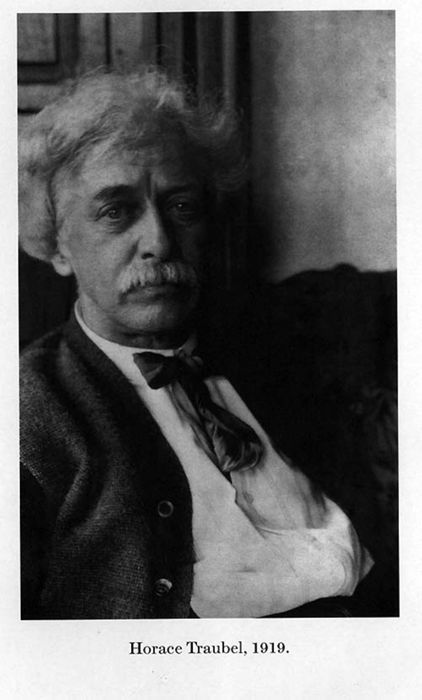
HORACE TRAUBEL, 1919. Courtesy Library of Congress, Horace L. Traubel Collection.
[Following page 240]
FACSIMILE OF LETTER - WALT WHITMAN TO DR. JOHN JOHNSTON, BOLTON, ENGLAND, FEBRUARY 6 AND 7, 1892. Courtesy Library of Congress, Feinberg Collection.
WALT WHITMAN, MAY 1891. Four photographs by Thomas Eakins, Courtesy National Portrait Gallery, Smithsonian Institution.
WALT WHITMAN'S TOMB, HARLEIGH CEMETERY, CAMDEN, NEW JERSEY. Courtesy Whitman House, Camden, New Jersey.
[Facing page 630]
ORIGINAL MANUSCRIPT OF THE POEM "A THOUGHT OF COLUMBUS", 1892. Courtesy Library of Congress, Feinberg Collection.
LETTERS CONTAINED IN THIS VOLUME
(Including Other Manuscripts of Walt Whitman)
| Baker, Isaac Newton, 261-62, 441-42, 475, 503-4 |
| Bucke, Richard Maurice, 21, 66-67, 101, 155-56, 184, 205, 216, 234, 252-53, 304-5, 312, 325, 326-27, 346-47, 372-73, 396-97, 398-99, 415-16, 421-22, 429-30, 457, 462, 473-75, 522, 528-29, 563, 579-81, 584, 610, 610-11 |
| Burroughs, John, 254, 323-24, 377-78, 401-2, 422-23, 464, 471-72, 548 |
| Bush, Harry D., 336 |
| Calder, Ellen M. (Mrs. O'Connor), 136-37, 624-25 |
| Carpenter, Edward, 207, 416-17, 452-53, 486-87 |
| Clarke, William, 569-70 |
| Clifford, John Herbert, 628 |
| Creelman, James, 460-61 |
| Dowden, Edward, 449 |
| Dwight, Harry L., 186 |
| Emerson, Ralph Waldo, 64 |
| Evans, Leo C., 476 |
| Fairchild, Elisabeth N., 244-45, 304, 345-46, 428, 608-9 |
| Forman, Henry Buxton, 5-6, 171-72 |
| Garland, Hamlin, 264, 340 |
| Gilchrist, Herbert Harlakenden, 536-37 |
| Gilder, Jeannette L., 612 |
| Gilder, Richard Watson, 508 |
| Gould, Elizabeth Porter, 616 |
| Greenhalgh, R. K., 567-68 |
| Hawkins, Walter T., 513-14 |
| Holdworth, J. E., 417 |
| [Begin page x] Howells, William Dean, 355 |
| Hyatt, Thaddeus, 139 |
| Ingersoll, Robert Green, 160, 245-46, 311, 330, 335-36, 353, 400, 444-45, 486, 549, 595 |
| Johnston, Dr. John, 100, 170-71, 386, 512-13, 568-69, 587-89 |
| Johnston, John H., 383, 558-59, 607, 629 |
| Kennedy, William Sloane, 159, 245, 357, 615-16 |
| Law, James D., 195-96 |
| Lazarus, Josephine, 336 |
| Longaker, Dr. Daniel, 627 |
| McDowell, William O., 231 |
| Morse, Sidney H., 233-34, 623-24 |
| Porter, Charlotte, 222-23 |
| Roberts, Charles H., 205 |
| Rolleston, Thomas William Hazen, 434-435 |
| Rossetti, William Michael, 565-66 |
| Salter, William M., 525 |
| Stedman, Arthur, 356 |
| Stedman, Edmund Clarence, 284-85, 558, 613 |
| Symonds, John Addington, 533-34, 534-36 |
| Tennyson, Hallam, Baron, 457-58, 495 |
| Volkhovsky, Felix, 13 |
| Wallace, James William, 179-81, 235-36, 376-77, 436-37, 515-16, 571-74, 628-29 |
| Webling, Ethel, 185 |
| Webster, Charles L. (& Co.), 453-54 |
| Whitman, Walt, 630 |
| Williams, Talcott, 607 |
EDITORS' PREFACE
The publication of this book completes the series, With Walt Whitman in Camden, ninety years after its author, Horace Traubel, published the first volume. Traubel began his records of daily conversations with the poet in 1888, and continued until Whitman's death four years later. In his foreword to Volume 1, he wrote:
Did Whitman know I was keeping such a record? No. Yet he knew I would write of our experiences together. Now and then he charged me with immortal commissions. He would say: "I want you to speak for me when I am dead." On several occasions I read him my reports. They were very satisfactory. "You do the thing just as I should wish it to be done." He always imposed it upon me to tell the truth about him. The worst truth no less than the best truth.... So I have let Whitman alone. I have let him remain the chief figure in his own story. This book is more his book than my book. It talks his words. It reflects his manner. It is the utterance of his faith. That is why I have not fooled with its text.... It occurs here in the rude dress natural to the incidents that produced it. I had no time then to polish. I have had no disposition since to do what I had no time to do then.... Whitman was not afraid of the man who would make too little of him. He was afraid of the man who would make too much of him.... I have never lost sight of his command of commands: "Whatever you do do not prettify me."
Like the editors of the previous volumes--Anne Traubel, Gertrude Traubel, Sculley Bradley, and William White--we have presented Traubel's manuscript as it was written. In a few cases, a word or phrase has been inserted in brackets to complete an otherwise unintelligible sentence, and the punctuation has sometimes been adjusted to assist readability.
[Begin page xii]The completion of this series has been a collaborative effort on the part of many people over the course of many years. We are deeply indebted to Robert Burton, director of the Fellowship of Friends; to William Bentley, the publisher; to Charles Feinberg, whose splendid collection of Whitman materials, now in the Library of Congress, includes Traubel's manuscript; and to Professor Ed Folsom, who wrote the foreword to this volume. The staff of the Manuscript Room at the Library of Congress were unfailingly helpful. Significant contributions were also made by Peter Bishop, Abraham and Susan Goldman, Judith Grace, Cynthia Hill, Kevin Kelleher, Leigh Morfit, Peter and Paula Ingle, Rosalind Mearns, and Alla Waite.
Apollo, CaliforniaJuly 1996 JEANNE CHAPMAN ROBERT MACISAAC
FOREWORD
HORACE TRAUBEL
(1858-1919)
IN HIS MARCH 26, 1892, ENTRY in this final volume of With Walt Whitman in Camden, Horace Traubel wrote that at the moment of Walt Whitman's death "something in my heart seemed to snap and that moment commenced my new life--a luminous conviction lifting me with him into the eternal." His words were prophetic: a new life did start for him, and his name would forever be bound to that of his departed master. Traubel described himself as Whitman's "spirit child" and for the next twenty-seven years he served the poet faithfully. He was the most active of Whitman's three literary executors (the others were Traubel's brother-in-law Thomas Harned and the Canadian psychiatrist Richard Maurice Bucke); he founded, edited, and published The Conservator, a journal dedicated to keeping Whitman's works alive; he issued his own Whitman-inspired poetry and prose in three large volumes; and he carried on a tireless correspondence with Whitman enthusiasts around the world, weaving together an international fellowship of disciples who worked to ensure Whitman's immortality.
He also began transcribing his notes of daily conversations with Whitman compiled during the final four years of the poet's life, publishing three large volumes of them (in 1906, 1908 and 1914, respectively) before his own death and leaving behind manuscript for six more. His dream of having all of his notes in print--a dream deferred for eighty years--is finally realized with the publication of Volumes 8 and 9, appearing more than a century after they were written.
Only thirty-three years old at the time of Whitman's death, Traubel had already known the poet for nearly twenty years. [Begin page xiv] "Walt Whitman came to Camden in 1873," Traubel recalled, "and I have known him ever since." Born and raised in Camden, New Jersey, Traubel first met Whitman soon after the poet--recovering from a severe stroke and depression over the death of his mother--came to live in his brother George's home. The Traubel family had known George Whitman for some time before Walt arrived, so it is not surprising that neither Traubel nor Whitman could recall their actual first meeting, which remained for Horace "one of the pleasant mysteries." Traubel was then only fourteen years old, but he quickly became a comfort to the half-paralyzed writer. Whitman once reminded Traubel:
Horace, you were a mere boy then: we met--don't you remember? Not so often as now--not so intimately: but I remember you so well: you were so slim, so upright, so sort of electrically buoyant. You were like medicine to me--better than medicine: don't you recall those days? down on Steven's Street, out front there, under the trees? You would come along, you were reading like a fiend: you were always telling me about your endless books, books: I would have warned you, look out for books! had I not seen that you were going straight not crooked--that you were safe among books.
Traubel's own recollections of those early meetings were similar: "My earliest memory of Whitman leads me back to boyhood, when, sitting together on his doorstep, we spent many a late afternoon or evening in review of books we had read."
In those first talks, Whitman rarely spoke of his own work; he and young Horace discussed instead Byron and Emerson and what Traubel would later call "the details of the lore of the streets." Like the poet, Traubel had stopped going to school by the age of twelve, and thus received much of his advanced education at Whitman's hands. He began to work as a newsboy and errand boy, and on his travels around town he would often meet the poet "strolling along the street, or on the boat," or, frequently, under the shade of the trees in front of George Whitman's house, where the poet occupied a room on the third floor. At first, the boy's relationship with Whitman caused something [Begin page xv] of a scandal; Traubel recalled that neighbors went to his mother and "protested against my association with the Ôlecherous old man' " and "wondered if it was safe to invite him into their houses." Such sentiments simply drew the young boy even more strongly to the old poet: "I got accustomed to thinking of him as an outlaw." Whitman, in return, admired what he called Horace's "rebel independence."
Following in the footsteps of Whitman, Horace spent his teenage years learning the printing trade and newspaper business. He became a typesetter, and employed his compositor's skills throughout his life, often setting the type himself for his various publications. By the time he was sixteen, he had become foreman of the Camden Evening Visitor printing office. After that, he worked in his father's Philadelphia lithographic shop, was a paymaster in a factory, and became the Philadelphia correspondent for the Boston Commonwealth. None of these jobs brought him much money, but they gave him a wealth of experience, confidence in his writing skills, and an intimate understanding of how words could be made public and effective through the labor of printing.
Whitman's "outlaw" character--his ability to think outside the boundaries of law, convention, and habit--continued to attract the intense young Traubel, who became increasingly involved with radical reformist thought and who persistently urged a reluctant Whitman to admit that Leaves of Grass endorsed a socialist agenda. Traubel was aware that many literary people thought of him as little more than "Walt Whitman's errand boy" and dismissed his writing as simply warmed-over Whitman, but he was no epigone. It is largely because of Traubel's insistence on interpreting Leaves of Grass as politically revolutionary literature that we have inherited Whitman as a radical democratic poet; Traubel was indefatigable in his support of Whitman's work, and he made sure that all the radical leaders of his day read and discussed it. But he also knew that politically he was to the left of Whitman, and by the 1890s he had begun to carve out a distinctive identity as a writer and [Begin page xvi] thinker. "I would rather be a first Traubel than a second Whitman," he said, as he began straddling the difficult line between reverence for his master and literary independence. "Emerson and Whitman made one big mistake," Traubel once said. "They seemed to think that a man could not be at the same time an optimist and a propagandist, a passive philosopher and an active revolutionary. I believe it is possible for a man to be both."
While his own books can be read as socialist refigurings of Whitman's work, Traubel never became an "active revolutionary"; his socialism tended more toward the religious and philosophical than the political. But his journal, The Conservator, which he began two years before Whitman's death and continued until his own death in 1919, was nevertheless an influential organ of radical ideas about everything from women's rights to animal rights. Traubel saw The Conservator as a place where the various liberal societies and clubs could be brought together in active dialogue, and he requested support from everyone "to whom Liberal thought and life are sacred, and sympathy and comradeship supreme factors in religion." Eugene V. Debs, the socialist labor leader and presidential candidate whose supportive statements often appeared in The Conservator, was one of the strongest endorsers of Traubel's work:
Horace Traubel is one of the supreme liberators and humanitarians of this age. . . . Traubel is not only the pupil of old Walt Whitman but the master democrat of his time and the genius incarnate of human love and world-wide brotherhood.
Every issue of The Conservator began with one of Traubel's idiosyncratic "Collect" essays. The journal frequently contained one of his Optimos poems, and in virtually every issue there would be essays on Whitman, reviews of books about Whitman, digests of comments relating to Whitman, advertisements for books by and about Whitman. Often, Whitman would be presented as a kind of proto-Ethical Culture thinker, an exponent of vegetarianism or a prophet of modern science. [Begin page xvii] The space devoted to Whitman increased over the years, and by 1902 Isaac Hull Platt, in a blurb printed on the back cover of the June issue, professed to admire The Conservator "because it is the continual exponent of the latest, greatest, most beautiful and sanest gospel and philosophy that the world has known--that of Walt Whitman." The Whitman who appears in The Conservator, however, had been led posthumously by his disciple down a far more radical political road than any he had traveled when he was alive.
Traubel traced his tough-minded liberalism and egalitarian beliefs not only to Whitman but to his hybrid heritage, especially to his Jewish background:
I am myself racially the result of fusion. My father came of Jewish and my mother came of Christian stock. When I have been about where Jews were outlawed I have been sorry I was not all Jew. . . . Where persecution is, there you should be, there I should be. I love being a Jew in the face of your prejudices and your insults.
But what he most liked about what he called his "half-breed" status was that it allowed him easily to transcend narrow systems of belief and affirm an expansive democracy: "I guess I'm neither all Christian nor all Jew. I guess I'm simply all human." He always retained his democratic identification with the persecuted and remained a dedicated political and intellectual radical. He kept up correspondence with countless leftist and reformist political and artistic figures, including Felix Adler, Debs, Ella Bloor, Hamlin Garland, Emma Goldman, Jack London, and Upton Sinclair. He was involved with the Arts and Craft movement and helped publish The Artsman from 1903 to 1907, espousing the belief that radical reform in art, design, and production was essential to social reform. His Chants Communal were originally printed in the Socialist newspaper The Worker, and in 1913, the Soviet newspaper Pravda devoted an entire issue to him. Three books about Traubel appeared between 1913 and 1919, all emphasizing his socialist beliefs, and all written by fellow radicals: Mildred Bain's Horace Traubel (1913), [Begin page xviii] William E. Walling's Whitman and Traubel (1916), and David Karsner's Horace Traubel (1919). All three predicted lasting fame for Traubel, but no books about him have appeared since, with one significant exception: Alla M. Liubarskaia's Horace Traubel, written in Russian and published in Moscow in 1980. This book examines Traubel from a Marxist perspective, demonstrates that Lenin read and admired him, and celebrates him as a writer whose views are in accord with those of Lenin and Maxim Gorky.
Traubel's radicalism did not come without cost. His one stable, salaried position was as a clerk in the Philadelphia Farmers' and Mechanics' Bank, a job he began during the last years of Whitman's life and held until 1902. In that year he published an attack on George Frederick Baer, J. P. Morgan's agent and the president of Philadelphia-area railroad and coal companies, who had become a symbol of business arrogance because of his refusal to negotiate with labor unions. Traubel's employers, embarrassed by their employee's attack on the powerful Baer, threatened to dismiss him unless he gave up his writing and editing of The Conservator. Horace resigned and began a life of self-imposed poverty. He had learned from Whitman that the freedom to express unconventional and revolutionary views entailed material sacrifice; as Horace put it, "I have no right to do unpopular things and expect the popular returns." So, like Whitman during the years Traubel knew him, Horace began living on the meager proceeds from his writings and gifts from his supporters.
Since he had his own family to sustain, his reduced means affected them as well. His small family was a contrast to the large one he grew up in (he was the fifth of seven children). Traubel had married Anne Montgomerie in Whitman's home on May 28, 1891, and their daughter Gertrude was born the following year; her birth in the same year as Whitman's death signalled the remarkable co-joining of commencement and conclusion, birth and death, that Whitman had taught Traubel to expect throughout life. The next year brought the birth of a son, named Wallace in honor of J. W. Wallace, a Whitmanite from [Begin page xix] Bolton, England, who had visited Camden in 1891 and stayed with the Traubels. Anne was so taken with their English visitor that she insisted on naming the baby after him, and Horace concurred. The Bolton group that Wallace represented became the first link in the international organization of Whitman followers that Traubel was forming.
But the next decade brought harsh trials. In January of 1894 a fire severely damaged the Traubel's house, and Horace was momentarily seized by the fear that all of his Whitman materials, including his notes of his conversations with the poet, had been lost. On February 27, 1898, young Wallace Traubel died of scarlet fever soon after Gertrude had recovered from it; on the front page of that month's Conservator appeared a quotation from Whitman's "Song of Myself": "The little child that peep'd in at the door, and then drew back and was never seen again." Horace's and Anne's heart-rending letters to J. W. Wallace about their son's illness and death (now housed at the Bolton Metropolitan Library) reveal that, even when facing the horror of their child's death, they sought to learn and to grow from the experience. "Is it only through such agony that consciousness is perfected?" wrote Anne to her English friend, trying to harvest hope from her grief even while admitting, "I am a mother, dear Wallace, and no stoic." The pain continued to mount: three months after Wallace's death, Horace's beloved father Maurice committed suicide. Then, in 1902, just before relinquishing his job at the bank, Traubel received word that his friend and co-executor Dr. Bucke, with whom he had just completed editing the ten-volume Complete Writings of Walt Whitman, had died after suffering a fall on the icy veranda of his home in London, Ontario.
Horace refused, however, to allow personal tragedy to drain his optimism and energy. He enlisted his wife and remaining child in his causes. If they were going to be poor, they would at least be poor together. Anne recalled that when she had first read Whitman's works in 1889, they "meant nothing" to her, but at Horace's urging she tried again and in 1896 she became [Begin page xx] enraptured by the "pulsating, illumined life" she found there; she was converted. Anne became associate editor of The Conservator in 1899, and Gertrude, whom Horace and Anne educated at home, joined the staff of the journal as an "Associate Worker" in 1906, when she was fourteen. A remarkably talented young woman who became an active suffragist, accomplished vocalist, and respected voice teacher at the prestigious Germantown Academy in Philadelphia, Gertrude eventually joined with her mother in preparing Volume 4 of With Walt Whitman in Camden (edited by Sculley Bradley) for publication. After Anne's death in 1954, Gertrude transcribed and edited Volume 5 on her own and worked on Volume 6 until she was too ill to continue. She died in 1983 at the age of 91.
Traubel founded the Walt Whitman Fellowship International and served as its secretary/treasurer from 1894 until a year before his death. He was instrumental in founding Whitman Fellowships in other cities, and the chapter in Boston became particularly important to him, for there he met Gustave Percival Wiksell, a dentist who was president of the Boston Fellowship.
Traubel's life was filled with intense friendships, but his relationship with Wiksell, five years his junior, was the most passionate of them all. In a heated correspondence spanning five years (1899-1905), Traubel and Wiksell poured out their love for each other, often expressing themselves in Whitman's "Calamus" terminology: "Percival, darling, my sweet camerado," wrote Traubel in 1902, recalling a recent meeting with his friend:
We walked together as in a dream--a dream. God in hell! The dream is the real & the real is the dream. Definitely sweet was one hour & the next while we remained there in love's carouse--That day will go with me into all eternities. Send me your words, dear love--your words live. They go into my veins. I do not put you away with a kiss. I hold you close, close, close!
Wiksell and Traubel often met Peter Doyle in Boston and Philadelphia, reconnecting the poet's closest comrade to the Whitman circle, and, upon learning of Doyle's death in 1907, [Begin page xxi] they wrote consoling letters to each other. Horace posed with Wiksell for photographs that imitated the photos of Doyle and Whitman. The final article in the final issue of The Conservator (June 1919) was written by Wiksell, and Wiksell presided at Traubel's funeral.
For the decade after Traubel quit his bank job, he lived an energetic life. He would read most nights until 4 or 5 a.m., then sleep for four or five hours. Each morning he would take the ferry to Philadelphia and work in his garret office on Chestnut Street, where he would write letters, edit The Conservator, and set type. He met regularly with a group of fellow radicals at a Market Street restaurant, his own version of Pfaff's, Whitman's bohemian beer hall. Like Whitman, he loved crowds, and could often be found at baseball games or concerts or on the ferry, absorbing the energy of the masses. It was while riding the Camden ferry in 1909 that Horace faced his first major physical trauma: he was trampled by a horse and suffered severe rib injuries. By 1914 his health had become a major concern, as rheumatic fever had left him with a weakened heart. The outbreak of the Great War was particularly wrenching for this pacifist and believer in universal brotherhood, and over the next few years he declined steadily, suffering his first heart attack in June of 1917, the night before Gertrude's wedding in New York. He suffered additional heart attacks during the next year, and in the summer of 1918, he had a cerebral hemorrhage and was confined to his home. At this point few of his friends expected him to live more than a few weeks.
But with the centenary celebration of Whitman's birth on the horizon, Traubel's notorious stubbornness came into play: he refused to die on any but his own terms. He and Anne moved to New York in the spring of 1919 to be close to Gertrude and their new grandson. They stayed in the home of their good friends David and Rose Karsner, whose five-year-old daughter, Walta Whitman Karsner, brightened Traubel's last months. Horace sat at a window looking out on the East River and over to Whitman's Brooklyn. He ate at the very table that his old [Begin page xxii] friend Eugene Debs had used while in prison--Karsner, who wrote Deb's biography, had procured it and made it available to Traubel. On Whitman's birthday he attended the celebration at the Hotel Brevoort on Fifth Avenue and was given a standing ovation by the two hundred Whitmanites in attendance, after which Helen Keller, meeting Traubel for the first time and touching his lips to understand his words, spoke movingly of this "great Optimist" and "his scheme of a better world." He was pleased to hear speeches that night celebrating Debs and Emma Goldman; his many efforts to bring Whitman and the radicals together seemed at this moment to have succeeded.
There was yet one more centenary event that Traubel was determined to attend--the August dedication of a mighty three-hundred-foot granite cliff at the Bon Echo estate in Canada, to be named "Old Walt" and inscribed with Whitman's words in giant letters. The dedication had been arranged by the Canadian branch of the Walt Whitman Fellowship, and Traubel saw it as a sign of the growing international reverence for Whitman. The frail Horace sat in a specially constructed chair on a rowboat that took him across a lake to the base of the giant rock, where he and Flora MacDonald Denison, the owner of Bon Echo, placed their hands on the spot where the inscription was to be and intoned the words "Old Walt."
For the next few days Traubel struggled through dinners, receptions, speeches, and meetings at Bon Echo. He wrote David Karsner in New York: "Here safe. Tired. Hopeful. . . . Tired still. Damned tired. God damned tired." Flora MacDonald Denison wrote that on August 28th Horace, while sitting in a tower room where he could look out on Old Walt, rapped his cane and shouted that Whitman had just appeared above the granite cliff "head and shoulders and hat on, in a golden glory--brilliant and splendid. He reassured me, beckoned to me, and spoke to me. I heard his voice but did not understand all he said, only 'Come on.' " Following this Traubel began to fail quickly, suffering yet another cerebral hemorrhage, and took to his deathbed, nursed continually by Anne. On September 3rd Flora was sitting next [Begin page xxiii] to his bed when Traubel claimed he heard Walt's voice again: "Walt says come on, come on." Anne stayed by his bedside, held his hand, smiled, and repeated, "No regrets, Horace." In her account of her husband's death, written to J. W. Wallace, she does not mention visitations from Walt. She recalls only that, on September 8th, "he didn't drift, he went":
Afterwards, he had a very tender and beautiful expression, not as if he had less spirit but as if he had more. There was in fact very little flesh left--but he did not look shrunken, or wasted. He looked exceedingly young. Even then as he laid on the bed unmoving he drew love from my heart. Even then he made the great affirmation. He devoted himself to the art that is life--and to the life that is love--and he has made love as common as bread.
Once again, beginnings and endings fused: Traubel's death one hundred years after Whitman's birth emphatically closed the first Whitman century. But before he departed, Horace left behind a final poem, written for the dedication of Old Walt. In this poem he did what he had done so well for so long, what he had recorded in nine large volumes. He sat down and talked, one last time, with Walt Whitman:
Well, Walt, here I am again, wanting to say something to you:
In a strange place, at the considerable north, talking again:
. . .
I just feel like as if I was having another chat with you
as you sit in the big chair and with me in the bed opposite:
Oh! those blessed times, Walt! they're sacreder to me than
the scriptures of races:
They're the scriptures of our two personal souls made one in a single supreme vision:
That's all for this moment, Walt: but it's the whole
world of appearance and illumination, for all that.
June 1996
"As to 'Leaves of Grass' I can say--with all its spirit and naturalness, and as the thing blows--the wind blows--that is not the whole story. Spontaneity--spontaneity: that's the word, yet even that word needing to be used after a new sense. I am quite clear that I have broken a way--that I have indicated a path--a new, superiorally new, travel-road heretofore not trod by man. Some one of the German philosophers had said, life is not an achieved fact, but a becoming. And 'Leaves of Grass' is much like life in that respect."
W.W. to H.T., November 23, 1891
Thursday, October 1, 1891
5:40 P.M. W. resting on his bed—the night dark—seemed to be quite well. Queer, his inconsistent feelings—some days leading him to close his room to suffocation (hot days) and now, when it is cool, lying there, with two windows thrown open and the air really chill. When I spoke of this, he replied, "It is no doubt as you say, and yet I do not feel any danger in it. You see, I am well wrapped, and there is no draft here." Felt disturbed—I could see it in his manner—and found that it was because Reinhalter had been in with his bill. W. "not prepared" to pay: argued they had promised to wait a year if he paid them a thousand dollars, as he had done. No definite outcome except discovery on part of the strangers that W. can be driven to do nothing. W. said, "I will write you later on." Rarely speaks of the tomb nowadays. Is conscious, I think in a way, that his friends suspect its consistency and wisdom. Boulanger's suicide in Switzerland stirs things. W. however declares, "What had that man for us? He never seemed to me to have a reason for being: was a rallying head for discontent, wild opposition: did not seem to stand for, represent, anything. France, the world, will not miss him. Of course, the thing is tragic, dark—has its sad side—is invested with an air we cannot escape—must count. But the man is well done his days: he struck no indispensable, even valuable, note." W. again speaks of his "writing days" as [Begin page 2] over—"the sun of all that is set"—though his after-light, the math of things been, may last him "a while yet"—though "from day to day" he faces the august shadows, fearing nothing—"prepared, ready, to break the last tie." Rather moved me to find him in such a mood, though his dominating cheer soon broke through, to show that he was sound as ever at core. "Not a letter today: hardly a glimpse of the outside world, even from the papers." Had written no letter, "perhaps" would "in the evening."
Friday, October 2, 1891
To W.'s on my way home—5:45—but found he had just closed his blinds and meant to lie down. I did not wait—had no mail. Not a letter written. "I doubt if I have written a word for two days." Seemed for some reason not so bright.
7:55 P.M. To W.'s again. In his room, reading Hedge's "Prose Writers and Poets of Germany." "It is one of my resources." Harned had been in last night. They had talked considerably about Symonds' essays. W. disposed more and more to give them value. Yet Miss Porter asks me, as I read her Symonds' letters, why this difference in temperature, the published as against the private judgment? Was it the consciousness of the critic? W. believes, "Yes, there seems no other way out. For sincerity lurks in both—is present everywhere."
W. says still, "I hear from Wallace, no less than two letters today. And a letter from Dr. Johnston, too, written from Annan, Carlyle's old place. Oh! There must be a charm in it all! Johnston has gone there to see his parents—was born there. The parents seem quite well-ado—solid, of some local consequence. I enjoy the Doctor's letters, especially some of them. He has at times an objective touch—a daring objectivity—gives description, detail. I am greatly moved by it." Was this letter one of the sort? "No, I can hardly say it is. The letters from the fellows there—from Johnston, Wallace—are mainly made up of thankfulness to me, to my work. Yet Wallace, too, now and then, tells [Begin page 3] me what he sees, leaving the thought of what he sees mathunsaid. This shows power—too latent, too little exercised, perhaps." Reference to Emerson, Carlyle—some of the old fellows. "They evidently made drafts of their letters (does Wallace? you think so?), and I don't know but that has something to be said for it." I argued, however, "Letters, journals, should be free: float along, word by word, as it comes, like the toss, the rhythm, of a song." W.: "Beautiful! I like that. I guess it is so! I live it—our fellows would, naturally. But I often look at the letters of the old fellows—say, a hundred years ago—they have a certain stateliness, measure—preparedness—yet a charm, too." I asked, "What of Bob's letter the other day?" "It is perfect; it is the curve and sweep of a wave up the shore!" Adding, "But every one to his kind. And we must see to it, every fellow is acknowledged for what he brings, not what we think he should bring." And again, "A letter is very subtle! Oh! The destiny of a letter should be well-marked from the first. We should know, make, every letter to fit its purpose—to go to the doctor, to the intimate friend, to the admirer, and so on and on, each having a quality its own, and for a specific end. It may seem queer for me to have a philosophy of correspondence, but I have. And of course, freedom is the charm of a letter—it before all other qualities. And a letter without freedom certainly has nothing left to it."
I had a note from J.W.W. marked Lindsay, Canada. W. said, "I am not surprised that the expansiveness, bigness, of things here should storm him. It gives him a copious draught. But what of his return—not a word of date?" I expected him any time next week. W. asked, "But you know nothing about his dates?" Speculated about Bucke. Is the lecture over? Was it a success? I was to go to Unity Church to hear a lecture on Hamlet. W.: "Yes, go and tell me about it." But there might be nothing to tell. W. then, laughing, "Well, tell me there is nothing: it is something to know that." Explicators of poets? I felt to say to them, Diogenean-like, "All I ask is, that you keep out of my light." W.: "A fine application, Horace, and true as truth! It is my own feeling exactly. And it is one of my dreads, that there [Begin page 4] may come a time, and people, to exposit, explicate, 'Leaves of Grass.'"
Left him a dozen Conservators. "Will send them away." Asked, "And what of the gentle, great Sidney? Is there anything further? No? What a child of nature! How could we but love him! The piece? O yes! I like that—more than like it: it is few but mighty," playing on a current phrase. "But 'Song of the Open Road' for Sidney? I can't find it anywhere. Very likely we will send him a complete book—that might be best." Salter wrote of his "pleasure" in Morse's "Leaves of Grass" article. W.: "I do not wonder—it is as simple, sweet, as a tale told across the table." W. "doubts" if he can go out tomorrow. Seems able, yet disinclined. More and more withdraws. But we will try. I leave it in Warrie's hands—I to be at 328 a little after five—to go out, if W. is agreeable; not, if not.
Wallace's letter of 23rd in a grateful strain, no objective eye evident. In letter of 28th, writes of plans of his departure on the morrow.
Bucke writes (27th), about to go to Montreal. Speaks of J.W.W.'s departure, will miss him, etc. Had no copy of address to send us.
W. gives me Wallace's letter of 17th to illustrate "the, so-to-speak, inner tones of the man."
Saturday, October 3, 1891
5:10 P.M. W. could not go out. Says at once to me, "I feel blue—bad." I protested, "I thought you never felt blue." To which, "It is as well not to be too sure of that." Going on, "I have been depressed. I don't know for what: for several days, now, in a cloud. Yet the days themselves have been fair and beautiful! But prisoned here—cabined up—it would be hard to see only cheer and light—only the rosy side of things." Spoke of Mrs. Davis as "still under the weather." Again a word of Harned's visit the other night. "I was glad to see him. He is a rush of vigor: stirs me." Then, "Another letter from Wallace, [Begin page 5] this from Fenelon Falls. He goes on at length about Fred Wild—some tragedy in his life, maybe. And part of him left in this place, or there once, and now memoried. The good Wallace! In this letter rather more than in others he gets out of himself: a quite important thing, especially for a strong man." Then, "Here is the note. You might as well take it"—slinging clear over the table to me.
I too have note from Wallace, but 'tis merely general—very short—and to about the same effect. W. likewise gave me Forman's letter at last: 46 Marlborough Hill St. John's Wood London N.W. 8 September, 1891 That birthday bit in Lippincott is a capital thing and most satisfactory for friends overseas who wanted some direct words, and evidence as to health, etc. Friend Traubel has done his photographing well and deserves our thanks. Conway's is the only bit that reads just a little stilted and as if written with one eye turned inwards and the other one half on you and half on the public. Well, well! now this is not very charitable, and after all it's a jolly, hearty, manly crowd that we see through Traubel's pages gathering around your revered form, dear Walt Whitman. Last time I wrote I was going to the Vienna Postal Congress. Since I came back I have had Bucke staying with me and giving me all the last news of you and renewing old memories (grand times!); and while I was there at Vienna I met "An Americano (not) one of the roughs," but one who knows you. This was William Potter of Philadelphia, who was one of Wanamaker's delegates to the Congress—one of the United States' delegates, to speak strictly. He is a real good fellow: he was the best friend I made at the Congress this time. The money I'm sending in this letter (about 15 dollars) is chiefly for "Good-Bye, My Fancy!" which I am without, though I have seen Bucke's copy. I want a copy in cloth as issued, with your name and mine in it if the old indulgent mood holds, and two copies of the untrimmed sheets not bound. Then I want, if it is to be had, six copies [Begin page 6] of "A Backward Glance" as printed on thin paper to be annexed to "Leaves of Grass" (pocket book edition). They need not be stitched or done up any way, but on one I should like your name and mine on the title leaf. There are several minor works, or rather separate works, which I fancy you still have, and of which one copy each similarly inscribed would be very welcome: these are "Passage to India," "Democratic Vistas," "After All," and "As a Strong Bird." Lastly, my youngest son, Maurice Buxton Forman, is likely to go out into the world soon—most probably to Egypt. He is now nearly 20. When he goes I want him to have the big book—Complete Poems and Prose; and if it were attached to him by your own hand in the same way the effect on his mind would be good. He is studiously disposed, and it is about time he began on the "Leaves": indeed he has begun. So I want to buy him his copy, for a part of his essential outfit, whether you write on it or not. Now if it chances that you do all I am asking, and the money does not run to it, as well might be, the mention of the figure minus will bring the rest by first post. Ever in affectionate respect H. Buxton Forman Repeated his notion that its characterization of Conway's letter was not just, yet that the letter (Forman's) was "genuine, noble." And, "You ought to have it for what it says of you—words to remember, keep." To him, "Forman must be a grand companion—a grand fellow to know."
We spoke of Young (J. R.), W. remarking, "John is a fine make-up: one of the best journalistic samples—German, strong, with a vivid style. He has always made me near his heart—held me close for good words, demonstrations. What I like about his references—well-sampled in that in the piece on Conkling—is his confidence. He makes no apologies—mentions, states, is free and full, says his say, lets there be no doubt about what he means—then stops. Does not appeal, does not argue for, best of all, does not apologize. Which shows not only the true artist-eye, but nature's." And further, "Shows a true appreciation of the situation," for we are "to be received or rejected and the devil take the rest!"
[Begin page 7]Had W. sent the Star to Bucke? I had left copy. "Yes, I sent it. Does he say it never came? Yes? Why, I am sure I have somewhere his acknowledgment of it. And yesterday I sent him the other paper." What other? I knew no other. "Oh! Did I not tell you? I meant to. The Transcript. And I want to say, too, I don't quite get at Kennedy: he is a queer fellow—turns odd corners. Here in the Transcript is a paragraph—undoubtedly written by him—in which he says that the writer has seen a letter written by an American gentleman visiting Europe who had seen Tennyson, etc., and then goes on to give the awful story. Wrong! Yes, wrong! Kennedy is guilty of trespass. It ought to have been clearly understood by my letter and by Doctor's itself that there was to be no publicity given anything which the Doctor had sent us. And yet Kennedy quotes it. It is hard to explain. Not a serious harm, I suppose, but harm—and harm if simply to give a word of it under the circumstances. Probably nothing will come of it—no evil—it may even be buried there. On the other hand we find often enough that some insane little item which never should have been written, travels the world around, into every hamlet, is denied nothing, makes ruin everywhere." And W. reflected, "Kennedy is not a fellow I can understand. At least, not this time. I don't know what Doctor will think of the breach—for breach, trespass, it was. It makes us a caution for the future. In the first flush I was a little angry about it, but I am inclined to let it go now, without a word. It is enough to know the bird is out—escaped—the damage done." Further, "And there was something else in the Transcript—a comment made upon an elegant new edition of Bartlett's quotations—and the question is asked: What is the matter, that Walt Whitman does not appear by a word, a line? I suppose Kennedy wrote that—it shows his mind, if not his hand. You think the journalists favorable to me? A good many, yes. As to magazine editors, they have a dignity to preserve—a professional something or other—and will not unbend to unusual or unpopular events. But the boys in the newspaper clans are of a natural tone, more or less able and willing to say a good word as occasion, freedom, persuades."
[Begin page 8]Did he know Barry, actor? Miss Aiken tells me her father and Barry old close friends. W.: "Yes, I remember him. Not thoroughly, not in detail, but as a person, those times. He was a man fitting well in minor parts—one of the walking gentlemen—indispensable, yet not important. There were hosts, the like of him. And sitting here these later days, inactive, having no outlet, memory panoramas the whole past, finding me a character here and there, to live again, whom I had thought gone forever even from the thought of men. The stage? I suppose there's a sense in which it has gone down—lost caste—position. But stars differ in their glory. And all we can say is, that changes have come—perhaps not all of them for the better."
Had he ever taken any extensive out-doorings with Burroughs? "None at all." Yet was it "a good experience for anyone who could companion John," who was "like a bit out of nature herself, a wild hare, the flower that grows in the wood, the bird in mid-heaven."
What had I heard last night about "Hamlet"? And then some talk thereon. Long had curiously said, "One of my doubts of Shakespeare is in the fact that no two men seem to agree as to what he meant by the plays." W. put in now, "Well, that would knock out his Bible, too." I then, "That's what I said, and all literature." And I said further, "Shakespeare did not intend to make Hamlet sane or insane, or to make his characters anything: he simply intended to make them, represent them, cutting them vividly out of life, with all their contradictions. For instance, in Hamlet: to show the conflicting conditions that warred about and in him and his resistance," etc. W. exclaimed, "That is fine, and it is 'Leaves of Grass': it is our doctrine—the doctrine we swear by," and more to the same end.
Sunday, October 4, 1891
1:30 P.M. Very hot day—I spent forenoon in Philadelphia. But W.'s condition day before, and for several days, had worried me, so made a special trip over to see how he was. Gilbert with me. [Begin page 9] Left him on step, with Warrie, while I went up to W. We talked 10 or 15 minutes together. W. reading Philadelphia Press, spoke of its "dullness." Yet that "all days here grow dull—lose their pulse, life." Indisposition to see strangers. "I am gradually closing all the avenues of escape: life narrows, narrows." Yet finds his mind still craving to know the world—to follow its winding experiences. I am to see McKay tomorrow. W. said, "Let Dave see everything is open except the simple fact that the additional pages are determined upon—that they are to go in, whatever he thinks about it. Yes, even in with the copies he has printed and in sheets. As for the rest—talk the matter over. You represent me. Tell Dave if he thinks to continue the book at two dollars, can manage to do it: well, very well. Yet that it is my notion something will have to be added. All I have to say is, feel him for the points we have talked over—then come to me. We want to be just to Dave and are determined to be just to ourselves, too. It is a closing act—the last on the bill: soon the curtain will be down."
Monday, October 5, 1891
5:40 P.M. W. reading papers. But was not well. Spoke of himself as "the same as yesterday—no change," but added, "But for the past ten days I have felt thoroughly bad, have had a bad run." Had he seen Kipling's portrait in Century? "Yes, and it seemed to me the face not of an Englishman. Oh! Did it impress you the same way? It is undoubtedly a strange face—a stranger face. Do you know, Horace, I think this fellow must amount to something. There is every indication of power—of a something there—though what I don't know. But he is very young, will probably break up. The precocious, early fellows can't, as a rule, stand the racket. True, there was Keats—poor Keats—went under, as so many thousands we do not even hear of—fragile as delicate-spun glass. I think Sidney hits the nail on the head in his little piece, what he says amounting to this, that polish is pushed to such extreme, it makes me mad. And that, you may say, is Keats. Noble Keats, too—the splendid sweet youth!"
[Begin page 10]A couple of packages for Post Office, one for niece, St. Louis, and one for Humphreys, Bolton. I laughed about the fullness of W.'s addresses, he remarking, "My friends always used to do that—do it still. But I think it a measure of safety. Once, many years ago, I sent a package to a fellow in New York, and it came back. I found on examining it that it came back because I had neglected to put 'third story' on it. Which taught me a lesson. You remember my friend in Washington with his stacks of trunks—the Adam Express man? He assured me that a little more care in addresses would have taken fully nine-tenths of the trunks to the proper persons. Now and then I get a foreign letter simply addressed 'Walt Whitman, America,' and it gets here sharply. Some knowing man in New York sends it right on."
Clifford in to see me. Has taken a reportership in Times. W. asked, "Has he anything in him for that?" I took the new sheets to McKay—had a long talk with him. He started by saying he thought the idea of the addition "foolish." I put in, "That's not a part of the discussion. They are to go in whether or not that is settled. I am here to discuss how they are to go in—on what terms." We got along amicably enough—a good deal of fencing. He opposed utterly to cheap edition, suggesting two editions: the one for two dollars, present price (autograph facsimile), the other at some larger price, with actual autograph. McKay not averse to green cover—rather favors it. Speaking of the present cover he said, "Walt insisted upon it—wanted it every way just as the Boston edition." "But you know why he wanted it so?" "Yes, I do." "And you know the reason is long since passed?" "Yes, I know that, too. I have no quarrel with the case, either as it is or as it is proposed to change it." McKay goes away tomorrow to New York and Boston and will not return till Monday. Will then be over to see Walt. W. asks, "That means the delay of another week?" "Yes." "It is our luck! But we can only smile." Then, "On first impressions, I would decide in favor of the two-dollar book. I do not insist upon actual autograph: perhaps the facsimile would serve for all." And again, "Our point is of course to add the pages. Whether we make any gain beyond [Begin page 11] that is not so important. I still adhere to the idea of the cheap paper edition. Sometime that must be. I am so happy to have lived out the work, to have touched the last mile-point (actually, I have rounded 'Leaves of Grass'), that I am willing to sacrifice most else. Though that is not sense either. But anyway, Horace, negotiations are mainly in your hands to make. We'll discuss it more or less thoroughly, day to day, before Dave is back."
Has been reading some of the Shakespeare plays. Not a word to either of us today from Wallace. "But Doctor writes me from Montreal—says the lecture affair was a great success—but not a word about Wallace." Johnston's postal from Annan moved us both. W. says, "I guess it is so. Carlyle always stirs me to the deeps. He was a giant-man, none more so, our time." McKay had called my attention to what was a defect in copyright page—W.'s assertion that in 1919 he might renew. But McKay argued he can't do it because he has no direct family—wife or child. W. however insists, "I think Dave is wrong. I have the copyright laws here and will look it up. But I am sure Dave is essentially wrong." After a pause however, "I don't see that it makes much difference either way. We'll all be dead, some of us long before that. So that it all comes to a point over which we needn't break any bones." Dave said to me, "If Walt insists on these pages, I suppose Mack'll have to take the dose!" To which I, "I'm afraid Mack will." W. said, "That seems rough, but that's about the amount of it." I found we could produce a paper-covered Walt Whitman for less than 20 cents per copy.
Tuesday, October 6, 1891
7:50 P.M. W. reading. Good color—warm hand. "It is almost winter's chill—eh?" he asked. Yet, "I stand it pretty well, supported last night by a good sleep." Then, "Now tell me the news!" I laugh at that question always, say to him, "You bring me news from the eternities: report for that today!" But he shakes his head, "No, it's time we want—the news of our own [Begin page 12] daily life—the history that is being made day by day about us." Told him then of my letter from Johnston today. Did he wish to read? "No, I guess not. Tell me about it." As to George Humphreys' book, "You were right in your guess. I sent the book yesterday." (I had "guessed" this in a letter to Johnston today.) "I held back, hoping to send him a copy of the final and complete edition. But as things hang fire, and threaten to go on doing so, I thought it better to send what I had." Then, "I have written Johnston, too, today. But no word comes from Wallace. Have you heard? He will be along before many days, no doubt, linger a few days—then, exit. And for me the last of him!" W. said this solemnly enough.
Book sale, at Thomas' today (Philadelphia). Copy of Bucke's "Whitman," presented by O'Connor to Appleton Morgan, on list. W. said, "I know nothing of Appleton Morgan, except what I gather from O'Connor. But he may have been some shakes among scholars of his kind." What of Winter's new book on Shakespeare? W. said, "I am reminded by it of what Carlyle said of modern poetry. He called it a raking over of old embers. Describes the poets—these times—poking at the old dead or dying fires—inviting them to burn—turning over and over the old ashes, for the spark of life left—finding little, perhaps nothing—chill, north-wind. That was Carlyle, and not to be too severe I would apply it to studies of Shakespeare—to Winter and his degree in particular. The critics of the great dramas all occupied to prove unprovable things—to stir up passions, fires, long gone out—the deceptive embers instinct with nothing. Oh! it is a lifeless sort of business! Yet a fellow hates to be too general, to make the mistake of being unjust. For often life comes, where we had thought of nothing but death."
W. afterward, "I have laid a letter and a paper out for you. I felt you would be interested. The letter is from the nihilist over there in London—the editor of Free Russia—and the paper will show you what sort of work he is doing. And anyway, keep both. They have an interest and value—show which way the wind blows." [Begin page 13] Henhurst Cross Beare Green, N. Dorking England. Sept. 26 1891. Revered Comrade You will be puzzled at the strangeness of the name subscribed to this letter, but you know well that democracy includes all nationalities and therefore though foreign, no name will be alien to you. Since I have been a political refugee in England, after going through America, I have met with many young people of your race, whom I admire & esteem, & who have told me the same thing—that Walt Whitman is the man who has done for them what no one else has done, has formed their character in accord with democratic ideals. And I understood this better when I became better acquainted with your writings. I also understood that the cause of justice & freedom in any country whatever could not be alien to you; and therefore I have decided to write you this letter & to send you the paper, intended to plead among English speaking nations the cause of freedom in Russia. I hope that you will find a moment to look through it & to kindly send in some lines from your mighty pen to be inserted in it. If you can aid this cause by introducing the subject among your friends & admirers & the general American public, you will do a good deed. Yours fraternally, Felix Volkhovsky Spoke of Stepniak's reputed friendship. "It is the rugged first-handers we are after." Would read "Underground Russia" if I brought it.
Left him—went downstairs—loitered with Mrs. Davis. While there a ring at the bell—Longaker admitted. After greetings we went upstairs together. W. seemed very glad to see Longaker, even said he was. And when asked how he had been said, "I have had the devil's own time with neuralgia, Doctor, for ten days past. All down this side of the head and face," indicating the left. "The night before last was a very bad night: it hardly let me sleep at all. But last night I slept well—enjoyed the peace of the just. Indeed, had an unusual sound long sleep. And stomachically I'm nothing to brag of either." Thence to questions [Begin page 14] and answers about digestion, "evacuations," as W. calls them. W. showed bad memory. Longaker tripped him several times (said to me when we got out on the street, "His memory is perceptibly failing"). Had not been downstairs today, "nor disposed to move anywhere." Longaker felt his pulse. "Is it about right, Doctor?" "Yes, just about, just." Longaker said, "I like to see you here nights. It is the time you show to best advantage." "Do you think so, Doctor? These days, to show to advantage any time is victory." Longaker said he had intended bringing copy of New York World (Sunday's) over to show Walt. A story of Kipling's there, started with quite a quote from W. Longaker "had not known Kipling was disposed our way." And W. laughed out his words, "Anyway, it's another straw on the winds: gives us a hint we won't dismiss, ignore." Longaker picked up from floor Johnston's photo of the Isle of Man, W. too much admiring. "Doctor seems to follow up the trail of beauty—gets his subjects always at the right moment."
Wednesday, October 7, 1891
5:10 P.M. To W.'s and a good talk. Neither of us have word from Wallace, but W. says, "He is no doubt all right—prospering somewhere. And though no word came, I expect him here any day now in propria persona. And of course he will be welcome. The English fellows have eminent good heart. There is nothing better." We had been startled by news of Parnell's death. W. much moved, "Now there are three: Balmaceda, Boulanger, Parnell. And all three from excitement, worry—what is called failure. Death and defeat! It is tragic. It brings up many questions."
We have news that Donnelly will speak in Philadelphia some late day the present month. W. asks, "Do you know what about? No? I often wonder about Donnelly, if he hasn't his career yet to make, or if all has been said that is to be said—can be said? His book? I have known it passably well. To me the first third or half of it is a wonderful statement—a rare, rich mass of [Begin page 15] learning, acute and conclusive. But the last, the cipher business, I have never read. Has Donnelly helped or hurt this controversy? The Baconists? I can never answer my own question—never make up my mind. Indeed, feel that only the future can settle the point. And Donnelly himself puzzles me. It is a question in my mind, whether the dash of insanity which Plato permits—even insists upon—for the poet is valuable to, does not damn, the lawyer, the critic, the advocate, the man whose bent and necessity is cold logic—close resistless indefatigable reasoning. And sometimes Donnelly figures to me possessed of that tendency—that dark shade—that taint, to put it severely."
As to his condition, W. answers, "It is only so-so." Asked me, "Is the general closed-inness of things I see out my window here prevailing in Philadelphia—on the river—as well? I suppose so. It has its curious atmospheric turns. I have been watching, absorbing, tallying it." I put in, "For much of it is mood as well as weather," to which he, "That is just what I meant in another way—with other words—to say: but you say it for me." Remarks himself the increasing distaste for work, writing. Is "glad" for "Mary's change for the better." W. said with rather a laugh, "Wallace sends me a copy of the Bobcaygeon Independent—a queer sheet—nothing being in it. Yet it comes, fragrant with the boy's good will." Gave to me. "I have no use for it," he said. "I wonder if anyone has?"
Thursday, October 8, 1891
5:40 P.M. To W.—in his room—reading local papers. Very cordial. I had but a few minutes to stay. Was all well? "Very, for me. Yet abstractly pretty bad. But we are not here to complain." Letter from Bucke? "Yes, a lively one, too. He is back, and busy. And he seems to regard his Montreal trip as a great success. Certainly, he enjoyed it, whatever of the others. No doubt it had important meanings." He thought Bucke's "opinions"—yes, "even his notions"—on these special lines "must carry great weight." I had two letters from Wallace. He is now on his way South— [Begin page 16] expects to be in New York tomorrow. W. saying, "We are then almost at meeting-point again. Well, let him come, to be"—with a laugh—"disillusioned."
The room full of smoke from the fire, yet he seemed oblivious. Even his smarting eye hardly told him. Yet on my reminder he said, "I did notice something, yet did not know what. Of course, it's bad." Yet would not let me open door or window. Chafes under McKay's delay. "Why the devil couldn't Dave have gone on. We can come to terms anytime, but the book itself ought to be out." Pan-American Congress in Philadelphia next week. "Have you your poem finished?" I asked. "What poem?" "Oh! the one announced last week or week before in the papers." "The papers? Oh! the papers be damned! A big lie in a little paper—or in a few words—will girth the world—go everywhere: the meaner the lie, too, the more perverse will people be to swear to it! But, however, tell me about the Congress, Horace. Is it all fallen through about the Colonel? Will he fail them?" But I insisted, "I am for the present interested in the poem." He then, "But I tell you there's to be no poem—from me. I am interested in the Colonel," laughing, exclaiming. For, he said, "The Colonel would set them on fire, if he were there—were to let himself out." But the Colonel is not likely to be there.
Friday, October 9, 1891
7:58 P.M. W. very cordial in his greeting. "Glad to see you again! So it is, day to day! Meet—part—meet again!" News? Who had news? His old question. Told me at once, "I have a letter from Wallace. Yes, written from Albany. He is probably in New York now, has the note you mailed him yesterday." I too had a note from Albany, 8th. W. went on, "He seems journeying back leisurely enough, which is the best way, no doubt. You don't think the Colonel will speak in Philadelphia?" "No more than that you will give a poem!" "Well, it's certain enough I shall not give a poem. In the first place, I doubt if I have been asked (I get so many requests, I forget most of them), then [Begin page 17] again, I couldn't give the poem if I could. All that is past for me." And again, "Wallace will probably be along Tuesday. He will finish on Long Island, unless you break in on him with a summons to hear the Colonel, which is unlikely."
W. then asked, "Did you get one of the printed copies of Doctor's Montreal address? Yes? It is a handsome document, don't you think? I started to read it today—did not get very far—yet far enough to see that this is probably Doctor's crowning work, probably the best writing he has ever done. But I could not go straight through it. It is a thing not to be passed lightly over, not to be dashed through with, but must be studied, page by page." And still again, "It displays considerable esprit—is quite professional. But good, apparently, every way."
I had a note from Garland. Said W., "Good! Good!" as to the first part, then, "I don't know about the book. Sure enough, did he send the money? There's a doubt in my mind! Indeed I had forgot the book—it is not sent. I remember his letter quite well, but remember nothing about the enclosure. But anyhow, I shall send the book—he shall have it." Is this W.'s memory again? It is likely. I had written Garland I would refer his note to Walt.
W. asked about Clifford, "How does he like his place? Does he fit to it? Make something of it?" Somehow we got talking of O'Connor—I don't know how. W. saying, "I tell you what, Horace, you ought to make out at some length a magazine piece about William. Any magazine ought to be glad to take it—Lippincott's, such. Though, of course, I don't know. To tell the story of William's life—what he seemed here for—what he stood for—the aim, accomplishment: that would be a great pleasure. You would thoroughly enjoy it, once started. And one point, Horace—if you write, caution yourself: do not make much this time of William's connection with me—touch it lightly—pass on. Then again, later, in other ways, have a special article dealing with nothing but that—our meeting—the eternal friendship (yes, eternal—it will, can, have no end—here, elsewhere). Your point would be to tell of that life—go into any details you chose." Someone had spoken of O'Connor as W.'s St. Paul, but [Begin page 18] W. shook his head, "Anyway, we will insist that William must be recognized by force of his own genius—does not need us, anybody, to lift, assist him—will anywhere account for himself, on his own terms." Would he help me in such a paper? "Yes, give you letters—dates—facts—add to, help you in any way." Burroughs thought there would be an O'Connor revival—a demand someday to know more of him. W. asked, "Did John say that deliberately? It is significant. I am sure it will be the case. Such superb personalities cannot be wrecked, lost, swept away, forgotten. And I think you could do a good deal even now to bring about that shift in the current. Just put the idea in your pipe—smoke it." And more, "You would want to set out the strong features of O'Connor's life just as simply as possible—to go underneath exteriors—to get the world to understand really what manner of man he was. And after that much is done the rest will easily follow. The noble William!"
In course of our talk, I said, "I often wonder if 'Leaves of Grass' does not after all and most of all mean good health." W. quickly, "How is that? Tell me how you come to ask that." "Why, it always fills me with such entire satisfaction, abandon, as a fine day. After I go from it, I find I always feel well. I find that I am large—that all my meannesses and doubts have dropped off." "Oh! that is noble! Oh! You give it a noble credit! I wish it could be so! Yes, I do!" "But it is so for me: that I am positive enough of." "But what of others? Develop it for me, Horace." "My judgment of a book is not by its ideas, or its sections or chapters, or its ornateness, but by the condition in which it leaves me. And 'Leaves of Grass' always leaves me whole, aspiring, full of courage." "A splendid criterion: I know none better! Tell me more of it, Horace." "There is no more—isn't that enough?" W. with a smile, "Sure enough—enough: if only it were justified." I adding, "Some books make me feel mean, small—the worm that never dies—make me ask why the devil I came and am alive anyway. But 'Leaves of Grass' expands me—makes me feel limitless. Yes, it fills, crowds, me, like a great grand day!" W. exclaimed, "O proud fame! If this should [Begin page 19] ever come to the 'Leaves'! And anyhow, Horace, you have touched a deep chord. I feel in it the throbbing life of a great thought. I hardly think you know yourself how deep you have sounded. Who knows? I guess there is no longer line." I mentioned Hawthorne, "He leaves me oppressed; 'Leaves of Grass,' glorified." "Does Hawthorne have that effect?" And several times he declared, "You have opened my eyes to the best future I can see for the 'Leaves.' To leave men healthy, to fill them with a new atmosphere." Then hauls himself up suddenly, with a laugh to me, "But what proof have you of it anyway?" And shakes his finger at me, "Be careful of your claims—guard your retreat well. For after all"—relapsing to quiet, thus abruptly—then resuming—"Yet William and I used to claim everything (like the politicians), at least set our claims way towards the top!" This reminded him of something, "If you write about William, write a good deal about his Lincolnianism. Tell how he came upon the significance of Lincoln at the jump. Yes, penetrated to his marrow—made no mistakes—was staunch, irresistible. Indeed, I think my own Lincolnism was a good deal the result of William's pressure—Gurowski's. I was borne down, the very momentum of the men sweeping all before it. A negative? He would not hear it—no, not a word of it—there was no question! And armed that way, nobody could resist O'Connor." I asked, "A tale might be told of his life among the clerks—his heroisms there." "Yes, a bright glorious tale. Nobody knows so well as I do what wealth of life O'Connor threw into his work at the department." I mentioned a notebook about children, left with me by Mrs. O'Connor, showing that O'Connor was planning to write on the subject. W. thought, "It must have a rare value. O'Connor's love of children, demonstrations towards them, were exquisite." I said, "I am scheming to write something about Walt Whitman and the children." His whole face lighted up, "What a chapter you might make of that! I had an inroad of the children just today—little Harvey (you know little Harvey, my friend, darling?)—and with him half a dozen others. It was a flash of light—a bit out of dawn."
[Begin page 20]We spoke of the marked friendliness of newspaper men to Walt Whitman. I quoted a talk I had with McClure last fall, anent the lecture, McClure saying, "I will do anything for either Walt Whitman or the Colonel." W. asked, "Did he say that? Were they his words?" Adding, "I always felt somehow that I could count on Aleck. And you think the newspaper men generally accept, or credit, me, and the literary fellows not? That has been my own experience. The high-jinks shrink from the issue, but the newspaper boys have no qualms." Miss Porter told me this afternoon that she and Miss Clarke were amusing themselves writing an imaginary conversation between Sidney Lanier and Walt Whitman. W. said, "It ought to amuse them, taken rightly. They might give it a great turn." The two men both patriots, yet with different ideals for America. There the subject at issue. Find the two women strangely and more markedly warm towards Walt. W. says he has sent a postal to Wallace at New York. What of the Rome brothers? "They are both alive—splendid average fellows of their class."
I have been speaking in notes recently about Pan-American Congress. I should have called it Pan-Republic Congress—a different tribunal from the P.A.C. which met in Washington.
Saturday, October 10, 1891
5:55 P.M. W. in his dark room, on the bed—a fire burning in the stove (two lighted logs). Smoke plentiful, yet he did not seem conscious of it. "Is it so? I did not notice." Every window closed. Says he had "felt the chill of out-of-doors." How was he? "Bad—bad." An ill night again to account for it? "I suppose so—I did not sleep at all last night." Continuing, "It was the neuralgia again. It kept me awake the whole night. Yes, Horace, we are entered upon evil days again." Had written a letter to Bucke today and made up a paper for Miss Whitman (Jessie). (These I later took to Post Office.) "I have a letter from Wallace—coming from Brooklyn—written at the Romes'. And as he is fully determined upon the Long Island trip, he can hardly [Begin page 21] be expected here for two or three or four days yet. He speaks of the ride down the Hudson—its wonder—its fortunate good weather. Indeed, he has been mighty lucky in weather. Almost uninterrupted clear pure days—more of 'em maybe than he ever had in his life before." I too had a note from Wallace.
And Bucke writes me, too, under date of the 8th: 8 Oct 1891 My dear Horace All well here. Weather continues wonderful—clear and warm. I have not written to you lately as much as I ought. Being away etc. etc. I have letter from you of 27 ult. and 5 inst. Do not forget me—write from time to time—I will write whenever I have a word to say. The "Star" came—W. seems uncertain but is apt to "get there" in the end. My Montreal venture was a decided success. Mrs. B. & I had a big time—lecture went well—was far more praised than it seemed to me to deserve. It was distinctly wrong of W.S.K. to allude in print to my T. letter—just shows that you can not trust these newspaper men—they are so hungry for anything that will make an item. I have often been loaded down with work but never anything like at present before. Annual report not begun—should go in a week, lectures to students ought to begin at once, no end of meter work which must be done, some pressing family affairs requiring a lot of my time, amusement season just about to open and arrangements to be made for lectures etc. etc., regular asylum work way behind, etc. etc. etc. But I feel well—better than for some years and I shall come out of it all O.K. by and by. I do not hear from W., nor from you much, see that I am kept posted like a good fellow. Love to Anne. Your friend R. M. Bucke W. says as to Kennedy, "It was a violation of confidence, no doubt. Kennedy would unquestionably protect himself behind the anonymity of the paragraph, saying that no names were anyway mentioned. But that would not satisfy me—no, would not. And yet I brought it on myself. I should have known better, though his promises to say nothing about it—to faithfully [Begin page 22] maintain quiet—were warm enough. I had told him we had the letters. I suppose I should not have done even that much. Well, well, Sloane is a queer make-up—baffles me—I am defeated." W. expresses wish to read the manuscripts Bucke left with me—translations—Knortz, Schmidt, Rolleston, Benzon. "They are all in a sense new to me. I should like to mine them—see what I can dig out. And if you will leave them with me for a day or two, I will grapple with the problem." Then again, "They tantalize me, now you tell me of them, for I have never really known any one of them except in snatches."
Sunday, October 11, 1891
Did not see W. Yet found all reputed well there. Has past fortnight been getting up very late—not till towards noon (twelve). So my seeing him on way to Philadelphia is out of question. Nothing definite yet as to Wallace.
Monday, October 12, 1891
5:20 P.M. W. on his bed—had closed shutters—but not asleep. Thermometer down to 63 today—markedly and suddenly cold. W. extended his hand from the bed at once. Spoke rather brightly, yet complained of his condition. "The last two nights have been bad ones—little for sleep—disturbed—the neuralgia pushing me hard. It is a beginning of the end—the disabilities multiplying—life becoming every way more difficult. Longaker has not been over"—since Tuesday—"I was hoping for him. Yet I don't know what he could do. There is nothing, in fact, to be done, but to be cautious—keep the eyes open—lay low. I have no other physical doctrine for a sick man." Had been downstairs last night for an hour, "yet only on Warrie's reminder and urging." They had set the parlor stove up. His own fire now burned brightly—the room comfortable (an unusual case, for if not too warm it is generally too cold). W. said he had received no letter from Wallace today, "Yet I conclude [Begin page 23] all is well." But had received slips, reprint of my third Post piece, from Johnston. "The matter is even better than ever," he averred. "I like it a good deal."
Wallace in Brooklyn. I heard from him today. W. remarking, "He intended going off to West Hills—may be there this minute. No, the railroads do not go to West Hills. What is called West Hills station is a barren desolate spot. It will not cheer him. The place is quite inaccessible. Wallace will find it rather difficult moving about. He should have gone to see Gilchrist. He will find this West Hills excursion harder than is supposed." And again, "I understood from him, too, that Rome would come along. It has been years since we met—many years."
He got up from bed by and by—went toilsomely to chair. "You see what a labor it is getting to be: worse and worse—yes, worse! After a while—well, never mind. But I'm not like to get better!" His mail—a letter to Mrs. Heyde, a postal to Johnston. Had been looking over a copy of Once a Week. But, "I am not much interested." I had been in to see McKay, who disappoints us again. Will not see W. till Saturday or Monday. Says W., "It is enough to turn the stomach: delay, delay, delay, then delay again! Postponements—postponements!" W.'s postal to Johnston was American, with a penny stamp plumped on. He said, "Some of our postal habits or laws are better than theirs in England—in any foreign country: more in the hands of the people. And by the way, Horace, the Post Office in Philadelphia issues a sheet of instructions. Will you see to get me one some day soon? I am curious to see it."
W. asked me about Mr. Hunter. "What do you hear from him? Does Dave hear? Oh! He has been in Philadelphia? And what of him: is he well, and himself? I have been thinking of him today." While he lay on the bed, for some ten minutes he was quiet and I threw out not a word. It was a holy peace—a quiet passing understanding—my memory meanwhile drowsily playing with all the events transpired in this room the past three years. I can say I never elsewhere realized so sudden, so sweet, so entire an abandon to the holiest impulses of reverie.
Tuesday, October 13, 1891
5:30 P.M. Spent half an hour with W., who seemed greatly better. Had just lighted the gas and sat reading. "Longaker has been over and left a good deal of cheer, if nothing else." Yet still thinks or says he is "blue." Is it the echo of the discussion over the payment of the tomb? Fire burning in stove—room pleasant. "Though I slept better last night, 'twas nothing to brag of." Not downstairs again. "I often feel to go down, yet can't bring myself together to do it." Then, "I have a letter from Wallace—written from West Hills. He went there—filled his fill of things thereabout. Says the country is beautiful—only regrets he can't stay, locate, settle there for a while. His letter is very cheery—the best, on the whole, he has written me. The good weather is gone, otherwise he is in good fortune. He tells me about the people he met—how everybody was hospitable—how he went from this thing to that—peering, absorbing, cherishing. It is a long letter—pages of it—and thoroughly in good temper. Now he says he won't be on here till Thursday—that he will go to New York—back there—spend a couple of days there—then come on with Rome—which in a sense will be to end up his pilgrimage." As to Wallace's books, "They are still in the box there, untouched. I am a great dawdler, these days."
I quoted Methodist in Ecumenical Council at Washington, speaking of scientists who make the conflict with religion as men who do not know the a-b-c of evidence and are incapable of drawing conclusions. W. remarking, "Whereas the scientists are different from the damned Methodistic snifflers, who know everything, and set down in articles and creeds all the ways of God—all the twists and turns of divine life, labor. Perhaps if these infernal Tom-fools knew more they would be less certain, would know how little is certain, and that the scientific men who are staggered by 'conclusions' give us the wisest conclusion after all. But it is always—has always been—just as we see it with these men: the least knowing, intuitional, pretending to know and see most. It is a lesson, if a fellow can take it." After a pause, [Begin page 25] continuing in the same strain, emphatic in tone and word, "What an infernal cabbage-head that man Talmage is! I look over his sermons in the papers. They are the vilest nonsense, as stupid rags, dishwater, as any man would dare to get off. Yet he has a following, a big one. It is a mystery, and sad, too. I find myself to get worse and worse disgusted, almost to hate him. How queer that is! Infernal arrogance—the most horrible assurance—and knows nothing. Once at least every day steps into the shoes of God almighty, dispenses the almighty decrees, says to me, this is the way, to another, that—sends one left, one right—delivers himself of his damned insanities and loads them on the Lord! It is a spectacle, a horror, to me. Yes, I heard he had spoken of George Eliot as an adulteress. It is horrible, horrible—and I say, to hell with his lies, filth, arrogance! What was George Eliot if not clean? And this man, unclean—yes, full of poison, venom, hate. Yet this man has conclusions—maybe to suit the Methodist priest we have spoken of. As for myself, I get farther away from conclusions the longer I live. I don't know why I ever read Talmage at all; perhaps to try to find some change for the better, some chance to revise my contempt. But instead of bettering, it worsens me. I find I fully endorse the Colonel in all he has had to say of Talmage."
I asked Longaker, meeting him last night, to see W. today and make a special examination—reporting to me. Hope he has done so. Letter from Bucke (11th) who seems busy about his own affairs and anxious about ours, especially from not hearing from us. But best of all a fine new letter from Baker (11th), which it will delight W.'s heart to see. Intended running in to see W. and show him this but had not time. But did go to see Harned, advising him to consult W. about tomb and discover if everything was straight. Harned consented. I told him all I knew. The contractors push Walt, W. thinks unjustly. But as W. has taken no confidant in this matter, no one knows just what led up to the contract, not even Harned or Bucke. Yet Harned was the natural person to have advised W. from the start. It troubles me to see W. troubled. Harned remarks, "We can't assume any loss of grip in Walt. We know he's as clear and sane as ever he was."
Wednesday, October 14, 1891
5:30 P.M. Another good half hour with W., who seems himself again. "I hear from Wallace again. He comes on tomorrow with Rome. What a thing it will be to see Rome again, after so many years. He is an old man now, I think older than I am." I said, "The world will have cause to remember him." "For what?" "Why, for 1855." W. smiled and answered, "That will be seen. I wonder, I wonder?" Then went on, "Wallace's letter is very cheery. He seems to have the faculty for pleasure—to see through difficulties to underlying favors—seems to turn a good face to everything—to the people he meets, things that happen—all that. He has seen Gilchrist, spent part of a day there. Says Herbert is well and hearty and was very cordial—indeed, wanted Wallace to stay over for a time, which he could not do. Wallace is now back in New York, determined today to go to see Bush. Has already seen Johnston, Williamson, to more or less satisfaction. He will probably be here towards or a little after noon tomorrow, and Rome with him. He says he intended to see you first. As I understand, Rome is to go home in the evening. This is in effect a wind-up: the last step of the pilgrimage. He says he has seen something of America—is satisfied in a way. And for my part I think he has gone about under fortunate conditions. The weather itself almost unvaryingly fortunate—clear, sunny—though, somehow, bent as Wallace is on being pleased, even foul weather would now be to him fair. What a quality that is, to be pleased, to go about with satisfied temper, not disturbed, immovably in touch with contentment! It ought to do a good deal with him—for his good health, for instance."
I, too, heard from J.W.W., W. saying, "So he's better than for three years? America has done that for him, anyway—which is something to count for. Good, good—for after all, that is the chief thing—to set him on his physiological feet again." I said to W., "Bucke asks if we've collapsed? He gets so few letters." W. laughed, "Oh! the impatient Doctor! I have just written him a postal—and you write him, don't you? From time to time? He must be patient! Probably some of our mail got in an hour after [Begin page 27] his growl—on its very heels." And then, "When we collapse, he will know."
W. calls attention to "an English offer to publish my works abroad—for all England and for English readers everywhere on that side." Did not mention names, nor did I yet ask—but wonders if Forman could not be called on for help in case of need. Which, of course.
Handed W. first a card sent by Aggie for Marion. "Oh! It is from Agnes! And this is the darling new one! How do the little girls come—a whole cluster of them! We will wax fat in the sweet gifts!" Then I gave him Baker's letter to read, and as he took it, "The brave Baker! It is good to hear from him again!" And as he read, "The fellow is a poet, sure enough! Oh! I like all this—it is a word fresh from the mountains!" And as he finished (the sentiment to W. near the end), W. exclaimed, "Thanks! Dear Baker! Thanks! And your friends are all happy to have such an announcement! So he is about cured—about free! It is almost more than could have been hoped for. Yet not more than we can be glad over!"
Billstein—in New York last week—visited DeKinney, the great Century printer. W. greatly interested in result, and questioned me till I had told him all I could remember of what Billstein had told me. W. thought of some mechanical appliances, "That seems to be the very soul of mechanism!"
Asked me, afterwards, "What of the Pan-Republic Congress? Tell me." But I knew no more than appears in papers, which he equally sees. "It is a noble object, a splendid purpose. It ought to send out infinite radiant gleams, for the betterment of affairs." I said, "It enlists a lot of men out of business and politics—is good because it shows them there is something beyond and superior to the details of their trade." W.: "That is very strong, vital—that is something, probably, to justify the whole proceeding. Sometimes the thing has struck me as a convention called to declare that two and two are four. Yet I thoroughly endorse its objects. Solidarity—human solidarity—is not that 'Leaves of Grass'?"
[Begin page 28]Had W. ever been in any communication with Dante Rossetti? "No, I do not think so. I would have remembered. Dante Rossetti took up—examined—'Leaves of Grass' from too high ground—from a region of ecstasy, so to speak. Was ecstatic himself—regarded everything with that eye. But I do not think 'Leaves of Grass' ever meant much or anything at all to him. I have a cool malignant enemy over there in England—Watts, Theodore Watts—of the Athenaeum. He has no room, patience, for me—no desire to acknowledge me. And Rossetti knew him; they were under more or less easy terms—friendly. And I think came under his influence. Nor Rossetti alone—Swinburne for another. I could not expect anything, against such odds, nor did—nor do. It is a fact—to be acknowledged a fact—then passed. But of William Rossetti I feel certain: he is as warm today as in the long ago—shows no diminution of interest in—loving applause for—'Leaves of Grass.' They say Swinburne spoiled his laureateship by the Russian poem. I don't think so—I don't think he had any chance anyway. And no one else now living there in England, for that matter. Which suggests that the present is a good time to let the fuglery lapse—at least for a while." As to American art, "It wants nothing—asks to be let alone."
W. gets many letters of curious inquiry, including one from Canada, about an early piece of writing. Bucke writes under date of 13th, of his busy occupations in London—the minutiæ of Asylum life.
Thursday, October 15, 1891
Harned wrote me the other day that Dr. Johnston had sent him a copy of his "notes" and wishing J.W.W. to accept his hospitalities. Postal (Oct. 7th) from Johnston this forenoon. Also, note from Buxton Forman (Oct. 5th). Forman's requests as to portraits hardly possible to fill up—the diners not available. We expect J.W.W. today. No further word.
Day opened clouded but cleared beautifully by and by—temperature all mild. Salter writes me, date 11th: "I have just read [Begin page 29] Havelock Ellis on Whitman in the 'New Spirit.' Do you know the book? Ellis is a friend of Chubb's and wrote me warmly about my own book." Referred this to W. yesterday, who said, "It is a pleasant glimpse of the man. I wish he would tell you more. You might ask him sometime." I have a large mail waiting at home for Wallace—17 letters in all, and papers in addition.
To W.'s—reached house about 5:45. Found all hands in parlor: W. at east window, Rome next to him on a chair, Wallace facing, over towards the door, Mrs. Davis on sofa. Warren had admitted me. Greetings very warm all around. Rome said, "I did not always know you, but since Dr. Johnston's visit I have learned about you very well." Rome seemed to wish to run off—was to go back to New York by 6:50 train. But W. insisted, "Sit down, Andrew, you have plenty of time—can stay full 20 minutes yet." The room was dark, only a few gleams of light from gas in hallway. Seemed that the two men had been to 537, had lunch with Anne, and now W. had spent time from a little after four with the two visitors. In midst of talk W. said, "Sit still, I want to go upstairs a minute"—rising, calling Warrie to help him—turning to me as he went, "Entertain them, Horace, till I come back. Yes, do." And so out, returning from the upstairs trip in about ten minutes. He insisted that Warrie should go to Philadelphia with Rome, to show him the way. Wallace offered to go also, but W. remarked, "I thought you would stay here a little while longer and go up with Horace." Which deterred J.W.W. and induced him to say good-bye to Rome then and there. They were astonished at W.'s frank free talk and endurance. Rome remarked, "I had no expectations of finding Mr. Whitman in any such condition. I have known Walt for forty years, but never knew him more willing to talk or to talk better." But perhaps there would be reaction from all this? I hoped not—thought probably not—but knew instances in which there had been. When Rome was about to leave, W. said, "It has done me good to see you again, Andrew, after all these years. You must come this way often." Rome a shortish, well-built man—gray beard—wore glasses—good voice—somewhat of the English [Begin page 30] verbalism left, and enunciation peculiarities. I think W. had given him a big book, though I am not certain. W. congratulated Wallace on the weather he had had in America—"especially wonderful to an Englishman"—Wallace admitting. Wallace does not say a great deal except as questioned. I told W. of my letter from Forman and of its substance, he laughing at imposts and "damning" them, exclaiming, "One way would be, for him not to send the books at all!" I laughed, "That would be poor revenge, from my standpoint!" W. heartily joining the laugh, "Sure enough! But that tariff business knocks the devil out of our patience!" W. told me, when we were alone with Wallace, "I have had an offer from England, from someone, to handle my books there. Didn't I tell you about it last night, Horace?" Only in a few words—indefinitely. "Well, I meant to—I thought I had. It is from someone, a new publisher, a new firm going into the publishing business, who well can be an opposition to the Tauchnitz." He had great difficulty getting this word out, first asking me, "How do you say it? To the great firm of Tauchnitz publications. I don't know much about it. The offer came in through Joe Gilder." I put in, "I hope you will let someone else manage for you—will not worry about it." "No, I will not worry—will not let it worry me. I will call in Henry Forman to manage for me. Of course there's no more than the proposition now." We talked over the dollar edition, I saying, "I am sorry Dave opposes it," and Wallace expressing his personal pleasure in the idea. W. himself declaring, "I think we are about ready for it. I can see the argument all clearly enough—it convinces me. As to Dave, well, we must look to him." But McKay not yet consulted with W. When the visitors "wondered" with W. if they had not overstayed the limits of time, W. urged, "No, it is all right. I am enjoying it." Wallace himself mainly silent, seeming rather to absorb than give out. W. certainly assuming a very rugged outside, as if unbroken on his old front. But when I finally got up and said I was going, and Wallace thought he would go with me, W. was quick to say, "Well, perhaps that's the best. I had been thinking of soon excusing myself—going upstairs." [Begin page 31] Arranged with J.W.W. for him to call about noon tomorrow. We went off together, after shaking hands with W.
Wallace happy to have had the long talk. "After what you wrote me of his condition, this seemed a great surprise—benefaction, even." He spoke of W.'s giving then the very long audience—doubted if he had not stayed too persistently—dwelt upon W.'s grace, voice, gesture—every turn of the head expressive. Wallace's reverential attitude marked—now greatly, deeply, impressed. At home we talked the whole evening of Whitmanic affairs—indeed, up to one o'clock. Wallace gave us some account of his travels. He had seen Bush, Williamson, Johnston. Bush had asked to lunch with him but they could not arrange. Spent Wednesday evening at Johnston's. Much engaged there with the Hine and Waters portraits. Found Johnston busy (sent a souvenir spoon over to W.). Williamson lives out of town (in Brooklyn somewhere). Remarks that since he has seen W. he thinks more and more of the Morse bust. He had secured a dozen copies or so of one of the Edy pictures in London, Canada. Exhibited—offered to leave a copy. He is every way simple, generous. His baggage has not come yet. Showed him the two Whitmans sent up from Washington by Mrs. O'Connor. Liked both—a copy of one of them he having seen in Johnston's collection. Morse's Carlyle photo he does not like. As to Morse's piece in Conservator, "I confess I was not taken with it." Bought a copy of Burroughs' "Indoor Studies" in New York. Had wanted it. "The last week I have felt distinctly better. But at London, though my general health was good, I did not sleep well—felt so stupid, lethargic, all the time."
We discussed many things with respect to W. I found myself pretty communicative—perhaps Wallace will set it down to gossip. In course of evening went upstairs among my papers, treasures, and were there till the wee sma' hour. Wallace particularly interested in the manuscripts: "Good-Bye," "Passage to India," etc. Protests, "I only hold a pint." Yet had been all day in leash to new wonderful things. Thought [Begin page 32] himself "stupid." I gave him a loose copy of "Death's Valley," cautioning against its use, and he took notes of this thing and that as we went along. "You know I am here in a representative capacity. The boys will expect me to tell them all about everything when I get back." He had had the long talk with W., "yet I hardly remember any part of it—certainly not his words. He spoke beautifully of Mrs. Gilchrist—gave me a sort of sketch of her life—yet not details or figures only. I wish I could have remembered what he said of Knickerbocker history, too—Mannahatta—that justice had not been done the old settlers there and that he always reproached himself—felt to kick himself—that he had not done something towards this act of justice." And Wallace said further, "I guess it was Rome's coming which inspired the old man." Yet Wallace very considerately asked my counsel how often and how long to see W.
J.W.W. much enjoyed his big mail. "I am getting entirely past the sense of novelty with which I saw everything on my arrival. I am getting to be a Wandering Jew, moving here and there constantly, without rest. I am glad to have you say 'home' of this place, for curiously, when I got here that was my first feeling—that after going for so long among strangers, I am home at last!" Wallace wants to go to see Pete Doyle. "I read all and copied some of the letters to Doyle, which Bucke has, and I am interested to meet a man for whom Walt demonstrated such an affection." But if Doyle is on the road, he is hard to catch. I think lives at Baltimore now. Wallace desires to see Ingram, too, and Brinton, if he gets back in time. I find he has more pleasure in the concrete actual America now than when he first came and when he protested that he had come to America to see Walt Whitman and nothing else. He will be more apt really to see W. in this mood than the other, for some knowledge of things outside W. is necessary for any real fair grasp of W. himself. W. himself said to me when I remarked this the other day, "You are undoubtedly right—America and 'Leaves of Grass' are indistinguishably complicated." Wallace is inclined to admit this [Begin page 33] more markedly and readily now than before. He has given me new meanings about my health. "Bucke and I discussed it. We think you must take care, for Walt's sake, if no other."
"I have not had time to read all my letters, but was impatient to look through them hastily, and did. There are many kind loving messages to you both—Mrs. Traubel and you. I did not think I was neglected, but naturally, when not having letters at all for a couple of weeks, when before you had them every day, you would wonder, some, and wonder if things might not happen." He had designed to sit down tonight and write some account of his talk with W., but was too tired—will defer till morning. "I must take some report of my talks back to the boys. They will expect it. You, who are with Walt every day, a son—in fact, we might say, an only son—ought to take the world in your confidence." Did he suspect I had notes? Had Bucke said anything to him? I think not. Yet I say nothing myself. Displayed all my treasures but these—the greatest treasure of all. Johnston (N.Y.) had a duplicate copy of "Leaves of Grass," first edition, which he gave Wallace (I think for Dr. Johnston—Wallace has a copy bought in Liverpool). Wallace looks much better than when he left—the air is on his face—no longer sea-brown but heart-red, which is a good omen. I have not yet dared to ask how long he proposes to stay, for fear he will mention a date this side of my hope. So I rest in pleasant ignorance.
Friday, October 16, 1891
5:40 P.M. To W.'s. Another order for complete works from McKay. W. says, "Yes, we are getting rid of 'em. Lord knows what wind hikes 'em away, but we pray they may fall on good soil!" When I entered W.'s room, he was sitting in dusky shadows—faint light from the evening skies. I could just make him out. A slight fire burned in the stove. He had gathered his gown about him in a way to indicate he thought it cold. Was gazing out to the north. "Ah! It is you, boy! Welcome! Welcome!" How had the day been? "Quite a good one! I am in a way to enjoy a [Begin page 34] few better days, maybe. But the morning was bad, too—after a sense. Somehow, however, we seem to survive all the knocks." Then he told me, "Wallace was here—spent well on to an hour with me. Good fellow! What a tenacious rascal he is, too! You would not think it, to look at the little fellow. Yet he takes hold, sticks, sticks, sticks like the devil—yes, sticks like a true Briton!" Laughing at the turn, and proceeding, "I got along better with him, with his voice. He was welcome—yes, welcome, welcome. And I am sure he must know it. And the fact of the manner of his coming—of the boys he represents—that alone would settle all scores with me. I suppose he is up at your house waiting for you, now. I have been looking out—up—the north there: oh! and soon, the sweet moon! It must be a great evening out in the fresh air! We ought to be happy, for Wallace's sake, that the days come and go, come and go, sunny, bright, hopeful—all of them. And before it passes out of my mind, Horace, let me ask you: Wallace says you report Pete Doyle in Baltimore. How did you get that?" It had been from Mrs. O'Connor. "Oh! Well, it was entirely new to me. I did not know of the change! The noble Pete! I hear but little from him. Yet that is not wonderful, either—I never did hear much." Doyle's letters not frequent? "Oh no! Never! He is a mechanic—an instance out of the many mechanics I have known who don't write, won't write—are apt to get mad as the devil if you ask them to write. But of course I always humored Pete in that. It was enough for me to know him (I suppose, too, for him to know me). And I did most of the writing. He is a train-hand: like all the transportation men, necessary wanderers. Wallace wants to see him. You must put your heads together and see if it can't be arranged."
I went to corner—took a copy of big book from a pile (for McKay). W. remarking, "They go, one by one! I suppose if all our friends were gathered together they'd make quite a cluster." I told W. of a talk I had had with a man who asked me, as if it carried a conclusive negative with it: "Had ever a writer such bitter enemies?" I had retorted, "Or such bitter friends?" W. [Begin page 35] laughed heartily, "It was a retort, the best part of which is, that it is steeped deep—oh! so deep! —in truth. The friends! —oh! they deserve to be immortal, whatever becomes of 'Leaves of Grass'!" I asked W. again, "Are you still in favor of the cheap edition? It is a hungry issue with me." "Oh yes! I still believe in it—in fact, believe in it with increased conviction." Dave back in town. Might be over any day. Would W. present a determined front? He laughed, "We will see about that. Don't I generally?" Then followed, "I am getting riled about 'Leaves of Grass.' Dave is delaying us inexcusably."
I read him Forman's letter. It was too dark—he said he could not see it. But by going close to the window and utilizing the faint rays from a street lamp, I was able to get along very well. But he was concerned. "Take a match, Horace—light the gas. Spare yourself!" At the reference to imposts, W. exclaimed, "I can say amen! amen! to that with a couple of damns added. That tariff is one of the devils by which civilization, so called, may worry freedom." And as I went on, "I wish you could get Harry the pictures, but I'm afraid you can't. Let me see—oh! yes! he might use a copy of the profile picture as mine. That was recent—just before the dinner—the nearest I know. But as for the others? It will be a puzzle, and you may prove a deft untier." And as to autographing books for Forman, "Yes indeed! Anything he could ask and I could give would be sent. We owe Forman many things, which the world—even Forman himself—wots not of." I spoke to Wallace of the Edy picture, said, "I do not like it: it has a tough look." Whereupon W.: "If it is the picture I think it is, it is poor enough. I do not like it any better than you do. Did Wallace get any number of them? I don't think it would be best to make much of them. If he wishes to take pictures to the boys, I will autograph a lot of the Gutekunst pictures for him—the one used in Bucke's life. I have them here—they are pretty good." And again, "As I have always said, there's an element, margin, play, of uncertainty in every photo: it may be a bit out of heaven or a breath from hell—is likely to be [Begin page 36] very good or very bad. The best of them come by hazard—the casting of a die." W. proposes to get some new reproduction of the butterfly picture. "I wonder if the process men can reverse the picture? Set it looking right where now it looks left? I want to have it done, for my own purposes. And if you will inquire, why, do so! I like the process pictures, at their best. They seem to utter a new thing in art."
I spoke in warm tones of Rome. W. saying, "It is all just as you say—he centers the best brawn, virtue, of the Scottish race. There's no discount to Andrew—he's true blue, however regarded. I hope you will have other chances to see him. It is a good thing to know these simple, intuitional fellows, for whom life expresses best things—and I know no one of Andrew's sort in whom so much is strained, distilled."
At home I found Wallace busily engaged upon his notes. He still complained of the inadequacy of his memory to serve him as he could wish. But read me some pages of specimen notes, which I consider fine in perception but not quite in touch with W. in the verbal constructive side. Curiously—at tea—Wallace said, "I read some of my notes to Mrs. Traubel and she thinks they are quite like Walt, I believe. But she tells me also, that you are doing this same sort of work, and have been for a long time." I instantly perceived that Anne had left the cat out, so owned up—afterward giving Wallace some specimen pages—reading to him. He was glad it was a fact. Johnston had advised Warrie to do this thing (not of course knowing of my labor). Wallace seemed rather aghast by the extent of my accumulations. He would keep it all shady, however, though I consented to have Johnston. He takes it very easy here—doing little, absorbing a good deal. Speaks of improved mental state. Anne is anxious lest he be overdone. He did not write to Johnston today, though I did not. We went together to Unity Church, where we met Harned and had a good talk, much of it, of course, about W. Wallace speaks of returning Wednesday of next week—on which issue I fought him.
[Begin page 37]Saturday, October 17, 1891
5:40 P.M. Spent nearly an hour with W., whom I found just about to close his blinds, preparatory to lying down. I protested, "Go on—I will not stay now." But he desisted from his determination. "No, I was making for the bed rather because I had nothing else to do than for any other reason. No, no, Horace—sit down—let us have a talk." But I still resisted, whereat he said, "You are welcome, I tell you. Indeed, I am glad you come. You spark up my native fires, which burn low enough these days, and need fresh air, youth, to rekindle them." Told me, "I have letters from Bucke and Johnston today—nice letters—but no news—none of account." I supposed Wallace had been here? "Yes, for an hour or so, about noon. He is a cheery body—swept away by the sunniness of his humor. He has now been about America some—has seen a couple of our big cities, a few of our smart fellows—but of America, essential America, 'Leaves of Grass' America, he knows nothing. Indeed, could not know, till here, absorbed in, absorbing, its rivers, skies, men, for a long period. Of course, he believes in everything he sees—is optimist to the core. And such a bright look brings to each day! And is capable of thoroughly wise accumulations! We talked—rather, I talked—for I grow garrulous, talk away at a great rate when once I get started. And by the way, Horace, Wallace wants to go to the tomb. I told him to go—perhaps tomorrow—but he was in doubt, knowing you had some engagements for him, how far he would be free. But whether he goes tomorrow or another day, it will be an easy trip. Tell him for me—go alone—go alone. And go more than once: go first time to find where it is—then go again. He will easily find it: out the road, out, just past the toll-gate. I had a notion to send Warrie with him, but then, I argued, Warrie might not care to go, and again, Wallace would probably be more content to go alone. And ought to go alone—he has the time, and it will touch him in better mood." I said, "He has promised to take back some calamus, too." "Well, [Begin page 38] that is easily done—there is plenty of it here." "So I told him." "But you must be careful how you look it up. There's a counterfeit calamus, which is only a rush—has no root. But calamus itself, the real thing, has a thick bulby root—stretches out—this way—like the fingers spread. And it is a medicinal root—you know, of course—is often brought in town by the niggers—some people boiling it even, some chewing it. It always grows in damp places, along runs of water—lowlands. You can easily get it—it pulls up. Oh! yes! You will know it by the root, which is really the only way to know it. Wallace can undoubtedly have some to take home with him."
I asked, "Did you know he had proposed to go home next Wednesday?" "No! Had he? The Wednesday coming?" "Yes, but I fought him—told him we would not let him go so soon!" "Good! Why should he? Though I can see how in a sense, his mission accomplished, he should now think to return. So many travellers coming to America have no definite ideas what they are after—come, loaf about big cities, see this or that superficial thing—often only the froth of our life—then go back and write books about us! Knowing nothing, absolutely nothing. But Wallace is different—came for a definite purpose—possessed that advantage—knew exactly what he had started out to do." But I remarked, "I tell him, however, that to see Walt Whitman, he must see America—can only see Walt Whitman by seeing America." "Which is undoubtedly true. 'Leaves of Grass' gives out its best to Americans—by whom I don't necessarily mean American-born, but American spirit. You are right, he ought to see more. He ought to see more of our concrete, living life—the daily tasks—work." Then further, "About Harleigh, Horace—tell Wallace what I have told you—tell him—he will understand. I do not doubt but he will like to hear my view. And tell him to walk, not to ride. That it is only a short distance anyway. And there are points by the way to be taken in. And another thing, Horace—about the dinner you proposed to have for J.W.W. Why not? Of course, follow your own notion—do it your own way. But I think a quiet affair, a [Begin page 39] dozen or so of you, would not hurt. No, not the least. And I would advise you, make it democratic—yes, democratic. Do not be afraid to grapple with simplicity. Our fellows are too much bent upon display—big set-outs, dishes, waiters, curtains, luxurious surroundings. But with us that ought all to be taboo. We ought to face the first facts—a little Rhine wine, cider, pork and beans, brown bread, such. And why not that and enough?" I described my plan to W.: "A very plain meal—no arrangements, in fact." "Good! Good so far!" "And to take Wallace there, simply without a word what is intended—simply to go in, and he not to know what it is for, or that anything is arranged, till he gets there." W.: "I like that—that is a first-rate idea, scheme. I would advise you to follow it up. I don't think it will hurt the fellow! He seemed rosy with health, humor, today. If I could, I would like to be present—testify myself to his visit—join you—enjoy you. But that is hardly possible—certainly not probable. For nowadays I am hardly able to move out of my room with anything like comfort." And again, "How could we expect Wallace to know anything about America when our own people—we ourselves—do not!"
W. called my attention to a box on the floor. "It is a book sent me by Harrison Morris—the book of selections, poems—sea-poems—you know it." Yes, and Morris had wished me today to see that W. knew it had come from him. "O yes! I knew how it came! Indeed, have written a postal there for him, acknowledging. It is a beautiful book, and I ought to feel flattered. For my name, work, appears many times. The whole thing is elegantly produced—pictures, letter press. And the selections are well made. Harrison has done his work well. But do you know, Horace—there are mistakes—several—and they have stirred my ire. I always had an idea Lippincott's proofreading was very near perfect—but there are several trips here. The fact is, I should have insisted on seeing the proofs of my own pieces. Yes, yes, the damned misplaced commas, but that is not the worst: words, even, omitted—serious words, too—necessary. I am rather surprised. But no matter—it is ungracious to growl in the [Begin page 40] face of so good a compliment." W. had written on the blue box: "'Where Meadows Meet the Sea' Harrison Morris' book of sea-poems (tho'ts and incidents) W. W. largely quoted Oct. 17 1891." "I want you to take the book along. It is even like to be more interesting to you than to me. It is a question, how much such a book is needed. But it is made, and that is enough; we might say, is in itself conclusive."
I had just read in the paper accounts of the death of James Parton. W. said of that, "I have read it, too. Poor James! Yes, I knew him—knew him many years ago. He married Fanny Fern—then married her daughter—who, now, I suppose, survives him. James did a good deal of work in his day—a good deal. And it was of a varied kind. His Voltaire? Oh! Have you read it? I suppose it must have been a good bit of work. Sidney liked it? Quite probable—and Parton was a great Voltairean anyhow—ranked him very high—held him up, oh! way on mountains of esteem! There were some people in the old days—in my youth—early years (some of the freethinkers, some scholars) who looked upon Voltaire, well, I suppose as about the best salt of the earth—the greatest man so far, beyond all odds. And not fools either—wise men—noble fellows—big, devoted, clear-eyed. But whether or no, Voltaire is a vital breathing force in all our modern life—a majestic great figure, set up in the eyes of history—yes, in man's heart, even. And who could measure what he has meant for America, even—freedom? One of the subtlest men, too, in all time, any land—wise not only in what he did do, but wisest in what he did not do. Able in all the difficulties of that period to steer a safe path—to keep power, protection, on his side—to baffle enemies—oh! the worst enemies!—to meet dagger with more than dagger: science, art, the buttress of philosophy. Oh! Cute as a modern Yankee! Great for France—great for the world! Able to cope with the damnablest foes—to damn them all. I can see no more necessary figure in all history. He brought gifts, courage, insight, the like—and won a new world by them—remade Europe, made America. Did you ever read accounts of his triumphant entry into Paris that last [Begin page 41] year or so of his life? It is one of the most instructive recitals possible. I never forget it. Power several times got him—seized him. He had been in the Bastille, suffered banishment, all that, but was never without friends—heroic, influential friends. And in that last year went back to Paris. Oh! What a triumph! The very elite of the then world—fashionable, intellectual, brilliant Paris, all at his feet—nobility, populace—the proudest bending low to this old man. The throne—the king at that time (who was he?)—turned the thing over—determined not to recognize Voltaire. So it was understood there was to be no reception at court, which was enough to fire the pile—to bring out every latent factor of adoration—noble, people, savant, all. Indeed, so wild the demonstration that in spite of the old man—half mad, half happy—frowns, smile mixing—his horses were unharnessed from the carriage—he dragged in more than state (what state was ever like that?)—king, malcontents stupefied. The old man was very old then—yet master of the situation. But a few months after, died. Curiously, Rousseau died about that same time—a little later, I think—without reception—poor, in poverty, neglected—taken care of by the charity of some pitying noblemen. Rousseau—that other giant! And, Horace, did you ever think deeply, determinedly, of the significance of these two lives? Oh! The stream runs very deep! There is a wise man somewhere who sums up this way: Voltaire, says he, moved kings, priests—toppled over false honors, thrones—brought men back to external realities; Rousseau moved their hearts and minds—souls. And God knows who greatest! Which matters little. Voltaire is not yet reckoned at his true worth, except perhaps in France. What he did for freedom, Europe—our own republic, life—has so far evaded, eluded, historic statement." Very impressive, adding, "I see by the papers that the pope has been giving out a speech, to this effect—that Rome is too small for both him and the king—which is to say that one of them had better step out." "That won't be the king," I said. W. seriously, "God save us—save Italy!" Then, "The pope is a past tense! The world drifts on, on—no more to be held by makeshifts!"
[Begin page 42]As I was about to go, "Horace, if Dave comes Tuesday, as you say, I hope to have a conclusive talk with him. This question of the books ought to be about settled!" And as I left, he came downstairs.
Evening. Supper at home—Wallace there when I arrived from W.'s making up his own notes. "I have had a grand talk with Walt." Read me some hits out of what he had written. Very satisfactory—true, too. Anne had liked them. Gilbert and wife in shortly and all to tea together. Mrs. G. had brought over some luscious selections of fruit, and a basket—these to be arranged to go to W. I had promised to take them. But we were very late going. By some grace of the girls, the fruit was given to J.W.W. to carry—Gilbert himself along (thus three of us).
9:15 P.M. Time of starting I felt doubtful about catching W. up—yet we went on and down, reaching the house a trifle after nine and being admitted by Mrs. Davis—from whom we gladly learned that W. was still reading. (Warrie in kitchen, asleep on lounge.) We went upstairs—I ahead—Wallace next, then Gilbert. In the room W. extended hand, "Ah! Welcome again, welcome! And you Wallace—oh! and Mr. Gilbert, too: how do you do?" I plunged at once into the reason of our coming, Wallace putting the heaped basket on his lap—he entering into proud mention of its "beauty"—for it was flowered, the fruits colored more than rainbow's colors. He looked very well—in good flush. Was reading Scott—"Robert of Paris." Though intending to stay but a minute or two, W. let out such a continuous stream of talk that we had no chance to break away (even if we had wished it)—though I stood most of the time, and the other two stood the entire time, of the stay. (I sat on bed next him for a while.) I found a bill of the '89 reception on the floor and gave to W. with remark that Wallace would probably like to have it. W. then, "Then he shall take it, of course." He asked from whom the flowers had come—by whom they had been made up—spoke of them as his "prize"—the "best bequest of days." After he had held it for some time, I offered to take it over to the table, he consenting—even specifying where it should be set down. The group [Begin page 43] fantastic—the hot room (a leaping light fire in the stove)—W. facing the two attentive faces—straight in front of him (strong in lineament, both). I standing nearer W., looking down over his right shoulder. I never knew his voice more mellow, or the ease and grace of the often-ascending hand more marked—and as he became animated, opportunity for observation was liberal. He spoke again of Wolcott Balestier's London offer. The sheet given to J.W.W. (Lincoln portraited thereon) brought out talk of Lincoln—W. full of fire to tell us how Gurowski had "from the first taken in the Lincolnian spirit"—known Lincoln for his genius and soul and fitness for the great grapple. "Things looked dark then, as if everything was going to ruin," but Gurowski was faithful. "And though disappointed in many of our public men, he knew Grant—yes, from the first: went down to the White House—a reception given then by the President to Grant. We met Gurowski afterwards, as he came out—met him on Pennsylvania Avenue. O'Connor was with me. Gurowski threw up his arms—he had a way, this way"—indicating—"cried out, 'I have seen him! I have seen him! I have seen him!' 'What do you mean, Count?' asked O'Connor—O'Connor always called him 'Count.' 'What is the matter? Who do you mean?' And it turned out that he meant Grant. 'He will save you! He will save you! He's the man!' the Count went on. And never once after that lost faith in Grant. And it was just in that way he had percepted Lincoln. The very first look, touch." W. dwelt upon the Count's peculiarities—for Wallace's and Gilbert's benefit. I asked W. (anent some remark about Wallace's knowledge of Lincoln) if he had read Herndon's life of Lincoln. He said, "Yes, I have read it." "Is it of any value?" "Yes, I should say it was—of distinct value." After a pause however, saying, "But you know Lincoln is a vast subject: he is not to be discovered, revealed, in books. He is like the opening of a new world. It is not easier to tell of him than of any other big bit out of natural phenomena. And the element of mystery! It opens a great field—is a comprehensive subject." And then said, "Gurowski, O'Connor—yes, they accepted Lincoln from the first. And so did I. And for some time we stood alone. That is [Begin page 44] to say, among our immediate friends. Though, of course, there were others, but Washington, the North, at that time, was full of growlers, critics, traitors, shaking-heads. Chase himself, for one—yes, damn him! A bad, bad egg! Handsome, smart, but a bad egg! And bad eggs were plenty!" Along with this, said, "I was in a very depleted condition, that Washington trip. When I first went, my pocket was picked on the way. I was without a dollar. And then was the report that George was fatally wounded, which, however, was not true. Curiously a spent slug struck him in, went clean through, the cheek—went through, and he took it out of his mouth with his fingers. Though it caused him discomfort, the doctors would not think it serious in the midst of so much more solemn business. He came through all right."
Much else went on—word after word—and theme playing with theme. We were astonished to see him so stirred—so shaken up and shaking us. But in the midst of it all happened an extraordinary and unlooked for thing. Kicking about the floor—as often—I turned over a couple of yellowed letters fastened by a gum band and, picking them up, found my heart to stand still at the inscription that met my eye! The Emerson 1855 letter at last! And by strangest accident, which no one could have foreseen. Often had he promised me this letter—never knew where it was. "When it turns up, it shall be yours." Was always confident he had it, and I doubting. Now to have its thousand eyes look at me from this heap of debris! At the first pause in the talk I extended letter to W. "I have made a great find, Walt." "What's that, Horace?" "Look!" He took it while I said, "A letter you have often promised to give me but which I did not believe you would ever find!" Without for an instant opening it, "What is that?" "Emerson's 1855 letter!" Then he took it out of its yellowed Fowler & Wells envelope (it had been sent in their care). "Sure enough, this is the letter. Did I promise to give it to you?" As if half hoping he had not. "Yes, often." "Well, then I'll keep my promise. But it seems almost too precious to part with." And with a smile, "It must not be written of us that we did not keep our promises!" However, "I will keep it [Begin page 45] for a day or so—look it over. Do not forget to remind me of it when you come tomorrow!" Then he asked me further, "How did you happen to find it?" "Oh! kicking about on the floor here!" This made W. laugh lightly, "Just like!" "I found it along with the other, Walt—in a gum band," handing him the companion envelope. "What an interlacing of names!" he exclaimed, pointing out the envelope's inscription: "Letter from Ralph Waldo Emerson introducing Walt Whitman to William H. Seward," adding—melodiously, "There's a whole history in that, Horace! Well, well—leave them with me together. You shall have both—they shall be yours." And so carefully thrust them in a safe place under papers on the table. My heart was strangely moved by this incident. We have talked the letter over so many times, I had so feared that it was destroyed (I think W. half feared it, too) that the happy accident of our visit with the fruit bore better fruit than we took!
W.'s eyes appear strained by the light. I suggested a drop-light—said I would provide one. Wallace gave us an idea of a white light (carbon?) used by him. Would not that serve for W.? Anyhow, the glare ought to be avoided. W. said of the ramshackle burner on the east table, "I used it till it was no longer usable. I found the pipe leaked, so I changed quarters to this side of the room." W. finally said—after hearing us debate—that he referred us to his committee in such matters, quoting an anecdote by the way—some politician's—intimating that he would use whatever we provided. Wallace asked W. twice, "Is Horace your committee?" But W. did not hear him.
As we were about to go, W. (with the true grace which belongs to him) thought himself that he had given Wallace something, and promised me—and that Gilbert stood neglected. So he got up from his chair, saying to Gilbert, "If I can put my hands on a picture, I want you to have one. Our friend"—turning to me—"has never had anything from us." So went over to his chair at the middle window—toilsomely—picked a bundle from the floor—untied it—and took out and autographed a processed copy of "The Laughing Philosopher." Gilbert grateful, and we [Begin page 46] then departed—not, however, before he had replied to our protestations that we did not wish to worry him. "You do not worry me—it is in fact a relief from the tedium of sitting here alone." Then all up, first stopping in to see my father and to look at his pictures.
Wallace says he is getting quite contented with America—is surprised at himself. Will stay over Wednesday. I have had a serious talk with him. He owned up that he had wished to run off on Bucke's advice—that three or four days would be enough for W. I said, "I can see Bucke's reason for saying that. If you went down there a good deal, to worry the old man, I would say—yes, go home—the sooner you sail the better. But if you take my advice—go for half an hour a day—a week more than Wednesday will benefit you a good deal and not hurt him." Wallace replied, "I confess I should like to stay, that there's nothing to hurry me home except Bucke's advice. The personal affairs that I at first thought made it imperative are smoothed out and no longer exist as an argument." A good deal of talk: of W., of affairs of many orders. Wallace, however, too tired to wax fat on them. I wished to hurry him off to bed but he would not go before the rest of us. I find he tells some stories inimitably. Says he has no sense of humor, but contradicts himself by his laugh, and this story-telling faculty.
Showed W. while with him this evening (as he spoke on Chase), Mrs. Fairchild's letter, and its "delicious sweet message" as W. called it. I had said, "I have a letter from the wife of another secretary of the Treasury."
W. further said, "I have great friends in the women. My best friends have been women. Put that in your pipe and smoke it." I asked, "What is there better than the friendship of a woman?" W. fervently, "Nothing at all, Horace, nothing—nothing in this whole world!"
I quoted for W. this afternoon a review of "Good-Bye" from Times. Told him, "The writer says for one thing, you display a very creditable faith in God!" W. blazed out, "I do, do I? Thank him, too, for that. Our friend, oh! Walt Whitman, yes! he is a [Begin page 47] very good man: he does not put his hand in his neighbor's pocket!" I could not but laugh at this outburst, whereat W. joined his laugh with mine, "Well, Horace, it is very funny with these fellows without a doubt—it always makes me mad and makes me laugh!" Had not the critique with me but would bring it down.
Sunday, October 18, 1891
Up at seven, Wallace about eight, he going to work on his notes at once, I occupying myself about various affairs. Gilbert rather dilatory. But a hearty breakfast all together. Then to Philadelphia. Wallace and Gilbert with me, the girls later—St. George's Hall. Clifford to speak there—did speak. Small audience. Afterward Longaker approached and introduced himself to J.W.W., as did Clifford—talking on both sides (greetings) pleasant. Wallace admitted he was at once attracted towards Longaker. After the meeting, to Camden—G., J.W.W., and H.L.T.—the girls going ahead to Gilbert's to prepare dinner. At W.'s we all went upstairs—about 1:50—and were there the greater part of an hour. Gilbert and Wallace sat at W.'s left, I in front of him. W. in great good trim—doing the most of the talking himself—led on by questions, mainly mine. We had no intention to stay beyond briefest five or ten minutes, but his ready and consuming flood of talk (eloquent, a great deal of it) made us forget time. Wallace seemed astonished and Gilbert pleased and happy. But the room was warm—very warm (a big log burning in the stove), and we all felt its effects. It was four o'clock and after before we got back to Philadelphia and up to French Street, where the Gilberts live.
What of W.'s talk? It spread over a great field. We had met Ed Lindell at the ferry. I introduced Wallace to him, and we found Ed to be chewing on a bit of calamus root. He had bought it of some negroes crossing the ferry. Broke off a bit for Wallace, who had discovered it was their English sweet-scented flag. Bucke had mystified them in England when they had asked him [Begin page 48] what calamus was, they supposing it indigenous here—not there at all. But J.W.W. says, "I find Doctor Bucke does not know much about trees and such things." W. himself now spoke of it as "sweet flag," saying, "We used to call it sweet flag—I suppose our old people do call it that now." (Asked me to secure roots and leaves through Ed for J.W.W.) Then of Ed Lindell, "He's a queer 'un—a curious fellow—but we can say of Ed as of the singed cat—he's not as bad as he looks!" W.'s reference to Lindell induced Wallace's question, "Are there not a good many folks like that?" W. then specifying, "Some famous, wise, profound man, a cute critic, said we can't know anyone thoroughly, spinally, exhaustively, from all sides, long, without liking him or her—seeing they deserved pity or compassion—affection—or tolerating, accepting her or him. Which I suppose is true—which is probable—because after all we condemn people for the least significant of their errors, giving too much to shows, appearances."
In speaking of buckwheat cakes (he had had 'em for breakfast) he said, "There are buckwheat cakes and buckwheat cakes," which Wallace was "glad to hear" as some he had had in Albany disappointed him. Speaking of Lindell and calamus and the darkies who bring it into town, W. quite indulged himself, talked on a long time about "the darkey population" as he had known it in South Jersey and Washington. "There are queer interesting old figures in South Jersey—I have met many—but the queerest, interestingest in Washington, in the markets there, with their odd ramshackle rigs—the gearing of the barges, old arms, metal, anything—a curious spectacle. Burroughs would delight in nothing better than to get one of these old gray-haired darkeys on market days—talk with him, question him, get at his queer notions—and they were very queer." To W. the darkeys were "a superstitious, ignorant, thievish race," yet "full of good nature, good heart," too. "Yet O'Connor would not have it this way—found excuses, palliatives, illuminations—had his defense." "The best real Southern samples" were "rare birds here but a plenty at Washington" and these were best worth seeing. [Begin page 49] But when at the Staffords he had had negro experiences worth noting—talked of them at some length—laughed that the darkey settlement nearby should be called Snow Hill. Described the darkies: walking great distances to save their few cents, a darkey returning from town with a couple of quarters or a half, the magnate of his neighborhood.
Talk wandered to Canada and Canadians, too—inimitably of French Canada and his experiences there—the Saguenay, the French there, "their patois," ignorance of English, "removed from sophistications of civilized life." The priests, many—he had met them, they treated him well—trained in France—their suavity. W. said then too, "I was never more tickled then when one of the old priests told me that my politeness was different from theirs—that it was better, which I of course knew was nonsense but which nonetheless tickled me."
Spoke in midst of his other talk of his headache, "Yet I like you to come—it lifts me out of this lethargy and discomfort." Giving me letter for Forman and postal for Bucke to mail, said of Forman he had given him power to treat with Balestier, "to act as my ambassador, representative," to illustrate quoting inimitably and in speech and gesture, Richelieu, as he exacts power from the king from the midst of the king's troubles. W. in voice and power striking and beautiful at this. To Wallace, "Have you never seen the play? I should advise you to take the first chance." Then, "Bulwer has made his title clear by several of his plays, if no way else: by this, by 'The Maid of Lyons,' by 'Money'—'Richelieu' the best without a doubt—though all of them vital, triumphant. 'Richelieu' not a work of genius but of first-rate talent—with dashes of genius—with great situations." He had given Forman such power—such "absolute authority" as depicted in Richelieu, "Yet I hope he will not abuse it in exerting it!" Referred to Fanny Kemble as supreme among the artists he had seen. Spoke of Alboni, the Italian opera—no being more than Alboni had moved and possessed him. "She roused whirlwinds of feeling within me." And to him, "After all the Italian opera has gone deepest, probably [Begin page 50] because I was trained in, for, it. My friends tell me—no, no, that is not for you, Wagner is for you. But somehow the old music lasts—perhaps because, for one thing, the only one or two Wagner performances I have seen were not good ones. Indeed, I have been told that is the explanation." Alboni a woman, to him, beautiful, though others ("none about me or people generally or wholly at that time") would not admit it—her "low brow, fat body, black hair and eyes." And whether Italian opera possessed the greatness of which he was conscious when she sung it, "she, at least, must have had it—bestowed it. If it was not in the opera then it was in her. She shed tears, real tears. I have been near—often within a seat or two—and seen her." About Alboni and her two children in Italy greatly moving: her evident thought of them as she played Lucia.
It was all in this strain—an atmosphere thrown out, crimsoned with good blood and sympathy.
After we had retired I went back an instant to ask about the Emerson letters. He said, "I have forgotten—let it be till tomorrow."
Afternoon and evening then at Gilbert's.
Monday, October 19, 1891
5:40 P.M. W. on his bed—room pretty dark—but he called my name instantly on entrance. "Sit down, Horace—sit down! I have only been dozing." And talked thenceforth a perfect flood. Expects McKay tomorrow. Would he defend our one-dollar edition? "Yes indeed—I will sound Dave." Morris suggests a supper together Saturday, approving my plan of saying nothing in an anticipatory way to Wallace. W. declares, "I like your scheme a good deal." And when I added, "We will take him to the Penn Club reception after," W. exclaimed, "Good! Good! And he might find some of the fellows there! Perhaps Brinton, Horace Howard Furness. And by the way, Horace, is Brinton back? I seem to feel myself as if I ought to see him." But I had [Begin page 51] written Brinton at Media to let me know instantly of his return, thinking I might hear before Wallace goes home, that he may meet B. Longaker writes for us to dine with him Tuesday or Wednesday or any other day we may set. W. remarked, "Wallace was here again—came along with Ralph Moore. Yes, he went out—walked—your instructions quite clear to him. Seems to have had a good time—to have seen his see, then dined with Moore, then come in town (Moore with him)." I supposed they had driven in? "No, I think not—they walked." But I found after that they had driven. And then, "Wallace seems to have enjoyment large among his possibilities—aches with it, so to speak. And now, Horace, while we are on this topic let me say something to you. I would dare say it to you, if not to him. Wallace seems almost agonistically possessed with the notion of doing something for me—of giving actual concrete service—all that. I want you to talk with him about it—tell him your idea—which will no doubt be mine. I have everything I want, everything—he can do nothing for me. I have friends, enough money, comfort—as good things as my age, my condition, will permit. There is nothing he could add to that to assuage." I put in, "So I tell him—I say, do not worry about the thing at all. Whitman is glad to have you—read 'Leaves of Grass' and bring yourself. That is gift enough!" W.: "Fine! Fine! And just the point—insist on that, Horace, till he understands it. Let him come in the spirit of 'Leaves of Grass,' which spares a man all worrisome mental questionings. What would a few dollars more do for me? I cannot see that it would add a cubit to my stature, do you? I could easily spend a hundred dollars, or fifty, but I cannot see that it would leave me in any better condition than I now enjoy and might leave me in worse." I remarked, "Walt, you know—or should know—and he should know, that if you were wiped out of every penny you have today, I know just where to go to make you secure for all the future." "God bless you, boy! Yes, I know. And what you have just told me, Horace—oh! it is the rock of my old age. I am built upon it—I rest myself upon its strong foundation. But I say, in [Begin page 52] face of that—do not urge the call. Almost the main sweetness of the fact you impart me is this—that it may be a reserve, may not, must not, be called up—that it stands there, my guard, my promise, yet past all possibility of demand. I almost think if I had to ask fulfillment, the rock, now my saviour, my peace, would be my wreck, my ruin, my night! But you cannot know how these days of my waiting, this night-coming time of my life, are confident, happy, secure, in you, in your right arm, in these friends you seem to have clustered, sworn. Good to me—necessary to me. Oh! the pathetic pathos of it! the deep of feeling below the deep! Wallace will know this, will comprehend—will see it all, plain, clear, lustrous—for it is lustrous to me. And tell him, Horace, the days ahead of me are few—there cannot be many—the most that can be done for me would be, must be, little. I do not want, I would not take, anything from him. He is here—we enjoy him, his good heart—that is enough. And tell all the fellows, tell yourself chiefly—Walt Whitman, saying little, few in words, is all heart, love for them, for you, for what has been done—is being daily, hourly, done—to alleviate the passage. I don't know why, Horace, but as we sit here now—or I on the bed, you there—I feel full of this thing, and to say much of the much I feel within—to make confession. We have travelled a long distance together—long, long—and soon the night—the sweet night, too, if we go forth in the true spirit." Had I ever such a talk as this—such voice-heart, such melody of private speech? The shadow had gathered closer—the room was quite darkened. I said to W., "I have beaten Wallace down on his desire to go home Wednesday. I have made preparations for another week, anyway. I would like for one thing to take him to one of our great political meetings." "Yes, that would be a good experience! A representative meeting. The old meetings, common when I was a boy, have all gone out. Oh yes! The man meetings, out of doors—farmers—the whole country, what-not, holidaying. They were great events those days." But the campaign in Ohio this fall must be the same—the two candidates debating, as Lincoln and Douglas. "True, and true Western [Begin page 53] style. There is a freedom got that way and in no other. In New York City? Oh! Of course meetings there had mainly to be indoors. There was the old tabernacle—I suppose the greatest American arena, those times—certainly giantesque! Great figures, every way, contending for reforms—the anti-slavery men greatest, more momentous—temperance, too—and the woman rightsers. Real giant fights. Those temperance fellows who thought rum was accountable for all the woes of man—who even dignified this by thinking it a principle. Think of the great fellows I heard off in Long Island: Daniel Webster, Silas Wright, N. P. Banks. Banks has spoken in Wall Street, I think—was just the fellow for Wall Street, anyhow. A deft handler of figures—full, overflowing—proving everything by fives and eights, for fellows who like that kind of thing, as brokers do. I suppose my early life would be considered very rich in such experiences: somehow, I seemed to see everything—to hear everybody—all singers, actors, speakers. But on the whole the anti-slavery men took off the honors. They were so deadly in earnest—so many of them such grand speakers!"
I had a couple of peaches with me—fine samples—which I told W. I wished to leave. He advised me, "Put them right at the foot of the bed. I will be getting up shortly, then will put them in a safe place—eat them, it may be, which would provide safe place enough!" I doing it. Then W. said, "I had a curious experience yesterday: suffered all day from a bad belly-ache (which made my head ache also). It was bad, bad! But when evening came, feeling no better, I took a mix of Tom's whiskey—just a nip, a couple of spoonfuls. And then something unaccountable happened, namely, that the headache stopped instantly, just as if I had cut a string—just that sharp. And from that time to this I have been exempt. I don't know whether the time had come for it to stop, or the whiskey was charmed, or what—but the immediate cessation of all pain, all discomfort whatever, was curious, undoubted. And the reason I tell you this, Horace, is that the whiskey is well right out—gone. No, no! Bucke need have no fear—I am cautious. Besides, you [Begin page 54] must remember I really take little. I am surrounded by sick neighbors—to the right, to the left. And often Mary downstairs, with her awful damnable neuralgic torture. And then I remember—all of them—mix them a drink now and then just to ease the pressure. Oh! Perhaps you have no idea, Horace, how such a privilege—how the privilege, too, to send a two-dollar bill, a five-dollar bill, here, there, to poor devils I know who need it worse than I do, means for me—how my heart leaps, is glad, to do it—how it enriches the interests of my old years! And this whiskey has helped a-many a time. No, no: Doctor is wrong and Tom is right. Is it so? Is he glad to have me send? The noble fellow! And do you know, Horace, this again raises a feeling in my heart which perhaps I am to be blamed for not long ago having expressed: no one can fully realize, measure, my gratitude for all they have done for me. It is one of the brightest of my memories as I lie here, now at last far up on the strand—how much the meals there at Tom's, at your sister's, contributed to the sunniness of my life. The eat, the drink! Oh! The good drink! The champagne itself superb—the whiskey, well, the best, if not divine!" With a laugh, "But I want you to tell them for me, sometime (not to lug it in), what I feel for it all—as I look back—as I survey that sweet past! oh! so sweet! For I know I should have said this many, many times—while the time was on. But we depend on one's knowing—yes, perhaps too much on that! Tom is a too-generous man—generous to excess—plain, blunt, often mistaken, but thoroughly hearty, manly—one of our 'Leaves of Grassers.' The dinners there, the teas, the talk, the friends, the face of Lincoln over against the wall. Then the dear children—oh! the darling children—and after the warm evenings, in wintertime, in the fireplace, as we talked! These are visions, memories, to last forever. I want to thank them both: Tom, your sister—yes, perhaps her more than him, if that is possible. Want you to do it for me. Doctor is wrong to think Tom bent on anything but the best for me. And I can see Tom is sensitive, with all his hard-hitting. Yes, Horace, all the friends—the noble comrades about me, determined that my old years [Begin page 55] should be made glad—they are in my heart—I live in their good—yes, grand—good will." I had said of the peaches, "They are good to look at, if you don't care to eat them." He thereupon, "How wonderful that in the great fruit, anyway: the eye feeds on it—sucks it of its exquisite life."
W. said, "I wonder if our park here is ever to come? Camden is in a sad hole, by her own insane stupidity. I see that Judge Garrison has appointed Park Commissioners." I said, "That is a good sign! It shows they are thinking about it!" But W., "Yes, but the danger is, that it may end in thought! I don't suppose there's a town in America in a worse plight than ours—ruled by a worse crew. This damned Mayor Pratt! What could be lower—meaner. All our mayors have been low, but this one beats every previous chapter in the story. A temperance man, so-called—that is, a bigot. And one out of the low end of the temperance procession. A man who knows nothing of life, nothing of experience, nothing (of real account) of decency, even, yet hobnobs with churches and prudes—sets down all our evil, horror, to the charge of the corner saloon." We need to rescue Camden from such a dominion. "We will never get our park—well, till we get, I suppose they'll potter, potter, potter—then in the end pay twice as much for their whistle as they would be called on to pay now."
Had W. yet examined the Emerson letters? "No, I have forgot, sure enough. But you shall have them, Horace—they will be yours." I asked, "You often speak of your own, O'Connor's and Gurowski's immediate espousal of Lincoln—but how about Burroughs?" W.: "John was not there immediately. When he came he was in a miserable sickly condition. And he debated with himself what he should do: it seemed a life or death. And he stood between two temptations: should he go into the army or take a clerkship?—his friends telling him at once—if you go to the front, that surely will mean death. So he stayed, and we came to have our association with him. But then John never was as warm as the rest of us—never as hot for Abe, never—the grand Abe! I suppose, partly because he was sickly, partly for [Begin page 56] other reasons, though he was friendly and determined enough, too. As for opposition to Lincoln—no! we would not allow that—it was not to be tolerated. We simply drove the enemy without compunction to the wall—Gurowski, O'Connor, I—enough to parry, defend, assault—especially those two." Then further, "But the world—Washington world—of that time, moment, was full of rumors—clouds hung everywhere—enemies, oh! malignant!—many of them typified in Chase. I call Chase the witch of that awful tragedy—the three witches of Macbeth, yes, packed in one: handsome, intellectual—head, face, complexion—well-dressed—not gaudily, but richly—malignant—a bad, bad egg." And further as to Burroughs, "John has had some runs of bad luck—bad health—even lately, with that infernal insomnia, for one thing." But the atmosphere now much cleared, "happily for him—for our love for him."
H.L.T.: "Wallace protests that he has no sense of humor, yet tells a splendid story." "Is that so? Isn't it queer to hear the fellows with the best humor spoken of as having none at all! William O'Connor ought to be here to hear that! Wouldn't he storm, rage! To think of the great times we have had together—the almost boundless fun, wit, humor, by-play, what-not!"
I left him Saturday a large Gutekunst photo for autograph. Brought me by Falkenan, from his mother. One of F.'s brothers dramatic and musical critic on Chicago Herald. His Cornell graduating thesis on Walt Whitman. W. now asks, "He must be close to George Horton. It would appear we have good friends there on that paper."
I find Morris takes W.'s regret for the errors in book kindly. Came in Bank yesterday, jubilant, to show me W.'s post card—not knowing I had already seen it.
As I was leaving and after W. had shaken hands and said "good-bye" to me, he counselled, "You will go right home? And Anne and Wallace will be there? Well, give them my love—tell them you left me here on the bed, in as good condition as the law will allow. Tell them they are remembered and must remember!"
[Begin page 57]I leaned over the bed—kissed him good-bye. "God be with you, boy! Yes, God is with you!"
Tuesday, October 20, 1891
Wallace met me by engagement at 4:15 at McKay's. He had been to Gutekunst's and purchased a photo and at McKay's had got some books. I gave McKay an order on Ferguson for plates. McKay had been over to see W.—result of which is, that book is to remain as it is in price and binding (binding by and by to be changed) and the new pages duly added. At 9th and Market somebody clapped me on the shoulder, I looking about and finding Morris at my elbow. Introductions. Together to Billstein's, then to Eakins'. But E. not in—Murray, however, greeting us. Had come to see the Eakins picture. Queerly, he said, "I don't know whether it is here." But on my insistence found it and brought out, Wallace inspecting for some time. Here happened an odd thing. O'Donovan was in front room on lounge, but never came out, though he saw us (once strode across the room). Got a paper and seemed to wish to shield himself. Knowing Morris and me well, this was mystifying. Nor during all our stay did he come out. Morris very angry, though quiet, wishing instantly to go, which we did after J.W.W. was satisfied with his seeing. I asked Murray, "How about the bust?" And he smiled and said, "It is not done yet," its tin box case still is covering its secret. After leaving Morris at Broad Street, we went to Union League, where Littlefield had this morning registered us but where we found no one to take us around. Wallace meanwhile said to me, "I don't mind saying, frankly, I don't like the picture at all. It is no way a representative picture of Walt." But I argued for its growth, that it would undoubtedly add to itself, as more deeply regarded. But he would hardly admit it gave even one phase of W. To Portuondo's next to meet or see Law. While we waited for him (he was off in the factory) we both wrote short notes to Dr. Johnston (I had an unsealed envelope, containing my day's letter, [Begin page 58] along, not yet mailed). Soon, however, Law, and fresh introductions and talk, he meeting us later on at 10th and Market and going to Camden with us. Law made immediate impression on Wallace. Thence home. We want to arrange to have an evening together. Wallace wrote a number of letters to England today, the first, I think, since coming to Camden. Said he had today seen little of W., who seemed sick, said he was having a bad time, etc. J.W.W. says, "I read the 'Good-Bye' poems with a new feeling, now I have seen Walt." We have arranged, a few of us—three or four—to dine Wallace at Reisser's Friday, at six—same room as our dinner 1890, which will interest him. But I am not to prepare him for it.
8:35 To W.'s, late. But I felt I must see him. He was writing on the flyleaf of a book. Quite bright, too. We had full half an hour's talk. "Wallace was here—could not have made much out of me today. But I have felt almost submerged—almost gone under—most of the day. But here I am tonight, feeling better, better. And when you go home (you are going straight up?), give my love to both the others and tell them what I tell you now. This bladder business troubles me." Was the catheter not able to attend to that? "It seems not—no, it does not. And my head gets such queer whirlings, like chestnuts in a pot—jumping, turning. So that it is no circus, no very pleasant procession of sensation." Then, "And Dave was here, too, having a long talk with me. The upshot of it all being, that the book will take in the new pages and remain in its present shape, for its present price—a facsimile autograph to go on the title-page. Dave fought me like the devil on that dollar edition—would not have it on any terms. And what do you think he suggests? Why, that if we have the dollar edition, then let's set the other at four dollars. Which I would not hear to at all—no, no!" I had seen Dave. W. asked with a laugh, "He was satisfied? I suppose! It all went his way today. But about the actual and facsimile autographs, I don't care much or anything." Again, "Dave did not come alone. He had his preacher with him—a Presbyterian— [Begin page 59] up tonight. And do you know, Horace"—laughing merrily—"I believe the old man came to me with a set purpose to deliver a speech—to question me about the 'Leaves,' about my philosophy, politics, what I thought of Lord Byron, Percy Shelley, Burns. But when he got into the room, the debrisity"—what a word!—"of things—the confusion, the air of don't care, the unusual look and atmosphere—must have struck him, abashed him, staggered him. For he hardly said a word beyond greetings!" W. made merry with this, to an extent which showed that the old man must have thrown out some inarticulate hint of the purpose W. detected. As W. fingered the book he was writing on on my entrance, he explained, laughing, "This is my old Virgil—you have seen it? It is the book I had in my carpet bag and burst a bottle of wine over in one of my trips to the army in Virginia. I am writing that in the margin here." I said, "It makes a history." "I suppose it does: it is badly soiled—the wine was good!" Was Virgil any way a favorite? "No, but I often read him. I never could make him out, probably because I only had the translation. But somehow he did not seem for me. Not only did I read the 'Aeneid' but the 'Georgics.' This is a little rendering, too, which ought to help it." He turned to title-page. "Davidson's. Who was Davidson? Do you know? I often had this book with me—it has done a good deal of travelling, sometimes as my only companion."
W. had put a noble autograph on the Falkenan picture. (I took it along.) Someone had given me an announcement of a book which starts to prove Lincoln a spiritualist. W. greatly amused, "Lincoln is like the Bible—you can read anything in him. One man will say, 'Here, here, Uncle Abe was so and so—I have the text for it,' and another with an opposite notion will say, 'See, he was with us: I have the text for it.'" "And good books, good men, the universe, prove too much for specialists!" "You are right, Horace. Lincoln was boundless—his character would furnish arguments for any good thing under the sun!"
[Begin page 60]W. mentioned a thing to me which had escaped my own observation—that the last Critic quotes me anent "The Midnight Visitor" thus:
I told W. about our wanderings today. He was pleased—and especially pleased to find I had set myself in Wallace's way and against his home-going. As to O'Donovan, "There is a mystery about all that. O'Donovan has not been here for weeks. I have suspected he was disgruntled about something—but what can it be?" Bust evidently so far fiasco. "Yes, it must be. Do I like him as a man? Yes and no—I don't like him, I don't dislike him—if inclined any way I was inclined to like him. But I was moved to give him the opportunities he asked to make the bust—to put nothing in his way."
I left with him postal from Mrs. Fels ordering two copies of the complete Whitman and giving names for inscription: Mila F. Tupper, a Unitarian woman preacher in the West, and a Miss Wilson, New York I took a blue pencil from my pocket and underscored the names. He asked quickly, "What's that? Is that a blue pencil?" "Yes." "Why don't you get me a pencil like that?" "I will—a dozen of them if you say so." "Well, I do say so. Let me try it." And try it he did. "Just the thing I am after! You know where to get them?" And from pure delight he scribbled and wrote all about the edge of a newspaper which he picked up. "Splendid—splendid! It is the very thing we were in search for and never could deliberately find. Now it comes by accident—if we can call it that!"
He apologized, his way, for not giving me the Emerson letter. "You shall surely have it tomorrow. And I'll strike a bargain with you, Horace: you bring me the plate and the pencils tomorrow and I'll give you the Emerson letter! Fair? Eh?" and laughed. "I'll try to bring the plate." "Well, try! I guess we won't quarrel about the rest." Touching again upon war times, "That peculiar phase of life down there—the struggle over Lincoln—the doubt, espousal, the murk, smirk, hypocrisy (courage, too, holy heroism), those early years—have never been told. I often think to take up pencil and tell it—or hint, suggest it—my own, William's, part in it. For it has intense meaning, interest, and belongs with the history of [Begin page 63] the time, yet may never have a hand to write it!" And again referring to Wallace's "unnecessary gratitude" for the hospitality shown him here, "He should remember it is but turn about: we felt that we participated in their welcome to Bucke—could do no less than do as well, if that be possible—even that."
Spent rest of evening at home with J.W.W. We read proofs of Conservator together. Wallace's eyes easily gave out. Anne likes him greatly. Modest, quiet. As yet, no signs of creative powers. But they may come. Splendid faculty, absorption—to appreciate, accept, take in.
W. said, "I do not forget the old man who came with Dave. He seemed disillusioned."
Wednesday, October 21, 1891
4:40 P.M. To Camden early—yet first procured plate from Ferguson, and pencils. W. in his room, autographing a lot of Gutekunst photographs for Wallace. After we had shaken hands, I said immediately, handing them out, "I have kept my part of the bargain: here is the plate and here are the pencils." "And I have kept mine—here are the letters"—reaching forward to table. Had enclosed the letters in an envelope inscribed, "Letters from R. W. Emerson to Walt Whitman 1855 etc: for Horace Traubel." With them the S. S. Times criticism, of which he said, "It is weak dilution—useless talk—damned patronizing—amounts to little. The fellow was evidently told to write two inches and did so. It is all right—it has blown over!"—thus to dismiss its triviality. On the old yellow envelope on which was written in his more delicate hand of long ago, "Letter from Ralph Waldo Emerson to William H. Seward introducing Walt Whitman" he had today written in blue pencil, "(Never delivered)." The letter in splendid condition, still in its own envelope, addressed to "Hon. W. H. Seward, [Begin page 64] Secretary of State, Washington, D. C." So far as I know, this letter has never been published: Concord, Masstts. Jan. 10, 1863 Dear Sir, Mr. Walt Whitman, of New York, writes me, that he wishes to obtain employment in the public service in Washington, & has made, or is about making some application to yourself. Permit me to say that he is known to me as a man of strong original genius, combining, with marked eccentricities, great powers & valuable traits of character: a self-relying, large-hearted man, much beloved by his friends; entirely patriotic & benevolent in his theory, tastes, & practice. If his writings are in certain points open to criticism, they yet show extraordinary power, & are more deeply American, democratic, & in the interest of political liberty, than those of any other poet. He is indeed a child of the people, & their champion. A man of his talents & dispositions will quickly make himself useful, and, if the Government has work that he can do, I think it may easily find that it has called to its side more valuable aid than it bargained for. With great respect, Your obedient servant, R. W. Emerson Hon. William H. Seward Secretary of State Is it not vibrant—spontaneous—corroborant of the earlier, 1855, letter? As to this, it is still in its original red-stamped envelope, addressed to "Walter Whitman Esq. Care of Fowlers and Wells 308 Broadway New York" (envelope all crushed, torn, discolored) and forwarded from them to "Walt Whitman 91 1/2 Classon St. Brooklyn." W. had at some time written on this in large hand, pencil: "Emerson's Letter" and again, in ink, and more delicately, the same thing. W. says of these, "They establish [Begin page 65] an epoch for me. The good Emerson! It is beyond computation a man's salute!"
Now W. continued his autographing till done. Then proceeded to wrap up deliberately and tie. This seemed to labor him and I offered to relieve, but he said, "Let me do it: let me continue to do all I can!" Then he said, "Wallace was here most of the afternoon." (I found from Wallace that he was only there an hour.) "He is very bright—very optimistic. He did not bring down the Canadian picture which I want to see. You bring yours, won't you? I am quite sure it is the one I don't like. I have fixed these pictures up, thinking they were better to go over. One of Wallace's dead-sets is to go down to Timber Creek. I encourage it—yes, have told him he ought to go. I find he is much disposed to see the concrete of 'Leaves of Grass'—I mean its geographical concrete. I told him today how to go—gave him some points (for which he questioned me). He is not satisfied to go there for an hour or two: he says he wants to absorb its air, as much as may be—to come into touch—that is, remembrance. And so he plans to spend a couple of days there, which I think well enough. I doubt if he'll find a hotel nearby the Stafford's. I suggested—or perhaps he did—that he stay with the Staffords. Yet I told him they are quite poor, and it would be well to pay them if they accommodate him. He is much disposed to pay his way—morbidly disposed to it. And this is one of the cases in which it is right for him to gratify his inclinations. But he'll have to be careful—the Staffords—the old man, Mrs. Stafford—are very spunky—though poor, very remarkably independent—distinctly so. So he'll have to work in the money, pay, without their suspicion, even. And he must do it." Further, "I think he has a notion to walk—he may do it: the whole distance is not more than nine miles. And through a nice bit of country, too." When W. said, however, "He will go Friday," I put in, "No he will not—we have our supper with him Friday." "Well then, Saturday." But how about the Penn Club reception Saturday evening, for which Morris has had tickets sent us? [Begin page 66] "To be sure, I think he ought to see that, be there, too. I feel, Horace, that you'd best pilot him about the most you can. I want him to meet life on as many sides as he can here. For his sake, you, he, ought to go there, too." I said, "Then you favor delay?" He quickly, "You won't discourage his trip to Timber Creek?" "No, I am in favor of it—it is what I have been telling him all along to do—to see Walt Whitman through America!" W.: "Good, good—that would be my gospel, too, and this will help him to see America. I want him to get a glimpse of a New Jersey farmer's life—of its mixed light and shadow—its simple, homely beauty, strength." I suggested then, "Let him go Sunday and stay over till next day." "Or Tuesday, if he cares to? Why not? Let him loaf, loiter, absorb: it is as good as he can do." Then again, "Wallace seems bit mad with that hunger to do something for us—it is morbid, almost, a sickness. Bless his good intent!"
At Ferguson's today. F. told me of a recent evening at League, several, with John Russell Young present, Young having warm things to say of Walt Whitman. W. now remarks, "I knew Young—knew him pretty well—though we were never intimate. True blue, John! and full of spirit, life—saw him often. So he lives in Philadelphia?" "Yes, and I propose to look him up." "Do so, do so—I will give you a copy of my book to take him. It will help you to open up." Referred to Jeff and George as "both fine specimens of men—inclined to the grand in port." Wondered what had become of "a bundle of Tennyson letters I had about me somewhere—now gone, gone for years—where to, God knows!" He had autographed the two big books for me—at my suggestion put copy of autographed Gutekunst phototype with each. Bucke writes me rather doubtfully about Morse's piece in Conservator: 17 Oct 1891 My dear Horace Yours of 14th came yesterday. My Annual Report is finished and sent off. I begin lectures to students Monday. I was not greatly impressed [Begin page 67] with Morse's article, think he has a good deal better stuff than that in him if he would only take pains to squeeze it out—express it. Yes, if you could spend a week out of each month here that would be fine. We could do no end of work together—the devil of it is the world seems made on such a poor plan that nothing is fixed as it ought to be! Are you doing anything at all about our book? I will take a whack at a circular pretty soon now. Love to Anne. Affectionately, R. M. Bucke But W. declares, "Doctor is extreme—is mistaken. On the contrary, I liked it very much. We go to a good meal—we eat all the dishes set out (and they are good enough, thoroughly good enough)—yet dream of dishes, the thousand and one things—not there, as if they had anything at all to do with the job in hand!" We still discuss the drop-light. W. gave me his whiskey bottle for Tom. "Tom will think it all right? How much I drift into his debt." Again of Morse: "We know where Sidney stands—we don't ask him to declare his love every time he opens his mouth," I said, and W. with a laugh, "Well said, Sidney has gone through too many fires for us to be doubted now." Alluded to the peaches I left the other day: "They took me out in the orchards." They were good to look at? "Yes, and not less good to eat. I have one left."
Wallace says, "I feel that my mission is about done. I might go home now, as well as later." Yet he will stay for a week yet, anyhow. W. says, "We are glad in him—glad in him. Let him feel at rest on that point." Wallace has several times said, "I am sure Walt is glad I came, that he appreciates the feeling with which I came, and my agency, exercised for the group there in Bolton."
A question I feel about the Seward letter: was not W. cute enough not to deliver it, because he knew it would stand in confirmation of the 1855 letter—ought to be retained—yet, once in official hands, would probably be filed and lost? I shall ask him. Its non-delivery seems as if all eyes for future necessities.
Thursday, October 22, 1891
8:10 P.M. W. reading Scott. What of the day? "Bad, bad. Wallace was here, but only for a little while. En route, I think, for somewhere. Do you know where?" Some one-time Bolton neighbor now living in Creamer's Hill. W. then, "Anyway, he was here—I was glad to see him. But I have had a head inhabited by a hundred devils all the day, so I guess he did not find me very bright. He brought down the Canadian picture. It is not the one I thought it was, and not so bad, either—in fact, good in one particular or two, which on the whole is about all that can be expected for a photo—often a child of speculation, chance, so far as human agency is concerned." He had given J.W.W. the bundle of phototype prints. "I think we may reasonably regard them as good—with distinct virtues." As to the Gutekunst card photo Wallace had brought yesterday, "I don't like that, at all. I admit it is elegant—all Gutekunst's work has a title to be called that. But this is in fact too elegant, that's what spoils it. They have touched it into vacuity, almost—touched all sense, even sight, out of the eyes. The eyes would be my main criticism."
Then W., "Wallace has decided to go to Timber Creek Sunday—proposes to walk down. Yes, says it is your wish to have him go then—that you have him engaged for Friday and Saturday nights." I reminding W. of our plans—his tone seeming a little doubtful—whereat, "No, it is all right, you are right—I am sure of it. I want him to see all of our fellows he can. And once he is back home, he will not be sorry, however it may seem unimportant to him now."
I asked W. indirectly, "I wondered about the Seward letter, why it was never delivered?" Very frankly W. said, "For a number of reasons, probably—for one, I did not altogether like it." What was there astray? "I don't remember, I only remember my impression: there seemed something awry, not just as I felt for the best." No idea at all what that point was? "None, not the least. Probably it was an impression, not to set down and point out reasons. I kept it, therefore, from that feeling, for one [Begin page 69] thing—though mainly, on the whole, I suppose because there was no call to deliver it." Then, "I give them to you, put them in your hands, but advise you not to print them—or, rather, it, for one is long in print. Do not print for the present: that would be my counsel." I said, "The letter has an importance running easily and far beyond its immediate occasion." "Tell me how you get at that." "Oh! I mean as reinforcement—yes, reassertion—of the 1855 letter." "Two years after?" "No, eight: 1863." W. quickly, "Sure enough—how did I get that impression of only two years! Eight. Probably you are right." Then after a pause, "You think it has weight—is significant testimony?" And he had me, led by his questions, go on at length, he carefully avoiding any further expression of his own ideas, until I said, "It was struck out in a heat—I am sure of it. Now that I see the handwriting, it is like the script on the wall." "How's that?" "A judgment on all who in what they think Emerson's defense deny that Emerson adhered to his salutation." "You mean it came from the heart, and the heart gives truth? Yes? So it did: I am sure of it. The book was just out—could not have been long in his hands—only out in May or June. And the letter? Oh! It was struck off at a heat! Must have sprung out of his spontaneous feeling. It carries that weight, if no more: cannot have been careless, unthought of (Emerson free from that—no one accuses him of that). And so we regarded it at the time."
Then W. spoke of Seward, "I saw him—saw him often. Met him, yes, and talked with him. He was a good speaker, a splendid speaker: luminous, good presenter of 'logical conclusions,' as they were called. Cool, knew how to say his say in the strongest terms. I heard him first out on Long Island, years before he came to Washington. Knew him, of him, thoroughly well." A man for his place, evidently. "So we thought, though he had enemies, not all of them unreasonable. At the time of the Trent affair he was for war with England—almost warm for it—though borne down by, passed over by, not receiving the endorsement of Lincoln! Oh! the sage, sagacious, far-seeing Lincoln! How much he did and undid, but for which!"—stopping then in the very rush of his [Begin page 70] grateful sensations, resuming again, "But Seward had his idea on the matter, too, which was this: that a war now, at that time, with England, would be a big factor by which to cement the States—the loyal States, anyway—the copperheadism, rabid Democratism, of the North—cement it, attract it, cohere it, by presenting an interest greater, if that could be, than the interest of our sectional war. It was probably a mistake—not admissible—Lincoln was undoubtedly farther-seeing, but Seward was by no means without ardent endorsement." Further as to Seward, "Yes, he came near being President. When minister abroad, before the war, they were so sure he was to be President, they paid him special attention, honors. But things were otherwise ordered, thank God! Though Seward, in his place, was a man of moment—as Lincoln well knew!"
I told W., "We stopped in front of Parry's the other evening. I said to Wallace, 'This is where Walt and Bucke get their good gray hats!'" Wallace exclaimed, "Ah! Is it so?" and looked with a curious eye, saying to me with a smile afterwards, "If I should go back to England with a suit of gray and a gray hat, would they then think I was a thorough-going Whitmanite?" I laughed—he had such a tone—whereat he continued, "But I am more concerned to be a Whitmanite inside than out." Which I told to W. as "good doctrine," and which he said was that, "if Whitmanism itself was a part of good doctrine, which a few people seem to doubt!" placing an amusing emphasis on the "few." I find by various indications that Wallace bears this notion out—accepts W. not as a conclusion but as forerunner, as beginning a line, perhaps, certainly not ending one—averse to having comrades die as disciples, or Whitmanism expressed in clothes. (Why are not Whitmanic articles of faith as foreign to "Leaves of Grass" as any other? I ask, and Wallace grants. To write verses, or wear coats, merely to shape like W.—it is poor tribute—runs the stream dry almost at its source.)
After leaving W.'s went to Harned's, where I met Wallace. We were there till eleven, Wallace and Tom talking, Anna and I playing euchre at a little table nearby. Before we left, W.'s [Begin page 71] places and nooks, chairs, etc., were all pointed out to Wallace, who absorbed with evident relish. Tom uncovered the Lincoln picture to show him—displayed the tea-kettle (the famous punch brew). Wallace sat down at W.'s place at the table, said something about its power to make him realize the situation more nearly. Oh's me! That form will never take the place again, the noble, gray-summited man! I think this must in some form have crossed Wallace's mind, for his face seemed to go for an instant into memory and shade. But we were aroused. Into the parlor: there the old fireplace. (The toasted toes, the stories told, the cane, the quiet dwelling lingering eyes! It all broke upon me, like lost or lapsing music on distant shores.) And still there on the wall the "Dismantled Ship"—"That's me! Yes, Tom, that's me!" And the big soft chair, which stood against the window, and over the arms of which the children would climb and roll to his lap. Here I felt Burroughs' hand again—and Kennedy, observant, waiting, critical. Will Walsh, for another, comes in (sent by Mary from 328, where he had first called) to ask W. a question: Is the Elias Hicks yet ready? And devil-haunted Dan Dawson, not to climb to W.'s world, by hook or crook of intellect or expedient of art, "Who is this Elias Hicks, Mr. Whitman?" Tom Dudley, Harry Bonsall, Adler (aglow with his manhood's brave belief and enthusiasm); Clifford—deliberate, seeing transcendent things—voice and brain nearly thrones of gods; Bucke, quick, loud, vehement, clean, pugnacious, gentle, loving; my father and mother, at times and to W.'s expressed delight; always of course the children, free to come and go as they chose. I could see the phantomed comrades—the chasing, quickening memories—all by a flash, as together we looked about the room. These and others untold, untellable! What could it have meant for Wallace? For me it meant a dip into old seas—a brush with ancient waters again—all the old days, companions, back again! No more to be—the waters receding, the tide gone out, the sun fallen below western hills. This room, these rooms, with old voices haunted, and old discussions, and best things—incomparable and incomparably said, to adapt [Begin page 72] Emerson—are to me perpetual, exhaustless suggestions. The recurrence this night sent something of a pang to my heart, yet gladness too. Sorrow for the things past, gladness they had ever been! (Among other things shown to Wallace by Gussie and Tom—a dozen notes, curious, pathetic, noble.)
Then up and hence and some further talk and preparations for the morrow. Wallace had seen W. was not in good shape and had not tarried today. He meets me at Press office 4:15 tomorrow. I wish him to see Talcott Williams. Then will come our supper together. As to this, I have written Clifford, Law and Buckwalter and sent word to Bonsall. Harned goes to Washington forenoon but hopes to get back to join us. Wallace speaks of returning 28th. Will make inquiry tomorrow. But I made him promise not to engage passage without my knowledge. Is embarrassed by Bucke's counsel. Wallace continues his notes. I shall sorrow when he turns his face east again. And he says to me, "It is heartache, almost, for me to think to go," yet probably heartache to stay, too. Impulses conflict—but duty? Alas!
Friday, October 23, 1891
Morning: Clifford writes—will join us if his Times work will allow. Law cannot come. I announced to W. yesterday, "Morris says the omissions in the book are his fault—he read the proofs!" W. raised his finger admonitorily, "Oh Harrison! Harrison! The devil's in you, too!" Then his odd sentence died in the affectionate question, "And how does Harrison keep these days? Is he pretty much always well?" I said, "He is cautious—is tied to the necessities of a family!" "Good for him! And he braces up to it?" "Yes, nobly." "Good again for him! How much it means for a young girl or fellow to tie up with a purpose!"
Met J. W.W. at 4:15 and with him first to see Talcott Williams, at Press, who was fortunately in and with whom we talked for some time—first about W.'s condition, then about American municipal and social development. Williams much at home here—Wallace little to say in way of dispute—nothing at all, in [Begin page 73] fact—and yet listened well, and enjoyed as he said. We wandered about street afterwards. We went into the little alley to the simple, cloistered Carpenters Hall—historic, heroic—set with such modest still air in midst of the great buildings on all sides in that neighborhood. To Independence Square also—and reflections sundry thereby around. Wallace every way acceptive, moved. And after the six o'clock, to Reisser's. Of course it was a surprise to Wallace to go into the room with me to find Clifford, Longaker and Morris there to greet him, and when I introduced Buckwalter, who sat with him, it flashed out that something had been prepared. Afterward came in Frank Williams, and still later Harned—and these made the party. We retired to the back room, where a table was set (here, 31st May, '90, we had sat with Ingersoll till one o'clock: great memories!). Wallace next me, opposite us Morris and Clifford, to the right Frank Williams and Buckwalter, to the left Harned and Longaker. Two hours together—things not uproarious. No speaking. Before we left Morris suggested that Wallace tell us about the Bolton group, which he did—giving tender thanks, informally, and not as gratitude, for the comradeship which seemed to enshroud the Whitmanic name and circle, as manifested in a deepening of their Bolton life to each other and in such significant reception as had been accorded him in America and as seemed to grow and fasten us together here. His first contact with Walt Whitman was from Rossetti's collection of American poetry, and the first copy of "Leaves of Grass" he possessed was the '83 edition. He said, when asked if the book had in any way repulsed him at the start, "There were parts that did repel me, but the attraction at the very first was much more than the repulsion." He would not venture now to say what was his estimate of "Leaves of Grass." It was too big a subject to tackle in this way. But nothing so much as the comradeship induced through it had impressed or convinced him. W. seemed everywhere to attract opposites—to bring opposites into contact—yes, even to weld them. The Emerson letters were brought out (I had them in my pocket) and read aloud—Frank Williams the 1855, [Begin page 74] I the 1863, letter. Had Emerson changed? The feeling of Morris, Williams, Buckwalter and Clifford seemed to be that he did, though how much, or where the record of it could be, if anywhere, is not known—the record being vague, at the best. But Harned had a more favorable opinion of Emerson's deliberation—thought there had been no substantial shift of his regard and admiration. Lowell, Stedman and Arnold up—Clifford told his story of Arnold at Mrs. Coates', Arnold having asked, "Can you tell me what was Longfellow's opinion of Whitman?" Arnold evidently had never read Walt Whitman at all. No one present knew anything of any reference whatever to W. in any of Arnold's books. Stedman affectionately discussed (will speak in University extension course at Georgetown this winter, giving all his Johns Hopkins lectures). A good many stories told—frank, easy, quiet talk. Williams recalls "the night Ingersoll sat here with us, spouting Shakespeare." Wallace said, "Our 'college' as we call it came about quite naturally. It is not a Whitman society, though they are all friends of Walt. Some years ago I gave out that I would be at home thereafter always on Monday evenings and that any of my friends, coming that evening, would meet me, if they chose, and probably one or two others. We have not even a name. We are strictly informal. But I believe we have some influence in the town, indirect though it may be. For we are known there, and our 'college' is known, and we have heard things to convince us of an influence." It was of course to Johnston and to Wallace that the rise of Whitman among the collegians was due. About the birthday, about 1887, they had sent W. a present (each had conceived the idea independently), but not till after Johnston had been here had anything like intimacy sprung up with W., "if it can be called that even now." Readers of "Leaves of Grass" scarce or none in Bolton. Such words and more to same effect interested us greatly—paved the way for further questions and answers and divers good interrelated talkings. At eight or a little after we adjourned. Clifford had first to slip off to his paper. Frank Williams had to go for his train, Longaker to a patient, Morris to [Begin page 75] his work (he is editing books). Harned complained of being tired. On my way to Camden we debated whether to go to W.'s at all. I announced, "I shall go, anyway, if only for a moment and a look." Finally, would all go together.
At W.'s—Wallace, Buckwalter, Harned and I. I preceded them upstairs, found his door locked, W. cried, "Come in!" and so I hurried round through Warrie's room. W. extended hand (he was reading Scott), "Ah! here you are! And where from? I am here with most of my duds off—have been taking a wash, bath. Now must take care myself." I told him who were with me. "Bring them up for a minute: yes, all welcome, welcome!" The others were soon there. Hearing them outside W. exclaimed, "Come in!" Tom first. W.: "You had a good splurge?" "Yes, a great time." Tom immediately turning a question on W., "Did you get the whiskey, Walt?" "No, Tom, where on earth is it?" "Why, home if not here, I suppose. Why ain't it here? I filled the bottle two nights ago." W. then looking at me, "How is it you didn't bring the bottle, Horace?" I had expected the children would bring it. Tom remarked, "Anyway, it ought to be here." W. then, "That's the most important news I've heard in a month." I had said, "I was at Tom's last night but it was too late to bring the whiskey." "No, it wasn't—late or early, that's always welcome: there's no late for whiskey!" And again, "I had the threaten of a bellyache even tonight, but it passed off—otherwise I would really have had practical use for the whiskey—the missing whiskey!" After which he questioned Tom, "So you had a supper? A good time—a thorough good time? Who was there? No champagne, did you say?" Harned laughed and called it "a beer crowd." Then, "I have been to Washington." "Been to Washington? What office are you after?" Turning to Buckwalter, who sat on the other side of the bed, near the door, "I guess I'll get you to push that to." Thus explaining to all, "I've had—been in—a catarrhal condition today—have had a bad, ugly day. As I sit now, have only a few duds on (after a wash) with the gown thrown hastily around me." Then spoke direct to Wallace, "I've put your names in the little books. I feel [Begin page 76] as if I ought to do a good deal more for you." Wallace reminded W. that he had still another for autograph, purchased today. "Yes, and I'll do it in another—do it with pleasure. I really ought not to take the money you left, anyhow—but I've already spent a part of it."
Wherefrom he developed into general talk. "I'm reading Carlyle's trip to Paris—here in a magazine (it came from Johnston, Wallace!). What a growler he is! He turns to the right and growls, turns to the left and growls, looks himself forward and growls—yes, growls at whatever he sees, country or city. No, I wouldn't apply the word unhappy. Yet he was always perturbed—everything seemed to be wrong, against him. It minds me of someone who had been to see him—Conway, I think (at least, Conway told me about it—Moncure Conway). They walked out, two of them—the stars were shining, they stopped, the stranger looked up, 'A glorious sight! glorious sight!' he cried. But Carlyle—oh! Carlyle—he would not have it so. 'Ah! Ah! It's a sad sight! A sad sight!'" W. told this with great gusto and feeling, but J.W.W. said, "That's a story told of Leigh Hunt—Hunt and Carlyle," and gave it as he had heard it. W. then, "It seems Carlyley. Such a fellow, with all his views, and what he says, is very valuable to make up the banquet—variegation. I don't think, would not say, he makes a type. Integrity—oh! integrity, honesty—it is his from top to toe. He don't wield a lance but a club. Without him there would be a great blank in Britishism. I think the fellows who rouse us and taunt us—perhaps even torment us—are the most valuable in some respects." More concretely again, without anymore transition than I show, "But what did you do tonight? Radiate?" Tom said J.W.W. had for one thing given us some account of his chums. "Oh! That I would gladly have heard: we ought to know more about them." Tom then that the supper was tame compared with the Bolton reception to Bucke. W. then, "There was a good deal of the hip hoorah for Bucke—if it comes, well enough; if it does not come, well enough, too—don't force it!" Then suddenly looking over my way (I was hid by the round [Begin page 77] table, piled full, that was between us, and scribbling all this away on the wrapping of a box I had and edges of newspaper), "What are you doing over there, Horace, that keeps you so quiet—anything's up? You've hardly said a word." Whereat I did say some words, anent Wallace and his smoking at Reisser's. But the minute after I looked over at Buckwalter who indicated by and answering my look—we had better go—and up I got, the others as immediately. First however over to W. to show him front page picture in Bazar: "Portrait of a Dutch Lady" from a painting by Bartholomew van der Helst 1613-1670. Of which paper he said, "Hadn't you better leave this? I would like to look at it at my leisure and long." After which our good-byes. Wallace and I to Harned's for a little while. (As we left W. asked me to "look up Warrie downstairs—have him run up for the whiskey," for "that is the most important item of today's news! Or for a month!" with a laugh.) Warrie came in at Harned's while we waited. Harned took Wallace into his library. Later, to 537 York—where a little talk further and Wallace early to bed.
Saturday, October 24, 1891
Wallace stopped in at W.'s with me on the way to Penn Club reception. I went upstairs first, Wallace staying in parlor. W.'s hall door locked, I going then through Warrie's room. "I've been washing—that was the reason, and I forgot to unlock things after. I feel better for my brush with the water." Not "a good day on the whole," however. Wallace downstairs? "Bring him up—tell him he might as well come up." I going out to head of stairs and calling, Wallace then appearing and W. greeting him again. Sturdy fire in stove. W. asked Wallace, "Is it too warm here?" Then to me, "Is it for you?" I smiled and he asked further, "Is it?" "It is too warm for me but probably not for you." "Well, leave the door open." As we left (some time after) asked me to close it again (after I assured him we did not need its light, there being a faint light in the hall below).
[Begin page 78]"If you go down to Timber Creek, Wallace," W. said, at one moment, thrusting his fingers in his vest pocket and drawing forth a silver dollar, "you will see the children: Amy has two children—a little boy, a little girl. Take this dollar—give it to Amy—tell her half is for the boy, half for the girl. And you must see Harry Stafford. They are poor—yes, poor—but" and this ended, as if word died in reflection. And again, "Let me give you some advice, Wallace: if you go to Timber Creek, go like a wise man—make no plans, indulge no speculations, expect nothing—go prepared for whatever may turn up, for good, bad. That may spare you a good deal." While Wallace was downstairs W. had remarked, "Jeannette Gilder—Jennie—was here today, with some beautiful girls. She is large, splendid, frank, manly—yes, she should have been a man." And after, "I was glad to see her. She refreshed me—and the girls, they too. The Gilders have stood by me now through the better part of 20 years, which is something to say—both Joe and Jennie—though Jennie, I think, with more warmth, with nearest to fervor. A cousin of Watson's? No, I thought Jennie was a sister—that was always my impression—but I may mistake the truth." I remarked, "Harry Bonsall is one of your old journalistic friends—he stuck by you even in the days of the New Republic." W. thereupon, "Yes, I know. There is Harry—he has always been loyal, loyal with fervid loyalty, too. Long ago, there was George B. Corse—General Corse—you met him?" To J.W.W., "He was an army officer with a lot of toploftical ideas—ideas such as military men are apt to get: glory, spreadeagle, show, gilt, bluster—a splurgey sort of fellow, George, but with good points, too. He and Bonsall were partners. I happened in the office often at that time, mostly by his invitation, suggestion. There I would meet Harry. They were good days." Then suddenly, "But you fellows are awful late. What's up? I thought you were already over the river." And after some explanations, "You ought to meet Horace Howard Furness. Yes, he will be there—is a great attender of such affairs. His deafness? It don't abash him—he goes anyhow—there is so much of that side to him. I seem to get along with him very well—we hear, are heard."
[Begin page 79]I had told W. the other day that Miss Anne Wharton had somewhere written of W. that he was after all distinctly a man's poet, not for women, at the best. W. asked, "Where did she say that?" But I did not know. Now, however, having found it was in Brains (Boston), I told W., who made merry over the article and the paper. I had suggested that Guts rather than the other thing distinguished the paper. W. then, "That is Herbert! His word—though he puts it to other meanings—'What do you think of this picture, poem, what-not, Mr. Gilchrist,' and perhaps it has line, color, beauty, and Herbert may say so—and may add, 'It has all these but it has no guts!' which is a word open to a world of significance!" Inquired then, "Will you take the Bazar now?" But I thought not—would leave till tomorrow. W. then, in comment on the Dutch picture, "We have a good deal to learn from this—oh! a good deal. It is refreshing, after the old tiresome emphasis placed upon Greek ideals of beauty—certain this, that, the other, a tradition—to strike upon such as this, to find such breadth of treatment. And the face itself, heroically made, accepted—touched with such mass (by master's hand)—such a face handled in such decision (some people would call it coarse, bloody)—the singular, latent power suggested, the character—and such work, such a personage, such momentum—as if with a solid bottom. And I tell you, bottoms are not in the world to be dispeged, as—who was it?—one of Dickens' characters—oh yes! Sary Gamp—would say."
After our good-bye to W. we went across to Philadelphia to the Penn Club. Frank Williams there—later Jastrow—later still Morris. Met there Esling, local poet and writer, who had traveled much and was replete with story or fable. Williams told me this. Lincoln Eyre's mother, Mrs. Wilson Eyre, though to that time ignorant of or opposed to "Leaves of Grass," in the summer took the book up and more carefully read it than before (if ever read before) and imbibed a certain sort of enthusiasm for parts of it—the other evening surprising a whole company of people by saying she would "recite something from Walt Whitman," whereto [Begin page 80] plying at "The Mystic Trumpeter" with great ardor and understanding. Williams astonished and pleased. Asks me now—can I get for him a copy of "As a Strong Bird" (the little volume), which contained "The Mystic Trumpeter"—along with Mrs. Eyre's name and W.'s autograph. I promise, knowing W. has copies and would do it, and that Frank Williams could nowhere else get them. "Do this for me, Horace—I'll be everlastingly indebted." "It will help me," he said again, "and help the cause."
Exhibited Emerson letters to Jastrow. Much pleased and studious over them.
Leaving Penn Club late it was one o'clock before we got home. Wallace's impression of Jastrow: "He is an odd little fellow," confessing that he felt disturbed to find that Jastrow knew so little about Walt Whitman. Liked Williams immensely. On way to Philadelphia we made notes on boat. But Wallace complains that he cannot collect himself.
Sunday, October 25, 1891
1:20 P.M. To meeting, forenoon, to hear Royce (of Harvard) speak—after which to Camden with Gilbert, reaching W.'s without delay and spending half an hour, or a little less, with him, and then going back to Philadelphia to dine with the Gilberts and to take a long afternoon walk.
W. in very good condition. Gilbert would not go up. Day superb—cloudless sky—air pure, bracing—quiet, peace, everywhere. Wallace started for Timber Creek towards eleven, intending to and I suppose did walk. W. at once spoke to me of "the beauty of the day" and Wallace's "good luck in it." I said, "He took 'Specimen Days' along with him, but what specimen days like these he is living through?" W. to that, "You are right—they are better than a fortune. And when he gets back to England, he, too, will believe what I say." He had been on the bed but insisted on rising by and by. Meanwhile, however, he talked recumbent. Gave him message from Frank Williams. He was intensely interested, at once saying, "He shall have the [Begin page 81] book—anything, anyhow, for Frank's sake—I am glad anytime to do him what small pleasures I can." Then, "You may have the book today or tomorrow or anytime you wish." After a pause, "Why not today—at once?" I objected to his getting up. "Oh! It's no matter. It's about time for me to get up anyhow. I get so sleepy and stupid—come over to the bed, then go back again—and that is about all my day's story." I proposed then myself to bring him a copy of the little book. "Do you know where to find it?" I went straight in and put my hands on the book immediately. When I returned W. exclaimed, "So you knew where they were? You seem to be all eyes!" Now I proposed leaving inscription till tomorrow, but he would not have it. "No, I will go over to my chair—write it immediately. That will get it off our minds." So he did get up and labored across to the middle window, where he put Mrs. Eyre's name in the book. He was much interested in all that Williams had told me and had considerable curiosity about Mrs. Eyre. After I had the book and was almost about to go, he cried, "Wait a minute, wait—I'll put a picture with it," reaching forward and getting one of the profiles from a bundle under the table. Endorsed it as usual "Sculptor's Profile," etc.), saying as he held it out to me, "Jennie Gilder likes that very much—had a good deal to say of it yesterday. She said for one thing, it impressed her as from marble, in the moonlight, with just a shimmer down the edges—fine beyond calculation. Certainly it has been a hit." Then he remarked, "So you had a good time last night? Tell me about it—who was there?" After I was done, "It was a good experience. I am glad you took Wallace there: it is one thing to go with the many other things he will take home with him in his picture."
Reference to the Drexel Institute, W. said, "It wonderfully appeals to me. The great word of our future is solidarity, mutual understanding—solidarity, reciprocity in international relations, manual training for the development of trade. Through these, what may not, must not, come?" And then, "That Drexel Institute affair enlists me. Accommodation for 2500! Grand! [Begin page 82] Grand! And, Horace, I am willing to have it go on record—to have it told Drexel himself: in that work Walt Whitman is with him—gives him heart, everything. It is oasis in a desert—a great fountain, a marvel, in the midst of inchoate things—oh! lifts business itself a thousand leagues above its ordinary modes." Then, "I have felt that in England, too, as here, there are scattered men, noble, instinctively free (men who love their land, love man)—men in trade, industry, factories, on 'change—to whom what I say of Drexel, here, now, would apply. And it is the foundation of a great hope." "Do you really wish me to see Drexel and tell him this?" "Yes, I do. I feel it almost a duty to send some word. I have just this morning been reading a fresh account of it in the Press. And the picture that went along seemed to unscroll the whole good deed."
Quoted from Young in yesterday's Star. Discussing Geneva tribunal Young says: "The most striking figure was Jacob Stæmpfli, the Swiss arbitrator, our strenuous friend, more American if perhaps less judicious than Mr. Adams—dominant, brusque, something of the Bismarck about him, a Demo who would have bewitched Whitman into another stanza on Democracy." Then, farewell and the trip across the Delaware. "Give my love to Frank when you see him"—this the parting shot as I passed out the door.
Monday, October 26, 1891
5:10 P.M. W. just finished making up a dozen or twenty copies of today's Record. Later I found out what caused this. For the moment, extended his hand, very cordially, "You are welcome, Horace—sit down, sit down." Then remarked at once, "Wallace has had good days—couldn't have been more fortunate. You haven't heard from him? He hasn't got back?" But I had not been home, he ruminatingly, "I suppose he won't be back now—the last train must be up"—which I questioned. How did he come to get that notion? "I gave him plenty of good advice about the Staffords—plenty—too much, I suppose. But he no [Begin page 83] doubt has found a way to accomplish his purposes." Wallace has seen the picture of W. at Mt. Pleasant—likes it: "It and the picture by Hine in New York are the only two that satisfy me." W.: "I do not wonder that he likes it."
Jastrow asked me Saturday night, "Do you know Strong, of London?" "Who is he?" "A great admirer of Whitman." "Did you meet him?" "Yes, in the summer." "What is he?" "If I tell you, you will not think more of him"—with a laugh. "Well, tell me." "He is a Sanscrit scholar—one of the greatest." At first Jastrow said, "He spoke of Whitman as the greatest poet of the century: oh! he was very hot. I was ice beside him." But when we questioned Jastrow further he remarked, "I would not like to be too certain about that 'greatest poet of the century'—perhaps he said greatest American poet. Indeed, I think it likely he did." But from Jastrow's further narrative judge Strong to be a man of power and future. W. says today, "I do not know the man—the name." Then questioned me very closely about him. "If it were true, it would set our heads very high." I said, "But it is true." He then, "You do not quite catch—I mean the judgment, not its authenticity." "Oh! There's no doubt Strong said it, but you ask, does Strong know?" W. laughed, "That's the main point of course. Yet there's probably a bit of weight belonging to it, coming from the man as you describe him, or have heard him described." I added, "But all is not golden. Clifford was in and said to me today that Fenno, managing or city editor at the Times, assured him with an air absolute that 'Walt Whitman is not only a great chestnut but a great fraud!'" This moved W. to great laughter. "Fenno—is that his name? Fenno has chased me down!" Adding however after a pause, "Yet some of the papers are after me, too. Yesterday the Record, today the New York Herald. The Record sent a young fellow named Patterson—not our Camden Pattersons—I know all them. Today the stuff appears. And it may be counted rather gloomy, unfavorable, on the whole—though true, too—essentially true. And, what is the chief thing, friendly—manifesting entire good will. Young Kerswell came from the Herald—he is their Camden (or [Begin page 84] Philadelphia) man. And now I wish you would look out for the Herald tomorrow and next day, to see what turns up there, if anything."
Conveyed to W. Frank Williams' grateful words for the book, which he will send to Mrs. Eyre, who is now in New York. W. responding, "Never mind, Frank—that's but a part of the evidence of my good will. I believe in doing all I can to brighten the planet, and Frank has done me well—oh! handsomely—many's the time!" I had this again to say to W., "Frank said to me Saturday night that he had since the spring been making a close study of Hawthorne and that especially in reading the notebooks he was constantly reminded of you, by some indefinable touch, spirit." W. looked, "Did Frank say that?" "Yes, but I contested it—at least said, a man is known by the atmosphere he keeps and that Hawthorne and Walt Whitman certainly occupied entirely distinct spheres." W. then, "I guess Frank—often think Frank (yes, and many of the other good fellows over the river there)—can hardly realize the 'Leaves'—do not reach the tapstone—face its physiological, concrete—might almost call it, its brutal, bloody—background, base. And what fact, factor, more important to know, to bargain for?" Again, "There are parts, features, faculties, detached bits, beauties, perhaps—these the fellows got—but the unitariness, the uncompromising physiology, backing, upholding, all—that they do not see, do not catch the first glimpse of."
Tuesday, October 27, 1891
Wallace met me, 4:55, as by appointment at Drexel Building, and here we looked up Frank Williams, with whom we went to the roof for a bird's-eye view of the city. This delighted us all. Wallace seemed thoroughly to absorb and luxuriate in it. To the east, looking up or down, was the winding, solemn, inevitable river, confused northward among the hills and westward in the flats. All over the city from thousands of stacks jets or puffs of steam, pure against the gray background (it blew briskly and [Begin page 85] temperature fallen far down). And far at the upper tier of houses, miles from where we stood, the departing sun had lit with its glory and gold a row of brick houses and frame—the stretching panorama showed by a million signs the busy mingling life that surged and swept on every side. Williams and I pointed out to Wallace the main places, buildings, landmarks—and we wandered across the big cemented roof, engaged by the chasing phenomena. The atmosphere not heavy but mists hung lightly, lacily, upon the horizon—the sun setting in cold color and the flowing river dusky dark (blacky) gray. Williams said, "I am glad you fellows came in to see me. Long as I have been in this building, I have never yet been up here." Leaving Williams and the building we went out on Chestnut Street again, I piloting, Wallace absorbent—stopping at Ledger for me to write and leave an advertisement; at Record to get a couple of copies of yesterday's paper. Wallace had joked with Williams, "I find I have got to Timber Creek before some of your people here." Williams then, "Yes, and I never would have got to this roof but for you"—things easy of access postponed.
Rapidly to Poet-Lore office—Miss Porter luckily in, Miss Clarke unluckily not. Some talk—a good deal of it about the tomb, Miss Porter averse and Wallace remarking, "I seem to be the only one who thinks it all right." Talked of Lowell, I mentioning the article I had on stocks, Miss Porter saying, "You may let us see it? We would like to have it." And further, after I had stated the main lines of my argument, "That would be just what we wished. I do not think as much of Lowell as the world elsewhere seems." Then, objecting to the exclusive praise usually bestowed upon Lowell's "Ode," "I think Whitman's poem, the one in 'Drum Taps'"—she seemed in a good deal of doubt about its name—"I think, as I was about to say, that this poem is at least to be mentioned with if not mentioned as better than Lowell's ode." She meant "The Banner at Daybreak." Wallace much pleased with the talk. Miss Porter asked us out to their West Philadelphia rooms. She is quite strong in her distaste for the dilettantism of the Critic and of all its sympathizers, planting [Begin page 86] herself on the human, as contra to the artistic (where artisticism is death)—and determinedly brave in her assertion of all this. Wallace rather quiet, yet now and then freely taking part. Likes her ways—her voice, etc. W. had given him a message to deliver her (he had just come from W.'s to meet me)—intelligence that he had had an extra bad day (bad sleep last night)—yet was cheerful, and as Wallace said, "He smiled as he wound it up," Miss Porter replying graciously, "That is characteristic of Walt Whitman! Thank him—yes indeed. Have you been to see him? Ah! Tell me how you left him today." Debated the propriety and consistency of the tomb, Miss Porter referring to a talk she had had with Brinton about it in which Brinton seemed, or tended, to approve—she, however, dissenting. Wallace said when we had left, "The talk threatened to confine itself to the tomb affair."
After leaving Miss Porter we went down Broad Street—I taking Wallace to show him the Art Club (where W. spoke April 1890)—to Academy (reminding him of the history of our refusal)—to Horticultural Hall. Wallace thoroughly attentive, liking to see and to have his store of practical Whitmaniana increased. On the river remarked the beauty of the night. Stars ascendant, a bit of mist and cloud—everything warmed and enlivened by the lights from the city. Remarked this as characteristic of our climate. "Nothing so much impressed me when I first got in America as the absence of smoke—to travel hundreds of miles, here and in Canada, and to see no smoke. Of course I have made up my ideas of towns mainly from Bolton, which is the only one I really know, and is very dirty. What most made me marvel just now from the top of that building was the clear air hanging over the whole place—the whole big city. There was hardly a sign of smoke."
We went straight home and had supper, after the meal I going off to see W. and do some other errands by the way, and Wallace to stay home and work over and fix his camera. I reached home from W.'s about 9:50. Wallace and Anne in dining room, Wallace writing on his notes, Anne laughing over Puck. Talk and discussion of various orders—mainly, with this question: should [Begin page 87] J.W.W. sail Saturday. We objected—set Wednesday next, and I think Wallace finally yielded to that. We have things to do together—to finish the vignettes, to look through my papers, and as I shall be engaged off and on a departure from Camden on Friday would break up the visit, and our work, abruptly. Impression is he will stay. (Read me his today's notes on the boat—interesting and well done.) Wallace wants to go back on a slow boat. Sea voyage will do him good.
8:25 P.M. Now at last to W.'s—in to his peaceful areas. Found him looking through a book of old scraps—taped, old, yellow—as if through seasons wet and dry, cold and warm. Had a lot of chopped wood piled in the room. The odor very perceptible, the instant I opened the door, and my eyes lighted on it. "Oh! You notice the odor? It has an odor—a pure sweet odor." I called it "better than the odor of flowers." "In senses," said W., "that is true. At any rate, it's a bit out of the fields for us—the odor of woods. And I conceit that it is medicinal, though as for that I am not knowing enough to swear. The smell is no longer apparent to me. At first it was very perceptible—I enjoyed it famously." W. asked me, "Where's Wallace?" I had left him home engaged with his photographic apparatus. W. inquiring, "But no harm done? Is well?" Then, "I saw by the papers that William's 'Three Tales' are to be out today. And I told Wallace he could probably get or order copies of Dave, which I suppose he will do. I am anxious enough myself to see the little volume." Then he asked, "You met Wallace? Did you see Miss Porter?" And to my "yes" said, "I am glad he could meet her—she is one of our American women, the image of whom will follow him a long time. I want him to see every side—or all the sides he can see—of our life, people, here." I gave him quite a circumstantial account of our several visits today. "Wallace has seen the Staffords. Of course you know that. Did he tell you about them? He was here today—very full in his descriptions. I think the trip to Timber Creek was a victory every way." H.L.T.: "I think I got the names of the women—the Stafford women—mixed. Who was the Amy you spoke of the other night?" "Did I speak of Amy? I don't remember. Harry's [Begin page 88] wife is Eva, his mother Susan, the two children to whom I sent the money are Harry's. There is an Amy—a young girl—daughter of one of Harry's sisters. The little girl was here—I think, born here. And they told me I should name her, which I did, giving Amy. Amy's the name of my grandmother. Amy is now out in Oklahoma or some such place West."
Williams came in to see me yesterday, after I had taken him the books, to ask if the autograph on the portrait was genuine. It was beautifully turned and the ink as black as the print above it, and Frank was in doubt. When I assured him of its genuineness he exclaimed, "It is a marvellous autograph. I could not be certain about it. How it will all please Mrs. Eyre!" W. asks now, "Did I give it any such touch? I could not have thought it myself." I picked up a picture off the floor—a copy of the same plate, autographed very much in the same way—saying to W., "See! Here is one—it is remarkably like the other." And the thing seemed rather to impress him. "That is a fortunate head all through—is mystic—a touch of shadow, of indefinability." Was touched to have me repeat some things said by Miss Porter. "It lifts us way up—it makes us feel our rights!" Nothing found in Herald yet. W. "satisfied either way." Record paltry and not amounting to anything definite. Yet W. insists, "It is substantially true—though it has a bit of black."
We were speaking of the use of foreign words. "They seem to give a music we do not always or mainly get in the English. Amy—that is from a French name—A-M-I-E"—spelling—"and fine, that way, with the e syllabled." I hit upon Marie, and W. continued, "Yes, that too! The Germans use that, and not them alone—in Russia they speak of Roos-see-a, which I think full of music. Italia? Certainly, that also, and the Italian, anyway, top to bottom." Then again, "I believe in adopting all we can—music and all. If I have the trick of music—verbal music—at all, I owe it to the great singers, actors: they were my teachers—I sat under their influence. Have I adopted many? Am I accused of many? I don't think many. There is camerado, and my great word, Presidentiad"—with a laugh—"which some don't think [Begin page 89] so great. Those two—they are our pride. John Quincy Adams—a high-jinks in that, an authority—declared that whether or no, when a nation took alien words into its language, it had the right, or assumed it, to fix its new music as it may—to adjust it to the new connections. And I suppose that will stand."
We spoke of impressive hours at theater and opera. W. saying, "You know 'Lucia' well—I am sure you do. You remember Edgardo (isn't it Edgardo?)—how, when he has the scene with her over the letter, the promise of marriage—and he grasps her by the wrist, holds her at arm's length—asks her if she wrote the letter. It is thrilling. And she is so frightened by his display of passion, she hesitates—and he then the more stirred, continuing his hold with one hand and exhibiting the letter in the other." Here W. leaned way out of his chair—his gray hair shaken, his eye bright with fire, his voice deep and full of music. "And then he says to her several times—only the one word: 'Respondez! Respondez!' And she thereupon admits, 'I wrote it! Yes! I wrote it!' Then the bag bursts—he turns about and sings the very devil's rage, sorrow." W. ending in a laugh, resuming thus, "But it is so, in a word often, that the whole act is vibrant!" I had been saying that Italian was music even where a word was not understood and W. asseverated, "It is! It is! And no one with more memory and conviction of it than Walt Whitman!" Then I described to him the opening scene of Salvini's "Gladiator," W. exclaiming, as if moved by my recital, "Vital, throbbing, with the very rush, flow, flood—yes, blood of life! Oh! I see it—see it all!"
Wednesday, October 28, 1891
5:40 P.M. Arriving at W.'s found Wallace was there waiting for me, taking a cup of tea in the kitchen. Without seeing him I went up and was with W. about 20 minutes. He recumbent—yet cheery. Hands warm (sometimes very cold). "This has been a sort of reception day," W. reported. "Frank Williams, for one, and Wallace, and Dr. Longaker. Besides these, several others. I [Begin page 90] was glad to see Frank again. And as for Doctor, he always cheers me up. The others I did not see (by 'others' I don't mean Wallace, whom I did see—twice)." Had he good talk with Frank? "Well, I don't know if it would be called that: he said something, so did I—I suppose my part of little enough weight, importance." I rallied him, "You must have felt unusually well to have passed unscathed such a run of talk." "On the contrary, I have felt unusually bad—yes, unusually bad. But then it won't do for me to spike our guns."
Bucke forwards me letters from Ingersoll and Baker. W. says of the first, "How strong, manly, direct, that is! Like a sweep of wind: straight to its mission! The Colonel dashes off his work as if mines and mines backed it up—as indeed they must. And health abounds in him—not a word but that is vital and to its aim. That may be called model letter-writing, if model comes in anywhere." And pleased to hear the Colonel's praise of Bucke's address because he had himself flattered and told Bucke that this was Bucke's best piece of work so far. And as to Baker's letter, "That is a beauty, too. And brings us the best news. I am glad to have seen them—both of them." And W. remarks, "It is wonderful how these fellows preserve their nature, individuality, in the very swim and surge of conventionality and affairs." W.'s fire throwing out flames and odor (the flame playing its game of hide-and-seek on the western wall), and the pile of wood reduced some already. "I feel the medicine of the wood. It is the next best thing to being in the forest." W. asked, "You have not seen Wallace this afternoon?" "No, but Warrie tells me he is in the kitchen, sipping his tea, waiting for me." W.: "Is he? Why, that's natural and pretty of him! The good Wallace!" Then, "You will go up together? Yes? And I have given him his books for the boys—all autographed, endorsed." A few words about tariff again, "I endorse all that anybody can say against it"—provoked by feeling that Wallace may have to pay some duty in England on his books. And in a laughing protesting way, "Wallace says you have driven your stakes around him, so he can't sail till Wednesday of next week. He will find plenty to do here, his few extra days."
[Begin page 91]Monday evening I dictated to Wallace a number of notes about W.'s friends whose names (and names alone) the Bolton fellows mainly know. Wallace pleased—I shall continue them. W. himself expresses his "gratification"—advises me to "go on, pack him full—when he gets home, not a line but he'll cherish!" Edwin Arnold lectures in Philadelphia next week. Did W. expect him over? "I wonder? I wonder?" he reflected (as if not to me, particularly), but would not say more, except in the way of inquiry as to his subject, etc. He complained a good deal of his "bad day" and of the fact that somehow he felt "a growing lethargy, deathiness." As I left, W. gave me a brief postal to mail to Bucke.
I did not stay to worry him. Off with J.W.W. to 537. He is in very happy mood. The sunset and its after-glow (after-gold, and the cloudless blue sky) moved him to admiration—yes, adoration. They did not have such nights in England. "We have our own sunsets, but they are not like these. I watched the sky from the boat while coming over this afternoon." After tea I had to go to Philadelphia to Ethical Culture Society meeting, and left Wallace to do his work and will about home as he chose. He will absolutely go on Wednesday.
When I returned, towards midnight, I heard J.W.W. snoring lustily.
Thursday, October 29, 1891
4:40 P.M. W. yesterday said to me, "Yes, go to the Ledger building—take Wallace—meet Childs if you can. I won't give you a letter, but you can say you are from me—and you may give him my good word and tell him he is often in my thoughts as I sit here in my den."
Today as I entered (his dinner finished) he was reading local papers. In very good mood. Wallace had taken lunch with Morris, Anne and me at the Bullitt Building—there telling me he had been in to see W. in the morning and found him not very well. Enjoyed dinner every way—Anne and J.W.W. leaving [Begin page 92] Morris and me to go out to Tioga, where the Fels will drive them out.
But now no trace of W.'s evil appearing, I felt willing to stay and listen to the flow of talk he let loose. I had brought him a pear, a sample the like of which would serve to defy augury or comparison. It had a blush on one cheek and down the neck. W. took it and dwelt upon its beauty—turning it over and over—putting it to his nose, "What a wonder that is—a ravishment of beauty—a revelation! What if you were to send a load of these to England—would they not be a marvel, a gift out of the heavens? Oh! the beautiful, beautiful pear! A light to the eye. 'If you have two loaves of bread, take one, sell it, and get you flowers in its stead—for while the bread will nourish the body the flowers will stay the soul.' So, or like that, Jean Paul—and I add to it, fruit. Oh! the fruit and flowers—they bless, they re-create, the old earth! Look at the blush of this little effervescent red, and"—turning the stem down—"the balloon-shaped pear! What it means to me!" I said, "Mrs. O'Connor told us that William Henry Channing had said to her, or to William, that he was rejoiced to find that the American threatened to become a fruit-eating nation." W.: "And when they do become a fruit-eating, wine-drinking, music-loving nation, then they will produce things worth talking about! And they are on the way, no doubt. But one of the dangers is in the damnable law-making tendencies of the time, democracy: the malice to throw everything into the legal scales. It would ruin us, if continued. But it won't continue—something will break the strain. Take this Tilden case. Yes, I read the papers—the will is broken. You think the niece will yield the money or a part of it? We shall see—the reports are reports—they may be no more. We speak of jurists, the law—but if law could do no more for us than this, it can't begin to pay its debts. I say, damn the law, juristry—it is a sham. Warrie finds that Wallace wants a box in which to pack the books he will take home with him. Wallace would go to a carpenter, but Warrie steps in—volunteers. Now today Warrie takes one of my boxes here. I was willing enough, did not need [Begin page 93] it—and asks me—if I do so and so, would it not suit Wallace? And I tell him—ask me no questions—take the box—obey your own instincts—you have handled boxes—you know what Wallace wants: and so I leave the rest with him. In most affairs we have to invest individuals with discretionary powers—should, too—their work is like to be better done for it. Apply this to the Tilden case. The ruling of the court seems to have been that too much was left to the discretion of the executors, yes, too much, damn 'em! as if Tilden—wise in his day—didn't mean, intend his after-workers to use their judgment in the particulars which the big job would include. Now, if that's what law can do, then law won't do much, though it is good at undoing. What I said to Warrie about the box is what Tilden substantially said about the will—the principal thing is that a certain this or that is to be done, there is no doubt of the intention—a thing to be done! Gads it! But the court steps in and says, you shan't dispose of your goods that way, there's only one way—my way—and if you won't travel that, the devil's in you." I put in, "Why shouldn't Tilden have vested faith in his executors?" W. quickly, "True, why shouldn't he? Nor has the court answered that, though it has answered a hundred other useless questions. It was the wonder with Queen Elizabeth—always established, proved her—that she knew enough to select great ministers, to know how and who to fit—man, place. So that great events, trials, found a great hand ready to meet them. In government, trade, anything, that is a first quality. And these judges—these laws, anyway—seem wholly lost to the most important facts of their case. It is one of the discouragements—this legal fiddle-de-dee. But we will get by, and yes, live through, triumphantly issue at last." He had set much heart on this Tilden bequest: it was "a great hope for New York," he says—and threatened to give it needed things. "Now all shattered, spent, lost." W. asked further, "Wallace seems quite determined to go next Wednesday. I suppose you have sounded him for that thoroughly?"
Had I yet seen Dave about the new pages for "Leaves of Grass"? "I am very anxious to see them—to have a look—to [Begin page 94] know, at last, that they are in practical effect!" Miss Porter regrets (so she tells me) that Miss Gilder was in town and they could not meet (have never met). W. says, "They may meet. The Gilders (or Jennie, anyhow) will stay at Bordentown this winter." We spoke of Wallace—I mentioning his extreme modesty—indisposition even to order a dinner on his own part. "No dogmatism." W. then, "I suppose it is all right—right for him to be as he is—right for Colonel Bob to be as he is: they may do their own work, each according to his nature." Gave me letters to mail—H. B. Forman and Funk & Wagnalls.
Brinton back in town. In to see me this morning. Hearty and happy. Came on La Gascoigne—hard voyage, storms, etc. Arrived two days ago. Says he has the pamphlet from Johnston and at once acknowledged. Very concerned about W. Had not yet seen the August Lippincott's. As to his own speech, "I could not give it to you. I had no note, no preparation—nothing; and I could not have written it up, even, perhaps, as to substance. And I do not like the notion of giving out speeches I do not make—though to some people that is no great matter." Wishes to get over to see W. Arranged with him for us (J.W.W. and H.L.T.) to call Monday night—eight to nine—at which last hour he goes to the reception for Arnold. Is now at home in city again—2041 Chestnut. W. greatly interested in all this. Brinton had asked, "Would W. wish me to call? Would he see me?" W. when I told him responding, "See him? Yes indeed, and only too glad! He belongs to the tribe, 'Leaves of Grass'—is one of its best lights. You will tell him to come?" Some further words of Arnold, but W. seems less curious than on some other occasions. Had he seen curious laughable ridiculous article in today's Press: "Walt Whitman's Tomb"? "What was that?" he asked. And when I restated, "It could not have been in my copy—must have come in a later edition." Just then I spied the Press among a pile of papers at his feet and picked it up, finding the big piece (more than half a column) under its big display head without trouble, he exclaiming, "How odd that is! I look into every chink and corner of the papers—pride myself that nothing escapes me: yet this is new to me [Begin page 95] this very minute—eluded me altogether this morning." I spoke of "the lugubrious birthday present" and he echoed me, "It's that, of course—or would have been, if there was any present about, as there was not." However, "But if there's that missed, I have a note in another direction. The French periodical, the Nouvelle Revue—published in Paris (I think Madame Adam edits it, has charge)—printed a piece in its August issue which it headed, as I understand it, 'Poe-Whitman-Browning.' It is by a man named Sheppard: J. H. or J. B. Sheppard—I forget which—but Sheppard. I have not seen the magazine—Oh no! only heard of it—otherwise I would not ask you to hunt it up. I remember, months ago, the man Sheppard wrote to me—some application, and I sent him a copy of the big book—sending it to his Parisian address. But I never heard anything from him or of it from that time to this. This article may be one of its effects—though it would be hard to know." Desired me to look up a copy of the magazine. I referred to place at Third and Walnut—an old store (kept for many many years)—where such odds and ends or infrequent literary bits could be secured. W. said at once, "I remember that place—it has a kind of fame. Forney told me he went there for all his special purchases in the periodical line."
Then away—later on to Tioga (the Fels) where I found Wallace and Anne—who, with Mrs. Fels and Mrs. Gilbert had quite a drive from which Wallace was much exhilarated. Home and to bed midnight. Wallace showed me yesterday's notes. Very interesting. We talked matters over—for instance, this: whether we would say anything to Johnston about my notes—thought he would, yet having some doubt still. I gave him caution. Wallace wants to have W. drive out but considers it doubtful. Desires to see Pea Shore. I shall try to take him.
Friday, October 30, 1891
4:50 P.M. W. on his bed. Day balmy, beautiful. "A king among days," W. called it. "Sorrowed" he could not go out—"Everything tempted" except his "own inclination"—that had lost all [Begin page 96] its old back and bone. "But Wallace wishes to go to Pea Shore," I said. W. to that, "He ought to go—ought to." What if I ordered a carriage for tomorrow? W. said, "Chances are against my going," but I was "to order" if I thought best, and Wallace could go with us anyway. Indeed W. wants him to go. I subsequently ordered carriage for 4:45. Little expectation that W. will be able to join us. Keeps fire burning. Still the pile of wood and its aroma. Why was W. on bed? Worse? "No, not worse—though bad enough. But I have had visitors today—am now some worn out. But," he said inquiringly, with a lift of his voice, "Wallace has not been here—where is Wallace?" On which I could give no word explaining.
I told W. a curious story given me by Brinton. B. said, "I know Knortz—the Rev. Karl Knortz, of Brooklyn—know him well. Yes, he is an admirer of Mr. Whitman—has written about Whitman. And Knortz has written about Longfellow, too." We drifted into some talk about W.'s dislike of personal worship and incense-burning. Brinton remarked, "I understand that. It is a great trait. Mr. Whitman stands supreme in that. That is one reason why 'Leaves of Grass' is for me." When I gave this to W. I put it, "Brinton understands, as I said to him, that you don't like to be incensed!" W. laughed with great heartiness, rolling his head round on the pillow my way, "That's so—Whitman don't! Bright and true! And so Brinton caught on to that? And he spoke of 'Leaves of Grass' as for him? I count that as a distinct cast our way." And I went on, "Brinton said further, when I dwelt upon this trait: 'Mr. Whitman is there—as in many or most other respects—entirely unlike Longfellow. Longfellow liked incense, flattery and praise. Knortz told me that he knew Longfellow, I think intimately—or, anyway, often saw him. And that Longfellow accepted him, or allowed him, so to speak, as long as the praise and applause lasted. But one day, somehow Knortz ventured to criticize or to take exception to something Longfellow had written, and from that time forth the gentle Longfellow had little or nothing to do with Knortz.'" W. exclaimed, "The gentle Longfellow—sure enough. Is Brinton's [Begin page 97] story possible?" Then, "I have never met Knortz, so of course I had no way of learning that—a thing he probably would not care to write out or have occasion for in a letter." I said, "I never knew before that Knortz was a minister." W. at that, "He is not! He has thrown all that aside." "Yet Brinton spoke of him as Reverend." "Probably—the title has held over, I suppose. I hardly think he has embarked on that sea again. Long ago he was a preacher, off here in some mid-Pennsylvania town. But he threw aside his husks, went to New York, and has since made his money, his living, in literature. He has written about 'Leaves of Grass'—seems to be a solid, sober, learned man, quite of the best German type. We always took to him, and he is to be grateful for, anyway—he has so truly espoused, stood up for, our cause."
Morris came in at Bank about 2:30—said to me, "Say, I have just been over to see Walt—took Miss Repplier with me. It was very funny, almost ridiculous. There was no particular reason for going except that she wanted to go and I had promised to take her." How had it come about? What was the result? "It came about in a very ludicrous way. I'll tell you." And he recited this: that John Bigelow's daughter, a Mrs. Lawrence, "living in Baronial style here beyond Philadelphia," had recently met a Mrs. or Miss Whitman, leader of a social set or more, in Boston, and heard her read with some warmth and ardor "The Mystic Trumpeter"—thereupon having her own eyes opened to possible power and greatness of Whitman and resolving to examine and know more of his work and character. All which came to Miss Repplier through the Lawrence woman and moved her to wish—yes, Morris says, even to determine—to visit him, or see him, if a formal visit might be out of the question. Says Morris, "Whitman's books have been possible to her all her life, and she knows him and can quote him; yet nothing that she has read, and nothing others have said, has so stirred her as this favorable judgment from a great society woman. It is characteristic of her." So had they gone over, "And Walt received us, kindly, courteously, and in his upstairs room. I guess we were there half [Begin page 98] an hour. He was just as frank and easy as at other times, and showed no sign of wonder, why we had come. But the whole thing is singular enough—was hardly a base for a visit." Yet they had had a satisfactory talk. Morris says that W. told Miss Repplier that it must have been Miss Whitman's voice that impressed Mrs. Lawrence, and this led to some discourse on vocal gifts, power, what the voice could do—its reach and range. With a good laugh Morris narrated W.'s reference to "the damnable intellectuality of the time"—aimed, or applicable, direct to Miss Repplier, "but I don't know whether she took it." Now that I sit with W. he refers to this visit. "Morris brought Miss Repplier here. We had quite a talk. But I have had in mind to ask: What the devil did she come for? She did not seem to have any errand at all." A bright stroke of intuitional feeling—for what Morris recites to me at length, something in her manner had betrayed to W.'s deliberate but unerring senses. I repeated Morris's story, W. thereupon: "I thought there was a bee in it. And yet it's a small bee—hardly much to count for. But I am glad they came. Morris is always welcome. She is very cute, very intellectual. Yes, with a sharp, sheer tongue—evidently au fait with smart things—of late certainly 'up' in the formal literary world—in the magazines, papers—writing essays, what-not, of the better sort. I suppose I was a curio to her—had such an interest."
We had some talk of Arnold, "I have a letter from May Johnston. By the way, her note, short as it was, seemed to indicate that John was still in bed—still sick. I wonder if it's anything bad? But I was going to say, she writes to tell me that Arnold came in there the other day—or yesterday—with Major Pond, inquiring about me and seeming to be glad to have such intelligence as May could give him." But whether W. would see anything of him here "another thing," he remarked. Yet, "You will see him next Monday, I suppose, you and Wallace. Morris said he had had a ticket sent Wallace." But I had none (finding one at home later). "Well, you will [Begin page 99] have to go with him—he can hardly go alone—will feel in a strange garret."
After leaving W. I took haste to Harned's. W. had said, "Give them all my love there—the baby and all. Yes, my dearest love. And tell Tom, anyhow, to come and see me."
Harned not home to tea. I to Philadelphia at 7:30 and back by 10:45—and from this hour till 12 sat with Wallace going on with the Whitman vignettes.
Morris took W. peaches today.
W. said, "Yes, I knew John Bigelow—met and talked with him quite often—a big fellow."
Saturday, October 31, 1891
Last night Miss Porter asked me for some address to the study class of the Browning Club (Philadelphia) on the naturalism of Walt Whitman. I left the matter open—would not absolutely reject, neither say the "yes" she wished. But I am tempted to try my hand on the question. Miss Porter has been solicitous to use my Whitman-Lowell paper. Wrote me about it—date 27th. But I have it in rough notes and could not meet her ideas of time. She is willing to let it lay over.
Law wrote me (16th) [re a letter from James W. R. Collins requesting all the editions of Whitman's Burns articles, to be sent to W. C. Angus, the "great Burns man in Glasgow"]. But as there are no varied or complex editions of the Burns, Law, advising with me, later, one day where I met him, made up his mind to so report. Johnston writes me very lovingly (14th)—announces sending me copies of Great Thoughts for Wallace, W. and H.L.T. Gave them about as advised. W.: "Glad to see it, if for no more than to know what it offers. One does not, must not, take all offerings." I also have a letter from Johnston dated 21st—much of it about Wallace—and seemingly bright with hope and love for him and gladness that he prolonged his stay: [Begin page 100] 54 Manchester Road, Bolton, England Oct 21/91 My Dear Traubel, I have just finished short letters to Walt & Wallace & now for an equally brief one to you. Again comes a sweetly precious missive from you & again have I to thank you for your good words of loving cheer & sympathy every one of which I reciprocate & echo across the sea. I fear that Wallace may have sailed before any letter reaches him. If so you may read it if you like tho there is nothing in it & send it to his home address. Ditto with the paper. His stay in the North has been longer than you anticipated & we hope to hear of his health being the better for it permanently. He is very enthusiastic about the Canadian climate, & scenery & people. His letters have been a great joy to us all. Our only fear has been that the writing of them has been a tax upon him & an intellectual strain wh. he would have been better without. We dearly love his letters but we are too fond of him to encourage the self sacrifice of his health, or at least of his nerve energy wh. we know the writing of his dear good letters implies. Fred Wild the other day when speaking of him said—"Why didn't he stay longer (at Fenelon Falls & Bobcaygeon) & write less?"—and Wallace himself will thoroughly understand Fred's feelings. Pardon this brief & hurried note. I must off to my duties wh. await me. Sometimes there seems to be no rest for a Dr. but with all its drawbacks I love my profession dearly. Good day to you & God bless you & your dear wife. Ever yours, Johnston Wallace says Johnston sometimes "blue" about Bolton—will probably eventually take up stakes and go elsewhere. Loves the country, the freer air every way.
Bucke letter, 25th, dwells upon W.'s condition and my silence (have not written for days—too busy with J.W.W.), but all is well, and Bucke so divines from my few missives. Bucke's letter 29th very hearty and specially recognizing my [Begin page 101] occupations and excusing my silence, even to himself. Noble good fellow! 29 Oct 1891 My dear Horace I was glad to get today yours of 17th. Received, also, today card from W. written 17th he says—"I am down with a bad spell sort of general congestion." Perhaps I shall hear something of this in your next (or it may be a passing feeling). I know you have been busy with Wallace etc. etc. and think nothing of you not writing—only too glad that there was nothing especial to write about. What you say about the Emerson letters is very interesting. Yes, if you & I could live 50 years (you may) our collections would make us the envy of the world. Love to Anne R. M. Bucke At 4:45 sharp I was at W.'s, and almost the same minute Warrie drove up with the carriage—a double team—quite lively animals. I went up to W., who greeted me cordially and asked, "Is the wagon here?" "Yes." "And you are ready to go?" And after a pause, "But as for me—I am to stay here. I think it best for me not to venture out." Warrie came in, "Well, Mr. Whitman, will you go?" "No Warrie, my chains are too heavy—I am chained. You must manage without me." As we did. Had his big gown on, buttoned—local papers on his lap—evidently engaged to read. Looked out at the north. "A perfect day to go, perfect. And if you take my advice you will go at once—it will soon be dark, soon nightfall. Warrie, have you got a good horse?" "Two of 'em, Mr. Whitman." "Two of 'em? That is style: well, it will help you on and out, which is the chief thing at so late a start." And so we said our good-bye. He gave me postal to mail to Postmaster at Wilmington—on which he asked if a money order for him, sent from England in April, and mistakenly drawn on Wilmington, was on file there. "It is a curious thing," W. remarked, "a case in which my name don't count for much in an address."
[Begin page 102]Out, rapidly stopping by the way at Harned's. Thomas not home. He had expected to go with us. Some talk with T.B.H. with whom we engaged to dine Monday afternoon. Then to the country—arriving at Pea Shore about nightfall—the sun casting its last red light. The waters still—licking up the sand—the light receding—the day about done. We gazed out on the broad waters with silent lips. I recalled a long past—then broke into some reminiscence concerning W. We gathered some grasses standing at the shore-side. Solemn thought—the shadows thickened. Wallace said by and by, "The red is all gone out." We turned with moved hearts from the scene and drove home through the arriving night. Wallace wrapt in the hour, the occasion. Wallace and Warren took a drive down for the packing-box. When Wallace was back we went on for an hour with the vignettes.
Sunday, November 1, 1891
Wallace went with us to hear Salter. Mrs. Gilbert and Joe over all night. Salter late—audience dismissed. So finally reading his beautiful lecture to about fifty people. Wallace much attracted—thought the address eloquent, noble. As a postscript I introduced J.W.W. and Salter and they had some pleasant chat together—Wallace remarking his interest in Salter through the Conservator and Salter his in Wallace through the Lippincott's report. It was a very happy meeting—the two such good faces. Were to have a walk in the afternoon. Went to Dooner's for dinner—Wallace, Gilbert and H.L.T. Talk of the trip—of the plans. I advised Wallace to go Tuesday early and try to get a glimpse of Ingersoll. I would give him a note of introduction. From Dooner's to Camden and W.'s.
2:15 P.M. Reached W.'s. Warrie not home. Upstairs immediately. Mrs. Davis had admitted us. I had these words on my lips as I entered, "Here are all the pilgrims!" W. looked up from his paper, "Welcome pilgrims! Welcome Horace! And you, Wallace, too. Ah! and you, sir," to Gilbert, whom he then saw and whose [Begin page 103] name he had evidently forgotten—hands extended to each in turn. Quite soon to Wallace, "Your time is short, Wallace. You go tomorrow?" "Yes, that is the arrangement." "I have just been writing to Bucke—a bit of a letter." Wallace wondered if it was too late to have his love sent in it? "Yes, I'm afraid so. I have sealed it. But there'll be another!" Then he inquired, looking at J.W.W., "You got your jaunt to Pea Shore. Tell me about it. What did it amount to?" The sunset, the waters, the coming of night—all moved him. Said he, "Yes, I remember the water there: it is very gentle—a swish, a purr, like a cat's—just a soft touch—not a murmur, ever. And always sweetest at nightfall." And again, "I am glad you got that—there is nothing more to the purpose, more to convey the right impression. Things are flat there, but beautiful beyond word." Wallace said it was the weather which had most moved and astonished him, the succession of fine days, W. saying, "Well, in this district—up along Long Island—we are like to have such days, such skies. I have known so much and more than our recent experience. Though all has lately been fine enough." Referred to five weeks spent in New York (Wallace speaking back to his trip)—"in May and June"—and knew the lay of the city pretty well, and had known hardly a day of bad weather that whole term. Wallace quoted Burroughs that Englishmen more freely venture out in bad days, W. remarking, "I suppose some of our bad days are worse than your worst." And again, "Your climate must make a great boom in wet-weather things—umbrellas, coats." And as to "my own tramps," as he said, "I went with hardly a thought of the weather, in rain or sunshine." W. asked us anxiously, "Have you had to eat? Shall I have Mary make something for you?" I said with a laugh, in which all immediately joined, "Wallace wanted to eat a whole porterhouse steak himself at dinner." W.—mockery of wonder, "Why, Wallace, that's the best news yet!" And now, "Where have you been this morning? Tell me." H.L.T.: "To hear Salter—Wallace enjoyed him." "Salter? Is Salter in town?" Then towards Wallace, "I guess there's a great field for preachers and churches, but in my area [Begin page 104] there's little to stake on 'em—precious little—nothing at all in fact: I took no stock in the business, any time—it had no call for me—never had!" Further, "You're thinking of going tomorrow? That leaves you little time. Warrie will come up—help you pack. It seems to me I would put a pretty stout rope on that box. It will be more secure. I would not swear to it as it is now. How will you get it in England, when you get it there? Oh! You will send it from Camden to New York by express? That's better still: it will save you a lot of trouble." Showed W. a leaflet I had from G. W. Cooke listing his lectures, among them finding "Some Leaders of Modern Thought" with Whitman enumerated (George Eliot, Darwin, Browning, Emerson, Whitman, Ibsen). W. remembers Cooke's Camden visit a couple of years ago. "I remember the man, too: the man was the chief part of him."
Through the talk here and all that followed W. wore as benign and grand a look as ever man could or ever he had; so much this, indeed, that it seemed almost transfiguration to me—and Wallace afterwards mentioned it, with words of sorrow, that so splendid an hour could not be arrested and his face, as then radiant, caught in some picture for the future that will revere him. But to go on. W. asked, "Have you heard anything from Garland? Nothing at all? I am all at sea about that book." Was it not yet sent? "No, I lost the address: he gave me the name of somebody to whom to send it." "Why, I picked up the letter from the floor the other day and read it." "Is it so? Did you do that? But where is the letter now?" Which sent me searching about among the confused papers. Nor did I abandon my quest—from time to time, while we talked, poking about—W. at one moment saying with a laugh, "It is the search for a needle in a haystack." Yet I finally found the letter, much to his surprise. I had said, "Garland speaks in the letter of enclosing the money." W.: "I don't think he said that. There was no money in it, anyway." And now, however, he could see I was right. "It is curious how I have been defeated in this thing. Now I shall send the book." Then again, "I have had a devil of a time over this whole thing. Garland has himself left his old address—gone to Roxbury, I think. Once I [Begin page 105] sent his letters to Jamaica Plains. So I was in doubt even how to write him for the other address. A curious mix-up, tie-up—the whole affair a little smoky—not plain to me."
I told W. I wished Wallace to step in and meet Ingersoll—that I would give him a letter. W. thereupon, "Yes, do so." Then turning to Wallace to say, "You ought to see him in one of his great splurges—in his speechifying, on the platform. It is a sight—yes, a hearing—to remember!" Then with a warmth and fire of convicting speech went on to this effect, "Ingersoll? Oh! He's a great growth—a superb, natural specimen—in humanity, in literature, in criticism, in speculation, in outright expression, mobility (yes, in the use of English itself—the pure stream!), in thought, in progress, in all that go with, belong to, these, his the top of the heap, the top of all heaps. His ideals and ideas of civilization are magnificent beyond comparison. I know no other anywhere to even come in sight of it. Magnificence—yes, with here and there a horrible whim, fancy, humor, the devil's own! His spirit is vast, expansive, expanding. It lifts you, it is like a mighty stream, like a geyser at Yosemite, giving everything, in a great flood—good, bad, everything—a wealth of vision, music, in him, too, and freedom—freedom to say all he thinks, sees, believes. In these directions, in his manhood—his port, personality—probably, undoubtedly, incomparable. Most of our fellows give of what they imbibe from libraries, books—what men have written, said. Ingersoll? No, never that—nothing of the kind. Ingersoll is vast, big—as a tree, a great plant. Probably there nowhere exists a rounder, saner sample, a more vehement spirit, than Bob Ingersoll—full of faults, mistakes—full of splendor, justice, truth—sweet to me, to us, by the rich out-throw of his manhood—his superb, all-breathing health—physiological, spiritual—a delver not in books, fancies, but in natural processes, elements."
We were greatly moved by this outburst. Wallace remarked that he had never read anything of Ingersoll's except the Whitman lecture. W. as to that (with a laughing merry musical tone), "That's largely a pouring out of his emotional nature— [Begin page 106] not so much a tribute to what I am as to what he has heard I am or ought to be. That's the origin of what I called out when you first came here—that you should, yes, come to be disillusioned." But was not sympathy at the base of all real criticism? Was it to be made to appear less? W. then warmly, "No, not at all—I did not mean that. Bacon—some cute fellow, I think Bacon—has said that no man can criticize another, do him justice, anyway compass, measure, him—except out of an enthusiasm, or the fire that lights up, moves, enthusiasm—from affection, from such a point of view. That of course is the justification of the Colonel: his point of view—his radiant lovingness—his capacity to receive, accept, keep—with none of the damned pessimisms or inquisitionals, or all that, to interrupt, becloud—for which, through which, all criticism, anywhere, is made null and void."
Wallace spoke to W. about a possible ride tomorrow. W. said, "We will have to wait till tomorrow comes—to wait to see what it will bring with it. Sometimes it is the worst." Then turning to me, "The New York papers have me dead—or substantially so. They have been driving hot and fast in each other with dark stories: the worst of which is, that the prospects ahead are not cheery." I announced, "I am already preparing for your next birthday." W. seriously, "I would not do so. By next birthday I shall occupy the house out there"—throwing his hand east, as if to welcome Harleigh and its asylum. Still we laughed down his fears and said we would go on. "The college is to send a representative," I remarked, Wallace then protesting mildly and W. saying, "We will not be complete without them." Still inquiring about O'Connor's book. Not out at date.
W. offered to mix us some porter sang, which he did skillfully. Put some water in jug—washed it—had me pour contents into the bowl. Mixed the drink with a pencil—tasted it twice right out of the jug. Finally it was passed around, a loving cup: Whitman, Wallace, Gilbert, H.L.T. I was going to leave a bit for J.W.W. but W. exclaimed, "No, you finish it, Horace." Laughed a good deal when reminded of the drink he had mixed for Morris. [Begin page 107] Talked of Longaker. "I have great respect for him—he is a simple healthy nature—and professionally, I suppose has the weightiest forces back of him. So I hear—so Horace tells me, too. And his cheer is always sunny, always refreshing. Longaker, like Bucke, attributes all my ills, everything, in one subtle way or another, to brain degeneration, the paralysis, the gradual extension of the paralysis. I have a notion that I have a good deal of catarrh, probably all through me—but however, I am in a pretty bad way, that much is certain." I spoke of Longaker's confidence in his future—barring cold and extra-excitement. "I have long seen that, Horace—yes, long. And try to guard against colds. The excitement business I am not likely to fall into. And of one thing I am convinced: my heart is sound, thoroughly. I know Osler used to speak of the heart, and Brinton has said things to Horace, but on that score, there's no danger. Though, when the end comes, God knows just what form it will take." All this calm—as science-like as if in some objective deliverance.
He held the mug up. "See this? Isn't it nice? Warrie gave this to me—it was a present from Warrie," and he lifted and dropped the hinged cover to show us its manipulation. "Many a good brew in this," he said. "It was Egg Harbor I just gave you." I told him that in Reisser's Rathskellar were hundreds such mugs spread up the wall. My description as I went on moved him. "What a good place to go to! You ought to take Wallace there." "I would if he had time." "Well," with a twinkle, looking towards Wallace, "well, there are good boats next Saturday!" Wallace, however, "I have my passage engaged, Mr. Whitman—I have put it off long enough." Yet was amused and laughing himself. Finally we had to say our good-bye. We were out for a long walk, W. saying, "I enviges you!" This reminded me to say, "Wallace tells me you used enviges on a postal or in a letter and they took it for a French word!" This excited W. to great merriment, "To think of that! Don't you know your own authors? You have been neglected, sure enough!" We wished he could go along. "So do I—if I did go, I would be the wildest, gayest of you all!"
[Begin page 108]Out and away. Reached Morris' at 3:45. Longaker already there. Off at once—into the Park—up to the Falls bridge east—across and down the western side—fine talk by the way and brisk walk. Wallace along with the liveliest—taking supper at Gilbert's (Mrs. G., Anne, Wallace, Gilbert, H.L.T.). A merry time. Wallace increasedly good at story-telling. Not to bed, Camden, till midnight. Wallace says, "I have given up hope of full rest till I get off to sea."
Note: W. spoke of Rome to Wallace. "He is one of the best Scotch samples—rugged, true, temperate, sane, simple—every way." Circumstantially spoke, too, of one of his old companions, "Hop John—a good fellow, out of German stock."
Monday, November 2, 1891
4:50 P.M. To W.'s expecting to meet Wallace, but they told me he had been there and gone up for Anne, the two intending to go to Harned's together—we having all to dine there. W. in very good humor. This morning's Press contained an interview with Arnold and at its close: "Today Sir Edwin will go over to Camden and call upon Walt Whitman." And I saw by the Post, which I read on the boat, that Arnold had really been there. W. talked of it quite freely. "They came three together: Arnold, Young and Pond. Arnold looks very good, very well—as if the Japan trip had done him good. He is very hearty, frank—had a good deal to say—was flattering—too much that—seemed every way in the best spirits. Yes, has a good voice—plenty of expression. Certainly a good voice for a parlor, whatever it might turn out to be, or not to be, on a platform. But Young, Horace—oh! he is handsome—seems to me to get handsomer every time I see him—strong, round, solid. And Young was very bright—had, has, true, solid sense. And, Horace, John brought me a message—a good one, too—it was from the Colonel. He told me he dined with Ingersoll the other day—told me of their jolly time together (how jolly it must have been). Ingersoll, knowing John was to come here, sent the noblest message." I asked W. if he remembered it? [Begin page 109] "Not its exact words, but its spirit: it was characteristic, affectionate, a welling-out of his marvellous emotionality—just such a word as you know he feels and can say." I could see by W.'s manner that it had touched him—gone below any spot penetrated by Arnold and Young. I said, "Ingersoll loves freedom—he seems to find his introductory contact with persons, causes, on the side of liberty." W. to that, "You are right—I have always felt that to be latent, active—yes, perhaps the best thing—part—of him. Though it is hard to discuss such a man in parts. But his message—well, it was good as a lover's. And indeed, who a better lover than the Colonel or who could wish another?" Had Arnold stayed long? "No, not very. But long enough. I was glad to see him—yes, to see John, too. John has not met me in a long while. Yet we used to meet often. And emotionally, at least, he accepts me—accepts my book." Wallace, though here, had not seen the visitors. W. then inquired about Gilbert. "Who is he? What does he do? Tell me—give me his measure. I am sort o' interested in him." So I stepped into that road and travelled it some time for him. When I referred to Gilbert's designing skill, W. exclaimed, "Good! Good!" And when I said, "When he first came to America he had not intended staying, but now declares, though his worldly prospects might be better there, he would on no account go back," W. exclaimed again, this time, "Splendid! Splendid! What a thing it is to hear. And I am often finding myself anyway wondering why the best fellows in England all seem curiously American. Take the Bolton group—how American! How American skies seem to float into them. And our rivers, spirit, life."
I asked W. if he had seen this in the Record:
W. remarks now, "Horace, I am opposed to Warrie's going over with Wallace. Wallace ought to go alone—ought to be free of all that—anything like encumbrances. With Warrie with him, he would feel tied, if only out of simple courtesy—both would in fact feel this. Wallace will go to the Colonel—will want to be alone. Yes! I am in favor of his seeing Colonel Bob—only, he must not expect too much of it. It will glimpse him something, no more. To see a man like that first, once, is like getting a first look at the sea: it may fill you, but you barely take it in. Nevertheless Wallace will wake to some new things if he has a chance at the Colonel—even a few minutes." Adding that "of course the Colonel, with his luminous speech, is more apt to reveal a part of himself, first lick, than an inarticulate fellow."
At one moment he had great difficulty in hearing me and said, "My deafness increases—I seem to get worse and worse—almost a daily change perceptible."
Told W. I hoped to gather some of the fellows at Penn Club reception and take them away to give J.W.W. a good-bye. "A splendid idea! If only I could be with you! I'd be the wildest one of the lot!" And after a slight pause, "Good will! That is the word. If I were with you I should toast: 'Our friend Wallace here is here in demonstration first of all of good will: international good will. [Begin page 111] Good will between nations, good will between religions, good will between individuals: good will! It is the passport to solidarity!'" W. said to me, "Wallace has bade me good bye. Sweet fellow, he thought to hold back, linger, knew not whether to go or to stay. But go he must—yes, the tide will out!" I suggested, "We may all three stop in on the way to Philadelphia this evening." "Yes, do—you are always and anyhow welcome." And as I passed out the door, "Tell them all, Walt Whitman responds to their good feeling. Do not forget: love to all—to Mrs. Harned, Tommy, the baby—to Tom himself."
7:40 P.M. Evening. Supper at Harned's—a good time. Anne and Wallace coming in rather late—delayed in their packing. Wallace said his farewell to W.—had kissed him and rushed out, as he said, crying so that "people on the streets must have thought I was an idiot." From this time on, blue—or a streak bluish—yet full of his grateful cheer, for all things said and done for him. I gave him the Record—read them the passage, which they thought rather remarkable, certainly happy. Wallace much amused at the Post's mention of him as an English literary light. "That is the best thing yet—I should like to take that home as a curiosity." He had been in to see Bonsall and "had a good talk, though not a long one." Wallace much liking Harned. "He is a frank, manly man," and his straightforward ways a charm. We left for Philadelphia about 7:30—stopping in by the way at W.'s—going straight to Brinton's (2041 Chestnut—now his townhouse) where we spent a full hour, talking about Russia—the Russian treatment of the Jews—questions of freedom in Europe. Brinton full of ideas—loaded with information. Had things to say about Col. Eglitz's book of which he had written me from Berlin. Will give us ideas of that before Ethical Society. Afterward to Penn Club together—along with us Captain Nelson, I was told one of Stanley's lieutenants in Africa (staying with Brinton for a season).
At Club introduced Wallace to Eakins, O'Donovan, Stoddart, Stoddart's son, Eyre. Arnold escaped before we could get forward for a word—a great jam. The Mayor (Stuart) there— [Begin page 112] lawyers, judges, artists, writers, men of trade. The dining table after a while besieged. Wallace smoked a cigar. We met and chatted with Morris, Jastrow and others. Wallace seemed delighted. For a while we sat together by one of the windows and chatted about the result of his trip, now about done. Stoddart (in fact all) heartily full of greetings for J.W.W. Later on, towards twelve, at my suggestion, we went to Zeiss', a restaurant on Walnut Street opposite the theatre, to give Wallace a send-off: Brinton, Stoddart, Stoddart Jr., Prof. Smyth, Jastrow, Harned, Morris, Wallace, H.L.T., and spent a jolly hour there. Toasts given and accorded. Wallace toasted Walt Whitman, "the cause of our being here together." Walt's toast—which I conveyed to Brinton and some about me—Brinton granted to be "the best, most appropriate word yet." Our fellows discussed evolution—the future of the negro. Stoddart was greatly amused, pointing out to us that at the table opposite things were hot in plug-ugly, slugging directions, and here were our fellows, mazed in science. Striking, indeed: "Look at the difference in facial signs." No drink after twelve (election tomorrow: laws strict). Rather hopeless views about the negro, in Brinton's case. And Nelson quite determined in his idea that the negro should be sent back to Africa. No chance of amalgamation. Brinton thinks inter-marriage would deteriorate the white race. There was a toast to Wallace who said again as so often before, "I can only say I appreciate your kindness every way." Did not talk thoroughly much yet seemed at ease: no sign of embarrassment. Wallace expresses affection for the fellows—with a particular word for Brinton and Morris—and concern for Frank Williams' absence. Talcott Williams present at Penn Club. The main thing—the cordiality mixed with entire freedom. Rare elements.
At 12:45 we left Zeiss'—Wallace, Harned and I to go to Camden—the others west. Thus midnight and farewell! Did not get to bed till 2:10. And were to get up at 6:30—in order to get train 8:20. Wallace not broken up but wearied. Yet happy, too—happy to be so greeted, feted—and under such sweet skies. (The night purity itself—stars out in glory.) Wallace saying, "I am at [Begin page 113] a loss which is greater among your people—the wonderful skies or the wonderful hospitality and good humor." He seemed greatly moved at the near departure. "I am sorrowful for it, I admit—yet want to go, too. It is a peculiar condition of mind." All our fellows seemed interested in Wallace and he interested in them: indeed the whole night carried an air of success.
Stoddart wishes to get over to see W. I told Stoddart I would soon have a manuscript ready for him. He responded, "Bring it along." Find him not abandoning the idea of the new magazine. Discussed Julian Hawthorne, Stoddart thinking as I did that Julian was handicapped by Nathaniel's fame. All these fellows strangely loyal to Walt Whitman, but, I notice, none of them rating Sir Edwin very high. Sir E. very busy with reporters: looks as if he liked to talk himself into notice.
Wallace is packing goods. We discussed the details of his trip. Are trying to arrange a cipher for cable. He will take my O'Connor picture, reproduce it there. Sunday used four plates on us as a group in the backyard—Anne, Mrs. Gilbert, Joe, H.L.T. Has photo of the house and of W.'s two Steven Street houses. Has accumulated a lot of books. Warrie's "sailor" box sturdy enough, with hinges, lid and key. Warrie had brought a thick rope which will not be needed. Wallace tells me how his notes have failed him, day by day, their necessary completeness.
A few words here about our run in on W. on the way to Philadelphia (evening). I upstairs first. Wallace rather averse, having said his good-bye, but I called it his "annex" farewell, which excited W.'s hearty laughter. W. himself called out, "Come up, Tom! Come up, Wallace!" Wallace waited in the hallway a minute to talk with Warrie about tomorrow's trip and found W. had already settled it with Warrie that he had better stay at home. Supreme delicacy! Wallace relieved. It saved him from having anything on his own part to say to Warren. Meantime Tom was in the room and W. questioning him about business, etc. Tom had given the boy up there a set of Cooper. W. exclaimed, "Good, Tom! It will do him good! Cooper is an influence, like a breath off the sea, like a fresh wind, like the [Begin page 114] scent of grass, leaves." And discussed about his own old earlier pleasure in Cooper—"a world in himself"—and he had seen Cooper, "the sturdy noble irascible old man." His best books were three—"The Pilot," "The Wept of Wish-ton-Wish" among them—"the last in some ways the best," and sketched this for Wallace, to whom it was strange. "It makes a good play. Did you know that, Horace? A capital play—with fire and feeling—oh! a wonder of feeling." And so pursued his subject, giving us "situations" that lent power to its dramatization. "Yes, even the regicider—the splendid, courageous giant—he is a character." Had said to Tom, who had asked, "Yes, Arnold was here—we had a talk—I don't know that it came to much, but I was glad to see him—to speak with him again. And he looks very well. But Young is the handsome one of the party, Tom—he is a feast to see!" And as we were about to go, "You will have a good time. I wish I could go with you. If I could—well, I'd be the merriest of the lot. But good luck to you, Wallace—and you, Tom—and you, Horace—yes, Horace, of course you. And it will all be right. And, Horace, you must be my tale-bearer, to bring me an account of it all tomorrow. My love to Brinton—give him my love—and tell him to come over."
We all shook hands and went out in the hallway. I turned quickly to J.W.W. "Go back—kiss him." "I said good-bye this afternoon." "Go again—go kiss him." He looked at me a flash, then darted back in the room, I closing the door and leaving him alone with W. Harned and I started off at once and before we reached the third street corner, Wallace came running after. He whispered to me—his voice full of feeling, "I did it. But I did it this afternoon, too!"
Tuesday, November 3, 1891
8:15 P.M. Found W. in good condition—reading Hedge's book. Much touched when I told him of the death of Frank Williams' mother. "I am trying to remember her. I wonder if [Begin page 115] we ever met? It would seem as if we must have met." And quickly, "It is a loss—a sad loss—loss irreparable. What do I not remember of my own dear, dear mother!" Then he asked, "And Wallace is gone? I suppose you saw him off? Tell me about it"—which I did. (We had hurried to Philadelphia at seven—getting breakfast in depot. Wished Anne to go along but she had to keep "open house" for the expressmen expected for J.W.W.'s baggage. So they said their farewells at home.) Wallace left on the 8:20 train. I told W. I had said in my letter to Ingersoll that Wallace had come from us both. "That was right—quite right," and when I recurred to other things said in the same note, he responded, "You have done quite right—they are just the things I could have wished said."
W. "wondered" if J.W.W. would be "breaking out into speech" over there in England. "If he had a voice," said W., "he might be able to do some good work over there. He has gone back with substantial fruits. But he has no voice, no voice at all: his voice is always husky, hollow." But he could tell a good story, I insisted. "No doubt—his quickness, perception, is all right, very cute. And his language is unexceptionable. All that would be in his favor, if he had a way of benefitting by it, but the voice—oh! it is against him, every way." Told W. the name of the paper I am asked to read at one of the Browning Club meetings: "The Naturalism of Walt Whitman." W. exclaimed, "I would like to hear about that myself! That is one of the mysteries." And asked me, "You will do it for them?" "Perhaps." "I should say—do it." "But it is rather out of my line." "What, to speak?" "Yes." "Oh! jump overboard. I notice you always do swim."
World reporter in to see W. today, W. thinking, "I am reported over in New York about at my last gasp—yes, about at the last. But here I am. But Julius Chambers has sent their Philadelphia man (I think it is the Philadelphia man) to inquire." Then with a twinkle of the eye, "I suppose when the time does come for me to slip cable, it will be to surprise them
[Begin page 116]
all." An account in Press this morning of the visit of Arnold almost idiotic—certainly foolish:
Telling W. that O'Donovan had asked Stoddart up to see the bust, I told him also of a little talk I had with Stoddart about it. Stoddart remarked, "How would it do for us to chip in and buy it?" "You haven't seen it?" "No." "Don't you think it would be wise to see it before you buy it?" He laughed, "Then you don't like it?" "I didn't like it a month ago. I haven't seen it since." W. laughed heartily, "That was very bright—a splendid reply, conclusive, I should say, Horace—and the right word, too, in the right place. Yes, I think Joe had better see it before he buys it!" And as to all our transactions with Wallace, "It was a good send-off: he will remember it more than a few days. It is a good deal merely to have met Brinton."
Harned tells us of reporters—two of them—who rung him up out of his bed Saturday to ask about the rumor of a dark turn in Walt Whitman's condition. They remarked that a carriage had driven madly to the door and away again—for doctors, etc., it was presumed. Harned had replied, "I know all about that carriage, for I was invited to take a ride in it—and besides, it was here at my door for some time. As for Whitman, why, he even intended going with us, but at the last moment decided not." This all excited W.'s laughter—the heartiest. "You see, they will have me dead or dying, whatever I may do."
Stoddart has another girl to bring over to see W., who says, "Let them come, I am here to receive them—it is about all I can do these days."
Wednesday, November 4, 1891
7:15 P.M. To W.'s after a day of hard work. Found him in very good condition, with the best of cheer to dispense—so much this, that my toil and its resultant weariness were easily and at [Begin page 119] once wiped out of memory. He was reading a letter he had from J.W.W. I, too, had such a note. Said W., "I am just looking over this again—it is full of feeling. His trip has been a triumph: he has had the best of weather, the best of friends, good luck every way. Such a series of successes as few travellers can expect to get or are likely ever to lay claim to. He will go back to England in a thousand ways enlarged by his experiences. He will have his tale to tell and listeners to listen." I informed W., "He has a goodly mass of notes." "Will they be printed?" "I think they will." "They are ardent, I suppose? Too ardent?" Then, "I suppose they will be printed?" "Wallace says not." "Good!" "But I told him the college would probably insist on it." "That is, take it out of his hands?" "I shouldn't wonder, and I suppose they can do no harm." W.: "Even now the dear fellow must be some hundreds of miles out at sea. Bless him for a good trip. Yes, Horace, a good fellow—a good, heart-rich fellow." I put in, "And sad to go." "I thought as much, but we must go, all of us, some time!" Then, "I had visitors today—Stoddart, with a girl. Oh! A fine girl, a girl out of the West—from San Francisco, I think—a quick, chipper girl—a delight to me. I was glad to see Joe—he is so hearty. He brought no news—none whatever."
I told W. I had the idea to make my new piece—"Walt Whitman and Some of His Comrades." He then, "A good idea, very good. And a good lick for William in it? William O'Connor?" Did he think the New England Magazine article too personal, revelative? "Oh! No! I felt no trespass whatever. Go on in that strain and I shall not object—may even help you." And now, "Wallace did not see the Colonel. I regret it, for his sake. But it cannot be helped. Election day knocked it all out." I wondered if W. had carefully read today's papers (election, etc.) and found he had. "I did not vote"—with a twinkle. "My time is completely over. I am too much of age."
Had he seen this in the Post?
Called my attention to a letter from Kennedy. "Sloane complains I do not write. I suppose I do not. But he deserves my best good will." And on another tack, "I intended sending Bucke the Record but have lost it. But I sent one applausive San Francisco paper. Oh! This was warm as any—from an unknown hand." I promised to get W. copy of Record and send to Doctor. Reference to Emerson, "He was wonderful in his many-sided vision: would see everything, every person, in a complete series of experience, from all points of view."
Thursday, November 5, 1891
8:00 P.M. Light up full—W. on bed. Talked with usual voice—seemed interested—yet remained in bed while I stayed. Fire nearly out—room comfortable enough, however. W. asked me to "stir up the embers," which I did, and soon secured a roaring flame and excess of heat. But he had no idea there was any extreme in this, nor can he have felt it. Warrie in and to and fro as we talked. I got copy of big book for McKay, whom I saw and who ordered same; and took it home and numbered it. No numbered copies remaining with W. I am keeping accounts of these books now. W. reminded that a copy sent for a week ago had been sent and no item of it given me. Took now. W. greatly interested in Stoddart's proposed magazine—new one. "I should like to get a fly at it at the new prices." I had a letter from Henry George. W. admired "the simple plain hand," it showing "a direct mind"—bursting then into a laugh, "I would not like to assert that connection always."
Wallace leagues off. "A good start," says W., "a great lift of sea already passed." Woodhullclaften [?] people have been sending him more pamphlets. "I did no more than open them. I am like to be drowned down by literary odds and ends. Everybody unloads on me." Some news of disturbance in Brazil, but W. says, "I am not afraid it is serious, though to be sure I wince at [Begin page 122] anything which seems to set us back. For, Horace, Brazil has now become our cause, and reaction there is our reaction. The people at the South are hot, impetuous—may do many things which we, cooler, Northern, would avoid." Yet confessed, "I am sensitive to every turn in affairs there—bad turn—having had such hope when Brazil made her change." I talked with Lincoln Eyre Monday at reception. He said some good authority had related in Telegraph how a good deal of the Chilean difficulty was owing to Minister Egan's interest in domestic politics. W. now, "I suspected as much, had a vague notion that there was something to be said on the other side—there generally is. More than that, I never could have trusted anything to Egan. And I am about given Harrison up. I had been wondering if perhaps there was not something in him after all—but much that has lately been happening has disappointed my hope—showed that it had no foundation. I don't think it necessary for a great nation—or any nation, anyway—to make every brawl, fight, mob, difference of opinion, a matter for diplomatic negotiations—fuss, fume, splutter. And it is in this respect Harrison has been lately playing a constant part—a devilish, picayune part—worthy of him—worthy of my original idea of him, unworthy of my hope. O no! Mr. Harrison—I guess we'll have to let you go!"
W. tells me, "I have read but little of Balzac—practically nothing." I had a volume of short stories. "I should like to see—read it." Told W. in particular of Brinton's view of the Russo-Jewish question—that with Russian ideas of national destiny, the Jews (aloof, not sharing) were not unnaturally subjected to persecution. Russia to be judged from her own situation, not from our ideals. The persecution of the Jews rather political than religious. W. shook his head at all this. "Damnable, horrible doctrine!" exclaimed he. "It is, every word of it, low, mean, inhuman, cruel, poisonous, viperous! I hate it—yes, hate it! Expatriation is never a solution—never was, never can be—neither for Jew nor Negro." I put in, "Why shouldn't the Jew expatriate the Russian or the negro the white?" "Exactly, exactly. It is a poor thing for a people when it has no destiny but must be [Begin page 123] carved out of wrong—written in blood. I, too, know, acknowledge the difficulties. I see man, his beastliness hanging to him—see the murderer, why people will steal, the onanist, the weary sorrowful whore—but I do not feel that this explains all. There is yet more to be said—not to condemn persons yet to condemn an event. Poor Russia, poor America, if either must travel the principle (they would call it that) of expatriation."
Jastrow tells me more about Strong (London)—a co-worker with Müller and Renan—an enthusiastic Orientalist and Whitmanite. W. asks, "And he said Strong cottoned to us?" Clifford remarks the tendency in exchanges got at Times to joke over W.'s tomb. W. says, "It has a grim background. But before long it will justify its builder." What did he mean? I wanted to hear more. He only said, "It is a thing not to be disputed about, of course," and left it.
McKay tells me Brinton was surprised (upon asking) to find how small was the sale of Walt Whitman's book. McKay wishes to bring his children over to see W., saying W. always asks, "Well, how about the babies, Dave? You have never brought them to see me yet." As to Scott's visit long ago Dave explained, "The reason for his silence was in something I said." What was that? "Oh! When we got there we found that Walt had been in bad condition. Scott at first protested that he would not go up at all, but finally went, on my assurance that he might as well go up and sit there and see the old man while we did our business together." It shows the force and aim of W.'s intuition that he knew something was up with the visitor. Wished me to get an order from Dave and go to Bennerman for a set of sheets of new pages. "I have met both the Bennermans—the father and son. Like the son better than the father—he is more obliging, more apt to look after your comfort. Would give a fellow greater freedom. But both are good: I must not complain." Of Dave and their several troubles over the book, "Dave deleted a couple of copies from our last settlement—declared he knew nothing about them, and I guess he did not. But I am as sure I gave them to him, that he owed me for them, as that we are here together [Begin page 124] now. But I feel that we are on the best plan now—for you to keep track of them."
W. wrote postal to Johnston today. Bonsall writes this in Post:
Friday, November 6, 1891
8:45 P.M. Rather late for me to get to W.'s, but Warren opened door and W. was still up. Reading Stedman's "American Literature"—spoke of it as "an everlasting resource." I was on my way to Unity Church to hear Wande speak about King Lear. W. remarked, "I should like to go—I should like to have something to say about that myself." Wande would read some. I went for the reading, mainly. Don't like explications. W. at this, "I see—nor do I. And yet they have an interest, too, perhaps a value—if not for us, then for others." And then, "Arnold is a good reader—quite good." "Did he read here, in this room?" "Yes, he read here—at great length, too. Indeed, threatened to become tedious. But luckily, someone pulled him up short. I think it was Young. It was a good deed." "Then you did not read or recite any poems yourself—yours or his?" "You know I never read my own poems." "Or recite?" "I don't recite because I don't know them. Could not recite." "And of course you did not recite any of his poems?" W. laughed outright, "No, no, no indeed. Oh! Horace, all that account you find in the Press is fabricated: a few outline facts, the filling-in thorough falsehood." "I have heard it said Arnold himself must have had something to do with the making [Begin page 125] of that report." W. smiled, "I think Stoddart would say that. Joe don't seem to care for the Sir—says some raspy things about him. Dramatic? I suppose would call him melodramatic—thinking of melodrama." And after a pause, I saying nothing between, "You are well enough aware that I don't sing my own songs." "No, you don't. But I have heard Murger often from you." "Well, I like that poem, in the first place. Then again it is often a good escape for me, when I am pestered for recitations."
I told W. that no one at McKay's remembered the book last week. First he asked, "Is that so?" After which he remarked, "Then it must have been a dream," adding, "But if it was a dream it was a real one." Said he had sent the book to Prof. Hale (the Garland book) "care of Garland."
Wallace up, W. "hoping" he is safe. Counted on his fingers, "Let's see, he's been out one, two—oh! nearly three days—it means a great deal." He had a letter from Johnston, "but it did not seem to give us any new points." I asked him more specifically about the Cooper novels he had touched upon Monday. "Yes, I meant 'The Prairie,' 'The Pilot,' 'The Spy,' 'The Wept of Wish-ton-Wish,' yes, with 'The Last of the Mohicans' added to make a fifth. 'The Pathfinder'—do you remember that? It is descriptive enough, but devilish dull. Did you find it so? But Cooper is always a stirring breath of fresh air, full of buoyant worth, genius." Spoke of George Sand as "a wonderful woman, cute beyond her time."
Saturday, November 7, 1891
8:25 P.M. To W.'s with Gilbert. Splendid talk, full half hour of it. Nine o'clock when we left. W. disappointed that I had not got sheets from Sherman or McKay. Will not be ready till Thursday next. But pleased with copy of "Three Tales" I brought with me (had bought volume for T.B.H.). I said, "They don't seem to think your name on the title-page would help matters. They did not put 'with preface by Walt Whitman.'" He laughed, "I don't suppose they have any such feeling. Probably the feeling [Begin page 126] of convention is a good deal stronger than any feeling in favor of 'Leaves of Grass.' And then, who knows but the old Osgood affair—Oliver Stevens—has laid something over, something subtle, of which they are not conscious, but which is real?" But of the book itself, "It is very handsome of its kind—good type, paper, cover—leaded, too. And everything in taste, handsome. I notice a peculiar order to the stories—how is that? 'The Ghost,' 'The Brazen Android,' 'The Carpenter.' Oh! Chronological? And 'The Ghost' first? Well, it ought to be first: it is the best of the stories, I guess." And so on with further endearing words of O'Connor. "And what has become of Nellie O'Connor, Horace? I haven't had a word in a long while." Nor had I. He asked cost of book, and when I said, "A dollar twenty-five—35 cents discount," he seemed surprised. And when I further said all books were nowadays discounted at published prices, he seemed to regard it as a seriously-merry subject of jest, and said, "That is another exhibition of protectionism, Harrisonism. Fictitious statements, prices. A show of something, and all unnatural. Protectionism is as if one fellow in a crowd mounted on a chair, and then another, and then a third, and then a fourth and a fifth. And so on and on, till at last all are mounted on chairs—all are on artificial heights. As long as one stood there alone, or even two or three, he, they, enjoyed a sort of eminence. But when all were up, the novelty was gone, even appearance gone, and all could realize what a sham fame they enjoy. That is protectionism. And of course you know I am against all that. You know me, 'Leaves of Grass,' bitter fighters to the end of the fight. We do not stop short of the world, of absolute human solidarity—no false elevations, depressions—the grand, great average, rather, and all it brings with it, good and evil." That was George's idea: George had said something greatly like that to me yesterday. W. then, "Good for George, then! A noble idea! The workingmen all brothers—world brothers! It leads forth to a great triumph!"
I picked up a book from the bed—calf, elegant—W. explaining, "That's Young's book: he sent it to me after he was here last week. I have been reading it—it has many a curious [Begin page 127] touch, description, which interests me. John can tell a good story—is in the main faithful, close to fact; and of course by temperament genial, affectionate, inclined every way to human good will." Then after a pause, "I gave him a copy of my big book—gave away three copies, in fact—one to each of them. Arnold one, with the others." This recalled: Mail and Express, New York, publishes the substance of the Press account of the visit of Sir Edwin to W. with varied additions. W. half-laughed, half-teased, over it. "With expansions, you say? Yes, I suppose so—likely, devilish expansions. And that whole lie will travel its circle. But, Horace, I want you sometime to face that whole thing—face it down. The curious characteristic of all that stuff is, that so far as it touches Arnold it is comparatively correct, and only when it comes near me, Walt Whitman, does it go wrong, indulges its silliness. And that is in fact the worst about these reports: they are so damned silly. I am made to appear a fool by them." Some of the fellows thought Arnold opened himself too freely to the reporters, but W.: "I do not charge Arnold with complicity, even unconscious complicity. But somehow everything is shaped wrong when they are ground out of the mill. Some occasion will probably arise soon, some chance for you to set it all straight, and I authorize you to set it straight—not only authorize but urge you. I would not lug it in—would not make a great deal of it—but put a good deal of emphasis in what you may say. I did not read a word from Arnold—do not know a word (and would not have read if I did know). And as for my own? No, never! I need not say, for you know, that I was pleased to have them come, that it was a gratification to have three good fellows come in that way. Young himself a handsome, honest, loving character. And the others—well, all welcome, and I happy to have them. But as for Sir Edwin, as for weeping over, weeping with him—as for any excess of gesture, feeling (at least on my part): it was impossible. I was no more to them, then, than I am to you, now—you two as you sit here. Not as much, in fact, for you, Horace, and I have relations together impossible to any [Begin page 128] other. And feelings, too." Here he stopped, was quiet a minute, then went on, "But we will not talk of that. Only, I was about to say, I was impassive enough—engaged them quietly—demonstrated no unusual emotion. In fact, I am not a demonstrable being, even to my intimate friends. I think well enough of Sir Edwin—yes, well enough: realize the importance of his work, his attitude—am grateful for his good words of me, spoken everywhere (from the Lotos Club a week ago down)—respond to it, too. But I do not make more of him than that implies. It is not a part of me: demonstration." I put in, "I have often said of you, that while you felt emotion and all that, even your intimate friends (or mostly your intimate friends) knew the expression of it was always in other than usual channels, by evidences hardly of the senses." W. asked, "Do you say that? Have you said it?" And to my "yes" he added, "Then you have said truth. God forbid I should be sans it—have lost it, fail it! But somehow, as you say, it goes forth its own way. But enough! I am getting devilish garrulous. Only, it is necessary to the contradiction of that story that this feature should be taken in. Edwin himself is demonstrative enough. It has interested me—instructed me—in the English character, to find that it is undergoing radical changes—that on the old immobility, impassivity, stolidity, is being super-imposed demonstrability, a warm effusiveness (in some individuals almost an effervescence). In Sir Edwin, this becomes Oriental—it is a part of him (I think as natural a part of him, as other things of other people). And his drift towards the Orient, his liking for its peoples (its salaams, infinite courtesies, amenities) is quite plain, explained, to me. I am not surprised. Of course this accounts for the peculiarities which some of our fellows here don't like or think artificial. I know they say he likes adulation—likes to be flattered—attentions, lionizing, all that, but"—with a laugh—"so do we all, if it comes from the right people!" And with a warmer word, "I often find myself, when I scratch beneath the surface, under the skin, guilty—oh! guilty! —of unsuspected crimes. And this may be one of [Begin page 129] them." And as parting admonition W. urged, "I leave that thing in your hands, Horace. But I think it ought to be done, somehow. These false notions are getting pretty common."
Longaker over today. W. asked when we got up to leave, "Are you going right home? Ah! I wish I had something here to send to Anne!" Looked about—brushed his hand on the papers on the table. "I guess I'll have to pass her this time, darling girl! All the fruitses and candies are gone, and everything else! Give her my love, anyway."
Sunday, November 8, 1891
Did not see W. today. Several notes left out yesterday. Spoke tenderly of Wallace and of his trip and some hope that "things would all go right." Curiously always addresses Gilbert as "Sir." Room fearfully hot, and when I remarked it, W. said, "I am not in the least conscious of it." No doubt was not. Warrie said last night, "He had his room so hot, and it made me so drowsy, that I almost fell asleep while I was rubbing him."
W. said to me of Young, "I would get to know him. He is a healthy influence—a fine specimen, every way, with instincts of a man. I find myself having a warm pull for such men." He described Major Pond to me as "large, of a more or less impressive look," but demonstrated no warmth. Remarked Arnold's description of the Japanese, "Perhaps the most important fact in that connection is Young's agreement: John has fully as warm an admiration of the Japanese as Arnold."
Monday, November 9, 1891
5:45 P.M. W. on bed, in a dark room. Soon, however, Warrie, dimly, at the door, "Mr. Whitman, shall I light the glim?" Which, "yes," and we had a faint glimpse thereafter of each other. But W. did not get up while I stayed, though talking freely enough. "I hear from Bucke, but mainly with the old story. He is busy, vigorously at work—well, too." And word [Begin page 130] from Johnston also. "Wallace is far towards home," says W., "far! The good fellow!" Morris had brought me in the Mail and Express. I left with W. who said, "It is all fudge and fluff—all! That embrace is like to get sick—or make me sick, anyway. Nothing like it happened at all—nothing, nothing. Arnold did start to read—he got the book here. But he did not go on at the length he evidently started out for. Whether because he saw my protest—inarticulate—whether I looked objection (which I hardly intended to) or whether for some other reason, I am puzzled to say. But, at any rate, he desisted." Then again, "I don't know about the reports. Young could not do it that devilish bad—no, he did not do it. Perhaps Major Pond had a bit to do with its divulgement. Though Pond is quiet, reserved, almost a silent man. I have met him several times, and that was my impression. So that on the whole, I would hardly suspect him of friendship for reporters—except, perhaps, on the business side, and what could that way be brought to the net. I have been thinking of what you have several times said to me, and I am inclined to agree with you the more I turn it over: that is, that Arnold himself must have had a finger in it. It must have got out, some way, from someone present. Arnold is a journalist—a journalist of a somewhat ardent type. And God knows what else! His own books? I never had them, never read them, never saw them, even, that I remember—certainly never had a word to say about them to Sir Edwin. It is a strange thing, altogether. And so infernal silly, one wonders how anyone could have made it or anyone been deceived by it."
Returned me the O'Connor book. (Did I say Saturday he asked me to have it? Well, he did so ask.) Now he reports, "I am wholly satisfied: it has everything in its favor. And I hope it will have some sale, for Nellie's sake. And that reminds me to say, Horace, that there's one break in my piece—at least, one mistake—or not even that, for it was deliberately done. One place there you remember I spoke of my return to Washington and reception by O'Connor and his noble New England wife. Now the noble has been deleted. I should not have permitted it—should [Begin page 131] have put my foot down on that. Why should it have been interfered with, even by Nellie? At that particular time it was fully as much Nellie as William to whom credit belonged—though then and always, to both, for superbest generosity, sympathy, adherence, affection. What could have been done by mortal man, I think they did for me—both together. And noble it was, and should have been written noble, of her as of him, in that report, and she should not have disturbed it. And a thousand things, too, possible only to a woman came from her then—deepest things. Oh! I live in a perpetual gratitude for it."
Speaking about the beauty of the days, W. added, "Isn't it a touch of Indian summer? And yet I haven't seen the haze—that beautifullest accompaniment!" And so he talked of that in a poetic, almost pathetic, strain for a little while. After which, as I was about to go, he called out, "Wait a minute, Horace—I have written Dave to say, if it is not too late, I should like him to wipe out 1891-2 from the title-page and put in its stead 1892 simply. The thing as I had it did well enough three months ago but now has a queer look, the whole thing having lally-gagged so horribly, for no apparent reason, and bringing us, anyhow, practically right upon the new year. And if you can get the sheets tomorrow, get them (the new sheets). In my prison here"—W. laughed merrily—"every message brought me these days has an interest—even the letters of the autographers. And these sheets will particularly gratify me, for they will finally, at the last, make me feel secure in my last plans. But I need not get garrulous with you, and about this—you who have travelled all these ways with me and know them as well as I do." But as I closed the doors I heard his voice, "Get the sheets, if you can!"
Tuesday, November 10, 1891
5:30 P.M. With W. half an hour. He on bed. Room dark. A bright busy fire in stove. Excessive heat. I asked him, after we had shaken hands, "Is it to be a roast or a boil?" He laughed, "Neither—if for me! Do you find the room hot? Perhaps you'd [Begin page 132] better open the door into Warrie's room." Which I did. George in to see me (at Bank) again today. "Do you think Whitman would like to have a book from me? I thought to send him a copy of my last book." I replied, "Send it—he will be glad to have it, if for no more than to have your salutation. I won't guarantee that he will read it, but that he will like it—and you for sending it—I am sure." W. now responds, "I think a good deal of him—he has a good deal of the new American in him." And again, "I will be glad, of course, to have the book: I try to keep in touch with everything. But of course I can't read all the books that are sent me." George wondered if W. could see him sometime?—"I have always understood him to be a man of remarkable presence." W. now says, "He would be welcome anytime."
W. diverted the talk. "I have read the Mail and Express you left me yesterday. That stuff seems worse and worse. I sent several copies of the paper away today." "What, the Mail and Express?" "No, our Press here. I got some of them, and up in the margin of the paper I wrote 'fishy—fishy—fishy.' Yes, I sent a copy to Johnston and wrote that on it, 'fishy—fishy—fishy.' And fishy it is, too. All that stuff which represents me as overwhelmed by the visit is bosh, ridiculous bosh—yes, even worse. Its tendency, drift, being to show me (as your friend said the other day) in a dotage. How could I have demonstrated anything towards a man to whom I felt demonstration impossible—for whom I had all natural human feeling, but no more—of whom I knew nothing, except that he had everywhere, on occasion, spoken favorably of us, our cause (and this puts a claim upon us, to be sure). And that hit about embracing—oh! it is all stupid—hardly a choice between parts. I could not have produced a line of his poems—not a line: I know nothing about them—never had them—never read them (no more than to get glimpses, bits). Now, I care for Arnold all that I should care out of regard for his human warming eligibilities. But beyond that, nothing, nothing. I want you somehow to take a hand in the contradiction of these stories, Horace. They are doing us damned bad service. Of course everybody reads [Begin page 133] them: if they were wise to read, nobody would think to see them—but being what they are, not a newspaperee but will take it up, dwell upon it." Then after a pause, "I should like to get at the truth of the authorship of this particular affair. Are you on good enough terms with Talcott Williams to get it from him? Even to speak to him about it? I doubt if I should like to ask, but perhaps you can." Did he still suspect that Arnold had a hand in it? "I am afraid it's something like—something entirely possible." Seemed to lose his first faith in Arnold. "But I should like to know who furnished the thread of the story: if you can get that from Talcott without seeming to push good will too far, do so."
Bush writes me of some long Whitman matter in Sunday's Herald. W. knew nothing of this, but "Joe Howard has sent me a big batch of stuff from the Recorder—his own: taking up three jolly men, or good-natured men (I think that's it!), Walt Whitman being one of them. I am getting into all sorts of masquerades, you see. And not always in the way of the imbecilities." I can see that he is annoyed by the Press story more and more. "It is one of the misfortunes I have learned to bear, but I hate it like the devil." But "life is not all bad, not all good—is bundled close, a mass of passions, lights, shades." Here, for example, was "an old Brooklynite—an anti-slavery man, I think—Thaddeus Hyatt," who had sent him today $25. "I have written him an acknowledgment. Noble, noble man! These are flowers—tender, appealing salutations, as we go along—aromas of true hearts." And again, "It touched me, the sweet unsolicited remembrance."
Warrie came in while I sat there, took up the mail from the table—but at W.'s suggestion gave it to me. "Horace will as well take it—is going up that way." Two letters (one for Mrs. Heyde, the other Hyatt's)—two papers. I went over to the washstand—groped about for a match—but just as I did so, the fire in the stove shot out increased light. I laid down the match—went to the middle of the room. "I have a letter to read you, Walt!" "Eh! Who from?" "From the Colonel—from him to Bucke. Bucke [Begin page 134] sends it to me." I dropped my open sheet so that the springing and lapsing light from the stove shone full upon it—then read.
Suggestions picturesque. Several times W. interrupted, asked me to re-read lines (I could see him on the bed—his eyes open). When I was done exclaiming, "How magnificent that is! How the Colonel is coming out in his old days. I need not say, I do not agree with it, but it is splendid, yes, splendid. Full of heart—vibrant. And conclusive, too, starting from his individuality. I can see how necessary that view is—how infinitely it carried weight and meaning with it. I am more and more impressed with the enrichening of the Colonel's nature, with the conviction that he grows—grows—grows with every day, sending feelers out into richer soils, under deeper seas. I want you to send him my love for that letter when you write." And he said something about "Ingersoll's splendid affirmations." I laughed slightly. He asked, "What do you laugh at?" "Why, everybody else, all the pious bodies and even broad-clothed liberals declare there's no affirmation in Ingersoll." W. took the thread up with vigor, "Bosh! All bosh, I can assure 'em. I remember that man Richardson, at London. We sat one day on Doctor's porch there. Richardson vehemently condemning Ingersoll. What! Would I apologize for Ingersoll, for his heresies, for his rough hand—the hand which would rob the world of its best comforts, its shrines, all it had to yield left any value—and give no substitutes, nothing but emptiness, vacancy—would I, Walt Whitman, enter the lists for this? Which he seemed to think conclusive—and perhaps new—unanswerable, anyway. But after thrust and parry and play and a good deal of real fire, my own wind up was positive enough. Namely this: But, Mr. Richardson, after all we can say—you or I, or anyone—isn't the real question whether your doctrines are true, not whether they are comfortable? And isn't our friend, the Colonel—'Bob' Ingersoll—isn't he after truth, with the rest of us: what else is his question but my question and yours?"
Johnston's World question had been to ask whether it was true that W. could not even rise without the assistance of a nurse? "Shall I tell Johnston that when we can no more rise, we [Begin page 135] will announce that fact?" W. laughed, "Yes, tell him we will issue a proclamation."
I read W. a letter from Mrs. Fairchild. "What a noble cheery woman—she always lifts me way up, sort 'o in loving arms—what a birth is the care of woman!"
Of Bush's Sunday note W. had many pleasant words to say—of Bush's "simple ways," again and of "the reminder of brother Jeff—dear Jeff."
Was to see "The Rivals" tonight—Jefferson, Florence, Mrs. Drew in cast. W. exclaimed, "That will be glad, that takes me back in my past—into the New York days—the Park (old Park) Theatre!" And, "I wish I could go with you: it would stretch my old legs!" I had sheets of new pages for him, and left them. He was pleased. Asked me if I thought Ingersoll would deliver his Shakespeare lecture here? I hoped he would. Would W. go? He was bright instantly, "If I could! If I could! Do you know, Horace, I feel somehow as if I must get out of this room: I sleep in it, wake in it. I live my days through here—get nowhere (to the washroom, nowhere else). Here is light and darkness—no sunshine but the little that creeps in here in spite of the walls. And it is a curious question, problem. I am between two fires. I don't feel inclined to go out yet want to go—if you can understand such a contradiction." He laughed, "Anyway, it is a puzzle: I don't give it up, neither do I settle it."
Is inquiring again about William Swinton, "I wish I could hear a little about him, and about John, too. William is a complex fellow—has swayed over to the side of worldliness long and long—is confirmed there (dropt there). But a healthy, solid sort of nature, too. And lovable, however you put it." "William suffers from insomnia," I said to W. "That English horror!" exclaimed W. "I think it is more persistent there than here, even." And when I spoke of dreamless nights my own, W. exclaimed, "How grand! It is a report, the best! None nowhere, nohow, better!"
Among papers to mail, stamp came from one—blew off on street. I picked it up. Clerk at Post Office said, "I'll put it on [Begin page 136] gladly. Do that and more for Walt Whitman. Great old man—I am afraid he won't have so long with us!"
Wednesday, November 11, 1891
5:40 P.M. I received note today from Mrs. O'Connor as follows: 34 Benefit St. Providence, R. I. Nov. 10. 1891. My dear Horace, I think you could not have received a letter that I sent you before leaving Washington, giving you my new address, as yesterday came the Conservator, with the 112 M St. on it. Yes I am here, & have been more than a month, & very busy getting used to the new abode, & the new duties, & the new life. I am sure you must have wondered at the non-appearance of the chair, if you did not get my letter. I found that the house was to be so stripped of chairs which I had promised, before I knew that Miss Howland wanted me to leave all that I could in the house, that I decided to leave the one that I have given you, until I have a final clearing out. I left furniture & carpets & various things for Miss Howland & her friend to use this winter. The last time that I heard from you the two pictures of Walt had arrived, but had not been unpacked. I hope that they were all right. And I no doubt should apologise to Annie for sending those old books, but they were the only copies of Consuelo & the Sequel that I had, & William & Walt had so often discussed Consuelo that I thought she might care for even that old one. I could write a small volume of the things that Walt & William used to say of Consuelo. And how is Annie? & how is Walt? I don't know one thing about any of you! The book is out! & I am going to send you & Walt a copy today, if I can get down to the Post Office; & will you tell me how you like it? I am very much displeased at the binding, & did not know that it was to be out so soon, or should have written to H. & M. & Co. I hate that ugly green for this book; it is all right for some books—was for Hamlet's Note Book, but is not for this. [Begin page 137] Tell me, & will you ask Walt & tell me what he says about the binding. How should it be? & in what colors? & how does that die strike you? The name & title? To me it looks confused & cheap, & I don't like it, & think I shall have it changed, when these are bound. Give me your & Walt's ideas about it in full. What has Mr. Harned done about the Miss Rice business? I gave him full authority to act in the matter, & have hoped to hear. I will send her last address as I found it in the Baltimore Directory. And how soon do you want the article? When will your book come out? My love to Annie, & to you. I hope that you are both well. And very much love to Walt. Yours cordially, Ellen M. O'Connor I found W. on bed, but before I was there long, he got up, went across to chair, I reaching about him and touching the light. Room had been very dark. He talked freely. Read Mrs. O'Connor's letter with relish, then said, "I am not moved to any criticism on the cover of the book. My impression at the time was, that it gave us about all that could be wished—satisfied me, in a way. And the stamping, too." And again, "So she is gone from Washington? And what is her address in Providence?" I had already taken the letter back. He took a slip and his blue pencil and wrote at my dictation. Where was the address book? He laughed, "Somewhere about here. I can't put my hands on it this minute." And again he asked, "What are the pictures she speaks of? Are they new to you? Yes, bring them down sometime. I should like to refresh on them—to follow them up, anyway." And still further, "What 'Consuelo' is it she speaks of?" and so on. And was moved by what was said of Miss Rice. (Harned has written at least once; no reply.)
Dave will not immediately bind up any full copies of "Leaves of Grass." Has 80 of the old, bound. W. now says, "I liked the sheets you brought me. They demonstrated the book." And as W. was "impatient"—his own word—he would have me "go in and see Dave and have him stitch up six copies of complete 'Leaves [Begin page 138] of Grass,' with all its annex pages." Only six? Finally at my urging said, "Well, a dozen, then." I laughingly, "Dave declares the book's getting too big, and worse still, that you will add more pages before you are through." But, "No, not a page. I am done—the last seed is set out."
Still speculating who could have written the Arnold Press interview. Asks himself, "Could it have been Talcott Williams?" And answers himself also, "Impossible! Impossible!" Times this morning contained account of dinner to Jefferson and Florence and of Young's little speech and reading of a letter from W. W. The "calfskin" over the chair moved W. to say, "I could not have written it that way. That must have been Young's mistake in copying, or the reporter's. It becomes absurd, given such a turn." I read to him. "Kindly, of John, and the letter, I suppose, about right. But what of that last sentence? Read it again!" Which I did; he then, "I guess it's all right. It sounds genuine." And as to the Tennyson messages referred to by Young, "Yes, they were very warm, very—full of good feeling, good will."
I left my copy of Star in which Times matter was reprinted with W., who would send to Bucke. Thought the Star "a decent little paper, with a circulation." He had known all three of the Young brothers. "They were all good fellows—seemed good stock!" Reminded me of Record of Monday week—a copy for Bucke. "I forgot my copy—lost it here—fully intended to send it." On table a clipping from one of the San Francisco papers warmly advocating W. as poet for the Columbian Exposition. W.: "I am sure I sent a copy of that paper to Bucke. How genuinely, radically, unflinchingly some of these fellows write!" I picked up a dilapidated red-covered book from floor. W. exclaimed, "That's a good book—I've handled it these many years. A valuable book—at least to me; though not interesting, it has great value. It is thumbed, handled." I looked at title-page: "German Literature. Jos. Godlick. 1854." W. remarked, "He was about in this country. I never met him, but I knew he was here." Before I left, W. said again, "Get the sheets right away, if it is any way possible."
[Begin page 139]Here is Hyatt's manly letter to W., spoken of yesterday: 73 Henry Street Brooklyn New York 8th. November 1891 Dear Mr. Whitman If I have been tardy in seeming rembrance of you & your deserts it is because during the past decade of years I have been myself among the breakers: and clouds, tempests, & darkness have been about me: but now I once more see the sun. I beg your acceptance of the enclosed & though but trifling, it will nevertheless show what my feelings are & what more I would like to do. You remember Wells—of Fowler & Wells Phrenologists. Through him & others of your friends, in Boston, (though never having had the pleasure to meet you personally) I have always felt that I knew you. Your good deeds to our country were during the war & under circumstances more trying and perilous than mine; which were before; & because of which, war came; for had Kansas been made a Slave State, there would never have been war: the Country would have become all slave! I was in the struggle to prevent Kansas being made a Slave State & my name must have been known to you in those days & familiar. I am, dear friend, very sincerely yours, Thaddeus Hyatt
And now a sweet surprise: further word from Baker, this time in his own hand, unchanged, noble as before: Ashbourne, Pa. Nov. 10th 1891. My dear Traubel: Can't you and your dear mate come out next Sunday afternoon and take tea with us? We long to see you—wd have appointed last Sunday, but did not know our plans, as we were away from here a few days. Love from both of us. We are pretty well. Let us know the train you will take. Yours Ever, I. N. Baker [Begin page 140] It will stir W.'s heart, when I show him this, as it stirred mine.
W. seemed a little pained by this—I don't know why or how:
"Mrs. Drew," he said, "must be a character—a splendid old-schooler. I would like her, I know." Told W. about the play last night, "The Rivals," and he went warmly into discussion of the old Park Theatre days. "That was my university. I got Lord knows how much from those years!"
Thursday, November 12, 1891
5:40 P.M. W. up this time, reading Camden Post. Seemed bright, and talked for three-quarters of an hour. He had read Star but not yet sent to Bucke. "Mary has it downstairs. But it will go—probably tomorrow." Meantime I had found the right Herald (Sunday week) and gave him copy—1855 portrait, birthplace, etc.—illustrations. Bush guesses it was written by a Harvard graduate. W. laughed, "That is an engineer's guess. We will see." Said to me, "I have been looking for a lost letter. I wrote to Mrs. O'Connor: I had a letter, a paper, a book for the [Begin page 141] mail. The letter is gone. Where is it?" So we searched and finally found between the bedclothes and the sideboard of the bed. W. laughingly, "It was tucked safely enough away!" Then, "I got the book from Nellie today and have written her about it." Book laid on floor, open at "The Brazen Android." The actor's dinner "evidently relishable." (Star account "stirred me up.")
I had a letter from Johnston (4th). W. read. "I hear from him too. He burns a good deal of incense. Bless 'em, but," and he merrily turned the talk. "I must not read this all. I see it is not a giver of news. But what about this debt?" looking at close of letter, finally remarking, "The world has its sample gougers everywhere." A little disturbed because Dave had said it would take several days to give us the 12 stitched copies. "It is a 15-minute job." A mistake, to be sure. Still, I don't think Dave puts himself out to please W. in this. Showed W. Baker's letter. "That runs deep. A proud triumph! Of course you will go? And when you go you will take my love!" And again, "Good for Baker! Good for the Colonel!"
The book he was sending away had been sent to him for autograph—a young Englishwoman (Josephine Wembling or Webling). Letter therewith interesting and very deferential. "Someone has sent me another Carlyle book," W. announced. I found it on the floor, that it was Flügel's. W. had "not read." Miss Webling's hand back: I found it "plain." W. did not. Then he spoke of "its peculiar left-handed inclination." And of someone in the war, "Major Bourne, I think," who had "collected three or four hundred left-hand writings of wounded soldiers—all of them with the same inclination." The paper I took off with mail was for Mrs. O'Connor.
The Jewish Exponent people wish some Whitman article from me. Would W. give me a text? "I will think about it—probably something will appear." We have discussed whether a pamphlet edition of O'Connor's "Good Grey Poet" and 1883 letter would not be advisable. Inquiries many. W. "favorably disposed," he said, "but not prepared to give an immediate absolute opinion."
[Begin page 142]Thence to talk on a theme which enlisted his energy and plainspokenness. "Tom was in last night—we had quite a talk together. What do you think? (Or I suppose you know.) Tom talks to me about the tomb, about its cost. Seems impressed with the idea that there is to be, or has been, an attempt to gouge me. How does all that strike you? Does it seem to have any reason?" As I was the one to suggest to Tom to see W. on this subject and push it, of course I had plenty of answers to this question. I told him about the contract I had examined. This aroused his ire. "There is no such contract." "But I have seen it." "Then it's a forgery." "But your name is there—full, round, complete!" He still, "Some way, it is a fraud: I never signed such a contract." "I never supposed you did, wittingly—but I was sure they had advantaged you somehow." "They did—yes, they did, if they exhibit any such document. I never, never, never would have signed it." The contract mainly typewritten, with a few written lines below from W. W. (autograph), reposing decision, as to detail, in Ralph Moore. W. declared, "There's fraud in it somehow. I can tell you the whole story. I have already paid the Reinhalters $1500—am willing to pay them $1200 more—making $2700. But not a cent beyond that." I put in, "I always said to Harned and Bucke and others that you expected to spend a couple of thousand dollars on it, but no more. Boyle told me at a Contemporary Club meeting that you had said to him, you were willing to spend from $1000 to $2000." "Exactly, that was always my idea. The Reinhalters said to me, 'We are not after profits in this thing, we are after advertisement—or want to go for a market. We will charge you simply the cost of quarrying and transporting the stone—not a penny for profit.' I cannot conceive of this gouge. It seems impossible. Five or six or seven thousand dollars! It is preposterous! I am willing to be fair, to give them their due, but can't be expected to get down on my knees for them. The tomb was built for a specific purpose—a purpose clear in my own mind, however it may have been mysterious to other people. And I was urged to it, in spite of the weightiest, seriousest objections [Begin page 143] (some my own, some others, all duly considered). I had no view but this: that a few of us—my father, mother, some very dear friends—should be put there together. A plan persisted in, whatever the hesitations, doubts. Now it would appear that I am to be gouged for it all! But I am sure they will not dare push the contract—it would be bad for them to push it. But you haven't told me all: tell me all." From which point I resumed and told W. of my experience with Moore, difficulty in persuading him to let me see the contract. As to Moore's proposition that I should raise the money and my refusal, W. exclaimed, "Good! Good! You did right!" And as to Moore's idea to have some other take it up, perhaps even a stranger (he mentioned one) if I failed to do it, W. cried out, "I call that gratuitous, at the least—I forbid it, would sit down on it, stamp it out. And I don't know what Moore, least of all, would have to do with it—with me! This is entirely my affair—no other's. And I will not be interfered with by a lot of interloping strangers. The whole transaction begins to assume an ugly look to me. I don't like it. And the worst of it is, that it looks as if Moore himself had a finger in it—was in for some sort of a divide. Yet I cannot believe that, either. It is coloring deep and deep! Oh! Horace! The contract, the signature—everything of that sort—must be impossible, impossible! I remember that when we came to discuss it, somebody—I think one of the Reinhalters—said that something ought to be put in writing. Something by which to know enough to go on and who would attend to details. And that I wrote—willingly—for I believed myself that they were entitled to something of that character. But as to price—not a word was said, on either side—not a word. And any assertion that there was, or any document that there was, is a fraud on the fact—a damned foul fraud." I was glad he had talked freely with Harned about it. W. asked, "Is Tom quick in such affairs? I find him very determined to think there's fraud." "Not too quick—but quick as sure lightning!" W. then, "I suppose I did not need to ask that: I know Tom well, well. And he is, I know, strong, the lion itself, when once at the game. But I should say, [Begin page 144] guard against a mistake!" And over and often again he denied the contract. His mistake, I said, had been that Harned had not been called in at the time the contract was made. Now the damage seemed hard to undo. W.: "I suppose I should acknowledge that. And the whole thing beats me out of conscience. And particularly for what it may show up for Ralph Moore. I trusted Ralph." And again, "They were always very plausible and velveted when they came here: had this and that to say, to make things easy, pleasant. I knew there was labor and trouble attached to the matter—a part of it. But they always protested it was not to trouble me."
I used Tom Davidson's word "philanthroposis." W. promptly took it up. "Was that Davidson's? I often feel myself tempted to say the same thing—find myself impatient with present tendencies. But pull myself short—will not let the dogs loose. Because, after all, the philanthropic in man has yet important functions to perform."
Friday, November 13, 1891
6:15 P.M. W. reading Young's book. On lap, closing as I came in. "I am not making much headway in it. It is a curio, and interesting for what it gives us of Grant. Grant looms up wonderfully well here—wonderfully. He cavorted the whole earth around, yet was as simple on his return as when he started. He must have taught those who met him, away from America, a lesson—a lesson of our life here. Perhaps of all there have been, Grant most expresses the modern simple—is thoroughly unadorned. I have told you of the old folks, the old couple, I knew him to visit in Washington. It was a profound lesson to me, to others. And he never forgot them, however high his place. I have seen him three or four times, leaning at the doorsill, or into the window, talking—seeming to enter into their life."
Told him of a letter I had written Johnston today. "That is right," he said, "they will welcome and make lots of 'em!" He had sent Star and Herald to Bucke, as promised. When, yesterday, he [Begin page 145] first looked at the column in the Herald, he said, "So Bush calls it a Harvard graduate's? I should guess it was Jenny Gilder: she's a man anyway!" Today he says, "It sounds very perfunctory, as if someone ordered to fill up two columns had obeyed orders. But it is kindly, affectionate almost, admiring—which is something. I feel quite sure there's a good deal said of us which never comes within eye-shot: as is said somewhere in Macbeth: 'I feel the tickle of it.'" Then by an easy transition, "There are contrasts. Here is the nasty, biting, barking, snarling little Courier. I sent a copy of it to Doctor—day before yesterday's. In a little paragraph like this"—measuring about two inches—"they concentrate their utmost venom. It makes me think of a dog, nothing less: a dog half-hidden, hiding, waiting to spring out at travellers, to bite, to annoy." I explained, "I shouldn't wonder but it's because of the favoritism we show the Post." W. then, "I shouldn't wonder but there's something in that—yes, I believe there must be." But whose care was it? "Not mine, I suffer nothing—but do they?"
Wallace still out. Storms in England and about the coast reported. W. remarks, "Our mild beautiful Indian summer and that stormy season in England are strong contrasts." We expect a cable from Wallace. He said of his letter yesterday to Mrs. O'Connor, "I wrote her in a general way about the book—not specially about the cover—though I said of that, too, that I liked it. I think I referred to type, paper, print as generally good, even fine." Said he had heard there was to be a supper at Unity Church. And when I laughingly replied, "Yes, a supper of Boston beans!" he laughed too and cried, "Well, you will enjoy it: it is a great tipple!"
McKay objects to, or advises W. against, Lovell as English publisher. W. saying, "Lovell and Balestier and Heineman are all one—one business." I had said to McKay, "Walt has left arrangements with Forman, who is used to getting out elegant books and will not let this be cheated or be made mean." To which W. now said, "That was a poser: good—and true, of course." Then W. asked me, "Have you seen Tom yet?" No, but I expected to see him at the church. "Well, tell him for me that I [Begin page 146] have thought the matter over further—that I will pay the Reinhalters $1500 additional to close the bargain. That is, $300 more than I named to you yesterday and him the day before." And again, "That 'contract' puzzles me. I do not understand it. And Moore—it is Moore troubles me more than anything else. Tom is quite determined to push it—to protect me, as he describes it. And certainly if such a contract is in existence I need to be protected. And you haven't been to Eyre's yet?" This with reference to my promise yesterday (my suggestion, too) to see Wilson Eyre—have him go to Camden, see the tomb, estimate its cost for us. "For not a cent above cost"—that was Reinhalter's promise. W. again commended me for refusing to get subscriptions for the tomb. "It would be unfit, unwise, horrible—almost disgusting to me. Worse than the worse taste."
I informed W. of my idea to buy the 328 house, to preserve and guard. He laughed and asked, "How will you hold it together?" He afterward (I saying, "We would make no doubt of that"), "There's one thing about it—the posts"—pointing to the four corners—"are oak, solid noble oak, and they will help you along some." We discussed droplight again.
Afterwards out and to the church, where I met and had a long talk with Harned. W. very specific with Tom about his affairs—told him mainly what he told me, with additions to this effect (what he had written Bucke vaguely in letter I have seen): that he had two dead children whom he wished to put into the tomb; further, that he had had five children, presumably from the one woman, of which woman, and these affairs generally, he wished to make some statement to Tom (Harned thinks deliberately for signature) to be held as history, authentic, and for emergencies. Says he has grandchildren, one of whom, a young man, wishes to come here. (Evidently the young man of whom he told me several years ago.) And this the "long story" which he then said he wished to tell me but to which he never had recurred. Harned says, "He offers no apologies for it. I shall go down there—take pencil notes—go home and draw up a perfect statement, and have him sign it—probably with you present, for a [Begin page 147] witness would be best." He has sent for Moore to come see him with all papers pertaining to the tomb. Will make an offer of immediate settlement for $1500 and full receipt. If they demur will some way force an issue. Feels as I do that some way they have badly advantaged W. Harned much stirred up about the children. W.'s first intention was to have them in tomb—then he seemed to change his mind. Now, according to Harned, he is quite determined.
W. says to Harned that he promised his mother on her dying bed to care for Eddy, that the tomb contract is irrational in face of that, as I have known and contended straight along.
Saturday, November 14, 1891
8:05 P.M. W. on bed. "I am getting lame and halt," he said. We shook hands. How had the day passed? "Dully, dully—it has been a dull day. Yet all days are dull days here." And then he asked, "Have you come to tell me the news? What have you seen today?" At that, "For one thing, I just had a cablegram from Wallace. He arrived about noon today." This pleased W. "The best news you could bring! And now for the new life! For his life henceforth will be a new one: he will enter new places, realize new meanings. His trip was a brilliant scheme, beginning and end and middle. Every way a triumph. It will bring with it to him a glimmering of the unexpected—open up fields untouched. The whole affair has been marked and significant—will so appear to him, more and more, as time goes, as scenes shift, when I am gone, no more here with you to speak, be heard." "That time will never come, Walt!" "You think not! Ah! Horace! It will come—and soon! Even before the spring!" I still insisted, "That time will never come, Walt!" Then his whole face lighted up, "Well, I see. I hope it will not come!" And we talked away from that mournful theme.
By this time he had got up, sat on the south side of the bed, his back towards me. I said to him, "I wrote to the Colonel today!" "Ah! and what did you say?" "I gave him your love—told [Begin page 148] him your love and admiration always attended him!" "Good! Good! They do! They do!" "And I told him more." "What more?" "I told him that while you often found yourself differing with his ideas you never differed from his heart!" "Bless him! Bless you! It is so—I do not! But, Horace, I differ a good deal less with his ideas even than you suppose—anyway, than is generally supposed. In fact, I almost wholly accept him. And at the most I would not dare to say our differences were serious. He is so vital, so near the heart of things, I would not dare look up differences anyway. In the Shakespeare matter, my sympathies are with the fellows who are disturbed, chaotic, off rudderless at sea—who question, don't see enough to believe—the men who riot with accepted notions. Every week I read Shakespeareana in the Critic—Rolfe's admirable page. It is superbly done. I can conceive nothing better of its kind—nothing, nothing! To the literary critter it would be perfect—a gem (that would be their word), and carry conclusion everywhere. But for my part I go with the sinners who are not so damned sure—who do not feel willing to swear we know all's to be known."
Tomorrow I go to see Baker. W. gave me a card to take him, the "Laughing Philosopher," above it writing "To I. N. Baker" and below "Walt Whitman." And as for a message, "Give him my dearest love. Tell him we think he has scored a great triumph. Noble Baker!" I picked up a copy of a stenographic monthly—made some comment (I forget what), W. then resuming, "Yes, they send me everything, but this happens to have been pretty interesting. Take a copy—see what you can make out of it. They sent me two."
The disturbances in Brazil and Chile watched by W., as he says, "with the greatest anxiety." Was republicanism for Southern peoples? "It is all experimental—all in air, all wait, wait, wait—till finally we must know results. I am not sure myself either way."
In Bazar big double-page picture from Frans Hals, "Portrait of a Young Man." Very powerful—broad. W. always delights in these pictures. Today, now, enjoyed this "after a huge amount" [Begin page 149] as he laughingly put it. I said, "We speak of breadth, but which one of our fellows beats these Dutch painters?" "Which one to be sure! Not one of 'em—not one—not one even to touch the edge of 'em!" And again, "No, they wouldn't paint that way now. In the first place, they couldn't do it—wouldn't do it; then, society don't want such. Art now is all made with reference to social conventions—the notions, instincts, of parlors, gentlemen, ladies. It does not come direct from nature, but through media: receptions, carpets, elegant, showy outsideness. And Hals, none of these old fellows (broad as breadth) could have worked, done, what they did, from such inspiration, background." He turned the Bazar over. On the next page a fashion plate. "One surprise is that a paper which would print this would care to print Hals at all. I suppose that is something in the direction of good." And in a tone exclamatory and musical, back at Hals again, "What careless power! How this breathes! How the blood pulses in this fellow: I can see the man, see him walk, sit, joke, drink, live his natural daily life."
I had been in to see Wilson Eyre about estimate. He referred me to William Gray, special granite expert. W. satisfied. But I must refer it first to Harned. W. remarks, "I now have the key of the tomb. Anyone you have to go out can come here and get it." Quoted to W. remark of a Unitarian preacher West who says: Take from man personal immortality and the universe is imbecile. W. exclaimed, "Shame on him! Shame on him!" Schiller mentioned as holding "grander ideas than any such." W. speaks warmly of Bucke, wishes "we could oftener see him," but as "there is an inevitable about affairs which it is folly to protest against," any rebellion would in this matter, as in others, be "stupid and childish." Has been "looking still further into Young's two big volumes," but finding it "generally not very bright work."
"Would like to see Baker over here, but I suppose that is impossible." Spoke of modern scientific men—how cheerfully they accepted the universe, good and bad. "That is 'Leaves of Grass'—that is what we mean."
[Begin page 150]W. recently gave me a note of Oct. 27th from Bucke, which he thought had "universal interest," and wished or thought ought to be "noted and preserved." Likewise a letter from Johnston (N.Y.), "quite a long one for John," which he felt should go among my "archives" and be "produced by and by when the proper day arrived."
Johnston's English letter (28th) very interesting. I showed to W. who thought it contained points "of significant moment." Postmaster Delaware, Ohio, writes W. No money order there. Sends back W.'s own postal. Evidently did not appreciate the value of the autograph.
Sunday, November 15, 1891
To Ashbourne in afternoon, without seeing W. Baker came towards the station to meet us. Was full of glee, affection, and looking stouter than I had ever known him: a red good flush in his face. But said his right arm was pretty lame (thinks will not wear its old power till spring, if then). Immediately to house on the hill, where we stayed till after eight, having tea and constant conversation. Mrs. Baker with us, and Mrs. Meyers, and with the latter a daughter (an odd mincing girl, I think somewhat unbalanced). Everything plain and informal. Anxious inquiries from the Bakers after W. Full recitative of shooting episode, Baker and wife together giving us a pretty good idea of things not previously so clear to us. Sets Baker's case up immensely. "Not one of our friends but were willing to wait," said Baker. "That's one of our happiest points." It was a painful story, the Andersons throughout and from the beginning aggressors. Ingersoll has not seen Baker. His first telegram from Helena was: "Dear Baker. Hold on with both hands. My purse and my heart are yours!" or to that effect. (W. exclaims to me of this, "That is human, emotional—like the big fellow he is! His intentions are the remarkablest I know in any man!") But Baker has an idea Ingersoll may be in to see him here, though B. contemplates getting back to New York within a week or [Begin page 151] fortnight. Baker very proud of the picture W. sent him—called it "characteristic—grand." Said he took greater joy in "Leaves of Grass" as he more closely looked into it. Spoke of the Colonel's love for W., and gave us a number of good stories about Ingersoll. Baker says he has no doubt Ingersoll would be as unsystematic or disorderly about his rooms as W. if he (B.) or some other did not day by day set things to straights again. "He takes a book off the shelf and leaves it where he last uses. He piles his desk up with letters, important and unimportant—valuable papers, too—and then he will grumble, his way, good naturedly, if anyone disturbs them—that is, gives them orderliness and sobriety!"
Ingersoll supremely generous every way. Baker shot, Mrs. Ingersoll was there at Croton day after day—nursing, inspiring, a very mother of mercy and good will. They would hardly have known what to do without her peculiar aid, rich both in tact and calm. Baker says he has already become one of "the medical marvels," his case having been written about in journals and discussed at conventions. The peculiar and rapid healing of the serious wound through the lungs—entering left above heart, and through and out right at back—amazing and inexplicable. A few days seemed to fix it up. Now and then a little pain appears, but does not continue; the doctors, however, urging great care for the coming winter. No pneumonia, no poisoning. They did not read the papers at all during the excitement. Baker not able to write yet, easily or much. Expressed great joy in message he had from Bucke. "It did our hearts good to have friends everywhere steadfast." This spot the birthplace of Mrs. Baker, or near here (just north, on the road, a bit). This was like coming home. They seemed like two children again, back in childhood's scenes, bright and blithe as spring's new birds. Rare to see people whom sentiment has so possessed.
Baker declares, "Genius is moody," and fortifies it by example. The Colonel? Oh, he too at times. As when, in San Francisco, engaged to meet and meeting a table of guests selected by [Begin page 152] a friend with especial reference to him, he spoke nothing but commonplaces, and few of these, the whole meal. (W. remarks, "I can see that. Can you blame him? A fellow—a good, natural fellow—hates to be a circus-performer, a curio.") One of the great days, a trip through the Sierras on stage, the Colonel in his best mood, speaking of and reciting Burns. ("A great stream, no doubt!" exclaims W. "I should have loved to sail it! What a commerce it must have carried!")
Found Baker thus, every way natural, able, skillful (both of them with radical ideas on the labor problem)—healthy every way and every way inclined to bodily as well as spiritual convictions. He will get well! Many loving messages sent to W.
Monday, November 16, 1891
7:55 P.M. W. again at Young's book. Thought its "typographical beauty" a great temptation. How had he been the day through? "Up to my usual standard, which isn't high at all." Then to me, "I thought you might be off to the city, to hear Donnelly. He is to speak there, in the Academy, I think." On Shakespeare? "My impression is, yes, but I don't really —. I looked in the papers this morning for some advertisement—but not a word. It seems to be managed by some Catholic institution for some Catholic purpose. Donnelly appears Catholic! I am rather surprised." Harned had proposed going over. Had he gone? W. still continued, "It might be worth while to hear. If I were get-about-able, I should probably go—see what sort of a fellow he is, anyway."
Salter went West today. Inquired after Walt. W. pleased with all inquiries. "They are my angels, to deliver me out of these walls!" Promptly now, "Sit right down, Horace—tell me of Baker!" After which, and as I went on, his "ah's" and "oh's" being frequent. "You saw the wife, too, and all—the wife must be reported, too!" And then further, "Did Baker give you any news of the Colonel? Any new points?" As to the Colonel's being a grandfather (through Mrs. Brown) and Mrs. B.'s trouble, W. [Begin page 153] said, "It is sad—yet good, too, now she is about well. But we have had a bad week down here. Three or four babies born the last week—one of them day before yesterday across the street. O sad! Sad! And the mother there now at death's door! The little one extracted piece-meal: too large for exit—too large! Oh! The tender tearful mystery of it all! I can see the lights over there in the window now." (The curtains opposite drawn—light within). Baker's account of Mrs. Ingersoll's loving service moved W. mightily. "A true magnificent mother! It always excites my respect—always stirs me!" And then, "That reminds me: Ralph Moore was here today. He did not come for his money—came to see me about the removal of the bodies of my mother and father." "Do you mean to have them moved at once?" "Yes, immediately. It will cost little. In my father's case I'm afraid they'll find a little difficulty in identifying the body." "Isn't the grave marked?" He did not answer this question direct. I then, "But I suppose they have a way to get their point." "Yes, I think they must have. Ralph says there will be no difficulty." And as to his mother's: "That is easy—her place, here, is well-defined." Again, "We are much separated: father at Brooklyn, mother here." Said he had a letter from Johnston (England). "It is not new. I suppose news is scarce, anyway."
McKay in to see me and to order 50 copies complete Whitman in sheets—to go abroad again; also, with question how many more copies we hold bound or in sheets. I went to Oldach's and numbered the fifty. Also left word for a count of remaining sheets. W. "surprised" at the new sale. I asking, "Do you remember the time you wondered if ever they would be sold?" "Yes, I do, I do—and it was not so very long ago, neither. Somebody is buying the books—Lord knows for what good!" Would he sell all he had? "Every one of them—every one. I have no wish to keep one!" Then, "It is now nearly time Dave had made me the payment on 'Good-Bye.' That was to have been December 1st or thereabouts, wasn't it?" After a pause, "Ingram was over today. He went up to see you, Warrie with him." (But we were both out, and he did not leave a card.) "What a [Begin page 154] noble good man Ingram is! Brings to me a thousand reminiscent memories of old days, way back in youth, and the old giants: Tom Paine, Jefferson, Cobbett, Voltaire, Volney—yes, and Franklin, too. Franklin was a rare sweet master of many things—mainly, of how truly to live. Elias Hicks was that time, too, or near it. Sometimes I have wondered by what caution, determination, he kept clear of all those men, influences. Yet he did steer another way. I guess I know why, and how advisably. For the men of that time, Paine and all—half-free thinker, half-philanthropic (Ingram's type)—I think the salt of the planet. How it was Elias kept his own influence, was never penetrated, he only knows or knew. They were very positive fellows, very—would have no compromise, would enter the lists for whole victories or none—superb, honest, integrity to the bone—but fanatical at times, too. It would be a mistake to suppose that fanaticism inheres only to the conventional: it may come to act a part anywhere, in most radical atmospheres even."
The wheel chair still in at Button's.
Tuesday, November 17, 1891
8:00 P.M. Thirty-five minutes with W., and through that time animated and even eloquent talk. Laid out for me a couple of Johnston's letters. "They are full of his cheer—written while Wallace was still with us. Warm, loving, concerned for us, our reputation, health!" Again on Ingersoll, "He has vast range, is boundless in natural expressiveness—absorbs elements, expels them." His first telegraphed salutation to Baker (from Helena) after the shooting: "Hold on with both hands. My purse and my heart are yours!" W. exclaimed, "How grand! How quick! No, how American—emotional from the jump!" Baker related some stories of Ingersoll's absolute nature—of their travels West—of long talks about Burns, etc. ("Oh!" exclaimed W., "that Burns talk! I should have been there! What it must have been—yes, what it must have been!") One trip through the Sierras and Ingersoll's stage coach eloquence. W. believed "that must have [Begin page 155] been a day for history to calendar! Yet history can never know a thing about it!" Further, W. remarked, "I can see how the Colonel works. What you tell me, from Baker, only confirms my convictions. Ingersoll's intuitions are magnificent. They beat anything I know. He travels more than winged!" And as to Ingersoll's immense audiences West (6000, Chicago; 4000, Cleveland) W. remarked, "They are all to be congratulated. I doubt if anyone of them all will ever hear the like again—unless they hear Ingersoll!"
Received letter from Bucke (this evening at Post Office, on way to W.'s) written yesterday forenoon. Wonderful carriage. W. remarked, "I, too, have a letter, same date, just as prompt. The postal fellows are shaming their own record! Yes, Doctor told me about Clare's ball. Oh! Miss Clare! I remember her! But it was years ago—six, probably—at the Smith's. And she was then small. Pardee and I were mutual favorites. And I had great faith in him. A reticent boy—is he so still? Clare was not like mother or father—not in look, in ways." 16 Nov 1891 My dear Horace I received today yours of 13th & 14th—it was like old times to see them in the mail and it did me good. I have not been at all uneasy about you except that the last few days I began to think whether it could be possible that you were sick. But I did not much fear that—you are not one of the getting sick kind. I shall certainly treasure and preserve the Ingersoll letters—I am very proud of them. Walt sent the papers on—a big bundle—those you mentioned and others. Will you please tell me the date of "N. Y. Recorder" con'g "Howard's Letter". I cannot enter it without the date. I note all you say re Tomb and trust H. will be able to straighten it all up. I like your notion much of "W.W. & Some of His Comrades" and hope you will carry it out. No I have not touched the circular. I have not had a minute. On top of all my other troubles and labors my daughter Clare considered it "de rigueur" to give a ball and accordingly we had over 200 people on our hands all night (13-14 inst.) of course this made a devil of a lot of work and simply stopped everything else until it was over. I have not done [Begin page 156] the "Cosmic Consciousness" piece either and fear I shall not until my lectures are over (as they will be by Xmas). Let me know when you see the arrival of Wallace's boat (City of Berlin) as I may not see it here—am a bad newspaper reader. I have sent for the O'Connor book but not got it yet. Am deep into Bacon-Shakespeare studies every available minute. Bacon wrote the plays you may put that down as certain and in a few more years it will be proved. That "Press" stuff was shameful—must have been written by a sentimental schoolgirl. Yes, send me the complete L. of G. stitched by all means but then another with cover on as soon as convenient. Don't forget this. And send me my '72 L. of G. as soon as you are done with it—and none of your tricks with it! (I see City Berlin reached L'pool 14th inst.) All well here—all goes quietly at Asylum. Re meter, cannot go into details but all looks well in fact more hopeful than ever before. I think '92 will show important developments. Love to Anne Affectionately R. M. Bucke And as to this ball of which Bucke speaks, "That is the penalty he has to pay, that is the penalty!"—said seriously, without a smile. What did he mean? Penalty for family, married life? Warrie has counted books—finds 67 copies. W. will "sell them all," every one, he says, in fact "I want to—want to get rid of them." I had sold one privately today for five dollars. W. thought that "nearer home for price." Then, "I sent quite a bundle of papers to Bucke today, quite a bundle. The Inquirer, the Press, the Record, the Times. Did you see the Donnelly reports?" "No, I did not." W. then, "Well, there was something in all the papers except that Record. And the Record," W. laughed, "probably would not notice it because Donnelly did not advertise. But they did not advertise at all, probably. The Inquirer had a piece, about a column all together—half of it given to the lecture, the other half to some talk with Donnelly about Western affairs: yes, farmers' alliance, politics, mortgagism in the West. Oh! That mortgagism! It is eating the vitals out of the farmers! I found this talk very interesting, I don't know but more interesting than [Begin page 157] the lecture. But the papers on the whole gave no satisfactory reports. But such as I had, I sent to Doctor, thinking he would be about the most interested in them. And I sent along a bit from the London Lancet—some discussion of the old point (I guess everybody knows it) that Shakespeare died at home, three or four days after a drinking bout of some sort with others: he had gone home sick, took to bed, and then an end! It is not new. This writer seems to have some authority. The Lancet itself stands high among medical men. This discussion being, whether he really died of pneumonia, or what-not, as generally believed." Did these questions interest him greatly? "No, not greatly, but a little bit—but Doctor is hot for 'em!" Thought it about time for Dave to have his "Leaves of Grass" volumes stitched. We discussed whether to get all the sheets folded ("November Boughs," "Good-Bye," etc.) and bring to Camden, perhaps store in my upper rooms. W.: "I am rather in favor of it. I guess Oldach will want to horse-whip us for giving him so much trouble—yes, worse than trouble. Only a couple of months ago he counted—now he must count again!"
Day beautifully clear. Moon full. W. pointed with his finger, "I can see it out the window there, from my chair, now. It is getting far north. A wonderful night!" I saw Gray (one of William Gray & Sons) today. He is expert in granite and will go out for us. I tell W. and he is agreed. Morris has several notes on us in Literary World.
We discussed advisability of issuing new special small edition of "Leaves of Grass." W. has been working on a new title-page. As for additions, "No, not a word. My work is done. Nothing remains now but to ring the curtain down." Gives me special message for Brinton (Contemporary Club this evening). I said to W., "I promised to let Miss Porter see the Lowell-Whitman notes by Monday if possible." This moved him to say, "I think I could easily state the difference myself: Lowell an elegant mansion, equipped with all that is luxurious, rich—not to be despised, after its own kind and degree; Walt Whitman, emulous of the seashore, the forest, even the prairie—or the surging [Begin page 158] manifold streets of the cities—quite impossible to delineate, but each of his poems attempts to suggest and to his opportunity succeeding in expressing, those." I cried out, "Hold on a minute—I am getting all that down." Had grabbed up an old envelope from the table, continuing, "I should like to use all that—quote it." W. then, "I have no objection at all to tell, but I don't want to be quoted as the author." I admitting, "I won't quote you, but set this down in the way of statement of your significance." "Good! I don't know whether it's very creditable for me to say that, but it's true!" And then after a pause, "I should say in addition that the irrepressible and in every way creditable authority of heredity, tradition, is upon Lowell. I think about 'Leaves of Grass' and me, that heredity, tradition and authority reside, as in a fellow's respect for his ancestry—father and mother: living with it in great tenderness, love, but thinking most—always most—of his own soul. What I think of authority and tradition is great—reverential, perhaps—couched in emotional tenderness and respect. But, feeling whatever, is very little of it imitative. It is a contrast, the force of which you may easily appreciate."
My good-bye and his rather more than usually affectionate. "My best love for all the boys at the club."
Wednesday, November 18, 1891
6:05 P.M. Half hour with W., during which easiest talk, and he in a seeming cheery mood. Yet he says his "days seem to get duller," that a "completer lethargy" seems to possess him, and Warrie tells me the rubbings amount to less, that W. asks him to let up in vigor and time.
Was in and had a long talk with McKay. His affection for W. a good deal more than publisherial. Glad to know it. Yet we have always known it, or suspected it. The 12 stitched copies not ready for me yet. Oldach busy on Christmas work.
W. hears from Kennedy less than of old, and writes him less. Here is the last note (K.'s): [Begin page 159] Belmont Oct. 30. 91 Dear Walt Whitman's paper rec'd with its saddening news of yr increased weakness. I am whirled on in such a melee of work (exhausting driving work) that I have no time to write or say anything agreeable I fear. I look back with feelings of pleasure of the deepest nature those divine days I spent in companionship of the noblest of books L. of G. & those happy letters back & forth between you & me. Recently someone in Transcript noticed that jackass Bartlett w. his "Familiar Quotations" had not a line of Walt W. I went over yr books espec. Song of Myself & culled a list of phrases & lines that I offered to prove the classic & current coin already. However, Clement still holds it in reserve. Will let you know when it appears, wh. may be in a year. After all that your sublime & haughty songs are not lozenge poetry for silly boys & girls is something to be proud of. It is a book separate "the words of my book nothing, the (trend) of it everything." Sadikichi seems to be in St. Louis writing. O'Connor's book is out I see—"Brazen Android." Write dear Walt—as of old when spirit moves you and so will I. [William Sloane Kennedy] But W. in nowise cooled, "The fires still burn for him." Then W., "I have been reading what Dicky Vaux said at your club last night, speaking about the criminal classes. He seems to think a good deal that goes by the name philanthropy now is damned sentiment—stupid, mawkish sentiment. But I don't know, Dick—I don't know. There are other sides to this question." Referred to Ingersoll's "Crimes Against Criminals" as "pivoting" the subject and Bucke's McGill address as "a touch near it," adding as to this, "It is the best thing, I say again, that our Doctor has ever done." I remarking, "Perhaps because tempered!" Which induced W. to say, "That is good: yes, tempered. It was a genuine scientific piece of work." As to criminals and the evil-minded, "They are only partial—need a brush-up this side or that," and life is so complex—every individuality so complex, "it is hard to determine how or why any man pulls up just where he does." Brinton and Russia adduced. "You tell me, Horace, [Begin page 160] that Doctor Brinton has a defence of Russia. Well, I suppose there is a defence, but to me the question seems very simple. Yes, have Brinton come—I should like to have him any time. But"—with a laugh—"I guess we won't agree!"
I had a letter from Ingersoll, written yesterday: Nov 17th 91 My dear Traubel, I have been away in Chicago & Cleveland—returning yesterday. Found your good letter. I will send you the Shakespeare with the understanding that it be kept private as it is not finished. I had it put in page form and have not yet corrected the proof. I expect to add greatly to it before publication. I do hope that Whitman is better than usual. I want him to live many years to enjoy the harvest of the seeds he has sown. I hope he will sit long by this cheerful fireside of old age, by the blazing hearth surrounded by friends and admirers. Good luck to the brave old poet. I may be over in Philadelphia shortly & then I shall call and pay my respects to Whitman and yourself. I am sorry that Dr. Bucke has the Bacon bee in his bonnet. Yours always R. G. Ingersoll W. remarked, "It's as bold as a lion. That handwriting alone ought to make the world stop and read! The Colonel is easy, flowing—dashes away at a letter—throws his whole moment's life in it—then lets it go! It's a rare faculty—no man seeming to have more of it these new days than Colonel Bob. All that you tell me of him through Baker is interesting—is rich, significant—increases the light!" And at the more personal part of the letter W. exclaimed, "Good Colonel! Sure enough, I am rich!" And laughed at the wind-up, "That bee is in Doctor." And as he returned me the letter, "That reminds me of my letter to Bucke today. I spoke in it of the Bacon business, said in substance this: that I had read all that Donnelly has to say on the question—that I felt the staggeringness of much of the [Begin page 161] evidence he brings against Shakespeare as an individual, but as for the Bacon claims—no, no, they are too thin. The attempt to trace identity between Bacon and the plays is too thin. Would not excite respect—deserve it. That in fact 'it is probable,' 'it is likely'—such—would not pass muster in science—in the real trial that the appeal must undergo. I am quite conscious of the embarrassments of the situation. It is no new thing to me—indeed, is a very old thing—it came to me, almost, in my youth. But of late it has grown upon me—grown more into pressure that I can't shake off—that there's a great grave mystery lurking in the plays—unseen (I don't know if unseeable)—a something not casually apparent—a suspicion, a breath—indefinable, as some hovering, lingering presence. As for that cipher, cryptogram, I think it all humbug. I have no faith in it at all—none. I advised the Doctor to go slow about the Baconian whirlpool, to not dare it imperiously—it is the Doctor's danger."
We spoke of poets and prophets as human, not partisan: but W. after saying, "I guess you are right on the whole—yes, indubitably right." Asked, "But how about Wordsworth?" I responding, "He was great—had great traits, but was one-half Puritan as well." He thereupon, "Admirable! That probably hits his whole case off." Brotherhood of man: "Leaves of Grass" its supreme modern exponent. W. asks me, "Do you say that?" "Yes." "Do you preach that?" "Yes." "Oh! Proud day! I hope it is deserved!"
Soon out and home. Met Harned on street, just on his way to W.'s. Tells me Moore not yet in to see him.
Thursday, November 19, 1891
8:05 P.M. Rarely find W. on his bed this hour, yet now he was there, with light half-turned down. Not asleep. "Nor in fact sleepy," he said, "only wearied—tired of this everlasting confinement." And then, "I think I am getting to forget what out-of-doors is like. It is a fine night? And milder? I thought so. [Begin page 161] I have been out but little this year, and get out less and less. It is the inevitable trend." Says he can't stand Warrie's rubbings as of old. Harry Stafford in to see W. the other day and rather puzzled and offended because W. seemed "changed"—that is, reticent. I find from Oldach that there are 81 copies big book left in sheets. That makes 148 all together here and in Philadelphia. W. pleased to have his figures. McKay speculates whether, these sold, W. will wish to add to edition. But W. shakes his head, "Not a book—no, not one!" Florence worse. W. says, "Poor fellow! I am afraid for him. Those fevers—typhoid—are worse in what they leave than in what they are. I have seen that with the soldiers, taking a thousand odd forms. Poor Florence!"
Visitors today? "A woman came but they could not let her up. And Reinhalter—one of the Reinhalters—was here. I saw him. He wanted money. I referred him to Tom—told him Tom had charge of that and other business mine. Yes, Tom was here last night. We had a good talk. I surrendered everything to him—gave him complete authority. Reinhalter was pleasant—has, like the others, kindly, considerate manners—not pushy, not offensive, any way. I advised Reinhalter to go to see Tom—further, to get Ralph Moore and take him along. I am anxious to be rid of the whole thing. These burdens sit more and more heavily."
Told W. I had written at length to Ingersoll. "You did! And what did you say?" I had delivered his several messages. "That is right: I want him to have all that. And there ought to be more. The noble Colonel! He is Sir Modern Knight, shield of every good cause!" I said, "I told him you had written Bucke to go slow on Bacon." He then, "You might have told him more—indeed, I should have been satisfied for you to have repeated me liberally to him, our whole talk. I do advise Doctor to hold his horses: he is going at a devil of a pace, to land up—where?" I quoted Bucke again: I am head and ears in Bacon—Bacon wrote the plays—in a few years it will be proved. "Bucke really said that?" asked W. "Yes." "Were they his words?" "All of them." "O Doctor! Doctor! Your horses do need to be held!" Then, "Preachers settle everything—but the 'Leaves of Grass'-ers? No, no, no, Doctor— [Begin page 163] it is a mistake, a mistake!" And now, "I shall hope the Colonel will come. It will stir our old heart! And if he comes, Horace, I must try to get out—I should want to take a drink with him. We could go to some plain place (no elegancies, no show), some restaurant somewhere, and have a couple of hours together. Or we might go to Tom's, if Tom wished it. But without show or fuss wherever we go. Probably Bob would be like me—prefer some little room, somewhere, plain, to ourselves, with a snifter handy!" But after a pause, "We could in fact have it right here—right downstairs, in our little parlor. Just a few of us, three or four, that would be enough. No splurge—no nothing but good will, a good right hand, an hour together (who knows but the last? yes, the very last?)."
Professor MacAlister had had a good deal to do with Arnold while he was here, especially the day of the lecture, when they dined together at MacAlister's house. M. urged Arnold to go to Academy—try his voice for the evening, for pitch, etc. But Arnold was stubborn—would not. Yet had never read in such a hall before. Risked everything. Now MacAlister reports, "The evening was a failure—a dreary flat failure. He read over two hours; few heard him; his matter was didactic. Before nine people began to go. After nine they went in squads. But he kept drearily on." W. interested. "That rather surprises me, and yet I can understand it, too. The Sir was very like to take such a posish. But it was a bad one—any after-dinner talker, even, in America, could have told him so."
After Stafford had been here the other day W. said to Mrs. Davis, "Mary, why do you let everybody come upstairs? I don't know but I'll have to close all my friends out." But that whole day had been a bad one for him. Next morning he got something for breakfast, not what he expected, whereat he quite frankly said, "Mary, I thought I'd have buckwheat cakes!"—of which there were none. His dinner that day was generous and he ate it all.
Progress in removal of the islands in the river slow but perceptible. Today they burned a lot of the refuse and material. It made a great spectacle after nightfall—the long lowering flame, [Begin page 164] along the island-top. W. says, "It must have been very impressive—sublime, even. I sorrow for the islands, or for us. They were a brave foreground!"
Friday, November 20, 1891
8:10 P.M. W. just getting up from bed as I entered, going laboriously around to his chair. He seemed bright, and I found out its reason before we talked of anything else. "Have you seen Tom?" he asked, and as I had not, "then you don't know. I have good news—he has done it—it has been a perfect success." What was that? "I mean the tomb affair: he has settled or is about to settle it. Reinhalter was in to see him today—came with Moore. And Tom has got the whole thing in his hands!" How was it brought about? "I never realized Tom to the full till an hour ago. He was then here—told me the story. It is interesting—almost dramatic. The amount of it is, that he made them confess they had inserted that paragraph about the price—actually drove them to the wall, and made Reinhalter own up to that. What a pretty fraud it was meant to be! They had the contract with them. I am glad for one thing—Tom says he don't think Moore was in it, at least for a divide. Which relieves me a little, though it does look bad for Ralph, too, when we know he held the contract and must have known the tricks it was up to. Tom has managed it all nobly—in a masterly manner—has shown his penetration, courage, decision. Yes, went straight to the heart of the trouble, diagnosed, delivered himself." Harned had said to me, "They shan't collect that money except over my body." I told W., who asked as if much moved, "Did he say that, Horace? I had no idea he felt it so strongly. Good Tom! Though I did know it was an element of deep personal feeling that in some part steadied him in his fight with these fellows, I had no idea the feeling ran so deep. I feel very much relieved tonight, as if a cloud was lifted. And I agree with you, with Tom, that now is the time to settle. I gave my check for $1500 to Tom just now. Reinhalter went off, saying he would see his brothers and again [Begin page 165] meet Tom in the morning. I am mystified—almost startled—certainly astonished—to have this plot unearthed—for it has the show of a plot of some sort. Tom says that when they left and offered to take their papers—contract, etc.—with them, he dropped his fist on them—on the papers, 'No, these papers will remain here!' He must have mastered them like a major-general—completely dominated, possessed, the situation. It is a new revelation of Tom's character to me: the subtle lay till everything was ready, then the jump. You see now that my memory served me well this time: I did not sign that document—not, at least, as it stands. It was against reason, against practice, against everything. Poor Eddy! He was like to go down in a general wreck of our fortunes!" All which was happily uttered, out of a happier heart. "When you leave here, where will you go?" "To the church. I want to see Tom." "What's going on there tonight?" "A lecture from Doctor Gould, who says you have done more to degrade literature and Bob more to degrade religion than any men the globe over." W. exclaimed, "Literature as he understands it! Religion as he understands it!" Then W. asked, "Do you know what Tom thinks of the Colonel?" "Variably. Sometimes Tom imagines he is a Unitarian—then he don't like Ingersoll as much as when he is a Spencerite or 'Leaves of Grass'-er—which is his more natural mood!" W. said, as he laughed merrily, "The good Harned! And good Emerson, too! There were times when the good Emerson shrunk back from brawn, from the brutes, from realistic fellows—the gentle, splendid Emerson—when he feared to have the winds blow too hard!" Then, however, "Tom tells me he has his portrait home—Eakins'. And he is very happy with it, says it is a great, strong event! And I guess it is! Brutally true, as Eakins' work is apt to be—not generally liked." I saw the O'Donovan photo of bust on table. Picked it up. "This comes out of the immane again?" W. with a laugh, "Isn't that Theodore Parker? Parker to the bone? There never was a better—of Parker. And by the way, I hear O'Donovan is still in town. What is he doing there? The bust was given up long ago, eh? No? I almost hoped it was." Then W., [Begin page 166] "I suppose our friend Gould does not go much for 'Leaves of Grass'! Does not see it, perhaps—or maybe we set too high a figure. Well, well—it is well enough to have things just as they are!"
W. had remarked that the dog howled as I came in. "He never gets to know me," I explained. "Nor anybody else," said W. "He's as dumb as the devil! Don't seem to have any dog intuitions. Why, bawls the life out of us if Warren pulls the bell or opens the door: hasn't yet inner life enough to know Warren. I don't believe he realizes anybody at all but Mary." Clifford in to see me. Sent love to Walt. W. asks, "How does the Times go?" And to my, "Well, and Clifford likes it!" W. exclaimed, "That's best news! And the best of it, that he likes it! That liking it will sail him on—make him a good ship." Turning to me again, "You said you were writing last night. What were you busy on?" "An article in reply to a recent sermon from Long. What do you think Long says?" "What?" "He says that take God and immortality from man, for Long, what impulse has he to do right—why should he keep morally straight?" W. in a tone of astonishment, "Did Long dare to say that?" "Yes, he did!" "Shame! Shame! And he preaches down at the church! Shame for him!" Then after a slight pause, "Yes, shame for him! Schiller's idea is the only one for modern science—that if it is right, immortality will come; if not right, not. No other idea can answer for science—satisfy it—be its inner voice. And that is 'Leaves of Grass,' too! That idea, too, is the basis of all the old philosophies—it is in Epictetus, Marcus Aurelius—it is the backbone of every brave thinker—our own heroes. Yes, it's the Colonel's note, too. He has sounded it with a deep call!" I said, "Frothingham set it down that Ingersoll is no bigot—that he will not deny evidence, what to him is evidence." "Nor is he—nor will he! But we can hardly expect the priests to take us at our intention. Poor Long! Why should I not pick his pocket and he mine? Sure enough!" I put in, "If there is no law why should I not rob my brother's house?" W. fervently, "That's the whole case—the much in a nutshell!"
[Begin page 167]We had speculated how to get enough copies of full "Leaves of Grass" for friends. Now W. decides to get a hundred stitched on paper covers. "I want a deep brown cover, and this label on the edge." Produced an envelope containing a package—yellow labels like accompanying—printed on paper he had furnished Curtz and with the old queer type. "He made a devil of a spread with 'Leaves' here, but it will do." I was to see McKay and then Oldach. McKay had told me today Oldach's Christmas orders swamped him—hence delay in our work. W. is eager to have the books: "I thought the matter over a good deal and concluded this as good a way as any to settle it." McKay has sent out word of the number of copies complete book inquired after. It is foreign. W. queries, "I wonder who's taking them all?" I told him of a Bible publisher for whom my father made plates—by lithography—rushing in one day to cry out, "I must have more pictures, Traubel—all I can get, all you can rush out. I don't know where the hell all these Bibles go!" "Well!" said W. between questions, "We may laugh out the same wonder."
Left W. and went to church. Harned there. We had a thorough talk after Gould's lecture was over. Harned told me in substance the same story W. had about Reinhalter, but more specifically. He had confused them utterly. Moore had a bill for four or five hundred dollars from the cemetery. At one point he asked Harned, "What can I do to help along a settlement?" "You can receipt that bill!" exclaimed Harned. And Moore did it. Harned's determined posture had shaken Reinhalter, who admitted the price paragraph had been inserted in contract. Harned displayed great feeling to me as he went on with recital. "The damned buggers! I said to them—'You ought to be ashamed of yourself, to drive this old man to the wall, to worry him. And you can't collect a damned cent from him—not a cent. This has already gone beyond patience: you never had any right to go there at all. You wormed a contract out of him—plagued him—got him to hurry out an agreement, knowing he had never consulted a word with Bucke or Horace Traubel or me, with whom he talks everything. I was the one to come to in the first place. I might have seen then [Begin page 168] if something could not have been done to help along. Now? No, not a step! Help now to raise the money? If I helped now to raise any money, it would be to reimburse the old man for the money you have got out of him. No, I want to settle with you—want your receipts clear and for everything and for all time. And if you refuse it now, we'll see—we'll see!' I believe I had 'em thoroughly frightened. Reinhalter said he had to consult with his brothers. I am pretty sure he will come over on the money, ready to settle up. I told Moore Whitman's mother and father would not go into the tomb till this thing was fixed straight. Moore said, 'You don't really mean that, Mr. Harned?' And I told him I meant every word of it—told him we did not propose to go another step, with this damned fraud hanging over us! I told Reinhalter, too, 'You'd better get this thing off your hands now while you can! By and by you'll get nothing—not even your tomb—for the law will not allow you to touch a brick or a stone of that!' By God! With their admission of the fraud, I had them right in my fist and I made 'em squirm. And when I get their receipt, it'll be a pretty complete one—telling all the facts—or my word ain't worth its weight!" And Harned said again, "I am not sure of Moore's participation. I think he meant to be straight. Yes, he certainly had a knowledge of it, which was bad for him. He was eager to have the tomb in Harleigh—would have done almost anything to have it there. But they made a mistake when they started out to bleed the old man. They even had the gall to suggest that I should go over to see Childs and Drexel! When they get through with us, they'll know enough to know we are not to be fooled with."
W. counsels me about the Whitman-Lowell piece, "Don't attempt to make it long—don't make it a big paper. Say your say—dash it off—let the word go out."
Saturday, November 21, 1891
8:35 P.M. To W.'s, finding him reading—a volume of Stedman's big work on his lap. Cordially greeted me. (Warrie had told me downstairs, "Mr. Harned was here. He left word for [Begin page 169] you that Reinhalter was not over today. He is to come Monday. He sent word.") W. now reported, "Reinhalter was not over. But I have had a talk with Tom, who has been in again." W. seemed a little disturbed. "I had been hoping it would all be cleared out today. But now we have struck a delay." I remarked my confidence that the thing would all be done Monday. W. not so confident. "I am not sure of that for myself—not at all sure. He may consult his lawyer and that would at least cause the lawyer to come over to see Tom, which would perhaps serve a good purpose. For knowing the real facts of the case, that there was fraud in it, the lawyer would be likely to withdraw. It is all a mystery to me. I don't know how much of it to believe and how much to doubt. Tom's whole transaction is superb—his management as bright a thing as I know." I read W. the notes from yesterday about Harned's talk with me. W. greatly interested—had me re-read a part of it. "How grandly Tom was aroused. How William O'Connor would have delighted to be present! Yes, he would have liked Tom—would have understood him. William was always a lion himself when any wrong was afoot." Yet W. "does not like" the delay: "it looks a little like a fight." "They would not dare fight." "Do you think so? I rather incline myself to believe that they won't want to press the thing; I agree with Tom that that admission of the fraud carries everything against them." And further still, "I am sure now is the time to settle up. Horace, this world, with its frauds, its mysteries, oh! it is a trial-spot, leading to what? There was poor Florence—dead now—a week ago here with his big soul strong and hopeful. Gone down, lost, in a tragedy deep as night."
An immense apple on the table. Has been there for some days. "My neighbor, the grocer at the corner, sends it in. He says, it is for my old friend, Walt Whitman. I don't know about the old—I don't suppose I really know him. It is beautiful—a rare fruit. And, as you say, seems to aroma the whole neighborhood—this room certainly." David Wasson had a great penchant for the raising of special fruits. W. said, "I am interested to hear that. [Begin page 170] Wasson was one of the big men up there in New England. Quite many of the fellows nowadays get out on their farms, for one purpose or another. Perhaps it is a healthy tendency!"
Reeder brings me a couple of pictures of his new house to show to W., who says, "Yes, bring them down. I am interested in all I can hear about Reeder!" Longaker over Friday. I referred to Brinton's idea that public opinion, not laws or states or gods, most powerfully affect and stay men in their moral standards. "That is really the heart of the question. Tell that to Long—he ought to be able to take some hint from it."
I have a letter from Johnston (England—11th). Wallace not then arrived:
54 Manchester Road,
Bolton, England
Nov 11. 91
My Dear Traubel
What a generous hearted correspondent you are! Two letters from you since last Saturday! I simply can't keep up with you so must give it up.
Yes I am sure Wallace's departure wd be a heartwrench for you but the memory of his stay will be sweet for many a day both for you & for him. Your loss is our gain for we are hourly expecting to hear of his ship's arrival at Queenstown & a good many of us have sent him letters of welcome. I enclose a copy of mine.
I am sending him yr last 2 letters.
I fear he has had a rough time of it today & yesterday as we have had a severe storm of wind & rain. It is now howling & pouring against my window as I write.
My heart's best gratitude & love to you for your frequent letters & for their tenderly sweet words about our dear comrade—doubly dear for his long absence from us. Also to your dear wife for her message.
I echo your wish that you could come over & shake hands with us all. Perhaps we shall meet someday! Who knows!
Since I wrote the last line I have recd an urgent message to go & see a lady in distress. I know you will pardon my hurrying off.
My love to you & yours.
[Begin page 171]
I gave R. K. G[reenhalgh] your message. He will write to you when he "feels to."
So long
Johnston
PS Will send R. K. G. your kind note.
Johnston's song to Wallace and the Literary World's kind poem, "To Walt Whitman." This last W. read and said, "Good for Tomkins! He seems to be warm, friendly. That ought to be sent to the Doctor—it would brighten him up." I promised to make a copy. "Good! Good! It will be a good act!" After which W. disclosed, "I have a new scheme, Horace—this, namely: to take up the 81 copies of the complete book still with Oldach and have the Annex pages put in with them—that would round, complete, the volume." Would that be fair to the early purchasers of the complete book? "I haven't debated that question. As I look at it now, that question would not enter. For one thing, I should have to get a new label."
Then he called my attention to a letter from Forman, which he gave me to take along: 46 Marlborough Hill St. John's Wood, London N. W. 8 Nov. 1891—8 P.M. Your letters of the 18th and 19th of October reached me together as you intended. You may be sure, dear Walt Whitman, that the moment I had them I wrote to Mr. Balestier to make an appointment. He replied promptly that what he was really after was the American copyright—only in a minor degree the Continental, and not the English at all, which in his opinion does not exist. He said he would appoint a meeting very shortly: & I am daily expecting to hear again. My own impression is that if you revised your works finally in few or many details, and the revision was first published here, the new readings would have English copyright—which a publisher could defend, and so maintain the position of publishing the only finally correct edition. Anything that I can do to forward your views will be a pleasure to me, be sure, but I expect to get no further with Mr. Balestier than to ascertain [Begin page 172] just what is the scope and end of his present approach to you. The moment I can see what he is driving at I will write to you again. About American copyright, of course, I have absolutely no instructions from you. The above I have written 24 hours after receipt of your letter on the 29th of October, with the enclosure which is too precious to name. Could I have caught the Cunarder mail of this morning from Queenstown, I should have written yesterday, if only to send my love and thanks for the delicate kindness you have done me. Your intuitive knowledge of men is wonderful: I do not know anything you could have sent that would have touched me as your latest gift has done. But how did you know that, dear Walt Whitman? H. Buxton Forman "Forman says Balestier is mainly after the American copyright—rather that and the Continental than the English. Which is not exactly the thing I looked for. If they write to me, or he more definitely (or even now, with his question before me), I shall have to say the American copyright is not for sale. I suppose things remain to be developed: they may take other forms than either of us suppose."
Soon, good night! But W. still felt his uneasiness that the tomb business was not yet closed out. W. remarks, "This tomb story will be a great one to tell the Doctor." And, "If there's a fight, how about us, Horace?" "It will be more than Reinhalter's business is worth in Philadelphia for him to press the contract." "Do you think so?" "Yes, it would startle public opinion!" "Can there be such a friendship—public—for me?"
Sunday, November 22, 1891
Did not see W. today. Weather fair—very mild—light misty murky clouds across sky all day. One part of last night's talk should be added here. I said to W., "'Leaves of Grass' does a good deal to make one feel as Schiller felt about immortality." "Indeed? Makes you to feel not too sure of it—yet not to doubt it, either?" "Exactly." "Well, I don't know a better lesson than [Begin page 173] that—don't know what I could wish of 'Leaves of Grass' that could be superior. It is the best out of science—that spirit of rest, of a sure something-or-other breathing through the universe." Then, "Do you really mean, Horace, that 'Leaves of Grass' has been a positive help to you? That it has any way lifted you?" And to my fervent, "Yes! It has become a part of me, bone and marrow, and has been the sun of many dark days, making me sure of light anyhow and where," he cried out, "Oh! That is grand! It is its immortality—its future!"
Brentano's writes: "We regret to say that we have not the copy of Nouvelle Revue in stock containing the article by Sheppard on Walt Whitman, but can import you a copy for 78 cts. We think you could receive same in about three weeks after your order reaches us." I send word back: "All right, let us have the magazine. We can wait three weeks, or four, if necessary." W. remarked, "I suppose it is well to get it—well. Though when we get it we may find it comes to little." "Well, if we find that, we will at least have got rid of an unsatisfied curiosity." He laughed, "I don't know but that effect's as good as the other! Anyhow, use your own judgment. I find you usually go right!"
Monday, November 23, 1891
7:55 P.M. When I went into W.'s room, I found him sitting in front of the fire in a small chair. Evidently nursing the rather diminutive flame, which soon, however, blazed up and induced him to go back to the rocker. He took my hand and went across the room toilsomely. He will often sit thus by the fire, a poker handy, when the room seems cold and the stove seems to shirk its duties. Said to me right quickly, "Tom was here—here half an hour or an hour ago. He said I should tell you the Reinhalters—two of them—were over, but that they did not settle: in effect, in substance, that they would settle tomorrow. He entered into no particulars, nor did I ask them, but seems confident things will all be satisfactorily wound up."
[Begin page 174]W. quite readily entered into talk from that time on, but he did not look well, and said, "I have spent a couple of dreary depressed days. Dismally blue straight along. This confinement is horrible, but nothing else is within range. I quite cheerfully resign myself to the discomforts." Bright enough in his manner, however, whatever appearance.
I had letters. I mentioned a postal from Johnston and a letter from Wallace, both this morning. Very brief—merely notice of Wallace's arrival. W. says, "I have a letter to the same effect—just as short, I suppose. But I suppose they have since had a great pow-wow." I had written Brentano's ordering Nouvelle Revue and had told them I could probably put them in the way of a first edition of "Leaves of Grass" (meaning Harned). But W. says, "I can't imagine why anyone should want that book. Yes, there seem to be more of them afloat in England than here. For one thing there are more gatherers of curios there than here—more people collect first or limited editions of books. We have them here, too, but they are here by reflection: the original breed is English. I can see why such folks should look up our first edition, but I can't see why we should."
Now he suddenly asked me, "What of the Poet-Lore piece. Has it gone yet?" "No, I am to go home and work on it tonight." "Ah! Then I am in time. Which is good, after my trouble." "Time for what? Have you suggestions to make? I hope so." Then he leaned forward to the bed, handing me from it a copy of my August Lippincott's and Bucke's "Whitman," with passages marked in each (in magazine from his own piece, in the book from Kennedy and Mrs. Gilchrist), and with manuscript slips thrust in the pages. "I am quite ready in my own work when I find a good thing I want to say said by another, to use him—quote him. It is wise for many ways. Perhaps you will like to do so in this. Anyway, I offer this to you. As to the August note, I should advise, use it last."
Then he went on earnestly, "As to 'Leaves of Grass' I can say—with all its spirit and naturalness, and as the thing blows—the wind blows—that is not the whole story. Spontaneity— [Begin page 175] spontaneity: that's the word, yet even that word needing to be used after a new sense. I am quite clear that I have broken a way—that I have indicated a path—a new, superiorally new, travel-road heretofore not trod by man. Some one of the German philosophers had said, life is not an achieved fact, but a becoming. And 'Leaves of Grass' is much like life in that respect. And indeed, old earth herself is still becoming and always will be the same. The old poets had spontaneity, too, but it was a spontaneity not of the sort we are after. 'Leaves of Grass' attempts the unattempted. Other poets have written and written with unmistakable power, grandeur, but my mark has been a distinct one—must be so recognized. I have no doubt but I have done what I say I have done, whatever else is uncertain and insecure. But you need not put this down. It is better said in those extracts than I am saying it now. O yes! The Nibelungen! They are grand poems, thrown out in utter disregard for traditions. Those fellows felt they might be as bloody as they chose." I remarked, "In a dispute the other night I said: the main question is not, what you are or have achieved, but which way are you tending?" W. at once, "That is another statement—a splendid one—to the same effect. Which way are we tending? That is the kernel of many a hard nut." W. read letter I showed him from Bucke. "So he thinks he will be here after Christmas! Will we? I wonder!" A rather dreary prognostic. But he said also, "Bucke is of a quick, exuberant nature: he seems to invite labor and excitement."
Up to Harned's later on, but he was not at home.
Tuesday, November 24, 1891
7:50 P.M. W. sitting up but not appearing well. Still eager to have the books from Oldach, of which no sign. Of Oldach himself, "I remember him—yes I do: it was long ago. He is an honest, straightforward German, determined to do the best thing." I had stayed up late but not finished the Poet-Lore article. Wrote Miss Porter asking an extra day. Will send off tonight.
[Begin page 176]W. remarks, as if to follow up yesterday's talk, "I have known science—it is reflected in 'Leaves of Grass.' I am not a scientist, but I have skimmed the sciences—taken the cream, here and there—realized in the full what science indicates, stands for, will lead out to. Then, starting with this, I go beyond—find another world. As I have said, 'Leaves of Grass' is not spontaneous only—it aims to be, or ought to be, spontaneity itself. Other poets before me have been spontaneous—others nobly spontaneous, simple. But I think the 'Leaves' have all that spontaneity—then something deeper still. I don't know that I can set this out in a way to have it understood—indeed, I suspect it is not to be so set out. Must be comprehended, if at all, intuitively—must be felt, visioned. Anyway, made palpable, self-evident, without word or process of logic."
Showed W. pictures of Reeder's country house. "They are very good photos: Reeder is quite an artist. The house itself—the barn back there—both—oh! they are fresh air itself! And simple, too, like Reeder himself. I enjoy that—tell him so." W. then, "Bucke says the Bacon theory is interesting because of its uncertainty, which uncertainty I hope he will adhere to." He had a postal "from someone in the Illustrated American office" to this effect: "The current number of the weekly Illustrated American contains an article of interest to you." W. directed me to table to find this postal, then saying, "Perhaps you'd do well to take a look at the magazine. I would not get it unless it contains some specially valuable item. I am not so curious myself. But if you can, get a glimpse at the paper at your newstand," which I promised to do.
No sign of Tom yet today. W. says "the pressure of confinement" is "wearing me out." Room almost unbearably hot. Yet he did not think so. He referred to the stars, barely to be seen between the slats of the shutters. "The day has been beautiful, but to me time wears the same face, pretty much, one day to another."
"An inundation of letters from autographers!" W. laughingly reports. "With a request, generally, from the female [Begin page 177] applicants—no less, in fact, than that I should add a sentiment to my name."
Out to the street. Met Harned up at Post Office. He asked, "Have you been to Walt's?" "Yes." "Well, come down again for a minute. I want you to hear what I tell him of Reinhalter." So we went south together. Mrs. Davis admitted us and we went straight up to W.'s room. W. already gone to rest on the bed, light turned down. Then ensued this colloquy:
W.: "Oh! It is Tom! And Horace back, too! Welcome both! Sit down! Sit down!"
Horace: "No, we didn't come to stay, Walt. Tom has something to say to you about Reinhalter."
W.: "Is that so, Tom? Well, say it, Tom. I will like to hear."
Harned: "Maybe you won't, Walt. It isn't altogether pleasant."
W.: "Eh? Nothing gone wrong?"
Harned: "O no! But we haven't made our settlement yet."
W.: "That's bad, but not wrong. But tell me how that is, Tom."
Harned: "Reinhalter was in today—came to my office. Then he went out to see Moore. After a bit he returned. What do you think he proposed to do then?"
W.: "What?"
Harned: "He wanted to know if it wouldn't be all right for him to take our check for $1500 and give a receipt on account."
W.: "On account?"
Harned: "Yes, on account. Moore had put that flea in his ear. Before he went to Harleigh, he was disposed to settle. Now he kicked."
W.: "We won't yield an inch."
Harned: "So I told him. I said, 'It is that or nothing: $1500 or not a cent.'"
W.: "Stick to that, Tom: $1500 or not a cent! That is our ultimatum. Anything beyond that—even that—would be a gouge!"
Harned: "That was my position. I won't budge—I won't compromise—I won't do a damn thing but settle—settle on these terms."
[Begin page 178]W. (raising himself on his elbow a minute): "You made that quite plain, Tom? Just as you do now, here, to me?"
Harned (smiling): "I guess they understand."
W. (going back on pillow): "Well, Tom, go ahead, treat with them your own way. You know the case—you have your own weapons."
A little general talk—then exit.
Wednesday, November 25, 1891
6:30 P.M. W. up and reading. In good mood. No sign of Harned today. W. again alluded to "that infernal forgery" and wondered "what the scoundrels proposed to do about it?" for "Surely it is a point they would not like to push to an issue." I had looked up Illustrated American. Nothing there but a paragraph. W. remarking, "I would not get the paper for that. It is hardly worth while. I suppose it contained nothing?" And after I had described it, "I am not at all curious. My days will get me over the bridge if I never see it!" The dog had barked when I came in and he had noticed it. "He is the dumbest dog that ever set foot in America! He never seems to learn to know anything!"
Reeder in to see me today to say he had sent some of his farm products over to W. and me. W. now, "Yes, a barrel of potatoes and some cider. They were timely enough—welcome every way. I want to thank Reeder for it all—warmly. You can do it for me."
I told W. I had gone home to work on the Poet-Lore piece the night before—had just got to work when Gilbert came in, keeping me chatting for an hour and a half or more, he not knowing the work I had laid out to do. Did not consequently get to bed till three o'clock, walking about a mile at 2:30 to mail the manuscript (I promised Miss Porter tomorrow, first mail). Called it "Lowell-Whitman: A Contrast." Will they take it? I doubt a little, but they may feel more warmly than I anticipate. It was vigorously written, without stint of word or thought. But W. was delighted when I went over its ground with him. "That is [Begin page 179] good—good. How Doctor will take to that! You have your hand on the right spot—you have the trowel by the handle. You have 'Leaves of Grass'—yes, I am sure of it. Sure enough, if they don't take it, some other will! That is a good spirit!"
The Reinhalter business is undoubtedly worrying W. though he will not allow it. "Was it a pit set for me?" he asks.
W. wishes to give Harned's two children (Thomas and Anna) complete books before all are gone.
Thursday, November 26, 1891
Did not get to W.'s today. Weather rainy, stormy. Letter from Wallace, quite of length, but without detail of reception, which must have been hot:
Anderton, nr. Chorley
Lancashire, England
17. Nov 1891
My dear Friends,
Your letters of the 4th inst. with letters returned from Jersey City enclosed just to hand. Thanks to you both.
I had planned to have some leisure at my command to write you a fairly long letter by this mail. But, alas!, business interposes unescapable laws, & I am shut up to a few hurried minutes.
Since I arrived here I have stayed quietly at home till yesterday, Fred Wild & his little boy coming out to see me on Sunday.
But last night (Monday) I had tea at Johnston's & later took a car to Ferguson's where the College met to welcome me. I must leave it to Johnston to tell you all that passed. But he cannot tell you—nor can I—how glad I was to meet my old friends, dearer now than ever, by an English hearth—not philosophers, nor literary men, nor refined, nor clever—but warm loyalhearted friends & true men. Glad indeed was I to see them again.
The inevitable songs were sung—chaff, raillery, fun & warm kindness, good will & affection—& deeper feelings still of gratitude to the kind Heavens, & responding affection to the good friends in America who gave me—& the College through me—so noble a welcome & such constant & unwearied service & hospitable kindness.
[Begin page 180]
We came away at 11.30—took railway train at 11.35 to Bolton, where I spent the night at Johnston's—sitting up with him till after 1, both loathe to separate.
I read the College some of my notes which were of course deeply interesting to them.
I got a little cold in the gale last Thursday & have felt tired since I came home. Otherwise I am well & expect to become acclimatized & settled down with returning vigour very soon.
All well here. Weather gloomy with occasional showers but fairly good for an English November.
Do not measure my appreciation of & gratitude for all your kindness by my cold, undemonstrative passiveness—"the cold silent manner of me without charm"—but believe that I treasure in my heart, undying memories of it all, & that I send you both love & blessing.
All the time I was in Camden I felt it all too deeply—beyond my capacity to adequately realize, much less express—but as I gradually settle down once more in my old place & work—it wil gradually take its due place & proportion & perspective in my mind. Then I trust the chief good to me—an ever present memory, encouragement, stimulus, joy & hope.
Love to our dear old hero for ever! Love to you & to your wife (more more than I can say). Love to the friends one and all. Joy to you—growing & advancing life to you, body, heart & mind—& the divine blessing on you & all your affairs.
J. W. Wallace
P. S. I had to go back to Bolton tonight on business after writing the foregoing. Business done I called on Deardens, Greenhalghs, & Dixons & handed over the presents I brought. They were all delighted with what I brought & are indebted (as I am myself) to Mrs. Traubel for her kind & tasteful aid & cooperation. It would have done her good to see the delight of Dixon's children & their affectionate response. Mrs. Greenhalgh seemed very much pleased with her glass dish—Mrs. Dixon with her purse. Mrs. Jones, too, was unaffectedly pleased with the aprons I brought.
In each case I think we scored a complete success & I have to thank Mrs. Traubel anew for all her kindness.
[Begin page 181]
I came home by the last train & scribble this hastily. It grieves me that I cannot now write to Walt more than the briefest line. I have to leave home early on business & shall probably be away 2 weeks, coming home only at week ends.
Love to you both
J. W. Wallace
Miss Porter promptly accepts essay. That seems to have a significance. Anyway, we will let it go out upon the waters, to return or not, as it may.
Friday, November 27, 1891
8:05 P.M. W. on his bed but not asleep. Shook hands with me. I went across to his chair and sat down. After a bit he rose, sat on the edge of the bed, his back my way. Talked a little while in that position: his back bent, his voice clear, the situation wholly strange and bathed in pathetic charm. Says, "I feel very bad—these are evil days: I seem to live in a cloud. Yet the outward days are beautiful enough! I have been looking over to the north, into the great skies. It is a great treat, to be able to do only that!" Complains of weakness, however. Warrie has almost suspended the rubbings. But W. says, "We'll have to go through the motions—keep up the form!" But says his body seems sore—all his body from the hips up. Warrie reports, "I can see a great change in the last two months. And lately he has taken to eating less." But this tomb business is to some extent worrying him. He said of that tonight, "I have entire confidence in Tom. I know he will drive 'em to the wall. Tom is wonderfully cute, and with great power. And of course he must not budge an inch from his original position—must keep all the advantage of that. We must not yield: it is a gouge, yes, an attempt at forgery and its benefits. We must defeat it!"
How had I passed Thanksgiving? His own "so-so." "What could a fellow do, jailed and bound?" Asked me, "I'll get you, if [Begin page 182] you will, Horace, to untie this handkerchief about my neck. I can't get at it." I had to reach under the beard, and easily did it. Then after I had re-taken my seat he called me up again. "One good turn deserves another. I'll ask you now to tie the new one on!" Laughing merrily. I had him hold up his beard as I did it. "I don't know as I ought to ask it, but it's asked and done, and I suppose we both are agreed that it is well done and done quickly!" Then, "These are several of the handkerchiefs I have left. Oh! I have lots and lots given me—silk, linen, every kind—and yet when I want a handkerchief, it seems the hardest thing in the world to turn up. They are stolen, stolen—not so much as they used to be, however, when I was downstairs. These things come from all directions, but they do not tarry long." It seemed greatly to amuse him, and he went on, "I spent a day at Mt. Vernon—a whole day, many years ago—and an old fellow I met there (I went about with him some) told me the relic-hunters were there in abundance and without their consciences—any of 'em! They would hack away at everything. He told me of a patch of ground they at one time cultivated: said that the more they worked, the worse the ravage—till finally the job was given up."
I alluded to Theodore Stanton's papers on Lincoln in some English review and his remark that Lincoln was never known to endorse Christian orthodoxy even in its mildest expression. W.: "No, nor endorse anything else. What did they ever know him to endorse in that line? Nothing at all—simply nothing." The original draft of the Emancipation Proclamation had contained no reference to God—no use of the word—till a cabinet minister suggested it and Lincoln waived the issue. W. says, "Now—In God we trust! When I think of this story, Horace, and many like it, and think of the filthy, vile, low, vulgar rot of that man Talmage, sent out every week, almost every day, from Brooklyn, I am quite determinedly willing to say to Ingersoll, 'Go on, Colonel! Whack away: the hardest blow you can strike will be none too hard for that damned crew!' No, Horace, no! There's nothing so vulgar, so alien to this time, age—to science—as what [Begin page 183] nowadays whistles about as religion. It is mere pretense—masquerade."
I had just got a letter from Bucke (26th) at Post Office. W. read. As he did so, "He is severe on Reinhalter. No, Doctor, not quite as bad as that!" And yet "bad enough," W. added. "A letter written with Doctor's careless dash, anyhow." "As all letters should be written!" I put in. He then, "Yes, all letters. I agree to that." "I'll send him one—yes, probably two—copies, when the book is out." What about books anyway? "Can you report progress on 'em?" Then we discussed means and ways—I shall run up to and urge Oldach tomorrow. W.: "I am anxious to see the book—have its concrete evidence that all is right. Everything set in its true angle."
The Poet-Lore people wrote me prompt acceptance of my article, as follows: "We hereby acknowledge receipt of your favor of to-day enclosing ms. We are sorry it is too late for Dec. We have, however, announced it for Jan. and will send you proof." I hardly expected it. They must have been moved. I said to W., "It was extreme—it was positive—it missed no emphasis." "Good for the girls then!" I entered into some talk of it. "You have got it into the right strain, Horace, I have no doubt. You got all the extracts in? Good—good! I always feel warmly towards a good extract, if it proves a good weapon, but extracts for the sake of extracts? That is lame—that carries us nowhere."
Johnston's English postal (7th) alluded to Bolton Chronicle extract from Record. W. had dictated the main part of that to a reporter here. Some points exaggerated afterwards. Puts his condition in rather bad color. The Brentano people not very well informed. They say they have an 1860-61 edition for five dollars, and call it first. Perhaps even this is a fraudulent Worthington book. W. again asserts, "I don't see what the fellows hunger after the fleshpots for—the old editions. Why don't they leave that for collectors?" Bucke's letter of 23rd answered my question: how had W. recently been writing him (in what spirit and with what frequency? ): [Begin page 184] 23 Nov 1891 My dear Horace I have yours of 19th. It has rained here steady since 7 P.M. friday last past and looks just now as if it might rain 3 more days. I send you with this Wallace's paper—if he told me to send it you (as probably he did) I have entirely forgotten—I have another copy so that which I send is for you to keep. If you would send me those Tennyson notes I would have them type-written and send you a copy in that shape corrected (for no doubt I should recall in going over them additional material). I have the MS. of the Montreal address and will give it you next time you are here or I go to Camden. I don't understand what you say about the impossibility of getting up a green L. of G. What are you doing about the cover of the New Edition? Will the cover not be changed? Yours of 20th this moment to hand. W. does not write so often as he used. Wrote 31st Oct and 4 letters & a postcard since—letters fairly cheerful—not nearly so down as I have know them other times. Last letter I had from him was dated 18th. No I do not want copies of big book—money is pretty tight with me at present—everything goes into the meter. We are finishing it we hope to have something with money in its belly before long. How is Anne? Give her my love—best wishes to you—wish I could spend a couple of weeks in your neighborhood. So long! R. M. Bucke W. remarks, "I wonder myself if that meter business will ever bring the Doctor anything. There are suspicions, not."
I received "college" songs today from Johnston, three of them. Duplicates, too, but no word what to do with these. Find however that W. has none. Presume they are for him. "I, too," he said, "only got a vague brief letter from Wallace: he leaves the details of their jamboree for a future letter, or for Doctor Johnston."
W. has been reading "The Wandering Jew," some prose piece (vol.) sent him by a Western lawyer (I am not sure about lawyer, but think that). It "did not interest" him, but "proved a curio." Told W. now for first time title of Poet-Lore piece: "Lowell-Whitman: [Begin page 185] A Contrast." "I like that. That sounds almost handsome." "I put Lowell's name first, for obvious reasons." "Yes, that was right. The reasons are obvious to me, too. All reasons I know point the same way." When in type could I get him slips of it? "I should want 10 or 20." Harned has gone to Washington and Virginia, taking young Thomas with him. W. thinks, "That will be a great trip for the boy, a great one. But I am anxious to have Tom get back, too." Among letters he gives me is "a simple complimentary one" from a woman named Webling: 2 Camden Gardens Shepherds Bush Green, London, England 26. Oct:1891 To Walt Whitman. Dear Sir It is my birthday and I am so grateful to you for the comradeship of Leaves of Grass that I must write today. I am an artist & paint portraits sometimes miniatures. My mother and sisters have just reached New York. The girls are quite young and going to give Recitations in the States and Canada. I hope to come sometimes but as I am a worker I must wait until bye and bye. Thanking you again and again and with greeting I remain, most sincerely Ethel Webling And another from Dwight (Friendship, New York) offering him asylum there, hearing W. was in distress. W. asked me, "Do you know what an apiary is?" "No." "Not a suspicion of it?" I laughed. W. thereupon, "You are as bad as Warrie, who made all sorts of wild guesses. The fact is"—bursting into laughter himself—"the fact is, I didn't know it any better than you. It seems to apply to bee supplies—such things. You have found the letter on the table? Oh! Let me see." I handed to him. He examined. "Yes, that's it! What a noble impulse in that man, to write such a letter. It ought to go on record some way." [Begin page 186] Harry L. Dwight, Manufacturer and Jobber of Bee-Keepers' Supplies Friendship, New York 11-24 1891. My Dear Sir: I read in the papers that you are sick and in want in your old age. Now Mr. Whitman, I am not wealthy, but will be proud to have you come here and live with us. I own a small home and will be only too happy to assist you. Kindly let me know by return mail if the statement in the papers is true. I sincerely hope it is not. I have a copy of your "Leaves of Grass." You have always been my favorite poet, and I think it a shame that you should be left in need. If circumstances are such that you need not come here or do not want assistance, I trust you will pardon this letter. It is written in all sincerity and truth. Your humble Admirer, Harry L. Dwight Then, pathetically, "The world is full of kindness, too. With all else—all the poison, worse—kindness, too! Our philosophies all need to be revised!"
Saturday, November 28, 1891
6:00 P.M. W. sitting up, reading Camden papers. Had just been resting. I saw Oldach—got from him specimen of paper (color) for book. W. approved. Sends "Wandering Jew" (spoken of yesterday) to Miss Whitman, St. Louis. Gave me ten-dollar bill to get changed in twos to send to Burlington. Exhibited the key to the tomb. Has it in his pocket book. Was it big? Only a minor key, in sooth. He laughed. Had I thought it a giant? "No, I think it will move a mountain." "That door is a mountain." Then again, "They have left that with me, as portent for all good," seeming inclined to be merry about it. Expressed some pleasure over pictures in daily papers. "They carry a good deal with 'em. I think this can be particularly said of the Times pictures." Now the question, "Have you seen Tom? No? I am anxious to have [Begin page 187] that affair settled. O yes! I will back Tom up—he can go on—I am here at his command." Harned back from Virginia today. Says, "Something decisive will probably appear in a day or two—either a move against Walt or acquiescence in my terms." W. "quite resigned" to let things "take their course." Gave me a couple of complimentary tickets for Annie Besant's lecture on "Theosophy and Occultism" next Friday. "They came with a complimentary letter which I confess I have not yet taken the trouble carefully to read. But you can take the tickets—of course I can't use them."
Left Current Literature with him. Notes there—taken from a speech of Edwin Arnold—saying Walt Whitman's poverty was a "disgrace" to America. W. doubtful about that "disgrace," but Arnold was "given to hasty magnanimity." Also left with him copies of songs from Bolton and the manuscript of Wallace's "Experience" (spiritual illumination or what-not—came from Bucke—I have not yet read it). "He means it for a secret, but not for a secret from you." W.: "I suppose not. Anyway, leave it. I must see what it is like."
Morris had told me about Simon Stein (Philadelphia, Vice-President Finance Co.), who had exclaimed over "Where Meadows Meet the Sea." "I was strongly moved by your extracts from Walt Whitman. Are they all from his book?" Yes, and many more like them! Stein thereupon allowing he would have to go back to the book. W. remarking on this point as I recite to him, "Yes, the best thing for him to do is to go back to the book—yes, that's essential! Stein? Simon Stein? Somehow I know that name but don't know how I know it."
Some more of W.'s comments on "the damned dog" downstairs who had "howled and went on at a great rate."
Sunday, November 29, 1891
7:40 P.M. Anne along when I went to W.'s, but did not go upstairs with me immediately. W. sitting up, a shawl pinned about his shoulders. Lusty fire in stove. Night cold. He remarked it. [Begin page 188] "It must be blowing a pretty cool gale out-of-doors." Thermometer pretty far down. Had he yet read Wallace's "Experience"? "Yes. It is not new—what it promulges not new, so to speak. For I have always contended—'Leaves of Grass' touches it in a thousand ways—that the universe, the earth, all the orbs—all they contain, night and day, of what is called ugliness and beauty—is just what the individual regarding it may be—not more, not less. Wallace is a curious mixture of the emotional—the affectionate, the faithful—and the intellectual. His intuitions grasp a good deal, a wonderful lot—past the toil of the understanding—a sort of inner sagacity. How much Wallace would have got from William O'Connor! To have seen William at his best was a world not to be forgotten, ever."
Had read in Times McClure's paper on Lincoln and Chase. Left with W., who said, "Tell me the amount of it, will you?" And after doing so he still insisted, "Chase was a bad egg: handsome, smart, but there a stop. This"—pointing to a little portrait—"this is a very good picture of Chase, very good. I have seen him often. What does McClure's judgment amount to? Does he seem to hit the nail on the head?" Again, "Chase did some indispensable things, I suppose, but along with them much evil. Elias Hicks used to ask, or say he often wondered, whether Christianity had done more good than bad in the world. I do not feel in doubt on that point, but I do about Chase. Much was made of the fact that he got us out of our need for money. How did he get us out? He printed the money. That strikes me strangely. And there were a few deep heads at that time shaking, shaking. He started the presses and the future had to foot the bill. We are still footing it. Chase had his good traits, no doubt—he meant, some ways, to do right. But he had a horrible way of stumbling over his good purposes, so that however we explain him, he don't rank first-rate. They were stormy times: he helped the storm. Noble Lincoln! Not a cloud left on him now!"
I said to W., "Anne is downstairs." "Eh! Downstairs did you say? You'd better go down and bring her up!" Which I did. They [Begin page 189] kissed each other heartily. W. very tender and loving—demonstrating it. W.'s welcome warm. Anne spoke of it as "comfortable here," W. saying, "Is it so? Well, we mean it to be!" At the idea that he should go out he said, "If only I could! Yes, I would enjoy it—would like to trip, run, with the rest. But there's no use attempting to break jail. Here I am!"
Left Conservator with W. Our dispute there with Long. Harned just tells me Long took the ground that if it had not been for Christianity, the world would likely have gone to smash. W. thereupon, "O Mr. Long! Mr. Long! And you preach down in the church, too! It is strange how people, when they get a good thing, declare it is the only good thing. The man who likes roast beef is not willing to allow that mutton is good, or that a chop may have enticements, virtues. But so it is nevertheless. These individual Christians, as you say, Horace, know only their little circle—do not seem to be equal to any brave considerations or to see much—report much." And again, "One man says, 'The apple is good.' What have you to say of pears, grapes? 'Oysters are good.' Why do you condemn roast lamb? That is a question we have a right to ask." I quoted Brooks to the effect that Marcus Aurelius, Epictetus were noble exemplary men, crowned with genius, but that they lived without light—that final last light, the Christ, the Christian. That they had in a sense walked in darkness. W. exclaimed, "That is very odd—very superficial. For men without light themselves, they managed to give a good deal of light to the world. These fellows all seem to forget that 99 one-hundredths of the time that has been—that a big, dominating majority out of all the people who exist—oh! whole majorities, not to be counted—never knew a word about Christianity—did not even know its name—yet managed to exist—to live well—to die nobly—to flower the earth. It is altogether a ragged, worthless interpretation." I put in, "But science has passed all that." He then, "Yes, it has—thoroughly." "And studies of comparative religions have knocked the old notions all out." "Yes, or tend to—have, in fact, with the best fellows." I spoke of Long, "He lives in a narrow [Begin page 190] circle—sees only a segment—a few things here and there." "True enough—yes, I am sure you are right. I am surprised at the currency of some of these ideas."
We had something to say of Reinhalter again and Moore. W. feels, "It puts on a bad promise for Ralph: I don't like the look of things." When we left he kissed Anne good-bye, saying to her, "Come often, darling, come often." She alluded to "the delightful odor of wood," and he asked, "You notice it, do you? I guess it's a good thing to have about." And then, "Good night, my dear! Good night, Horace!" And he called after her, "Take care, dear—is there a light below?" (When she had started up obedient to my summons, he had called from his seat, "Come up, Anne! Come up! We are home!")
Monday, November 30, 1891
8:05 P.M. W. on bed—room darkened—but insisted on getting up and going to his chair. Said to me, "Tom has not been in. But the Reinhalters were here today—two of them. They said they were not satisfied to settle on the basis proposed by Tom. But I referred them back to Tom, saying he had those matters in charge and I could not interfere. They were very mannerly. They did not seem to wish to pick a quarrel—nothing of that sort. They expressed some special solicitude about Moore's bill." The receipted bill? "Yes, that—as if wishing him to have it. But of course I had nothing to give them, either by way of information or money. They even proposed a privilege from me that Moore should go among my friends and collect the money! As gratuitous an assumption as I know. No, no, I sent them to Tom. If they don't choose—well, it will be well for them to choose!" Then, "I stand by the issue we have made. I propose to back Tom up—propose to fight the forgery!" Reinhalter, it seems, now endeavors to thrust all on W. Said to him, "Mr. Whitman, we did not propose, insert that figure. That was done by Mr. Moore. You left details in his charge and he it was who insisted that the price should go in before he proceeded with the [Begin page 191] work." W. thinks this "a pretty bad hole for Moore to have crawled into."
Returned me Current Literature. He had marked items, one referring to "the glorious large-tempered dithyrambics of Walt Whitman." Another, "Sir Edwin wishes to see America strike out on a literature of her own, paint her own pictures and carve her own statues. He esteems Walt Whitman the most genuine American living writer, is proud that he personally knows him, and thinks that the good gray poet's poverty is a disgrace to the country." W. saying, "I enjoyed the magazine. It has something for every taste." Gave him the five two-dollar bills I had procured. He enjoyed looking at them, especially McPherson's picture. "I have been reading the Critic," he stated. "Jennie Gilder has been going on at some length there about her visit to me. It is very dull, very—quite formal and perfunctory. Jennie is a big girl, but she, too, lets I dare not wait upon I would." Would he send that paper to Doctor? "Yes, but if you wish it, I will let you have it instead." But I would get my copy. "Better let that go to Bucke," which he said he would.
I had letters from Wallace and Johnston. But mainly referring me to some fuller letter written W., who now remarks, "Yes, I supposed you were to have the letters. I will get them for you." And would get up, despite my protests, and go to the table. "It will do me good. I ought to get up—move about a little." Giving me after a few minutes letters from Johnston and Wallace. "I thoroughly enjoyed Johnston's account of the spree: but it was too short."
Times yesterday published "personal" to effect that Walt Whitman was denying himself pretty nearly all visitors. "I know—I have seen the same thing in several papers—came across it in the Boston Transcript last week." Curious about J. William Lloyd who sends W. sheet of some paper (no name attached) containing a poem "To Walt" written in Whitmanic line. With it a letter, which W. says he has "today been looking in vain for." Lloyd lives at Westfield, N. J. Seems to be a professional nurse. Wrote on the back of his card, also sent, that if W.[Begin page 192] needed a nurse he ventured to offer himself. "Westfield is at the fork of the road. Where the Atlantic and Cape May roads part, the one train going one way, the other the other. There, that is Westfield. Lloyd is practically our neighbor. What do you know of him? Oh! He is one of the Tucker Anarchists! They all seem friendly—yes, all seem friendly. And they tell me the same thing about the Young Socialists in England—why is it? Why is it?" Anyway, "We keep a warm side for 'em all."
W. remarks of the Bolton letters, "They are valuable, not so much for what they say as for what they indicate." Did he not feel more and more a confidence in the ultimate acceptance of "Leaves of Grass"? "I don't know as to that: no, I should hardly say that. I am confident, however, that I have opened a way—that something has been done through us." I put in, "That you will be an open way to a great future." "Yes," smiling, "rather that. But," laughing heartily, "this is all self. Ain't the rest of the world damning us meanwhile?"
Have not seen Harned, but think the Reinhalters went straight home without seeing him.
Tuesday, December 1, 1891
6:05 P.M. W. just going across the room to chair. Greeted me on the way with extended hand (holding on foot of bed with the left hand), "Here you are, Horace! Well, sit down! Sit down! We can talk at our ease." Adding however, "But little ease for me these days!" As I picked my way to the chair over by window, "I tread onto this dust which Miss Gilder could not forget—this dust, which made her forget that you were here." W. thereupon, "Jennie is a queer girl: large, ample, all right in the timber, originally, but so overgrown, soaked, with conventionalisms, she witnesses little of her old self. And that social pressure, the life of the big cities, threatens everyone with the same fate."
Visited Longaker last night. Found him lying down sick with a bad cold—scarcely able to talk for huskiness. Which explains his absence. W. had remarked and now said, "I can understand [Begin page 193] —I can see. Poor Longaker! But I suppose it's noway serious?" Longaker had said, "Whitman came near meeting with a serious accident. I found his catheter the other day about ready to break off. Had it done so while he was using it, the damage might have been fatal—certainly would have been serious." Longaker seems to find things amiss with the bladder and talks of some examination and cleansing.
No books yet from Oldach. But they promise them absolutely by Saturday. W. wishes to send some out for Christmas presents. "There are several I particularly wish to send—to my folks and one or two others." We spoke of Drexel Institute. "I delivered or sent your message to Drexel through MacAlister," I said. W. now, "I am much struck with the Institute. It seems to fill a great bill. Who knows but Philadelphia will in such things go ahead of all the rest?" Warrie reports some trouble with one of W.'s ribs, but says W. declares there is no pain from it—though seeming displacement. But "the body is sore," W. complains, and, "Don't know what it all means: probably the start of the end!"
Somehow reference was made to McKean of the Ledger, W. saying, "I always knew he was inimical to me—was so from the jump. Thought my book a fraud, thought me a fraud—as, no doubt, I am." City editor of Times speaks to Clifford of W. as "a chestnut and a humbug." W. laughs and says, "That is another way of putting the same truth," laughing greatly. "We have a miscellaneous fire to go through—some of it ridiculous, some dangerous—but, anyway, or either way, we seem to outlast it, alive!" Had he read the McClure piece on Lincoln and Chase? "Yes, read it carefully: it interested me. It came close to my own way of thinking. If you get a chance to see McClure, I wish you would say to him for me that I endorse that article thoroughly—that, indeed, he might have said a great deal more and not overstepped reason. I think Chase was the rottenest man in high place at that time—doing a vast deal of good, too, but capable of damnable meannesses, past the ability of most even mean men. The timber in him was rotten, or gone. He was easily, early, stung [Begin page 194] with that respectability bee which made such havoc of Harlan and his fame—which made both of them big in the conceit of numbers—made them imagine they were upholders of holy hosts, set up by God specially and in manifold ways. Lincoln! Lincoln! He was leagues beyond all that—magnanimous, superb—with a gracious air, like summer breezes, to soothe, compose. And above all personalities, all bitter struggles for selfish ends—led on, on, ever, by the one blazing light ahead: nationality, the Union—losing sight of all in that." "Figuring himself little that that might be great!" I exclaimed. "Nobly said! Yes, that. Out to save the ship, to pass the storm, to heed no criticism, croak—only to labor and triumph! No one can really comprehend what Lincoln did unless he understands the great fund of slavery feeling then here at the North as well as that at the South. Indeed, this Northern sympathy was hardest to bear, beset Lincoln with the knottiest problems. This feeling extended not only in a great city like New York, but beyond—for instance, out through the cities of the state (I saw lots of it!)—in Albany, Rochester, Buffalo—in places like Syracuse—so on. And not only among the low and the vile—no, not there—but in Methodistical, Presbyterianistic circles (yes, often with men essentially sound and good). Circles then bad enough, yet with good samples—splendid samples—left, but growing nowadays damnably worse and more vulgar. Lincoln watched, bore with, curbed, all that—never missed the right word, act—led us, in the end, victors! I don't know how there could be anywhere a more conclusive argument in favor of men as they average up than the life of Lincoln: a life right out of the popular heart—a hero august and simple as nature—supreme for his own ends, eligibilities. A man like Chase could not be expected to penetrate Lincoln—to know the first letter of his alphabet. Chase always constituted himself schoolmaster—as Harlan did—yes, as many men do, in official as in other history. He was fair to look at, serene, but in the deeper moral intentions, in the fundamentals, in bottom principles—he was vacant—did not grasp the situation—America."
[Begin page 195]I picked up from the floor a book, "Modern Authors: A Review and a Forecast" by Arthur Lynch, into which the author had thrust this note: London October 1891 Dear Walt Whitman May it be permitted to offer, as a tribute of admiration and affection, this little book of a young Australian to the great Poet of America. Arthur Lynch I called W.'s attention to the book. Had he looked into it? "Yes, it came yesterday. And by the way, you had better take it along and read it. It is singular, chaotic. Full, too, of touches about Walt Whitman—which might give it integrity!" Laughing, "I told Bucke about it today. As I say, it is chaotic—a jumble, many ways—but fairly sound—written with swing and vigor. You will find I have marked many places there. I have hardly made up my mind how to take it. But, whatever, do you take it, report on it."
Law sends me this note: Camden, N. J. Nov. 30/91 (St. Andrew's Day) Dear Traubel: I'm sick wi' the caul' hence this pencil scrawl, but I could hardly postpone writing you. Maybe you remember my last letter to you regarding the Burns Exhibition at Glasgow, Scotland, Jany 1892? My friend Collins has had another letter from Mr. W. C. Angus, the great Burnso-maniac, and it seems he is considerable of a Whitman enthusiast as well. The first intimation we have is when he writes on the back of the envelope containing his last communication: "L. of G. will be the first American Book to go into £100.00"—pounds, mark you, not dollars. On perusing the epistle: (Date is Nov. 9/91) "I have a strong admiration of Walt Whitman (a line to itself). I would like to have Whitman's copy of Burns. I wish you could get the Poet to write his name on the title-page [Begin page 196] of any good edition of Burns, if he won't part with (loan) his own copy. Whitman's Burns should be in such a collection as I am forming. I have some very distinguished books—five at least from America—and I should value none greater than Whitman's. I cannot afford to buy mss., but I would not grudge a good fee for a Whitman Burns. It would give distinction to my gathering. Is this too big an order?" Then again by way of Postscript: "It may interest you to know that a Pack-Merchant—one of the old school (By the way his book has gone over $600.00, like Wilson-Law) fetched several copies of the first edition of 'Leaves of Grass' from America to Sunderland (Yorkshire, Eng.). The late Wm. Thos. Dixon (a cork-cutter to trade) to whom Ruskin addressed 'Time and Tide by Wear and Tyne' purchased several copies and gave one to W. B. Scott, who gave it to Rossetti, who republished the book. This was the introduction Whitman got to the old country." Now, do you think there is any encouragement for such a man? Can we hope for anything Whitmanesque at the forthcoming exhibition? Robert Louis Stevenson is to write the preface to the Book of the Exhibition, and a host of other literary lights will contribute. I should be pleased to hear from you at your leisure—having come direct to you as I consider you without any question or cavil the nearest to the Poet of all men of our time. Future ages will envy you the privilege you now enjoy. Wallace I guess has gone home some time ago. Wish I had seen more of him, but I'll have to bury myself for a long time yet. And while I regret it, as far as I see it cannot be helped much. My "Dream's Home" has been well received in America—nothing from home so far, hardly time yet. Autograph—or rather holograph letters from Whittier, Holmes, J. W. Riley, Wheeler Wilcox, H. H. Furness (the finest of all perhaps), Dr. Bolles, Gen. Wilson, and many others—the Scotch Americans responding in noble style. Am driven almost to death at the factory, business increasing daily—doubled since last year! Remember me to Mrs. Traubel, and with kind regards to yourself, hoping to hear from you at your early convenience, believe me, Yours very truly, James D. Law. P. S. Half the time I pencill'd this I had the baby on my knee! Five months old—and one tooth!! Your time is coming!!! [Begin page 197] Have not yet referred to W.
Met Harned this evening. The Reinhalters did not get to him yesterday. Still confident they will appear and wish to settle.
Hear from Bucke (date 29th).
Wednesday, December 2, 1891
5:30 P.M. Warrie admitted me—I thought seemed a little disturbed. When I asked him how W. had been, he replied, "Just about so-so. But say," with a note of annoyance, "he fell down today. His left leg gave way. But it did not hurt him. I was out for a while this afternoon. I had to go uptown. Walt said to me, Why don't you go to see the launch while you are out. It was the New York, at Cramp's. So I went. While I was out he got up to go across the room. He did not call Mom [Mary Davis]. That was the time he fell." Warrie rather disturbed to have it happen. I went up—found W. in his chair. Seemed to be none the worse for his shaking up, or down, of which he remarked, "Yes, I tumbled: at least, my left leg gave way. It was rather that than a fall. I went down quite easily—in fact, let myself go—and when down, rested there till Mary Davis came up and helped me to my feet. It is extraordinary, what good luck we have. My legs are hardly able to hold me up anymore: the steel is given out—all out." Did he feel any shock from it? "Not the least, now—no, nothing. Oh! I went down quite easily—merely in a heap."
Gave him Law's letter to read. He put on his glasses. Never looked up till the reading was done, then saying, "I don't see what good my Burns would do them. It is a cheap edition, only three or four years old, with few marks, very few. Nothing, in fact, that would in any way associate the book with me. Sheets of my Burns might be sent, if I could fish them out. But even that is doubtful."
Century on floor. I picked it up, commenting on its Christmas cover. It had been laid open at Stockton's story. W. remarked, "It's a dull, stupid number—full of virgins, angels, cherubs— [Begin page 198] all infernal rot! I can't think of anything so alien to our time—so past, so overdone! The whole stuff, that issue, is cheap enough. Even the cover is horrible: I don't like the ordinary cover—this is worse! No, I do not pay for it—they deadhead me." Returned me Wallace's manuscript, or the copy of it Bucke had sent me. "It is a curious document, to be read as such."
H. L. T.: "I think Bucke regards it as conclusive."
W.: "Conclusive of what?"
H. L. T.: "Of immortality."
W.: "It is conclusive of nothing: conclusive only of Wallace himself. It passes us some things about Wallace—then is silent. I didn't see it the way Doctor seems to. Nature keeps the secret well-enveloped—hides every glimpse. Wallace undoes his own envelope—lets himself out. As for Nature, immortality—not a word! And somehow it is a silence we must respect."
H. L. T.: "Do you think much searching after it will avail?"
W.: "Not a bit: there is background and background."
H. L. T.: "And what is hid there—well, what is it?"
W.: "True—what is it? Can Dr. Bucke tell? Can anyone tell?"
H. L. T.: "Nature seems to keep her palm closed."
W.: "She does. As I have said, her envelope is sealed—no soul, no human (no divine) can open it."
H. L. T.: "Then Wallace is only conclusive for himself?"
W.: "Only conclusive in so far as he is conclusive—that is, in self-revelation—in telling us what his eyes see—in personal experience. But after that, as to general conclusions—this, yes; that, no—he, like all the rest of us, leaves everything in mystery, silence, cipher!"
H. L. T.: "I have not yet read the piece. I have only heard of it, from Bucke, enthusiastically, and from Wallace, deprecatingly."
W.: "Well, read it. It is worth while. It is well-written, clear, decipherable (being written by a machine), and more than interesting to know, for Wallace's sake. But if you look in it for proof of anything—no, no: I would say, you will find it a blank page!"
[Begin page 199]H. L. T. : "I shall read it, of course; and probably find it marrowed. But I say, Walt, in spite of what you say about evidences and uncertainties, you believe in immortality?"
W.: "Do I? Anyway, that is another thing."
H. L. T.: "And do you hold to it that worry about it either way is a disease? As introspecting for a fellow's sins is disease?"
W.: "The two are parallel. I rest in this: Nature holds her secret well-enveloped—as you put it, her palm is closed—probability, belief, guess, is not evidence. So far, the Colonel is right—I go with him—he has made a brave fight for that. Now, is there something more? After all, let us keep close to this: affairs are right, and if immortality is right, we will have it—indeed, have it not alone but along with many other things undreamed of in our fighting philosophies; if not right, then no immortality."
H. L. T.: "A sort of agnosticism, in spite."
W.: "I don't know about that. But, whatever, to go named or unnamed, there's the nut."
H. L. T.: "Not so hard to crack, either."
W. (laughing): "We won't debate that; but there it is!"
W. reminds me as I leave, "Get me a couple of stitched copies of the 'Leaves' from Oldach. Get them without the cover if you can't get them with." Almost worries to see them.
Harned has not yet got from W. the statement regarding his children. When I broached it the other day, W. returned, "I am not in good condition today. Let it go for another time. It is a nasty story anyway."
Thursday, December 3, 1891
8:05 P.M. Light down—W. resting on bed. Extended hand with warmth (tonight really a warm hand), greeting me with, "Bless your coming. It is like bread—for everyday!" Immediately thereafter, "Sit down! Sit down! And now—what is the news? Tell me that!" He has himself been stirred by the tragic
[Begin page 200]
position of Cyrus Field in New York—the wife recently dead, a daughter fearfully if not fatally sick, the son failed and gone insane. "It is too much for one to bear, all brought together!" [Showed him] paragraph I had put editorially in today's Post:
Nobody has heard from the Reinhalters. W. thinks, "Perhaps they mean to fight. If they do, I suppose I will have a writ served on me. But that hardly presents itself to me as a possibility. The thing that knocks me clean out is Moore's bill—his anxiety, too, to have it paid. Moore, anyhow, puzzles me. I do not understand him. Well, we have no more to do now than not to do. We must wait." Then, "But what's the news from Oldach?" "He will give me some books tomorrow." "Did he say so?" "Yes." "Thank God for the return of the hat!" After a pause, "But you really think you will get some of the books?" "Yes." "On what ground? How did he promise you?" "The bookkeeper, who is also a sort of manager, went upstairs to see and on his return said, 'We can't give you copies stitched today, [Begin page 201] but can give you some copies all done tomorrow.'" "Is that absolute?" "I think so." "That last looks like authority, to be sure."
He sank back on his pillow, closed his eyes. I said nothing till he spoke up again. The quiet strange, almost. I heard nothing but a slight crackle in the fire and his measured breathing. Five minutes fully so consumed. Then he asked, "You hear from Bucke?" "Yes." "What is he telling you nowadays?" "He talks a good deal about the complete 'Leaves.' I told him in my last letter that he would undoubtedly get a copy next week." "So he will! I shall send him one of the first—the very first, in fact."
Referred again to Jennie Gilder's Critic "Lounger" notes on the visit here. I then asked him if he had read Molly Elliot Seawell's piece in Critic, "On the Absence of the Creative Faculty in Women." He replied, "No, what does she say?" "She argues that woman is without creative genius—without genius, in fact, which is necessarily creative." "Does she seriously argue that?" "So it appears." "But what is her base-ground—on what does she build?" "History, or thinks she does." "Probably thinks." "She says women do not create character, write the great poems, construct the great stories." "How does she account for Sappho?" "She contends that Sappho is an imagined quantity—that her fame is unwarranted." "How about Homer's fame, then? They came to us together, a pair, equally revered by the Greek." "She discounts George Eliot and George Sand." "Indeed? By comparison?" "Yes. Asks if they are anyway to be rated with Thackeray or the great creators of character." "But who says they are not?" "She does—she mightily says, no, and asks what about Madame de Staël and others? Admitting that women have contemporary fame, but add nothing to immortality. And she goes on to argue the same way as to musicians—all creative workers, in fact. They are all men!" "Damn the woman! But stick to George Sand! That would be dangerous doctrine for her to pronounce in Europe. It would be hard lines for anyone to pretend that Dickens and Thackeray and that class can anyway approach the best women: it would show there was no sense in talk."
Friday, December 4, 1891
6:10 P.M. When I entered W.'s room, I exclaimed, "No books, Walt! He has broken his promise!" He looked across at me—laughed. "I supposed something! Does he say tomorrow?" "Yes." "Well, then we have another day for hope!" Then asked me, "How about Lynch's book? Have you read it?" "Only in part—some pages." "All right, there is no hurry. But what about Lynch: what do you know of him?" "Nothing—never heard of him before." "Nor I. Who knows but O'Dowd could tell us about him. He is Australian." I asked W., "Do you think he has something to say?" "I do not see that. He seems determined to unload—to be full of something or other: seems bursting with the momentum of parturition. But the book seems like a thorough chaos—chaos, yes, that, with all it means." "He is hot for you." "Yes, hot for me, and hot for others, too—hot anyhow—stirred up, by I guess he don't know what. What will come of it? I am doubtful—I have no opinion."
I was to go to hear Besant—this the evening. W. saying, "I have no message to send. I do not know what she stands for—what exactly is her ground—and she probably knows nothing of me—of 'Leaves of Grass'; so that messages hardly belong between us. Yet she is heroic—a good woman, no doubt—and we always have some heart for good women."
Longaker still sick. W. notes to me, "He writes me about it. I had the letter today. It is a very bad cold. I miss him." Told him I had written Law about the Burns. W. thinks his (rather new) copy of no value, but I would propose to send slips of his Burns piece, he to autograph. W. now, "That was circumspect—I approve of that. My Burns is not of particular value. As I have said, it is not an old copy. I don't think I care to part with it. It contains a number of Burns clippings pinned in by me—a few such notes—but nothing beyond. And by the way, if you will get me a couple of copies of 'November Boughs' stitched I can send [Begin page 203] one of them. You remember the Burns piece is in 'November Boughs.' For the present that must serve."
Morris showed me clip from Nation about his book in which reference to W. was gingerly and grudging though tending to favorable. I described it to W. as the paragraph of a man who felt to say more but had to show some respect to his past record. W. laughingly, "That is good! I suppose their past record is the enemy's. But I do not know. I hardly know where Godkin stands. Godwin? He, too, is in the fog: whether for or against us I do not happen to know." A little word further of George Sand, W. dwelling upon her "palpable genius."
Met MacAlister, of Drexel Institute, this afternoon. He will send opening cards to W. and to me. Is enthusiastic about "After All, Not to Create Only." Will probably take texts from it for the Institute. Amusedly said, "I tried to make my daughters see it the other night—read it to them—but no, they would not have it. The girls think that poetry is a matter of rhyme and elegance—of merely verbal beauty." "But you think they will see more truly of that by and by?" "Yes, I do—as all other people will." W. greatly pleased with this. The Institute is a joy to him, anyhow. "Manual training is the future of America," he has said to me time and again. MacAlister says, "It is manifest from that poem that he thinks so."
We are much startled by attempt today to assassinate Russell Sage—the poor daft fellow with the bomb, himself blown to pieces. W. sadly shakes his head, "O the poor human critters we are! And the mystery of it past all philosophy, definition!"
On boat later on in evening met Harned. Had he yet talked with W. about children? "No, but I shall probably go down tomorrow afternoon." Harned extremely busy. "But I have good news," he said. "What is that?" "I have heard from the Rice woman." "What does she say?" "She asks if a copy of the manuscript would not do. She says she can't put her hands on the original." "A pretense." "So I believe, and I act on that supposition. I wrote to her at once to say: 'I must have the [Begin page 204] manuscript immediately. The offer of a copy is out of the question. The manuscript is the property of Mrs. O'Connor. I hope you will not delay the settlement of this matter.' If she evades me, I shall go to Baltimore to see her. She is a bad woman—an insincere woman. I realized that in the other letters Mrs. O'Connor left with me. An insincere woman is hard to handle." Harned's original letters to the woman had been disregarded. She no doubt got them, they never returned to him. But she evidently intended to take advantage of the fact of the change of address—to act the lie that the letters did not find her, or she did not exist. I devised a plan to find out if she still lived in Baltimore. Billstein (just gone there to take charge of a big printing house) offered to help me. I knew she was a teacher. Billstein wrote to know her terms for French lessons. She replied that she had no terms for French—that she did not in fact give French lessons—her specialty being elocution. On the letter was of course her address. (He had addressed her as in Baltimore directory. ) Now we knew our ground. Billstein forwarded her letter to me and I gave to Tom, who instantly wrote to her at her new address. She must have known Harned had somehow knowledge that she was in Baltimore. No use to hide! Hence her note to him. He was decidedly happy about it. It is almost exciting to wait the result.
In letter of 21st Bucke speaks of the chances of his trip this way after the holidays and also of W.'s plain touch at the Shakespeare-Bacon controversy. W. still says, "Bucke seems too fast in his inference. If this and that and the other, then Shakespeare did not write the plays! But it stands pretty clear to me that logic won't work—not at all. It leaves too much out." Yet "we will be happy enough to see the Doctor here. But I scarcely accept it. It is only one of his many big hopes." Bucke writes on 24th in connection with sale of copyright. But W. remarks, "Doctor is very vehement, but he don't see all sides of this thing, as we do."
Roberts had written this with his book, some time ago: [Begin page 205] Law Office of Charles H. Roberts No. 180 South Clark Street, Chicago Nov. 25 1891 Dear Sir: Years ago, centennial year, I spoke with you on Camden Ferry about sunset, Celia Thaxter, the man o' war bird, John Burroughs, etc. I was then, or had been, mechanic and with Star & Sons, although a western man. Now, at Chicago, I have just bought "Good-Bye My Fancy" and renew the acquaintance. I shall send you, tomorrow, a little book of mine, which some people read; and which I think myself has green in it, though it may not be worth the browsing. I doubt if I send it to be read, or even looked at, but rather as a tribute to courage, it is all I have. Look at its bill of fare; and—hand it to someone else or—heave it away. Yours very sincerely, Charles H. Roberts W. wonders "if any man ever got more stuff of a certain kind than comes here?" Bucke is very vehement about the tomb embroilment—Dec. 2nd: 2 Dec 1891 My dear Horace I have your notes of 27th & 30th ult. I am too infernally busy to write more than a line. I feel much worried about the "tomb" matter—it begins to look serious—if W. gets into a lawsuit it will about kill him. I do not think any other thing wd. harass him so much—it is a damned muddle for such a man to get into just at the end of his life. Keep me posted—all well here— Love to Anne Yours always R. M. Bucke We feel all that here to the full and more. It hurts W.
Saturday, December 5, 1891
6:10 P.M. Entered W.'s room with a big bundle under my arm. Ten of the books ready—had got them from Oldach. Would not cover the rest till knowing if the paper on these would suit. W. exclaimed, seeing me enter loaded, "Here is my book at last! Into harbor at the end of day! Welcome, Horace: drop the bundle—sit down—rest!" I stepped forward, shook hands with him, and put the bundle on the bed, proceeding then to open it. He took the first book eagerly—turned it over and over—looked at it, at me—murmuring, "After hard labor and long waiting, here it is, yes, here it is!" "Since 1855," I put in, "labor and waiting of 36 years!" He smiled and looked at me, "It is a long story, isn't it? And here we are, at its end, heads above water!" Had he seen McKay's miserable misplacement of the autograph on title-page? "Yes, I did—it is very bad, very. Though whether put there out of bad taste or for publisherial reasons I can't say. Either way, it is horribly mal."
Having things to say further of George Eliot and George Sand, W. remarked, "If it did not seem like treason to my old reverence for Walter Scott, I should call 'Consuelo' the greatest novel ever written."
W. has intermitted the rubbings for four days now, on the ground that his body is too sore to bear them. A bad sign: we may hope, only indicative of temporary derangements. Has been reading the Critic this afternoon. Denunciates it "duller even than itself!" Wondered if "even a rougher paper" would not do for the book. I am to write his instructions to Oldach: so promised. Would W. send a copy to Bucke? "Yes, immediately." I ordered a drop-light for him at Shaw's today—to be delivered Monday. W. advises, "Make it Monday afternoon. I am often in bed till noon." Which I did by immediately writing a postal. We have talked a good deal this week about Ingersoll's Tuesday's speech. The Star correspondent warms up about it. W. exclaimed, on hearing me read this matter, "It must have been a magnificent outburst! A flow straight from the heart—a sample [Begin page 207] piece of oratory, probably, in the true sense, the richest possible, in our time, any land." Was I to get papers, try to see some report? "I wish you would. It might give us a glimpse indoors—show us indirectly what was said, heard." Remarking again, "We all of us watch the Colonel—rejoice in him—in his superb abandon, naturalness." Had a couple of letters laid out on bed for me. "I have heard from Dr. Johnston again, and from Carpenter: fresh, handsome letters, with a bit of genuine sunshine." London, 20 Nov. '91 Dear Walt Just a few lines of greeting and remembrance. Was glad to get yr. card a few weeks ago. This is one of those warm spring like days wh. we not infrequently have in wintertime when the buds & the birds seem almost ready to make a start again. I am in London for a week or two, partly to arrange about a third and enlarged edition of Towards Democracy, wh. I expect to get out by next March. That will about finish the book, and there will not be much added to it I believe afterwards. I had some good talks with Bucke when he was over, and he told me a bit about you, and about his book wh. he is bringing out. I guess, dear Walt, you have a tedious time of it on the whole—all those infirmities nagging don't leave the mind free for long. I got your Goodbye book,—and like the poem from wh. it takes its name about the best of any in it. "Goodbye—and hail!" After all the mind, the special local consciousness, is only a smallish part of oneself. It with all its troubles & pains one may decently fold up in due time and put away in its appointed locker! I am glad you have such good friends with you—Mrs. Davis and Warry. Kind greetings also to them. I am still living at Millthorpe (near Sheffield) and having good times, with many dear friends. We all read yr. Leaves of Grass—or most of us—and it keeps just the same as ever or improves, like good wine. Give my love to Harry Stafford if you ever write or see him. I don't hear from Herbert Gilchrist—tho' I sometimes get tidings of him. Should like to come over to U.S.A. but no prospect at present. With much love to you as ever Ed. Carpenter [Begin page 208] I had likewise a postal from Johnston (dated 25th). W. thinks "the Bolton church is founded on a rock," laughing, "on 'Leaves of Grass,' which some people think insecure enough!"
Clifford has delivered W.'s message to Col. McClure and writes this simple line about it: "I personally gave W.W.'s message to Col. McC. who received it with much interest and returned thanks. J. H. C." W. reiterates, "I could not make my approval too strong: the subject is one on which I always had intense feeling. And William, too, with his lips of fire! Many's the hot word of all that, back in Washington!"
Then with rather a serious tone, "Look here! The Reinhalters are determined to hetchel me as much as they can. Read this letter, and look at their bill!" An impudent enough note, after all that had gone before. W. remarks, "Give it to Tom. I wish something could be done to keep them away from me. I have entire confidence in Tom—he has a long arm. No, you are right, Horace, I should not have gone on with this a day had I known the figures they hid, deceived, away from me: not a day. It would have proved me a fool—a fool in my old age, after the war and the toil and the saving. Poor Eddy then! But we will see if affairs are to be trifled away by forgery and bluff. It is a sad game to play." Then asked, "You know what hetchel is? The origin or practical application of the word?" Going explicitly into its genealogy and industrial application, then concluding, "These fellows are set out, to draw me over these wires, to plague, worry, hetchel me." Yet Moore had said to Harned, "You surely don't think, Mr. Harned, that we intend to trouble the old man about this money?"
Sunday, December 6, 1891
No chance to see W. today, but went in forenoon to Harned's with Reinhalter letter. Harned quite easy about it. "They'll come up and settle. As to their worrying Walt, we can't prevent their writing to him. On the other hand they can't make him read or answer their letters or receive them if they call. If they [Begin page 209] are ignored by Walt they must come to me. I will see Walt today and tell him not to worry—we hold the trump cards. If they enter suit I will ruin them. Moore? He's a sneak—he has been at the bottom of the whole trouble. He has been so devilish anxious to get the tomb in Harleigh he has gone any length to secure it. I want to deal with gentlemen, with the cemetery owners. I did in fact deal with them first. Ed Read was one of them. I will see if they aid and abet the schemes of Moore. It is a pretty record, that they undertook to deceive the old man and almost succeeded. But we have come into action: now it is our turn. One thing we can do: we can desert the tomb—let it stand there unused—even bury Walt somewhere else. In fact, if anything should happen now, that would be the only thing for us to do. It is an ugly thing to happen at this time. But I do not mind saying that letter of Reinhalter's is dirty and small, after all their admissions and declarations."
Afterwards went to Reeder's and took a walk with him and Gilbert across the country (from Broad Axe) to Plymouth—the curious old Quaker settlement and meeting house: wandering into the old graveyard and feeling a profound interest in the old stones and inscriptions (one recorded death as far back as 1722).
Back to Camden late at night—towards eleven.
Monday, December 7, 1891
7:55 P.M. I find W. looking quite well, yet complaining of "horrible phantasmic tiresome days" and "a body that won't work out any comfortable end longer," informing me moreover that the rubbings continue suspended and he don't know when if ever he will renew them. "Tom was in yesterday, with the Reverend Mr. Long: they stayed a bit, and we talked. Yes, he spoke of Reinhalter and advised me not to notice their communication. He is confident they will come round to us." Yet W. does think and worry about it, as witness what Bucke says in letter today received by me: "I have yours of 1st and trust the Tomb [Begin page 210] matter may be settled. W. constantly mentions it to me and evidently worries about it."
I said to W., "[R. W.] Gilder writes me today—wishes to know if he does not owe something to the Whitman fund." W., merrily, "Does he? Is that his exact phrase?" I quoted his phrase: "Do I not owe something to the Whitman fund?" W. then, "That sounds brief and friendly. I have been curious about Gilder, but he seems not to withdraw." And again, "That reminds me: what do you think of my new portrait?" Reaching back to the sofa, bringing forth an etching—T. Johnson's—a copy of the "Laughing Philosopher." "Carey sent me this—sent me a number for my name. This one I shall keep: the others are in the package there." Across the room on the floor a package addressed to Carey, to go to New York tomorrow. I rather discounted the portrait. "It is a variation from the original, and not to advantage," I argued. "It has a pinched expression, certainly with some of the lines of the nose and mouth out of place." W. had himself "suspicioned" some "bad lines there," but "hesitated—rather, waited" to pass on them. I spoke of the work itself as "unexceptionable" and he repeated, "I guess there's no doubt about that." He signed his own (did he sign the others?) "Walt Whitman in 1891," which is not strictly fortunate. He looks and has looked rather different this year. Very explicit in address of package, even noting the date it is sent.
I had brought in "Where Meadows Meet the Sea" and the Bucke volume he had marked for my use in the Poet-Lore article. Showed him sample of new, rougher paper I had got from Oldach. He was satisfied. I am to write back (later on, I did). W. remarked, "Let him give this all the bottom he with decency can," meaning to have the cover strengthened. Had got him copies of Wednesday's Herald and World in hope they would contain some report of Ingersoll's speech. Nothing but vague, dull lines. Both of us disappointed. Have ordered Tribune. W. "laments" that the newspapers "lacked in perceptive" and "virtually missed so important a gathering, event, and Bob's great splurge." I received today Wallace's letter 28th. "He is sick, [Begin page 211] confined to the house," I said to W., who remarked, "Bring him over in our atmosphere—we will cure him: give him light, freedom!" Wallace after all did not get the O'Connor books in New York before starting. Now wishes a dozen. I ordered of McKay today. W. received a note and "Thanatos" (a poem—in manuscript—New York). But he evades expressing any opinion (his usual mode). "An unusual influx of pamphlets and so forth, here, on me, lately," adding, "I take a look: in most cases that is the most I can do." Then, "I have had visitors today: Harry Stafford's wife and the little children. You have not seen the children? We love them—we do: Oh yes! tenderly!"
I received a copy of Academy from Johnston, this extract from Arnold's therein:
Law sends me up a copy of his Whitman poem for Wallace. I shall send tomorrow.
Tuesday, December 8, 1891
6:05 P.M. W. on bed. A dim light in the room. Drop-light had arrived (not delivered yesterday). W. greatly pleased with it. "It appears to work well: certainly the light seems just what I want—nor more, nor less. The man came, put it up himself, seemed to try it a good deal before he was satisfied." I had been in Shaw's and found that the storm yesterday had prevented delivery. (A hard storm, for some hours, in the afternoon.) I took W. several copies of "Leaves of Grass" in grey. He expressed a wish to send a copy to Ingersoll. I would be back later in evening, perhaps to get it: certainly, ought to write to the Colonel to say to him that W. sends it from a full heart, without apology or supplication. W. remarked, "The Colonel ought to have that and much more—no one can express what he means for, to, me." What of Dave? I had sent to Bolton 12 copies O'Connor's book. W. called that "wholesale" and "wondered" what would become of all the books in Bolton. "Fall in loyal hands, for one thing, I suppose," he said. Adding, "I have written a letter to Dave" (I afterwards mailed it). "It seems to me now is a good time to experiment with the change of binding. 'Leaves of Grass' has become a big book—yet not too big, either." Had I discovered any trace of gas from the new light? And what of the heat of the room? "I seem to be getting numbed on all fine points of temperature—of the body." [Begin page 213] Harned not in. Yet W. anxious. "We would all like to get that ugly affair out of the way," he thought. I did not linger.
8:05 P.M. To W.'s again. Had discovered in Illustrated American, December, a reproduction of portrait of W. used in one of the weekly issues a year or more ago. Fills a page. Text very kindly to W. but doleful.
W. on bed on my entrance. Extended his hand. "Here again? I thought you were over to the Club." I was on the way now. Read him Illustrated American. "That," he said, "must have been written by William Walsh—perhaps Harry. I guess William, however. It is distinctly a generous notice—is warm, prompt. The papers certainly are having a run of bad news about me." I left paper with him. He wishes a couple more. Not yet resumed rubbings. "I am fuddled and oppressed: these days are, some ways, the worst I have ever known. O this confinement! It is horrible! Yet I know that it is impossible to get out." I had written Ingersoll I would send the book. W.: "I will get it ready for you tomorrow." And to me, "You take a copy, too, Horace, for yourself." "Without your autograph?" "O no! Leave it—I will inscribe it." Reeder has given me a piece of parchment, hoping to have W. write upon it the first stanza of "Song of the Broad Axe." (Reeder proposes framing it in the wall of his house, under glass, at Broad Axe.) W. seemed restless on the bed, throwing his arms about, shifting his position, etc. Finally he got up—sat on the edge of the bed—fully five minutes—talking with me meanwhile. Then reached for his cane, got up, would not accept any aid, threw open the door and glided out to the steps in the hall, where he sat down. "My God!" he exclaimed. "I feel as if to burst!" I shook hands with him. "Is there anything you want?" "Not a thing." "You will not take cold?" "I will only stay a minute, Horace. Good night! God bless you, boy! Am I in the way? Can't you get by?" And as I left, "I shall call Warrie when I want to go back."
I hurried downstairs—told Mrs. Davis—who tried vainly by shaking and calling to wake Warrie, who was asleep on the sofa in the parlor. We heard W. struggle to his feet. Mrs. Davis gave [Begin page 214] Warrie up and rushed to the head of the stairs herself, helping W. back to his room and chair. She shortly down again and to say to me, "He wants a cup of tea. He seems tired—to need refreshment."
To Philadelphia and Club. "Literary Symposia" up: Professor Parkhurst, Miss Repplier, Owen Wister, Frank Williams and Lincoln Eyre. Miss R. confessed at one point her dislike for poetry that read like prose. Eyre took this up with other points, saying words in applause of Walt Whitman—he really being the only one to hit near the heart of the question by an appeal for the human. But the good lost in fustian and singular bombast. I noticed Misses Clarke and Porter applaud, and they afterwards spoke to me about it.
Wednesday, December 9, 1891
5:50 P.M. Not more than half an hour with W., but in that time a good talk—he evidently feeling a great bit better than yesterday. Learned that Longaker had been over and relieved W. of pressure on bladder and left instructions for Warrie tomorrow. Always brighter after L.'s visits. He examined parchment from Reeder and said, "I shall be glad to do what he asks, if I can. He must want this in a pretty big hand." As he did. Had been reading Post by drop-light. (The green shade makes it almost impossible to distinguish from the street whether W. is up or not.) Gave him account of my talk with McKay. W.'s note to McKay had gone over the substance of what W. told me yesterday, adding a drawing of the stamp for cover. But McKay will not tackle it till after the holidays, when we will get out our green book. W. remarked, "I am satisfied: in fact, must be. Meantime, these will do us. I like this cover—this paper cover."
Copy of Illustrated American I sent last evening he will send to Bucke. Stuck his fingers in vest pocket and drew out half a dollar. "I guess you might get me four or five copies of the paper—say, five. If you send one to Dr. Johnston, I will keep mine for my own
[Begin page 215]
immediate people. Mary has that one copy downstairs now." Had he read much about the discharge of Bogy at Washington?
Our two books lay on bed, inscribed. W. said, "I always feel as if more belonged to the Colonel than I can give him." Here are inscriptions:
from the author with admiration,
thanks and love
Horace L. Traubel
from the author with
best wishes, remembrances
and love
I quoted W. the following from Bazar: "Walt Whitman is said to have refused of late to receive many of the visitors who called to see him. His own friends he is always glad to welcome, but he wearies of the importunities of mere curiosity-mongers." "Ah!" he exclaimed, "perhaps that will have the one good effect of keeping the curiosity-mongers away." "I doubt it." "So do I, but it is worth while to give the thing a hope!" He has sent copy of [Begin page 216] new 'Leaves of Grass' to Post Office and had it weighed. "It gives us 30 ounces, that is, 15 cents. It is getting, or has got, to be a big book. It is our history—with the last chapter and the finis!"
Bucke seems a little exercised about the green book. In letter of 6th he says: 6 Dec 1891 My dear Horace I have your letters of 1st & 2d inst. also "Conservator" for Nov. and I thank you most heartily for your good words. I have from you 2 copies of "Con." I hope you mean to (perhaps have sent) send me a few more. W. did not send me "Critic" yet but we take it now and I have filed away the No. of Nov. 27—but as you say it amounts to nothing. I hope to have a stitched copy of the new L. of G. this week—what is settled about cover for it? And will you use my '72 L. of G. as sample? If not wd. you please send the '72 to me? All very quiet here and jogging along slowly. I gave 7th (double) lecture yesterday—hope to finish the course 19th inst. So long— R. M. Bucke W. says, "The always-impatient Doctor! But I guess he will have to wait. I am sure all are baffled and frustrated often enough!"
W.: "How did the meeting go last night?"
H. L. T. : "Well. There were about 400 persons in the room."
W.: "A great array! And what did they do?"
H.L.T.: "Discussed 'Literary Symposia.' "
W.: "I suppose I guess what that means. But what does it mean?"
H.L.T.: "They were mainly after the magazines—the symposia of magazines; and they seemed to wonder if it was not all a mistake—a financial ambition backing it—whether, in fact, the people were benefitted in the least."
W.: "But who said a word for the people?"
H.L.T.: "Eyre, for one, and he spoke of you as well."
W.: "Am I one of the people?"
[Begin page 217]H.L.T.: "You are their poet."
W.: "Did Eyre say that?"
H.L.T.: "Yes, he did. He mentioned you. Miss Repplier had said something to the effect that among other things she disliked, she disliked the prose that masquerades as poetry."
W.: "Meaning 'Leaves of Grass' and the like?" (Laughing.)
H.L.T.: "I suppose so, and so Eyre thought. Eyre took it up."
W.: "In what way?"
H.L.T.: "Oh! He argued that those of us handsomely assembled there to discuss the question of reading and readers were hardly the fringe of the reading public: that for the first time in history the masses of men were beginning to read; that if they read less things now, less would lead to greater; that whether we liked it or not, whether our conceit was patient of it or not, the surging modern democracies were assuming their own—were reading, thinking, doing; that only one man in all the world, in all history, and he our neighbor, grey-bearded, across the river, tonight, had voiced that new power and asserted its potency and right."
W.: "Was that just the way he said it?"
H.L.T.: "That is its substance. It came along after a lot of fustian and brag and inane witticism."
W.: "As you put it—noble, noble! It was a bold challenge—a bold challenge."
H.L.T.: "Eyre is a mixture—fool and wise man."
W.: "So he seemed here at the dinner."
H.L.T.: "Yes. And always seems. But with good will and heart."
W.: "With what is he particularly associated over there? What speciality has he? Or none?"
H.L.T.: "None. Potters about everywhere. But has a good practice, I am told."
W.: "Bless him, anyhow, for this good word! He touched the human of it! If I had him here now, I should tell him I appreciated what he said. I am afraid such things are not said enough. And we must welcome them, whoever the tale-bearer."
Thursday, December 10, 1891
5:48 P.M. No light in W.'s room when I approached. Loag with me—I had met him on the boat. Would not go in nor did I press or even present an invitation. "I appreciate both his position and his condition and must not worry him. When I was there a couple of weeks ago, Warrie came up to say a couple of visitors were downstairs. 'Excuse me to them,' says Walt, 'tell them I am a very sick man,' and turned to me to explain: 'What could I say if I did admit them?' I have entire respect for his feeling in that—think it should be regarded religiously." Deserved to see W. greatly more than many who do see him! Mrs. Davis saw me from a window. Came delicately and stood the door ajar for me. On Loag's departure I went in the house and upstairs alone. W. on bed—the room only lighted from the blaze in the stove. W. said, "Come in, Mary—is it you?" "No, not Mary—me—Horace." "Horace? Welcome, Horace, too." "Walt, you don't seem often to mistake my step, even in the dark." "No, I do not, but my senses seem to get duller." I took a chair and moved it up towards the bed. (We had shaken hands: his hand warm.)
W. remarked at once, "I have a letter from Bucke. The book had arrived (the 8th—that was the date): an early trip—it went right through. He says he likes it—that it satisfies him. And it satisfies me, too. Why should it not? It is a very happy job. Oldach, the fellows over there, are to be congratulated. I have sent copies to Johnston and Wallace. They were to go by Saturday's steamer." I too hear from Bucke to effect mentioned by W. Bucke mystified by the Rice note. He forgets Mrs. O'Connor's story. But W. is alive to it. "I hope Tom will seize and clench her." Again of "Leaves of Grass," "An ideal soft cover would be this we have and a paper folded about it, simply, with effect."
I had with me the five copies of Illustrated American. He has not sent Bucke's copy off yet. "This picture is good as any in the papers—as good as any. I rather affect it." Not yet worked at Reeder's parchment. Loag had just told me a good story of [Begin page 219] Ingersoll, whom he knows well, and on whom he often calls when in New York. A couple of Saturdays ago Loag happened in towards noon and had a good talk. They were on the point of starting off together when Ingersoll seemed suddenly to bethink himself of something. "Say, Loag—I forgot. There are two things I love: whiskey and music. This is my music day. I have only about an hour and a half to get home, get lunch, gather the women together and hunt up the opera. Hadn't we better have our lunch some other day?" Laughing merrily, and Loag too, and Loag of course not minding. W. seemed to think this a great story. "It was very manly, frank, spontaneous—which, of course, was no more than to say it was Ingersoll!"
Warren came in, stirred up the fire a little, lighted the gas. W. directed him to a letter for mailing, then turned to me with some comment about "the satisfactoriness of the drop-light."
I had a number of scraps sent me over from New York by Ketler, which I, sitting down by the light, read to W., who listened and seemed much amused. He remarked, "I think that one fellow is about right: I must be 'a venerable fraud'"—laughing a good deal about it. Said, too, "It moves me to see how Ingersoll's speech travels about—has its effects everywhere! We owe him a great debt: there are senses in which he has handed our cause out to the people."
Then he asks me, "How does the air in this room seem? Pretty pure?" He has asked me this lately every day or two. "Does it smell sick-roomy?" I assured him it did not, that it was full of woodsy odors, from the pile over towards the stove, and now and then of the burning timber, but of nothing more. "That sort o' reassures me," he responded. "I was afraid it might have been worse."
Friday, December 11, 1891
5:50 P.M. A low light in W.'s room. He on bed. A good fire in the stove. Very hearty and cheery. We talked of a number of things. He is alive to a good deal which persons more busily in [Begin page 220] the world do not note. Details of government, labor, science, literature. I left Bazar with him. It contains a Velasquez, which he says he wishes to "dwell upon." Is disappointed that Oldach has not sent the books over yet. Had Longaker not relieved him? "I shouldn't wonder. I am in a way to feel his influence: he has such hearty hope always." Yet "these are all weak feeble days." Several copies "Leaves of Grass" off. "Two to England, to Wallace and Johnston." "I wrote to Wallace saying you had sent him a copy." "Good! That is a fortunate consideration. I wrote to Johnston: so they will both know." Remarked, "How much the drop-light does for my eyes!" It was "an eye-saver, sure enough." Young makes another pleasant allusion to W. in Star. W. asks, "Does John really live in Philadelphia? His loyalty is unmistakable." The reception at Brinton's home this evening. W. counsels me, "Give all of my friends there best remembrances, and give Brinton my special affection and regard." (Brinton very happy in this when I told him. "It does me honor—great honor.")
Had no time to stay. W. however let out some political reflections, strongly against the present regime at Washington. Later, after supper, met Harned, who had a piece of news, this, namely: that a lawyer had come over to see him, representing the Reinhalters (Jones his name), and that they had had a stormy interview. Harned not confident but a suit will issue. Anyway, no conclusion. We are all disturbed. Any excitement might kill W. Harned also said to me, "I went down the other evening and broached that subject of the personal history to him, but he declared, 'I am too sick to give it to you today, Tom: it is a long story.' But I drew from him this much: that there were two women; that they are Southern born and bred; that the families hold their heads very high. He has grandchildren, and they seem to want to come and take care of him. He hears regularly from one young man." Suppose W. would die before it was divulged. That would be bad! Tom continued, "He also said to me: 'I want to give you everything, Tom, without reserve—every fact—all the data. I want you to have them in your [Begin page 221] hands.' I said something in a general way to Brinton the other night and he advised me, 'Harned, don't unnecessarily conceal anything.'" Much talk about the Reinhalter affair.
At Brinton's a rather brilliant company of men—varied talk with varied fellows. Stoddart among them. Always testifies to Walt Whitman. Tells me, "I have been at the old man to give me a couple of poems." "Walt has not written for months." "But hasn't he unprinted pieces—some of them—over there?" Will probably go over this week to see W.—wishing, too, to have a young lady working with him, a Miss North, see him and hear W.'s voice. Gave Stoddart the history of the O'Connor "Poe" manuscript, and I think if we recover it he will print it. Gave me a funny story of his last visit to W. "I had a young California lady with me. I said to her: you must give him the impression, let him know, you came all the way from California to see him. We tried to get some fruit on this side of the river but couldn't get anything nice enough to satisfy us. But in Camden we got some flowers—a chrysanthemum stalk. When we got to Whitman's, the girl overdid it all—told Whitman that she had brought the flower all the way from California for him!"
Saturday, December 12, 1891
8:05 P.M. Though W. was on the bed I found he was in very happy spirit, full of fire and thought. We talked three-quarters of an hour—he mainly, I only incidentally. Books over from Oldach at last. I wrote an imperative note this morning. "They came this evening, an hour or so ago. That job is every way satisfactory to me: I want Oldach congratulated." Asked, "Has anything been heard from Reinhalter?" Tom had counselled, "Don't tell Walt, it may worry him," but W.'s question and his condition and the fact that he will have eventually to know anyway constrained me to tell him about the lawyer's visit. He quietly said, "I am glad it has taken that turn. I wanted a good lawyer to get hold of it—to see Tom and hear Tom's statement. A lawyer ought to understand. Ralph Moore, the Reinhalters, [Begin page 222] do not seem to have the least conception of the enormity of that forgery—not the least: it is astonishing how they brush it off, as if it was a casual innocent act not to be mentioned or thought of. It is a revelation of pretty odd standards of right—of the square. No, do not be afraid: I have entire faith in Tom—in Tom's equipment—lawyerally and otherwise. And then the feeling of it. What surprises, astonishes me is the idea those fellows have that when I constituted Ralph Moore with power to watch the constructive details, he assumed the power to set me my financial bounds, too. Which is outrageous—of course not for a moment to be thought true. It don't need the dead to rise from their graves to convince us that I never measured out any such idiocy."
Then he inquired, "What is news with you?" I read him Miss Porter's letter, received this morning:
Office of POET-LORE CO.,
1602 Chestnut Street, Philadelphia.
12/10/91.
Dear Mr. Traubel:
Your notice of Poet-lore in The Conservator is one we thoroughly appreciate, and we thank you most heartily for it. We hope we may more and more deserve your commendation.
How is it about the final meeting of the committee you proposed? In my postal card reply to you I suggested the following Friday at this office, and not hearing from you, scarcely knew whether it was so arranged or not, but I went back to the office that Friday Evening after dinner and waited there till half past nine. I meant to have written about it before now, but the days have been particularly full. I enclose our Circulars for 1892 in which you will notice that the Whitman-Lowell Contrast is announced for January. It is one in which, as I expected, we would agree, in the main. The Dec. 15th number will have a little thoughtful paper, by Mr. Trumbull again, on the Whitman-Shakespeare Question, that has been waiting space for some time. I think you may be interested in it. But you will be certainly, I think, in our motto for the year's title-page which we have taken from Whitman's "Goodbye" etc. It is so exactly true, and large & sound. We thought of it as almost our poetic creed.
Yrs cordially,
Charlotte Porter
I send you a programme of the Br[ownin]g Soc. by same post with this & will you notice meeting for Feb. 11/92 marked? I wish you would feel like saying something apropos of point marked.
He listened, pleased (his deafness palpable: I had to read much of it the second time). Then he said, "I am a little surprised at that. Your paper must be pretty strong—even defiant: I hardly expected them to accept it, even to take any positive respect to it. And yet here they are, almost acquiescing." I said, "Even Wallace thought it rather stiff. Advised me when he was here to tone it down."
"Did he? My own counsel would be, don't tone down or up: let go—give way to the spirit—it must come up right in the end. That passage from Kennedy which you have used is itself a challenge, a charge—a profoundly significant, vital utterance, not to be easily brushed aside or made light of." And still again, "I think I realize from what you told me that the import of your piece is deep as any—goes about to the root. That motto business, too, surprises me. You do not know the passage she proposes to use?" He has not seen my manuscript. Wonders if I can let him have a glimpse of the proof? "And we will want some extra proofs. Can we get them?"
Mrs. Coates protested to Frank Williams at last Club meeting, "Why don't you say something in defense of the magazines?" instancing Century and saying but for Gilder there would be no poetry in America. W. remarked on this, "I have heard many a damned stupidity, but I think nothing more damnably stupid than that. My question would be, where is the poetry anyway? I do not see it—not a glimpse of it. Whittier, they would say, but was Whittier made by a magazine or did he have any lift from magazines? Besides, Whittier is but a [Begin page 224] snivel: not a line he ever wrote or writes but is propped—leans up against something. Though I admit he has the divine afflatus, too—has genuine gifts—a true voice." As to the Browning Club's discussion of W.'s "Hermit Thrush," "I doubt if any one of 'em knows a damn thing about it. It is a shy bird, living its life through Long Island—all through the North, in Canada. Burroughs? O yes! He knows—he knows all—he tracks 'em right home! But these literary folk? No, they don't go close enough to the forests. Don't like Burroughs? I thought they did! I thought they looked on him—up to him, even—expectantly, with respect. If they do not, all the worse for them. John is fresher than all their scribblings put together. For that very reason, after all, probably, not liked—rather distressing them."
Card from MacAlister and program about dedication of Drexel Institute next Thursday. Read to W., who questioned me about the program. The participation of Bishops Potter and Whitaker excited his remark, "The priests get in everywhere—everywhere—though I suppose if they are left in on such occasions no one should kick. It is about all that is left for them—a few gesticulations, ceremonies, rites." This led to another point of related interest. "It reminds me again of the last Century which I think a horribly stupid number, the angel business overdone. I thought, hoped, that was finished long ago, but they keep it up. And who cares for that stuff. What connection has it with the cares, the throbbing life of today? Important in its time, its time is unalterably past. Ministers, angels, virgins may well depart together."
Reference to Miss Rice caused him to say, "How shameless she is! How shameless people are, at times, some of them, anyhow! The Reinhalters—this woman—and I do not know but Talcott Williams, too—our friend Talcott" (reflecting about Williams' retention of that manuscript). I told W. what I learned from Stoddart about the Rice manuscript. This pleased him. "Did you think you discovered in Stoddart new signs of friendliness? Poems? I will see: not, of course, for the January [Begin page 225] number—it is too late for that. Though I have substantially gone out of business."
When I referred to the wines at Brinton's reception, W. remarked, "And Brinton himself don't drink at all!" I wondered and laughed, W. asking, "Why do you laugh?" "Because you are all astray." "Am I? Does he drink? I thought I noticed at the dinner that he did not drink at all." A mistake over which W. had his quiet laugh. "Oh! There's the greatest difference in the world in drinks! That champagne at the dinner—it was divine! How did you manage to get it? I believe it was the best I ever tasted. And but for it I could not have passed through that excitement. It took me back to Pfaff's. What a judge of wines that fellow was! He made no misses."
Returned me Bazar. "I enjoyed that picture more than I could tell you. It is very fine—very powerful. Alexander, the artist, who was here making sketches of me, would have it that Velasquez was the top of the heap. Anyway, this picture is very grand. Yes indeed, Guzman must himself have been a wonderful character. Look at that face—its daring—its strength! In our English American life we do not half enough appreciate the Spanish dons—the old heroic Spaniards. They were a wonderful race, not without their virtue. We are too much complicated with the Mysteries of Udolpho business to enter into the rugged directness of such men." Had Garland sent W. his new book? "Not yet, nor a word about it. What is it to come to?" Then referred me to a copy of Century which he had been reading today in which one of Garland's stories appeared. W. remarked, "I read it. It is a potboiler, but genuinely artistic, too—in good literary form. The magazines now think that they must in each number have two or three short stories, no matter how utterly futile and stupid they may prove to be, and most of them do prove that."
Brinton lectures for Ethical Society tomorrow. Suggests coming over to see W. after lecture. W. himself, "Let him come—you come with him—he is always welcome." Then, "What does he lecture about?" "Recent religious movements in Europe." This [Begin page 226] moved W. into some energetic utterances. "Carry me a message to Brinton. Say to him: it is my opinion that the great affairs of our time (perhaps of any time—certainly of ours) go their way, revolutionize things, re-make, re-form, away, apart from, all churches, societies, liberalizations of any sort; that beneath all the surface-shows are influences—great undertows—through which the world is pressed on and on. Not by cries of priests or tabernacles, but in the human heart. I should say that even to Adler, though Adler knows it as well as I do. We misplace our confidence—see to the wrong place—get hold of the wrong string—admit mistaken credits. It is not in forms, institutions, railroads, telegraphs, factories, stores—all our parades—no, no: these are but fleeting ephemera—these alone are nothing, absolutely nothing; only the absorbent spirit enveloping, penetrating, going beneath, above, all—only this is something. And a ferment on the surface—how little it may mean! And observations—how short the road they lead us!"
Sunday, December 13, 1891
1:10 P.M. After Brinton's lecture we went to Camden and to W.'s together, being admitted by Warrie and going straight upstairs to find the room rather confused—the bed all laid off and W. eating his breakfast. "I am just up," he said, "having spent a horrible night." Brinton congratulated him that he was "even that well." W. to that, "Which is not much well, the best you put it. For about three years past I have been little by little deleted—robbed of one thing after another—till now I am in a low tide indeed." He looked very bad—strangely and ominously feeble—and for ten minutes or so appeared to find it a wrench to emit a word. But finally he warmed up and spoke with both pathos and fire about several of the topics introduced. (Brinton remarked a greater deafness, after, to me, and added, "I can see how enfeebled he is. I should say he would not weather the winter.")
Conversation passed from one topic to another. I picked up a copy of Illustrated American from the floor and handed to [Begin page 227] Brinton, who "liked" the portrait, W. however saying, "Though I like it, Mary Davis don't." I also showed Brinton Johnson's etching—which he, too, thought askew. W. himself admitting, "There's a bad twist to it someway." Gave Brinton a copy of "Leaves of Grass"—the paper-covered—autographing it—handing it to him with the remark, "Here is the book, with all its sins upon its head." Then suddenly said to Brinton, "I see Doctor how wide is the ravine between you and me—how very wide. It is a subject of never-ending wonder to me how you, how Ingersoll, should so stalwartly find recognitions in 'Leaves of Grass'—should hold to, cleave to, me as you do." Brinton protesting, "It's because we find in you hooks to climb by!" W. fervently, "Which I hope you do! Yes, I hope 'Leaves of Grass' gives you hooks to climb by, as you say. There are two things in 'Leaves of Grass' which dominate everything else—which give it meaning and coherency—two things, found, I hope, in every page—I was going to say, every word. The first is atmosphere: that what we call phenomena, facts, reason, intellect, are not the explications of life—that that lies deeper, is a more penetrating factor—is deep, deep, deep below all casual eyesight or insight either." (Brinton afterwards said to me he could not understand this point.) "The other principle, to call it that, is that man is in process of being—that his justification is not in himself, today, but in something yet to come—something ahead." And so proceeded for some length, at one point saying, "Under what we see is something else, and under that something again, and under that something, and something, something!" And again spoke of "the Almighty, if there be such a being."
Brinton dined with Conway and Dixon (the lawyer) last evening. Dixon asked Conway, "Has the time yet come for a truthful history of the American Revolution?" Conway reflected a minute and said, "No, it has not. Even if anyone existed competent to write such a history, he would not dare do it. Perhaps a century from today it might be done—but now? Impossible!" Brinton told this to W., who remarked, "Could a truthful history of anything, of any individual, be told? A truthful history of an [Begin page 228] individual means to bring out folly, mistake, error, crime, devilishness, poison. Who can do that? Who could even write a history of our own rebellion—a truthful history, even if he dared? I was in Washington for three years behind the scenes, practically—having access to men, events. In all the crowds of actors how many could have been picked out for even a reasonable degree of sacrifice? Except Lincoln, Grant, Stanton, I hardly know one whose every act was not a calculation—done with reference to private interests, advancement. These three alone standing free. And any one of these, I am sure, willing at any time to lay down his life for a great victory. I don't know but I might add Burnside to this cluster—Burnside—yes, him—for though Burnside was a pretty dull fellow for the occasion, he was heroic, modest, patriotic. But apart from these, I saw plot, scheme, scandal—God knows what not. Poor Lincoln! Poor Lincoln! Poor Lincoln! What a seething world about him—trouble, misunderstanding, slander, finally murder! Poor Lincoln! Yet he to stem all—to keep at the helm—to control the ship!" And so again with eloquence about the war.
He himself introduced the Russian question by asking Brinton, "Doctor, I have intended to ask you: What are your views—have you any views? What are your observations on the Russian question, the cruel barbarous treatment of the Jews in Russia?" Brinton then covered a pretty ample descriptive ground, W. listening. Brinton more or less accepting the argument of Russian loyalists that the Jew himself, by his unpatriotic attitude, is mainly responsible. But to W. this was "no excuse for expatriation," and he said to Brinton at one point, "I am glad, Doctor, to hear all that you have to say, but nothing you have told me moves me an inch from my old convictions." Brinton educed our own treatment of the Chinese but W. shook his head, "That will not convince me." But was it not the custom all along the line of our national policy? "No matter—if it is a custom, it is a damned bad custom. The exclusion of the Chinese, the tariff, prohibition, all that is of one piece, and I for one not only despise it but always denounce it—lose [Begin page 229] no occasion. The policy which allows some fellow who wishes to make buttons or some fellow who wishes to make tin to go to Washington and set matters up there so that the foreign fellows with their tin and buttons are barred out is no policy of mine. And it is besides a damnable horrible mistake, to be some day discovered. If the Jews in Russia are unpatriotic, who can wonder? How could they be otherwise, treating with such a government? All our own laws, which tell us that workmen who choose to come here under contract, or fiddlers to fiddle, or professors to teach must be warned off, are bad in themselves, bad in everything they suggest." Brinton suggested the analogy of our war, "It is a complete one. It parallels the Russian case perfectly." Still W. shook his head, "I do not admit that—do not admit it for a moment. On the contrary it is not analogous at all. We came here in this country to the point where nothing was left to us but to give up the Union all together or cement it by fire and sword. There is no such issue in Russia: all the facts, conditions, are different." Then again W. said, "It is not rules, policies, that control the fate of nations. The emotional critter settles many things ahead of elaborate policies."
Monday, December 14, 1891
5:40 P.M. W. in by no means better condition, though he admits he passed a better night last than Saturday. "Tom was here yesterday. O yes! I guess after you had been in. He seemed very well. He did not say a word about the Reinhalter matter, nor did I. Today your sister, Mrs. Harned, sent me down some broth. Oh! It was very good! I want you to thank her for it! My appetite is nearly all gone. I seem to have no wish to eat." Asked him if our visit yesterday had been too long? "O no! What a fine red Brinton has in the cheeks! It is a symptom of high conditions. I enjoyed it, if possible, more than anything else about him, or his talk, yesterday!" Quoted to W. Brinton's mention of Bucke to Wallace in which he described Bucke as a man of "remarkable intellectual acumen," W. saying, "I can hardly say [Begin page 230] Bucke impresses me that way. I find in him one of the best specimens of the physiological concrete—not this of the low but the high type—having this feature; then a profound sensitiveness—the spiritual-physical—especially physical—dominating. I find people so misunderstanding this I am convinced it is hard to convey. But Brinton himself is in much a specimen of the same order—more than he would allow (Bucke would probably rebel at the description, too). The animal, the purely physical, are common enough, but these combinations, of the physical with what in right senses can be called refinement (something brought by long evolution), is rare—very rare." And he said again, "I am always surprised (though I should not be surprised) to hear of Brinton's ample tastes—how he seems to take grip of everything." Brinton much pleased with the gift-book. "Is it so? It is little enough to do for his pleasure. I think Brinton is a man who likes to respond and likes to be responded to."
W. reading Poet-Lore. It was open on his lap. Much in it about him. Trumbull with a second article on "The Whitman-Shakespeare Question," notes on "Good-Bye" from Miss Porter, announcement of my article, title-page for 1891 volume with the Whitman motto written to me the other day. If they keep on at this rate, the magazine will have to add Whitman to Shakespeare and Browning as an object of particular devotion.
Brinton narrates a curious story, namely: In the summer or before he proposed to the Program Committee of the Browning Club, of which he is a member, that one evening be given to a discussion of the immoral poems of Robert Browning. This caused excited interest and difference, and he was ruled against. He immediately resigned from the Committee. But while in Europe he heard from the Committee to effect that they had reconsidered their verdict and would consent to the topic, provided first, the announcement should be phrased "The Unconventional Poems of Robert Browning," and second, that he should write the paper. "I immediately wrote and said yes to both conditions." "They thought you would not do it? That they would corner you?" "Yes." "And got cornered themselves?" To which Brinton [Begin page 231] laughingly assented. Brinton disgusted with pretense of Browning's sainthood—thinks poems (doubtless) of unmistakable immorality, Browning leading a free life at one time—the poems evidence enough. Some members left the club on account of the discussion, Miss Louise Stockton among them. W. intensely interested in my detail of it all and expressing "entire concurrence with Brinton's attitude."
Warrie recites dolefully the fact that W. seems almost to have ceased eating. Sometimes will eat only a bit of toast and half a cup of coffee for breakfast, then nothing till four to five again. Has not yet resumed rubbings. I have not heard from the Bolton fellows for a week or ten days, but W. reports, "It has not been many days since I have had something." Spoke of a letter from Bucke and tenderly of B., "his superb health and spirit and sound, solid heart." Bucke's letter of 11th to me pathetic in its sorrow for W.
Here, recovered at last, is the Pan-Republic invitation for the poem: Pan-Republic Congress Committee. 20 Spruce Street, Newark, N. J. Aug. 21st 1891. My dear Sir On Oct 12th (Discovery day falls this year on Sunday) our Pan Republic Congress Organizing Comt. meet in Independence Hall Phil to adopt an address to all peoples and to organize the Human Freedom League. In the evening we have a public meeting in the Academy of Music. The times, the place, the work are all suggestive and is it to be wondered at that our Comt. turn to you for the poem of the occasion. Hoping that you will favor us I am Very truly yours Wm. O. McDowell Also gave me tickets and circular anent the great banquet to [Frank] Carpenter.
Tuesday, December 15, 1891
5:40 P.M. W. sat reading Century—a couple of the local papers in his lap. The light up full—the green shade put away on the bed. "I do that only a little while, for the change!" On the bed several letters, one from Bucke. "And one of them, you will see, is from Ingersoll. Read it—read it first, then read mine to him. I had that sealed then opened it again, thinking you would perhaps like to see it." W. then, "It is very inspiring. I was greatly stirred by it. How tonic, bracing, he always is! I have enjoyed it all the day long." And he rather pathetically mentioned "the thrill with which" he "opened—read—it." Said, "You can have the letter, but not tonight. It has done me a good deal of good—it will do me more. I think I shall want to read it several times yet. What a treat it would have been to hear him read the poems!" Ingersoll mentions reading aloud "The Mystic Trumpeter," "Sea Drift," "Two Guests from Alabama," and "When Lilacs." "It is high praise, what he says there. If one had any right to be vain, such things would accentuate his disposition. But I won't talk of that. Though I will say the letter has warmed me up almost to a glow for a bit." One of Ingersoll's phrases was, "In you, while there is life there will be song." And he protests that W. must not speak of his work as "finished" till it is done. W. saying in return that "finished" must have been Horace's word, not his, and declares "Leaves of Grass" imperfect enough (which of course enters another phase of the subject).
I had Poet-Lore in my pocket, and we spoke of it, W. examining. In Miss Clarke's review of "Good-Bye" she speaks of the poems as, many of them, "gems which will flash their laugh at time." W. asks me, "Who does that come from? I don't remember it in Shakespeare." And when I confessed ignorance, he counselled, "Let's find out," I saying I would inquire. "The printing of this magazine is superb—the best; and the tinted, rough paper—that, too, is a great success. You think it an evolution with these women? I suppose it is—they certainly are [Begin page 233] warmer than of old." I laughed and said, "I shall remind Miss Porter that if the magazine continues its discussion of you, there will have to be a revision of the title so as to make it 'Shakespeare, Browning, Whitman and the Comparative Study of Literature.'" W. laughed, "That would be preposterous. They would laugh you out." "Well, that's the worst they could do." He read Trumbull's article while I sat there. "He wields a heavy-timbered pen." And again said, "If we were in the way of feeling flattered, this magazine would spoil us."
W. is in great conviction of his precarious tenure. "With no eating of account, and no exercise, no out-of-doors, what can we have ahead of us? Only wreck—only wreck!" Gave me a letter to mail to his sister (Mrs. Heyde). I held it up, "Two dollars?" "No, five!" "For the good of the philanthropist?" This made him laugh, "No, I hope not!"
A good letter to me from Morse, now in St. Louis: 1748 Waverley Place Dec. 12, 1891 Dear Traubel, Your note of Nov 18. followed me all about into Kansas, Neb, and now returns to this city, where I find it on getting back here from my Lecture trip. I hope to have a Lowell out by the 20th. If that will serve Mrs. Fels I shall be glad to send her a copy. If I do not hear to the contrary I will do so. It is a bust. I have ordered copies of my Lincoln & Columbus (2 each) to be forwarded by freight to your address. You can show Walt the Lincoln. If it impresses him favorably, leave a copy with him. Please accept the other Lincoln & one of the Columbus for yourself & wife with my kind regards & best wishes. The other Columbus give to Harned's boy for Xmas. I had a successful trip into Kansas & Neb. Fine audiences at Lincoln & Omaha. My "Lowell, Holmes & Whitman" was well received. There was much interest in what I had to say of Whitman. At the Unitarian Ch. they are discussing the 12 authors who have helped make the English language. I don't know who the others are, but Walt is one of the number, & by request of the minister (who doesn't like L. of G.) [Begin page 234] his books were ordered for the Public Library. My lecture is with my sketches, about 2 hours long—1/2 hour to each part, & about 1/2 hour to the sketches as I go along. Dividing it into 3 parts with a little music between each part, it does not seem long—so they tell me. My sculptor's art begins at 8. and gets done at 10. or 10 1/2—just as the people feel. At Lincoln & Omaha they stayed on after I dismissed them till I was tired, quite tired out. Todd of Topeka is a strong man. He has written to Germantown. But may not please that Society. I send you a few circulars you can give out. Kind regards to all your people. Sincerely, Morse W. read with great interest and remarking "evidences multiply" to the 12 masters of English. "That new work from Sidney ought to be new light. He always sheds light. The noble Sidney!" I have a letter from Bucke, dated 13th. He speaks thus of W.: 13 Dec 1891 My dear Horace I have your notes of 10 & 11 inst. and am relieved to hear that W. is easier but fear it is only for the moment and that the clouds will soon gather about him again—perhaps darker & heavier than ever—it is a heartbreaking business, the only thing to which we can look for relief (W.'s death) being such a dreadful alternative. I sometimes feel as if I shd. break down myself before we get through with it all. Of course you will keep the '72 L. of G. until you have settled upon & made the new cover. I lectured all yesterday morning and one more forenoon (next Saturday, I guess) will finish the course. My lecture then (last lecture) will be largely original speculations on the origin, course, meaning, of insanity—showing how it proceeds inevitably from the evolution of the race. Love to Anne. So long! R. M. Bucke
[Begin page 235]After leaving W. and going home, I found delightful letters from Wallace and Johnston:
Anderton, nr. Chorley.
Lancashire, England.
5. Dec. 1891
My dear Traubel,
I have to thank you for your letters, one dated Nov. 20th being the last received. I have neglected my own duties in that respect (& in others) but am not unmindful or indifferent.
I have been at home for 10 days (confined to the house for over a week) with a cold which, though not serious or very severe, has kept persistent hold. And I have felt in little tune for writing or exertion.
I have been out a little in the immediate neighbourhood during the last 2 days, & am beginning to feel more like myself again.
I wrote a letter to Mrs. Traubel last night giving her some of the particulars she asked for of my voyage. Of course they are meant for you as well. I would have written more, but that I got too tired.
I have done very little while I have been at home, except a good deal of idle reading, mainly Shakespeare.
I find the change from the weather I met with in America to our English November weather a very great one. Dull dark days, more or less damp & raw, with frequent rains. But occasionally—as yesterday afternoon for instance—we get a few hours of perfect loveliness, with cloudforms & atmospheric effects all our own.
I have seen nothing of the College fellows for 2 weeks, though I get letters from some of them. But they are busily engaged just now, & find it difficult to get out here. Johnston & Greenhalgh especially have tried often to manage it, but without success.
Greenhalgh reports an extra pressure of work at the Bank (some special business, I don't know what) & has been busy till late every night. And Johnston is very busy too.
I hope that Ingersoll succeeded in getting over to Camden. Doubtless you will give me full particulars if he did. I was extremely sorry to leave America without having seen him.
Has Burroughs not been to see Walt yet?
I am glad to hear of Baker's "wonderfully good condition" & hope that his arm will soon be all right again.
[Begin page 236]
What about your article on Lowell? When is it to appear?
Johnston will probably manage to get out here today (Sat) or tomorrow. I have one or two things to give him yet, & others to shew him. I have not told him yet about your "Notes"—simply because I have had no private talk with him since our College Meeting. I am sure that in the interests of W's work & influence, he will rejoice greatly to hear of them—especially when I tell him of the marvellous photographic accuracy with which you reproduce his talk. My own feeling is that his talk is as great as his written work—though of course less studied & condensed. And his comments on current events will be intensely interesting & valuable. He never speaks idly & his lightest words have weight & value.
My visit to Camden has only confirmed & deepened my previous reverence for him, with a more intimate affection & knowledge.
I often think of you & always with affection & good will. "If thou follow thy star thou shalt not fail of a glorious haven"—& in daily duty & industry, & loyalty, in open eyed reverence to truth & wisdom & good, in warm hearted affection & comradeship & love, you are advancing to that true success which is success in life itself.
May all prayers & blessing attend you, & the love of an ever increasing band of comrades & lovers.
Amongst whom count always
J. W. Wallace
Law spent the evening with me. The Scotch fellows wish something badly from W. for the Burns celebration Jan. 26th. Where can the manuscript of W.'s Burns piece be?
W. has cards for Drexel Institute dedication Thursday. It appeals to him and he says that if in health he would go.
Wednesday, December 16, 1891
5:15 P.M. La Grippe very prevalent again. We are seriously troubled for W., who seems weak and for physical purposes "worthless," as he puts it. Found him on his bed—head full of [Begin page 237] voice and hope—cheery to the last degree—and affectionate in mention of friends. Mrs. Davis said he had not got up again till one or after. He remarks when I say, "It is comfortable in this room," "Yes, so far as heat is concerned. But I don't enjoy much comfort, as these days run." Had he not slept well? "No! And the belly and head perturbations crowd thicker and thicker. Longaker not over today—no, though I almost hoped he had come." Tomorrow is the Drexel dedication. W. says, "Oh! that I could get out, that I could practically demonstrate my admiration, my applause! I am tied here by cords of fate. No more to break loose." Had any city two such institutions as Gerard College and the Drexel Institute? "Has any one? And I don't know but the Drexel is better than Gerard College—more near our time, necessities." Childs very sick with grip, W. lamenting, "I almost feel to send him a message." But he remarks his own "growing lethargy and incompetence" and "can only wish Childs well." I think Morris also sick and his mother steadily worse—W.'s pity all excited for this old woman whom he has never seen. Again "curious" to know if there were "odors of a sickroom" here. "Of all things we must battle off that."
Drifted now to other themes. "Tom was here yesterday. And by the way, he borrowed the Ingersoll letter—wished to show it to Mrs. Harned. I wish you would get the letter for me. I told Tom I wanted it back. Oh! It was a rich letter—a big, broad letter—free as air—free as the Colonel! I was thinking perhaps there should be some way to have the two letters published together—his, mine: though we should have to write to him first to know if he felt willing." I suggested, "How would it do to use them in 'Walt Whitman and Some of His Friends'?" "Just the thing, if it could be done. And it could be done, if not in the body, then in a note somewhere."
Where was Warrie? "Oh! I have sent him to Blackwood to see Eddy. Eddy? O yes! He keeps quite well, I believe!" Had provided a carriage for Warrie, who drove out. We developed an interesting chat about Shakespeare. Said W., "I have read Trumbull's article today with some care." "Could you make [Begin page 238] anything of it? I could hardly tell what he started out to tell." "That was my own feeling: I wondered if he had anything to say. But there are fingermarks of something." "Was it evolution?" "Perhaps. I am at a loss. What was he getting at? The article is well put together, and it treats us kindly: these are virtues—especially the last," with a laugh. But after a pause, "I should not like to go on record as picking flaws in Shakespeare—as standing in the attitude of critic, questioner—for that would be unjust to me. And not, besides, be square with my known principles, for, as with Emerson, I claim Shakespeare for the top—as the justification of many things but for them questioned. Nor do I know but Shakespeare after all levelled his lances—some of his lances—low enough—against many things we are against. Nor should science be given too much—I allow it a great deal, no one more—but not all: there is a limit to its scope. There is something above that, even. As to William O'Connor's idea of Shakespeare, I don't know. How often I have heard him argue that the plays were no defense of feudalism—that no man who meant to bolster, to applaud, feudalism, would have pictured it as faithfully as Shakespeare did. That the picture itself was exposure, allurement to the modern, invitation to democracy, all that. Yes, that the writer of the plays, whoever, could have been no friend of the great figures even of feudal epochs—since all the grace, beauty of the picture was away from feudalistic ideals. I don't know how far I was prepared to follow William in this, but it always seemed to me a profound statement. What I have written of Shakespeare has been written in the face of that—of all our long talks. It was the idea of Machiavelli: I will expose you by telling the truth about you! I will expose you by the exactness of my portrait! To William O'Connor that was the spirit which moved the writer of the plays."
W. expressed curiosity over Conway's life of Paine. It is said to reveal new and creditable traits—noble means and purposes—sufficient to give shame to all old pictures of Paine. W. saying, "I supposed as much. I have always been looking for [Begin page 239] such a life—knew it was possible and necessary. I shall look forward to this with a good deal of curiosity." I reminded him of George's remark to me in front of Independence Hall, "If Paine had not written that one unfortunate book, he would probably have been with the first of the list there!" W. exclaimed, "He would! He would! Then it would have been Washington, Franklin, Paine."
Thursday, December 17, 1891
6:10 P.M. First thing I heard at W.'s was from Warrie, who admitted me. "Mr. Whitman had a chill today—this afternoon." "A real chill—or chilliness?" "A real chill—it lasted two hours." This rather alarmed me. I went upstairs. W. on bed—extended hand instantly. "Ah! Horace! Well, how do you do?" I responding, "How do you do?" He then, "Very bad, Horace, very bad. I had a bad chill for two hours this afternoon. Warrie and Mary have been with me nearly all day, piling me full of blankets—doing all they could. Now I feel more towards myself again, but very feeble—very feeble!" His whole talk full, however, of cheer and brightness. "It was a severe chill—an incipient rigor, I call it. These things are always very serious for me." Should I not look up Longaker? "Perhaps it would be best. Could you do it?" "I will do it!" "Well, I guess you know. And if you get anywhere near the Associated Press, Horace, tell them: Walt Whitman had a severe chill this afternoon—that it lasted two hours and passed off leaving him in a very draggled, enfeebled condition—that it was what I call incipient rigor. But say, I am here tonight, in my bed, cheerful if not comfortable, with hope up again, though with entire recognition of the gravity of my condition." Had he seen Press note this morning?: "Walt Whitman, the 'Good Gray Poet,' yesterday longed to jot down on paper a few lines of verse in honor of Mr. Whittier's birthday today, but the hand that was to have penned the cheery poetry of congratulation, refused to do its work...." "Yes, and found as often before that one has to go to others and to a distance to find out [Begin page 240] about his intentions and his good deeds." Then back to message, "I would not urge you to go out of your way. But if we don't give 'em something, they'll do much worse. Say, too, if you see any of the press people, that the book is done, that it will be out early in '92, that I am about finished with all deliberate tasks." Then again, "These struggles seem to increase with us. I own up to it, that I am more and more mystified as to the future." Moreover, "Mary and Warrie were very kind to me. They watched and brought me round." As to the report of a poem for Whittier, he laughed, "A reporter was here at the door. Mary saw him. He built up his little tale from a little she told him. Of course," laughingly, "we wish Whittier well, but we can hardly do more as circumstances now are." Asked me about temperature, also if Drexel Institute proceedings were all well passed off. I spoke of Depew's oration as "stuff" and he said, "I supposed it would be."
Tenderly said, "Morris must suffer about his mother. Give him—give her—my love, sympathy. Poor woman, too—she particularly: my heart goes out to her." Reminded me, "My copy of Poet-Lore came today. Shall I send it to Bucke?" I tried to find it but could not. W. then, "It is still in its wrapper somewhere. I had no disposition even to open it today."
Warrie came in several times. W. asked him to prepare some hot water. I started off, to go first to Harned's, then home for supper, then to Longaker's. Harned not home, but got the Ingersoll letter from Gussie. Anne just back from the Drexel dedication (has a poor opinion of Depew). A few minutes for tea, then rapidly to Philadelphia and to Longaker's. He gone to theatre. Left a note on slate for him. Downtown again—talk with city editor Press, then with Albright of the Ledger—giving W.'s message to both. To Camden again, back towards W.'s house. Mrs. Davis at door (brisk north-west wind), her apron wrapped about her head. "Mr. Whitman rested well this evening," she said. Then good night! (This about 10:10.) Home and to work till 12:30 on profit-sharing notes for Unity Church tomorrow evening.
See by Bucke's letter of 14th he is determined to keep up hope.
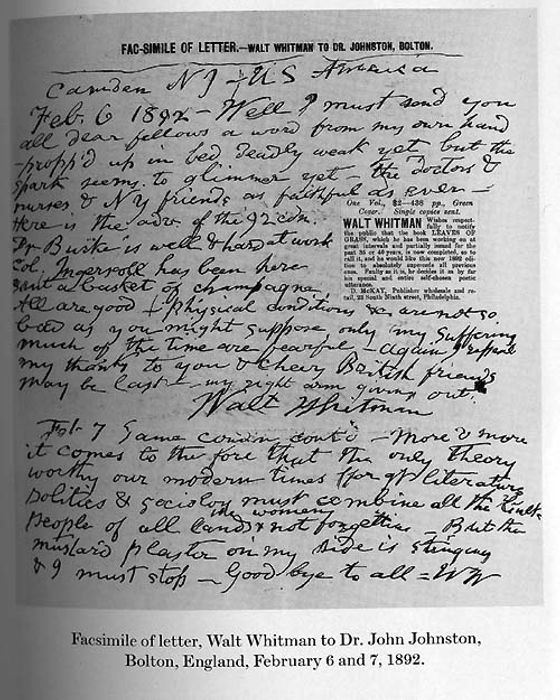
Note (): letter, dated Return to text.
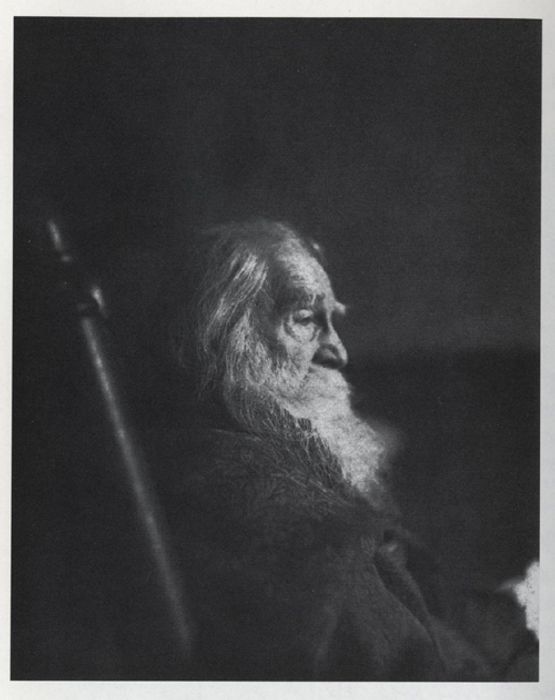
Note (): photographs, dated Return to text.
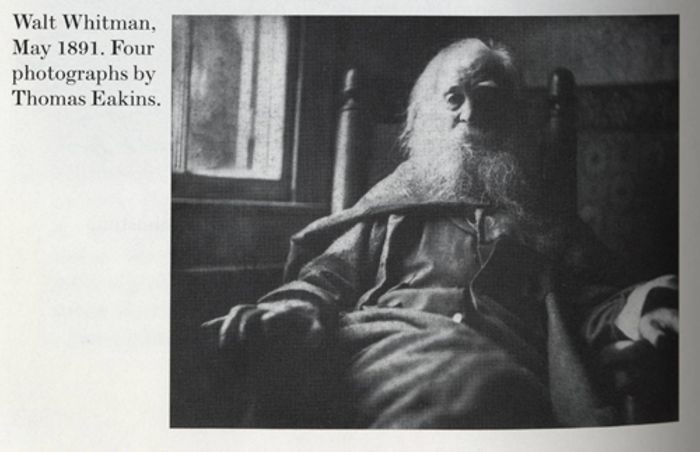
Note (): photographs, dated Return to text.
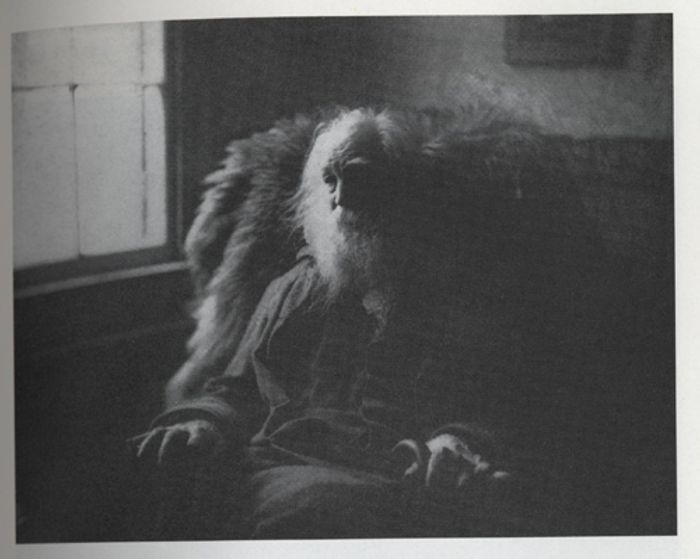
Note (): photographs, dated Return to text.
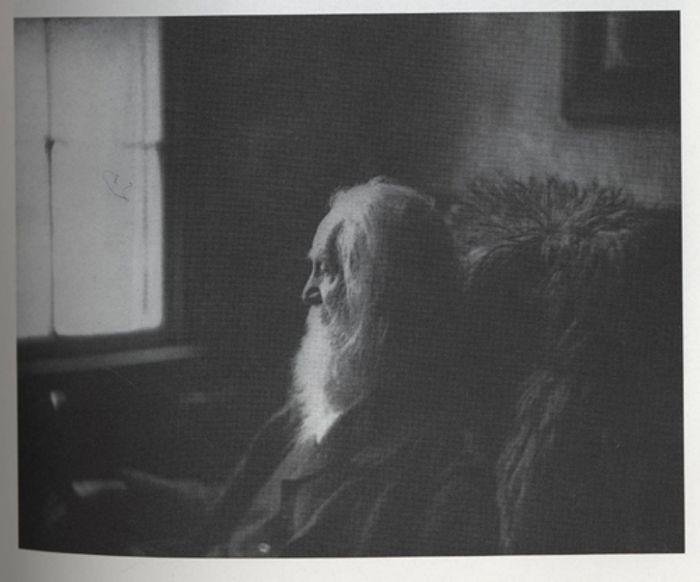
Note (): photographs, dated Return to text.
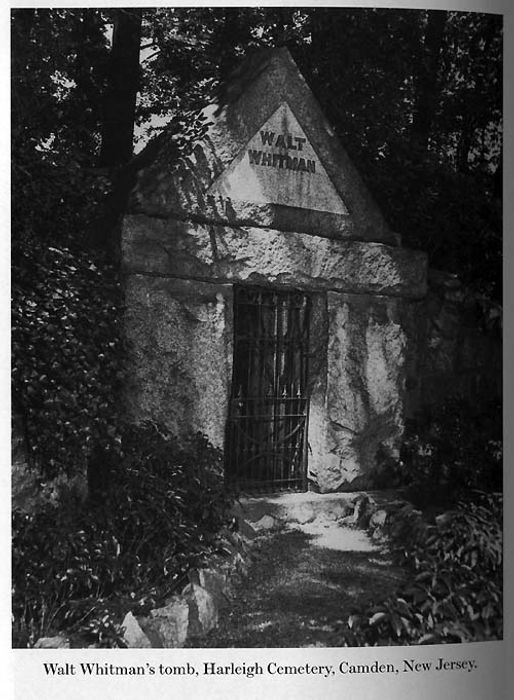
Note (): photograph, undated Return to text.
[Begin page 241]Friday, December 18, 1891
Reached W.'s towards six in evening and found he had not been able to get up at all through the day. I was surprised to hear that Longaker had not been over. Upstairs a few minutes to see W. "Here I am—fast in bed—driven at bay." At my suggestion that Longaker should have been over, he declared, "We do not need him. What I need is rest and composure." "But you had rest and composure and still got sick." "That's true enough. Anyway, pursue your own pleasure." And again, "What I need is some sleep—some few hours of unbroken sleep." And still further, "Things seem badly given out. I do not know what it promises, but whatever, let it come." Had had no curiosity to examine papers or mail today. I referred to "good digestion" and "good sleep" as "the best guarantees of good health." W. fervently then, "True to the bone! Yes, I always insist on that!" W. lay in bed, the light far down, a cheery fire in the stove. Looked very pale, feeble, worn out. Too weak to hold his head above the counterpane.
I looked about the old room, had some rapid solemn thoughts (sitting on side of the bed), then left. Instructed Warrie to go over and get Longaker without delay. Several reporters over but not as many as flying rumors generally bring. Day fair—even beautiful.
The Press note might have been worse—or better! But it observed my warning: "Don't become alarmist." And so did Ledger. The Camden Post man had been equally careful, as witness this in this afternoon's paper:
Walt Whitman is a very sick man. For two months he has not left his bedroom. Now the dreadful grip claims the poet as a victim.
Mickle street, on the south side below Fourth, looked cold and bleak this afternoon when a Post reporter walked up the steps of the
[Begin page 242]
venerable bard's frame home, but within, how warm and cosy. The welcome by the lady at the door was hearty and hospitable.
Presently Mr. Whitman's faithful and courteous attendant pattered down the stairway with this message from his charge:
"I am holding the fort 'sorter.' I may get over it and I may not. It doesn't make any difference which."
After the meeting in Unity Church was over I went round to W.'s with Anne. Longaker had been over. Warrie only had an indefinite notion what was the matter—called it bronchial pneumonia! But said Longaker had left word he wished to see me tomorrow morning if possible. W. had protested to Warrie against his going over for L., but of course overruled. Milk punches and medicine! That is W.'s immediate regimen. Longaker had said to Warrie, "Mr. Whitman is a very sick man." A remarkable admission for L. to make, having the cheer and reserves he has. Will of course be over tomorrow again.
W. not yet asleep (eleven o'clock), says, "I hate to go under the harrow." Saying, too, "My mind is too active: I wish it would rest. It is as active as 40 years ago." Warren thinks he has something on his mind. He has—more than Warren knows! The future dubious enough. W. is coughing up an ugly green mucus, but Longaker says it is good to have it out. Cough easy.
Saturday, December 19, 1891
Matters grow gloomier. W. is worse. This morning the following letter from Longaker: [Begin page 243] Saturday P.M. Dear Traubel, As far as I know I shall be at home this evening. W. W. is no better. I expect to be over to-morrow morning; but should I be detained then in the afteroon early. As ever D. Longaker Could not get up there in the course of day but wrote him. At W.'s he had left me a little note to call on him. As he had left a like word last night, I felt the gravity of its atmosphere. He had pronounced W. worse to Warrie and with "chances" against him. Premonitory note from Bucke, too. W. very weak—the cough increased, though yet mild—the mucus however coughed up copious and disheartening. Shows a disinclination to be aroused—this even to Warrie and Mrs. Davis when they attend him. Longaker advising Warrie however to keep him moving. Somnolent—asks for sleep, rest. Endeavors today to use the catheter unavailing, Warrie having to operate it for him. Darkness thickens—my heart trembles on its throne—the end not unprobably near.
To my mother's house a few minutes (this my birthday—a solemn birthday—my mother giving me with tender hand an old cherished copy of Tasso). Then home and after supper to Longaker's, who frankly said to me, "The prospects are all against us. I do not expect a sudden demise. His heart works well—there is not likely to be heart failure. But I expect that within four or five days, or in about that time, this mucus will so thicken as to quietly drown, suffocate him." While we sat there, reporter came in from Press. Longaker reserved with him, I not so much so—"as I preferred," said L. on the reporter's retirement. L. thought it well to divulge but not for him to do it. What should I do with Bucke: summon him or still wait? Longaker seemed not to know what to say, nor I. Yet L. was sure of the end—sure the chances of a mistake are reduced to the infinitesimal. I told L. enough of the Harned-Walt episode to show him its importance. He advised that Harned get it at once. [Begin page 244] How could it be done? We arranged for a meeting at W.'s at 9:45 tomorrow—Harned to be with us. L. will see W. and will urge the business with Harned. "I can tell him his danger very frankly. It makes no difference to Mr. Whitman. I noticed yesterday that he cared little, which side the blow fell. He is beyond all such fear. A little more stimulant of whiskey will aid him. A bad sign with him is his somnolency—his disinclination to be woke up." Longaker would be better prepared in the morning, too, to crystallize his opinion. Solemn talk—an hour or more. Then away again—downtown—stopping in at Press office, seeing city editor and one of the reporters.
To Camden—a cab at ferry—driving up to W.'s. Warrie and Mrs. Davis still up. Went into parlor and we had some talk, I submitting the substance of the bad news, they hearing full of feeling, expression. Stoddart and Gilchrist in at different times today, neither knowing W. was sick. Warrie says W. took his medicine last night at ten, twelve, two, then at four kicked—spoke of its bad taste. Today more willing—tonight markedly so—even proposing more whiskey in one of the punches.
Warrie wrote Johnston today. I have sent serious word to Bucke by letter, which he will get Monday morning.
Weather perfect—cool, mild—clear skies. The Press men getting ready for W.'s death.
Buckwalter also called to see W.
No chance to show W. Mrs. Fairchild's tender note and its Christmas remembrance: 191 Commonwealth Avenue. December 15 My dear Mr. Traubel, Christmas draws near once more; I remember that last year you were good enough to charge yourself with a commission for me. May I ask you to repeat your good offices?—and to buy something for our friend that he wants or needs with the enclosed five dollars? I wish it were more! but misery cries with a louder voice than love in this modern world—and with so many sick and sad I cannot think of my own selfish pleasure in giving first. [Begin page 245] May Christ be born again indeed in the hearts of us all. These are my warm Christmas wishes for Walt and you and me and all people. Very cordially yrs Elisabeth Fairchild Acknowledged to her today.
When I showed W. Gilder's note the other day, he exclaimed, "Just enough! And the practical right word!"
W. at last turned up Kennedy's Tennyson postal; which, now Kennedy divulged, has a curious significance: Sat. Morn. 6 A.M. Dear W. W. I shall count it a distinguished favor to get the loan of that Bucke letter anent T. Tenn. was the bright particular star of my youth and early manhood—is a man who makes this dull earth godlike, & immortality not at all strange. I will sacredly respect yr wish as to mention & will be extremely careful not even to mention it to any dangerous person whatever. W. S. Kennedy
The fellows all greatly admire Ingersoll's letter of 12th to W.: 400 5th Ave. Dec 12. 91 My dear Mr. Whitman, A thousand thanks for the "Leaves of Grass" and many many more for the inscription. As soon as the book came I read to a party of friends the "Mystic Trumpeter" and we were all stirred to the very depths as though by the blast of a trumpet. What a beautiful, hopeful, imaginative, tender, prophetic and superb poem it is! Then I read Sea Drift—The Guests from Alabama, and then "When Lilacs Last in the Dooryard Bloomed"—and we all agreed that there could not be found in our literature three poems to equal these in intensity, tenderness, philosophy and dramatic form. The only objection I have to the book is that it purports to be finished—with you, while there is life there will be song. You have not [Begin page 246] reached the journey's end, and, while a grain of sand remains within the glass of time, there's something left unsaid that we, your friends, would gladly hear. You must not say Goodbye!—wait and let that be the last. Thanking you again for the book and especially for the loving words I am as ever your friend and admirer R. G. Ingersoll Mrs. Ingersoll writes with me in thanks, congratulations and regards.
Sunday, December 20, 1891
First to Harned's. I found him reading the Press—in no way other than pleased with the report. Together to W.'s. Longaker did not get in till 10:20. Warrie reports W. "better"—that is, stronger—that he sat on the edge of the bed and ate the reedbird Stoddart left yesterday—had in fact asked for it himself, nor seemed longer to resent the punches but rather to ask for them. Told Mrs. Davis he had no wish to see anybody today. Not even his brother George? "No, not even George. I do not feel to." And gave such indications of his disposition towards reserve and quiet. Warrie had said something about the papers, that the Press had "done him up" this morning. "Have they got me dead?" asked W.
Harned and I went upstairs and into the room to look at him. He did not notice our entrance—was in a deep doze—lay on his left side, his face to the light—mouth and eyes blue—the left hand holding a folded handkerchief (beautiful, now slender, hand). Breathing regular but greatly choked, head and throat. We went downstairs again, Longaker almost instantly coming. Harned, L., Warrie and I up thereupon to W.'s room together. L. took his place north of the bed and took W.'s hand, at which he woke up. "Ah! Doctor! It is you!" And then questions and answers. His answers easy and ready. "I am a little confused about the days, Doctor. I had to ask Warrie this morning what day it was. I felt better this morning, but this afternoon I felt [Begin page 247] just as weak again—just as weak, Doctor!" Even now confused about the hour. Telling of the whiskey he had taken, W. also said, "I ask Warrie for a good deal of water—cold water, but he thinks I ought not to have it." Here W. laughed audibly and cracked his little joke. "Warrie is a very faithful nurse, Doctor. He is very insistent. He quotes against me the old Scotchman, 'Ye ken have yer whack, Johnny, but nae ma! nae ma!'" And then, "I must have got a good deal of sleep last night, Doctor—a good deal. I seem to be holding my own." W. coughed a good deal, working up much mucus.
After retiring Longaker consulted in the little back room with us a minute. While there Warrie came out to ask if W. could have a few peaches—he had asked them. L. said of them as of the water—let him have what he wishes. L. went back in the room, said something to W. which led W. to ask, "How am I, Doctor?" "You are a very sick man, Mr. Whitman." "Yes, Doctor, I suppose I must be." Longaker then spoke of our presence and asked if he had particular things to say to us. "I cannot stand it, Doctor. I am more nervous than my friends understand." And so Longaker did not press it, saying "good-bye" and rejoining us. L. not registered as doctor in Camden. We decided to call in McAlister as committee. Longaker wrote him a note which Harned will deliver. L. says of W.'s condition, "He is no better, which is in fact to say he is worse. The apparent improvement is no more—it is the result of the great stimulation. I still hold to what I said last night. I see four or five days ahead of us—perhaps a week, but a reduction of the life—a fall in the pulse—an increased inability to throw off that mucus—finally substantial suffocation." We are all to meet at five this afternoon at W.'s—perhaps to make a new attempt to get W. and Harned in contact. Gave five dollars to Warrie for his extras. Is faithful—up night and day.
To Camden again in afternoon, reaching W.'s about five. Harned in at 5:05, McAlister a couple of minutes later and Longaker at 5:18. L. and McA. upstairs together at once. I followed [Begin page 248] them and lingered in the room and in Warrie's room next. They entered into a close consultation and examination. W. remembered McAlister. "And you have a sister Nellie? I have met her often up at Tom Harned's, and I want to be remembered to her, too." He got into an oddly humorous banter with Longaker about the bitterness of the medicine. "Don't you like it?" "Doctor, you are joking." "No, I am not." "What! You will mix salt, vinegar, aloes, assafetida, with a few other damndest things, and say you like them?" "Liking is a matter of taste." "Of damned bad taste often." Longaker quoted him a German story or proverb.
When they commenced this examination W. assisted them every way he could. They sat him up at one time—sounding him lustily. After they were finished, he remarked, "I feel none the worse for the ordeal except for my left leg: that is the side of my paralysis. Whenever I get that in such a position, it soon gets to pain horribly. Otherwise I feel no pain."
Said W. at one moment, "Dr. McAlister, do I look like a dying man? None of your doctor stories, but the truth—the naked, sheer truth. In the morning? Then I was very far down—very low. I was depressed—I had not vim enough to lift my hand. I have eaten solids. I have drinked a little beef tea. You think the punch has done me good? Anyhow, here I am. It is hard to say how. Now much that was dim seems swept away." Doctors proposed to go out to consult. Said W., "Yes, go out, and tell the result to Warrie or Mary Davis and let them tell me—but tell them the result. I want to know it—no doctorial hidings and seekings."
Left Longaker and McAlister in the little room together where they spent well upon half an hour alone. In meanwhile to parlor. The Press reporter, there when I had come, still there. Warrie told me Ingram had been over with a bottle of wine which W. had enjoyed. Warrie thought W. greatly improved. He had sat up in chair while Warrie changed bed and had been able to submit to re-clothing.
[Begin page 249]Longaker and McAlister now downstairs. McAlister at once said to our inquiries, "He is a dangerously sick man."
"How sick—fatally?"
"Yes, I think fatally."
"How long can he live?"
"I should say, about four days."
"Then you give up?"
"Not absolutely, but the chances are only one in a million."
"Then the improvement indicates what?"
"It is mainly the result of the stimulants."
"And will not continue?"
"No." The reporter was all open ears. It seems the right lung is all collapsed—that he now practically does all breathing by the one lung. I walked up the street with Longaker, who really says, "I see no cause to revise my morning's judgment." Should I telegraph Bucke? He rather thought not, if I meant to do so positively—wait till tomorrow. They had ordered a flax-seed poultice. McAlister will come at nine in the morning unless called before. Longaker will meet him at four at 328 for further consultation. I went up to Harned's, where we had lunch together. And then we sat down and made up the following telegram for Bucke, whom we considered we should notify:
McAlister had gone back with Longaker this afternoon. W. asked, "Well, what's the verdict?' "A bad one—you are a very sick man." Was it fatal? They said they thought it was. He never winced. Afterward W. remarked to Warrie, "They give me up. We will beat the doctors yet!"
Sent Bucke's telegram off from Broad and Montgomery Avenue, also the following cable to Wallace: "Walt critical. Small hope. Traubel."
Back still again to W.'s 11:30. Warrie and Mrs. Davis both in parlor—both with colds (Mrs. Davis a bad headache superinduced). Offered to stay but found I could do nothing. W. still as he was. Mrs. Davis went up and asked him how he was and he reported "so-so." The lights evidently going out. Warrie seems to fear the night. Is to have Tom and I instant anything occurs. The outlook without relief. I scarcely slept last night. This day has been full of work and unrest. Poor Bucke—with that telegram for breakfast! And poor Bolton—with the chill few words!
Monday, December 21, 1891
To Philadelphia usual time but stopped on way at W.'s, finding his night reported decently good, with no increase of discomfort but with an undoubted heavier pressure of sleep. Warrie had just woke him and he had protested, as he always does. "O Warrie! Why did you wake me? Don't you know that every minute's sleep is golden?" Later in the day he said again, "Warrie, it was such a sweet sleep! I was in Paradise. Why did [Begin page 251] you wake me? You startled me." His whole disposition towards the somnolent. I did not linger long in the morning. McKay had sent over for a couple of books, which they could not deliver at the time and which I now took.
At the Bank a whole string of visitors and inquirers, among them Brinton, Frank Williams, H. S. Morris, Edelheim, Morris Lychenheim. My whole day full of business and anxiety. Brinton startled at the knowledge I gave him. "I am afraid it signifies an end." Questioned me like a surgeon. Morris asks, "Do you really give up hope?"
"No, but I cannot give up my fears and convictions either." The morning papers quite moved by the occurrence: Press to greatest length, Inquirer not at all. Found something in the New York Tribune, but not in Herald or World. The Post in afternoon brightly conservative—a fine solid item:
The physicians in attendance upon Walt Whitman have practically given up all hope of his recovery. His friends still have some faint hope, but expect the worst. He is suffering from bronchial pneumonia. His right lung is in a state of collapse, and his left lung is partially affected. All remedies have thus far failed to produce favorable results.
His condition this morning is "no better" and in fact somewhat worse. He takes some little nourishment. He is cheerful, but has a desire to sleep all the time. No one is permitted to see him. He may pass into a comatose condition at any time. His physicians have told him of his exact condition, but he pleasantly said to his nurse, "We may beat them yet." He faces death with great calmness and courage and awaits the final summons as if nothing extraordinary was going to happen. This perfect calmness may tide him over, but no one expects a favorable turn.
At 3 o'clock there was no change in Mr. Whitman's condition.
[Post, Dec. 21, 1891]
Letters from Johnston and Wallace (one of Wallace's containing the cipher, providentially!):
Very ill, no alarm at present.......................Paumanok
D[itt]o alarming..................................Ontario
Do doctor fears immediately fatal results..........Navesink
Do no hope—have sent for Dr. Bucke...........Osceola
Remains the same, neither better nor worse............Average
A little better.......................................Pioneers
Steadily improving....................................Road
Much better...........................................Joys
Out of danger.........................................Song
A little worse........................................Time
Much worse............................................Prelude
Worse alarming..................................Whispers
Do likely to be fatal..............................Starry
Do expect death in a few days....................Parting
Do do in a day or two.....................Sunset
Sinking...............................................Finale
Dead..................................................Triumph
Funeral in 3 days...................................Memories
Do day after tomorrow..............................Lilacs
Do tomorrow........................................Captain
Also from Bucke: 18 Dec 1891 My dear Horace I have yours of 16th and am a little relieved to hear that W. is some easier. You say that nearly every one has the grip there. Should W. get it as he is very likely to do, it would probably quite or nearly end him. You will no doubt have a chance to see the speculations on the cause & meaning of insanity later as it is almost sure to grow into a paper or book eventually and get itself published—but so far I have written nothing down but a few notes. The ground is white but not enough [Begin page 253] snow to make decent sleighing which is aggravating. I feel constantly very anxious about Walt. Write me a line often. I look for a complete collapse before spring. Afftely R. M. Bucke Bucke's seeming to fore-fear something, and even Johnston giving a solemn quotation from one of W.'s recent postals to him.
McKay sent to Bank for the books. (I should have said yesterday I had a short talk with Mrs. George Whitman, who was just going at the time of my entrance.) W. had told Mrs. Davis, "Don't let anybody in to see me today, Mary: let me sleep." Not even George? "No, not even George: some other time, Mary." After hours at Bank (how hard and horrible—how long—the day!). I took a run to McKay's, where I had some talk with him (his busy holiday season on). It appears his own father had been sick. For several days at the point of death but had now rallied. McKay wishes to name a big edition of "Leaves of Grass" instantly on a fatal termination of W.'s illness—should things really turn the bad way. He had received still another order for big book. (How these orders used to stir up W.'s old heart!)
After leaving him and taking a very brief run in on Billstein, I hurried towards Camden, meeting Frank Williams coming off the boat. "I have just been there. There seems to be no change in Walt. Harned, whom I met on the step as I came away said he was worse, though I don't know on what he based it." Some further talk with Frank, who mentioned the weariness of Warrie and Mrs. Davis and offered to help relieve them. But what could he do? "They seem to look on it as only a matter of a few days," says Frank, "which, if so, they seem to think they can manage without assistance." Then good-bye to Frank and to Camden. (Frank had further remarked, "The doctors were there while I was there—consulting.")
At W.'s found Longaker had left a note for me, as follows: "Dear T., W. W. no better. If any change at all slightly weaker. No change otherwise. Longaker. 12. 21. 91." This was rather [Begin page 254] discouraging and confirmed by all that Warrie told me. W. never wakes except when waked—is somnolent—resents all breaks up of his repose—takes medicine (says less about it than formerly) then relapses. George here in course of day but W. had not seen him. "Give my love to George: tell him I am glad he came, but say I will see him when I am stronger." To Longaker he had said, "Doctor, you always have the bad luck to catch me at my worst. I was better this morning, wasn't I Doctor?" Appealing to McAlister, who assented. But did not indicate same inclination to press a joke or any casual talk as yesterday. Reporters here—plenty of them. Harned had been in and had said Bucke telegraphed this morning to know if any change in W.? And on Harned's "no" had again telegraphed that he would come at once, and was probably now on the way. Letter from Burroughs in this afternoon: West Park New York Dec 20, 1891 Dear Walt, I was reading in your Nov. Boughs the other night & was for a long time thinking of you intently. I seemed to realize you very vividly & of all you had been to me, & of all you still are. I have had no word directly from you in a long time. I thought I should see you before this, but here I am in the old ruts. I must get down your way this winter. I keep pretty well & lead an eventless life: read a few books, write a little now & then, & work on my place. I saw by the paper you were not as well as usual which made me grieve. I hope you are able to send me a card: if you are not, have Horace do it. I long to have some word from you. Not much winter here yet—no snow at all, Julian has just had his first skate. He grows finely & is getting to be an omnivorous reader. Wife is well except rheumatism. I go to Roxbury to-morrow on business. Hoping you will be able to eat your Christmas turkey with relish I am with much love John Burroughs I took the privilege of opening it, and it proved well I did. And then sat down and wrote on W.'s pad, which Warrie brought me [Begin page 255] down from W.'s room, letters to Burroughs and Ingersoll. Thence to my mother's, where I found a cable message from Bolton: "Wire again. Love to Walt. Wallace, Johnston."
To 537 York. Anne not extra well—a sweet supper and talk—she aiding me every way in the work and having written letters today to Johnston and Wallace, to Mrs. O'Connor, Johnston (N.Y.) and the Bushes. Now again downtown to mail these and other papers and letters and to Western Union to send Wallace and Johnston the cable, which I put into these words: "Sunset-Osceola," translated: "Worse—expect death in a day or two. No hope. Have sent for Dr. Bucke." When at 328 again I found Warrie much exhausted and Mrs. Davis wishing to go out for a few minutes or more, so offered to stay on watch—which I did while I engaged on these notes. I wrote in the parlor on one sofa, Warrie on another sofa soon falling into a deep sleep. I would go up to W. every ten minutes—turn the light up in back room—go in—watch him—listen to his breathing—then to retire. He lay on his right side—never seemed to stir hand outside the cover—drawn up into small compass. Once Warrie went up to give him some of the flax-seed tea (Mrs. Davis had been up—thought his throat full—had aroused him by touching his hand)—I went with Warrie. W. remarked, "It tastes good, Warrie." Then, "Lift me up to the side of the bed, Warrie," which was done. And in this position he took the tea. Warrie, after replacing him in the bed, remarked, "Now I'll leave you for a little while." W. then, "Before you go, Warrie, give me a little more to drink." And as he took it, "It does me good, Warrie. I feel much better tonight—much brighter—than last night. I have no fever—I almost burned up last night. My mouth, jaw, tongue are sore from the amount of medicine I have taken." Yet seems never to say a word save when stimulated. Warrie said to me, "That's the most he has said all day." When Warrie told him of McKay's father, he first exclaimed "Oh!" and then, "Poor old man!" And from that point collapsed. Expresses no curiosity in anything going on around him. Would sleep on forever if not shaken up. One of our trips upstairs he says, "O Warrie, give me [Begin page 256] the water! It is so good!" Again he says, "Warrie, get some fresh water—that seems better." And once when asked how he was he speaks, "Fairly—fairly—considering!" Warrie made some remark about the fog out of doors and he did not notice it. Before he got into the deep of this stupor, he once asked Warrie about Morris' mother, "There's another poor devil who has a heap of trouble!" He seems now to take the medicine without a murmur, and without opening his eyes. Often when I would go into the room and to the bed and gaze at him—listen to his breathing—my own heart would throb wildly, almost with hope. He seemed so peaceful. Once he lay in such a way as let the light fall on his face. The face was peaceful—the two hands together—the body pulled together—all childlike and beautiful, and the breathing stately and steady, like the long lines of his poems. To touch his head—to touch his hand (the head warm—the hand cool)! He would never wake. I would never say a word—out on tip-toe as I had come in.
We watched even more closely at midnight, but not the least change appeared. A couple of reporters pulled the bell. I went to the door and talked with them (one from Ledger). One asked me, "Is it worth while for us to sit on the doorstep all night?" A damp foggy night—sultry. It seemed almost ludicrous. "No, I don't think there's any danger of his dying tonight. I am so sure of it, I'm going away home myself in a few minutes." Just before it struck I went upstairs for a last look at W.—close to the bed—leaned over him. He was on left side, one hand under his cheek and holding handkerchief—the other out of coverlet and hanging down. A moment's prayer of love and gazing—a silent, solemn prayer—then good night to all and home.
Tuesday, December 22, 1891
Early to W.'s—at eight—after a slight breakfast. The morning clear but still soggy and warm. Mrs. Davis admitted me and Warrie soon came downstairs. W. had been asking him, "What day is it, Warrie? Is it the 23rd?"—which shows that he keeps a [Begin page 257] pretty close account. Warrie had said to him, "Dr. Bucke will be here pretty shortly, I guess." W. opened his eyes wide, "What?"—crying as if in astonishment. Looking and continuing to look at Warrie and keeping eyes open full ten minutes. I wonder if the thought did not flash on him then: "They give me up! Why should Bucke come but for that?" I have no doubt of it. I went up with Warrie and lingered about the room for five to ten minutes. Warrie gave him some medicine, which he took unquestioningly and without opening his eyes. Then asked for water. Did not like taste of water in mug, saying, "It is bitter—bring some fresh," which, when brought, he took without criticism—instantly relapsing to his wonted sleep without word or sign. His voice seems changed since midnight—fuller. Yet the breathing is still wonderfully steady.
Warrie reports head warm, hands cold, feet clammy. In complexion W. not frightfully pale, though there are dark spots in face, on the left side, Longaker ascribing it to "deficient aeration of the blood." Opened a letter from New York—marked immediate—written by some stranger to tell W. of his own recovery from a like trouble. Bucke not arrived yet. Will stay at Harned's. I have anxious letters from Gilder and Rome.
Morris and Williams again anxiously in Bank this forenoon. Law in later. At the least sign of an end in W. I am to be telephoned for. Answered Gilder and Rome by special letters. Also wrote at some length to Johnston and Wallace.
To Camden a bit after five. Mrs. Davis almost encouraged about W. He said to her this morning once, "Mary, I am here yet!" And again, when she suggested to sit on the lounge near the bed and rest, "Yes, do so—sit a long while—take a good rest!" At the same time hearing Warrie shake the medicine to his right, looking about archly, "I hear you, Warrie—yes, I hear you!" But Longaker gives no encouragement. "I see no reason to change my Sunday's opinion." Bucke not arrived yet. Harned expects him towards six.
W. keeps up his cheer. The Bulletin appears this afternoon with a long biography, as if fearing he might slip them in the [Begin page 258] night. W. unquestioningly lighted up mentally for a brief space, or in flashes, today. I sat down to write further to Bolton and Warrie happening to go upstairs told W. Had he word to send? "No, I guess not. Three or four days will tell the story." They started to clean the bed and he urged them to "hurry," saying at one moment, "Look out, Warrie, you'll knock over my mug of water" on the commode nearby, and when Mrs. Davis added, "And the medicine, too," W. said facetiously, "We won't mind that." Again and again says, "We'll beat the doctors yet." Warrie came down to remark, "He is certainly weaker. I noticed it this time. He has become a dead weight—don't help the moving anyway." W. knocked on the floor with the cane at one time and Warrie hurried up, I with him, to find W. complaining of sudden pain which Warrie proceeded to relieve by the catheter.
I wrote to Stedman briefly, too. Frank Williams heard from Stedman briefly today but with no mention of W., from which Williams concludes S. had not observed the papers. Letters from Bucke today, to both of us (W. and me). I opened W.'s. Both to same effect. Johnston (N.Y.) telegraphed yesterday. Today Neidlinger. Here is N.'s telegram:
I sent cable to Johnston, "Time," translated, "a little worse." Found cables for me from Johnston and Wallace separately: "Love to Walt and to you all. Wallace." "Thanks sympathy Love. Johnston." Harned had also left Bucke's yesterday's cable for me.
To W.'s, arriving 9:10. Found Bucke there. He had not been up to Harned's—came direct to 328—sent a note up for McAlister, who came over for a consultation. They are up in W.'s room together as I write. When Bucke entered room, W. exclaimed, "Maurice Bucke—welcome—welcome—welcome—wel—" as long as his feeble body would allow and asked, "How came you here?" Bucke saying, "Slack work—slack work." But wasn't he "busy"? Bucke insisting, "Didn't I write that I delivered my last lecture Saturday and was likely to drop down here any day?" Bucke suggests an additional nurse to relieve Warrie but Warrie resists. I think several of us might relieve Warrie. Soon Doctor downstairs and greetings. I readily found that Bucke had no more hope than his confreres. "Nothing but a miracle can save him." Yet Bucke was in doubt whether W. could not live days yet. He had examined and sounded him every way. His version of W.'s exclamation on seeing him was, "Maurice Bucke—Maurice Bucke—Maurice Bucke—welcome—welcome—welcome"—extending a feeble hand at the same time. Bucke had sent McAlister up to say he was here, and should he come up? W. had instantly and urgently sent word down, "Come up right away!" Bucke says, "He talked quite a good deal—enough to surprise me, I can tell you that. No, he did not allude directly to his condition, but he seems to know its gravity and indirectly touched it pretty sharply. For instance, he talked of Emerson and Lowell, referring to Lowell as 'poor old man' and telling me the story of his last moments when he pleaded to know if the doctors could not let an old man die in peace!" W. talked freely enough further about his general state and finally admitted he had better rest and let Bucke go.
Bucke and I went up to Harned's together, McAlister going to his own home. At Harned's some conference till nearly [Begin page 260] midnight, deciding several things, among them: to let the tomb matter rest—that fight can't be continued; to have no funeral ceremonies but a few words from three or four of W.'s friends—deciding upon Ingersoll, Brinton, Bucke and Harned—with Frank Williams to read from old scriptures and "Leaves of Grass." I sat down at once to write Brinton to call in to see me in the morning. We will have plaster casts of W.'s face and hands taken. Deeply moved—all of us—the saddest hour of life so far for me. As to disposition of W.'s literary effects we urge caution, which is about all that can be done now.
After leaving Harned's I hurried to 328 again, where I remained till nearly one—seeing W. several times—finding him much exercised in general ways and specially by his bladder, on which he kept Warrie busy for a long time. I had gone up one moment to see how he was, and there I found him sitting on the edge of the bed. I rushed downstairs and called Warrie, who was asleep, and who was up the stairs like a deer. Once when Warrie gave him some water he smacked his lips and said, "How good it is! I could drink a barrel of it." Warrie replying, "You have drunk that much, Mr. Whitman," at which W. very feebly laughed, "I suppose! It is very good!" And he heard Warrie working at the fire. "Hadn't you better let the fire go out, Warrie?" Has practically taken nothing but water all day. The greater number of Warrie's remarks he passed by unnoticed. His temperature seems to have been up. His desire for water constant. Good night! Home at 1:15—confident he would breast the night.
Wednesday, December 23, 1891
At W.'s by 8:15, to find Warrie and Mrs. Davis impressed with the fact that W. was "much worse." Mrs. Davis had essayed to lie down on lounge near the bed, and he detecting her had suggested he would prefer to be alone. I went up into the bedroom with Warrie and found W. looking worse than at any time since he had been sick. Nose, lips and eyes blue—mouth wide open, as [Begin page 261] if to get over severe difficulties of breathing—the breath itself seeming thick and portentous. He slept—we did not disturb him, but I regarded him "long and long." The cheeks are much sunken. He was on his left side. In left hand clasped a handkerchief. First joints of fingers dark underneath and milky white on top. The stray light from the window threw a strange sadness into the face—seemed to give it no relief. His whole appearance more labored and shattered than last night. Still takes no nourishment—cries every now and then for water—and always says it is "good." For full ten minutes I stood and gazed at him, wondering to myself if anywhere could be spur to bring this wreck back to life. Bucke not expected down till nine, when McAlister is to be here. Bucke anxious to have Longaker give him details of the case from the first. The outlook gloomy for today. I go to Philadelphia and to my desk with a heavy heart. Cheered by a beautiful note from Baker and solicitous words from Wilkinson: Law Office, Robert G. Ingersoll 45 Wall Street New York, Decm. 22d 1891. My dear Traubel: I am more pained than I can express to see, by the morning papers, that dear, good, great Walt Whitman is lying at the mouth of death. My hope is that the reports are exaggerated, but I fear the worst. After my own tussle with the Angel, however, I am constrained to send a message of Life and Hope. If not for the dear Life's sake—for I know he can and does calmly, even wooingly, embrace the "cool, delicious" messenger—yet for the sake of those myriads whose loving admiration and devotion demand that he live still further to illumine and electrify them by his living words and presence, he must not die now, he must not leave us solitary, he must live. I yearn for his life, with a yearning that all the pleadings of right, propriety, necessity,—backed by a million voices—urge and insist with. He must not leave us now—cannot, shall not. His light, though presently dim, must not yet go out. Tell him to hold high the torch, and countless hands that he has held up will now pour in the oil of life. This will be. This must be. [Begin page 262] Tell him this from me, if he can, or when he can, receive the message—from one who thought to precede him in the precedence and preferment of Fate. With a loving and strengthening word to you, also, my dear friend, in these hours of watching, I am, as always, Your friend and comrade, I. N. Baker I telegraphed Ingersoll as follows: "Whitman sinking. All hope gone. May die today or tomorrow. Believe you long ago acquiesced in Johnston's proposition to speak. We can depend upon you? Wire me 427 Chestnut Phila. at once. Walt's friends grouped here send love. Traubel."
Baker shortly replying: "Ingersoll in Toledo have repeated your telegram to him. I send Love and Hope. I. N. Baker."
And I then telegraphing Baker: "Telegraph instantly Ingersoll replies. Will be at 427 till 3.30. Send then to 328 Mickle, Camden. Letter here. Grateful. Urge Colonel for us. When is he due home? Indispensable. Traubel."
To which Baker a second time answering says: "I repeated your telegram to Toledo. Expect Ingersoll home tonight or tomorrow better wire him again tonight 400 5th ave. I. N. Baker."
Brinton in to see me—consenting to speak—showing in every way tender consideration and desire. And Frank Williams will read, at once and easily comprehending the situation and acquiescing with noble and faithful air. Edelheim in, too, and Morris half a dozen times—all hoping against hope, as I do, and all anxious to do something. Late in afternoon in to see Frank Williams, then to look up Murray, at Eakins', for taking cast, in case of emergency—failing, however, to find him.
Hastened then to Camden and to 328. Met there Bucke. I was late but Bucke was patient. On the chair a telegram for me, which I opened and found was from Ingersoll: "Give the great good man my love. I shall reach home tomorrow." And here, too, had come one direct for W.: "After the day the night and [Begin page 263] after the night the dawn. Yours with words of love and hope. R. G. Ingersoll." Bucke said, "Wonderful! Wonderful!" as he repeated it and added, "I gave it to the old man: he was deeply moved."
Harned dropped in and the three of us went off immediately to his house, Bucke meanwhile telling us the story of the day. "I had quite a talk with the old man just a while ago, in the dark. Better? No, not better: not worse, either. When I got there this afternoon, the old man was up in a chair and I said at once to the doctors, 'Now would be a good time to sound him,' which we did, very thoroughly. There was a suspicion of action in the right lung. To show how weak he was, he sat up only about two minutes before we came and about five after and was completely tuckered out. The doctors finally decided he was a shade better, though they even hesitated to grant that. I am much in doubt myself. The old man may peg out any day, may float along this way for many days. His vitality is remarkable—remarkable. But his weakness—that, too, is remarkable and not to be denied. No, I don't see a ghost of a chance for him, and yet"—and so Bucke ended. As to their talk together Bucke said, "I brought up that matter of the children—told him, Mr. Harned, what you said. But he seemed to question whether they would ever assert themselves. He said to me what he said to you, that the women were high-born—proud. And he said further that he did not think there was the least probability that they would ever come forward—ever make any claims—that on the contrary their inclination was to keep quiet, to stay away. Walt don't seem at all averse to telling it, but I don't think he wants to tell part—he feels that a part would put him in a wrong light—while he is not able to tell the whole story, which is a long one." Did Bucke think W. would ever tell it? "No, I don't think he will. I don't believe he will ever be able to tell it." And after a silence, "There was another thing he said to me: he wants to see the will—wants to make some changes in it." Harned said quickly, "That would be dangerous business. He'll have to be careful what he does." Bucke thereupon, [Begin page 264] "When I promised him to bring it down tomorrow, I felt for myself that I would bring you with it." Harned, "He could draw a codicil." "That is about what he wants, I judge. I think he wants to leave that house to Mrs. Davis." And further, "He said the will answered for its time but that it did not completely satisfy him now. God knows what changes he'll want to make on it—maybe many." Harned rather serious over the thing.
Mrs. Davis said to W. once today, "These doctors will get you up," but he shook his head, "No more getting up for me, Mary." And Bucke informs me he said something to the same effect to the doctors. Bucke hardly encouraged by W.'s condition but attentive to the rally. Will it last? "I can't see how it can. Suppose, too, we did patch him up for a few weeks: he would have to go through this whole business again before long. Is it worth while?"
Bucke did not go down again to W.'s. We took supper at Harned's and Bucke went early to bed. I went up home a while, then at ten to W.'s, where I spent a couple of hours—seeing him a number of times—going into the room—never waking him. Certainly much less restless than last night. I found at 509 Arch a cable from Wallace: "Have wired English friends. Carpenter Johnston join love to Walt. Wallace."
And at home had received a letter from Garland:
Dear Traubel:
I read with alarm that our poet is suffering with the grip. Please convey to him my love and sympathy and tell him that the Arena has a fine study of him in the Jan. number doubtless you've seen it already. Written by D. G. Watts. I see Kennedy occasionally and he keeps me informed of all the main happenings down there at Camden.
There is coming a vast change over the world concerning Whitman. It does not wait for his death—it is here.
Yours as ever,
Hamlin Garland
Bucke and Harned will go down in the morning with the will. We regard Bob's telegram as an acceptance—a response to my morning's telegraphic message. We retire with grave doubt of everything, as if the earth was slipping away from under our feet. Jessie Whitman here today. W. saw her—only, however, for a few words of greeting, a kiss and good-bye.
Thursday, December 24, 1891
This morning at nine Harned and I came to W.'s together. The old will was read by Harned and directions given by W. for the new. Harned then went home to draw it. An hour after Harned went away W. gave me some supplementary directions. Then Harned came down at 10:30 just as I was sending a note to him. Embodied the new provisions and took the will upstairs to W. to be executed. Harned had brought with him Thomas B. Hall and Henry Hollishead—his clerks—as witnesses. About eleven we were all in W.'s bedroom, viz., the above two witnesses, Warren, Harned, W. and self. Harned read the will. W. wanted one clause of it struck out—that namely in which his [Begin page 266] gold watch is left to Harry Stafford—but when he found that to do this the will would need to be rewritten, he said, "Never mind, let it go," and Harned finished the reading. W. was then lifted up—sitting position—on edge of bed, by Warrie. Harned handed him the pen and with some difficulty he signed his name. He immediately fell back upon the pillow exhausted: closed his eyes and lay for a time pale and almost collapsed. After a little Harned said to him, "It is necessary Walt for you to declare that this is your last will and testament and to request these two persons, Mr. Hollishead and Mr. Hall, to sign their names as witnesses," to which he said, "I do." Harned then, "Walt, it's necessary for you to say that in so many words: you must say, I declare this to be my last will and testament," and then with a very strong, clear voice he said, "I declare this to be my last will and testament." Then casting his eyes towards Hall and Hollishead, who were at the foot of the bed, he said, "I request you to sign as witnesses," which they immediately did, in his presence and the presences of each other. Then Harned turned around to say, "Now, Walt, you've got nothing to worry about. This is entirely according to law and everything is all right." W. noticed the two witnesses were about to leave the room and he attempted to raise his hand and wave a good-bye and exclaimed, "Thanks! Thanks! Thanks!" After which Harned and Bucke left the room.
Have seen Eakins, who will superintend cast should we send word. O'Donovan and Murray also will come over. Eakins showed me a hand (W.'s) already done, "but not first-rate: he trembled so when it was done." Variously about—writing letters, sending telegrams. To Camden towards seven, taking tea first then hurrying to Harned's, where Bucke was—hastening thence to W.'s.
Found from Bucke and Harned that they had succeeded in getting the will through. Harned first got the material for W.—the substance of the changes—went back to his office, wrote them up, then returned to 328 with his two clerks, Hollishead and Hall, as witnesses. Harned says scene intensely dramatic [Begin page 267] when W. signed. Hesitated, exhausted, between signatures—finally, however, achieving it. Leaves Mrs. Davis $1000 instead of $250, and use of 328 for a year; leaves Warren $200; fastens the literary executorship more closely. Harned kept the old will, which is entirely superseded. W. much relieved when this work all done—instantly relapsed into worst shape from absolute overexhaustion. Sat up on bed to write. Burroughs thought the signature "as good as ever." Harned and Bucke did not. W. broke it off in the middle, then restarted.
9 P.M. W. won't take any more medicine (had refused it twice before).
Friday, December 25, 1891
12:10 A.M. Bucke says, "It is doubtful if he ever sees daylight."
12:15 A.M. McAlister came and went upstairs, reporting him then a trifle worse.
Talcott Williams came in, and reporters of Ledger and Press, whom Harned had telegraphed.
3 A.M. Called, "Warrie," and when Warrie went in, "I wish you would turn me over, Warrie—yes, that way." "You don't care about a drink of water?" "No, I believe not."
3:10 A.M. "Warrie, give me my handkerchief. It is back here." Much coughing.
"This is Christmas morning."
"Oh! is it? Well, a merry Christmas to you, boy."
"I wish I could say the same to you, but it's not a merry Christmas in bed."
"True! True!"
3:15 A.M. Press reporter knocked at door. Says will issue a special up to six.
6:40 A.M. "Warrie."
"Try it again?"
"Yes, try it again."
"Suppose we go for one of the doctors and pass the catheter?"
"No, no, let us try."
[Begin page 268]"I think we did a little."
"Yes, I think we did."
"You don't want any water?"
"Yes, Warrie." (Drank.)
6:50 A.M. Great spell of coughing—choking even. Warrie asks, "Did you get it up that time?"
"A little, Warrie."
7:10 A.M. Warrie put out light and opened blinds. W. struggles a good deal with the mucus, which thickens. Rattle disappeared from throat—moans incessantly.
7:20 A.M. "Have a drink, Mr. Whitman?"
"No."
(The Press struggled hard to get the bulge in on the other papers by keeping open till six—but it did not work.)
7:30 A.M. W. on his back—his head high up on the pillows—pale—mouth open—breath short and fast—great struggling with phlegm. Again Warrie asked, "Water, Mr. Whitman?" And he, "No, Warrie boy. Thank you!"
Observant—said to Warrie, "Open the door!" quick, and then, "Is the window down?" "No." "Then put it down—a little." "Feel like having a drink, Walt?" "No, I believe not. Not anything."
Mrs. Davis went in and said, "Good morning, Mr. Whitman, how is thee." He opened his eyes and said, "Poorly."
While I was home to breakfast, Burroughs to 328.
9:20 A.M. Went up with Bucke, who examined pulse. W. never awoke.
Jessie Whitman came in.
Bucke says at this hour he may live through the day. "Breath very shallow."
10:35 A.M. "Well, Walt," said Bucke, "I was in a while ago, but you did not see me."
"Were you?"
10:40 A.M. Went in to look up etching. Heard W. murmur, "That'll do—I told you that would do."
[Begin page 269]Longaker tells me:
W. "Pretty well gone, Doctor?"
"Pain?"
"No."
"What kind of night?"
"Well, dreary, restless."
"The early part a nice sleep."
W. "What shall I probably fall into next, Doctor? A sort of comatose condition, state? You don't hardly think it? This horrible, sharp mentality—these thoughts—keeps its power to the last—determined not to stop. Nothing like resting slumber comes—the opposition to anything like that. I found by drinking coffee or tea or even milk punch it stirred up my brain, so I stopped. Well, it kept me stirred up more or less all the while. I feel pretty easy just this minute." Coughed some little.
Longaker said, "You always felt better when I came."
"Yes, I do, Doctor. I sweat a little?"
"Yes, your skin is moist now. Think you could take a cup of warm milk?"
"Yes, I could, but I don't want it. I would rather have a cup of cold water."
"You are not taking so much?"
"No, but enough. I've skipped the medicine. The drinking of the water always stirs the flame better than anything else."
"It might be well for you to take it during today"—to which no reply.
Warrie to W.: "Doctor says I ain't a good nurse."
"In what respect?"
"In letting you go without the medicine."
"It's my fault altogether."
3:40 P.M. Burroughs went up and into the room. Bucke said to W., "Walt, you are certainly better today than you were yesterday."
"Is it so?"
"Yes, undoubtedly."
[Begin page 270]Bucke downstairs said, "All the symptoms are better. I don't believe he is to die of this attack." Bucke almost thinking of going home tomorrow night. Burroughs came down and said, "I can certainly see he is better." (I noted that when Burroughs came in, W. advised Warrie to get him a chair.) Burroughs up there 15 or 20 minutes.
Bucke: "Walt, you will be up to see me next summer yet."
W.: "Doctor—no, no, that is a wild shot."
McAlister says at this hour, "I still adhere to my opinion. The rally is only temporary."
7:50 P.M. To W.'s again. I went upstairs, in directly to W., saying, "I have a message from the Colonel, Walt."
"Oh, Horace, boy!" raising and shaking my hand.
"He is concerned about you—wishing to know how you are."
"God bless him!"
How did he feel? Better this evening?
"Oh! Poor! Poor! Dr. Bucke thinks I am better, but I don't think I am."
I reached over and kissed him. I could feel his responding lips. "Bless you, Horace, bless you. God bless you! Good-bye! Good-bye!" He reached up his right hand, which I held warmly an instant—then passed out.
Mrs. Davis tells me, "Whitman said a funny thing today. He saw me flitting about with my black dress on and said to me, 'O Mary! I wish you would not wear that dreary dress.'" I had found her rather gaily dressed. Warrie has had some sleep and been relieved. He does not agree with Bucke's exuberant view. Longaker still says he insists upon his judgment of last Sunday—admits improvements.
George Whitman and Jessie in and sat there a great part of the morning and some part of the afternoon. George went up into W.'s room and burst into a great cry of pain, saying to me, "I want to be with him a while." When I went out I closed the door. He sat down on the box by W.'s side, saying little. Yet Bucke going in later on remarked, "They seemed much affected—both," [Begin page 271] Bucke saying he thought W. also had been crying. W. had told both Bucke and Burroughs yesterday that for the first time he had been unnerved, George's visit its prompting cause. Jessie said W. had spoken cheerily to her today and kissed her.
W. yesterday gave Burroughs two copies of "Leaves of Grass"—the paper edition.
Evening at Harned's. Donaldson coming in, also Loag.
10:30 P.M. Met McAlister and Longaker at W.'s. "You're not feeling as comfortable as this afternoon?"
"No, Doctor."
As to catheter: "Does that hurt you any?"
"Only a little." No more medicine. "This liquid medicine I've stopped."
The catheter discovered no urine of moment, not more than a little spoonful, yet he had fretted the whole evening about it. Told the doctors, "It burned and stung like the very old devil." Voice struggling.
"Do you feel comfy now?"
"About as usual."
"Do you feel like sleeping?"
"Yes, always."
"Did the nourishment do you much good?"
"Not much."
"Didn't you feel mentally better and more active this afternoon?"
"Yes, but that burning, stinging sense of choking is on me all the time."
Longaker, after a consultation with McAlister, said to me, "He is at lower ebb than at any time I have examined him since he was taken sick. His pulse is now 90." I walked up the street with the doctors. They neither of them shared Bucke's confidence, looking upon it as rather the feeling of lover and friend than the cool judgment of a doctor.
Ingersoll's telegram was this: "How is our friend—is there any hope? R. G. Ingersoll."
[Begin page 272]And my reply as follows: "Very much worse last night. Has rallied some today. Doubt what to expect. Will telegraph tonight or tomorrow. Some hope still. Will you write? Traubel."
Letter came from Johnston this morning. (Some Bolton and other letters for W. All his unopened.)
Sent telegrams to Brinton, Morris and Frank Williams: "Has rallied some," and to Bolton: "Pioneers," meaning "a little better."
W. suggested to Mrs. Davis and Warrie tonight to put the lights out and go to bed!
Wallace yesterday cabled again: "Love to Walt."
Saturday, December 26, 1891
Breakfast towards eight, after which Burroughs and I started down for 328. Burroughs meaning to go home if W. proved much better.
Warren opened door to us and said, "Oh! He is much worse this morning—much: at four o'clock I thought he was in danger of dying and went up for Dr. Bucke and Dr. McAlister. They came down. Bucke said he was worse than at any time since he had come down." Burroughs and I went upstairs and into W.'s room. He lay there, breathing with difficulty. Did not appear to observe us—at least, did not remark us. Eyes closed. Called out, "Warrie!" "Well, Mr. Whitman—here." "Bring me some water." Warrie picked up the mug. W. asked, "Is it cold?" "No." "Get some cold." And as Warrie dashed out the room, "Hurry, Warrie, hurry!" Eyes still unopened. When Warrie came in, W. took mug—or part of it (Warrie directing it)—and eagerly drank. And when Warrie had put it down said, "More, Warrie!" and took a second swig. He had asked Warrie, "Lift me up on the pillow." And when it was done said gratefully, though feebly, "Thank you, boy!"
Burroughs and I left—went downstairs—and I to Philadelphia. Sent Ingersoll telegram to this effect: "Whitman much worse and Doctor says may last two days. Mind clear and [Begin page 273] calm. Is grateful and loving for your concern. 'God bless him!' he exclaimed last night. Gives up all hope. Will wire later in day." Received proof of Poet-Lore article this morning. Burroughs telephoned me from Harned's office towards twelve to say, "Walt a bit better. Doctor Longaker says he may last two days. I go off from Broad Street on ten o'clock train." Morris, Frank Williams and Brinton solicitous and tender. Brinton's mother (84 years) suddenly ill with grip. Morris quotes from a note from Arthur Stedman. Arthur went to see Stoddard the other day and reference was made to W.'s condition. Stoddard only exclaimed, "Fraud!"—which is very significant.
Bucke reports a scene with Mrs. Davis (the 24th). She cried and went on at some rate about the unfairness of W.'s treatment of her, seeming to know the terms of the will. How could she? Did she listen at the keyhole, or did W. tell her his intentions? She really knew all about her own part in the will. Says that $3000 would no more than pay her. (One of W.'s grants was for her to live in the 328 house for a year after he died.) Bucke says, "I confess my opinion of Mrs. Davis is entirely changed in the last 48 hours." Harned remarked, "I understood from Walt that their agreement was: to let her have the use of the house and she to board him in return. If this be so, we none of us see how Walt owes her. Warrie's services have all been paid for, and gifts without count have come to the house for W. and gone into general use. I likewise have for four years furnished half of the coal." Burroughs out of patience with her and with the disorder of the house. "I am free to say I do not like the woman. I think her a good deal of a humbug." When Mrs. Davis yesterday told W. the old hen had laid another egg, he jovially remarked, "Good for the old hen!"
To W.'s about five. The door was opened by Bucke, who had a rather dismal story to tell. "The old man is practically dying now—has been sinking since one o'clock. His heart is giving out. Pulse is now 95 and going up. He is near the end—very near. I doubt if he will live the night through—if he can live till daybreak. He has said nothing today—literally nothing. Once or [Begin page 274] twice when I spoke to him, he answered me—but he has volunteered nothing. He wants to die—oh! wants, is eager, to die—to have an end of all this. No, he don't say so directly, but notice: when McAlister went in the room this afternoon, he asked Walt, 'Well, Mr. Whitman, how are you passing the day? How are you?' And Walt answered him, 'Slow—slow—slow.' Which no doubt had a double meaning." Harned came in upon us and we all started off together, I not going up to see W. but appointing to be down after tea.
Telegram from Edwin Arnold today, dated St. Paul: "Our hearts are with you, great and noble friend." Joseph B. Gilder telegraphed: "You are making splendid fight. Don't give up the ship." Also a telegram from Richard and Helena Gilder. I telegraphed "Time" to Bolton ("a little worse"), and to Ingersoll: "Today's telegram holds good in the main. We fear the night." At 9:30 when McAlister and Bucke met at 328 and examined W., they reported pulse fallen to 88. At 2 A.M. (Sunday) Warrie tried pulse and found it 90 and at 7:40 pulse was 88. The slight improvement induced Bucke to go to Harned's and to bed. He had originally determined to stay down all the night. Jessie and George Whitman there, intending to watch—to stay over. I there until 7:45 Sunday morning. Reporters frequent and I gave them such "aid and comfort" as good sense and caution allowed. Talcott Williams glided silently in towards 12 and stayed till 12:20.
At 12:40 W. called Warrie, who was fast asleep in the chair in the next room. I had great difficulty getting him awake. Mrs. Davis asleep on the bed nearby. "Some water, Warrie!" said W. "Not much—but water." And after he had sipped, "I am troubled so with the dreadful hiccoughs." He complained of this all night—I could hear him—the short breath and these hiccoughings between. Voice seemed to me clearer and stronger. When the doctors were here, it was thick and choked, but it cleared in the night. Longaker telegraphed his inability to come till 10:30 in the morning. W. called Warrie quite often for the water, at one time saying, "Lift my head a little higher, boy," and again, [Begin page 275] "Put my leg in the bed, Warrie"—the leg hanging out and he unable to withdraw it. He kept a keen eye about for details. He would advise Warrie, "Keep the light low!" And again, "Rake up the fire a little." A strong wind rose in the night and the temperature fell roundly. I believe it benefitted him. The whole night easy, without perturbations. We all got some sleep, except Jessie, who sat and rocked her parlor chair the whole night through. George went to sleep in a rocker. I slept on the bed upstairs next W.'s, relieving Warrie part of the time. Frank Williams over and had talk with Bucke anent funeral, and will be over again Sunday morning.
Cables yesterday and today from Bolton.
Last night (Saturday) W. expressed wish for a peach. "And don't forget the sugar, Warrie!" he said. Half expected Johnston from New York, but he did not come. Mrs. O'Connor writes a loving letter from Providence. Johnston in letter to Bucke said he would come over if he had any notion he would be permitted to see W. Bucke telegraphed diplomatically that W. had no inclination to interest himself in persons or things and indicating that J. might take his chances. But J. did not appear.
Sunday, December 27, 1891
8 A.M. Pulse 76—respiration 28. Warrie said to W., "I think you're better this morning," but he made no reply.
Bucke in shortly. Much elevated by W.'s changed condition. Talks of going home tonight. McAlister and Longaker soon came, and then the fresh examination and conference. W. undoubtedly improved. Bucke intemperately jubilant. Longaker would not admit more than "a little rally," but is inclined to allow that W. is now in such shape as might continue for some days, even weeks. "If I were called in now as I was last Sunday, I should be apt to give a much less dismal judgment."
W. says to Warrie, "Bring me a bit of toast—a bit as big as three or four fingers—and half an egg; for the egg, not forgetting the salt." Sent downstairs for Miss Jessie and spoke to her [Begin page 276] cheeringly—and even volunteered remarks to Bucke. Warrie asked him, "Do you feel much better, Mr. Whitman?" And he answered, "I don't know that I do, Warrie. I guess not." His hiccoughings quite frequent and positive.
To Philadelphia in the day. Heard Chubb speak on Ibsen, afterwards dining with him at Fels'. Has a proposition to write life of Whitman for "Great Writer" series. Mourned that he could not see W. Looks well—is in good hope. To Camden later on, reaching 328 with Anne about 4:35, Bucke awaiting me. Frank Williams had been over (we met him round the corner from W.'s) and Bucke and he had conferred about the funeral. Bucke reports condition of W. continued good. "He talked with me some—even volunteered some talk. He is a good bit better—a good bit. I shall probably go home tomorrow if nothing in the meantime turns up." Bucke broached the idea of a second nurse to W., who at first resisted then yielded. Bucke said at one juncture, "You may go on two or three weeks this way, Walt," to which he replied, "I could wish for anything but that." And he afterwards said to Warrie, "It's the worst news they could have told me."
We arranged at Harned's for the care and pay of the new nurse. Would it be made a Camden fund? Harned will raise it. Frank Williams to make a search. Bucke, instead of going tonight, will hold over till tomorrow. Is concerned about W.'s hiccoughs, says, "They are a seriously bad sign."
Mrs. Davis tells us a good story. A little box came for W. She was present. As he untied the string, he lifts up the box and says to her quizzically, "What do you guess is in this, Mary?" "In the shape of the box I should say some pills, Mr. Whitman." He laughingly responded, "No, wedding cake: but it amounts to the same thing."
At nine o'clock McAlister: pulse 78—respiration 24. He told McAlister he did not enjoy the toast and egg this morning. Said too, "Bucke was here about an hour ago," which indeed was sharply accurate.
[Begin page 277]7:45 P.M. Bucke upstairs. "How are you feeling this evening?"
"Middling. I raise a good deal of phlegm. Hiccoughs trouble me a good deal."
Bucke tried pulse: 80—respiration 28. Suddenly W. said, "Warrie, you get a couple of the complete—so to call it—copies of 'Leaves of Grass.' I meant to send by mail, but never did." (Said with memory of Bucke's intention to go home tomorrow.)
Bucke reports irregularity in heart action: every sixth beat falling in with seventh. Things otherwise favorable for a good night—perhaps many good nights.
Mrs. Davis to W. about 7:30. It was dark in the room. He knew her and said, "Well, Mary?"
"How goes it, Mr. Whitman?"
"I'm having a tough pull, Mary."
"I hope you'll pull through all right."
"It will be all right either way."
"I'm going now."
"It's just as well."
"But I'm just in the next room, close at hand, if you want me for anything."
"All right, Mary. Dear girl."
Monday, December 28, 1891
To W.'s at eight—the first thing after starting. Found he has passed a pretty good night. Upstairs and into the room, though not waking him up. He seemed comparatively easy. Afterwards Warrie came in and said, "How are things now, Mr. Whitman?" "Pretty bad, Warrie, pretty bad." "Do you wish any water now, Mr. Whitman?" "No, I guess not. It is as well as it is." "Do you feel any stronger?" "None at all." Voice rather weak and bad. Troubled all night with hiccoughs. Still, too, no nourishment.
Left, and to Philadelphia. Letter from Brinton. His mother worse. Bucke in about ten. How did he find W.? "About the same. Almost bright, cheerful. He spoke readily to me. I went [Begin page 278] into the room and asked him what kind of a night he had spent, and he said poor, poor! I told him he ought to give McAlister a copy of the book, and he immediately replied, 'Certainly, I will. Warrie, go over there and get him a copy. Yes, get him two.'" Bucke still determined to go tonight. Now in search of a professional nurse (wants a woman).
The Johnston-Wallace cable yesterday was simply "Love." I sent them "Pioneers," translated: "a little better." My yesterday's telegram to Ingersoll was: "Slightly favorable change. Will write." And did write this morning and sent off special. After consulting (Bucke and I) I gave Ingersoll's telegram away to the papers last evening.
Met Bucke at 328 at 5:10. We immediately went off to Harned's. Bucke quite determined to go. Says of W., "He is not better nor worse than yesterday. But I can't wait—it would not be right: would not be right to the government, nor right to the Asylum, nor right to my family. I will simply have to go, and come back on your call." What were W.'s prospects? "He may die any day, or may go on this way for two or three weeks. It is all confusion and mystery. I can't possibly see how he can live through January. My opinion now is that January will put an end to all this business." He thought W. was "rather talky" today: his heart keeping to a uniform figure—about 80. He ate a couple of fingers of mutton-chop and drank a cup of mixed milk and hot water. He was rather disappointed that the nurse was a woman, but told Doctor after introduction, "I feel I shall like her. But the main question is, will she say the same thing for me? But I guess doctors and nurses learn to bear with the poor sick human critter." The woman's name is Keller. Bucke believed she was eager to come. Would start this evening. We are to pay her $20 per week. Bucke explained the situation and she seemed instantly to take it in, viz., that she was first under the direction of the doctors, then of Harned and me, and to no way turn to those in the house—though to live amicably with them. As to W.'s room: "You are mistress of it," Bucke said. We may put in some new furniture if it may seem required—certainly [Begin page 279] some bedding. W. gave Bucke a couple of copies of the Johnson etching and insisted on sitting up in bed (Warrie assisting) and autographing them. Keeps constantly in mind Bucke's departure. Harned will attempt to raise money for the new nurse in Camden—as Camden's gift—not to touch on my fund.
At 509 Arch my mother handed me a couple of telegrams that had just shortly before arrived. Both from Ingersoll, to this effect: "How is the brave pioneer today. Give him the love of the whole family. R. G. Ingersoll." "Of course I will keep my promise and speak at the funeral. If Whitman asks you can give him the assurance. R. G. Ingersoll."
Later in evening I replied to Ingersoll, by wire. Also sent to Bolton cable, "Average," translated, that W. is neither worse nor better. Took supper at home then hurried down to 328 again to meet Bucke, with whom I was to go to station. Mrs. Keller had arrived and I was introduced to her. Bucke writing a letter down in parlor (it was 7:10). Had not yet been up. I went to see Warrie, who said W. had spoken to him to effect that he had rather the new nurse had been a man, but no further criticism. Nurse was to start this evening to relieve Warrie.
Bucke now came up, and he and I went into W.'s room together—Bucke first. W. caught us on the approach (was hiccoughing horribly and it interfered with and broke all his talk). "Ah! Maurice! It is you! And Horace, too! Welcome both." Bucke took a chair up to the bed, and I one out on the floor—both of us sitting down—he taking W.'s pulse. (We had shaken hands with him. ) Asking W. how he felt, he replied, "Poorly! Poorly!" And when Bucke asked, "Have you been eating anything this evening?" he responded, "O yes! some: part of a mutton chop and some milk and water." Warrie said, "But that was long ago, Mr. Whitman." "No, Warrie, not more than an hour," but it was, nevertheless. As Warrie glided about the room, W. asked Bucke, "Who's that—who's here?" seeming not to recognize him. The light burned decently high. When Bucke was done, I approached the bed again, took W.'s hand as before and gave him Ingersoll's message. He responded, "How good that is! [Begin page 280] God bless 'em all! How good! Good! It cheers a fellow up to get such things—to hear them. Give my love to all—my love to all—all," and seemed exhausted, adding after a slight cough, "The great fellow! The great fellow! Yes, it does us good!" I resumed my seat, and Bucke, removing his chair, sat on the edge of the box near the head of the bed, regarding W. intently. For a few minutes utter silence, except for W.'s hiccoughing. Then Bucke arose and took W.'s hands, bending over him with intent gaze and emotion, which for an instant checked any attempt at speech. Then he broke forth, "Well, good-bye Walt! I must go!" "I suppose! I suppose!" "Well, I ought to go, Walt. I don't want to go. But you know I am not my own master—that I have duties." "Yes, Maurice, I know." "But if I go now, I can no doubt get back soon to see you again." "No, Maurice, you will never see me again!" And after a pause, "I ought to be gone now—it were best all over now—I would be more than satisfied." The voice—the desire! Bucke could hardly speak—the tears sprang to my eyes. "This is an end of all, Maurice. This is the end—you will never see me again!" "Well, Walt, these things are not in our own hands. We have to submit. I hate to go." "Yes, and it tears me up to have you leave." Bucke stooped over and kissed him—and kissed him again—withdrew from the bed a minute, "Oh! so loth to depart!" then back and took W.'s hand again, and stooped over and once more kissed him. "Good-bye! Good-bye! You are in good hands, Walt!"—holding his hands, gazing at him (he, too, at Bucke), turning towards the door, then back for another look (oh! the pain—the solemn sad secret thought and heart-throb!)—finally to break away rapidly, stride from the room and downstairs—stirred, overwhelmed, speech lost in passion and feeling. I still kept my place in the chair—heard W. breathe heavily, cough some—not a word being spoken. Then I went over to W., leaned down and kissed him. He took my hand—squeezed and held it. I said, "Well, good night, Walt, good night!" And he replied faintly, "Don't go! Don't go!" at the same time increasing his grip on my hand (I was surprised at its strength). And I lingered for a minute or more [Begin page 281] so, saying nothing. But again I urged, "I must say good night, Walt. Doctor expects me to go to Philadelphia with him." I felt the hand tighten about mine again. Leaning over I kissed him. He responded—his lips closed with mine, "Good night, then, boy. God bless you—God bless you." He opened his eyes a brief instant. "This is the finish of the tale, Horace—this is the wind-up!" Overcome I rushed from the room. I stopped for an instant at the head of the stairs to recover myself—then joined Bucke in the parlor, where he sat with Mrs. Keller, Mrs. Davis and Warrie—silent, full of sacred unutterable thoughts, emotions. "By God! I don't want to go!" cried Bucke, and then to those around, "But when a fellow has an institution with 1200 people on his hands, what can he do?"
Soon the cab, farewells and departure. We crossed the river without event and to 9th and Green. Ingram there at station with a bottle of wine and lunch for Bucke. Had come out of his bed (he has been sick) to bring it. I arranged with Bucke to write twice a day—morning and evening, after seeing W.—and wiring instead of writing if any disasters threaten. Bucke has "no doubt but it'll be a very short time only" between today and the next call. Will reach London tomorrow evening.
To Camden again and to 328 by the way. McAlister there. W.'s pulse 84—respiration 32. No fears for the night, so we both went home. Mrs. Keller on watch and Warrie to sleep till midnight.
Bucke left these memoranda with me:
To write me each day.
To have Dr. McA. keep notes of case for me—taking pulse, resp. etc. morning & evening.
Mrs. Keller is to have $20. 00 a week—if not satisfactory may be sent away or changed.
If wanted I will at any time send $25.00 toward pay of nurse.
Circular for our book cannot be written till after W. dies.
About notifying friends when W. dies? Will not notices in papers be best?
Tuesday, December 29, 1891
Saw W. at 8:20 in his room. He slept. I did not disturb him. He looked much as before. Breathed shortly and with labor. Mrs. Keller had kept watch till two, then had slept from two till seven. She had kept some notes for me. Showed a quiet night. To Philadelphia then. Brinton in inquiringly and to say his mother was worse and he could not go to Washington at all. McKay's father died last night. Was taken sick same day as W.—grip, then pneumonia. We are all startled, too, by the death of Ralph Moore—yesterday: a giant, rosy with health. Bucke exclaims, "Some recklessness in it, I'd swear." I have written Bucke twice today. Have also written Wallace and Ingersoll. Sent no cable tonight. Bolton salutation to W. today: "Love from all." Wallace writes, date 19th. On the 20th I sent them the first cable.
Again at 328 at 6:10. W. resting easily enough. Longaker and McAlister had met and consulted again. They reported "no change." I was down again at eight and stayed till 10:15, talking a while with Mrs. Keller—who shortly went to bed—and then with Warrie. Several times W. called Warrie in his sleep, and when Warrie went in he found W. did not wish him. The hiccoughing and moaning constant. The hiccoughing suspended the greater part of the day, but now returned with vigor. It fills W.'s mouth and makes talking difficult. Here are the notes Mrs. Keller handed me:
8.30 Awoke. Washed hands in warm water, which he apparently enjoyed. Holding his hands in the water of his own choice. Sponged face, and washed back after turning him on his right side. Bathed back with lotion. Asked if Horace had been here. On being told he had, and that Dr. B. had gotten off in safety, said, "That was what I wished to enquire about."
[Begin page 283]
9 Hiccough—not severe.
Note: Has taken nothing but water in nearly 24 hours.
9.45 Ate one egg—also piece of toast 2 inches square.
Wished to sit up on edge of bed to eat, but let me feed him lying down, in which position he had no difficulty in taking his food. When I said, "Mr. W. don't think because I am a nurse you must eat when you do not wish to"—he replied, "You will find me very self-willed when you come to know me."
10 Quiet—slight hiccough—occasionally cough with raising of mucus.
10.30 Respiration 30—taken while sleeping.
10.45 Movement of bowels, large. Was lifted on commode. Did not seem much exhausted by it. Warren lifted him.
11 Quiet—breathing easily.
12 Has been sleeping for some time.
12.20 Hiccough, awoke.
1 Sleeping on back.
1.15 Awoke for a short time. Asked to sit up on edge of bed for a moment. Helped him up. After sitting one minute requested to be laid down saying, "I am very very weak."
1.30 Quiet—excepting a slight hiccough.
3.15 Pulse 71—Respiration 23.
4 Sleeping or quiet.
5 & 6 Condition unchanged.
W. ate soft-boiled egg—toast two inches square—this morning. Refused clam juice—says he does not like it. This recommended by Burroughs.
Afternoon. McAlister: "How are you feeling?"
"I'm feeling so-so. Rather worried over Dr. Bucke. He went last night." Then to Warrie, "Did Dr. Bucke get off all right?" And added, "I was rather afraid he might come to harm, as he was five minutes late and is of a reckless disposition anyhow."
Warrie told him he got off all right—that I had duly so reported. W. had also spoken to Mrs. Keller about this.
Last night Warrie heard W. several times murmur "Mother." Last week I, too, heard this same word, as I watched, alone, in [Begin page 284] the next room—once stepping in to W.'s bed and listening intently to catch what he said in connection with it. But though other words seemed spoken, I could not rescue one.
8:30 P.M. Asked Warrie, "Give me another pillow." "Hadn't I better lift you up higher?" "Maybe that would do."
9 P.M. Warrie offered to turn him and he said, "I am sick, sick and tired and don't know which way to turn." Took some orange juice, called it "first rate." Would he have more? "Yes, but not till morning."
4 A.M. Warrie heard him moan and asked him if he was in any pain. He said, "No, not particularly. Do not let me worry you, Warrie."
Wednesday, December 30, 1891
Stopped in at W.'s at 8:20 and spent 20 minutes there, the most part in his bedroom. But I did not approach or speak to him, and he gave no indication that he knew anybody was in the room. Though the ease with which he awakes when spoken to and catches the thread of what is said convinces us that his sleep is mainly very light. He had not spent a good night, yet was about as I left him at ten. Breathed more easily, if anything—murmuring constantly.
I had received a letter at Post Office from Stedman—tender and loyal:
137 West 78th Street.
Dec. 29th. 1891
Dear Mr. Traubel,
Of course I am greatly indebted to you for remembering me at this time, and for judging so rightly that I & mine would be profoundly interested in direct news of our old bard's condition. I see from the newspapers that he is making a characteristically strenuous and heroic fight of it. The whole country is with him at this moment, & somehow I feel as if you will enable him to beat off the "grim conqueror" yet once more. I want him to live through the Columbian year—yes, & to write the Columbian ode. He will leave none behind him, if he departs,
[Begin page 285]
who can so justly claim that song as his own. At the worst, or best, give him the assurance of my warmest love, comradeship, honor. He will live in his book, from generation to generation. I have been counting more upon visiting him, & upon reading to him some of my lecture-work, than upon any other feature of my trip to Phila. next month. If I don't find him there, it will be winter indeed. But, if he must go, there will be a new force added to some other world. Thinking of your group at Camden to-night, and depressed by illness myself, Tennyson's refrain rings in my brain—"Tred softly, & speak low,/For the Old Year lies a-dying!"
Sincerely yours,
Edmund C. Stedman
Found with W.'s mail a letter from Ingersoll, which I opened and meant to read him, but seeing him at rest I postponed it. Then to Philadelphia. No word through the day. I am in momentary fear of a call over the telephone from Harned, day after day. At 6:10 I was back at 328 again, just in time to meet McAlister, with whom I went upstairs. In the room McAlister said to W., "Well, here I am again," W. murmuring, "How are you, Doctor?" McAlister at that adding, "And Horace is here with me."
"Ah! Horace—so, you are here?"—and lifted his hand, which I pushed forward and took. McAlister sat down and held W.'s pulse. "You are in a different position again," he remarked. W. responding, "Yes, yes, any change is comfort—any change. This dreadful bedriddenness—the helpless, weary hours." And when McAlister asked him how he was, "Not for much, Doctor—all gone, weak—the old hulk with its 160 feet (pounds?) up high and dry—useless, helpless, weary, sick, sore—its voyages done, done"—and appeared to stop from sheer feebleness. Suddenly he lighted up a brief instant—opened his eyes—turned to me, "Well, Horace, what is the news? Is there news?" I went up to the bed, took his hand, sat down. "No great news, Walt, but letters today from Ingersoll and Stedman." I put my disengaged hand in my pocket and drew them forth. "Could you hear them?" He half shook his head, "No, you keep the letters. Tell
[Begin page 286]
me the amount of 'em."
"The amount of them, Walt, is sympathy and love!" He murmured, eyes closed again, "How good that sounds! God bless 'em both—both." Still holding his hand I asked, "They told you the Doctor got off safe the other night?" He feebly responded, "Yes, glad." And I briefly told him of Ingram's thoughtfulness, at which he slowly said, "Good—old—man." I made no further motion to say anything, nor did he. The doctor meanwhile had gone out. I found he was inclined to think some change in W. imminent or already come. At any rate he pronounced him "weaker" and with the sinus condition more marked and moisture bad. Mrs. Keller gave me some notes, as follows:
8 am Light sleep with occasional cough & hiccough
9 Quiet
10 Sponged face and washed out eyes. Gave the hands a good warm bath which Mr. W. enjoyed. Made no objections to having his nails cleaned and trimmed. Told me with his eyes closed where to find pocket knife and scissors.
10.15 Ate very little canned peach. Took a drink of water from Warren. Asked Warren for it.
11.30 Drs. came. Was bright during the call. Consented to take medicine again. To take it once every three hours. After Drs. left said, "I am to take medicine every three hours. I will take the first dose at 12 o'clock." Took it at 12. Said it was disagreeable. That the next dose was to be given at 3 o'clock.
1.45 Has drank more water today. Has just eaten a little toast & small quantity of egg. Has drank a half cup—3 oz. milk & water hot. Said, "The peach was a little too sweet this morning." Very quiet. A little hiccough at times. Had it louder while Drs. were here.
3 Took medicine. Has drank water frequently.
4 Juice of orange. Said it was good. Pulse 84. Resp. 30.
5.30 Dr. McAlister and Horace came in. Had just been turned on left side. Said, "You have a way of beating up the pillow that makes it very comfortable." Asked, "Shall I beat it up now?"
"Yes, please." Hiccough came on at dark.
6 Hiccough bad—constant and in quick succession.
[Begin page 287]
7 Asked, "Don't I hear the 6 o'clock whistles?" Mrs. D. said yes. "Then it is time for my medicine." Took it. Hiccough continues.
7.45 Turned on right side. Took the juice of two oranges.
8 Awoke. Slight cough. Very little raising from lungs today. Has had his back and hips rubbed and bathed. Skin moist. Has talked very little all day.
Again at W.'s, towards twelve. Anne went into the room and saw W.—the first time since the new sickness. Much affected by the change. Mrs. Keller asleep. Home. Harry Fritzinger's boy, born December 25, has been named Walt Whitman Fritzinger. W. says, "It quite sets me up." Started to take medicine noon today again. I doubt if he will continue it. A stranger came today—an English Doctor—and made a scene. Strenuous in determination to see W. and not brooking the denial. Have written Bucke twice today. Longaker writes me that he thought W. a "little" better yesterday. Among other greetings, today one from William Winter as follows: "Kindness, sympathy, hope and every other good word and wish. William Winter." Unlike Stoddard, he seems, today, to hold old enmities at bay.
Thursday, December 31, 1891
To W.'s first thing after eight and to his room. Had passed a restless night—the hiccoughings never letting up. Nurse was fixing bed. W. awake. She saw me in the doorway and said to W., "Here is Mr. Traubel." He turned the head just a trifle and ejaculated, "Oh! Horace!" But we had no talk. Mrs. Keller was endeavoring to turn him from left to right. It was a heavy burden for her and she had to ask me to assist. I lifted W.'s head higher on the pillow. He tried to help throw the body over but could [Begin page 288] not. Then he told her, "Don't be afraid. You won't hurt me," and shortly he was in position, murmuring, "Any change is an improvement—any change." And immediately dozed off again.
To Philadelphia and to work. Busy day in Bank. All on duty till midnight. About eight Warren telephoned me that there was no change in W. except that McAlister had thought him possibly a bit weaker. Towards one o'clock I myself stopped at 328 and stayed half an hour, with Warren, part of the time in W.'s room. He seemed peaceful and easy—slept and looked more like himself—for the time the hiccoughs not ascendant. Impressed me profoundly—one hand out on the coverlet—laying on his back—the beard and hair spread out over the pillow. I only touched his hand. He did not wake. Then away. Mrs. Keller in bed but she had left some memoranda for me:
8 Awake.
8.15 Had position changed. Said he was going to take no more medicine. Did not [take] the 8 A.M. dose nor the 6 A.M.
9 Had position changed. Asked for 1/3 cup of coffee. Drank it, holding the cup.
10 Asked for more coffee, egg and toast. Ate very little. Drank coffee and requested the remainder left to drink cold.
10.30 Partial bath. Warren helped make and change bed at 9.30.
11 Mrs. D. came into the room—was just finishing washing his hands. Mrs. D. said, "Your brother is here." Answered, "Tell him I am much the same, fairly comfortable just at this time." Enquired if Jessie was with him.
11.15 Dr. came. Said, "I took my medicine at 12, 3, 6, 9, 12. I am not going to continue it."
11.30 His brother came into the room. Only said good morning.
12 Took orange juice. Hiccough for some time, continuous.
2 Slept but little today. Took cold coffee, and orange juice occasionally.
5.30 Dr. came. Mr. W. talked with Dr. Complained of being so wide awake. Still hiccoughing.
6 Sleeping and waking.
[Begin page 289]
8.30 Turned him over. Said, "I wish we could make you more comfortable."
"Well you cannot; the trouble is it is the critter itself." Has talked more today.
Friday, January 1, 1892
To W.'s as before, first thing, before going to Philadelphia. Night not bad but hiccoughs persistent. Saw W. without speaking to him. Then to Philadelphia, and Bank, till about eleven—after which back to Camden, and again to 328. W. still silent, speaking little or nothing beyond the staples of request when he needed help. Nurse speaks of his extreme and growing weakness. "I can notice a change in two days." Otherwise no indication. Just as clear, and certainly as calm, as any time in the past. Faces the worst with cheer—even gladness. While I sat in the little back room writing Mrs. Davis came up to tell me John Johnston was here from New York. Went down to greet him. Friendliest talk and inquiries. I went up and talked with the nurse and she advised me to bring J. up immediately—which I did. We went into W.'s room unannounced and quietly. J. greatly disturbed—stood at the foot of the bed—saw W.'s condition—heard him moan—shook his head sadly again and again. Turning to me after about two minutes and inquiring whether we had better go. I noticed a quiver in W.'s eyes—the lids several times opened and shut—he looked our way—then suddenly he seemed to recognize Johnston. I could see the hand struggle to get out from under the bedclothes, and heard W. cry out, "Oh! John! Here you are!" J. rushed forward, took W.'s hand—kissed him, kissed him several times, meanwhile saying, "O Walt! Walt! I am glad for even this glimpse of you—even this—if it's only for a minute!" And W. returning (the hiccoughs interfering with talk), "And I am glad to see you John—glad, glad. And how have you been, John? Tell me how?" And J. replied quickly—his voice thick—and turned to me inquiringly, and then back to W., "I ought to go, Walt—yes, I ought." But W. protested, "Not yet, John—don't go yet—stay, stay a [Begin page 290] minute—sit down," and as John moved to the other side and sat on the edge of the bed, "A minute, anyhow, John"—and pausing and closing his eyes and opening them again. "How is Alma, John? Well? Ah! Good! And Albert? And the girls, John—all of them: and the boys? All well? Give them all my love—all my love!" And almost as J. held his hand feebly dropped into a doze. There was only a word or two further as I rose to go. (He passed again to right of bed—leaned down and kissed W.—who responded.) J. said, "They will all be happy to know you remembered them as you lay here." And W., "I remember many things, John. My love to the wife, to all the children—bless 'em all—bless—bless!" And again J. kissed him, turned, then looked back, took another step, another look over the shoulder—a murmured "good-bye"—with W.'s "good-bye" interplayed—and out of the room. I went up to W.—kissed him. "What's the news, Horace? Is there anything to tell?" I mentioned Ingersoll's letter. Could he hear it read? "I would like to hear it, but can't, boy." "It is rarely beautiful." "Is it so? I am sure—sure." Closed his eyes. I felt his warm grasp of my hand. I had got just outside the door when I heard him call Mrs. Keller—she hurrying in. "You know Mr. Johnston has just left." I passed into the room to hear him continue, "I want to give him a couple of books before he is gone—'Leaves of Grass'—you get them." At that instant he saw me, "Or you, Horace: two copies—one for him, one for Albert—with my best love. I only wish I could write in 'em." I took the books out of the package, then W. called me, "Horace, Horace: one word!" I going over to the bed. "When they have gone, Horace, come up again a minute or two: I want to ask you something." From something J. had dropped W. supposed Albert was with him but was of course mistaken. I went downstairs—gave J. his books—which delighted him and moved him profoundly. After which upstairs again to W.'s bedside. "You said you wished to see me a minute, Walt."
W.: "Yes I do. Tell me honestly, Horace: are the doctors paid anything for this?"
[Begin page 291]H.L.T.: "You must not worry about that, Walt. That is being attended to. We have set all that straight."
W.: "Probably. But I ought to set it straight, too."
H.L.T.: "No, it is rightly adjusted: they are quite easy about it."
W.: "They have worked hard for me: hard, hard. Longaker has worked long: and Morse, too, has done well."
H.L.T.: "You mean McAlister, not Morse?"
W.: "Yes, the other doctor—that's McAlister. But it appears to me, Horace, my will is not yet right: it does too much in some directions, too little or nothing in some others."
H.L.T.: "Which means that you want Tom and the will down here?"
W.: "Yes, that's the point—as soon as Tom can, too—this afternoon, now—or if too busy, then tomorrow towards twelve."
H.L.T.: "I shall go up to see him at once."
W.: "Yes, tell him there are some changes to make—that I am determined upon them."
Kissing him I left—going downstairs and to Johnston and taking J. to lunch with me. Much good talk. Happy that J. came over and J. happy to see W. Fears end any time. J. tells me of a dinner the other day with Lyman Abbott, who wishes J. interviewed for the purposes of some obituary of W. for the Christian Union. Showed him the Emerson letters, with which he was much engaged. After lunch to Harned's, and after some talk at Harned's, to 328 (the three of us)—Johnston only staying a few minutes, having an engagement in Philadelphia at five. W. asleep when I first went upstairs but shortly awake and Harned and I went into the room. Harned opened talk by referring to my message from W. and W. said, "Yes, that was right. I want to make some changes in the will. It fails to satisfy me as it is. How can the changes be made? Will you have to rewrite the whole document?" "No, only add a codicil, which you will have to sign. Do you think you can sign it?" "Oh yes, I can—I must." I passed into the next room and got H. a writing pad. He sat on edge of bed, pencil in hand. W. dictated several items, starting [Begin page 292] always, "I wish to leave"—$200 to Mrs. Van Nostrand instead of $1000, $200 to Walt Whitman Fritzinger, "to be invested for him," he added, even stopping to spell this name, "a new baby—a dear little one—born a week ago, and named after me—yes, Harry's boy." Further changed the gold watch from Harry Stafford to H.L.T. and the silver watch from Pete Doyle to Harry Stafford and reduced Mrs. Stafford to $200, from $250 (though he contended it was $450), and then he asked, "And Mrs. George Whitman my executrix—eh? That is all fastened?" And after Harned's "Yes," "And Dr. Bucke, you Tom, and Horace, to have my papers—literary belongings of whatever character." "That, too, is all down already, Walt." "Well then you have the substance of my changes."
Several times H. had to say to W., "No hurry, Walt, take your time." W. remarked, "I have such a poor memory—I seem to forget things, but that is certainly all I remember now." H. rose to go but W. said, "Don't go, Tom—stay a few minutes." Tom however, "We had better go, Walt, and we will be right back. In the meantime you will husband all the strength you can; you will need it." Once he asked H. , "You have the will with you?" (time: 4:50). Immediately to T.B.H.'s office and after brief tea back again by a little after six. W. awake. Warrie said, "He is expecting you!" and Mrs. Keller remarked, "He is determined to do something for that baby: he even says he wants to see it—wants to hold it here, on his breast." He had spoken with them about it. Gussie with us as witness. Harned and I going into the room, W. said, "I am ready—yes." I explained to him that Gussie had come to sign and he looked about, "Oh! is she here?" Mrs. K. was called in and Warrie came. We lighted a candle (the gas shed no such light as we needed on the bed); brought the pen and inkstand. Warrie started to fix W. so he could sit on the edge of the bed, but W. protested, "No, Warrie, I will sit up right here and sign it." Harned stood near and read the codicil aloud. Twice W. said, "Read that again"—in regard to special items. Finally, when the last word was out, W. exclaimed, "It is all right, Tom."
[Begin page 293]Now the scene. I dipped the pen in the ink and held it suspended. In my left hand the candle. Warrie leaned over and lifted W. into a sitting posture. Harned thrust the paper forward (it rested on a pad) and held it. Warrie slipped W.'s glasses on and W. adjusted them. I slipped the pen between his fingers. He had it upside down—I turned it to a proper angle. "Sign here, Walt," said Tom. "Yes, here, Tom," and his head and body trembling but his hand firm. W. after asking again, "In this space?" —signed. The hand stopped with "Whitm" and the "an" occurs after a separation. Immediately with signing fell back on the pillow. Warrie took away the glasses. Tom gave out the formula, "Do you declare," etc. and he repeated it three words at a time with a strong voice. And then further at Tom's dictation requested Gussie and Mrs. Keller to sign, curiously stopping at Mrs. Keller's name to ask how she spelled it—repeating the letters to himself. The two women went off to the table and signed. When they came back Gussie (she had not seen W. for weeks) went up to the bed to bid him good-bye. She leaned over and kissed him and gave him messages from the children. W. listened and said, "Bless the darlings! Give them all my love—Annie, Tom, Herbert. O the children—the children!" He had responded to Gussie's kiss warmly. Now, after a moment's faint and rest, he spoke out to Harned, "I am—I am a good deal of trouble to you." "Oh, none at all, Walt, don't think of that." "Thanks, oh! Thanks!" And murmured after a moment's pause, "Tom—I—promised—you—copies—of the big—book for the children—one—for—each: why not—take them—now?" And away from Tom, "You, Warren, or Horace maybe you—get the books for Tom." I went to the big box and did so. "There they are," he said, as he saw me hand them out, "One for each—and sorry me that I can't write in them." All of which was spoken with great difficulty, between painful hiccoughings and chokings and other signs of feebleness—but proof of good memory and faithful affection, through all the sorrows and sufferings.
All then departed—his "God bless you!" following us—the light lowered—he left to solemn silence—we to our grief. A sacred [Begin page 294] impressive scene—as he sat in the bed—held and stayed—some red still in the cheeks—the hand fine though shrunken. I went off with them to Harned's. While we talked there McAlister came in. He had just come from W.'s, Warrie with him. I had spoken to Mrs. Keller in forenoon about champagne. She thought it might please if not benefit W. It seems W. had asked the Doctor, "Is there anything better than orange for me to eat?" "How would you like to have some champagne?" "Much—that is always good." "Would you like to have it now?" "Yes." For which reason Warrie had come to H.'s thinking he had some which he could furnish. But as H. had kept champagne in the past mainly for W.'s use, and W. had recently had no use for it, he was now out. We had to go to a drug store to get it.
McA. said, "Mr. Whitman was quite talkative. He said he had added a codicil to his will today. There don't seem the least sign of change in him except for the weakness, which perceptibly grows." McA. thought this weakness would increase day by day and that heart failure might finally ensue. Mrs. K. had written me down one remark of W.'s to the doctor, "I thought a week ago the old brig would break up without much trouble. But it is gnarled, knotted, snarled—and I guess it will last—take some time yet." He had also asked McA., "Doctor, do you know Sheriff West?" "No." "He was at the dinner at Morgan's Hall." "Was he? Were you there?" "O yes! I sat about the middle of the table." And he was very frankly descriptive of the day to McA.
While at Harned's before the will was executed I wrote to Bucke, Johnston and Wallace. At a later hour again (towards eight) I returned to 328 and stayed till after ten, lounging in room next W.'s. Mrs. K. again gave me her day's notes:
Saturday, January 2, 1892
About ten minutes in W.'s bedroom. Lay on his back, asleep, and not appearing to know I was there. To Philadelphia, a busy day. (The champagne had very positively acted upon him.) On my return from Philadelphia in evening—6:30—I stopped in for a few minutes. The day uneventful. McA. pronounced no change visible. Longaker not over at all. I have two letters from Bucke.
To W.'s again in evening—9:15 P.M. Warren had just been paying W. some attention. I went in and spoke with him. We had [Begin page 296] quite a long talk—the longest for several weeks. He said, "I am glad to see you, Horace—glad, boy."
H.L.T. : "I have letters from Bucke—two of them. They came today."
W.: "Then he got home safely?"
H.L.T.: "Yes, no mishaps. And he speaks of getting down here again before long."
W.: "Does he? Good!" After a pause, "What are the papers saying about me, Horace?"
H.L.T.: "The papers hereabout are just now saying practically nothing at all. A week ago they were full of you."
W.: "Full of me? And I wonder if the folks in New York know anything about this?"
H.L.T.: "More than we do, almost. The papers over there have outdone ours in sensations."
W.: "So? Can it be?"
H.L.T.: "And it was all of a dismal order, too."
W.: "Well, a week ago there were reasons for it. A week ago I was much nearer death than I am today. But an old, well-knit, strong-timbered keel takes a long time to break up." After a pause, "What did, does, the Critic say?"
H.L.T.: "Shall we hope to have you many days yet?"
W.: "Wish for me anything than that, Horace, boy—anything. I can tell you, it is no triumph to get where I am now from where I was a week ago—no triumph—no victory—I do not glory in it. You ought to wish—all our friends ought to wish—as I wish—that this was all over now—all. What does the ship come to, Horace—the old hulk—the useless, clinging old hulk—its last voyage over—its tasks all done?"
H.L.T.: "The nurse thinks you have had an easier day."
W.: "I don't know—I don't know. Restless, uneasy—and the awful chokings. In a wine-cellar I knew in New York—a curious cork—it worked automatically—in and out, out and in. Somehow, something in my throat—some obstreperation—it brings back that cork: a dozen times a day it rises up, stifles me, threatens. And then I have the hiccoughs very bad—they interrupt [Begin page 297] everything—sometimes I can hardly talk for them. And then this weakness—and the long hours! No, boy, no, no—it is not triumph, not victory: it is defeat—defeat."
H.L.T.: "Morris was in New York the other night, to attend the author's reception. He met Stoddard, who is nearly blind."
W.: "Poor Stoddard! Poor fellow!"
H.L.T.: "Another item, Walt. A telegram has come here from William Winter."
This made him open his eyes.
W.: "From Winter? Oh!" He held my hand all this time and pressed it again and again. "If you write to Doctor, give him my love: and to Ingersoll, too—yes, and to Ned Stedman."
H.L.T.: "When Doctor Bucke was here a week ago he gave you up."
W.: "I knew he did: I knew why he was here."
H.L.T.: "Well, you are tired, Walt, I won't worry you more now."
W.: "You don't worry me—it is not worry."
H.L.T.: "Anyway, I will go—I will say good night."
W.: "Good night, then! We will meet again."
Twice within the next half hour he called Warrie and had him rub some life into the unfortunate left leg. Then he called to have his position eased. "I expect I shall soon get tired of this, too." Warrie called me to help him in the latter operation. (How sadly the body has lost its old shape and strength!)
Just as I was leaving, about eleven, he again called Warrie. "Throw a cloth or quilt over my whole bed. It is getting chilly here."
Mrs. Keller left me her memo running up to 7:00 P.M.
Sunday, January 3, 1892
At W.'s towards ten. He seemed to be resting—night generally restless but about five had dropped off into something like sleep, which had with more or less steadiness continued. Inclined against talk. Thence to Philadelphia—not returning till [Begin page 298] after six, when Chubb was with me. McAlister had left some notes for me to send to Bucke. Went upstairs (both of us) into Warren's room. W. had just called Warrie and when I went in, I saw it was for a change of position. Back again for a few minutes with Chubb till Warrie was done, then in for a talk with W. He lifted his hand out from under the covers and grasped mine warmly as I did his.
H.L.T.: "I am told you have been getting some sleep today."
W.: "Yes, some."
H.L.T.: "Which you appreciated?"
W.: "I suppose—anything—any change to a man in my condition is comfort." After a pause. "What is new, Horace? Tell me—what is new?"
H.L.T.: "Nothing you would care at all to hear. But the stars are out tonight—it is cold, and the heavens are fine and clear."
W.: "Beautiful! beautiful!"
H.L.T.: "Do you feel any way stronger?"
W.: "No, weak—weak—weak: I guess weaker." He held my hand warmly, and I could feel its grasp loosen and fasten from time to time.
H.L.T.: "I sent your message to Bucke—and also wrote to Stedman and Ingersoll."
W.: "Good! Bless them all—bless the Colonel."
H.L.T.: "And if there's more to say to anyone, let me say it for you."
W.: "I will—yes, I will, boy." (Stopped a brief space, seeming to be effecting remembrance. ) "To whom should we send books, Horace?" And not waiting for a reply, "I want a copy sent to Ned Stedman—yes, and one to Morris—and I will leave them in your hands to send. You can take them now."
I went over to the bundle to extract two. Suddenly, he called me.
W.: "Take three, Horace, three: one for Julius, Julius—oh! that man on the World."
H.L.T.: "Chambers?"
[Begin page 299]W.: "Yes, Chambers: take three."
I laid the books out on the chair and went over to W. again. (Chubb was all this time standing inside the door: I had not noticed him.)
W.: "Are there any others? Any at all?"
All this time he had been choking and hiccoughing—so that I urged, "Perhaps the three are enough for tonight, Walt. You are tired. Suppose I make a list of the others and bring it to you some other time." "Well, that will do—that will do. If you want to write a word or two in the books, do so—using your own taste." I had mentioned Symonds' name. "Yes, we must not forget him: he must have one." I stood by his bedside some minutes. He held my hands tightly—twice saying almost in a whisper, "God bless you, boy: God bless you—bless you!" And again, "I feel a great dependence—but it is nearly all over." I whispering, "It is a glad service, Walt," and he, "I know! I know!" This passed as I leaned over, twice, to kiss him. Chubb could not have heard, and it shook my heart. Then the final good night and kiss and escape. "Keep yourself well!" was his parting and my own was silence.
Now again to Philadelphia and not back to 328 till ten. I sat more than an hour in Warrie's room, reading proof of Poet-Lore piece—hearing W.'s calls to Warrie (he was so restless)—once for water—twice to be turned—three times to have his left leg rubbed. "It is a bad pain, Warrie: it chases me close." It would seem impossible to sleep. Harned had been in and talked with W. while I was across the river. W.'s voice strong when not disturbed by the chokings—but his cough, which demonstrated itself now and then, was weak and broken. He seems to have more pleasure than a week ago in brief greetings from all of us. But prefers in the main to be left alone, and in utter silence. A little more cleaning of room today but not enough seemingly to excite his remark. I have no doubt he has noticed it: there is little he does not notice. Warrie looks another man, now the watches are paired off.
Monday, January 4, 1892
First look in at W.'s at 8:25. He slept—the hiccoughs, however, constant. Restless through the night till early morning, then fell into sleep from which only after considerable intervals aroused. Evidently has noticed that they are dusting things in his room. This morning said to Mrs. Davis, "Well, Mary, we are here yet," then asked her to take his new hat, which lay on the table, and put it in the bandbox "and tie it up with a good strong stout cord." Made no direct remarks, however, upon the efforts to clean the room. Mrs. Keller on watch and Warrie out. She says, "He seems peaceful enough now, except for the hiccoughs, which are dreadful. He says little or nothing—seems to be very drowsy." Not a letter for W. this morning and curiously no word from Lancashire to any of us yet. A few papers. I received copy of "The War-Atah" from Sarrazin (a copy had come for W. last week), written by L. Henry and sent with his and S.'s compliments. Took Morris' book with me to Philadelphia. Around the corner beyond the railroad saw Warrie sitting up with the owner of a cab. He called me and said, "I'm going down for it now!" "For what?" "Oh! for the baby!"
Morris exceedingly moved and grateful for the book—even astonished. Longaker tells Anne that W. has baffled him from the first—that he is a mystery—and especially a mystery in these later developments and the strenuousness with which life clings to him.
To Camden a bit after six and at 328 for half an hour. W. had spent a day of varied indications—part of it restless, part peaceful. Complains of pains in the leg and hip—asks very frequently to be changed in position. The hiccoughs on all day, except for brief spells. Doctors here today but seem to know no more about W.'s condition than we do. No visitors. The Whitmans do not come every day. I have been answering some of W.'s letters. After supper down to 328 again and there till 11:30. I was in and about W.'s room a good deal—and up to the bed—but without addressing him. It goes against my heart to add [Begin page 301] anything to his unrest. He called Warrie often, for one thing or another. He seems to find it hard to get into a satisfying position. Tonight I heard him say, "Anything that is not the last thing is a comfort—anything: any shift, turn." And again, "Turn me, Warrie—any way—any way."
Mrs. Keller's notes this day:
Ten o'clock, pulse 77.
Wrote Forman, who sends word from Rome of the death of Balestier, that we had perhaps better wait the issue of W.'s sickness before proceeding in negotiations.
We hear again from Mrs. O'Connor.
Tuesday, January 5, 1892
My usual call at 328 on way to Philadelphia. W. dozing peacefully, on his left side. Color good, but hiccoughs heavy. Scarcely any mail for him at all. It seems to have dropped off vastly. No word for any of us yet from Bolton. Warrie said to W. this morning at eight when he woke, "You have had three hours [Begin page 303] good sleep, Mr. Whitman." "Have I? Good! Good!" W. had taken the medicine at regular intervals all night. Now, when Warrie said, "I did not wake you at six for it," he replied, "It is just as well. Perhaps we won't take any more anyhow." A little more brushing up the room, which begins to assume a new look and shape.
5:40 P.M. To W.'s again. McAlister just over with W., and we had a talk. W. has taken rather more nourishment today than for days, but has shown a marked disposition not to talk. McA. saying to me, "At my last call, just now, he hardly noticed me at all." Did McA. anticipate any real rally in W.'s case? "No, none whatever. This is his high-water mark. He is more likely to collapse than to go on this way." Longaker over today. What did he see? "No change, except that Whitman is weaker." To take medicine or not, whether to persist with certain foods, are problems which W. settles for himself by a weary positive yes or no. The doctors grant that he baffles their best experience and foresight. They wish to prevail upon him to take the punch again.
11 P.M. Warren went in to rub him (at W.'s call) and said to W., "I don't wonder you ache. You lay on your bones."
W.: "Yes, I must be pretty thin."
Warrie: "You have fell away considerable. I don't suppose you weigh more than 150 to 155 pounds."
W.: "I am pretty heavy at that to move. Mrs. Keller can't lift me though she does very well." W. had used a bedpan today and now said to Warren, "I would rather be dead than use that bedpan." "But you couldn't stand it to get out of bed." "No, I suppose not—I suppose I would collapse." And then again, "I am very weak—pretty nearly all gone."
Hiccoughs eased in early evening but now returned with great vigor. Has talked less today than for many days. I intended conferring about the books and some other things, but when down at eight had no heart to disturb him from his sleep.
[Begin page 304]Four times there today—8 A.M.—5:30 P.M.—8 P.M. and again on return from Philadelphia at midnight. No word with him now for two days. Mrs. Fairchild writes me beautifully of W.: 191 Commonwealth Avenue. Jan 3. 1892 My dear Mr. Traubel, I have scanned the papers for the past week, with the most mingled feelings of hope and dread. How long is this agony to last! Your few lines took away every desire of mine that W.W.'s life should be prolonged:—yet how can we wish his large, calm, benign personality to leave us, even though it is shorn of much that the world has learned to admire. How well I remember when our Emerson died! The intellect, the memory, the humor that we knew were gone: everything extrinsic had dropped away, but the Man remained sweeter and greater than ever before. Stripped of everything character appeared, the one great fact in the shifting sands of earth. Walt has known the flavor of his immortality, and the reward he most cared for, "the faithful love of comrades," has always been his. Why should earth detain him? Let the great soul pass. One cannot feel anything but exaltation—& yet, I enclose the usual check with a longing that it might go once more to its old purpose. May the end of your New Year be brighter than its beginning! Very truly yrs Elisabeth Fairchild And Chubb sends me check for a book. Badly wishes Burroughs' book, now out of print. W. still has some copies.
Bucke's letter of 2nd deals with some of his own apprehensions: 2 Jan 1892 My dear Horace There was a mail yesterday morning but nothing came from you—no mail yesterday afternoon—in this morning's mail were three letters (m[orning] & e[vening] of 30th and m[orning] of 31st). It looks as tho' the dear old man would sink silently into death—but do not feel [Begin page 305] too sure of this—watch him as closely as you can—it might be that he will brighten up and speak towards the last. You ought to be in his room when he dies if possible. I wish I could be—if he lives over next week I shall make a strong effort to be there and do keep the doctors on the alert and keep your own eyes open so that I may get such notice of the end as will enable me to be there if possible. If you speak to Walt tell him he is never out of my mind a moment. All good wishes to you R. M. Bucke We of course guard all that well.
Johnston sends from New York Saturday's Telegram containing a horrible picture—"Last Days of Walt Whitman"—representing the old man sitting in a big chair surrounded by visions of life and experience.
Mrs. Keller's notes:
Wednesday, January 6, 1892
A glimpse of W. in the forenoon (8:20). He was sleeping in some peace. Lay on his back. Color rather good. Hiccoughs prevailing but not severe as at other times. I did not approach or disturb him. Then to Philadelphia. Frank Williams has been sick since Saturday but expects to be down to business again tomorrow. Morris in inquiringly—and towards noon Brinton, who seemed depressed, and who informed me that his mother was hopelessly ill and he saw her irretrievably sinking day by day.
After Bank hours to McKay's and some talk with him about W.'s affairs and his own. He gave me quite a specific account of the sickness and death of his father. Then offered to make a settlement with me of all due from him to W.—which I declined to take, advising that he let that rest for a week or two till we knew more thoroughly the issue of W.'s sickness. He showed me bound copies of the new "Leaves of Grass." Is having stamps made for the new green cover. Then to Camden.
Reached W.'s at 5:30. After a few preliminary words with Mrs. Keller immediately in W.'s room and to his bed. Mrs. Keller lighted a candle and stood it on a box near the door. Gas not yet lighted. W. heard me approach. Without opening his eyes said, "How are you, Doctor?"
H.L.T.: "It is not the doctor!"
W.: (The hand instantly drawn forth from bed clothing. ) "Oh! Horace! I am glad to see you. Sit down on the bed." (Which I did—having first kissed him—then for the rest of the time of my stay held his hand in my own and felt its frequent warm pressure.)
H.L.T.: "You seem to be resting more or less today."
W.: "A little—perhaps—some sleep: not to brag of."
H.L.T.: "We must be grateful."
W.: "Yes, even for that, I know. Tell me the news, Horace."
H.L.T.: "I am getting letters every day."
W.: "Yes, I suppose."
[Begin page 307]H.L.T.: "Doctor writes me that you are never for a minute out of his mind."
W.: "Dear, dear Doctor."
H.L.T.: "And Ingersoll—"
W. (interrupting): "Dear, dear Ingersoll, too!"
H.L.T.: "And Brinton came along today, anxious for you, and Mrs. Fairchild has written me a noble letter."
W.: "I love them all—dearly, dearly."
H.L.T.: "And I saw Dave McKay today."
W.: "Dave? What of him?"
H.L.T.: "He showed me a bound copy of the complete 'Leaves of Grass.'"
W.: "Of the green book?"
H.L.T.: "No, that is not out yet. That will come in a couple of weeks."
W.: "Why so long?"
H.L.T.: "The stamps are yet to make."
W.: "I thought they were made! But that's not a great matter—to make the stamp: a day or two."
H.L.T.: "Dave has had a good deal of trouble at home. For more than a week he was away from business."
W.: "Has it all blown over? Is it all right now?"
H.L.T.: "Yes, it has all blown over: it is all right now."
W.: "Good! Good for Dave!"
(Alas!)
H.L.T.: "I sent away the three books we spoke about the other night."
W.: "Oh! To Chambers, to Stedman, to—to—"
H.L.T.: "Morris."
W.: "Yes, Morris."
H.L.T.: "Now I want to speak about the others."
W.: "Tell me—have you opened any of the mail?"
H.L.T.: "Some of it—letters that seemed to need answering."
W.: "That was quite right: I am glad. Do you know if the books got to Bolton? I sent two copies—one for Johnston, one for Wallace—just before I was taken sick."
[Begin page 308]H.L.T.: "I haven't heard anything about it from them."
W.: "I think you'd better open the mail."
H.L.T.: "One of the letters was from Forman—and in it he confirms what you heard before you were sick. Balestier is really dead—aged 26."
W.: "Only 26! Sorrow! Sorrow!"
H.L.T.: "And Forman thinks his death may deter you from wishing him to go on with the negotiations."
W.: "Let him go on."
H.L.T.: "I wrote him the other day to wait. Shall I now write to him to continue?"
W.: "Yes, that is my wish."
H.L.T.: "Then I should open the mail?"
W.: "Yes, boy—if you will. I am in your hands."
H.L.T.: "And shall I send the rest of the books?"
W.: "Yes, send them. Symonds first of all, particularly—the good Symonds!"
H.L.T.: "And Dowden and Mrs. Fairchild—"
W. (interrupting): "You know as well as I do—all, all. You will find plenty of books over there in the corner. A few have been taken out, but enough are left."
H.L.T.: "Chubb was here the other day. He wishes a copy of Burroughs' book."
W.: "Let him have it—yes, have it—send it, along with my regards: you will find a bundle of the books somewhere in the next room."
H.L.T.: "I should have told you of a note from Mrs. O'Connor, too."
W.: "Nellie? Yes, I might have known. Dear, dear Nellie—dear William!"
H.L.T.: "You seem to enjoy something like peace just now."
W.: "Little of peace, Horace—little of joy."
H.L.T.: "Anyway, Walt, I am here. If there's anything you want done."
W.: "Oh, boy—it is all right as it is! All are kind to me—everything seems done."
[Begin page 309]H.L.T.: "But I don't refer to attendance, or things of that sort."
W.: "I know." (I felt his grasp tighten.) "I understood, Horace—and whether I would or not—I know I must. And if things cross my mind any time, I will say something to somebody here, so they are not forgotten. I know—I know: our affairs here belong, after me, to you." (He seemed about to pursue the matter—yet was so feeble the words only struggled forth. I interrupted him.)
H.L.T.: "No more now, Walt. We can take this up tomorrow." (Again the pressure of his hand increased.)
W.: "Perhaps it is best—best—"
I leaned over and kissed him—and I felt his lips reach for mine. "God bless you, boy—God bless your blessings!" And then I kissed his hand and he said again, "Tomorrow, then—tomorrow—"
All this talk on his part was feeble past description. The words, always connected, seemed only to beat a way out. His eyes were shut most of the time, though now and then they partly opened as if to catch my face as well as voice. His own voice strong and clear in moments—then almost panting—he lay half on his left side—his head straight on the pilloW. Many times he threw his left arm about, as if for rest, shifting it this way, then that. When I withdrew I took the light with me.
While I talked with Mrs. Keller in the next room, W. called her (he keeps good reckoning who is on watch) and asked to be moved. Mrs. Davis passed in to help and he noticed her, "Oh! Mary it is you!"—but said nothing further during the shifting, afterwards falling into a doze quite promptly. Once in the late afternoon he had asked, hearing Mrs. Keller in the room, "Who is that?" And when she gave an answer, "Oh! I thought it was Horace Traubel!"
Longaker not over today—McAlister came twice. But W. took no notice of him. He has given the two doctors copies of the etching (day before yesterday), but admitted he was "too weak to sign them." Would perhaps be able to do that some other [Begin page 310] time. Certainly added weakness, but he seems better able to sleep.
After supper, down again from 7:30 to 7:50—still sleeping. And when back at 11:30 he continued in his doze, with some hiccoughing and choking. Warrie said he had passed a restless evening, calling frequently to have his leg rubbed. Complains of base of spine—of a great pain there. A minute after I had left his room after the talk a letter came from Johnston, answering the question he had asked. The books safely arrived. A couple of letters from Wallace, too—one to Warrie, one to me.
Mrs. Keller's notes:
Thursday, January 7, 1892
First to W.'s on my way to Philadelphia (8:20). He was sleeping—I did not disturb him. Remarkably good color and no hiccoughs. Warrie said first part of night very restless (which I knew, having been there) and early morning easier. I have note from Ingersoll this morning, which I answered by special delivery: Law Office, Robert G. Ingersoll, 45 Wall Street, New York Jany 6 1892 Dear Traubel Thanks for your good letters. I will come & see the grand man if possible. The other day I sent him by express a few bottles of champagne—the dryest—& hope he will enjoy every drop. Give him my love. He grows dearer every day. Love to you & Mrs. Traubel Yours always, R. G. Ingersoll The champagne came yesterday—W.'s attention not called to it at the time. Indeed, those in house not knowing from whence it had come. I urged Ingersoll again to come—that it would do W. some cheer. Morse also writes from the West.
I write Bucke twice a day—morning and evening. Frank Williams not yet about—nor further word from Brinton. To W.'s again about 6:10—and considerable talk with Warrie and Mrs. Keller. W. had passed a pretty easy day and even the doctors had felt encouragement. W. talked more than usual with them. Longaker the more hopeful one of the two always. Ate rather beyond his recent usual fare and the women even concerted that when they changed the bed he somewhat assisted them, which had not been the case for a week. In W.'s room and finding him evidently in an easy doze did not arouse him.
[Begin page 312]Bucke writes as follows from Toronto—5th: Inspector of Asylums, Prisons, Etc. Toronto 5 Jan 1892 My dear Horace I came to this town yesterday on some government business—left directions that any telegrams were to be forwarded and would go from here to Camden if any sudden change took place. Hearing nothing from you I shall probably return home tomorroW. The last letter I had from you was dated 1 Jan. and I was much disappointed that I did not get later news before leaving home last evening. I thought of something on the train last ev'g—what about the use to which the tomb is to be put over and above W., his father & mother? Has he ever expressed a wish on this subject or given any directions? There are eight crypts—are a number of them to stand empty? Or will the executive powers given Mrs. Geo. Whitman enable her to deal with this matter? I wish you would speak to Harned about this and let me know what you & he think. Would it be well to speak to Walt? Always affectionately yours R. M. Bucke W. told L. again today he was done with the medicine—is averse to it.
8:50 P.M. At W.'s again. Warrie and Mr. Bannan in Warrie's room playing cribbage. I tarried for a moment—took my coat and hat off and put on bed—then slipped through the part-open door, on tiptoe, into W.'s room—standing then in a listening attitude for a minute or two. Did he know I was there? No light—the fire faintly burning—the whole room black. Suddenly he called out, "Is it you, Horace?" —and I knew I was recognized. I went over to the bed—kissed him—sat down on bed. Our hands were clasped during the whole of the talk, and I knew it was with genuine love he pressed mine time and again as we sat there together. Certainly he was better. I was there nearly half an hour. His voice easier and fuller—breathing not oppressed. Hiccoughing slightly—no more. His loving warmth [Begin page 313] almost astonished me. Often in pauses he murmured, "Dear dear boy!" and pressed my hand—and once with almost a passion he cried, in his whisper, "Dear, dear, dear, dear boy—we all love you!"—in such a tone as drew all my life together into one sense of recognition and response. How was he? "I am here still—here still—broken up, maimed, useless—but here still." But I had learned he had spent an easier day. "I don't know. But everybody is kind to me. Mrs. Keller is kind to me—Warrie is kind to me. Everything I need—more than I need—seems anticipated." Had the bed become his throne? "I do not even need to ask. Everything happens. Yet this imprisonment in the bed is torture—is horrible. I shall try tomorrow to sit up in the big chair for five minutes if I can." But after a pause, "I must confess I don't feel much like sitting up now—so weak I doubt if I could easily turn my head on the pillow. But we will see—see." Referring to his nourishment, said, "It is little enough after all."
Told him of Johnston's acknowledgment of the books. "Then it is clearly definitely conclusively settled that the books are arrived and in the right hands?" I was to go on sending the books. "Be very liberal with them—let them go to the right fellows: you know who—know as well as, better than, I do." What had he to say to Bucke's question as to disposition of the tomb? "I have no particular wish, except that father and mother be put there, I between them—you will clearly stick to that for me." I quoted Ingersoll's letter of the morning. "Good fellow! princely—royal"—and as to the "He is dearer every day"—"Not me to him more than he to me." But as to proposed visit, "Perhaps he had better not come." Then a question, "Have you got the letter from him yet?" For a minute I missed him, "What letter?"
"Oh! the letter sent last, there, before I was sick." I did remember, of course—yet not better than he—but I had not yet asked for its return. "I would do so, Horace, or a copy of it. You will need to use it." But he did forget I had read it. "Is it so? There my memory is treacherous." How alive he seemed! The very extent and general nature of his questions showed re-awakening. "Is there anything notably new, Horace?"
"Someone
[Begin page 314]
wrote about you in the Arena."
"Ah! Is it heavy or light? Is it a plume?" I had not yet seen or read—only heard of it. "You will get a copy?"
"Yes."
"Good! Then tell me how much of the tumbler it fills up."
"Suppose it leaves it empty?"
"It won't be the first experience of that kind." And yet more of his questions, "Have you heard any more about Poet-Lore?" I related the story of the proofs. "That sounds like progress. Was it well set up?"
"Splendidly."
"That is a good start in itself." I mentioned their suggestion that I should cut Kennedy's slap at Methodism and my acquiescence. W. then, "I am glad you allowed it—glad. It is out of place: far better without. Not that I would defend Methodism." Also told him the story of "Walt Whitman as a lawyer" now going the rounds of the papers:
How the Good Grey Poet Administered a Drubbing to a Tormentor
and the Verdict by Which He Was Acquitted of Assault.
The serious illness of the "good grey poet," Walt Whitman, has made him more talked about lately than he has been for years, and has brought to mind through some of the older people many stories of his early life and experiences. There is one especially good told of an adventure he had when he lived with his father in Babylon, New York. The old gentleman occupied the Minturn Place, west of the village about a mile and a half. It was in 1840. The budding poet, then about eighteen years of age, had just returned home after his venture in journalism in Huntington. His success had been marked; in fact, it is questioned whether it should not be put down as a miserable failure....
He was a popular favorite among both sexes in the village, and many jolly yarns are told of those days which, no doubt, the now aged and suffering poet can recall with pleasure.
One of the stories called to mind is the arrest of the poet for an assault upon a young man named Benjamin Carman. The Carman farm joined the farm occupied by the Whitmans. A trout pond formed the boundary. In this pond Walt delighted to fish. On a certain day while Whitman was sitting in his boat angling Young Carman conceived the
[Begin page 315]
idea of annoying him. He first threw stones so as to disturb the water near the fisherman. Seeing no effect upon the stolid fisherman, he got in his own boat and commenced leisurely rowing around in the vicinity of the poet, to the total destruction of fishing. Even this annoyance failed to call forth any reproof or remonstrance, and Whitman fished on as though nothing was annoying him. At first the lad was careful to keep beyond the reach of the fishing pole, but finally, his suspicions being quieted by the manner of the fisherman, who in a casual sort of way plied him with various questions, asking if he were not a namesake of Benjamin Franklin, and engaging him in cheerful conversation, the boy edged nearer and nearer, until, coming within the swing of Whitman's fishpole, the poet caught him unawares and thrashed him unmercifully, breaking his pole and inflicting quite severe injuries upon the boy, dismissing him with the admonition that, next time he refrain from interfering with his fishing.
But this was not destined to be the last of the matter. The elder Carman, in rage at the castigation of his son, swore out a warrant for Whitman's arrest before Justice Joel Jarvis, of Huntington.... General Richard Udall, afterwards a member of Assembly from Suffolk, appeared as attorney for Carman, while Whitman pleaded his own case. The jury was made up of men who thought more of common sense than of law. The foreman was John Edwards, an Englishman, full of stubborn persistence, prepared to insist upon having his own way.... General Udall made a clear case. The evidence was not disputed. Whitman, when he summed up his defense, told the jury the facts in the case. He admitted he had trounced the boy, but pled in justification that Carman had interfered with his vested rights and had made himself a nuisance, and the nuisance had simply been abated. The jury filed out. They were out but a few moments and returned into court.
The justice resettled his steel-bowed spectacles so that he could more readily look over them and asked: "Gentlemen of the jury, have you agreed upon your verdict?"
"We 'ave," said Edwards.
"What is it?" asked His Honor.
"We find 'e did not 'it him 'ard enough," said the foreman.
The uproarious laughter which greeted this verdict the justice was unable to quell, and in his righteous indignation broke his spectacles in his endeavor to sufficiently express his disapproval. When quiet was restored he explained to the jury that they must find a verdict of
[Begin page 316]
"guilty" or "not guilty," when the spectators were again convulsed by the answer of the sturdy Yorkshire gentleman, who stubbornly insisted that the only verdict of the jury was that "Whitman 'ad not 'it 'im 'ard enough," and after repeated attempts to get matters right, the prisoner was discharged and the verdict stands today that "the plaintiff was not hit hard enough."
I returned to the other room then to make up "Leaves of Grass," inscribing copies for Warren and for Symonds, Mrs. Fairchild, Forman, Dowden, Bush, Gilder, Williamson, S. Weir Mitchell, J. K. Mitchell, Howells, T. Williams, Edelheim, Josephine Lazarus, Adler, Baker, Poet-Lore.
[Begin page 317]Cable from Wallace today: "Thanks for letters. Love to Walt and all. Wallace."
I added a couple [of lines] to Mrs. Keller's notes today:
9:20 Called Warrie. "I think I'll have to be laid on the other side."
10:50
"Warren, get a little ice and put it into that milk punch. Bring it up in a glass if you wish or take this down." And when Warrie came back, "Shall we have a drink of it?"
"Yes." Warren said to W., "We are looking for a ball of twine."
"Yes, I think you will find it over on the table." W. was shifted again.
Friday, January 8, 1892
W. sleeping very happily when I went into his bedroom, 8:20. Flush on his cheeks and his right hand, out on coverlet, showing a certain sort of pink. To Philadelphia and a busy day. Loag in to inquire. I wrote a postal to Edelheim to say he would find his [Begin page 318] book at the Bank. Wrote to Bucke, too. Delivered book for T. Williams at Press. He was not in. McKay sent for a copy of the big book, which his boy went to Camden and got and I numbered and billed. Late in afternoon saw McKay. We talked green book. He had lost W.'s written instructions, but we made arrangements in lieu of them. Expect future events to create a demand. In Camden found letter from Bucke.
6 P.M. In Camden again and at 328. Shortly W. called Warrie and he went in, Mrs. K. with him and I following and lingering in background. He wished position changed and Warrie to rub his right knee. Seeing me, said, "Horace, too!" but until Warrie was done I said nothing. Then W. sought me, "Set down a while, Horace—don't go now." Whereupon I did sit down on edge of bed. When Warrie shifted him he had dropped the flowers from his hand. Warrie remarked, "You are losing your flowers, Mr. Whitman!" "Oh! Am I?" and he held his hand up to take the flowers. Afterward simply dropping the hand on the bed as if totally exhausted, opening his eyes to explain to me, "Horace, they are carnations: a lady admirer sent them in this morning. They are exquisite—I hate to part with them." His memory is markedly active. "There ought to be a letter from Edward Carpenter." "There is!" "Oh! And you have attended to it?" "I have even shipped the books." "Good! Good! I must depend upon you for it all!" Asking again, "What is new out in the world—anything especially for me to know? Anything about the Colonel? And our affairs—what of them?" I went into nothing but this last. "I have the Arena." "Ah! And who is the writer?" Again, "D. G. Watts, did you say? No, I do not know him. And a portrait? Which one of the portraits? And is it all combed and dressed up? That is the eternal danger in which we live." And after I had gone on with my description, "How much does it come to? Is there anything novel in it for us? Ah! He says we stand for democracy and America? That is not new but it is good." And further, "Read more of it—read it carefully—and tell me about it." And still again, "You count it a favorable article—friendly—on the right side? I suppose Doctor will know [Begin page 319] about it, but you had better remind him." I likewise described to W. the column about W. from "The Listener" in the Transcript. He was very inquisitive to know the drift of this. "It is Chamberlain," he said.
Told him the Poet-Lore folks had sent 30 sets of the "[Lowell-Whitman] Contrast." "That is generous—generous. You will send some of them out at once?" Yes, to Bolton tonight—two. "What day is this, Horace?" "Friday." "And what date in the month?" "The 8th." "Oh! I had lost the reckon of it!" Then, "Send two to the Doctor—two copies of the slip." I laughed. "Why do you laugh?" "You speak of it as a slip—you don't seem to know how big it is." "Big?" "Yes, it fills three galleys." "Is it so? All for the Poet-Lore?" "How much did you think it was?" W. answering by a question, "How many pages will that make?" "Nearly ten!" "Ten! I had five in mind—no more." How had he got that notion? He had never seen it. "I don't know: it was only a notion, I know." And after a pause, "I should like a dozen." "Can I send them out for you? Give me names and I will do it." He thought for a minute. "I don't know any special names, to be sure. I should like one to go to Karl Knortz." And for fear I might go wrong he stopped to spell the name and to think out the address, which I wrote down. "Of course you will remember the rest of the fellows—I do not need to name them." And questioned, "How does it appear?" Good. "And are you satisfied with it?" "No, but it will do. The Poet-Lore people appear to like it." "That is a good sign. It is strong, uncompromising, I know, and I'm not sure but there you are impregnable."
He was interested to learn that a copy of etching was displayed in Earle's window, Philadelphia. "How does it look?" And then, "They told me if I wanted more, they would send them—and I shall send for half a dozen. Then there will be to spare and you are to have one. They gave me four, two of which I signed for Bucke, the other two being bespoken by the doctors. The other copy here—still here—belongs to Carey, who has written me about it. It should in fact be sent to him." Advised me, "Keep the run of things—sample 'em all." Has not said a word about getting up. Indeed reports to me, "I seem to sleep some—but [Begin page 320] what does it mean? For 24 hours now I have lived through, in, a deathly weakness—a deathly, deathly impoverishment. Is that rest? rest?" Yet, "I have everything I need, want—I seem provided for, up to every desire." Should I send for the extra etchings? He considered for a moment. "No, not yet." He still expected to get up? "Do I?" quickly, "That is all in the clouds!" (To show his awakening senses, I can add to above. He had asked Mrs. Davis, "How is Mr. Mansfield opposite?" She told him the old man was dead. "That is news"—calmly. Then asked for Mansfield's wife. She was dead, too. "Why, how sorrowful!" Further, "What of Mrs. Haberstroh?" whom somebody had vitrioled just before he was taken down. "She is still alive," said Mrs. Davis, "but they have not discovered who did it." W. then, "It is just as well. Jessie could tell about that." Jessie, the pretty daughter for whom it is supposed the liquid was intended. These indicate how alive he is to events and that memory resumes its throne.) Alluding once more to his weakness, "This is melancholy business—melancholy: it leaves us bare." After further minor talk I left—kissing him, "Good night!" and he saying, "Dear boy! dear boy!"
9:10 P.M. To W.'s again, with only some five minutes' talk with him. Warrie now on watch. W. rather restless, calling often for punch, for Warrie to rub him, etc. Once asking for cold coffee. I went into the room to ask Dowden's address of him and he was quite ready and clear about it, even spelling name and place. Complained of great pain in legs and spine and often had Warrie rub him. I worked again in next room over W.'s correspondence and with the books—this time, of the latter, writing up copies for Knortz, Mrs. O'Connor, F. Williams, Garland, Harned, Tennyson—once or twice passing in to W. to ask him some question, which he readily heard and answered—showing he enjoyed no profound sleep. Several times he reminded me of Poet-Lore slips—of parties he wished them sent to. (His mind evidently always active.) The flowers still in his right hand. The room in less crowded aspect—most of his papers and books have been piled up in the corners. He is drowsy all the time, yet sleeps little. Mrs. Keller predicts, "It bodes some positive [Begin page 321] change, either for good or bad." And she adds, "I don't think he will ever get out of that bed." Pathetic to see him, with the old sleeve of a flannel shirt thrust over his right arm and those flowers in his hand. The other day he complained of cold in that arm and asked for a sleeve from an old shirt which he remembered but had not used for seven years. One sleeve had been made into a chest protector when he was very sick.
Mrs. Keller's notes:
Saturday, January 9, 1892
Saw W. as usual in the forenoon, between eight and nine. He slept peaceably and looked well—his color fine and pure—no hiccoughs. Wrote Bucke and others, and postals to those to whom books had been sent.
7 P.M. Again to W.'s. He was in good turn. Both doctors had been over. There are vague, slight signs of rally. More appetite if no more strength—and that may lead to strength. Only went in to see—not to speak to—W., and he did not arouse. Mrs. Keller paying some attention to the bed. Then home—quite a mail there—from Burroughs, Garland, Miss Porter and Miss Clarke.
9:10 P.M. To W.'s alone—and promptly in his room. He had asked Warrie in the evening, "Has Horace been here yet?" "Yes, but said he would be back again." "When he comes send him right in." Affectionate greetings. He lay on his right side. I sat on the bed and held his hand. He was bright enough to talk a good deal—yet laboredly. Had he not more strength? "I don't know—I am very weak. But I have taken more nourishment." The hiccoughs were mainly gone? "No, that is a mistake: I have had quite enough." Then asked me, "What is this Warrie tells me about the Inquirer?" "They have a piece about the tomb." "About the row?" "No, descriptive." "Was it good?" "More good than usual, certainly." "Who do you suppose did it?" "Upton Jefferys." "He's as good as the best."
[Begin page 323]Brinton had written to say his mother was improved. W. exclaimed, "Happy Brinton!" I told him of the death of Emile de Levelage, at which he said, "A great man!" And of the madness of Guy de Maupassant, "That is tragic: we live in a day of tragedy!" Was quiet for a few minutes, then advised me, "I wish you would send the Poet-Lore slips to Tennyson—yes, write Tennyson—say I asked that they be sent." I inquired, "A book should go to Kennedy?" "Yes, Kennedy, at once—we have neglected him too long. And send Poet-Lore to him, too." And was "happy" to know I "had thought to send a copy of the '92 'Leaves of Grass' " to Tennyson. How about Scudder, of Atlantic? "No, hardly him—I would not send one to him." I presented the joint message from Miss Porter and Miss Clarke. "It is very good of them: say, I respond to it—give them my love." And then, "I much wonder that they printed your piece. It is a good sign—for them." Bucke safely returned from Toronto. W.: "Tell him I am relieved." He thinks B. "reckless" and is "always glad when he is safely back from a journey." Asked me to send Stead copy of "Leaves of Grass." Described portrait and article in Frank Leslie's. Who was Keasbey? W. replied, "He was a lawyer—I know something of him. Is the article favorable?" And to my "yes" he inquired, "What line does he write on?" And after my reply and my saying that "they all seem to be coming round," he faintly laughed (and choked) and exclaimed, "Johnny comes marching home!" A little spell of hiccoughing waned, at which he remarked, "I suffer more from this than anything else: it shakes, shatters, me." I delivered Burroughs' message: West Park, New York Jany 8. 92 Dear Horace I thank you much for your letter, I know your labors have been many, too many I fear. But it never does any good to caution any man who has a genius for work. When one overdraws his account in the bank he can make it good again, but when he overdraws his account in nature's bank he forever impairs the bank, so beware. I am looking [Begin page 324] every day for the fatal telegram. How slowly he sinks, like a great orb into the sea. I do not know as I shall come to the funeral. Give him my heart's love, if he still speaks and knows. Sincerely your friend John Burroughs And he cried with great feeling, "Noble John! My love goes out to him!" And Garland's tender inquiry: "Please convey again my greetings to our poet & let me know how he is feeling as often as you can find time. Fraternally, Hamlin Garland." He answered with, "Bless him, too!" and a remark, "How good everybody seems, is!"
Rather "disgusted," he said, to learn that Leslie's had used "the foxy Sarony picture." At some reference to Bolton, "They are loyal—loyal: they have no fears. It would be our shame if we returned them less love than they give!" He dwelt again upon "the almost sacred—yes, quite sacred" feeling and consideration which everybody showed him. Advised me, "Get the books out—let them go." I had written postals to all to whom books were sent. "That is right: that is my habit." As to his "improvement," he asks the doctors, "Is it enough to swear by?" Asked me, regarding Howells' change to the Cosmopolitan, "Is he editor?" Also, "When will Ned Stedman be here in Philadelphia? His lecture must be about to begin?" The talk was throughout significant for what it showed of his mental clearness and interest—the latter now again apparently aroused. When I got up, leaned over and kissed him, he murmured, "Dear boy!" and called out to me, "Don't forget Kennedy's book—we have forgotten him too long."
Mrs. Keller's notes:
Sunday, January 10, 1892
To 328 as usual between ten and and eleven. Mrs. Keller was just rearranging W. and the bed. He complained (hiccoughing greatly), "I am very weak: these hiccoughs tire me all out." Looked rather worse than last night. (Warrie wants to get him [Begin page 326] to sign the doctors' pictures.) W. said to Mrs. Keller, "I will take a little bread—not just now but in a little while." And as she fixed his head and stroked the hair back, "I am better now: it is a bit better." Some reaction evident. Will it last? I went to Philadelphia and to various duties there with trepidation.
10:10 P.M. Again at 328. No sign of change in W., except of relief from the morning's pressure. The hiccoughs had passed off. Anne with me—I went into the room several times, tip-toeing—and it did not seem to arouse or disturb him. Anne also in. Promise of an easy night. It made my heart glad. McAlister had left his weekly report for me to forward to Bucke. The nurse had left her daily notes for me. The air tranquil. W. rallied from the morning's depression.
I spoke at a labor meeting up at Kensington this afternoon and was astonished to have a mere mention of W.'s name produce a storm of applause. What does this mean? How much is information of W. filtering into the paths and lives of those men?
Monday, January 11, 1892
Bad, cloudy, dampish cold day. Letters from Sarrazin and Johnston (26th-30th-2nd) and Wallace (Dec. 26th and Jan. 2nd) and Bucke (8th). A great comfort to me. 8 Jan. 1892 My dear Horace I have yours of midnight 5th & forenoon 6th. Your letters at present possess for me an almost terrible interest. I had a note from Harned today giving me substance of the "codicil" and telling me also that Mrs. Keller said last Sunday that W. would hardly live to next Sunday (i.e. tomorrow) but I guess she will be out same as the doctors were. Splendid sleighing here now. I get out (as usual) every afternoon between 4.15 & 6 for a drive and enjoy it. I am through my visit to Toronto (as you know) and am now much freer than I was when I first came home to go away. I would gladly now go to Camden at any time [Begin page 327] if I was sure W. would not live more than 3 or 4 days at the outside. But I could not go on the chance of his dying—it would never do. Were I a free man I should go now and stay with him until the end if it were a year. Beautiful clear crisp breezy air these times—does me lots of good and I need it with this constant anxiety prowling around my path like a wild beast preparing to spring. Love to you & Anne R. M. Bucke To W.'s between eight and nine. He slept—had passed a fairly good night—neither very fine nor positively bad. To Bonsall's, where I left him copy of "Leaves of Grass." (W. had said, "Don't forget Harry—take him one.")
5:20 P.M. To 328 on my way home. Happened in a little earlier than normal—and when W. shortly called Mrs. Keller in to give him some water, I followed and stood in the middle of the room. He drank slowly—without eagerness—and even that small effort excited some hiccoughing. Shortly he perceived me, and as Mrs. Keller took the mug back he called, "It is you, Horace? Come up here and sit down." And when I neared the bed, his hand was already in the act of being extended. It was on his part a feeble but a loving grasp—while I found the hand very cold, as if it had been exposed to the cold open air. "How are you, boy? What have you been doing since the last?" I reminded him, "It is now two days since we talked together last." He, "Yes, I know: this is Monday, the 11th." (Voice very feeble—distinctly worse, weaker, tonight. But it will pass off?) How was his own condition? "I am here—that is about all. Weak—weak—weak." But no hiccoughs? "Not so much—often—but plenty." After a pause, "Have you letters?" I went over my mail categorically. "What does Sarrazin say? He is still sick? Poor fellow! Give him my sympathy. And, Horace, send him a book—a copy of the '92 edition—we must not fail in that." I likewise mentioned Symonds' return to Wallace for the repetition of my messages. "Noble fellow! We love him much. I wonder if he has his copy of [Begin page 328] the book?" I recalled that it had been sent only three days ago. W. then, "That is true—I forgot." All his talking seemed done with great effort. He asked me, "Did you not say there was a message from Winter? What did he say?" I repeated the substance. "That was the point of it, eh?" Then was silent. "But, Walt, I know from Morris that Stoddard does not relent—that he still thinks you a fraud." "I am afraid there is a venomous strain in Stoddard." Requested me to send books to Rolleston and Schmidt. "How is Anne?" he asked, and to my, "Well," exclaimed, "Dear girl!" I adding, "She was here last night." "So I believe." I told him the story of yesterday's meeting and the applause at the mention of his name. He was very emphatic in designation of the value of this story. "It is significant—sweet, singular, welcome—oh! very welcome!—nothing more welcome, more triumphant! They applauded? And it was quite spontaneous, you think? Welcome—welcome!" Told him Ingram had been sick and he cried, "Poor man!" Had he any letters he wished written? Pondered an instant—then, "No, I think not: not now. O yes, Horace—when the time comes you may do it—I must rely upon you. You will think me a great botheration." "Well, I am here to be 'bothered'!" He half smiled and remarked, "I understand it all—respond to it all." If I wrote to Ingersoll and Bucke, I was to send his love. "It is all I can do for them now. But I bless them—bless—bless."
Mrs. Keller busied herself with the fire: the wood crackled in the stove. A lighted candle was placed near the door, and as from time to time my head shifted it exposed his full face on the pillow (I was between him and the door). He was pale and his eyes heavy—only opened now and then. Finally I got up for the good-bye. He reached forth his hand again, "You must, I suppose: good night, boy! Good night!" And as I leaned over and kissed him, first on the lips, then on the forehead, he murmured, "Always a blessing, boy. These are long, long days—but they might be longer." His ever-present gratitude for what he calls the "the superb good care." I left the room. Some stranger had brought some roses for him. They were on the [Begin page 329] mantlepiece. I urged Mrs. Keller to show them to W. Just then he called, "Mrs. Keller," and she rapidly went in and up to his bed, he wishing to be shifted again. Warrie also now there, ready to go on duty again, W. saying, "Well, Warrie—once more!" Then told him how and where to turn him. Could not assist—was turned as if limp and lifeless. Warrie lifted him higher on the pillow. Several times he said, "Thanks! Thanks! That is good—right!" He got to his left side and they bolstered him front and back with pillows and sheets. Then Mrs. K. produced the roses and handed them to Warrie who was on that side of the bed—a moment's explanation—W. saying, "The beautiful roses! The generous giver! Beautiful—beautiful—beautiful!" and seemed to drink in their fragrance. Shortly, however, having to turn even from them in feeble surrender and to say, "I would like to take them in my hand—hold them." Now? "No, morning will do—in the morning." Warrie sat down by the bed and asked him how the day had been. His feeble answer was very short, "Long—weary—sad." Then we left him alone—the lights being put down and the door mainly closed. Mrs. K. said to me, "Your talk is the only one that he has had today. He seems wholly disinclined." We all noticed the added feebleness—the increased inabilities. Will tomorrow brighten the prospect? I had opened his day's mail before seeing W. Several letters each from Johnston and Wallace which needed no answers, and letter and proof from Photographic Times, whose publishers propose an article on W. (proof enclosed for correction) and a portrait (Gutekunst's phototype). (I alluded to this in talking with W. who, after asking about it in special detail, remarked, "I must leave it in your hands. Give them all the good advice you think necessary." They wished an autograph to go under the portrait, but a new autograph is now impossible. Says W., "I guess I'd better not try to write one now.")
Spent the evening in Philadelphia—part of it with Longaker—who is very dubious about any long continuance of W.'s condition, but is cautiously conservative in his statements.
[Begin page 330]It was midnight by the time I got back to W.'s. Warrie admitted me. Into and out of W.'s room freely. Wrote Bucke. W.'s hiccoughs marked and weakening. Just before I left he said to Warrie, "Tell Mary that if in the morning I feel like eating anything, she should have ready some mutton broth and rice—the kind she used to make; having it ready by or before ten."
Received considerable mail this evening at Post Office—in it letter from Bucke (9th), and letter from Ingersoll, same date: 400 Fifth Avenue. Jany 9—92 Dear Traubel— I just retd. from Toledo. I hope that the dear man is better—hope that he can recover enough at least to enjoy many years of pleasant life. How is he? Keep me posted. I am coming over if possible to see him just for a few minutes. At the same time I am afraid that it would make us both unhappy. You need not be surprised to receive a dispatch warning you of my approach. I have been reading Whitman for several days and I am astonished more and more at his greatness of soul, his amplitude, his vastness. Give him my love again & again. Yours always R. G. Ingersoll Will write latter in morning, special. His letters always drive a way to the heart. Hoped to have a chance to deliver this, but would not disturb him to do so.
Mrs. Keller's notes:
6:30 Mr. Traubel came in. Mr. W. talked with him a while.
7 Still quiet. Hiccough seems more persistent.
9 Was turned over. Hiccoughing quite hard. Not inclined to talk or eat.
12 a.m. Asked for "milk punch middling strong of rum."
Tuesday, January 12, 1892
I have acknowledgments of books from Williamson, Gilder, Miss Porter, Karl Knortz: 540 East 55th St., New York Dear Sir, Many thanks for a copy of L. of G. I am very glad that W. has not forgotten me. I shall bring out a new selection from L. of G. in German within a month or so. A copy of it will be sent to you. Yours truly, Karl Knortz [Begin page 332] (W. interested in my accounts of them all—particularly in Knortz's announcement of new translations.)
Morse's letter of 16th December still unanswered. But once when I spoke to W. of it he remarked, "Sidney is faithful and loving to the last."
A glimpse in at W.'s as usual in transit (after 8 A.M.). He looked haggard and pale, but slept peacefully, without hiccoughs. Once in Philadelphia wrote Bucke and sent off a special to Ingersoll.
5:55 P.M. Reached W.'s—and shortly went into the room and had some 20 minutes' talk with him. Although he seems to have spent an easier day than yesterday, he did not now appear stronger or more restful. He hailed me with his, "Well, Horace," and when I had come nearer invited me to "sit down on the bed," which I did. How was his own case today? "I do not see any change—perhaps a suspicion if easier, but no more." We drifted into talk of literary topics, mostly by his own numerous questions. "How is Dave moving with the book?" I told him of the death of McKay's father. "O dear dear—I did not know he was dead. Poor Dave!" Had he known General Meigs, just dead? "No, but of him a good deal: was an eminent engineer, one time, down at the capital." Asked, "What of our book, Horace, the green book?" And to my explanation, "Oh! It is slow—slow!" Then suddenly, "Was it A. Q. Keasbey who wrote the piece in Frank Leslie's? He is a bright fellow—full of stuff." Again reminded me, "Do not forget Sarrazin's book. I suppose about half of them are gone now—fully half. There were three bundles." Asked again, "How is Anne? How is the dear girl?"
He was "not sure or not even suspecting" that he would "pull through this ordeal," and if he did "in a sense," he asked, "what would it amount to?" Reported him Ingersoll's letter. He listened and was "glad to hear so good a word again." Who gave him "such cheer as this man"? Was I to respond? "Yes! Yes! Respond with my love—memories—admiration." And he curiously, "You hear from Bucke every day? Dear Doctor! Always [Begin page 333] give him my choice good prayers." When I imparted the substance of Gilder's letter, he inquired, "Has it any significance? How does it seem to you?"
He had asked Mrs. Davis to prop him up by sitting back on his pillow (a way of giving him brief respite). She now came in to inquire if he was ready and he replied, "Wait five minutes more, Mary." Then to me again, "Is there any news out in the world for me to hear? Anything, abroad? Of Tennyson? Anything of any of our fellows?" He considered "the '92 book" his "final offering," his "last word." "The future of the book will have a curious history, no doubt: you will see it—a part of it—I will be gone—a good deal is still left in your hands to do." Did he feel any sign of spring—any breath of fresh life? He confessed, "No, I seem slipping away, if anything—a sense of insecureness." Inquired, "You tell me of Ingersoll and what of the man who was shot?" He had forgotten the name. "Baker?" "Yes, Baker." And learning he was well remarked, "Blessings for him, too: tell him we remember him here." I asked as I left, "What message for Bolton?" And he responded, "Tell them, I am low—very—very: that I still have one chance in four or five—but only one, if that: tell them I am well seen-to—that I am encircled by sweet attentions: tell them I send my best affection and regard—my best: tell them"—and here he broke off of sheer feebleness, and I cried, "That is enough—don't try more: they will know it all from that"—and he murmured almost in a whisper, "Right!" I went into the next room and instantly threw this into written words and mailed the letter to Wallace.
Again at W.'s at 8:45. The ice cream had not helped hiccoughings, which now were returned in thorough vigor. Seemed very restless—called Warrie six times within half an hour for some service or other. At 9:05 a ring at the bell, which Mrs. Davis answered—confronted then by a messenger boy who brought a box of flowers with the following inscription: "To Walt Whitman, Camden, N. J. with Edwin Arnold's love. Hotel Lafayette, Philadelphia. Please let special messenger bring Sir Edwin Arnold news how Mr. Walt Whitman is tonight."
[Begin page 334]I sat down at once and answered as follows: "In reply to Sir Edwin's question, it may be said that Walt Whitman continues tonight in a condition of unrest and weakness, which his physicians and friends look upon and define as critical."
The flowers were put away for tomorrow.
The fourth time at W.'s at 12:40, returning from Contemporary Club. Only an instant upstairs. W. extremely restless. Had called Warrie as many as 17 times in a certain 25 minutes. Hiccoughs continued. Voice weak—seems to become a greater effort to speak.
Mrs. Keller's notes:
2 No hiccough—a little cough. Has not slept much today.
2:30 Some roses were given to him yesterday by Mr. Dutch. They were shown him in the evening. Today after his bath one was given him to hold in his hand. Said, "O how beautiful." Has just had his eyes bathed again. Asked, "Where are the other roses?" Was answered, "In the other room. Shall I get them?"
"No. I think they cause a huskiness in my throat, a peculiar huskiness." Wished the rose in his hand taken away.
3 Was changed from left to right side. Would not take anything. Said he would have more broth at half-past four or five.
4 Quiet.
4:30 Ate broth and rice, meat small quantity. Dr. Longaker came. Told doctor his condition correctly.
5:30 Was turned over. Took milk punch, small quantity.
6 Hiccough on again. Dr. McAlister told him he had received a letter from a lady saying hiccoughs could be cured by eating ice cream.
6:30 Ate ice cream, feeding himself. No hiccough.
7:25 Hiccough again.
Wednesday, January 13, 1892
The morning's mail brought me letters from Ingersoll and Josephine Lazarus. Ingersoll's noble and high, J. L.'s tender and pathetic: Law Office, Robert G. Ingersoll 45 Wall Street, New York Jan'y 12th 1892 My dear Traubel, I have just read your "Lowell-Whitman: A Contrast." It is wonderfully well written. I agree with all you say—except that I think you give greater credit to Lowell than he is entitled to. There is one sentence that has in it the marrow of the matter: "Lowell gives us Greece as she died; Whitman, as she rose." I agree with you that there was nothing creative in Lowell. He was almost the opposite of Whitman. As a matter of fact, such men as [Begin page 336] Whitman furnish the raw material, out of which such poets as Lowell are made. Thousands of people have stolen stones from the Coliseum, to make huts for themselves. Your article is splendid in every respect—magnificent, indeed. The real poet is in harmony with Nature's self, and you cannot tell where the poet ends, and where Nature begins. This you have brought out to perfection, with your "old castle and the ruined wall." Give my best regards to Whitman. I hope that, after all, he is to have another spring. Very truly your friend, R. G. Ingersoll 38 N. 10th St. Jany. 12th My dear Mr. Traubel, It is difficult for me to put into words, how profoundly I am touched by the gift of this new and last edition of Walt Whitman's words. Coming just now, when the silence is falling around him, the message seems more than ever a sacred & living one. With deepest thanks I am very truly yours Josephine Lazarus Bush wrote acknowledgment of his book to W. direct: 120 East 26th St. New York Jan 12. '92 Dear Walt Whitman, The '92 edition of Leaves of Grass which you thoughtfully sent us has arrived and is an additional reminder of you, who have been so much in our thoughts of late. I will not weary you with a long letter, but say "Don't give up the ship although the prize is won." Thanking you for the book and with hearty love from both my wife and myself. Faithfully yours H. D. Bush [Begin page 337] W. however not able to see or hear it. Later I received Bucke's message of 11th. Letter today also from Heyde—but W., saying "he's no good," had it thrown aside.
A glimpse of W. on my morning round (eight and nine). He rested sweetly after the perturbations of the night—with face tinted but look haggard: breathing heavily—on his back—with mouth wide open—always a disturbing aspect to me. W.'s mail has dropped off to a mere show—a few stray papers, now and then a letter of no consequence (perhaps from some quack). His friends, knowing his condition, either write me or are silent.
6:58 P.M. To W.'s and after a little preliminary talk with Mrs. Davis and Warrie I went into W.'s room. Warrie started to fix W.'s bed and W. recognizing me called out, "Welcome, Horace; another day!"
This morning he had told Warrie he would no longer call but would tap with the cane on the bed. I guessed this was because he felt the effort of calling. Tonight he confessed it to Warrie—and I had heard his slight tap and summons.
After some rearrangements about the bed Warrie left the room and W. and I had a talk of full 20 minutes. The hiccoughs had returned with great vigor, but he persisted in spite of them. "They would come anyhow," he explained, "it is about their time—I have not had them since last night—nor they me. I am pursued by about a dozen little devils who make their demands night or day, without any discrimination—who worry and threaten me: one little devil, for instance, to crawl upon my throat now and then and make as if to choke me—make a short end of it all. It is a bad look-out." I put in, "And you try to look out for it?" He laughed gently and responded, "Yes, caution, caution—it is my old virtue!" Now he inquired, "Is there any news of the literatures—anything at all my kind?" And to my pause and final negative, "I suppose news of the right kind is rare enough—it always was. Tell me about Harrison Morris: how is Harrison? And particularly about the mother—dear mother! And you say Brinton's mother will come round! What [Begin page 338] blessed news that to do the Doctor proud! And 85! A grand age—grand, grand!" The papers report Cardinal Manning as dying. This raised W.'s interest and he remarked, "He's another of the old-age giants!" At this I asked more particularly after his own condition. "I do certainly feel easier today. As for stronger—I doubt that. I had hoped, expected, to die—but you and the doctors determined otherwise. So, here I am: what will you do with me? I can do nothing with myself."
I mentioned Ingersoll's note, come this morning, and as he seemed inclined to listen to it, went into the next room, got it from my coat pocket and sat by his bed and read. He was delighted. Between hiccoughs he cried, "Read it again, Horace!" And I read sentence and word a second, often a third time. "That is all fresh and noble." And at the idea that I had given too much credit to Lowell, "It is a good way to lean." And in regard to the closing words, "Thanks—gratitude—dear Colonel—thanks and love! It all reaches a ready heart!" Then I quoted from memory Ingersoll's other letter—"Perhaps the end of the journey is the best of all"—to the end. W. exclaimed, "Did he write that! Repeat it again!" And after I had done so, "What a eulogy that is! How superb—how overarching! How vital and throbbing! I consider Ingersoll and Symonds my proof. Ingersoll, the most intuitive man that lives—Symonds, the most scholarly (with all that it implies, carries along with it, in best senses)—the most scholarly that lives—the two together, with Ingersoll first (as intuition always is first). How much all of that is to me no casual words can tell. Dear boy, long from now—long, long—you will bear witness for me. And tonight, if you write to New York—to the Colonel—let some things be made clear!" Silence for a minute or so—then he asked to hear one sentence from the Colonel's letter again. "Lowell gives us Greece as she died," etc. "Is that yours? It is very significant—very weighty—profound."
He had called for his vest today and given Warrie money to buy stamps for sending out the books. Remarked to me, "They must have cost a good deal." Then, "Do not forget Sarrazin's [Begin page 339] book—he must have one." Touching upon recovery of Brinton's mother I quoted Brinton last night, "The old generation continues with great tenacity for life. Has the new as good grit?" W. replying, "We are all now hustling—rushing—driving (it is a great problem)—seeing who will get there first." I referred to etching at Earle's again. "I guess there's no doubt, Horace, but that's the best yet—the best. I think you must be wrong about the nose—that is all right." Had he not better let me send to New York for the other half dozen belonging to him? He was still for a breath—then, "Wait a bit—I want to think over how best to ask for them." Arnold's flowers spread about in the next room, W. still declaring their odor strained his throat.
In leaving W. I kissed him. "You are not the least of my comforts, Horace!" he exclaimed. Surprising strong grasp of hand—though hand was cold. "Don't forget the book for Sarrazin: I look upon it as essential for him to have one." Did talking affect him towards hiccoughing? "No, I think not—not at all." Wearies of "the awful weakness" and says, "I wish I could sit up a minute, if only for a change of position. I must try before many more days." Deplores that he can't read my Poet-Lore piece. "But perhaps the time will yet come!" But "the future is so vague—so dim—so much not to be counted upon, I delude myself with no promises whatsoever." (All this—in fact the whole talk—only one word out at a time—he always hiccoughing between, but persevering, and rarely "breaking" or injuring a sentence.)
12:20 A.M. I was in. Hiccough bad. He knocked with his cane for Warrie, who went in. "Bring me some fresh water, Warrie. I have the hiccoughs bad—bad—bad." Warrie brought it. W. took some—slowly—nearly choked over it. Warrie no sooner in next room then W. called him again, "More, Warrie, more." The hiccoughs constant and painful. "I've had 'em for two hours—tearing and racking me. Sometimes get sort of worse—horrible." And so restless! Warrie started off again and he called, "Warrie, change that pillow between my legs." In five minutes again the knock on the bed and cried, "More water, Warrie." [Begin page 340] And he said to Warrie, "I am filled half full of wind. Does the bread and milk hold out yet?" —taking by way of effort to stop the hiccoughs. Then took the bread, and with even an effort to joke, afterward calling Warrie again, "Smooth this pillow." Unquiet in the extreme.
Thursday, January 14, 1892
Glimpse again of W. in forenoon—he slept. Peace come at last, after a bad night. Another postal from Garland, and word from Chambers that his book had not arrived yet.
Later on further word, and fuller, from Garland: 211 North Capital St. Washington, D. C. Jan 13/92 My Dear Traubel, Infinitely touching is that letter inscription "from the sick-bed". Did he really think of me? If he did he has paid me the greatest tribute of my life. Does he realize the work I am trying to do? The best part of my success is that it has come while I am doing a work whose spirit is in part Whitman's and thoroughly reformatory. I am a reformer—a radical—a promoter of Democracy and yet the people sustain me in it. I wish Whitman could realize that. I tell you the whole temper of the republic in letters as in politics is changing. Whitman's prophecies are be[ing] realized. Not in the exact form in which he seemed [to] expect them but in spirit and interior purpose they are coming. Convey that assurance to him if he can listen. His enemies are almost gone. Those who know him admire and love him. My extended travel and study of literature make me capable of speaking decisively here. Once again Hail and may it not be fare-well, Hamlin Garland Bucke's letter of 12th very indeterminate as to W. We are all in adding darkness and fear.
[Begin page 341]Mrs. O'Connor's acknowledgment of book (12th) very sweet. (When I told W. of it, he declared, "She is with the sweetest of them all—a perpetual fountain of loving sympathy and feeling: dear Nellie! dear Nellie!"). Many telegrams and letters required of me, in all directions, and the days are full of inquiring, at home or in the Bank or often on the street. A Record reporter hunted me up for some notes touching W.'s religious views. After much talk he went off promising me a proof before mention of matter. The Record, like other papers, has matter in type ready to throw in on any sudden news of W.'s death.
6:10 P.M. At W.'s, but he slept. Looked fairly easy. Did not talk.
8:05 P.M. In again at 328, seeing W. almost immediately. Mrs. Keller on watch still. Hearing W. tap with his cane we went into the room together: she lit a candle and set it on a pile of books near the door. (Had been out to buy him some ice cream.) Mrs. K. and I together lifted W.'s head higher on the pillow. "Pretty high!" he cried, "high as you can"—and we got him almost in sitting posture. He took the mug of cream himself and fed slowly, talking to me between and full of questions, on which I had to answer and satisfy him. He seemed very feeble, and the words struggled forth, one at a time, in disconnected tones but coherently. Did he feel any zest tonight, as if from an introduction of new strength? "None at all, none—I do not feel a bit stronger—indeed, I have wondered if I was not weaker. Today has been easier—the hiccoughs less frequent and troublesome." When I told him, "Tom has the grip and is in bed!" he cried, "That makes me shiver!" And when I said Whittier had yesterday been taken down, he cried again, "Poor dear old man! If it gets good hold, things will go hard with him!" Koch and Dixon on track of the germ—thought they had markedly gained it up. W. shook his head, "I suppose—yes, medicine makes wonderful strides—in the meantime the cause of all the trouble—the virgin, the first seed—where is that? They do not find it—it is undiscovered—perhaps undiscoverable."
[Begin page 342]W. declined Mrs. Keller's offers of assistance in eating the cream. Once when she came in he remarked, "You see—I am eating it." I putting in, "It is an old task"—and he, "And a good one, I hope: it has stood by me from boyhood." Then to me, "What news for us, Horace? Anything particular?" To which I responded by mentioning the Illustrated American of the present week, with its five pages and three portraits of W. "Who could have done all that?" he asked. "Was it William Walsh? I suppose it likely. Favorable? Oh! I guess it was Walsh. I do not forget the great send-off in Lippincott's once." I quoted the paragraph about W.'s power to express sympathy, etc., etc., and the mention of his book as in that respect "almost without parallel in literature." W. suspended with the cream and looked at me, "Say that again, Horace." And after I had said it, "Are they the exact words?" —adding upon my assent, "I guess they are Walsh's—yes, Walsh's." Asking me further, "What of the portraits? Are they good?" Remarking when I spoke of the Thayer and Eldridge picture, "You mean the one with the fat pudgy head?" Finally inquiring, "We seem to be getting a remarkable swing, nowadays—eh?" And after a pause and another mouthful of cream, "All of which reminds me, Horace, that we should send Walsh a book. Send it care of the paper, Bible House, New York: that will reach him—follow him up." Our talk was very desultory and broken on his part from the difficulties of speaking. He said to me after some pause, "I want to send a book to John Newton Johnson, Mid"—(spelling his name—calling it "odd")—"Marshall County, Alabama." I looked inquiringly and he seemed to know why for he immediately added, "Yes, it is the queer fellow, but I want him to have a book." Further, "And Stoddart, too—yes, now you remind me—by all means—and with my best affection. Stoddart has stood by us like a hero." I had not Schmidt's address and he could not give it to me—and I had half-forgotten Rolleston's and he failed me in that, too. "I think it County Wicklow, Ireland: it would find him at that—but there's more—more," and that more he could not achieve.
[Begin page 343]By this time he had finished the cream and Mrs. Keller came in and took the mug. He remarked that the position we had put him into was "a comfort from its mere novelty," and added, "What a big thing it would be if I could sit up now and then, if only for two minutes at a time." But "I am possessed by a weakness which drags me down, a helpless, hopeless wreck." I quoted him Garland's letter and he seemed doubtful about the assertion that opposition was mostly dead. But "there is no doubt about Garland," however this claim might prove. Asked, too, "Is it really true that Howells leaves Harper's? What a princely salary! It takes a fellow's breath away." Referred to the Harper's Weekly editorial on W. "What was its trend?" "Towards deference to you as a free man rather than applause of the book." "That must be Curtis: it is very Curtissy." Telling him I had only just learned of Tom's sickness, he advised, "Go to see him—give him my love. Tom must not get sick."
Now approached him—kissed him—saying, "I will go into the next room—will work there. You are tired. If you think of anything else, call me." "I will, Horace—bless you, bless you!" Then, "You won't want this light?" (candle). He, "No, take it along—I want no light." Spent an hour in next room writing and addressing books and postals for Stoddart, Eyre, Gilchrist, Morse, Kennedy, Walsh, Stead, Rolleston, Sarrazin, Schmidt. W. very wide awake. Suddenly, in 15 minutes, I heard him call my name, and found, on going in, that he had thought out the complete Rolleston address. And again, later on, he called "Horace," and on my entrance, "You have Walsh's name down, Horace?" Told him Harry Walsh had left Lippincott's. "I am almost sorry, though I don't now why I should be."
He suggested snuff, that he might sneeze the hiccoughs away. And snuff was brought him. When I left at 9:30, he rested quietly and was without hiccoughs: the first night so free.
Went up to Harned's but only saw Gussie. Tom in bed—no serious attack. McAlister had been in there to report W. weaker. Wrote to Bucke and to Johnston (England) at home.
Friday, January 15, 1892
W.'s early morning sleep—after being free of the hiccoughs—very sweet and wholesome. But he somehow looked pale and worn as he lay there on his bed, when I entered his room (8:15) and silently and intently regarded him. He did not wake and I did not linger. Snowing hard. The day promising bad. Did a good deal of letter-writing to W.'s friends in the city and abroad. Cable from Wallace: "Constant thoughts and love," and a letter from him, too, full of tender warnings and sympathies. Two letters from Wallace to W. and one from Johnston. They contained nothing which needed to be communicated to W.
6:30 P.M. At W.'s and in to see him—no preliminaries—he knowing my step and greeting me, "Welcome, Horace—and love! Another day: here I am." Better? "Easier, yes, easier: not stronger—the hiccoughs for the present gone. They are my greatest dread: they tear me up by the roots." Asked, "How is Whittier?" Nothing in papers. "No news is good news," he repeated. Then, "And how is Tom?" "Not better—not feeling as well." "I wish he might have escaped this," said W. Then again, "Now for the news?" I spoke of the death of the Prince of Wales' oldest son. W. exclaimed laughingly, "Poor collars-and-cuffs! So he is dead—the boy is dead—collars-and-cuffs is gone! But that next son—they say he is a better fellow." The deaths of Simeoni and Manning he accepted calmly. "The cardinals—both old men—both giants in their way—gone—gone!" We passed into literary talk, W. mostly with questions. Once he said, "If you come down tomorrow about this time—or Sunday—yes, Sunday about eleven—I will get you to read me the Poet-Lore piece—as much of it as I can hear." But shortly he asked, "Have you got the piece with you? Yes? Well, suppose we start now?" I went into the next room, lighted a candle, and returned promptly—setting the candle on the commode at the head of the bed—I sitting on the big box containing books. W. turned his face half my way, put his right hand up to his ear and listened, [Begin page 345] eyes open. Should I read all? "Yes, every word! What I don't hear tonight I can hear tomorrow or another day." Several times (six or seven) as I read he interrupted and asked re-readings—once because he did not hear, the other times because, as he said, he wished to "fix that idea in" his mind. Once or twice he murmured, "Good! Good!" and once, "Strong!" When I had read one out of the three galleys, he cried, "Stop there! Spiritually I would like to hear it all—physically I cannot." He almost gasped this out. He had been intent on every word. Then a little further desultory talk. Spoke of Bucke. "Dear Doctor! Dear Doctor! When you write him, Horace, do not forget my word—love, only love—it is all I can send now." And again, "Keep in touch with all the boys—and without any special messages, signal them for me, all of them."
Saturday, January 16, 1892
8:21 A.M. To W.'s—and when into his room, found him, eyes open, alive to my presence. Pale and weak but easy—no hiccoughings and the night altogether a relief. Read him Mrs. Fairchild's letter, received last night: Boston, Jan. 12. My dear Mr. Traubel, I begin to believe that I took your warning words about Walt's condition too much in the spirit of an alarmist. The days go by and the beautiful life is still spared to us. And one cannot help hoping that strength may return once more, or at least comparative strength and ease of body and mind. I cannot express to you how greatly I was moved by the volume which I received yesterday from him through your kind hand. His were the words which first greatly stirred and exalted me; as I look over the familiar pages in their new dress the message becomes more intimate and personal than ever; his soul to my soul. So must it be with all of us who love him, and his voice that can never be silent, will be my inspiration and my trumpet-call to the end of my life. [Begin page 346] Will you tell him this? —and that my thoughts are often with him in love and veneration. I envy those who are near him and who have the pleasure of serving him who has served us so long. Very cordially yrs Elisabeth Fairchild It brought tears to his eyes. He cried out, "It is an inspiration! Inspiration!" And again, "Bless her and give her my love!" Read him, too, Bucke's letter of 14th, amending as I went along. 14 Jan 1892 My dear Horace I did not write yesterday—very much occupied all forepart of day and took 1/2 doz young folk for sleighride in evening. We went to Dorchester 10 ms. east of Asylum—had tea and a game of cards at a tavern there, home by 10 P.M. We all enjoyed the outing much and I wish Anne and you could have been with us. I have (since last writing) 2 letters 10th, 2—11th and 1—12th (forenoon). Also "Post" and "Record." Thanks again and again for all and for all your labor and devotion to dear old Walt and the sacred cause that he represents. We had very good sleighing two days ago and it has snowed (quietly) pretty much all the time for the last 48 hours so that we have now any amount of snow. The weather is mild and pleasant. As for the late news of Walt—he must be very low but I do not see how he is going to die until some other distinct ailment supervenes. He will not die of the lung trouble, nor of simple weakness, nor of the paralysis—looks to me as if he might lie (very much as he is) for a long time—many weeks. This is a damnable outlook for him and for all but all we have to do is to brace up and bear it—one thing I am anxious about—viz., that you shd. spare yourself all that is possible—consider the devil of a mess every thing connected with Whitman would be in if you, say, fell sick now and remained sick for some weeks during which W. would die? For heavens sake think of this and whatever happens try to get a good sleep every night as that is the main element in keeping up. [Begin page 347] Tell W. from me that he was never greater than he is now and that all points to the conclusion that his place in the future is safe and will be supreme or at least with the supremes. Love to dear Walt— to you and to Anne R. M. Bucke At reference to paralysis, W. exclaimed, "Yes, it is the paralysis: that is at the bottom of it all!" And more again, "Dear Doctor! Dear—dear!" And at the touch upon my need of sleep, "You get it, don't you? Get it?" I hurrying on so as not to have to answer him and he regarding me fixedly. Another remark, "Here I am, Doctor: helpless—not gaining strength—now a trifle easier, after a fair night. Tell him, Horace, I send my love—I reach out to him: tell him we are still in the clouds but with more promise, chance, of daybreak." After I had finished, he inquired, "What of Tom? Is he better? No? Poor Tom, I hope it is not to be grip: give him my love, too. There seem to be a number of us, Horace, quite a circle!" Before I left he asked me, "Have you the Poet-Lore piece with you? Yes? Then leave it, if you will, and through the day, if I can, just at the right moment, I will have Warrie or Mrs. Keller—probably Mrs. Keller—read the rest for me. Mark the place where you stopped last night. That is right—thanks! I suppose the rest of it is about me—mainly about me? I shall like to hear it all—every word!" And when I said, "Good morning," he advised me, "Have Warrie come in."
Exit then, and to Philadelphia. (When I had marked the article, he reached forth, "Give it to me, right in my own hands," and smiled.) Wrote to the Photographic Times, returning their proof. Arthur Stedman appeared in Bank. Long talk. Wants permission from W. to make selections from "Leaves of Grass" for a volume in a series projected by Webster and Co.—150 pages. Stedman to make the selections and W. to hold all copyright privileges. Stedman is selecting Whitmania and asked my help in certain particulars. The father pretty well. His lectures [Begin page 348] about to commence—will be here a month—going to New York only Saturdays. Arthur said the book had not yet been delivered to his father. What can have caused this delay? I explained that I had written Chubb last night.
W. said to Warrie in asking for mutton broth this morning, "I shall live on that mainly for the next four or five days, if I live at all."
5:50 P.M. To W.'s and at once in his room. He was wide awake and greeted me in the dark. "Well, Horace, come in—come in. You are welcome—welcome." And we shook hands, I warning him, "My hand is cold—you will rue it," and he replying, "It is not cold: I think it warm," as indeed must have seemed the case to his own, which I found to be like ice. "It is refreshing anyway: a breath of fresh free air." How had his day gone? "A little better—a bit improved, I think. I got them to prop me up a little in the bed, and put on my glasses and read a little in the Press and the whole of your Poet-Lore piece. I found I could manage the reading ever so much better than I suspected, my eyes seeming to be of some use yet. And it is, oh! such a relief to have something besides the old routine of being a sick man!" I found he had some anxiety about Tom. "You don't know anything new? I wish you would go there and let me know." I would tonight. "That's right, come down again—I will rest easier for knowing he is coming round."
Questioned concerning Whittier. Randolph Rogers dead. "I did not know him, but I guess he was a genuine man." And then, "Is there anything I ought to hear?" Informed him that John Russell Young prints the first of two papers on W. in Star today: "Memories." Says W., "Is it so? And what does he say? How much is there to it? Four columns and all about me and more to come! Why, John is outdoing his record! Have you a copy along with you? Could you leave it? Do then—put it under the stamp box over there—I shall want to look over it." He also on my reminder asked to see the Arena and the Illustrated American. "If you come tonight, bring them then." Inquired after the weather. I spoke of a lustrous star in the west. "Venus or [Begin page 349] Jupiter," he said. "Venus probably." Night clear and cloudless and cool. "I seem to feel it getting colder." But it was not.
Stated to him Arthur Stedman's proposition. How much did he want? "About a quarter of the book." "It is too much—I don't think I would care to grant it." "But he wants to accord all the privileges of copyright—all royalties." "Does he?" "Yes, and to assume all responsibility for selections and make it plain it is only a bit of the book." "Does he say all that?" "Every word." "Well, there's another face. But of course we can't do anything without Dave's consent—at least, without knowing his opinion. Will you go and see to that?" And when I assented, "After you have done that much I leave the adjustment of the rest to you, giving my general consent." Asked him if he was inclined to give copies of "As a Strong Bird" to Arthur and Longaker, he readily answering, "Sure, sure—give them and freely, gladly—say so, to both." Suddenly, after a little pause, "But I haven't said anything about the Poet-Lore piece." "No, I was wondering." "No cause for wondering, Horace. I am delighted with it—thoroughly so. It is superb—superb." I was astonished and frankly said so. I had expected no such warmth. "Well, that is what belongs: I am delighted. It is certainly a splendid piece of work—the most splendid, best, you have done: it puts you up close to—yes, perhaps with—the first-raters. I am sensitive to workmanship, and this is to me well upon perfect. I can see why Ingersoll thought you gave Lowell too much credit, but as I said yesterday, that is part of the game. The piece is a little bit artful—no one to see that more quickly, surely, than I do, I think (I flatter myself so, anyway), but it is justified in every line. It has a certain sway, swing, momentum, which carries weight and purpose along with it, which makes me glad—yes, proud. Yes, everything is satisfactory: it sets you way up, and I should not be surprised but it will be widely known—widely read. As I have said, it is powerful simply as a piece of workmanship—not to count its inner elements, even more to its worth, solidity." And then, "I want copies sent round and round if you have them. One to Tennyson, for instance—yes, as from me—and [Begin page 350] can you spare one for Jessie Whitman? Send it in care of Colonel George—at Burlington—and I will tell you some others again." I was an amazed man at all this, especially as he resumed the subject several times.
10:45 P.M. To W.'s again (after a look in on Harned, who really is badly sick, stomach and head). He called Warrie, and hearing me moving about asked for me and I went in, he greeting me immediately with a question about Tom: also inquiring if I had the Arena and Illustrated American with me, as I had: leaving them, with the Star, on the big box near the head of the bed. Then good night. I said, "I hope you may sleep." He responding, "I doubt if I sleep much, but I will sleep."
Sunday, January 17, 1892
10:10 A.M. Reaching W.'s this time found him awake and Mrs. Keller attending to his toilet: combing his hair, washing his face and eyes, paring nails and cleaning, etc. He submitted with grave docility, now and then interspersing some pleasant or witty remark. But he looked bad and said he felt bad. Had already caused the magazines and papers to be put on his bed (Arena, Illustrated American, Star). "I shall make my best show to read them." Asked me about temperature—news, etc. "Anything about us in the paper today?" Mentioned the two columns in the Press (a medley of extracts from the birthday book, '89). He seemed surprised, as I had, that this matter had been thus recovered. I went downstairs (he asking to see) and got the paper. "What is its effect?" was his inquiry. Then with evident feeling, "And tell me about Tom—what is the news this morning?" And when I said I had not been up, then he disappointedly responded, "I wish you had." And with a further show of sympathy, "Tell him not to get the grip, Horace, tell him to take good care!" He gave Mrs. Keller some directions about his food. "I have had a fair night—a fair night. But I seem very weak, as if I had been sapped clean through." Warrie out. I looked over the papers some—then departed for Philadelphia.
[Begin page 351]10:05 P.M. Back to W.'s again—Anne with me. Warren out—Mrs. Keller on the watch. A pleasant talk with her. She reports an easier day for W. Buckwalter and Ingram called today—W. admitting both. Ingram left some of his wine. (All sorts of jellies and potent foods are sent W. now.) I passed into W.'s room and as I did so he cried out, "Warrie!" (it seems he was waiting to be turned, and Warrie the only one able to do it). I responding, "It is not Warrie!" He thereupon, "Oh! Horace! I am glad to see you!" And after we had shaken hands, "What time is it, Horace?" And again, "Tell me about Tom," which was what I could not do. (They put a pillow on a chair beside the bed and he threw his hand over and rested on it.) Then told me of his day's exploits, "I eat like a corporal—yes, and read the Arena and Walsh's paper—indeed, read the Star, too. They are all interesting, the pictures much better than I expected them to be. I read Russell Young, too, and liked him—liked him quite a good deal. His piece is mainly substantial—true and good to revive—especially some parts of it—some of its incidents." He asked, "Where is Anne?" And when I answered "in the next room," he urged, "Tell her to come in—tell her I want to see her." I going out to summon her and she coming back with me. They greeted each other lovingly and he said at once, "I am here still, dear, you see—and trying to eat my way to life again. I am come to be a great eater—a great eater." And they talked loving congratulations for a few minutes in that strain. He was quick, in turn, as to how she was, and quick to say, "Good! Good! Dear!" when she reported well. He remarked, "I succeed better with the reading than I thought I would—and when Warrie set me up in a chair last night, I stood it better than I had a right to expect. But there's no foundation for brag!" W. had said to me further—anent Poet-Lore, "Your piece furnishes itself the supreme justification: it gives the other side more than it deserves—even more than it asks!" I quoted something of Mill's as to honesty in controversial work. "Brave! Splendid!" said W. "Mill, I suppose, would be reckoned up with the highest types—among the stars. And poor Mill: he is long dead—long dead!"
[Begin page 352]W. evidently not sleeping much. Shortly we left him and lingered in the next room with Mrs. Keller, Warrie coming in and W. immediately calling him and asking to be turned.
Wrote Bucke—and to Bolton—remarking a rally in W. Both doctors over today.
Monday, January 18, 1892
Never miss a morning. Always in to see W., if only for a few minutes. Did no more than greet him this morning. He seemed drowsy. Gets his best sleep from four to ten or so. Looked pale and blue. But was cheerful in the few words he spoke. "Later on I shall try to read a little." Day bad—rainy and slushy.
Two letters from Bucke today—Jan. 15th and 16th.
6:10 P.M. To W.'s but as he had had an unquiet day and slept now I hurried away again, to come down after tea.
(Said W. yesterday when I spoke of a lustrous star over the southwest, "Brave star! Is it Jupiter or Venus? Brave, beautiful star!" Saying to W. I wrote the doctor twice a day, "Dear Doctor, and dear boy! Keep it up—it is all he has now!")
8:18 P.M. Reaching W.'s found Mrs. Keller and Warrie playing cards in Warrie's room. I went across into W.'s room. He immediately recognized me and called my name. He seemed to cough some and raise some phlegm. Can he be getting cold? His hands under the cover. "I will not put them out," he explained. "I am very cold, very"—yet extra blankets on the bed. How had the day gone? "Not horribly, altogether, though it has been horrible enough. I have had some dysentery, but seem quiet and safe noW." Involuntary passages—several today—and he in what he called "abject terror" of them. "Yet I read some, even looked a little at the mail, but it goes slow—I am so weak—so useless." Asked me to send a copy of Poet-Lore to Charles Eldridge. "He was always William's and my friend—and he will appreciate—will measure up—this piece." What message for the Doctor today? "None, especially. Give him my love and send him for me Logan Smith's letter, come today from Paris—I gave it to Mary [Begin page 353] to put away." (I found it subsequently in next room and sent to B.) I had a letter from Ingersoll. Went over to gas, turned it up—then back to bed, reading W. the letter: 400 Fifth Avenue Jany 15. 92 Dear Traubel, A thousand thanks for your good letters. Is there anything that the dear man wants? Has he the best medical attention? Let me know if I can do anything to cheer the last days of the great poet—greatest on the continent—so far as I know in the world. Give him my love and the love of us all. Mrs. Ingersoll and the girls join with me always in love and hope. I made a little after-dinner speech last night before Unitarian Club. I send you the paper containing the few words. Be sure and tell Whitman that we are thinking of him nearly all the time—thinking of him as he lies near the sea. I wish he had children to hold his hands and press their kisses on his lips. Love to you and Mrs. Yours always, R. G. Ingersoll He was much moved. "Beautiful—beautiful for the Colonel!" he exclaimed. "And did he say, in the whole world? That is very significant—very—from him. It is noble—noble—noble of him. Tell him, Horace, that I am well-looked after—that I am satisfied everything is done for me—doctors, nurses, all—or everything I know—or which seems to me required. Thank him for the champagne—say I have had two what I call champagne days—two—and he was uppermost in my thoughts. I felt that was the very best. There are two kinds of champagne—the wet and dry—tart and tartest—and his was best of best, tartest of tartest. Now, what of that speech of his? Did you read it? Could you leave it with me tomorrow? I have no doubt it would be a great lift to me if I could read it. And as for reading it, I may try." And again, "You will write to Ingersoll? Then give him my love—my love for all: for wife, daughters—and though I am hard beset, assure him not the least of my benefits is his, their, [Begin page 354] love." I had delivered "Leaves of Grass" to Stoddart. He busy—no talk—but grateful, and sent love to Walt. W. asks, "And you say Harry Walsh is going or has gone?" "Has gone." "Oh! I was thinking, Horace, that it was Harry, not William, who wrote the Illustrated American piece. I am quite sure of it." I confessed I did not know H.'s fingermarks. W. then, "I don't know that I do, but I feel him in it." Referred to hiccoughs—how happy, in a sense, all days, with them gone. I remarked, "What the sickness won't do for a fellow the hiccoughs seem calculated to effect." He laughed, "That is true, and I can laugh over it now."
Repeated to him my interview with McKay. McKay not opposed to assenting to Stedman's proposition but advised care in treating with Webster, who is slippery. Would ask from Stedman pages and ems on each page proposed and then limit him to that. Was not sure but it might help sale of "Leaves of Grass." W. now tells me, "That is satisfactory. I leave the rest all in your hands, to watch and guard, to hear and decide." McKay owes W. money. He offered to settle in December, when it was due, and while W. was sick, but I had advised him to wait. W. now advises me, "You settle with him: we might as well have the money. You know the account as well as I do. I authorize you—give you full authorization—to go on just as if you were Walt Whitman—and of course Dave understands the relationship." Inquired about green book. Expected in a day or two. McKay lost sheet for stamps W. had sent over. W. now, "I guess you will have it all right, anyhoW. The only thing I really insist upon is to have 'Edition '92' on the cover." McKay's wife very sick and W. condoles with M. "What a trial-time for Dave! Tell him we wish him well out of it, being deep enough in it ourselves!" His memory served him well. He could specify the greater part of McKay's indebtedness. I offered to write letters for him. He assured me, "I may have to ask it." Wished a copy of Illustrated American for himself. He declared, "I seem to be watched night and day by the utmost vigilance, and that is a great comfort, everybody seeming to have it in their hearts to treat me well."
[Begin page 355]Mrs. Keller's notes:
Tuesday, January 19, 1892
My early trip to W. found him awake (8:25) and so we had a few words. I read him a letter just in from Howells: 241 East 17th St., New York Jany 17, 1892. Dear Dr. Traubel: Thank the great friend of human nature from me, and tell him how deeply grateful I am for his remembrance. To have been thought of at such a time by Walt Whitman should go far to comfort one for not being thought of at any time by all the rest of the world. Give him my cordial sympathy. Yours sincerely, W. D. Howells [Begin page 356] He made no remarks upon this, except to ask me to read the last sentence a second time.
Wallace's letter of 8th also came in the morning's mail. And Baker writes me an acknowledgment of the book, in unmistakable terms. The lame man seems like to get well. Arthur Stedman seems a little bit moved on the subject of the Whitman volume. He did not wait for me to write but urged this:
Charles L. Webster & Co., Publishers
67 Fifth Avenue, New York
Jan. 18th 1892.
Dear Traubel,
Please ask Mr. Whitman about the proposed book as soon as possible.
Tell him from me that I hope he will give me this opportunity to add my pebble to the cairn. The volume will not purport to be W. W. "complete," but is intended to reach those whom even a cheap complete edition would be beyond. It will also be made up in a scholarly way for the busy man who cannot master the whole work.
Put this very strongly to Mr. Whitman.
Sincerely,
Arthur Stedman
Let me know at once.
But in the forenoon I did not speak gravely to W. about all these. After some words of a general nature and after handing him the clips containing Ingersoll's speech, for which he said, "Thanks! Thanks!" I left. At Bank busy with Bank's work and my own. Wrote some letters (always of course to Bucke). Edelheim in to see me and offered money even beyond the usual contribution, but for the present I would not take it. He is very generous. "Well, when you do need, do not neglect me: I want to be called on for my share." (Having more expenses in connection with W. lately I have had to send out bills to date.) Late in afternoon to McKay's—but he had gone home, his wife still seriously sick. When into Camden again and to W.'s (5:45), W. was asleep and I did not disturb him. Dysentery not yet gone, but the paregoric does him some good. I
[Begin page 357]
sat down in Warrie's room and scrawled a short letter to Johnston in pencil and at Post Office wrote a postal to Wallace. Received here a postal from Clifford, and found at home a letter from Kennedy—loving and to the point. I know it will please W.:
Belmont, Mass.
Ja. 16 '92
Dear Horace:
I was deeply touched and gratified—how deeply I can't express by poor paper & ink—by that kind word of remembrance from Walt Whitman. The vol. I shall cherish to my dying day as I wd. my choicest heart's blood. 'Tis pretty, too, a surprise as all Walt's editions are. I have followed all bulletins in Critic & Transcript grieving like a faithful & favorite dog on the outside of the sick master's chamber, not daring to speak in view of the solemn realities within or intrude my poor self. I grieve most that he shd. suffer. Give him my love & thanks. We will keep the "flag of man" waving when he is gone. The colors shall never go down that he has so bravely borne for thirty-seven years—not while you & I & all the rest live. Nor ever, I believe.
Am pegging away at my Whittier. It was given me to do unsolicited, & is pure drudgery (between you & me). Whittier is a clean-lived, sweet-natured balladist, but terribly narrow, ridiculously Quakerish, & lacking in the intellect[ua]l-philosoph[ica]l dept. He will live in anthologies by a few perfect ballads & by his Snow-Bound. The rest of his seven vols. is nil.
Have been browzing around Harvard Library this morn. Walked over 3 miles: I often do.
Whittier has a good moral prophet-indignation ag[ains]t injustice. That is his best quality.
Your Poet-Lore piece is good. You adjust the Lowellian balances right.
I have written a brief word of eulogy of our sick friend & notice of the new ed. of L. of G. for Transcript. 'Twill probably appear Monday (tomorrow) as a letter to editor or perhaps as editorial bit.
We are tolerably well. The cursed grip has gripped our editors some on 'em though. I believe this alone it is that has downed Walt. If it had not been for it he might yet be sure of 25 yrs. of life.
W. S. Kennedy
[Begin page 358]
After tea Anne sat down and threw off a note for Johnston and I another—besides further messages to Baker and Ingersoll. All these I got off by hurrying for the eight o'clock mail. Now to Harned's. Found Harned up, with headache much improved every way. But Gussie in bed. The times are hard, sickness plying everywhere. After one to two hours at Harned's (I knew W. would ask me how Tom was), down to 328 again. W. there in his quiet room, with cough light and phlegm raised without difficulty. This 9:55 P.M.
I had gone quietly into the room and he had recognized me. We talked 20 minutes to half an hour together. His first question was about Harned—and when I gave him the news of Tom's improvement, he exclaimed, "That's the best yet: Tom must not get sick." Had just had another involuntary movement of bowels and it weakened him. How had his day gone? "Only so-so—no more." Yet was a bit stronger, too—could help in trifling [ways] when the nurse worked about or with him.
Had he read Ingersoll's speech? "Not today, but I hope to tomorrow." Examined a part of his own mail, which was small enough. Jim Scovel sends him a clipping from the Sun. W. asked me, "Will you send that copy of yesterday's Post to my sister, at Burlington, Vt." And stopped to spell and furnish me with all the particulars of the address. (I sent paper immediately on leaving him.) Read him Kennedy's letter. As to Poet-Lore article, "Your eulogy of Lowell is very liberal: it is a subtle, sound analysis—it comes to me with great force." Told him I had sent Arthur Stedman a copy of "As a Strong Bird" and he expressed satisfaction. E. C. [Stedman]'s first lecture in Philadelphia last night. W. had seen no note of it. "I guess he must have made some request of the papers not to report." Stedman wishes to come over to shake hands with W., who now advises me, "Tell him to come over—or do you bring him? But only for a minute—only a minute, Horace." Find that young Garrison did Sunday's two columns in Press. W. guesses, "It is Lynn—Lynn." He went to McKay for copies of the portraits. We will have copies of the green book Thursday. W. remarks, "You can [Begin page 359] hardly imagine how much my curiosity is aroused. I can hardly wait for the book: I am as wild and eager as a child." He asked me with a half-laughing air, "So you don't think a great deal of the Arena piece?" I don't know the why of his question for he said nothing more on the subject. He asked particularly to know if "the American is dead"—Barker's old sheet. W. again says, as to Stedman's visit, "Bring him in with you, for a minute, someday on your rounds—but only for a minute." I asked whether or not to make up a book for Rossetti. "Yes, yes—do it, Horace." And he was specific to give me R.'s address, though I knew it without his cautions.
Counsels me, "When something really worth while—some curious fact—comes up in the literary world, let me know; but for the ordinary float of that stuff I care nothing." And to touch his condition, "What this is all to lead out to Lord knows. I suppose the whole business is a bad mystery, not without its compensations—yet not without its discomforts either." And he repeated some line from Omar Khayyam which has escaped me, as he seemed to have only indifferent memory of it anyway. He is making a sort of repository of the top of the big box near the head of the bed. Directed me to several things there—and I inevitably found them, having however to turn up the light to do so.
Then good night and his fervent press of hand and word.
Still signs of the dysentery and one unfortunate movement of the bowels. More paregoric. He speaks of the "humiliation of this."
Wednesday, January 20, 1892
W. awake—8:20 A.M. —when I reached the house, and I had some little talk with him, reading him meantime Bucke's letter of 18th, in which he took much interest. Had a letter of his own which he kept on the bed—so far unopened. Looked quite well—face even swollen. (I learn that feet and body at various points show such signs.) He had not known of the great snowstorm the night before, yet said, "I feel sort o' glad to have you [Begin page 360] tell me about it. I sniff it." I received letter from Gilchrist, acknowledging the books, and enclosing letters from Leonard Brown. Says W., "I am happy for Herbert, somehow. And so he has got the book and likes it? Good—good."
Wrote [E. C.] Stedman from Bank, making some suggestion of a plan for him to go with me to see W. An hour after letter was mailed Frank Williams in to explain he had the night before arranged to go over to Camden at noon today. So they went. Frank asked as to probability of W.'s seeing them. As there was every probability, I said so. So they went over. Later in afternoon I saw Williams again and he gave me some account of the visit. They stayed only ten minutes. Stedman was for going right up but Williams instructed Mrs. Davis to tell W. they were there and to find out if he would receive them and for how long. Mrs. Davis came down to say they should go up—W. desired it, but were to stay only a minute. The interview warm. Frank says, "Speaking of New York once, and thanking Stedman for all he had done, Walt remarked that he felt very little indebted to New York, for apart from Ingersoll and Stedman very few or none of the fellows over there have done much or anything for us." S. thought this unjust and "bitter." I shook my head—Williams exposing me—I arguing, "I don't see the bitterness of it." "Nor I—it is not bitter." W. alluded to the book and to the copy that had been sent over by Chubb. "There is one on the way," said Stedman. What can have become of Chubb? But W. insisted on giving S. another. Stedman told W. he would be in the city four weeks and probably would call again, W. expressing welcome.
What was S.'s feeling about W.'s appearance? (I don't think he has seen him since the reception in New York in 1887.) Had never been to Mickle Street house. "I consider him a dying man," and Williams himself said he was "shocked" to see him so changed. S. had taken over beautiful fruits and flowers to W. Williams said further, "He spoke of your Poet-Lore piece: said it was a splendid piece of writing—that you knew Whitman thoroughly, but Lowell not so well. He thinks that if you knew [Begin page 361] Lowell as well as you do Whitman, you would perhaps have other opinions of him." His criticism being that Lowell, too, had his inspirations from nature—no man more so. But Williams agreed with me rather than with Stedman. Stedman deeply affected by the whole visit and W.'s great peril and nighness to death. "He spoke to Whitman of seeing him again but I doubt if he expects it."
I have written Arthur Stedman, giving consent to print the little volume, but asking for a more definite statement of quantity purposed to be used. To McKay's, and there consulted over the statement of accounts. Wrote Rossetti about the shipment of the book, and to Tennyson, also, and Burroughs.
6:10 P.M. To W.'s—Mrs. Keller washing him. I lingered in his and the next room. When she was done, I heard him call me—and we shook hands, he inviting me to sit down. Mrs. K. speaks to me of his swelled feet, and of their alarm over today's rash, which turned out to be only from the paregoric. On the table half dozen bits of W.'s yellow paper cut to note sheet size. He wished to write today—had Mrs. Davis prepare him the paper, bring him the pencil, help him adjust his glasses, furnish him the pad—yet at this point, he exclaimed, disappointed, "Lay them all away, Mary: I am worn out getting ready."
Told W. I had written to Tennyson. "What did you tell him?" I went roughly over the ground. "How do you usually address him?" I asked. "Alfred Tennyson: isn't that enough?" And with a laugh, "I guess that will find him—and so far as I know that is all an address is for." Harned rather disappointed in Young's article. Protests W., "Tom is too severe. It is good, good—very good: lively—more or less true—mostly true, indeed—and all these are virtues. John wields a good journalistic pen." Following with the question, "But what of Tom himself? He is about well?" I left Illustrated American with him. He had wished an extra copy and now asked for it. "Stedman was here—yes, and I enjoyed his visit. He is warm, ardent, affectionate, and looks so well. I was surprised to see him so well—I had expected something a good deal worse. Indeed, I think he looks better now than I have ever known him, [Begin page 362] far better. I gave him one of the books. He objected that there was one on the way, but I told him to take this, and do with the extra one, when it came up, whatever he chose. They were only here a few minutes, but they were bright minutes." The fruits and flowers in the next room—these he dare not smell (they hurt his throat); those he dare not eat—they would disturb his stomach. He asked for some good brandy—asked me to ask Tom for it. "I am sure then of getting good. I only want a little—a very little." I remarked, "You run risks getting the genuine article." "Yes, you do—there is very little of it to be found."
McKay today had a letter from Charlotte Fiske Bates. He gave to me and I now gave substance to W., who said, "I have no opinion one way or the other—I leave it with you and Dave—chiefly with you: but I would be inclined to let Charlotte have it." I responding, "I am disinclined—I don't like her letter. She puts her plea on the wrong ground." And I reported that portion of the letter which mentioned her fear to let an unabridged edition of "Leaves of Grass" get popular currency. Then he asked quickly, "What's that? Did she say that?" and I reported my quotation—he suddenly exclaiming, "Bosh! Bosh!" and finished up with a reply which was droll and made me laugh, "I guess Charlotte had better not have it." Then, "I agree with you, Horace. Clinch the matter with Arthur—get up some agreement between you." And I was to "give a negative to Charlotte." His manner was amusing and cool.
Said he had read some "but precious little," that he only felt "so-so" with "no margin of comfort." Inquired again after McKay's wife, who is better. (He never forgets the sick.) Objects to McKay's charging of 84 cents per copy for the '92 copies in sheets and paper cover. "It is too much—50 cents—or 55 at most—is enough." Again, referring to himself, "You are all very good to me—more than good. I lose one point after another: I guess this is the last stop."
7:50 P.M. In for only a few minutes. W. sleeping quite soundly. Warrie worked about in the room and once spoke to W., but without response.
[Begin page 363]12:10—midnight. Again in. W. again sleeping soundly. Had only called Warrie twice between nine and twelve. Warrie often in room, but W. seemed not to notice.
Stedman remarked to Williams that though W.'s speech was slow and labored and painful, the words lingering one after another—there was yet the most absolute coherency and perfection of phrase—which showed a sane and clear mind.
Thursday, January 21, 1892
W. was sleeping peacefully at 8:15 when I happened in. Did not wait. He looked rather bad—less color than often before—breathing easy. Some cough. Lay on his side, his face towards the window. He had several letters. Now opens his mail.
When I told McKay what W. had said about the 84-cent schedule, he replied, "Thirty-five of that he gets back as royalty." This will of course square up, bringing the sheets within W.'s own figures.
To Reisser's and from the chef there (Falkenberg) got verifiable brandy for W.—distillation 1825.
Brinton writes happily of his mother and accepts Harned's word as to W.'s prospects.
Eyre's greeting to W. for the gift of the book felicitous. Weir Mitchell acknowledges book through his clerk.
Kennedy's letter to the Transcript (1/18):
Turning to me Ingersoll said with a laugh, "I wanted to telegraph you, but I couldn't think of the name of your damned bank." And explained, "We came here right out of court—didn't we Farrell? Right out of court after a busy day." At this moment W. called out to me, "And the book, Horace, did you bring it?" I simply said, "Tomorrow," but with rather poor voice—knowing he would be disappointed—and he, with sad voice, "Tomorrow and tomorrow and tomorrow," and Ingersoll at this point taking it up and finishing the Shakespearean line. A great touch of unstudied music. W. put his right hand up to his ear, the better to take in what the Colonel was saying. Ingersoll made some reference to Unitarian Club speech. "Yes, I was glad to go and speak; it was their first invitation to me—and we [Begin page 366] had a good time," turning to me with a significant look, "Our spiritual friend, Chadwick, was there." W. asking, "Is Chadwick about? What is he doing nowadays?" Adding then, "Horace left the speech here—I have read it."
W. asked after Baker. "He is well, well: I have never known Baker to look so well: he is fat, hearty. I have been telling him—if you know anybody who is especially weak or fragile, anybody who is sick—the lame, the halt or the blind—go have him shot. Why, damn it, Baker was so weak before this thing happened, I only asked him to do one or two things a week for fear he'd break in pieces—and I should have thought simply to have shot at him would have meant destruction: but here he is today, miraculously recovered from the whole trouble, full of bullet holes, asking no favors of anyone." W. put in, "I knew a very similar case—a young friend of mine—in Brooklyn—many many years ago—a poor consumptive critter, like as not to vanish in some night and be seen of men no more. He caught smallpox—suffered—didn't die—recovered—came out of it an athlete." I suggested, "An American will not rest: it takes a fever to make him rest." They all laughed, but when they were done, Ingersoll protested, "But I am not sure that we are any worse off than some of the others: I imagine men are pretty much the same, all over; and then, famine has its advantages, too. I don't know but I believe in feast and famine. Look abroad—see the fellows there with petty incomes—incomes without uncertainties—75 pounds a year say. A fellow with 75 pounds a year will live to narrow himself within that amount: I mean the man with no hope of more or danger of less—will cut a little here and pare a little there and clip a little beyond—till he is crowded down into that little life. Give him a little uncertainty—not enough to make him miserable, just enough to keep him hustling—and his whole life expands."
Some mention was made of Conway, at which after W.'s remark, "He was here not very long ago," Ingersoll reported, "Among other things which Conway has unearthed is a letter of Paine's day, written from America to someone in England, by a [Begin page 367] man named Hughes." W. interrupting, "What name?" "Hughes! Hughes!" After which Ingersoll resuming, "It describes Paine's funeral, which was the most pathetic thing in history—or among pathetic things. This letter says that the writer witnessed that funeral, and it goes into some detail." W. quickly cried, "Tell me about it—tell me." And Ingersoll proceeded, "It is probably the only authentic account of the funeral anywhere to be found. We seem to look in vain elsewhere for any report. Hughes goes on to say, he was travelling on the high road, leading out from New York to New Rochelle, and that he passed this curious cortege—this cavalcade—that it was simple, pathetic; that it was composed of the undertaker's wagon, in which were the undertaker and his assistant, of a man on horseback, following, who turned out to be Willett Hicks, and of three negroes, trudging along on foot. Hughes was led by the curious nature of the scene to ask whose funeral it was, and was told it was Thomas Paine's!" W. broke out at this point, "How tragic! How striking! How it appeals—appeals—appeals! And poor, poor Paine!" Ingersoll's recital had been inimitable and full of pathos. He now remarked to W., "How I wish you could write a poem about that!" "How I wish I could!" "And you will live yet to do it!" W. shook his head, "No, Colonel, no—my work is all done." Ingersoll then taking up the thread, "Think of it! Think of it! This man who probably did more than any other man of his time for freedom—for freedom in America, for freedom of thought, for the liberty of a world—and then that sacred, simple, almost ludicrous cortege, shadowed by the pitiful and the pathetic: nothing but an undertaker's wagon, a Quaker on horseback, and three negroes, trudging afoot—trudging 21 weary miles, out of respect for the dead: an undertaker's wagon, a Quaker on horseback, and three negroes, trudging afoot: that was all, that was all! What could have been more simple, good, and majestic—to make the day holy! I tell you, Whitman, it takes a piece out of your heart to think of all that!" W. fervently, "It does! It does! Noble, noble Paine!" Ingersoll continuing, "I was curious to know why the negroes were [Begin page 368] there, and Hughes tells us that, too, for he inquired. What he found was the fact that these negroes came and marched and paid this last act of respect to Paine because his first, or one of his first, printed pleas, had been for the abolition of slavery." W., yes all of us, were intensely moved and W. said, "It is all new to me, Colonel, all of it." The Colonel nodding, "And to me, too, but it is a lucky find." To which W. with an ardent look assented. It was a heart-theme for W. When Ingersoll had just mentioned the story and was about to name the writer of the letter, W. eagerly inquired, "Was it Fellows? Colonel Fellows?" Warm to think it might have been his old friend, and I think rather disappointed that it was not.
Ingersoll remarked to W., "I have been a long time getting over—a long time—but now I have commenced, I will be here often. I will come in a few days again—in a week, anyhow. I am over a good deal, attending to trifles which the world calls important business"—with a sniff and a turn and a laugh towards me, I throwing in, "Such as the purchase of a railroad," and Farrell, "With its $360,000 profit: trifles!" Ingersoll very easy, floating from one subject to another—once saying, "I often say to myself that if there is a god, he must be as much mystified with the universe—with all its gorgeous shows and acts, its panoramas—as we are—for neither can he get back himself," and he cited the illustration of the mirror and the belief that "if we were quick enough we catch the image back of it. But no, no, no, it is all this side!"
When he thought the time had come for him to leave, he rose from his chair, looked over towards me, "Well, Traubel, I guess we have stayed long enough"—turning then to W. and taking his hand, "And you, Whitman, good luck to you still: longer life, better health, superber joy, a voice to sing us songs again." I heard W. ejaculate, "Bless you for all that, Colonel—I attend every word!" And then Ingersoll again, "And I am charged by Mrs. Ingersoll, by Mrs. Brown, my daughter, and by Miss Maud, my other daughter, to say to you, that you must not leave us yet—that you still have your say to say, that your notes are not [Begin page 369] yet all struck, that some things yet remain to be done and you must stay to do them: they send you that, and send with that their true love and sympathy for all these hours of pain." The tears almost gushed to W.'s eyes. "And of course, Whitman, you have come to be very dear to us, and I second all they felt to say and send. And for me, I wish to add, whatever you wish—of word, act or anything—whatever you need, I am here, I am to serve, my hand is to prove its pledge." W. could only say, "It is too much, Colonel—too much! But God bless you! I know it all—I believe it all—it needs no evidence beyond what I have—beyond what you are in yourself." Ingersoll moved off, himself much moved, and Farrell approached, with warm loving hand and word. But Ingersoll, after moving across the room, seemed loth to go—passing back to the bed, with gentle hand pushing the hair back from W.'s brow—then softly saluting him with a last word, "Good night again, Whitman—good night, good night!" and W. responding, "I am proud and glad to have you come." Ingersoll then turning to Farrell and in his imperative laughing way saying, "Come," going over first to shake hands with Warrie and to say to him, "Don't forget the chicken—boil it all day!" (This reference to chicken was caused by his earlier advice to Warren to put a chicken in a pot, boil it all day and then give it to W.) Yet still hesitating and facing the bed again and lifting his arm high towards W., "It is all right, Whitman—I can assure you that whether you live or die, whatever may come—storm, struggle, suffering—you will find one defender, one voice, one fortress, in me: I swear it!" And as he glided from the room, I heard W. say, "Strange and great—strange and great!" And I hurried after Ingersoll, who exclaimed to me, "What a cosmos is that man! He is a vastness of thought and life, studded with stars!"
I went downstairs with Ingersoll and Farrell. In the parlor, while they were getting ready, a little talk. Says Ingersoll, "Why the old man has considerable strength left. He took my hand with a good sound grasp. And he is better, anyway, than I expected to find him." To Mrs. Davis, "And good-bye, Madam! I [Begin page 370] am glad to have met you!" And to me, as he heartily extended his hand, "Well, Traubel, here we are, all together again. Good-bye again, too, and take good care of yourself." And as we edged towards the door, "If there's anything the old man wants and I can do it for him, call on me: I am here, always at hand." Someone came downstairs to say, "Mr. Whitman says one of the effects of your visit is to make him wish to eat." Ingersoll turning to me at that, "See, see: if I talked with him a little more about eating, I would get him well." And on the way out to the carriage, "Don't forget me to the wife, Traubel: give her my love. She is well?" Asking the driver, then asking me, "We want to go to the nearest ferry." Drove off. I hurried back into the house and upstairs. W. a bit tired from the exertion but mentally happy. I spoke of Ingersoll as "a wonderful man" and W. exclaimed, "Indeed! Indeed!" And again remarked, "Yes, his eyes—his complexion—that divine voice—divine—divine—but, best thing of all, that atmosphere—rich, inspiring, magnetic, satisfying. Oh! that, I was going to say, majestic atmosphere! I am sure but few people are sensible of the splendor of that in him—and I claim to be one of the few." And another time said, "His very atmosphere uplifts and refreshes." How well had he noted Ingersoll's tale of the Paine funeral? "Well, well—I seized the whole picture. Who would not, limned by his rapid lines—shaded by his strong colors? Poor, poor Paine! And I can see Willett Hicks—the younger, I think he said—laboring along there on horseback—and the three negroes. Tragic—tragic! Hicks was of the best type of that simple Quaker wholesomeness and strength—purity, breadth. Poor, poor Paine!" Who was Farrell? he asked, and when I explained, "Oh! He, too, is good to look at—a bright, fresh man!"
I went into the next room and brought W. the brandy. He was pleased—his face lighted up. "I have great faith in that man over there—he knows—seems born to it: you say he is called Falkenberg? Well, Falkenberg, then; I see he sees—and that is enough. He reminds me of Pfaff. You knew about Pfaff? When I would go to see Pfaff after an interval from absence he [Begin page 371] would say, 'First of all, before anything else, let us have a drink of something,' and would go down in his cellar and bring out from his cobwebs a bottle of choice champagne—the best. Cobwebs are no discount for champagne!"—laughing. "And Pfaff never made a mistake—he instinctively apprehended liquors—having his talent, and that talent in curious prolixity, almost. Often I would wonder—can he go wrong?" (Later W., after mixing the brandy into toddy, approved of it as "the right stuff, unmistakably.")
I asked W. if he had read Ingersoll's Unitarian Club speech. He answered "yes," and spoke of it as "very good—more than good." I am to give it to Harned to read. Ingersoll had left proof copy of Young's second article—evidently given him by Young. W. waited patiently for his food, being prepared by Mrs. Keller. Asked me, "What news, Horace? Have you seen the fellows? And what do they tell you?" Further, "I am glad Tom is up and about again. I had a strong feeling against his getting sick." I explained to W. Dave's explanation of the charge and he was satisfied. "Go on," he said, "Make your own settlement, standing for me." Royalties not due till April. Had he done any reading today? "Some—but not enough to carry me far. I can't do anything at a stretch—only in bits. Stronger? I am not sure. Only so-so, so-so—at the best you can set." I told him Conway speaks Sunday for Ethical Society. "Is it so? And you say about Paine? It would be a prize to hear it." Of him, he said, "Paine is of the first importance," his "historic as well as personal" interest in him "never knowing abatement." I have known this, always—and even a stranger could have detected it in his quick response to Ingersoll.
Shortly Mrs. Keller came in with the food and I proposed to leave. "You must be pretty well tired out with this much talking," he responding, "I suppose—I suppose." Shook hands and each said, "Good night." (Ingersoll on his way to Clover Club dinner tonight.)
10:48 P.M. Down to Post Office to mail letters and then in and saw W. again as he slept. A markedly peaceful evening again— [Begin page 372] Warrie only called once or twice and having in fact and at last an easy time of it. Will this lull continue?
I wrote Burroughs, Ingersoll, Kennedy, Bucke, Johnston (England) and several others: I suppose 25 or 30 letters in all today.
(Ingersoll told me about his daughter, Mrs. Brown—that she and her child prospered beautifully. Both he and Farrell urged me, "You will come to New York soon? We want to see you in our home." This Ingersoll's first glimpse of W. in his. They were both in high good humor. Ingersoll said, "I am a great wanderer—going, going, going all the time.") Ingersoll goes home on the midnight train.
Friday, January 22, 1892
Received this morning letter from Bucke (19th)—in which he proceeds at some length on the question of a restoration of W.'s house: 19 Jan 1892 Dear Horace I have yours of Saturday evening—also a long letter from Mrs. Keller of 17 (Sunday). It seems that a crisis has arisen very different from that which we looked for. Mrs. K. writes that W. is so much better that we must look to having him with us "an indefinite time," then she goes on: "It would be impossible to properly clean up the room he is in without removing him to another. The walls are too dusty to touch near his bed. The room is crowded with articles incompatible with a sickroom. The bed is infested with bugs and the carpet with moths. Not only the bed but other articles in the room have nits that will next summer produce an army of fresh bugs. The bedstead is an old one, no amount of care would make it fit for an invalid (or any other person) to lie in. His old shirts have been patched until they are all in tatters, and there is a general lack of everything. He uses the bedpan usually but at times the bed has to be changed quickly and occasionally the sheets are used much faster than they can be washed and dried. There are no towels, napkins or tray cloths to speak of— [Begin page 373] neither dishes usually provided for invalids. He needs a bed rest and some other things. Everything in the house is old and fast falling to pieces. The room Mrs. Davis and Warren use (one by night and one by day) is unfit (as it is at present) for human beings. The whole house is unwholesome in the extreme. Unsanitary and thoroughly inconvenient. Mr. W. is so wedded to his way of living that I have only made such changes as seemed absolutely necessary that he might be cared for. I have feared to annoy him or put him out. I am now at a loss how to proceed. A complete renovating of the house and a restoring of household effects seems so essential to me. "Mr. W. is very pleasant and nice to get along with. I feel he is not averse to me or my care. He prefers Warren as a matter of course but I am confident he is as well-suited with me as he would be with any outsider. He is comfortable just at present but something must soon be done to give him needed attention—things cannot go on very long as they are—the paper is deserting the walls, the plaster is ready to fall—the water closet is in a miserable state. Mr. Harned is ill today, had he been here I would have said to him what I have written to you." Now Horace something will have to be done. If a couple of hundred dollars can be raised (over & above Mrs. K.'s salary) I would propose to move W. (I do not know that I would even ask his leave—just say it was necessary to move him for a day or so while the room was being fixed up a little) to the next room—then thoroughly clean up and new paper his present room—put a new (iron) bedstead into it and a good set out of linen and all necessaries. Put him back into it and renovate in the same way Warren's room and the bathroom—for the latter you would have to have the plumbers—plasterer and painter. In this way W.'s surroundings might be made comfortable and at the same time presentable. Consult H. on this matter as soon as convenient and let me know the result. I have the "American" & "Poet Lore" thanks. I shall read your piece with more care and write about it. Am up to my eyes (and over) in work. Love to Anne Yours R. M. Bucke 6:20 P.M. In at W.'s. Found him in reasonably good shape. Talked quite easily. "I've been thinking all day of Ingersoll's [Begin page 374] visit. The sight of him is a treat: his physical voice, with all its splendor and color, is a lift up—up—up." And here he put in emphatically, "Oh! that story of Paine—of the funeral! I shall not forget it—never, never. Ingersoll's touch is so sure and strong." And further, "Poor Paine! Poor Paine! His fame or mal-fame is the work of three or four howling preachers—damn 'em! But he will be restored—I do not despair of it—no, am sure, sure." Justice Bradley dead at Washington. W. calls him "Old, old man," and says no more. Then refers to Young's second piece, "I am quite set up by it—quite. I count it among the best things yet—the authentic things. His account of Arnold's visit is true—the only true account. I can see it all again by these few notes. But what he says of Dorgan might just as well be left out. I don't know if it's worth a fling—a toss." And again, "I have read Young's piece twice—it is worth a good deal to us." Then after a pause in which I said nothing, "You have no idea—not even you, who are nearest of all—you have no idea of the virulence of our past—of our history—of what we have passed through—been subjected to. There is certainly a great change of feeling—almost a revolution—especially in the last six months. It is hard to believe—difficult to understand: in fact, I do not understand it."
Had I the green book yet? Positively, it was to be tomorrow! He mournfully said, "Still tomorrow! Sometimes tomorrow does not come!" I exclaiming, "Ours, yours, will, anyway!" Then he followed up, "This '92 edition is the one to swear by: to us it must, hereafter, be the only edition. This—the great revolution of feeling—my recognition of it all—I have had a notion to acknowledge—say, in the Tribune—by an advertisement. What do you say to that? Would you be in favor?" I asked for time to think it over. Informed me, "I wrote my first letter today—a short one. It was for my sister, Mrs. Heyde in Vermont." He had enclosed five dollars. Complained, "I do not seem to get stronger, and the last few days I have had rheumatism. It shoots in lively style about my body, but chiefly in the legs. No, [Begin page 375] strength seems reluctant—it is slow to appear—though I think I feel its precedents hovering within touch."
Told him of William Sharp (English), now in town, who had come to me with a card from Stedman on which Stedman had written a brief introduction calling Sharp "the poet." Sharp wishes to see W. I promised to refer it to W. and we could abide by what he thought. W. asks, "Does he wish to see me for anything particular?" "No, only to see you." Then advising me, "Discourage him—tell him it isn't worth while. Should he come, I may—probably would—see him, but discourage him. What sort of a fellow does he seem?" And was more interested when I described to him Sharp's splendid body.
I made a settlement with McKay today and gave him receipt. W. pleased and asked me to "put the check in the stamp box in the corner." (Amount—$283.25—royalties not due till April.) W. asked me, "Hadn't you better take the odd $83? You must be under pretty heavy extra expenses just now." But for the present I declined to take anything.
"One of my greatests trials is to keep myself engaged—to while away the time—kept here in bed—helpless (I don't know but hopeless). All I can do is to get a few papers and letters up about me—dally with them." An accident in the talk brought up our Whitman volume of essays, W. advising, "Don't you think you'd better go on with that now? Push ahead? I am particular about the Sarrazin paper and Kennedy's Dutch piece. They must not be unused. Sarrazin's will do in the shape you find it: it is about straight, that way. You could make a book about 75 pages, brevier page. You can get a good deal on such a page. It don't look quite so well, but they make it look well enough. Make it to correspond with Bucke's appendix. I'm in favor of this last piece—Young's, the second part of it—going in—though perhaps Young has ideas of his own—to print it in a volume of his own. If he has that purpose, if it gets into print by his publication, I don't care about using it. But I'm entirely definite about Sarrazin. You have the copy in good condition— [Begin page 376] they can handle it well, and let all the extracts go in without erasion. Bucke's book, I can see, will be significant by itself. And if you and he join in this collection, it would suit me." Then his "good-night."
I went in next room and wrote to Sharp to come in and see me in the morning, when I could report W.'s condition and we could decide about going over.
Stedman writes me from the Stratford, dating yesterday.
Saturday, January 23, 1892
In to see that all was right at W.'s (8:20 A.M.)—and as he was sleeping soundly hurried off to Philadelphia. Bucke's letter of 20th goes into some detailed mention of W. The morning's mail brought me letters from Johnston and Wallace, also: Johnston's of 13th, Wallace's of 12th.
Anderton, nr. Chorley.
Lancashire, England
12 Jan 1892
Dear Traubel
I have had quite a busy evening & must cut this letter short. I have been writing copies of your last letter, & of a pretty long one I received from Dr. Bucke yesterday to send to Symonds & Carpenter. And I will try to take press copies for Forman & Rhys. And I have just finished an 8 page letter to Symonds.
My thoughts are with you daily, & concentrate with memory & imagination & many emotions on the room in Mickle St. where our dearest friend & hero lies stricken. I cannot write as I would. It is no time for long letters or for philosophising (except as one can in one's own heart). It is ours only at present to assure you of constant daily sympathy & love, to tell you that our hearts are with you, grieving as yours grieve, hoping as yours hope, & in the worst disaster & pain & death, rejoicing as you rejoice in immortal faith & hope & assurance.
My dear poor friend! The blow falls heaviest on you, yours the daily care, anxiety, work & toil. All the greater our sympathy & love. Be strong & courageous, & God bless you.
[Begin page 377]
Pardon me if I again ask you to take care of yourself. Be wise to spare yourself where you can, do not attempt too much, run no risks of breaking down under too heavy & too numerous burdens. For Walt's sake, for your wife's sake, for all our sakes, be careful.
I wish I could help you. But I am powerless. Only my love & sympathy go out to you always.
I have kept delaying to send the books you asked for, though I have got them. I have no heart to send them now, nor would you care to see them.
Someday I mean to send you two prose books of Carpenter's which I have lately read & like immensely.
Please to give my heartfelt love & good wishes to your wife (may I simply say "Anne"?) & to the Harneds & to all the friends.
My heart is sore for you dear friend. Be wise, be strong, & emulate Walt's serene faith & constant cheer.
With love always
Wallace
P.S. If Walt is well enough to heed, give him my dearest & tenderest love—always the same.
No letter from these to W. Burroughs is more definite and strong towards W. than for some time—writing from West Park the 21st:
West Park, New York
Jany 21. 1892
Dear Horace,
Your letter & its good news is very cheering, tho' I have been watching the papers closely & knew Walt was better. If he gets able to be around out of that house into a clean sunny room somewhere—if he could only be taken to Atlantic City—I think he might take a fresh start, & find some satisfaction in life yet. I should certainly have his house turned inside out & well shaken & aired—& should not ask his consent.
Your essay is the best piece of work of yours I have seen; parts of it are remarkably good, but you must forgive me when I say I shall not be satisfied with you till you write in a more simple & easy style. You
[Begin page 378]
do Lowell full justice & Walt too. I wrote a paper on Walt for the Critic of about 3000 words, & having got my pen in, have kept on writing,—may turn out something on him I will care to print. I find it hard to take an independent view of him—a view from the outside & to avoid falling into a strain of eulogy. It is over ten years since I read him with any attention or sympathy & I find on coming back to him after I am done with Emerson & Carlyle & Arnold & many other things, that he sweeps me along the same as ever. He can be surveyed from so many points, he presents so many different outlines like a high mountain. Give him my warmest love & tell him I am again in my little skiff coasting up & down his shores. I hope I can again run down & see him this winter.
Very cordially yours,
John Burroughs
Sharp came in with Stoddart about noon. I advised him to go over to Camden, but to make his stay with W. the shortest possible. Tried to persuade Stoddart to attend Sharp, but he would not see it, having business engagements to keep him in Philadelphia. "Besides, I do not feel that I should annoy or weary the old man." Sharp cordial, and grateful, he said, for my note.
At McKay's secured copies of the green book at last (got three: one for W., one for Bucke and one for myself). Then to Camden.
6:10 P.M. Reached W.'s and went immediately into his room. He had not been asleep for some time. Cordial greetings. He still reported his state "only so-so," and contended that his day had been "spent poorly—poorly," though the nurse gave another report. He had read papers and the mail—yes, even looked over a part of the accumulated mail, which he had Warrie bring him. Had he written more letters today? "None at all—I did not even attempt it." And no strength yet evident? "No, I make no gains." Sharp had been over. "He came with a Miss North: we had a pleasant little visit together—but it was very little—they were hardly in before out. What a big fellow he is! You like to look at him, he is so set on his pins, so ruddy." Stoddart had not got over. I hoped to see Conway at a reception tonight. Had W. [Begin page 380] any message? "Yes, my best respects! Tell him I am here, very low, very low—but holding the fort, after a way—not yet surrendered. Yet very near surrender-point. Tell him I was, am, glad to hear he is to speak about poor Tom Paine tomorrow—tell him it is a good cause—none better." I remarked the singular odium which is so hard to shake off Paine's shoulders. "Yes, it is pretty horrible. Do I think justice will ever be done for Paine? I do—I do ardently. The right man will finally come. Is Conway that man? I am not sure, one way or the other. I would give a good deal, however, if I could listen to him tomorrow. You will be there? Well, then, I shall have to depend upon you to report to me." I remarked that I could not shake off the impression Ingersoll's account of the Paine funeral had left on me. "Nor I—nor I!" exclaimed W. "The Colonel has a great dramatic faculty, too!" Crauch dead. "Yes, I see it. I only knew him slightly—met him two or three times." Had brought over a number of Stars. He wished one copy left with him and would give me tomorrow names of some he wished me to send copies to. Room dark—did not therefore read Burroughs' letter—but repeated a great part of it, and all its substance. He remarked as to the last paragraph, "That is criticism, and good, too." And urged me, "Keep writing to John—make him our manifest."
Exhibited copies '92 Edition, in the green. Would he look at them now? "O yes! If you will bring the candle." Which I did, setting it on the bed near his head. He turned the book over and over. "This, of course, is the edition I swear by." Lettering was: "Leaves of Grass Edition '92." He argues, "Would it not be better to make it 'Walt Whitman's Leaves of Grass' and the '92 '1892,' and big? Because we have had editions and editions and editions, and this is to be in future the only authentic and perfect. And I want to make that evident—evident not casually, but radically. I think we had probably better have these changes made." And again, "What a book it makes now—how plump! And with a pretty touch, too, as made up in this shape." Promised to autograph copies for Bucke and for me. By and by—after looking book all over and through—he asked me to [Begin page 380] lay it aside for him, near the bed. "I will examine it more critically tomorrow. Meanwhile, I am satisfied—even as it is—though I prefer to have the changes in the stamping attended to: they seem to me to have a bearing on our history." (Now and then the hiccoughings.) Still allows, "Strength does not come—not at all. And will it? I do not know. I seem now and then to smell it, but no more. So far it has not appeared—nor its corners even." Held my hand warmly on departure. "Bless you, boy! This is a hard monotony to bear!"
In talking with W. I told him of advance sheets sent McKay and shown today by him to me of article by Walter Blackburn Harte in the forthcoming February issue New England Magazine, Whitman the subject. W. simply said, "That is interesting—very interesting—from his standpoint justified. We have to assume that he speaks his message, which is not to accept but to question. And we know that is part of the game, against which we must play but which stands for a vital something—a card thrown down by an honest opposition."
Sunday, January 24, 1892
Mailed letters to Bolton and to London (Johnston and Bucke), and then hurried down to W.'s for a five minutes' stay, finding he had had a rather restless night, and that the others noticed, as I had last evening, that there was a suspicion of the return of the hiccoughs. Still, he looked well as he slept—and breathed easily, though hunched somewhat in bed. He was on his back, color good, facial lines haggard—hands folded outside the covers. He did not move at my entrance nor did I disturb him. Then to Philadelphia. (Mrs. Keller says, "I look for the return of the hiccoughs anytime: he showed some trace of them after the visitors had gone yesterday." And again, "He is a weak man—a very weak man.")
No definite word from Arthur Stedman.
[Begin page 381]9:05 P.M. Found at W.'s that he had had a bad day again, with some touch of dysentery. The result being that he was very weak. I had twenty minutes' talk with him. They were dosing him with paregoric and brandy. W. took occasion to applaud the brandy and wished for "more like it." How had the day been with him? "Poorly—poorly: I am low—very weak." I remarked, "That seems to be the problem—you do not get strength." He then, "You are right: I feel if anything a suspicion of weaker today than yesterday, but here I am—here I am." When I entered, he had asked, "Is Conway with you?" I think he half hoped Conway was along. But I had had no good chance to speak with Conway today. W. asks, "And what about the lecture? Was it worth while?" Whereupon I drifted into some mention of Conway's main points, to all of which W. listened. His impression was that this lecture would "help along the cause," and besides "recreate opinion in some quarters for poor Paine." Conway had told us about the funeral, but his description was pale compared with Ingersoll's. "Yes, indeed," said W., "the Colonel's was a flash of light."
His recovery even to this stage "a marvel—a marvel," he reports, and adds, "But the remarkablest note to be made on the subject is this: that I live still—after all the whacks and blows I have had, after horrible perturbations, belly, mind, for years, years—that is the remarkable fact."
He had looked over the papers some, "not much," and had seen the mail. "I am glad to see the fellows at Bolton got the bust: they seem happy of it and I am happy to see them so." Then, "I sent my advertisement to Bonsall for the Post, and I intend it ultimately for the New York Tribune. I shall have a number of slips of it and will give them to you." He had also written a memo for me to examine and show to Dave, giving his notes of stamp for book, adding "Walt Whitman's" to "Leaves of Grass" and instead of "Complete '92" making it "Complete" on one line and "1892" on another—and as he says "in a big figure which nobody can mistake. That damned thing as it stands now—the curl and [Begin page 382] the 92"—it was written "complete '92"—"nobody will understand. This is now my own personal, authenticated volume—sealed, signed, made as it stands, by me, to so remain, if I can keep it, forever and ever. It is my ultimate, my final word and touch, to go forth now, for good or bad, into the world of the future. It is from this deep—yes, profound—conviction that I hope now, before I go, to see an actual physical book before my eyes, shaped and left to the last particular just as I, its author, the immediate person most concerned, approve and assent for its own—this book to take what fortune it may of men, of the future, of democracy, of the newer civilizations." I exclaimed, "I wish all that could be set forth in the advertisement. It would be a blazing sun." He only smiled. "Well, you will see the ad tomorrow, if Harry determines to print it." Should Dave object? He replied, "He won't—he will do it: his interests will approve me in this."
Thence to talk of Young's article again. Did he wish it to be generally circulated among his friends? "Yes, I do wish it: it has eminent virtues." So I promised to get plenty of papers and send off to a long list. New England Magazine piece up again. I am to leave with him tomorrow. If Walt Whitman had only had an adviser or counsellor! "Yes, I suppose." And an abridged edition? "That, too." And with an odd burst and laugh, "And after that, damnation." Had Mead sent it? "It was good of Mead! Good of Mead!" Said of the books, "I did not autograph your copies today because I want you to have perfect copies, after the stamping is all adjusted." So two of the copies I took away and the third I left with him.
Speaking again of his condition, "I am weak—weak—weak, but everybody is so kind to me, my weakness seems less than it is." But the pneumonia was all gone? "I don't know—I doubt if it is all gone." The doctors speak of nothing but weakness. "Yes, perhaps they are right, but that weakness is a solid saddening fact." I asked him frankly, "Do you anticipate strength?" And he owned up, "I don't dare do more than live from day to day, holding the reins well in hand, waiting for what may turn up, whether it be day or night."
[Begin page 383]Letter from Johnston (N. Y. ): J. H. Johnston & Co., Diamond Merchants and Jewelers 17 Union Square, New York Jan. 23rd, 1892. Dear Mr. Traubel: When I left you, you will, perhaps, remember that you promised to write to me or drop me a postal every day about Uncle Walt and not one has come. All we know about him is what we see in the papers or hear by accident. I met Ingersoll the other night and he told me he was going over to see Walt the next day which would be Thursday. He suggested his giving another lecture for Walt's benefit here in New York but I have not seen him since. Give my love to Walt. With kind regards to your wife, and with the hope that you will let me hear from you often, believe me, Very sincerely yours, J. H. Johnston I wrote him: "Wait till we see what is to be the result of W.'s sickness."
Monday, January 25, 1892
8:15 A.M. Only at 328 for a brief few minutes. W.'s night had been restless and fatiguing throughout, but now he slept. His mail there—a lone letter and a paper. (The mail has much decreased.)
To Philadelphia—and busy all day. Wrote 15 or 20 letters between times at the Bank.
4:20 P.M. McKay's. Talked with him anent stamping. Likes idea of "1892" distinct, but resists "Walt Whitman's" at top—preferring an autograph "Walt Whitman" lower down. Can't change books already done. I advised him to go to Camden and see W. a minute or so about it all. Will make the trip tomorrow if possible. To Reisser's for a pint of the 1825 brandy.
[Begin page 384]6:00 P.M. Met Longaker on boat and we went to W.'s together, finding the nurses together busily engaged changing W. and the bed. Longaker had a little chat with him. While talking he called for something to drink. They gave it to him. Longaker came across the room and sat on a chair near mine. "He is frightfully emaciated," he said. "He is undoubtedly losing ground." W. called and Longaker went over to him. W. spied my figure but could not distinguish who it was. "Who is that?" he asked, and when I spoke up he exclaimed, "Oh, Horace! Welcome! My eyesight is not much good at such a distance!" Longaker then questioned him about his condition. W. admitted, "I am weak—very weak, low. No, not gaining, if anything getting weaker—weaker. Yes, I eat a good deal—eat enough, but nothing seems to work out into strength." Talked about his stomach, with which there is immediate trouble, asking L., "How about lemonade—is it good for me?" "Under ordinary circumstances, it would be, as it is a laxative, but just now it would be bad." W. then, "Well, we must avoid it then." Then further, "I get along well, considering all things: everybody is kind to me—and McAlister, he is faithful—comes in and watches me like a dog—every twitch, turn. But best of all is the careful nursing, Doctor." Thoroughly frank—seeming to miss no sign, good or bad, in his condition. "I try to do a little writing and reading: my worst affliction is to have to lie still so much of my time—to be so weak and useless. They lift me up a little and I make a show of doing something." Appeared to be amused himself at this defeat. Asked L., "And how are you all, Doctor?" L. felt his pulse and reported, "It is quite well, doing very well: regular." But W. inquired, "It must be weak—very weak?" L. however only saying, "But it does well, certainly has a surprising regularity." Asking further about food, looked at W.'s tongue—pretty closely attacking the question of his condition. Then off into the next room to talk with Mrs. Keller. I left alone with W., who called me to his bed. He had noticed L.'s quiet manner and I explained to him that L. 's wife's grandmother had died in his house a day or so before. W. cried, "Poor Longaker! Poor Longaker!" Gave him Brinton's love. [Begin page 385] "Dear dear Doctor Brinton!" and requested me, "Let him have a good word from me, Horace." Told him about Dave and he was satisfied. "Let him come over: I can give him a few minutes." And then, "I have been thinking myself those books already done can hardly be fixed to look right anymore."
He spoke of the threatened war with Chile. "I am opposed to it—opposed to it. It is a cowardly proceeding, all through—a big fellow with a little one—a chip for political capital—but it is Harrisonism—Harrisonism gone mad, and Harrison will live to rue it. There will be a reaction and he will be swept away and lost in its stream. All of us know about these sailors' rows: they are plenty enough, and no cause to go to war upon. What a fussy fighting show we make—this great country, America—with the Harrisonites and Harrisonism riding it: a little, snarling, pecking administration, with a big tuft of pretended dignity." Very vigorously spoken. Then inquired further, "Why not arbitrate all this? Who would not who knows America? In such hands all our glory will go to rags."
Again asked for New England Magazine piece—I had forgotten this morning. "We ought to know foe and friend." But this man was not foe. "Well, call them what we may—we ought to know all that can be said against us as well as for us." He was in warm mood—held my hand all the time we talked. Spoke again of Young's article and wished "it sent out pretty generally to the boys." He asked me, "Did you see the Post?" "Yes, but did not see the advertisement." "That's right, it was meant for Tuesday: I so told Harry." He told Longaker about sleep, "It is not heavy—not marked—not continuous. I am inclined to be restless." His good-bye to me was fervent. He grasped my hand ardently. Does he sometimes think it may be the last? I am always in the presence of the feeling that he does.
Longaker up to tea with me. Careful and conservative as he always is, he now admitted, "He certainly is not holding his own—he is losing ground—his days are numbered."
10:20 P.M. To W.'s again. He had started into a restless night—frequently calling Warrie. Hands and feet fearfully cold. [Begin page 386] Complains of chilliness. Night cold—but wood fire aglow, enough to sweat me, even as I sat in next room. Yet W. calls Warrie and says, "Warrie, isn't there a crack open in one of the windows? Take a close look—examine each one of them." Warrie doing so—finding nothing—exact fit everywhere. "See they are all shut, Warrie—shut tight." I left shortly after.
Letter from Wallace, and Johnston: 54 Manchester Road Bolton, England Jan 16. 92 My Dear Friends, Your good letters with the heart-of-love messages & their sadly interesting details about our dear old Hero on his deathbed are all duly received, read, and sent upon their round among the friends in Bolton & then to Carpenter & Symonds—the latter you will be sorry to learn, is now laid up in Switzerland with an attack of Bronchitis—in his last letter to me he says—"What a warm hearted fellow Traubel is!" Poor dear old Walt! What a truly pitiable condition he must be in! Death would be infinitely preferable to that state of helpless inactivity on the very brink of the grave & the kindest wish we can express for him is that his sufferings may soon be ended by the coming of the "Strong deliveress, Death". And yet the thought that we shall no longer have him with us is at present torturing—but afterward will doubtless come the sweet sense of his assured presence in our daily lives & duties, cheering, sustaining & aiding in ways unknown to us at present. Did I tell you that the big bust—the Sidney Morse Head—had arrived? It is within a few feet of me as I write & seems to pervade the room with the presence of the Master himself. It is a splendid piece of work, tho the sculptor seems to have scarcely done justice to the forehead. Our best thanks for all the letters & for the papers. We have ceased writing to Walt seeing that he opens no letters. But you must give him the warmest & undiminished love & sympathy of myself & of each & every one of the friends here. With the same to Mrs. T. & yourself, I remain Yours ever Johnston Bucke writes with a lively anxiety.
[Begin page 387]Tuesday, January 26, 1892
8:20 A.M. For a few minutes' stop at 328—to find W. asleep after a mainly restless night. Face pale and hands thrown out on coverlet. Looked at him some minutes, without any trace of wakefulness appearing—then away.
Many callers at the Bank and inquiries by mail and telegraph. Everybody seems anxious and I have little hope to give them.
McKay went over about middle of afternoon. I saw him at four. Said he, "I was prepared to see a great change in Walt, but I was shocked: he has changed more than I could have believed possible. It is dreadful—dreadful: it is death itself." W. consented to drop "Walt Whitman's" and use the autograph "Walt Whitman," telling him, "I have no great objection: I yield to you." Nurse told McKay, "You find him at his best," and Dave argues, "If that was the best, what is his worst?" McKay wishes to be prepared for a big sale of books in case of W.'s demise. Will push stamp. W. eager. (Said to me the other day: "I can die easier, seeing these things all in order." Yet again, "Though you know what is their order quite as well as I do—in which respect I am fortunate.") W. had spoken to Dave about the loss of his father, calmly, with evident profound sympathy.
6:10 P.M. At Camden again. Examined Post. No advertisement there. But found Bonsall had been in and seen W. and left slips. Sat in Warrie's room writing a letter to Bolton. W. tapped and we both went into the other room. Warrie to turn him over—I to talk with him. Quite as feeble as yesterday. Day had been "horribly weary, restless," he said. Then no return of strength? "No, nothing—loss, if anything. Horace, it is all retrograde—all retrograde." This he had told McKay. "Yet," he added, "I seem to eat plenty, too." Such a bad blow as December's hard to rally from. "Yes, hard—I guess impossible. But it was not December's alone—this thing has a long history: it is our cat with the long tail again." Had he his slips? "Yes, but wasn't the ad in the paper?" "No." "Well, we have the slips, anyhow—and I want you to take some of them." Directed me where [Begin page 388] they were to be found. I took the bundle over to the light and counted out twenty, which he wished me to have. There were 125 in all. He remarked, "I expected a hundred—asked for them. Take 25, and let the fellows have them liberally: yes, cut off the advertisement part and send it to the papers as a literary item—that part of it, at least—those eight or ten lines—in which I make my personal statement." After a pause continuing, "As I have said to you before, the point is, to substitute this for all other editions—to make of it my final, conclusive utterance and message—a declaration of my realized intentions—and all you can do to have this understood belongs as a duty to us all. Don't you have that same feeling? It is our cause—our standard—something to hold to and affirm. Not 'Leaves of Grass' simply, or even principally, but the things in nature, life, which it stands for or hints of."
Had I heard more from Burroughs? "Dear, dear John!" And further questions of Mrs. O'Connor. "Dave was over—I yielded to you fellows. I am not sure but you are right, and anyway I am in no way to make a fight of it." Pause and rest (as often required). Then, "Anne was here today—dear girl! But I was at the time passing through a dreadful, deathly spell and could not see her. Tell her for me: she will understand—the darling girl!" Asked me, "What news can you bring me? I ache for news—for the best things from all the fellows: it is my balm, after lying here, unvarying hour after unvarying hour!" Had he a message for Bolton? "No, nothing—only the slips: send them the slips." He had looked at the papers. "I hate that snarl with Chile: it is a game of brag, bluster—we are making a big noise. Meanwhile, what of America—the essential America?" Mentioning letter from Gilchrist, he advised me, "Always remember me to Herbert—yes, and write him when you can. And you keep up your line with Bucke? Doctor chiefest of all—and Ingersoll—and throw in what you can, to keep us all in touch."
He spoke majestically of his work, of "its now near close" and of the "doors soon to be shut." Then suddenly—I standing at foot of the bed, he almost raised from his pillow—spoke these [Begin page 389] solemn words, as if with the air of a charge and farewell, "I have read the New England Magazine piece from Harte, the newest star." I asked, "He is new, but is he a star?" "Yes, he is a star—though not of any first magnitude, and not lustrous in our heavens. He is very critical—makes several good points—and he writes well, very well. He is sharp, raspy—is a sort of male Agnes Repplier." I had met Miss Repplier personally the other day—described her prevailing manner. W. took up the thread, "Yes, that's the woman, and that's Harte, too. He is well-booked—has knowledge of many things of the bookiest order, but he fails to know, understand, that last fruit of philosophy, of poetry, as I call it, which controls, or shows, the large reserves of nature. Nature only gives us a little of her territory, her domain—and retains the rest: retains it for her own modesties, for reasons of her own. These other fellows—the orthodox—call that waste—but no, it is something else—something far else. And out of this principle—these recognitions—came 'Leaves of Grass.' And it, I, must be, are, more indebted to nature than we know. All writings heretofore have been done on other suppositions—even Shakespeare's, Virgil's—yes, after a big, big drop, Lowell's. But my own departure has been quite definite and conclusive: and here, today, at the end, with the book closed or closing, I glory in the surrender—have no regrets, have nothing to recall. It is by such unhesitating lines I have aimed to draw, or remain, near the mysteries of nature: near them, to feel their breath, even when I knew nothing of what they meant, and could but wonder and listen, as if to vague music. I had all this clear from the start—I had all these determinations—I never erred—never strayed. And now, whether to be charged as a fool, or as reckoned victor, I am sure my choice, at least for me, was well-taken—was, finally, the only path possible for me to foot."
This was all uttered as readily as his physical condition would allow, with tones almost of vigor, and with eyes wide open, and several times even the lifting of his hands. I could have wept and laughed, with the conflict of my feelings. I exclaimed, "Yes, yes, Walt—I hear it all—I love it all." And he, "Love it? Yes! And I [Begin page 390] loved it—oh! so much!—and now an end! But the book, Horace: there are things resting on you, too, to fulfill—many things—many—many. Keep a firm hand—stand on your own feet. Long have I kept my road—made my road: long, long! Now I am at bay—the last mile is driven: but the book—the book is safe!"
I left the room—he seemed to relax from the mere force of this utterance. Yet had seemed to need to say it. I went back a minute to give him some jelly sent over again by Mrs. T. Williams. "Bless her good heart!" said W. And I told him of several things I had in hand to do for him—letters to be written and papers sent away. "It is all right, boy, I know they will find themselves all done. I must leave them with you." Then to next room, a finish to Johnston's letter, and home.
9:20 P.M. Met Harned by appointment, finding him already in the back bedroom. There discussing affairs for some time. W. asleep or seeming so, and we did not go in. Once he called Warrie by the tap-tap of his cane, and asked to be turned. Warrie spoke several things to him, telling him a story—a fling at the Jews—but W. took no notice of it except in a monosyllabic way, seeming to wish to be let alone.
Some more of the books have been moved from the front to the back room. Mrs. Keller has abandoned all idea of a remaking of the room and house. She looks upon it as impossible to disturb W. in his present low condition and that it is hardly worth while to undertake so large a contract for the short term she thinks yet belonging to W. Harned had been misled as to W.'s real condition by McAlister's unreasonably favorable reports. He was startled when I reported the result of Longaker's examination.
Wednesday, January 27, 1892
While I was down at dinner in Bank (12:05) today, I was sent for and found Stedman awaiting me. Stayed towards an hour. He seemed better than when I was in New York, and admitted he was better except for the feasting and dining he was [Begin page 391] experiencing from the "too kind" people of Philadelphia. We talked of W. mainly, Stedman saying he was greatly pleased with the paper book. "I took it back to the hotel with me that night. It is the best book of all—very much like Walt—characteristic of him. I read the 'Backward Glance' paper: oh! how good it is! I started it and read it through. It impressed me more than ever. It had impressed me as it was in 'November Boughs,' but now the impression was deeper. It seems so fitly placed there. And it is, besides, the best piece of prose Walt ever wrote—is dignified, reserved, modest, pure—yet confident, too—and brave. As a piece of literature it is high up—the more so for being without the flagrant offensiveness of some of Walt's prose, with its chopped sentences." He said he had now both copies of the book, as Chubb's had at last turned up. He wishes to go over again to see W. Contended as to my Lowell article that Lowell, too, went direct to nature for his inspiration, "no man more so." "You know Whitman through and through," he said, but was "not satisfied" that I knew so much of Lowell. Arthur would make "a pretty book" of that Whitman, "and the Websters are liberal with copyrights." Of Charlotte F. Bates he said, "She is a schoolteacher—you can tell it by her handwriting." And laughed heartily over my account of W.'s reception of her letter. Stedman rather inclined to recognize W.'s tomb as a part of him, consistent with his past. "Walt has a distinct place in literature. He has established it. This last book is an organic whole—it is something entire—and will stand. I am delighted with it. Yes, that prose piece is right just where it is, at the back of the book. I am glad you fought Bucke down and agreed with Walt to have it at the end instead of at the beginning. As you say, it is the survey from a height of the long road the traveller has come—the hill and vale, and all the streams—that is a very good statement of the matter and I endorse it. Noble old fellow! How glad I was to get over there the other day and shake his hand again! He looked very bad—very bad: it was a pull at my heart to look him in the face. But we must hope the best for him. Anyway, he has done a great work—a work which is now [Begin page 392] completed." "This new book rounds it up and affirms it," I put in, "and leaves it perfect forever." Stedman resuming, "That is so, and if he dies now, no harm can be done the work, however we suffer from the deprivation of his friendship in flesh and blood." "And yet," I asked, "isn't that all in the book, too, and to remain and cement it, even after he is gone?" to which S. answered fervently, "All that is true—every word of it. Yes, Traubel, we are not wide apart in these things, as you ought to know and do know. I have always known and realized Walt—yes, from the very first."
Stedman is a quick, nervous talker and jerks out his ready sentences with great haste. Laughingly asked me at one point, "Has Walt any children anywhere who are likely to turn up with claims on his property?" Wished to know, too, if W. was in any need. I said to him, "I am glad to hear from Williams that you saw Bucke's picture over there and were attracted by it." "Yes, I was. I haven't generally cared much for Bucke, but I should judge from that picture that he is quite a man. I want to meet him sometime. He must be a pretty strong character." And once again, "I was sorry to see that Walt did not realize any real appreciation of his popularity in New York. He misjudges the literary feeling there, which is really favorable, and has been favorable for ten years past. What it was before that I should not like to answer for. As for popular acceptance—who has that, anyway? New York has a vast population of foreigners—the Jews alone a world in themselves. To these people as a whole no man is popular; no one man, I mean. And we have a musical side of the town, and a theatrical side, and classes divided between musicians, and all that. But no man is better in favor, or better received, now, in New York, among writers, than Walt—and he ought to know it. All the rest will have to come later, and he is no more a sufferer from its delay than others." Again, "Walt has form, too, no man more so—and art, too." "But an art his own, and form his own," I put in, "the burden of nature and not of books." Stedman admitting that but still contending it was form. I only said, "Walt protests [Begin page 393] against the forms modelled on forms—not forms modelled on nature. He asks the line to be kept direct—the succession, or the origin, evident and vital, as of a child with a father." To which S. did not object.
We mentioned O'Connor, whom S. regarded as "a genius of high degree," and ran along a number of themes of one kind or another, usually falling back to W. from each one. I could perceive that Stedman was warmly in the tenor for good feeling towards W., full of respect and love. He said, "I am trying in these lectures to make my attitude towards and with Walt plainly understood by everybody, and if I don't succeed it won't be for want of a struggle. In the lecture on imagination I particularly dwell upon him and insist that he is so far the greatest imaginative gift to our literature—that he stands supreme and alone." Stedman spoke of his radicalism. "I am a socialist. Didn't you know it? My son Arthur was born in a socialistic colony," and jokingly told me of the pleasantries passed in New York upon Howell's anarchistic and his own socialistic tendencies. "Even now I am practically interested in and helping at Yopolohampo." The talk ran in such lines for some time further. Stedman will come in again and make some arrangement for another trip to W. before going to New York. "I am getting along well, and will be well as soon as I get back home and have my sleep again. I am not my own master here." Spoke of Burroughs. "I have not seen him for a long time. He is in good shape?" And "happy" to know B. was writing about W. again. I showed him W.'s advertisement. He was delighted, "Thoroughly like him. And he wrote it on that sickbed? And I can have a copy?" I remarked, "It wears his clothes." And Stedman assented, "It does: it is Walt all over."
6:45 P.M. Reaching W.'s, found he was awake and went straight into his room. He knew me even in the shadows and called my name. After greetings I sat down on a chair. Still inquiring after the book. "You were in at Dave's?" McKay promised to push right ahead. W. gratified. "Good for Dave! I want to see a copy," as if feeling doubt, should the thing be delayed. Does he face [Begin page 394] death with any show of defiance? Sometimes I think he has given up, then again I have a contrary opinion. Remarked, "Brinton was over to see me today, but came while I slept, and they did not arouse me. I am sorry he came while I slept, but I am glad they did not disturb me. Yet, I am willing to—yes, want to—see Brinton, and you may tell him so, making it clear I want him to come again."
"Mary is very cute—she seems intuitively—gently, too—to comprehend the right thing to do."
He had been "surprised" not to find his ad in Post today. I said, "Your purpose is ahead anyway: your idea was to have the slips for use elsewhere." "That is so—and of course, now that we have the slips, we can easily send them out to the right people." He said further, "You can send it out as a literary item to the papers, cutting off the upper and lower lines, which form the advertisement." I proposed one for Stead. W. at that, "A good idea: send it." And I mentioned Jennie Gilder, Kennedy, Chambers, Baxter and several others. He remarked, "I see you are on the right track. Now tell me, Horace, what Dave says: is he entirely satisfied?" And after some definite reply with detail, he said, "I am glad he is pleased. What do you think? Should anything be added to it at any point?" At this juncture he seemed quite exhausted. After some quiet, which I did not break, he himself said, "I am weak! I don't feel the breath of a suspicion even of a return of strength; nothing, in fact, but retrograde—retrograde." But he soon got on his pins, so to speak, and we went on with the talk. "I have to thank you for many things—now for the book!" I expressed a satisfaction in the advertisement. "It is clear-sailing? Does it say enough?" "Yes, fully—it sets that '92 edition straight on its feet. That was your purpose?" "Exactly: I want to emphasize the fact that this supersedes all others—that it goes out, in last days, the concluding and rounded utterance of my life, of my faith—and just as it stands—every word, every word. It is for this reason I wish the '1892' bold on the cover—bold—unmistakably. You know I yielded to Dave yesterday on 'Walt Whitman's': I was not set [Begin page 395] for that, but the date was essential, and he quickly understood it. Dave is a good fellow, and is inclined to humor me (has been, in fact, from the start), and I am inclined to be humored," with a laugh.
Spoke of Chile. "So, the noise and danger is about over! Yes, well over, I say. It makes me think of an old farce—you push me, I push you, let's have a fight. It's a disgrace to us all through: we will yet be ashamed of it. Apologize? Bosh! What for?" I quoted Emerson, "The true gentleman never apologizes." W. exclaimed, "That's very profound: oh! goes down—down—to last deeps!" Then after another of his pauses, "Before I forget it—tell Dave I shall want a few of the books—half a dozen—yes, more: say, a dozen." And again, "I have written to Bucke today—or sort o', and to my sister at Burlington. It is hard lines—I soon tire." I told him of Stedman's visit and he questioned me for the import of our conversation. As to the idea that W. had been too severe on New York, "I am glad to hear him say that. Perhaps I have been too much guided by Stoddard and despicable little Willie Winter. I am just their man, if they had but the sense to see it—but they haven't. Andrew Lang, Edmund Gosse and such—they are for New York, today's New York." Should Stedman come over again? "Yes, I would be glad to have Stedman come over—bring him, and Brinton, too." Morris took an advertisement to send to Literary World.
I expressed gladness that Burroughs was writing of W. again. W. said, "Dear John! Dear John! I am glad, too—it is a good word to hear. Watch them all, Horace—keep an eye out for all our affairs: it all devolves upon you now. Many things are now going on—I depend upon you: you are more than my right arm." Inquired afterwards, "Have you any letters?" I told him of that from [James Walter] Young, of Harvard. As to exclusion of "Leaves of Grass" from Harvard library, "I am not astonished—the action would probably be duplicated in many quarters—it is in response to an influence wide-spread and powerful—not, of course, new to us."
[Begin page 396]He expressed his pleasure in the green book again. "It seems to answer all my notions—whims, you might call them. The 'Leaves' have their own base and theory from first to last: they are an unbroken procession—season following season. But all this gets very tiresome to you, no doubt—though you, none better than you—know the genesis, the result, the final expression, of the 'Leaves.'" I had told McKay I would bother him till I got the book, which made W. laugh. "To me, the important thing is, to get them. The ways and means I leave to you." Has deposited McKay's check and one or two others in bank and has had his book settled. (Believe it shows over $5,000. Harned still holds $1500 check made out to Reinhalters.)
Mentioning acknowledgments of books from the two doctors Mitchell, W. remarked, "I am glad you sent them copies. I see you are on the right scent."
Bucke writes (date 25th): 25 Jan 1892 My dear Horace I have your letter of Thursday evening and the two letters of Friday—they all came by this m'g mail. I really wonder how you do all your work and write so many letters—it is very good of you—I should be in a bad fix just now without you. That must have been a wonderful 1/2 hour with W., I[ngersoll] and F[arrell]—the report of it will make interesting reading when we get it! You ask me if I should like to read I.'s Unitarian Club speech? Quite an unnecessary question, of course I should. Send it me please if you can. I shall look for Saturday's "Star" with much interest (I have Thursday's "Star" & Friday's "Times"—thanks). I feel very sorry that you are annoyed with Mrs. Keller. I believe she wrote me without the least idea she was doing anything out of the way—simply because I am a doctor & an older man than you or H. and also because I had brought her over. It never occurred to me (I am intensely stupid about these etiquettical matters) that Mrs. K. had done wrong tho' I see plainly enough now that it would have been in far better taste for her to have consulted H. or you and let you consult me (or not) as you saw fit. Then as for the tomb matter and the difficulty that makes in [Begin page 397] money matters—it is my belief that you (unconsciously) exaggerate that. I cannot understand how any real friend of W.'s would be the less ready to chip in and help him because of this—(foolishness or freak—if you like to call it so) this false step of his old age. If you have work done, etc. etc. and charged to Walt it would be (I think) unnecessary to consult Geo. & Mrs. Geo. Whitman—I do not like the idea in any shape—suppose W. lived—got a little stronger and was dunned for the moneys? I would have no hand in such a business at all. Let us pay for all we do—what we don't want to pay for leave it undone. All well here. Shall write again tomorrow. Love to Walt, Anne & yourself R. M. Bucke 12:40 A.M. On way from Philadelphia—had attended and spoken at meeting of Ethical Society. W. sleeping peaceably—lingered a full 15 minutes. Just before I left he tapped for Warrie. Complained of cold—wished to be turned—mentioned great pain in his legs. But would not talk of general matters, though Warrie incidentally touched upon them. I stood in doorway—saw him—he didn't see me.
Thursday, January 28, 1892
8:18 A.M. At W.'s. He slept and so I came away. Looked decently well, for him. Hands, face, with some color. Night not very good—no very sound sleep. Wished Warrie and the rest to let him alone now for his morning's rest (always, and long before his sickness, his best sleep).
At McKay's failed to find books done—but he still says, "I am pushing them." Met Harry Walsh. Has indeed left Lippincott's. Will probably go West, to San Franciso, there to edit one of the California papers. I find W. was mistaken—Harry had nothing to do with Illustrated American piece, but says there's little doubt William wrote it, "though even that I don't know." William there, however, on the ground. Paper just commencing to pay. Harry further said, "William has written a paper for [Begin page 398] Lippincott's on Whitman. It is to appear in the March number." I said I would like to tell W. of it. What was the purport? "It is critical. In fact, it was intended for an obituary." Harry now living in Camden but will not remain long. Informed me that Harte was assistant editor of New England Magazine and he thought him "a bright fellow."
6:28 P.M. Reached W.'s and as he was not asleep, went into the dark room and had a talk with him. He was as cordial as ever, and held my hand all through the talk, which lasted 20 minutes or more. One of his first questions was about the book. Then he asked, "What does your mail amount to?" And finally we drifted into general talk. He was very comfortless as to his own condition. "I feel very discouraged," he remarked. "I seem to eat—eat plenty—but gain nothing." "It is disappointing." "Yes, discouraging." He was anxious to know if I had heard from Arthur Stedman. I explained that I wished first to know conditions of Webster and Co.'s contract. W.: "That is right—be cautious—see clearly what they want." Alluding to Chile and the now apparent "peace," W. exclaimed, "How absurd we are! How absurd! How can we step out of it all with any show of strength?" I have been making notes for "The Scripture of Democracy," "Leaves of Grass" to be its key and suggestion. Would W. read it and draw his pencil through it? "Yes, gladly—I will do all I can to give you a lift, if you think I am up to it." Told him of William Walsh's Lippincott's piece—not speaking of it as an obituary notice. "I think William should have something to say," W. remarked slowly. "You say this is a study?" And again, "If you ever have occasion to write to Walsh or meet him, give him my congratulations." Complained of "inability to work," which means that he kept the day in every way abstinently, husbanding even against any considerable talk. Thoroughly bright mentally.
Here is Bucke's letter 26th: 26 Jan 1892 My dear Horace I have your two notes of Saturday also the "Star" and "Post" of 23d & 22d. I have too a letter from Walt! It is wonderful—almost like [Begin page 399] a letter from another world. Here it is (for I guess you would like to read it): "Am deadly weak yet otherwise inclined to favorable—bowel drain sufficient—appetite fair—the plaster cast came safe to Dr. J. Bolton. Ralph Moore is dead. Tom Harned well. My doctors and attendants cont. first rate. Horace ever faithful. Am propped up in bed. God bless you all. Walt Whitman." Have read the "Star" piece—like it very much. Many thanks for sending papers. I would say to Walt's rich friends: "We do not come to you as beggars—the question is—do you want to give to Walt? Yes, he has a little money—he has also a crippled brother to whom he is leaving it. Yes, he spent money on a tomb—was it foolish? Well which of us has not spent money foolishly. The man is old—almost dying. He needs many things which he himself cannot provide without entrenching upon the provision he has made by will for his brother. He is not in a condition to decide what is best for himself—does not realize his own needs (pressing as they are). We cannot spend his money without his consent. We cannot obtain his consent because he is not in a state to discuss such matters. Any way if his brother is to be provided for Walt has not the money which is now needed. But the question is do you want to give money to Walt. If so well, if not all right we do not ask it." Hold the two L. of G. (new & old) for the present. It is likely I shall be down that way before many weeks. In any case I guess early in the spring. I will write for New England Mag. for Feb. So long! Good luck to you. Love to Anne R. M. Bucke 10:40 P.M. In again. The night promised to be easy. Have been busy all the evening on letters. W. reminds me of some names and counsels me, "Do what you can, but don't overpress yourself." Called Warrie several times with his tap-tap but would not enter into any conversation.
Wallace writes with full heart!
Friday, January 29, 1892
8:15 A.M. W. awake. I went into room. He was on the left side, face towards light. Fearfully pale—wearied. Rather restless all [Begin page 400] night. He saw me: struggled to get his hands out from the cover. "Horace," he said briefly, and after we had shaken hands, "Isn't it very early, Horace?" "No, it is nearly half past eight." "So late? I thought it was very early." "I am down at the Bank at nine." "As early as that?" "Yes, the superstition is that the Bank people work from ten to three—but the fact is, that we work from nine to four and any time after." He, "Do you stick to it as long as that? You are very busy." I asked him then, "How did you pass the night?" "Only fairly—only fairly." "Strength?" He shook his head several times—a negative. "None—none." Left with him letters from Burroughs and Morse. "Put them on the table—I know I shall delight in them both." I quoted him all Ingersoll's message but the first paragraph: Law Office, Robert G. Ingersoll 45 Wall Street, New York Jan'y 27th. 1892 My dear Traubel, Your letter of yesterday gives me great anxiety and pain. I do hope that he is again to see the spring, and another summer. Give him my love over and over again. I shall come to see him, if possible. Yours, R. G. Ingersoll. "The dear dear Colonel!" W. exclaimed. "Dear—loyal—great! Dear Colonel!" Seemed exhausted. On table beside the bed an opened letter from Dr. Johnston (arrived yesterday), and Warrie busy in the next room writing Johnston. W. curiously asked, "You keep our affairs well in rein?" And after a pause, "I would watch Dave—see that the books are forthcoming." Then we shook hands again and I left.
Another letter from Wallace.
(Mrs. Davis went in to W. just before I left. She stopped at foot of bed—saying "morning!" and he saying "morning!" in response, and saying no more.)
[Begin page 401]Later at McKay's, not finding books, yet received promise of them for tomorrow or Monday. Met Clifford. He had asked city editor, or managing, if anything had been done about Walt Whitman? Yes, obituary in type. Who wrote it? Lambdin. What was its purport? That W. was "a rowdy Emerson." McKay ships today the 50 green copies "Leaves of Grass" to Gardner, Glasgow.
6:35 P.M. Arrived at W.'s. Mrs. Keller, "He has passed a dreadfully quiet day. It always frightens me." In sleep? Not always sleep—much of it something like stupor. I went into W.'s room. He at once realized my presence and called me. We shook hands and he pulled me down to the bed. "Sit here," he said, "let us talk a while." He held my hand then without change till I said good-bye. I put the question to W., and he replied, "A bad day—quiet: a deathly weakness—almost stupor. I have not written anything—read little. Strength—strength—strength: that does not come—I guess we are baffled." Yet we "must still wait." He seemed to breathe with labor and to articulate with difficulty. "I have read the letters you left me. They were both pleasant reading—both. I am glad Sidney is pleased; the dear Sidney! And John writes a good note—very good." I spoke of Burroughs' "exceptions," and W., "They don't any of them know the game as we do—not even John." West Park, New York Jany 26 Dear Horace: I have been looking over your Lowell-Whitman essay again, & think much better of it than what I said in my other letter would indicate. It abounds in fine penetrating thoughts. There are sentences in it that have rare force & felicity. How fine these about Lowell, "He owed no apologies for merits betrayed," "he shared the impulse of freedom." Or this one on W., "Poets touched with prophecy divulge the cosmic order," & many more I could point out. I think you do better for Lowell than you do for Whitman. W. is so hard to grasp, to put in a statement. One cannot get to the bottom of him; he has so many bottoms, he is bottomed in Nature, in democracy, in science, in personality—but you did well in getting your lever under him as far as you did. [Begin page 402] I cannot quite rest content with your contrast, & what you imply by it, between the castle on the hill, & the ruined wall overrun with vines & mosses. I think Walt too builds a house for the soul: at least, he protects one from the cosmic chill, he surrounds him with friendly & congenial influences. I am not content to leave him with disorganized nature or disorganized art befriended by nature. It has been often charged against him, you know, that he only brings the raw material of poetry—brick & mortar & lumber, but not a house. All these analogies are more or less misleading. The art impulse lies back of his work the same as any, namely the need for expression. But in him the art impulse is kept in abeyance; he brings to the front life & fervor—he makes his verse "the free channel of himself," he permits to speak "Nature, without check, with original force." I am glad you had a letter from Howells. I have just written & sent off to "the Critic" a short paper pointing out how Howell's criticism justifies Walt. In his criticism in his last book called "Criticism & Fiction," I think H. is fast coming around, & that he may save his soul yet. I do hope Walt will continue to mend & find some joy in life yet. Tell him my love is with him daily & hourly. Also give my love to that little wife Annie whom I forgot in my other letter. Spare youself & take time to breathe a little. Very sincerely, John Burroughs And then, "I take no 'exceptions'—I see the case clear." As to B.'s projected article, "I think it will be a brave thing for us all: I have an instinct that John will speak strongly and to the point." And further, "The Critic needs it: John will give them a fresh breeze." Asked after the January Century. "I have felt a little curiosity to look over it." He asked how Spurgeon was. The papers have him very sick. At a mention of Lincoln he exclaimed, "Dear Lincoln! The noblest of us all!"
Asked if he had any message for Bolton? He did not reply direct but he inquired, "Did Johnston tell you, too, of the safe arrival in Bolton of Sidney's bust?" And to my assent, "And did he say it was all in good order, in no way damaged?" I thought he had but could not quote him to the effect. Said W. thereupon, [Begin page 403] "My latest judgment is like my first—that this is far and above the best thing we have—the most like a revelation of the critter—the most ample, broad—the fullest of the divine touch which belongs to the best work anywhere, in anything: and I want you to stick to it, that my notion is in no way shaken by any attempts I have seen elsewhere by other people." I thought Burroughs rather better disposed towards the bust than in years past. This seemed to please W., and he exclaimed, "Good for John!" Could the bust be put in marble? "I suppose it would cost an awful lot of money," he argued, "enough to make it impossible." I asked him if he did not think it would be wonderfully effective, so cut in stone, and he assented but still dwelt upon the cost. Reminded him of Bush's proposition to buy one of the casts. "Bush shall have one," W. responded, "I feel warm to Bush. And do you hear from them?" I had found from Harry Walsh that Harte was assistant editor of New England Magazine and some further personal facts—such as that he was a journalist (I think he said from Canada) and young, but bright. W. interested in all this. "Yes, bright," he allowed, "with a certain sharp literary swing; but do you notice, Horace, how many of the fellows get that? It is a glib gift."
Had me turn up light and look for a New York letter proposing an interview for Telegram. "Take it along," he said, "it will please you." Should I write him to come? "No, I would not do that. But if he comes, I will see him for a minute." Repeated Clifford's story of Lambdin, W. remarking, "I know Lambdin: he is a bad egg—bad, bad. God help us if we fall into his hands!" I laughed and protested, "But we don't fall into the hands of every man who attempts to handle us." This moved him to laughter also, "You are right, Horace, but it is bad anyway." He adding without any word of mine after a pause, "But let them whack away! It is a necessary part of the story." Referring to Chile, "How absurd we are! But for Blaine, the administration would have no redeeming feature. But Blaine, say what may be said of him, will never narrow himself down to the Harrison measure."
[Begin page 404]A little further talk, then I left—he, first, saying to me, "Do not get reckless of your youth, Horace. You are our staff, and if you break, what will hold us up?" I kissed him good night. "Brave boy! God bless you forever!" On my departure Warrie entered room, but W. had already relapsed—replying to some tenders of conversation with a "yes" or "no," Warrie shortly coming out with me in next room.
10:48 P.M. Again in at W.'s and loafed a while in back room. Could hear W.'s labored breathing, and hear an occasional cough. At very long intervals a slight touch of hiccoughs. Mrs. Keller thinks they will return. W. tapped for Warrie at 11:10—for the second time only since nine o'clock—asking to be turned but vouchsafing no talk whatever, even in reply to questions. I have written many letters today.
Letter from Johnston, Bolton.
Saturday, January 30, 1892
In my forenoon visit to W. I found that he was sleeping and did no more than simply look into the room and at him, observing the paleness and care-worn expression that marked him even in his sleep. Had just got a letter from Ingersoll at the Post Office on way down, but I did not leave it, as was my first thought. To Philadelphia, taking with me a basket of glasses and moulds in which Mrs. Williams and Miss Willis had been sending W. the special foods. As he no longer takes these foods, I so explained to the bright Negro girl who brought in a further supply at Bank today. She took all home again.
McKay sent for copy of big book in course of the day and I sent his boy to Camden with an order for it, he afterwards bringing the book to me to be numbered. Later saw McKay and found half a dozen copies green book ready for W.'s inspection—of these taking half to Camden.
6:35 P.M. Now at 328. Warrie in room, lighting gas and fixing windows, W. ready with suggestions. At once found he had spent a better day than yesterday. Warrie shifted him around [Begin page 405] on right side and I took a chair up to the bed—Warrie leaving the room. Talk considerable and ready. I read him Ingersoll's letter. At conclusion of second paragraph W. exclaimed, "Then his hope must get up pretty high," and at the phrase "laughter frozen by fate," he asked me to re-read, which I did, he then exclaiming, "How striking!" And at the end of it all ejaculating, "How free, dashing, bold, easy: how he sits on his horse! He is alone—alone"—again exclaiming—"Dear Colonel! Dear Colonel!"
How had his day been? "Only fair." Not better than yesterday? "Perhaps a shade." And strength? "Still no sign of it, Horace: I am a mere rag." On box near bed a bundle of manuscripts tied up in a string. "I have put that together for the Telegram man." Where from? "Some of it I directed the folks to find for me." But the man had not come? "No, nor will he till tomorrow." I saying, "Perhaps not then unless we send him some word." I urged then, "Let me telegraph him to come." "Could you do it?" "Certainly." "Well, I am willing; tell him, at twelve and only for a minute. I feel like accommodating them. Any requests so formal and regular seem to me to demand some response, and I don't feel to disregard them." (My telegram was: "Whitman see you briefly at 12 o'clock tomorrow morning.")
At first W. said he would not look at the green books. "Let them be till tomorrow: put them on the box." But as I kept on talking, his curiosity got more and more aroused, till he finally remarked, "If you will get the candle, and you, Warrie—if you will bolster me up—I will make an effort to look at the book." He went over it critically. "I like it, like it—it presents a fine appearance." And he made some suggestion as to spacing. His eye caught an almost indistinguishable curl on the "8" in "1892." "I don't like that," he said critically. "In spite of my request for an antique or black letter, Dave has carefully avoided them. But never mind—I am grateful to have it done—to see it." Asked me if I had read Tennyson's poem on the dead prince? "McAlister has been talking with me about it—says it is being horribly ridiculed in England." I promised to look it up—when doing so [Begin page 406] finding a telegram and not the poem current in the morning papers. (Now and then his struggling hiccoughs.) When I told him Ingersoll had written a piece on the World's Fair, W. said, "I wish you would let me see it—bring it down in the morning." W. talked easily enough at times, then would seem to have some difficulties in hiccoughs. Once he called Mrs. Keller for something to drink. I left him impressed that he was better than yesterday. His "good night" very affectionate. When I said, "If I find any news at the house, I will be down to tell you about it,"—"Yes, do," he returned. Asked if I had yet heard from Carpenter of the safe arrival of books.
10:55 P.M. Only in for about ten minutes. W. resting if not sleeping. Twice called Warrie by his tap-tap, asking both times to be turned. Probably will be restless tonight. Pays little attention to Warrie's general remarks. I have been at Harned's this evening and had a talk of financial ways and means.
Received two letters from Bucke today.
Longaker left this written and sealed word at W.'s for me: 30th January 92. My dear Traubel: Your postal reminded me that I had partly failed in the good resolution of coming to Camden often. I had intended to come—would have done so before, but time is not elastic. I find little change in W.'s condition. I like to see the renewed interest in affairs as shown by his effort at some writing today. He has consented to resume his old time strychnine granules. I hope to see you at to-morrow's lecture. Regards to Mrs. Traubel. Daniel Longaker Was over yesterday specifically at my request.
Sunday, January 31, 1892
10 A.M. Up to W.'s room instantly on learning he was awake. The night had all been bad after I left. I greeted him and he [Begin page 407] me—his "welcome" quite prompt and sweet. "Well, how has it gone?" I inquired. "Bad! bad!" he replied, "a bad night!" Then no strength? "None, none—weakness, weariness!" On the bed the Sunday papers spread out before him—he with a piece of one in his hand—his glasses on. He seemed to see an inquiry in my looks. "It don't go very well," he remarked. "I am not up to it." Green book also on bed. I took the two Ingersoll articles out of my pocket and gave them to him. One on the fair, the other theological. "I know I shall enjoy them," he said. "The Colonel is a great vitative quantity in our current civilization." Learning I was to hear Cope speak this morning he told me, "I remember Cope well—we met once at Tom's—long, long ago. Give him my regards." Remarked, "I am ready for the reporter if he comes, but if he don't come, I shall not grieve." Mrs. Keller brought him his pellets. He had only yesterday consented to resume these. Now he rejected them. "No, Mrs. Keller, no: no more. They set my head in a whirl—mixes me all up—and besides hurts my throat. No, I shall not take any more. It may help the belly but it injures the rest of me." Tennyson's poem in Press. Asked me to fold it out for him. I also folded supplement of Press in such shape as permitted him to look over the copious extracts (three columns of them) from the just-published essays of Carlyle on literature. He appeared thoroughly exhausted, and spoke of it himself. Complexion pale. Hand, however, quite warm—almost feverish. "I feel too utterly helpless to do anything." Then a "good-bye."
Met Longaker in Philadelphia. He detected no great change in W., but was confident of a gradual improvement all around.
6:45 P.M. Met Mrs. Keller and Warrie looking rather dubious, with record of a bad day for W.—inarticulate, less nourishment, restless. I went into his room—far across to the bed—stood there—a dim light at the window—he breathed heavily a full breath, as when pneumonia was on, but steadily—was in sleep—the cane across the bed, held in both hands. He did not observe me. Room hot—a lusty fire in the stove, door of which was closed. After a few minutes, sacred to contemplation and [Begin page 408] reflection, I went from the room as noiselessly as I had entered, spending then five or ten minutes more with Warrie. But before departing I went back into the room and to his bedside as before, and this time he realized my presence and hailed me. "It is you, Horace? Come—come!" and as I moved forward and took his hand, "Welcome! Welcome!" I spoke of the warmth of his hand. He asked after the weather, and I described the clear eighth moon in the south-west and the two lustrous stars in the heavens above it. "A great sight!" he exclaimed, "a great sight!" And after a pause, "Great to see, greater to know!" How had his day been? "Only fair—only fair yet. I merely hang on—do no more!" Yet he had eaten sufficient? "Plenty, I am sure: indeed, I don't know but I crowd it." Was not result rather in power to assimilate than in bulk? "That is very subtle—very! I am not sure but that is the point—and my deficiency!" Passing along, "Who have you seen today?" Cope and Longaker, for two, I said. "Both good fellows!" according to his measure—then advised me, "The Telegram man did not come today"—probably did not receive my telegram. Should I write him? "No, I would not do that—if he comes, all right (perhaps it will be tomorrow). If he don't come, that'll be all right too." Had he read the Ingersoll pieces? "Yes, both—and both very good, too"—saying especially of the World's Fair article, "It is our principle—our deepest scheme—set out with great strength." I was to write to Bucke. Had he any message? "No, none that I know of." (W.'s breathing difficulties increasingly apparent—a full wheeze, as with pneumonia—heavy, as if accomplished with effort.) He asked me, "How are you? Do you keep well? That is quite as important a question now as any I know—for us!"
Alluded to green book. "You will in no way let the matter rest, Horace, till it is all done? That is right, boy, right: to hack away—keep on—as long as one devil remains on his feet." No writing today—autographs therefore not in books for Bucke and me. W. asks, "Have you an idea things will blow up in the night—that we are to have another touch of winter?"
[Begin page 409]McAlister's bulletin to Bucke (left for me to forward) referred to the determined advance of W.'s weakness. I mailed late in the night—did not get back to 328. W.'s general atmosphere depressing. Breathes very heavily, almost as if troubled in the air passages again.
Monday, February 1, 1892
Seeing W. in forenoon but seeing him sleeping, I was not moved to arouse him. Looked pale and terrible—I don't know at what time more horribly lost, physically, in shape and color, to all his former self. As I stood at the foot of the bed, his eyes shook open—he recognized me—and reached forth his hand. It was a hand warmer than usual, and sweaty—but his grasp was hearty. We had but little to say to each other. He asked, "Is it late?" And remarked, "The nights drag wearily through," replying to my questions to say, "I have spent a bad night—a very bad night. And I am so frightfully sore. This bad left side: always bad, anyway, but worse now, and seeming to grow worse." He had some inquiries to make after the mail. Had I anything of "moment or import?" His own mail on the table by bed only a paper and one letter from a stranger. On the whole shows less interest in things, and more tenderness for persons—these, his immediate friends (the demonstrable human asserting itself). Advised me as I left, "Arrange everything with Dave: you know my whims, notions—I trust to you." And ever again, as I was passing out, he called, "Don't lose sight of any of our affairs, Horace, or of any of the fellows! Good-bye! Good-bye!"
Several callers at Bank, inquiring after W.'s condition. In afternoon to see McKay, who will follow W.'s instructions as to spacing of stamps, though he would probably prefer no such radical change. To see Childs, too, and considerable talk with him anent nurse at W.'s and W.'s affairs generally. Childs says we may depend upon him and Drexel to do anything that may be necessary for W., either now or after he is dead. But shrinks from the notion of making any solicitations at present. Said he [Begin page 410] had helped W. for years and was willing to do so for as many years more, and any time there was actual need. He knew a good deal about the tomb affair—had sent Albright over to question Harned about it some time ago. Thought the Reinhalter share in this thing shameful but concluded we would have to foot the bill—and ought at the worst allow no newspapers discussion of it. "The other fellows can't afford to start it." And again, "Whitman has lots of admirers who would do anything for him but nothing for his family—wouldn't give them ten cents. As I understand it he is under no peculiar indebtedness to his family?" Left, promising to convey his regards again and to call upon him if need arose.
6:35 P.M. A short talk with W. He had not heard of death of Dr. Garrison. Seemed shocked, yet reflected, "He has been sick a long time." Spurgeon also dead. "And only 58, you say? That seems tragic! Cut down right in the thick of the battle." He was in a strange listless mood, not seeming to have any interest in anything. I told him I had been at McKay's and he said, "That was right: I have no doubt you squared things up with him. Dave sometimes kicks a little at our pranks but always in the end laughs and gives in." And then, "But you attend to everything, Horace: I leave things in your hands—there's no other to do them now." He spoke lovingly of Bucke and Ingersoll. "Dear fellows—dear, dear, fellows! We are near—near." I sat all this time on his bed, holding his hands. But after he had said, "I have passed a lifeless, useless, helpless day—have not read, written—hardly opened my eyes." And he spoke of his weakness, "The old strength seems all gone—gone, probably, forever—gone, irrevocably gone!" He said, "By the way, Brinton was over and I was glad to see him—he was fresh, hearty—had his usual cheery encouraging voice. He was in every way his old self—affectionate, loyal."
Bucke's Saturday's letter reaches me today.
I sat in room with Warrie—room next W.'s—to 11:15 P.M. Tap-tap! Warrie went in—turned up light.
W.: "Warrie, just turn me over the other side."
[Begin page 411]Warrie: "You don't seem to lay easy?"
W.: "Not at all: it is all hard—hard."
Warrie: "Do you seem to feel any stronger?"
W.: "No, move me pretty gently, Warrie—I feel so sore."
Warrie: "Will we have a swig of the brandy?"
W.: "Yes, a little."
Warrie: "I should think the brandy would help you some."
W.: "This part of the back of my belly to the left is the great trouble—sore and hurts and swells."
Warrie: "More than formerly?"
W.: "Yes, more than ever. A change of posish seems to help a little. I'm in hope by the way it feels now—I'm in hope I'll lay without any terrible pain. I'll be satisfied with that."
Warrie lowers light and withdraws.
Tuesday, February 2, 1892
8:22 A.M. Found W. awake after restless night. "I hope yet for a good nap," he said—after warmly greeting me. "But things are mainly against me—I seem to struggle with an adverse tide." I went into next room to look for my mail. In the meantime Warrie went in to W.
Warrie: "Well, do we feel like a better day?"
W.: "Oh! I don't know, Warrie."
Warrie: "How is the side?"
W.: "Sore everyhow. I guess it might be worn through. It's here"—indicating—"all this spot."
Warrie: "I thought you moved your legs and felt better last night."
W.: "Ah!"
Warrie: "You don't seem to get any strength, though. If you could get that, it would overcome the rest."
W.: "Yes, that would be a great move."
Warrie left room and I re-entered. I had scribbled all this down on my knee—standing in doorway. W. had said to Warrie, in the night, "The brandy holds out well." Warrie laughingly [Begin page 412] replying, "But it's all gone now. This is the last swig." W. thereupon, "Oh! that's too bad!" Now W. reports the fact to me. "Is there any more where that came from, Horace? I think that is the best I ever tasted—yes, beyond all odds, the very best: it's a bracer merely to smell it: it has done me a heap of good." I promised more, telling him of a man I knew who always asserted, "I mean to live handsomely on handsome things—the best of every kind. If I can't get the best, I can starve. And if I starve, I can starve handsomely and depart in a handsome poverty." In spite of his pale face and wearied look W. took this up with a bright peal of laughter. "How good that is!" he exclaimed. "And so subtle!" "It is the bottom life of all true art," I remarked. "Yes, a deep plumb!" he appended. Joe Gilder had sent me proof slip of Burroughs' "Mr. Howell's Agreements with Whitman." I proposed to leave it with W. "Yes, do, Horace," he said. "I will do my best to read it today. It ought to strike a true note—it is in John's field."
Restless in the night. At 4:15 he had Warrie turn him—again at 4:30—again at 4:45, and then again at 4:50. Yet he says to me, "It is fairly easy at times." Has not yet autographed books for Bucke and me. "I will do so if the hand will permit. But I am weak—ambitionless. The spirit is always willing." And he remarked again, "This is a losing game." I remarking, "But it may be a long time before the last man is taken—all life is a losing game." But he shook his head, "The last move is near, Horace, near. But—God bless you—God bless you all, all are good to me—true steel—all." And after a further loving word from him for Bucke and another for Ingersoll, I passed out.
6:10 P.M. Telegram from Ingersoll, received at Bank: "Give my love to Whitman and to it add my hope that he may recover." When I had met W. and passed greetings and he asked me, "What of the boys? What news?" I had this to divulge, he responding to it with several warm phrases, among them, "The dear fellow! Always loving and great!" Then he asked me, "Is there new about Ingersoll? Has he come to new and new and new light? I wonder, often." I replied, "The women who sing [Begin page 413] often mellow up at 50, losing brilliancy, but gaining in power to pierce men and hold them." W. affirmed, "That is so, that is truly so—I could quote cases to fit it." I then continued, "Ingersoll has gone further up—the branches have spread: he shelters more than he did," etc. W. at that, "I see—and I guess it must be true. He is full of life—full of all forces of growth." He directed me to table to get the Burroughs proof. I struck a match and looked it up. Meanwhile W. reported, "I read it carefully, several times, and like it a good deal. It shows that John has not lost his ability to fetch in delicate game or to strike a powerful blow. The article is along the lines of your Poet-Lore piece—treads much the same way—and like yours is a bit artful—for which there are reasons why, plain to us. It is admirable, admirable—covers the case. Even Howells ought to like it, for it follows out the logic of his position far better than he does himself. John is cute—he has made a direct stroke, straight to central reasons—and leaves his impression there." He wondered, "Will it appear in the next issue of the Critic?" I asked if I had not better send a copy of the '92 edition to Joe Gilder. "Haven't you done so already? Well, do it now. Joe may profitably have one." Had the day been easy? "It has been a sleepy one—I don't know about the ease." I had brought the brandy. W. wished me to "present" his "compliments" to Falkenberg and to say, "It is the best brandy by all odds I have ever tasted and it is a credit to your cellar."
Quoted the following to W., in a general way:
Wednesday, February 3, 1892
8:18 A.M. My flying trip to W.'s on way to Philadelphia. He was awake and I had some little talk with him. Left him my written notes of the talk with Stedman on 27th. He said, "I would be glad to read them—very glad—and can manage sometime today no doubt." When I apologized for its illegibility, "No matter: I will make it out easily enough." His hand fairly warm. How had the night been? "Only fair—passable—no more." Looked very pale, haggard—the nostrils pinched. He called Warrie to turn him, and I bade him good-bye.
Three notes this morning from Brinton, Bucke and Longaker dwelling upon W.'s duration, agreeing on this: that he will not recover, yet that he may last indefinitely—yet Bucke looks for a collapse before the month is out. 31 Jan 1892 My dear Horace I have yours of midnight 28th. It is evident to me that W. cannot rally beyond the smallest, temporary betterment—but how long he may linger—a little easier today, suffering somewhat more tomorrow it is past my science to tell. I look day by day for a message that he is dying or has already passed away. I have a curious feeling at the same time that I shall (someway) know when he dies without a message—but this may be foolishness. I do not think things can go on many weeks as they are. I expect we shall all meet for the last duties before February runs out. I have been passing a quiet, pleasant, thoughtful forenoon (from chapel time to now 12.30) in my office alone with my books and pen. Among other things I have read again your "Lowell-Whitman" piece—it is admirable—a perfect bit of criticism—must do much good—is well poised and weighty—sinks in—goes to the right spot—is bound to do good service in the great cause. My Cosmic Consciousness meditations grow & grow—threaten to fill a good sized volume but I cannot yet see clearly what it will be. I could get ready the W. piece (which is to go in our book) almost any time—there is no reason why we should not be working on our book all [Begin page 416] the spare time we have. And I think we ought decidedly to get out our circular soon, but the book itself had better wait—i.e. its publication had better wait until we see definitely what will come from the present desperate emergency. Should W. die the book ought to be issued as soon as possible thereafter. All well and quiet here. We have lost our sleighing (worse luck)—but may soon get some more. Give my love to W.—tell him I am here still on the bridge keeping a lookout and ready for whatever may happen. Love to Anne and yourself R. M. Bucke Johnston writes me from New York—views of W. and some mention of a Boston pilgrimage and his exhibit there of the Paine picture. This will interest W. Swinton has recently written W.
Induced McKay to give up his New England Magazine sheets to Bucke. Don't appear in February issue—doubtless because it was meant as obituary. Lawyer (from Washington) in at McKay's for edition of "Two Rivulets" (1876). I promised to look it up, feeling sure I could put my hands on a broken set. The stamps not yet fully cut. Last night I wrote Carpenter in reply to his letter of December 19 to W., sending him also a copy of the '92 book.
Holmesfield, nr Sheffield
19 Dec '91
Dear Walt
I enclose a Postal order for £4, and want you to mail one copy of your great big volume complete edition to my friend Robert F. Muirhead, 174 Bath Row, Birmingham and two copies of your pocket book edition of Leaves of Grass printed on thin paper to me as above.
This is on the supposition that your big vol. costs £2 and the other one £1, but I am not sure (writing from Birm'm) of the prices—anyhow send a copy of each—and if you wd. write Muirhead's name in the big vol. he wd. be pleased.
If you see Traubel will you thank him for me for various letters & papers rec.d, wh. I ought to have acknowledged. I suppose we shall see his & Bucke's joint vol. out soon.
[Begin page 417]
I wonder how you are, dear Walt. Is everything being done about an edition, complete, of Leaves of G. in England—because I have no doubt it wd. go off pretty well, and many people do not get the book now because they do not know where to apply? I suppose you have not much respite from bodily ailments & troubles. If you are not feeling well do not trouble about this letter—but hand it over to Warry or Traubel.
I am finely well & happy. With much love to you
Ed. Carpenter
Likewise wrote Holdworth in Halifax, England, reply to letter of December 15 to this effect:
The Labour Church, Manchester
47 Violet St.
Halifax, England
15.12.91
Dear Sir
I am engaged in compiling a hymn-book for use in the Labour Church movement (see circulars enclosed) & I wish to include a few selections from your poems in the work. As I do not know what copyright you may have in England, & as, in any case, I would rather not pirate, I beg to ask your kind permission to publish in our hymn-book, two or three short selections from your verses. I may add that we do not expect to make a profit on the book, but if we should do so it will go to the funds of the Labour Church.
I enclose stamped envelope for reply.
Yours truly
J. E. Holdworth
P.S. Do you know what copyright J. Russell Lowell has in England? —or can you give me the address of his representatives or executors?
Advised him that W. was sick and had left these things in my hands and that I knew W. would not resent but would rather welcome the quotes he proposed. January 9 I had filled an order to a Miss Ashley, in Bath, England. Now write her and send catalogue.
Wallace's letter of 23rd is here today. I still write Johnston (England) daily bulletins. Bucke writes me under date 1st gloomily of W.'s state and its evil prospects of continuance. Sent '92 book to Joe Gilder also, with note and advertisement (copy of which last I wrote of and enclosed to Miss Porter for Poet-Lore).
5:48 P.M. Saw W. He had been passing through an uneventful day—sleepy and wearied—saying nothing to anyone except when addressed, and even returning salutations with monosyllabic brevity. I talked with him 10 or 15 minutes. "I have read the Stedman notes," W. said. "They are wonderfully vivid, vital, fascinating. I hardly wished to put them down." "Well, Walt, all that was necessary was to tell the truth and not be literary." "True—deeply, deeply true!" he exclaimed. "It would be a good thing if the whole damned crew took the lesson to heart, but they won't: to them, literature is a tittivation—they tittivate everything—make it sweet in the mouth." And again, "I read it easily—the writing is plain. I went straight through it without a stumble." And he thought "it a talk worth preserving" with "elements of real power," its simplicity alone "a proof conclusive."
Told him what I had written to Holdworth. "That was right," he said. "I should have written exactly that thing myself had I the arm to do it." Approved of the books sent Carpenter and Gilder. "Especially Carpenter—he is a dear fellow, always faithful, always generous, devoted: one of the best specimens—a prize of prizes." Then asked me, "Have you any of the books with you?" meaning the green book, but I had not. "It is a slow drag of life," W. complained. "Everything slow—slow—slow." Told him however of my possible sale of "Two Rivulets." Found my copy in the next room, but it contained no portrait. W. tried to tell us where the bundle was. Everything, however, piled up and crowded, in corners and along the wall—he called it a "wreck." "You will find it in the wreck there somewhere." We had a long look, but fruitless—finally, however, found one mounted on a card, I saying, "That will do—I [Begin page 419] will give the fellow that." W. consenting. Would he autograph it? "No, I don't feel like undertaking it." Then to me, "Say to Dave, the book should be sold for $2. 50, he to have his discount." I interrupted, "I told Dave it would sell for five dollars and I would give him 20 percent." W. laughed, "Did you tell him that? That is better yet! And of course the books are rare now, which, to the market, gives them a value."
Warrie gone—and I alone with W. Spoke of a picture of Spurgeon in current Harper's Weekly. W. said, "Leave it—I should like to look at it tomorrow. He was a sturdy fellow." Then said to me, "Don't lower the light—where is Warrie? Hurry him up—tell him I want my grog." I went downstairs. Warrie at supper—growled a little at the interruption—went up, gave W. his "grog," turned him in bed. Then lowered light and we left the room. W. had meanwhile said to my question, "No strength—not the least: lassitude, lassitude, lassitude—inability, inability, inability!" Up home then and the whole evening spent writing letters to W.'s friends, Europe and home.
Thursday, February 4, 1892
8:12 A.M. A moment's glimpse at W. Stood in room, regarding him. He slept peaceably, lying on his back, his face half-turned away from the window, the light only falling on the left cheek and forehead and the straggling beard. The throat is much gone—has lost the strength and set which made it worthy and able companion of that massive head. Hands out on the cover, holding easily the cane (the wand of his need, the call to watchful ears). Found he had no mail except one paper and a postal from the Society of Old Brooklynites. My own mail included letters from Bucke and Kennedy.
At McKay's later in day found our Washingtonian preferred complete set of the Century Edition and will call in a week for it. He is after the autograph. Busy writing many letters.
6:10 P.M. At W.'s and immediately in to see him. Warm in his greeting. Told him of the Washingtonian. "That is good—good," [Begin page 420] he said. "Better eight dollars than four," I laughed out, he joining. "I have plenty more of them in a box in the other room." "But not autographed and arranged?" "Not touched—all in the rough." "Well, wouldn't it be one of the first things, when you get up, to pack and finish them?" "When I get up? I will never get up!" He said this very deliberately and looked at me, as if to ask if I had brighter hopes. I only said, "It would be more for Eddy's purse." And he, "It would—yes, it would—but I always postponed the job, and now it is too late." How had he passed the day? "Dozing—dozing—with some real sleep." And had he eaten? "Plenty—enough for a well man." And strength—what of that? "Not a trace of it—not a promise." I rallied him, "You know I used to laugh when you would speak of 'a hint of a suspicion' of a thing—as if that was a breath, a promise, from great distances. Haven't you now a hint of a suspicion of health?" He shook his head, laughed mildly, and responded, "Not even that, Horace, nothing but what you see—nothing but utter giving-out-ness—failure. I feel almost as if emptied of the last fill of life." Very positive, evidently, that he faces death. The others tell me he has shown this in his manner if not by words. Sleeps—sleeps—sleeps. Disposed to be left alone. Not kind to interruptions. Volunteers nothing. He tells me, "We had Harry's baby here again today. Dear little thing! And what a story it tells! With its older Walt about to disappear and its new Walt entering, with all its history yet unwritten, yes, unlived."
Now told me, "I have neither read nor written a word today—not a word. The spirit has played me against it." Yet asked, "What news with you? Sit here on the bed—tell me the news," he taking my hand and I sitting there, detailing such things from the papers as I thought might interest him. He listened intently but said nothing beyond questioning several times to make a fact clearer to himself. After this I mentioned the letter from Kennedy, W. thereupon, "When you write to Sloane next, ask him about Baxter—whether he is on the Herald still, whether he is well—finding out for me. I consider Baxter one of my best friends." I mentioned Baxter's more frequent contributions [Begin page 421] to magazines. "I did not know he was on that list!" Then with a quaint, humorous turn of intonation, "Anyway, I have considered him one of our best friends." When I told him I had sent for the Herald spoken of by Kennedy, he said, "That was right—and you will let me see it?" As to Review of Reviews, I had a copy with me and went into next room for it, reading W. the two-inch article it contained and showing him the portrait and the reprint of the postal. W. remarked, "Stead himself must have written that—it sounds like him. I am a little at wonder why the American reprint takes up this picture: it appeared in the English edition long ago. I like the picture pretty well."
11:10 P.M. In again for a few minutes. W. slept. Coughs some.
Friday, February 5, 1892
Forenoon, between eight and nine, at W.'s, inquiring as to things there and finding all well, with W. sleeping. No mail again. How strangely all that has fallen off! As if in still air, silence and death! Among my own letters, one from Bucke—February 3rd—and one from Burroughs. 3 Feb 1892 My dear Horace Last evening came your letters of Sat. e'g. & Sun. m'g. My idea is that we want $300 or $400 to carry this thing thro'—H[arned] you & I have (in one way or another) put our hands very deep in our pockets for W. within the last few years—for my part (as I know is true of H. & you) I would gladly do it again but these things must have a limit when one has a moderate income and a family. I think you should go quietly to New York & Boston—consult J. H. Johnston, Col. I., Mrs. Child (?)—I believe that is the name of a rich friend of Walt's there. Would also consult Child of Phila. I would not go to them as begging but lay the case fully before them and ask their advice and assistance if they feel like giving it. The fund would of course pay your traveling expenses. Walt must know nothing about it. Circumstances have thrown this matter onto our shoulders and we must carry it ourselves the best we know how. It is my belief that the [Begin page 422] people mentioned would gladly put up the small amount needed or that one or other of them would send you to a person who would do it but supposing they did not we are no further behind than at present. Should the above not commend itself to you or should it be tried and fail then H. must see local man (as spoken of before) and I will be good (at all events) for the $25 mentioned. All well here. Love to Anne. Tell Walt that I never cease to think of him. So long! R. M. Bucke West Park, New York Feb. 3d 92 Dear Horace: I am hoping every day to hear that the tide has turned again or shows signs of turning in favor of Walt, but I fear, I fear. Tell me if he takes much nourishment, & if you think it would be worth while for me to come down again. If he does not talk any, or if he is anywhere near as low as he was when I was there I will not come. I am thinking about going to New York for a week or so, & if I do I would run down & see him again if you advise it. I asked the Critic to send you proof of my little paper on Howells & Walt. It is not much, only contains a hint or two. My new writing on Walt takes quite a different turn from the old. I think I shall put it in the form of a letter to a young man asking about W., one who is an admirer of Arnold etc. This gives me a tangible mark to aim at & will check my besetting sin of talking in the air. I shall aim to show what Walt's working ideas are, the ideas from which his book starts & in which it has root—what his criticism of life is, in Arnold's phrase; how he is saturated with the idea of America & democracy, as much as the old prophets of Israel were with the idea of the chosen people; that his is indeed the same passion flaring up with the same vitality & power, the same passion enlightened by science & ennobled by the idea of universal brotherhood etc. I want to show that he does not speak as a man, but as Man, that he personates the Genius of Democracy, & that it is in filling this character that many of his utterances have been too large & bold & all-inclusive for the wit of most of his readers etc. I find I gain much by freely admitting that the book displeases as well as pleases, & that people are not to be blamed for at first being bewildered & shocked. I have my material all out, & I have now to sort [Begin page 423] out & reject & put it together. My deepest love to the dear old man. I keep well, but need a change. Remember me to Harned & his family, & to Annie. Sincerely, John Burroughs Late afternoon called at Poet-Lore office and long talk there with Miss Porter. They intend moving the whole establishment to Boston next month. She gave me a beautiful volume of Poet-Lore bound, with loose sheet inscription from both to W. The two have written together "Parleyings with Poets,"—or something to that purpose—a little volume still in manuscript. Among others, a parley between Lanier and Walt Whitman. Would W. care to look at this? I thought, yes; so they will see that he gets it. Miss Porter asked, "Would he like or care to see us?" To my, "Yes, if in fair condition," she replied, "Suppose we make the parley the excuse of a trip over—yes, take it to him ourselves?" I liked that, but I cautioned her, "Should you get there at an unfortunate hour, you must not feel hurt if he does not see you." She gave me in some detail account of a talk with Stedman. As to "Lowell-Whitman: A Contrast" she assured me, "We thought it very good, though this is a blunt way to say it. And at all events it is the piece of the number—it is much noticed: we find that readers pick it out." She seemed proud of their title-page of the last year with its escutcheoned Whitmanism. "That," she said, opening a copy at W.'s poem, "that contains all that can be said on the subject." I advised her to get Kennedy and Burroughs to write for Poet-Lore—even promised to intercede for her and to arrange a visit from Burroughs when he came down. They tire of the snobbishness of Philadelphia—so she says—and believe they can prosper better in Boston. So the talk, running into a miscellany on art and literature, with W. for thread of gold. She differed with Stedman's view of my paper. "You never would know Lowell better," she said. "You give him more than he deserves."
[Begin page 424]Thence to Camden. Had written Burroughs, "come down," inviting him to stay with me.
6:40 P.M. My evening's talk with W. I learned he had spent a quiet day, having little to say to anything except when questioned. Greeted me with warm manner but cold hand. "It's a poor look-out," he said, "poor—poor. I have spent a decent quiet day, but that's about all that is to be said. The hours drag wearily through. I have practically done nothing—just glimpsed the papers a bit—nothing more." And had there been any sign of strength? "Not a suspicion—nothing, nothing." Sat down on side of the bed, took his hand. Read him Burroughs' letter, after going across the room and turning up the light. The long sentence, "I shall aim to show what Walt's working ideas are," he had me read a second time. "How subtle and profound that is! That ought to go in just as it is—not a word left out or changed to weaken it. Tell John for me." And the next sentence, "I want to show that he does not speak as a man, but as Man," likewise arrested him, and that I had to read again, W. at the end saying, "John still holds the reins—still commands—still strikes a strong note. I am glad to know it. That which you have just read to me is very subtle, very penetrating—it knifes itself deep, deep, deep." And I put in, "Undoes the knot?" And he, with a smile, "Helps to—helps grandly."
In writing Kennedy today I repeated what W. had said about Baxter. W. now assured me, "I am glad you did. I want to hear about Sylvester: he is one of our genuine friends—concrete, full of detail, knows affairs." "Yet with an eye upward?" I asked. "Yes, just that: a bright, subtle American, wholesome for America, democracy," and "Yes, send a book to Baxter when you learn, if you learn, he is still on the Herald."
He received the Poet-Lore volume sweetly. "Put it on the table. I will look at it tomorrow—and in the meantime, anyhow, thank them for it: say I am here in my bed, helpless, but with the best heart for them and all others of our circle." Would he have the "Parleyings"? "Gladly—if they bring them—I shall [Begin page 425] be glad to see them." Telling him what they said of my article: "I don't wonder, I doubt if anybody would pass it by: it has an unmistakable flavor—a prompt call, whatever the ear—and after all, the world is pretty wide awake to its best concerns." Herald column referred to by Kennedy only reprint of recent Sunday article in Press. "I looked at the Review of Reviews today—looked at that page—but I made no effort to read anything. Stead seems well disposed our way," and with a laugh, "and we ought to encourage that." Morris met Brinton last night, B. saying to him, "When I saw Whitman, I told him I expected to see him at the head of the table again next 31st May, but I don't."
Just then across in the south-western sky tonight Venus crossing Jupiter: the two beauteous stars now nearly together—the night luminous and cold—everything propitious. I had watched the approach from the boat and the shore. W. said to my description, "How glorious! I can feel it all. I can almost dare to be carried out to see it." And again, "How rare—how rare—how rare! Celestial! Celestial!" In taking his hand I had excused its cold, but W. responded, "Never mind—it does not shock me—I like it: it is fresh air, life, power!"
Read W. a great part of this, from Athenaeum:
When I departed and he said "good-bye," I protested, "Is it good-bye?" to which he responded, "So long then—let that be the word!"
10:38 P.M. W. calls for Warrie, who goes in.
Warrie: "Want to be turned?"
W.: "I am feeling very uncomfortable."
Warrie: "If it wasn't for being easier days than nights, it would be rough altogether, wouldn't it Mr. Whitman?"
W.: "Yes indeed, Warrie."
Warrie: "How does the side feel?"
W.: "It's horrible—horrible."
Warrie: "Do you think the mustard plaster does any good?"
W.: "Yes, yes, it takes off the edge. Warrie, give me a little ice in the mug, or is there some in?"
Warrie: "Here we are. How does the strength feel?"
W.: "Nothing more."
Warrie: "Don't you think the brandy helps build it up?"
W.: "Well, I don't know—hope—"
Warrie: "It don't have the effect to make you boozy?"
W.: "No, I'm not."
Warrie: "Which do you like better—brandy or champagne?"
W.: "Brandy."
Warrie: "I guess the brandy's the oldest. Feel warm enough?"
W.: "What, Warrie?"
Warrie: "Feel warm enough?"
W.: "Yes, keep up a good fire, though."
Warrie then brushed up the fire a bit, put down the light and came out. W.'s voice not strong.
Saturday, February 6, 1892
8:23 A.M. W. at this hour slept peaceably, but as usual had had a restless night—and cold. The room tropically hot and more and yet he complains, "It is cold—cold," and asks Warrie to tuck the bedclothes about him snugly. His mail very scarce. Wrote many letters in course of day. McKay has not yet had copies of stamped book. W. disappointed with these delays. Once said to me, "I hope to see the book yet."
6:35 P.M. At W.'s—W. not bright—though not sleeping. A reasonably fair day. Tried a letter for Johnston—has for days been projecting it. Did not finish but wrote a few lines, Mrs. Keller assisting with pen and ink and paper and pasting of advertisement on the sheet. He seemed to bend all energy toward this message and when done sank back on pillow exhausted. Ingram had come at this time and lingered in ante-room, asking to see W. if W. wished and Mrs. Keller going in and mentioning his desire to see W., who was writing, and whose emphatic "No!" must have startled Ingram. He read a mere trifle in the papers. I was in and out the room but had no long talk with him. I mentioned to W. that I had recommended to Miss Porter that they should secure Kennedy's matter now and then, W. saying, "Yes, for every number: he is just their man." We had rallied Mrs. Keller about her bangs and bangles—her fixings—and W. joined us, as we stood about his bedside, with his own banter, "It must be for someone who comes here!" he said, and laughed. Still denies that he feels any strength, and the hiccoughings have indeed been more marked today than any day since their steady occupancy. W. fears them and fears the pain on his side. They continue to apply plasters to this side and these soften his pain. Looked over Poet-Lore volume today a very little. Admired its cover and spoke loving words of the girls who edit it and their respect for him.
In evening at Harned's, talking with him some about W.'s affairs. I had written for George Whitman and his wife to see [Begin page 428] Harned and George was there today when H. was out. Shall write him to come Tuesday forenoon. Beautiful warm generous words from Mrs. Fairchild, who is ever faithful: 191 Commonwealth Avenue. Feb. 3d Dear Mr. Traubel I am almost glad of my delay in sending you my cheque, since it has given me the opportunity to make it a little larger. I wish, like you, that I would provide Walt now with everything that can yet give him pleasure—it is the hardest form of selfishness to shake off I believe. I am glad a kind Providence has willed it otherwise for us both! and that even you, who yet do so much more than the rest of us, are obliged to share your service. Your letter touches me to the core. Would that some higher thought than mere personality could be sent from me to yonder sick-chamber. But in times of grief it is still the heart and not the head that speaks: I can only remember what I owe him and can think only of trying still to stammer gratitude which he can hear. In the volume so lately received from him in "A Backward Glance" p. 434, he has spoken words which alone can save American literature from the pit at the end of its present path ("I say the profoundest service" etc.) if I can read aright the tendency of the time. How they ring with his own truth! A touchstone for a national literature! Pray excuse a hurried note; my profound love to Walt; my love also to your wife & you Elisabeth Fairchild 10:38 P.M. Sat with Warrie on his watch for three-quarters of an hour. Twice in that time W. called to be turned. Made no remarks except such as Warrie forced from him by pertinacious questioning. Did he feel any bit stronger? "Not in the least—no sign of it." How was the side? "Not so sore, but sore enough." Asked for some water. Warrie went out and got ice—and after he had taken the water W. asked for some "grog," which he seemed to relish. His voice was weak. He spoke with effort. [Begin page 429] Room was scorching hot from the lusty burning wood in the stove. Yet W. asked, "Isn't it cold in this room?" and counselled Warrie, "Keep the fire up—it is a cold night." Although I wandered about the room and stood in the doorway, he said nothing—in fact, did much of his talking with his eyes shut—and consented to be literally dragged about the bed, buoyancy deadened as a sleeping child's—very often settles into a great hump in the bed. Never lays square on the back, with the body stretched out flat. Even when his head is so, his body is either one side or the other and gathered up. A light is always kept burning—very low, when we are out of the room. I often go in in the dark and listen at the foot of his bed—in this place at different times noting his hard breathing, his nasal difficulties, then, as happens, a very slight reflex moan or murmur. More hiccoughs today than any day since he had them in status. Tonight his hands deathly cold and his head and cheeks flushed and hot. At other times this is reversed. Mrs. Keller watches him intelligently, and from the resources of a long experience. W. dreads the hiccoughings and that pain in what he calls his "back belly." (By the way, doctors and nurses and W. seem only to guess what may cause this soreness—no one makes any absolute statement.)
Bucke's letter of the 4th yields our dispute as to how to raise money and goes into some detail of ideas as to the crisis we seem to approach: 4 Feb 1892 My dear Horace I have your two notes of Monday (1 Feb.). I take back what I have said in late letters about raising money. It seems to me that a week or two must end the present miserable suffering and suspense. Let us jog along as quietly as possible until the end and then settle up—after all Walt's estate is perfectly well able to pay these late expenses. But meanwhile what about H[arned] and the Camden men—I thought they were to attend to Mrs. Keller's wages (?). As for what you have paid Mrs. K. of course you must have it back and I will see that you get it but do not pay out any more. Let her wait for the final settlement [Begin page 430] unless H. raises money in Camden and if he does see that you get your $20 the first thing. We are having quite a little influenza here but not severe—from 1 to 5 days fever then convalescence—it would be a nice go if I should get it just when I am needed in Camden! So far (thank goodness) I keep well and am ready to jump on board the first train after receiving word from you. I find I can leave here 3 A.M. & reach Ph. 10 P.M. " 12 n " " " 7 A.M. " 4 P.M." " " 10 A.M. If I hear from you in good time in morning I should leave at noon—I should prefer that train. I look almost hourly now for a message from you—spare yourself all you can—do not you collapse at the last moment. Say to Walt that I am with him now and always Love to Anne—so long! R. M. Bucke Arthur Stedman sends me a list of the pieces he proposes or wishes to use in the book. Could not refer this to W. this evening—too exhausted. Talked as with great effort: breath short, now and then stray hiccoughs, doubled—for they usually come in pairs or troops—rarely singly. Busy till one A.M. —writing numerous letters—Europe and America.
Sunday, February 7, 1892
My morning's trip—10:10—met with W. in his forenoon sleep—probably the best he gets. Face rather pale and wearied, but quiet. The room kept fearfully hot. He had again complained towards morning of the cold. Nothing about his condition now in the papers for some days. Today's papers awaiting him. I stood alone in the room for some time—then sat down for a few brief minutes, regarding him. Breathing regular and easy, where sometimes it is labored and short—and now and then a low strange murmur would issue reflexly from him. The light fell full on his face and disclosed its lack of color and its sunken contour. The blazing fire—the peace—the remembrance of old days—the darker prospects for days to come— [Begin page 431] threw me into a conflict of pleasing and sorrowful emotion. I could have wept. I went over to the bed—up close—close—right to its side—looked down into his face—yet he never stirred. Then I turned and noiselessly rejoined Mrs. Keller in the next room. She shook her head, "He gets no strength. I expect something will turn up now before many days—perhaps something quick and fatal. Poor man! It would be a blessing if he were to slip away, quietly, quietly, some night as he rested." Then to Philadelphia. Busy day. Salter inaugurated as lecturer of Ethical Society. Afternoon I spoke at a labor meeting. (Anne too ill to go about with me.)
10:05 P.M. At 328 on my homeward way. W. passed an average day. Continued his letter for Johnston, and had Mrs. Davis put it in the mail. McAlister had left weekly notes for me to forward to Bucke. I went in W.'s room a little while and sat down. The heat almost suffocating, and yet a few minutes after he was urging Warrie, "Don't let the fire go out—it's cold here." But I sat there, at foot of bed, alone. He slept—did not see, or seem to see, me—and breathed thickly and heavily. Twice signs of hiccoughs. The very dim light made it impossible to see more than his outline. Face to the south—one hand out of cover, grasping the cane—his wand. On the table some bottles, the beer mug, a few stray papers and letters. On the box nearby miscellaneous papers and letters, etc. The door into the entry has been locked ever since his sickness—a couple of chairs now stood against it. He received letter from Ingersoll, which he had left for me. "Give this to Horace when he comes," he had said to Mrs. Keller. Warrie went to the door with me, and while we were there talking we heard W.'s tap-tap, and Warrie hurried back upstairs.
Monday, February 8, 1892
8:15 A.M. My morning round and glimpse of W., who was in his sleep, but coughed considerably and was feverishly flushed. In his mail a letter from Hallam Tennyson, which I did not open. [Begin page 432] Took set of '76 books to Philadelphia and delivered to McKay, giving him 20 percent on the ten dollars. Long talk with McKay over Arthur Stedman's letter. Did he agree with me that Webster was up to a bright trick in issuing the Whitman volume out of its order? Undoubtedly! For with me he saw Webster's anticipation of W.'s death and what would then be the demand for "Leaves of Grass." Would this interfere with complete book under such circumstances? We had the same affirmative instinct on this point. Under the conditions Dave advised against book, though aware all copyrights are in our hands. I suggested referring to W. either for power to act or some absolute ground to work upon. Note this, also: Arthur ignores the "Children of Adam" poems completely—bring to W.'s attention. I wrote George Whitman to meet Harned tomorrow.
5:48 P.M. Warrie and Mrs. Keller at supper. Mrs. Davis on watch. I went several times in W.'s darkened room—stood there—sat down—but he breathed heavily, did not seem to see me or to stir. Now and then a slight hint of hiccoughings—I made no move to disturb him. I had retired to the back room and got into some talk with Mrs. Davis, when I heard W. cough violently. She went into the room, finding this had awakened him, and told him I was there at which he called out at once, "Come in, Horace—come in—come in." Greetings warm. I saw at once W. was in bad shape. Talked with great effort—was pale—hand very hot. I stroked his head and found it cold as ice. Our talk various. Told me of the Tennyson letter. "It was from Hallam—cheery, hearty, sweet. I wrote a few words on a blank page of it and sent it off to Bucke: it was very short—without ornaments, superfluities—drove straight to its purpose, which was, good will." The envelope still lay on the table. He had also written to his sister—told me old George Stafford was dead. "He is to be buried tomorrow. Poor George! I want Warrie to go to the funeral." Referring to the many offers everywhere to help him, "I am in no need—I have for years now had more than enough—get along easily—things seem all provided for me." (This also the substance of his reply to a question of the [Begin page 433] Telegram reporter's.) Bucke called my attention to fact that Harte's New England Magazine piece appeared among the book advertisements—so we are mistaken. W. asks, "Isn't that a devil of a place to put it?" I left him copy of magazine, of which I had got him several today. Inquired after his feeling of strength. "There is none," he replied. And then, "Bad—bad—bad—bad—bad! Horace, it is wearing me out. I am slipping away—slipping, slipping—the tide is falling, I feel the last turn." I asked, "Is it so bad as that, dear Walt?" And he responded—taking my hand—looking at me, "You all try to buoy me up—you are brave—you have fought like lions, hyenas—doctors, all: but, dear boy, we must not deceive ourselves—no, there is no gain in that—we are at the last twist of the road, the very last." Then said to me further, "These are all bad days: they don't give us any rest. It is the one strain of a song—the same, evermore the same." After a pause, "Tell me, when do you intend writing to Dr. Johnston?" "Tonight." "Oh! Well, I have a message for him—a message to this effect. Indeed put it in my own words." I whipped a sheet of paper out of my pocket and wrote in the dark as he dictated. "Say to him, Horace: Walt Whitman says, colon." I laughed, "You are very specific." "Yes, I suppose," laughed himself. "Well, put in the colon, then go on: If entirely convenient, facsimile the letter of February 6th and send it copiously to European and American friends and to all friends anywhere." After a pause, "You got that? Send it word for word. And give him some addresses, if you wish, or think it advisable." He relaxed, closed his eyes, and for full five minutes nothing was said on either side. Then suddenly he remarked, "You will find a letter from Leonard Brown on the table over there." I searched it out and held it up. "That's it!" said W. "Tell Dr. Johnston to send a copy—a facsimile—to Brown. Give him Brown's address. I would advise, don't you write to Brown—the other letter will serve." And speculatively, "As I understand it, the fellows there at Bolton have an inexpensive way of facsimileing, and they do it wonderfully, too—wonderfully—so well as to deceive me, even me—for they even adopt paper of the [Begin page 434] same color and weight—give it every way the show of genuine, if it can't be genuine." I read him Mrs. Fairchild's letter, to which he responded, "Brave devoted rare woman! We treasure every word. Tell her, Horace: say I heard it and feel its weight and respond to it, to her, with all my love." Then I still continued to sit on the side of the bed and to read him letters—now, Rolleston's, January 26th: Birnam, Spencer Hill, Wimbledon, London. Jan. 26th My dear Traubel Whitman's L. of G. 1892, has just reached me, being forwarded from Delgany. Coming at this moment, when one fears that every mail will bring us news of his death, it touched me more than I can say. And it is just such an edition as I wanted & did not possess before. My warmest thanks to him & you, which please convey to him if you can. You must be happy indeed in being able to serve him in these last days of helplessness & assuredly you have the affectionate thanks & sympathy of all who love him here. Please note my address. I have left Delgany for some time & have knocked about the world a good deal since. Things going there have a good chance of being long delayed if they arrive at all. I got "Goodbye My Fancy" at Putnam's the other day, a serene & beautiful book. How strange to learn from it that American magazines can even still reject his contributions without making themselves ridiculous! When last in Germany the German L. of G. was doing well. I read very cordial & very penetrating articles on it in the best literary journals—the Gegenwart of Berlin etc. Certainly their reception of him has shown more insight & comprehension than that of lands where his own language is spoken. Here, however, he is really becoming a classic now a great change has taken place during the last dozen years or so. You find his books in the Free Public Libraries, for instance. I fear things in America are still backward. There is not enough genuine culture there, than which nothing so surely emancipates & ennobles the taste. I mean the culture gained from absorbing the spirit of the great Greek poets & thinkers—the men who faced the problems of the world & its phenomena in the freest and sincerest spirit ever known. [Begin page 435] I hope to send you a small Plato volume of mine ere long. Goodbye till then. Sincerely yours T. W. Rolleston He responded to this letter with a warm, "God bless him, too! The good Rolleston! And that which you read me from him about Germany is very interesting—almost startling. You ought to tell that to Bucke. On Greek culture? Read that again—read it slow"—and then W. put his hand up to his ear, his head turned my way, and listened. "Kennedy ought to hear that about the magazines," he suggested. "Altogether, Horace, that is one of the best of our recent letters. It goes near bottom." Then repeated to him the substance of my talk with Dave. As to Arthur's avoidance of the "Children of Adam" poems, "That rather surprises me—yet I understand, too." And again, "I want to leave that matter principally or wholly in your and Dave's hands—you to decide the yes or the no, and the ways of the yes or the no, only insisting that whatever is done, the Webster volume shall make 'Selections' very obvious and conspicuous, so that no one may get the book under a delusion—under false representations. Indeed, selections is cardinal to the performance—the first condition—to be set forth and made plain before anything else is done. I know of nothing more essential to our purposes than to have the world realize the approved volume—the '92 edition—as the only really complete and satisfactory presentation of our case. So that this little side speculation must not interfere with, or take the place of, the main scheme. I can see Webster's little trick." I had boldly said, "These fellows, the Websters, evidently think you are about to kick the bucket—that you will soon die—and that they will have this volume ready and will flood the market with it. Dave thinks it would at such a time injure if not drive out the complete book." "Does he think that? Do you think he thinks that? If he thinks that, then I think it had better be blocked for the present. But I leave it with you. Here would be another proposition—for Webster to [Begin page 436] take both prose and poetry for cash down, right in so much absolute: 100 pages for $100—250 pages for $200. How does that strike you?" "It is too cheap." "Too cheap? I wondered if they would pay it." "They would pay more. At your rate you would sell the book for $300." He laughed, "You seem to discourage it." "I do." "What will Dave do?" "I don't know, but if you wish, I will find out." "Do—ask him what he has to say to it. I think from the publisherial, Websterial point of view it would not seem preposterous, but from Dave's it may have other leanings." I stood at the foot of the bed. "I am quite set about 'Selections,' Horace—that is an unalterable condition—but I am willing to abide by what you fellows say."
Read W. the postal from Forman. "Poor Buxton! He too is down sick! We are a sick world this winter. But I am glad he is not seriously set about. Take good care of Rolleston's new address, Horace, you may need it." Referring to Stafford again, "Poor George! That's the last of him!" I received Bucke's two letters of 5th today, alluding to some of their features to W. "Doctor keeps up the quick round of his life." The brandy nearly out, W. asking, "Is the barrel empty? Is there any more of it, Horace?" And was a bit inclined to joke over it. Twice he laughed at things I said. Also reminded me, "I have a letter from Wallace: I gave it to Warrie to put in your way to take—it belongs to you. It is a loyal breath of sweet favor, a loving breeze from across the sea." Anderton, near Chorley. Lancashire, England 28. Jan. 1892 Dear Walt, I cannot tell you how glad I am to write to you again with some confidence that you will be able to read it yourself. I only pray that you may recover sufficient strength to enjoy some measure of comfort and ease. The last 2 days have been a happy joyful release from the heavy cares & anxieties of several weeks past. Do not think us thoughtless or inconsiderate, or altogether selfish that we welcome your partial [Begin page 437] recovery with so great a joy. The world has seemed to us, during your illness, half emptied of its warmth & love. We have learned, in bitterness & grief, how much the love between us means & how deep it goes. And it is an immense joy to us to find that it is to be ours still. The last mail brought letters from Traubel which were the first to give us solid grounds of hope. And it astonishes me to find how gladdening & vitalizing is the joyous sense of release—as of a long & heavy load removed. May God bless you & give you comfort & strength. Horace has been marvellously good to us, as well as to you. Daily & faithfully he sends us bulletins of your condition, and under trying circumstances & heavy press of affairs steadfastly shows us loving kindness like a brother's. I cannot thank him or respond to his kindness as he deserves. Perhaps you, whom he loves & reveres as we do beyond all others, will thank him for us? That will please him best of all. I will not write much now, but I am very happy in the prospect of writing again. My dearest love to you & my most fervent prayers & good wishes are yours always. Wallace I, too, had letters from Bolton—in fact, a whole budget: Wallace 25th, 26th, 28th, 29th and Johnston 27th.
10:38 P.M. Passed a tall, glassed, sandy-whiskered, fine-looking fellow at Third and Mickle, finding him afterward to have been the Telegram reporter, come at last, who had seen W. a minute, got his package, waited some time for me and gone off, intending to take midnight train to New York. A few minutes later saw W. while Warrie was turning him. He alluded to the New Yorker, "He has come and gone—he got his message, but we had no prolonged talk." Looked pale and unrested. Complained of his side. Longaker still tells me, "My luck is, to see Whitman at his best, whenever I come." The pain in the side still a mystery to us.
Warrie writing to Wallace. Asking W. for a message for the Staffords, he received but a few brief [words], of rather dismal import. Wishes Warrie to go to the funeral tomorrow. Much cough, considerable mucus raised, some little hiccoughing evident.
Tuesday, February 9, 1892
8:23 A.M. W.'s mail this morning short, having but one paper—nothing else. My own larger. Kennedy writes me a postal: "Yes, Baxter is on Herald staff and in various functions social and reformatory. Regards." Johnston's letter of 30th arrived.
I mailed letters to Ingersoll, Bucke and others. Found W. had passed the night turned and turned again, as usual, but was now, and had been for a couple of hours, sleeping quietly. Complexion pale—hands cold, too: circulation evidently feeble. Face turned towards the light, the left hand laying negligently over the inevitable cane. Mrs. Keller remarked, "Tell Doctor Bucke he is about the same as last night. I never really know how he is till he is thoroughly awake in the morning." Warrie already off to the funeral, timed for ten.
6:20 P.M. A good talk with W. immediately. He was awake. I went in—he distinguished me in dark. Sat as usual on edge of the bed. He shook hands—I finding the hand hot, and the head almost of equal temperature. (I stroked the hair back, and he seemed to like it.) "It is bad, bad, Horace," he said. "No lift—no light?" I asked. "None, none—I am near eclipsed." Warrie, he said, he had sent to the funeral as his "representative," and added, "Poor George! It is all over for him!" He said he must have sent "rather a gloomy message," but that was "the only honest message" and there was no use "building up false hopes."
Gave him Kennedy's message. "I am glad to hear that. Now we can send Baxter a book," which I promised to do. Someone had called him a "saint." He laughed, "Far, far from that!" I told him some had wondered why he had not called in the priests when he was so sick. "Oh hell!" he exclaimed. Told him I had had a check from Howells today. "The good Howells, too: give him our thanks!" Howells always addresses me as "Doctor." W. laughed, "That is odd." But when I said, "That is better than being addressed as I have been, as 'Reverend,'" W. cried out, "A thousand times better. How horrible, horrible!"
[Begin page 439]New England Magazine on table. "I looked through it but did not find the piece." I volunteered but he protested, "He is an Agnes-Repplierish sort of a man: smart, bright—but not our man." Directed me to a copy of the Boston Globe on table. "That just came. Will you look through it, to see if there's anything I should hear. And the Transcript, too, take that. I do not seem to have much ambition." I went across the room, turned light up and examined papers, finding in Globe some warm personal item about Mrs. Fairchild, which I read to him. "She is a rare woman. All they say there is true," he declared. Then, "You have written to Forman? I owe Forman a whole lot of stuff: pictures, books, etc. His draft came just before I was taken sick." "Could I send them for you?" "Yes, you could—if you could find them. But that's the rub—to find them! Besides, I am too exhausted to undertake it now." Did he remember Young's quotation on Shelton MacKenzie? "Yes, why?" "McKay tells me MacKenzie's daughter was in after one of your books—that she is an admirer." "So? So?"
Entered into talk about the Webster book again, W. still harping upon the idea of the lump sum. "I have been thinking of 200 pages for $250—selections from prose and verse—to be read or set down on the title-page this way: 'Selections'—with the word very conspicuous—'Selections from the Prose and Poetry of Walt Whitman—duly authenticated, or approved, or warranted by him.' That is the idea I would wish followed out, but 'Selections' very conspicuous—as a main point, or the point—and to be fought for as the first condition of a contract. Ask Dave what he thinks of that. The idea of a lump sum satisfies me—to take that and let them go on. But maybe you fellows won't consent to it, and then you will have to hew a road of your own. Anyway, it won't hurt to make a lunge." And again, "The Websterial idea is for money, of course, and so is mine—but I add something to that consideration. But I must not worry myself fingering with the thing—go on, do your best, and what you think and do as best will be good enough to me." I kissed him and retired.
[Begin page 440]10:35 P.M. Found Longaker there. First he went into room. W. did not notice him. I was there also. We strolled into next room. I said, "Wait—he will tap—he won't be long in that position." And sure enough, soon the tap—Mrs. Keller on duty—he calling her, wishing to be turned. Warrie resting till midnight on account of funeral. We all went into room together.
W.: "Oh! there's Doctor."
L.: "You've had quite a nice sleep."
W.: "I'm half asleep now."
L.: "I was looking in at you a few minutes ago."
W.: "Good. Good."
L. found his head profusely sweating. "You feel warm, do you?"
W.: "Mrs. Keller—you tell Doctor everything—I'm so stupid."
L.: "I won't worry you with many or any question."
W.: "Mrs. Keller will tell you."
L.: "She has been giving me a faithful account." (Tried his pulse.)
Mrs. K.: "Is there anything more, Mr. Whitman?"
W.: "Pull that leg down. Pull it still a little more."
Longaker did his examination quietly. W. closed his eyes, letting all go on. Then L. left the room—we talking together. "He is very weak," said L., and added, "That sweating—profuse sweating—is not a good sign." How was the pulse? "Weaker than when I was here last," adding, "He is getting very thin, very—there don't seem much of him left." W. beginning to get restless. Soon he tapped again. Some brandy—this time, Mrs. Keller proposing—Longaker tasting and admiring the "bouquet." When Mrs. K. went back with the drink, L. attended her and made his brief good-night to W., who had nothing more to say, except as he murmured "good" to the brandy, and, "I am sleepy and stupid," as if by way of apology. Walked to ferry with Longaker, who admitted W.'s bad condition and saw no hope out of it. "This loss will continue," he said. "We cannot say for how long, and finally there will be a break. We must not be surprised to have that come any day."
Wednesday, February 10, 1892
8:10 A.M. W. now regularly sleeps at this time in the morning. A letter there from Ingersoll—of course unopened. I had one of my own from same source. Ingersoll going away and wishes to be kept informed of W.'s condition.
Kennedy mails this from Transcript of 4th, from one of my letters to him: "A watcher by the bedside of Walt Whitman writes to a friend in Boston that he 'does not rally, but seems rather to go deeper and deeper into the stream—yes, beyond our best hope and throw. The four days past have been bad ones throughout.'"
Last night brought a letter from Symonds, dated January 25th. How it has moved all! I read to Harned in his office and it stirred him to tears. Anne felt it to the deeps. Shall I show it to W.? If he wishes it, yes. But it is sad—sad. It must be answered before next mail—Saturday morning.
Bucke's (7th) letter pathetic in its profound sympathy for W. Bucke's letter of 8th [also arrived.] He writes me assiduously. Is acting on my idea to proceed with circular for book. But I am opposed to getting it out while W. lives. This letter and that of 9th show Bucke to be in as uncertain mind as we are about the duration left W. On the 7th Baker wrote me beautifully from New York. I left this letter with W. and he read it "with a deep joy," as he said, adding in his remarks something about "the miracle of Baker's escape" and the "lovableness of the man, through and through."
Law Office, Robert G. Ingersoll
45 Wall Street
New York, Feby 7th 1892.
My dear Traubel:
You are much in my thought these days—days to you of trembling hope and dread, of life and death—nights of loving though anxious vigil. Love outlasts days and nights of weariness of the flesh, and hope uplifts and renews—but anxious fear wears. Be hopeful therefore by the bedside of the dear one—hopeful as you are heartful and loving,
[Begin page 442]
and your days and nights of watching will not phase you. But be careful that you hope—else you will bow beneth the burden.
Again give my love to the great patient, and again accept for him my high hope that he will see many more calm days—beautiful days—before his barque sinks beyond the horizon of our sight. When he sinks to rest, it will be the setting of a sun—a perceived setting—clear, cloudless, gorgeous, glorious to the world.
Mrs. Traubel's beautiful letter, in helpful stead of yours, was very welcome to both Mrs. Baker and myself. It was very good of her to write. We both return our love to you both! We enjoy your soulful utterances. The Colonel reads me all your letters about dear Whitman—so I am kept advised.
Now, dear fellow, keep your own health and strength just as far as you can—for every reason, and for all sakes.
Yours as ever,
I. N. Baker.
Mr. Farrell wishes me to ask if you will not find an early opportunity to write a line to Peter Eckler of 35 Fulton St. this city—the friend of W. W., who sent him a little cash contribution which it seems was not acknowledged.—Just a line saying that W. W. sends his grateful thanks, or whatever. You know what to say—but you say it as coming from W. W. and Mr. Eckler will prize it beyond measure—that's all he wants, a friendly mental handshake.
B.
As to Eckler, I must ask W. Miss Gould remembers W. and salutes him:
191 Chestnut St.
Chelsea Mass.
With loyal affection and best wishes to my dear poet. God bless him! Splendor of ended day/Be but the door/Opening the endless way—/Life evermore! February 1892. Miss Gould.
J. H. Johnston keeps up his interest in us, [writing on the] 8th. Mrs. George Whitman in to see Harned, the two having a long
[Begin page 443]
conference, to this effect, that the Whitmans will advance money for paying Mrs. Keller and her extras, I to continue my fund in its own way and to furnish such odds and ends as I find required and can pay for. Harned greatly pleased—found her very amenable to his suggestions—very proud of the tomb—very conscious of the situation. We find that W. made the Van Nostrand change in will at George's suggestion. It seems they don't need it. She will send Harned a check for $100 to start with today. This will end Bucke's anxiety very soon. She thinks W. hardly realizes his financial debt to Mrs. Davis.
4:10 P.M. With Arthur Stedman. He called on me forenoon in Bank but could not have much talk then and at that time over book. Appointed for later afternoon. Then to Reisser's together—when, over oysters and, for him, a bottle of beer, we discussed the project of the book. He rightly judged some unexpected questions had risen with us. Brought proposition along from New York, to this effect:
6:10 P.M. At W.'s. He was and had been in quite bad shape all the day. Left Ingersoll's letter out for me: 400 Fifth Avenue. Feby 9th 92 My dear Whitman— I am going away to-day—first to Buffalo, then Cleveland, then Chicago, Cincinnati and Indianapolis. Hope to be back by the 22nd inst. Of course Traubel will keep me informed as to your condition. I think of you hundreds of times a day and you are in my heart always. I have not given up hope by any means. You have a wonderful constitution—amazing recuperative powers. [Begin page 445] But there is one thing that ought to give you great comfort. You have done great good. You have delivered your message to the world. You have helped to emancipate the world. This is enough. The Republic will hold your memory dear— Yours with hope & love R. G. Ingersoll All the family unite with me and they all send hope & love. And had pencilled a form of contract and design for me to submit to the Websters. I immediately went in and had a talk with him. He was in miserable shape and seemed to find it a struggle to talk—yet talked and insisted he should hear me out. I read him the contract. "No, I don't like that," he said. "We are not to give them any right to sub-sell?" I assented. He then, "I have written out my own notion of the book. Warrie will give that to you." I told him Stedman would be over. "Well, let him come—you will arrange something with him. I don't think I can see him or am up to a discussion of this thing. You know well enough, and enough to go on." And again, "That outline on the slip is my ultimate—it shows what I am willing to do." I protested, "It would break the character of their series." "Well," he said doggedly, "see what he says to it." Then he inquired, "What news is there? Arthur don't expect to see me if he comes over? Good! Good! I am passing through a period of frightful depression."
I said to W., "I have a letter from Symonds." "What! Addington Symonds?" "The same." "And what says the good Symonds?" "He is very sick—perhaps is dying!" "Dying? Dying did you say? Tell me more about that, Horace." "I have the letter with me." "Good—then you will read me the letter?" "You wish to hear it?" "Indeed—indeed!" I went in other room and got letter from my coat pocket—returning, setting the light higher and going back to the bed. W. remarked, "Read every word of it, Horace—read it verbatim." I sat down at the left of [Begin page 446] the bed—he put his hand up at the left ear as sounding board. I commenced to read. He was instantly and profoundly moved. "The good John! Sweet John, too!" he exclaimed. And he warned me again, "Don't leave anything out, Horace, read it all—I can hear it all!" In the midst of the reading Mrs. Davis came in. W. saw her. "Well, Mary?" "Mr. Gilder is here to see you." "Gilder? Oh! I am busy now, and in a bad way besides. You, Horace—can't you go down and see him?" Mrs. Davis protested, "But he is right here—right in the next room. I had him come up." "Well, let him come in, but only for a minute. I am having a bad time." Gilder a minute afterwards appearing. "Why, Mr. Traubel!" he exclaimed, seeing me—approaching—shaking hands. Then turning to W. with great fervor. W. very warm, too. "So it is Watson. I am glad to see you once more, Watson!" And asked, "How are all things? How are Jeannie and Joe?" And readily receiving good reports of them and of Watson's wife—expressing gratification therefor. Gilder turned to me, "You were reading to him? Don't let me interrupt you. Go on with your reading, if I am not a disturber." I looked inquiringly at W. "Shall I go on, Walt?" "Yes, Horace." And I explaining, "It is a letter from Symonds, who appears to be dying." And W. further exclaiming, "John Addington, Watson! Poor, poor, poor fellow! Go on, Horace!" So I proceeded, though it was a pull at me to do so. When I was done, W. again exclaiming, "Poor, poor, poor Symonds! Sad—sad—sad!" The tears visible in his eyes and on his cheeks. "Poor fellow! Poor fellow! I had no idea of it." Gilder turning the talk into another channel, as if for relief, and W. readily following. "Your voice lasts you out well," said Gilder. "Yes, it is one of my best points, today," returned W. "But these are glum days, Watson, very glum—with no repair, no betterment—everywhere loss, loss." And again, "Since Ned Stedman has been coming here and swearing to it, I have sometimes thought that even in New York I have friends." Gilder breaking in, "Many of them, many of them, Mr. Whitman!" and W. proceeding, "Ned has been telling me I was not up to the truth about you fellows there—that you [Begin page 447] meant me better than I knew—and he set it down so hotly I have been wondering myself if my old opinions were not too straight—too much against—too full of suspicion. That would be my last and sweetest prize, tuft, plume, gift—Manhattan Island—my first love." Gilder remarked, "I wish there was something we could do for you, Mr. Whitman." "There is nothing, Watson, God bless you, nothing—I have everything I need or want, every service. All of them are warm, watchful, unwearying, on my behalf—no king could have more than I have, if as much." A few more words, then good-bye. I lingered but a moment myself, said to W., "We will not worry you this evening—we will discuss that between us," and he assenting, "Do so, it will give me a clean bill. I am having one of my worst spells." Then I followed Gilder downstairs. He had come in a hansom and wished to hurry back to New York. Offered me a seat but I was not going that way. "I hear of Whitman often from Johnston, who sends your notes over."
7:37 P.M. Arthur Stedman just arrived. Apologized for being late. Passed at once into talk, I showing him W.'s memo. While we sat there W. sent word down by Warrie that he would see Stedman a minute, but "only a minute"—no more. S. was starting to apologize and to refuse to go up, but I urged him and in fact led the way. W.'s greeting to Arthur warm, but his words few. "I am glad to see you again, Arthur. But this is one of my bad days—one of my worst—and I am not up to a talk with you. Take my love, dear boy—and take with you, too, my best remembrance to all the fellows in New York, telling them how you saw me here, and how truly I remember them all. Talk with Horace about the book: he knows my ideas fully—we have had a talk tonight. Settle with him—see what the two of you can do together. I am glad to see you, I was glad to see your father—but, as I feel now, I am not able to go on. This must do for tonight. Good-bye! Good-bye!" W.'s eyes closed most of the time. Arthur spoke something in return, in a low voice, in the midst of W.'s greeting, but W. did not heed. As W. dropped his hand Arthur turned towards me—I already commencing to [Begin page 448] move towards the door. He took the cue and followed. Downstairs—further talk then—then, after Arthur's good-bye to Warrie and Mrs. Davis, to Philadelphia.
Arthur's deafness very marked. "Did he say anything?" he asked pathetically. (He had not heard a word.) "Yes, quite a bit." "What did he say?" I repeated it. He seemed pleased. "I did not hear, but I could see his lips move." Then again he asked, "Do you suppose he heard what I said?" "I do not think he did—he is himself a little deaf and you talked so low." Arthur said pathetically, "What a pity! But I was glad to see him: that was a good deal." W. had looked pale and worn. Arthur now asked, "Don't you suppose he saw my lips move?" "I doubt it: his eyes were closed." "Once when he was speaking I felt an extra pressure of his hand." Arthur comforted himself with this. After greeting Stedman, W. had seen me wandering about the room. "Who's that?" he asked, not able to make me out. I spoke up. "Oh! Horace! Well, Horace, take Arthur in charge—act as my representative. I am in bad shape tonight." Now on way to Philadelphia we talked the matter over. Arthur felt defeated, yet would try again. I saw he could not adopt W.'s scheme of a 300-page prose and verse book for a series of books of 150 pages in which prose and verse are kept separate. Arthur asked how to proceed. I advised—go back to New York at once—consult with the firm—write me a clear refusal, with a restatement of their own proposition. W. would sell out for $250 down. I opposed. Arthur said Webster & Co. would probably do better—advance $125 for book on royalties and make two volumes, one prose and one verse—though not with W.'s title-page. All this he should put into a letter, sending it to me tomorrow. That would give me Thursday and Friday evenings to discuss it with W. before Arthur gets back Saturday. Arthur tells me, "John Burroughs told us he thought Mr. Whitman would 'outlive all of us'—meaning by that the older fellows. I have no doubt he will live through the winter."
Thursday, February 11, 1892
8:10 A.M. W. had passed his usual restless night and now slept soundly. Face pale, breathing easy. His mail very scarce. To Philadelphia. No time to see McKay. No reason. Letter from [Everett N.] Blanke asking for a portrait of W. and autograph. Will broach the subject tonight.
6:15 P.M. W. awake and so I went immediately in for my talk. Had found at W.'s this letter from Dowden awaiting me: Feb. 3rd Dear Mr. Traubel, If Walt Whitman is in a condition to receive a message, give him my love & heartiest thanks for his gift of L. of G. which I value highly. I trust he may yet have some strength & good in life. It is a comfort to us to know that he is so loyally cared for. Since the book came, I have been in bed, rather seriously ill with influenza & bronchitis, but I am now recovering. Very sincerely yours, Edward Dowden. Although the room was very dark, W. knew me and called out, "Come right over, Horace—tell me the news." I produced Dowden's letter at once, turning up the light so I could read it to him. He was pleased—expressed his pleasure in warm words—and his regret that D. was sick. "The influenza has cut a broad swathe this time." Any further news? I asked him about Eckler. "I know the man, but I forget about the money—forget entirely. Yet it is very likely I got it." He is very urgent about the facsimile. "Yes, I wrote it in ink. I had some indistinct remembrance of having heard that ink facilitated things. They have a way at Bolton of doing these things so well—paper—ink, even—that even my eye is cheated." Had he a message for Symonds? I was to write, "Tell Addington how you see and find me here: tell him we love him—tell him the tide is going out—tell him I slip [Begin page 450] away—am wearing, wearing—am worn and tired—day by day realizing the departed strength. And, Horace, do you give him hope for himself: he will weather the cape and have many days ahead of him yet. We love him! And as for life or death, we love him—and love is the best of either and of both."
Asked me how "the good Harrison" was (meaning Morris). Alluding to intense excitement in world of stock over a big Reading Railroad deal, "That is one world, I suppose. I read a bit of the long accounts this morning: it is a mad world." Told him Stedman proposed coming over Saturday. W. asked, "What is he coming for?" "He closes his lectures Friday, and this will be his good-bye." "Oh! you mean E.C.? Let him come." I had sent word to Stedman—don't get to W.'s before noon—W. assenting, "That was right." Gave me message for Ingersoll, "Tell him I am here, weathering bad weather out in a fashion, with a suspicion of losing—little real hope of having anything better than I have now. Give them all my love, too, and safety for the Colonel."
W. asked me, "Who is in the next room?" And when I said, "Warrie for one," he seemed doubtful. "Warrie? I thought he was gone." Warrie heard him and hurried in. "I thought you were already off, Warrie?" Warrie then approached and took W.'s hand, "Good-bye, Mr. Whitman." "Good-bye, Warrie! Don't stay long—and don't let anybody run away with you." Warrie going off laughing and I saying, "A fellow who's big in as many parts as Warrie is not easily run away with." And W. assenting, "True, and Warrie is very cute. Indeed, all of us fellows who brush about the cities are obliged to be cute." But the minute after I told W. of Blanke's request, "I will give it to him." "When? He wishes it at once." "Now. Can you find a picture? Catch Warrie before he goes—he will hold me up." I did find Warrie lingering still in next room. Together we hunted a picture. "What shall it be?" W. asked, and I said, "The profile." "Yes, that or the Gutekunst phototype." I scouted for profile and finally found one of Johnston's reproductions of it. "That will do," said W. When the card was in his hand, "Now come, [Begin page 451] Warrie." "Pencil or ink?" "Ink," he said. So I got ink and pen ready. Warrie handed him his glasses, which he adjusted himself. I lighted the candle. Warrie put his strong arm back of W. and lifted him up. I was at hand with light, pen and ink. W. breathed hard from the effort—wrote "Walt Whitman" first—stopping at "m" as if to resume strength—and then followed with "Sculptor's photo: Feb. 11, '92"—stopping again at "Feb.," closing his eyes—then finally making a desperate lunge for the rest and getting it. I took the card and he sank back exhausted. The signature very shaky—ink and pen put back on table. "That is done, Horace," he murmured. "And you will see that it goes off?" —which I did, going into the next room and writing Blanke a letter describing the origin of the photo. W. called for "grog"—said, "I am very weak." And again, "I do not seem able to do anything anymore." Also shortly asked to be turned. Before I left I went in again—kissed him—stroked his forehead and hand. "Bless you boy for all you have done and do—bless you, bless you!"
Friday, February 12, 1892
My morning's trip to W.'s revealed nothing. He was in his usual sleep. The weary night had given way to a placid forenoon. Found in my mail acknowledgment from Schmidt—a postal: 26 Jan. 1892 Dear Sir, According to your request I hereby acknowledge the receipt of a copy of the latest edition of W. W.'s poems. If W. W. still should be alive, when you receive this postal card, pray go to him and bring him my loving farewell! I have known him since Jan. 1872. Truly yours Rudolf Schmidt Blaagaardsgade 16 B. Kjøbenhavn. N. [Begin page 452] This will please W. Just yesterday he asked, "I wonder if the book went safely to Schmidt? It is a long trip." And he asked, "What could we do without our mails? They are now become a part of us—a limb of the critter." And he had also said, "Tell me the minute you hear from Carpenter." This same mail brought me a letter from Carpenter. The '92 book not yet arrived, but the others are undoubtedly there. He writes: Holmesfield, nr Sheffield 1 Feb '92 My dear Traubel How much we owe to you for all your goodness! Your loving care of Walt, your letters & reports hitherward. The Bolton friends have sent me on some of your letters and I forward them to Addington Symonds. Taking all the reports tog:—up to Jan 19—it is pretty clear that the end is not far off—one might only pray that Death might be persuaded to come more quickly. So much suffering for him, after 20 years of more or less discomfort & disability, seems hard—and hard for you to witness, unable to do much in relief. But his physical grip & hold upon the world has always been so strong that it can only be detached bit by bit as it were, and slowly. His soul remains the same, shining at intervals serene & clear upon you—perhaps will do so more before the end. What a life his has been—with what range of experience—what health & vitality & outer eventfulness, and then illness & tragic loss, and now traveling through the long valley of the shadow—with strange shapes & transformations sometimes (if only for a time) obscuring the real person both from himself & from others. With all your work & interests & the emotions & anxieties of the hour, you must, dear Traubel, at times feel torn to pieces & tired out. However it is all well and will appear so as time goes on. If this shd. arrive in time, and Walt be accessible, give my love to him the same as always. I think of him already as disengaged from these shackles & ties—his good work here finished & completed,—but yet not so far removed from us after all. Glad that he has a good nurse, and with Mrs. Davis & Warry, & yourself & your wife & others, so many "sweet attentions." [Begin page 453] Good of you to attend to the complete vol. for my friend Muirhead—wh. I hear has arrived—and the vols for me may have come also, but I am absent just now for a day or two. Do not trouble to write to me—as Wallace keeps me posted in all information. Bucke will perhaps be with you soon. Friendly greetings & affection Edward Carpenter I likewise have another letter from Wallace—dated 2nd—full of affection and solicitude. Letter arrived last night towards nine from Arthur Stedman. Its enclosure gave these as Hall's ideas: Charles L. Webster & Co., Publishers 67 Fifth Avenue New York, Feb'y 11th., 1892 Dear Sir, We have received Mr. Stedman's report in the matter of a volume of "Selected Poems" by Mr. Whitman, and beg to acknowledge with thanks the latter's proposition. The volume of "Choice Selections", however, could not be made to work into the scheme of publication which we have in hand. Our "Fiction, Fact, and Fancy" Series will be composed of volumes entirely in prose or entirely in verse. None of the volumes can be over 200 pages in length, so that it would be impossible for us to use "Choice Selections" in the indicated form. With all respect to Mr. Whitman (who perhaps does not perfectly understand our plan), we think the title "Choice Selections" somewhat unattractive. We make the following proposition: We to bring out the little volume of verse under the title "Selected Poems" quite soon, and a similarly-sized volume of selections from "Specimen Days" (to be called, perhaps, "Autobiographia") by and by; and we to pay Mr. Whitman $100.00 in advance of royalty on the publication of each volume, royalty to be calculated at 10% on the retail prices, and accounts to be rendered every three months. We do not wish to purchase the right outright for a lump sum, as it is more than likely we should be criticised for so doing. Nor can we burden one little [Begin page 454] volume of our Series with so large an advance payment at $250.00. The Series has not yet been published, and, while we are confident as to its success, no publisher can predict with certainty. As we wrote before, it is our intention to conspicuously advertise Mr. Whitman's works in the little volumes. Mr. Stedman's "Editor's Note" will make very clear (in addition to the title) that the volume does not purport to be complete. He will be very much disappointed if the plan does not go through. With kind regards to Mr. Whitman, and thanks to you for your courtesy, we are Very truly yours, Chas. L. Webster Esq. Too late to disturb W. with a discussion of the subject. I hear again from John Johnston (N.Y.), who says: 17 Union Square, New York Feb. 11th, 1892. Dear Traubel: I have ordered the Paine photograph and will send it to you as soon as done. Thanking you for frequent postals, and with love to Walt, believe me Very sincerely yours J. H. Johnston W. will be glad to see this photo. He remarked yesterday, "I am more and more curious about that portrait, to hear you say what you do about it. Don't tantalize me anymore with your good opinions of it: let me see the portrait!" And he added, "Paine was one of my first loves and is one of my last, and he will yet achieve a high place in history."
Baker writes me more definitively of Ingersoll's trip West. Bucke sends me his circular at last. Should this be submitted to W.? Several visitors in Bank. Stedman thinks of going over quite early Saturday. I sent word: "Don't do it—give W. time to end his morning's sleep, which is very precious to him."
6:25 P.M. At W.'s. Found he had spent a very bad day—one of the worst—in quiet and weakness, and with disposition to be let [Begin page 455] alone. Dr. McAlister spoke of his pulse as very bad and "wavering"—an evil sign. I did not tarry with the folks, but went right into the dark room, W. seeming to be awake and to recognize me at once, calling out his cheery, "Well, Horace, here you are again—again welcome!" I went to bed, took his now warm hand, and kissed him. He was in bad shape, as I at once realized, from his labored breathing and difficulties in articulation—but he was warm and seemed to wish to know what he calls "the news," with, as he said, "all its skews and capers." I at once entered into the matter of Arthur Stedman's and Webster's letter. Would he hear this last? He "thought" he would. So I called Mrs. Keller, who lit the gas and turned it well up, so to give me light at the bedside. Then I read, W. listening intently. Several portions then re-read, at his request. We debated it 10 or 15 minutes. W. finally said (after disguising all show of an opinion), "I am favorably inclined towards it—in fact am moved to instruct you to proceed. But I cannot be worried, bothered: you know my notions as well as I know them myself. See Dave, and what you agree to I will approve." I said categorically, "All right. Then I am to sign for you and Arthur may sign for Webster, and we are to make a contract on the lines here indicated without further trouble to you?" "Exactly, I see you take it all in—protect our rights." "And that $100—you'd like it at once?" I said laughingly, to which he replied, "Yes, that will bind the bargain." I told him of Carpenter's letter but did not read it to him. "The good Carpenter! No more royal fellow lives!" Should I leave Doctor's scheme of a circular tomorrow? "No, do not do it. I am not equal to an examination." But would he examine it if it chanced he did any reading? "Perhaps then, but that's a slender chance." Then he felt bad? "Never worse—the whole day has been against me: I am weak and low, low and weak—am pushed back, back, into the stream." I was about to go into next room and write to Bolton? "Nothing particular!" "But your love?" "Always that," W. said. "Always, always—and anyway, Horace, this time, send my special remembrance to George Humphreys and Fred Wild—to both, yes, special remembrances—and particular [Begin page 456] affectionateness, love, to Wallace, who for his part is so loyal and loving and meets us more than halfway always."
Quoted him Baker's letter. "Noble fellow, full of noble wishings—he is remembered with the best." As to Bob's "Lincoln," W. said, "That is a rare promise and I guess as good performance: the Colonel never disappoints." I would telegraph Ingersoll. What from him? "My love to wife, him, Farrell—and a share in memory of Lincoln. This is Lincoln's day!" Expresses great curiosity again to see the Jarvis photo. Described my day's letter to Symonds. "I like it well—I like it all." And to my remark, "I told him we were glad to hear from him but sorry to hear him speak in such a tone," W. assented. "True! True! It is a sad, sad letter. Poor Addington! But he will come out of it yet!"
Concerning other things Arthur Stedman had asked, "What would you think of a proposition from Webster to present all of Whitman's works?" I replied, "This is not the time to talk of that." I now tell this to W. who assents, "You answered him right: the present is not the time to talk of that. It was a good answer—would have been my own." A few more words, then farewell. "Perhaps I may get over with Stedman in the morning." "You think he will come?" "He thinks so." "Well, let him, he will be welcome—but the future is all a problem—what the days may open into no one knows." Kissed him good-bye—lips and forehead—and stroked his forehead, too. Both hands and head warm but he was strangely pale—"harried," he said, "by the dozen devils of the flesh." After I had left he called Warrie, "My grog, boy." Yet followed this up with, "Yet I am in no hurry either." And again, "No particular hurry." This was 6:50. Warrie spoke with him as he changed position.
Warrie: "Well, how's our side tonight, Mr. Whitman?"
W.: "Bad enough, Warrie."
Warrie: "Maybe this cold snap has something to do with it?"
W.: "Yes, pull me over this way as far as possible. I quess I'm good now." Then he advised Warrie, "Make the grog," and called after him, "No particular hurry." Not disposed to talk.
9:10 P.M. Only a few minutes at 328. Mrs. Keller on duty. Then to Unity Church, where I met Brinton and from which we [Begin page 457] walked to the ferry. Read him Symonds' letter. He said, "It is a remarkable, an extraordinary, missive." On way home telegraphed Ingersoll: "The fire still burns but the flame is low. Depressed day. Whitman wishes you safety and joy of your travels. Joins you in loving memory of Lincoln. Warm words for your wife, you and Farrell."
Saturday, February 13, 1892
8:25 A.M. At W.'s, finding him in sleep looking better than last night, and with almost calm even in his features. Yet asked to be turned while I was there, and they told me he had been turned less than half an hour before and less than half an hour before that. His mail like my own—scarce. I had no letter concerning W.'s affairs except from Bucke (dated 11th): 11 Feb 1892 My dear Horace I have yours of 8th ev'g & 9th mn'g. I enclose copy of H[allam] T[ennyson]'s letter & of W.'s note scrawled on the back of it. I feel sure that W. is dying (tho' slowly) and look day by day for telegram to go down. Of course he may linger for weeks—his constitution is a remarkable one and then I do not know his exact physical condition—but all the same I feel sure that the end is very near. I feel for you—you are over-taxed—have too much work and worry, I am in daily fear that you will break down. I earnestly wish it were all over—the strain is becoming (in many ways) too much for us. Love to you R. M. Bucke Bucke includes Hallam's letter as follows: Farringford, Freshwater, Isle of Wight. Jan 26/92 Dear Mr Walt Whitman My father thanks you cordially for your New Edition of "Leaves of Grass" he is not allowed by his doctor to write more than is absolutely [Begin page 458] necessary. We are very sorry to hear that you have been unwell but hope that as the spring advances your health will improve. With our greetings for the New Year. Yours faithfully, Hallam Tennyson. And then W.'s in the margin of Hallam's: Monday, Feb 8 P.M. 92 Geo Stafford the father is dead, buried tomorrow. I keep on much the same probably growing weaker—bowel movement an hour ago. Bad steady pain in left side—what I call under belly—Dr McA here daily—God bless you all. Walt Whitman Took dinner with Arthur Stedman to discuss plans and particulars of contract. And when we parted he offered to draw up contract in afternoon, I to meet him at his father's reception at Art Club in evening and consummate bargain. Webster wishes to begin to advertise at once. Arthur holds it against Bucke that at time of printing of his father's essay on Walt Whitman, Bucke wrote him and others a sort of duplicated letter by way of criticism. This new to me. Not serious. They evidently have sour feelings in the matter. Shall learn what I can of it from W. and Bucke. I contended that we should reserve copyright to provide against their grant of sub-rights. Memorandised all items proposed and held to by me, and submitted them to McKay later in afternoon, he approving. Stedman (E.C.) could not go to Camden because of illness and necessity of turning up for this evening. Morris disappointed, having himself been ready to go.
6:15 P.M. W. not asleep, so I went into the room and was duly greeted by him. "Is Stedman with you?" he immediately asked, and was evidently disappointed to find I was alone. He had been telling them today he expected S. I explained why S. did not come over and W. was satisfied. Described to him my talk with Arthur and its result. Read him the memorandum I had referred [Begin page 459] to McKay and asked him some questions, but he still said to me, "You keep the reins—drive on—you will end up all right." Dave advised that we take out the copyright. W. asked, "What do you think of that?" and was impelled again to say, "Anyway, you make what arrangements you may—the best: I will be satisfied." Arthur had made it plain to me that Mark Twain was Webster & Co.—with a brave second in Hall. Webster had married a niece of Clemens and early in business career had died of brain fever, or something akin. This was all interesting to W., and he questioned me till I told him all. Our talk pretty brief though I was there with him for some time—he holding my hand, I his. He had copies of the Photographic Times, containing portrait and article. The autograph comes up handsomely. We are both satisfied with it.
Arthur Stedman tells me of a circular letter, or something of the sort, circulated by Bucke in criticism of Stedman's essay at the time it was written. "They seem to hold that against Bucke," I told W., who said, "I do not remember the thing at all: ask Doctor about it—see what he has to say—and tell me what he says. I guess it was nothing serious, and now is rather Arthur's pick than Ned's." And when I said, "Criticism should always find open doors, and the critic may be criticized," W. assented. "That is profoundly true—profoundly. And when you hear from Doctor you will no doubt see that the offense was innocent enough."
I was to go to reception tonight. Stedman's wife on, too. W. wished "to be remembered to both." Remarks, when I ask how his day had been, "Bad! Bad! Bad! I am slowly slipping away—wearing out." Had he no feeling of revivification? "No, not a breath: constant unvaried depression—a steady, subtle, slow decline—I see, face it, fairly, without disguise." He had "read little," he said and found "the papers very uninteresting." And of course had not written a word. Asked me, "What of the Telegram? Is anything yet turned up?" And urged me, "See that we get papers," adding however, "I seem to lose desire to see these things."
[Begin page 460]Clifford and Mrs. Von Utassy over the other day. "I saw them only a minute." Spoke of Ingersoll as "many ways the preciousest morsel of personality of us all." When I telegraphed again I was to send his love. He still complained of pain in side, but it was "not so urgent," the applications "sufficiently subduing its edge." Talked pathetically with me about taking care of myself. "You are our next necessary self—that to all of us," he said, and I would "do well" for myself, as for them, by "heeding Dr. Bucke's good advice," which was based on science and sense (holding my hands meanwhile, and I felt the pressure of his own). Upon my rising to leave, he finally suggested, "Make your contract with Arthur just as if it was for yourself—I could not make my own ideas clearer by telling you more." Exit, then home. Could not start for reception till 9:30.
10:30 P.M. Reached Art Club (Philadelphia). Found Arthur Stedman anxiously on stairway, wondering if I would disappoint him after all. After greetings to father and mother, and some talk with Cope, Mrs. White and others, Arthur and I adjourned to the sitting room of the Club and at a desk there perfected our arrangements, drawing up duplicate contracts, one for each, and both signing each, with Morris for witness. These contracts will be superseded by a formal contract based on them and drawn up in New York by Hall. I really have no doubt of the good faith of Hall—the Stedmans of course faithful.
Sunday, February 14, 1892
10:15 A.M. To W.'s, finding at my mother's on the way this special delivery letter from the Telegram office: The Evening Telegram Office, No. 2 Ann St., New York, Feb. 13, 1892 Dear Sir: As a result of the editorial and story in today's Telegram small sums of unsolicited money are beginning to arrive in this office. The senders ask that the money shall be used to adorn Mr. Whitman's sick room [Begin page 461] with his favorite flowers. We have now $9.50 so that $10 can be spent at once. The fund will be very large. Will you, as Mr. Whitman's nearest friend, undertake to keep him supplied with a great abundance of flowers and we will forward the money to you? The sum will probably go over a hundred or two hundred dollars, possibly very much more. You may be able to fill the place with blossoms, provided the doctors see no objection to fresh ones. Will you kindly reply by wire. Faithfully yours, James Creelman W. sleeping—pale and haggard. Color all gone. Very quiet. Having a busy day ahead I did not stay there. Met Mrs. Von Utassy in day. She spoke of W.'s "beautiful face as he lay there on the pillow." She had never seen him before. Longaker said to me, "The old man is wearing out, but how long it will take him to wear out I wouldn't predict." I telegraphed Ingersoll—Gibson House, Cincinnati: "Whitman sends love. No better—no worse." And I telegraphed Creelman: "Will gladly take charge of funds. Will write. Whitman no better." Late in evening (after eleven) I sat down at W.'s and wrote Creelman to same effect as telegram except to add that Whitman could not stand the flowers—that we would have to spend the money to other purposes. Found a note [from Everett N. Blanke] awaiting me, when I stopped in at 509 Arch.
W. still in same condition. Day greatly quiet. McAlister had left bulletins, which I at once mailed to Bucke. Stedman and family left at noon today for New York. Tells me he will never undertake such a lecture course again. "It was my first struggle in that field and it will be my last."
Monday, February 15, 1892
At W.'s for a while in forenoon, as always, and then to Philadelphia. Many things through the day—letters to be written, inquiries of callers answered, telegrams sent, etc. Showed McKay contract, and he agreed that it was as good (with two
[Begin page 462]
amendments to come in the final paper) as could be hoped for. Reeder in to see me—has a sick child—the little girl, Ruth. Bucke's letter of 12th reaches me today [enclosing a letter from Wilson MacDonald, a sculptor, asking to be allowed to make a cast of Whitman's head after his death, for a proposed memorial statue]:
12 Feb 1892
My dear Horace
By this forenoon mail came your letters of Tuesday ev'g. & Wed. mn'g. Also Ingersoll's address at U. Club dinner which last I have this moment read and much enjoyed. (Have given it to Beemer to read will return it tomorrow). By same mail comes enclosed letter from W. MacDonald which I have answered as you will see (answer enclosed), and if there is in the judgement of H. & yourself more to be said please let me know it.
It is a great relief to me to know that the expenditure matter is for the present settled—and I am free to say that I think it is settled as it should be. W.'s relations (except Eddie) have no claim upon him (and certainly none upon us) and there will be plenty and to spare for Eddie. I hope you will let me know Longaker's opinion on the point of cancer of the descending colon—the more I think of all the circumstances of the case (the long continued pain & tenderness in that region, the gradual sinking, the disturbance of function of the lower bowel etc.) the more I lean to that view.
I much doubt now if any of those books will be autographed. I know if any are done I can depend on you to get mine thro' along with H.'s and your own. Walt should write the date along with the name if possible it would add immensely to the value to us of the autograph & book. You will of course get back your $20 now? Am I right in inferring from yours that tho' Col. I[ngersoll] goes West he will return for funeral if death takes place while he is away? I hope so. We must have the Col. He is a grand fellow. I think more of him every day. Love to Anne.
R. M. Bucke
I wrote Longaker instantly on the medical question raised and wrote Bucke negatively as to MacDonald—that we had best
[Begin page 463]
hold off, not complicating circular with unknown persons or their schemes, and suggesting that we have the cast made, pay for it, and hold it. Creelman again telegraphs me:
Happened in at W.'s again a few minutes after ten. Warrie and Mrs. Keller playing cribbage in the little room. Once I went into W.'s room but he was still asleep. He had passed just such a day throughout, saying never a word to anybody on any subject except when being turned. Twice this evening turned but no other sign of life from him. Room suffocatingly hot. Longaker surprised me while there, and we had some talk anent speculation raised by Bucke, which L. did not accept. L. explains the pain by flatulency—yet admitted that, too, was a guess. Rather late for him to come over. Before departure went into room. Warren turned up light. W. moved and Warrie said, "Here is Dr. Longaker," who then stepped forward and took W.'s hand, W. saying, "I am too sleepy to talk, Doctor. Warrie, you tell Doctor just how I have been—all about me," and closed his eyes and said never a word, L. only replying, "I shall not worry you, Mr. [Begin page 464] Whitman, nor talk to you"—quietly going about his purpose—[illeg.] in spite of W.'s brusqueness. (W. does not quite appreciate the devotion of Longaker.) I made no attempt to speak with W. myself. After Longaker had satisfied himself we left together, I walking to ferry with him. He said of W., "I do not see much ground for hope." Nor of despair? "Of immediate despair, no." Yet he said, "The old man's flesh has gone off greatly. He is surely losing ground—not holding his own. It is a question of time." But of how much time neither he nor any other might predict. Did not telegraph Creelman. L. remarked that he would come over again in a day or two and make a thorough examination of W.'s side and then report for Bucke.
Tuesday, February 16, 1892
8:20 A.M. My morning's round took me to W.'s. Found several letters of my mail there, and had received several at Post Office. Among them this short note from Burroughs: West Park, Feb 15 Dear H. I dreamed last night I rec'd your fatal despatch. I hope it will be long delayed. I do not see my way to come down yet. I am quite out of sorts. I suppose I should only weary W. Give him my love. J.B. Stead has received his book and seems to appreciate its peculiar tribute. Two letters from Bolton—Johnston writing on 6th and Wallace on 5th. I hear also from Kennedy. A good fillip out of one mail. W. himself few letters—one from Wallace, that is about all, and a paper. Beyond above was a letter for me from Arthur Stedman enclosing contract and check for $100 with note.
W. had asked me for more brandy, but in going to Reisser's I discovered they could not deliver any such goods on election day! Could then only leave my order. Wrote Creelman. I would have to submit project of introduction of flowers to W.'s room to [Begin page 465] W. and would write him result of conference (no talk on the subject having been so far possible). Submitted draft of finished contract to McKay, who was entirely satisfied with it. W. has been asking for copies of green book—promises one tomorrow and stock on Thursday or Friday.
5:35 P.M. Into W.'s room without delay, being in a great hurry. Found him taking dinner, Mrs. Keller feeding him, he helping somewhat. As soon as he saw me he cried out, "Come in, Horace, come in." He was drinking some coffee—laying on his back—Mrs. Keller sitting on edge of bed with a tray on her lap. He talked between bites and I went on readily answering his many questions. Quoted him Stedman's letter and he said, "I am quite happy in it. I guess you have watched all the edges and corners of the thing and we will come out all right. Then I almost think I see the friendly hand of Mark Twain in it all: perhaps that is a mistake, but it is my feeling. And to add Arthur to that is of course to secure us—to make us feel ourselves in hands of friends. Yes, I will sign, but don't let us sign tonight—I hardly feel up to it. I can see they mean to treat us right, and as you and Dave have clinched everything, I have no questions to ask. What have you got there?"—seeing an open paper in my hands. "It is a copy of the Post with an extract from today's New York Herald."
"What about?"
"You."
"About me? Is it long?"
"No."
"Read it then." Which I did, not hesitating or dropping a word:
Now W. asked, "You say the Telegram has made a big splurge?" I had Saturday's copy in my pocket. As to the editorial, which I mentioned, he asking, "Is it long? If it isn't, read me that, too." He then went on with his meal and I leaned over the foot of the bed and read. At the line "we will fool these doctors," etc., he exclaimed, "Which he never said, of course." At the mention of Horace [Begin page 467] he called out, "Read that again—I want to get it straight," and at the comparison of W. with Halleck and naming of him as H.'s successor he laughed and exclaimed, "That is very ridiculous: I don't accept the swing of that at all!" And at several points further down he took the cup from his lips and said, "Read it again, Horace!" After I was all done remarking, "That is all in the best of feeling—full of good heart, good will—bless them for it, bless them! Well, Horace, you can hardly do more than you have done: they will grasp the situation. Tell them about the flowers—if I could I would but as I can't I mustn't." Mrs. Keller at this juncture asked him, "Enough, Mr. Whitman?" And he replied, "Yes, I am satisfied." Then turning to me, "How about the brandy, Horace?" "Oh! I was to tell you: it is election day, and they can't treat with us at Reisser's." W. laughed, "Damn election! Another sample of our obfusticated laws." But when I added, "We will have it tomorrow, sure," he assented, "We'll live in the prospect of it then." Asked me to leave him the Telegram. "Put it on the box there, then I can take it up with the other papers in the morning."
I inquired after his day and he said it had been "miserable." Warrie says sometimes he almost suspects the old man has gained some strength—enough for him to help them turn him on the bed—but W. tells me when I tell him, "It may appear so: at times my legs seem better than other times, but as for strength, I entirely doubt it." Then adding, "We must not delude ourselves." I did not pass documents from Webster over to him. Must wait till he can sign.
Ingersoll wired W. from Cleveland as follows: "Glad to hear that you are holding your own. Mrs. Ingersoll and I send love." Telegraphed Ingersoll from Philadelphia at 10:30 tonight: "Life still at the wheel and the craft lubbers along. That is all. Love for telegram." Sent to Dennison House, Indianapolis.
Wednesday, February 17, 1892
8:18 A.M. In to see W.—not a bit of mail there. My mail this morning consisting of one letter, that from Bucke dated 14th, [Begin page 468] debating schemes for the book. W. slept—looked pretty fairly, with a good flush on his cheeks—hand out on cover, white and thin. Afterwards to Philadelphia, taking copy of "Good-Bye" in sheets to A. Stedman. Busy day, writing a great number of postals and some letters. Wrote Creelman, specifying my notions of the flower business and W.'s, and leaving matters then in his hands. (W. could not have the flowers, though a bloom might now and then be introduced. Warning again against appeals, speaking of my fund and of W.'s simplicity of life as his taste and not enforced from need. Creelman could put money into fund, etc.—telling him he might quote this if he chose.)
6:18 P.M. At W.'s—went in (the door unfastened) and upstairs, without anyone seeing me. Warrie and Mrs. Keller at supper and Mrs. Davis somewhere else in the house. W. therefore alone. I went right in, and as he proved to be awake, we were quickly in conversation together. His greeting affectionate—even more so than usual. Room entirely dark except for streak of light that came through the opened door. He lay with face north and one hand out on the cover. I sat north of bed, on a small, cane-seated, rather loose-jointed chair. I had brandy with me and laid the bottle on the table. Said W., "That is good news. There's a whole world in that bottle." Had he read Telegram? "Yes. It is faulty—but kindly—especially the editorial." Did he not think there had been a great change of popular sentiment towards him the last year? "It does look that way, especially over there in New York—and that was what Stedman argued." Should I send a copy of Photographic Times to Kennedy? And at his "yes" I took a copy from the pile on the table. Had already sent copies to Bucke and Johnston (Eng.). "That was right—I wished them supplied." Defined my message to Creelman. "That was just the thing—just the thing: I want to stand free of any appeals, and you have made that plain. The flowers are impossible. The whole thing, however, seems spontaneous and sweet to me."
[Begin page 469]Described my telegram to Ingersoll, W. remarking, "You do right to keep him informed—he evidently wishes it." At some mention of Bucke he exclaimed, "Dear Doctor! Dear Doctor!" Was he able to sign contract now? "I am afraid not—let it go another day. I have done no writing today—no, nor for many days." I gave him a kiss for Anne. He said, "Darling girl! How is she?" And when I described to him the many letters she daily wrote, here and there, to his friends, he cried out, "Noble girl! I am sorry she has so much work on our account." Adding, "Give her my love: tell her to take the best care of herself." The sick neighbor, girl, to the west, dead. "Poor soul!" W. remarked. "Her troubles are all over." Further speculating, "Whether to come or go is best? It is hard to know. Anyway, her troubles are over. She suffered—suffered." Consumptive for many years.
"Did Burroughs' article appear in the Critic? The issue of the 7th? I do not remember to have seen it." Read W. some notes from Telegram Monday, following up the flower fund—$32 then submitted. Letter from Depew (poor stuff enough, too). Also editorial. W. remarked, "It is all very sweet, very gratifying, and I scent the flowers even when they are not here." Speaking tenderly, "I am anxious to have you communicate my gratitude, Horace, sending, saying, it in such a way as to make it unmistakable. I often rub my eyes to see if much or most of this kindness is not a dream." Asking me then, "Who sends you these papers?" "Baker." "Oh! Dear Baker! Good for him and good for us to have him!" Recurring to Anne he said, "Don't let her work too much"—after a pause—"write too many letters." I protested, "But they'll never be satisfied till you're up again." He then, fervidly, "I'll never be up again, Horace—never, never." I must have said something, or exclaimed something (I don't remember), but he said, "Never mind, dear boy—it is all right, all." Shortly I kissed him good-bye and left.
11:20 P.M. A few minutes at 328 again. W. in peaceful slumber. Breathing heavily—with occasional hiccoughs—so far a good night.
Thursday, February 18, 1892
8:25 A.M. W. had slept four to five hours without a turn—an unprecedented record. Shows improvement. I received 40 to 50 copies Saturday's Telegram by mail. No mail of importance for W. He looked pale and forlorn as he slept, yet seemed to sleep a solid and significant sleep.
At McKay's, later in day, was disappointed as to green book again. Ordered copy of "Leaves of Grass" in sheets for A. Stedman. We hear nothing further from the Telegram fellows.
5:25 P.M. Sun still up, and a glimpse of W. by daylight. Went into his room. He had coughed violently the minute before—I went in on tiptoe. Lay with his eyes closed—face pale—one hand out on coverlet. Noted a few hiccoughs. Not inclined to arouse him. Then passed into next room and had some further questions with Mrs. Keller. She thought W. rallied somewhat today and felt that he seemed to help himself a trifle more when they turned him—seemed to have a touch of buoyancy. Both doctors here together today. Longaker, after examining his side, pronounced against Bucke's theory. Mrs. Keller so informed me. Some conversation of this nature, then back to W.'s room, Mrs. K. with me and this time intending to poke up the fire a trifle. Now we found W. with his eyes struggling open. He called to me, "Well, Horace, how is it?" And when I reached the bed, had disengaged his hand from the clothes and extended it towards me warmly. I sat down and said, "They tell me you are better today." "So? I believe they do say that. Meanwhile, the shoe pinches." "But perhaps it don't pinch as much?" He laughed, "Well!" and added, "So they say, Horace, but what news do you bring?" "No green book yet. Another disappointment." He responded, "We are used to disappointments." I had received a big bundle of the Telegram, Saturday's—who would he advise to send them to? "Mostly abroad—send them to the fellows there." Was he up to signing the contract today? "No, I think not: we will do it another time." Quoted him Kennedy's letter where it mentioned the 1885 portrait. W. remarked, "That runs [Begin page 471] very deep: Sloane thinks he has dived the stream." Again referring to his day's ease, "We must wait, wait—not anticipate. How will it all eventuate? It's all in that." And he mused, "Some day, it'll all pull up like that"—giving a fling in the air with his hand. Had been reading Poet-Lore: it was on the box at his side. But thought the papers "very dull, lifeless, uninteresting." Learning the probability that Webster would print the O'Connor book, he said, "That would be good luck, I think. I am glad to hear it, and it will please Nellie." Adding, "This ought to be done for William." And again remarking, "Very few thoroughly realize the wonder of that man—but I do." Then a kiss and good night.
Friday, February 19, 1892
At 8:15 called in at W.'s. After his good day he had experienced a trying and disturbing night—with frequent turnings and obviously prevailing unrest—even now did not sleep. I had only a word with him and a shake of the hands. He looked all he had gone through, having great weary lines along and down his face. Said his night had been "bad—bad—bad," and that "now" he was "weary to the last point of patience." My mail brought me intelligence from Burroughs of the "publisherial" fate of his late writing on W.: West Park New York Feb 17, 1892 Dear Horace: Your card rec'd. I am feeling much better, but not yet well. Does the nurse use the flesh brush on Walt? If he can stand it, I would have it used. My main article on Walt's poetry is nearly finished. I cut out a lot of material from it & made up two short articles of about 2500 words each & sent one to the Christian Union on "Our Poet of Democracy" & the other on the art phase of W.'s poetry to The Independent. The C. Union writes that it is just what they want & that they will soon print it but that they will have to put in an editorial protest about his art! [Begin page 472] The Independent returns theirs & says in effect that it would be eating their own words to print it, that they have been rather severe on W.'s art & aims etc. The articles are both rather slight & contain no thoughts that are not very familar to Walt. I shall try to cut a little deeper in any longer paper for some magazine. The returned article I shall use elsewhere. My love to Walt. I hope Annie is well again & that you open the check draughts of your hurrying life now & then. I sit here facing the river & look out on the white level plain dotted with the ice harvesters. Sincerely, John Burroughs And likewise, Bucke's letter of the 17th. To Bucke's urging anent the book I replied that I could not add that to other labors now—it would have, then, to wait and I believed he would realize the situation. Found the green book at McKay's and took four of them for W.
6:10 P.M. At W.'s. Bad day, very bad—the presage of yesterday false and swept away. Involuntary action of the bowels this morning and very weak ever since, with more signs of hiccoughings than any recent day. Coughs pretty markedly, and raises mucus. I saw him but about five minutes. Said he, "Glad to see you, boy—welcome, welcome!" The day not good? "Miserable—nothing worse," and advised me, "Our talk will have to be a short one tonight—I am sleepy and tired—all wrung out." Told him Burroughs seemed better. He replied, "Good John—we all love him!" And as to the Christian Union and Independent, "That is news for you and Bucke"—as if he had himself resigned interest, saying then ruminatingly, "I have done nothing today, nothing—only laid here, suffered." And he was frank to say, "It is discouraging." Remarked the book I had brought over. His face lighted up an instant. "That is tangible evidence," he said. "You have them here?" "In the next room." "All right—I am glad to know they are available at last." I stayed no longer—he spoke with great effort—hiccoughed [Begin page 473] some—voice not strong. "Good night," I said, "Good night," and he pressed my hand and replied with his own "Good night! And God bless you!" I thereupon leaving—or going to door—he, however, instantly tapping for Warrie and asking to be turned (Warrie just coming on duty). Warrie tried to engage him in talk but it was of little avail.
Warrie saluted him, "Here we are: do you feel like sleeping tonight?"
"I feel bad: it isn't sleep so far, though I was just dropping into a pleasant sleep."
"You're feeling easier tonight and last night and night before than what you have been?"
"Just this moment."
"How's the grog?"
"All right."
"It's raining out of doors—it's going to be wet."
"Wet?"
"Yes. Does the weather affect your side?"
"No, not that I notice. If it gets cold—the side—then it hurts: more that than the weather."
And from then on all Warrie's questions (many) were answered only with "Eh" and "Oh."
Striking change in W. My many exuberant letters of forenoon already knocked off their feet. Went into next room—wrote a short note to Bolton—then went home. Not out at all this evening. Intended to see Harned, but he went to the theatre. W. started in for a restless night.
Bucke's letter yesterday came in the last mail today. He is much alive to things here—bravely so—and sage advice falls from him rich as milk from a coconut:
18 Feb 1892 My dear HoraceSince writing I have 2 letters f'm you written 15th and one written morning of 16th. You are a good fellow to write so constantly not only [Begin page 474] to me but to many others. I do not see how you do it and all your other work besides and as W. is likely (as far as one can see at present—cancer or no cancer) to live weeks or even months (tho' I cannot imagine how he can do it) I would suggest (and this is very unselfish on my part for I enjoy getting your letters very much) that for the present you drop down to one letter a day returning to the 2 or 3 if occasion seems to demand. I agree with every word you say about the MacDonald (sculptor) matter and so we may consider that settled—in any case I should not think of making engagements or arrangements without the full knowledge & concurrence of you & H.
I have not yet received Saturday's New York Telegram which you mention having sent on m'g. 15—it may come yet—I think you had better (by all means) take any money they will give you for W. and add it to the fund.
Say—look here—let us have none of this talk about "ends" and "throwing up of sponges"—we have got to see the end of this job we are in first of all. I wish you would go to your bed earlier and stay in it longer and try to spare yourself a little—as it is you are living too close to your limit of endurance—my dear boy do try to take things a little easier. I should not mind W. or his manner, he is sick and feels bad. I guess he (to a certain extent) resents the attentions of friends, they weary and annoy him—if he feels that way the remedy is to leave him more to himself & the nurses.
Re descending colon—of course I do not say there is malignant disease—I only suggest it—but "flatulency" will not account for the long continued pain and tenderness in that region—there arises the ?. Does W. give a fair report of his sensations? For a long time I have wondered if he was not a little melancholic (when you got right down to the critter under his calm and cheerful manner) perhaps a little hypochondriacal. It is hardly fair to use these strong words but there are no others to express my meaning. Centric disease causing paralysis is commonly associated with a mental tilt towards mania or melancholia and it is saying nothing against W.'s habitual & splendid sanity to assume that he shares with his fellows in an obedience to the laws of pathology. Altogether (psychologically, physiologically and pathologically) Walt presents a series of problems that will keep the world speculating for a while.
[Begin page 475]I shall be pretty interested to have result of Longaker's examination of W. Hope he will make it thorough.
Love to Walt to Anne & you.
R. M. BuckeSaturday, February 20, 1892
W. had spent a horribly restless night, having called Warrie to be turned three or four times an hour, and being still awake at 8:30 when I arrived. He was pale and tired, and expressed a real melancholy over "the weary experience of the night," as he called it. I had a few words with him—a warm clasp of the hand—but undertook no more. Warrie turned him—helped him in several ways. Then Mrs. Keller came in to take charge. W. said, "Good morning, Mrs. Keller" and no more, then closing his eyes. I left him Investigator, containing Ingersoll's speech on Paine. In my mail, which I sat down and read, was this letter from Baker: Law Office, Robert G. Ingersoll 45 Wall Street New York, Feby 19.th 1892 My dear Traubel: How is the dear, good and great one? The lingering strain? Would it might longer sound with old time lusty vigour, to a world that would now be a listening world. I enclose you a beautiful word about W. W. You can take a copy of it some time, and return the original, as the Colonel has not yet seen it. May be W. W. knows of the writer—may be not—but no matter whether he can hear a word of it—it is what his friends think and feel and say of him. Greatly hurried but always the same Yours & yours, Baker [Begin page 476] I have not sent the Telegram regularly, as I suppose you have ordered, or receive, daily copies. If not, command me. B. Here is the enclosure: No. 140 W. 129th St. New York Jan 15 '92 Col. R. G. Ingersoll: Dear Sir: Had Walt Whitman never written other lines than those descriptions of the old time sea-fight, he might securely rest his fame upon the latter. They are not a story of the fight—they are the fight itself. The verses throb with life; every word seems pregnant with tremendous power. I have seen paintings of naval fights—paintings accounted masterpieces—that by comparison with the color & actions of Whitman's lines impress me as scenes of still-life. Is there anything in art or literature more graphic than, as graphic as, the verse beginning, "Stretched & still lies the midnight"? Those lines, beautiful, true, horrible, stick in my memory. I would not forget them if I could. Whitman, I think, is the first of American bards; it matters little who the second is, for the second is millions of miles behind the poet of Camden & of the world. I am, indeed, very much obliged to you for the copy of "Liberty in Literature" you gave me on Monday. Very truly yours, Leo C. Evans Moreover, a bunch of Bolton letters—two from J.W.W. and one from Johnston. Creelman writes me [agreeing to place the Telegram flower money into H.L.T.'s fund]. I went immediately with Mrs. Keller to Van Sciver's and we together selected a new bedstead for W. which Warrie was to come down to confirm.
My letter-writing is assuming enormous proportions, but I must stick to it—the battle is on and it is only for me to fight—not to question. Some talk with McKay again. He wishes to be prepared for a big demand should W. die—only a few hundred books in sheets now.
[Begin page 477]6:20 P.M. At W.'s. Met Longaker, who was in W.'s room at the bedside questioning him about cough and side and a variety of things—W. replying sleepily, but replying. Bucke thinks W. not sufficiently communicative, perhaps. I shook hands with W. but ventured upon no talk with him. The bed arrived but not set up. Room hot, but W. still urges, "Keep the fire up." Longaker says, "He is undoubtedly much worse than he was the other day when I was here." In any special way? "No, only generally." Mrs. Keller reports, "When he has gone too long without a movement of the bowels, I give him the champagne—that is sufficient." Longaker laughed and remarked, "A pleasant remedy," and W. opened his eyes and smiled. I, too, "It is W.'s old remedy and practice," and he murmured, "Yes, of long-standing," and smiled again. Then he said to L., "I am all fagged out, Doctor. Mrs. Keller will tell the rest." And L. responded, "I do not mean to worry you." After some further talk together, we left—I shaking hands with W., who said, "Welcome and good night, Horace—always welcome." Had he read the Ingersoll speech on Paine? "Yes, and enjoyed it." That was all he had to say. I walked a few squares with Longaker. "Any more grounds for hope?" I asked. "None," he answered, "none at all—he is very slowly losing."
10:40 P.M. Again at W.'s. Warrie on watch. W. called him twice in the 20 minutes I stayed—once for "grog," once for a turn. Voice poor, cough strong, hiccoughs now and then. Warrie attempted talk, but he took no notice of it.
Sunday, February 21, 1892
W. had shown no improvement in night. I was there at 10:10 and hoped to have some chance to get at him with the contract, of which Stedman is anxious and even has written Morris. But he was too peacefully at sleep to be roused up—and even if aroused so would probably not have consented to the effort. I wrote to Stedman last week to have patience—it is difficult to [Begin page 478] say when, if ever, our purpose will be achieved. W. coughs a great deal. Is pale and fatigued. Talks with difficulty. Shows no interest in things. Looks at the paper and his mail an instant—for ten minutes or so—then relapses for the rest of the day. Now and then if we go into the room he will make some remark, but it is generally a general one, about us or the weather—and he quickly subsides into his world of silence. No opportunity yet to put up the bed. Luckily he does not object to it. Mrs. Keller broached the subject the other day and it led to no objections—in fact he wearily assented to the idea. It stands in its dismembered condition down in the hallway and parlor noW. No doubt he will feel its benefits promptly.
8:40 P.M. Bucke's letter of 19th is here. J. H. Johnston writes me. Letter came the other day. I at once replied. (In fact, write him nearly every day.)
I should insert A. Stedman's letter on which W. commented the other day, re O'Connor. I wrote Baker Friday to telegraph me where the Colonel could be telegraphed Sunday or Monday. He replied Saturday. Tonight I telegraphed Ingersoll at Detroit: "Whitman has spent three bad days."
9:20 P.M. At 328 again. W. had been so bad all the day that no attempt had been made to set the bed up. Stole into room—dark—he breathed heavily—coughed a great deal. No one here today. Scrawled to Bucke a note in which I enclosed the Doctor's and my bulletins for a month. W. awoke as I was there—was discouraged. Did not have much to say. "I seem to be washed out—to go forth with the tide—the never-returning tide." Very pathetic—tone and gesture—the lifting of the right arm—a "good night" and then the trip home and some work there.
Monday, February 22, 1892
At W.'s 10:10 A.M. Asleep. Sat in next room and wrote letters. Towards eleven came his rap-rap, and we were all immediately astir. Mrs. Keller went for his breakfast. Warrie and I brought [Begin page 479] up bed and set up in his room. When he saw me he exclaimed, "Oh Horace, good morning!" But was not inclined to talk. Closed his eyes as if not curious and yet we detected him opening them when we were not looking. Once as we worked Warrie, whose back was turned to W., whispered to me, "Is he looking?" and as I quickly squinted I found he was indeed, with both eyes wide open.
Mrs. K. to W.: "They think of putting up your new bed today."
W.: "Oh!"
Mrs. K.: "You will like it."
W.: "What time is it?"
Mrs. K.: "About eleven—yes, it's ten minutes after. Hope you've made up some of your lost rest by a good morning's sleep."
W.: "I feel a little ease—pretty miserable."
Mrs. K.: "I'm going to make the new bed up and Warrie can put you into it before he goes to sleep."
W.: "Oh!"
Would say no more—ate ahead—looking bad. I passed in and out. Mrs. Keller sat on bed holding tray. He silent—yet seeming to enjoy his food, too.
Mrs. Davis: "Feel able to be moved?"
W.: "I guess I do."
Mrs. D.: "How's everything—first rate?"
W.: "Oh!"
Mrs. D.: "You look pretty well."
W.: "Well, I've had a little sleep for a couple of hours."
We proceeded with work. Mrs. Keller made the new bed. We took beds and set them side by side. Warrie standing between said to W., "Mr. Whitman, we are ready to move you." "Oh!" "Do you think you can stand it?" "Oh yes! I guess so." The coverings removed. He put his arms about Warrie's neck. I stood over at the other bed with blankets suspended. "Ready Mr. Whitman?" asked Warrie. And to me, "Ready Horace?" And W. answered, "Yes," as I did, and Warrie laboriously lifted him, turned round and dropped his burden in the new bed, I at [Begin page 480] the same instant letting the blankets fall on W., who was paler for an instant and closed his eyes. "How did it go?" "All right, I think." We then put the new bed on the old spot. Warrie asked, "How's it now?" And W. responded, "I seem to have a little headache—that is all." So that after all the thing was not a shock to him. Then W. said to me, "While you are here and it is daylight perhaps we had better do that little business together—sign the contract." I was glad enough to hear this and went at once to the next room to my overcoat, bringing the contracts back with me. "There are two," I said. "One for you, one for us." He then asked me, "Is it long? Read it. Is it long?" And after saying, "No, it is short," I read, he listening intently. When done I asked, "Do you wish to make any suggestions?" "No, nothing. Warrie, bring my glasses," which Warrie did, likewise bringing the rest, asking W., "Shall I lift you up?" "No, it will do as I am." He rejected the first dip of ink as "too thick, sandy," but succeeded well enough with the second, though the signatures were both hesitating and uneven. When done I handed him Webster's $100 check, which he folded up. "Put it in the stamp box, will you Horace?" And there it lays now. I filled in dates to contract, and Warrie witnessed. Then he asked me, "What did you bring over the green books for?" "To make up your dozen." But wishes a dozen perfect, latest copies. "These are latest." In one respect McKay had not respected his suggestion—to separate the "complete 1892" and this W. had observed. The other changes had been made. W. said, "Bound to have his own way!"—half-twitted, half-smiling. Told him Wallace wished two. "Send them," he said. I passed out into the next room—was working there. Soon I heard him call Mrs. Keller and went in. "Oh! Horace! Have you the morning paper?" I found and took him Record and Press. He lay back in bed and read. We had wondered if he would scratch and bang the footboard of the new bed as he had the old. I suggested, "Rig up a bell—let him call that way." Meantime, Warrie had spread a thick blanket over the footboard. W. saw it. "What's that left for, Warrie?" At which Warrie told [Begin page 481] him outright and made the suggestion of the bell. W. thereupon saying, "That would be the best of all." We at once set to work to rig up the bell, which we suspended in the hallway and from which we led a cord through the door, over to a nail against the western wall and thence down directly to W.'s pillow. He tried it several times for us. "I can't hear it in here," he remarked, yet the sound was perceptible to us in his room and to Mrs. Davis down in the kitchen. I gave him Leo Evans' letter to read. He read with great attention, finally wishing to know, "Who is the man? I don't know him or of him," adding however, "The letter is gratifying, anyway." He admitted to us, "The new bed works well: I don't know but I feel easier on it." And as we worked taking apart the old bed, he asked, "What are you going to do with that? Oh! I would put it down in the yard or smash it up—use it for kindling wood." But we decided not to destroy it.
Mentioned to W. two letters from Johnston and Wallace this morning, but he manifested little interest, except for saying, "Good fellows—always faithful!" Several times as we worked about I had little passages with him. Once his question was, "Any news?" And again, "You hear from the Colonel? He is a phenomenal man!" And his allusions to Doctor always loving. As to our book of essays, he felt he could "not worry over it," he having "got past it." "These bad days sapping all the life, ambition out of me—I am no longer eligible for the least work." By and by he seemed suddenly to grow pale, put aside letters and papers and relapsed—from that time on dozing. This was about noon. I went to Philadelphia.
Today's Inquirer [article] undoubtedly written by Jefferys, of whom W. says, "I like him: he is as good as any of them: treat him well."
4:20 P.M. Back at 328. W. in room, asleep still. They had not aroused him for his dinner. But towards five Mrs. Keller going in, he was wakened and she then asked him if he would have his meal, to which he said, "Yes, at once." And having some, asked for more (an unusual experience). I was in and shook hands [Begin page 482] with him again—not staying. He asked after the weather and asked, "How is the city today? Busy? Yes, I suppose the world is busy." Then quiet—never a word to Mrs. K., except for necessity, and most of his replies in "Ohs!"
Tuesday, February 23, 1892
My forenoon's call at 8:20. W. not asleep, so I looked in room. Says he is pleased with the bell, though he suspected its potency yesterday and asked to be given his cane again, which he took but did not use. I asked him about his bed and he admitted, "It works well: it is a go." Asked me, "You write Bucke often? Dear Doctor!" Inquired after Anne, too. Then to Philadelphia. I seem to get more and more demand for correspondence. All manner and sorts of letters of inquiry, most of them needing to be answered.
6:30 P.M. W. awake. Mrs. Davis on guard. Warrie and Mrs. Keller down to supper. I went straight in and W. knew me and called out my name—I then going direct to the bed and shaking hands with him, he disengaging his hand from the cover (hand cold and perspiring). Talked 10 to 15 minutes together. He was in a dreadfully weak condition—coughing a good deal and speaking with broken voice—but he answered and asked questions readily. I excused my interruption. "It is all right, Horace, I was not asleep: I am always glad to see you." I lamented his unquiet days, and he responded, "So do I, so do I—today has been about as bad as any day could be, very bad—miserable, miserable." He was stopped by a fit of coughing, after which, "It is a succession of bad days now—hopeless, hopeless days." Then he shifted the talk himself. "Tell me the news: who do you hear from—who do you meet—what do they say?" My specification of Bucke's constant letters caused him to exclaim ardently, "Dear, dear—ever dear—Doctor!" Had he any special message to send Doctor? "I don't seem to have—everything is
[Begin page 483]
dull and dead with me now." Suddenly he said, "I have a cable from Wallace today, who says the facsimile will be sent next mail—so we ought to have them tomorrow." I asked after the message and he directed me where to find it on the table near his head. "Turn up the light," he counselled me, and after I had turned it high, "Turn it brighter: it won't hurt me." I very easily hit upon telegram, which read: "Facsimile next mail. Love as always." It disappointed W. to have me say this meant "would be sent" next mail, not arrive probably for ten days. (He is quickly discouraged when he sets his heart on such things, as he often does, as if of such uncertain tenure he feared the useless lapse of days.) "You acknowledge it anyway, Horace," he said. I told him I would go at once and write Johnston. "What message?" I asked. "Nothing, beyond what I have told you. You will tell him all needful things, facts, about my condition. I feel slipping away—slipping away." Inquired, "What news in the papers today?" explaining he had felt so bad in the forenoon he had done nothing at all. "Not till about four was I at all relieved." I quoted this from Record:
10:15 P.M. Again at W.'s. He slept. Mrs. Davis and Mrs. Keller on guard. W. rung his bell positively. He wished some "brandy." While he took it, while he was being turned, he talked briefly with Mrs. Keller. She remarked his ease, and the part the new bed had performed to effect it. "Yes, it seems to work well," he answered, but was not disposed to say more. He cautioned, too, after asking, "How is the weather out?"—"Watch the fire—watch the fire!" She had shifted the rubber under him. "It is a pity about the side, that it should pain so," she said. "Yes, but it's not the only pity, Mrs. Keller."
Wednesday, February 24, 1892
8:10 A.M. Reached W.'s and spent 20 minutes there. He slept or dozed peaceably. I sat some five minutes in his room and he appeared to take no notice. Lingered a while and read my mail. Burroughs writes a postal, 22nd. Letter, dated 16th, from Wallace, in by same mail. Wallace had also sent a note to W., which has arrived and will greet him when he wakes. Arthur Stedman acknowledges contract and encloses sheet of reading notices. I receive many letters applying for W.'s autograph and one thing or another. There is one from New York expressing a wish to help. Bucke in letter of 21st dwells upon W.'s condition and goes into some detail as to probabilities of death. His "cosmic consciousness" threatens to be a book.
[Begin page 485]In a later mail came a letter dated 22nd in which he describes critique of Stedman which W. said he had never known or had forgotten and would like to know again. (I had no chance to refer this to W. tonight.) McKay ordered copy of big book today, which I numbered duly.
6:20 P.M. At W.'s, but so late and in such a hurry, I could not stay for any talk. Had spent a fair day only. Mrs. Stafford up, and he saw her, and George Whitman's wife. He wrote a note to Mrs. Heyde and sent her five dollars. Had Mrs. Davis go to Post Office and have orders I left with him cashed. First signed them with his blue pencil, which signature was not satisfactory. Read paper a bit. Very loving and cordial, as always: held my warm hand in his cold palm and remarked its warmth. Day chill but not cold. W. urges, "Brush up the fire." Warrie glided in and out of the room. "How do we feel tonight, Mr. Whitman?" (Just coming on duty, and usually asks such a question.) "Oh, bad enough, Warrie, ruinable enough—though just this minute a bit more comfortable." Told me Longaker had been in today and I afterwards found his note on the mantlepiece in the next room.
W. is still inclined to think we should use Young's second piece in our book. The first he does not regard as so valuable. He gives me proof-sheets (those left by Ingersoll) in which he has written with blue pencil: "This is one of the best reviews and criticisms of L[eaves] of G[rass] yet—the int: with Sir E. A. is correct—piece might go in Dr.'s and H.'s book."
But W. while counselling its use, still grants, "Young may use it himself—in that case I would not advise you fellows to make any use of it. There are reasons for and against."
Thursday, February 25, 1892
8:18 A.M. In my usual round found W. had passed a pretty good night. Was not asleep and I went in, shook hands with [Begin page 486] him, and wished him my good morning, as he wished me his. He had called for something to drink. Was drowsy—evidently in for his morning's sleep. I did not linger. In next room stopped to read my mail, which I had just received at Post Office, and contained letters from Ingersoll, Carpenter, Johnston and Chubb: 400 Fifth Avenue Feby 23. 92 Dear Traubel, A thousand thanks for your good telegrams. Just ret'd and hasten to send a message of love and hope to the Poet—And he is the Poet. I read your article on Whitman & Lowell. I not only agree with you, as the Irishman said, but I agree more than you do. Lowell lacks amplitude. He is quite a brook but Whitman is a Mississippi that runs through all lands. Give my love to the brave heroic man who has made America his "comrade." Again, thanks for your goodness Yours always R. G. Ingersoll Holmesfield, nr. Sheffield 17 Feb 92 My dear good Traubel Your letters of 2nd & 3rd rec'd—also 92 Ed'n all right with y'r inscription, thanks! Then all y'r letters to Bolton reach me and I send them on to Symonds. What a time it is for you—this great life wh. has encircled you from boyhood onwards now passing away—withdrawing itself inch by inch befor y'r eyes! What mingled feelings of suffering, depression and triumph. Yes it will merge itself all into victory at last. He suffers from the very extreme vitality of his physical nature, wh. will not let him go—wh. contests the ground inch by inch. Having seen more of life he sees more of death than most people—but the spirit remains the same thro' it all. I picture you sitting hand in hand with him by his bedside and often seem to look in & see you—it is good that he has you to talk quietly [Begin page 487] to now & then—& one person is enough. All the physical ruin & slow death wh. you have to face day by day must bring a heavy strain on faith & hope—but it will reveal the true & unchanging Self all the more surely at last. When this reaches you the end will surely be very near if not already come—how good too when it comes! I have no message but gladness for him. Do not overstrain y'rself dear Traubel with all the calls upon y'r powers. It is all good & well & will work itself out so as time goes on. With love to you Ed. Carpenter 6:05 P.M. Mrs. Davis admitted me. I went upstairs alone. Nobody in the back room. I found there Mrs. Keller's notes of the day, which were rather encouraging. Went immediately into the front room. W. was awake and called my name. "Horace? Is it you?" and I hastened to the bed and we shook hands. I at once remarked, "They tell me you are better today—that you show signs of improvement." He quietly negatived me, "That shows how little they know—how very little—I see, feel, no change—no change whatever." Were there not signs of strength? "No, none at all." Yet the nurses tell me he does help them markedly when they move him and that last night he even threw one leg over another, in a way not possible since Christmas. But he is doleful about it all, "The lifts are only temporary, only lifts for another fall: they never really give me anything." I then chanced to say, "We should be glad for the smallest sign." But he did not appear to view it so. "If we wish us well, Horace, we should wish this all done with. Do you suppose I see anything alluring ahead of me? Anything I crave for, desire?" Anyway, was it not the part of faith and courage to make cheer over the inevitable? This remark seemed to light him up. "Whatever turns up, or fails to turn up, Horace, we will do that!" And after a pause, which seemed to say on his part and on mine, "enough of disease and death," he inquired of me, "What news, Horace? Beyond all else, I crave news." I laughed, "Don't you find plenty of it in the papers? You [Begin page 488] read them." He laughed mildly, "Yes, plenty (of a sort), but hardly the sort we would travel for or waste much time to get." The room was very dark. On first entrance I had hardly noticed there was a light. I now crossed the room to the dim jet and turned it into a glare. "I have a letter from Ingersoll," I said. "Shall I read it?" And he instantly responded, "Yes, do—read it—sit right here on the bed," which I did, and read—he, in order to hear more surely, putting his hand up to his ear. "The good Ingersoll!" he exclaimed. "How sweet all that is! How like him, too, to say it and stop—to be free and spontaneous to the last! And he is back, safely home—that is the best news of all." Told him of the fight between the Colonel and the New York ministers in the Telegram. He was interested—had I a paper? No, but could bring it in the morning. "Do bring it, then—I will try to look through it. Tell the Colonel to whack away: it is a damned narrow crowd. They have no future."
He had heard from Johnston (N.Y.) today. "I have the Paine picture, too—came at last. It is fine, fine—you will like it, it is your kind. Oh! A wonderful face, anyhow, and a wonderful man. Poor Paine! His reputation has been rifled these ninety years now!" I saw the picture on the box, stood against the wall—and went over and picked it up. "It is a great treat, Horace, to have that—to see it, only. John is good to send it on." It was endorsed in Johnston's name and to W. "You must have one, Horace. Tell him so: it is possession to own it. I don't know anything lately which has so refreshed me." In Scribner's (March) Lowell's posthumous poem on Grant. I proposed leaving the magazine with W., who instantly responded, "Yes, leave it. I may read the poem. I am sure to look at the pictures, though I am not in a condition to promise anything an hour ahead." Read him Bucke's letter descriptive of the Stedman critique. He was very attentive. When I was done, "It seems as if I should remember that if I ever really knew it, but I haven't the first notion—not the first." Likewise told him of Carpenter's letter, but did not, as I could not, read it to him. He only asked, "What did he say?" and I gave him a general idea of the letter. Inquired of me, [Begin page 489] "Have the facsimiles arrived?" and to my answer that they probably would not be here for a week yet, he cried, "Oh! What a pity!" with even pathetic intonation. "Well, they will come," I put in, but he strangely shook his head, "Come—but will they be too late?" Rather an odd turn at this time, when he was passing his best day since Christmas. I did not stay much beyond this—yet he held my hand, on "good-bye," in such a way, I took my disengaged left hand and stroked his forehead—five minutes or so—he seeming to enjoy the sensation and murmuring once or twice, "It is a sweet touch! Dear boy!" Then I kissed him and left. They told me Mrs. George Whitman had been over again. Mrs. Keller proposes to leave the middle of March—she long ago engaged for another case at that time. We are studying how to supply her place, whether if W. continues in his present condition we need so expensive an associate.
Learned that Reinhalter at last appears again at Harned's proposing settlement. They had some stiff talk and R. on going away engaged to meet Harned tomorrow morning for some more conclusive action. They evidently have been waiting for W. to die, but as he is in no hurry about that, and they are under financial pressures, they are forced to initiate some proceedings looking towards settlement. Circumstances play in our hands.
Friday, February 26, 1892
8:10 A.M. A few words with W. Left him Telegram. "I am glad to have that," he said. "Will try to take a bit of it today." Looked pale and gone and explained to me, "I have spent a bad night—everything against me—awake most of the time." Yesterday's gain (if gain at all) evidently not maintained. Warrie gave him some "grog" and turned him, and I left.
6:20 P.M. Again at W.'s and some 15 minutes' talk with him, but he had passed "an evil day" and was "discouraged," as he said, having "no faith that any real betterment" was "anyway possible." He had "looked over" the Telegram and spoke of Ingersoll's "wonderful soul, vitality, nerve," and yet he said, "I often wonder
[Begin page 490]
if it's worth while to spend anything over these fellows," concluding, "however, that in the long run it is," as it "would not do to let the devil think he was to have things all his own way." He had looked at Lowell's poem on Grant, but expressed no interest in it. Yet Ingersoll's "I agree more than you do," when I quoted it again, excited his merriment. He advised me to take both Telegram and Scribner's. Still inquires, "No facsimiles yet? It is a long story!" I read him Webster's advertisement:
To Harned's later in evening and discovered that a settlement had finally been arranged with Reinhalter, after a stiff fight—on terms which included a surrender of W.'s check, held since the fall, for $1500 and a note in Harned's name for three months [Begin page 491] for $1000, and the waiving on R.'s part of all claims above $4000 and a complete transfer to Harned of all rights now held by the others. Harned will put his note in against the estate when W. dies. He has fought out a practical discount of $800 and more, which, added to the $500-$600 forced by Moore by his receipt of bill for extras, saves the estate about $1400. Under the circumstances this is happy. It proves what I guessed, that the Reinhalters had a big note to meet and had to beg a settlement. Harned was clear that the whole amount could have been legally collected on W.'s death anyhow—that if the forgery was urged they would appeal to the value of the tomb, which one of the Grays assured me was fully $6000. Mrs. Whitman had told H. that she as executor would pay the claim in full without demur. So, altogether, this is a fortunate circumstance. Harned had asked me if I thought it necessary or advisable to refer the matter to W., but I assured him I did not. I told W. that one of the Reinhalters had been in to see Tom. "What was the conclusion of it all? Or was there no conclusion?" I simply answered, "I must let Tom tell you, for he knows the whole story and I do not." "Well, that will do—perhaps that will be best." Reinhalter had called at 328 yesterday and been admitted, W. recognizing him and shaking hands, but not volunteering or encouraging any talk on business. Reinhalter much struck with W.'s appearance. "He must be a dying man, Mr. Harned." A good business to wash our hands of. W. was drawn into it, but the "marplots" really [sentence left incomplete.]
Saturday, February 27, 1892
8:18 A.M. W. not asleep, though sleepy. I did not do more than shake hands with him as Warrie busied himself about the room. Pale and hand cold.
6:20 P.M. W. in a sound sleep. I went into the room, stood by the bed, heard his steady, strong breathing. He did not appear [Begin page 492] to notice me. I had no wish nor reason for waking him and did not, though I lingered about the room some minutes. Heat intense—wood-fire lusty and unmistakable. Yet thinks "things are cold." Borrowed the Paine picture to show Anne.
10:15 P.M. Again in at 328. Warrie out—Mrs. Keller on watch. As luck would have it, W. rang shortly after my arrival and we went into the room together. I made no attempt to do more than greet him. Mrs. Keller asked, "Do you want to turn now?" "Yes, please." Yet was very quiet, letting her work about and with him without a word. "What else, Mr. Whitman? A clean handkerchief?" "Yes." After handing him that she crossed the room to turn down the light, but he suddenly called her again, "I wish you would get me a cup of cold water, please." After she had been downstairs and returned with the water, he said, "Give me the whiskey cocktail first." The brandy had given out and they had not told me, so the whiskey was substituted. "It will have to do for a day," he remarked resignedly and asked me, "You can get more of the brandy, Horace?" Mrs. Keller handed him the whiskey, asking, "Is there enough there?" "I guess there is"—tried, then, disappointed—"It's true," he spoke ruefully, "there is not much." "Shall I make you more?" "No, no." She laid the cup aside—bent over him. "Do you feel entirely comfortable this evening?" "Fair as is belonging to me, but that is little enough." Not inclined to remark more. Eyes closed during almost all of this talk. Mrs. K. now again went to light and turned it down. But we hardly got into the next room before the bell rang again. Mrs. K. hastened in to see what was the matter. "Mrs. Keller, I want the pillow on the chair." A way he has of resting his right arm, which he flings over and rests upon a pillow set on a chair at the side of the bed. This is a good sample of his talk of late days—its nature, brevity—its disclosure of his reserve and silence. He seems rarely to mention his friends, even when I first do so. Even Bucke and Ingersoll unalluded to. Has on the whole spent a negative day, neither for better nor worse.
Bucke's letter of 25th is from Toronto.
Sunday, February 28, 1892
10:15 A.M. My early round not so early as through the week. Ed Stafford in parlor chatting with Warrie. We suggested to him to go up and look at W., even if he happened to be asleep. Warrie rapidly preceded, returning to us and counselling, "He is asleep, but go quietly in and look at him." S. following the advice and I following him. He went up to the bed (tip-toeing) looking at W., who neither woke nor winked nor gave any sign of intelligence. Lay with his face towards window, showing pinched temples and nose and jaws. When Stafford came out I asked, "How does he seem to you?" "Like a dying man—like a man dying by inches," and further, "I was prepared to see that he had lost a good deal, but I did not expect to find him so near gone." Stafford and I went to Philadelphia together. He asked after J.W.W. and said they all liked him at Glendale, "all but his voice," he remarked. Told me of W.'s habits at Glendale. "He would make a great mess of the papers and mother would fix them up after her own notions, and he would say, when he got back and saw it—Susan, you have set things to rights—that is, have mixed them all up for me." (W. calls his room now, to me, "a damned wreck." I for a long time wondered how much of the room-cleaning he had noticed.) Stafford more circumstantially discussed the death of his father—his unexpected paralysis and the short ten days between that and death.
10:10 P.M. Back from Philadelphia and of course to W.'s. His day a fair one only, with almost constant sleep, and "only a scarce look at the papers." McAlister here but did not leave bulletins for Bucke. No other strangers. Mrs. Keller had been rummaging among things on his round table and he referred to it to Warrie. "The women always think they should put things in what they think or call order." The night promised to be a restless one. Several times in my stay of half an hour he called Warrie by ringing the bell. One pull was quite imperative. As Warrie entered in response to it, W. said, "I'll get you to turn me," which Warrie proceeded to do—finding it, of course, heavy [Begin page 494] enough. When he was done, he remarked, "Dr. McAlister should have lifted you then. He would know more about your weight." (McAlister guessed W.'s weight 100.) W. now responded, "Yes, he must be mistaken." Then Warrie asked, "How is the pain in the side?" "Not very sharp—only a suspicion—not enough to swear by." After a pause, "I'd like a cup of cold water, Warrie." "We can't get any of that brandy till tomorrow night." "Oh, that is bad!" "In the meantime I suppose the whiskey will do?" "Yes." "We ain't got any snow yet." "Oh!" "The wind is north-east." "Cold?" "Cool." "Oh! Nice, I guess—just healthy." Warrie meantime working about, then asking, "Anything else, Mr. Whitman?" "Nothing." Eyes closed most of the time. Made no remark, except in replies—never volunteering a word. That feature has characterized him for days.
Bucke writes on 26th—again back in London.
Monday, February 29, 1892
8:20 A.M. Learned that W. has lived through another restless night—one of the worst—from twelve to one he had Warrie turn him four times—and in the subsequent hours this program was continued. On coming in, when I looked upon W. as he dozed, he was pale and haggard and showed every sign of collapse—physical discomfiture. Even while I was there he imperatively rang bell and asked to be shifted. Warrie talked to him somewhat, but W. did not reply to one of his questions or remarks. I read my mail while there—letters from Hallam Tennyson, Bucke, Wallace, Mary Ashley. W.'s own mail constituting one paper (the Long Islander, which still comes regularly) and a letter from a Western man expressing the pressure of his spiritual debt to W.W. and his gladness that "the most modern and liberal of all our poets" was yet spared to "the world that loved, or would love, him." With W. in his present straits I knew it would be unwise and unjust to initiate even Tennyson's letter, which would be a joy to him. So after talking a while with the [Begin page 495] attendants, and looking finally at W.—immediately dozed off again—I left for Philadelphia.
6:10 P.M. I found W.'s situation dismal. He had not improved any since morning. Was depressed and discouraged. Has not spoken a word except when addressed. Told the doctor he felt "very bad." Soon after he rang for Mrs. Keller and asked to have his position changed. While performing the service, she endeavored to engage him in conversation, but he resisted all attempts with his impenetrable "Ohs!" She said she thought his depressed condition was incidental to the stormy day itself and would pass off as the cold cleared off. He only replied, "You think so?" and there dropped the matter. I had strolled in meanwhile and he greeted me promptly, extending his hand from the bed. Mrs. Keller passed out into the other room. I said to W., "I know you have been passing a bad day, and I shall not keep you long." He assented, "Yes, Horace, a bad day—bad, bad, bad." I passed to the other side of the bed—sat down. "I have a letter from Hallam Tennyson." "Eh?" lifting his head. "From Hallam Tennyson." "Good!" he exclaimed. "I should like to hear it." So I sat there and read—and, at W.'s request, read it a second time. Harringford, Freshwater, Isle of Wight Feb 17/92 Dear Sir My Father is not allowed by his doctors to write more than is absolutely necessary. He bad me write some days ago to Walt Whitman & thank him and cordially (which I did) for his 'Leaves'. He is grateful now to you for your enclosure. My Father is subject to attacks of gout but is wonderfully strong on the whole. We are delighted to hear of the calm peace & happiness of Walt Whitman and that he is really better. He was touched by the messages and sends his love to Walt Whitman. Yrs faithfully Hallam Tennyson
[Begin page 496]"Good son!" he cried. "And good father, too! A hearty sweet letter." Had he anything to say in return? He shook his head, "Nothing particular—I know nothing." I had thought this rather a better letter than the one sent to W. direct. "I don't know but it is," replied W., "and at any rate, its good will is unmistakable, that is the chief thing." Was not moved to elaborate. I read Miss Ashley's letter, which pleased him greatly for what he called its "unstudied affectionateness." Told him the facsimiles were hardly likely to be here in less than a week. Expressed disappointment. "Why not three or four?" His face was turned toward the window—the last light of day falling upon it. Pale, haggard, weary. He inquired as he always does, "Any news? Anything at all?" I specified Wallace's letter received today, he only answering, "Everybody is faithful." Said he had "merely taken up the papers this morning," for he had "not felt like anything—everything seemed so deathly weak and uncertain." Ingram had been over yesterday—brought flowers—but as soon as Ingram had gone, W. ordered them out of the room. "Take them to the parlor, anywhere. I told them: I could not—cannot—bear their efflorescence. Yet the old man did it all with the best heart, and we respect him for that." On my "good-bye" I kissed him and stroked his head. "God bless you!" That and I left.
10:18 P.M. Again at 328, but only briefly and to discover that W. was passing a quieter night than last. Breathed heavily, laboredly, with intermittent hiccoughs.
Tuesday, March 1, 1892
Stopped at 328 at 8:15 A.M. Happy to learn W. had passed an easier night. Now resting. No mail for either of us, except of a minor sort (for him, one autographic application). Ledger contained this in Jersey news:
6:10 P.M. Reached W.'s and found him sleeping—dozing—after one of the worst possible days, which had depleted him of all encouragement and hope. I made no attempt to awaken him. Was in the room for ten minutes and more, at one time going up against the bed and even putting my hand on his head, but he never stirred. Breathing heavily—much cough. Once or twice the hand that lay out on the coverlet moved instinctively. The last pale light of the dying day fell on his pale face. It was a strange, sad moment to me—gazing, gazing, gazing—not daring to linger, not wishing to go. On the chair his arm-resting pillow—a paper on the bed—the fire across the room burning busily and temperature of room high, yet his face and hands cold and chill. A bad storm prevailing out-of-doors—wind, rain, snow, sleet—a characteristic March mixture. Mrs. Keller tried with W. to say his own evil feeling was a result of this—an atmospheric result—but he shook his head, "No, it is not that. It is in the critter—the fault is there." Little interest in papers today. Some letters—of inquiry, from strangers, etc. He does not read at all. Referred McAlister to Mrs. Keller today, not caring to speak himself.
10:20 P.M. Mrs. Keller and Warrie playing cribbage in little room. W. resting. Passed into the room. He did not wake. Light [Begin page 498] very low. Lay on his left side, his face north. A rising, falling fire in the stove now and then lit up his beard and face—the face so pale and tired.
Wednesday, March 2, 1892
At W.'s a bit after eight. Letters from Bucke and Arthur Stedman. Bucke's a good prognosis. W. did immediately as he said tumble from his improved position of Thursday. Real improvement gets more and more improbable. W.'s whole night terribly restless—never had a worse one. Dropped into sleep towards seven and now slept, though not soundly. Complains of increased difficulty in getting comfort. If he lays on left side, the pain there is intense—if he lays on right side, he is disposed to choke, the phlegm rising in considerable volume. Pale, worn, unmistakably sick. Century in his mail and a letter from Charlie at Burlington—also letter from Peter Eckler enclosing money. Several autograph [requests], one with a glaring daring red ink inscription to this effect: "Secretary will please not open," and within: "If Secretary opens he will please see that it is brought to the attention of Mr. Whitman." Stedman irate with McKay. Once while here I said to him, "Let's go to McKay together," but he shook his head, "No, I would get into a fight with him—sure to." Though I don't and did not know why he thought he would necessarily fight.
5:35 P.M. The day still up. In at W.'s. He had slept all day, they told me, with no sign of improvement. No interest in affairs—a total lapse. Complexion bad—no increase of color as the day wore on. I had hardly reached the house when he rang and asked Mrs. Keller to turn him. She said to him, "Horace is here." And as he was replying, "Where? Let him come in," I passed in. "Oh! Horace, welcome!" he said. "You see, we are still here: pretty badly banged up—not good for much or anything—but still here!" I shook hands with him. His hand cold. I remarked it very cold. "Is it so?" he asked. "Is the room cold?" I spoke of the snow and he said, "Yes, I see it yonder," pointing to the caps of the [Begin page 499] houses opposite, with their odd gable lines and the sky back of them. "Do you count it cold today? Is it cold here?" Mrs. Keller had left the room. It did seem to me chill. Going out I told her—she came back with me and worked at the stove, putting in another log and closing the door. I could almost instantly notice the quickened temperature. "I am just done dinner," he said. "Yes, and have eaten enough. Sometimes I think I eat too much—am not cautious enough—though caution is one of my strong points, too." After a pause, "I wish you would write Peter Eckler for me—Peter Eckler, 35 Fulton St.—telling him his missing letter and its enclosure came to hand today—its five dollars—and thank him for it." I told him of a letter of thanks I had written Eckler the other day. "That was right—I hear he is a good friend." Made no further allusion to his mail except, "The Century came in today and I have looked it over. I see Stedman's lectures commence, but I've had no heart to go into this, the first one. Perhaps it will come yet." I repeated to him Arthur's letter. He laughed, "Dave should not have charged him. We'd give 'em a dozen copies, but Dave is very canny." And as to the "peppery" letter, "Dave can do it: it is funny." And he laughed and looked me straight in the face, putting to it in a moment another remark, "I shall be curious to see that little book if I am still here when it comes out, which is doubtful." I left Harper's Weekly with him. "I shall try to look at it tomorrow: it always interests me."
Clifford gone to work for Lippincott's, Harry Walsh gone West, William Walsh reported to have left the American. "So they go," remarked W., "swept this way and that, up and down, from the pressure of circumstance, eligibility—most of them to come well up somewhere." After a pause, as if to think (closing his eyes), "Yes, they seem to come round very handsomely—most of our fellows—out of the drift of life."
His letters all laid aside on the chair. Had not called for anything till about three. His examination of papers and letters only slight. Letter from "Charlie" read, with its insinuating beggary, "its damned ever-present all-pervading hypocrisy," as [Begin page 500] he described it. I mentioned Paderewski's portrait in Century. "Yes, I saw it. What about him?" "Stedman says he has divided the town (New York) into two armies, one for and against—practically stormed it." "Well, but what is he doing? What is his work?" And after I had spoken, "Oh! A piano player," and then dropped it. I find he has no enthusiasm over the best piano playing. At my mention of Bucke, "Dear, dear Doctor!" And of Ingersoll, "Dear, dear Ingersoll, too!" Then, "What do you hear from them?" I described the hot election in Ontario, the London town election, saying, "I suppose it all means annexation." W. exclaimed, "Good! good! Let it mean annexation. Annexation must come!" Would he object to my giving copy of his Bolton letter to Kennedy for the Transcript? "No, not at all—it is meant for all the fellows, across the sea and here—there can be no ban: use your judgment—use Kennedy's—let it have its play." Perhaps the facsimiles would be here Saturday. "Good! I hope they may! We can use them."
The men at the ferry always solicitous about W. I am frequently asked about his condition and affectionate concern is expressed. "Is it so?" asked W. now. "So they remember me? So do I remember them. Through all this siege they have been present—a part of the events of each day. Give them my love—Ed Lindell, Eugene Crosby, others—tell them I am not likely ever to see them again—ever to get down there, in any way, to meet them—but say that, though I never shall see them, neither will I ever forget them. The old ferry has been a part of my life, not to be wiped out but with life itself." I read him several personal letters. He thanked me for the brandy. His bed he said was "a real lift into comfort, or what is near that." As to his general condition, he shook his head, "There's nothing to say to it, Horace, it is what it is—and pretty bad—no day seeming to bring relief: only discouragements left, loss—loss—again loss." I kissed him good-bye—kissed his hands, his lips, his forehead. (How cold he seemed!, and I again remarked it. "I do not feel cold just now," he responded.) Took some of the green books to send to Johnston and Wallace. "All right," he asserted, "send [Begin page 501] them what they order—and God bless them—bless their loyalty, care, devotion!"
12:20 A.M. Midnight—again at W.'s. Warrie on watch.
W.: "I'll get you to turn me."
Warrie: "Over to the left?"
W.: "Yes."
Warrie: "Well, any easier tonight?"
W.: "Easier—not at my worst."
Warrie: "How does the cough—eased up?"
W.: "Kind 'o—" (Pause. Warrie works.) "I'd like a cup of cold water, Warrie." (Warrie goes out.)
Warrie: "Your hands feel warm now instead of cold."
W.: "Yes."
Warrie put down the light and left him alone. His voice rather better than in afternoon. Breathing labored, considerable cough, but quieter than last night.
Thursday, March 3, 1892
8:15 A.M. W. awake after a rather easy night, but was not improved in appearance: eye dull and cheeks pale—hand cold. The right side so affects his breathing he can scarcely rest ten minutes at a time that way. Is turned and turned. Evinces little interest in anything. Lies there with his eyes closed, often, and submits without word or sign of life to the operations of attendants. The hastening signs of decrepitude worry us and he perceives them. Was detected the other day feeling his own pulse. We feel encouraged, however, by his quieter night to hope for a fairer day. I go to my work with lighter heart.
6:08 P.M. A second look in at 328. News there bad. Despite good night and our hopes therefrom, today had been if anything worse than yesterday. Intensely quiet. Slept even now. Had asked for neither papers nor mail. Mrs. Keller said to him, "There is no mail today, not even an application for an autograph," he responding, "That is a rare report." (He said to me once, "It is some comfort not to get any mail—for, not to get [Begin page 502] any means no autographers, and it is worth almost any sacrifice to get rid of them.") W.'s pulse high—80—but very weak. Impossible to get his hands warm. Today and yesterday the old remedy failed—the dips in hot water (he enjoying it). Side of head on which he lies assumes a purple color. Circulation not bettering, evidently. Is very sweet and patient in it all—serene and calm. Last night Warrie was out. Mrs. K. going in at one time, W. asked, "Where's Warrie?" She answered, "Out for a little while." "He ought to be at his post!" said W. with a minor trace of petulance. Warrie shortly came in but W. said nothing to him on the next ring and turn or at any time since. Continues the complaint of right side—coughs up much mucus—and this mucus chokes him when he lies to the south. McAlister remarks, "Whitman has lost more in the last three days then in the previous three weeks." I spent five or ten minutes in his room at this time, but he seemed peacefully resting and asleep. As I did not need to speak to him, I said nothing. But I stood quietly at the foot of the bed and to the left, in the light of the evening—the grayish glow out of the clear west.
Two good letters in mail this evening—one from Baker, and another from Mrs. Fairchild.
11:20 P.M. Returning from Philadelphia could not go home till I felt sure of W., so pulled the bell again, was admitted by Warrie and went upstairs and into W.'s room. After that lingered with Warrie about 15 minutes. W. had entered a more hopeful night—calling less—but suffering, too, from the pain of the left and the suffocation of the right side, and from a more or less frequent cough. His breathing was heavy, and his look in the very dim room not reassuring.
Friday, March 4, 1892
W. slept easily on my morning round (8:20 A.M.). Looked a trifle flushed. Night partially comfortable, partially disturbed. He called Warrie once in the ten minutes I spent [Begin page 503] there. The peculiar difficulty with the right side increased. I hear from Bucke under date 1st.
W. gets his facsimile from Johnston, but I do not get mine. Yet Johnston writes me. Baker's letter of 23rd quotes a Lincoln incident which I told W. I called it "simple" and he replied, "It is all the better for being that." Law Office, Robert G. Ingersoll 45 Wall Street, New York, Feby 23'd 1892 My dear Traubel: I have just reached the office—have been ill for three days—& yesterday being a holiday, did not get your word till this minute. The Col. will be back tomorrow. The Lincoln lecture is not published. The Col. had a few copies—in outline—printed for his own use, but he has them all. I send you what he wrote & printed in his Prose Poems—which he repeated almost verbatim in his present Lincoln lecture. It may be of use to you. I have an enormous correspondence of the Col.'s to attend to during his absence, & have not yet caught up—so it is impossible to write you anything that w'd be helpful to you in time for your little speech. If I had the time, I would. I will give you one incident—never printed, that I know of—unless I may have put it in my paper The Sunday School Times—years ago—think now that I did. However, here it is: When I was in Springfield, Illinois, in 1867, on my way, in the horse cars, to Lincoln's Tomb, I talked with the conductor. He said to me: "In 1859, before Lincoln was nominated for the Presidency, one winter's morning I was walking down town. The side-walks were covered with ice, so that walking was dangerous. I slipped, & came very near falling. A voice of command called to me from behind: 'Young man, hold up!' I recovered my footing, and Mr. Lincoln passed me, saying as he paused a moment: 'Young man, always hold up!' Emphasizing the always. I have never forgotten it; and when Lincoln became President, and in fact, ever since, when in trouble, and doubt, I have recalled those words, and they have helped stiffen my back-bone, and make a man of me." My dear Traubel, maybe this little incident will be of use to you. I have sent you several Telegrams—am afraid some did not reach you. [Begin page 504] Oh, so grieved to hear that W.W. is worse again. How bravely he is "holding up." Whatever comes, he can and will meet—is meeting—like a hero. This last fight will find him Victor. My love to him—it's all I have of use. Mrs. B. & I talk of you & Mrs. T. & both repeat and return love to both Yrs Baker And to Baker's affectionate remembrance, "He has a warm heart—he has the first quality, good will: and I sometimes wonder, what can a man have more than that?"
In afternoon saw McKay. He was in high temper over the Stedman incident, going into particulars and showing he didn't feel he had any interest in, perhaps an interest against, the selected books. I told him if we had known we should have sent a copy ourselves. Talks of an increased demand for "Leaves of Grass"—25 copies to McClure (Chicago), one lot, the other day. I had him send four copies (green book) to Johnston and three to Mrs. Fairchild. "You will see a big change in the royalty report next time," he said.
6:15 P.M. At W.'s and as he was awake, having just been turned, I went into his room. He recognized me and called my name. "Come to the bed," he cried, "sit down—sit down—sit down." And without further ado shared what was upmost in his mind, "The facsimile is here! Have you yours?" "No." "Well, it has come—I have mine." "Is it a good piece of work?" "Excellent—it completely satisfies me: indeed, it reveals me to myself. But haven't you got your day's mail? You'll surely find yours at the Post Office." "I have not been home yet. It may be there." "Yes, Johnston tells me that he sends you 30 copies, so you will have ample." "Is there anybody you wish them particularly sent to?" After a pause, "No, I don't care to go into that. You know as well as I do—better, these days." "Would you object to a facsimile in one of the papers?" "Not at all—why should I?" "Then you would not kick if I gave copies to the reporters?" "Not at all—use your discrimination." "You wrote a letter today?" [Begin page 505] "Yes, to my sister" (and had enclosed money). "But you have not yet autographed Bucke's and my copies of 'Leaves of Grass.'" "No, I haven't. I have been so broke up—indeed, I am so lame—my right arm is lame, lame: I can't write."
Quoted him the Telegram's absurd description of the flowers given him. He laughed. "How absurd all that is," he said. "But the papers must have their fun, I suppose—often enough enjoying it at someone else's expense." The room pretty dark. "Turn up the light," he counselled, "then we can see each other." His hand quite warm. I remarked it. "Is it good?" he inquired. "Anyway, it is!" Had been looking into Harper's Weekly today. His face wearied and pale now. Yet pulse was at 84, and weak—indicating, McAlister reported, tendencies to heart failure. I mentioned Bloor's letter and check to W., who remarked, "I know him—I have heard from him before: he is a natural, happy fellow—generous—not possessed of much money—makes his living much as you or I would." I quoted Mrs. Fairchild. "There is a noble woman!" W. exclaimed. "Fair of act as to behold!" And when I said, "She will spend nothing on luxuries," he exclaimed, "Why should she? Who need want luxuries? Anyway, we want none of them. She has compacted her life of rare stuff"—the phrase emphasized. Assured him I thought the Websters expected a big run for the "Selections." "Do they?" he asked. "On what do they base it?" "On the general interest caused by your sickness and precarious condition." "Is that all?" "Not quite: they expect to put the books on every stand and bookstore in America." "That remains to be seen. And yet, why shouldn't they?" And wondered, "Would there be any objection to the book anywhere?" To prove the Websters I quoted what Dave had said today about the already accelerated sale. "That is significant, to be sure: we are much talked about now."
We sat that way, variously talking. I asked again, "Did you read of the proposition to give Lowell some memorial in the Abbey?" "No, did they?" "Are you in favor of it?" "Why not? Lowell had his points." He asked how the exposition was "coming [Begin page 506] on." What I had "been hearing about it of late?" Again asked, "Is it a good night?" I described the new moon. "Great! Great! Gorgeous! It tempts a fellow out-of-doors." And I alluded to the night of the conjunction of Venus and Jupiter. "That must have been a rare and wonderful sight! It is tantalizing: there was only a wall between me and it!" Had he had word from Bolton? "What can I send? It is an old story." "Your love?" "Always that." I putting in, "That never gets old!" And he assenting, "No, you are right," and I again said, "It is always morning with love." "Fine, fine, boy—stick to that: that is the dear 'Leaves'!"
Signed a portrait for Mrs. Keller today, doing it in pencil. As to Dave's charge of $1.20 to Websters for the sheets, "It is a pity for Dave: I think it a small affair." Asked further, "Have you ever heard from Rossetti—did he get the book?" And to my negative he answered, "It is odd—you have heard from about everybody else." Somehow he spoke of the tomb and I informed him, "Tom has absolutely settled that matter." "With Reinhalter?" "Yes, and for good!" "How happy I am! How grateful to Tom. I can imagine all it meant for him—all that fell to him to do." But I did not go into particulars, only telling W., "It is done—you will never see those fellows again. When Tom comes down you can inquire about particulars." "The good Tom! I am very happy and I want to tell him so." "He will be glad to hear." "Not as glad as I to say." And after a pause, "You even forecast all this when you see him." Inquired again after "Nellie O'Connor" and Anne—"darling girl"—and wondered, "How are Tom's children—all?" And when I wrote, "in fact, always in writing," he said I was "to remind dear Doctor and dear Ingersoll" of his "love." Mrs. Fairchild's money above one dollar per volume I would put into fund rather than in Dave's coffer. "That is right," answered W. He was not strong but seemed moved to freedom to listen. When I rose to go he said, "You are in a hurry!" "No, I ought to go." "True, so you ought! Well, love and luck to you, dear boy!" I leaned over [Begin page 507] and kissed him. "God bless you always!" he exclaimed. "And God keep you safe!"
12:15 A.M. Rang for Warrie—right side very troublesome.
Warrie: "Come over on the right?"
W.: "Yes, Warrie."
Warrie: "Got kind of English weather tonight."
W.: "How is it out?"
Warrie: "Mucky—damp."
W.: "Drizzly?"
Warrie: "Kind o' that way. You can yank the bell good."
W.: "Does it sound plain?"
Warrie: "Don't you hear it when you pull it? I think that was quite an invention. We'll have to get a patent out on it—go down to Washington."
W.: "Oh!"
Warrie: "Have a swallow of the ice water?"
W.: "Yes, Warrie."
Warrie: "This last ice, I got it up at William's. He told me to tell you it was pure water itself—the water 30 feet deep—see the fishes."
W.: "So clear?"
Warrie: "Yes, they had a bottle at Brown's. It has been there a year—is just as clear now as ever it was. We ought to have a little of that around here."
W.: "Yes."
Saturday, March 5, 1892
8:15 A.M. W. not sleeping. Had just been turned. Only greeted him—no more. Paler than yesterday morning. Still wears the curious armlet. In his mail a letter from Wallace and one from Dixon. I was there but five to ten minutes, and only in the room a minute. Received at Post Office this letter from Gilder: [Begin page 508] Editorial Department The Century Magazine Union Square, New York March 3rd, 1892. My dear Mr. Traubel: It has been a scheme of mine for some time to either edit myself—or else to get someone else to select—a book of poems of the city of New York. Such a collection would be incomplete without extracts from some of Whitman's poems. I do not know whether this is the proper time to make inquiry. I suppose his literary executor (whoever he is) could give consent. My idea is not at all commercial, however, but purely patriotic, it being to increase the civic pride of the people of Manhattan Island. My best love to Walt. Yours sincerely, R. W. Gilder Thought best to wait—not refer to W. just now. This makes another demand on him for "Leaves of Grass." They are becoming plenty. He will no doubt grant. Bucke writes, date 3rd. Bucke's recent prognoses on W. all remarkably fulfilled. Mrs. Keller goes about middle of next week. I inform Bucke that we propose to have Warrie and Mrs. Davis pair off nursing and put a girl in the kitchen, that I shall submit this to Longaker and if he objects we will respect his objection and get a skilled nurse again to succeed Mrs. Keller. W. has not yet been told of the change. I hear again from Wallace, Feb. 23rd. These letters strangely inspire me. My work great—from early morning to midnight—putting correspondence in all the odd moments of all the hours of the day. Ups and downs hard to bear. Wrote Ingersoll this morning again—also Baker—and of course Bucke. Mailed last night's letter to Wallace.
6:30 P.M. After a busy pressing day, back again at 328. Mrs. Keller in W.'s room—had just turned him—was closing blinds preparatory to lighting fire. I strolled in upon her. W. instantly spoke up, "Ah! Horace, is it you?" and with my "oh yes!" I was instantly at the bed and grasped his reaching hand. Asked me [Begin page 509] then instantly, "How goes it, Horace? What is the news? Have you the Critic? Any news there? I don't feel in humor, strength, for more than a look, a quick glance (yes, a dull one, too) at the papers nowadays—and I suppose I miss most of the best things." Talked laboredly—lying right. (Curious, that choking: is it a straying, lingering touch from December?) I quoted Gilder's note. He asked, "Should we object? What do you think?" And again, "I don't see why we should object, any reason against." I asked, "Shall I write him, then—say I have referred to you, and you assent?" "Yes, put in those words—they will give him what he wishes. That ought to make an odd, good book, rightly maneuvered." And he inquired, "He don't say which poems he would use? I don't know but it would be well to find that out. Anyway, I leave it in your hands." Then again, "We seem to be in demand. What does it all mean?" Had he read Stedman's first lecture, in current Century, thoroughly? "I have seen it—yes, looked it through—but hardly read it. It is very kind whenever it mentions us—very warm (good Ned! good Ned!): yes, very genuinely ready to take up arms for us."
How was his day? "Very miserable—very miserable: I feel myself strangely breaking up—and so lame—even in the right arm." "Even in the last fortress?" "Yes, Horace, even there: you describe it well." Pulse, however, only 80. Longaker had been over. No despair on score of pulse, though acknowledging it to be bad and dreading it might get irregular. Splendidly regular now—no beats dropped—but "weak as dishwater." W.'s complexion strange—hardly any warmth—white and blue—with parchmenty texture and curl. He talked of his eating, "I have enjoyed what they set out for me. I get quite as much as I wish—yes, as much as I should have or need." Could he eat strawberries? "I guess the plain food will serve." "But could you eat them? Would they hurt you?" "Oh! I could! Perhaps could even relish them. They would not hurt me. But where are strawberries now?" "Southern—they are already up in our markets." "Already the spring! Already the spring!" he murmured, and as he looked towards the window, "It must be a brave night: [Begin page 510] is the moon up?" I quoted Heine, "The moon is up and shining," and he continued, "In the old days it was such an hour I took for my walks." He "wondered" if I found the room too hot? And said of himself, "I seem to live in a land of perpetual cold." I held his hand this evening through our whole talk, and often I felt it press mine with warm feeling (I sitting on edge of the bed). He seemed finally to indicate so much effort in talking that I leaned over and kissed him and said, "Well, good night: you are tired—you don't wish to be worried." "Yes, I am tired, but I am always tired: but I suppose it is best. God bless you, Horace!" And as I kissed him again, "That's for Anne!" he murmured. "Bless her too, darling girl!" And as I laid his hand down and slipped away he repeated, "Bless you—bless you! Make the days serve you well!" I put a chair near the bed, put a pillow on it and he dropped his hand on the pillow, saying pleasantly, "Thanks! Thanks! I see you know."
I had not gone from the room five minutes before he rang vociferously, Mrs. Keller hurrying in and he asked to be turned. "It won't do," he said, "that right side baffles me." He said nothing during the operation, and when done and the light down she came out to me again. We talked briefly. She leaves Tuesday, says she leaves with "regret." "I did not know how much I was to become attached to him." When she told him of her departure he said, she reports, "You can't—you can't—you can't," and to her, "But I must, there is no help for it," he replies, "That's the worst news I've heard yet."
11:45 P.M.
Warrie: "Come over again?" (Turned from left to right.)
W.: "Yes, Warrie."
Warrie: "Having it a little easier?"
W.: "Well, I don't know—bad enough."
Warrie: "Yes, the best is bad enough—fine night out."
W.: "Fine, eh?"
Warrie: "Yes, stars are out, moon, clear, cool."
W.: (as he was turned over he said) "I suspect that'll be a short tack."
[Begin page 511]Warrie: "A nautical man couldn't say it better."
W.: "Is that so?"
Warrie: "A long tack, a short tack, then about ship."
W.: "That's it, is it? It sounds like a cube!"
Warrie: "You get the best sleep if any on the left side."
W.: "Eh! I suppose!"
Sunday, March 6, 1892
10:12 A.M. A short look in at 328 and some little talk with W., who had spent a bad night (Warrie called it "a hell of a night!") and now was propped up on bed by an extra pillow, looking over the morning papers. His color very odd and bad—a mixture of blue and white, without any trace of pink—the blue especially evident about the eyes and mouth. His hand was cold—his eye dull—his head rather moist. Wore his glasses. A ready, dashing fire in the stove—the light from the north strong—the day itself perfect—the sky nearly cloudless—a strong wind from north-west, tempered and pleasant. W. seems to have realized something of the phenomenal joyousness of outward nature. "How is it, Horace, out of doors? I enviges you your liberty, that you can go and come—that you can lead your life—drive it with your own reins. But I have had all that—no man more of it—and am satisfied, but reminiscence, old memories, will occur." How had he passed the night? "Passably, passably. All I can say is—here I am." Worse off for his sleep? "Not worse off, I guess, yet not better, either." Told him my facsimiles had not arrived yet. "That is too bad, and yours the most important of all!" As to Johnston's refusal to let the papers have it, "I would say, let 'em have copies, to do with what they please." Perhaps Stead would print it? "Well, he is our good friend. Why not?" I did not have further talk with him. He cried as I left, "So you will go on a tramp today? Safety! Safety!"
Met Longaker. Favorable to scheme by which Mrs. Davis would become nurse, pairing with Warrie. "I don't see what a [Begin page 512] skilled nurse can do just now." As to W.'s condition, "He is undoubtedly on the down road again: I detected impairment in the few days between my two last visits." He was inclined to agree with Bucke that W. had seen his last rally. As to duration he still cautiously says, "No man can tell it—no one can say how long he will last." Longaker I think a litte hurt by McAlister's assumptions in the case. "I am more and more interested in Whitman—interested in him as a physician, interested in him as a man: he more and more attracts me." I told L. frankly the case was his, and McA.'s only so far as L. chose to confer it: that it was Bucke's wish and mine that there should be no mistake on that point. This pleased L., who said, "Henceforth I must make it a point to get over oftener and more regularly." Everything properly belonged in his hands—nurses, doctors, etc.
Received today Johnston's letter of 27th, listing the facsimiles already sent out. Mine still not here. Manchester Road, Bolton, England Feb 27. 92 My dear Horace Again have we to acknowledge the receipt of a bundle of good letters from you by last mail, for all of which we send you our warmest heartfelt thanks. Yes indeed "the days that Walt remains to us are very precious" indeed, as you say & we can well understand that "he is indubitably wearing out" though the process may take some time yet—wh. means more to you than to anyone else & more than anyone has any idea of. I can quite understand his not liking the flowers because of what they hint to him, though apart from that he would gladly welcome them & their gracious messages. I am glad to know that my poor letters are welcome to you & "refresh" you. I always feel that they are a poor equivalent for your tender & affectionate words which you pour out upon us in such unstinted abundance & I can assure you that your letters are treasured very fondly. Someday we purpose getting them copied in the order of their [Begin page 513] dates so as to form a diary of Walt's illness from yr. point of view & we will send you a copy. I shall be glad to see the Photog. Times portrait. Many thanks to you for the loving words from Walt & many thanks to him too for them! God bless him! The dear good old Soul! Exhaling love like a dew to his last breath. I have had a busy time during the last 3 days getting off the facsimiles. I send you a list of friends to whom they have been sent. We shall be glad to see the new Webster Whitman when it is out. We had a good College meeting here last night—present Wallace, Dixon, Hutton, Greenhalgh, Humphreys, Sharrock & self—when Wallace read to us extracts from Walt's letters to Pete Doyle and greatly did we all enjoy the evening. Sorry to hear of Mrs. Traubel's continued sufferings. Surely there will be relief for her by this time. Give her my love & sympathy, poor dear girl! With love to you both & a sweet good night & God bless you. Yours always, J. Johnston
Copy of Letter from Walter T. Hawkins to
J. Johnston M.D. Bolton
Chipping Norton 29 Feb. 1892. Dear Johnston, Your favor came duly to hand, and I cannot express to you how gratified I was to receive even a fac-simile of the delightfully characteristic, but intensely pathetic letter from dear old Walt. I shall treasure it as one of the choicest souvenirs I possess. It is my intention to mount and frame it, and have it on the most conspicious wall of my house where it will constantly serve to remind me of one who has been a source of loving pleasure to me since first I read the "Leaves of Grass" and became imbued with his marvellous personality. I can truthfully say that his "So long" at the end of the volume was, to me, one of the most mournful and tearful farewells it has ever been my lot to experience. [Begin page 514] It seemed as if the very essence and spirit of the poet had been transmitted to me by mere contact with his work. No other man ever impressed me so, and with all reverence I say it, that there is but one other and that the Perfect One whose luminous personality pervades the literary essence of him to such an extent. If it be not a sin to envy our fellows of good, I envy you your personal contact with the great soul-speaking spirit of America—Walt Whitman. Believe me old schoolfellow and dear friend I am sincere in my feelings and I thank you "from my heart of hearts" for this shadow of the great personality who projected it. With best wishes, I am, Ever sincerely yours W. Hawkins Bucke's message of 4th is severely serious. No rally? Appearances are against us. W.'s pulse today still at 80 and steady.
Evening—9:20 P.M. W. in bad shape—very restless—asking to be turned often: voice husky and weak, though his pull on the bell is vigorous and unmistakable. Harned in this morning with Hodgins, Unitarian minister, now supplying the Camden pulpit. W. saw them but said little, apart from certain questions he had to ask Tom. Tom spoke of Hodgins as a friend of Bucke, W. calling Bucke "my best friend." Read papers, but had dropped way down, depressed, before noon, and had remained so throughout the entire day, and was so now as I saw him. We had no talk, and when I said, "It is best not, you are weak and tired," he assented. "I suppose it is best not, unless you have something very urgent." Asked after the night—then after, a vague expression of love.
Monday, March 7, 1892
W.'s whole night restless and wearisome—keeping Warrie on constant watch and call and keeping W. awake and making him discouraged. Facsimiles here at last and in same mail letter of 25th from Wallace. I keep writing night and day—sometimes
[Begin page 515]
at W.'s suggestion, sometimes at request of others. And yet many letters have to go unanswered.
Anderton, nr. Chorley
Lancashire, England
25. Feb 1892
My dear Traubel,
Your letters of the 12th & 15th inst. are before me as I write. I wrote copies of the former last night & have sent them to George Humphreys & Fred Wild. You may be sure that they will prize Walt's kind message at its value, & that I treasure his loving-kindness to myself as a sacred possession.
I will send the letters on to B. Forman as before.
I had a post card from Carpenter this morning—kind & friendly.
I have just addressed a number of envelopes to friends in Phila.—& will enclose a list of them. But I haven't got the addresses of your brother-in-law (Morris?—stein) Clifford & Law, & I wish that you would send facsimiles of W.'s letter to them, with the regards of Johnston & self & the friends here. Also to Mr. & Mrs. Bush & to Williamson New York. Will write to Staffords myself & enclose facsimiles.
I cannot write much tonight, though it is my last chance for this mail. Tomorrow night I shall stay in Bolton to a "College" meeting, & on Saturday aftn. I have a business engagement.
It seems very likely that Walt will continue for a long time in pretty much his present condition. However much we may wish it were different, our wisdom is to accept the actual facts (after all has been done to improve them) as being for the best. Perhaps their fitness & value may in time reveal themselves to us. But it is very hard to think of Walt & to realize his condition all the time.
It is a long, heavy, terrible strain for you, my dear friend. Ease the load as much as you legitimately can. Do not write letters at the cost of your energy & endurance. And believe always that our sympathy & love & best wishes go out to you continually.
If a newspaper report of Ingersoll's Lincoln lecture ever appears you might send me one?
I got a copy today of the Jan'y Arena, which I had ordered & have read the article on W. W. How absurd it seems that the question should still have to be raised whether W. is an "ugly duckling" or a possible swan! And that an American writing in eulogy should rank
[Begin page 516]
him with Thoreau below Emerson! But it matters little to Walt himself now, & the future is secure.
"They say! What say they? Let them say!" runs the haughty motto of a Scotch College. And it seems to me to matter little more what is said of Walt. The tide has turned & is rolling shoreward. It is no longer necessary to fight (much) for the favourable opinions of others. The far more difficult task is ours of exemplifying Walt's influence & teaching in our lives, & so furnishing living object lessons infinitely more important & effective than literary criticism or eloquence, though the best.
But I must stop. I am very reluctant to do so. I wish I could do more to cheer & support you. But I cannot overstep my limitations & circumstances. It is as foolish as vain to seek to do so. What are our limitations but beneficent guiding hands to our best road?
I hope that Anne is better. I trust that you both realize that I give you from my heart what you have so nobly won, & steadfastly retained—a brother's love always.
With heartfelt best wishes,
Wallace
P. S. Saturday 27 Feb
Had tea at Dixon's last night, then W.D. & I went to Johnston's. Hutton, Sharrock, Greenhalgh & Humphreys there. Read them W.'s letters to Pete Doyle. Took train @10.30 to Harwich, whence a three-mile walk home.
I intended to address one of the facsimilies to Mr. Long, but Johnston has the latter & I shan't have a chance of getting one from him today. So long! Love to you all.
J.W.W.
This night lung trouble renews with more and more force. I almost fear relapse into the bronchial period again. The difficulty is constant—prevails and asserts itself any time he is placed right. I stood and watched him as he slept, and his face, turned to the light, was blue and pale—the hand out on the coverlet sapped of its fat and its color—the breathing short and labored. Without a rally I do not look for him to live long: this percent of loss, kept up, will easily and surely sap him to the death.
6:40 P.M. W. just turned to the right as I came in. I did not approach him immediately—lingered rather in next room and talked with Mrs. Keller. But he had not been in position ten minutes before the bell rang sharply again. Mrs. Keller went in. "You wish to go over again, Mr. Whitman?"
"Yes, it is a short lift on this side." He coughed violently. Mrs. K. proceeded to turn him, I watching, and when she was done I approached the bed. "Ah! Horace!" and we clasped hands. "Sit down," he said, "take a chair." I pulled a chair right up to the bed and held his hand while we talked. I really found him in a wretched condition. "I have spent a hard day. Oh! I am tempest-tossed—bound to go down—bound to yield, to give up the struggle, at last!" Was there much downright suffering, or was it discomfort? "Pain! Pain! Pain! And there is no defense. I am given every care—every care. The day has been miserable. I am weaker (yes, markedly weaker). But what is the news? Tell me the news."
"I have received the package of facsimiles at last."
"Good! Good! And you think it a fine piece of work?"
"Yes."
"So do I: it is top nick. It is curious workmanship to me." Suddenly he seemed to get faint, closing his eyes and paling. "Is there anything particular, Horace?" But he gained some color instantly again and resumed the talk, which it looked as if we would have to cut off. I inquired, "Did you see the explanatory slip sent out with the facsimiles?"
"Yes, and liked it: you evidently said all that was necessary and stopped."
Mrs. Keller to go in the morning. They all hesitated to tell him. I jumped into the breach, "Mrs. Keller leaves tomorrow." "Leaves tomorrow—leaves tomorrow?" "Yes, Tuesday." "Horrible! Horrible! Horrible!" "It is a confinement case—she is called—she must go." "Horrible! Horrible! I suppose she must!" And he murmured after a pause, "Changes go hard with me." "So I see! And I am sorry we must make the change. But we have arranged for Mrs. Davis to pair off with Warrie and to get someone in the kitchen to do that work for her, so that you will be provided for." "With Mary—yes: yes, I see." "And Warrie feels he must get some night sleep hereafter—he will arrange the hours with respect to that." But W. did not take kindly to that thought, moaning "umph!" at first—evidently a thought of how hard his nights go, how much he needs to be changed, and how more readily Warrie can shift and attend to him. He was moved to know of the change, but it had to be announced. Warrie wishes his watch from 11 P.M. to 11 A.M., which really covers W.'s worst hours.
All this time I had W.'s hand, which was cold. He remarked at one moment, "I have had as bad a day as ever was prepared. I have gone down and down—as if resistlessly, hopelessly, inexorably, pressed. Oh! Horace, it is the feeling of death." Uttered calmly and sweetly, with no tone of complaint. The voice very weak, however. When I felt my time was up, I left the one side of the bed and walked about to the other, taking his hand and leaning over and kissing him—kissing both lips and forehead. I felt his hold tighter. I whispered him, "Dear Walt, you do not realize what you have been to us!" And he whispered me back, "Nor you what you have been to me!" My eyes filled with tears. I kissed his hands—his eyes opened an instant—looked me ineffable love. I hurried off—wiped the tears away—turned down the light—passed into the other room.
[Begin page 519]On way home stopped at Post Office. Wrote cards to Ingersoll, Burroughs, Kennedy, Gilchrist, J. H. Johnston and several others.
10:55 P.M. To W.'s, finding Mrs. Keller and Warrie playing cribbage in back room. Joined them in game of euchre after a bit. Meanwhile W.'s ringings were incessant—first to be turned one way, then another, then for water, etc., etc. Once Warrie said, "It is hard sailing, this right side, Mr. Whitman." "It is indeed, Warrie," he replied, "it hardly goes at all." Two involuntary movements of bowels in early evening and another just before I left, at 12:30. His discomfort lively, and cough sometimes violent—phlegm plenty. But he never chose to say a word—never save when urged thereto by question. He told Warrie at one moment, "Turn quickly, it won't hurt me." Warrie spoke of the weather, but he took no notice. On a second or third call Warrie remarked, "The right side is very bad tonight," and he responded, "I am bad all over, Warrie, it is all bad." And again, "I am very weak."
Tuesday, March 8, 1892
8:15 A.M. W. now asleep after a restless and weary night—the worst, perhaps, in the history of the last three months. I was in his room a bit. Warrie fixed fire. No shifting on his part—now seemed at peace. My heart rejoiced for him. Mrs. Keller getting ready to go. No mail whatever for W. No abatement of the right side trouble. W. is pale—parchmenty, it may be called. I hope he may enjoy rest today.
6:10 P.M. Still very light. Mrs. Davis on watch—the succession duly declared. Mrs. Keller gone—W. very silent. Mrs. Davis remarked, "He has not said a word all day except when it was necessary."
I went into the front room, up to the bed. He saw me, cried, "Welcome, Horace!" disengaging his hand from the bed clothes and offering it. Dreadfully pale. Hands cold. "I am all fallen [Begin page 520] out," he explained. "A horrible night—exhaustion—clean gone—today, no better—no strength whatever." Spoke with great effort. "I see no escape," he said again. "The pressure is too great—the burden too heavy." I said, "But with life, hope!" "Yes, yes, yes—but one must not fear to face the truth, to see what is real—we have no use for illusions!" And again he said, "I am weak as death." Then he asked me, "Is there anything special for me to know—to do? Though as for doing, I am no good anymore. But do you bring any news?" Informed him that I had given a copy of facsimile to a member of Inquirer staff, with consent to use it as he chose. "Do you object?" I asked W. "Oh no! Not at all! I am in favor of it: there are reasons why it should be printed, and if they choose to print it—why, that is their concern." As to copies sent to Telegram and to Kennedy he again said, "That was right—that is as I wish it." "I shall go in the next room now and write to Bolton." "Oh! Johnston?" "To him and Wallace. I write often." "Good, good. They are part of us."
He referred to Mrs. Keller's departure, but resignedly. "It is all right, I guess." Spoke of "the kindness of the doctors," and informed me, "Longaker was here today—good fellow!—himself sick." Had he any message for Bolton? "No, none: there seems nothing to be said." His love? His face lighted up, "I have told you, Horace—that always!" Some coughing as he talked. He asked, "You hear from Bucke right along?" "O yes! And he always enjoins me to say to you that you are in his thought and heart night and day, profoundly and hopefully." "Brave true Doctor! He is a best: we cherish all that—every word—all it carries with it." I had sent the books to Mrs. Fairchild? And to my "yes, last week," he replied, "I think of her often. She is a woman out of the few." Asks, too, of Anne and mentions Ingersoll with his grateful "sweet as love itself, Horace, few people know him for that—I am one of the few. Dear Ingersoll! Dear Colonel!" Then informed me, "I eat enough—too much, perhaps, and the brandy! Oh! That is good—it freshens me, if anything can! But in spite of eat, drink, attention, I no way mend—I seem indeed to slip away!" He grew so pale—I leaned [Begin page 521] over and kissed him. "You are tired: you are easier alone." He pressed my hand, "Well, good night—good night, Horace." And I left the room.
I wrote Longaker this morning proposing to meet me at W.'s at six, but he had anticipated my card, arriving at two, and so missing me.
Ingersoll telegraphs me this evening: "A thousand thanks for your continued kindness in keeping me advised of Whitman's condition. All I can say is give him my love & tell him that he will always have one friend no matter what happens."
Bucke's letter of 6th very touching to me—full of feeling and full of plans—an active nature.
11:45 P.M. I rejoice to learn that W.'s evening has him reposed, that he has required to be turned less than last evening and seems to rest with greater ease. I chatted with Warrie in the little room. Once W. rang and asked to be shifted. When over, it being right, he at once commenced to cough. I knew this could not last long. A few minutes later, when I left, and was on the stairway, I heard the bell ring again, and understood that W. had already given out on that tack. Still, all the evening, very silent. Mrs. Davis on till eleven. "He never spoke a word." There is more hope for the night and the morrow.
Wednesday, March 9, 1892
Stopped in at 328 at 8:15. W. had passed a fairly restful night, as compared with the night previous. I went in and looked at him, but he did not wake up—not wake, even when I went up to the bed and fixedly regarded him. Face rather better—not altogether without color. Hand very white. He lay left. The early light—no sun—shining into his face from the north. Room very hot—almost suffocating. Not a letter for him. Has soon accommodated himself to Mrs. Keller's absence and even to Warrie's new time. I sat down and wrote postal to Longaker, appointing today at six, as we had missed yesterday. McKay proposes to print a large edition of "Leaves of Grass."
[Begin page 522]
Sales mounting up. Bucke's letter of the 7th full of curious speculations:
7 March 1892
My dear Horace
This morning came your letters of e'g. of 3'd, 2 of 4th, 1 m'g of 5. The prospect ahead is black enough. I cannot tell why W. coughs & chokes when lying on his right side it is in consequence of some pathological condition left by the pneumonia but I do not know what. I note what you say about your psychological experience. You are probably on the eve of experiences that will make those you speak of insignificant—you are on the border land of Cosmic Consciousness. Will you cross the line? I hope you may. St. Paul's experience to which you refer was the oncoming of C[osmic] C[onsciouness] in his case. Keep cool all will come right! Walt's silence simply means he has nothing to say. I do not see any thing strange about it—it is the man—read "I sit & look out" p. 215 L[eaves] of G[rass] I think that explains it fully. He has no life—no inclination to talk about the old interests—he will not talk about his sufferings as common men & women use.
I am curious to see whether he will speak of any mental experiences with the oncoming of death. I had asked Mrs. Keller to watch him and remember any indications he might give—try to be on hand yourself—and to make sure speak quietly to the new nurse if an intelligent woman—it would not be amiss to have Mrs. Davis & Warry quietly observant, if you could manage it without saying too much. I can hardly imagine W. dying & making no sign but he may. Best love to Walt. Love to Anne.
So long!
R. M. Bucke
Longaker sends me a card, which confirms Bucke's reasoning. I receive from Arthur Stedman an explanation of last week's note:
Charles L. Webster & Co., Publishers,
67 Fifth Avenue, New York
Mar. 8th, 1892.
Dear Traubel,
Harper's Magazine announced in the last number a poem & two portraits of Whitman for the next number. The portraits are reproductions
[Begin page 523]
of the Alexander pictures. I have seen them (some time ago) & don't like them, but it will all be a good advertisement.
Faithfully,
Arthur Stedman
P. S. I would, so far as possible, suppress further accounts of W.'s illness (unless he becomes very ill) as some of the papers have begun to make disagreeable remarks.
It will please W. to know of this. He inquired just the other day, "I wonder if my Harper's poem is lost irretrievably?" We thought they intended it to appear at his death.
6:05 P.M. Just in time to see Longaker, who had sat down to write a message for me. "Oh!" he said, "I won't go on: you are just the fellow I wish." What was new? "Nothing new. The old man is just about as he was. He loses subtly, surely. Apart from that, there is no change." How was his pulse? "Rather up—still at 80." And his respiration? "Not so good today." He had already been in to see W. and wished to go in again before leaving. "I shall write to McAlister and say I shall resume the case and that he need not, therefore, come every day: that I will hold him for emergencies. That is your and Bucke's wish?" To which I assented. How did W.'s general condition strike L.? "Bad—it is very bad. But duration is a feature I would hardly care to enter upon." Was the end likely to be heart failure? "Quite." L. had no fears over the lung symptoms, right side. He felt as Bucke does that they were left by the old bronchial trouble—not serious in themselves. Then we went in to W.—Longaker to the bed. "Well, good-bye! I shall have them give you an injection for that lower bowel trouble: there seems to be some deposit there." W. asking, "Is it so? Is that the trouble?" "Yes, and I think you will then be eased." "I hope so, Doctor." And then their good-byes over again. I simply shook hands with W. and went out of room with L., who, after a bit of further talk, left. Will be over again tomorrow. I urged Mrs. Davis to go downstairs, she and Warrie to eat their supper while I watched. She went below but Warrie was [Begin page 524] not awake yet. Had been in bed from 1:30. I then went in W.'s room and stood or sat there a full quarter of an hour, not venturing to say anything or even to discover if he was awake. He breathed hardly and regularly—now and then a slight cough. Lay with face to window. I could see it there in the dim light. The reflections of that moment sharp and crowded. His voice tonight thick and poor. Called for neither mail nor papers today. Indicates no outside interests whatever. Never speaks save when spoken to. His remarks to Mrs. Davis, on watch from eleven, commonplace and simple, and only in reply to questions.
Mrs. Davis' notes:
12:20 A.M. Rang bell—all quiet at 328. I could stir no one up. That proved that things were well. I went home, satisfied in spirit.
Thursday, March 10, 1892
My budget of mail at Post Office this morning took in letters from Stedman, Dr. Johnston, Wallace, Bucke, Creelman. I read them on the way to W.'s—then, arrived, and finding he was awake (the bell just rung for Warrie, who turned him), I went [Begin page 526] into the room and had a little talk. He greeted me—his hand feeble, his voice bad. He was right side now and the cough was on, he finding it difficult to speak. "Is it a cold morning?" he asked. I said to him, "I have just been reading a letter from [E.C.] Stedman." And having it open in my hand, I read some passages. He listened—asked me to repeat one sentence—but made no comments. Then I read him Ingersoll's telegram. "Is he in New York now? Yes? Give him my love—yes, again and again." I also told him, "I have an explanation of the Harper's business." "What is that?" "The business Arthur wrote us about the other day." "Oh! Well, what is the explanation?" "Why, that in their next number they will print your poem and two Alexander portraits." "The poem? The death poem?" "Yes." "And the pictures? I hear they are bad, bad—good for art, but bad for truth—good, but no portraits." "That is my impression of the one I saw." "And your opinion I find seconded in all our fellows! Well, we must stand it the best we can!" I also had letters from Johnston and Wallace in my hands. He exclaimed, "Good! Good!" but added nothing to that. "I have heard from Creelman again." "Of the Telegram?" "Yes." "What has he to say?" "Oh! That the facsimile was probably to have appeared in yesterday's paper." "Is it so? But you haven't seen the paper?" "No, will send for some." "Do—if it comes to anything, get a batch."
I remarked, "The New York papers are more enterprising than ours." "I believe they are: they are keyed higher." And he half-laughed, then nearly choked for the effort. I asked him, "Now what of the night? Was it a good one?" "Only fair—only fair—bad enough." "And this morning?" "I am deep in the cloud, Horace." I lingered no longer—shook hands with him, got his good-bye and passed out. Despite good night he was evidently in bad shape. I don't like the look of eye and cheek and that frightful cold of the hand. Every word is an effort to him. In the night he got so he did not articulate directions to Warrie, but pointed, as, for instance, when he wished to be turned.
Bucke's letter of 8th is gloomy.
[Begin page 527]6:05 P.M. Again at 328. Longaker had been over. Left me a note: Dear Traubel; Don't you think it would be better for you or Mr. Harned to suggest to Dr. McAlister that there is no necessity for him to continue his visits; unless he should be summoned in emergency, to discontinue. I hardly see how I can and moreover think it not my place so to do. You employ him, not I and so you should discharge him. I am almost certain that otherwise a certain amount of ill feeling will be produced which I think can and should be avoided. Hastily, Daniel Longaker McAlister told Mrs. Davis today that he did not think W. could now last long, and she reported Longaker as more conservative but still admitting the important changes and losses evident. When she went in to close the blinds (I had several times been in quietly before), I went along and W. waking called me—I instantly thereon going up to the bed and shaking hands with him. He said to Mrs. Davis, "Mary, give me some brandy and water." And to me, "Well, Horace." The injection had relieved him—worked effectually—but he was weak—face deadly pale. For two days has not even looked at the papers. Today had Warrie read letter which came from Johnston and Wallace. He related this to me, adding, "I am deadly weak—everything slips away from me—the last sands of strength."
Big blizzard in the far West. We could hear the winds about the house—the tail of it felt even this far towards the sea. W. inquired, "Is it cold?" And then, "What day is it?" Explaining, "It is hard to keep account, living this life—hardly living at all, indeed." I joined with him, "I hope they will keep the room warm tonight." "I hope so, too." McAlister had spoken of W. today as "very much worse," and Longaker, though more conservative, had admitted marked loss and change. W. remarks of this to me, "I may push it back, little, but that is all," with reference, evidently, to the final scene. When I quoted him Stedman's letter [Begin page 528] again, he asked, "They discuss me at the Author's Club? I suppose they find it a knotty puzzle—a sad nut." I said, "I have a peculiar letter from Salter. He questions me about some of your poems, which he thinks licentious." "Oh! What is that word?" "Licentious." "Licentious? Indeed? Tell me—what poems?" I quoted titles. He smiled, "Considers them licentious?" And after a pause, "It is curious! Curious!" And I said, "You know the letter goes to Wallace: I shall also send a copy of it to Bucke." "Wallace is the fellow for such questions," he remarked, again feebly smiling. "Let them go to Wallace: he will like to turn them over, in and out, up and down!" and laughing himself strangely into a cough. "Leave him to Wallace," said W., "and let us be about our business!"
Gave him some account of Bucke's work on "Cosmic Consciousness." W. took the matter smilingly, "It is a great subject—appalling—it will give Doctor a great grapple: I would be afraid of it." He was touched by what I had to say of Creelman's letter and check. "The world is good of heart," he said. "I experience all the kindness of love—all the attentions, care: everybody does me more than my due." Morse lecturing on W., among others, in the West. Said W., "Sidney—gentle, noble Sidney—always a bright day, always bringing cheer." He asked me several questions of current public matters. Then I kissed him good-bye. "Are there letters to write, Walt, or is there anything today, whether in that way or any other?" "No, boy, nothing that I know of!" "I want you to call on me—that is what I am here for." "I know you, bless you for it: you do without my injunctions."
Received Bucke's letter of 9th this evening to this effect: 9 March 1892 My dear Horace I have this morning your two letters of Sunday. Walt seems to have settled down on a somewhat lower plane and may stay there for a few days. I endorse every word you say in re McA., Lonagker, Mrs. Davis & co. and have written to that effect to L. and enclose with this copy of that letter. We do not want 1/2 doz. persons in authority and the Dr. [Begin page 529] in charge whoever he may be (and it is L. in this case) is the right man to give all directions. It is our business to support him in them. Fine spring weather here. Love to Anne. So long! R. M. Bucke I have not L's address but I guess the one used will find him? March 9th, 1892. My dear Dr [Longaker]: I have just had a letter from Horace in re W. W. I want to say to you that I concurred with Horace most heartily in the engagement of yourself in the first place and since I have known you I have felt still more strongly that the case should be left entirely in your hands—you to arrange for any assistance you might need—and make any changes in the same that might seem to you advisable. It is also my desire that you should give all such directions in Mr Whitman's house as may be for his good from the medical point of view and I promise to give all the authority I have to support you therein. I am, faithfully yours, [R. M. Bucke] Went with it and enclosure at once to Harned, who, however, thinks it advisable to have Longaker settle the matter with McAlister—that so it may be done with the best measure of peace.
11:20 P.M. Mrs. Davis still on watch—Warrie not yet home. W. fairly easy. The right side still very bad. Once he rang bell while I waited, saying to Mrs. D. on entrance, "Turn," and no more. She says that today he often simply indicated with his hands, evidently being averse to saying a word.
Friday, March 11, 1892
8:18 A.M. At W.'s and was rejoiced to learn of his brighter night and easier sleep at daylight. But he did not look well—the face almost absolutely without color. No mail for him and only [Begin page 530] a few papers for me—nothing of particular interest. If that trouble in the right side increases, W. will have no rest on this earth—the left being so lame, and the back impossible. Certainly his ills increase.
To Reisser's and secured another pint of brandy.
6:30 P.M. Some talk with Mrs. Davis and Warrie. The day cold—the winds tremendous—the skies clear and crisp. Find W. had spent a day somewhat bettered: looked over papers briefly, was washed (feet, mainly) and freshened up a bit. Submitted pleasantly after asking if it was needed. Yet had declined consistently to talk. To him silence seems the most necessary study—how to have life served him with the least expenditure of energy. McAlister thought him easier. Longaker not over up to this hour. I had written L. but he probably had detentions with other cases.
Mrs. Davis' notes:
I said to W., "Poet-Lore is about gone—made its way to Boston." "O sorrow!" "They think it is for the good." And I quoted him a greeting from Miss Porter. "God bless them— [Begin page 532] prosper them!" he cried. I put in, "And fill their sails with fair winds!" "Yes, yes, the fairest!" And, "They are good girls—faithful to us—sturdy for their principles." Advised him, "We won't get out of brandy this Sunday—I have brought over a new bottle." "Thanks! Thanks! Thanks!" he repeated. I kissed him good-bye and he pressed my hand, "Good night, Horace: bless you! Bless you!" Pale and tired—did not seem to me better. His first question to me was, "Is there anything notable?" and he often puts that to me. Then I sat for some time this evening, his hand in mine and often pressing mine, while neither spoke a word. He breathed hard and short.
12:10 A.M. Sat with Warrie till 12:45. W. in next room breathing his difficult hours away—life ebbing slowly into the infinite—solemn vigil—and every sound of his voice now precious. Night promises to be restless.
Saturday, March 12, 1892
8:10 A.M. Batch of letters at Post Office, among them Bucke's—10th March. Baker sends me two copies Telegram (10th), containing facsimile from which the advertisement was cut out, as warned us from Creelman. They call W.'s own letter and mine introducing it (which they mainly reproduce at the foot) "touching." Other letters still—one from Gilchrist, two from Symonds. Longaker tells Anne, "Mr. Whitman has seen his last rally," and to me he said, "I seem to see a decline day by day." Strangely has ceased almost altogether to use his left hand—and even the right is "lamed," truly enough, as he says. The other night while Warrie was absent the bell became detached from the wire. Mrs. Davis was unable to reconstruct the line, so W. asked for his cane, which she gave him. But after he had got his cane he could not use it—could not comfortably lift it—and so he had to call her when she was wished. This is significant of the subtle loss that is day by day preparing him for the end. Was in and spoke with W. a few minutes, but did not wish to mention Symonds till I had myself read the letters. [Begin page 533] W. very cordial, but very silent. Still asks, "Is there any notable news? Do you hear anything notable?"
6:15 P.M. Again at W.'s and this time for a little talk with him. He has been spending a very bad day—a day of incuriosity, silence—without appetite, relish, strength. The west window still unopened, the papers untouched, the mail unasked for. All day long the one story—turned from left to right, a little to eat twice, the visits of the doctors, to whom he paid but little attention. No visitors—the left leg getting troublesome—the right lung still clogged and resisting his endeavors to use that side for rest. He had just been turned and so I went quietly into the room and closed the door. He instantly recognized me, dark as it was, and attempted to say my name—choking on the "O Hor"—and after his cough proceeding with his salutation, after which inquiring, "Now tell me the news, Horace." I said at once, "I have a couple of letters from Symonds, which I would like to read to you."
"From who?"
"Symonds."
"Oh! the noble fellow!"
"Can you stand them now or shall I postpone?" I saw at once that he was eager to hear. "Read them now—now—now." I saw he was determined, so drew the letters from my pockets and opened the first and read it—difficultly—for nightfall made the light very dim:
Davos. Feb. 27. 1892.
My dear Traubel,
Hearty thanks for your letters to myself.
Johnston, Wallace & Carpenter have sent on to me, by wire, your cablegrams, & under cover your letters to them—which latter have been by me duly returned to their owners.
So, out here, in these Alpine snows, where we have been blocked by avalanches for some time, with only an express post bringing mail in & out, I have been daily & punctually informed of what is going on by our dear great Master's sick-bed in Camden.
I have got to know you more closely through the perusal of this painfully interesting correspondence, & to sympathise most deeply in all your hours.
And there I have your photograph upon my working table. Altogether then you see that I have been living in near relation to your spirit.
[Begin page 534]
It is a good & great thing this which the love & service of Whitman has wrought for us all. It is what his spirit, if it soon arrives at a fuller knowledge of the whole, will appreciate as the best outcome of his teaching—this creation of comradeship, sensitive pulsation of emotion noble in its quality, between men so far apart.
Are we to hope, in Whitman's case, for a prolongation of life after all he has been going through?
I do not venture to answer the question.
Yet the attitude which he preserves upon his couch of mortal weakness is worthy of his previous life, the seal set upon his teaching.
Please tell Warry that I think of him, & am grateful to him. He may never have heard of me.
Believe me your true friend & comrade
John Addington Symonds
He interrupted me at several places. Done this, I hurried into the next room for a candle, which I lighted and set on the little table at W.'s head. "Does it hurt your eyes?" I asked. "No, not a bit. Do not be afraid." Whereupon I started in to read the second note:
Davos. Feb. 27. or 28.
in the deep night, 1892.
My dear Traubel,
I scribbled to you a very hasty note this evening—a mere handshake—to catch the night's post.
I am overwhelmed with proofs: two books going on together: one a big new Life of Michelangelo, which costs me hours of labour in its final revision through the press: the other a volume of descriptive essays by my daughter Margaret & myself (she is the little girl on my back in an old photograph I once sent to Whitman, & some one told me he still keeps) about our experiences here. It is to be called "Our Life in the Swiss Highlands"; & when it comes out, I will send you a copy, as it has much personal about myself & life here in it.
Well, I wanted only to say that I wrote a few lines under great pressure of work, for which my strength is not quite adequate at present. And then there came to me a good pleasant friend of mine here, with a trouble of his own to communicate. Our interchange of counsel
[Begin page 535]
& sympathy lasted a couple of hours; & I am refreshed again by this wholesome contact with true loving confiding human life.
And, to wind my story up, I return now in the dead hours of the night—to you & Whitman; he may die this year or that, & a great light will be extinguished; but he lives for ever in the words which he has left behind him, in the spirit he has created beneath the very ribs of intellectual & academical death in such poor men as I am.
You do not know, & I can never tell any one, what Whitman has been to me. Brought up in the purple of aristocratic school and university, provided with more money than is good for a young man, early married to a woman of noble nature & illustrious connections, I might have been a mere English gentleman, had not I read Leaves of Grass in time.
I am not sure whether I have not abused the privilege of reading that book. It revolutionized my previous conceptions, & made me another man. Revolution is always a bad thing. And so, bred as I have described myself, it is possible that I have not attained to that real & pure nobility of nature in dealing with my fellow men which Whitman teaches & exemplifies.
I only know that he made me a free man: he helped me to work at my chosen trade, literature, for better or for worse, as I was made to do it: but he also made me love my brethren, & seek them out with more perhaps of passion than he would himself approve.
Working upon a nature so prepared as mine was, the strong agent of Whitman's spirit could hardly fail to produce a fermentation.
He says himself: I shall do harm as well as good.
To clinch all, he has only done for me good; & the harm which may have come to me, from intemperate use of his precepts, is the fault of my previous environment and my own feeble self.
I pour all this out upon you now, because, while Whitman is lying on his death bed, you must hear what one of his disciples—a man sworn to him unto the grave—has to say about the effect of his prophecy.
If I have seemed to be cold, here & there, about Whitman, it is not because I am not penetrated with his doctrine; but because I know by experience how powerfully that doctrine works, & how it may be misused & misunderstood.
Yours
J.A.S.
[Begin page 536]
If Whitman is able to hear a word from an old friend, whisper in his ear that so long as I live I shall endeavour to help on his work, & to the best of my poor ability shall try to do this in his spirit. J.A.S.
Several times he cried out, "Loving Symonds! Dear Symonds!" and several times he had me re-read passages. "Do you hear it all?"
"Every word, every word—I am attentive to every word," which was very evident—the tears gushing out of his eyes, and his whole body and brain evidently stirred by the words of the letters. When I was done, and had folded up the letters, he called to me, "It is a noble thought for Symonds, to send so warm a message, at such a time: he and Ingersoll, to me, justify so much—are elements, proofs. And he must be better—surely better—for there is scarcely anything at all in the letters about his health. You read the letters entire?"—evidently with a moment's suspicion. "Yes, every word."
"That is the way I like to hear them."
"I read them to Brinton today."
"And what did Brinton say?"
"He called them extraordinary missives."
"They are that—so they are." And after a pause, "How is the good Brinton himself?" How the picture fastened itself upon me—the flickering candle, the pale face on the bed, all attention—his left hand pushing forward the left ear—his several interruptions and questions! I read him likewise, now, Gilchrist's letter, which had come in this morning:
Centreport. Suffolk Co. N.Y.S. L.I.
U.S.A.
8 March 92.
My dear Traubel
All of your post-cards duly received—for w'ch kindness I am very much obliged to you. Sorry to have this morning's news of a relapse. Trust the old fellow will rally again, all right.
Give Walt my kindest remembrances & love, & tell him that we all think of him as he patiently lies upon his sick bed. I prize & admire his last edition extremely. Also tell Walt, please, that my life-size half length oil painting & last portrait of him, is about to be engraved by an
[Begin page 537]
eminent French engraver. I will write again when the name of the engraver & of the publisher is settled upon.
Yours very truly
Herbert H. Gilchrist
P.S. Glad you have my book. Have you two nurses now?
He did not seem to take much interest in that intelligence about the etching, though he exclaimed, "The French artists and craftsmen are always a wonder to me." Referring to the last passage of Symonds' second letter I asked, "Wouldn't that be something to send to Kennedy, who always half-suspects Symonds?"
"So it would—and you will send it?"
I blew the light out and laid the candle aside, he remarking, "That's right," then returned and sat on edge of the bed, holding his hand—smoothing and rubbing hand and forehead and he seeming to appreciate it. Told me Longaker had been over and said pleasant things of L.'s "fidelity and quiet capacity," saying he always "made much" of this "posture of reserve in any man." I left copy of Telegram with him. "I will try to look at it tomorrow," he promised, I putting it on table. My check for eight dollars left with him this morning he gave to Warrie with the injunction to put it in the stamp box, where it now lies along with the other, from Webster, which has never been banked. Inquired, "I wonder how far Arthur Stedman has got with the book?" "Pretty far—it must be nearly ready for the market." "I would like to make a suggestion if it is not too late." "Of what nature?" "That he call it, 'Leaves of Grass, Jr.'" "I will write—give him the question and the idea." "Do it then, though I suppose it will avail little." Had he heard of the "Walt Whitman Jr.," who writes for one of the English labor papers? "Yes, and I am told he is a bright fellow." How had the day been spent? "Here, just as you see me now—in helplessness, pain—oh! Horace, I am drinking to the dregs!" And again, "The slow drag of these days is horrible—horrible."
[Begin page 538]McKay told me this afternoon he had only 600 or 700 "Leaves of Grass" in sheets left: should a couple thousand more be issued, for the contingency of W.'s death? I would write to Bucke and question Harned, and if the three of us agreed McKay would print at once. I mentioned a part of this to W. "Dave says he has sold 600 to 700 copies since last September." "Can that be possible?" "That is his statement." "Then we will have a little money next settlement?" "Yes indeed—quite a block." "Good! Good!" What did he think of McKay's issue of more sheets at once? "I don't know what I think: I guess it would be all right. Anyway I leave it with you to settle with him." McKay says Wanamaker will take orders for W.'s books but not keep them on sale. W. laughed when I mentioned it. "It is an old story—a pull on the old string." Towards the end our talk dwindled down to a word and then silence. W.'s total utterance, while sane and cheerful, was the product of pain. His words came out between coughings, with much effort—detached, one from the other, but thoroughly coherent—at times he could not speak two words in one breath—would pulse them out at great cost. He was very fervent when I kissed him good-bye. "Go, Horace—yes, it is right to go—but God bless you! And come again! Yes, again and again!" It is sorrowful to witness the subtle losses, day by day—the inexorable downward-making influences that operate for his death and now seem to wipe out all hindrances. With Bucke and Longaker I feel that he has made his last rally.
11:10 P.M. Gilbert spent the evening with me up home. I walked downtown with him when he left, stopping in at my mother's, from whom I got Bucke's letter of 11th. Mrs. Davis on watch at 328. Warrie still out. W. called several times, by means of bell. But did no talking. Right side grown almost impossible. Asked for some brandy and water. Thanked "Mary." "I am altogether useless," he said. Asked, too, "Is the night cold?" and "Is there plenty of fire?" And again, "What day is it?" Suffers intensely from left ankle and insists on having it out of bed, resting on a chair.
Sunday, March 13, 1892
10:10 A.M. W. has spent a terrible night—restless and woeful. Looks pale and thin—nose strangely pinched. Still has his foot out of bed, on the chair—covered. (First suggested this last night—once even asked to have it "farther out.") Kept Warrie pretty busy after midnight. No sign of mending in right side. Has not yet asked to have west window open, nor for the papers. Seems to pay less and less deference to externalities—rarely suggests even his meals—only assenting when others suggest them. Looks better awake than asleep. Longaker went into the room yesterday and took his pulse while he slept. When aroused L. told him what he had done. "Oh, did you?" he asked, and pronounced it "good." Then L. told Warrie there was a contrast between W. in the sleeping and W. in the waking state. The papers are very quiet about him these days. The Telegram still lies on the table at the head of the bed untouched.
6:20 P.M. After a busy day, at W.'s again. Longaker not over. McAlister reported W. "unmistakably worse than yesterday," and we could perceive the subtle changes. Hardly a word all day, even to doctors, whom he turned over to the others. Has not had west window (necessary, when he reads) open for two days—of course not reading anything today or making any inquiries about the papers. The left foot still painful and he still asks to have it out of bed. He had just been turned on my arrival, so I went in, the room black enough. But he must have been awake, tiptoeing it as I did, and knew my step or somehow knew I was here. "Oh, Hor," then he was seized with a violent fit of coughing. After he recovered he finished my name and we shook hands. Then he asked, "What kind of night is it outside?" And again, "What items of news? Have you any?" On my questioning saying, "I have spent a dreadful day, seemingly to get deeper and deeper into the mire." He coughed a good deal, being half right in position. "I have not looked at the Telegram," he said. "It is still on the table there if you wish it." "I only wish it for Dr. Bucke, and he will wait." "Well, let me have it another [Begin page 540] day then. I will probably have a shy at it tomorrow." I quoted him a story of Tennyson and Oscar Browning. The two had met at Club—been introduced. Months after, meeting on the highway, and Tennyson not knowing O.B., B. said, "Don't you know me? I am Browning." Tennyson exclaimed, "Is it so? Is it so?" And after regarding Browning a moment, "I'll be damned if you are!" W. laughed at this (choking as he did so). "It is very good!" he said. "I have heard of that Browning." I then further remarking of Tennyson, "If you did not see the papers today, you did not see the Press attack on Tennyson." "Why does it attack him?" "For the 'Collars and Cuffs' poem. It calls up us to witness his descent from a high estate." "Does it say that?" "In substance, yes." "Poor Tennyson! Poor Tennyson!" "Yet not so poor after all?" W. responding with a slight laugh, "I guess not so poor—you are right. Tennyson has a good many eddies, currents, watery perturbations, to steer through—it invokes skill, courage, attack—and he shows a certain ability to cope with the situation." Then he suddenly asked, "What day is this?" "Sunday." "Oh! I have lost the count!" And he further asked, "Did you say there was snow on the ground—full moon, too?" Had he any message for Bucke? "None." I stood over him and stroked his head for some time (ten minutes, I guess). He inquired if I thought the room was warm enough, and further curiosity whether his body was cold. His head was quite warm and I told him so. He appeared to be pleased, several times whispering, "God bless you!" and pressing my other hand, which he held.
Johnston sends me a couple of Bolton papers in which are notes on W.
Monday, March 14, 1892
8:15 A.M. W. awake and so I went into the room and shook hands with him. Very weak. "What kind of a night have you had?" "Middling." He had not lifted his hand from the pillow—only opened it, to receive mine when it fell. He was very cordial [Begin page 541] but I did not think it wise to remain and attempt any talks. He did not. He speaks of feeling "pretty sore all over." He bravely faces the issues day by day. I said to him now, "I hope you may shake off some of this pain," and he responded significantly, "It is pretty well over now, Horace, pretty well over now." Had not yet looked at Telegram. No desire to have west window opened.
6:20 P.M. The day bad altogether. W. had a few minutes of brightness—or lessened discomfort. He called for the papers, they propped him up in bed by an extra pillow. But a little bit of this was enough. He soon collapsed, sank down on the pillow, seemed to gasp for breath. They feared he was about to die. Shortly after that Longaker came in. McAlister did not meet Longaker as L. had requested. No visitors the whole day. Longaker spoke seriously to Mrs. Davis of the situation. The notes of attendance during the day tell but bare facts—enumerate the constant turnings. He had hardly spoken the whole day. Dreads more and more the being lifted. Ate well enough—wished a soft-boiled egg and chocolate. Declined oysters this afternoon. No relief in right lung. I went into the room. He was left and asleep. I stayed there, softly, hardly breathing, and could catch his hard quick breath. The fire burned cheerily. The sunset beamed a cold gold into the room, reflectedly. On the bed, W.'s face lighted by the declining day—pale, tired, worn—a touch of death already there—the hands both under cover. Today he had said as Mrs. Davis was washing him, "Be quick, Mary—cover me over." Legs up to the knee cold now nigh prevailingly.
10:05 P.M. After Ethical Society Board meeting Longaker and I went to Boothby's and had a good talk, as much for comparison of notes as anything. He told me he discovered Saturday that W.'s right lung was doing him little service. He describes the failure of these recent days, but will not set out for prophecy to say how long this decline may go on before death. "I don't think it will last long." But what was "long"? He shook his head and laughed, "I have made some pretty full notes for Bucke, which I will send to you to forward." I could however see that he [Begin page 542] had no faith in the future. "Collapse total and complete may come any day—any hour." Longaker feels that McAlister has not fairly understood his position as second on the transaction, which is true. L. will arrange really to take charge hereafter till the end. Read him Symonds' letters and he was much struck, "I am growing more and more interested in and drawn to Whitman—not only as a person but for his books." We came to a pretty clear understanding about the future and prepared to communicate with each other and by cable abroad with others immediately upon W.'s severer sickness or death. "I think this whole thing will close up before long." Longaker expressed his pleasure in Bucke's note.
11:20 P.M. Back from Philadelphia. Mrs. Davis on watch still. Warrie asleep. W. restless enough—but quiet—saying nothing and seeming to court silence and retirement. He once came to the right—only kept it three minutes—rang and was turned left again. As Mrs. Davis turned him he cried, "Oh—oh—oh—oh," as if hurt—but neither made remark. Often when turned he contracts his brow, as if in pain, but again makes no remark. Now and then he will say, "Thanks—thanks." Mrs. Davis asked him, "Do you wish for anything, Mr. Whitman?" and he shook his head and simply answered, "No." He once simply motioned with his hand when wishing to be turned. His voice very weak and choked, especially when lying right—in fact, on this tack he can hardly speak at all and seems to struggle to get breath. Again, on one turn, the breath seemed to stop—he hung as if dead (Mrs. Davis in dread)—then resumed life with a long breath, almost a sigh. (Could he have felt a defeated hope?) Displayed no curiosity, no inquiry, no disposition to volunteer any word or act. I lingered about till after twelve. His room very hot—the night very cold and windy.
Tuesday, March 15, 1892
At 328 at 8:15 A.M. W. had been through an ordinary restless night. Warrie just turning him to the right. Was a very picture [Begin page 543] of death—eyes closed, color gone, hand thin. Warrie proposed to turn pillows. He objected. Yet usually welcomes it. Says nothing save monosyllables—seems to have no strength.
Our conversation will illustrate his weakness. I stood in doorway. He saw me (his eyes spying after Warrie had turned him):
"Horace"—a struggle, a cough.
"Yes, me." I advanced. His hand lay on the chaired pillow. He opened it, my hand dropping to its clasp, which was weak.
"Morning."
"Morning—and a fine morning, too. After a cold night."
"Cold?"
"Yes." Then after a silence, "How was your sleep?"
"Middling." After a pause, "News?"
"Nothing—nothing for us."
"Arthur?"
"I haven't heard from him yet—but expect to."
"Hope so."
This reference to Stedman shows how closely he thinks up and in affairs. I asked again, "Have you had a look at the Telegram?"
"What?"
"At the Telegram."
"Yes."
"Was it right?"
"Very—good."
"Do you feel any return of strength?"
"None—none."
"Loss?"
"Always—more—more."
"I am on my way to work—to the busy desk over there in the big town."
"Luck!"
"I tire of it at times."
"No doubt."
"But I stick to it."
He smiled, "I know you do."
[Begin page 544]Warrie had left the room. I reached over—kissed his hand. "Good-bye—good-bye, Walt."
His face lighted up, "Bye—bye."
"I am sorry you must suffer so."
"It's—right."
Every word a struggle. And again I kissed him, and heard him say, "Bless—bless." Coughed—choked—breathed heavily. I turned as I reached the door. His eyes opened. He smiled. That smile! And after I had gone I had yet to go back. Again to see him, to have his smile. In next room Warrie. I stopped to say a word. Then W.'s bell rang, Warrie hurrying to W. at once.
"Will you go over left again, Mr. Whitman?"
"Yes."
And was turned without speech on either side. Warrie said to him, "When you turn next I will try to wash you a little and give you your breakfast and get you in shape for the doctors when they come." He only answered, "Oh!" and closed his eyes.
Longaker calls McAlister to meet him today at twelve. W. if anything a bit worse than yesterday. The weakness abject. The body frightfully sunken in. The legs strangely various in color—in tint—dark and light—giving every evidence of bad circulation and constrictions generally.
I look for an early collapse. After reaching Bank I wrote Arthur Stedman, divulging W.'s suggestion and asking him to wire answer. I likewise followed up my last night's note to Ingersoll by another, not more hopefully freighted, again inviting him on.
The papers still in the dark and we will leave them so till positive signs appear. The Post sent a boy up yesterday.
Stopped in on McKay. He opposes "Leaves of Grass, Junior" on the ground that it will interfere with the sale of the complete book. Waits for me to hear from Bucke.
Edelheim sent me $25 today.
5:50 P.M. Again at 328. Longaker had left the notes for Bucke. Today's was as follows: "W. looked up as I entered his room—extended hand, giving mine quite a firm grasp. I said, 'You are [Begin page 545] a little stronger today.' He replied, 'Yes, a little,' and then closing his eyes he again apparently slept—breathing heavily with no disturbance of pulse. Respiration ratio however 22-88. Had an enema this morning and a large stool, mostly formed. Urine eight ozs. in last 24 hours. No breakfast save two cups cocoa. Dr. McAlister and I think there is perceptible failure of strength during the last few days." Longaker here about twelve. Evidenced no disposition to enter into particulars with Warrie or Mrs. Davis. Telegram here from Ingersoll, evidently in response to my letter: "We all send words of love and hope." Mrs. Davis read it to him and he exclaimed, "Dear dear good man! You are all good, Mary."
Mrs. George Whitman here today but did no talking with W.—going in—holding his hand—both being thus content.
Wallace's letter still lying there unopened. As W. was awake I took telegram and letter and went into the room, standing by the bed. He recognized me and extended his hand. "Again here, Horace!" "Yes, to find you better, I hope." "No, no, no." "Are you not stronger today?" "Not any way changed." "I hear you had a telegram from Ingersoll." "Yes, I did—the sweet, dear, grand fellow!" "And here is a letter from Wallace unopened." "Open it—read it." Which I did and to which he said nothing. "I am about to write to Bolton." "Oh! Good, good." Any message? He only shook his head. "What else have you there?" "Only the telegram." "Oh! I thought there was another letter." "I have not heard from Arthur Stedman yet, but expect a telegram, perhaps here." "Good! And yet I think I was too late." Told him of Edelheim. "Good fellow! Generous fellow! Have I seen him? Do I know him?" And then, "We are compassed round by great loving arms—care—good-will the best." As to Dave and a new wave of books, "Let him do it. Yes, give him an order for the plates." Then his recurrent question, "Any news?" (Lying left—his leg out on the chair.) Remarked as to Stedman's criticism on my Poet-Lore piece, "Stick to it—it's the only way." Suddenly there was a great noise of whistles about the city. "That's six o'clock," he said. I called them [Begin page 546] "chimes" and he joined, "I like them." I quoted Joe Gilder's letter of 11th: The Critic Co. 52 & 54 Lafayette Place, New York. 11 March. Dear Sir: Will you kindly let me know wherein the 1892 "Leaves of Grass" differs from earlier editions,—& whether there is any variety in the style of binding, etc., of this latest edition. Also the price in papers & any other form, & whether there is a regular trade discount. Very truly yours, Joseph B. Gilder I am very much obliged for the copy sent me by you at Whitman's request. "Wherever does it differ?" asked W. "Why, in being complete—which is difference enough. Tell him the paper-covered books are not for sale." "I will send him one of the ads." "Yes, do that. I wonder he did not more readily catch on." After a pause, "Is it still cold?" "Yes." "How is this room?" "Not as hot as usual." "Is the room cold?" "No, but not as hot as usual." The fire rather neglected. Did he feel cold? "No, I am comfortable enough." His head was warm but his hand very cold and damp. Finally I said, "I am done with all that is necessary—now I will let you rest." He pressed my hand, "Well, bless you, you are always good to me." "No, only as one having love." He repeated that as if to himself, "Only as one having love," and then spoke directly to me. "Anyhow, Horace, we are quite easy about that, which is enough." And I felt the further fervent grasp of the hand and left him.
In next room talked with Warrie and Mrs. Davis and wrote three letters—to Johnston, to Wallace, to Symonds. Suddenly there was a ring at the bell downstairs, Mrs. Davis answering it and bringing up a telegram, which proved to be for me and from Arthur Stedman and of this import: "Will add it to present title." [Begin page 547] I instantly went into W.'s dark room and to the bed. He was not asleep. "Ah! Here again, Horace!" "Yes, a telegram just here from Arthur." "Is it so?" I then quoting. But he said quite energetically, "That will not do: I don't want it added—I want that to be the title: 'Leaves of Grass, Junior,' with 'Junior' spelled out, made unmistakable." "Shall I write him to that effect?" "Yes, instantly." "Dave disapproved of the whole thing." "Why?" I explained, W. saying, "I suppose if Dave objects outright I would be disposed to withdraw the proposition." And after some minutes of silence, "I should want the title-page to be 'Leaves of Grass, Junior—selections from Walt Whitman's poems by Arthur Stedman.'" Inquiring, "Will you remember that?" "I have written it down, here at the edge of the bed." "Good, good: you always find a way!" And I could hear a gentle laugh, not being able to see him at all. And finally he advised, "I will have you write Arthur at once and see Dave again—if you will." I wished him another "Good night!" and went into the next room to finish my letters, writing to Stedman the proposition outlined.
While I stayed he called to be turned right—when the inevitable coughing and choking. In three minutes he wished to be set left again. Neither time had he a word to say.
11:20 P.M. Warrie on duty. Turned at 11:40. Rang bell. Warrie hurried in. "Want to go over to the right?" "Yes." Instantly commenced to cough. Had previously lain in thorough quiet. "Want the pillows shook up?" "No." (Usually felt it a refreshment. ) "I'll be in in a minute or so and put you back." "All right." 11:49 rang again to go back. Still coughing. Said nothing whatever. Seemed to groan slightly when touched. So it goes—is turned twice each hour—spending only ten minutes of that time (sometimes less) on right side. He relaxed again to his deadly quiet, breathing in short breaths and as if in labor.
Wednesday, March 16, 1892
8:20 A.M. At 328. W. had just been turned and slept—lightly however. But I did not disturb him. Complains some of pains [Begin page 548] when moved. Now and then will exclaim, "Oh!" and again will sigh and groan—hardly audibly and yet unmistakably. The worn face flushed. Lying mainly on his back. Seems to breathe laboredly and to be in considerable disquiet. Hands out on cover and very white. Latterly hardly ever asks for food, but when asked, assents to it. A couple of letters for him but both from strangers and concerning autographs, etc.
Last night wrote Ingersoll, Bucke, Johnston (England), Burroughs, Brinton and others. I had a letter from Burroughs, dated 14th: West Park Mch 14, 92 Dear Horace: I have thought a good deal lately about coming down to Camden, but matters here do not seem to shape themselves favorably for my getting away. I have to go to Delaware Co. soon too, don't know how soon. I hope I shall hear from you that W. is no worse at least. May be the coming of Spring will revive him. I trust you will give him the assurance of my love & solicitude for his health, that he may pull up again. I have at last finished what I was writing about him. It took quite a different turn from what I at one time indicated to you. I have two articles of 5000 words each discussing his poems from different points of view. The N.A. Review has signified its willingness to look at one of them—may not take it. Don't know what I shall do with the other. I hope you & your wife keep well. My love to her. It is curious you do not hear from Mrs. O'Connor. Very truly yours John Burroughs Likewise note from Bucke (13th). Letter from Wallace, March 4th, sweet and helpful. Hoped yesterday to be able to read a part of it to W., but it seemed out of the question. Perhaps today. W. himself yesterday called my attention to a letter he had from Smith College (March 8th). It reflects curiously on his past. He was rather moved, but would not pronounce it as a question of fact.
[Begin page 549]Added to telegram to W. yesterday Ingersoll sent me the following note: Law Office, Robert G. Ingersoll 45 Wall Street, New York Mch 15, 1892 My dear Traubel, A thousand thanks for your letters about Whitman. His condition is such that one can hardly hope for any recovery, and under such circumstances hardly dares to dread the approach of death. At the same time, I cannot help hoping that recovery is possible. Give him my love again and again. Yours always, R. G. Ingersoll. 6:15 P.M. W. in unchanged condition. Passed a day of unbroken monotony—the two turns an hour invariable. Longaker over—McAlister not in. W. has eaten little—hardly eats at all—rarely making any suggestions in that direction. Even the brandy is disused for cold water, which he often calls for. Moaned a good deal this forenoon from suffering—the laying on left side growing very painful. So they put the rubber ring under him and he has since been somewhat eased. Certainly has had no occasion to moan and has in fact confessed that he felt better. No improvement. Expressed no wish for paper or mail. Two letters, arrived forenoon, unopened: I opening them now, finding one an application for an autograph and another a labored description of some public movement in the West to have the pansy made our national flower and emblem and substituted for the stars in the flag. But this afternoon, when a letter arrived from his sister, he wished to hear and listened as Mrs. Davis read it. Longaker had come and gone without word with the others further than to say W. was no better. W. is pitiably helpless—for instance, is always fed—cannot wield knife and fork and even tires using his fingers, as I have seen him do, the nurse (one or the other, often Mrs. Keller) holding the tray. Still realizes the same right-side difficulties and the same suffering in the left leg, [Begin page 550] which, whenever he lies left, is put out of the bed. He was not asleep on my entrance—his eyes wide open, facing the light. Instead of usual exclamations he only said, "Day." After shaking hands I said, getting at once to business, "I have had a letter from Burroughs."
"With you?"
"Yes," opening my pocket and producing it.
"Read."
"You are not too tired?"
"No, read." Which I did promptly.
"Good John!" he exclaimed at the expression of love and hope. When I had got to the end, "Do you know more?"
"About what?"
"The pieces."
"O no! But I am quite sure they will be important."
"So am I—yes, yes." After a pause he asked, "Arthur?"
"No answer yet—I sort of expect an answer today, here."
"We will wait."
"We must. But he will do his best."
"Yes, surely!"
I quoted Ingersoll's warm wishes.
"Noble fellow! Always with the right word and time to fit!" And after a pause, in which I said nothing, he inquired, "News?" And further, a few minutes later, "How is the weather?"
"The snow is nearly all gone."
"So soon?"
"We touch the spring—the sun is warm!"
"The spring! Who would have predicted it?"
I looked at him—his eyes were closed—the face had the hue of death. Who would have predicted it? That he would live to the spring?
His breath came and went laboredly—now and then seemed as if suspended. Finally he opened his eyes again, but said nothing. Then I asked, "You wish Dave to use a thinner paper in the new edition of 'Leaves'?"
"Yes, that is my idea, but I leave the final decision to him."
[Begin page 551]"You think the book too much in bulk?"
"A shade or two—it could be shaved down a little."
"I am to tell him that?"
"Yes, say it is my wish—wish, not order: I acknowledge his privilege."
"I am afraid we are too late for Webster."
"I too. But there's no worse thing can happen than failure, which we are not afraid of."
Several times he only answered me in looks and nods. It was easy to see his exhaustion and determination to spare all the words possible. Finally I rose to go—dropping his hand on the coverlet—kissing him.
"If I hear from Arthur, I will let you know at once."
"Do—yes, do."
Very tender, his tone, broken as it was, as he said, "Good night!" to my "Good night."
I was hardly back in next room till he rang and was turned to the right. Then the old program—great coughing and choking for about three minutes—another ring at the bell—a shift back to the left. Often in turning him right they will themselves say, "I will be in again in a few minutes to make another change," and he will respond, "I shall expect you," or "Yes," simply—and always welcomes it when they come. Has better color tonight. Hands, however, cold and general decrepitude visible.
Picked up big envelope off floor marked in blue pencil "Columbus." Thought it additions to the Columbus poem of which he long ago gave me manuscript. He offered no objection to my having it.
11:47 P.M. Back from Philadelphia. Same program continued. Very restless. Warrie evidently had not improved his day and was himself sleepy. Light in W.'s room as I approached the house. Heard him cough violently. When Warrie opened the door I said, "He has been turned right?" "Yes, how did you know?" "The cough: I heard it from the street." Then said, "We are having a devil of a time again: he is being turned and turned." Back then into the room. Why didn't he put down the [Begin page 552] light? "The old man is contrary—he says he is not ready to have the urinal on the bed." But in a minute he was ready and Warrie put down the light. "I won't be there very long," he said. Nor was he. Warrie had scarcely rejoined me when the bell rang again, Warrie hastening in. "Do you wish to go back?" No answer at all. So Warrie went on with the work. "Any water?" "Eh!" uttered in a tone which we knew to mean "yes." Warrie went out and downstairs—chopped up some ice—brought him his mug, replenished, from which he drank eagerly. For the present asks no more for brandy. We are also on Ingersoll's last bottle of champagne. I wrote Ingersoll yesterday: "We are nearly all out—use your own judgment about sending more."
Found my letter from Arthur Stedman awaiting me. It had arrived several hours before, Warrie telling W. and asking him, "Do you want to see Horace tonight about it?" And he answering, "No, not tonight, but perhaps he will leave it, or tell you what it contains." Which, however, I did not do. I needed rather to talk it over with him.
Thursday, March 17, 1892
Always at W.'s a bit mornings to make sure affairs are in good shape there. Found him apparently in sleep. I went into the room. He did not indicate his knowledge of my presence. Yet did not breathe quite automatically, as a man in sleep. No new developments of any character. With a night somewhat easier he may have an easier day. Shows his wonderful self-control—will not expend energy talking or by any uncalled for exertion. Longaker says, "It seemed to me nip and tuck between Mr. Whitman and my next door neighbor—and my neighbor is now dead."
Missed McKay this afternoon, going there with intentions to feel him on the question of thinner paper for "Leaves of Grass."
6:10 P.M. When I arrived W. was on his right side, coughing some, seeming to be uncomfortable. I waited till he rang for a turn to left, then went in with Mrs. Davis. Our talk then quite long—at least longer than recent averages.
[Begin page 553]"Ah! Horace!"
"Yes! Another day gone."
"I thought I would see you this morning."
"You were asleep when I came."
"I suppose."
"I am glad to hear you have spent a better day."
"Do you hear that?"
"They tell me so."
"Do they? Good for them. But for me?" He shook his head.
"They are all eyes for you, sitting watch for every sign of improvement, and they think they have found some today."
"I should like to know it!"
"This is a hard month to pull through."
"So is any month—for me!"
"You seem incredulous."
"Haven't I call to be?" After a pause he resumed himself, "Pretty cold out?"
"Yes, and snows again."
Mrs. Davis had left the room. I sat down by the bed. "I have heard from Arthur Stedman."
"So Warrie told me. What is the amount of it?"
I quoted (from memory). He regarded me scrutinizingly.
"That would seem to show the book is far on the way."
"That's my reading."
"Nevertheless we'll push our case."
"You do not think much of his suggestion?"
"I think more of my own."
"But suppose yours is impossible—what do you think then?"
"I don't think then—then I drop it. After all, it is their case, to set right or left as they choose."
"Well, I will send Arthur your message."
"Look on the table here—a little yellow sheet."
Pretty dark but I found the sheet.
"Have you got it?"
"I think I have"—going towards the light.
"What's the first line?"
[Begin page 554]" 'My idea is...'"
"That's right—you've got it. I want them to see my idea as there set down—then to reject or adopt."
His sheet written today on a yellow sheet, with blue pencil and red ink. Not bad—nervous in places—spelling bad.
I suggested, "If they should adopt this, it would not agree with their page headings."
"That would not matter."
"I am afraid I think it would—at least that they will think it would."
"Another thing, Horace: tell Arthur we want to see all the proofs—particularly of the life."
"All of them—poems, everything?"
"Yes, it is best—particularly of life, of title-page. We ought to see them—must see them."
Seems to forget Arthur Stedman edits the book—that we do nothing. Yet I answered him, "I will deliver your messages faithfully. We will see what they come to."
"What have you there? Another letter?"
I had taken Bucke's note of the 14th out of my pocket. It reached me this morning [some portions crossed out by H.L.T. and words between slashes added by H.L.T.]: 14 March 1892 My dear Horace I have your letter of Thursday e'g. and your two letters of Friday. I note what you say abt. W. not being able to lie on his back nor right side more than 5 minutes and the left side being sore to lie on. Had I a patient in such a fix as this I should put him on a water bed—and on that he could lie on his back—& so could W. If the case is really so bad as seems from your letter a water bed should be procured at once. Will you speak to Longaker? Do you think W. would tell you anything about his own experience of "Cosmic Consciousness"? Would you try him some day if he was in better trim than usual? Do not say that I asked you. Tell him (for instance) that the doctor says that Christ, Paul & Mahomet all had C[osmic] C[onsciousness] but that W. W. is the man who has had it in most pronounced development—then try [Begin page 555] and get from /ask/ him something about it, where he was and what doing at the time it first made its appearance? Did a luminous haze accompany the onset of C. C.? How many times has the C. C. returned? and how long remained at a time? If you could quietly induce W. to talk about this experience it would be /it will be/ most important to me and interesting to thousands—to many millions in the end—but I fear he will say nothing. If I had known as much a few years ago (abt. C. C.) as I do now I would have got some valuable statements from him but now I fear it is too late. Tell Walt that my heart is with him there in Camden always and always Give my love to Anne. So long! R. M. Bucke
"A letter from Bucke."
"Read it."
"Do you care to hear?"
"Always—always! Dear Doctor!"
I wrote Bucke this forenoon urging in amount: if you wish to know what you question of in this letter (as to cosmic consciousness), write me again and again of it more specifically and I will refer the letters to W., perhaps without success, yet perhaps to some issue. This letter I had put in such a way as not to read amiss. Now I read, easily, after having turned up the light. He interrupted me quickly.
"Don't get the water-bed now."
"Bucke says it will undoubtedly ease you."
"Never mind—not now—wait a bit."
"It would give you sleep—consecutive sleep. Longaker thinks that is a great desideratum with you."
"Ah! I suppose."
"But you know about the water bed?"
"O yes! It is large—you lie full on it—it is rubber filled with hot water—the water remaining hot from 24 to 48 hours."
"I see: but why shouldn't you have one? Longaker thinks it would lift you way up." (At my request Warrie had referred to L.)
[Begin page 556]"Not now, not now—let it rest."
"We want you to rest."
He laughed lightly, "It is a problem, a problem—insoluble—ever more insoluble." After a pause inquiring, "Is that all Bucke says?"
I proceeded with my reading. At the mention of Christ, Paul and Mohammed he interrupted me.
"Wait."
"Well?"
"What was that first name?"
"Christ."
"Oh! I see: well, go on."
Several times he asked re-readings till I had in fact re-read the whole letter. At one moment he looked at me so curiously I thought he was going to speak, and stopped. He saw why.
"Nothing," he said sententiously. I resumed.
After I had finished, he murmured, "Doctor has given himself a great task."
"He is anxious to have you help him at it."
He looked at me, repeated, "It is a big, big, big job!" and then was silent. I waited to see if he had more to say. He added nothing. Closed his eyes. Suddenly was very pale.
"You don't wish to be worried with such a thing now?"
"I am easily worried: everything burdens me."
"You have had a busy day—for you?"
"Yes, got my rest on the bed—wrote my sister at Burlington. I am very lame. There's little of me left."
I leaned over, kissed him and he pressed my hand. (His hand so cold, yet so responsive!) His "good night" was faint but clear.
"Shall I turn the light low?"
"Yes, very low—I do not need it at all."
Again, "Good night," his and mine, and my quiet retirement.
Mrs. Davis in the little room. We talked some. She has strong feelings against Bucke and wishes she "may never see him again." She has heard that Bucke spoke to someone of her [Begin page 557] "neglect" of W. She descants at length on her duties and performances in W.'s interest, now over a term of years.
W. certainly brightened up some, though he shakes his own head doubtingly. Longaker over again and McAlister met him here. W. did not look his improvements, but talked with more vigor, or with something towards vigor, and with interests more evident. After consulting with McAlister today and when asked about the water-bed, L. had remarked, in answer to McAlister's question, "Is it worth while?" "He may need it for some time," adding, "I am not prepared to predict anything after our past experiences with Mr. Whitman." W. ate a good deal better. This afternoon Mrs. Davis asked him what he would have. "What have you got?" and they settled upon a meal between them. Yet when it was prepared and brought he waived it and said he guessed he would "have some fried oysters"—fried after a way by which they have known how to please him. Few signs, however, of such fickleness. Once or twice he complained of Mrs. Keller, "She will let me starve."
The neighbors next door to the west claim that their cellar is made wet by water from W.'s alley. Mrs. Davis spoke to him about it the other day, he only answering, "Yes, from mine or some other!" He is quite glad to have the ring to lie on. Yet at first objected to that as to the water-bed now. His side better today. The lotion which did it good he now refuses! Is a curious contradiction. The pain in the left leg if anything increased. Coughs less. Mentally keeps run of all his affairs. W. signed the two checks today and Warrie banked them.
Wrote Arthur Stedman giving him W.'s proposition of title and saying that for myself I did not frankly like it. Urged him for immediate answer so as to set the matter at rest. Advised against "Leaves of Grass Junior" in conjunction with "Selected Poems" for the title, and said I thought W. did not always see that he, A. S., was editor and responsible for title-pages and arrangements—yet that W. was disposed to help make an authoritative volume.
[Begin page 558]Bucke's letters of 15th and 16th full of meat for our affairs here. Shall read parts of them to W. and send questions to Longaker. My letter writing grows to immense proportions.
Friday, March 18, 1892
W. not asleep on my round (8:15) but not in shape to say much. I did no more than shake hands with him. Letter in morning's mail from Webster to him. What was in it?
In morning's mail this happy word from Stedman:
137 West 78th Street,
New York City
Thursday, Mar. 17th, '92
Dear Mr. Traubel,
Thanks for your card. I write a line to say that Arthur last night showed his selections and arrangement for the popular edition which he is editing, & I was greatly struck by his success. If I mistake not, the little book will go everywhere, & do very much to make Whitman's work familiar to the general readers. Its effect is striking. It is already extensively advertised, and is receiving track orders, as "Selections from, etc.," & Walt's message came too late for changing the title.
Sincerely yrs,
E. C. Stedman
And Johnston (N. Y. ) writing yesterday, raises a question which I must refer to W.:
J. H. Johnston & Co.
17 Union Square, New York
March 17th, 1892.
Dear Traubel:
I received your postal yesterday which makes it very plain to me that the end is not far off. If it would do any good I would go over, but I cannot see that there would be any satisfaction in it. This morning Miss Conway, daughter of Moncure D. Conway who is writing the life of Thomas Paine, came in and asked me if I thought it would be possible
[Begin page 559]
to get Walt Whitman to sign his name to two or more volumes of his poetry, to be used at the Actor's Fund Fair, a great event which is to come off here next month. I said I knew Walt could not possibly sign his name, but I would find out if there were any volumes now on sale or if you had any in charge which we could get.
Kindly let me know, and oblige,
Very sincerely yours,
J. H. Johnston
Longaker makes an inquiry of me:
652 North Eighth Street
Philadelphia
My dear Traubel,
I write in reference to my talk with Dr. McAlister to-day. He makes Mr. Harned say things which conflict with what I understood was unanimous between yourself, Dr. Bucke and Harned and which I told the doctor was unanimous. This puts me as well as the rest of you in a false position and I think you and Mr. Harned ought to see the doctor together to correct any wrong impressions that he may have gotten. The water bed would cost about $20.00 as near as I can guess. It is not immediately needed. Walt certainly seems a little brighter to-day.
I enclose my notes.
I think the attendants are quite faithful and competent to do all that more skilled nursing could do.
If you can come up some evening about six and take supper with us we'll be glad to see you. Latch string always out for you!
Cordially,
Daniel Longaker
I forward copy to T.B.H. at once. Hope no friction may come of this little misunderstanding. Longaker enclosed notes for two days for me to send to Bucke. I quote:
5:45 P.M. At W.'s—Warrie and Mrs. Davis both present. They do well with W.—now all the responsibility is on them. They were glad to have me read the encouraging words from Longaker's letters. Readily found W. had spent a darker day again, interesting himself in nothing—neither asking for mail nor paper—and speaking only when addressed. Longaker over about noon. McAlister not here. L. always very reserved. I find the folks ever get but little from him of any sort, though they always try it. This probably does not enhance him in their favor. People like confidences. After I had been there a few minutes Mrs. Davis went into W.'s room and I followed. He saw me and called my name. Then the handshakings and greetings and his invariable monosyllable, "News?" Read him Stedman's letter, in which he was much interested. "That looks hopeful," he said, "and yet it remains a problem, what that little book will come to—whether it will help or hinder." I suggested, "I wrote to Arthur, strictly as you told me to. I expect an answer today. But I doubt if we are in time." "It is likely not: it is right, too, either way—whether they do or do [Begin page 561] not." Then I asked, "Did Webster send you a check for my fund?" "No, no check—it was only a letter." Did he forget? I knew it was a check. Mrs. Davis had read the letter to him and he himself had looked at the check. Still, I accepted his statement. "Oh! All right then! I sent them a fund bill the other day and thought this might have been an answer. I will have to send them another bill." This seemed to move him to remembrance. "I don't know—maybe there was a check: I will give it to you sometime." Still I hesitated, "I need the money: it is a part of the amount that goes towards paying Warrie"—at which finally he murmured, "You will find the envelope on the table there, right back of you." As I did, and further found, on opening, that there was a check, and that my bill was sent back along with the check. It looked to me as if he was loth to give it up.
Now told him I had again missed McKay. "I am sorry," he said. "I am anxious to have his ideas about the paper." And further to press it he remarked, "It is not anything to crack skulls over—it is really in Dave's hands anyhow—only a fellow has his notions (whims? ) anyhow." To Johnston's letter, which I stood there in the near dark and read him, he suggested, "No, I don't want to sign now—I am all lamed up—but you might find some signed books." "The pocket edition?," he instantly responding, "Yes, write and suggest that. It is as good as any."
Told W. Morris was to speak at Unity Church this evening. "What about?" I told him. He made no remark. Read from the passage from Bucke's letter which relates something of his talk with a Methodist preacher on conversion. W. laughed at the idea of "conversion" as a bastard form of cosmic consciousness and then said, "The Doctor has a steep climb for that thing," but added nothing, though I waited. Inquired of him if Harned had yet said anything about the Reinhalters? "No, not a word." "Would you like to know?" "Very much. Were they all over? Did he see them all? I guess Tom cleaned it all out without any heavings of dirt." He made a personal request to me to "keep writing [Begin page 562] all the fellows," but when I asked specially for a message for Bucke, he answered, "I have none."
In reply to my question how he felt he said, "Like fifty thousand devils"—his manner making me laugh and my laugh exciting him to laughter and with the laughter coming a cough and choke (constant rattling of the mucus in the throat). I kissed him goodnight, and he called a "good night" after me. Just as I was passing out of the room the factory whistles started up their hubbub. I heard W. remark, "It is six," and the minute after he rang the bell and asked to be turned right, coughing at once. I sat in the little room and wrote two letters—one for Symonds, one for Bolton. At 6:12 he rang again to be set back on his left side. He asked for brandy and Mrs. Davis brought it, he describing it as "warm and good." At 6:40 I was still there. He rang and on Mrs. Davis' entrance asked, "Has Horace gone?" and on her negative, "Tell him I would like to see him." I hurried in, the Bolton letter in my hand. "I wish you would write to Arthur tonight and say to him, I shall be satisfied either way." Was that all? "Yes, but I am disposed not to press the matter or make them feel I intended to force it." I lifted the letter in my hand, "This is for Bolton." "Ah! Good!" "Have you any word?" "None—none." W. looks pale and certainly is not as easy as yesterday this hour.
8:25 P.M. Mrs. Davis on watch. Bad prospects for the night, as W. was very restless and wearied to begin with. Telegram had come from Stedman for me since my trip in earlier evening, to this effect: "All right, selected poems will stand alone. There is no 'life' only 'editors note.' Whitman's own account will appear in autobiographia. Arthur Stedman."
Saw Harned later in evening. McAlister has a feeling Longaker is "trying to freeze him out" says H., which is of course a mistake. W. has recommenced on the brandy. It did him much good before and may again. Longaker advised to let him rest as much as possible on the right side, that so he could get rid of the mucus. But W. protests, "I can't: it would break me up."
Saturday, March 19, 1892
8:20 A.M. Warrie reports, "Mr. Whitman has passed a hell of a night." That instant almost W. vigorously pulled the bell—yes, three times, in succession—and thinking Warrie not quick enough called him, "Warrie! Warrie!" When Warrie got in finding that he had loosened the bell rope. My mail contains letter from Bucke, 17th, which anticipates an early end for W.:
17 March 1892
My dear Horace
I have yours of e'g. 14th & m'g 15th. The end is certainly near—no rally or anything like a rally can be any longer looked for or dreamed of. I look almost hourly for a telegram to go east and am ready to go at a moment's warning.
Spare yourself all you can and brace up for the final pull.
I will be with you within 36 hours after receiving your message to go—perhaps within 24 hours—depends on the hour the message reaches me. I shall leave here at noon or at 4.30 P.M. & shall reach Phila. abt. 7 or 11 the next a.m.
Your friend,
R. M. Bucke
When death occurs see that you have the house and everything in it strictly guarded. R.M.B.
Bucke will think better of that from later letters. Check from Howells—no word attending. Joe Gilder again writes about that copy "Leaves of Grass." Seems very anxious about discount. Arthur Stedman writes me more in detail, as following up yesterday's telegram. Morris in to give me message from A. Stedman, that he wishes names of 20 of W.'s friends to whom to send books and that he will send five copies additional to W.
Seeing McKay, I found he was rather disposed to assent to W.'s proposition for paper of lighter weight, thinking it would be well to make the book as it now stands not bulkier than it [Begin page 564] was after "Sands at Seventy" was included. Also discussed with him the nature of an advertising page for the Webster issue.
6:45 P.M. No one upstairs. I went straight into W.'s room and up to the bed. He breathed regularly (lying left) and seemed asleep. So after looking at him and remarking his very pale face and hands (the window light creeping into the room), I retreated again, silently and easily. But I was hardly gone before his bell rang, and Mrs. Davis, who had by this time come up, hurried in. "What do you want, Mr. Whitman?" "Is Horace there? I thought I heard him then." "So you did—he is in the next room"—at which she called my name and I responded. W. was cordial and lifted his hand from the cover and grasped mine, "Welcome, welcome!"
"They tell me you are easier today."
"What is that?"
"They tell me you are easier today."
"I am glad to hear it."
"And it makes me easier to hear you are so."
"So it would me. It is news: you are a good news gatherer."
"You don't seem to be very sanguine."
"You think so?"
(Once today—10:45 a.m.—while Warrie was bathing his left hip, he moaned. Warrie asked him, "Does it hurt?" and he replied, "O eternal damnation! I suppose all over continually!" And five minutes after he again rang and said, "Warrie, I will have to be turned or I'll suffocate.")
I acquainted him with the readiness of the Webster people to give him the 25 books. He repeated the sentence after me, "Will give me 25 books—five for my own use, 20 for my friends? That is kind—kindly." But he had no names to suggest just now. "You take a shy at it," he advised. "Then I will add if any addition may seem required." He did "quite approve" of my taking the "November Boughs" advertisement, his own work, and adding thereto. Referred briefly to Longaker as having been over. I said to him, "The Colonel seems to have sent you some more champagne."
[Begin page 565]"Is it so?"
"There is a whole box of it."
"It must have come today."
"It has been here several days."
"The good Colonel, never forgetting!"
Referred to Gilder's letter. W. said, "Give him a book—one with the soft cover—paper—we have plenty." The papers mention death of Lothrop (publisher) in Boston. W. says, "I have never met him." W. hiccoughed a good deal while I sat there with him. He complains to me and to Warrie and Mrs. Davis that he has so much pain, but he tells Longaker that he has none at all. He laughed at Arthur's, as he said, "nabbing up of Burroughs' book," and asked me, "What's the news from Bucke?" I described Maurice Bucke [son] to W., who remarked, "I think every word of what you say must be true, yet it has been a long time since I last saw the boy. Doctor must be pretty busy." I mentioned cosmic consciousness to him as one item in the busy life. W. remarked, "It is a big job, then—yes, a doubtful job." I observed, "I am glad you are taking the brandy again," and he quietly said, "I am glad to take it: it is a great lift." His breathing very hard and raspy.
Ingram over today. Did not talk with, though he looked in the room towards, W. And George Whitman present at five, meeting Longaker.
Rossetti heard from at last, to this effect: 3 St. Edmund's Terrace Regent's Park, N. W., London 8 March /92 Dear Sir, Two or three weeks ago I received the copy kindly forwarded to me of Whitman's last edition. Your letter wh. accompanied it, dated 20 Jan., only reached me the other day; it had gone down in the wreck of the steamer Eider, but was recovered and sent on to me. I need not tell you or Whitman with how much affection I regard his book, sent to me by him as from out of the jaws of the tomb. The sight of it has incited me to re-read the entire book, old poems as well as new: & I once again feel, what I have never doubted since 1855, that [Begin page 566] Whitman is one of the great spirits of the age, destined to leave his mark on this & other centuries. Wd. you give him my love & reverence, if manageable. At the crisis of his recent illness I was of course anxious from day to day: Whitmanite friends in Lancashire (not personally known to me) used to send me telegrams. If Whitman congratulates himself upon having surmounted this formidable stage of his illness, I also heartily congratulate him. You kindly say that you "may from time to time write me concerning Whitman's condition." I shall feel highly grateful to you for any such attention. Yours very truly, Wm. Rossetti Just today had it in mind to write an inquiry. Also a word from Kennedy.
11:20 P.M. Mrs. Davis has not yet called Warrie. W. in very restless mood. I made up paper books to send to Baxter and Riordan, sending the latter, however, though inscribed to Riordan, to Gilder. Wrote a number of letters and postals, among them one to Bucke. W. very restless. Called and called. Spoke of "pain in this left side." And again, "On my right side I choke. One way or another I suffer all the time." Rejoiced that he took brandy. Night cold. He was little disposed to talk—hardly answering questions. Could not read him the Rossetti and Kennedy letters. In the room, but he was silent, after a simple salutation.
Sunday, March 20, 1892
W. really has passed a horrible night—his time between turnings diminished and his sense of soreness on the left side increased. Nor is the cough relieved. The bulk of mucus is no way reduced. I was in at 10:10. Warrie was engaged giving him an injection (rarely has an unstimulated passage anymore). I did not attempt to show him my letters. Is quite apt to call for the Sunday paper but has not so far today expressed any desire. [Begin page 567] Longaker over early, at 8:55. No one upstairs on his arrival and he quietly suggested that someone always keep by W. "within instant call." Sorry I missed him. But he had left word in favor of the water-bed, which I shall get. W. is getting harder to turn, and when he lies left. Had a little champagne this morning—his own wish. When I told him yesterday about the champagne, he asked, "Then I may draw on it again?" "Yes, whenever you wish." And replying, "Then I shall not hesitate when I feel so."
We are all rather alarmed about Mrs. O'Connor. She sends no word whatever. W. asks, "What harm can have come to Nellie?" And again, "John Burroughs and Nellie—Nellie first, yes—are the only ones alive today to link me to the past." Takes all the nursing with great patience—yet now and then seems provoked, as when, for instance, he rang the bell seven times the other night, Warrie getting all the way in and up to the bed before he stopped. As to Arthur Stedman's hunt for "Passage to India," "Tell him to stop it at once. I have copies—some few: you will find them here somewhere." "In the other room." "I am pretty sure—yes, they must be."
Four Bolton letters here today—one from Greenhalgh (9th), one from Wallace (7th) and two from Johnston, dated 5th and 9th. Noble expressions of love for W. and for me, and a help for me in these hard-pressed, concerned days, which so charge life with mystic fire. The Bank of Bolton Ltd. Bolton, Lancashire, England 9 Mar 1892 My dear Traubel I ought to have sent you a line long ago. It is impossible to say why I have not done so—pardon my procrastination, which, with regard to my private correspondence, I am afraid is one of my sins. Forgive! Be assured my heartfelt thanks have gone out to you many times. Your generous kindness in sending me a present with Wallace (I have read the book with profit & it delighted me), your daily messages as to the sufferings of our master Walt—& other tokens of your love have [Begin page 568] gone down to my heart & touched me with the spell of your great love. May I speak my thanks to you? That I could write as I feel! I can't & there's the rub! "Thank you" are my only words, but I feel more. From your latest messages I believe that the Friend and Hero of our College—whose name I always utter & think of with reverent love—is much the same. His great suffering still continues. How heartrending to think of it. And yet "it is all right" he would say. Many are the lessons learnt from his teachings. I wish I could live the life—the higher life—they imply. But his love! I cannot say more now—will write again before long, if you will allow me to trouble your busy hours. I am here at my desk in the bank—it is now 5.30—and I must shortly be off. Here at my work I am delighted. I like my work—I am partly on the Ledgers & partly at the Counters. Walt has taught me "the glory of my daily life and trade." In all the departments of my life Walt entered with his loving personality & I am never alone. May I ask you to send me the latest edition of L. of G. The price 8/6 I enclose per post office order. If this does not cover expenses kindly let me know the amount of the same & I will remit the difference. With the prayer that God's blessing will be with our Friend—as I know it is and will be—& that his sufferings may be turned into joy. My best love to him & sympathy & love to you Ever yours R. K. Greenhalgh 54 Manchester Road, Bolton, England Mar 9th 1892 My Dear Traubel I scarcely know what to say in answer to your letter of Feb 24th—so full of tender and tearful thoughts concerning our dear and fondly-loved old comrade, which I prize and treasure in my heart stirred to its depths by your inexpressibly sweet and affectionate words. And your letter of Feb 25th announcing the first sign of a rally since Dec was cheering indeed. May it be confirmed by the next letter! How glad we shall all be if this is so! And what a load of anxiety and care it will remove from your vastly overburdened shoulders! I enclose a copy of a letter I recd this morning. I intend giving our Clarke permission to quote from my Notes but my feeling in regard to [Begin page 569] the letter is that it was intended to be kept among friends only and not for the public press. I presume this is your feeling. Many thanks for the Ingersoll controversy wh is very interesting. RKG is here and wishes me to say that as it is now (8pm) too late for a postal order, he will send it by next mail. I am to deliver a Lecture on Whitman—or rather read a paper though a long one—before the Bolton Literary Society on Friday next (Mar 11). I am busy, busy, busy, so pardon more this time. My love to Walt & all the fellows not forgetting your good wife, who I trust is better. With ditto to yourself Yours always Johnston Copy of letter from Wm. Clarke to Dr. Johnston. Norton Chambers Gt. Ormond St. W.C. My dear Sir, I hope you will pardon the temerity of one who does not enjoy the pleasure of your personal acquaintance in thus writing to you. But we have a common acquaintance with Mr. Ernest Rhys who mentioned you to me a common acquaintance in Walt Whitman. I am writing a little book on Whitman for Sonnenschein's Dilettante series. I wish to know whether if I want to do so you will permit me to quote from your notes of Visit to Whitman. Rhys has sent me a copy of these notes. I have also another favour to ask. Rhys has also sent me Whitman's last autograph letter to be distributed among his friends in this country. May I reproduce this in the Daily Chronicle, a journal for which I am leader-writer, note-writer and reviewer. This letter is what journalists call "good copy," and if we get it into our journal it will prove a very interesting item. I envy your extended opportunites of seeing Whitman. I only saw him once when I was in Boston in the autumn of 1881 and then only for a few minutes. He was engaged in bringing out the edition of [Begin page 570] "Leaves of Grass" and got all the compositors in to supper with him at a small hotel in Bullfinch St. Yours very truly William Clarke This enclosed letter from Clarke will attract W. as a reminiscence.
Longaker's views as to his difficulty with McAlister are sane and calm and sweet. He has nothing but good to say, yet that sort of good which speaks the truth. I urged a fuller explanation tomorrow, when they meet again. What L. tells me makes it look rather worse for McAlister than I could have believed.
Met Longaker at lecture, thence a walk and talk (I dining with him at home).
"What is your idea of Walt's condition—as you saw it this morning, for instance?"
"His condition is bad enough but he may last so for weeks and weeks."
"Except for the unusual?"
"Yes, except for the unusual. If anything out of the common turns up, he'll go under."
"Do you expect such a shock—a break?"
"I won't predict. I haven't a word to say as to duration."
"How far does his mental repose help him? Isn't it a tremendous factor?"
"Almost everything: it is wonderful."
"His heart?"
"Is in bad shape. Every time he is turned it is much disturbed."
"And a rally?"
"There can be no real rally—that is out of the question. I can almost daily catch new signs of emaciation."
"Then you think Bucke is right?"
"Substantially."
"How about his explanation of the pain at the ankle?"
"I could not pass on that now. It is probable. I will look into it more closely."
[Begin page 571]"You expect warning of the end? For instance, sufficient warning to enable me to get Bucke here and perhaps advise the English fellows of its approach?"
"That is the worst puzzle of all. If he goes down gradually, you will have warning. But he may end any day. We must prepare for a sign—yet prepare also for any sudden calamity."
10:20 P.M. Mrs. Davis on watch. The bulletins show that the turnings are increased. The water-bed is more and more necessary—will look it up tomorrow. Mrs. D. looked consternated when I told her what Longaker had said as to W.'s likely length of life, "continuing for weeks and weeks yet." The left side evidently growing worse. I watch with joy the reduction of the brandy. Heretofore it has so helped him, and always when he has stopped it he has gone down. (Or has he stopped it because he has gone down? Either horn is bad enough.) No visitors at all today. W. has had no talk whatever with anybody. Looks bad. I went in as Mrs. Davis turned him once. He never opened his eyes—only submitted. His hand cold and head warm. We simply greeted—nothing more his side or mine. Has been in exhausted condition all day from injection, which was effectual.
Monday, March 21, 1892
Very bad night for W. More turnings. Less food. Some moaning and outward expression of pain. Lay easily at this hour (8:20) with a slight flush on either cheek.
Bucke's letters of 18th and 19th arrived, and a letter from Wallace dated the 11th:
Anderton near Chorley
Lancashire, England
11 March 1892
My dear Traubel,
This morning's post brought me from J. your two letters of Feb 29th & March 1st, with an enclosure in the former from Anne. I myself recd. one from her last night which I have partly replied to.
[Begin page 572]
But the chief item in this last mail is your copy of Longaker's memm. & Bucke's comment on same. After the partial hope roused by your last previous letter it is doubly painful to ascertain the true nature of the case. Of course I cannot venture to give my opinion on the matter. But, with all due reservations, I confess to believing that the Doctors are right, & I unhesitatingly accept their judgement in all its main features.
It is a very terrible prospect. It is heartbreaking to look forward to the probable future: Walt lingering on & on in slowly deepening pain & exhaustion—slow torture—the slowest imaginable—till every minutest spark of vitality & strength passes gradually away, till the last embers are consumed, & the flame of life almost imperceptibly goes out.
It is very terrible—but it has got to be accepted! And whatever passionate protest may naturally & instinctively rise from our hearts, we must learn to accept it in Walt's own spirit of faith & trust.
I scarcely know how to write to you. What can I say? My eyes grow moist as I realize the sad, sad situation. Dear brother, dear friend, I send you my love—& that is all.
But there is one duty which I must discharge, & which I feel more incumbent upon me than ever. And that is to warn you once more, gravely, solemnly, & lovingly, to take care of yourself.
Dear Horace, I want to come very near you, & I want my words to have effect upon you. Do you not see what serious issues are at stake?
I know your gallant & heroic spirit. I admire, as well as wonder at, your marvellous energy, industry & devotion. "C'est magnifique, mais ce n'est pas la guerre!"
You know as no one else can, the terrible strain & toil of the last 3 months. Do you really think that you are equal to six months more of a more terrible strain still—hopeless, hopeless—till the last grim climax of the tragedy? I know your health & strength. Rightly rejoicing in it, you are in greater danger of seriously injuring it—with disastrous results to your whole future life, & all that depends on it—than you are aware.
Do you doubt the truth of my words? How can you? You, who have for so many long years had a living object lesson of this truth in Walt himself!
Do I need to remind you that Walt once thought that he too was invulnerable? In a great national crisis he did a stupendous & heroic
[Begin page 573]
work. But what has been the result? You know what his condition has been for 20 years & in its final stage now.
The fact is that great excitement & exaltation of mind calls into action all the forces of nature & of energy, which ordinarily are kept in reserve, & which in ordinary cases of exhaustion soon bring about the recuperation of the patient. But when the reserves are exhausted, then indeed bankruptcy! —then indeed the quick descent to hell, from which it is a heavy task & long toilsome labour to return to the sweet airs & sunshine of healthy life.
Dear Horace, I speak from experience. May Heaven in mercy preserve you from a similar one!
I repeat that the danger lies in your unconsciousness of it—in the fatal idea that additional powers are given to meet special emergencies. Additional powers are not given in the least degree. Powers which should be kept in reserve may be summoned out, & by their help it happens sometimes that victory is won. But if the reserves too are outnumbered—if the Imperial Guard itself is shattered or insidiously betrayed to ruin—then not only is that one battle lost, but all future campaigns are forever prevented.
And no man—not the wisest—can tell in the heat of action where the limits are which it is ruin to exceed. Have you never discovered this in minor matters? I have, scores of times.
Think of your future—your developing powers—the rich future—blessed & blessing—that is yours—think of Walt's own future influence & its inextricable dependence to a large extent on you—think of Anne, your best beloved, your wife, & her absolute dependence on you, on your health & strength & happiness.
Do not be offended by my insistence—nor impatient at it. I won't say much on this subject again. But now—when our eyes are opened to the real facts of Walt's condition & we realize the issues—the long, long wasting & deepening gloom—it would be criminal in us not to speak.
Yours now the responsibility of action. May heaven guide you to wisdom, my dear friend, my comrade indeed, my brother beloved. God bless you.
I scribble hastily—when in some respects I ought to write but briefly. Forgive the defects of my letter.
Its practical conclusion is that I think you should immediately reduce your correspondence to its narrowest possible limits (including of
[Begin page 574]
course your letters to us) that you should seek relief altogether (if practicable) from your work for the Ethical Society & The Conservator. (Surely something may be arranged for 6 months to come)—that you should attend no labour meetings that can be avoided—& that you limit yourself as rigidly as possible to your attendance on Walt & fulfilling his wishes. Of course I know that you cannot do all this. But you should certainly do so as far as possible.
(Exit Mentor—sorrowfully shaking his head & sighing.)
Johnston is reading a paper (quite a long one—he told me it would take him 2 hours!) on W.W. to the Bolton Literary Society tonight. The Society was formed last winter (after a course of lectures by Hutton on Browning) as a Browning Society. It was decided at the close of the session to drop the name & call it a Literary Society & admit other subjects. Hutton is president & Johnston was asked 6 months or so ago for a paper on W.W. which he agreed to give.
So he has gradually prepared it in his leisure hours. He lent me the MSS the other week & I thought it pretty good for its purpose. I am sorry that I can't attend. However J. will write to you tomorrow & will tell you all about it.
But I must stop. I feel reluctant to leave what is the only medium between us. When this paper comes to your hands if only it could convey the tender sympathy & loving solicitude I feel about you! Good night dear friend. May all good influences be with you to help & guide & cheer you on your path. Cherish your wife—let her loving care for you have full free play. And for her sake keep yourself strong in body & soul.
God bless you,
Your loving friend
Wallace
PS Don't answer this. And don't write any more nonsense about your "neglect" of us. Oh, how ridiculous it is of you! But don't neglect any counsel. Love to you, & love's kiss!
McKay sent advertising page down to me. I added advertisement of pocket edition and mailed it special to Arthur Stedman asking him for proof to show W. Longaker meets McAlister today. Called at Levick's and looked at samples of water-bed, deciding finally to refer all to Longaker.
6:18 P.M. W. just being turned to left and I went quickly in, he seeing and instantly calling my name—Mrs. Davis retiring. I sat on edge of the bed and we talked for full 20 minutes. When I asked him, "How have you passed today?" he answered, "It has been a dreadful day: I suffer all the time. I have no relief, no escape—it is monotony, monotony, monotony—in pain!" Yet not uttered complainingly at all. Coughed violently, choking a good deal, and the constant rattling of mucus in the throat. His words throughout our talk uttered feebly—brokenly—but the sentences and thought coherent and clear as 20 years gone. Hand cold—forehead warm. He pressed my hand again and again while I stayed.
I read him Rossetti's letter. He called it "very remarkable—very sweet, too," and then added, "I am happy to know he got the book." "They are all acknowledged now." "So? And you sent Joe Gilder's?" "Long ago." "No, I meant the copy for Roger Riordon." "Oh! That was mailed yesterday." "Good, good!" And I read him also Kennedy's letter. He felt moved to hear this, too. "The good Baxter, too." And then, "Rossetti has been a long and faithful friend, has been loyal from the first. And he says he has read the entire book through once more? It is a tribute—a good deal. Things seem to have taken a turn for us, eh? Horace? Do you think?" And after a pause, "Any more letters?" At which I read him William Clarke's, sent by Johnston. "Who is he?" —when I was done. "I don't quite remember him." And yet at the close, "I remember the printers—that was a famous time we had. But Clarke? No, no. You say he is an able fellow? I suppose, I suppose. England is sending up these days some as good specimens—young men, firm, big, royal in everything—as ever stalked into history. We have known more than a few, and there must be many more than we knoW." Several times choking painfully and some of his words only whispered. What of Nellie O'Connor? "There's a color of mystery about her silence, Horace. You say you haven't heard from her in eight weeks?" And he advised, "Write—write until you hear."
[Begin page 576]Miss Porter wished to print the Whitman-Ingersoll letters. Should I let her? "Yes, if you wish, do it. But if you do, get me a proof—let me see how they show up in the type." "But you don't make a point of having them printed just now?" "O no! I leave the when in your hands." Then I asked, "What do you think of another piece from me on Whitman-Lowell?" "Do you mean it?" "They will print it. Miss Porter has so written me." He was silent a bit. "Do you have any real intentions?"—ending in that curious way. "Yes, some. Do you see any reason against it?" "None at all. On the contrary I can see reasons why you might wish to go on—yes, in several directions." "I am glad." "But keep the reins in your hands! Though I need hardly warn you that." I was silent, looking out the northern window in deep thought. Suddenly his voice rose, quite firm and easy again for a minute at the start, then lapsing into the disastrous struggle now becoming his norm. "Horace," he said—and his voice stirred me by a something mandatory in his tone, "Horace, if I wrote anything more, I would compare Tennyson, Whittier and me, dwelling quite a bit on the three ways we each have treated the death subject: Tennyson in 'Crossing the Bar,' Whittier in 'Driftwood'—both ecclesiastical, theoretical—and my 'Good-Bye, My Fancy'—based, absorbed in, the natural. That that I've just said is quite a significant"—here he broke off from vain effort to say more. I had whipped a pencil out of my pocket and written as he spoke, he seeing me and nodding assent. I commented, "That is perfect in itself: one needs hardly to say more: people may find the rest for themselves." He first responded, "True, true—perhaps," and then, "But it will bear saying in full: it tells the whole story of 'Leaves of Grass.'" I saw him getting very weak. "The girls have gone to Boston. I will write them." "Yes, give them my love." "And now, good night, Walt—you are wearied out." "It is easy for me to get so: there's nothing to me anymore." And he added, "I have had several foreign letters. Warrie read them to me. But I hardly know who from. Good fellows, all!" And as he pressed my hand, he said slowly, "Good night." Mrs. Davis, in next room, said she had hardly heard W. talk. His voice very weak and full.
[Begin page 577]11:20 P.M. To W.'s—Mrs. Davis on watch. Warrie still asleep. No brandy since last night. "The left leg is paining me like fury," he says. "There's no relief, refuge, but in a change of position." When I referred to Longaker's hope that he could be more on right side, thus to get rid of the mucus, he said, "Does he want to kill me off at once?" Nearly suffocating as soon as turned this way. Once last night he so gasped, Warrie quickly threw him over without asking if the time had come, and then he caught his breath again—almost as if brought to life again out of death. Now, further, when right, he throws all the bedclothes down. Spends but few minutes turned this way. Often only points. Asks for nothing to eat or drink, though accepts when reminded. 11:20 was turned left and then 11:42 turned right. He slept a little while, till 11:55, then we heard him moan and Mrs. Davis went in. "Right, Mary—turn." Do not ever lower light now when and after W. is turned to the right; his summons is so inevitable and quick. In the several turnings during my stay he made no move to talk. Once or twice he only motioned for the turn.
Tuesday, March 22, 1892
At W.'s at 8:22 and in his room for a few minutes. He was not asleep soundly. His eyes trembled open as I entered. He murmured a "good morning," but I decided not to press my presence.
Talcott Williams writes with his last fund remittance: "I enclose my check for a dearly loved service."
1:20 P.M. Longaker in to see me. Just from W.'s. Advised me to get the bed. "Can the folks manage it?" "O yes! Why not? And it will be much like a blessing to Mr. Whitman." Longaker had in his hand a copy of Harper's Magazine, the "Death's Valley" poem appearing there and the two portraits (Alexander's), one as frontispiece and both travesties. Longaker remarked, "In spite of the many pictures of Whitman, it will be difficult 50 years hence to identify him from them—perhaps because of their unexplicity." How had he found W. this morning? "About [Begin page 578] as usual—neither worse nor better. He talked a little more than is customary." What of McAlister? "I think he understands now. He blames you for it all." I saying, "Well, that makes it easy for you two to work together. I am willing to shoulder the blame." "I asked him frankly if he thought it was necessary for both to call every day and he admitted it was not." "Wasn't that conclusive?" "I think so." Much other talk of same purport. Will send me bulletins tomorrow for Bucke. These details involve me in a lot of troubles. McAlister evidently has no tender feeling towards me. He denied with L. the other day that he had ever said he was open to the questions of reporters, which is a denial of fact or an impeachment of his memory.
6:10 P.M. Water-bed just preceded me. Makes a very small package. I upstairs and into W.'s room. No one else about. A little talk with him. Copy of Harper's in next room. I took in and mentioned to him. He asked, "How does the poem look? And the portraits—what of them?" "Poor enough." "So I should suppose." Had he any desire to send any copies out? "None at all—none at all." And again, "It's a pity about the portraits: they go about, far and near, on an irreparable errand." I said, "That poem is one of your best. It is keyed way up." "You think so? It will take a place with the rest?" "Surely, surely: it plays so grandly with its theme—with Death." "Good! Good! You remember what I said the other day about Death?" "Yes, I wrote it down as I sat here." "Oh! So you did. Well, that contrast follows me a good deal these days."
His face painfully worn and pale. I inquired, "You have passed an easier day?" "No, not in the least: my days are dreadful—dreadful." "With pain?" "No, not pain: a frightful goneness—a feeling as if everything had slipt from under me." I protested, "But you seem cheerful." "Do I? I hope I do, especially as there's nothing else to be." "You do not care to look at the Harper's now?" "No, I'm not up to it." "I am allured by its handsome print." "So you might be. But just leave it on the table till morning. I may have a chance and feeling for it then." Any letters? "Few—I get a few. But they most of them pass in [Begin page 579] and out, if in at all. Oh! I am too helpless. These things have all become impossible." He had read papers today—even with some attention—referring to death of Prof. Parker, attached to the community. "It is tragic," he said, "an early fall—inexplicable. But why do I say that: what is not?"
Mrs. Davis came in at this moment to tell me that Warrie had the bed ready. (We were to experiment with the water-bed to see how it would float.) I turned to W. and gave him my "Good night," which he returned, raising his hand, which I kissed as he pressed mine—that hand so cold today and he so pale! I hurried downstairs. We found all well with the bed—that it would work. I then went uptown and home, finding there a couple of letters from Bucke, dated 20th, both—and both a part of our affair here. Likewise a postal from Baxter. March 20th, 1892 Strictly private My dear Horace:- As you know I am writing on what I call "Cosmic Consciousness." Of all men who have ever lived, I believe Walt Whitman has had this faculty most perfectly developed. I am anxious therefore to obtain from him some confirmation or some correction of my views on the subject and I ask you to read this letter to him and get from him if possible answers (however brief) to the series of questions with which it ends. 1 The human mind is made up of a great many faculties and these are of all ages some dating back millions or many millions of years, others only thousands of years, others like the musical sense just coming into existence. 2 As main trunk and stem of all the faculties are (1) consciousness and (2) self consciousness the one many millions of years old the other dating back perhaps a few hundred thousand years. 3 What I claim is that a third stage of consciousness is now coming into existence, and that I call "C.C." 4 Of course when a new faculty comes into existence in any race at first one individual has it, then as the generations succeed one another more and more individuals have it until after say a thousand generations it becomes general in the race. [Begin page 580] 5 "C.C." dates back at least to the time of Buddha—it was this faculty that came to him under the Bo tree some two thousand five hundred years ago. 6 Christ certainly had the faculty though we have no record of how and when it came to him. 7 St Paul and Mohammed had it and we have pretty full details in both these cases of the time and manner of its onset, and we can plainly trace the effects of their illumination in their writings. P. refers to faculty fully and explicitly. 8 The faculty seems to be much commoner now than it used to be. I know six men who have had it in more or less pronounced development. NB. A man may have it for half a minute or off & on for years & for days continuously. 9 Whatever Walt may say to you about it every page of L. of G. proves the possession of the faculty by the writer. 10 Not only so but he describes the onset of the faculty, its results and its passing away, and directly alludes to it over and over again. 11 The faculty always comes suddenly—it came to W. suddenly one June day between the years 1850 and 1855—which year was it? 12 Was the onset of the faculty accompanied by a sensation of physical illumination? As if he were in the midst of a great flame? or as if a bright light shone in his mind? 13 What did he think of the new comer at first? Was he alarmed? Did he think (or fear) he was becoming insane? 14 Here follows (15-16 etc) a brief description of the onset of "C.C."—is it fairly correct or will Walt suggest some alterations or additions? 15 The man suddenly, without warning, has a sense of being immersed in a flame or rose colored cloud or haze—or perhaps rather a sense that the mind itself is filled with such a haze. 16 At the same instant or immediately afterwards he is bathed in an emotion of joy, exultation, triumph. 17 Along with this is what must be called for want of better words a sense of immortality and accompanying this:- 18 A clear conception (in outline) of the drift of the universe—a consciousness that the central over-ruling power is infinitely beneficent, also:- 19 An intellectual competency not simply surpassing the old but on a new and higher plane. [Begin page 581] Just as science rests on reason, just as society rests on love and friendship, and is high or low according to the presence or absence of these, so religion rests on "C.C." It may be said indeed in a very true sense that all that is best in modern civilization depends on the light that has shone by means of this faculty on half a dozen men—of these few men W.W. I believe is really chief and on him will rest a higher civilization than we have yet known—but meanwhile (while this is building) "C. C." will become more and more common, and his prophecy of other and greater bards will be fulfilled and by means of the spread of the same faculty an audience will be supplied which will be worthy of its poets. Tell W. that I beg of him to give me through you a little light to help me forward with my present task. With love to W. and to all his friends, RM Bucke Did not get down to Mickle Street again. Busy the whole evening, writing a great number of letters and postals.
I did not open the subject with W. but Warrie told W. later on that we had the water-bed. He offered no objection, simply said, "Oh!"
Wednesday, March 23, 1892
Not much time at 328 but enough to see W. and to learn he had spent one of his usual restless nights. Looked quite ill—worse than in general. In room, but not to speak to him (8:22). Has no desire to eat. Takes ice water. Brandy again almost abandoned. About midnight Warrie had come to straighten out the bedclothes under him and he seemed disturbed. "I feel as if every bone in my body was being shaken up." At 2:45, before Warrie had him completely fixed in the turn right he asked to be turned back again. At 3:45 when turned to the right he groaned. "I will not stop here long. Come in soon and turn me." So he kept Warrie on the run all night. This sorrowful unrest leaves its trace on him.
[Begin page 582]To Philadelphia. At McKay's they gave me a letter from Miss Ashley (Bath). I will send her some portraits. McKay away in Boston and New York. (Telling W. this yesterday he responded, "I hope Dave has a good trip.")
5:40 P.M. Mrs. Davis gave W. something in the way of a meal—the first today. She had asked if he would have something and he said, "Yes." Once he asked not to be bothered about it. He took toast and canned peaches and had his face and hands washed and hair and whiskers combed. Has spent a bad day—a day as bad as any he has known.
Longaker had been here about 12:20 today. W. said to him, "The last 15 hours have been the worst in my experience." Rejected the idea of breakfast. Nothing to eat the whole day till a few minutes ago. Mrs. Davis now giving him his dinner. Very sleepy—lifeless—most of the day. Once Mrs. Davis went in and he awoke and looked at her as if for the instant startled. And once he said to her when she turned him, that was "going from one misery to another." (To me his expression was, "I turn from left to right, from one misery to another, day and night, helplessly, without succor.") Longaker left word with Warrie, who told him we proposed moving W. on the water-bed tonight. "Don't do it unless he is a good deal better than he now is." (And I discovered soon enough after seeing him that he was not enough better.) Hearing him cough while L. was here Warrie remarked, "Doctor, that sounds like December." "Yes." "How is Mr. Whitman, Doctor?" "Well, I don't know. About the same." "Weaker?" "A little." "A good deal weaker?" "Yes, but then he changes two or three times a day."
Once today Mrs. Davis forgot to return W. the urinal when she shifted him. He called out, "Urinal, Mary," and she laughingly returned, "You've got so many attachments I'm sure to forget some." He laughed heartily himself at this—twice repeating his laughter.
When Mrs. Davis came out of the room with the tray I went in. He was laying, his head flat on the pillow—his big collar up along the side of his head. "Ah, Horace—Horace—Horace!" [Begin page 583] And we clasped hands. "News?" I asked in return, "What of you?" "Bad—bad—bad—bad: I don't know if I ever felt so bad. This last day has been the worst in my history—and it's been a hard history, some parts of it." Read him Baxter's postal. "Good good Baxter! And is he on the Herald still, Horace?" Also told him about Miss Ashley's letter. "Use your own ideas, Horace. You send her a couple of pictures—you will find plenty of 'em about here." I asked him what I was to do about the leather book Arthur Stedman wished. Warrie reported none left. He said, "I don't know—it is hard lines." And again, "There ought to be one or two over there." So I tried my own hand in the box in the corner and really found half a dozen. His face lighted up, "Good! Good! Let Arthur have one. He is a good boy."
Had not asked for mail or papers. "What have the papers on hand?" "A bit of dispute between Harrison and Salisbury on the Behring's Sea question." "Oh! Damn Behring's Sea! And Harrison? He's a fussy, pugnacious pigmy. I guess the worst we've ever had to swallow." Had he seen Harper's? "No, I had no chance today. It has been all misery today—no relief at all." And when again I spoke of the portraits as "bad," "I have no doubt. Tell me about them. Which portraits are they?" Acquainted him with Agnew's death. "The great Agnew! A great surgeon, doing a good deal in America that line. And the death of Parker—that was curious and sad, too." Freeman, too, dead, and W. called him, "Good old man, who honored all his work." He asked, "Anything from Bucke?" At which, having letters from Bucke with me, I read him a paragraph here and there which I knew would interest him. As to Bucke's coming down, "We will be glad enough to see him if we are here—but if?"—and his voice lapsed. As to W.'s opposition to the book of selections, "No, no, no, no, Doctor, there you are wrong. We quite understand, appreciate, the purpose of it—and we acquiesce gladly." And further, when I quoted that he had selected the "Walt Whitman Junior" title to damn the book at once he exclaimed, "Again—no, no. Doctor probably does not understand [Begin page 584] our situation." And then he laughed quietly, "To damn the book! I to damn it? That is very funny." 21 March 1982 My dear Horace I neglected to say yesterday that I have a copy of typewritten "C[osmic] C[onsciousness]" letter so that should you refer to paragraphs I can see to what and save you details. I see that in the "List of Writers & Authorities" Century Dictionary—W. W.'s name is given but I have never found a reference to him or his writings in the Dictionary itself. If you come across a quotation from him in the D. let me know. This morning I have your two letters of 18th & 1 of 19th and Longaker's notes of 16th & 17th. It looks now as if W. might go on indefinitely and yet it will probably not be many days before he is worse than ever. I have this morning the "Inter-Ocean" of 13th inst. with 5 columns of criticism of "L. of G." Also I have your "Telegram"—many thanks. Now as for my attitude towards Arthur Stedman and his book? I take W.'s view precisely—I do not like these collections—these castrated Ls. of G. To me they are utterly senseless—I would never issue one on any terms. At the same time I do not say but it may be well that they are issued. Let those do it that like. I am not the measure of the country—because a thing seems senseless and puerile to me I would not stop it—to those who like it I would say "go ahead," "good luck to you," "Au revoir—I am going this other way." But "L. of G. Junior" that would damn the book before it was born—and W. would just as soon do that very thing. Good luck to you! Love to Anne R. M. Bucke When I left he seemed badly gone, but said quietly, "Keep a sharp look out over our affairs." And as to the little book (Stedman's), "I am almost anxious to see it—it seems to bring us good news every way. But for good luck—we'll wait." Did he wish for anything? "No, nothing. I have everything—nothing is [Begin page 585] wanting. You are all and everywhere kind and loving. No man could have more than that. Bless you always."
6:10 P.M. When I left the room, he called for Mrs. Davis, who turned him again, now right—he coughing at once. 6:12 he went back. Both times called. Did not seem to wish even the exertion of pulling the bell. Made no remarks to Mrs. D.
11:35 P.M. Returning from Philadelphia stopped at 328. All unchanged there. W. however as restless as ever, being turned and turned. Often now he calls—seems even disinclined to make the effort to pull the bell-rope. Wrote half a dozen short notes while there—one of them to Bucke, enclosing to him several pages of Mrs. Davis' notes. W. called several times. No remarks while being turned. No water or brandy. Seems drowsy yet not to enjoy deep sleep. Continues the deathly whiteness. Ingersoll said to W. once, "I don't like death—it is so white—so still!" This often floats back to me, enriched by Ingersoll's voice.
Bucke's letter of 22nd in tonight. McAlister has sent no notes to B. of his last week's regular visits, nor to me, though I wrote twice for them.
Thursday, March 24, 1892
8:18 A.M. At W.'s. In my hand an astonishing document—notice from Providence of the marriage of Mrs. O'Connor to Albert L. Calder. I peeped in W.'s room and seeing that he was awake (Warrie had just turned him left), went in and up to the bed. He offered his hand. Sick and sad—the complexion a strange thickish yellow. "Mrs. O'Connor's silence is explained."
"Oh! How?"
"She has been getting married."
"What?"
"Married."
"Oh! Oh! Oh!" And he looked at me, "Is it so? Married?" Seems to have taken his breath away: he was serious, smiled, then was serious again. I quoted the formidable document. He murmured, "Nellie—Nellie—married?" And I had no time to stay. We shook hands again. He wished me "Good-bye!" in a
[Begin page 586]
weak tone. "The night? Oh! It was bad—about the worst of any!" Longaker sends me three or four days' bulletins. I quote:
W. said to me a while ago, "Johnston is pluck—pluck: he could make a stiff fight—no doubt has many an occasion for it." Wallace comes in again—enters my house and heart—now by words of cheer and loving warmth dear and helpful in the saddened watch and struggle.
Arthur Stedman acknowledges my sketch of an advertising page. Wrote him that I was looking up the books promised and asked for a set of plate proofs of the little book.
6 P.M. At 328. W. not asleep. Turned to right and coughing steadily, so that soon there came the back turn. I then went in and had a talk with him—briefly only. He had been better the day through, brighter, than yesterday, yet looked much the same. Fades out—as he said again to me, "I seem to sink—sink—sink, yet never to reach bottom." And after a pause, "Yet there is a bottom." When I quoted Baxter, "'I hope he will enjoy the green of spring,'" he closed his eyes ruminatingly, "The spring—yes, it is here—but the joy of it? No, no." Told W. of Bucke's long letter on cosmic consciousness, not thinking he would wish to hear it today, as proved the case. "Let us postpone it," he urged. Had he looked at Harper's? "Yes, a bit: only a bit. The pictures? Oh! They are not ours—they lack in most everything." And he asked as to the poem, "There are no liberties taken?" I had asked this question myself, and he urged me, "Compare—compare—compare," meaning with the old proof laid aside for "Good-Bye." Narrated the story of Johnston's discussion at the Bolton lyceum. He was a little interested. "I guess Doctor carried himself high: yes, that goes without a word." But he added, "No, I had best not hear it. I am so easily worn out."
[Begin page 590]And now he inquired, "What particular news? Any at all?" I put in, "You have a great hunger for news: more than I can satisfy." He laughing very softly, "I suppose, but I have to get everything in brief—or not at all." Nellie MacAllister had sent in some violets, with her cards, but W. was unable to see them. They had to be laid in the next room. Calling his attention to Bucke's alternate titles for the selections, he answered me, "It is too late, if it was worth while any time." Then immediately apprised me, "John Hay sends me a check for a copy of the green book. Have you sent Doctor's to him in Canada?" "No, it is here yet." "Well, take that and send it to Hay—you can get another for Doctor. Send it to New York." After a pause, "You know his address?" "No." "Well, you will find his letter in the tin box over there." I crossed the room, got the letter. "I will leave the check, take the letter." "All right." But Hay's address was Washington. W. said, "I did not know it: the fellows float here and there, moor only a while in one place." W.'s idea very vague—seemed surprised when I read Centennial edition. Got package from the other side of the room on the table. At his request put that and a paper copy up together.
"I have a letter here for you to take to Dave," and explaining, after a lapse of a minute or so, "It is an order for books with autographs. I can't autograph, but perhaps Dave can make some arrangement to satisfy him." Also called my attention to several other letters, of a reverential kind, written by strangers, in a shifting idiotic and manly style. I was not with him more than 15 or 18 minutes. On my good-bye he pressed my hand ardently. "You will go on the water-bed tonight." He only saying, "Oh!" Not objecting.
Longaker said when spoken to about W.'s brightness, "I expected it," and advised us to get W. on the bed at once.
Warrie goes to bed and I have arranged to be down after eleven and help in the transfer.
At 6:22, Warrie going in. "Want to go over?" He only pointed. "Want the pillow shook up?" "Yes." No unnecessary [Begin page 591] talk. Commenced to cough instantly. Made up express package for Hay containing Centennial edition and copy of paper book.
Mrs. Fairchild has sent on a little box with an explanatory note. I doubt if W. can touch the wine: it is too strong and rather of an opposite tendency to what would best supply his needs.
Bucke's letter of 23rd arrived, and again is word from Johnston, written four days later than letter reaching me this morning (16th date). W. will feel glad to hear Johnston has received acknowledgment of facsimile from Schmidt.
11:25 P.M. On hand to make the transfer. Mrs. Davis exhausted—Warrie just up. "Look at that sheet," Mrs. D. said, motioning to her diary on the table. And I found it indeed an exhibit. W. had been turned four and five times an hour since supper. Warrie soon up. Implements are ready. We would wait for the next signal from W. and Warrie would then broach the subject. This signal did not come till 11:45, and from that time on we proceeded with despatch.
There was a hole bored in the door from W.'s room into the hallway. Through this the hose was stretched, and out into the bathroom, and there attached to the spigot. Mrs. Davis asked W. how he was and he said, "Restless! Restless!"
Warrie addressed W., "Horace is here: we had better put you on the other bed now."
"Eh? Is Horace gone?"
"No, he is here. He and I will shift you together."
"Oh! Oh! Is it best?"
"It'll be easier for you I hope."
"Do you mean to do it at once? Get ready for it?"
"Yes, now."
He said no more—offered no objection. Very weak—voice full and breath quick.
We instantly and busily set to work—the three together. Warrie and I carried the lounge into the room and laid it up close to the fire, head south. The coverings were then taken off the bed [Begin page 592] and when W. lay exposed Warrie put his arms about him and W. in turn put his arms about Warrie and so Warrie lifted—the transfer being quickly and dexterously made—though greatly to W.'s exhaustion. As he was dropped on the lounge, he moaned piteously and cried, "Oh! Oh! Oh! Oh! Oh! Oh!" six times, as if in misery and dejection. And he cried again, "Higher! Higher! Warrie, the head! Lift!" And though Warrie lifted he still cried, "A little higher." His feet fell helplessly towards the floor and I picked them up and adjusted them to the lounge. Lifeless, cold, no response, majestic. I covered him first with a blanket and then with a counterpane. Warrie hurried away—Mrs. Davis and I going to work on the bed—removing sheets and blankets and placing the great rubber mattress in position. W.'s face was full in the light. "Does it hurt your eyes?" I asked, motioning towards the light. "No, no: it is all right." The hose was attached and the flow of water then began—Warrie returning. W. as pale as death. I whispered to Mrs. Davis, "He could not look worse if he was dead. It is almost enough to make one afraid of the result." His breath came and went in gasps. At one moment he cried, "Breath! Breath! Breath! Breath!" And again while I was working at the bed, he opened his eyes and addressed Mrs. Davis, "Will they put me back?" Oh! the music and pathos of that tone! I looked up. He was as if on the brink—about to break. My heart stood almost still. Stretched along the lounge, death itself might have come then and there. We had great difficulty getting him in a comfortable position. We put pillows about him and a chair at the side of the lounge against which for him to lean. Again while Mrs. Davis and Warrie were in the next room he looked at me as I busied about and asked, "Done? Done? Done?" And I touched his forehead and responded, "Nearly," and he murmured, "Good—bless!" We all worked with the best will we knew, and in a few minutes enough water seemed in the bed to receive and buoy him. Warrie then went up to W.
"We are ready now, Mr. Whitman."
[Begin page 593]"Ready?"
"Yes, all ready. Shall we lift?"
"Yes."
I seized the bedclothes from the lounge and Warrie leaned over W., putting his arms about him.
"Don't be afraid of me, Mr. Whitman."
"I'm not afraid of you—I'm afraid of myself."
"Here goes now—we will lift."
And it was done with a real power which in Warrie always reassured W.—I clearing the way and Mrs. Davis ready. The return was even better than the coming off, and immediately W. was back—yes, and afloat—his whole body lifted. He said nothing, but cried, "Oh! Oh! Oh!" mingled with low moans. We watched him. Warrie asked, "Is it easier?" and I saw W.'s lips move but he could not speak. Yet regaining enough power to express himself he cried, "Lift—lift," and Warrie lugged away till he was high up on the pillow. His face was ghostly, his eyes shut, the hands dropped lifeless. It would have seemed as if he would collapse—the last thread break. We were all concerned. We continued to run water into the bed till it was pretty well filled. I felt the bed—I touched his feet (cold! cold!) and the hands (cold! cold!) and a clammy sweat out on the forehead—the thick mucus in the throat rising and almost drowning him. It seemed almost a crisis. Had we run too many risks? In a few minutes Mrs. Davis asked, "How does thee feel now?" and he responded feebly, "Better." "Pillow! Pillow!" he said again and they put an extra pillow back of the head. Mrs. Davis asked, "Will you have a pillow for the left hand?" and he replied, "Yes." But when she brought the pillow, he had not power to lift his arm to it—she, seeing the struggle, helping him. And she thrust a handkerchief into that half-open hand, but he did not close it, as usual (several times has lost the handkerchief lately—always keeps one in his hand). Suddenly however, he essayed to thrust the bedclothes back but was too weak to do it. Warrie asked, "You wish them back, Mr. Whitman?" And [Begin page 594] he replied, "Yes," and Warrie adjusting them he said briefly, "Good." Then we left him. Mrs. Davis turned the light down. The whole time consumed in this was 35 minutes. At 12:20 we were done. I stayed some 15 minutes longer. Once he called feebly, and Warrie going in he asked for some water. I wandered in with Warrie then and he seemed already better. My heart was relieved. Home, then, and sleep.
Friday, March 25, 1892
The history of last night after I left will bear a note or two. Though turned almost as much, he was less uncomfortable, appeared to be under less pressure. At 1:10, when turned right, Warrie remarked, "You turn better," and he responded, "Ah! Lighter!" At 1:15 turned to left, at 2:15 to right, at 2:30 left again. At this juncture Warrie remarked, "The bed does not seem to make much difference on your right side," but he protested, "Oh, I feel good," and he laughed gently when Warrie likened the splashing of the water when he was moved to the splashing up the side of a ship. At 3:25 he took bread and milk and thought it "good." Adding some water at eight Warrie told W. he was "afloat," W. responding, "Like a ship or duck, eh?" And later he told Mrs. Davis that the water-bed had been a great help. "Whose work is it?" he asked. And she replied, "Doctor Bucke proposed it and your doctors here and friends approved of it and got it at once." Certainly the first signs have been favorable. If he is not better, he is at least in greater comfort. I was in at 8:20 and in his room a bit, shaking hands with him but having no remarks either to make or listen to. Asks now rather to be changed in position than to be turned. Resumes the milk punch. Asked at 9:27 what he would have for breakfast he said, "I don't know," and consented to have them make a choice for him. Letter had come from Ingersoll and Warrie read it to him, but he did not make the least remark. [Begin page 595] Mch 24 92 My dear Friend I was pained to hear that you are suffering more and more, but was glad to know that your brave spirit has never been bowed—and that in all your agony your heart keeps sweet and strong. I think of you a thousand times a day, and of the great good you have done the world. You have uttered such brave, free and winged words—words that have thundered and ennobled the hearts and lives of millions—that my admiration has deepened to obligation. Again I thank you for your courage, and again I lovingly say farewell. And yet I hope to see you soon. Yours always R G Ingersoll Is weak to dullness. "I am sapped," he told me yesterday. "Nothing is left: only a last flickering spark, somewhere." Attempts to engage him in talk all failures. Mrs. Davis went on duty about noon and he told her then, "Mary, I am feeling very poorly." At 5:30 when urged to take some mutton broth (he had had others earlier in the day), he rejected the idea, "No, I cannot eat." Is shifted almost as much as before but is not turned nearly so often. Rests longer in one position. Longaker counselled Warrie today, "Encourage him to eat." The day altogether worse than yesterday but better in particulars, which the water may soften. No words, no messages, no interest in anything or anybody. The benefit of the water-bed seems to be to ease him. The processes of decay go on. The failing appetite is noticeable. Wrote John Hay today and had from McKay an order for one copy complete works.
At 6:10 I was there and went in the room, standing by the side of the bed full ten minutes, during which time he slept. Breathing regular, quick and labored, with the thick rattling in the throat and a painful moan struggling out now and then. He will moan quite positively and continuously at times. I touched his head. He did not stir. (Mrs. Davis had said, "This has been a stupid day. He says nothing—takes no interest in anything.") [Begin page 596] Head quite warm and moist. The water in the bed very mild. Heat of room intense—almost enough to suffocate one who comes right out of the open air—but of pure odor—no tendency towards impurity. Solemn moments, crowded with memories. I passed out of the room and sat and talked with Mrs. Davis and wrote short notes to Ingersoll, Symonds, Johnston (England) and others. Suddenly he called—did not ring—Mrs. Davis going in quickly, I following. He said briefly "over" and no more, and she asked no questions but went to work. After she had got him over and covered he called her again, "Mary, lift me a little higher." She seemed in despair. "You are very high now, Mr. Whitman." "Well, just a little higher." She then attempting, he finally saying, "That will do—yes, that will do," though he was not really higher. "Any change is so good!" he exclaimed. As she fixed the bed, she mentioned my name, "Mr. Traubel is here." W., who had had his eyes shut, opened them an instant and looked at me. "Oh! Horace!" then seemed to lapse again. I did not go forward then nor feel to urge him out of his torpor. Bucke's letter must go another day! Perhaps (I fear surely) forever unanswered.
12:20 At W.'s and just as he called to be turned. In two minutes he called again. "Put me up a little higher still," he said. Is more restful. Looks very weak—worse and worse. Again he said, "I don't rest any way I am put, but a change now and then relieves the terrible pressure." Asks for no food but pulls again at the brandy punches. Mrs. Davis retired and Warrie on duty. Resists bedclothes—pushes or has them pushed back. "They are so heavy," he says. I remarked to Mrs. Davis, "He is so weak, he seems to have no power any more to clear his throat." And she said, "I have noticed it: it grows worse and worse."
Letter from Johnston (N.Y.) about a new and the old Paine picture. Also Bucke—24th—calling my attention to "Death's Valley," not knowing I know too that it was not unchangedly like the version in type for the book.
Saturday, March 26, 1892
This morning about eleven Warrie said to W., "I guess I'll wash you now." But W. said, "No." Warrie still insisting, "The Doctors will order it and I ought as well do it." W. offered no more resistance. Warrie then downstairs. "Mom," he said, "I think we'd better put off changing his clothes till he rallies a little. He is so weak I can't bear to press it." Ate no breakfast, had nothing but the punches. "I can't eat anything—let me alone." Ate no supper last night.
Mrs. Davis upstairs from one o'clock. Not so much turning but more lifting up in bed. She lifted till his head touched the headboard and yet he wanted to be higher in the bed. No talk at all, only just what he wanted done. Rang to the last, yet a little after four called "Mary" twice and quite loudly. At 4:25 rang but could say no more than "Mary"—totally exhausted. Wished again to be lifted. She gave him toddy and he urged to have it stronger. Prepared it himself, practically. About 20 minutes after that he asked to have both pillows changed and motioned to have his foot put out of bed—and wished again to be lifted higher. And again he asked to be put over a little in the bed. Mrs. Davis remarked, "Mr. Whitman, you're sweating." "Yes, dreadfully—all over—wipe my face, please," adding the "please" after she had commenced. After she had wiped his face, he said, "That's good," his voice very choked and feeble. Again she said, "Mr. Whitman your hands are cold." And his voice was so weak: he only whispered, "No." Immediately after he took his thumb and motioned to the left, and she said, "What does thee want, Mr. Whitman—to be turned over a little more to the left?" And he answered, "I don't know." This and his appearance together alarmed her. Warrie was out. Mrs. Davis put her hand back of his neck and found there such a profuse perspiration—handkerchief and collar so wet—that she inquired, "Won't you let me put a clean dry silk handkerchief on your neck? I won't worry you—I'll do it carefully." He replying [Begin page 598] simply "yes"—she then acting accordingly. "Feels good" was his brief comment. She retired, and still again he rang for her—again wishing to be moved over a little, not wishing to go to the right side at all.
About three o'clock there came in the mail a book and letter from Elizabeth Porter Gould, the former a volume of poems which Mrs. Davis took in and showed to W. She read the inscription and then remarked, "Ain't it a beautiful-colored cover," and he responded faintly "yes" and motioned her to put it on the stand at the head of his bed.
About five o'clock Mrs. D. had sent Mrs. Williams, a friend, for McAlister and Mr. Harned, and both were now here. McAlister at once said, "This is the last—he is dying." Mrs. Davis put a hot water bag at his feet, which were cold. From that time on he said nothing, except once to call Warrie and say "shift" and "change." He had recognized the Doctor on his entrance, and when the Doctor asked if there was anything he could do for him he said, "No." Eyes closed, breathing faster and weaker. Once he moved as if reflexly to grasp the bell rope, wishing something—but the hands fell back useless. Again, folding and clasping his hands, Mrs. Davis detected him feeling his own pulse, as if deliberately and cooly. The last word heard from him was "shift."
It was after this I came in, at 6:07. Hearing the front door open, Harned came from W.'s room and met me in the hallway. "Walt is dying," he said, "it is nearly over." It struck my heart, yet it was the hourly fear at last fulfilled. I hastened into the room and up to the bed. His face was looking towards the windows and his eyes were closed. Dr. McAlister sat at the head of the bed—Warrie and Mrs. Davis were on the other side—Tom strolled in at the foot. McAlister accosted me in quite positive tones, which seemed for an instant to arrest W., whose eyes fluttered open as he struggled to get his right hand out from under the bedclothing, as if to grasp my own (as so often in days gone)—but the effort died of its own weight and the eyes closed wearily. Once he moaned. McAlister remarked, "This will not [Begin page 599] last long, unless he rallies—and he can hardly do that." I took W.'s right hand and from this moment to the end held it, as if it was my last touch of his life. (I write this now, 10:30, in the back room, after another look at him as he lay front there, stretched out and still. Over my head the little bell. No more its pull—no more the summons—for another summoner hath summoned him!) He breathed on, more lightly, more quickly—the mouth open, now and then twitching—his color all gone and death's white upon him. Again the Doctor said, "See, it grows fainter." And Warrie leaning forward, ears and eyes intent (as ours, too), exclaimed, "Did you see—he skipped a breath or two," as indeed was the case. This phenomenon growing more marked and the breath very irregular—the mouth working again and several times the brows contracting as if from the difficulty of breathing. "What we expected in December is happening now?" "Yes." I asked, "And still there's no hope?" "None—he will go." "And rapidly?" "Very soon." At 6:25 he emitted a marked "Oh!" and seemed to stop breathing. Harned exclaiming, "It is all over." McAlister announced, "No, his heart still beats." After a struggle again there was a flutter of life. At 6:28 came a long gasp—we all took it to be the last. The Doctor cried, "A candle—let me have a candle." And by its light peered at W. For a minute breath was suspended. At 6:29 another slight heave of the chest, a twist of the mouth and a labored breath. Here his eyes opened but gave no sign of recognitions and languorously closed again. These were the final flickerings of life—a breath again at 6:30, 6:31 (three here overlapping each other), at 6:32 and at 6:34—and this was the last. Harned turned his head away—I heard a choked sob from Mrs. Davis—and nearby was Warrie, still eagerly observant, but with a mixed sigh and cry in his throat. "Is he gone?" I looked at McAlister, who had his head low over W.'s breast. "The heart still beats." But there seemed no pulse. "Put your fingers here," he counselled; and I did so, and caught the feathery beat, as a gentle breeze on silk. (When I first took W.'s hand the palm was warm and its back cold—and I touched his head, which was cold.) And so Warrie felt—and so Harned—and [Begin page 600] still the life seemed to stay. "He is dead!" said McAlister, "practically dead—see," and he lifted the fallen eyelid and touched the ball of the eye, which was fixed and showed no sense of impact. But at 6:43 came the last. The heart was still! No contortion, no struggle, no physical regret—and the eyes closed of themselves and the body made none of the usual motions towards stiffening out—towards rigidity. By and by McAlister and I together laid him decently and reverently straight. I laid his hand quietly down—something in my heart seemed to snap and that moment commenced my new life—a luminous conviction lifting me with him into the eternal. Harned murmured, "It is done," and I could not but exclaim, "It is triumph and escape." The life had gone out at sunset—the light of day not yet utterly gone—the last rays floating with timid salutation into the gloom. The Doctor had said to me, "He's likely to stretch out," but there was no effort—not the first trace. One time when the breath got slow there came a sigh and almost sob, perhaps only the reflex pressure of the air—all was peaceful, beautiful, calm, fitting. The day clouded—a light drip of rain now descending. I leaned down and kissed him, hand and head—and then I went out, shadowed, into the penetrating night.
I did not get home till after eight. Harned walked part way with me. Rain hard—everything had different color and intent for me. I spoke the dark word in at the window at the Post Office and they sorrowed of it and spoke of "the grand old man." And I found my mother and father and Tillie still at supper and they were shocked at my news, yet could not but say, "It is well for him—he is succored at last." And now the walk in the night towards the river, north, and home—and the entrance there (new sensations, of loss and emptiness, upon me). In the parlor the Gilberts. "You are pale!" they cried, seeing me as I entered. I could but say, "The end is come—the old man is dead!" I felt the rising tide—for so long stemmed—and hastened back into the kitchen. (Mrs. Gilbert calling after me, "How strange—Annie said nothing else would have so detained you!"). And now to face her, working over the fire, turning a [Begin page 601] startled face towards me, crying before I had time to utter a word, "He is dead!" And her sweet and yearning kiss and the flooding tears at last!
10:20 P.M. Again at W.'s. W. lay stretched on a stretcher. I went into the room, uncovered and kissed him. The body was clean. The face already assumes a repose and majesty. The emaciation very evident but not painful and growing less so. The body was already getting rigid. Eyes beautifully sweet and lips closed. Hand not nearly so fallen away as other members. He lay there in the light, his splendid head seen at its noblest and all the history of his tumultuous years wiped away by the touch of peace. The strange quiet smote me. I leaned over and kissed his forehead (oh! that kiss! and the afternoon's kiss, the life just gone!). It was only rest—the turnings and shiftings all over—the messengers all home at last. Even the livid face was alluring—and it lay there like some grand old god pictured to the soul or memoried out of our loving and immortal friendship—no more—no more! I laid the cover softly back upon the darling head and turned the light down and left the room, working again at Warrie's desk for an hour—all seeming so changed, and so much of the heart seeming severed from this world.
Notes after W.'s death:
We had telegraphed Mrs. Whitman as W. grew worse and followed that telegram by another announcing his death. Simmons, undertaker, was summoned, and quickly came, taking in the situation and having our instructions.
McAlister and Harned and I composed a bulletin, which McA. wrote in his own hand on a big sheet of the yellow paper and signed: Camden, N.J. March 26, 1892 Whitman began sinking at 4:30 P.M. He continued to grow worse and died at 6:43 P.M. The end came peacefully. He was conscious until the last. There were present at the bedside when he died Mrs. Davis, Warren Fritzinger, Thomas B. Harned, Horace L. Traubel and myself. Alex. McAlister, M.D. [Begin page 602] No effort had been made to call Longaker. I did not ask nor did they tell me why. The two doctors had had a consultation this noon and had arranged to meet at the University Club in the evening, Longaker saying, "I would not be surprised but it should be announced before morning." But it was L.'s idea that Walt would live into next week.
Harned was to telegraph Eakins as to the cast. We had immediately telegraphed Bucke the final word. Warrie and Mrs. Davis asked the privilege of washing Walt, Mrs. Davis the face, Warrie the body. They almost begged it and of course there was no objection. Mrs. D. wandered disconsolately about the house.
I asked McAlister, "This is the death you expected in December—the same forces operating?" "Yes, the same. He was drowned in his own secretion."
Wired Ingersoll: "After life's fitful fever he sleeps well. The end came peacefully at 6:43. Will you write?"
And to Bolton: "Triumph. Evening. 6:43."
To Burroughs: "Walt died peacefully this evening at 6:43."
To Mrs. O'Connor: "Walt is at peace. Died 6:43 this evening."
The bulletin at door effective. I escape reporters entirely. The end so uneventful—so simple, quiet—so without dressings and puerilities—a simple few words will tell it all.
Yesterday Warrie read W. letters from Ingersoll, Wallace and Johnston, and while reading them Mrs. Davis entered with a second letter from the last. But he was past the expression of the interest he must have felt.
Sunday, March 27, 1892
10:05 A.M. Found grouped in parlor at 328 Mrs. Whitman and George, Harned, Eakins, Murray (two assistants with these). We discussed cast and they were shortly at work upstairs upon it. I stayed till 11:45 and they were still at work. Walt's face serene and sweet and composed. The head never seemed so marked. Eakins threw back the shirt from the shoulders. How [Begin page 603] like one of the grand classic pictures of gods, with the hands calmly folded and that strange yellow-white, and peace everyhow lined however the eye looked! They worked and worked—I watched and watched. In from the north the gray light—outside the beating rain—the room, so long dedicated to his sacred work, still redolent of his nature. I could catch the faint odor of his hair. I touched his hand. Though cold it was yet somewhat pliable.
George Whitman objects to post-mortem proposed for this afternoon. Mrs. Whitman clearing up—has covered all W.'s papers carefully, husbanding everything. Warrie and Harry clearing out the two front rooms. George wrote two telegrams for me to send from Philadelphia—one for Jessie Whitman at St. Louis and one to the sister at Greenport.
We seem in favor of funeral for Wednesday at two, and probably for public view eleven to one. My suggestions. Harned wondering why no word from Bucke. No callers. The bulletin, taken down at midnight, replaced.
Going with Eakins into W.'s room I threw open the blinds. W.'s head lay towards the window. The light played a strange beauty into his hair, and the pallor was no way painful. Seems with each hour to settle down into the room—his old self of years back. The family characteristics came out sharply. Looks more like George since the face is thinner. George, however, so ruddy.
Met Longaker in Philadelphia and Dr. Cattell and found from them that W. had indeed consented in December (Harrison Allen commemorating with L.) to a post-mortem after death. This may obviate George's objection. Longaker sent his final notes over by Warrie last night but Warrie has not given them to me. Found upon questioning Longaker that he really had understood with McAlister that he was to be telephoned for in the event of a crisis. L. says to me, "It was sudden after all. We all expected it and yet it was a shock." And again, "I had set the middle of next week. I saw the end was quite near. The trachial sals were evident Friday and not so strongly by any means as in [Begin page 604] December. But we had to take into account Whitman's general weakness and that these meant more now than then." And I asked L. as to the post-mortem. "Bucke," he said, "told me in December that there would be no difficulties placed in the way of that." Cattell said, "Of course we could not do anything without the family's consent. And yet what a thing it means for science and knowledge." "And for man?" "Yes, that too."
Sent George Whitman's two telegrams off from 9th and Green.
Longaker willing to postpone post-mortem to late in afternoon. Arranged to be at 328 at six.
Received cable from Johnston and Wallace, and three others: Lezinsky, F. H. Williams, Maud Ingersoll: San Francisco Cal 27th Place wreath for me marked "Un Pilori" letter follows. David L. Lezinsky Germantown PA 27th Am unable to be out today owning to sickness but will be on hand at funeral please telegraph me arrangements. Francis H Williams New York 27 My father in Buffalo will notify him. Maud Ingersoll Morris and Talcott Williams over today. George and his wife went home in afternoon.
At 6:05 met doctors at 328, finding that George had reiterated and left his objection to an autopsy.
6:10 P.M. Autopsy in rear parlor. Longaker's charge from Walt we considered conclusive, despite George W.'s objection. No one present but Dercum, Cattell, Longaker, McAlister and H.L.T., with the undertaker helping from time to time. The wonder of the doctors as operations proceeded seemed to grow. Once Cattell said, "This man must have lived weeks and weeks simply by [Begin page 605] force of will power." I put in, "And serenity," and he then, "Yes, that too."
Longaker made some remarkable guesses. The heart stood alone in its perfection and strength. Everything else was impaired. The brain was extracted and seemed without hurt. It was underweight. Dercum spoke of "the magnificent symmetry of the skull" and he referred to the stroke of W.'s early life. Three and a half quarts of water extracted from the left pleura and the left lung all drawn up into the shoulder. Cattell remarked, "He evidently lived at the last on less than a sixteenth of his normal breathing capacity." Evidently the poor damaged right lung had done noble work since December. Warrie lingered in the room until spoken to by Longaker. When the brain was extracted Cattell put it into his gupsack. The work kept us till towards ten. A reporter from the Press in the room—we had some trouble dismissing him. Harned would not stay. The people in the house kept their places in a certain sort of shrinking. To hear the claw and dip of the instruments—to see the skull broken and opened and the body given the ravening prey of the investigator had its horrors—then its compensations. I looked beyond and saw science, man, with benediction sweet. I stood all without hurt and wrote Cattell's notes in his book as he called them out. Somehow I could not have gone home, leaving them at this work, or avoiding. I seemed to hear an injunction out of space, "Keep then close to the temple till the final toll is paid." And so I braved and threw that inner protest which so closely attended me throughout. To these men body and brain yielded unexpected fruits.
Many callers in the day, Morris and Talcott Williams among them. Jessie Whitman not likely to come.
The death mask has been wholly successful though it had taken three rather than two hours. O'Donovan in before it was finished. No slips—no stumbles. And the hand also was done. The head tonight seemed no way the worse. The wavy float of the beard rather damaged, and a red line burns the bridge of the nose, as if the plaster had at that point been stubborn. I [Begin page 606] carry that scene upstairs: the busy workers—Eakins directing and laboring both—and W.'s serene face and folded hands and bared shoulders, as a god stretched out on god's own altar, dead.
Monday, March 28, 1892
To 9th and Green early and found Bucke's train delayed. Longaker met me there and we went to his house and had breakfast, after which I met Bucke's train and piloted him to Longaker's. Left London yesterday noon, having telegram Saturday evening at 8:30. Looked well—not startled, he said, by the summons. Left him there with L. Approved of autopsy heartily. I to Bank, having things to straighten up their. Brinton came in with inquiries.
Wired Ingersoll: "Miss Maud telegraphed that you were at Buffalo. Funeral Wednesday at two. Let me hear from you immediately that the way is clear and all is understood between us. Can you arrange to reach Camden Wednesday forenoon? Telegraph me at Bank till four."
Reply from Baker: "Colonel at Rossin House, Toronto. You had better wire him direct. I send my unutterable sorrow. What can I do?"
At which I telegraphed to Toronto: "Baker advises me of your address. You know of Whitman's death. Funeral set for Wednesday, at two. Must we postpone to enable you to get here? You belong to the event and the event belongs to you. Wire instantly."
And to Baker: "Will you wire Colonel on your own account? Will postpone for him if it is necessary but the change would be unfortunate."
Cabling to Johnston: "Lilacs. Hour, two. Love."
Later, in Camden, at W.'s, I found a telegram from Ingersoll from Buffalo: "When is the funeral to be?" Miss Maud's telegram had stopped his Canadian plans evidently. I at once wired: "Funeral set for Wednesday at two. Telegraphed you at Toronto. Wire me instantly." In about an hour came a reply [Begin page 607] from Toronto, dated 6:55: "Leave for home tomorrow morning. Will be on hand Wednesday. Wish it was Thursday."
Johnston and Wallace sweetly cable me again: "If wreaths accepted, get one for us."
Johnston (J. H.) will be down from New York. Notes a remarkable parallel:
J. H. Johnston & Co.
17 Union Square, New York
New York, Mar 27 1892
Dear Traubel,
I expect to come over with May tomorrow. We will go to Levy's and perhaps I will come right over tomorrow pm to Mickle St.
Fifteen years ago yesterday Walt was with us when my wife was taken sick and died. He was in the room until the last, and went home the next morning after a month's stay—his first visit.
Our New York Recorder has the best and largest picture of him.
Sincerely yours
J H Johnston
Talcott Williams seemed grieved to know or feel that Ingersoll will speak tomorrow and thus protests in a note written yesterday:
"The Press"
Philadelphia, PA. U.S.A.
March 27, 92
My dear Mr. Traubel
I deeply regret to learn that Mr. Ingersoll may be asked to speak at the funeral of Walt Whitman. Mr. Harned's views are my own that Mr. Ingersoll's presence will lead to grave misconception and do serious injury now and in the future. I most earnestly protest against any such step & I have been unable to learn of any direction from Walt Whitman on the subject. Mr. Burroughs, his oldest friend, also protests and this I am sure is the general voice of those who loved him.
Yours truly
Talcott Williams
[Begin page 608]
How different the tone of John Hay's letter, now before me, neither asking nor anticipating vexatious notions:
800 Sixteenth Street,
Lafayette Square.
Washington March 27
Dear Mr. Traubel,
I received yesterday your letter of the 25th and the accompanying books, and I learn this morning the sorrowful news of my old friend's death.
I do not know what his circumstances are, but if anything is needed for his funeral, I would be glad if you would draw on me at sight for whatever is wanted.
Yours sincerely
John Hay
Burroughs sent me a card Saturday before hearing of the end:
West Park New York
Mch 26
I am expecting to go to Roxbury NY Sunday, for a week. I hope you will drop me a card or two. I am deeply pained by the thought of W.'s continued suffering. If I could only do something for him!
J.B.
And Bolton speaks out again, Wallace and Johnston writing (17th). Mrs. Fairchild strikes a high note, writing Sunday:
191 Commonwealth Avenue.
Sunday
My dear Friend
This morning's "Herald" brings me the news. I have had a feeling that the end was at hand; for several days I have been unable to shake the thought of it from my mind. And the desire to do something for the beloved poet's momentary comfort was too strong to be withstood. But I learn that it was too late expressed.
So the great soul has passed out of the trammels of the flesh. What he has done for the Freedom of us all may the future of this country
[Begin page 609]
show. He has pointed the only ways of safety to us; our gratitude as individuals and as a nation will be to walk therein.
Will you tell me if it is possible for me to buy one of his books? I should like to have one of his bibles if it might be.
With the bond between his lovers sealed and cemented by "Sacred Death," I am sure that I may sign myself
Affectionately yrs
Elisabeth Fairchild
Can I be of any immediate help?
Mrs. Whitman has done an extraordinary thing, going to Dr. McConnell in Philadelphia and asking him to conduct the services at the grave. Bucke says, "My God! It was like to wreck us all! I wouldn't go to the funeral—no, I wouldn't: I couldn't—and dear old Walt would be outraged! But as luck would have it Mrs. Whitman came in this morning and in about half an hour I had everything amicably fixed, so that McConnell will not be present!" A narrow escape from a catastrophe.
Spent today at the Bank. Feeling broken up.
Long discussion at Harned's. General plans gone over and all so far seeming well. Arranged a big list of pallbearers and wrote and telegraphed them: "Your name is placed on the list of pallbearers for Whitman's funeral. Will you attend? Wednesday afternoon. Answer." We repeated this to Hawthorne, Morse, Gilchrist, Kennedy, Garland, Baxter. We sent a united telegram to Mrs. Fairchild to this effect: "Funeral Wednesday afternoon. We should be rejoiced to see you here. Wire." Signing it with the three names.
Reporter then at Harned's from Press. I gave him passage from Rossetti's letter and Ingersoll's.
Bucke's letter of 26th from London, just arrived, has pathetic interest for me: [Begin page 610] 26 March 1892 My dear Horace I have yours of e'g. 23 and m'g 24. Walt seems to have suddenly dropped to a still lower plane—his condition must be deplorable—nothing I have ever known has taxed me like this long drawn out sickness of Walt's. Will it ever come to an end? I keep asking myself—and no answer. How you bear it (face to face with it week after week) as well as you do is a mystery to me—but thank goodness you are young and strong and can bear a lot. But with poor Anne sick & suffering too and your immense duties! Really it beats me—I cannot understand how you stand up under it all. But I end by thanking heaven again and again that there is such a man for this present crisis. Tell me anything you know about Calder? He is a well off man is he not? I wonder if he knew W. D. O'C[onnor] and will be interested about getting out the "Life Saving" book (?) How is it getting on? I have this m'g 3d ed. "Towards Democracy" f'm E[dward] C[arpenter]. It is much enlarged—is a handsome book. I am vexed that you delay so much getting W. on the water bed—it ought to be like new life for him to get on it—tho' like as not he will kick at first—but no one should pay any attention to it if he does. Love to Anne. R. M. Bucke In a previous letter arriving by the same mail, dated 25th, he again expresses his attitude towards selected poems: 25 March 1892 My dear Horace I have yours of Tuesday n't. & Wed. m'g. Also (no doubt you have same) cards of wedding of Mrs. O'Connor to Mr. Calder. Who is Mr. Calder, do you know? I have written Mrs. C. to congratulate her and I wish her every happiness. I think I have never known a finer woman than she is. If W. does not like the w. bed at first make him stick to it—he will like it—can't help—but it is queer to lie on at first. I have not seen Tennyson's new play—hope to later. I have [Begin page 611] spoken (in last letter) of the Harper's—the mangled verses and the rubbishy Alexander portrait. I note what you say about the Stedman book of selections—no doubt it is all right but I cannot feel any interest in the thing—and fancy a man having the gall to "select" W.'s best poems who knows so little about them—is so far from being in touch with the spirit of them that he does not like or approve of "Ch[ildren] of A[dam]." What would you think of a man making a selection of gems from Milton who "did not like" the first four books of "P.L."? Or of Browning who "did not like" "Men & Women"? This admission of Mr. A. S. damns the whole thing to my mind and still it may be a good thing to do for all I know.—I have nothing to say about it. Tell Walt that all is well here in London and that I never for a moment forget him. Love to Anne. So long! R. M. Bucke Arthur Stedman urges me to send copies of books ordered. Today sent the books.
Saw the body several times today. The face is getting more and more composed—yes, is today better than a week ago, when in its great passage of pain.
Telegrams come in rapid succession, this way and that. Bucke with me to my home to see Anne and talk. While there Raymond, of the New York Telegram, came in. Will now stay over till after the funeral, representing Herald and Telegram. Told us about Creelman and his friendship for W. Gave Raymond what I had given Press reporter and besides quoted him Mrs. Fairchild and others. While he was with us I received a telegram from Creelman himself: "Will you kindly aid Mr. Harold Raymond in his work in Walt Whitman case. He represents Telegram and Herald." My telegram from Ingersoll relieves us all.
No heart for details for Bolton. Can only send a word from my heart. The world oppresses me. I cannot rest.
Tuesday, March 29, 1892
Hunted about some for New York Herald—going to ferry—getting my mail on the way and finding in it a letter from Jeannette Gilder which tells a sweet story of W.'s international endearment: The Critic 52 Lafayette Place New York Mch. 28 92 My dear Mr. Traubel, Mr. John Burroughs has just told me of the interesting ms. you have of Whitman's conversations. If you have not arranged for the publication of the work I feel quite sure that the Cassell Publishing of New York & London, of which I am literary advisor, would be glad to undertake this publication. Please let me know how the matter stands as soon as you can conveniently. The Cassells, I need not tell you, is a big publishing house. Sincerely yours Jeannette L. Gilder And a happy intelligence from Burroughs. Williamson sends on his loving regrets. Chubb writes tenderly from Brooklyn and will come.
Quite a chat with Bonsall at Post. Is eager for a big paper tomorrow. Will bring out an extra with all the speeches. Could I help him? Advised that he come up to 328 and discuss with us there. My engagement with Bucke had been that we meet there and commence at once to box up the papers. Thanked Bonsall for his splendid espousal of Walt. "Yes," he said, "I have tried to make a fight for it—a long, long fight. These papers haven't the pluck—they don't own themselves. I have known Walt Whitman—or thought I knew him—from the very beginning." Harry disposed every way to meet and help us. Further saw superintendent at Pennsylvania Railroad inquiring about a train [Begin page 613] for Harleigh at a time to meet cortege—finding hour 2:10 Camden side. Both Post and Courier will notify the public and give them a special invitation. Hard to get anything out of the Courier.
Found at 328 a letter from Stedman, addressed to me at "Walt Whitman's house," written yesterday: 64 Broadway March 28th, 1892 My dear Mr. Traubel, As I cannot be where I wish to be, on Wednesday, having a duty to perform in Baltimore, I send by express to you to-night a big wreath—my humble tribute of honor and affection, for Walt's passage and starry night. I have hastily written a few broken & all unworthy lines, which I trust you will permit to stay with it. Your long service, so generous, devoted, ennobling, now ends: it will never be forgotten—neither it, nor you. Sincerely yrs., E. C. Stedman Spent several hours, to 1:30, working on W.'s literary effects. Warrie secured barrels and we filled them. Many manuscripts and letters on the floor. Turned up in different places letters from Symonds, Tennyson, Mrs. Gilchrist. Four or five old scrapbooks (containing manuscript beginnings from notebooks, etc.). We packed things together, pell-mell, intending to send them to my house for me to sort.
Bonsall, Johnston (J. H.) and Loag joined me in parlor. Long talk of Walt and affairs and of the wondrous peaceful simple end. The hour solemn and strange. The strong men all worn and wearied, yet glad that W. had escaped the toils at last. Bucke of course present and, by and by, Harned, with a handful of telegrams and letters responding to our invitation. Miss May Johnston and Calder will be over in the morning. Gilchrist said to me, "I wish to congratulate you on the preparations for the funeral. I read of them in the morning papers. They are simple, [Begin page 614] even august, and I do not see how you could have done better." Will Burroughs be moved to say a like thing? In December he opposed speeches altogether, and even now he shakes his head at it. Gilchrist is to stay at the Staffords'.
Burroughs already here. I took Gilchrist in to see the body. He was much struck. Could it not be photographed? "The beautiful lines of that face ought not to be lost." I reminded him of yesterday's cast. "That is good, but this would add to it." Seemed greatly affected, exclaiming, "Poor chap! Poor chap!" He advised me, "It is exquisite in all its lines, even its waxenness. It ought to be secured in as many shapes as possible." He regarded it long and long.
Later I went in with Burroughs, whose emotion was much more visible. "I was hardly prepared to see him so fallen away," he remarked, "yet might have been, too, from your notes. Poor, poor fellow! How this contrasts with the Walt Whitman I knew in Washington! Yet how like it, too—the great features so persistent. I have often said and I say it again: that I doubt if America, or our time, has produced another such head—a head so grand." I had lifted the lid and he stooped over and kissed the still forehead. The tears had started in his eyes. "Dear Walt! So wasted! How much he must have suffered. Now it is all over. Now he is at rest. The silence is very deep, dear Walt! Good-bye for this world—good-bye." But as he turned to me, "Yet we have him still. He is present now as never before."
Responses to my telegrams come. From Chambers: "I fully intended going to funeral and accept honor with sincere thanks." From Mrs. Fairchild: "Impossible to be with you all tomorrow except in thought and sympathy. Greet all his lovers for me." Bush's wife telegraphs: "Bush away. Not time to reach him. Accept our sympathy." Clifford wired: "Certainly I shall not fail of the service tomorrow." Morse says by telegram from St. Louis: "Sorry, impossible." From Aldrich, by wire: "Have sent you a wreath for Whitman. Please place it." Julian Hawthorne telegraphs: "Regret that request to attend Whitman's funeral was received too late for compliance." (Sent from [Begin page 615] Sag Harbor.) Arthur Stedman: "Shall attend exercises as representative of Chas. L. Webster & Co." E. C. Stedman wired to this effect: "Sent you wreath, verses and letter last night. Must be in Baltimore tomorrow. Arthur will attend funeral. Thanks." Boston office telegraphs for better address for Garland. Could not deliver my telegram. And this message made me very happy: "I will come. Wrote you today. Kennedy." Furness, Garrison, Eyre, Stoddart, Eakins, Cattell formally assent to serve as pallbearers.
Stedman had addressed his wreath: "For Walt Whitman's funeral c/o Horace L. Traubel, Walt Whitman's house, Camden, New Jersey. Paid."
I wrote Johnston again tonight but no detail. Heart fails me.
Wednesday, March 30, 1892
Burroughs awake and at work early. Writes his letter to the Post. Nobly indignant. Special letter from Mrs. O'Connor and money for wreath, which I ordered at once. The day came in radiant and mild. There had been prophecies of a storm, but the storm did not appear. When I first looked out, the sky was absolutely cloudless and a sweet fresh wind was blowing from the north-west. And blessedly electric was the sea-blown cry from Bolton: "With you in spirit. Love to all!" In the mail came nestling words from Kennedy and Miss Gould: Tues (March 29, 92) Dear Traubel I did not hear that end had come (was much shocked) until Monday morning. All day yesterday the sad consciousness was with me. Or rather I kept trying to realize that that pleasant cheery voice was no more. I went out and bt. all the N. Y. & Boston Sund. & Mond. papers—a bill a foot thick!—Please send me any news or papers you can conveniently. W. S. Kennedy [Begin page 616] My heart is sair, sair. I am reading his favorite book, The Border Minstrelsy, those homely ballads of the people. 33 Mt. Vernon St. Boston, Mass. March 28, 1892 Not condolences, but congratulations I send upon the death of our dear Walt Whitman; for the mortal has put on immortality, and faith has become sight. Death has revealed more life. I regret that I can not be present at the Memorial service. But I shall consecrate the hour to loving thought and grateful prayer. Most sincerely Elizabeth Porter Gould Flower somehow got hold of my Garland telegram and sends me Garland's New York address. (Later Kennedy and Garland both appear.) Then came a postal from Garland.
I wandered away from home at early ten, leaving Anne to go to Harleigh in a carriage with Mrs. Longaker. To Western Union office, despatching several further telegrams. A few minutes, too, with my mother, and some parleying at the Post Office. Finally to 328 Mickle Street, arriving 10:40. They had just admitted a group of people who passed by the coffin (set in the back parlor), thinking soon to have the curious throng over with. But somehow this was merely the taking down of the bars, as it proved: for this group was followed by another, and these by others, as if risen by instinct from all quarters of the wind, till a magic stream was in full play, and no break was at all thenceforth possible. The line grew longer and longer—it was silent, sympathetic, curious, expressive. It stretched out and up the street and then north through Fourth to the railroad—and it continued its reach and play for three hours till, at 1:50, we were compelled to stem and refuse it, in order to prepare for the cortege. Between twelve and one it took the simpler aspect of the laborers, off for their dinner hour. Letter [Begin page 617] carriers, policemen, railroadmen, ferrymen, school children, merchants—who was not included? I caught glimpses of tradesmen and familiar faces in all walks—men whom W. had known well and seen often and those to whom his kindness and gifts had added and stored precious affections. Said a ferryman out of the line to me, as I stood there, "I have a picture—a portrait—at home, just in the frame he gave it me in." Really spoken in eloquent tones of pride. Bucke was already there, sitting by the window. The gas was up in both rooms, the shutters bowed. Ingram sat near Bucke. Harned sauntered around. Half a dozen reporters already in the parlor or hallway. Mrs. Whitman in the kitchen. George with us in front. Mr. Simmons and Warrie managed the line, and Warrie counted as the procession passed along. The several wreaths had been placed on or near the head of the coffin: Gilder's, from him and wife; Stedman's, with the poem; Lezinsky's, marked "Un Pilori"; some palms from Mrs. Whitman; Mrs. Fairchild's; Aldrich's; one marked "from Nellie and William O'Connor"; and several other sprays, from persons known and unknown, one or two with touching notes attached.
Three or four reporters were over from New York, one from Frank Leslie's with a camera. (At one point Simmons broke the line, so as to enable this man to get a picture of the back room.) They questioned Harned about everything, the will included, and asked after names and distinguished friends. All much exercised about Ingersoll. No word or sight of him this morning. They came to me, "Had we better telegraph an inquiry to New York?" "No, there's no help if he don't come, and if he does, this will not add anything." At one moment an excited reporter ran in to me and whispered, "There's a report Ingersoll will not come." "Where?" "Out on the streets there." I went to the door, curious. The street was alive with curious, interested, solicitous groups, and the line was dragged round the corner still. Already private carriages were drawn up at various places. Overhead the clear blue—the day mild. The throng sedate, serious.
[Begin page 618]Kennedy came along in great excitement, agitated, disturbed. He went straight to the back room and had his look at W. and then joined us in the front parlor. Looked well—color good—quick of movement. "What a change," he murmured, "from the days I saw him in '88! Yet so sweet, too—nothing of his sweetness gone!" And yet was so little collected as [not] to know any one of us without new introductions. Burroughs was next to come. Bucke said in a low voice to Burroughs, "Did you ever see anything like it, John? It is a complete surprise to us all." And Burroughs himself stood for some time, fixed in observation of the moving line, which seemed to have no end. Kennedy was quickly damning the papers that they had no idea or word for W. Some critique read on the way over raised his blood and ire. Burroughs now remarked to me, "I would like you to read this, Horace, before I send it off"—holding up his Post letter. I proposed going upstairs, and we took Bucke along—Kennedy soon following. We lounged in W.'s room and I read the letter aloud. Burroughs said, "I want you to criticize it. I shall not be annoyed." But we had no criticisms to offer, the feeling being so clear, and agreed that he had said a good thing well and no more needed be done. Kennedy could not get above his agitation, but Bucke urged, "Don't worry about this. You've got a thousand things of the same kind to meet with and fight over yet, so you may as well keep cool." "But it's damned brutal—I can't help it!" "Never mind: you won't help matters by getting mad."
Miss May and Calder Johnston appeared before long on the street and after coming in in the line, stayed in, I taking them upstairs. And by and by Mrs. Whitman brought in Miss Helen Price. Bucke knew her last. She was personally strange to me. She remarked, "I have heard of you often enough—yes indeed—and now I am glad to shake you by the hand." Well built, good color, glasses. Clifford joined us, and Loag, and still further along, Johnston. I sauntered into hallway and downstairs several times, standing at the foot of the stairs as [Begin page 619] the line passed me. Harry Walsh appeared, with hearty words, and Joe Stoddart, ruddy, dark, rotund. Conway, too, finding his way in. He said to me, "I came over from New York especially to attend W.'s funeral. He was a grand fellow." Turning to others, "He himself gave me a copy of his first edition in Brooklyn. I have known and acknowledged him from the first." (Keim, Reading Railroad, Philadelphia, had brought Conway over.) Quite a group gathered about Conway in the hall and he talked a good deal about his Paine. "I came over here only a few weeks ago, to talk with Walt about Paine. I got a good page from him, simply from our talk then, though at that time he was dying, and we knew, when he parted, we would never meet again. He knew Colonel Fellows, who knew Paine. Oh! Yes! The page is very valuable—very." Turning to me, "When did you talk with him last, to any effect?" "Thursday." "And he was perfectly clear then?" "Without a fleck." "So it was when I was here. I was astonished to see him physically so far gone and yet with his mental powers undimmed." They talked of pictures of Paine, and Johnston had much to say that interested Conway.
Brinton came along, and next Frank Williams. I took them upstairs and with Bucke and Burroughs arranged the order of the speaking, having each understand his place and no introductions. Frank rather pale. Has suffered much. But determined to go through this. Morris came in the house with Arthur Stedman, and Talcott Williams I found in the hallway with Julius Chambers. Williams solemn, serious—Chambers merry, fine, full of life. Next Tom Donaldson, then Harry Bonsall. Whole row of reporters in hallway, ranged up the stairs. People curious to see Walt's room, but we soon cleared them all out and locked the doors. Gilchrist came in with Ed Stafford. Someone was sure Peter Doyle was seen somewhere in the crowd, but I saw nothing of him till we had got to Harleigh, when he was pointed out to me (by Burroughs) up the hill, twirling a switch in his hand, his tall figure and big soft hat impressively set against the white-blue [Begin page 620] sky. (Returning, we stopped our carriage, seeing him on the road, leisurely walking, and Burroughs called him, he running up, shaking hands all around and calmly talking some to us, as to himself and Walt. Is on a Providence line of railroad. I told him of Mrs. O'Connor. Seemed immobile, not greatly moved by the occasion, yet was sincere and simple and expressed in his demeanor the powers by which he must have attracted Walt.)
Horace Howard Furness entered, trumpet in hand, quiet, sweet, fine—tender with word and greeting. He asked for a lock of Walt's hair. My mother and sister Tillie fall into the line, and come in and go out with it—faces full of memory and love. (How often has Tillie come to him with messages and gifts! And his, to her, always a sweet considerate word, freighted with feeling.) My father would not come here, though he went to Harleigh. "I want to paint a picture of him—one that is worthy of his best days, in the flush of his life—and so I must keep the old image, without this pallor and show of death." (My father a man of exquisite organization, vibrant to all enthusiasms and impulses of beauty.) Mrs. Davis and the members of her household in the back room—the kitchen—and there, too, Mrs. Whitman sat; George, however, mostly front (quiet, taciturn, seeming in wonder). Burroughs not very well, probably from a surplus of feeling. Harned came back, bringing Gussie. How strangely the line flowed and flowed—the human stream, with its many waves of feeling: as when old women, gazing at the quiet face, or even schoolgirls, went out, weeping, sobbing, with halting step. Some dropt flowers—some only their tears. Once, when I stood in the doorway, I met Chubb's eye, out in the gazing crowd. And I thought I saw then, too, Garland, though it was not till we were leaving Harleigh that I felt sure he was present. As it came near two and Ingersoll had not yet appeared, there was again some anxiety, and I was again hunted out by reporters, curious to know if I felt any way confident. But at eight minutes before the hour, there was a murmur in the [Begin page 621] street and some commotion at the door. I heard the name repeated out into the street and everywhere, "Ingersoll! Ingersoll!" quietly, slowly, no noisiness, yet as if a sensation was created. At the same time Ingersoll's tall form appeared in the doorway, and his wife's in front of him, slowly edging their way in. Ingersoll was dressed in an ordinary dress suit, and wore a derby hat. He looked depressed, but his color was good. I pushed forward—we shook hands. "Ah! Traubel! It is all over—all over and passed, and here I am." A tone and word too hard to bear. He was carried into the front room, greeted by friends, looked at, wondered over, all attention centered upon him. Mrs. Ingersoll modestly made a way for herself to the back room, near the coffin, where I sought her out and we had a few brief words. "We are just over from New York," she said. "Robert only got home this morning, and we had no time to wait." I responded, "We are relieved to have him come." And she said thereat, "Oh! We would come. It was close to Robert's heart." By and by Ingersoll came back and looked into the coffin, slowly shaking his head—again and again swaying, doubting, sorrowing; and I could see that tears sprang into his eyes. Mrs. Ingersoll asked, "He is much changed?" And he only said, "Yes." Ingersoll turned to me and said, "Traubel, I did not want to come—no, I did not"—pathetic, shaking head and looking again at W. with head poised in thought. He had little to say to anyone in response to greetings. An old lady sat on the sofa and said to someone near her, "I read every word he writes, but I hate him." Mrs. Ingersoll heard this and turned to Gussie to ask, "Who is the good old lady?" I introduced the Ingersolls to George Whitman and his wife. (Again I went to the doorway—again the clear sky and the curious awed groups of gazers—the street dotted with them—and the waiting carriages.)
Then the final view of W.—George and his wife kissing the quiet face, and I went in with Burroughs. Oh! that moment! And I pressed my lips to the calm brow, now unresponsive, [Begin page 622] but memoried over with the traceries of joy and care. The beard combed and not quite freely flowing and playing as of old, but the lips very sweet, not set—and the fine nose and line of cheek and brow and arched eyes past description. Burroughs wept—and I?—yes, I wept, too—for somehow even this dead form reached up to me, as if for a last embrace, and I held it in my arms long and long and pressed it with a passion of love. And Burroughs there, alone. I took his hand, and together we stood, gazing, thinking, remembering, loving—consoling, he me and I him: and then a gaze backward and the calm face there, undisturbed, warning as to content and visioning us the future. (Could I have written of that strange head, with all its changes! The sunken temples—great cups—the nose lost from its breadth—the lips thinned and blue, yet the pallor not sad to see.) And as we stood there together, I heard the lid drop, the door closed, the face forever shut out, the new life begun.
Together we passed from the room. I had not seen Bucke. Had he come in at all? I think not—nor Harned. And to save the pressure of feeling I busied myself with others in getting the pallbearers together. Attendants carried the body slowly out, and at the door it was given into the hands of a group of W.'s friends, Talcott Williams and Morris among them. The flowers, wreaths along. Slowly the hearse moved off. (My heart smote me: his last ride—now, into the rift and mystery!) And slowly we filled the carriages prepared. Burroughs, Bucke, Longaker and I came last. I think Ingersoll had his own carriage. He had loitered out into the street and away—the figure of most interest to the persistent crowds. The cortege turned slowly through the town—up Fourth to Federal, out Federal to Haddon Avenue and then wound along the high road to Harleigh. The day still bright, cloudless. Burroughs quiet—Bucke profoundly moved by the popular aspect the day had assumed, and Burroughs responding, "Yes, it would have been Walt's own wish." We passed the many familiar spots—passed [Begin page 623] the tollgate (the curious man to whom Walt had given some books hurrying to the door to say, "It is Mr. Whitman's funeral! Good old man!"). And saluting me as our carriage passed.
Present at house or Harleigh: Ingersoll, Mrs. Ingersoll, Burroughs, Bucke, Harned, Traubel, Gilchrist, Mrs. K. G. Traubel, M. H. Traubel, Matilda Traubel, Morris Lychenheim, Agnes Lychenheim, Mrs. Julie Gilbert, Kennedy, Garland, Chubb, Stoddart, Conway, Julius Chambers, Arthur Stedman, George and Mrs. Whitman, Longaker, Reeder, McAlister, Ed Stafford, Miss Helen Price, Pete Doyle, Mrs. Mary Davis, Warren Fritzinger, Harry Fritzinger and wife, Joseph Gilbert, T. Williams, F. H. Williams, Brinton, Ingram and daughter, Bonsall, Donaldson, Joseph Fels and wife, H. H. Furness, McKay, Judge Garrison, Harry Walsh, William Walsh, Edelheim.
Floating in from the West with the afternoon letters this from Morse, sweet and strong:
St. Louis
2720 Pine St.
28th Mch. /92
Dear Traubel—
I wrote you last week, but fear my letter did not reach you in time for the message to Walt. However, there was no necessity for it. I had a feeling all day Saturday that the end was near & began my plans for a small bust the size of the small Emerson. I staid in studio until half past six studying the few photos I have with me, while you and others were bidding him goodbye.
I hope it can be arranged so I can have a copy of the mask which of course will be taken.
You spoke of books. If there are any you think would interest me and be a memory of the man, please do send them.
I took Harper's out to Larned Sunday morning, & he read Walt's poem on death as his opening with excellent effect.
You are overwhelmed with many things to do, so I will not take your time with a longer letter. It will be interesting to see the press notices of his death. The papers here are of little account. One calls him
[Begin page 624]
a 4th century Goth with no poetry in his soul. Lend me papers at your leisure with accounts of his burial.
Yours most truly
Sidney Morse
Remember me to Harned. He has been a good friend, & intelligently so.
And Mrs. O'Connor sends me a note which would have much rejoiced W. had he been here to know it:
Boston, March 29, 1892
Dear Horace & Annie,
Your telegram announcing the death of our beloved Walt was forwarded me here, & I got it yesterday. The Sunday papers had the news, & tho' it could not be unlooked for, it was at last a shock & surprise,—death always is, even when you are sitting by the side & waiting for the last gasp.
My thanks forever to you both, & to dear, dear Annie for the loving & faithful record she has kept for me from day to day of the changes & fluctuations in the conditions. I have meant to, & wanted to write to you both a long, long letter & tell you of myself & my new outlook;—but sickness & death, & the engrossing cares of my new life kept me so occupied from day to day that I could not get time to write a long letter, & a short one I could not send, as that could not say the half that I wanted to tell you of my new life.
I think I told Annie in Washington that I had known Mr. Calder ever since I was eighteen years old, & long before I knew William, & before he knew the lady whom he married, & in all these years our friendship had never been interrupted. My daughter & his second daughter, Helen, were intimate friends, & from my sister, Mrs. Channing, living in Providence, the intimacy had always been kept up,—but it was a warm, congenial friendship, & no more,—& so I did not question the future, & when I came into the family to "assist Margaret in the household cares" as Mr. Calder put it, I did not dream that I could ever marry him, or any other man. I tell him that no one will ever be half as much surprised as I am & I am very sure of that.
[Begin page 625]
But I hope & think that I shall be able to add, not only to his happiness, but that of his children, of whom he has four now living. His wife died five years ago. I think it was his loving devotion to his children & his sweetness & goodness at home that won me at last,—for though I have known him forty-four years, I had not known him at his best till I knew him at home.
You see the acquaintance began when I was 18. That was 1848, as I was born in 1830.
I sent cards to you all, & and every day before I left I wanted to write a long letter to Walt & to you, if he was able to have it read to him, but Mr. Calder's illness, and it was the first in his life, made it out of the question for me to get the time.
Now dear Horace & Annie, will you let Dr. Bucke read this letter, & will he take it as if to himself, for I want to tell him all, & want all of my friends & William's friends to know Mr. Calder by & by.
I said to Mr. Calder that it was "impossible for me to think of marriage, my life was too full of memories, too full of the past,"—but he answered that so was his, & he should no more expect me to forget than he should forget. I knew his wife well, & it is a tie between us.
Well, as you see, I did change my mind, & have changed my name, & that is what I did not like to do. I wonder if any man knows what he asks, when he asks a woman to give up the name she has borne for thirty & more years. I propounded that question to Mr. Calder, but he insisted that while he should not like to change his—etc.
Will you give me address of Mr. Kennedy? I could not find it, & so could not send him a card.
Will you tell me, when you can, any details of Walt's last hours? He is not out of my thought a moment, & the old days & times come back so vividly.
I will let this go now, & send a word later.
Remember, dear ones, that it is only in name that I am changed, & am still your loving & sincere friend.
Ellen M. Calder
We return home on Wednesday, to-morrow, so send to 34 Benefit St. as usual.
My love to Dr. Bucke.
[Begin page 626]
Mrs. Gilder had written "from Dorothea" and "ivy and violets" on a card with her gift of flowers.
After the funeral, at 328, Bucke standing in the hall with George Whitman, called me. "Listen, Horace, what do you think George is saying?" I found George incredulous as to the great applause greeting his brother today. But Bucke said, "It is coming. Did you hear what Ingersoll said? Great as any—perhaps great as any that ever lived. Wasn't that enough?"
I sat with Walt years ago one day at the river's edge. A mosquito alighted on his forehead. I warned him of his danger. He asked, "What?" and added afterward, laughing, "They don't poison me: I never was stung by bugs, spiders, mosquitoes—by the tribe of petty insects: no"—laughing again—"not by bedbugs. Somehow I am constituted against them." And once in his room I called his attention to the fact that a mouse was down at his feet, seeming to linger there without fear. Again he only remarked, "I suppose, and there must be others," but did not stir.
Walt's teeth have easily left him. Some remain to the present, but the front teeth, upper, are mostly gone. He never has needed or submitted to dental operation. Now and then he will lose a tooth. He took one from his mouth in my presence and laid it on the table. "There—that's done for. I'll have no use for it again"—with a merry look. I found the tooth to be full of decay. He remarked, "I seem to lose them all that same way, without difficulty or pain. They just simply agree not to hold together any more."
Walt again dwells upon this, "I regard Ingersoll and Symonds as my greatest victories: Symonds at the very crest, summit, of scholarship, erudition, out of the old world, its institutions, habits, ideals; Ingersoll, broad, expansive, ample, cute, generous, courageous, happy—perhaps the most vital and spontaneous man on the planet today. These are plumes indeed, justifying, explaining, illuminating." And he murmured after a pause, "And such dear fellows, too, simply as simple men—Ingersoll a child, wayward, sweet, leaving good flavor everywhere."
Thursday, March 31, 1892
Burroughs to go away. Made a morning's trip to Harleigh, but turned sick while there and was glad to get back to Mickle Street—the headache frightfully sick.
Salter writes, and Mrs. Bush, and Longaker submits his tender condolences: Society for Ethical Culture Wednesday March 30th 92 My dear Traubel, I am sorry that I could not be with you and the other friends again this evening: My wife was quite miserable when I returned from my engagement and I felt I could not leave her. I hope you will explain to the rest for me. (When does Dr. Bucke go back?) What a memorable day this has been—never to be forgotten are the many touching incidents, and what a void you must feel in your own life since the loved and noble Walt Whitman is no more with us. Ever yours Daniel Longaker Mrs. Whitman gave Burroughs one of Walt's chairs. After a while we found that Walt had willed this chair to Johnston (N.Y.), whereat the second chair, with the red uprights, belonging to Warrie, was set apart for Burroughs.
Friday, April 1, 1892
Packing, packing, packing Walt's papers. Ingram and Warrie helped Bucke a bit. Bucke went to Burlington and took tea with the Whitmans. George consents to the idea of an interview on Walt's early life. Will put into the book. Bucke and Ingram to Harleigh and returned with some leaves. Burroughs went home today, his headache about slept away.
[Begin page 628]Clifford messages this: 3039 Lydenham St. Phila. April 1, '92 Friday Morning Dear Traubel, It was that sweet and holy day. All was done and said as it should have been;—even your own self-secreting modesty haloed with a pathetic loveliness which to some of us in your face and demeanour spoke more eloquence than all the voices, though they, too, were true and touching. Dear old Walt!— Thankful to you am I for the place kept for me at his side until we laid him down. Your own devotion—if anything does—follows him into the new realm. Love to you and Annie! J. H. Clifford And pathetically a letter from Wallace, dated 21st and 22nd March—those concerned and reeling days.
Saturday, April 2, 1892
All the papers moved to my house today. Bucke took supper at McAlister's. Letters from Johnston and Wallace to Walt, pathetically here without an owner: Anderton, near Chorley Lancashire, England 15 March 1892 Dear Walt, Just a line or two, my dearest friend, my comrade & father, dearest of all to my soul, to express the triumph & joy & cheer with which I think of you & with which I receive tidings of you. Outwardly sad enough, but deep within my soul I know that all is well & that our last words should be triumph & praise. Day by day I think of you with tenderest sympathy & love. If only I could come for a moment to your bedside & imprint upon your lips a [Begin page 629] long & loving kiss. Be it as if I were with you, & here upon the paper I send you one as a token of my dearest love. X Wallace Johnston's letter of March 23rd reaches us today, and Wallace's reply to Salter.
Johnston (N.Y.) writes a striking note: 17 Union Square, New York New York, April 2d 1892 Dear Traubel; Loag is here and has told me of your grand time Wed. night. I am so sorry I missed it, but everything was so uncertain and I am so busy that I felt that a good night's rest was the best thing for me. The last postal you sent me is before me and it makes me sad to think that no more will come. What a day that was! In a hundred years not one like it nor will there be in another hundred. Everything was good about it. I liked Harned's speech very much. It was just the thing to say, all was so well said. Dr. Bucke excelled himself and did his subject full justice. But what can we say of Ingersoll? It seemed to me that what he said had been filtering through his brain since that August day in 1888 when I urged him in Saratoga to re-read Leaves of Grass. And it seems now as I think it over that his speech was just such a one as Paul would have made over Jesus if he had lived out his days and Paul had known him in the flesh. Give my love to Harned and with kind remembrances to your wife believe me Most sincerely yours J. H. Johnston
Sunday, April 3, 1892
Great find tonight. The Columbus envelope spoken of in notes for March 16 does not contain old notes, but notes and one draft of [Begin page 630] a new poem, unpublished, dedicated to 1892. So far as I know the only recent formidable attempt since "Good-Bye" to write any.
A THOUGHT OF COLUMBUSThe mystery of mysteries, the crude and hurried ceaseless
flame, spontaneous, bearing on itself. The bubble and the huge, round, concrete orb! A breath of Deity, as thence the bulging universe unfolding! The many issuing cycles from their precedent minute! The eras of the soul incepting in an hour, Haply the widest, farthest evolutions of the world and man.
Thousands and thousands of miles hence, and now four
centuries back, A mortal impulse thrilling its brain cell, Reck'd or unreck'd, the birth can no longer be postpon'd: A phantom of the moment, mystic, stalking, sudden, Only a silent thought, yet toppling down of more than walls of
brass or stone. (A flutter at the darkness' edge as if old Time's and Space's
secret near revealing.) A thought! a definite thought works out in shape. Four hundred years roll on. The rapid cumulus—trade, navigation, war, peace, democracy,
roll on; The restless armies and the fleets of time following their
leader—the old camps of ages pitch'd in newer, larger areas, The tangl'd, long-deferr'd eclaircissement of human life and
hopes boldly begins untying, As here to-day up-grows the Western World.
(An added word yet to my song, far Discoverer, as ne'er before
sent back to son of earth— If still thou hearest, hear me, Voicing as now—lands, races, arts, bravas to thee, O'er the long backward path to thee—one vast consensus,
north, south, east, west, Soul plaudits! acclamation! reverent echoes! One manifold, huge memory to thee! oceans and lands! The modern world to thee and thought of thee!) [Begin page 631]
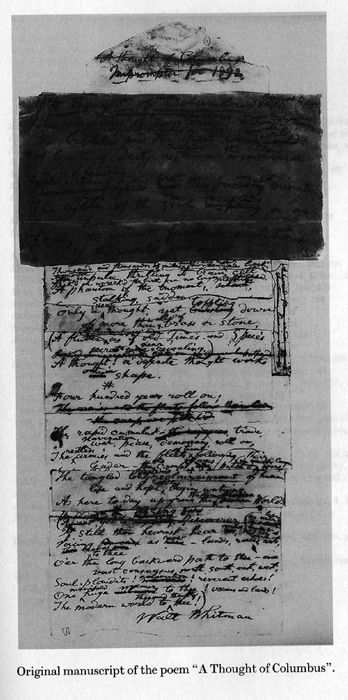
Note (): photograph, undated Return to text.
 [Begin page 634]
 [Begin page 635]
 [Begin page 636]
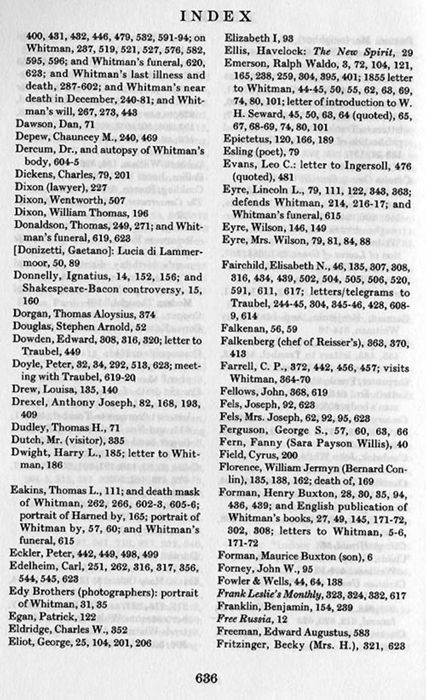 [Begin page 637]
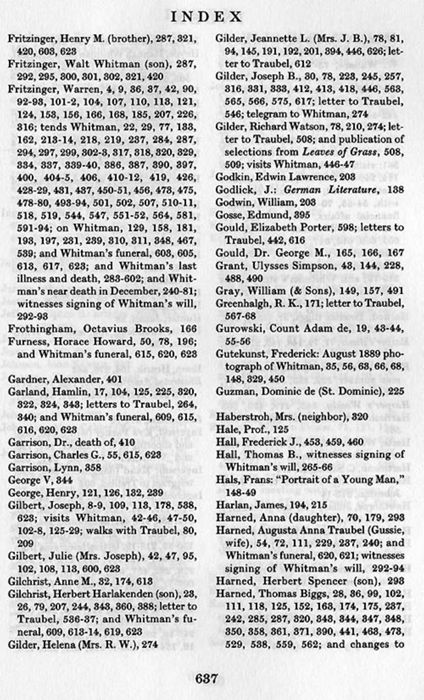 [Begin page 638]
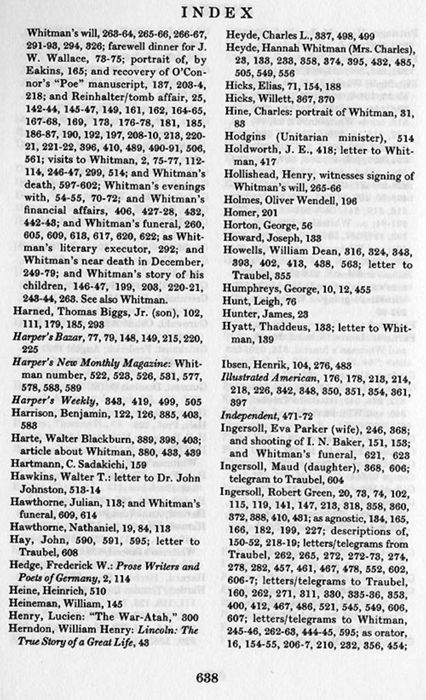 [Begin page 639]
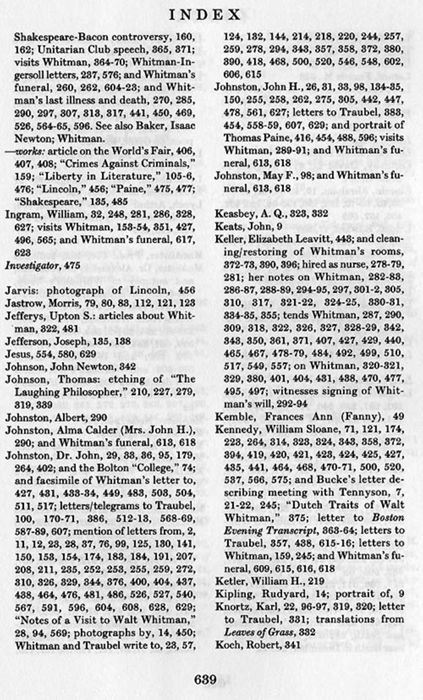 [Begin page 640]
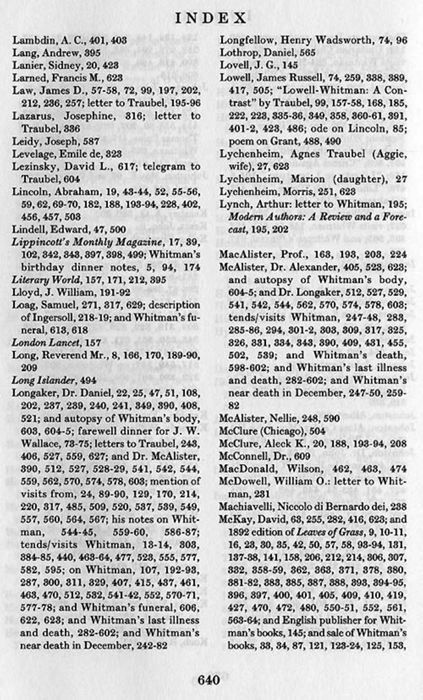 [Begin page 641]
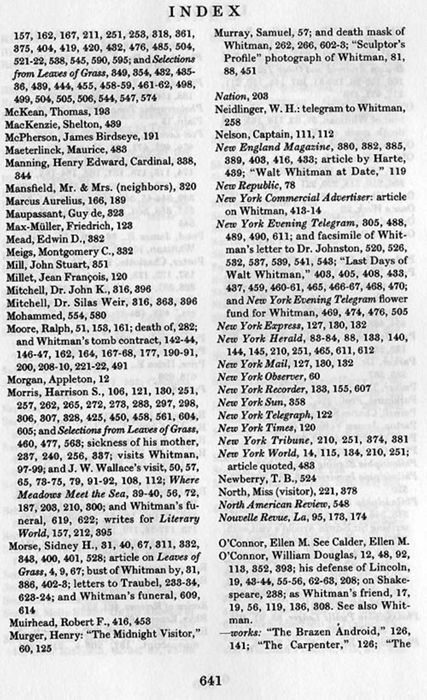 [Begin page 642]
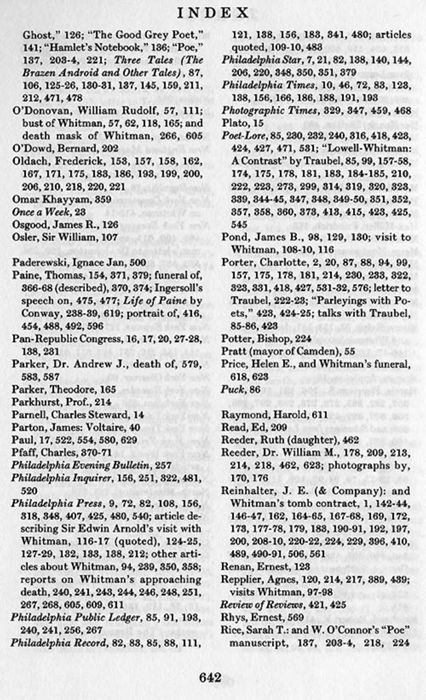 [Begin page 643]
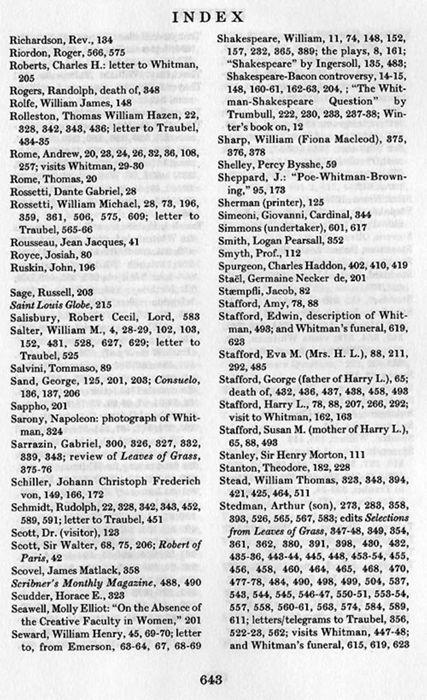 [Begin page 644]
 [Begin page 645]
 [Begin page 646]
 [Begin page 647]
 [Begin page 648]
 [Begin page 649]
 [Begin page 650]
 [Begin page 651]
 [Begin page 652]