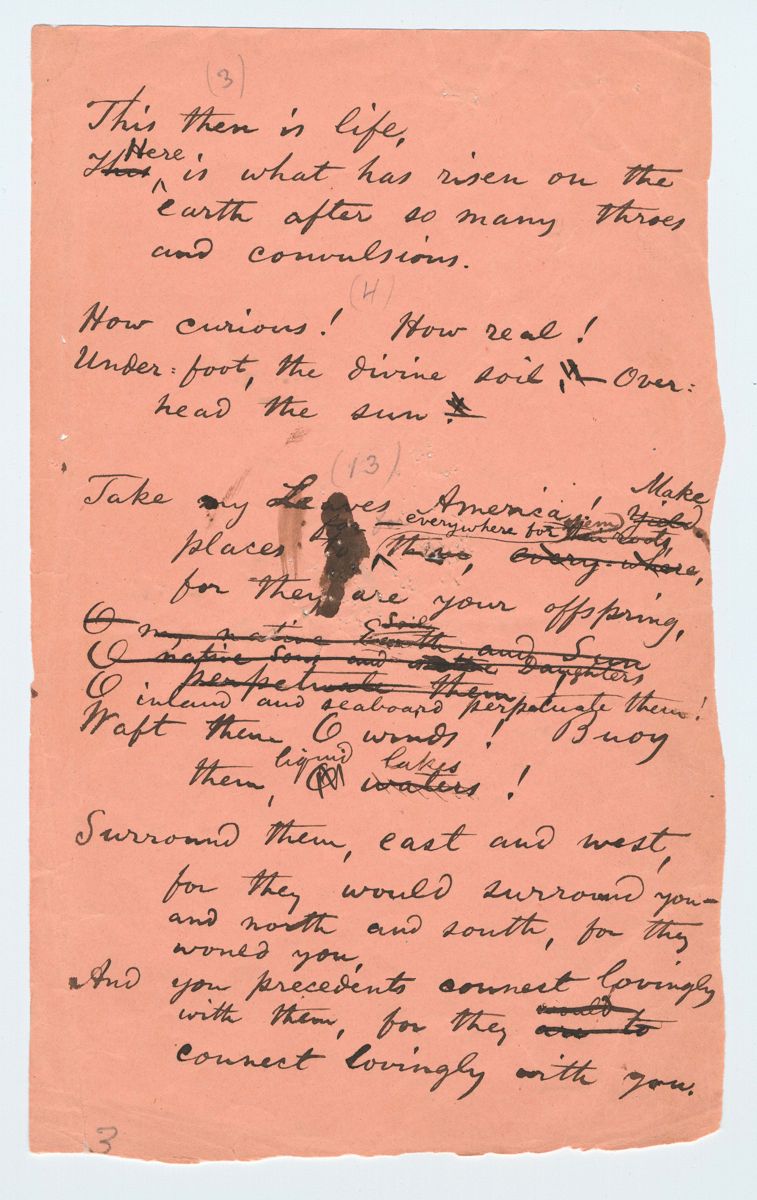
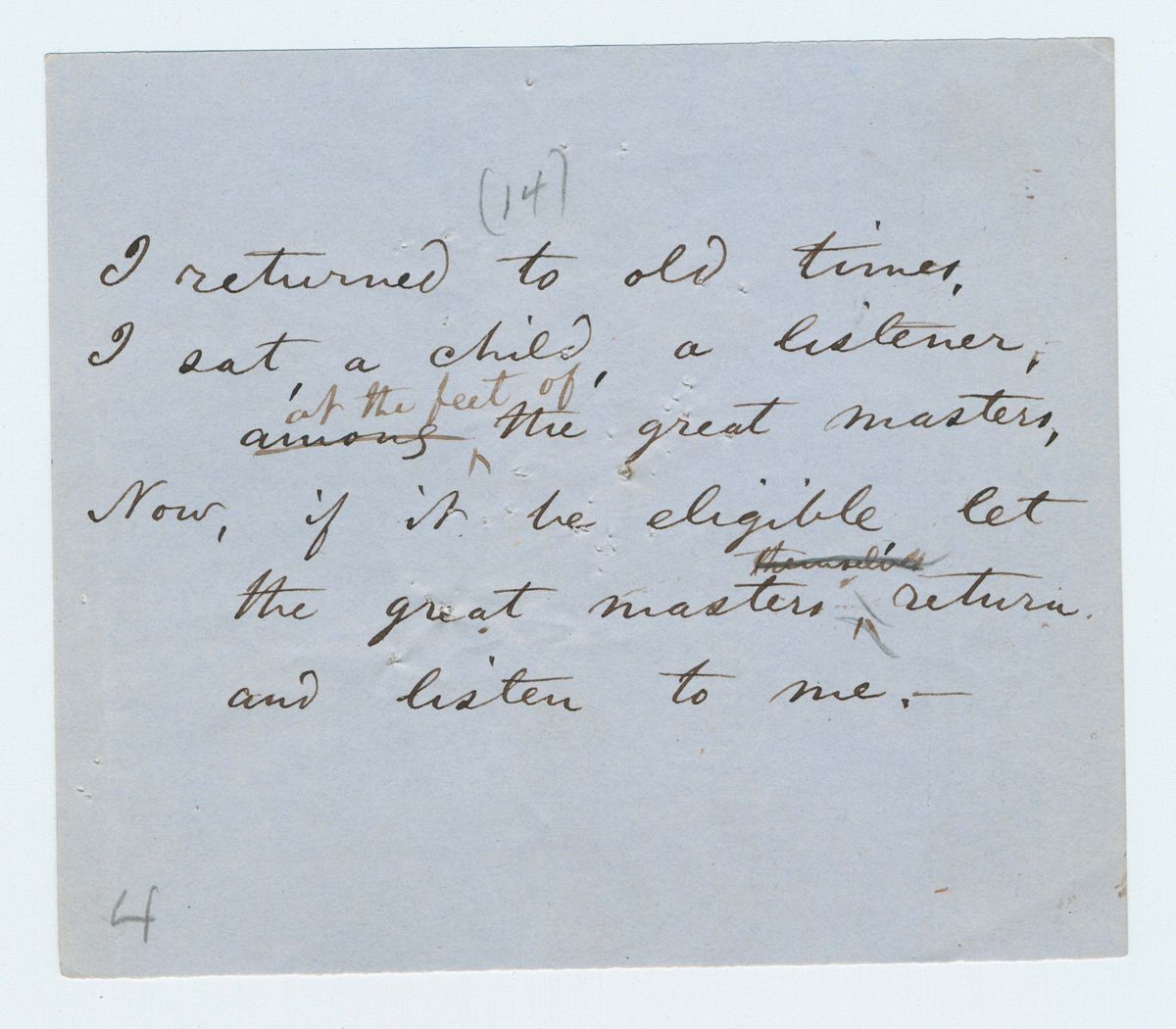
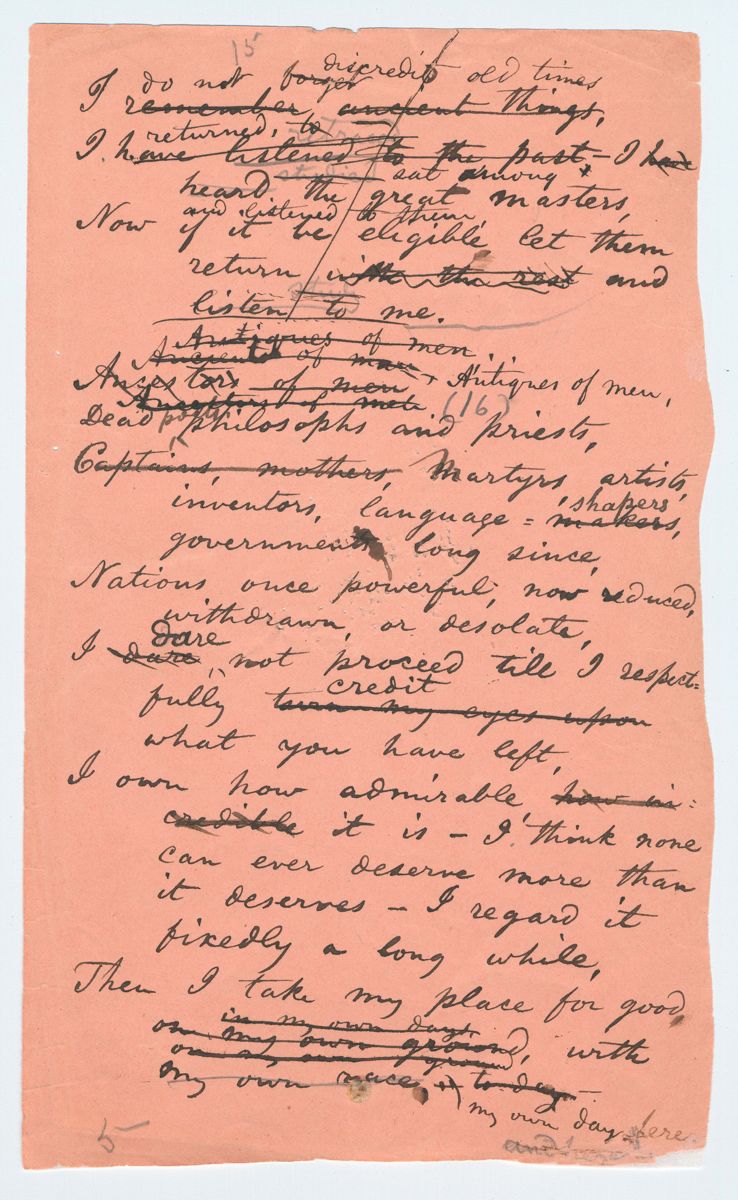
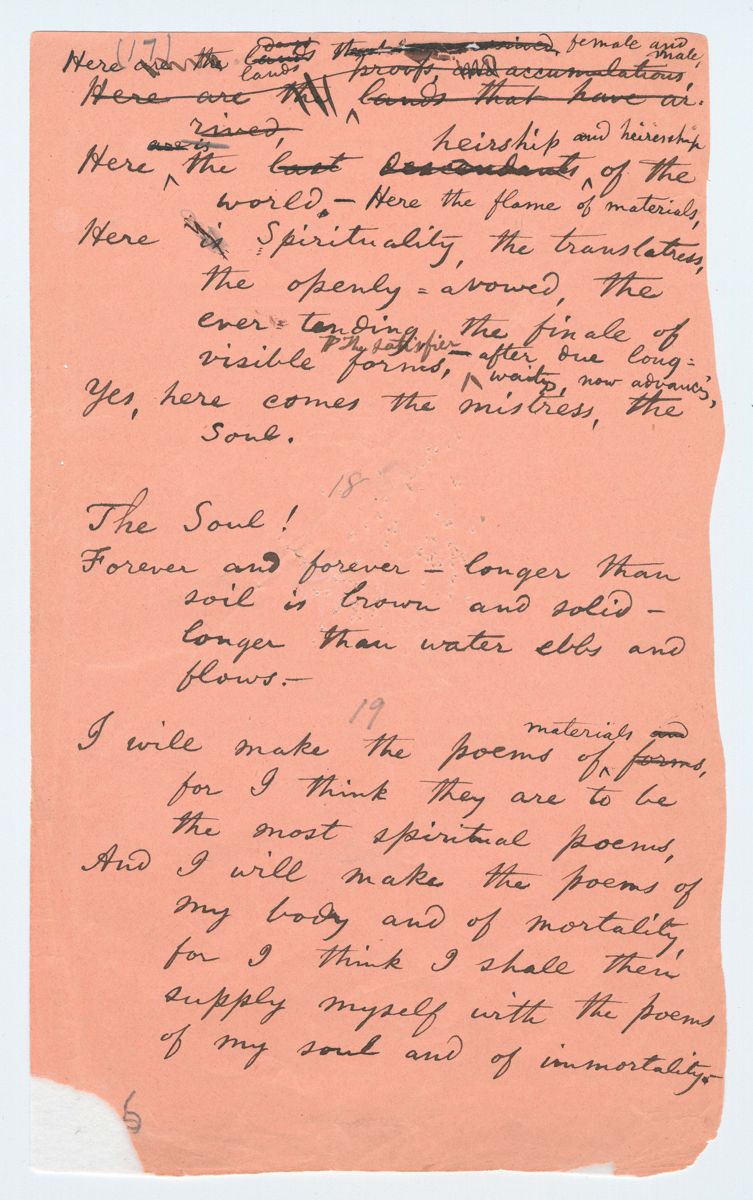
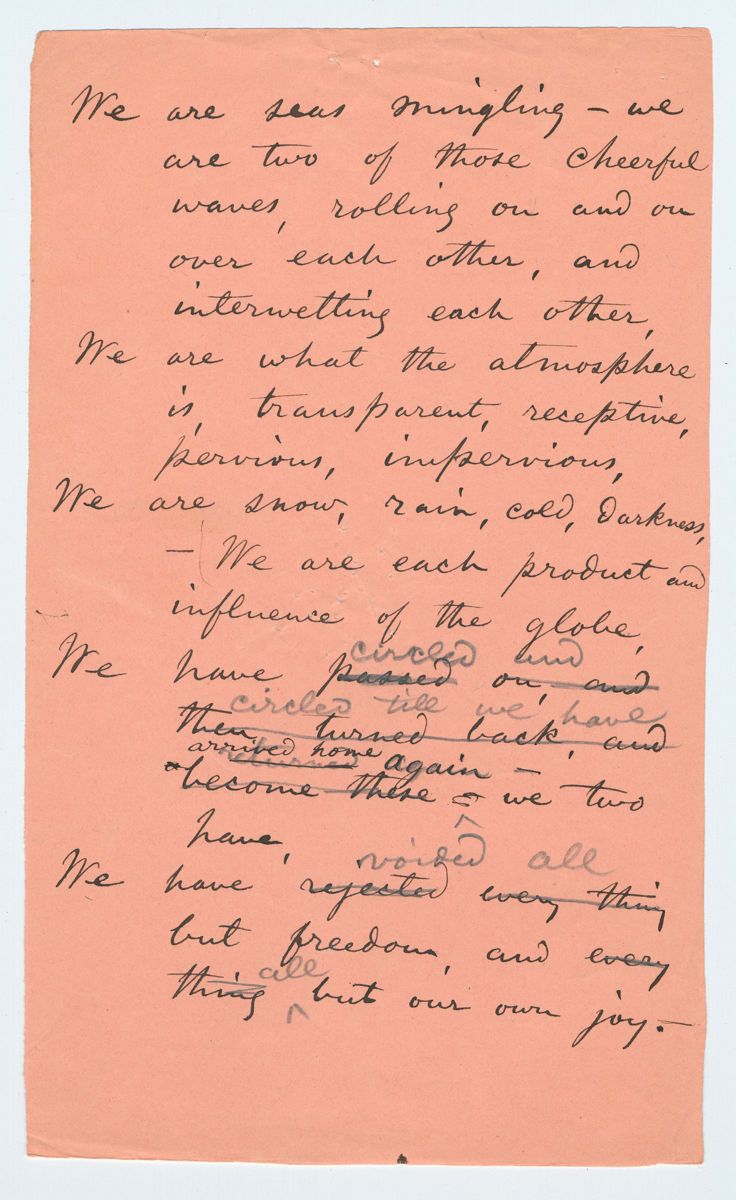
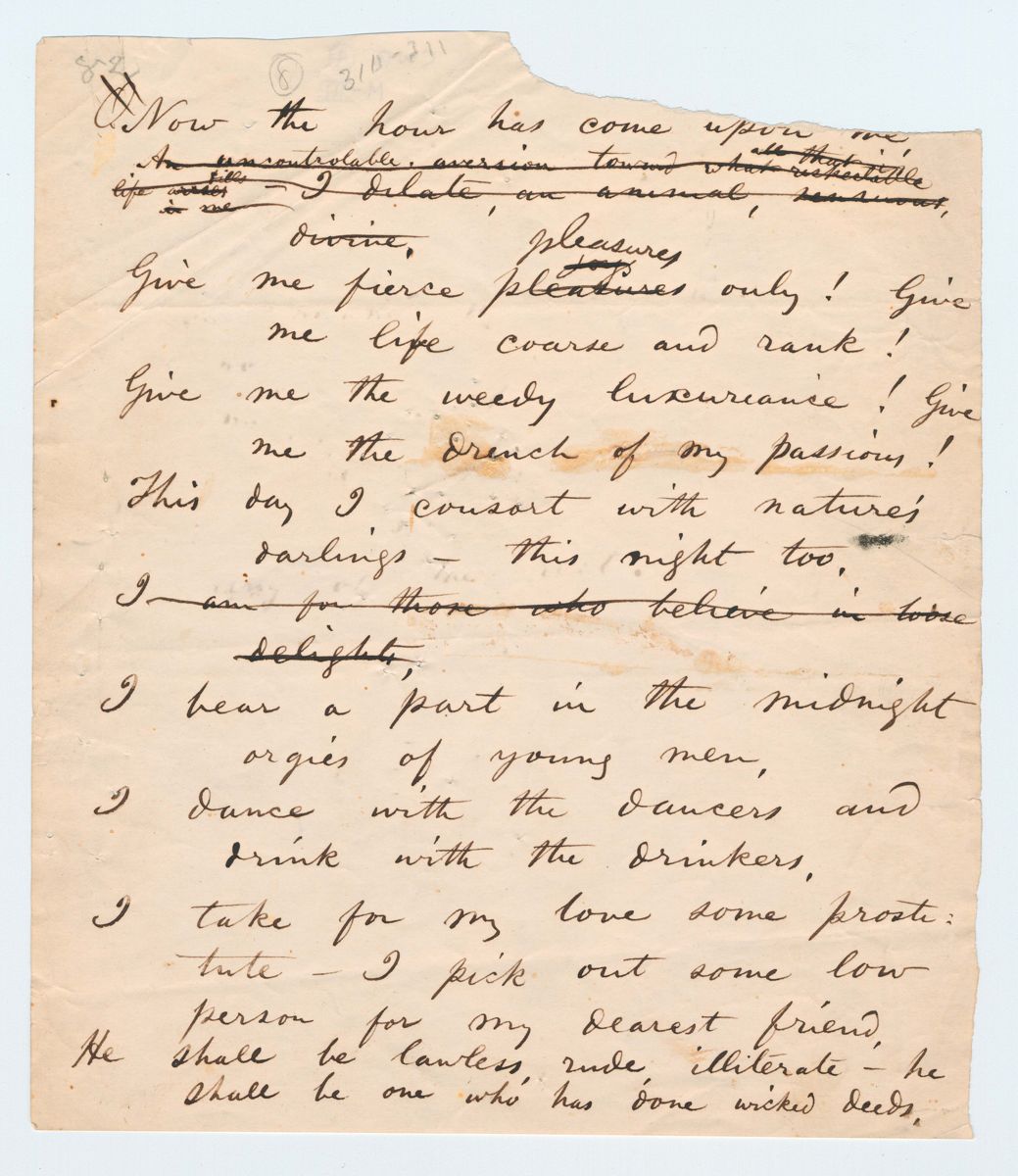
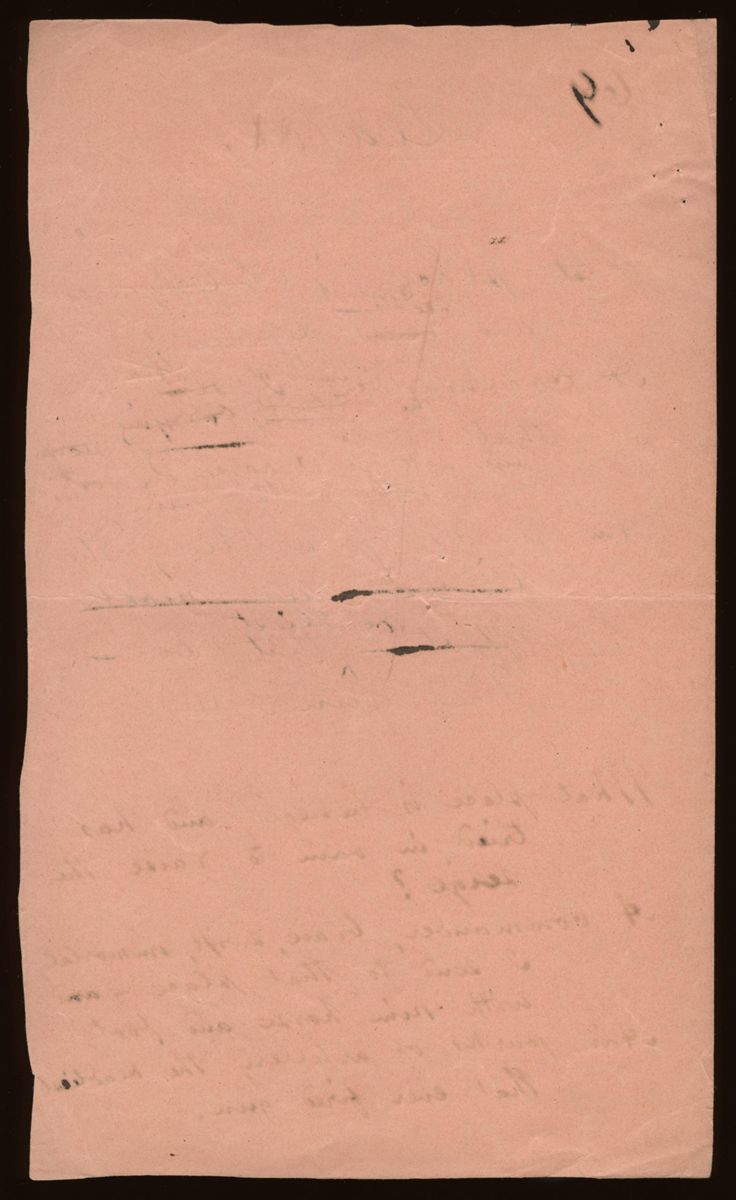
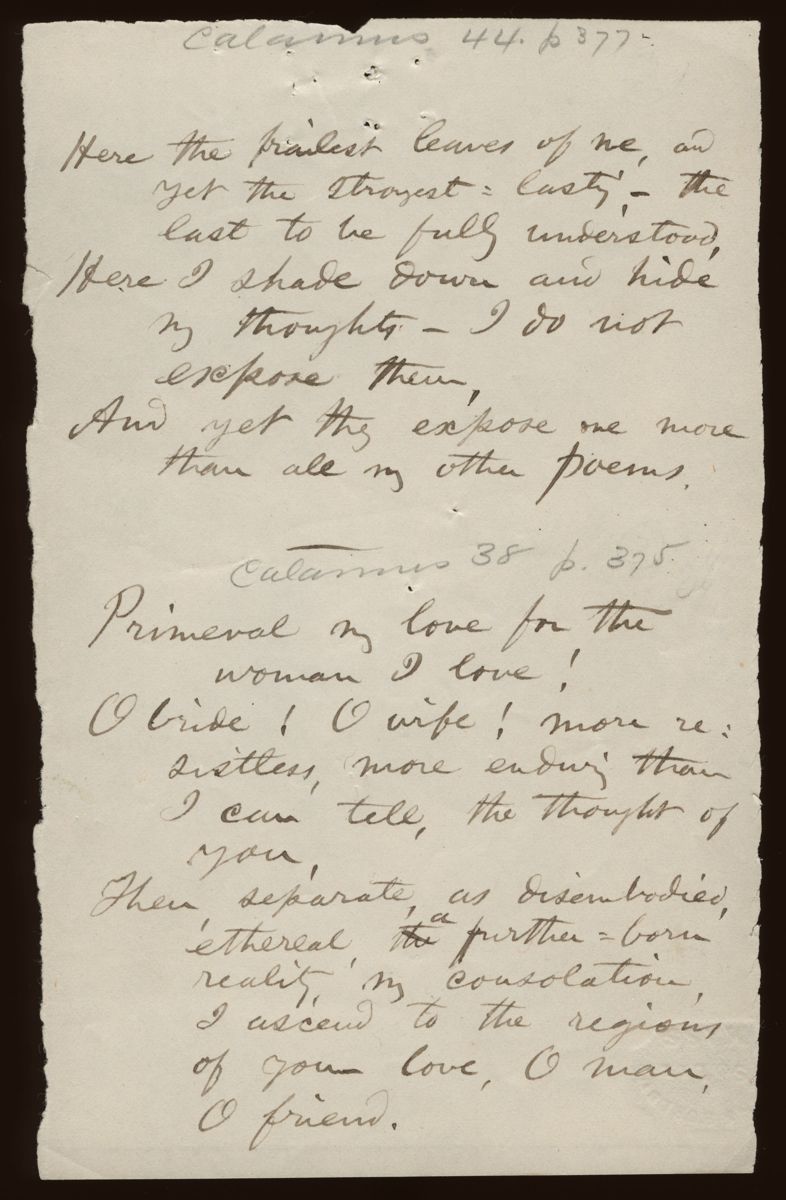
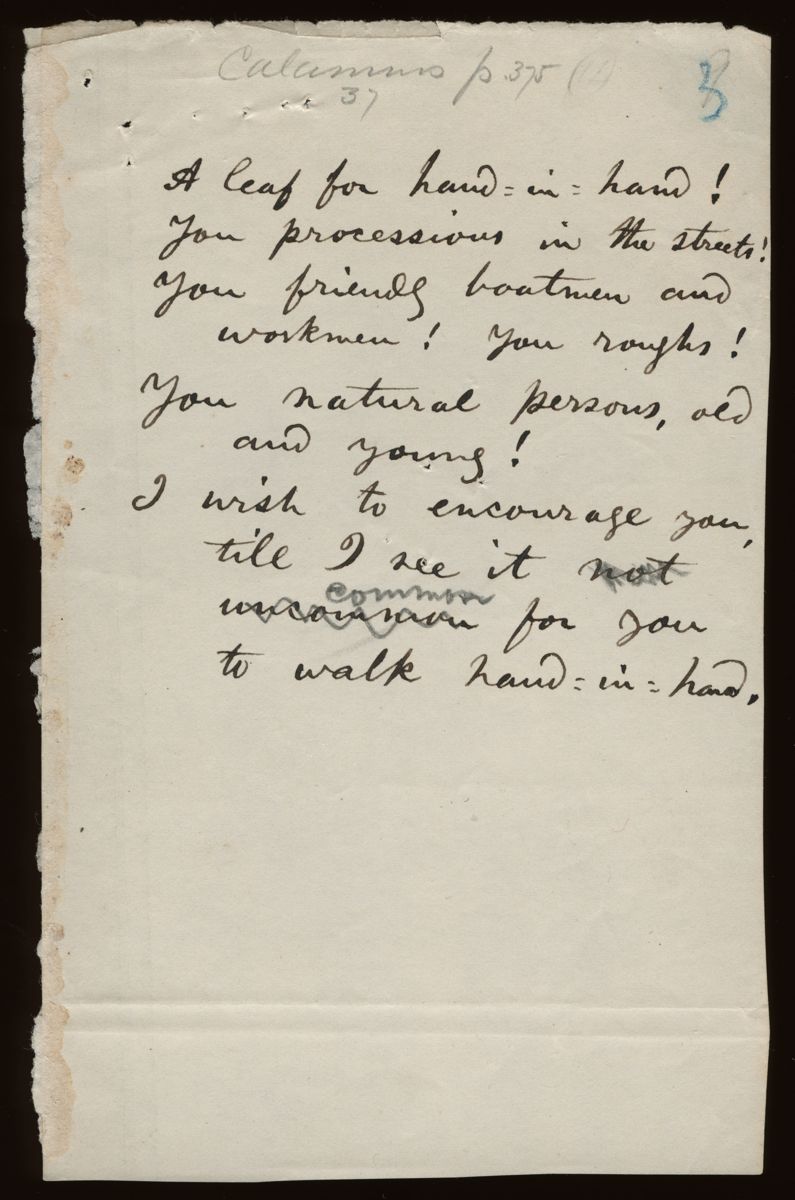
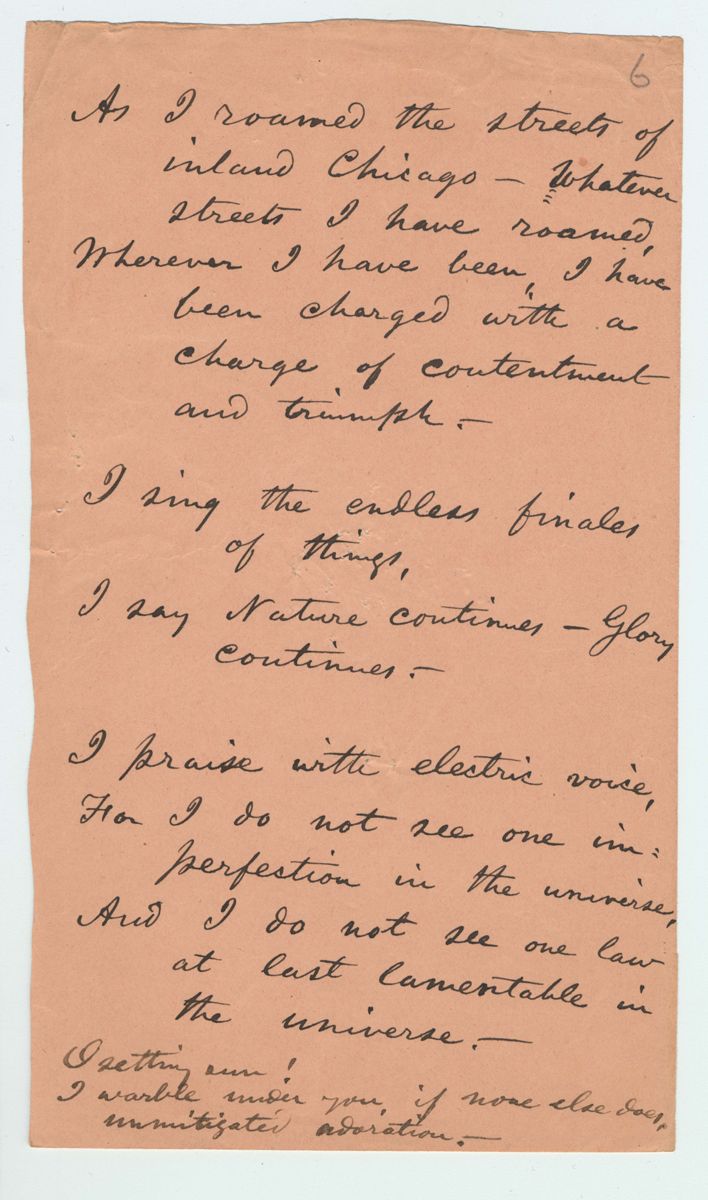
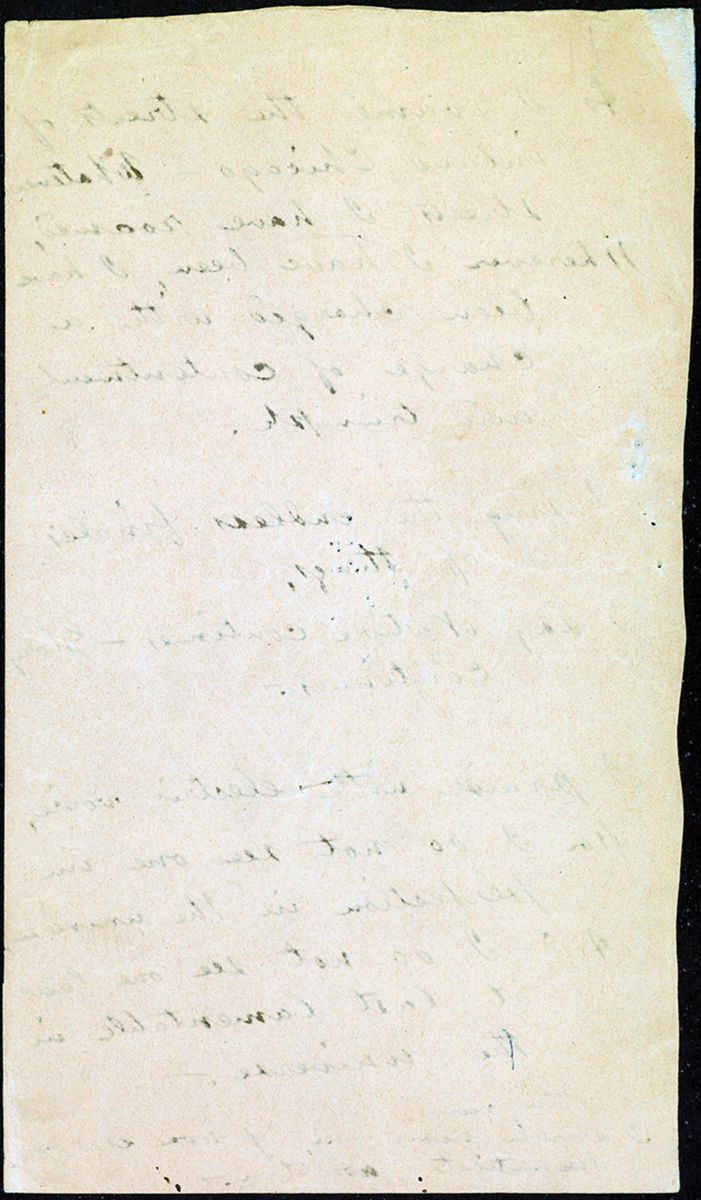
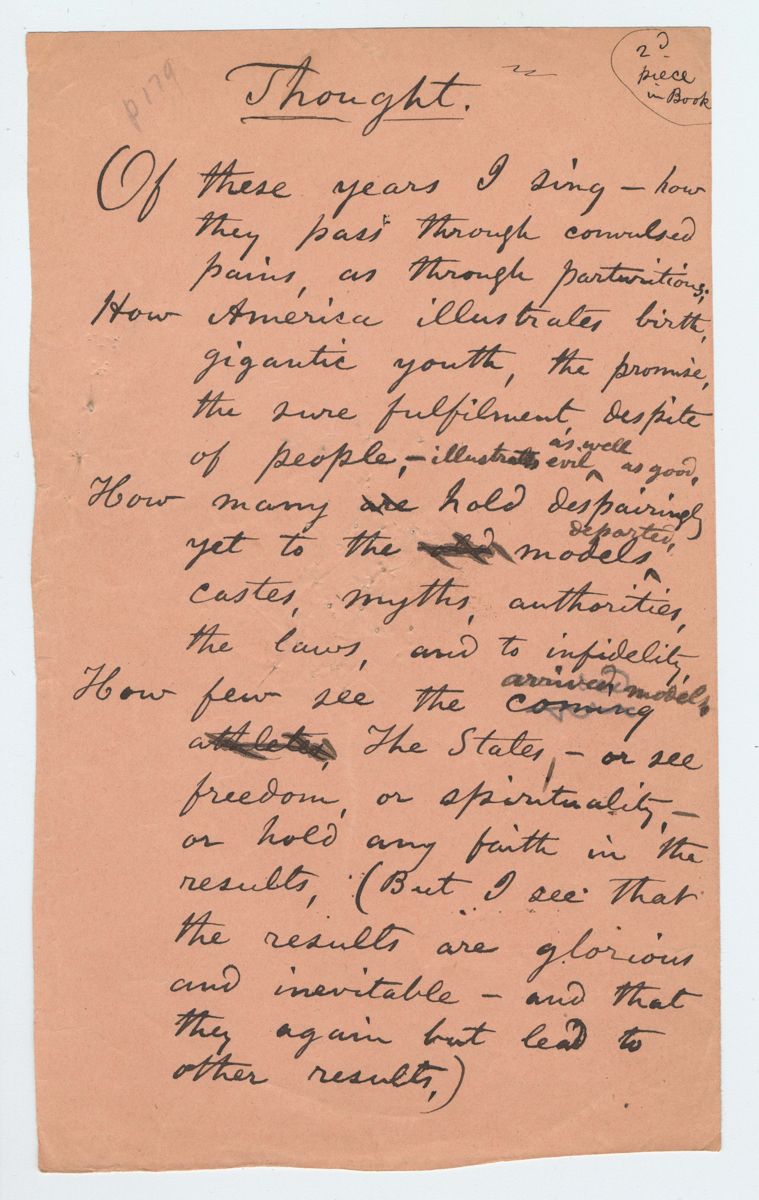
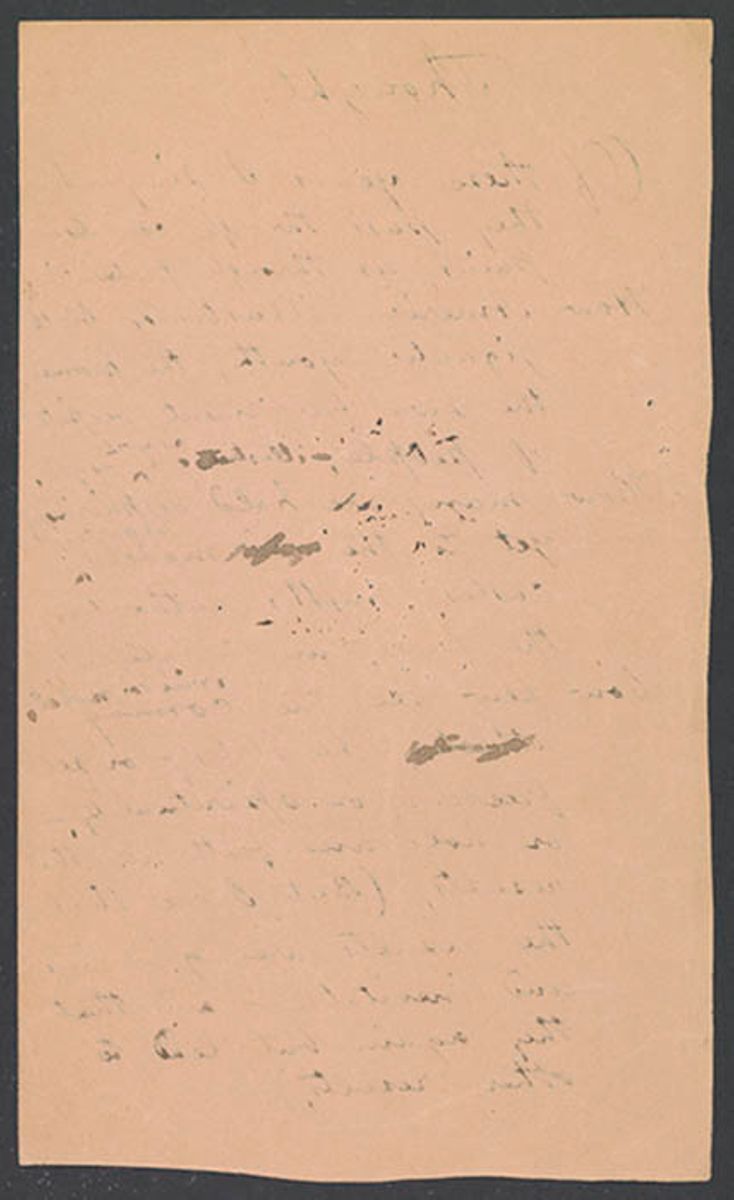
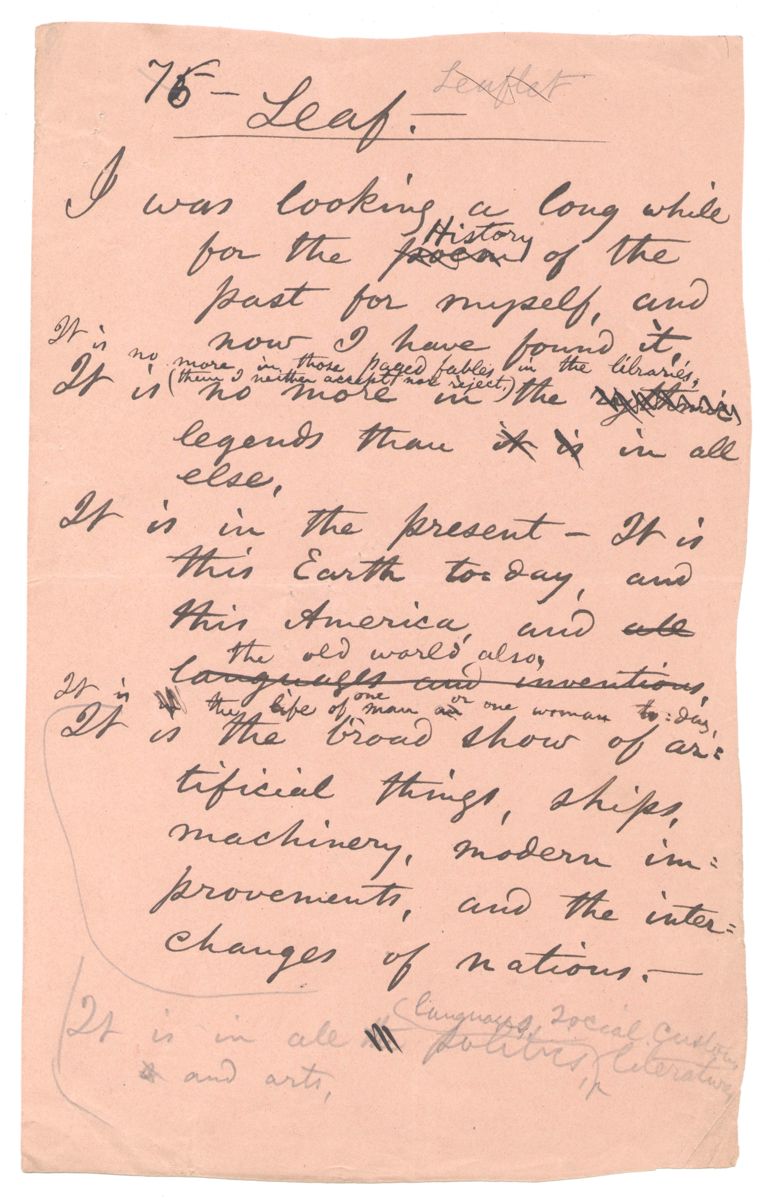
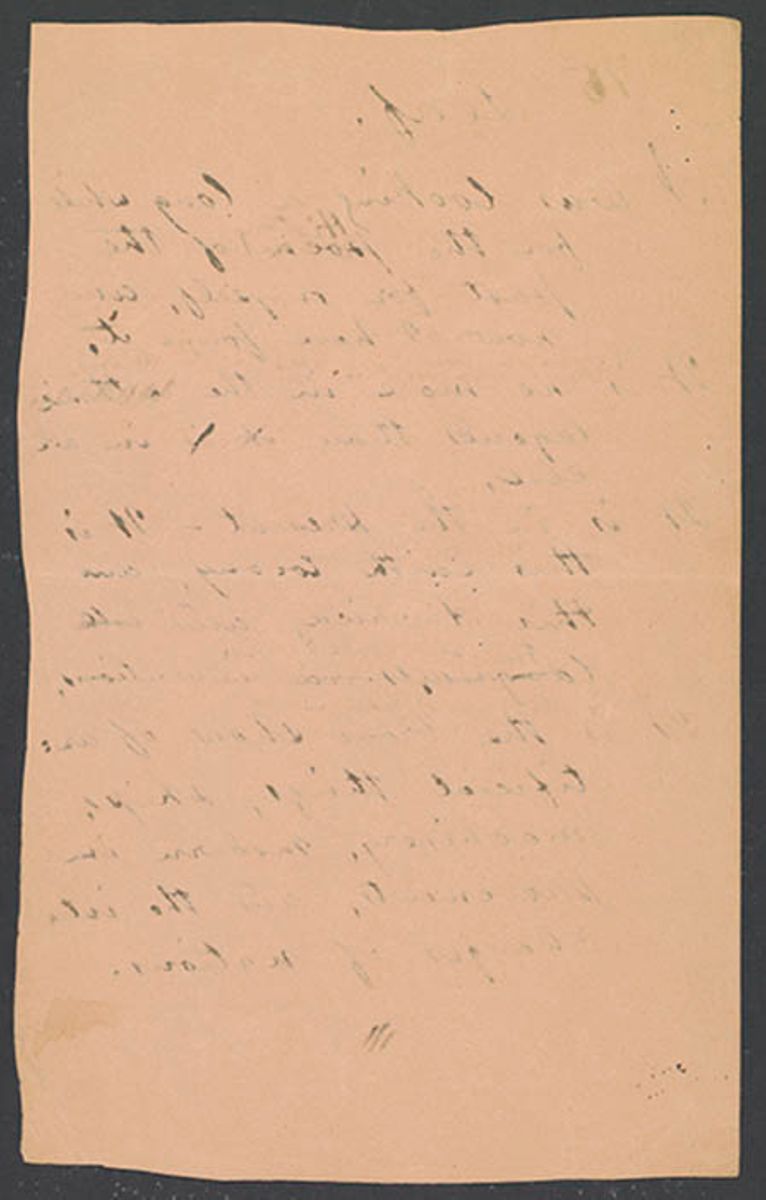
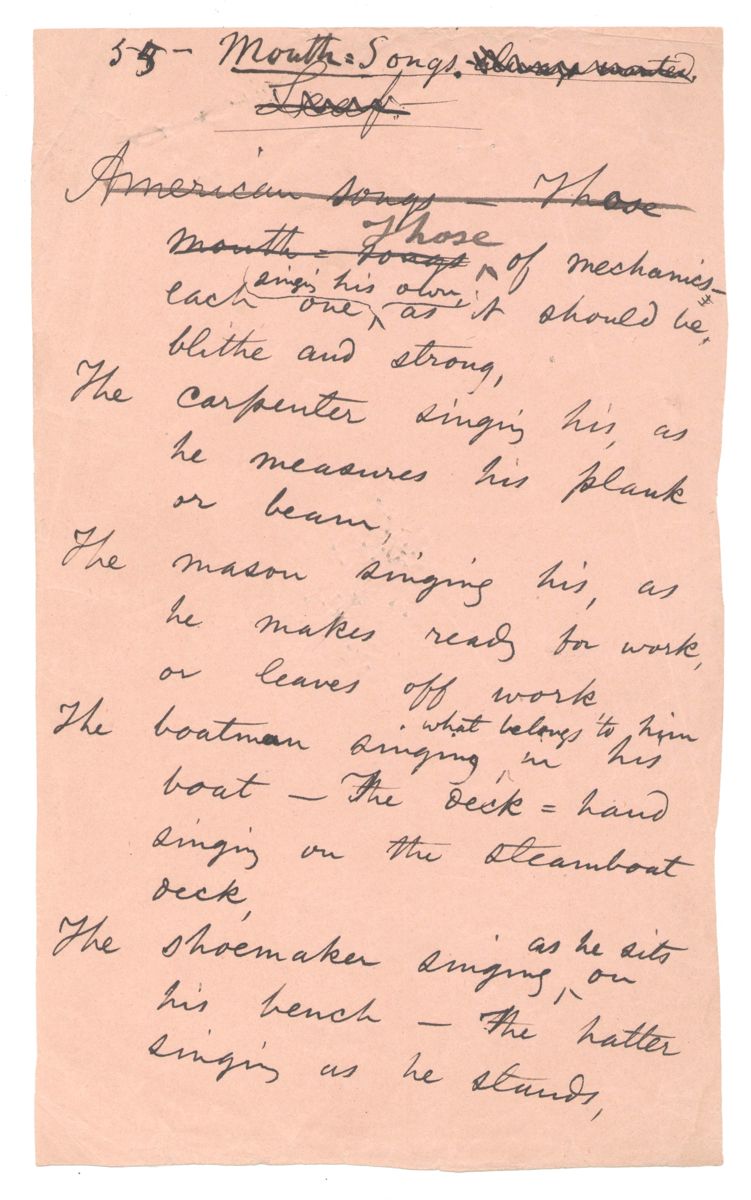
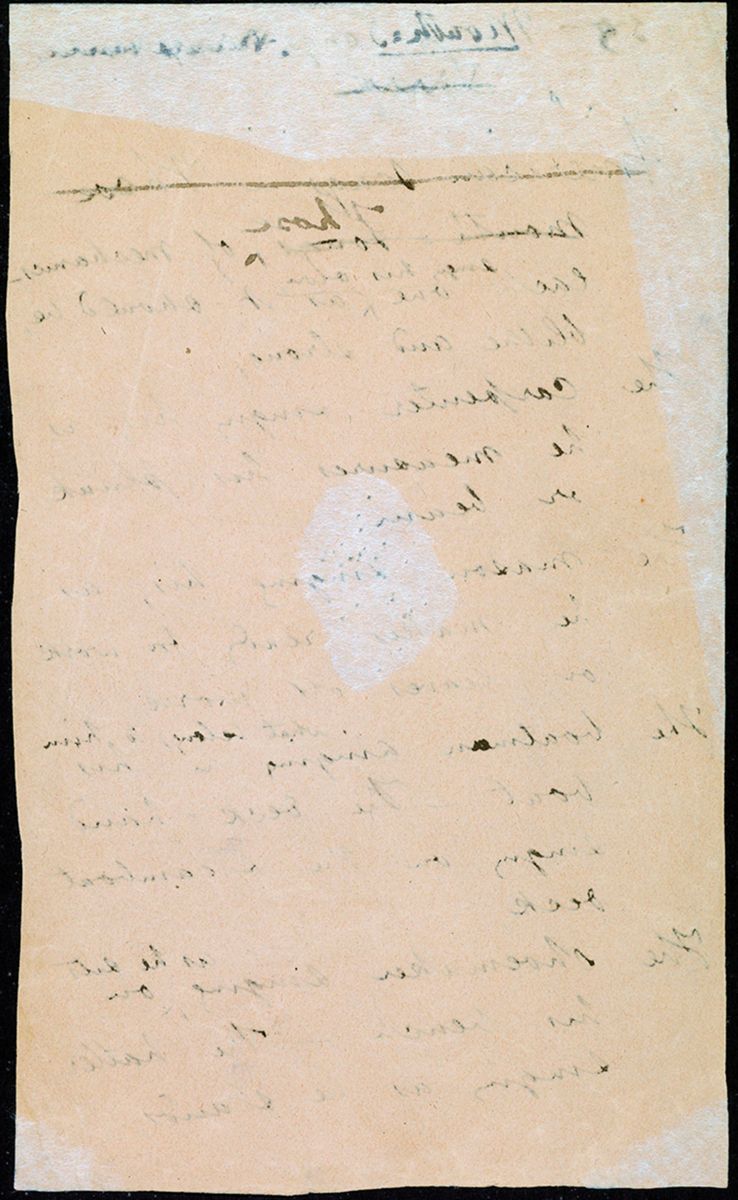
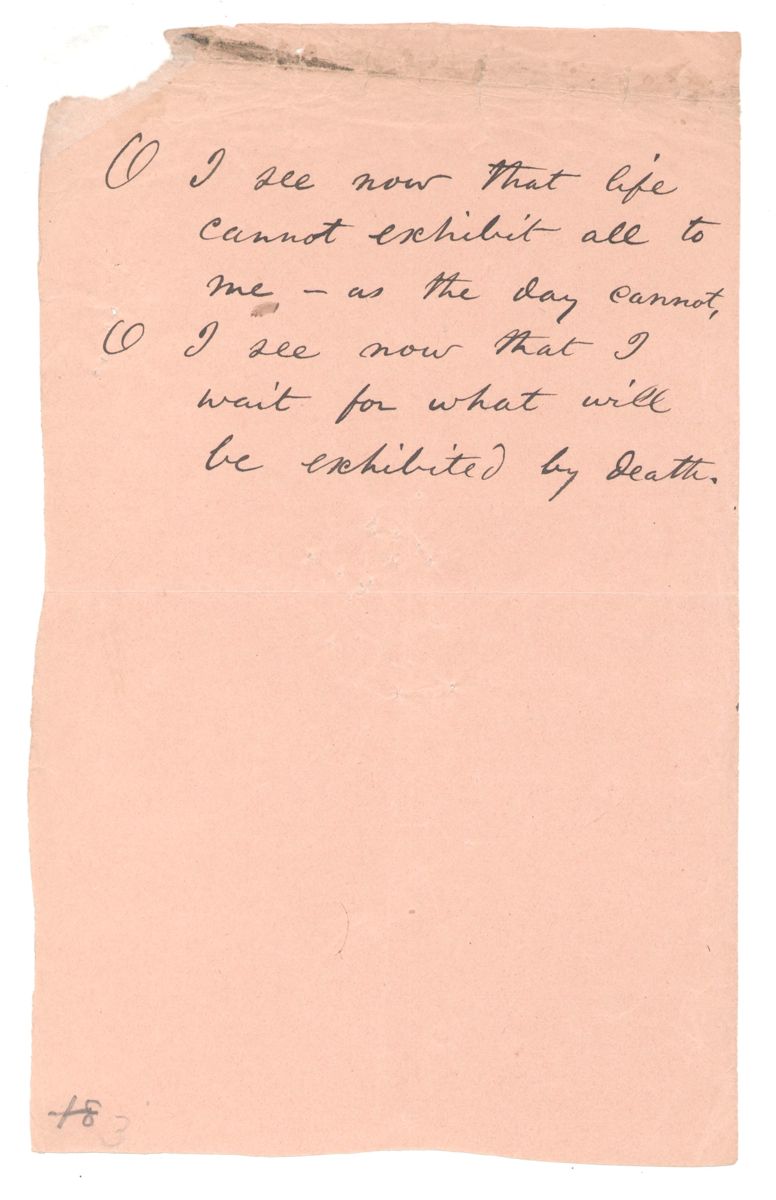
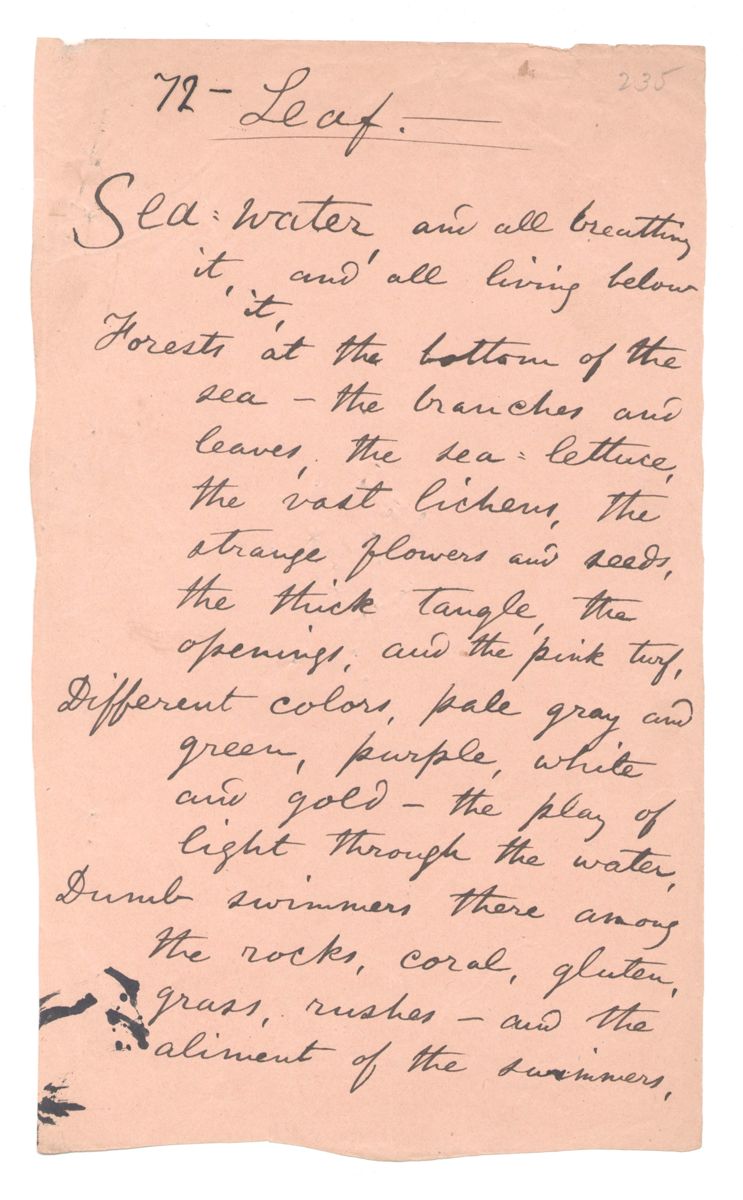
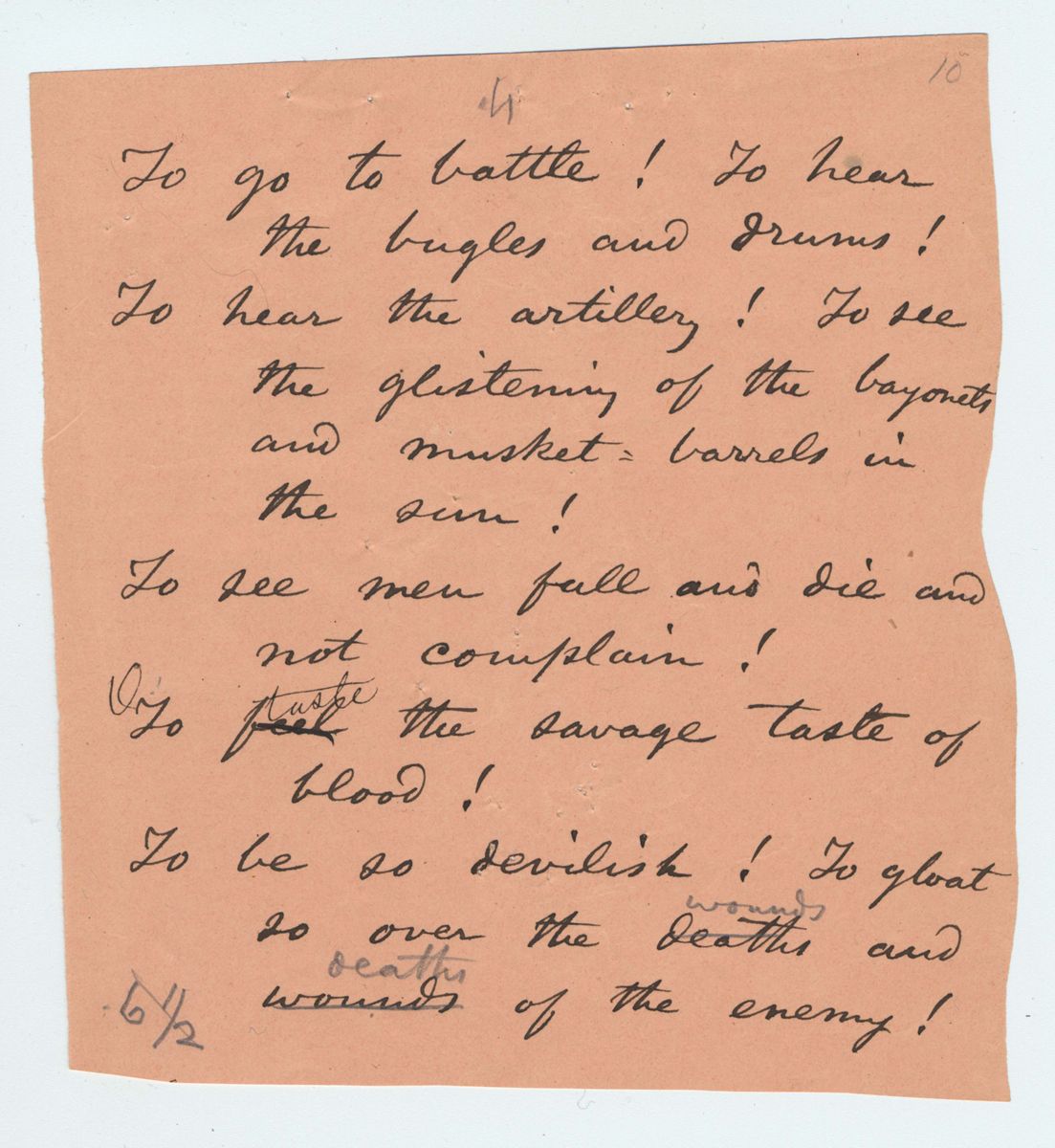
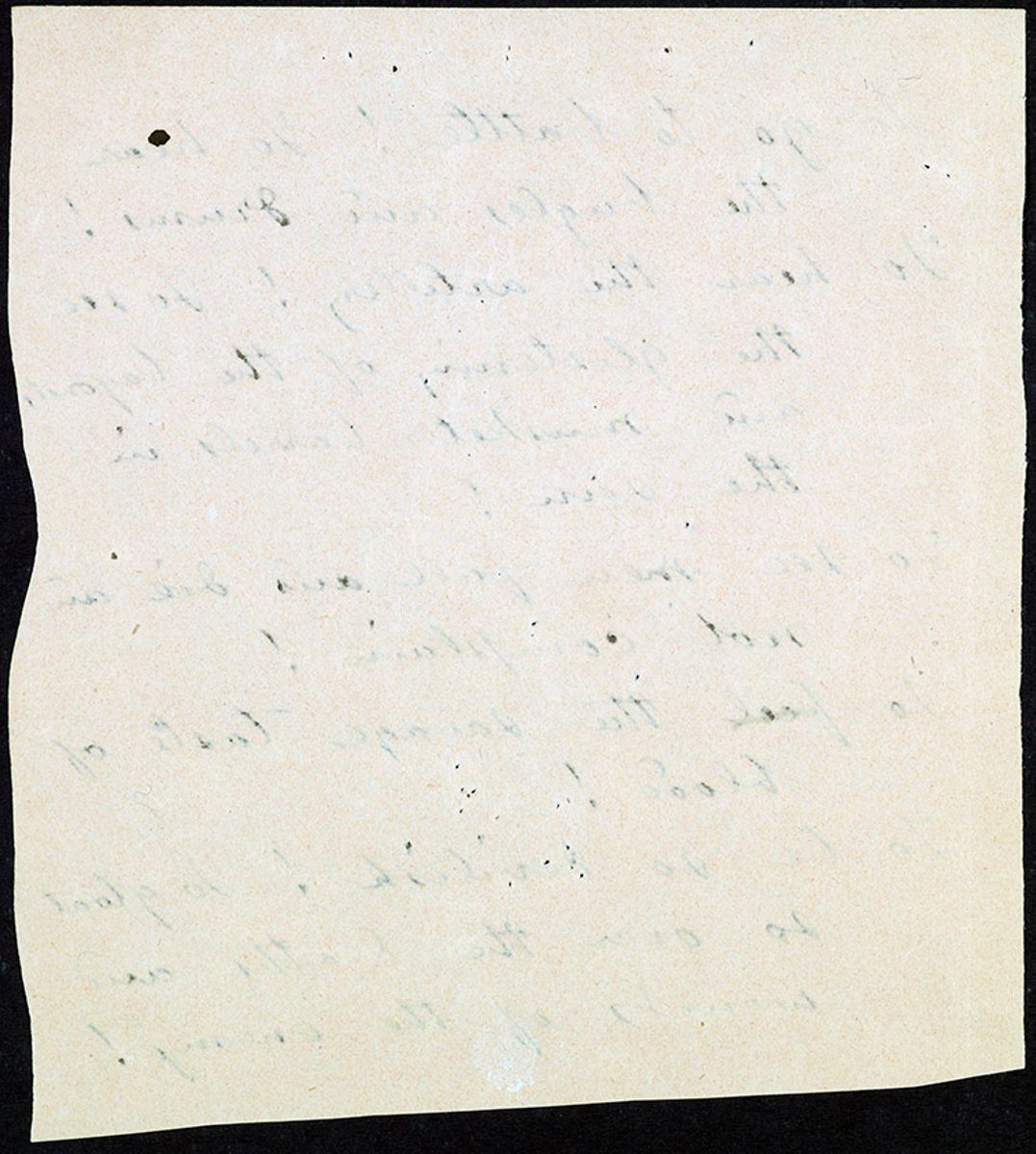
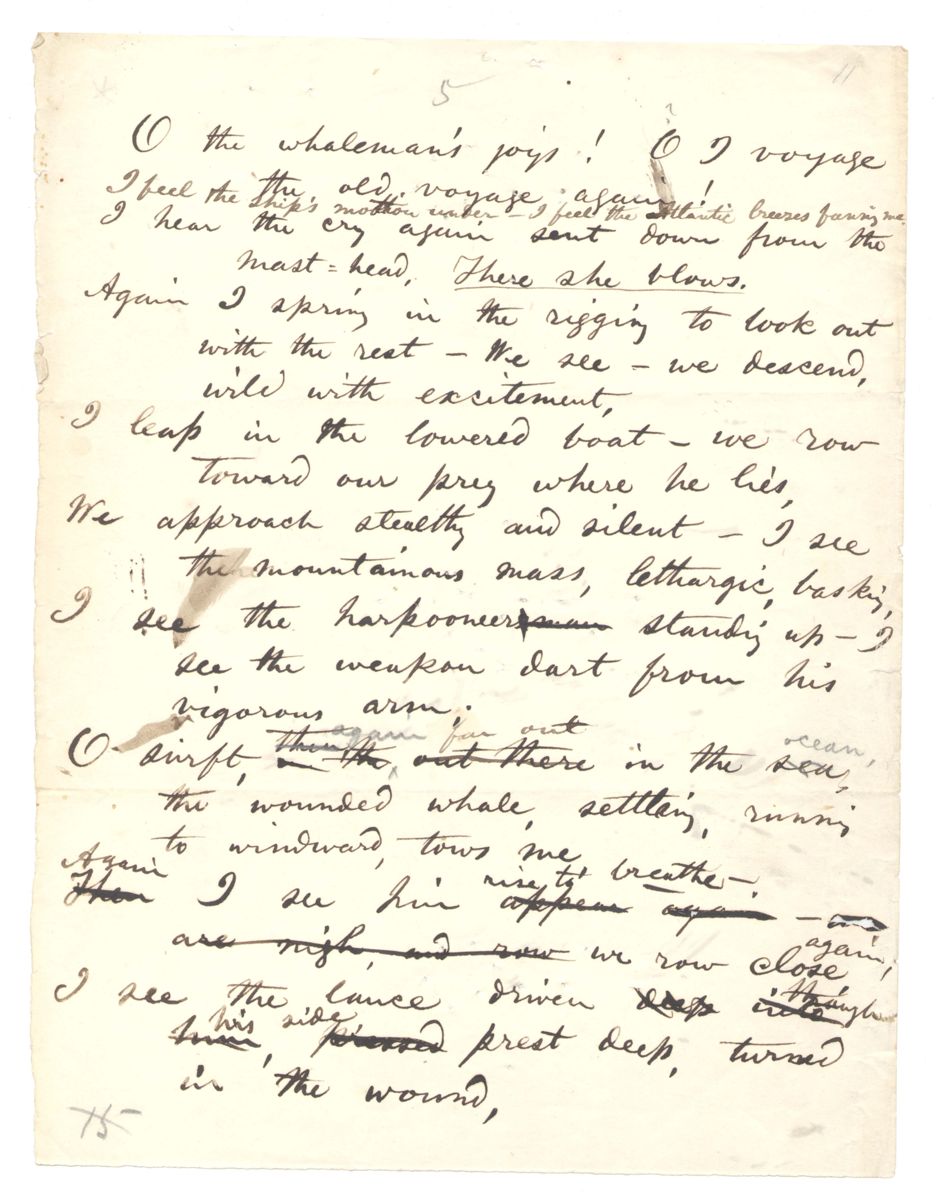
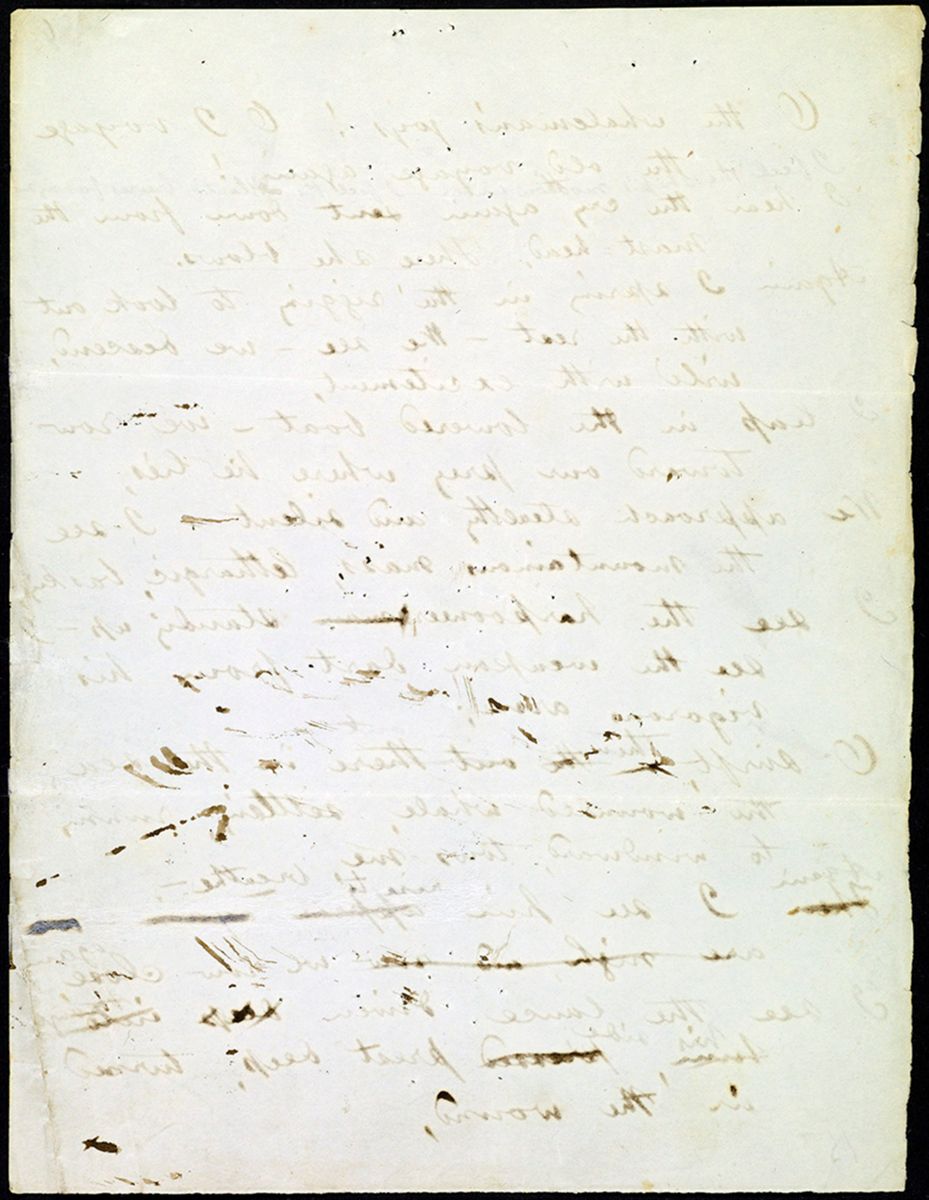
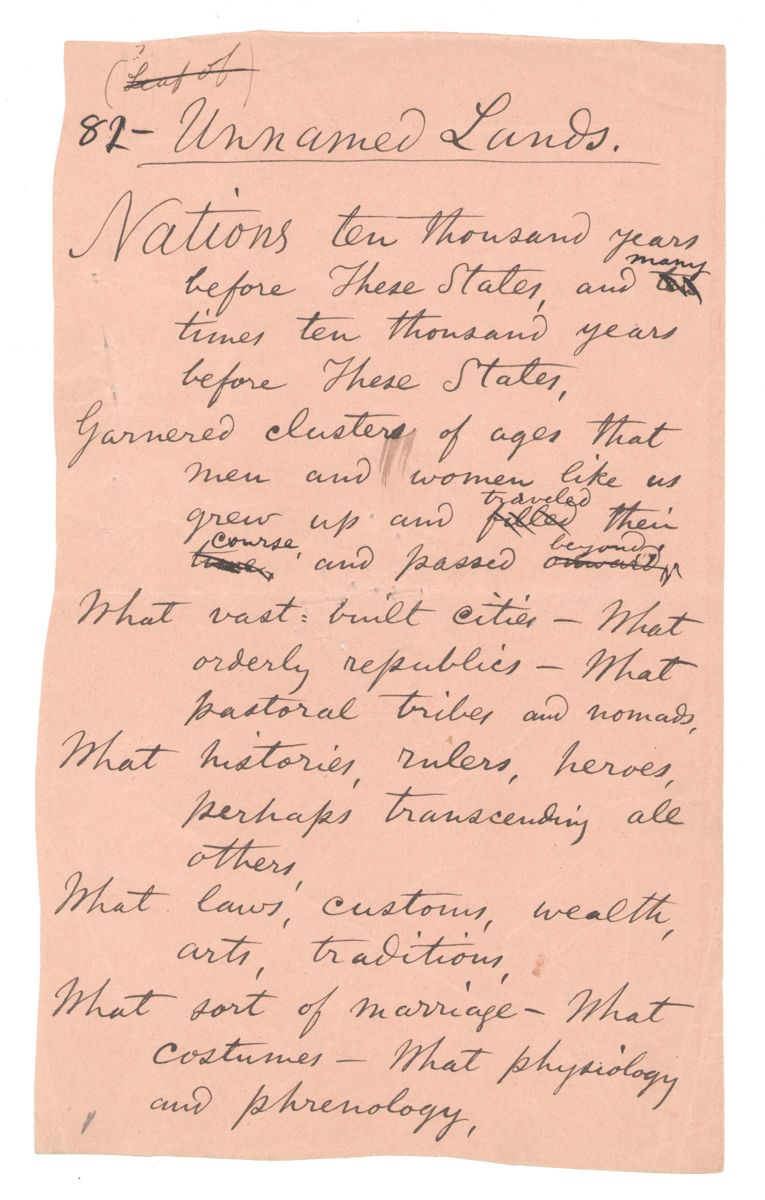
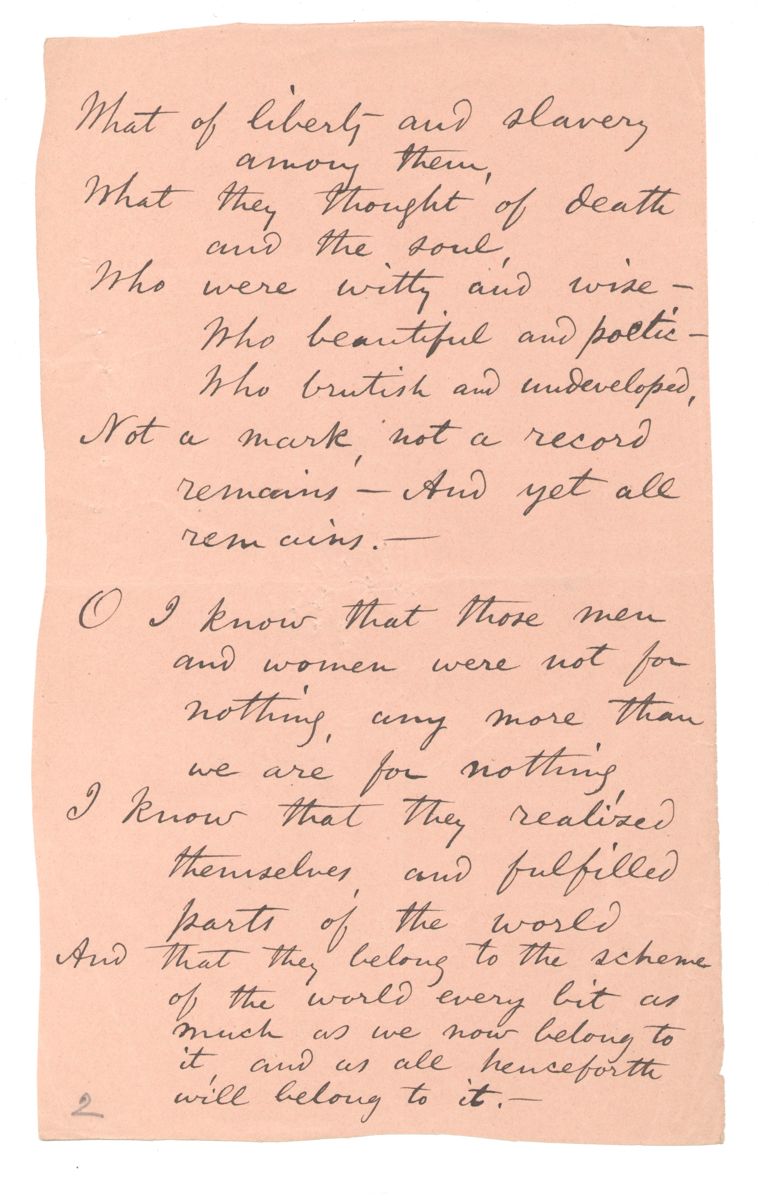
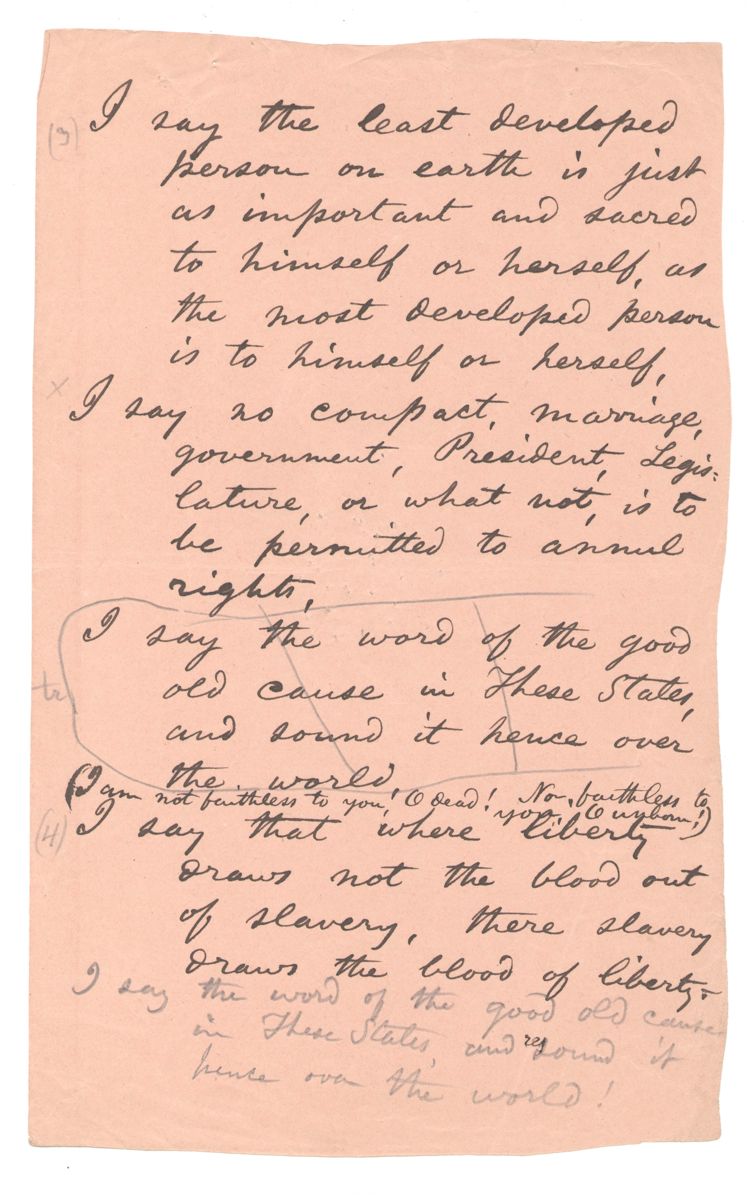
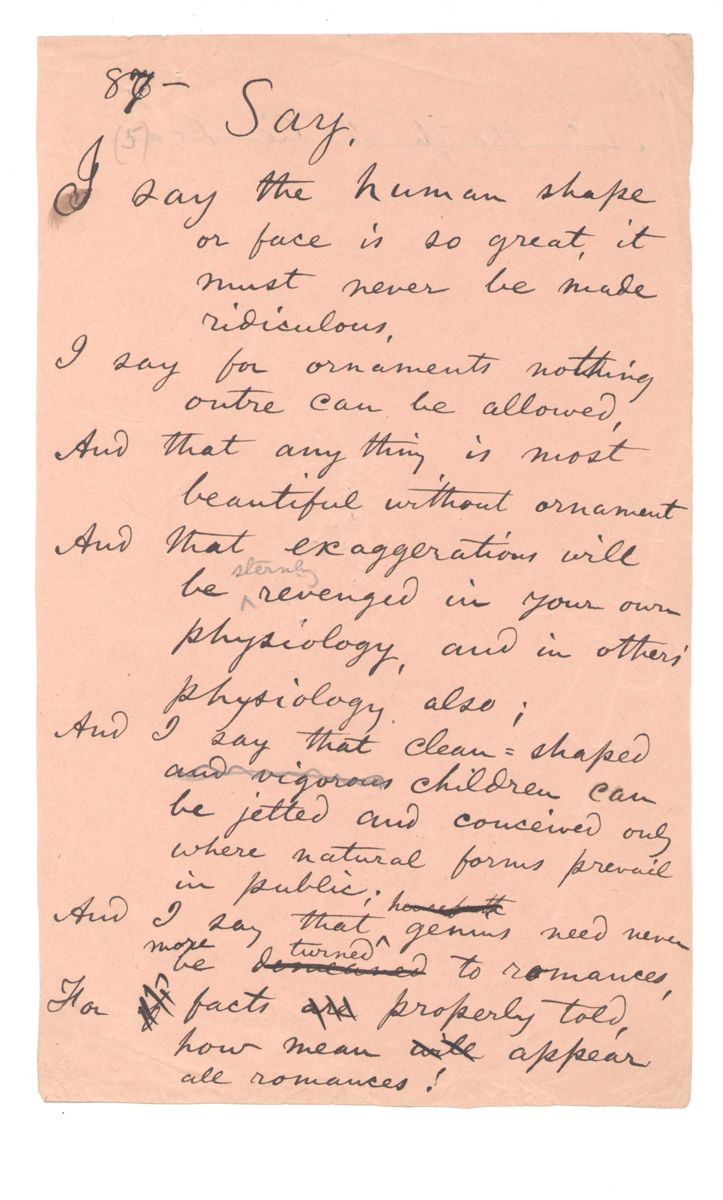
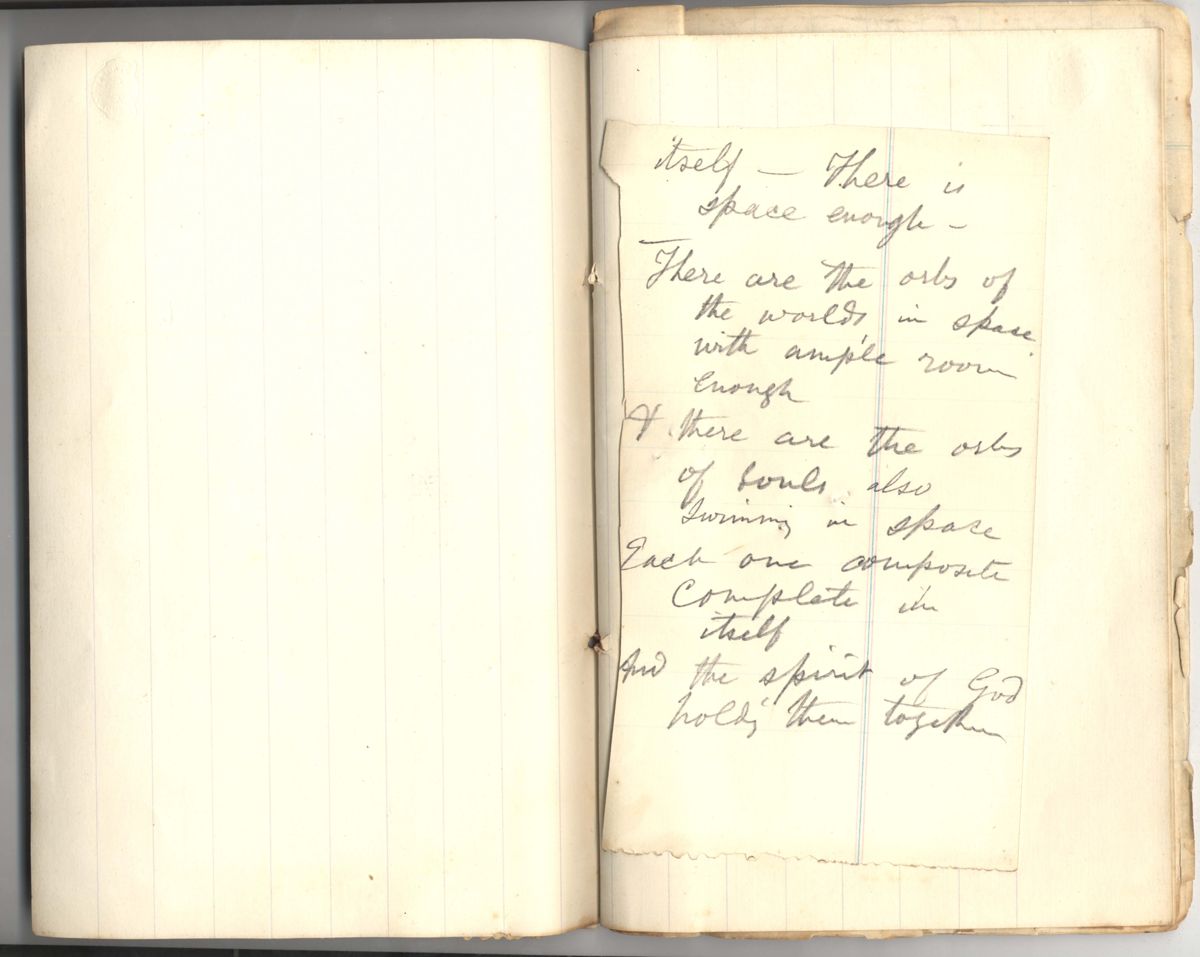
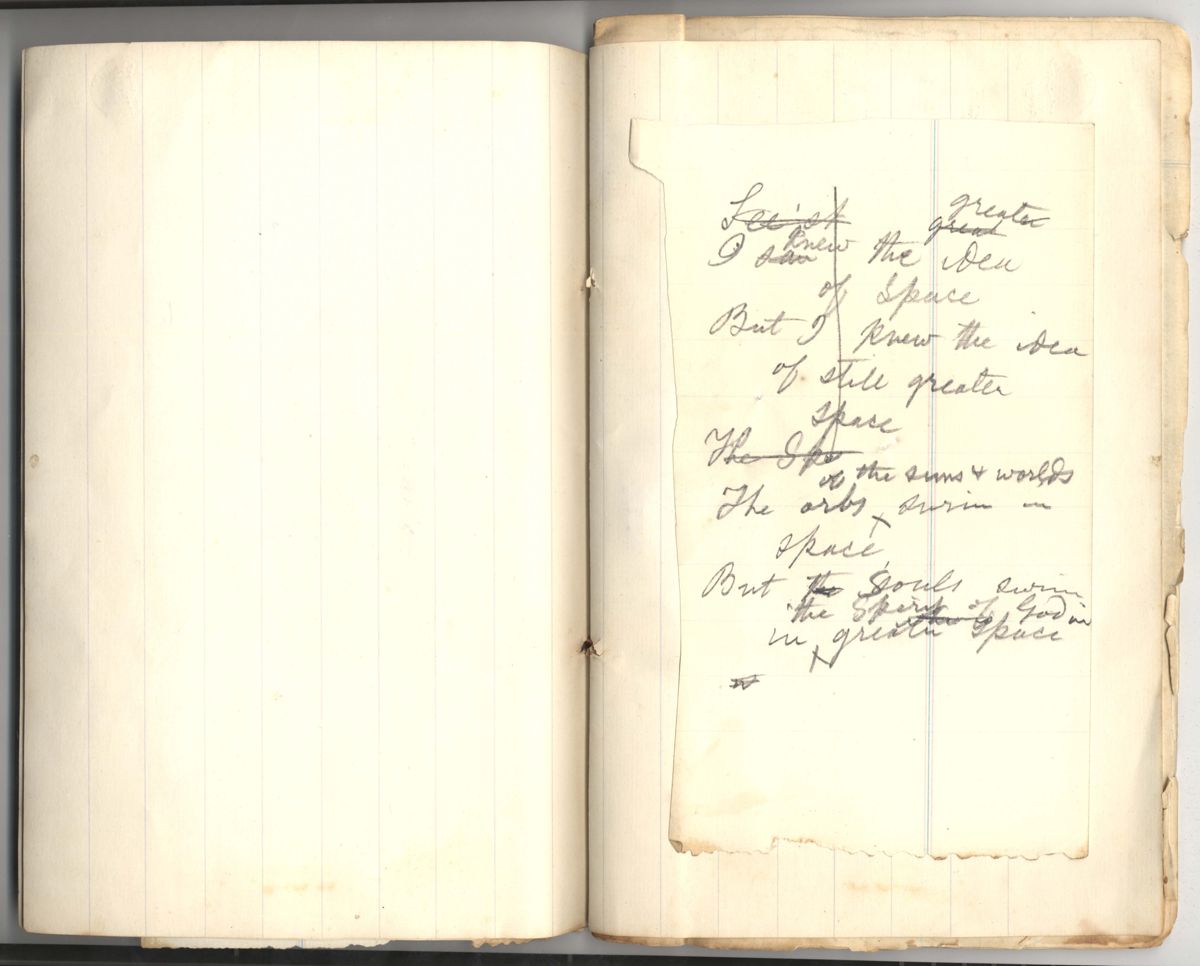
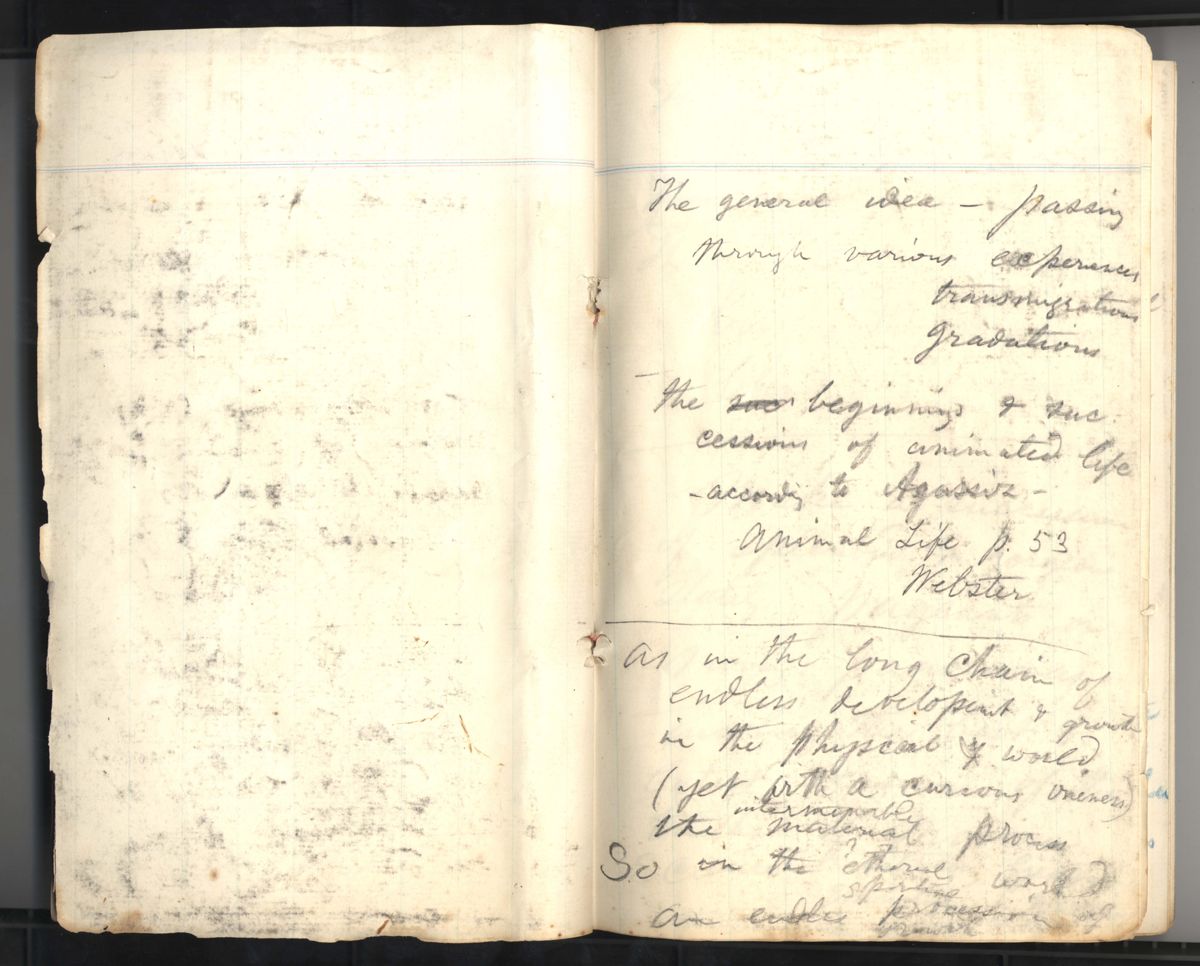
-
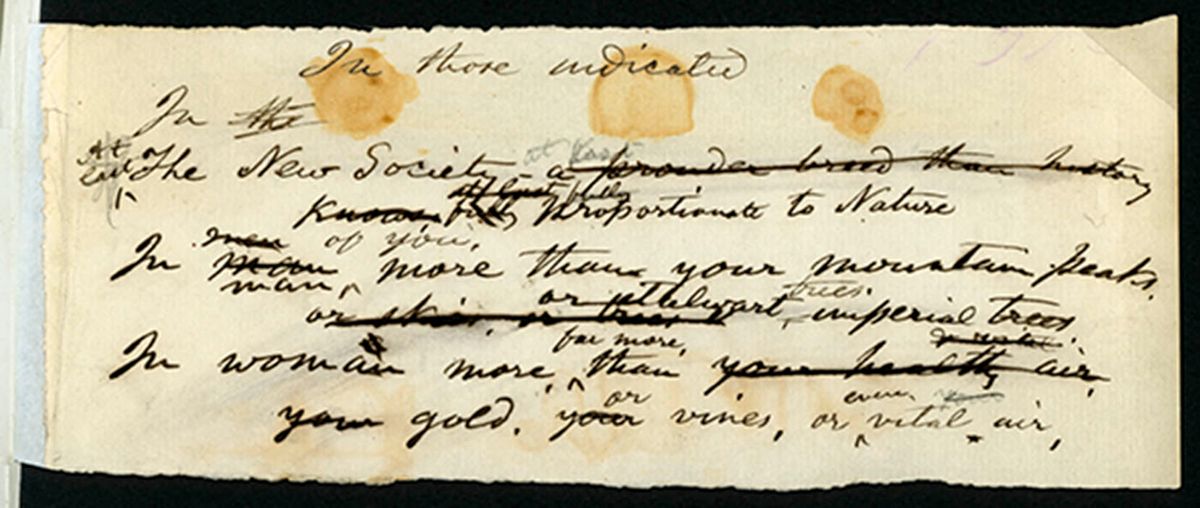
Home
-
Literary Manuscripts
-
Manuscript Catalogs
- uva.ead01
Catalog of the Walt Whitman Literary Manuscripts at the Clifton Waller Barrett Library of American Literature, Albert and Shirley Small Special Collections Library, University of Virginia
Original records created by the Albert and Shirley Small Special Collections Library; revised and expanded by The Walt Whitman Archive and the University of Nebraska-Lincoln Libraries. Encoded Archival Description completed with the assistance of the Gladys Kreible Delmas Foundation, the University of Nebraska Research Council, the Institute for Museum and Library Services, and the National Endowment for the Humanities.
- Title: Catalog of the Walt Whitman Literary Manuscripts at the Clifton Waller Barrett Library of American Literature, Albert and Shirley Small Special Collections Library, University of Virginia
- Collection Number: uva.ead01
- Creator: Whitman, Walt, 1819-1892
- Repository: University of Virginia
- Abstract:
This catalog was created through a comprehensive examination of original manuscripts held at The Albert and Shirley Small Special Collections Library, University of Virginia.
- Scope and Content:
The Clifton Waller Barrett Library of American Literature in the Albert and Shirley Small Special Collections Library at the University of Virginia holds one of the world's most extensive and varied collections of documents related to Walt Whitman, including drafts of poetry and prose, notes, letters, printed versions of Whitman compositions (many with holograph annotations by the author), photographs, prints, legal documents, a map, and pieces written about Whitman by others. This catalog includes item-level description of poetry and prose items.
- Biographical Information:
For additional biographical information, see "Walt Whitman", by Ed Folsom and Kenneth M. Price, and the chronology of Whitman's Life.
- Subjects:
- Whitman, Walt, 1819-1892
- Whitman, Walt, 1819-1892—Manuscripts
- Poets, American—19th century
Individual items at this repository
-
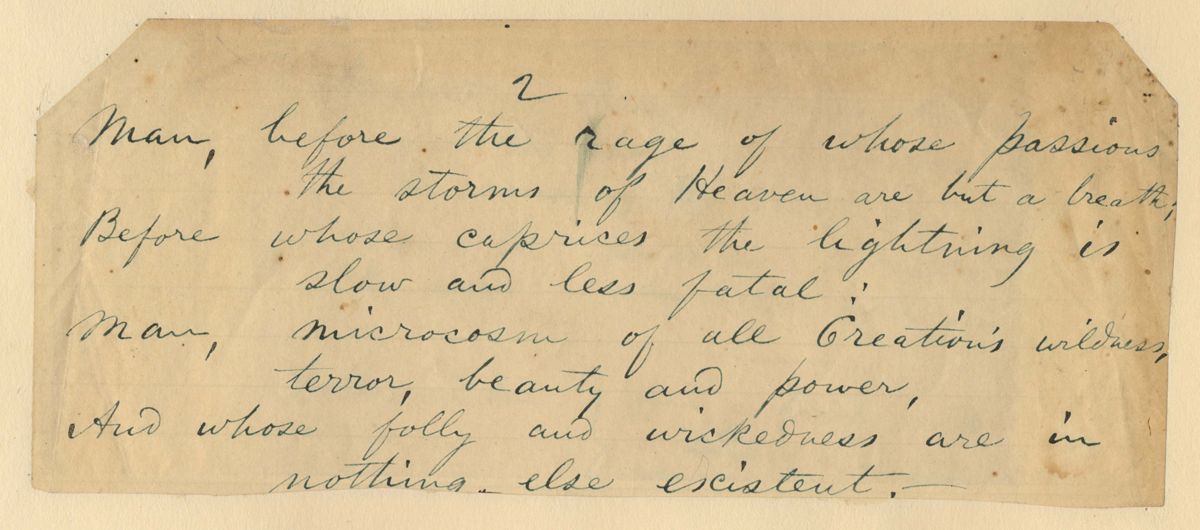
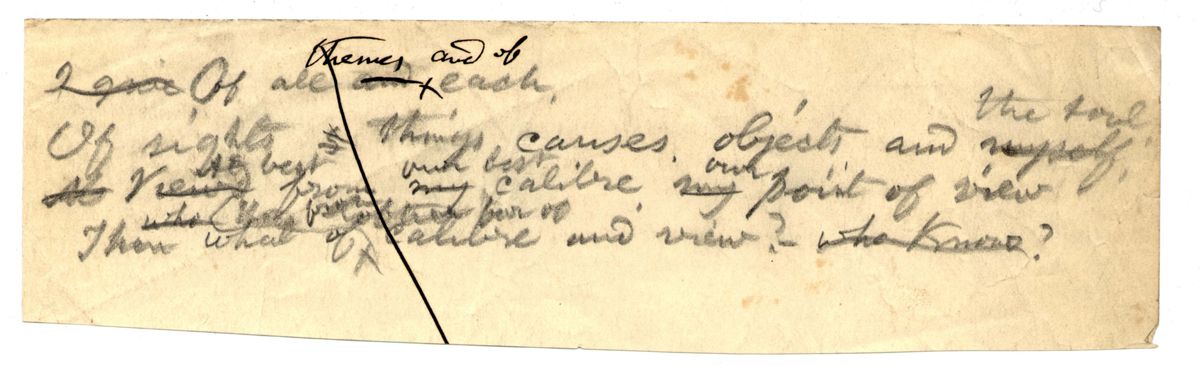
Whitman Archive Title: Man, before the rage of
-
Whitman Archive ID: uva.00287
-
Box: 1
-
Folder: 88
-
Date: Before 1855
-
Genre: poetry
-
Physical Description: 1 leaf, 8 x 19.5 cm, handwritten
-
View Images:
1
|
2
-
Content:
Although they are written in free verse, both the conventional nature of these lines and the handwriting suggest an early date of inscription. This draft may be a continuation of duk.00018 ("There is no word in"), suggesting it may relate to the poem eventually titled "Song of Myself." The lines, especially the first and third, also bear some resemblance to a passage of the preface to the 1855
Leaves of Grass
and to lines in what eventually became section 6 of "I Sing the Body Electric."
-
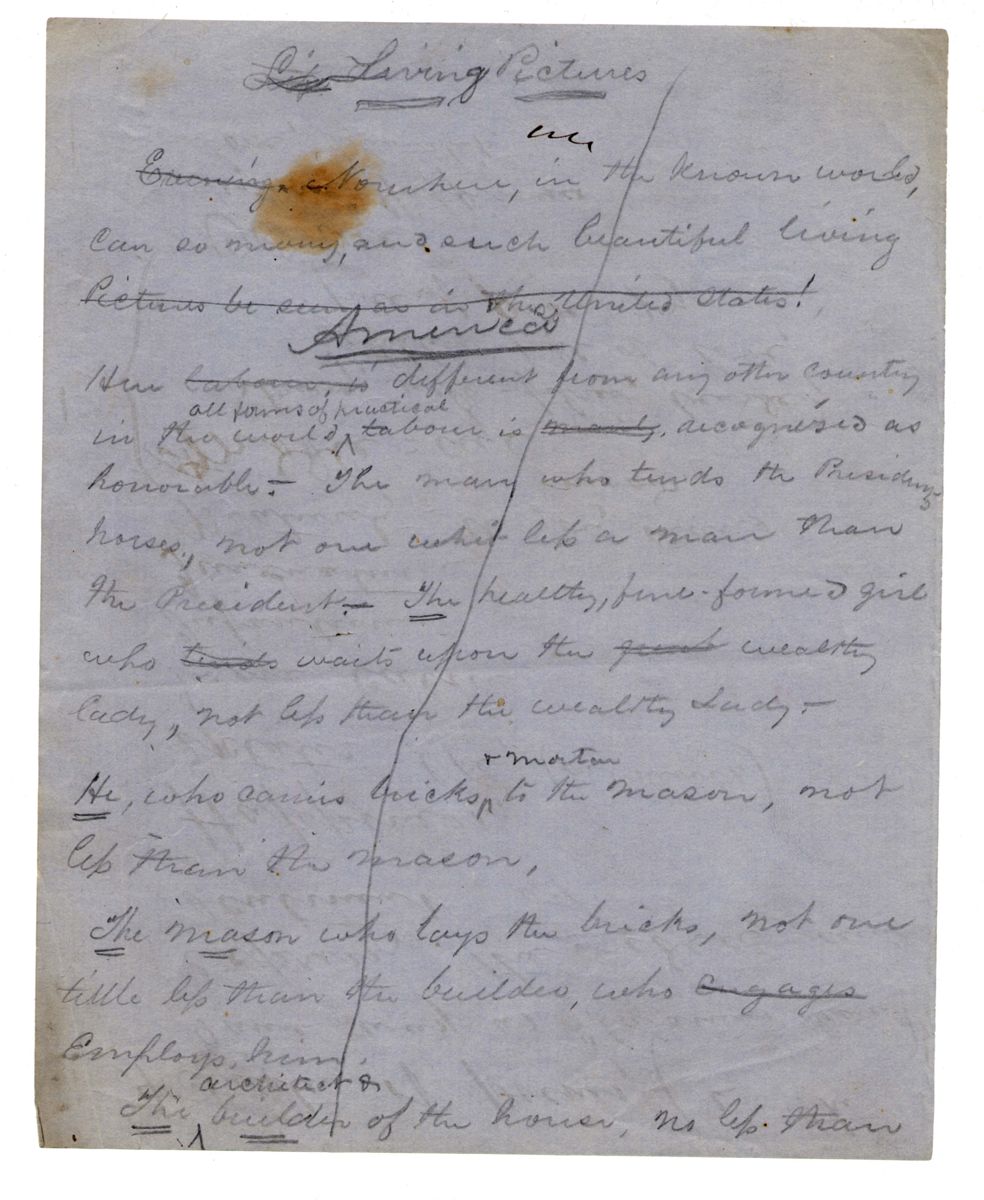
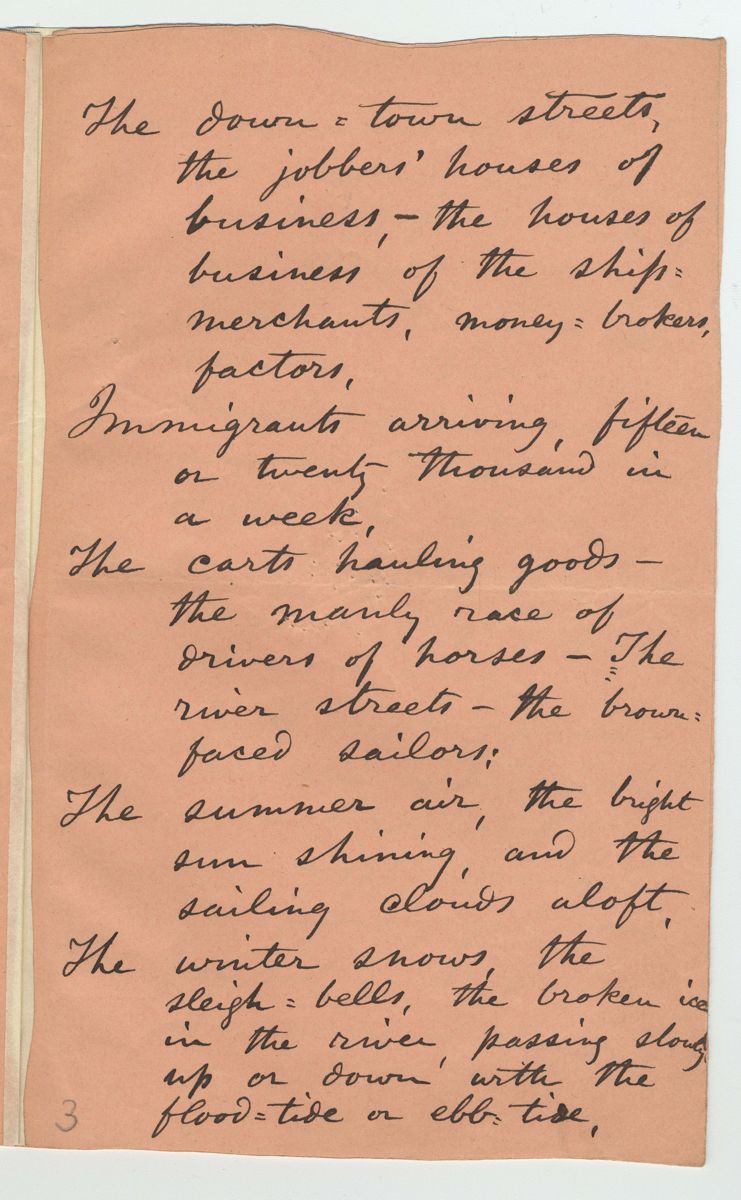
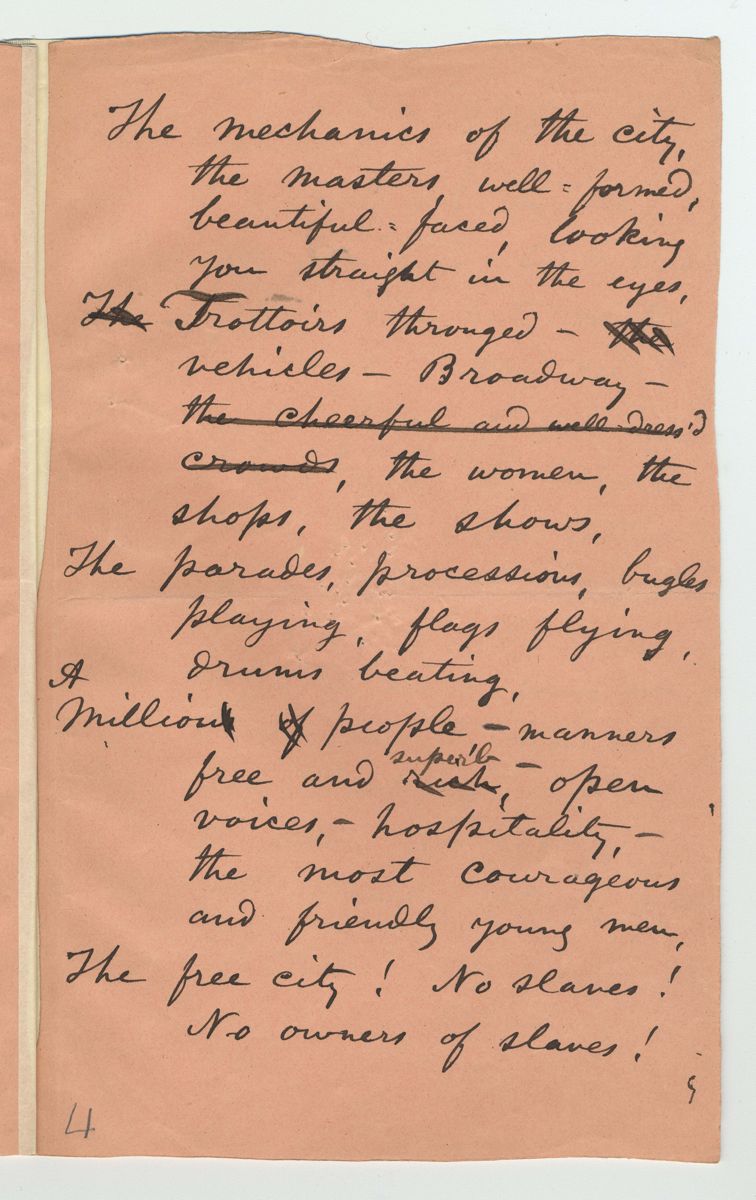
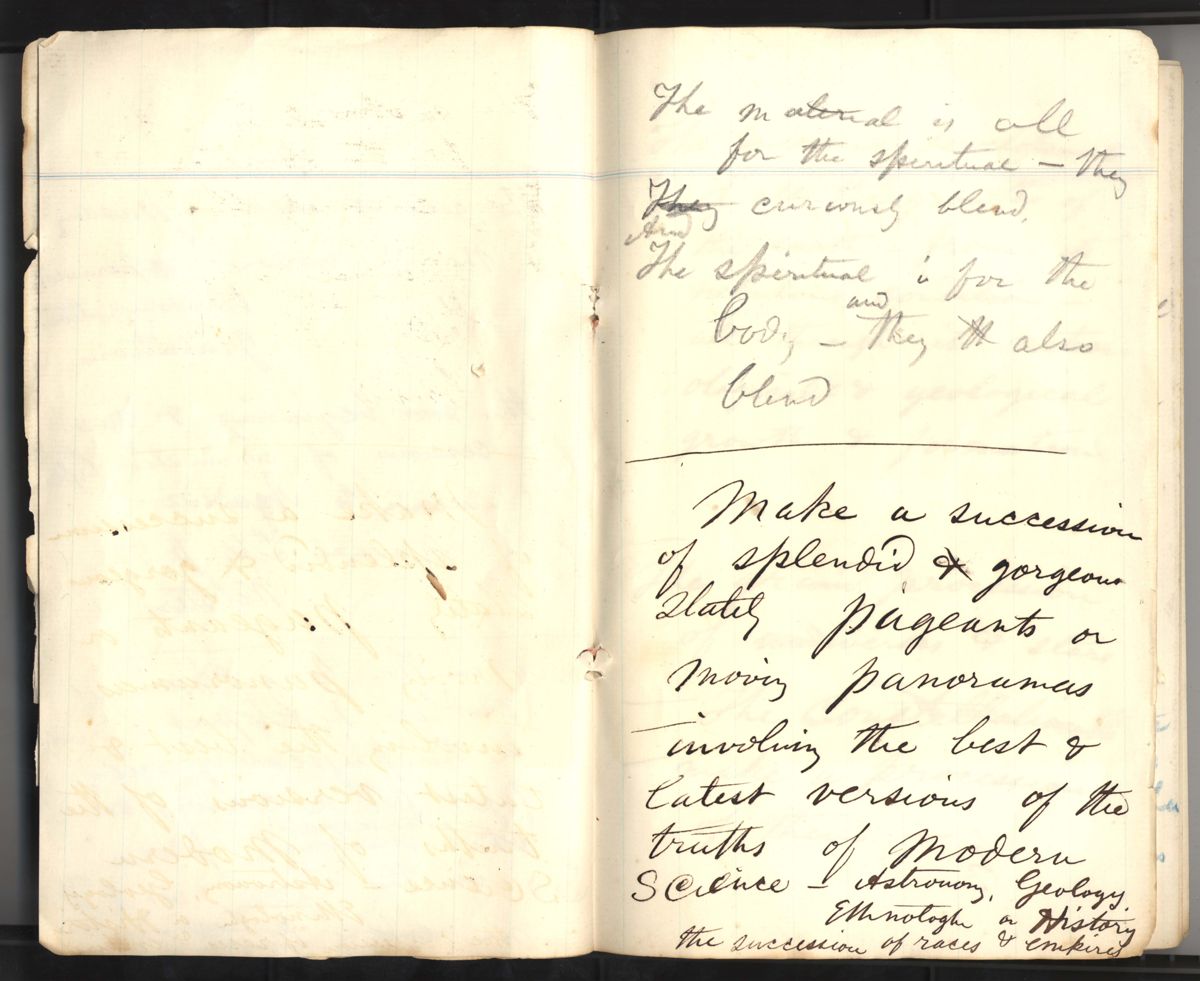
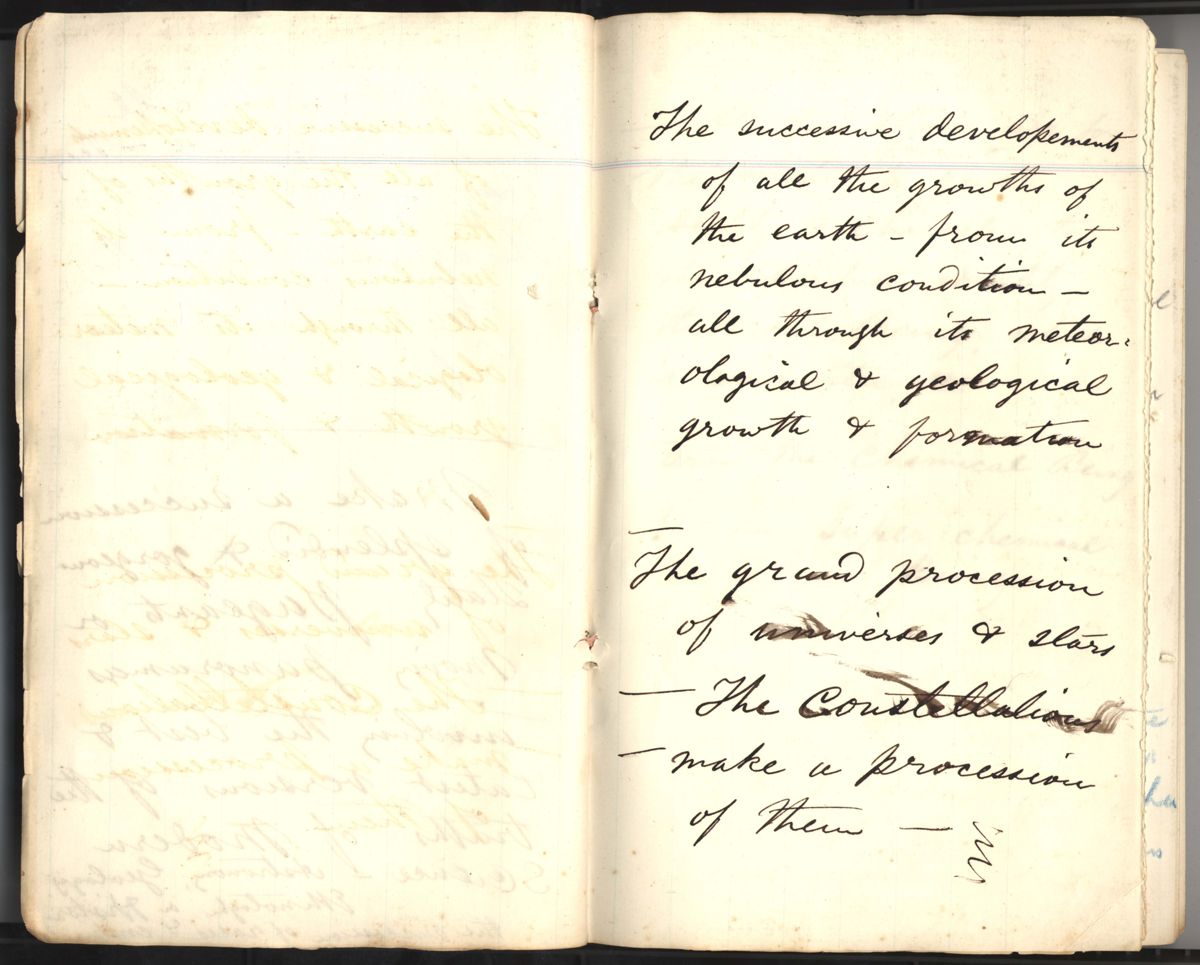
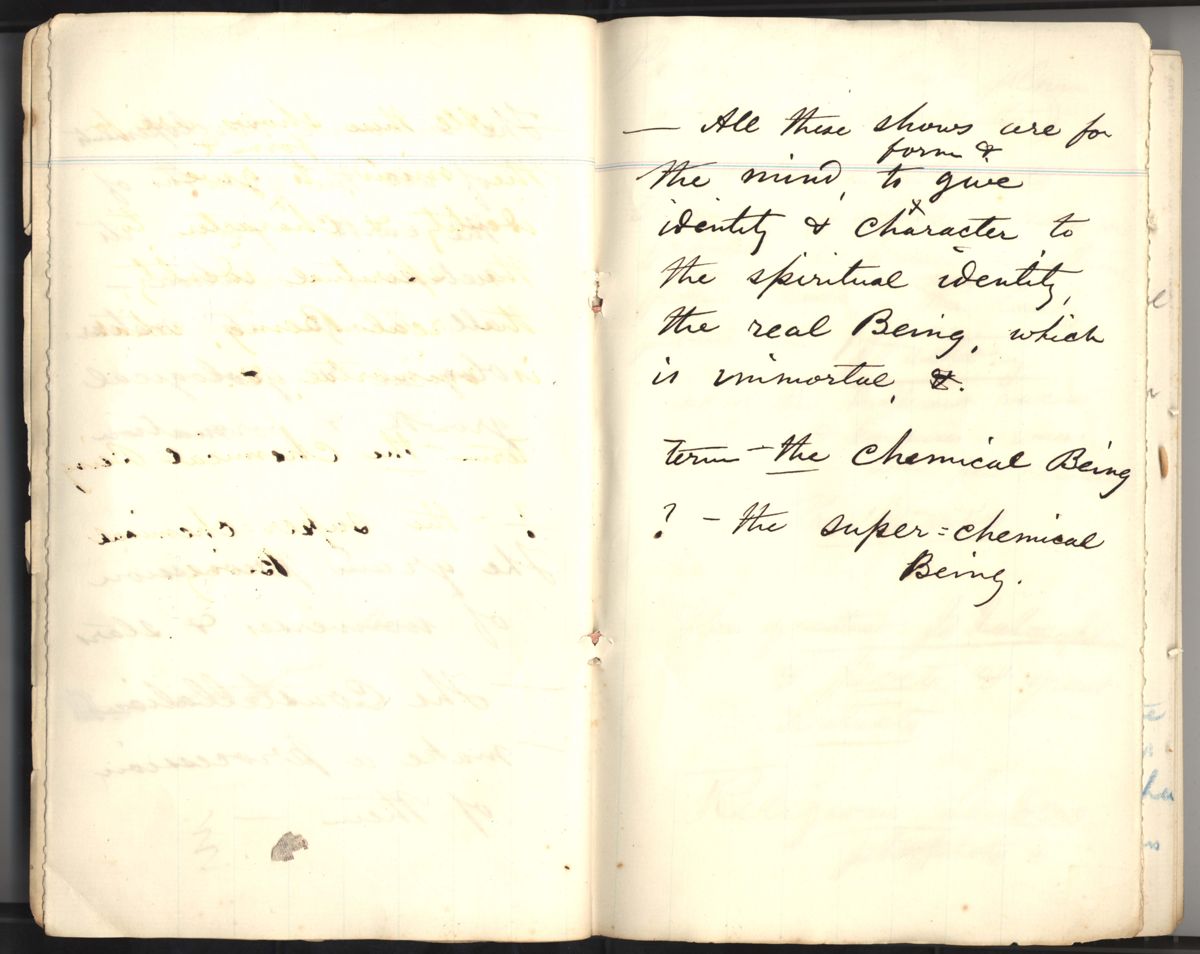
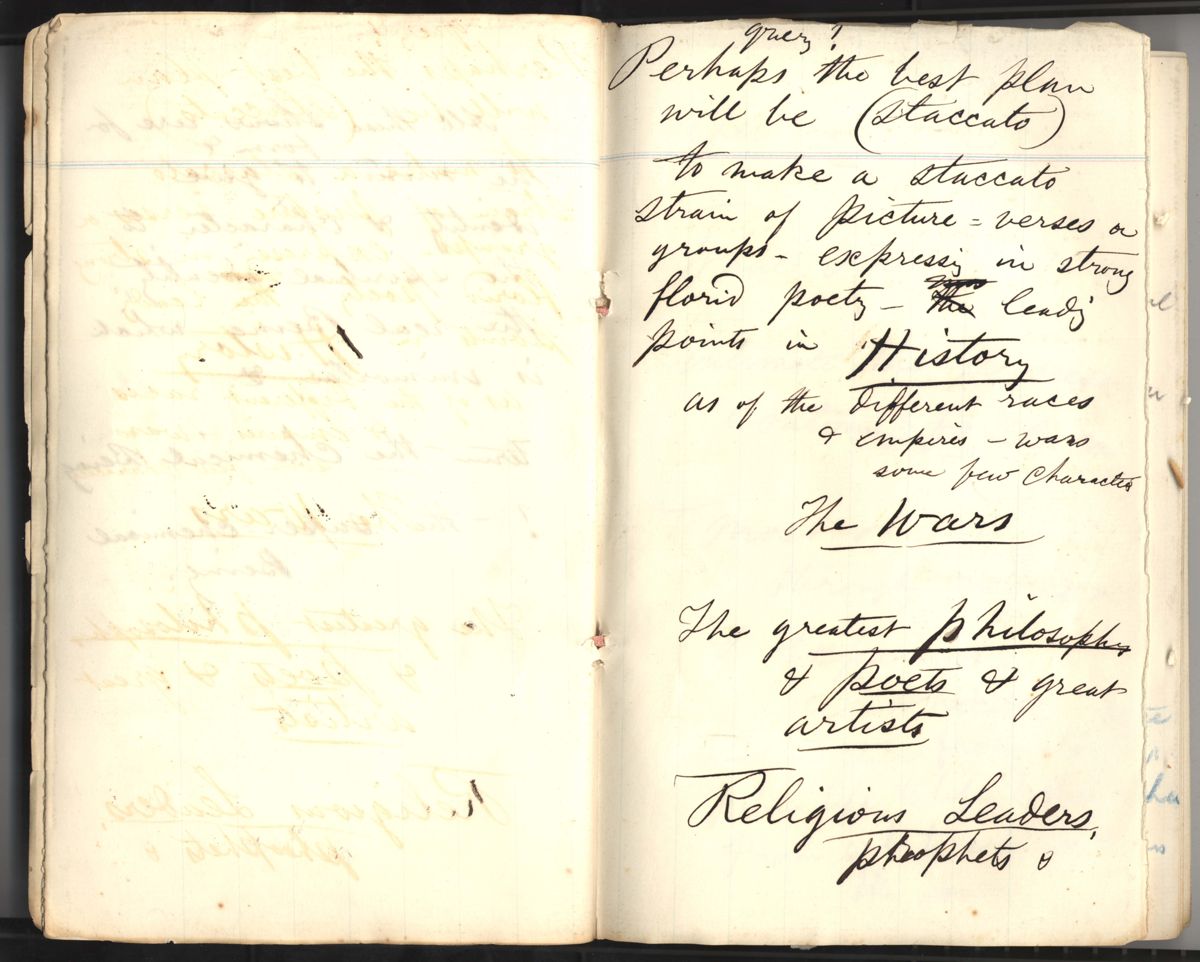
Whitman Archive Title: Living Pictures
-
Whitman Archive ID: uva.00516
-
Repository Title: "A Cluster of poems" and "Living Pictures"
-
Date: Before 1855
-
Genre: prose, poetry
-
Physical Description: 1 leaf, handwritten
-
View Images:
1
|
2
-
Content:
The handwriting and Whitman's use of the long "s" in several of the words suggest that this is an early manuscript. It is possible that these lines are early notes for the second poem in the 1855 edition of
Leaves of Grass
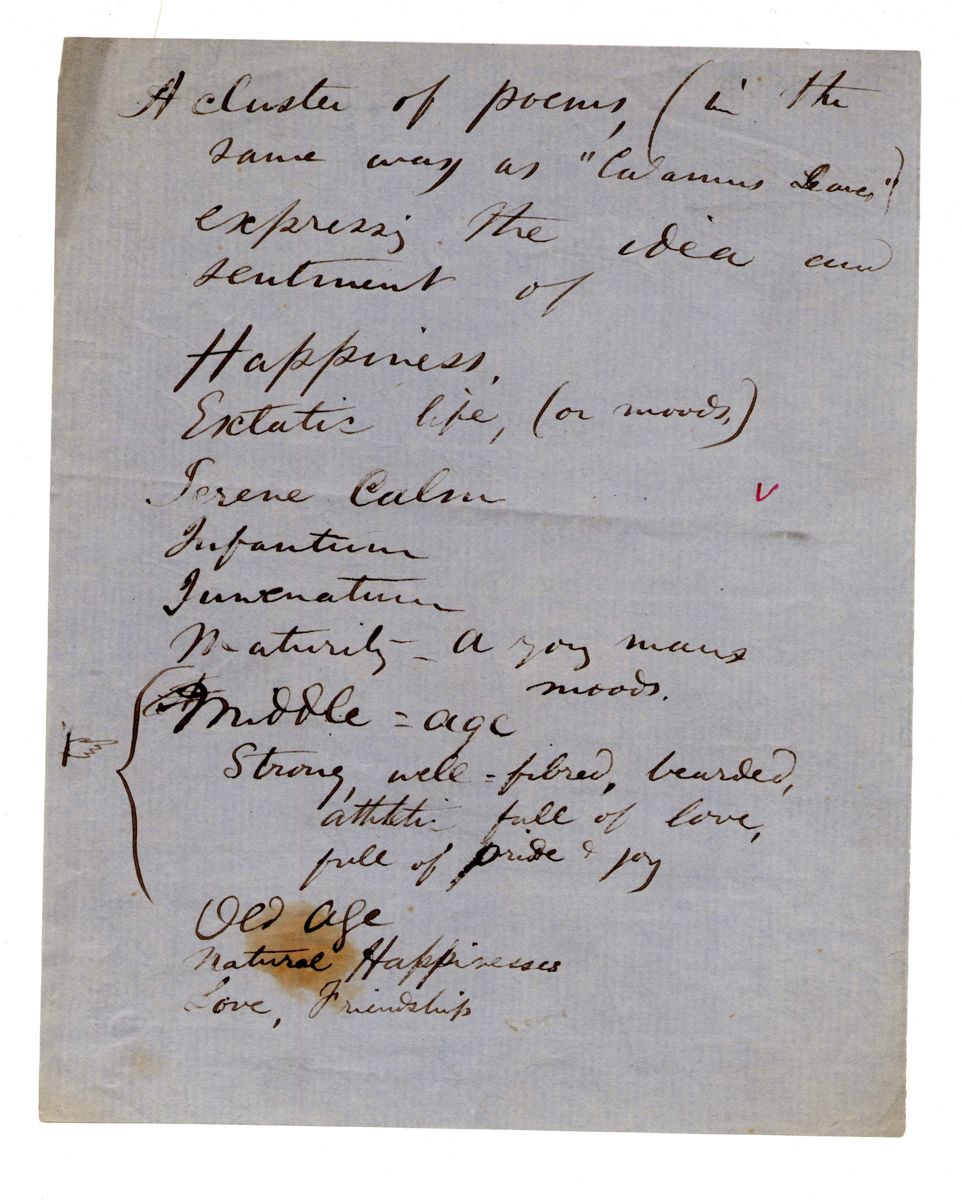
, eventually titled "A Song for Occupations." This manuscript may also relate to yal.00081 ("Pictures"), a lengthy manuscript poem held at the Beinecke Library at Yale University that was probably written in the mid- to late-1850s. On the back of this leaf (uva.00086) is a list, almost certainly written later than the prose on the front, of subjects on which to write "a cluster of poems."
-
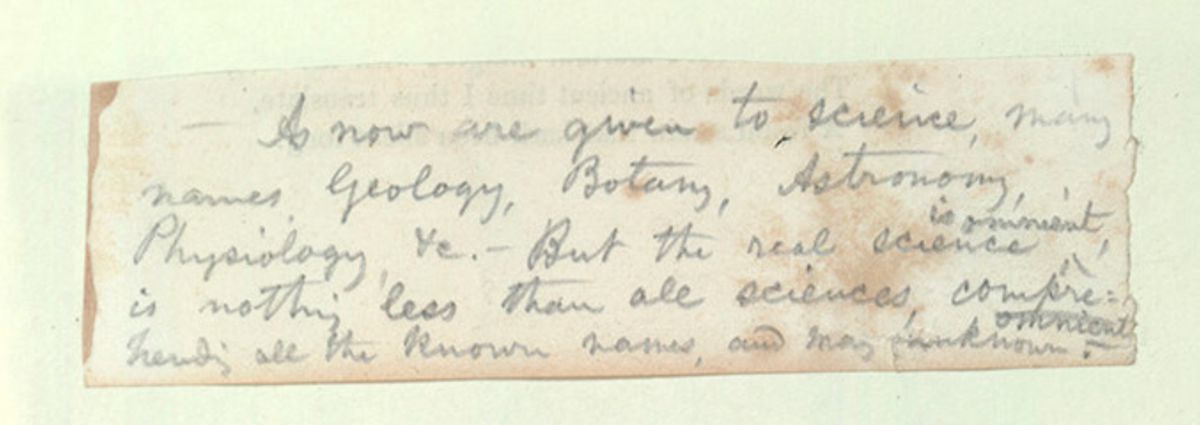
Whitman Archive Title: As now are given
-
Whitman Archive ID: uva.00508
-
Box: 1
-
Folder: 38
-
Repository Title: Glimpses of Walt Whitman from 1877 to '87
-
Date: Between 1845 and 1860
-
Genre: prose
-
Physical Description: 1 leaf, handwritten
-
View Images:
1
-
Content:
A manuscript containing prose notes about science and the names of various scientific fields. Although Whitman was interested in sciene throughout his life, his most intense period of interest in the subject was during the late 1840s and 1850s. The small handwriting and small scrap of paper on which the note is written are also characteristic of Whitman's early writing (see Edward Grier,
Notebooks and Unpublished Prose Manuscripts
[New York: New York University Press, 1984], 5:1998). The manuscript was therefore likely written in the late 1840s or the 1850s. The manuscript is pasted down to a backing sheet, making the verso inaccessible.
-
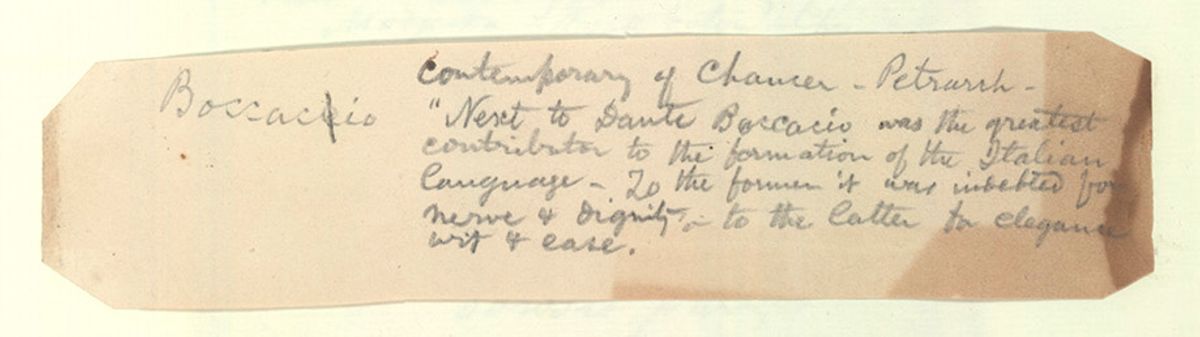
Whitman Archive Title: Boccacio
-
Whitman Archive ID: uva.00511
-
Box: 1
-
Folder: 38
-
Repository Title: Glimpses of Walt Whitman from 1877 to '87
-
Date: Between 1849 and 1860
-
Genre: prose
-
Physical Description: 1 leaf, handwritten
-
View Images:
1
-
Content:
A prose note about Italian writer Giovanni Boccaccio (1313–1375). According to Edward Grier, this scrap may have been part of a larger manuscript of notes about other Italian writers (see
Notebooks and Unpublished Prose Manuscripts
[New York: New York University Press, 1984], 5:1858). The text Whitman quotes comes from the
Westminster Review
, American Edition, LI, (July 1849): 187 (see Stovall, "Notes on Whitman's Reading,"
American Literature
26, no. 3, [November 1954]: 361). This manuscript could therefore date from as early as 1849, although it was most likely written in the 1850s. The manuscript is pasted down to a backing sheet, making the verso inaccessible.
-
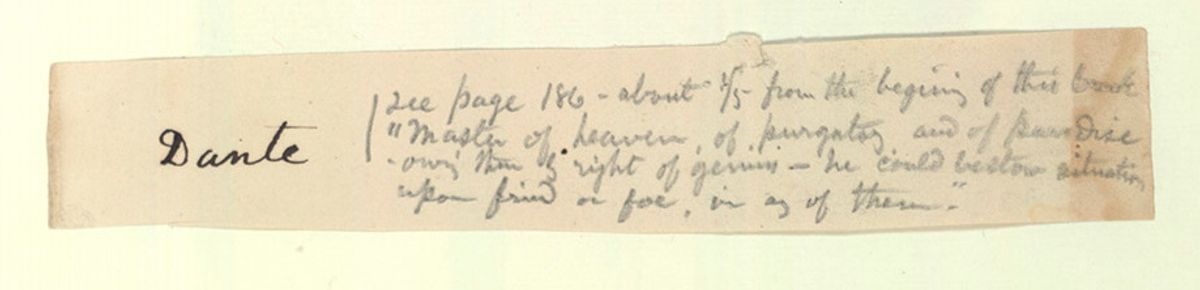
Whitman Archive Title: Dante
-
Whitman Archive ID: uva.00512
-
Box: 1
-
Folder: 38
-
Repository Title: Glimpses of Walt Whitman from 1877 to '87
-
Date: Between 1849 and 1860
-
Genre: prose
-
Physical Description: 1 leaf, handwritten
-
View Images:
1
-
Content:
A prose note about Italian writer Dante Alighieri (1265–1321). According to Edward Grier, this scrap may have been part of a larger manuscript of notes about other Italian writers (see
Notebooks and Unpublished Prose Manuscripts
[New York: New York University Press, 1984], 5:1860). The text Whitman quotes comes from the
Westminster Review
, American Edition, LI, (July 1849): 186 (see Stovall, "Notes on Whitman's Reading,"
American Literature
26, no. 3, [November 1954]: 361). This manuscript could therefore date from as early as 1849, although it was most likely written in the 1850s. The manuscript is pasted down to a backing sheet, making the verso inaccessible.
-
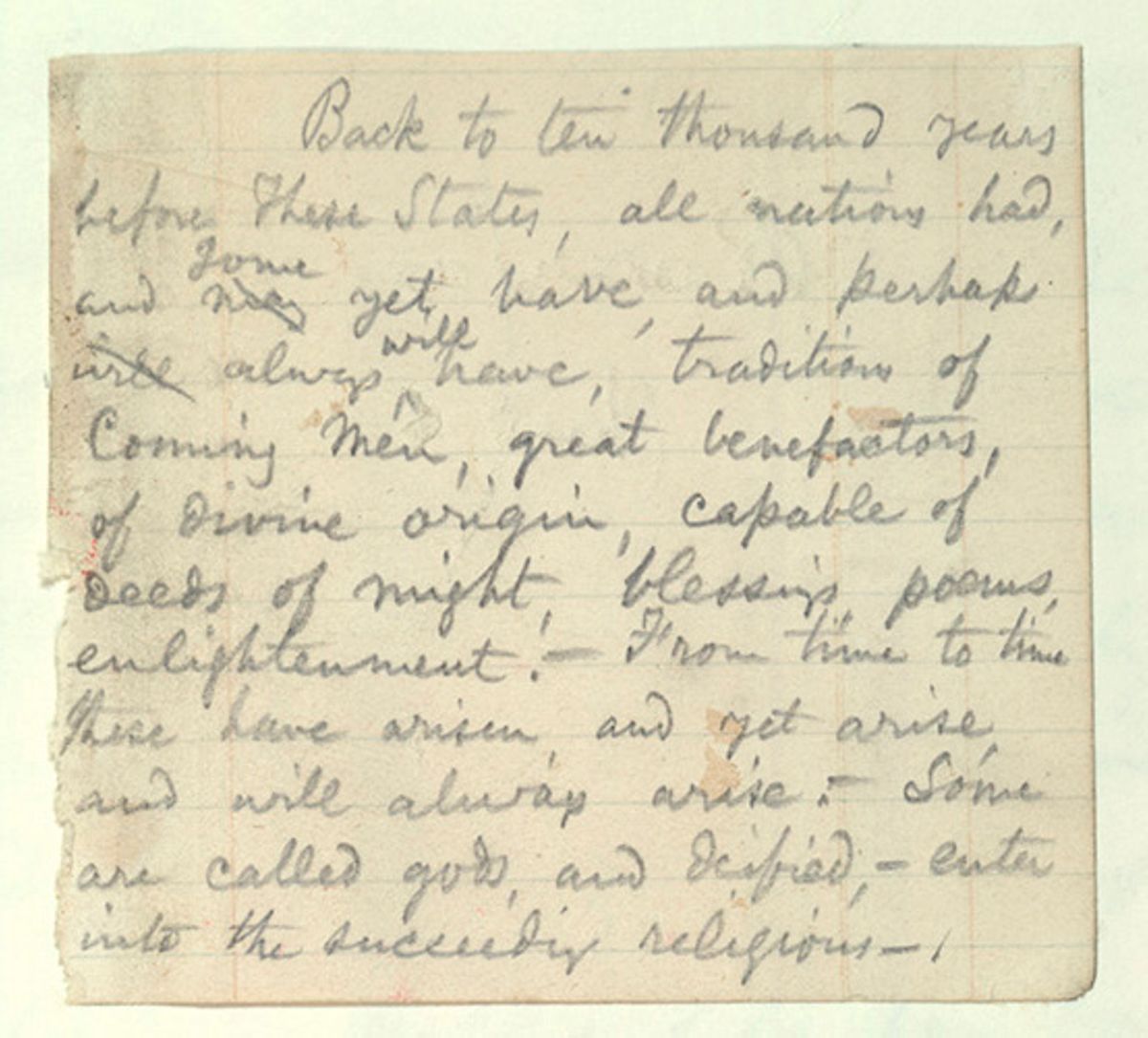
Whitman Archive Title: Back to ten thousand years
-
Whitman Archive ID: uva.00495
-
Box: 1
-
Folder: 38
-
Repository Title: Glimpses of Walt Whitman from 1877 to '87
-
Date: Between 1847 and 1857
-
Genre: prose
-
Physical Description: 1 leaf, handwritten
-
View Images:
1
-
Content:
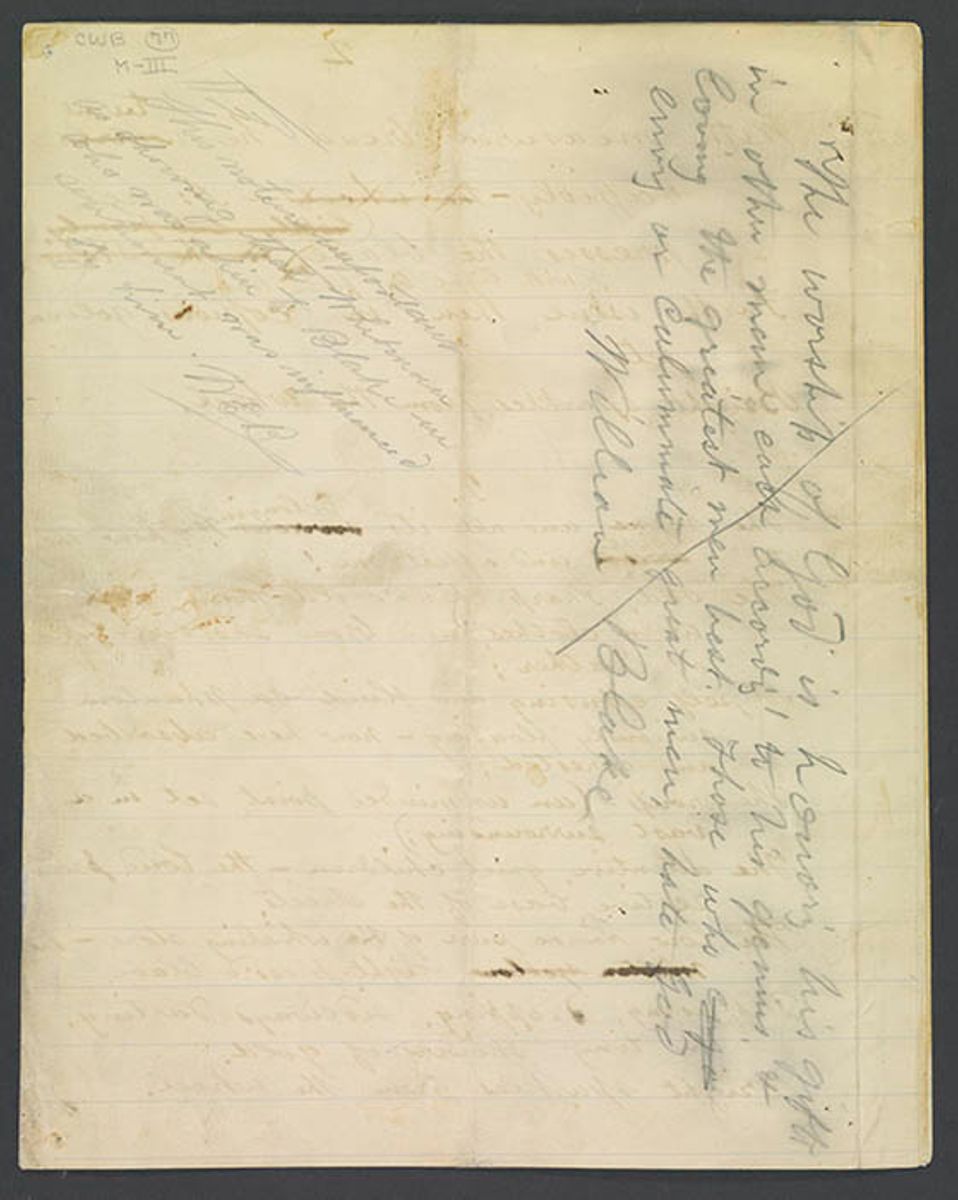
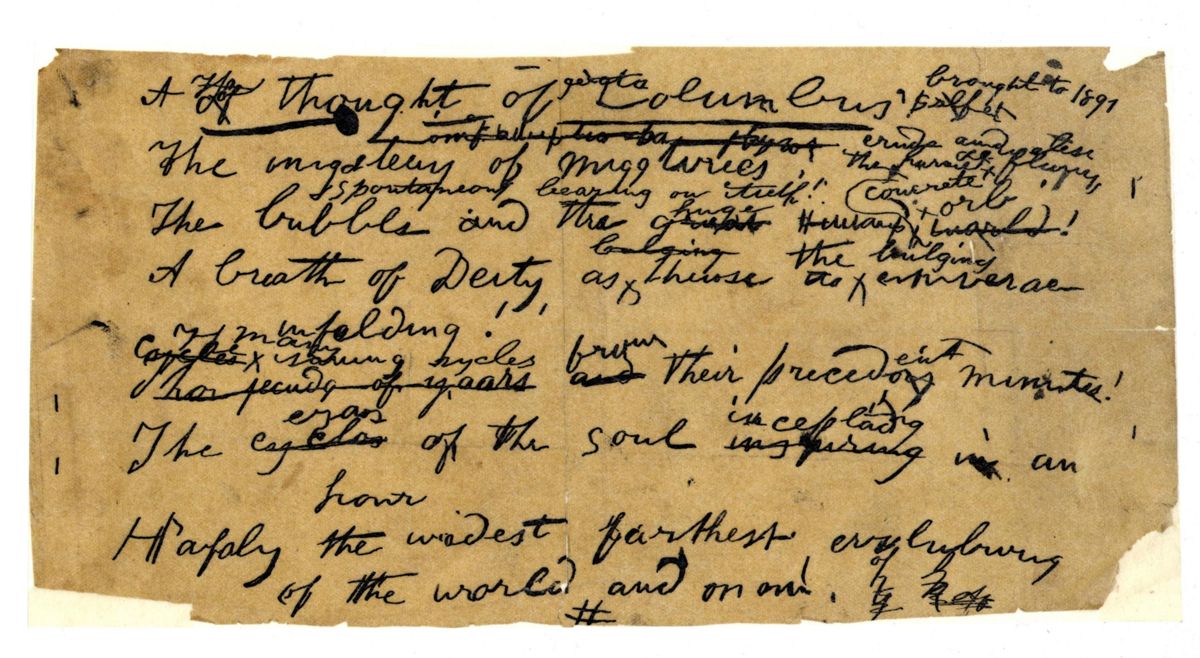
A manuscript containing prose notes about the historical ubiquity of great men, "capable of deeds of might, blessings, poems, enlightenment," with the suggestion that these were introductory thoughts for a discussion of various religions. The writing contains no known connection to any of Whitman's published works. Edward Grier notes that writing on the verso would suggest that this manuscript "must have been written in 1857 or earlier" (
Notebooks and Unpublished Prose Manuscripts
[New York: New York University Press, 1984], 6:2067). The manuscript is pasted down to a backing sheet, making the verso inaccessible.
-
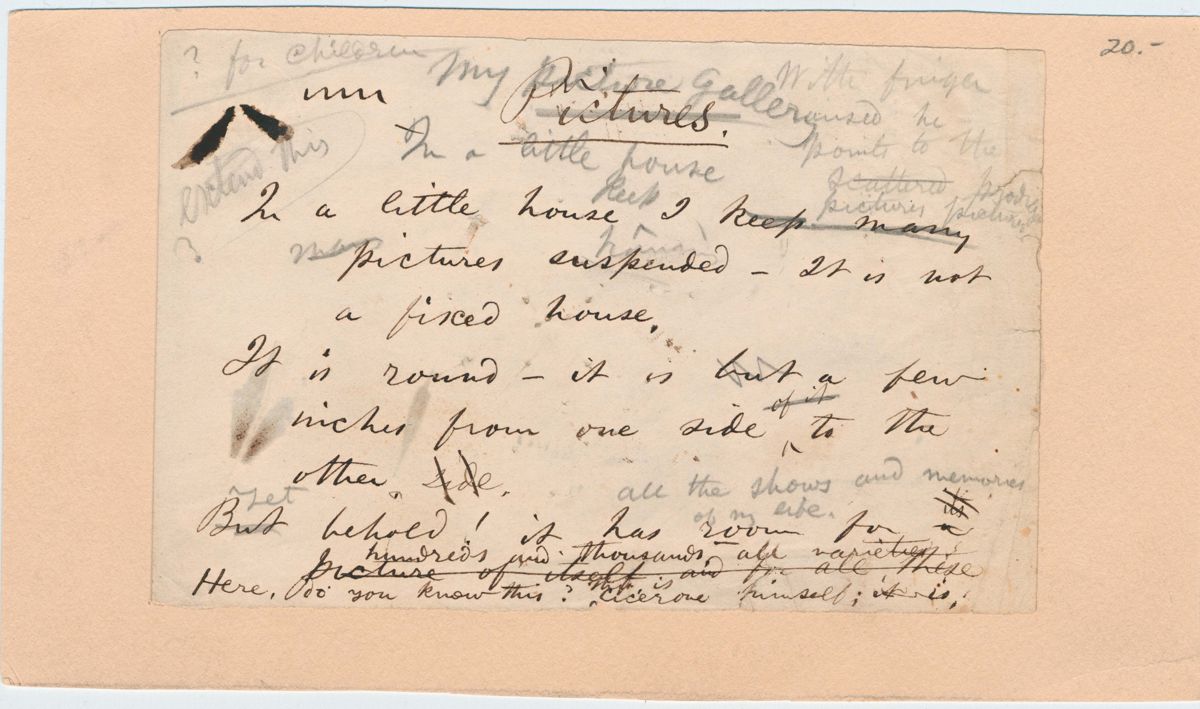
Whitman Archive Title: My picture gallery
-
Whitman Archive ID: uva.00061
-
Repository ID: #3829
-
Box: 1
-
Folder: 58
-
Date: between 1850 and 1880
-
Genre: poetry
-
Physical Description: 1 leaf, 10 x 15.5 cm, handwritten
-
View Images:
1
|
2
-
Content:
Originally titled "Pictures,"
this manuscript is a revision of the first four verses of a draft poem by that
name, inscribed by Whitman in a twenty-nine page notebook before the first edition
of
Leaves of Grass
appeared in
1855. The notes "? for children" and "extend this?" appear in the upper left
corner. The final verse appears in the upper right corner. After further revision
Whitman published these verses in the October 30, 1880 issue of
The American
under the title "My Picture-Gallery," after which
he placed it in the new cluster "Autumn Rivulets" in the 1881 edition.
-
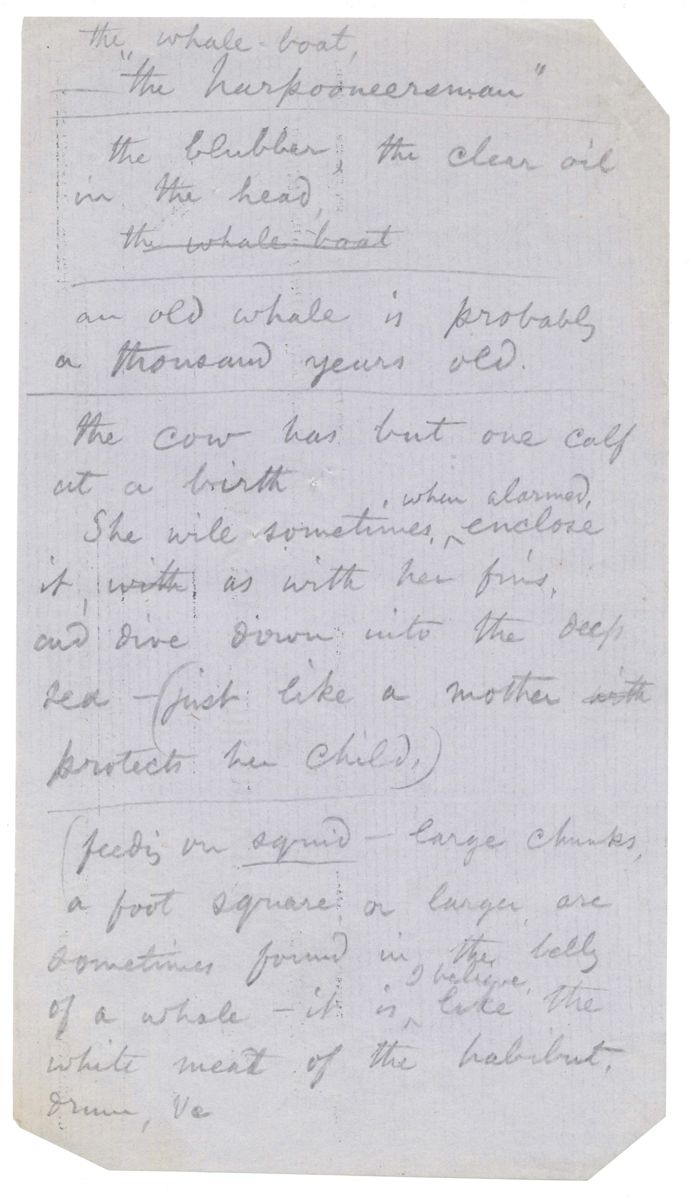
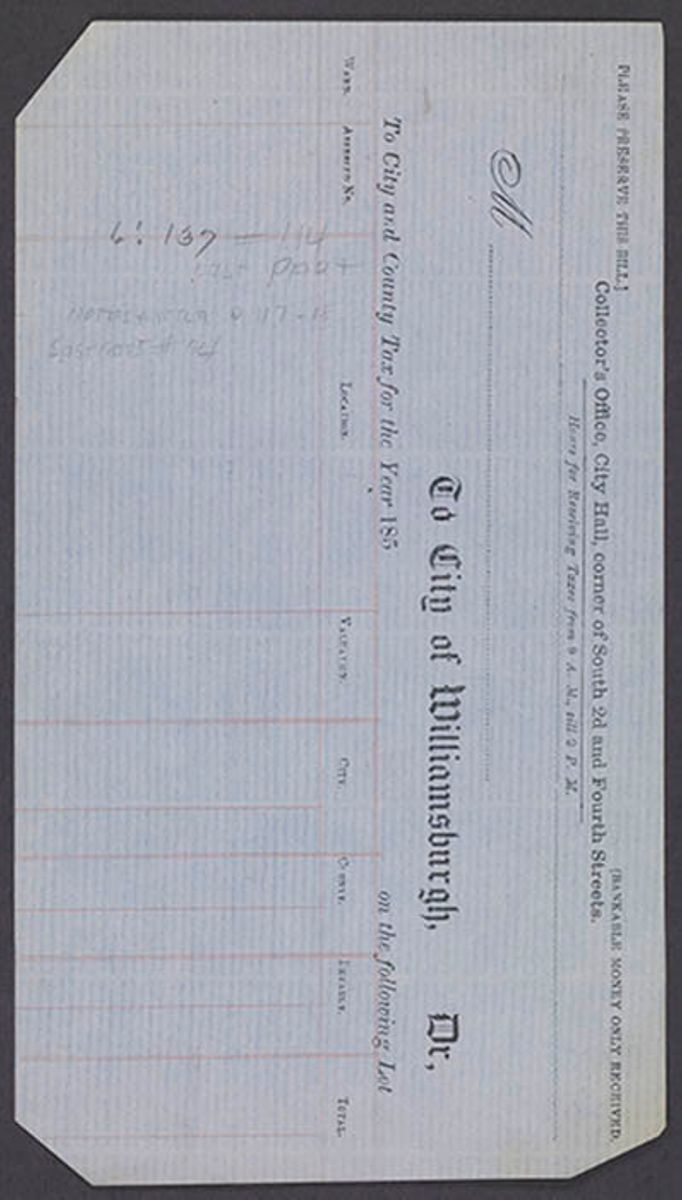
Whitman Archive Title: The Whale-boat
-
Whitman Archive ID: uva.00117
-
Repository ID: #3829-i
-
Box: 2
-
Folder: 23
-
Date: late 1850s
-
Genre: poetry
-
Physical Description: 1 leaf, 21 cm x 12 cm, handwritten
-
View Images:
1
|
2
-
Content:
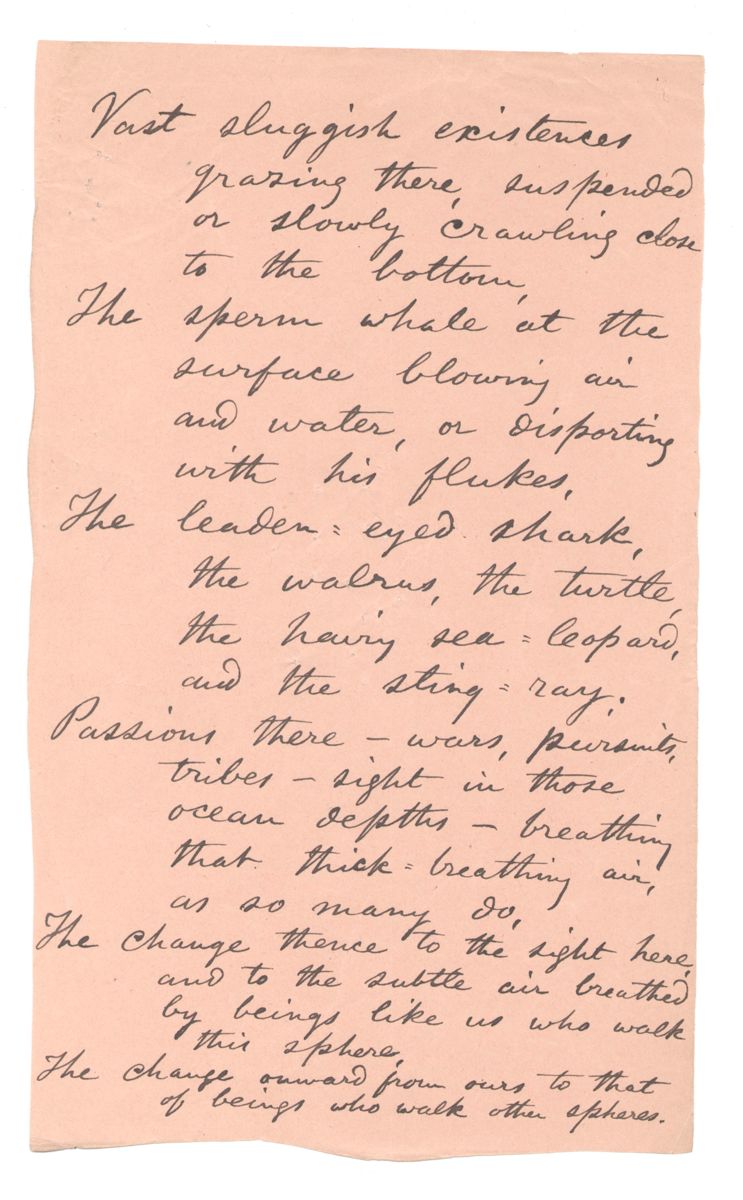
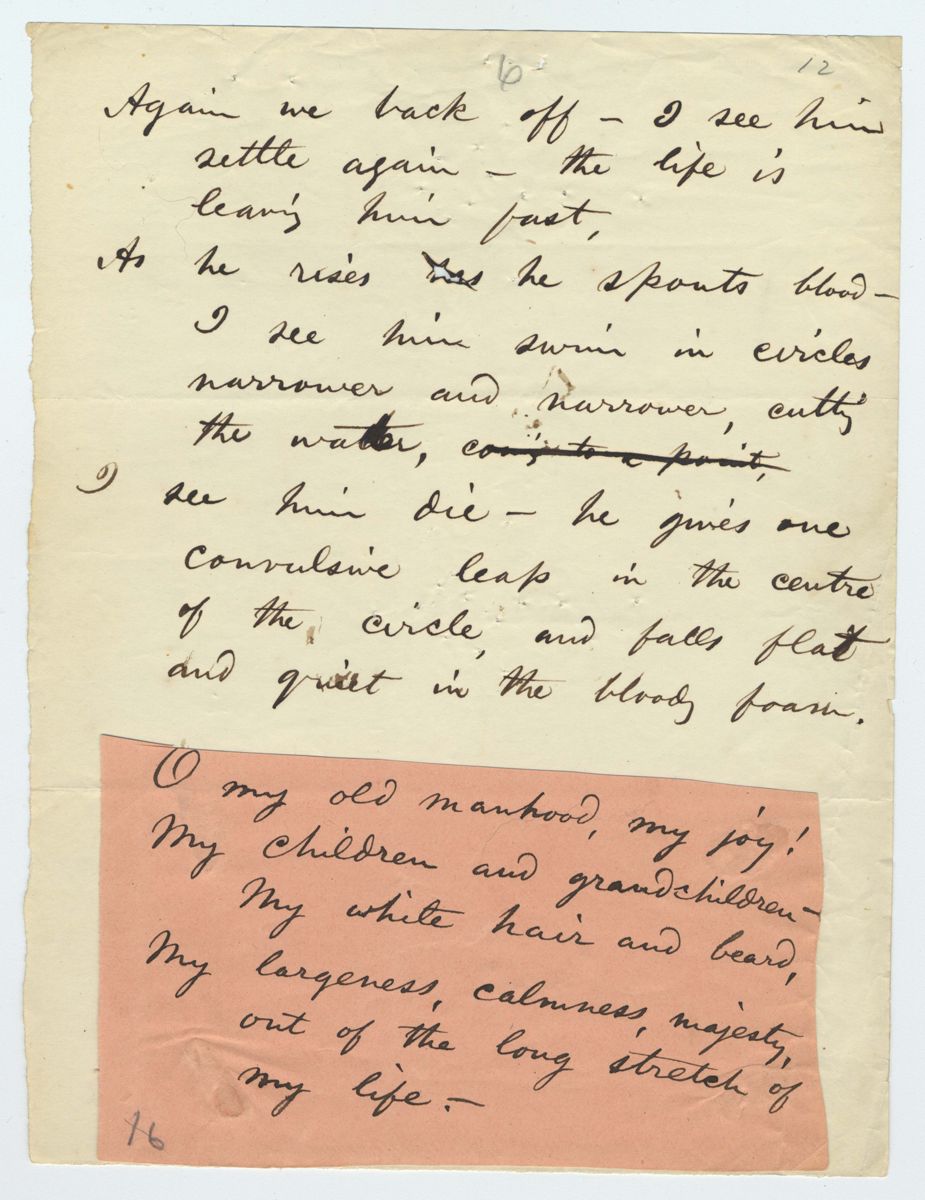
This manuscript contains notes about whales that mirror a passage about whales
published in "Song of Myself".
A direct relationship between this manuscript and Whitman's published work is unknown,
although a possible relationship also exists with drafts of the poem "The Sleepers" in which Whitman
was working with the idea of a whale being harpooned. These notes may be a
continuation of notes written on two separate scraps and held at Duke University
(The Trent Collection of Walt Whitman Manuscripts, Duke University Rare Book,
Manuscript, and Special Collections Library), "The Whale," MS q 88.
-
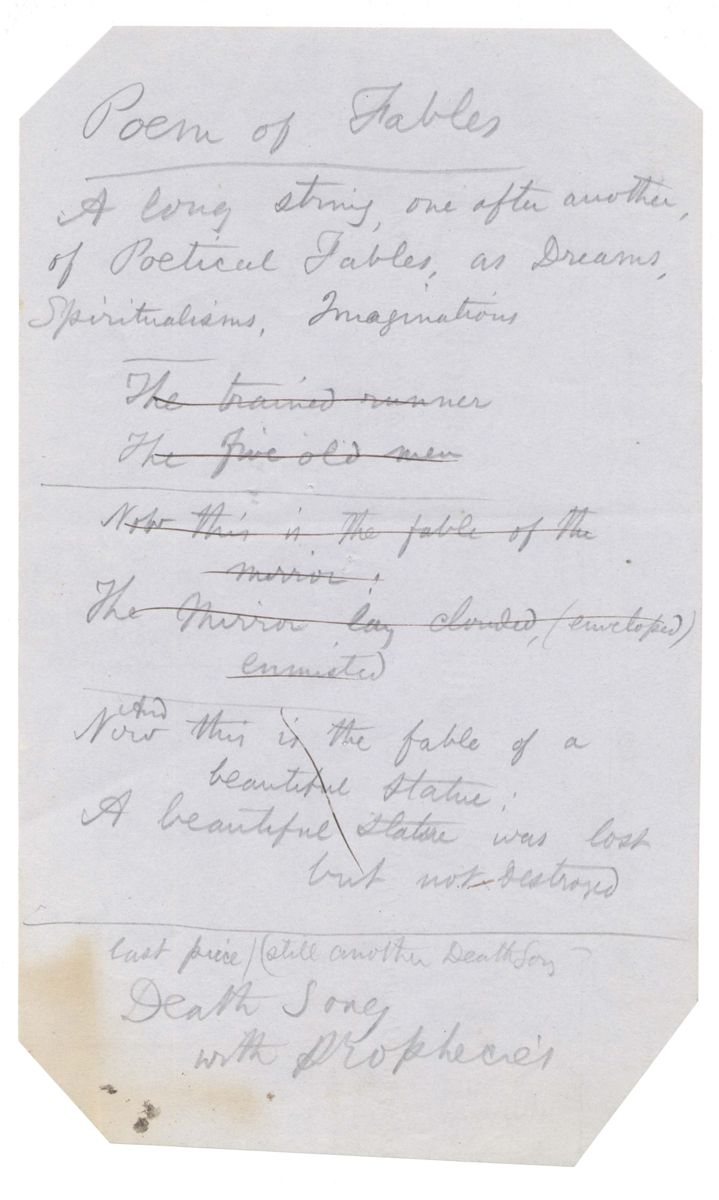
Whitman Archive Title: Poem of Fables
-
Whitman Archive ID: uva.00103
-
Repository ID: #3829-i
-
Box: 1
-
Folder: 76
-
Date: 1850s
-
Genre: poetry
-
Physical Description: 1 leaf, 20 x 12 cm, handwritten
-
View Images:
1
|
2
-
Content:
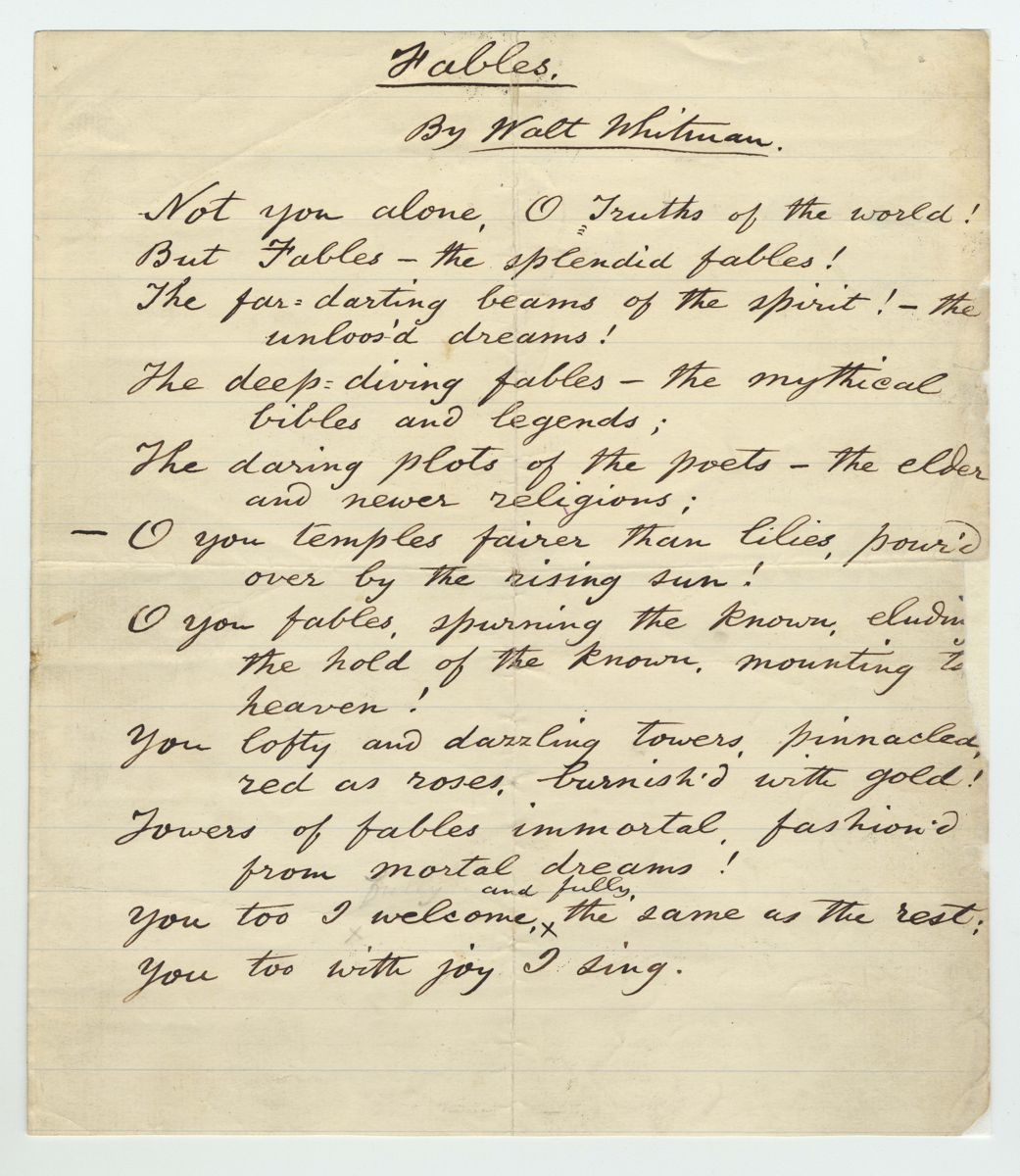
Two sets of deleted verses constitute adaptations of lines from Whitman's pre-1855
unpublished notebook "Pictures" "Now this is the fable of the mirror" and "And Now this is
the fable of a beautiful statue." Two other deleted potential fables ideas also
appear: "The trained runner" and "The five old men." At the foot of the leaf
appears the note "last piece (still another Death Song— Death Song with
prophecies." All of the sections are demarcated with horizontal lines. Based on
Whitman's use of the tax blank, the manuscript appears to be a set of notes he
made between 1857 and 1859 while preparing the 1860 edition of
Leaves of Grass
. The "Poem of Fables" as such never
materialized, but a poem simply titled "Fables" was incorporated into the second
section of the poem "Passage to
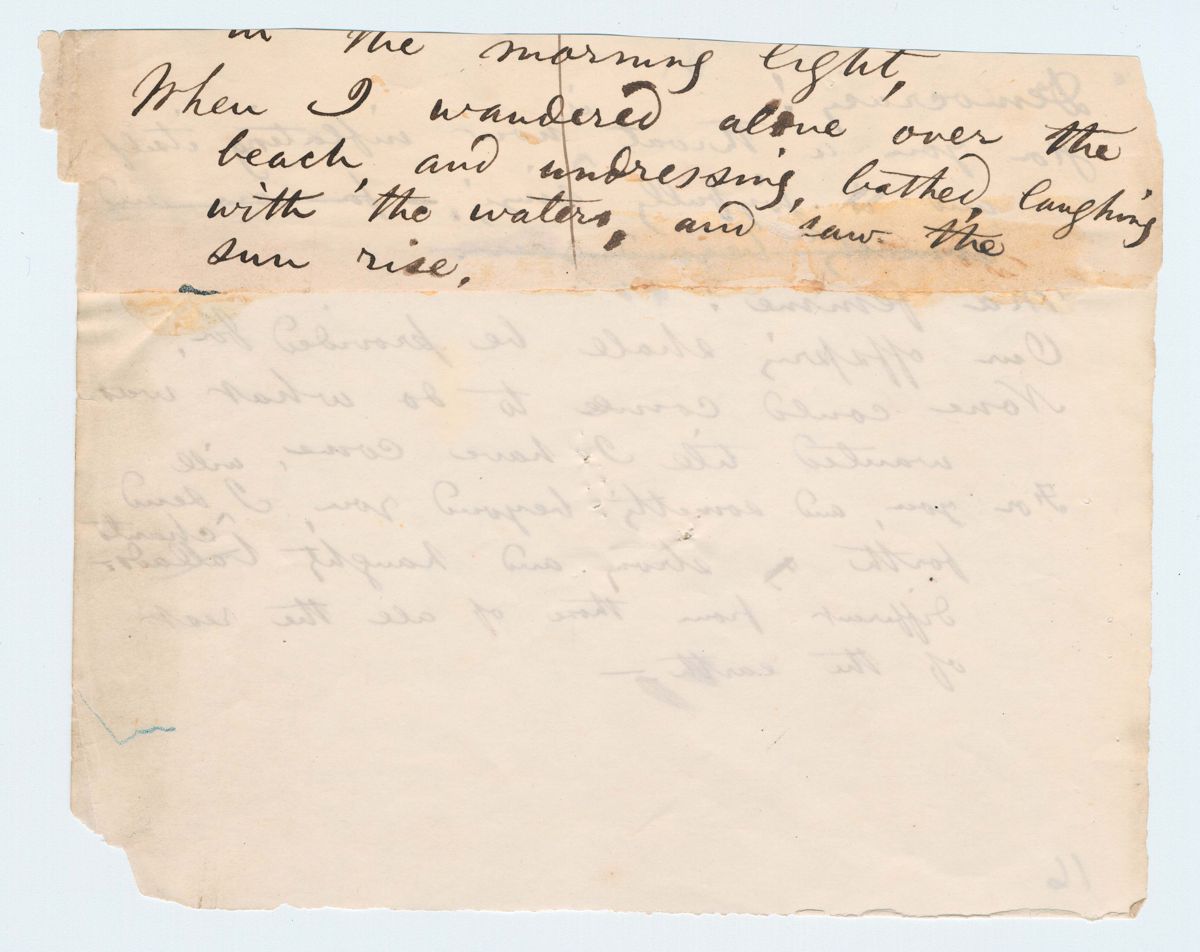
India", first published in 1871. Whitman's "Pictures" were not published in their entirety until
1925. Whitman uses the phrase "well-train'd runner" in "The Runner", a poem which first appeared in Leaves of
Grass in 1867.
-
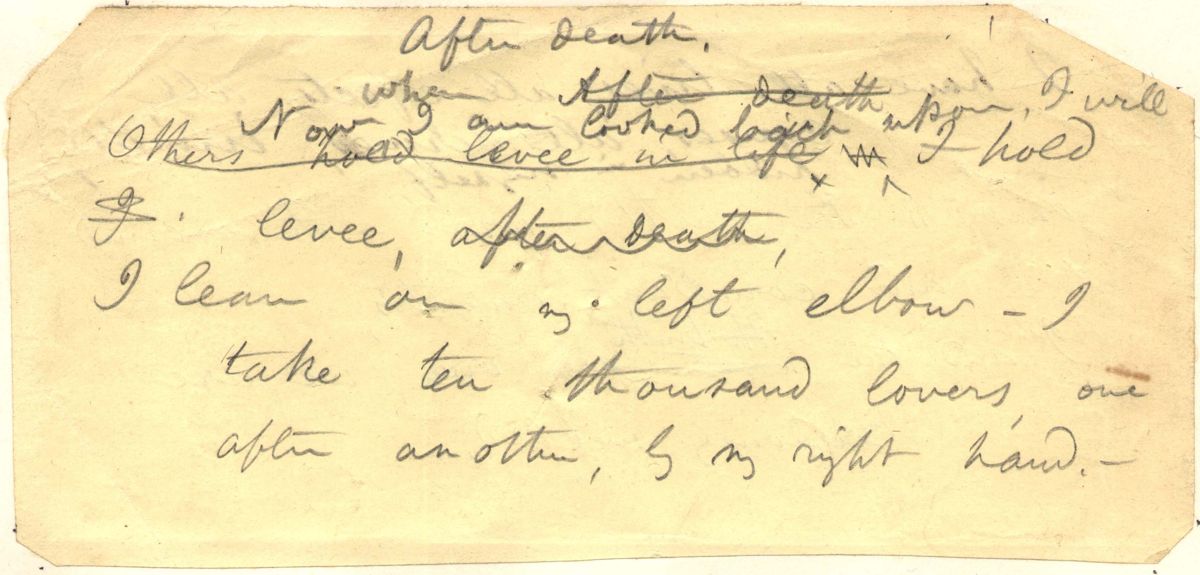
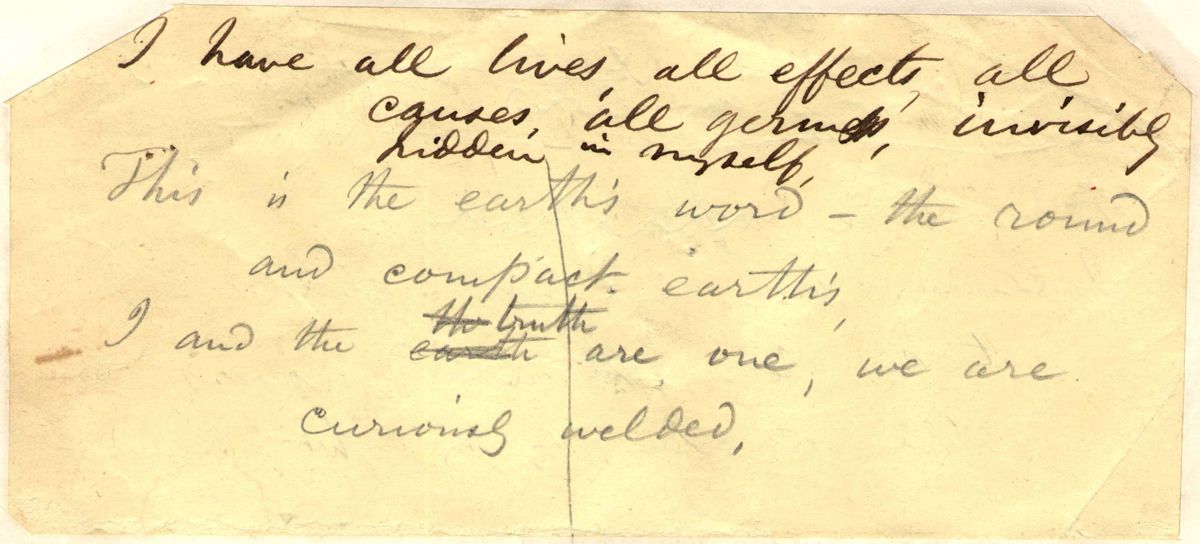
Whitman Archive Title: After death
-
Whitman Archive ID: uva.00133
-
Box: 1
-
Folder: 49
-
Date: Mid-1850s
-
Genre: poetry
-
Physical Description: 1 leaf, 7 x 15 cm, handwritten
-
View Images:
1
|
2
-
Content:
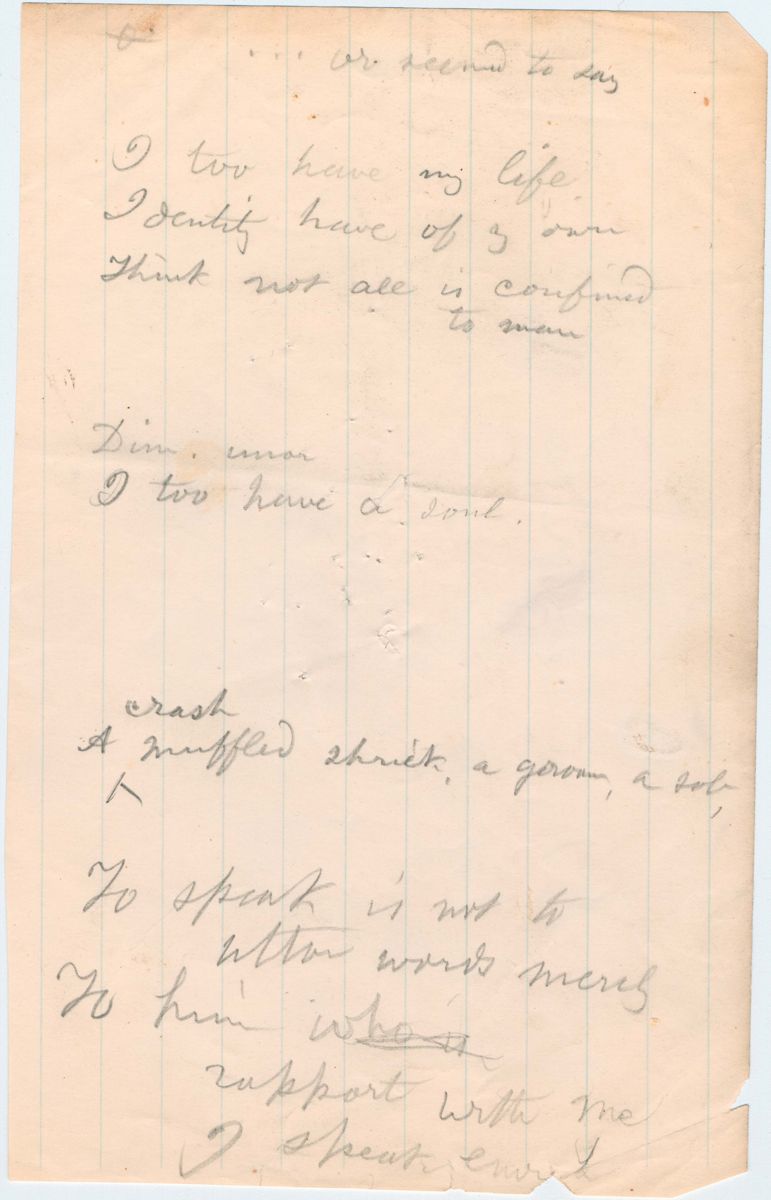
This manuscript was probably written in the mid-1850s. The lines beginning "After death" are not known to have been published in Whitman's lifetime. The lines on the verso, beginning "I have all lives," are likely related to the poem first published in the 1856 edition of
Leaves of Grass
as "Poem of The Sayers of The Words of The Earth" and ultimately entitled "A Song of the Rolling Earth." Because the handwriting is similar on the two sides, we treat them here as a single text.
-
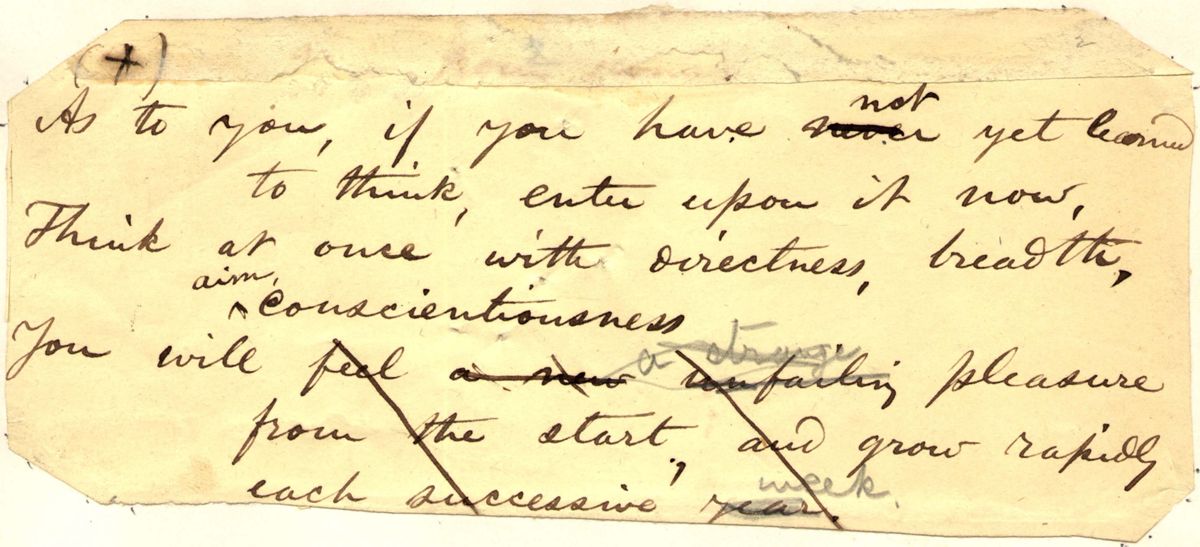
Whitman Archive Title: [As to you]
-
Whitman Archive ID: uva.00134
-
Box: 1
-
Folder: 49
-
Date: Between 1850 and 1860
-
Genre: poetry
-
Physical Description: 1 leaf, 7 x 15.5 cm, handwritten
-
View Images:
1
|
2
-
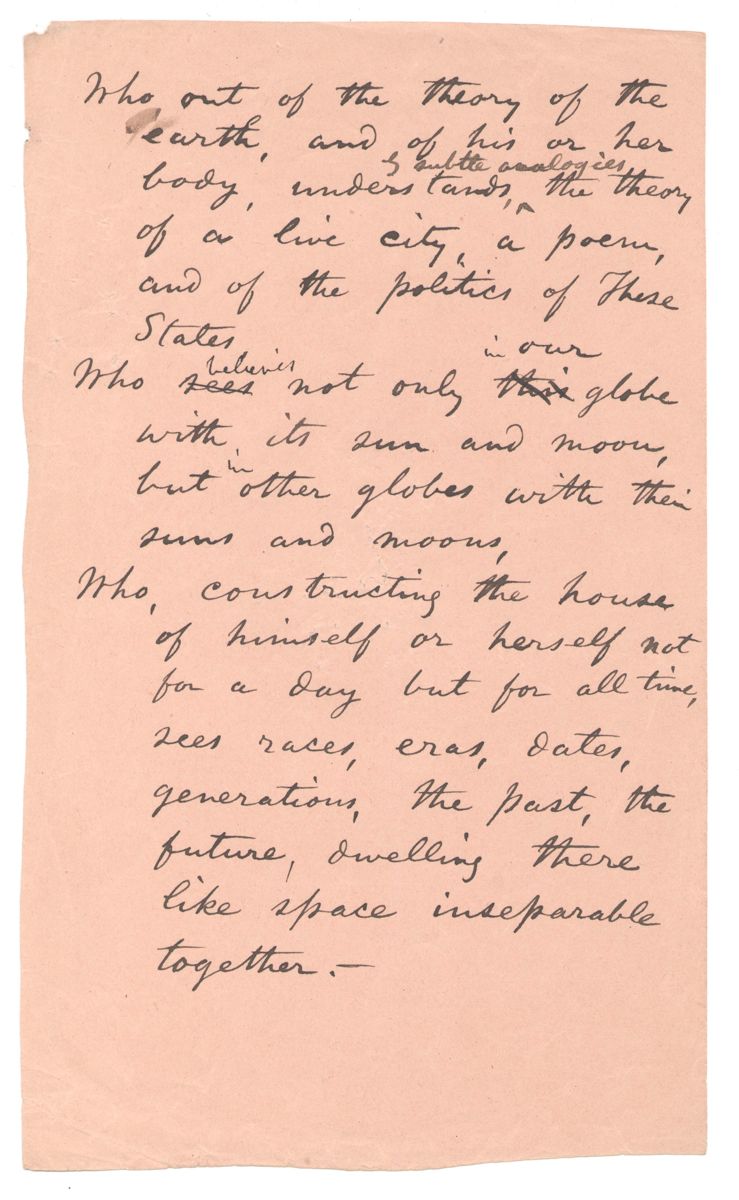
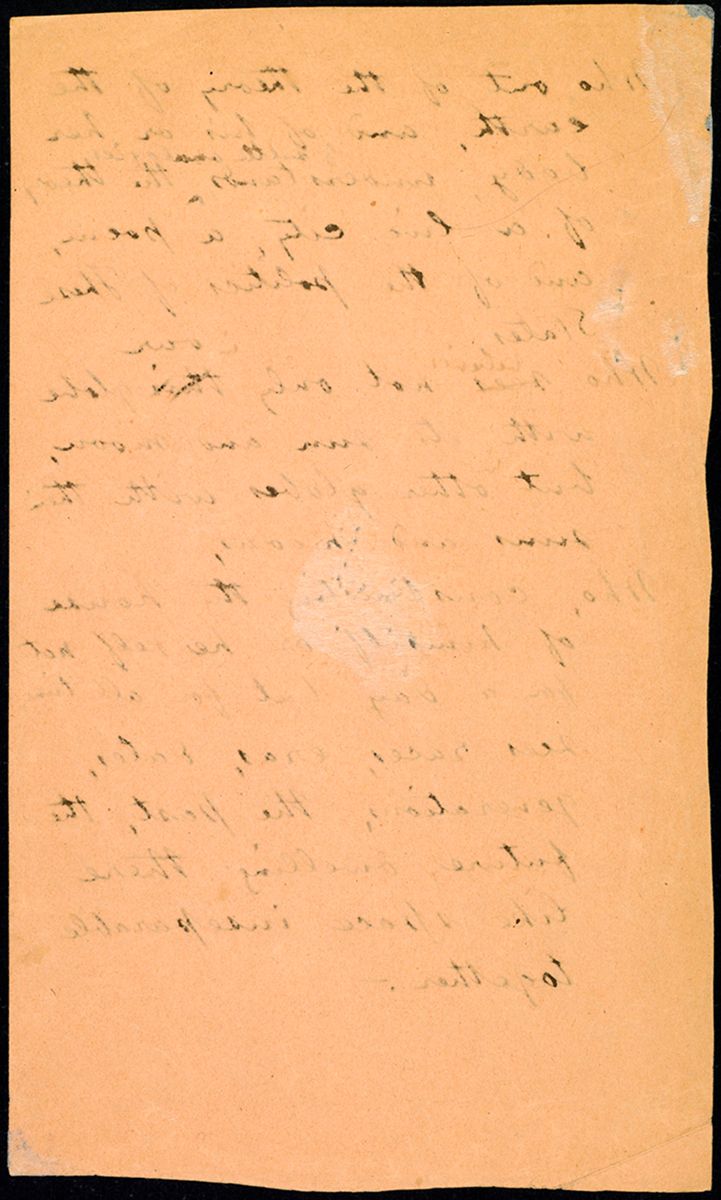
Content:
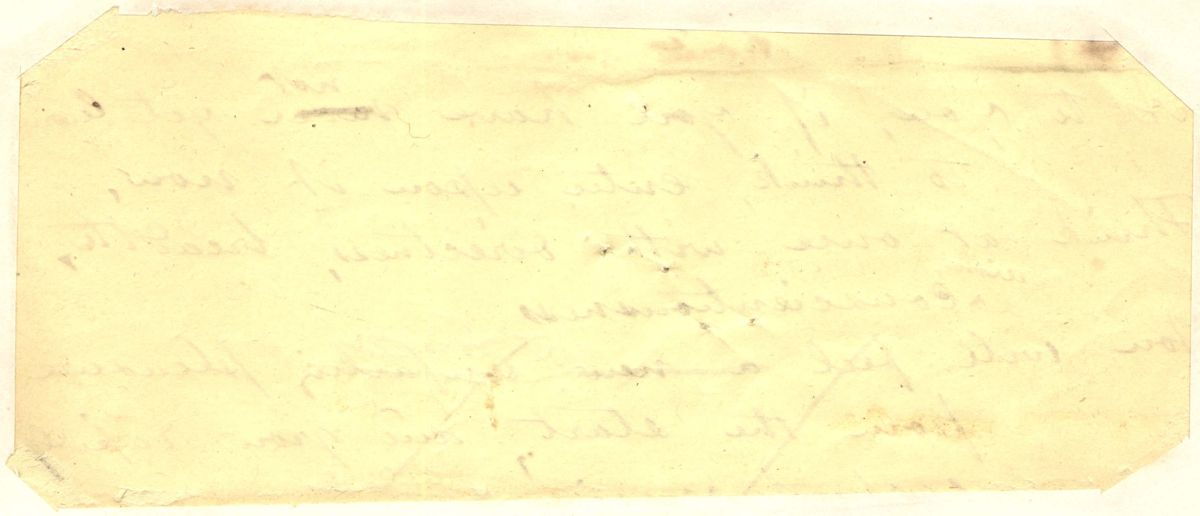
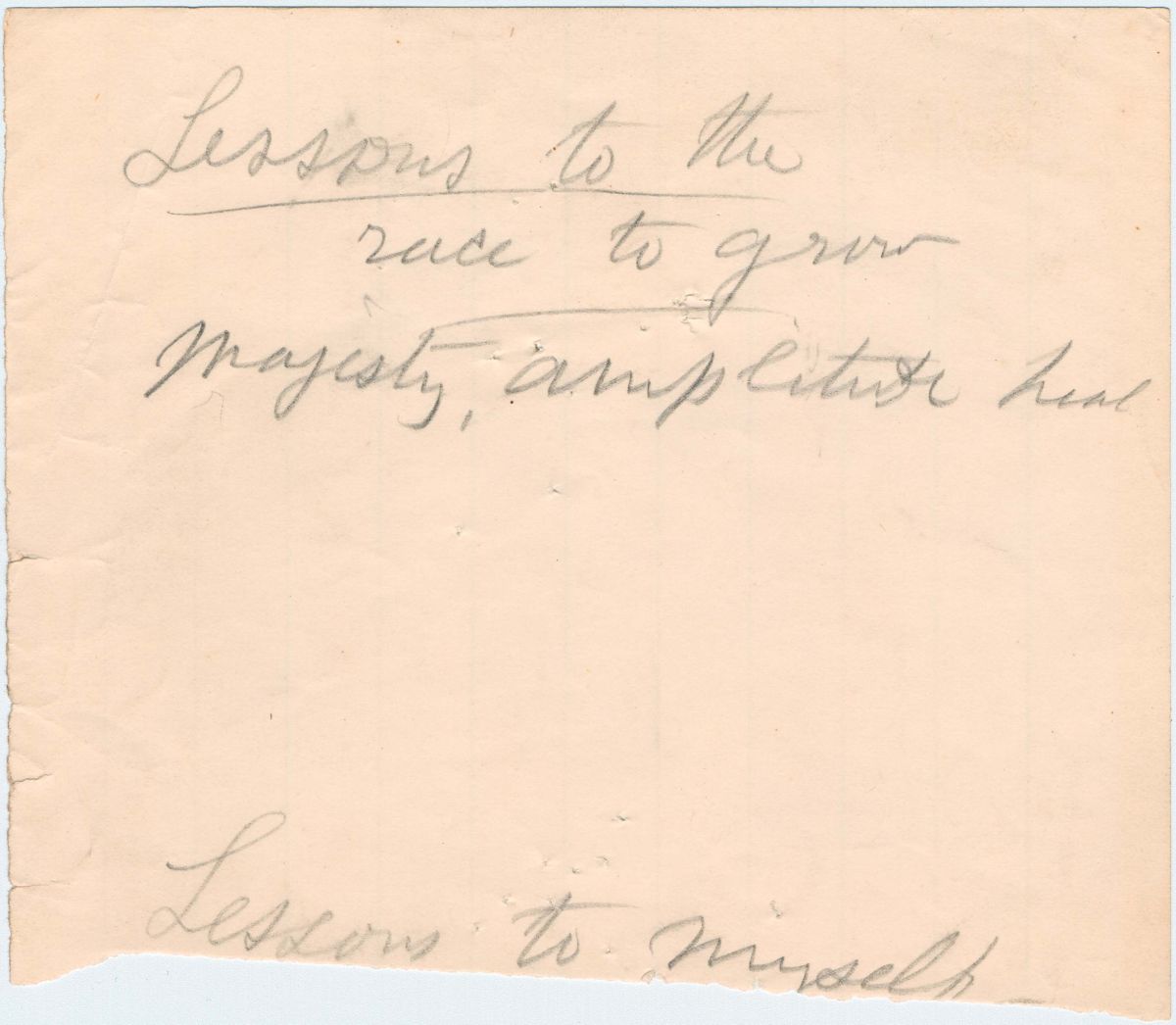
This manuscript bears some similarity in subject to the poem that became "Who Learns My Lesson Complete," though there does not appear to be any specific contribution of lines or phrases. This leaf was evidently pasted to and then pulled away from another page; some fragments of that other page remain affixed to the top. In his transcription of this manuscript, Richard Maurice Bucke combined it with three other manuscripts: see nyp.00095, nyp.00097, and uva.00283 (
Notes and Fragments
[London, Ontario: A. Talbot & Co., printers, 1899], 28–29). Though the subject matter is similar, the manuscripts do not appear to be continuous.
-
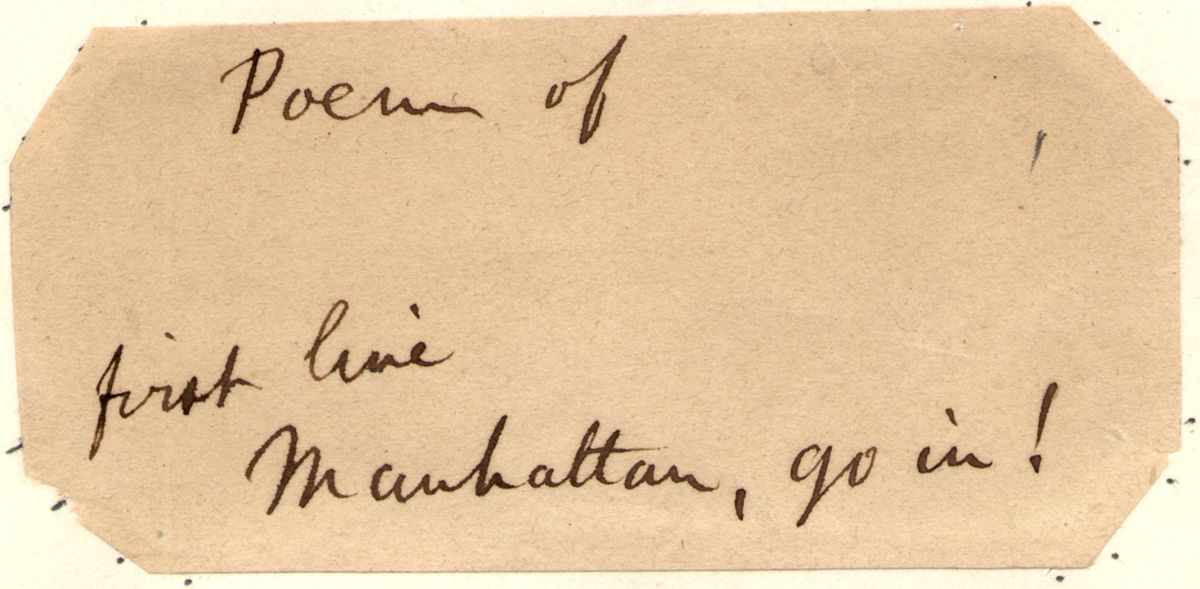
Whitman Archive Title: [Poem of]
-
Whitman Archive ID: uva.00006
-
Box: 1
-
Folder: 49
-
Date: about 1855
-
Genre: poetry
-
Physical Description: 1 leaf, 4 x 8 cm, handwritten
-
View Images:
1
|
2
-
Content:
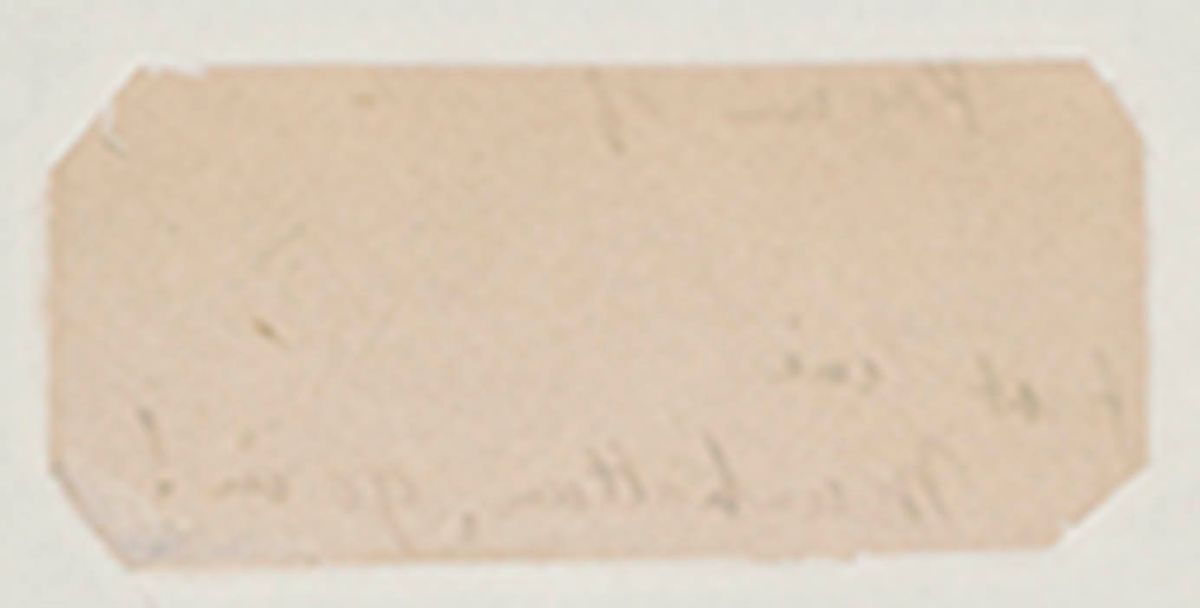
These notes, on a very small scrap of paper, could have represented an early stage
of a number of poems.
-
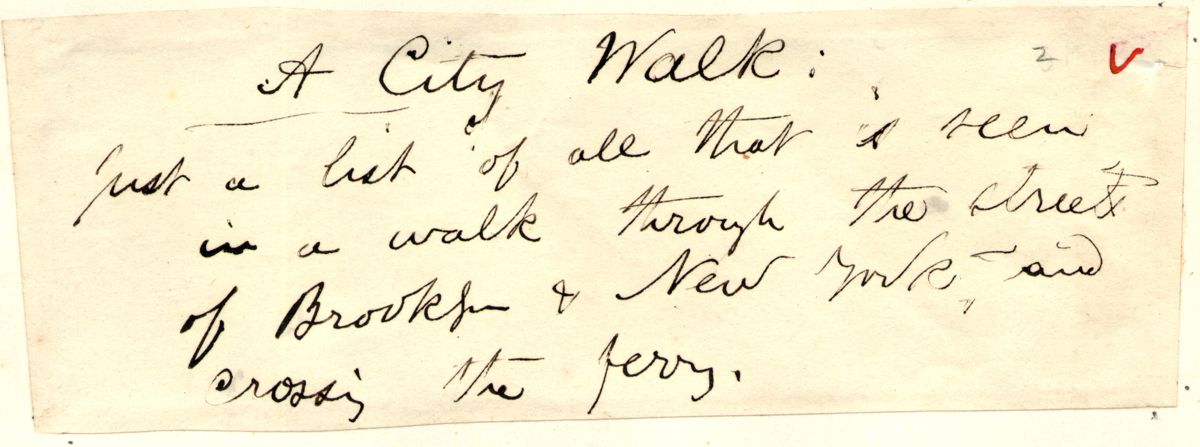
Whitman Archive Title: A City Walk
-
Whitman Archive ID: uva.00292
-
Box: 1
-
Folder: 49
-
Date: About 1855
-
Genre: poetry
-
Physical Description: 1 leaf, 4.5 x 12 cm, handwritten
-
View Images:
1
|
2
-
Content:
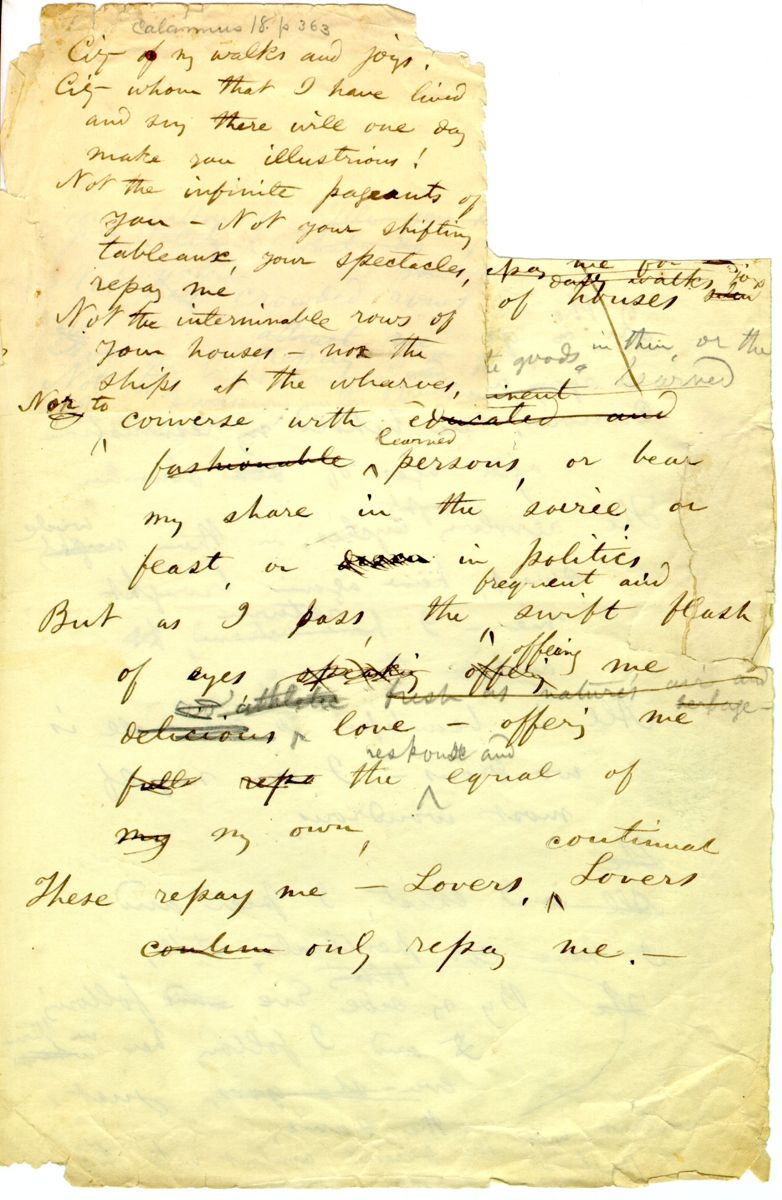
A faint horizontal line beneath part of "A City Walk," along with the words'
capitalization and central position on the page, indicate that Whitman may have
contemplated using the words as the title of an independent poem. The closest he
came to this title was "City of Walks
and Joys," the name he originally assigned to "Calamus" 18 in his "Blue Book" revisions of the 1860
edition of
Leaves of Grass
. This
title was changed in the "Blue
Book" to "City of orgies,
walks and joys" and finally became "City of Orgies" in the 1867 edition. The manuscript
also suggests making a list of things seen while "crossing the ferry," an idea
later developed and published in "Sun-Down Poem" in the 1856 edition of
Leaves
. The poem was retitled "Crossing Brooklyn Ferry" in 1860.
-
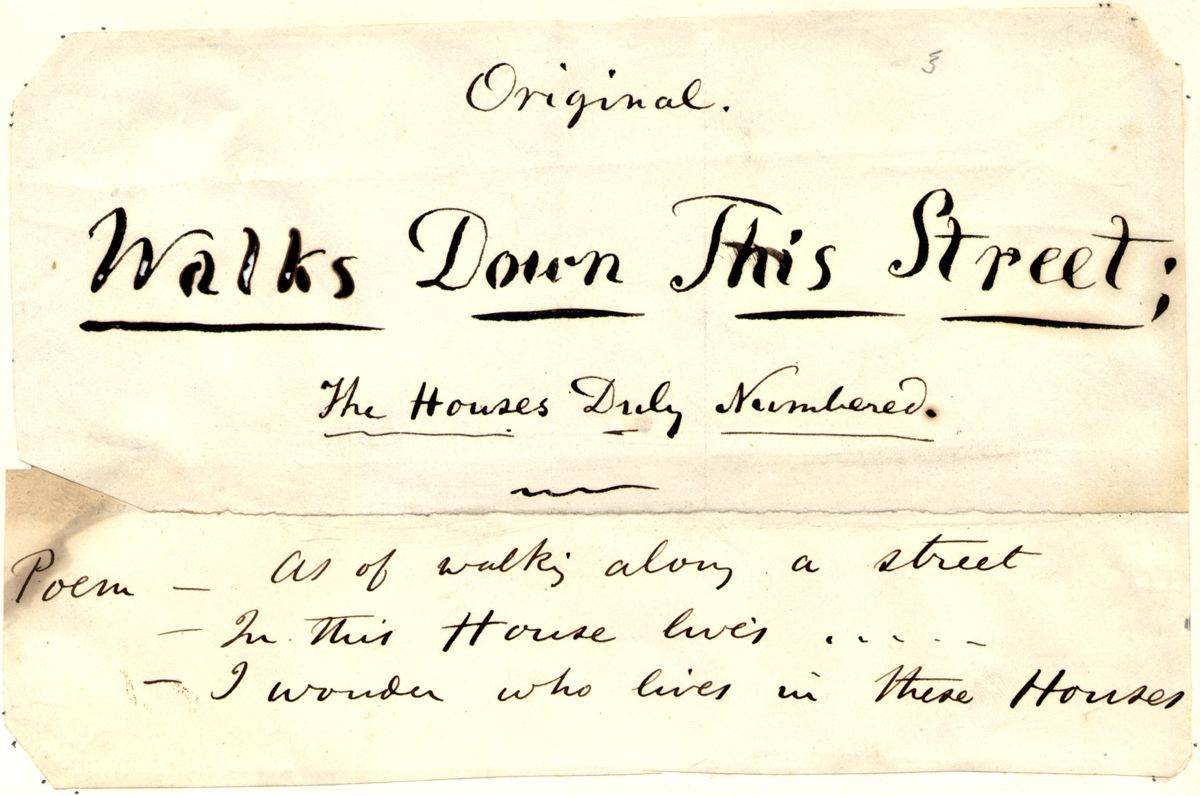
Whitman Archive Title: Original. Walks Down This Street;
-
Whitman Archive ID: uva.00293
-
Box: 1
-
Folder: 49
-
Date: about 1856
-
Genre: poetry
-
Physical Description: 1 leaf, 7 x 16 cm paster to 4 x 15.5 cm, handwritten
-
View Images:
1
|
2
-
Content:
Both parts of the title are underlined. A wavy line appears at the foot of that
section. The word "Original" at the head of the upper section suggests that
Whitman was sketching out a new poem for a revised edition of
Leaves of Grass
. If it was the 1860
edition, as his style of inscription here appears to indicate, it is possible that
this leaf could represent an early stage of the poem that would eventually become
"City of Orgies", 1867.
-
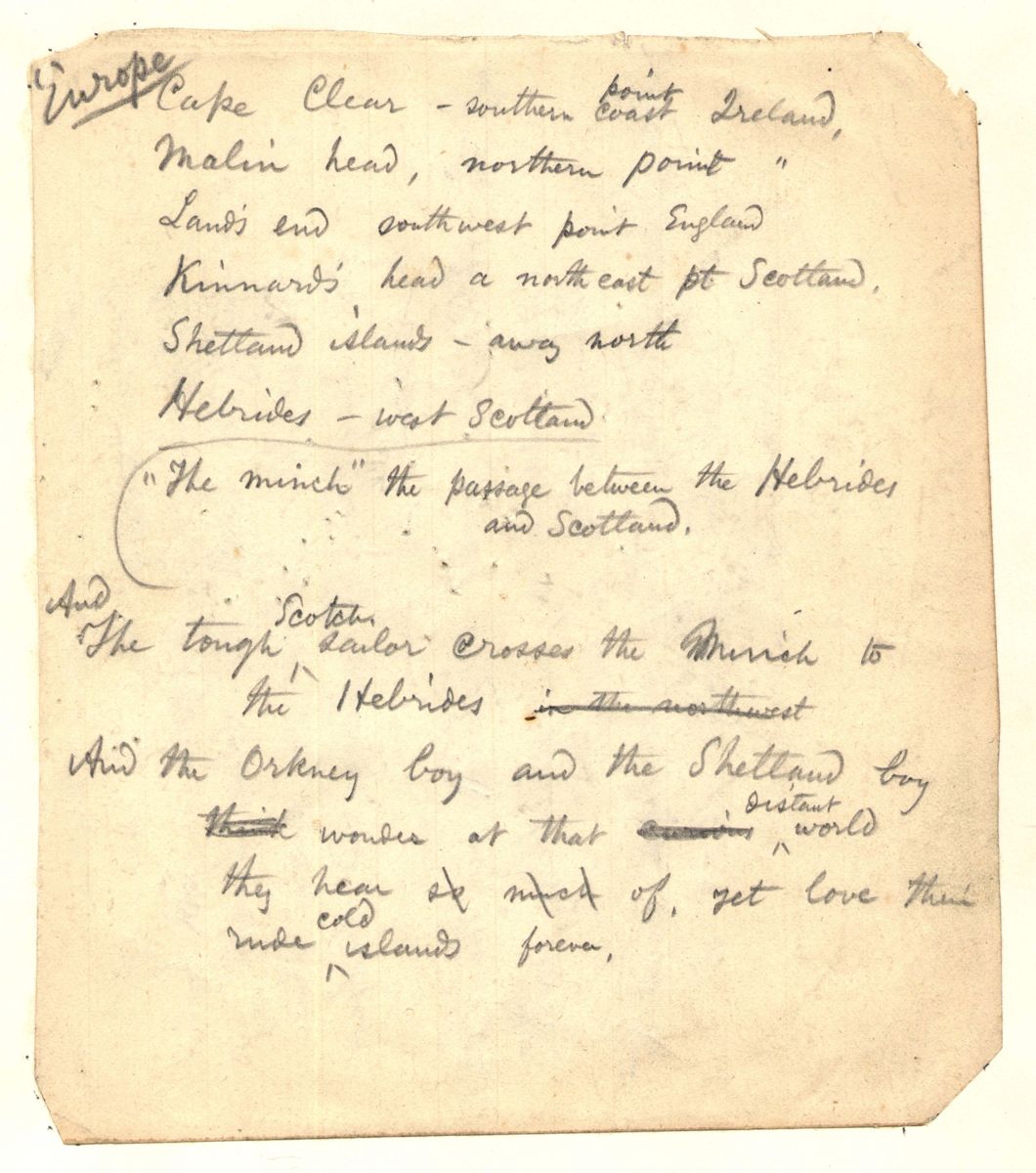
Whitman Archive Title: Europe
-
Whitman Archive ID: uva.00304
-
Box: 1
-
Folder: 49
-
Date: about 1855
-
Genre: poetry
-
Physical Description: 1 leaf, 16 x 14 cm, handwritten
-
View Images:
1
|
2
-
Content:
The recto notes represent an early stage of lines partially incorporated in "Poem of Salutation," the new
third poem in the 1856 edition of
Leaves of Grass
, which was permanently retitled
"Salut au Monde!" in the
1860 edition. If the note or title "Europe" suggests that Whitman might have first
intended to divide his salutations into discrete sections based on the different
continents, this is a plan he did not follow in the published version(s). The more
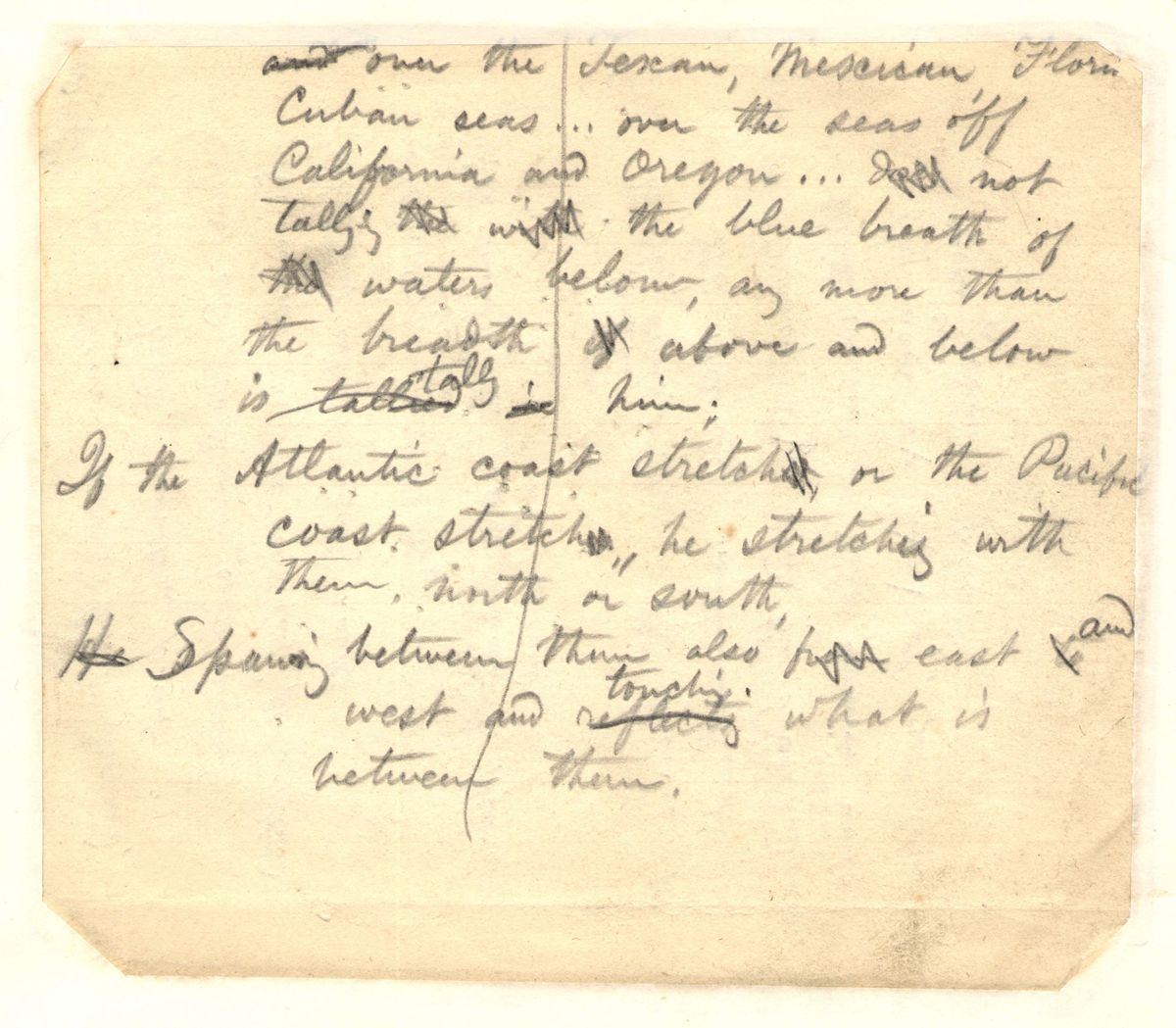
polished (but deleted) lines on the verso represent a recasting in poetic form of
several lines from the 1855 Preface. These were further revised for the
1856 "Poem of Many in One,"
after which the first verse drafted on this page (cut off here, and beginning
"over the Texan, Mexican, Florid[ian,]/ Cuban seas...") was dropped. The two
verses below this, however, were preserved relatively unchanged through the poem's
many transformations until the text was essentially fixed under the title "By Blue Ontario's Shore" in
1881.
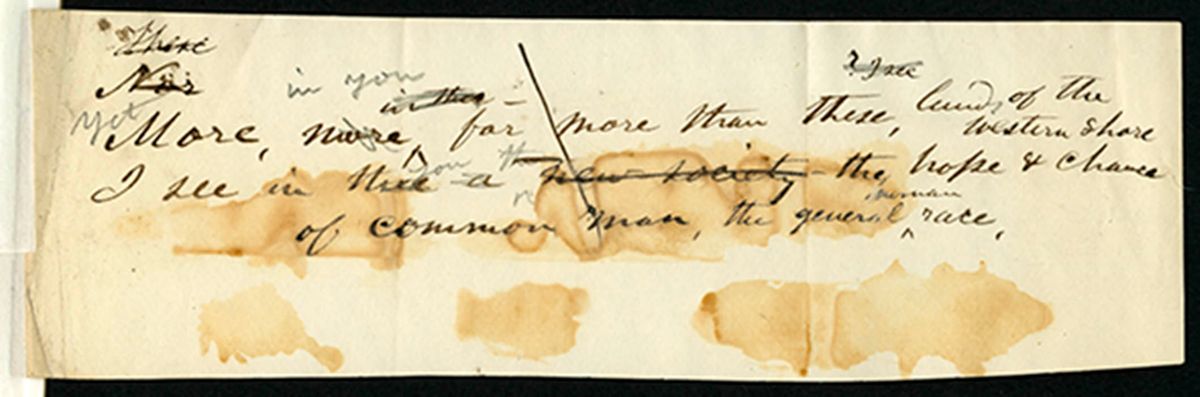
-
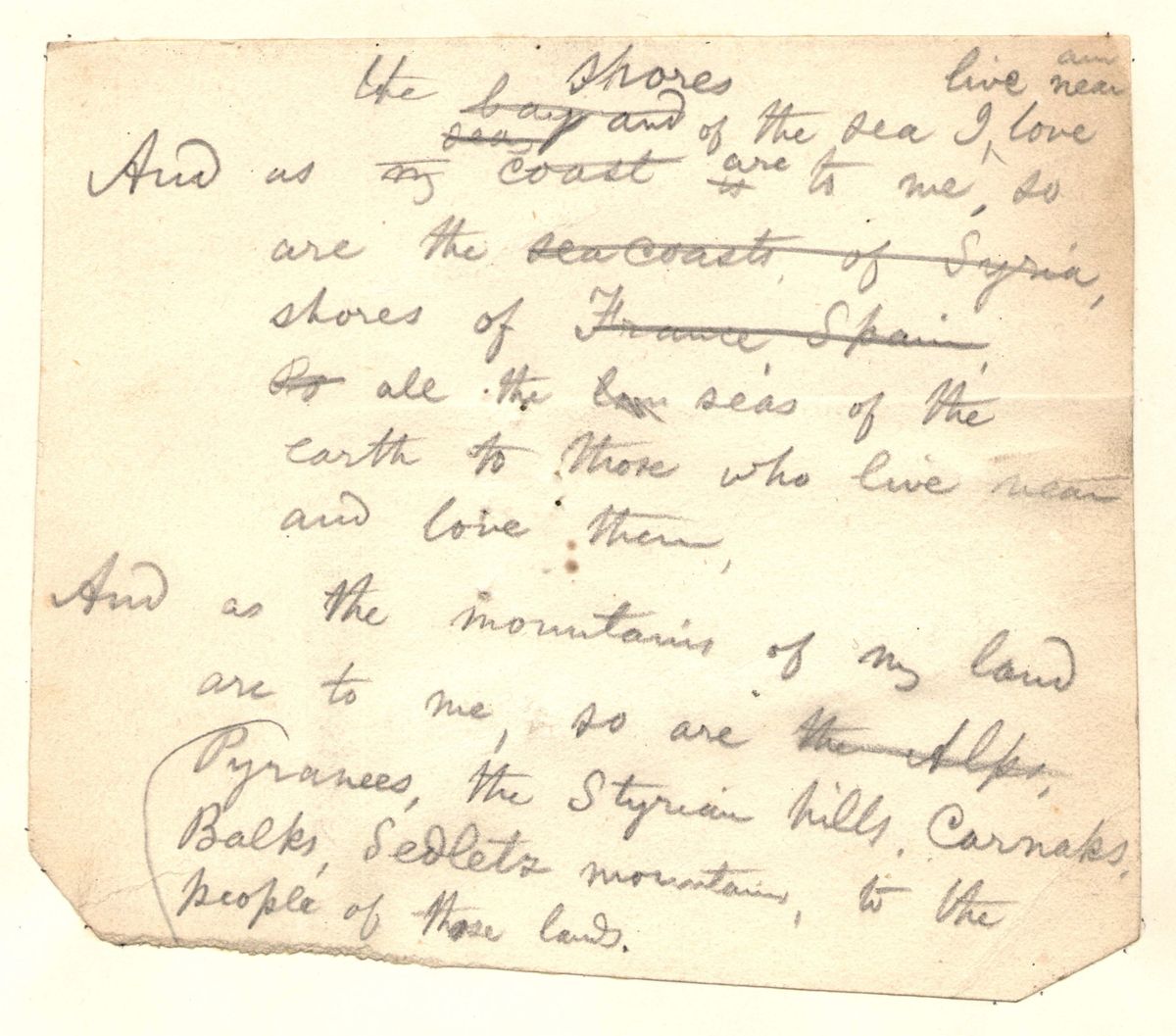
Whitman Archive Title: [And as the shores of the sea I live near and love are to me]
-
Whitman Archive ID: uva.00305
-
Box: 1
-
Folder: 49
-
Date: about 1855
-
Genre: poetry
-
Physical Description: 1 leaf, 13 x 14.5 cm, handwritten
-
View Images:
1
|
2
-
Content:
These two verses represent a draft of lines that would be further revised and
incorporated in the new 1856 poem "Poem of Salutation," permanently retitled "Salut au Monde!" in the 1860
edition of
Leaves of Grass.
. A
plate mark can be clearly seen on the verso.
-
Whitman Archive Title: Poem of Pictures
-
Whitman Archive ID: uva.00289
-
Box: 1
-
Folder: 49
-
Repository Title: Leaves of Grass, [ca. 1855–1856], AMs, 12 fragments on 7 leaves
-
Date: Before 1856
-
Genre: poetry, prose
-
Physical Description: 1 leaf, 6.5 x 15.5 cm, handwritten
-
View Images:
1
|
2
-
Content:
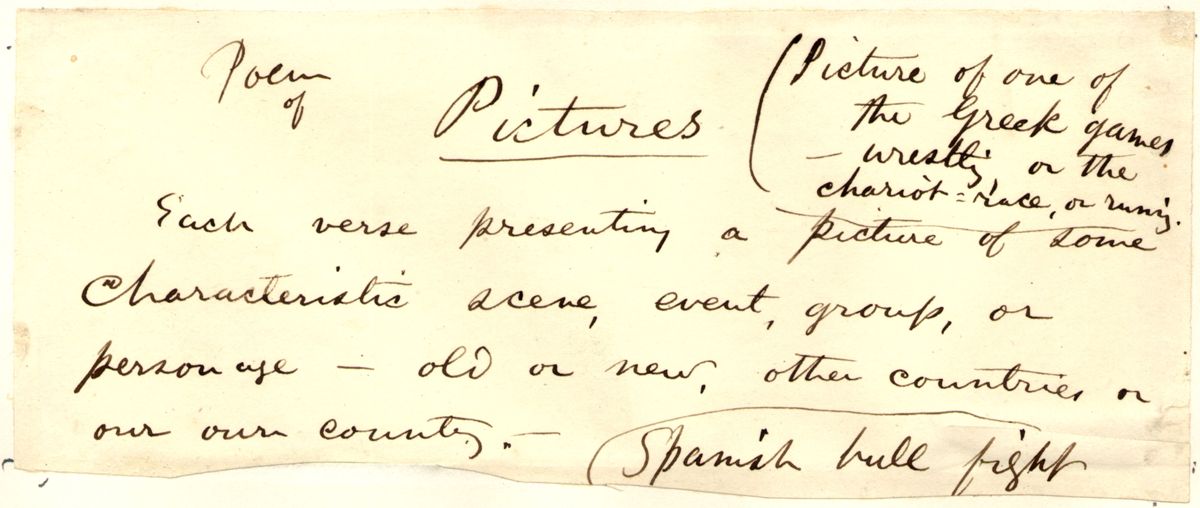
A phrase beginning "Picture of one of/ the Greek games" appears in the upper right
corner, delimited from the rest of the notes with two curved lines. The words
"Spanish bull fight" appear in their own semicircle (damaged by Whitman's cutting)
in the lower right corner. The lines seem to occupy a middle space between the
very early notebook poem "Pictures" and the 1856 "Poem of Salutation" (ultimately "Salut au Monde!"). Therefore, the date of this manuscript is likely before 1856.
-
Whitman Archive Title: [My two theses]
-
Whitman Archive ID: uva.00009
-
Box: 1
-
Folder: 49
-
Date: about 1856
-
Genre: poetry
-
Physical Description: 1 leaf, 4 x 16 cm pasted to 10.5 x 16 cm, handwritten
-
View Images:
1
|
2
-
Content:
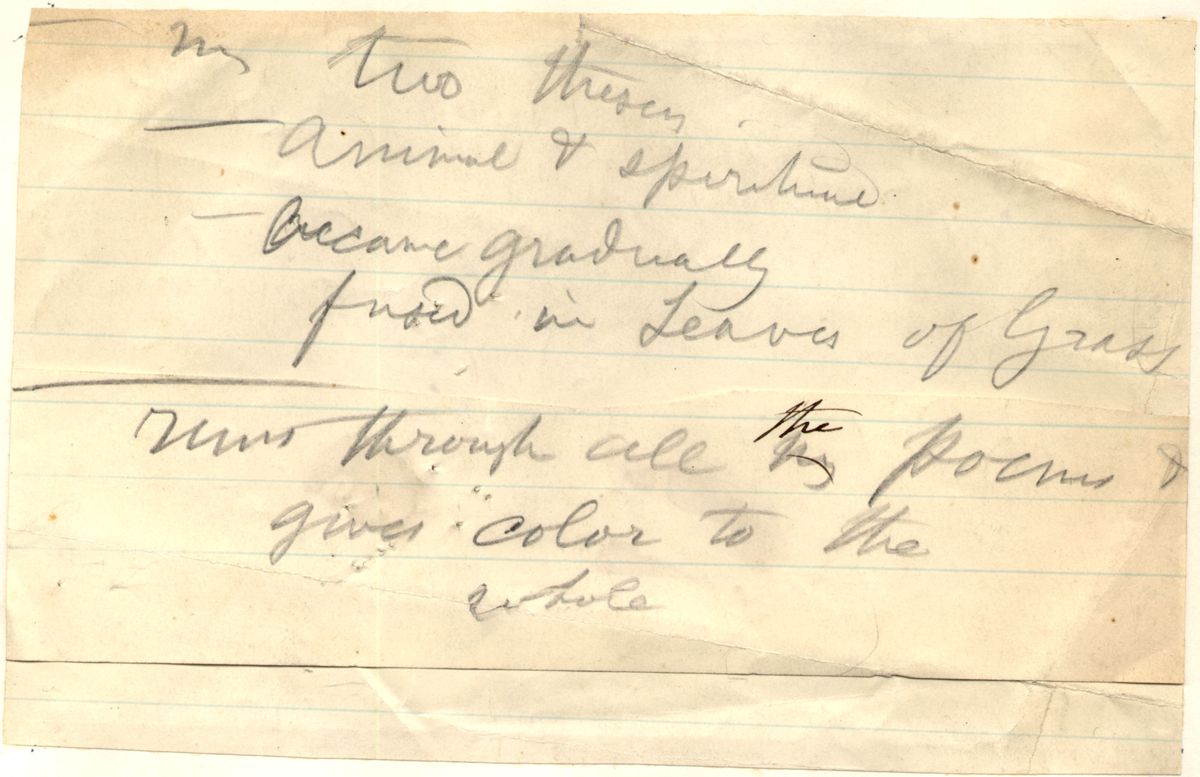
On a small composite leaf of white wove paper, ruled in blue on one side,
containing notes about developing two theses to "run through all the poems . . .."
-
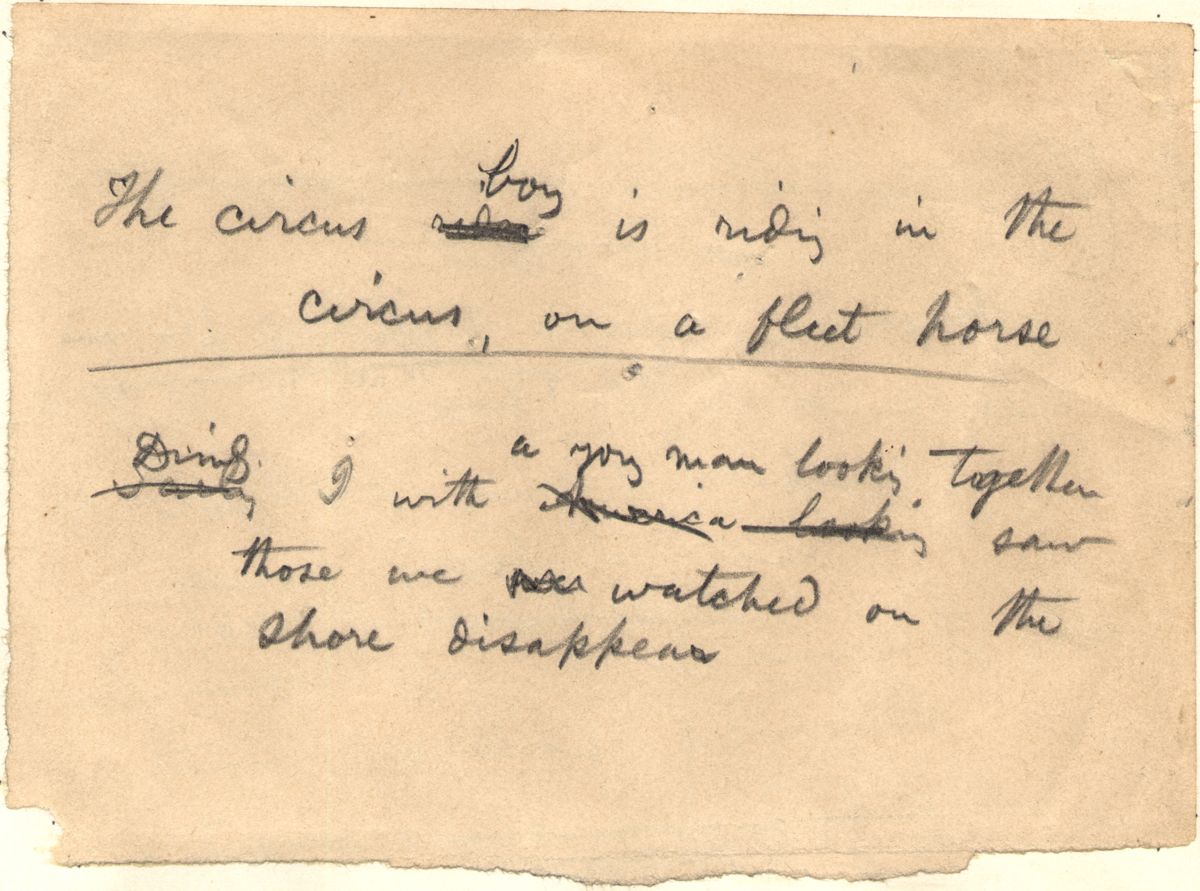
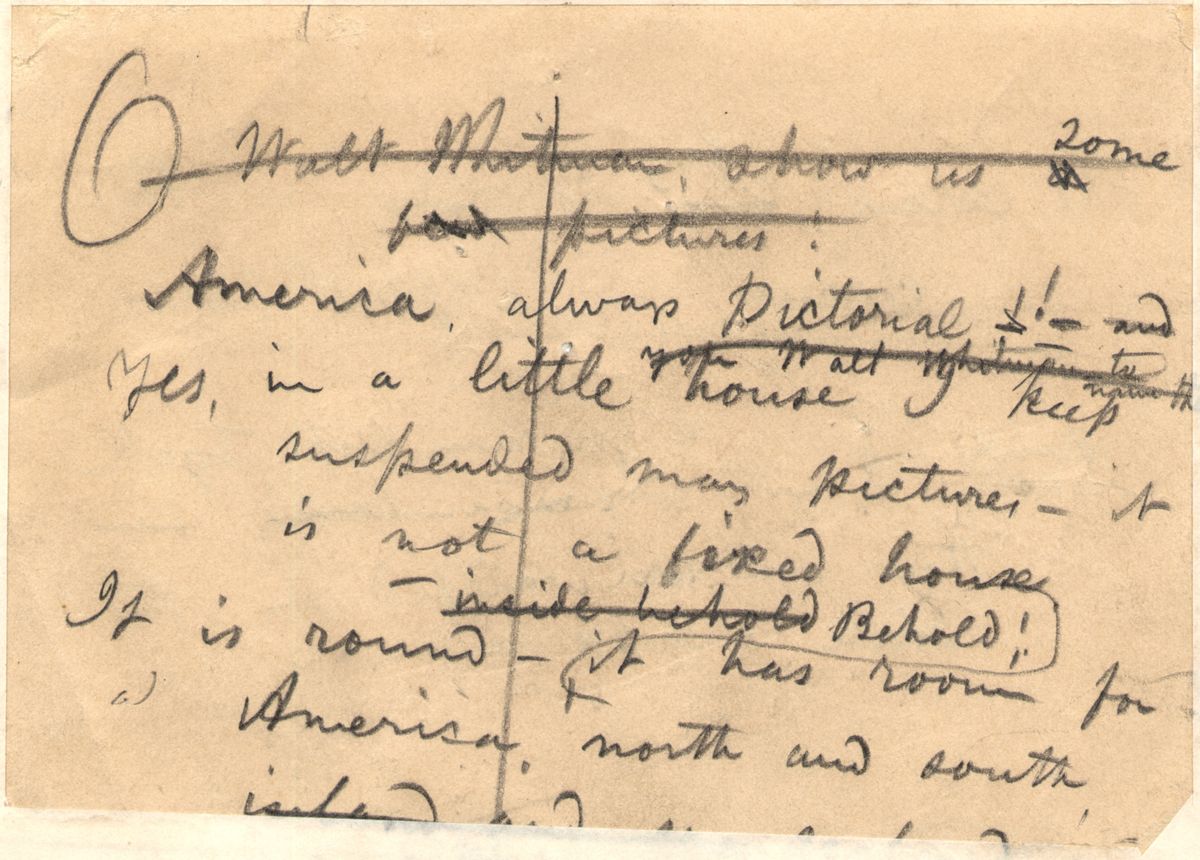
Whitman Archive Title: [The circus boy is riding in the]
-
Whitman Archive ID: uva.00010
-
Box: 1
-
Folder: 49
-
Date: about 1855
-
Genre: poetry
-
Physical Description: 1 leaf, 10.5 x 14 cm, handwritten
-
View Images:
1
|
2
-
Content:
The verso lines (beginning with the individually deleted line "O Walt Whitman,
show us some pictures!" and continuing "America, always Pictorial!") represent a
later draft of the beginning of the poem "Pictures" than the most complete extant version, which
is contained in the pre-1855 "Pictures" notebook currently housed at Yale University. Critics have
dated the lines to around 1880, when Whitman was working on a short version of
"Pictures" both for
magazine publication and for the 1881 edition of
Leaves of Grass
, where it was published as "My Picture-Gallery." But
Whitman's early style of inscription in this draft, along with the line "It is
round—it has room for America, north and south" and his use of his own name in the
deleted first line, all suggest that Whitman may have inscribed this draft around
the same time that he was working on the new 1856
"Poem of Salutations"
(eventually "Salut au
Monde!"). This draft also suggests that at one point he may have considered
linking what would become "Poem of
Salutations" and the formally and thematically similar "Pictures" more directly. The
lines on the recto, divided by a horizontal line, refer to images of a circus boy
on a fleet horse and of watching those on a shore disappear. The relationship
between either of these lines and Whitman's published works is unclear.
-
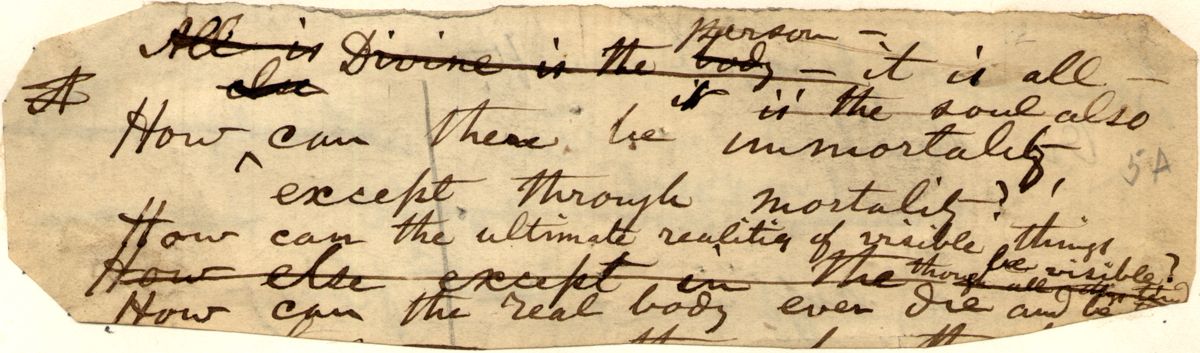
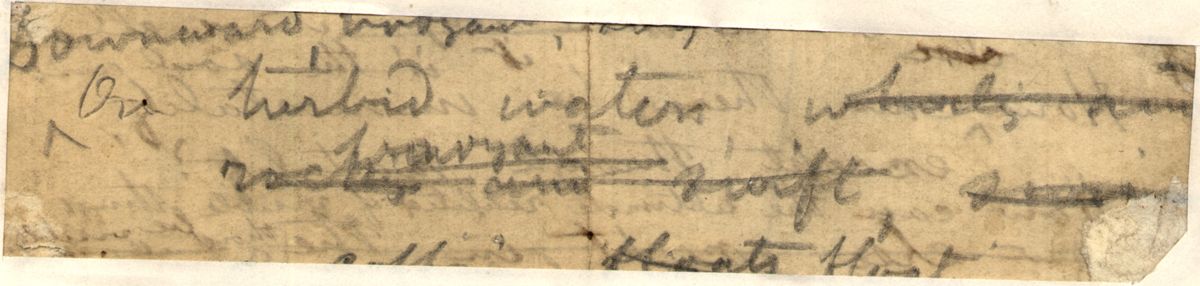
Whitman Archive Title: [How can there be immortality]
-
Whitman Archive ID: uva.00014
-
Box: 1
-
Folder: 49
-
Date: about 1855
-
Genre: poetry
-
Physical Description: 1 leaf, 4.5 x 14.5 cm, handwritten
-
View Images:
1
|
2
-
Content:
These lines, appearing on a very small section of white laid paper cut and cropped
irregularly, bear a strong resemblance to the (eventual) second verse paragraph in
section 6 of "Starting from
Paumanok," first published in 1860 as "Proto-Leaf." The fragmentary lines on the verso
(beginning "Downward, buoyant, swif[t]"), represent a different version of a line
incorporated in the pre-1855 notebook poem "Pictures" and of one inscribed in the 1854 notebook [I
know a rich capitalist...], currently housed at the New York Public Library.
-
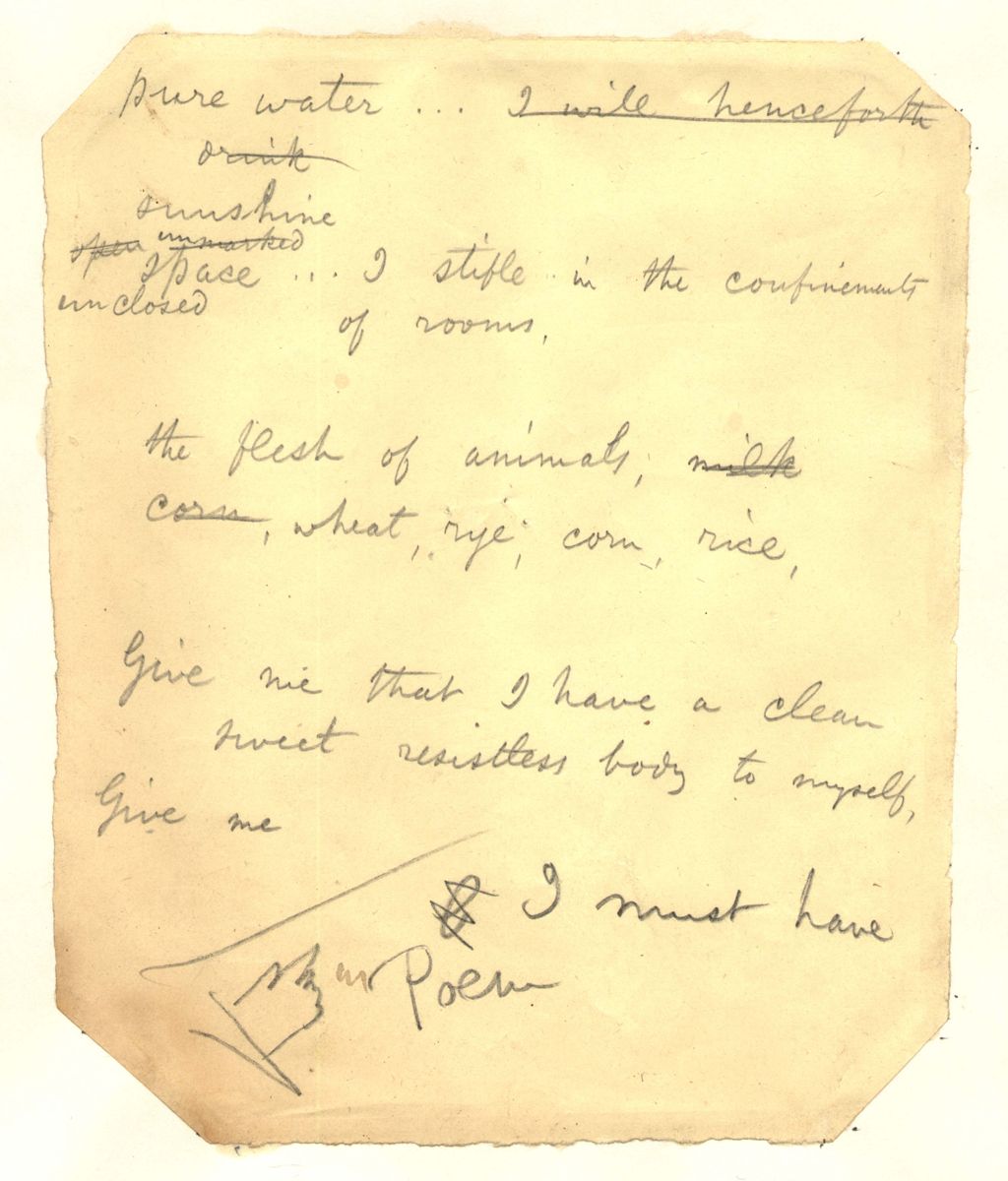
Whitman Archive Title: [Pure water]
-
Whitman Archive ID: uva.00015
-
Box: 1
-
Folder: 49
-
Date: about 1855
-
Genre: poetry
-
Physical Description: 1 leaf, 16 x 13 cm, handwritten
-
View Images:
1
|
2
-
Content:
Below the trial verses, separated from them by a diagonal pencil stroke, appears a
cartoon hand pointing to the annotation "I must have/ Poem[.]"
-
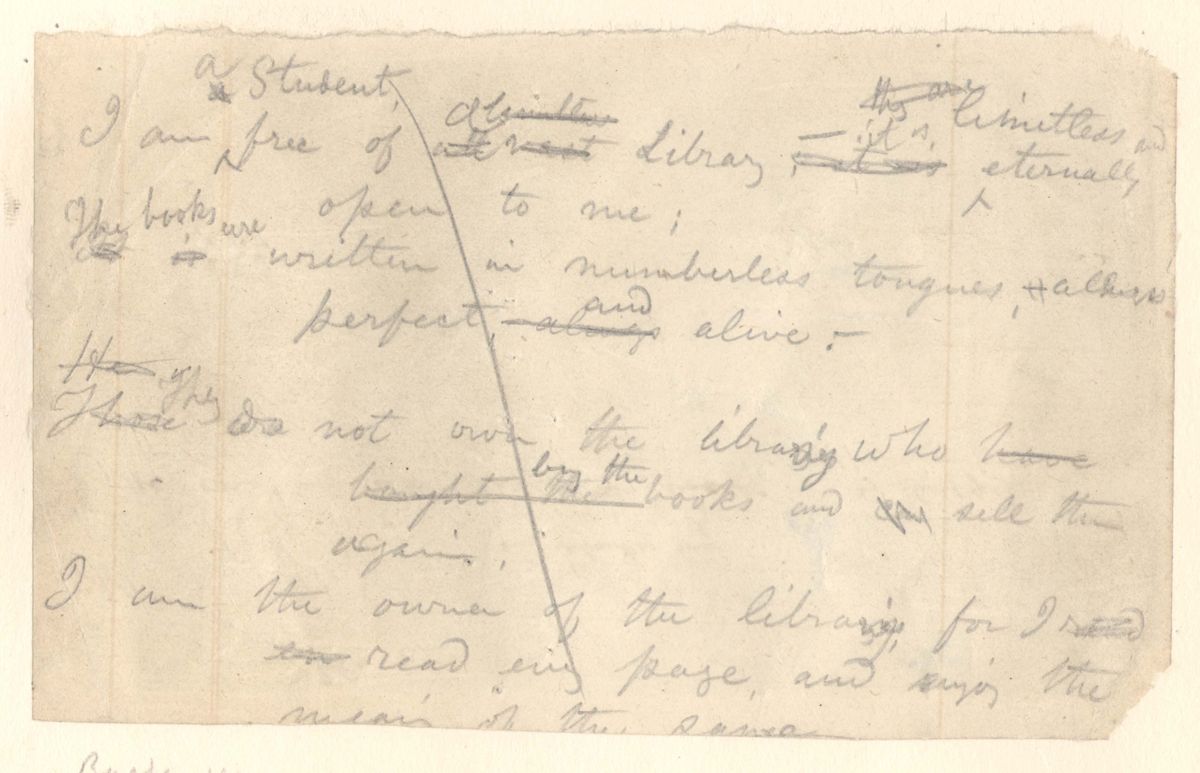
Whitman Archive Title: I am a Student
-
Whitman Archive ID: uva.00238
-
Box: 1
-
Folder: 88
-
Date: Between 1850 and 1855
-
Genre: poetry
-
Physical Description: 1 leaf, 9.5 x 15 cm, handwritten
-
View Images:
1
|
2
-
Content:
Whitman probably drafted this manuscript in the early 1850s as he was composing the first (1855) edition of
Leaves of Grass
. Lines in the manuscript are similar to sentences used in the preface to that edition. Ideas expressed in the manuscript also relate loosely to lines in the first poem in the 1855 edition, eventually titled "Song of Myself." Lines written on the back of this manuscript leaf (uva.00570 appeared in the poem eventually titled "Song of Myself."
-
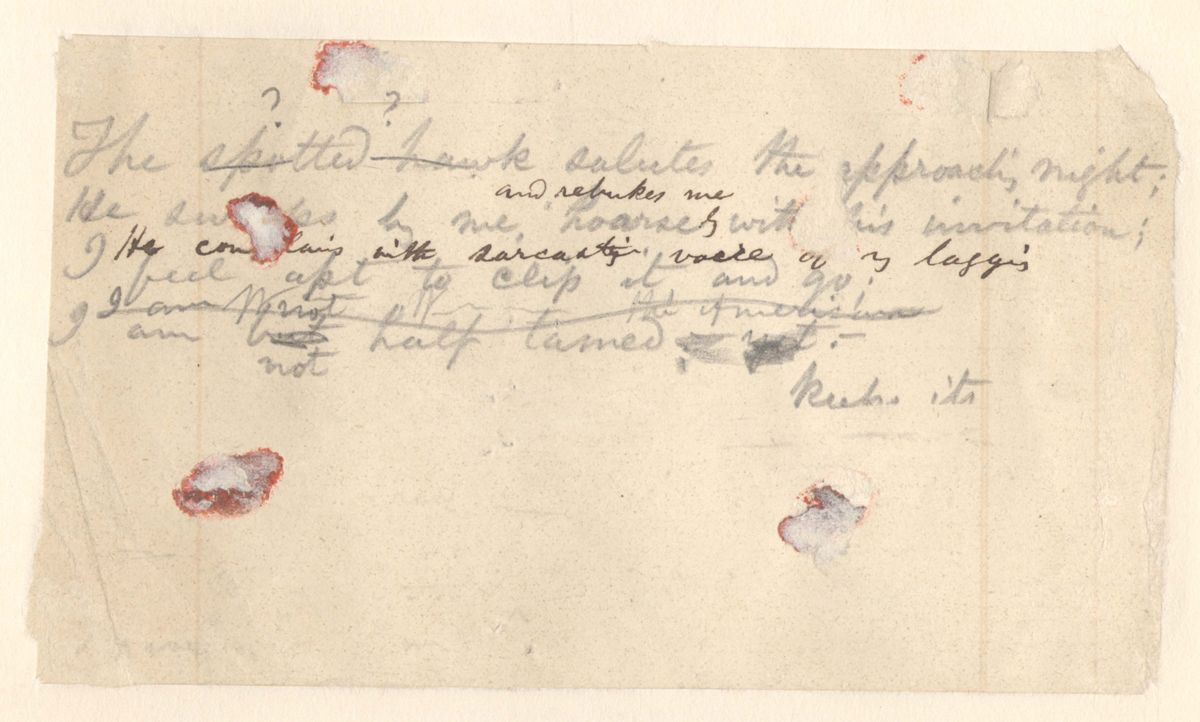
Whitman Archive Title: The spotted hawk salutes the
-
Whitman Archive ID: uva.00570
-
Box: 1
-
Folder: 88
-
Date: Between 1850 and 1855
-
Genre: poetry
-
Physical Description: 1 leaf, 9.5 x 15 cm, handwritten
-
View Images:
1
|
2
-
Content:
Whitman probably drafted this manuscript in the early 1850s as he was composing the first (1855) edition of
Leaves of Grass
. Lines from the manuscript were included in the first poem in that edition, eventually titled "Song of Myself." Several lines of poetry are drafted on the back of this leaf (uva.00238.
-
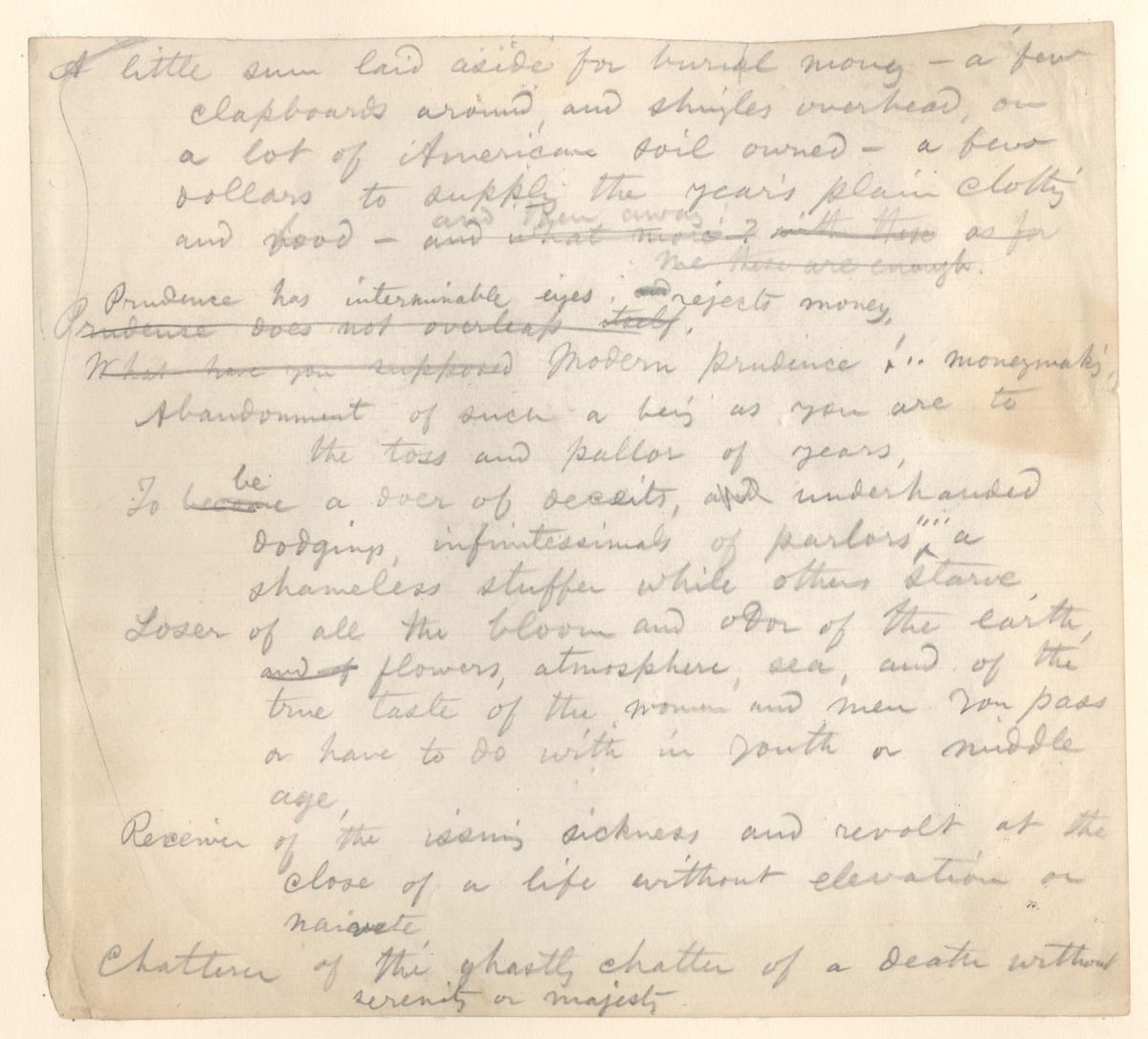
Whitman Archive Title: [A little sum laid aside for burial money—a few clapboards around]
-
Whitman Archive ID: uva.00248
-
Box: 1
-
Folder: 88
-
Date: about 1855
-
Genre: poetry
-
Physical Description: 1 leaf, 17 x 19 cm, handwritten
-
View Images:
1
|
2
-
Content:
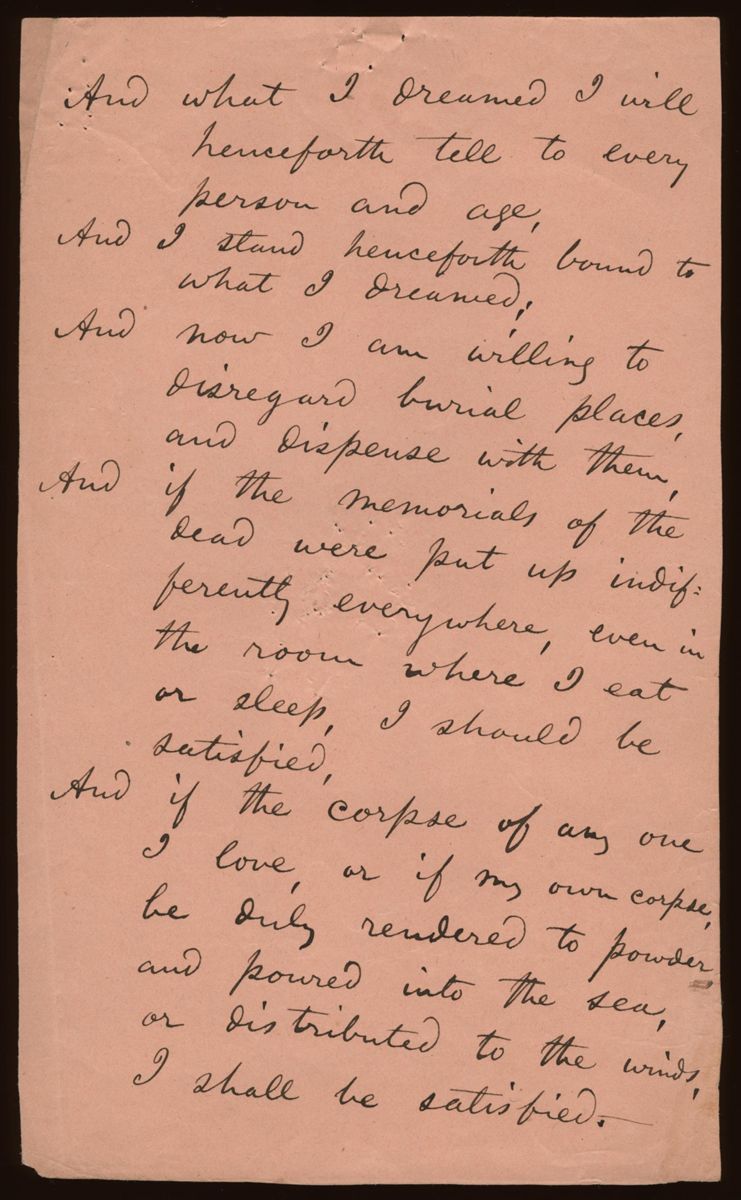
This is a poetic rendition of a long sentence in the preface to the 1855
edition of
Leaves of Grass.
The
prose sentence begins, "Beyond the independence of a little sum laid aside for
burial-money, and of a few clapboards around..."
-
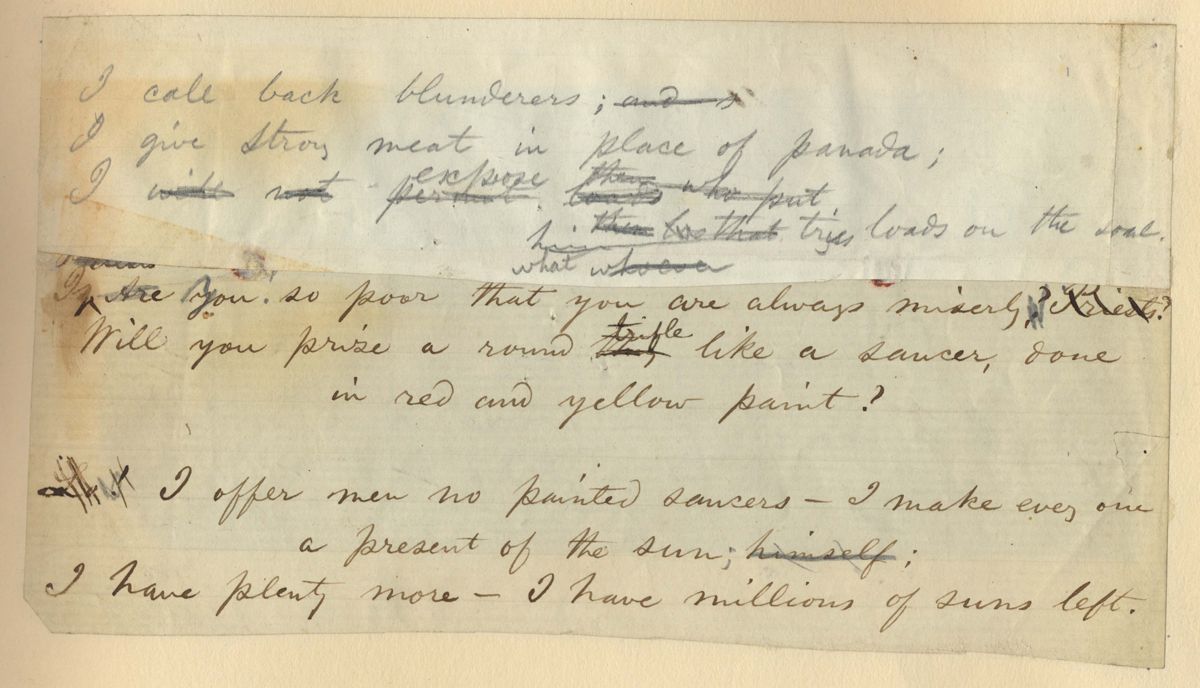
Whitman Archive Title: I call back blunderers
-
Whitman Archive ID: uva.00250
-
Box: 1
-
Folder: 88
-
Date: Between 1850 and 1855
-
Genre: poetry
-
Physical Description: 1 leaf, 4.5 x 19.5 cm pasted to 7 x 19.5 cm, handwritten
-
View Images:
1
|
2
-
Content:
Whitman probably drafted this manuscript in the early 1850s as he was composing the first (1855) edition of
Leaves of Grass
. The last couple of lines are similar to lines in the first poem in that edition, eventually titled "Song of Myself."
-
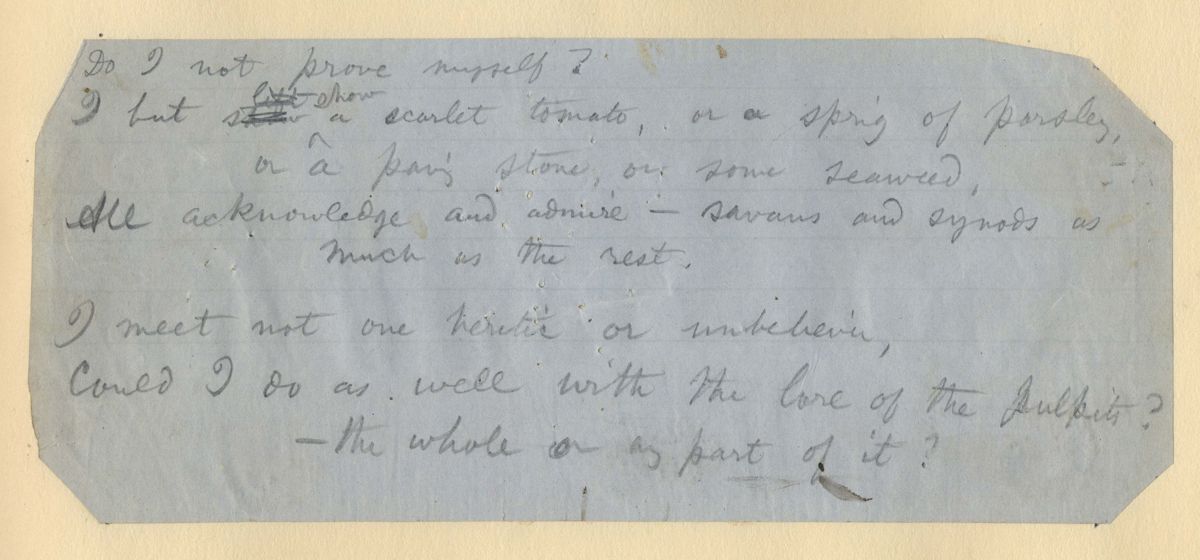
Whitman Archive Title: Do I not prove myself
-
Whitman Archive ID: uva.00251
-
Box: 1
-
Folder: 88
-
Date: Between 1850 and 1855
-
Genre: poetry
-
Physical Description: 1 leaf, 8 x 18.5 cm, handwritten
-
View Images:
1
|
2
-
Content:
Whitman probably drafted this manuscript in the early 1850s as he was composing the first (1855) edition of
Leaves of Grass
. In language, ideas, and structure, the manuscript most closely resembles lines 39–43 in "Debris," a poem published in the 1860 edition of
Leaves of Grass
. However, the ideas and some of the language are also similar to other early manuscripts that relate to the first and second poems in the 1855 edition of
Leaves
, ultimately titled "Song of Myself" and "A Song for Occupations" (see "Priests" [loc.00013], "I know as well as" [duk.00051], and "[Fa]bles, traditions" [duk.00261]). In his transcription of this manuscript, Richard Maurice Bucke combines it with "I ask nobody's faith" (nyp.00102), but the manuscripts do not appear to be continuous (
Notes and Fragments
[London, Ontario: A. Talbot & Co., printers, 1899], 25). Poetic lines written on the back of this manuscript leaf (uva.00568) appeared in the poem eventually titled ""Song of Myself."
-
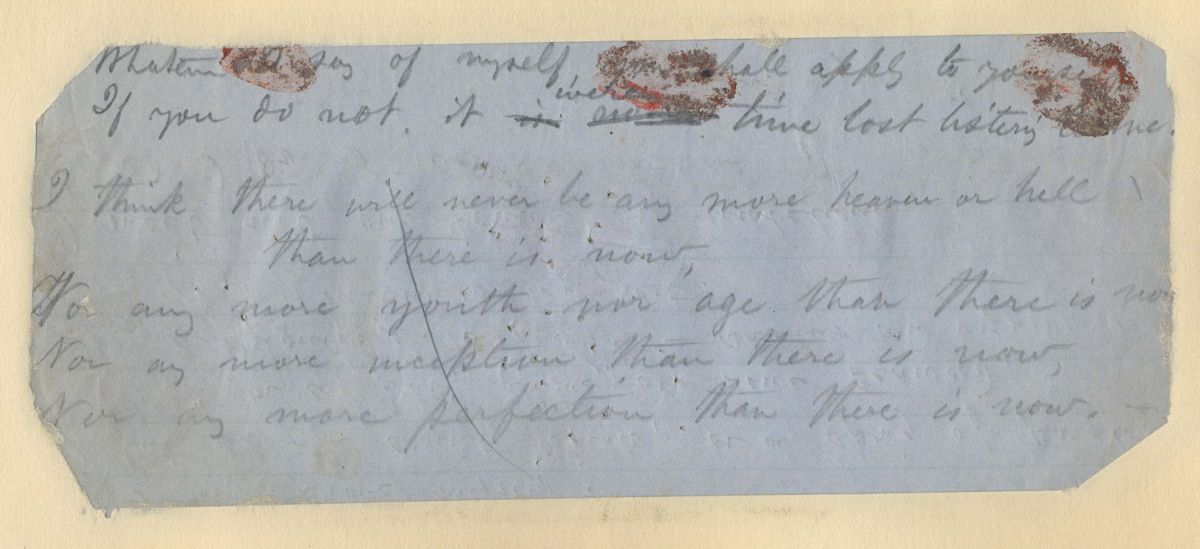
Whitman Archive Title: Whatever I say of myself
-
Whitman Archive ID: uva.00568
-
Box: 1
-
Folder: 88
-
Date: Between 1850 and 1855
-
Genre: poetry
-
Physical Description: 1 leaf, 8 x 18.5 cm, handwritten
-
View Images:
1
|
2
-
Content:
Whitman probably drafted this manuscript in the early 1850s as he was composing the first (1855) edition of
Leaves of Grass
. Lines from the manuscript appear in the first poem in that edition, eventually titled ""Song of Myself." Poetic lines on the back of this manuscript leaf (uva.00251) also relate to poems in the 1855
Leaves of Grass
.
-
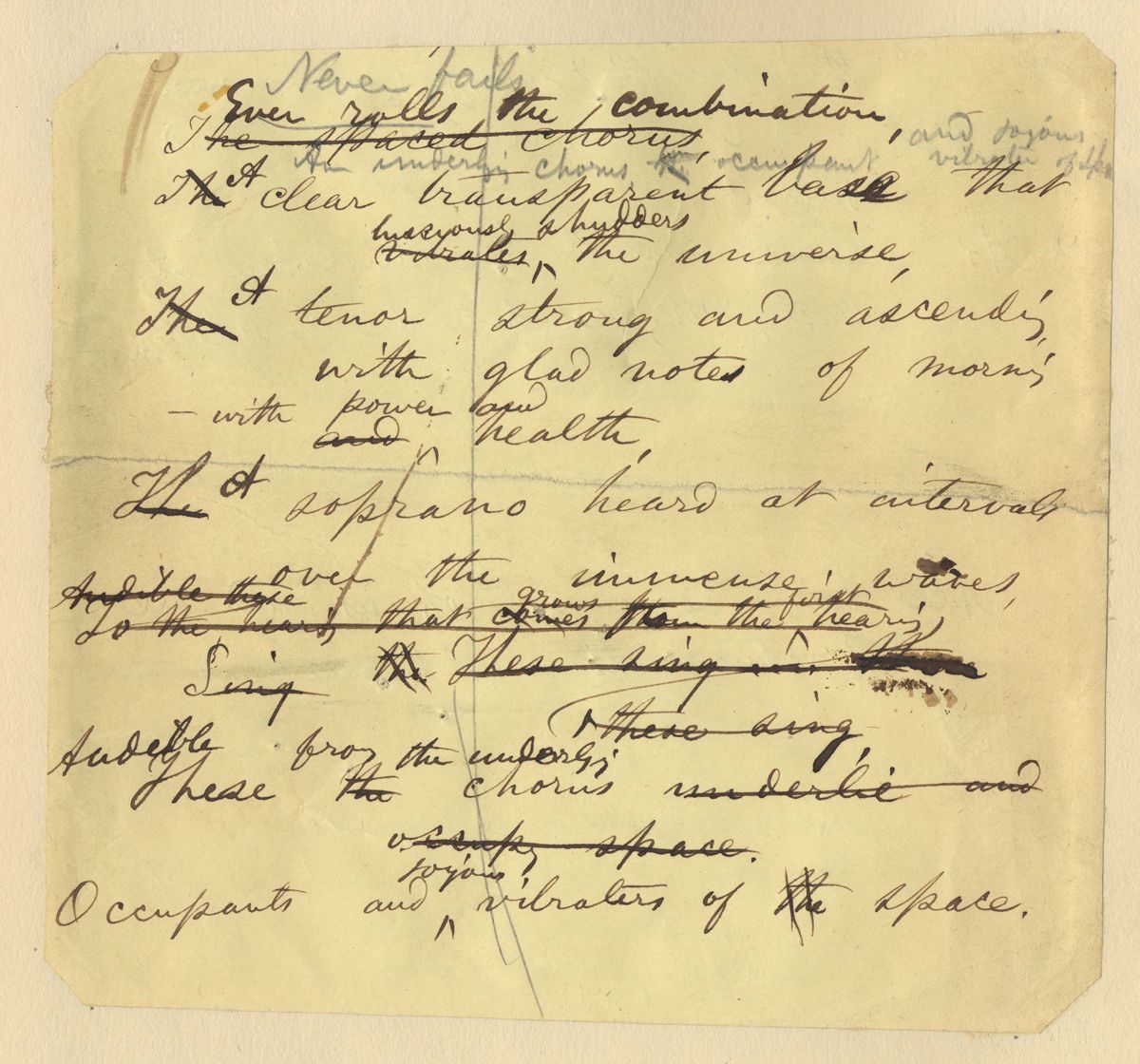
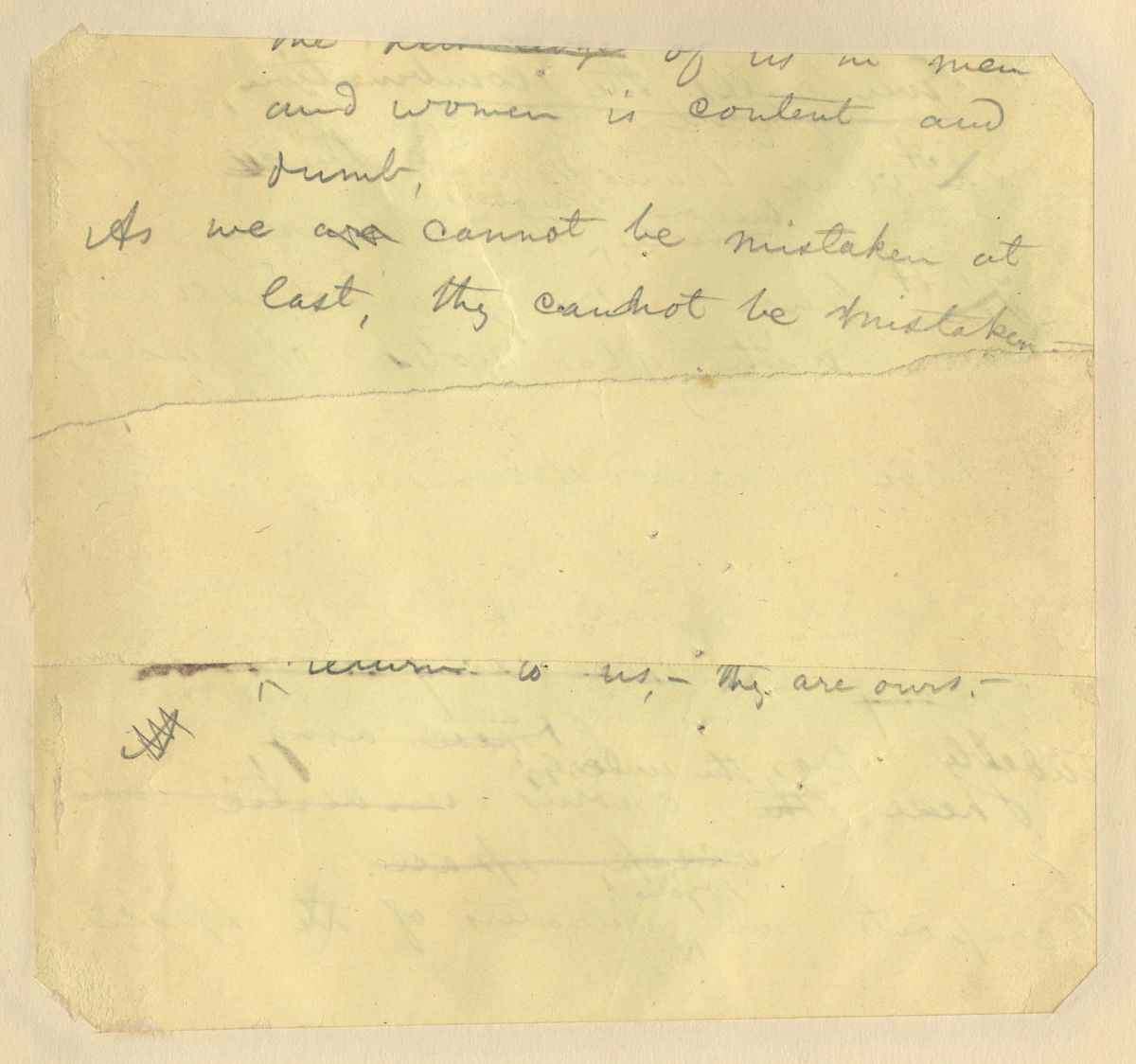
Whitman Archive Title: [Never fails]
-
Whitman Archive ID: uva.00253
-
Box: 1
-
Folder: 88
-
Date: about 1855
-
Genre: poetry
-
Physical Description: 1 leaf, 14 x 15 cm, handwritten
-
View Images:
1
|
2
-
Content:
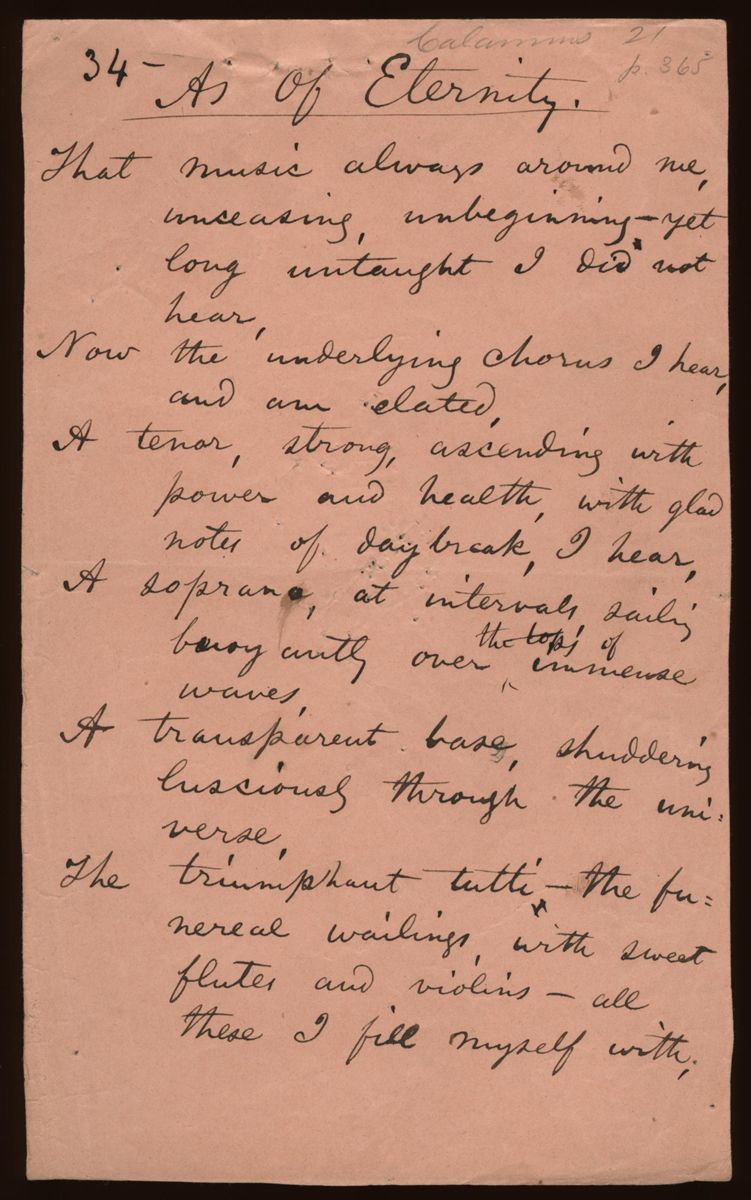
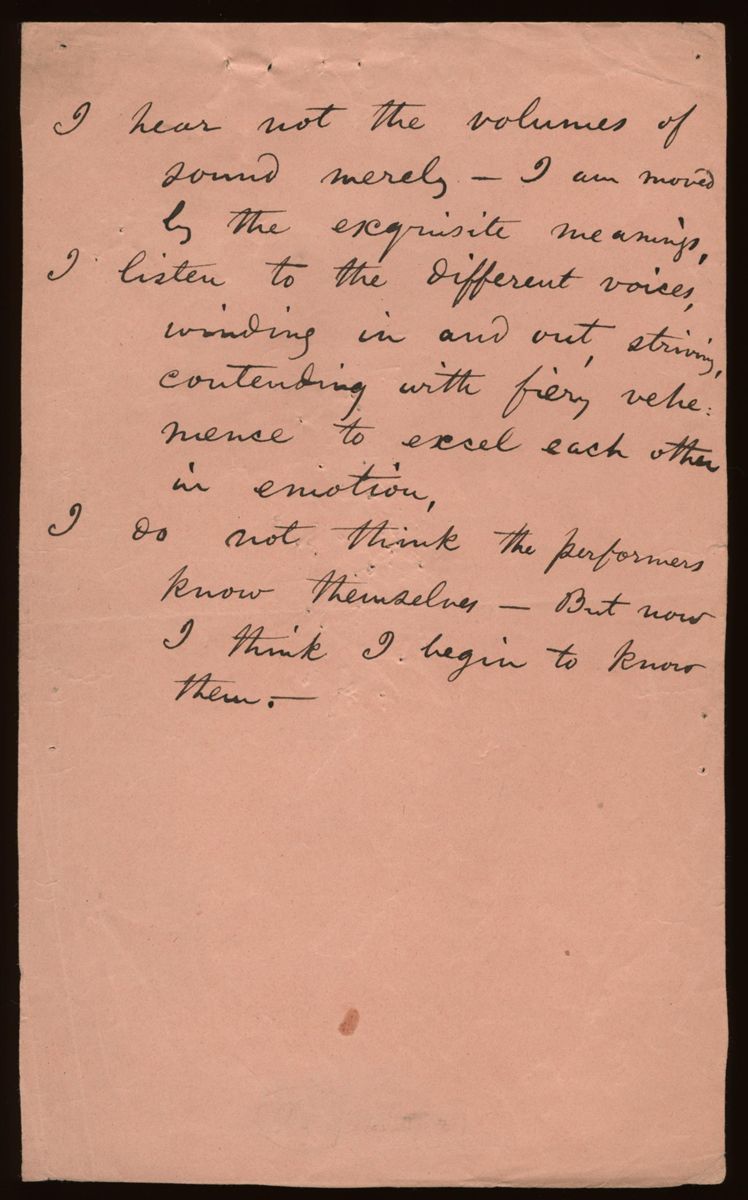
The lines, deleted with a single pencil stroke, appear after revision and
expansion to have eventually formed part of section 21 of the cluster "Calamus" in the 1860
edition of
Leaves of Grass
; in
the 1867 edition this section received the title "That Music Always Round Me."
-
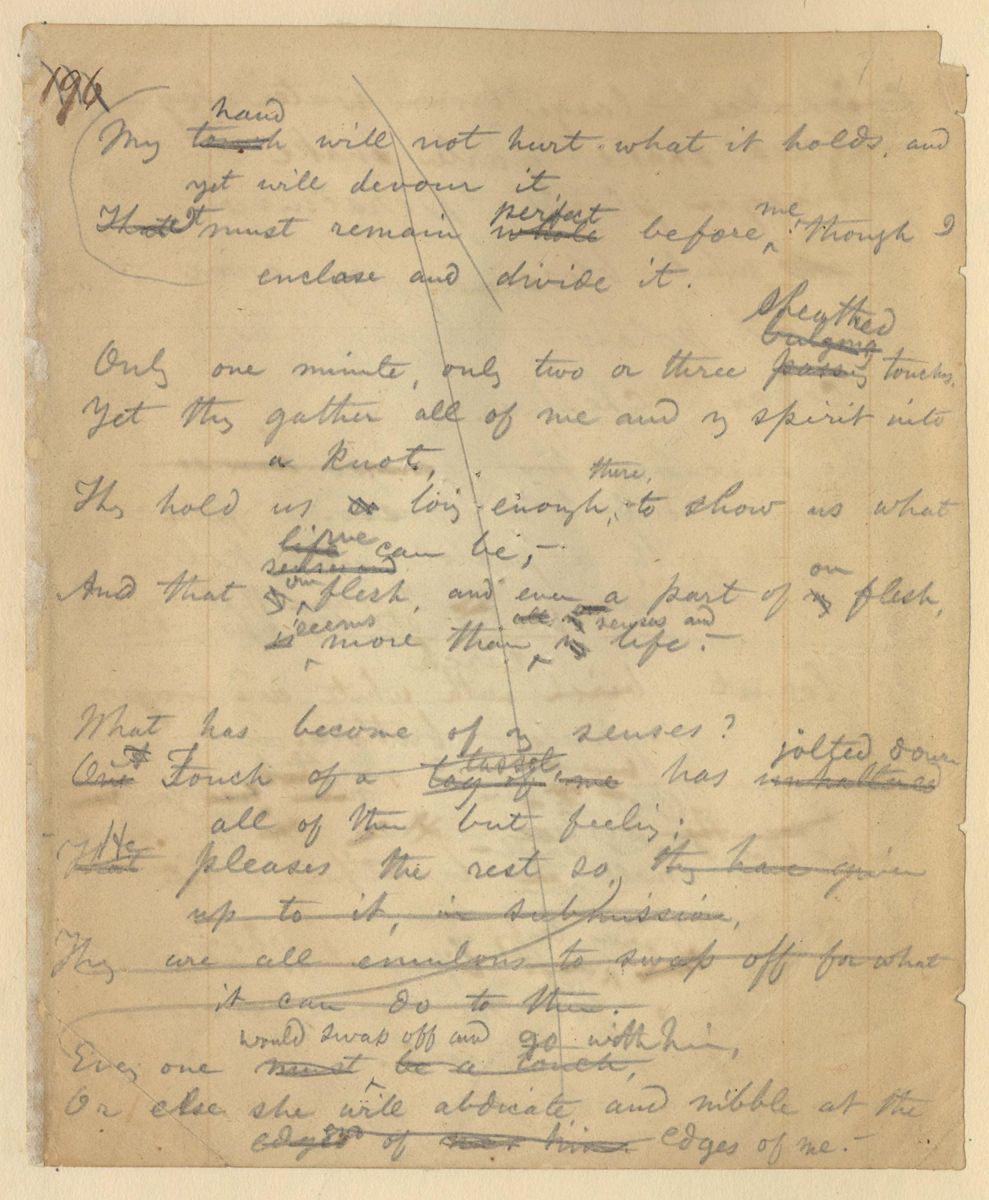
Whitman Archive Title: My hand will not hurt what
-
Whitman Archive ID: uva.00254
-
Box: 1
-
Folder: 88
-
Date: Between 1850 and 1855
-
Genre: poetry
-
Physical Description: 1 leaf, 19 x 15.5 cm, handwritten
-
View Images:
1
|
2
-
Content:
Whitman probably drafted this manuscript in the early 1850s as he was composing the first (1855) edition of
Leaves of Grass
. Lines in the manuscript are similar to lines that appear in the first poem in that edition, eventually titled "Song of Myself." The numbers written on the manuscript, along with remnants of paste and binding tape along the margin, suggest that the page likely came from a notebook. Lines similar to the last several in this manuscript were also reworked in the notebook "Talbot Wilson" (loc.00141). Notes written on the back of this manuscript leaf (uva.00601) also relate to lines in the poem eventually titled "Song of Myself."
-
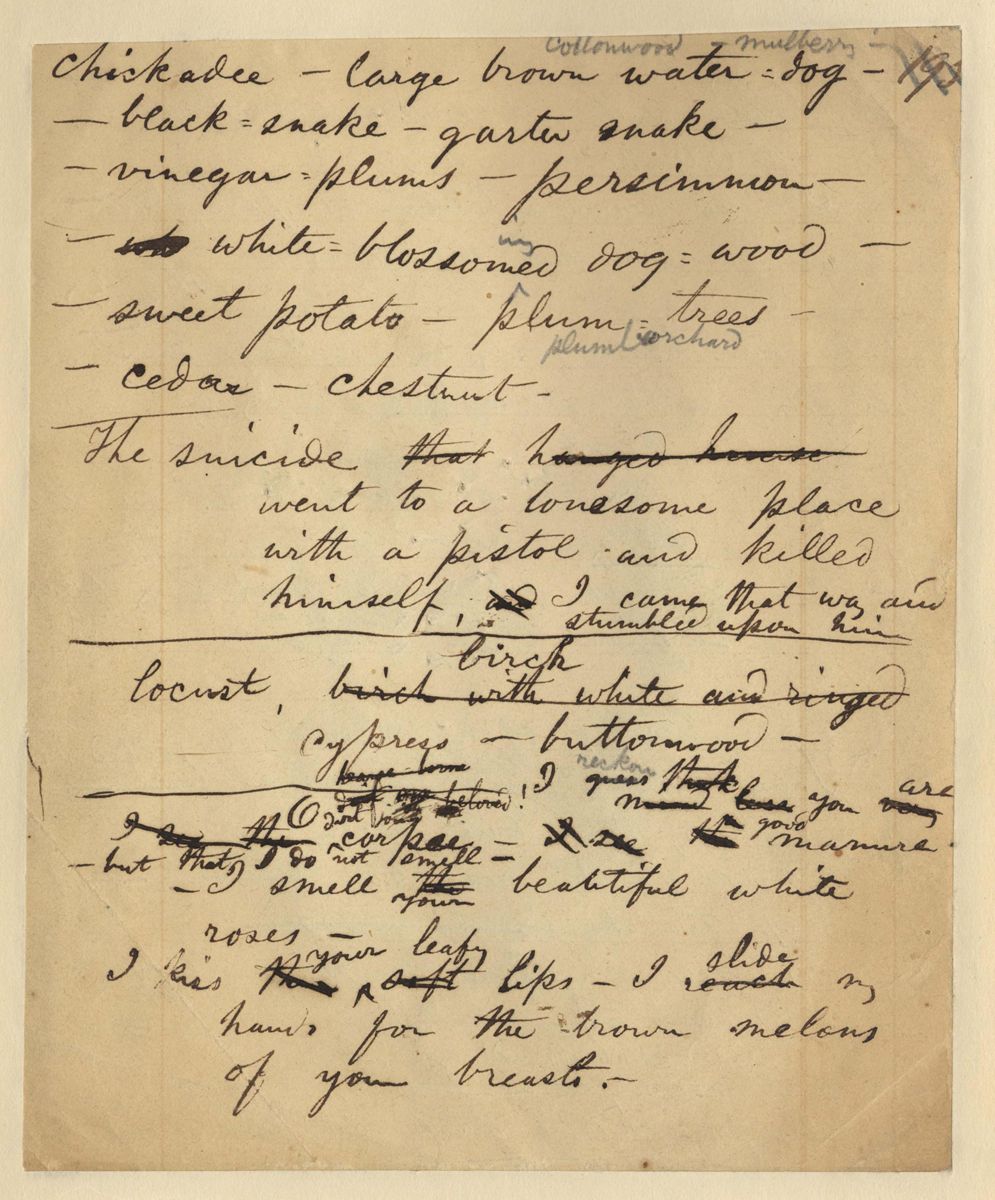
Whitman Archive Title: cottonwood
-
Whitman Archive ID: uva.00601
-
Box: 1
-
Folder: 88
-
Date: Between 1850 and 1855
-
Genre: poetry
-
Physical Description: 1 leaf, 19 x 15.5 cm, handwritten
-
View Images:
1
|
2
-
Content:
Whitman probably drafted this manuscript in the early 1850s as he was composing the first (1855) edition of
Leaves of Grass
. Lines in the manuscript are similar to lines in the first poem in that edition, eventually titled "Song of Myself." The list of flora and fauna could anticipate any number of similar lists in Whitman's writing, but has perhaps the most words in common with a line in the prose preface to the 1855
Leaves of Grass
. Poetic lines on the back of this manuscript leaf (uva.00254) also relate to lines in the poem eventually titled "Song of Myself."
-
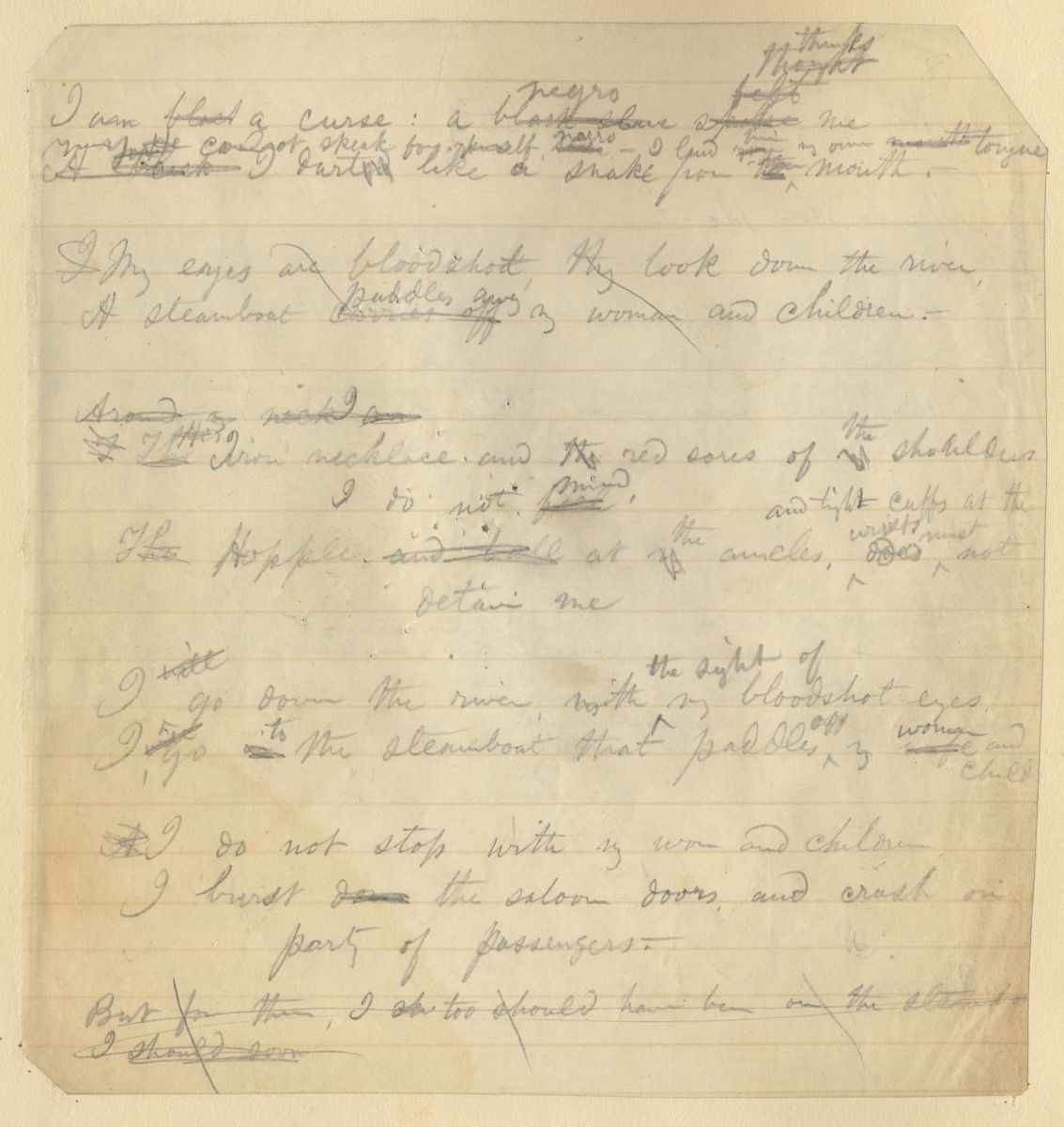
Whitman Archive Title: I am a curse
-
Whitman Archive ID: uva.00256
-
Box: 1
-
Folder: 88
-
Date: Between 1850 and 1855
-
Genre: poetry
-
Physical Description: 1 leaf, 18.5 x 17.5 cm, handwritten
-
View Images:
1
|
2
-
Content:
Whitman probably drafted this manuscript in the early 1850s as he was composing the first (1855) edition of
Leaves of Grass
. It is a draft of lines that appeared in the fourth poem in that edition, eventually titled "The Sleepers." Fragmentary poetic lines on the back of this manuscript leaf (uva.00602) may relate to the poem eventually titled "Song of Myself."
-
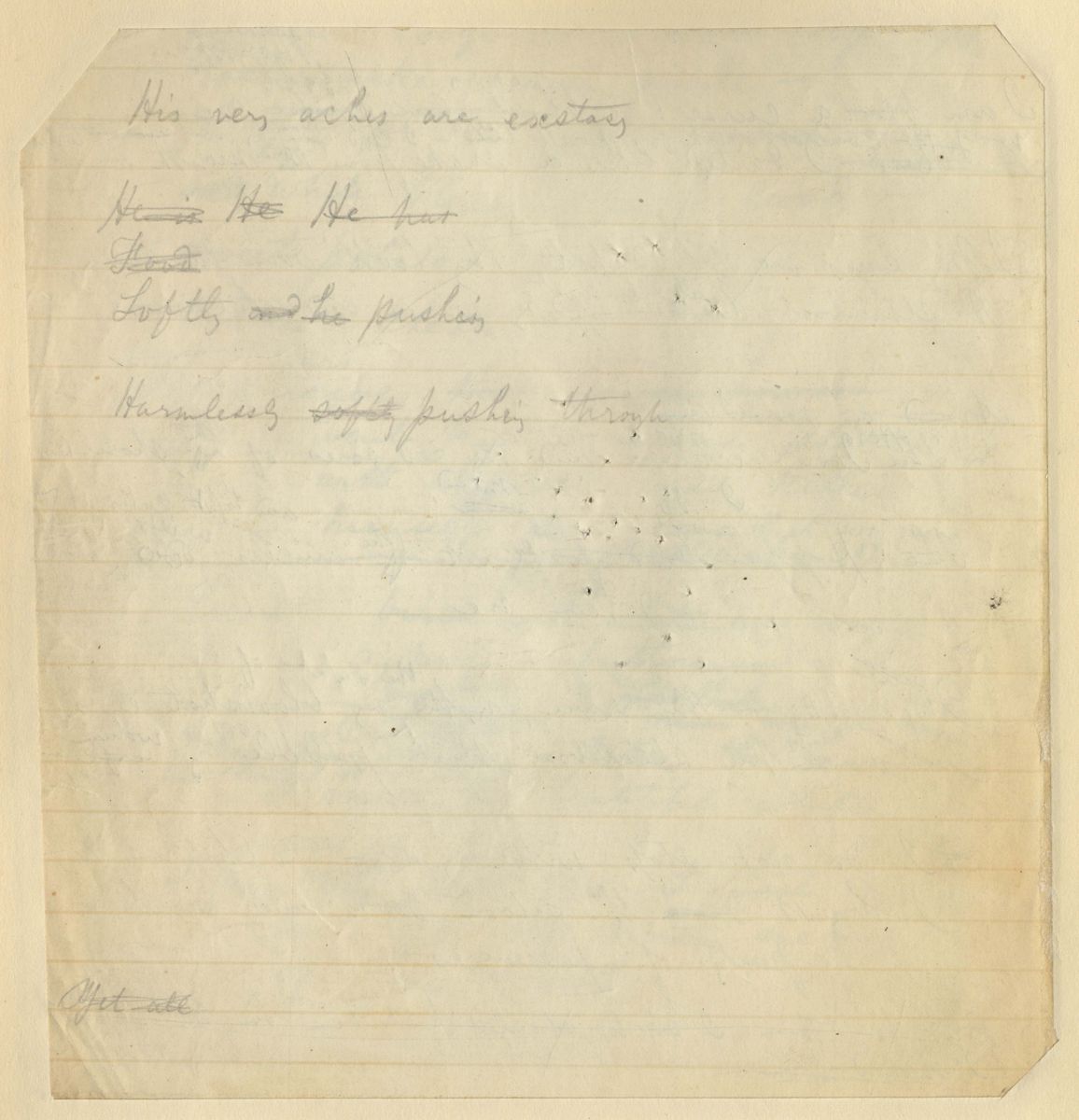
Whitman Archive Title: His very aches are exstasy
-
Whitman Archive ID: uva.00602
-
Box: 1
-
Folder: 88
-
Date: Between 1850 and 1855
-
Genre: poetry
-
Physical Description: 1 leaf, 18.5 x 17.5 cm, handwritten
-
View Images:
1
|
2
-
Content:
Whitman probably drafted this manuscript in the early 1850s as he was composing the first (1855) edition of
Leaves of Grass
. The fragmentary lines may relate to a section on touch included in the first poem in that edition, eventually titled "Song of Myself." Poetic lines on the back of this manuscript leaf (uva.00256) relate to lines in the poem eventually titled "The Sleepers."
-
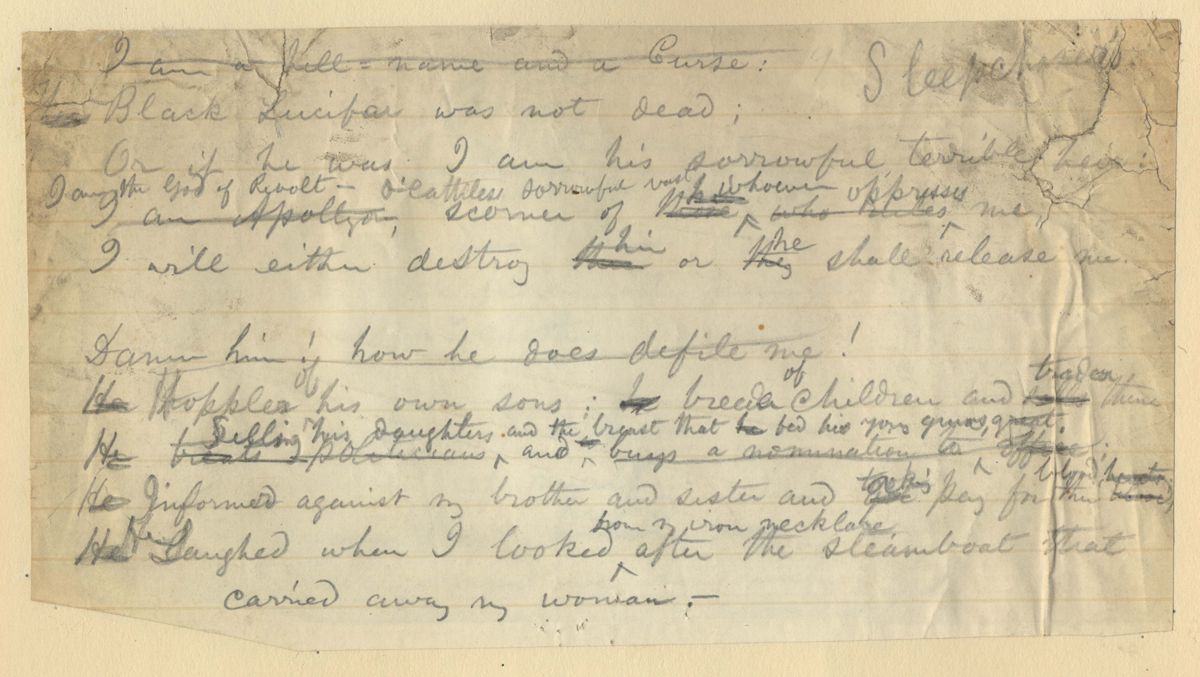
Whitman Archive Title: Black Lucifer was not dead
-
Whitman Archive ID: uva.00257
-
Box: 1
-
Folder: 88
-
Date: Between 1850 and 1855
-
Genre: poetry
-
Physical Description: 1 leaf, 10.5 x 19.5 cm, handwritten
-
View Images:
1
|
2
-
Content:
Whitman probably drafted this manuscript in the early 1850s as he was preparing materials for the first (1855) edition of
Leaves of Grass
. It is a draft of lines that appeared in the fourth poem in that edition, eventually titled "The Sleepers." The word "Sleepchaser's" appears in the upper right corner, perhaps indicating that Whitman was considering a title similar to the 1860–1861 and 1867 title "Sleep-Chasings" even before the poem was first published in 1855, unless this is in fact a reworking of the section for the 1860–1861 edition. The possibility of a post-1855 dating, however, appears to be slight given the similarities of paper choice and inscription techniques among other leaves and similarities to drafts in "Talbot Wilson" (loc.00141), an early Library of Congress notebook. The poem "Sleep-Chasings" eventually became "The Sleepers" in 1871–1872.
-
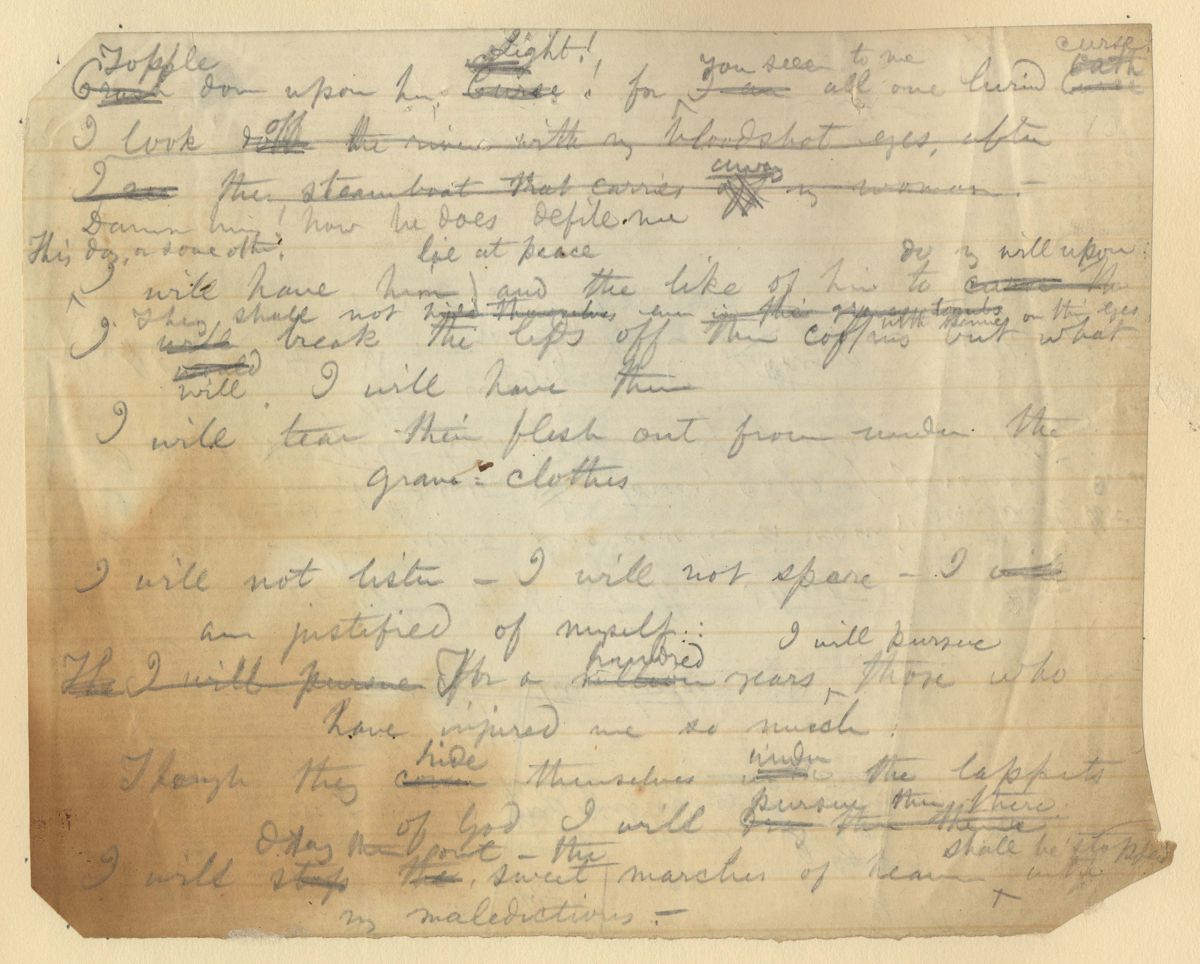
Whitman Archive Title: Topple down upon him
-
Whitman Archive ID: uva.00258
-
Box: 1
-
Folder: 88
-
Date: Between 1850 and 1855
-
Genre: poetry
-
Physical Description: 1 leaf, 15.5 x 19 cm, handwritten
-
View Images:
1
|
2
-
Content:
Whitman probably drafted this manuscript in the early 1850s as he was preparing materials for the first (1855) edition of
Leaves of Grass
. It is a draft of lines that appear in the fourth poem of that edition, eventually titled "The Sleepers." A revised version of the phrase "pennies on their eyes" appears in the poem eventually titled "Song of Myself." Lines on the back of this manuscript leaf (uva.00566) relate to the poem eventually titled "Faces."
-
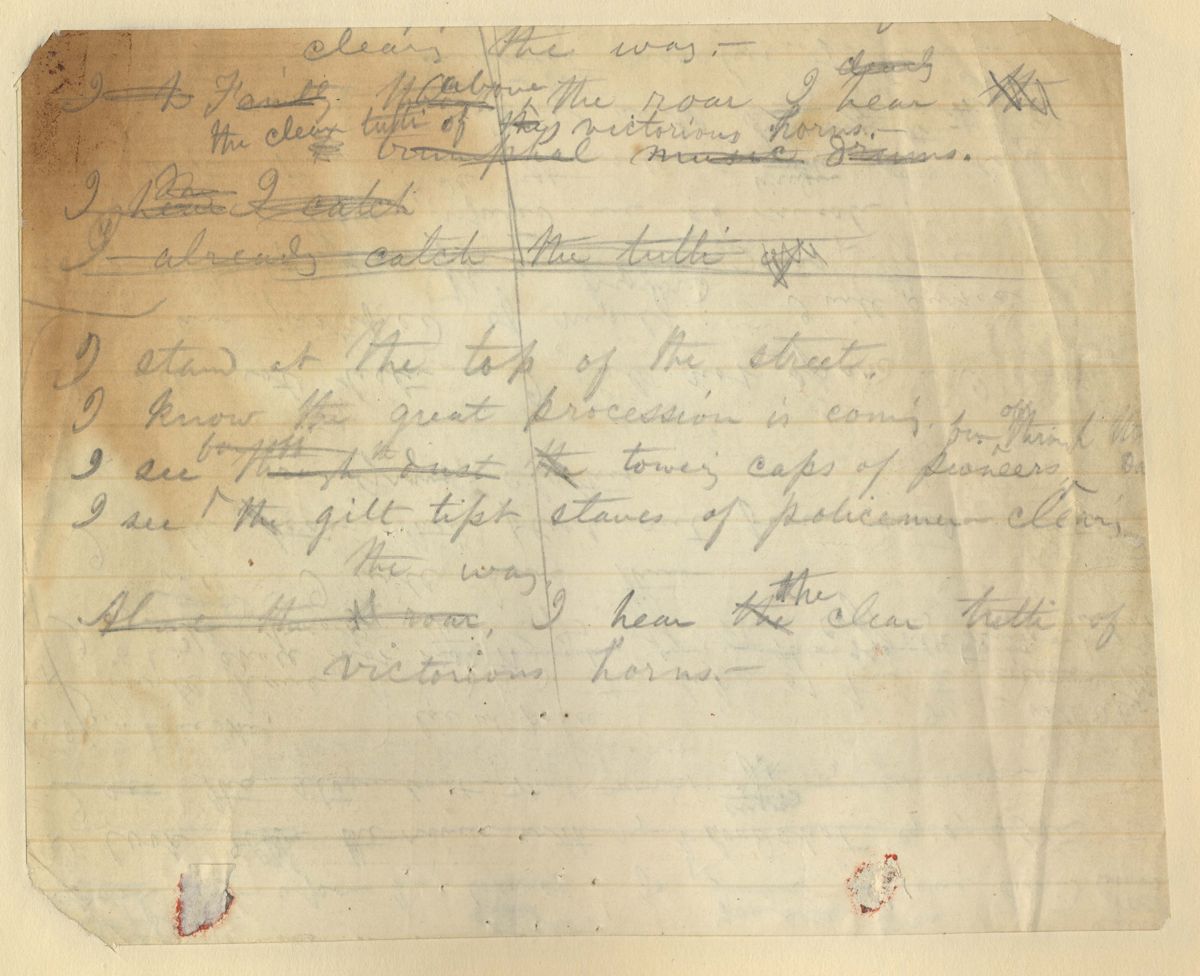
Whitman Archive Title: clearing the way
-
Whitman Archive ID: uva.00566
-
Box: 1
-
Folder: 88
-
Date: Between 1850 and 1855
-
Genre: poetry
-
Physical Description: 1 leaf, 15.5 x 19 cm, handwritten
-
View Images:
1
|
2
-
Content:
Whitman probably drafted this manuscript in the early 1850s as he was composing the first (1855) edition of
Leaves of Grass
. It is a draft of lines that appear in the sixth poem in that edition, eventually titled "Faces." Lines on the back of this manuscript leaf relate to the poem eventually titled "The Sleepers."
-
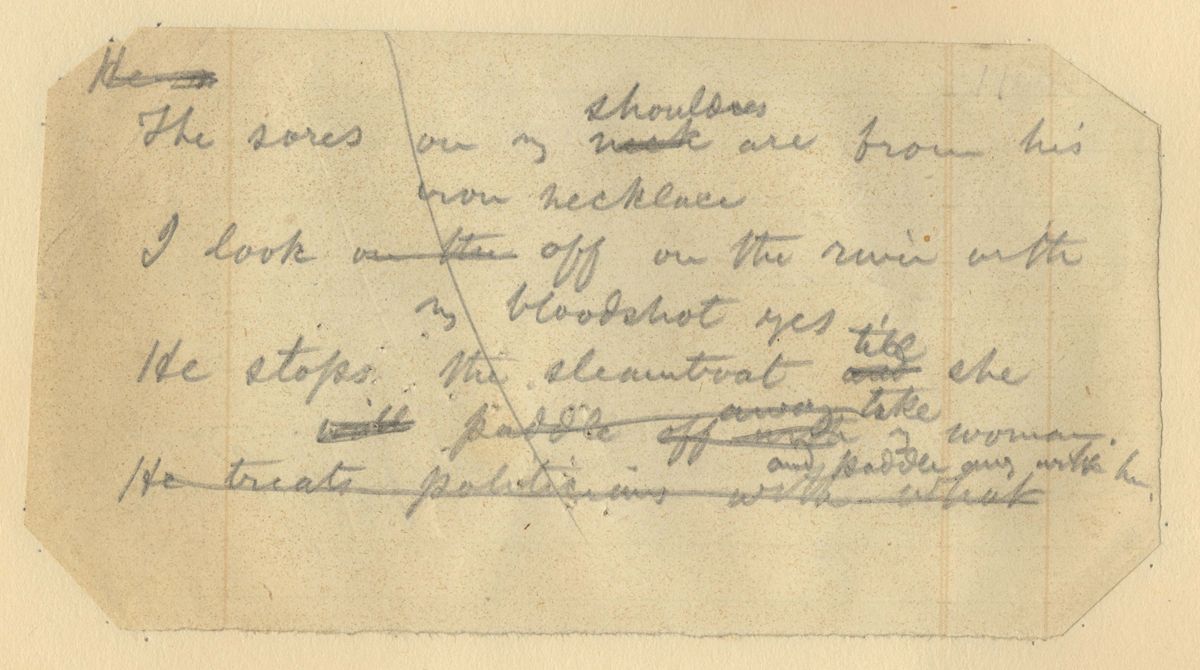
Whitman Archive Title: The sores on my shoulders
-
Whitman Archive ID: uva.00260
-
Box: 1
-
Folder: 88
-
Date: Between 1850 and 1855
-
Genre: poetry
-
Physical Description: 1 leaf, 8 x 15 cm, handwritten
-
View Images:
1
|
2
-
Content:
Whitman probably drafted this manuscript in the early 1850s as he was preparing materials for the first (1855) edition of
Leaves of Grass
. The manuscript is a draft of a section of the fourth poem in that edition, eventually titled "The Sleepers." Lines on the back of this leaf (uva.00565) relate to the manuscript poem "Pictures."
-
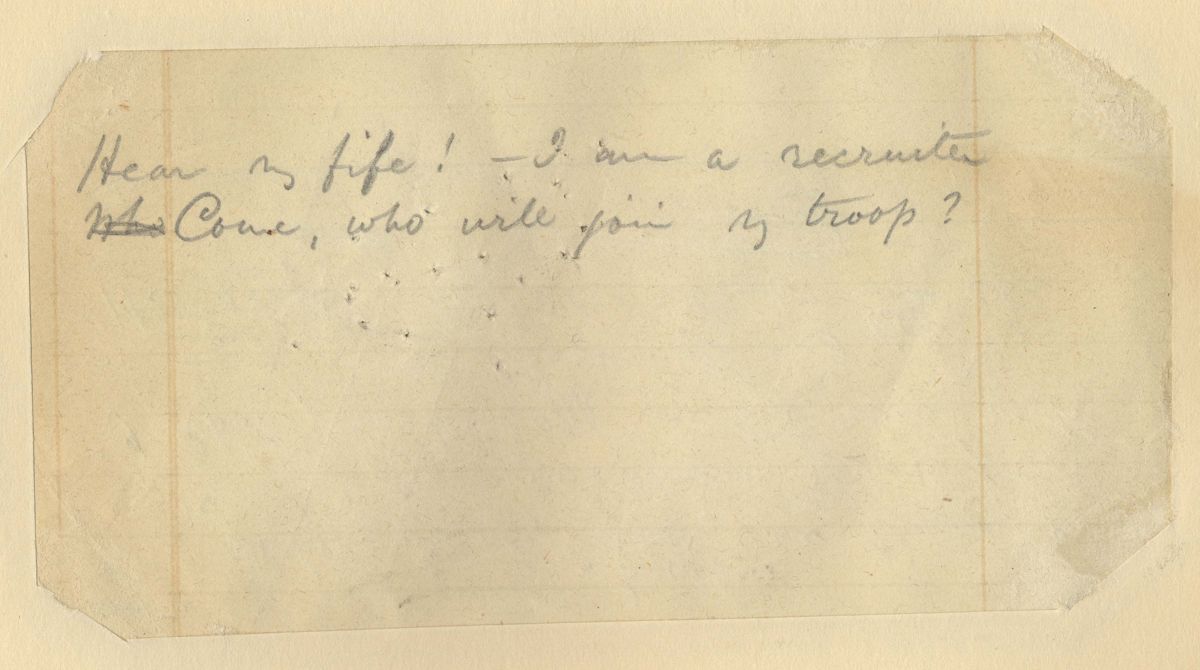
Whitman Archive Title: Hear my fife
-
Whitman Archive ID: uva.00565
-
Box: 1
-
Folder: 88
-
Date: Between 1850 and 1860
-
Genre: poetry
-
Physical Description: 1 leaf, 8 x 15 cm, handwritten
-
View Images:
1
|
2
-
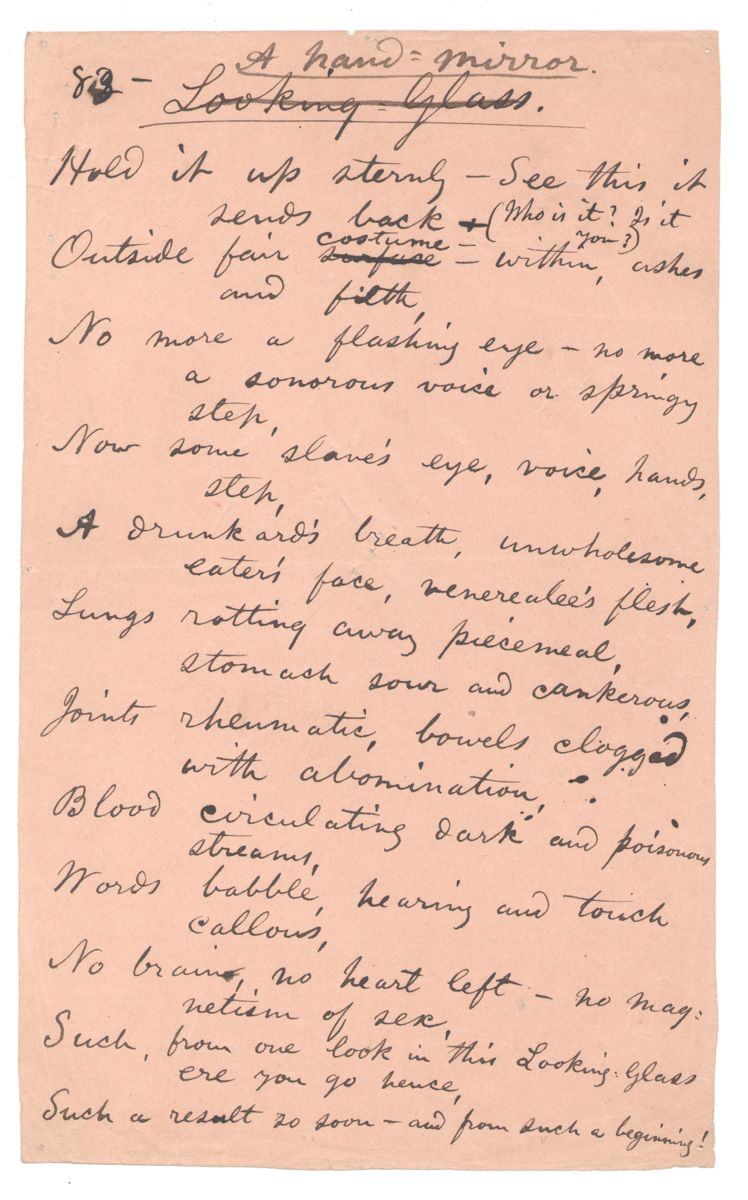
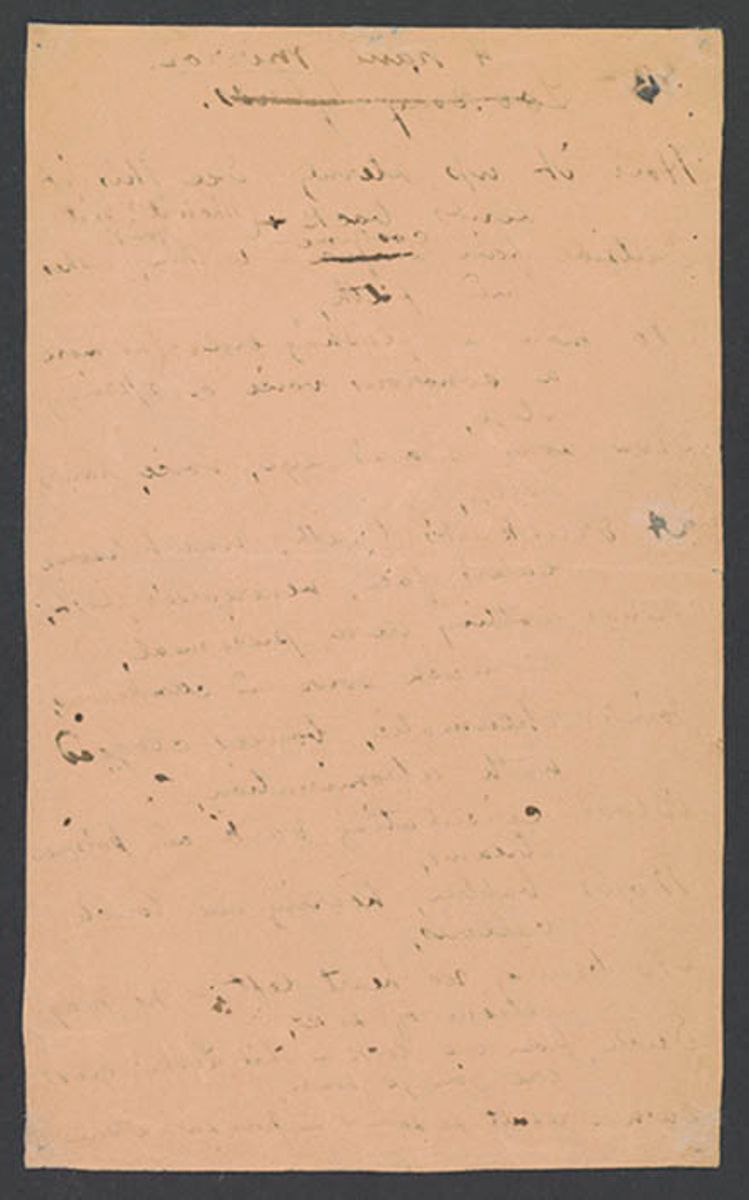
Content:
Whitman probably drafted this manuscript in the 1850s. The lines are versions of a line in a long manuscript poem titled "Pictures" (yal.00081), which probably dates to the mid- to late 1850s. Based on the first-person perspective in these draft lines, Emory Holloway has speculated that they likely were written after the line in "Pictures" (
Pictures: An Unpublished Poem of Walt Whitman
[New York: The June House, 1927], 31). The first several lines of "Pictures" (not including this line) were eventually revised and published as "My Picture-Gallery" in
The American
in October 1880. The poem was later published in
Leaves of Grass
as part of the "Autumn Rivulets" cluster. Lines on the back of this leaf (uva.00260) appeared, in revised form, in the poem eventually titled "The Sleepers."
-
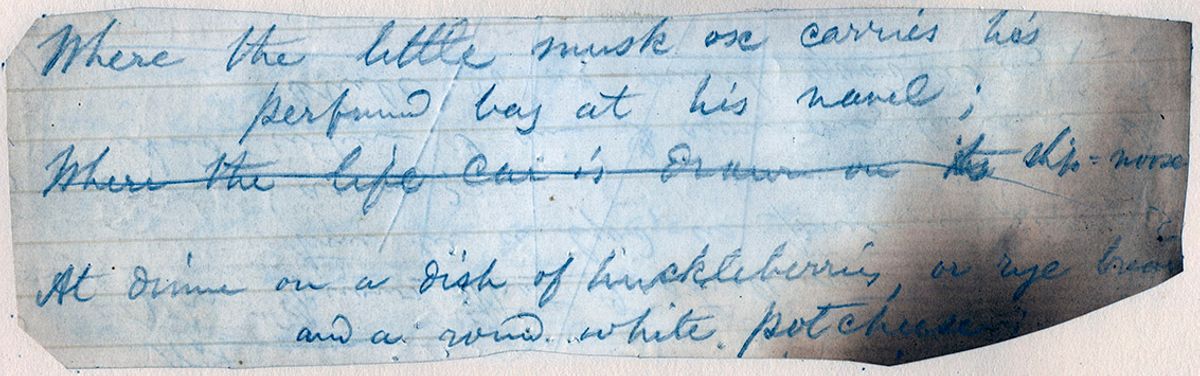
Whitman Archive Title: Where the little musk ox
-
Whitman Archive ID: uva.00261
-
Box: 1
-
Folder: 88
-
Date: Between 1850 and 1855
-
Genre: poetry
-
Physical Description: 1 leaf, 6 x 19 cm, handwritten
-
View Images:
1
|
2
-
Content:
Whitman probably drafted this manuscript in the early 1850s as he was composing the first (1855) edition of
Leaves of Grass
. A line from the manuscript appears in the first poem of that edition, eventually titled "Song of Myself." Lines on the back of this manuscript leaf (uva.00262) also relate to the poem eventually titled "Song of Myself."
-
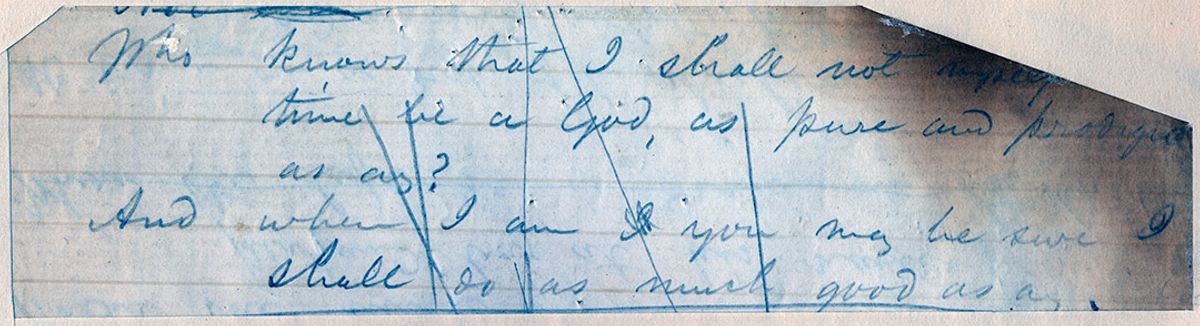
Whitman Archive Title: Who knows that I shall
-
Whitman Archive ID: uva.00262
-
Box: 1
-
Folder: 88
-
Date: Between 1850 and 1855
-
Genre: poetry
-
Physical Description: 1 leaf, 6 x 19 cm, handwritten
-
View Images:
1
|
2
-
Content:
Whitman probably drafted this manuscript in the early 1850s as he was composing the first (1855) edition of
Leaves of Grass
. Versions of the manuscript lines appear in the first poem of that edition, eventually titled "Song of Myself." Lines on the back of this manuscript leaf (uva.00261) also relate to the poem eventually titled "Song of Myself."
-
Whitman Archive Title: You there
-
Whitman Archive ID: uva.00263
-
Box: 1
-
Folder: 88
-
Date: Between 1850 and 1855
-
Genre: poetry
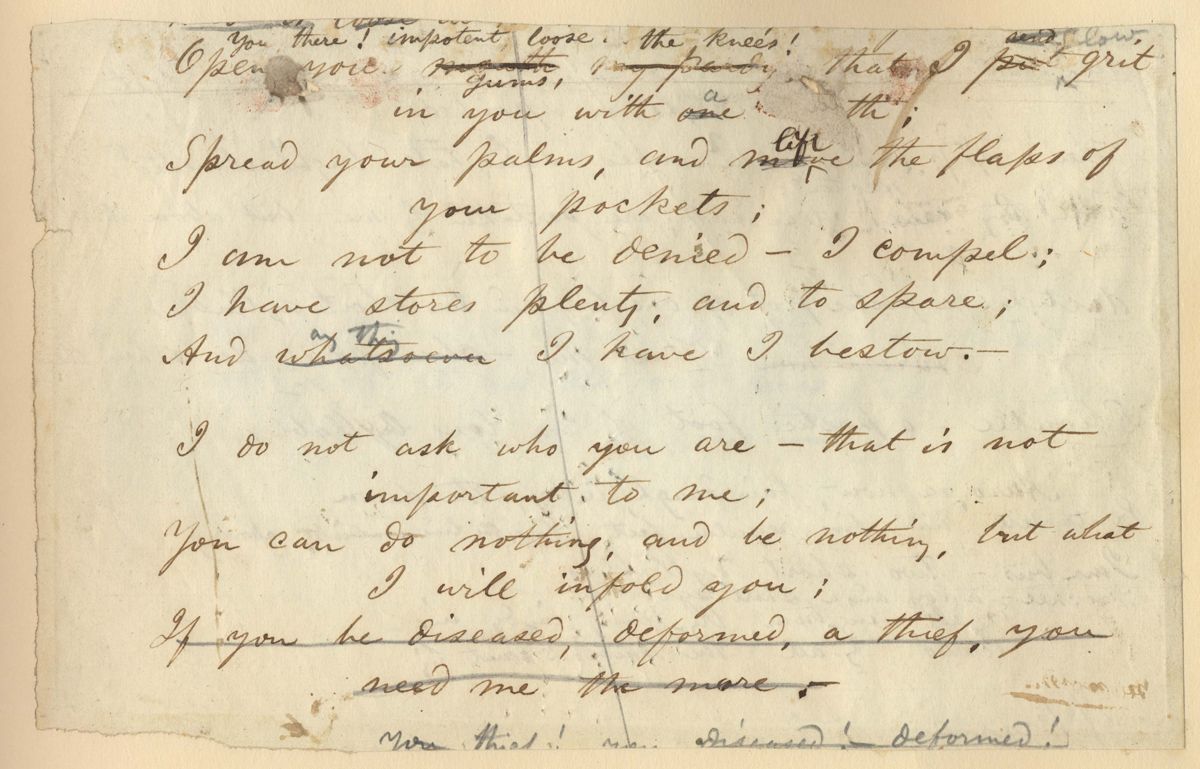
-
Physical Description: 1 leaf, 12.5 x 20 cm, handwritten
-
View Images:
1
|
2
-
Content:
Whitman probably drafted this manuscript in the early 1850s as he was composing the first (1855) edition of
Leaves of Grass
. It is a draft of lines that appear in the first poem in that edition, eventually titled "Song of Myself." A series of notes about poetic meter are written on the back of this manuscript leaf (uva.00603).
-
Whitman Archive Title: hexameters
-
Whitman Archive ID: uva.00603
-
Box: 1
-
Folder: 88
-
Date: Between 1850 and 1860
-
Genre: poetry
-
Physical Description: 1 leaf, 12.5 x 20 cm, handwritten
-
View Images:
1
|
2
-
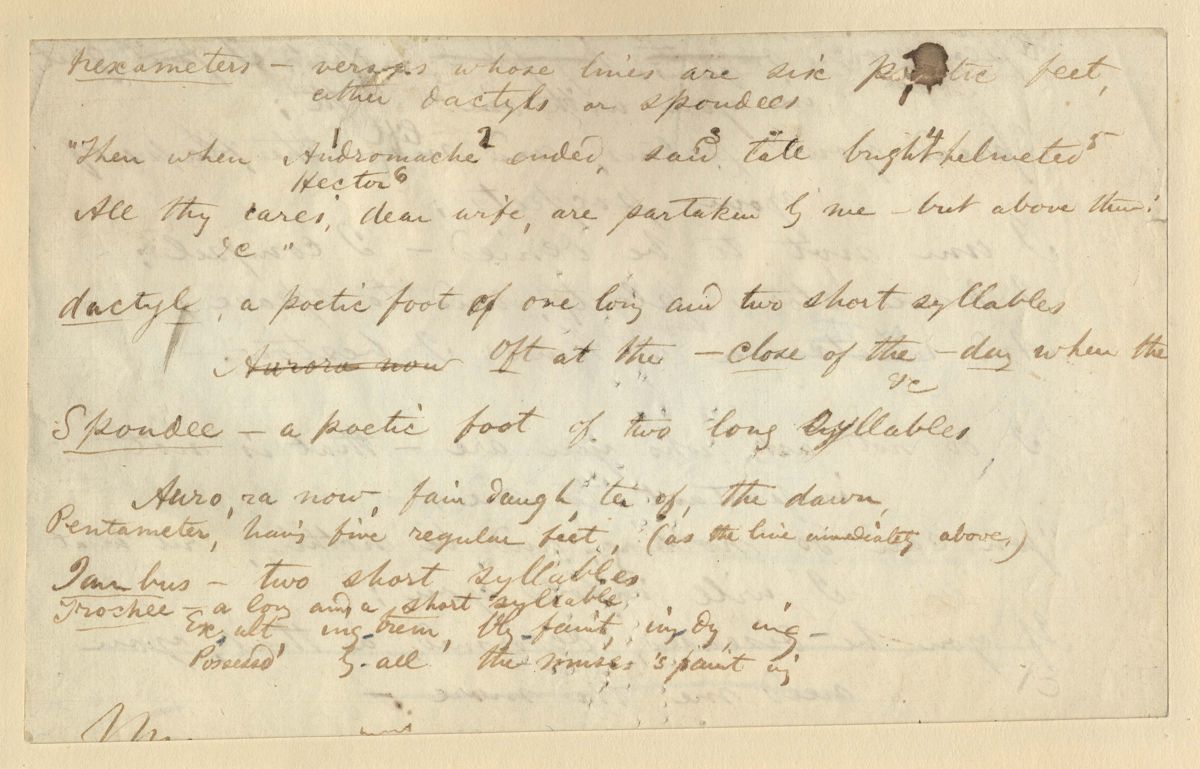
Content:
These notes about verse forms are similar to notes in rut.00022 ("dithyrambic trochee"), a manuscript currently housed at Rutgers University. Edward Grier posits that the Rutgers manuscript probably dates to around 1856, when Whitman was pursuing a self-education in poetry (
Notebooks and Unpublished Prose Manuscripts
[New York: New York University Press, 1984], 1:355–356). These manuscript notes may also date to that period, although the draft lines on the reverse of the leaf, which were probably written before 1855, may suggest a slightly earlier date. Draft lines on the back of this manuscript leaf (uva.00263) relate to the poem ultimately titled "Song of Myself."
-
Whitman Archive Title: And their voices
-
Whitman Archive ID: uva.00264
-
Box: 1
-
Folder: 88
-
Date: Between 1850 and 1855
-
Genre: poetry
-
Physical Description: 1 leaf, 4.5 x 19.5 cm, handwritten
-
View Images:
1
|
2
-
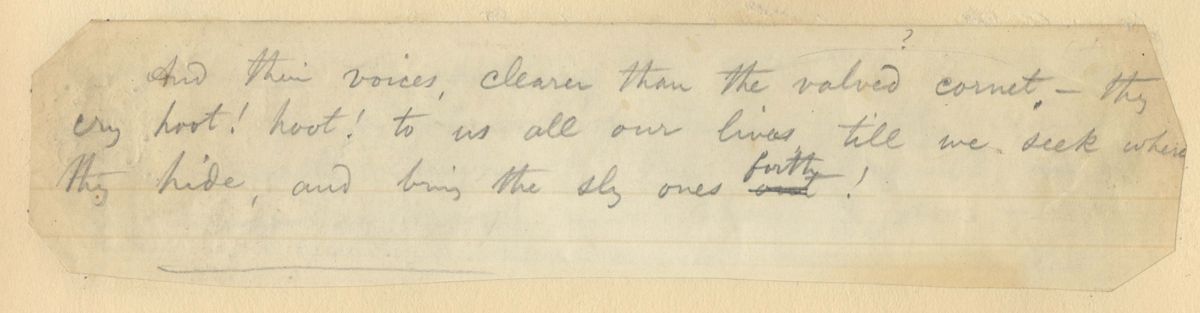
Content:
Whitman probably drafted this manuscript in the early 1850s as he was composing the first (1855) edition of
Leaves of Grass
. The notes were revised and incorporated into the first poem in that edition, eventually titled "Song of Myself."
-
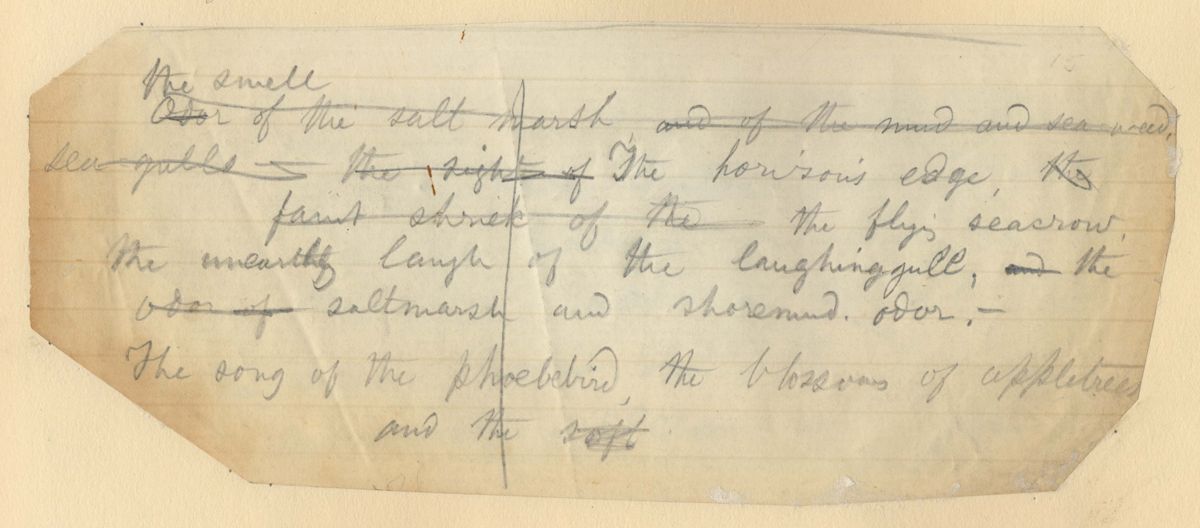
Whitman Archive Title: The horizon's edge
-
Whitman Archive ID: uva.00265
-
Box: 1
-
Folder: 88
-
Date: Between 1850 and 1855
-
Genre: poetry
-
Physical Description: 1 leaf, 8.5 x 20 cm, handwritten
-
View Images:
1
|
2
-
Content:
Whitman probably drafted this manuscript in the early 1850s as he was composing the first (1855) edition of
Leaves of Grass
. The manuscript includes drafts of lines used in the first and tenth poems in that edition, eventually titled "Song of Myself" and "There Was a Child Went Forth," respectively.
-
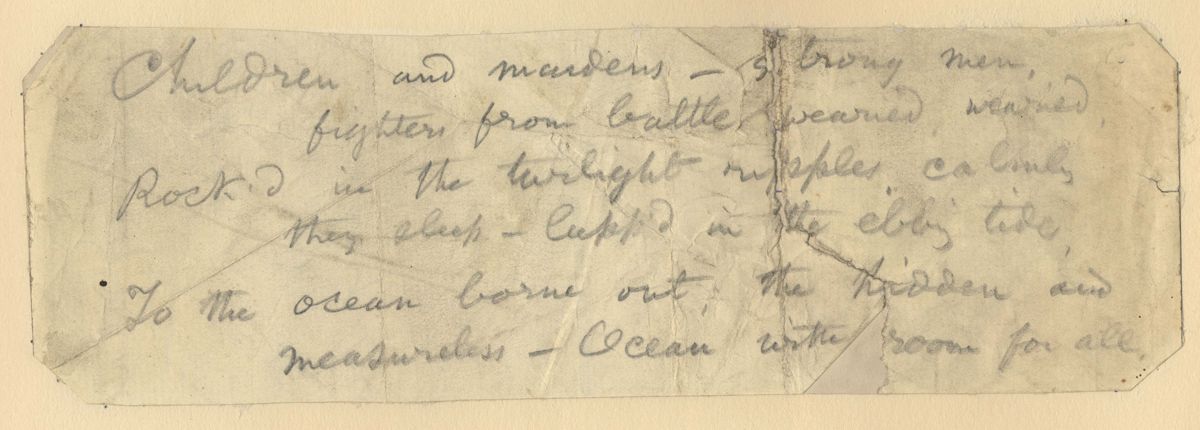
Whitman Archive Title: Children and maidens
-
Whitman Archive ID: uva.00266
-
Box: 1
-
Folder: 88
-
Date: about 1855
-
Genre: poetry
-
Physical Description: 1 leaf, 7 x 21 cm, handwritten
-
View Images:
1
|
2
-
Content:
The laid paper was originally the last page of a letter; a few illegible words and
part of a signature can be seen dimly through the back of the composite leaf.
Whitman wrote his lines on the verso of the page after turning it sideways. These
lines have no known relation to any published Whitman poem.
-
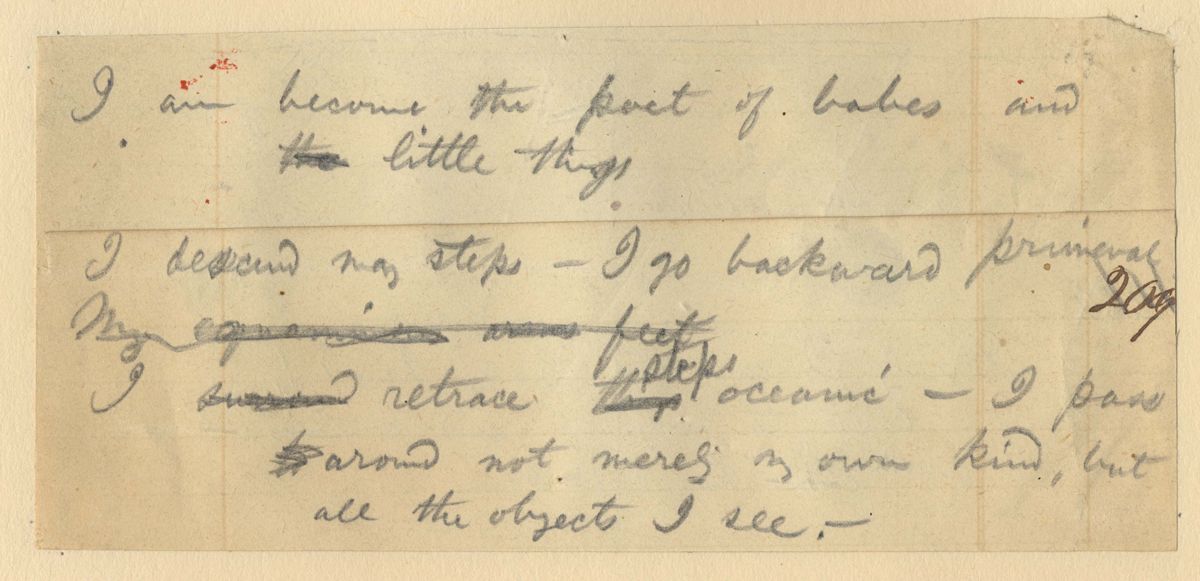
Whitman Archive Title: I am become the poet
-
Whitman Archive ID: uva.00269
-
Box: 1
-
Folder: 88
-
Date: Between 1850 and 1855
-
Genre: poetry
-
Physical Description: 1 leaf, 4 x 14.5 cm pasted to 4.5 x 15 cm, handwritten
-
View Images:
1
|
2
-
Content:
Whitman probably drafted this manuscript in the early 1850s as he was composing the first (1855) edition of
Leaves of Grass
. The first line in this manuscript matches a line in the "Talbot Wilson" notebook (loc.00141, recto leaf 38) and is similar in structure to lines that appeared in the first poem in the 1855 edition of
Leaves
, eventually titled "Song of Myself." The image of the poet navigating stairs also appears in what would become section 44 of "Song of Myself." Draft lines written on the back of this manuscript leaf (uva.00600) may also relate to the poem eventually titled "Song of Myself."
-
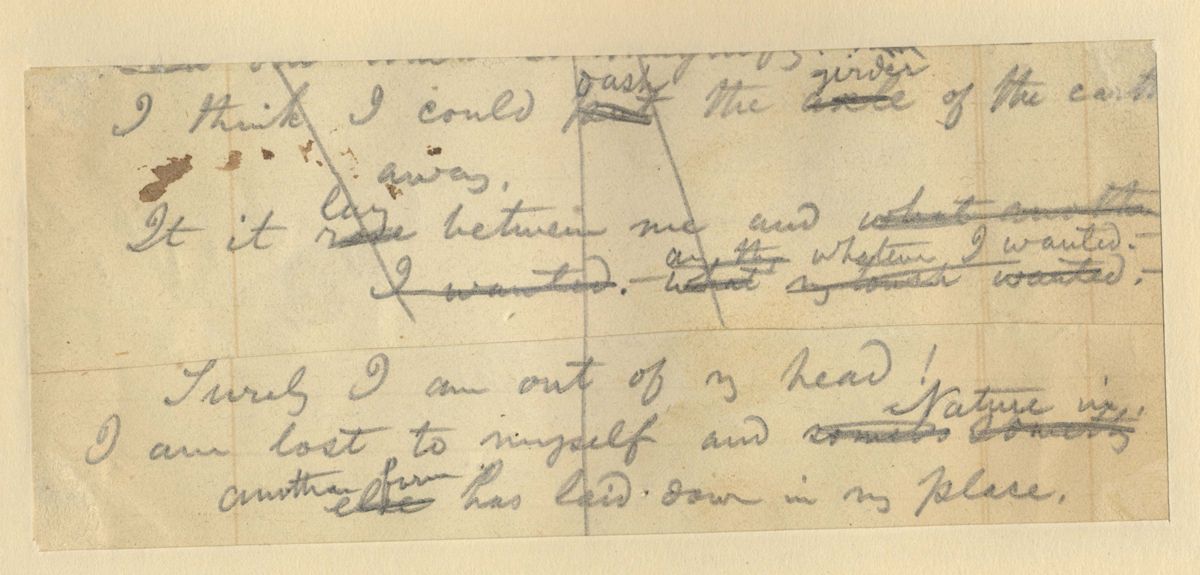
Whitman Archive Title: I think I could dash
-
Whitman Archive ID: uva.00600
-
Box: 1
-
Folder: 88
-
Date: Between 1850 and 1855
-
Genre: poetry
-
Physical Description: 1 leaf, 4 x 14.5 cm pasted to 4.5 x 15 cm, handwritten
-
View Images:
1
|
2
-
Content:
Whitman probably drafted this manuscript in the early 1850s as he was composing the first (1855) edition of
Leaves of Grass
. The first line in this manuscript matches a line in the "Talbot Wilson" notebook (loc.00141, recto leaf 38) and is similar in structure to lines that appeared in the first poem in the 1855 edition of
Leaves
, eventually titled "Song of Myself." The image of the poet navigating stairs also appears in what would become section 44 of "Song of Myself." Draft lines written on the back of this manuscript leaf (uva.00600) may also relate to the poem eventually titled "Song of Myself."
Whitman probably drafted this manuscript in the early 1850s as he was composing the first (1855) edition of
Leaves of Grass
. The manuscript may relate to a passage about touch that appeared in the first poem in that edition, eventually titled "Song of Myself." In his transcription of this manuscript, Richard Maurice Bucke included lines at the beginning and end that read: "Yet I strike and dart through . . . . . . " and "I am a creased and cut sea; the furious wind . . . . . ." (
Notes and Fragments
[London, Ontario: A. Talbot & Co., printers, 1899], 34–5). These lines do not currently appear on the manuscript. Draft lines written on the back of this manuscript leaf (uva.00269) relate to lines in the poem eventually titled "Song of Myself."
-
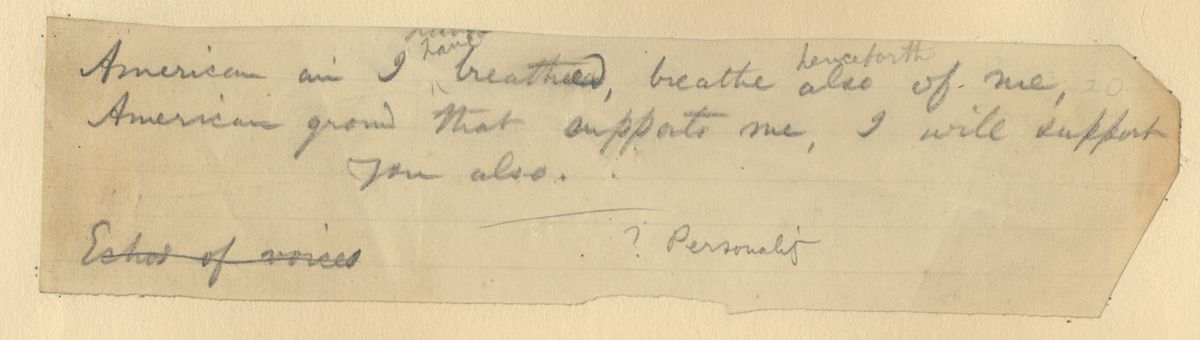
Whitman Archive Title: American air I have breathed
-
Whitman Archive ID: uva.00270
-
Box: 1
-
Folder: 88
-
Date: Between 1850 and 1859
-
Genre: poetry
-
Physical Description: 1 leaf, 4.5 x 18 cm, handwritten
-
View Images:
1
|
2
-
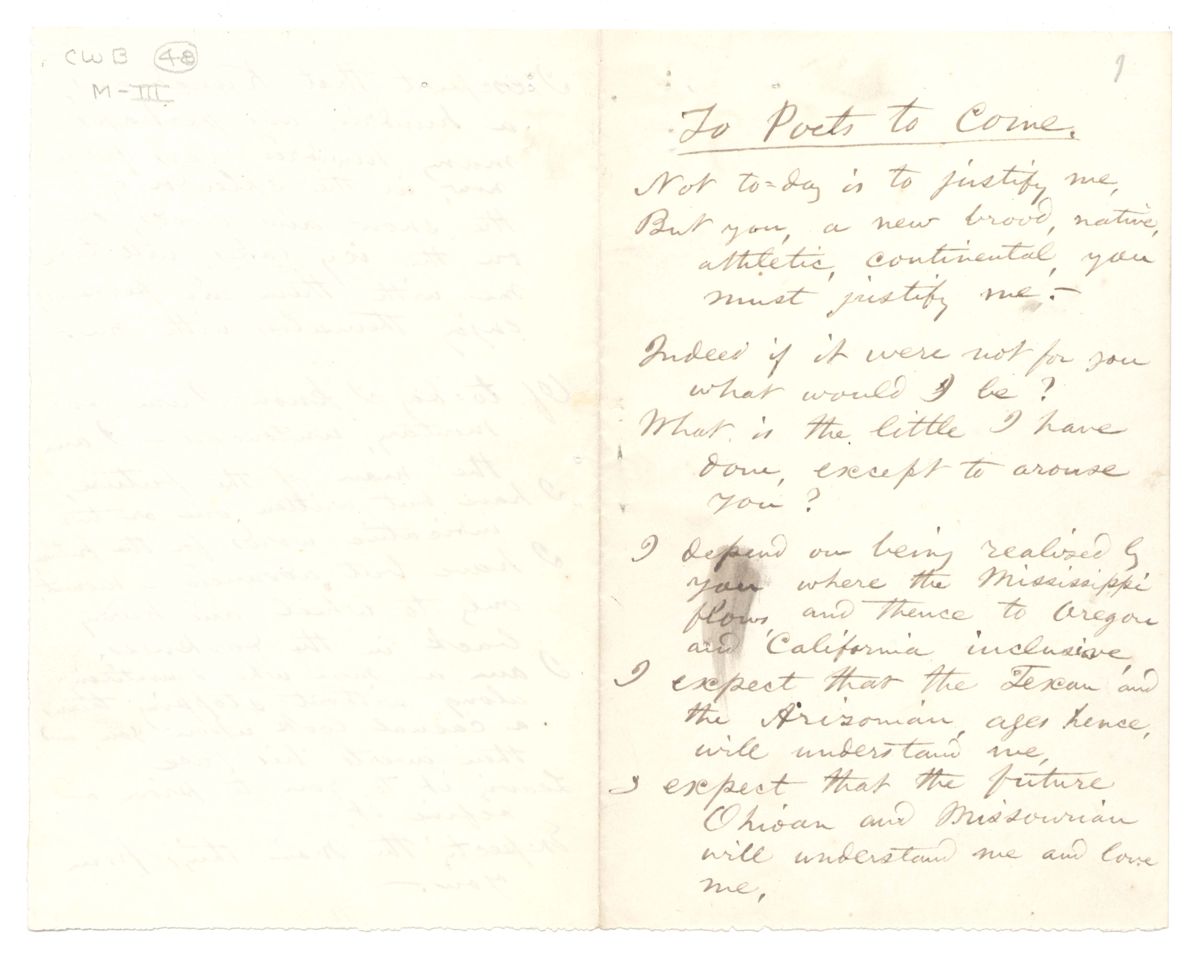
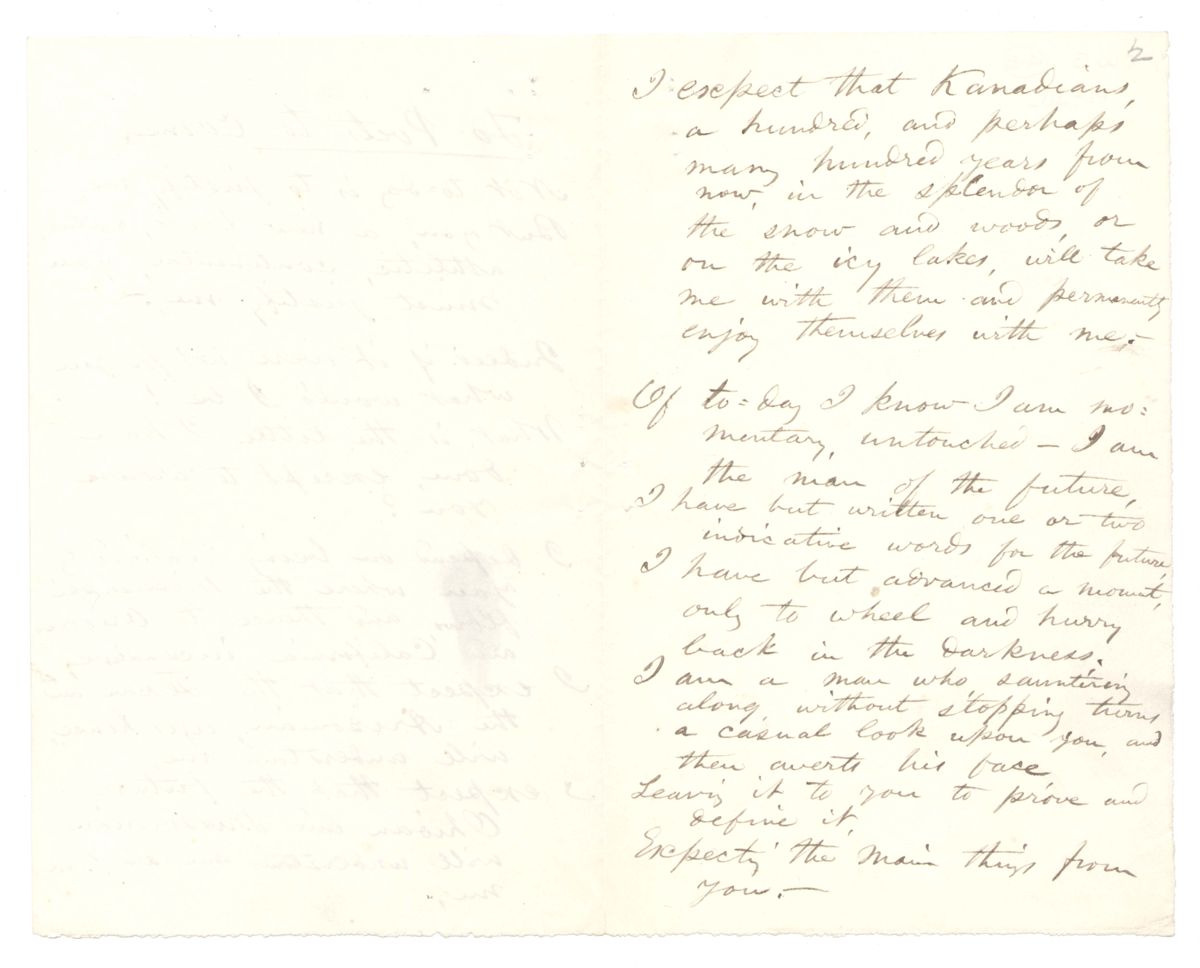
Content:
Although Whitman did not publish these verses himself, their structure and the
type of paper upon which they are inscribed suggest a close relationship with the
lines on another manuscript in the University of Virginia collection, which were
revised to form part of section 14 of "Chants Democratic" in the 1860 edition of
Leaves of Grass
, a set of verses
eventually transformed into an independent poem under the title "Poets to Come."
-
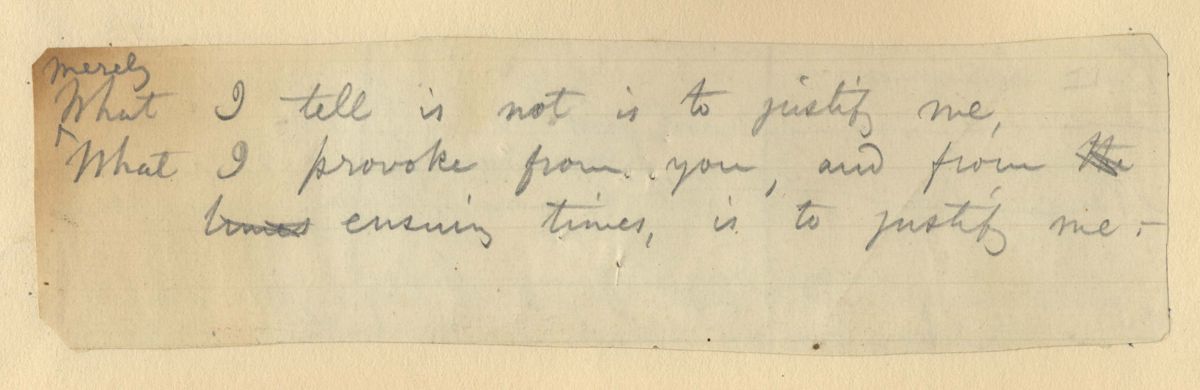
Whitman Archive Title: Merely What I tell is
-
Whitman Archive ID: uva.00271
-
Box: 1
-
Folder: 88
-
Date: Between 1850 and 1860
-
Genre: poetry
-
Physical Description: 1 leaf, 4 x 15 cm, handwritten
-
View Images:
1
|
2
-
Content:
These manuscript lines were probably written in the 1850s. They bear a strong resemblance to ideas expressed in the opening lines of poem #14 of "Chants Democratic and Native American," which first appeared in the 1860
Leaves of Grass
. The lines eventually became part of the independent poem "Poets to Come." A series of draft lines are written on the back of this manuscript leaf (uva.00272).
-
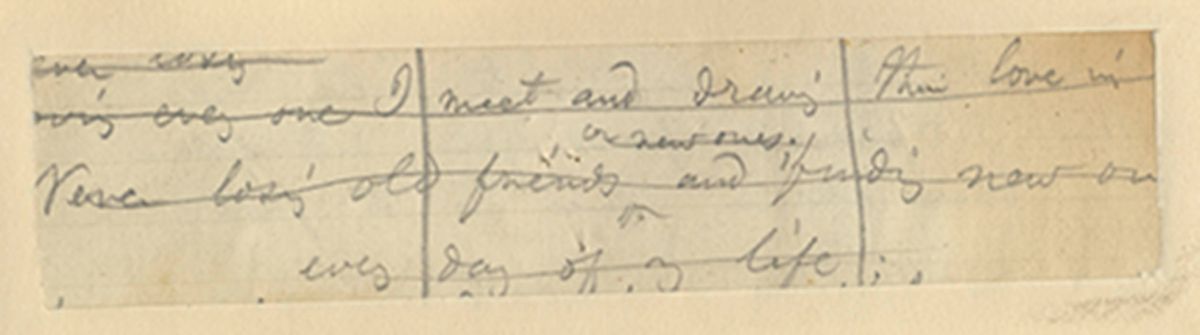
Whitman Archive Title: Merely What I tell is
-
Whitman Archive ID: uva.00272
-
Box: 1
-
Folder: 88
-
Date: Between 1850 and 1860
-
Genre: poetry
-
Physical Description: 1 leaf, 4 x 15 cm, handwritten
-
View Images:
1
|
2
-
Content:
Based on the material written on the back of this leaf, this manuscript was probably written in the 1850s. The lines do not appear to have contributed directly to any of Whitman's published poetry. Draft lines on the back of this manuscript leaf (uva.00271) probably relate to the poem eventually titled "Poets to Come."
-
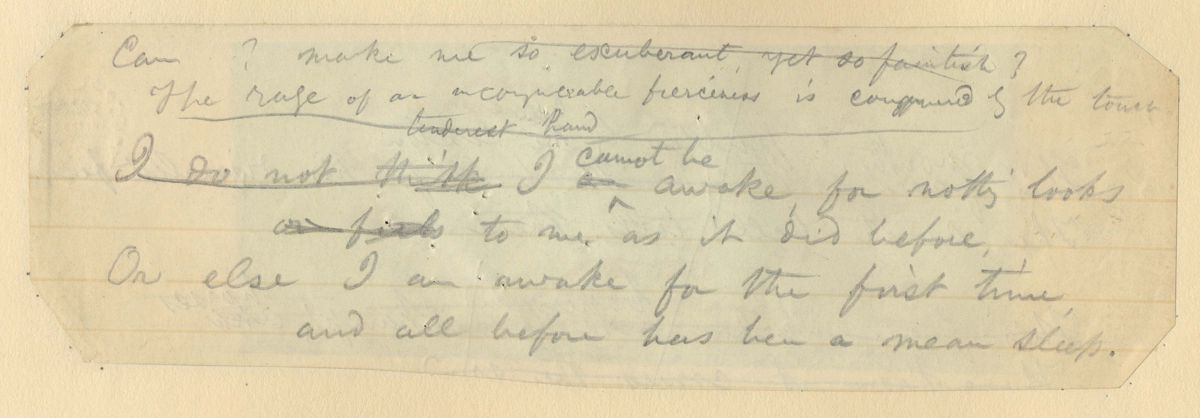
Whitman Archive Title: Can ? make me
-
Whitman Archive ID: uva.00273
-
Box: 1
-
Folder: 88
-
Date: Between 1850 and 1855
-
Genre: poetry
-
Physical Description: 1 leaf, 6 x 19.5 cm, handwritten
-
View Images:
1
|
2
-
Content:
Whitman probably drafted this manuscript in the early 1850s as he was preparing materials for the first (1855) edition of
Leaves of Grass
. The lines bear some similarity to lines in the first poem in that edition, eventually titled "Song of Myself." Poetic lines on the back of this leaf (uva.00562) relate to the poem eventually titled "Faces."
-
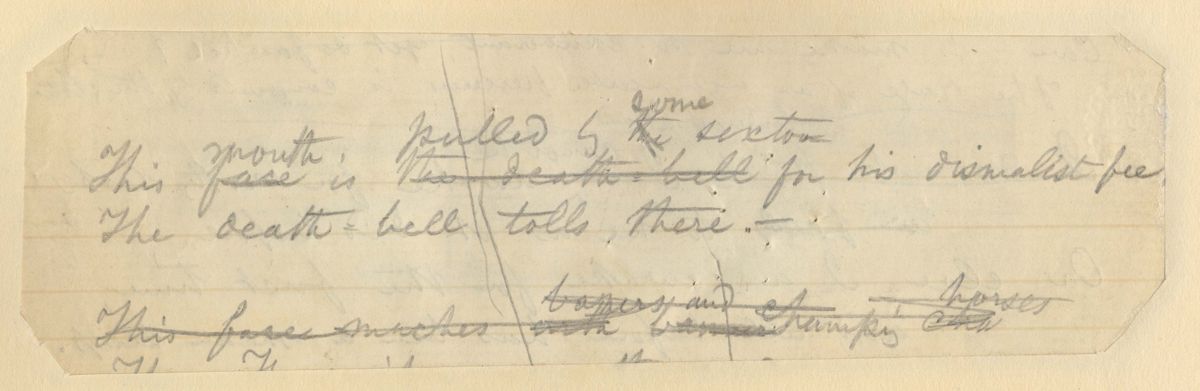
Whitman Archive Title: This mouth is pulled by
-
Whitman Archive ID: uva.00562
-
Box: 1
-
Folder: 88
-
Date: Between 1850 and 1855
-
Genre: poetry
-
Physical Description: 1 leaf, 6 x 19.5 cm, handwritten
-
View Images:
1
|
2
-
Content:
Whitman probably drafted this manuscript in the early 1850s as he was creating material for the first (1855) edition of
Leaves of Grass
. It is a draft of lines that appear in the sixth poem in that edition, eventually titled ""Faces." Poetic lines on the back of this leaf (uva.00273) may relate to the poem eventually titled "Song of Myself."
-
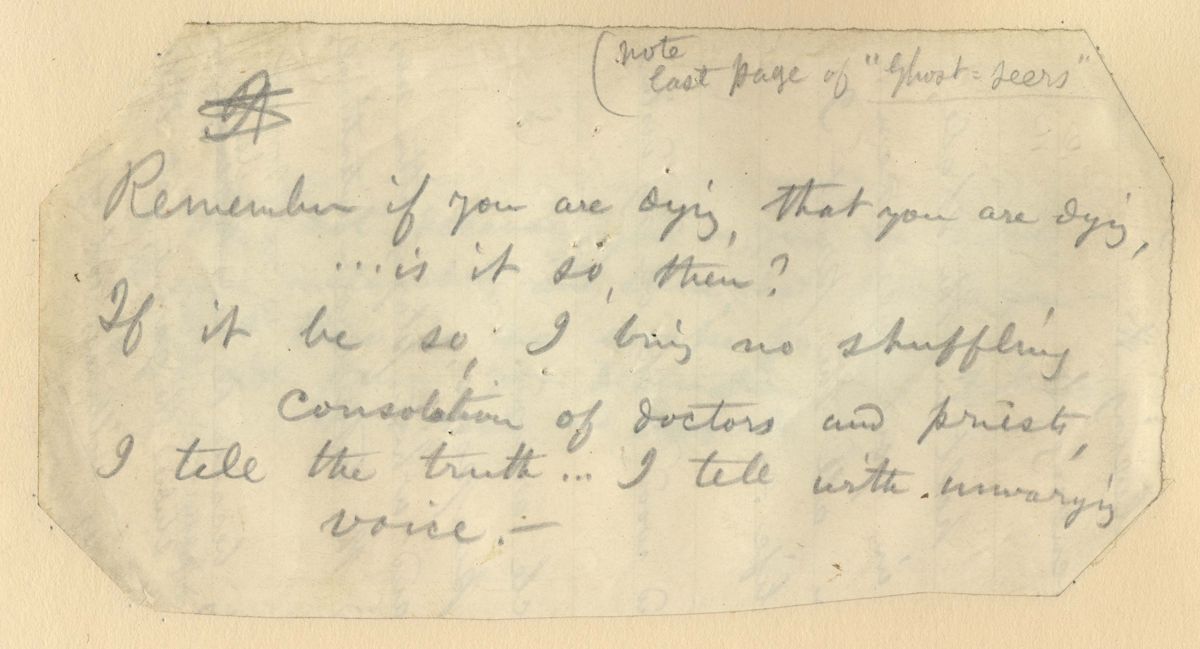
Whitman Archive Title: Remember if you are dying
-
Whitman Archive ID: uva.00278
-
Box: 1
-
Folder: 88
-
Date: Between 1850 and 1860
-
Genre: poetry
-
Physical Description: 1 leaf, 8 x 15.5 cm, handwritten
-
View Images:
1
|
2
-
Content:
This manuscript was probably written between 1850 and 1860. The lines are similar in subject to lines in the poem "To One Shortly To Die," first published in the 1860 edition of
Leaves of Grass
. The use of ellipses within poetic lines was characteristic of Whitman's first (1855) edition of
Leaves of Grass
, however, and lines in this manuscript also resemble lines that appeared in the first poem in that edition, eventually titled "Song of Myself." On the upper right corner of the manuscript appear the words "note last page of 'Ghost-seers'" in Whitman's hand, which may be a reference to one of the two volumes of
The Night Side of Nature, Or, Ghosts and Ghost-Seers
, by Catherine Crowe (London: T. C. Newby, 1848; G. Routledge & Co., 1852). Whitman mentioned the book in a conversation with Horace Traubel on December 9, 1889 (
With Walt Whitman in Camden
, 6:180–2). The phrase "Ghost-seers" also recalls a statement regarding Emerson in "Leaves-Droppings," a section of correspondence and commentary Whitman appended to the 1856 edition: "[Emerson] sees the future of truths as our Spirit-seers discern the future of man..." Fragmentary lines written on the back of this manuscript leaf (uva.00561) were used in the poem eventually titled "Song of Myself."
-
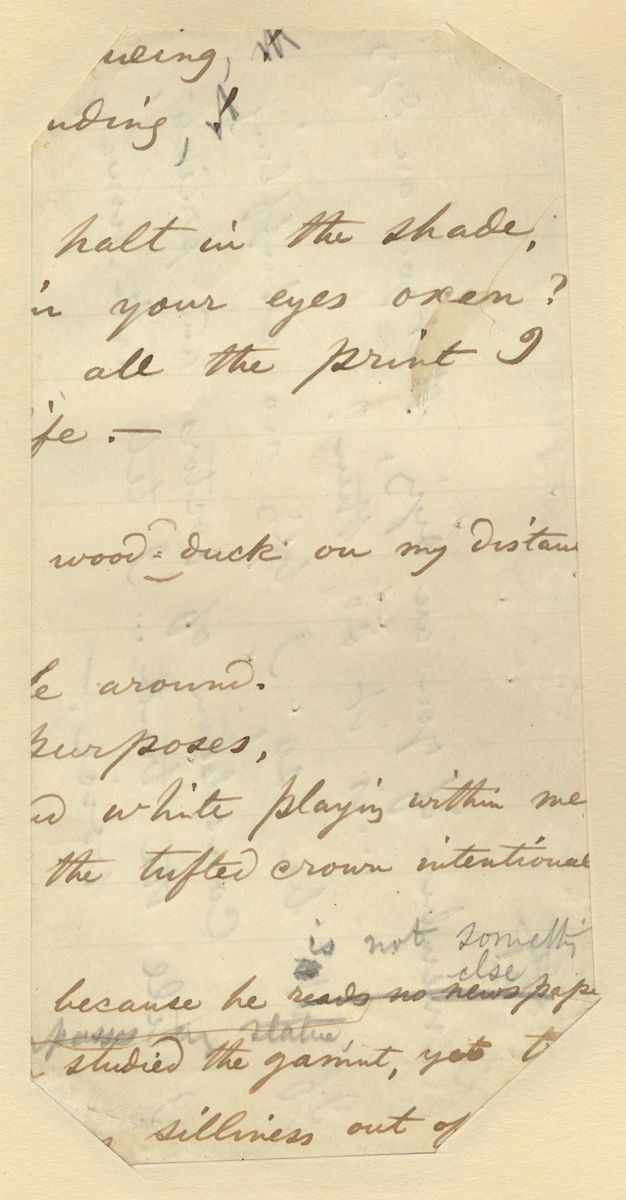
Whitman Archive Title: halt in the shade
-
Whitman Archive ID: uva.00561
-
Box: 1
-
Folder: 88
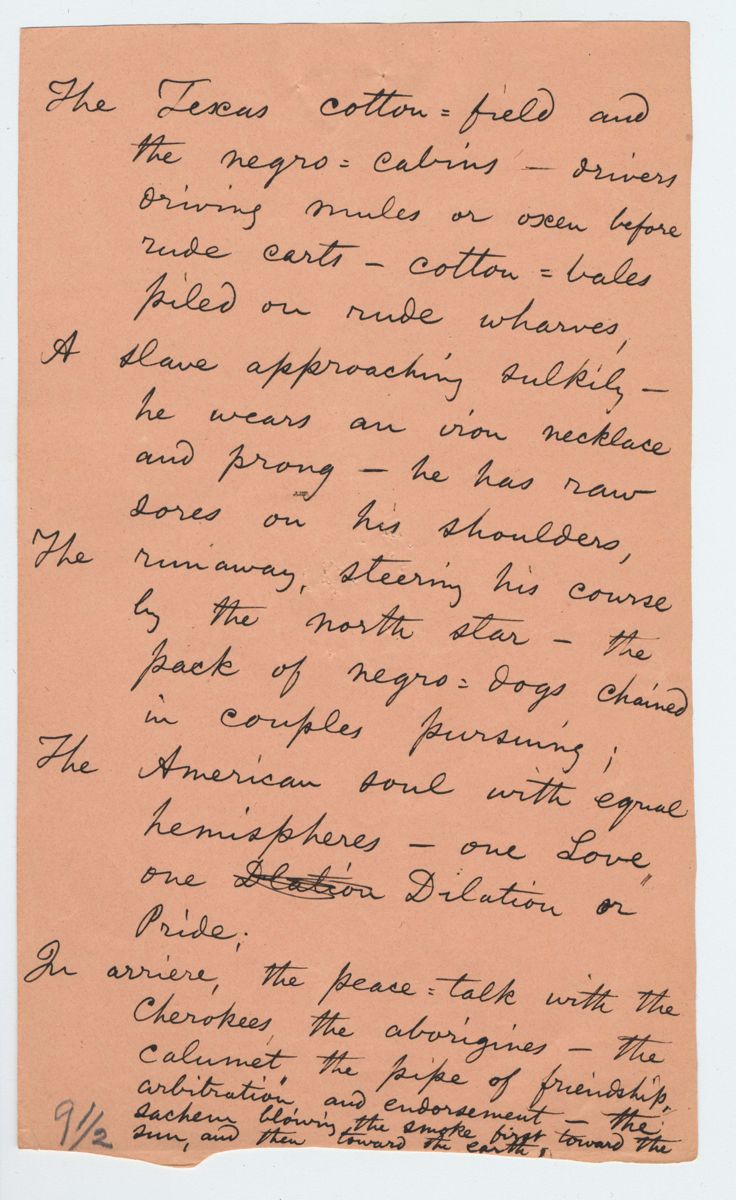
-
Date: Between 1850 and 1855
-
Genre: poetry
-
Physical Description: 1 leaf, 8 x 15.5 cm, handwritten
-
View Images:
1
|
2
-
Content:
Whitman probably drafted this manuscript in the early 1850s as he was composing the first (1855) edition of
Leaves of Grass
. The manuscript fragments of poetry are partial drafts of lines used in the first poem in that edition, eventually titled "Song of Myself." Lines written on the back of this manuscript (uva.00278) are similar in idea to lines in the poem "To One Shortly To Die," first published in the 1860 edition of
Leaves of Grass
.
-
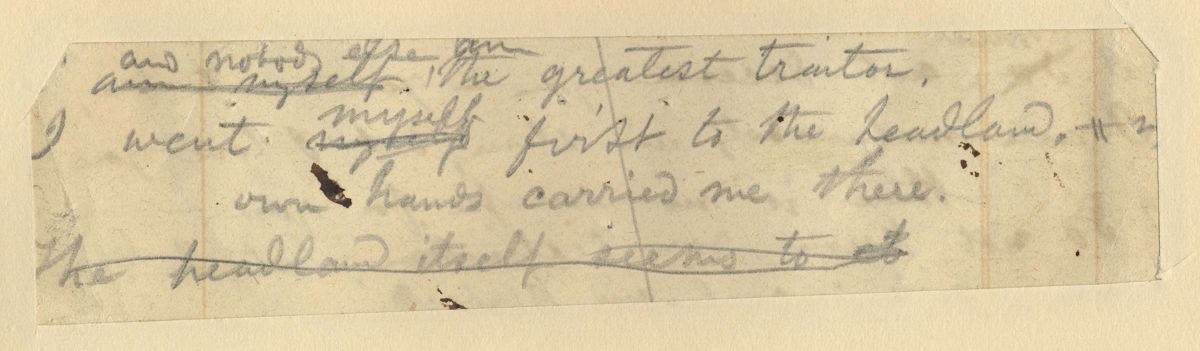
Whitman Archive Title: and nobody else am the
-
Whitman Archive ID: uva.00280
-
Box: 1
-
Folder: 88
-
Date: Between 1850 and 1855
-
Genre: poetry
-
Physical Description: 1 leaf, 4 x 14.5 cm, handwritten
-
View Images:
1
|
2
-
Content:
Whitman probably drafted this manuscript in the early 1850s as he was composing the first (1855) edition of
Leaves of Grass
. The lines were used in the first poem in that edition, eventually titled "Song of Myself." More draft lines of poetry are written on the back of this leaf (uva.00560).
-
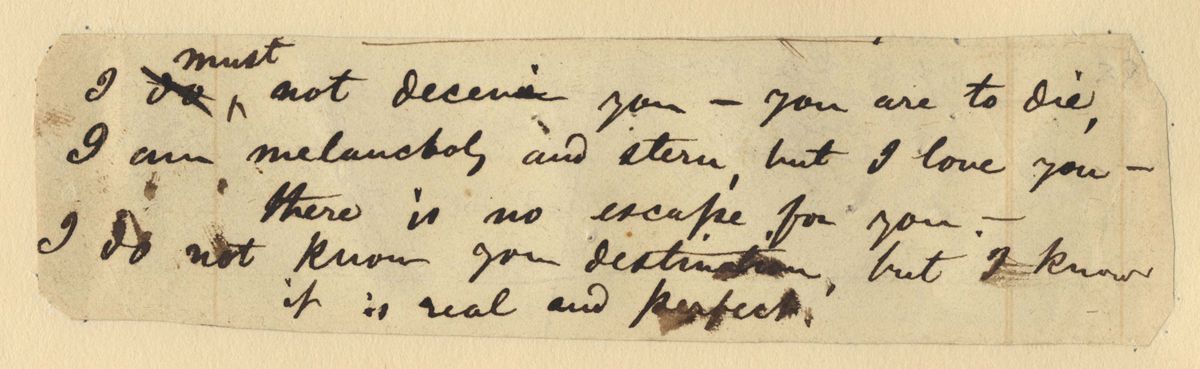
Whitman Archive Title: I must not deceive you
-
Whitman Archive ID: uva.00560
-
Box: 1
-
Folder: 88
-
Date: Between 1850 and 1860
-
Genre: poetry
-
Physical Description: 1 leaf, 4 x 14.5 cm, handwritten
-
View Images:
1
|
2
-
Content:
This manuscript was probably written between 1850 and 1860. The lines were used in the poem "To One Shortly to Die," first published in the 1860 edition of
Leaves of Grass
. Draft lines on the back of this leaf (uva.00280) appeared with revisions in the first poem of the 1855 edition of
Leaves of Grass
, eventually titled "Song of Myself."
-
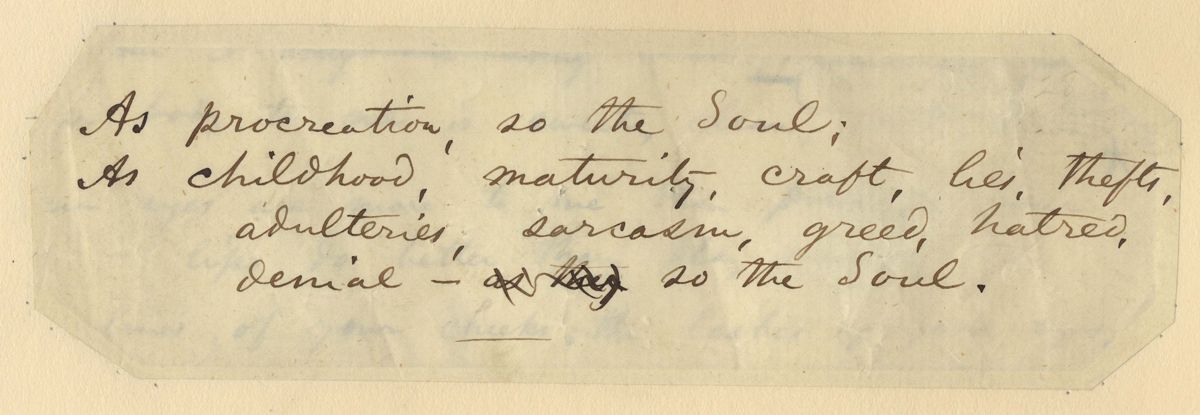
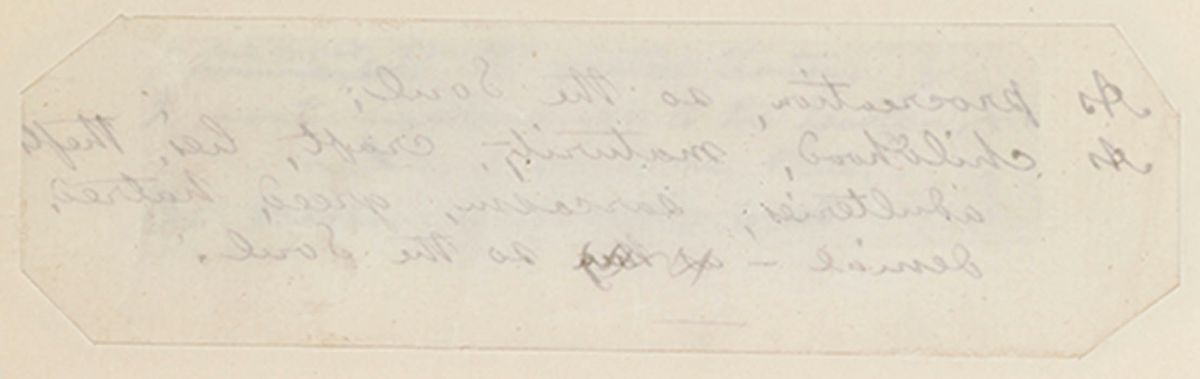
Whitman Archive Title: [As procreation]
-
Whitman Archive ID: uva.00281
-
Box: 1
-
Folder: 88
-
Date: about 1855
-
Genre: poetry
-
Physical Description: 1 leaf, 6 x 18.5 cm, handwritten
-
View Images:
1
|
2
-
Content:
The ideas expressed in this manuscript may have been used in the 1856
"Poem of Remembrances for A Girl or A
Boy of These States," which became the sixth poem in "Chants Democratic and Native
American" in 1860. It was subsequently shortened by several stanzas
(1867) and retitled (1872) "Think of
the Soul" before being excluded from
Leaves of Grass
with the publication of the 1881
edition.
-
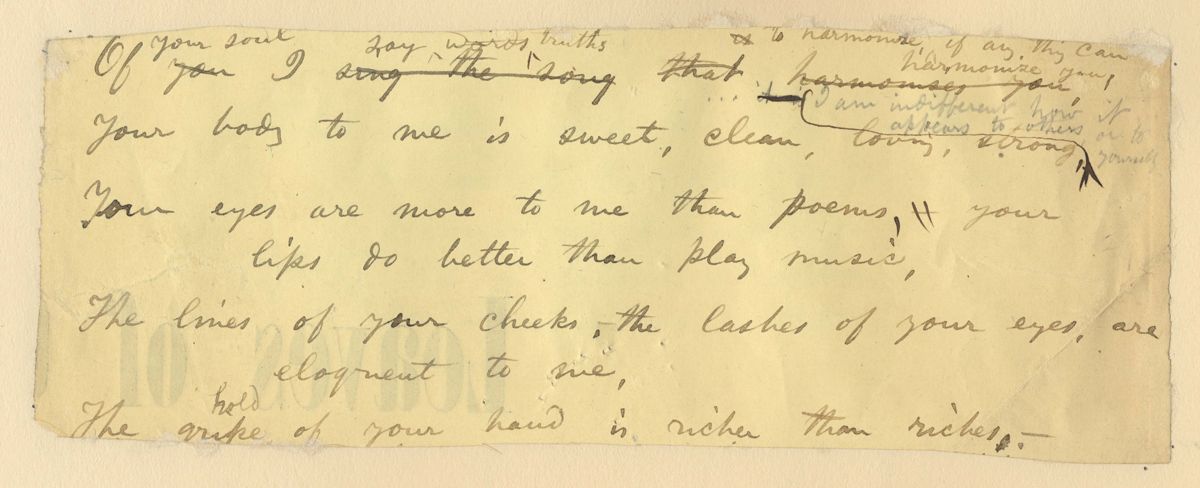
Whitman Archive Title: [Of your soul I say truths to harmonize]
-
Whitman Archive ID: uva.00282
-
Box: 1
-
Folder: 88
-
Date: about 1855
-
Genre: poetry
-
Physical Description: 1 leaf, 7.5 x 20 cm, handwritten
-
View Images:
1
|
2
-
Content:
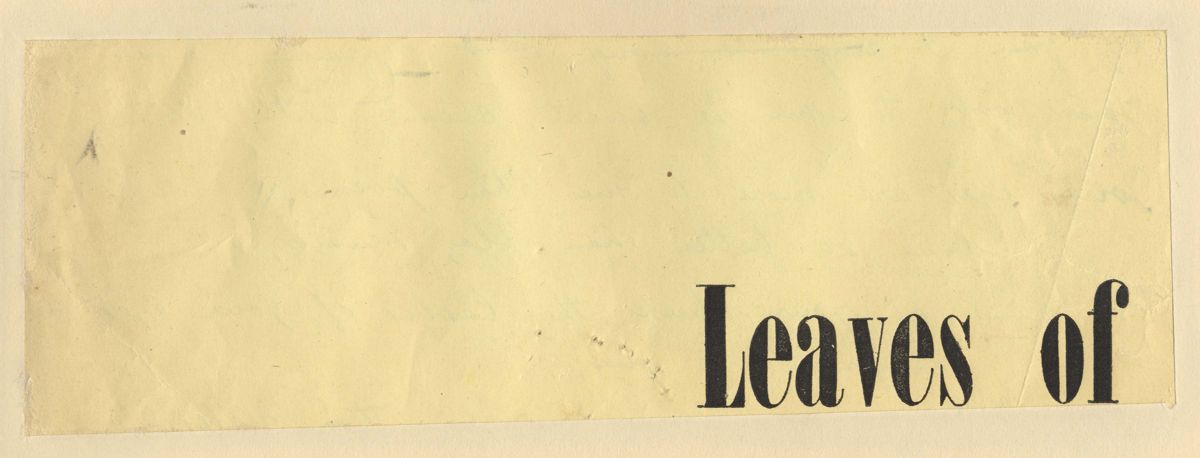
The verso contains the words "Leaves of" from a title page of the 1855 edition of "Leaves of Grass".
The damage to the words "The gripe" in the last line by cutting and the
appearance of the tops of other letters above the lower edge suggest that this was
the upper section of a larger leaf.
-
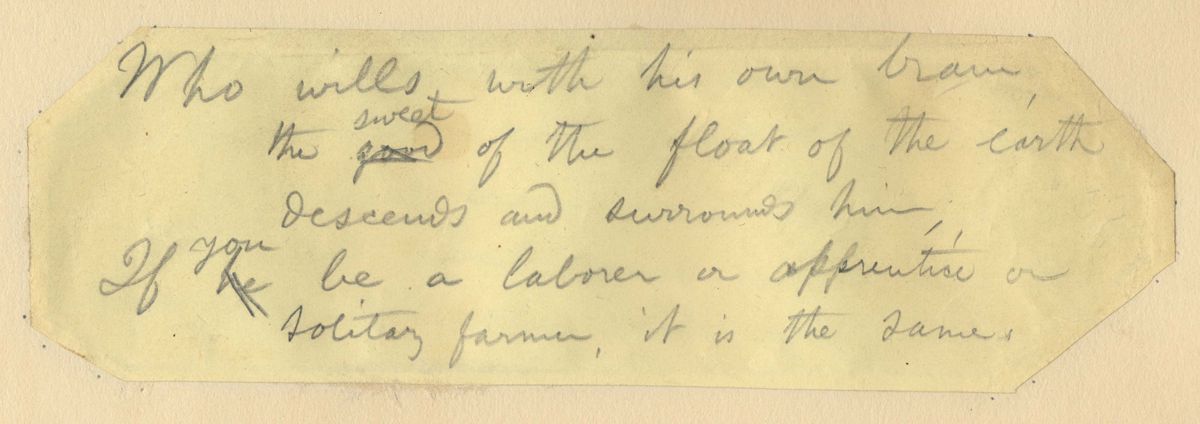
Whitman Archive Title: [Who wills with his own brain]
-
Whitman Archive ID: uva.00283
-
Box: 1
-
Folder: 88
-
Date: about 1855
-
Genre: poetry
-
Physical Description: 1 leaf, 5 x 16 cm, handwritten
-
View Images:
1
|
2
-
Content:
Draft lines of an incomplete poem, of which other parts may have been lost or
never written. These lines display some similarities to the eleventh untitled poem
of the 1855 edition of
Leaves of
Grass
, named "Lesson
Poem" in 1856 and finally, beginning with 1871's
Passage to India
, "Who Learns My Lesson Complete?"
-
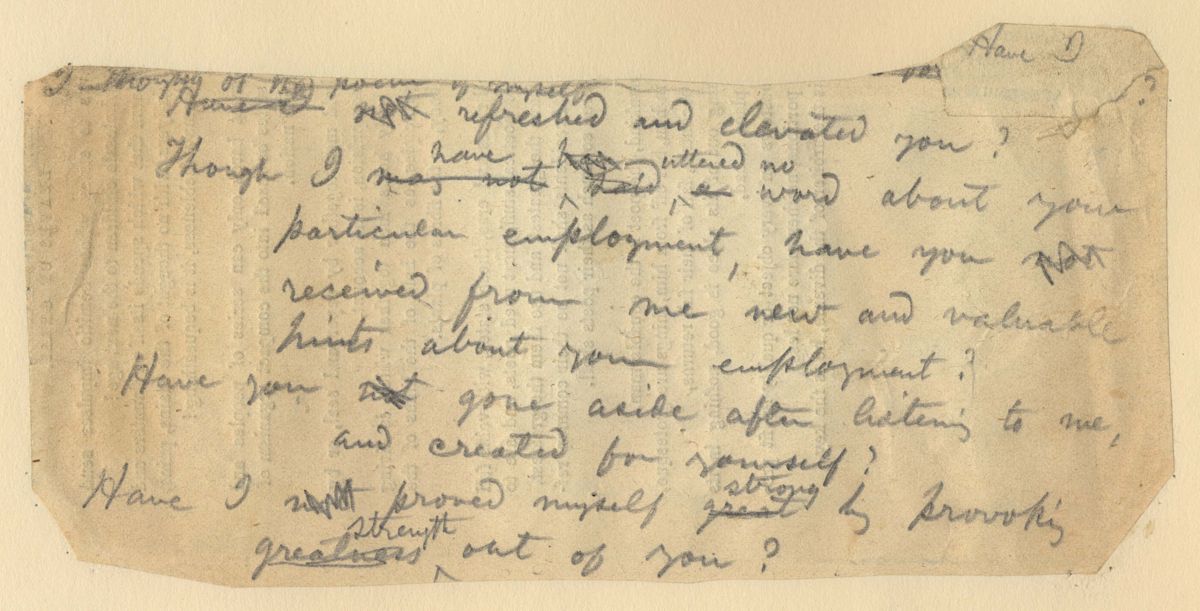
Whitman Archive Title: [Have I]
-
Whitman Archive ID: uva.00284
-
Box: 1
-
Folder: 88
-
Date: about 1856
-
Genre: poetry
-
Physical Description: 1 leaf, 9 x 18 cm, handwritten
-
View Images:
1
|
2
-
Content:
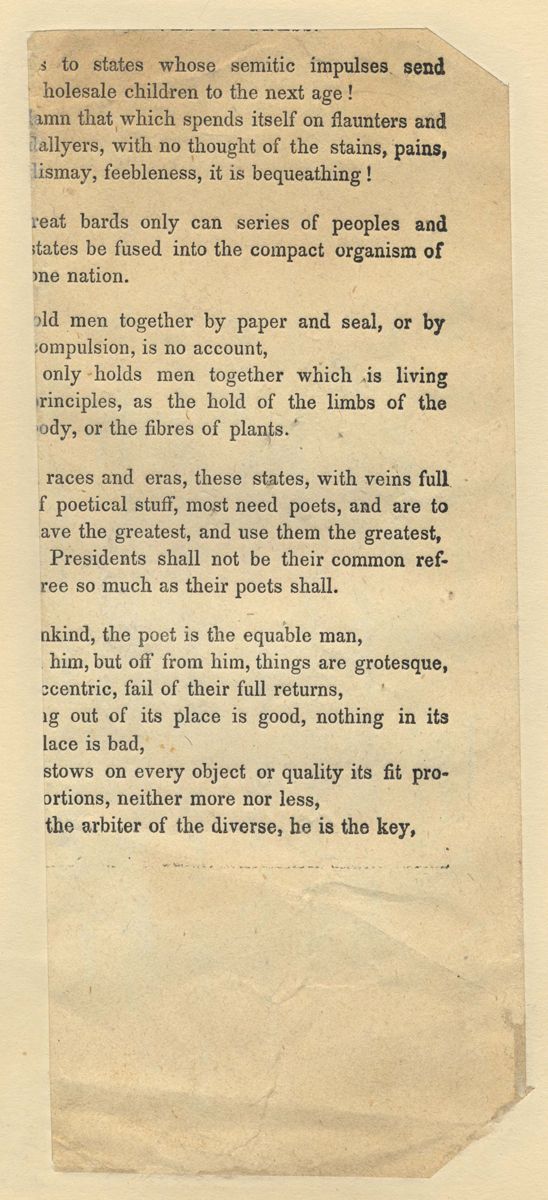
The words "Have I" at the beginning are inscribed on a small scrap of the same
paper, which Whitman pasted over some deleted words in the upper right corner that
cannot be discerned through the paper. Inscribed and extensively revised in
pencil, these verses were part of a larger set of lines before Whitman cut away
the rest. Although the page number and many words on the left side of the proof
have been cut away, the remaining words identify it as being from the "Poem of Many in One (1856)," which eventually became "By Blue Ontario's Shore." These unused but also
undeleted lines may have been intended for that poem or a number of other poems in
Leaves of Grass
.
-
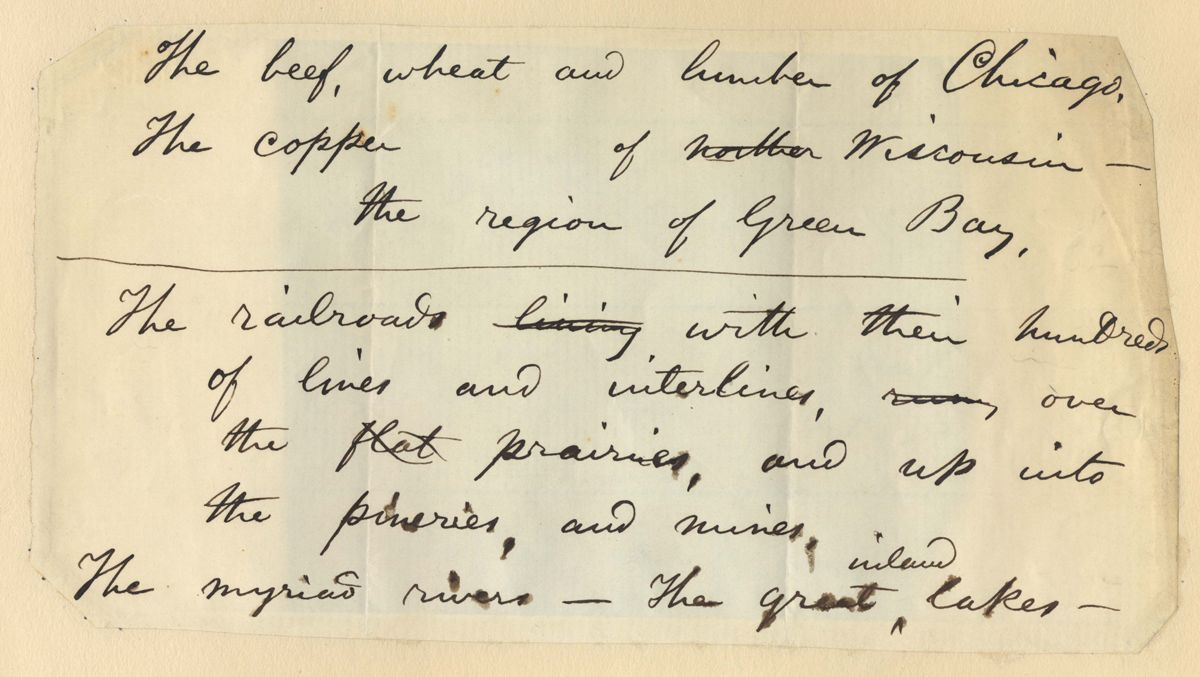
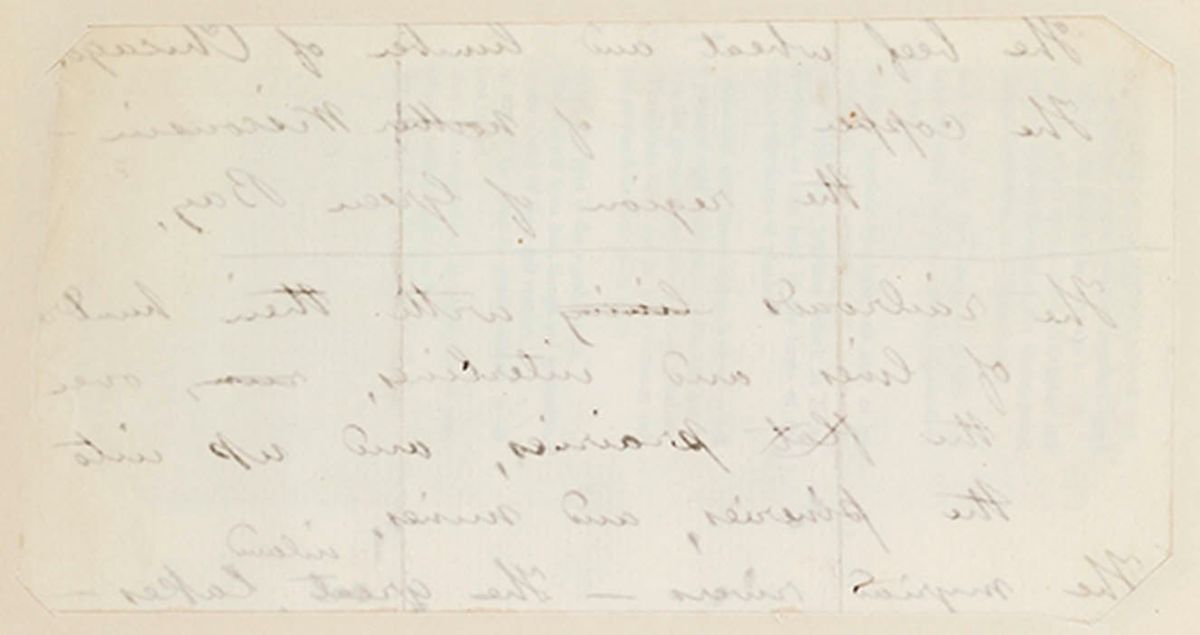
Whitman Archive Title: [The beef, wheat, and lumber of Chicago]
-
Whitman Archive ID: uva.00285
-
Box: 1
-
Folder: 88
-
Date: about 1855
-
Genre: poetry
-
Physical Description: 1 leaf, 10.5 x 19.5 cm, handwritten
-
View Images:
1
|
2
-
Content:
Although these poetic notes are difficult to date, they may represent an
intermediate stage between the 1855 Preface to
Leaves of Grass
and the 1856
"Poem of Many in One"
(eventually "By Blue Ontario's
Shore"), which cast many sentences similar to these from the Preface in
poetic form.
-
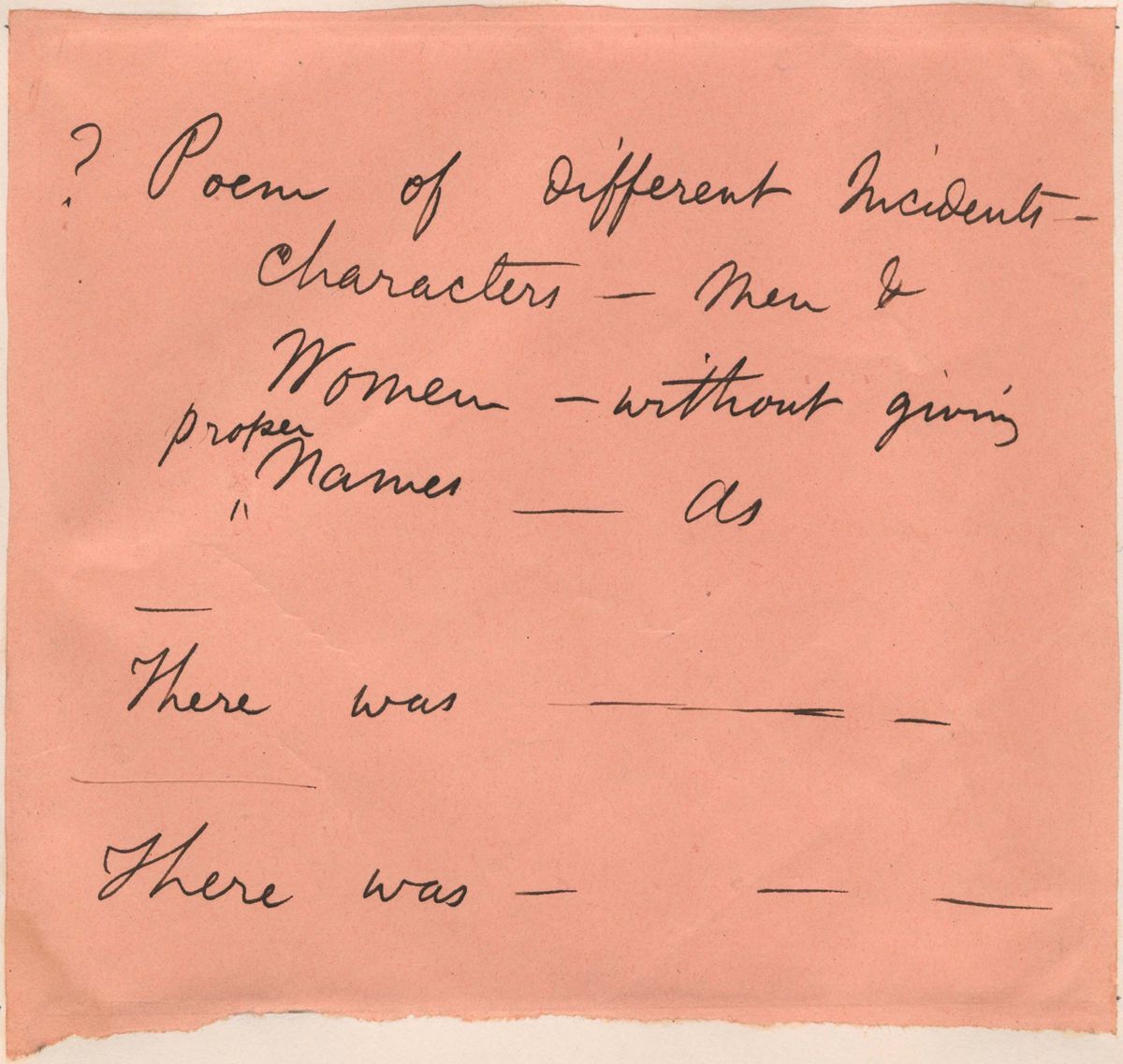
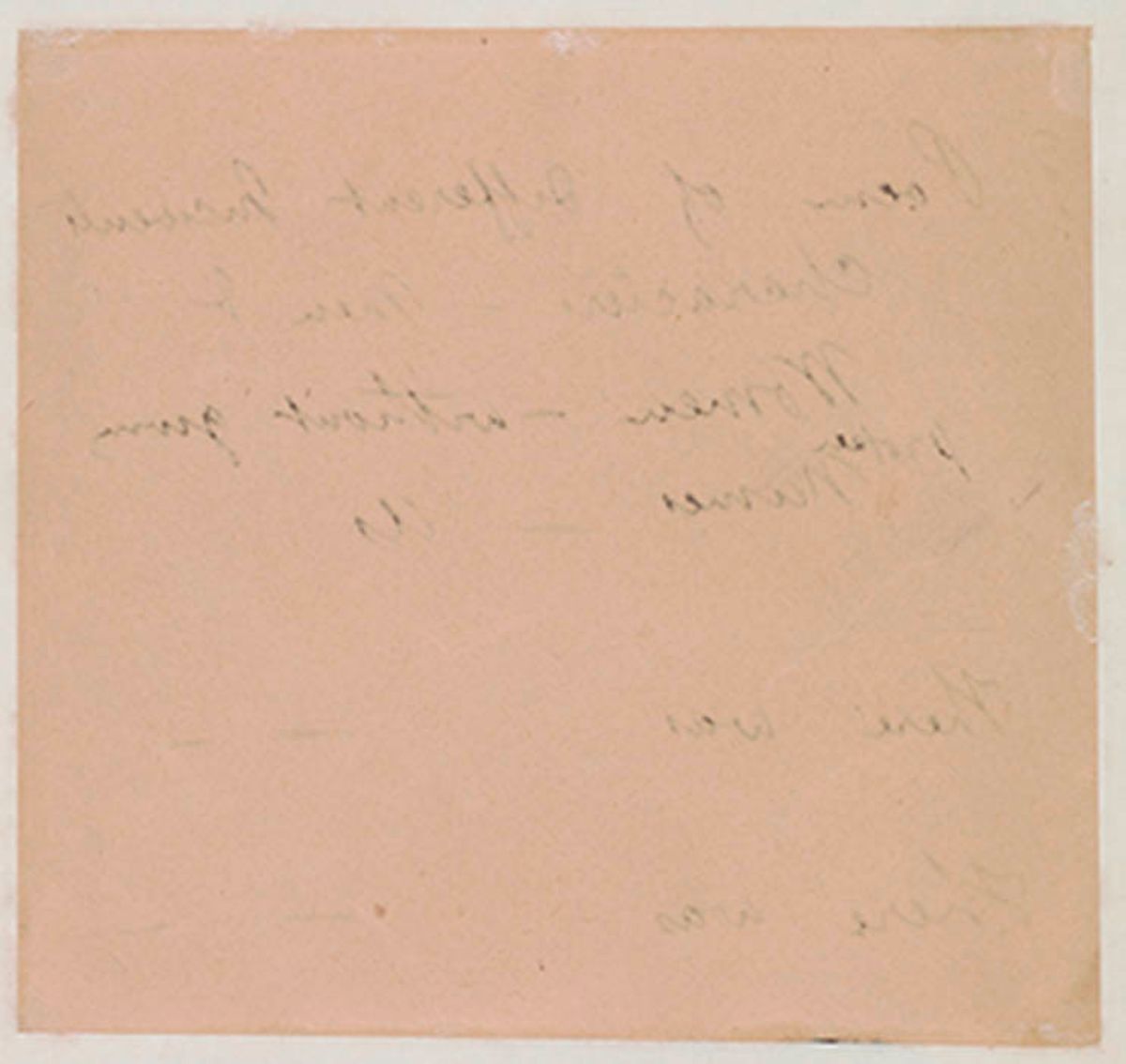
Whitman Archive Title: [?Poem of different incidents]
-
Whitman Archive ID: uva.00295
-
Box: 2
-
Folder: 2
-
Date: 1850-1860
-
Genre: poetry
-
Physical Description: 1 leaf, 7.5 cm x 12.5 cm, handwritten
-
View Images:
1
|
2
-
Content:
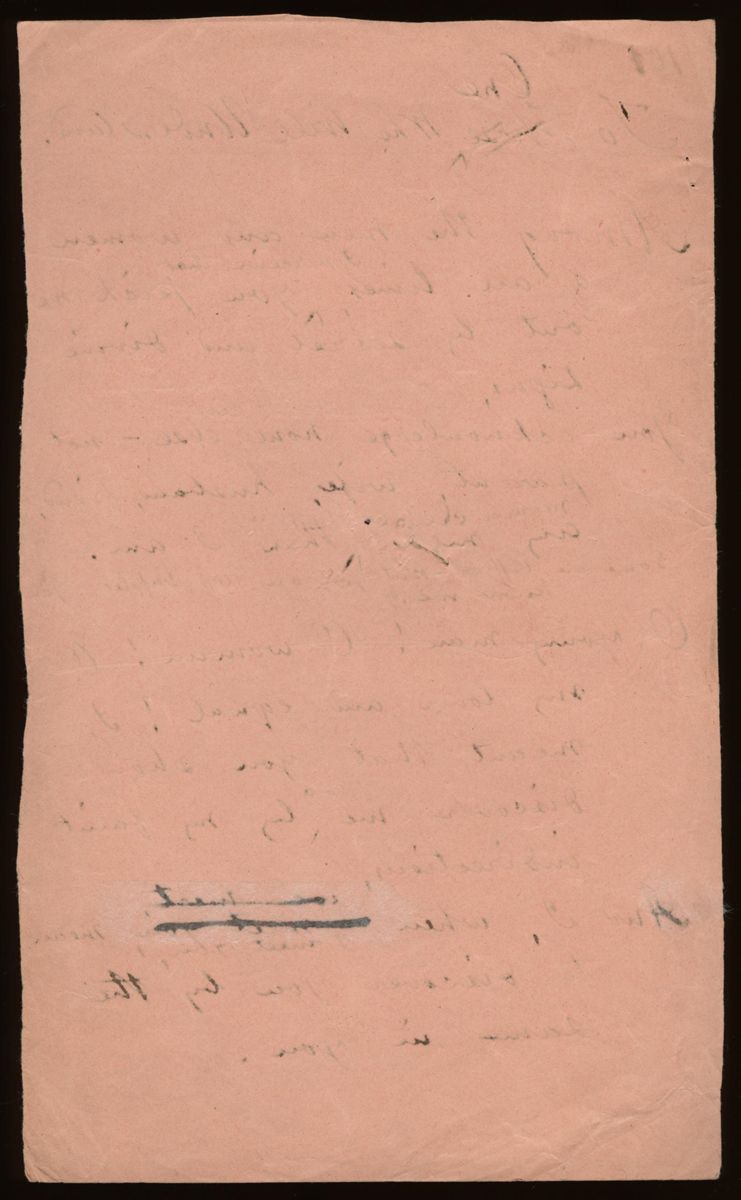
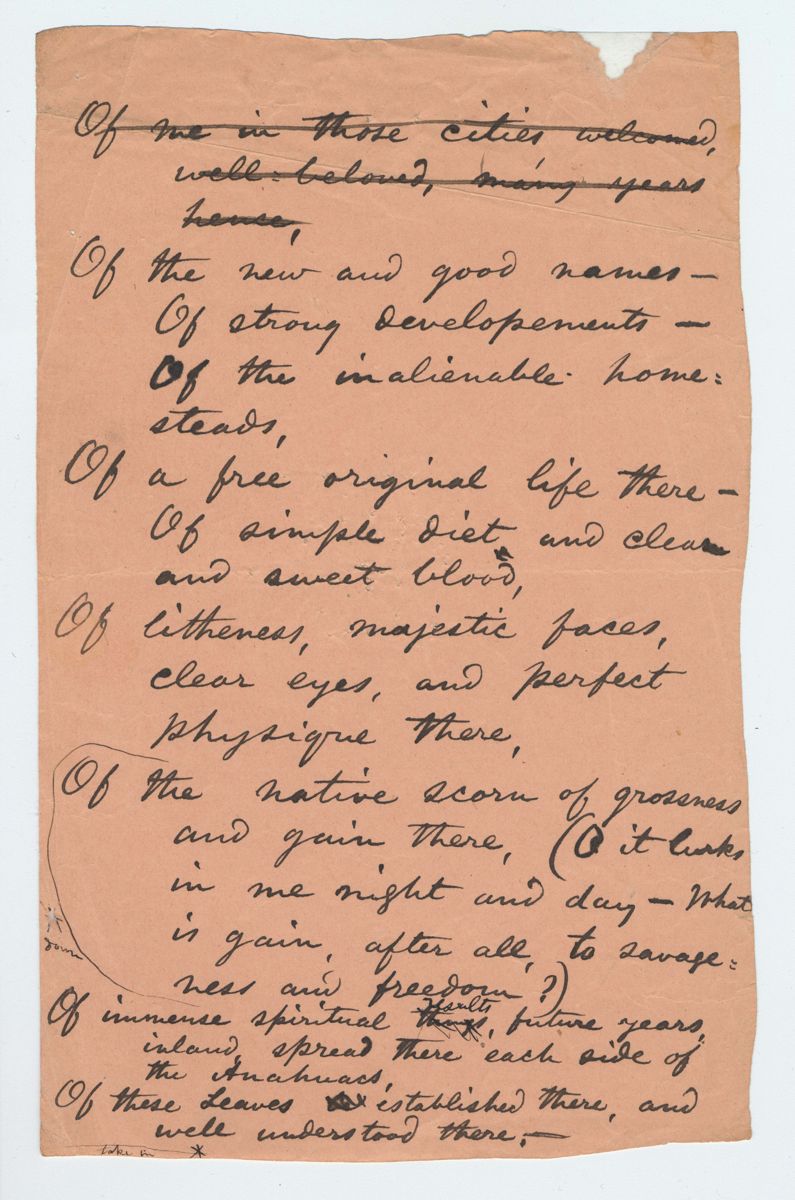
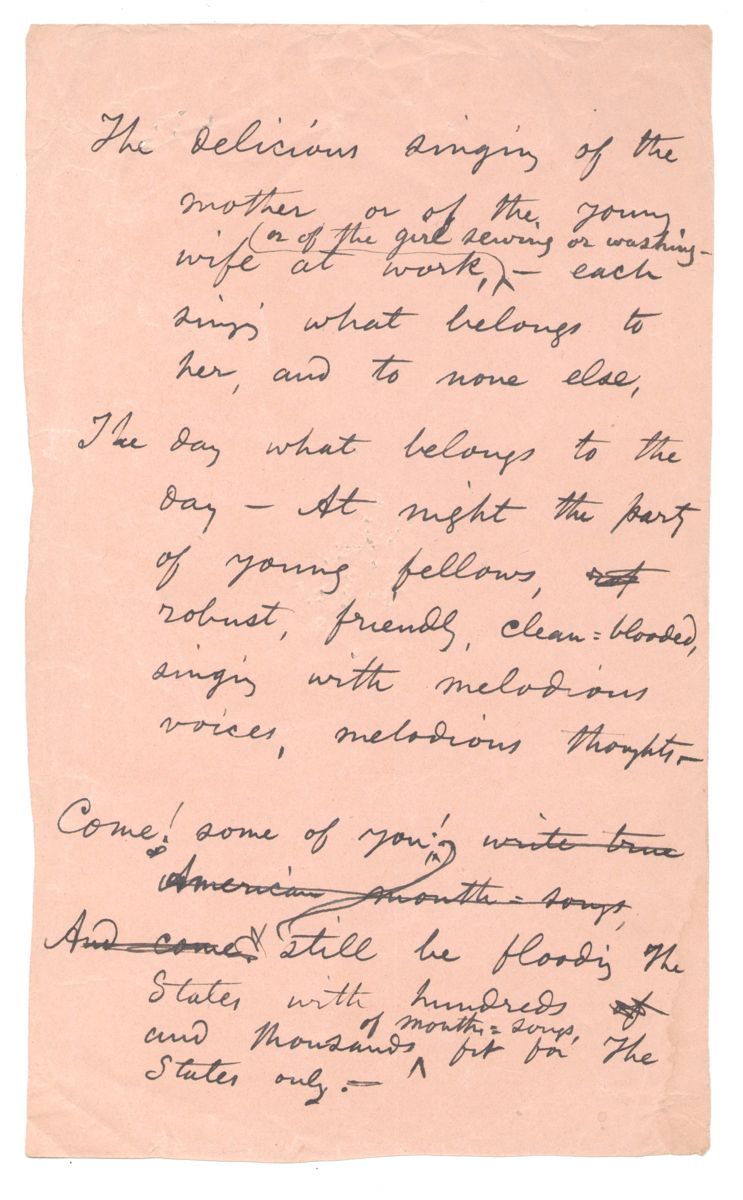
Notes toward a "poem of different incidents," written in ink on pink paper.
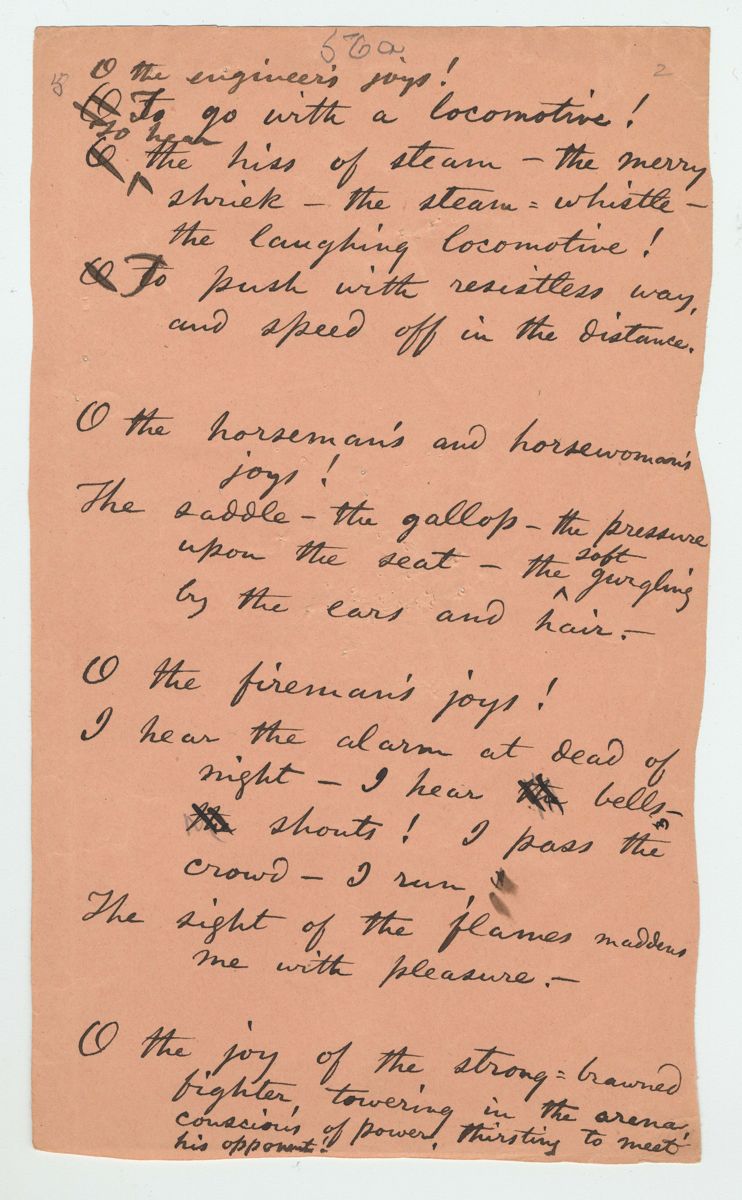
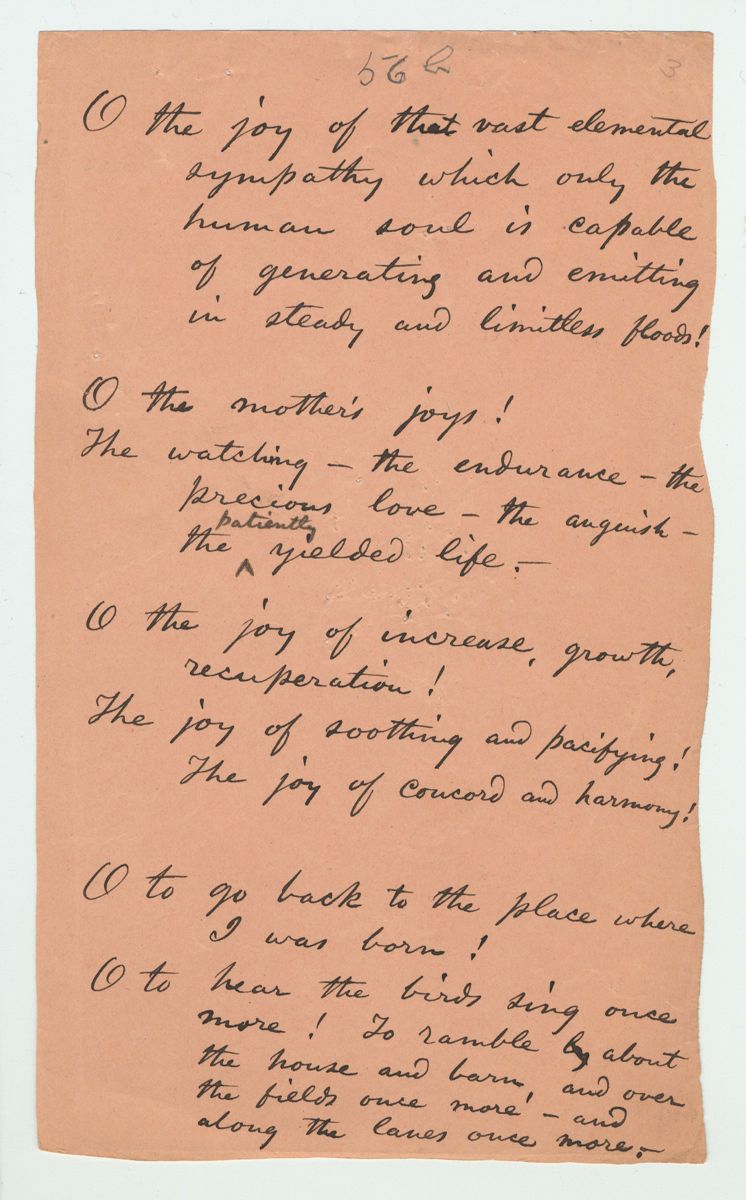
-
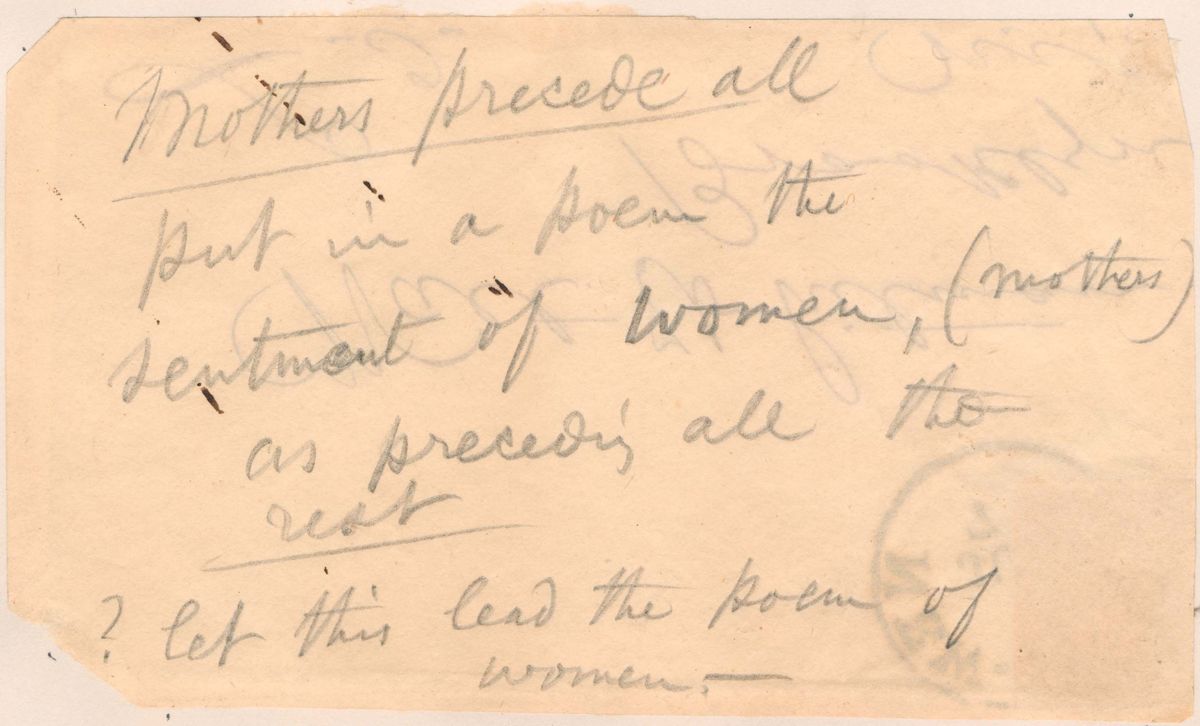
Whitman Archive Title: Mothers precede all
-
Whitman Archive ID: uva.00296
-
Box: 2
-
Folder: 2
-
Date: 1850-1860
-
Genre: poetry
-
Physical Description: 1 leaf, 8 cm x 13.5 cm, handwritten
-
View Images:
1
|
2
-
Content:
Pencil on verso of envelope.
-
Whitman Archive Title: [In Poems]
-
Whitman Archive ID: uva.00297
-
Box: 2
-
Folder: 2
-
Date: 1850-1860
-
Genre: poetry
-
Physical Description: 1 leaf, 7.5 cm x 15.5 cm, handwritten
-
View Images:
1
|
2
-
Content:
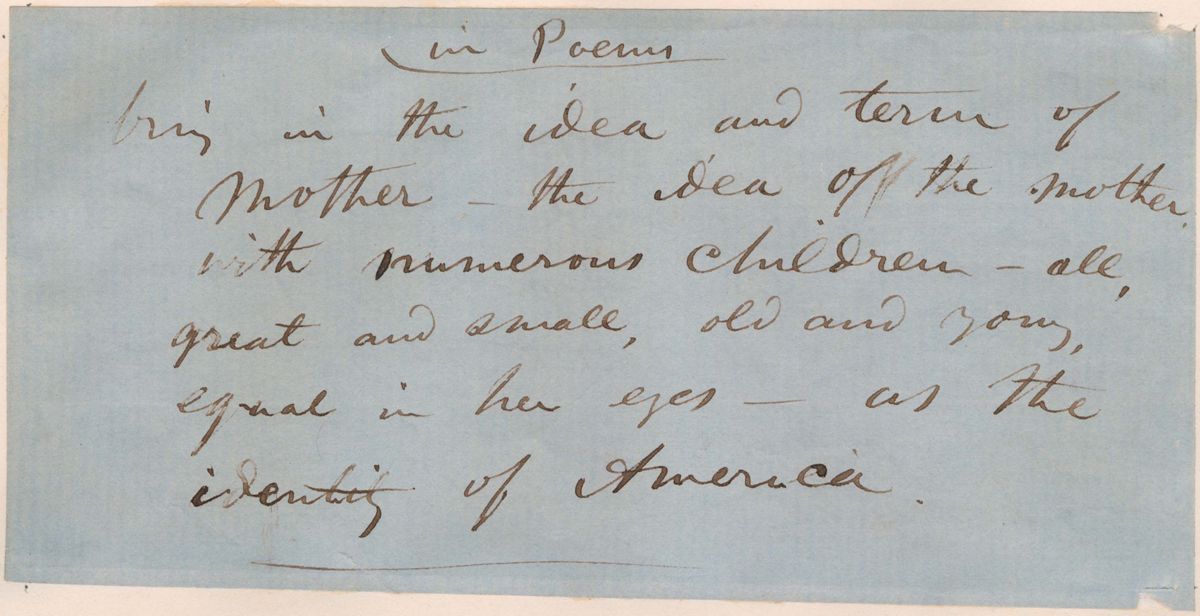
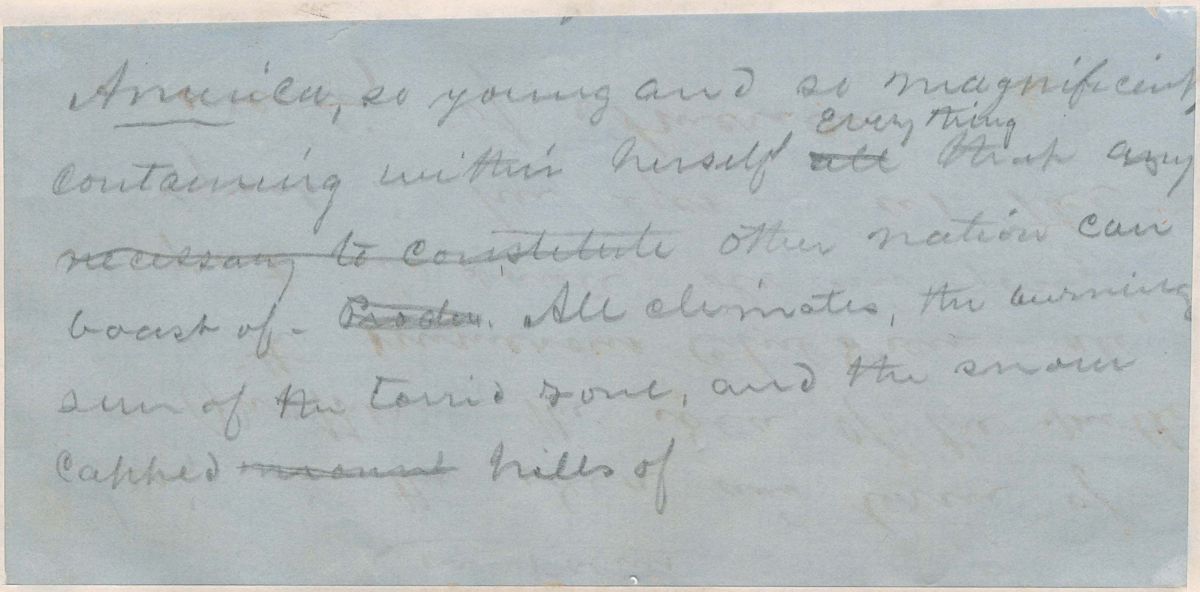
Ink on blue paper. Pasted on bottom half of archival leaf. Verso has some notes
for poem "[America, so young and so
magnificent]."
-
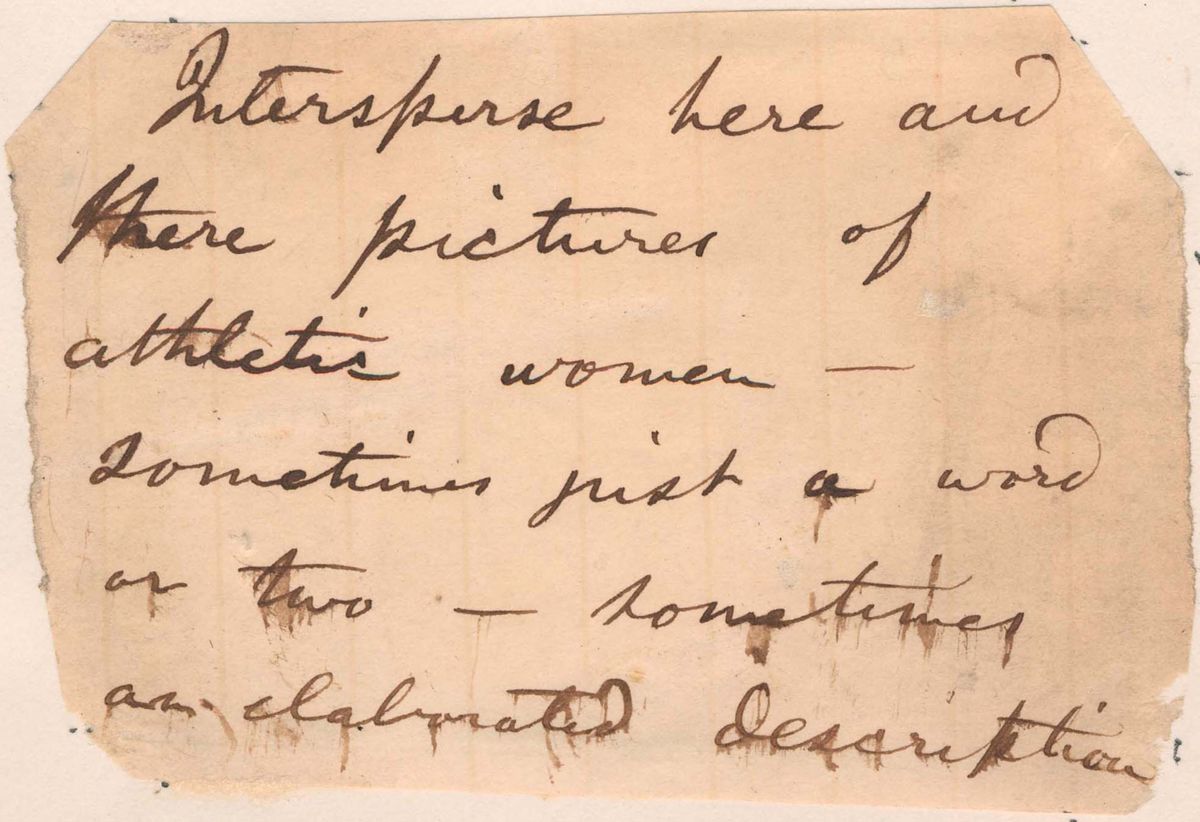
Whitman Archive Title: [Intersperse here and]
-
Whitman Archive ID: uva.00300
-
Box: 2
-
Folder: 2
-
Date: 1850-1860
-
Genre: poetry
-
Physical Description: 1 leaf, 5.5 cm x 8 cm, handwritten
-
View Images:
1
|
2
-
Content:
Written in ink. Pasted on top third of archival leaf.
-
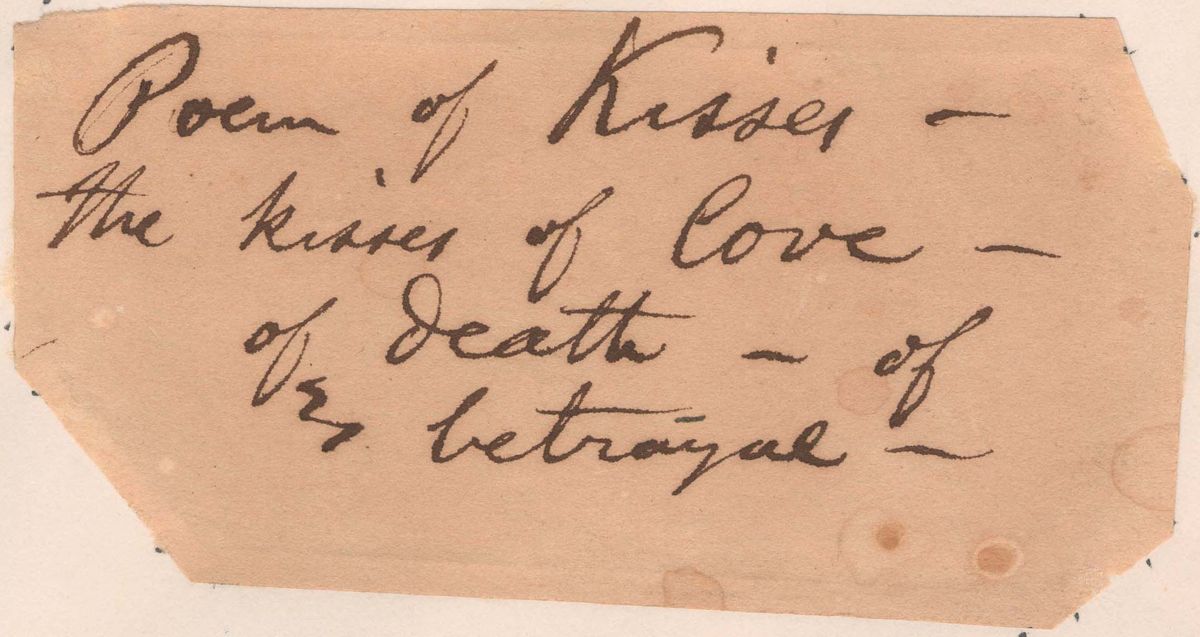
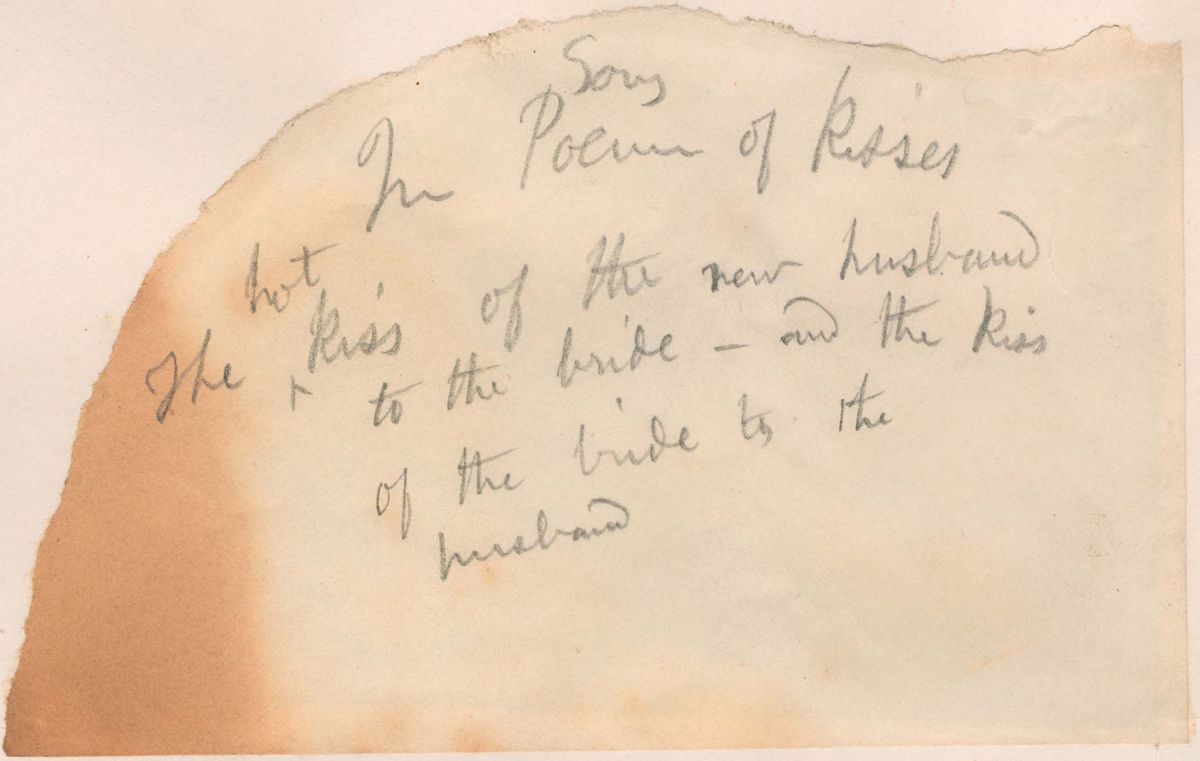
Whitman Archive Title: Poem of Kisses
-
Whitman Archive ID: uva.00301
-
Box: 2
-
Folder: 2
-
Date: Before 1860
-
Genre: prose, poetry
-
Physical Description: 1 leaf, 5 cm x 9.5 cm, handwritten
-
View Images:
1
|
2
-
Content:
The name of the proposed poem, "Poem of Kisses," recalls the title format used in the 1856 edition of
Leaves of Grass
. Based on the topic and the manuscript's appearance in Richard Maurice Bucke's
Notes and Fragments
(1899) with transcriptions of other early manuscripts, Edward Grier speculates that Whitman wrote this before 1860 (
Notebooks and Unpublished Prose Manuscripts
[New York: New York University Press, 1984], 4:1344). This manuscript may relate to "Song In Poem of kisses" (uva.00302).
-
Whitman Archive Title: In Poem Song of kisses
-
Whitman Archive ID: uva.00302
-
Box: 2
-
Folder: 2
-
Date: Before 1860
-
Genre: prose, poetry
-
Physical Description: 1 leaf, 7.5 cm x 11.5 cm, handwritten
-
View Images:
1
|
2
-
Content:
This manuscript may relate to "Poem of Kisses" (uva.00301). Based on the handwriting, Edward Grier dates it before 1860 (
Notebooks and Unpublished Prose Manuscripts
[New York: New York University Press, 1984], 4:1345).
-
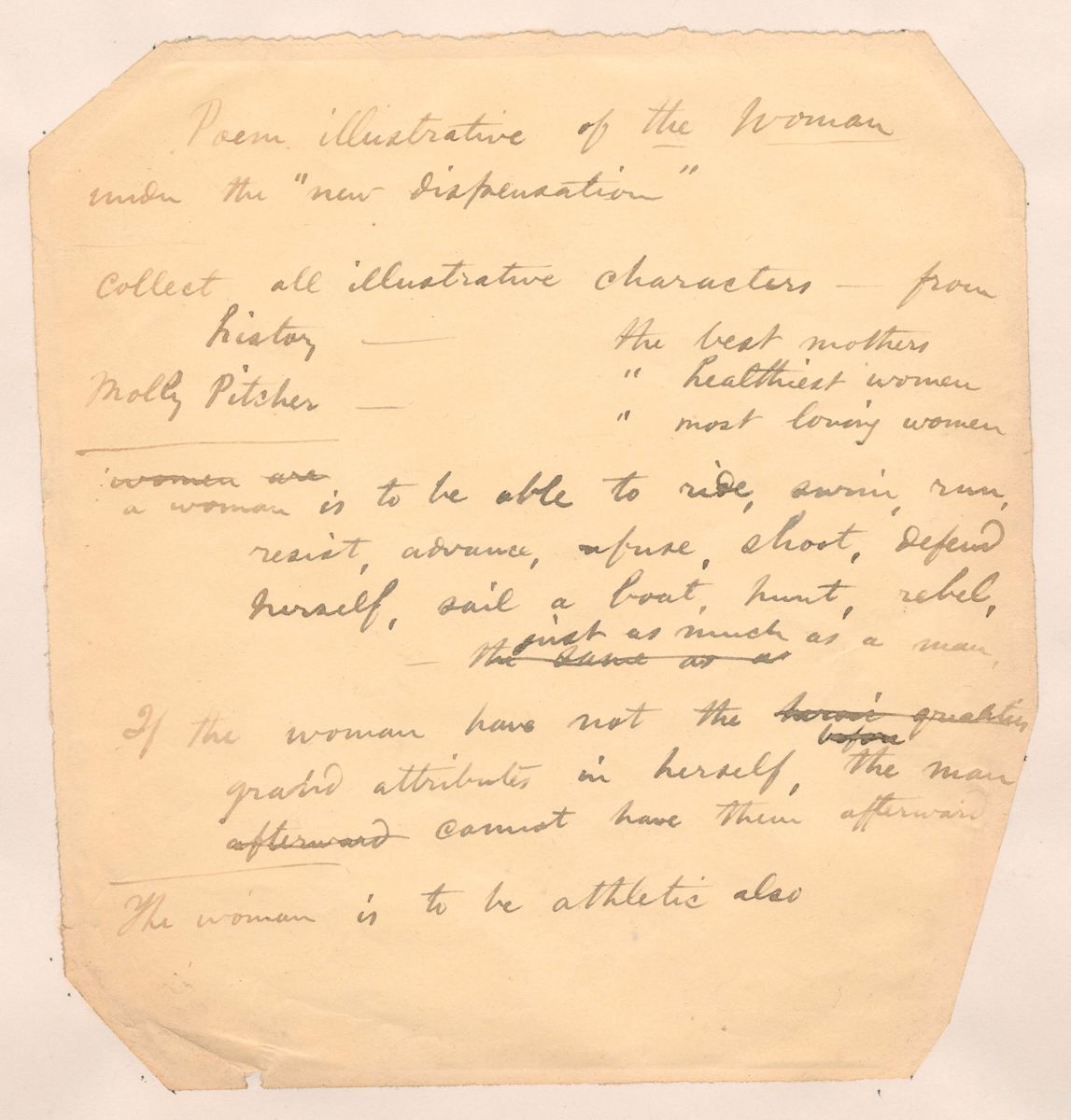
Whitman Archive Title: Poem illustrative of the Woman under the 'new dispensation'
-
Whitman Archive ID: uva.00303
-
Box: 2
-
Folder: 2
-
Date: 1850-1860
-
Genre: poetry
-
Physical Description: 1 leaf, 17 cm x 16 cm, handwritten
-
View Images:
1
|
2
-
Content:
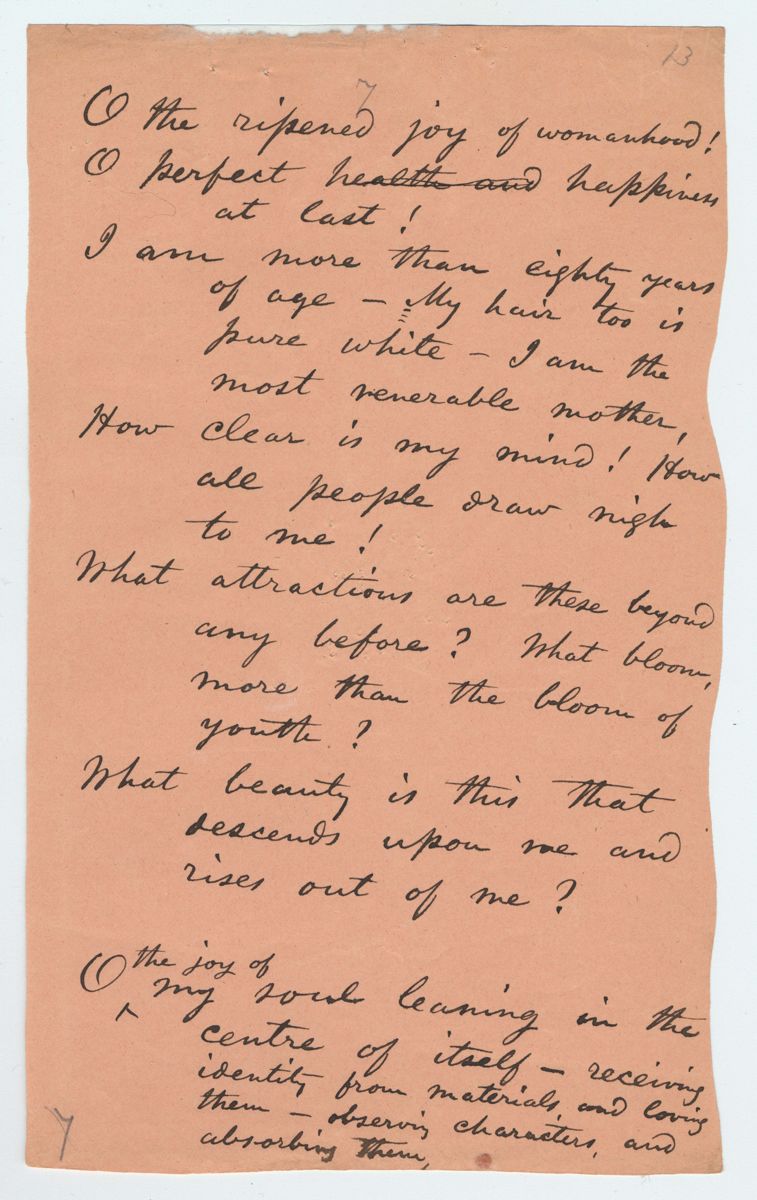
Notes and trial lines, written in ink, for a poem about the future of women.
-
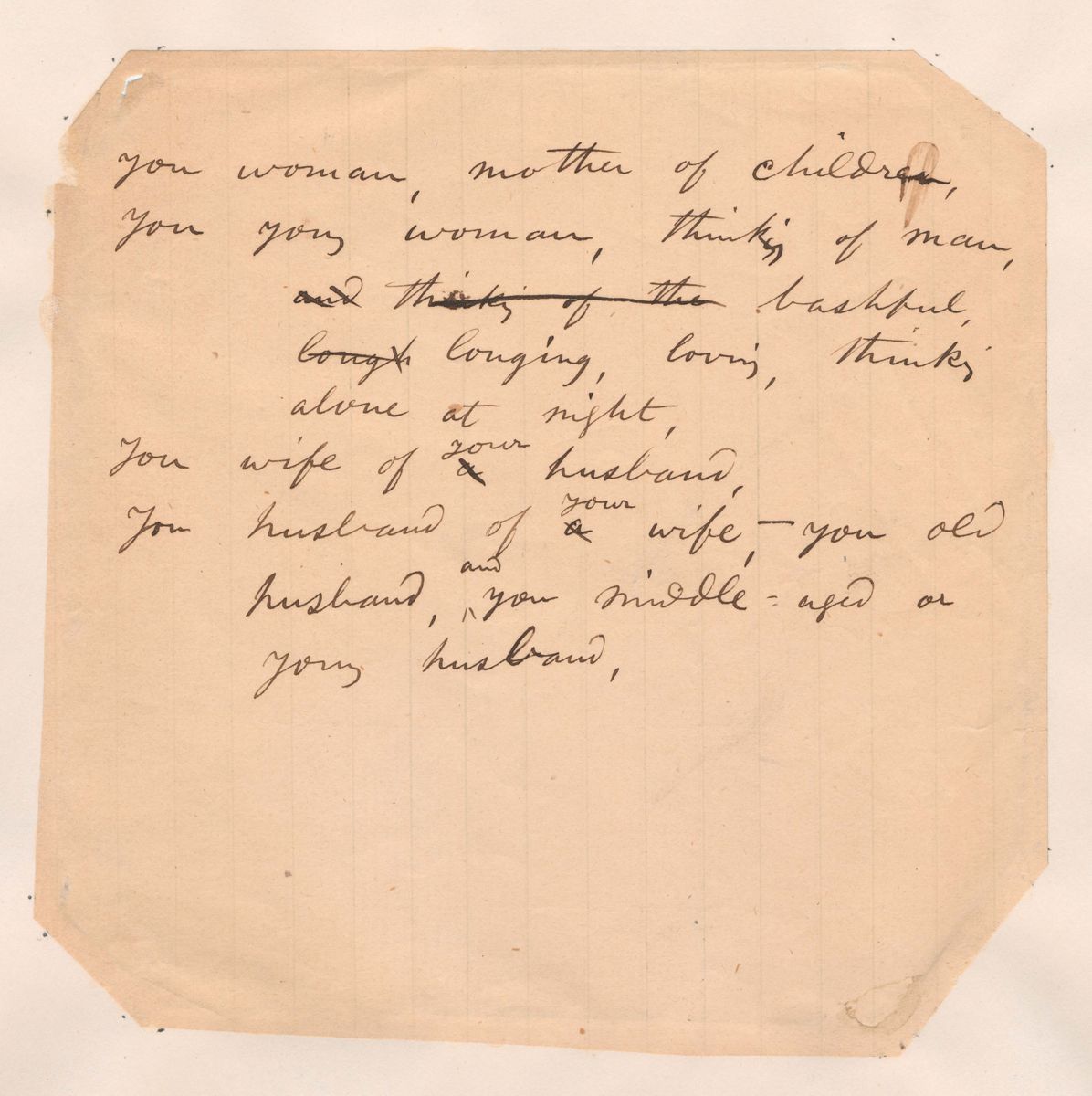
Whitman Archive Title: you woman, mother of children
-
Whitman Archive ID: uva.00137
-
Box: 2
-
Folder: 2
-
Date: Between 1850 and 1860
-
Genre: poetry
-
Physical Description: 1 leaf, 24.5 cm x 24.5 cm, handwritten
-
View Images:
1
|
2
-
Content:
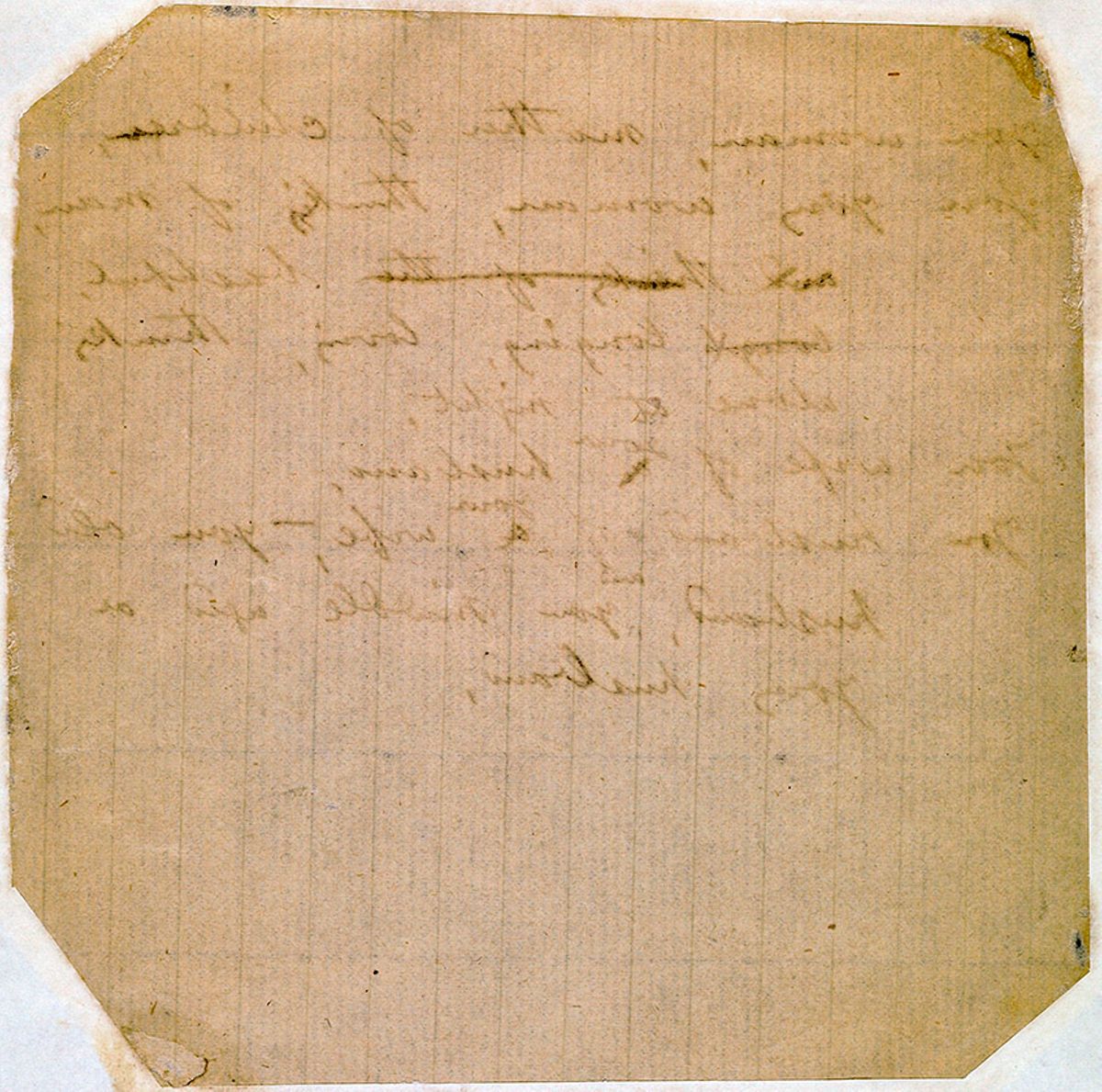
This manuscript may have been written in the early 1850s, as Whitman was preparing material for the first (1855) edition of
Leaves of Grass
. The language and imagery in the manuscript are similar to language and imagery used in the preface to that edition and in the first poem, eventually titled "Song of Myself."
-
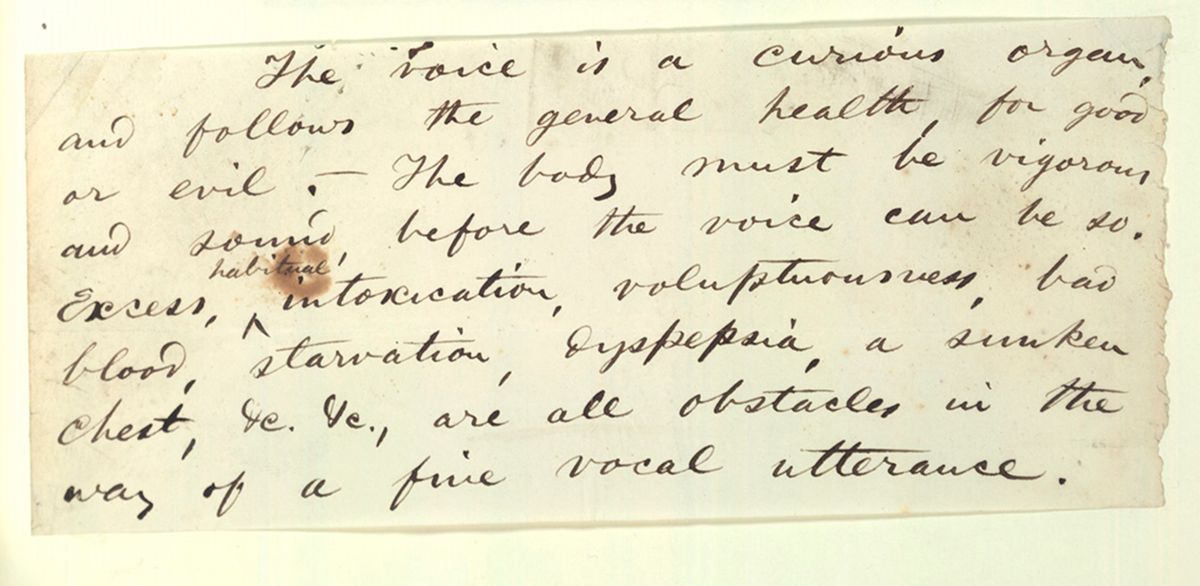
Whitman Archive Title: The voice is a curious organ
-
Whitman Archive ID: uva.00477
-
Repository ID: #3829-i
-
Box: 1
-
Folder: 38
-
Repository Title: Glimpses of Walt Whitman
-
Date: 1850-1855
-
Genre: prose
-
Physical Description: 1, handwritten; printed
-
View Images:
1
-
Content:
This manuscript scrap might be part of the missing page 8 of another manuscript by
Whitman, "A Visit to the
Opera," held at the
Huntington Library
. These and other manuscripts about opera singing bear an obvious relationship with the article "The Opera," published in
Life Illustrated
on November 10, 1855, although the details of the relationship are unclear. For a description of the intricacies of these various manuscripts, see Edward Grier,
Notebooks and Unpublished Prose Manuscripts
(New York: New York University Press, 1984) 1:388-398. The manuscript is pasted down, making the verso inaccessible.
-
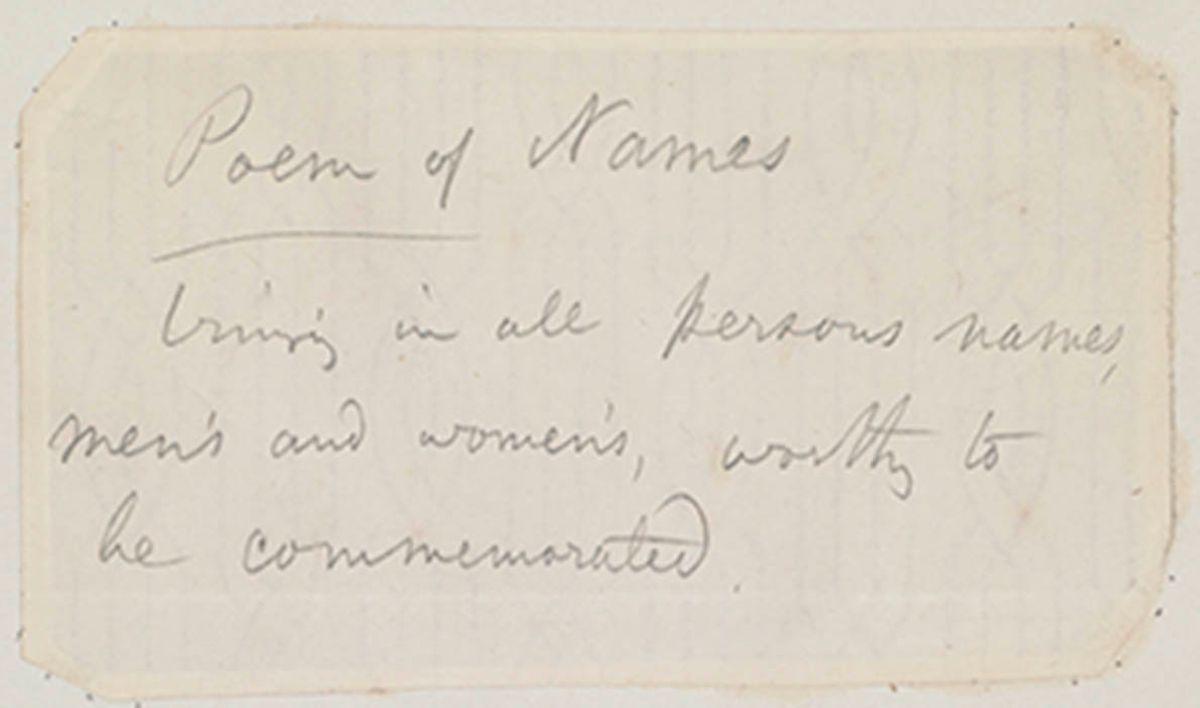
Whitman Archive Title: Poem of Names
-
Whitman Archive ID: uva.00294
-
Repository Title: "Studies of Womanhood," [ca. 1850–1860]
-
Date: Between 1850 and 1860
-
Genre: prose
-
Physical Description: 1 leaf, handwritten
-
View Images:
1
|
2
-
Content:
The name of this proposed poem, "Poem of Names," recalls the title phrasing used in the 1856 edition of
Leaves of Grass
. It is possible that this manuscript thus dates from before or early in 1856. Edward Grier dates it to the 1850s, based on the handwriting (
Notebooks and Unpublished Prose Manuscripts
[New York: New York University Press, 1984], 4:1310).
-
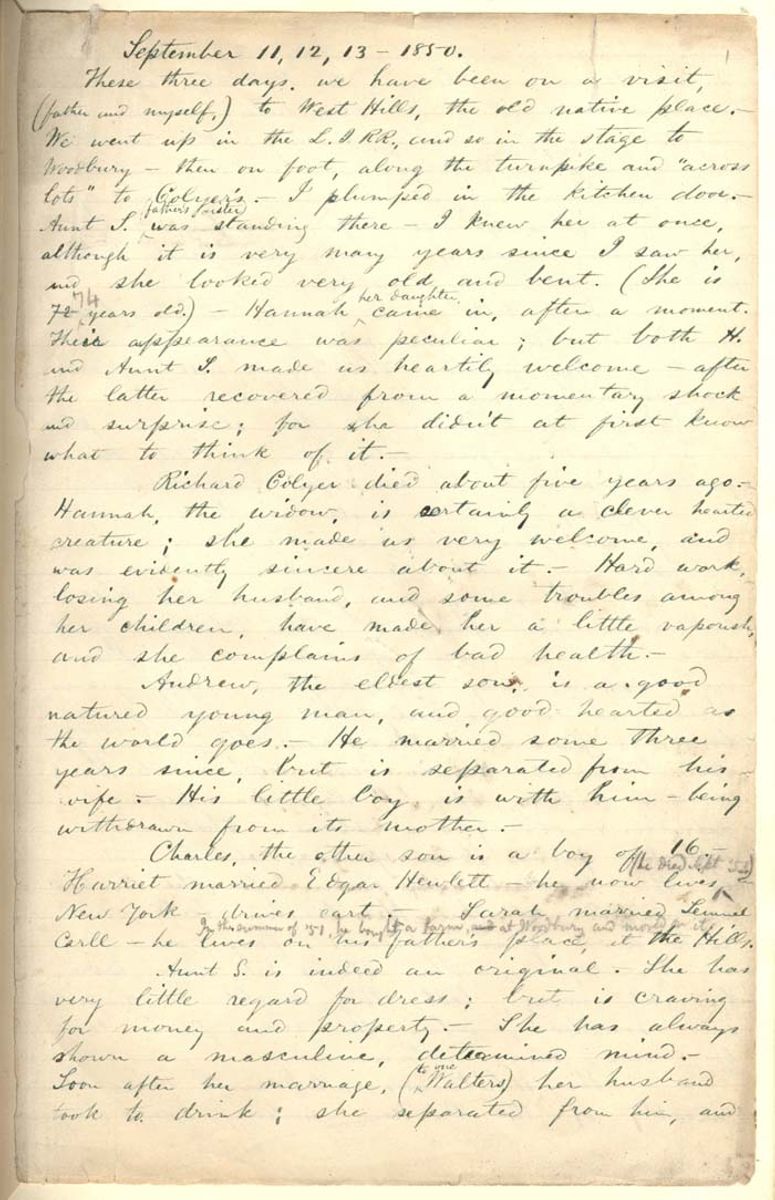
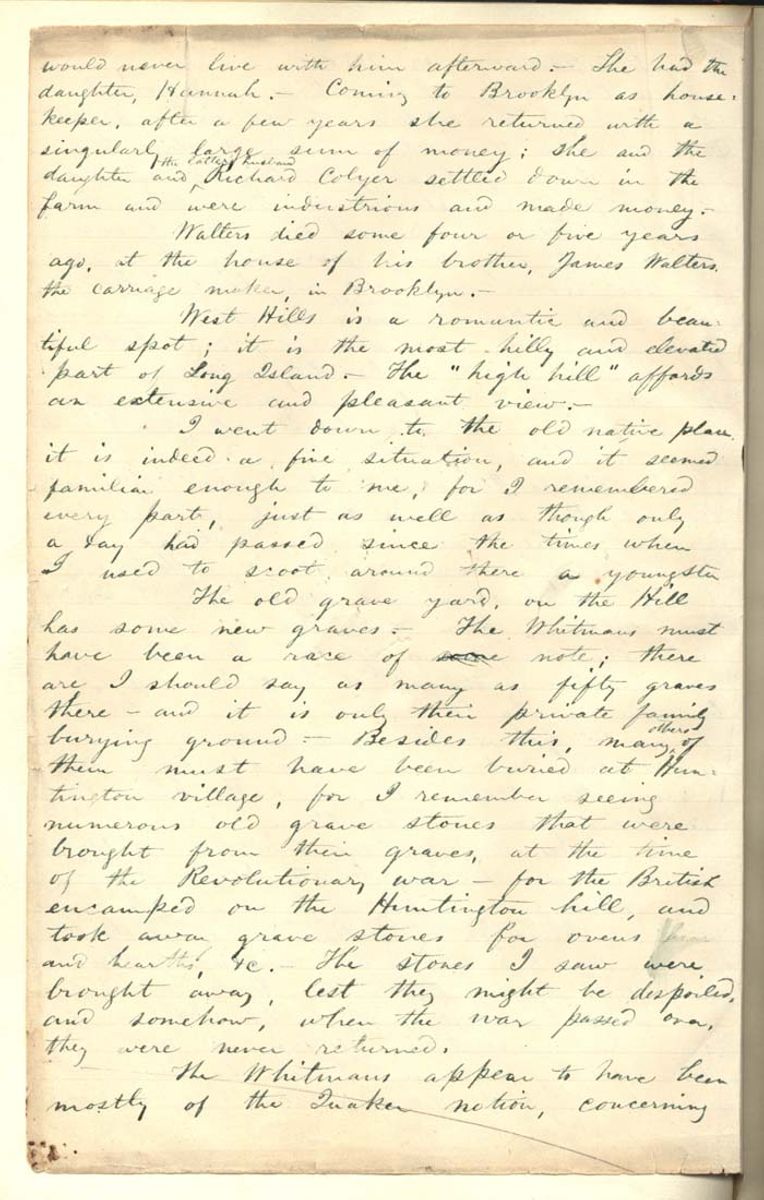
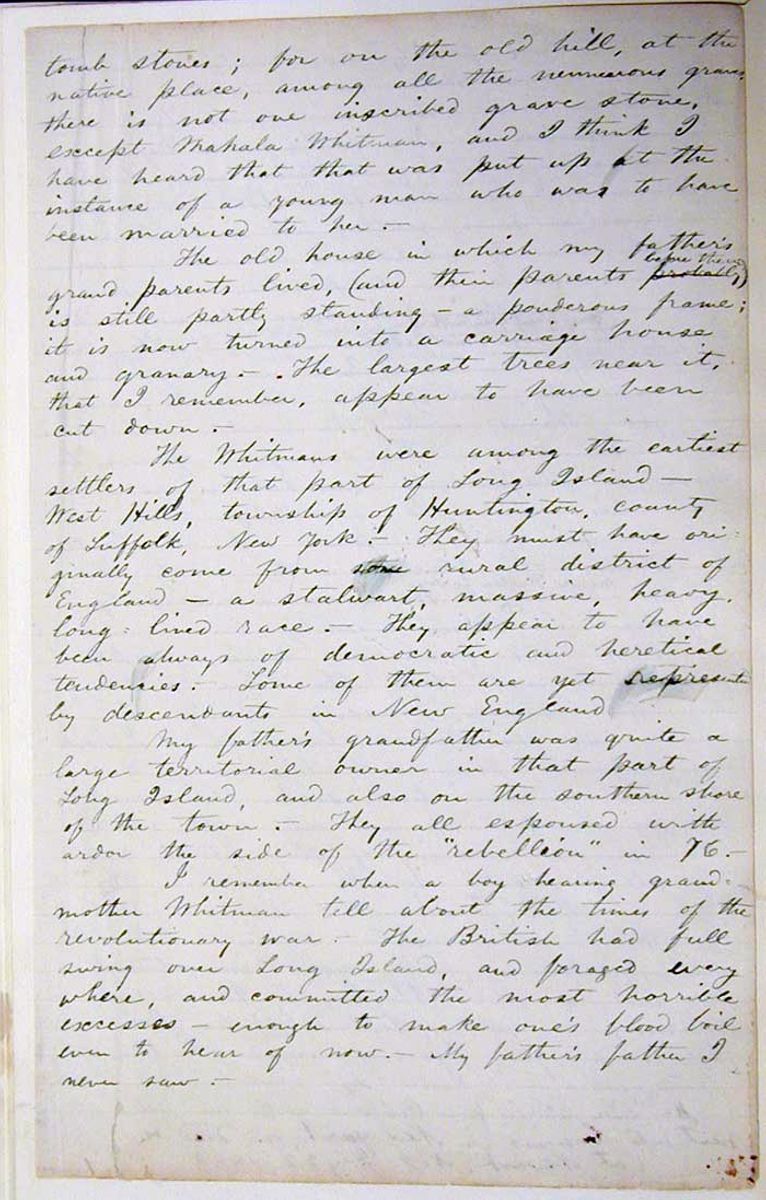
Whitman Archive Title: September 11, 12, 13—1850
-
Whitman Archive ID: hyb.00016
-
Repository Title: "Walt Whitman: A description of His Birthplace..."
-
Date: Between 1850 and 1883
-
Genre: prose
-
Physical Description: 2 leaves, handwritten
-
View Images:
1
|
2
|
3
|
4
-
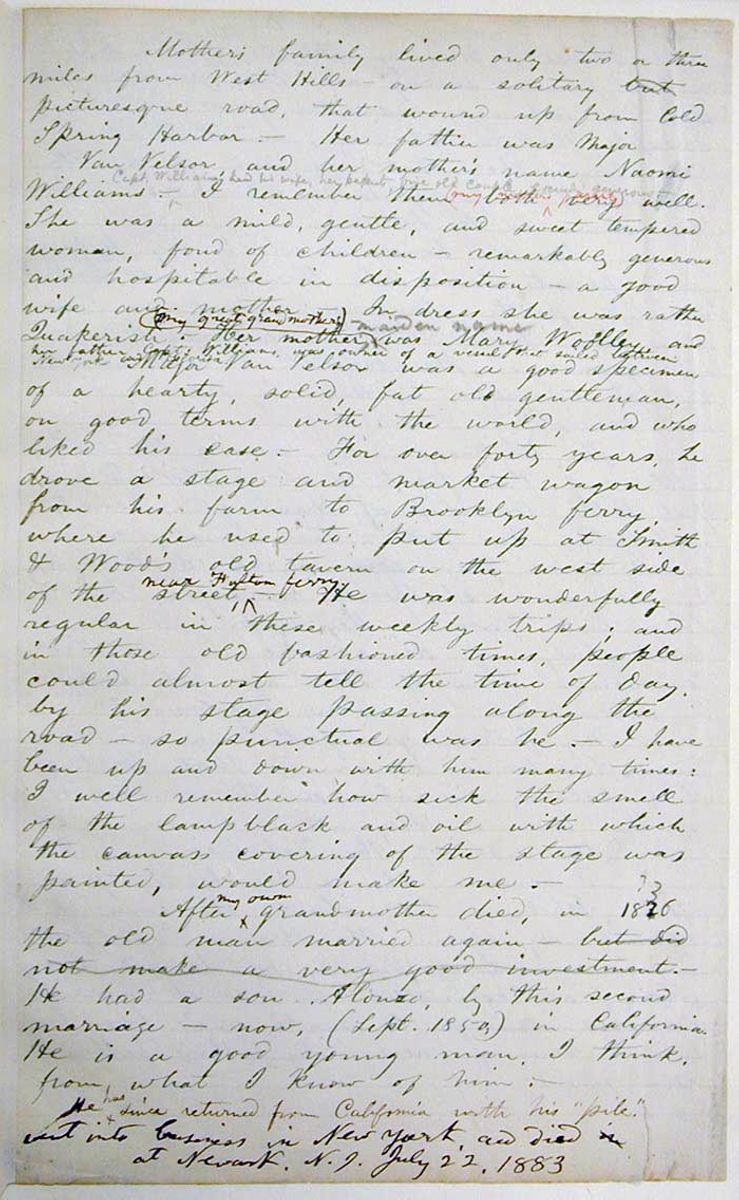
Content:
This manuscript, consisting of two leaves, features an autobiographical account of Whitman's visit to his birthplace in Huntington, Long Island. Whitman mentions this visit in "The Old Whitman and Van Velsor Cemeteries," an 1881 recollection published in
Specimen Days.
Although Whitman probably wrote the manuscript during or shortly after the visit in September 1850, he returned to it as late as 1883, adding a note at the end of the piece about the death of his stepuncle (see Edward Grier,
Notebooks and Unpublished Prose Manuscripts
[New York: New York University Press, 1984], 1:4). At some point, the leaves of the manuscript became separated, and the first leaf wound up at the University of Virginia and the second at Duke University. We have presented them here as one object.
-
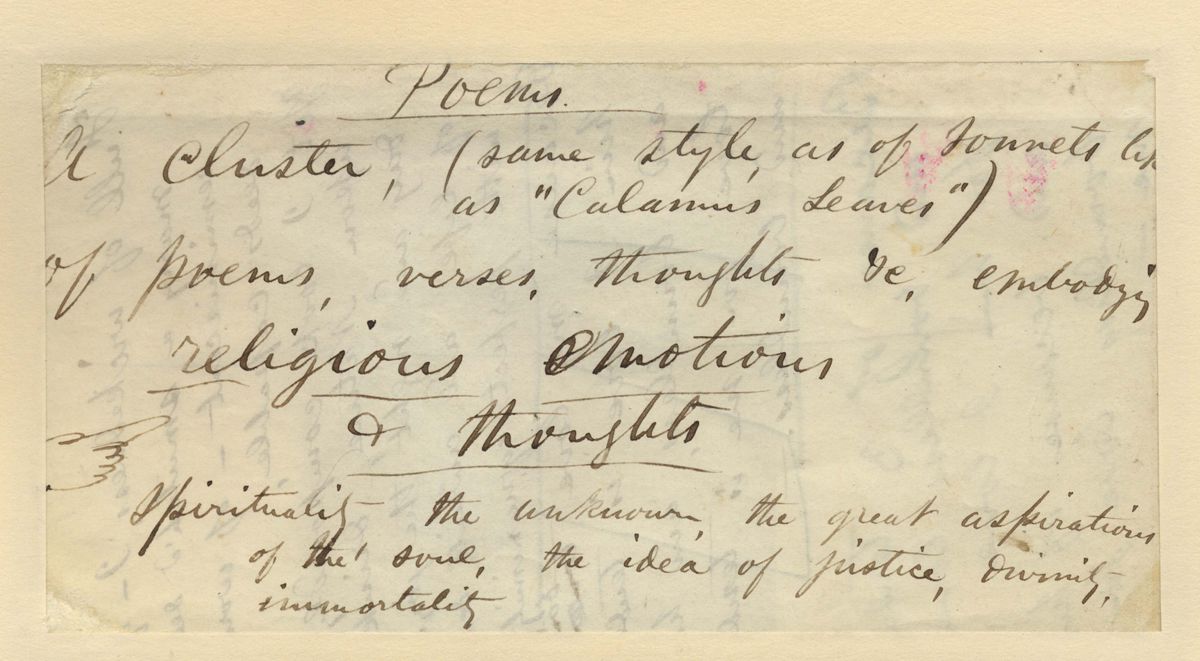
Whitman Archive Title: A cluster of poems
-
Whitman Archive ID: uva.00086
-
Repository ID: #3829-i
-
Box: 1
-
Folder: 19
-
Date: About 1859
-
Genre: poetry
-
Physical Description: 1 leaf, 19.5 x 15.5 cm, handwritten
-
View Images:
1
|
2
-
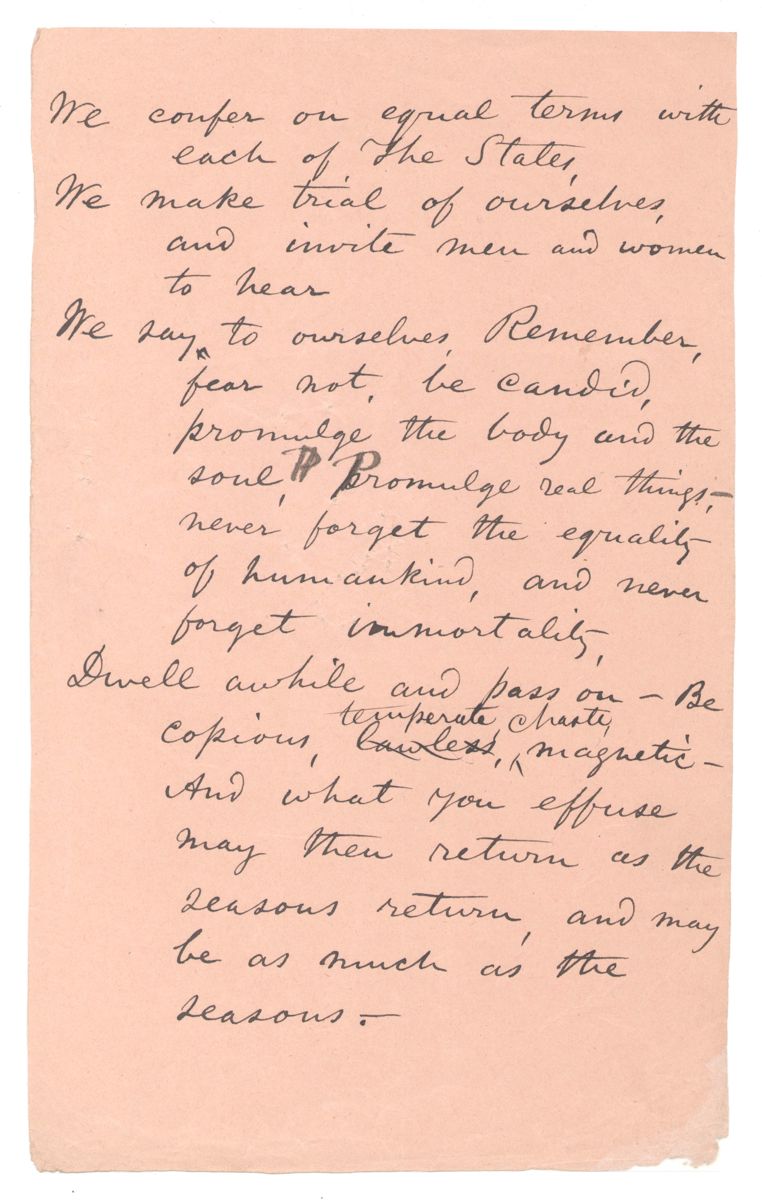
Content:
This manuscript contains notes for a cluster of poems that Whitman characterizes as being "in the
same way as 'Calamus Leaves' expressing the idea and sentiment of Happiness . . . " Whitman's use of the title "Calamus Leaves" on the opposite side, as in some very similar notes currently housed at Duke University, point toward the 1860 cluster "Enfans d'Adam" and dates the notes to some point in the late spring of 1859. On the reverse side of the leaf (uva.00516) are lines that perhaps constitute early notes for the second poem in the 1855 edition of
Leaves of Grass
, a poem that would eventually be titled "A Song for Occupations."
-
Whitman Archive Title: I subject all the teachings
-
Whitman Archive ID: uva.00249
-
Box: 1
-
Folder: 88
-
Date: Between 1854 and 1860
-
Genre: poetry
-
Physical Description: 1 leaf, 15.5 x 12 cm, handwritten
-
View Images:
1
|
2
-
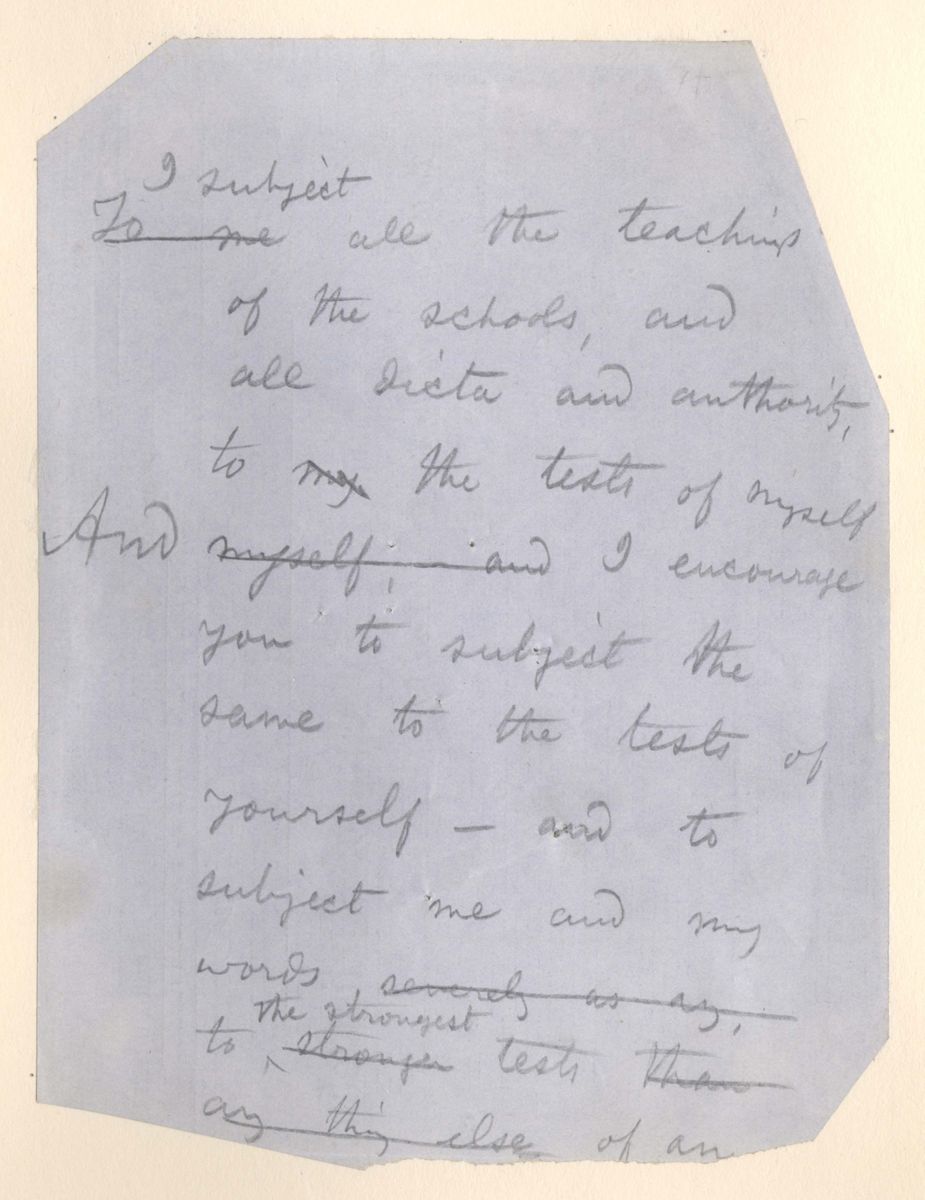
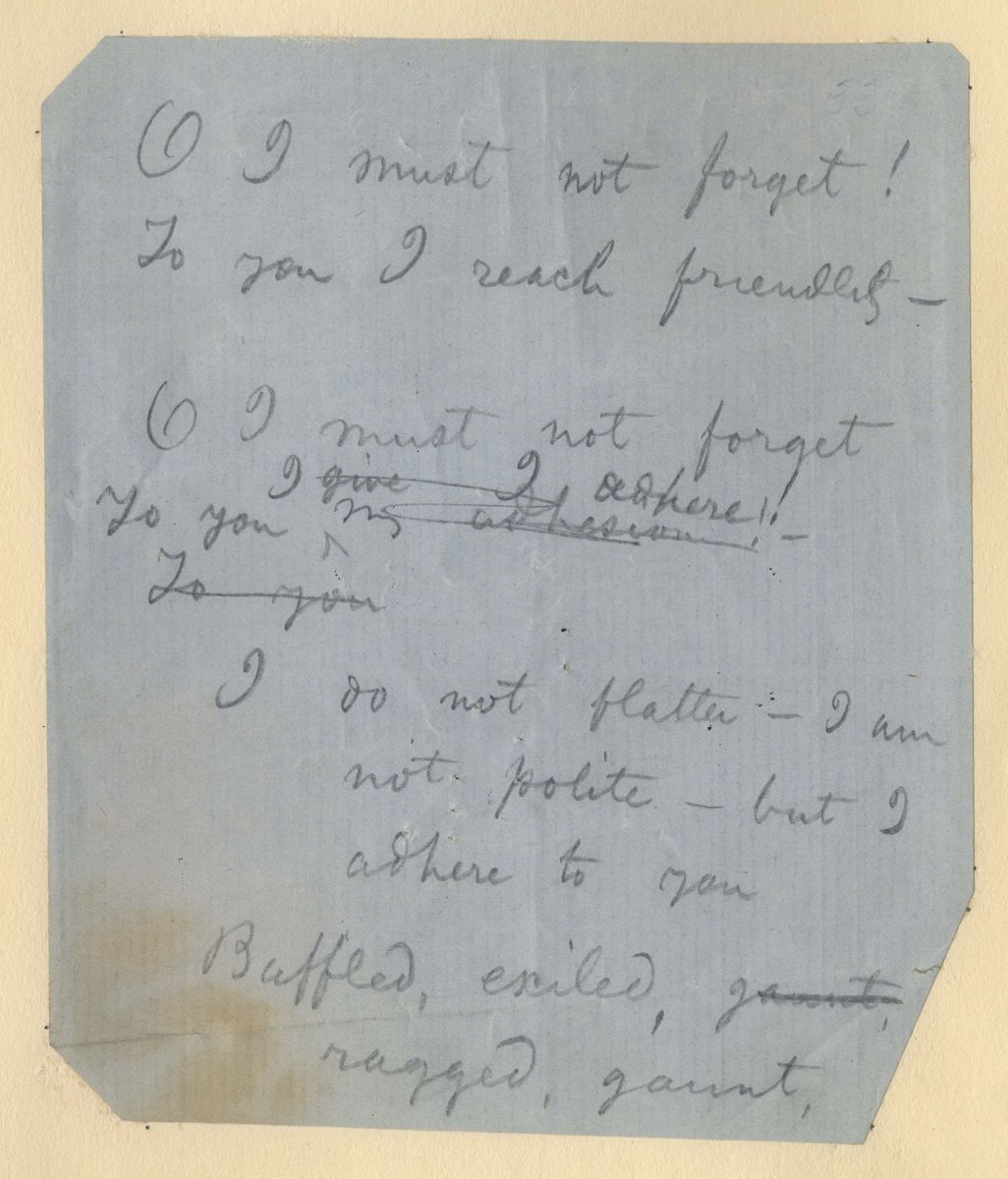
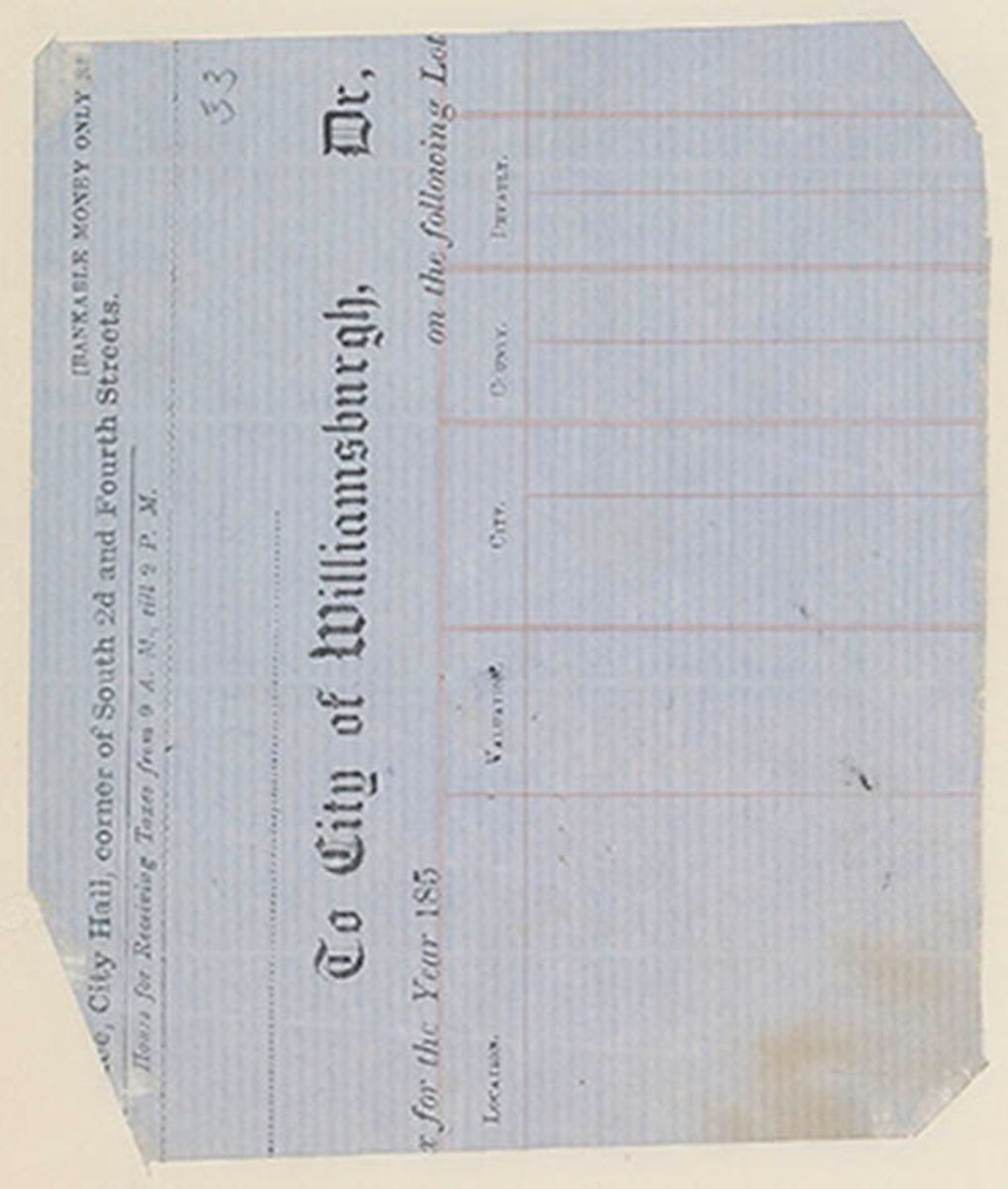
Content:
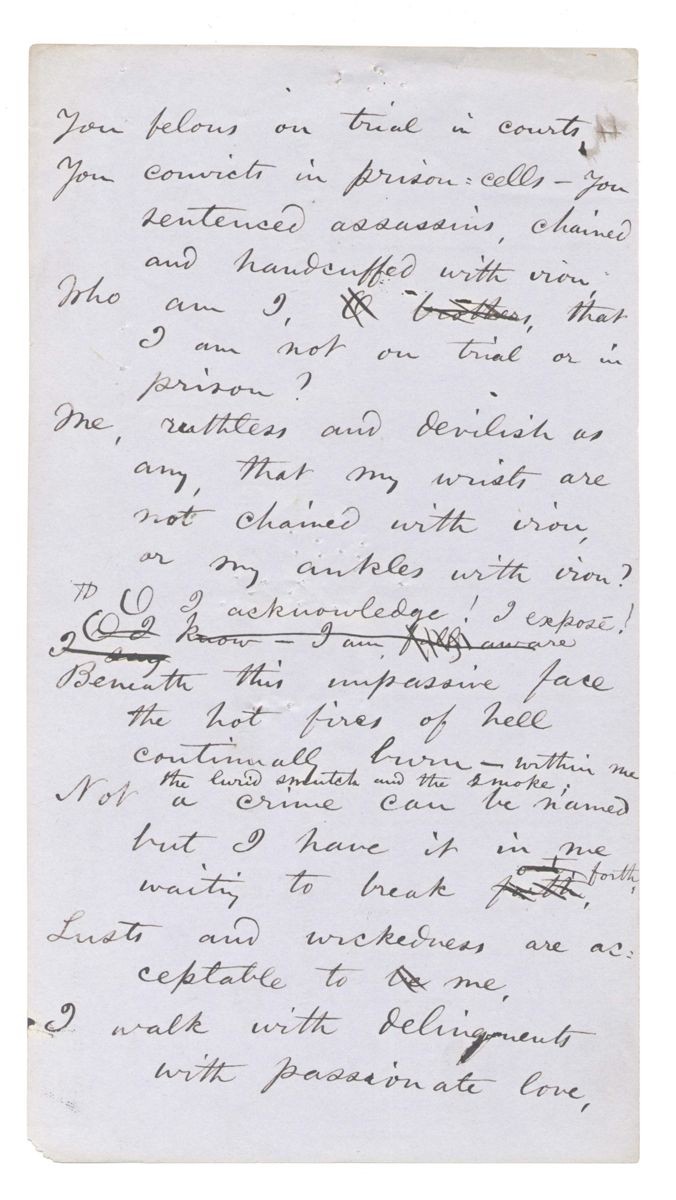
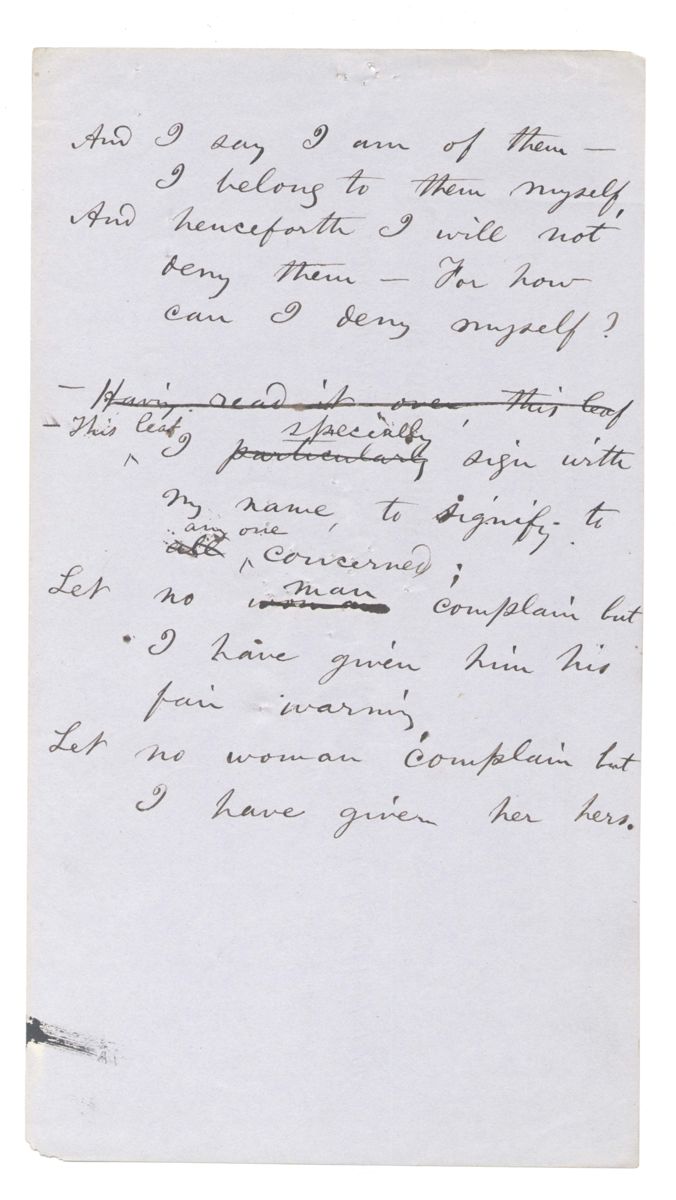
Whitman used language similar to what appears in these manuscript lines in the fifth poem in the first (1855) edition of
Leaves of Grass
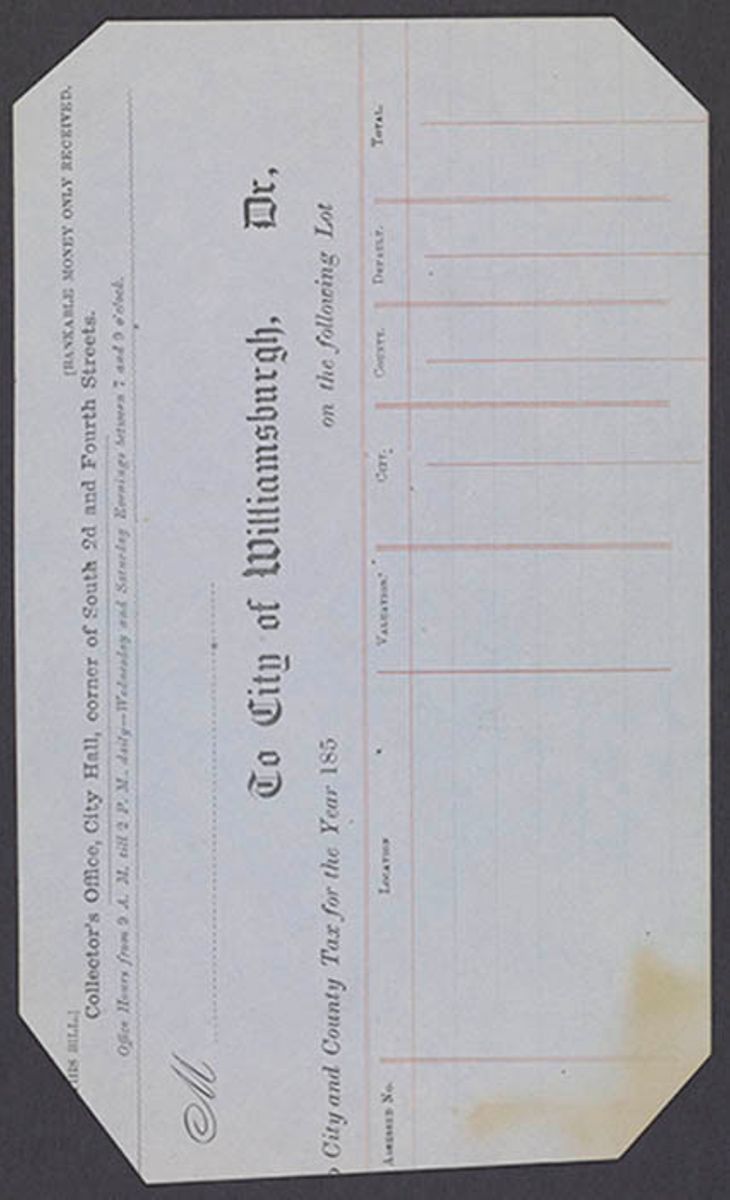
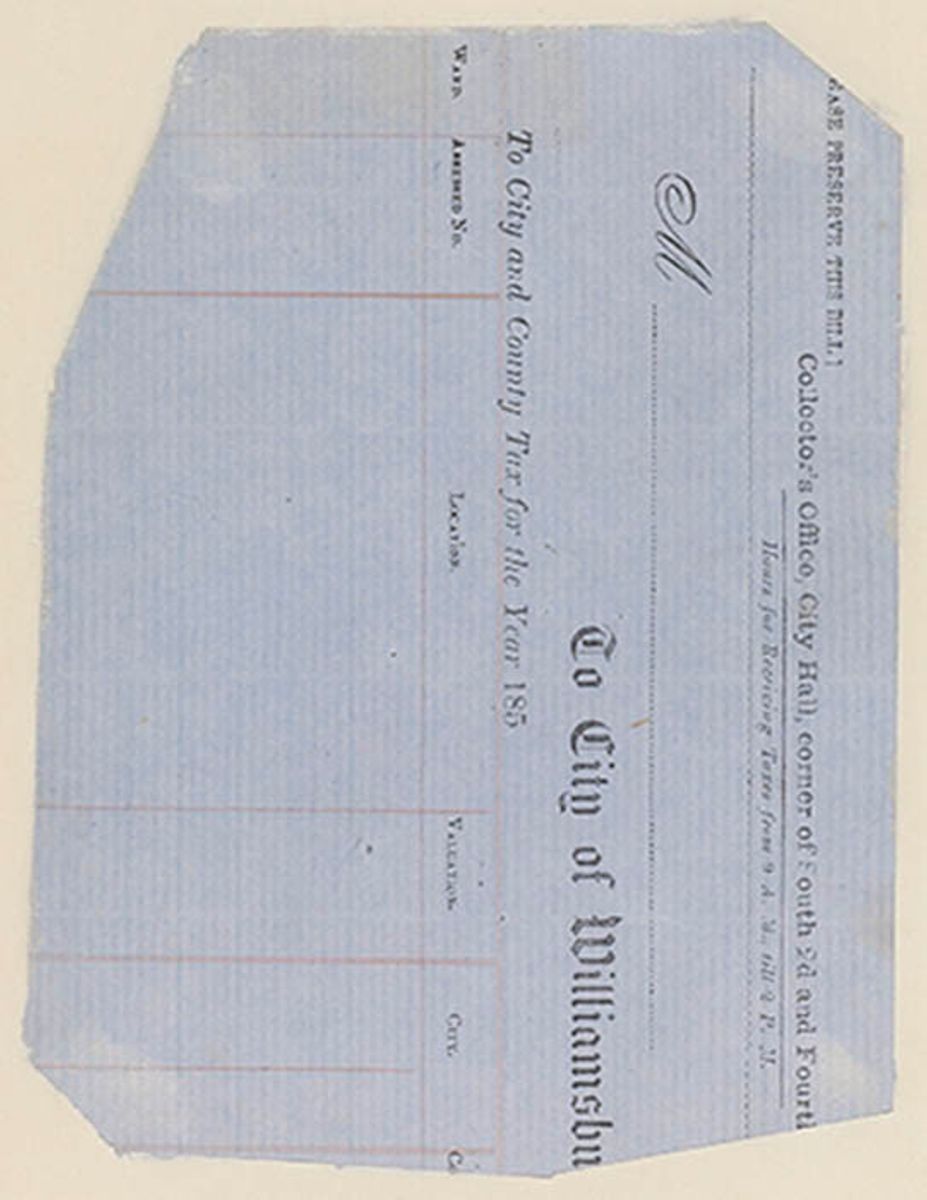
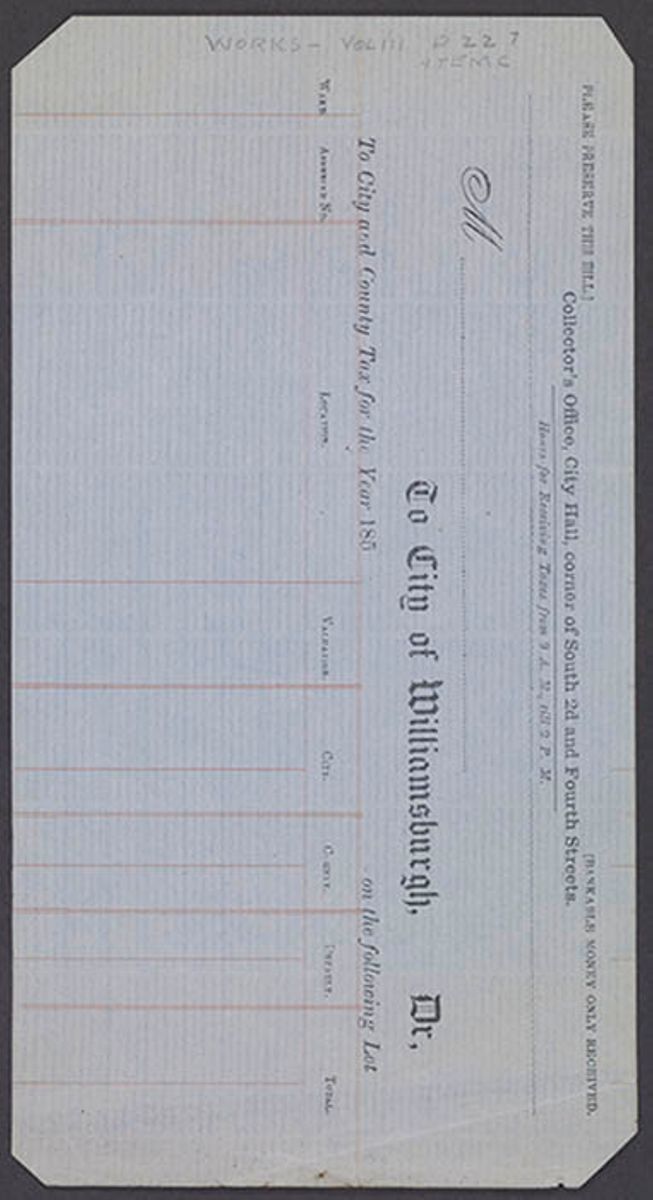
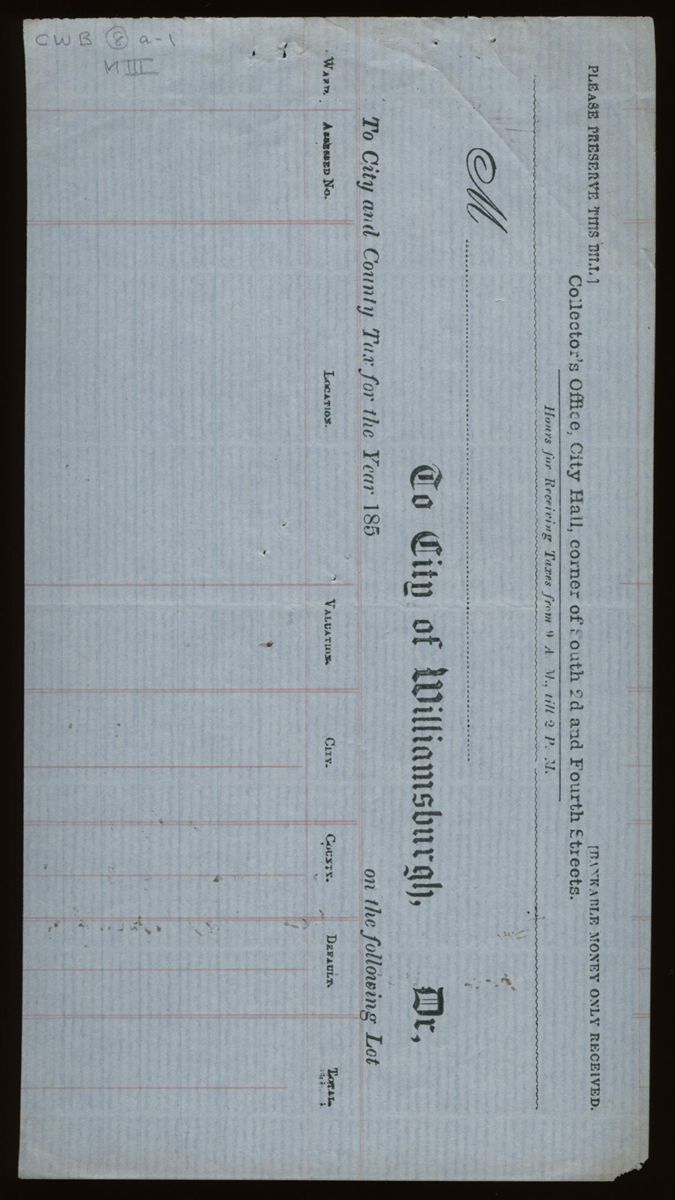
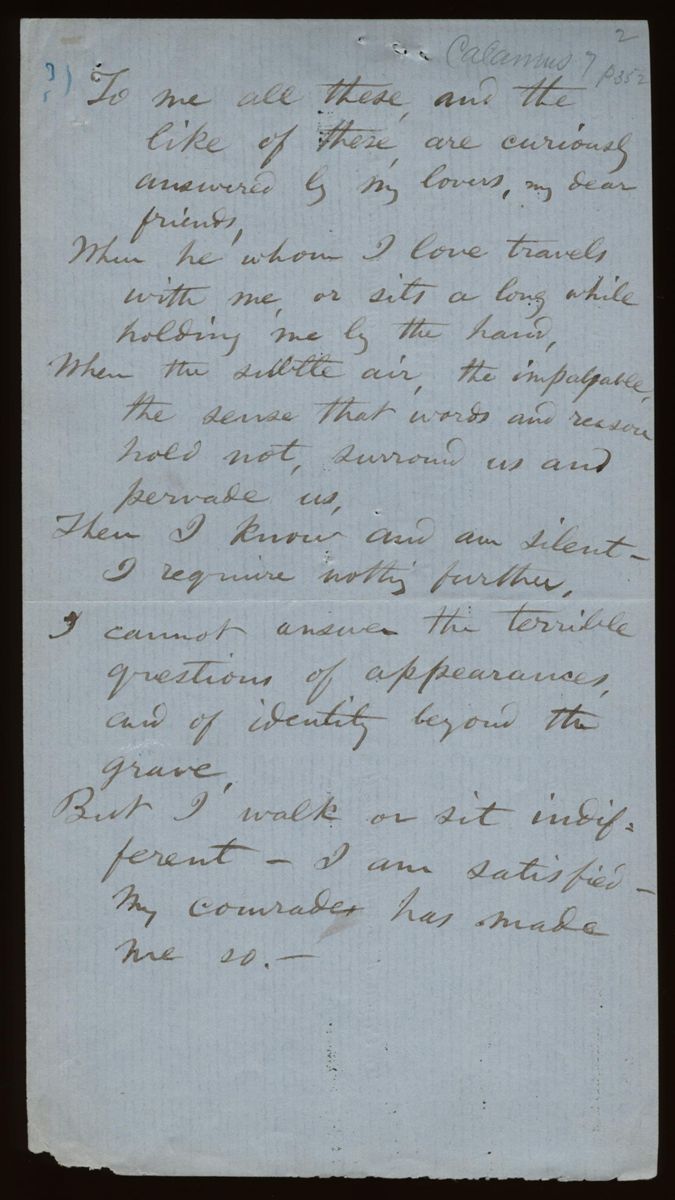
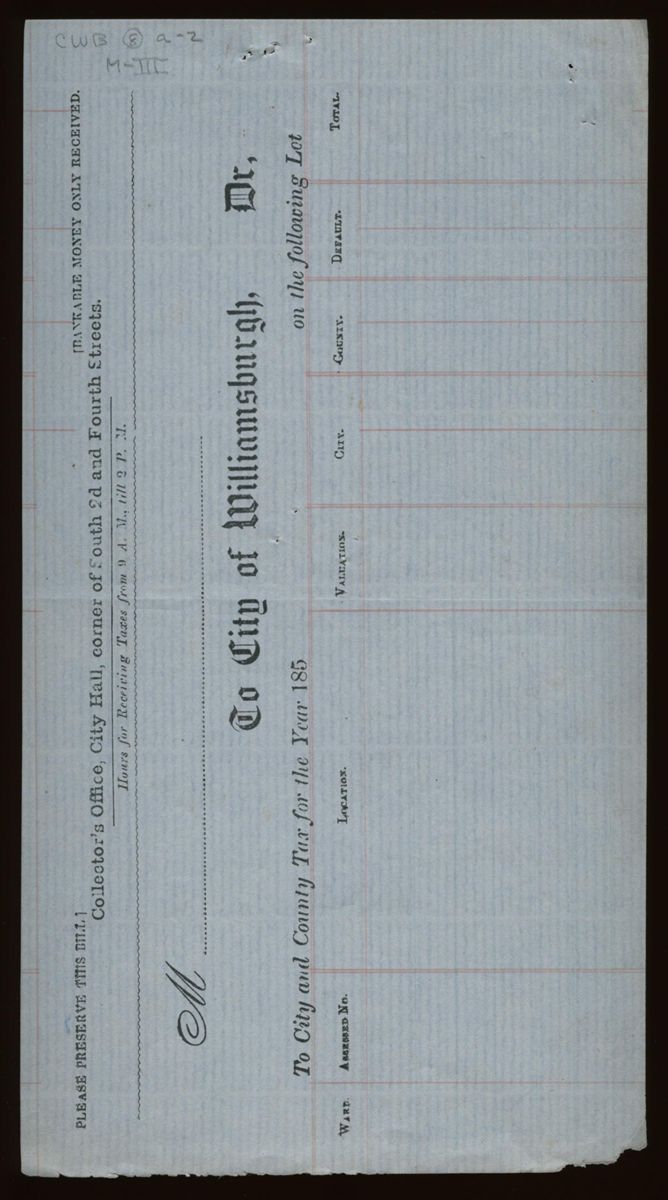
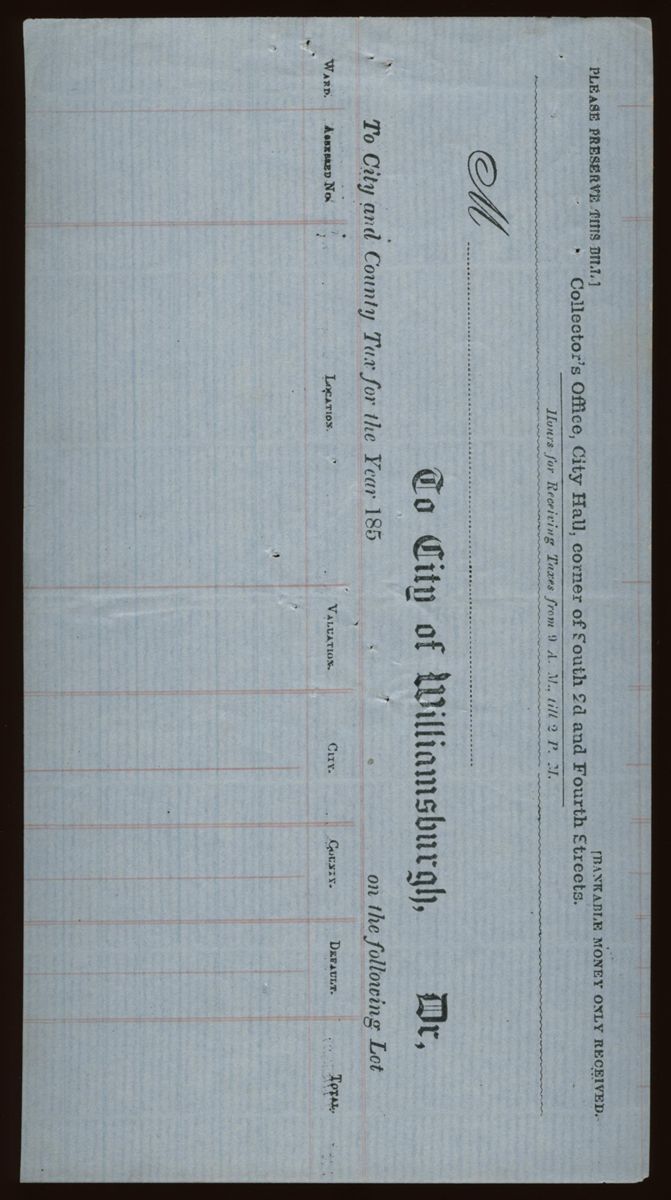
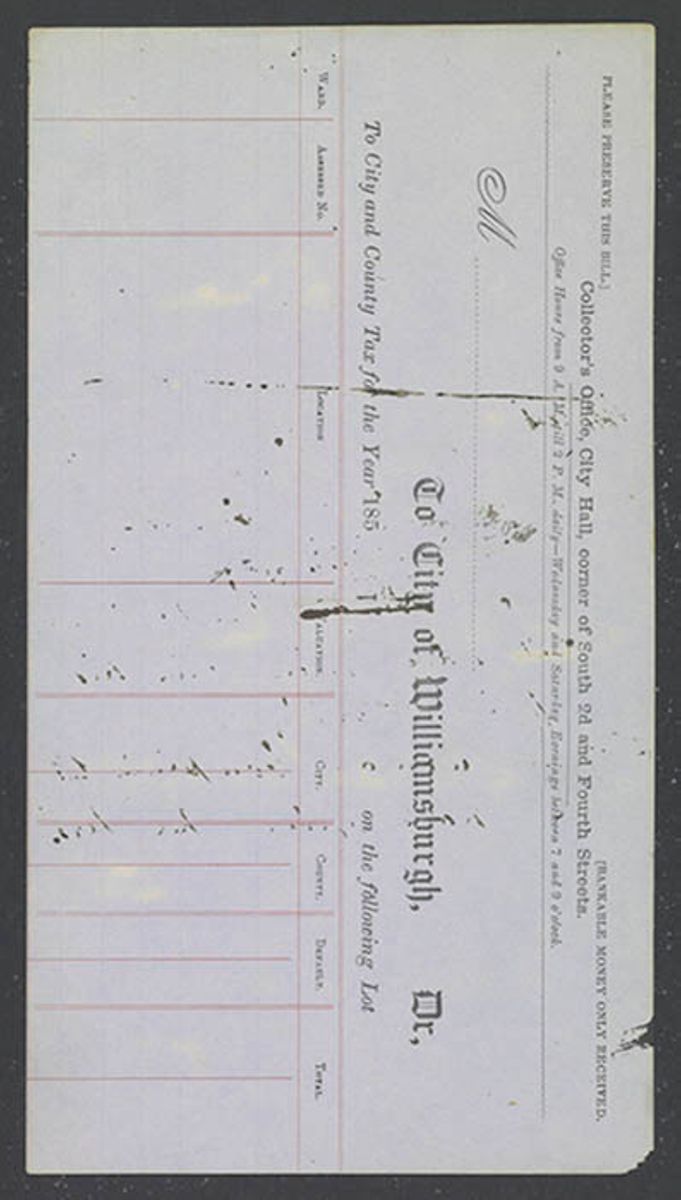
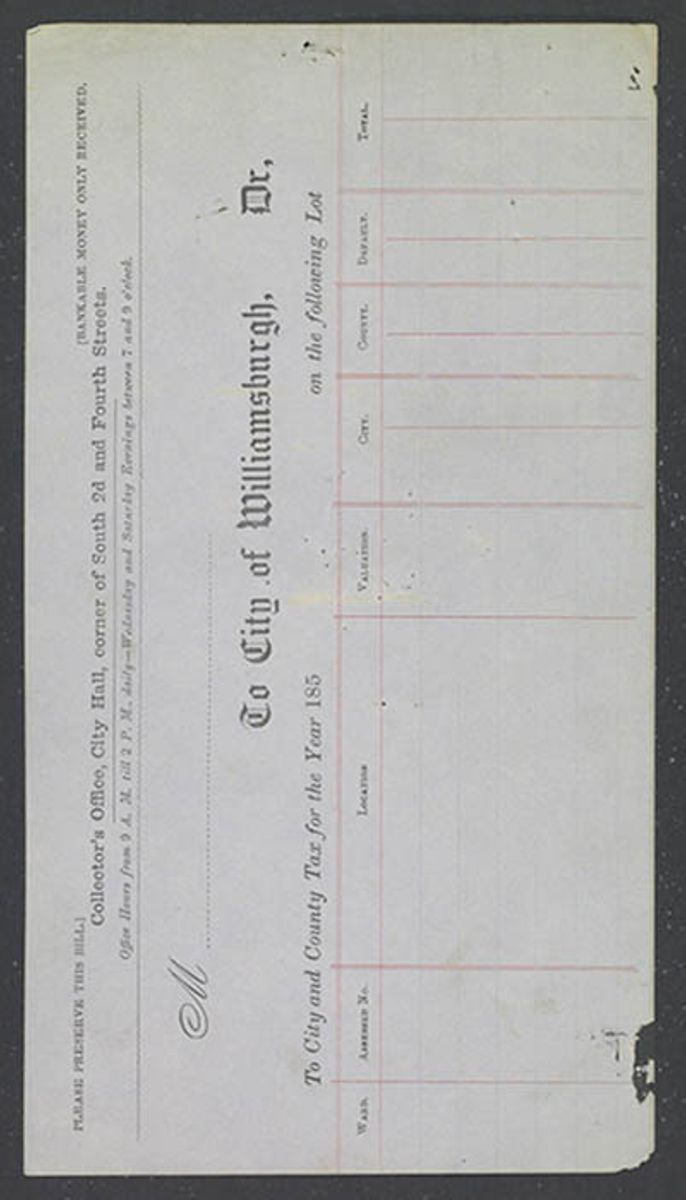
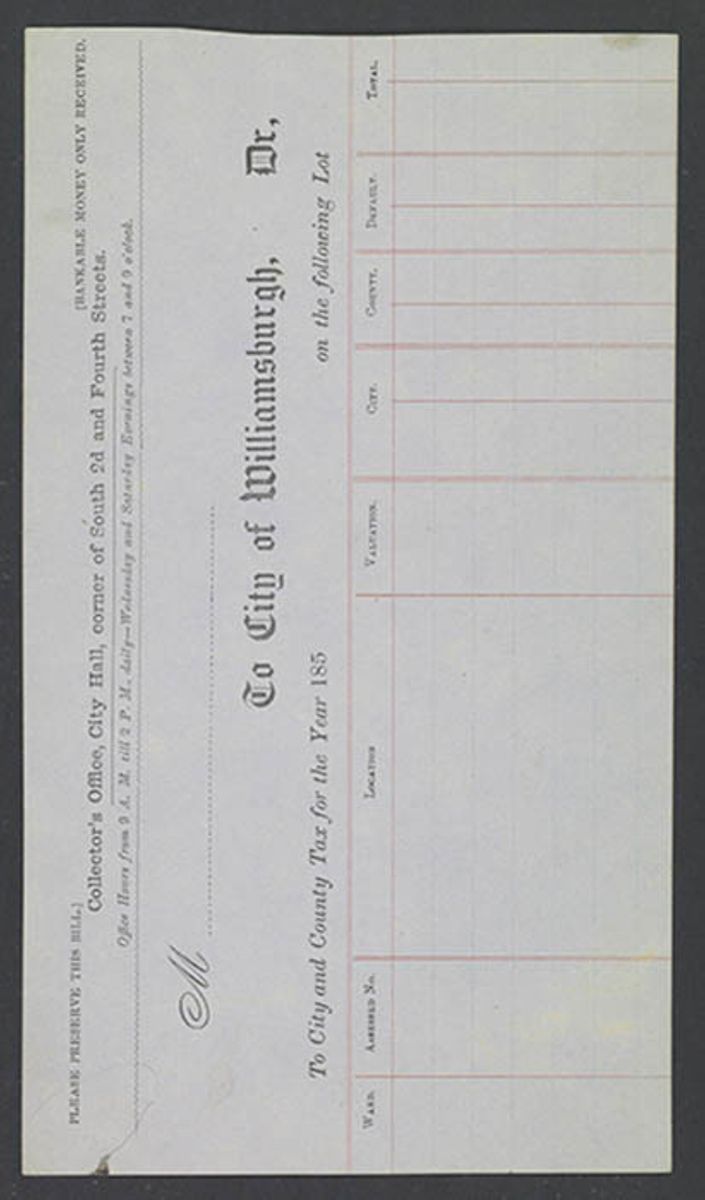
, eventually titled "I Sing the Body Electric," as well as in the 1856 "Poem of the Road," eventually titled "Song of the Open Road." The manuscript is written on the blank side of an 1850s tax form from the City of Williamsburgh. Scholars, following Fredson Bowers, have generally assumed that Whitman used the Williamsburgh tax forms from 1857 to 1860, while he was working at the
Brooklyn Daily Times
. The city of Williamsburgh was incorporated with Brooklyn effective January 1855, so the forms would have been obsolete after that date (
Whitman's Manuscripts: Leaves of Grass
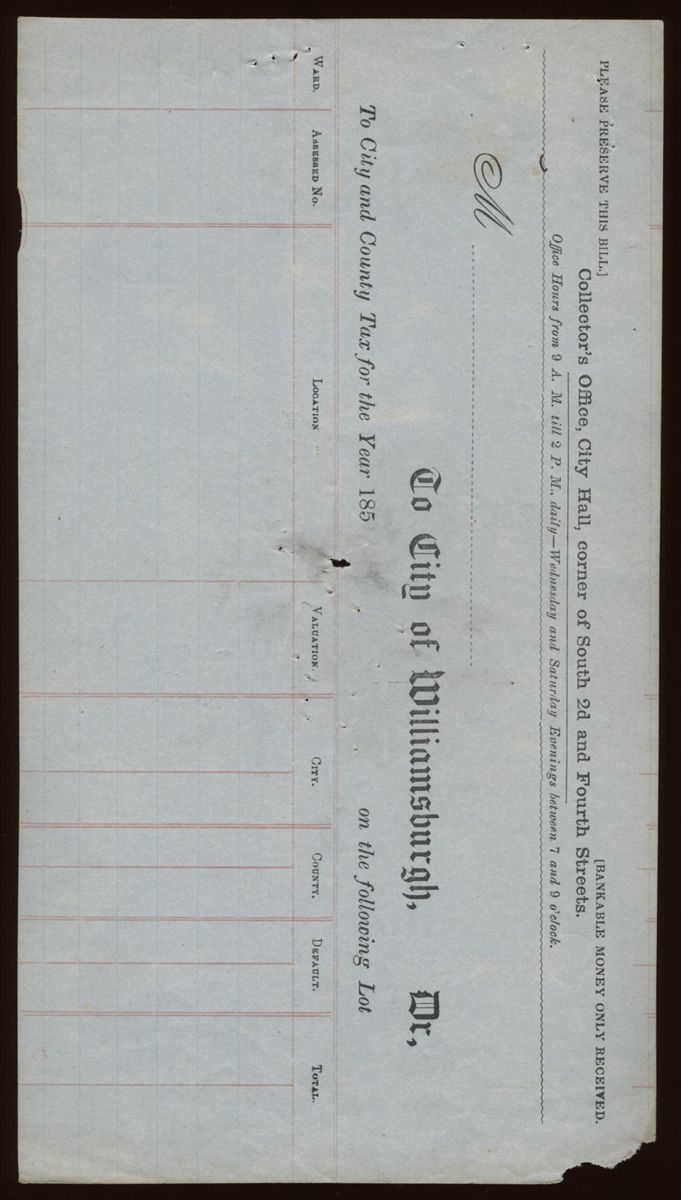
[1860] [Chicago: University of Chicago Press, 1955], xli–xliii). Most of the manuscripts Whitman wrote on the tax forms can be dated to the late 1850s. Bowers also notes, however, that Whitman may have used the forms over a considerable span of time, and that "it is not impossible that Whitman had picked up these tax forms for scrap paper at Rome Brothers at some unknown date in 1854 or early 1855, or later" (xliii). At least two of the tax forms Whitman used were dated 1854 (see, for instance, "Vast national tracts" [loc.05354]), but as Edward Grier points out, this may not correspond to the date of Whitman's writing (
Notebooks and Unpublished Prose Manuscripts
[New York: New York University Press, 1984], 5:1946). Whitman may have found a stack of obsolete Williamsburgh forms in 1857 that included discarded draft forms dated earlier. The manuscript is thus difficult to date conclusively, but it was almost certainly written after 1854 and probably before 1860.
-
Whitman Archive Title: Inscription
-
Whitman Archive ID: uva.00060
-
Repository ID: #3829
-
Box: 1
-
Folder: 46
-
Date: between 1855 and 1867
-
Genre: poetry
-
Physical Description: 1 leaf, 19.5 x 12.5 cm, handwritten
-
View Images:
1
|
2
-
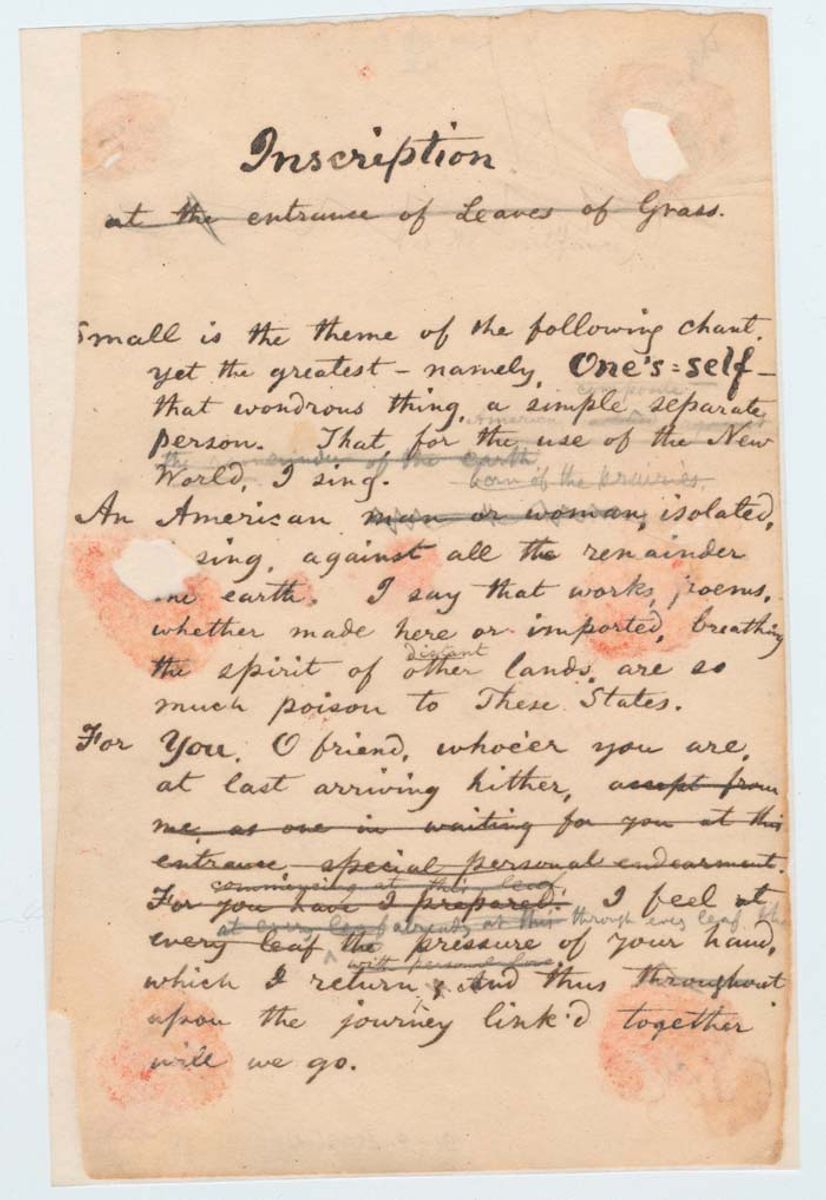
Content:
This manuscript entitled "Inscription" appears to be a revision of other "Inscriptions" Whitman gathered in a notebook, along with prose drafts for a never-finished introduction to
Leaves of Grass,
and attached to his copy of the 1855 paper-bound edition. (The entire collection of draft "inscription" and introductory material is currently housed at the New York Public Library.) In the 1867
Leaves of Grass
Whitman culled material from this poem and the other "Inscription" poems to create an italicized "Inscription" that he placed before "Starting from Paumanok" at the beginning of the book; in that edition he also transferred part of verse 2 to "As I Sat Alone by Blue Ontario's Shore" (later the line was dropped and the title was revised to "By Blue Ontario's Shore"). From 1872 onward, this poem, revised and retitled "One's-Self I Sing," was printed as the first of several poems in the "Inscriptions" cluster that opened the book. In the 1888
November Boughs
, however, Whitman reprinted the 1867 version as "Small the Theme of my Chant." Note: This manuscript draft may have been written before the Civil War, since it does not include the 1867 line "My Days I sing, and the Lands—with interstice I knew / of hapless War."
-
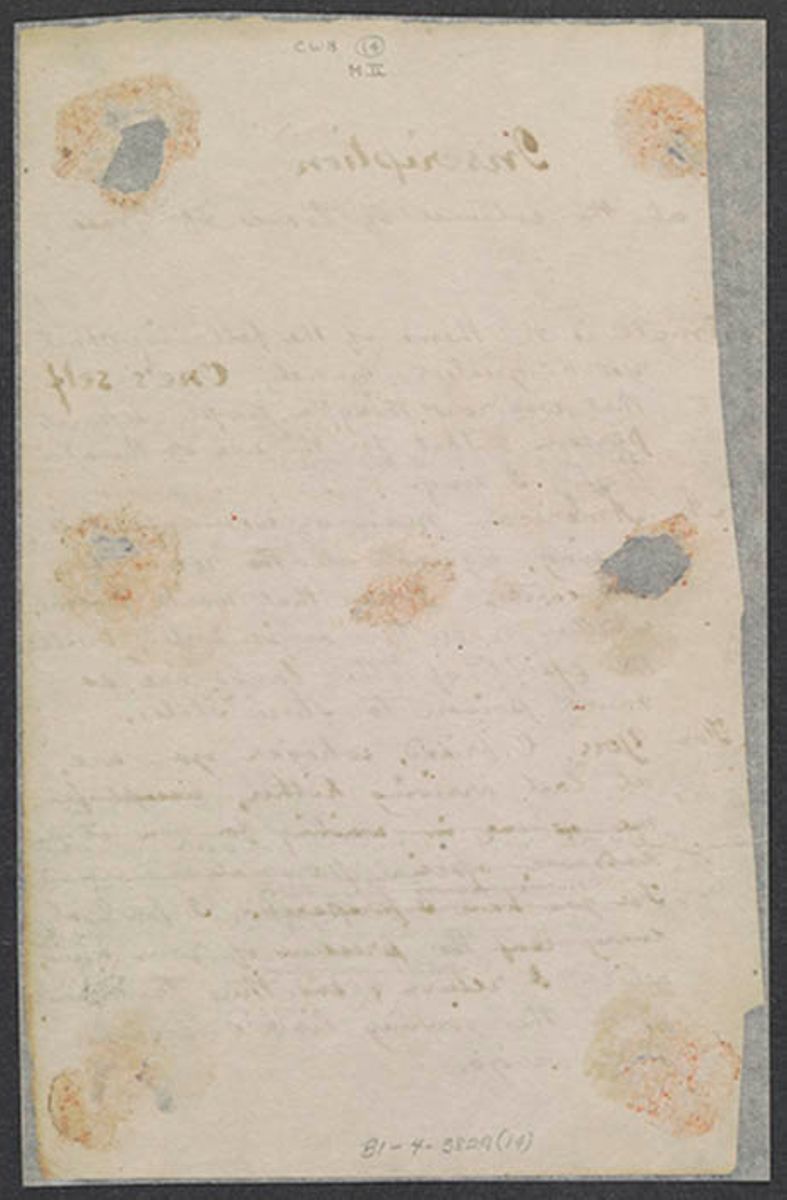
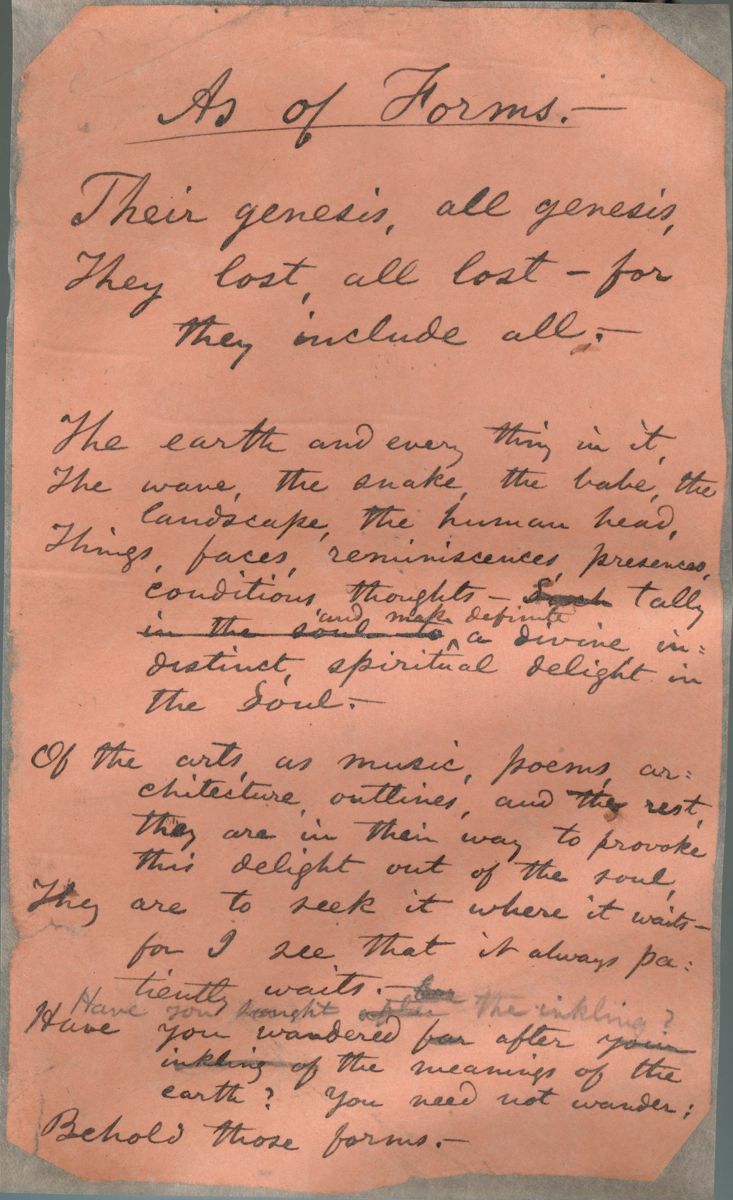
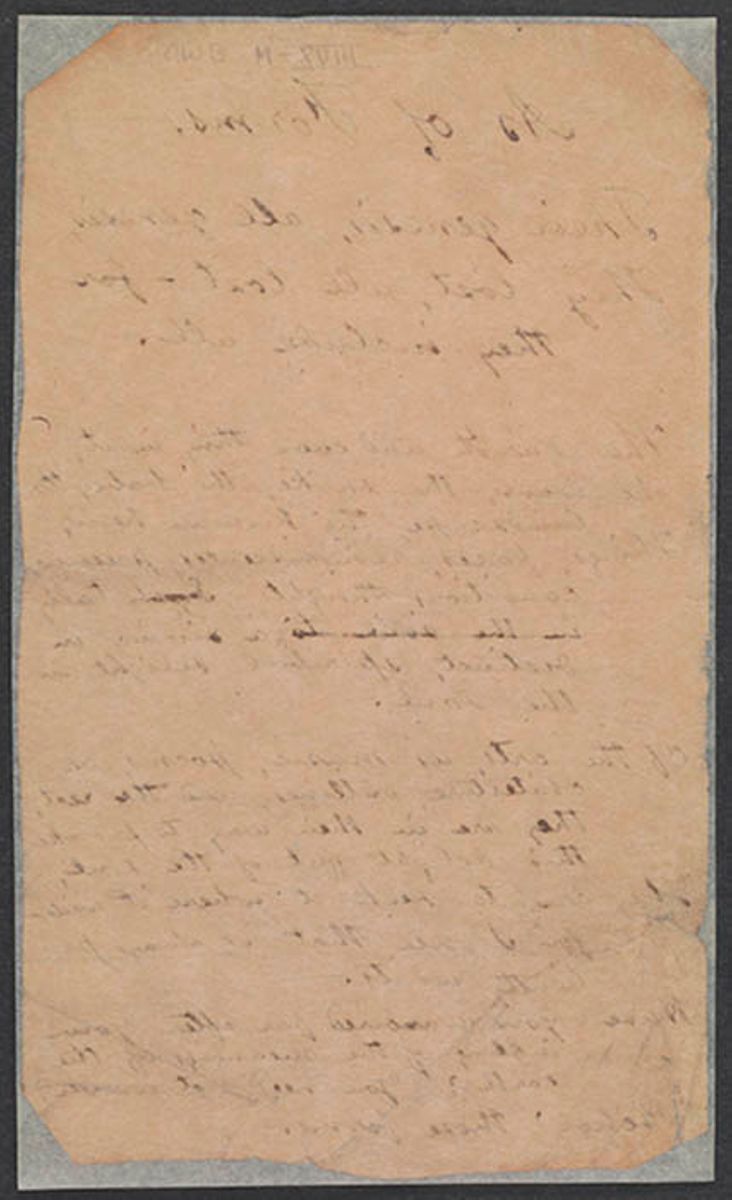
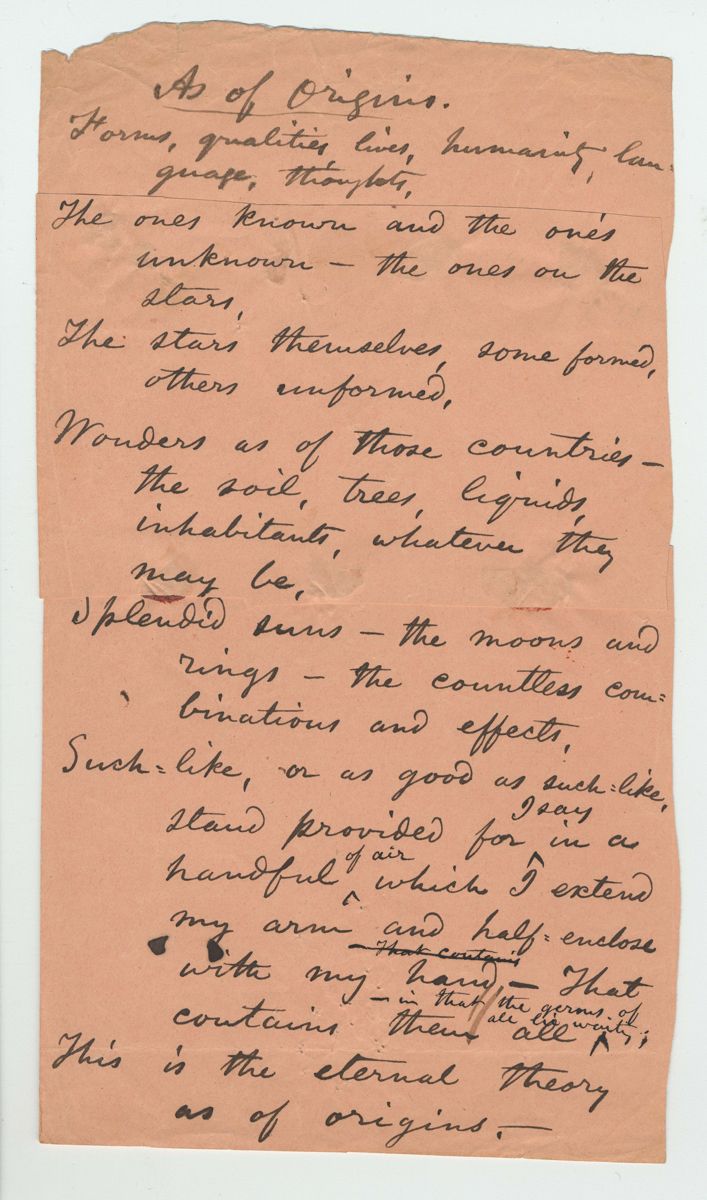
Whitman Archive Title: As of Forms.
-
Whitman Archive ID: uva.00124
-
Box: 1
-
Folder: 5
-
Date: between 1856 and 1860
-
Genre: poetry
-
Physical Description: 1 leaf, 21.5 cm x 13 cm, handwritten
-
View Images:
1
|
2
-
Content:
Manuscript draft of the unpublished poem "As of Forms," which is possibly one of a group of poems
Whitman composed prior to the third edition of
Leaves of Grass
.
-
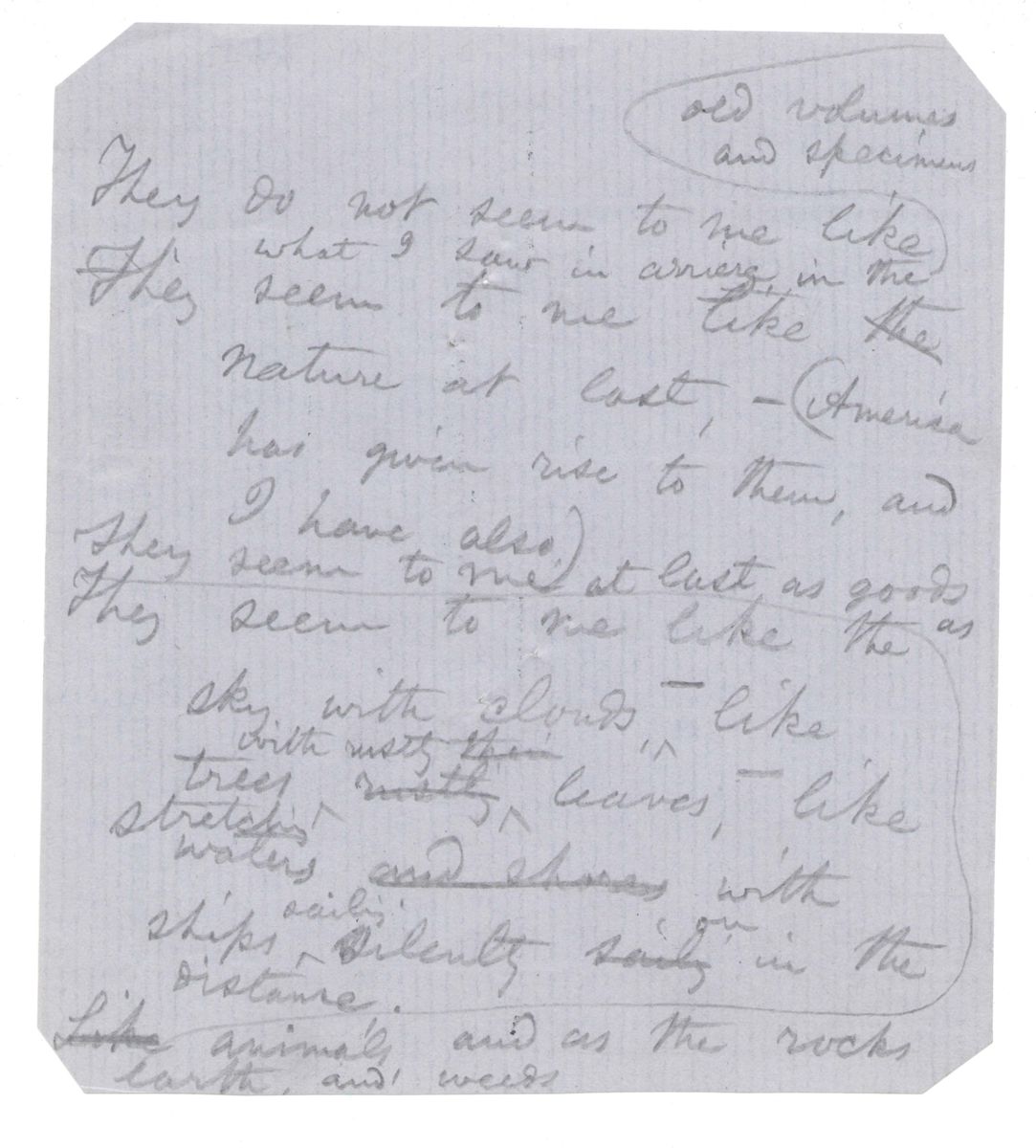
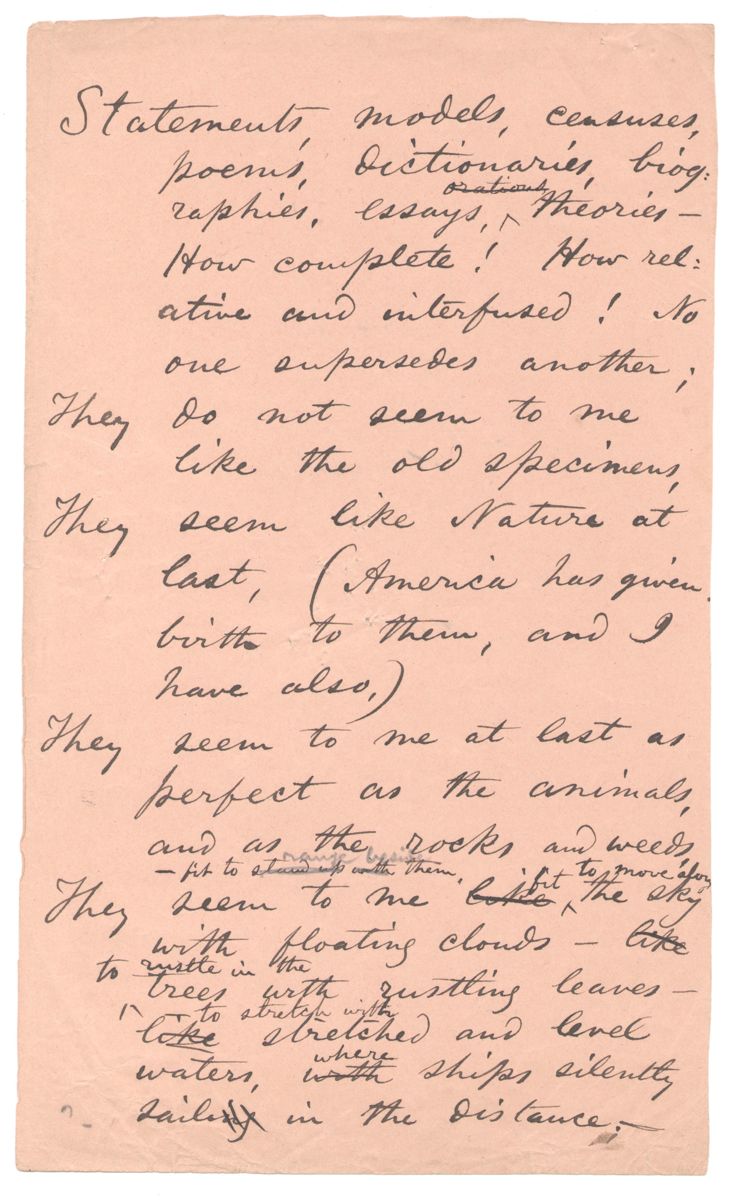
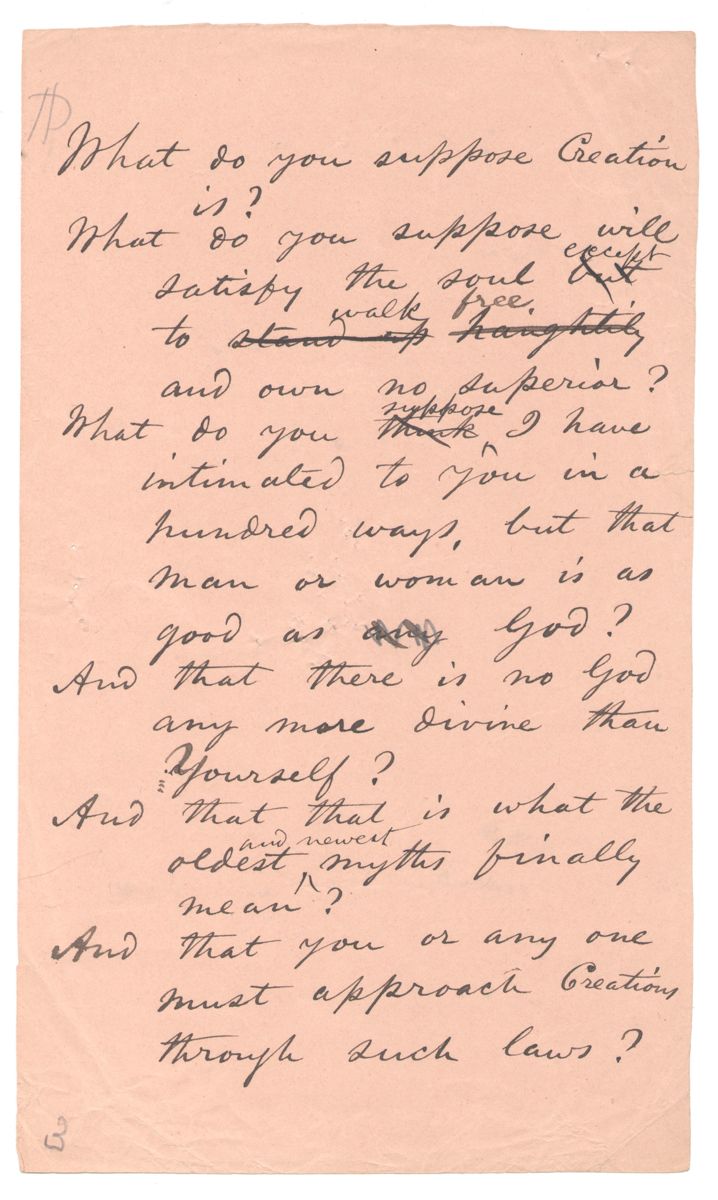
Whitman Archive Title: They do not seem to me
-
Whitman Archive ID: uva.00110
-
Repository ID: #3829-i
-
Box: 2
-
Folder: 4
-
Date: about 1860
-
Genre: poetry
-
Physical Description: 1 leaf, 13 cm x 11.5 cm, handwritten
-
View Images:
1
|
2
-
Content:
This manuscript is a draft of lines that were published in "Chants Democratic," number 13, in
the 1860 edition of
Leaves of
Grass
. That poem was later revised and published as "Laws for Creations"; however, the
lines on this manuscript are a draft of the section of the poem that was deleted
after the 1860 publication.
-
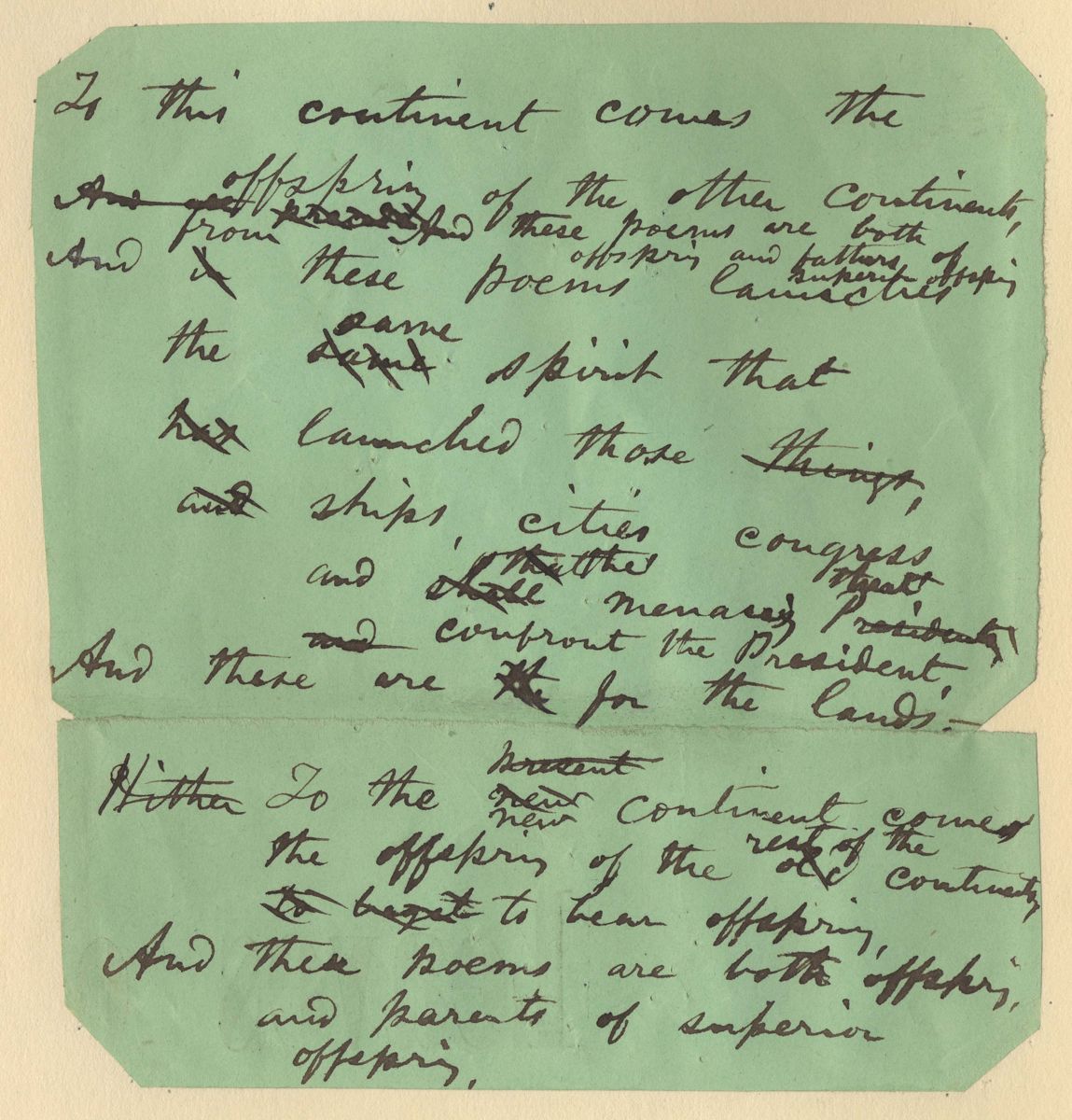
Whitman Archive Title: [To this continent comes the]
-
Whitman Archive ID: uva.00275
-
Box: 1
-
Folder: 88
-
Date: 1856-1860
-
Genre: poetry
-
Physical Description: 1 leaf, 10 x 13 cm pasted to 5 x 13 cm, handwritten
-
View Images:
1
|
2
-
Content:
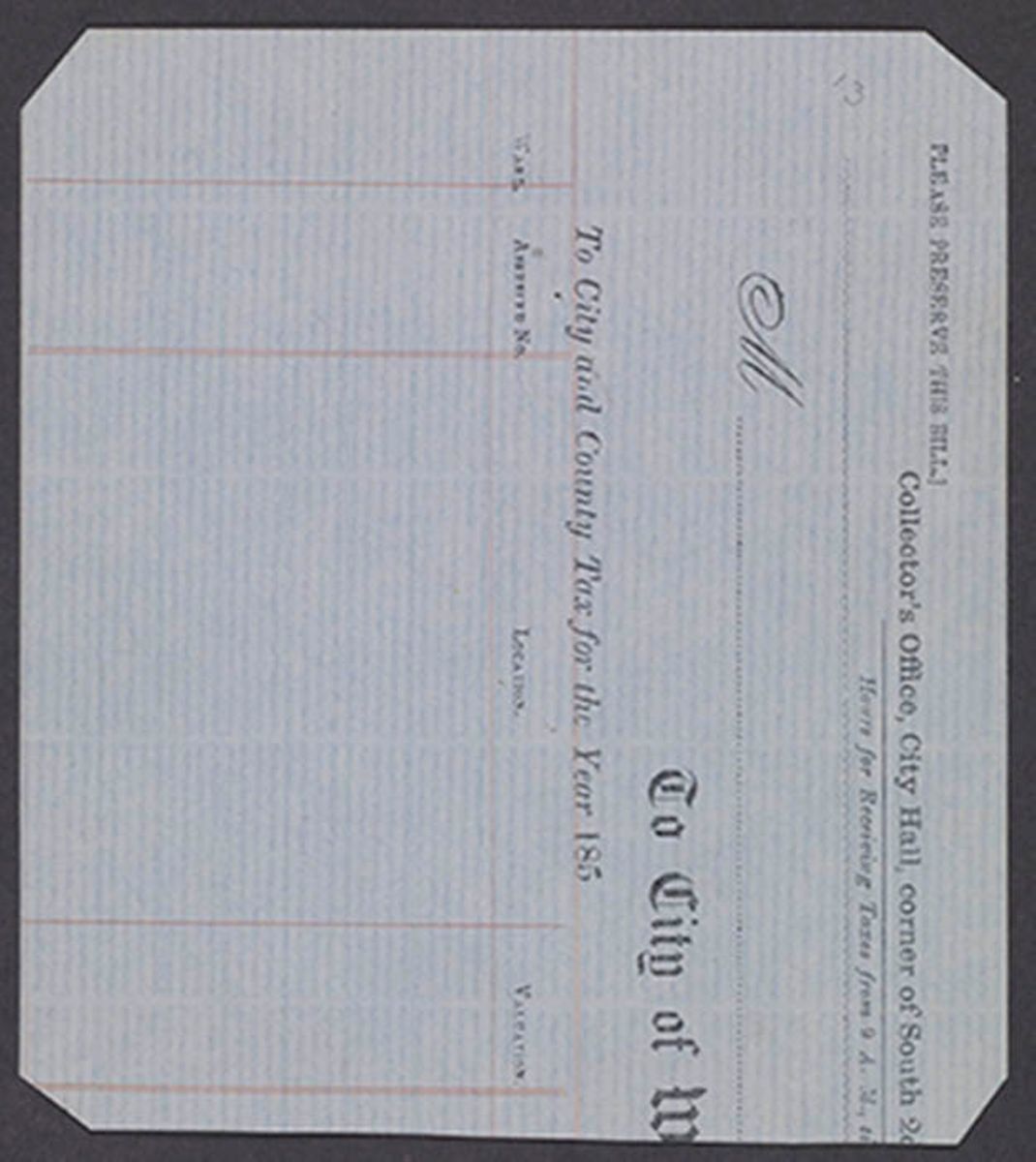
These lines share common ideas expressed throughout
Leaves of Grass
, especially in many of the new poems
to the 1860 edition. The strongest verbal echoes appear in the poem "So long!" which expresses very
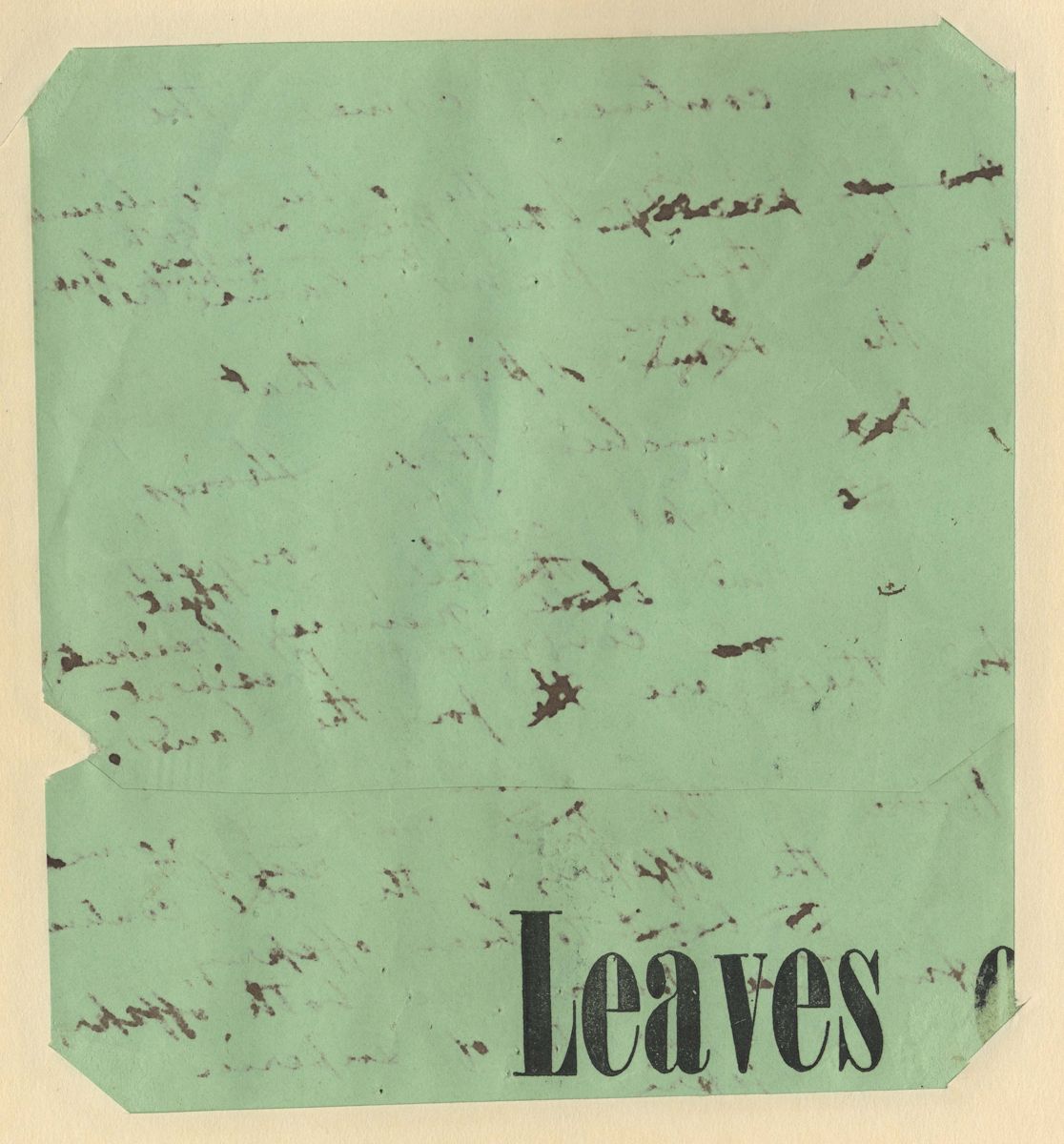
similar ideas and the common words "menacing" and "offspring." The printed words
"Leaves of" appearing on the verso indicate that Whitman composed this draft on a
piece of paper cover from the 1855 edition.
-
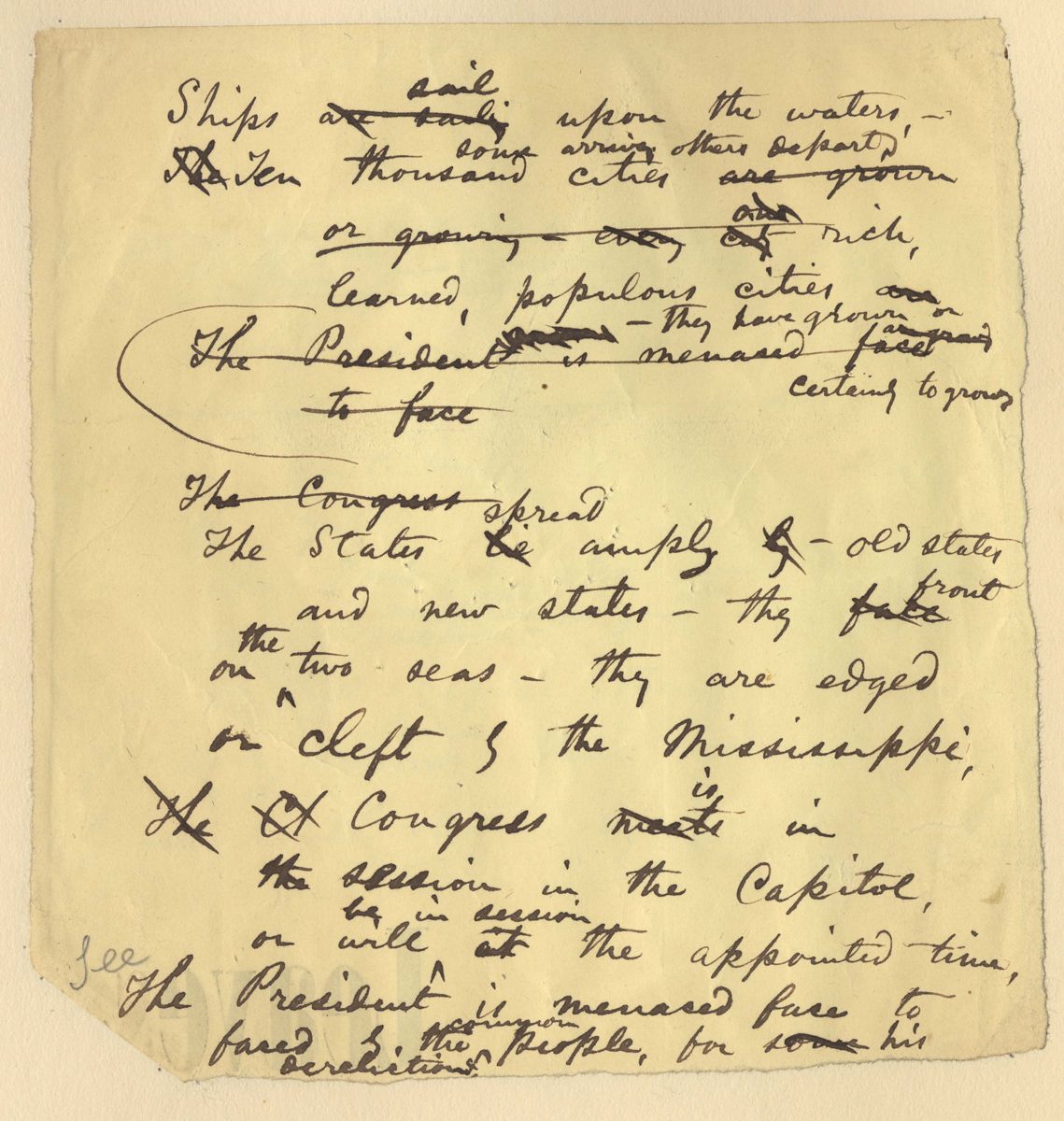
Whitman Archive Title: [Ships sail upon the waters]
-
Whitman Archive ID: uva.00276
-
Box: 1
-
Folder: 88
-
Date: 1856-1860
-
Genre: poetry
-
Physical Description: 1 leaf, 15.5 x 14.5 cm, handwritten
-
View Images:
1
|
2
-
Content:
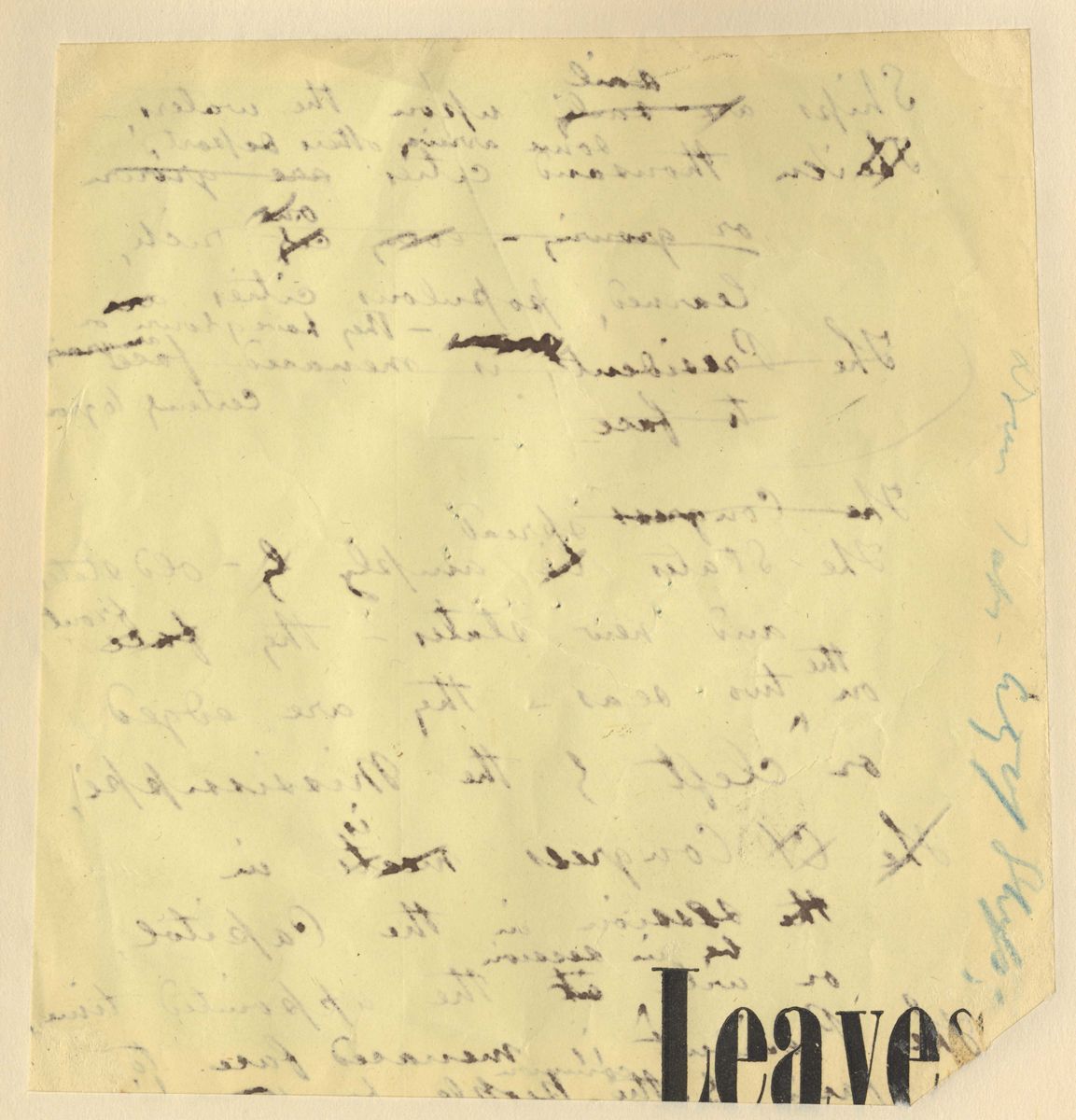
Part of the word "Leaves" appears in the lower right corner of the verso. On the
verso, in blue pencil, appears a note, reading "Drum Taps—City of Ships" which
appears to be in Whitman's hand. This may indeed have been a draft of the poem
"City of Ships," which
first appeared in 1865 as part of the independent publication
Drum-Taps
, but the similarities to
the lines on another manuscript in the University of Virginia collection and lack
of references to the Civil War indicate that it was inscribed prior to the
publication of the the 1860 edition of
Leaves of Grass
.
-
Whitman Archive Title: [You are English]
-
Whitman Archive ID: uva.00277
-
Box: 1
-
Folder: 88
-
Date: 1856-1860
-
Genre: poetry
-
Physical Description: 1 leaf, 10 x 15 cm, handwritten
-
View Images:
1
|
2
-
Content:
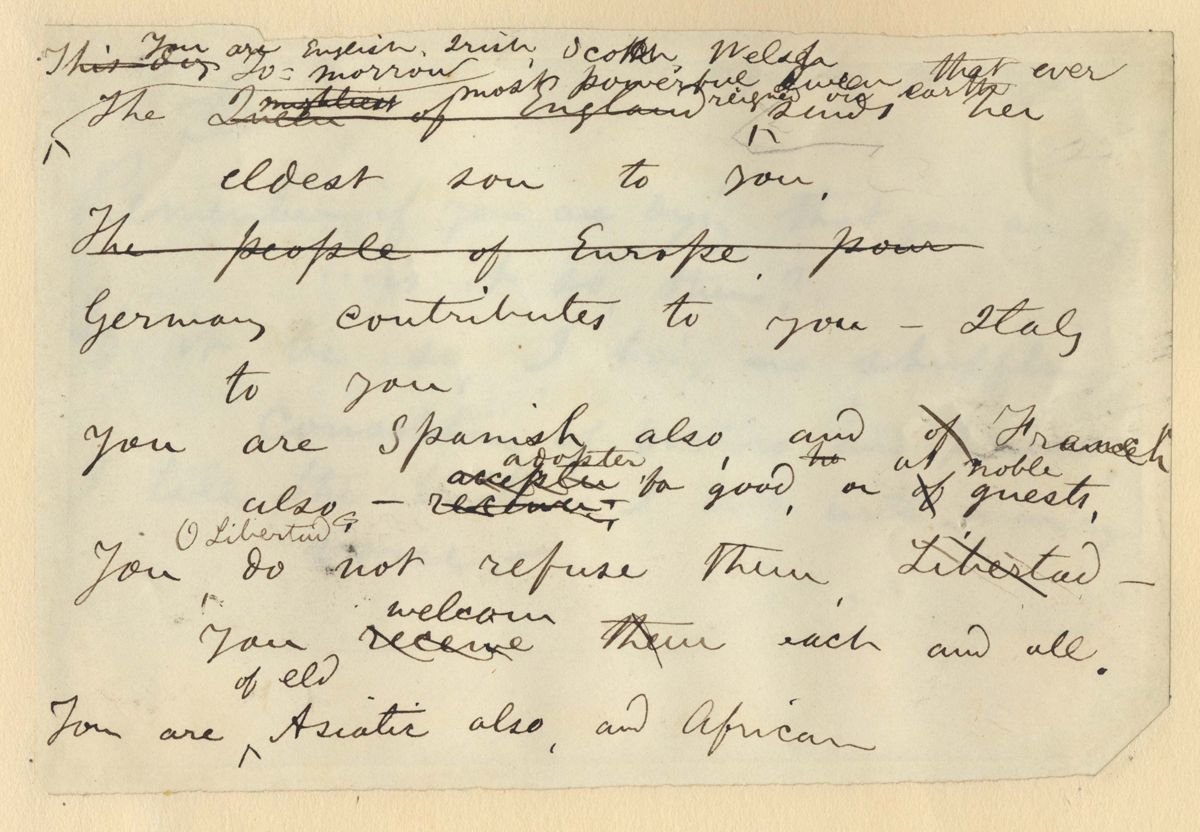
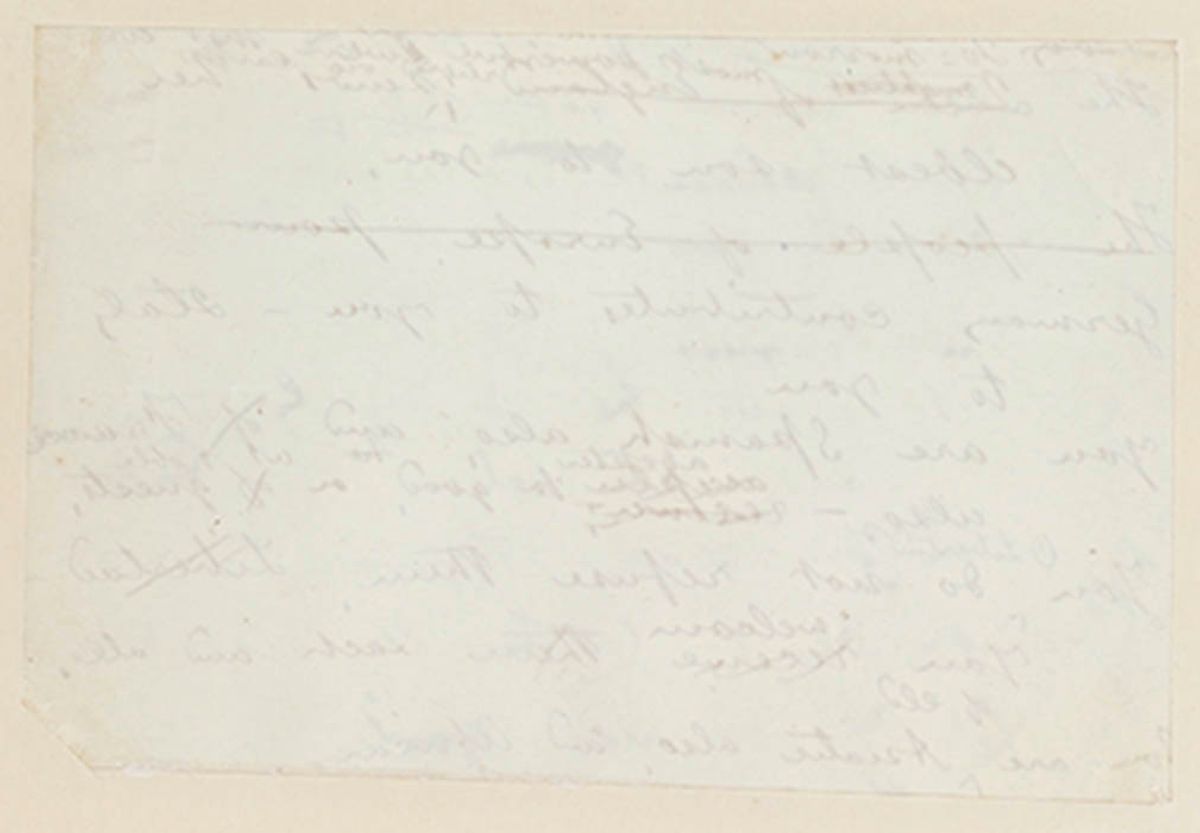
An early, partial draft of the poem
eventually known as "A Broadway
Pageant," first published in the June 27, 1860 issue of
the
New York Times
as "The Errand-Bearers."
-
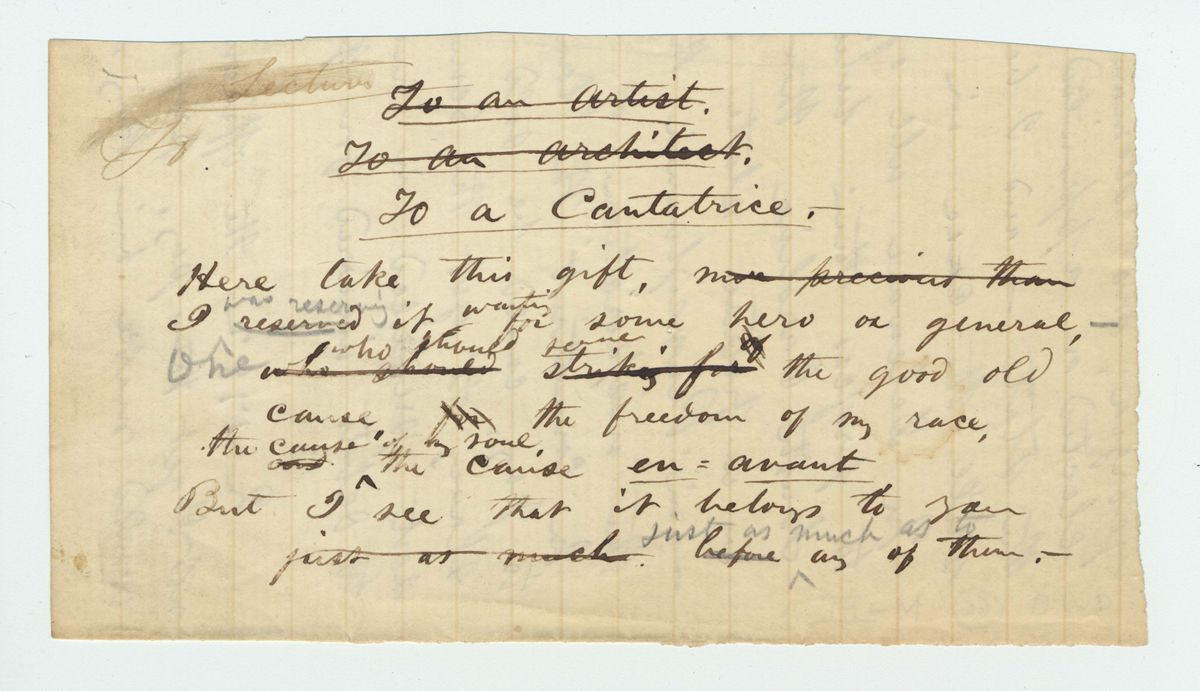
Whitman Archive Title: To a Literat
-
Whitman Archive ID: uva.00114
-
Repository ID: #3829-i
-
Box: 2
-
Folder: 10
-
Date: 1857-1859
-
Genre: poetry
-
Physical Description: 1 leaf, handwritten
-
View Images:
1
-
Content:
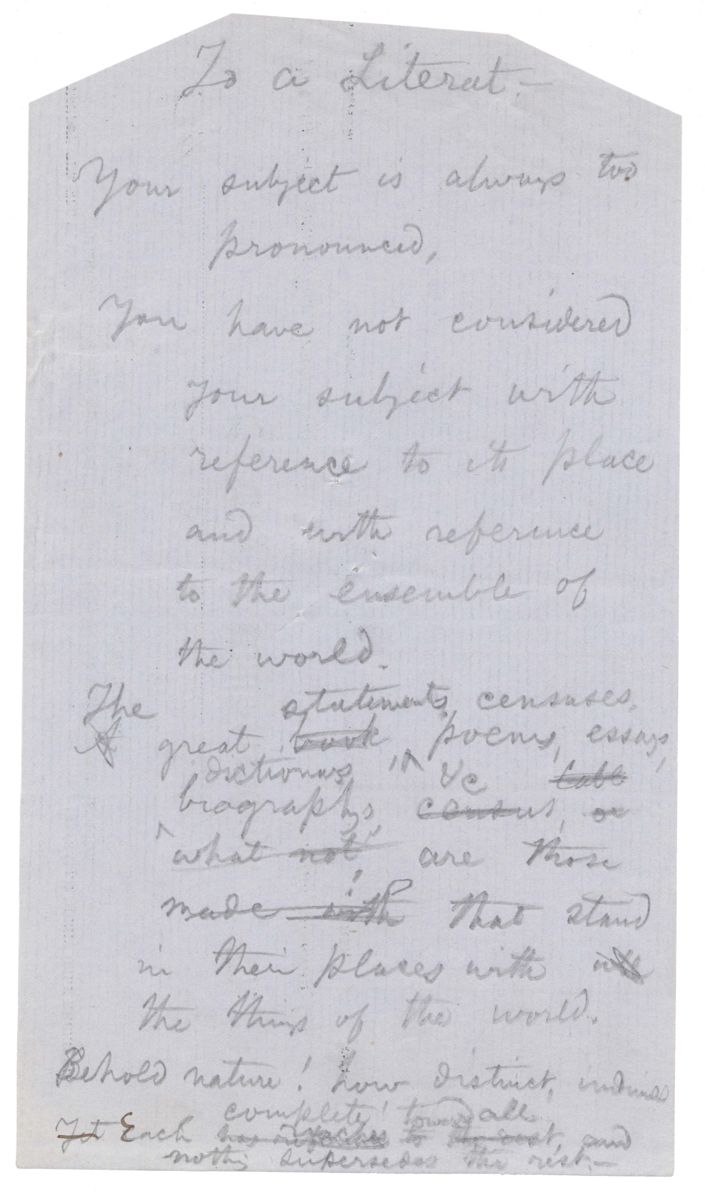
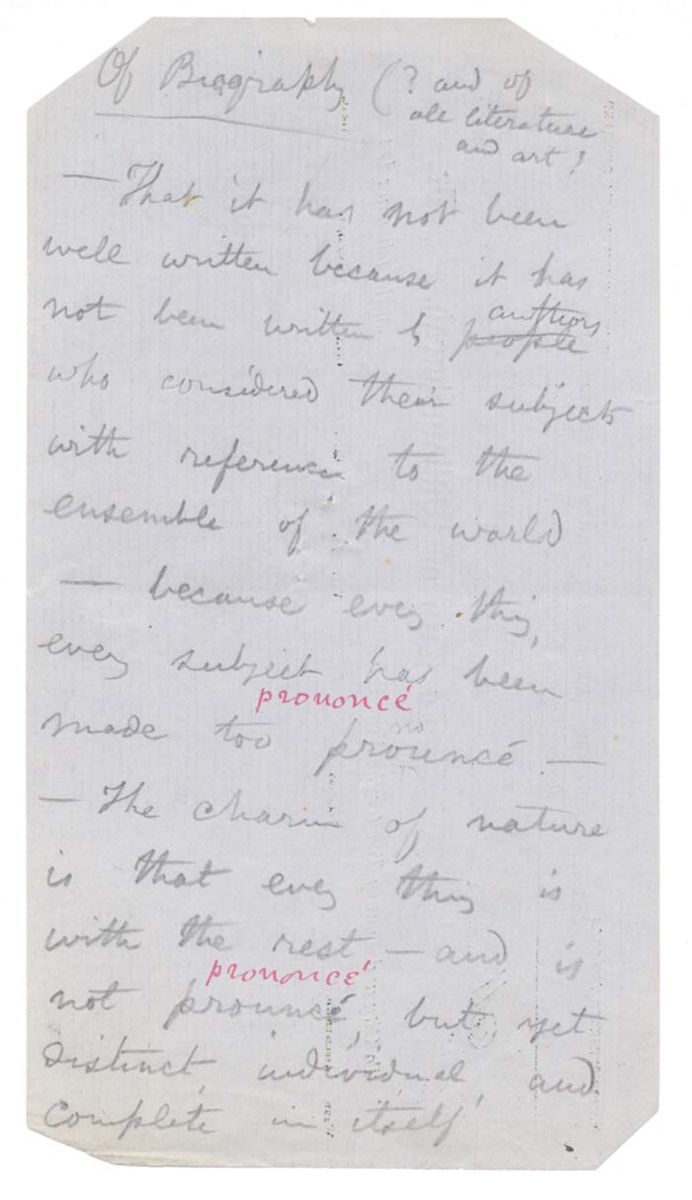
The first two verses, taken more or less directly from a prose manuscript, "[Of Biography]," have no
revisions, but the remaining three verses represent a significant expansion of the
themes in the prose notes and are extensively revised. These verses, which precede
"[Walt Whitman's law]" in
the composition process, correspond, like "[Of Biography]," to section 13 of the 1860
version of the poem "Chants
Democratic and Native American" which was revised and permanently
retitled "Laws for Creations"
in 1872.
-
Whitman Archive Title: [Walt Whitman's law]
-
Whitman Archive ID: uva.00115
-
Repository ID: #3829-i
-
Box: 2
-
Folder: 20
-
Date: 1857-1859
-
Genre: poetry
-
Physical Description: 1 leaf, handwritten
-
View Images:
1
|
2
-
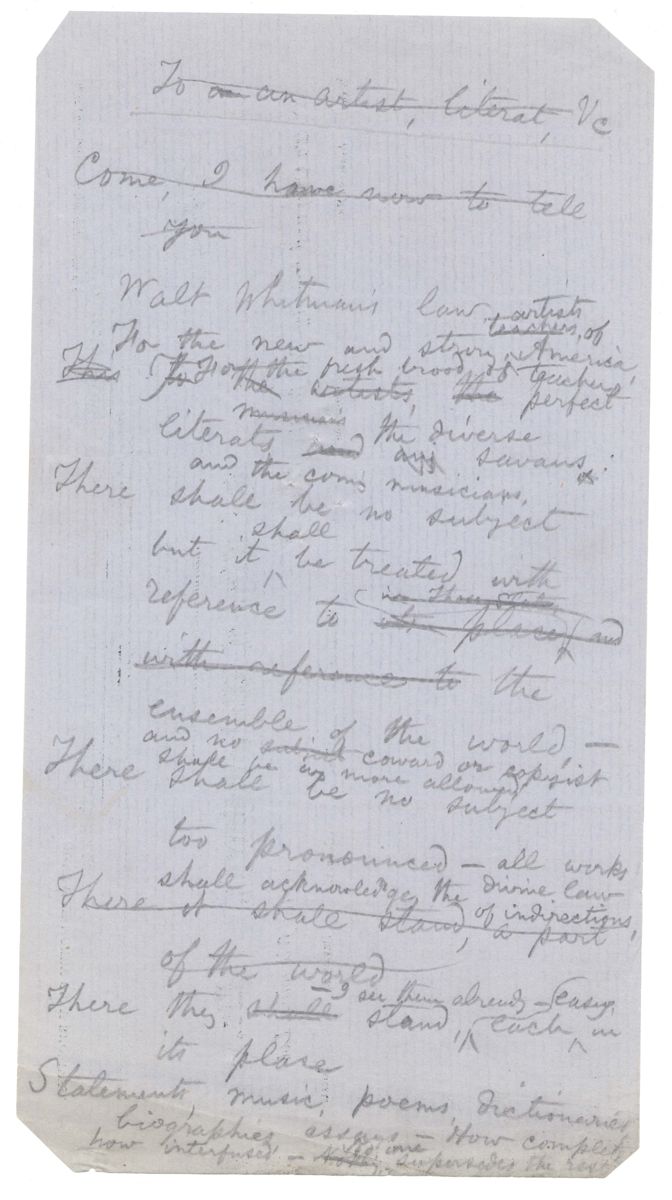
Content:
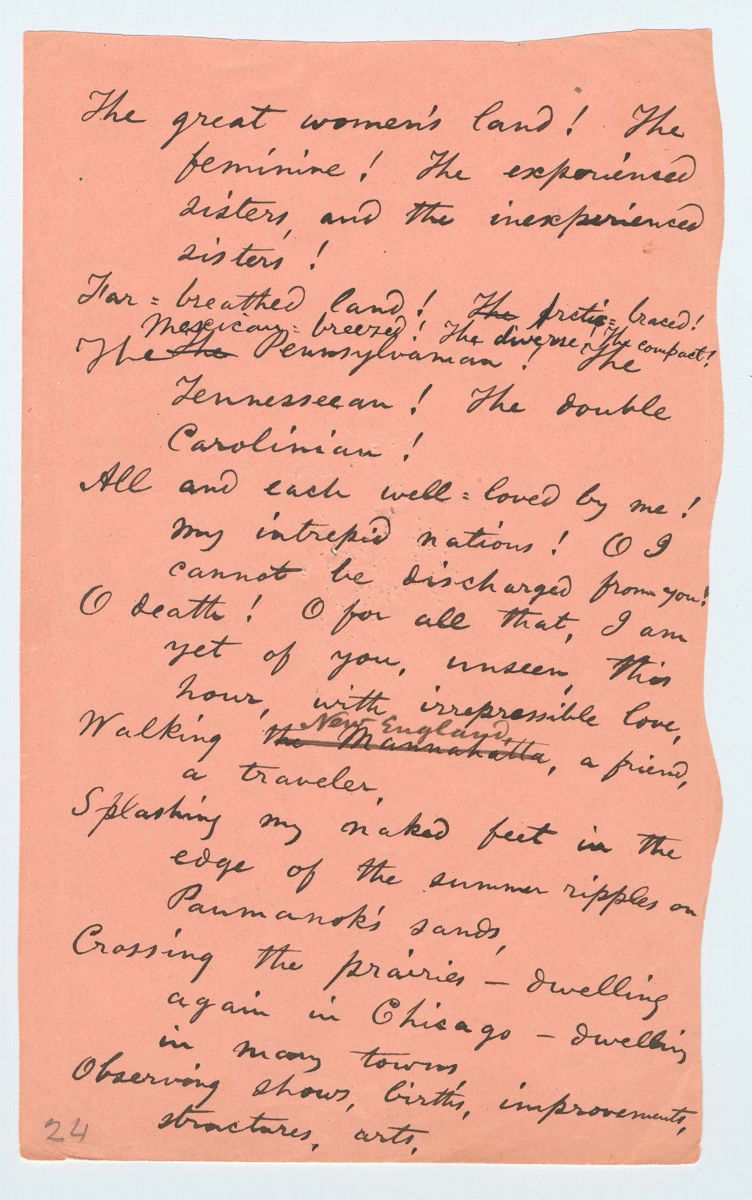
This leaf bears the deleted title "To
an artist, literat, &c". The first line "Come, I have now to tell
you" revises and expands on another manuscript "To a Literat". These lines were eventually revised to
form section 13 of the 1860 version of the poem "Chants Democratic" which was
revised and permanently retitled "Laws for Creations" in 1872.
-
Whitman Archive Title: Premonition
-
Whitman Archive ID: uva.00179
-
Folder: 50-51
-
Date: 1857-1859
-
Genre: poetry
-
Physical Description: 33 leaves, handwritten
-
View Images:
1
|
2
|
3
|
4
|
5
|
6
|
7
|
8
|
9
|
10
|
11
|
12
|
13
|
14
|
15
|
16
|
17
|
18
|
19
|
20
|
21
|
22
|
23
|
24
|
25
|
26
|
27
|
28
|
29
|
30
|
31
|
32
|
33
|
34
|
35
|
36
-
Content:
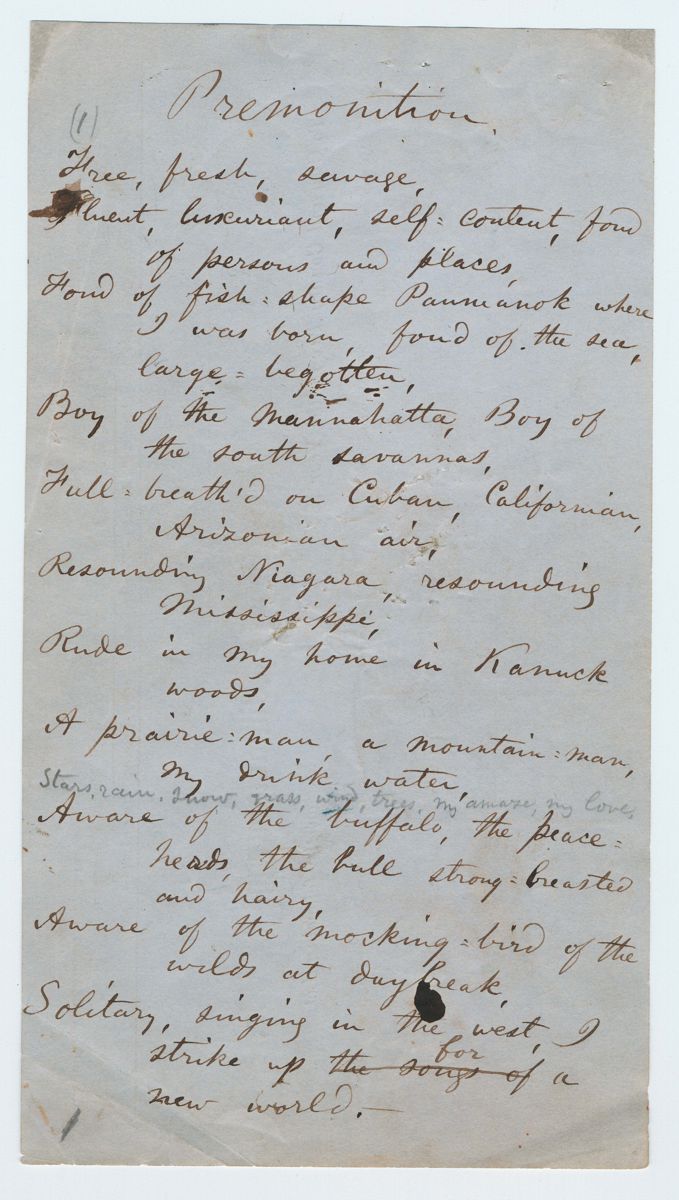
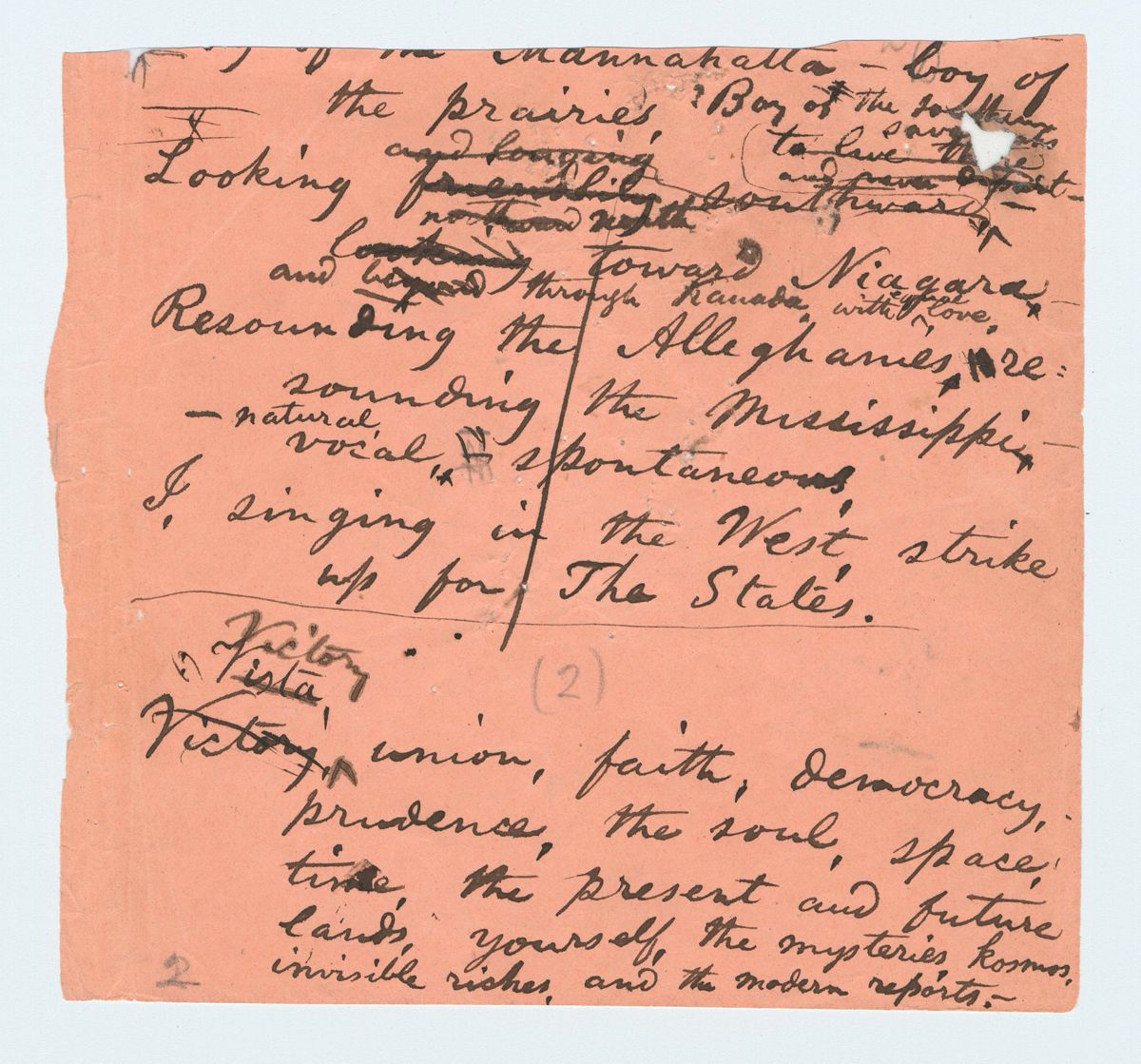
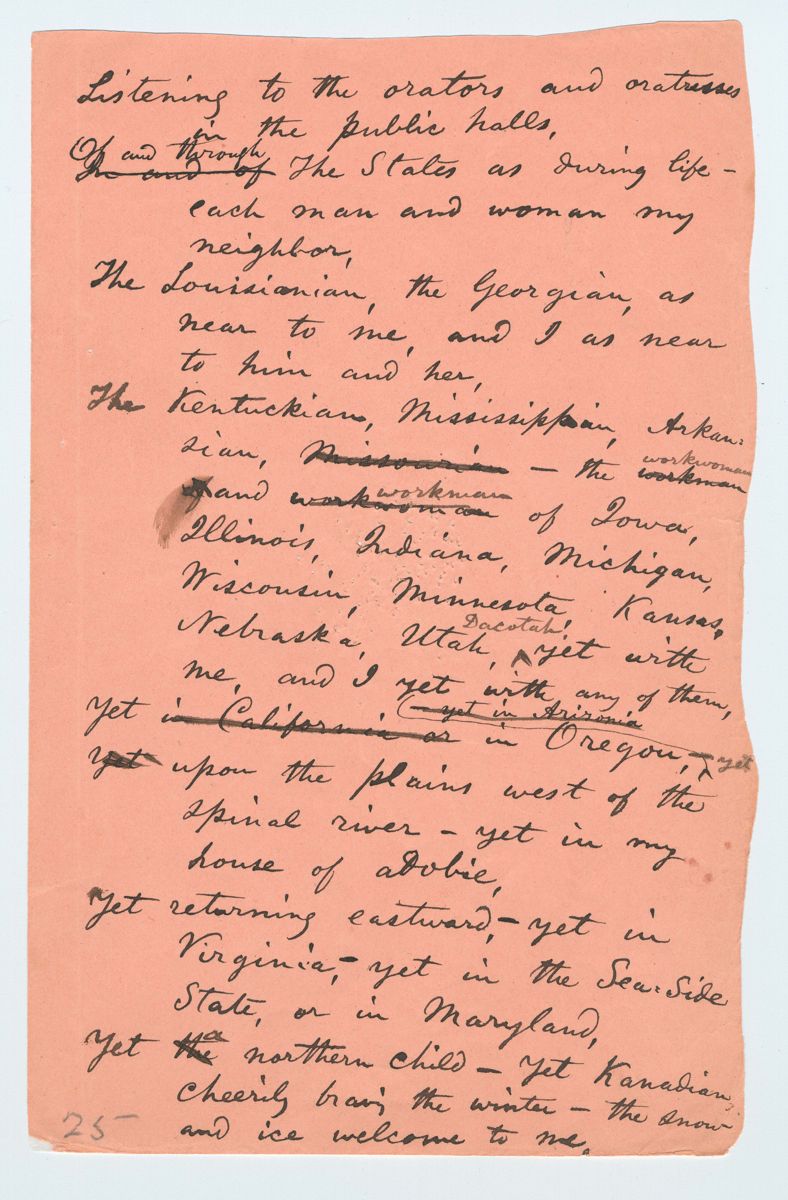
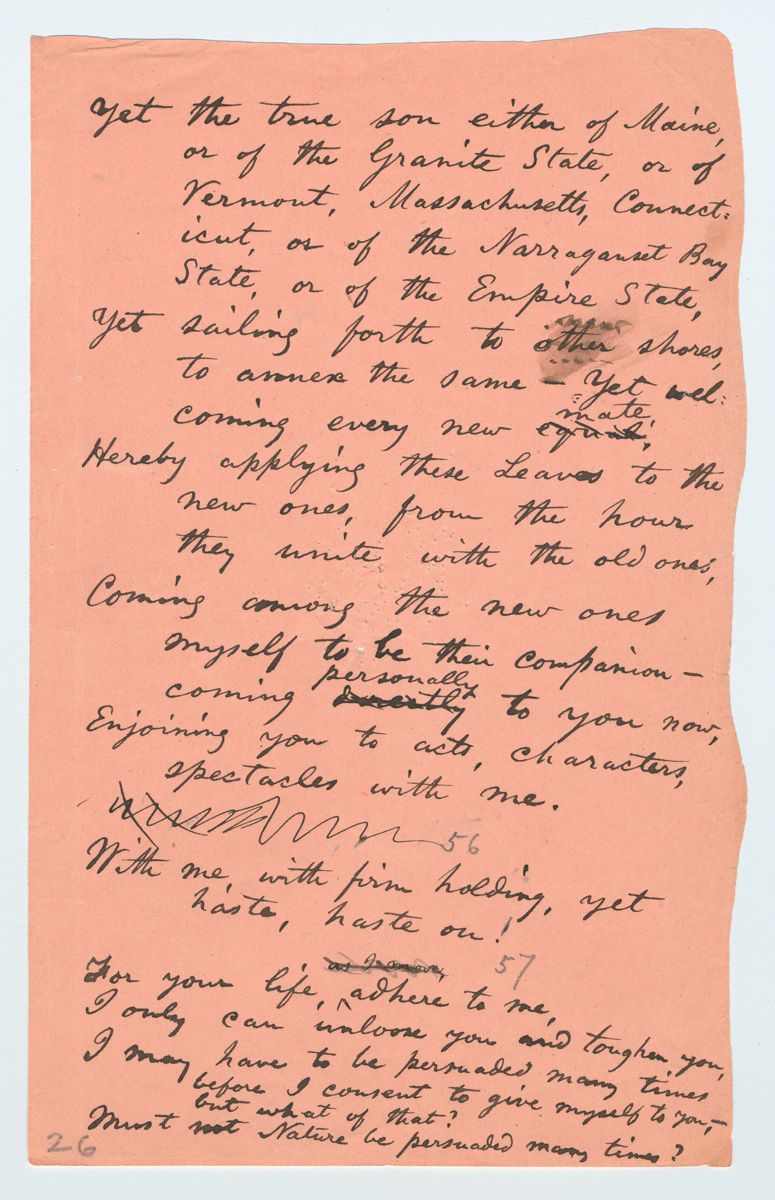
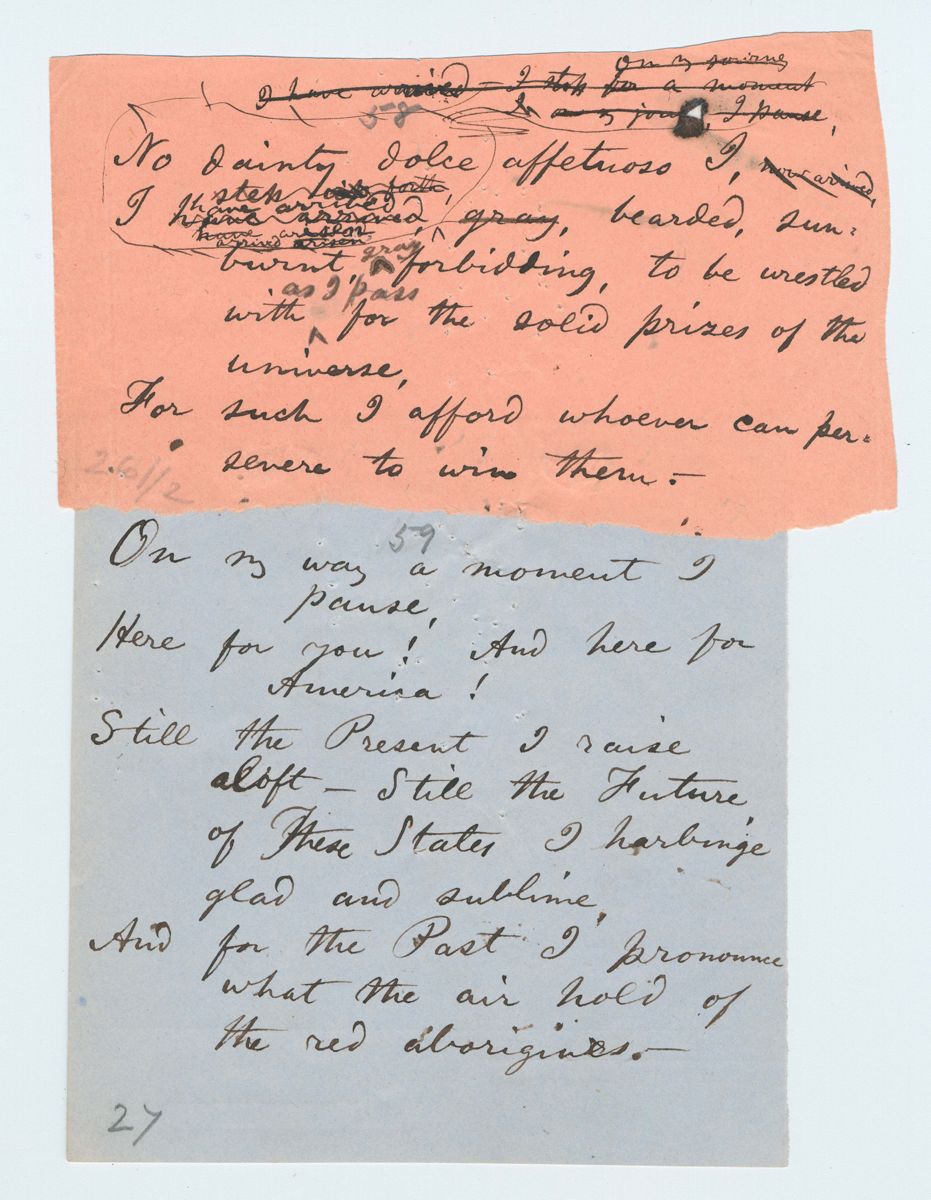
Thirty-three manuscript leaves numbered consecutively by Whitman in the lower left
corner. "Premonition" was
published as the introductory poem to the 1860 edition of
Leaves of Grass
under the title "Proto-Leaf." In the 1867 and
later editions it appeared directly after the opening poem "Inscription" as "Starting from Paumanok." On the
verso of leaf 15 and part of leaf 16 appears a draft of what would become section
11 of "Calamus" in the 1860
Leaves of Grass
.
-
Whitman Archive Title: Leaves-Droppings
-
Whitman Archive ID: uva.00180
-
Folder: 50-51
-
Date: 1857-1859
-
Genre: poetry
-
Physical Description: 1 leaf, 16 x 10 cm, handwritten
-
View Images:
1
|
2
-
Content:
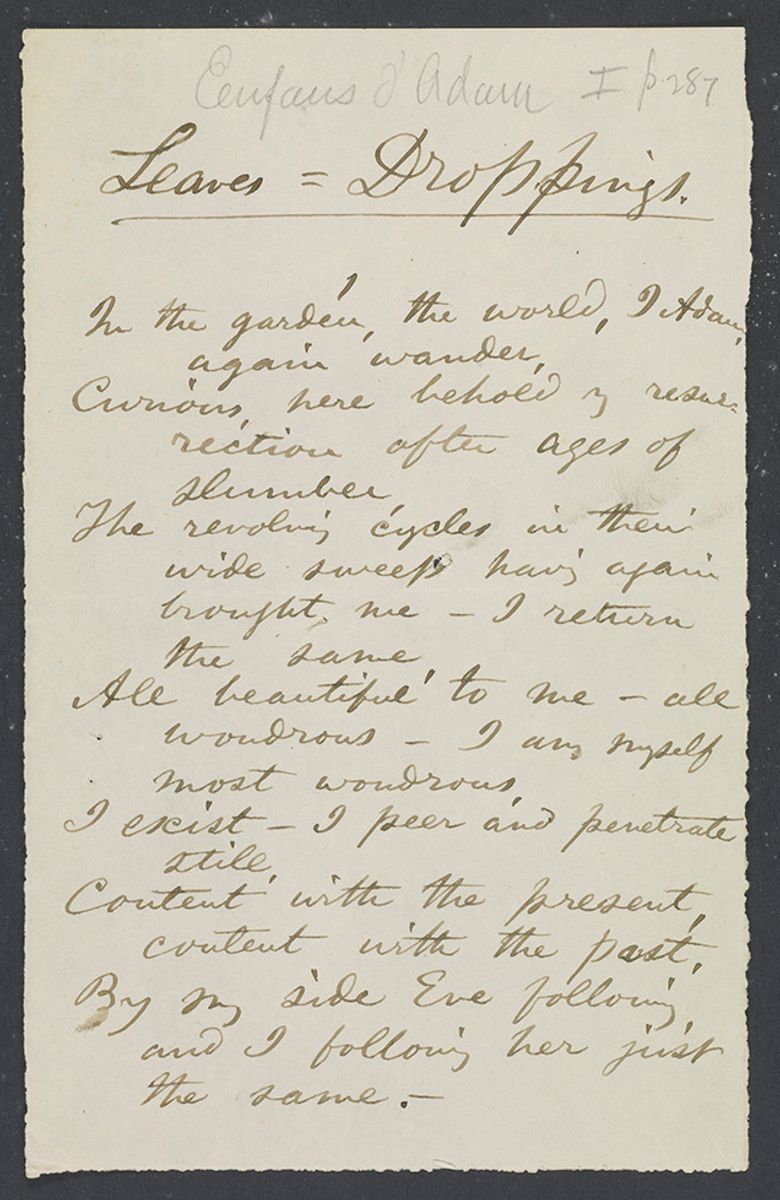
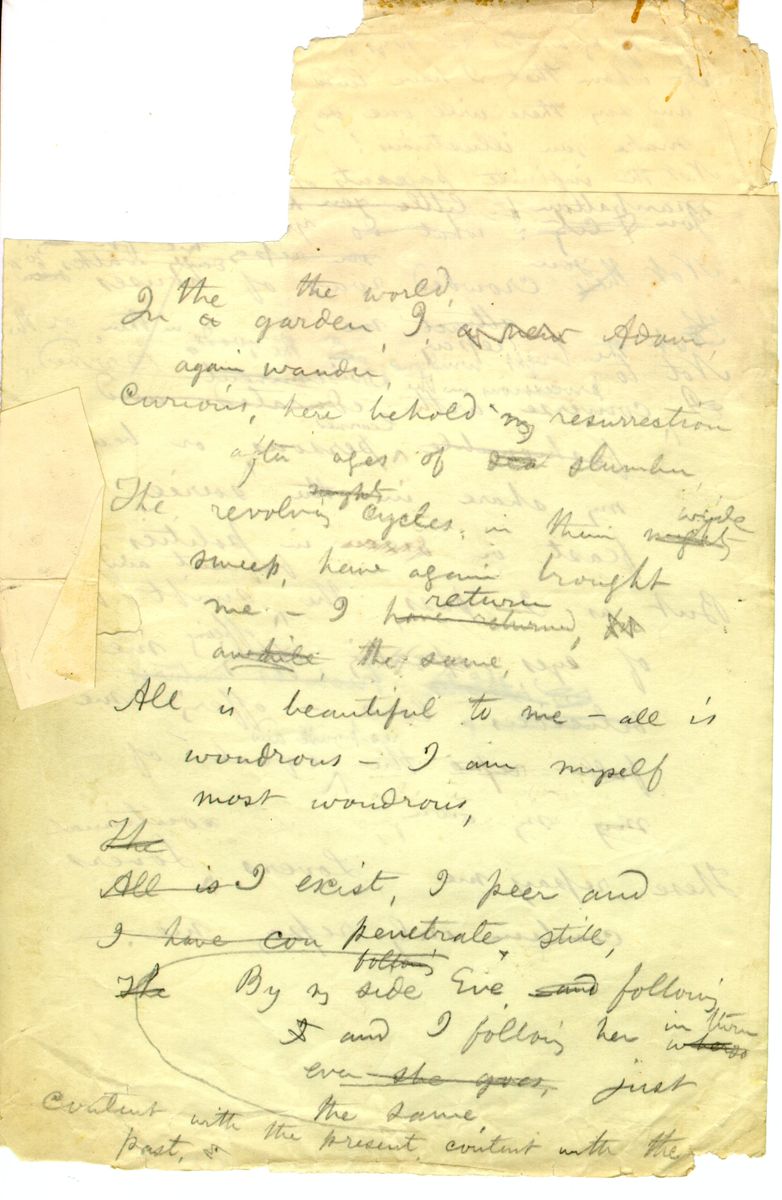
After being incorporated as the first main section of "Enfans d'Adam" in 1860, this poem received its
own title, "To the Garden, the
World" in the 1867
Leaves of
Grass
and retained its position in the "Children of Adam" group.
-
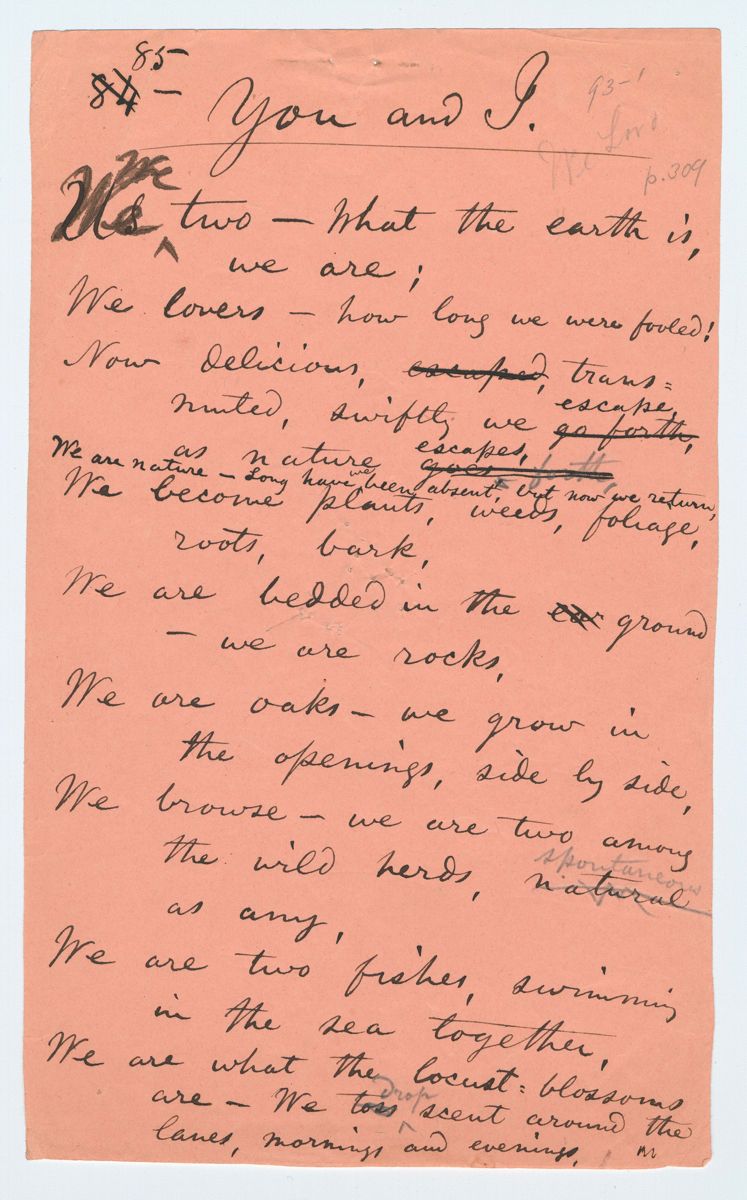
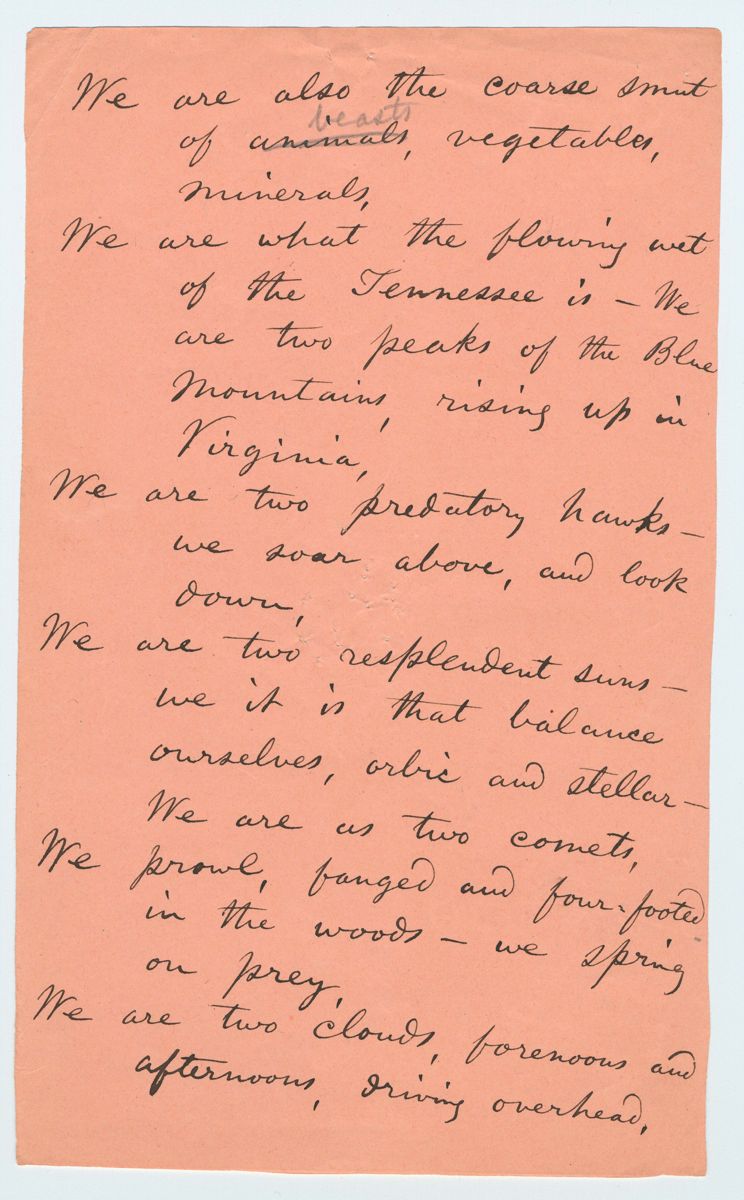
Whitman Archive Title: You and I
-
Whitman Archive ID: uva.00181
-
Folder: 50-51
-
Date: 1857-1859
-
Genre: poetry
-
Physical Description: 3 leaves, all leaves 21 x 13 cm, handwritten
-
View Images:
1
|
2
|
3
|
4
|
5
|
6
-
Content:
Originally numbered 84, this poem appeared in the 1860
Leaves of Grass
as main section 7
of "Enfans d'Adam," and was
retitled within the group "We Two—How
Long We Were Fool'd" in 1867.
-
Whitman Archive Title: [Now the hour has come upon me]
-
Whitman Archive ID: uva.00182
-
Folder: 50-51
-
Date: 1857-1859
-
Genre: poetry
-
Physical Description: 2 leaves, leaf 1 18.5 x 16 cm, leaf 2 11 x 16 cm, handwritten
-
View Images:
1
|
2
|
3
|
4
-
Content:
This poem, numbered 82 in pencil, became main section 8 of "Enfans d'Adam" in 1860, and
was permanently retitled within the group "Native Moments" in 1867.
-
Whitman Archive Title: [Once I passed through a populous]
-
Whitman Archive ID: uva.00183
-
Folder: 50-51
-
Date: 1857-1859
-
Genre: poetry
-
Physical Description: 1 leaf, 20 x 16 cm, handwritten
-
View Images:
1
|
2
-
Content:
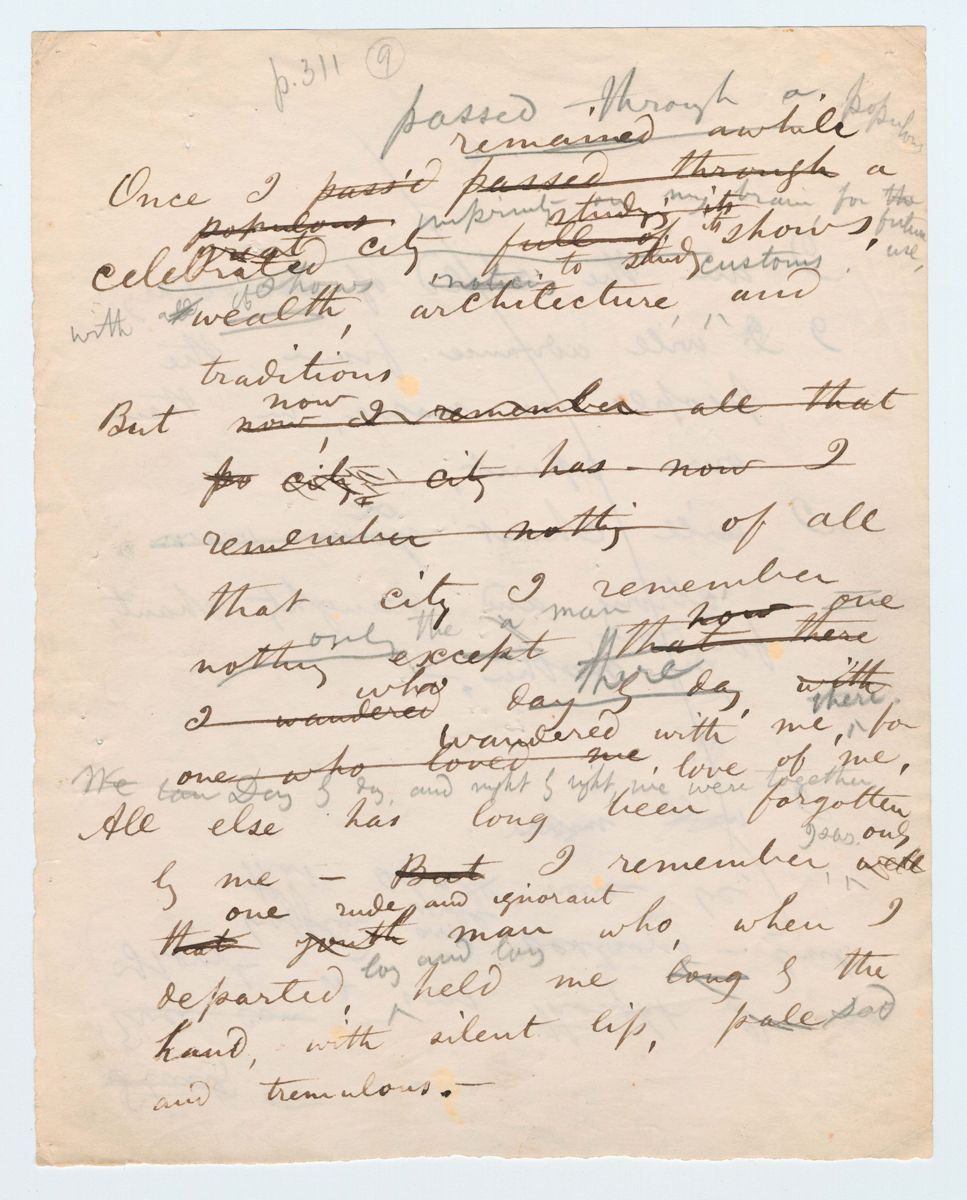
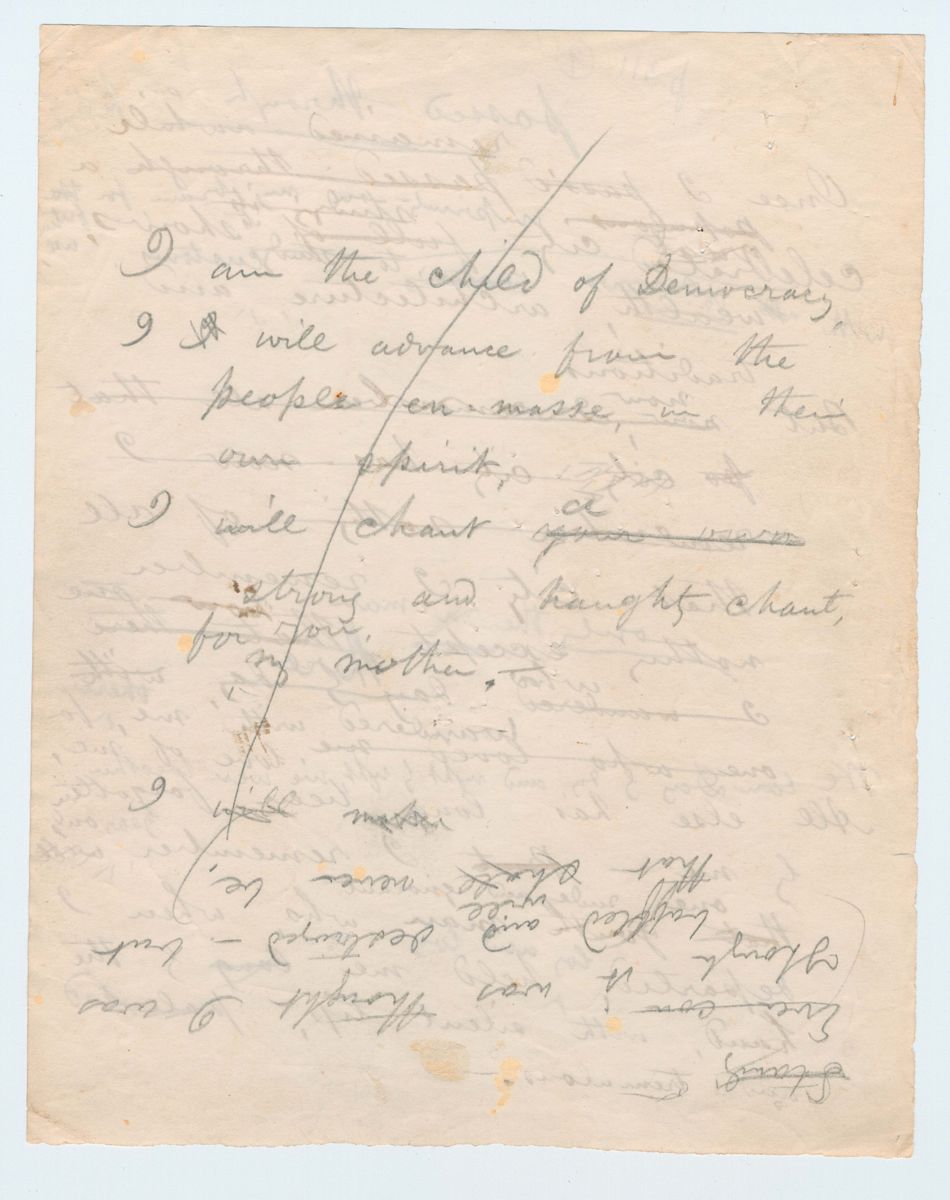
The recto verses appearing on this manuscript became the main section 9 of "Enfans d'Adam" in 1860 and
were retitled "Once I Pass'd Through
a Populous City" in 1867. On the verso appear two fragments: an
undeleted verse that would be used in Satan's section of "Chanting the Square Deific" in
"Sequel to Drum-Taps"
(1865-66); and what would become section 23 of "Proto-Leaf", which becomes "Starting from Paumanok" in 1867.
The undeleted verse is upside-down relative to the deleted section.
-
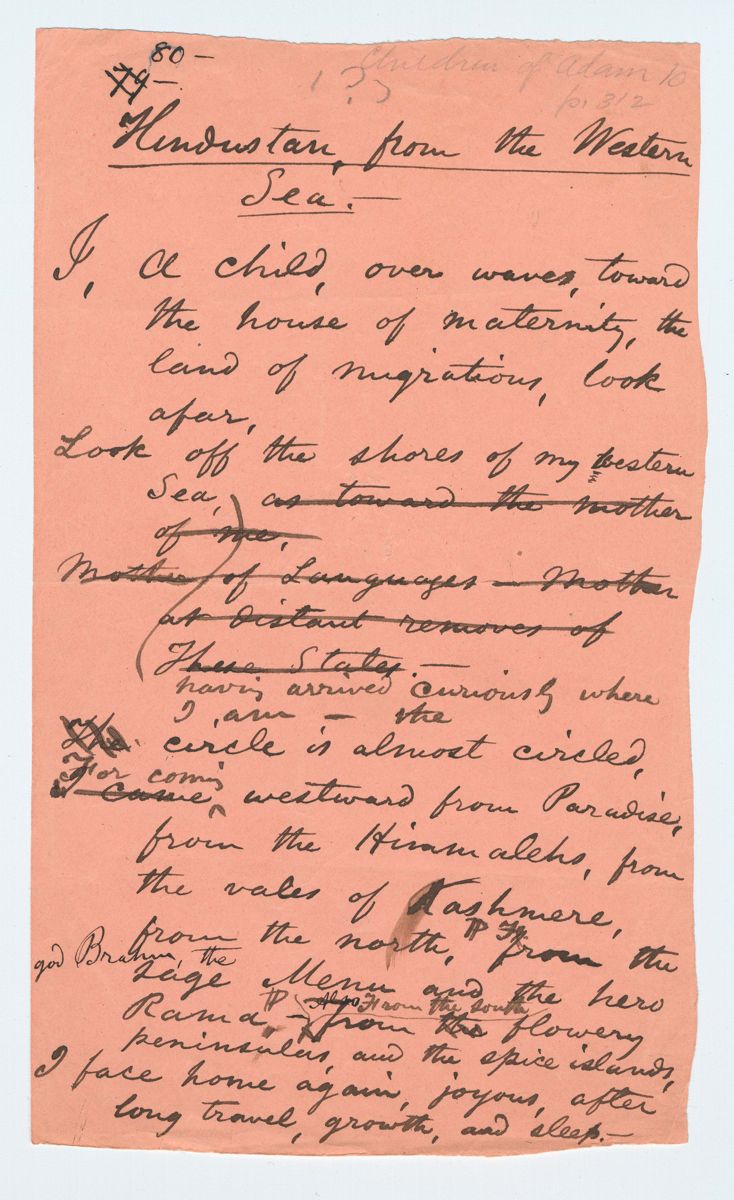
Whitman Archive Title: Hindustan
-
Whitman Archive ID: uva.00184
-
Folder: 50-51
-
Date: 1857-1859
-
Genre: poetry
-
Physical Description: 1 leaf, 21 x 12.5 cm, handwritten
-
View Images:
1
|
2
-
Content:
The number 80 appears above the deleted 79 above the title, along with a pencil
question mark in parentheses. This poem was revised to form main section 10 of
"Enfans d'Adam" in 1860, and
in 1867 was given two new opening lines and retitled "Facing West from California's Shores."
-
Whitman Archive Title: Calamus—1st draft p. 341 [Long I was held]
-
Whitman Archive ID: uva.00244
-
Folder: 50-51
-
Date: 1857-1859
-
Genre: poetry
-
Physical Description: 1 leaf, 16 x 10 cm, handwritten
-
View Images:
1
-
Content:
This manuscript became section 1 of "Calamus" in 1860, and was retitled "In Paths Untrodden" in the 1867
Leaves of Grass
.
-
Whitman Archive Title: [Was it I who walked the]
-
Whitman Archive ID: uva.00246
-
Folder: 50-51
-
Date: 1857-1859
-
Genre: poetry
-
Physical Description: 1 leaf that folds out, 21.5 x 16 cm, handwritten
-
View Images:
1
|
2
-
Content:
These leaves comprise two sections of a poem inscribed (with very few alterations)
on the first and third sides of a folded half-sheet of paper. On the first side of
the folded leaf a blue pencil was used to correct a pencil number 7 to a 1, and on
the third side the blue pencil corrected a pencil 8 to a 2. The five verses
beginning "Was it I who walked the / earth..." were not used in "Calamus," but the five lines
beginning "Scented herbage of my breast" became the opening verses of section 2 of
the cluster in the 1860
Leaves of Grass
. In the 1867 and
later editions the first line was used as the title of the poem.
-
Whitman Archive Title: [I do not know whether]
-
Whitman Archive ID: uva.00243
-
Folder: 50-51
-
Date: 1857-1859
-
Genre: poetry, prose
-
Physical Description: 5 leaves, 20 x 16 cm, handwritten
-
View Images:
1
|
2
|
3
|
4
|
5
|
6
|
7
|
8
|
9
|
10
-
Content:
The verses on the recto became lines 6-40 of section 2 of "Calamus" in the 1860
edition. Section 2 of the Calamus group was permanently retitled "Scented Herbage of my Breast" in
1867. On the verso appears a draft of an editorial, "Important Questions in Brooklyn.—," which Whitman
apparently never published but which seems to have inspired at least two published
editorials on the Brooklyn Water Works and the political quarrels surrounding
control of the project. The editorials appeared in the Brooklyn
Times
of March 15 and 16, 1859.
-
Whitman Archive Title: [These I, singing in spring]
-
Whitman Archive ID: uva.00330
-
Folder: 50-51
-
Date: 1857-1859
-
Genre: poetry
-
Physical Description: 4 leaves, 20 x 16 cm, handwritten
-
View Images:
1
|
2
|
3
|
4
-
Content:
These leaves comprise four sections of a poem inscribed on the first and third
sides of two folded half-sheets (20 x 16 cm) of the same white wove paper used for
1:3:1 and 1:3:2, in the same light brown ink and, like them, with only minor
revisions. The pages were folded and pinned together to form a small pamphlet.
Pinholes mostly at center-top and in what was the left margin of the pamphlet. The
lines on page 1 became verses 1-8 of section 4 of "Calamus." in 1860; page 2 ("Solitary, smelling the
earthy/ smell,...") became verses 9-14; page 3 ("Here lilac with a branch of/
pine,") became verses 15-22; and page 4 ("And stems of currants, and/
plum-blows,") became verses 23-28. From 1867 on the poem was titled "These I, Singing in Spring."
-
Whitman Archive Title: [Of the doubts]
-
Whitman Archive ID: uva.00322
-
Folder: 50-51
-
Date: 1857-1859
-
Genre: poetry
-
Physical Description: 2 leaves, 21.5 x 12 cm, handwritten
-
View Images:
1
|
2
|
3
|
4
-
Content:
On two light blue Williamsburgh tax blanks (21.5 x 12 cm), in light brown ink,
with minor revisions. A few pinholes at the head and in the center. A blue pencil
question mark appears to the left of the first line on the second form. The lines
on the first leaf became verses 1-9 of section 7 of "Calamus" in 1860, and the second leaf's lines ("To me
all these, and the/ like of these,..."] became verses 10-16. Retitled "Of the Terrible Doubt of
Appearances" in 1867.
-
Whitman Archive Title: [Long I thought that knowledge]
-
Whitman Archive ID: uva.00321
-
Folder: 50-51
-
Date: 1857-1859
-
Genre: poetry
-
Physical Description: 3 leaves, leaves 1 and 2 15 x 9.5 cm; leaf 3 6.5 x 9.5 cm, handwritten
-
View Images:
1
|
2
|
3
|
4
|
5
|
6
-
Content:
On three pieces of white wove paper (the first two 15 x 9.5 cm, the third 6.5 x
9.5 cm), in black ink, with revisions in the same ink and in pencil. Whitman also
penciled in the numbers 7, 8, and 8 1/2 in the lower-left corner of each page.
Pinholes at the head and in the center of each page. This was the fifth poem of
the original sequence "Live Oak, with
Moss"; the poem number is inscribed ornamentally, as with the Roman
numerals Whitman used for other "Live
Oak" poems, and a wavy line appears after the last verse. The lines on
the first leaf became verses 1-5 of section 8 of "Calamus" in 1860; the second leaf's lines ("Take
notice, you Kanuck woods") became verses 6-10; and the lines on the half-page ("I
am indifferent to my own/ songs—") became verses 11-12. There were no further
appearances of this poem during the poet's lifetime, Whitman having canceled it in
his "Blue Book Copy" of the
1860
Leaves.
-
Whitman Archive Title: [Hours continuing long]
-
Whitman Archive ID: uva.00314
-
Folder: 50-51
-
Date: 1857-1859
-
Genre: poetry
-
Physical Description: 2 leaves, leaf 1 9.5 x 9 cm; leaf 2 14.5 x 9 cm pasted to 5 x 9.5 cm, handwritten
-
View Images:
1
|
2
|
3
|
4
-
Content:
On two pieces of white wove paper, the first cut down to 9.5 x 9 cm and the second
comprising two sections (14.5 x 9 and 5 x 9.5 cm) joined by means of a strip of
pink paper. In brown-black ink, with revisions in the same ink and in pencil.
Pinholes mostly at top and in center of leaves. Whitman penciled in the numbers 11
and 12 (apparently over other numbers) in the lower-left corner of each page; his
partly erased pencil note "(finished in/ the other city)" appears on the first
page. The ornamental number "VIII" replaces a deleted ornamental "IX" on the first
page, and the top of another "IX" appears at the foot of the second page, beneath
a wavy line indicating the end of the poem. Whitman removed the lower section of
page 2 from the top of current leaf 1:3:33 ("I dreamed in a dream of a/ city...").
This poem, the eighth in the sequence "Live Oak, with Moss," became section 9 of "Calamus" in 1860. This was its
only appearance in
Leaves
. The
first page contains what would become verses 1-3 in 1860, and the second ("Hours
discouraged, distracted,") contains lines 4-12.
-
Whitman Archive Title: [You bards of ages hence]
-
Whitman Archive ID: uva.00340
-
Folder: 50-51
-
Date: 1857-1859
-
Genre: poetry
-
Physical Description: 2 leaves, leaf 1 8 x 9 cm; leaf 2 14.5 x 9.5 cm pasted to 5.5 x 9.5 cm, handwritten
-
View Images:
1
|
2
|
3
|
4
-
Content:
On two sections of white wove paper, the first cut down to 8 x 9 cm and the second
a composite of two pieces pasted together, the top measuring 14.5 x 9.5 and the
bottom 5.5 x 9.5 cm. In black ink, with a few revisions in the same ink. Pinholes
at top and in center of both pages. Whitman numbered the first 9 1/2 and the
second 10, in pencil, in the lower-left corner of each leaf. The Roman numeral is
inscribed in an ornamental style, and the poem terminates with a wavy line. The
seventh poem in the sequence "Live
Oak, with Moss," became section 10 of "Calamus" in 1860 and was permanently retitled "Recorders Ages Hence" in 1867.
The lines on the first page correspond to verses 1-3 of the 1860 version, and
those on the second page ("Publish my name and hang up/ my picture...") to lines
4-11.
-
Whitman Archive Title: [When I heard at the close of]
-
Whitman Archive ID: uva.00339
-
Folder: 50-51
-
Date: 1857-1859
-
Genre: poetry
-
Physical Description: 2 leaves, 15 x 9.5 cm, handwritten
-
View Images:
1
|
2
|
3
|
4
-
Content:
On two leaves of white wove paper, both measuring 15 x 9.5 cm; the lower half of
the second page is pasted over with a section of white paper (8 x 9 cm) containing
four revised verses. In black ink, with revisions in the same ink and in pencil.
Pinholes mostly at top of both pages. Whitman numbered the pages 4 and 5, in
pencil, in their lower-left corners. The third section of "Live Oak, with Moss" (with
ornamental Roman numeral), this poem became section 11 of "Calamus" in 1860 and was
permanently retitled "When I Heard at
the Close of the Day" in 1867. For an earlier draft of the poem numbered
V please see the verso of leaves 15-16 of "Premonition" (1:1:15-16). Bowers (p. 88) supplies the
three earlier lines concealed by the paste-on revision to the second leaf. The
lines on the first page correspond to verses 1-5 of the 1860 version, and those on
the second page ("And when I thought how/ my friend,...") to lines 6-13.
-
Whitman Archive Title: To a new personal admirer
-
Whitman Archive ID: uva.00332
-
Folder: 50-51
-
Date: 1857-1859
-
Genre: poetry
-
Physical Description: 2 leaves, leaf 1 13 x 11.5 cm; leaf 2 20 x 16 cm, handwritten
-
View Images:
1
|
2
|
3
|
4
-
Content:
On two pieces of white wove paper, 13 x 11.5 and 20 x 16 cm, in brown-black ink,
with substantial revisions in the same ink. Pinholes mostly at center and in left
margins of both pages. This poem, featuring a new first line, became section 12 of
"Calamus" in 1860; in 1867
Whitman dropped the last 2 1/2 lines and permanently retitled it "Are you the New Person Drawn Toward
Me?" The first page contains verses corresponding to lines 2-3 of the
1860 version, and the lines on the second page ("Do you suppose you can easily/ be
my lover,...") became verses 4-11.
-
Whitman Archive Title: Buds
-
Whitman Archive ID: uva.00308
-
Folder: 50-51
-
Date: 1857-1859
-
Genre: poetry
-
Physical Description: 1 leaf, 21.5 x 13 cm, handwritten
-
View Images:
1
|
2
-
Content:
On pink leaf (21.5 x 13 cm), in black ink, with minor revisions in the same ink. A
few pinholes at top and near center. A pencil question mark appears in parentheses
in the upper-right corner. The number 52 appears to have been revised from 51.
After adding several verses, Whitman designated this poem section 13 of "Calamus" in the 1860
Leaves
, and, after dropping the first
two and last three lines of the 1860 version, permanently retitled it "Roots and Leaves Themselves
Alone" in 1867.
-
Whitman Archive Title: Calamus-Leaves
-
Whitman Archive ID: uva.00310
-
Folder: 50-51
-
Date: 1857-1859
-
Genre: poetry
-
Physical Description: 1 leaf, 15 x 9 cm, handwritten
-
View Images:
1
|
2
-
Content:
On white wove leaf, 15 x 9 cm, in black ink, with the title "Live Oak, with Moss" stricken out
and "Calamus-Leaves" added in
light brown ink, and with one small revision in blue pencil. Whitman numbered this
page 1 in pencil. The first section of the original sequence "Live Oak, with Moss," this became
section 14 of "Calamus" in
1860 and was permanently retitled "Not Heat Flames up and Consumes" in the 1867
Leaves
.
-
Whitman Archive Title: Confession-Drops
-
Whitman Archive ID: uva.00311
-
Folder: 50-51
-
Date: 1857-1859
-
Genre: poetry
-
Physical Description: 1 leaf, 21.5 x 12 cm, handwritten
-
View Images:
1
|
2
-
Content:
Written on a light blue Williamsburgh tax blank, this poem became section 15 of
"Calamus" in 1860,
and, with the addition of a new first line, was retitled "Trickle, Drops" in 1867.
-
Whitman Archive Title: 43—Leaf
-
Whitman Archive ID: uva.00317
-
Folder: 50-51
-
Date: 1857-1859
-
Genre: poetry
-
Physical Description: 2 leaves, 21.5 x 13 cm, handwritten
-
View Images:
1
|
2
|
3
|
4
-
Content:
The original title was "Leaflet." On the second page Whitman added, in a combination of normal
and blue pencil, the number 43 (1/2). With the addition of a new first line ("1.
Who is now reading this?") the poem became section 16 of "Calamus" in 1860; the
lines on the first draft page correspond to verses 2-8 and those on the second
page ("Or as if interior in me") to verses 9-10. This was the first and last
appearance of the poem during Whitman's lifetime: he rejected it from his "Blue Book Copy" of
Leaves of Grass
in 1860.
-
Whitman Archive Title: Poemet
-
Whitman Archive ID: uva.00325
-
Folder: 50-51
-
Date: 1857-1859
-
Genre: poetry
-
Physical Description: 2 leaves, 21 x 13 cm, handwritten
-
View Images:
1
|
2
|
3
|
4
-
Content:
On two pink leaves (21 x 13 cm), in black ink, with revisions in the same ink and
in light ink. Pinholes in center, at top, and in top-left corner. This poem was
originally titled "Leaf" and
apparently numbered 78; Whitman inscribed its new title, "Poemet," in light ink. It became
number 17 of the "Calamus" cluster in
1860, with the lines on the first leaf corresponding to verses 1-7 and those on
the second ("And what I dreamed I will/ henceforth tell...") to verses 8-13 of the
first published version. Retitled "Of
Him I Love Day and Night" in 1867, it was transferred to the "Whispers of Heavenly Death"
cluster in
Passage to India
in
1871. In 1881 Whitman incorporated it, with the rest of the cluster, in the main
body of
Leaves
.
-
Whitman Archive Title: City of my walks and joys
-
Whitman Archive ID: uva.00023
-
Folder: 50-51
-
Date: late 1850s
-
Genre: poetry
-
Physical Description: 1 leaf, 8.5 x 10 cm pasted to 20 x 16 cm, handwritten
-
View Images:
1
|
2
-
Content:
On a composite leaf consisting of two pieces of white wove paper. The smaller
section is pasted over some lines in the top-left corner of the larger piece, from
the top of which other lines were cut off. The verses became section 18 of "Calamus" in the 1860 edition of
Leaves of Grass
; the poem was permanently titled "City of Orgies" in 1867. On the reverse of the leaf (uva.00583)
appears an extensively revised pencil draft of the first poem in "Enfans d'Adam."
-
Whitman Archive Title: In the garden
-
Whitman Archive ID: uva.00583
-
Folder: 50-51
-
Date: late 1850s
-
Genre: poetry
-
Physical Description: 1 leaf, 8.5 x 10 cm pasted to 20 x 16 cm, handwritten
-
View Images:
1
|
2
-
Content:
A composite leaf consisting of two pieces of white wove paper that have been pasted together. On the larger piece
is an extensively revised pencil draft of the first poem in "Enfans d'Adam." The group first
appeared in print in the 1860
Leaves of Grass
with this poem as section 1. The poem was
permanently titled "To the Garden of
the World" in 1867. On the reverse of the leaf (uva.00023) are verses that became section 18 of "Calamus" in the 1860 edition of
Leaves of Grass
; the poem was permanently titled "City of Orgies" in 1867.
-
Whitman Archive Title: [I saw in Louisiana a]
-
Whitman Archive ID: uva.00316
-
Folder: 50-51
-
Date: 1857-1859
-
Genre: poetry
-
Physical Description: 2 leaves, 15 x 9.5 cm, handwritten
-
View Images:
1
|
2
-
Content:
On two leaves of white wove paper, both 15 x 9.5 cm, in black ink, with extensive
revisions in the same ink, in light brown ink, and in pencil. Pinholes mostly at
top and in center of both pages. Whitman numbered the pages 2 and 3 in pencil.
This was originally the second section of the sequence "Live Oak, with Moss" (one of the deleted lines reads
"I write/ these pieces, and name/ them after it [the Louisiana live-oak];"), with
ornamental Roman numeral. It became section 20 of "Calamus" in 1860; the lines on the first manuscript
page correspond to verses 1-7, and those on the second ("It is not needed to
remind/ me...") to verses 8-13. The poem was retitled "I saw in Louisiana a Live-Oak Growing" in 1867.
-
Whitman Archive Title: As of Eternity
-
Whitman Archive ID: uva.00307
-
Folder: 50-51
-
Date: 1857-1859
-
Genre: poetry
-
Physical Description: 2 leaves, 21 x 13 cm, handwritten
-
View Images:
1
|
2
|
3
|
4
-
Content:
On two leaves of pink paper, both 21 x 13 cm, in black ink, with minor revisions
in the same ink. Pinholes mostly in center and at top of both pages. This poem
became section 21 of "Calamus"
in 1860; the lines on the first manuscript page became verses 1-6, and those on
the second ("I hear not the volumes of/ sound merely—...") became 7-9. Retitled
"That Music Always Round
Me" in 1867, it was transferred in 1871 to the "Whispers of Heavenly Death"
cluster in
Passage to India.
In
1881 Whitman incorporated it, with the rest of the cluster, in the main body of
Leaves
.
-
Whitman Archive Title: To A Stranger
-
Whitman Archive ID: uva.00334
-
Folder: 50-51
-
Date: 1857-1859
-
Genre: poetry
-
Physical Description: 2 leaves, 21 x 13 cm, handwritten
-
View Images:
1
|
2
|
3
|
4
-
Content:
On two leaves of pink paper, both 21 x 13 cm, in black ink, with revisions in the
same ink and in light ink. Pinholes mostly in center and in left margin of each
page. This poem was first numbered 94, and the first word was "Stranger"; Whitman
penciled in a question mark, in parentheses, next to the title. It was numbered
section 22 of "Calamus" in
1860: the lines on the first page correspond to verses 1-6 of the 1860 version,
and those on the second ("You give me the pleasure") to verses 7-10. Whitman
reintroduced the title "To a
Stranger" in the 1867
Leaves
.
-
Whitman Archive Title: [This moment as I sit alone]
-
Whitman Archive ID: uva.00331
-
Folder: 50-51
-
Date: 1857-1859
-
Genre: poetry
-
Physical Description: 1 leaf, cm, handwritten
-
View Images:
1
|
2
-
Content:
On one leaf of white wove paper, in dark brown ink, with revisions in pencil.
Pinholes in center and at top. Whitman penciled in the number 6 in the lower-left
corner. The fourth poem in the original sequence "Live Oak, with Moss" (with ornamental Roman numeral),
it became section 23 of "Calamus" in 1860 and was permanently retitled "This Moment, Yearning and
Thoughtful" in 1867.
-
Whitman Archive Title: Prairie-Grass
-
Whitman Archive ID: uva.00326
-
Folder: 50-51
-
Date: 1857-1859
-
Genre: poetry
-
Physical Description: 1 leaf, 21 x 13 cm, handwritten
-
View Images:
1
|
2
-
Content:
On one leaf of pink paper (21 x 13 cm), in black ink, with revisions in an even
blacker ink and in pencil. Pinholes in center. The poem was originally numbered
53. In 1860 Whitman designated it section 25 of "Calamus," transforming the title into a new first line
and expanding the original first line into verses 2-4. In 1867 he further revised
it, permanently retitling it "The
Prairie-Grass Dividing."
-
Whitman Archive Title: Leaf [O dying! Always dying!]
-
Whitman Archive ID: uva.00319
-
Folder: 50-51
-
Date: 1857-1859
-
Genre: poetry
-
Physical Description: 1 leaf, 21.5 x 12 cm, handwritten
-
View Images:
1
|
2
-
Content:
On one light blue Williamsburgh tax blank (21.5 x 12 cm), in dark brown ink, with
revisions in fine pen and pencil. Whitman penciled in a question mark, in
parentheses, next to the title. With the addition of the new first line "O love!"
this became section 27 of "Calamus" in 1860. In the 1867
Leaves
it was retitled "O
Living Always—Always Dying!" Whitman next transferred it to the "Passage to India" supplement
bound in with
Leaves
, where it
reappeared in 1876; in the 1881
Leaves
Whitman permanently added it to the cluster "Whispers of Heavenly Death."
-
Whitman Archive Title: Leaf [A promise to Indiana]
-
Whitman Archive ID: uva.00318
-
Folder: 50-51
-
Date: 1857-1859
-
Genre: poetry
-
Physical Description: 1 leaf, 22 x 13 cm, handwritten
-
View Images:
1
|
2
-
Content:
On one leaf of pink paper (22 x 13 cm), in black ink, with revisions in the same
ink. Pinholes mostly in center. The original title was "Leaflet," and the original number seems to have been
70. After substantial revision (including the addition of the new first line "A
promise and gift to California,") this poem became section 30 of "Calamus" in 1860. Whitman further
revised the poem before including it, permanently retitled "A Promise to California," in the
1867
Leaves
.
-
Whitman Archive Title: Leaf [What place is besieged]
-
Whitman Archive ID: uva.00320
-
Folder: 50-51
-
Date: 1857-1859
-
Genre: poetry
-
Physical Description: 1 leaf, 21.5 x 13 cm, handwritten
-
View Images:
1
|
2
-
Content:
On one leaf of pink paper (21.5 x 13 cm), in black ink, with a fair copy of the
poem at the bottom of the leaf and a deleted draft featuring heavy revisions in
the same ink and in pencil at the top. This poem was originally numbered 68, and
its title was "Leaflet—." In
1860 it became the second numbered verse paragraph of section 31 of "Calamus." In 1867 Whitman split
up the two paragraphs and made them separate poems; these verses were moved to a
position between the "Calamus"
and a "Leaves of Grass"
cluster and permanently retitled "What Place Is Besieged?" In 1881 the poem was transferred to the
cluster "Inscriptions."
-
Whitman Archive Title: [Here the frailest leaves of me]
-
Whitman Archive ID: uva.00313
-
Folder: 50-51
-
Date: 1857-1859
-
Genre: poetry
-
Physical Description: 1 leaf, 15 x 9.5 cm, handwritten
-
View Images:
1
|
2
-
Content:
On one leaf of white wove paper (15 x 9.5 cm), in medium-brown ink, with one
revision in the same ink. Pinholes mostly at top and in center. The two sets of
verses are divided by a short horizontal line. In 1860 the first set, with the
addition of a new first line ("Here my last words, and the most baffling,") became
section 44 of "Calamus"; the
poem was permanently retitled "Here
the Frailest Leaves of Me", and the new first line dropped, in 1867. The
second set was revised to form section 38 of "Calamus" in 1860; in 1867 it was further revised and
retitled "Fast Anchor'd, Eternal, O
Love."
-
Whitman Archive Title: [A leaf for hand-in-hand]
-
Whitman Archive ID: uva.00306
-
Folder: 50-51
-
Date: 1857-1859
-
Genre: poetry
-
Physical Description: 1 leaf, 14.5 x 9 cm, handwritten
-
View Images:
1
|
2
-
Content:
On one leaf of white wove paper (14.5 x 9 cm), in black ink, with revisions in
pencil. Pinholes in center and at top. A blue-pencil number 3 appears in the upper
right corner over an erased 9. With substantial additions and revisions this
evolved into section 37 of "Calamus" in 1860; after further revision it became "A Leaf for Hand in Hand" in
1867.
-
Whitman Archive Title: [Earth]
-
Whitman Archive ID: uva.00312
-
Folder: 50-51
-
Date: 1857-1859
-
Genre: poetry
-
Physical Description: 1 leaf, 14.5 x 9.5 cm, handwritten
-
View Images:
1
|
2
-
Content:
On one leaf of white wove paper (14.5 x 9.5 cm), in brown-black ink, with
revisions in lighter ink (including the deletion, undone in 1860, of the phrase
"My likeness!" after "Earth!"). Pinholes mostly at top and in center. Whitman
penciled in the number 15 in the lower-left corner. Originally poem XI in the
sequence "Live Oak, with Moss"
(with the Roman numeral ornamentally drawn), this was revised to become section 36
of "Calamus" in 1860. In 1867
Whitman retitled the poem "Earth! My
Likeness!"
-
Whitman Archive Title: [I dreamed in a dream of a]
-
Whitman Archive ID: uva.00315
-
Folder: 50-51
-
Date: 1857-1859
-
Genre: poetry
-
Physical Description: 1 leaf, 9.5 x 9 cm, handwritten
-
View Images:
1
|
2
-
Content:
On one leaf of white wove paper cut down to 9.5 x 9 cm, in brown-black ink, with
revisions in pencil. Pinholes at top and in center. Whitman numbered the leaf 13,
in pencil, in the lower-left corner. The excised top portion of the leaf became
the bottom section of page 2 of 1:3:11, the poem (eighth in the sequence "Live Oak, with Moss") beginning
"Hours continuing long, sore/ and heavy-hearted..." In 1860 this poem was
substantially revised to form section 34 of "Calamus"; in 1867 it was retitled "I Dreamed in a Dream."
-
Whitman Archive Title: [What think you I have]
-
Whitman Archive ID: uva.00338
-
Folder: 50-51
-
Date: 1857-1859
-
Genre: poetry
-
Physical Description: 1 leaf, 8.5 x 9 cm pasted to 6.5 x 9 cm, handwritten
-
View Images:
1
|
2
-
Content:
On a composite leaf of white wove paper consisting of two sections (8.5 x 9 and
6.5 x 9 cm) pasted together. Both sections are in black ink but, as Bowers notes,
the lower verses were inscribed using a darker, thicker pen; the upper section is
unrevised, but the lower section bears several alterations in the original ink.
Pinholes at top of both sections and in the current center. Whitman numbered the
page 9, in pencil, in the lower-left corner. Originally the sixth section of the
sequence "Live Oak, with
Moss," this poem was revised to form section 32 of "Calamus" in 1860, and in 1867 was
retitled "What Think You I Take My
Pen in Hand?"
-
Whitman Archive Title: [Sometimes]
-
Whitman Archive ID: uva.00328
-
Folder: 50-51
-
Date: 1857-1859
-
Genre: poetry
-
Physical Description: 1 leaf, 15 x 9.5 cm, handwritten
-
View Images:
1
|
2
-
Content:
On one leaf of white wove paper (15 x 9.5 cm), in light brown ink, with one
revision in the same ink. Pinholes at top and in center. A blue pencil mark,
possibly the number 4, has been inscribed in the upper right corner. Bowers notes
that the page bears the imprint of a papermaker's lozenge die, perhaps that of
Platner and Smith of Lee, Massachusetts. This poem became section 39 of "Calamus" in 1860; in 1867 Whitman
replaced the third line with a new one and permanently retitled the poem "Sometimes with One I Love."
-
Whitman Archive Title: [To the young man]
-
Whitman Archive ID: uva.00337
-
Folder: 50-51
-
Date: 1857-1859
-
Genre: poetry
-
Physical Description: 1 leaf, 15 x 9 cm, handwritten
-
View Images:
1
|
2
-
Content:
On one leaf of white wove paper (15 x 9 cm), in black ink, with revisions in the
same ink and in pencil. Whitman also penciled in the page number 16 in the
lower-left corner. Pinholes in center and at top. This page bears the same
papermaker's mark as 1:3:35. Twelfth in the original sequence "Live Oak, with Moss" (with
ornamental Roman numeral), it became section 42 of "Calamus" in 1860. In 1867 Whitman changed the poem to
an apostrophe, adding the first line "O Boy of the West!" (later removed) and
permanently retitling it "To a
Western Boy."
-
Whitman Archive Title: To One Who Will Understand
-
Whitman Archive ID: uva.00336
-
Folder: 50-51
-
Date: 1857-1859
-
Genre: poetry
-
Physical Description: 1 leaf, 21.5 x 13 cm, handwritten
-
View Images:
1
|
2
-
Content:
On one leaf of pink paper (21.5 x 13 cm), in black ink, with revisions in the same
ink, in pencil, and in fine ink (in that order). Pinholes mostly in center.
Originally titled "To Those Who Will
Understand" and numbered 100 (then 101, then the current ?100 in the
fine pen). This was revised to form section 41 of "Calamus" in 1860 and was permanently retitled "Among the Multitude" in the 1867
Leaves
.
-
Whitman Archive Title: [O you whom I often and silently come where you are]
-
Whitman Archive ID: uva.00324
-
Folder: 50-51
-
Date: 1857-1859
-
Genre: poetry
-
Physical Description: 1 leaf, 14.5 x 9 cm, handwritten
-
View Images:
1
|
2
-
Content:
On one leaf of white wove paper (14.5 x 9 cm), in brown-black ink, with revisions
in the same ink. Pinholes mostly at the top, with a few lower down. The tenth
section of the original sequence "Live Oak, with Moss" (with ornamental Roman numeral), this was
reformatted and renumbered but otherwise left unrevised as section 43 of "Calamus" in 1860. In 1867 Whitman
permanently retitled it "O You Whom I
Often and Silently Come."
-
Whitman Archive Title: [That shadow]
-
Whitman Archive ID:
-
Folder: 50-51
-
Date: 1857-1859
-
Genre: poetry
-
Physical Description: 1 leaf, 17 x 9.5 cm, handwritten
-
View Images:
1
|
2
-
Content:
One one leaf of lined light blue wove paper (17 x 9.5 cm), in pencil, with one
pencil revision. Only two sets of pinholes, both in center. This was revised to
become section 40 of "Calamus"
in 1860; in 1867 it was retitled "That Shadow, My Likeness."
-
Whitman Archive Title: To one a century hence, or any number of centuries hence
-
Whitman Archive ID: uva.00335
-
Folder: 50-51
-
Date: 1857-1859
-
Genre: poetry
-
Physical Description: 1 leaf, 10 x 13 cm pasted to 11.5 x 13 cm, handwritten
-
View Images:
1
|
2
-
Content:
On one composite leaf of pink paper formed of two sections (10 x 13 and 11.5 x 13
cm) of the same page cut apart and pasted together in a new order. The poem number
was originally 101 and then changed to 102; this number was deleted and the
current ?101 added in fine pen. Bowers explains that the poem, in two discrete
verse sections and inscribed in black ink (with title), originally occupied one
full side of this leaf. When Whitman wanted to expand the first section without
having to retranscribe the second one, he simply cut the two sections apart,
flipped the first section over (turning it upside-down in the process), pasted the
second section to the lower edge of the verso of the first section, and wrote his
new first section (beginning "Throwing far, throwing over the head/ of death" and
incorporating the original title as verse 3) in the blank space now created above
the second section. The new first section is written and revised in light ink. As
Bradley and Blodgett observe, the words "thirty-eight years old the/ eighty-first
year of The States" indicate that Whitman composed the poem in 1857; these were
revised to read "I, forty years old the Eighty-third Year of The States" in the
1860
Leaves
, in which this poem
constituted section 45 of "Calamus." In 1867 Whitman retitled the poem "Full of Life, Now."
-
Whitman Archive Title: Feuillage
-
Whitman Archive ID: uva.00185
-
Folder: 50-51
-
Date: 1857-1859
-
Genre: poetry
-
Physical Description: 16 leaves, 21.5 x 13 cm, handwritten
-
View Images:
1
|
2
|
3
|
4
|
5
|
6
|
7
|
8
|
9
|
10
|
11
|
12
|
13
|
14
|
15
|
16
-
Content:
This poem was originally numbered 89. Whitman also numbered each leaf in the
lower-left corner in pencil: the leaves follow the order 1-9, 9 1/2 (a full page
despite its number), and 10-15. The expression "the Eightieth year of / These
States" at the top of leaf 2 indicates that Whitman was working on this poem as
early as 1856. It became section 4 of "Chants Democratic" in 1860. In 1867 Whitman
ungrouped it and retitled the poem "American Feuillage," a name it kept until being permanently retitled
"Our Old Feuillage" in
1881.
-
Whitman Archive Title: Evolutions
-
Whitman Archive ID: uva.00187
-
Folder: 50-51
-
Date: 1857-1859
-
Genre: poetry
-
Physical Description: 6 leaves, 21 x 13 cm, handwritten
-
View Images:
1
|
2
|
3
|
4
|
5
|
6
|
7
|
8
|
9
|
10
|
11
|
12
-
Content:
On six leaves of pink paper. The deleted title is "Poemet—."
"Evolutions.—" is written in
light ink, and the number "41—" in a darker ink than the text. Whitman numbered
each leaf in pencil in the upper right corner. This poem was first published in
the January 14, 1860 issue of the
New York Saturday Press
under the title "You and Me and To-day," after which it became section
7 of "Chants Democratic" in
the 1860
Leaves of Grass
. In
1867 Whitman ungrouped it and permanently retitled it "With Antecedents"; in 1881 it was
permanently transferred to the new cluster "Birds of Passage." The manuscript leaves correspond to
the published verses in the 1860
Leaves
of Grass
.
-
Whitman Archive Title: A Sunset Carol
-
Whitman Archive ID: uva.00188
-
Folder: 50-51
-
Date: 1857-1859
-
Genre: poetry
-
Physical Description: 6 leaves, leaf 1 25.5 x 12.5 cm, leaves 2-6 21.5 x 12.5 cm, handwritten
-
View Images:
1
|
2
|
3
|
4
|
5
|
6
|
7
|
8
|
9
|
10
|
11
|
12
-
Content:
Whitman numbered each of the six leaves, in pencil, in the upper right corner. In
the 1860 edition of
Leaves of
Grass
Whitman published this poem as section 8 of "Chants Democratic." In 1867, he
gave it the permanent title "Song at
Sunset" and moved it to the supplement "Songs Before Parting"; in 1871 it was finally
transferred to the cluster "Songs of
Parting" within the main body of
Leaves of Grass
.
-
Whitman Archive Title: Thought [Of these years I sing]
-
Whitman Archive ID: uva.00189
-
Folder: 50-51
-
Date: 1857-1859
-
Genre: poetry
-
Physical Description: 2 leaves, leaf 1 21.5 x 13 cm, leaf 2 18.5 x 12.5 cm, handwritten
-
View Images:
1
|
2
|
3
|
4
-
Content:
Whitman inscribed and circled the note "2d/ piece/ in Book" in the upper-right
corner of the first leaf. The small top section is inscribed on the verso of some
deleted draft verses excised from "So
Long!" "Thought"
became section 9 of "Chants
Democratic" in 1860. In the 1867
Leaves of Grass
Whitman combined it with the second
"Thought" to form the poem
"Thoughts" in the
supplement "Songs Before
Parting." (This particular "Thought" was numbered section 1 of the composite poem.) In 1871 "Thoughts" appeared in the cluster
"Songs of Parting" within
the main body of
Leaves of Grass
,
and in 1881, it achieved its final position within that cluster. These leaves
correspond to the verses in the 1860 "Chants Democratic" version.
-
Whitman Archive Title: Thought [Of closing up my songs by these]
-
Whitman Archive ID: uva.00190
-
Folder: 50-51
-
Date: 1857-1859
-
Genre: poetry
-
Physical Description: 2 leaves, leaf 1 9 x 12.5 cm pasted to 17.5 x 13.5 cm, leaf 2 21 x 13.5 cm, handwritten
-
View Images:
1
|
2
|
3
|
4
-
Content:
The paste-on revision contains an expanded version of the original lines Whitman
cut away and apparently discarded. The verso of the paste-on section contains,
five undeleted draft lines that would become the final verses of "Proto-Leaf" in the 1860
Leaves of Grass
; Whitman's small
note in the lower-right corner, in a semi-circle, reads "end of Poem." These
"Thought" lines became
section 11 of "Chants
Democratic" in 1860. In the 1867
Leaves of Grass
Whitman combined it with the second
"Thought" to form the poem
"Thoughts" in the
supplement "Songs Before
Parting." In 1871 "Thoughts" appeared in the cluster "Songs of Parting" within the main body of
Leaves of Grass
, and in 1881, it
achieved its final position within that cluster.
-
Whitman Archive Title: To a Historian
-
Whitman Archive ID: uva.00191
-
Folder: 50-51
-
Date: 1857-1859
-
Genre: poetry
-
Physical Description: 1 leaf, 20 x 16 cm pasted to 11 x 16 cm, handwritten
-
View Images:
1
|
2
-
Content:
After undergoing extensive revisions, in 1860
"To a Historian" became
section 10 of "Chants
Democratic." In 1867 Whitman deleted five verses, transferred the poem
to the supplement "Songs Before
Parting," and permanently retitled it "To a Historian." It appeared as the fifth poem in the
opening cluster "Inscriptions"
in the 1872 and all later editions. On the verso appear fragments of pencil notes
for a speech or essay Whitman wrote (most likely) in 1856, and revised in 1858,
under the working title "Slavery—the
Slaveholders—/ —The Constitution—the true America and Americans, the laboring
persons—." The verso of another manuscript in this collection entitled
"To a Cantatrice.—"
contains an additional fragment of these notes.
-
Whitman Archive Title: Orators
-
Whitman Archive ID: uva.00193
-
Folder: 50-51
-
Date: 1857-1859
-
Genre: poetry
-
Physical Description: 5 leaves, 22 x 13.5 cm, handwritten
-
View Images:
1
|
2
|
3
|
4
|
5
|
6
|
7
|
8
|
9
|
10
-
Content:
The poem was originally numbered 67, and the partly erased pencil note "Needs to
be/ re-written/ or excluded" appears in the upper-right corner of the first leaf.
Whitman also numbered the leaves in pencil in their lower-left corners. The leaves
correspond to verses in section 12 of "Chants Democratic" in the 1860
Leaves of Grass
. After excising
and altering numerous verses of the poem and numbering different verse paragraphs
for the "Chants Democratic"
version, Whitman next made the poem the second numbered section of the last "Leaves of Grass" cluster in the
1867 edition. From 1872 to 1876 it bore the title "To Oratists." Then, in 1881, Whitman deleted several
lines, joining this poem with a previously unconnected poem known as "Voices" to form "Vocalism" in the cluster "Autumn Rivulets," a position and
identity the now-composite poem retained from that point on.
-
Whitman Archive Title: American Laws
-
Whitman Archive ID: uva.00195
-
Folder: 50-51
-
Date: 1857-1859
-
Genre: poetry
-
Physical Description: 3 leaves, leaf 1 19.5 x 12.5 cm, leaves 2-3 21.5 x 12.5 cm, handwritten
-
View Images:
1
|
2
|
3
|
4
|
5
|
6
-
Content:
A partial horizontal line at the top of the first leaf indicates that Whitman cut
away the original title and number. Whitman numbered each leaf in pencil in the
lower left corner. These pages were transformed into section 13 of "Chants Democratic" in the 1860
Leaves of Grass
. In 1867 it was
greatly shortened and transferred to the final "Leaves of Grass" cluster. In 1872 the poem was
permanently retitled "Laws for
Creations" Its final position was in the cluster "Autumn Rivulets".
-
Whitman Archive Title: To Poets to Come
-
Whitman Archive ID: uva.00196
-
Folder: 50-51
-
Date: 1857-1859
-
Genre: poetry
-
Physical Description: 1 leaf, 20 x 16 cm, handwritten
-
View Images:
1
|
2
-
Content:
Whitman numbered the inscribed sides of the folded leaf, in pencil, in the upper
right corners. Side 1 corresponds to verses 1-9 of section 14 of "Chants Democratic" in the 1860
Leaves of Grass
; side 2 ("I
expect that Kanadians,") became verses 10-16 of that version. In 1867 it was
shortened to make up section 4 of the final "Leaves of Grass" cluster. In 1872 it was permanently
retitled "Poets to Come" and
transferred to the cluster "The
Answerer," where it stayed until being moved to the "Inscriptions" cluster in
1881.
-
Whitman Archive Title: Mediums
-
Whitman Archive ID: uva.00197
-
Folder: 50-51
-
Date: 1857-1859
-
Genre: poetry
-
Physical Description: 2 leaves, 21.5 x 12.5 cm, handwritten
-
View Images:
1
|
2
|
3
|
4
-
Content:
This manuscript draft became section 16 of "Chants Democratic" in 1860, with Leaf 1
corresponding to verses 1-6 and Leaf 2 ("They shall train themselves/ to go in
public,...") to verses 7-11. In 1867 Whitman restored the title "Mediums"; in 1871, the poem was
transferred to
Passage to India
,
and in 1881 took its final position in the cluster "From Noon to Starry Night."
-
Whitman Archive Title: Wander-Teachers
-
Whitman Archive ID: uva.00198
-
Folder: 50-51
-
Date: 1857-1859
-
Genre: poetry
-
Physical Description: 2 leaves, 21.5 x 13 cm, handwritten
-
View Images:
1
|
2
|
3
|
4
-
Content:
The poem was originally numbered 50. Whitman penciled in a question mark, in
parentheses, in the upper-right corner. This became section 17 of "Chants Democratic" in the 1860
Leaves of Grass
, with leaf 1
corresponding to verses 1-6 and leaf 2 ("We confer on equal terms with / each of
The States,") to verses 7-13. Although he dropped it from
Leaves of Grass
in 1867, Whitman nonetheless used the
poem, permanently retitled "On
Journeys through the States," in
Passage to India
in 1871. In 1872 and 1876 it
appeared in the "Passage to
India" annexes to
Leaves of
Grass
and
Two
Rivulets
, respectively, and in the 1881 edition it took its final position
in the cluster "Inscriptions."
-
Whitman Archive Title: Leaf [Me imperturbe!]
-
Whitman Archive ID: uva.00199
-
Folder: 50-51
-
Date: 1857-1859
-
Genre: poetry
-
Physical Description: 1 leaf, 21 x 13 cm, handwritten
-
View Images:
1
|
2
-
Content:
Originally numbered 73. This poem became section 18 of "Chants Democratic" in 1860; in 1867 it was
permanently retitled "Me
Imperturbe," and after various repositionings, was finally transferred
to the cluster "Inscriptions"
in 1881.
-
Whitman Archive Title: Leaf [I was looking a long while]
-
Whitman Archive ID: uva.00200
-
Folder: 50-51
-
Date: 1857-1859
-
Genre: poetry
-
Physical Description: 1 leaf, 21 x 13 cm, handwritten
-
View Images:
1
|
2
-
Content:
Originally numbered 75; the pencil title "Leaflet" appears, deleted, in the upper-right corner.
This poem became section 19 of "Chants Democratic" in 1860; in 1867 it was permanently retitled "I Was Looking a Long While," and
in 1881 was assigned to the cluster "Autumn Rivulets."
-
Whitman Archive Title: Mouth-Songs
-
Whitman Archive ID: uva.00201
-
Folder: 50-51
-
Date: 1857-1859
-
Genre: poetry
-
Physical Description: 2 leaves, 21.5 x 13 cm, handwritten
-
View Images:
1
|
2
|
3
|
4
-
Content:
Originally numbered 54 and titled "Leaf.—". The title was next "Songs—always wanted" and then "Mouth-Songs." This poem became
section 20 of "Chants
Democratic" in 1860, with leaf 1 corresponding to verses 1-6 and
leaf 2 ("The delicious singing of the/ mother...") to verses 8-10. In 1867 Whitman
revised the first line and permanently retitled the poem "I Hear America Singing"; in 1881
it achieved its final position in the cluster "Inscriptions."
-
Whitman Archive Title: Confession and Warning
-
Whitman Archive ID: uva.00202
-
Folder: 50-51
-
Date: 1857-1859
-
Genre: poetry
-
Physical Description: 3 leaves, 21.5 x 12 cm, handwritten
-
View Images:
1
|
2
|
3
|
4
|
5
|
6
-
Content:
After undergoing substantial deletions and revisions this poem became section 13
of the cluster "Leaves of
Grass" in 1860, with the manuscript leaves corresponding to
the published version as follows: leaf 1 to numbered verse paragraphs 1 (now
beginning "O bitter sprig! Confession sprig!") through 3 and 5; leaf 2 ("You
felons on trial in courts,") to 4 and most of 6; and leaf 3 ("And I say I am of
them—") to the rest of 6. In 1867 Whitman permanently retitled the poem "You Felons on Trial in Courts"
and further shortened it by removing the first three verse paragraphs. The poem's
final position, in 1881, was in the cluster "Autumn Rivulets."
-
Whitman Archive Title: Night on the Prairies
-
Whitman Archive ID: uva.00203
-
Folder: 50-51
-
Date: 1857-1859
-
Genre: poetry
-
Physical Description: 3 leaves, 20 x 13 cm, handwritten
-
View Images:
1
|
2
|
3
|
4
|
5
|
6
-
Content:
Whitman cut off and flipped over the top section of the first leaf, gluing it to
the rest of the leaf, in order to transform the original first line into the
title. (The current verso of the top section still bears, undeleted, the first
line "Night on the prairies[,]" along with the title "Leaf.—" and the number 73, originally 72). Whitman
deleted the pencil numbers 16, 17, and 18 in the lower-left corner of the leaves,
substituting the numbers 1 through 3. This poem became section 15 of the cluster
"Leaves of Grass" in 1860. In
1867 Whitman restored the title "Night on the Prairies" and revised the poem, transferring it to the
"Leaves of Grass" group.
After other repositionings it achieved its current place in the cluster "Whispers of Heavenly Death" in
1881.
-
Whitman Archive Title: Leaf [Sea-water, and all breathing]
-
Whitman Archive ID: uva.00204
-
Folder: 50-51
-
Date: 1857-1859
-
Genre: poetry
-
Physical Description: 2 leaves, 22 x 13 cm, handwritten
-
View Images:
1
|
2
|
3
|
4
-
Content:
The poem was originally numbered 71 and then modified to 72. These 2 leaves
contain verses first published in section 16 of the 1860
Leaves of Grass
cluster. In 1867
Whitman transferred this poem to a different "Leaves of Grass" group with the poems that would
become "Night on the Prairies"
and "I Sit and Look Out."
After receiving the title "The World
Below the Brine" in the 1871 "Sea-Shore Memories" group of
Passage to India
, the final change was its transfer
to the cluster "Sea Drift"
within the main body of
Leaves of
Grass
in 1881.
-
Whitman Archive Title: Leaf [I sit and look out upon all]
-
Whitman Archive ID: uva.00205
-
Folder: 50-51
-
Date: 1857-1859
-
Genre: poetry
-
Physical Description: 2 leaves, 21.5 x 13 cm, handwritten
-
View Images:
1
|
2
|
3
|
4
-
Content:
Originally numbered 77 and then changed to 78. This became section 17 of the
cluster "Leaves of Grass" in
the 1860
Leaves
. After taking different
positions in both the 1867 and 1872, it took its final place in 1881 in the
cluster "By the Roadside."
-
Whitman Archive Title: As of the The Truth
-
Whitman Archive ID: uva.00206
-
Folder: 50-51
-
Date: 1857-1859
-
Genre: poetry
-
Physical Description: 4 leaves, leaf 2 19.5 x 13 cm, all other leaves 21.5 x 13 cm, handwritten
-
View Images:
1
|
2
|
3
|
4
|
5
|
6
|
7
|
8
-
Content:
This poem became section 18 of the cluster "Leaves of Grass" in the 1860 edition. In 1872 the
poem received the title "All is
Truth," and in 1881, after various repositionings, it was finally
transferred to the cluster "From Noon
to Starry Night". The second leaf is a composite formed when Whitman
deleted and cut away the original first two verses on the leaf, flipped the new
small section over and upside-down, pasted it to the foot of the remaining
original verses, and inscribed a verse in light ink on the newly created blank
space.
-
Whitman Archive Title: As of Origins
-
Whitman Archive ID: uva.00208
-
Folder: 50-51
-
Date: 1857-1859
-
Genre: poetry
-
Physical Description: 1 leaf, three pasted sections of 6.5 x 13 cm, 8 x 13 cm, and 12.5 x 13 cm, handwritten
-
View Images:
1
|
2
-
Content:
This poem became section 19 of the cluster "Leaves of Grass" in the 1860 edition. In 1867
Whitman moved it to a different "Leaves of Grass" group in the "Songs Before Parting" annex. In 1872 it was retitled
"Germs" and was ultimately
transferred, in 1881, to the cluster "By the Roadside."
-
Whitman Archive Title: Voices
-
Whitman Archive ID: uva.00209
-
Folder: 50-51
-
Date: 1857-1859
-
Genre: poetry
-
Physical Description: 2 leaves, 21 x 13 cm, handwritten
-
View Images:
1
|
2
|
3
|
4
-
Content:
This poem became section 21 of the cluster "Leaves of Grass" in the 1860 edition. In 1867
Whitman placed it after what would eventually become "All is Truth" and "Germs" as section 3 of a "Leaves of Grass" group in the annex "Songs Before Parting." In 1872
Whitman restored the title "Voices." In 1881 he dropped the first two verses and added "Voices" (as verse paragraph 2) to
the previously unrelated poem "To
Oratists" to form "Vocalism" in the cluster "Autumn Rivulets".
-
Whitman Archive Title: Leaf [What am I after all but a]
-
Whitman Archive ID: uva.00210
-
Folder: 50-51
-
Date: 1857-1859
-
Genre: poetry
-
Physical Description: 1 leaf, 21 x 13 cm, handwritten
-
View Images:
1
|
2
-
Content:
This poem became section 22 of the cluster "Leaves of Grass" in the 1860 edition. In 1867
Whitman dropped the second 1860 verse and made it section 4 of a "Leaves of Grass" group in the
annex "Songs Before Parting".
Whitman gave it the title "What Am I
After All" in
Passage to
India
(1871), and in 1881 it was finally transferred to the cluster
"Autumn Rivulets."
-
Whitman Archive Title: To One Shortly To Die
-
Whitman Archive ID: uva.00211
-
Folder: 50-51
-
Date: 1857-1859
-
Genre: poetry
-
Physical Description: 2 leaves, 21 x 13 cm, handwritten
-
View Images:
1
|
2
|
3
|
4
-
Content:
Originally numbered 95 and then changed to 96. This poem was published under the
title "To One Shortly to Die,"
with only minor revisions, in the 1860
"Messenger Leaves" cluster. In
1871, Whitman made small but significant additions to the poem and transferred it
to the supplement "Passage to
India." In 1881 it was finally moved to the cluster "Whispers of Heavenly Death."
-
Whitman Archive Title: To Rich Givers
-
Whitman Archive ID: uva.00212
-
Folder: 50-51
-
Date: 1857-1859
-
Genre: poetry
-
Physical Description: 1 leaf, 21 x 13 cm, handwritten
-
View Images:
1
|
2
-
Content:
"To Rich Givers—" was
originally numbered 98. In 1860 it formed part of the "Messenger Leaves" cluster under
the same title. After being ungrouped (1867) and transferred to the cluster "Songs of Parting" (1872 and
1876), it finally appeared, in 1881, in the cluster "By the Roadside." The deleted verses on the back of
the leaf represent an earlier version of the manuscript poem "To the Future," never published
by Whitman, and currently housed in the Huntington Library.
-
Whitman Archive Title: To a Pupil
-
Whitman Archive ID: uva.00213
-
Folder: 50-51
-
Date: 1857-1859
-
Genre: poetry
-
Physical Description: 1 leaf, 21 x 12 cm, handwritten
-
View Images:
1
|
2
-
Content:
The manuscript bears the title "To a
Pupil"; however, the original title seems to have been cut away. This
poem was revised somewhat and published under the same title in the "Messenger Leaves" cluster of the
1860
Leaves of Grass
. It was ungrouped
in 1867, transferred to a "Leaves of
Grass" group within the "Passage to India" supplement in 1872 (also 1876), and finally moved to
the cluster "Autumn Rivulets"
within
Leaves of Grass
in
1881.
-
Whitman Archive Title: A Past Presidentiad, and one to come also
-
Whitman Archive ID: uva.00214
-
Folder: 50-51
-
Date: 1857-1859
-
Genre: poetry
-
Physical Description: 2 leaves, 21 x 13 cm, handwritten
-
View Images:
1
|
2
-
Content:
Whitman wrote and deleted the date 1858 in blue pencil in the upper right corner
of the first leaf, and inscribed the same date in normal pencil in the lower left
corner of the second leaf. This poem became "To The States, To Identify the 16th, 17th, or 18th
Presidentiad" in the cluster "Messenger Leaves" in the 1860
Leaves of Grass
. Ungrouped in
1867, it was transferred in 1872 to a "Leaves of Grass" group within the main body. In 1881
it was finally transferred to the cluster "By the Roadside". Images of the versos are unavailable.
-
Whitman Archive Title: To a Cantatrice
-
Whitman Archive ID: uva.00215
-
Folder: 50-51
-
Date: 1857-1859
-
Genre: poetry
-
Physical Description: 1 leaf, 9 x 16 cm, handwritten
-
View Images:
1
|
2
-
Content:
This poem was first titled "To an
artist," then "To an
architect"; the smudged-out words "Lecture[s] / To" appear in light ink
in the upper-left corner. These lines were revised and published under the title
"To a Cantatrice" in the
"Messenger Leaves" cluster
of 1860. After being ungrouped and permanently retitled "To A Certain Cantatrice" in 1867,
it was revised for inclusion in the cluster "Songs of Insurrection" in the 1872 and 1876
Leaves of Grass
. In 1881 it was
finally transferred to the cluster "Inscriptions". On one section of the same leaf of white ruled laid
paper used for "To a
Historian," and with another fragment of the same pencil draft of the
speech or essay "Slavery—the
Slaveholders—/ —The Constitution—the/ true America and Ameri-/ cans, the
laboring persons.—" on verso.
-
Whitman Archive Title: To You
-
Whitman Archive ID: uva.00216
-
Folder: 50-51
-
Date: 1857-1859
-
Genre: poetry
-
Physical Description: 1 leaf, 9 x 12.5 pasted to 20 x 13 cm, handwritten
-
View Images:
1
|
2
-
Content:
Beneath the pasted-over section can be discerned a second title, also "To You," with the number 91
(mended from 90). In the 1860
Leaves of Grass
Whitman divided
the poems again, publishing them in reverse order under the same titles at the end
of the cluster "Messenger
Leaves." Section 1 was eventually published (1881) as one of the poems
in the cluster "Inscriptions,"
but Whitman dropped section 2 from his published poems after an 1876 appearance in
the supplement "Passage to
India."
-
Whitman Archive Title: Mannahatta
-
Whitman Archive ID: uva.00217
-
Folder: 50-51
-
Date: 1857-1859
-
Genre: poetry
-
Physical Description: 5 leaves, 21 x 13 cm, handwritten
-
View Images:
1
|
2
|
3
|
4
|
5
|
6
|
7
|
8
|
9
|
10
-
Content:
A draft of the poem "Mannahatta." Whitman numbered each
leaf in pencil in the lower-left corner. The leaves correspond to
various verses in the 1860 edition. In the 1872 edition of
Leaves of Grass
the poem was transferred to a "Leaves of Grass" cluster, and in
1881 took its final position in the "From Noon to Starry Night" cluster.
-
Whitman Archive Title: Poem of Joys
-
Whitman Archive ID: uva.00218
-
Folder: 50-51
-
Date: 1857-1859
-
Genre: poetry
-
Physical Description: 20 leaves, 14.5 x 13 cm to 21.5 x 13 cm, handwritten
-
View Images:
1
|
2
|
3
|
4
|
5
|
6
|
7
|
8
|
9
|
10
|
11
|
12
|
13
|
14
|
15
|
16
|
17
|
18
|
19
|
20
|
21
|
22
|
23
|
24
|
25
|
26
|
27
|
28
|
29
|
30
|
31
|
32
|
33
|
34
|
35
|
36
|
37
|
38
|
39
|
40
-
Content:
These twenty leaves, numbered by a collector, relate to "Poem of Joys," first published in
the 1860
Leaves of Grass
. The title became
"Poems of Joy" in 1867, but
reverted to the original title in its next two iterations (in the "Passage to India" supplement of
1872 and 1876). In 1881 it was finally titled "A Song of Joys" and left independent of any
cluster.
-
Whitman Archive Title: France, the 18th Year of These States
-
Whitman Archive ID: uva.00221
-
Folder: 50-51
-
Date: 1857-1859
-
Genre: poetry
-
Physical Description: 5 leaves, 21 x 13 cm to 22.5 x 13.5 cm, handwritten
-
View Images:
1
|
2
|
3
|
4
|
5
|
6
|
7
|
8
|
9
|
10
-
Content:
Originally numbered 86 and revised by overwriting to 87; Whitman also numbered the
leaves 1-5 (in pencil, lower left corner), with the 1 replacing a 6 and the 2
written over what looks like a 7. The leaves correspond to various verses in the
1860 published version "France, The 18th Year of These States". Although Whitman never changed
the title, and did not revise the poem much, he did transfer it twice, grouping it
in the cluster "Songs of
Insurrection" within the main body of
Leaves of Grass
in 1871 and 1876, and in 1881 finally
transferring it to the new cluster "Birds of Passage" within
Leaves of Grass
.
-
Whitman Archive Title: Unnamed Lands
-
Whitman Archive ID: uva.00222
-
Folder: 50-51
-
Date: 1857-1859
-
Genre: poetry
-
Physical Description: 5 leaves, 21 x 13 cm, handwritten
-
View Images:
1
|
2
|
3
|
4
|
5
|
6
|
7
|
8
|
9
|
10
-
Content:
Originally numbered 81 and revised by overwriting to 82, with the note "?/(Leaf
of)" above the number and title. Whitman numbered the leaves 1-5 in pencil in the
lower left corners. The leaves correspond to various numbered sections of the
1860 published version. In the 1872
Leaves of Grass
Whitman transferred the poem to a
"Leaves of Grass" group,
and in 1881 it was finally moved, after several revisions through the different
published versions, to the cluster "Autumn Rivulets."
-
Whitman Archive Title: Kosmos
-
Whitman Archive ID: uva.00224
-
Folder: 50-51
-
Date: 1857-1859
-
Genre: poetry
-
Physical Description: 2 leaves, 21.5 x 12.5 cm, handwritten
-
View Images:
1
|
2
|
3
|
4
-
Content:
Originally numbered 55 and revised by overwriting to 56. Leaf 1 corresponds to
verses 1-6 of the 1860 version, and the lines on leaf 2 ("Who out of
the theory of the/ earth,...") correspond to verses 7-10. Revised very little
through the different editions, "Kosmos" appeared in 1872 and 1876 in a "Leaves of Grass" group in the supplement "Passage to India." In 1881 it was
finally transferred to the cluster "Autumn Rivulets" within the main body of
Leaves of Grass
.
-
Whitman Archive Title: A hand-mirror
-
Whitman Archive ID: uva.00225
-
Folder: 50-51
-
Date: 1857-1859
-
Genre: poetry
-
Physical Description: 1 leaf, 21 x 13 cm, handwritten
-
View Images:
1
|
2
-
Content:
Originally titled "Looking-Glass" and numbered 82 and revised by overwriting to 83. The
poem remained unchanged and with the same title since its first appearance in the
1860 edition. This poem was titled but ungrouped until 1881, when
Whitman finally placed it in the cluster "By the Roadside."
-
Whitman Archive Title: Savantism
-
Whitman Archive ID: uva.00226
-
Folder: 50-51
-
Date: 1857-1859
-
Genre: poetry
-
Physical Description: 1 leaf, 21 x 13 cm, handwritten
-
View Images:
1
|
2
-
Content:
Originally numbered 52 and revised by overwriting to 53. Ungrouped in the 1860 and
1867
Leaves of Grass
, the poem
"Savantism" was transferred
to
Passage to India
in 1871 and
from there to "Leaves of
Grass" groups in the "Passage to India" annexes of the 1872
Leaves of Grass
and the 1876
Two Rivulets.
From there it was moved, finally (in
1881), to the "Inscriptions"
cluster within the main body of
Leaves of
Grass
.
-
Whitman Archive Title: Says
-
Whitman Archive ID: uva.00227
-
Folder: 50-51
-
Date: 1857-1859
-
Genre: poetry
-
Physical Description: 2 leaves, 21 x 12.5 cm to 21.5 x 13 cm, handwritten
-
View Images:
1
|
2
|
3
|
4
-
Content:
These manuscript lines were revised to form numbered sections 1 through 4 of the
ungrouped poem "Says" in the
1860 edition of
Leaves of
Grass
. Whitman cut four verse paragraphs from the poem in the 1867
Leaves of Grass
version; from
that point on the shortened poem appeared, ungrouped, under the title "Suggestions" until its final
appearance in 1876.
-
Whitman Archive Title: Says
-
Whitman Archive ID: uva.00228
-
Folder: 50-51
-
Date: 1857-1859
-
Genre: poetry
-
Physical Description: 1 leaf, 21 x 12.5 cm to 21.5 x 13 cm, handwritten
-
View Images:
1
|
2
-
Content:
These manuscript lines were revised to form numbered section 5 of the ungrouped
poem "Says" in the 1860
edition of
Leaves of Grass
.
Whitman cut four verse paragraphs in the 1867
Leaves of Grass
version; from that point on the
shortened poem appeared, ungrouped, under the title "Suggestions" until its final appearance in 1876.
-
Whitman Archive Title: Says
-
Whitman Archive ID: uva.00229
-
Folder: 50-51
-
Date: 1857-1859
-
Genre: poetry
-
Physical Description: 1 leaf, 21 x 12.5 cm to 21.5 x 13 cm, handwritten
-
View Images:
1
|
2
-
Content:
These manuscript lines were revised to form numbered section 6 of the ungrouped
poem "Says" in the 1860
edition of
Leaves of Grass
.
Whitman cut four verse paragraphs in the 1867
Leaves of Grass
version; from that point on the
shortened poem appeared, ungrouped, under the title "Suggestions" until its final appearance in 1876.
-
Whitman Archive Title: Says
-
Whitman Archive ID: uva.00230
-
Folder: 50-51
-
Date: 1857-1859
-
Genre: poetry
-
Physical Description: 1 leaf, 21 x 12.5 cm to 21.5 x 13 cm, handwritten
-
View Images:
1
|
2
-
Content:
These manuscript lines were revised to form numbered section 7 of the ungrouped
poem "Says" in the 1860
edition of
Leaves of Grass
.
Whitman cut four verse paragraphs in the 1867
Leaves of Grass
version; from that point on the
shortened poem appeared, ungrouped, under the title "Suggestions" until its final appearance in 1876. The
cancelled lines on the top section of the manuscript appear to be a draft of lines
that were never published but that bear great resemblance to the various "Thoughts" and "Thought (Of . . .)" poems Whitman
published throughout the many editions of
Leaves of Grass
.
-
Whitman Archive Title: Nearing Departure
-
Whitman Archive ID: uva.00231
-
Folder: 50-51
-
Date: 1857-1859
-
Genre: poetry
-
Physical Description: 1 leaf, 16 x 20 cm, handwritten
-
View Images:
1
|
2
-
Content:
Draft of a poem which Whitman titled "Nearing Departure." Whitman retitled the poem "To My
Soul" when it was first published, in the 1860 edition of
Leaves of Grass
. In 1867 Whitman cut eight lines and
revised others, retitling the poem "As Nearing Departure" and moving it to an untitled group of poems in
the supplement "Songs Before
Parting." In 1872 it was finally retitled "As the Time Draws Nigh" and transferred to the cluster
"Songs of Parting" within
the main body of
Leaves of
Grass
.
-
Whitman Archive Title: So Long!
-
Whitman Archive ID: uva.00232
-
Folder: 50-51
-
Date: 1857-1859
-
Genre: poetry
-
Physical Description: 9 leaves, 15 x 9 cm, handwritten
-
View Images:
1
|
2
|
3
|
4
|
5
|
6
|
7
|
8
|
9
|
10
|
11
|
12
|
13
|
14
-
Content:
Whitman numbered the leaves 75-81 in the upper right corner, with the exception of
leaves 6 and 7, which are numbered at top center. In 1860 this was the final poem
in
Leaves of Grass
; in 1867
Whitman cut twenty-one lines and transferred it to the end of the last
Leaves of Grass
supplement "Songs of Parting." In 1872, with
the transformation of this supplement into the cluster "Songs Before Parting," it was permanently fixed as the
final poem in the main body of
Leaves of
Grass
.
-
Whitman Archive Title: [Full of wickedness]
-
Whitman Archive ID: uva.00267
-
Box: 1
-
Folder: 88
-
Date: 1857-1859
-
Genre: poetry
-
Physical Description: 1 leaf, 15.5 x 8 cm, handwritten
-
View Images:
1
|
2
-
Content:
The verses on the recto, while not published word-for-word until 1897,
seem to represent an early draft of the poem first published as number 13 of the
cluster "Leaves of Grass" in
the 1860
Leaves of Grass
, and
eventually titled "You Felons on
Trial in Courts." Whitman's careful script and verse forms here also
resemble the methods of inscription used for the "Live Oak, with Moss" poems dated to the post-1856,
pre-1860 period. The undeleted notes on the back are titled "Poems". A cartoon hand in the
left margin points to the phrase "religious emotions." Whitman's use of the title
"Calamus Leaves" dates
these notes to the same pre-1860 period as the deleted verses on the recto, since
"Calamus-Leaves" was what
he renamed the cluster "Live Oak,
with Moss" before settling on "Calamus" for the 1860 edition. A section of the notes
below the rest (beginning "spirituality—the unknown,...") is inscribed in verse
form.
-
Whitman Archive Title: [O I must not forget]
-
Whitman Archive ID: uva.00286
-
Box: 1
-
Folder: 88
-
Date: 1857-1859
-
Genre: poetry
-
Physical Description: 1 leaf, 14 x 12 cm, handwritten
-
View Images:
1
|
2
-
Content:
Whitman's use of the tax form and the strong similarity this fragment bears both to the 1856 "Poem of the Road" (later "Song of the Open Road") and to the 1860 "Proto-Leaf" (eventually "Starting from Paumanok") indicate that this may have been a revision of the former poem or, as seems more likely, an early draft of "Proto-Leaf" intended for the 1860 edition of
Leaves of Grass
.
-
Whitman Archive Title: [Of Biography]
-
Whitman Archive ID: uva.00100
-
Repository ID: #3829-i
-
Box: 1
-
Folder: 64
-
Repository Title: Of Biography and of all literature and art
-
Date: 1857-1859
-
Genre: poetry, prose
-
Physical Description: 1 leaf, handwritten
-
View Images:
1
|
2
-
Content:
This manuscript contains a note composed around 1857-1859. It contains two phrases ("authors who
considered their subject with reference to the ensemble of the world"; "every
subject has been made too prononce' ") that are resonant with passages of the poem
"Laws for Creation" first
published in the 1860 edition of
Leaves of Grass
and later retained in all subsequent
editions of
Leaves of Grass
.
-
Whitman Archive Title: Brutish human beings
-
Whitman Archive ID: uva.00085
-
Repository ID: #3829-i
-
Box: 1
-
Folder: 12
-
Repository Title: Brutish human beings - wild men - the 'koboo'
-
Date: 1857-1859
-
Genre: prose, poetry
-
Physical Description: 1 leaf, handwritten; printed
-
View Images:
1
|
2
-
Content:
This manuscript contains notes by Whitman about what he calls "a very low kind of
human beings," "wild men," the "koboo," apparently described to Whitman by Elias
Pierson in June 1857. Pierson had been to China in the rebel army of Canton, and
had seen the aboriginal "koboo" people, as reported in the manuscript, in the
Ladrone islands, in the South China Sea off Canton. To reinforce the truthfulness
of Pierson's stories about the "koboo," Whitman mentions the fact that Captain
Walter Murray Gibson, who had also talked about the "koboo" people (possibly in
the book
Report, American Geographical
and Statistical Society. Monthly Meeting. March, 1854. Captain Walter M. Gibson
on the East Indian Archipelago: a Description of Its Wild Races of Men
,
published in 1854, and/or in
The Prison
of Weltevredin, and a Glance at the East Indian Archipelago
, published
in 1855), had affirmed that all his statements in the book were true and made in
good faith. Since the term "koboo" is used by Whitman in "Song of Myself" (the term
already appeared in the first published version of the poem, in the 1855
edition, and was retained in all the subsequent editions) and in "Salut au Monde!" (the term
appeared in the first published version of the poem in the 1856 edition and was
retained in all the subsequent editions), it is probable that Whitman first
learned about the "koboo" by reading Gibson, and then heard again about them from
Pierson. The manuscript also contains a clipping of a short newspaper column
entitled "The Wild Men of Borneo," and a short comment on it.
-
Whitman Archive Title: Three Verses
-
Whitman Archive ID: uva.00071
-
Repository ID: #3829
-
Box: 2
-
Folder: 6
-
Date: 1860s or 1870s
-
Genre: poetry
-
Physical Description: 1 leaf, 22.5 x 13.5 cm, handwritten
-
View Images:
1
|
2
-
Content:
This manuscript seems to comprise notes and draft lines for two poems: "[One?] Song—Come Philander" and "Three verses." The poems were apparently never further developed and
were never published. The leaf has been folded in half, and the verso contains two
independent texts. One is a list of names and addresses including family members,
friends, and supporters. The other seems to be notes for a newspaper announcement,
beginning "Walt Whitman, after an absence of almost three years, appeared again on
Pennsylvania Avenue this forenoon." Based on this date it can be speculated that
the notes were written late in 1875 (a possibility corroborated by the list of
names), but the poem(s) may have been inscribed in the late 1860s or earlier.
-
Whitman Archive Title: [I go around]
-
Whitman Archive ID: uva.00097
-
Repository ID: #3829-i
-
Box: 1
-
Folder: 45
-
Repository Title: I go around among these sights...
-
Date: 1860-1863
-
Genre: prose
-
Physical Description: 2 leaves, handwritten
-
View Images:
1
|
2
|
3
|
4
-
Content:
This manuscript is possibly an early draft of another manuscript held at the University of Texas-Austin, entitled "The
Army Hospitals." That manuscript was
used in the first paragraph of the article "The Great Army of the Sick," which was published in the
New York Times
on February 26,
1863. The contents of both these manuscripts contributed to "Feb. 23," published in
Memoranda During the War
(1875-1876) and "Patent-Office Hospital" published in
Specimen Days
in 1882 (later retained in
the
Complete Prose Works
,
published in 1892).
-
Whitman Archive Title: With the sun and sky
-
Whitman Archive ID: uva.00510
-
Box: 1
-
Folder: 38
-
Repository Title: Glimpses of Walt Whitman from 1877 to '87
-
Date: Around 1865
-
Genre: poetry, prose
-
Physical Description: 1 leaf, handwritten
-
View Images:
1
-
Content:
A manuscript containing poetic lines with no known relation to any of Whitman's published work. One of the notes at the bottom of the manuscript, "Photo for Pratt," is likely a reference to Alfred Pratt, a young soldier who Whitman befriended at Armory Square Hospital in Washington, D.C. in 1865. In an
August 7, 1865 letter to Whitman
, Pratt requests "potographs of Abe and Washington," and in his
August 26, 1865 reply to Pratt
, Whitman notes that he has sent the picture. If this is the photograph referred to in this manuscript, then the note was written in August 1865, with the poetic lines likely composed slightly earlier (likely the early 1860s). The manuscript is pasted down to a backing sheet, making the verso inaccessible.
-
Whitman Archive Title: [Who shall tell]
-
Whitman Archive ID: uva.00107
-
Repository ID: #3829-i
-
Box: 1
-
Folder: 62
-
Repository Title: A Night Battle, Over a Week Since
-
Date: 1862-1875
-
Genre: prose
-
Physical Description: 2 leaves, handwritten
-
View Images:
1
|
2
|
3
|
4
-
Content:
This manuscript is a draft of a piece first published as "May 12—A
Night Battle, over a week since" in
Memoranda During the War
in 1876 and
later, as "A
Night Battle over a Week Since", in
Specimen
Days & Collect
(1882–1883) and in
Complete Prose Works
(1892).
-
Whitman Archive Title: [And that was war]
-
Whitman Archive ID: uva.00396
-
Repository ID: #3829-ac
-
Box: 1
-
Folder: 2-a
-
Repository Title: "And that was war..."
-
Date: 1862-1876
-
Genre: prose
-
Physical Description: 1 leaf, handwritten
-
View Images:
1
|
2
-
Content:
This manuscript contains a passage about a war night scene of "flitting souls"
which would appear, with revisions and additions, with the title of "A Night Battle, Over a Week
Since" in
Memoranda During the
War
in 1876 (later retained in
Complete Prose Works
, published in 1892).
-
Whitman Archive Title: Memoranda of a Year
-
Whitman Archive ID: uva.00095
-
Box: 1
-
Folder: 57
-
Date: between 1863 and 1875
-
Genre: prose
-
Physical Description: 2, handwritten
-
View Images:
1
|
2
|
3
|
4
-
Content:
On one side of these leaves is a fragmentary set of notes concerning Whitman's belief that the system whereby U.S. military officers are chosen should be reformed to reflect the nation's democratic spirit. This is an idea that Whitman introduced, although briefly, as early as the 1855 preface to
Leaves of Grass,
though the present manuscript is most likely related to one or more of Whitman's later, more extended expressions on this topic. The most likely possibility is that these notes represent draft material for the 21 October 1863 letter that Whitman sent to James Redpath, pitching a book idea for his newly established publishing house. On the reverse of the second leaf is a title page mock-up for the proposed book,
Memoranda of a Year
(1863). Unable to get a publisher for his book at that time, Whitman waited for over a decade to publish
Memoranda During the War
(1875–76), in which appears a short essay on the topic of military reform, "A New Army Organization Fit for America Needed." Subsequently shortened to a single paragraph when republished in
Specimen Days & Collect
(1882–83), it was given the slightly altered title "A New Army Organization Fit for America." The present manuscript may also represent draft material that eventuated in a note on the topic that Whitman added to
Democratic Vistas
(1871) when he created that book-length essay from several earlier pieces.
-
Whitman Archive Title: [There has been [Washington, Oct. 13, 1863]]
-
Whitman Archive ID: uva.00409
-
Repository ID: #3829-h
-
Box: 1
-
Folder: 48
-
Repository Title: Last of the War Cases
-
Date: 1863
-
Genre: prose
-
Physical Description: 2 leaves, handwritten
-
View Images:
1
|
2
|
3
|
4
-
Content:
This manuscript is a partial draft of "Last of the War Cases," first published in
November Boughs
in 1888 and later in
Complete Prose Works
(1892).
-
Whitman Archive Title: As I Sit in Twilight, Late, or twilight song
-
Whitman Archive ID: uva.00147
-
Box: 1
-
Folder: 4
-
Date: around 1865 or 1888
-
Genre: poetry
-
Physical Description: 1 leaf, 30 cm x 22 cm, handwritten
-
View Images:
1
|
2
-
Content:
Manuscript draft of the poem "As I
Sit in Twilight" which Whitman eventually retitled "A Twilight Song" and published in
Century
, May
1890.
-
Whitman Archive Title: [As I sit in twilight alone by the flicker]
-
Whitman Archive ID: uva.00002
-
Box: 1
-
Folder: 4
-
Date: around 1865 or 1888
-
Genre: poetry
-
Physical Description: 1 leaf, 26 cm x 20 cm, handwritten
-
View Images:
1
|
2
-
Content:
Manuscript draft of the poem "As I
Sit in Twilight" which Whitman eventually retitled "A Twilight Song" and published in
Century
, May
1890.
-
Whitman Archive Title: As I sit in twilight
-
Whitman Archive ID: uva.00003
-
Box: 1
-
Folder: 4
-
Date: around 1865 or 1888
-
Genre: poetry
-
Physical Description: 1 leaf, 27 cm x 20 cm, handwritten
-
View Images:
1
|
2
-
Content:
Manuscript draft of the poem "As I
Sit in Twilight" which Whitman eventually retitled "A Twilight Song" and published in
Century
, May
1890.
-
Whitman Archive Title: Unknown
-
Whitman Archive ID: uva.00004
-
Box: 1
-
Folder: 4
-
Date: around 1865 or 1888
-
Genre: poetry
-
Physical Description: 1 leaf, 28.5 cm x 19.5 cm, handwritten
-
View Images:
1
|
2
-
Content:
Manuscript draft of a poem Whitman titled "Unknown" and which eventually became "A Twilight Song" which was
published in
Century
, May
1890.
-
Whitman Archive Title: Unknown
-
Whitman Archive ID: uva.00005
-
Box: 1
-
Folder: 4
-
Date: around 1865 or 1888
-
Genre: poetry
-
Physical Description: 1 leaf, 27.5 cm x 21 cm, handwritten
-
View Images:
1
|
2
-
Content:
Manuscript draft of a poem Whitman titled "Unknown" and which eventually became "A Twilight Song" which was
published in
Century
, May
1890.
-
Whitman Archive Title: [A Glint inside of Abraham Lincoln]
-
Whitman Archive ID: uva.00406
-
Repository ID: #9778 item 5
-
Box: 1
-
Folder: 39
-
Repository Title: A Glint inside of Abraham Lincoln's Appointment - one item of many
-
Date: 22 August 1865
-
Genre: prose
-
Physical Description: 2 leaves, handwritten
-
View Images:
1
|
2
|
3
|
4
-
Content:
This manuscript contains a large part of the account of Abraham Lincoln's
appointment of James Harlan as Secretary of the Interior, which was first
published in
November Boughs
in
1888 with the title of "Small Memoranda" and was later retained the
Complete Prose Works
, published in 1892.
-
Whitman Archive Title: A Carol of Harvest, for 1867
-
Whitman Archive ID: uva.00129
-
Repository ID: #3829
-
Box: 1
-
Folder: 14
-
Date: 1867
-
Genre: poetry
-
Physical Description: 29 leaves, 19.5 x 12.5, handwritten
-
View Images:
1
|
2
|
3
|
4
|
5
|
6
|
7
|
8
|
9
|
10
|
11
|
12
|
13
|
14
|
15
|
16
|
17
|
18
|
19
|
20
|
21
|
22
|
23
|
24
|
25
|
26
|
27
|
28
|
29
|
30
|
31
|
32
|
33
|
34
|
35
|
36
-
Content:
The poem "A Carol of Harvest for
1867" was published first in
The Galaxy
, September 1867, and reprinted one month later in
Tinsely's Magazine
(London). A
revised version of the poem was added to
Passage to India
(1871). The 1881–82 edition of
Leaves of Grass
includes a further revised version
entitled "The Return of the
Heroes." These manuscript pages were likely revised prior to the poem's
first publication.
-
Whitman Archive Title: The Soul's Procession
-
Whitman Archive ID: uva.00121
-
Repository ID: #5604
-
Box: 1
-
Folder: 93
-
Repository Title: The Soul's Procession
-
Date: 1869-1871
-
Genre: poetry, prose
-
Physical Description: 16 leaves, handwritten; printed
-
View Images:
1
|
2
|
3
|
4
|
5
|
6
|
7
|
8
|
9
|
10
|
11
|
12
|
13
|
14
|
15
|
16
|
17
|
18
-
Content:
This handmade notebook contains notes for a projected poem, "The Soul's Procession," as well as a newspaper clipping attached to the third leaf, entitled "The Steamship Pereire Disaster"
and dated January 28, 1869. Whitman never finished or published this
poem, but various passages are similar to ideas and language in the poem "Passage to India," first
published in the 1871-1872 edition of
Leaves of Grass
and retained in all
subsequent editions.
-
Whitman Archive Title: Song of the Redwood Tree
-
Whitman Archive ID: uva.00064
-
Repository ID: #3829
-
Box: 1
-
Folder: 90
-
Date: about 1873
-
Genre: poetry
-
Physical Description: 20 leaves, 11 x 12.5 cm to 22.5 x 17.5 cm, handwritten
-
View Images:
1
|
2
|
3
|
4
|
5
|
6
|
7
|
8
|
9
|
10
|
11
|
12
|
13
|
14
|
15
|
16
|
17
|
18
|
19
|
20
|
21
|
22
|
23
|
24
|
25
|
26
-
Content:
This manuscript contains a rough draft of the poem "Song of the Redwood-Tree" written, according to a note
intialed by Whitman, during October and November 1873 prior to its first
publication in the February 1874 issue of
Harper's Magazine
. In 1876 the poem was published in
the group "Centennial Songs"
and annexed to
Two Rivulets
. The
poem appears ungrouped again in
Leaves of
Grass
(1881). Several leaves contain deleted and undeleted titles or
variant verse references to other published poems: "Eidólons", "Waves in the Vessel's Wake", "(a sonnet)" written "for
Century Verses," which appears from a Library of Congress manuscript to have been
a working title of the group that became "Centennial Verses" and "A California song".
-
Whitman Archive Title: Song of the Redwood Tree
-
Whitman Archive ID: uva.00067
-
Repository ID: #3829
-
Box: 1
-
Folder: 91
-
Date: about 1873
-
Genre: poetry
-
Physical Description: 11 leaves, handwritten
-
View Images:
1
|
2
|
3
|
4
|
5
|
6
|
7
|
8
|
9
|
10
|
11
|
12
|
13
|
14
|
15
|
16
|
17
|
18
|
19
|
20
|
21
|
22
|
23
|
24
|
25
|
26
|
27
|
28
-
Content:
Written on miscellaneous sheets of paper, including scraps of prose notes and
letters, this manuscript contains eleven numbered leaves. Some pieces which were
pasted together have been lifted and photographed separately to show lines
obscured by the pasted-on scraps. This manuscript contains a rough draft of the
poem "Song of the
Redwood-Tree" written, according to a note intialed by Whitman, during
October and November 1873 prior to its first publication in the February
1874 issue of
Harper's
Magazine
. In 1876 the poem was published in the group "Centennial Songs" and annexed to
Two Rivulets
. The poem appears
ungrouped again in
Leaves of
Grass
(1881). The similarities between this manuscript draft and the
Harper's edition of the poem seem to indicate that Whitman revised these pages in
preparation for the first publication.
-
Whitman Archive Title: [Hark! some wild trumpeter]
-
Whitman Archive ID: uva.00098
-
Repository ID: #3829-i
-
Box: 1
-
Folder: 59
-
Date: about 1872
-
Genre: poetry
-
Physical Description: 9 leaves, 25 x 19.5 cm, handwritten
-
View Images:
1
|
2
|
3
|
4
|
5
|
6
|
7
|
8
|
9
|
10
|
11
|
12
|
13
|
14
|
15
|
16
|
17
|
18
-
Content:
"The Mystic Trumpeter" was
first published in the February 1872 issue of
The Kansas Magazine
, after which Whitman published it
in the 1872 book
As a Strong Bird on
Pinions Free
, in the 1876
Two
Rivulets
, and in the 1881 edition of
Leaves of Grass
. There and in later editions the poem
was included in "From Noon to Starry
Night." Other drafts of the poem are housed in the Charles E. Feinberg
Collection at the Library of Congress, the Trent Memorial Collection at Duke
University, and the T.E. Hanley Collection at the University of Texas.
-
Whitman Archive Title: [The Time and Lands]
-
Whitman Archive ID: uva.00113
-
Repository ID: #3829-i
-
Box: 2
-
Folder: 8
-
Date: about 1872
-
Genre: poetry
-
Physical Description: 2 leaves, 18.5 x 18.5 cm to 20 x 18 cm, handwritten
-
View Images:
1
|
2
|
3
|
4
-
Content:
The first two entries on Leaf 1 appear to contain general notes for a poem; the
second entry reads, "Make a demand for the Ideal, (or rather idea of the Ideal of
the real)." The lines are followed by the note "in the piece," which leads up to
several trial verses eventually incorporated in the second verse paragraph of
numbered section 5 of "Thou Mother
With Thy Equal Brood." The accompanying leaf contains general notes
about creating a song or chant to celebrate America and her "best men." A cartoon
hand singles out the lines "All the states / East & west, / north & south
/ Brotherhood / an equal union" which prefigure the whole poem, but particularly
such lines as "South, North, West, East, / (To thy immortal breasts, Mother of
All, thy every daughter, / son, endear'd alike, forever equal,)" in the same
section projected on Leaf 1. The poem "Thou Mother With Thy Equal Brood" was composed with
the title "As a Strong Bird on
Pinions Free" and presented as the Dartmouth commencement poem on June
26, 1872. The poem was first published in a volume of the same name with seven
other poems also in 1872.
-
Whitman Archive Title: [Centennial Ed'n]
-
Whitman Archive ID: uva.00163
-
Repository ID: #3829-a.
-
Box: 1
-
Folder: 53
-
Repository Title: Leaves of Grass & Two Rivulets: Draft of Advertisement for Centennial Edition, 1876
-
Date: 1870-1876
-
Genre: prose
-
Physical Description: 1 leaf, handwritten
-
View Images:
1
|
2
-
Content:
This manuscript is a draft for the advertisement, with information about
price, binding, and contents, for the "Centennial Edition" of
Leaves of Grass
, published in 1876. The manuscript is
almost identical (with the exception of the expression "Italian card" instead of
"Italian boards") to a manuscript preserved in Harned collection (see
loc.05636
).
-
Whitman Archive Title: Sparkles from the Wheel
-
Whitman Archive ID: uva.00234
-
Folder: 50-51
-
Date: 1871
-
Genre: poetry
-
Physical Description: 2 leaves, 25.5 x 20 cm, handwritten
-
View Images:
1
|
2
|
3
|
4
-
Content:
First published not in the 1860
Leaves of Grass
, but in the
separate publication
Passage to
India
in 1871. Whitman penciled in the note "Long Primer / middling
wide measure" in the upper left corner of the first leaf, and on the verso of the
second wrote and deleted (also in pencil) the note "The worship of God is,
honoring his gifts in other men, each according to his genius, & loving the
greatest men best. Those who envy or calumniate great men, hate God William
Blake[.]" After being bound with the rest of the
Passage to India
poems as a supplement to
Leaves of Grass
, in 1881 the poem was
permanently transferred to the cluster
Autumn Rivulets
within the main body of
Leaves of Grass
.
-
Whitman Archive Title: Fables
-
Whitman Archive ID: uva.00235
-
Folder: 50-51
-
Date: 1871
-
Genre: poetry
-
Physical Description: 1 leaf, 23 x 20 cm, handwritten
-
View Images:
1
|
2
-
Content:
This poem became numbered verse paragraph 4 of section 2 of the title poem in the
separate 1871 publication "Passage
to India." In 1881 the poem "Passage to India" was transferred, ungrouped, to the
main body of
Leaves of Grass
.
-
Whitman Archive Title: [A tip-top caricature of Walt Whitman]
-
Whitman Archive ID: uva.00077
-
Repository ID: #3829-h
-
Box: 2
-
Folder: 9
-
Repository Title: A tip-top caricature of Walt Whitman
-
Date: 1871-1872
-
Genre: prose
-
Physical Description: 1 leaf, handwritten
-
View Images:
1
-
Content:
This manuscript is a draft of an untitled note that ran in the Washington News and Gossip section of the
Evening Star
(Washington, D.C.) on November 22, 1872.
According to Emory Holloway, the caricature that it describes was printed in the
Fifth Avenue Journal
in 1872.
-
Whitman Archive Title: [Of All themes and of each]
-
Whitman Archive ID: uva.00081
-
Repository ID: #3829-i
-
Box: 1
-
Folder: 63
-
Date: about 1876
-
Genre: poetry
-
Physical Description: 1 leaf, 19.5 cm x 8.5 cm and 5.5 cm x 19.5 cm, handwritten
-
View Images:
1
|
2
-
Content:
The manuscript contains heavily revised draft lines written in pencil beginning
"Of all themes and of each." The relationship between the draft lines and
Whitman's published verse is unknown.
-
Whitman Archive Title: Hast never come to thee an hour
-
Whitman Archive ID: uva.00058
-
Repository ID: #3829
-
Box: 1
-
Folder: 41
-
Date: late 1870s or early 1880s
-
Genre: poetry
-
Physical Description: 1 leaf, 14 x 22 cm, handwritten
-
View Images:
1
|
2
-
Content:
This manuscript contains two drafts of the poem "Hast Never Come to Thee an Hour," the first draft
having been deleted with two horizontal and two diagonal pencil lines. The partly
erased word "Interp[ellation?]" appears in the lower left corner. After further
revision the poem appeared for the first time in the 1881
Leaves of Grass
, in the cluster
"By the Roadside."
-
Whitman Archive Title: The dalliance of the eagles
-
Whitman Archive ID: uva.00092
-
Repository ID: #3829-i
-
Box: 1
-
Folder: 23
-
Date: late 1870s or 1880
-
Genre: poetry
-
Physical Description: 1 leaf, 12 x 19 cm, handwritten
-
View Images:
1
|
2
-
Content:
The poem was first published in the November 1880 issue of
Cope's Tobacco Plant
and became one
of the new poems in the 1881 edition of
Leaves of Grass
, where it appeared in the cluster "By the Roadside." At some point
this leaf was pasted to a cardboard print of a photograph of Whitman stamped
"Thomas C. Watkins" on the verso, but almost identical to one attributed by Henry
Scholey Saunders, author of
100 Walt
Whitman Photographs
, to the studio of Frederick Gutekunst in
Philadelphia, and reproduced in the 1889 pocket edition of
Leaves of Grass
.
-
Whitman Archive Title: Two Rivulets
-
Whitman Archive ID: uva.00072
-
Repository ID: #3829
-
Box: 2
-
Folder: 14
-
Repository Title: Two Rivulets
-
Date: 1875-1876
-
Genre: prose
-
Physical Description: 1 leaf, handwritten
-
View Images:
1
-
Content:
This manuscript is a draft of the "Preface" to
Two
Rivulets
, published in 1876.
-
Whitman Archive Title: Songs of Departure
-
Whitman Archive ID: uva.00069
-
Repository ID: #3829
-
Box: 1
-
Folder: 92
-
Date: about 1881
-
Genre: poetry
-
Physical Description: 1 leaf, 12 x 19.5 cm, handwritten
-
View Images:
1
|
2
-
Content:
This manuscript appears to have been a trial cover leaf for the cluster "Songs of Parting," new to the
1881 edition of
Leaves of
Grass
. Whitman struck out the words "A few" above the current title,
but left undeleted four other possibilities at the top of the leaf: "Songs of Departure/ Departing,/
Termination/ Completion."
-
Whitman Archive Title: [New York visit]
-
Whitman Archive ID: uva.00480
-
Repository ID: #3829-i
-
Box: 1
-
Folder: 38
-
Date: 1878
-
Genre: prose
-
Physical Description: 1 leaf, handwritten
-
View Images:
1
-
Content:
This manuscript is a draft of "A
Poet's Recreation" published in the
New York Daily Tribune
on July 4, 1878. The essay was
reprinted with revisions as "Death
of William Cullen Bryant" in
Specimen Days
in 1882. The manuscript is pasted down, making the verso inaccessible.
-
Whitman Archive Title: Embers of Ending Day
-
Whitman Archive ID: uva.00051
-
Repository ID: #3829
-
Box: 1
-
Folder: 31
-
Date: between 1880 and 1888
-
Genre: poetry
-
Physical Description: 1 leaf, 9.5 cm x 11 cm, handwritten
-
View Images:
1
|
2
-
Content:
The manuscript appears to be a draft of a title or titles. The lines on the
manuscript—"Embers of Ending Day," "Embers of day-fires mouldering"—are echoed in
the partial line "the embers left from earlier fires" in the poem "Continuities," which was published in the
New York Herald
on March 20, 1888 and included in the "Sands at Seventy" annex to later printings of
Leaves of Grass.
On the verso is a
note, dated December 28, 1880, confirming a request for a set of Whitmans's books:
"Dear Sir, I shall be glad to supply you with a set (Two Volumes) of my
books—There is only one kind of binding—Walt Whitman."
-
Whitman Archive Title: After the Supper and Talk
-
Whitman Archive ID: uva.00082
-
Repository ID: #3829-i
-
Box: 1
-
Folder: 2
-
Date: about 1885
-
Genre: poetry
-
Physical Description: 1 leaf, 25 x 20 cm, handwritten
-
View Images:
1
|
2
-
Content:
A draft of "After the Supper and
Talk". This poem was rejected by
Harper's
in 1885 but published in
Lippincott's Magazine
in November
1887, after which it eventually became the final poem in the "First
Annex" titled "Sands at
Seventy." To the verso are pasted sections 16 and 18-19 of "Poem of Joys" (final title:
"A Song of Joys") clipped
either from the independent book
Passage
to India
(1871) or from the "Passage to India" supplement to
Leaves of Grass.
-
Whitman Archive Title: [From wooded Maine]
-
Whitman Archive ID: uva.00268
-
Box: 1
-
Folder: 88
-
Date: 1889
-
Genre: poetry
-
Physical Description: 1 leaf, 11 x 18 cm, handwritten
-
View Images:
1
|
2
-
Content:
The verso letter is dated "Aug 14th /89," and asks Whitman to send the
unidentified writer a copy of the "latest special edition" of
Leaves of Grass
. These trial verses
became part of "A Twilight
Song"—subtitled, "for unknown buried soldiers, North and South"—which
was first published in theMay, 1890
Century
and then included in the
second annex "Good-Bye My
Fancy" in the 1892 "deathbed" edition of
Leaves
.
-
Whitman Archive Title: [No birth-identity]
-
Whitman Archive ID: uva.00159
-
Box: 1
-
Folder: 21; Continuities
-
Date: around 1888
-
Genre: poetry
-
Physical Description: 1 leaf, 25.5 cm x 19.5 cm, handwritten
-
View Images:
1
|
2
-
Content:
This manuscript contains a draft of the poem first published in the New York
Herald
, March 20,
1888 with the title "Continuities". A note at the bottom of the page states "Sent to H March
17" indicating the draft was likely completed near the time of publication.
-
Whitman Archive Title: Carols at nearing Seventy
-
Whitman Archive ID: uva.00158
-
Box: 1
-
Folder: 16; Carols Closing Sixty-Nine
-
Date: around 1887
-
Genre: poetry
-
Physical Description: 1 leaf, 28 cm x 21.5 cm, handwritten
-
View Images:
1
|
2
-
Content:
This manuscript contains a draft version of a poem appearing with two alternative
titles: "Carols at Nearing
Seventy" and "Carols
Closing Sixty-Nine". A note at bottom states "Sent to Lippincotts." The
poem was first published with the title in the New York
Herald
, May 21, 1888. In the same year, this poem
appears in the annex
Sands at
Seventy
under the title "A
Carol Closing Sixty-nine".
-
Whitman Archive Title: [Simple and Fresh]
-
Whitman Archive ID: uva.00162
-
Box: 1
-
Folder: 35; The First Dandelion
-
Date: around 1888
-
Genre: poetry
-
Physical Description: 1 leaf, 26 cm x 20 cm, handwritten
-
View Images:
1
|
2
-
Content:
This manuscript contains a draft of a poem first published in the New York
Herald
, March 12, 1888
entitled "The First
Dandelion". A note on the bottom of the page states "sent to Herald March
11" indicating the draft was likely composed around the time of publication. On
the verso appears a letter to Whitman from Witcraft dated 3/8/88.
-
Whitman Archive Title: Old Age's Lambent Peaks
-
Whitman Archive ID: uva.00164
-
Box: 1
-
Folder: 66; Old Age's Lambent Peaks
-
Date: 1880s
-
Genre: poetry
-
Physical Description: 1 leaf, 25 cm x 20.5 cm, handwritten
-
View Images:
1
|
2
-
Content:
This manuscript contains a draft of a poem first printed in the
Century
, September, 1888 entitled
"Old Age's Lambent Peaks".
A note in the top margin states: "sent to Century accepted—paid" indicating the
draft was likely completed around the time of publication. Thee poem was collected
into reprints of
Leaves of Grass
in the Annex of the 1884-88 editions and in the Birthday edition of 1889.
-
Whitman Archive Title: [With every heaving wave]
-
Whitman Archive ID: uva.00168
-
Box: 2
-
Folder: 25; Sands at Seventy
-
Date: 1880s
-
Genre: poetry
-
Physical Description: 1 leaf, 24 cm x 14.5 cm, handwritten
-
View Images:
1
|
2
-
Content:
This manuscript contains a draft version of the poem "By That Long Scan of Waves" included in the group of
poems "Fancies at Navesink".
The group was first published in
Nineteenth Century
, August, 1885.
-
Whitman Archive Title: [I suppose one can say]
-
Whitman Archive ID: uva.00084
-
Repository ID: #3829-i
-
Box: 1
-
Folder: 10
-
Repository Title: The Bible as Poetry
-
Date: 1880-1883
-
Genre: prose
-
Physical Description: 1 leaf, handwritten
-
View Images:
1
|
2
-
Content:
This manuscript is an early draft of the first part of the essay "The Bible as
Poetry" published in the
Critic
on February
3, 1883 and then included, with the same title, in
November Boughs
, published in 1888
(later retained in the
Complete Prose
Works
, published in 1892). On the verso is a letter from D.W. Zimmerman to Whitman, dated 13 January 1883.
-
Whitman Archive Title: Out West not Long Since
-
Whitman Archive ID: uva.00488
-
Date: 1880-1882
-
Genre: prose
-
Physical Description: 1 leaf, handwritten
-
View Images: currently unavailable
-
Content:
This manuscript is a partial draft of "A Week's Visit to Boston" published in
Specimen Days
in 1882.
-
Whitman Archive Title: The Dead Carlyle
-
Whitman Archive ID: uva.00151
-
Repository ID: #3829-i
-
Box: 1
-
Folder: 25
-
Repository Title: The Dead Carlyle
-
Date: 1881
-
Genre: prose
-
Physical Description: 3 leaves, handwritten
-
View Images:
1
|
2
|
3
|
4
|
5
|
6
-
Content:
This manuscript is a draft of the essay "The Dead Carlyle" printed in the
Literary World
on February 12, 1881 and,
with the slightly different title of "The Death of Carlyle" in the
Critic
, on February 12, 1881. Parts of the essay were used for
"Death of Thomas Carlyle"
published in
Specimen Days
in
1882 (later retained in the
Complete Prose Works
, published in 1892).
-
Whitman Archive Title: [The Dead Emerson]
-
Whitman Archive ID: uva.00057
-
Repository ID: #3829
-
Box: 1
-
Folder: 26
-
Repository Title: The Dead Emerson
-
Date: 1882
-
Genre: prose
-
Physical Description: 1 leaf, handwritten; printed
-
View Images:
1
|
2
-
Content:
This manuscript, entitled "The Dead Emerson," contains some handwritten notes
about Whitman's last visit (which, according to the manuscript, took place in the
winter of 1881) to Ralph Waldo Emerson, and a clipping from a printed piece which
is almost equivalent (except for a short phrase) to "A Visit, at the Last, to R. W. Emerson" as published
in
Specimen Days
in 1882
(retained, within
Specimen Days
and with the same title, in the
Complete
Prose Works
, published in 1892). The clipping included in this
manuscript was taken from the section " Emerson as He Looks Today" which appeared within the
article "How I Still Get Around at
60, and Take Notes" published in the
Critic
on December 3, 1881.
-
Whitman Archive Title: [But outset and sure]
-
Whitman Archive ID: uva.00106
-
Repository ID: #3829-i
-
Box: 1
-
Folder: 85
-
Date: about 1891
-
Genre: poetry
-
Physical Description: 1 leaf, 17.5 x 21.5 cm, handwritten
-
View Images:
1
|
2
-
Content:
This manuscript contains trial verses for the poem "Sail Out for Good, Eidólon Yacht!," first published in
the March
1891 issue of
Lippincott's
Magazine
in a group titled "Old-Age Echoes". The top part of this manuscript has
been cut away, leaving the emendations to what would become line 5 of the poem
only partly visible. Whitman grouped "Sail Out for Good, Eidólon Yacht!" in his "Second Annex," titled "Good-Bye My Fancy", to the 1891
edition of
Leaves of Grass
. The
pencil note "Sail Out for good, Eidólon Yacht / Good Bye My Fancy / Page 7"
appears in the lower left corner, below two new drafts of the ending lines.
-
Whitman Archive Title: How I made a book
-
Whitman Archive ID: uva.00148
-
Repository ID: #3829-f
-
Box: 1
-
Folder: 43
-
Repository Title: How I made a book
-
Date: 1885-1886
-
Genre: prose
-
Physical Description: 34 leaves, handwritten; printed
-
View Images:
1
|
2
|
3
|
4
|
5
|
6
|
7
|
8
|
9
|
10
|
11
|
12
|
13
|
14
|
15
|
16
|
17
|
18
|
19
|
20
|
21
|
22
|
23
|
24
|
25
|
26
|
27
|
28
|
29
|
30
|
31
|
32
|
33
|
34
-
Content:
This manuscript is a draft of the essay "How I Made a Book," published in the
Philadelphia Press
on July 11,
1886 and later included in
Democratic Vistas, and Other Papers
published in 1888. The manuscript also contains two clippings (with handwritten
revisions) of the essay "A Backward
Glance on My Own Road," published in the
Critic
on January 5, 1884. (This latter essay was revised and also included in
Democratic Vistas, and Other Papers
published in 1888). "How I Made a Book," "A Backward Glance on my Own Road" and "My
Book and I" (which was published in
Lippincott's Magazine
on January 1887 and later included in
Democratic Vistas, and Other Papers
published in 1888)
all contributed to form the essay "A
Backward Glance O'er Travel'd Roads" which was published in
November Boughs
in 1888 and
later retained in the 1892 edition of
Leaves of Grass
.
-
Whitman Archive Title: [Lo, where arise three peerless stars]
-
Whitman Archive ID: uva.00112
-
Repository ID: #3829-i
-
Box: 1
-
Folder: 55
-
Date: 1886
-
Genre: poetry
-
Physical Description: 1 leaf, 25 x 19.5 cm, handwritten
-
View Images:
1
|
2
-
Content:
This manuscript is a signed fair copy of three verses from numbered section 6 of
the 1881
Leaves of Grass
version of a poem
published under the title "Thou
Mother with Thy Equal Brood"; his note "
Leaves of Grass
/ page 350," corresponding to the
pagination of the 1881 edition, appears beneath the lines. Whitman seems to have
prepared this copy for an admirer, with his signature appearing in huge letters
above the lines "Camden New Jersey / April 19 1886—."
-
Whitman Archive Title: [Time always without break]
-
Whitman Archive ID: uva.00118
-
Repository ID: #3839-j
-
Box: 2
-
Folder: 7
-
Date: 1887
-
Genre: poetry
-
Physical Description: 1 leaf, 28 x 21.5 cm, handwritten
-
View Images:
1
|
2
-
Content:
This manuscript contains two lines from Whitman's poem "Song of the Answerer." This fair copy was evidently
made for an admirer: it includes Whitman's autograph in large letters above the
lines "Camden New Jersey / March 14 1887—." The lines from the poem are quoted
without revision from the 1881 edition of
Leaves of Grass
, followed by the citation "(L of
Grass—p 137)," which refers to the 1881 system of pagination. These lines come
from the first verse paragraph of section 2 of the poem. This section began as the
independent composition "19—Poem of
The Singers, and of The Words of Poems" in 1856, after which it
underwent various changes in content, title, and position until being joined with
"Now List to My Morning
Romanza" in 1881.
-
Whitman Archive Title: A Carol-Cluster at 69
-
Whitman Archive ID: uva.00157
-
Box: 1
-
Folder: 15; A Carol-Cluster at 69
-
Date: 1887
-
Genre: poetry
-
Physical Description: 1 leaf, 21 cm x 20 cm, handwritten
-
View Images:
1
|
2
-
Content:
This manuscript contains a draft version of a poem entitled "A Carol-Cluster at 69" which was
likely composed and edited around the time of its first publication in the New
York
Herald
, May 21,
1888. In the same year, this poem appears in the annex
Sands at Seventy
under the title
"A Carol Closing
Sixty-nine".
-
Whitman Archive Title: [To-day]
-
Whitman Archive ID: uva.00169
-
Box: 1
-
Folder: 71; Orange Buds by Mail from Florida 3 copies
-
Date: 1887
-
Genre: poetry
-
Physical Description: 1 leaf, handwritten
-
View Images:
1
|
2
-
Content:
Manuscript draft of a poem first appearing in print in the New York
Herald
, April 23, 1888
entitled "To-day and Thee". A
note in the top margin: "sent April 21 to Herald" indicates that the draft was
likely completed around the time of publication.
-
Whitman Archive Title: Orange buds by mail
-
Whitman Archive ID: uva.00165
-
Box: 1
-
Folder: 71; Orange Buds by Mail from Florida 3 copies
-
Date: 1887
-
Genre: poetry
-
Physical Description: 1 leaf, 14.5 cm x 24 cm, handwritten
-
View Images:
1
|
2
|
3
|
4
-
Content:
A manuscript draft of the poem eventually titled "Orange Buds by Mail from Florida" and first published
in the New York
Herald
, March 19,
1888.
-
Whitman Archive Title: Orange Buds by Mail from Florida
-
Whitman Archive ID: uva.00001
-
Box: 1
-
Folder: 71; Orange Buds by Mail from Florida 3 copies
-
Date: 1887
-
Genre: poetry
-
Physical Description: 1 leaf, 15.5 cm x 32.5 cm, handwritten
-
View Images:
1
|
2
-
Content:
This manuscript contains a draft version of the note that appears in brackets
before the start of the poem titled "Orange Buds by Mail from Florida" and first published in the New York
Herald
, March 19,
1888. A note at the bottom of the page states: "Sent to H March 17"
indicating the draft was likely completed around the time of publication. On the
verso the words "Walt Whitman" and "Camden New Jersey" are written in an unknown
hand.
-
Whitman Archive Title: A Prairie Sunset
-
Whitman Archive ID: uva.00167
-
Box: 1
-
Folder: 79; A Prairie Sunset
-
Date: early 1888
-
Genre: poetry
-
Physical Description: 1 leaf, 14 cm x 21 cm, handwritten
-
View Images:
1
|
2
-
Content:
This manuscript contains a draft of the poem titled "A Prairie Sunset" first published in the New York
Herald
, March 9,
1888. A note at the top states: "sent to Herald March 2" indicating the
draft was likely completed around the time of publication.
-
Whitman Archive Title: [Camden March 18]
-
Whitman Archive ID: uva.00475
-
Repository ID: #3829-i
-
Box: 2
-
Folder: 72
-
Repository Title: J.B. Gilder to [Walt] Whitman, 1887 March 17
-
Date: 1887
-
Genre: prose
-
Physical Description: 1 leaf, handwritten
-
View Images:
1
-
Content:
This manuscript is a response to a letter of March 17, 1887 from Joseph B. Gilder, editor
of the
Critic
.
In the letter, Gilder asked Whitman if he agreed to publish a short note about the
letter that the poet had recently received from Alfred Tennyson. (Tennyson had responded to Whitman's "A Word About Tennyson," published in the
Critic
on January 1, 1887).
Whitman agreed to the publication of such a note, followed by his ideas on how to phrase it. The note, based closely on Whitman's suggested phrasing, was published first in the
Critic
on March 26, 1887 and then in
The Literary World
on April 8, 1887.
-
Whitman Archive Title: Broadway
-
Whitman Archive ID: uva.00156
-
Box: 1
-
Folder: 13; Broadway
-
Date: 1888
-
Genre: poetry
-
Physical Description: 1 leaf, 22.5 cm x 20 cm, handwritten
-
View Images:
1
|
2
-
Content:
This manuscript contains a draft version of the poem "Broadway". A note appearing at the top of the page
states "Sent Herald March 3—sent again April 9 '88" indicating that this
manuscript was likely composed and/or edited around the time of its first
publication in the New York
Herald
, April 10, 1888.
-
Whitman Archive Title: The Dead Emperor
-
Whitman Archive ID: uva.00160
-
Box: 1
-
Folder: 27; The Dead Emperor
-
Date: 1888
-
Genre: poetry
-
Physical Description: 1 leaf, 11 cm x 21 cm, handwritten
-
View Images:
1
|
2
-
Content:
This manuscript contains a draft of a poem first published in the New York
Herald
, March 10, 1888
entitled "The Dead Emperor". A
note at top of the page states "sent Herald March 8" indicating that the draft was
likely composed around the time of publication. On the verso appears part of a
letter with Houghton Mifflin Publishers letterhead.
-
Whitman Archive Title: Paumanok
-
Whitman Archive ID: uva.00166
-
Box: 1
-
Folder: 75; Paumanok
-
Date: early 1888
-
Genre: poetry
-
Physical Description: 1 leaf, 14 cm x 20 cm, handwritten
-
View Images:
1
|
2
-
Content:
This manuscript contains a draft of the poem titled "Paumanok" first published in the New York
Herald
, February 29, 1888.
Notes at the top state "pub'd" and "personal." A note at the bottom states "sent
to Herald Feb 27 '88" indicating the draft was likely completed around the time of
publication.
-
Whitman Archive Title: The Wallabout Martyrs
-
Whitman Archive ID: uva.00171
-
Box: 2
-
Folder: 17; The Wallabout Martyrs
-
Date: 1888
-
Genre: poetry
-
Physical Description: 2 leaves, 11.5 cm x 20.5 cm, handwritten
-
View Images:
1
|
2
|
3
|
4
-
Content:
This manuscript contains a draft version of the poem "The Wallabout Martyrs" first published in the New York
Herald
, March 16,
1888. A note at the bottom states: "sent to Herald March 11" indicating
the draft was likely completed around the time of publication. On the verso of the
leaves appear scraps of a letter and an envelope addressed to Whitman in
Camden.
-
Whitman Archive Title: [Elias Hicks]
-
Whitman Archive ID: uva.00055
-
Repository ID: #3829
-
Box: 1
-
Folder: 30
-
Repository Title: Elias Hicks
-
Date: 1888
-
Genre: prose
-
Physical Description: 5 leaves, handwritten
-
View Images:
1
|
2
|
3
|
4
|
5
|
6
|
7
|
8
|
9
|
10
-
Content:
This manuscript contains a biographical note about the religious leader and
abolitionist Elias Hicks (1748-1830). Parts of this note would be published in
"Notes (Such as They Are) Founded
on Elias Hicks" in
November
Boughs
in 1888 and was later retained in the
Complete Prose Works
, published in
1892.
-
Whitman Archive Title: Death's Valley
-
Whitman Archive ID: uva.00073
-
Repository ID: #3829-w
-
Box: 1
-
Folder: 28
-
Date: about 1889
-
Genre: poetry
-
Physical Description: 1 leaf, 35.5 x 21.5 cm, handwritten
-
View Images:
1
|
2
-
Content:
Whitman's correspondence indicates that the poem was written and sold to
Harper's New Monthly Magazine
in
1889, although it did not appear there until April 1892, after the
poet's death. Whitman originally included the poem in his 1891 manuscript for the "Good-Bye My
Fancy" annex to
Leaves of Grass
(1891–92), and Traubel grouped it in the cluster "Old Age Echoes," which he added
to
Leaves of Grass
in 1897. The
Harper's printing included an engraving, "The Valley of the Shadow of Death," by American
painter George Inness, which appeared facing the poem. On the verso appear the
notes "Death's Valley" (twice) and "Magazine/ April, 1892" in, possibly, Whitman
executor Horace Traubel's hand.
-
Whitman Archive Title: [Walt Whitman is putting the later touches]
-
Whitman Archive ID: uva.00395
-
Repository ID: #3829-i
-
Box: 2
-
Folder: 19
-
Repository Title: Walt Whitman is putting the later touches...
-
Date: 1890
-
Genre: prose
-
Physical Description: 1 leaf, handwritten
-
View Images:
1
|
2
-
Content:
This manuscript contains part of an autobiographical sketch on the composition of
Good-bye My Fancy
. At the top left of the manuscript is the date November 10, 1890. A paragraph based on this draft was published in the
Critic
on November 29, 1890 along with many similar notes about other authors under the heading "Of Making Many Books." On the verso of the manuscript is the letter from the editors of the
Critic
, dated November 1, 1890, in which they solicited Whitman's contribution.
-
Whitman Archive Title: A Thought of Columbus
-
Whitman Archive ID: uva.00070
-
Repository ID: #3829
-
Box: 2
-
Folder: 5
-
Date: 1891
-
Genre: poetry
-
Physical Description: 1 leaf, 12.5 cm x 25 cm, handwritten
-
View Images:
1
|
2
-
Content:
A draft of "A Thought of
Columbus," a poem first published on July 16, 1892, in
Once a Week
, accompanied by
Horace Traubel's account of its composition, called "Walt Whitman's Last Poem."
This manuscript is a draft of only the first six lines and is dated 1891.
-
Whitman Archive Title: Old Age Echoes
-
Whitman Archive ID: uva.00152
-
Box: 1
-
Folder: 65
-
Date: 1891
-
Genre: poetry
-
Physical Description: 1 leaf, 52.5 cm x 21.5 cm, handwritten
-
View Images:
1
|
2
-
Content:
The general title, "Old Age
Echoes," appears at the top of the page. Beneath that title are two
poems with individual titles: "Sounds
of the Winter" and "The
Unexpress'd." Pasted to the leaf below the second poem is a woodcut
engraving of Whitman along with his autograph. The untitled lines directly
following the picture and autograph eventually become the poem titled "After the Argument." The three
poems were first published together in
Lippincott's Magazine,
March
1891, under the general title "Old Age Echoes."
-
Whitman Archive Title: You tides with ceaseless swell
-
Whitman Archive ID: uva.00140
-
Box: 2
-
Folder: 26
-
Date: 1888-1889
-
Genre: poetry
-
Physical Description: 1 leaf, 25 cm x 19.5 cm, handwritten
-
View Images:
1
|
2
-
Content:
One leaf in ink on lined paper with pencil revisions. This poem "You Tides with Ceaseless Swell"
was first published as part of the "Fancies at Navesink" group in
Nineteenth Century
, August 1885.
-
Whitman Archive Title: Sea-Drift
-
Whitman Archive ID: uva.00135
-
Box: 1
-
Folder: 86
-
Genre: poetry
-
Physical Description: 20 leaves, 20 cm x 12 cm, corrected proofs
-
View Images:
1
|
2
|
3
|
4
|
5
|
6
|
7
|
8
|
9
|
10
|
11
|
12
|
13
|
14
|
15
|
16
|
17
|
18
|
19
|
20
|
21
|
22
|
23
|
24
|
25
|
26
|
27
|
28
|
29
|
30
|
31
|
32
|
33
|
34
|
35
|
36
|
37
|
38
|
39
|
40
-
Content:
Revision of poem cluster originally titled "Sea-Shore Memories" contained in red bound volume
measuring 26 cm x 18 cm. Revisions are made in ink and pencil on printed edition
of the poem. WW apparently used two volumes to tear the leaves from, as every
other page is slightly smaller than the rest; revisions are made only on the recto
side of each leaf, verso is crossed out. Several leaves are cut apart and pasted
in new order on other leaves or on lined paper. Leaf 8 is a handwritten MS.
-
Whitman Archive Title: Song of the Broad-Axe
-
Whitman Archive ID: uva.00141
-
Box: 1
-
Folder: 89
-
Genre: poetry
-
Physical Description: 23 leaves; 20 leaves, 20 cm x 12 cm, corrected proofs
-
View Images:
1
|
2
|
3
|
4
|
5
|
6
|
7
|
8
|
9
|
10
|
11
|
12
|
13
|
14
|
15
|
16
|
17
|
18
|
19
|
20
|
21
|
22
|
23
|
24
-
Content:
Revision of poem cluster "Song of the
Broad-Axe" contained in red slipcase measuring 24 cm x 15 cm. Revisions
are made in ink and blue pencil on printed edition of the poem. WW apparently used
two volumes to tear the leaves from, as every other page is slightly smaller than
the rest, revisions are made only on the recto side of each leaf, and verso is
crossed out.
-
Whitman Archive Title: To an Exclusive
-
Whitman Archive ID: uva.00139
-
Box: 2
-
Folder: 11
-
Genre: poetry
-
Physical Description: 2 leaves, 20.5 cm x 13 cm, handwritten
-
View Images:
1
|
2
|
3
|
4
-
Content:
This manuscript contains lines of an unpublished poem comparing the power of the
voice of the poet and the common man to the "Exclusive." Whitman challenges future
generations to follow his lead in representing those who remain unheard and to
"respond to whatever needs response" at that time. The verso of the second leaf is
an ordered list of poems beginning with "33 A Handful of Air" and ending with "72
Leaf."
View All Works