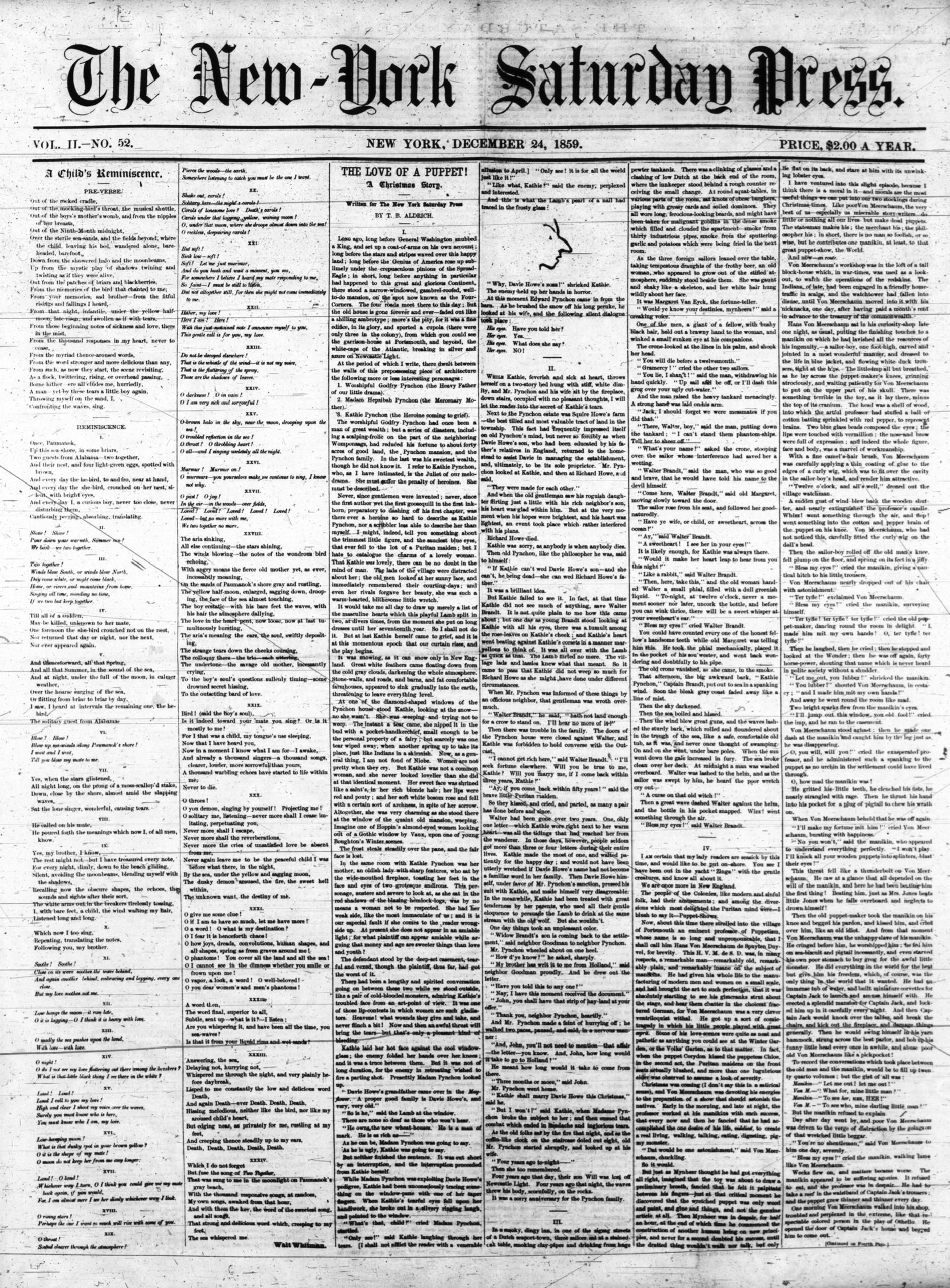
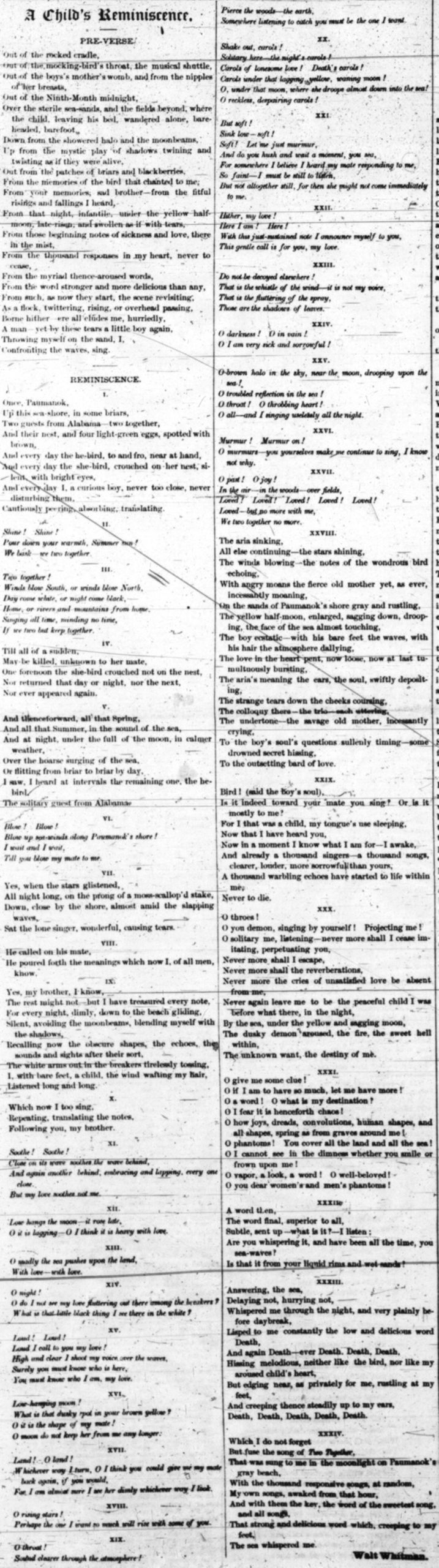
A Child's Reminiscense
 per.00071.001
 per.00071.001_cropped
A Child's Reminiscence.1
PRE-VERSE
Out of the rocked cradle, Out of the mocking-bird's throat, the musical shuttle, Out of the boy's mother's womb, and from the nipplesof her breasts, Out of the Ninth-Month midnight, Over the sterile sea-sands, and the fields beyond, where
the child, leaving his bed, wandered alone, bare-
headed, barefoot, Down from the showered halo and the moonbeams, Up from the mystic play of shadows twining and
twisting as if they were alive, Out from the patches of briars and blackberries, From the memories of the bird that chanted to me; From your memories, sad brother—from the fitful
risings and fallings I heard, From that night, infantile, under the yellow half-
moon, late-risen, and swollen as if with tears, From those beginning notes of sickness and love, there
in the mist, From the thousand responses in my heart, never to
cease, From the myriad thence-aroused words, From the word stronger and more delicious than any, From such, as now they start, the scene revisiting, As a flock, twittering, rising, or overhead passing, Borne hither—ere all eludes me, hurriedly, A man—yet by these tears a little boy again, Throwing myself on the sand, I, Confronting the waves, sing.
REMINISCENCE.
I.
Once, Paumonok, Up this sea-shore, in some briars, Two guests from Alabama—two together, And their nest, and four light-green eggs, spotted withbrown, And every day the he-bird, to and fro, near at hand, And every day the she-bird, crouched on her nest, si-
lent, with bright eyes, And every day I, a curious boy, never too close, never
disturbing them, Cautiously peering, absorbing, translating.
II.
Shine! Shine! Pour down your warmth, Summer sun! We bask—we two together.III.
Two together! Winds blow South, or winds blow North, Day come white, or night come black, Home, or rivers and mountains from home, Singing all time, minding no time, If we two but keep together.IV.
Till all of a sudden, May-be killed, unknown to her mate One forenoon the she-bird crouched not on the nest, Nor returned that day or night, nor the next, Nor ever appeared again.V.
And thenceforward, all that Spring, And all that Summer, in the sound of the sea, And at night, under the full of the moon, in calmerweather, Over the hoarse surging of the sea, Or flitting from briar to briar by day, I saw, I heard at intervals the remaining one, the he-
bird, The solitary guest from Alabama.
VI.
Blow! Blow! Blow up sea-winds along Paumanok's shore! I wait and I wait, Till you blow my mate to me.VII.
Yes, when the stars glistened, All night long, on the prong of a moss-scallop'd stake, Down, close by the shore, almost amid the slappingwaves, Sat the lone singer, wonderful, causing tears.
VIII.
He called on his mate, He poured forth the meanings which now I, of all men,know.
IX
Yes, my brother, I know, The rest might not—but I have treasured every note, For every night, dimly, down to the beach gliding, Silent, avoiding the moonbeams, blending myself withthe shadows, Recalling now the obscure shapes, the echoes, the
sounds and sights after their sort, The white arms out in the breakers tirelessly tossing, I, with bare feet, a child, the wind wafting my hair, Listened long and long.
X.
Which now I too sing, Repeating, translating the notes, Following you, my brother.XI.
Soothe! Soothe! Close on its wave soothes the wave behind, And again another behind, embracing and lapping, every oneclose. But my love soothes not me.
XII.
Low hangs the moon—it rose late, O it is lagging—O I think it is heavy with love.XIII.
O madly the sea pushes upon the land, With love—with love.XIV.
O night! O do I not see my love fluttering out there among the breakers? What is that little black thing I see there in the white?XV.
Loud! Loud! Loud I call to you my love! High and clear I shoot my voice over the waves, Surely you must know who is here, You must know who I am, my love.XVI.
Low-hanging moon! What is that dusky spot in your brown yellow? O it is the shape of my mate! O moon do not keep her from me any longer:XVII.
Land! O land! Whichever way I turn, O I think you could give me my mateback again, if you would, For I am almost sure I see her dimly whichever way I look.
XVIII.
O rising stars! Perhaps the one I want so much will rise with some of you.XIX.
O throat! Sound clearer through the atmosphere! Pierce the woods—the earth, Somewhere listening to catch you must be the one I want.XX.
Shake out, carols! Solitary here—the night's carols! Carols of lonesome love! Death's carols! Carols under that lagging, yellow, waning moon! O, under that moon, where she droops almost down into the sea! O reckless, despairing carols!XXI.
But soft! Sink low—soft! Soft! Let me just murmur, And do you hush and wait a moment, you sea, For somewhere I believe I heard my mate responding to me, So faint—I must be still to listen, But not altogether still, for then she might not come immediatelyto me.
XXII.
Hither, my love! Here I am! Here! With this just-sustained note I announce myself to you, This gentle call is for you, my love.XXIII.
Do not be decoyed elsewhere! That is the whistle of the wind—it is not my voice, That is the flutering of the spray, Those are the shadows of leaves.XXIV.
O darkness! O in vain! O I am very sick and sorrowful!XXV.
O brown halo in the sky, near the moon, drooping upon thesea! O troubled reflection in the sea! O throat! O throbbing heart! O all—and I singing uselessly all the night.
XXVI.
Murmur! Murmur on! O murmurs—you yourselves make me continue to sing, I knownot why.
XXVII.
O past! O joy! In the air—in the woods—over fields, Loved! Loved! Loved! Loved! Loved! Loved—but no more with me, We two together no more.XXVIII.
The aria sinking, All else continuing—the stars shining, The winds blowing—the notes of the wondrous birdechoing, With angry moans the fierce old mother yet, as ever,
incessantly moaning, On the sands of Paumanok's shore gray and rustling, The yellow half-moon, enlarged, sagging down, droop-
ing, the face of the sea almost touching, The boy ecstatic—with his bare feet the waves, with
his hair the atmosphere dallying, The love in the heart pent, now loose, now at last tu-
multuously bursting, The aria's meaning the ears, the soul, swiftly deposit-
ing, The strange tears down the cheeks coursing, The colloquy there—the trio—each uttering, The undertone—the savage old mother, incessantly
crying, To the boy's soul's questions sullenly timing—some
drowned secret hissing, To the outsetting bard of love.
XXIX.
Bird! (said the boy's soul), Is it indeed toward your mate you sing? Or is itmostly to me? For I that was a child, my tongue's use sleeping, Now that I have heard you, Now in a moment I know what I am for—I awake, And already a thousand singers—a thousand songs,
clearer, louder, more sorrowful than yours, A thousand warbling echoes have started to life within
me, Never to die.
XXX.
O throes! O you demon, singing by yourself! Projecting me! O solitary me, listening—never more shall I cease im-itating, perpetuating you, Never more shall I escape, Never more shal the reverberations, Never more the cries of unsatisfied love be absent
from me, Never again leave me to be the peaceful child I was
before what there, in the night, By the sea, under the yellow and sagging moon, The dusky demon aroused, the fire, the sweet hell
within, The unknown want, the destiny of me.
XXXI.
O give me some clue! O if I am to have so much, let me have more! O a word! O what is my destination? O I fear it is henceforth chaos! O how joys, dreads, convolutions, human shapes, andall shapes, spring as from graves around me! O phantoms! You cover all the land and all the sea! O I cannot see in the dimness whether you smile or
frown upon me! O vapor, a look, a word! O well-beloved! O you dear women's and men's phantoms!
XXXII.
A word then, The word final, superior to all, Subtle, sent up—what is it?—I listen; Are you whispering it, and have been all the time, yousea-waves? Is that it from your liquid rims and wet sands?
XXXIII.
Answering, the sea, Delaying not, hurrying not, Whispered me through the night, and very plainly be-fore daybreak, Lisped to me constantly the low and delicious word
Death, And again Death—ever Death. Death, Death, Hissing melodious, neither like the bird, nor like my
aroused child's heart, But edging near, as privately for me, rustling at my
feet, And creeping thence steadily up to my ears, Death, Death, Death, Death, Death.
XXXIV.
Which I do not forget But fuse the song of Two Together, That was sung to me in the moonlight on Paumanok'sgray beach, With the thousand responsive songs, at random, My own songs, awaked from that hour, And with them the key, the word of the sweetest song,
and all songs, That strong and delicious word which, creeping to my
feet, The sea whispered me. Walt Whitman.
Notes
1. This poem later appeared as "A Word Out of the Sea," Leaves of Grass (1860); as "Out of the Cradle Endlessly Rocking," in "Sea-Shore Memories," Passage to India (1871); and finally in "Sea Drift," Leaves of Grass (1881–82). [back]